THE QUARTERLY NEWSLETTER OF THE UK AND IRELAND SPILL ASSOCIATION
MV WAKASHIO LOSS AND SPILL LLANGENNECH DERAILMENT UK SPILL AND ISAA MERGER MEMBER NEWS AND ... MUCH MORE
PRODUCED BY
1
PLAN FOR THE BEST. PREPARE FOR THE WORST.
How prepared are you? The unpredictability of a spill, the impact it can have on the environment, and on the responsible party’s business, calls for a prudent approach to regularly reassess potential risks and their consequences, and to apply commensurate levels of risk mitigation. But navigating through oil spill preparedness and response can be daunting. With over 30 years of experience in oil spill response and preparedness globally, Oil Spill Response Ltd. provides peace of mind and expert support through every phase of preparedness from planning, training and exercising, to identifying oil spill equipment requirements and response services. Managing oil spill risk and meeting regulatory requirements can be left in our expert hands. Strategically positioned in ten locations on six continents, OSRL offers an end-to-end oil spill service and integrated solutions for all of your preparedness and response needs. We’re ready to assist anytime, anywhere. In the event of an incident, OSRL members have access to five oil spill 2
response experts for five days, with one call, ensuring coordination when it’s most crucial.
In good hands OSRL Membership provides expert guidance and support across all tiers of preparedness: • Training of personnel • Range of contingency planning, consultancy and advice • Fully maintained response equipment • Exercises
Contact us Get in touch to speak with one of our representatives about managing your oil spill risk: MyOSRL@oilspillresponse.com
www.oilspillresponse.com
CONTENTS 4 6-7
INTRODUCTION AND WELCOME UK AND IRELAND SPILL ASSOCIATION A UNITED FUTURE
8
UK AND IRELAND SPILL ASSOCIATION WORKING GROUPS
9
INTRODUCING INTERNATIONAL SPILL ACCREDITATION SCHEME
10-12 13
LAND CONTAMINATION RISK MANAGEMENT BEST PRACTICE GUIDE
14-17
INDUSTRY NEWS
18
NEW PRODUCTS
19-22
22 23-25
MV WAKASHIO – COUNTDOWN TO AN ENVIRONMENTAL TRAGEDY OAMPS AGREE TO BECOME EVENT SPONSOR SIGNIFICANT DERAILMENT AND FUEL SPILLAGE IN SOUTH WALES
26
NEW MEMBERS
27
UK AND IRELAND SPILL ASSOCIATION 2021 EVENT PLAN
Spill Alert is the official magazine of the UK and Ireland Spill Association. It is published by the Association whose Registered Office is; 39 Chapel Road, West End, Southampton, SO30 3FG. The views in the magazine may not represent the views of the Association if the authors are not employees of it and are therefore individual views. No article may be reproduced without the permission of the Association whose contact details are below
© UK and Ireland Spill Association Ltd - 2020
All enquiries for membership of the Association, editorial, advertising or attendance at events should be made to: Mark J Orr, Executive Director, UK and Ireland Spill Association Ltd info@ukirespill.org Tel: 0333 444 1890 Mob: +44 7864 707408 www.ukirespill.org
All enquiries for marine, shoreline and inland accreditation should be made to: John Dawes, Executive Director, International Spill Accreditation Scheme Ltd info@isasaccreditation.org Tel: 0333 444 1891 Mob: +44 7710 378697 www.isasaccreditation.org
3
WELCOME TO SPILL ALERT WELCOME After a 3 year break it is great to be able to write an Introduction to our new look Spill Alert. This publication has always showcased the best of our industry whether it be spill case studies from which we can all learn, the introduction of new products, learning who has moved to new posts in the industry or just to catch up with what has been happening. This edition captures a lot and I hope that you like the new fresh look to it!
Lee Barber, Chair UK and Ireland Spill Association
4
This has been a significant time for our own spill industry. After a while sat gathering dust we have completed the merger of UK Spill Association with International Spill Accreditation Association. This allows us to speak with one voice on behalf of the whole industry and to work in a united way to raise standards in accreditation and training through our accreditation body International Spill Accreditation Scheme Ltd. The quality composition of the Boards of both the trade association and the accreditation body demonstrate the depth of knowledge, experience, intellect and capability that exists when we work together to deliver. With this change has come a time to reflect on what we do and how we do it. The collective view is that there is plenty to do but we will best achieve this by being united, setting high standards for the industry to follow, being more relevant to our members,
regulators and governments, being visible in what we do, and creating opportunities for our members. Completing the merger, the increased activity in the Trade Association and the work now being undertaken by the Accreditation Body is an important part of setting and raising standards; being visible is demonstrated, in part by the re-introduction of Spill Alert and our raised profile on social media. This helps our members who are now benefitting from greater referrals of work from the Association. The guidance work we are doing will focus more effort on spill prevention and the importance of using accredited spill responders to ensure pollution planning and response is professionally delivered. One question has arisen that we are now looking into, is how we broaden our focus from just hydrocarbons to all pollution incidents. For example; chemicals, sewage and plastic in the inland and marine environments. We shall be reaching out through webinars on this in the New Year. The Association works with only a limited number of paid part time sub-contractors so relies a lot on volunteers. To all who work for the Association in whatever capacity many thanks you are making a difference! May you all have a great Christmas and a safe and prosperous New Year!
E L T www.darcy.co.uk
More details at
Inverness
Glasgow
Newcastle Sligo
Belfast
Leigh
Dublin
Norwich Cambridge
Malvern
Bridgend
Redruth
Exeter
Salisbury
Camberley
5
UK & IRELAND SPILL ASSOCIATION
A UNITED FUTURE Merger concluded between UK Spill Association Ltd and International Spill Accreditation Association Having partnered to deliver the Accreditation of MCA Marine Oil Spill Response Organisations in 2018 the two organisations have been working closely together since, not just in the marine environment but also sharing resources to deliver accreditation services to our members. Consequently, the opportunity to merge was agreed by members of both Associations and a merger agreement was signed by both Boards during September enabling the merger to be completed on 30 September 2020.
The merger enables the following: One common set of accredited marine, shoreline and inland standards that can be updated to comply with legislation and best practice. One strong trade Association speaking with a united voice for the industry across UK and the Republic of Ireland that Government and Regulators can access. One strong accreditation company whose focus is the management of the accreditation schemes, maintaining and raising standards and the production of best practice. Ability for others, eg governments and emergency planning organisations to access member network to cover surges in demand for major incidents. Production of best practice guidance that can be disseminated with authority. Ability to work with other trade associations as the sole voice for the spill response industry. Ability to represent the industry in UK, Republic of Ireland and overseas.
6
What happens now? UK Spill Ltd has renamed as UK and Ireland
Each organisation is independent of the
The Chair of International Spill Accreditation
Spill Association Ltd and has become the
other which fulfils Regulator requirements
Scheme Ltd is Stewart Ower of Compass
Trade Association representing the interests
that accreditation is not controlled by
Environmental Consultancy Ltd.
of all corporate, accredited and individual
contractors. Each has their own boards
members.
which have each met several times since the
The Boards of both organisations represent
merger.
the depth of talent available when both
International Spill Accreditation Association
organisations work together.
Ltd has renamed as International Spill
The Chair of UK and Ireland Spill
Accreditation Scheme Ltd to deliver all
Association will remain Lee Barber of Oil
accreditation and training activities on
Spill Response Ltd
behalf of the Trade Association.
The Board of UK and Ireland Spill Association Ltd is as follows: Chair: Lee Barber, Oil Spill Response Ltd; Vice Chair, Manufacturer and Interspill Representative: Richard Proctor, Darcy Spillcare Ltd; Inland Spill and Consultancy Representative: Ruaraidh McKinnon, RSK RAW Group; Marine Spill Representative: Mark Shepherd, NRC Environmental Services Ltd; Regulator, Government contacts and the promotion of Best Practice: Robert Evans, Adler and Allan Ltd, Chair of ISAS who will represent the Accreditation Schemes: Stewart Ower, Compass Environmental Consultancy
Executive Director UK and Ireland Spill
The inland accreditation schemes are
Association: Mark Orr 07864 707408,
currently being updated and by mid 2021
info@ukspill.org
ISAS will be ISO 9001 accredited.
In attendance: Executive Director ISAS Ltd – John Dawes
For further information please contact:
To support the merger a new website,
Mark J Orr
www.ukeirespill.org is being built and will be live shortly. In the meantime,
Executive Director UK & Ireland Spill Association
www.ukspill.org will continue until the new
Mob: 07864 707408
site is up and all traffic to that domain will be routed to the new domain when live. The new ISAA website, www.isaa.org.uk has been rebranded as www.isasaccreditation. org . A new website is being built which adopt some of the back end features of the accreditation schemes which are on www.spillonline.org. It will have a ‘family’
E-mail: info@ukspill.org John Dawes Executive Director International Spill Accreditation Scheme
Mob: 07710 378697 E-mail: info@isasaccreditation.org
resemblance to www.ukeirespill.org.
Irish member Representation : To be appointed
7
UK AND IRELAND SPILL ASSOCIATION WORKING GROUPS
We have formed several sector-specific working groups to help target the Association’s activities to directly support member interests: The following have been formed:
Marine Working Group (MWG)
Insurance Working Group (IWG)
The UKEireSpill-MWG represents all marine focussed members drawn from the following groups to collaborate together to create events, networking and promotion opportunities for all members:
The UKEireSpill-IWG represents all inland focussed members drawn from the following groups to generate a communication strategy for the insurance industry that highlights the importance of best practice and the use of accredited contractors to manage and execute the clean-up of pollution incidents. This may well involve the creation of events, networking, and promotion opportunities for all members of UKEireSpill and ISAS.
Manufacturers Distributors Marine Spill Response Organisations Marine consultancies Marine service companies who also undertake spill response
These groups are: So far, we have held two meetings and are involved in planning the following: 26 Jan 21 – Types of Booms and where to use them – the manufacturers and responder view. Paul Rayner, Vikoma and Mark Shepherd, NRC 25 Mar 21 – Plastic Pollution – where are we at and is how can members help? 16 – 17 June 21 Marine Spill Event National Oceanography Centre, Southampton
8
If you are not involved and want to do so please get in touch.
Corporate members ISAS Inland Accredited Members The initial plans will be going to both Boards in December If you are not involved and want to do so please get in touch.
Manufacturers Working Group (ManuWG) This is the next to start and we hope to have a meeting during December
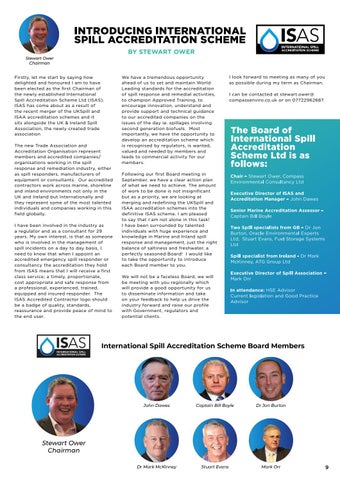
Firstly, let me start by saying how delighted and honoured I am to have been elected as the first Chairman of the newly established International Spill Accreditation Scheme Ltd (ISAS). ISAS has come about as a result of the recent merger of the UKSpill and ISAA accreditation schemes and it sits alongside the UK & Ireland Spill Association, the newly created trade association The new Trade Association and Accreditation Organisation represent members and accredited companies/ organisations working in the spill response and remediation industry, either as spill responders, manufacturers of equipment or consultants. Our accredited contractors work across marine, shoreline and inland environments not only in the UK and Ireland but Internationally and they represent some of the most talented individuals and companies working in this field globally. I have been involved in the industry as a regulator and as a consultant for 29 years. My own interest, is that as someone who is involved in the management of spill incidents on a day to day basis, I need to know that when I appoint an accredited emergency spill responder or consultancy the accreditation they hold from ISAS means that I will receive a first class service; a timely, proportionate, cost appropriate and safe response from a professional, experienced, trained, equipped and insured responder. The ISAS Accredited Contractor logo should be a badge of quality, standards, reassurance and provide peace of mind to the end user.
We have a tremendous opportunity ahead of us to set and maintain World Leading standards for the accreditation of spill response and remedial activities, to champion Approved Training, to encourage innovation, understand and provide support and technical guidance to our accredited companies on the issues of the day ie. spillages involving second generation biofuels. Most importantly, we have the opportunity to develop an accreditation scheme which is recognised by regulators, is wanted, valued and needed by members and leads to commercial activity for our members. Following our first Board meeting in September, we have a clear action plan of what we need to achieve. The amount of work to be done is not insignificant but as a priority, we are looking at merging and redefining the UKSpill and ISAA accreditation schemes into the definitive ISAS scheme. I am pleased to say that I am not alone in this task! I have been surrounded by talented individuals with huge experience and knowledge in Marine and Inland spill response and management, just the right balance of saltiness and freshwater, a perfectly seasoned Board! I would like to take the opportunity to introduce each Board member to you. We will not be a faceless Board, we will be meeting with you regionally which will provide a good opportunity for us to disseminate information and take on your feedback to help us drive the industry forward and raise our profile with Government, regulators and potential clients.
I look forward to meeting as many of you as possible during my term as Chairman. I can be contacted at stewart.ower@ compassenviro.co.uk or on 07722962687.
9
Environment Agency formally publishes updated ‘Land Contamination Risk Management’ guidance In October 2020, the Environment Agency
Although the purpose and principles of
to assess if there’s an unacceptable risk,
(EA) published a new set of clear and
the framework remain the same, the new
decide which options are the most suitable
concise guidance documents on the
document is clear, concise and up-to-date.
to manage the risk, plan and implement
management of land contamination. Land
It is aimed at anyone that may need to
remediation if needed and verify the work
Contamination Risk Management (LCRM)
manage or deal with land contamination,
completed”. While LCRM is relevant to
replaces the long-standing guidance
including landowners, developers, planners
all those involved in or responsible for
known as the Model Procedures for the
and regulators. The guidance is a more
managing land contamination, the EA
Management of Land Contamination (CLR11)
intuitive approach to the management of
stressed that the person responsible for
which has now been formally withdrawn.
land contamination and includes up-to-
applying LCRM is appropriately competent
date terminology to advise users on “how
in the tasks they are doing for each stage.
CLR11 was first published in 2004 as a
sites that the EA regulate, reference must
research document and was developed to
now be made to LCRM not CLR11.
provide a technical framework for applying risk management processes when dealing
LCRM has been designed to be accessible
with contaminated land. The process
for both experienced and
involved identifying, making decisions on,
first-time users. It meets the
and taking appropriate action to deal with
guidelines that the EA must
land contamination. This guidance provided
meet for publishing on
a consistent approach, which complemented
GOV.UK. The online
government policies and UK legislation at
guidance is now
the time. CLR11 had never been updated,
accessible on a range
was out of date and was archived from
of platforms such
GOV.UK in 2016. It has now been formally
as mobile phones
withdrawn.
and tablet
The EA is aware that CLR11 is extensively referenced and stated that there is no immediate action to replace all of these references. If people search GOV.UK for CLR11 they will be redirected to LCRM. For
10
computers.
It includes a helpful list of basic site details
Stage 2 focuses on options appraisal and
specific ways; under the planning regime, a
and general information required for any
the 3 steps to follow, including identifying
competent person is defined as “A person
reports that may be required, and useful
feasible remediation options, doing a
with a recognised relevant qualification,
links to relevant guidance via the CL:AIRE
detailed evaluation of options, and selecting
sufficient experience in dealing with the
Water and Land Library. Documents linked
your final remediation options.
type(s) of pollution or land instability, and membership of a relevant professional
within the guidance also include relevant British Standards. LCRM is comprised of 4
Stage 3 has 4 steps. These focus on how
organisation.” For all other works, the
HTML guides.
to develop a remediation strategy, how to
LCRM states that “we expect you to have
implement it and how to ensure and that the
appropriate knowledge, skills, experience
remediation has been verified, including any
and qualifications in the: i) specific area
long-term monitoring and maintenance if
of LCRM you are doing, and ii) the type of
required.
contamination you are dealing with”
The remediation process has been improved
Of particular relevance to UK and Ireland
with the main emphasis being on a single
Spill Association members, the guidance has
You can print the 4 HTML guides, search for
remediation strategy and there is also now
updated and clarified the EA’s position with
particular terms more easily and save them
more emphasis on adopting a sustainable
respect to ‘new pollution’ such as pollution
as
remediation approach throughout, using
resulting from spills. The guidance states
PDFs if required. The latest version will
for example, the SURF-UK Framework. The
that if you have caused the pollution you
always be on GOV.UK.
new LCRM includes a remediation matrix to
must:
Before you start – everyone must read this. Stage 1 Risk Assessment. Stage 2 Options Appraisal. Stage 3 Remediation and verification.
determine which remediation options are The stages within the framework have been
most appropriate and gives you remedial
1. Identify the source and clean it up
reviewed and updated to form a three-stage
options depending on what contaminants
quickly
approach. This three-stage approach is as
are found within the soil or water.
2. Return the site to its original state and
follows:
The EA have stated that they are currently
deal with any adverse effects it caused
updating this with an aim to improving it.
3. Put measures in place to prevent it happening again
Stage 1 focuses on the three tiers of risk assessment: Preliminary Risk
The guidance states that you must be a
4. Where appropriate comply with the
Assessment (PRA), Generic Quantitative
competent person with training, knowledge
Environmental Damage (Prevention and
Risk Assessment (GQRA), and Detailed
and experience in remediation to complete
Remediation) Regulations
Quantitative Risk Assessment (DQRA)
works at stage 3 of the process. The guidance defines competence in two
11
The guidance provides links to pollution prevention guidelines for businesses published on GOV.UK and to section J of the Environment Agency’s approach to groundwater protection which states that “The Environment Agency requires those who cause new land or water contamination (for example, contamination from an accident or incident) to manage it promptly and effectively. They should identify and secure the source and remediate the contamination and any effects it has caused, to ensure groundwater quality is protected and where necessary restored.” Importantly the LCRM guidance will ONLY be online and will be periodically updated so that the information is current policy. This means it is no longer a static PDF that is difficult to update but it is a live suite of documents that can be managed and updated easily. The EA have stated that: “This is not just our guidance, we want the industry to embrace it, help us to improve it and keep it up to date. It had a big act to follow.” Dr. Jon Burton, ISAS board director commented that “The ISAS board are in the process of reviewing the content of the guidance and will be incorporating it into the assessment of accredited contractors under the ISAS accreditation scheme. There will also be a review of the definition of competence with respect to ISAS accredited contractors. ISAS are also keen to engage further with the EA to establish how the guidance with respect to dealing with new pollution will be enforced.”
We hope to have a speaker to introduce the guidance and host a Q&A at the Inland Conference in April 21.
Further detailed information on the LCRM is available at: https://www.gov. uk/government/publications/landcontamination-risk-management-lcrm Our thanks to Phil Fitzgerald, BSc, MSc Hydrogeology, FGS from the Environment Agency Groundwater Protection team and Dr Jon Burton PhD, BSC of Oracle Environmental Experts for the production of this article.
12
INLAND OIL AND CHEMICAL
SPILL RESPONSE
GOOD PRACTICE GUIDANCE The vision is to produce a UK and Ireland Spill Association published document that provides guidance for Spill Response Organisations (SRO) and Operators to ensure effective and consistent standards are achieved in spill response activities. Legislation and regulatory permits are generally focused on planned activities and outcomes. Spill incidents are, by their nature, unplanned events with unknown outcomes. During a spill incident there is often a level of heightened urgency when decisions can be made in haste. If responders are not adequately trained or do not have the appropriate equipment, failure to implement an effective response could occur or the impact of the incident could be exacerbated by poor practice. Whereas the law places onus on operators
The purpose of this guidance is to provide: A framework for SROs to measure and maintain competence appropriate to the level of spill incident they intend to undertake.
Or in the event of an incident, to select a suitably qualified SRO. The guidance is based on relevant legislation and the standards reflect current good practice. Following these guidelines and standards will assist operators and SROs to manage environmental responsibilities to prevent pollution and comply with the law. It will
A benchmark for operators to assess ‘in house’ capacity and determine the level of 3rd party support (SRO) required to fulfil environmental obligations. A framework for operators to assess the capabilities and competence of SROs to ensure they are suitably qualified to respond to an incident on their behalf.
and SROs to ensure all measures necessary
Competence can be demonstrated via
are taken to prevent and limit the
appropriate accreditation and continued
consequences of an incident, due to the
commitment to training and improvement.
multiple permutations of the type, scale
(Delivered through the robust accreditation
and potential impact of a spill incident,
modules provided by ISAS Ltd and our
it is not possible to provide prescriptive
Accredited training providers)
assist organisations to realise that if they cause pollution or allow it to occur and they fail to make appropriate provision to respond and rectify an incident that does occur, they may be committing a criminal offence. The guidance and standards provide a framework that allows operators and SROs to demonstrate they have followed good practice in preparing for and responding to spill events.
guidance for each incident type. The guidance is applicable to spill However, there is a duty of care placed
response organisations and operators with
on operators to assess the risk posed by
responsibility for responding to spills within
their activities and ensure they have made
an inland environment only.
is current and in line with any regulatory
of such an event. This is generally achieved
These guidelines will be produced by UK
in response technologies; on this basis a
via robust incident response planning and a
and Ireland Spill Association in consultation
combination of ‘in house’ trained response
with International Spill Accreditation
and 3rd party contractor (SRO) retained
Scheme, to assist operators, SROs, local
support.
authorities, Regulators and other key
adequate provision to mitigate the impact
stakeholders: To meet environmental obligations, it is therefore important to ensure
To establish that appropriate provision
the competence and capacity of the
is in place to mitigate the impact of a
‘responder’ employed to act on behalf of
foreseeable spill incident.
the organisation.
It is, however, important that the guidance updates and reflects any new learning review will be undertaken within 2 years. The Association is seeking support with completing this guide and is seeking an experienced environmental consultant/ land contamination responder to assist in completing the guide. There will be an honorarium payment for completing this work. Please contact Mark Orr at info@ ukspill.org.
13
INDUSTRY NEWS NEIL HORNBY APPOINTED AS NEW CEFAS CHIEF EXECUTIVE
STAY UP TO DATE ON THE LATEST INDUSTRY NEWS
Neil Hornby has been appointed as the
new chief executive of Cefas (Centre for Environment, Fisheries and Aquaculture Science).
ORACLE EXPAND THEIR TEAM AND BASES
Following the retirement of Tom Karsten earlier this year, Defra has appointed Neil Hornby as the new Chief Executive of Cefas. Neil will take up his new post in January 2021. Until then Tim Green will continue as Interim Chief Executive. Neil Hornby is currently the Director of Marine and Fisheries in Defra, a post he has held since 2016.
“
Neil Hornby said: It is an enormous privilege to be
to strength during 2020. We recruited a
Provis, and they also moved into new larger
number of new starters earlier this year,
office accommodation allowing further
including our new office administrator, Jo
growth and development of the team over
Emery, who joined the Malvern office on the
the coming years.
first day of lockdown! Fortunately she took
Our Cornwall office has also grown with Ian
it all in her stride and continued to work
Milward, Remediation Engineer, and Elliot
from home until restrictions were eased
Thomas, Environmental Consultant, both
We had four other new starters during
relocating from the Malvern office.
lockdown, including Duncan Houlden,
Recruitment has continued through the
who joined us as a Senior Environmental
summer with Abbie McCarthy, Evy Hughes
Consultant in April. He will be opening our
and Ed Canney all joining in August
new Pembrokeshire office in the Autumn.
and September. Ed, Senior Remediation
Gwilym Luckett, Assistant Environmental
Engineer, is currently working from Kent
Consultant, and Dominic Richards, Spill
but will be joining the new Pembrokeshire
Response and Remediation Technician
office in early 2021.
joined the Malvern team and Steve
We continue to grow the team with
Scammell, Senior Spill Response and
vacancies in our Malvern, Hampshire and
Remediation Engineer, joined the team in
Belfast teams.
Hampshire. More details from: The team in Hampshire has also grown through the relocation of one of the
14
www.oracle-environmental.com
appointed as Cefas Chief Executive. It is an exciting time to be joining Cefas as the UK takes on responsibility for managing our fisheries and we continue to strengthen our leading role in protecting the marine environment
around the world. Science and analysis will be at the heart of this and I’m look forwarding to working with everyone in Cefas to make the most of the opportunities ahead.
Welcoming Neil’s appointment, Director
General for Environment Rural and Marine
“
David Hill said: I’m delighted that Neil will be the new
“
Malvern Environmental Consultants, Aaron
“
OEE has continued to grow from strength
CEO of Cefas. He brings a wealth of
experience in marine and fisheries to the role and will provide great leadership
to Cefas’ mission to deliver the highest quality marine science
COMPASS INCREASE THE FAMILY BUSINESS
environmental setting and meticulous attention to detail when carrying out site investigation works. Harry is no stranger to the business having
It is with great pleasure that we can
grown up with the smell of kerosene in
announce that Harry Ower has joined
his nostrils! He has always shown a keen
Compass Environmental Consultancy as
interest in our work, in particular site
a Graduate Environmental Consultant to
investigations and fieldwork having taken
further strengthen our family-run business.
plenty of opportunities to work with Compass during his holidays over the
He comes to us from the University of
past couple of years. He has his SPA card
Winchester where last year he completed
for petrol station forecourt work and has
his Archaeology degree and is currently finalising his MSc qualification. The fields of Archaeology and Environmental Science share many common factors such as thorough understanding of soils,
TWO LEADING ENVIRONMENTAL FIRMS MERGE: SEED AND PAULEX CREATE NATIONAL NETWORK
already been put to good work supporting
Harry Ower joins the family firm!
shop’, but also meant very much business as usual. We have worked hard to become
reaction throughout the whole of the UK.
a market leader while ensuring we maintain the reputation of being innovative, friendly, efficient and responsive with technically excellent staff. Seed is capitalising on the profile Paulex established in the south west, attracting new clients while maintaining the regular workflow provided
Environmental and Paulex Environmental,
by established and valued customers.”
merged creating a world-class leader in environmental incident response and
Seed are continuing to evolve in the
pollution management.
marketplace and strategically diversify the breadth of their services. The core
The bringing together of the two
and focus of the business remains
companies saw the exciting collaboration
environmental claims management
of the talented and expert staff, pooling
(ECM), but Seed are exploring options
of resources, enhancement of knowledge
to further increase their emergency spill
streams and the alliance of industry
satisfaction and the delivery of excellence. The synergy was apparent as both companies specialised in environmental and pollution incident response; environmental claims management; site investigation; decontamination; remediation; restoration services; and monitoring for loss adjusters; insurance companies; commercial entities; public sector; and private clients. Merging with Paulex provided Seed with a south west outpost, which was the last piece in the jigsaw for establishing a national presence on a local scale. The new Exeter office has adopted Seed’s model of
More details at: www.compassenviro.co.uk
service levels and unrivalled speed of
pollution control specialists, Seed
drive and passion for quality, customer
country.
meaning they can deliver high quality
In July this year, two well established
experienced Directors who share a
a number of our projects around the
response services while also harnessing Welcoming the development, Seed
their extensive inhouse consulting and
Environmental Director, Matthew Watts,
contracting resources to deliver more
said: “With offices covering most of the UK
larger scale remediation projects.
and recent growth in Northern Ireland and Scotland, bringing us together with Paulex not only gave us national coverage as a combined company, but also combined our skill sets for clients of both businesses. This was very much a strategic merger to enable us to improve our service, broaden our offering and facilitate growth.” Paulex’s Managing Director, Nicholas Mullen, who has joined the Seed board, added: “The merger of the companies has brought some great minds to the same table and has established us as a ‘one stop
inhouse contracting and is now offering a more rounded inhouse service for clients throughout the south west and beyond. Having started from a small office in Suffolk
Seed Environmental can be contacted on
over seven years ago, Seed now has offices
0844 381 5650,
in Newmarket, Exeter, Doncaster, Reading,
contact@seedenvironmental.co.uk,
Tewkesbury, Glasgow, Belfast and Inverness,
www.seedenvironmental.co.uk
15
T&T Eco will be focussing on developing OSE II sales for a range of specific UK industries including: Rail & Plant, Construction & Civils (including Groundworks), Internal waterways & water systems & Industrial Distribution.
Meet: www.onestopenv.com www.iceresponse24.com Meanwhile in the UK things are looking positive: In UK Ambipar Response is now two years old and I caught up with Matthew Perkins, their Commercial Manager. Ambipar manage the national emergency incident stockpile and also manage the EMSA equivalent now based in Rotterdam. They also manage the Republic of Ireland stockpile and act and lead national incident responders. Uniquely Ambipar work across all aspects of incident response; nuclear, biological, chemical, hydrocarbon, clinical waste including animal and human body parts. This year there usual busy workload work has been enhanced by COVID. When COVID hit they worked closely with DEFRA to manage the reception of UK citizens returning under repatriation flights which involved the sterilisation of aircraft, coaches facilities etc. This COVID work has extended into sterilisation of critical facilities and utilities for government and local authorities and continues now. They are very positive about the future and seeing a growing need for their services. No staff were furloughed and they have been recruiting new staff to join their teams as responders and into sales and marketing. Two years on from their acquisition Ambipar seem to be carving their own identity in the UK and European market. More details from www.ambipar-response.com
CHANGES AT THE TOP IN VEOLIA EMERGENCY RESPONSE
After many years leading their Emergency Response division Mike Chamley has retired to the Peak District where no doubt he will enjoy walking his dogs! Ably filling his shoes is Keith Minshull
16
“
We are really pleased to welcome T&T Eco to our growing global team of OSE II resellers. They are passionate about helping their clients to increase their
UK & Ireland Spill Association Corporate Member A&S International Ltd (A&S) is pleased to announce the appointment of Track & Train Limited (T&T Eco) as their first UK reseller of the biological enzyme bioremediation product Oil Spill Eater II (OSE II). A&S has represented this US manufactured environmentally friendly oil clean up solution since January 2019 and is responsible for a number of territories around the world including BENELUX, Denmark/Finland, Portugal, South Africa & the UK. A&S launched OSE II to the UK market at last September’s Contamination Expo held at the NEC Birmingham & were pleased with the huge amount of interest generated from a wide variety of industries for multiple applications – not just oil spills on land & water but also contaminated land. In February of this year OSE II’s inclusion on the MMO list of Approved Oil Spill Treatment Products was also then renewed until February 2025 – the only bioremediation solution included. OSE II was developed by Texas based entrepreneur Steven Pedigo in 1989 – since then it has been involved in more than 50,000 oil spill clean ups around the world. One of the largest being the successful clean-up of the 2013/14 AGIP Brass Terminal spill in Nigeria – more than 550,000 litres of crude oil cleaned from 18km of shoreline & mangroves.
productivity & profitability whilst also
protecting the environment with market leading solutions. Their experience &
contacts in their specialist areas will be
invaluable in helping to grow the OSE II brand in the UK
Said Shaun Macdonald, one of the
“
Directors at A&S.
T&T Eco is a specialist supplier of Eco-Friendly Oil Spill Remediation & Cleaning Solutions. We are thrilled to be Partnering with A&S as well as securing our position as their 1st reseller taking OSE II into the market as well as establishing ourselves as the leading natural bio-remediation solution. T&T Eco will also shortly be entering into
“
Ambipar is a Brazilian response organisation with a vision to take their operation global. There first step in this was the acquisition of Braemar Response just over two years ago. They have recently expanded this with the acquisition of two US response organisations.
T&T ECO APPOINTED AS OIL SPILL EATER II RESELLER - COMPANY WILL BE RESPONSIBLE FOR CERTAIN KEY UK INDUSTRIES
“
AMBIPAR RESPONSE EXPANDS IN US AND UK
a number of innovative collaborations
where the addition of OSE II significantly improves both the efficiency &
effectiveness of In-Situ Hydrocarbon removal
Commented Mike Page, Director of T&T Eco.
For further information on OSE II please visit: https://www.aands.international/ourbrands/oil-spill-eater-ii/
who has been working alongside Mike for the last few years just in case Mike finally pulled the plug! Veolia have a consistently high presence in spill response and hold a large number of term contracts of which the Highways England is the jewel in their crown. Keith is looking to expand their activity and we will no doubt meet up as he has agreed to host one of our regional meetings at Kingswood when we are able to hold them.
For further details: https://www.veolia. co.uk/services/emergency-response Keith can be contacted on: keith.minshull@veolia.com
SUN EUROPEAN PARTNERS PURCHASES ADLER & ALLAN FROM FELLOW PRIVATE EQUITY FIRM LDC Sun European Partners has agreed to buy UK environmental risk reduction specialist Adler & Allan from fellow private equity investor LDC.
replace the long term leadership team. After a difficult year the business quickly
The existing senior management team
recovered and the business, with perhaps
remain in place which will give continuity
clearer direction and direct leadership is
of leadership and direction and the day
unified under one brand and there is now
to day business is unaffected by this
better integration of service delivery to
ownership change.
the customer. Now settled, their financial performance has been impressive and
We look forward to seeing what will
they have grown improving headline sales
happen over the medium termand will
and EBITDA which must have delighted
catch up with them in the next issue. More
Sun European Partners managing director
LDC and possible prompted the sale. Their
details at: www.adlerandallan.co.uk
Paul Daccus said, “Business services
acquisition of OHES in particular and also
continues to be a key area of focus for
LCM Environmental’s forecourt division
Sun European, and our investment in
have strengthened their service delivery in
Adler & Allan is another example of our
these specialist areas.
commitment to finding value in this sector. “The company’s strong reputation for high quality service, as well as its leading position in the growing environment risk management market, shows its enormous potential. We look forward to working closely with the management team at Adler & Allan and supporting them in delivering their ambitious plans for growth both organically and through acquisitions.” Adler and Allan have grown significantly both by acquisition and organically over the last decade. Whilst owned by LDC there was a period of turbulence when a new management team were brought into
Providing expert advice and support on the assessment of environmental impacts, risks and liabilities.
www.oracle-environmental.com Providing: Response & Remediation Services Environmental Consultancy & Monitoring Services On behalf of: Insurance Industry Oil storage and distribution Industry Water Industry Electricity Industry Spill Response Contractors
To find out more t: 01684 252858 e: info@oracle-environmental.com 17
FURTHER PORTBIN TIDE INSTALLATIONS IN UK PORTS Zwanny’s (SpillTech) stationary collector for floating waste in ports has changed its name. They are now called PortBin Tide The reason for this is the Portbin Tide will take advantage of the tide having optimal levelling of tide and collecting floating plastics, cans, cups and other floating waste. The PortBin Tide range has three different units. PortBin Tide shallow, PortBin Tide, and PortBin Tide XL. With 3 options in the range the shallow unit only needs a depth of 90cm while the standard Portbin tide would require at least a depth of 120cm.
These 2 options have got a 30litre basket which when full needs to be emptied manually by hand. These 2 types would be supplied with a non inflatable boom that will guide the rubbish to the unit.
of a person(s) going in around the port or marina with a boat and net to fish out the floating rubbish. Why not look at cost savings for your port/marina/river and let nature do some of the hardwork and save time? In July 2020 we supplied another UK Port with a Portbin Tide as they can see the great benefits of cost savings and keeping the ports clean. There are now a number of Portbin Tide units in the UK and speaking to the Ports who have them they are happy with the product and if a visit is needed this can be looked at.
The third unit in the range is the PortBin Tide XL is the big brother in the range with a collecting volume of around 1000 liters, this unit will sit in a corner of the port or the marina and will work on its own but if needed can be supplied with a guide boom as illustrated above. When full the basket can be lifted out by crane and all the collected waste can be put into a skip.
Why not contact Zwanny to discuss how the PortBin Tide can be of use to you? For more details please contact: sales@zwannyltd.com or visit the website at www.zwannyltd.com
Each unit has a specially designed pump that will run for many hours which helps draw marine debris into the bin. The Portbin tide family will save the cost
RTP TRAYS – RAILWAY TRACK PROTECTION TRAYS This is necessary for many types of scenarios including; extension of fuelling areas, new fuelling points, sidings and maintenance sheds.
OPEC has been providing solutions to the rail industry since the 1980’s. In 1995 after completion of the channel tunnel OPEC installed the first generation of drip trays to protect the ballast from standing trains at Ashford, Kent. Since then OPEC has developed several versions of track protection. The evolution of design has led to a ‘washdown’ version which enables the trays to be interlinked continuously and connected to existing drainage networks or purpose build pumping stations or pump sumps.
18
However, one of the main drivers has been due to train washing activities. All water whether its rain water, cleaning water, chemicals, antifreeze, or general oils can be collected along the whole length of the train and washed down to a drain using the ‘washdown’ style.
The design incorporates a built in automated pump out system or gravity drain to underground pipework. The design also uses special seals to allow for curves in the track when required. More details from: James Ilsley – info@ opec.co.uk; www.opec.co.uk
MV WAKASHIO – A SLOW COUNTDOWN
TO AN ENVIRONMENTAL TRAGEDY The Japanese owned, Panama registered capsize bulk carrier, MV Wakashio, discharged her cargo of iron ore in China on 4 July and was routed, in ballast (no cargo onboard), via Singapore to Brazil where she was due to arrive on 13 August. She never did. Instead she ran aground on a coral reef 1 mile off the south east coast of Mauritius at 11 knots at 1925 hrs on 25 July having apparently not slowed or altered course. While owners and authorities had believed she could be refloated she started to move along the reef and eventually one of her bunker oil tanks ruptured (tanks containing the fuel for the ships engine and generators). On the 6 August there was a significant loss of around 600 to 800 tons of low sulphur fuel oil which spread into the lagoon between the reef and the shore and along nearly 30 kms of the protected bio-diverse marine waters of the Mauritian South East coast. It seems surprising that a 300m long, 50m wide, modern, well crewed, global travelling super carrier could strike a reef that it had approached in day light. However, the world was as shocked as the local Mauritians who woke to see this vessel, sitting high and proud, just a mile from their shore. For many fishermen, her bridge looked down onto their prized fishing grounds. She sat on a reef that is a key destination for tourist visitors who dive to wonder at the marine diversity on the reef and in the lagoon it protects. For the last 20 years, the Mauritius Government had sat as the ‘poster boy’ in East African oil spill response having received various tranches of inward investment totalling over $15M in training and equipment resulting in capability for which it was respected. As MV Wakashio
sat for a week she was slowly deteriorating. Battered by a storm, with no suitable tugs yet available or anchors able to be set to stabilise her position, she ‘walked’ 500m along the reef and ended up with her stern sections locked onto and being torn apart by it. With the stern no longer able to move her 22mm steel hull was starting to bend, twist and fail. On 6 August the first failure occurred causing between 600-800 tons of fuel to spill from her. Efforts were made to transfer oil internally and to schutz tanks and drums on the deck. However it was not until the 8 August, two days after the fuel leak, that another tanker was able to get alongside and serious inroads could made in pumping out what was left of the 3894 tons of bunker and other oils she had on board when she grounded. Meanwhile what had been lost was causing distress to the people of Mauritius and harm to the diversity and marine habitats along the beautiful coastline. It was also galvanising these communities into a wave of action that surprised the world. Dwarfing the government response, a public call to action saw local Mauritians and NGOs mobilise in their thousands to manufacture bagasse booms using sugar cane leaves, hair, plastic containers and plastic sheeting. Fishermen deployed them and as a result protected many coastal areas and prevented the migration of oil away from areas it had already impacted . The shock at the event and a desire for action prompted, what the organisers reported was over 100,000, people to demonstrate their desire for more action on successive Saturdays throughout late August and into September.
19
Since then the shipping company have stated that there is full satellite communication available to its crew with telephone and internet access for all. Other reports have questioned whether the vessel did strike the reef at 11 knots or meandered around more slowly beforehand as if dropping something off. A problem with the engine room has also been alleged. The question remains why put the vessel in danger by going so close to the shore? Why run aground on a reef when the surf line would have been obvious to anyone on the bridge?
The impact of the spillage eventually extended some 30km along the coastline. Early action by the government saved serious contamination of the Blue Bay Marine Reserve but areas downwind and to the East of the vessel were the worst affected and this included some mangroves swamps (10% were affected but 90% were protected by the co-ordinated response actions). Deployment of what existed as the government stockpile together with hundreds of ‘home-made’ bagasse booms held some of the lost oil at sea or close to beaches so that it could be recovered before it reached the shore or move again to unaffected areas. In late November the picture is more positive. The clean-up changed scale in late August with the arrival of professional teams from France, Japan and India. The work started on the large public areas and sand beaches where volunteers were crucial to using smaller teams for the more sensitive sites. Polyeco, Mauritius’ preincident oil spill response service provider have worked hard since the incident began and supplemented their team with other professionals from their parent company in Greece. The Government encouraged and supported them, and the ship owners’ appointed contractor, Le Floch from France, in employing local people to work alongside their responders and scientists. Nearly 200 Mauritians continued to form the backbone of the cleanup workforce of over 300 people full time engaged in the clean-up operation. As a result, the spill responders expect to complete their work by the end of February or in March 2021. Beaches are now starting to re-open, some fishing areas have been opened and more are likely to open before Christmas. The stern section of the ship remains on the reef and will be removed during first quarter of 2021 when weather and resources can be deployed for the wreck removal operation for which a contract has now been let. Tourism, so heavily impacted by COVID and then this spill, is slowly returning.
20
However, it is too early to assess the long-term environmental impact on wildlife. There is no doubt the public and NGO effort helped to minimise harm in some accessible areas and early signs are positive but equally the environmental damage of oil, the clean-up operation disturbing habitats and affecting eco systems will continue for some time. Investment will be required to restore what has been damaged over the long term. A spill like this in such a delicate environment cannot occur without significant effect. So how did this happen? On 9 Sept. the Panama Maritime Authority issued an initial report which was very critical of the seamanship in the hours leading to the grounding on a number of points:
The vessel deviated from its approved navigation plan, to round the Cape of Good Hope. The Captain authorised the approach so close to the shore, apparently to gain telephone and internet signal. The navigation system displayed the wrong scale charts. At the time of the grounding the Captain, First Officer and Chief Engineer were on the bridge.
Why did the vessel completely ignore all calls from the Mauritian authorities about its intentions as it closed the shore having entered Mauritius territorial waters at 2342 hrs 23 July nearly two days prior to her grounding. Why do this? The Government reaction has been criticised, locally and internationally. A similar incident when the MV Benita grounded had resulted in the ship being refloated in equally challenging conditions. This going to demonstrate that a past success is no guarantee that the next incident will result in the same outcome. The details of the challenges, decisions and circumstances will eventually be independently reviewed and hopefully we can all learn from this for future incidents. Some of the delay in action could have been to do with COVID restrictions which required the crew to be tested before any support could come onboard. Was the rigidity of their POLMAR plan, which dictated that as no oil had been lost, there was no need to instigate a response? Only when a loss above 10 ton occurred did the plan trigger action by making it a Tier 2 incident. Was the responsibility for a response sat with the owners of the vessel who had appointed SMIT salvage to manage the incident. Was inaction therefore their fault? Indeed, when SMIT arrived on the vessel on 31 July they confirmed that they were confident of salvage…….
The legal issues still continue. The Captain is held in custody on the island and in late October a bail application was refused. He has been charged with unlawful interference with the operation of a property of a ship likely to endanger its safe navigation and is likely to face a severe penalty by the court. No trial date has been set but an appearance is expected in January. The insurance issues still remain unresolved. To date commitments have been made to the tune of
Japan Mitsui OSK Line the charterer of the ship (hired to go to Brazil to pick up and transport cargo for them) had no legal liability but have committed $9.42m to help Mauritius to target effort on the mangrove forests and an environmental recovery fund. With regard to response costs and compensation for financial losses as signatories to the Bunker Convention the island is entitled to compensation but as signatories to the Limit of Liability Convention 1976, the limit of liability is approximately $18.7m. However had they signed the 1996 version this would be over $40m, a similar lesson learned in recent years by Australia and New Zealand with
respect to incidents involving MVs Pacific Adventurer and Rena. The costs of salvage effort and wreck removal being outside and paid separately to this. The majority of the compensation will come from the Japanese P&I club who are ‘trying to make internal estimates’ for the cost of the cleanup and work with the government to identify and compensate those affected.
Without COVID the impact on tourism could have been significant but given the island was already closed that impact is difficult to determine but post COVID it is the reputation of this beautiful island that needs to be restored so tourism can recover.
CONCLUSION All observers who witnessed this incident were saddened to see pictures of oil reaching pristine shores and then the sight of people in Tyvek suits covered from head to toe in it. Nearly five months later we still do not know why this incident happened. As spill responders the incident highlights the high cost of delay in responding and take all steps necessary to mitigate the possible effects of any spill or potential incident. The week of inaction following the grounding sealed Wakashio’s fate. Any response plan must be flexible to allow concurrent, or preventive, action to take place even if, after the incident, the action may not have been necessary. The plan must also be practised, tested and evolve based on experience.
UK and Ireland Spill Association have now conducted two webinars on this incident. The recordings of these can be viewed through the website: www.ukspill.org and in our Youtube channel.
Communication to all stakeholders, in this case particularly the public and the media, must be clear, honest and consistently delivered. The vacuum that existed here has not helped the Government, those who have invested it is pollution response over the last 20 years and Mauritius’ global reputation. With maritime shipping forecast to increase further is it time that response to these incidents is based on preventing environmental harm rather than worrying about who is going to pay. Surely that can come later!
21
TIMELINE TO AN AVOIDABLE ENVIRONMENTAL INCIDENT 16 July - MV Wakashio enters Indian Ocean en-route to Brazil 21 July - Alters course 23 July - Enters Mauritius waters 25 July - Strikes coral reef 6 August - First fuel oil loss 7 August - Government declares State of Emergency 8 August - Spill response equipment and experts from pollution response stockpile on French territory Reunion arrive in Mauritius. 11th August UN, IMO team on site12 August - Oil removal from vessel main bunker tanks complete 12 August - French pollution clean up company arrive in country to supplement clean up 15 August - Forward sections breaks from stern section 16 August - India sends equipment, technical support and clean up team 18 August - Captain and First Officer arrested 20 August - 3 Scientists and Maritime Lawyer arrive from CEFAS UK 24 August - Bow section deliberately sunk at sea 26 and 28 August – 39 whales and dolphins dead on Mauritian shores 31 August - Tug and barge with oil on board collide and sink killing 6 of the crew on the tug. 9 September - Panama authorities critical of Captain’s actions 12 September – Second weekend of protest action, this time with 150,000 people, against Government actions. Protesters claim ‘the system has failed us and we need deep structural change’. 20 Oct – Captain and First Officer refused bail on second application November – Polyeco with government permission starting to reopen beaches November – Contract let for removal of Wakashio’s stern section by late Spring 2021 November – Polyeco estimate their clean up and remedial work will conclude by late February/mid March 2021.
OAMPS agree to become Event Sponsor and Insurance Manager for UK and Ireland Spill Association OAMPS – the specialist insurance advisor to the hazardous fuels and environmental industries – has agreed to become Event Sponsor and Insurance Manager to the UK and Ireland Spill Association for the next 12 months. Following its merger with International Spill Accreditation Scheme in September the Association is growing and seeks to place pollution response higher up the public agenda. In this way Government, Regulators, Insurers and members of the public are more aware of what happens when incidents occur and the skills and expertise required to safely manage complex pollution incidents. Lee Barber, Chair of UK and Ireland Spill Association commented: “OAMPS is aware of the complexity of the incidents our members are trained and accredited to manage safely with protection of health and the
22
environment as the highest priorities. We are keen to ensure that all are aware of the high standard work our corporate and accredited members do every time they attend a pollution incident. OAMPS’ sponsorship of our events will assist us through funding, access to venues and their experience in the Insurance industry in which they are highly respected.”
“As corporate members, OAMPS has long supported the association’s activities. Now, with its exciting events plan and goal of increasing public awareness about the challenging, technical and often hazardous works its members do, we are only too pleased to step up that support to better showcase the skills and expertise that every spill response demands.”
Adam Shefras, Managing Director of OAMPS Hazardous Industries commented:
The sponsorship commences 1 December and will run for 12 months.
“Early and effective intervention when spills occur is absolutely vital in order to mitigate damage to the environment as well as the companies involved, as clean-up costs and consequences can be significant. That’s why we are delighted to increase our support of the association and its members to more widely highlight the essential, complex and professional work undertaken at each and every pollution incident.
Further information from: Mark J Orr, Executive Director, UK and Ireland Spill Association Mob: 07864 707408 Tel: 0333 444 1890 info@ukspill.org
SIGNIFICANT DERAILMENT AND FUEL SPILLAGE IN SOUTH WALES Every day a locomotive pulls up to 30 railway tank wagons with fuel from Puma Energy’s terminal at Milford Haven, on the south west corner of Wales, to its two regional inland terminals at Westerleigh (near Bristol) and Theale (Reading). Each of the wagons carry up to 80,000 litres of fuel (diesel, petrol, kerosene, aviation fuel). This is not unusual. In the UK most fuel is moved from terminals on the coast to inland sites by rail and there are up to 700 railway tank wagons operating safely on the UK rail network each day. Each wagon saves 3 HGV tanker clogging the road network and is a safer and more environmentally sustainable way of moving bulk fuel quickly and efficiently around the country. It is a tried, tested and heavily regulated process. In this case, Puma Energy contract with a tank wagon owner, usually VTG (UK) or Touax, from whom they rent the wagons for 36 to 60 months. They appoint a haulier who supplies the locomotives that pull the tank wagons and manage the logistic aspects of rail movement. They engage a maintainer, certified by Network Rail to be competent, to maintain the tank wagons on their behalf. The railway tank wagons require periodic (8 year) and Intermediate (4 year) integrity testing and inspection of each wagon which is managed by the wagon owner who will use an accredited body eg. Bureau Veritas or Zurich to undertake this work. All other testing and maintenance is undertaken by the appointed maintainer.
The maintainer conducts annual, monthly, weekly and daily inspections. The rail industry has a strong safety culture based around inspection and audit which does make this mode of travel very safe. However, in this case something quite unusual appears to have happened! About 23:15 hrs on 26 August 2020, train 6A11, the 21:52 hrs freight service from Robeston (Milford Haven) to Theale, conveying 25 tank wagons, each containing up to 75.5 tonnes of diesel or gas oil, derailed on the ‘Up District’ line near Llangennech, in Carmarthenshire. The derailment and the subsequent damage to the wagons resulted in a significant spillage of fuel and a major fire. The driver, who was unhurt, reported the accident to the signaller who immediately closed the line to all other rail traffic. Subsequent examination of the site revealed that a total of 10 wagons (positioned 3rd to 12th in the train) had derailed, and that around 330,000 litres of fuel had been spilt. The fire was tackled by the fire service, who ordered the evacuation of local residents due to concerns for their safety. Local people reported seeing successive plumes of flame and smoke for several hours and a strong smell of fuel. Immediate response was provided by Adler and Allan who were appointed by Puma Energy, who were promptly on the scene.
The fire made it much harder to attend to the spill as the fire service created an exclusion area of several hundred metres around the site due to the risk of further fires and the necessity to cool wagons still with fuel on board to avoid their spontaneous combustion. This exclusion lasted two and a half days. The fire is estimated to have consumed some 116,000 litres of diesel with a further 214,000 litres spilled. A further complication is that in a derailment no access is permitted close to any wagon until it is assessed as or made stable by the Rail Safety Team. With 10 derailed wagons to assess and stabilise this created a further delay in gaining access to remove fuel within the derailed tank wagons. The derailment occurred on an elevated section of the track so the exclusion area included the ditches and streams some 10-15m beneath the derailed wagons. Consequently, a large area, critical to containment and recovery of lost product, was closed to the responders. This meant another significant delay. Adler and Allan had some initial assistance from Ambipar and OSRL related to the impact of the lost fuel on the Lougher estuary which is noted for its natural diversity and shellfish beds. The pictures from the scene were startling. The fire at night making it more so.
23
spots. When the train reached the crossover at Morlais Junction, travelling at about 30 mph (48 km/h), the false flange on the right-hand wheel caught on the converging stock rail and distorted the track, leading to derailment of both wheels. Around one hundred metres further on, the partly derailed wagon encountered facing points set to route the train to the right. The locomotive and the two leading wagons went to the right and the derailed third wagon went straight ahead. The third wagon turned over onto its right-hand side and became detached from the wagon
Right-hand leading wheel of third wagon, on its side after the derailment, showing flat spot on wheel tread and false flange (RAIB)
in front of it. This caused the points and the track beyond them to be destroyed, and derailment of another nine wagons
The rail line borders the Lougher Estuary which has many cockle beds and is a minor fishery. As a precaution these were closed and remained so until water quality monitoring and shellfish sampling indicated that they were safe to consume.
prior spring tides pulling more product away from the site and into the estuary.
Regrettably due to the necessary delays in access to the site fuel did reach the lower parts of the estuary. On the 29 August Natural Resource Wales published a map showing that the fuel had reached as far as Crofty, some 10 miles from the spill site.
Meanwhile as this was a derailment, the Rail Accident Investigation Branch (RAIB) had to carry out an investigation into its cause prior to wagons and equipment being removed from the site.
followed. In a subsequent Urgent Safety Advice
By the 18 September the site was clear of all obstructions and the full mitigation plan could be implemented.
released on 5 November the RAIB stated that: ‘Examination of the brake group on the third wagon (TEA wagon GERS89005) found that the relay valve was loose on the pipe bracket. A sealing ring from one of the ports in the mating face had migrated
As part of their major incident plan Natural Resource Wales convened the Wales Environment Group which included representatives from Public Health Wales, Food Standards Agency, Carmarthenshire, Swansea and Pembrokeshire county councils, Welsh Government Fisheries Department, Maritime Coastguard Agency and Centre for Environment, Fisheries and Aquaculture Science (CEFAS). Its role is to monitor and manage the environmental impact of the spill and to help co-ordinate an appropriate response and mitigation strategy whilst managing any public health impacts and to guide the actions of organisations in minimising the impacts on people and nature. Consequently the fishery was closed for a period. CEFAS carried out daily modelling of the likely spread of diesel which showed small concentrations reaching the outer estuary, which was proved by observations of oil sheen on the high tide on the south side of the outer estuary, west of Crofty. However they estimated that almost half of the diesel that escaped into the estuary has either evaporated or biodegraded. By 8 September all wagons had been removed from site which allowed the removal of rail infrastructure, tracks, sleepers, signalling and signage etc, allowing access to the ballast which always retains product. It also enabled clearing of vegetation on the estuary side of the track and to put retention measures in place
24
Brake group on TEA wagon (RAIB) RAIB published their initial findings on 21 September and found that although all the wheels of the train were probably rotating freely when the train left Robeston, at some point during the journey the brakes on all wheels of the third wagon of the train had become applied, and remained so until the derailment. While three of the four axles of this wagon continued to turn, although their brakes were dragging, the leading axle ceased to rotate altogether, and consequently a flat spot around 230 mm long developed on each of the wheels on this axle. There was a substantial ‘false flange’ (a raised lip on the outer side of the wheel tread) associated with these flat
to a position where it lodged between two other ports, distorted the sealing rings of those ports, and probably created a route for air to pass directly from the auxiliary reservoir to the wagon brake cylinder. This would have had the effect of applying the brakes on the wagon, producing the result described above. The ECM (maintainer) for the wagon was unable to identify with any degree of certainty where and when the fastenings of the relay valve had last been disturbed. However, this may have taken place during routine repairs in the sidings at Robeston terminal or during scheduled maintenance elsewhere. There was no record of any
check on the tightness of the fastenings
causing a lengthy rail diversion and coach
(All sources used in this article are in
ever having been made, and no process
movements to be in place. At the time of
the public domain. No one has been
requiring such checks or provision of any
going to press the line is still closed and
interviewed and no opinion has been
measures, such as witness markings, which
infrastructure has yet to be reinstalled. The
sought from any response company,
would have indicated that fastenings were
disruption has therefore been considerable.
company involved in the incident, agency
becoming loose.
or consultancy. We have chosen to publish The remediation has been considerable and
as this is a major response incident of
continues.
interest to our membership and the readers
This incident has had significant
of this publication.)
consequences for rail movements having
We will continue to follow this incident and
closed the principal south wales main line,
publish what we can about it.
The images used in this article and the montage of images on the rear cover page are of the derailment site taken once the fire was extinguished. Credit Media Wales
25
NEW MEMBERS
OVER THE LAST FEW MONTHS WE HAVE WELCOMED THE FOLLOWING NEW MEMBERS
Established in 2013, Zwanny is a South Wales based distributor of a range of spill response equipment. They supply oil booms, skimmers, power packs, tanks, absorbents…all products that would be used to help prevent, clean up and contain an oil spill. They are the UK agents and suppliers for Lamor equipment (skimmers, tanks, booms, pumps). They also sell absorbents and spill kits from the only 100% UK manufacture of meltblown absorbents. They are noted for going the extra mile for their clients and Marc, the MD, prefers being out doing it than being stuck in the office! With years of practical experience in spill response and waste management he is a useful source of information and will ensure that you get the right equipment for the job. For further information contact: 01633 968083, sales@zwannyltd.com, www. zwannyltd.com See their PortBin Tode in New products
Sales Director Paul Rayner said, “We are pleased to return to UK Spill and look forward to retaking an active role in the organisation and to promoting UK business across the globe”. For further information on Vikoma please contact us on sales@vikoma.com, Tel: +44 (0) 1983 200560
Elastec is the largest manufacturer of oil spill cleanup and surface water pollution equipment in North America, with three manufacturing facilities in southern Illinois and Cocoa, Florida, encompassing over 200,000 square feet. We support our operations from international offices in Virginia, U.K., Quito and Perl, Germany We are a global leader in the distribution of oil skimmers, oil boom, fire boom, dispersant application systems, work boats, vacuum systems, portable incinerators, turbidity curtains, and custom containment boom for floating trash, debris and aquatic weed control.
For fifty years, our equipment has been operating in 155 countries. We share a passion for keeping our waterways, Following a brief absence whilst UK Spill was reorganising itself we are delighted that Vikoma has rejoined the Association. Vikoma was originally involved in the formation of UK Spill and has actively supported the Trade Organisation over the years. Vikoma is ready to retake an active role and support the organisation and its membership in actively promoting UK businesses. Vikoma is the UK’s leading manufacturer of oil spill response equipment and as one of the largest players in the market has over 50 years’ experience of supplying equipment all around the globe. Vikoma design and manufacture a complete range of oil spill response and clean up equipment, booms, skimmer, tanks and ancillary equipment at our factory based on the Isle of Wight. We are ISO9001: 2015 accredited and have a dedicated team of over 60 and a world-wide network of partners.
26
rivers and oceans clean with a network of partners around the globe. www.elastec.com Kevin Bond is the area manager for the U.K and Europe. Based in Southampton, he has spent over 24 years in the Oil Spill Response industry and has a wealth of knowledge and stories to share. Elastec are not only a major player in the marine market, we are able to support the industrial msector in sites such as Refineries, Food processing and metal processing facilities to name a few. These are all areas that can benefit from the unique products that we have to offer. Feel free to drop Kevin an e-mail at kbond@elastec.com for any questions or requirements that you might have. More details at: www.elastec.com
Since 1992 Envirofluid has been manufacturing environmentally friendly cleaning products, otherwise known as Chemical Substitutions – currently requiring distributional agents to service the growing demands within the UK & Europe. The products are engineered to safely work with the user & nature rather than against it by being developed to the highest standards of biodegradability and non-toxic content. Highly Certified and Approved, these products are well respected within industries such as Defence, Mining, Oil & Gas, Agriculture, Road & Rail and many more. Envirofluid markets products under three distinct brands – Triple7 – ActivEco – Purasolve Triple7 is a world-class range of products offering powerful yet safe substitutes for some of the world’s most common toxic and dangerous chemicals – many of which are probably in your workplace today. Feature product being the Triple7 BioConcentrate is a non-ionic surfactant solution that reduces oil mats to their mono-layer molecule or particle by separating the oil droplets in an oil spill from one another without actually combining with the oil body or forming a standing emulsion. Very short-lived micro-emulsions are formed and as the hydroxyl or water phase attachment occurs, the extremely weak oil phase serves only to create a water interface (particle separation) in water borne systems. Unlike traditional oil dispersants this means that the product does not disperse oil throughout the water column and, instead, causes it to break up on the surface which aids its recovery. Parasolve range offers low hazard alternatives to commonly used industrial solvents such as MEK, Acetone and Gun Wash as well as products containing carcinogens (cancer forming) including Benzene and its derivatives. Low hazard doesn’t mean low performance. Purasolve solvents dramatically lower health risks for workers, whilst boosting productivity by being more effective and easier to handle than the chemicals they replace. Specially designed recyclable formulations can be reused for years, reducing chemical inventory and dramatically lowering disposal and environmental compliance costs. ActiveEco is a range of chemicals specifically designed for very challenging heavy duty industrial & technical tasks. Every ActiveEco product is carefully formulated for a specific purpose and aims to provide the lowest possible risk profile compared to other products in its category. In conjunction with regular operational use of Triple7 Worksafe and Environmental products, ActiveEco can form part of a chemical regime that manages even the most difficult maintenance problems with increased cost efficiency and improved workplace safety. Envirofluid has been distributing products around the globe for the past 10 years and are now looking for distribution agents in the UK and Europe. More details from: www.envirofluid.com Direct Email: jon.cox@envirofluid.com Phone: +61 3 5564 6455
UK AND IRELAND SPILL ASSOCIATION 2021 EVENT PLAN SUPPORTED BY OAMPS : Webinars 21 Jan 21 – Types of Booms and where to use them – the manufacturers and responder view. Paul Rayner, Vikoma and Mark Shepherd, NRC 10 Feb 21 – Absorbents, what they are, and how best to use them 17 Feb 21 – MV Wakashio Part 3 – incident update, the legal and insurance picture, the environmental, political and socioeconomic of the spill. 25 Mar 22 – Plastic Pollution – where are we at and how can members help?
22 and 23 September: Contamination and GeoTech Expo, NEC Birmingham (Midlands Regional Meeting) 29 and 30 September: UK and Ireland Inland Spill Association Inland Event and Best Practice Launch to include AGM and Awards Ceremony TBC November TBC: British Disaster Management Association Conference and Exhibition
Regional Networking Meetings:
Events (other than webinar)
March ? – Fuel and Forecourt Roadshow, Belfast
22 April: (Earth Day) UK and Ireland Spill Association Inland Event - in planning
19 May: UKIFDA Expo, Liverpool - NW Regional Meeting
19 and 20 May: UKIFDA Expo, Liverpool (NW Regional Meeting)
17 June: UK and Ireland Marine Spill Association Marine Event, Southampton SouthernRegional Meeting
16 and 17 June: UK and Ireland Spill Association Marine Event, National Oceanography centre, Southampton (Southern Regional Meeting)
Meetings will be arranged in Scotland, Republic of Ireland, Wales, South West, Eastern and North East England during the year. Follow www.ukspill.org for updates to the event plan which will also be covered in monthly e-news. Due to COVID-19 the event situation is fluid. We hope that by the end of Q1 2021 the Government will allow face to face events. If they do then our events in late March and April will be face to face. However please watch the website and enews to see what is on.
23 September: Contamination and GeoTech Expo, NEC Birmingham - Midlands RegionalMeeting
SPILL RESPONSE INDUSTRY INSURANCE SPECIALISTS Our policies have been evolving since 1986 and can provide cover for: • Bespoke tanker/vacuum units with values up to £500,000 and beyond • Business Interruption losses if your vehicles are unusable after being damaged at your premises • Pollution both on and off the highway arising from your own vehicles • Defence Costs for Directors in respect of Pollution claims against them OAMPS is part of Pen Underwriting Limited which is authorised and regulated by the Financial Conduct Authority (FCA number 314493). Registered Office: The Walbrook Building, 25 Walbrook, London EC4N 8AW. Registered in England and Wales. Company Number: 5172311
Insurance Managers for UK and Ireland Spill Association Ltd & International Spill Accreditation Scheme Ltd
CONTACT US 01372 869 700 team@oamps.co.uk www.oamps.co.uk 27
28