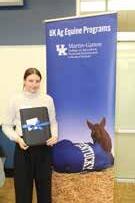
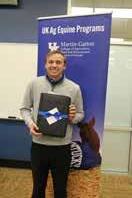
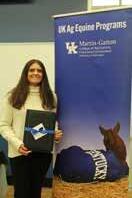
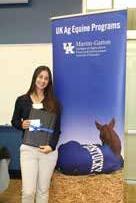
Krista Lea, MS, coordinator, UK Horse Pasture Evaluation Program
Mary Jane Little, MS, academic coordinator
James MacLeod, VMD, PhD, director
Savannah Robin, EdD, lecturer of career and professional development
Jill Stowe, PhD, director of undergraduate studies
CONNECT WITH US
N212 Ag Sciences Building North Lexington, KY 40546-0091
(859) 257-2226
equine@uky.edu equine.mgcafe.uky.edu
Cover photo by Holly Wiemers
Graphic design by Ag Communications Services, LouRae Stacy @UKAgEquine @ukequineprograms
WHEN RESEARCH UNCOVERS WIDESPREAD GRATITUDE
What started as a research project focused on demand for equine veterinary services turned into something much bigger. Although the research produced three peer-reviewed publications, perhaps the most impactful (and unexpected!) part of this research was the outpouring of unsolicited gratitude that thousands of U.S. horse owners voiced. CONTINUED ON PAGE 21
EQUINE STUDENT PARTICIPATES IN IMPORTANT TICK RESEARCH DURING
TRAVEL TO VIEQUES, PUERTO RICO
In May 2025, I was granted the opportunity to travel to Vieques to build on my undergraduate research skills and gain hands-on field experience. I assisted Hannah Tiffin and Camie Heleski in evaluating tick burden on horses. CONTINUED ON PAGE 22
FROM OUR STUDENTS…SOME OF THE PIECES WRITTEN IN AN EQUINE COURSE
UPCOMING EVENTS & IMPORTANT DEADLINES
A current equine course is designed to expose students to hot button issues in the industry and encourage them to research and formulate well-communicated opinions about those issues. Read some here. CONTINUED ON PAGE 38 FEBRUARY
WELCOME
The Old and The New
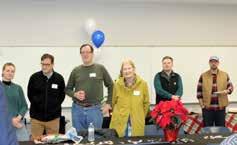
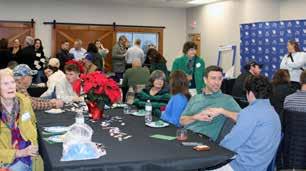
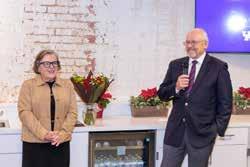
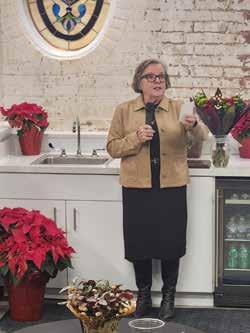
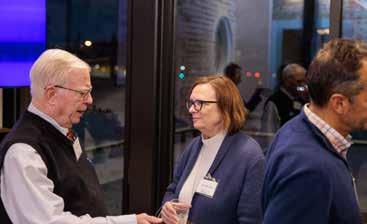
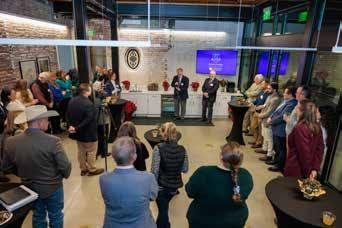
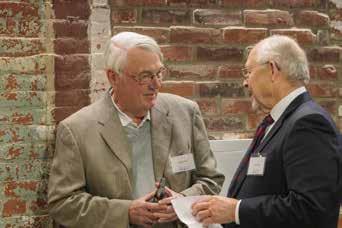
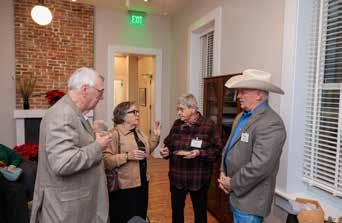
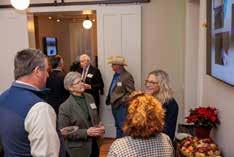
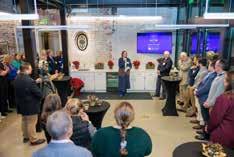
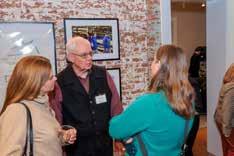
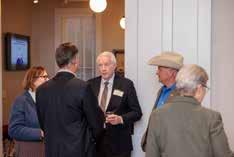
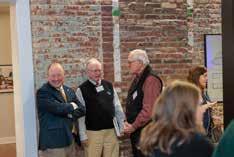
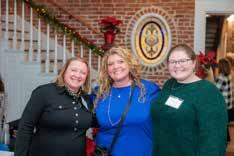
The year-long celebration of Equine Programs’ 20th anniversary culminated in a memorable reception on the evening of Dec. 2. Individuals central to planning and organizational efforts during the early years joined more recent participants to reflect on the journey and everything that has been achieved.
Attendees included many people from within UK, but also very important contributors from the private sector - the farms and equine-affiliated organizations and businesses. Indeed, the breadth and scope of our publicprivate collaborations across so many components of equine agriculture have always been a primary catalyst for our success and growth.
Personally, I very much enjoyed
JAMES MACLEOD, VMD, PHD DIRECTOR, UK AG EQUINE PROGRAMS
reflections during this past anniversary year on how much has been accomplished. However, my strongest memories about Equine Programs in 2025 will actually be the emergence of a shared realization for the many exciting possibilities going forward.
The multiple new agricultural buildings on UK’s campus are a clear and tangible component of this. A formal ribbon-cutting ceremony for the MartinGatton Agricultural Sciences Building has been scheduled for Friday, April 17. It is a beautiful building. The offices and shared workspace for Equine Programs will be on the top floor, with the Pre-Veterinary Mentoring team and Companion Animal program as our neighbors. This bright and modern work environment will really help. Everyone is looking forward to moving into this wonderful new space that undoubtedly will enhance our engagement with colleagues, students and visitors.
Another clear reason for excitement going forward is the active participation of more and more people across multiple specialties and interests. Important traditional areas of equine science and management continue to be enriched by new programmatic initiatives across disciplines within business and economics, communication, engineering, biomedicine, plant and soil biology, recreation, education, veterinary medicine, human healthcare, law and computer science, all of which
are advancing equine agriculture and career possibilities that have both direct and indirect ties to horses.
Changes within equine disciplines, and in some areas even contraction, have always occurred in the horse world and will continue. However, there is clearly also growth and innovation within equine agriculture. Going forward, the University of Kentucky will continue to be an important site of academic leadership for discovery and development of these many opportunities.
Essentially all horse enthusiasts have a personal affinity for author John Lubbock’s quote from 1894, “There is nothing so good for the inside of a man as the outside of a horse.”
There is another phrase that speaks to me which in some ways I like even more, “Horses can put people back together.” How very true.
Several top-tier scientific studies in recent years have documented the crucial contribution of horse domestication for the success of early human populations in their migration across Europe and Asia - providing major advantages in travel, trade, warfare and obtaining or growing food. As such, horses have been a very important “part of the solution” for humankind literally dating back tens of thousands of years. There is no doubt that these wonderful animals will also be a special part of our future.
Advisor: Mary Rossano, mary.rossano@uky.edu uksaddleseatteam@gmail.com
UKY Saddleseat Team
IN ADDITION TO THIS PUBLICATION, UK AG EQUINE PROGRAMS HAS OTHER READS IN ITS PUBLICATION STABLE.
CHECK OUT THE LATEST ISSUES OF THE EQUINE SCIENCE REVIEW OR THE GRADUATE GALLOP OR SUBSCRIBE HERE.
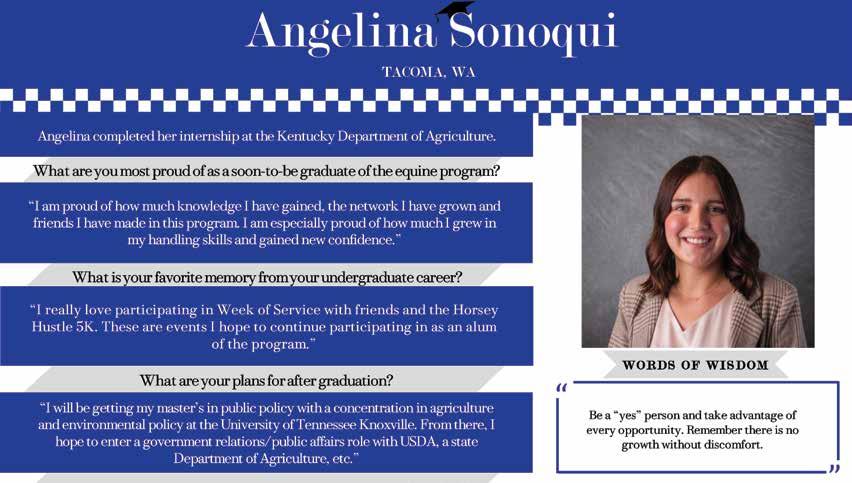
UK AG EQUINE PROGRAMS WELCOMES ANGELINA SONOQUI
Originally from Tacoma, Washington, Angelina Sonoqui’s path to agriculture was far from traditional. Growing up in a military family, she was not able to ride or spend time on a farm as much as many of her peers, but that did not stop her love for agriculture.
Sonoqui came to the University of Kentucky with the intention of becoming a large animal
veterinarian. Like many students, her career path evolved during her time at UK, where she found a passion for policy and legislation. It was after taking AFE 100: Issues in Agriculture, Food and Environment, a course that introduced her to the broad sectors of agriculture, that she began having an interest in law and policy. With the guidance and support of her advisors and mentors, Sonoqui felt confident
about her choice that she described as a significant but exciting career change.
Reflecting on her three and a half years spent at UK, Sonoqui said, “It is definitely bittersweet to have graduated; I will forever cherish my time here and be grateful for all those I met and the opportunities I had.”
Having recently graduated from the Equine Science and Management program, Sonoqui steps into a new role as Program Coordinator in the Ag Equine Programs office. Within this position, she will assist faculty, staff and students while helping continue the success of the program.
“One of the things I am most excited about in this position is getting to help students feel supported, achieve their goals and feel confident throughout their time in the ESMA program,” Sonoqui said.
Looking forward, Sonoqui plans to continue her education at the University of Tennessee Knoxville in the fall, where she will pursue a master’s degree in public policy with a concentration in agriculture and environmental policy.
UK AG EQUINE PROGRAMS BIDS A FOND FAREWELL TO ERICA RUGG
My time with Equine Programs was short, but incredibly sweet. This program is so much more than a degree—it’s a community, a support system and a place where students and staff genuinely lift one another up. When I was in college, I didn’t have the level of kindness, encouragement and commitment that these students experience every day, and witnessing it firsthand has been truly special.
Some of my favorite moments were spent at the front of the office, greeting students as they came in—whether they were stopping by to see our amazing academic coordinators, Alicia Benben and Mary Jane Little; sprinting down the hallway to meet with one of our wonderful advisors, Korie Burgess (yes, they really do run!); or hoping to catch the elusive and always-onthe-move Dr. Savannah Robin. I
loved hearing their success stories such as internships earned, study abroad opportunities secured and exams conquered. Their excitement was contagious.
The trust and compassion students have for the faculty and staff is palpable. Every day, I watched meaningful interactions unfold. Serving as a career and professional mentor for a few ESMA students gave me an even deeper appreciation for how driven, mature and capable they are. Each student had their own unique path, but they all shared one thing, a genuine love for horses. As someone who has spent years in the horse industry myself, it was refreshing and inspiring to see that same passion reflected in the next generation. Their enthusiasm will serve the industry well, and I’m proud of the horsemen and horsewomen they are becoming.
Getting to know my colleagues was equally rewarding. They all share a deep dedication to the University of Kentucky and to Equine Programs. Working alongside them was a privilege. The support they offered me and the skills I gained during my time here are unmatched. I’m excited to continue my career in Kentucky’s horse industry and to carry forward the professional growth I’ve gained at UK.
A huge thank you to everyone who makes this program what it is. I will truly miss coming to campus each day… though I won’t miss the parking, ha! I began this journey as a proud Michigan State alum, but I can confidently say I now bleed a little blue.
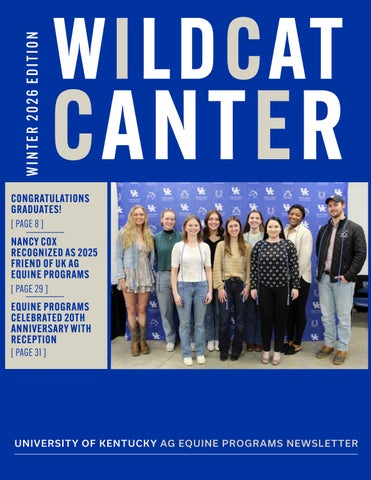
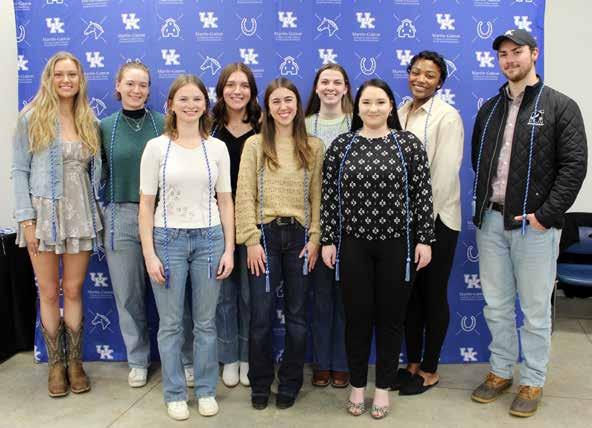
CONGRATULATIONS FALL 2025 GRADUATES!
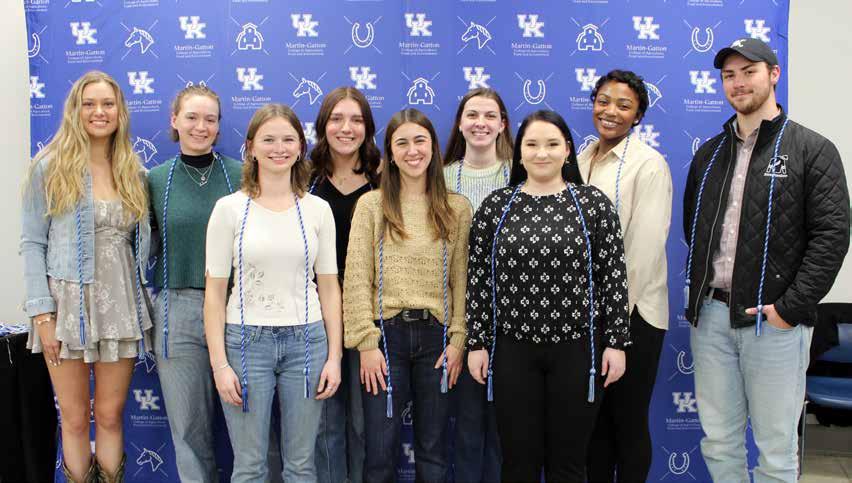
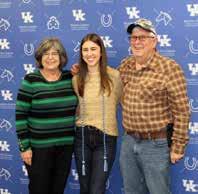
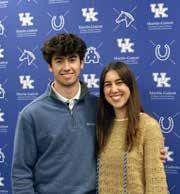
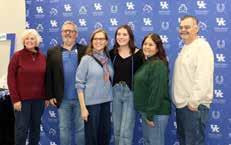
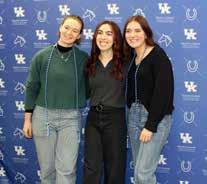
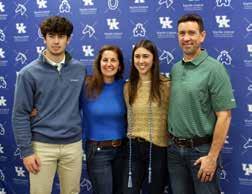
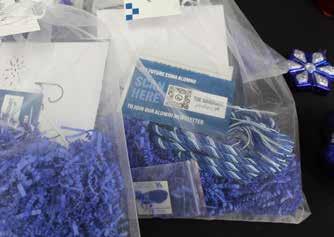
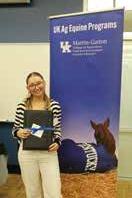
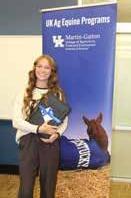
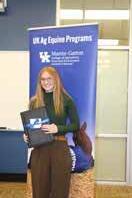
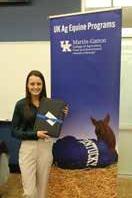
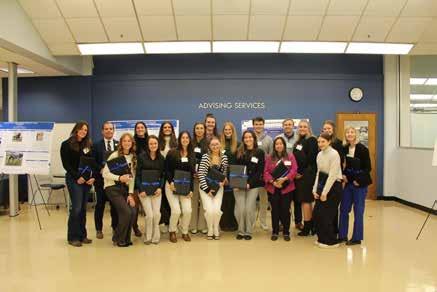
UK Ag Equine Programs hosted the Equine Science and Management Graduation Open House Dec. 18 at Maine Chance Farm’s Pirri Teaching Pavilion. Family, friends and UK faculty and staff celebrated the 18 newly minted alums.
GET TO KNOW, OR RECONNECT WITH, THE EQUINE PROGRAMS OFFICE
Bethany Smith, UK Ag Equine Programs intern and Equine Science and Management major, created a short video introducing the UK Ag Equine Programs office team. View it here
WHEN RESEARCH UNCOVERS WIDESPREAD GRATITUDE
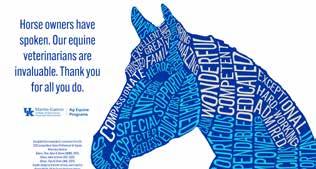
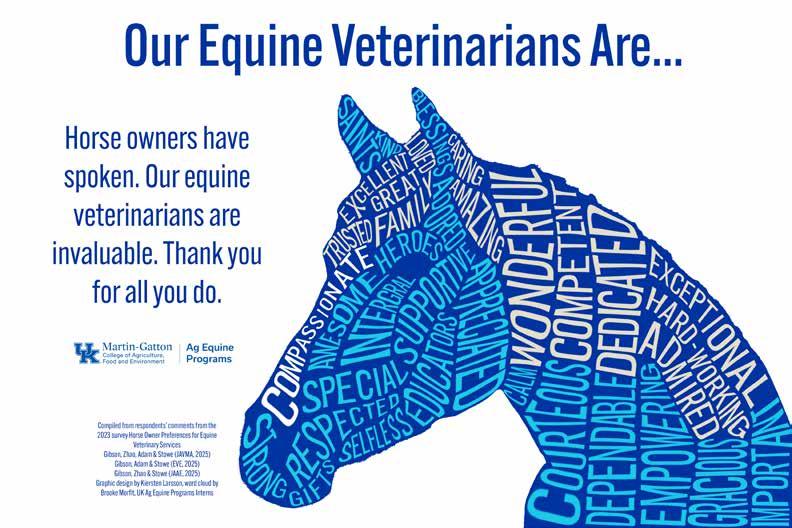
What started as a research project from the University of Kentucky’s Department of Agricultural Economics focused on demand for equine veterinary services turned into something much bigger. Although the research produced three peer-reviewed publications, perhaps the most impactful (and unexpected!) part of this research was the outpouring of unsolicited gratitude that thousands of U.S. horse owners voiced. Two talented UK Ag Equine Programs interns used these comments to create a word cloud of sorts to capture the sentiments of horse owners and share them with the people who should hear them most, our equine veterinarians.
UK Ag Equine Programs aims to discover, share and apply new knowledge on the health, performance and management of horses, enhancing the signature status of Kentucky’s equine industry. With a large undergraduate degree program, part of this mission includes preparing the next generation of equine veterinary students through a rigorous curriculum, exposure to career paths for equine veterinarians and access to a dedicated Pre-Veterinary Mentoring team and experiential workshops like pre-vet experience days. We welcome the support and collaboration of equine veterinarians.
Full-size (16x20) copies of this word cloud image are available and suitable for framing and display – just let us know if you want one by emailing equine@uky.edu
UK EQUINE STUDENT PARTICIPATES IN IMPORTANT TICK RESEARCH
DURING TRAVEL
TO VIEQUES,
PUERTO RICO
Tick Burden Pilot Study
By Chloe Young
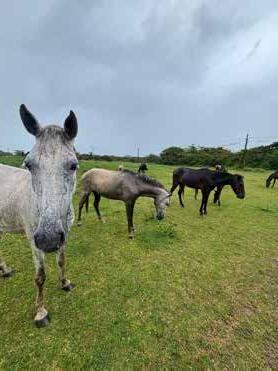
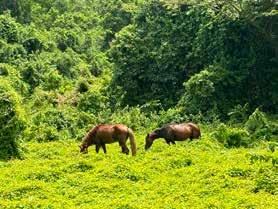
Vieques, Puerto Rico hosts an estimated 2,500 to 7,000 equids over 135 km2. Limited resources and high poverty rates on the island pose challenges for equine welfare and management. A large challenge is the dense island vegetation of Vieques, which provides a favorable habitat for ticks, a vector for equine piroplasmosis (EP). EP is a bloodborne disease that can be deadly to horses and is considered endemic in Puerto Rico.
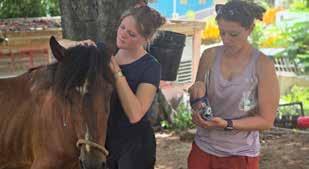
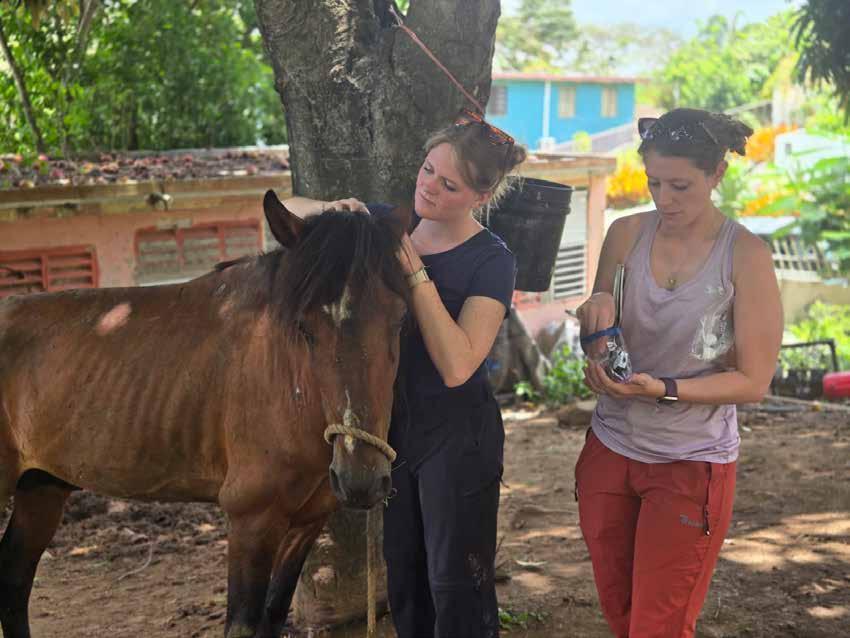
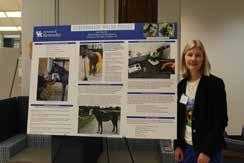
In May 2025, I was granted the opportunity to travel to Vieques to build on my undergraduate research skills and gain hands-on field experience. I assisted Hannah Tiffin, entomology assistant professor, and Camie Heleski, senior lecturer, both faculty members within the University of Kentucky Martin-Gatton College of Agriculture, Food and Environment, in evaluating tick burden on horses and the prevalence of EP parasites in ticks collected.
Our small research team from UK collaborated with island veterinarian Samantha Shone. Shone assisted in tick collection and equine assessments across the island. We used
body condition scores to indicate animal health, as high tick burden may negatively affect overall condition. Additionally, different equine management strategies were documented and categorized into one of three groups: managed, free-roaming or mixed-managed. Equids deemed as “managed” were those confined to a single property for much of the year. The “free roaming” population, while all privately owned, are equids allowed to roam the island and are scarcely confined. The third, “mixed-managed” group was for all equids intermittently confined or used in seasons of increased tourism.
Photos courtesy Chloe Young
The connection built between our group and Shone allowed us to integrate into the community and build rapport. At one point, we were getting calls throughout the day from locals wanting us to collect ticks from their horses. Conversations with horse owners were very constructive, and I recall many being intrigued by our work and open to sharing details about their horses.
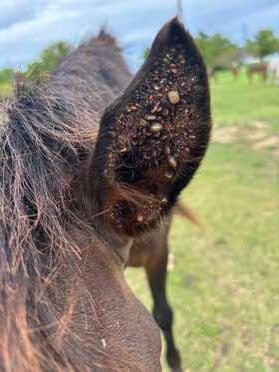
Due to the general structure of a pilot study, both time and sample size were limited, particularly because private ownership required signed consent for horse participation. Despite these limitations, a total of 583 ticks from 34 horses across all management styles were collected in a four-day period, exceeding our expectations. As we collected ticks, we had to adopt new methods of collection for efficiency, which translates to hand scraping ticks out in masses. We used an adapted body condition score for working equids to determine the average body condition of the horses, which was a 2.3 out of 5. Tick burden averaged 8.3 ticks per horse, with the predominant tick species being Dermacentor nitens, a tropical horse tick reported to be a vector for EP. Since the current prevalence for EP is unknown on the island, ongoing screening of the ticks collected from horses will hopefully provide a greater idea on the number of affected individuals.
Besides the experimental objectives, our team had an educational objective as well, which was made possible through collaborations with Hilda Rodriguez, extension agent at the University of Puerto Rico Cooperative Extension, and Angela Varnum, veterinarian and education specialist with the Equitarian Initiative. Generous funding from the Equitarian Initiative and well-rounded equine education modules created by Varnum were incorporated into a 4-H youth program. Rodriguez was able to lead and facilitate discussions with support from our team.
We delivered community-based youth education modules on topics in equine behavior, management and tick control. A total of three sessions with a group of students occurred, with the final session being an escape-room challenge demonstrating what the students had cumulatively learned. Completion of the sessions and challenge resulted in 4-H equine curriculum certificates being awarded. As a previous member of 4-H myself, I was amazed at the ingenuity of the delivery of the content and the youth participants’ positivity across sessions. Many commented on their excitement to educate their friends and appeared hopeful for similar content in the future.
Our team viewed this opportunity and pilot study as a major success; not only in the data that was collected, but also from the engaging conversations we had with horse owners and youth, the generosity the locals showed by granting us their time and the interest the community expressed in the research. Acceptance and continued support from the community is what I believe will increase our ability to return and resume data collection.
Having had this experience, taking on much of the tick collection and identification and revealing a large variation in tick burden severity, I am hopeful about the progression of this work and plan to continue contributions to future research targeting equine health on Vieques.
Tiffin and Heleski have since worked extensively on extending the future of this research and collaborative efforts with the community members through grant submissions. Although not presently having been selected for funding, the proposal has received positive feedback and the planning process has fostered continued collaboration with Shone and Rodriguez, building upon community relationships.
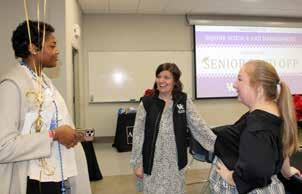
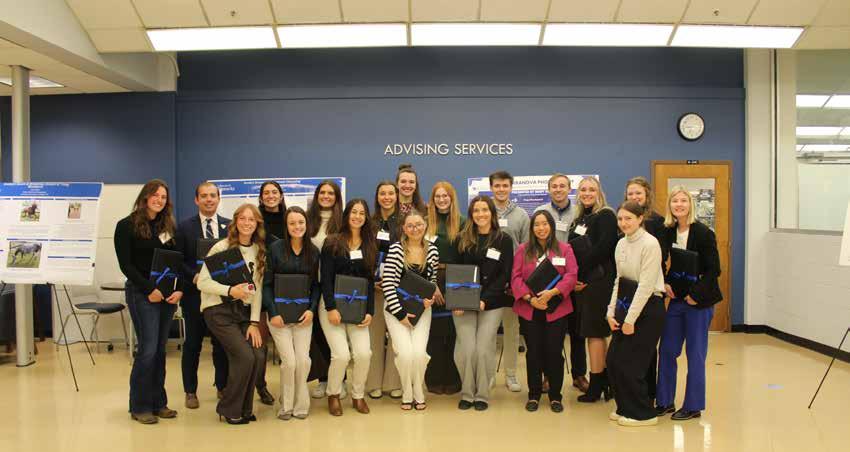
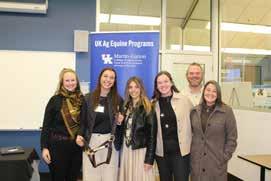
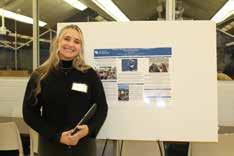
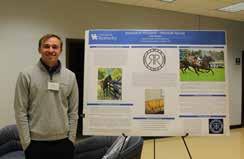
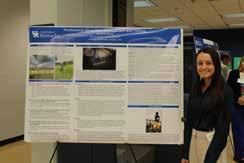
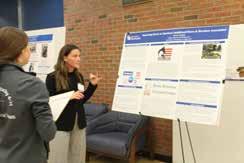
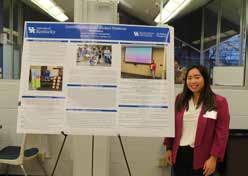
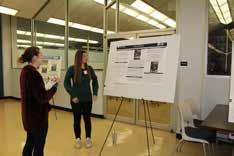
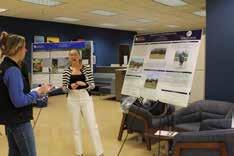
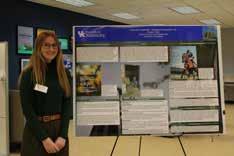
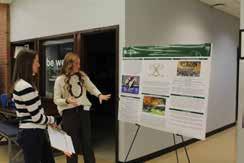
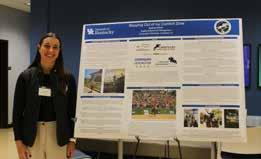
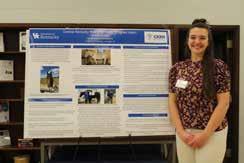
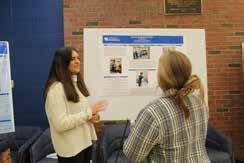
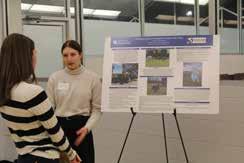
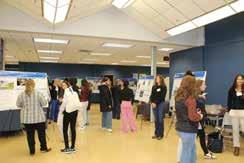
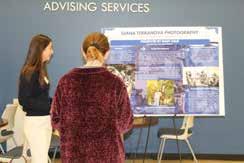
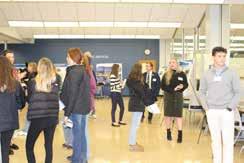
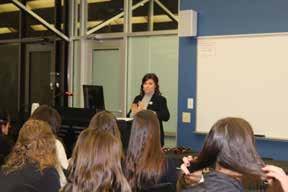
Twenty-three students presented their internship experiences Dec. 2 as part of the Fall 2025 Experiential Learning Showcase. Their hard work and dedication to their internship placements was evident in their efforts and their passion shone through their presentations.
Beau Greely, was awarded the Summer 2025 Outstanding Intern award from his work with the Horseracing Integrity and Safety Authority (HISA) in Washington, D.C. over the summer.
Sydney Zaikov was awarded the Fall 2025 Outstanding Intern award for her work with Equestrian Events Inc. during the fall 2025 semester.
Three students tied for People’s
Choice Award: Zella Schnitzspahn with Annie’s Answers, Bethany Smith with UK Ag Equine Programs and Christina Spiliotis with Kentucky Equine Hospital.
“Allowing students to showcase their work and reflect on both their internship and undergraduate experience gives them the opportunity to further prepare for their professional journey,” said Savannah Robin, lecturer of career and professional development within UK Ag Equine Programs. “This practice of sharing their story and experience provides preparation for future interviews, client testimonies and more. It is important to reflect on our experiences and also communicate what we’ve learned in order to grow; this experiential learning showcase provides that opportunity to our students.”
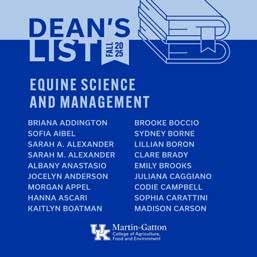
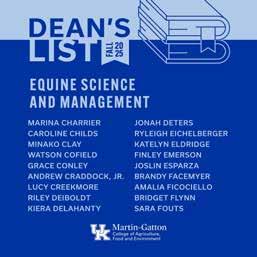
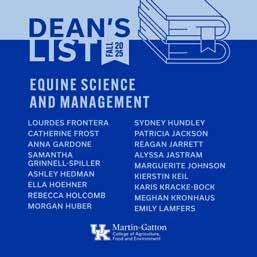
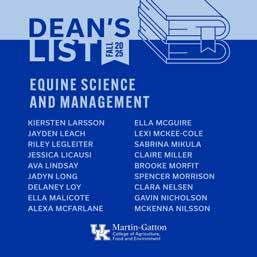
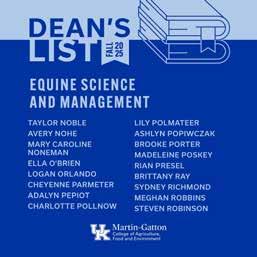
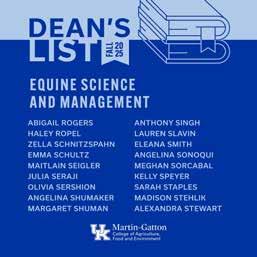
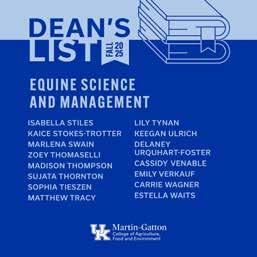
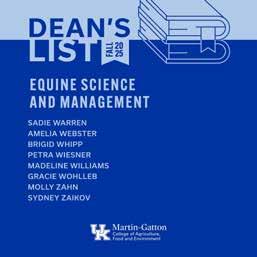
CONGRATULATIONS TO OUR FALL 2025 DEAN’S LIST STUDENTS!
NANCY COX RECOGNIZED AS 2025 FRIEND OF UK AG EQUINE PROGRAMS
$340 million. Cox had joined UK from Mississippi State University just a few months into the crisis to serve as the college’s associate dean of research.
She and other members of the leadership team under former dean Scott Smith quickly recognized the critical importance of collaboration across scientific disciplines in addressing this major challenge. Cultivating opportunities for synergy by engaging all components of Kentucky’s land-grant institution, success in solving the MRLS crisis became a high-profile achievement for the university. Indeed, her response to various challenges facing equine agriculture and broad support for equine-affiliated industries are pivotal aspects of Cox’s tenure.
By Holly Wiemers
Nancy Cox, former University of Kentucky vice president of land grant engagement and former dean of the Martin-Gatton College of Agriculture, Food and Environment, was named Friend of UK Ag Equine Programs during its 20 Year Anniversary Celebration Dec. 2.
UK Ag Equine Programs has recognized many friends over the years, but perhaps none have had as much impact on the program as Cox.
Cox is widely seen as a central driving force behind the program’s creation and one of its most ardent champions during its two decades of growth. Active and influential in her own right within Kentucky’s equine community, she is recognized for her vision for the program
and her sustained efforts in helping it rise to national prominence.
“I can’t think of any greater honor than to be in the company of so many previous awardees who have contributed so much to our programs,” Cox said. “The thing I’m most proud about this program is it is truly a partnership with our industry. Thanks to the lowly caterpillar, the university and the industry not only began to think of ourselves differently but began to realize how much we need each other.”
Cox, who currently serves as special advisor to UK’s president, is referring to Mare Reproductive Loss Syndrome. In 2001, it caused an estimated 30 percent loss of the Thoroughbred foal crop that spring, and Kentucky’s horse industry suffered economic losses of approximately
It has been 20 years since the formation of UK’s Equine Initiative, now UK Ag Equine Programs, an effort to serve the horse and the industry that supports the horse. Formed in March 2005 and formally announced by UK in May 2005, the program began as a partnership between UK and the horse industry and was established through the efforts of the UK Gluck Equine Research Foundation, the Kentucky Thoroughbred Association/Kentucky Thoroughbred Owners and Breeders and several other prominent Kentucky equine organizations.
Since its formation and throughout its rapid growth, Cox has been one of the primary leaders at the helm.
“Dean Cox’s commitment to the success of UK Ag Equine Programs has been unwavering since inception of this initiative 20 years ago. She is a true champion of the university’s efforts to advance equine agriculture through teaching, research
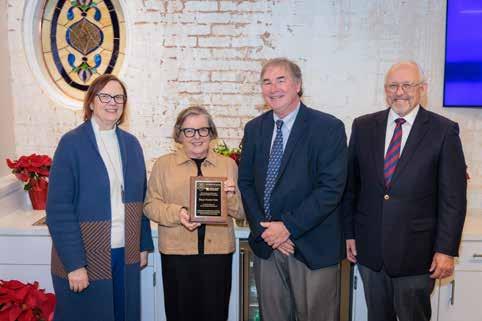
Pictured left to right, UK Vice President of Land Grant Engagement and CAFE Dean Laura Stephenson; past UK Vice President of Land Grant Engagement and past CAFE Dean Nancy Cox; UK Ag Equine Programs Director Jamie MacLeod; and UK Ag Equine Programs Advisory Board Chair Fred Sarver. Photo by Matt Barton UK Martin-Gatton College of Agriculture, Food and Environment Ag Communications.
and extension,” said James MacLeod, professor of veterinary science and director of UK Ag Equine Programs. “This award is our highest honor and there is truly nobody more deserving.”
During her time as dean of the college, Cox oversaw its $25 million research enterprise — which nearly doubled during her tenure — and represented UK on the state’s agricultural commodity boards. Cox oversaw the investment and renewal of UK’s Veterinary Diagnostic Laboratory, which serves a critical animal and public health role in the Commonwealth. She was the founding administrator for several growing equine programs and was central to initiating numerous partnerships with private industry. She also routinely served on key federal policy boards and organizations.
Cox developed deep ties with agricultural industry and educational leaders across the state, including Kentucky Farm Bureau, all major commodity organizations, Kentucky State University and various economic development partners. She began service as dean of the college in 2014. In 2020, UK President Eli Capilouto named her UK’s first vice president for land-grant engagement.
During her time as dean, Cox also led the creation of innovative equine programming and partnerships, including the Racetrack Safety Program. In recognition of her leadership in equine safety, in 2020 Cox was appointed cochair of the Horseracing Integrity and Safety Authority nominating committee. She has worked extensively with equine organizations to help advance and support the industry. She is a member of the Kentucky Thoroughbred Farm Managers Club and served on the Kentucky Horse Park Foundation Board. She is also an active member of the Iroquois Hunt Club.
The Friend of UK Ag Equine Programs was created in 2005 to recognize people who have provided advocacy, funding or other extraordinary support or a college or university employee
who has generated an exceptional relationship with stakeholders that manifested into a new program, new advocacy success or new resources.
Past Friends of UK Ag Equine Programs include:
• 2022: Sarah Coleman, executive director of the Kentucky Horse Council
• 2018: Fred Sarver, Cornerside Farm and current chair of the UK Ag Equine Programs Advisory Board
• 2017: Tom Riddle, Lexington-based veterinarian, co-founder of Rood & Riddle Equine Hospital and past chair of the UK Ag Equine Programs Advisory Board
• 2016: Matt Koch, Shawhan Place Farm, current state Representative and former member of the UK Ag Equine Programs Advisory Board
• 2015: Bennie and Cheryllee Sargent, of Sargent Quarter Horses, longtime coach for UK’s Western Equestrian Team
• 2013: Stuart Brown, Lexington-based veterinarian; vice president of equine safety for Keeneland, former veterinarian with Hagyard Equine Medical Institute and current member of the UK Ag Equine Programs Advisory Board
• 2011: Norm Luba, executive director of the North American Equine Ranching Information Council, past president of the American Quarter Horse Association and former chair of the UK Ag Equine Programs Advisory Board
• 2009: Dan Rosenberg, of Rosenberg Thoroughbred Consulting and current member of the UK Ag Equine Programs Advisory Board
• 2008: Northern Kentucky retired county extension agent trio Don Sorrell of Campbell County, Dan Allen of Kenton County and Jerry Brown of Boone County
• 2005: David Switzer, former executive director of Kentucky Thoroughbred Association/Kentucky Owners and Breeders Association and current member of the UK Ag Equine Programs Advisory Board
Pictured left to right, Stephenson, Cox, MacLeod, Sarver and Equine Philanthropy Director Caitlin Dibiasie. Photo by Matt Barton Martin-Gatton CAFE Ag Communications.
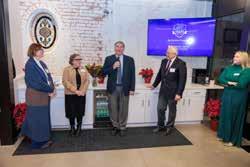
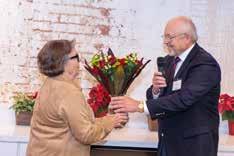
Sarver announces the award during the program’s 20th Anniversary Celebration. Photo by Matt Barton Martin-Gatton CAFE Ag Communications.
Cox speaks after being awarded Friend of UK Ag Equine Programs during its 20th Anniversary Celebration. Photo by Carrie McIntosh, CAFE Philanthropy.
EQUINE PROGRAMS CELEBRATED 20TH ANNIVERSARY WITH RECEPTION
By Holly Wiemers
Photos by Matt Barton
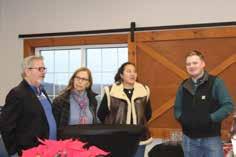
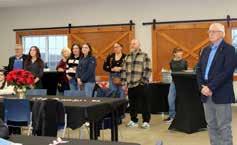
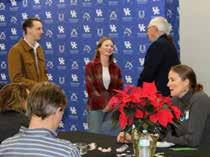
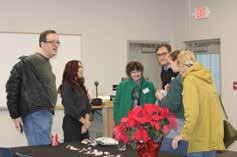
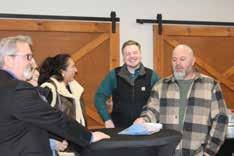
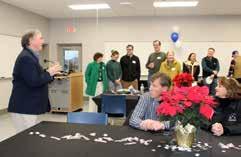
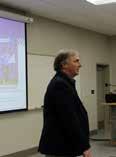
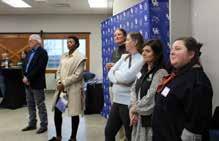
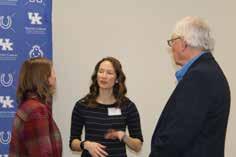
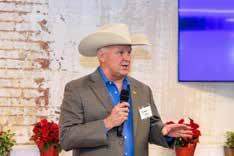
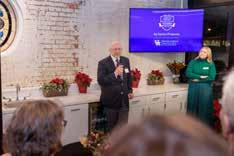
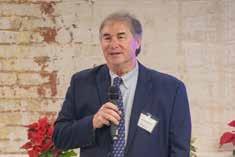
UK Ag Equine Programs hosted a reception celebrating 20 years of equine excellence on Dec. 2 at UK’s Cooper House. Speakers included UK Ag Equine Programs Director Jamie MacLeod; current Martin-Gatton College of Agriculture, Food and Environment Dean and UK Vice President of Land Grant Engagement Laura Stephenson; former Martin-Gatton CAFE Dean Scott Smith; former UK Ag Equine Programs Advisory Board Chair Norm Luba; current UK Ag Equine Programs Advisory Board Chair Fred Sarver; and former Martin-Gatton CAFE Dean and UK Vice President of Land Grant Engagement Nancy Cox.
Cox was also named the 2025 Friend of UK Ag Equine Programs at the reception, an honor she described as one of the most important of her career.
At the reception, Sarver also announced that the USA Equestrian Trust had gifted an additional $50,000 to the Nancy Cox Scholarship endowment, a scholarship open to UK equine students.
The event was held at the culmination of UK Ag Equine Programs Advisory Board meeting, where participants were provided college and Equine Programs updates from college leadership. Topics included current undergraduate program statistics, equine pre-veterinary program opportunities, an update from a recent research project conducted by Jill Stowe, faculty in the Department of Agricultural Economics, and a philanthropy update. Additionally, board members were provided an opportunity to tour the new Agricultural Sciences Building and future home for UK Ag Equine Programs.
EQUINE STUDENT MILEY PARKS PUTS IN THE LEGWORK
By Angelina Sonoqui
In the fall of 2024, University of Kentucky’s College of Agriculture, Food and Environment launched the Growing Graduates from the Ground Up Program, an initiative that aims to empower students to help improve curriculum for their peers, themselves and the college as a whole. Instructors were invited to apply for participation in the pilot program by submitting a course for review. Selected instructors were then paired with two to three student partners to collaboratively improve their curriculum and overall course learning experience.
Equine Science and Management major Mei Mei Baileys and Agriculture and Medical Biotechnology major Daniella Jackson were partnered with Ag Equine Programs Academic Coordinator, Alicia Benben. Together, the student partners met regularly to evaluate Benben’s course and brainstorm small, medium and large innovations. Through these discussions, they identified a gap in creative and hands-on learning, sparking an idea to redesign a key component of the course to better engage students with the material.
EQM 101 serves as the introductory course for Equine Science and Management students. Like many foundational courses, it is traditionally very content and exam heavy. Through their collaboration in the Growing Graduates Program, the student partners identified the final exam as an opportunity for improvement. Their goal was to design an alternative assessment that could be implemented during the spring 2025 semester.
The leading idea behind this alternative was for it to be student-designed, directed and built. The project allowed students to select a topic that resonated with them and explore it further, while providing creative freedom to showcase their knowledge and skills. Students submitted project proposals and participated in a series of check-ins with Benben throughout the semester.
“Exams only tell me so much,” Benben said. “Students’ projects show me comprehension and abilities they may not have known they have had. It’s overall just an amazing way to see how they connect with this course.”
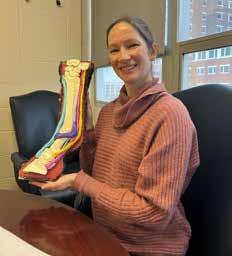
Miley Parks, an Equine Science and Management sophomore from Cornelius, North Carolina, on the pre-vet track, took EQM 101 in the fall of 2025 and was part of the second class to participate in this idea. Parks found a passion for the anatomy section of the course. She created her own specimen out of a SmartPak box that showed both the anatomical and external sides of the lower leg of the horse. Parks’ project featured color-coded ligaments and tendons, as well as a detailed bone structure, making the model both visually engaging and understandable.
Parks’ project not only showcased her technical and creative skills, but can now be used in the classroom as a study tool and resource for her peers. By turning a SmartPak box into a detailed anatomical model, she demonstrated how the project encouraged students to take creative liberty and apply concepts from the course in a tangible and long-lasting way.
“I’ve enjoyed how much of a community it is here,” Parks said. “I’m from North Carolina so I’m really far from home, but everyone here has been so kind and welcoming. Especially the professors who actually care about you and want you to thrive.”
The success of the EQM 101 term project has since inspired another foundational course, AFE 100, to implement a term project into their curriculum.
“You don’t know how assessments like this are going to land,” Benben said. “But students overwhelmingly said this mattered -- they enjoyed it, they valued it, they appreciated having choice and they felt supported.”
Alicia Benben shows off the leg model created by Parks. Photo by Holly Wiemers.
Above and below photos courtesy Miley Parks.
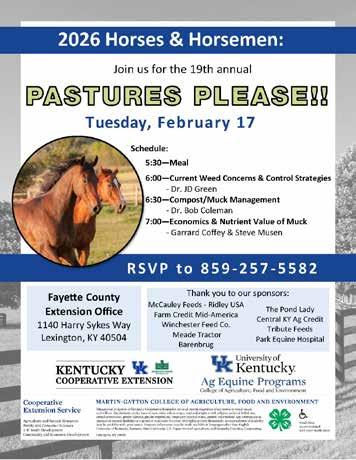
19TH ANNUAL “PASTURES PLEASE!!” PROGRAM SET FOR FEB. 17 IN LEXINGTON
By Angelina Sonoqui
All are invited to attend the 2026 Horses & Horsemen: Pastures Please!! program on Tuesday, Feb. 17, hosted by the Fayette County Extension Office and the University of Kentucky Ag Equine Programs. This annual event will focus on pasture management, weed control and effective muck management strategies for equine operations. The event will be held at the Fayette County Extension Office, located at 1140 Harry Sykes Way, in Lexington beginning at 5:30 p.m.
“Pastures Please is a program that offers equine producers knowledge of best management practices to help their operations be more profitable and efficient,” said Linda McClanahan, Mercer County Extension Agent for Agriculture and Natural Resources. “The goal for this event is to give producers new and timely information. This year, the decision was made to focus on muck management and value.”
The meeting agenda is as follows:
• 5:30 p.m. – Meal provided
• 6 p.m. – Current weed concerns and control strategies, presented by JD Green, extension weed scientist and emeritus professor within the Martin-Gatton College of Agriculture, Food and Environment’s Plant and Soil Sciences department..
• 6:30 p.m. – Compost/muck management, presented by Bob Coleman, extension horse specialist within the Martin-Gatton CAFE Department of Animal and Food Sciences.
• 7 p.m. – Economics and nutrient value of muck, presented by Garrard Coffey, Rockcastle County Agriculture and Natural Resources Extension Agent and Steve Musen, Jessamine County Agriculture and Natural Resources Extension Agent.
The event will be held at the Fayette County Extension Office, located at 1140 Harry Sykes Way, Lexington, KY 40504. RSVP by calling 859-257-5582.
The event is sponsored by McCauley Feeds, Ridley USA, Farm Credit Mid-America, Winchester Feed Co., Meade Tractor, Barenbrug, The Pond Lady, Central Kentucky Ag Credit, Tribute Feeds, and Park Equine Hospital.
For more information, contact the Fayette County Extension Office.
ECLIPSE AWARD UPDATE: UK EQUINE ALUM PICKS UP HER FOURTH AWARD
AND UK
FACULTY MEMBER BECOMES PART
OF
A WINNING PODCAST SERIES
Two connections to UK’s Ag Equine Programs and Equine Science and Management undergraduate degree program were recently recognized with a Media Eclipse Award. The National Thoroughbred Racing Association, Daily Racing Form and the National Turf Writers and Broadcasters announced the winners of the prestigious 2025 Media Eclipse Awards in six categories on Jan. 8.
Under the Writing-News/Enterprise category, Natalie Voss, an ESMA alum, won with a story published during her time at the Paulick Report called “Doom Scroll: Thoroughbreds, Bail Pens and Horse Traders,” December 2024.
An excerpt from the announcement reads:
“In her four-part series, ‘Doom Scroll: Thoroughbreds, Bail Pens and Horse Traders,’ which was published in the Paulick Report in December 2024, Voss provided an in depth analysis on the methods, reactions and ramifications of bail pens, a new and growing economy in which horses, including many Thoroughbreds, are offered for sale to the public under the threat that they will be exported and rendered for meat if a steep ‘bail price’ isn’t paid.
This is the fourth Media Eclipse Award for Voss, of Georgetown, Ky.
“I’m so honored to win the Eclipse for this series because this subject is incredibly important to me,” said Voss. “I did a lot of reporting that intersected with the bail pen economy in my career and was always a little surprised when I’d encounter racing stakeholders who didn’t know much about it. I also recognized there wasn’t a lot of independent refer-
ence material out there about it, so I endeavored to create a series that could break down its complexities, and also offer micro- and macro-level solutions and perspective for someone trying to navigate the space.”
Voss, who is now Director of Communications for United States Equestrian Federation, won the Media Eclipse Award for News/Enterprise in 2016, and in 2020 in News/ Enterprise and in Feature/Commentary. All were written for the Paulick Report. She was with the Paulick Report for 12 years, and was editor-in-chief at time of her departure in 2025.
The winning entry can be viewed here.”
Under the Multimedia category, Freakonomics Radio was awarded the Eclipse. Jill Stowe, a faculty member in UK’s Department of Agricultural Economics, an equine economist and director of undergraduate studies within the ESMA degree program, participated in the podcast and helped with groundwork ideas for the episode.
An excerpt from the announcement reads:
“The Freakonomics Radio Podcast ‘Inside the Horse-Industrial Complex,’ examined the wide-ranging world of horse racing, and discussed the
various facets of the industry through from the life of the jockey, to breeding, auction sales and issues from artificial insemination to recent changes in U.S. immigration policy. The program, the second of the three-part series ‘The Horse is Us,’ was produced by Augusta Chapman and hosted by Stephen Dubner. The program first aired last year on Oct. 31.
Freakonomics, based in New York, interviewed a range of individuals for their perspective on horse racing: Emily Plant, Thoroughbred researcher and statistician, associate professor of marketing at the University of Montana; Jill Stowe; professor of economics at the University of Kentucky; Mark Taylor, president of Taylor Made Farm; Oscar Gonzales, vice chair of the California Horse Racing Board; and Richard Migliore, head racing analyst for Fox Sports and New York Racing Association, and retired jockey.
The winning entry can be found here.”
The announcement can be viewed in its entirety here
CONGRATULATIONS TO ESMA ALUM REBECCA HUTCHINSON ON HER SECOND PLACE FINISH IN 3-MINUTE THESIS COMPETITION
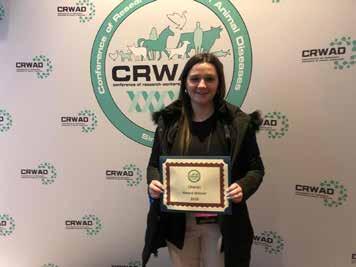
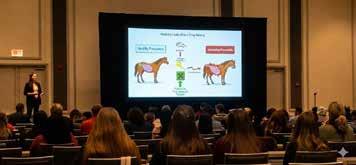
The University of Kentucky’s Gluck Equine Research Center demonstrated research excellence at the 2026 Conference of Research Workers in Animal Diseases (CRWAD), held in Chicago Jan. 17–20.
Rebecca Hutchinson, a graduate student in the Equine Reproduction Laboratory and alum of UK’s Equine Science and Management program, earned second place in the highly competitive 3-Minute Thesis competition, standing out amongst 20 presenters from leading institutions.
Hutchinson’s award-winning presentation, “Transcriptomic Profiling of Equine Myometrium Identifies Immune Networks Underlying Placentitis-Induced Activation,” showcased her ability to clearly and effectively communicate complex, cutting-edge research to a broad audience. Her work provides important insights into the molecular and immune mechanisms driving myometrial activation during equine placentitis, highlighting the translational relevance of her research to reproductive health.
As one of the premier international meetings for animal disease researchers, CRWAD brings together top scientists, clinicians and trainees from around the world. Hutchinson’s recognition in the 3MT competition underscores the Gluck Center’s growing reputation for excellence in graduate training and innovative reproductive research.
Congratulations to Hutchinson, her advisor Hossam ElSheikh Ali, associate professor in equine reproduction at the Gluck Center, and the Equine Reproduction Laboratory on this outstanding accomplishment!
UK AG EQUINE PROGRAMS ADVISORY BOARD MEMBER STUART BROWN AMONG HONOREES TO BE RECOGNIZED DURING NIGHT OF EXCELLENCE
The University of Kentucky Martin-Gatton College of Agriculture, Food and Environment will recognize some of its most impactful alums and friends during its Night of Excellence event Feb. 20.
The event is held and the Hall of Distinguished Alumni awards are given every two years to recognize alumni whose careers reflect lasting influence, professional excellence and meaningful contributions to agriculture, their communities and society.
Among the honorees is Stuart Brown, Lexington-based veterinarian; vice president of equine safety for Keeneland, former veterinarian with Hagyard Equine Medical Institute and current member of the UK Ag Equine Programs Advisory Board, who will be presented with the Oran & Myrtle Little Friend of Martin-Gatton CAFE award. This award is presented to a non-alumnus whose dedication and service have made an extraordinary impact on the college.
An excerpt from the announcement reads, “A steadfast advocate for the college and Kentucky’s equine sector, Dr. Brown has provided exemplary service through leadership roles with the Ag Equine Advisory Committee, the Veterinary Diagnostic Laboratory Advisory Committee and the Gluck Equine Research Foundation Board—where he served as chair from 2017 to 2025. His support for faculty research, student mentorship and legislative engagement continues to advance UK’s land-grant mission.”
Rebecca Hutchinson at the CRWAD conference. Photos courtesy Hossam El-Sheikh Ali.
US EQUESTRIAN ANNOUNCES
THE 2025 HIGHER EDUCATION
SCHOLARSHIP RECIPIENTS, UK EQUINE STUDENT AMONG THOSE AWARDED
Source: US Equestrian Communications | 1/21/2026
US Equestrian congratulates the five recipients of the 2025 USEF Higher Education Equestrian Scholarships. The scholarships are awarded each year to incoming first-year college students to support their continuing involvement in horse sports.
Among those awarded include Natalie Koch from Canal Fulton, Ohio.
An excerpt from the announcement reads, Natalie Koch started riding with her mom when she was just 3 years old. Her entrance into formal equestrian education was through the United States Pony Clubs, which continues to be part of her life today. In addition to achieving her HB and C2 eventing ratings through the Bath Pony Club, she also competes in eventing with her Mustang, Captain Jack Sparrow. “Sparrow” introduced her to the plight of America’s wild horses, which has become a passion for Koch. Her AP research paper, ‘Domesticated Mustang Horses: Comparative Health and Physical Characteristics Analysis’ earned a 5, the highest possible score, from the College Board.
“I am an incoming freshman at the University of Kentucky, where I will be majoring in Equine Science and Management as well as Business Management with a minor in International Business,” said Koch. “Through these degrees, I am pursuing a career in the business field that integrates my passion for horses. My experience with Mustangs and research has also made me want to work towards Mustang advocacy in my future. Through learning more about the equine industry at the University of Kentucky, I hope to find what specifically excites me and how I can contribute more to the equine industry after my graduation.”
UK AG EQUINE PROGRAMS MOURNS THE LOSS OF ALUM LAUREN HANSEN
Source: edited excerpt of obituary published by Legacy on Dec. 12, 2025
Lauren Hylton Hansen, 35, of Lake Frederick, Virginia, passed away peacefully on Dec. 8, 2025, surrounded by her immediate family after a courageous six-month battle with Ovarian Cancer.
She was born on Aug., 1990, in Newport News, Virginia to Paul D. and Robyn H. Hansen and grew up in the Hampton Roads area of Virginia along with her sister Kristen, her brother Nicholas and their pets including but not limited to Duke, Maverick, Mittens and Oliver. Hansen received a Bachelor of Science in Equine Science and Management from the University of Kentucky and an MBA with a concentration in marketing from Anglia Ruskin University in Cambridge, England.
Hansen’s courageous passion drove her throughout her life to push the status quo and experience life to its fullest on her terms. To know Hansen is to know her unconditional love for animals whether going to the pet store and promising that if she got one more animal that she would take care of it. This was not just a phase but a part of her character that only developed stronger as she matured to take care of any animal, and her love had no bounds in regard to animals. Whether it was a cat, dog, bird, guinea pig, squirrel, horse, she loved each one equally and strongly with unrelenting passion and drive.
As she grew so did her passion and love for horses, inspiring her to explore every discipline of riding from hunter jumper to three-day eventing to Western to horse racing. In addition to riding, Hansen worked in the horse industry as a vet tech, pre-trainer in horse racing, wrangler and business marketer.
Hansen’s vibrant spirit was infectious. She was the life of every party. Her quick wit and unfiltered honesty brought laughter, joy and a sense of adventure to those around her. She was a fiercely loyal friend. Her tenacious spirit extended to her undaunting faith and commitment to her beliefs and convictions. One salient example fueled by her Jewish faith was her trip to Israel in the months following the Oct. 7 tragedy to help with the war effort by working in the fields harvesting fruit.
The light that she brought to the world will continue to shine through those she loved and touched. Her parents, Paul and Robyn Hansen, her sister Kristen Hansen McCaughan, her brother-in-law Peter McCaughan, her brother Nicholas Hansen and his girlfriend Danielle Jacobs, her nephew Benjamin McCaughan, and soon to be born baby McCaughan as well as her loyal dogs, Carly and Merle, and her horses, Johnny and Hank are committed to carrying this torch to ensure that others know of the light she brought into the world.
A visitation was held on Sunday, Dec. 14, 2025.
FROM OUR STUDENTS… SOME OF THE PIECES WRITTEN IN AN EQUINE COURSE
An important part of the mission of our program includes undergraduate education, specifically with our Equine Science and Management undergraduate degree program. A class taught by Camie Heleski, a faculty member and lecturer within the program – is one designed to present provocative, often controversial issues that are current to the equine industry. In this course, students are introduced to topics, hear from speakers, research information and communicate about industry issues in written and oral formats. The course is designed to expose students to hot button issues in the industry and encourage them to research and formulate well-communicated opinions about those issues. One avenue made available to this course was publishing some of those stories here.
Our Environmental
“Hoofprints:”
Environment and Horse Health Factors
By Isabella Stiles
As horse owners, lovers and riders, we are all aware of the immense amount of time, labor and money it takes to care for our equine friends. From weekends spent mucking stalls, turning out horses and stocking up on hay bales, our horses are a huge chore, but we’re willing to do it all because we love and want the best for them. However, despite some of our good intentions, we might not realize that many of our everyday jobs as caretakers could have adverse effects on our horses rooted in environmental issues. Equine practices need to be more sustainable before they harm the health and safety of our environment– and horse.
First, let’s talk about just one of the most prevalent environmental issues in the equine industry: land and pasture management. Horses typically require one to two acres of land, and for horse farms on a large scale, this can equate to hundreds or thousands of acres. Pastures that are overgrazed are prone to vegetation loss and eventually bare soil or mud. Muddy pastures are poor quality for your horse as they can increase their exposure to disease, stress and injury. Research published in BioScience (Beever & Aldridge, 2019) shows that equine grazing can significantly alter plant communities, reduce biodiversity and damage riparian zones. This is bad news in both an ecological and equine caretaker standpoint. Lower quality pastures will not allow the horse to meet as many nutrient needs. Also, damage to riparian zones means less vegetation is in place to keep a water source free of many pollutants from runoff. If a horse drinks this water, it can lead to health risks.
One solution to avoid overgrazing and muddy pastures is the implementation of heavy traffic pads/soil cement in turn with rotational grazing. Horses should
be properly rotated among different areas of pastures to avoid damage to vegetation and their health. Doing this gives time for forage to grow back with proper nutrients for the horse. Using heavy traffic pads or soil cement is also helpful to prevent soil erosion and mud in areas that will be most frequented by horses, like water or feeding troughs, gate openings, etc. These practices stabilize the ground and minimize the degradation of commonly trekked areas.
Climate feedback can lead to unpredictable weather events that can deteriorate the quality of land used to grow hay as well. According to the American Horse Council (2024), prolonged droughts, unpredictable rainfall and extreme heat events already threaten forage quality and horse safety across much of the U.S. This makes it harder and more expensive to buy good quality hay for your horse.
According to Horse Journals, “Drought stressed hayfields have a higher sugar content but produce lower volumes of hay while waterlogged fields produce fields produce high volumes of hay with lower protein content.”
Adobe Stock.
Forage is the most essential part of your horse’s diet, but if hay or pasture quality isn’t sufficient for maintaining your horse, costly supplementation might be required. The effect of climate change can directly affect our horses as well with hot or damp days leading to dehydration, overheating, weight loss, respiratory and skin issues, injuries, infections and even fertility issues (Horse Journals 2024).
Another challenge with land quality is manure management. Horses defecate almost 40-50 lbs. a day. Many horse facilities have stockpiles where manure and other waste from bedding can be piled. If there is little to no coverage above or below these stockpiles, the runoff of rainwater collects phosphates and nitrates from the manure which contaminates water quality. Runoff that is nutrient rich often leads to eutrophication and is dangerous for aquatic environments. Other bacteria have a chance to fester in these environments as well. This can be extremely toxic to horses who drink the water or it may prevent your horse from drinking at all, risking colic.
Research supported by the National Institute of Food and Agriculture (NIFA) highlights composting as one of the most effective strategies to reduce emissions and nutrient runoff from horse facilities. If a stockpile is to be used, make sure that the area is on solid, concrete ground and has a covering to limit water from reaching it and creating runoff that filters into the ground. In this way, environmental responsibility directly improves both land quality and equine welfare.
Weather events that affect pasture or forage quality is out of our control when it comes to environmental factors at play, but it is a wakeup call that equine industry workers need to pay more attention to the environment around them and do what they can to protect it for the sake of their horses. Climate change isn’t going away, and in fact, will most likely continue to worsen. It is critically important to do our part
as horse owners to mitigate those effects and take proactive measures to reduce damage to our properties and horses’ health. In adopting more sustainable solutions, we can further ensure a safer and healthier environment for our horses.
Works Cited:
Beever, E. A., & Aldridge, C. L. “The Impacts of Free-Roaming Horses on North American Ecosystems.” BioScience, vol. 69, no. 7, 2019, pp. 558–569. https://academic.oup.com/ bioscience/article-abstract/69/7/55 8/5519497?redirectedFrom=fulltext. Accessed 5 Oct. 2025.
“Climate Change’s Impact on Horses and Properties.” Horse Journals, 26 July 2024, www.horsejournals.com/how/ climate-changes-impact-horses-andproperties. Accessed
“Climate Change & Environmental Sustainability.” The American Horse Council, 7 July 2024, horsecouncil.org/ issues/climate-change-environmentalsustainability/. Accessed 5 Oct. 2025.
“Using Soil-Cement on Horse and Livestock Farms | Equine Programs.” Uky.edu, 2023, equine.mgcafe.uky.edu/ news-story/using-soil-cement-horseand-livestock-farms. Accessed 5 Oct. 2025.
Protecting Our Horses: Why USEF Should Implement Class limits
By Charlotte Odom
has become a hot topic on social media platforms such as Instagram, Facebook and Tik Tok (Milestone Equestrian).
An Equestrian social media influencer and professional rider, Nina Thornton, brought her concerns to Tik Tok and the Plaid Horse Magazine after watching a horse compete in 21 jumping classes in just five days, adding up to about 200 jumping efforts. Thornton stated, “It wasn’t illegal. And it wasn’t against USEF rules. But it was sickening.”
The Plaid Horse’s article describes the welfare concerns as horses can enter an unlimited number of classes for mileage, points to qualify for finals, essentially personal gain. Horses are often doing entire divisions during the week, then jumping another division with a junior or amateur rider (Thornton, 2025). Class limits are not a new idea to horse shows as the United States Dressage Federation limits horses to “three classes per day from intro through fourth level and a maximum of two classes a day at Prix St. Georges level and above.” So why are class rules at hunter jumper shows not implemented as well? (Equestrian Counsel, 2025).
The United States Equestrian Federation is the governing body for equestrian sport, including Hunter, Jumper and Equitation disciplines. USEF is responsible for overseeing the rules, regulations and standards of horse shows. Currently there are no regulations for the number of classes a horse may compete in, raising concern about overuse and overall horse welfare. Discussions about implementing class limits
Sadly, overuse has become a leading cause of injury, often ending many horses’ careers. Consistently being in the show environment is draining mentally and physically, also contributing to many horses’ early retirement. Clear and obvious overuse is prohibited by USEF but is a case-by-case scenario and only investigated if reported. The overwhelming pressure to earn points for year-end awards and finals further leads to overuse at competitions, but it ultimately comes down to riders and trainers being accountable for the overall wellbeing and longevity of our beloved horses.
While USEF has implemented many welfare rules at shows, they have yet to create a solution to this concern many, including Thornton, have expressed.
Adobe Stock.
The class limit proposal and concerns expressed by many individuals stems from the shared idea of improving horse welfare. A common reason for doing multiple classes and divisions is for the horse to gain mileage but it ultimately damages the horse as “the quality of its management throughout its active years” play a significant role in the longevity of a horse’s show career (Equestrian Counsel, 2025). While the physical well-being of the horse is a welfare concern, the mental wellbeing is just as important.
Attending horse shows often means traveling several hours and staying for multiple weeks. The mental exhaustion of traveling, plus limited turn out available at shows combined with overuse is the perfect pathway for a horse to burn out mentally. Thornton proposed a rule change to USEF, stating, “Horses may not compete in more than four jumping classes per competition day and no more than 10 jumping classes per competition week (Monday through Sunday), regardless of height, section or division.” (Thornton, 2025). Yet the proposal was denied, though 10 classes is very generous and would still allow a rider to do an entire division (four classes), the classic round, derby round and a warmup. Creating a class limit would make people be more intentional with what class and division the horse is entered in and why. This would cause trainers to reflect on if they are entering to gain points, for the horse to gain experience or for the rider to gain experience.
Regardless of the reason, it comes down to personal gain and we must advocate for our horses who cannot speak for themselves. This rule change could be the difference between a career ending injury.
Many people wonder why a rule has yet to be implemented, but coming to an agreement on what is reasonable has been a struggle. In 2023, At a United States Hunter Jumper Association (USHJA) meeting, a rule change proposal was made to limit classes, but the board
could not come to a conclusion on whether it should be based on fence height, class type or competition format (Equestrian Counsel, 2025). Many agree that a class limit should be made but how?
Robin Greenwood writes in the Plaid Horse why class limits are not the answer. She expresses that 12 classes at the 2’ level is significantly different than 12 classes at the 1.30-meter level, “A fixed class number treats them as equal, which further undermines the rule’s fairness.” (Greenwood, 2025).
One argument against creating a set rule for classes is the idea that no single rule can apply to a green horse, a well-seasoned horse, a nervous rider needing an extra warm up, the list goes on.
But if anything, the 10-class limit Thornton proposed is more than generous for any scenario and further displays the selfishness and excuses of overuse. The economics of horse showing causes many to be against a class limit. The cost alone of attending a horse show is extremely expensive, leading to many people to attend fewer shows and instead do multiple classes at one show.
The topic of accessibility is a common reason people are against the rule because if a rider wishes to horse show more or do more classes at a horse show, it requires that the rider get another horse. For those who have multiple horses “overuse is less of an issue because they can rotate their horses among shows” but unfortunately, this is unattainable for the average rider and family (Equestrian Counsel, 2025).
While accessibility and differences in each horse contributes to many against the class limit, it is simply bad horsemanship to put one’s goals above the welfare of the horse.
The CEO of USEF ultimately went against creating a rule and instead felt that giving “people an understanding of the signs of overuse: How do you know that a
horse is in distress? What are the signs of that you’re seeing?” would help (Chronicle of the Horse). This is a disappointing response to the issue at hand. USEF emphasizes the importance of horse welfare yet is ignoring the problem at hand.
Beyond Lasix: Can Horse Racing Win Back Public Trust?
By Brittany Ray
To restore the public’s confidence after high-profile breakdowns and positive drug tests, the Horseracing
Integrity and Safety Authority (HISA) was created to protect the Thoroughbred industry’s Social License to Operate. Trainers, owners, veterinarians and jockeys at U.S. racetracks and training centers are now subject to evolving medication policies designed to regulate or, in some cases, restrict race-day drugs and therapeutic treatments through reforms, tighter testing and standardized withdrawal-time rules. Can the U.S. racing industry balance horse welfare and public confidence while maintaining the sport’s economic strength?
As veterinary medicine progressed in the 1950s and 1960s, American trainers found it easier to turn to medications to combat common ailments in horse racing: inflammation, soreness and bleeding. The medications were marketed to protect horses’ welfare, keeping them comfortable to train and compete. While other countries banned race-day medications, the U.S. allowed each state to regulate independently, creating a disjointed
Adobe Stock.
system in which drug use became normalized and routine.
Opponents argued that such widespread medication led to overuse and masked injuries. After several highly televised breakdowns and prominent drug-positive cases, the industry’s Social License to Operate was in jeopardy.
“HISA was created to implement, for the first time, a national, uniform set of integrity and safety rules that are applied consistently to every Thoroughbred racing participant and racetrack facility,” (Horseracing Integrity and Safety Authority, n.d.).
The enormous economic impact of the racing industry, billions in wagering, breeding value and jobs, has increased the pressure between performance, safety and regulation.
The Case for Medication
Lasix, the brand name for furosemide, is scientifically proven through multiple controlled studies to significantly reduce both the incidence and severity of exerciseinduced pulmonary hemorrhage (EIPH; Hinchcliff & Morley, 2010). EIPH is extremely common, with more than 80% of horses showing some sign of bleeding, even when there are no visible signs.
“Some horses need Lasix. But the public doesn’t want horses medicated on race day,” said Jeff Blea, a former jockey turned racetrack veterinarian (Kolbert, 2021).
Properly medicated horses are much less likely to break down mid-race, improving jockey safety and allowing horses to remain in training longer. When jockeys are safe and horses can remain in training, the racing and Thoroughbred industry can sustain local economies, aiding in employment at the racetrack, breeding, sales and much more.
The Case Against Medication
If Lasix is proven to work, why is
there so much disagreement on its use? Lasix is a diuretic, meaning it increases urine output. With a race-day dose, horses can lose 5-10 pounds of fluid, which may improve racing performance beyond the medical benefit (Hinchcliff & Morley (2010). Critics also argue that using Lasix on every horse before every race encourages over-reliance on medications rather than breeding or training for natural soundness.
Trainers who continue to use banned medications are further damaging the sport’s reputation. After the infamous Medina Spirit Derby-day disqualification, Churchill Downs Incorporated (2021) stated, “Failure to comply with the rules and medication protocols jeopardizes the safety of the horses and jockeys, the integrity of our sport and the reputation of the Kentucky Derby… Churchill Downs will not tolerate it.” Medina Spirit was disqualified from the title after he failed a post-race drug test. While the drug wasn’t Lasix, it was a therapeutic antiinflammatory drug banned on race day.
Reform and What Lies Ahead
After decades of controversy, HISA is rolling out the Anti-Doping and Medication Control (ADMC) program, widely considered the most ambitious reform in American racing history. The program establishes uniform national rules, replacing the patchwork system that existed previously. Stricter testing, standardized withdrawal times and heavier penalties are central features of the new program.
According to Mitchell (2022), Lasix use in graded stakes races dropped from 98% in 2017 to just 11% by 2021, demonstrating the shift HISA is looking for. However, the reform hasn’t been without its challenges. Some argue that the new regulations are expensive, confusing or impractical in daily training. A handful of lawsuits challenging HISA’s authority still show that the reform is in its early stages.
The central question remains: Can the U.S. racing industry balance horse welfare and public confidence while maintaining the sport’s economic strength?
A Brighter Future
Sources like Light Up Racing prove that the answer is yes. According to DeBernardis (2023), “Light Up Racing, an initiative led by a group of industry participants, is striving to illuminate the path to transparency, awareness and accountability in horse racing.” With resources like this popping up across the industry and transparency becoming a priority, we’re bound to protect the legacy of Thoroughbred racing and earn back the public’s confidence and respect.
References:
Churchill Downs Incorporated. (2021, May 9). Churchill Downs’ statement in response to Medina Spirit’s postrace test result allegations. Churchill Downs Incorporated. https://www. churchilldownsincorporated.com/ resources/kentucky-derby-and-oaks/ churchill-downs-statement-in-responseto-medina-spirits-post-race-test-resultallegations/
DeBernardis, C. (2023, October 4). Striving to illuminate the path to transparency: Light Up Racing launched. Thoroughbred Daily News. https://www. thoroughbreddailynews.com/strivingto-illuminate-the-path-to-transparencylight-up-racing-launched/
Hinchcliff, K. W., & Morley, P. S. (2010). Furosemide and exerciseinduced pulmonary hemorrhage in Thoroughbred racehorses. Equine Veterinary Journal, 42(S38), 318–324. https://doi.org/10.1111/j.20423306.2010.00204.x
Horseracing Integrity and Safety Authority. (n.d.). About HISA. https:// www.hisaus.org/
Kolbert, E. (2021, May 24). Can horse racing survive? The New Yorker. https://www.newyorker.com/ magazine/2021/05/24/can-horseracing-survive
Mitchell, E. (2022, February 8). A closer look at the initial impact of Lasix phaseout. TrueNicks. https://www.bloodhorse. com/horse-racing/articles/257196/ closer-look-at-initial-impact-of-lasixphase-out
Tail Sets and Tail Nicking in the American Saddlebred Industry
By Carrie Wagner
The eccentric American Saddlebred industry is wrapped around appearances. The basis of the industry is to produce an exciting creature that consistently appears as if it could explode. The grooms, trainers and spectators all echo this larger-than-life appearance by running alongside trotting horses as they enter the ring, whistling to get horse ears forward and cheering to get the judges’ attention as their favorite makes a pass.
There is an intentionality behind every detail, from the tip of the horse’s nose to the feathers of its tail. The tail, which is meant to appear as a pinnacle of the animal’s elegance, is a source of much controversy in the industry. In the traditional saddle seat discipline, the tail is supposed to resemble the animal in an illustriously excited state. The ideal aesthetic is to have a high-headed horse that carries its tail over its back in a flagging motion. This is achieved via a process called “nicking” that refers to the cutting or stretching of ligaments on the underside of the horse’s tail.
Some of the earliest descriptions are found in Mason’s Farrier Stud Book from the 1860s, which describes the process as adding to a horse “much to his beauty and value” (Mason, 1860). Since then, Saddlebreds have continued with the nicking process well into the 21st Century, even though many modern
veterinarians will not perform the procedure. Upon the completion of the surgery, it is necessary that young horses wear what is called a tail bustle, with the older show horses wearing a more complete tail set. It is a topic with many caveats as well as alternatives in modern times. Overall, it is up to each individual to evaluate the pros and cons to decide if it is a practice worth continuing or extinguishing.
Beginning with the pros, it must be acknowledged that the presence of a high-tailed horse creates a niche industry that is set apart from the rest of the horse world. The United States Equestrian Federation (USEF, 2025) states in its rule SB102.2 relating to presentation and appearance that the “tail should be carried proudly, coming out high from the croup.” This statement does not permit or prohibit the use of a nicking procedure or other devices to keep the tail in perfect order, but rule SB103.5 adds that the “surgical release of the ventral sacrocaudal muscle is allowable if performed by a licensed veterinarian” (USEF, 2025). These are rules issued by a respected governing body that represents many breeds and disciplines across the country. They are also breed-specific, indicating that the practice is permitted within this breed in the context of the show ring.
A 2017 press release from the American Saddlebred Horse Association (ASHA) describes the tail nicking process as beneficial for more than just aesthetic purposes. The president of the association explains that the breed is notably broken to drive long before carrying a rider and often has their tails nicked to produce a horse that can more comfortably pull a jog cart (ASHA, 2017). It also defends the point that horses are capable of swishing their tails against flies and clamping them even after being cut. The alternative is also introduced: the appearance of a nicked tail can be achieved by stretching the tail daily.
The care following the procedure should be considered just as crucial when examining the process that Saddlebreds often undergo. The average daily tasks completed without a tail set require the groom to remove the tail bag material, the cotton netting and any sort of ties that keep the tail straight in the crupper portion. The groom must then remove the crupper itself, followed by the breast collar. This daily care requires extreme familiarity with the horse’s tail and attention to detail. That attention can be seen as a positive when done attentively but also as a source of neglect when not regarded with sufficient importance.
Tail boards are also a common occurrence around the edges of stalls as a preventative measure. These ensure that if a horse does attempt to remove its tail set, it will remain in place to keep the tail straight. If the tail does not remain straight, further medical repercussions for the animal may follow.
In terms of cons, it must be considered that the American Association of Equine Practitioners (AAEP, 2023) does not support the procedure due to a lack of benefit to the animal. It is worth noting that the association does not describe it as inherently detrimental. The American Veterinary Medical Association (AVMA, n.d.) has also persisted in supporting the AAEP’s position. While it was pointed out that the use of tail sets can lead to incredible attention to detail, it can also lead to dangerous situations for the animal. If the quality of care is subpar, a newly cut tail can take on a corkscrew shape that limits functionality.
Daily care of these tails is seen as critical, so it follows that it increases the labor costs of an employer. Indeed (2025) currently lists the average yearly salary of a groom in Lexington, Kentucky at $33,715. The groom is expected to remove the tail set, groom, tack, cool out, replace the tail set and proceed to help clean up each afternoon. If the
Adobe Stock.
barn has even 25 horses, it seems unreasonable for each groom to care for more than five and maintain their duties efficiently. The cost to pay them yearly would be $168,575 without including benefits. That is a major commitment for an employer when costs could be reduced by eliminating the tail set from daily work.
To conclude, the use of tail sets and tail nicking has a historical implication of being controversial. Upon evaluating the pros, one could conclude that the use of both is non-harmful. After reading the cons, one might decide that the risks far outweigh any benefit. It is simply an aesthetic modification that can be viewed from many perspectives, and it is up to the individual to decide whether the opportunity costs are worth supporting or ending the practice.
References:
American Association of Equine Practitioners. (2023). Position on tail alteration in horses.