Vandals going Dancing
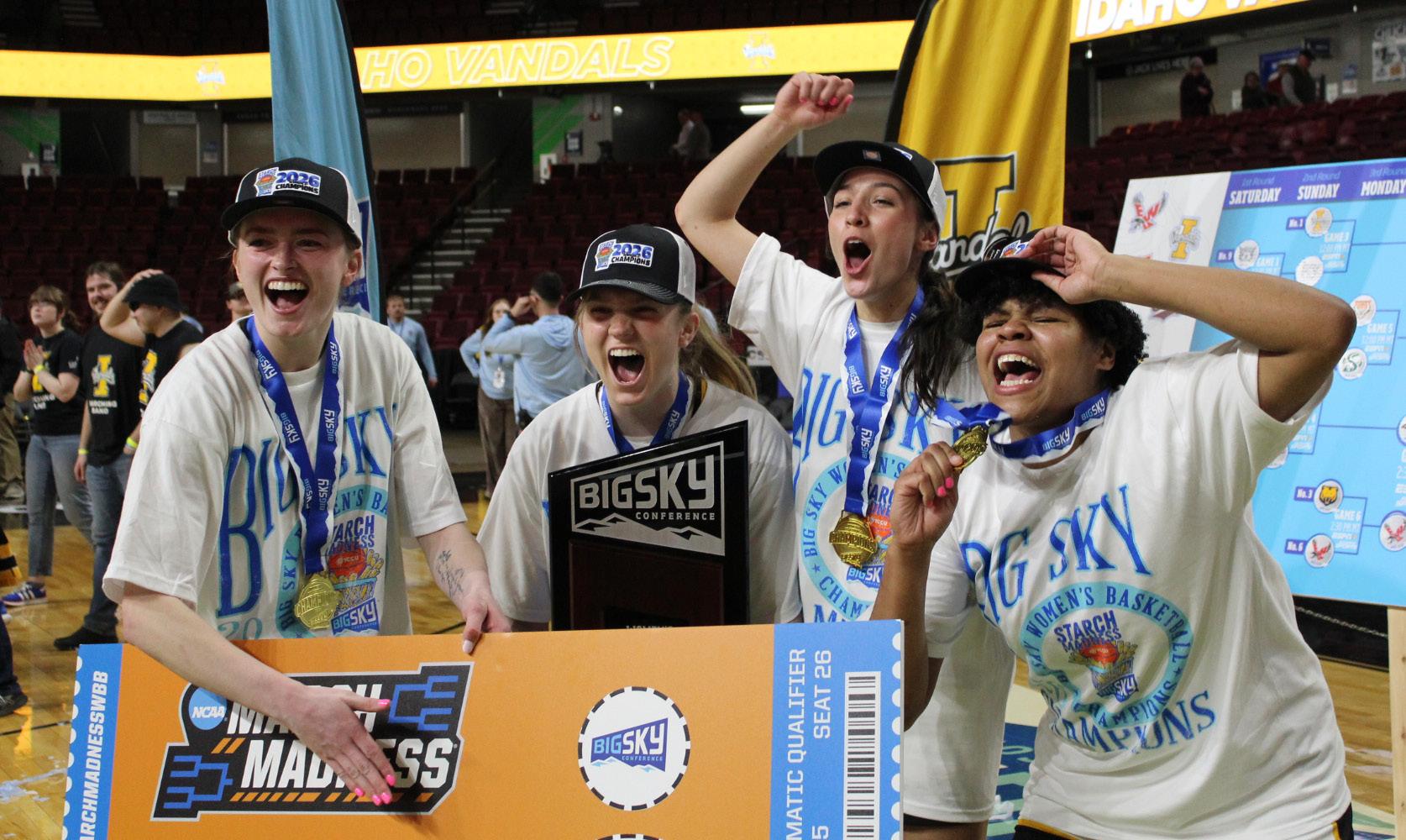
It had come down to one final possession to decide the Big Sky championship. Montana State swung around to senior guard Ella Johnson, who launched it toward the rim. As the ball went up in the air it came back right to her as redshirt senior Lorena Barbosa blocked the shot with under two seconds left, to give the Vandals the Big Sky crown and secure their spot in
March Madness. The Idaho Vandals women’s basketball team had one goal when this season began: get to March Madness. After a 60-57 dramatic victory over Montana State Wednesday, they accomplished it, punching their ticket to the NCAA tournament for the fifth time in program history and the first time since 2016. the women will join the 68-team field in the NCAA tournament.
The Vandals (25-9, 18-1) led 60-57 with under 10 seconds remaining when Montana State (25-6, 16-3) got the ball with a chance to tie. The Bobcats had been in a similar spot in their semifinal win over Eastern Washington, hitting a threepointer to force overtime. This time, the Vandals needed one defensive stand to fulfill their goal.
The ball swung around to Ella Johnson, who launched it toward the

rim. But it came back right to her as redshirt senior Lorena Barbosa blocked the shot with under two seconds left, sealing the Vandals’ Big Sky championship victory.
“So many emotions. I was so happy to be a part of this team,” junior guard Hope Hassmann said at the post-game press conference. “I love each one of the girls. We have such a special bond. We just all love each other so much and want to do everything together. I feel like that was the motto of the game. At times when we couldn’t score, we just knew we had
to come together and get stops, and that was kind of the name of the game. I couldn’t be more proud of everyone. We couldn’t do it without any of the staff or the girls.”
The Vandals and Bobcats were on a collision course all season, meeting twice in the regular season with each team winning on their home court. Montana State defeated Idaho 99-66 in Bozeman, then a few weeks later the Vandals won 73-70 in overtime at the ICCU Arena.
After that game, Montana State rattled off nine wins in a row and secured the second seed in the tournament.
The defending Big Sky champions had momentum and experience on their side.
The Vandals opened the season with an 87-85 victory over Washington State, a team full of potential with a goal in mind. After the Jan. 10 loss in Bozeman, they never lost again, winning a program-record 18 straight. After two hard-fought wins in Boise, they had their chance to punch their ticket to the NCAA tournament.
Liam Bradford ARGONAUT
When the final horn sounded Wednesday night inside Idaho Central Arena, the Idaho Vandals (2114, 10-9) gathered near midcourt as the magnitude of the moment began to settle in.
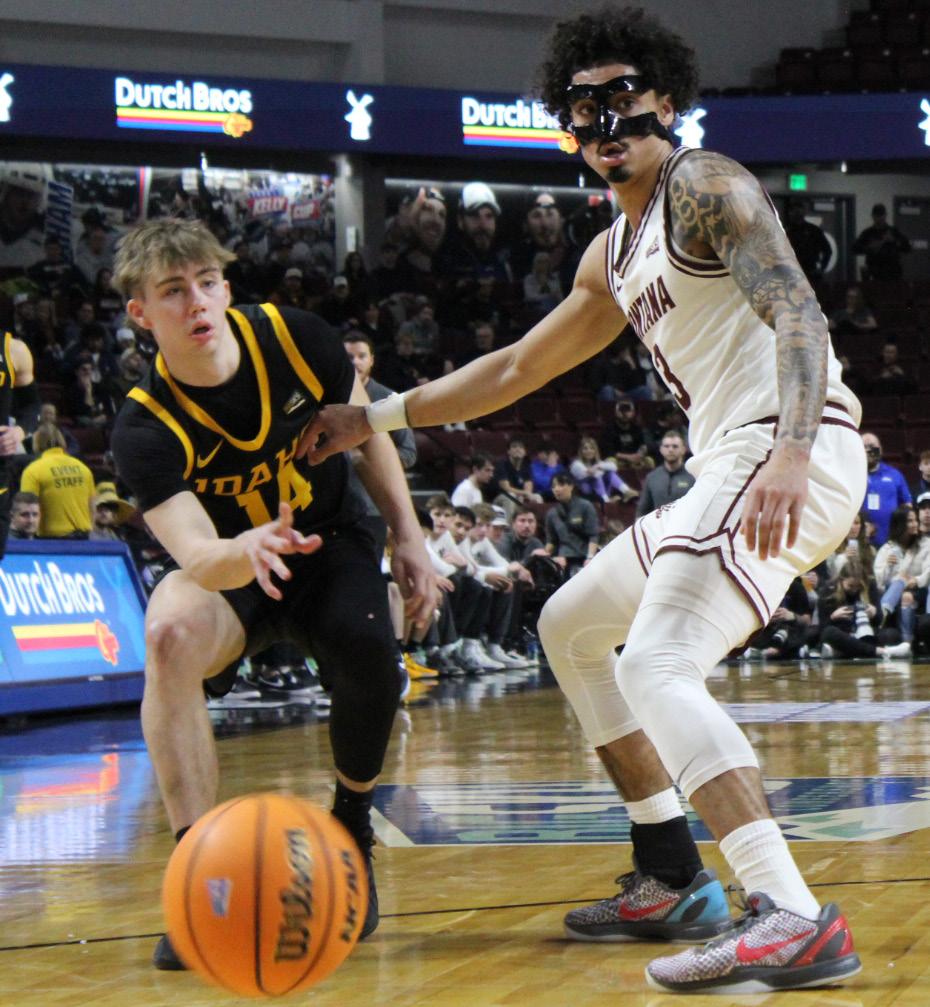
For the first time in more than three decades, Idaho men’s basketball is going dancing. Behind a dominant rebounding performance and another balanced offensive effort, the seventh-seeded Vandals defeated the fourth-seeded Montana Grizzlies (18-16, 10-8) 77-66 in the Big Sky Conference championship game Wednesday night, securing the program’s first
NCAA Tournament berth since 1990.
The victory capped an improbable five-day run through the conference tournament for Idaho, which had an up-and-down regular season and entered the tournament with a worse seed than it had last season. The Vandals rattled off four consecutive wins in Boise, including victories over two top-three seeds, to capture the program’s fifth conference championship and the Big Sky’s automatic bid to March Madness.
For a team that spent much of the winter searching for consistency, the Vandals found their rhythm at the perfect time.
“It’s taken a lot of resilience and a lot of trust,” said Idaho head coach Alex
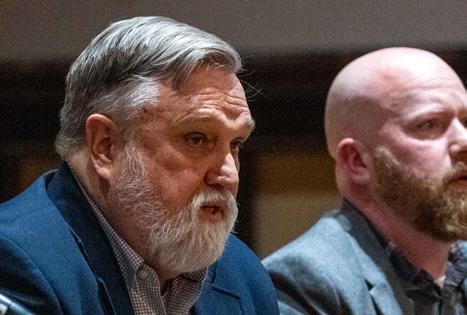
Pribble in the postgame press conference after the semifinals. “When you feel like you’re doing the right things, but the outcomes aren’t there, it takes belief to stay the course. This group trusted the process, and it came together at the right time.”
The Vandals opened the game with the same physical edge that carried them through the first three rounds of the tournament.
Emphasizing rebounding and interior scoring from the opening tip, Idaho surged to an early 18-8 advantage behind an 11-0 run that energized the Vandal-heavy crowd.
Cuts to Idaho LAUNCH scholarship likely to reduce enrollment, higher ed leaders say
Lauren
Despite legislators’ claims that Idaho’s K-12 public schools will remain untouched unaffected by additional budget cuts, it doesn’t mean higher education and the programs that assist K-12 students will have the same immunity.
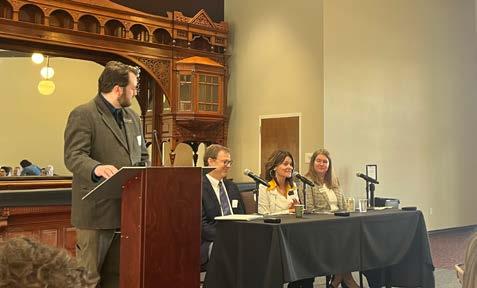
On March 3, the City Club of Boise, a local nonpartisan nonprofit aiming to promote
community conversations, hosted a panel to discuss the uncertainties universities, colleges and K-12 schools are facing during current state budgetary shortfalls.
Panelists included David Douglass, president of the College of Idaho; Chandra Zenner Ford, center executive officer of the Boise and Southwest Idaho campuses of the University of Idaho; and Wendi Secrist, executive director of Idaho’s Workforce Development Council.
The Joint FinanceAppropriations Committee approved a total cut of $20 million from Idaho’s LAUNCH program, which provides grants of up to 80% of tuition cost to help state residents pursue higher education. It was decided that $10 million would be transferred from
the 2026 fiscal year and an additional $10 million reduction would be placed in the next fiscal year’s budget.
Secrist said she recognizes the funding LAUNCH previously received was start-up funding to help expand the program, and clarified that the funding they received exceeded expenditures.
“We were able to take the money that reverted to us after the class of 2024, their first semester, plus these operational savings and offer back $10 million back to the state.” Secrist said.
The original motion was to take $10 million from LAUNCH’s budget as a one-time reduction, but the second $10 million from fiscal year 2027 wasn’t expected and will likely make a noticeable impact
on the program, Secrist said.
“The $10 million cut translates into about 1,250 students that we may not be able to offer grants to,” Secrist said.
College of Idaho, a private institution, doesn’t rely on state funding, but Douglass denies that it doesn’t affect their college.
“We all operate in the same environment, in the sense that the go-on rate affects all of us,” Douglass said.
Douglass has concerns that cuts to LAUNCH will cause the go-on rate, the rate at which high school graduates go straight to college, to decrease.
An increase in Idaho’s go-on rate is necessary to fill the projected 103,000 jobs that will be added to Idaho’s workforce annually over the next 10 years,
AI recruiting chat bot discussed in Faculty Senate
Joshua Reisenfeld
ARGONAUT
Provost Torrey Lawrence spoke about the 2026-27 academic year estimated enrollment numbers at the March 10 University of Idaho Faculty Senate meeting.
“It appears that we’re still on track to actually have a larger class, but application numbers certainly have people’s attention,” Lawrence said.
Concerns were raised about a report presented to some faculty on Monday stating that the total number of applications received by UI was down compared to previous
years. Lawrence confirmed the report, but said the number reflects a change in university shopping behavior and was not a cause for concern.
“What we’re wondering is if some of those applications that we’ve gotten in the past were never very serious about us, and if [those students] are more focused on the schools that they’re really pursuing,” he said.
UIdaho Bound attendance and FAFSA submissions are up compared to previous enrollment cycles, which Lawrence said are better signs of future enrollment.
Lisa Victoravich, Dean of the College of Business and Economics, was invited to provide a UI Strategic Plan update as the champion for Pillar 5.
Victoravich reminded faculty of a survey in progress to provide input on a formal data structure and data warehouse
for the university, which falls under one of her subsections of data governance and modernization.
The other subsections under Pillar 5 include simplification and automation through AI; university employee attraction and retention; and the creation of collaboration and project execution culture.
While discussing automation processes underway at UI, Victoravich spoke about an AI recruiter chatbot, named Jane Vandal, which is currently being trained.
“This is on the front end to help with recruiting, so our students can get more customized information up front, and she talks in many different languages,” Victoravich said.
Once the chatbot is up and running, Victoravich said the team developing it would be able to provide a demo to faculty senate.
Other automation processes include faculty assistance with inbox items, intern recruitment and training and reimbursement pipelines for expense reports.
Within the topic of employee retention, Victoravich mentioned excellence awards which received multiple questions about how it would be decided. Faculty expressed complaints about the current system which prioritizes grant money rather than the impact of a given scientific contribution. Victoravich suggested further senate partnership for retention and culture policies.
Lawrence also reminded faculty of the next gathering happening Tuesday, March 24, from 4:30-6:30 p.m. in the Germplasm Building. An RSVP for the event would be sent out soon, Lawrence said.
according to Secrist, and she says about 66% of those jobs will require some form of secondary education.
A shortage of people entering the workforce may also be a factor.
Secrist said the fact that shocked her was that there are 25% less individuals between the ages of 0-4 than there are individuals ages 14-18. This means there will likely be 25% fewer people entering the workforce once these individuals reach adulthood, not accounting for any individuals moving in or out of state.
Douglass also addressed concerns that the value of higher education was no longer worth it.
“The value of higher ed remains completely intact,” he said.
Douglass said the average earnings for a college graduate are still higher than those without a degree; they receive social goods, and their chances of unemployment are lower.
Whatever else people may think might increase quality of life in an area, “the single most productive factor you could come up with would be to increase the fraction of college education,” Douglass said.
Idaho’s public higher education institutions already faced a 3% cut this year and next, and now face additional cuts of 1% for Fiscal Year 2026 and a 2% cut for Fiscal Year 2027. State lawmakers are debating those bills.
Sen. Janie WardEngleking, D-Boise, proposed a motion in the Joint FinanceAppropriations Committee on March 3 to restore $7.3 million to higher education
to combat some of the cuts, but the motion failed.
“This time I think there’s going to be real consequences in our ability to supply the talent the workforce needs,” said Zenner-Ford. Those consequences are going to be seen in recruiting and retaining staff as Idaho universities are no longer able to offer competitive salaries with neighboring state schools.
Immigration enforcement was also discussed, and the panelists were asked how the current climate surrounding immigration has affected the enrollment of foreign students.
Zenner-Ford said enrollment of foreign students has dropped significantly. The Argonaut reported a 15% drop at UI.
Douglass has seen similar results at the College of Idaho.
“We have students who are perceiving this is no longer a welcome environment for them to study,” he said.
When asked for final statements, Zenner-Ford said, “How do we help shape the future of our state? That requires investment.”
Secrist agreed with Zenner-Ford, saying, “At every level, we need investment in the state.”
Secrist expressed gratitude to legislators who are working and fighting the battle to restore funding back to education. Despite the losses of funding, Secrist said, “We should all be proud that the state of Idaho has affordable, accessible education at all levels.”
Paige Wilton ARGONAUT
Three of the four men who burglarized six University of Idaho fraternities in December have been officially sentenced by the Latah County Magistrate Court.
The individual trials for perpetrators Grant Abendroth, Traiden Cummings, Aidan Prakash and Silas “Wogayu” Qualls
began on Feb. 18. Prakash, Abendroth and Qualls–UI students who were members of fraternity Theta Chi at the time of the crime–pleaded guilty to unlawful entry and petit theft.
On Dec. 21, the day the burglary occurred, Qualls was also charged with drug paraphernalia use or possession with intent to use, according to the state’s iCourt Portal. However, the record says the charge was removed on Feb. 12. Each of them will face the same repercussions: 40 hours of mandated community service and a year-long probation period.
Cummings, who was the only one not affiliated with the university, will appear for his sentencing on March 25.
After reaching out to the three UI students, the only response came from Qualls, who said he was unable to comment.

Josie Adjanohoun ARGONAUT
The ongoing war in Iran is unlikely to result in a regime change, according to a University of Idaho professor.
Professor of Global Studies Erin Damman said that a complete democratic change in Iran would be very difficult to pull off, since most of the legislative leaders are aligned with the former Ayatollah, keeping his belief system relevant in the country.
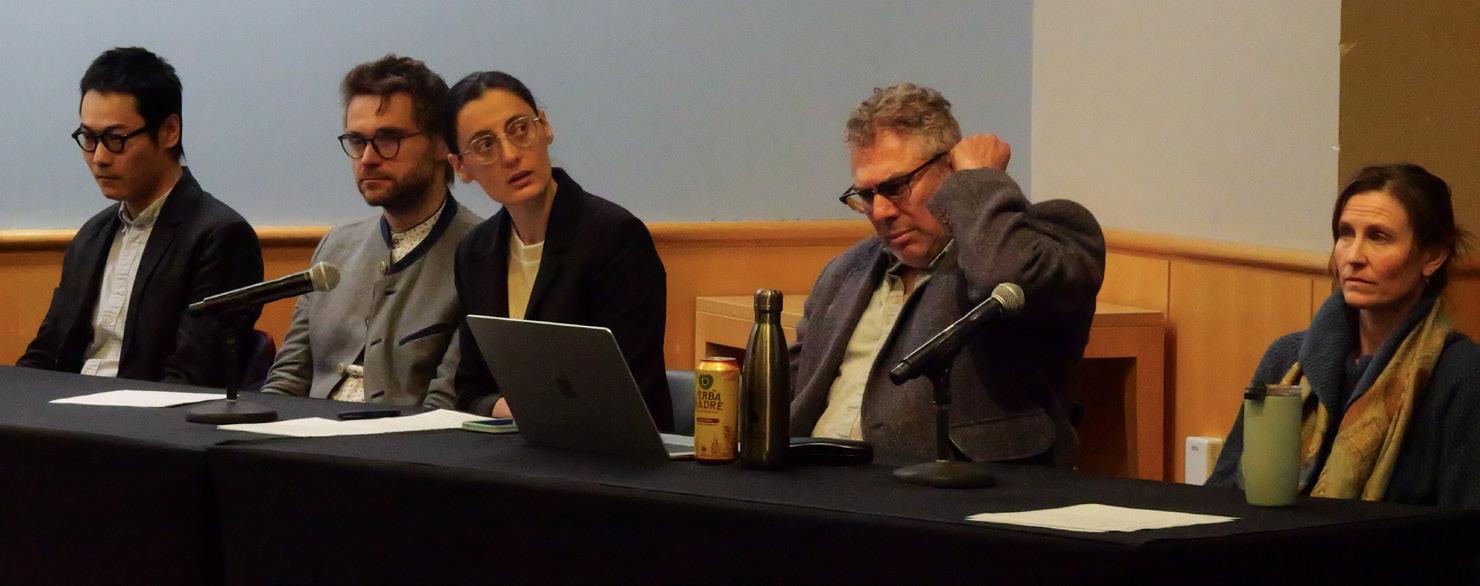
Professors from the UI Martin Institute and the Department of Politics and
Philosophy held an expert panel on the on-going war in Iran, on Tuesday, March 10. The Iran pannel discussion had an audience of more than 50 and was live-streamed.
The United States and Israel started airstrikes early Saturday, Feb. 28. Since then, thousands of strikes have hit targets such as military bases, the Shajarah Tayyebeh girls school, which killed 175 people, and Khamenei’s compound, killing former supreme leader, Ayatollah Ali Khamenei.
“As [Iran’s] proxies have faced heavy military defeats…showing weakness in its foreign policy abilities… Iran has been facing some serious challenges to its regime from a both
domestic and international stance,” said Damman, who opened the panel.
President Donald Trump announced the current attacks known as “OPERATION EPIC FURY”, in a pre-recorded video posted to his Truth Social account at 4 a.m. on Feb. 28
“They have had every opportunity to renounce their nuclear ambitions, and we can’t take it anymore. Instead, they attempted to rebuild their nuclear and to continue developing long range missiles,” Trump said in the video.
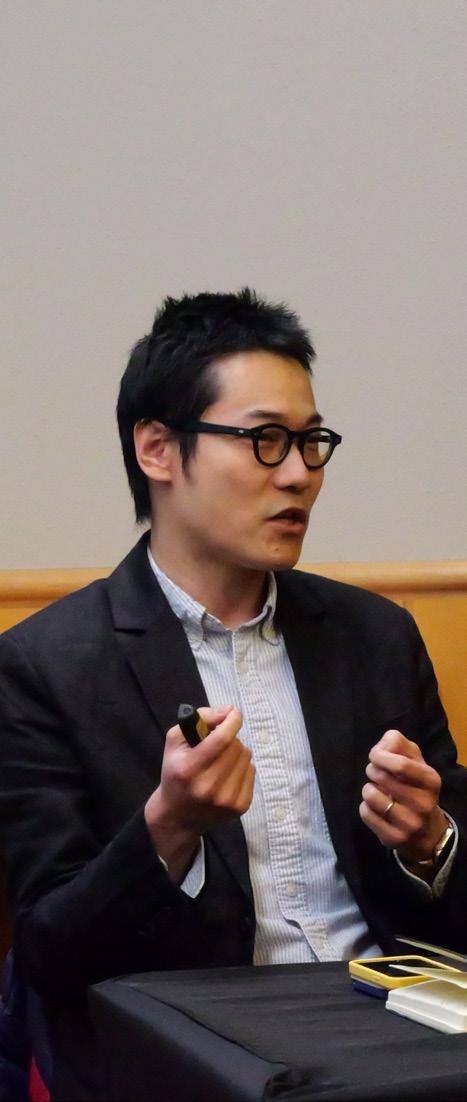
Professor Chen Wang, the Slayton assistant professor of East Asian Politics, was given the perspective of U.S. considerations.
Idaho to lease ISU anatomy lab pending state approval
Joshua Reisenfeld ARGONAUT
The Idaho State Board of Education approved a collaborative agreement for the University of Idaho to be one of several partners leasing Idaho State University’s anatomy and physiology laboratory. The partnership also involving University of Utah’s
Spencer Fox Eccles School of Medicine to expand undergraduate medical education in the Treasure Valley is pending approval from state legislature.
This agreement is one of the recommendations provided by the “Train Here, Stay Here” undergraduate medical program plan, which aims to solve Idaho’s physician shortage, developed by the Undergraduate Medical Education Committee in 2025.
“This joint venture represents a thoughtful, fiscally
responsible approach to MD undergraduate medical education in Idaho,” said UI President Scott Green in a March 5 press relase. “By leveraging existing public resources, we’re expanding opportunities for future physicians to train and serve in Idaho. We’re grateful for Idaho State University’s partnership in helping make expanded undergraduate medical training in Idaho a reality.”
To make use of the anatomy lab, UI plans to base medical students at
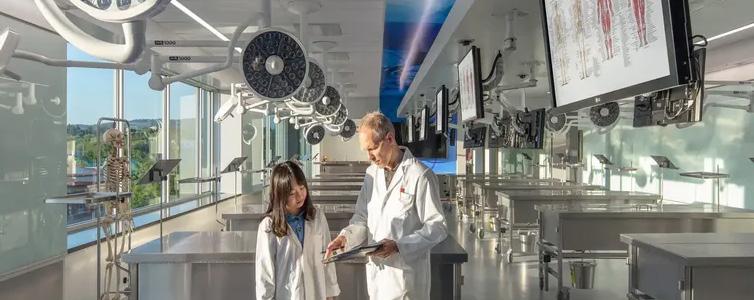
the Water Center in Boise, which is currently used for research and outreach. These students would then commute to ISU’s Meridian Health Sciences Campus for the anatomy component of their education.
This agreement would enable students to complete anatomy training without costly facility investments. UI already has an anatomy lab in the WWAMI Medical Education Building on the Moscow campus, but this partnership would expand the university’s medical education program to better meet the state’s physician needs.
Currently, Idaho is ranked number 50 in physicians per capita and number 44 in terms of total physicians in the state, according to Idaho Ed News, due to rapid population growth and high physician turnover. The state would need 1,500 doctors today to meet the national average.
UI to lose $1.7 million more in govt. funding
Joshua Reisenfeld
ARGONAUT
The Idaho House of Representatives passed a resolution on Friday, March 6, to approve a 4% budget cut to state agencies and departments for the current Fiscal Year 2026. Senate Bill 1331 passed the Idaho Senate on March 2, and now awaits a signature from Gov. Brad Little.
SB 1331 is a 1% addition to Little’s executive
order from August 2025 that required all agencies, except for K-12 public schools, to reduce their general fund budget and other appropriations spending by 3%. The University of Idaho saw $5 million in cuts back in August, which has now become $6.7 million as a result of the additional 1% cuts.
Because these cuts affect the current fiscal year, state agencies and departments including UI will have to retroactively free up this additional percentage of their budget by the end of July.
According to the Idaho
Capital Sun, prior to the legislature session, Idaho was estimated to end FY 2026 with a deficit around $40.3 million following five years of tax cuts approved by the Idaho Legislature, which reduced Idaho’s revenue by an estimated $4 billion.
Increasing the cuts from 3% to 4% reduces the state’s budget by an additional $48 million.
Supporters of the bill said it was necessary to ensure the state passes a balanced budget.
“It’s a crappy bill that we have to vote on, but it’s a necessary bill,” said House
Majority Leader Jason Monks, R-Meridian according to the Idaho Capital Sun.
The bill passed the house 44-22, but just barely passed the senate at 18-17.
In September, the division of financial management told state agencies the 3% budget cut would continue into FY 2027.
While nothing has been voted on yet, the Idaho budget committee proposed for FY2027 maintenance of operation to raise this number to 5%, raising the total budget cuts for UI up to $8.3 million.

Joshua Reisenfeld ARGONAUT
ASUI is accepting applicaitons for President, Vice President and seven senator seats until Wednesday, March 25 by 5 p.m. Applicants are required to attend a candidate meeting on March 27 at 5 p.m. in the DSI office.
A launch campaign for candidates begins on Monday, March 30, with restrictions, fully opening on Wednesday, April 1. Voting will close on Friday, April 10 at 5 p.m., and the winners of the election will be announced at 5:30 p.m.
Three debates will be held during the campaigning session, on April 2, April 7 and April 9, with times and locations yet to be assigned.
Students not interested in running for ASUI are still encouraged to participate in the voting, which will be sent out via e-mail once the campaign session begins.
Updates to this information, as well as application forms and the duties of each role, can be found in a PDF available through the ASUI Linktree on the @asuidaho Instagram.
In response to anticipated budget cuts from the state, the University of Idaho is offering incentives to the planned retirement program, which allows employees to reduce their employment appointment level over a period of up to two years, but retain health benefits at their current rate.
To be eligible, employees must have an apportion of 0.75 full-time employment or greater, be at least 53 years old at the time of entry, have completed a minimum of five years of service at UI and have no written notice or contract for any other retirement agreement.
Employees who opt in to the program between Wednesday, March 4 and Tuesday, March 31 will receive a onetime payment equal to two pay periods of base salary in the first pay period of Fiscal Year 2027.
Spring 2026 graduation gowns must be ordered by April 3
The deadline for ordering all spring commencement regalia for bachelors, masters, law, doctorates and faculty is 5 p.m., Friday, April 3, 2026. Regalia must be ordered though Jostens.
Academic regalia is required when participating in University of Idaho’s commencement ceremonies. Tassel and hood colors are color-coded for specific majors, which can be seen on the regalia colors list available through the UI GradFair information page.
Bachelors and master’s gowns ordered through Jostens will be delivered directly to the graduate.
Doctorates and faculty rental gowns will be available for pick up from 8-5 p.m., Monday, May 11 to Friday, May 15, at Alumni Relations, Hays Hall, 1212 Blake Avenue.
Law graduate rental gowns will be distributed by the College of Law in Moscow and Boise. Rentals are due back no later than a week after the ceremony.
Spring break bus tickets still on sale, bus leaves Saturday
Vandal break bus tickets for spring break are still available for sale through the University of Idaho alternative transportation website. Round trip tickets are $135 for the Boise route and $200 for Idaho Falls route. Reservations are sold first-come, first-served and are available for students.
On Saturday, March 14, the break bus will arrive outside of Wallace on Sixth Street at 7:05 a.m. and in front of the Bruce Pitman Center at 7:40 a.m. The bus will arrive in Boise around 3:30 p.m. and Idaho Falls at 8:40 p.m.
The bus will return on Sunday, March 22, beginning in Idaho Falls at 6:30 a.m., stopping in Boise at 12:15 p.m. and arriving in Moscow at 7:15 p.m.
More information and the timetable for each stop is available on the UI alternative transportation website under vandal break bus schedule. All students riding the bus should check the schedule for their specific destination prior to departure. Each rider may bring no more than two pieces of luggage and one small carry-on item.
Restaurant will bring 115 jobs to Moscow
A new Chick-Fil-A location will open in Moscow at 2124 W Pullman Road, in the Palouse Place mall parking lot, Thursday, March 12, at 6:30 a.m.
The opening of this location will bring 115 jobs to Moscow.
The only Chick-fil-A location currently open Moscow is on the University of Idaho campus, which will have no changes because of this new location, according to Idaho Eats Marketing Director Eldon Nelson.
“We are excited to hear that more options are available to the community. Our Chick-fil-A on campus will continue
serving the campus community, providing the convenience of dining on campus to all students and faculty/staff members,” Nelson said.
The Pullman Road location will serve a whole menu and accept Chick-fil-A gift cards, services that are not currently available at the UI campus location.
According to a public relations representative for Chick-fil-A Inc., the location is owned and will be operated by Josh Altmeyer, from Spokane, Washington.
Prior to the opening of the Moscow location, the nearest fully operating Chick-filA was located 87 miles away in Spokane.
As part of the grand opening, the Pullman Road location will have a “MooveIn Party” where guests of all ages who show up dressed in cow spots or cow-spotted accessories can redeem one free entrée or kids’ meal in the restaurant or drive thru.

Young Americans for Liberty cite safety and Second Amendment
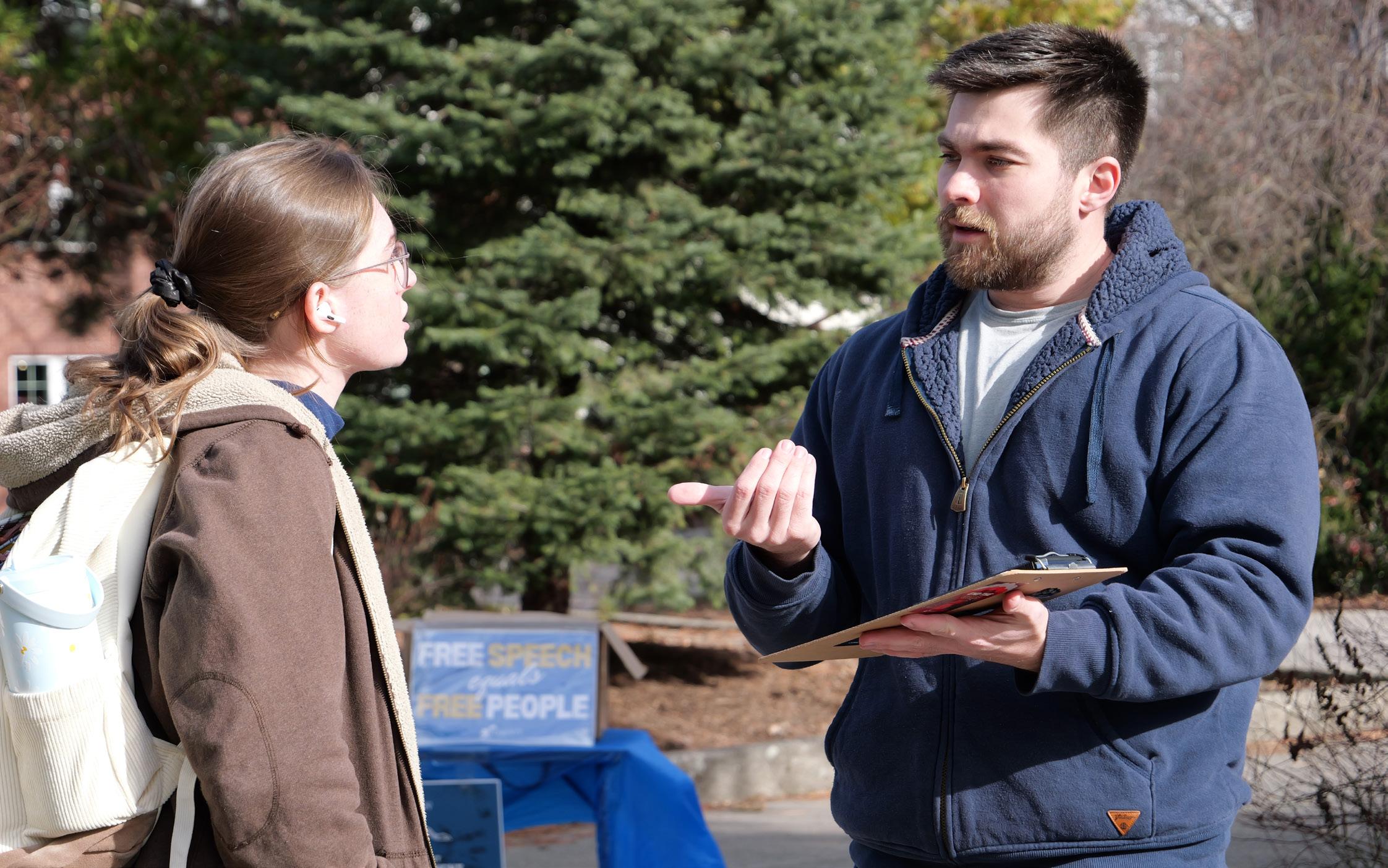
Braving the cold Idaho winter, Phillip Sturholm attempts to get signatures for his petition that aims to get tasers unbanned from the University of Idaho campus.
Since 2015, tasers have been banned at UI, but students with Young Americans for Liberty say removing the rule would improve campus safety as well as protect students’ Second Amendment rights.
Sturholm is the state chair of Young Americans for Liberty, a libertarian-aligned advocacy organization that promotes grassroots political action and confrontational politics. He says students should have the option to carry tasers for self-defense.
“We simply want people to have something to stand up and defend themselves with,” Sturholm said.
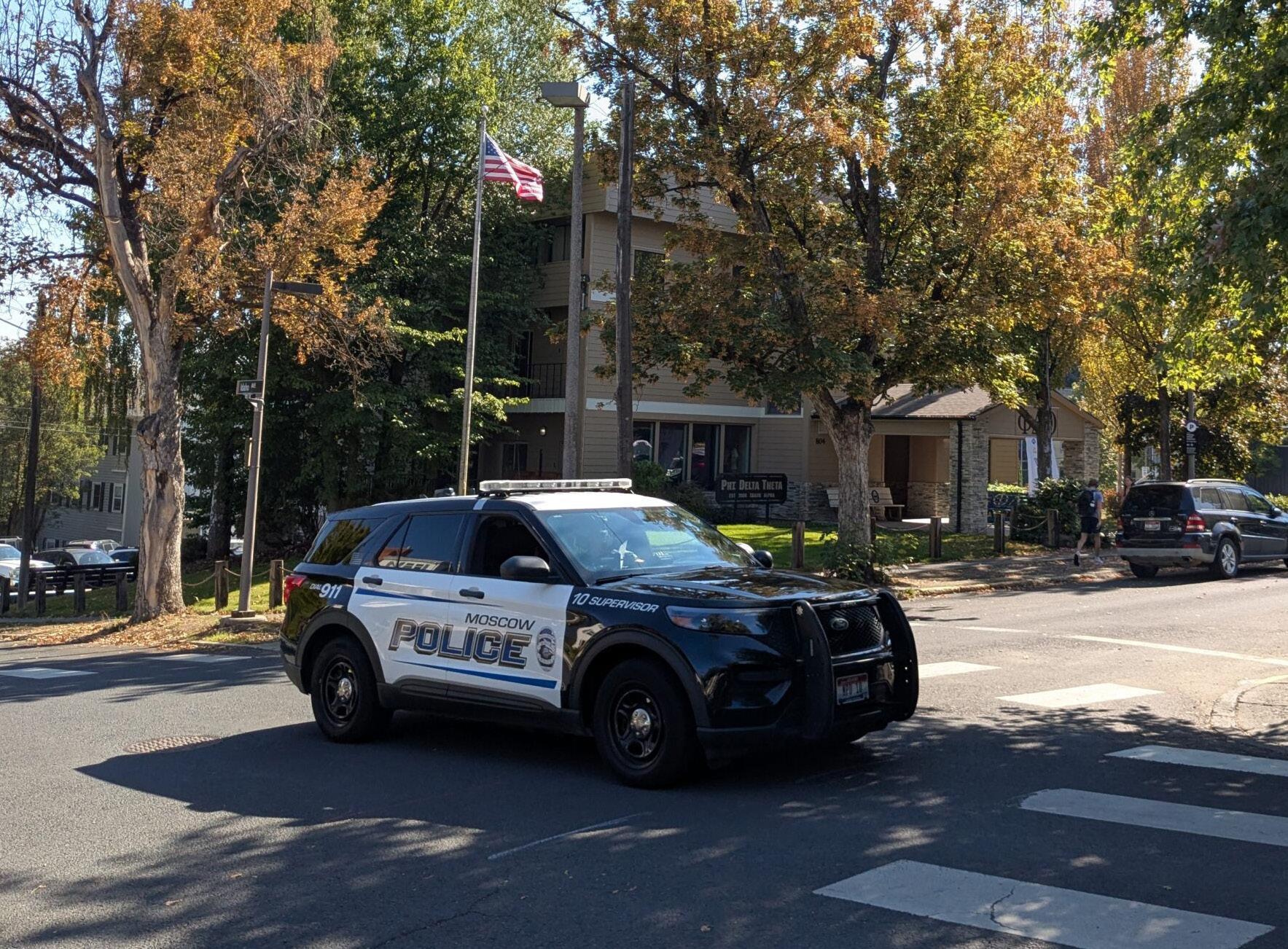
According to a Moscow Police Department report from 2023, there were 1,169 UIrelated calls during the year, or an average of 3.2 per day. This number is closer to 4.5 per day when factoring out breaks and other low activity times.
While not all calls are in response to
potentially violent situations, with the ban on tasers lifted, Sturholm believes that it would make campus a safer place to be.
He explains that the possibly of a student having a taser on their person discourages attacks even if it is not there.
“I think that—when students engage in that, I think it’s great,” said Bruce Lovell, director of physical security at UI. “So, if they want change and they go about it appropriately, I think it’s a really good mechanism.”
Sturholm said that while this will improve safety on campus, it is mainly a battle to protect constitutional rights.
“For me, it’s an entire Second Amend-
3D artwork entries for display from local artists due by April 15
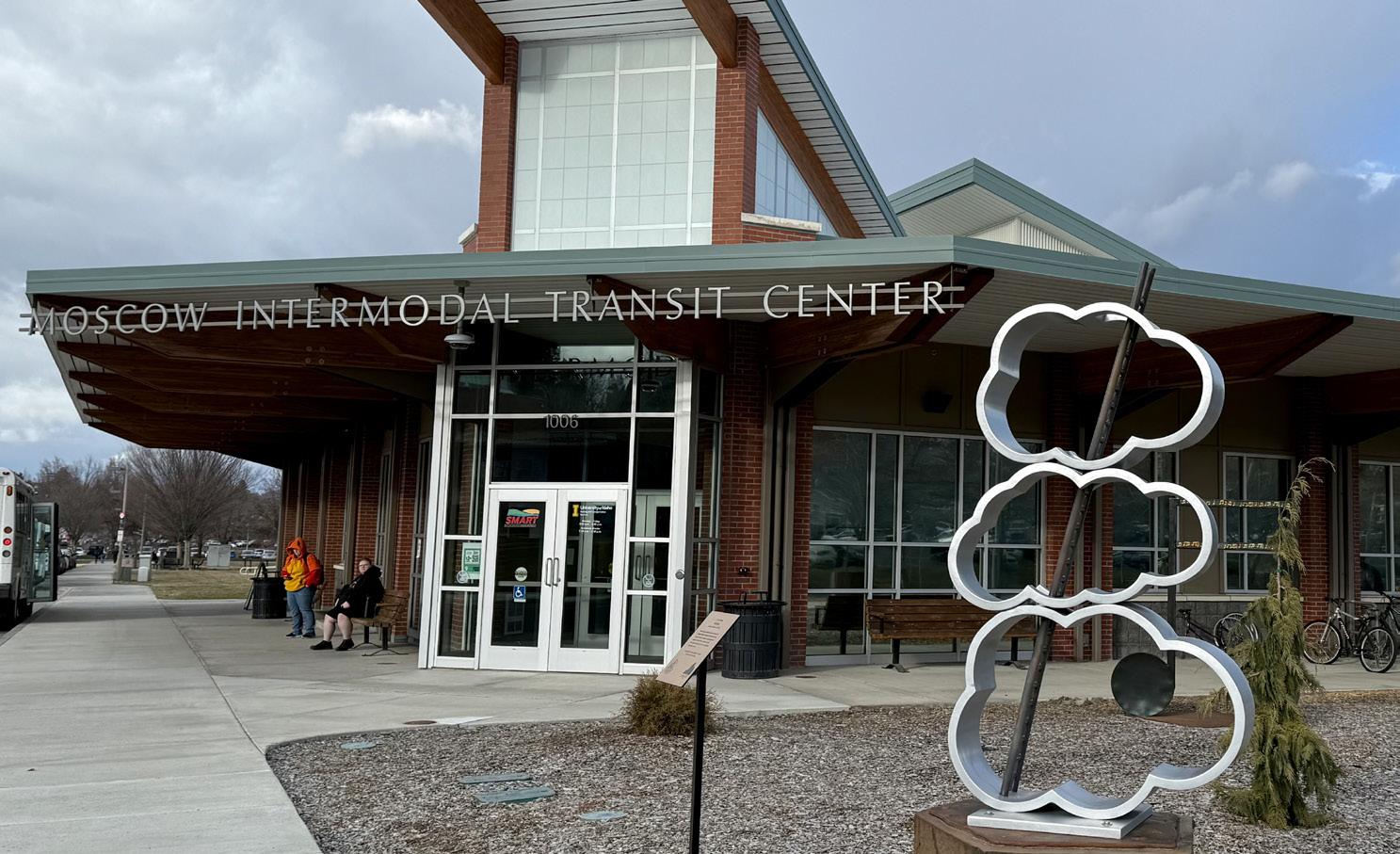
Each year, the City of Moscow and the Moscow Arts Commission host a contest for regional artists as they search for threedimensional pieces to be displayed in a one-year installation amongst the sculpture garden, which sits outside the Intermodal Transit Center on the University of Idaho campus.
“Moscow is a place where art is viewed as essential,” Megan Cherry, the arts manager of Moscow, said. “This is such an amazing trait of the community.”
The application to submit artwork is open until April 15, and can be found on the city’s Submittable page.
Up to four pieces will be chosen for display in the garden from May 2026 to May 2027. A detailed list of requirements
can be found on the application page.
Winners will also receive $1,000 as a means of compensation for the pieces they loan. This is to support contributors and is a very standard component of art-on-loan programs nationwide, Cherry said.
Following the founding of the ITC in 2012, the Moscow Arts Commission created the sculpture garden in 2015 to accompany the service that aims to provide accessible transportation services for the Moscow area
According to Moscow Arts Commission mission statement provided on their website, they work to “enrich the community by celebrating and cultivating the expression of all forms of art and culture,” which the sculpture garden embodies.
Their mission could not be upheld without involved community members such as Cherry, whose role keeps her at the center of the city’s art scene.
In 2010, Cherry began a career in public education, though she began to shift her focus to municipal public art in 2016. That
ment battle,” Sturholm said. “It’s the principle of the matter, and the fact that students who either cannot obtain the license or do not want to use something lethal for selfdefense should have every single right for their own autonomy and personal protection.”
Lucas Van Osdol is a sophomore living on campus in the Living Learning Communities. He believes that while this issue doesn’t impact him, he still sees the benefit of students having the choice.
“Even though it could be used as a weapon, I think it best to allow people to carry their own safety preventatives,” Van Osdol said. “The world is dangerous enough for everyone with them and an extra safeguard for those that are scared and believe they need it isn’t a bad thing.”
Sturholm said that he is aware that some students are concerned and think it is dangerous to allow weapons on campus, even if they are nonlethal.
“If you tase somebody with it and they’re not assaulting you, that is assault on yourself, that is not only still against the rules, still punishable, still even illegal, by law, but also, it’s equally as enforceable as the current ban,” Sturholm said.
Since the petition started at the beginning of the fall 2025 semester, Sturholm said that he and the other members of Young Americans for Liberty have been able to collect 923 signatures from students and staff on campus.
“I am three days of tabling worth away from getting our goal,” Sturholm said. “But we’re going to try to make it up in force and have as many people who signed and who are willing to come with us, just to be a crowd, to be a show, to be an image.”
On Tuesday, March 24 at 1 p.m., Young Americans for Liberty will be presenting their petition to Dean of Students Blaine Eckles.
interest in preserving and promoting the local artistic culture led her to fill the role of the arts manager, which she took on in 2018.
“I connect with community members regularly, and I learn so much from those relationships. The people here in Moscow really are passionate about art, and that is what keeps the city’s arts programming alive and responsive to what the citizens want to see,” Cherry said.
Though not involved in choosing the
winning sculptures herself, Cherry was clear in describing her favorite part of the selection process: appreciating art-based conversations.
“I love to observe the conversations that arise during the selection panel process. Art provokes the very best dialogues, and while I don’t vote on submissions, I do get to observe wonderful conversations as the selection panel facilitator,” Cherry said.
House Bill 659 moves to senate for vote
Paige Wilton ARGONAUT
On Friday, March 6, the Idaho House passed a bill that would require all local law enforcement in the state to apply for a partnership with ICE through the nationwide 287(g) program. It awaits a vote from the senate and requires the governor’s approval before it becomes law.
The program, which is an addition to the Illegal Immigration Reform and Immigrant Responsibility Act of 1996, was created in order to establish relationships between ICE and law enforcement agencies across the nation in an effort to more effectively carry out immigration enforcement on community levels.
House Bill 659, which passed in a 41-27 vote, would require all of Idaho’s city and county law enforcement agencies to apply the program, rather than it being optional.
Three distinct models exist within the program: a jail enforcement model, task force model and warrant service officers.
Each of these sectors hold different responsibilities, though they all allow local law enforcement to go beyond their typical duties to enforce immigration policies.
According to the map and available spreadsheet on ICE’s website, there are currently 10 participating branches in Idaho. This includes seven warrant service officer programs, one jail enforcement model and two task forces.
While most partnerships are based in southern Idaho, Kootenai County is affiliated with one warrant service officer program and the jail enforcement unit.
Dale Hawkins is the representative sponsoring HB 659.
In a video broadcast of the meeting, published by KTVB7, Hawkins defended his proposal of the bill by explaining the importance of state uniformity.
“So that we are all on the same page, so that we are all working together for the same goals,” Hawkins said.
In that same video, those against the bill shared their reasonings for opposition.
Rep. Chris Mathias said, “It’s going to undermine [Idaho law enforcement’s] trust in us.”
After speaking to her own district sheriffs, Rep. Lori McCann said, “Every one of them said the same thing: ‘We don’t have enough manpower right now. Today, we are short.’”
Joining them in opposition during the initial bill introduction before the Idaho House of Representatives on Thursday, Feb.
26, were Canyon County Sheriff Kieran Donahue on behalf of Idaho Sheriffs’ Association, and Hailey Chief of Police Steve England, representing Idaho Chiefs of Police Association.
The Moscow-Pullman Daily News quoted Donahue explaining the separation between state and federal duties.
“We are a constitutional office. We do not do the [federal] government’s work. We do the state government and our constitutional duties,” Donahue said.
Nationwide, there are 1,511 signed 287(g) program Memorandums of Agreement across 39 states and two U.S. territories, according to the public database.
The university aims to physically connect the campus with the community
Paige Wilton ARGONAUT
The Jackson Street property where Silos and Social currently sits has been purchased by the University of Idaho as part of a plan to connect downtown Moscow with the university campus via a ‘Legacy Crossing.’
According to an article written by the MoscowPullman Daily News, the university acquired the plot of land in a $1.625 million deal from the previous owner, Andrew Crapuchettes.
Crapuchettes, a Moscow local and the founder of job board-based company Red Balloon, has owned the land since 2017.
In an email to the Daily News, the university’s director of communications, Jodi Walker, noted there are no plans for new development in the immediate future. The three businesses currently operating on the space – Silos and Social, KnoxBox Coffee and Taqueria Las Torres – will remain up and running for the time being.
While UI now owns the 625 S. Jackson St. property, the Moscow Urban Renewal Agency retains
ownership of the empty lot that sits directly next to it on the corner of 6th and Jackson Street.
In acquiring this new property, the university adds to the 20 acres it previously purchased between campus and downtown.
Walker said that the property is meant to connect campus to downtown “in a physical way that matches the deep connection the two already share.”
While the ‘Legacy Crossing’ is a vision driven by UI, a larger district dedicated to the idea was established in 2008. According to MURA, the Legacy Crossing District covers approximately 163 acres.
The MURA website says the district was established to “eliminate
conditions impeding the city’s economic growth in the area.”
Despite the broader goals for the area, the university intends to use what acreage of the district it currently owns to foster further community connection.
MURA’s website also says, “A future developer has been selected through a public Request for Proposal process and is currently planning a $15 million mixed-use development for the site.”
There have been multiple previous attempts to build on the land since MURA acquired it in 2010, but it was reported previously by the Daily News that, due to unstable soil conditions and rising building costs, all attempts to develop have fallen through.

“This was something that has not been really mentioned by news coverage, which is the uniqueness of Trump’s position in the U.S. presidential electoral cycle,” Wang said. “Research shows that American presidents who are early in their tenure are way more likely to get involved in conflict, than at any other time during their tenure.”
China and Russia are hesitant to speak against the U.S. actions in Iran, Wang said. The response these counties had was less vocal than their response to condemn U.S. action after the capture of Venezuelan president Nicolás Maduro in early January.
Beijing is handling its foreign policy with the U.S. very well, and Moscow is currently pre-occupied in the war with Ukraine, Wang said.
Adjunct Professor Emine Ari-Erol spoke on the implications and reactions from the ‘gulf countries’, and the region surrounding Iran. Most Gulf countries are focusing on protecting civilian infrastructure.
“By Saturday, [March 8,] at least 14 countries were directly affected.
This war is not anymore between Iran, the U.S. and Isreal, because Iran is deliberately targeting the U.S. partners in the Gulf, and treating them as cobelligerents to maximize the cost of the campaign,” Ari-Erol said.
Department of Politics and Philosophy Chair and Director of Graduate Studies, Florian Justwan introduced perspectives from U.S. Allies, especially those from the EU and Israel.
“If you look at the official language from prime minister Netanyahu, you’ll hear that Israel says it was a pre-emptive strike in order to remove threats against Isreal, that we may call this an instance of strategic overstatement,” Justwan said.
He added that most leaders in the EU were concerned about what this attack says about U.S. intentions in the area but are publicly silent or threading the needle due to the U.S. assistance in the ongoing war in Ukraine.
“Privately, they are pretty unhappy about the conflicts; they are unhappy that they haven’t been looped in, and they do have concerns about the legality of this war,” Justwan said.
The final panel speaker, Clinical Assistant Professor of Political Science,
Charles Dainoff, spoke on what the next steps were for the war.
Dainoff placed the timeline of the remainder of the war from now to summer 2026.
“The global economy has become more volatile than before as we see the weakening of institutions and the solution of formerly solid alliances,” Dainoff said.
Dainoff continued to go through scenarios, stating that the most likely one is that Mojtaba Khamenei, the son of the previous Ayatollah, will continue to act in Iran as his father did, with religious and political crackdowns. Iranians will die as a result, Dainoff said. He also added that the U.S will end the military campaign relatively soon, and “move on to the next shiny object” as the rest of the region continues to fight each other for political dominance.
The Argonaut interviewed Tadman Nettles, a freshman political science and philosophy major.
“I think it is important to listen what academics actually have to say…I think everyone should go to it, regardless of if they are a political science major, engineering major, people should also ask questions,” Nettles said.




The event, which drew in thousands last year, hopes to be similarly successful again
Cal Torres ARGONAUT
On Sunday, March 29, from 11 a.m. to 4 p.m., over two dozen vendors representing international cultures will participate in Cruise the World in the Bruce Pitman Center.
This will be the 28th annual Cruise the World event, hosted by the University of Idaho’s International Programs Office.
Many of the vendors will have international foods and drinks available for purchase.
On top of these cultural dishes and snacks, eventgoers can expect a variety of performances and fashion from the cultures represented on campus and in the greater Moscow community.
“Anyone who’s had some kind of affinity abroad can host a booth there, even students who have studied abroad as well as community members,” said Mimi Kestle, the program coordinator for the IPO.

“We really just want to bring the whole community together to celebrate international education and cross-cultural engagement. There is a whole world out there and we get to celebrate that in Moscow,”
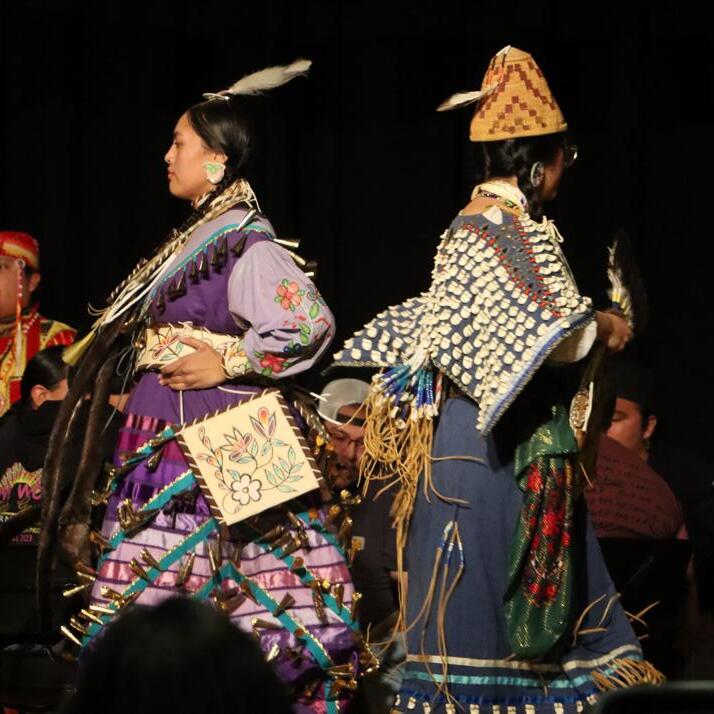
According to Kestle, about 2,700 people attended the event last year. This year, they hope to draw more.
Because of the broad audience for the event, the office has been working hard in its promotion.
They have designed and put up fliers, worked with local schools and universities as far as Lewiston, spoken with classes and put out PSAs on local radio stations.
“I think it’s a really family-friendly event. There’s a lot of folks that come up to me and beam and share, like, ‘Oh, I brought my kids to this, and it really taught them that there’s a whole world outside of Moscow, Idaho, but they get to taste and see that right outside of their doorstep.’ I hope it inspires people to travel, to engage cross-
“Left-Handed
Academy award nominated film depicts differences between younger and older generations
Dale Fussell ARGONAUT
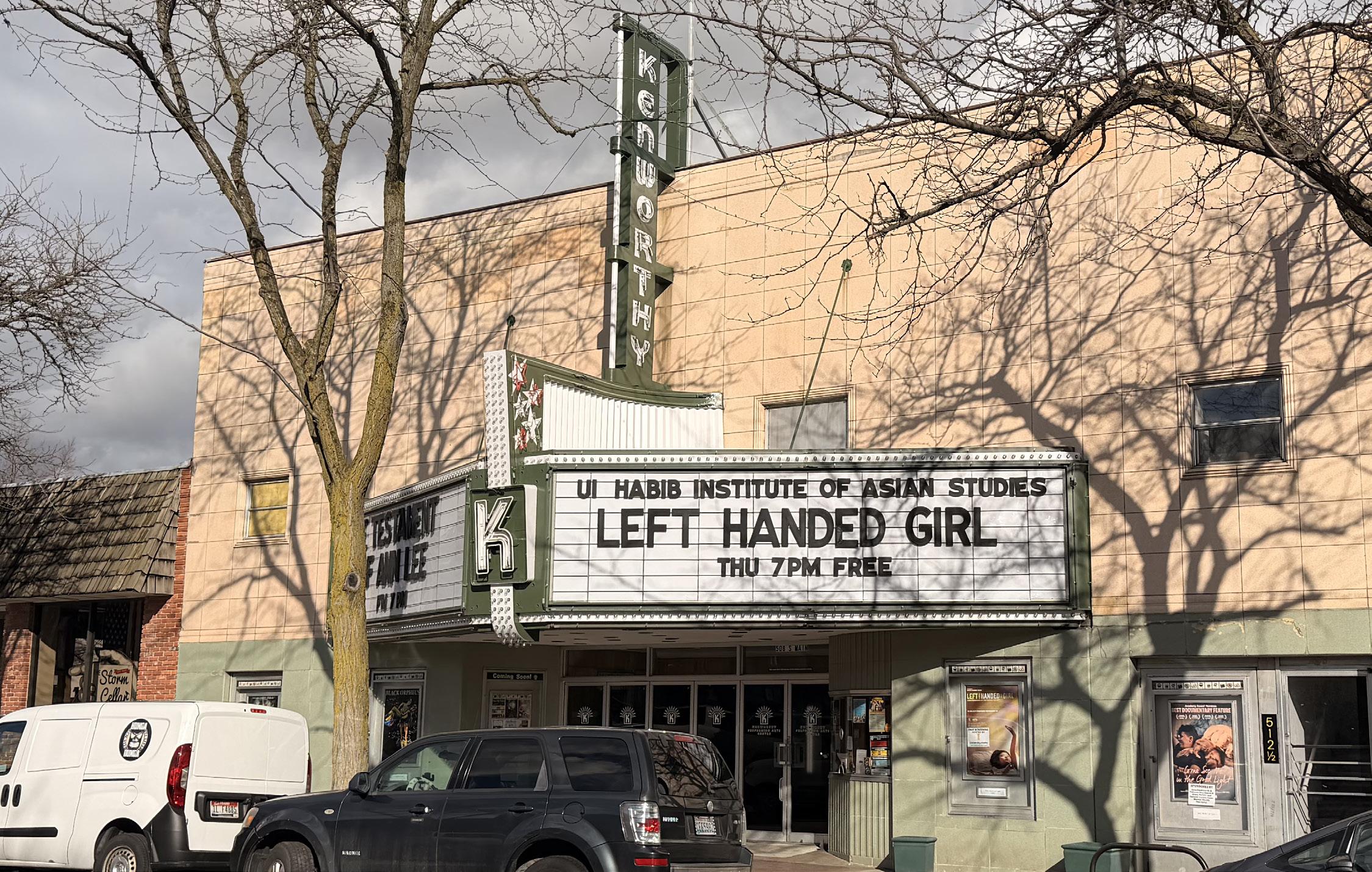
“Left-Handed Girl,” a 2025 Taiwanese film and directorial debut for Shih-Ching Tsou, was shown at the Kenworthy Theatre in partnership with the University of Idaho Habib Institute of Asian Studies on Thursday, March 5, as their final event for the Chinese New Year.
“Left-Handed Girl” is a fantastic movie that expertly plays with the split between traditionalism and the modernization of younger generations.
The film was both funny and emotionally impactful throughout its entirety. The story centers around three main characters: ShuFen, the mother, Yi-Ann, the eldest daughter, and Yi-Jing, the youngest daughter.
Each generation of the family has their own perceptions of traditions and folklore which is thoroughly explored throughout the movie.
Shu-Fen has an abusive ex-husband who has become terminally ill and faces financial hardship to pay for his medical and funeral bills burdened by obligation.
Yi-Ann has a turbulent relationship with her mother made worse by the debt accrued paying for her father’s expenses and works the stigmatized job of selling psychedelics, while Yi-Jing struggles with her left-handedness in a culture that is both growingly excepting of left handedness but still retains much of the stigma within older generations.
At one hour and 48 minutes in run time, “Left-Handed Girl” was entirely shot on an iPhone camera in Taipei, Taiwan.
This choice of filming technique and the limited focal length of the lens keeps the camera close to characters and also shows the world in the way people document their life rather than what can be seen on a movie set seen though a cinema camera.
In one of the opening scenes, Ama, the
culturally,” said Kestle.
The event is largely carried out by UI students, who help run the booths, make the food and perform.
Saif Sikdar Riyadh, a junior, is currently on the student committee for planning the Cruise the World event.
In the past, he worked on the Bangladesh committee and at the flag parade.
“I carried the flag of Bangladesh in the main flag parade of the day of the event,” said Riyadh.
“In my first time, I was worried, like, ‘Can I do it or not?’ but it was really nice to me. Last year, I did the same—I carried my country’s flag. It was a very proud moment for me.”
Countries that will be represented with booths currently include Brazil, Bangla-
desh, Denmark, South Korea, among many others.
Ultimately, the appeal of this year’s Cruise the World will be their very successful past iterations; many cultures will be showcased and available to sample in some small way.
“If you saw last year’s Cruise the World, we got so many people from different countries to participate here, and this year we are hoping to get more people and get some more amazing performances,” said Riyadh.
The IPO and involved students will work with Idaho Eats to get all the food prepared for Cruise the World. Food is purchasable with cash only.
More information, including menus, will be available as the event draws closer.
grandmother, Apa, the grandfather, Shu-Fen, Yi-Ann and Yi-Jing are eating together.
Yi-Jing is eating with her left hand, as is normal for around 10% of the population, yet Apa looks at Yi-Jing and questions her actions.
Ama tells Apa that nobody follows those old rules anymore.
In traditional Chinese and Taiwanese culture, the left hand is associated with the devil, Apa tells Yi-Jing when they are alone.
Jeff Kyong-McClain, the director of the Habib Institute for Asian Studies and associate professor of history at UI, gave an opening talk before the movies showing where he used the central line of lefthandedness to explain the cultural struggles expressed in the movie that do not have parallels in the United States.
Most of the films cast members are women, and the few men that are shown have major character deficits with very little redeeming qualities from what is presented.
The centrality of women is a comment on the shame and standards sexist placed on them by their culture, especially from within their family.
Another core theme is the one-sided shame placed on women expressing their sexuality.
For example, when two boys learn about Yi-Ann’s job, they ask her how much to touch her, 100 or 200.
Her job implies the character of her and her family.
However, what people observe in YiJings devil’s hand and Yi-Ann’s stigmatized work turn out to be true.
Yi-Jing steals from her grandmother and Yi-Ann is revealed to have had an affair with her boss resulting in pregnancy.
When this comes to light, the grandparents are outraged, yet it is cathartic for the younger generations to be honest about the people they are.
These examples represent the changing cultural mindset where younger generations push though tradition rather than live a life restricted by it.
At the same time, the lessons persevered in tradition are not to be forgotten.
The showing at the Kenworthy was a one-time event, but the film can still be watched on Netflix in Mandarin with English subtitles.
While
derstood, can be exploited. The graphics and system requirements are average for modern triple-A video games as is the $70 price point. The difficulty selection offers an easy, medium and extra hard mode, promoting online discussion about a needed intermediate hard mode.
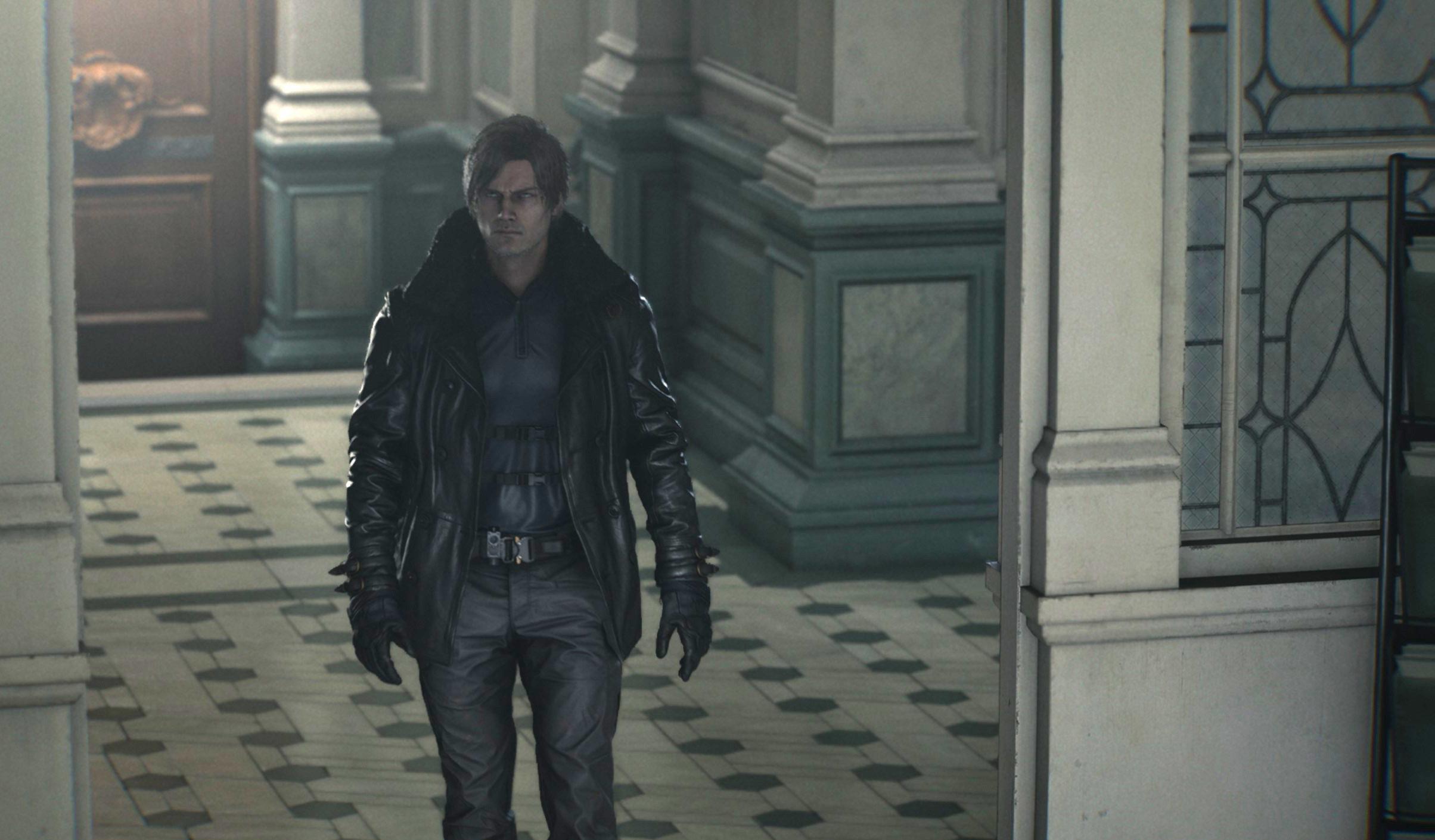
Resident Evil Requiem, released Feb. 27, 2026, is the ninth main line entry in the well-known survival horror game franchise developed by Japanese game studio Capcom. The story of Requiem builds upon the Raccoon City incident, featuring returning protagonist Leon S. Kennedy and a new playable character, FBI analyst Grace Ashcroft. Gameplay alternates between the characters as they uncover remnants of the Umbrella Corporation, a pharmaceutical company that developed the bio-organic weapons responsible for the zombie outbreak in Raccoon City, 28 years ago.
Requiem is Resident Evil at its best, but it is still a single player survival horror game with an M-rating, full of blood, death and gore. The series continues its phenomenal ability to create atmosphere and suspense within the player and does an excellent job handling the new characters to create a compelling narrative. Leon is beloved, but with Requiem being his fourth game appearance as a main character, his inclusion in the story feels driven by his popularity rather than a strong narrative reason.
Aspects of the gameplay mechanics, especially the sometimes glitchy boss hit boxes and over-bloated fetch quests, remind the player that it is a video game level following a series of parameters, that once un-
Requiem continues to improve from previous installments, but being the ninth entry in a series does not make it a good starting point. The story begins with reports of Raccoon City survivors dying in the same but mysterious way. Leon and Grace’s mothers being survivors of the incident is barely addressed, despite being the reason for both main characters’ involvement in the plot. This lack of character context affects the players’ understanding of the third act, though the game is still quite enjoyable even without this knowledge.
Grace’s gameplay is the more difficult of the two characters, requiring resource management, exploration and stealth. Leon, on the other hand, always has more than enough ammunition, powerful and upgradable firearms and a mean hatchet, all reminiscent of his Resident Evil 4 appearance where the franchise transitioned from puzzle solving to action.
Requiem allows the player to select from first-person or third-person game play. Both perspectives are well polished, leaving it wholly up to player preference, though the

game suggests first-person for Grace and third-person for Leon to enhance each of their primary gameplay purposes, immersion and action respectively.
While Grace’s well-acted voice lines play some part in her characterization, much of her personality is shown visually and is therefore completely hidden in first-person. Additionally, seeing her injured state through her posture is the only health bar the player has.
Around six of the 11 hours of gameplay are set in Rhodes Hill Chronic Care Center, where Grace was kidnapped and brought to for a reason unknown to her. The care center is operated by ex-Umbrella scientist Victor Gideon whose experimentation has created another zombie outbreak. During the story, Grace saves a young blind girl named Emily from a cell in the basement, and together they escape from the care center.
Requiem has no puzzles, something core to the game play of earlier games, only fetch quests. For Grace to escape the care center, she needs three quarts keys, which are spread-out thought the facility and hidden behind locked doors. While the player can suspend disbelief for a zombie outbreak, the absurdity of the many keys needed to ultimately unlock one door can break the games attempt to create an imersive survival feeling.
Leon is getting old, approaching his 50s and no longer backflipping off doors to dodge chainsaws. He is also suffering from the same sickness which seems to have been fatal for the other Raccoon City survivors.
As a playable character, he is still a tank, able to take a beating and dish out one far
worse. After exploring most of the care center as Grace, the player then returns to Leon’s perspective, confident with the layout and ready to hunt the large enemies Grace had to hide from.
While it makes sense for Leon, an ex-cop and government agent, to be far more effective in combat, it felt unfair to Grace when she would find two or three bullets at a time and he would find nine.
What really makes Leon feel like a super soldier is his hatchet. As Grace, the player would have to stagger and push enemies multiple times and make every shot count.
Once Leon staggers an enemy, one swing with his hatchet ends the fight. Even on nonstaggered enemies, Leon’s hatchet was able to put them in a stun lock, and it can also be used to parry.
The game included sharpness and durability mechanics to make the hatchet feel like a limited resource similar to bullets, though it is barely of consideration to the player.
Alongside main line titles, Capcom has been remaking earlier games, most notably the 2005 title Resident Evil 4, Leon Kennedy’s second appearance, and the game that cemented many fans’ love for the Resident Evil franchise.
Priced at $40 and having 16 hours of story plus bonus content, the 2023 remake of RE4 is a better starting place for newcomers to the franchise.
For Resident Evil fans, Requiem is a worthwhile experience with an impactful narrative, great gameplay and strong cast, and would be good for some quality gaming over spring break.
time event you attend.
Ingredients:
4 russet potatoes
3-4 large pickles or 8-10 small ones
1 can black olives
6-8 eggs (hard boiled)
1 c. mayo
With spring Daylight Savings happening last weekend, the days are officially longer, allowing for more sunshine each day.
Spring grows closer with the promise of sunshine and the staple spring events, such as picnics, potlucks and family BBQs can finally begin.
This creamy and delicious potato salad recipe is sure to be a hit dish at any spring-
1-2 tsp. yellow mustard
1-2 tbsp. pickle juice
Onion powder*
Garlic powder
Salt
Pepper
Paprika
Parsley (dried or fresh)
Directions:
Wash the potatoes and cut them into chunks. Put them in a large soup pot and boil for 15-20 minutes.**
Get a separate pot for your eggs. Boil for 15 minutes to ensure the yolks are fully cooked.
While the eggs and potatoes boil, chop the pickles and olives and put them into a large bowl.
Once the eggs are boiled, put them into an ice bath and let them sit for about five minutes.
When the potatoes are done, dump them into a strainer and rinse slightly with cold water.

Dump them into the bowl with the olives and pickles.
Once the eggs have sat in the ice bath for around five minutes, gently crack their shells and rinse slightly with cold water to ensure there are no pieces of shell left on the eggs.
Chop the eggs and dump the yolk into a separate bowl and mash them until they are fine crumbs; this will be for the sauce.
Add the egg chunks into the large bowl with the potatoes, olives and pickles.
In the small bowl with the yolks, add the pickle juice, yellow mustard and seasonings.
Mix well until it becomes a creamy consistency.
Taste the sauce
and adjust any ingredients as necessary to get your desired flavor.
Pour the sauce into the large bowl and mix together until everything is evenly coated with the sauce.
Eat hot or chill for 20 minutes to serve it cold.
Enjoy!
Chef Notes:
*All seasonings are to taste and personal preference.
**An easy way to tell if the potatoes are done is to poke them with a fork.
If the fork penetrates the potato with little-to-no resistance, then the potatoes are done.
You want them to be soft but not mushy, so test them as many times as necessary.




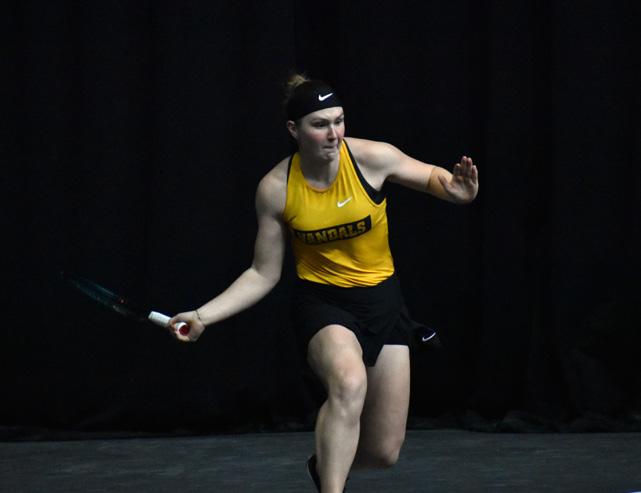
Schraeder has been the key to the Vandals turnaround this season
Jayden Barfuss ARGONAUT
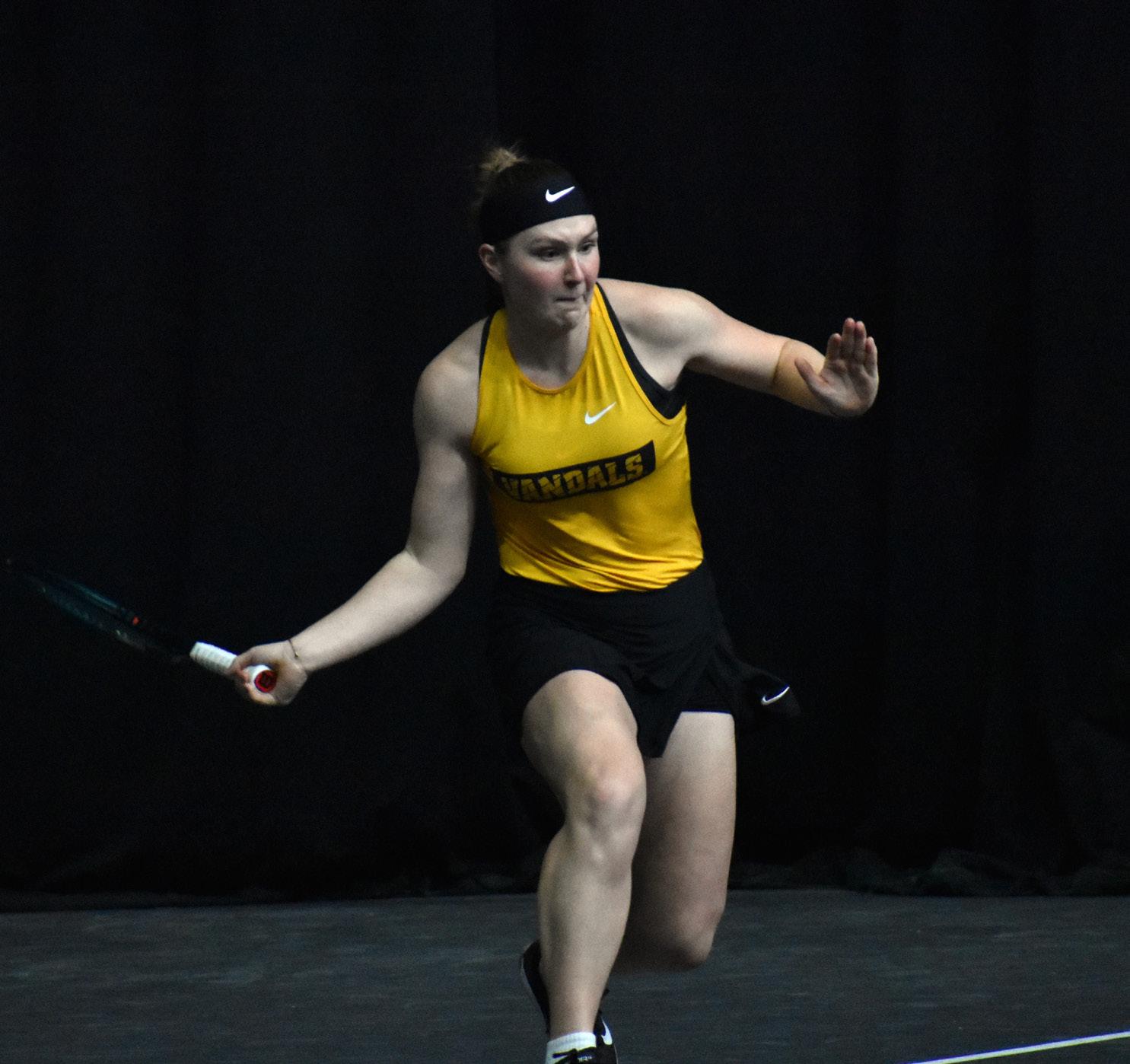
As junior Naomi Schraeder steps to the baseline, tosses the ball into the air and sends a thundering serve across the net, she is exactly where she belongs.
Schraeder, a native of Kelowna, British Columbia, attended Kelowna Secondary School where she was named team captain her senior year and held an undefeated record throughout her high school career. She was also crowned the Okanagan Valley Triple-A champion before bringing her game to Moscow.
From the moment she stepped on campus, Schraeder has been a rising star. Her freshman season, she turned heads as she grew comfortable in her new surroundings, using the tennis court as her most familiar ground.
Arriving on campus as a walk-on, Schraeder’s play quickly proved she belonged, earning an athletic scholarship that same season. She finished that first year with a 21-14 record, going 13-4 in singles (7-1 Big Sky) and 8-10 in doubles (2-6 Big Sky). Her sophomore season was even better.
Schraeder posted a 22-11 record with a singles mark of 14-5 (5-2 Big Sky) and doubles record of 8-6 (4-2 Big Sky), the best season of her Vandal career to that point.
Now in her junior year, she has taken another step forward. Through 14 matches she carries a 12-6 record, going 7-3 in singles (2-1 Big Sky) and 5-3 in doubles (2-1 Big Sky).
By almost every measure, this is the best tennis of her college career.
A big part of that has been her partnership with junior Jessica Matthews. The two have served as Idaho’s number one doubles pair all season, posting a 5-3 record together.
Schraeder helped lead the Vandals to an 8-6 record with three straight conference wins. When Schraeder and Matthews step on the court together, they set the tone for the rest of the lineup.
This past weekend offered a glimpse of just how versatile Schraeder has become. With Matthews unavailable, she stepped in alongside sophomore Chenyue Xu and the two wasted no time getting on the same page, cruising to a 6-3 victory over Kelsey Phillips and Meghna Anand to get the Vandals off on the right foot.
Schraeder then went back out and defeated Anand in singles, winning the final two sets 6-3 and 7-5 to help Idaho roll to a 6-1 victory over Montana.
Through three seasons, the trajectory
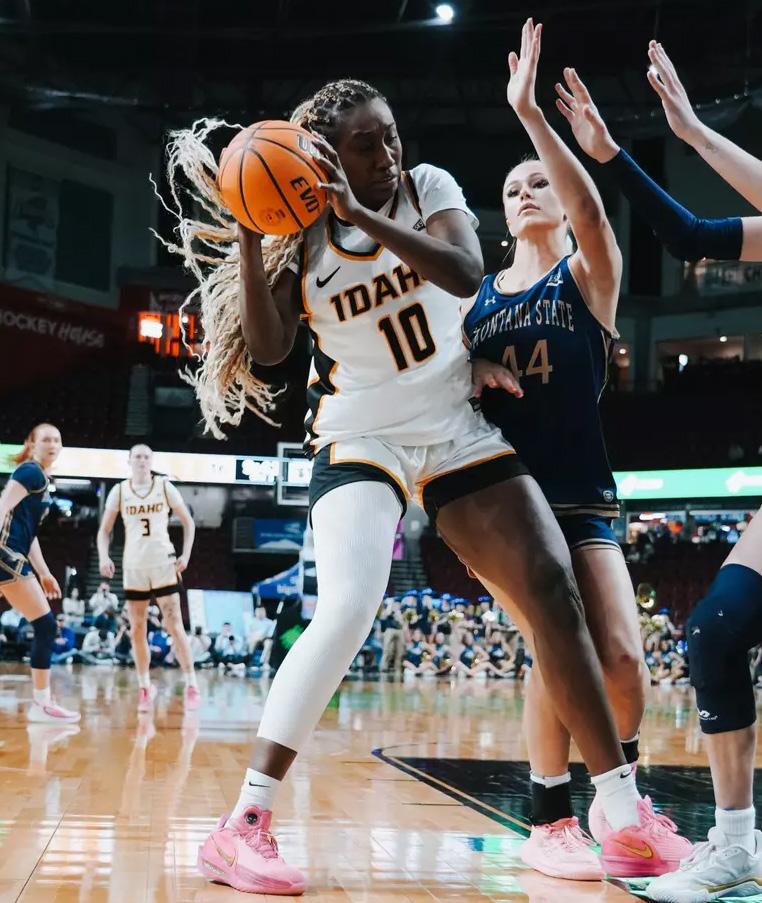
Both teams came out ready to play and the lead changed back and forth early. Sophomore guard and Big Sky Player of the Year Taylee Chirrick settled the Bobcats in with two threepointers, but the Vandals went on a 6-0 run to close the first quarter. A layup by Hassmann ended the quarter with Idaho leading 18-13.
Hassmann had seven first-quarter points and gave the Vandals momentum going into the second.
They carried that and stretched their lead to 10 after a three-pointer by sophomore guard Ana Beatriz Passos Alves da Silva.
The game continued to sway back and forth, and Idaho took a 36-31 lead into halftime.
The Vandals answered every Montana State counter-punch and after three quarters led 55-43 with 10 minutes until a trophy.
But the Bobcats climbed
back in. With under a minute left, Johnson drilled a three-pointer to cut the deficit to one. Hassmann, named tournament MVP, stretched the lead back to three, finishing with 11 points, four rebounds and four assists, and then the defense did the rest.
When the buzzer sounded, the team exploded onto the court, confetti rained down and Idaho had reached its goal.
Redshirt senior forward Debora dos Santos was instrumental off the bench, as she has been all season, finishing with nine points and 10 rebounds.
Dos Santos came to Idaho from the University of San Francisco after battling injury trouble and has been the backbone of the Vandals all year. Her journey brought her to March Madness.
“I’m proud of everybody. Everybody decided to make some sacrifice to come here. Since the beginning, we had this goal. We stayed focused until the end, we got those two trophies, we got it done. I’m happy for everything,” dos Santos said during post game press conference.
When Arthur Moreira took over as head coach two years ago, he had just
two returning players and a team still searching for its way.
Moreira and his staff landed a class that set the foundation of this team, and from there they have broken every barrier, every record and are now living a basketball player’s dream of playing in the NCAA tournament.
“I’m really proud of these girls. It’s been a lot of work. They put their heads down and a lot of people decided to take a chance on us. This doesn’t happen because of one person or two or three. It takes the whole team, the entire roster, all of our staff. This is the people’s trophy right here. It’s not just for our program. It’s not just for us,” Moreira said during post game press conference.
With the job done, the Vandals now await their NCAA tournament destination. They will find out their firstround opponent on Sunday, March 15, at 5 p.m.
“I don’t care where we play. I’m just excited to go compete,” Hassmann said.
“We’re just going to go out there and give it a roll, no matter who we play at the highest level. I feel like we can step out there and compete and play hard.”
Vandals will their way to Big Sky championship game
Vandals advance to take on second seeded Montana State
Jayden Barfuss ARGONAUT
The Idaho Central Arena grew quiet as junior guard Hope Hassmann stepped to the free throw line for a chance to seal the Idaho Vandals’ (28-5, 17-1) 59-51 semifinal victory over Sacramento State (15-18, 8-10). Hassmann took some deep breaths, dribbled the ball twice and swished both free throws, capping the Vandals’ victory over the Hornets. Hassmann led the Vandals with 15 points, three rebounds and three assists.
The Vandals’ women’s basketball team will now advance to its first championship game since 2016, hosting the no. 2-seeded (25-6, 16-2) Montana State Bobcats, tomorrow at Idaho Central Arena at 2 p.m., as they look to punch their ticket to the NCAA Tournament.
The fourth quarter, better known as “winning time” according to head coach Arthur Moreira, was what decided the contest. Rebounding, defense and the free throw line made the difference.
With the Hornets successfully slowing down the Vandals’ offense for most of the game, Idaho began to drive the ball inside and draw fouls. The Vandals went to the line 12 times during the quarter and drilled 10, outscoring the Hornets 15-8.
The Vandals’ defensive ability has been on display heavily in the tournament, even when the shooting hasn’t been there. Today, Idaho went 19-of-58 from the field, 4-17 from three and 17-19 from the free throw line. For an offense that has averaged nearly 80 points per game, the offense has not been clicking in the tournament.
However, that has never deterred this team and belief remained that shots would fall when they needed to. Their unique and aggressive style of defense paid off in the clutch as they held the Hornets scoreless for nearly five minutes and began to pull away.
“We emphasize defense quite a bit,” Moreira said. “We have a lot of very unique concepts and a lot of things that takes a while to get it, but once they’ve got it, they’re doing a great job. That’s what it takes to win the postseason.”
Idaho also outrebounded the Hornets 14-5 in the final frame and 41-34 in the game, a lot of those falling to redshirt senior Debora dos Santos, who finished with 14
points and 12 rebounds, her seventh doubledouble of the season.
The Vandals, coming off a day of rest, faced the fifth-seeded Hornets who came fresh off a victory over third-seeded Idaho State. Both teams entered with just one game separating them from a championship.
The Hornets grabbed an early lead before Hassmann and sophomore guard Ella Uriarte knocked down back-to-back three pointers to give the Vandals their first lead of the game.
Both teams went back and forth until senior Kyra Gardner hit a jumper from the right corner to give Idaho a 17-12 first quarter lead.
The dynamic guard duo of Hassmann and Gardner got the Vandals going in the second with back-to-back jumpers.
Idaho continued to create offense and redshirt senior dos Santos extended the lead as Hassmann surveyed the floor, threaded the needle and hit dos Santos in the hands.
She caught the ball, laid it in and made the ensuing free throw, pushing the Vandals’ lead to 12.
Sacramento State countered with a 13-0 run of their own, capped by a three pointer from senior forward Fatoumata Jaiteh, giving the Hornets a 25-24 lead.
a 30-25 lead.
Both offenses struggled to score, andw the defenses shined on both ends, especially the Vandals. Their sticky man-to-man defense and team intensity made it difficult for the Hornets to get anything going. The Hornets shot 9-30 from the field and 4-11 from beyond the arc.
The Vandals weren’t much better at 12-35 and 3-10 from three.
Idaho used their experience, willpower and elite defensive ability to get the hardfought victory and advance to the Big Sky championship.
“Just staying the course and just letting the game come to me, and overall, it’s just a team game,” Hassmann said. “At the end of the day, I’m just giving it to my teammates. If I’m not doing the greatest, I want to do the best for my team. So getting stops on defense and then just ultimately leaning on my team.”
The Vandals have come through every time they were called upon and with their goal of March Madness one game away, they need to pass one final test to win the Big Sky championship.
Isaiah Brickner ignited the early momentum with a highlight-reel putback dunk off a missed three-pointer by Kolton Mitchell coming out of the first media timeout, a sequence that set the tone for Idaho’s relentless effort on the offensive glass.
Montana responded midway through the first half. After a flagrant foul by Biko Johnson, the Grizzlies seized the momentum, stringing together a 17-4 run to erase the deficit and eventually take a 31-30 lead into halftime.
Despite the setback, Idaho remained within striking distance thanks to its work inside.
The Vandals dominated the paint throughout the opening period, outscoring the Grizzlies 20-8 down low, even as their perimeter shooting struggled. Idaho went just 2-12 from beyond the arc in the first half.
The entire game was a battle of momentum swings. The teams traded the lead 10 times before the first media timeout in the second half.
Then, Idaho began to pull away as Brickner continued to attack the rim, and Brody Rowbury provided a crucial lift inside with physical post play and timely perimeter shooting.
Despite not being known for his shooting
ability, Rowbury knocked down two threepointers during a pivotal second-half stretch, helping Idaho extend its lead to 53-43, matching the Vandals’ largest advantage of the night at the time.
The run proved especially important with forward Jackson Rasmussen limited by foul trouble. Rasmussen was limited for most of the first half with two early fouls, and then he picked up a third first-half foul.
When the second half started, he knew he needed to be cautious on the defensive end, but a questionable call gave Rasmussen his fourth foul with 10:41 remaining, which sent him to the bench for the majority of the game’s finish.
Rowbury and Seth Joba responded by imposing their presence on the glass.
Joba converted a second-chance putback that pushed Idaho’s lead to seven midway through the half, part of a stretch in which the Vandals repeatedly created extra possessions through offensive rebounds.
That rebounding dominance ultimately became the defining statistical difference of the night.
Idaho finished with a commanding 42-28 advantage on the boards, including a 13-3 margin in offensive rebounds, allowing the Vandals to overcome a difficult shooting night from three-point range.
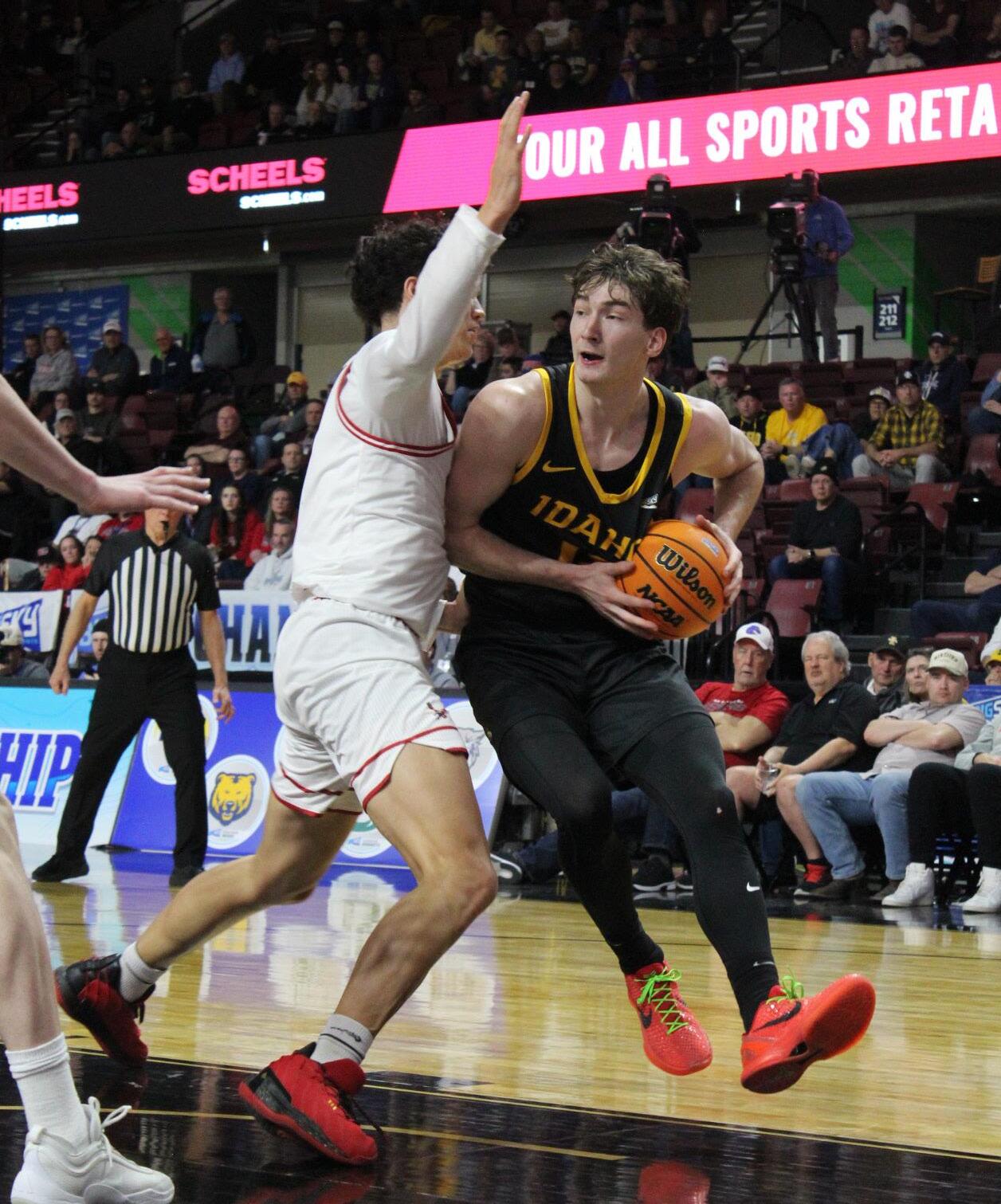
Even late in the game, the Vandals were still searching for consistency from deep. Idaho finished just 5-21 from beyond the arc, but its ability to generate second-chance opportunities and protect the basketball proved decisive.
The Vandals committed only eight turnovers in the game, continuing a trend that defined their tournament run after similarly disciplined performances in wins over Montana State and Eastern Washington.
With the lead hovering around double digits late in the second half, Mitchell, who led Idaho with 26 points against Eastern Washington, delivered one of the game’s signature moments.
The redshirt sophomore guard spun into a smooth turnaround jumper to maintain a 10-point advantage and quiet a brief Montana push.
Montana attempted one final surge when Te’Jon Sawyer converted a tough layup through contact after Mitchell missed two free throws with just over two minutes remaining, trimming the deficit to single digits.
But Idaho answered immediately. Moments later, Jack Payne launched a fullcourt baseball pass ahead to Brickner, who finished with an emphatic fastbreak slam that pushed the lead back to 11 and effectively sealed the championship.
The defensive effort marked one of Idaho’s strongest performances of the season. Montana did not reach 50 points until fewer than five minutes remained in the game, a testament to the Vandals’ disciplined defensive rotations and physical interior presence.
The victory was particularly meaningful for Idaho after the Grizzlies swept the Vandals during the regular season, winning both meetings in tightly contested games. When it mattered most, however, Idaho flipped the script. The Vandals entered the tournament as an underdog after finishing

Brickner delivered a legendary performance in the title game, finishing with a game-high 23 points and 10 rebounds to lead the Vandals.
Rowbury added 12 points, while Mitchell contributed 11 points despite battling lingering effects of a back injury that sidelined him late in the regular season.
Trevon Blassingame scored 10 points and Payne chipped in nine.
For Montana, Sawyer and Money Williams each scored 19 points to lead the Grizzlies, while Brooklyn Hicks added 11.
However, Idaho’s defense limited the rest of Montana’s roster, holding the Grizzlies to just 24 percent shooting from three-point range.
seventh in the Big Sky standings, but their postseason surge showcased the version of the team that head coach Alex Pribble believed existed all along.
Resilience, rebounding and timely scoring carried Idaho through four games in five days, culminating in a championship performance that will send the Vandals back to the NCAA Tournament for the first time since 1990.
And now, after decades of waiting, Idaho will once again hear its name called this Selection Sunday. The selection show will be on Sunday, March 15 at 3 p.m., streamed on CBS. The Vandals will await their first round opponent to play on March 19 or 20.
State earlier in the tournament. Eastern Washington had been one of the hottest teams in the conference entering March, but Idaho had already proven it could handle the Eagles, including an 85-81 win in Cheney just eight days earlier in the regularseason finale.
When the seventh-seeded Idaho Vandals (20-14, 9-9) walked into Idaho Central Arena in Boise on Tuesday night, they understood the challenge in front of them.
Beating a conference opponent once is difficult. Beating the same team twice in a season is harder. Doing it three times, especially against a team that tore through the bulk of its Big Sky schedule late in the year, can feel nearly impossible.
But the Vandals have spent the past week defying expectations.
Behind another efficient offensive performance and a defensive effort that neutralized Eastern Washington’s perimeter attack, Idaho defeated the third-seeded Eastern Washington Eagles (14-19, 11-7) 81-68 in the Big Sky tournament semifinals Tuesday night, earning the program’s first trip to a conference championship game since 2014.
For Idaho head coach Alex Pribble, the moment reflected three years of work building the program toward this stage.
“This was the vision when we took over the program,” Pribble said. “We wanted to put ourselves in a position where we compete for championships. I could not be more proud of the effort and the togetherness the guys showed tonight.”
The Vandals entered the matchup already riding momentum after wins over Sacramento State and second-seeded Montana
After Eastern briefly grabbed a lead less than three minutes into the game, Idaho answered with a decisive run coming out of the first media timeout. The Vandals ripped off a 12-1 surge to seize a 20-8 advantage.
It was the kind of start Idaho has struggled to sustain at times this season. But unlike many earlier games, the Vandals never allowed the momentum to slip away. Eastern Washington never led again. The Eagles trimmed the deficit to single digits on multiple occasions, but Idaho consistently responded with timely baskets and defensive stops to maintain control.
By halftime, the Vandals held a 36-28 lead after shooting efficiently and limiting mistakes, which has become the theme that has defined their recent run. Idaho committed just seven turnovers all night while shooting more than 50% from the field for the second consecutive game.
That offensive efficiency proved especially important because the Vandals did not rely on their typical formula. Much of Idaho’s success throughout the season has come when it dominates the glass and controls the paint. Tuesday night, however, Eastern Washington held slight advantages in both categories. Instead, the Vandals won the game through shot selection. Leading the way was
senior guard Kolton Mitchell, who delivered his best performance of the tournament while continuing to battle through a lingering back injury.
Mitchell poured in 26 points on 9-15 shooting while adding seven rebounds and three assists, repeatedly creating offense during crucial stretches of the second half.
“I wouldn’t say I’m fully healthy,” Mitchell said. “But today was good offensively. I wanted to find my rhythm early, and my teammates did a great job getting me open. I felt like I had a lot of open shots.”
Big Sky Freshman of the Year Jackson Rasmussen continued his strong postseason play as well, finishing with 16 points and six rebounds while helping stabilize Idaho’s offense when Eastern threatened to cut into the lead.
Biko Johnson added 11 points and once again delivered key defensive possessions, while Isaiah Brickner chipped in 10 points and Jack Payne added nine points.
While Idaho’s offense operated smoothly, the Vandals’ defense proved just as impactful, particularly along the three-point line.
Eastern Washington finished just 3-20 from beyond the arc.
The Eagles relied heavily on their top scoring options to keep the game within reach. Kiree Huie led Eastern with 20 points and seven rebounds, while former Vandal JoJo Anderson added 12. Alton Hamilton and Isaiah Moses each finished with 10 points.
Outside of those performances, however, Idaho shut down the rest of the Eagles’
roster.
With the victory, Idaho has now won four consecutive games — its longest winning streak since the 2017-18 season — and secured a spot in the Big Sky championship game.
This was Idaho’s second consecutive semifinal appearance after being eliminated by the eventual conference champion Montana Grizzlies to end the 2024-2025 season.
Brickner noted the motivation that carried the returning core into the season.
“After last year we all talked and said, ‘Let’s come back and do something special,’” Brickner said. “We believed in each other and believed in Coach.”
Now, Idaho stands one win away from something the program has not accomplished in decades.
The Vandals will face the fourth-seeded Montana Grizzlies in Wednesday night’s Big Sky tournament championship game, with the winner earning the conference’s automatic berth to the NCAA Tournament.
Montana defeated Idaho twice during the regular season and enters the title game as the defending conference champion.
“Montana’s given us trouble,” Pribble said. “They’re physical, they’re tough, and they’ve got an elite scorer. But that’s what this is supposed to be. You’re not going to get a ticket to the big dance with something easy.”
The Vandals have not reached the NCAA Tournament since 1990, and in Pribble’s third year at the helm, they are just one win away from pulling it off.
Ella Uriarte has been a key piece to the Vandals’ special season
Jayden Barfuss ARGONAUT
In their quest for a regular season championship, the Idaho Vandals were locked in a battle with Northern Colorado. Neither team could find a rhythm offensively, every possession mattered and defense stole the show, something sophomore Ella Uriarte has made her calling card.
With 5:05 remaining and the Vandals on the verge of a title, the Bears were clawing back. Northern Colorado had an out-ofbounds play drawn up to cut the deficit to single digits. Uriarte read the pass, picked the pocket of senior guard Gabi Fields, and raced down the court for a layup that brought ICCU Arena to a roar.
A few minutes later, the buzzer sounded. The Vandals had won the regular season championship. Black and gold confetti fell from the rafters, and Uriarte, in her white and black jersey, stepped up to the ladder and cut a piece of the net. All the hard work of the regular season had paid off.
“It’s an amazing feeling, not many people get to experience that,” Uriarte said. “Our opportunity to win the conference championship is awesome. When you’re doing that with people that you genuinely like and enjoy their time, there’s no truer feeling.”
Uriarte, a native of Folsom, California, grew up around the game. With her dad coaching her brother, she would attend practices and participate in the drills on the side, and that planted the seed.
“It was kind of run out there and have fun when I was really little,” Uriarte said. “It was just a fun sport where I could run and have fun out there with my friends. Now it’s gone to a point where I’m getting
to find my role and do what I do best, trying to get better every year and every day.”
Basketball wasn’t always the plan. Until eighth grade, Uriarte played competitive soccer before stepping away to focus on the hardwood. She also tried volleyball and track and field before making her choice.
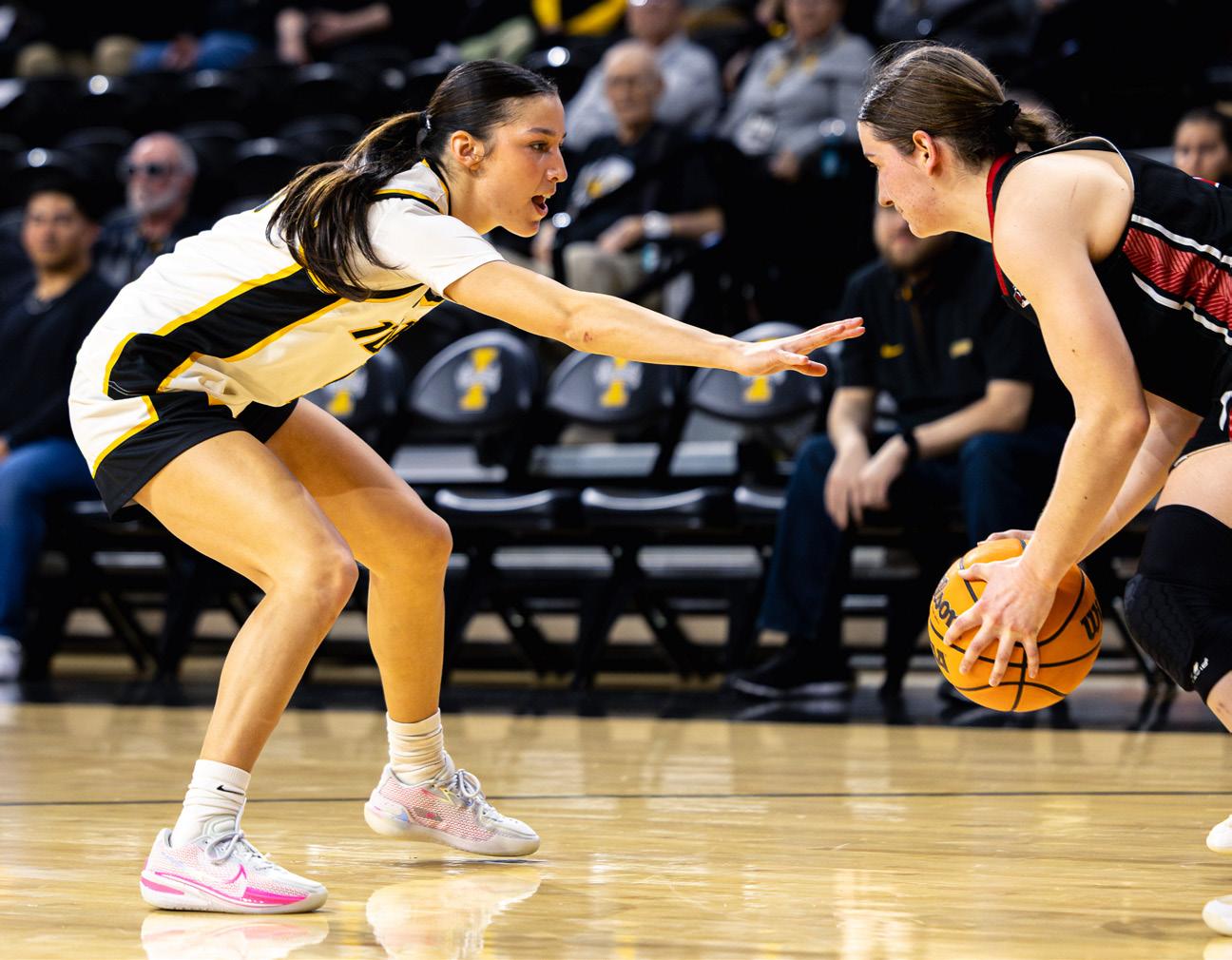
“I just enjoyed that more,” Uriarte said. “I thought I could grow more in basketball. The team aspect is super important to me. You don’t have to be your best every day, because you have a team. You build so many friendships, people that are going to be lifelong friends.”
Uriarte isn’t a player who fills up a stat sheet, but she is an elite defender and a winner, the kind of player who makes the right play when it matters most. Those are exactly the traits that drew head coach Arthur Moreira to her coming out of Folsom High School.
“What drew me to her was that she would always be in the game in late game situations,” Moreira said. “When it was close, she’d always be in there, even though she wasn’t the one scoring 30 points or hitting all the crazy shots. She always had the assignment of guarding the other team’s best guard, and whenever they needed to win, she was on the floor.”
At Folsom High, Uriarte was a twoyear captain. Her leadership helped drive back-to-back successful seasons and pushed several of her teammates into Division I programs.
She wasn’t heavily recruited herself, but after a visit with then-head coach Carrie Eighmey, she stepped on campus and knew.
“I fell in love with the coaches and the players and everything here,” Uriarte said. “The Moscow community is great. Being able to have fans at your games is something that a lot of schools don’t get. It’s a small community, but our restaurants are amazing. Getting to experience the college environment too, and the friendships I’ve made here are amazing.”
Uriarte arrived into a guard-heavy program last season and played a supporting role, appearing in 30 games for 444 minutes while averaging 2.1 points and 1.3 rebounds per game.
Already one of the team’s best defenders,
she spent the offseason attacking her offensive game.
“Over the spring, I worked really hard to develop my offensive side and become smarter. So, this year, getting the opportunity to start has been amazing. I think still just finding my role in what my team needs me to do each day has been something that I still like to look for,” she said.
The growth has shown. In her sophomore season, Uriarte has started all 32 games, scoring 205 points across 931 minutes, averaging 6.4 points, 2.9 rebounds, 50 assists, eight blocks and 24 steals, with a careerhigh of 14 points against Walla Walla.
What she does on the court is impressive. What she does off it is what makes Moreira most proud.
“She’s a great teammate and has a lot of respect for the girls,” Moreira said.
“She does a really good job, even though she’s a sophomore she has taken on more of a leadership role. She’s a great kid, she’s a great teammate, great culture, she has a fun personality. We’re pretty lucky that she’s here.”
Every time Uriarte steps on the court, it’s a story of the little girl who ran drills on the side of her brother’s practice to the player who has given everything and doesn’t need a stat sheet to prove it.
From Folsom to Moscow, Uriarte has been a rising star with a bright future in the black and gold, looking to leave a legacy far beyond the final buzzer.
Her impact is written all over a regular season championship. And she’s just getting started.
“I want people to know that I played hard and I played my best every day,” she said. “I really hope that people understand that I enjoy doing it. It’s not just something that I go out there and do.”
Johnson’s winding path led him to be in a starring role for Idaho
Jayden Barfuss ARGONAUT
For Idaho’s Biko Johnson, the road to Division I basketball wasn’t a straight line. It was a test of persistence. From grinding at the junior college level, to a frustrating injury at his first Division I stop, to a breakout season at the Division II level, Johnson’s college career has been shaped by constant adjustment. Each stop required him to learn a new system, adapt to new teammates and prove himself all over again.
Now, in his senior season with the Idaho Vandals, that journey has culminated in the most complete year of his career. Johnson has played in all 33 games this season and started 32, emerging as one of Idaho’s most important players. He ranks among the team leaders in multiple categories, averaging 12.6 points, 2.5 assists and 1.1 steals per game. He is also second on the roster with 59 three-pointers, and has also recorded 37 steals, helping anchor the Vandals on both ends of the floor. “I would say it’s been a journey,” Johnson said. “A lot of adversity, a lot of different coaching styles, different playing styles—just having to adapt everywhere I go.” His collegiate career began at Western Nebraska Community College. Johnson said the junior college experience forced him to grow quickly, both physically and mentally. “Junior college, it’s really what’s in the name—you’re still growing,” Johnson said. “You’re an 18-year-old, 19-year-old going into college with no expectations, really. You’re just learning on the fly.”
The transition from high school basketball to the junior college level was demanding. Practices were intense, weightlifting sessions came multiple times per week and Johnson began learning the complexities of playing at a higher level. “I was still learning basketball,” he said. “Different plays, different sets, learning how to communicate with teammates. The intensity of practices and lifting four times a week—it was really a challenge.”
After developing his game at Western Nebraska, Johnson made the leap to Division I at the University of Nebraska Omaha. “The biggest adjustment was the intensity of the practices,” Johnson said. “I thought junior college was pretty hard, but D1 is just a different commu-
nication level, urgency and focus that you have to bring into every practice.”
Johnson earned a starting role early in the season, but his momentum was disrupted by a shoulder injury that limited his minutes. He ultimately appeared in 18 games that season, averaging 10.8 minutes and 3.3 points per game.
The injury proved to be one of the most difficult stretches of his career. Looking for a fresh start, Johnson transferred to Division II Fort Lewis College, where his career finally took off. In his lone season with the Skyhawks, Johnson emerged as one of the top guards in the Rocky Mountain Athletic Conference. He was second in the conference with 16.3 points per game, while also contributing 2.5 assists and 2.1 steals per contest. He led his team in nearly every offensive category and finished second in the conference in steals.
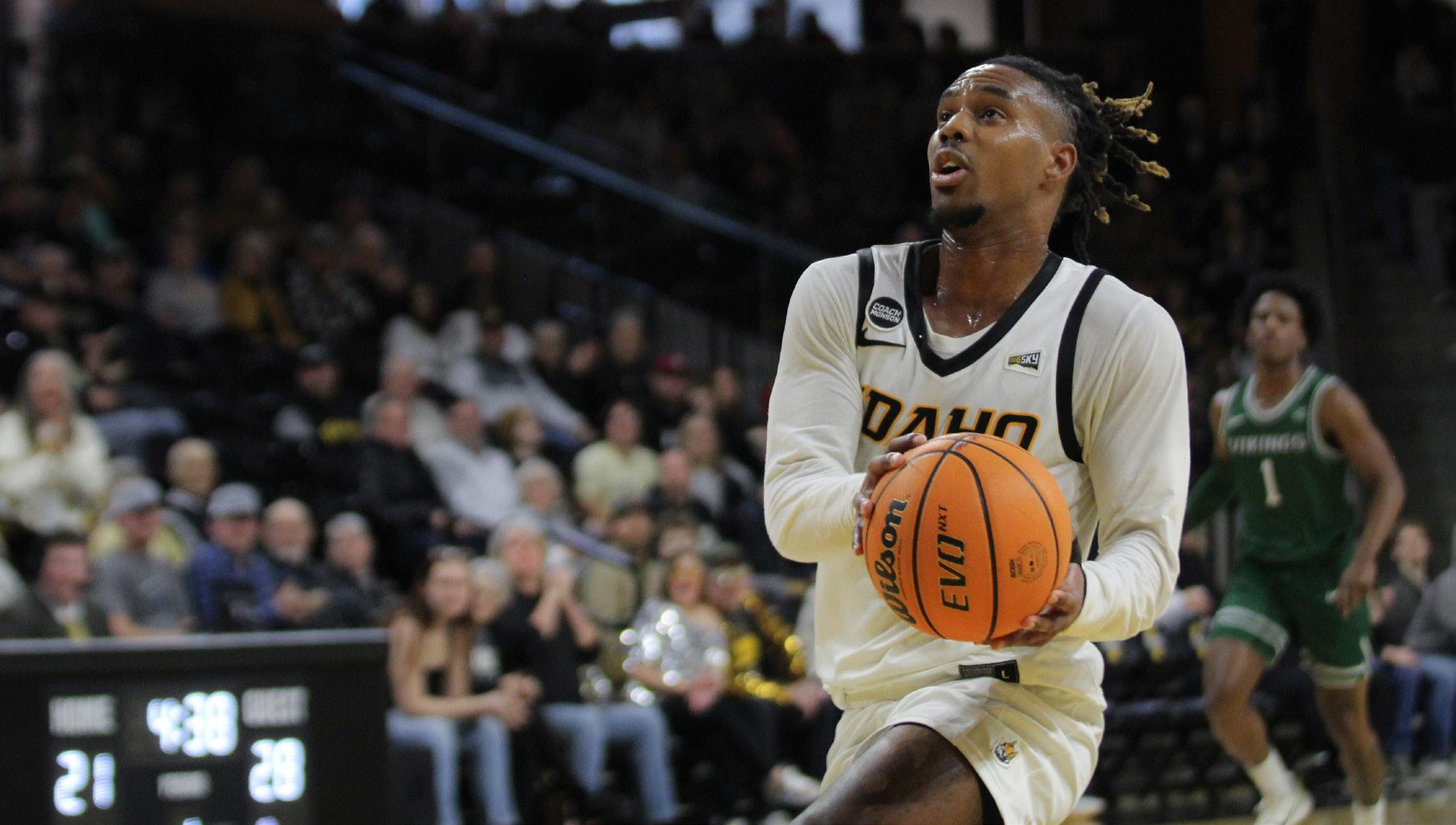
suffered an injury in the season opener. With a major scoring presence suddenly unavailable, Johnson became one of the players tasked with helping fill the gap.
Rather than forcing the issue, Johnson focused on staying within his game. “I just tried to be myself,” he said. “Not trying to do too much or too little, but just asserting myself offensively and defensively.”
For Johnson, the breakout wasn’t about discovering a new ability, but rather about confidence and maturity.
“I feel like I’ve always had it in me,” Johnson said. “It was a maturity thing, just learning when to be aggressive and asserting myself on offense and defense.” That confidence helped him grow into a leader as well. Johnson said earning his teammates’ trust allowed him to take control of games when opportunities arose. “If your teammates can trust you, then you’re going to have the ball in your hands when you need it,” he said. His success at Fort Lewis reopened the door to Division I basketball, eventually leading him to Idaho. Johnson said the honesty of Idaho’s coaching staff played a major role in his decision to transfer to the program. “They kept it real with me,” Johnson said. “They said nothing’s going to be given; everything’s going to be earned.” Johnson’s work ethic helped him quickly earn a major role with the Vandals. He stepped into the starting lineup immediately and has remained there throughout the season.
The timing of his arrival proved crucial. Idaho lost its top returning scorer early in the year when Kristian Gonzalez
The approach worked. Johnson has recorded nine 20-point games this season, and Idaho is 7-2 when he reaches that mark. Head coach Alex Pribble has described Johnson as a “closer,” someone the Vandals trust in late-game situations. Johnson embraces that responsibility. “It starts in practice,” Johnson said. “Having your teammates’ trust and having the coaches’ trust to have the ball in your hands in those moments is really special.”
Johnson said he feels particularly comfortable when the game is on the line. “I feel like I’m built for those moments,” he said. “When I have the ball in my hands, my mindset is the dude in front of me can’t guard me, and I’m going to score regardless.”
His offensive contributions have been matched by his defensive intensity. Johnson leads Idaho’s perimeter defenders with 37 steals and prides himself on disrupting opposing guards. “I don’t like anyone scoring on me,” Johnson said. “That’s my mindset.”
After a journey defined by adaptation, Johnson has finally found his stride at the perfect time as Idaho makes a push for their first Big
championship since 1990.
Women’s
The Idaho swimming and diving team have their Diving Zone Championships in Flagstaff, AZ until Friday. No time has been announced for that yet.
Men’s Tennis
The men’s tennis team has two
matches this week. The first match will be on Saturday, March 14 at noon versus Idaho State. Then, on Sunday, March 15, they will have a match at 3 p.m. Both matches will be in the P1FCU Kibbie
Women’s Tennis
Students without a promo code must pay to attend a debate at UI
AJ Pearman ARGONAUT
Universities often describe themselves as marketplaces of ideas, places where opposing perspectives can meet in open dialogue. That goal will be tested at the University of Idaho as representatives from the Catholic Church and Moscow’s Christ Church gather for a public debate on theology, authority and doctrine.
Joe Heschmeyer, a catholic apologist, will debate Doug Wilson, the senior pastor of Christ Church, on Thursday, March 26, at 7 p.m. in the ICCU Arena. The event has generated significant interest among students and community members alike. Debates between different Christian traditions are not new,
but hosting one on a university campus gives the conversation a unique academic dimension. For many students, it represents an opportunity to witness a direct exchange of ideas about faith, scripture and church authority.
Alongside the anticipation surrounding the debate, another conversation has emerged. Students have learned that attending the event requires purchasing a ticket, even though the debate is being hosted by the university itself.
However, students can gain free tickets through the catholic church’s webiste, using the promo code: “augistine.”
The debate itself is likely to draw attention far beyond the campus. Christ Church has been a central figure in Moscow’s religious landscape for years, often sparking intense conversations about its theology, leadership and growing presence in the community. The Catholic church, meanwhile, represents one of the oldest and most globally influential Christian traditions. Bringing these perspectives together in a structured debate has clear educational value. Universities are uniquely positioned to host discussions that might otherwise remain confined to churches or religious institutions.
A campus
setting allows students from different backgrounds to observe, question and analyze the arguments being presented.
Debates also serve a different purpose than lectures or panel discussions. Instead of simply presenting viewpoints, debates require participants to directly respond to one another. Claims must be defended, criticisms must be addressed and ideas must stand up to scrutiny in real time.
For students studying philosophy, political science, history or religious studies, this kind of event can be especially valuable. It demonstrates how complex ideas are tested through argument and dialogue, something universities frequently encourage in classrooms but rarely showcase on a public stage.
That is part of the reason the event generated excitement when it was first announced.
However, the ticket requirement has complicated that excitement. Many students already pay significant tuition and fees to attend the university. Those fees support everything from campus facilities to student programming and guest speakers.
The fee waiver for students has helped the tickets become more available, but students have to keep up with the church’s website and social media to be made aware of the promotional code. Making the promotional code more acessible would help more students and diverse perspectives be able to attend.
That outcome affects more than just attendance numbers.
Debates rely heavily on audience engagement. The presence of a diverse audience helps ensure that discussions resonate beyond the speakers themselves. Students bring their own
perspectives, questions and reactions to the event, shaping how ideas are received and interpreted.
When fewer students attend, the broader educational impact of the debate may be reduced.
Supporters of the ticket price point out that events like this require resources to organize. Venues must be prepared, security arranged and logistical details handled. Charging admission can help offset those costs and ensure the event is run professionally.
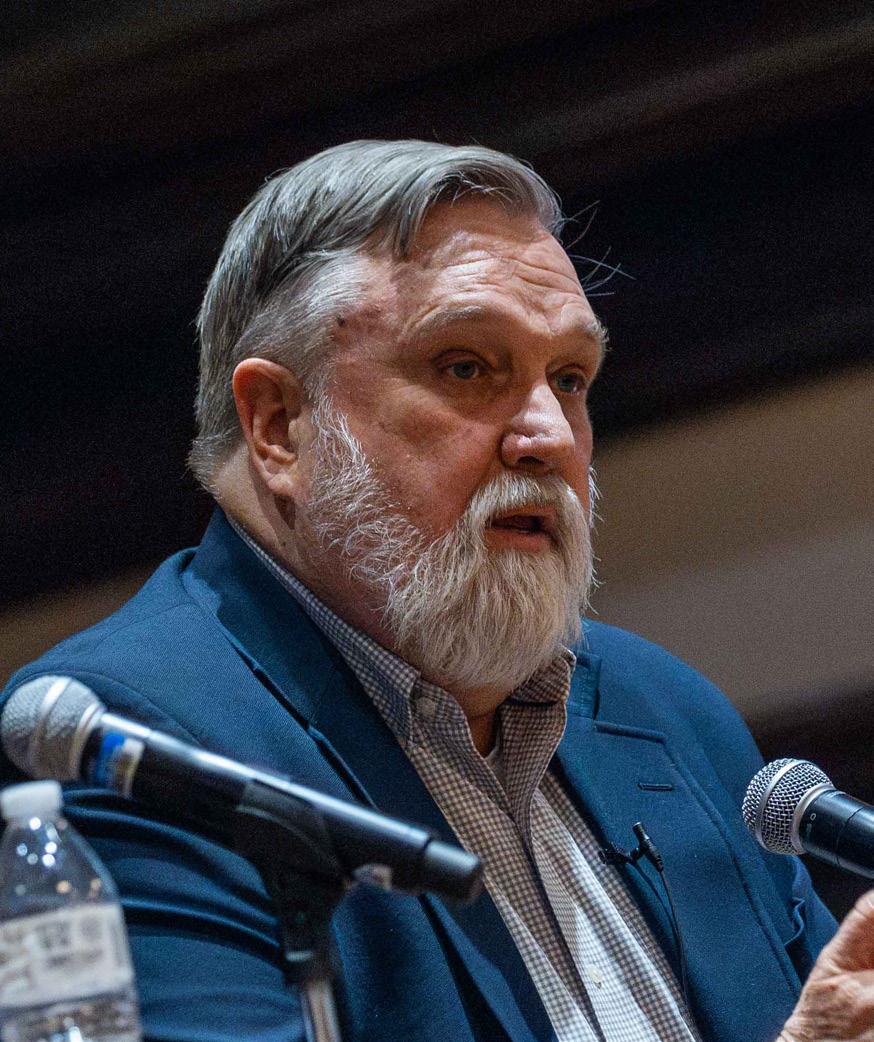
Those practical concerns are understandable. Large public debates do not simply appear overnight, and universities must manage their budgets carefully.
Still, the optics of the situation have become part of the discussion. When a university promotes itself as the host of an intellectual debate, many students expect that the campus community will have easy access to the event.
The debate between representatives of the Catholic church and Christ Church will likely generate strong arguments and passionate reactions. Questions of doctrine, authority and interpretation have shaped Christian history for centuries, and they remain deeply meaningful to many believers today.
Hosting that conversation
on a university campus has the potential to elevate the discussion. Students and community members alike can witness how religious ideas are debated, defended and challenged in a public forum.
That is exactly the type of intellectual exchange universities often say they want to promote. But if the goal is truly to encourage dialogue, accessibility matters. Students should feel invited to participate in the conversations their university brings to campus.
In the end, the debate itself may be remembered for the arguments presented on stage. Yet the discussion surrounding the ticket price highlights a broader question facing universities everywhere: how to balance the costs of hosting events with the mission of keeping intellectual engagement open to all students.
More information about the debate can be found on the Vandal Catholic Website.
formed decisions when choosing where to attend college.
Education policy in the United States is entering a period of change as both federal and state leaders introduce new initiatives aimed at reshaping how students access and experience education.
Recent announcements from the U.S. Department of Education focus on transparency, workforce development and institutional accountability in higher education. At the same time, Idaho lawmakers are promoting policies centered on parental choice and flexible learning options.
Together, these efforts highlight an ongoing debate about who should control education policy and what the primary purpose of education should be.
One of the newest federal initiatives is the Department of Education’s earnings indicator, designed to help students and families better evaluate colleges before enrolling.
The indicator provides data about the typical earnings of graduates from specific schools and programs, allowing students to better understand potential financial outcomes after graduation.
According to the Department of Education, the tool is meant to provide clearer information so students can make more in-
Supporters argue that transparency about post-graduation earnings can help students avoid taking on large amounts of student debt for programs that may not lead to stable employment. With the cost of college continuing to rise, understanding the potential financial return of a degree is becoming an increasingly important factor for many families.
However, critics worry that focusing heavily on salary outcomes may reduce education to a financial investment rather than recognizing its broader role in developing critical thinking, civic engagement and cultural understanding.
The Department of Education is also investing in new initiatives aimed at strengthening colleges and expanding opportunities for students. Recently, the department announced the release of $169 million through the Fund for the Improvement of Postsecondary Education, which will support projects focused on improving higher education programs and exploring new educational innovations.
These grants are intended to support programs that improve campus operations, expand educational access and explore emerging technologies in education. Funding may also support programs that promote civil discourse and improve institutional accountability. While federal investments can help institutions adapt to changing educational needs, critics often question
these initiatives address deeper challenges such as rising tuition and unequal access to higher education.
Another major policy effort involves reforming the accreditation system used to evaluate colleges and universities. Accreditation plays a critical role in determining whether institutions are eligible to receive federal financial aid. The Department of Education recently announced negotiated rulemaking sessions aimed at reforming and strengthening the nation’s higher education accreditation system.
Supporters believe stronger accreditation standards could help ensure that institutions receiving federal funding provide meaningful educational outcomes for students. By increasing oversight and accountability, policymakers hope to protect students from programs that leave graduates with significant debt but limited career prospects.
Federal education policy is also becoming more closely connected with workforce development initiatives. The Department of Education and the Department of Labor recently announced new steps to implement a Postsecondary Education Partnership designed to strengthen collaboration between colleges, workforce programs and employers.
The partnership aims to ensure students graduate with skills that match current labor market demands. Supporters argue that stronger connections between education and workforce programs could help address labor shortages in key
industries while improving job opportunities for graduates.
Another initiative tied to workforce development is the creation of the Workforce Pell Grant program. The Department of Education recently concluded negotiating rulemaking sessions to implement the program, which will allow students to use Pell Grants for shorter job training programs rather than only traditional degree programs. Programs funded through Workforce Pell could include short-term training programs that prepare students for careers in fields such as healthcare, technology and skilled trades. Supporters say these programs provide faster and more affordable pathways into the workforce for students who may not want to pursue a four-year college degree.
While federal policymakers focus on workforce preparation and institutional accountability, Idaho lawmakers are emphasizing a different approach centered on parental choice.
Idaho State Sen. Lori Den Hartog recently wrote that the state’s Parental Choice Tax Credit is based on the belief that families—not government bureaucracies—know what educational environment works best for their children.
According to Den Hartog, the program allows eligible families to receive a refundable tax credit of up to $5,000 per child, or $7,500 for children with qualifying disabilities, to cover educational expenses such as private school tuition, tutoring and
curriculum materials. She argues that the policy gives parents greater flexibility to build an educational experience tailored to their child’s needs.
Den Hartog wrote that while many educational options already exist—including public schools, charter schools, homeschool programs, virtual learning and tutoring—families often lack the financial resources to take advantage of them. The tax credit, she argues, helps close that gap and allows parents to respond quickly when their child’s educational needs change.
Supporters of the policy say it strengthens educational freedom and empowers parents to choose what works best for their children. Critics, however, worry that programs like these could divert resources away from public schools or increase inequalities in access to education.
Together, these federal and state initiatives demonstrate how education policy is evolving across the country. Federal reforms emphasize workforce readiness, transparency and institutional accountability, while Idaho’s policy highlights parental choice and educational flexibility.
The larger question remains unresolved: should education policy prioritize economic outcomes, institutional oversight or individual choice?
As these policies continue to develop, they will shape how students learn, how institutions operate and how future generations experience education in the United States.
A recent libel case shows the impact that influencers can have on audiences
Andrea Roberts ARGONAUT
True crime has been a recent obsession that seems to be going viral on every major social media platform. Outlets like Instagram and TikTok are full of videos of unsolved murders and mysteries.
It was no surprise that when tragedy struck the University of Idaho in 2022, when four students were killed, that true crime TikTokers would pounce.
A federal jury recently ruled that a TikTok influencer, Ashley Guillard, would have to pay $10 million in damages to a UI professor after Guillard made over a hundred videos claiming that the professor murdered the students. Guillard continued to make videos even after Bryan Kohberger, who pled guilty to the murders, was arrested and charged for the crimes.
Rebecca Scofield, a history professor and department chair at UI, claimed that these
videos were false and impacted her mental and physical health as well as her relationship with the community.
“There was a moment where it felt like I lost ownership of my face and my name, and it was no longer stitched to my body,” Scofield told jurors during the trial. “It was utterly terrifying.”
Guillard claimed that the tarot cards pointed her to Scofield, who she found by scrolling through the history department’s page.
These murders shocked the nation, and the families of Ethan Chapin, Madison Mogen, Xana Kernodle and Kaylee Goncalves, the victims, finally saw some justice when Kohberger was convicted in 2025 and was given multiple life sentences.
Even so, the internet still speculated and produced outlandish theories that could not be verified by police or anyone.
Guillard, whether it was for attention or fame, or because she believed she was helping, still ruined someone’s life. She continued with spiritual intuition guiding her claims rather than actual evidence and facts.
While Scofield was awarded $10 million,
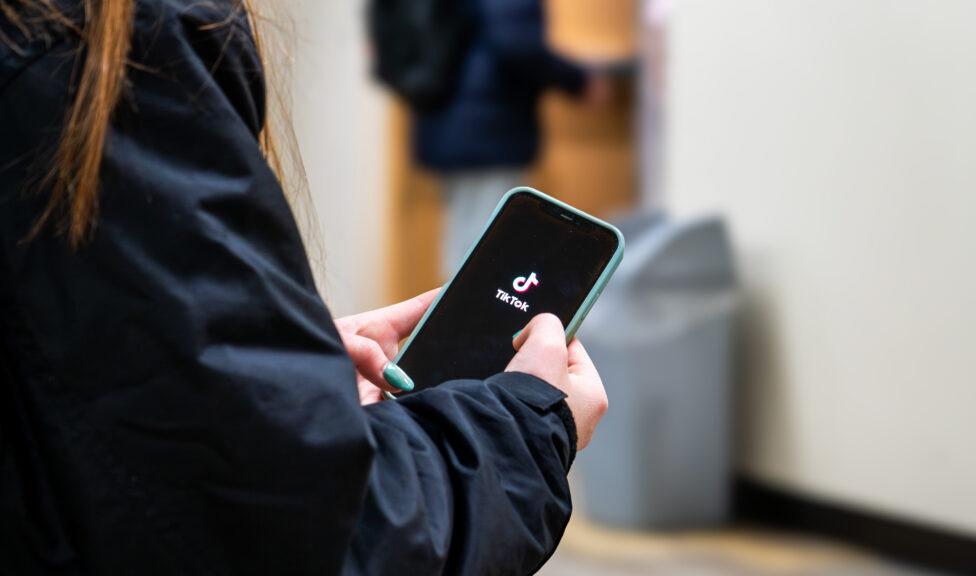
the chance of her seeing all of the money is slim. Even so, her winning shows that defamation online can be just as harmful as in person.
This is why accountability matters, especially influencers who have fans that will believe anything someone tells them.
This goes beyond one case. People can lie, people can make false claims and the old saying of “don’t believe everything you see on the internet” rings true. More information on the case can be found on The Argonaut’s website.
Small communities, like Moscow, are vulnerable to oil price increases
Andrea
For many students, the current conflict in the Middle East can feel distant. But the recent surge in gas prices shows that the conflict impacts everyone at the local level.
According to an article by CNN, global
oil prices have been extremely volatile because of the conflict in Iran. Oil markets have begun to surge exponentially. Earlier this week, crude oil reached over $100 per gallon, something that hasn’t been seen since 2022, when Russia invaded Ukraine.
This instability is also affecting Idaho drivers.
According to an article by the AAA, Idaho data shows that the average price per gallon of regular gasoline in Idaho has jumped to $3.24, a 27-cent increase in just one week. Even though Idaho’s prices
remain lower than some states, the rapid increase shows how quickly these prices can shift.
AAA Idaho Public Affairs Director Matthew Conde spoke about the rising prices.
“Prices across the country are off to the races,” Conde said, noting that Idaho’s increases have not been as steep as some other states. “However, these days, that’s like celebrating the last banana to go rotten. It’s just a matter of time.”

AAA Idaho said that crude oil prices surged during the conflict, with West Texas being the benchmark, briefly trading around $117 per barrel over the weekend before settling at $95.
Still, Idaho drivers could be facing even worse.
AAA noted that while gas prices are quickly rising, Idaho still ranks 31st in the nation for the most expensive gas. Other states are seeing much sharper increases. The national average is already $3.48 per gallon, which is nearly 50 cents higher than a week ago.
Idaho is a state where driving can be unavoidable. There are many rural areas with long distances between cities, which makes driving a necessity. With spring break quickly
approaching and many students beginning to make their drive back to their house, they will quickly realize that it will not be a cheap trip home.
When prices rise more than a quarter in a week—those costs can add up quickly.
The oil market also creates uncertainty for consumers. According to CNN, oil prices recently dropped sharply after political leaders suggested the conflict with Iran could end soon.
The sudden drop is not reassuring. It just highlights how unpredictable the oil market has become. Prices can surge when conflict escalates and drop just as quickly when peace is mentioned.
For consumers, this instability makes planning difficult. Drivers never know when gas will be higher or lower.
It’s easy to think that global oil markets are distant economic matters that only affect investors of energy companies, but the reality is, it impacts everyone. Students, families, community members, and staff all see the consequences of surging oil prices.
The recent spike in gas prices shows that the connection between global politics and local economics is stronger than many people realize.
The biggest lesson from the past week is that Idaho drivers have very little power over the forces that control the price of fuel. How vulnerable are small communities, like Moscow, when global conflicts occur?
For now, head to your nearest gas station and fill up. Like the conflict in the Middle East, we don’t know when it will end, and we don’t know what the cost of gas could be tomorrow, or even next week.
Idaho’s proposed parental rights law risks undermining students’ trust within the education system
Idaho lawmakers say that House Bill 822 is about protecting parental rights, but the proposal raises serious questions about student privacy, trust in schools and how far the state should go in regulating conversations between parents and their children.
House Bill 822, titled “Pediatric Secretive Transitions Parental Rights Act,” would add new requirements for schools, health care providers and childcare facilities across Idaho. The bill states that “parents have a fundamental right to raise their children and make medical and educational decisions on their behalf.”
While this principle is widely accepted, and parents play an essential role in their childrens’ lives and decisions, the bill goes too far in parental involvement. It creates rules governing how schools and professionals respond when a student questions their gender and identity.
Under the bill, “covered entities,” including schools, childcare providers and mental health professionals, would be prohibited from facilitating a minor’s medical or social transition without parental involvement.
The legislation defines social transition broadly, including actions such as changes to a student’s name or pronouns, as well as their appearance or self-expression. This means that even small steps a student may take when exploring their identity could
trigger legal consequences for educators or counselors who don’t report them.
Supporters of the bill believe that parents should know what is happening in their childrens’ lives. That argument is understandable. Families and parents play a crucial role in guiding children through the formative years of their lives. A strong relationship between parents and their school is also vital for the students to succeed. But a policy of trust should not be replaced with surveillance.
House Bill 822 risks turning teachers and counselors into reporters of the students’ personal lives and identities. This shift would ultimately change the relationship between students and educators.
For some students, school is the one place where they can feel comfortable to ask questions and seek guidance from trusted adults. Counselors and teachers often serve as a support system for students, especially if they don’t have that support at home. If students believe that their actions might be reported, they will stop seeking help all together.
This could have far worse consequences that goes beyond gender identity. Students often speak with counselors about mental health struggles and family problems. Those conversations stem from one thing: trust. If educators fear legal action from not reporting students’ decisions, they could stop wanting to have these conversations all together.
This bill also raises concerns about privacy. Students are at a critical point of trying to understand who they are. This process can include experimenting with
different forms of self-expression, such as changing their hairstyle, or wearing different clothes. While these changes are a normal sign of growing up, educators can misinterpret these changes and report them as something they are not. This could stop students from wanting to express themselves freely in school.
This doesn’t mean that parents should not be a part from important conversations about what is going on in a child’s life. It just means that the government shouldn’t mandate when these conversations are had.
These should be personal family matters, and when a student feels comfortable enough, they should have the right to talk to their family.
If Idaho lawmakers truly want to support families and students, they should reconsider legislation that places educators as enforcers and instead focus on policies that strengthen understanding between parents and students.
More information about House Bill 822 can be found on the Idaho State Legislator’s website.
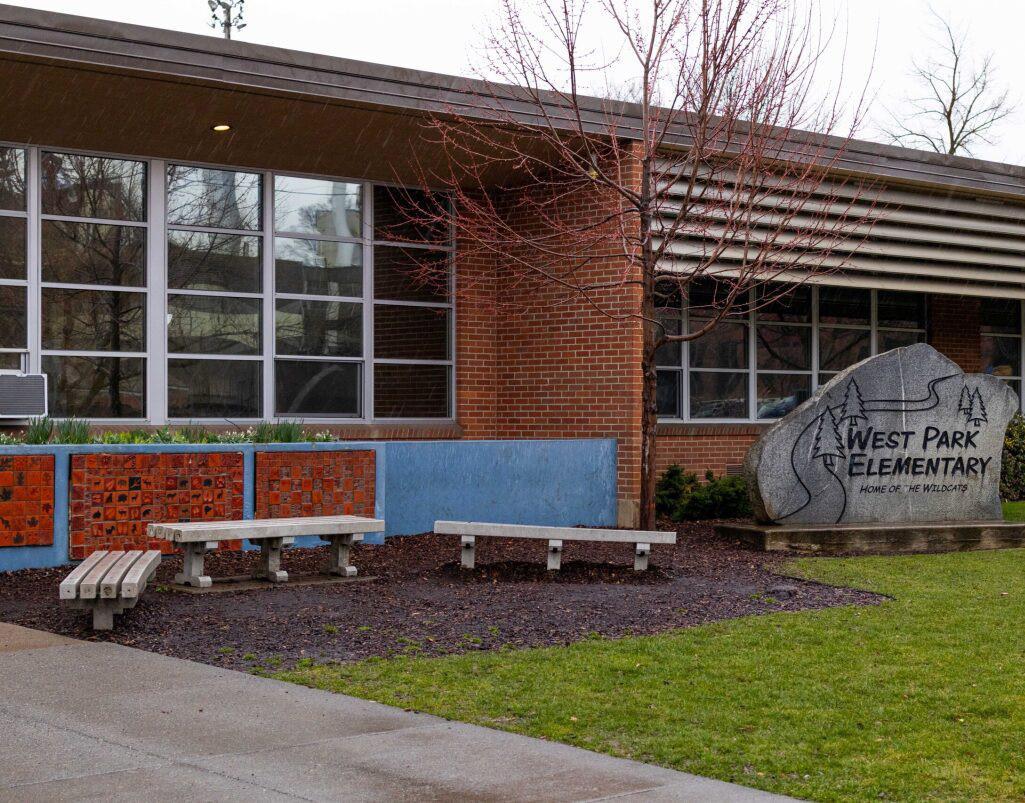
Repealing voter-approved coverage would have drastic effects to Idaho residents
Andrea Roberts
ARGONAUT
As the Idaho Legislator debates the future of health care in the state, lawmakers face a choice: protect Medicaid expansion and the thousands of Idahoans who depend on it, or move forward with proposals that would strip health care coverage from tens of thousands of people.
Advocates from the American Cancer Society Cancer Action Network are headed to the capital this week. They are advocating to protect Medicaid and preserve the expansion that has helped thousands of Idaho families have access to care since 2020.
According to an article by the Idaho Capital Sun, the Medicaid expansion has
been approved by nearly 61% of voters in 2018 to close the gap for low-income residents to receive coverage. The policy took effect in 2020 and has provided coverage to thousands of residents in Idaho.
Despite overwhelming support from voters, lawmakers are considering legislation that would repeal the program entirely.
A bill that was introduced would eliminate Medicaid expansion starting in 2028. This would remove around 90,000 residents from the program.
For many families, this would mean losing access to preventive care, cancer screenings, mental health treatment and other life-saving care.
Supporters of the repeal argue that Medicaid expansion puts a strain on the state budget. Some legislators have framed the issue as a choice between funding services for people with disabilities or continuing expansion for low-income adults.
However, this framing creates a false dilemma.
Health care policy should not put two vulnerable groups against one another. Idaho can and should support people with disabilities while also maintaining coverage for those who need it.
Medicaid expansion was designed to help people who fall into the “coverage gap.”
These are often working adults whose incomes are too high to qualify for traditional Medicaid but too low to qualify for traditional insurance.
Before the expansion took effect, Idaho relied on programs like the Catastrophic Health Care Fund and other care programs to help cover unpaid medical bills.
These programs were repealed after the expansion took effect, meaning that if the expansion disappears, the state could once again be responsible for paying emergency
care for uninsured residents.
Medicaid expansion also brings billions of dollars for federal funding into Idaho’s health care system. This supports hospitals, clinics and health care jobs throughout the state.
House Minority Leader, Ilana Rubel, said that repealing the expansion would cost Idaho more in the long run.
There’s a lingering question if lawmakers will respect the wishes of the voters, or if they will strip coverage from them.
For many residents in Idaho, health care is not negotiable for them. They depend on it for everyday risks, or even large emergencies. Some, even need it to save their lives.
If lawmakers truly want to strengthen Idaho’s health care system, they should focus on improving access and not taking it away.
For the sake of Idaho and it’s residents, the answer to the repeal should be clear.
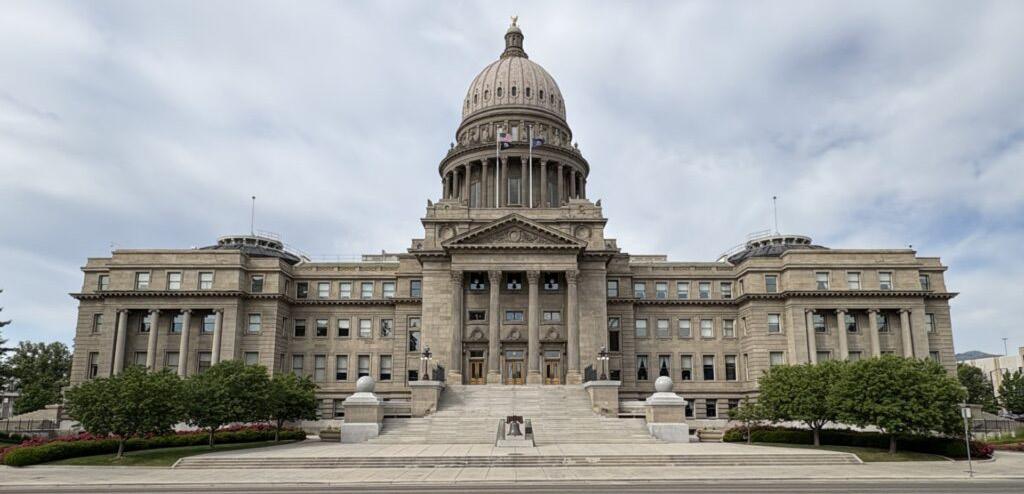


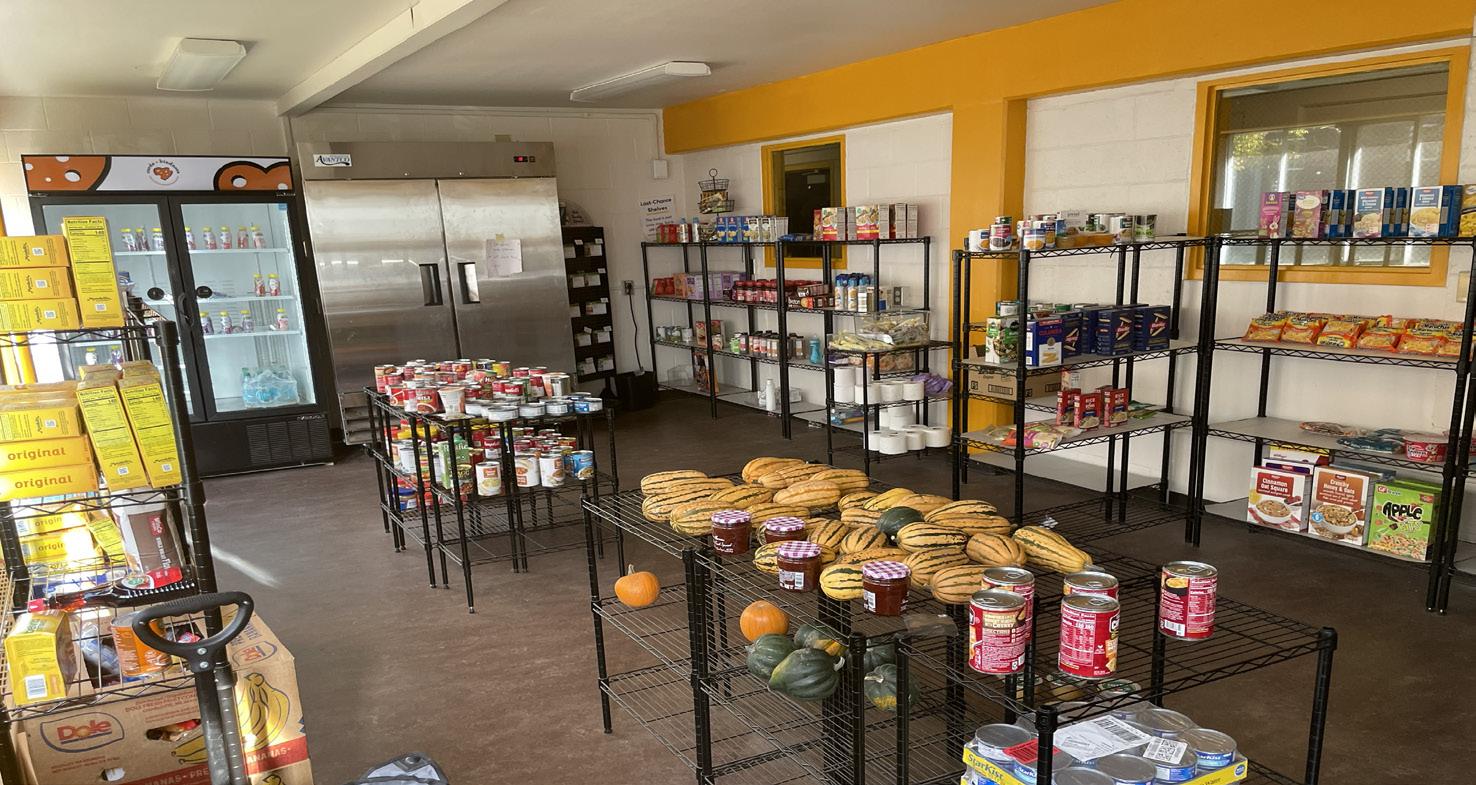






“Where
By Dakota Steffen