A Bachelor of Science and minor in artificial intelligence at the University of Idaho were approved at the Faculty Senate meeting on Feb. 3. The B.S. curriculum is part of the College of Engineering computer science department and is a four-year 120 credit degree program. It would begin in the 2026-27 academic year.
One of the driving factors, according to previous chair of the UI CS department, Terence Soule, is competition among other Idaho colleges. Boise State University began their B.S. in AI in the fall of 2025, and Idaho State University will begin their program at the same time as UI in fall 2026. Current CS department chair Steve
Wang said that more than 30 institutions already have a B.S. in AI program.
According to Wang, shifting attitudes and oversaturation in the CS degree market have led to a decrease in enrollment in general CS programs nationwide. However, specialized programs such as UI’s cybersecurity degree, which began in
2020, continues to grow.
“If we want to be competitive, I think we need degrees in this area,” Soule said at the senate meeting.
The department has been developing the degree program for over a year, according to Soule, but was postponed for input from Wang, who began as chair in fall 2025. The
curriculum builds on the CS department’s existing programs and courses, with a focus on how to develop and use AI technologies. Soule stated it was not a degree in AI application, but such program could be developed in the future without significant overlap.
One of four sentenced; cases against three others still pending
Paige Wilton ARGONAUT
Two months after six University of Idaho fraternities were burglarized, the four offenders are beginning their individual pleas and sentences.
As of Feb. 25, Latah County District Court has published the sentencing for one perpetrator, who will serve community service and probation.
The perpetrators, Grant Abendroth, Traiden Cummings, Aidan Prakash and Silas “Wogayu” Qualls, were caught and arrested on Dec. 21 after fleeing the scene.
Though each of the men made an initial court appearance on Dec. 22, the individual pleas and sentences just began with Prakash appearing in court for his hearing on Feb. 18.
According to public state records, Prakash pleaded guilty to unlawful entry as well as petit theft. He was sentenced to 40 hours of mandated community service hours to be completed by June 18, 2026.
He will also face a
probation period of nearly a year, which will be active between Feb. 18, 2026, and Feb. 17, 2027.
While both Cummings and Qualls were originally set to appear separately on Feb. 25, Cummings’ trial was rescheduled to March 25 for reasons unknown.
The results of Qualls’ trial, which occurred at 1:30 p.m. on Feb. 25, have yet to be released to the public as of Wednesday night. Abendroth’s sentencing is scheduled for March 4.
The stolen items mostly included personal items such as backpacks, jewelry and a cellphone, and items meaningful to the fraternities, such as paddles and
framed pictures, according to Moscow Police Department Capt. Dustin Blaker.
A framed picture worth $3,000 is listed in court records as among the valuables taken.
All four men are 2025 graduates of Moscow High School, with Abendroth, Prakash and Qualls enrolling in UI after graduation, where they all joined the fraternity Theta Chi. Cummings is not affiliated with the university.
In the wake of the crime, it’s unclear whether Theta Chi has taken action against the three members.
More than half—55%— of faculty and staff at the University of Idaho reported their greatest concern about campus safety was the potential for an active shooter. At the faculty senate meeting on Feb. 17, Kristin Haltinner, a professor of sociology, presented the findings gathered by the ad hoc committee on employee safety and security formed in fall 2025.
The key takeaways were that 36% of sure respondents reported a situation in which they felt unsafe or threatened.
Around 40% of women and non-binary employees and around 55% of employees of color reported such experiences. The measures of concern identified in the survey include harassment, threats or stalking from the public, students or other employees, online harassment and active shooters.
Employees with prior experiences of feeling threatened or unsafe responded that they felt significantly higher levels of concern across all measures. The largest category of people reported to be causing these discomforts were undergraduate students at 31%, followed by community members at 15%. Despite this statistic,
42% of employees expressed the most concerns about threats from community members, which Haltinner explained was likely a fear of the abstract other.
“We tend to fear people we don’t know, and we know students,” she said. The committee recommended the creation of a victim advisor group to support employees navigating situations in which they experience harassment or a loss of safety at UI, which would connect the person to appropriate services including counseling, medical, law enforcement or legal support.
Haltinner suggested that the senate create an ad hoc committee charged with developing a policy on the use of e-bikes and scooters on campus as an element of pedestrian safety.
The committee also recommended that the faculty senate serve as a conduit for distributing information to ensure employees are aware of ongoing safety planning by campus security. Such projects include the installation of electronic locks on campus buildings, the addition of buttons to classrooms that enable faculty to call campus security in the event of a non-emergency situation, improving campus lighting and increasing the visibility of campus security and the Moscow Police Department.
The response rates for faculty and staff were around 25% while the response rates for graduate students were less than 10%, according to Haltinner.
Aubrey Sharp | Argonaut
University of Idaho student Molly Haeberle rides the mechanical bull at the ASUI Winter Social on Wednesday, Feb. 25
Reagan Jones | Argonaut
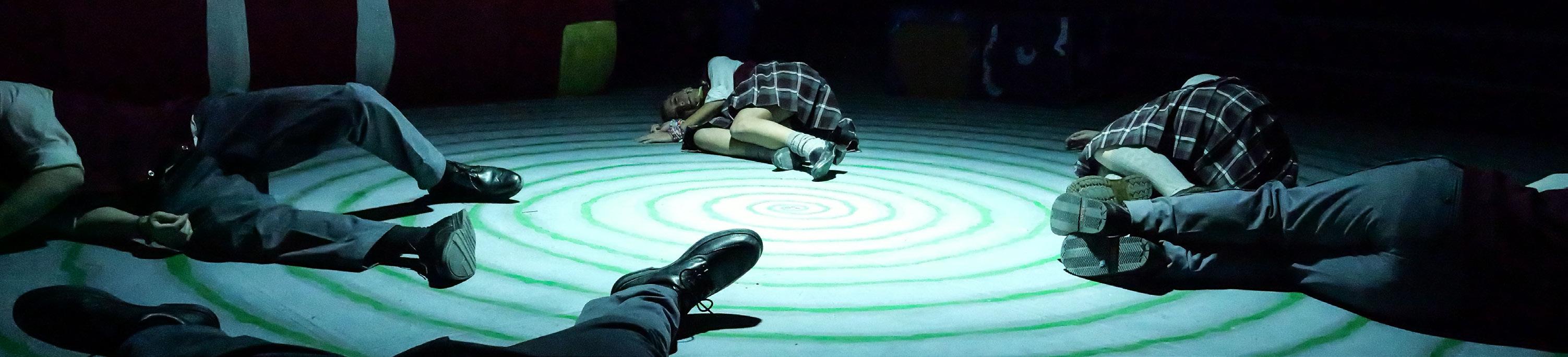
The Saint Cassian chamber choir lie on the ground after the opening scene of the musical “Ride the Cyclone.”
Douglas Wilson delivered prayer at the Pentagon
Local
pastor’s appearance met with controversy
Douglas Wilson, a self-proclaimed Christian nationalist and the senior pastor of Christ Church, was introduced at the Pentagon last week by U.S. Secretary of War Pete Hegseth. As a chosen speaker for Hegseth’s monthly Pentagon prayer services, which were established in May 2025, Wilson preached on Christian beliefs.
In 1977, Wilson and a group of fellow founders began the Moscow-based religious community of Christ Church. What began as a local chapter, one focused on emphasizing classical Christian education and a reformed theology, has since grown across the globe.
The expansion of Christ Church and its teachings occurred after the church joined the Communion of Reformed Evangelical Churches in the late 1990’s, a larger religious organization whose aim is to follow historical reformed traditions through devout Protestantism.
Along with his previous involvement in the creation of Christ Church, Wilson helped to establish the CREC as well. Today, there are over 100 CREC branches worldwide between 11 countries, with locations extending as far as Japan.
Wilson has spoken publicly about why he is of the opinion that women do not deserve the right to vote and why homosexuality should be criminalized, amongst other topics.
on Wilson’s blog, he began his speech by wishing a revolution upon American Christians.
“What I would like to urge upon you this morning, Lord willing, is that many American Christians need a Copernican revolution in their hearts and minds when it comes to their relationship to God and to His Son, Jesus Christ,” Wilson said.
A Copernican revolution refers to the influential astronomer Nicolaus Copernicus, who presented the first mathematical model of a heliocentric system in the 16th century, one where the earth revolves around the sun
Catholic apologist to debate Christ Church founder
Joe Heschmeyer and Doug Wilson set to discuss Sola Scriptura in March
Austin Kieckhefer ARGONAUT
Catholic apologist Joe Heschmeyer will debate Douglas Wilson, senior pastor of Christ Church, at the Vandal Catholic Club’s “Great Debate” on March 26 at 7 p.m., in the ICCU Arena.
This is the sixth year this annual event
The theme of this year’s debate is “Sola Scriptura,” asking questions regarding the authority of the scripture, and how it should shape daily life.
Sola Scriptura is a Christian theological doctrine that states the Bible is the sole infallible source of authority for Christian faith and practice and is held by most Protestant Christian denominations.
Wilson is the founder of Christ Church, a local evangelical church which, according to their website, has the mission of turning Moscow into a Christian town.
Wilson, a self-proclaimed Christian Nationalist, wants to use Moscow as the example of what a Christian Nationalist culture could look like to the larger American population.
In wake of his outspokenness, he has become a controversial figure both in politics and religion. The personal invite he received from Hegseth, who is a member of a CREC branch himself, struck a chord in many people across the nation. Wilson is just one of several preachers the Pentagon has hosted in Donald Trump’s second presidential term, but his visit has received the most significant media coverage.
According to the prayer transcript posted
rather than the earth being the center of the universe. Heliocentrism was proposed as early as the third century B.C. by Aristarchus of Samos, though the Copernican revolution had significant cultural consequences on Christianity and Western culture as the cosmological philosophy became more broadly accepted.
Though Wilson’s opinions on women, homosexuality and the patriarchy didn’t seep into his address, according to a CNN article, he made several “military-themed jokes about putting Jesus Christ first.”
is being held, with tickets costing $8 and available for purchase though the Vandal Catholic website.
The doors will open at 4 p.m. with Mass beginning at 4:30.
Concessions will open for dinner at 5 p.m.
At 6 p.m. Currie Meyers, a retired sheriff of Johnson County, Kansas, and faculty in the criminology department at Benedictine College in Kansas, will discuss “GOD in the DARK.”
The debate will begin at 7 p.m.
Along with Christ Church, Wilson is also a founding board member of New Saint Andrews College, a Christian liberal arts school that emphasizes Christian faith through all forms of expression, including music and art.
Wilson has also been given a more national spotlight, with a recent visit to the Pentagon at which he gave a prayer. Additionally, U.S. Secretary of War Pete Hegseth has reposted interviews of Wilson on social media.
Recently, Christ Church has opened a new parish in Washington, D.C.
Heschmeyer is a Catholic apologist who has worked for Catholic Answers for many years.
Catholic Answers is a media ministry which, according to their website, focuses on creating a safe environment for people to learn and speak of Catholic faith.
They emphasize fundamentals and how to fight against misinformation regarding Christianity and the Catholic church.
Heschmeyer is a public speaker and author of the blog Shameless Popery. He has attended numerous religious events as an ambassador of Catholic Answers and is a prolific writer, with his works featured in various books and magazines on topics of Catholicism and Christianity.
Heschmeyer has since turned Shameless Popery into a podcast and YouTube channel, emphasizing addressing misconceptions of Catholicism as well as various overall objections.
Significant cost of cloud storage, AI literacy training discussed at recent Faculty Senate
Old Teams content being deleted by UI Office of Technology
Joshua Reisenfeld
ARGONAUT
The University of Idaho is now being asked to pay Microsoft nearly six figures for cloud storage space, which was previously free, according to Teresa Amos, Director of IT Planning and Initiatives, during the Faculty Senate meeting on Feb. 24.
The conversation began with faculty reporting receiving emails about previous Canvas classes expiring. Lyudmyla Barannyk from the department of mathematics was concerned about receiving these
notifications for classes that are not taught every semester but remain a current part of the department’s curriculum. Barannyk said that many of the materials for these classes were longer locally saved, and would be lost should the Canvas page expire.
Amos responded to the issue, saying the emails were about old Teams content created by an automated system for each class that are now being cleaned up by the UI Office of Information Technology in the effort to mitigate the costs of paying for cloud storage. Amos said all Canvas classes are staying.
“We’re having to cut back on what we’re storing in the long term quite a bit,” Amos said.
In December 2024, Microsoft made a change to educational plans where each
institution will now get 100 terabytes of free storage allocation and usage across OneDrive, SharePoint and Teams, and can purchase extra storage in 10 terabytes increments priced at $300.
Microsoft reported that 99% of schools using their education plan were well below this new storage allotment, and that the change comes with benefits such as helping schools reduce security risks associated with legacy storage and data sprawl while also benefiting the environmental footprint created by largescale data storage.
During the meeting, Provost Torrey Lawerence reminded faculty members of an AI literacy class called “Teaching and Learning in Higher Education.” Lawerence explained it aims to help faculty know how AI can be used in the classroom. A small
The Argonaut Directory Dakota Steffen
Timmon Friel Taylan Hallum
•
number of seats remain, and Lawerence encourages those interested to enroll. A link can be found in emails already sent out to faculty.
Faculty Senate Chair Tim Murphy said that he had completed the training last week and that it was quite interesting.
Lawerence also reminded faculty members of Title II accessibility compliance that will go into effect in April. The Center for Excellence in Teaching and Learning has resources that can help faculty convert their course work.
“We’re seeing some utilization of those resources, but there is a lot still available,” Lawerence said. “It’s a great way to help, so it’s not all on faculty to fix on their own, but they won’t be there forever so using them now would be ideal.”
John Keegan | Argonaut
Honest Answers” in 2024, alonside pastors Toby Sumpter and Benjamin Merkle
True crime TikToker back in court over UI libel case
Jury to award damages for defamation
Josie Adjanohoun ARGONAUT
A true crime TikToker from Texas appeared in court Tuesday, Feb. 24, for a civil suit for defamation filled in 2024, after she accused a University of Idaho professor of the November 2022 murders of
In addition to the core degree, students will pick an area of emphasis which include: AI infrastructure & operations, secure AI, AI cyber, robotics AI, general AI studies and AI in data science. The course work for the various emphases can increase the total number of credits required to 132.
four UI students. Ashley Guillard, a TikTok personality who used tarot card readings of both the victims and of UI faculty to reach her hypothesis, claimed in more than 100 TikTok posts that Rebecca Scofield, a UI history professor and department chair, was involved in the murders.
Scofield issued cease and desist letters, which Guillard ignored, prompting Scofield to sue the TikToker.
After this initial suit in June 2024, U.S. Magistrate Judge Raymond Patricco stated that there was no viable evidence that supported Guillard’s statements and determined the claims were liable for defamation.
The hearing held Tuesday was to determine possible punitive damages, which will be determined by a jury. Scofield previously asked for more than $1.8 million, stating that the allegations lead to a PTSD
diagnosis and professional hardships.
Guillard is representing herself in the case, while Scofield is being represented by Wendy Olson, a former U.S. Attorney for Idaho. Guillard has also been delaying the lawsuit through multiple legal maneuvers, including filing to dismiss the case over improper jurisdiction. According to the Idaho Statesman, the trial is expected to last up to four days.
Joshua Reisenfeld ARGONAUT
Faculty Senate seeking volunteers for committee on AI use at UI
At the Faculty Senate meeting on Feb. 10, the senate authorized the creation of an ad hoc committee to develop policies around AI use in the classroom by both instructors and students.
The minor in AI will focus more on theory and fundamentals rather than programming and math and would only require 19 credits.
Undergraduate and graduate certificates in AI and machine learning are already offered by the CS department.
Soule said that these programs already include many of the upper division courses that will be part of the degree program. Some prerequisite requirements were also removed from existing classes to better streamline the curriculum.
Soule stated that dual credit programs and placement tests allow students to skip four credits of precalculus in MATH 1143 and MATH 1144, reducing the number of required credits back towards 120.
Soule stated that because of this, the need to increase the number of faculty is small, with two currently open searches.
One of the new curriculum items, AIML 1101, a freshman level class Soule called a non-technical introduction to AI, is in discussion to become a general education requirement on AI ethics, system fundamentals and responsible use.
Faculty Senate members were in support of a general education AI class and suggested changing the course name to a more understandable title, such as ethical use of AI technologies. The senate voted 20 in favor,
two against for the B.S. in AI and 22 in favor, two against for the minor in AI.
Soule said that both degree programs were designed to meet Center of Academic Excellence in Cybersecurity and ABET accreditation. Wang also said that he was hopeful to further partnerships between North Idaho College and UI’s Coeur d’Alene campus where a selection of computer science courses are offered.
The whole course catalog as presented to the faculty senate is available to view through in FS agenda for Feb. 3, 2026, on the UI shared governance website.
Idaho introduces six bills on the collection of immigration status
Bills would force schools and hospitals to report to the state
Joise Adjanohoun ARGONAUT
The Idaho State Legislation has introduced several bills in relation to immigration status during the 2026 legislative session.
House Bill 656 would require public schools, charter schools, public universities and colleges to report on the nationality, primary language and immigration status of all students. HB 656 states that the additional information gathered will not be used to discriminate against students. This bill would be an addition to preexisting Idaho State code Title 33, Chapter One, which deals with the use and limitations of student data that is reported directly to the Idaho State Board of Education. HB 656 was referred to the house education committee on Feb. 13.
House Bill 592 would require hospitals to collect patients’ immigration status and report the expected costs to treat those patients to the state. These reports would not include patient information. Like the previous bill, this would be an addition to prior state code Title 39, Chapter 13. HB 592 was
sent to the health and welfare committee on Feb. 5. Senate Bill 1247, House Bill 584 and House Bill 704 intend to mandate the use of the federal government work authorization program E-Verify to establish certain requirements for employers to verify the lawful status of workers. SB 1247 passed the senate on Feb. 19 and is now in the house for reading, while HB 584 remains in committee discussion.
House Bill 700 would make it a misdemeanor for employers to knowingly hire or continue employing individuals who are not lawfully present in the U.S. or authorized to work.
HB 700 and 704 were reported out of committee on Feb. 24 with do pass recommendations, which means the committee advises the full House to approve the bill in its current form.
According to a report from University of Idaho faculty Tim Naderau and Steven Peterson, the implementation of these bills could lead to an estimated gross state product loss of $5.1 billion, or 3.6%, and a $397.8 million reduction in state tax revenues. The study estimated there were between 30,000 and 50,000 unauthorized individuals in Idaho, and that these bills would have an impact on 50% of the unauthorized workforce.
The committee is seeking seven faculty members, two students appointed by ASUI, one student appointed by GPSA, CETL director or delegate OIT Director or delegate and CDAR director or delegate. The chair of the committee will be a faculty representative, but will be a non-voting member to ensure objectivity.
Given the size of this project, the senate anticipates the committee appointment would last 1.5 to two years. In addition to developing the policy, the committee will also offer periodic updates on progress to the Faculty Senate.
Those interested can contact Kristin Haltinner (khaltinner@uidaho.edu), the chair of the committee on committees and Vice Chair of Faculty Senate.
Rodeo Club to host fundraising dinner this Friday for spring rodeo
The University of Idaho Rodeo Club will host a dinner and auction at 5 p.m. Friday, Feb. 27, in the Latah County Fairgrounds Event Center, featuring a catered tri-tip dinner, live music, a silent auction with local items and a no-host bar. Tickets are available on the event webpage at $50 per person or table sponsors ticket which includes eight individual dinner tickets and spherical recognition for $360. All proceeds from the night will go toward hosting a UI rodeo later this spring.
The rodeo club is a men and women’s collegiate team that competes against other schools in the Northwest Region college rodeo circuit. More information about the rodeo club can be found on their Instagram @idahorodeo.
Grad fair and graduation regalia deadlines approaching soon
The University of Idaho graduate fair is March 2 and 3 in the Clearwater/Whitewater room in the ISUB. The fair will be open from 8 a.m. to 5 p.m. and will allow students to order Spring 2026 graduation regalia, shop for graduation related items or speak with graduation services. More information about the event is available on the UI grad fair website.
The deadline for ordering all regalia, bachelor’s, master’s, law, doctorates and faculty, through the required service of Jostens is 5 p.m. PST, Friday, April 3, 2026. For students unable to attend the grad fair but have questions about regalia can email alumni-regalia@uidaho.edu or see the FAQ page on the UI website.
Student achievement, honorary degree nominations open
The student achievement awards are open until midnight, Sunday, March 1, where students can nominate a fellow Vandal or themselves for a variety of different awards, including Student Employee of the Year, outstanding members of each class, Career Catalyst Award and the ASUI Presidents’ Scholarship. The awards will be presented April 10, 2026, in the Bruce Pitman Center International Ballroom from 5:30 to 7 p.m.
The nomination page can be found on the Engage UIdaho website.
Honorary degree nominations are also open for individuals who have made a scholarly distinction or public service that has significantly contributed to the University of Idaho, the state, the nation or the world. Nominations must include a biographical sketch, a summary of accomplishments and supporting documents and must be endorsed by the appropriate dean and department chair.
Nominations are to be submitted by April 15 to Commencement Committee Chair Jylisa Kenyon. More information is available in the faculty state handbook on honorary degrees.
Jazz Festival tickets are on sale now, festival in April
Brooklynn Jolley ARGONAUT
The Lionel Hampton Jazz Festival is one of the largest events that takes place on the University of Idaho campus. An event this large calls for extra help, so volunteers are needed for the 59th Jazz Fest, which will be April 22-25.
All UI students, employees and members of the community who are 18 years or older that are passionate about music and arts are encouraged to join the team. Volunteers are rewarded with one free concert ticket for every four hours of service. No experience is necessary.
The current open volunteer positions include pre-festival office volunteer, performance site volunteer, information desk attendant, workshop presentation assistant, drive crew and many more. For more information about becoming a volunteer and available positions, visit go.uidaho.edu/jazzvolunteers. The application closes on Sunday, March 15.
Aubrey Sharp | Argonaut
A majority of immigrant labor is in the agricultural industry; Idaho production estimated to
Aubrey Sharp | Argonaut
Farmworkers approach center-pivot sprinkler in South Idaho
Energy Symposium comes to UI
Event to focus on regional development of clean energy
Rebekah Brown
Robert Bryce, a journalist, film producer and author of texts concerning energy and politics, is scheduled to give the keynote address at the University of Idaho’s first annual Energy Symposium. The event, hosted for the first time by the UI Energy Institute, will take place March 4 and 5 with registration for the address priced at $50 for adults, $35 for seniors and $15 for students with ID. Bryce’s keynote will be held at 7 p.m. on Wednesday, March 4, in the Bruce Pitman Center International Ballroom.
Bryce has spent several decades researching the intersections of energy, power, politics and innovation, according to a UI press release. His books, including “A Question of Power: Electricity and the Wealth of Nations” and “Pipe Dreams: Greed, Ego and the Death of Enron,” discuss topics of energy consumption and development and the rise of fall of corporations. He has given over 500 lectures regarding various aspects of energy across the world.
“Bryce has spent a long career reporting on energy topics,” John Kumm, executive director of the UI Energy Institute, wrote in an email to The Argonaut. “He views energy primarily through a human
and economic lens, asking how decisions made around energy impact all of us who use it… Bryce is deeply knowledgeable and plainly spoken, so his presentations are educational whether or not the listener has a technical background.”
The Energy Symposium champions clean, reliable and affordable energy while also providing energy literacy education for both professionals and students. The symposium will focus on the permits required for the generation and transmission of energy. These permits act as a safeguard for the resources that are available, but can also become a pain
UI housing rates rise above market
2026-27 academic year on campus residence options explained
Austin Kieckhefer
The University of Idaho released the price guide for on-campus housing for the 2026-27 academic year in December 2025, which included a first look at the new graduate student apartments under construction along Sweet Ave.
Shortly after, three graduate students, KT Turner, Richie Thaxton and Zachary Foley, wrote a letter to The Argonaut where they brought up concerns with the pricing of the new grad apartments and compared the amounts of $1,150 to $1,450 with other housing options in Moscow.
“The major point we wished to make was the discrepancy that existed between the proposed rates and graduate student TA stipends. As we stated in the editorial, the stipends for some of the lowest-paid TAs on campus would mean that over 70% of the TAs stipend would be spent on rent every month,” said Thaxton, who said he was representing himself and the other writers of the letter.
These apartments are advertised to be for graduate students, but include units for students married or with children. These new apartments were built as a part of UI’s $162 million construction project, which also includes renovations in Theopolis Tower, Wallace Residence Center and the Elmwood Apartments.
The rates for these apartments include $1,339 a month for a studio apartment, $1,432 a month for a one-bedroom apartment and $1,154 a month for a two-bedroom apartment. All of these rates are per person and all new construction comes fully furnished. Internet, water, sewage and garbage are included in the rent. The cost of gas and electricity will need to be
paid separately.
New family housing begins at $1,275 for a one-bedroom flat, with townhouses priced at $1,940, $2,440 and $2,920 for two through four bedrooms respectively.
UI also offers the Elmwood, South Hill and South Hill Vista Apartments, which are reserved for families. These apartment options range between $752 to $992 per unit per month.
Applications for all apartments open March 10 and require a $30 application fee followed by a $500 down deposit once offer letters are sent in May or June. Rent will begin Aug. 1, 2026.
Priority applications for UI residence halls, which offer room selection, closed on Feb. 20, 2026, but general applications remain open. Room selection begins March 3 with timeslot details sent to students’ emails on Feb. 24. Of the residence hall options, the North Campus Communities double rooms are the cheapest per semester at $2,575, followed by Tower doubles for floors one through five at $2,790, which have yet to be renovated.
The renovated Wallace rooms, Ballard and Stevenson, will cost $3,060 per semester and the unrenovated rooms, Willey and Gooding, will cost $2,870 per semester.
Other residence hall options include a single at McConnell Hall for $3,915 per semester or the Living Learning Communities at $3,385 for a double and $4,435 for a single. The last day to cancel a residence hall application without fees is July 1, 2026. Move in for the 2026-27 academic year begins on Aug. 19 for new students, and Aug. 20 for returning students.
The housing guide which is available through the digital version of this article includes a more detailed breakdown of all apartment and residence hall rates and application timelines.
point due to extensive timelines. Kumm explained that the energy systems at use must balance environmental stewardship with the urgent need to upgrade infrastructure.
“[The] Energy Symposium delivers on the UI Energy Institute’s mission to lead discussion on energy issues facing our region,” Kumm wrote. “The symposium brings together experts, researchers and policy makers to engage in these complex topics while educating our students and inspiring more to pursue energy-related disciplines.”
The UI Energy Institute looks to shape
the future of energy production by building on the pillars of education, research and industry partnership.
Affordable energy and improvements to the existing energy grid can help strengthen healthcare systems, drive economic opportunities and raise the standard of living according to Kumm.
“When communities understand energy’s connection to human flourishing, they are better equipped to support practical energy solutions that balance environmental responsibility with reliability and cost-effectiveness,” Kumm wrote.
Families sue WSU over UI murders
WSU denies all claims of negligence and requests dismissal
Dakota Steffen ARGONAUT
The families of the University of Idaho murder victims have filed a lawsuit against Washington State University, alleging that WSU did not take adequate action against Bryan Kohberger prior to the murders.
The lawsuit was filed in Skagit County, Washington, on Jan. 7, by plaintiffs Steve Goncalves, Karen Laramie, Jeff Kernodle and Stacy Chapin. The plaintiffs are the parents of Kaylee Goncalves, Maddie Mogen, Xana Kernodle and Ethan Chapin, respectively, who were murdered just off the UI campus on Nov. 13, 2022, by Kohberger. Kohberger was sentenced to life in prison on July 23, 2025, after pleading guilty to four counts of murder and one of burglary.
On Jan. 27, the case was moved from Skagit County to the U.S. District Court’s Western District of Washington in Seattle. WSU filed its response to the lawsuit on Feb. 11.
In the lawsuit, the families of the murdered UI students allege that WSU did not respond sufficiently to complaints about Kohberger’s behavior while he was enrolled and employed in its Criminal Justice and Criminology Department. Kohberger was working on a Ph.D. focused on sexually motivated burglars and serial killers.
“Almost immediately upon his arrival to the Pullman-Moscow community, Kohberger developed a reputation for discriminatory, harassing and stalking behavior, instilling substantial fear among young female students and fellow WSU employees, necessitating regular security escorts for multiple females. Despite receiving at least 13 formal reports of Kohberger’s inappropriate, predatory and menacing behavior, WSU failed to respond in any meaningful way and allowed Kohberger’s escalating behavior to continue unchecked,” the lawsuit read.
Kohberger broke into the King Road residence in the early hours of Nov. 13, 2022, where he stabbed Kaylee Goncalves, Maddie Mogen, Xana Kernodle and Ethan Chapin to death.
“These deaths should not and would not have occurred if WSU had acted appropriately,” the lawsuit claims.
According to the lawsuit, Kohberger
had a history of heroin addiction, theft and alarming behavior toward women.
“On multiple occasions and with multiple WSU female staff members and fellow students, Kohberger would regularly stand close to their desks, loom over them and would block their exits from on-campus offices for long periods of time,” the lawsuit said.
“As early as mid-September 2022, WSU professors were discussing the ‘need to do an intervention with Kohberger’ because of his treatment of female students. By September or October 2022, a WSU professor believed that Kohberger was stalking people,” the lawsuit said. “The WSU office of Compliance and Civil Rights had at least 13 formal complaints related to Kohberger; yet, the individual in charge of acting on those complaints later reported that she had neither met nor even spoken with Kohberger.” WSU denies nearly every allegation in the lawsuit.
WSU admitted that Kohberger murdered four UI students on Nov. 13, 2022; WSU admitted Kohberger into its Criminal Justice and Criminology Department Ph.D. program, providing a teaching assistantship and associated pay as well as housing; it has a WSU Police Department on its Pullman campus, which aims to protect the safety and security of the campus community; and that it has a Threat Assessment Team.
WSU claimed that it acted with reasonable discretion and that it was not responsible for Kohberger’s actions.
WSU also claimed that the plaintiffs did not meet the statute of limitations in filing the lawsuit. The university requested that the court dismiss the lawsuit.
The lawsuit was originally filed in the Superior Court of Skagit County, Washington, the county in which Stacy Chapin, mother of Ethan Chapin, lives. WSU requested to move the case to the Eastern District of Washington, based in Spokane, from the Western District.
The plaintiffs’ team submitted a list of 69 total witnesses, including former WSU graduate students, expert witnesses and people who knew Kohberger in Pennsylvania, his home state.
The plaintiffs argued for the change in location primarily due to more flights being available to Seattle than to Spokane. The plaintiffs also claimed that the average “time to outcome” in the Western District was 70 days shorter than in the Eastern District.
Reagan Jones | Argonaut
The Energy Symposium will dicuss the importance of clean energy and its impact on communites such as Moscow
Mock trial team competes in Seattle
The club has been renewed as a credited class with an instructor, gaining more support than past student-led attempts
Cal Torres ARGONAUT
The University of Idaho is one of two institutions in the state to be a member of the American Mock Trial Association, the organization responsible for intercollegiate mock trial, but it hasn’t always sent a team.
Up until this year, mock trial languished at UI as a completely student-based effort. This year’s team has an instructor and credited class, both of which are relatively common features at other schools. With more university support and structure, they have been able to direct their attention to other challenges; namely, they are focusing on actually competing.
“I would say [the hardest part is] just it being the first year,” said Addie Beplate, the criminal defense attorney hired to coach the team. “Figuring out what we want the program to look like, and starting from scratch in that regard, and everyone learning how to do a mock trial together.”
There are some things students can expect of a mock trial—they will pick their positions, whether that is witness or attorney, and they will be expected to carry out both direct and cross examinations of the witnesses.
Direct examination is the initial questioning of a witness, conducted by one party; cross examination, in which the opposing party questions the witness, follows. Participants will be expected to reenact the roles they selected to the best of their ability and to conduct themselves using courtroom etiquette.
In addition, collegiate mock trial takes place in the fictional Midlands. Each year’s case is either civil or criminal, and former cases can and should be studied; since 1985, when AMTA was founded, the world of the Midlands has been building on itself.
This year’s case, State of Midlands v. Charlie Martin, revolves around the alleged murder of a TV show contestant. Participat-
Review:
ing students know all of this. They have been given hundreds of pages to help them study the case and prepare their arguments. However, the only way to fully immerse oneself in mock trial is to actually participate.
In preparation for the regional competition, the UI team has participated in two scrimmages.
Scrimmages are unranked practice meetings in which a team from one school will meet with another and hold their own mock trial surrounding the case.
“We had our first scrimmage with WSU…I was nervous and scared and a little bit excited, and then we went in and started doing it, and I recognized a whole other group of people that are also doing the exact same thing we are and are passionate about it. A lot of my nerves went away,” said Mila Rice, a political science and English major graduating in December.
She is serving as a prosecutor and witness for the UI team in the upcoming case. “We didn’t have a winner or anything when we did it. It was just for practice and to get to know each other.”
The UI team is composed of eight undergraduate students, who all come from different backgrounds.
Beplate and Raleigh Halgren, the elected team captain, both noted this as a strength; as they figure things out and piece their arguments together, they all have different perspectives to offer.
One thing most of them have in common, though, is that this year’s mock trial team is a better opportunity to participate in mock trial than others they’ve gotten. “Everyone’s knowledge of mock trial and how it works has grown exponentially, because a lot of us are actually—it is our first year ever doing anything like this,” said Halgren.
While Layla Knight, a defense attorney for the team and a senior in political science and philosophy, participated in mock trial in high school, she echoed similar sentiments.
The same year she joined mock trial,
“Wuthering
The book-to-movie adaptation starring Margot Robbie and Jacob Eloridi leaves audience conflicted
Joshua Resisenfeld and Andrea Roberts ARGONAUT
“Wuthering Heights” was released in theaters after a long and anticipated wait by fans. The movie was directed and produced by Emerald Fennell and produced by Margot Robbie and Josey McNamara.
The movie is an adaptation of the novel of the same name written by Emily Brontë and released in 1847. “Wuthering Heights” has been adapted seven other times, first made in 1939, followed by other productions in 1970, 1978, 1992, 1998, 2011 and 2009.
The novel is a famous piece of classic English literature known for its passionate and dark love story between Catherine “Cathy” Earnshaw and Heathcliff, taking place in the bleak Yorkshire moors.
Leading up to the release of the movie, fans started an online trend where people would go up to the hung movie poster and try and bending backwards, mimicking Robbie’s pose in the poster, pretending as if they were about to kiss Jacob Elordi.
The movie takes place in the 18th century in the English moors and starts off with Cathy as a child. One day, Cathy’s father brings home a boy, who Cathy takes in and names Heathcliff, after her deceased brother. They live with Nelly Dean, who is their caretaker and housekeeper. They all suffer extreme abuse from Mr. Earnshaw, their father, and the estate owner of Wuthering Heights.
Cathy and Heathcliff were inseparable, but as they grow older, sexual tensions arise. Years later, her father has become more indulged in his habits of gambling and alcoholism. When new, wealthy neighbors arrive, Cathy goes to introduce herself as an
the pandemic started. “All three of my competitions were actually held on Zoom, because even after the bans were lifted, the state competition was easier to access for everyone on Zoom. I never actually got the benefit of being able to do an in-person trial,” said Knight. “When you’re in real life, your notes aren’t in front of you. It’s a lot more challenging, and it’s a lot more intimidating…[collegiate mock trial] is harder for me now because I didn’t have the preparation [high school mock trial] would have given me.”
According to Graham Hubbs, the pre-law advisor for UI, mock trial at the university also suffered during that time. “We had an active mock trial team before the COVID19 pandemic,” he said. “The students just kind of put the club together on their own and would go and compete at the regional tournament in Seattle...The pandemic hit, and I think that put a dent on the institutional continuation of the club.”
Now, with credits and an instructor, those involved hope that UI students will continue to compete beyond this year. “It’s a really, really great experience, and it’s not just for the mock trial competition,” said Rice. “I’ve been provided with resources that will help me if I have questions about law school or if I’m a starting attorney and have questions even then…I would love for this to grow and for people to familiarize themselves with it. It’s a pretty cool opportunity that I just don’t think has the publicity that it deserves.”
According to the AMTA’s website, UI is just one of hundreds of member schools, and the eight UI students are in the company of over 7,300 college students.
This year, the regional tournaments are spread across 32 cities and four weekends.
The UI team participated in the Seattle tournament on Feb. 21 and 22. While they did not move on, six teams won bids to the Open Round Championship Series.
Heights”: A dark obsession
excuse to leave her home for a while. When spying on the neighbors, she injures herself, and the neighbors, Edgar and Isabella Linton, his ward, take her in to heal.
While staying at the Linton estate, Edgar grows closer to Cathy. When she returns home dressed in fancy clothes, Heathcliff is not pleased because of her long absence. Edgar travels to her home and sees the vile conditions she lives in with her abusive father. He proposes to Cathy, who is now a young adult, and she accepts.
Cathy later expresses to Nelly how she feels guilty marrying Edgar to have a better lifestyle. She explains how marrying Heathcliff would “degrade her.” Listening through the door, Heathcliff hears this and flees home, heartbroken, just before Cathy was planning to confess that she loves him.
Nelly sees Heathcliff listening through the window but refuses to tell Cathy, so Nelly can move to the Linton Estate and escape Mr. Earnshaw with her.
With Heathcliff not returning home, Cathy finds herself with no other option than to marry Edgar after delaying the wedding by a year. Years go by as she lives with Edgar and longs for Heathcliff’s return every day.
When Heathcliff returns after five years, Cathy has become pregnant. Heathcliff has transformed himself into a wealthy and well-groomed man fitting of Cathy’s beauty. While Cathy is happy to see his return, Heathcliff is angry because of what she said and threatens to marry Isabella to make Cathy jealous.
Heathcliff purchases Wuthering Heights from their father who is drinking himself to death; the estate is now in shambles. Neighbors once again, Cathy and Heathcliff see one another frequently, fighting each time they speak, Cathy confessing that she has always loved him.
They start an affair behind Edgar’s back, which Nelly discovers and reports to Edgar. Edgar forbids Cathy from seeing Heathcliff ever again.
This doesn’t stop the passion that they always wanted, and Heathcliff soon finds out she is pregnant. He tries to be understanding at first, but after getting into a fight once again, he storms out of the manor.
Heathcliff goes on to marry Isabella and lives at Wuthering Heights, but he mistreats her. Cathy becomes depressed and locks herself in her room at the Linton Estate.
Heathcliff has Isabella write Cathy letters, which includes details of his mistreatment towards Isabella, but Nelly burns every single one before Cathy can read them. During this time, Cathy’s health declines from self-starvation and her pregnancy.
Nelly realizes the impact of her cruelness towards Cathy, and wants to rescue Isabella, devising a plan to have Heathcliff see Cathy. When Nelly visits the dilapidated manor, Isabella is chained up and barks at Nelly as she enters, like a dog. Heathcliff says Isabella is happy as she eats cake out of his hands, but upon learning about Cathy, he saddles his horse and rides to save his deepest desire. But he may not arrive in time. They are not in love, and seem incapable of feeling so because of their past, but are driven by an unhealthy obsession for each other’s bodies.
The movie was a financial success, produced with a budget of $80 million, and netting $92 million since its release. Many fans of the novel were surprised and upset that the second half of the book, which includes the main characters’ children, was erased. This part dealt with generational trauma and moving beyond it, a major theme in the narrative which the movie made no attempt to explore.
Isabella was reduced to sex slave in the movie, instead of being a strong mother character who broke the cycle of abuse. Although many other adaptations have done this, a major change was the casting of a white actor for Heathcliff, who is described as dark-skinned gypsy which adds to the abuse from Mr. Earnshaw.
As a movie rather than an adaptation, the
movie was entertaining though it exaggerated the dark romance elements to an uncomfortable degree, using lust as a selling point rather than a narrative to tell a deeper story. The cinematics were beautiful, showcasing the green misty moors and elaborate gothic manors, whose gloom adds to the narratives depressing tone. At the same time, this overshadowed the plot to the extent that the only take was that the directors preferred vibes to substance.
The costume design was strikingly beautiful but unfitting for the 19th century setting. Elordi alone wore clothes fitting of the setting compared to Robbie whose elaborate outfit looked like it belongs at the MET Gala. The worst offender of Robbie’s outfits was a dress that looked like colorful plastic wrap.
For such a bad plot, the actors were able to spin so much tension into every moment they appeared on-screen together. This movie wants to be the next dark romance obsession of the young women, and may be for some, but like Saltburn, another story about unhealthy obsession gone wrong from
the same director, this movie will fade from cultural memory in a couple of years.
John Keegan | Argonaut
“Wuthering Heights” movie poster
Addie Beplate Courtesy
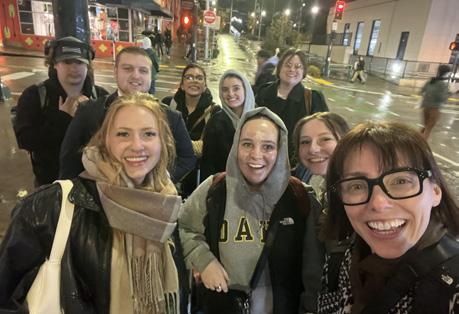
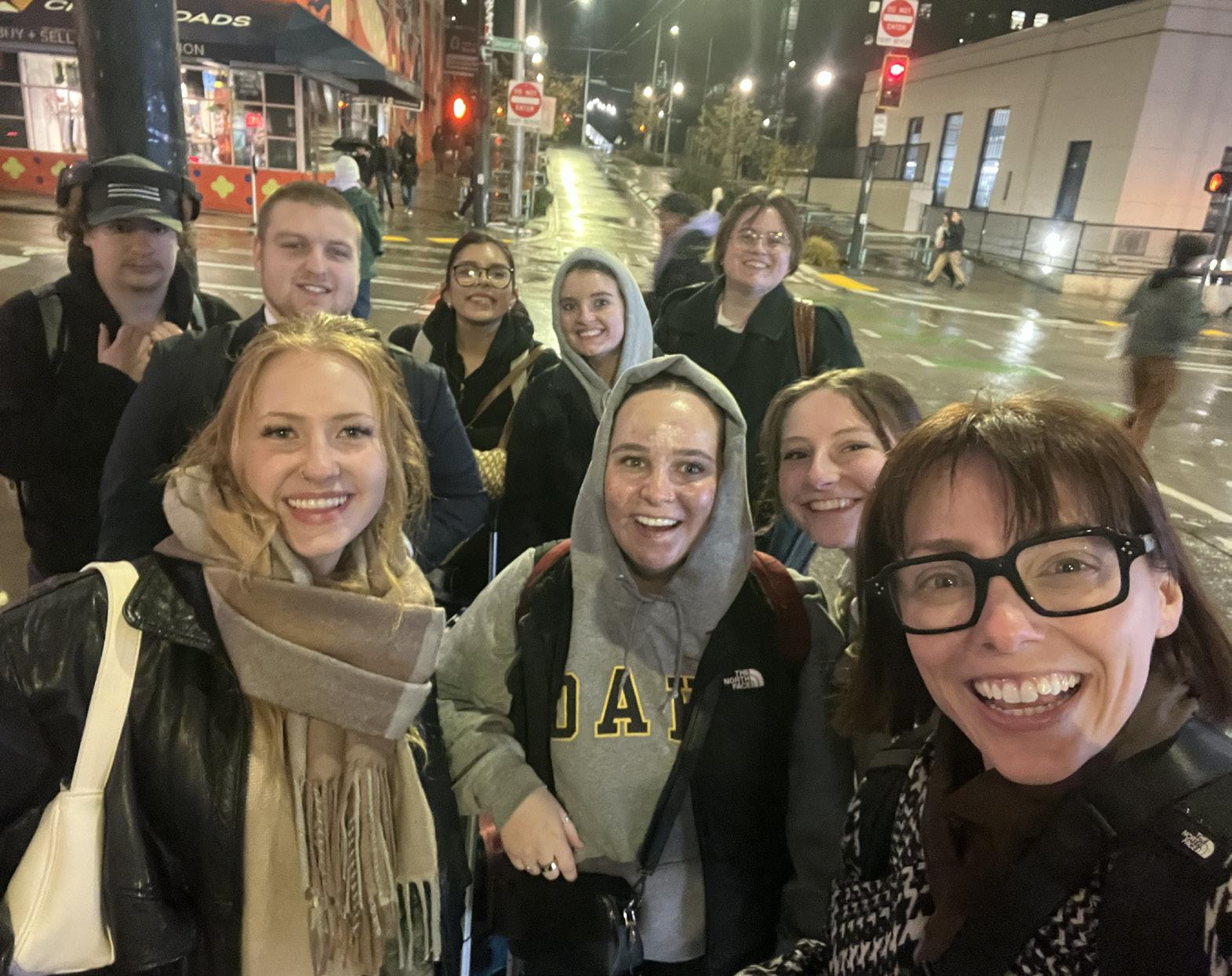
The UI mock trial team, clockwise from top left: Benjy Jones, Raleigh Halgren, Erika Amaral Pelayo, Layla Knight, Dakota Steffen, Karina Young, Addie Beplate, Maya Engledow, Mila Rice
School of music events for March
LHSOM has concerts, student and faculty recitals lined up for the month of March
Shelby Sandford ARGONAUT
For the month of March, the Lionel Hampton School of Music will present large ensemble concerts and various recitals between students, faculty members and guests.
Concert Band (Tuesday, March 3)
At 7:30 p.m. in the Administration Building Auditorium, the LHSOM will present a performance featuring the University of Idaho’s Concert Band. This big ensemble will be playing multiple pieces, highlighting the abilities of the musicians. Tickets are $12 for general and $10 for students. Tickets can be bought online or at the door with a card.
Convocation II (Thursday, March 5)
From 2:30-3:30 p.m. in the LHSOM building in Haddock Performance Hall, Convocation II will take place. Select students from the school of music, including solos and ensembles, will perform. This event is free to attend.
Faculty Recital—Duality (Thursday, March 5)
At 7:30 p.m. in the LHSOM building, in Haddock Performance Hall, Vanessa Sielert on saxophone and Catherine Anderson on
piano will be joining together for a faculty recital. This event is free to attend.
Student Recital—Yaw Nam (Saturday, March 7)
From noon-1 p.m. in the Haddock Performance Hall, UI student Yaw Nam will be performing a student recital on piano. This event is free to attend.
Student Recital—Jacob Johnson (Saturday, March 7)
From 4-5 p.m. in the Haddock Performance Hall, UI student Jacob Johnson will be performing a student recital on piano. This event is free to attend.
Guest Masterclass—Nicole Riner (Wednesday, March 11)
From 1-2:20 p.m. in UI’s Administration Building Auditorium, Nicole Riner will be holding a guest artist masterclass. You can attend to ask questions and learn more about her. This event is free to attend.
Student Recital—Katrina Nejely (Thursday, March 26)
At 6 p.m. in the Haddock Performance Hall, UI student Katrina Nejely will be performing a student recital on cello. This event is free to attend.
Wind Ensemble (Tuesday, March 31)
At 7:30 p.m. in the Administration Building Auditorium, the wind ensemble concert will commence, with musicians performing various pieces. Tickets are $12 for adults and $10 for students. Tickets can be bought online or at the door with a card.
Gaming Con will take over Pitman Center
The annual event will be run by UI’s esports program
Brooklynn Jolley ARGONAUT
The annual Vandal Gaming Convention is set for Saturday, Feb. 28.
This massive, all-day event will start bright and early at 10 a.m. and take over the Bruce Pitman Center until later that night at 8 p.m.
This event will be run by the esport program at the University of Idaho, and they’re dedicated to making sure the event stays community based.
The Vandal Gaming Convention serves as a place for gamers, cosplayers, nerds and esports enthusiasts across the Moscow community and greater Palouse area to connect and interact with one another.
This year’s convention will feature three main events, with one being a brand-new addition to the convention.
There will be a cosplay contest, a high school invitational and classic casual gaming.
At 3 p.m., the cosplay contest will commence. The contest is an opportunity for cosplayers to show off their hard work and talented costume designs.
Winners of the contest will be awarded a trophy and an Etsy gift card as follows: first place will receive $75; second place
will receive $50; and third place will receive $25.
All costumes must be family friendly. Those interested can register online at vandalgamingcon.com.
The first ever Vandal Gaming Convention High School Invitational will take place Friday, Feb. 27, and Saturday, Feb. 28. High school teams for Rocket League and Smash Ultimate can battle it out for a grand prize of $1,000 in scholarship or club funds.
Schools may register multiple teams of three for Rocket League and teams of four for Smash Ultimate.
There will also be a singles bracket for Smash Ultimate. Those interested can register their teams online at vandalgamingcon. com.
This brand-new event will be a great opportunity for students interested in esports, as it will feature a professional broadcast, live commentary and a tournament structure that is similar to high-level leagues.
Finally, there will be spaces for various consoles and PCs for open play and casual tournaments.
Additionally, there will be spaces set up for tabletop games.
This is an all-day event, but attendees are encouraged to come and go as they please.
This is a family-friendly event, so families and children are welcome to come join in for the fun!
Meet the 2026 Jazz Fest performers
The world class artists that will be performing at this year’s Jazz Fest have been announced Brooklynn Jolley ARGONAUT
The Lionel Hampton Jazz Festival is right around the corner, happening on April 22-25 at the ICCU Arena. This long-awaited annual festival is one of the biggest events that the University of Idaho hosts, with many talented artists performing. For tickets and schedule information, visit uitickets. com. This year’s lineup features six artists or musical groups, ranging from Latin jazz to powerful vocals.
Tito Puente Jr.
Being the son of a Latin music legend, Puente Jr. brings high-energy performances and blends Latin jazz, mambo, salsa and merengue in his music. He was born in New York and is now based in Miami. Puente Jr. has released albums recognized by Billboard, such as “Guarachando” and “Sientelo.” He continues to play his music on stages around the world and dazzles crowds with his signature Latin jazz.
Summer Camargo
One of jazz’s brightest and talented rising stars, Summer Camargo is a trumpeter, composer and bandleader. She has been named one of DownBeat’s “25 for the Future,” and she has made waves from being in Saturday Night Live’s band to Broadway’s “Just in
Time.” Summer Camargo is a Julliard alum and Conn Selmer/Bach artist and released her debut album, “To Whom I Love,” with Blue Engine Records in 2024. She has performed with Jazz and Lincoln Center, Jon Batiste and the Mingus Big Band.
Jazzmeia Horn
A Grammy-nominated vocalist, Jazzmeia Horn is known for having powerful vocals, fearless artistry and a deep connection to the traditions of jazz. Horn has a rich and diverse vocal range and a compelling stage presence. Being part of jazz’s new generation, she pushes boundaries while also honoring the past traditions of jazz. She was raised in Dallas, and her music is inspired by life’s ups and downs. She uses her emotions and experiences to create beautiful storytelling.
Warren Wolf
A powerful vibraphonist and multiinstrumentalist, Warren Wolf is known for his dazzling technique and large-scale reach. Wolf has toured all across the world, from New York to Tokyo, Paris to Singapore, and shared his vibrant music. He was born in Baltimore and is an important member of the SFJAZZ Collective and Christian McBride’s Inside Straight. Wolf is an educator at the Peabody of Music and the San Francisco Conservatory of Music. He has 10 recordings out, mostly with Mack Avenue Records, and he continues to push the boundaries of jazz with his music. Something Else!
A powerhouse septet of soul jazz pioneers, Something Else! is led by alto sax legend Vincent Herring. The group features jazz heavyweights like Jeremy Pelt and Wayne Escoffery. Something Else! performs groovy, electrifying renditions of classic pieces from Horace Silver, Herbie Hancock and more. This group has deep roots in ‘50s and ‘60s soul jazz and the feel-good vibes of those eras.
Lionel Hampton Big Band Co-led by previous Hampton band
members, the Lionel Hampton Big Band is a classic group that performs at the Jazz Fest. They bring Hampton’s hard-swinging jazz to life with energetic performances of his most famous and classic hits. The band serves to continue Hampton’s legacy and honor jazz icons like Louis Armstrong and Benny Goodman.
For more updates and Jazz Fest news, you can follow the Jazz Fest team on their social media or contact them at jazzinfo@ uidaho.edu with any questions.
1 c. mozzarella (shredded)**
Directions:
Start boiling water for your noodles.
While you wait for the water to boil, chop your chicken into slices or bite-sized pieces, dice your onion and shred the mozzarella.
This pasta isn’t called “marry me” pasta for no reason. This delicious and simple recipe is sure to wow your friends and family, and it’s definitely a keeper recipe! This pasta packs a unique and savory punch of flavor despite being so simple to make.
Ingredients:
1-2 chicken breasts
Noodles of your choice
Garlic powder
Smoked
1
1
1/4
1-2
1-1
Once the water has come to a boil, put your pasta in and let it cook. Let cook according to your pasta instructions.***
While the pasta is boiling, mix all the seasoning together with one tablespoon of oil. Mix well then spread onto your chicken.
Pan fry the chicken in butter.
Once the chicken is fully cooked (the internal temperature should be 165 degrees Fahrenheit), take it out of the pan and set aside. Throw in the diced onion, sun-dried tomatoes and oil and tomato paste into the pan.
Mix it all together and cook until the onions are translucent.
Add in the pasta water and cook down until all the water has evaporated.
After that has cooked down, add the heavy cream, spinach and mozzarella cheese.
Once combined, add in the pasta noodles and serve with chicken.
Enjoy!
Chef Notes:
*It’s approximately one cup, but it should be enough to cover the things in the pan. It will boil down regardless of the amount, but the time it takes will depend on how much water you use.
**Freshly shredded mozzarella should be used. Pre-shredded cheese has a coating that prevents the cheese from clumping, which
makes the cheese not melt as well as freshly shredded.
***Each pasta noodle comes with slightly different cooking times, so the amount of time you boil it will depend on the pasta that you choose. Check the box for proper cooking times.
John Keegan | Argonaut
The sax section of the Lionel Hampton Big Band rock back and forth at the 2024 Jazz Fest
Horoscopes for the month of March
Aries (March 21 – April 19)
You will form new friendships or connections this month. If you put yourself out there and remain open, your social life will thrive in March.
You’re a social person by nature, but maybe you’ve felt like your social interactions have been waning recently. This month will be very fulfilling for your extroverted needs.
Taurus (April 20 – May 20)
Something has felt off balance in your life recently. Do some soul searching this month and try to align your wants and needs. Maybe there’s some part of your normal routine that isn’t fulfilling anymore.
Reflect on yourself and your life to see if you’re in the position that you want to be. Look into your feelings about work, friends or your hobbies, and find the thing that is creating some dissonance.
Gemini (May 21 – June 20)
You’re a sensitive and empathetic person by nature, so lean into that side of your personality this month. Allow yourself to be vulnerable and allow your loved ones to find strength in you.
Have those deep conversations with people and show them how dependable you are. Your personal connections with be strengthened this month if you put in the effort to foster trust between yourself and others.
Cancer (June 21 – July 22)
Don’t give up on your dreams. Perhaps you’ve ventured into something new, and you feel like it’s not working out the way you had planned.
Don’t let it get you down. Stand tall and give it your all. Good things take time, so just be patient and you will see some reward for your efforts.
Leo (July 23 – Aug. 22)
Don’t be afraid to be firm with others. Stand up for yourself and be your own advocate. Chase your wants and desires this month. Perhaps you’ve been feeling defeated recently, and it’s getting hard to push on.
Don’t give into those feelings, but rather, use them as fuel to try harder. Good things are coming your way.
Virgo (Aug. 23 – Sept. 22)
Your aura will shine this month. People will be drawn to you, and new opportunities will be plentiful. You may feel pressured to immediately decide on these new things but
remember that it’s better to take things slow and reflect on what you truly want.
You know your wants best and what will fit well into your life, so don’t give in to the pressure from others.
Libra (Sept. 23 – Oct. 22)
Big changes are coming your way. Take time this month to get your life in order in preparation of these changes. March will be the month of alignment.
Make sure that you’re doing what you want and considering your happiness. You tend to do what others want to make them happy, but March is the month to focus on yourself and your wants and needs.
Scorpio (Oct. 23 – Nov. 21)
It may be time to lay low this month. You’ve been pushing hard recently and maybe you’ve been in the spotlight.
March is the month to step back and let someone else shine while you relax and recover from your hard work. Remember to have a healthy balance between your work and play.
Sagittarius (Nov. 22 – Dec. 21)
Take some time to smell the roses this month. Don’t forget about the little joys in life. Look for the small things that bring you happiness and focus on integrating more positivity in your life.
March is the beginning of spring, which symbolizes growth and beauty. Take time to foster these things in your personal life.
Capricorn (Dec. 22 – Jan. 19)
Don’t let others’ negativity get you down. Perhaps you’ve been working hard for yourself and others recently with no thanks or acknowledgment of your efforts.
Treat yourself to something nice this month, and don’t let others walk all over you. Be firm with your boundaries and expectations.
Aquarius (Jan. 20 – Feb. 18)
You may have been feeling sluggish lately or slacking on your duties. March will bring a sense of renewal and revive your spirits. Hang tight and don’t let yourself get down in the dumps.
Keep an eye out for the things that bring you joy. Be meaningful with your activities and interactions with others, and you’ll leave the month of March feeling brand new.
Pisces (Feb. 19 – March 20)
Your hard work will pay off this month, and you’ll finally get a reward for your efforts. You will realize that your efforts haven’t been going unnoticed. Keep pushing forward in your professional life, and don’t be afraid to chase goals that may seem unattainable now; you may be surprised at what you can accomplish when you really want something.
Kieran Heywood | Argonaut Horoscopes graphic
GALLERY: UI Theatre Arts Dept. to present “Ride the Cyclone” musical
Reagan Jones | Argonaut
The Saint Cassian Chamber Choir (played by Elise Von Bargen, left, and Abby Patterson, right) ride the Cyclone roller coaster in the opening moments of the show
Reagan Jones | Argonaut
The Amazing Karnak, played by Gunnar Edwards, gestures in his booth
Reagan Jones | Argonaut
Jane Doe, played by McKenzy Quick, sings the “Ballad of Jane Doe”
Reagan Jones | Argonaut
Ocean O’Connell, played by Elise Von Bargen, sings “What the World Needs” in royal attire
Reagan Jones | Argonaut
Jane Doe stands silhoutted behind a cloth during “Jane Doe’s Entrance”
Reagan Jones | Argonaut Noel, played by Cale Wilponen, smokes a cigar as he sings “Noel’s Lament”
Standout Vandal Spotlight:
Jackson Rasmussen emerges as a star for Idaho
Rasmussen has been one of the Vandals most important players
Taylan Hallum
ARGONAUT
When the season began, no one knew what kind of impact freshman forward Jackson Rassmussen would have on the Idaho Vandals. The answer has been given by Rassmussen, not by his words but his actions, and how he has played as one of the most important and consistent players for the Vandals so far this season.
Rasmussen, a Meridian, Idaho, native and one of the five Idaho players on this team, was a must-get for head coach Alex Pribble and, even with his transfer out of state to Utah Prep for his senior day, the Idaho pipeline is a big deal for Pribble and the future of the Vandals.
“We knew he’d be ready to make an impact right away,” Pribble said. “The great thing about Ras is he’s nowhere near the ceiling. He’s got great basketball ahead of him. He’s physical, he’s tough, but to me, his best quality is his coachability. He can pick up things very quickly and make adjustments, and that’s a huge strength.”
Over the last two games for the Vandals, Rasmussen has stood out with two 18-point performances against Sacramento and
Portland State. A very impressive freshman season is taking place in Moscow, with Rasmussen leading all freshmen in PPG by three.
During this first season in Moscow, Rasmussen has eclipsed 20 points five times, an impressive feat not many people have done for the team this season. Rasmussen has been an elite scorer with a season high and career high of 29 points, which he scored against Northern Colorado. Out of the 27 games he has played, Rasmussen has scored above 10 points in 18 of them. His success, however, did not start in college.
Rasmussen played three seasons of high school basketball at Owhyee High School from 2021 to 2023. He spent his last year of high school at Utah Prep in 2024. He led his team to two state championships and left high school as the number one recruit out of the state of Idaho and the no.52 ranked forward in the country.
Rasmussen was named the 5A Boys Basketball State Tournament MVP, while averaging 17.3 PPG and 7.7 RPG, and received 5A First Team All-State Honors. The success from his past doesn’t define Rasmussen as coaches and teammates look at who he is now.
“This is the right fit for Ras. He’s got great people around him. We trust him. We believe in him,” Pribble said. “Rasmussen isn’t just a great player; he’s a great teammate. He supports his fellow players and
strives to be better for them. They want him to keep playing for the Vandals in the future and they know that if he does, success will follow.”
As he has just scratched the surface of what he can be, Rassmussen impact is bigger than the scoreboard. His elite scoring ability to rebound and defend the rim stick
is what showcases on the floor. However, his impact of being from Idaho and living out a goal of being a college player, which not many kids in Idaho gets to say they achieved that. His brilliance on the court is great, but his legacy he leaves every time he sports Idaho across his chest is what is his greatest achievement.
Vandals host final two home games of the season
Idaho looks to gain momentum going into Big Sky tournament
Timmon Friel
ARGONAUT
The Idaho men’s basketball team is currently looking at one of the best seasons they have played under head coach Alex Pribble since the 2015-16 season. They finished 21-13, which is the last time they finished the regular season above a 0.500 winning percentage.
The Vandals are currently sitting at (15-13, 7-8), with a deep roster and a lot of potential leading up to the Big Sky Conference tournament, which the Vandals are currently no.7 in the standings.
The Vandals have a huge weekend ahead as they look to close an up and down regular season with some momentum.
Idaho has two more games inside the ICCU Arena. The first is on Thursday, Feb. 26, at 6 p.m. where they host the (10-18, 4-11) Northern Arizona Lumberjacks. They will then host senior night on Saturday, Feb. 28, versus the red hot (18-10, 8-7) Northern Colorado Bears at 1 p.m.
Northern Arizona
The last time the Vandals and Lumberjacks played in Flagstaff, Arizona, the Vandals won 79-62 and by halftime the Vandals were up 47-23, absolutely dominating.
Senior guard Isaiah Brickner dropped 31 points, along with three other players scoring in double digits.
Idaho will want to get Brickner involved as he has been the spark for the Vandals as a new entry into the starting lineup. He has brought life and energy into Idaho’s starting five.
Idaho will look to replicate their result in Flagstaff and play a full 40 minutes, which hasn’t shown up a lot this season, with incontinency being the Achilles heel of this team.
Northern Arizona, who is last place in the conference, is coming in with nothing to lose looking to come to the ICCU Arena and steal any momentum the Vandals have to move forward.
Northern Colorado
After the matchup last Thursday, the Vandals have a very tough game against Northern Colorado.
The Bears are doing really well this season and are on a seven-game win streak
and have serious momentum walking into the ICCU Arena.
In Greeley, Colorado, the Bears pulled away at the end 91-83 and ignited this ferocious run they have been on. The game was close in the first half with the Vandals going into halftime with the lead.
Idaho had the lead with 14 minutes left in the second half, before the Bears took control of the game and kept their lead after passing the Vandals early in the first half.
Key players for the Vandals in the previous game were freshman forward Jackson Rasmussen, who put up a total of 29 points, redshirt sophomore Kolton Mitchell and senior Brody Rowbury.
They also had a strong showing, and they will have to show out in a big way against the Bears.
For the Bears, senior guard Quinn Denker, a former player for the Idaho Vandals, has been a key contributor this season. Denker averages 18.4 points a game and is the leader for Northern Colorado.
Coming back to play against his original team with so much momentum, this will be a chance for the Vandals to showcase their ability to win.
Denker was almost unstoppable in the first matchup as he finished with 35 points,
seven rebounds and 10 assists and was playing with that chip on his shoulder he always plays with.
Slowing Denker down both as a scorer and as a facilitator will be crucial for the Vandals to walk out of senior night with a victory.
These matchups are going to play a big role in the upcoming Big Sky Conference tournament. If Idaho can win these games and even win against Eastern Washington, their last regular season conference game, they will have a much better seed.
With such a huge turnaround under Pribble, there is a lot to look forward to as this season comes to an end.
There have been recent player standouts that show a promising future such as senior guard Biko Johnson. Johnson has been averaging 12.7 points a game and recently has become one of the Vandals’ go-to players. Idaho, looks to finish off the regular season with some confidence and go into the tournament playing their best basketball.
The Vandals have the team to do it, and they have shown at times what this team can be but now is the chance to prove it with three huge matchups to prove that Idaho isn’t someone people want to play in Boise.
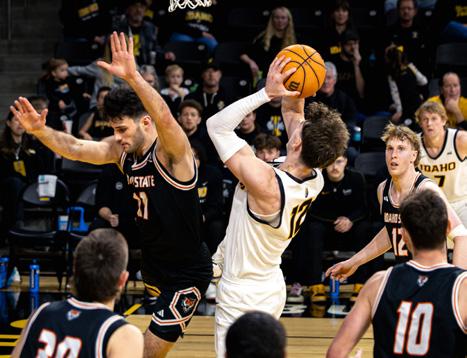
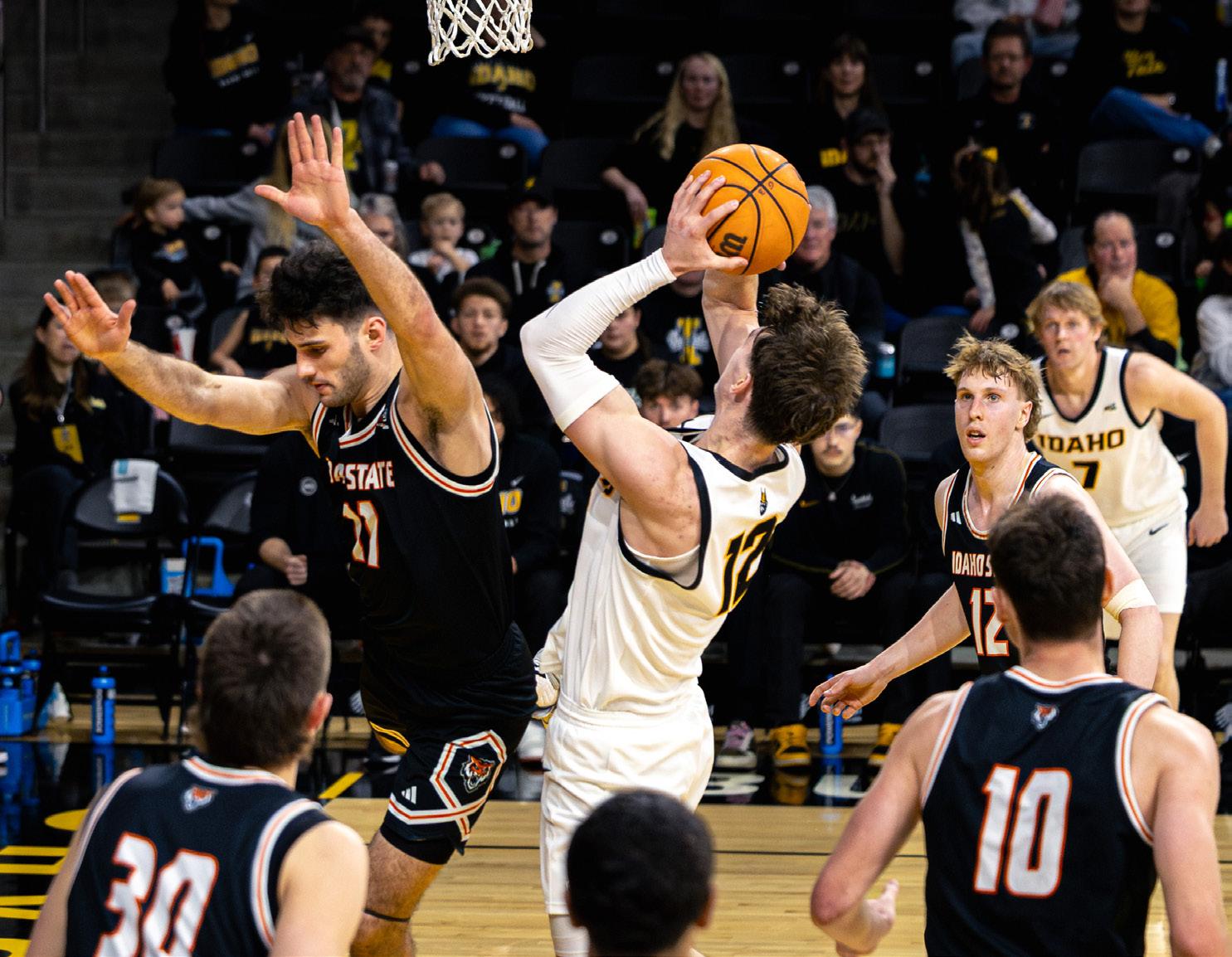
John Keegan | Argonaut UI forward Jackson Rassmussen led the University of Idaho against Idaho State with 21 points
Halfway across the world, Katlin Kangur finds her home with Vandals
Kangur has become a key player for the Vandals off the bench
Jayden Barfuss
Every time freshman guard Katlin Kangur, better known as “KK,” laces up her shoes and puts on her blue jersey with “Estonia” across the front, she is representing not only her country but the six-year-old version of herself who dreamed of one day wearing those colors.
“It’s an amazing opportunity. When you reach the women’s national team, the environment and putting on your country’s jersey, it’s such a special feeling,” Kangur said. “All the players coming together from different teams, different places, it’s amazing.”
Kangur, a native of Tallinn, Estonia, first discovered basketball in a PE class.
While in first grade, she was spotted by a basketball coach and from there, she rose through the ranks, going from a little girl with a dream to a player ready to live it out.
It wasn’t always basketball for Kangur.
She first tried dancing and singing, but once she picked up a ball and stepped onto a court, her mind was made up and her heart belonged to basketball.
“I love basketball because I tried dance and I went to singing classes, but basketball, the team, the contact, I just loved it,” Kangur said. “Who inspired me? I was my own inspiration. From a young age I got the opportunity to represent my country, so every year I pushed harder to be better at that level.”
Kangur began representing Estonia at 14 and moved to the senior national team at 16. Most recently, she played for a professional club team, winning a senior league championship and leading her team with 5.8 assists per game.
Looking for a new challenge, Kangur made a bold decision and moved 4,794 miles from Estonia to Moscow, Idaho, to take a chance on playing for the Vandals.
a lot of friends, the team is amazing and the coaches are really supportive,” Kangur said.
Coming from Europe, the adjustment has been real, both on the court and off.
“I feel like the speed and the system are a little bit different, but basketball is basketball,” Kangur said.
Beyond learning a new style of play, Kangur also had to pick up a new language, adapt to a new culture, and do it all within a
are so supportive.” Kangur entered a guard room loaded with experienced talent, including junior Hope Hassmann, seniors Kyra Gardner and Mary McMorris, and sophomores Ana Pinheiro and Ana Beatriz Passos Alves da Silva.
“I feel like I have more confidence in myself now, just trying to focus on the things I can control, defense, rebounding, moving the ball, cutting, figuring out my position,” Kangur said.
Then came an injury to McMorris, and with it, Kangur’s opportunity. She didn’t miss it.
Through a connection with Idaho women’s basketball head coach Arthur Moreira made via another coach, Kangur committed to the program and arrived on campus on August 18, 2025.
“I really like the people here. I’ve found
few months.
“Back home, people weren’t so open. So, at first, when I came here, it was really weird for me,” Kangur said. “People are so talkative and friendly with each other. I struggled with that. The food is different too; that’s been hard. But I love that people
With that kind of depth, not everyone was going to get minutes early in the season, Kangur included.
To start the year, she was used in a lategame mop-up role, balancing the demands of learning the system, the language, and her place on the team.
Her relentless work ethic and willingness to do the little things saw her climb the depth chart, and she has since become a key piece of the Vandals’ rotation.
“KK came in as a freshman on a good team. She wasn’t playing a lot early in the season. She had a little doubt about it,” Moreira said.
“Then we had an injury to Mary, and KK was ready. She took advantage of it, and now I can’t imagine our rotation without her.”
Kangur has appeared in 24 games this season, averaging 2.1 points, 2.2 rebounds and just over one assist per game. But her impact goes well beyond the stat sheet. She is an elite defender and rebounder, two qualities Moreira prizes, and her attention to the little things, cutting, setting screens, making the extra pass, has made her irreplaceable in the rotation. Whether she’s on the court or off it, Kangur’s outgoing personality is impossible to miss.
“I’m a people person,” she said. “I love to spend time with people. I also love to read and watch movies, but most of all, just spend time with people.”
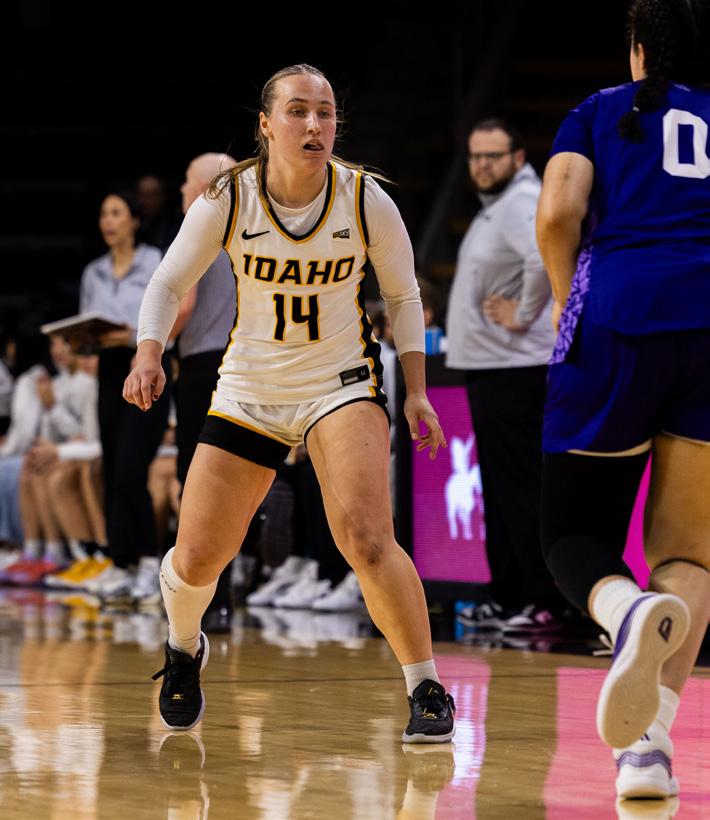
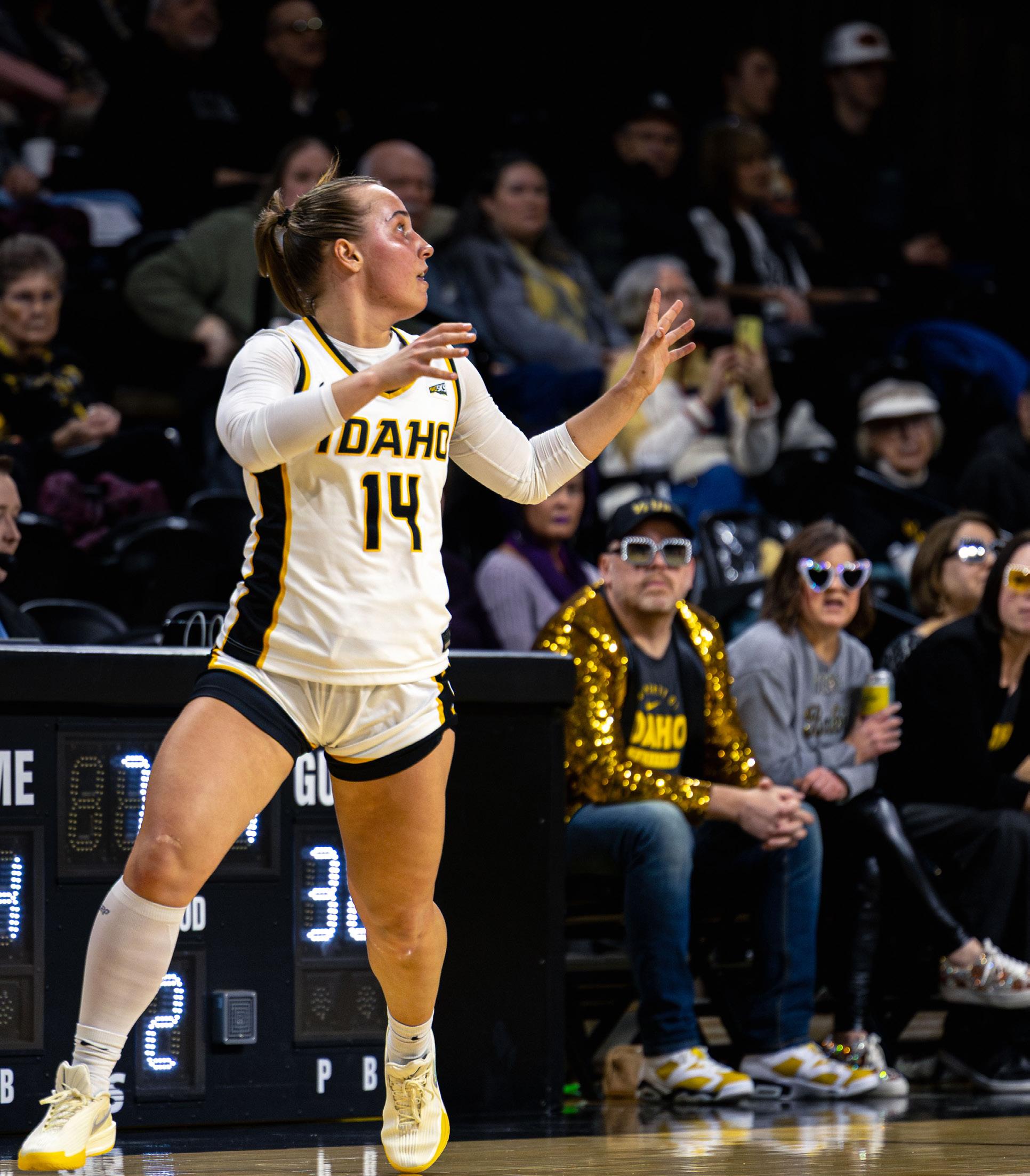
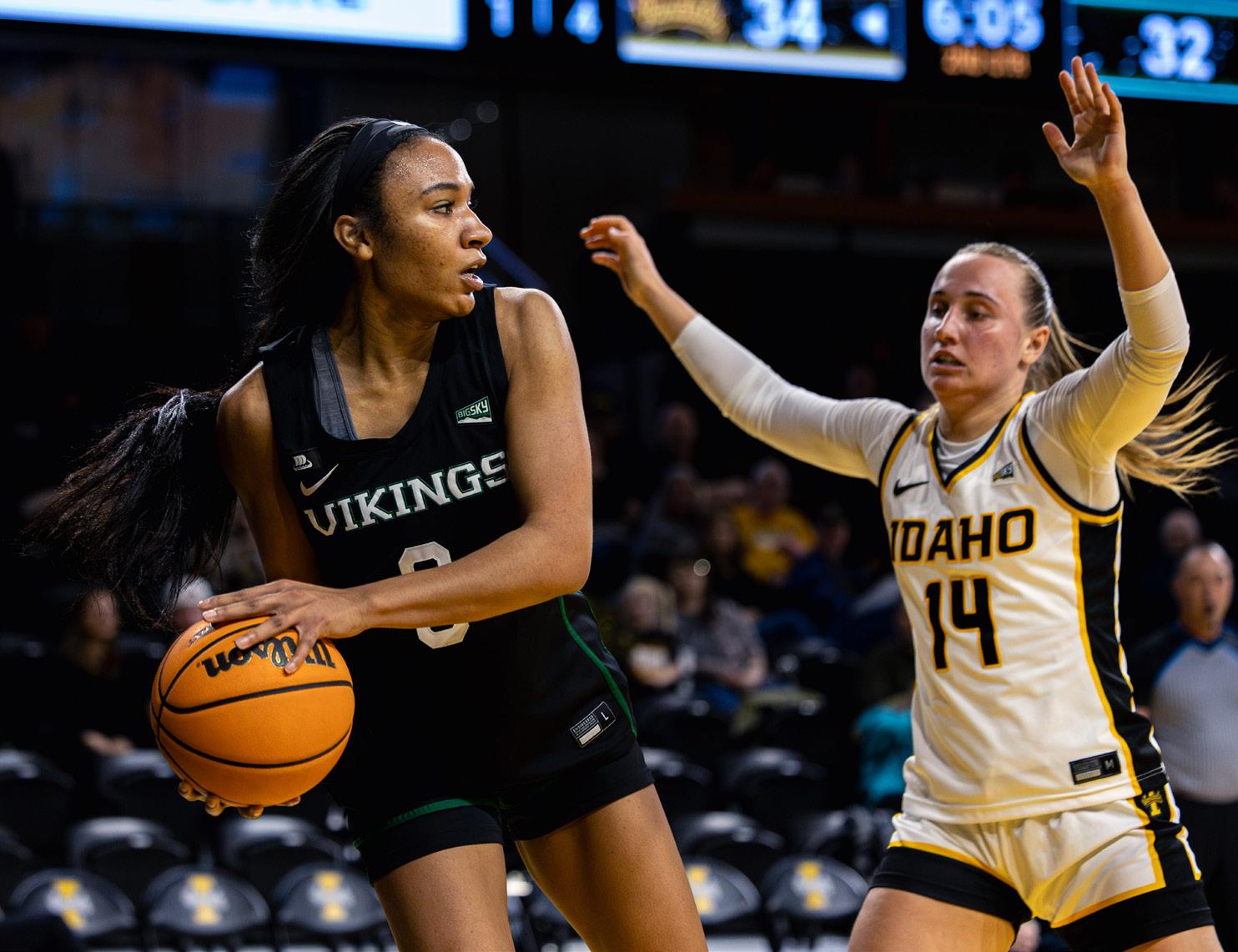
Kangur plans to continue her career in Europe after her four years with the Vandals and hopes to keep representing Estonia on the biggest stage possible. Until then, every time she pulls on no. 14 and steps onto the court in Moscow, she carries with her the kid from Tallinn who fell in love with the game in a PE class and never stopped believing she belonged.
The final stretch: Vandals within reach of the Big Sky regular season crown
Vandals look to finish off regular season strong
Jayden Barfuss ARGONAUT
In every race, the final stretch can be the toughest, and for the Idaho Vandals women’s basketball team, this one comes with a regular season championship on the line. The Vandals (23-5, 14-1) have won 12
games in a row, gone 12-1 inside of ICCU Arena and are on the cusp of winning their first regular season championship since 2019. Three games remain, one on the road and the final two at home.
Idaho will hit the road for the final time this regular season and match up with the (10-18, 6-9) Northern Arizona Lumberjacks in Flagstaff on Thursday, Feb. 26, at 5 p.m. Then the Vandals will make the long flight home and prepare to take on the (20-8, 11-4) Northern Colorado Bears, the third best team in the conference, at ICCU Arena on Saturday, Feb. 28, at 3:30 p.m.
Northern Arizona
The Lumberjacks came to Moscow on Jan. 31 and fell 94-71. Northern Arizona is in the middle of a rebuild with first-year coach Laura Dinkins reassembling the program after longtime head coach Loree Payne departed for another job. Despite a rough season the Lumberjacks have plenty of talent, starting with redshirt guard Naomi White.
The Grand Canyon transfer is the conference’s leading scorer at 21.3 points per game and shoots 40% from both the field and three-point range. She had a rough time in Moscow, scoring just nine points on 4-12 shooting, and will be looking to put on a much better showing in front of her home crowd. Sophomore guard Madison Watts has been a reliable second option, averaging 10.5 points and 6.9 rebounds per game and put up 20 points in the first meeting between these two teams.
Idaho is thriving in year two under head coach Arthur Moreira, averaging a leaguebest 79 points per game as one of the most balanced and deepest teams in the conference.
Junior guard Hope Hassmann leads the way averaging 14.1 points, 3.7 rebounds and 4.25 assists per game while ranking second in the conference with 119 assists.
Senior guard Kyra Gardner, a transfer from Washington State, has been the backcourt partner the Vandals needed, averaging 13.6 points and 6.8 rebounds per game while leading the team with 72 steals at 2.5 per game.
Up front, redshirt senior forwards Lorena Barbosa and Debora dos Santos have been a one-two punch down low that no team has been able to stop. Barbosa averages 12 points and 4.8 rebounds per game while dos Santos off the bench contributes 11.7 points
Northern Colorado
The Bears have been the surprise of the Big Sky this season, rising up the rankings and building momentum as they look ahead to Boise and the conference tournament.
In their first meeting in Greeley, the Vandals edged out a 62-55 win in a physical, defense-first contest where both teams excelled and the intensity was unmatched.
Northern Colorado is led by sophomore guards Neenah George and Heather Baymon, who average 13 and 12.1 points per game respectively, with their inside game anchored by junior forward Tatum West and senior Aniah Hall.
The Bears come in balanced, hungry and a tough out, and the Vandals will need to rely on their defense, rebounding and highpowered offense to get the victory.
Sophomore guard Ana Pinheiro has been leading the Vandals’ defensive charge, and what started as a weakness has tightened up considerably.
Over the last month, the team has been playing the best defense of the season.
With their first regular season title since 2019 within reach, the Vandals must continue to play Vandal basketball, focus one game at a time, and take care of business to get to where they want to go and reaching their ultimate goal of a Big Sky championship.
“We have so much fire still left in us,” Hassmann said. “This is only the beginning. We have three games, one on the road, and then ending with two at home is really awesome. Finishing conference with the bang would be really cool, we have so much momentum and I feel that’s going to carry us into Boise.”
John Keegan | Argonaut
Kangur readies herself for a pass during the Vandals’ game against Portland State on Feb. 19
and 7.7 rebounds. The Vandals are also the best rebounding team in the conference, averaging 47 rebounds per game.
John Keegan | Argonaut Kangur guarding a Portland State Vikings player during their game on Feb. 19
John Keegan | Argonaut Kangur during Weber State game
Raising the bar: The rise of Cami Cvitkovich
Only a sophomore, but already breaking high jump records
Gage McElroy ARGONAUT
There is no one anybody would rather want more on their team than standout sophomore Cami Cvitkovich. Arguably the best high jumper in the Big Sky Conference, Cvitkovich has had an amazing season this year for the Idaho Vandals track and field team. Cvitkovich has been on quite the hot streak this year.
Four first-place meet finishes in a row is what she brags headed into the conference championship this weekend. Her dominance this season has not only elevated herself but has also given the Vandals a major boost in team scoring at every meet she competes in, which Cvitkovich prides herself in immensely.
When Cvitkovich was in seventh grade, she had never even thought of competing for the track and field team. It wasn’t until her seventh grade English teacher brought up the idea.
“Right off the bat, I just fell in love with it because I was naturally kind of gifted, and I loved it too,” Cvitkovich said. After her very successful first meet, everyone on the team noticed her special skill and motivated her to continue to pursue in the long jump.
As an Eden, Utah, native, Cvitkovich continued to dominate throughout high school. At Weber High School, she was a two-time Utah state champion and broke the
state’s high jump record with a 1.71-meter jump.
After she graduated, Cvitkovich planned on attending college, but did not want to stay local at Weber State, instead choosing to move to Moscow.
“When I came to Idaho, I just immediately loved it. The small-town vibe, scenery and I just fell in love with the people and the coaches, and Idaho in general,” Cvitkovich said.
For Cvitkovich, the decision wasn’t just about track and field, it was about finding a home. From the moment she stepped on campus and met the team, she knew she could see herself growing here both as an athlete and as a person.
In her first year, her love for Idaho grew even further.
“I loved my freshman year. Getting adjusted to college athletics was hard but the people here and the coaches made it easier, and overall, it taught me a lot, which helped me out a lot to shape how I am today,” Cvitkovich said.
As a freshman, she was no push-over. She set a high jump PR in just her first collegiate meet at the 2025 Spokane Sports Showcase.
Her confidence and hard work throughout the season began to show as she placed top five in high jump at nearly every meet she attended. At the indoor and outdoor 2025 Big Sky Conference Track and Field Championship, Cvitkovich took fourth place as a freshman, a truly special first season for such a talented athlete.
Going into the 2026 season, she already had goals she had set in place for herself to
improve her play even more.
“My goal was to just go out there and do the best I can. To give it my all and no regrets, and to put everything into high jump because that’s what I love,” she said.
This mind set and passion for the sport has proven to show its worth. This season Cvitkovich has won gold in four straight meets. When asked what she thinks has been the biggest factor of her improvement, she said, “Having a strong mindset of never giving up and keeping myself mentally strong. I read every day to help keep myself motivated because high jump is so much more mental than almost every other event.”
Adding to the mental side of the high jump, nervousness is often a silent killer. With all the crowd, teammates and opponents watching her, Cvitkovich usually combats the nerves with her motivation.
“When I’m competing, I’m very locked in, but I think just remembering all of the work that I’ve put in to get there, and knowing that all my teammates love me and support me and definitely helps the nerves,” she said.
As a person, Cvitkovich is extremely humble and believes that she wouldn’t be so successful if it wasn’t for her teammates.
“I couldn’t do it without them. Although the high jump is an individual sport, you can’t do it without your teammates,” Cvitkovich said. “They’re cheering you on, and you practice with them every day so you grow a relationship with them, and without them it would be hard to do this.”
Cvitkovich doesn’t just thank her teammates for all their support, but also her high jump coach Brad Gamble. “I rely on Brad.
There will be days that I will not be having the best day and be instantly cheered up by my coach,” she said.
Together, the constant encouragement from her teammates and the guidance from Gamble have created the kind of support system that allows her to grow, stay confident and continue to dominate each meet.
As the Big Sky Conference comes up this weekend, Cvitkovich is more motivated than ever. She has been waiting for this meet all season and will not take this moment for granted.
“I 100% want to be a Big Sky Champion for my team, for myself and for my family, that is my top goal, and to make a ton of memories along the way,” Cvitkovich said.
With the work she has put in and the support behind her, she enters the weekend not just chasing a title but embracing the opportunity to represent her team and everything she has built this season.
When conference play arrives, Cvitkovich is devoted to leaving it all on the field, knowing that every jump reflects the hours of preparation, passion, and love for the sport that brought her to this point. No matter the outcome, she has already made a lasting impact on her team and has set the tone for an even brighter future.
Cvitkovich seems to be raising the bar often, not just literally, but metaphorically too. It seems like she checks all the boxes and continues to rise in her event throughout her career. The high jump bar truly reflects her college success perfectly, steadily climbing meet by meet, season by season, until it rests at the very top, right where she belongs.
The Pittsburgh Pirates might be an awakening giant in 2026
The baseball team is given a fresh start after a front office makeover
As a Pittsburgh Pirates fan, every year I head into the season with high hopes. But every year has the same story. Owner Bob Nutting hates to spend money, so usually the offseason sees a few free agent signings that make little impact on the team.
Once the season starts, everyone shows up for opening day, only to get demolished. The Pirates usually finish the season dead last in the National League Central with just over 70 wins, way less than ideal for such a historic MLB franchise. The front office says they plan on building a winning team, but for the past seven years, the Pirates have been below .500, and haven’t been to the postseason in ten10.
It wasn’t until early 2024 where that motive had the opportunity to change. On May 11, 2024, against the divisional rival Cubs, Paul Skenes made his debut,. Skenes went out and put on a show. In 2024, Skenes went 11-3 as a starter, struck out 170 batters, and had an unbelievable ERA of 1.96, and a WHIP of 0.947, which led him to easily securing the National League Rookie of the Year and National League All-Star appearance. In 2025, Skenes still dominated and even won the National League Cy Young Award by storm, this time finishing the season with a 10-10 record, 216 strikeouts, a 1.97 ERA, and a 0.948 WHIP, truly insane numbers. Heading into the offseason, everyone involved in the Pirates management pledged
to build around him, and this time they finally did.
The biggest issue in 2025 was the offense. The Pirates, led by veterans Bryan Reynolds and Oneil Cruz, finished dead last in the league in runs scored with 583, No. 28 in hits with 1,244 and dead last in home runs with 117, while Oneil Cruz led the team with 20, a truly lifeless offense.
In order to truly build around Skenes, the Pirates had to address their offensive struggles first. The Pirate’s front office started hot, as on Dec. 19, 2025, the Pirates were a part of a massive three-way trade with the Houston Astros and Tampa Bay Rays. The Rays were willing to give the Pirates a two-time All-Star Second baseman Brandon Lowe, who finished the 2025 season with 31 home runs and a .256 batting average.
They also got a speedy contact hitter in Jake Mangum, who in just 405 at-bats hit three homers and had a .296 batting average. They also took Mason Montgomery, a solid left-handed relief pitcher. All the Pirates gave up in return was Mike Burrows, who finished 2025 with a 3.94 ERA and 1.240 WHIP, to the Astros.
The front office continued to upgrade when on Jan. 8, 2026, the Pirates signed veteran Ryan O’Hearn to a two-year $29 million contract. O’Hearn hit 17 home runs and had a .281 average in 474 at-bats last season, and will most likely play some outfield for the Pirates this season. About a month later, the Pirates signed veteran righthanded starting pitcher Jose Urquidy on a one-year $1.5 million contract.
Although Urquidy spent most of 2025 in the IR in Detroit, he has produced an ERA below a 4.00 from 2019-2022. And finally, on Feb. 16, the Pirates signed
Marcell Ozuna to a one-year $12 million deal. Ozuna had another solid year with the Braves last season, boasting 21 home runs and a .232 batting average. Just like last season, Ozuna will most-likely play DH for the Pirates, replacing Andrew McCutchen. While it’s tough to see a franchise icon gone, the addition reflects a commitment to competing.
Now headed into spring training, the Pirates look so much better. If Oneil Cruz and Bryan Reynolds have a rebounding season in 2026, this team could easily have one of the most surprising offenses in the league. Tie this offense in with the number one best prospect in the league in Konnor Griffin. In the minor league last season, Griffin had a .333 batting average, 21 homers and 94 RBIs. Griffin’s elite athleticism, power potential and consistency give Pittsburgh a dynamic young cornerstone.
On the pitching side of things, Skenes will be the ace no doubt, maybe even the face of the franchise, followed by veteran Mitch Keller at the no. 2. I could see young stars such as Bubba Chandler and Braxton Ashcraft round out the rotation, and in the last spot I have Jose Urquidy for the beginning of the season, until Jared Jones recovers from elbow surgery.
Jones missed all of the 2025 season but had a great 2024 rookie season. Jones
struck out 132 batters and had a 4.14 ERA. Once he is healthy, I see him fitting in the no. two or three in the rotation.
With Paul Skenes anchoring the rotation, and a new offense featuring Cruz, Reynolds, O’Hearn, Lowe and Ozuna, as well as notable guys such as Nick Gonzalez, Spencer Horwitz, Jared Triolo and maybe Konnor Griffin, the Pirates look to have balance on both sides of the ball. If they can stay consistent and healthy, Pittsburgh could go from the punching bag of the league to a contender in the National League. For the first time in years, fans have reason to believe that the Pirates aren’t just rebuilding; they’re awakening.
Jaelynn Durels | Argonaut
Cvitkovich high jumping during the Vandals’ Idaho Team Challenge track and field meet on Friday, Feb. 6
Isaiah Brickner: The spark that the Vandals basketball team didn’t know they needed
For much of last season, Isaiah Brickner was a role player.
He came off the bench and contributed as a complementary piece in the backcourt for the Idaho Vandals. The flashes of greatness were there, but consistency and opportunity had yet to fully align.
One year later, Brickner has a new role in Idaho’s rotation.
Now in his senior season, Brickner has emerged as one of the team’s most efficient offensive players, averaging 11.7 points and 3.7 rebounds per game while shooting 52.9% from the field and 45.5% from threepoint range. After averaging just 4.1 points per game last season, Brickner has made the most of every opportunity he has earned this season.
“I would just say my mindset is more consistent,” Brickner said. “I had some good games last year, good spurts, but I wasn’t doing it for the whole game. This year, knowing it’s my last opportunity, I just wanted to give it my all every time I’m on the court.”
Entering the season, Idaho expected to lean heavily on returning scoring production from its backcourt. That plan shifted quickly when veteran guard Kristian Gonzalez, the team’s top returning scorer from last season, was sidelined after the season opener.
The adjustment forced multiple players into larger roles, including Brickner. Rather than changing his approach dramatically, Brickner has thrived in his newfound role.
Brickner has come into his own in conference play, averaging 14 points per game and leading the team in points per minute. His efficiency has made him one of Idaho’s most reliable scoring options.
A large part of that improvement comes from understanding his role within the offense.
“Shot selection has been huge,” Brickner said. “Watching film, knowing where I’m getting my shots and just taking the right ones.”
The result has been one of the most efficient seasons of his collegiate career.
Brickner’s path to Idaho began at Marist College, where he spent two seasons before transferring prior to the 2024-25 campaign.
Last season became a learning year for Brickner as he acclimated to the Idaho program.
“Nothing really changed that much from what I was doing last year,” Brickner said. “I just have more opportunity now.”
That patience has paid off. With increased minutes this season, Brickner has translated his scoring instincts into consistent production, especially when Idaho needs momentum offensively.
Throughout the season, Brickner has developed a reputation as one of Idaho’s most reliable momentum-shifters.
“I feel like I’ve kind of been the same player,” Brickner said. “I just have more opportunity this year to show what I can do.”
proaches possessions with that same mentality.
“I’m still trying to keep that chip on my shoulder,” he said. “Making sure I bring energy every time I’m on the floor.”
Brickner leads all guards on the roster in field-goal percentage and ranks among the conference’s top perimeter shooters. His ability to score without forcing shots has helped stabilize Idaho’s offense during both scoring runs and scoring droughts.
As one of the team’s four seniors, Brickner’s role extends beyond scoring.
“I took pride in being that spark,” Brickner said. “Instant energy, instant offense, just giving whatever the team needed.”
He is part of a veteran core guiding a roster that includes multiple younger contributors. That responsibility has grown as Idaho navigates a tightly packed Big Sky Conference standings race.
midseason slump before responding with a strong performance against Idaho State, a moment Brickner said reflected the team’s confidence in its potential.
“We know what we have in the locker room,” Brickner said. “We just had to stay confident and trust what we do every day.”
He described the group as both competitive, emphasizing the depth within Idaho’s backcourt rotation.
“On any given night, it can be any one of us,” Brickner said. “We’re unselfish, and we trust each other.”
For Brickner, the timing of his breakout carries additional meaning.
Senior seasons often represent a final opportunity to define a collegiate career, and Brickner has embraced that.
said. “Playing in front of these fans, playing with my teammates. I love playing for these guys…It’s honestly so fun to come out here and go to work with these guys every single day.”
As Idaho approaches the final stretch of the regular season, Brickner believes the focus remains simple: consistency and momentum.
“It’s about hitting our stride at the right time,” he said. That goal mirrors his own development arc this season of steady improvement built through opportunity.
After beginning last year as a role player off the bench, Brickner has turned his senior season into his most productive stretch of college basketball, becoming one of Idaho’s most efficient scorers and a key piece of the team’s offensive identity. Brickner is taking
Even with increased playing time, Brickner said he still ap-
The Vandals experienced a
“It means a lot,” Brickner
The World Cup is coming: Major League Soccer is setting the stage
The tournament will be on American soil for the first time since 1994
Jayden Barfuss ARGONAUT
It started as a dream. In 1994, the United States hosted the World Cup for the first and only time, and now a new generation has watched tournament after tournament, hoping that one day it would be in their backyard, where they could wear their nation’s kit, sing the national anthem and live out the chance to watch the World Cup on home soil.
We are now just a few months away from the greatest sporting event on the planet, the FIFA 2026 World Cup, hosted for the first time in its history by three countries: the United States, Mexico and Canada.
With the World Cup coming, it makes the Major League Soccer season all the more important, as the league not only sets the stage for the tournament, but gives fans the chance to see the venues,
the players, and build the excitement before the biggest show on earth arrives.
MLS is growing at a rapid rate, with teams in almost every major city in the United States.
When the league was founded in 1996, there were just 10 teams and it has since grown to 30, and according to footballbusinessjournal.com, MLS now carries a valuation of $23 billion with five teams worth over $1 billion individually.
MLS has put that money back into the league, investing $11 billion over the past two decades in facilities and infrastructure to make it an attractive destination for the world’s best players.
That attraction brought the greatest soccer player of this generation to North American shores. In July 2023, Lionel Messi left Europe and signed with Inter Miami, and the impact was immediate. According to the Football Business Journal, MLS has seen an increase of 12 million in fan attendance and 3.7 million viewers worldwide, a 29% increase.
Soccer in America is on the rise, and MLS has a big piece of that and will play a significant role in the World Cup this summer.
MLS Commissioner Don Garber has been vocal about this, and in an interview with Reuters he spoke about what the World Cup can do for the league long term.
“While everybody is going to be
paying attention to what is going to be the biggest sporting event in the history of this country, we hope that some of that drama, some of that appeal, some of that history, could rub off and create a lasting legacy,” Garber told Reuters.
“This is about taking the great game, the beautiful game of soccer and putting a bunch of energy behind it so that we can continue to do our part in helping to lead the game.”
MLS kicked off this past weekend and the buzz was unlike anything before it. The excitement reached new heights as the two presumed favorites, Inter Miami led by Messi and Los Angeles Football Club led by Son Heung-min, faced off at the Los Angeles Memorial Coliseum in front of 75,673 fans.
As David Martinez ran down the field on a breakaway, Son found him and Martinez curled in a beautiful opening goal, the crowd roared and a new MLS season was officially underway.
According to World Soccer Talk, Matchday One of the 2026 season drew a combined 387,271 fans across all 15 games, the most attended opening weekend in MLS history and a 17% jump compared to the 2025 regular season average.
For too long in the United States, soccer has been overlooked and undervalued. But the beautiful game is on the rise, and when the first match of the 2026 World Cup kicks off on June 11, it will be met by a nation and a fanbase that grew up dreaming of this moment.
Sitting in the stands, whether in the front row or the nosebleeds, wearing their country’s jersey and watching it all unfold on American soil.
Watching the players take the field wearing United States across their chest has been 32 years in the making.
Vandal Scoreboard:
Jayden Barfuss ARGONAUT
Men’s Basketball
The men’s basketball team returns home to play Northern Arizona tonight at 6 p.m. and on Saturday, Feb. 28, to play Northern Colorado at 1 p.m. Both games are in the ICCU Arena.
Women’s Basketball
The Vandals will hit the road, first taking on Northern Arizona tonight at 5 p.m. They will then head back home Saturday, Feb. 28, to take on Northern Colorado at 3:30 p.m.
Swimming and Diving
The Idaho swimming and diving team have concluded their regular season and will begin the MPSF championships starting today and going through Saturday, Feb. 28.
The women’s tennis team will travel to Ogden, Utah, to face Weber State on Friday, Feb. 27, at 10:30 a.m. They will then travel to Logan to face Utah State University on Sunday, March. 1, at 8:30 a.m.
Women’s Tennis Track and Field
The Vandals track and field teams will head down to Pocatello, to compete in the Big Sky Championships. The events begin today and run through Saturday, Feb. 28.
John Keegan | Argonaut
UI guard Isaiah Brickner drove to the lane and finished a finger roll layup in the game against Weber State
Fauzan Saari | Unsplash
A soccer ball sits alongside the 2018 World Cup trophy
International student enrollment dips
Growth without global diversity is not sustainable in higher education
AJ Pearman ARGONAUT
The University of Idaho is growing—just not in the way that truly prepares students for a global future. While total enrollment continues to rise, the percentage of international students on campus is quietly shrinking, and that shift risks making the university less diverse, less competitive and less connected to the world.
Recent enrollment data shows a clear trend. In spring 2026, the university had 639 international students, down from 758 the previous year—a drop of about 15.7%. At the same time, overall enrollment increased by 8.7% according to an article by The Argonaut. International students now make up a smaller slice of a larger student body.
On paper, growth sounds like success, but it masks a troubling imbalance.
International students are not just statistics. They bring languages, perspectives and lived experiences that domestic students cannot replicate. A classroom discussion about economics, politics or climate policy is fundamentally different when someone from India, Nigeria or Brazil is part of the conversation.
Without those voices, education becomes narrower, more insulated and less reflective of the real world that students will enter after graduation.
Historically, international students have been a modest but meaningful presence at UI. Estimates place them at roughly 5.4% of the student body—small compared with large coastal universities but significant for a rural campus, according to an article by
CollegeData.com.
Even a modest decline from that level can be felt across campus organizations, research labs and cultural programs.
The reasons behind the drop are complex. National trends play a role. Across the United States, new international student enrollment fell sharply in the 2025–26 academic year, with visa delays, political climate concerns and stricter policies cited as major factors according to an article by The Guardian. For many students abroad, choosing where to study is not just about academics—it is about safety, stability and whether they feel welcome.
But local factors matter too.
Moscow is safe and welcoming by most measures, yet it is also geographically isolated. International students often face long travel times, limited direct flights and fewer cultural support networks than in major metropolitan areas. For someone traveling thousands of miles from home, those barriers can outweigh the benefits of a strong academic program.
Cost is another issue. International students typically pay higher tuition rates and often receive less financial aid. When competing countries like Canada, Australia and Germany offer clearer immigration pathways and sometimes lower costs, the United States—especially smaller institutions—becomes a harder sell.
The decline also has economic implications. International students often pay full tuition and contribute to local businesses through housing, transportation and everyday spending. Losing even a hundred students can ripple through a college town’s economy.
Perhaps most concerning is what the trend signals about the university’s global
Inclusion shouldn’t be political
A teacher resigned over an “Everyone is Welcome Here” sign and is now filing a lawsuit
Roberts
Andrea
ARGONAUT
Upon entering a classroom, students are used to signs and posters encouraging hard work, creative thinking and inclusion. Most people wouldn’t think that a poster fostering an inclusive space for students would be a case for the federal government.
West Ada School District officials told sixth-grade teacher Sarah Inama to remove a simple poster reading, “Everyone is Welcome Here” from her classroom. The poster displayed hands of different races.
It wasn’t simply a decoration, but it showed that every student was accepted in that classroom, their school and the broader community. Every student should feel safe and respected regardless of race or their background.
Inama, a social studies teacher, resigned in early 2025 from her position after the controversy from the sign.
House Bill 41 was voted into law in July 2025 and prohibits flags or banners that express views about race or politics in public schools.
Inama filed a lawsuit against the State
Board of Education and declared that the bill is unconstitutional. She is also seeking momentary damages from the State Board of Education for violating her First Amendment rights.
While the case has not been decided if it will be heard or not, Inama has every right to fight against the injustice that has been brought against her. If a teacher has to resign over a simple sign that promotes unity, there is something wrong with the current state of the culture we reside in.
Public schools are meant to educate children and teach them skills such as respect, inclusivity and diversity. When a teacher’s efforts to create a supportive environment is labeled as “political,” we should question which side of politics is being protected, and which is being silenced.
This case should remind us that free speech should be protected in all areas and professions, such as teachers. It allows people to engage in an open and respectful dialogue about subjects such as inclusivity. A public school that doesn’t allow that is one that has lost its integrity and ultimate goal: to educate students.
If the lawsuit succeeds, it will not only restore teachers’ rights, but it will show that the First Amendment protects everyone.
More information on this case can be found on The Argonaut’s website.
standing. A campus with fewer international students risks becoming more inward-looking at a time when employers increasingly value cross-cultural competence. Students preparing for careers in business, engineering, agriculture or diplomacy will work in international contexts whether they realize it or not.
UI has long marketed itself as a place with global reach, noting students from dozens of countries study there each year. Maintaining that reputation requires more than recruitment brochures. It requires sustained commitment—scholarships, visa support, cultural services and a campus climate that actively welcomes students from abroad.
None of these diminishes the achievements behind rising overall enrollment.
More students choosing the university is a positive sign. But growth without diversity is incomplete progress.
A thriving public university should reflect the world, not retreat from it.
If the percentage of international students continues to fall, the loss will not be abstract. It will be visible in quieter international festivals, fewer language exchanges, smaller global student organizations and classrooms that feel less expansive than they once did.
In the long run, UI’s success should not be measured only by how many students it enrolls, but by how well it prepares them to live and work in an interconnected world.
Right now, that preparation may be slipping away—one percentage point at a time.
A global crisis in plain sight
New 2026 research shows lack of menstrual products continues to disrupt day-to-day life worldwide
AJ Pearman ARGONAUT
Every month, hundreds of millions of girls and women face a crisis that rarely makes headlines: how to manage a natural biological process without the basic supplies needed to do so safely and with dignity.
Period poverty—the lack of access to menstrual products, sanitation facilities and education—remains a global problem that cuts across income levels, cultures and continents. Recent research from Dignity Grows underscores how widespread the issue has become, even in wealthy nations. National studies released through its Period Poverty Institute of America found that more than one-third of American women and girls cannot consistently afford period products, a reality that contributes to missed school, lost wages and health risks. Jennifer Tolman, president and CEO of Dignity Grows, argues that the crisis is often misunderstood.
“Period poverty transcends the traditional definition of ‘poverty’ because it can affect women who may typically be considered financially stable yet still struggle to consistently afford menstrual hygiene products,” Tolman said. “According to the latest data, 41.9% of American women have experienced difficulty accessing period products due to financial constraints.”
Rising costs of housing, food and healthcare mean many families who appear financially secure still face difficult trade-offs.
An estimated 500 million women and girls worldwide lack adequate access to menstrual products and sanitation, according to an article by Global Health Economics. In many regions, girls miss school during menstruation because supplies are unavailable or facilities are unsafe, reinforcing cycles of educational inequality.
Tolman says the issue reveals a deeper disconnect between income statistics and everyday reality. “Period poverty exposes the gap between income level and lived experience,” she said. “We see how deeply opportunity can be compromised when basic needs aren’t met and a public health crisis is overlooked in conversations about economic security.”
Dignity Grows’ recent research also
highlights how period poverty disrupts stability in tangible ways. Lack of supplies forces many women to stay home from school or work, undermining both educational attainment and economic independence.
“Period poverty interrupts education, employment, and other day-to-day routines that create stability for girls, women and entire families,” Tolman said. “Among women experiencing period poverty in 2025, 21% said it impacted their ability to attend or perform at school, and 42% reported it impacted their ability to attend or perform at work. The effects are also felt in deeply personal ways that can alter a woman’s sense of wellbeing. Last year, 57% of women facing period poverty reported a decline in their mental health and 22% felt negative impacts on their relationships with family, friends and partners.”
Organizations worldwide are attempting to address the crisis through both direct aid and systemic change. Dignity Grows distributes hygiene supplies while also conducting research to shape policy responses.
“Dignity Grows’ mission is to end period poverty in the U.S. through a multifaceted approach that links direct product support with research, ongoing education, and national networks of cross-sector changemakers,” Tolman said. “We invest in rigorous data collection to better understand the scope of period poverty while developing tools that address this issue at its roots, in homes in every American community.”
Stigma continues to compound the problem. In many cultures, menstruation is still treated as taboo, discouraging open discussion and delaying policy action. Without public acknowledgment, the issue remains hidden despite its scale.
For Tolman, the urgency is personal as well as societal. “For me, the work Dignity Grows is doing across the country is a true passion,” she said. “No woman or girl should have to plan her month around scarcity and fear. As a national community, we have the chance to eliminate period poverty and help move individuals, households and whole communities toward stable futures.”
Ending period poverty will require more than charity. It demands recognizing menstrual health as essential—as fundamental as access to food, water or medicine. Until that shift occurs globally, millions will continue to navigate each month not with inconve-
Jaelynn Durels | Argonaut
Decorations from a Chinese Lunar New Year celebration on Thursday, Feb. 19, on campus
Haadiya Tariq | Argonaut The Idaho State flag hangs among
Leaking victims’ names in the files is a betrayal
While a call for the names of perpetrators was justice, disclosing the names of the victims was not
AJ Pearman ARGONAUT
When millions of files connected to Jeffrey Epstein were released to the public, many Americans hoped the truth would finally come out. Instead, what emerged was not only transparency, but another devastating failure: the accidental exposure of victims’ names and identities.
What should have been a step toward justice instead became a painful reminder of how institutions continue to fail the very people they claim to protect.
The Department of Justice released millions of Epstein-related documents under pressure to increase transparency. But in doing so, they made critical mistakes. According to Channel 10 News, police reports containing “nude photos. The names and faces of sexual abuse victims. Bank account and Social Security numbers in full view. All of these things appeared in the mountain of documents released Friday by the U.S. Justice Department as part of its effort to comply with a law requiring it to open its investigative files on Jeffrey Epstein.”
This was not a minor oversight. These were real people—many of whom had never spoken publicly—suddenly exposed to the entire world without their consent.
For survivors, anonymity is often essential to healing. Many choose to remain private because of fear, trauma and the stigma that comes with sexual abuse. Yet the government failed to uphold even this
basic protection. According to Security Magazine, thousands of records had to be removed after victim information was mistakenly revealed. The damage, however, was already done. Once names and identifying details are released online, they cannot truly be taken back.
Justice is supposed to protect victims, not retraumatize them.
The Justice Department has claimed it intended to protect victim privacy. According to Cape and Islands News, officials admitted that victims were “unintentionally identified due to redaction errors,” and some names appeared in ways that made identification easy. This raises serious questions about competence and accountability. If the government knew these documents contained sensitive information, how could such obvious mistakes happen?
Beyond the technical failures, this situation highlights a deeper problem: society continues to prioritize public curiosity over survivor protection. People are eager to know which powerful figures were connected to Epstein, but far less attention is paid to protecting the victims. According to Reuters, more than 1,200 victims have been identified in Epstein-related investigations, and survivors have expressed feeling “retraumatized and gaslit by institutions.”
These survivors have already endured unimaginable trauma. They should not also have to endure public exposure because of bureaucratic negligence.
Transparency is important, but it must be done responsibly. There is a difference between exposing wrongdoing and exposing victims. The public deserves to know who enabled Epstein’s crimes. However, victims deserve privacy, dignity and respect. Releas-
Israel’s participation
Israel has been the topic of controversy since the games begun
AJ Pearman ARGONAUT
As the world sits by the TV and watches the 2026 Winter Olympics in northern Italy, debate has intensified over whether Israel should compete amid ongoing global tensions.
While the Olympics have long been framed as a symbol of unity, many believe reality is far more complicated.
The games, which will take place across Milan and Cortina d’Ampezzo, are meant to bring nations together under shared athletic values.
The International Olympic Committee
ing their names without proper redaction does nothing to hold abusers accountable. It only harms those who were already harmed once before.
This failure also damages public trust. If the government cannot even protect the identities of sexual abuse survivors, how can victims trust the system enough to come forward? Survivors may now fear reporting abuse, worried their names could someday be exposed as part of a public record. That fear could silence victims and allow abuse to continue unchecked.
in the
has repeatedly emphasized political neutrality, maintaining that athletes should not be punished for the actions of their governments.
Supporters of Israel’s participation say this principle is essential to preserving the spirit of the Olympics.
Many argue that Israeli athletes have trained their entire lives for the opportunity to compete and should not be excluded because of political conflict. They say the Olympics should serve as one of the few spaces where differences are set aside.
“Sports are supposed to bring people together, not divide them,” said one University of Idaho student who supports Israel’s inclusion and who asked not to be named.
Supporters often point to past Olympic moments where athletes from rival nations competed side by side, showing that peaceful competition is still possible even in times of conflict.
Others, however, strongly disagree.
Critics believe allowing Israel to compete sends the wrong message and undermines accountability.
They point to calls from activists who argue that participation on the global stage provides legitimacy and normalcy at a time when many believe serious hu-
Ultimately, the release of Epstein’s files was supposed to represent progress. Instead, it exposed another injustice. Survivors were promised protection, but they were given exposure. They were promised accountability, but they were given carelessness. Justice is not just about revealing the truth. It is about protecting those who suffered while pursuing it. In the Epstein case, that responsibility was clearly ignored. And for the victims whose names were leaked, the harm did not end with Epstein—it continues today.
Olympics sparks debate
manitarian concerns remain unresolved.
Some critics compare the situation to the restrictions placed on Russian athletes following the invasion of Ukraine. They question why some nations face consequences while others continue to compete.
“It feels inconsistent,” said another student who opposes Israel’s participation who asked not to be named. “If the Olympics stand for justice and fairness, those values should apply to everyone equally.”
For many observers, the issue reflects a broader question about whether the Olympics can truly remain separate from politics.
The games have historically been influenced by global events, from boycotts during the Cold War to protests of injustice. The modern Olympics, despite their ideals, do not exist in isolation.
Others say targeting athletes does more harm than good. They argue that athletes often have little influence over political decisions and should not be used as symbols
of national policy. Excluding competitors, they say, punishes individuals rather than governments.
The debate also highlights the emotional weight of international identity.
For some, Israel’s presence represents pride and perseverance. For others, it represents pain and frustration, particularly among those who support Palestine and believe the international community should take a stronger stance.
As the Olympics approaches, one reality remains clear: the Games continue to reflect the world itself, with all its divisions and disagreements.
Whether Israel’s participation represents unity or controversy depends largely on perspective.
What remains unchanged is the power of the Olympics to spark conversation, not just about sports, but about justice, identity and the role of global institutions in times of conflict.
Student press Freedom day
What does the day mean for student journalists?
"Student Press Freedom Day, a national celebration of the resilience of student newsrooms across the country, and a moment to collectively deepen our advocacy for student journalists’ First Amendment rights.
Amid escalating censorship, intimidation and legal threats, now is the time to take action in support of student press freedom. No matter your connection to student journalism, you can make an impact on Feb. 26 and beyond."
More information can be found at: https://studentpressfreedom.org
College Media's Role
Media in college, such as newspapers, broadcasting, radio, and others, serve as a watchdog over campus affairs, government, and decisions.
The Argonaut strives to continue this dedication to inform all students, faculty, and community members of what is going on in and throughout The University of Idaho.
Louis Velazquez | Unsplash
The United States Capitol building, in Washington D.C. against a blue sky and clouds
First Amendment Rights
Sean | Unsplash
The Olympic rings against a night sky, on top of a building
Olympic backflips show how figure skating has evolved over the decades
for jumps that land on a single skate edge, according to an article by Yahoo Sports. Bonaly did it anyway.
Nearly three decades apart, two Olympic figure skaters performed the same breathtaking move—a backflip on ice—and received wildly different reactions. One was punished and pushed aside. The other was celebrated as a history-maker. The contrast says as much about the evolution of figure skating as it does about the sport’s long struggle with fairness, tradition and change.
In 1998, French skater Surya Bonaly stunned audiences at the Nagano Winter Olympics by landing a backflip on one blade—an astonishing feat of athleticism. It was also illegal. The International Skating Union banned backflips in 1977, citing safety concerns and the sport’s preference
Her performance was not rewarded. Instead, she received deductions and finished far from the podium. The moment became iconic not because it won medals, but because it represented defiance—a skater refusing to conform to a system that many believed undervalued her power and originality.
Fast forward to the 2026 Winter Olympics in Milan. American star, Ilia Malinin, launches into the same move, lands cleanly and electrifies the arena. This time, the reaction is applause, headlines and praise for innovation.
What has changed?
The simplest answer is the rules. After nearly half a century, the ISU lifted its ban on backflips in 2024, removing the restriction from competition guidelines according to an article by Forbes. By the time Malinin
competed, the move was legal again, even if it carried no technical point of value.
Malinin’s flip became the first legal Olympic backflip since 1976, transforming what was once a forbidden stunt into a celebrated highlight according to an article by Reuters.
But rules alone do not explain the emotional reaction many fans feel when comparing the two moments.
Bonaly’s backflip came during an era when figure skating emphasized elegance, classical lines and a narrow definition of artistry. Her style—powerful, explosive and rooted in gymnastics—clashed with those expectations. Critics have long argued that she was judged more harshly because she did not fit the sport’s traditional mold.
Some observers also point to deeper issues. Bonaly was a Black athlete in a sport historically dominated by white competitors, and debates about racial bias have resurfaced as her legacy gains renewed attention
according to an article by AP News. Meanwhile, modern figure skating increasingly rewards athletic difficulty. Quadruple jumps, once unimaginable, are now routine among elite men. The sport has shifted toward spectacle, speed and technical firepower—qualities that align perfectly with Malinin’s strengths.
Timing also matters. Bonaly’s flip was an act of rebellion at the end of a disappointing competition. Malinin’s came as part of a triumphant performance that helped secure team success. One was framed as rulebreaking; the other as history-making.
Yet the two moments are inseparable. Without Bonaly pushing boundaries, the move might never have been reconsidered. Today’s skaters perform in a landscape shaped by pioneers who were once penalized for daring to innovate.
There is an uncomfortable truth in that progression: sports often celebrate breakthroughs only after the risk has passed and the rebel has retired.
Figure skating likes to present itself as timeless—blades tracing elegant circles on ice, costumes shimmering under arena lights. It evolves like any other cultural institution, influenced by changing attitudes about safety, entertainment and inclusion.
Malinin deserves credit for his extraordinary athleticism. Landing a backflip on Olympic ice requires courage, control and precision few humans possess.
But Bonaly deserves something equally important: acknowledgment.
Her flip was not merely a stunt. It was a statement—one that forced the sport to confront its limits, even if it took decades to respond.
If the 2026 Olympics proved anything, it is that innovation rarely belongs to a single athlete. It belongs to a chain of competitors, each building on the risks of those who came before.
The applause echoing through Milan was not just for one skater in midair. It was also, whether recognized or not, for the woman who flipped first when the world told her not to.