Pitkin Nursery works to replace downed trees on main campus
UI nursery supports conservation efforts
Paige Wilton ARGONAUT
On Dec. 17, a monumental windstorm swept through North Idaho and Eastern Washington,
downing and damaging trees across the region.
Since then, the University of Idaho-led Franklin H. Pitkin Forest Nursery has been working to restore the areas that were damaged on campus and in Moscow.
Amongst many of the fallen trees across the city were two distinctly significant ones to the campus community. The Presidential Grove, located
Undergrad medical plan advances
Idaho and Utah begin developing partnership
Joshua Reisenfeld ARGONAUT
The University of Idaho announced the beginning of a partnership with the University of Utah on Feb. 11—the two universities will begin preliminary development of a regionally based undergraduate medical education program in Idaho’s Treasure Valley.
“This initiative represents an exciting opportunity for Idaho to expand medical student education right here at home,” Rayme Geidl, interim co-director of the UI School of Health and Medical Professions, said in the press release. “By building another strong partnership and training students in Idaho communities, we can help meet the state’s growing need for physicians.”
The “Train Here, Stay Here” undergraduate medical program plan, which aims to solve Idaho’s physician shortage, was developed by the Undergraduate Medical Education Committee and Idaho State Board of Education and submitted to the governor’s office on Dec. 31 for approval.
The previous legislative session passed House Bill 368, which called for 30 additional medical school seats over the next three years and created a task force that would study the medical education issue and make recommendations for the 2026 legislature.
Currently, Idaho is ranked no. 50 in physicians per capita and no. 44 in terms of total physicians in the state, according to Idaho Ed News, due to rapid population growth and high physician turnover. It

is estimated that the state would need 1,500 doctors today to meet the national average.
HB 368 specifically targets Idaho residents who are more likely to stay in state after graduation and seeks to develop pipelines to encourage graduates to stay in Idaho. It specified a desire to create a program other than the Washington, Wyoming, Alaska, Montana and Idaho partnership program at the University of Idaho, which was last expanded in 2016.
According to the UME plan, each year approximately 190 Idaho residents apply to allopathic MD programs and 213 to osteopathic DO programs, with around 70-75 Idaho applicants enrolled into each type of program annually. Of these, 50 students receive state support through a longstanding medical education partnership with the UW WWAMI program (40) and the UU School of Medicine (10). Idaho invests an annual $10.7 million into subsidizing the $50,000 per student tuition fees for these programs.
As UI and UU move forward with the planning process, the two universities will have equal representation on a joint steering committee, the announcement said, which would be responsible for admissions, curriculum development, student support, clinical training and overall program management. If fully approved, the program would have certain features to specifically serve Idaho’s needs:
1. All students will be Idaho residents;
2. Students will attend classes and most clinical rotations in Idaho;
3. Students must sign a “Return to Practice” agreement committing to at least four years of medical practice in Idaho following residency or repayment of
on Hello Walk, lost the Colorado Blue Spruce planted by Theodore Roosevelt in 1911, and Port Orford Cedar planted by William Howard Taft later that same year.
After the storm dissipated, members of the Pitkin Nursery team were first on the scene, including nursery director and associate professor of forest regeneration, Andrew Nelson, and director of
the Inland Empire tree improvement cooperative, Marc Rust.
The nursery team immediately took on the role of preserving the trees that were downed, particularly the presidential ones, where they began the delicate process of tree regeneration called grafting.
“[Rust] takes the seedlings I planted, he lops off the top of them, and then he splits the stem
down vertically. He then takes the material from the Taft tree and he jams it in the center. He wraps it really tight and it sits there for a couple months, and hopefully they fuse together into the same tree,” Nelson explained.
The process takes months to generate results during which the grafting trees require a specific environment in which to thrive in. Dozens of rows of
grafted trees are currently arranged in the greenhouse and, carefully tended to by staff and students.
Though small stems now—some only a foot tall—they will one day be strong enough to be planted outside.
Nelson said the team is most actively focused on the replication and preservation of the...
the state’s investment;
4. Participants will contribute to the Rural Physician Incentive Program, which supports rural communities and their needs.
“The University of Utah is fully committed to this partnership and to expanding high-quality medical education opportunities in Idaho,” Kristina Callis Duffin, M.D., interim dean of UU’s medical school, said in the press release. “We are dedicated to working alongside the University of Idaho every step of the way to ensure this program succeeds and strengthens the state’s physician workforce.”
Another school identified in the report is the Idaho College of Osteopathic Medicine, a private, for-profit medical school in Meridian that trains 220 students per class, including an average of 34 Idaho residents, though it does not have any seats funded by the state.
The report identified four possibilities for the legislature to move forward with development, which included cost benefit analysis:
1. The creation of a new UME program between UI and UU which would establish a regional MD campus in the Treasure Valley partnering with Idaho State University lab facility use;
2. Expanded statesupported seats at UU;
3. Purchase of seats at ICOM;
4. The purchase of

ICOM, which would be a five-year transition costing an estimated $250,000.
Also included in the report was an ISU proposal to create an Idaho Health Education Collaborative, which would be housed at ISU.
The state subsidization aims to offset the financial burden placed on Idaho students enrolled in medical programs which can attract students from rural communities, where medical practitioners are most needed. The UME report stated that without subsidization, WWAMI graduates carried $208,418 in average debt, UU graduates $196,875 and ICOM graduates $227,072.
While the institution at which the 30 seats are to be placed is among the recommendations, the report also identified the need to develop postgraduate pipelines, especially in state residency programs. Residency is an important postgraduate medical training that takes three to seven years and costs approximately $210,000 per resident, according to the report.
Idaho currently funds a little less than $60,000 per year of this cost, which the report says is showing of the state’s commitment to developing medical practitioners.
A decision has yet to be made by the state legislature or the governor, but is likely to happen during the 2026 legislative session.
‘Everyone is Welcome Here’ lawsuit filed in federal court
Inama says Idaho banner law is unconstitutional
Josie
Adjanohoun ARGONAUT
Sarah Inama, a former sixth-grade teacher from West Ada School District in Meridian, Idaho, who resigned from her position in early 2025 over controversy regarding an “Everyone is Welcome Here” sign hung in her classroom, has moved her case to up to the federal government.
Inama was a social studies teacher at Lewis Clark Middle School prior to her resignation and is currently working for the Boise School District.
She was told by West Ada school administrators to remove two posters in her classroom, one of which read, “Everyone is Welcome Here,” pushing the story into the national spotlight.

Following the incident, the Idaho legislature drafted and voted into law House Bill 41, which prohibits flags and banners that may express ideological views about race or politics in public schools and went into effect July 2025. The new lawsuit, filed Wednesday, Feb. 4, with the federal court, aims to declare Idaho Code 33-143 unconstitutional and is seeking monetary damages against the State Board of Education for violating Inama’s First Amendment rights. The suit directly states the West Ada School District, Superintendent Derek Bub and Attorney General Raul Labrador as defendants and claims that the law violates the U.S. and Idaho constitutions.
According to the Idaho Statesman, the West Ada School District said it does not comment on pending litigation. The Idaho state department made a similar comment. It has not been decided whether the case will be heard or not.
According to the lawsuit, West Ada administrators said the sign, which includes hands of all races, was “crossing the political boundary” and that “political environments change.”
John Keegan | Argonaut
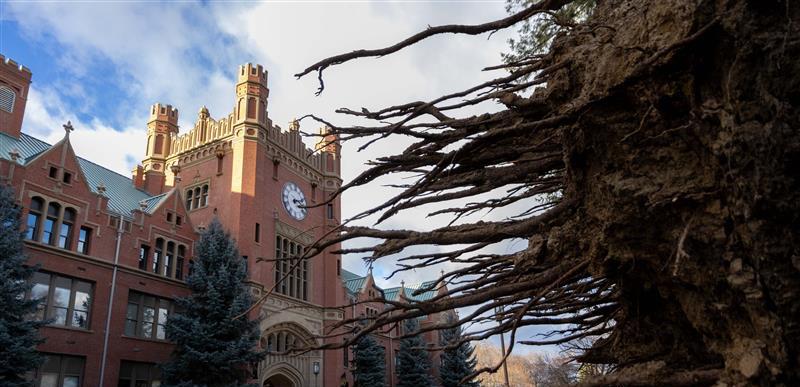
The Presidential Grove, where the Roosevelt and Taft trees were located, is undergoing the majority of conservation efforts
New grad program for sustainability created
Faculty Senate passes motion to create a committee to draft policies on AI
Rebekah Brown ARGONAUT
In this week’s Faculty Senate meeting, Erin James, sustainability certificate director and a professor of English at the University of Idaho, proposed a new graduate level companion to the undergraduate academic sustainability certificate that UI currently offers.
“When I started as a sustainability certificate director, when I started visiting classrooms and talking to students about the undergraduate level certificate, the overwhelming response was, where is the graduate level version? There was a big appetite amongst graduate level students for a similar micro-credential,” James said.
The current undergraduate sustainability certificate is a one year program requiring 12 credits, and currently includes courses such as environmental psychology, climate change mitigation and ground water hydrology, along with many others.
The proposed new certificate will have the same credit requirement but incude higher-level courses.
This graduate-level program will come with the introduction of a new common course, called the Sustainability Challenge, or SUST 5060.
“So, the certificate requirements are basically that sustainability challenge [SUST 5060] plus three additional classes from a list of pre-approved classes,” said James.
SUST 5060 will task interdisciplinary groups of students with addressing a reallife sustainability issue on campus.
“So, for example, our plan for the first cohort is that they’re going to look at a campus-wide compost program and what would be involved in getting something like that off the ground,” said James.
“This course has been funded for the first three years by the strategic plan grant program. So, each cohort of students will have a $10,000 budget by which to make recommendations and enact some of their recommendations for the annual sustainability challenge,” she said.
James continued on to say that the certificate would be available online or in person, and is targeted to not only graduate students attending UI but also professionals who might not be interested in a full graduate-level degree but would like to pick up additional credentials.
Tim Murphy, assistant professor of law at UI, announced an incentivized AI training
for faculty instruction on how to use AI in developing course materials.
“I know that [in the Senate] here, we have different feelings, pros, cons about AI, but as academics, I think we can all appreciate that the first step is understanding, right?” Murphy said. “And so, that’s why I’m taking this course. I would just want to see what other folks are doing with AI in their classrooms to get a better understanding of how people are using this.”
Adding to the conversation about AI use in teaching, Kristin Haltinner, a professor of sociology, proposed the creation of a university committee that would draft a policy as a way to address concerns about AI use by students and instructors using AI without students’ knowledge in their classrooms.
“What we’re proposing is a makeup of six faculty members from different disciplines, including faculty members from the library, with different perspectives on AI use, all of whom are classroom teachers,” Haltinner said.
There are strong opinions about AI on campus, Haltinner said, including those who are very excited to use it and those who are very timid or skeptical or fearful.
The motion to create the ad hoc committee passed, 19 to five.
Torrey Lawrence announced that the Joint Finance-Appropriations Committee in the Idaho State Legislation passed an additional 1% budget cut to the current fiscal year.
This movement still has to go through the House and the Senate before it is enacted, but it could mean an additional and permanent funding cut to the university’s budget going forward.
In Fall 2025, the university received a permanent funding cut of 3%, which this would be in addition to.
Additionally, Lawrence reminded faculty members about the upcoming faculty gathering.
The February Faculty Gathering, hosted by the College of Natural Resources, will take place 4:30-6:30 p.m. Wednesday, Feb. 18, in the ICCU Arena Alumni Club Room.
All academic rank faculty—tenure track, non-tenure track and emeritus—are invited and may bring a guest over the age of 21.
Hors d’oeuvres and a no-host bar will be available, with a free drink ticket for each guest.
Monthly gatherings will continue throughout the academic year, and the schedule can be found on the Vice Provost for Faculty’s Intranet.
Total international student enrollment down 15% at UI
10th-day enrollment numbers presented at Feb. 3 Faculty Senate
Joshua Reisenfeld ARGONAUT
The size of the international student body at the University of Idaho is down 15.7% in the spring 2026 semester compared to spring 2025, according to the 10th-day enrollment snapshot gathered Jan. 29, which was presented by Provost Torrey Lawrence at the University of Idaho Faculty Senate meeting on Feb. 3.
While total enrollment at UI is up 8.7% in the past year, the number of international students has decreased from 758 to 639 for a total decrease of 119 students.
Beginning in early 2025, the United States changed its visa policy for international students, requiring current international students to resubmit documentation with stricter standards, revoking student
visas and halting visa interviews for incoming international students.
In spring of 2025, The Argonaut reported on four international students who had their visas revoked, of which two had their legal status reinstated.
“This year, they’re still doing interviews, so we do have visas coming through, but it’s pretty clear that all of this has had a very strong chilling effect on international applications,” Lawerence said.
Faculty Senate members also brought up the financial impact of the decrease in international student enrollment.
“I really do hate looking at students with a dollar sign, but if you take the numbers in general and kind of in aggregate, you know, if we lose one international student and gain three resident students, that is flat financially,” Lawerence said.
The number of Idaho residents composing the student body rose by 14.3% from 6428 in spring 2025, to 7,348 in spring 2026, for a total increase of 920.
ASUI introduces club funding bills for Soil Judging Club
Finance director promises to unclog monetary pipeline
Josie Adjanohoun ARGONAUT
The University of Idaho Soil Judging Club brought in eight members to represent them as they introduced bill S26-B03, which pushes for new funding for their club.
“We look at the soil, and we look at the unique characteristics of the soil to see how you can use [it] for development purposes and for agriculture,” said Daniel Middlehoven, a representative of the club during public forum.
Club representatives also explained the importance of the club to their careers and informed the senate of their participation in the National Soil Judging competition last spring, which they won.
This victory was the first time that a university from Idaho won this competition. The club previously received funding from ASUI, but club coach Paul Tietz stated that the funding from ASUI has been slowly decreasing since 2021.
This bill was sent to the finance committee for review.
During public forum, new director of finance, Zac Knapp, briefly explained his transition to his new role as the director. Towards the end of his January progress
report, he stated how he wanted to send a message to the student clubs who are currently waiting for funding from ASUI.
“I want to apologize to students that have been patiently waiting for their reimbursement and to the senators who have been advocating for these clubs. I want to assure all of you that while the traditional methods of getting reimbursements sent out haven’t been as effective as originally planned, I will work towards finding other methods. This I can promise,” said Knapp.
A bill that was introduced in the last meeting, bill S26-B03, allocates $500 towards a winter Engage workshop for club leaders to update the webpage.
Engage is the university’s calendar and club information website.
Unfortunately, the website continues to lack updates as club leaders learn to use the website.
The bill’s funding goes directly for reserving the Administration Auditorium for the event.
The bill was written by Senator Charlie Peacock who has been heading the creation of the program.
“I think if Senator Peacock got paid 15 an hour for all of the work she has put into this bill, I think we would already have the $500,” said Sen. Gunner Cavender, the sponsor of the bill. ASUI Senate meetings are open to the public and are held on Wednesdays at 7 p.m. in the Clearwater-Whitewater room of the ISUB.
The Argonaut Directory Dakota Steffen Editor-in-Chief argonaut@uidaho.edu Reagan Jones
Timmon Friel Taylan Hallum


John Keegan | Argonaut
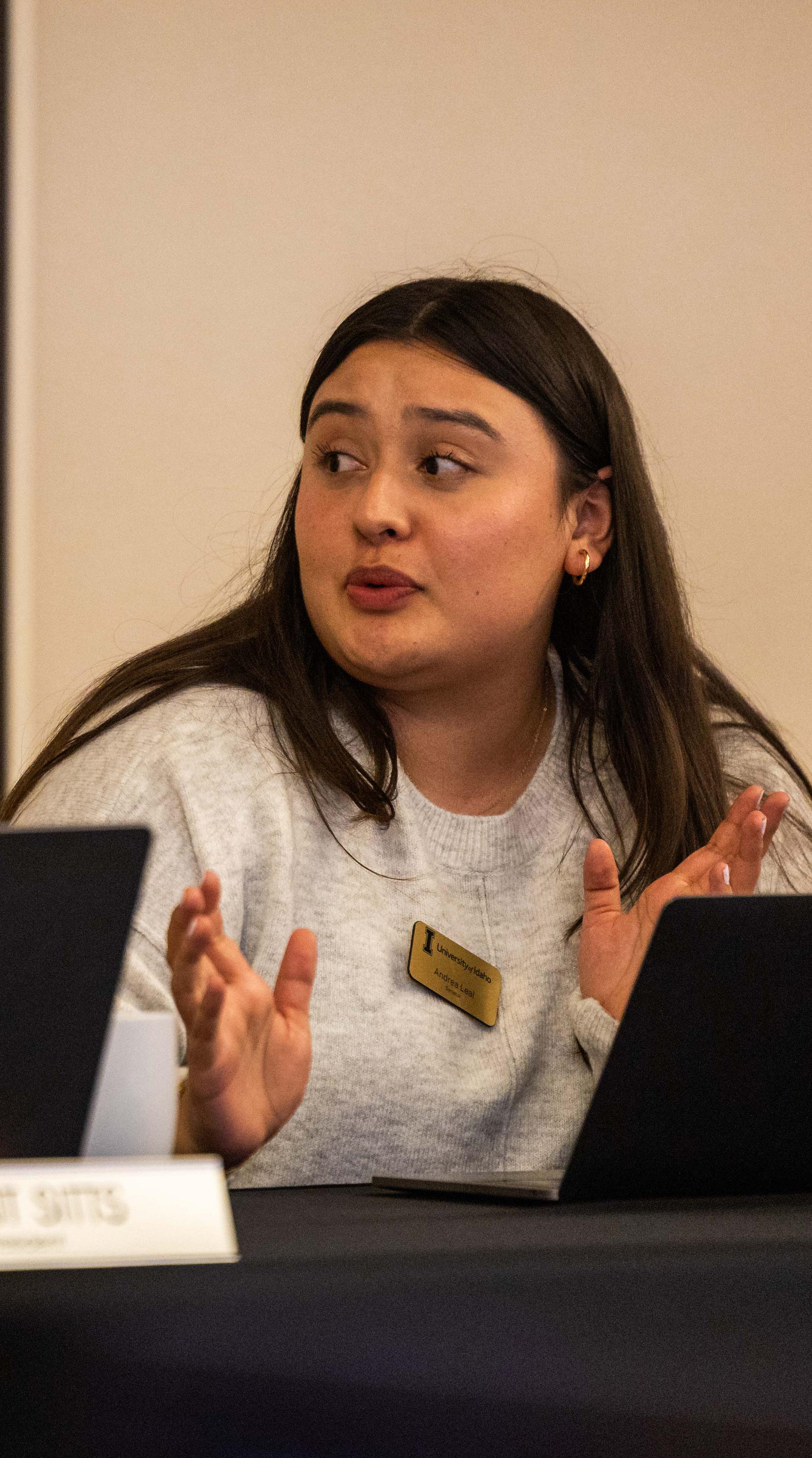
Senator Andrea Leal speaks at the Jan. 28 weekly meeting
Roosevelt and Taft trees, which they hope to plant back in the Presidential Grove this upcoming spring.
Though it’ll be years before the specimens reach full maturity, the director is confident the work being done by the nursery today will help to support trees that live on for generations.
“It’s still helping to preserve that legacy for the university and for all the emotional connection that alumni have to the institution,” Nelson said.
Located on Parker Farm just off Highway 8, Pitkin Nursery has a rich history of forestry and conservation efforts. The nursery is
part of UI Center for Forest Nursery and Seedling Research and produces nearly 500,000 seedlings annually, including over 70 species of conifers, hardwoods and shrubs. The nursery also engages in statewide outreach and research efforts year-round.
“We put a very strong emphasis on teaching and research and outreach to help fulfill the university’s land grant mission to give back to the citizens of Idaho, to train the next generation of people working in the nursery industry and conduct cutting edge research to help local nurseries grow better quality seedlings,” Nelson said.
On top of the work they do within the university, Nelson explained several

other outlets and organizations the nursery engages with, such as K-12 programs, local conservation groups and the Moscow Tree Commission.
Each year in partnership with the Idaho Forest Product Commission, 20,000 seedlings are donated for Arbor Day.
Those budding trees are then given out for free
across the state to promote the holiday.
Beginning in 1909 with Charles Shattuck, the program has run continuously, yet has only seen five directors. The longest standing leader for whom the nursery is named after, Frank Pitkin, maintained it for 50 years from 1929 to 1979.
Hailey Lewis’s first month as the mayor of Moscow
Years of city involvement prepared Lewis for this role
Paige Wilton ARGONAUT
“If you’re asking yourself when’s the right time to run for office, the answer is there’s never going to be a right answer,” said Hailey Lewis, the recently elected mayor of Moscow, in an interview with The Argonaut.
Lewis, who will serve for the next four years, recounts that her path to the position was paved by years of experience and engagement within the community.
A Moscow native since birth, Lewis’s leadership roles started in junior high when she ran for a position as class representative at Moscow Junior High School. Lewis graduated from the University of Idaho in 2016 and began serving a total of ten years as secretary for Moscow’s music and arts festival, Rendezvous in the Park and previously served on the Palouse Basin Aquifer Committee. She went on to join the Moscow City Council in 2021.
On top of those experi-
ences, she also served as a lobbyist in Boise for eight years.
The skills she developed durring that time equipped her with a strong foundation for governance. One reason in particular that drove her to run for mayor was based on her understanding of Moscow’s inner workings as well as the state’s legislative processes.
“I know how to meet the [legislature] where they’re at and what messages resonate to change the minds of people who are writing the rule book in Boise,” Lewis said.
She also noted that city council was looking for the mayor to be “someone who understands how the limited number of tools that not only cities in Idaho have, but cities the size of Moscow have, to provide all the services we dream of and we hope for and to do it with good quality.”
Since being elected in November and having been sworn in Jan. 5, Lewis said the transition period has been smooth for her. Having known all of the city council members for years, Lewis said she already trusted her entire staff, and they in turn supported her.
Despite the immediate
comfortability she found in the new position, Lewis mentioned that there are still lessons to be learned. Going forward, however, she doesn’t expect to be surprised by much.
“I think always knowing that I’m never going to know everything has made it easy to not feel like surprise is a factor,” Lewis said.
Lewis said she is aware of what Moscow needs in order to grow stronger as a city and community.
A few of the stances she ran on while campaigning for mayor included increasing inter-agency communication and collaboration, fiscal responsibility and continuing the momentum of sustainable growth.
As someone passionate about government work, legislature and checks and balances, the mayor said she recognizes that the time and effort it takes to make greater changes occur in small communities may not always be understood by those living there.
For that reason and others, communication with people of all backgrounds is of the utmost importance to her.
“I also think it’s important that the mayor uses the
platform to teach people how things work,” Lewis said.
In an effort to promote community communications further, Lewis plans on tabling at the Moscow Farmer’s Market as a way to connect with people in a less formal setting than city council meetings. Lewis said she hopes to foster a space where Moscow residents can freely discuss and meet with the people who run the daily operations of the city.
While her mayorship has just gotten underway, Lewis said she’s eager to continue doing good for her hometown in the future.
“Moscow is for everyone,” Lewis said fondly. “It’s different from anywhere else you can live.”

ARGONAUT
Make a Valentine’s Day gift at ‘Bouquet for Your Boo’ Feb. 13
Bouquet for Your Boo, a floral crafts event, will be held in the Bruce Pitman Center International Ballroom 4-6 p.m. on Friday, Feb. 13. Students will be able to make a bouquet from fresh flowers, and event organizers, the University of Idaho Student Sustainability Cooperative and Vandal Entertainment, will be providing newspaper wraps and thrifted vases.
Vet to speak at 1912 Center on bat science and conservation Feb. 18
Board-certified veterinarian Lynne Nelson will present ‘Bat Chat! Bats from the Perspective of a Bat Advocate’ on Wednesday, Feb. 18 at the 1912 Center in Moscow,open to the public. Lynne Nelson is a professor of cardiology at Washington State University’s College of Veterinary Medicine.
The event is part of a month series put on by the Palouse Audubon Society and will discuss the vital yet often overlooked role bats play in ecosystems. The presentation will address the common myths and fears and aims to leave the audience with an understanding and appreciation of the mammals. It will also touch on bat biology, science and conservation.
Taste of Nepal
cultural event returns Feb. 22 for 21st annual
Taste of Nepal, an annual event hosted by the University of Idaho Nepali Student Association, will hold its 21st annual event Sunday, Feb. 22, in the Bruce Pitman Center International Ball room from 5-7 p.m.
Tickets are required for the event and can be purchased online through links available on UI NSA social media accounts, or in person. Tickets are $15 for UI students and $20 at the door or for general admission.
This year’s theme is “Beyond Gurkhas & Sherpas,” where attendees will participate in an evening of culture, cuisine and storytelling. Last year’s Taste of Nepal sold out with 400 audience members. Organizers encourage people interested in attending to secure their seats in advance.
Spring event schedule from the UI Habib Institute for Asian Studies
On Thursday, Feb. 19, a Chinese New Year Celebration with food, music and Chinese cultural activities will be held in the Asian Studies Library in the Administration Building, room 204, between 2:30-4:30 p.m.
At 5-7 p.m. on the same day, the Asian American Pacific Islander Association is hosting a Lunar New Year event in the International Ballroom. Admission is free.
Thursday, Feb. 26, You Qiang, a physics professor at the University of Idaho, will speak on Ancient Chinese Astronomy and the I Ching, translated to the Book of Changes, an ancient Chinese divination text from 100-750 B.C. in TLC 245 at 4:30p.m.
Thursday, Mar. 5, at 7 p.m., there will be a free screening of Left-Handed Girl, the Oscar shortlisted film from Taiwan, at the Kenworthy Theatre in downtown Moscow. Statewide graduate research comp. comes to Coeur d’Alene
Idaho’s eighth statewide Three Minute Thesis competition hosted by the University of Idaho Coeur d’Alene will be held from 2-4 p.m. Tuesday, Feb. 17, in the Lake Coeur d’Alene Room at Northern Idaho College’s Student Union Building.
12 students will deliver a three-minute presentation using only one photo or slide to showcase their research to a panel of judges and a live audience. The presentations will be given by four graduate students from each of the state’s public research institutions, University of Idaho, Boise State University and Idaho State University.
Founded by the University of Queensland in 2008, 3MT events are now held at more than 900 universities in over 85 countries. The event is open to the public and free to attend, it will also be livestreamed at uidaho.edu/cogs/3mt-state.
Idaho proposes bill restricting local LGBT protections following backlash
House Bill 557 prohibits cities and counties from adopting local antidiscrimination laws
Sam Walch ARGONAUT
The passing of the Idaho House of Representatives bill follows months of backlash in Sandpoint after a controversy at a local YMCA involving locker room access. Police previously said no state law prohibited the situation, leaving the matter to policymakers and the YMCA’s policymakers.
House Bill 557 stops local governments from creating anti-discrimination policies that provide protections beyond those at the state level. Cities and counties would be unable to keep existing non-discrimination ordinances or change state anti-discrimination laws through local government. The
bill passed the Idaho House of Representatives on Feb. 5 and awaits a vote from the Idaho Senate to become law.
At the state level, the Idaho Human Rights Act prohibits discrimination based on race, sex, color, national origin, religion, age or mental or physical disability, however, protections for sexual orientation and gender identity are not included in state statute.
Many Idaho cities have adopted local ordinances as protection for LGBTQ+ residents.
“If these end up being removed, it sends a very hostile message to the LGBTQ community,” Rep. Ilana Rubel said in a Moscow-Pullman Daily News article.
Rep. Bruce Skaug said the bill was introduced “in large part” because of testimony from outraged Sandpoint residents following an incident at YMCA.
The controversy began Oct. 15, when YMCA lifeguard Jennifer Hook posted publicly about an encounter during a locker
room check where they reported someone they identified as a biological male using the women’s locker room, but were informed that the situation was permitted under YMCA policy, citing gender identity protections under Idaho and city of Sandpoint code.
Following the incident, Sandpoint City Council replaced its non-discrimination ordinance now referencing state civil rights law.
Rep. Cornel Rasor said that Sandpoint’s community stands “wholeheartedly” with the bill and said that several local school principals contacted him asking what would be done about “the YMCA issue.”
Supporters of House Bill 557 argue that statewide consistency reduces legal confusion for businesses.
Opponents, however, believe that removing local authority limits cities’ ability to respond to the needs of their communities, especially the needs of LGBTQ+ citizens.
Paige Wilton | Argonaut
A few grafted trees from UI Presidential Grove
Paige Wilton | Argonaut
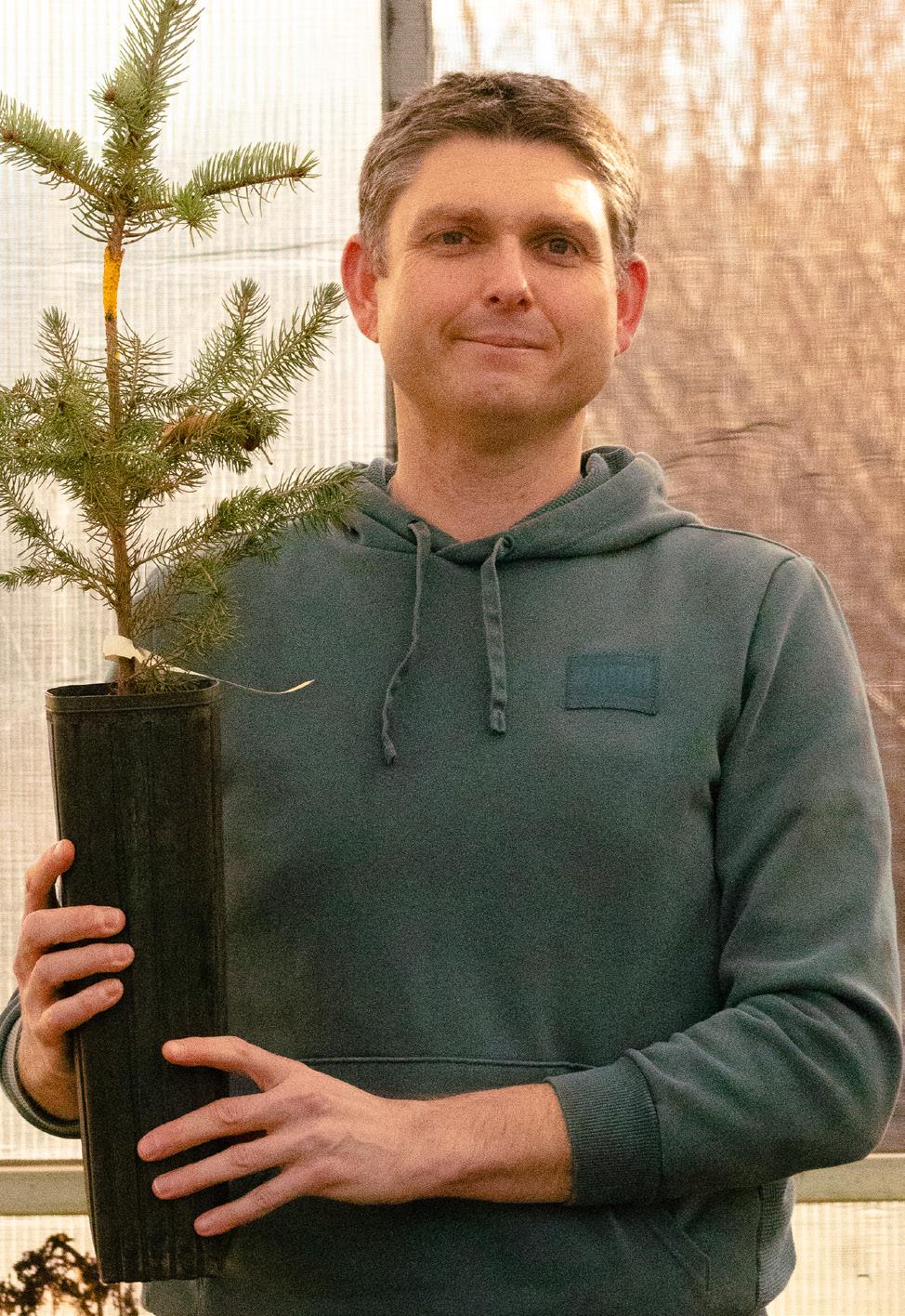
Andrew Nelson holding a Taft sapling
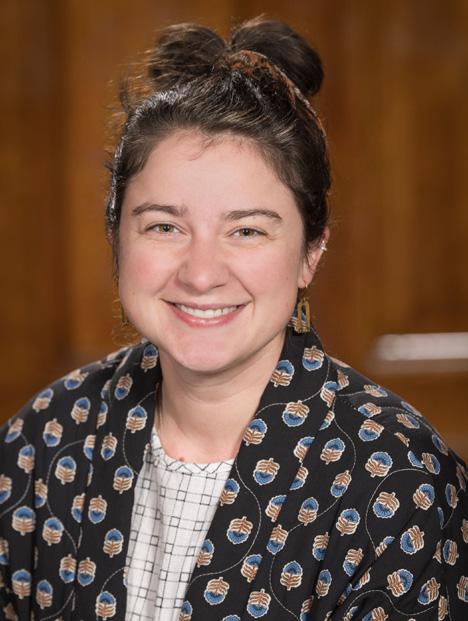
City of Moscow | Courtesy Hailey Lewis
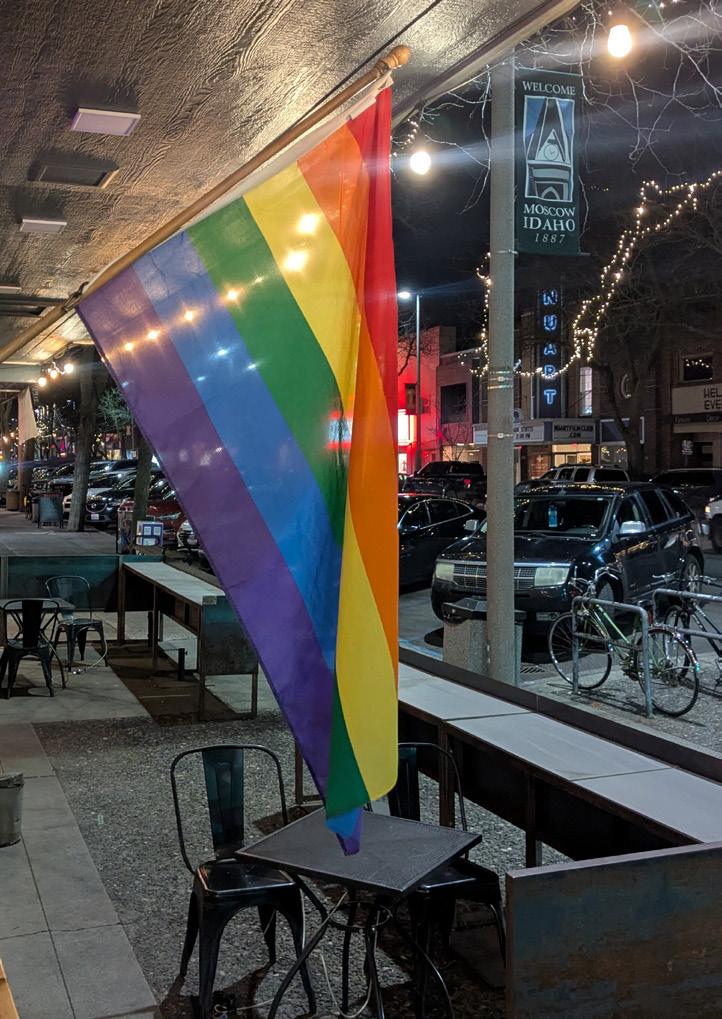
John Keegan | Argonaut A pride flag hangs outside of One World Cafe
The world’s take on the United States’ action in Venezuela one month after
Conversation with UI politics and philosophy chair, Florian Justwan
Josie Adjanohoun ARGONAUT
Early on the morning of Jan. 3, 2026, the United States launched an operation into Caracas, Venezuela, aiming to capture and sentence the president of the country, Nicholas Maduro, for drug trafficking crimes. This operation, known as Operation Absolute Resolve, drastically changed American foreign policy, and raised fundamental questions of the international world order.
Florian Justwan, chair of the UI Department of Politics and Philosophy, reached out to The Argonaut to provide commentary about the impact of Maduro’s capture on the international community. Justwan specializes in foreign policy, attitudes towards democracy and has conducted research on South American politics.
The Argonaut: In your opinion, what is the global message being taken away from Maduro’s capture?
Justwan: Its seems to a lot of IR [International Relations] observers, that the Trump Administration is pursuing a foreign policy, where it’s trying to achieve 2 and half things. One is a consistent supply of energy for the United States. This is to a large extent about energy, and it is not really a story about the United States trying to help the humanitarian side of things. It’s not a story about establishing democracy in Venezuela, its establishing energy supply for the United States, and clearly, that is something the trump administration is working on.
The second thing, looking at this holistically, not just with regards to Greenland or Denmark and Venezuela, but also in the dialogue with Columbia and Mexico. The United States is clearly working hard to strengthen its political control in the western hemisphere. That seems to be kind of the larger, big picture goal here. Strengthen, re-establish control of countries in the western hemisphere , particularly in regard to countries that have energy implications for the U.S.
The half thing I will say here, is that the United states seems much more
comfortable just using its muscle , engaging in pretty blatant power politics, un-constrained by international law, or even wishes of key allies, that’s sort of a lesson that people in the international politics world take away from this.
Arg: The Prime Minister of Canada, Mark Carney, said at the World Economic Forum, “The rulesbased order is fading, and the strong can do what they can, and the weak must suffer what they must,” is there a general belief internationally that International World Order is gone after the capture of Maduro?
Justwan: The response that countries gave was quite varied. There were some countries that immediately criticized this action, and publicly said this was a violation of international law, Brazil is a really good example. The Brazilian President [Luiz Inacio Lula da Silva] came out and criticized this very forcefully.
Other countries, Argentina for instance, with a more right leaning government, applauded the United States for doing this. Long standing United States allies in Europe, we see that their response differs depending on whether it was made publicly or behind closed doors. Publicly, a lot of European leaders were bending themselves out of shape, to not offend Trump, since they need United States support in Ukraine to strike a deal there, while still pointing out international law is important.”
That was what was perceived negatively and skeptically throughout the world, because essentially the United States threatened a fellow NATO ally, Denmark, over part of their territory. And they said, at least for a while, unless you give up your territory, we will put sanctions on you. The combination of these factors has led a lot of observers to say that we are in a New World order now.
Carney is a good example of this, but elsewhere in the world, you get skeptical and concerned statements. The former President of the European Parliament [Josep Borrell] for instance said that the United States with this current administration should be seen as a hostile power. Venezuela was how it all started, but I think Trump’s foreign policy right now has multiple different moving parts, and they should all be thought of holistically.
Arg: To what extent has the United States conducted similar missions and what makes this mission different?
Justwan: The United States has repeatedly during Republican administrations, and in Democratic administrations, used its military in ways that international lawyers called illegal. I think there are two ways that this stood out, number one, going into another country, and then really forcibly removing the head of state. There’s precedent for that, Noriega in Panama, in 1989, 1990, but that’s pretty much it. There is that precedent, but it’s still unusual in the grand scheme of things. Not a lot of instances of that happening.
The other way in which this is different, is that there is a norm in the United States, that the executive branch gives at least a heads up about something that is about to happen to a small circle of trustworthy members of congress. Based on what we know, this did not happen this time, so it was a violation of norms in this way. It’s really something where the executive branch decided to act and no one on the legislative side of things was really consulted or taken into account ahead of time.
Arg: Do you see other countries who want control over foreign territories enacting similar foreign policy such as China and their interest in taking Taiwan, or is only the United States able to make these claims due to their military strength?
Justwan: The Trump administration essentially made the argument that what the United States is doing in Venezuela is making the United States appear strong on the world stage. It’s going to deter countries like China from doing things that ‘the United States doesn’t like’ because China and other actors see that the United States is trigger happy, and willing to use their force.
But at the same time, the argument is being made that the United States is continuing to undermine international norms, and international law, and that continued undermining might lead other countries to behave more aggressively, violate laws and norms themselves. Some people might argue that it might motivate China to behave more aggressively towards Taiwan, because the message is interna-
tional law and international norms don’t count for as much anymore.
Immediately after the Venezuela action, the former president of Russia, Dmitry Medvedev, quipped and said, if going abroad and abducting foreign heads of government is what we are doing now, Russia might do the same to the German head of government.
So that shows at least, in terms of narrative, people see it as an attack of international law.
As of Feb. 12, the United States still has Maduro in custody. At his first court date, Maduro and his wife Cilia Adela Flores de Maduro both pleaded not guilty. The next court date is on March 17.
Former U.S. diplomat on NATO and the future of American involvement abroad
Jeff Hovenier discusses importantance of continued cooperation
Sam Walch ARGONAUT
“American power is most effective when it is exercised in partnership with Europe.”
This was one of the central messages former United States diplomat Jeff Hovenier spoke about on Feb. 4 in the International Ballroom at the University of Idaho. Hovenier covered various topics surrounding diplomatic relations between the United States and other countries, underlining the importance of alliances in an unstable global landscape.
Hovenier is a United States diplomat with 35 years of service across Peru, Croatia, Greece, Panama, Germany and Paraguay. Former President Joe Biden nominated Hovenier to serve as a United
States Ambassador to Kosovo in 2021.
He argued during his talk that alliances don’t find strength by the absence of conflict, but through the ability to manage disagreements without damaging the relationship.
“Healthy alliances are not defined by the absence of disagreement,” Hovenier said. “They’re defined by the presence of mechanisms to manage disagreements without calling the relationship into question.”
Hovenier then described NATO’s success, citing expansion into Central and Eastern Europe as an effort to support new democracies emerging, noting that the United States played a key role in helping former communist states choose their own arrangements. He also pointed to NATO’s role in stabilizing the Balkans following violent conflict as an example of successful multinational cooperation.
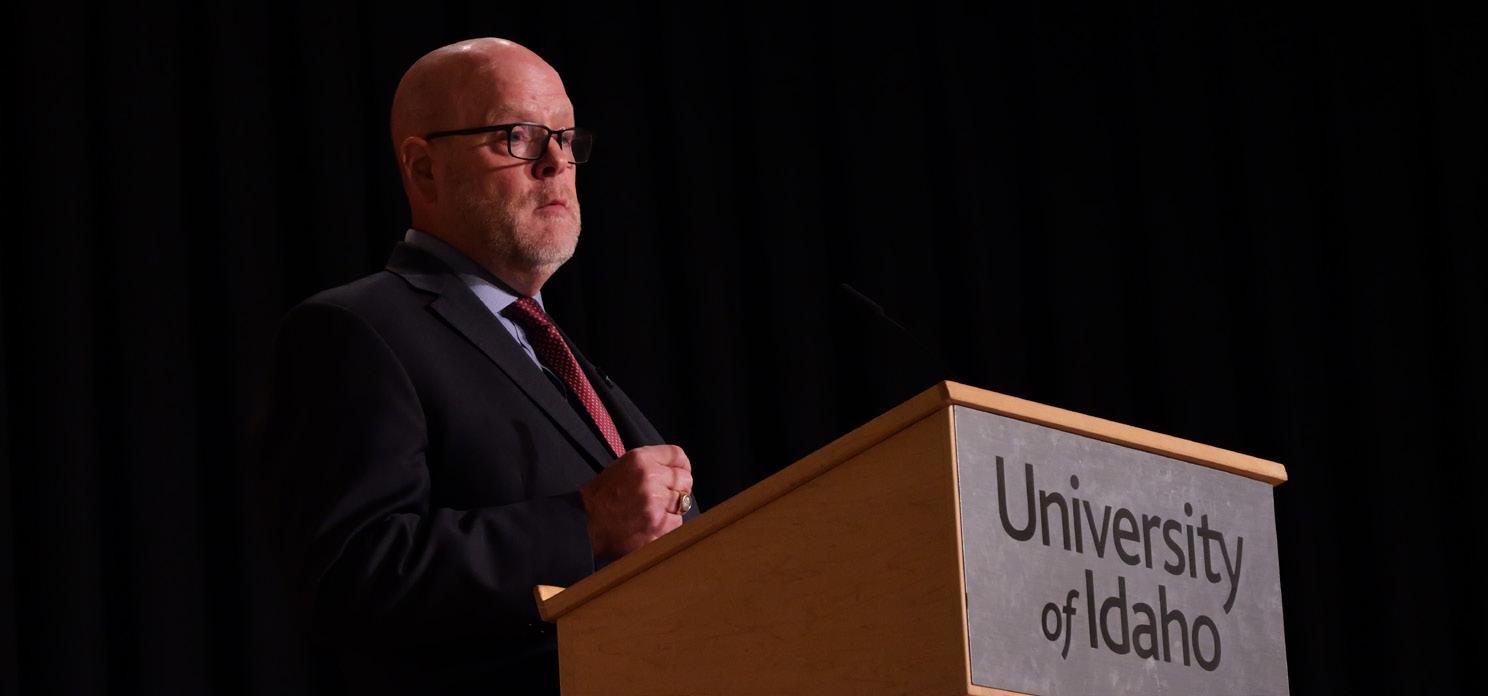
Hovenier asserted NATO as the most successful defensive alliance in history, combining American military with European geography. He said forwarddeployed United States forces in Europe deter aggression and reduce the likelihood of larger conflicts.
Turning to the present, Hovenier said NATO now faces a different strategic environment, stating that Russia’s invasion of Ukraine shattered long-held assumptions about European security and demonstrated that territorial conquest is not a thing of the past. He also pointed to China’s growing economic and technological influence as a challenge no single nation can manage alone.
Hovenier also added that democratic societies are increasingly strained by political polarization, misinformation and declining trust in institutions. He emphasized that Europe is not monolithic, with differing threat perceptions across regions. Eastern European nations view Russia as an immediate and existential threat, while southern European countries are more focused on instability in North Africa and migration.
To illustrate these divisions, Hovenier shared a personal story from 2005, when he served as deputy director of the State Department’s Office of European Security. During a NATO meeting in Berlin, officials from Lithuania, Latvia and Estonia approached him to express concern that NATO lacked formal defense plans for their countries given proximity to Russia. At the time, NATO members opposed
developing such plans out of fear they would provoke Russia. Defense plans were eventually developed, and he said their existence has since proven critical.
Hovenier then addressed recent tensions between the United States and Europe, including disputes over trade, defense spending and sovereignty issues. While disagreements among allies are not inherently dangerous, he said, the way they are handled matters. Predictability and respect, he argued, strengthen alliances rather than weaken them.
In addressing why the United States still needs Europe, Hovenier emphasized that preventing conflict in Europe is far less costly than failing and, in turn, fighting wars there. He reminded the audience that previous generations of Americans paid a heavy price to establish stability on the continent and that United States security remains tied to European security, also saying that whenever Europe and the United States work together, the work becomes the norm for the globe, and when we aren’t doing that work, the global standard becomes determined by other countries with different values.
Hovenier reaffirmed that alliances grounded in shared interests; democratic values and cooperation remain essential in a world where security threats are increasingly complex and interconnected. He closed by encouraging local voices, saying, “I want people from Washington and Idaho... Less from Yale and more about the perspective of Moscow.”
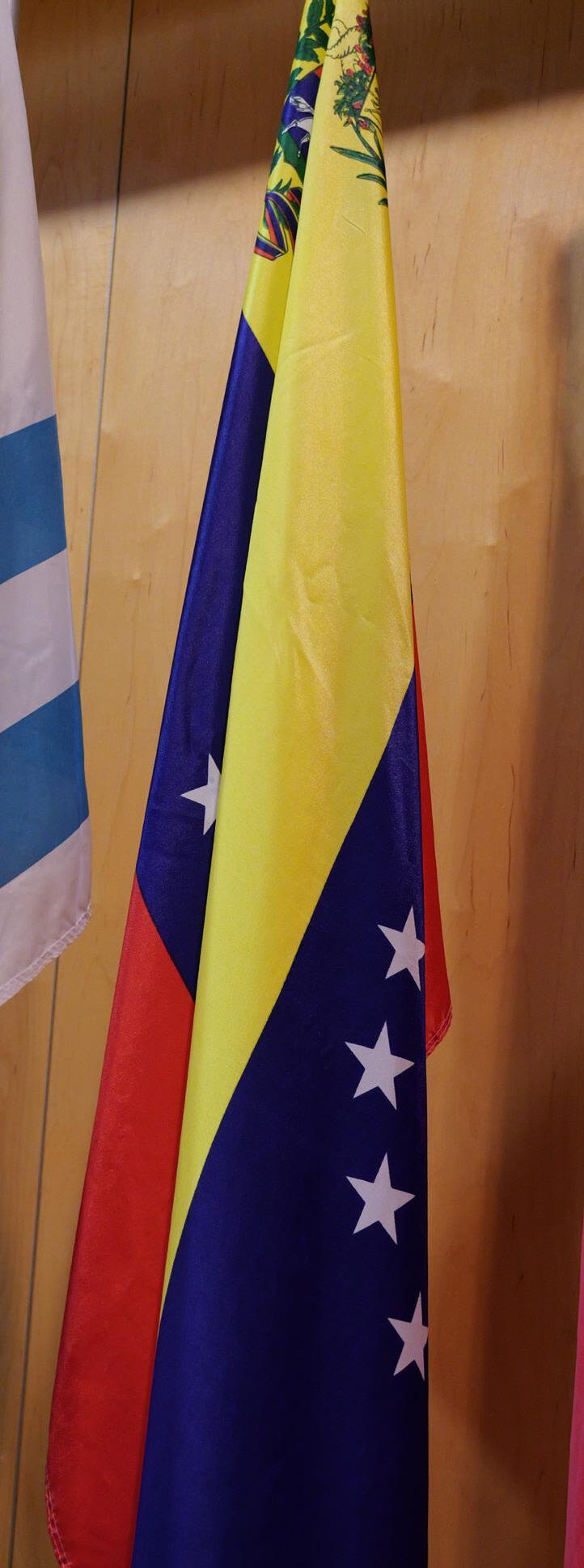
Reagan Jones | Argonaut Venezuelan flag in UI International Ballroom
Review:
“Iron Lung” may not be a favorite film, but there’s nothing else like it
An ocean of blood and a fight for survival, Markiplier’s first film turns a 10x box office
Joshua Reisenfeld ARGONAUT
The camera only exits the submarine three times during “Iron Lung:” when the movie begins, showing the darkening of the stars and the lowering of the submersible into the ocean below; when the movie ends; and for a moment between when the mix of radiation poisoning and depleting oxygen bends the human mind to see a great being some might call God.
“Iron Lung” is a 2026 theatrical adaptation of a 2022 video game of the same name and is a science fiction horror film set in an ocean of literal blood. The movie was written and directed by internet personality Markiplier, whose real name is Mark Fischbach. The film was self-funded by Fischbach with a budget of $3 million and has made $27 million since its opening on Jan. 30, receiving mixed ratings from critics and overwhelmingly positive audience reactions.
“Iron Lung” owes some of its popularity to Markiplier’s online community supporting his work, but the movie’s premise, scripting, acting and effects were able to carry the initial wave of interest into full blown success. Fischbach’s acting had some standout moments, such as the line included in much of the film’s promotional material—“I just want to live, is that so wrong?”—where his voice sews together the unfairness and impossibility of survival he is forced to overcome.
The movie is not for everyone, with its appropriate R rating and slow and narrow story, but it is certainly weird, and that is something rare in the modern entertainment scene rife with regurgitation. The plot is not about saving the world; the chance to do that has long passed. All that anyone can do is survive.
Fischbach’s character Simon, first

introduced as a convict, is trapped inside of the submarine. The port through which he entered has been welded shut, and the single window showing only crimson is quickly closed. A crisis, called the quiet rapture, has led the humans who remain to believe these depths hold the best chance for their survival. Simon is told he is the first one to enter the depths, and though the submarine is rudimentary, it will withstand the pressure of the ocean.
Back in the ocean, the submarine cannot ascend on its own, leaving Simon at the mercy of the mothership he is tethered to if he ever wants to see the stars again. He is asked to visit a series of locations and take a photo with the camera onboard. If he does so, his criminal sentence, which deemed him expendable enough to be locked inside of the submarine, will be over.
All Simon has to navigate are a readout of his current coordinates, a map which he can draw his slow meandering path onto, a throttle and four lights that alert him if he approaches an obstacle. The camera, his
single pinhole into the outside, is activated by a button on the far side of the interior. It displays on a screen nearby, but the image quickly fades before the blurry shapes can truly be understood.
The small room feels massive when he walks from the control panel to the camera and back, but tiny when it is all the viewer sees of the alien plant and dystopian world. It is tempting for a story set in such an unfamiliar place to be rife with detail and description of all that is new, but there will never be an answer to many of these questions, and with extinction looming, few of these questions really matter.
When the journey though the crimson waves feels like it has just begun, the oxygen meter loses one of its four bars and Simon and the audience both realize that there will only ever be two possible endings: either he runs out of oxygen, or he does not. He needs to work faster.
He takes a photo at the next marked location on his map, but instead of another grainy image showing rolling sea floor, Simon sees that he is face to face with the skeleton of alien whose agape jaws hold too many teeth and whose presence means that he is not alone in the ocean of blood.
As if the skeleton is alive and encircling him, the proximity sensors light up in all directions. The mothership does not seem as distressed by this information as Simon and repeatedly asks him to confirm what he sees, eventually hoisting him up and telling him that all the rattling is simply the sea floor shifting. This is an alien planet with an ocean of blood after all; there will be nothing normal. He is in the hanger just briefly as a sample collecting device is welded onto the front of the submarine while crew bicker about refilling his oxygen.
No one seems to hear Simon refuse to return to the depths, certain that there are creatures alive and predatory down there. He slams the camera’s large button to get their attention, creating a large flash
followed by screams. The camera uses x-ray imaging to pierce the viscous red blood. Simon is told he irradiated everyone present, almost certainly killing the welder. He is apologetic, but apologies do not collect samples, and he is dropped back into the ocean where a new voice tells Simon his next assignment. He is also told that he is safe from the radiation, but very little of what the people in the mothership say seems to be true.
He is blindly rammed at full speed into the alien skeleton for the sampler to grab hold, but he must do so in a submarine where the hull is one collision away from imploding, blood now leaking though tiny cracks and onto his hand.
It takes courage to return to a place where he almost died, and Simon finds it in a pendant of a preserved leaf hidden in an electrical box alongside a note. Clearly, he was not the first person to be locked in this submarine. Simon wants to live, so he must do this. Like before, his sensors light up and he is thrown about. The radio is alive with chatter. The decision to cut the tether is made, and Simon and the submarine are dragged away by exactly what he was afraid of.
He wakes on the harsh metal floor, injured. The power is out, oxygen is down to one bar and the radiation from the x-ray has gotten into his system. The only light he has is the screen that displays the most recent photo, each push of the shutter ticking away his life, but also necessary to help him find the tools to restart the engine.
For much of what follows, Simon hallucinates and remembers, expanding the story outside of the submarine. But at the same time, it is all in his mind, which is still trapped inside. Simon is determined to survive, but the ocean of blood does not make it so easy. “Iron Lung” will end one of two ways, either he survives, or he does not. “Iron Lung” is showing at the Village Center Cinema in Moscow through Thursday, Feb. 19.
Singer-songwriter and award nominee
Raising awareness for mental health, Jacob Merrithew spreads his message through songs
Shelby Sandford ARGONAUT
In early January of 2026, Jacob Merrithew released the single, “988.” It is a song meant to spread a message about mental health and help raise awareness for those who may be struggling. After releasing it, Merrithew was nominated by the International Singer Songwriters Association, being recognized for excellence in independent songwriting. Merrithew is a BYU Idaho alum who graduated with a bachelor’s degree in international studies, business and a minor in French.
Merrithew didn’t come from a family with musical history. He started his musical journey in middle school with some friends who helped him write, produce songs and upload them to YouTube. His songs started doing really well and he enjoyed it, so he began releasing more. By the time Merrithew graduated high school in 2021, he had two, almost three, whole albums finished.
Soon after, Merrithew wanted to transition from making fun and catchy music to music that was more meaningful, with the idea of helping people. He changed his musical style, going from pop/rap-style to piano/instrumental storytelling.
Merrithew recorded “988” in 2023 after having previously struggled with mental health throughout high school.
“I was never actually planning to release it, due to how emotional it was. It was almost like a message for me, and for anyone I know closely, who maybe struggled... when I finally got the courage that I needed to release it, I knew that it was more than a song; it was a movement that I wanted to associate with it,” said Merrithew.
With this song, Merrithew has started his mission in 2026 to normalize the conversation around mental health and to help provide students with a message of hope, while bringing awareness to Idaho’s high suicide rates.
With Merrithew’s efforts in this, he has shared his song and his message with over 20 mental health organizations and partnered with some, such as Chasing Red Flags, Mindless Labs, Headspace, ICS Hotline, Hope Means Nevada, the National Alliance on Mental Illness and Talkspace.
To help spread the message within his song and bridge the gap between independent music and professional support resources, he’s making sure his work has a real-world impact.
“As an independent artist, it just took a lot of doing the nitty and gritty to find these, to share and just to be vulnerable. Just to tell them ‘Hey, this isn’t just like a song,’ [and] this isn’t about how many people listen to it. I really have an impact that is tied to this, and it can be very helpful,” said Merrithew.
While connecting with these organizations, Merrithew’s goal wasn’t to promote his song. He wanted to spread a message through his song. Many of the organizations loved this and gave him positive feedback and were able to provide him with resources to help him with his mission.
When creating the song, Merrithew decided to name it “988” because he wanted the song to be a bridge between him and other people struggling and to connect people to the help they need. Therefore, by naming it “988,” when people look up the song, it directs them to the helpline.
Merrithew was inspired by several songs that also were expressions of mental health, overcoming suicide and people struggling. A few of those songs were “How Could You Leave Us” by NF and “1-800-273-8255” by Logic. Being inspired by these songs made Merrithew want to make something just as powerful.
Through the creative process, the biggest
struggle Merrithew had was finding and creating a beat that would be able to carry the vibe he wanted throughout his song. He wanted it to be more emotional and intentional, hence the violin, drums and piano blending together to create more emotional depth within the song.
“Once I made that, I heard it and I knew it was going to be the one, and I think I spent the rest of that day writing the song. It took me probably about eight hours of just straight writing, but by the end I was so pleased with how it turned out that I ended up recording it that same night,” Merrithew said.
After coming from no musical background, Merrithew had worked hard throughout his life, and with great courage, was able to release this song. After around eight years of making music, he is now getting recognized for his efforts. He has been nominated for several awards, all for a song he never planned to release. His message to other independent artists and anyone trying to create or follow their dreams is to work hard, and don’t be afraid to be vulnerable.
“I feel so grateful that I made the decision to release a piece of work that was this vulnerable and, honestly for me, kind of scary to release because it’s so emotional. I’m just so glad I did it because there’s companies and people that are backing it and supporting this message and that’s just so beautiful and powerful to me because every person we can touch is someone who can be saved or someone who may be struggling,” said Merrithew.

Jonbo says: Somewhere in the rabbit hole there is a predator.
Jonbo has a radio show on KUOI FM 89.3 and www.kuoi.org.
7:00-9:00 PM Fridays.

Jacob Merrithew | Courtesy A headshot of sing-songwriter Jacob Merrithew
John Keegan | Argonaut A movie poster of “Iron Lung” at the cinema
Savory and crispy fish and chips
A quick and easy way to get some delicious and good quality fish and chips
Brooklynn Jolley
ARGONAUT
Fish and chips are a staple meal of the coastal states in the PNW, but it can be hard to find some that taste as crispy and delicious in Idaho. This recipe is an easy way to make your own that taste just as good as the ones from the coast.
Ingredients:
For the batter:
¾ c. cornstarch
¾ c. all-purpose gluten-free flour
1 tsp. baking powder
1 tsp. granulated sugar
½ tsp. salt
¼ tsp. black pepper
¾ c. sparkling mineral or seltzer water
For the fish:
1 and ½ lbs. skinless fillets (cod, haddock, or flounder)* cut into smaller pieces
½ c. all-purpose gluten-free flour
½ c. cornstarch
For frying:
2 quarts vegetable oil**
Instructions:
In a medium bowl, whisk together cornstarch, flour, baking powder, sugar, salt and pepper.
Add seltzer water and whisk until batter forms. The batter should flow easily from a spoon but be slightly thicker than the consistency of heavy cream. If it’s too thick, add a little bit more seltzer water. Set aside.
In a large bowl, whisk together remaining flour and cornstarch.
In a Dutch oven, heat oil to 375 degrees Fahrenheit.
Coat the fish, one piece at a time, into the batter. Allow excess batter to drip off.
Lower the fish into hot oil and cook until the batter sets or for about three minutes.
Turn the fish and cook until the batter turns golden brown or for about another three to five minutes.***

Drain fish on a paper towel-lined plate.
Serve at once with some crispy fries.**** Enjoy!
Romance movies to watch on Valentine’s Day
Dive back into some of the classic romance films this holiday
Shelby Sandford
ARGONAUT
A nice way to spend Valentine’s Day is sitting back and relaxing with a movie. Whether you like a classic love story, a comedy or something with drama, there are a variety of movies to choose from.
“Notting Hill” (1999)
“Notting Hill” is a perfect love story to watch for Valentine’s Day. Anna, played by Julia Roberts, is a famous actor who runs into William, played by Hugh Grant, who is a bookstore owner.
The movie is a romantic comedy where the two fall in love while trying to adjust to their very different lifestyles.
“The Notebook” (2004)
“The Notebook” is a classic love story, showing the more intense turmoil that can occur within a love story and that love has its way of coming back.
The movie is a romance drama between Allie, played by Rachel McAdams, and Noah, played by Ryan Gosling, who go through uncontrollable events trying to separate their love.
“Crazy, Stupid, Love” (2011)
“Crazy, Stupid, Love” is the perfect mix between romance, drama and comedy. Cal, played by Steve Carell, is living the perfect life until his wife Emily, played by Julianne Moore, divorces him.
The movie unravels his life, while entering new characters and dramas to create a dramatic and comedic ending.
“Anastasia” (1997)
“Anastasia” is great for anyone who loves an animated story that’s a little different than the average Disney princess. It is a musical, historical fantasy movie with a
perfect amount of romance.
The movie follows Anastasia after she has been cursed and loses her memories.
Dimitri helps her, with the motive of getting the reward offered for her to be brought back safely to her home.
“The Princess Bride” (1987)
Valentine’s Day is the perfect excuse to watch one of the best classic love stories. It is a fairytale adventure between Buttercup, played by Robin Wright, and Westley, played by Cary Elwes.
The story is about the true love between them and finding each other after being separated, while Westley rushes to save the princess from her soon-to-be husband, who is planning her murder.
“How to Lose a Guy in 10 Days” (2003)
“How to Lose a Guy in 10 Days” is a great rom-com to watch for Valentine’s Day. Magazine writer Andie, played by Kate Hudson, has to write a piece about how to lose a guy in 10 days. Benjamin, played by Matthew McConaughey, is confident that he can make a woman fall in love with him in 10 days.
The movie follows the two as they meet and execute their plans for each other.
“La La Land” (2016)
“La La Land” is the perfect romantic musical to watch for Valentine’s Day. Sebastian, a pianist, played by Ryan Gosling, and Mia, an actress, played by Emma Stone, fall in love.
They show the struggles that happen in a relationship as they try and pursue their dream careers.
“50 First Dates” (2004)
“50 First Dates” is a romantic comedy between Henry, played by Adam Sandler, and Lucy, played by Drew Barrymore.
The movie follows Henry as he falls in love with Lucy, who has short-term memory loss and can’t remember anything the day before.
Henry spends every day making Lucy fall in love with him over and over, hopeful that her memory might come back one day.
“10 Things I Hate About You” (1999)
“10 Things I Hate About You” is a high school romance story between Kat, played by Julia Stiles, and Patrick, played by Heath Ledger, based on William Shakespeare’s comedic play, “The Taming of the Shrew.”
The movie centers around Kat and her sister Bianca, who is not allowed to date
unless her sister Kat does.
Cameron, played by Joseph Gordon-Levitt, in his efforts to date Bianca, gets Joey, played by Andrew Keegan, to bribe Patrick to take out Kat.
“Dirty Dancing” (1987)
“Dirty Dancing” is an exciting romance between Baby, played by Jennifer Grey, and Johnny, played by Patrick Swayze.
Baby’s parents take her to a resort for the summer. Here, she meets Johnny and develops her love for dancing.
When Johnny’s partner can no longer dance, Baby steps up.
The two fall in love while dancing and practicing for a big performance, all while hiding the truth from her father.


Chef Notes:
Brooklynn Jolley | Argonaut
Some crispy and delicious fish and chips topped with a hint of l emon juice and served with tartar sauce
Standout Vandal Spotlight:
Keenan Kuntz: Breaking records in black and gold
Kuntz shines bright for the Vandals every time he races
Gage McElroy ARGONAUT
So far this track and field season, sophomore Keenan Kuntz has recently been one of the most dominant and more consistent players on the Idaho Vandals track and field team. This season, Keenan has been nothing short of dominant, as he is coming off backto-back first place finishes in the men’s 60 meter and 200 meter, setting himself as one of the Vandals’ most reliable point scorers.
After graduating from Richland High School in Richland, Washington, Kuntz decided to stay local and attended Washington State University for his first year as a college athlete. As soon as he stepped into his first season, he immediately made an impact with the Cougars. In the Inland Northwest Invitational, Kuntz took gold in the 60 meter with a 6.83-second time, and at the Whitworth Indoor Invite, he also took gold with an even better 6.77-second time.
But the season accolades didn’t stop there. As a freshman, Kuntz participated in the Pac-12 Open, finishing second in the 100 meter with a 10.51-second time and third in the 200 meter with a 21.82-second time.
The Bradford Beat:
Entering the 2026 season, Kuntz entered the transfer portal and decided to travel across the Washington-Idaho border to play in Moscow for the mighty Vandals. With over half the season finished already, Kuntz has not lost his step in the slightest.
At the 2026 Inland Northwest Invitational, Keenan got his first taste of success in the 60 meter as he took home first with a 6.71-second time, 0.05 seconds away from tying the school record, a record he set himself earlier in the season. At the same meet, he also won the 200 meter with a much-improved time of 21.21 seconds.
But, headed into the following weekend at the Idaho Team Challenge, held at the Kibbie Dome, was where Kuntz showed off his electric speed. Kuntz only won one event, and it was a win to remember. Kuntz lined up for the familiar 60 meter and once the starting gun fired, he shot down the track like a missile, easily scoring first with a 6.61 second time.
Not only did this time beat the school’s record he set himself by 0.05 seconds, it also broke the entire Big Sky Conference record by the same time. While being the best in the Big Sky, his time also makes him the no. 23 best in all of the NCAA.
“Keenan setting the Big Sky and school record in the 60 was the highlight of the meet,” Tracy Hellman, the director of the track and field team, said in an Idaho Athlet-
ics press release. “It is super impressive to know that he’s now the fastest ever in the history of the conference.”
Kuntz’s record-breaking performance has not only boosted the Vandals in the standings, but also put the rest of the Big Sky on watch.
With conference championships right around the corner, his speed, confidence and
consistency give Idaho a serious scoring threat. If his current form continues, Kuntz could finish the indoor season with even more awards and become Idaho’s greatest to ever

The sound of belief belongs inside of the ICCU Arena
The Vandals are building a home-court edge in Moscow
Liam Bradford ARGONAUT
There’s a certain level of volume that only occurs when belief fills a building.
It’s not just cheering. It’s not just noise. It’s the kind of roar that rattles the air, that makes opponents rush everything more than they want to. Idaho basketball has heard that sound a few times this season inside ICCU Arena.
The challenge now is making it the norm instead of the exception. On Jan. 22, the Idaho men’s basketball team beat Sacramento State 86-76, and they experienced what a true home-court advantage feels like. Greek Life Night brought 2,445 fans into the arena, and the student section became a wall of sound. Fraternity and sorority members packed the baseline, screaming through defensive possessions and distracting freethrow shooters.
Sacramento State felt it. You could see it in rushed shots and missed free throws. You could feel it in the way Idaho fed off every defensive stop, every run, every swing of
momentum.
“We needed a little extra energy jump, and that was the fans,” head coach Alex Pribble said afterward. “The student section was incredible tonight. When things started to get tight in the second half, I heard defensive chants that got the guys going again. Hopefully, we can make ICCU Arena the hardest place in the conference to play.”
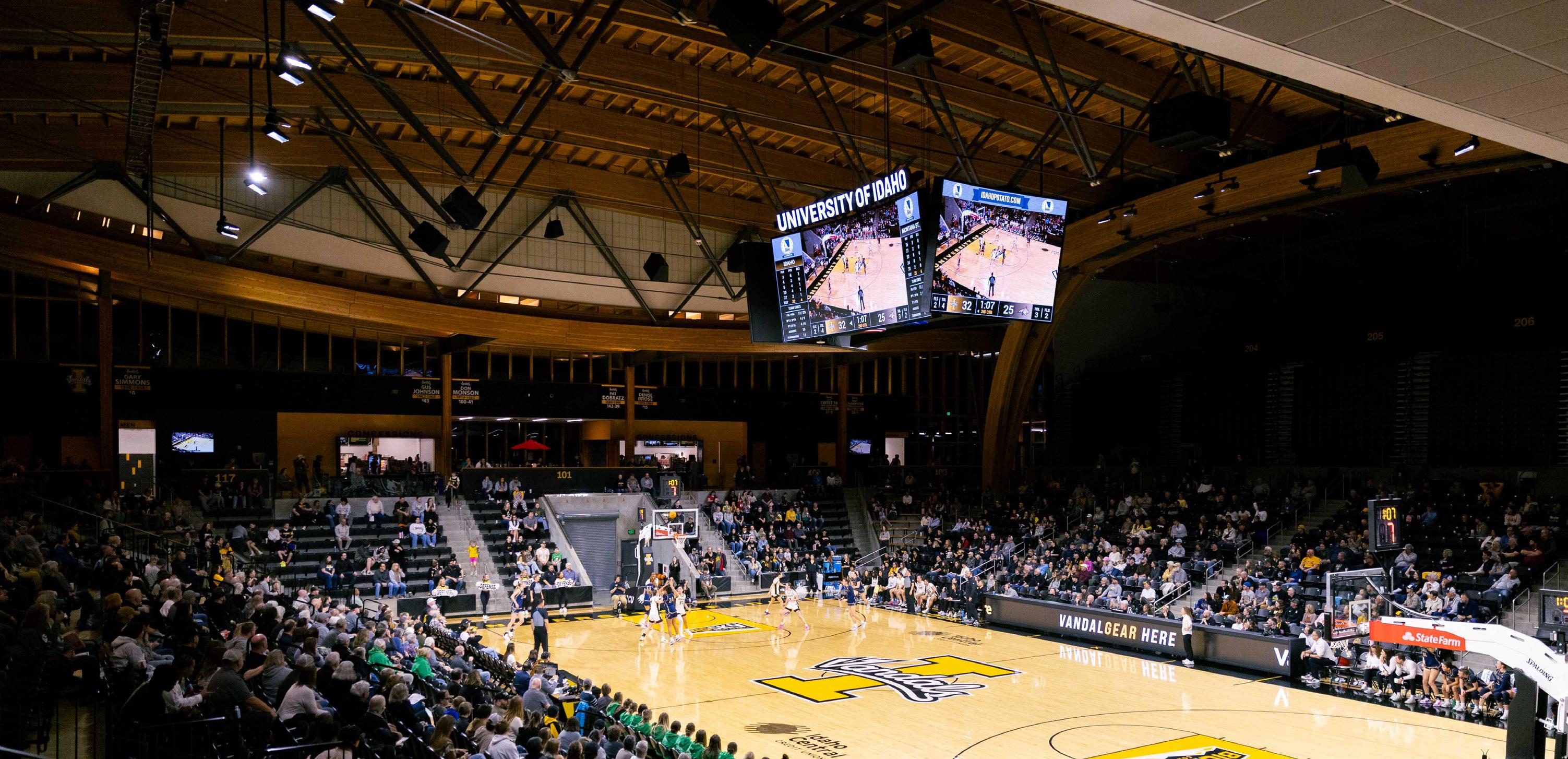
Constructed in 2021, the 4,200-seat Idaho Central Credit Union Arena is one of the most unique venues in college basketball. Its double-curved timber roof, designed to mirror the rolling hills of the Palouse, traps and throws sound back toward the floor. When the arena fills up, the noise echoes and focus gets tested.
But architecture can only do so much. Atmosphere requires people, and for too long, too many of those seats have gone empty. I often look around at the empty seats on game day and can’t help but feel disappointed after seeing what Vandal fans can do during football season.
For years, football Saturdays in the Kibbie Dome have drawn thousands, even during seasons when wins are harder to come by. The gap has been hard to ignore, especially as both basketball programs have steadily improved under Pribble and Moreira.
That’s what made the women’s game against Montana State on Feb. 5 feel different.
A crowd of 1,773 showed up for a showdown with first place in the Big Sky on the line. It was a chance for head coach Arthur Moreira to earn his first career win over the Bobcats and for Idaho to match last season’s 18-win total. The game was tight, physical and dramatic all the way into overtime, and the crowd played a big role.
Late in regulation, the momentum began to tilt toward Montana State. I was on the sideline working the broadcast that night, and when the Bobcats took a five-point lead with two minutes left in overtime, I leaned toward my friend, one of the camera operators, and said, “It’s over.” I couldn’t have been more wrong.
Instead of going quiet, the arena got louder. Defensive chants rolled down from the stands. Every Idaho stop felt like it shook the building. Then came the play that flipped everything.
Ana Beatriz Passos Alves da Silva drove into the lane, absorbed contact and finished a go-ahead and-one layup with just over a minute left. In that moment, the belief in the building felt as real as the game itself.
Standing there on the sideline, one thought crossed my mind: maybe this team
really is the best in the conference.
Two days later, 1,588 fans packed ICCU Arena again for the Teddy Bear Toss game against Montana. Another win. Another loud student section.
“Our crowds have been amazing ever since the Montana State game,” veteran guard Hope Hassmann said. “I feel like our crowds are just growing. Us players do feel that energy on the floor. It’s such a blessing to end here at home and hopefully end on a high note.”
Something is shifting. Crowds are growing. Belief is growing. And as the season tightens and conference races come down to a handful of possessions, the edge provided by a loud home arena could be the difference between hosting in March or hitting the road.
ICCU Arena has the design to be one of the toughest places to play in the Big Sky. The teams are giving fans meaningful games, big moments and championshiplevel effort. Now it’s on Vandal Nation.
If Idaho wants banners, if it wants postseason runs, if it wants ICCU Arena to become a place opponents dread, it starts with showing up consistently.
The men’s team will host Idaho State in the final game of the Battle for King Spud at 6 p.m. on Thursday.
Idaho looks to turn losing streak around against their in-state rivals
Vandals will face Weber and ISU with a lot on the line
Timmon Friel ARGONAUT
This week, the Idaho Vandals men basketball team will go on to face Weber State in the ICCU Arena on Thursday, Feb. 12, at 6 p.m.
That game will be followed up by one against rival Idaho State on Saturday in the ICCU Arena at 2 p.m.
Idaho is sitting right in the middle of the Big Sky Conference standing, in fifth place.
After a much better year than last, they struggled in the middle of the season. Coming off two losses, they can bump up a spot in conference if they beat Weber State.
Weber State is 6-6 in conference play and holds fourth place, while the Vandals are 5-6.
Vandals will have to look out for offensive weapon Tijan Saine Jr. He averages 16.6 points a game along with a 45.3 field goal percentage.
In their previous matchup this season, Saine Jr. had 25 points.
Idaho won their last game against Weber State 75-67. In this game, Biko Johnson went off and scored 26 points.
This put the Vandals to 11-7, and they were pretty high in the conference standings at the time.
Idaho has a 68.3% chance of winning,
according to ESPN. A win for Idaho would be huge, as it would put them back on a win streak after going 1-4 in their previous five games.
Looking ahead to the Idaho State game, there is a lot riding on this game as well.
Idaho State has not had the best season, and they currently sit at 10-15 on the season and 3-9 in conference play. At ninth place, the Bengals will not have much to lose.
On the other hand, this is always a heated rivalry between the in-state rivals. Idaho has lost the last nine out of 10 games, and the winner will get the King Spud trophy.
The trophy was not around after the 1979 season and was brought back as a replica in 2022.
Since the reintroduction of the trophy, Idaho State has had possession of it the whole time. The Vandals hope to get it back this year. In the previous meeting between these two teams this season, Idaho State took the win 76- 68.
Idaho had a consistent lead and an 80% chance of winning with just seven minutes left in the game, and ISU came back to win the game.
Idaho will have to shoot a better free throw percentage than their last game.
On top of that, Idaho only shot 15% from three, which allowed Idaho State to crawl back and win.
Both of these matchups are promising wins if the Vandals can turn around their losing streak, and it would place them at 8-6 in conference play.
Both games can be found on ESPN+ and will be played in Moscow.
The risk worth taking: Ana Pinheiro’s journey from Braga to Northern Idaho
Pinheiro has been the key unlocking the Vandals’ defense
Jayden Barfuss ARGONAUT
With the clock ticking down and pressure mounting, the opposing team had the ball, looking for a score. In that moment, when the best player on the other team is bearing down, staring sophomore guard Ana Pin heiro in the eyes, daring her to stop her, Pinheiro feels the most comfort able, even though she’s an ocean away from home.
From the time Pinheiro picked up a basketball, defense was what she loved, and it remains a huge part of her game.
“I really love defense,” Pinheiro said. “And I think, like, when they put the best players on me, it’s extra motivation and a challenge for me. Sometimes scoring is not good. I always know that I’m going to play defense. I really like the mentality of defense.”
Pinheiro, a native of the vibrant culture of Braga, Portugal, worked hard on the defensive end from the moment she first touched a basketball— a commitment that has made her one of the best defenders at this level.
“Since I was little, my coaches always told me defense is 90% effort and 10% technical, you know,” Pin heiro said. “So, if you want to play, you need to want to play defense. He always had this mentality with us.”
Every game Pinheiro runs onto the floor, laces up her shoes and pulls on her no. 37 jersey, she’s playing with that same mentality she had when she was first learning to shoot a basketball.
She began with her local club in Braga before moving to a highlevel training center in Lisbon, where top players from around the country lived and trained together for two years. She then moved to CPN in Porto, where she won back-to-back youth national champion ships and helped the senior team earn promotion to the country’s first league.
Along the way, she also represented Portugal at the U16, U18 and U20 national team levels. However, Pinheiro had a dream to play professionally, and after talking with her agent and family,
she wanted to try coming to America. She connected with University of Idaho head coach Arthur Moreira and quickly decided where she wanted to go.
“I asked my agent to search for something in America. He told me about this school. I was also talking with my coach from CPN, and he helped me make my choice,” Pinheiro said. “He knew a friend of Arthur, so it was easier because he could tell me if he’s a good coach. I FaceTimed
one, her offense was another story. After a summer representing Portugal at the FIBA U20 Women’s EuroBasket, she returned with an improved offensive game.
In the season opener, Pinheiro made her first career start and rolled to 16 points, helping defeat Washington State 87-85.
Since then, she’s set four career scoring highs, finally eclipsing her previous best with 19 points versus Eastern Oregon.
glove,’ and then I asked her, ‘Do you know who Gary Payton is?’ She had no idea,” Moreira said. “She’s too young for that, but we’re still going to call her ‘the glove.’ She keeps shutting people down. It makes it a lot easier to defend when you have a player that you can just stick on the other team’s best player, and you know that they’re going to do their best.”
Palouse wasn’t easy. Pinheiro not only
the Moscow community became

Standing 6’0”, Pinheiro is an explosive guard who can score at all levels. Her ag-
Her long arms, defensive IQ and desire to lock down every player she faces have made her a crucial part of the Vandals’ defense.
gressiveness on offense and defensive excellence have fueled her breakout season.
Pinheiro’s true calling has always been defense, and it has shown up when it matters most. Down the stretch of the past five games, she has faced three of the best scorers in the Big Sky Conference: Northern Arizona redshirt freshman guard Naomi White, Montana State sophomore forward Taylee Chirrick and Montana sophomore forward Avery Waddington.
White came to Moscow averaging 22.5 points per game and hadn’t scored under 10 in more than two games this season. Pinheiro held her to nine points on 4-12 shooting.
In the following game against Chirrick, who had been voted national player of the week while averaging 18.4 points per game, Pinheiro limited her to 3-14 shooting and 15 points, seven of those from the free-throw line.
This past Saturday, when the Montana Grizzlies came to town, Waddington arrived averaging 15 points per game and left with just six points on 2-10 shooting.
Associate head coach Drew Muscatell nicknamed Pinheiro “the glove” after defensive great Gary Payton, a player Pinheiro knew nothing about.
“Drew gave her the nickname ‘the
Pinheiro’s game is humming on the court, but what she’s most proud of is the progress she’s made off it.
Last year, she could barely speak English, which forced her to write all her papers and do all her homework in Portuguese before translating it. Now she’s speaking the language better than ever and putting in the work to excel in the classroom.
“I’m a very different person and player from the first time I came here to now,” Pinheiro said. “Basketball-wise, I think the most important thing I had to develop was being more physical and embracing the contact. Non-basketball-wise, the language. I feel way more comfortable. Even in classes when the teacher tells me to speak up and stuff, I try to talk. I already feel more comfortable. I’m proud of that.”
Two years ago, Pinheiro made a choice to leave the vibrant streets of Braga for a small college town in the Palouse.
From then to now, she has grown into one of the most important players for the Idaho Vandals and their quest for a championship.
Every time the ball is tipped, from the opening whistle to the final buzzer, Pinheiro is in her element, whether she’s locking up on defense or using her signature spinning layup on offense.
She took a chance on herself, and that gamble has paid off.
When she eventually hangs up her no. 37 jersey for the last time, she’ll have far more than her success on the court to be proud of. She’ll have conquered a new language, a new culture, and the challenge of competing thousands of miles from everything familiar, proving that sometimes a risk is worth taking.
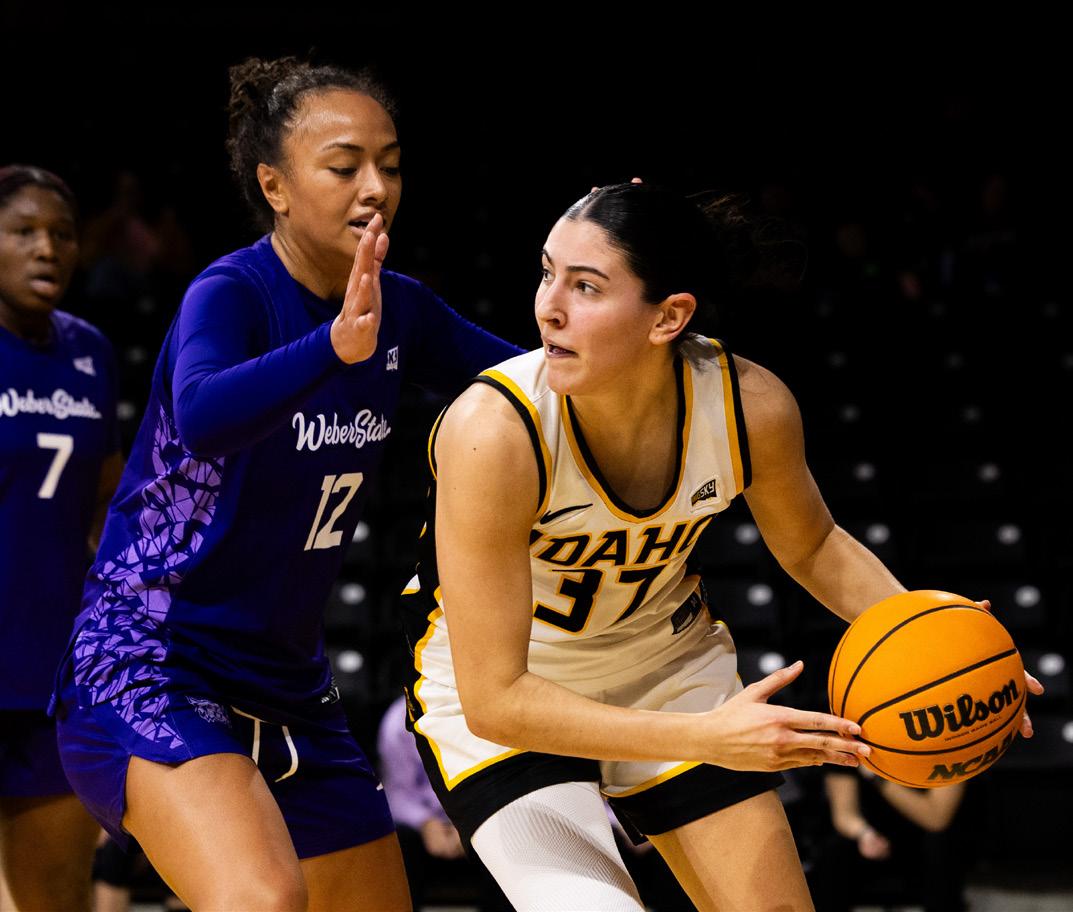
John Keegan | Argonaut Pinheiro dribbles past Weber State’s Fui Niumeitolu
John Keegan | Argonaut
Pinheiro shoots against Weber State
John Keegan | Argonaut
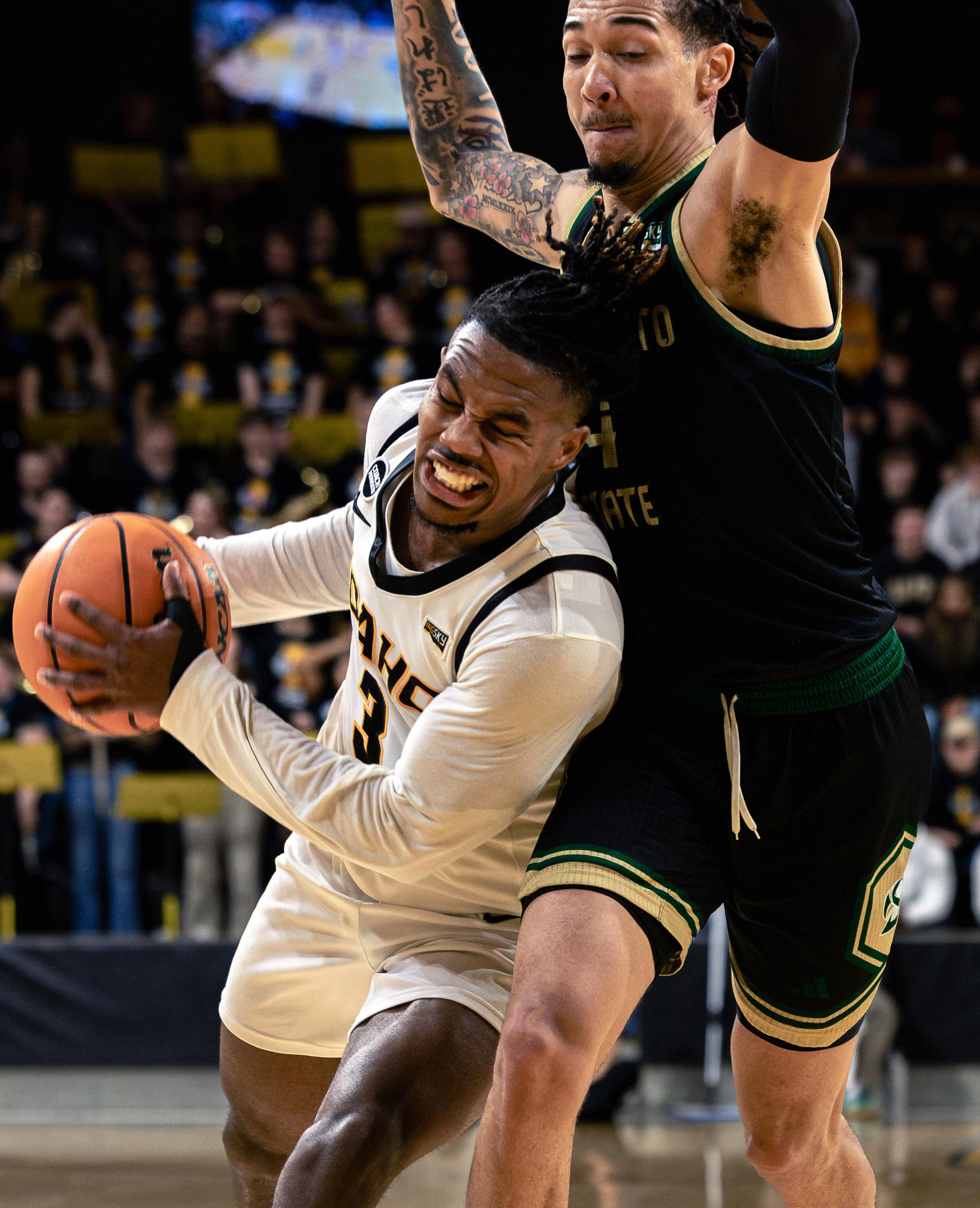
Vandals guard Biko Johnson pushes past Sacramento State’s Jahni Summers
Breezy Johnson, the ultimate champion
Johnson wins first gold medal for the U.S. at the 2026 Olympics
Jayden Barfuss ARGONAUT
United States downhill skier Breezy Johnson stood at the top of the Olympic podium, tears rolling down her face as the U.S. flag was raised and the “StarSpangled Banner” played.
Johnson, hand over heart, had just done something that every Olympian dreams about: winning a gold medal at the 2026 Winter Olympics.
A couple hours before, Johnson had stood at the top of Olympia Delle Tofane in Cortina, Italy, ready for her chance at gold.
As the timer went off, Johnson went flying down the course, and all her work throughout her life had come down to one minute and 30 seconds.
The Victor, Idaho, native navigated through a few rough patches, then glided down the course with the finish line in sight. Nothing was going to stop her.
She crossed the line with a time of 1:36.10. Now came the hard part: waiting.
Johnson was the sixth competitor to go, and she had to sit and agonize as 30 more racers took their runs.
It came down to 0.04 seconds, the difference between gold and silver. Emma Aicher of Germany crossed the finish line at 1:36.14, and Johnson was officially a gold medalist, only the second U.S. woman to ever win a gold medal in downhill skiing. The other was U.S. legend Lindsey Vonn in 2010.
For Johnson, this was much more than a race. It was redemption.
Four years ago, a month before the Beijing Olympics, Johnson crashed on this same course, tearing her ACL and ending her dream of being an Olympian.
After her winning run in an interview with NBC, she said she “had to fall in
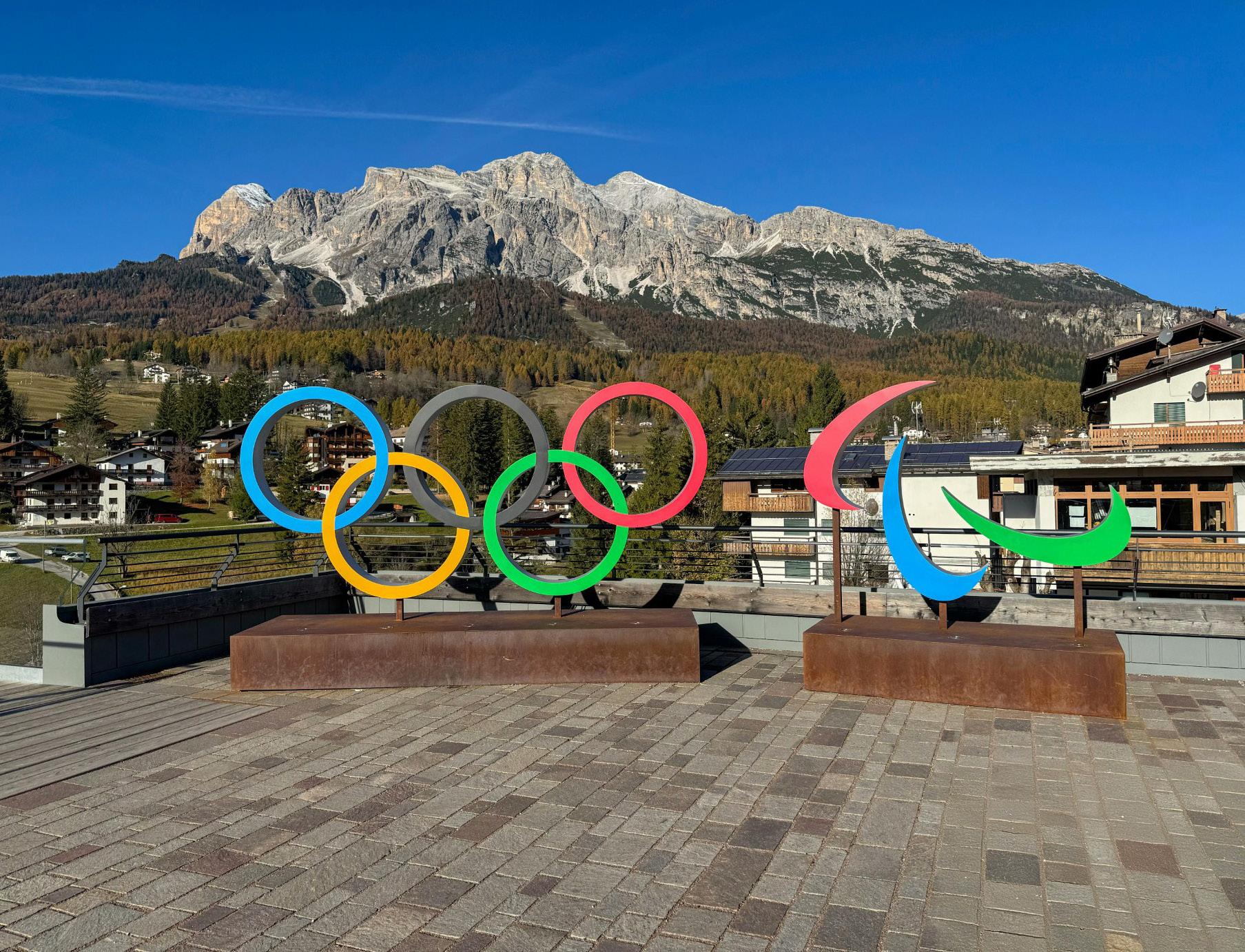
love with the course again.”
Four years of grit, determination and will led her to stand on top of the podium and hang a gold medal around her neck.
In an article by USA Today, she reflected on her win and the journey to get there.
“I think people are jealous of people with Olympic gold medals,” Johnson said in the article. “They’re not necessarily jealous of the journey it took to get those medals. I don’t think my journey is something that many people are envious
of. And it’s been a tough road, but sometimes you just have to keep going, because that’s the only option.”
“And if you’re going through hell, you keep walking because you don’t want to just sit around in hell,” Johnson continued. “And sometimes when you keep going, maybe you’ll make it back to the top.”
Johnson embodies what it means to be a champion. Unlike other sports where athletes get annual chances at glory, Olympians wait four years between op-
Why Lindsey Vonn made the right choice to compete in 2026 Olympics
Vonn crashes in what could be the final race of her Olympic career
Jayden
United States legend and downhill skier Lindsey Vonn took her place at the top of Olympia delle Tofane nine days after tearing her ACL, at the age of 41. Vonn took off from the starting gate and flew down the course. However, just 13 seconds in, it was over.
Her arm got too close to a gate as she turned a corner, twisting her around and sending her crashing down the mountain. Vonn’s chances at another Olympic gold medal were gone, and she had broken her tibia.
When you think of downhill skiing greatness, Lindsey Vonn’s name should be the first that comes to mind. Sixteen years ago, she became the first U.S. woman to win Olympic gold in downhill skiing. She would go on to win two bronze medals, one in super-G in 2010 and one in downhill in 2018.
Along with 84 World Cup victories, 45 downhill wins, 28 super-G wins and 138 World Cup podiums, Vonn is one of the best ever.
After hanging up her skis in 2019 due to injuries, she returned to competitive skiing in November 2024. She had gotten back into Olympic shape before tearing her ACL at the Crans-Montana World Cup downhill in Switzerland on Jan. 30, 2026, just nine days before the Olympics. Many thought her dream had ended.
However, Vonn was determined to compete. She worked with her trainers and doctors, got the okay and completed a qualifying run before her final race on Feb. 8.
Vonn’s crash had nothing to do with her ACL. Her arm twisting into the gate sent her body out of control, confirmed by teammate
Keely Cashman in an ESPN article.
“People that don’t know ski racing don’t really understand what happened yesterday,” Cashman said. “She hooked her arm on the gate, which twisted her around. She was going probably 70 mph, and so that twists your body around.”
Vonn gave an update in an Instagram post on Feb. 9 and had no regrets about competing.
“Yesterday my Olympic dream did not finish the way I dreamt it would. It wasn’t a storybook ending or a fairy tale, it was just life. I dared to dream and had worked so hard to achieve it. Because in downhill ski racing, the difference between a strategic line and a catastrophic injury can be as small as 5 inches. While yesterday did not end the way I had hoped, and despite the intense physical pain it caused, I have no regrets. Standing in the starting gate yesterday was an incredible feeling that I will never forget.”
Vonn, at 41, went out there on one knee with her country’s flag on her uniform and competed one last time. The question is, should she have taken the risk?
FIS president Johan Eliasch weighed in his opinion.
“I firmly believe that this has to be decided by the individual athlete,” Eliasch said in an ESPN article. “And in her case,
she certainly knows her injuries on her body better than anybody else. And if you look around here today with all the athletes, the athletes yesterday, every single athlete has a small injury of some kind.”
Vonn has accomplished everything in the sport, yet she wanted to compete, not just for glory or gold, but for the chance to represent the United States one more time.
No one but her knows her body and what she could or couldn’t do. To say she shouldn’t have competed is wrong and not our place.
Vonn wanted to leave a legacy as more than a skier, but as someone who didn’t let anything stop her.
“Similar to ski racing, we take risks in life,” Vonn continued in her Instagram post. “We dream. We love. We jump. And sometimes we fall. Sometimes our hearts are broken. Sometimes we don’t achieve the dreams we know we could have. Life is too short not to take chances on yourself. Because the only failure in life is not trying. I believe in you, just as you believed in me.”
Whether she should have competed isn’t for us to decide. What we can decide is this: Lindsey Vonn is a champion, not just because of what she won, but because of what she dared to risk.
portunities, making her comeback even more remarkable.
She was counted out, injured on the very course where she would eventually triumph.
What Johnson did, overcoming an ACL injury on the same course and turning around to win the gold medal, marks her as a one-of-a-kind athlete, one who will leave a legacy far beyond skiing down a hill.
Men’s Basketball
The men’s basketball team returns home to play Weber State tonight at 6 p.m. and on Saturday, Feb. 14, to play Idaho State at 2 p.m. Both games are in ICCU Arena.
Women’s Basketball
The Vandals will hit the road, first taking on Weber State tonight at 5 p.m., then they will travel to Pocatello on Saturday, Feb. 14, to take on Idaho State at 1 p.m.
Men’s Tennis
The men’s tennis teams returns home to the P1FCU Kibbie Dome. They first play Texas Rio Grand Valley on Friday, Feb. 13, at 2 p.m., then they will face University of Califorina San Diego on Sunday, Feb. 15, at 9 a.m.
Women’s
The women’s tennis team will also be at home first matching up with the University of New Mexico on Friday, Feb. 13, at 9 a.m. They will then face the University of South Dakota on Sunday, Feb. 15, at 4 p.m.
Tennis Track and Field
The Vandals track and field teams will head up to Seattle for the Husky Classic on Friday, Feb.13, and Saturday, Feb. 14, at noon. They will also be at the Whitworth invitational on those same days.

Michael Wedermann | Pixabay The Olympic rings set outside Milan, Italy, for the 2026 Winter Olympics
David Dilbert | Pixabay Olympic rings are placed in front of a scenic backdrop for the 2026 Olympic games
Fear and terror have come to Idaho
A father was apprehended by ICE outside his child’s daycare, striking outrage in the community
Andrea Roberts ARGONAUT
It was a quiet February morning when a father took his normal route to drop his child off at daycare, as he does almost every day. After saying their goodbyes, instead of being met by other parents, hellos and polite conversation, the father is approached by unidentified, masked agents. They pulled out a photo of his face.
“Is this you?” they asked.
The father said yes and was apprehended, put in an unmarked vehicle and detained by Immigration and Customs Enforcement. This is not how a school morning
should begin for parents and families who are simply trying to take their children to daycare.
“They took a dad,” Nivea, a parent who asked their last name not to be shared, told the Idaho Statesman after they witnessed the incident.
Mayra Ramirez, the owner of Mayra’s Spanish Preschool and Daycare in Boise, said that several agents blocked the father in and wouldn’t let him leave. When Ramirez asked for a warrant or detention order, they were denied.
The agents didn’t enter the school, but many families were terrified after being notified that ICE was outside the school.
“They’re not going to Croatian schools. They’re not going to Bosnian schools,” Estefania Mondragón, executive director of PODER of Idaho, told the Statesman by phone. “They’re going to a Spanishlanguage preschool—it sends a very clear

Students bowing their heads and closing their eyes during a protest against
John Keegan | Argonaut
ICE on campus
Bad Bunny brings a cultural phenomenon to halftime
The 60th Super Bowl halftime show called for love over hate
AJ Pearman
ARGONAUT
Bad Bunny’s Super Bowl halftime performance on Sunday was more than a musical showcase—it was a cultural statement rooted in identity, resilience and pride. Rather than focusing solely on spectacle, the global superstar used one of the world’s biggest stages to tell the story of his upbringing in Puerto Rico and his rise to becoming a Grammy-winning artist.
His performance resonated with millions, especially those who saw their own struggles and dreams reflected in his journey.
According to Forbes Magazine, the show carried deep symbolic meaning tied to Bad Bunny’s background and the experiences of Puerto Rican communities. The performance opened with dancers wearing traditional straw hats, representing the street vendors and laborers who have long worked in Puerto Rico’s cities and rural areas. Another scene depicted workers in the fields, referencing 19th-century agricultural laborers in Puerto Rico’s sugarcane industry, a powerful reminder of the island’s history of hard work, exploitation and perseverance.
These moments were not simply artistic choices but intentional acknowledgment of people whose stories are often overlooked on global platforms. By centering on working-class imagery, Bad Bunny challenged the idea that success requires erasing one’s past. Instead, he demonstrated that cultural pride could coexist with global fame, and that personal roots can be a source of strength rather than something to leave behind. Bad Bunny has been the source of controversy throughout the U.S.
There was a concern that the halftime show would fully be in Spanish, leading to Turning Point USA, an American nonprofit organization that advocates for conservative values, to host their own halftime show during Bad Bunny’s performance. This show featured Kid Rock, an artist who has been known recently to heavily support the Trump Administration. The “All-American”
message to who they are targeting.”
According to an article by KTVB, the unidentified father had a misdemeanor theft on his record from 2024, but no other criminal charges. He had spent several days in jail for the misdemeanor before doing community service.
KTVB reported that the Boise Police Department was notified by an uninvolved third party who was at the scene. Officials stated that the police were not involved and unaware that the arrest was happening.

outside the bounds of the law.
“He picks up his child every day,” Nivea told KTVB. “He’s such an amazing dad. He goes on field trips, he chaperones the field trips. To learn it was him was awful. On a Friday when our kids are supposed to be learning, one little boy is going home to just a mom and no daddy.”
This was no violent criminal, no menace to society or the community, but a father. A father who has the right to feel safe when dropping his child off at daycare. The fact that he was refused a warrant and still detained proves that ICE continues to act
The lack of accountability from ICE and the federal government should raise alarms across the country. What is holding back these agents from arresting our community members, our friends, our families? We have seen this happening across the country, and it has finally arrived in Idaho.
The only thing that can enact change is speaking out, supporting community members and coming together in times of crisis. Fear grips Americans during this time where we are bound by the law, but people who are supposed to be upholding it are not.
Everyone has rights in this country, undocumented or not, and this father is another example of these rights being taken.
Idaho ed. cuts are harmful
halftime show got around 6.1 million views on YouTube where it was streamed, according to an article by the New York Times. While the official viewership numbers are not yet released, the San Fransico Chronicle reported that the YouTube video of the Bad Bunny halftime show has already surpassed 35 million views.
The performance included special guests like Lady Gaga, who turned her hit song, “Die With A Smile” into a salsa dance with Bad Bunny. Cardi B, Pedro Pascal and Ricky Martin were all shown. There was even an actual wedding on display during the middle of the performance. The performance also reflected Bad Bunny’s own journey.
From growing up in Vega Baja, Puerto Rico, to becoming one of the most influential artists in the world. His rise has been marked by genre-breaking music, Spanishlanguage dominance on English-speaking charts and a consistent refusal to conform to industry expectations. That authenticity has made him a symbol of possibility for fans who rarely see their language, culture or communities represented on such massive stages according to Biography.
Bad Bunny’s performance became a celebration of resilience and ambition. It reminded viewers that success is rarely linear, and that dreams often grow out of struggle. By honoring his past while embracing his present, Bad Bunny delivered a message that resonated far beyond football: where you come from does not limit how far you can go. Bad Bunny ended his performance by saying, “God bless America,” and proceeded to list off nearly every country in the Americas while displaying their flags. He held up a football he had carried throughout the performance and showed it to camera: a powerful message reading, “Together We Are America.” As he left the stage, the camera panned to a billboard over the stadium, which read, “The only thing more powerful than hate is love.”
Bad Bunny transformed the halftime stage into a tribute to Puerto Rico, its people and the power of perseverance—proving that representation, when done authentically, can be both meaningful and unforgettable.
Idaho proposes education budget cuts, which would cause long-term harm to the educational system
Dominic Dorigo ARGONAUT
Children spend more than 1,000 hours in school each year throughout their entire K-12 education, according to EducationWeek. With children spending so much of their time in the education system, why do lawmakers feel like funding should be cut?
EdWeek ranked Idaho no. 17 for student achievement among all 50 states and the District of Columbia, a number that has increased from no. 31 in the nation when the survey was conducted in 2015. Spending on education has been correlated with an increase in the quality of education.
From 2023-2025, the education budget in Idaho increased from $8,750 per student to $9,387. This is a significant increase in budget despite Idaho continuing to be the state with the smallest education budget.
Despite this, education budget cuts are still being proposed. In a recent memo between co-chairs of the Joint FinanceAppropriation Committee, Sen. C. Scott Grow and Rep. Josh Tanner recommended that 1% or 2% of the budget be cut from the current education portion of the budget.
These suggestions came after Gov. Brad Little made an executive order which exempted public schools from further education cuts.
The Idaho State Constitution requires that the budget remains balanced or in surplus to ensure a fallback plan, which is sometimes referred to
as the “rainy day reserve funds.”
With K-12 education being generally protected, many of the suggested cuts would affect higher education. According to the Idaho Capital Sun, Idaho universities were asked last week to submit a list of potential cuts and how they would affect the universities.
The University of Idaho told the Idaho Capital Sun, “These impacts represent longterm capacity losses that cannot be quickly restored and would materially affect Idaho’s workforce, industries and communities.”
When lawmakers decide to make cuts to education, it is likely to have detrimental effects on the job force permanently.
An argument in support of education cuts may suggest that this is the only way to ensure that the budget remains balanced, but there are other options. Idaho has continued to deliver tax cuts such as the Parental Choice Tax Credit Program—coincidentally providing tax cuts to parents who enroll their students in private schools—despite the continued negative effects and ensuing scramble to balance the budget.
Whether you like it or not, taxes are essential to ensure that Idaho remains successful financially, and tax cuts create an unnecessary burden on the state budget which ultimately affects the education system.

John Keegan | Argonaut
An American flag amidst protestors and signs on campus against ICE
Hilary Valdez | Argonaut
The Idaho State Capitol Building in Boise on a cloudy day
Having a V-day birthday isn’t as fun as it seems
When romance culture and holidays overshadows personal milestones
AJ Pearman ARGONAUT
Having a birthday on Valentine’s Day or a couple days after sounds sweet, in theory. Candy fills store shelves, bakeries overflow with desserts and restaurants are already decorated. But for people born in mid-February, the overlap between romance culture and personal celebration often turns their birthdays into an afterthought.
When someone’s birthday falls on Valentine’s Day, it rarely feels fully theirs. Friends hesitate, unsure whether to treat it as a romantic holiday or a personal milestone. Couples prioritize reservations over parties. Plans become complicated, and what should feel meaningful becomes shared in a way that makes it easy to overlook.
Those with birthdays two days after Valentine’s Day face a different version of the same problem. By then, decorations
are discounted, chocolate boxes are halfempty and the excitement of celebration has passed. What should feel special instead feels leftover, rushed or recycled.
Beyond inconsistency, this reflects cultural priorities. Valentine’s Day dominates mid-February with messaging that focuses on romantic love. Adding a birthday into the mix can double the discomfort. A day meant to celebrate personhood becomes a reminder that personal milestones must compete with something louder and more socially enforced.
Still, mid-February birthdays often build resilience. People learn to celebrate on random weekdays, value effort over extravagance and laugh when their cake says, “Be Mine.” But resilience should not be a requirement for having a birthday.
Birthdays are universal. Everyone deserves one day that feels undeniably theirs. Valentine’s Day deserves its place, but love exists in more forms than roses and candlelit dinners. Friendships, family and self-recognition matter too—and birthdays honor all of them.

Red Star Coffee Company’s new stand on campus isn’t just a change of scenery; it’s a smart move that makes coffee more accessible, more convenient and more connected to both students and the wider Moscow community.
With the University of Idaho being one of the most high-traffic areas in town, Red Star’s relocation feels less like a business decision and more like a community upgrade.
For students, accessibility is everything. Between early morning classes, late-night study sessions and packed schedules, most people don’t have time to go out of their way for caffeine.
Having Red Star right on campus means grabbing coffee between classes or on the way to work is now easy, fast and realistic.
Instead of driving across town or settling for whatever is closest, students can support a local business without sacrificing time— something that matters when every minute feels scheduled.
The location also benefits community members who aren’t students. Campus is already a hub for traffic, whether it’s parents, faculty, visitors or people just passing through town.
Placing Red Star in a high-traffic area increases visibility and makes it more inviting to people who might not otherwise stop by. It turns the stand into a shared space instead of a niche stop.
One of the biggest improvements is how the new location handles car traffic. Unlike some drive-through coffee stands that spill into streets or parking lots, Red Star’s setup allows cars to line up without blocking traffic.
That means no awkward turns, no frustrated drivers and no safety concerns— just a smooth flow of vehicles that keeps

everything moving. For a campus already juggling buses, bikes and pedestrians, that design choice makes a real difference.
Even better, Red Star didn’t forget about people on foot. The walk-up window makes it easy for pedestrians to grab a drink without having to dodge cars or stand awkwardly in a drive-thru lane.
Students walking between buildings, faculty on lunch breaks and people exploring campus can stop in without needing a car at all.
That kind of access matters on a campus where not everyone drives—and where walking culture is already strong.
Beyond logistics, this move signals something bigger: the university is becoming a more livable, usable space.
When local businesses integrate into campus in thoughtful ways, it improves the everyday experience of being a student. Coffee stops become social spaces. Quick caffeine runs turn into moments of connection.
Instead of campus feeling isolated from the rest of town, places like Red Star help blur that boundary in the best way.
Red Star’s relocation shows what happens when convenience, design and community are prioritized together. It’s easier to access, safer for traffic and welcoming to both drivers and pedestrians.
More than that, it feels like a business that understands the rhythm of student life—fast-paced, mobile and always in need of caffeine.
Ashley Kramer | Argonaut Valentine’s Day themed teddy bears displayed on a shelf at a local store
Reagan Jones | Argonaut A car pulling through the new drive through
GALLERY: Senior Vandals swim in emotional


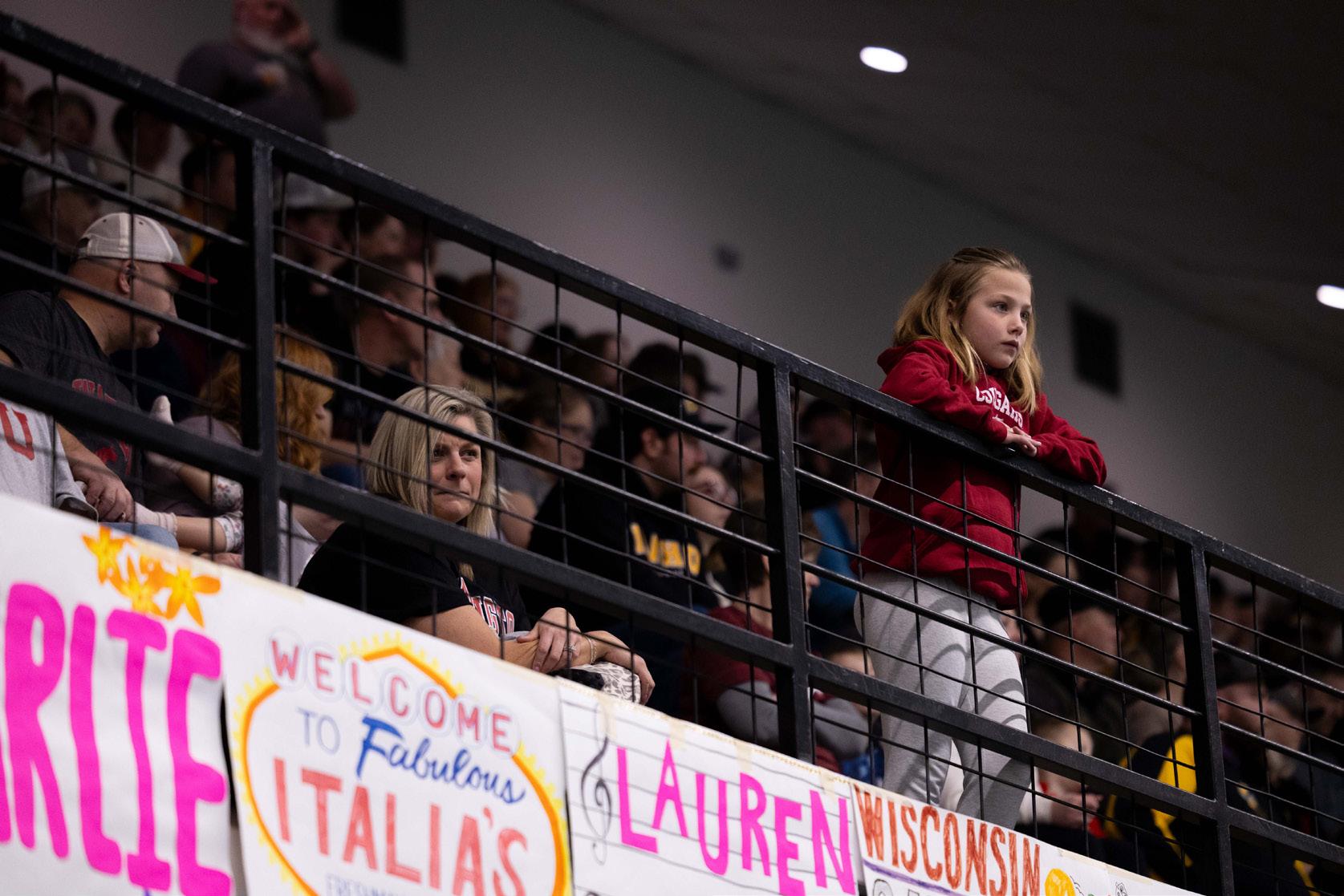
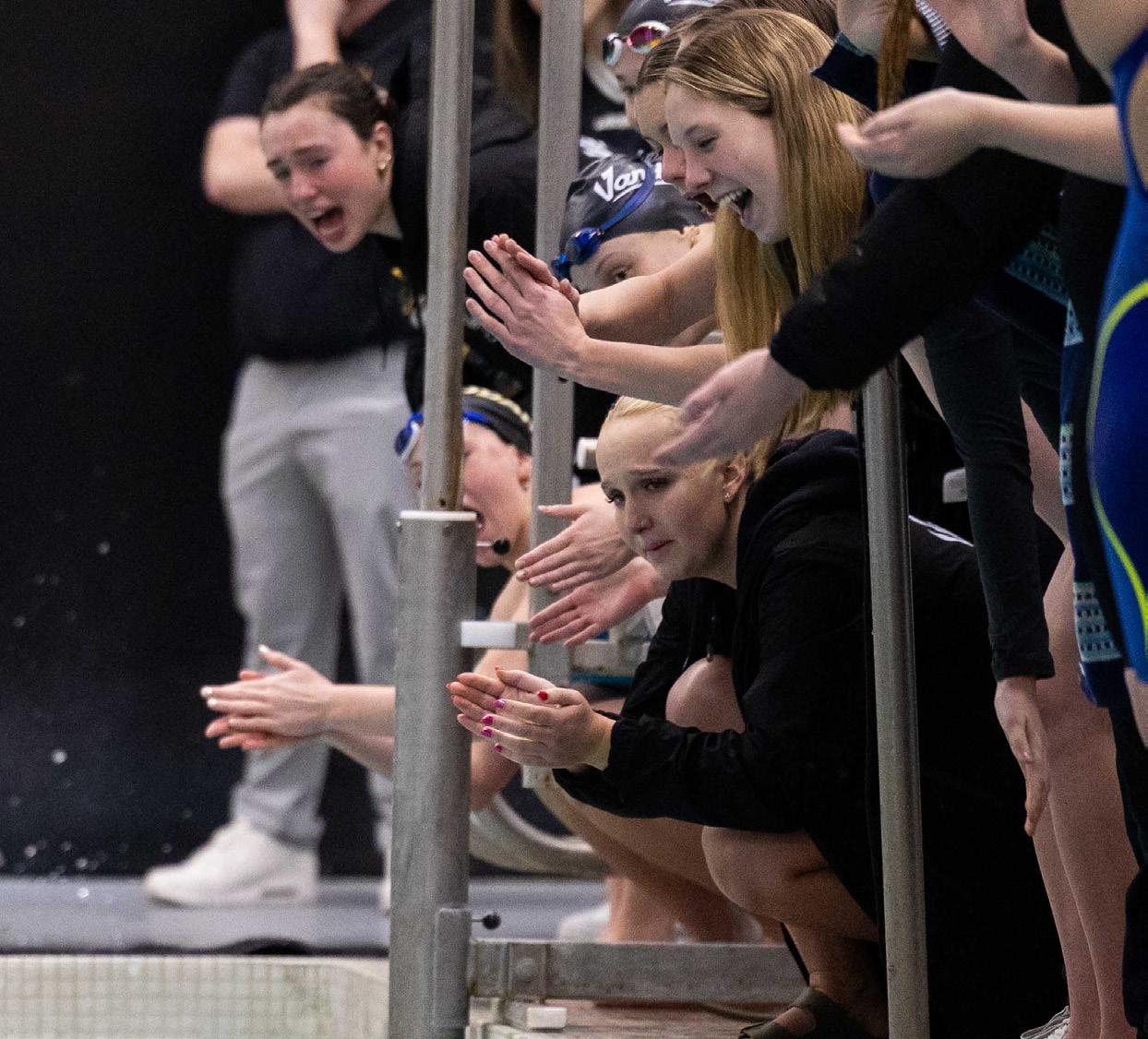

John Keegan | Argonaut
senior Bethany Rahn embraces her senior teammates after thei r final home meet of the season
John Keegan | Argonaut
UI swimmer Helen Schumaker races the 100 yard butterfly
John Keegan | Argonaut
swimmer competes in
backstroke event
John Keegan | Argonaut
John Keegan | Argonaut