WINTER 2019
The spark that moves us forward
CONNECT MAGAZINE
WINTER 2019
School of Social Work
The spark that moves us forward
Anna Scheyett Associate Dean
Shari Miller
Director of Research Expansion
Harold Briggs
PhD Program Director
Y. Joon Choi
MSW Program Director
David Okech
BSW Program Director
Leon Banks
Director of MA MNL Program and Institute for Nonprofit Organizations
Tony Mallon
Director of the Center for Social Justice, Human and Civil Rights
Llewellyn Cornelius
Director of Field Education
Zoe Johnson
Director of Global Engagement
Jane McPherson
Connect Magazine Staff
Welcome to the 2019 edition of Connect, the magazine of the UGA School of Social Work. This has been a tremendously exciting year for the School, and I am happy to share some of our stories with you. I am proud to show you the ways the faculty, staff, students, and alumni of Anna Scheyett the School are making positive change through innovations at the local, regional, national, and international levels. We are engaging in creative and impactful work through curriculum innovation, through technological innovation, through innovative partnerships—all in order to promote well-being and social justice and fulfill the mission of social work. As social workers, we know that solving the grand challenges of our time will require new and innovative actions. It will also require new generations of committed social workers, passionate about social justice and armed with the latest evidencebased skills. Our faculty engage in research that finds innovative solutions to these tough problems, and engage in teaching that shares these innovations with students. Our staff ensure that the research and teaching are operationalized effectively and efficiently, and our students and alumni take these innovative solutions and make positive change in the world through practice, policy, and advocacy.
Editor
Laurie Anderson Copy Editor
Keith Farner Writers
Laurie Anderson, Mereille Bishop, Erica Gilbertson, Alison Salerno, Chris Starrs Graphic Design and Layout
Tim Welsh, Bulldog Print + Design Photography
Laurie Anderson, Stephen Bridge, Wingate Downs, Erica Gilbertson, Caleb Guice, Claire Jordan, Dorothy Kozlowski, Robert Newcomb, Chad Osburn, Andrew Davis Tucker Connect Magazine is published annually for students, alumni, friends, and supporters of the University of Georgia School of Social Work. For reprint permissions, address changes, or additional copies, email sswpr@uga.edu. Copyright © 2019 by the University of Georgia. No part of this publication may be reproduced in any way without permission from the editor. The University of Georgia is committed to principles of equal opportunity and affirmative action.
Postmaster | Send address changes to: UGA Connect Magazine 279 Williams Rd. Athens, GA 30602
So take a few minutes and read about some of the ways we are making change through the spark of innovation. You’ll see how we innovate in our curriculum through PrOSEAD and through our Double Dawgs program. You’ll learn how faculty are using technology to explore the lived experience of poverty and to improve wellbeing through gamification. You’ll read about our innovative partnerships with the local library, with community artist/activists, and with government leaders. We are innovating from Athens to sub-Saharan Africa, in the classroom and in the community. As you read this issue of Connect I hope you’ll feel the excitement and catch the enthusiasm we feel for our work here at the School. Let me know what you think— what inspires you, what gives you new ideas, where you’d like to connect with us and our work. Contact me (amscheye@uga.edu) and let’s talk about ways to work together. We would love to strengthen our relationship with you, and with your support move forward in solving today’s tough challenges through innovation, passion and commitment. With warm regards,
Anna Scheyett, MSW, PhD Dean and Professor
Robert Newcomb/UGA
Dean
5
18 7 24 FEATURE
PROGRAMS 4 Moving up: MSW program ranking leaps to No. 15 5 Curriculum: What is PrOSEAD™? 6 Double opportunity
TECHNOLOGY
18 Tom Holland: Building a new pathway to nonprofit success
NEW PARTNERSHIPS 20 Lending a hand 21 Mapping mortality: Opioid deaths in Northeast Georgia 22 Strengthening Georgia's family treatment courts 23 Investing in the future of public behavioral health
7 Social work and... robots?
24 Courtroom drama
8 Playing for life
25 State of Hope
9 Research: The ample sample
25 Professors-in-residence in public schools
10 A program for pastors
26 Care for the caregivers
11 Book: Social Work and Science in the 21st century
27 Tackling human trafficking
12 Focused on community empowerment
28 Connecting with Grenada
STUDENTS
29 Virgin Islands sojourn
13 Leadership skills 14 "You can see us, if you try" 16 Cultivating excellence 17 Best foot forward
PASSAGES 30 Laurels and Welcome
ALUMNI 32 James "Jim" Dodd Distinguished Alumni Award 33 Q&A: Cartter Fontaine
GIVING Find us online at ssw.uga.edu. On social media, we are: @UGASocialWork
34 Why I give: Alberta J. Ellett 35 Thank you: A letter to the Student Emergency Fund Connect Winter 2019
3
PROGRAMS
Moving
UGA School of Social Work MSW program leaps to No. 15 in national rankings
by Laurie Anderson
The Master of Social Work (MSW) program moved to No. 15 among public institutions that offer a master’s degree in social work, according to the U.S. News & World Report’s 2019 ranking of graduate schools. The program is No. 24 nationally among both public and private institutions. “This new ranking puts us in the top tenth percentile, nationally,” said David Okech, director of the master’s degree program. Graduates have very high pass rates on the national licensure exam, he noted, and 95 percent of students are employed or in a doctoral program within a year of graduation. When it was last ranked in 2016, the school placed 38th. Since then, the curriculum has been updated to put greater emphasis on social justice and the most current, evidence-informed practices. The revised curriculum, developed with input from community stakeholders, helps students gain competencies and confidence as practitioners, teaching them to keep in mind ways to envision and instigate change, said Okech. The MSW program is one of three in the Southeast and the only one in Georgia to be ranked among the top 25 social work graduate programs.
140
Undergraduate
437
Graduate/Professional 4
Connect Winter 2019
BY THE NUMB3RS
A E S D
™
wi
th
PrO
PROGRAMS
Social Justice
Social Justice Curriculum:
PrOSEAD™ (pronounced “proceed”) is an acronym for a curriculum framework officially known as
Addressing the Bases of Power, Oppression, Social Justice, Evidence-Informed Practice, Advocacy, and Diversity The easy-to-remember mnemonic device reflects the school’s commitment to integrating the most current evidence-informed practices with social work’s ongoing advocacy for social justice. “Beginning in 2019, all majors will contain content that addresses issues of power, oppression, social justice, evidence-informed practice, advocacy and diversity,” said Associate Dean Shari Miller. “Whether a student earns a degree in social work or nonprofit management and leadership, the PrOSEAD™ philosophy will provide a critical and practical understanding of how to address injustice.”
Connect Winter 2019
5
PROGRAMS
DOUBLE OPPORTUNITY Two new programs offer more options for nonprofit learning by Laurie Anderson
Nonprofit organizations are looking for leaders. A 2018 survey of more than 3,300 nonprofit directors found that 86 percent of respondents believed that demand for their services was rising, while more than half—54 percent—said they planned to expand their programs.1 Two new programs are helping to meet that need.
The Double Dawgs Program enables undergraduates to earn a bachelor’s degree in certain majors and a master of arts in nonprofit management and leadership (MA NML) in five years. The following bachelor’s programs offer a quick route to the master’s degree:
• • • • • • • •
Another option is the online Graduate Certificate in Nonprofit Management and Leadership. The self-paced program has long been available to students who can come to campus; the online version is open to non-degreeseeking students around the country. Courses can count toward a master’s degree if the student is accepted into the graduate nonprofit program.
Human Development and Family Science (BSFCS) Latin American Caribbean Studies (AB) Music (AB) Music Performance (BMus) Psychology (BS) Social Work (BSW) Sociology (AB) Theatre (AB)
“We’ve heard from employees of numerous nonprofit organizations regarding their need and interest in improving their management and leadership skills as well as strengthening their credentials,” said Tony Mallon, director of the Institute for Nonprofit Organizations, which administers the certificate and degree programs. “The online program is ideal for those who find themselves involved in fundraising and writing grant proposals within their organizations or for staff in service agencies who need to evaluate and measure the effectiveness of their work but lack some of the skills.”
The Double Dawgs program was created to give ambitious and motivated students a competitive advantage in today’s knowledge economy. By earning both a bachelor’s degree and a master’s degree in five years or less, students can save time and money while positioning themselves for success after graduation.
The curriculum for the master’s and the certificate covers basic theory and administration of nonprofit organizations, grant proposal writing, program design and evaluation—a key component of successful grant proposals—as well as fundraising and managing volunteers.
Wingate Downs/UGA
For more information about Double Dawgs, visit doubledawgs.uga.edu/. For details about the online Graduate Certificate in Nonprofit Management and Leadership, visit t.uga.edu/4iD.
1 State of the Nonprofit Sector Survey 2018, Nonprofit Finance Fund® bit.ly/NFF2018survey
TECHNOLOGY
Social work and… by Chris Starrs Jenay Beer works at the crossroads of a host of disciplines, including gerontology, social work, engineering psychology and technology. With joint appointments in the College of Public Health and the School of Social Work, Beer studies the use of technology to improve quality of life for older adults, individuals with disabilities, and lung cancer survivors.
Laurie Anderson/UGA
Beer was attracted to the University of Georgia because of its encouragement of a multidisciplinary approach to issues throughout campus, and she says she enjoys “breaking down silos” where her study interests intersect. An engineering psychologist, Beer and her students grapple with issues in and out of the field of human-robot interaction to assist the aging population. She works with socially assistive robots and tele-presence robots (“Think of it as Skype on wheels,” she said).
life. “It’s happening already,” she said. “Think about the Roomba. It’s incredibly useful and easy to use.
Perhaps the first and most prominent hurdle Beer faces in her research is encouraging older adults to accept emerging technology. “(Acceptance is) the cornerstone/foundation of all the research that I do,” she said. “Technology acceptance is based on two factors—perceived usefulness and ease of use. Older adults see a lot of benefits to healthoriented technology.
“I see appliances becoming more robotic and I see it happening now. I think over the next five to 10 years these systems will be integrated into our homes whether we realize it or not. Smart thermostats, security systems, and even laundry machines might be some examples. In terms of more complex health care robotics, I think we’ll see them more and more in hospitals, in assisted living and other care facilities.”
“However, ease of use is a problem. A lot of companies don’t think about the older user when they’re designing their technology—buttons that are too small, text that is too small, not enough contrast makes it hard to read, or they might not have proper instruction. These are all barriers to technology adoption.”
Beer said she engages social work students on every project in her lab. “They’re such an important component in my lab,” she said. “I love working with social work students because they bring such a unique perspective to the research we do here. There’s something healing about the human touch and we don’t want to take that away…It’s so, so critical. They are absolutely instrumental in what we do.”
Beer is committed to knocking down barriers and believes it won’t be too terribly long before robots are an accepted aspect of everyday
Laurie Anderson/UGA
George Mois, a PhD student in social work whose area of focus is aging in place using assistive technology (which includes physically assistive robotics, tele-robotics, and socially assistive robotics), works on several projects in Beer’s lab and lauds her body of work and her moraleboosting encouragement. “I really enjoy it,” said Mois. “She’s very knowledgeable in this area and she’s motivated me to pursue it and constantly explore.” Connect Winter 2019
7
TECHNOLOGY
Playing for Life Digital role-playing games to teach healthy behaviors by Laurie Anderson
In this wired world, Chad Osburn/UGA
many teens and young adults spend a lot of time playing computer games. Javier Boyas and Adrienne Baldwin-White think that digital, game-based learning can also help players improve their health behaviors. That’s why they are developing applications (apps that offer game-like role-playing experiences.
Javier Boyas
“Gamifying” the System Associate Professor Javier Boyas is working with Brian Winn, director of the Games for Entertainment and Learning Lab at Michigan State University, on a proposal to “gamify” (pronounced “game-ify”) curriculum that helps middle school students learn strategies to avoid substance abuse and relationship violence. The pair have partnered with the developers of Keepin’ It R.E.A.L., an evidencebased school program that has been proven to reduce substance abuse, to develop a digital, game-like version of the curriculum that also addresses relationship violence. The Keepin’ It R.E.A.L. curriculum teaches youth to resist social pressure with tactics summarized in the program’s name: Refuse, Explain, Avoid and Leave (R.E.A.L.). In the proposed game, students will be presented with common social situations and awarded points for utilizing the R.E.A.L. tactics. “A major aspect of this game is decisionmaking,” said Boyas. “A student can test different responses to see how they affect the outcome.” Boyas has already worked on a small pilot study with promising results for an earlier version of the game, which is called “Choices & Consequences.” Youth in the pilot program “were very engaged,” said Boyas. “They had ownership of how it unfolded. They could play as boys or girls, so boys, for example, got to see what it was like
8
Connect Winter 2019
to be a girl being pressured into using substances or what leads to a potentially violent relationship.” Students also liked to discuss the scenarios in a group setting with a trained, flesh-and-blood facilitator. “This is where the learning took place,” said Boyas. The next version of the game, if the proposal is funded, will use more immersive 3-D animation and will be downloadable from the Web onto any device. Players will also be able share their results on social media, said Boyas, as they do with commercial games.
TECHNOLOGY
Research:
The ample sample
Laurie Anderson/UGA
Preventing Sexual Assault Assistant Professor Adrienne Baldwin-White is also developing an app to alter behavior. Instead of teens, it will target college students at risk for sexual assault. “Previous research has demonstrated that college students do not understand consent or how to promote and participate in healthy relationships,” said BaldwinWhite. “In addition, their behaviors with intimate partners are influenced by harmful gender norms that contribute to sexual violence. This game seeks to change those underlying attitudes and beliefs.” Students who use the app will face hypothetical social situations. The scenarios will focus on allowing the players to recognize and practice risk reduction or bystander strategies, and players will get to see the potential consequences of their actions or inaction. Still in the planning stages, Baldwin-White has enlisted Jenay Beer, assistant professor in the School of Social Work and College of Public Health, Gabrielle Darville, an instructor in health promotion and behavior in the College of Public Health, and Glenna Read, an assistant professor of advertising in the Grady College of Journalism and Mass Communication, to help develop the app. The team is proposing a web-based game that college students can use on their phones, tablets or computers. There are several advantages to delivering assault prevention education in digital game form, said Baldwin-White. It’s cheaper, convenient for players, and encourages multiple exposures, which research has shown is a necessary part of effective sexual assault prevention education. It is also more inclusive of sexual minorities, said Baldwin-White. And it works. “Games like “Escape from Diab” and “Re-Mission” have been shown to positively influence diet choices and increase compliance with cancer treatment, respectively,” said Baldwin-White. “Hopefully, a game like this can reduce the prevalence rate of sexual violence on college campuses.” And in that scenario, everyone wins.
Courtesy Jeremy Gibbs/UGA
by Laurie Anderson Acquiring behavioral health information about marginalized groups can be difficult. Typically, researchers must physically visit places where members of those populations hang out to enlist a representative number for surveys or other studies. To conduct a Jeremy Gibbs survey of young men who have sex with men, for example, researchers usually recruit volunteers from gay bars. However, this method— called venue-based probability sampling—may not reflect the whole population, and is slow and costly. Jeremy Gibbs thinks smartphone apps that utilize geosocial networking can help. The apps share location data, and are popular with youth and young adults. “Basically you map out the density of where everyone’s located (using the app), and then you’re able to systematically identify all the different regions for recruitment, so everyone has the same probability to be selected for a study,” said Gibbs. After identifying high density areas of that population, the researcher can send out an invitation via the app to people in those areas to participate in the study. In early tests, responses took a third less time and cost half as much as venue-based sampling, Gibbs discovered. Importantly, information based on the participant responses was more accurate, because a broader sample of the population was represented. In addition to sexual minorities, the method can be applied to other hard-to-find groups who rely heavily on geosocial networking apps, such as homeless youth, said Gibbs. “It may be especially applicable to areas in which venues are not readily accessible, such as rural areas,” he said, “allowing more accurate sampling of the most marginalized populations.”
Connect Winter 2019
9
TECHNOLOGY
A program for pastors Interactive computer “game” to help ministers respond to domestic violence
Chad Osburn/UGA
by Chris Starrs Domestic violence remains a significant problem in the United States, and members of immigrant communities are just as likely as any other demographic group to suffer abuse at the hands of an intimate partner. More than two decades ago Y. Joon Choi, an associate professor in the School of Social Work, counseled Asian immigrant victims of domestic violence while serving as a social worker in New York City. It was there she learned firsthand of the obstacles those in danger had to navigate. Y. Joon Choi
Players can go back and try a different answer. The goal, said Choi, is to help religious leaders develop their skills related to domestic violence intervention and prevention in a safe environment. In 2018 Choi was the recipient of a $439,542 National Department of Justice grant to continue to develop the training program as “Rele Healthy – Religious Leaders for Healthy Families and Communities.” Over the next
“They had a lot of barriers because of language difficulty and a lack of knowledge about the legal system and community resources,” said Choi, who joined the School of Social Work faculty in 2011. Many victims told Choi they’d spoken with their church pastors about the abuse and added that while some ministers were sympathetic, others were in denial. But one thing all the ministers had in common was that they were unprepared to respond in a helpful way. “That was very frightening to hear,” said Choi. “They could have gotten help much earlier in the process or in the relationship, but they waited so long because their ministers told them to keep the family together.” In response, the Korean native created an online intervention training program that includes a virtual case simulation that helps ministers take the steps that promote abuse victims’ safety. “It’s almost like gaming,” said Choi. “We provide the scenario of a hypothetical domestic violence case and the ministers have avatars of themselves and of the congregation member who is coming to them for help.” The minister determines how the story unfolds. “We give them three choices to continue: a good decision, an okay decision, and a poor decision. If they choose the right answer, we explain why that was the right choice. If they choose the wrong answer, we explain why and how that choice could actually endanger the congregation member who came to them for help.”
10
Connect Winter 2019
two years, Choi and Pamela Orpinas, a professor of health promotion and behavior in the College of Public Health, will develop more virtual case simulations and test them with Korean ministers in metro Washington DC and Chicago. Once Rele Healthy (pronounced “Really Healthy”) is developed and evaluated, it will be available to victim service organizations and the justice system to integrate into their trainings and interventions. In addition, Choi hopes to expand and adapt the program beyond the Korean community. “I think the potential is great. In a lot of immigrant communities, faith leaders have very influential roles,” she said. “I want to expand and adapt this for other immigrant communities.”
TECHNOLOGY
Social Work and Science in the 21st Century by Chris Starrs
There are some compelling threads that run through the book “Social Work and Science in the 21st Century,” set to be published in late 2018 by Oxford University Press. The social work profession, which is committed to evidence-based practice, is increasingly utilizing advances made in the natural and physical sciences. Yet social work students are rarely formally taught about the applications of the sciences to human services. The book, which lists five authors—including School of Social Work Professor Larry Nackerud—was written in response. “Our common interest is science and wanting to push back against the antiscience perspective that has come forward,” said Nackerud, who has taught at the School of Social Work since 1994. Nackerud, whose chapters in the book cover access to potable water, climate change and human geography, shares editor honors with Leon Ginsberg, considered an icon in the field of social work education and public service, and Chris Larrison, assistant professor of social work at the University of Illinois at Urbana-Champaign. The book also has chapters by John Barner, a staff member at UGA’s Carl Vinson Institute of Government, and Lauren Ricciardelli, assistant professor of social work at Troy University. Aside from an interest in science and technology, four of the book’s five authors share a UGA connection. Larrison, Barner and Ricciardelli all earned doctorates at the School of Social Work, and all three were students of Nackerud. Ginsberg, like School of Social Work Dean Anna Scheyett, served as dean of the College of Social Work at the University of South Carolina and has been a mentor to Nackerud and Larrison. Nackerud has filled a similar role for Barner and Ricciardelli. “It’s a small world,” said Nackerud, who has also published books on U.S. refugee policy and on welfare reform.
Wingate Downs/UGA
Nackerud, Ginsberg and Larrison also collaborated in 2004 to write “Human Biology for Social Workers.” “That’s what got us going again,” said Nackerud. “We wanted to do something different and extend it.” Connect Winter 2019
11
TECHNOLOGY
by Allison Salerno The Iron Triangle occupies the poorest census tract in Athens-Clarke County. Census data show one in two children in the neighborhood live at or below the federal poverty level. Associate Professor Michael A. Robinson is motivated by the desire to “see change happen in the community that surrounds the university. It’s the least we can do.” To that end, he has received a $20,000 grant from the Fahs-Beck Fund for Research and Experimentation fellows grant program to embark on a photovoice project aimed at creating positive changes in the Iron Triangle. Photovoice is a qualitative research methodology developed in 1992 by Caroline C. Wang of the University of Michigan and Mary Ann Burris, Program Officer for Women's Health at the Ford Foundation headquartered in Beijing, China. The goal is to empower often excluded groups so they might document their concerns and, ultimately, influence public policy makers. In the fall, 20 African-American male adolescents in the Iron Triangle neighborhood of East Athens received 35-millimeter cameras to document through photography what they like about their community and what they would like to see changed.
As part of the project, Robinson also is partnering with Broderick Flanagan, an Athens visual artist and community activist, to curate 60 of these photographs in an art gallery in Athens. They will invite community members and local community leaders to view the photographs and speak with the young men about their community and the changes they would like to see happen.
12
Connect Winter 2019
Laurie Anderson/UGA
Later, the young men will meet with Robinson and graduate student Septima Riley to “get the story behind the picture,” said Robinson. “We will look for common themes in the photographs.”
Laurie Anderson/UGA
STUDENTS
by Mereille Bishop
Jenna Embrey, a double-major in sociology and social work, enjoys helping others. She’s torn about which career direction to take, though.
As an intern at Advantage Behavioral Health, Embrey reviews services, meets with clients, and tries to determine how staff can do better. Originally focused on mental health, Embrey was drawn to social work and sociology after taking introductory classes in both areas during her second semester at UGA.
Throughout college, the honors student always had an interest in working with adults experiencing mental illnesses. However, lately she has become passionate about working with those who have developmental and intellectual disabilities.
“I found that I really identified with the core social work values and appreciated the profession’s commitment to self-determination and social justice,” said Embrey.
“In my senior field placement, I have had the opportunity to build strong relationships with clients who face cognitive or physical challenges,” she said. “I love seeing them gain independence and make progress toward their goals.”
Embrey has had several opportunities to demonstrate her leadership abilities while at UGA. During her sophomore year, she headed a small group of students as they worked through a leadership curriculum in a sociology class. Embrey has also taken part in the Public Service and Outreach Student Scholars program, managed shifts for Campus Kitchen and tutored student athletes. In addition to her studies, Embrey is a member of Phi Alpha Honor Society for Social Work and Alpha Kappa Delta—the International Honor Society of Sociology. She volunteers at Athens Area Homeless Shelter and for three years was a member of the Redcoat Band, for which she received the Redcoat Band Scholarship. For demonstrating outstanding leadership skills both on and off campus throughout her college career, she was selected to join the Blue Key Honor Society, which also presented Embrey with the 2018 AT&T Student Leadership Award.
Laurie Anderson/UGA
After graduation, Embrey plans to get a master’s degree in social work. She also wants to obtain her clinical license so she can practice in either the mental health or developmental and intellectual disabilities field. “I often go back and forth on this dilemma,” she said. “I have to remind myself that nothing is ever set in stone and that social work is a broad field with many opportunities.”
Connect Winter 2019
13
STUDENTS
A photovoice project initiates change. by Mereille Bishop Photo courtesy Rachel Ward/UGA
There is the old saying, “A picture is worth a thousand words.” For mothers with children living with rare diseases in Pernambuco, Brazil, truer words have never been spoken. Rachel Ward spent six months working as a Boren Fellow in Recife, Pernambuco, Brazil to create greater awareness and visibility of families with members who live with illnesses that include Zika congenital syndrome, cerebral palsy and other diseases that result in physical or cognitive disabilities. Originally from Gwinnett County, Georgia, Ward earned her master of social work and master of public health dual degree at the University of Georgia in 2018. For her graduate research project, she partnered with local nonprofit organizations in Recife to capture photographs of areas of inaccessibility that limit children with rare diseases from doing various activities - from riding public transportation to playing in a park, to going to school. The purpose of the pictures was two-fold: to increase awareness of rare diseases in Pernambuco, Brazil and to increase global knowledge by publishing the results of this research. Ward, who speaks Portuguese, partnered with 15 women who met her research criteria. Each needed to be a mother of a child with a rare disease, a resident of Pernambuco, at least 18 years of age, able to communicate in Portuguese, and a member of Aliança das Mães e Famílias Raras (AMAR), an organization that supports mothers and families dealing with rare chronic illnesses. They also needed to be willing to share photos they took of their children and the challenges they faced. Ward explored how affected families felt seen and unseen in areas such as education, government, transportation, city and building infrastructure, and in social interactions. In addition to photos, the mothers who participated shared stories about their children’s invisibility in society. They
14
Connect Winter 2019
enjoyed being able to share their stories and to have their stories heard. Ward incorporated the use of the “WhatsApp” phone app in her research, which allowed all of the participants to interact with each other and to remain part of the research at every step. The mothers said that using the app was therapeutic, because it allowed them to support one another. After they collected photographs, in July 2018 the mothers shared them with the public at Fenearte, the largest annual artisan festival in Latin America. Twelve of the women also shared their pictures on plaques as they walked through the art exhibits. “We had people coming up to us, hearing the stories, leaving crying, so touched by the stories,” said Ward, “so it was very effective in sharing the message with the public, and the mothers felt just so great to be able to share.” Ward believes this research will help implement change in Recife. One of the photographs has already made an impact. It was of a boy in a wheelchair outside a dog park. “I wish I was a dog so I could play here,” the boy told his mother, because there were no parks that were accessible to him. After she shared the picture and her son’s statement on social media, the city opened a park that was accessible to children in wheelchairs. Ward now works at the Centers for Disease Control and Prevention in Atlanta as an Oak Ridge Institute for Science and Education (ORISE) Fellow in the Division of Global Migration and Quarantine. As a health communicator, her work includes health messaging, responding to global epidemics, and supporting immigrants and refugees who come to the US by informing them of their health resources and options when they enter the country.
Photo courtesy Rachel Ward/UGA
Rachel Ward’s photovoice project raised public awareness of the needs of families in Recife, Brazil who deal with rare, chronic diseases.
STUDENTS
CULTIVATING
UGA School of Social Work doctoral students continue to impress. In recognition of their strong scholarship, seven students have each received funding that will help further their research and studies.
EXCELLENCE
Laurie Anderson/UGA
16
Eunhye Kim and Sunwoo Lee received the UGA Korean Student Association Research Award. The award is annually presented to up to five graduate students who have made significant scholarly and service contributions to the field of their research discipline during their student careers. Kim was also awarded the UGA Graduate School Dean’s Award for Social Sciences from a very competitive pool of applicants.
Connect Winter 2019
Tenesha Littleton was selected through a nationally competitive process to participate in the week-long Summer Dissertation Proposal Workshop organized by the Center on Race and Wealth at Howard University and the Institute for Research on Poverty of the University of Wisconsin–Madison.
Laurie Anderson/UGA
George Mois was selected as a 2018 Pre-Dissertation Fellow by the Association for Gerontology Education in Social Work. As a fellow, Mois received a stipend of $1,200 to attend the Gerontological Society of America’s Annual Meeting, mentoring from an AGESW member and access to a webinar. Mois studies the effect assistive technology has on the process of aging in place. Tatiana Villareal-Otálora, a licensed clinical social worker, was awarded the State Doctoral Scholars Program fellowship from the Southern Regional Education Board. She was one of 12 scholars in Georgia to receive the award and the only social work student. The fellowship provides three years of direct financial support from SREB and two years of support from UGA. With her fellowship, Villareal-Otálora said she plans “to enhance the delivery of social services to marginalized communities, particularly Latinx adolescents and families via supporting the development of culturally responsive social workers.”
Laurie Anderson/UGA
Laurie Anderson/UGA
Joel Izlar received the Terri Lewinson Dissertation Award. This $1,000 award will aid his dissertation, “Byting back! Community technology centers and community organization: A qualitative case study.” Izlar’s research explores how community technology centers-places that offer access to computers for free or at a small cost--address social, economic and environmental justice both locally and globally through their use of electronic waste, popular education and community-building.
Taylor Yates/UGA
Laurie Anderson/UGA
Laurie Anderson/UGA
Luis Alvarez-Hernandez was accepted into the Minority Fellowship Program for doctoral students by the Council on Social Work Education. When asked why he wanted to pursue a doctorate in social work, Alvarez-Hernandez said, “I wanted to make a difference in my community. My mother is a high school teacher in Puerto Rico and growing up I could see how she was trying to teach while also addressing the situations her students brought with them to her classroom. I knew I wanted to be of assistance to others and decided social work was my conduit to do it.”
Laurie Anderson/UGA
by Mereille Bishop and Laurie Anderson
Taylor Yates was awarded the 2018 Solution Focused Brief Therapy Association Research Award. Yates is also the clinical supervisor at AIDS Athens. She is interested in researching strengths and resiliency, HIV and AIDS in families and effective social work teaching and supervision methods.
To learn more, visit t.uga.edu/4Bi
STUDENTS
Best foot forward by Mereille Bishop
Some graduate students, after completing their master’s program, find employment near home. Others decide to pursue a doctorate. Emily May chose a slightly different path. Soon after graduating from the Nonprofit Management and Leadership program, she packed up her belongings, sold everything and moved to Jinja, Uganda to join a nonprofit organization. The organization, Sole Hope, treats those affected by a foot parasite known as “jiggers.” The parasite is a sand flea endemic to sub-Saharan Africa that buries itself in human skin. The results are very painful and can cause blood-borne diseases or even lead to death. Sole Hope provides medical clinics, education and shoes to protect bare feet. May had previous experience with the organization. While still a student, she interned with Sole Hope for five months. After returning home, they offered her the full time, paid position of international coordinator. Photos courtesy Emily May/UGA
Sole Hope’s current staff is made up of about 65 people, mostly Ugandans, who work as social workers, nurses, caretakers and shoemakers. May oversees the daily administrative duties, ensuring that her staff have both the funds and resources they need. She also supervises the American interns and manages the organization’s Guest House, where the volunteers reside. “My favorite part of my job is working alongside our Ugandan staff—and I get to be a part of seeing them grow professionally and personally as they care for people suffering from foot-related diseases,” said May. May said the master’s program really helped her to narrow down what she wanted to pursue within the nonprofit sector. Because much of the coursework and projects emphasized improving local nonprofit strategies, she was able to get a feel for nonprofit management in the real world. In April 2018, just prior to graduating, May was named Student of the Year for the Master of Arts in Nonprofit Management and Leadership program. Tony Mallon, director of the Institute for Nonprofit Organizations, praised May’s initiative. “Emily independently landed her international internship with Sole Hope,” he said. “Students who are successful are usually very self-directed….Emily May epitomizes that.”
Connect Winter 2019
17
FEATURE
Tom Holland: Building a New Pathway to Nonprofit Success by Laurie Anderson A degree program gets started for all sorts of reasons, but usually because someone sees a need and has the resources to support it. In the case of the nonprofit graduate program at the UGA School of Social Work, Tom Holland saw the need, didn’t have the resources, but built a successful program anyway.
“You’re drifting,” Dean Bonnie Yegidis announced during his annual review. Her comment surprised Holland. He had helped to build two doctoral programs at two different schools, published dozens of refereed journal articles, written a couple books, designed and taught courses, and brought in significant funding. Drifting? “It’s the first time a dean ever gave me that kind of feedback,” said Holland later, whose output usually pleased his supervisors. “But she was right.” “If you could push on any one thing, really dig in on it,” Yegidis continued, “what would it be?” Holland thought about it. Then while visiting a gym in the old O’Malley’s building—the same building that now houses the School of Social Work—he met Jeff Brudney. A faculty member in the department of political science in Franklin College (now the Department of Public Administration and Policy in the School of Public and International Affairs), he shared Holland’s interest in nonprofit management. As they talked, their enthusiasm for the topic grew. People needed nonprofit know-how, but no one was teaching the subject in depth—at least not in the southeast. Why not, they asked each other, create a degree that would prepare and train leaders to strengthen the effectiveness of nonprofit organizations? They were off and running. Convincing others wasn’t easy, though.
18
Connect Winter 2019
Wingate Downs/UGA
Doing that was not on his mind in 1997. At the time the tenured professor was overseeing research grant proposal development for the school. He’d had success, but had lost his enthusiasm.
“We dove in, not having in the slightest idea how hard it would be to establish a new degree program,” said Brudney. “But Tom had a real knack for integrating a lot of points of view that helped us to get over a lot of obstacles.” “My biggest challenge was persuading the university administration,” said Holland, who had full support of social work faculty but little funding. To oversee the degree, Brudney and Holland created the Institute for Nonprofit Organizations. The pair felt strongly the new program should be interdisciplinary, so Holland reached out to faculty across the campus, showing them how to add a nonprofit dimension to their classes. There were no textbooks, so they wrote their own. Holland says the program they established in 1999—the Master of Arts in Nonprofit Management and Leadership— is his proudest professional accomplishment. Brudney, who is now the Betty and Dan Cameron Family Distinguished Professor of Innovation in the Nonprofit Sector, in the
FEATURE Department of Public & International Affairs at the University of North Carolina Wilmington, still speaks about the experience with amazement. “We were just two guys with no resources, and it took two years of our lives [to get the degree approved],” said Brudney. “In retrospect, it was nearly an impossible task.” Today the institute administers the master’s degree, seminars and workshops for the nonprofit community, and a graduate certificate program that is open to students in any major as well as to students not enrolled in any other UGA degree, and can be earned on campus or online. More than 500 graduates of the certificate and master’s programs have gone on to successful careers in both nonprofit and for-profit organizations. (Read about two alumni in this issue: Emily May, page 17 and Cartter Fontaine, page 33). And interest continues to grow. “There’s still a hunger for that,” said Holland, whose books are often checked out of his local public library. “How do we manage better? How do we fundraise?” His queries reflect both his teaching and research philosophy, which he described as “learning how to ask the right questions.” In recognition of his contributions to nonprofit scholarship and education, in 2018 the Board of Regents approved the Thomas P. Holland Distinguished Professorship in Nonprofit Management and Leadership. The position will increase research and contribute to teaching within the institute. It was funded through the UGA Foundation, Holland, his wife Myra Blackmon, the Riverview Foundation and multiple private donors.
Wingate Downs/UGA
Laurie Anderson/UGA
“It is really appropriate that this endowed chair is being named for Tom Holland,” said Anthony Mallon, current director of the institute. “He played a central role in addressing the gap in higher education regarding nonprofit leadership, and in building a strong interdisciplinary program here at UGA.” Holland, who retired in 2012, is glad he persevered. “It was time to take some risks,” he said, “and I’m so glad I did.”
To learn more about the Holland Distinguished Professorship, contact DeVin S. Taylor, development coordinator, at devin.taylor@uga.edu. To support it, visit bit.ly/HollandProfessorship.
Connect Winter 2019
19
NEW PARTNERSHIPS
Athens-Clarke County Library becomes trauma-informed by Laurie Anderson
These days libraries lend all kinds of things – books, audio recordings, tools and more. Now the Athens-Clarke County Main Library is set to lend a hand as the first traumainformed library in Georgia, and one of a few in the nation.
Utilizing a $150,000 Community Catalyst Initiative Grant from the Federal Institute of Museum and Library Services*, in October 2018 the library partnered with the UGA School of Social Work to bring social work graduate students inside the library. The project is part of a larger program to make the library trauma-informed. “We are pleased to expand how we engage with the community to include a trauma-informed environment,” said Athens Regional Library System Executive Director Valerie Bell when the program was announced. The library was one of only 12 nationwide awarded the IMLS grant in 2018, out of 51 applications. Among other things, the students will identify specific needs of at-risk community members and share information about social services while advocating for those who have difficulties accessing services. While familiarizing themselves with patron needs, the students have begun to develop a resource guide for library staff and patrons, and participate in trauma-informed and crisis intervention trainings, said Simone Moonsammy, a graduate student who is one of the interns at the library, along with Olivia Ricketts and Lydia Hawkins Hall.
20
Connect Winter 2019
Caleb Guice/UGA
Public libraries serve people from all walks of life, including those impacted by trauma. Individuals who have experienced trauma sometimes engage in unhealthy coping behaviors such as self-harm or substance use. Despite increasing interactions with patrons who suffer from trauma, most library staff are unprepared to respond to this segment of society.
L-R: Liv Ricketts, Simone Moonsammy and Lydia Hawkins.
The grant also funds trauma awareness training for library staff and an after-school peer-mentoring program that teaches leadership skills to at-risk teen girls. The project’s collaborators hope the training and assistance will become commonplace. “Social work services should be deeply embedded in the community, in places that people trust and where they feel welcomed. The library is one such place, if not THE place,” said School of Social Work Dean Anna Scheyett. In addition to Scheyett, faculty members Jennifer Elkins, Mary Caplan and Zoe Johnson, and part-time faculty member and alumna Caroline Sharkey (MSW ’15) are involved in the project. Moonsammy, who worked as a mental health counselor before she pursued her MSW, did not expect her internship would take her to a public library, but is happy about it. “I was and am still very excited to be a part of this experience,” she said. “I like that we are able to provide a service that is definitely needed in the community.”
* The views, findings, conclusions or recommendations expressed in this article do not necessarily represent those of the Institute of Museum and Library Services.
NEW PARTNERSHIPS
Opioid-related deaths in Northeast Georgia tell another story
Dorothy Kozlowski/UGA
by Allison Salerno Since September 2016, Associate Professor Orion Mowbray has partnered with Advantage Behavioral Health to figure out the best ways to treat people with opioid use problems. Based in Athens, Advantage Behavioral Health provides people in 10 Northeast Georgia counties with treatment in dealing Orion Mowbray with the effects of mental illness, developmental disabilities, alcohol and other drug use. The $100,000 grant for Mowbray’s work comes from the state of Georgia through federal funds from the Substance Abuse and Mental Health Services Administration. First, Mowbray looked at where opioid-related deaths are highest in the 10-county area and analyzed existing infrastructures that support people with opioid addiction through medication-assisted therapies (MAT), including buprenorphine and naloxone. While substance use tends to be an issue that disproportionately affects men, one finding from his
research was that women were almost equally likely to experience opioid-related deaths compared to men. “Middle-aged women in particular are a neglected group” in terms of substance use research and interventions, he said. Advantage Behavioral Health provides services to a large area of Northeast Georgia. However, the majority of its substance use services are only available in Athens-Clarke County. “This is discrepant with data that shows other counties outside of Athens-Clarke have equally high or higher rates of opioid-related overdoses,” Mowbray said. Recommendations that followed from his partnership with Advantage Behavioral Health include: increase efforts to collaborate with MAT treatment providers in the region, especially in rural areas, and provide opportunities for MAT-based training to providers in the region, focusing on MAT efficacy, evidence associated with MAT, and required procedures for the delivery and monitoring of MAT for opioid use.
An interactive version of this map can be found at tabsoft.co/2E2FQkL. Connect Winter 2019
21
NEW PARTNERSHIPS
GEORGIA’S FAMILY TREATMENT COURTS by Allison Salerno
Social Work faculty Orion Mowbray and Michael A. Robinson are partnering with Georgia’s Criminal Justice Coordinating Council and the federal Substance Abuse and Mental Health Services Administration to figure out how best to help parents who find themselves in family treatment courts. Georgia operates nine family treatment courts. The stated mission of these courts is to “reduce foster care stays, promote stable family reunifications for children of parents with severe substance use disorders, and achieve permanency in every case.” The state of Georgia wants to expand these courts; most of them are clustered around Atlanta. It wants input from the UGA professors first. The professors’ first task is to assess the current family treatment courts to ensure they are functioning well and meeting the needs of clients. Mowbray, whose research interests include evaluating issues related to mental health and substance abuse treatment, said the grant—$60,000 a year over the next five years—will be used to hire staff, conduct site visits and meet with various stakeholders to get their feedback on how the courts work and how they might improve.
22
Connect Winter 2019
NEW PARTNERSHIPS
Investing in the future OF PUBLIC BEHAVIORAL HEALTH IN GEORGIA
Laurie Anderson/UGA
by Allison Salerno
Sara Skinner
The School of Social Work has launched an internship program for MSW students in partnership with the Georgia Department of Behavioral Health and Developmental Disabilities (DBHDD) with the aim of attracting future social workers who will work in public behavioral health settings.
“It’s good for us to partner with them,” said Sara Skinner (PhD ‘18), who is coordinating the initiative. “Working in public behavioral health is a pretty difficult and challenging field, and the whole idea is to incentivize and to give them the support they need to comfortably meet the challenge.” In the Spring 2018 semester, four students participated in a pilot program. In the 2018-2019 academic year, 10 students were awarded internships. The internships are for students’ final year of master’s studies. The process to participate begins with students applying and then interviewing with a panel that includes representatives from DBHDD. Those who are accepted into the program receive a $10,000 stipend and are expected to work 20 to 25 hours a week at the internship site, which must be within the DBHDD system, including Community Service Boards. The internship experiences range from shadowing clinicians who work with people who are chronically homeless to leading psychotherapy groups for women struggling with addiction. In addition, students participate in a specialized seminar that gives them specific knowledge and skills related to working in public behavioral health. Once students are licensed as social workers, the program requires them to work within DBHDD or at a Community Service Board for 12 months. In exchange, DBHDD will help graduates find potential job opportunities appropriate to licensed MSWs.
For more information about the program, visit t.uga.edu/4uA.
Connect Winter 2019
23
NEW PARTNERSHIPS
Courtroom
DRAMA
Trial simulation trains social work students in trauma-informed court practices by Allison Salerno
Andrew Davis Tucker/UGA
Claire Jordan/UGA
Traditionally, social workers have been cautious around lawyers. A new partnership between the UGA School of Social Work and the UGA School of Law aims to teach future practitioners of each profession how to work collaboratively to benefit clients. Through an innovative, traumaJennifer Elkins informed mock juvenile court trial simulation, future social workers are learning to advocate and represent their juvenile clients in court, and future lawyers are being trained to more effectively use expert witnesses and to understand the trauma their clients might have experienced.
court,” she said. “Often what we do learn is to avoid talking to lawyers and avoid court. By working with law students, we are teaching them how to become more aware of the dynamics of trauma and how to use expert witnesses more effectively. For social work students, it teaches them how to be a more effective and prepared expert witness in court to advocate for a client.”
The interdisciplinary work of two University of Georgia faculty members—Associate Professor Jennifer Elkins at the School of Social Work and Assistant Clinical Professor Emma Hetherington at the Law School—is so state of the art, that it won the 2018 SAGE/CSWE Award for Innovative Teaching in Social Work Education. The award is given annually by the Council on Social Work Education.
According to the federal Substance Abuse and Mental Health Administration, “a trauma-informed court is one in which judges recognize the people appearing before them have personally experienced acts of violence or other traumatic life events, and are also cognizant of the stress of the courtroom environment impact on trauma survivors.”
The course Elkins and Hetherington teach integrates classroom lessons with a trauma-informed mock trial simulation. In her own research, Elkins is particularly interested in the impact of trauma, violence and abuse over the life course. Hetherington directs the Wilbanks Child Endangerment and Sexual Exploitation (CEASE) Clinic, which represents survivors of child sexual abuse in juvenile court dependency matters and civil litigation. This is the first course in Georgia to give social work graduate students and law students exposure to a juvenilecourt case simulation that incorporates interprofessional practices designed to recognize and prevent trauma. Elkins said the course adds a dimension to social work education that often is missing. “One thing that is not typically taught in social work and mental health fields is how to handle being an expert in
24
Connect Winter 2019
The mock trial is more than an academic exercise. Nearly 14,000 children in Georgia are currently in foster care and half of them will receive a termination of parental rights ruling from the juvenile court system. Social workers play a key part of those rulings, because they are often called to testify as expert witnesses.
Hetherington said she is hopeful the mock court will develop more social work professionals who are more comfortable testifying in court, enabling them to better advocate for clients.
NEW PARTNERSHIPS
Professors-in-residence
Since 2009 the UGA College of Education and the Clarke County School District have collaborated on a partnership that brings faculty into county schools. In 2018, Associate Professors Jennifer Elkins and Michael Robinson became the first social work faculty to join the team. Together with Dawn Meyers (MSW ‘94), associate superintendent of policy and school support services, and Chrystal Gillis, director of social work, the pair focus on leading professional learning for school social workers related to race, equity, other sociocultural dimensions, and trauma-informed care to build their capacity to lead social justice initiatives in schools.
enhance public school capacity
Erica GilbertsonUGA
by Erica Gilbertson
Stephen Bridge/UGA
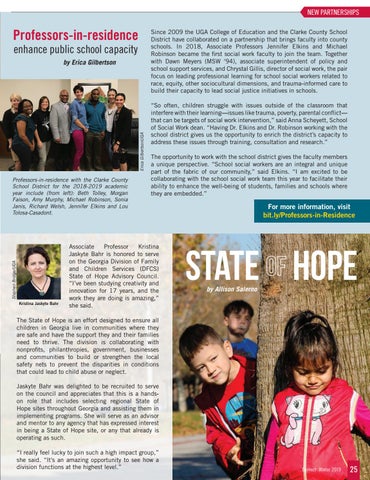
Professors-in-residence with the Clarke County School District for the 2018-2019 academic year include (from left): Beth Tolley, Morgan Faison, Amy Murphy, Michael Robinson, Sonia Janis, Richard Welsh, Jennifer Elkins and Lou Tolosa-Casadont.
Kristina Jaskyte Bahr
“So often, children struggle with issues outside of the classroom that interfere with their learning—issues like trauma, poverty, parental conflict— that can be targets of social work intervention,” said Anna Scheyett, School of Social Work dean. “Having Dr. Elkins and Dr. Robinson working with the school district gives us the opportunity to enrich the district’s capacity to address these issues through training, consultation and research.” The opportunity to work with the school district gives the faculty members a unique perspective. “School social workers are an integral and unique part of the fabric of our community,” said Elkins. “I am excited to be collaborating with the school social work team this year to facilitate their ability to enhance the well-being of students, families and schools where they are embedded.”
Associate Professor Kristina Jaskyte Bahr is honored to serve on the Georgia Division of Family and Children Services (DFCS) State of Hope Advisory Council. “I’ve been studying creativity and innovation for 17 years, and the work they are doing is amazing,” she said.
For more information, visit bit.ly/Professors-in-Residence
State Hope by Allison Salerno
The State of Hope is an effort designed to ensure all children in Georgia live in communities where they are safe and have the support they and their families need to thrive. The division is collaborating with nonprofits, philanthropies, government, businesses and communities to build or strengthen the local safety nets to prevent the disparities in conditions that could lead to child abuse or neglect. Jaskyte Bahr was delighted to be recruited to serve on the council and appreciates that this is a handson role that includes selecting regional State of Hope sites throughout Georgia and assisting them in implementing programs. She will serve as an advisor and mentor to any agency that has expressed interest in being a State of Hope site, or any that already is operating as such. “I really feel lucky to join such a high impact group,” she said. “It’s an amazing opportunity to see how a division functions at the highest level.”
Connect Winter 2019
25
NEW PARTNERSHIPS
Care for the
caregivers by Allison Salerno
Robert Newcomb/UGA
How much respite do family caregivers need?
Tiffany Washington
Tiffany Washington, an assistant professor in the School of Social Work, will try to find out in her recentlyfunded project.
It’s an important question: about 43.5 million people in the United States provide unpaid care to an adult or child, according to a 2015 study by the National Alliance for Caregiving and AARP. “My research lives at the intersection of health and aging,” said Washington. “I am interested in how well people are aging. And I am very interested in how caregivers fare. Are they neglecting their own health? Are they burdened? Do they take time for self care?” Washington has been awarded a $149,980 grant from the Health Foundation of Western and Central New York to find out. The funds will support her research on family caregivers’ use of respite—short-term breaks for people who provide, on average, 24 hours of care per week of loved ones. Partnering with aging-services providers, she and her research team are conducting telephone surveys with about 80 caregivers in western and central New York state to see how often they are using respite services and examine whether their social support networks, among other factors, relate to their access to and desire for respite care. Then
Washington will conduct focus groups of caregivers who participated in the survey to delve deeper into caregivers’ experiences. The team includes Sheryl Zimmerman, Mary Lily Kenan Flagler Bingham Distinguished Professor, University of North Carolina at Chapel Hill School of Social Work, and Dr. Thomas Caprio, associate professor in the departments of medicine, nursing, and public health sciences at the University of Rochester Medical Center. Before she earned her PhD, Washington spent five years as a medical social worker, years that made her realize how little she knew about older adults. “I was encountering older adults through my social work role in a health care setting and I wanted to understand their uniqueness.” Her doctoral work and her research focus on gerontology—the study of older adults. She is the recipient of several research and training grants, including the John A. Hartford Doctoral Fellowship, and has authored or co-authored peer-reviewed articles in The Gerontologist, Social Work in Public Health, and Social Work Research. She has also delivered presentations to national audiences, including The Gerontological Society of America and the American Society of Nephrology. Washington’s teaching interests encompass aging and health, social work practice in health care settings, generalist social work practice, and service-learning. She designed a dementia caregiving service-learning course that takes an engaged scholarship approach of integrating research, teaching and service to understand the impact of dementia on individuals, families and communities. Laurie Anderson/UGA
While Washington’s training as a social worker did not include much about older people, her own life has provided lessons. Washington grew up in rural Stanly County, North Carolina near her great-grandmother. “Every great childhood memory of mine in North Carolina: she’s in it.”
NEW PARTNERSHIPS
David Okech: Tackling human trafficking by Laurie Anderson
Human trafficking, also known as modern slavery, is a persistent, worldwide problem hampered by lack of data for intervention efforts. Thanks to a $4 million award from the U.S. Department of State to the University of Georgia Research Foundation, Associate Professor David Okech is directing an effort to address the lack of data and reduce the prevalence of modern slavery in targeted communities of West Africa. The project is overseen by the State Department’s Office to Combat and Monitor Trafficking in Persons and is part of its Program to End Modern Slavery. Under Okech, researchers at UGA formed the Africa Programming and Research Initiative to End Slavery (APRIES) to implement the award. Over the next five years, APRIES will collect data on the prevalence of human trafficking in parts of Sierra Leone and Guinea. The baseline research will support programs that seek to achieve a measurable reduction of human trafficking. The program’s methodology could serve as a model for similar efforts elsewhere. “There has never been a systematic, research-based multinational effort as extensive as this to tackle the problem of modern slavery in Africa,” said Okech, the project’s director and principal investigator. “This is a challenge and also a great opportunity to execute truly transformational programs.” Statistics are acutely needed in Africa. “There are limited data in Guinea and Sierra Leone on the prevalence of modern slavery,” said Jody Clay-Warner, Josiah Meigs Professor of Sociology in the Franklin College of Arts and Sciences and an associate director of the project. “The award provides us the opportunity, at a minimum, to fill this gaping hole to inform policy and programming.”
based at Makerere University in Uganda, to collect, analyze and establish robust baseline data on the prevalence, impact and service gaps of human trafficking in target communities in Sierra Leone and Guinea. Using a collective impact approach, local implementing partners will amplify the effort by using the findings of the research in anti-modern slavery operations and programs that help trafficking survivors. Implementing partners will be openly and competitively selected on their ability to execute well-designed, measurable programs. The project will not replicate or create overlaps with existing anti-human trafficking efforts. APRIES members have a proven record of anti-trafficking research in sub-Saharan Africa, including the development of a model for the reintegration of female survivors of human trafficking; increasing transparency in labor supply chains in cocoa cultivation and garment manufacturing; and reintegrating former child soldiers in post-conflict zones. These projects were made possible by the UGA President’s Interdisciplinary Seed Grant Program, the UGA Office of International Education, the Owens Institute for Behavioral Research, the National Institutes of Health, the National Science Foundation, and the United Kingdom’s Economic and Social Research Council. In addition to Okech and Clay-Warner, University of Georgia team members include Assistant Professor Tamora Callands and Professor Nathan B. Hansen in the department of health promotion and behavior, College of Public Health, and Trasie Topple, a social work doctoral candidate. Alex Balch, professor of political science at the University of Liverpool is an associate director of the project.
For more information on the Office to Monitor and Combat Trafficking in Persons, visit state.gov/j/tip.
Laurie Anderson/UGA
The APRIES team will work with ResilientAfrica Network, a USAID-funded partnership of 20 African universities
Front row L to R: Steven Davis*; David Okech, School of Social Work**; Joshua Youle*; Andrea Balint*. Back row: Tamora Callands, College of Public Health**; Jody Clay-Warner, Franklin College of Arts and Sciences**; Amy Rustan Haslett*. Not pictured: Alex Balch, University of Liverpool; Nathan Hansen, College of Public Health**; Trasie Topple, School of Social Work**. (Photo: Laurie Anderson) *Office to Monitor and Combat Trafficking in Persons, U.S. Department of State **University of Georgia Connect Winter 2019
27
NEW PARTNERSHIPS
Connecting with Grenada: Undergraduates Meet Their Peers Virtually and In Person
Jane McPherson
A new partnership between the University of Georgia, St. George’s University in Grenada, and the Grenada Association of Professional Social Workers will help University of Georgia BSW students develop collaborative personal and professional relationships with their Caribbean peers and shift the international development paradigm.
“Very often when Americans go overseas to work, we imagine that we possess the know-how to solve other people’s problems,” said Assistant Professor Jane McPherson, director of Global Engagement at the School of Social Work. “Instead, we need to approach problems with humility. We need to listen and learn before we can become partners in creating solutions.” A two-year grant from the Katherine A. Kendall Institute of the Council on Social Work Education is enabling social work undergraduates at the University of Georgia to connect and collaborate with their peers at St. George’s University in the Caribbean nation of Grenada. “I am wondering if meaningful connections between peer students can be established and nurtured, even if those students never meet face-to-face” asked McPherson, “and, if those relationships are established virtually, can they be more fully developed through brief study abroad experiences? In Spring 2018, students in McPherson’s International Social Work elective began developing those virtual
Laurie Anderson/UGA
Robert Newcomb/UGA
by Allison Salerno
connections in cyberspace through Skype sessions, email, and WhatsApp conversations—and in Spring 2019, about 15 UGA students will actually travel to the island nation and engage with their peers over spring break. While in Grenada, students will also meet professional social workers and learn about the challenges and opportunities the profession faces. “I hope that students at UGA will see their Grenadian peers as people with skills and knowledge, and I hope to complicate ideas they may have about their roles in international development.” McPherson said. “I want them to develop their identities as global social workers.” This project in international social work education complements McPherson’s ongoing work focused on improving Grenadian women’s health, specifically through access to screening for Human Papilloma Virus. This work, in partnership with Dr. Amy Baldwin at the UGAAugusta Medical Partnership, is supported by UGA’s Latin American & Caribbean Studies Institute and a UGA Global Collaborative Research Grant.
L-R: Adzele Benoit, LCSW; Calisha Hyacinth, LMSW, and Kanisha Johnson, MSW, discuss Grenadian social work issues.
Laurie Anderson/UGA
Virgin Islands
NEW PARTNERSHIPS
Sojourn
Robert Newcomb/UGA
by Allison Salerno
In May 2019, 10 University of Georgia social work undergraduate and graduate students will launch a Maymester program of study in the Virgin Islands. The program is developed by Llewellyn Cornelius, Donald L. Hollowell Distinguished Professor of Social Justice and Civil Rights Studies and director of UGA’s Center for Social Justice, Human and Civil Rights. He will coinstruct the program with Constance Wooden-Smith, Llewellyn Cornelius MSW, Gwinnett Campus program coordinator. They will collaborate with Chenzira Kahina, Ph.D., the director of the Virgin Islands Caribbean Cultural Center. This isn’t a trip for tourists. The value for future social workers of studying in the Virgin Islands is to “expand their cultural humility,” said Cornelius, whose own family traces its roots to the Virgin Islands. He notes the significant Caribbean population in the Atlanta metropolitan area. “If you’re going to work with clients from any other background than yourself, this will expand your learning,” he said. The program has three learning objectives. First, students will study the neocolonial legacy of the Caribbean. Second, they will learn about environmental justice through interacting with the scholars at the Slave Wrecks Project, which is building scholarship and knowledge about the global slave trade. Third, they will work with community empowerment of indigenous populations on the islands. In particular, they will spend time in each location co-facilitating community discussions regarding posthurricane resilience. The Maymester program was delayed a full year because of two back-to-back Category 5 hurricanes in September 2017—Irma and Maria. The lesson for UGA students, Cornelius said, is on “the effects of tropical storms on resilience,” not only among people in the Caribbean, but also for residents of coastal areas in Florida, Georgia and the Carolinas. “How do we build environmental resilience?” he asked.
Connect Winter 2019
29
PASSAGES
New Emeriti Professors
Laurie Anderson/UGA
Alberta “Bert” Ellett joined the faculty in August 2000 as an assistant professor and retired at the rank of full professor in July 2018. Renowned in the child welfare field, Ellett excelled at research, grantsmanship, teaching and service. From 2001 until her retirement, she was the principal investigator of the Title IV-E Child Welfare Education Program at UGA, guiding more than 340 UGA social work students through the program. She was also the principal investigator of a statewide study of child welfare staff retention and turnover that led to development of an employee selection protocol used by the Department of Family and Children Services.
Robert Newcomb/UGA
by Laurie Anderson
In 2018 three distinguished faculty retired and took on new roles as emeriti professors. Their exceptional achievements in teaching, service and scholarship continue to impact social work practice and improve well-being for marginalized populations. Elizabeth “Betsy” Vonk earned her doctorate from the School of Social Work in 1996 and joined the faculty in August 2002. Over the course of her tenure she directed three programs – the MSW, PhD and Northern Ireland Study Abroad – and coordinated the Marriage and Family Therapy Certificate program. Much of her research addressed issues related to direct social work practice effectiveness and practice specific to transracial adoptive families. Admired by students and colleagues for her scholarship and teaching skills, she modelled “the million pieces of how to do an academic career,” said one former studentturned-academic at her retirement celebration.
From 1989 until her retirement at the rank of professor in 2018, Lettie Lockhart taught about and furthered knowledge of the empirical investigation of intimate partner violence, with particular attention to the intersectionality of cultural and contextual environmental factors. As an educator, she sought to prepare practitioners to be producers of evidence that supports their assertions of practice efficiency and effectiveness. Recognized for her expertise on social issues confronting families and communities, she served as principal or co-principal investigator on projects for which she secured more than $33 million from state and federal funding sources.
30
Connect Winter 2019
PASSAGES
New Faculty
Associate Professor Javier Boyas codeveloped an app that has shown promise in helping to reduce substance abuse and relationship violence among adolescents. His research also addresses the well-being of people of color who are undocumented and exposed to an elevated risk for disease and injury related to their occupations. He earned his doctorate in social work from Boston College and comes to UGA from the University of Mississippi. Assistant Professor Allison Dunnigan focuses on child welfare structural factors of youth and family outcomes. “This research seeks to explore opportunity points for policy and practice interventions that facilitate permanency, decrease placement disruption and improve service delivery within the child welfare system,” said Dunnigan, who earned her PhD at the Brown School, Washington University in St. Louis.
Courtesy Rachel Fusco/UGA Courtesy Jeremy Gibbs/UGA
Assistant Professor Adrienne BaldwinWhite earned her PhD at Arizona State University, where her research focused on sexual assault prevention on college campuses and how college students communicate about sex. She is developing an intervention that will help college students establish and maintain fully consensual, healthy sexual relationships and confront biases that contribute to misperceptions about sexual assault.
Chad Osburn/UGA
Courtesy Allison Dunnigan/UGA
Chad Osburn/UGA
Laurie Anderson/UGA
by Laurie Anderson
The best scholars have expertise in their areas, ask the right questions, and craft innovative approaches to addressing persistent social problems. Our new faculty do all that and more. We are excited to welcome the following individuals: Associate Professor Rachel Fusco is the first Georgia Athletic Association Professor in Health and Well-Being. She currently focuses on interventions for new mothers with opioid use disorders, with the goal of increasing mother-child attach¬ment and decreasing the likelihood of child welfare system entry. She earned her doctorate in social welfare at the University of Pennsylvania and comes to UGA from the University of Pittsburgh. Assistant Professor Jeremy Gibbs looks at the relationship be¬tween psychosocial stressors, mental health and substance use for sexual minority young adults. For the purpose of intervention development he explores the factors that contribute to health disparities using innovative, technology-driven methods such as geosocial networking app probability sampling. Gibbs earned his PhD at the University of Southern California. Clinical Assistant Professor Rebecca Wells coordinates the MSW/MPH dual degree program. With an interest in advancing inclusion, accessibility and equity for people with dis¬abilities, her research focuses on patient- and family-centered approaches for both children and adults with disabilities and other underserved populations. She earned her doctorate at the Georgia State University School of Public Health.
Connect Winter 2019
31
ALUMNI
2018 James “Jim” Dodd Distinguished Alumni Award by Laurie Anderson
Terri Lewinson (MSW ’01, Ph.D. ‘07) is the Hartford Geriatric Scholar and Associate Professor of Social Work at the Andrew Young School of Policy Studies, Georgia State University. In that role, she advances scholarship on behalf of people challenged with chronic and acute health issues, homelessness and unstable housing conditions. A residential Legislative Fellow in Congressman John Lewis’ office, Lewinson also co-chairs a legislative intern exchange with the Canadian Parliamentary Internship Programme and a symposium on housing strategies for successful aging. “Terri is doing phenomenal and valuable work every day, using research to inform policy that will improve conditions for vulnerable individuals and communities,” said Dean Anna Scheyett. “We are proud to call her an alumna of the UGA School of Social Work.” Photo courtesy Jennifer Abbott/UGA
Dawn Meyers, (MSW ’94, Ed.D. ’13) works on behalf of children and families in the Athens-Clarke County school system. As associate superintendent for policy and support services, Meyers leads efforts to address physical and mental health needs of students, reduce gang involvement, and has spearheaded a move to make discipline less punitive and more trauma-informed. In accepting the award, Meyers outlined an example work week to highlight the constant need for social work skills in the school system. It included, among other things, a crisis debriefing with school staff, a student walkout, a student with a severe medical problem and a meeting with teachers after the death of another student. “I’m really just one example of how a degree from the School of Social Work is the best possible preparation for a career that changes lives in the schools,” Meyers said. “I use my social work training every day.”
Laurie Anderson/UGA
32
Connect Winter 2019
ALUMNI
Q&A: Cartter Fontaine Degrees: Bachelor of Science in Family and Consumer Sciences, 2010, Master of Arts in Nonprofit Organizations 2012 Occupation: CEO, DT Productions, www.dtproductions.com In 2010, Cartter Fontaine was looking for a graduate degree program that was both people-centered and meaningful. The nonprofit degree fit the bill. A selftaught videographer, he utilized what he learned in the program to turn his hobby into a “humanity-focused film company.” Today Athens-based DT Productions travels the world, creating films for clients such as Zaxby’s, Cisco and ABC. In 2018 the UGA Alumni Association inducted Fontaine into the “40 Under 40” Class of 2018—young alumni who are leaders in their fields and communities.
Photos courtesy Cartter Fontaine/UGA
Q: How has your master’s in nonprofit organizations helped you with DT Productions?
learning from mistakes. I think that has been our key to strong organic growth.
A: I can honestly say that DT would not exist had I not
Q: What’s the most satisfying project you’ve worked on (or most satisfying type of project)?
gone through the MANPO program. I was always interested in video and photography, but it was never something I thought of actually pursuing, career-wise, until I went through the program. During that time I started using video as a marketing tool for the nonprofit I interned for. I fell in love with the craft and realized how powerful of a marketing tool video is. I was interested in the nonprofit program because I was interested in both helping people as well as being entrepreneurial. Now obviously, I went on to create a forprofit business, but I apply so many of the values I learned during the program to what we do at DT, most importantly compassion for others. No matter what we are doing or who we are working for, we always aim to tell stories that help people. On top of that, we dedicate a lot of time to working with different nonprofits to help get their story out there.
Q:
What’s the most challenging aspect of running a business?
A: I would say it is definitely managing growth along with
the day-to-day tasks. On the creative side, we have multiple projects all in different stages going at once, which can definitely be a handful. To run a business, you have to wear so many hats that it can get overwhelming. You just have to take one thing at a time, focus on getting better and
A: A project is most satisfying when we can really see the
positive impact it has for the client/subject. For instance, we were able to travel to Tanzania for a nonprofit called Team Nelson. Team Nelson funds education for African orphans, and we were able to tell that story firsthand and give people the motivation and tools to help improve the lives of these children. This does not apply solely to nonprofits; the majority of the work we do for for-profit clients revolves around emotionally uplifting stories. I just can’t believe we have the tools and ability to tell inspirational stories that actually can help make a difference in people’s lives, and the more impactful the film the more satisfying it is for us.
Q: What’s next? A: We have a lot going on that I am very excited about.
We are continuing to do a lot of work with clients like UGA, Barrick Gold, Hanover, Emory University and Pace Academy. On the philanthropic side, we are working with Creature Comforts on a film for their Get Comfortable campaign that focuses on the people and nonprofits around town who dedicate themselves to helping the less fortunate in the Athens community. So we definitely have a wide variety of stuff coming out, which is awesome. Connect Winter 2019
33
GIVING
by Laurie Anderson
“Child welfare has made many strides since I began,” said Alberta “Bert” Ellett, who started her career in 1970 as a DFCS case worker in Americus, Georgia. “But more remains to be done to professionalize the workforce, and to improve outcomes for vulnerable kids and children. It’s really worth doing.” Professor Alberta “Bert” Ellett’s ready smile and quiet voice make it easy to assume that she is not a fighter. Don’t be fooled. Ellett has a national reputation for dogged tenacity, which she earned during years of advancing the well-being of children and their families. Since joining the School of Social Work in 2000 until her retirement in 2018, Ellett was the principal investigator for research and instructional grants that totaled more than $8 million. Her research on how child welfare organizations can retain and promote the development of competent staff ultimately changed the way that the Georgia Department of Family and Children Services selects student interns and professional staff. The Employee Selection Protocol she helped to develop provides DFCS clients with better, more consistent support, and has influenced agencies in other states. As director of the Title IV-E education program, she also ensured that hundreds of social work students were better prepared for professional child welfare practice. “If each of those students went on to help a hundred or more people a year, for just ten years, then you could say that over the course of Bert’s career she’d made life better for nearly half a million people,” Dean Anna Scheyett told attendees at a retirement reception honoring Ellett. Ellett also served for ten years as the first editor-in-chief of the Journal of Public Child Welfare. She originated and for many years led the child welfare track at the annual conferences for the Council for Social Work Education and the Society for Social Work and Research. Additionally, she served on the SSWR board of directors for six years. In recognition of her contributions, in 2014 Ellett was selected for the first group of Fellows of the Society for Social Work and Research. “She has improved our system tremendously because of the work she’s done to make our workforce stronger,” said Mary Havick (BSW ‘96), DFCS Region 5 director. Committed to taking child welfare education in Georgia to the next level, in 2018 Ellett established the Planning for Excellence in Child Welfare Fund. The fund provides support for planning efforts on an initiative for promoting excellence in child welfare research and training in the School of Social Work.
34
Connect Winter 2019
To contribute to the fund, visit bit.ly/PECWFund.
GIVING
Nicole Ambush’s route to a BSW degree took a few detours, but she refused to give up. The Student Emergency Fund helped. Now she is enrolled in the master’s degree program as an Advanced Standing student. When she graduates in 2019, she plans to direct a nonprofit organization that serves young, at-risk males.
Laurie Anderson/UGA
A Letter to the Student Emergency Fund
e lder of a BSW degre ho d ou pr a w no am dI My name is Nicole an Social Work. I am of l oo ch S ia rg eo G of ys from the University it took me 11,580 da e us ca be , ds ar w ck ba starting this story ney. to complete this jour sted, amount of days inve at th h it w ll, te ly would assume that As you can probab le op pe t os M t. en l stud access to enough I am not the typica ve ha ld ou w I t, en stud om as a non-traditional d not be further fr ul co is Th n. io at uc y ed h resources to fund m rgrad was filled wit de un an as r te es m se the truth. My last earn my first degree. 20 to y rit io pr p to a id, uncertainty. It was hich included an unpa w le, du he sc s as cl s Because of a rigorou ip, family obligations and other personal rnsh sustain my life and hours per week inte to s ur ho h g ou en t work obstacles, I could no ng my apartment and automobile. losi was on the verge of ergency funding em r fo w lo d an h g I searched hi of the School of an de e th to ed ct re and was di Funds I received cy en g er Em e Th k. Social Wor of my life that I rt pa e th ve sa e m l helped nd played an integra fu is Th t. os m e th as needed of my degree, as I w n io et pl m co e th in e role my education and mov on e at tr en nc co to able e of my life’s goals. on e ev hi ac to d ar rw fo it without it! I couldn’t have done Nicole Ambush BSW Class of 2018
Connect Winter 2019
35
Nonprofit Org. U.S. Postage
PAID
Athens, GA Permit No. 165 279 Williams Street Athens, GA 30602 (877) 535-6590
The University of Georgia is an Equal Employment Opportunity/ Affirmative Action/Americans with Disabilities Act institution.
A LASTING
It’s more than our mission. More than our passion.
LEGACY
It’s our commitment. To each other. To our future. To a better world.
Laurie Anderson/UGA
At the University of Georgia School of Social Work, we are redefining education in social work, social policy and nonprofit leadership, training future change agents to do more for our state and our world, transforming lives and communities. Join us in preparing the next generation of advocates for social justice.
Contact DeVin S. Taylor, development coordinator, at devin.taylor@uga.edu to help you create a lasting impact at the School of Social Work in the way most meaningful to you.