the
Boomerang a University College Student Association Magazine |September 2013
In the Wake of ‘Behind the Walls’ The Boomerang Follows up on Mental Health at UCU
By Welmoed van Ens, Ivo Dimitrov, Anna Dolman and Sabella Berkhout
I
n March the Boomerang reported on student well-being in Behind the Walls. Half a year later, the topics raised in the article still regularly find their way into our conversations, both on campus and online. Recently, a group of students initiated a conference, aiming to turn discussion into action. As you’re reading this, a report of their findings is making its way to College Hall. What events generated such a strong movement amongst our student body? And will this change our community? The Boomerang follows up. Initial reactions February, 2012. A remark from one of our writers about the prevalence of psychological problems in our community prompts the Boomerang to investigate the topic in depth. The goal is clear: finding out how much our mental health is influenced by our direct environment, and to what extent we are willing to talk openly about this issue. Dozens of interviews with students, staff and alumni were conducted for an extended cover story in the March issue: Behind the Walls. The article covered diverse opinions. Some considered UCU’s intense social and academic environment a major con-
tributor to problems in the student population and expressed their concerns about stress, anxiety, peer pressure and even depression and eating disorders. Others pointed out that UCU might attract students who are prone to developing problems or that we simply notice more problems because we live in such a close-knit community. The one thing that became undeniably clear is that problems exist, but that openness was lacking. Initially, the discussion sparked by the article was limited to private conversations amongst students, but it went public during the elections GA on the 25th of April. Rens Bakker asked UCSA candidate Sil Boedi Scholte how he was going to address the issues described in Behind the Walls. Sil, who was elected chair of the UCSA later that night, pointed out that it was hard to reach the students that were struggling, but also emphasized that the board would be open to talk about these issues. When asked to reflect, Bakker told the Boomerang that he was not satisfied with Sil’s reply, stating: “As the UCSA Chair, the various pressures that affect many students on campus should be one of your primary concerns.” Although Bakker might have been disappointed in what he considered lack of vision, he did manage to bring the discussion on mental health out in the open.
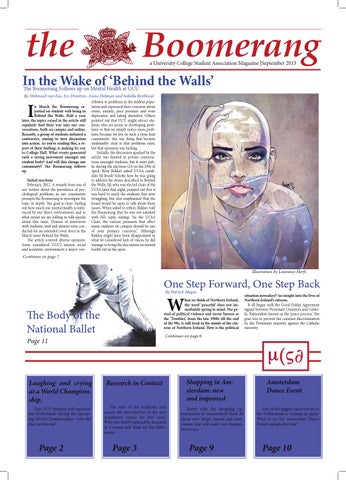
Continues on page 7 Illustration by Laurance Herfs
One Step Forward, One Step Back By Patrick Magee
W
hen we think of Northern Ireland, the word ‘peaceful’ does not immediately spring to mind. The period of political violence and terror known as the ‘Troubles’, from the late 1960s till the end of the 90s, is still fresh in the minds of the citizens of Northern Ireland. How is the political
The Body of the National Ballet
Continues on page 6
Page 11
Laughing and crying at a World Championship. Two UCU students will represent the Netherlands during the upcoming World Championships - how did they get this far?
Page 2
situation nowadays? An insight into the lives of Northern Ireland’s citizens. It all began with the Good Friday Agreement signed between Protestant Unionists and Catholic Nationalists known as the ‘peace process’. The goal was to prevent the constant discrimination by the Protestant majority against the Catholic minority .
Research in Context The start of the academic year meant the introduction of the new mandatory course for first years. Why was ASAP replaced by Research in Context and what are the differences?
Page 3
Shopping in Amsterdam: new and improved Bored with the shopping opportunities in Amsterdam? Read all about new shops, brands and renovations that will make you shopperheart race.
Page 9
Amsterdam Dance Event One of the biggest dance events in the Netherlands is coming up again. What is on the Amsterdam Dance Event’s agenda this year?
Page 10
The Boomerang 3the Boomerang| September | September2013 2012
02 The Bubble Editorial
M
y tutor once asked me: “The Boomerang, that’s the committee where you play with boomerangs on the quad, right?” Hearing this, I was indeed ready to target him with the entire collection of the Aboriginal Art Museum. But then I realized that he, like any UCU newbie, needed an introduction to the innumerable UCU traditions. We never got around to discussing my courses at that particular meeting. So if you too are puzzled by the paper in your hands: the Boomerang is the official magazine of UCU’s student organization. Founded by a group of pioneering students in the summer of 1998, it has been present in our community since the very first class taught here. I have to disappoint you: the name has nothing to do with Australian weaponry. It refers to the Kromhout (Dutch for “curved wood”) Military Base, as the campus was known before UCU’s existence. Twelve pages, black on white, a student creation from the first to the last word. The Boomerang has known many different formats, but the original premise has not faded away. At a place full of engagement, discussion and opinions, we want to be the student medium. The place where all of your thoughts and questions, otherwise lost in busy corridors and crowded meetings, can meet and reach others. Much is said about the critical outlook of a liberal arts education, but on the pages of the Boomerang, students prove why we speak about the “UCU spirit” with pride. Just like our community, the Boomerang has changed its focus over the years. Whereas fifteen years ago students started a rather unusual experiment, nowadays UCU sees itself as an established and recognized institution. We, students, continue to care and look out for it like we always did, as evidenced by the discussion started by the Groene Amsterdammer. This discourse has found its way on our pages, and hopefully won’t stop here. So, congratulations on your new subscription! A warning: we won’t deliver the paper on your doormat every morning at 6 a.m. That’s essay writing time, as everyone knows. But we do promise to appear once per month around campus and keep you informed on everything related to your student life. And we guarantee a better read than that article for tomorrow’s class. My tutor agrees. On behalf of the Boomerang board, Ivo Dimitrov Editor-in-Chief
Committee Corner: Enactus in Ethiopia By Zoë van den Brink & Janna Dijkstra
“Use your talent to improve the lives of people worldwide”
I
n this recurring feature, the Boomerang will take a look into the heart of our many committees. What goes on at those closed borrels and board meetings? What do they busy themselves with between events? Which goals have they achieved so far? First up: Enactus. Enactus is an organization that strives to improve communities through sustainable development plans. This business group is completely run by students and has branches all over the world. Enactus distinguishes itself from normal entrepreneurship enterprises by its focus on social (re)form instead of just money. When Enactus identifies a target group that needs their help, the organization comes up with a sustainable business idea. Eventually, they withdraw from the project, transferring their tasks to the target group so that it becomes a self-sufficient project that no longer needs continued support from Enactus. The UCU Enactus team is currently working on providing our sister University in Ethiopia with some much needed supplies through ‘Project Wollega’. Co-chair of Enactus, Gustaaf van Oosterom, tells us: “The students are forced to pay high prices for basic school supplies. Together with their student association we are developing a plan to build a stationary shop on their campus, making school supplies easily acces-
By Annerijn Vink
sible and affordable.” Enactus organized several events last year, including an art sale, a ‘tosti’ sale, and a bar party to fund the project. “We also sold school supplies in Dining Hall at the beginning of the semester. Everything was sold out very quickly,” Gustaaf adds. Important steps towards the realization of the campus shop in Ethiopia are being taken. However, communication between Enactus and the student organization at Wollega University has proven to be challenging at times due to their limited Internet access. “We are waiting for their drafted business plan before we can go further.” Gustaaf says. Two UCU staff members are planning to go to Ethiopia in December, followed by two students from Enactus in January. They will familiarize themselves with the school, which has a similar liberal arts philosophy, and will help set up the shop. The good news is that the Ethiopian campus already contains a building that could be used to sell the supplies. The money that would initially have been invested in the construction of this facility can now be saved for any troubles that may arise in the future. “Ultimately we will take a step back. They will take over the book keeping and run the operation.” Gustaaf adds that new members are more than welcome. According to him, “an Enactus member should be dedicated, curious and take initiative.” So, if any of you cherish dreams of changing the world, take that first small step and join Enactus.
Profile: Piet Lammers & Eline Oskam
Y
ou might have spotted her jogging around campus with her lacrosse stick. Or you could have seen him cycling daily to the rowing-course. Second years Eline Oskam (20) and Piet Lammers (18) both attended a World Championship this summer. How did they come this far? If you are as ignorant about “the fastest sport on land” as I was, here is a short crash course in the world of lacrosse. Every player has a long stick with a net on top. Using the stick, you throw the ball in the opponent’s goal. “Although it’s officially a non-contact sport, I’m often covered with bruises afterwards,” Eline says. Both of them started relatively late. After a rather unsuccessful soccer career, Piet discovered rowing at 14. “The discipline, strengthening your entire body and pushing to the utmost with your teammates, is what I love about rowing.” Eline’s lacrosse career stemmed from an exchange year in the USA, where the sport is very popular. Still, she was forced to join a men’s team. “Suddenly, these boys had to thump girls instead of being courteous”, Eline laughs.
The Bubble 03
Research in Context filling in for an old friend
Laughing and crying at a World Championship By Julie Albers
A University College Student Association Magazine
The lack of lacrosse opportunities in the Netherlands made Eline set up her own team in her hometown. She arranged for the keeper of the national team to be their coach and started playing in the league. The number of trainings increased when they got selected for the Dutch national team. During his summer course, Piet also practiced daily in Amsterdam. But there were fun moments too: the eight boys (unofficially) beat the Dutch team on some short distance sprints and improved their team spirit at a bonbon workshop. Eline went to Canada, Piet to Lithuania. Both found themselves staring with eyes wide open at their idols of the famous teams. Still, “you don’t have any contact with the other teams,” Piet says. “You’re really on your own.” Rowing on a beautiful lake near a castle, Piet’s eight performed well enough in the first race. They proceeded to the second semi-finals, mostly competing against the team from the US, finishing 8th out of the 14 teams. “The beautiful thing about a world championship is the intensity of your emotions. You practiced incredibly hard for a long time, and there’s so much stress.
When you lose, everyone cries; when you win, everyone jumps around,” Piet says. Eline arrived in Toronto. “The audience was wonderful: they love lacrosse and don’t ask if I’m catching butterflies,” she laughs. Despite the English-speaking countries rising above the rest, the Dutch team was happy to be 14th out of 19. Little gifts are exchanged before a lacrosse match; rowers swap each other’s outfits afterwards. Not everything is fun though. Soaking with sweat, Eline had to play matches in 38 degrees. Piet woke up at 6 a.m. to go to practice. But both wholeheartedly underline the uniqueness of such an event. So what happens after this climax? Piet switched to the student rowing-club Triton and keeps on rowing fanatically, hoping to win the Varsity one day – the most prominent Dutch student’s race. Eline is busy setting up two ‘development camps’ to encourage fresh lacrosse talent to train together. “But I mostly hope lacrosse will be reintroduced at the Olympic Games,” she says. “I dream about coaching the Olympic team someday.”
U
TRECHT, the Netherlands – This semester first year students are taking Research in Context, a new course replacing Academic Skills and Practice. Over summer, six UCU teachers have been working to redesign the obligatory academic core class all second and third years remember very well but did not evaluate with straight As. Instead of one teacher for the ‘skills’ and one teacher for the ‘context’, each class now has only one teacher. And rather than focusing on one specific theme, Research in Context puts, unsurprisingly, research in the center of attention. What is research? How do you set up and carry out research? And what are the main methodological approaches that can be found in Newton, Locke and Voltaire? “There were severe organizational problems with ASAP,” said course coordinator Annemieke Meijer. “Often the two teachers did not have time to consult each other regularly, resulting in two mini-courses.” Meijer, who studied English and is head of the Writing Center, taught both the skills and content part in one class last spring. Positive feedback gave the green light for a single instructor class.
“There were severe organizational problems with ASAP”
“In ASAP, instructors did a great job using a content theme to teach students about the different approaches to research. However, the themes themselves were arbitrarily chosen,” Meijer said. In Research in Context, the starting point is research itself. “That is not only more logical, but it also ensures course coherence. Even the five lecturers we invited to illustrate research from a personal point of view will speak to the entire cohort,” she said. ASC Student Assessor Madeleijn van den Nieuwenhuizen added: “Research in Context has a more natural balance between understanding the concept of research and academic skills. Less hair splitting about how to cite, but simply pointing out where to find the required information. After that, the truly interesting question can be dealt with: how do we conduct research?” The Little Brown Handbook is now only a recommended book, which illustrates the shift in focus of the course. While the aim of the course remained the same, the first UCU class of the first years was structurally different from the one the second and third years used to have. According to Madeleijn, first years reply “it’s fine” when they are asked about the class. “Which is actually a pretty good sign!” she said. Still, if students have complaints or suggestions, “our door is wide open for all academic related questions, complaints, and declarations of love.”
The silent class of 2015 By Hans van Deursen
W
here was my class of 2015, now second years, during the UCSA and ASC elections last year? Only three second years put themselves forward for ASC, and no one for the UCSA. This seems to go hand in hand with a decline of interest in the bar. According to former BarCo treasurer Steven Minke, the bar “earned approximately €50.000 less” compared to the year before. It is not unthinkable that my own cohort, class of 2015, has something to do with this. Second year Marcela Tripoli indicated that the academic pressure is very high, as there is “too much [academic] work for too little time.” What may have mattered is that UCU, having been first in several Dutch university rankings, seems to be perceived more and more as a guarantee for good education. This might explain why more academic oriented people seem to apply. Causing a shift in academic focus, these ambitious students focus on studying rather than participating in an active campus life. The decreased level of activity of second years could also be linked with financial cutbacks from the Dutch government, enforcing the importance of academics for the Dutch students. “Dutch students seem to be more focused on academics,” Marcela said. A theory often discussed over a beer says that campus involvement follows a cyclical pattern. In other words, the super-active class of 2014 crowded out the current second years. But there are currently 82 committee board positions filled by the class of 2015, compared to 64 from the class of 2014. Maybe the step to ASC and the UCSA Board simply seemed to be too big. MarathonCo Chair Sophie Bots said that “the UCSA Board and ASC feel more like something for third years.”
In other words, the super-active class of 2014 crowded out the current second years. Inge Schrijver, ASC Chair and a second year, confirmed this feeling. “But I really wanted to do something on campus, and ASC seemed like the right place for me,” she said. It is perhaps this strong urge to contribute to campus life that lacks among second years, including myself. Whatever the causes may be, I hope current first years as well as returning students remember that, as Steven put it, “the combination of social campus involvement and high academic standards is what makes UCU unique”.
UCU Lustrum: The Fifteen Years’ Experience By Marlijn ter Bekke & Vera van Rossum
O
n September 6, UCU celebrated its fifteen year lustrum with students, staff and alumni. A good reason to delve into our history, and who better to ask than two professors who were there from the start? Professors Jos van der Linden (History) and Hans van Himbergen (Physics) shared their experience. In 1996, a group of true educational pioneers set out to design and develop the first Liberal Arts and Sciences College in the Netherlands. One of them was Hans van Himbergen, who became the first Head of the Science Department and later UCU’s dean. During his years as a professor in the USA he had become familiar with the concept of Liberal Arts and Sciences education. This was the cure, he felt, for what he perceived as the ill-functioning higher education system in the Netherlands. “What I saw around me were students longing for a
broader education than the one they were getting at the regular universities. UC provided just that,” says Van Himbergen. Jos van der Linden joined the staff of UCU just before the very first semester in the Fall of 1998. Unlike Van Himbergen, he was not familiar with the Liberal Arts and Sciences concept, but soon discovered its many advantages. “I noticed that the students were experimenting with the concept in ways that I had not thought of, for example combining two different fields of study in an essay they had to write for Modern History. This opened my eyes to the possibilities of a broad education, and I decided to make it an explicit part of the history program.” The initial absence of organization provided teachers with the opportunity to shape their own courses. “In the beginning there were only 100 level courses, which gave us the opportunity to devise a completely new curriculum. A wonderful sense of freedom.” Of course, there was also a down side to this
freedom. Students and teachers alike were often groping in the dark about the direction their education was to take. Over the years, much has changed. The concept Liberal Arts and Sciences is now far better understood and applied, both at the college and elsewhere in the Netherlands. Because of the accomplishments of its alumni and its excellent accreditation, UCU’s international reputations has grown. This, in combination with more intensive student recruitment internationally, has resulted in a more diverse campus population than before. Both professors stress that, despite the changes, they still feel the very same enthusiasm as they did in their very first weeks. It is exactly this feeling that might just keep them around for another fifteen years. Who knows, we might be interviewing them again for the next lustrum.
The Boomerang | September 2013
04 The Bubble
Heavy Construction Work for Better Transport
By Eugenia Melissen Ferrer
W
A banana a day....
R
Surprisingly, nobody has mentioned caffeine yet. Luckily, second year Timothy Merkel springs to the rescue. “It all depends on how much time I have”, he says, quickly adding: “but coffee is pretty much the most important part of starting the morning.” If there’s time for breakfast, he likes it hot. No complicated fry-ups though: plain porridge will do. Timothy’s ideas on morning rituals: “These are all things you do to energize yourself for the day and you’ve got to figure out what’s going to have the biggest concentration of energy to do that.” Third year Linda has the most spiritual approach: if there’s enough time, she prays. This is the most complicated ritual as there is a lot of hand, face, head, leg and foot washing involved before the prayer actually begins. Praying is “the best way to start your day”, Linda says. She admits to being a bit superstitious about the possible consequences of missing her morning prayers. It’s easy to start thinking that “everything could go wrong.” Apart from it being her duty as a Muslim, Linda’s morning ritual keeps her mind balanced and ready for a new day.
Linda’s prayer beads and prayer mat
Morning transformation
The salsa capital of the Netherlands By Paula Ozola
T
he streets of Utrecht are vibrant in the evenings: people chit-chatting at cafes after work, rushing to the supermarket, and… cycling on their way to a salsa party. Exactly, quite a lot of Utrecht’s inhabitants spend their evenings dancing. Believe it or not, it’s not that difficult to become one of them. Utrecht has a lot to offer when it comes to salsa. From the outside Café Maria and Stairway to Heaven look just like any other café in town. But wait till you get in: you feel, hear and see the difference. Tables and chairs are put aside to create a dance floor, and you can already hear Mark Anthony’s or Luis Enrique’s voice and the classic salsa, bachata or merengue rhythms. Your first salsa party demands some courage – luckily facilitated by the bartenders ready to serve you a confidence-increasing shot. Perhaps intimidated by all the amazing dancers, do not underestimate your capabilities. People are friendly and always willing to teach you some moves. Or come early and follow a workshop which will introduce you to the basics of salsa. My first salsa party ended at 5 am only because the DJ stopped playing. I could have continued dancing until sunrise with the amateur salsa champion of Holland. Who would have thought that a guy like that would dance with me – a beginner?! Salsa is a social dance with lots of interaction. Most dancers are a bit older than you and usually a few men even remind you of your grandparents (until you see their dance moves). You’ll meet a guy who keeps asking you for a dance, or a girl who continuously smiles at you. Don’t be surprised if someone asks your number. Yet remember that this is only a secondary thing; a salsa party is all about living in the moment and enjoying it to the fullest. Besides the salsa evenings in little places like Café Tropical, every few months huge salsa parties are organized in the Winkel van Sinkel and at the stadium. Especially the last one is an extraordinary experience: the dancing floors are wonderful. At the end of the evening, you are soaked in sweat and feel an ache in your feet. Huge amounts of endorphins have been released, people are waving you good-bye and you feel genuinely happy. Be aware: salsa parties may cause a serious addiction! Salsa is just an amazing way to forget about your deadlines and stress. Plus, it’s an exciting way to get to know Utrecht from a different angle. Whether you’re already taking salsa classes on campus or not, you can always join UCU’s salsacilious group headed to town on Tuesdays (Stairway to Heaven) and/or Thursdays (Café Maria). More information for salsa in Utrecht? Visit: http://salsa.latinnet. nl/salsa/agenda/utrecht-stad/
How Utrecht’s houses witnessed slave trade By Mara Wendebourg
W
To round things off, Tycho Tromp shows us how to do mornings the Dutch way. Three essential elements: his bike, ‘vlokken’ and national pride. After turning off his alarm which he puts a few meters away from his bed, a shower follows. Then he tucks into some cornflakes with milk (don’t separate a Dutchman from his dairy) and ‘chocolade vlokken.’ After packing his backpack for the day, his bike awaits, ready to transport him to his first class, admittedly a long distance from X (Newton) if you’re in a hurry. If in doubt, don’t walk but cycle in Holland.
The municipality originally came up with the idea for this construction in 2006, but the start of the project took much longer than anticipated, because the necessary finances of more than 320 million euros had not yet been secured. The estimated time of completion is four years and hopefully, if there are no more delays, the first trams should be up and running by 2017. Despite this promising prospect, locals have raised concerns about the roads that are under construction. For one, the cycling routes are changing continuously, and often without clear indication. For now, if you do decide to venture out of the bubble, make sure to not get lost in the rubble.
ecently, the already difficult task of leaving the bubble has been made even harder due to the severe construction sites around campus. It does not matter whether you’re by bike or by car, it´s simply going to be a bit of a nightmare. All these traffic nightmares are caused by the transformation of the Prins Hendriklaan into the primary cycling route from the city center to De Uithof, whilst the former bike paths of the Weg tot de Wetenschap are slowly being converted into a tramline. According to one of the men working on this long process, the new roads will be used to accommodate theSander ever-ongoing traffi1 c stbeyear Hintzen, tween the center of Utrecht and De Uithof. This transformation has already been going on for a few months and as a consequence, has led to a whole lot of confusion and frustration among all the road users. The cycling route between the city center and De Uithof is one of the busiest streets in The Netherlands and the municipality is aiming to make this route not only much safer, but also more easily accessible and recognizable for cyclers. The planned tramline from Utrecht Centraal to De Uithof is scheduled to be finished by 2018. Once construction has been completed the tramline should make the commute for students faster and smoother. While that sounds good in theory, this is not necessarily good students for UCU students.
His involvement on and off campus (academics, two jobs, UCWorld chair, UCSA Independent Body, three political parties) leaves him no choice but to sacrifice sleep. Pau’s morning strategies include: 1. Placing the alarm between piles of books “where non-delicate items may easily fall from place”, making extra noise. 2. Placing the alarm somewhere in a full closet where retrieving it “requires extra effort.” 3. Leaving the alarm on the rim of the sink, where he can splash cold water into his face directly after turning it off . In comparison, second year Mariel Navarro is a lot easier to please . Just give her a banana after waking up and she’s good to go. It’s funny how one fruit can provide so much bliss. When asked if she prefers bananas to say, strawberries or apples in the morning, the answer is a resolute “yes.
Rather than using your morning as an opportunity to hit the snooze button exhaustively, perhaps it’s not a bad idea to experiment a bit more. Who knows? It might make your 9am just that little bit nicer.
Two major construction sites interfere with the smooth passage through the local neighborhood but will ensure safe cycling routes and an efficient tramline in the future By Zoë van den Brink
First up, third year Pau Castellví Canet gives an account of a complex reality: His Morning.
This is all very nice, but what happened to all the girlie girls? This is where second year Laura Kropp butts in to remind us that doing your hair and make-up is an essential part of starting the day as a woman. No, we’re not vain. Yes, we will make time for it. Even.if.there.isn’t.any. Laura’s morning rituals include making a cup of tea, brushing her teeth, doing her hair, getting dressed, doing her make-up (“I paint my face on”), packing her bag and brushing her teeth again before class. Oral hygiene: check. Perfect eyeliner: check. There are worse ways of starting the day.
Local 05 Minh Tue Le Ngoc, Sanne van der Steeg and Fisayo Toforate
Good morning, governor! e all do it. We all hate it. Hang on, I hear some love it. Either way, we have no choice: waking up is a part of everybody’s day. If you’ve ever wondered what other people’s morning rituals (or daily struggles) look like, you are about to get a sneak peak of just that.
A University College Student Association Magazine
hile spending your Saturday afternoons strolling through town, have you ever wondered about Utrecht’s history? Did you realize that the slave trade has also affected our beautiful city? This year it is 150 years ago that slavery has been completely abolished in the Netherlands. Thanks to historian Esther Captain, who designed a walk along the remains of this dark age, you can now find yourself wandering through the Utrecht of 1750. During the Dutch golden age, thriving trade brought wealth and prosperity to the coastal provinces Holland and Zeeland. The large companies VOC (Dutch East Indian Company) and WIC (West India Company) were founded in 1602 and 1621 respectively to administer the trade between the Dutch Republic and its colonies. In Indonesia, the VOC would acquire spices and ship them to Europe. The journey to the West on the other hand included a stop in Africa, from where people were enslaved and taken to the cotton or tobacco plantations in the Caribbean. The final st objective of this year demand triangular trade Amy was to Claire meet the Bush, growing1European in the plantations’ products. 1. Self-expressive The merchants who worked in service of these com2. Dress - high street shop in Surrey, England. Lace top charity top in Camden, London. Shoes - charity shop in Surrey, England.
panies usually spent time working in the colonies and returned to their hometown once they had gathered enough money. They often also brought their domestic help home with them. Because the Dutch Republic forbade slavery in the Seven Provinces, these employees had a better status than enslaved workers on the plantations.
This year it is 150 years ago that slavery has been completely abolished in the Netherlands. Historian Esther Captain, associated with the Center for the Humanities of University Utrecht, created an interesting account of the social diversity Utrecht hosted by collecting and gathering information about its houses. The aim of her work is to show that the international slave trade of the 18th century also had an impact on peripheral cities like Utrecht. She found the houses of traders, the homes of freed slaves, nd Jaehoon yearof slavery’s and finally the legacy of localJeong, protesters2in favor abolishment. One of these interesting houses is located on Drift
27, nowadays the university library. It was the home of Joan Gideon Loten, governor of Ceylon (now Sulawesi and Sri Lanka) from 1752 to 1757. His testament and the epistolary exchanges with his brother show that he had a native Batavian (modern day Jakarta) maid and took great care of her. Another exceptional case is the one of Eduard van Akaboa, who came from Angola. He bought his freedom and became a weapon engraver on the Drieharingstraat. Then there was Nicolaas Beets, a member of the Dutch Society for the Promotion of Abolition, who lived on Boothstraat 6, where he wrote activist poetry influenced by the British Parliamentary Wilberforce. More stories related to the slave trade are still to be found during a walk in Utrecht one and half centuries after it has been abolished. It counts as a testimony that its peripheral location did not hinder the establishment of a cosmopolite society. So look beyond the Albert Heijn and the shops at the Oudegracht and gain some insight into Utrecht’s vibrant history.
Isabelle van der Vegt, 1 http://www.sporenvanslavernijutrecht.nl
st
year
1. I wear what I like and I like what I wear 2. Shirt from - Sway in Berkeley, California. Coat - Vera & Lucy, Pants - ZARA. Shoes - New Yorker. Necklace Fashionology.
Ththe e Boomerang Boomerang| |September September 2013 2012
06 Global
Travelogue: Shiok in Singapore
S
The Boomerang Follows up on Mental Health at UCU
ingapore isn’t just a great holiday destination, but also a fantastic place for an exchange. For this first travelogue, we interviewed Singaporean Pranav Sethaputra, who shared some of his perspectives on the Asian city-state with the Boomerang. Singapore is well-known for being clean, safe and sterile – though this image might be a bit exaggerated. The island is a mishmash of Asian and western influences, which are visible in the blend of languages that the Singaporeans speak. According to Pranav, Singaporeans, much like the Dutch, have a very direct approach in conversations. “If you compliment someone on their shirt, they always give an answer like ‘Thanks, it was only five euros!’ People always need a specific reason.”
By Welmoed van Ens, Ivo Dimitrov, Anna Dolman and Sabella Berkhout Continued from cover UCU in the media and online The topic was brought to students’ attention once more when the well-known Dutch magazine De Groene Amsterdammer published an article on excellence in higher education on the 5th of June. The article, titled Competition on Campus, outlines the recent shift towards excellence in Dutch universities and how this is affecting students, quoting Behind the Walls. In discussing the increasing need for students to distinguish themselves in order to succeed, it cites UCU as an example where high standards can cause a lot of pressure. Suddenly, the mental health of UCU students had been placed in a national perspective, once again emphasizing the need for it to be addressed. On the 6th of September 2013, De Groene Amsterdammer published an online letter from former UCU student Auke van der Veen. In an opinionated response to Competition on Campus, he expresses his dissatisfaction with UCU due to what he describes as an unhealthy and unnatural environment. In an interview with the Boomerang, Auke says he believes that the original article did not focus enough on the negative aspects of UCU. When asked what he hopes to achieve with his article, Auke says he merely wanted to express an unconventional point of view. “I wanted to stress that there are still so many things that need to be improved.”
DO: - Visit the renowned tourist attractions: Universal Studios at the island Sentosa; the Underwater World; and the world’s most expensive casino at Marina Bay resort. - Go to the bird park. As Pranav explains: “You get a bowl of honey with some food in it, and then the birds sit on your head and shoulders. You actually feed them out of your cup – it’s wonderful.” - Explore other districts, such as China Town, Little India and Arab Street (great for shopping!). Singapore’s multicultural atmosphere makes walking through its diverse cultural hotspots a great experience. - For the shopaholics, there is a huge Louis Vuitton store. - Eat. A lot. Singapore is a culinary paradise. Roti Prata (delicious Indian pancakes) and noodles, which taste better in Asia than on any other continent, are just two of the many delights that can be found in Singapore. - If you have some money to spend, stay at the Marina Bay hotel. The hotel consists of three towers, which are connected by swimming pools. At night it is an amazing experience to go into one of the swimming pools and look out upon the Singaporean skyline. - Party! Clark Quay is the party district in Singapore. Its fancy restaurants and bars will ensure an unforgettable experience for visitors. DON’T: - Smoke. It’s difficult and expensive to smoke in Singapore. Aside from the yellow boxes, the entire island is basically a non-smoking area. - Chew gum. You can’t buy gum anywhere in Singapore. This is because people would stick their eaten gum into train doors, which after a while would no longer open. - Bring drugs (or any kind of decorative bullets and other weapons into the country). - Eat durian (a fruit with a very particular flavor) in a train, because of its very strong smell. Also, while on the subject of trains: don’t go looking for a dustbin – there are none in the stations and trains, because it’s feared that people will put bombs in them.
By Laetitia Boon
T
he aftermath of this year’s elections in Zimbabwe has left many people confused, but just as many indifferent. Why is it that Zimbabweans have given up on their nations’ politics? When I was in kindergarten in Bulawayo, we would play on the jungle gyms and sing songs about how Mugabe would soon lose power. On election days I would see my friend’s parents come home, their fingers purple after having waited for hours in the boiling sun in order to vote. When I got older, we would fantasise about Tsvangirai and his Movement for Democratic Change winning the next elections, and that things would get better again. But it never happened. On July 31st of this year, presidential elections took place once again. Due to the notorious illegality of previous proceedings, many institutions were put in place in order to ensure that the elections would be “Free and Fair”. Now, two months later, people are still debating about the outcome of the elections. Mugabe, the president of Zanu Patriotic Front, won with 61%, renewing his term for another five years. He completely destroyed the fragmented opposition MDC, who only got 34% combined. At 89, he is the oldest dictator in Africa, and has ruled Zimbabwe since its independence in 1980. South African president Jacob Zuma congratulated him for his victory, and the South African Development Community also showed support. MDC president Tsvangirai claimed the elections fraudulent. But many now believe that such claims of unfairness are not based on facts, but reflect a failure to accept defeat. However, the suspicions that Zanu PF has once again used unlawful tactics, remain. Emil Kee-Tui, a student in Bulawayo, mentions “extending the voting role to beyond the grave” as an example – making dead people vote through Zanu PF officials, a practice that has been used repeatedly over the years. Regardless of these problems, the elections were peaceful. Many Zimbabwians have decided to accept the outcome, even if disappointed and surprised with the results. Outside viewers may be shocked with this sentiment of “political apathy”, but it has become a necessity in a country where the political situation has not changed in 30 years. Tsvangirai, the only alternative for Mugabe, has recently been under fire both from outside and from within the party. As Bramwell Ndlovu, a Zimbabwean musician, puts it: “Zimbabweans do want change, but no one wants Morgan Tsvangirai due to his short temper, womanising, selfishness and lack of leadership qualities.” It has been suggested that Tsvangirai should resign, but he has outright refused, stating that leadership renewal is not needed. Many Zimbabweans agree that they wouldn’t want to trade one dictator for another. “Rather the evil you know than the evil you don’t,” says Kee-Tui. Indeed, Tsvangirai has been the MDC party leader since its creation in 1999, and seems to share Mugabe’s unwillingness to step down. So what can Zimbabweans truly do about their situation? Without a strong opposition to put their faith in, very little can be done legally. Hence, they wait. Maybe change will come someday from an unexpected corner.
Cover Story 07
In the Wake of ‘Behind the Walls’
By Emma Douma & Rosalie Fidder
“Rather the evil you know than the evil you don’t”
A University College Student Association Magazine
One Step Forward, One Step Back By Patrick Magee Continued from cover Nowadays Unionists and Nationalists are required to share power in government. This is far from ideal: no side can dominate which often leads to impasses and a lot of frustration. However, at least for the time being, this is the only viable solution. Northern Ireland has cast off the burden of the Troubles but it still clings to the nation’s heels as it marches toward peace. Catholic Nationalists have a hard time to forget 800 years and counting under British rule; Protestant Unionists are anxious about the too realistic threat of being subsumed into the Republic. Even fifteen years after its peace, Northern Ireland remains a hotbed of political violence. Every year still riots break out between Nationalists, Unionists and the police. Unrest has increased during the past two years. The Protestant majority of Northern Ireland is decreasing, which means that the numbers of Catholics and Protestants are becoming more equal. A big up-rise of violence took place in December 2012 because the Belfast City Council voted to remove the Union flag from atop City Hall which had previously flown every day of the year. This decision sparked riots across Northern Ireland but the main violence was in the streets of Belfast. Unionist rioters attempted to storm City Hall and for several months protesters blockaded streets demanding the Union flag be returned to its place. The protests are still ongoing but on a much smaller scale. And this is merely one example out of many. Why do these heated riots keep occurring, such as the clash between Unionists, Nationalists and the police during a parade only three months ago? Unionists are feeling apprehensive with the population numbers changing. They fear that a united Ireland is approaching and they will lose their cultural heritage in a Catholic dominated republic. That fear has manifested itself in the increased unrest of the past year, causing Unionists to be the main aggressors instead of the Nationalists. The police checkpoints, the army patrols and the frequent killings that defined the Troubles are gone. But even the peace process has not succeeded in transforming Northern Ireland into a peaceful country. It will continue to be a segregated place where Protestants and Catholics live together yet completely apart at the same time. Riots will carry on being a routine happening every year. The future is hazy for Northern Ireland. Will its divided people find a common ground where they can live in true peace? Or will the peace process become a small period of history in a larger tale of political violence?
Suddenly, the mental health of UCU students had been placed in a national perspective, once again emphasizing the need for it to be addressed.
The article evoked emotional replies and lead to explosive discussions amongst students and staff. Some students jumped to UCU’s defence, others could relate to it. Surprisingly it was UCU’s alumni association, and not the current student body, that appeared to lead the discussion. On the UCAA facebook forum, alumna Laura Scheske comments: “The reason I found this article distasteful is the way it is written - totally one sided
and very much ignorant of all the positive aspects of UC.” Daniel Craanen, class of 2013, adds that he is disappointed in the way Auke expresses his concerns, which he describes as “vomiting all over the internet, rather than constructively challenging the educational system at UCU.” Alumna Hinde Haest even wrote a letter in response which De Groene Amsterdammer published online on the 12th of September.
“I wanted to stress that there are still so many things that need to be improved.” Eventually, the heavily critical discussion about Auke van der Veen’s article turned out to be fruitful. “Granted, the article is rather one-sided and a tad unreasonable in places, but there are plenty of things in there that are worth taking seriously,” says Joël Zwaan, who graduated in spring 2013. Students, alumni and tutors started exchanging ideas on what could be improved. Inspired by the wealth of contributions, the UCSA board, ASC and Boomerang met to formulate a plan of action and decided to organize a conference open to all students: Let’s Talk. Let’s Talk On the 19th of September, 48 students gathered in Locke to discuss topics such as social and academic pressure, support systems, financial worries and pressure from outside. “I think it’s very good to be able to reflect on our experiences and reevaluate the overly-positive narrative we tend to construct,” comments one participant. Those present also came up with possible solutions to the problems they identified. “It was better than I expected,” says another attendee. “It was constructive. The atmosphere was very intimate, and it was cleansing being able to share and reflect.” The suggested solutions range from adjusting Introweek, to represent both the academic and social life at UCU in a better way, to implementing a buddy system. Most ideas come down to the need to promote openness and awareness within the student body and to support each other. Students agree that not much can be done about the academic and financial structure already in place, but that we can change the way we deal with it. “Ultimately, we have the responsibility to accommodate for our own needs,” comments another participant. “We need to nourish a communal culture where we can be open about positive and negative experiences, based on our community and not on competition.” Moving Forward It’s been half a year since the Boomerang started the discussion. Now that a report has been written based on the contributions of the students that attended Let’s Talk, we have access to a somewhat representative and comprehensible account of how students experience mental health for the first time. With a clearer picture of the situation slowly emerging, students are beginning to share their ideas on what should happen next. Not everyone proposes radical changes. “The college is already very involved in monitoring how we’re doing through the tutor system, personal contacts with teachers and support from ASC, UCSA and Mark Baldwin. There is not much more UCU can do to help us out,” says an anonymous third-year. Second-year Lina Knol, who has suffered from several depressive episodes in the past, believes there are no easy solutions: “Asking students to be more proactive about their mental health is based on the wrong assumption that mental health problems are easily dealt with by the ones who suffer from them; you can’t be proactive about a sickness that tells you to not talk about anything and stay in bed.” Others believe that the current situation leaves room for improvements. Proposed changes are talks given by older students and alumni in which they share their experiences, or more involved and supportive Introweek-parents. Ella van der Pol, sec-
Timeline: March
25th April
The Boomerang publishes the article Behind The Walls, shedding light on the mental well-being of students on campus.
of
The article is mentioned and discussed in the General Assembly.
6th of June
De Groene Amsterdammer mentions Behind The Walls in Competition on Campus, an article about excellence in higher education. 6th of Sep- De Groene Amsterdammer publishes a letter from a former UCU tember student online. - 11th of September: A group of studen 11th of A group of students meets to disSeptember cuss how to convert the criticism into positive changes. They decide to organize an event.
18th of Students organize Let’s Talk, September where they discuss mental health on campus.
ond-year, suggests that a buddy system might lower the threshold for students who are looking for support. A former student who was forced to leave UCU due to mental health problems last year adds: “At that time I really felt like I was the only one who was going through this, so being able to talk to someone your own age would definitely help.”
“Ultimately, we have the responsibility to accommodate for our own needs”
And what about College Hall? Student Life Officer Mark Baldwin tells us that he is interested in the outcomes of Let’s Talk. “I think it’s potentially very productive when students organize discussions on important topics.” When asked if UCU should make any changes to the existing structure, Baldwin replies: “In the short term, this depends somewhat on the recommendations which come from the Let’s Talk conference. As an organization we are in almost constant review of how we function and what we do.” As far as the UCSA is concerned: after being asked about the long term goals that emerged from Let’s Talk, chair Sil Boedi Scholte promised the General Assembly that the board would do its best, where appropriate in collaboration with ASC. Although they have not come forward with concrete ideas yet, the UCSA is planning on discussing the report that emerges from Let’s Talk with College Hall and hopes to formulate a strategy from there. For now it is still unclear whether any changes will be student-initiated or implemented by the management and what these might entail, but one thing is certain: by organizing and participating in Let’s Talk, the student body is showing that it is more than willing to take the lead and advance the discussion. As one participant said: “We are constantly shaping our own environment; campus is what we make of it. If we want to bring about a change in attitude or set up a support system, we have the potential to make that happen.” As long as we keep being critical, it seems as if change, in any form or shape, could be just around the corner. The Boomerang will keep you posted.
Thethe Boomerang | September Boomerang | September2013 2012
08 Opinion Vegetarianism: Encouraged by UCU?
V
You’re no Superman By Vincent Gerez
L
ately, it seems like everyone on campus has been rethinking the way UCU students should live their lives. The pressure to perform well in academics, participate in committees and, on top of all, bar-hop every night is simply too high. So high that not being able to cope with this pressure makes people unhappy or insecure about themselves. While many argue for fewer readings, events and party nights, I think there’s nothing wrong with the current system. It’s good for us that we can’t cope with the pressure. To start with the source of the students’ unhappiness. Due to the selection procedure of College Hall, students admitted to UCU are typically used to being able to do everything. They perform well in high school, go to multiple MUN conferences, are active in all kinds of sports and still have time to hang out with their friends. Upon our arrival on campus, we find out this is exactly what UCU’ers do, only that much more intensely. We soon realize we cannot be the superhero we used to be, whereas everyone else is seemingly able to do everything. Now that “going with the flow” is not an option anymore, we want the “current” to be slowed down instead of facing the fact that we are only human and that we will have to compromise our former lifestyle. However, isn’t being an individual supposed to be about defying the norm? About living life according to what you find important and not what society thinks you should be doing? Now that we have collectively recognized that none of us is the norm, it is time that each of us, individually, learns to prioritize. Reconsider whether you really believe it crucial to have done all your readings for every single class, to join committee boards or to be partying it up every Tuesday and Thursday. You do not need to go through this process all by yourself: do talk to your friends, tutor or student life officer. Nevertheless, do not forget that in the end you are the one giving direction to your life. Consciously taking responsibility for your life will give far greater satisfaction than finding yourself struggling to adhere to the social standard. Reading the UCU website, going to the open days and finally choosing to go to UCU, we have never been lied to about the pressure that is present on campus. Even the Dean explicitly states in his yearly talk that the time of being good at everything is over. Despite these warnings it’s only much later that it hits us: we are no longer the exception to the rule. We must now decide whether to lower the bar so we can all live life as excellent students, or whether to see this confrontation as an opportunity to find out who we truly are. In the end, excellence does not lie in the ability to conform to the norm, but in the capability to defy it.
By Sanne van der Steeg
L
overs of style and fashion may have been a little disappointed during previous shopping trips to our capital city, Amsterdam. As well as being completely jam-packed most of the time, the previous assortment of shops lining the main streets, in particular the Kalverstraat and Leidsestraat, wasn’t particularly inspiring. With not much more than the De Bijenkorf, the Zara and two H&M’s, the shopping district was perhaps a little disappointing when compared to the high-street stores in London, Berlin, or Stockholm. For those who despaired, and vowed never to return to Amsterdam for shopping trips, there is good news. After the implementation of a new CEO, De Bijenkorf has decided to shake things up, and have decided to invest more than 200 million euros in their seven remaining locations. As part of the renovation plans, on the 2nd September of this year, De Bijenkorf in Amsterdam opened two Topshop
Illustration by Janna Dijkstra
all that she provides. It is to understand that premature death through diet-related illness is a completely unnecessary risk; that by virtue of being modern human beings we have developed the cognitive faculties to counter a dietary protein and vitamin B-12 deficiency. My own vegetarian inclinations have not been for long, but after one month of living at UCU I feel anything but discouraged to put down my steak knife, take responsibility for my food choices, and grab another pesto panini.
Is there hope left for Femen? By Geertje Bol
R
UC Style 09
Shopping in Amsterdam: new and improved
By Dominic Stephen egetarianism is on the rise in the West and UCU has only helped confirm this global trend. I’ve noticed considerably more students banging the vegetarian drum here at UCU than back at my old East London suburban school. I wonder why? Does the UCU Admissions team search for students with a certain intelligence and awareness; with qualities beyond the generic academic and extracurricular expectations, and a perspective that the Vegetarian Decision can entail? Maybe it’s just a coincidence. All I know is that either there’s more vegetarians in The Bubble than there are on average, or the Dining Hall’s pesto and cheese panini’s taste really bloody good. I don’t think it would be too radical to say that the Dutch lifestyle is complementary to the philosophies often embraced by the vegetarian community – in Holland recycling is widely facilitated; freedom of speech and expression encouraged; the lost tourist will be kindly offered the correct directions by a local; and even after a month I still feel a touch sentimental about the Dutchie’s unshakeable and admirable devotion to their bicycle. It’s a country whose spirit is healthy, helpful and progressive – reflective of the average vegetarian’s principles, you might say. Ethics is a messy business. The reader will be relieved to know that I will steer clear of this prickly issue, and spare them the animal welfare sermon that we know all too well. No, I think the conversion to vegetarianism – or its less restrained sibling, pescetarianism – is one of holism. Documentary-films such as ‘Forks Over Knives’, ‘Food Inc.’ and ‘Vegucation’ enlighten us to the inhumane, unnatural and unsustainable processes that may churn out their next meaty meal. I challenge the conscientious viewer to deny that they feel ever so slightly guilty about supporting these largely corrupt, contaminated and sociopathic industries. And this mental process requires an awakening. It challenges the consumer to look up, over their dinner plate and consider the implications of their purchase. It is bewildering to discover that the world’s transport industry is out-polluted by the methane-emitting farm animals; it is frightening to think of the corn given annually to the forty two million animals in the U.S. could be redirected to the deprived masses in Africa and Asia; and footage of veal-farmers dragging wailing calves, still covered in their protective in-utero slime, away from their howling mothers is heart-breaking. Vegetarianism is the opposite of denial - it is a considered detachment from a Western culture that, directly or indirectly, perpetuates the obsession with exploiting Mother Earth for
A University College Student Association Magazine
ecently I came across a documentary about Femen, a feminist organization that operates through topless protests. Founded in Ukraine in 2008, the organization has branches in ten different countries and aims to fight “patriarchy in its three manifestations – sexual exploitation of women, dictatorship and religion”. Women showing their breasts for the cause of feminism – that obviously attracts a lot of media attention. But with that attention comes a lot of criticism. Why do women need to show their breasts in order to get (male) attention for feminism? The Femen
activists – or sextremists as they call themselves – are slim, young and attractive, once again showing that in order for feminism to be popular, feminists have to be hot. But is taking your top off really going to achieve anything? I can understand where they are coming from. Feminism in Ukraine leaves a lot to be desired and shocking and provoking people may be useful. But bare breasts, at least in Western Europe, aren’t shocking anymore, they regularly appear on television and the beach. I’m not saying that in Western Europe feminists are dispensable. There are still things to fight for. But these issues will not get fixed by wom-
en taking their tops off. Recently, something was revealed that might be the kiss of death for Femen: the revelation that the organization is actually led by a man. The new documentary Ukraine Is Not a Brothel by Australian filmmaker Kitty Green claims that Victor Svatsky is the man behind Femen. Does this mean that Femen is completely done for now? Not necessarily. I think the organization needs to move on past this sextremism and focus more on oppressed women and garner media attention in better ways. Only through being more concrete about their goals, will they be able to achieve something new.
shop-in-shops, one for men and one for women. Topshop, a popular English brand, offers a unique spin on the latest fashion trends. At (relatively) affordable prices, Topshop is a must-go destination for those looking to add to their wardrobes, or for those simply looking for inspiration. De Bijenkorf have also started selling new brands in their own collection including All Saints, Rag & Bone, Phillip Lim, Avelon, l’Agent by Agent Provocateur, Juicy Couture and Tory Burch. During the summer, All Saints opened their flagship store on Heiligeweg in Amsterdam. Known for their cool boots, quirky dresses, chic blouses, all with a rock ‘n roll-twist, All Saints will be well worth a visit. Although the opening date has yet to be announced, as well as Topshop and All Saints, on 17th October Amsterdam will also be home to a brand new Urban Outfitters, to be found at 31-33 Kalverstraat. Often described as a store catering to the ‘hipster’ public, Urban Outfitters will be selling clothing and accessories as well as modern art, music, books and other knick-knacks
perfect for the home. At the end of 2013, Forever 21 will also be opening a flagship store of five floors in the Rokin Plaza, close to the Kalverstraat. Catering to both men and women, Forever 21 offers a wide variety of very affordable fun pieces, perfect for nights out. For those of you who simply cannot function without their Zara there is good news for you too. The Zara on the Kalverstraat closed for 3 months over the summer, and when it opens again some time in October it will be double its original size. The new Zara will also be selling limited edition stock, which can only be found in a few select stores worldwide. With all these new stores opening, it seems Amsterdam will be the perfect place to shop for those essential autumn and winter items. Let’s hope this is just the beginning of Amsterdam’s transformation, and fingers crossed there’s more to come!
Benjamin Assante 1. What are you wearing? I am wearing a grey blazer from the ‘vintage’ wardrobe at home. It is probably dating from the 80’s. The red trousers are just simply one of my favourite. Then there are the coloured socks, which are from NYC. -I got them as a gift. The shoes are van Bommel shoes, I have to stay patriotic I guess. Furthermore, the scarf is from Ghana, with a family brooch attached to it. Ah, and the shirt is from Utrecht’s own Episode store, picked out by the eyes of someone who embraces the Polish ‘cool’ 2. Where’s your favorite place to go shopping? My favourite place is Berlin, London and my mother’s wardrobe I assume... In these cities I can find the most diverse and rare distinct pieces of clothing, which truly entice me. And my mother for some reason has many old clothing which is too large for her (perhaps fashionable at the time), hence perfect for me! 3. Describe your personal style and its influences/inspiration? I do simply observe what and how people around dress. Their trends, and colour combination I can very much enjoy paying attention to. Furthermore, for certain patterns or textures actual fashion may be interesting. However, concerning what I am wearing I do just pick the first things I like from my wardrobe, see if it matches yes or no, and put it on. -I do like to add a tad new to my clothing combinations every time.
Katie Mudd
1. What are you wearing? I was wearing a white shirt from H&M and a blue pair of shorts from H&M and a black pair of doc martens 2. Where’s your favorite place to go shopping? I enjoy shopping at thrift stores as well as American Apparel 3. What’s the first thing you look at in another person’s outfit? I usually look at shoes first.
Grace Hardman 1. What are you wearing? I’m wearing a Kate Moss for Topshop dress layered with my favourite sheer Topshop blouse. Over that is an Urban Outfitters “Urban Renewal” Harrington jacket and the bag was a gift for my birthday. My cream tights (an essential if you’re bored of black) and leather heeled brogues are from a vintage fair. 2. Where’s your favorite place to go shopping? Shopping in London is super fun. The Oxford Street Topshop is like a huge library of clothes, and Greenwich has the most amazing vintage shops. 3. Are there any fashion icons or famous people whose style you admire? I absolutely adore Alexa Chung, Ellie Rowsell (from wicked band “Wolf Alice”), 1970’s psychadelia and Noel Fielding.
Mark Lambert
1. What are you wearing? A khaki coat from FCUK, checked shirt from Episode, skinny grey jeans from H&M and New Balance trainers from Urban Outfitters. 2. Where’s your favourite place to go shopping? The vintage charity shops are always great, I discovered Episode on the weekend which had some pretty cool stuff. There are a lot of these shops in Leeds which is where I’m on exchange from, but Episode is the biggest one I’ve seen for a while. 3. What are your favourite bands? Bloc Party, Chic and Fleetwood Mac.
The Boomerang | September the Boomerang | May2013 2012
10 Colosseum The Cheaper, the Better By Eva Nivard
I
t’s a rainy and boring Saturday afternoon. The entire campus has gone home, you don’t have classes today and your homework…. well, that can wait for another day, right? You don’t have appetite for Dining Hall food and you’ve been to the bar way too many times in the last week. Why not be adventurous venture out of the Bubble? Don’t be scared, I’m sure you’ll be fine in the big city. Besides, I’ll guide you. Since everything is better, tastier and prettier when it’s cheaper (true to the Dutch why not look for discounts? In order to have access to these cheap deals, you need to have a Student Card from the University of Utrecht. Furthermore if you buy the ‘Knaekpas’ for 10 euros, you get a discount at a lot of places including (but not limited to): Simon Lévelt; Burger King; Dominos, Subway; Eazie; and Gamma. However, be aware that not all items at these stores are discounted. If you’re looking for nice places to eat, you might want to check studentenhappen.nl. Restaurants and cafés such as Havana and Broers publish their daily ‘studentenhap’ on here. Other places where you can go are Café Rex, Mr. Jacks (Greek-Italian), ‘t Pakhuis, Popocatepetl (Mexican) and Café Otje. Prices vary from 6 to 14 euros. Watch out: some places only offer discount on particular days. After dinner you might like to go to a play or film. For Dutchies only: At Theater Kikker you get 2 – 3 euro’s discount and on Tuesdays you only have to pay 10 euros. The Schouwburg offers a 5 euro discount and if you buy a ticket 30 minutes before curtainsup you pay 10 euros. For everyone: at Pathe Rembrandt you have a 2 euro discount, except for Friday or Saturday evening or during some holidays. Filmhuis ‘t Hoogt offers 1 euro discounts to students. Now you know that there are so many affordable and fun places, you should have no trouble leaving the Bubble. Take your bike, go past the gate and discover Utrecht. And if you are really short on money, you can always take a stroll through het Griftpark, Wilhelminapark or the beautiful forests of Rhijnauwen.
“AM”–Arctic Monkeys Released September 6th 2013 By Grace Hardman
I
t is difficult not to be seduced by the testosteronefuelled record that is the Arctic Monkey’s new masterpiece. Sceptics beware: it won’t be long until Alex Turner has your heart racing and your hand reaching for your phone and for your 4am booty call, as in “Why do you only call me when you’re high?” Yes, it’s sleazy and lazy and slightly uncomfortable, but what would the Arctic Monkeys be without a bit of controversy? It’s been said that the album contains essence of RnB and 1970s rock ‘n roll, which on paper sounds alarming, but is executed so seamlessly that it almost escapes your notice. Not that the falsetto of Josh Homme, which could easily find itself on a Frank Ocean record, doesn’t demand to be heard in “Knee Socks”. The Californian guitars are most prominent on the single that originally bridged the gap from Suck it and See, “R U Mine?” and secondly that guitar solo in “Arabella”. Turner cites the latter as AM’s cornerstone; where opposing genres combine to create a supernova of lust for his Mexican-Coke-drinking muse. Yet what many reviews fail to notice is the record’s unarguable connection to the Beatles, which is screamingly obvious in the slow burning smoulder of “No. 1 Party Anthem”. It contains the same surrealism of Lennon’s later work and appears to be a hangover from the 1960s-inspired The Last of the Shadow Puppets project. Unsurprisingly, this is by far my favourite. The only disappointment is the closing track, “I Wanna be Yours”. Turner, the great lyricist who wrote such gems as “Have you no idea that you’re in deep? I’ve dreamt
Infancia Clandestina
Download – “Do I Wanna Know”/ “No. 1 Party Anthem”/ “Arabella”
Amsterdam Dance Event
By Eva Nivard
I
n the year 1979, Juan, together with his parents, his baby sister Victoria and his uncle Beto return to Argentina. His parents and Beto are members of the Montoneros Organization, a left-wing Guerrilla movement that rebelled against the government. Although upon return Juan is only twelve years old, he already has to change his name to Ernesto and keeps a serious secret. He is told that if something happens, he must take his baby sister to a hiding place and stay there. In contrast to this, Juan is also a relatively normal schoolboy who goes on school trips, makes a lot of friends and eventually falls in love with a girl. He is a young boy living two different lives and to him, his personal problems are just as important as all the dangers his family has to face. Infancia Clandestina is a partly autobiographical movie by director Benjamín Ávila who experienced the Dirty War as a child himself. As a result of the Ávila being able to imagine and reproduce what Juan must be going through, this movie is personal, touching and realistic at the same time. As the movie progresses, small incidents keep on happening and gradually, the tension starts to build. Since the movie is being portrayed from the perspective of a young child, it isn’t too grave and serious. Moreover, as a way of dealing with his fear, Juan pretends that his life is a story in a comic book. Thus, at moments of brute violence and real danger, Ávila switches to stylized cartoon. So if you’re interested in graphic novels, these cartoons of Andy Riva will definitely appeal to you. Apart from the visuals and the storyline, I only have the remark that Ávila assumes that his audience already knows a lot about the Dirty War in Argentina. Nevertheless, the core idea of the film wasn’t to show the revolutionists’ ideology, but more about depicting all the dangers and fears of families that had joined the Guerrilla movement. All in all, I can only conclude that you should definitely see this intense and interesting film that had the most beautiful graphical illustrations I have ever seen.
about you nearly every night this week”, fails to impress here and creates a song that sounds frustratingly try-hard. “Stop the World I Wanna Get off with You” should have been the climatic finish to this otherwise 41 minutes and 48 seconds of perfection. But come on, it isn’t the bands 5th consecutive number one album for nothing.
By Mark Lambert
T
Film information
Director: Benjamin Ávila Cast: Teo Gutiérrez Moreno, César Troncoso, Natalia Oreiro, Ernesto Alterio, Violeta Palukas, Cristina Banegas. Release: Argentina, September 2011/ Netherlands, June 2013 Language: Spanish
he Amsterdam Dance Event, taking place on 16-20 October 2013, is to festivals what the Mona Lisa is to art. With hundreds of the biggest names in dance performing across five days (and venues ranging from warehouses, record stores and small bars; it is sure to be a big one. Despite its small-scale start it is now the world’s biggest club festival, attracting around 200,000 dance lovers every year. Whether you are a fan of House, Drum and Bass, Dubstep and pretty much every other sub-genre in-between, there is something for everyone at the ADE. Here are a few picks of the best events throughout the week. Wednesday night provides an eclectic variety of DJs and locations. Julio Bashmore headlines the ‘Colors’ night at the TrouwAmsterdam venue; those familiar with Bashmore’s sets know this is one not to be missed. Local man Nicky Romero will also be performing at the Protocol Recordings label night in one of the most well-known Amsterdam venues; the Melkweg. Thursday hosts a mix of genres, with events ranging from psychedelic trance to deep house; we are being truly spoilt. The titan of house, Pete Tong, hosts a massive night at AIR club with Skream, Ben Pearce and DJ Shadow amongst others. Other artists playing across the city include master of trance Armin van Buuren and Dusky who will headline the Chicago Social Club. Need I say anymore? With ADE in full swing, Friday night continues to showcase the finest talents in dance. International heavy weights David Guetta, Tiësto and Calvin Harris will play sets across the night whilst Hot Creations label will host a massive night at Scheepsbouwloods with some of its finest DJs. Artists include Jamie Jones, Ȃme and Infinity Ink. What more could you want? If you want to mix it up a bit, Saturday is the night. The Noisia Invites event is sure to satisfy dubstep and drum and bass lovers everywhere. Artists include I am Legion, the collaborative mix of Noisia and London’s Foreign Beggars, with American dubstep artist Kill the Noise also making an appearance. Finally, on Sunday, the last day of ADE, which goes out with a bang. Lithuanian pioneer of house Mario Basanov headlines the Needwant Records night at BARKODE, a perfect ending to a perfect five days. If you want a more chilled end to ADE, head over to the Sugar Factory where Smoove & Turrell provide some funky soul. For more information head on over to the website - http://www.amsterdam-dance-event.nl/
A University College Student Association Magazine
Colosseum 11
The Body of the National Ballet By Welmoed van Ens
By Jelena Brodnjak
T
raditionally, famous classical ballets feature a dramatic love story with a beautifully outfitted young couple stealing the spotlight. Engrossed in their world, we tend to forget about the dozens of dancers in the corps de ballet, who have not been given the status of soloist, who are also an important part of the magic. The Dutch National Ballet is about to change that by giving the corps de ballet the lead in the latest addition to their repertoire, titled Corps. The night opens with Les Sylphides, a beautiful classical ballet featuring long white skirts and soft movements. Fokine, who choreographed it in the early 20th century, abandoned the tradition of storytelling and refused to infuse his choreography with impressive tricks that were supposed to entertain the audience. The Dutch National Ballet challenged its corps by asking it to dance as one, and dance as one they did. Despite this only being the dress rehearsal, Les Sylphides was beautifully executed. Les Sylphides is followed by Corps, a contemporary piece choreographed by van Manen in 1985. Twelve men appear on stage in outfits that, albeit slightly awkward, show off their muscles quite nicely. Their movements are strong and the air is filled with tension and bottled up aggression. One by one three women enter to engage in progressively more troubled duets with one of the men. Although recognized as a masterpiece in the world of ballet, I did not find Corps particularly moving. The third and final performance was by far the most interesting one. Het lichaam van het nationale ballet was utterly strange and truly compelling. Choreographers Greco and Scholten focused on the energy behind the movements instead of the esthetics, creating a completely different atmosphere. The corps de ballet displayed the impressive ability to dance to silence alternated by a symphony of sounds that had no apparent melody or rhythm. Overall, I can recommend this experience to everyone. Yes, also those of you that have a strong aversion to men in tights. I found myself completely lost in it, blissfully unaware of anything outside the stage. And that, is a sign of art in its purest form.
A new party scene? “There’s a big buzz in England about Croatia being the next Ibiza. So, we’ll see. We’ll see tonight.” - Fatboy Slim, DJ Rhythmic dancing to the beat of foreign electronic music, copious amounts of alcohol and activities around the clock all point to one thing: the most outrageous beach party in Croatia. Zrće, on the Island of Pag, just a short while away from the popular tourist town of Novalja the nearest Zadar Airport, is home to an energetic party scene. Some of the clubs on the island are even equipped to accommodate 5000 drunken partygoers at a time and this has resulted in a widespread reputation among people from all over the world. From April to September, tourists celebrate under the boiling summer sun, dancing to loud house music that can even be heard on the mainland of Croatia. The beach is crowded with topless youngsters, who hop around with cocktails in one hand and cigarettes in the other. After sunset, the crowd moves to one of the four nightclubs for the ‘after party’, continuing the fun until noon. Every year, several concerts and festivals are organized in Zrçe, with headliners like Snoop Dog, Calvin Harris and Armin van Buuren. “It’s very simple; the reason why I keep coming back is because there’s a great crowd here. I’ve been coming here for the third year now and the people are fantastic,” says world-renowned DJ Armin van Buuren, who has become a regular performer on the Croatian party scene. However, the more controversial activities that go on during these festivals are swept under the rug. On several occasions, the fervent spread of sexually transmitted diseases was reported, as well as the presence of many drug dealers and numerous drug and alcohol overdoses. The reason behind all the taboo could be the fact that in the last fifteen years the Croatian economy has been depend-
Illustration by Alexandra Barancova ing on tourism, foreign investors and the construction of new hotels and suites. Ivan Dabo, the mayor of Novalja, the town to which Zrće belongs to, says: “We are a touristic destination, it’s a philosophy of living. We live for tourism and of tourism.” Despite the issues that clearly still need to be addressed, this Croatian party district has grown more and more popular in the last few years and seems to be on everyone’s ‘must go’ lists for the summer months. However, time will only tell if these concealed problems will prevent Zrçe of becoming an even bigger international party destination in the future.
Chicken and Chorizo Risotto By Izzy Sayers
S
imple yet delicious, risotto can easily be made in your unit “kitchen”, requiring only one hob. It’s an all time favourite as once you have the basic gist of it, you can experiment with whichever ingredients you fancy! If you want a smaller portion you need around 70g of rice per person and then just downsize the quantities of other ingredients accordingly.
Ingredients (serves 6):
700g chicken (diced) 250g chorizo (small pieces) 400g arborio rice 2 red peppers (small pieces) 3 small red onions (diced) 3/4 cloves of garlic (finely chopped) 200ml of white wine (optional) 60g parmesan cheese 2 chicken stock cubes 300g peas A knob of butter (optional) Oil Salt, pepper and mixed herbs
1) Prepare the onions, peppers, chicken and chorizo. 2) Seal the chicken in the oil until it is white on the outside, but not cooked through. Put this to one side and drain any liquid left in the pan. 3) Fry the chorizo pieces until they are slightly crispy on the outside. Also put these to the side, but leave the oil they produced in the pan. 4) Fry the onions and peppers until they are soft, then add the garlic, letting this sizzle for a couple of minutes. Season with salt, pepper and mixed herbs. Boil 1.5L water. 5) Add the rice to the vegetables and stir for a minute or so. Throw in the white wine (perfect use of dregs from the night before), and let this sizzle until all absorbed into the rice. 6) Add the stock cubes and around 150-200ml of boiling water, then stir. Add the chicken. 7) When the water is absorbed, add more a little at a time until the rice is almost cooked. Add the peas, then continue to add water until the rice is soft and creamy (takes 30 mins). 8) Stir in the cheese and butter, and season to your taste. 9) Impress your unit mates with a fantastic risotto and enjoy :)
The Boomerang the Boomerang| September | September2013 2012
QUAD
vv
QUERIES
What’s the craziest thing that happened during Introweek (that you can remember)? Rachel Ecclestone & Dominic Stephen, 1st years
Axel Renngardt, 1 year
Benjamin Assante, 1 year
“I got drunk three times”
“I revived the past”
Eline Wildöer, 1st year
Hanna Song, 2nd year
“Accordion playing turned pots and pans banging turned into a jam session during a pre-party” Lin Seidler, 3rd year
“I made myself a 3 course meal at 6am”
“I ate sushi”
“I fell off my balcony”
Liselotte Wuite, 3 year
Lukas Petrinho , 1 year
“Our family got so drunk before the bar whilst pre-drinking that we didn’t even make it to the bar”
“When we climbed up trees during a pre-party”
st
rd
Editors Laura Boerboom Ivo Dimitrov Sanne van der Steeg Welmoed van Ens Julie Albers Vivian van Weperen Alexandra Barancova Omar Nathoo Manou van Montfort Irina Fomichev
st
Pranav Sethaputra, Exchange student
st
“ I was bumping and grinding 24/7”
The Boomerang Team 2013|2014: Editor-in-Chief Ivo Dimitrov Managing Director Welmoed van Ens Executive Editor & Secretary Sanne van der Steeg Executive Editor & Treasurer Julie Albers Managing Editor Laura Boerboom Art and Layout Director Valeria Boers Trilles CAO Marijn Maas