34
news briefs
health and climate symposium held SPH an NIH disparities center The UCLA School of Public Health has received a major grant from the National Institutes of Health to establish a Center for Population Health and Health Disparities in partnership with the University of Southern California, the Los Angeles County Department of Public Health and several community collaborators. The award, $10 million over five years, will help the center work toward the goal of reducing cardiovascular disease risk among Latinos in East Los Angeles, where 96 percent of the population is of Mexican or Central American ancestry. This community experiences higher rates of obesity-related chronic diseases, including heart disease, diabetes, hypertension and stroke, especially in comparison with residents in other areas of Los Angeles. The new effort will be directed by Dr. Alex Ortega, professor of health services, in collaboration with other faculty members at the school.
The Los Angeles Health and Climate Symposium, hosted at the school, brought together more than 240 community leaders to inspire creative solutions to the health challenges facing the greater Los Angeles region from climate change. Attendees participated in interdisciplinary work groups with experts in the natural environment, public health, water, infrastructure, green economy, agriculture, and food security, with the goal of developing climate adaptation strategies for people and the environment in the Los Angeles area and beyond. Dr. Richard Jackson, chair of the Department of Environmental Health Sciences and a featured speaker, noted that the average minimum temperature in downtown Los Angeles at night has gone up more than 7 degrees Fahrenheit since 1876. The temperature increase has been driven by climate change, but also by a “built environment” – the buildings and paving of the city – that affects health in major ways. “Place is at the core of health,” Jackson said. “Our built environment is a product of our social policies and our beliefs about our communities. We must change our thinking and our imaginations to construct environments that work for health.” The symposium was co-sponsored by The Nature Conservancy, Communities for a Better Environment, the California Department of Public Health, Physicians for Social Responsibility-Los Angeles, and the UCLA Institute of the Environment’s Center for Climate Change Solutions. A link to the webcast of the symposium can be found on the school’s website: www.ph.ucla.edu.
INTERACT WITH US!
UCLAPUBLIC HEALTH
You can learn about happenings at the school, participate in discussions on public health topics of the day or reconnect with former classmates and favorite faculty members through the school’s Facebook page, and follow UCLASPH on Twitter for important updates. In addition, alumni are invited to join the UCLA School of Public Health Alumni Network on the professional networking site Linkedin.
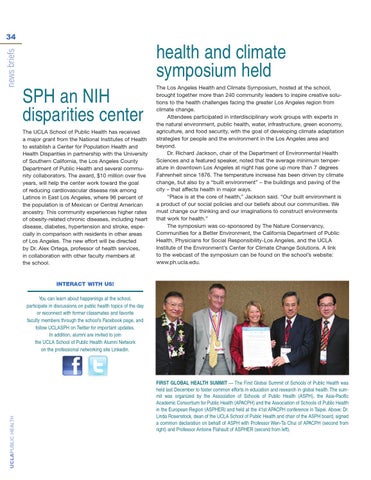
FIRST GLOBAL HEALTH SUMMIT — The First Global Summit of Schools of Public Health was held last December to foster common efforts in education and research in global health. The summit was organized by the Association of Schools of Public Health (ASPH), the Asia-Pacific Academic Consortium for Public Health (APACPH) and the Association of Schools of Public Health in the European Region (ASPHER) and held at the 41st APACPH conference in Taipei. Above: Dr. Linda Rosenstock, dean of the UCLA School of Public Health and chair of the ASPH board, signed a common declaration on behalf of ASPH with Professor Wen-Ta Chui of APACPH (second from right) and Professor Antoine Flahault of ASPHER (second from left).