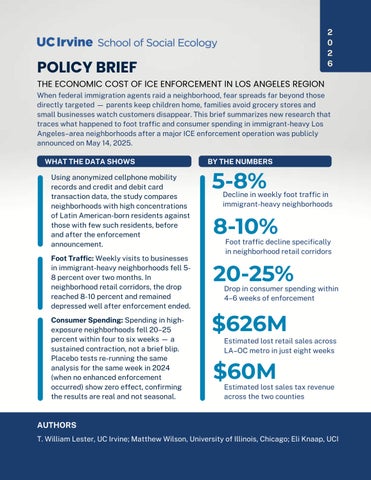
When federal immigration agents raid a neighborhood, fear spreads far beyond those directly targeted parents keep children home, families avoid grocery stores and small businesses watch customers disappear. This brief summarizes new research that traces what happened to foot traffic and consumer spending in immigrant-heavy Los Angeles–area neighborhoods after a major ICE enforcement operation was publicly announced on May 14, 2025.
BY THE NUMBERS

Using anonymized cellphone mobility records and credit and debit card transaction data, the study compares neighborhoods with high concentrations of Latin American-born residents against those with few such residents, before and after the enforcement announcement.
Foot Traffic: Weekly visits to businesses in immigrant-heavy neighborhoods fell 58 percent over two months. In neighborhood retail corridors, the drop reached 8-10 percent and remained depressed well after enforcement ended.
Consumer Spending: Spending in highexposure neighborhoods fell 20–25 percent within four to six weeks a sustained contraction, not a brief blip Placebo tests re-running the same analysis for the same week in 2024 (when no enhanced enforcement occurred) show zero effect, confirming the results are real and not seasonal.
AUTHORS
5-8% 8-10%
Decline in weekly foot traffic in immigrant-heavy neighborhoods
Foot traffic decline specifically in neighborhood retail corridors
20-25% $626M $60M
Drop in consumer spending within 4–6 weeks of enforcement
Estimated lost retail sales across LA–OC metro in just eight weeks
Estimated lost sales tax revenue across the two counties
T William Lester, UC Irvine; Matthew Wilson, University of Illinois, Chicago; Eli Knaap, UCI
ECONOMIC TOLL
Scaled to the full retail economy using state tax administration data, these declines represent enormous losses across just eight weeks:

Geography
POLICY RECOMMENDATIONS
Reconsider (or stop) indiscriminate surge enforcement and warrantless stops that amplify community fear.
Track enforcement-driven revenue shortfalls and consider fiscal relief for municipalities bearing disproportionate impacts
Require economic spillover cost estimates in any analysis of immigration enforcement cooperation agreements.
Document and quantify economic disruption during enforcement surges to inform fiscal planning and build legal standing.
Fund know-your-rights clinics, multilingual outreach, and community liaisons to reduce feardriven avoidance of public spaces.
THE BIG PICTURE
As federal immigration enforcement has expanded into churches, schools, and workplaces, chilling effects have grown from a community concern into a measurable drag on local economies and a genuine fiscal problem for governments that depend on sales tax revenue to fund schools, infrastructure, and public safety.
THE BOTTOM LINE
Immigration enforcement does not stay at the arrest scene. It ripples through entire communities emptying storefronts, shrinking tax revenues and imposing costs on governments and businesses that had no role in enforcement policy. These harms are measurable, large and persistent.