The Government Shutdown Not Only Delayed
the Release of Economic Data, But it also Changed the Data.
GDP Growth in the Fourth Quarter of 2025 Was Significantly Impacted.
The 2025 federal government shutdown this past fall halted operations at key agencies like the Bureau of Labor Statistics, Census, and the Bureau of Economic Analysis, thus delaying essential reports on unemployment, inflation (Consumer Price Index), retail sales, and payroll jobs and unemployment data. The October CPI release was fully canceled, and significant parts of the October labor market reports were missing, with two monthly jobs reports delayed overall. A second, though much shorter, shutdown earlier this year also affected the data release schedule.
Beyond delaying the release of data, the shutdown itself impacted some of the data. Most prominently, the data for real GDP in the fourth quarter took a significant hit from the postponement of federal spending that would have otherwise taken place in the fourth quarter.
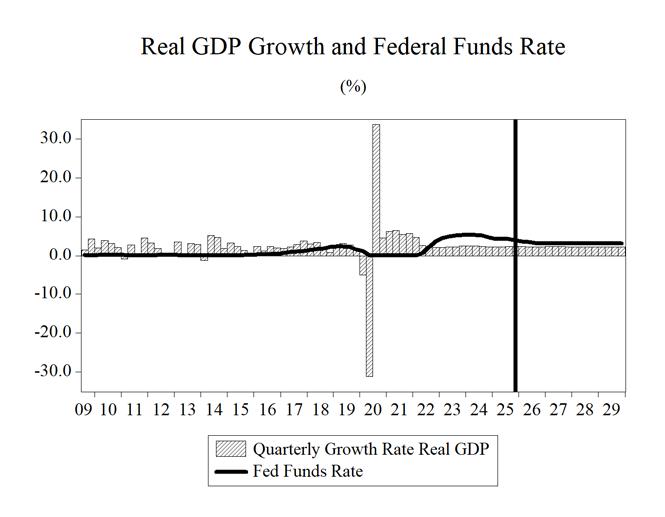
Real GDP growth was expected to be 3.0% in the fourth quarter of 2025, but the first reading for that quarter came in at just 1.4%. Taking a closer look at that report, federal government spending subtracted 1.2 percentage points from that fourthquarter growth rate. If the shutdown had not occurred, growth would have been much closer to expectations.
Most of the spending that would have occurred during the shutdown will be pushed into the
first quarter of 2026 and will make growth higher in this quarter than otherwise would have been the case. Real GDP growth has been somewhat volatile since 2025, but this has been driven by factors outside of the natural working of the economy, thus making it more difficult to ascertain the state of the economy and the strength of the current expansion. As 2026 wears on, the curtains should be pulled back, and it will allow a clearer view of the underlying strength (or lack thereof) of the economy. The war in Iran adds additional layers of uncertainty to the outlook for the U.S. economy, and depending how it unfolds it could ultimately push GDP growth in either direction.
ANXIOUS INDEX
Recession Fear Eases Further
The most recent release (fourth quarter of 2025) of the Survey of Professional Forecasters by the Federal Reserve Bank of Philadelphia states that the forecasters surveyed for the publication put a 24.0% chance that a decline in real GDP will occur in the first quarter of 2026. This is another decline of the anxious index after a tariff-inspired spike in anxiety during the second quarter of 2025.
The Anxious Index
One-Quarter-Ahead Probability of Decline in Real GDP Quarterly, 1969:Q1 to 2026:Q1
GDP OUTLOOK
Quarter for Decline
Source: Survey of Professional Forecasters, Philadelphia Federal Reserve Bank
One section of the Survey of Professional Forecasters asked panelists to estimate the probability that real GDP would decline in the quarter in which the survey is taken, as well as the probability of a decline in each of the following four quarters. The anxious index is the estimated probability of a decline in real GDP in the quarter after a survey is conducted. In the survey taken in November for the fourth quarter of 2025, the index stands at 24.0, meaning forecasters believe there is a 24.0% chance that real GDP will decline in the first quarter of 2026. This is down from 36.1% in the survey conducted in the second quarter of 2025 and from 29.6% in the third quarter of 2025.
The graph above plots the historical values of the anxious index, where the gray bars indicate periods of recession in the U.S. economy. The current level of the anxious index is slightly more than 10.0 points higher than the average level during the 2009-2020 economic recovery (13.63).
There has been a high level of uncertainty in the economy with the frenetic pace of activity in the first year of the Trump administration. Coupled with the government shutdown, this uncertainty caused growth to delerate in 2025. The war in Iran has introduced an entire layer of uncertainty to the economic outlook. How impactful this uncertainty will be is a function of the length, severity, and collateral damage of America’s latest conflict.
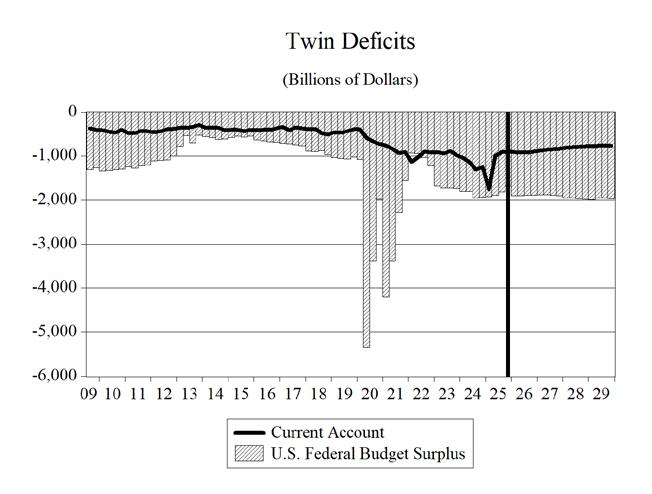
Persistent large deficits at the federal level continued to fuel economic growth through the end of 2024. The size of these deficits is starting to drift higher and will support GDP growth despite the longer-run risk of the national debt.
The eventual end of trade-related uncertainty and general economy friendlier policies from D.C. should help carry the economic expansion through the end of our forecast horizon — albeit with slower economic growth as consumers will be tapping the brakes on spending and working at repairing their inflation-damaged balance sheets.
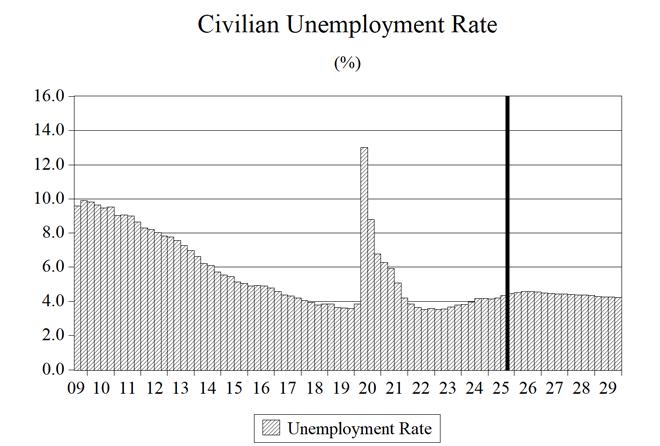
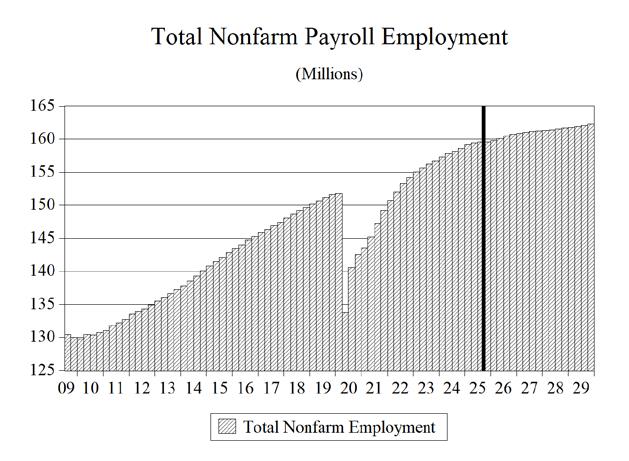
The slower GDP growth in 2025 and beyond will impact the labor market. The unemployment rate will gradually rise into 2026, before stabilizing around 4.4% through 2029. Job growth will slow to a trickle as the economy essentially remains at full employment.
There will be another recession, and it could be borne of the uncertainty persisting in the nation’s capital and heightened geopolitical conflicts and tensions. We are not predicting that it will
The shading shows the period beginning with each NBER peak and ending with the corresponding trough.
come to pass in the next several years. In the meantime, we are anticipating a softening of real GDP growth, rising from 2.3% in 2025 to 2.8% in 2026, before slowing to 2.0% in 2027, drifting down to 1.7% in 2028 and then ticking up to 1.9% in 2029.
CONSUMER SPENDING
U.S. consumers were hard hit by the highest inflation in 40 years, which persisted at these elevated levels for more than two years. Although wage and salary growth was occurring during this time, the rising cost of living wiped away those wage gains and even more purchasing power. Starting in the second quarter of 2021, real median weekly wage and salary growth turned negative.
This means that even though workers had more dollars in their paychecks, the amount of goods and services that they could purchase with those dollars continued to decline for more than two years.
The shortfalls in consumers’ budgets were patched by savings from the COVID lockdown era and, when those ran out, by using credit card debt. However, these patches to consumers’
budgets were not a permanent solution to the loss of purchasing power and would only hold for so long before spending was impacted.
Inflation hit middle- and lower-income households hard. Roughly 63% of consumer expenditure of these households goes to food, shelter, and transportation; all three of these categories saw outsized price increases over this two-year span.
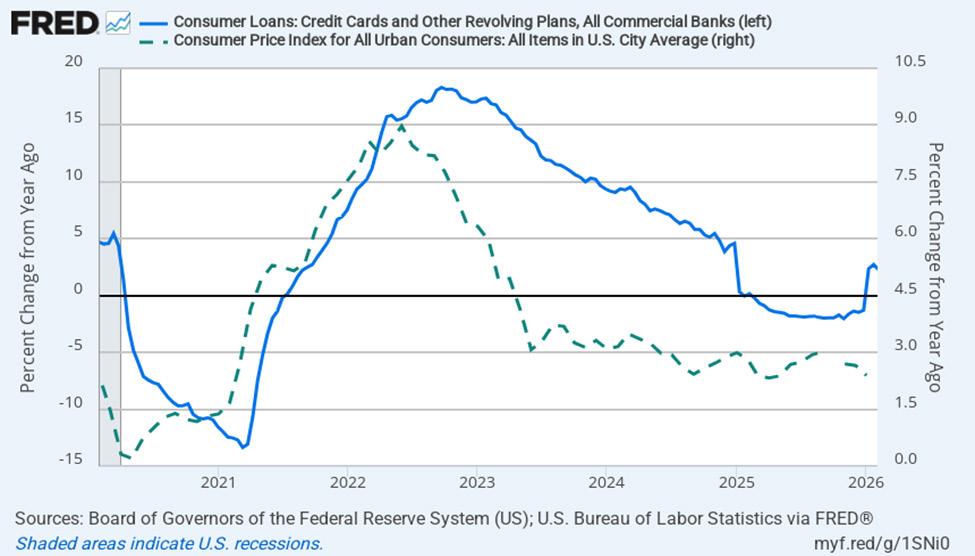
In the chart below, we can see the synchronized rise in both inflation and the amount of credit card debt held by U.S. consumers. Even after inflation hit its apex and began a slow descent, credit card debt continued to rise as inflation persisted above wage growth.
Over the most recent two years, thanks to a still-strong labor market and retreating inflation, growth in real wages has turned positive. This is enabling consumers to make more permanent repairs to those inflation-damaged household budgets.
Credit card delinquency rates that were rising for more than two years as households struggled to make ends meet, began to decline in the second half of 2024. However, overall credit card debt remains above $1.0 trillion dollars, and in recent months, debt levels have begun to rise again. This will continue to constrain consumer spending growth over the next few years. Consumer sentiment has been on a volatile path since hitting an all-time low at the height of the inflation crisis. Seeing paychecks starting to stretch further has played a role in regaining confidence in households’ financial status, despite the “doom and gloom” predictions that were made at the start of the second Trump administration.
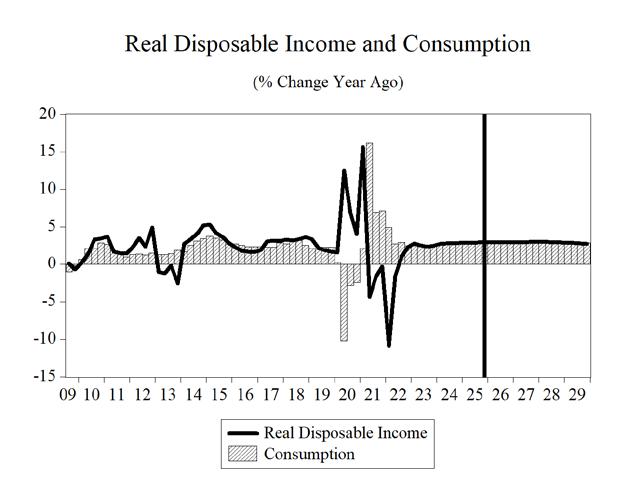
COVID-19 lockdowns caused spending growth in 2020 to contract by 2.5%. Consumption spending growth slowed from 8.8% in 2021 to 3.0% in 2022, and then to 2.6% in 2023 before ticking up to 2.9% in 2024 and then easing to 2.7% in 2025. During 2026-2029, real consumer spending growth is expected to average 2.4%. Consumer spending growth will be dampened by the economy slowing, with consumer spending growth of 3.0% in 2026, 2.1% in 2027 and 2028, before ticking up to 2.3% in 2029.
INVESTMENT
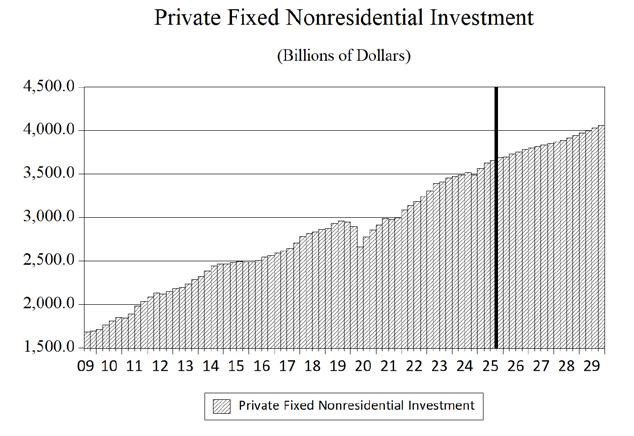
Higher interest rates and increased levels of policy uncertainty combined to slow investment spending in 2024, before it accelerated in 2025. Growth will decelerate in 2026 and continue to do so before rising in the final year of our forecast to 2.8%. Businesses will continue to try and solve the tariff puzzle and policy changes and, importantly, how long such changes might remain in place. This uncertainty will impact investment spending growth until answers to these questions become clearer.
In 2020, non-residential investment spending contracted by 4.6%, then rebounded to 6.2% growth in 2021 and 6.5% growth in 2022; then jumped to 7.3% in 2023 before sliding to 2.9% in 2024. During 2026-2029, we expect average growth in non-residential investment spending to be just 2.5%, decelerating from 2.9% in 2026 to 2.1% in 2028, before rebounding to 2.8% in 2029.
Spending growth on equipment and software jumped from 3.5% in 2024 to 8.7% in 2025. Average growth in this type of investment spending is expected to be 2.7% over the 20262029 timeframe, after slipping to 1.4% in 2028.
In 2023, as air travel continued to grow in the post-lockdown era, aircraft purchase growth surged to 21.3% in 2023. Over the 2026-2029
period, spending on aircraft is expected to grow by an average of 2.3%. This deceleration of growth comes after tariff-fueled growth of 45.0% in 2025.
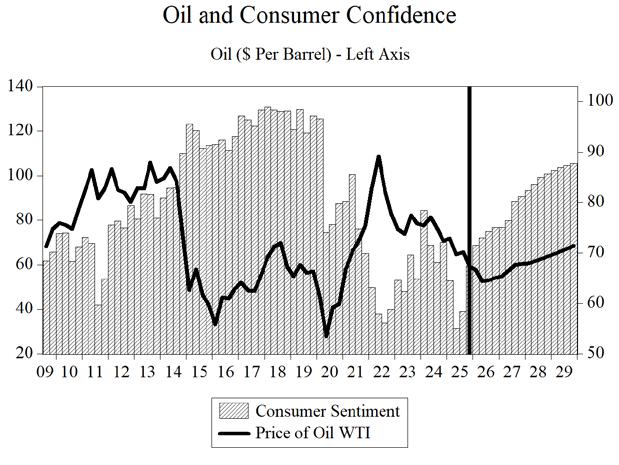
Lower oil prices have pushed the current U.S. rig count to 550, which is 43 rigs fewer than a year ago. Rig counts were over 1,000 as recently as 2019. The war in Iran has already sent oil prices higher and disruptions in the Strait of Hormuz could worsen the spike. This could lead to more rigs in the U.S. if the war drags on.
Investment in mining and petroleum equipment growth plunged to -38.7% in 2020 as oil prices crashed. Investment will average 10.2% growth per year during 2026-2029, including a surge to 28.2% in 2026 as a result regulatory restraints being eased.
Business non-residential structures investment growth contracted by 9.2% in 2020 and then accelerated to 3.5% in 2022. After growing 16.7% in 2023 and 1.1% in 2024, non-residential structures spending contracted 5.3% in 2025. It will grow at an average rate of just 0.3% during 2026-2029.
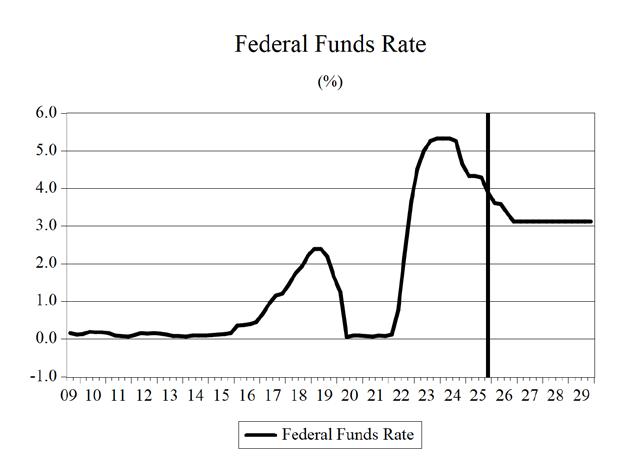
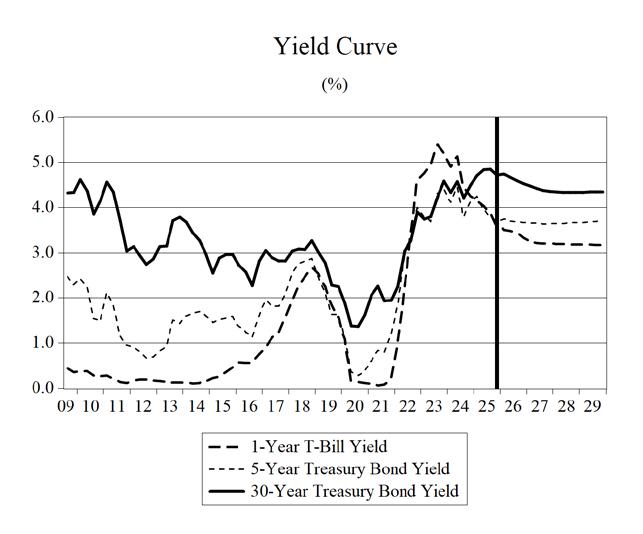
Higher interest rates slow investment spending. The Fed temporarily switched gears to go into recession-fighting mode in Fall 2024, prematurely cutting short-term rates in September. But this caused long-term rates to rise in response to those cuts. With inflation closer to the target level, the Fed resumed interest rate cuts in Fall 2025 and paused again. With a change in the leadership of the Federal Reserve in May, we will likely see some additional rate cuts, which could push longer-term rates somewhat lower, but not to the levels of the post-pandemic era.
Business spending on industrial equipment will grow at an annual average rate of 4.0% from 20262029. Investment spending growth on computers and peripherals will average -0.4% during 20262029, after 51.7% of growth in 2025 was fueled by
the rush into artificial intelligence and spending that was pulled forward to avoid higher tariffs. Spending on communications equipment should mildly contract at an average annual rate of 0.1% during the same period, after spending in 2025 expanded at a 9.1% rate — also boosted by tariff avoidance.
Residential fixed investment growth hit 10.9% in 2021. Growth will average 1.3% during 2026-2029. Higher prices combined with higher mortgage rates eroded demand and caused investment spending to contract by 8.1% in 2022 and 7.8% in 2023, before growing 3.2% in 2024 and contracting again in 2025 by 2.4%.
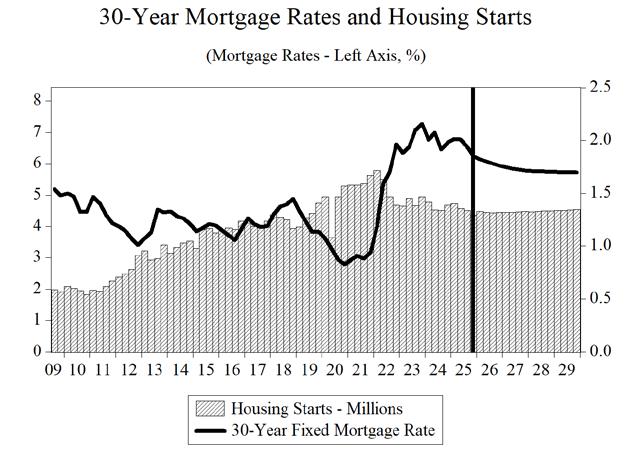
We expect housing starts to stabilize after a slow deceleration that commenced in 2023 and continued through 2024. After reaching 1.6 million in 2021, starts fell to 1.37 million in 2024 and 1.35 million in 2025. They will continue to hover in a narrow range for the next four years, coming in at a level slightly more than 1.34 million in 2029. High home prices and a slowing economy are headwinds, and the expected decline in mortgage rates as the Federal Reserve initially loosened monetary policy did not materialize, as long-term interest rates moved in the opposite direction. But additional cuts should cause mortgage rates to drift somewhat lower. The ongoing shortage of housing in many parts of the country will help fight against these headwinds and provide support for home building, albeit at this slightly slower pace.
GOVERNMENT SPENDING
Federal government spending has been devoid of any policy discussions or debates about priorities, problems, objectives, or any consideration of deficits and the national debt, let alone talk of a balanced budget. Replaced instead with series of continuing resolutions and government shutdowns
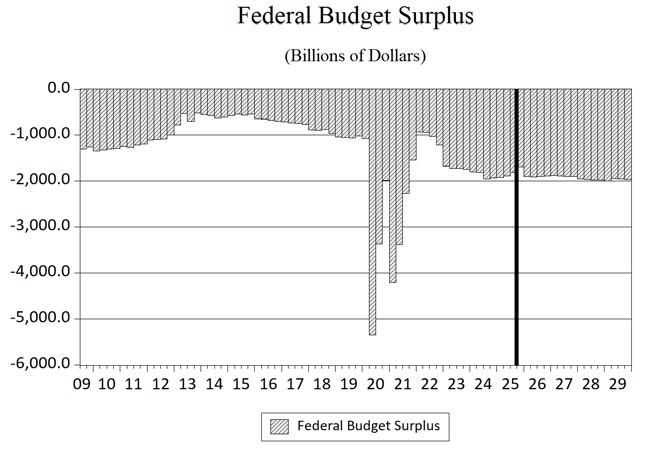
or threats thereof. Unsurprisingly, public finances have been adrift, and deficits climbed back to the $1-trillion mark in 2019 even before the massive wave of deficit spending triggered by the pandemic. The current federal budget deficit is more than $1.7 trillion.
Did the “cuts” made by the Department of Government Efficiency (DOGE) curb this profligate and unchecked spending? Unfortunately, it appears that DOGE was all bark and very little bite. Congress has taken no action to codify any of these cuts that were identified by DOGE and instead has maintained the status quo of nearly $2-trillion deficits.
Federal government spending growth was 3.8% in 2019 before jumping to 6.3% in 2020. During the 2026-2029 period, federal government spending growth will continue, growing at an annual average pace of 0.4%. Over the same period, state and local governments will see spending growth at an average rate of 0.4%.
I am doubtful that Congress will undertake the required cuts to the deficit soon, and the Big, Beautiful Bill turned law suggests further delay in addressing this issue. Thus, we are still projecting deficits through 2029 that will consistently average over $1.9 trillion. The amount that the projected deficits will add to the national debt over the next four years will be $7.7 trillion, pushing the total national debt to more than $46 trillion and a debtto-GDP ratio of approximately 128%. If higher interest rates return to the economy, the burden of servicing this debt will continue to rise as well. Slower-than-projected economic growth or a recession would also push projected deficits higher, though the possibility of faster-than-projected economic growth and interest rate cuts could help mitigate the growth of these deficits on the debtto-GDP ratio.
Depending on the length and intensity of the
Iran war, military expenditures could further widen the already large deficit.
Currently, the national debt is over $38.7 trillion and rising. This represents a debt of more than $355,350 per taxpayer and $112,887 per citizen and a 124.2% debt/GDP ratio. The unfunded liabilities of the U.S. are even more troubling. These include Social Security, Medicare Parts A, B, and D, and Federal debt held by the public and federal employee and veteran benefits, representing more than $124.7 trillion in liabilities, boiling down to $359,160 per person.1
NET EXPORTS
Uncertainty regarding and the implementation of tariffs levied against U.S. trading partners riled the international sector of the U.S. economy in 2025. Last year we witnessed wild swings in the levels of imports quarter to quarter.
Some of the tariffs have now been overturned by a ruling of the U.S. Supreme Court, but there may be other legal channels through which the administration could pursue these policies. The ruling by the Supreme Court raises more questions than it resolves and extends the pall of uncertainty that has been hanging over trade in the economy for more than a year.
Tariffs are implemented by countries for a variety of reasons. The Trump administration is primarily using tariffs as a lever to get other countries to make changes that are to the benefit of the United States or to bring about changes to other barriers to trade.
A longer run goal appears to be incentivizing U.S. firms to reshore production that had been moved overseas previously. It is not clear how successful these efforts will be, particularly after
the Supreme Court ruling and possibility that these tariffs may not be in place in the long run.
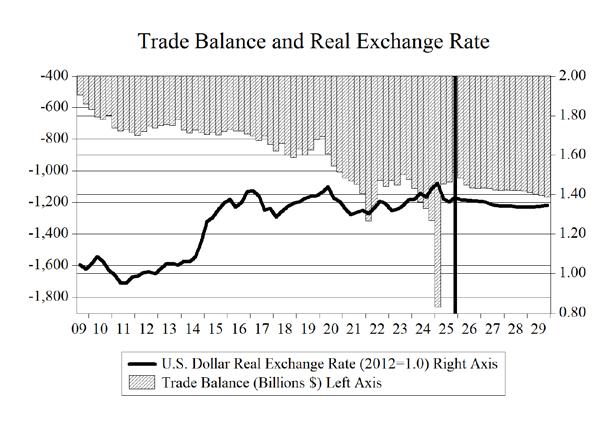
A stronger U.S. dollar boosts imports and reduces exports by making our goods and services more expensive to foreigners while at the same time making imported goods and services less expensive to U.S. consumers. This results in a worsening of the trade deficit, which is the difference between the dollar value of exports and the dollar value of imports. The opposite is true when the dollar undergoes depreciation.
However, the effects of currency changes take time to work on the actual quantity of trade flows, resulting in what is known as the J-curve effect on net exports. Because of this effect, an appreciation (depreciation) of the dollar initially decreases (increases) the trade deficit before eventually increasing (decreasing) it. Why? Importers and exporters do not enter contracts based on the total dollar value of the transaction, but rather on the actual quantity of goods to be shipped (automobiles, flat-screen televisions, etc.). As the exchange rate varies in the short run, the values of these shipments and, thus, net exports vary as well. Over time, however, the quantities do adjust in response to the exchange rate fluctuations, and this is what gives rise to the J-curve effect.
With the Federal Reserve resuming the interest rate cuts that began in September 2024, lower interest rates will lead to a depreciation of the dollar in 2026 and persisting, though decelerating, through 2029.
Overall, real export growth has resumed, after a sharp contraction in 2020, and will continue through the end of our forecast horizon, after accelerating sharply in 2021 and 2022. The appreciation of the dollar in 2022 caused a deceleration of this growth in 2023 and 2024. Real import growth also experienced a strong contraction in 2020, but growth recovered
before contracting again in 2023. Import growth resumed in 2024 and will accelerate after slowing in 2025 and 2026. Evolving trade policy issues, a slowing economy, and increasing geopolitical uncertainty will continue to weigh on this sector. Nevertheless, real export growth from 2026-2029 will average 3.8%, while real import growth will average 3.5% over the same period.
Real net exports will average over -$1.49 trillion during 2026-2029, with the trade balance improving somewhat in 2026 in response to tariffs even after the Supreme Court ruling, before worsening to -$1.61 trillion in 2029.
UNEMPLOYMENT
The national unemployment rate (U-3) in January 2026 stood at 4.3% — down 10.5 percentage points from the April 2020 reading of 14.8%, which was the highest level since the Great Depression era — but up 0.3 percentage points year-over-year. January 2026 labor force participation rate ticked up to 62.5% from the December 2025 rate of 62.4%. The labor force participation rate is still below pre-pandemic levels of 63.3%.
The Bureau of Labor Statistics (BLS) produces alternative measures of labor market weakness, including the broadest measure of unemployment (U-6). U-6 accounts for discouraged workers (currently 475,000 workers), underemployed workers — working part-time but not by choice (currently 4.88 million workers) — and workers who are marginally attached to the labor force — those who have looked for work in the past 12 months, but are not currently looking, yet indicate a willingness to work (1.67 million workers). None of these more 7.0 million workers are accounted for in the January headline unemployment rate of 4.3%.
U-6 stands at 8.0% as of January 2026, down
0.4 points from the December 2025 level, and up 0.5 percentage points from the start of 2024. The current level of U-6 is close to its level in November 2021. U-6 was stuck in double digits for more than seven years. It had been in single digits for 51 consecutive months, beginning in December 2015, before surging during the lockdowns in April and May of 2020, hitting 22.9% in April. The current streak of single digit U-6 now stands at 55 months.
The spread between U-6 and U-3 measures of unemployment sits at 3.7 percentage points and is 3.7 points below the peak spread of 7.4 points that took place in September 2011.
Table 1. Annual Summary of the Long-Term Forecast of the U.S.
Table 1. Summary of the Long-Term Forecast of the U.S.
Measures
Incomes