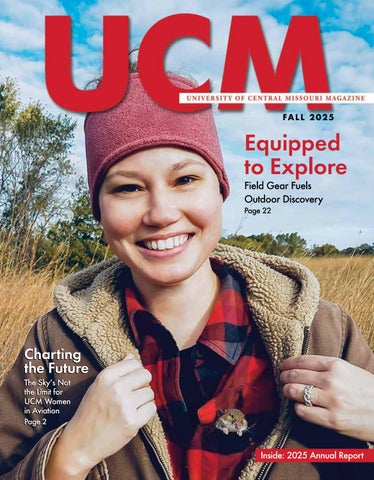
Field Gear Fuels
Outdoor Discovery Page 22

Charting the Future
Charting the Future
The Sky’s Not the Limit for UCM Women in Aviation
Page 2
Page 2
Cori Brown, assistant

Wolcott. Cori obtained an


![]()
Field Gear Fuels
Outdoor Discovery Page 22

Charting the Future
Charting the Future
The Sky’s Not the Limit for UCM Women in Aviation
Page 2
Page 2
Cori Brown, assistant

Wolcott. Cori obtained an


FALL 2025, Vol. 24, No. 2
EXECUTIVE EDITOR
Kathy Strickland
ART DIRECTOR
Linda Harris, ’91, ’24
CONTRIBUTING STAFF
Ryan Anderson, ’11, ’13
Eric Boedeker, ’14
Tiffany Cochran, ’05, ’23
Katie Frey
Tyler Habiger, ’24
Darice Heishman
Jazmin Hohmann
Jackie Jackson, ’09, ’12
John Kennedy, ’92, ’13
Nicole Lyons, ’13
Andrew Mather, ’12, ’15
Trevor McLanahan, ’25
Travis Seek, ’16
Jessica Tart Jacob Watson, ’20
Heather Wirsig
© 2025 by University of Central Missouri.
All rights reserved. Views and submitted content do not necessarily reflect the opinions or policies of UCM Magazine, the UCM Alumni Foundation or the University of Central Missouri. Find us online: ucmfoundation.org/magazine. Submit address updates at ucmfoundation.org/update, by email at alumni@ucmo.edu or by phone at 660-543-8000.
UCM Magazine is published biannually by the University of Central Missouri, Warrensburg, MO 64093. Printed by Walsworth, 1201 Bluff St., Fulton, MO 65251.
POSTMASTER: Send address changes to UCM Magazine, Smiser Alumni Center, University of Central Missouri, Warrensburg, MO 64093
To view the University of Central Missouri’s Nondiscrimination/Equal Opportunity Statement, visit ucmo.edu/nondiscrimination.

UCM Magazine was recognized as a Gold Winner in the 2025 Educational Advertising Awards.
With every new year at the University of Central Missouri comes renewed energy across our campuses. We welcome new and returning students while honoring the proud traditions that connect generations of alumni. At the same time, we’re embracing innovative opportunities that prepare students for the future.
One of our most meaningful annual traditions is recognizing graduates who embody UCM’s motto of “Education for Service.”

Since 1978, the Distinguished Alumni Awards have honored individuals whose lives and work set an example for us all. This year’s recipients — Adam M. Freeman, ’09, ’10; Elizabeth A. Fenner, ’68, ’71; Diane L. Dudley, ’81, ’23; and Brian Thomas Smith, ’00 — represent the breadth of fields and service that define UCM. They were honored at the Distinguished Alumni Dinner on Oct. 24, a highlight of Homecoming weekend.
As we carry on traditions like these, we are simultaneously reshaping the learning experience of current students through extended reality (XR). Aviation students train on simulators that prepare them for real-world challenges, Fashion students are designing in virtual spaces, Nursing students practice in virtual scenarios before stepping into clinical environments, and Agriculture students learn how to handle large animals before encountering them at the university farm.
This innovative approach is exemplified in our new VR flight simulator lab, named in honor of longtime Aviation instructor John “Jack” Horine. The lab reflects UCM’s leadership in the field and connects to the inspiring story of women in aviation that you’ll read in this issue.
Beyond classroom innovation, our commitment to learning continues through the UCM Alumni Foundation’s work, as detailed in the FY25 Annual Report. This year’s donor-funded Opportunity Grants supported projects such as a Field Gear Library, which equips Biology students to study everything from birds to bats to butterflies. Another Opportunity Grant funded weather balloon launches that give Geoscience students firsthand experience in atmospheric data collection.
These achievements all reflect that, at our core, we are in the people business. I invite you to read more about our people in this issue and discover the wonderful innovations, traditions and stories that showcase UCM’s spirit.
Robin and I look forward to seeing many of you in the coming year as we celebrate these achievements together and continue building a strong future for UCM.
Warm regards,

Roger J. Best, Ph.D. UCM President
By Heather Wirsig
From the earliest days of flight, women have proved that the skies are for everyone. In 1910, Raymonde de Laroche became the first woman in the world to earn a pilot’s license, followed soon after by Harriet Quimby, the first American woman to do the same. Two decades later, in 1932, Amelia Earhart’s record-setting solo transatlantic flight cemented her place as a global icon, showing the world that aviation was not for men alone.
That same pioneering spirit is alive and well at the University of Central Missouri. From airspace to aviation classrooms, UCM women are not just flying — they’re leading, mentoring and building a legacy.
Kate Shannahan, a Professional Pilot major, was inspired to pursue a degree in aviation by her father and brother, both pilots. She piloted her first plane at age 15 and hasn’t looked back. What began as a childhood passion quickly evolved into a career goal. While many students arrive on campus still uncertain of their direction, Kate knew exactly what she wanted to pursue.
“I couldn’t see myself doing anything else once I did my first flight,” she says. “I was excited about the idea of the sky being my office.”

Before she graduates in December, Kate has made it her mission to help other young women chart their own flight path to a career in aviation.
As the driving force behind the revival of UCM’s chapter of Women in Aviation International (WAI), Kate is advancing a field where, according to the Federal Aviation Administration, only 10% of aircraft pilots in the U.S. are women. The student organization now serves as a powerful support system, offering mentorship, advocacy and a sense of belonging to women entering this traditionally male-dominated industry.
“It was really important to me that girls knew there was a place here for them,” Kate says.
Her leadership is not just symbolic; it’s strategic. She worked with faculty advisors, coordinated outreach events, and helped develop mentorship programming that connects incoming students with upperclassmen, alumni and industry professionals. Under her leadership, WAI has prioritized mentorship


and community engagement, creating opportunities for women to envision themselves in aviation careers.
This spring, the chapter hosted its first Girls in Aviation Day at UCM’s Max B. Swisher Skyhaven Airport, welcoming more than 40 girls from kindergarten through 12th grade to explore aviation through flight simulators, aircraft tours and hands-on activities.
Another student helping at Girls in Aviation Day was Aviation Management senior Jordan Watson. She led an activity where girls made paper airplanes, then experimented with the effects of crosswinds.
I was excited about the idea of the sky being my office. “ ” — Kate Shannahan
Jordan became interested in aviation through an internship at ATD Flight Systems in high school, and she began her pilot training on a scholarship through RedTail Flight Academy, a nonprofit flight school at the Kansas City Downtown Airport. In April 2023, she earned her Private Pilot License at the age of 19. This year, she received the Steckel Family Aviation Scholarship from the UCM Alumni Foundation.
“Sometimes it’s hard to seek out role models,” Jordan says of her experience.
“Sometimes it can get competitive, and you have to remember it’s all about you — it’s your career, it’s your education, you don’t need to worry about how fast or slow other people are going; just worry about yourself.”
Jordan is a member of UCM’s chapter of the American Association of Airport Executives (AAAE), a student organization that goes to at least one conference a year and tours airports to network and learn about management and operations. This past summer, she completed an internship in commercial development at the Kansas City International Airport (MCI) and credits her success to mentors along the way, including UCM alumna Melissa Cooper.
Melissa Cooper, ’97, ’06, is Director of Aviation for Kansas City, Missouri. Her early passion for aviation took flight on her 16th birthday, when she received
her first flying lesson just hours after earning her driver’s license.
“Being 16 years old and flying an airplane is surreal,” she recalls. “I was hooked. I knew aviation was going to be where my passion was, and that set my career in motion.”
Aviation wasn’t just an interest; it became her calling. Melissa participated in the NASA Young Astronauts program and gravitated toward careers that stretched the boundaries of what was possible.
“There’s something to be said about spreading your wings and being in the sky that shaped my interest in aviation and my future,” she says.
Today, Melissa leads MCI and the downtown airport, breaking barriers in 2023 as the first woman to serve as director of the Kansas City Aviation Department — a role she fills with humility and purpose.
“I’ve never really worried about being the first female to have this leadership role,” she says. “I want to make sure I’m the best person for the job.”

MelissaCooper
There’s something to be said about spreading your wings and being in the sky that shaped my interest in aviation and my future. “ ”
— Melissa Cooper
Melissa Cooper checks in with dispatcher Serena Garcia on a visit to Skyhaven Aviation Center.


Melissa oversees a team of more than 500 aviation professionals, many of whom are fellow UCM graduates. She earned her bachelor’s in Aviation Technology and master’s in Aviation Safety. Today she is deeply committed to mentorship, frequently returning to UCM to share her experience and guide students.
“I feel like that is my goal now — to invest in other people, especially females, to give them an opportunity to see themselves in a leadership position,” Melissa says.
Her message to the next generation of women in aviation: “Go for it. You won’t be alone. It is a rewarding career that impacts communities, regions and nations.”

In 1991, Shannon was the youngest member of her UPS training class, the only civilian and the only female pilot. She was hired as a flight engineer, moved up to first officer and then attained the rank of captain. She flew the Boeing 727, Airbus 300 and Boeing 747 all over the world.
“Becoming a captain — that’s the pinnacle of my career,” Shannon says. “Finally earning that fourth stripe and knowing that I had made it to the top of my profession.”
Capt. Shannon Jipsen, ’87, ’88, has dedicated her career to breaking barriers in the cockpit and building pathways for others to follow. Ironically, Shannon’s passion for aviation was born from fear.
“I was scared to death of flying,” she says. “I was absolutely white-knuckled and didn’t want to fly.”
But a single introductory flight at the age of 19 with a friend who was a flight instructor changed everything.
“We flew from Higginsville down to the Lake of the Ozarks,” Shannon recalls. “It was a perfect summer day, and I was hooked. Seeing the colorful reflections of the fireworks on the lake that night as we were flying back changed my life!”
Shannon earned her Private Pilot, Instrument, Commercial, Certified Flight Instructor, Instrument Flight Instructor, and Multi Engine ratings and certificates while completing her undergraduate degree in Business Administration/Marketing and her master’s in Aviation Safety from UCM. She served as a flight instructor and adjunct instructor at UCM and later joined Executive Beechcraft in Kansas City as a flight instructor and charter pilot.
Beyond the cockpit, Shannon has become a powerful advocate and mentor for aspiring aviators. She has traveled nationwide to speak at conferences, sharing her story of confronting fear and finding purpose.
“I didn’t have a mentor,” she says. “That’s why I try to be one now.”
She also supports the next generation of aviators financially through the Shannon L. Jipsen Aviation Scholarship, available to Aviation students at UCM. Through financial support, mentorship and storytelling, Shannon continues to inspire the next generation to find their wings and chart their course.
Through community outreach, mentorship and leadership, UCM women are claiming their place in aviation. Each woman featured in this story shares the qualities of persistence, resilience and innovation that honor the lives of the world’s first female aviators. While there is still a long way to go, UCM is helping close the gap, proving that the sky is not the limit; it’s just the beginning.
future aviators through the Shannon L. Jipsen Aviation Scholarship at ucmfoundation.org/give/jipsen.


By Trevor McLanahan, ’25


For decades, flight training has relied on traditional simulators — large, expensive machines that mimic cockpit controls but often fall short in visual immersion. Now, UCM is pioneering a new approach with its state-of-the-art virtual reality (VR) flight simulation lab, designed to give student pilots a more realistic and accessible training experience.


A MoExcels grant awarded in the summer of 2024 through the Missouri Department of Higher Education and Workforce Development provided $80,000 for UCM to add 12 VR flight simulator stations.
“We’re very hopeful that this new tech will change how we offer beginning instruction to our new students in a positive way,” says Aviation Department Chair Jim Gamble.

The space in the TR Gaines Building that houses this new technology is named for John W. “Jack” Horine, the late instructor who served as the first chair of what would become UCM’s Department of Aviation. Horine served the university for more than 50 years and was instrumental in launching the master’s program in Aviation Safety.
Unlike traditional simulators, which primarily focus on cockpit procedures, VR training emphasizes external visuals that do not require multiple projectors and a wrap-around screen to achieve. The technology allows students to shift their viewpoint naturally, providing a true-to-life


With record enrollment of more than 300 students in UCM’s Professional Pilot program, VR training reduces the burden on the university’s fleet of aircraft. It also provides practice in a variety of simulated weather conditions and builds essential muscle memory with aircraft controls.
Over the summer, the Department of Aviation invited alumni and supporters to tour Skyhaven Aviation Center, which opened in September 2023, and the brandnew lab in TR Gaines. Just days before this event, high school students from Kansas City were taking the flight simulators for a test run during a Metro Aviators camp hosted at UCM. Capt. Sam White was there representing RedTail Flight Academy, a nonprofit flight school inspired by the Tuskegee Airmen, America’s first all-Black squadron of military pilots, formed in 1941.
White was himself a member of another elite group formed during World War II, the 393rd Bomb Squandron. He served the 393rd at Whiteman Air Force Base from 2002 to 2004 and again from 2009 to 2011, departing as commander of the nation’s only operational B-2 squadron. To date, he is one of fewer than 800 pilots to have flown the B-2.
White is proud to have flown the B-2 over UCM’s Walton Stadium, and his son Sheldon is a 2020 UCM Aviation graduate who now works as an aviation manager for the Kansas City Aviation Department. White is now a pilot instructor for Delta Air Lines. While UCM’s flight simulators are a night-and-day contrast with the life-size simulators he uses to train 767/757 pilots, he appreciates the value of virtual reality.
Rich Stekel, a 2008 graduate from the Aviation Safety master’s program, tries out one of the new VR flight simulators.

Capt. Sam White in a Piper Seminole with his son Sheldon, who is now an aviation manager at MCI. Sam earned his Airline Transport Pilot rating at UCM in 2011 when transitioning to the private sector after serving in the Air Force.
“We’ve learned that with simulation you can effectively teach somebody to be operationally proficient without having to expend jet fuel, and you can do it really to a higher level,” White says. “I’m glad that UCM is using the same types of tools that we use on the professional side of the industry because then it won’t be foreign to [incoming commercial pilots].”
The new VR lab allows students to practice problematic maneuvers over and over again. Instructors can also program realistic weather and emergency situations like flying through a microburst, making a high-crosswind landing or even having an engine catch on fire.
“Instead of imagining it like in the old days, you’re actually in real time sensing it,” White explains, adding that he envisions AI being effective in simulating Air Traffic Control. “By the time you come out of the simulator, it’s second nature.”
Want to help students earn their wings at UCM? Support the Dr. John W. “Jack” Horine Virtual Reality Flight Simulation Lab Quasi-Endowment at ucmfoundation.org/give/horine.

By Trevor McLanahan, ’25
When people hear “virtual reality,” they often picture a headset that drops them into a fully immersive digital world — whether that’s flying a plane in a simulator or exploring a museum through an immersive virtual tour. But, VR can also be less intense, like playing a 3D video game on a computer or watching a 360-degree video. Augmented reality, on the other hand, layers digital elements onto the real world, from playful Snapchat filters to try-before-you-buy eyeglasses or homedecorating apps. Mixed reality takes it a step further, merging the two so digital and physical objects can interact in real time. At UCM, extended reality (XR) is rapidly becoming an essential part of campus life, transforming how students interact with course material. XR is an umbrella term that includes virtual reality (VR), augmented reality (AR) and mixed reality
as XR to simplify conversations and keep the focus on what really matters: how they enhance learning.
UCM is using XR technology to create highly detailed 3D models of realworld objects, a process that involves photogrammetry.

“One way to help support the curriculum is through making 3D models,” says Tebbenkamp, who splits his time between the university’s two XR Studio locations: one in the James C. Kirkpatrick Library (JCKL) on the Warrensburg campus and another at the UCM Lee’s Summit–Missouri Innovation Campus (MIC). “We take multiple images of the top, the middle and the bottom of the object and input the images into the software where the 3D model is created.”
Bryan Tebbenkamp uses photogrammetry to transform real-world objects, like this dress from UCM’s historical costume collection, into detailed 3D models that students can explore from any angle.

experience learning in new dimensions.
These technologies often overlap, and because the lines blur, UCM educators like Bryan Tebbenkamp, ’03, ’13, extended reality manager in UCM’s Office of Digital Learning and Instructional Innovation (DLII), often refer to them collectively
Tebbenkamp’s degrees in Photography and Technology have been crucial to his work with XR. He finds that creating 3D models not only makes learning more interactive but also allows students to virtually engage with objects they may not have access to physically. “Students can interact with it, and professors can put their own curriculum, hotspots and pop-up videos into the models,” Tebbenkamp explains.
This flexibility is especially valuable for complex subjects where visualization plays a crucial role in understanding.
Integrating XR technology has taken time, but departments like Fashion and Apparel Merchandising, Aviation and Agriculture have been quick to adapt. In 2023 faculty from these areas of study presented to their UCM colleagues during a faculty learning day.
“We have made considerable efforts to educate faculty about our XR activities and achievements in the classroom,” says Erica Spurgeon, ’09, ’17, chair of the School of Industrial Sciences and Technology and associate professor of Fashion and Apparel Merchandising.
Before joining the faculty at UCM, Spurgeon worked as a product developer and buyer for Buckle. While earning her master’s in Educational Technology, she
Associate Professor Erica Spurgeon uses CLO3D software to demonstrate how digital garments can be visualized in 3D, allowing adjustments to fabric and details before anything is physically made.


started to recognize how instructors use technology in their teaching.
Spurgeon strives to ensure that students are using the technology to learn something new or implement something they couldn’t do otherwise.
Sydney Agovino, ’24, used a VR program called Gravity Sketch in one of Spurgeon’s classes to design a shoe. After creating the sketch, she was able to make a prototype using CLO3D fashion design software. She then 3D printed the sole and used fabric to sew the shoe together.
Agovino majored in Graphic Design, and her passion for fashion led her down the road of adding a minor in Fashion Merchandising.
“It was fun playing with the program, and being able to see things in 3D helped me visualize it,” says Agovino, who believes XR technology is integral to the future of design.
In spring 2025, Spurgeon explored the VR space for collaborative design. This concept enables multiple students to work together in real time, sketching and designing within a virtual environment that mimics industry practices — similar to working alongside merchandisers, buyers, pattern makers or manufacturers during sample reviews.
“It’s not just about having a cool device,” she says. “It’s important for us to stay updated on industry trends so we can confidently tell our students they have what it takes to reach these standards and take advantage of the opportunities when they step into the professional design world.”
With each new tool, educators, designers and innovators gain the ability to push boundaries and explore possibilities that once seemed out of reach.
Sydney Agovino combines a virtual and physical design by moving her Gravity Sketch concept into CLO3D, then producing a physical prototype with a 3D-printed sole and hand-sewn fabric. At right, Fashion student Brandon Becton explores design applications in the XR Studio.


UCM’s Department of Agriculture is exploring XR’s potential with CattleVR, which allows students to interact with virtual animals and practice the skills needed to safely handle them.
Kyle Lovercamp, ’02, professor of Agriculture and Animal Science, uses headsets with students in his Animal Handling class before they go to the university’s Prussing Farm to work with live cattle. Lovercamp grew up around livestock and understands that some students in the program did not come from a farming background. The technology helps bridge the gap between what could be an intimidating activity and a safe learning environment.
“At the university farm, we work with the farm management staff to ensure we have calm-tempered animals, so we’re not putting the students in any highrisk situation,” Lovercamp explains. “There will always be that risk, but that’s why introducing them through the XR tool and then doing it in real life helps students feel prepared and more confident.”
Lovercamp also uses XR technology to teach about animal anatomy. After learning about the bovine digestive system in class using a 3D model, students are able to have a tactile experience in the field with a cannulated steer.
Michelle Santiago, department chair and professor of Agriculture and Agribusiness, explains that one of the most challenging aspects of incorporating VR is trying to help align students with industry practices while maintaining the curriculum. In her Unmanned Aerial Systems class in fall 2024, students learned how to control a drone used in precision agriculture, navigating a virtual obstacle course before flying an actual drone.

For students preparing to step into clinical settings, the Nursing Simulation Lab at UCM Lee’s Summit–MIC blends XR technology and high-tech simulation manikins to create safe spaces for practice. Annie Seymour, simulation lab manager and assistant professor in UCM’s School of Nursing, has seen firsthand how technology transforms student learning.
“We have been using virtual sims since before COVID,” says Seymour, a veteran emergency department nurse with 32 years of experience, 25 of which were in the ER. “And then we used them a lot for online virtual simulations during COVID when we couldn’t go into the hospital.”
Today, UCM Nursing students begin working with VR as early as their first semester in the program. Simulations
give them practice in communication, critical thinking and prioritization — all foundational skills for patient care.
This summer, a state-funded MoExcels grant allowed UCM to purchase for the lab a dozen VR headsets and an Anatomage table — a life-size 3D anatomy platform that lets students virtually explore the human body. These tools enable faculty to go beyond textbooks, giving students a clearer view of complex systems and how they connect in practice.
Seymour explains an example of a patient with a kidney stone. “We can use the manikins or our live patient actors to demonstrate where the pain is, and then go into the VR headsets and pull up the kidney stone, where it would be. I can also overlay that with the nerves that kidney stone pain travels through to explain why

the pain starts in the back and moves to the front. … It has been really helpful to make that connection that you can’t see on a live patient, and you can’t physically see on a manikin.”
That same level of layering digital content helps students visualize lung function, surgical wounds and even complex heart rhythms. Seymour emphasizes the controlled environment XR provides for trial and error.
“When you start in nursing school, we don’t take you to the hospital and go, ‘OK, figure it out,’” she says. “The Sim Lab gives us a really safe environment to practice all this.”
Practice is paired with reflection. Each simulation ends with structured debriefs where students connect scenarios to realworld outcomes.
“We do a lot of debriefing where they talk through what they learned and how it applies,” Seymour explains. “What would this look like if your patient was getting better? What would you expect to see if your patient was getting worse? The more they practice, the more it makes sense.”
It’s a two-way street when it comes to feedback. Seymour surveys students about the Simulation Lab and uses their input to refine the future experience. The results have been positive. Students are eager to use the technology as they progress deeper into the program.
Still, Seymour is quick to point out that technology is a supplement, not a substitute, for the human side of nursing.
“VR and AI will never replace bedside nursing care,” she says. “Competency and compassion are key. To be confident in the ever-changing world of nursing and health care, you have to be able to stay up on all of it. What we did in the ER 20 years ago looks nothing like what we do now, but the people haven’t changed — taking care of people hasn’t changed.”
Top Left: Funded by a MoExcels grant, the Anatomage table is the newest addition to the Nursing Simulation Lab at UCM Lee’s Summit–MIC.
Bottom Left: Assistant Professor Annie Seymour demonstrates human heart functionality to Nursing students.


In spring 2025, seven faculty members were awarded a “Using XR Innovation to Enrich Curriculum” mini grant to support the integration of this technology into their courses. The subject-area applications ranged from Agriculture to Interior Design.
Adam Runyan, ’17, assistant professor of Psychology, was awarded one of these grants. He is making use of UCM’s second Anatomage table, located in the DLII lab at JCKL, in addition to a VR neuronal communication simulation and a 3D model of a neuron in his Physiological Psychology course this semester.
He says XR technology has opened new pathways for both teaching and research. By using immersive simulations, students can go beyond memorization to meaningful application, an approach Runyan believes boosts both engagement and retention.
Student anxiety often stems from the difficulty of understanding foundational topics like neuron anatomy and communication. XR helps bridge this gap by giving students a more tangible, visual way to interact with the material.
“To see students believe in themselves — ‘Oh my gosh, I do know this content’ — that’s extremely rewarding,” Runyan says.
XR is also taking hold in UCM’s Engineering Design Technology program, thanks to a mini grant pursued by instructor Gina Eairheart. In her classes, students build detailed architectural models using Revit, then use VR to walk through their models to look for errors and work through how to fix them.
Students are already noticing details they missed in 2D.
“I had a student walk through their project last semester, and they had a hole in the wall,” she explains. “They were like, ‘Where’s the light coming from in

here?’ … It’s coming from outside — from the sun.”
For students, the experience could be transformative. XR offers a bridge between classroom learning and the satisfaction of real-world applications.
“The first time I saw a building that I designed in real life, it was amazing,” Eairheart recalls. “You get that sense of pride. Well, you can even get that right now with VR.”
The Engineering Design Technology course culminates in a major architectural design project students work on throughout the semester. Eairheart acknowledges technical challenges, like getting various software programs to work together, but sees XR as a vital industry-aligned skill.
“Every job that recent grads are working at is using this technology,” she says.
At Left: Neurons can be extracted from a 3D model of a brain using a zSpace laptop and stylus, allowing students to explore and understand the effects of neural damage.
Below: The Anatomage table allows students to explore highly detailed 3D models of the brain and nervous system, making complex psychology concepts easier to understand.


In addition to departmentspecific applications, UCM is using XR technology to enhance student support services. The Learning Commons in JCKL has implemented an XR-based tutoring system, Curio XR, which is available to both faculty and students.
“It’s basically like a virtual classroom,” Tebbenkamp explains, “but with built-in tools for math, a graphing calculator and even chemistry tools for building molecules.”
The platform provides a wide range of resources, making it an invaluable tool for students across disciplines.
As technology continues to evolve, the potential for XR at UCM is only beginning to be realized. Tebbenkamp anticipates that the next five years will bring even more sophisticated applications.
“I see it going toward more upper-level tasks,” he says. “XR really shines in areas that are hard to do, or impossible to do, any other way.”
With departments across UCM embracing XR in different ways, the university is creating a rich, multifaceted environment for students to engage with emerging technologies. As XR continues to evolve, so will UCM’s ability to harness its full potential.
Early results show that XR isn’t just a cool tool; it’s reshaping academic success and student confidence. For Tebbenkamp, the most rewarding part of his work comes when students experience the power of XR firsthand.
“Once you get the students in the XR Studio, that’s the part that keeps you going,” he says. “It’s really awesome.”
XR really shines in areas that are hard to do, or impossible to do, any other way. “ ”
— Bryan Tebbenkamp


In April, the University of Central Missouri and the local community celebrated the addition of a 100-yard rifle range at Prussing Farm, the 260-acre property that Founding Philanthropist Natalie Halpin donated to the university in 2002.
The Trap and Skeet Range at the farm, located about five miles east of campus on Division Road, has offered archery and shotgun capabilities since 2006. The new rifle range was partially funded by a range improvement grant from the MidwayUSA Foundation, a nonprofit in Columbia, Missouri, working to grow and sustain youth shooting sports. UCM’s Shotgun Sports team is part of the foundation’s Team Endowment Program.
Shooting sports at UCM have been in the national spotlight lately, with current team member Lilly Dunn placing third in Women’s C-Class American Skeet at the 2025 Collegiate Clay Target Championships. The competition took place in March at the National Shooting Complex in San Antonio, Texas.
In July 2024, UCM alumna Rachel Tozier, ’14, competed in Women’s Trap Shooting at the Olympics games in Paris. After earning her Finance degree, Tozier joined the U.S. Army and became a member of the Marksmanship Unit’s Shotgun Team.
When planning for the new rifle range began, University Farms Director Travis Hume, ’15, ’18, talked with partners across campus to ensure the range’s design would benefit multiple UCM programs.
“I talked with ROTC, Criminal Justice, Military Science, the Military and Veterans Success Center, the Central Missouri Police Academy and the Department of Public Safety,” Hume says. “We work with all four colleges across campus regularly, and we also work with Athletics and Student Activities a lot. This facility will expand on what we can do with our partners.”
In addition to numerous campus partners, the University Farms staff works with the Missouri Department of Conservation, Whiteman Air Force Base, Johnson County 4-H and FFA.
Johnson County youth from 4-H and FFA frequently use the UCM shooting range, which aligns with MidwayUSA’s focus on youth shooting sports education. Hume says the new rifle range will also allow for conceal and carry courses and an expansion of the university’s hunter education offerings. Hume adds that there is potential for area law enforcement to use the UCM shooting range for firearms training and practice.

UCM and the Warrensburg Chamber of Commerce celebrated the new rifle range with a ribboncutting April 7, 2025. Those in attendance included partners from Johnson County 4-H and FFA, the Warrensburg R-VI School District, UCM President Roger Best and Warrensburg Mayor Bruce Uhler, ’77.

Max Prussing attended the university and is pictured here in 1914 with some of his college friends from what was then known as Normal School No. 2. (The “N” on the shirt stands for “Normal.”) Max’s daughter, Natalie Halpin, donated the family farm to the university in 2002, including a barn built in 1902 that still houses the university’s live mule mascots.


Lilly Dunn, a junior Economics and Finance major from Blue Springs, is UCM Shotgun Sports’ first national medalist, winning third place in the 2025 Collegiate Clay Target Championships this spring.
Charles Wells made an additional contribution to increase the earning power of the Patricia A. Wells Shooting Sports Scholarship Endowment. This endowment was established in memory of his late wife, Patricia, ’62, for students using the UCM shooting range.

Larry Wade, ’70, ’81, has established the Agriculture Mule Award Endowment in memory of his late wife, Linda, ’70, ’80. This scholarship supports students who have been involved in 4-H or FFA and are pursuing a degree in Agriculture.

The Greek Opportunity Endowment Fund was established with gifts made during UCM’s Greek Week, April 7–11, 2025. The fund was established to assist new members in paying membership dues in an effort to make Greek Life accessible for all students. The slogan “For Greeks, By Greeks” emphasizes the fund’s collaborative intent and purpose.

Vicki, ’76, ’84, ’95, and Michael Bird have established the Mike and Vicki Bird Scholarship for Greek Life to honor their respective Greek chapters, Sigma Sigma Sigma and Alpha Kappa Lambda, and ensure Greek Life at UCM continues to thrive.

Bob, ’82, and Jo Skidmore have established the Clifton and Barbara Skidmore Memorial Scholarship Endowment to support freshman and sophomore students majoring in Agriculture. The Skidmores established this endowment to honor Bob’s parents, who were lifelong Johnson County farmers dedicated to a life of service, often helping first-time farmers in the Bristle Ridge community.

Sarah Bailey, ’70, has established the Charles Dewey and Mabel Rose Courtney Fitterling Memorial Scholarship Endowment, which supports students who have a strong interest in volleyball. Sarah established this endowment to honor her grandparents, who encouraged her to seek employment at UCM.
Delores Burger, ’59, has established the Dolores Harlan Burger Entrepreneurship Quasi-Endowment to provide sustaining support to the entrepreneurship program under the Harmon College of Business and Professional Studies.
Wade, ’89, and Stephanie Carpenter have established two new scholarship endowments: the Carpenter Family Scholarship in Finance and the Carpenter Family Scholarship in Kinesiology.
Paul, ’97, and Melissa Kaiser made a significant gift to support the Mules Football Excellence Fund.
Tim, ’67, and Judy, ’66, Schowalter stepped up with a gift to assist in outfitting the newly established Blaine Whitworth Disc Golf Course with amenities such as picnic tables, a covered shelter and grills.

Mary D. Ross, ’66, who writes under the pen name Fedora Amis, has established the Fedora Amis-Mary D. Ross Speech Education Scholarship Endowment to support students majoring in Speech Communications and Theatre. Mary is a retired speech and debate teacher who is now an accomplished author with five well-received fiction books to her credit.

Rick Bennet, ’74, was honored with significant contributions from employees of CCA Global Partners for his retirement as CEO. The gifts will be invested to grow the Richard W. Bennet III Sigma Phi Epsilon Balanced Man Scholarship Endowment, which he established with other members of the Sigma Phi Epsilon fraternity at UCM.

The Valor Partners Foundation (formerly the Heart of America Patriot Foundation) made a significant gift to provide scholarship support to spouses and children of disabled or deceased veterans who are eligible for the U.S. Department of Veteran Affairs Dependents Education Assistance (DEA) benefit but still need additional financial aid.

Steve, ’76, and Ann Lacey have established the Waning Moon Eagle Scout, Micosay Scholarship Endowment to provide financial assistance to UCM students who are Eagle Scouts and have participated in the Micosay leadership program at the H. Roe Bartle Scout Reservation.
The Jedel Family Foundation provided a grant for the greatest needs of the THRIVE program within the College of Education. The foundation was established by Harrison Jedel, a Kansas City native who was passionate about education, the arts and cancer research. This grant was utilized to purchase a washer, dryer and other equipment for teaching life skills to students in the program. The Missouri Scholarship and Loan Foundation also provided support for the THRIVE Student Success Fund.
UCM Legacy Students p. 16
p. 18 Above the Clouds p. 20
We have much to be grateful for at the UCM Alumni Foundation, beginning with our incredible alumni! More than 34% of alumni actively engaged with the university last year, and some even inspired their family members to follow in their footsteps. This fall, we welcomed almost 500 UCM Legacy freshmen and revitalized the program that celebrates these multigenerational UCM Legacy Families.
On Giving Tuesday, Dec. 3, 2024, more than 300 donors contributed a record $122,000 to the Central Annual Fund, which powers our Opportunity Grant program. In March 2025, our annual Match Madness giving day raised over $64,000 from 472 supporters for UCM Athletics. These efforts, combined with many other acts of generosity, allowed the Alumni Foundation to provide nearly $2.3 million back to UCM in FY25 including a record $1.96 million awarded in student scholarships.
Endowment growth is also redefining what’s possible at UCM. Last year, donors established 16 new endowed funds, bringing our total to an all-time high of 649. Endowments are invested to provide perpetual support for scholarships, faculty excellence and innovative programs, ensuring UCM’s ability to adapt and expand for generations to come.
Thanks to the Oppenheimer Symposium Series Endowment, we welcomed acclaimed actor Sean Astin to campus to speak on community engagement and mental health issues to a crowd of more than 2,000.
On behalf of the UCM Alumni Foundation Board of Directors, we are pleased to present the 2025 Annual Report, which highlights these accomplishments and more. No matter where you are in MuleNation, thank you for your support and for carrying forward the proud legacy of UCM!
With gratitude,
Leslie
J.
Krasner, J.D., ’77, ’78 President, UCM Alumni Foundation Board of Directors
Courtney E. Goddard, J.D. Vice President for Advancement Executive Director, UCM Alumni Foundation


Nov. 20, 2024,

Above: On April 12, 2025, actor Sean Astin addressed a crowd of thousands in the Jerry M. Hughes Athletics Center. The event was free and open to the public, funded through the Oppenheimer Symposium Series Endowment at the UCM Alumni Foundation.
At Right: On Giving Tuesday 2024, donors who contributed $150 or more to the unrestricted Central Annual Fund received a MuleNation sweater.

The Founders Society is the UCM Alumni Foundation’s most prestigious giving society, reserved for donors demonstrating significant investment in UCM. The Founding Philanthropist Award is the society’s highest honor, and at An Evening of Appreciation, May 3, 2025, the following recipients were recognized. For society membership benefits and information about giving, visit ucmfoundation.org/founders.
John Clyde “J.C.” Smith was an exceptional member of the UCM community. Born Oct. 11, 1941, in Clinton, Missouri, he attended what was then Central Missouri State College, earning a Bachelor of Science in Business Administration in 1963 with a major in Merchandising and Retailing. As a student, he was a member of the Epsilon Phi chapter of Theta Chi fraternity. Later in life, he served on the advisory board for the Harmon College of Business and Professional Studies and was proud that his great-nephew followed in his footsteps by attending UCM.

Mike and Patti Davidson
After J.C.’s passing in April 2021, the UCM Alumni Foundation received a bequest from his estate. This generous gift has now become the J.C. Smith Quasi Endowment, meaning that these funds have been invested and will continue to provide dividends in perpetuity. The endowment was celebrated at a special event Oct. 11, 2022, on what would have been J.C.’s 81st birthday.
Mike and Patti Davidson grew up in Richmond, Missouri, where they were high school sweethearts. They were married during winter break of their junior year in college and both graduated in 1972, the year Central Missouri State College became Central Missouri State University. Mike, a member of Tau Kappa Epsilon fraternity, earned his degree in Physical Education, and Patti earned her degree in Elementary Education.

During his career at State Farm, Mike was instrumental in bringing the State Farm Marketing and Sales Competition to UCM. In 2007, he received the Distinguished Alumni Award. That same year, he and Patti established the Mike and Patti Davidson Distinguished Marketing Professorship. They have also made UCM a beneficiary of their Individual Retirement Account (IRA). From 2016 to 2024, Mike was a member of the UCM Alumni Foundation Board of Directors.
The couple’s service to their alma mater has been exemplary. From November to April, they reside in Marco Island, Florida, where they serve on the MuleNation Florida leadership team. While at their home in Osage Beach, they attend Mid-Missouri chapter events and encourage fellow alumni to engage with their regional MuleNation chapters. The Davidsons also champion UCM Athletics and give regularly to the Central Annual Fund.
Charles Earl “Chuck” Simmons has been a faithful supporter of the university. A native of Warrensburg, Chuck first enrolled at Park University before transferring to what was then Central Missouri State College. While a student, he worked for the Maurine Achauer family at their Vernaz Drug Store on Pine Street. He was also a member of the Epsilon Phi chapter of the Theta Chi fraternity. Chuck graduated in 1961 with a Bachelor of Science in Education, majoring in Agricultural Education.

Chuck’s service to UCM has been not only from him personally but also from the many he has inspired to give back. In 2007, Chuck’s longtime friend Lela Budwine established two scholarships for UCM Agriculture and Chemistry students in his honor. In 2015, the Kappa Sigma Kappa–Theta Chi Alumni Scholarship was renamed in his honor.
A member of the UCM Foundation Board of Directors for many years, Chuck has been a great supporter of UCM Athletics. In honor of his lifelong support, he was inducted into the UCM Athletics Hall of Fame in 2008. Chuck and his wife, Araly, continue to attend the UCM Athletics Auction and the First Pitch Fundraising Banquet.
By Trevor McLanahan, ’25
The Alumni Legacy Scholarship Endowment was created to help families continue their tradition of seeing multiple generations become proud graduates of UCM. The scholarship is available to incoming freshmen who are children, stepchildren, grandchildren or stepgrandchildren of alumni. Meet a few of the recipients who have benefited from this scholarship!
Ethan and Grayson Thompson, twin brothers from Higginsville, Missouri, are proud to continue their family’s strong UCM tradition as fourth-generation students. With parents, grandparents and greatgrandparents all attending UCM, the twins’ connection to the university runs deep. Their mother, Sarah Cole Thompson, and father, Josh Thompson, both graduated in 2000. Sarah is a former employee of the UCM Alumni Foundation, and Josh is chief of police for the city of Odessa, Missouri.
For Ethan and Grayson, the decision to attend UCM wasn’t made overnight; it was shaped by a childhood full of memories. Ethan recalls afternoon trips as a little boy to visit his mom on campus, where she worked in the Smiser Alumni Center.
“With each visit, my parents would give me tours of the buildings,” Ethan says. “I remember visiting James C. Kirkpatrick Library with my grandpa, and I would stare at the massive shelves of books in awe as he would tell me stories of his time on campus.”
Ethan also remembers Homecoming parades and roaring football crowds that made campus feel alive.
Grayson shares similar memories of visiting his mom at work, attending Homecoming festivities, and listening to his dad reminisce about his days as an equipment manager for UCM Athletics.
“Every time we drove by the stadium, my dad would start telling stories,” Grayson says. “I also remember thinking the library was the biggest building I’d ever seen.”
For both brothers, walking the same sidewalks and learning in the same classrooms as their parents, grandparents and great-grandparents is not just an opportunity, but an honor.
Are you part of a UCM Legacy Family?

Ethan is majoring in Management and following in his mother’s footsteps as an annual giving student employee for the UCM Alumni Foundation. Growing up immersed in university traditions inspired him to pursue a career in alumni relations and give back to the university that has shaped his family for generations.
“The community has helped so much, and it is only right to give back once I graduate,” Ethan says.
Grayson is pursuing a degree in Sport Management and looks forward to building a foundation in business, marketing and event planning within the sports industry to ultimately create meaningful experiences for athletes and fans.
“UCM’s strong and loving community is what makes it so special to me,” Grayson says.
Together, the Thompson twins are not only honoring their family’s legacy at UCM but also working to build futures that will allow them to give back and pay it forward.
Alumni and current students whose parent, stepparent, grandparent or child attended the University of Central Missouri belong to a UCM Legacy Family. Tell us about your family, encourage family members to apply for the Alumni Legacy Scholarship or make a gift to enable more families like yours to uphold this special legacy. Visit ucmfoundation.org/legacy.
Maryn Clement, from Lenexa, Kansas, is pursuing an undergraduate degree in Kinesiology and plans to continue her education in graduate school to become a physical therapist. She hopes to work with athletes or young patients recovering from injuries, making an impact through hands-on care and encouragement.

Tenneson Gardenhire, from Lee’s Summit, Missouri, is majoring in Speech-Language Pathology with a minor in Modern Languages. Tenneson plans to return to Lee’s Summit School District as a speech-language pathologist, helping students thrive both academically and socially.

A third-generation UCM student, Maryn is proud to carry on her family’s tradition at the university. Her mother, Rachel Clement, graduated in 1998, and Maryn has many other family members who attended UCM, including her grandfather, aunts and cousins.
In addition to the Alumni Legacy Scholarship, Maryn received a scholarship to play on the Jennies Soccer team. She says both have been essential in helping her succeed academically and athletically.
“I am excited to start this new journey and chapter of my life, and that is thanks to the donors,” Maryn says. “My family plays a huge role in my life, and being able to share my school with them is something I’m truly looking forward to.”
Gaby Miciano is a shining example of an alumna who received the Alumni Legacy Scholarship as a UCM student and has gone on to a successful career.

Originally from Lee’s Summit, Missouri, Gaby was looking for an affordable college close to home. Her mother, Shelly Kay Miciano, graduated from UCM in 1995 with a degree in Fashion and Apparel Merchandising. Shelly suggested UCM might be a good fit.
His family’s UCM legacy began with his great-grandmother Mildred Gregg, who graduated in 1939 when the institution was known as Central Missouri State Teachers College. His grandmother Judith Bates graduated next in 1964, followed by both of his parents, Kimberly (Bates) Gardenhire, ’91, and Gary Gardenhire, ’92, who met in a watercolor class at UCM.
“I’m honored to be attending the same university as many of my family members,” Tenneson says. “The Alumni Legacy Scholarship will lessen my financial anxiety and allow me to focus on my academics. I will be able to support and continue my education so that I can teach and guide future students.”
“It was CMSU back then, but it was very familiar to her and something we could definitely bond over,” Gaby says. “It was really cool to hear stories about what campus used to look like.”
Gaby started in UCM’s Open Option program, which allows students to explore different majors, and found her passion through a PR/recruiting internship with Northwestern Mutual. The internship turned into a promotion, which turned into a full-time job. After graduating in 2022 with a major in Communication Studies and a minor in Public Relations, she immediately started working as a director of campus selection for Northwestern Mutual.
Lexie Morgan, from Liberty, Missouri, is pursuing a degree in Radiologic Technology. Her inspiration for entering the medical field comes from a close relative’s experience living with a medical condition and the compassionate care they received from health care professionals. Lexie hopes to provide the same level of care for others.

During her senior year of high school, she completed an internship in the Radiology Department at Liberty Hospital, which solidified her career choice. Lexie’s ties to UCM are strong. Her grandmother, Teresa Swope, graduated in 1993.
“My grandmother is one of my biggest supporters and role models in this world,” Lexie says. “She taught me that college is a huge milestone in your life. … I love the environment that surrounds UCM.”
Lexie is excited to continue her education at UCM, deepen her knowledge of radiology, and prepare for a meaningful health care career.
Now based out of the company’s Olathe, Kansas, location, she has been in this position for five years. She estimates that half of her time is spent networking at colleges and universities in Kansas, while the other half is spent recruiting for the company’s nationally ranked business finance internship and providing professional development for other Northwestern recruiters.
Gaby remains engaged with her alma mater as a guest speaker in Business Communication classes and has conducted workshops for students on networking, job searching and building professional portfolios — all skills that, along with a little help from her UCM Legacy Family, have helped her get to where she is today.
Your generosity is enhancing the student experience at UCM by funding innovative programs and technologies, including extended reality (XR).
Because of you, students are prepared to succeed in a rapidly changing world equipped with lasting values of service leadership. Together, we also deliver need-based student scholarships that allow more students to learn and grow in our programs and facilities.
In fiscal year 2025 (July 1, 2024 — June 30, 2025) we are proud to report:
$11.12 MILLION
Total FY25 Giving 7,875 Gifts from 2,831 Donors
• $1.96 million distributed in direct scholarship support to students
• 16 new endowed funds that will support UCM in perpetuity
• $2.3 million in endowment earnings paid out to UCM, the largest amount ever!
Thank you for your continued support!
In 2013, the UCM Alumni Foundation launched the Opportunity Grant program, drawing from the Central Annual Fund to provide onetime seed money for faculty and staff initiatives to enhance the student experience.
In fiscal year 2025, a total of $30,000 was awarded for a range of forward-thinking initiatives aimed at improving academic spaces and hands-on learning opportunities. One donor-funded project allows students to engage in real-world data collection through the use of weather balloons, tracking flight paths and analyzing atmospheric data. Another grant facilitates outdoor learning by establishing a field gear library within the Department of Biological and Clinical Sciences, giving students greater access to the tools they need for research and exploration.
These Opportunity Grants reflect the University of Central Missouri’s continued investment in meaningful, experience-based learning and demonstrate the lasting value of alumni support in shaping the university’s future.
Make a difference by donating to the Central Annual Fund at ucmfoundation.org/give/magazine
By Caitlin Mendenhall, ’25, and Jazmin Hohmann, Public Relations Undergraduate Student

Associate Professor Corey Werner launched the first weather balloon with students in fall 2024, thanks to a donor-funded Opportunity Grant.

We’re not trying to prepare students for their first career. We’re trying to prepare them for their last career. In other words, we’re trying to make them lifelong learners, trying to get them curious about things so that they can be agile when things are chaotic. “ ”
— Corey Werner
down South Holden street, drivers don’t expect to see a giant balloon floating above Walton Stadium — but that’s exactly what happened during the fall 2024 semester when science students launched a weather balloon as part of a hands-on learning lab. It might have looked like a novelty — but the balloon served a scientific purpose.
Weather balloons are helium-filled, ascend 1,000 feet per minute and carry instruments that measure air temperature, humidity and pressure. They are released all over the United States, including in UCM’s own backyard.
An idea that started a decade ago has finally come to fruition for Corey Werner, associate professor of Geoscience. In 2024 Werner was awarded a donor-funded Opportunity Grant through the UCM Alumni Foundation to fund a basic StratoStar flight system.
“I’ve been looking for opportunities to do more active learning with my weather and climate students,” says Werner.
Weather can be unpredictable, and wind conditions high up in the atmosphere can change every day, affecting whether a launch can happen. A Thursday in late September 2024 proved to be the perfect day.
In Alumni Park behind Walton Stadium, Werner and students from his Weather and Climate, Physical Geography and other courses gathered for the launch.
“I had several students show up, including students who sit in the back of the classroom,” Werner says. “It was more than I had hoped. I was very pleased with their excitement.”
For the launch, students were divided into three groups. The first group was the launch team, who prepared the balloon. Then, the
chase team found the balloon once it had fallen. There was also a ground control team that followed the GPS and communicated with the chase team to let them know where the balloon was flying at all times.
The balloon launch was as simple as it sounds. Students filled the balloon with helium and released it into the atmosphere. It floated for about 80 minutes before it burst, then took less than an hour to fall back to the ground.
With the unpredictability of weather and wind, where exactly it would land was uncertain. Because of this, Werner opted for the StratoStar Tree Recovery Package in case it got stuck in a tree.
“I practiced a little bit with it,” he says. “It’s basically a slingshot.”
Other components of the StratoStar flight system included atmospheric sensors, online training, GPS tracking, satellite tracking, a GoPro camera, a payload box and the balloon with launch supplies.
Some components of the system funded by the initial Opportunity Grant, such as the camera’s sensors and parachute, can be used again for future missions, but there are also expenses that must be renewed for each launch, including the balloon itself and software subscriptions.
The fall launch was recorded with a 360-degree camera so students could review its flight path using VR headsets in the university’s Digital Learning and Instructional Innovation (DLII) XR Studio. UCM Assistant Professor of Aviation David Jupp brought students from his Aviation Weather course to the lab to watch the VR footage. He had previously taken a group of students to Springfield to watch the National Weather Service launch a balloon, and the VR footage gave students who
were unable to go on the trip a chance to experience a launch.
Visitors to the XR Studio are also able to watch the launch using VR headsets, and the launch data continues to inform new lab exercises. It’s an experience that encourages exploration — a skill that serves students well, no matter their program of study or future plans.
“We’re not trying to prepare students for their first career,” says Werner. “We’re trying to prepare them for their last career. In other words, we’re trying to make them lifelong learners, trying to get them curious about things so that they can be agile when things are chaotic.”
The weather is an excellent example of something that doesn’t always stick to a predicted pattern. Werner and his students launched another balloon in spring 2025, and he would like to eventually involve local K–12 classes. By expanding access to experiential learning like weather balloon launches, Werner aims to spark curiosity and a love of learning that sticks with students long after they leave the classroom.
student in Assistant
Professor David Jupp’s Aviation Weather class uses a VR headset to experience a 3D video of the weather balloon launch.


By Jazmin Hohmann, Public Relations Undergraduate Student


as a snow-day project for Cori Brown wound up snowballing into something bigger than she could have ever imagined.
While snowed in during the holiday break in December 2024, Brown, ’18, ’22, decided to tackle a dreaded household project: sorting through her old field gear. While decluttering her space, she thought about how useful her extra muck boots and clipboards could be to her students.
Brown recruited fellow University of Central Missouri Biology colleague Nick Barts to help her brainstorm ways to let students borrow her gear. Together, they applied for and received an Opportunity Grant, powered by donations to the Central Annual Fund. This provided the seed money for them to establish a field gear library.
Brown has always had an immense interest in animals and nature. She worked in veterinary medicine for 10 years before coming to UCM to pursue a degree in Biology. Her passion for fieldwork and research was sparked during her undergraduate Mammalogy course with Associate Professor Daniel Wolcott.
She was part of a lab at Turkey Foot Prairie, located just 10 minutes south of the main Warrensburg campus, where students trapped and studied small mammals. This fieldwork helped the class estimate species abundance and understand the diversity, distribution and health of the mammal population that plays a critical role in the prairie ecosystem.
UCM students also help with prescribed burns at Turkey Foot, which is something Brown became interested in for her graduate research. She visited Stony Point Prairie in Dade County, Missouri, to study the species found in areas at various stages of prescribed burns, a method used to manage the prairie. Some mammals prefer open ground, while others need thick vegetation. It was during this period of research and fieldwork that she found her calling.
A full-time UCM Biology instructor since 2023, Brown now wants students to have a similar experience of a fire being lit inside them.
“Some of them just don’t know that it’s in there,” Brown says. “We just need to turn [the fire] on for them.”
don’t belong compared with students who have spent more time in nature. Brown and Barts are trying to remove that barrier. They coteach General Biology II, with Barts giving the lecture and Brown leading the lab. With field gear now more accessible, they are coming up with more opportunities to get students outside observing wildlife and plant diversity near campus.

“I think it is important that students studying Biology get outside and see what is going on in their own environments,” Barts says, “even if they don’t want to do any kind of outdoor work in the future.”

In fall 2024, Brown took her Field Techniques in Biology students to Turkey Foot Prairie to catch and tag monarchs as they migrated south for the winter. Students used nets to capture the butterflies, then attached tiny, wing-safe coded tags as part of Monarch Watch, a community science initiative to observe and better understand the species’ 3,000-mile mass migration from Canada to Mexico. Monarch Watch is a project Brown hopes to get UCM’s chapter of the Wildlife Society involved with in the future.

Brown is attuned to how vital it is for students to have access to field gear for classes, research projects and even their own personal explorations. Field gear is expensive, and many students can’t afford it or don’t want to spend the money on something they don’t know if they will enjoy or ever use again. In Brown’s experience, some students feel self-conscious, out of the loop or like they
Cori Brown checks traps at Hi Lonesome Prairie Conservation Area in Dade County, Missouri, where she has captured deer mice, voles and shrews.
Student organizations such as the Wildlife Society and the American Fisheries Society (AFS) are able to use the field gear library too. About 30 members from these clubs


State Park. Campers are able to check out tents, sleeping bags, flashlights, binoculars, boots and other gear they either didn’t have or didn’t have with them on campus.
Yonah Bennett, a student in the Master of Science in Biology program, past president of UCM’s chapter of the Wildlife Society and member of AFS, says having the field gear library not only allows more students to participate but also improves the overall quality of their experience.
“I think as more people know about the field gear library, it’s going to be used for everything,” he says.
Biology master’s students like Bennett are required to complete a graduate project in order to earn their degree. Bennett is studying diseases in raccoons and has frequently used a hiking backpack from the field gear library while conducting fieldwork. He says the library helps students save their funding for actual research instead of spending it obtaining the gear needed to conduct the research.
The library doesn’t just benefit Biology majors. UCM’s Introduction to Environmental Science and Ecology lab is an introductory class often taken by nonmajors as their general-education science credit. During this class, students participate in fieldwork at places near campus, like Pertle Springs. If students don’t own the appropriate footwear to get close to the water, they can use boots from the field gear library to get the most out of their experience.
The field gear library not only kindles a love of nature but also nurtures it. UCM Biology instructor Dawn Pauling, ’14, is currently conducting research on a fungal pathogen that may impact bats at Sodalis Nature Preserve near Hannibal, Missouri.
Brown and Pauling have taken qualified students to the protected Lime Kiln Mine to survey for a fungus that is to blame for widespread bat deaths. Lime Kiln is home to 168,000 Indiana bats, which are federally endangered. This is the largest known hibernation population for the rare species, so monitoring for the fungus is important. Students practice multiple sampling techniques and experience something they don’t get in the classroom — all while wearing helmets, headlamps and packs provided by the field gear library.
Bennett experienced one of the mine trips, along with Will Weger, the current president of the Wildlife Society and a member of AFS. Weger has also noticed the difference the field gear library has made for his peers, recalling one student in particular.
“When he first came here, he often looked to me and a couple other students for supplies,” Weger says. “He would say things like, ‘Oh, I can’t go; I can’t afford it at the moment.’ He is from the city, and he was nervous about [doing fieldwork]. But now he’s comfortable going to the library for supplies.”


Dawn Pauling shows students how to sample a fungal pathogen in the Lime Kiln Mine near Hannibal, Missouri. Pauling’s research on a different pathogen carried by fleas was published last year in the prestigious Nature
Tents, backpacks, a camp grill, a blow-up air mattress and muck boots from the field gear library were all used by UCM students in the Wildlife Society and American Fisheries Society during their yearly campout.


Another UCM Biology student who has taken advantage of the field gear library to pursue his own passion is senior Drake Carr.
Carr is interested in bird-watching. He had been on several birding trips but
“ — Drake Carr The predictable randomness of birding is something I enjoy about it. There is a set of birds you can expect to find in a particular habitat at a particular time of year, but you never know exactly what you will find. Especially during the migration, you can go to the same place several days in a row and see different birds every time. ”

“I was also in Ornithology that semester, and I checked a pair out every time we went birding for the class,” Carr recalls. “I was checking them out so much that eventually they just let me keep a pair checked out. I have been birding with that pair ever since. After using them, I never wanted to go without them.”
Carr’s favorite birds are the ones that take the most time and effort to see, such as the Henslow’s Sparrow. Paintbrush Prairie south of Sedalia is one of the few places in Missouri where this bird can be regularly found.
“I had heard them before but had never managed to see one until I had the binoculars,” says Carr, who also enjoys taking them on trips with the Wildlife Society and AFS.
The field guides and binoculars that changed Carr’s life are just a few of the resources at students’ fingertips through the field gear library, located in the Wilson C. Morris Science Building.


Checking out binoculars from the field gear library took Drake Carr’s birding hobby to a new level. Drake, pictured here with fellow wildlife advocate Smokey the Bear, took all of the bird photos on this page. Pictured clockwise are an altamira oriole, an upland sandpiper and a green jay.


Currently, the library has muck boots in a variety of sizes, chest waders, fishing nets, insect nets, helmets and headlamps, flashlights, first aid kits, camping gear and much more. The room also has a sink for cleaning gear after being in mud or other elements. With more funding, Brown hopes to offer a wider variety of boot sizes and other items that students recommend.
It has been only a year since Brown and Barts put the UCM Alumni Foundation Opportunity Grant to use, and although the library is not complete, the positive impact it has had on students is evident. Faculty in Biology and beyond want to give students every opportunity to ignite the fire of curiosity and spark their passion for the outdoors. And they have begun to do just that — one borrowed pair of boots and binoculars at a time.

Taylor Emmendorfer, ’24, holds a monarch butterfly after tagging it with a small, wing-safe sticker that is coded for tracking. UCM Associate Professor Dan Marschalek co-authored a study published this March in the prestigious journal Science revealing a 22% decline in butterfly populations since 2000.
Help expand students’ horizons in the sciences and beyond through the UCM Alumni Foundation’s Opportunity Grant program. Your gift to the Central Annual Fund allows faculty and staff to invest in projects like the field gear library. Give now at ucmfoundation.org/give/magazine.


If you were to look through my childhood photos, you would find a picture of me at about the age of 5 — looking straight at the camera through a pair of binoculars. You might be inclined to think “Ah, he’s been fascinated with birds since that tender age.”
For a while back then, I was obsessed with the notion that I could catch a robin in our backyard. I’m not sure where I got the idea, but somewhere in this endeavor my mother encouraged me with the idiom about catching a bird by putting salt on its tail. So I went to the yard armed with a salt shaker, and for good measure I found a cage with a hinged lid. I don’t recall what I intended to do with the bird, but thanks to the natural proclivity of birds to avoid little boys, I never had to deal with that.

My avian mania did not appear for another 30+ years. For some of my friends, their bird obsession began with an experience with a particular bird, what some call their “spark bird.” For me it was a bird feeder presented as a white elephant gift one Christmas. I dutifully filled it with seeds and hung it outside the window. Over the months that followed, I became curious about the different kinds of birds that ate from it. Why do they like these seeds? If I put different kinds of seeds in, will the birds keep coming back? Wait, there are different kinds of birds now; what’s the deal? Where do they come from? Where do they go? Why?
I subsequently obtained a few different kinds of feeders — and accessories, binoculars and so much more — and set upon a journey for information. In the pre-internet age, I inadvertently (but happily) started a small library of bird books. One of the first was a 1,100-page tome titled “The Audubon Society Encyclopedia of North American Birds,” which contains much information but is not handy to use in the field. Thus, I bought a field guide, so named because of its portable size, concise descriptions and imagery.
As I kept learning, each answer was a hydra sprouting new questions. I don’t know what triggered this intense interest, but I was suddenly curious about all aspects of birds.
In an attempt to understand what drove this, I read books by birders about this obsession. My favorite author is Pete Dunne, the onetime director of the Cape May Bird Observatory in New Jersey and founder of the World Series of Birding, who wrote with a style that let me know I was not alone.
By Michael O’Keefe, ’82, ’14

I first read “The Feather Quest: A North American Birder’s Year” and learned that people travel across the country and around the world in pursuit of birds to “list” in an effort to track all of the species they observe (see and/or hear). I keep a single “life list,” but many people list the species they’ve seen each year, or in each state, county, their yard and so forth. The level to which one does this is highly personal and subject to their own obsessive tendencies. I met one man who listed only the birds he was able to photograph, and a couple who counted only the birds they observed together.
Dunne also wrote about how to get started birding, stressing that one can spend lots of money on books, gear and travel, or simply enjoy the birds you find locally. The common factor is curiosity.
What really helped me learn about observing and appreciating birds was mentorship from people I met in those early years. I found my first mentors at Burr Oak Woods Conservation Nature Center in Blue Springs, Missouri, when I joined the volunteer corps in 2000. Shari Harden was a volunteer who was the first to introduce herself as a Bird Nerd. She was happy to (OK, I’ll say it) take me under her wing to show me her favorite birding haunts and ply me with wisdom about identifying different birds by their appearance, the sounds they make, as well as their specific behaviors and habitats.
My quest to learn included formal education at UCM. Owing to the educational benefit offered to staff, I was able to explore a variety of science and ecology classes, starting with Ornithology with Professor Emeritus John Hess. I happily delved into early-morning birding, studied preserved bird mounts and even dissected a pigeon.
Eventually I took enough undergraduate hours to pursue advanced studies, which
Although this bird is considered a harbinger of spring, it can be found year-round in much of the United States. Have you ever truly looked at a robin? That and other questions from “Let’s Go Birding” can be pondered to start you off on your own journey. See the “Welcome, New Birders” page at the American Birding Association’s website, aba.org.

included Field Ornithology with Professor Kurtis Dean, where I learned more about observing and collecting data to advance our understanding of birds.
What I’ve learned from these people, the books I read and experiences I continue to have, is that birds are indeed amazing, but so is all of the natural world!
Thanks to these mentors and my other friends and colleagues within the birding and conservation communities, I’m inspired to keep learning. I wish to follow their examples and share my curiosity about the birds and the world we share. I encourage you to follow your passions, learn all you can about the things that bring you joy
and share this with others. When you do, worlds will open up for you!
Michael O’Keefe retired this year from the University of Central Missouri as the programming/communications manager for KMOS-TV. He graduated from UCM in 1982 with a bachelor’s in Broadcasting and earned a master’s in Environmental Studies in 2014. He currently volunteers with the Missouri Department of Conservation and serves as president of the Missouri Birding Society, a nonprofit organization dedicated to the preservation and protection of birds and other wildlife; to education and appreciation of the natural world; and to effective wildlife and habitat conservation practices.
Since 1978, the UCM Alumni Foundation has presented the Distinguished Alumni Awards annually to recognize outstanding University of Central Missouri graduates who raise the bar in their fields and exemplify the university’s motto of “Education for Service.”
Congratulations to the following four 2025 award recipients!


Adam Freeman’s childhood was shaped by both adventure and adaptation. Growing up in a family that moved frequently, he quickly learned how to make new friends, find his footing in unfamiliar places, and appreciate the diversity of people and communities he encountered along the way.
Baseball became a constant for him. Whether it was sandlot games with neighborhood kids or Little League, the baseball diamond offered a sense of home in new locations. These early experiences helped develop not only his resilience and adaptability but also his appreciation for teamwork — qualities that would later serve him well in the aviation field.
As a youth, Adam rewound his VHS copy of “Top Gun” countless times, captivated by the sleek aircraft slicing through the sky. He knew he wanted to be around planes, and UCM’s reputation for aviation made his college choice an easy one.
While earning his bachelor’s degree in Flight Operations Management, Adam also earned his Commercial Pilot Certificate with Instrument Rating. After
graduating in 2009, he went on to earn a master’s a year later in Aviation Safety.
Adam started his career as an airport operations officer at Sloulin Field International Airport in Williston, North Dakota. He then moved back to his hometown of Kansas City, Missouri, to work as an airport operations agent at Kansas City International Airport (MCI).
“Kansas City isn’t just where I live; it’s part of who I am,” he says. “There’s something truly special about being able to contribute to the ongoing growth and development of Kansas City as a destination in the U.S.”
After a few years at MCI, Adam became airport operations manager at Rosecrans Memorial Airport in St. Joseph, Missouri. He frequently coordinated with the 139th Airlift Wing of the Missouri Air National Guard and oversaw operations for the Sound of Speed Airshow.
Adam remained at Rosecrans for nearly seven years before assuming the role of airport manager at Kansas City’s Wheeler Downtown Airport. Building on his experience in airport management and large-scale event coordination,
“Kansas City isn’t just where I live; it’s part of who I am. There’s something truly special about being able to contribute to the ongoing growth and development of Kansas City as a destination in the U.S.
“
he transitioned to a position of further responsibility within Kansas City’s aviation infrastructure as the deputy director of Aviation Operations, Maintenance and Security for MCI. There he serves under the leadership of Director of Aviation Melissa Cooper, a fellow UCM alum (see page 2).
During his time at UCM, Adam was proud to be a leader in the Delta-Lambda chapter of Tau Kappa Epsilon (TKE) and currently serves as the Delta-Lambda Alumni Association vice president. Adam is also a certified member of the American Association of Airport Executives and president of the Missouri Airport Managers Association. For him, aviation is more than a career; it’s a lifelong passion, one that shaped his dreams from childhood and continues to fuel his leadership today.
Adam resides in Kansas City, Missouri, with his wife, Bailey, and their infant daughter. “Looking forward to what the future brings, seeing her grow, just her ability to smile and brighten my day,” Adam says. “When I come home from a hard day at the airport, it makes it all worth it.”
“If I belong to any organization, I don’t want to sit on the sidelines; I want to be involved. That’s just part of my DNA.
“


Elizabeth “Liz” (Bertz) Fenner was born in 1934, a year that endured the Great Depression, the Dust Bowl and a grasshopper plague. The youngest of eight children on a farm south of Lexington, Missouri, her strong work ethic grew out of necessity.
At the age of 5, Liz began her education in a one-room schoolhouse, walking more than a mile (uphill both ways) on a dirt road. By the age of 10, with five of her six older brothers in the military (all returned safely), she was helping shock wheat and bale hay while still excelling in her classes.
Liz entered Lexington High School in the fall of 1947. In 1951, she graduated at the top of her class and received a full-tuition scholarship to William Jewell College. After one year there, she married her high school sweetheart, D.E. Fenner, and transferred to the University of Central Missouri.
After her husband returned from two years of service in the Korean War, she became a stay-at-home mom, raising three daughters: Beth, Dee and Carrie.
Once the girls were in school, Liz finished her degree in Elementary Education.
After graduating in 1968, Liz began her career teaching fourth grade in the Richmond school system. In 1971 she earned her master’s degree in Library Science and became the district’s elementary media specialist. During those years, she served two terms as president of the teacher’s association and was charged with staff development in moving into the “computer age.”
Following retirement in 1993, Liz became fully immersed in volunteerism. Already engaged in the United Methodist Church at local, state and national levels, she was elected to serve on the board of directors of the world mission arm of the church, headquartered in New York City (NYC). This led her to many places in Africa, Papua New Guinea, Australia, Austria, Nicaragua, the Holy Land and numerous times to NYC and other places in the U.S. Her love of travel and mission work has taken her
ELIZABETH A. FENNER, ’68, ’71 Distinguished Alumni Award for Service
to every continent except Antarctica, with more than 15 trips to Europe.
At home, Liz served 10 years as director of the Lexington Food Pantry, five terms as chair of Lexington Community Betterment and five years as chair of LIVE! in Lexington, which brought live performances to the stage at Wentworth Military Academy. She also served as community chair of a University of Missouri award program for economic development through the arts. An important outgrowth of this effort was forming the Lexington Arts Council. In 2022, Liz served as fundraising chair for Lexington’s bicentennial celebration, raising over $40,000 and leading the parade as grand marshal.
“If I belong to any organization, I don’t want to sit on the sidelines; I want to be involved,” she says. “That’s just part of my DNA.”
At age 91, Liz remains active in the church, community organizations and three bridge clubs. She dotes on her five grandchildren — four of whom attended UCM — and five great-grandchildren and says that, through service, she has lived life to the fullest.


Growing up on a farm in Higginsville, Missouri, Diane (Schemmer) Dudley had the usual chores of helping to care for the animals. In addition, she took an interest in helping her father balance his checkbook and maintain financial records for the farm.
She received permission to enroll a year early in an accounting class for high school seniors, and the following year she took a college-level accounting course using a textbook and curriculum supplied by the University of Central Missouri. She went on to pursue a degree in Accounting from UCM.
During her first week on campus, Diane met another first-generation student, Chuck Dudley, ’80, whom she married during her junior year. Diane was highly involved in on-campus activities, including the Accounting Students Association, the Phi Beta Lambda national business fraternity and Collegiate 4-H.
After graduating summa cum laude in 1981, Diane took a job at Peat Marwick Mitchell and Company, known today as KPMG, in Kansas City. In 1989 she transferred to KPMG’s New Orleans office and later to
Washington, D.C. Diane led the firm’s first audit of a federal agency and became a partner, growing the federal audit practice from two partners in 1992 to more than 400 employees when she retired in 2020. Since retirement, Diane has continued to support the federal financial management community as an independent consultant with the Association of Government Accountants. She also develops and updates federal audit and accounting training courses for Management Concepts Inc.
In 2023 Diane earned her MBA with an emphasis in finance, and the following year she was appointed to the Federal Accounting Standards Advisory Board for a five-year term. This nine-member board sets the accounting standards that are used by all federal agencies. In addition, she was appointed to serve on the Government Accountability Office’s Accountability Advisory Council, which advises the U.S. comptroller general.
The Dudleys have given back to their alma mater in several ways. They were co-chairs of an alumni group in Washington, D.C., and Diane served on the UCM Alumni
“It is really rewarding to meet the students and discuss careers in accounting and auditing. I’ve hired several of those students for internships and full-time positions in Kansas City and Washington, D.C.
“
Foundation Board of Directors from 2013 to 2023, including two years as president. During this time, she became reacquainted with the faculty in the Harmon College of Business and Professional Studies and joined the Accounting Advisory Board. One volunteer activity she finds particularly rewarding is serving as a guest lecturer on accounting, auditing and leadership topics.
“It is really rewarding to meet the students and discuss careers in accounting and auditing,” she says. “I’ve hired several of those students for internships and full-time positions in Kansas City and Washington, D.C.”
Chuck and Diane are regular contributors to the university’s unrestricted Central Annual Fund, with matching contributions from KPMG. They have also established two generous scholarship endowments and documented their planned estate gift.
One of their two sons recently moved back to Missouri from D.C. The other son is now managing the family farm in Higginsville with his wife and young son. Diane is happy to be living the farm life again with a new generation.
“Doing plays at Central Missouri State, I discovered this is what I want to do, and having that discovery I think is the game changer.
“


Before he appeared on screen, Brian Thomas Smith could be found behind the camera, videotaping skits for the University of Central Missouri’s “Central TV.” A St. Louis native, he enrolled at UCM to study Film and Broadcasting. It wasn’t until his junior year that his acting class professor, Laura Downing, inspired him to audition for a main stage play called “Stanton’s Garage.”
That experience led to a minor in Theatre and launched a love of performance that still defines Brian’s professional journey. He performed in seven plays and collaborated on student video projects, often with his Sigma Phi Epsilon fraternity brothers.
After graduation in 2000, Brian spent the summer working as a bartender at Lake of the Ozarks in order to save money to move to Los Angeles and pursue a career in acting. He has appeared in more than 100 commercials, including a Heineken ad with Jennifer Aniston in 2003 and memorable campaigns for Bud Light, Chevy, Progressive Insurance and
DirecTV — where his character, Phil Shifley, became a fan favorite.
In 2005, the audition tape that Brian and his brother, Greg, created using the video production skills Brian acquired at UCM won them a spot on reality TV show “The Amazing Race,” Season 7, taking them to South America and Africa.
Brian is best known for recurring for nine seasons in the role of Zack Johnson on the hit sitcom “The Big Bang Theory,” and he is currently working on a “Big Bang” spinoff titled “Stuart Fails to Save the Universe.”
He continues in Season 2 of the AppleTV series “Bad Monkey” alongside Vince Vaughn, one of his longtime acting role models. His TV credits also include “Two and a Half Men,” “Happy Endings,” “The Neighborhood,” “NCIS,” “United States of Al,” “9-1-1: Lone Star” and “Shrinking.”
On film, Brian has appeared with Al Pacino and Annette Bening in “Danny Collins” and in independent features
BRIAN THOMAS
such as “For When You Get Lost,” “Babysplitters” and “Big Muddy.” He also wrote, produced and starred in a popular web series called “The Flip Side” with fellow actors in Los Angeles. Whether in commercials, TV or film, Brian is happiest acting.
“Doing plays at Central Missouri State, I discovered this is what I want to do, and having that discovery I think is the game changer,” he says. “It’s hard to figure out that passion. So get out there and explore things. Find out what it is that you love doing so much that you could make a career out of it. … It’s scary, but it’s worth it to know that you’re chasing a dream, that you’re doing something you love. It won’t feel like work. And then you know you’re in the right spot.”
Brian resides in LA with his wife, Maggie, and their three young children. From his first steps onto the stage at UCM to being watched by millions around the world, he continues to redefine what is possible for UCM graduates.
Mules Baseball captured its sixth straight and 31st overall MIAA regular-season title before winning the NCAA Division II Central Regional Championship and advancing to the College World Series for the 21st time in program history. The Mules finished as 2025 national runner-up.
Jacob Steele, JD McReynolds, Vance Tobol and Dayvin Johnson each earned All-America honors, with Steele also named MIAA Co-Player of the Year. Fourteen student-athletes earned All-MIAA recognition. The Mules received the ABCA Team Academic Excellence Award for their performance in the classroom.
Head Coach Kyle Crookes became the program’s all-time winningest coach with 446 career victories, while Tobol was recognized as a First-Team College Sports Communicators Academic All-American for the second consecutive year.
The Jennies closed the season with 30 wins, highlighted by four Top 25 victories. Brooke Weimer and Taylor Thompson were first-team All-MIAA selections, while Bailey Brumley earned honorable mention and Jadyn Sheffield was the All-MIAA Gold Glove selection at second base.
Weimer threw the 24th no-hitter in program history against Missouri Western and reached 200 career strikeouts. Thompson was named a College Sports Communicators Second Team Academic All-American, while Brumley, Sheffield, Weimer and Morgan Shields earned Academic All-District honors.
The Jennies also ranked third in NCAA Division II on the NFCA Team GPA list with a 3.80.


At the NCAA Division II Indoor Championships, UCM had two First Team All-Americans: Rachael Molloy in the weight throw and Rawley Chard in the 400-meter dash. The Mules’ 4 x 400-meter relay team, Reagan Ulrich in the pole vault and Parker Wormek in the 60-meter hurdles collected Second Team All-America honors.
At the NCAA-II Outdoor Championships, the Mules and Jennies combined for six First Team All-America honors: Molloy (hammer throw), Addison Throckmorton (javelin), Karsyn Kanzler (javelin), Ally Fox (javelin), Wormek (100-meter hurdles) and Chard (400-meter dash). The Jennies produced the most javelin All-Americans of any program. Throckmorton also captured the 2025 MIAA women’s javelin conference title. In the classroom, 18 student-athletes were named All-Academic, and both the Mules and Jennies earned All-Academic Team honors.


The Jennies Bowling team qualified for the ITC National Tournament in Las Vegas after finishing third at ITC Sectionals. Andrea Perez Perez, Haylee Bates and Norma Romero Alarid earned All-GLVC honors. Seven student-athletes earned National Tenpin Coaches Association All-Academic Awards, and six received GLVC Academic All-Conference honors.
In the classroom, the team placed 10th on the NTCA AllAcademic Scholar Team list with a GPA of 3.668. Camryn Cramer, Tiffany Hediger and Megan Lelli earned the Brother James Gaffney Distinguished Scholar Award with a perfect 4.0 GPA, while Hediger also received the GLVC Council of Presidents Academic Excellence Award.

Reese Schaaf was named MIAA CoNewcomer of the Year and earned Second Team All-MIAA recognition. She was also honored nationally as a WBCA Division II Coaches’ Honorable Mention All-American.
Taylor Weishaar was an All-MIAA Honorable Mention selection, and the Jennies earned WBCA Team Academic Honor Roll recognition with a 3.689 GPA.

The Mules reached 1,788 program wins, the third most in NCAA Division II history, and are just two away from tying Northern State for second most. For the first time since 2018, UCM advanced to the MIAA Quarterfinals.
Guard Kyran Tilley was named MIAA Freshman of the Year, averaging 10 points, 2.3 rebounds and 2.3 assists. Senior guard DeAirius Barker earned MIAA Honorable Mention, averaging 12.6 points and 2.5 rebounds per game.

Jennies Golf made program history by winning its first NCAA Division II Central Regional Championship and advancing to the NCAA Division II National Championship match. The Jennies finished as national runner-up, their highest finish ever, after claiming their third straight MIAA championship. Mia Rallo was named a WGCA Second Team All-American and the 2025 MIAA Golfer of the Year for a second straight season. She also earned Second Team College Sports Communicators Academic All-American honors.

Mules Golf extended its streak to 31 straight NCAA postseason appearances, finishing fourth in the region and 19th overall at the NCAA Division II Championships.

Head Coach Chris Port earned Golf Pride WGCA Central Region and MIAA Coach of the Year accolades, while Assistant Coach Jess Green earned Golf Pride WGCA Division II National Assistant Coach of the Year. Mia Rallo, Nicole Rallo, Libby Green and Maya McVey were all named WGCA All-Central Region and earned All-MIAA honors. Green, McVey, Mia Rallo, Kiki Bruner and Reece Nimmo were named WGCA All-America Scholars, and the Jennies posted the top GPA in Division II with a 3.945.


Lawson Barks was named MIAA Freshman of the Year, and CJ Phillips earned All-MIAA recognition. In the classroom, Calvin Dillion, Nick Fallin and Andrew Whittaker were honored as Cobalt Golf All-America Scholars.
Mules Wrestling celebrated a national champion as Jakason Burks won the NCAA Division II title at 125 pounds. The team achieved its best-ever finish at the NCAA Championships, placing seventh. Burks, Damon Ashworth and John Ridle all earned All-America honors.
Three wrestlers received All-MIAA recognition, with Burks and Ridle on the second team. Torin Forsyth was named MIAA Freshman of the Year.
The Mules also earned academic distinction, ranking 17th nationally on the NWCA Team Scholar All-America list with a 3.322 GPA.


MuleNation Florida
March 8 at AJ’s Grayton Beach, Santa Rosa Beach

MuleNation Washington, D.C.
March 25 at Mission Navy Yard


Darin Welt, ’85, and Kathy Welt, ’84.

Kadesha Powell Sadiq, ’99, and Yonika Powell, ’00, ’03.
MIAA Day at the K

Diane Dudley, ’81, ’23, and Chris Rodriguez, ’02.
April 26 at Kauffman Stadium, Kansas City

Brian Rest, Matt Rest, Barbara Rest, Laura Kennedy, ’94, and John Kennedy, ’92, ’13.

Megan Phillips, ’24, and Macie Wallace, ’24.
UCM All-Greek Reunion
April 12 in Warrensburg

McQueeney, ’21, and Evelyn Thompson.


Charno Award winners Angela Ritz, ’96, and Zac Cherrington, ’96.

David Pearce, Kristen Plummer, ’03, and Andrew Mather, ’12, ’15.

Michelle Coffey, Erica Spurgeon, ’09, ’17, Carmen Mallery, ’95, and Becky Clayton.


MuleNation Road Show featuring UCM Athletics
May 7–June 27 in St. Louis, Sedalia, Lee’s Summit and Lake of the Ozarks


Patrick Rhoads, Lazaro Crespo and Chris Heckadon, ’97.

Sam Hildreth, ’11, and Emily Neuberger.

Darren Scotti, ’93, Jean Scotti, Rick Campbell, ’92, and James Boydston, ’82.
MuleNation at the State Fair
Aug. 12 at the Missouri Wines Tent

Lynn Alkire, ’85, ’88, Bruce Uhler, ’77, Terri Leven, ’77, and Darrell Leven, ’77.

Paula Brandt, Julie Merrell, ’88, Carole Nimmer, ’84, ’87, ’94, Don Nimmer, ’94, Rondal Hunter and Laura Hunter, ’87, ’91, ’11.

Scott Dieckgraefe, ’84, and Janet Dieckgraefe, ’84.

John Shaw, Karen LaJaunie, ’83, and John Shaw Jr., ’97.

Teresa Huffman and Jeff Huffman, ’15.

Debbie Thomas, Flip Piontek, ’88, and Doug Thomas.

Lori Hopkins, Terry Hopkins, ’95, Bree Heathscott, ’19, ’23, Joe Heathscott, Macie Wallace, ’24, and Megan Phillips, ’24.
MuleNation
Tennessee
April 17 at Adele’s in Nashville

Construction Management Golf, Kansas City
June 6 at Adams Pointe Golf Club

Emily Perez, ’21, ’23, Brian Schinderling, Matt Perez, ’20, and Neal Ruby.

Joel McPhee, ’13, Brian Hicks, Heidi Schumaker and Brady Myers.

Drew Powers, ’09, Sam Sherwood, ’17, Scott Tucci and Jeremy Luecke, ’11.
Construction Management Golf, Columbia
Aug. 1 at the Columbia Country Club

Kenzie Thorp, ’12, Nate Moenkhoff, ’12, Ed Erdel and Reid Wilson.
Want to hear directly from the dedicated individuals who embody UCM’s spirit of innovation and service? Central Speaks is a podcast that introduces you to faculty and staff who are inspiring students and redefining what’s possible every day. Subscribe on your favorite podcast app, including Apple Podcasts and Spotify, or listen at ucmo.edu/news/central-speaks.

The University of Central Missouri’s footprint has expanded with the opening of a 25,000-square-foot facility at UCM Lee’s Summit–Summit Technology Campus (STC). The expansion brings enhanced classroom and office space to better serve students and employees.

The Kansas City Police Department gifted a VirTra V-180 Law Enforcement virtual reality training simulator to the Missouri Safety Center, located on UCM’s Warrensburg campus. This VR system includes more than 100 different training programs for simulations ranging from active shooter scenarios to mental health issues.

The center purchased a new virtual reality patrol car simulator, the DriveSafe MTS (Mobile Training Simulator), through a MoExcels award from the Missouri Department of Higher Education and Workforce Development. The DriveSafe MTS has been used with high school driver’s education students, Central Missouri Police Academy cadets, law enforcement officers throughout the state, and for community events such as National Night Out.
Rae Clements, ’09, ’11, ’19, director of Academic Affairs Operations at UCM, received the Walter Hicklin Excellence in Service Award from the Student Government Association.

Amber CliffordNapoleone, ’97, ’01, professor of Anthropology and director of the McClure Archives and University Museum, received a Presbyterian Historical Society Research Fellowship.

Jordan Compton, assistant professor of Communication Studies and director of Forensics, was named the Bennett Strange International Public Debate Association National Coach of the Year and appointed to the International Public Debate Association Governing Board.
Sydney Crank, ’15, ’22, assistant director of Forensics, was named the Missouri Association of Forensics Activities Coach of the Year.
Brenda Dooley, ’11, support coordinator for the Communication Disorders program in the Department of Human Services, received UCM’s Outstanding Staff Award.
Tina Ellsworth, ’03, ’10, assistant professor of History, has been named president of the National Council for the Social Studies.


Brenda Fuhr, ’07, manager of Student Transition and Engagement in Online Learning and Engagement, received the Kenneth J. Schueller Outstanding Academic Professional Advisor Award.
Krystle Gremaud, ’09, ’19, Career and Technical Education (CTE) undergraduate program coordinator, was named the 2025 ACTE Region III Teacher Educator of the Year.
Brian J. Hughes, professor and director of UCM’s Athletic Training Program, was inducted into the Missouri Sports Medicine Hall of Fame.
Jackie Jackson, ’09, ’12, associate vice president of advancement, was named one of the Top 50 Women Leaders of Kansas City 2025 by Women We Admire.
Joyce Lawson, ’79, ’02, a senior strategic HR partner/benefits specialist, received the university’s J.P. Mees Award for Outstanding Professional Staff.

Georgi Popov, chair of Occupational Risk and Safety Sciences, received the Safety Management Professional Award of Excellence and the American Society of Safety Professionals’ Thomas F. Bresnahan Standards Medal.


Nicholas Marchello, ’14, assistant professor of Nutrition, was awarded a grant from the Center for Children’s Healthy Lifestyles and Nutrition to expand a nutrition education intervention for rural middle school teachers in Missouri.

An Quigley, ’94, senior designer and brand manager, was the 2025 recipient of the Carl B. Foster/John M. Inglish Prize for Outstanding Achievement and Service in Public Relations.
Allison Robbins, associate professor of Musicology and academic area coordinator, was appointed to the Development Committee for the Society for American Music.
Charlie Schwepker, the Randall and Kelly Harbert Distinguished Professor of Marketing, was named a Highly Ranked Scholar™ by ScholarGPS.
Scott Smith, ’99, professor of Marketing, has been named Faculty Athletics Representative, the liaison between UCM faculty and student-athletes.
Karrie Snider, associate professor of Early Childhood Education, has been named the 2025 Missouri Head Start Children’s Champion.


Julie Stephens de Jonge, professor of Spanish, was the faculty recipient of the 2025 UCM Education for Service Award.
Courtney Swoboda, ’17, ’20, director of Military and Veteran Services, was the staff recipient of the 2025 UCM Education for Service Award.
Jackson Thomas, director of Choral Activities, received the Podium Award and the Opus Award for Excellence in Choral Composition from the Missouri Choral Directors Association.
Miaozong Wu, associate professor of Safety and Industrial Hygiene and coordinator of the Master of Science in Occupational Safety Management, received the Kenneth J. Schueller Outstanding Academic Faculty Advisor Award.


Sam Shouse, ’65, was inducted into the Greater Kansas City Football Coaches Association Hall of Fame.

Kelton Smith, ’65, received a Daily Point of Light Award for his volunteer service at the National WWI Museum and Memorial.
Linda Algozzini, ’73, ’76, wrote the song “Finding 2nd Gear,” performed by Lois Mahalia.
Michael Schuber, ’74, retired from the United States Postal Service as a rural letter carrier.
Charlie Ault, ’78, was honored by the Grand Lodge of Missouri for 50 years of membership.


Kathy Anderson, ’80, was inducted into the MIAA Hall of Fame as an administrator, becoming the first person to be inducted as an administrator and a student-athlete (2010).
Connie Simmons, ’83, ’97, opened a boutique and gift shop in Warrensburg called Marmee’s.
Darwin Featherston, ’86, joined Corrugated Supplies Company as the facilities general manager.
Alan McLain, ’86, retired as a lieutenant with the Fort Worth, Texas, Fire Department after 32 years of service.
Sabrina Wiewel, ’89, was promoted from chief administrative officer at Hallmark Cards to executive vice president of Crayola Studios.


Mark Burrell, ’90, became the first individual wrestler to be inducted into the MIAA Hall of Fame.
John Donovan, ’91, associate professor of History at Broward College in Florida, was recognized as the 2025 Stephen C. Barker Endowed Teaching Chair.
Stacey Ordal, ’91, ’99, has opened SOJO Small Engine Service and Repair with her husband in Clinton, Missouri.
Gillian Chapman, ’94, was named superintendent of the Blue Valley School District in Kansas.
Sara Given, ’94, received UCM’s 2025 Ed See Outstanding Theatre Alumnus award.


Darren Shafer, ’94, ’10, has returned from retirement as an undersheriff with the Johnson County, Kansas, Sheriff’s Office.
Gavin Tade, ’94, ’16, was promoted to brigadier general in the U.S. Air Force at Air Combat Command, Langley Air Force Base, Virginia.
Troy Link, ’95, retired as police chief of Moberly, Missouri, after 33 years of service.
Tara Link, ’95, retired as a new teacher induction coordinator, instructional coach and teacher from Moberly School District.
Anita Harmon, ’99, was promoted to master chief petty officer in the U.S. Navy Reserve.
Scott Kuttenkuler, ’01, ’03, became the first president of the Arkansas Rural Health Academy.
Matthew Mason, ’01, was hired as the new commander of the Pine Bluff Arsenal in Arkansas.
Julia DiSalvo, ’05, was named the elementary sacrament coordinator at St. Peter Catholic Church in Kirkwood, Missouri.
Jon Petersen, ’06, ’09, ’17, became superintendent of the Green Ridge School District in Missouri.


Samantha Washington, ’06, ’08, was promoted to associate professor in the Department of Communication Disorders at Southeast Missouri State.
Danny Powers, ’07, ’13, was named assistant principal of Carl Junction Junior High in Missouri.
Don Robson, ’07, was hired as an associate professor of studio art at Bethany College in Lindsborg, Kansas.
Christopher Schmitz, ’07, became principal at Shepard Boulevard Elementary School in Columbia, Missouri.
Alisha Rinne, ’08, was named the 2025 Warrensburg School District Teacher of the Year.
Shaunda FrenchCollins, ’09, was named dean of the School of Business, Mathematics and Science at Chadron State College in South Dakota.
Jason Price, ’09, became superintendent of School of the Osage in Lake Ozark, Missouri.
Dinah Orr, ’10, was named Missouri Art Educator of the Year by the Missouri Art Education Association.
Nate Taylor, ’10, succeeded Adam Teicher as the Kansas City Chiefs beat reporter for ESPN NFL Nation.


Amy Bamaca, ’11, has become a fulltime real estate agent at House of Real Estate.
Megan Sheets, ’11, ’13, an executive at the U.S. Dairy Expert Coucil, was honored by UCM’s American Marketing Association.
Kelsey Whitley, ’12, was hired as assistant principal at Hannibal Middle School in Missouri.
Renae Boone, ’13, was named assistant coach for Texas Tech University’s women’s basketball team.
Kelsey Pollard, ’14, was named the women’s volleyball coach at HannibalLaGrange University in Missouri.
Mary Seidler, ’14, has taken a position in Warsaw, Poland, as an educational consultant with Wall Street English.
Troy Kyser, ’17, ’22, was promoted to solution manager for Breg, the orthopedic solutions company.
Kail Pressley, ’17, was hired as an ambassador for Kelly Education.
Kenzie Kostas, ’18, was named assistant coach of the women’s basketball team at the University of Missouri–Columbia.


Cassie Slana, ’19, account supervisor at VML, was appointed president of the Kansas City Ad Club for the 2025–26 term.
Darick “DJ” Anderson, ’20, was promoted to strategic account manager in the Rare Disease department of Sanofi Biopharma.
Zach Rayl, ’20, was promoted to assistant controller at B.F. Ascher & Company in Shawnee Mission, Kansas.
Lauren Miller, ’21, has joined the Nursery Street Family Care Clinic in Butler, Missouri.
Sofia Sanchez Salcedo, ’22, has become house director of the Alpha Nu chapter of the Alpha Chi Omega sorority at MU.
Samie Stewart, ’22, was named the Warrensburg School District 2025 Rising Star Teacher of the Year.
Gina Cervantes
Esquivel, ’24, was hired as a middle school art teacher at Harrisonville Middle School in Missouri.
Trever Haugen, ’24, was hired as events manager at UCM’s Elliott Student Union Bowling Center.


Are you the proud parent or grandparent of a new arrival? Get a free UCM bib when you share your news and a baby picture at ucmfoundation.org/ baby-news. Katlyn (Peters) Runyan, ’16, and Adam Runyan, ’17, welcomed Lily Jo Runyan in January 2024.

Courtney Callahan Ralph, ’19, and Wesley Ralph welcomed Colton Jordan Ray Ralph in September 2024.

Jane Funke, ’79, and Jim Funke welcomed two grandchildren, Annabelle Jane Kitz and Louise James Severson, in January 2025.
Jessica (Lewis) Morris, ’11, and Chris Morris welcomed Olivia Morris in July 2024.

Emma (Mallory) Gardner, ’18, ’21, and Darrek Gardner welcomed Rory Lue Gardner in November 2024.

Emily (Edwards) Mankin, ’21, and Taylor Mankin, ’19, welcomed Nara Kat D. Mankin and Nox Morrigan D. Mankin in February 2025.

Gabby Atkins-Linder, ’19, and Samuel Linder, ’20, welcomed Emery Linder in January 2025.

Jenny (Schreimann) Ramsay, ’15, ’19, and Cash Ramsay welcomed Taylor Grace Ramsay in March 2025.
When Joe Neuerburg, ’94, graduated from the University of Central Missouri with a Finance degree, he never would have imagined he’d be founding a school and a medical clinic in an off-the-grid Ghanaian village accessible only by boat.
“That was certainly not on the bingo card getting out of college,” he says. “If you would have told me that I’d be involved in starting a nonprofit with my wife halfway around the world, I would have said you’ve got the wrong guy, but here we are.”
When Joe met his wife, Robyn, in 2014, she had a daughter, Ashton Lile, attending UCM and excelling on the Jennies Track and Field team. Joe had a son, Andrew Neuerburg, who was a student at Liberty North High School and would enroll at UCM a few years later, graduating in 2021. Joe was working as vice president for Mutual of Omaha Bank in the Kansas City office, and Robyn was working as a nurse for a family clinic in Cameron Regional Medical Center.
In the summer of 2016, Robyn went to Ghana on a medical mission trip that would change their lives and broaden their world. When she came back, she told Joe that she intended to build a school in a remote village there in hopes of breaking the cycle of child enslavement and trafficking from outsiders who would lure youth away with offers of an education and a better life. She returned that fall to meet with the village elders and get to work sourcing local building materials and a construction crew. Two years later, Prosperity Academy opened its doors.
Sixty-five students were enrolled the first day, and 92 showed up. Year after year, more kept coming, and today the school has three locations serving

kindergarten through ninth grade students from several villages in the region. Through their nonprofit organization, Isaac’s Dream, Robyn and Joe have also built housing for teachers who commute (via canoe) from surrounding communities and are currently building a facility that will house and educate up to 400 children rescued from forced labor and human trafficking.
Drawing on Robyn’s nursing expertise, they established a medical clinic in the village, which delivered its first two babies this summer. In September they opened a trade school for students who graduate from Prosperity Academy and want to learn a trade like construction, sewing or catering. Other students may earn scholarships to attend high school outside the village.
“The goal is to learn a trade but then also to be able not just to get a job but to start your own business if you wanted to,” Joe says.
Joe’s experience in business has been a driving force in the couple’s charitable work. His career spans three decades of leadership in commercial real estate and capital investments. In 2023, he co-founded Metafora Staffing LLC, a commercial construction staffing company providing skilled workers in all 50 states. Joe credits not only his education in what, only a year after his graduation, would become the Harmon College of Business and Professional Studies, but also his experience in Greek Life at UCM.
Joe was a founding father of the university’s Alpha Tau Omega (ATO) chapter. He keeps in touch with
some of his fraternity brothers and says founding the chapter was a transformative experience.
“You don’t just build relationships; you learn to work with other people and solve problems,” he says. “You’re not just building these great friendships, but you’re kind of running an organization together too. … You get all of that rolled into one experience.”
Today, Joe gives back to his alma mater by serving on the UCM Alumni Foundation Board of Directors. From this vantage point, he has seen how crucial philanthropy is to the university’s ongoing success. Just as he appreciates donors to Isaac’s Dream entrusting the nonprofit to use their contribution wherever it’s needed most, he recognizes the importance of an unrestricted fund like UCM’s Central Annual Fund. For this reason, he made a planned gift to the Central Annual Fund by naming the university as a beneficiary of his life insurance policy.
“In 30 years from now, who knows what the greatest need will be,” Joe says. “UCM has been very impactful in my life and the kids’ lives, and I just want to keep that going.”
Along with Joe and Robyn Neuerburg, these generous alumni and friends were recently inducted into the Heritage Society by documenting a planned gift in support of the University of Central Missouri:
Jenny, ’87, and David Anglen to increase the investment in the Dr. Norman Key Safety Scholarship Endowment.
Steve, ’86, and Sue, ’87, Brammer to provide continued support to the Steve and Sue Brammer Accounting Scholarship Endowment.
Bret Fischer, ’84, to establish the Bret, Emil and Juanita Fischer Scholarship Endowment. This fund will support Political Science students who wish to travel internationally.
Brett, ’12, ’13, and Allison, ’12, Ginn to support the Mules Football Excellence Fund and the Central Annual Fund.
Susan Nelson Smedley to invest in the UCM Alumni Foundation’s Unrestricted Endowed Fund.

For society membership benefits and information about giving, visit ucmfoundation.org/heritage.
The UCM Alumni Foundation holds dear the memory of emeriti, alumni, faculty and friends who have passed away. Every person listed here will be missed by their university family.
Bill Bernier
William Paul “Bill” Bernier, age 75, was born Oct. 10, 1949, in Canton, Ohio. He graduated from Kent State University in 1971 with a Bachelor of Science in Business Administration. He worked for the Boy Scouts of America in Cleveland, Ohio, before moving to Warrensburg in 1973 to become chief executive officer of the Sigma Tau Gamma Fraternity.
During Bill’s 42 years of leadership, Sigma Tau Gamma initiated 35,000 members at nearly 90 universities. He served as president of the Fraternity Executives Association in 1983-84 and received the gold medal from the National Interfraternity Conference. Bill was appointed to the University of Central Missouri Board of Regents in 1984 and was a dedicated supporter of the university and Warrensburg communities.
Joy Patricia Burke
Joy Patricia (J.P.) Burke, age 77, was born March 18, 1948, in Wilkes-Barre, Pennsylvania. She obtained her doctorate in Psychology from Rutgers University and joined the University of Central Missouri faculty in 1993 as a professor of Psychology and Counselor Education. She served as professor and chair, leaving the university as professor emerita of Charter Schools and Urban Education in 2009. She then served as associate provost, dean of students and dean of professional and graduate programs at Mansfield University.
Joy dedicated her life to expanding the knowledge of her students and excelled in the fields of criminal and child psychology. She submerged herself in her work and took great pride in her research as a major contributor to the American Psychological Association. She was also a key player in the development of Kansas City Charter School.
William Thomas Burtner
William “Tom” Thomas Burtner Jr., age 87, was born Jan. 16, 1938, in Columbus, Ohio. He earned his Bachelor of Science at Ohio State University, Columbus, in 1959, and remained in state to teach at a public high school and pursue his graduate education. After completing his Master of Arts in 1965 and his doctorate in 1972 from Miami University in Oxford, Ohio, Tom moved to Warrensburg to join the faculty of the Department of English and Philosophy. This was the same year that Central Missouri State College became Central Missouri State University. Tom devoted nearly 28 years to teaching at the university, retiring as professor emeritus of English in 1999.
Conan Jennings Castle
Conan Jennings Castle, age 97, was born June 19, 1927, in Ashby, Nebraska. After graduating from North Platte High School, he was drafted into the U.S. Army, where he played trombone in the Army bands. He earned his bachelor’s and master’s degrees in Music from Northwestern University and his Ph.D. in Musicology from the University of Michigan. Conan joined the music faculty of the University of Central Missouri in 1959. He conducted two
choirs and taught voice, conducting, choral techniques and music history. Active in the community, Conan founded the Worlds of Fun Festival of Choirs in 1975 and was choirmaster of the event until 1998. He retired as professor emeritus of Music in 1991, and the choral rehearsal room in the Utt Music Building was named for him in 2020. Other honors included the College of Arts and Sciences Distinguished Faculty Award and the Byler Distinguished Faculty Award, the highest faculty honor at UCM.
Memorial gifts may be made to the Conan and Patricia Castle Vocal Music Scholarship Endowment at ucmfoundation.org/give/castle
Vance Avery DeLozier
Vance Avery DeLozier, age 75, was born July 18, 1949, in Warrensburg. He graduated from the University of Central Missouri in 1971 with a degree in Speech Communication. During his college years, he served as president of the Lambda Chi Alpha fraternity and went on to a successful career as the owner of Key Realty since 1977.
Vance remained engaged with his alma mater and served as a member of the Alumni Board from 2008 to 2014, including as president from 2010 to 2012. When the Alumni Board and Foundation Board merged, he became director of the Alumni Foundation Board from 2015 to 2018.
Shirley Jean Dieker
Shirley Jean (Clegg) Dieker, age 67, was born Aug. 19, 1957, in Wichita, Kansas. Shirley was a proud member of Alpha Phi Sorority (Gamma Xi Chapter), Little Sisters of Sigma Phi Epsilon, and the Girl Scouts of America, where she both participated and volunteered. She had a successful career in information technology as a manager and director across various organizations, including Farm Credit Banks, Newman University, Fidelity Bank, and Big Brothers Big Sisters of Kansas. Shirley was a member of the UCM Alumni Foundation’s Founders Society.
Anita Kathleen Godfrey
Anita Kathleen (Gerber) Godfrey, age 82, was born April 25, 1943, in Independence, Missouri. She earned her Bachelor of Arts in Elementary Education in 1964 from Graceland University in Lamoni, Iowa. She first worked at the University of Central Missouri as a nursery and kindergarten supervisor at Central Elementary School. Over the years, she taught language arts and reading to students from kindergarten through fourth grade. Anita furthered her education at UCM, earning her master’s in Elementary Education in 1967 and an education specialist degree in 1975. In 1980, she joined the faculty of the Department of Human Environmental Sciences. During her tenure, Anita enriched the university’s Child Development Center, helped renew accreditation for area day care centers, advised the Sigma Kappa sorority and served as faculty advisor to the Central Missouri Teachers Association. After 36 years of dedicated service, she retired as professor emerita of Family and Child Development in May 2000.

Lyman DeWane Hannah
Lyman DeWane Hannah, age 84, was born Dec. 21, 1940, in Iberia, Missouri. He earned bachelor’s and master’s degrees from the University of Central Missouri in 1962 and 1965 and a doctorate from the University of Missouri-Columbia in 1974. Lyman joined the UCM faculty in 1968 and, throughout his 34-year tenure, taught courses in manufacturing, robotics, automation and more. He also served as coordinator of the Industrial Technology Manufacturing Management program and was the founding faculty sponsor of the student chapter of the Society of Manufacturing Engineers.
Lyman retired as professor emeritus of Industrial Technology in 2002. He was recognized with the Society of Manufacturing Engineers’ Award of Merit, the UCM College of Applied Sciences and Technology Award and the T.R. Gaines Distinguished Faculty Award.
Glenn Q. Pierce
Glenn Q. Pierce Jr., age 95, was born Nov. 20, 1929, in Wichita, Kansas. He enrolled at the University of Kansas in 1948, then enlisted in the U.S. Air Force in 1951. He served four years, including time on Okinawa during the Korean War, and achieved the rank of staff sergeant. Glenn returned to KU in 1955 to complete bachelor’s and master’s degrees in Speech and Drama. He went on to earn a Ph.D. in Speech (Theatre) in 1960 from the University of Illinois at Champaign-Urbana. He served as director of Theatre at California State University, Northridge, before joining the faculty at the University of Central Missouri in 1963. He served as president of the Faculty Council and the Faculty Senate during his tenure, retiring as professor emeritus of Theatre in 1984. He also served as the mayor of Warrensburg for three years.
Richard Patterson Phillips
Richard Patterson Phillips, age 84, was born Aug. 17, 1940, near the family farm in Norborne, Missouri. He was a three-time alumnus of the University of Central Missouri, earning a bachelor’s in Physical Education in 1965, a master’s in 1967 and an education specialist degree in 1973. He played football for the Mules and returned as an assistant coach for the UCM Athletics Hall of Fame 1970 team.
Richard was a member of the UCM Alumni Board of Directors from 2001 to 2005, serving as president in 2004. He was a member of the UCM Board of Governors from 2005 to 2011, serving twice as president. In 2013, Richard was inducted as an individual into the UCM Athletics Hall of Fame and joined the UCM Foundation Board of Directors. He continued on the board when it merged to become the UCM Alumni Foundation in 2015 and was a Foundation board member until 2022. He served as vice president in 2015 and president in 2018. Also in 2018, Richard received the UCM Distinguished Alumni Award for Service.
Richard and his late wife, Charlotte, established the Phillips Family Scholarship Endowment, and he established the Charlotte Phillips Scholarship for Agribusiness Endowment in memory of her. Memorial gifts may be made to the new Richard Phillips Teaching Torch Scholarship Endowment at ucmfoundation.org/give/in-memory
Norene Nelle (Green) Mealman, ’43
Elinor Leora (VanTrump) Autrey, ’47
Julia “Judy” Lou (DeMasters) Winter, ’48
Emma Lee (Dixon) Godfrey, ’49
Charlotte (Mahin) Pullen, ’49
1950-1959
John Jacob Hoff, ’50
Jo Anne (Sturges) Brown, ’51
Edward “Ed” James Cleary, ’52
Ted Eugene Harris, ’52, ’60
John Eldon Hayter, ’52
Marilyn “Jo” (Howard) Kammeyer, ’53
Earl “Don” Allee, ’54
Walter “Walt” Winfred Bruens, ’54
Barbara Jean (Maynard) Binger, ’55
Sue Elizabeth (Smith) Redden, ’55
Robert “Bob” Darnold Richmond, ’55
Carole Virginia (Pile) Collins, ’56
Cecile Lee (Mann) Hertzberg, ’56
Thomas “Tom” Eugene Jaques, ’56
William “Bill” R. Haney, ’57
Joan Hyen Ja (Chung) Park, ’57
Norma Dean (Simmons) Tucker, ’57
Sandra “Sandy” C. (Harlan) Cockriel, ’58
Joseph “Ken” Kenneth Hayob, ’58
Lou Ann (Stith) Stewart, ’58
Jimmy Edward Vandiver, ’58
Shirley J. (Biere) Cleveland, ’59, ’68
Donald “Don” Lee McCormick, ’59
Freddimae Lorelei (Fiene) White, ’59
1960-1969
Nancy Lee (Fight) Fryer, ’60, ’64
Daniel “Dan” Lewis Scotten, ’60
Mary Ann (Seba) Newman, ’61
Marian E. (Twitt) Sandbothe, ’61
Glenda “Kay” (Shover) Schluckebier, ’61
Beverly Ann (Stalling) Stephenson, ’61
Calvin “Cal” Harold Stoney, ’61
Gerald L. Clark, ’62
Joyce Jean (Groh) Rice, ’62, ’73
Larry Joe Bollinger, ’63
Kenneth “Kenny” Deane Kluter, ’63
William Harrison Gabel, ’64
Jack Edward Heustis, ’64
Jimmy “Jim” Roy McEwen, ’64
Jo Ann (Hogan) New, ’64
Jacqueline “Jackie” Sue (Case) Swope, ’64
Michael “Mike” Neth Weber, ’64
Carol Frances (Kappelman) Yoss, ’64
John J. Cadle, ’65, ’67
Phillip “Phil” Bernard Johnson, ’65, ’70
Marilyn Sue (Detweiler) Sabella, ’65
Melvin Eugene Smith, ’65
Michael Lee Wertz, ’65, ’68
Johnnie “John” H. Bailey Jr., ’66
Lyle William Laughman, ’66, ’74, ’78
Perla “Sue” (Philbrick) Lutes, ’66
Mary Catherine McDaniel, ’66
Connie Sack, ’66, ’75
Patricia D. (Sullivan) Sherman, ’66
Wilbur H. Wafel, ’66
Mary C. (Henry) Washburn, ’66
George J. Zvirgzdins, ’66
Marvel Lou (Herbert) Baumgarden, ’67
James “Jim” Paul Kohl, ’67
Vivian Kay (Rowles) McGraw, ’67, ’77, ’94
William “Bill” Lewellyn Pollock III, ’67
Elijah F. Wade, ’67
William “Bill” Frank Washburn, ’67
Jackson “Jack” Ben Colaw, ’68
Victoria “Vicki” Sue (Cumpton) Moser, ’68
Marsha Sue (Bryson) Shepherd, ’68
James “Jim” Harley Vandergriff, ’68, ’71
William Stephen VanVickle, ’68
Martha Ann Weller, ’68
Milton Leon Whitesell, ’68
Robery “Robbie” Sue (Tipton) Woodley, ’68
Muriel Ann (Martin) Beshears, ’69
Edward “Ed” M. Clark, ’69
Chadd Conyers, ’69
Elizabeth “Caroline” (Kesterson) O’Neal James, ’69
Valera Marguerite (Stinson) Matthews, ’69
Paul Mowry Jr., ’69
Donna Lee (Parsons) Price, ’69
Wayne Edwin Whitehead, ’69
Harold Wayne Dunning, ’70
Donald “Don” E. Erhardt, ’70
Dennis Walter Florkowski, ’70
Robert “Bob” Leroy Heintz, ’70
Richard “Rick” Jon Miller, ’70, ’76, ’79, ’80
Betty “Janelle” (Clark) Schultz, ’70, ’73
Clarence W. Stessman, ’70
James “Jim” Lee Urczyk, ’70
Richard “Rich” Lee Knoch, ’71
Thomas “Tommy” Edward Limback, ’71
R. Anne (Holdren) Moyer, ’71
Frederick “Fritz” Henry Kreisler Rambow, ’71
Bradley “Brad” Warren Ward, ’71, ’73
James “Jim” Paul Harris, ’72
Richard “Rich” Porter Keener, ’72
William “Willie” B. Shipman Jr., ’72
Eddy “Ed” O. Simmermon, ’72
Zephia Mae (Turner) Davis, ’73
Pearl Marie (Ward) Freeze, ’73, ’86
Larry Richard Garrison, ’73
Kathryn “Kay” Tobaben, ’73
Lenna Faye (Jennings) Vance, ’73
Janet Kay (McDonald) Whitehead, ’73
Milton “Milt” Francis Barr, ’74
Clyde “Ed” Edward Brown, ’74
Charles “Chuck” F. Carrender, ’74
Arlene Connie (Elliott) Castanada, ’74
Kenneth W. Fowler, ’74, ’78
Michael Leroy Jepson, ’74
Clark Wiliiam Odor, ’74, ’75
Charles S. Pugsley III, ’74
Julia “Julie” (Spencer) Scott, ’74
Janice “Jan” Marie (Gillespie) Vinyard, ’74

Marilyn Ann (Barron) Bosso, ’75
Jimmie Mae (Willis) Carpenter, ’75
Richard “Rick” L. Colton, ’75
Geraldine (Bodenstab)Hartwig, ’75, ’79
Linda (Houk) Hessenflow, ’75
John Maurice Laschkewitsch, ’75
Robert “Bob” E. Ringdahl, ’75
Joseph “Joe” Anthony Graf, ’76
Dorothy June (Purdy) Norman, ’76
Tommy James Tomson, ’76
Dan Eugene Adkison, ’77
Jeanne Marie Brown, ’77
John R. Allee, ’78
Armen Charles Avakian, ’78
Walter Madison Braddy, ’78
John Jefferson Carter, ’78
Thomas “Tom” F. Fitzpatrick, ’78
Gary Douglas Hooper, ’78
Betty Jean (Kirker) Ireland, ’78
Annie Lee (Farr) Palmer, ’78
Wanda “June” (Carlile) Tygart, ’78
Deborah “Debbie” A. (Waite) Walker, ’79, ’82 1980-1989
Janet “LaRue” (Sampson) Cromer, ’80
Carolee Ann Smith, ’80
Maria A. Williams-Hawkins, ’80
Kelvin “Kelly” Ray Young, ’80, ’81
Thomas “Tom” Albert Adams, ’81
Eugene “Gene” Bauer, ’81
Stanley “Stan” Joseph Greil, ’81
Sheryl “Sherri” Rae (Dowell) Rogers, ’81, ’87
Neill Martin Seaver, ’81
Sharon S. (Grinstead) Bockelman, ’82
Timothy “Tim” Dale Payne, ’82
Bobby Gene Deitch, ’83
Marilyn Jeanne (Schluemer) Dyer, ’83
Kristine “Kristy” Ann (Cordell) Oxendine, ’83
Norma Jean (Ray) Skelton, ’83, ’85
Susan Mary (Schatzle) Gidley, ’84
Steven “Steve” Joseph Robinette, ’84
Thomas “Tom” Lee Thissen, ’84
Kimberly “Kim” Lynn (Lowe) Abbott, ’85
Gregg L. Haefner, ’85
Sabrina Dawn (Hoagland) Gibbs, ’86
Janet W. (Walker) Gieseke, ’86
Rebecca Lynn Miller, ’86, ’89
Janet Eileen (Meador) Smith, ’87, ’10
Myra Stewart, ’88, ’96
1990-1999
James H. Branson, ’91
Mark Forrest Lichte, ’91
Allison (McClure) Cheesebrough, ’92
Milton Carl Moore, ’92
Judith Gayle (Barwise) Varalli, ’92
Kirsten Renee Schaefer, ’93
Larry Samuel Schmidt, ’93
Ernestine Artese, ’94
Robin Randall Hicklin, ’94
Terry Lee Preston, ’95
Frances Nadine (Garr) Crouch, ’97
Kendell L. Nichols, ’97
Jason N. Butler, ’99
Nicole Dionne Williams, ’99
2000-2009
Philip “Phil” Arthur Bos, ’01
Bobby Dee Hazen, ’02
Anna Katherine (Ernzen) Foster, ’08, ’10
2010-2019
Casey Stephen Conroy, ’10
Damon Lynn Rhoades, ’11
Zachary “Zach” W. Schwenk, ’12
Shannon Craig Thompson, ’12
Nicole “Niki” (Gorham) Warner, ’12
Gene Monroe Peoples Jr., ’15
2020-2025
Narender Jalla, ’25
Former Students
David H. Avery
James “Jim” Harold Baile
Catherine Muriel Bales
Robert “Bob” Lyle Bauer
Arthur Lindsey Bennett Jr.
Mary (Stanford) Bode
Timothy “Tim” Hugh Bosler
Kyle Kendrick Boswell
Jammey Sue (Bywater) Brandes
Betty Jean (Batschelett) Braun
Bertha “Fern” (Adams) Brown
Timothy W. Brown
Elizabeth “Louise” (Atkinson) Brunton
Carl “Duke” Wayne Burns
Ralph Vernon Carey
Betty Sue (Powell) Clardy
Jo Lynn (Cady) Cook
Mary Katherine (Mayes) Creason
Roger Dean Crocker
Maurine June (Montgomery) Dehn
Mary A. (Nelson) Dick
Wilma Ruth (Welch) Eide
Eric “Brian” Englert
Thomas Fasbinder
Sara Ann (Howard) Frederick
Eloise Jane (Hader) Frey
Robin Leigh Fry
Carol Louise (Gunderson) Goddard
Haston G. Hammons Jr.
Barbara Jo (Dillingham) Hartford
Anthony “Tony” Allen Helmerichs
Patsy Jean (Strohfield) Henderson
Gerald “Jerry” Roth Hooper
Albert E. Hoskins
James “Jim” William Hull
Doris “Dori” Helen (Myers) Johnson
Phyllis Jean (Reinhardt) Johnson
Cynthia “Cindy” Elizabeth (Bolen) Kaser
Ronny Joseph Lenzy Jr.
James “Jim” Alfred Lieser
Clayton Neil McGillevry
Peggy Eunice Moore
Jerry Allen Morgan
James “Jim” Leonard Morrison
Jerry Earl Moss
Sandra Elaine Myerchin
Gail Oline O’Banion
Ruby Fay (Upton) Parks
Theodore “Ted” V. Picraux III
John Richard Porth
Lois Carole (Schmidli) Raynes
Sue Elizabeth (Smith) Redden
Wilma “Jean” Orear Riley
Patrick “Pat” Pierre Schendel
James “Jim” W. Pilcher
Michael “Mike” Wayne Schockmann
Hari Kiran Gowd Senagana
Elizabeth “Liz” (Haley) Short
Steven Kermit Shroyer
Virginia Rae (Baker) Smith
James “Jim” Michael Sparks
Kenneth “Ken” Lee Young
Martha June (Hook) Yancey
Ellis Wayne Barker
Pamela “Pam” Kathleen (Neidholdt) Benson
Galen Dean Cobb
Carole Virginia (Pile) Collins
Robert “Bob” Wayne Ford
Philip “Tony” Anthony Lagud
Kenneth “Pete” E. Potter
Dora Mae Smith
James “J.R.” Wheatley
Blair Whitney
Friends
Nancy Jo (Wilson) Bedsaul
Virginia Ann (White) Bell
Barbara “Anne” (Moser) Downs
Marion Curtis Droege
Wilbert “Ethmer” Erisman
Mary J. (Hutson) Galetti
Lawrence O. Huffman
Emma Katherine (Bruch) McGinnis
Sharon Rose (Frederick) Muir
Maxine Marie (Warila) Pearson
Linda Lee (Carpenter) Shipley
Sondra Elaine (McKeown) Short
Eduard Wickman
Robert “Bob” L. Williams
Ralph Eugene Younger
College High Alumni
James “Jim” Harold Baile
Marvel Lou (Herbert) Baumgarden
Elizabeth “Louise” (Atkinson) Brunton
Ralph Vernon Carey
Barbara Jo (Dillingham) Hartford
Norene Nelle (Green) Mealman
Charlotte (Mahin) Pullen
Mary C. (Henry) Washburn
Martha June (Hook) Yancey
Just before the start of the 2025–26 academic year, Syerra Burnor became a Certified Flight Instructor. It was a milestone she’d been working toward for five years while earning her Professional Pilot degree, as well as a degree in Graphic Design.
In both areas of study, you could say her head is in the clouds. Whenever Syerra can make an art project about flying, she doesn’t hesitate. She has created numerous comics and zines from the perspective of a pilot.
In April, Syerra received a 2024–25 Student Employee of the Year award for her work in Airport Operations at UCM’s Max B. Swisher Skyhaven Airport. In May, she boarded a plane to Paris on a study abroad trip with fellow art students and UCM School of Visual and Performing Arts professors Melanie Johnson, chair of the Division of Art and Design, and Jasmine Cloud.
While the group admired priceless paintings at the Louvre and other museums, Syerra’s attention was drawn to a man famous for photographing these artists, including contemporaries Honore Daumier, Gustave Courbet, Eugene Delacroix and Jean-Francois Millet. Paris was the birthplace of Felix Nadar, who took some of the world’s first aerial photographs in 1858 from a tethered hot air balloon levitating over a village outside the city. Syerra took pictures on her trip from the Ballon Generali, a tethered balloon overlooking the heart of the city from nearly 500 feet.
Syerra is inspired not only by Nadar’s art but also by how he helped advance human flight and aerial navigation. In 1863, soon after his friend Jules Verne finished writing “Five Weeks in a Balloon,” Nadar was building the real deal — a balloon nearly 200 feet high, made of almost 12 miles of silk, with a two-story basket accommodating up to 45 passengers. Although the flight of “The Giant” did not end well, some good came out of Nadar’s experiments. During the Siege of Paris in 1870, he helped organize airmail deliveries to besieged residents.
Syerra is currently working on a comic book based on Nadar’s adventures. She has secured a Certified Flight Instructor (CFI) position at Skyhaven and serves as captain of the UCM Flight Team, aka the Flying Mules.
After graduation, Syerra wants to spend as much time as possible in the air — and inspiring others through her art.


If this is addressed to an alum who no longer maintains a permanent address at your home, please notify the UCM Alumni Foundation at alumni@ucmo.edu or 660-543-8000.
Being a UCM Legacy Family means carrying on a tradition that connects generations of Mules and Jennies.
You are part of a UCM Legacy Family if you and a parent, grandparent, stepparent or child are alumni of UCM, CMSU, CMSC or even CMSTC! To celebrate these special ties and recognize the families whose university pride has been passed down from one generation to the next, we are relaunching the UCM Legacy program.
Tell us about your family and learn about our Alumni Legacy Scholarship, enabling more families like yours to uphold this special legacy!