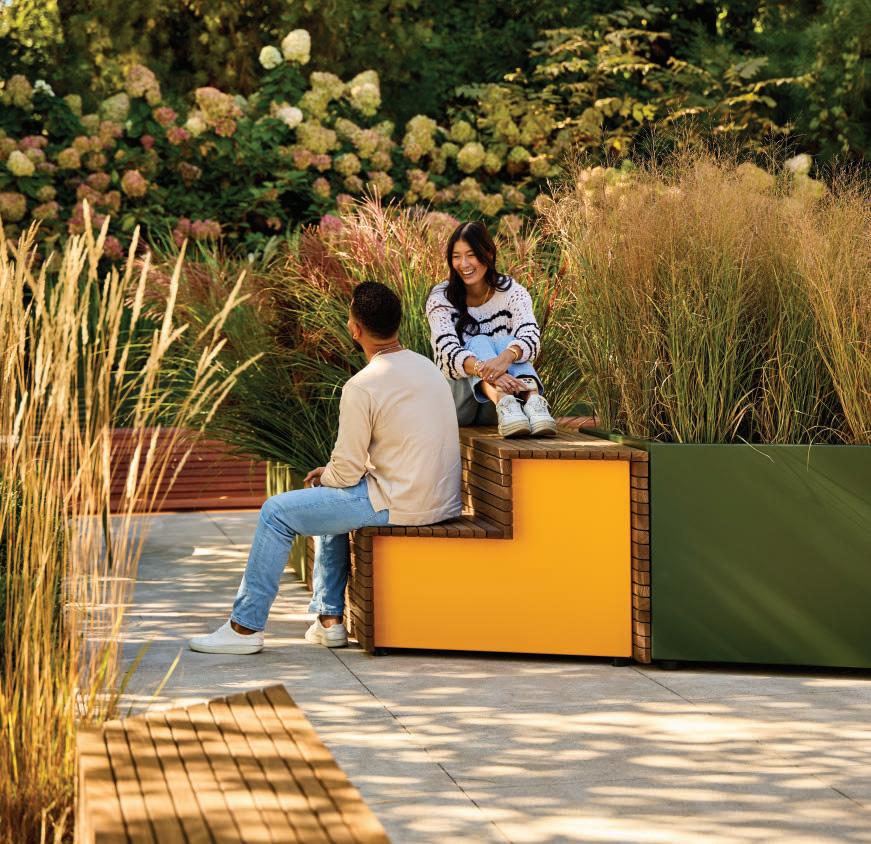
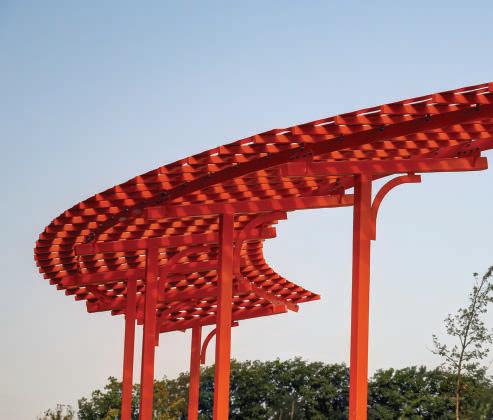
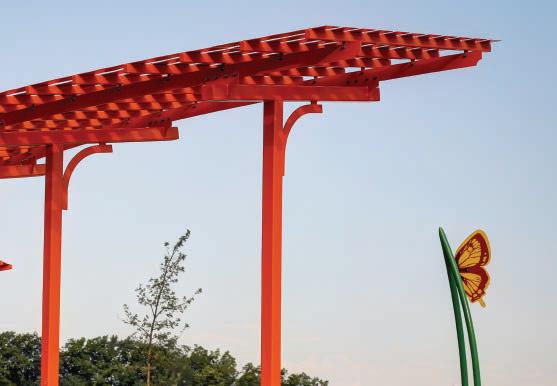
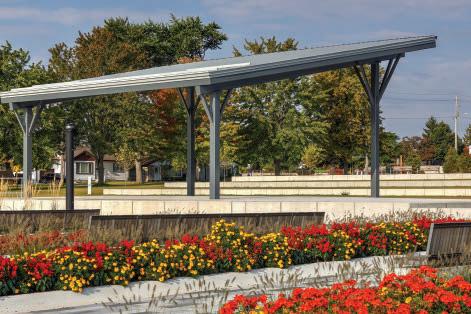
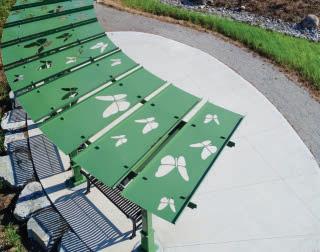
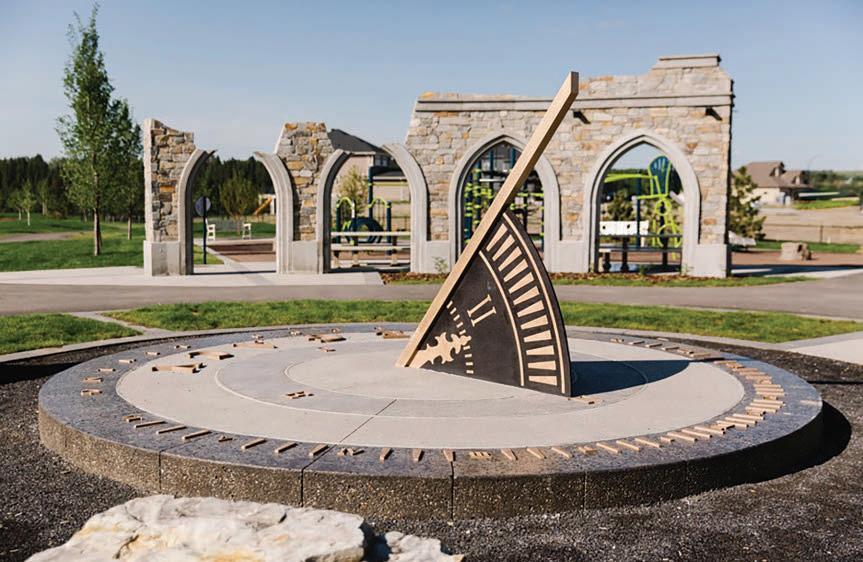
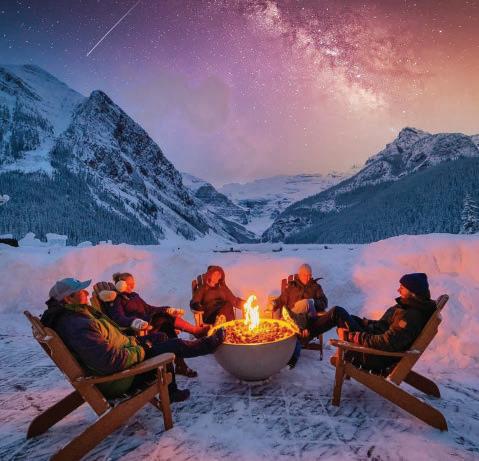
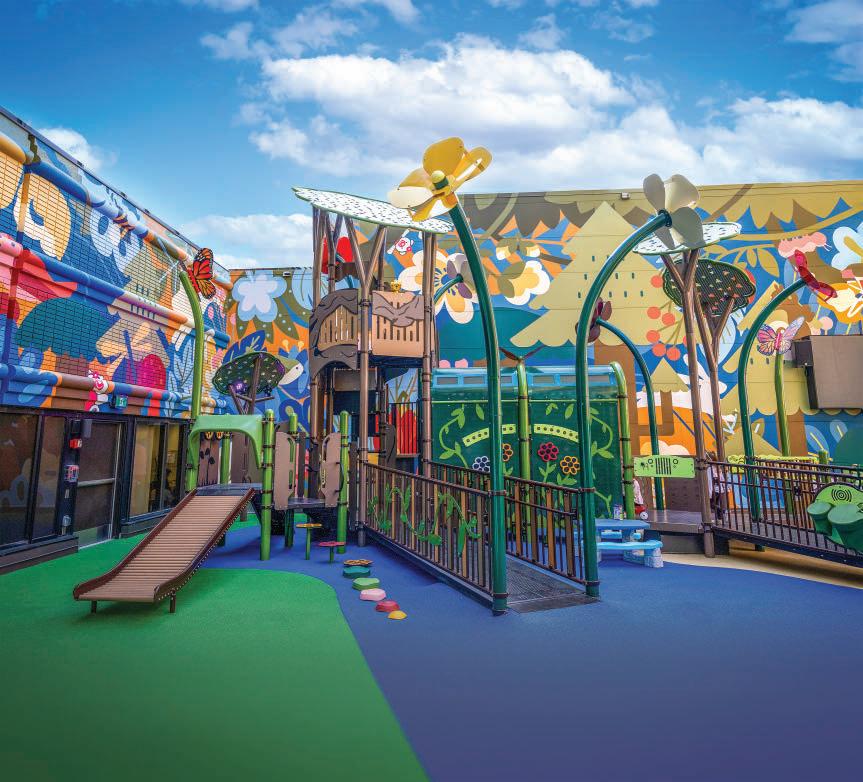
Parallel 42: Modular seating, planters and site definition to elevate social outdoor space.
Designed by Landscape Forms
Landscape Forms | A Modern Craft Manufacturer
Alberta Association of Landscape Architects
Suite 248, 17008 90 Avenue
Edmonton, AB T5T 1L6
Tel/Fax: 780.435.9902
aala@aala.ab.ca www.aala.ab.ca
The AALA is grateful to provide an open-based submission process for Terrain magazine’s content. The voices, ideas and opinions of each article reflect those of the author, and do not necessarily represent the AALA as a whole.
PUBLISHED BY:
Naylor Association Solutions
1200 Portage Avenue, Suite 200 Winnipeg, MB R3G 0T5
Tel: 204.975.0415
Fax: 204.947.2047
www.naylor.com
Publisher Troy Gainer
Editor Jen Lipner
Cover & Layout
Manish Dutt Sharma
Branding Design by Colette Cartier
www.cartierstudios.ca
Email: info@cartierstudios.ca
Cover
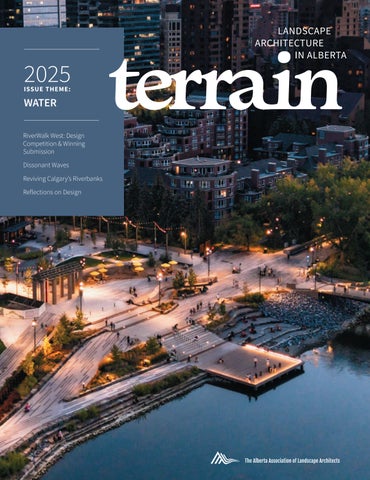
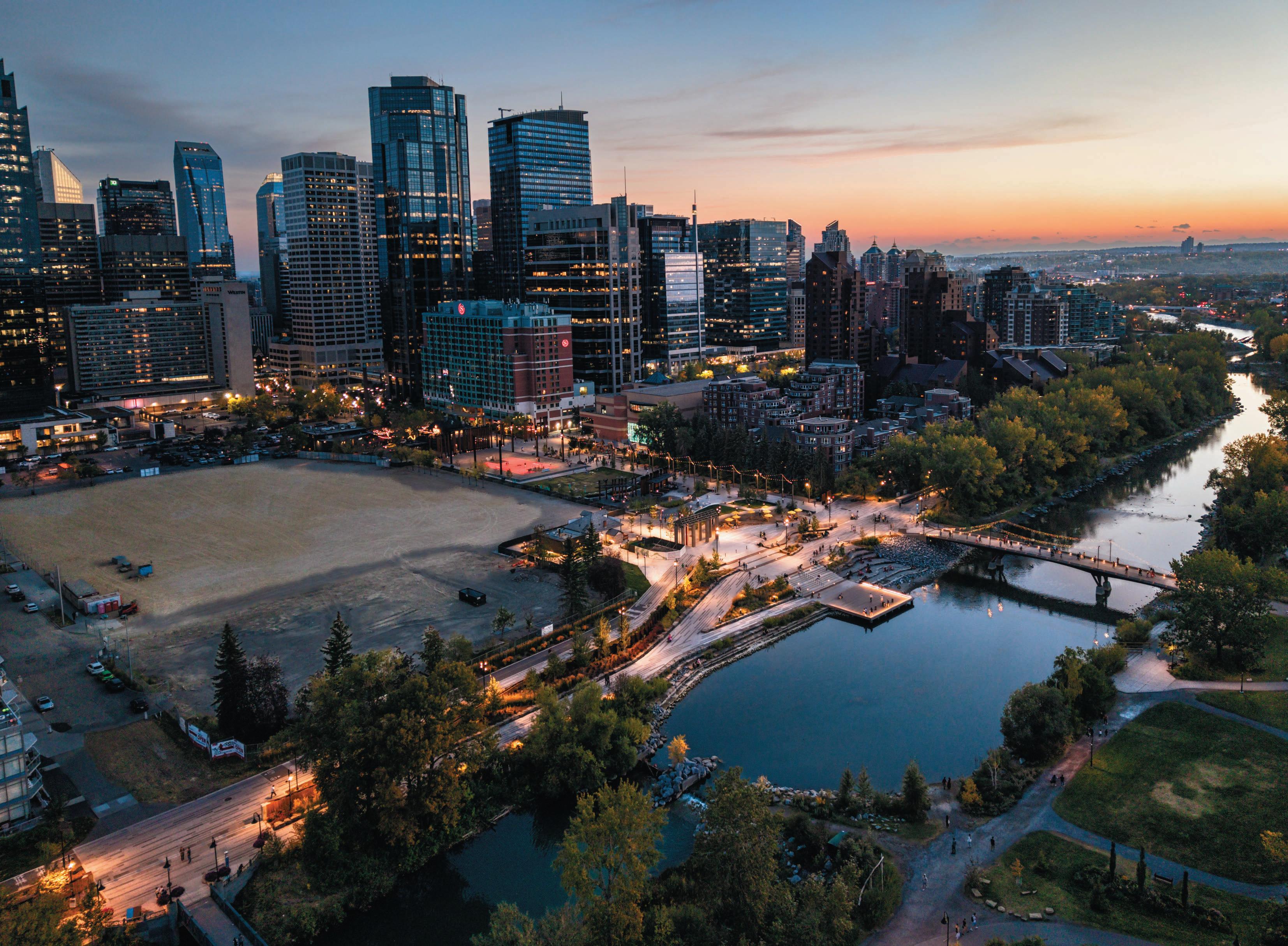
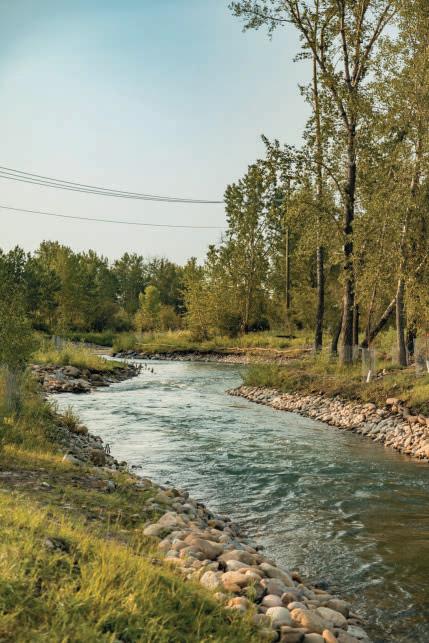
Downtown Flood Barrier and Public Realm Improvements, Calgary, AB (O2 Planning and Design)
All rights reserved. The contents of this publication may not be reproduced by any means, in whole or in part, without the prior written consent of the publisher.
PUBLISHED NOVEMBER 2025/ AAL-A0025
Canadian Publication Mail Agreement 40064978
PRESIDENT, AALA
AALA PUBLICATIONS COMMITTEE MEMBERS, 2025
Jason Pfeifer (Chair)
Bridgette Badowich
Victoria Bohm
Eti Borah
Ashley Bodemar
Kris Fox
Weiting Huang
Dryden Kalesnikoff
Margot Kopache
Fiona MacIver
Diba Mohebzadeh
Marcia Palmer
A
Message from the President
What a year it has been! From the incredible energy and collaboration at the CSLA Congress in Ottawa to the vibrant discussions at our AGM in Calgary — and not forgetting the lively pub socials that brought us all together locally — it’s been a year full of connection. I’m energized and inspired by the passion and dedication I’ve seen in our members across Alberta.
First, and most importantly, I want to extend a massive thank-you to the outgoing Board of Directors. Your dedication, long hours and countless online meetings have been instrumental in guiding our association. It’s not an easy job, and you’ve handled it with grace. I also want to give a special shout-out to our Office Manager, Dryden Kalesnikoff, for his unwavering commitment to supporting the AALA. His hard work is the backbone of our operations, and we’re so fortunate to have him.
And to our incoming Board of Directors: welcome aboard! Thank you for stepping up to serve your profession. Your willingness to volunteer your time and expertise is what keeps this association thriving. I know the feeling of thinking, “I’m already so busy, how could I possibly find the time?”
But I can tell you from experience that the rewards are immense. Volunteering for the AALA isn’t just about giving back; it’s about growing. You’ll gain a deeper understanding of our profession’s governance, build relationships with incredible people and contribute to shaping our future.
Speaking of our future, the Professional Governance Act is finally moving forward. We are now actively in the process of updating and modernizing our regulations, bylaws and policies. This is a rare, once-in-a-generation opportunity to ensure our governance framework is robust and future-proof. We’re committed to keeping you informed every step of the way, because your input is crucial to making sure these changes reflect the needs of our members.
Thank you all for your continued commitment to our profession. I hope you enjoy this year’s magazine, and I look forward to working together in the year ahead.
Letter from the Publications Committee
Over the last five years, we have seen incredible growth in the level of engagement with Terrain We received a record response to our call for submissions and are thrilled by the diversity of work in 2025.
We would like to thank both our returning members, those who have newly joined the committee and those departing for their contributions. Volunteer commitment makes it possible for the magazine to continue as a platform for the voices and perspectives of the profession in Alberta.
The committee is always accepting new members, including all types of AALA members (full, associate, student, etc.)
If you see opportunities for improvement, reach out to publications@aala.ab.ca to get involved on the committee.
Beyond being a showcase, we see Terrain as an important record of landscape architecture; capturing the work, ideas and conversations that define our profession today while contributing to a growing archive for the future. In doing so, the magazine has an opportunity to transfer generational knowledge and strengthen the influence and impact of landscape architecture in this province.
As we look ahead, we encourage members to get involved with the Publications Committee. Whether you’re interested in editing, curating content, or exploring new directions for Terrain; we are enriched by the wide range of skills, experience and insights our members bring.
Finally, we welcome your ideas for next year’s publication, whether themes to explore, topics you feel are important to highlight or new ways the magazine and committee can continue to evolve and expand. Please reach out to us at publications@aala.ab.ca with your thoughts and interest.
— On behalf of the Publications Committee, Jason Pfeifer
Ten Years of the University of Calgary’s Master of Landscape Architecture
Vision
for the Future
PHD, AALA, CSLA, AIAPP, OAPPC-FC
WITH CONTRIBUTIONS BY KRIS FOX, TAWAB HLIMI, DOUGLAS ROBB, BEVERLY SANDALACK AND MARY-ELLEN TYLER
Enrica is a landscape architecture practitioner, scholar and educator. With her firm P’ARC, based in Italy, she has produced award-winning works, which have been published in various landscape architecture magazines and exhibition catalogues. Her design philosophy is presented in several book contributions and she has written for journals such as JoLA, Landscape and Urban Planning, Landscape Research, Cities and the Journal of Cultural Heritage. Dall’Ara is Associate Professor and Associate Dean of Planning and Landscape Architecture at the University of Calgary.
This year, we celebrate the 10th anniversary of the University of Calgary’s Master of Landscape Architecture (MLA) program, the youngest in Canada and the only one in Alberta. The program was launched in 2015 in the former Faculty of Environmental Design (EVDS), now the School of Architecture, Planning and Landscape (SAPL), with the first student cohort enrolled in the fall term of that year.
Building on the faculty’s strengths in the areas of urban design, ecological design and cultural landscapes, Professors and CSLA members Beverly Sandalack and Mary-Ellen Tyler, supported by the Dean at that time, Nancy Pollock, also a CSLA member, developed the program to take on many of the challenges facing settlements, societies and environments, using a landscape-based approach. “We believed that landscape architecture, especially our new program, unhindered by institutional traditions, could be a program for the 21st century. We aspired to be leaders and to train leaders,” recalls Dr. Sandalack.
As a professional program, the curriculum reflects the Canadian Society of Landscape Architects (CSLA) professional standards. When the first students graduated in 2018, the program had been granted full accreditation. Just ten years later, the program was reaccredited for a full six-year term. Since 2018, the program has had 89 graduates; 38 currently hold AALA membership, as registered Landscape Architects (7), Associates (4) and Interns (27) and many others are practicing elsewhere in Canada. This success could not have happened without the support and contribution of the local professional industry. Dr. Mary-Ellen Tyler, CSLA Hon. and Professor Emerita, noted: “The success of the MLA is something we can all be proud of and reflects a strong community of committed professionals and friends.”
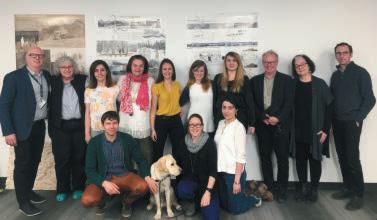
First MLA cohort on their final studio presentations with AALA guest critics, 2018. | PHOTO COURTESY OF BEVERLY SANDALACK
CURRICULUM FEATURES, MULTIFACETED LEARNING
The SAPL MLA curriculum, comprising a Foundation year and M1 and M2 years, is a course-based degree structured around a sequence of core design studios as well as technology and design theory courses. On-site activities are an essential complement to in-class learning and students also have the opportunity to complete a term abroad in cities such as Zurich, Barcelona and Tokyo.
The program has built its identity around the principles of sustainability and interdisciplinarity, working with other professional programs and across disciplines, notably SAPL’s
Master of Planning and Master of Architecture programs. Additionally, students gain a unique learning experience through SAPL’s signature masterclass-style Block Week courses, which have included analog drawing, landscape photography and advanced technologies, as well as ecological restoration and technical courses in plant materials and landscape construction. The latter is offered in collaboration with Olds College of Agriculture and Technology.
In 2022, the MLA Work-Integrated Learning (WIL) Studio was launched. In this initiative, students spend a semester working on projects with external firms, which have so far included ground cubed, O2 Planning and Design and Stantec.
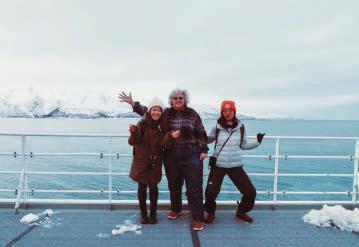
c) MLA students in Norway with Professor Mary-Ellen Tyler, February 2019. The class explored the Northern landscapes and exchanged experiences with the Arctic University of Norway’s landscape architecture students. | PHOTO SAPL ARCHIVE
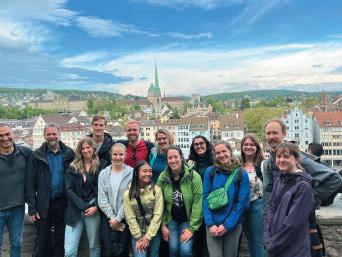
d) Study Abroad Program 2022. An interdisciplinary class of SAPL MLA, MPlan and MArch students in Zurich, Switzerland. | PHOTO SAPL ARCHIVE
Landscape Architecture Fieldwork.
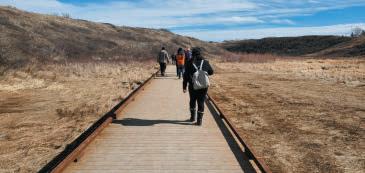
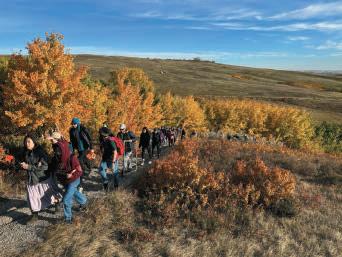
a) Ecological Restoration course. West Nose Creek, Calgary, March 2022 (Instructor Mathis Natvik). | PHOTO SAPL ARCHIVE. PHOTO BY TRIPTY KAUR (MLA ’22)
b) Landscape Ecology and Planning course. Nose Hill Park, Calgary, Fall 2024 (Instructor Douglas Robb). | PHOTO COURTESY OF DOUGLAS ROBB
The Morphology of Urban Repair. Calgary East Downtown. Life between the Buildings. Street –Building Interface and the Quality of Public Realm, by Thu Ngo (MLA ’20). Senior Landscape Architecture Studio project (Instructor Beverly Sandalack). | PHOTO SAPL ARCHIVE
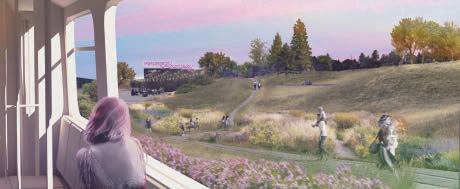
Regenerative Railscapes. Ephemeral Infrastructures, by Zoe Crandall (MLA ’22). Design scenario, View from future LRT Green Line toward Jefferies Park in Ramsay, Calgary. Landscape Architecture Studio II project (Instructor Enrica Dall’Ara). | PHOTO SAPL ARCHIVE
Student design thinking and competency have been recognized through several local, national and international awards, including Calgary’s Mayor’s Urban Design Awards (MUDA) and the Urban Land Institute (ULI) Hine Student Competition, as well as the CSLA Student Award of Excellence, where SAPL students have been recognized twice.
PRACTICE-BASED SCHOLARLY IMPACT
Our program is an ongoing member of the Land|Terre design research network, collaborating with colleagues from other Canadian landscape architecture programs. Our faculty have strong individual research agendas that contribute to the environmental
and social quality of local landscapes, engaging students in a variety of design investigation topics. The Urban Lab, co-directed by Dr. Beverly Sandalack and Francisco Alaniz Uribe, works with community associations, town and city councils, neighborhood committees and other civic groups to address urban design issues of common interest.
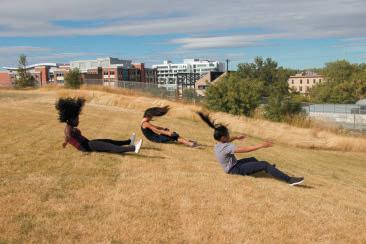
A recent project by Dr. Mary-Ellen Tyler was the Downtown Canmore Sense of Place Study (2023). Dr. Tyler’s work has focused on climate change policies, sustainable energy practices and regional landscape planning. Dr. Tyler also studied the landscape impacts of hydrological networks. In 2021-2023, she authored the report Climate Risk Assessment and Adaptation Considerations for Municipal Governance for the University of Calgary’s School of Public Policy’s research partnership with Alberta Municipalities. Dr. Enrica Dall’Ara has collaborated with the School of Creative and Performing Arts (SCPA) on the project Landscape in Motion (2019-2024) — co-authored with choreographer Melanie Kloetzel — and is currently part of the research team of the pan-Canada project Quality in Canada’s Built Environment: Roadmaps to Equity, Social Value and Sustainability (2022-2027).
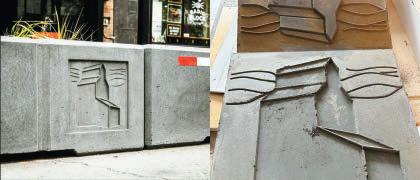
Landscape materiality is the primary focus of Kris Fox’s scholarship. His recent works include the Innovative Modular Patio Barriers Project, a collaborative effort with Barkman Concrete aimed at enhancing accessibility and contributing to the overall quality of pedestrian and vehicular experience on the street, while also addressing traffic safety regulations. Tawab Hlimi’s research and critical practice explore topics related to green infrastructures and ecological design.
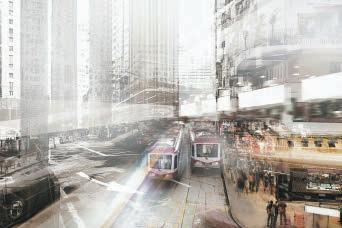
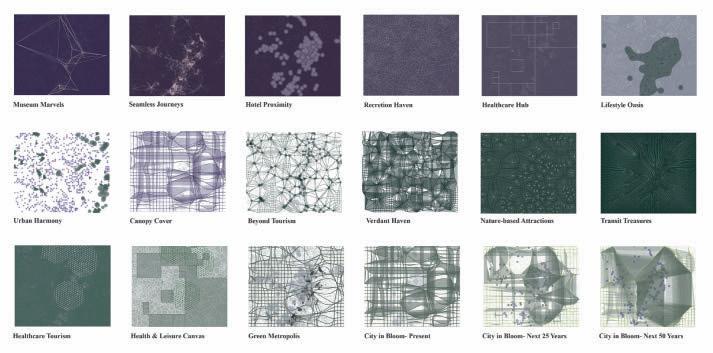
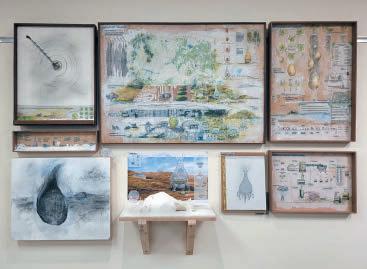
Maps of Singapore, by Afrin Islam (MLA ’24). Block Week course on Computation Approaches, Fall 2023 (Guest instructor Philip Belesky). | PHOTO SAPL ARCHIVE
Agricultural Futurism: The Unsettling of Agriculture in Southern Alberta, by Erin Schwab (MLA ’24), winner of the 2024 CSLA Student Award of Excellence, Studio Project Category. Work developed within the Regional Landscape Systems Studio (Instructor Kris Fox). | PHOTO SAPL ARCHIVE
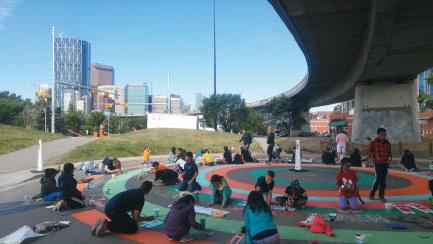
Past community-based projects included Metabolic Movements (2020), a first-prize winner of the Design Talk Institute’s Movement competition and the 4th Avenue Flyover (2017-2018), which received an Honourable Mention at the 2018 National Urban Design Awards. Since joining the Program in July 2023, Dr. Douglas Robb has developed a research agenda centered on the spatial and environmental politics of decarbonization and climate change adaptation. His investigation spans topics such as energy landscapes and evolving concepts of degrowth. Faculty members are also deeply involved as volunteers on municipal, national and international professional committees and design review.
VISION AND OBJECTIVES FOR THE FUTURE
The MLA program is situated in a geographical and socio-cultural context at the forefront of globalized issues such as the climate crisis, energy and economy and decolonization. Our Alberta context enables us to address these issues through specific course contents and a regional approach to landscape architecture.
In 2024, we developed a new MLA Strategic Plan (2024-2027), centered on the values we promote: Climate Action; Justice, Equity, Diversity, Inclusion, Accessibility and Decolonization; Place-based Design; and Craft and Technical Acumen, which are also subject areas we want to strengthen in our curriculum delivery.
Strategic priorities for the near future include:
1) Consolidate and gradually increase the program size, seizing the growing demand for landscape architects in the province and the country. (CSLA Report on the State of the Profession of Landscape Architecture 2024). Key objectives include attracting students to complete their professional education in Alberta after graduating from Olds College, the Northern Alberta Institute of Technology (NAIT), or the SAPL Bachelor of Design in City Innovation (BDCI). Additionally, the goal is to increase student financial support through new scholarships to enhance study affordability.
2) Intensify teaching and research capacity. To innovate education and make a real impact on communities, the expertise of the faculty and sessional instructors is an asset. We aim to expand the collaboration with local stakeholders and industry professionals to co-create on-the-ground projects, engaging students in the process.
3) Review curriculum. Ten years from inception, in light of the emerging landscape architecture discourse and evolving professional practice, we have engaged in a thorough curriculum review, which will lead to course content and sequence revisions.
4) Raise program profile. Community outreach, collaborative projects and strong relationships with local industry have established the MLA program within the community. We aim to augment our impact on external communities, including the profession and the public. Building a stronger identity for our MLA Program will raise awareness of its uniqueness and positively impact student and faculty recruitment as well as research/practice partnerships.
We are grateful to the AALA community for their continued support over the years and look forward to ongoing collaboration to advance landscape architecture education and the profession in the province and beyond.
b) Modular Patio Barriers
c) 4th Avenue Flyover Public Space. | PHOTOS COURTESY OF THE AUTHORS Featured images from Calgary-based research projects:
a) Landscape in Motion
What If We Did It Differently?
Lessons from Calgary’s First International Design Competition
When a new public space opens, we often celebrate the outcome — but rarely pause to examine the process. Who shaped it? Who was heard? What compromises were made, and what possibilities were missed?
This is the story behind RiverWalk West, the final, long-overlooked segment of Calgary’s downtown riverfront. But more importantly, it’s a story about what happens when we, as landscape architects, dare to do things differently. It’s about challenging the status quo of how municipalities approach city projects, navigating bureaucracy and holding space for joy, equity and imagination in public design.
We didn’t just want to build a park. We aimed to develop a process that acknowledges our current approach to city park design has room for improvement, starting with how we determine the best team to lead the design process.
BES, MLA, MCIP, CSLA, ARCT
LEADER OF URBAN DESIGN/INTERIM CHIEF URBAN DESIGNER, CITY OF CALGARY
Joyce is a strategic leader and award-winning landscape architect, planner and classically trained musician (ARCT). She was instrumental in the formation and funding of Calgary’s Downtown Revitalization Capital Program, Main Streets and TOD Public Realm programs — bringing hundreds of millions in capital investment to shape the city’s urban design. With 23+ years of experience, she integrates health, equity and research into public space design.
As founder of HealthYYC, she champions the link between urban form and community well-being.
Proud to bring diversity to the city’s leadership team, Joyce is creating vibrant places where people pause, live, invest and thrive.
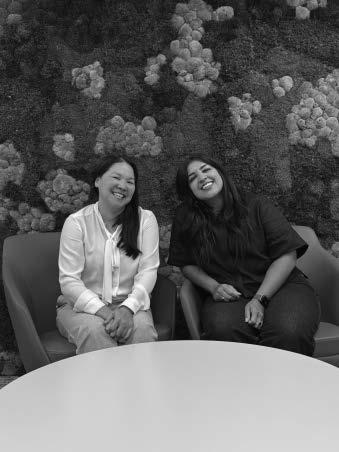
The professions of landscape architecture and city administration historically did not include people who looked like us, and experiencing that inequity fuels us to change it. We wanted to utilize our professional platform to share our experience in the hope of sparking conversations and creating micro changes.
It’s about asking: What could we do differently to get better outcomes — for our cities, our communities and our profession?
THE EXPERIENCE WE BROUGHT TO THE TABLE
Behind every bold process is a team willing to take risks — and our lived and professional experiences played a big role in shaping how we approached this competition.
Tamara:
“I’ve worked in a tiny four-person firm, in engineering/architecture-led firms, in developer-focused companies and now in the public sector. That range gave me insight into how different people approach projects — whether it’s roads, water, planning or the public. It helped me become more collaborative. This couldn’t have been a single-vision effort. We had to listen, learn and stay flexible.”
Tamara’s experience across sectors helped bridge the technical and creative sides of the project. She understood how to navigate internal city processes while advocating for design excellence and innovation.
Tamara Marajh
BA, MLA, CSLA
PORTFOLIO LEAD, CITY OF CALGARY
Tamara is an award-winning Landscape Architect with over 16 years of experience shaping public spaces that inspire and connect. Born and raised in Calgary, Tamara brings a global design perspective drawn from her travels to cities around the world. As a Portfolio Lead at the City of Calgary, she leads a team of Landscape Architects driving innovative, people-centered urban design.
A respected voice in the industry, Tamara is frequently invited to serve on national design juries and is sought after for her insight into creating meaningful, inclusive public spaces. Outside of work, you can catch Tamara enjoying urban life in the community and expressing her creativity by playing in a steel band. She loves a chat and a laugh — so always come by and say hi.
Joyce:
“I used to think being a woman and a visible minority in landscape architecture was a disadvantage. But my scrappiness became a strength. It fueled my fire to not give up — and to make space for others who might not be heard.”
Joyce brought a deep understanding of how built and natural environments shape people’s lives — especially those who are often overlooked. Her background in planning and therapeutic landscape design helped ensure the competition prioritized healing, inclusion and joy.
Together, we brought a shared belief that landscape architecture is about more than just space — it’s about people. And that belief shaped every decision we made, from how we structured the competition to how we evaluated the submissions.
LET’S START FROM THE BEGINNING — WHAT IS RIVERWALK WEST?
Calgary’s pathway system — shaped by rivers, open skies and natural beauty — is a favourite among locals and visitors, connecting over 700 kilometres of scenic trails.
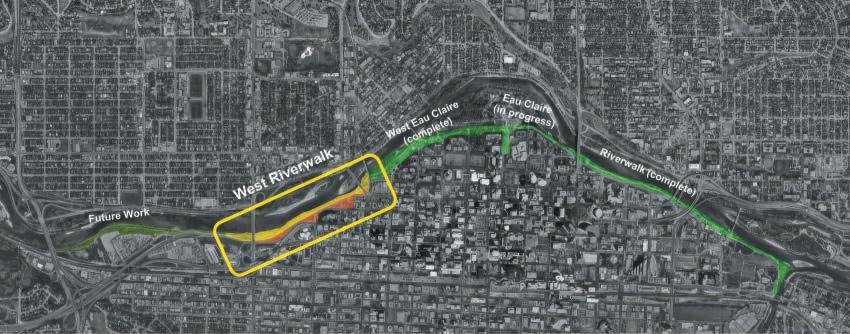
RiverWalk West offered a chance to complete the final link, creating a continuous public promenade from East Village to the west end of downtown.
RiverWalk West was more than a missing link in the city’s riverfront. It was a test of how we approach complexity, collaboration and creativity. It was an opportunity to build upon the success of the previous stages to create a vibrant, high quality riverfront destination, with park and pathway amenities that connect communities and people to the Bow River and the downtown.
RETHINKING THE PROCESS TO UNLOCK POSSIBILITY
The context of the project was both complex and deeply impactful. It challenged us to rethink how we allocate space — particularly in proximity to the river, on shared land ownership — and how we navigate the layered dynamics of public realm and infrastructure needs.
Tamara:
“The project has the potential to do so much, yet it is constrained by so many things — including land, water, layered jurisdictional interests, pressures to support the largest residential community in the city, the need to attract investment into our downtown and most of all create a public space for all that celebrates the water.”
This space lies at the heart of the city and holds the power to shape the identity and future of the communities it touches. Yet its context is also laden with Western cultural preferences and planning biases — often void of Indigenous history and the multicultural diversity that defines Canada. This absence prompted us to ask bold questions: Did we define the scope in a way that truly enables an equitable and inclusive outcome?
Instead of defaulting to a traditional RFP, we asked: What if we opened the door to more voices, more ideas and more possibilities?
Joyce:
“The standard RFP systems could be hindering our broader progress toward building a better city together as a profession, because they reward those who have already figured out the system and encourage firms to compete first — rather than share ideas so that we can collectively do better with every project we build. In other words, you get points for having a better ‘secret sauce.’”
This project demanded a new approach — one that embraces complexity, fosters collaboration and unlocks transformative possibilities for the future of our city.
BUILD THE PROCESS YOU WISH EXISTED
When we proposed an international design competition, the answer was no. The city didn’t have the tools. The process didn’t exist. The risk felt too high.
So, we started the process anyway, to prove that this was the best solution to our complicated site. Our elevator pitch was,
For the same budget and timeline, an international design competition offers greater certainty that the selected team can deliver, while building community buy-in and excitement about the change to come. It turns what is typically an inward-facing process outward — creating transparency, sparking public engagement and positioning the project as a shared civic opportunity.
We created a framework that met procurement rules, ensured fairness and invited creativity. We added rigor — requiring cost estimates, third-party reviews and a diverse jury. We didn’t just ask teams to tell us what they could do — we asked them to show us.
Tamara:
“In a RFP process the teams tell us who they are and what they think they can do: they tell us about their past experience, tell us about their past projects and start to give us a little insight to what think they could come up with for a design solution.
In a design competition, the qualified teams show us what they can do: they show us their ideas, show us their experience and they prove how they use their knowledge in an actual concept.”
Joyce:
“Leadership isn’t about having all the answers — it’s about asking better questions. It is about acknowledging that there is always room for improvement and asking for help isn’t a sign of weakness but of strength.”
Riverwalk West Context Map.
RFP vs. Competition.
Tamara:
“We didn’t have the answers, so we had to get the right team on board to solve the site. And think bigger. We wanted people to think more outside of the box, outside of Calgary, outside of anything we’ve done before.”
DESIGN THE JURY LIKE YOU DESIGN THE SITE
If we want better outcomes, we need better conversations. That starts with who’s in the room.
We built a jury that reflected a range of disciplines, ages, cultural backgrounds and lived experiences — including members of the Indigenous community and youth. We anonymized submissions and standardized formats to reduce bias. And we brought in a neutral advisor to oversee the process.
Tamara:
“The jury process was eye-opening. Everyone saw something different. One person thought a design was too serious, another thought it was visionary. It reminded me that design isn’t about consensus — it’s about conversation.”
LET JOY AND EQUITY GUIDE THE WORK
One of the most surprising outcomes of the competition was the emotional response. Some submissions were technically strong. Others were playful, even whimsical. One — sparked a conversation we didn’t expect: Are we still having fun in landscape architecture?
Tamara:
“One submission made me ask: Are we bringing joy to people? Maybe it’s okay that some elements wear down over time. Maybe that’s part of the process — building, adapting and responding to how people and nature interact with the space and improving until we get to a more permanent solution.”
Joyce:
“Joy is not a luxury in public space — it’s a necessity. It’s what brings people back, what makes a place feel alive and what reminds us why we do this work.”
WHAT WE’D DO DIFFERENTLY — AND WHAT YOU COULD TOO
We don’t claim to have all the answers. But we do know this: the process matters. And we can’t keep doing things the same way and expect different results.
One area we’ve reflected on deeply is the potential value of interviews in the competition process. While anonymity and fairness were critical, we also recognized that some teams may be stronger at verbal communication — a skill that’s essential when engaging with the public, stakeholders and city departments.
Joyce:
“Some firms are better at explaining their ideas verbally than graphically. An interview could help assess how well a team might collaborate with internal departments or engage the public — skills that are critical for a project like this.”
Tamara:
“I see the value, but interviews can be risky. Charisma might overshadow technical ability. An interview could become more of a sales pitch than a solution to a problem.”
We didn’t include interviews in this competition, but we’re open to adapting. In future processes, a shortlisted interview round — especially in the case of a tie — could help assess team fit, communication style and alignment with project values.
THE LESSONS: BIAS, BOLDNESS AND THE POWER OF PERSPECTIVE
We learned a lot. About procurement. About process. About ourselves.
We learned that bias is everywhere — and that checking it requires intention. We wanted every team to have a fair shot, regardless of who they were or where they came from.
We also learned that boldness matters. Sometimes, you have to build the thing that doesn’t exist yet.
We learned that joy is not a luxury. It’s a necessity — especially in public spaces.
We took a risk. Knowing the site’s deep significance to the Indigenous community along the river, we chose not to presuppose the outcome. Instead, we asked design teams to include an Indigenous placemaking lead as a core team member. What we learned through the competition exceeded all expectations. We hope it opens the door to new possibilities.
Joyce:
“When I reflect on why I began my journey as a landscape architect, it was because of my belief that everyone deserves to live in a community with a built and natural environment that heals, brings joy and offers respite — no matter their socio-economic background. So let’s keep leading as great collaborators — without judgment, without silos — and share information and learnings to better all of us.”
Tamara:
“What stood out to me most was how many different perspectives can exist for the same space — and how powerful it is when we make room for all of them.”
THE PERSONAL: WHAT THIS MEANT FOR US
We didn’t anticipate it, but we were pleasantly surprised to see that every submission was unique — proof that there are many great ways to respond to the same design brief. The competition created a space where ideas could be shared openly with the public, in a non-threatening, discovery-driven environment.
Tamara:
“This process changed how I see design. Seeing five completely different responses to the same site — and hearing how differently the jury interpreted them — opened my eyes. It reminded me that design is about perspective. And that the best outcomes come when we make space for many voices.”
Joyce:
“This project reminded me to be bold, to stop waiting for permission and to be humble and accepting of learning new things — from those who share this land with us. As well, to bring others along, including younger professionals who deserve a seat at the table.”
Tamara:
“Ha ha, that’s me, she’s talking about me. It was a good ride, but it had to be together.”
Joyce:
“You aren’t that MUCH younger than me.”
FINAL QUESTIONS TO THINK ABOUT:
The culture of our work environment impacts the physical spaces that we design as landscape architects. Whether that is working in a municipal setting where the foundation for a project outcome starts, or a consulting firm where learnings are held tight to secure the next bid, and where design teams are assembled.
We are not criticizing the people who worked before us but are celebrating the acknowledgment that our systems, assumptions, and approaches are biased due to our colonial history and privileges. We recognize that change is necessary if we, as a profession, want to lead the way towards designing equitable places.
ONE LAST QUESTION…
Tamara: What would our cities look like if every design decision started with the question: Who might be left out?
Joyce: What would happen if we stopped asking what’s possible within the system — and started asking what kind of system would make the best possible outcomes inevitable?
RiverWalk West
A Living Exchange
Greg has been working as a Landscape Architect in Calgary for 20 years. He feels a strong connection to the communities and landscapes of the city where he grew up and takes pride in designing and building beautiful public spaces that serve people. Greg’s designs reflect
When we decided to enter the Riverwalk West design competition, we did a site walk. There, standing on the south bank of the Bow River, we asked, “Why is this place important to us? ”
We had intentionally assembled a local team: an engineer, landscape architect, architect, urban designer and the Blackfoot artist Jared Tailfeathers. We believed the most meaningful design would come from people who have a real and rooted connection to this place.
“My family always came here together when I was growing up,” one person said.
“I love to bring my kids here.”
“I train for runs on these pathways.”
Then Jared shared, “The significance of this place,” he said, “began thousands of years before I was born.” This stopped us in our tracks.
We knew Indigenous perspectives would be integral for the
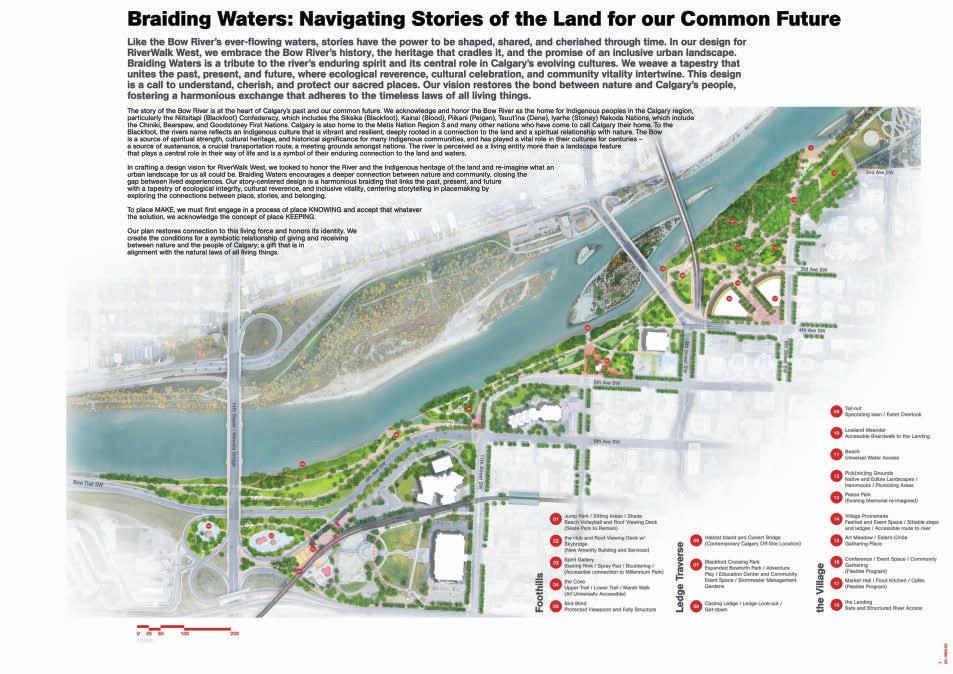
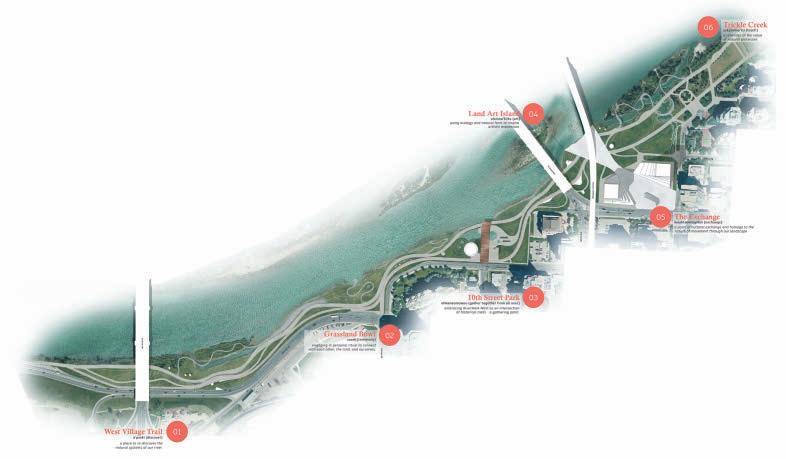
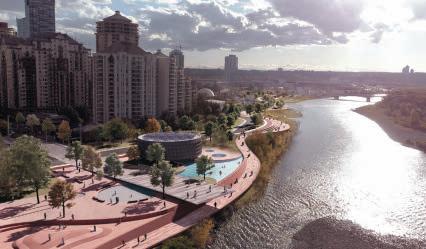
Image provides an overview of the RiverWalk West Site Concept Plan, showing six nodes. | PHOTOS ALL IMAGES COURTESY GROUNDCUBED + HEREBY
BEFORE WE DESIGN, WE LISTEN.
Our process always begins with deep listening.
Through historical and technical site analysis, we learned that, as Calgary developed, the river’s edge was manipulated and hardened to accommodate the lumber industry. Once sinuous and dynamic, the edge along this section of the riverbank is now completely straight and highly engineered.
By speaking with Jared and Blackfoot Elders, we learned that Indigenous Peoples camped and traded along the banks of the river for thousands of years. Their traditional crossings lined up with where today’s Mewata and Louise Bridges serve as crossings for cars, the C-Train and pedestrians.
When the City shared the results of their online public engagement (because this was an anonymous submission, we could not engage directly with the public), we understood citizens wanted more inclusive park space, more amenities and a better connection between RiverWalk, the river and the surrounding communities. They wanted to honour history and heritage — and for the place to feel natural again.
The City design brief called for beautiful and functional multimodal pathways and a better connection between the Downtown West neighbourhood and the river.
Today, the site has a single, narrow, poorly lit pathway, leading to congested and sometimes unsafe pedestrian and cyclist experiences. Furthermore, the pathway is elevated and completely divorced from the river.
How could the design reclaim this section of the Bow River as a natural place and reconnect people with water? How could we honour history and future — facilitating exchange between urban and natural ecosystems?
GIVING STORY FORM
Our team thrives on the design competition process. With an RFP, you tell why you’re the best fit. In a competition, you get to show what you have to offer. We love the design process, and our goal is more than compelling design: it’s giving form to story.
For RiverWalk West, we wanted to tell the story of exchange Over the sweep of time, the river had been a place for sharing knowledge and ideas, for doing business and for humans interacting with each other and the natural world.
Jared and Blackfoot Elders shared six distinct experiences associated with the RiverWalk West site. Those experiences and the Blackfoot words for them shaped six character areas along the river’s edge. From west to east, they are:
A’psski — Discover West Village Trail
Here, we want people to re discover the river’s natural systems by directly touching the water, or via an elevated boardwalk. Water levels rise in the spring to touch or even submerge the boardwalk, then retreat as summer progresses. People will be reminded these waters are a natural system, connected to the mountains, the weather, and the seasons. Up the slope, a pavilion with a restaurant and a grand terraced edge offers a place to pause and take in views of the city or the sunset.
Saam — Ceremony Grassland Bowl
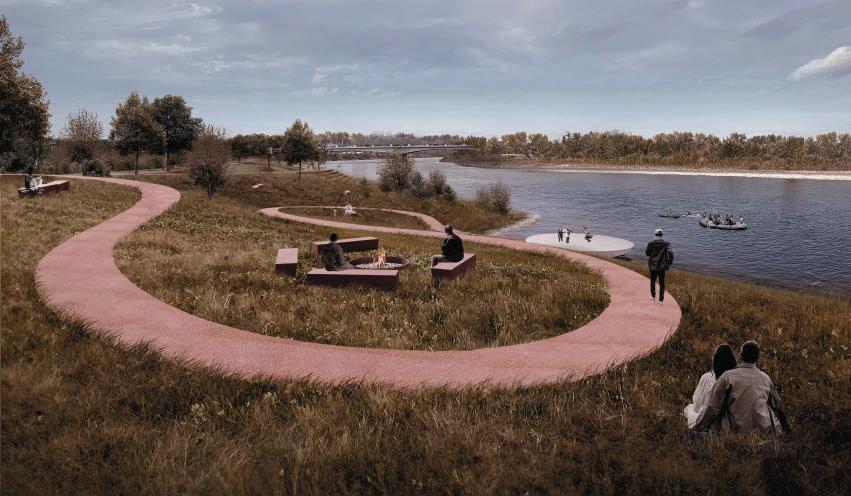
A pathway breaks from the RiverWalk to lead people to a bowl filled with prairie grasses that overlooks a stage surrounded by water. Grassland Bowl is designed for ceremonies of all sizes–a conversation between two friends, a winter bonfire, weddings, live music, or a public event of up to 1,000 people–with the Bow River as the backdrop.
Ohkanaomowoo — Gather together from all over 10th Street Park
10th Street SW is a planned main street and one of the few places offering a direct river connection from the downtown core and the West End neighbourhood. A cantilevered boardwalk overlooking the river draws the energy from businesses and restaurants to spill over to the river’s edge. Surrounding the overlook is park space, animated year-round.
Gather together from all over reflects this point’s history as a traditional Indigenous gathering place, and as a point where people arrive from north, south, east and west.
Image provides a bird’s eye view of the river and design elements of 10th Street Park (node #3).
that’s causing ice dams and other risks. The City plans to redistribute some of those materials.
Our design turns the remaining smaller island into a place for ephemeral sculptural art made of natural materials like stone and willow. From the Louise Bridge, pedestrians can view the art from above or descend a new staircase down to the island and engage with the sculptures and the land.
As time goes by, the art will disappear and be replaced, disappear again, and so on, emulating the ever-present change of the river through time.
Aaahtsowáapiksi — Exchange
The Exchange
This is a destination for exchange within an urban context where nature, community, people, culture and commerce play off of each other. An urban beach provides people with access to the city’s planned engineered surfing wave and offers a place to rest and hang out.
A plaza, sized for weekend markets and festivals, connects the river to the community. The plaza will include indoor-outdoor
To return this highly engineered riverbank to a natural area, our design recreates a historic natural island that once stood here. A floating boardwalk weaves through the tree canopy of the island and interpretive panels teach about the design approach and history of the place.
A constructed wetland with native plant material, bioswales, and grassy swales will serve as a new stormwater management tool, cleaning the water before it returns to the Bow River, and incorporating green design, beauty and functionality.
SO WHY DID WE WIN?
In the end, we think this is a story about celebrating local talent. As a Calgary-based team, our personal connections to RiverWalk West allowed us to deeply hear and understand the history, the people and the story the river had to tell.
As such, we proposed a design that not only accomplishes the needs laid out by the City of Calgary, but also honours the role the river has played over time, what our city needs from it now, and, we hope, long into the future.
Image shows the boardwalk features of the Grassland Bowl (node #2).
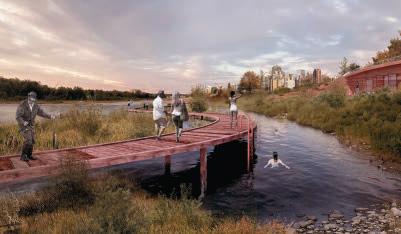
Image shows how proposed boardwalks will allow people to interact with the Bow River.
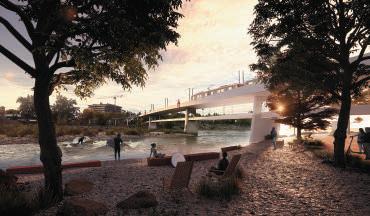
Image shows seating, gathering areas and access points along the banks of the Bow River.
Dissonant Waves
Rivers, Risk and Recreation
with over a decade of experience on diverse landscape projects and a focus on leading multi-disciplinary, high-profile urban waterfront parks. Her project experience includes public spaces, mixed-use
As a nature enthusiast and landscape architect, I am frequently reminded that rivers are lovely and disturbingly dangerous. I’ve discovered this paradox increasingly through my own life experiences: first in my childhood and then more knowingly as an adult and landscape architect. The concept of nature as both beautiful and grotesque is not my own — Annie Dillard probes it in Pilgrim at Tinker Creek: “In nature I find grace tangled in a rapture with violence; I find an intricate landscape whose forms are fringed in death.” With a growing fascination, I find myself exploring this contradiction of the beauty and danger of rivers through a personal and professional lens.
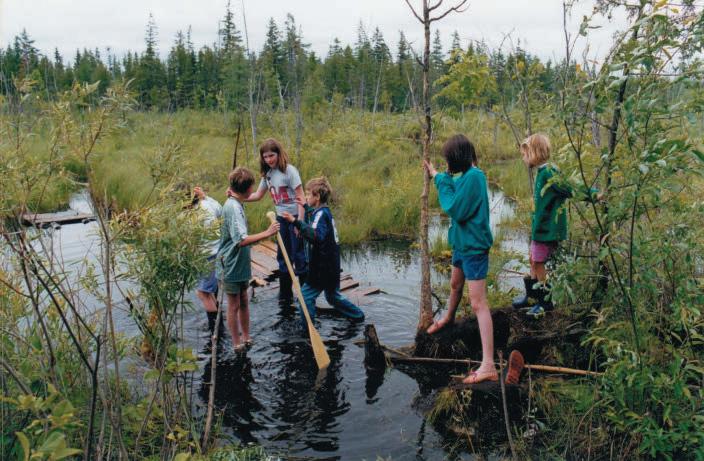
When I was seven or eight years old, we used to tie wooden logs together with rope and explore the swamp behind our home. With the raft heaving and tilting under the weight of small bellies and limbs, we pushed out into the gently moving waters and navigated around cattails with our cuffs dripping, boots filling and shrieks trilling. The biggest risk was getting my socks soaked.
Two kilometres north of the swamp, the Ottawa River is wide, vast and nearly impassable by swimming. It does freeze over but not as readily in faster-moving channels. As Canada’s 8th largest river, it flows nearly 2000 cubic metres in a
As kids, we explored the swamp in my childhood home backyard in Ottawa, Ontario (Author in green sweater and pink shorts). | PHOTO LEE DE KORTE
But come summertime, I would pull my canoe paddle through the same Ottawa River, plunging through leaping crests and foam and out into its deep blue shadows until I was exuberant with joy. My girlish imagination pictured romantic love as the water gifted me sun-sparkles instead of diamonds. How should I contend with this capricious force, both sparkling extravagance and an irresistible lure of death?
Years later, when I first came to Calgary as a young adult, the 2013 flood was still drying out of damp basements. The flooding of the Bow and Elbow Rivers caused 80,000 evacuations and $6 billion in damages across southern Alberta1. What is striking is that I witnessed people returning almost immediately to the rivers for leisure. While there may not have been a serious safety risk by that point, I saw a sharp juxtaposition between the flood and the return to leisure. Despite the force and chaos of the recent flood, they wanted to go to the edge — to get closer, let their legs swing, their toes dip and their bodies submerge.
Ten years after the 2013 flood, I joined a project team2 that had designed a flood wall for downtown Calgary and the public park around it. I watched a drill rig pound steel sheet piles metres deep, wrestling cobbles and boulders far below the ground surface, creating a continuous wall that can withstand a 1:200-year flood. By design, the wall allows tiny seepage to pass through the sheet pile seams to maintain natural groundwater flow patterns and manage hydrostatic pressure. This points to a ubiquitous theme in river management: we often have an urgent imperative to control this untameable force, yet we are bound by its vast, complex systems.
Two kilometres west of the flood wall lies another flood resilience project that surpasses traditional riverfront design scope: we will move islands and sculpt waves in the river itself. Our first project goal is focused on the Louise Bar, an island of the Bow River that increases in size and flood risk annually because of gravel and sediment deposits. To lower the chances of flooding, the project team3 proposes to relocate several islands to improve channel flow and reduce navigational risk for river users. Yet alongside the technical flood resilience focus, our project has a second goal: a recreational river wave. The new wave is an underwater engineered structure that creates a permanent, adjustable wave intended for river surfers, kayakers and other recreational users. To accomplish this dual-purpose design, the project will shape not just the land around the river but the flow of water itself. Thus, we will compose a vibrant expression of river use by re-aligning river islands to reduce flood and navigational risk, while simultaneously introducing a controlled recreational risk through the wave.
The idea of controlling water is particularly interesting to me because I have a slight underlying fear of drowning. This took on a new form when my infant daughter went to a beach for the first time this spring. She delighted in the cool liquid pooling over her toes, but of course, I held her back from wading in too deep.
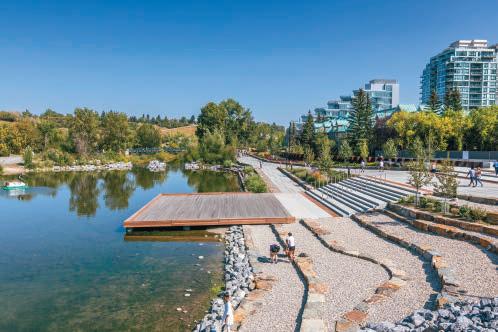
A large deck and stone terraces extend down to the Eau Claire lagoon, with the steel flood wall in the background, both part of O2’s Downtown Flood Barrier and Public Realm Improvements project in Calgary, Alberta. | PHOTO O2
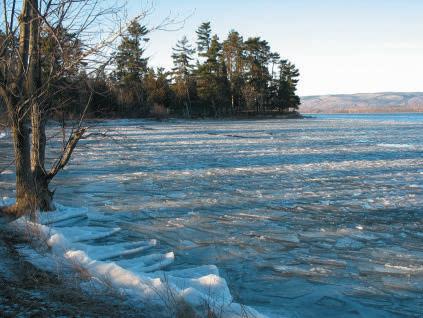
Freezing ice on the Ottawa River at Pinhey’s Point, several kilometres from my childhood home in Ottawa, Ontario. | PHOTO LEE DE KORTE
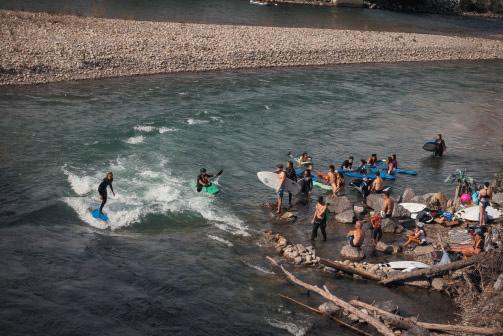
The existing 10th Street surf wave was unintentionally created from logging debris associated with the Eau Claire & Bow River Lumber Company, in Calgary, Alberta. | PHOTO SURF ANYWHERE
At birth, her first breath out of the water-filled womb and into the cold air was an involuntary gasp. This first breath triggered the inflation of her tiny lungs, the redirection of blood flow and the start of her autonomous respiration. The fear of drowning doesn’t stop me from swimming with my daughter but is manifest in recurring dreams of water. I dreamt one night that I was swimming leisurely in a river. Treading water, I played a red grand piano, and as my fingertips pressed the keys downwards, I began to sink. My lungs were filling with water but I was not drowning; I was losing myself in liquid, melodic reverie.
Demonstrated by the captivating and enigmatic nature of water that enchanted me in my dream, I see rivers as the most vivid, exciting element within a designed public space. A river’s elusive, uncontrollable qualities create a complex design problem further compounded by the effects of climate change; such as increasing precipitation and an earlier, faster snowmelt. The work of landscape architecture must be dynamic — nearly musical — in its responsiveness to river systems. Furthermore, design solutions that include an element of calculated risk to the visitor are like musical dissonance — a combination of notes which sound harsh, clashing, or unstable to the ear. When handled by a skilled composer, dissonance is not simply a mistake or an unpleasant sound but used to evoke emotion and add complexity and interest to music. Risk can never be fully eliminated. Instead, river-based design must acknowledge and reinterpret experiences of the dual nature of rivers to orchestrate a deliberate, strategic and managed moment of risk. Sometime soon, I’ll take my daughter to the Bow River’s edge to let her legs swing and her toes dip. With one hand, I’ll splash and the other I’ll sketch, composing the waves of the river for her.
REFERENCES
1. City of Calgary, Flooding in Calgary, Flood of 2013, 2025
2. City of Calgary, O2, Klohn Crippen Berger
3. City of Calgary, O2, Surf Anywhere, Montrose Environmental
The road to my childhood home, overlooking the Ottawa River and Gatineau, Quebec, in the distance. | PHOTO LEE DE KORTE
Memory Beneath Our Feet
Tiffany is a Métis landscape designer at groundcubed in Edmonton. She completed her MLA in 2023 at the University of Guelph following a Bachelor of Fine Arts degree in visual art from the University of Alberta in 2014. During her MLA, she experienced a merging of her personal and professional lives, becoming devoted to and curious about how decolonized design can contribute to both reconciliation and healthier ecological spaces. She is interested in exploring this throughout her career, contributing to healthier spaces both ecologically and culturally, for anyone who finds themselves at home in what is now Alberta.
Fundamental to life, we know to follow water, to stay near it, and learn from it where to traverse landscapes, find food, resources, and medicine. Rivers were the first highways that humanity used for transportation.
Indigenous Peoples in what is now Alberta have learned how to live with water in highly intelligent and purposeful ways. Beyond its practical uses, water is also seen as alive and as a teacher, capable of great change, healing, and connection. Water shows us how we are all connected, through our bodies, our mothers, and all the creatures around us that seek it out for the same reasons we do.
As newcomers arrived to these lands, waterways were a preferred route of travel. Rivers, like the kisiskâciwani-sîpiy (North Saskatchewan), were the original guides that allowed trade routes to grow and for resources to be harnessed along the way. They allowed for ease in transporting goods, making navigation across vast distances a little easier and providing constant access to fresh water for consumption. The Métis also made great use of rivers across Canada, often travelling by canoe to harvest plants and animals and to bring them to trading posts, most of which were situated on rivers, lakes, or oceans. These rivers guided the movement of Indigenous Peoples and newcomers. As economic and cultural shifts swept across the land, water led the way.
In places like Métis Crossing, about an hour and a half drive northeast of Edmonton, paths were developed near rivers that allowed for additional transportation routes.
kisiskâciwani-sîpiy at nightfall. | PHOTO TIFFANY ADAIR
Over time, these routes became embedded into the land from persistent passage. The abundant use of these roads meant they, and the more-than-human, or flora and fauna, that were relied upon along the way, were also attended to. Settlements began to emerge along these routes, including places like St. Albert, the Garneau neighbourhood in Edmonton and the Victoria Settlement, all originally settled by the Métis.
At these settlements, the Métis brought their knowledge of plants, medicines and important animals, like bison, to life. The lands were enriched in these places as the Métis grew and harvested specific plants, caring for them in reciprocity. Some animals, like bison, brought plants with them too, such as sage, which they use to keep biting insects off their skin and fur. Sage is a sacred plant, but also useful practically. The presence of these plants and animals often has symbiotic impacts on other creatures around them, typically improving the health of these places.
Some Métis created farms that followed a French style of land division with long and narrow lots, each with direct access to the river. Others lived nomadically or semi-nomadically, continuing to contribute to the trades that were the foundations of what would become Canada. Always, water was near.
An untold story that left an impression on me during a visit to Métis Crossing involves what is now a deteriorating and humble home that once housed a ferryman. This man would have helped take people across the North Saskatchewan to handle goods or find rest or direction during their travels. This person’s home, and the ferry itself, are slowly being absorbed by the banks of the river and taken apart by the work of plant roots, wind and weather.
On the ferryman’s front doorstep is Victoria Trail, a historic trail frequently used by the Métis who pulled Red River carts from place to place. Nearby are the paved asphalt highways that follow the routes originally made by these carts. Not uncommon across Canada, the routes set by Indigenous Peoples of the region, often footpaths, were later paved for use by vehicular traffic. Many of our major highways follow these old, efficient paths. Today, the original Victoria Trail, with cart ruts and all, is carefully preserved under landscape fabric and aggregate, as a semi-hidden, but remembered history within the land.
The treaty boundaries that divide Alberta and provide some of the strongest legal protection for Indigenous rights trace some of these original trade and travel routes, several of which are rivers. How Indigenous Peoples used waterways and the insight and knowledge they hold about them, unfolded over time into the settlement patterns that shape our province today. Many major cities that developed on the banks of rivers, oceans or lakes, were originally gathering spaces of various Nations that shared, traded, fought, and otherwise convened for a multitude of reasons. Without their guidance and understanding of plant communities, animal movement and habitat, and how to travel cross country; we would not have the development patterns of the Canada that exists today.
When the Métis were forced into hiding in the 1880s, and as many First Nations and Inuit were also forced to abandon much of their culture and home regions, many of these routes fell into disuse, swallowed by time.
A small section of Victoria Trail adjacent to kisiskâciwani-sîpiy, an original trade and travel route heavily used by the Métis, Métis Crossing. | PHOTO ASHLEY ELIAS
Remains of the Ferryman’s house at Métis Crossing, on the banks of the kisiskâciwani-sîpiy. | PHOTO CINDY GO
Landscape architects possess a special skill in reading the land in a variety of ways, a skill in decline. As we continue to shape the lands we live on to improve life as we charge forward in time, we should pause to consider those who came before us and how they understood the land. This begins with water: the ice that shaped the face of our province, the melt that became rivers and carved valleys and ravines, wetlands that hold a richness of life and offer
services often invisible to us. Who has floated down these ancient rivers before us and why? Who lived along the banks of the North Saskatchewan, the Bow, or the Athabasca? What did they leave behind and why did they do so?
We may not be able to gather all these answers, but they remain part of the history of this land. We flourish here because of the work of those who came before us. As we progress, how do we honour the ancient plants and animals whose bodies have become oil or layers of black topsoil or the people with the foresight to foster the more-than-human around them, shaping the places we love? What part of their story can we tell in our work? Can we weave their legacy into our current spaces and places, bringing their knowledge back to life in our day and age?
Regardless of how human history unfolds, the Earth herself maintains the memory of those who passed before us. Those old foot and cart paths still exist and some, such as at Métis Crossing, are now preserved and cared for so future generations can learn from our ancestors’ knowledge. Travel routes maintain traces of where we needed to go in the past, of places we may still need to go, if we only know what we are looking for, where to look, and why.
As a Métis Elder has said, “If you don’t take care of things, you lose them.”
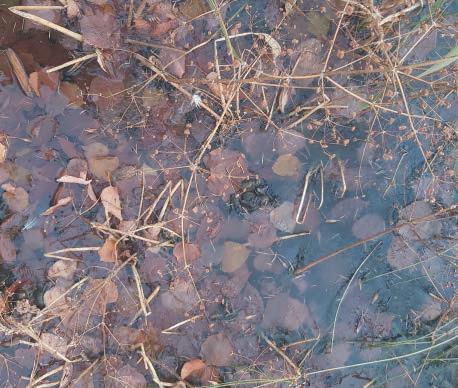
Autumn leaves layered in water. | PHOTO TIFFANY ADAIR
Reviving Calgary’s Riverbanks
Quarry Park Fish Habitat Restoration
Kathryn Glendinning
Kathryn Glendinning, Stantec’s landscape architecture design studio manager in Calgary, has extensive experience in multi-disciplinary projects across western Canada. She collaborates with clients to
Calgary’s rivers are integral to the community, creating shared experiences for all. In June 2013, 325mm of rain fell over 72 hours, exceeding Calgary’s average yearly rainfall. Combined with other seasonal factors, the intense rainfall caused the Bow and Elbow Rivers to overtop their banks, leading to overland flooding and significant damage to areas along the river edges. As the water receded, the extent of the damage to City infrastructure and riparian edges became apparent. Approximately 21% of the Bow and 17% of the Elbow riverbanks within the city limits were lost.
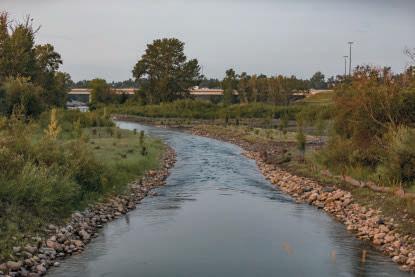
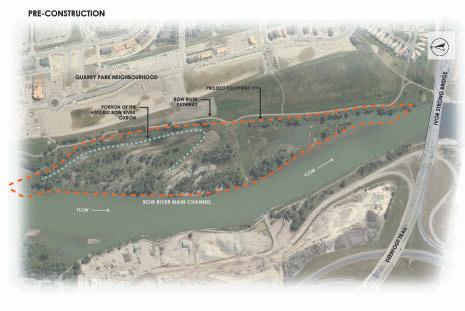
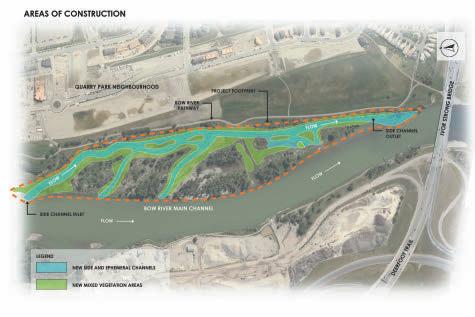
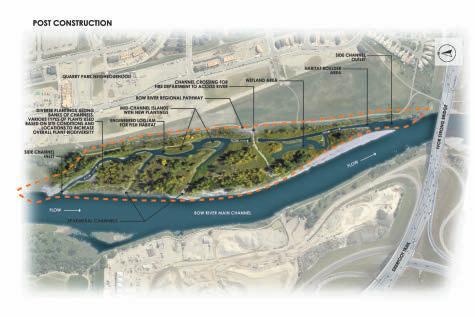
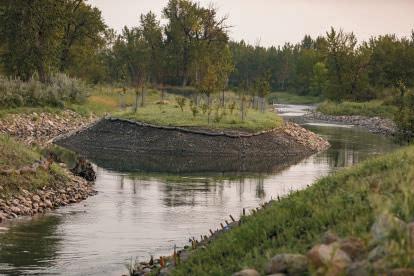
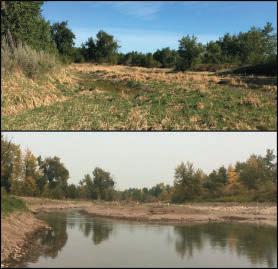
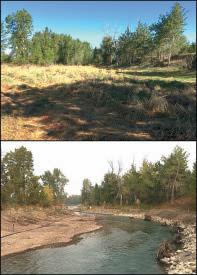
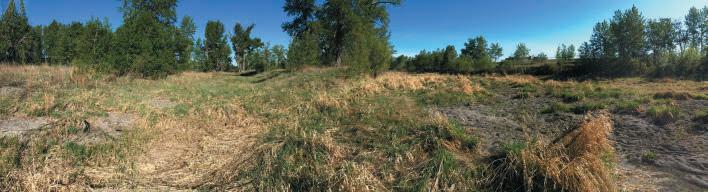
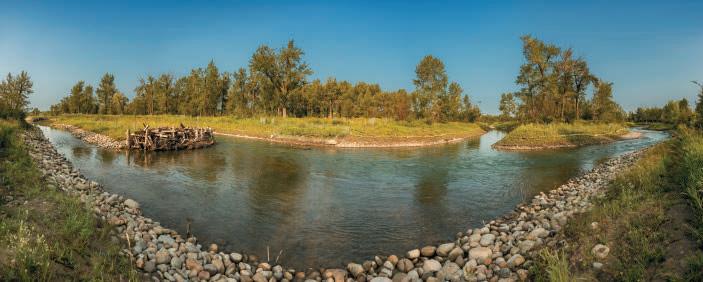
Following this flood event, emergency bank repair measures stabilized critical infrastructure throughout Calgary’s river corridors. While effective in protecting assets, these interventions significantly degraded fish habitat. Under the federal Fisheries Act, instream work resulting in habitat loss must be offset with habitat of comparable quality and scale. To address these habitat debts, the City engaged Stantec’s multi-disciplinary team to design a 1.2 km side channel along the Bow River. Situated adjacent to the community of Quarry Park, the project reclaimed a previously degraded landscape by reactivating a historic oxbow of the Bow River. Once a low-lying grassed area with limited habitat and negligible vegetation diversity, the site now features enhanced terrain, new walking trails and diverse avian, terrestrial and aquatic habitats.
Stantec embraced an integrative design approach that went beyond traditional river reconstruction. The team incorporated landscape enhancements, improved recreational elements for the established residential community, addressed navigation considerations and created fish and wildlife habitats.
As a natural area along the river’s edge, all improvements needed to blend with the existing landscape, aiming to restore the site to a pre-disturbance condition by addressing biodiversity and habitat potential. Vegetation communities were established to support bank stabilization, riparian edge conditions, overhanging growth for fish habitat and succession planting on the upland areas of the site.
Channel aligned to maintain existing old-growth tree stands and new vegetation communities. | PHOTOS ALL IMAGES COURTESY STANTEC
Post-construction: view towards side channel outlet & wetland area, channel around existing willow stand & trees.
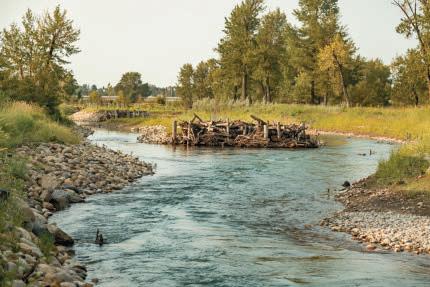
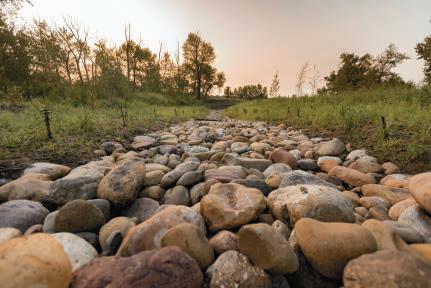
A diverse team of engineers, environmental scientists and landscape architects collaborated to create this habitat oasis within the City. By reusing natural onsite materials, bioengineering strategies created layers of flood and erosion resiliency. Riprap was buried with a secondary layer of vegetation protection to stabilize and protect the banks. This approach achieved a level of flood resilience typically delivered through engineered hard infrastructure, while maintaining a landscape that appears natural, soft and green.
Utilizing the historic oxbow as the starting point, two additional ephemeral (secondary) channels now receive water during high-flow periods, typical during spring melt and storm events. To benefit aquatic species, the design went beyond carving out adequate depths for fish passage; it now maintains the optimal velocities, minimizes turbulence and increases refuge for rearing in channel margins. The main channel also offers optimal gravel substrate for salmonid species known to occur in the Bow River, to increase spawning potential for the local fishery. Overall, the project enhanced fish habitat and increased productivity potential in the ecosystem. These efforts have also indirectly contributed to increased biomass and terrestrial diversity in a previously derelict landscape.
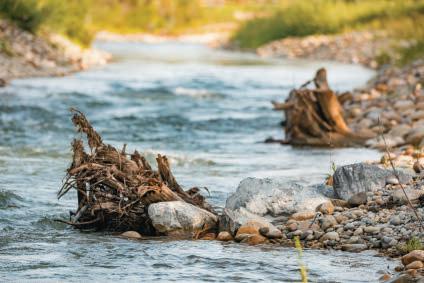
Some key project mandates were to source materials from the site and to limit the removal of existing vegetation for the construction of the channels. This was achieved by configuring the channels around stands of old growth trees and salvaging dogwood and willow and relocating them on site. Any trees that required removal were left on site and utilized in the bank stabilization and habitat features. They became root wads along new channel edges, were integrated into log jams to protect the vegetated islands and are scattered throughout the upland areas to enrich the ecosystem.
The existing wetland soil bank was salvaged prior to site grading. Appropriate wet meadow plants were selected to support adaptability to the new site configuration. The team crafted quality habitat features with integrated bioengineering techniques for channel stability, vegetation biodiversity and preservation of unique site features. More than 80 boulders and 355 pieces of woody debris were thoughtfully placed to enhance fish habitat. Native grasses and 5,500 new trees, shrubs, plugs and live-stakes were planted along the channel banks, wetland edges, on new islands and upland areas to increase biodiversity. The design strategies resulted in improved fish habitat quality and enhanced the amphibian and waterfowl habitats, as illustrated by the multiple returning wildlife species that have started to call this enhanced green space home.
Although fish are the primary user group, recreational users were also considered due to the site’s location within the established community near the popular Bow River Regional pathway network. Traditionally, public access is limited and not encouraged in the footprint of restoration projects; however, during the monitoring period, it became evident that the maintenance access points provided passive recreation opportunities for community members.
These areas transitioned into recreational trails for public use and are now popular access points for anglers and local residents who walk their dogs and linger in the shallow waters during low flow. These new recreational opportunities allow Calgarians to learn about riparian ecosystems and experience a positive transformation following the destructive flood.
During the project, challenges arose, such as sourcing materials and dealing with large stands of invasive species on site. Despite robust pre-construction plans to address weed stands, continual re-evaluation was needed to manage weeds due to the large project footprint and established invasives on the site’s fringe. Collaborative efforts between natural area volunteers and landscape contractors mitigated the issue through ongoing weed and soil removal and replacement plantings until an acceptable level was achieved.
Limited rainfall following construction made it difficult to maintain a consistent moisture level for plant establishment. To address this, a temporary irrigation system was installed to support the new woody vegetation. This learning carried over to other projects, where redundancies in irrigation methods and the flexibility of project teams became critical for implementing alternative watering regimes in response to changing site conditions, ensuring project success.
Post-construction: log jam and reinforced banks (layered protection). Fish habitat: root wads.
Planted island in new channel, live stakes along banks.
Post-construction: view along ephemeral channel, live stakes, seeded edges.
Post-construction, a 5-year monitoring program was implemented with specific key measures to ensure quality fish habitat outcomes. The landscape team conducted site visits in spring and fall to evaluate vegetation establishment. Recognizing and understanding that nature will reveal what works was imperative. Replacement planting decisions were based on site dynamics and observations rather than rigid specifications that would replace a like-for-like built condition.
A significant factor in vegetation establishment was the arrival of beavers! How they enjoyed the buffet that the post-construction conditions provided.
Due to a beaver lodge created on site and observation of their patterns, sacrificial trees were carefully selected with both new and old growth trees receiving additional wildlife protection measures. This allowed for a balance of natural processes and successful vegetation establishment.
In addition to the project team’s monitoring efforts, the City’s overall Fish Habitat Program was evaluated by a third-party consultant to determine habitat quality. The realignment and activation of this lost Quarry Park oxbow created over 5,000 m² of fish habitat and offset approximately 35% of the City’s required flood repair measures. Within the first spring following the channel’s activation, 28 active rainbow trout redds (fish nests) were identified, compared to the typical annual count of 40 rainbow trout redds found within the nearby Lower Elbow River reach.
Pre-Construction
This measurement indicated that the constructed channel had become a high-density spawning location for key fish species within the Bow River fishery, contributing to the annual reproductive success of the fish community.
The Quarry Park Fish Habitat project has laid the foundation for a healthier watercourse, increasing aquatic and vegetation biodiversity, promoting flood resiliency and enhancing the public experience along the Bow River in Calgary. Ultimately, it contributes to an environmentally conscious city, illustrating Calgary’s commitment to creating healthy, natural ecosystems that integrate nature and people by addressing challenges posed by extremely destructive forces.
Post-Construction
Pre-construction of the main channel & during construction — view towards mid channel island.
Pre-construction of the main channel & during construction — view towards side channel inlet.
Pre and post-construction of main and ephemeral channel.
Reflections on Design
Reframing Elegance, Ecology and Emotion in Residential Landscape Design
María is an award-winning landscape architect with over 20 years of international experience across a wide range of projects in both scope and scale. With a strong academic foundation and practical experience, she has successfully completed hundreds of design and construction projects. María holds a Master’s degree in Landscape Architecture from the University of British Columbia, which has shaped her deep theoretical knowledge and practical approach to design.
As the principal of María Galdón & Co. Landscape Architecture, she leads the firm in delivering innovative landscape solutions. María is also dedicated to educating the next generation of landscape architects, sharing her expertise and passion through her role as a sessional instructor in the Master of Landscape Architecture program at the University of Calgary. With a blend of passion, academic training and hands-on experience, María continues to contribute to the advancement of the field of landscape architecture.
In a time of heightened environmental awareness and resource sensitivity, speaking of water as a symbol of beauty might seem outdated, unsustainable, or even irresponsible. But for landscape architects and designers, water has never been just about visual appeal. It is a spatial, sensory and psychological tool — one that speaks to both the science of place-making and possibly, the soul of the garden.
Even in residential settings, where space is limited and budgets carefully managed, water can play a transformative role. It doesn’t need to be extravagant; only intentional.
Throughout history — from the geometric rills of Islamic gardens to the grand canals of Versailles, from Roman courtyards to Central Park in New York — water has held a central and symbolic role in landscape design. Even today, a quiet Sunday stroll around The Lake in Central Park offers a moment of stillness and reflection. So why, in our private gardens, do we so readily overlook the aesthetic power of water?
In our recent residential projects, we’ve had the opportunity to introduce water into the landscape — gently and with intention. Though often modest in scale, its presence is anything but insignificant. For the homeowner, it creates a moment of pause and reflection. For guests, it adds a layer of visual beauty and calm. For birds and pollinators, it becomes a quiet refuge. For surrounding plants, it subtly enhances the microclimate through added humidity. When thoughtfully integrated, water elevates the garden — not just ecologically, but emotionally and experientially.
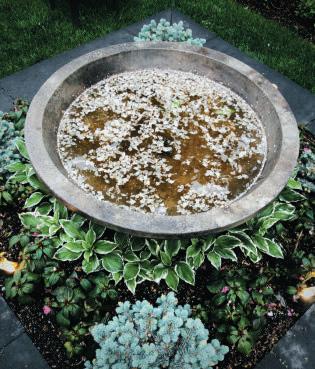
This garden project features a traditional stone bird bath nestled within a lush planting bed, where scattered petals drift across the water’s surface, adding a fleeting sense of ephemerality. Beyond its ornamental presence, the bird bath offers the homeowner a Sunday ritual — cleaning, refreshing and engaging with the garden in a meaningful and intimate way. |
Sustainable design rightly dominates current practice. Many urban homeowners are hesitant to include water features, often viewing them as wasteful or purely ornamental. But these views are largely based on outdated models.
Design — and the process behind it — naturally evolves with each project, even at the smallest scale of a private residential garden. When context and appropriateness are treated as guiding principles, they give real weight to our sense of responsibility.
An English-style garden may introduce water through a simple, ornate birdbath, while a modern garden might incorporate a more sculptural or integrated water feature.
Regardless of style, today’s water elements can be designed with environmental efficiency in mind — using recirculating systems, low-evaporation surfaces and weather-responsive technologies. When implemented thoughtfully, these features not only conserve water, but also enhance biodiversity, improve the microclimate and support overall wellbeing.
As professionals, we are called to navigate this duality — designing landscapes that are both responsible and resonant. Water, perhaps more than any other element, allows us to do both.
At a private residence in Calgary, we were asked to design a front yard that felt “spectacular.” The homeowner wanted something impactful — welcoming yet unexpected.
Instead of dramatic plantings or imposing structures, we chose restraint. At the focal point of the entry courtyard, a mirroring, still reflecting pool became the centrepiece. This low, architectural basin captured the movement of light and sky, animating the space with quiet elegance.
The pool informed every design decision — from stone selection and circulation, to planting rhythms and architectural alignment. The result is not flashy. It’s calm, confident and complete.
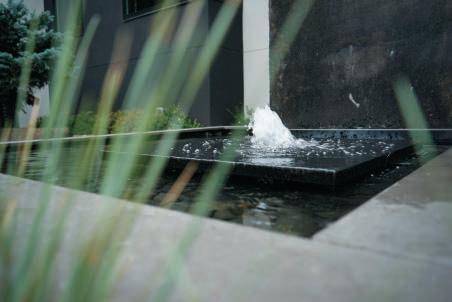
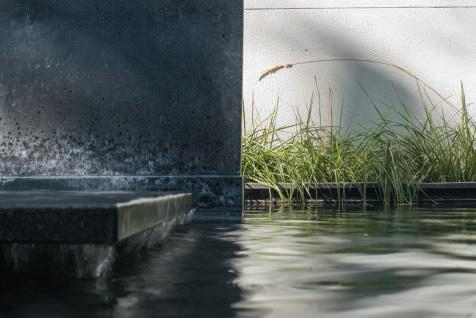
Elegantly achieved through thoughtful detailing, the granite piece was proportioned with precision — positioned at just the right height to produce a gentle, continuous sound without splashing. A custom GFRC (glass fiber reinforced concrete) coping, contrasting subtly with the tone of the proportionally poured slabs, conceals the water feature’s lining and allows the water level to sit at the exact elevation to achieve the desired effect. Surrounding vegetation was carefully selected and placed to frame the space and soften the composition — breaking up the “hardscape-on-hardscape” condition in both plan and elevation, without detracting from the water’s quiet presence as the central design element.
Importantly, it is also sustainable. The feature operates on a closed-loop system, using minimal water. It stands as a testament to how thoughtful water design can enrich a space both aesthetically and ecologically.
In many of our projects, water is introduced in the most modest of ways — a simple birdbath, a reflective bowl or a shallow rill. These understated features may require the occasional refill or cleaning, but that small act of care invites the homeowner to slow down, engage with their surroundings and become more present in the garden.
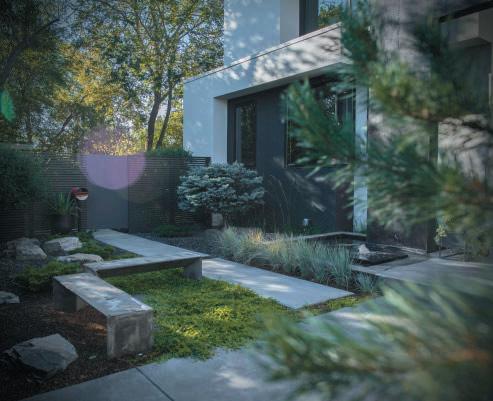
A minimalist water feature anchors the courtyard garden, its clean lines and reflective surface enhancing the minimalist architecture while adding movement and tranquility to the space. | PHOTO ELISSA NIPPARD
The granite piece, proportioned to echo the scale and tone of the entry’s concrete columns, sits within a shallow reflective pool framed by clean architectural lines, soft plantings and grasses that lend movement and texture to the composition. | PHOTO WEITING HUANG
Such gestures foster a biophilic connection, gently deepening our relationship with nature and pride in our surroundings.
One example is the unassuming bowl in our own Studio Garden. Fed by the irrigation line, it’s regularly visited by all kinds of birds — even the magpies, though not always graciously. Its presence, though simple, animates the space and brings quiet joy to our team’s daily routine.
Even the smallest gardens — including those measuring just a few square meters — can benefit from the presence of water.
Yes, water must be used wisely. But that does not mean it must be removed. When integrated with clarity and intention, it becomes one of the most powerful tools in our design vocabulary. Its presence — simply being there — adds value. We begin to appreciate it. To protect it. To connect with it.
Water doesn’t need to dominate the landscape. It simply needs to be present.
To design with water today is to walk a fine line between tradition and responsibility. But it is precisely on that line that the most meaningful and elegant work can emerge. In the modern residential landscape, water can still embody life, luxury and purpose — when we allow it. Not as excess. As essence.
Ultimately, the question is how water can contribute to the project as a whole — enhancing function, enriching experience and anchoring design intent.
Water is not a fleeting trend — it is a timeless element in the language of landscape design. From Roman baths and Japanese koi ponds to contemporary spaces like the High Line’s Sundeck or Portland’s Water Park, water has helped shape both public and private realms. It defines edges, marks transitions, reinforces symmetry, anchors focal points and offers moments of sensory and psychological respite.
In urban residential contexts, where space and time are in short supply, water gives us something increasingly rare: a reason to pause. To notice. To breathe.
As designers, we often advocate for native planting, stormwater capture and low-impact materials. But advocating for water — on emotional and aesthetic grounds — deserves equal conviction. Because design is not only about solving problems. It’s about elevating everyday life.
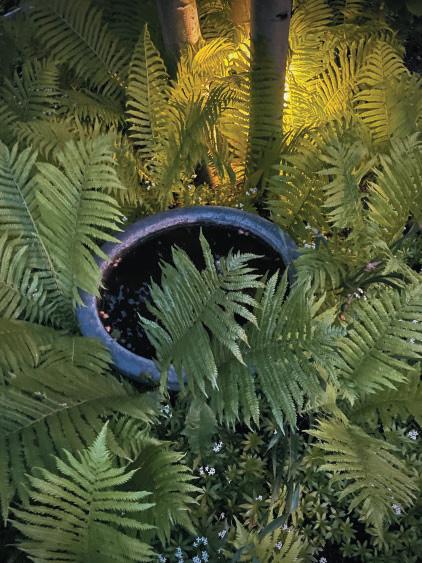
A simple bird bowl, resting at grade and quietly nestled among soft drifts of ferns and galium, offering a gentle moment of pause in our Studio garden. |
PHOTO MARIA DEL SOL GALDON
Light and movement contrasting with the stillness of the surface. Here, water is not expressed as excess, but as essence — quiet, restrained and integral to the architecture and planting around it. | PHOTO WEITING HUANG
Awards and Life Members
LAT TRAILBLAZER AWARD
James Allan
James Allan has over 25 years of experience as a Landscape Architectural Technologist, leaving a lasting mark on Alberta’s public spaces through leadership, technical excellence, and dedication to quality. As a Project Manager at ISL Engineering and Land Services, he has guided complex projects such as Imagine Jasper Avenue, Dermott District Park, and Jubilee Park. With credentials including a Landscape Architectural Technology Diploma, Construction Administration Certificate, and ISA Certified Arborist designation, James brings a well-rounded, detail-oriented approach to design and implementation. A long-standing AALA member, he helped found and chair the LAT Committee, advancing advocacy and recognition for technologists. James’s mentorship, innovation,
and advocacy embody the Trailblazer Award’s spirit of leadership, excellence, and lasting professional impact.
WILD ROSE AWARD
Dr. Douglas Olson
Dr. Doug Olson is a visionary leader whose career has profoundly shaped landscape architecture in Canada. Holding a Doctor of Design from Harvard and an MLA from the University of Manitoba, Doug integrates ecological intelligence with design innovation across regional, urban, and site scales. As founder and former CEO of O2 Planning + Design, he led award-winning projects such as Dale Hodges Park and the Delta Garden, establishing O2 as a national leader in Geodesign. A CSLA Lifetime Achievement Award recipient and Fellow, Doug’s work continues through teaching at the Universities of Calgary and Manitoba, and through advancing the
S.A.F.E. Design Standard™. His career exemplifies leadership, mentorship, and lasting
George D. Harris
George D. Harris has spent over 30 years advancing landscape architecture in Alberta and across Canada through design, mentorship, and leadership. As founder of George Harris Collaborative Inc., his award-winning work — including the 2022 CSLA Award of Excellence for the Iqaluit Recreation Masterplan — reflects a commitment to inclusive and resilient design. A long-time AALA member and President (2015–2016), George has strengthened advocacy, policy, and public recognition of the profession. As the University of Calgary’s first Practitioner in Residence and instructor, he has mentored countless emerging professionals and helped secure program accreditation. His leadership extends to community service,
championing accessible, people-first spaces. George’s vision, generosity, and mentorship embody the Wild Rose Award’s spirit of excellence, service, and lasting impact.
Ted Muller
Ted Muller’s 45-plus year career in landscape architecture is marked by excellence, mentorship, and service. A CSLA Fellow and Wild Rose Award recipient, Ted has shaped Alberta’s landscapes through iconic projects, trails, and parks. As a founder of EDA Collaborative, he built a legacy of quality and collaboration. Even in retirement, Ted remains an active mentor and contributor to the profession. His volunteer service with the AALA and passion for landscape architecture make him a deserving recipient of Life Membership recognition The AALA is proud to welcome Ted as a Life Member in 2025.
MLA/BLA Scholarship
The AALA offers an annual scholarship (up to $2,000) to an Alberta resident attending any accredited BLA/MLA program. This scholarship is available to a student from Alberta who is a member in good standing with the AALA and is attending any recognized BLA/MLA program based on academic achievement and portfolio quality. This year, the BLA/ MLA Scholarship is awarded to Tenaya Lynx.
UofC MLA Scholarships
The AALA is pleased to offer two annual scholarships ($2,000 total) to a student attending the University of Calgary, Masters in Landscape Architecture Program ($1,000 Completed 1st year, $1,000 Completed 2nd year). This year’s scholarships are awarded to Awani Khatu and Fengxia Ning.
Transfer Scholarship
NAIT LAT Scholarship
The AALA awards two annual scholarships ($2,000 total) to a student attending the NAIT LAT Program ($1,000 Completed 1st year, $1,000 Completed 2nd year). The 1st Year Scholarship is awarded to Augusto Medina. The 2nd Year Scholarship is awarded to Drew Walker.
The AALA is pleased to offer an annual scholarship (up to $2,000) to an Alberta resident that has completed a related diploma/degree and is going on to attend any accredited BLA/MLA program. This scholarship is available to a student from Alberta who is a member in good standing with the AALA and will be attending any recognized BLA/MLA program based on academic achievement and portfolio quality. This year, the Transfer Scholarships is awarded to Tasneem Wahed.
ARCHITECTURAL SIGNAGE
Behrends Bronze Inc. 4 https://www.behrendsgroup.com/
BICYCLE PARKING
Habitat Systems Incorporated Inside Back Cover https://www.habitat-systems.com/
BIKE RACKS
Habitat Systems Incorporated Inside Back Cover https://www.habitat-systems.com/ Wishbone Site Furnishings Outside Back Cover www.wishboneltd.com
FENCING
Pure Country Fencing 34 www.purecountryfencing.com
FIRE PITS
SOLUS DECOR 24 https://www.solusdecor.com
FURNITURE - OUTDOOR
Habitat Systems Incorporated Inside Back Cover https://www.habitat-systems.com/
LANDSCAPE - BORDERS & EDGES
Habitat Systems Incorporated Inside Back Cover https://www.habitat-systems.com/
NURSERIES
Cheyenne Tree Farms Ltd. 34 cheyennetree.ca/
Stewart Brothers Nurseries Ltd. ............................. 31 https://www.stewartnurseries.com
PARK & PLAYGROUND EQUIPMENT SPECIALISTS
Habitat Systems Incorporated Inside Back Cover https://www.habitat-systems.com/
PARK AMENITIES/FURNITURE
BDI Play Designs 21 https://www.playbdi.com
PARK BENCHES & RETAINING WALLS
Habitat Systems Incorporated Inside Back Cover https://www.habitat-systems.com/
PICNIC SHELTERS
BDI Play Designs 21 https://www.playbdi.com
PLAYGROUND & RECREATION EQUIPMENT
BDI Play Designs 21 https://www.playbdi.com
Habitat Systems Incorporated Inside Back Cover https://www.habitat-systems.com/
PLAYGROUND SAFETY SURFACING
BDI Play Designs 21 https://www.playbdi.com
PLAYGROUND SUPPLIERS
Habitat Systems Incorporated Inside Back Cover https://www.habitat-systems.com/
SAFETY SURFACING
Habitat Systems Incorporated Inside Back Cover https://www.habitat-systems.com/
SIGNAGE
iZone Imaging 34 www.izoneimaging.com
SITE FURNISHINGS
Habitat Systems Incorporated Inside Back Cover https://www.habitat-systems.com/
Landscape Forms Inc. Inside Front Cover https://www.landscapeforms.com/
Wishbone Site Furnishings ........ Outside Back Cover www.wishboneltd.com
SOCIETY TO PREVENT DUTCH ELM DISEASE (STOPDED)
Society to Prevent Dutch Elm Disease 21 https://www.stopded.org
STRUCTURES
Shadeview Structures 3 https://www.shadeview.com
It’s more than a structure.
It’s more than a way to pass time.
It’s a promise of pause from life’s challenges, offering kids the freedom of a play experience made just for them.