
My name is Anabella and I’m the coordinating editor of The Ubyssey, your campus newspaper. I’m here to give you some unsolicited advice that I should’ve listened to in first year.

You’re going to hear this a lot, but you don’t need to have everything figured out. There’s no possible way to make a perfect choice at every turn, so give yourself the space to try new things. I had to learn this the hard way.
Exhibit A: I had a major bout of self-doubt in wanting to do political science in my first year since I wasn’t that inspired by my intro to political science classes.
If you love POLI 101, as a nerd I’m happy for you! But turns out, those general studies classes were just not for me. I could’ve taken that time worrying about my major to do literally anything else. But despite the worry, I’m happily in the last year of my political science degree, having taken a ton of cool POLI and non-POLI classes along the way.
Exhibit B: I had big plans of graduating in four years. Then I found out about co-op, so those four years became five. Then in third year, I started writing The Ubyssey — I planned on becoming an editor for a year, then going back to co-op.
Then I abandoned all those plans — I wanted to be an editor again.
All along, I worried about making the perfect career move or felt bad abandoning what past me wanted. But now, in my third year at The Ubyssey, I can’t imagine having gone through with my original plan.
I’m sure the version of me who graduated in four years would be doing great at law school, but that version of me has no idea how much she loves to write. Neither is a worse version of the other — they’re both me.
So don’t stress out — things happen and plans change. And if that means you end up writing for The Ubyssey (not-so-subtle plug) that’s great! In my totally unbiased opinion, we’re the best student organization on campus. I’ve been able to make amazing friends, push myself personally and professionally and use our toaster oven for countless lunches.
At UBC, you’ll discover so much about yourself and the world around you. So chill out and enjoy!
Coordinating Editor Anabella McElroy coordinating@ubyssey.ca
News Editor Aisha Chaudhry news@ubyssey.ca
News Producer Renée Rochefort news@ubyssey.ca
Culture Editor Elena Massing culture@ubyssey.ca
Features Editor Iman Janmohamed features@ubyssey.ca
Opinion Editor Spencer Izen opinion@ubyssey.ca
Humour Editor Jocelyn Baker humour@ubyssey.ca
Science Editor Tova Gaster science@ubyssey.ca
Sports + Rec Editor Lauren Kasowski sports@ubyssey.ca
Visuals Editor Anya A Ameen visuals@ubyssey.ca
Photo Editor Isa S You photo@ubyssey.ca
Video Editor Ravnoop Badesha video@ubyssey.ca
Akanksha Pahargarh, Bea Lehmann, Caleb Peterson, Cher Yeo, Diya Gandhi, Emilija Harrison, Emily Lu, Isabella Falsetti, Jasmine Cadeliña Manango, Jasmine Foong,
The Ubyssey is the official student newspaper of the University of British Columbia (UBC). It is published every second Tuesday by the Ubyssey Publications Society (UPS). We are an autonomous, democratically-run student organization and all students are encouraged to participate. Editorials are written by The Ubyssey’s editorial board and they do not necessarily reflect the views of the UPS or UBC. All editorial content appearing in The Ubyssey is the property of the UPS. Stories, opinions, photographs and artwork contained herein cannot be reproduced without the expressed, written permission of the Ubyssey Publications Society.
The Ubyssey is a founding member of Canadian University Press (CUP) and adheres to CUP’s guiding principles.

The Ubyssey accepts opinion articles on any topic related to UBC and/or topics relevant to students attending UBC. Submissions must be written by UBC students, professors, alumni or those in a suitable position (as determined by the opinion editor) to speak on UBC-related matters.
Business Manager Douglas Baird business@ubyssey.ca
Account Manager Forest Scarrwener advertising@ubyssey.ca
Web Developer Brittany Sampson b.sampson@ubyssey.ca
Web Developer Sam Low samuellow@ubyssey.ca
Web Developer Akshanjay Kompelli akshanjaykompelli@ ubyssey.ca
Social Media Manager Jasmine Lee social@ubyssey.ca
President Jalen Bachra president@ubyssey.ca
Editorial Office: NEST 2208
604.283.2023
Business Office: NEST 2209
604.283.202
6133 University Boulevard Vancouver, BC V6T 1Z1
Website: ubyssey.ca
Twitter: @ubyssey
Instagram: @ubyssey
Facebook: @ubyssey
TikTok: @ubyssey
Jerry Wong, Katie Timms, Lua Presidio, Marie Erikson, Maya Levajac, Melissa Li, Nathan Bawaan, Queenie Kwan, Shubhreet Dadrao, Simon Jian, Sophia Russo, Victoria Lee, Zoe Wagner
Submissions must not contain racism, sexism, homophobia, transphobia, harassment or discrimination. Authors and/or submissions will not be precluded from publication based solely on association with particular ideologies or subject matter that some may find objectionable. Approval for publication is, however, dependent on the quality of the argument and The Ubyssey editorial board’s judgment of appropriate content. Submissions may be sent by email to opinion@ubyssey.ca. Please include your student number or other proof of identification. Anonymous submissions will be accepted on extremely rare occasions. Requests for anonymity will be granted upon agreement from fourfifths of the editorial board. Full opinions policy may be found at ubyssey.ca/pages/ submit-an-opinion
It is agreed by all persons placing display or classified advertising that if the UPS fails to publish an advertisement or if an error in the ad occurs the liability of the UPS will not be greater than the price paid for the ad. The UPS shall not be responsible for slight changes or typographical errors that do not lessen the value or the impact of the ads.
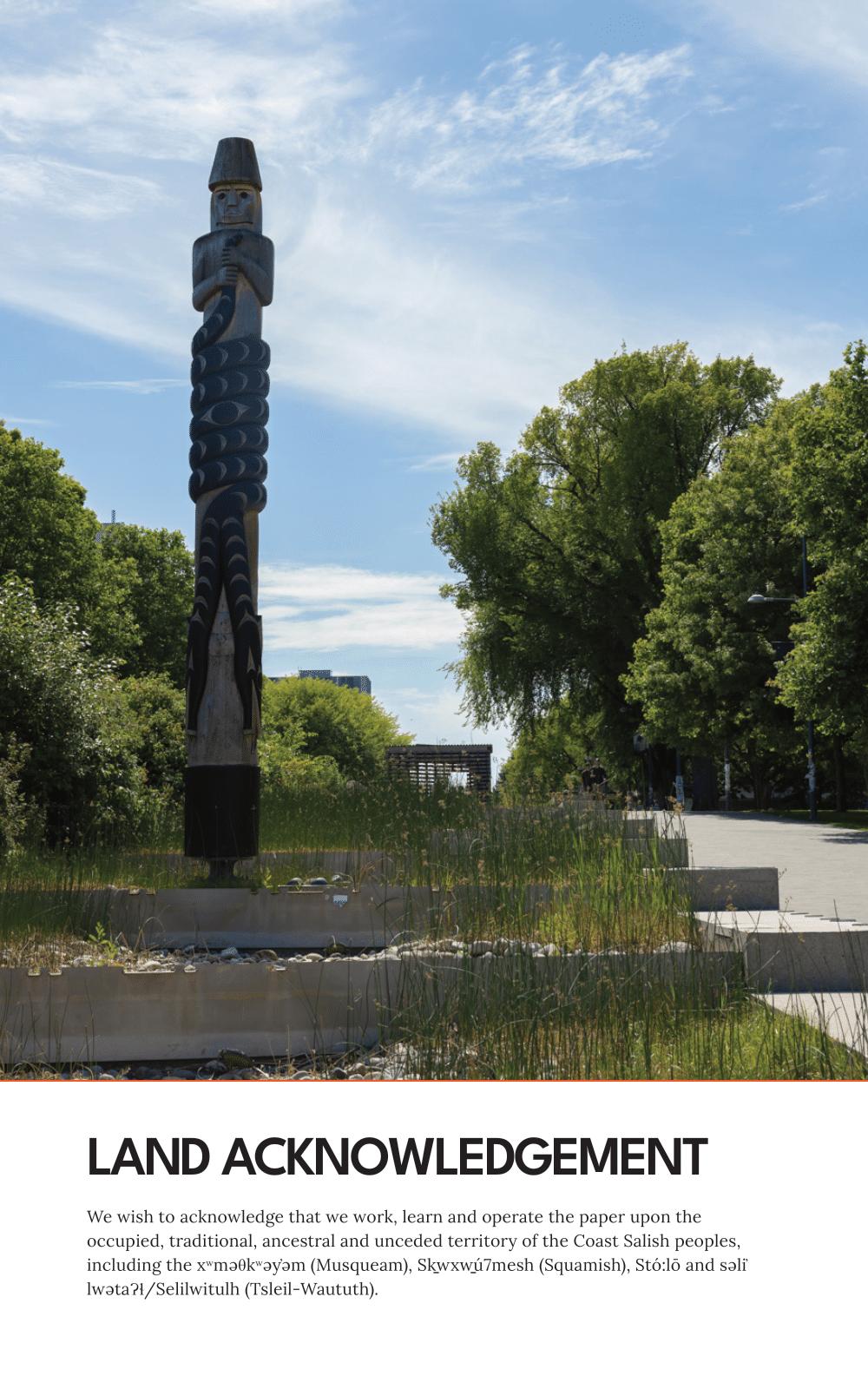
Land Acknowledgement
Editor’s note
UBC
UBC History
Letter from the AMS President
Letter from the GSS president
Governance bodies
UBC Thunderbirds Student traditions
ACADEMICS
The basics
Navigating majors + courses Study tips
Interacting with your Profs and TAs
Transitioning from high school to university Opportunities beyond the classroom
Academic and learning resources at UBC
FINDING YOUR PLACE AT UBC
Finding your community
Clubs and student groups
Religion and spirituality
Roommates
105 things to do at UBC
ON CAMPUS
Best eats on campus
Campus attractions Study spots
UBC after hours
Campus housing
Recreation
Cheap prices and student discounts
Navigating off-campus housing

Finding a job + balancing with studies
Queer
Resources for Indigenous Students
Resources for Black Students
Legal resources
Consent, safe sex, UBC sex shop
Responding to sexual assault
PARTIES AND MORE
Vancouver night life and drinks
Drinking consciously
Drug safety
Weed and where to get it
After you arrive in Canada
Student resources
The great outdoors

As a UBC student, you’re part of a long legacy. When you walk past IKB, you’re seeing the same weathered stones as students who studied medicine before the invention of penicillin. But the cliffs and forests around campus have a far deeper history with the Musqueam people, who know the peninsula as ʔəlqsən (point of land).
Indigenous peoples have been living on their traditional and ancestral lands since long before UBC’s campus was established. UBC campus sits on the unceded territory of the xwməθkwəyəm (Musqueam) people, and Vancouver sits on the unceded land of the Musqueam, Sḵwxwú7mesh Úxwumixw (Squamish Nation) and səlilwətaɬ (Tsleil-Waututh Nation).
The University Act of 1908 established UBC, and the province decided the university would sit on the current Point Grey Campus in 1910. This allowed UBC to be responsible for its own utilities, services and governance, meaning if you live on campus, you don’t actually live in the City of Vancouver.

Construction of the campus began in 1914 but was soon halted by World War I, so UBC operated out of a former facility of McGill University College in Vancouver.
In 1919, students returned from military service to tight tents and overcrowded churches that were used for classes. This was until 1922, when unsatisifed students began The Great Trek, a march that gathered 56,000 signatures to persuade the provincial government to continue the construc-
tion of what is now UBC’s Vancouver campus.
Students marched from the temporary campus to the campus we know today and set up camp. The Great Trek succeeded in convincing the BC government to restart the construction of campus.
While the Great Trek was a landmark moment of student activism, it was also colonial land theft. Contrary to student protestors’ rhetoric, the land was not empty, and UBC’s construction dispossessed the Musqueam people of their land.

UBC is still reckoning with its colonial history and present. Part of that reckoning includes incorporating Indigenous content into curricula, adding signage in the Musqueam language hənqəminəm to campus residences and other gestures toward increasing Indigenous visibility. This is an ongoing process that you as a student should educate yourself on — you can start with the resources at indigenous.ubc.ca.
Our campus opened its doors in 1925, marking the beginning of UBC as we know it.
The university grew slowly until the end of World War II, when the student population exploded as baby boomers reached adulthood.
Since then, UBC has been marked by the legacies of prime ministers, scientists and groundbreaking researchers who walked the same sidewalks and learned in the same classrooms. Now, you have a chance to make your mark (but no pressure!), and to tread respectfully on a landscape with a long history before and after you. U

Hello, and welcome to UBC!
My name is Esmé, and I’m your AMS president. You might be asking, “What the heck is the AMS?” Basically, the Alma Mater Society (AMS) is your student union.

We are here to connect students across faculties and provide part-time jobs and volunteer opportunities. We also provide services like the AMS Food Bank, Peer Support, Safewalk, Advocacy, Tutoring and the Sexual Assault Support Centre.
The AMS administers your health & dental plan, hosts parties and socials and runs the AMS Student Nest — a home base for students whenever you might want to get food, study or hang out.
We also have elections every year in March, so make sure to vote and see if you want to get involved in AMS Council, the Executive team or other roles to make decisions about where our student fees and voice go toward!
Before I started my first year, I saw some college advice that said, “Sleep more than you study, study more than you party and party as much as you possibly can.” Even if partying in the beverages and loud music sense isn’t your thing, partying can also mean getting involved in clubs, constituencies, sports teams, hanging out with classmates and groaning about the homework or whatever means fun to you!
Whatever it may be, even just studying on campus and being around other people is so important to know you’re not alone. You’re part of communities on campus, whether that’s your faculty, AMS or
UBC community, and you’ve earned your spot here — I just hope you’ll remember you belong here every day that you’re with us.
I won’t lie, there are going to be some stressful times ahead, but you can mitigate how much the stress gets to you by making connections with the people around you, tutoring each other on different subjects and having somebody to talk to and feel at home with in this big university.
Honestly, just saying “hi” and exchanging names with whoever I sat down beside in any class helped me a lot, so try your best to have those little conversations and see where they take you!
University can be such a great place to make lifelong friendships as you bond through the good and bad times, and I really hope that you’ll find your people here. It’s not just about learning from our classes, but about learning from the people we meet here along the way.
If you ever need anything or just want someone to talk to and listen, I’m more than happy to help!
Come by the AMS offices on the third floor of the Nest or feel free to send me an email at president@ ams.ubc.ca. I’m looking forward to seeing you around and all the best for your first year and the years to come.☺ U
The Graduate Student Society (GSS) of UBC Vancouver is an organization dedicated to representing and advocating for the interests of over 10,000 graduate students at UBC.
As the GSS president and a fellow Ph.D. student, I want to assure you that our primary focus is on serving and advocating for all graduate students.
The GSS is led by an executive team composed of elected graduate students who work collaboratively to address the academic, social, financial, professional and recreational needs of our graduate student community.
Working alongside the GSS Council, committees and staff, our executive team strives to connect graduate students with the university and the provincial and federal governments. We are an organization run by graduate students, working for graduate students.
One of the crucial services we offer is Peer Support, a resource where fellow graduate students can access information, resources and confidential assistance for a range of challenges including housing, personal issues, funding, debt, academics and supervision. Our dedicated peer support specialists can be reached at advocacy@ gss.ubc.ca.
In addition to our strong focus on academic support, the GSS provides a wide array of programs, events and classes aimed at enriching
the lives of graduate students on and off campus. In the past year, these have included French and Mandarin classes, a softball league, fitness classes, board game and movie nights, hikes and professional development events.
This fall, we are thrilled to announce the opening of the Graduate Life Center (GLC) located near the Rose Garden, in Thea Koerner House. The GLC has been in development for over five years and is designed to provide formal and informal spaces for studying, relaxation, social events, seminars and conferences.
If you are passionate about enhancing the graduate student experience at UBC, I encourage you to get involved with the GSS. Whether by joining our team or participating in various committees, your ideas and initiatives directly contribute to the success of our society. For more information, please visit our website at gss.ubc.ca. or email aa@gss.ubc.ca.
I invite you to seize the opportunities available through the GSS to fulfill your potential and achieve your personal and professional goals during your time at UBC. Welcome to the GSS, and may you enjoy a fulfilling journey at UBC!
Best regards,
Sam Kenston U
In March, students vote in AMS Elections to pick student representatives for various governance bodies at UBC. Here’s a quick guide to each position so you can know who’s who in student governance.
There are five AMS executives, each elected individually. They run the major operations in the AMS and around the Nest.
• The president — currently Esmé Decker, a.k.a Remy the Rat — focuses on the broad strategic direction of the AMS and is the face of the organization.
• The VP academic — currently Kamil Kanji — focuses on student priorities within UBC, often pushing the university for more funding.
• The VP finance — currently Abhi Mishra — works on all things financial, like the annual budget and club reimbursements.
• The VP administration — currently Ian Caguiat — runs all things Nest operations and clubs.
• The VP external — currently Tina Tong — is a student lobbyist, advocating for student priorities at all levels of government outside of UBC.
An important non-elected position in the AMS is the student services manager. They run the AMS Food Bank, Safe Walk, AMS Tutoring and Peer Support. Currently, the position of senior manager, student services is held by Kathleen Simpson.
AMS Council is where most major decisions in the AMS go to a vote. It has representatives from all constituencies on campus (like the Arts and Science Undergraduate Societies). They approve the annual budget and are meant to hold the executives accountable to their goals.
Committees are where a lot of AMS work happens before going to Council. Council members serve on them, but students at large (like you) can join as well! Keep an eye out on ams.ubc.ca for applications come September.

The Senate is UBC’s chief academic governing body and makes rules on everything from textbook costs to academic misconduct. The Senate also approves new courses and majors. It has 85 members, including 16 elected student representatives — one per faculty, two from graduate and postdoctoral studies and five senators-at-large.
Student senators work as an informal voting bloc called the Student Senate Caucus, currently led by Kamil Kanji and Kareem Hassib.
The Board of Governors (BoG) essentially runs UBC — it approves the annual budget and strategic goals for the institution. The biggest story out of BoG last year was that it voted to approve tuition increases while students protested outside the boardroom. There are 21 BoG members, 11 of which are appointed by the province.
There are three elected student governors on BoG, one from UBC Okanagan and two — Eshana Bhangu and Kareem Hassib — from UBC Vancouver. U

Thunderbirds, T-Birds or just the ‘Birds — UBC’s varsity athletic teams are represented by the sometimes goofy mascot we’ve come to know and love. But he wasn’t students’ first choice.
In 1933, students overwhelmingly voted to be the UBC Seagulls — a write-in joke candidate in a university-wide poll for a mascot. You might have seen the AMS Birb walking around campus since the student society has kept the original choice around.
But the UBC Pep Club and The Ubyssey weren’t enthusiastic about having a seagull represent them and did what they thought was best — pick the name themselves.
Although UBC started to officially recognize varsity athletes as “Thunderbirds” in 1934, the university did not consult or gain permission from the Musqueam people or any other nation to use it. The Thunderbird is an important figure for many Indigenous peoples.
It was not until 1948 that Chief William Scow of the Kwikwasut’inuxw Haxwa’mis First Nation gave UBC permission to use the name and a traditional ceremony was held during the homecoming football game.
The Thunderbird mascot represents UBC’s 26 athletic teams. Here’s a few highlights of the past season:
• The seventh-seeded women’s volleyball
team came from behind to win the national championship against the top seed and local rival Trinity Western University. This marked UBC’s thirteenth women’s volleyball national title.
• UBC dominated at the division level, with both soccer and cross country teams, women’s hockey, women’s rugby, women’s rugby sevens and women’s swimming teams capturing Canada West banners.
• The baseball team, men’s and women’s golf teams and women’s track and field, secured banners in the Cascade Collegiate Conference, under the National Association of Intercollegiate Athletics (NAIA).
• The women’s track and field team won back to back NAIA championships and the men’s team came second. Ten T-Birds walked away with individual gold medals as well.
There are also a few festive events to show your school spirit with varsity teams through the year.
Homecoming is September 16–23, culminating with a football game with a roaring student section on the 22. Courtside is a basketball festival, hockey hosts the Winter Classic and Pride Night is an annual celebration of 2SLGBTQIA+ Pride with fundraising volleyball games. U
Academics are important, but having fun is too! Make the most of university by participating in these unique-to-UBC experiences.
Kick off the school year with Day of the LongBoat, a sand-tastic annual tradition that’s been going on at UBC since 1987. You and your team of 8–10 will race in a longboat canoe at Jericho Beach.
Whether you want to show off your athleticism or want to take it easy, there’s an opportunity for you to canoe in a competitive or just-for-fun race. Nothing beats rowing your boat to the beat of a song and team bonding through intense arm workouts!
Brrrr-ace yourself for the last day of term one classes with the Polar Bear Swim.
This year marks the tenth anniversary of The Calendar’s Polar Bear Swim, where students quite literally cool off before the brunt of finals season. Grab some swimwear and take a plunge in the ice-cold water of Wreck Beach with your fellow UBC students! Shivering in your wet clothes on the hike back to campus is all part of the experience.
Pro-tip: Book a free hot tub slot at the Aquatic Centre to defrost.
Storm the Wall is one of the most anticipated events at UBC. Returning to campus for the 44th time, you and your team (or just you if you’re brave) will participate in a relay race consisting of swimming, running, biking and using each others’ shoulders to storm a 12-foot wall.

With over 3000 students participating every year and both competitive and just-for-fun teams, it is definitely an activity to check off your bucket list!
The Engineering Cairn on Main Mall gets ‘defaced’ by students all year round (The Engineering Undergraduate Society has an official process for painting it — The Ubyssey can’t officially endorse vandalism). Whether it’s to commemorate a holiday or to reference a TikTok, the Cairn is almost always painted. Follow @theubce to explore the many faces of the Engineering Cairn.
The Pit is UBC’s student pub, run by the AMS. If you’re 19+ and looking for a nightclub on campus, go to the basement of the Nest on Wednesdays or select Fridays to party it up with your friends. Be prepared for a wait to get in. U


The two most significant dates that impact all UBC students are the add/drop and withdrawal deadlines.
Before the add/drop deadline, you can withdraw from classes and receive a tuition refund or transfer into classes with space. After add/ drop but before the withdrawal deadline, you can withdraw from courses with a W standing. This means that your transcript will show that you withdrew from a course, but don’t worry, one or two W’s are unlikely to affect your longterm academic success.
You can add and drop courses through the Student Services Centre before the add/drop deadline, but withdrawing from a course after the deadline should be discussed carefully with an advisor to learn about how it will affect you.
UBC assigns percentage grades that correspond with letter grade ranges. This means that 90 to 100 per cent is an A+, 85 to 89 is an A, 80 to 84 is an A-, 76 to 79 is a B+, 72 to 75 is a B, 68 to 71 is a B-, 64 to 67 is a C+, 60 to 63 is a C, 55 to 59 is a C- and 50 to 54 is a D and anything below 50 is an F.
While the passing grade for most courses is 50 per cent, some courses require a passing grade of 60 per cent or above, so be sure to read your syllabus at the beginning of term. The syllabus will also contain important grading
information, like how final grades for the course will be calculated, and may contain department or faculty-wide policies, like grades adjustment (scaling).
In some undergraduate degree programs, students can take up to 12 credits with a Credit/D/ Fail standing instead of receiving a percentage grade on their transcript. This means that courses will appear on your transcript as either credit (55 per cent or higher), D (50 to 54 per cent) or F (50 per cent or lower). Courses in which the passing grade is 60 per cent will be assigned Credit or Failed standing only.
Courses taken for Credit/D/Fail standing will not affect your GPA, even with D or F standing. Consider making full use of this system for degree electives!
When students start at UBC, they are automatically assigned “good standing.”
If your average falls below a certain threshold, you may be put on academic probation. This lowers the number of credits a student can take per semester. Students on probation can return to good standing by improving their academic results, and faculty advisors are able to help. Guidelines for academic standing vary depending on faculty. To learn more visit vancouver. calendar.ubc.ca. U
UBC offers a wide variety of courses — from wine science (FNH 330) to songwriting (CRWR 311) — to satisfy your interests and to help you explore new things!
But with all these options, choosing your courses can also become overwhelming. Here are some tips to help you through the process.
Keep your degree requirements in mind while choosing classes. These are classes you must take in order to graduate from UBC. These classes often fall under categories like “language” or “science” to ensure students get a well-rounded education. A list of all the courses that satisfy these requirements is available on the UBC Academic Calendar at vancouver.calendar.ubc.ca, so you can easily find the most suitable courses for you. Degree requirements vary based on your program, make sure you’re looking at the correct webpage!
Specializations on the Student Service Centre (SSC) include all honours, major and minor programs. These programs have their own sets of requirements for admission and completion. Honours programs often require an application, so consult the department you’re looking into. Some majors and minors may also require an application, so be sure to keep an eye on department websites for when they open and close.
At UBC, you can have up to two specializations — this means you can double honours, double major,
major-minor or just have a major. When adding a major to your degree (typically in your second or third year), you’ll have the option to pick another specialization if you want, or you’ll be left with space for electives outside of your main area of study.
There’s a lot of flexibility when it comes to making a schedule, so don’t forget to take advantage and pick electives at times that work best for you, in subjects that genuinely interest you and with professors that inspire you!
Degree Navigator is the tool most students use to check in on their degree progress. It can help you see which requirements you’ve satisfied and which ones you still need to complete. This resource can be found on the SSC, and UBC holds sessions to teach students how to use it as well.

While Degree Navigator is a great tool, it should be treated as a supplement to academic planning — not an end-all, be-all guide. Courses and majors change all the time, and this may not always be reflected on the site.
If you’d rather talk to someone, UBC provides faculty advising — both virtually and in-person. You can talk to someone about your concerns or questions, and they can help you plan the years you spend here. Beware of long wait times during peak periods (during registration, the start of the year and nearing graduation).
Being in charge of your own schedule can sound very daunting, but if you plan ahead and ask for help, it can also be really fun! U
Popular tried-and-true study tips don’t work for everybody. During your time at UBC, you’re probably going to forget a deadline or two, and be less productive than you planned to be. It’s okay. Be kind to yourself and use these tips to make your study plans more realistic and sustainable for even the most burned out versions of yourself.
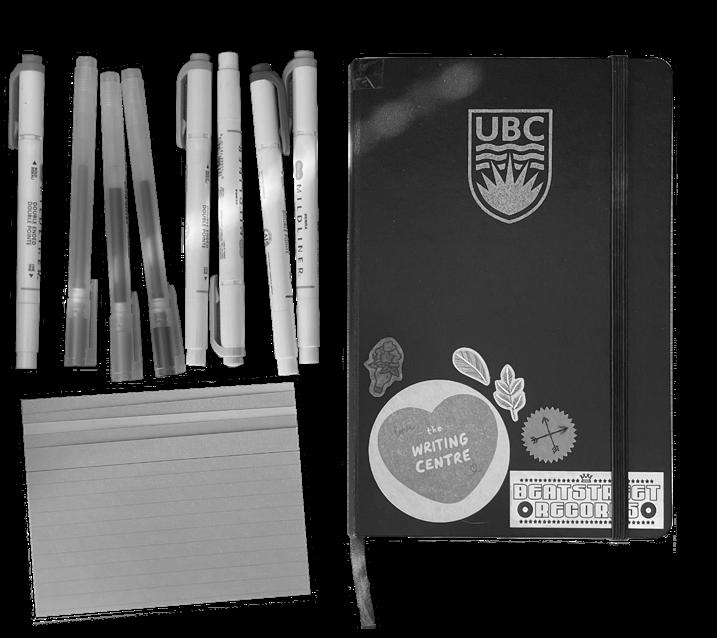
Pick three priority tasks for your to-do list each day. Look at everything else as a bonus so you can create realistic expectations for what you’ll get done. Gamifying your study plan and giving yourself a little treat for tasks you finish makes studying more fun in the moment.
Design three types of daily routines according to how much energy they’ll require: a high, medium or low level. Each day, do the routine you have the energy for. If it’s a high energy day, you can knock that gym-studying-meal-prep agenda out of the way! But if you can recognize that it’s a low energy day, it’s okay to skip the gym, eat something simple and skim your class readings. Give yourself time to recover after doing high energy tasks and take it easy by doing low energy tasks when you’re feeling meh.
Sometimes you’ll be ready for a nine hour study session and other days you won’t even want to look at a book. Creating routines for different circumstances can help you get over the mental hump of having to start studying.
Plan weekly work hours for each course and schedule them like meetings so you’re always
spending at least a little time each week on each of your courses. This could mean setting up recurring study sessions with classmates from specific courses.
While studying, use a visual timer (like Pomodoro) to track your study and break times to combat time blindness. You can also “body double” with friends — this means you study with them around to hold yourself accountable to completing your tasks. You can also send your study buddies your to-do lists and ask them to follow-up with you to keep on track.
Putting a whiteboard calendar somewhere you naturally look every day, like next to your mirror or on your fridge, can help remind you of deadlines you might otherwise forget.
Schedule office hours with your instructors to and clearly state in your email beforehand what work you want to complete and discuss (e.g. a first draft) at your session to fight procrastination with more externalized, intermediate and lowstakes deadlines.
Try to spend some time every day doing something you love outside of academics. Besides that, schedule at least one rest day per week where you can just do some self-care and work on your hobbies, even if it’s just for a couple hours. Studying is easier when you’re not miserable, and taking care of yourself is important too. U
Professors and teaching assistants (TAs) are people too, so treat them like real people. Expressing your interest (real or pretend) in actually learning helps when approaching them in and outside of class.
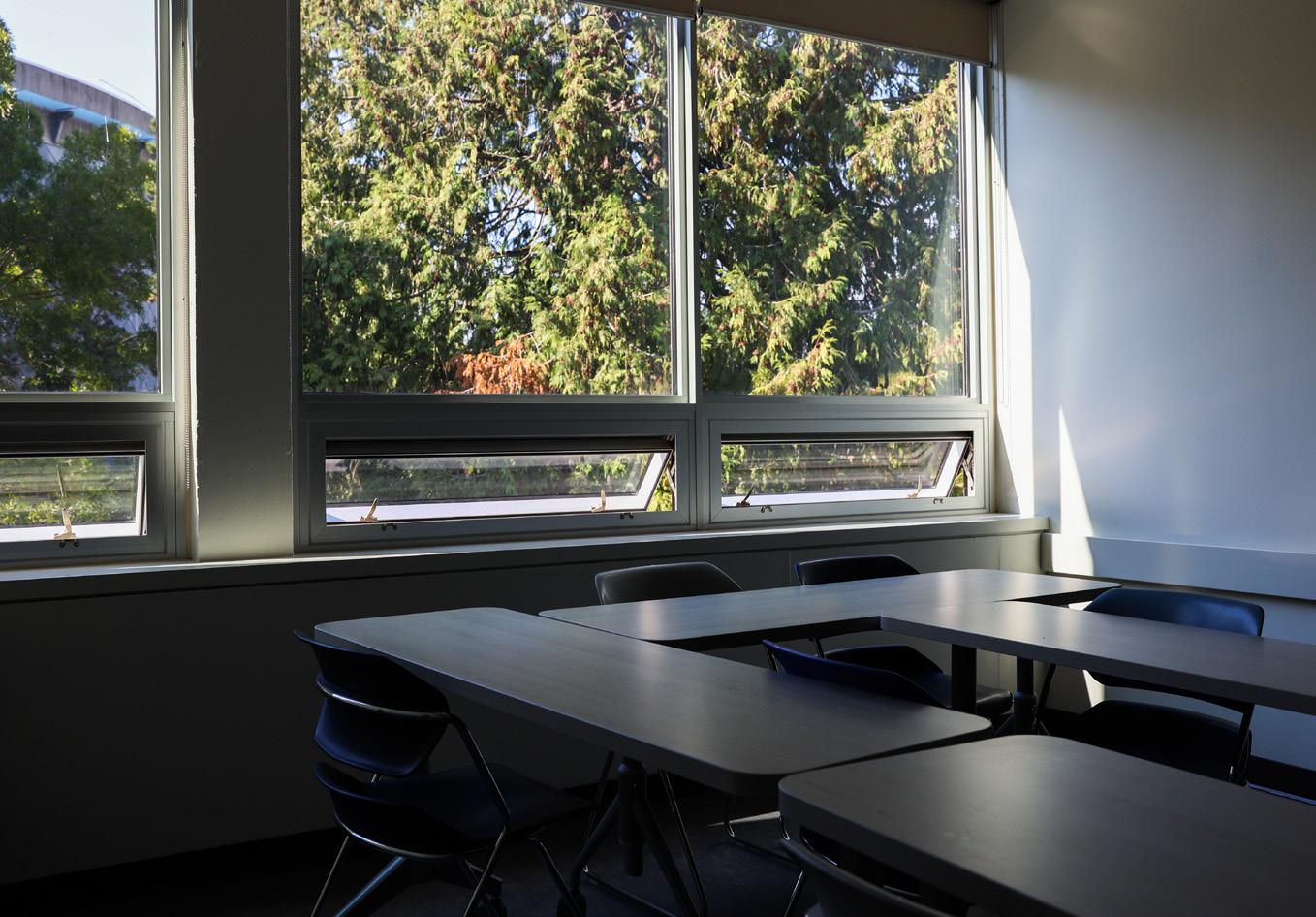
Professors write their office hours, their email address and how they like to be addressed, among other course information in the syllabus. Your professors will tell you time and time again that the answers are in the syllabus, and we’re telling you that too — so it must be true! It should always be your first instinct to check there so you don’t waste class time on questions you already have the answers to.
It’s good practice to always include your name, class, section and student number when emailing a prof (especially in big classes) so your professor does not have to remember which of the four Marks you are. Starting with an “I hope you are doing well” or “insert your own nicety here” makes for a slightly more tolerable email. If the syllabus doesn’t tell you how to address them or they
didn’t say on the first day, you can ask a peer, or ask the professor after class. Or just go with “Hi Professor/Hi Dr. [Last name],” which should work in most situations.
Office hours are where the magic happens. In a sea of students, going can help you stand out (in a good way)! They are a great place to introduce yourself and ask clarifying questions to your professors and TAs where they have more time than in lecture. They’re also there to help you beyond the class, so don’t hesitate to use them as a resource for letters of recommendation, grad school advice and general post-grad life questions. Unless there’s a 10-person line out the door, you can also ask them about their work and show some interest in digging into the class material to stand out.
Also, go during weeks that aren’t right before the midterm while everyone is cramming! They’ll be less busy, so your profs and TAs are likely to have more time to help you out. U
First year is a fun time! You’re learning new things, meeting new people, moving away from home and entering the world of higher education.
But this change can also be scary. Professors can get on your nerves and roommates can make residence life a living hell.
Luckily, university is not as bad and scary as you might think, and your friends at The Ubyssey have some tips on how to ensure that your transition between high school and university is as seamless as possible.

Something special about university is that everything is really up to you! Want to eat the same meal at the same dining hall for eight months straight? You do you! Don’t want to go to class? Well, you don’t have to!
Though attendance is mandatory for some classes (read your syllabus), if a professor’s lectures are not helpful to you or if you want to get a head start on another class’s work (or want to party with the boyz), more often than not, you can skip class.
If you skip class, you might miss out on important information about exams, essays and
assignments, so be sure to find a friend or two in your classes that can let you know what you missed.
In high school, you can be limited in what kinds of classes you can take to get your diploma, but in university, you have some freedom when it comes to exploring different disciplines through electives. You have tons of choice at UBC and regardless of your major or program, you can try a bunch of fun and interesting classes that fall out of your primary area of study. Whether that’s an engineering class for non-engineers, a wine science, anthropology of the supernatural or language class, UBC has got it.
Studying something you’re interested in is not only fun, but also a good way to expand your horizons and potentially fall in love with a new subject.
School can be scary, but by going to class (most of the time), catering your schedule to your interests and taking advantage of academic resources, you’ll be set up for academic success.
University is what you make of it, so try new things, meet new people and have fun! U
No matter your interests, degree or background, there is something for everyone to enjoy outside of the classroom at UBC. However, the sheer number of volunteering, job and club activities at UBC can be overwhelming. Not sure where to start? Here are some popular options.
Study abroad in the country you’ve always dreamed about with Go Global. There, you’ll take courses at a partner university and gain unforgettable experience in a new culture and country. Regardless of your degree, there are options for you to take your learning outside of the classroom and have an internationally rewarding experience. Some programs cost the same as UBC tuition, while others are more pricey — but even those often have funding options if you do some digging. Learn more at global.ubc. ca/go-global.
Study ecological and social systems with Indigenous knowledge holders and community leaders in Haida Gwaii. While you live there for a semester or a summer, you’ll complete fieldwork and projects in
the natural environment to further your learning.
If you want to trade classes for a semester of work experience and make some cash, consider applying to Co-op. No matter your degree, you can apply to a variety of different companies across Canada and the world. Plus, you’ll gain insights into what career roles and environments you enjoy or don’t enjoy. You can also get Co-op designation on your transcript if you complete a specific number of work terms. Learn more at coop.ubc.ca.
If you enjoy helping your fellow students, peer leader positions in the AMS or undergraduate constituencies might be the right choice! Whether you want to help your fellow students with their health, academics or finances, there is a position for you. You can also volunteer as a Jump Start or Imagine Day leader to help introduce new UBC students to university life. Learning doesn’t only happen in the classroom. Try to take advantage of these opportunities, you won’t regret it! U
Need support with class? UBC offers a range of academic and learning resources.
Looking for help with your essay? The Centre for Writing and Scholarly Communication offers free in-person and remote writing consultations for undergraduate and graduate students.
Looking for course-specific aid? Head to AMS Tutoring. They offer free group tutoring for popular lower-level classes and affordable oneon-one tutoring. Their tutors are all upper-year students who have done well in the classes they
tutor. Many faculties and departments also offer assistance. The Engineering Undergraduate Society typically hosts review sessions for some first-year engineering courses. The Faculties of Commerce, Land and Food Systems and Forestry host Peer Assisted Study Sessions. Arts, kinesiology and science students can get help from a peer academic coach with meeting their academic goals. You can reach faculty-specific academic advisors for academic questions as well. U


With tens of thousands of students at UBC, finding friends and community can seem daunting. But the diversity of people and experiences also means that any student can find a space right for them. Here are a few tips to consider when situating yourself in this new social space.
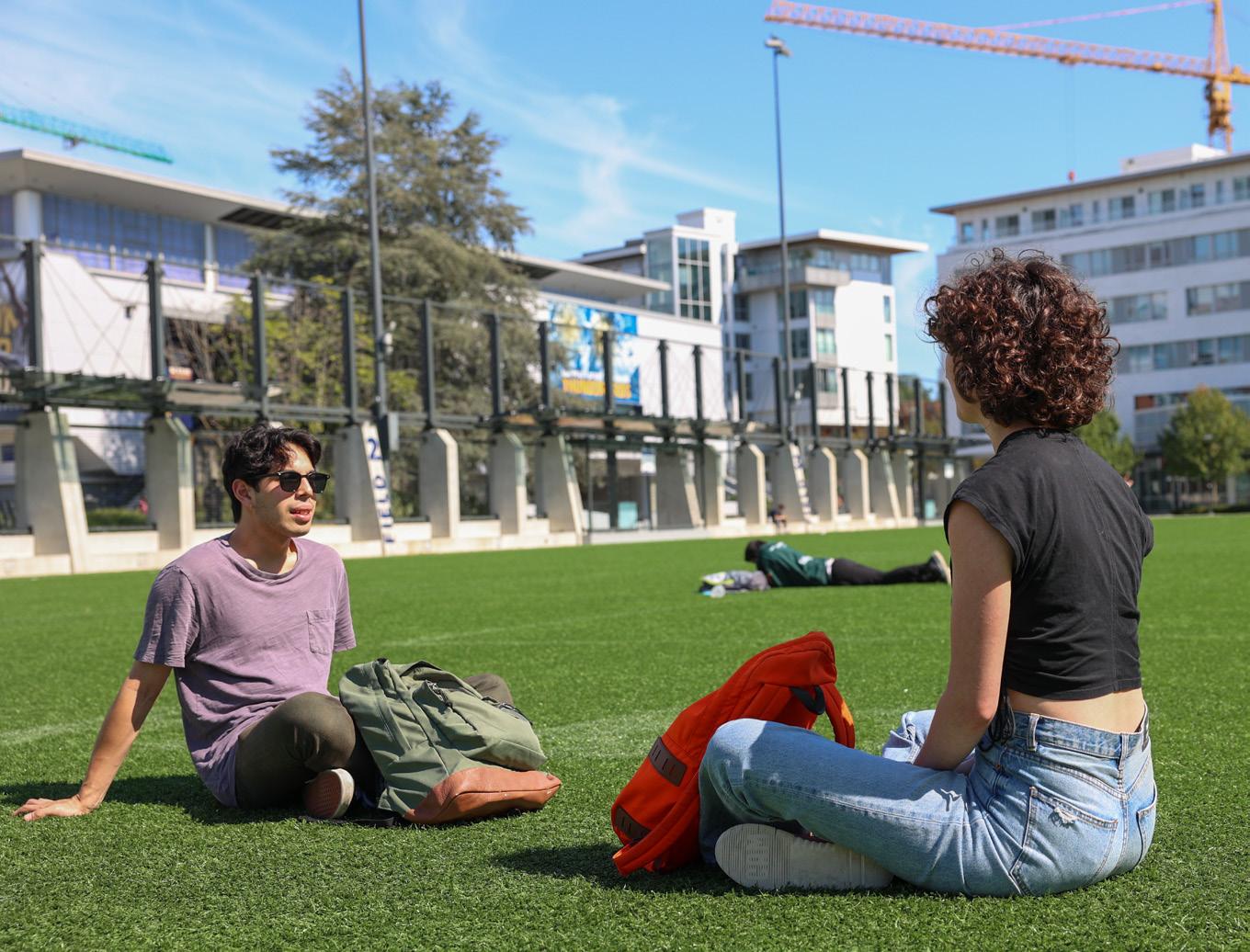
Joining a club is a common piece of advice for finding friendships. Regularly engaging with the same people is likely to create lasting relationships. An easy way to do this is committing to one consistent activity where you talk to the same people, whether it be at weekly club events, dinner with roommates, Ubyssey meetings or elsewhere. You will have both a regular chance to socialize and the feeling of being part of a community.
UBC has plenty of events and places to find other students. Events, your classes or even your residence will have plenty of students with similar interests. Even if you do not meet your new best
friends, you can still feel more connected to others and find your favourite spaces.
Asking to make plans with new people can be scary, and a lot of people avoid doing so. At the same time, it is incredibly difficult to become friends with someone without hanging out. Asking via text or DM can make the experience less stressful. Suggesting a day to check out the place you both wanted to go to or even something as simple as, “hi, would you be interested in getting coffee together saturday?” can be the catalyst for a great friendship.
Making and keeping friends is hard, and feeling lonely on occasion is normal. Your communities and social circles may also change over the course of your degree. Despite these challenges, so many other students are experiencing the same thing and are looking to make new friends. Hopefully, with a little effort, you can meet some of them. U
Everyone says to join clubs to make friends — and they’re right! Clubs rock!
Imagine UBC is an annual event that takes place on the first day of fall term (September 5) — there, you can explore student group booths along Main Mall. From the Varsity Outdoors Club to the Musical Theatre Troupe, there’s something for everyone. You can chat with club members, sign up for clubs and get some free merch if you’re lucky. The Ubyssey will be there too, so come say “hi!” Learn more about us on page 76.
If you didn’t get to explore every club at Imagine Day (which is reasonable — there are more than 300!), the multi-day AMS Clubs Fairs at the end of September and in January have got you covered!
As student journalists, we have to shout out fellow campus media CiTR 101.9 FM. CiTR is the community radio station that runs Discorder, an arts magazine right out of the lower level of the Nest. It’s also where Canadian legend Nardwuar the Human Serviette got his start. If you’ve ever wanted to host your own radio show, CiTR will get you trained and give you air time. Learn more at citr.ca.
Each UBC faculty is represented by an undergraduate society — a team of elected executives and student volunteers. If you want to get involved in faculty-specific community building, this could be the place for you. You can find information about most student societies at students.ubc.ca/ubclife/ student-societies-associations
Student associations represent students in
specific departments like English, computer science or geological engineering. Similar to an undergraduate society, student associations plan events and information sessions about their department, and some run their own undergraduate research journals.
Resource groups are advocacy subsidiaries of the AMS that raise awareness for social issues while offering students safe spaces to find community.
Groups include the Pride Collective (find more details on page 59), the Disabilities United Collective, the Social Justice Centre, the Student Environment Centre and the Women’s Centre. You can learn more at ams.ubc.ca/support-services/ resource-groups
UBC is home to eight sororities and ten fraternities run by UBC Sororities and the Interfraternity Council, respectively. UBC also has some co-ed service, business and engineering fraternities that operate outside of the Greek system.
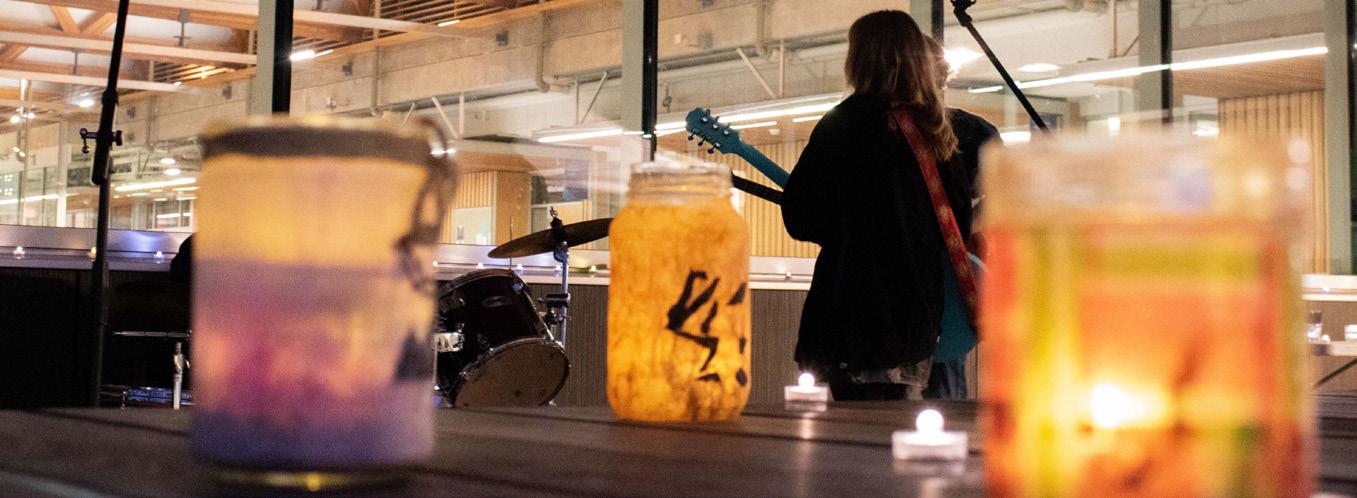
Recruitment for sororities and fraternities starts in September — you can learn more about Greek life, recruitment and dues through social media @ ubcsororities and @ubc.fraternities.
While some enjoy Greek life for social and professional connection, others may never step foot inside a frat house. Greek life can be expensive, and some people don’t feel safe or uplifted in these spaces. Although Greek life and the university have worked to improve the environment, it still may not be everyone’s cup of tea, so don’t feel pressured to join because of some idealized version of university that you think only Greek life can give you. U
There are a plethora of spiritual resources at UBC to question, practice and deepen your faith, whatever that might be.
One way to explore your spirituality on campus is by meeting with a chaplain — they are individuals representing a religious, spiritual or philosophical belief, often ordained by their religion. The Multifaith Chaplains Association’s office is in LIFE 1303. It includes chaplains who are Roman Catholic, Sikh, Anglican, Presbyterian, Muslim, Zen Buddhist, Jewish and more. You can find more information as well as contact information, programming and places of worship at: students.ubc.ca/campus-life/religion-spirituality
If you prefer to meet in a larger group setting, there are several spiritual spaces on campus:
• Hillel House (6145 Student University Boulevard)
• Tenth Church UBC Point Grey (CIRS Building, 2260 West Mall)
• Drop-in Zen Meditation (Life Building room 2212/2214)
• St. Anselm’s Anglican Church (5120 University Boulevard)
• University Chapel (5375 University Boulevard)
• Chabad Jewish Student Centre (1867 Acadia Road)
• St. Mark’s Parish (5935 Iona Drive)
You can also meet other students through faithbased student groups. Several major religions are represented by campus clubs, and some host community meals and similar events for students. You can find a full list of clubs on the AMS CampusBase website.
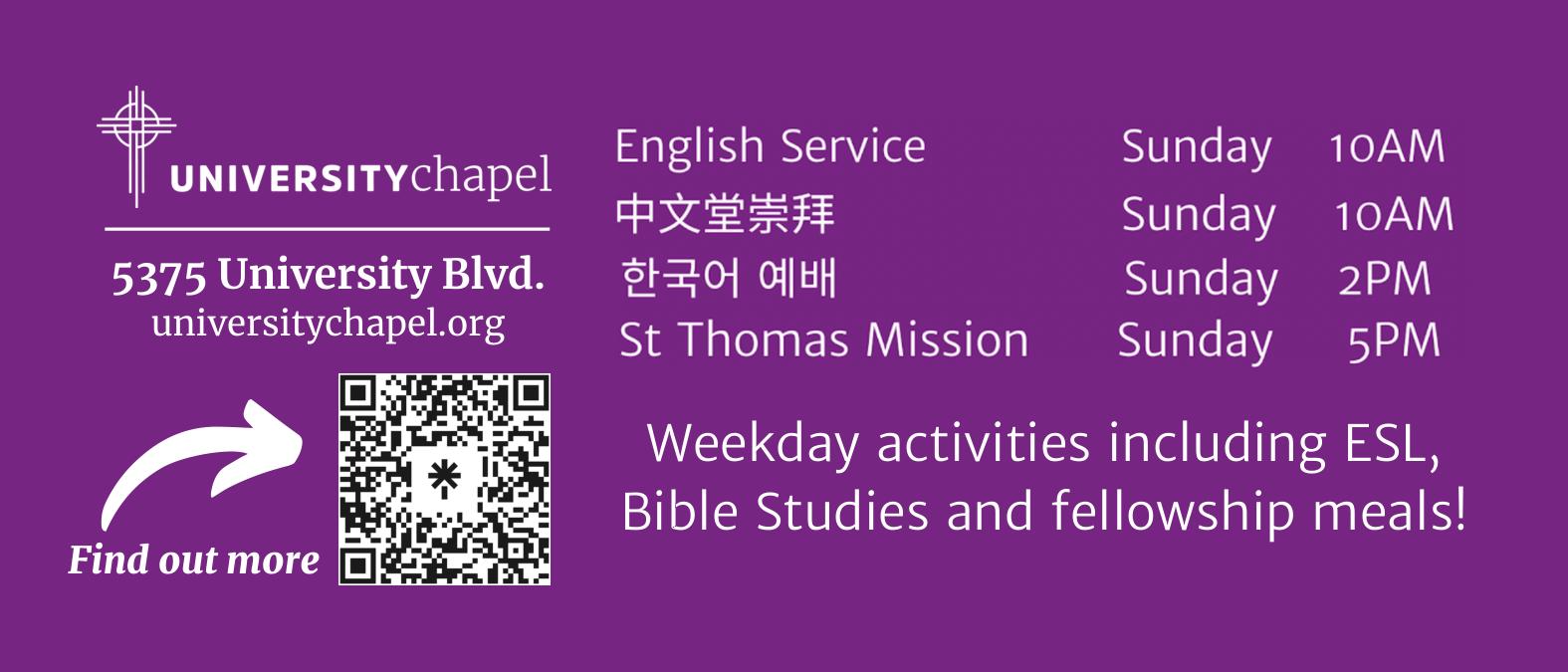
There are also multifaith prayer rooms available in the Wesbrook Building, West Mall Swing Space, Marine Drive Residence and the Life Building.
If you’d rather explore your spirituality privately through reading, then librarians and UBC Library research guides can help you out. U
Roommates are a pillar of the university lifestyle. Whether it’s your first or fifth year living with someone new, here are things to think about when moving into your new place.

Choosing your own roommates isn’t always in the cards, especially for those living on campus in residence. Unlike the movies, don’t feel pressure to become best friends with your roommates. If it works, great! But if it doesn’t, that’s okay too.
Regardless of if you feel an instant connection, it is worthwhile to get to know your roommates. These are people you may see almost daily for months on end. You’ll see them at their highest and their lowest. You may even see them more than your own family. It’ll make your time together easier, and who knows, you might become friends!
Everyone’s life experiences mean different ways of doing things. So when it comes to living with new people, definitions of ‘clean’ and
boundaries are important to discuss.
Something like a roommate agreement can help clearly outline the expectations for living with each other. The agreement is a written document that is signed by each roommate, agreeing to how guidelines about various things that might cause disagreements. Each agreement is unique but can cover anything from noise levels to having guests over to the division of chores.
Open communication is also key to having a good experience with your roommates. Whether that’s a group chat to let them know you’ve locked yourself out of the apartment or a chore chart to keep everyone accountable, staying connected to your roommates helps everything go smoothly.
Being honest and open about things that bother you about your living situation may be uncomfortable but will help everyone in the long run. U
1. Read The Ubyssey
2. Find the Ubyssey office
3. Contribute to The Ubyssey
4. Swim in the fountain (bonus points if between 12–4 a.m.)
5. Get lost in Pacific Spirit Park
6. Find yourself in Pacific Spirit Park
7. Realize you were right next to Wesbrook Village the whole time
8. Get blackout drunk at Koerner’s for the first time
9. Make good friends that will get you home safely
10. See one of your peers nude in an experimental theatre production
11. Remember that tequila and water look the same in your water bottle
12. Join an intramural team to get exercise and make friends
13. Get dramatically injured playing intramurals
14. Quit intramurals. These jocks are bloodthirsty
15. Change your major
16. Run in a student government election
17. Lose a student government election
18. Lose yourself at the Great Debate
19. Cry in the rose garden
20. Try not to get stranded on campus when it snows challenge (impossible)
21. Go camping with gear from the Varsity Outdoors Club (VOC)
22. Look longingly at a cute dog across Main Mall
23. Finally work up the courage to ask to pet the cute dog
24. Spend over four hours in a dining hall to get your money’s worth
25. Go blue from holding your breath in the IKB bathrooms
26. Power nap in a silent reading room
27. Laugh at a @UbysseyHumour Tweet
28. Head to Wreck Beach alone at midnight
29. Fall down the stairs because you can’t see
30. Finally touch down on the beach after falling for seven minutes
31. Find the perfect study spot
32. Accidentally post it on Instagram
33. Listen to CiTR 101.6 FM
34. Apply for honours math
35. Fail out of honours math
36. Avoid everyone in your residence
37. Become friends with Kip the Coyote
38. Have your residence fire alarm pulled at 2 a.m.
39. Be happy about it because its the only interesting thing to happen in the last three months
40. Realize it’s called Uncle Fatih’s, not Uncle Faith’s
41. Do the Greenheart Tree Walk
42. [Insert weed joke here]
43. Get lost between Buchanan B and C
44. Scale Buchanan Tower for office hours
45. Photosynthesize on the MacInnes Field
46. Get hit by a spike ball on MacInnes Field
47. Get a little treat (you deserve it!)
48. Get blackout drunk at Koerner’s for the uhhhh first time
49. Renew your UPass
50. Forget to renew your UPass and have a negative Compass Card balance
51. Brave a weekday Tim’s line
52. Visit every coffee shop on campus
53. Go to Rain or Shine for Taco Tuesday
54. Buy a Happy Meal just for the toy
55. Wait in the Pit line for over 30 minutes
56. Wear earplugs in the Pit to avoid ear damage
57. Miss the last 99 home
58. Get from MoA to MacMillan in under ten minutes
59. Collide with a cyclist on Main Mall
60. Fall in love with that cyclist
61. Break into the secret tunnels
62. Live in Place Vanier
63. Laugh in Orchard Commons
64. Love in Totem Park

65. Buy a mini fridge
66. Have nowhere to put it after first year
67. Get into pottery club
68. Take a fun elective that tanks your GPA
69.
70. Butcher karaoke at The Gallery
71. Get way too personal on Piazza
72. Drop $30 on a t-shirt at the Fashion Club thrift sale
73. Drain your bank account at the AMS Craft Fair
74. Bike up UBC hill
75. Take the SeaBus with your friends
76. Take the 68 with your enemies
77. Buy UBC Farm produce
78. Study with a water bottle, red bull and bubble tea
79. Get an STI test
80. Cornerners. Drunk. Blcakout.
81. Learn what a situationship is
82. Find yourself in one
83. Go to Community Eats at Sprouts
84. Get a totally unique poster at the poster sale that no one on your floor will have
85. Do the Polar Bear Plunge
86. Immediately regret doing the Polar Bear Plunge
87. Touch grass
88. Have a crush on a prof
89. Run up the Wreck Beach stairs bare(foot)
90. Take care of your friends
91. Take care of yourself 92. Take care of the evidence
93. Take a class on the Rule of Threes 94. Enjoy the Rose Garden 95. Tan on the grassy knoll (not that grassy knoll) 96. Study in the Forest Sciences Centre 97. Get jealous of its trees 98. Plan to transfer into forestry 99. Remember you’re allergic to pollen
100. Spend $60 on your dinner at Harvest 101. Get stuck with third-year standing for three years
102. Sleep on a table in a study room 103. STORM! THE! WALL! 104. See a rat 105. Graduate! U
I’m hauling water do I wonder if I’m getting any stronger








Blue Chip Cafe is the campus classic in the Nest, though the line is usually quite long. Loafe Cafe is another popular option in the Alumni Centre and the Sauder building. Their drinks are good, though on the pricier side. On the north side of campus, Great Dane Coffee has solid drinks, and they accept Flex Dollars, which are practically monopoly money. The Food Hub Market in the CIRS building has $1 coffee, and for that price it really doesn’t matter how the coffee tastes.
If you are closer to Totem Park and Orchard Commons, head to Bean Around the World for your croissant fix. When they offer to heat up the croissant, say yes.
On the other side of campus, Great Dane sells the famous (to us) Jeremy sandwich. We recommend the lemon blueberry muffin and London fog scones.

You can also pick up one of Blue Chip’s in-house bagels, though they often run out in the afternoon.
Just down in Wesbrook Village, Doughgirls cannot go unmentioned. While you can’t use laptops inside, they have so many baked goods it makes up for it.
Pacific Poke in the Life building and ICICS is a flex-dollars go-to. The Grand Noodle Emporium in the basement of the Nest has a variety of noodle and rice dishes. Down at the end of the Nest’s basement hallway, you’ll find Sprouts Cafe, a student-run affordable food spot. The cafe also has free-meal cards for anyone to use. A little walk away, below McDonald’s, is the International Food Court, which has various more affordable Asian cuisine options.
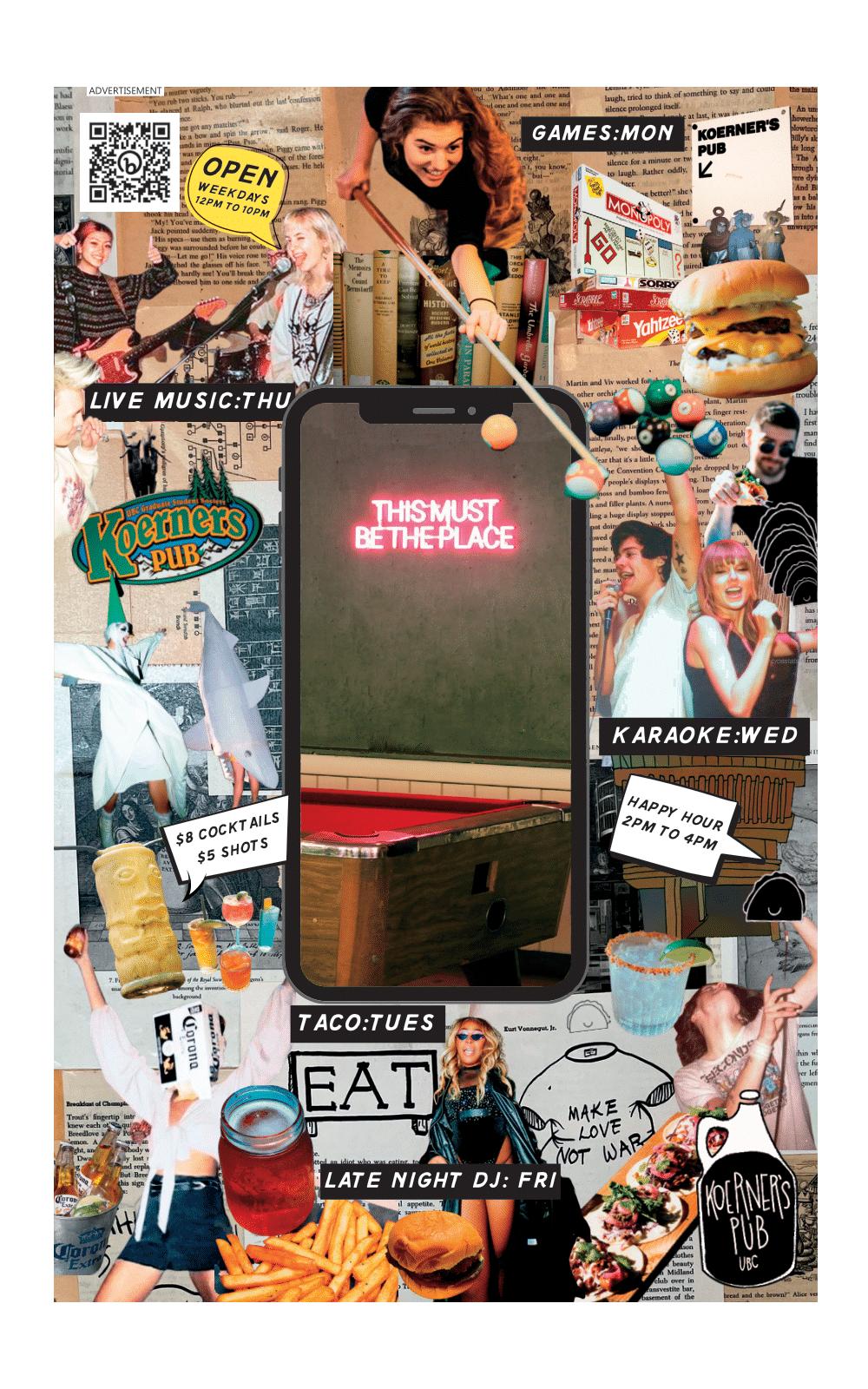
The Gallery in the Nest and Koerner’s Pub are classics for drinks and bar food. Keep an eye out for special events and deals at both.
Don’t forget Rain or Shine ice cream! Any flavour you choose will be decadent — and always ask for samples. Taco Tuesday is perfect if you’re craving ice cream in a waffle cone taco shell.
There’s also plenty of bubble tea on campus — we prefer Pearl Fever Tea House near McDonald’s, and Chatime, though it can be a bit overpriced.
For a midnight snack, Uncle Fatih’s stays open till 1 a.m. on certain days. If you head across the street to the University Village plaza, Pizza Garden is open ‘til 1 a.m. on Fridays and Saturdays, and McDonald’s and A&W are open 24/7. U
There’s a reason UBC has a reputation as one of the most stunning campuses in Canada. Whether you need a cool spot to take your friends or just somewhere to clear your head during exam season, this list covers campus’ most iconic sights.

The UBC Botanical Garden is Canada’s oldest university botanic garden and free to all UBC students. You can easily lose a few hours wandering paths which, depending on the season, might be sheltered by blossoms or carpeted by fallen leaves. The sheer size of this garden is breathtaking, and chances are, you’ll see something new each time you go. (For example, a Ubyssey writer saw mating slugs in September.)

The Nitobe Memorial Garden located on Lower Mall is full of lush greenery and is also considered one of the most authentic Japanese gardens outside of Japan. It’s beautiful all year round, but especially in the spring and fall when cherry blossoms and maple leaves line the mossy paths. Entry is free for UBC students.
Wreck Beach is the epitome of what makes UBC so unique. Where else can you go dip your toes in the ocean (or the rest of your body — the beach is clothing optional!) after a tiring 6 p.m. class? While you will quickly learn the struggle of trekking up 490 stairs, the opportunity to stroll on the beach whenever you need can be a godsend.
The postcard-ready vista at the end of Main Mall is a favorite sight for many UBC students, especially when the flowers are in full bloom in late spring and summer. Try walking by near sunset — the colours come together with the view of the garden, the flagpole and the ocean to create something truly awe-inspiring. Just be sure to avoid photo-bombing a wedding.
Unfortunately closed for renovations until late 2023, the Museum of Anthropology (MOA) is a spot to check out when it does reopen. The museum hosts nearly 50,000 works from almost every part of the world, in addition to another 535,000 archaeological objects. The MOA is also known for its emphasis on collecting and curating traditional and contemporary Indigenous art, with conversations ongoing about how to decolonize anthropology.

Across the street from the Peter A. Allard School of Law, there is a walking path that runs alongside NW Marine Drive with some spectacular views. Sometimes UBC’s tall buildings make it difficult to remember just how close to the water we are. Yet the natural beauty that comes with being on a peninsula becomes clear when walking this path. Just remember to turn around at some point, or you’ll end up down at Spanish Banks beach with a long uphill walk to get back to campus. U
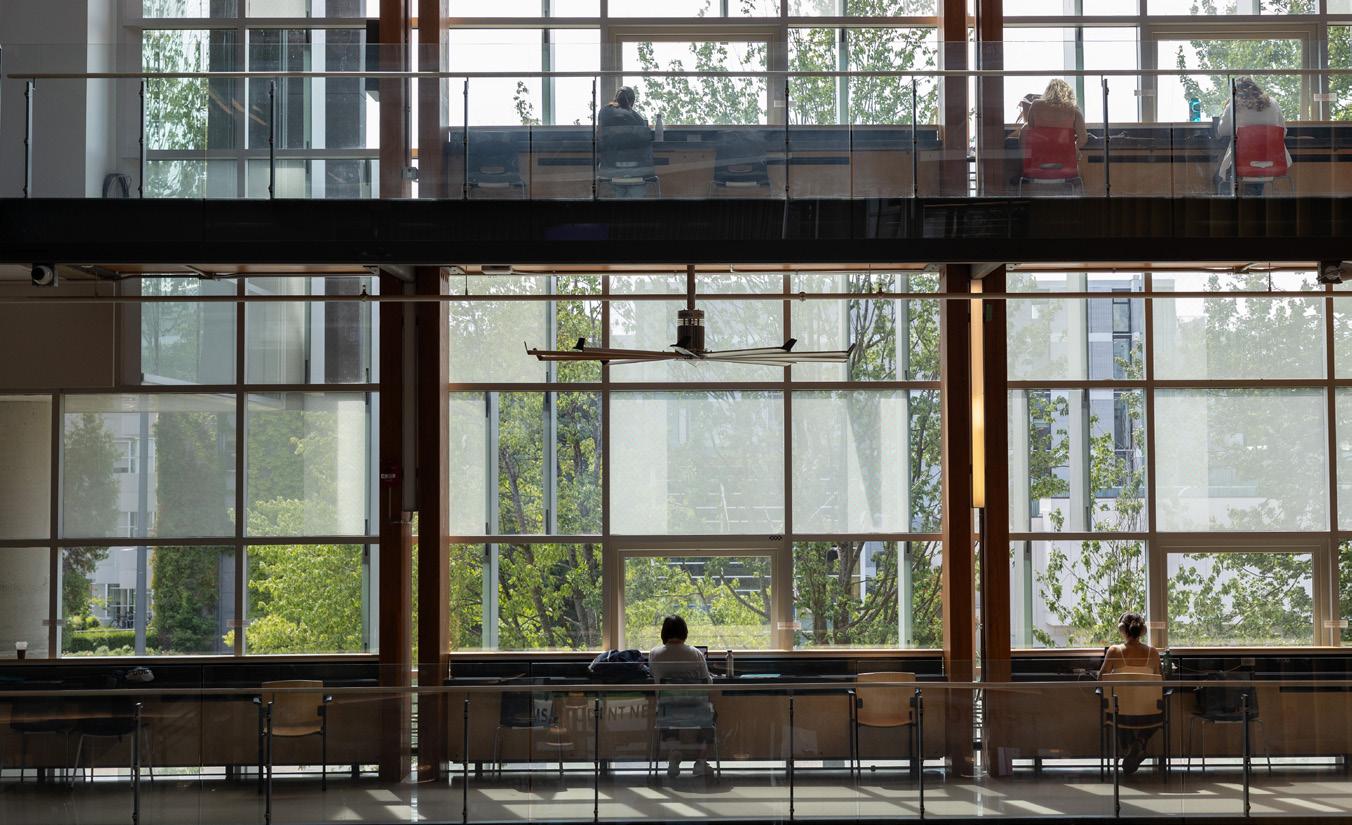
UBC is full of study spots, but it’s also full of students who want to use them. Here are some of our favourite places to find space and silence for all your studying needs.
Across from Nitobe Memorial Garden, the Asian Library is a peaceful space shielded from the noise of central campus. On the second floor is an open study space with rows of large tables for individual or group study. With a high, sloping ceiling that converges in a skylight, the library’s study space is the perfect cure for dorm-induced claustrophobia.
The large wooden orb in the centre of the Nest isn’t just a bold architectural statement — it’s also a great study space. From the Nest’s third floor landing, take the stairs or ramp up to the top of the egg where you’ll find comfy couches and tables. This space isn’t the quietest on campus, but it’s perfect for a casual group study session — just don’t look over the side if you’re scared of heights.
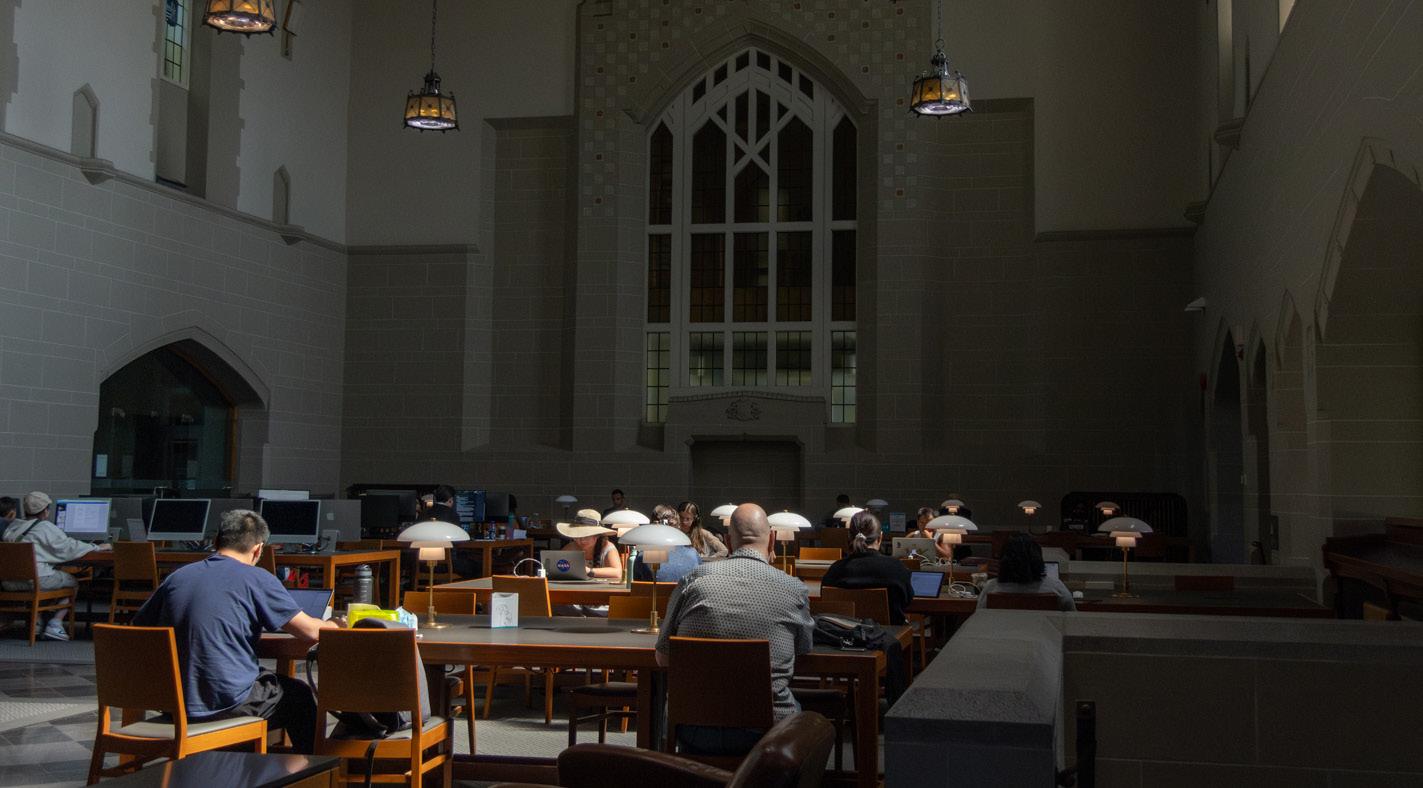
If you’re looking for a quiet place to focus, the Ridington Room (dubbed the Harry Potter Room by millenial alumni) on the third floor of IKB is the perfect spot. In this silent study space, you’ll find
rows of outlet-equipped tables great for long study sessions as well as window-facing lounge chairs for more relaxed studying. It’s a great place for a quick nap too.
On the second and third floors of Buchanan B are lounges filled with different types of tables and chairs great for group or solo study. There are also stands where you can pick up the latest Ubyssey issue to read during your study breaks.
For views of campus and a quiet rooftop garden, head outside on the fourth floor of the Nest. You won’t find as many amenities as in other study spaces, but it’s rarely used and quite peaceful with a large picnic table and other places to sit and study.
If you still want to be surrounded by trees, but don’t want to brave the cold, head to the MacMillan Bloedel Atrium. It’s a large indoor courtyard filled with trees, tables and outlets. There’s a Tim Hortons nearby for study snacks as well. U
Whether you’re living in residence or having a study sesh with friends, you might find yourself at UBC well past your last class. Here is what’s open at UBC after hours.
McDonald’s, A&W and Pizza Garden are trusty college staples located in University Village. McDonald’s and A&W are open 24/7, while Pizza Garden is open until 1 a.m. on Fridays and Saturdays and ‘til 12 a.m. the rest of the week.
Uncle Fatih’s Pizza is a true campus classic. Located on University Boulevard (and a shorter walk from most residences), you can get pizza by the slice and canned drinks up until 1 a.m. on Fridays and ‘til 12 a.m. other days of the week.
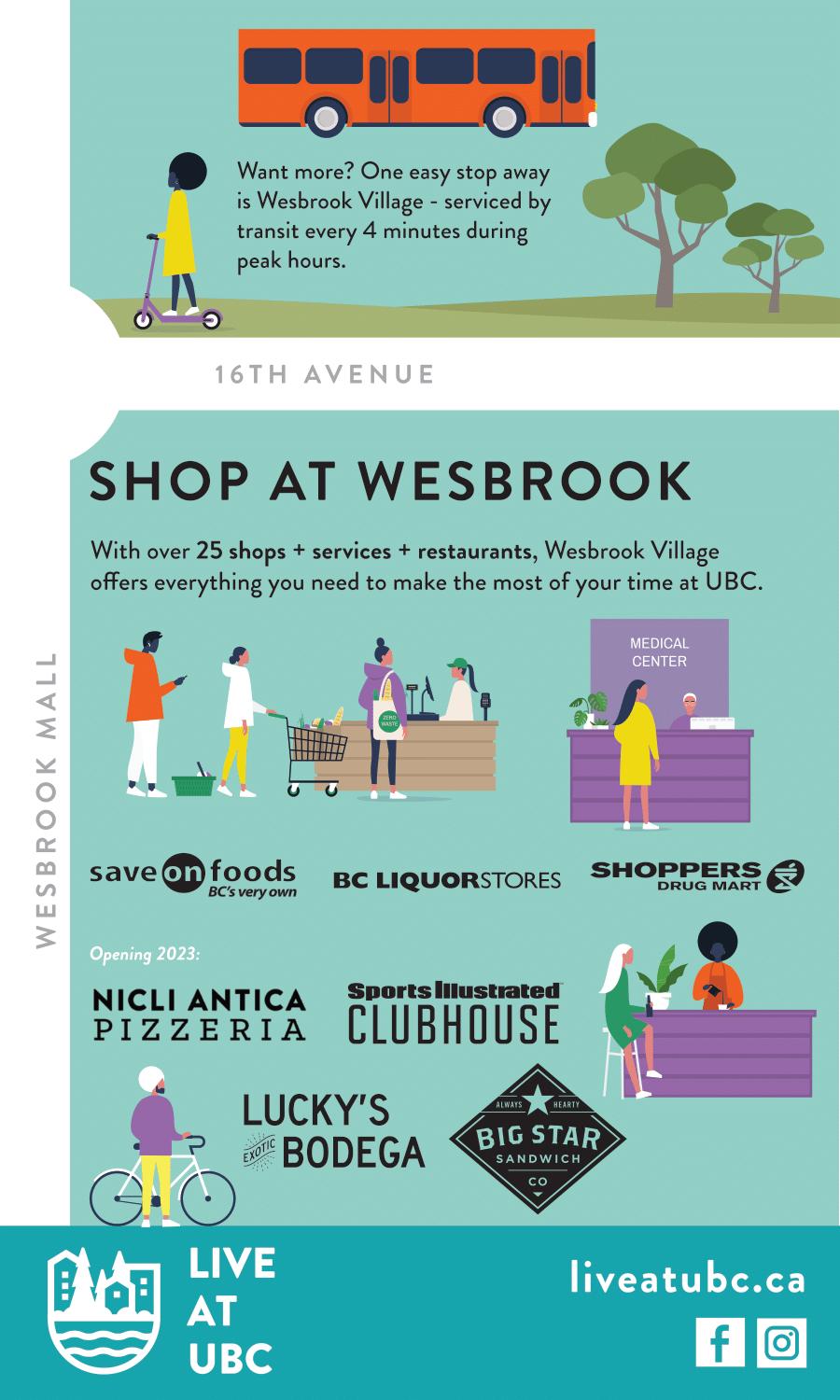
Lucky’s Exotic Bodega and Avenue C are both convenience stores on campus. Open until midnight, Lucky’s is in Wesbrook Village and offers rare snacks and drinks. Avenue C is a 24/7 self-serve convenience store at Walter Gage residence perfect for late night essentials like frozen meals, snacks for your all-nighter and
Advil for after a night out.
Magda’s Night Market at Totem Park residence is a great spot for students looking to use their residence meal plan. Open until 11 p.m., Magda’s offers snacks, medication and toiletries — anything you might need after hours.

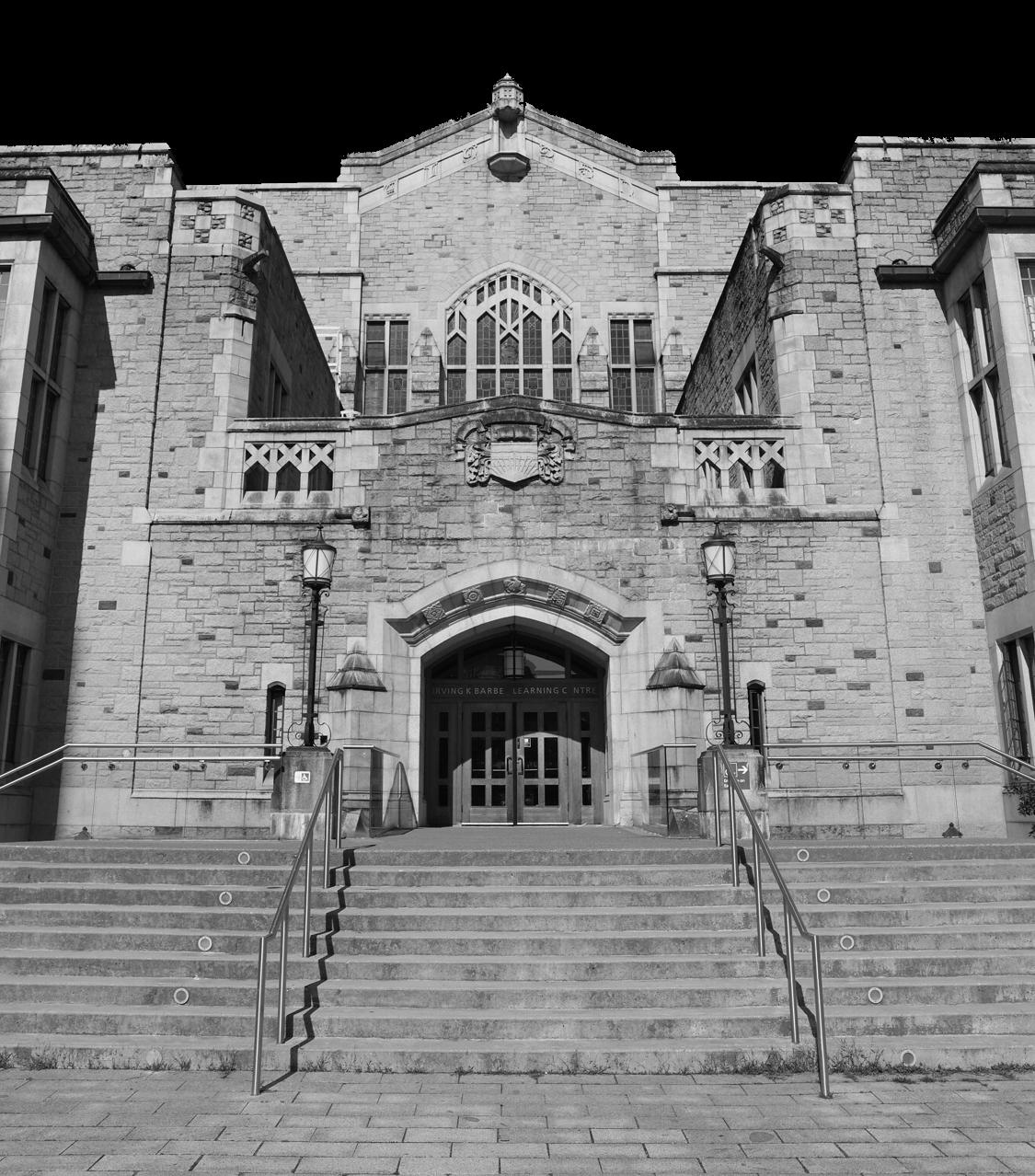
Irving K. Barber Learning Centre (IKB) is open until midnight all school year long, making it the ideal place to grind for midterms or finals.
The Pit, UBC’s only nightclub, is open on Wednesdays for student Pit Nights from 9 p.m. to 2 a.m. in the Nest. They also host Friday night events occasionally, so keep an eye out. Be sure to get there early as the line gets long!
Residence commonsblocks are a key part of residence life, whether you’re looking for a quiet study spot, a late-night gym session or a snack from the vending machine. Bookable rooms are also available in some residences if you are looking for a place to host your study group. U
Most first-years are guaranteed a spot in UBC’s residences. If that’s you, you’ve probably already applied, been assigned a residence and paid your deposit. Then — phew — you’ll just have to learn to live with a couple hundred of your new best friends.
First years are assigned to Place Vanier, Totem Park or Orchard Commons. Totem and Vanier have a reputation for a stronger sense of community due to more shared areas, while Orchard is more private. That said, meeting new people and making friends in residence is guaranteed no matter where you end up. One of the easiest ways to get to know your floormates is to leave your door open while you study in your room — you never know who might walk by.
If you end up in Orchard, you’ll only be sharing your bathroom with one other person maximum, while most of Vanier and Totem share one bathroom per floor.
Your residence advisor, or RA, is the first person you should go to for any issues or general advice. They’re an upper-year student working to make sure your floor can get along, so try to be friendly to them. Make sure to read your residence contract in your welcome package for all rules. One thing to keep an eye out for is your residence’s quiet hours — dorm walls are thin!
Your rent in any first-year residence includes a mandatory meal plan, called the All Access

Dining Plan. That means at any of the three dining halls (Feast in Totem, Gather in Vanier, and Open Kitchen in Orchard), you can use your student card to enter as many times as you like during open hours and eat as much as you want. The plan also gives you a couple hundred “flex” dollars to spend at cafes and restaurants on campus in case you need a coffee after your 8 a.m. lecture.
• For shared bathrooms: A shower caddy is a great way to carry all your toiletries with you and shower shoes (flip flops or slides) are an essential.
• For snacking: A mini fridge is great for keeping fruit or milk for your morning cereal. You’re also allowed to bring a coffee machine, a kettle, a rice cooker or a toaster — but space is limited so only bring what you really need.
• For your desk: You’re probably moving into a smaller space than you’ve lived in before, so organization is all the more important. Find a system that works for you — don’t be afraid to do a Staples or Muji run to get new cabinet dividers.
• Other survival supplies: A small fan is a must with no AC, and an ethernet cable or router, depending on your residence is good to have so your ubcsecure connection doesn’t fail while you’re gaming.
Only first-year students are guaranteed housing at UBC. This means that from your second year onwards, you might not get on-campus housing even if you want it because demand for

UBC Recreation (known as UBC Rec) is responsible for all the activities that get students moving around campus.
UBC Rec is behind many classic UBC traditions like Day of the LongBoat and Storm the Wall.
Beyond those events, they run intramural leagues for everything from dodgeball (visit the Ubyssey office to learn about how you can join our dodgeball team) to water polo to flag football. Most sports have a couple of tiers of competition, so everyone from the former competitive athlete to the total newbie can participate.
Registration for intramurals opens at the start of each term. If you’re looking for others to form a team with, UBC Rec will host a free agent night to meet others looking for a team. Besides that, you can find teammates through the UBC Intramural Facebook group or by frantically asking friends of friends of friends. Teams play once a week, making intramurals a great low-commitment way to stay active and
meet people.
UBC Rec also hosts drop-in sports at the Student Recreation Centre (SRC). Stop by the SRC before or after classes to play some pickup basketball, volleyball or futsal — it’s free for students, just bring your UBC card!

UBC also runs two gyms on campus — the Bird Coop in the SRC and the ARC in the basement of the Life Building. The gyms are open 6:30 a.m. to 10 p.m. on weekdays during the school year, with all-access membership costing $42.50/term. They both have lots of equipment, but the Bird Coop is almost always packed. Make sure to go to the gym during off times since you’ll have to wait to workout if gyms are at capacity.
Finally, make sure you take advantage of Free Week. For one week, typically around the start of the term, you can attend any UBC Rec class for free. Try your hand at everything from pilates to an intense boot camp, then decide if you want to pay $85/term for unlimited group fitness classes. U
 Alex Charles
• Sergeant - Vancouver Police Department - Recruiting Services Unit
• Lieutenant Governor General Meritorious Service Award recipient
• UBC Bachelor of Arts in Human Kinetics
• Team captain/Vanier Cup Champion - UBC Thunderbird Football ‘97
Alex Charles
• Sergeant - Vancouver Police Department - Recruiting Services Unit
• Lieutenant Governor General Meritorious Service Award recipient
• UBC Bachelor of Arts in Human Kinetics
• Team captain/Vanier Cup Champion - UBC Thunderbird Football ‘97

The student-run cafe Sprouts in the basement of the Life Building offers affordable vegan and vegetarian food to fill your belly for lunch or a quick snack. Look out for Sprouts-run community eats, produce markets and community fridge programs where you can grab a free meal or some groceries by donation.
Agora Cafe in the MacMillan Building serves a wide selection of lunch hot dishes and baked goods. It is expanding to a second location at IRC (adjacent to Woodward Library) as well. UBC Food Hub also runs a subsidized (read: cheaper) grocery market at the Centre for Interactive Research and Sustainability (CIRS) for basics like pasta, peanut butter and veggies. Check foodhub.ubc.ca/market for details.
You can gain free access to Nitobe Garden, the Beaty Biodiversity Museum, the Museum of
Anthropology and many other museums at discounted prices with your student card. Other than having student prices on fitness programs and gyms, UBC Rec drop-in activities and the Aquatic Centre are also free for students to access through booking at recreation.ubc.ca.
The Arts, Science and Commerce undergraduate societies have respective discount card programs for stores on campus. Visit each undergraduate society’s website or social media for more information.

The Too Good To Go app connects users with nearby stores and restaurants that sell surplus food for a reduced price.
Classifieds sites like Facebook Marketplace, Buy Nothing groups and Craigslist are great platforms if you are looking for textbooks and furniture. Don’t miss out on the student discounts for streaming and subscription services like Spotify and Amazon Prime too! U
We’re located at the corner of University Boulevard and Toronto Road. Present your parking receipt to your cashier and receive a reimbursement for your first hour with a minimum $15 purchase at Urban Fare.




BC is known for its beautiful natural sites and the abundance of outdoor activities close to Vancouver. Whether you’re an out-of-towner looking to bask in the sun or a Vancouverite hoping to elevate your heart rate, we’ve got you covered.
The Stanley Park Seawall and its scenic views of the water sit at the west end of downtown Vancouver and are about an hour bus ride away from campus.
Queen Elizabeth Park and the VanDusen Botanical Garden both offer lush, carefully maintained greenery in addition to views of the North Shore mountains.
Closer to UBC is Pacific Spirit Regional Park, with winding temperate rainforest trails that lead to the beach.
Vancouver is famous for its nearby hikes. Mount Seymour, Grouse Mountain, Cypress Provincial Park, Capilano Suspension Bridge, Brunswick Mountain and Lighthouse Park are all hiking and sightseeing destinations located in North and West Vancouver, about 2 hours away by bus or 40 minutes by car. If you’re looking for more niche trails, check out alltrails.com and vancouvertrails.com
Head north to find several hiking and skiing destinations two to three hours’ drive away that are well worth the trip. Stawamus Chief Provincial Park and Mount Garibaldi are known for their rigorous hiking trails and stunning views. If you’re looking for something chill, Shannon Falls and Brandywine Falls have flat trails and beautiful canyon waterfalls not far from their trailheads.
Whistler is where the world-famous skiing is at. An hour north of Squamish are the Whistler and Blackcomb Mountains, home to many black diamond runs designed for only the most adventurous skiers.
There is no shortage of beaches in Vancouver, and watching a beach sunset is the perfect way to end the day. UBC is home to clothing-optional Wreck Beach, but if that’s not your thing, Spanish Banks Beach, Locarno Beach and Jericho Beach are all a 20 minute bus ride from campus.
Stay on the bus for 10 more minutesand you’ll reach Kitsilano Beach and its scenic view of the Stanley Park Seawall. If you continue across the Granville Street Bridge, don’t miss Sunset Beach and English Bay Beach on the southwest end of downtown Vancouver. U

Public transit is not only a handy option to get to UBC if you don’t live on campus, but also a great way to explore the Lower Mainland.
As a student, you are required to pay for a transit UPass as part of your tuition. To access it, you’ll need to buy a $6 Compass Card, sold on campus at Shoppers Drug Mart and the UBC Bookstore. Afterwards, you’ll need to link the card with your UPass on upassbc.translink.ca.
Make sure to reload the pass before the beginning of every month, and you’ll be able to take unlimited trips on the bus, SkyTrain and SeaBus.
The UPass is only available for students registered in at least 3 credits or those paying more than $185.20/month in tuition. This means students on a co-op work term still have access to it.
The 99 B-Line runs along Broadway. The 99 stops at Broadway-City Hall, where you can transfer to the Canada Line SkyTrain. Notably, the Canada Line can get you downtown and to the airport. The 99 also stops at Commercial-Broadway Station, where you can access both the Millenium and Expo Lines.
The R4 runs along most of 41st Avenue. If you’re commuting to campus from outside of
Vancouver, then you will likely be using this bus. It’s big, green and rapid (hence the ‘R’ in R4). It also stops at Oakridge-41st Station (Canada Line) and Joyce-Collingwood Station (Expo Line).
The 4, 14 , 44 and 84 are super useful if you want to shop and eat along W 4th Avenue. The 4 and 14 can also get you downtown and pretty close to Kitsilano Beach.
Use Google Maps or the Transit app to find out when buses are coming or if there are any delays. If you’re commuting for classes, make sure to give yourself enough wiggle room in case you miss a bus (or two). Buses can get full in the morning, especially during the first few weeks of class, so budget extra time just in case.
Be mindful of the time if you’re out late as most buses and trains stop running around 1 a.m. There are some night buses, but they come much less frequently.
If you’re on the bus or SkyTrain, it’s important to be aware of others and follow some transit etiquette rules: take off your backpacks when it’s crowded, say “thank you” to the bus drivers and offer a seat if you can for someone who might need it. U



Not to knock UBC’s on-campus establishments (The Delly, you will always be famous) but eating out off-campus is generally cheaper and more delicious. Vancouver has a lot of great restaurants, and while you’ll certainly find your own favourites with a little exploration, here are some starting recommendations.
This student favourite has delicious sushi at reasonable prices. Ride the 99 B-Line to Sasamat to get the Koi Sushi Special — three items and miso soup for just $12.75.

While you should definitely also check out Nemesis Coffee for its pastries and drinks, Breka is the quintessential Vancouver bakery and café. Great for a morning coffee or a 2 a.m. drunk donut, every Breka location is open 24/7.
This Persian restaurant on Broadway and Trutch Street (with a UBC location coming soon) could become your go-to for a kebab.
Also on Broadway, you might be wondering why another sushi restaurant gets a mention on this
list — it’s because they serve great cocktails.
Good pizza and authentic Italian food can be found at this restaurant in Mount Pleasant. If you’ve been dying for a cacio e pepe you should probably see a doctor, but afterwards head to Sprezzatura.
Whether you’re vegan or anti-vegan, MeeT (on Main, in Gastown or in Yaletown) has delicious plant-based food. If you haven’t already tried their sweet chili cauliflower, you need to stop reading and get on a bus.
The only good bagels in Vancouver. Get them at Granville Island or in Kitsilano.
Have your fish and eat it too with your choice of fresh seafood, cooking methods and sauces.
Sorry Sharetea, Perchance gets my “best $8 boba” award for the 2023/24 academic year. You can quote me on that, but this list has no byline. U
We don’t have to tell you how shitty the Vancouver housing crisis is. Rents are sky-high and although there are cranes on campus as far as the eye can see, there are not enough beds at UBC for all 60,000 of us — let alone reasonably-priced ones. But don’t panic! You have options!
Much like a relationship, a successful house-hunt starts with clearly defining your needs, preferences and boundaries. The housing search might not provide you with everything you want, so make sure to feel confident on what your dealbreakers are, and where you’re willing to compromise.
Some key questions: What’s your budget range? How much of a commute can you stomach? How long of a lease are you looking for, and when can you start? How many roommates do you want, and what sort of lifestyle do you lead (e.g. can you handle a garage rock roommate’s band practice?).

Use that information to put together a blurb about yourself that clearly states what you’re looking for, as well as some quick fun facts about yourself — hobbies, job, course of study, etc. Potential roomies and landlords will be more responsive if they can tell that you’re a real person who has a life and is fun and normal to live with.
Craigslist and Facebook Marketplace, especially groups for UBC students, can be good for finding
rooms in shared houses, people looking for roommates and more affordable basement situations. Just be prepared to send out a lot of messages and cast a wide net because competition is fierce. If you’re looking for a condo or apartment, a site like Padmapper could also work.
Put out calls early if possible, but don’t worry if you don’t find much months in advance —many people don’t put their places on the market until a month before the move-in date. Set aside a few hours each week for searching and check your messages frequently.
UBC also has some helpful resources for this at vancouver.housing.ubc.ca/other-housing/ more-campus-housing/.
If a listing doesn’t have a photo or the photo looks like it might be a generic stock image, watch out. If the price is too good to be true, it probably is. If you can’t be in Vancouver while searching, always get a FaceTime tour from the landlord (or a local friend!) before paying a deposit.
If you start asking around your circles, you might find someone looking for a roommate. That roommate could be you! Finding a house through mutual friends or acquaintances can help you vet your new roommates/landlords for quality, or at least sanity. U
Balancing work alongside your studies can be challenging, but a little practice and organization can make it more manageable. Many students work throughout their studies and gain employable skills through their different experiences.
To find a job on campus, your first stop should be UBC Careers Online.

A lot of the roles are ‘work-learn’ positions, a UBC program which provides students with part-time positions in an administrative or research unit, from the UBC Library to UBC Farm. Most are 10 hours a week from September–April, or 20 hours a week in the summer. These roles are a great opportunity to gain mentorship from a UBC staff or faculty member and gain work experience in an area you are interested in.
Whether you want to tutor, organize events or provide mentorship, the AMS offers many paid positions throughout the school year and summer. These can be found on their website at ams.ubc.ca/opportunities/jobs/. You can also apply to be a teaching assistant or become a notetaker for students with the Centre for Accessibility — keep an eye on your email for those opportunities.
There are also lots of customer service positions available on or near campus with restaurants in UBC and Wesbrook Village, which you can often find on Careers Online or Indeed.
Positions are open to both domestic and in-
ternational students, but make sure you check the study permit requirements as they differ for various positions. Applications for schoolyear positions are typically open in August and summer positions are due in March. And don’t forget to polish up your resume, cover letter or interview skills using resources from UBC Careers!
Some practical tips to balance work and study include:
• Upgrade your study skills for efficiency. Learn the difference between active and passive recall, ask questions and don’t forget to reward yourself with breaks.
• Plan ahead. Avoid cramming for exams and instead, start earlier with a study schedule. By starting early, you’ll avoid stress and be able to balance all your commitments.
• Communicate. Don’t be afraid to find a schedule that works best for you by talking to your supervisor. Exactly what that means will look different for everyone, but could include scheduling on days you don’t have class or working less hours around exams.
• Don’t forget to take care of yourself and your mental health — balancing work and school is tough, but with patience you can find techniques that work for you. U
Being responsible for your own finances can be overwhelming, but we’ve condensed what you need to know into these tips.
A budget is an easy way to start managing your money. It makes looking at your finances and deciding your priorities simple. No two budgets will look the same — that’s okay!
While budgeting can be done on Google Sheets with a spreadsheet, many apps also exist to make tracking expenses easy. Splitwise is great for tracking and splitting common expenses between friends or roommates and PocketGuard is a free budgeting app which can show budgets in your preferred currency (a win for international students!)
One way to structure your budget is to divide it into categories like rent, food and entertainment. By allocating a certain amount of money to each category, you can ensure you’re able to meet your financial goals and shift your expenses. There is no right amount for each category, but tracking and sorting your expenses for a month can help you decide how much you’d like to allocate to each in the future.
One great perk of being a student is student discounts. From reduced admissions prices for attractions to the famed Student Price Card to
savings on your Spotify Premium plan, being a student means getting some things for a little less.
These small savings can add up to a lot of extra cash! Some faculty societies, like the Arts Undergraduate Society and the Science Undergraduate Society, have discount cards that give their students more savings.
Everyday deals will help too. Weekly grocery flyers and second-hand shops can help you keep more money in your wallet. These additional savings can help you save money for the future and for emergencies.
If you have a credit card, pay it on time. Please. Credit cards help build credit history, which is important for making big purchases, like a rental agreement. By paying your bill on time, you’ll stay away from paying interest while improving your credit score.
Don’t be afraid of missing out — saying no to one thing means saying yes to something else. It can be hard to say “no” to some purchases, like that sparkly dress, but that means you can say “yes” to other things like concert tickets.
However you choose to manage your money, there’s help at UBC too. The UBC Tax Assistance Clinic can help file taxes in April and your Enrolment Service Advisor can support with allocating money for tuition. U

The rising cost of tuition, textbook costs and inflation all put extra financial pressure on students. Here are a few avenues to financing your education at UBC to hopefully graduate debt-free.
Scholarships are often awarded based on community involvement or academic achievement. UBC has an Award Search Tool at https://students.ubc. ca/enrolment/finances/award-search to find UBC awards you are eligible for — some require an application, but there are some you are automatically eligible for if you’re registered in a minimum number of courses.
Some students have luck finding external scholarships through platforms like Scholartree, Scholly and Scholarships Canada. You can create a profile tailored to your interests, goals and achievements, and the platforms will help match you with the right scholarships.

UBC’s Bursary Program is a need-based financial aid program. Individuals need to apply through the SSC to receive it.
Indigenous students may also be eligible for First Nation, band or community sponsorship to
support tuition costs and even some monthly living expenses.
Students with a disability can register with the Centre for Accessibility to get support and apply for additional awards.
Canadian citizens are eligible for StudentAid BC loans. You need to be registered in 60 per cent of a full-time course load and demonstrate financial need to be eligible for the full-time loans. Loans are interest-free, but you are responsible for repaying them after graduation — so borrow wisely.
When you apply for a loan, you’re also automatically assessed to see if your income level qualifies you for a BC Access Grant, a non-repayable provincial aid.
If you need support, you can contact your Enrolment Services Advisor through Student Services in Brock Hall or drop in to services online — you’ve probably received an email from them. These advisors are assigned to all UBC undergraduate students and their job is to help with any questions you might have about applying for student loans, paying tuition, making a budget and more. U

Coming to university, there might be more on your mind than remembering to go for a run and stay hydrated. However, staying fit and having good nutrition is important for keeping your mind and body healthy.

Staying fit isn’t solely about how many workouts you do. Daily lifestyle choices are equally important. Dancing at a club? Talking the stairs in CIRS instead of the elevator? Biking to class? Although these don’t seem like exercise, they help your body stay fit! These ways of getting extra movement add up over time and help to maintain a baseline level of physical activity.
UBC is known for being a pretty active campus and it’s no surprise why — we’ve got so many ways to stay fit. Want to get a new routine off the ground? Check out the Aviary for rock climbing. Prefer water? UBC students get into the Aquatic Center (and the ocean!) for free. Unmotivated exercising alone or want to make new friends? Check out UBC Rec for group Zumba, dance and spin classes. You can also get involved with intramurals at the Student Recreation Centre. This is
just the tip of the iceberg — there is something for everyone at UBC.


Getting proper nutrition as a university student is hard — we get it! And just like how there’s no one right way to exercise, there’s no one right way to eat healthy.
A good rule of thumb is to hit the three major food groups at every meal: protein (whether animal products or plant-based), carbs (grains like rice or bread) and fats (like oils, nuts and seeds).
You can also access professionals for advice at UBC. There’s some coverage under the AMS/ GSS Health & Dental Plan, and students in residence can meet with an in-house dietician.

You’re not always going to eat all your broccoli or take yourself to the gym everyday. It’s important to rest too. This helps give your mind and body a break, which allows you to come back stronger.
“Healthy” is a relative term and will look different for every body. Staying active and having a nutritious diet in ways that work for you is the most important part. U
UBC students are able to find a wide array of medical services and resources on and off-campus. The resources detailed below will aid you whether you need to fill a prescription or seek help during an emergency.

The Student Health Service provides assessments and treatment for acute and chronic health conditions, as well as referrals to specialists. Registered UBC students residing in BC can book in-person or virtual appointments. In-person appointments are available at the two student health clinics on campus located in the Koerner Pavillion and Orchard Commons.
Looking for a family doctor? Although the UBC Health Clinic is currently not accepting new patients, students can add themselves to the waitlist or explore neighbouring clinics off-campus. Some tips from the BC College of Family Physicians include utilizing the Pathways Medical Care Directory, asking the doctor at a walk-in clinic if they can take you as a new patient and asking friends or family to refer you to their family doctor.
University Village Medical and Dental Clinic is a private medical clinic on campus with locations in Wesbrook Village and on Allison Road. Make sure to call 604.222.2273 to book an appointment as walk-ins are not available at this time.
HealthLink BC is a valuable service where students can obtain free health information and support from a registered nurse, dietician, pharmacist or qualified exercise professional over the phone by calling 8.1.1.
Walk-in clinics can be found with the help of the MediMap website, which provides the location, contact information and estimated wait time for a wide array of care facilities near you.
If you are seeking care for non-life threatening injuries or illnesses outside of traditional hours such as during the night or on holidays, urgent and primary care centres are there for you. For more details call 8.1.1 or search the online directory at healthlinkbc.ca.
The UBC Hospital Lab provides a full range of services from blood work to urine tests to colon cancer screenings and more. A spot can be reserved using the Outpatient Laboratory Online Booking System.
If you need to get lab work done off campus, the LifeLabs Save My Spot app can help get you an appointment at your location of choice and send you updates on estimated wait times.
At the pharmacy, you can fill a prescription, get your flu shot or even pick up some dietary supplements. Shoppers Drug Mart and University Pharmacy are both conveniently located on-campus.
Pharmacists are also able to prescribe certain medication for minor ailments like UTIs, and can prescribe contraception. They can also renew certain perscriptions.
For life-threatening injuries and illnesses as well as mental health emergencies, call 9.1.1 or go to the nearest emergency room. The UBC Hospital
E.R. admits patients from 8 a.m. to 8 p.m., but at nighttime head to Vancouver General or Saint Paul’s Hospital. You can check edwaittimes.ca/WaitTimes. aspx to see which can see you faster. U
The most basic health insurance plan available to UBC students is the BC Medical Services Plan (MSP). The plan covers medically necessary doctor visits, surgeries, diagnostic services (like X-rays) and more. Some supplementary services are also covered under MSP, like acupuncture and physical therapy. To see the full list of covered services, visit the MSP website and check under the “Benefits” tab.
Unless you are covered under another province’s health insurance plan, you must sign up for MSP. You can apply for coverage online on the MSP website or by sending in forms through the mail.
Students should apply for MSP as soon as possible as there is up to a three-month waiting period for coverage to start. In the interim, students can access alternative health insurance options: iMED for international students and Global Campus Health Plan for domestic students.
MSP is free for domestic students, but costs $75 per month for international students. Payments are due at the end of each month.
The plan can also be used for some gender-affirming care services, including some hormonal therapy and surgeries. The Trans Care BC website has more information on this kind of coverage.
Along with MSP, students are automatically enrolled in the AMS/GSS Health & Dental Plan. It costs $338 annually and is included in your tuition and fees. The plan covers many services not included in MSP, including vision and dental care, prescription drugs
and $1,250 in mental health coverage.
Starting this year, students can also use the Health & Dental Plan to cover some gender-affirming care services.
Students can opt out of the AMS/GSS Health & Dental Plan if they have a similar coverage plan through their parents at the start of the school year — this year’s opt-out period goes from August 21 to September 25. To opt-out, opt back in if you previously opted out or see what is covered under the Health & Dental Plan, visit studentcare.ca.
To be reimbursed for covered medical costs, you need to make a claim through Pacific Blue Cross. All information related to making a claim can be accessed at pac.bluecross.ca.

The AMS/GSS Health & Dental Plan covers up to 80 per cent of most prescription drug costs. You have to register for BC Fair Pharmacare to access this coverage.
Fair Pharmacare offers coverage of prescription medications and some medical devices based on income: the less you earn, the more coverage you are entitled to. Many prescription drugs and medical devices are at least partially covered. You can search on the Fair Pharmacare website for all covered medications.
International students must sign up for a social insurance number (SIN), then use their SIN and an estimated income from the previous year to enroll. U

From taking classes to figuring out how to live independently, university can be stressful. Here are some small things you can do to help maintain your mental health while at UBC.

It’s easy to forget about your own well-being
Comparing yourself to others is something we all do, no matter how hard we try. But disparaging yourself for having an off day or not doing as “well” as your peers won’t help.
Be kind to yourself, and remember that everyone else is on their own journey. Even your TA or
Some of us need additional support to succeed because of barriers beyond our control. UBC and external bodies offer resources to support students in their unique needs and empower them along the way.
The Centre for Accessibility is the central hub for supporting students living with disabilities and medical conditions. The Centre supports a variety of student demographics, including those living with mental health conditions, neurological disabilities, sensory or physical disabilities and chronic illnesses. Episodic conditions like Crohn’s Disease and migraines are also supported by the Centre.

The Centre is governed by UBC’s Disabilities Accommodation Policy LR7, which describes student eligibility for disability accommodation. Accommodations made by the Centre include priority access to housing, reduced full-time course load requirements, the accessibility shuttle, wayfinding and accessible parking.
Contact the Centre at info.accessibility@ubc. ca or 604.822.5844 for more information about these services that can best support you and your individual needs. The Centre will likely need documentation from you to determine accommodations, so it’s best to contact them as soon as possible, not just when a problem comes up.
Academic accommodations aim to alleviate barriers that students may face in navigating
courses. These accommodations can include captioning and ASL interpretation, assistive technologies, alternative assignment instructions, note-taking and exam accommodations.
Students with chronic illnesses can also access academic accommodations. For example, students with inflammatory bowel disease (IBD) can receive concessions in the way of added bathroom breaks or additional exam time to account for symptom flares.
For exam support, students registered with the Centre must book their exams through the Exam Registration System well in advance. Make sure you are familiar with the exam accommodation guidelines and expectations, but try not to let it intimidate you! These services exist to help you find an environment where you can feel and perform your best.
Students can also turn to peer groups like Disabilities United Collective (DUC), a student-run resource group dedicated to supporting and empowering students living with disabilities. DUC offers a mentorship program, resources to help inform students about navigating assessment and diagnostic services and much more.
You can also seek support off campus. For example, Crohn’s and Colitis Canada hosts peer support groups and information workshops that are open to students. It also offers an annual scholarship program to financially support students living with IBD.
Though it might feel daunting to seek support, you deserve the access to a fulfilling university experience that accommodations can provide. U
University is a time of growth and exploration — and that’s not just confined to the classroom. This might be the first time you’ve been able to explore your sexuality and gender identity, and while it may seem scary, there are lots of resources and communities across campus that are here to support you.
The Pride Collective, known as Pride to most students, is a student-run group located in room 2103 in the Nest. Pride hosts regular events and provides resources for students. The collective also has discussion groups around different 2SLGBTQIA+ identities and experiences. Pride also runs the Gender Empowerment Store, which provides free gender-affirming clothing and products to students. Just down the hall, you’ll find Out on the Shelves, a library featuring 2SLGBTQIA+-relevant books and resources.
This program pairs incoming Trans students with upper-year Trans mentors to provide support during the transition to university and comfortable spaces for Trans students to meet each other Find them @ubctrans on X (formerly known as Twitter).
Intersections is a show hosted by the community radio station CiTR’s Intersectionality Collective. The show explores gender, race and social justice. Episodes come out bi-weekly and more information can be found on CiTR’s website.
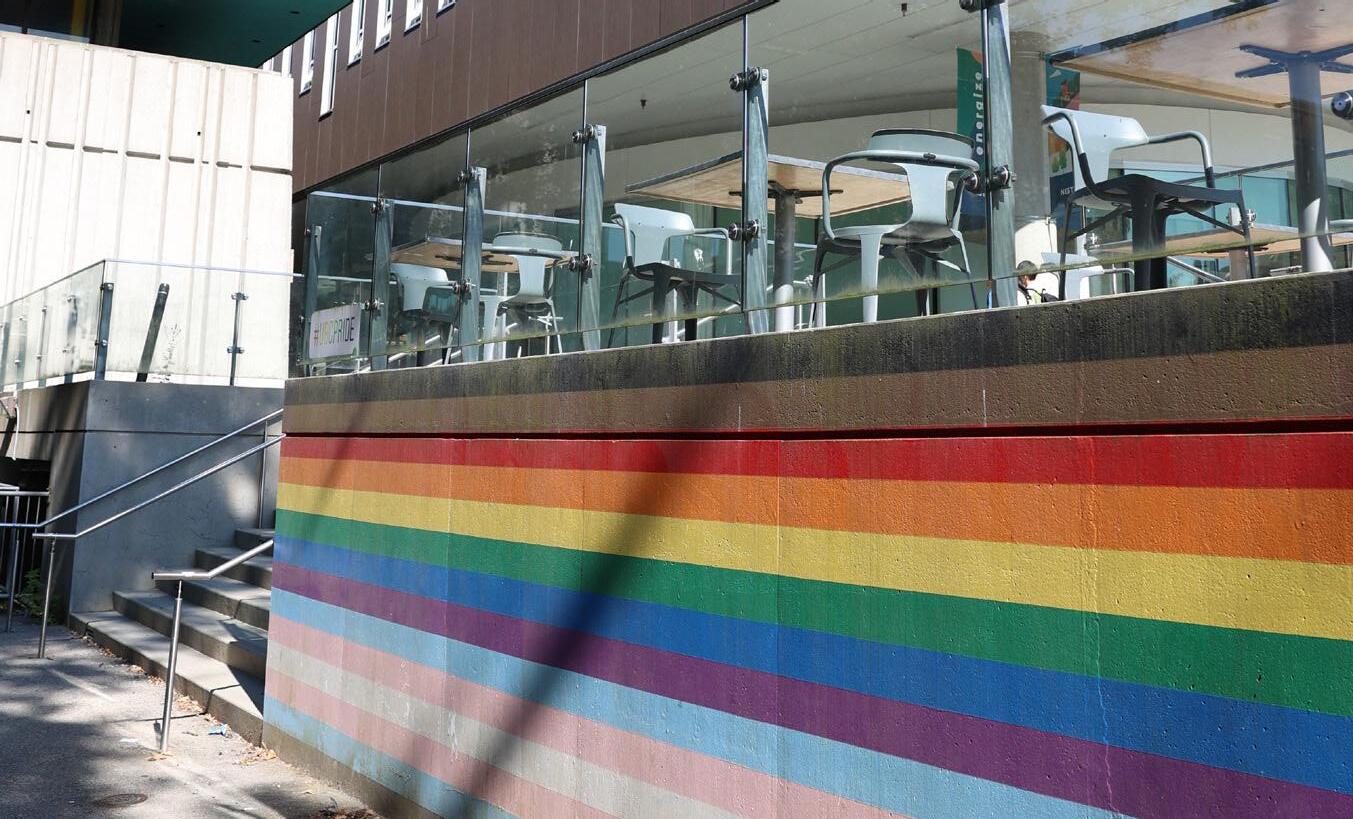
The Equity and Inclusion Office (EIO)’s website equity.ubc.ca has many learning guides and resources on gender diversity and gender-affirming care at UBC. The EIO posts about 2SLGBTQIA+ events happening in Vancouver and can help community members file complaints if you face anti-2SLGBTQIA+ discrimination on campus.
The Trans and Non-Binary Student Guide on the EIO site is another resource created by UBC students. The guide includes tips to navigate life from housing to the classroom as a Trans or non-binary student.
UBC Drag is a student-run group that brings Queer nightlife to UBC students. It typically hosts drag shows bi-weekly at Koerner’s Pub, and provides ‘pay-what-you-can’ tickets to students, no questions asked. You can learn more on Instagram @ ubcdrag. U
The First Nations Longhouse describes itself as the “home away from home” for Indigenous students on campus. You’ll find study lounges and a kitchenette, where you can hang out, snack and build community. Other resources include student meals, wellness events, a student nurse and counselors.
šxʷta:təχʷəm Collegium at the Longhouse is a peer-run place for Indigenous students to connect with each other. It offers social activities, tutoring and opportunities to connect with elders and UBC professors. Register on its website and follow their Instagram page (@ubcindigenouscollegium) for event updates.
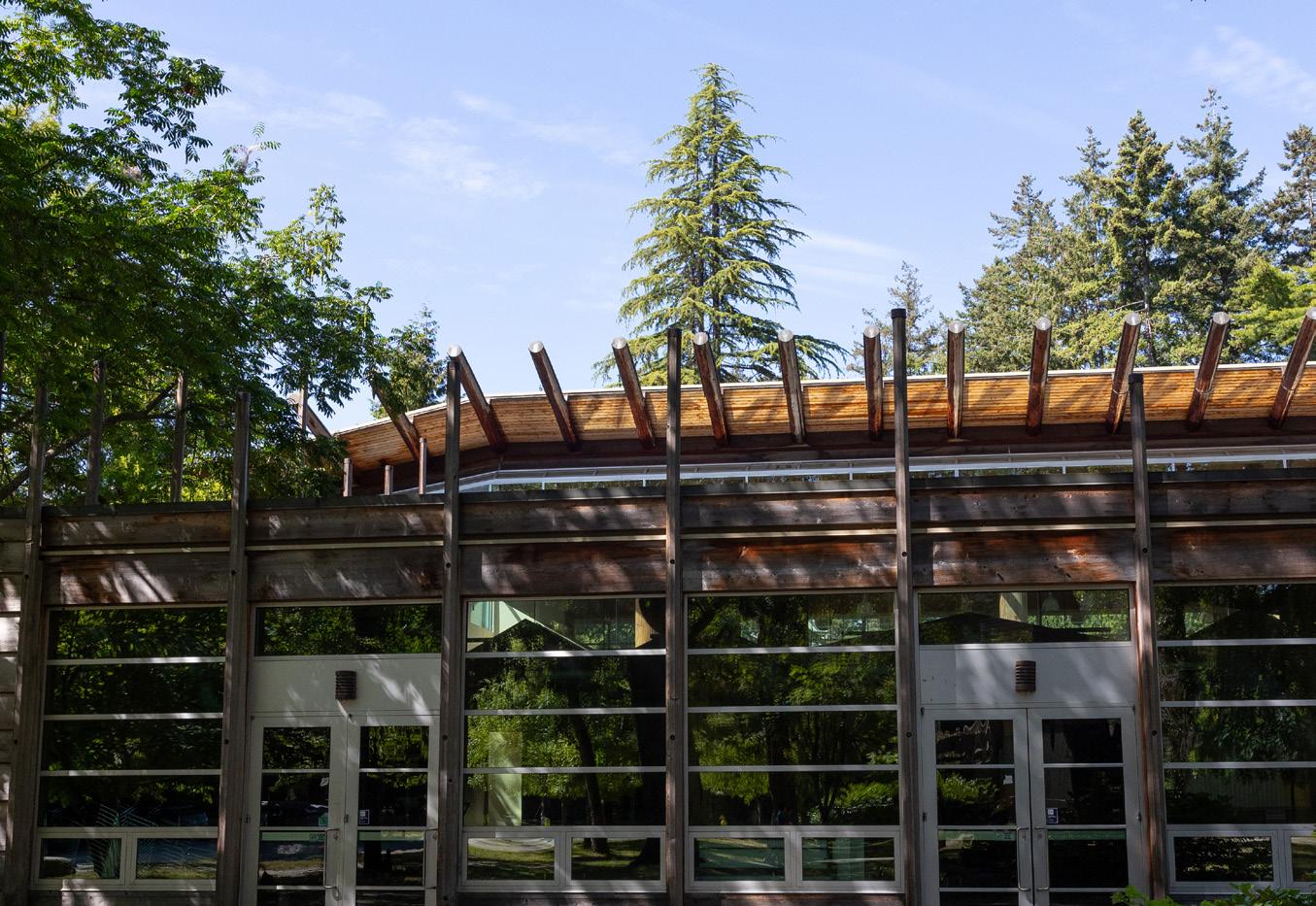
The Longhouse is next to Xwi7xwa Library, which is an Indigenous-centric library. Talk to the librarians for guidance on Indigenous informational resources, whether you have a specific question about heritage, need help with a school project or want to learn more about a general area of interest like music or activism.
Other Indigenous community groups on campus
include:
• The AMS Indigenous Committee advocates for Indigenous student priorities and holds events. They also run the Indigenous Student Lounge in NEST 2131. The committee is transitioning to become a constituency, which will mean a more central place for Indigenous student groups and governance on campus.
• The Indigenous Leadership Collective is supported by the Arts Indigenous Student Advising team (AISA) and is a chance for students to develop leadership skills, community and friendships at UBC.
If you’re confused about a degree requirement, want to discuss grad school options or explore volunteering on campus, talk to a program advisors. You can find a list under Students - Current Students - Student Resources at indigenous.ubc.ca.
The AISA is available for Indigenous Arts students seeking academic advising, but the office also runs social events with peer volunteers through the year. The AISA has a lounge located in Buchanan D140, where students can speak to advisors or just relax. U
The UBC Black Student Union (BSU) is a student-led organization that aims to improve representation and support for Black students on campus. They host events to connect Black students across campus. You can find more information on their CampusBase page. Graduate students can also join the Black Graduate Student Network, an affiliate organization of the Graduate Student Society (GSS) dedicated to fostering connections between Black graduate students.
The Black Muslim Collective at UBC is a space for Black Muslim students to connect. Find more information on their Instagram, @bmcubc
All students, staff and faculty on UBC campus who identify as Black can join the UBC Black Caucus, which aims to support all Black community members and improve anti-racism at UBC. You can find more info at blackcaucus.ubc.ca, plus a digital billboard of upcoming events around Vancouver.
UBC Africa Awareness Initiative: Started in 2002, this student-run organization aims to improve “discourse surrounding and including Africa at UBC.” Africa Awareness hosts various events throughout the year, including conferences, game nights and more. Visit https://ubcaai.netlify.app/ or @ubc_aai on Instagram for more info.
The UBC Black Law Students’ Association organizes networking, social and academic
opportunities for Black students at the Allard School of Law. This group hosts a Black Pre-Law Conference in partnership with the law school annually in the spring, and other events throughout the year. Find out more on their Facebook page, @ UBCBLSA
Black students can attend Black student orientation on August 31 and September 1 to learn more about resources available at UBC, run by organizations including the Black Caucus and BSU Black Graduate Student Network. You can find more information on the Black Caucus website.
The Black Caucus also runs the Black Mental Wellness Initiative, which provides up to two free virtual counseling sessions to any Black community members. Find counselors’ contact information at blackcaucus.ubc.ca/black-mental-wellness-project/
The Equity and Inclusion Office (EIO) hosts equity events and training. It can provide conflict advising for those looking for help addressing discrimination on campus. More information can be found at equity.ubc.ca.
If you’re having an issue with a professor, a student or a staff member, the UBC Ombudsperson is an independent, impartial and confidential resource for students. You can learn more at ombudsoffice.ubc.ca. U

Established by UBC law students in 1969, this non-profit provides free legal services for people who can’t afford other legal assistance. LSLAP is student-run, but formally governed by a board of lawyers and professionals. The clinic offers a wide variety of services such as drafting legal documents, offering case-bycase representation as well as immigration and employment legal disputes. You can find more information about services at lslap.bc.ca.
Located in the Downtown Eastside, the ICLC is a pro bono and educational clinic run by Allard Law students and provides free legal representation to the self-identified Indigenous community. The ICLC takes cases under the jurisdiction of BC provincial courts and does not offer full representation in Supreme Court cases. Learn more at allard.ubc.ca/community-clinics/indigenous-community-legal-clinic.
Supported by the Richards Buell Sutton LLP, the Business Law Clinic is another Allard Law support clinics backed by practicing lawyers and law school students. The clinic provides an opportunity for students to apply develop legal skills while offering business-oriented legal advice to small businesses, non-profit orga-
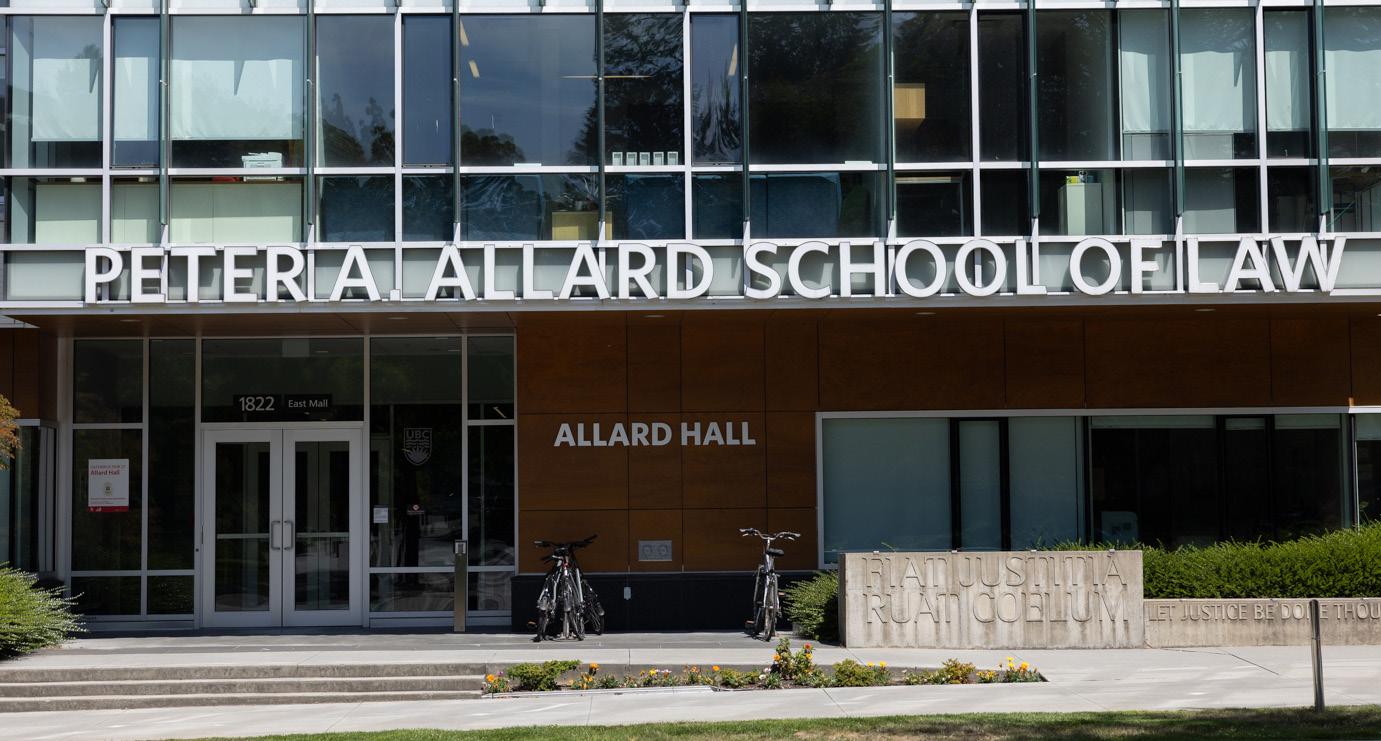
nizations, entrepreneurs and individuals who cannot afford legal support. Services include answering legal questions, reviewing contracts and leases and drafting legal documents like privacy policies, corporate bylaws, confidentiality agreements and offers of employment.
The SLFS is a non-profit organization run by a board of annually elected students to support litigation and advocacy at UBC. Funded through a $1 annual student fee, the SLFS has historically held information sessions about tenancy rights and funded select legal cases reviewed by legal professionals. The organization has been less active in recent years, but this year’s Board has said they’d change that.
Although the AMS Advocacy Ofice does not provide legal advice, it offers s a wide range of confidential support for students in formal conflict with the university. Students accused of academic and non-academic misconduct and with violations of the Residence Contract can get support from AMS Advocacy. Its website, ams.ubc.ca/support-services/student-services/ advocacy, offers digital resources for grade appeals, failed standings, missed examinations and co-op disputes. The office aims to provide a space for students to discuss investigative and disciplinary appeals with the university, potential strategy actions and get feedback on written appeals. U
Whether you want to explore your sexuality by yourself, with a consenting buddy or lover, here are some of the things to keep in mind to stay safe and sexy at UBC.
By yourself or with others, treat needs, desires and limits with respect. Consent must be freely given, clearly and unimpaired. This is particularly important when consuming drugs or alcohol. If someone isn’t able to communicate well or seems ‘out of it,’ it’s important to hold off, even if they express their desire to have sex at the moment.
Consent is not a one-time ‘yes,’ nor is it ever implied. Consent is ongoing; it can be revoked at any time, so make sure to check in with your sexual partner(s). You should look for both physical and verbal confirmation. You also should not be afraid to set your own boundaries — nobody should pressure you into an unwanted sexual encounter.
In BC, almost half of STIs occur in people under 25. That could be you! Luckily, there are many ways to reduce your chance of getting an infection. Make sure you’re up-to-date on your immunizations, know the signs of STIs, get
tested if you’re sexually active and use condoms to reduce your risk.
You can find free condoms around campus in the Nest at the SASC, UBC Life at the Wellness Centre or buy them at your local Shoppers. UBC’s Student Health Service offers free and confidential testing, and there are other testing sites throughout the Vancouver area if you’d rather get off campus.
Many types of prescription contraceptives are free in B.C. and can be prescribed by a pharmacist. This includes birth control pills, copper and hormonal IUDs, injections, implants and the morning-after pill. While these contraceptives may reduce your risk of becoming pregnant, they do not prevent STIs.
If you’re a man who has sex with men, a trans woman, or have sex/share injection equipment with a person who is HIV positive, you may want to talk with your healthcare provider and discuss whether HIV Pre-Exposure Prophylaxis (PrEP) is right for you.
The Wellness Centre in the Life building hosts the Sexual Health Shop. While somewhat limited in selection, you’ll find budget-friendly toys and other sexual health products, such as menstrual cups, oral dams and pregnancy tests (for $2!). Free condoms and lube are typically offered outside of the Centre when the shop is open. U
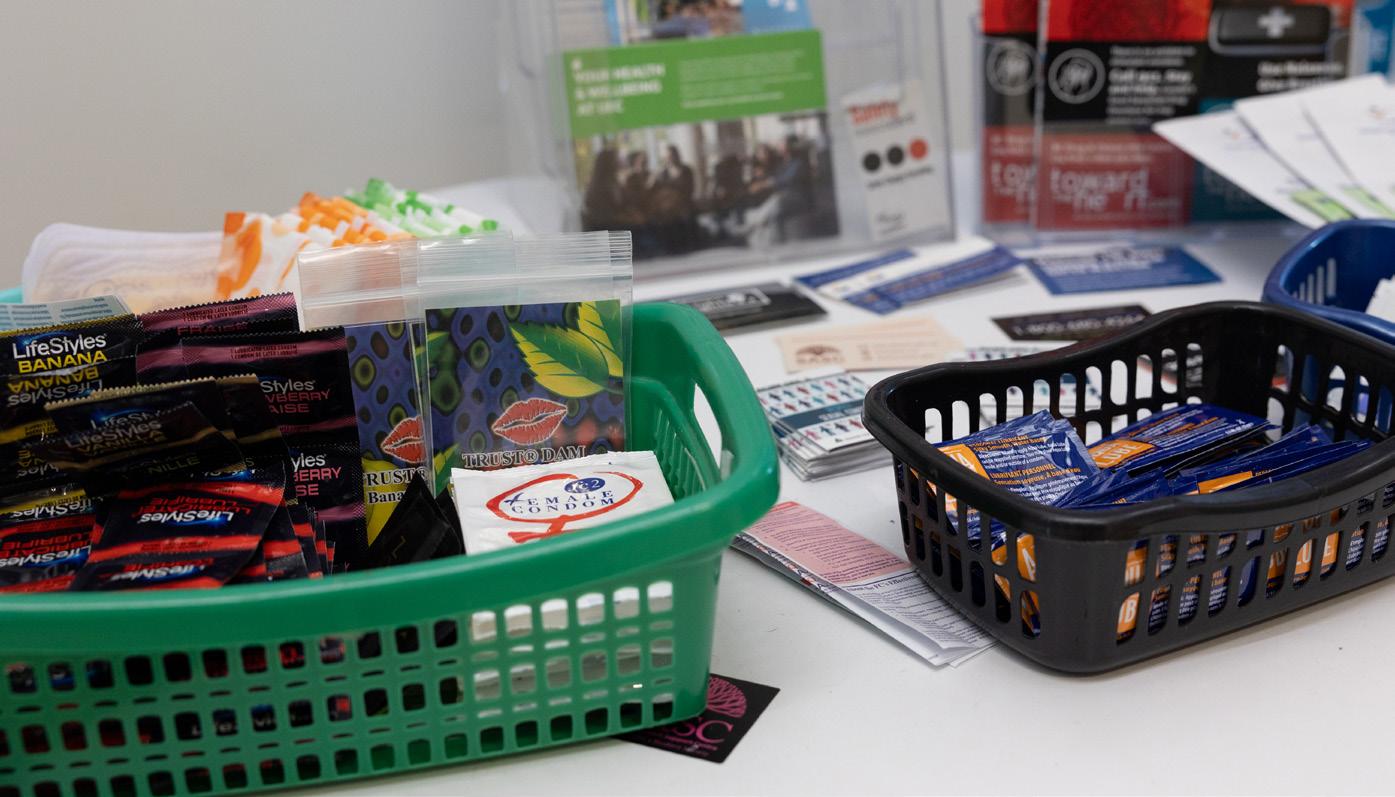
Here are some campus resources that can support you if you or someone you know has experienced sexualized or gender-based violence.
Run by UBC, the SVPRO provides confidential support and information for people impacted by sexual or gender-based violence.
It can inform survivors on their reporting options — to the police and UBC — and help them report their assault, navigate receiving a sexual assault evidence kit (also known as a rape kit) and it can provide a support worker to attend court and the hospital with you.
SVPRO also can help you find safe housing options both short- and long-term on- and off-campus, arrange academic concessions under UBC’s Academic Concessions Policy and coordinate workplace accommodations like arranging leave.
You can reach the SVPRO by phone or email at 604.822.1588 and svpro.vancouver@ubc.ca, respectively, or visit the SVPRO office in room 4071 in Orchard Commons Residence.
You can learn more about the SVPRO at svpro. ubc.ca.
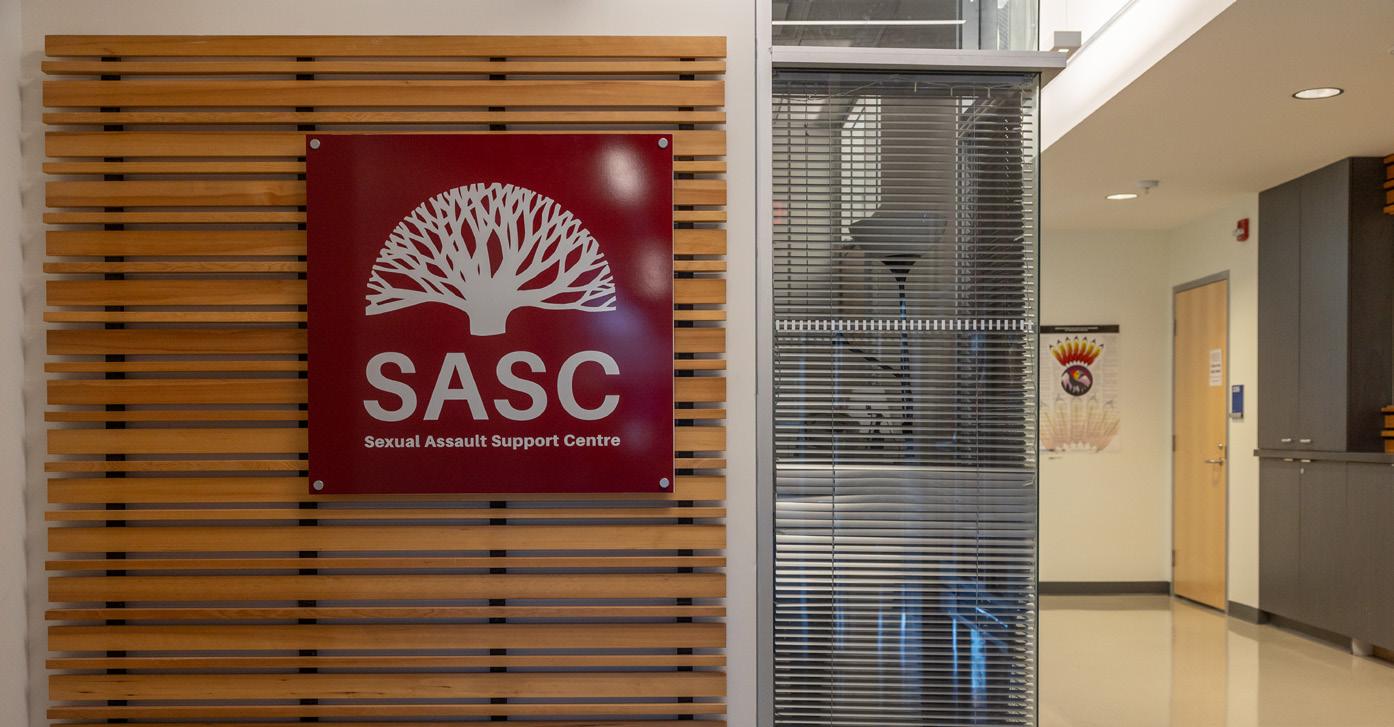
Funded by the AMS, the SASC provides support and education to survivors and their friends and family.
The SASC serves UBC students, staff, faculty and others with a UBC connection, but the centre itself is independent of UBC.
SASC offers confidential crisis support and runs support groups like Roots & Resilience, a six-week long art-based, peer support group for survivors, and BIPOC Community Care Circle, a biweekly group for BIPOC survivors, during the school year.
It can also connect you with a support worker to help you navigate legal, academic and medical systems. SASC can help you apply for academic concessions, file reports with UBC and the police, request workplace accommodations and access health services.
The SASC Sexual Assault Service also provides medical care for people 13 years old and older that have experienced sexual assault in the previous week. The service is free and confidential with no MSP needed and is located at the UBC Urgent Care at Koerner Pavilion and at Vancouver General Hospital’s Emergency Department, 7 days a week from 8 a.m.–8 p.m.
SASC also hosts workshops on responding to disclosures, workplace sexual violence and more. It also runs the Healthier Masculinities program, which works to eradicate gender-based and sexualized violence through dismantling damaging stereotypes for male identified and masculine presenting students.
You can reach the SASC at 604.827.5180 or sasc@ ams.ubc.ca, or visit the SASC office in room 3130 in the AMS Nest.
Learn more about the SASC at amssasc.ca. U

Want to stay on campus on a night out? The Pit is UBC’s only nightclub, and Wednesday is the day to go, for some reason. There’s no cover and often a fun seasonal theme (think Y2K or “Back to School”). After your night out, head over to University Village and hit up McDonald’s or A&W for a quick snack, since both are open 24/7.
If you’re looking for a spot to grab a drink on campus, Koerner’s Pub, the Gallery and Brown’s Crafthouse got you. Koerner’s is by the Museum of Anthropology and has $5 pints of beer between 2–4 p.m, as well as improv, drag shows and open mic nights. The Gallery is nested on the top floor of the Nest. Brown’s is right outside the Nest, with a happy hour from 3–6 p.m and 9 p.m to close.
Down to venture a bit further? Kitsilano has a handful of cool bars to check out: the list is lengthy, but some classics are The Colony and Darby’s Neighbourhood Pub. Glitch, a new arcade bar, recently opened and has open karaoke
on Thursdays.
If you’re looking to hit a gay bar or two, head to Davie Village, Vancouver’s historically Queer neighborhood. Numbers, Junction and Celebrities are all classic spots. Eastside Studios also hosts Queer events and drag shows at their warehouse space near Olympic Village, and Normiecorp organizes high energy dance parties.
Although a bit further away, Fortune Sound Club in Chinatown is another option for some weekend fun. Their music selection is mostly hip-hop. If you’re not feeling the dance floor, Greta, an arcade bar, is nearby.
The Granville Strip, packed with bars, clubs and late-night food spots, is Vancouver’s ~classic~ going-out spot. Depending on the night, you could be riding the bull at the Yale Saloon or dancing the night away at the Roxy or Levels. End the night debriefing with your friends at Lucha Libre Taqueria or one of the many donair spots and hop on the N19 back to UBC. U
The legal drinking age in BC is 19, so you probably won’t be going out to bars or clubs much in first year. But if you do happen to be of legal age or are drinking at home or a party, here are some tips.
Don’t go overboard, particularly if you’re drinking for the first time. Test your limits slowly, and ideally, with other people in case something goes wrong. Drink plenty of water both while you’re drinking and afterwards, since alcohol makes you dehydrated much faster.

Avoid drinking on an empty stomach, despite the temptation to get drunk faster. It’s a recipe for getting hungover too!
If you’re of age, you might find it useful to set yourself a budget before you head to the bar. Drinks are expensive, so if you’re conscious of how many shots you’re buying, it might help you think about how much you’re actually drinking. It will also help you think twice before getting another drink as soon as you finish your last one. And, setting a drink budget can make you slow down while drinking, giving you time to sit, stand and/or dance.
One easy way to set and follow a budget for the bar is to bring a small amount of cash so you’re less likely to mindlessly tap your card over and over again. That said, you should bring your credit card or a second piece of ID with you since BC requires
two pieces to buy alcohol.
Roofies, also known as date rape drugs, are drugs which can incapacitate someone by causing extreme drowsiness and blackouts. They can be put surreptitiously into drinks, so it’s important to safeguard yourself against them.
Going out with friends is always safer, as you have someone there to notice if you start acting off and get you home safely if you need it.
Don’t leave your drink out unattended. If you have to, then make sure it’s with someone you trust! Be careful about taking drinks from strangers at parties, in particular ones you didn’t watch someone make.
Driving drunk is both illegal and dangerous for yourself and others on the road. There are always other options to get home — but it helps to plan in advance.
This could mean assigning a designated driver among your friends, ensuring you have access to public transit, downloading the Uber app or saving the phone number to call a taxi when you’re ready to go home. U
Experimenting with different substances is seen as a rite of passage for a lot of university students. Drugs can be fun, but they come with varying levels of risk.
Drugs like heroin, ecstasy (MDMA) and cocaine could be laced with fentanyl — a synthetic opioid around 50 times stronger than heroin and 100 times stronger than morphine — and large quantities of fentanyl can lead to an overdose faster than other substances.
If you’re planning on engaging with substances that could be laced with fentanyl, it’s important to know your limits, to test your substances and know how to prevent an overdose. This article offers some starting resources.
While drug use is often taboo, it’s important to talk about it openly because stigmatizing it won’t stop people from using — it just forces them into secrecy. In the middle of a toxic drug crisis, using unsafe supply alone or in secret is dangerous.
You can test your substances many different ways, including through fentanyl test strips which can be found for free at the AMS Sexual Assault Support Centre (SASC), the AMS Resource Groups Lobby on the second floor of the Nest on their respective resource tables and at the UBC Wellness Centre front desk in the Life Building.
You can also find test strips at supervised consumption sites across the Lower Mainland. The closest site to campus is the Insite supervised consumption site near Columbia Street and E Hastings Street. Insite has professional medical staff on site and also provides clean injection equipment and spectrometer drug checking. You can also test your drugs anonymously online at getyourdrugstested.com
Remember that fentanyl test strips cannot detect all types of fentanyl, like carfentanil, so even if the test strip comes back negative, you should never use substances alone and have naloxone on
hand in case of an overdose.
Naloxone (also known as NarCan) can temporarily reverse the effects of an overdose when injected into a muscle in the body, typically the arm or thigh (think EpiPen). The effects of naloxone last 20–90 minutes and only temporarily reverses overdose, so get immediate medical attention after administering naloxone. Subsequent doses may be needed.

Naloxone kits can be found on campus in every residence commonsblock, and you can get kits and training through Student Health Services, at SASC and at Shoppers Drug Mart. You can also pick them up from pharmacies across the Lower Mainland.
As of January 31, 2023, possessing 2.5 mg of an illicit substance is decriminalized under BC law but the use, distribution and possession of illicit substances on campus still goes against UBC’s Student Code of Conduct and student housing contracts.
If you are in possession of illicit substances and call 911 if someone overdoses, the Good Samaritan Drug Overdose Act protects you from charges for possession of a controlled substance because you called for help.
When experimenting with drugs for the first time, you might not know your limits so creating a safe environment is incredibly important. As a rule of thumb, start with small quantities since potency of drugs can vary.
Ensure you’re in the company of trusted friends in case of an emergency or overdose, and always tell someone if you’re using so they can watch out for you. U
Cannabis, also known as marijuana, weed or pot, is a legal and widely-used recreational drug in BC. Trying weed is a common (but by no means mandatory or expected!) part of many UBC experiences, so here’s a guide for beginners.

Cannabis can be taken in many forms, and choosing which one depends on what you’re looking for. The two most common methods are ingesting and smoking.
Ingesting weed through food (often a gummy or brownie, but it can be any food that includes cannabis oil) is called an edible. It usually takes 45 minutes to an hour to hit, and then lasts between four and twelve hours depending on the dose and your tolerance. For some people, edibles have a more intense and full-body effect than smoking, but that also depends on the strain and your personal chemistry.
The most common ways to smoke weed are joints (which is just weed rolled in cigarette paper), blunts (which is weed rolled in a cigar paper, so it’s larger and contains a bit of nicotine), pipes or bongs. Smoking can make you feel high within minutes and lasts between one and three hours. Although the effects of cannabis use may wear off sooner, detectable amounts of THC may remain in the body for days or weeks after.
There’s also vaping (which is inhaling weed through an electronic vape) and dabbing (which involves breathing in heated cannabis resin through a dab pen). Vaping and dabbing are convenient to store but are often much more potent. Beginners should tread carefully.
THC is the primary psychoactive component in cannabis, making you feel “high.” Commercial weed products come with their THC content labeled. If you’re a beginner, look for an edible less than 5mg. If smoking, keep it under 20-25% THC. You can always take more if needed.
Smoking is generally better than edibles for be-
ginners, because it’s easier to control how high you get. The effects of cannabis can vary from person to person, so always start with a low dosage and experiment cautiously.
There are different types of cannabis, which are called “strains.” The two most popular are sativa and indica. Sativa strains tend to provide energizing effects while indica strains offer more relaxation. There’s also CBD, which isn’t psychoactive (so pure CBD won’t get you high) but is said to have a calming effect for sleep or stress relief. There are also hybrids, which combine elements of all three.
If you choose to buy weed, get it from a credible and safe place. Trinity is the closest dispensary to campus, and they have a 10 per cent student discount. Evergreen on Fourth also has student discounts.
All authorized weed shops in British Columbia can be found at https://www.bccannabisstores. com/. Another good website to check out is https://weedmaps.com/. Enter your location, and the service will list dispensaries in your area. Some dispensaries provide delivery services. All will require proof that you’re 19+.
If you or a friend gets too high, try and get to a safe place that feels comfortable. Make sure to drink a lot of water. Although it’s unlikely to have a fatal overdose from weed, if your reaction becomes severe, call 911 or go to your nearest emergency room.
While cannabis is deemed safer than many other recreational drugs, it does not mean it will cause no harm. If you’re someone who frequently gets anxious or paranoid when high, it’s important to know this about yourself and potentially limit your use. Some prescription drugs may also influence the effects of cannabis. How weed affects people can vary significantly, so listen to yourself and others, have fun and stay safe! U

Congratulations, you’ve made it to Vancouver! Though the challenge of getting here is behind you, there are still many things you’ll need to do and keep in mind while living here.

As a student, you’ll receive your study permit when you arrive in Canada. The permit will be valid for the length of your program plus an additional 90 days. This small piece of paper lets you stay in the country, so don’t lose it! Keep it safe, and keep a picture of it on your phone for emergencies.
Your study permit is only valid if your passport is valid. Make sure to renew your passport before it expires. Otherwise, you’ll have to renew everything you applied for, from the study permit, your BCID, your health insurance and more.
If you plan to work, then you may or may not need a work permit, depending on your job. If you are on co-op or an internship, then you’ll need one, but if you’re working part-time, then you likely won’t need a work permit. You’ll also need a Social Insurance Number (SIN) to work in Canada, so make sure to apply for one at a Service Canada Centre. The closest one to campus is at 1263 W Broadway.
You never know when you might get injured or sick, so make sure you’re on top of getting insurance. All UBC international students are eligible for MSP, a mandatory health insurance plan — you just need to apply online. It can take up to three months to process applications, so make sure you apply right away. While you wait, you’ll be covered by iMED, a temporary health insurance plan.
You’ll also want to get a BCID while you’re
here. It’s a government-issued ID and extremely useful to have. To get one, you’ll need to book an appointment at ICBC (the closest one to UBC is at 4126 MacDonald Street). Make sure to bring two pieces of valid ID (check icbc.com for more details).
Banking may seem scary, but opening a bank account is a necessity. There are many banks in Canada to choose from. RBC, BMO, Scotiabank and CIBC all have branches on campus, and TD has a branch in Wesbrook Village, where you can get help either by walking in or booking an appointment.
Alternatively, you can book an appointment at a credit union like Vancity or Coast Capital. These credit unions are collectively owned, but still secure, alternatives to a traditional bank. Vancity has a location in Wesbrook Village.
Lastly, you’ll need a phone plan. You can search around for different plans and carriers to see what works best for you. Popular carriers in Canada include Rogers, Bell and Telus, but Fido and Virgin tend to be more affordable. Many banks and phone carriers also have student discounts, so keep an eye out for those!
This is by no means an exhaustive list of everything you’ll need to know. There are plenty of places across campus that can provide more information and support, like the UBC International Students Advising Center and Student Services. The Canadian government websites on Immigration, Refugees and Citizenship also include a lot of up-to-date information! U
International students make up over a quarter of UBC Vancouver’s student population, so you’re not alone as you adapt to life in Canada. Aside from the new friends you will meet from around the world, here are some resources to help you navigate life as an international student.

International Student Advising (ISA) is your go-to spot on campus for assistance with immigration and citizenship documents, health insurance, work requirements and general international student advice.
The ISA website offers a comprehensive International Student Guide for life before, during and after your time at UBC. You can find the guide at students.ubc.ca/international-student-guide.
If you need in-person assistance, the ISA office is located in room 1200 of the Life Building. Dropin appointments are available 9:30 a.m.–4:00 p.m. every weekday except for Wednesday, when the office is open from 10:00 a.m.–4:00 p.m. You can also book an appointment through the ISA website.

This is a newsletter created by International Student Development and sent out every Friday. The newsletter contains information about upcoming international student programming like career fairs and support groups, as well as workshops
to help you apply for a work permit or to extend your study permit.
This is also a great resource to check out if you’re looking for fun cultural events on campus and around Vancouver. Subscribe to the newsletter on the ISA website, students.ubc.ca/ international-student-guide.
Immigration, Refugees and Citizenship Canada is the federal government agency that grants citizenship and issues travel documents. This is where to go if you need to apply for or extend a study or work permit, apply for citizenship or permanent residency (PR) or seek asylum.
Beyond UBC and government resources, there are plenty of opportunities to engage with the international community on campus. UBC has a variety of clubs with cultural and spiritual focuses if you’re looking to connect with students of similar backgrounds.
The Simon K. Y. Lee Global Lounge & Resource Centre, located in Marine Drive Building One, also offers international community programming like coffee chats about global issues, gallery exhibitions and screenings, alongside networking and leadership opportunities. U
If you’re an international student looking to transform your temporary stay in Canada into a permanent one, you’re not alone. Here’s a simplified breakdown of different ways to do so.
Almost all provinces or territories operate a Provincial Nominee Program (PNP) to help people immigrate to their particular region. First, apply to your desired province or territory, and if nominated, you can then apply to Immigration, Refugees and Citizenship Canada (IRCC) to apply for PR.
Each province has its own criteria and requirements. For BC, your skill set needs to meet the needs of BC’s labour market, so most categories require a valid job offer from a BC employer.
Alternatively, the Canadian Experience Class (CEC) under the Express Entry system invites those with at least 12 months of skilled work experience in Canada (excluding co-op placements) and a competitive Comprehensive Ranking System (CRS) score to apply for PR.
Other than Canadian work experience, you can get points for various factors such as holding a certificate, diploma or degree from a Canadian institution and official language
(English and French) proficiencies.
Many UBC grads aren’t eligible for PR immediately after graduating, so you may want to apply for a Canadian Post-Graduation Work Permit (PGWP), which enables individuals to remain and work in any field anywhere in the country between eight months and three years after their program of study. A job offer is not required to apply for the PGWP. Apply only after your Letter of Completion becomes available, but before its been 180 days (about 6 months) after graduation.
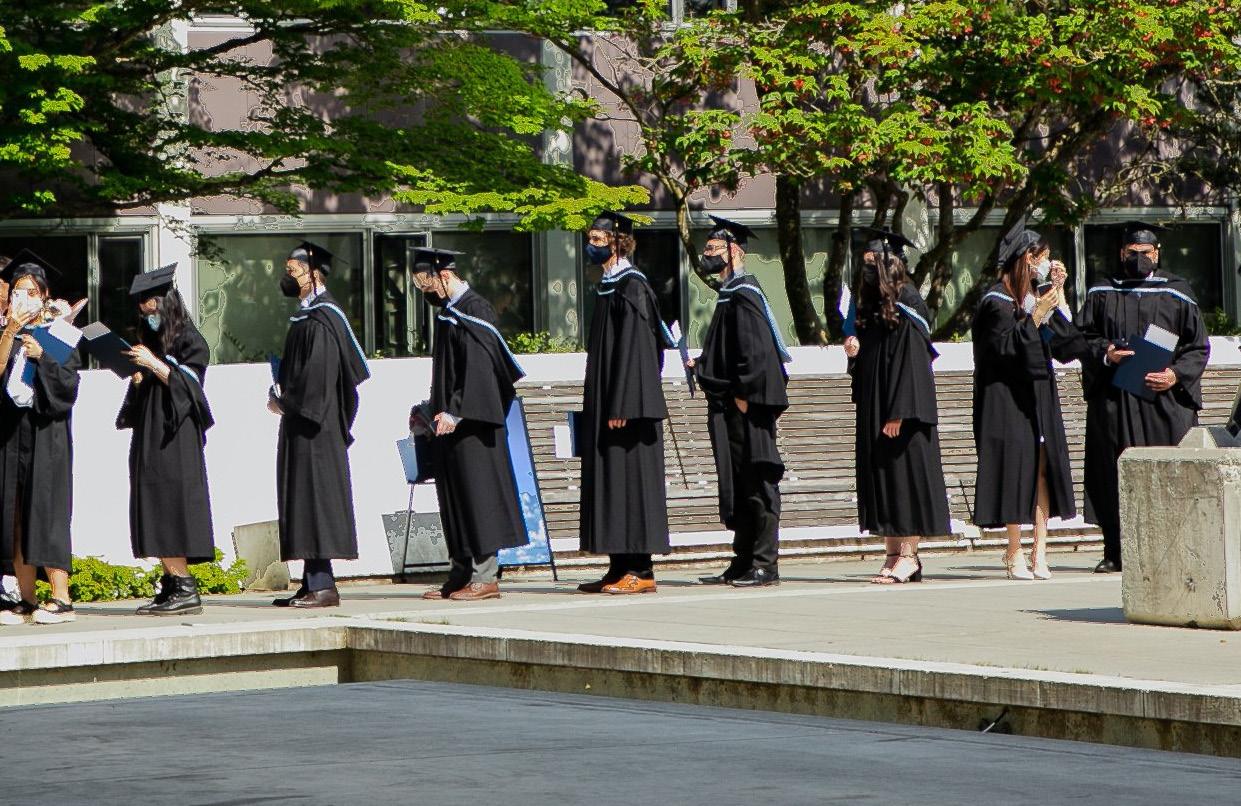
To be eligible for Canadian citizenship, you must have PR status in Canada. You also must have lived in Canada for a minimum of three years out of the last five, have filed your taxes, pass a citizenship test and prove your English or French language skills. The entire process takes an average of 18 months from the application to the citizenship ceremony.
Drop by the International Student Advising office located in the Life Building for further clarifications and next steps about settling in Canada. U
We’re UBC’s student paper — established in 1918, independent since 1995.


We’ve been the definitive source of news on campus for 105 years. We’ve covered everything under the sun from UBC’s fuck-ups, student wins, athletics, research, theatre, your opinions and things that make us laugh.
The Ubyssey is written and edited by students in room 2208 of the Nest, and you need zero experience (yes, you heard us right! Zero, zilch, nada!) to contribute. We’ll teach you everything you need to know — you’ll be able to hone your written and verbal communication abilities, learn computer and technical skills and develop your graphic design talents. You might walk into The Ubyssey with zero experience, but you won’t be leaving that way.
And while we work hard, we play hard too! The Ubyssey is the place to learn how to be a journalist
on campus — but it’s also a place to make friends and have fun. Between digging through documents and putting together our bi-weekly print issue, we find time to go to social events and parties, represent the paper during intramural sports and get (safely) sloshed at our annual Pender Island retreat. We also go to class, occasionally.
The Ubyssey has been the training ground for Canadian icons — past senator Pat Carney edited the paper in the 1950s, former Prime Minister John Turner was an associate sports editor and broadcaster Pierre Berton admitted he attended UBC to skip classes and work for the paper.
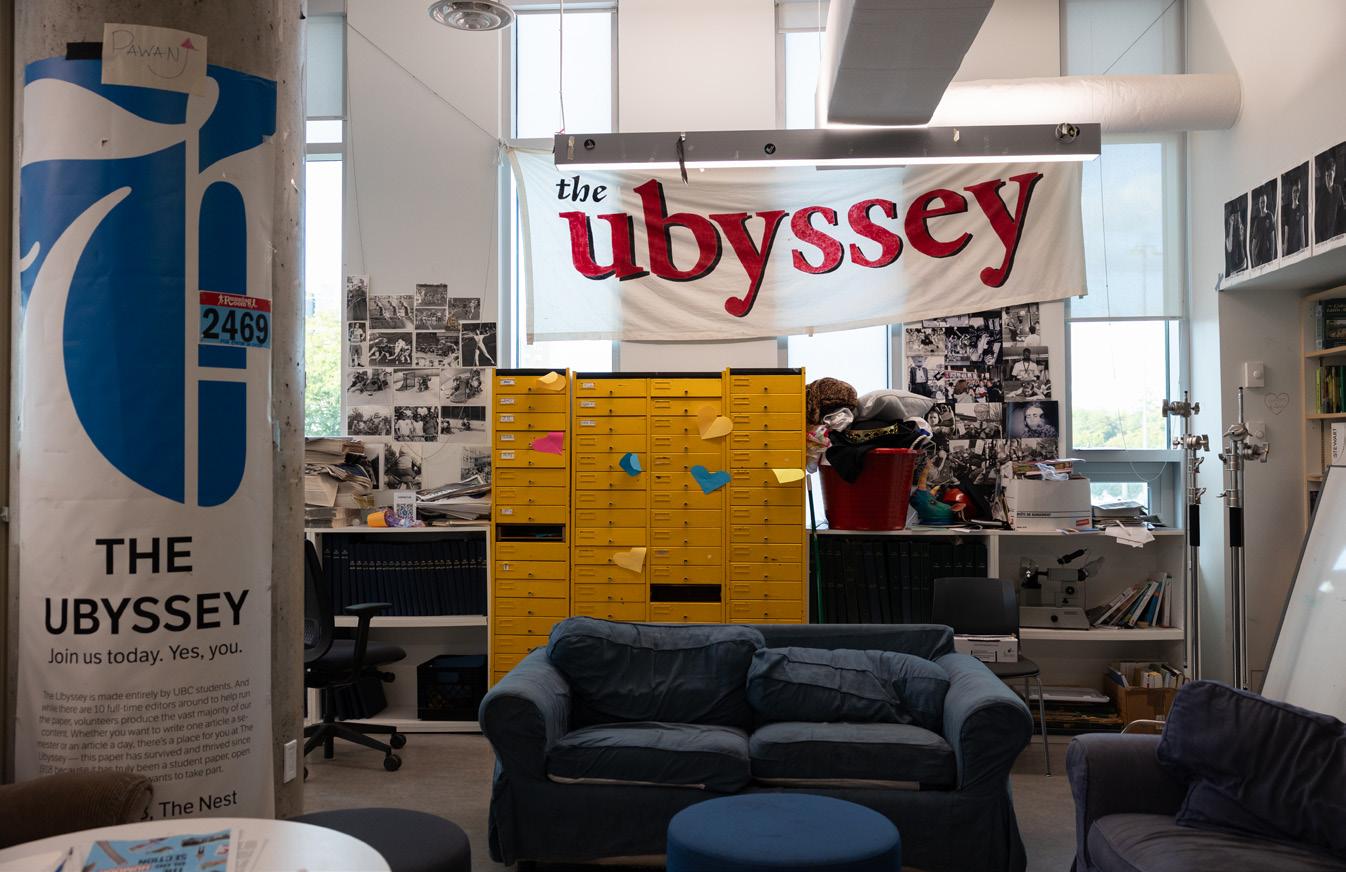
Today, you can find our alum in newspapers across the country and the world — from Canadaland’s Arshy Mann and exclaim! editor-in-chief Alex Hudson to the CBC’s Justin McElroy and Moira Wyton. They all got their start at The Ubyssey.
And who knows? You could be next. U
For 105 years, The Ubyssey has been put together by students. Whether that’s an article, visual, video or our website — we need student contributors, like you, to help us make our paper!
The easiest way to get involved with The Ubyssey is to join our pitch lists by visiting ubyssey.ca/page/ volunteer. Here, editors send out assignments. Pitches are short descriptions of stories that editors want someone to cover — whether that’s a cool news story, new event happening on campus, a piece about new research, a recap of a T-Birds game or even a video, photo or illustration! You don’t have to have any experience to contribute to us — we’ll teach you everything you need to know!
At ubyssey.ca/page/volunteer, you can find information on joining our community Discord server and section Facebook groups to stay updated on all things Ubyssey including pitches and our weekly section and staff meetings.
Have questions? Contact an editor! You can find our emails at ubyssey.ca/pages/about.
We don’t just write at The Ubyssey — we take photos, create illustrations, film videos and have an
entire web development team, too!
You can also join our Board of Directors, who oversee all things business regarding the paper, from finances to our strategic plan. They’re elected once a year in the spring during AMS Elections. Have questions? Email our Board president at president@ubyssey.ca
We hold meetings for all of our sections in our office, so come visit us in room 2208 in the Nest!
Staff meetings are a great way to get to know your friends at The Ubyssey! Once a week, INSERT TIME ONCE WE HAVE IT, we hang out and talk about exciting things going on at the paper and the top ten articles of the week. We also talk about Ubyssey events like socials and our intramural teams. You don’t have to be a Ubyssey staffer to attend staff meetings — come on down for a fun time!
You can also drop by the office from 11 a.m. to 5 p.m. every weekday to do some homework, use our toaster oven, brainstorm a story, eat your lunch, drink some coffee or joke around. Editors are in the office pretty much all the time, so come visit us. We don’t bite — I promise (and we have some comfy couches)! U