The Ubyssey’s 2026 Black History Month Supplement, in collaboration with the UBC Black Student Union:
ON OUR TERMS
Creative Non-fiction by Daniella Barretto Guest Contributor
Who might we be if given the room to become?
A question that haunts the still spaces of the mind, yet we often lack the language to confront it. We wait for a spark, a sudden clarity, a bolt of inspiration to strike. Yet for many, life does not always begin with an act of lighting. Sometimes it begins with fighting the will to imagine what could have been. We find ourselves paralyzed, not by a lack of desire, but by the fear of the unseen and the lack of strength to give in to our potential. Yet there is a staggering power in this resistance: the will to abstain from the paths that were never meant for us.
This resistance is not unfamiliar. Each day, we encounter the quiet pull toward what is easiest, the urge to remain where we are, to postpone becoming, to choose comfort over transformation. We are told constantly to rise, to strive, to show up without hesitation, yet many of us know the immense force of the opposing will: the desire to remain still, to delay, to abstain from effort. To acknowledge this resistance is to recognize its magnitude. Only when we confront the strength of this opposing force do we begin to understand what it truly means to choose growth, to choose discipline, to choose becoming. The will to abstain, when recognized, reveals the depth of the will required to overcome it.
Continued on page 8.

Post-secondary funding to remain steady under provincial budget
Report by Sophia Bertuzzi Samilski News Reporter
Post-secondary institution expenditures over the next three years will modestly increase, according to B.C.’s provincial budget tabled Tuesday afternoon, while the province will sink into a record-breaking $13.3 billion deficit. Government expenses in the sector are projected to rise from $9.1 billion in 2025-26 and reach
$9.5 billion by 2028-29, marking a $394 million or four per cent increase. The annual increase is not projected to keep up with inflation.
According to the government, the rise in expenses are primarily driven by amortization and operating costs associated with new major infrastructure initiatives across the institutions, and inflation on operating costs. Salary expenses are also expected to significantly contribute
to the rising expenses as many unionized employees who work in post-secondary institutions and research universities have negotiated new collective agreements.
The province is also increasing the tax rate of the lowest income tax bracket from 5.06 per cent to 5.60 per cent. Additionally, school tax rates are going up, and PST exceptions on certain goods and services are being removed.
Continued on page 3.
How could Venezuela’s political future impact Canadians?
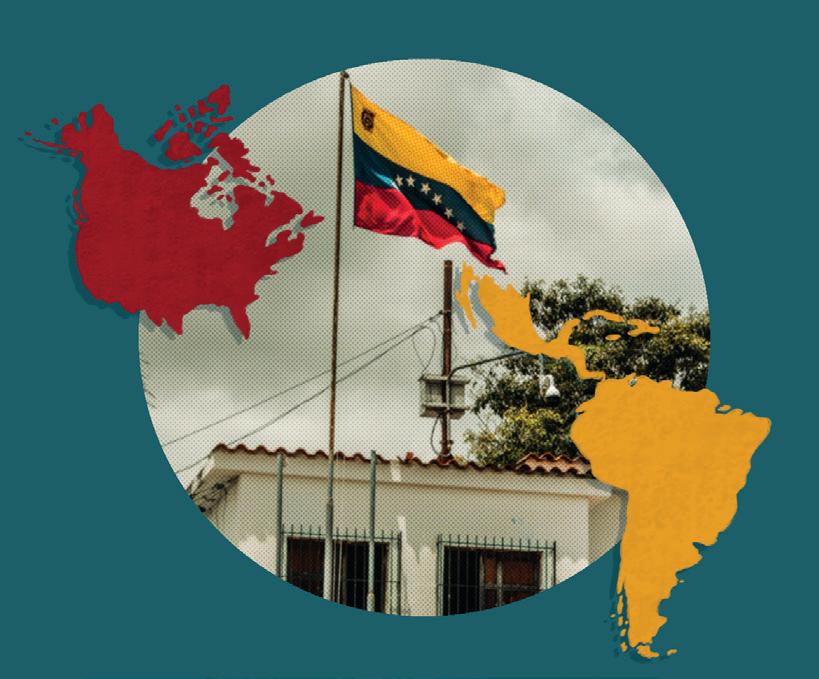
In a statement following the United States’ intervention, Prime Minister Mark Carney affirmed Canada’s support for a peaceful, Venezuelan-led transition while calling on all parties to respect international law. Yet the potential implications for Canada are significant.
Feature by Harper Jasinski Contributer
In the wake of the United States’ capture of Venezuela’s then-President Nicolás Maduro, questions have arisen over the country’s democratic future. This brazen act of foreign intervention also raises further topics that are critical to Canada and the world order, including issues surrounding natural resource production, breaches of international law and principles of state sovereignty.
Review by Nivita Dutta Contributor
On a cool February afternoon, crowds huddled toward the Pride wall outside the Nest to seek warmth, but not of the electric variety: this heat would emanate from what some were hoping might be a potential hunk parade.
Months after the Performative Male contest hosted by the Gender, Race,
Sexuality and Social Justice Undergraduate Society (GRSJUA), event organizers Nayis Majumder and friends decided to throw their second event on their own. This time, it aimed to get a little less family-friendly. The Feb. 10 Heated Rivalry Lookalike Contest was a chance for guys who wear hockey jerseys to class and anyone who can do a Russian accent to compete to be
UBC’s very own Shane Hollander and Ilya Rozanov. Minutes after the event’s start time, large masses began to form. Against the wall stood a judges’ table and a red children’s hockey net. Students stood around claiming disinterest about the event, yet proceeded to get on tiptoes and crane their necks trying to goggle the growing contestant pool.
Continued on page 4.
In a statement following the United States’ intervention, Prime Minister Mark Carney affirmed Canada’s support for a peaceful, Venezuelan-led transition while calling on all parties to respect international law. Yet the potential implications for Canada are significant. Venezuela possesses the world’s largest crude oil reserves, leading to concerns that Canadian crude may be threatened if Venezuelan
production increases.
Further, given President Donald Trump’s repeated ‘suggestion’ that Canada become the 51st state, the operation in Venezuela heightens concerns about the United States’ intentions for Canada and the rest of the Western Hemisphere. Trump’s remarks about “running” Venezuela post-Maduro further complicate the picture, and widespread confusion remains surrounding the fate of Venezuela and a world in which the United States is a dominant actor.
The Ubyssey spoke with Dr. Maxwell A. Cameron for his insights on the situation in Venezuela and its impact on Canada. Cameron specializes in comparative Latin American politics and is jointly appointed to the School of Public Policy and Global Affairs and department of political science at UBC. He has been a touchstone for media sources in light of political unrest in Venezuela.
Continued on page 7.
High sticking at the Heated Rivalry lookalike contest
There was a Shane from Montreal, a Shane who’d seen the show four times and a Shane who claimed their reason for qualification should be that they also “like dicks.” | ALEAH KIPPAN / THE UBYSSEY
MYELLE YOUNG / UBC BLACK STUDENT UNION
The Ubyssey
FEBRUARY 12, 2026| VOLUME CVII |
LAND ACKNOWLEDGEMENT
The Ubyssey acknowledges we operate on the traditional, ancestral and stolen territories of the Coast Salish peoples including the x ʷ məθk ʷ əyəm (Musqueam), Sḵwx̱wú7mesh Úxwumixw (Squamish) and səlilwətaɬ (Tsleil-Waututh) nations.
EDITORIAL
The Editorial Office creates the content of the newspaper. They do all the research, writing, photography, programming, illustrating and editing — the journalism.
Editor-in-Chief
Aisha Chaudhry eic@ubyssey.ca
Managing Editor Saumya Kamra managing@ubyssey.ca
News Editor Stephen Kosar news@ubyssey.ca
Arts & Culture Editor Julian Coyle Forst culture@ubyssey.ca
Features Editor Elena Massing features@ubyssey.ca
Deputy Managing & Opinion Editor Spencer Izen deputymanaging@ ubyssey.ca opinion@ubyssey.ca
Sports & Recreation Editor Caleb Peterson sports@ubyssey.ca
Research Editor Elita Menezes research@ubyssey.ca
Humour Editor Kyla Flynn humour@ubyssey.ca
Illustrations & Print
Editor Ayla Cilliers illustrations@ubyssey.ca
Photo Editor Sidney Shaw photo@ubyssey.ca
Digital Editor Sam Low samuellow@ubyssey.ca
STAFF
Abbie Lee, Akmal Zulkifli, Amrit Rai, Annaliese Gumboc, Carol Rocque, Ewan Keenan, Fiona Pulchny, Gabby Ranu, Ian Cooper, Jeff Lee, Liana Raisanen, Lorainne Chua, Luiza Teixeira, Maia Cesario, Mason Carter, Maya Tommasi, Morrison Tulloch, Natalie Vakulin, Navya Chadha, Quyen Schroeder, Raul del Rosario, Selena Sallay, Seneesha Ekanayake, Skye Shen, Sofia Campanholo, Sofia Gonzalez, Sophia Clearwater, Sophia Samilski, Sophie Cark, Tatjana Huber, Thomas Favelle, Trinity Sala, Vicky Nguyen, Yasmine Armstrong, Zoé Stojanovic
PRINT DESIGN BY: Ayla Cilliers, Lorainne Chua, Skye Shen, Sophia Clearwater, Yasmine Armstrong
BUSINESS OFFICE
The Business Office supports the journalism by managing the Ubyssey Publications Society’s money at the direction of the elected, majority-student board. It has no say in or over our coverage, in keeping with the principle of editorial independence.
Business Manager Scott Atkinson business@ubyssey.ca
Editorial Office: NEST 2208
604.283.2023
Business Office: NEST 2209
604.283.2024
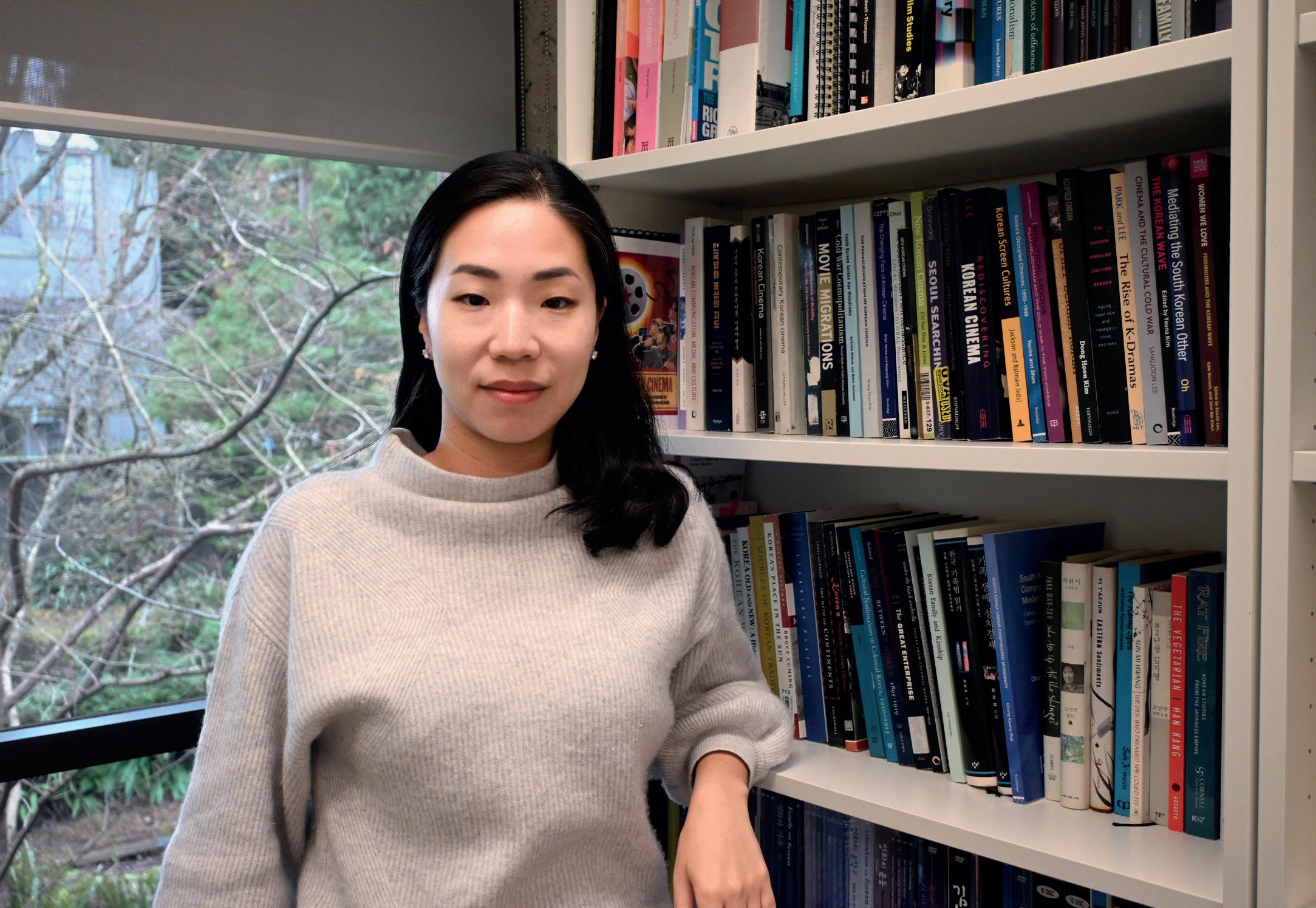
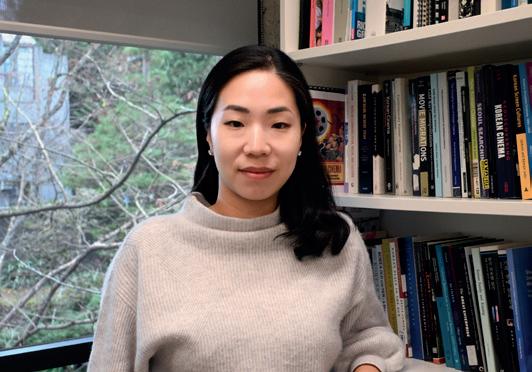
Ultimately, as a professor of cinema, An wants her students to learn how to be informed, critical consumers of popular media. | ALEAH KIPPAN / THE UBYSSEY
Dr. Ji-yoon An investigates cinema’s monstrous others and what they can tell us about ourselves
Profile by Liana Raisanen Contributor
Account Manager Ben Keon advertising@ubyssey.ca
CONTACT
Website: ubyssey.ca Instagram: @ubyssey Facebook: @ubyssey TikTok: @ubyssey Bluesky: @ubyssey LinkedIn: @ubyssey
Every story we publish comes with a label — here are the brief definitions for what they mean.
PROFILE
Profiles are a detailed description of a person and their life experiences. They promise to be descriptive and analytical.
REVIEWS
Reviews are critical analyses of works of the arts. They promise candour, description and fairness from a knowledge voice.
REPORTS Reports are accounts of particular moments — the who, what, when, where, why and how in 800 to 1,200 words. In News and Research, they promise impartiality. In Arts & Culture, they promise critique and/or analysis.
EXTENDED REPORT
Extended reports are accounts of subject, engaging multiple peoples, places, sources and smaller events over long periods of time. They promise impartiality
GAME ANALYSIS
A game nalysis is an analytical account of a sprting event either involving UBC’s varsity teams or taking place on campus. These promise to describe what happened, but also why the game matters.
OPINION ESSAYS
Opinion essays take a position on something newsworthy in the present moment, and are either written by guest contributors from the community or in-house columnists. All essays represent the author’s views alone.
PERSONAL ESSAYS
Personal essays explore an individual’s perspective on an experience that is relevant to a larger group of people.
Frankenstein is a classic monster tale, told time and time again, most recently in Guillermo del Toro’s Oscar-nominated 2025 film. Born from Mary Shelley’s gothic horror novel published in 1818 then appearing on screen for the first time in 1931, Frankenstein’s monster is one we see “transitioning throughout the decades,” according to Dr. Ji-yoon An, an assistant professor at UBC in the department of Asian studies who specializes in contemporary Korean popular culture. Ultimately, as a professor of cinema, An wants her students to learn how to be informed, critical consumers of popular media. Alongside her other courses — ASIA 356:
Introduction to Korean Cinema and ASIA 383: Korean History through Cinema — An’s new course, ASIX 342: Cinematic Monsters of Asia, made its debut this semester.
With this new course, her goal has become “much more pronounced,” because monsters are deeply personal. While we’re fearful of the monster, we find ourselves attracted to the concept. “It says so much about what society deems to be monstrous and what we don’t,”
An said.
The initial Frankenstein film already heavily differed from its source material, as it became centred on issues impacting the United States in the 1930s and the state of global politics between World Wars. But now, An believes we’re more likely to side with the monster, not the scientist.
In certain nations and cultures, something being horrific or monstrous is often more political than it is instinctive; the transition from fearing to sympathizing with Frankenstein’s Monster says a lot about what we currently deem a threat.
“We’re not scared of the monster anymore,” An said. “Something that looks like a human is no longer scary to us, [and] the fact that his birth is through electricity and not through the human womb — that doesn’t scare us anymore. But that was so [feared] in the ‘30s.”
While An currently focuses on Korean popular culture, her academic journey began with her undergraduate and master’s degrees in music. Recalling her academic journey, An
shared a story of a professor who shaped the trajectory of her learning, specifically when it came to writing. “[He] told me, ‘For a music student, your essays never have any musical analysis. Your essays only do visual analysis. I think you’re a visual person.’” An realized her professor was right — she did find herself more drawn to analyzing visuals. He had just launched a new film studies course and encouraged An to pursue a master’s in film, which solidified the direction of her academic career. During this time, Korean cinema began seeing more commercial success in Europe, also sparking An’s interest. She began moving away from Wes Anderson films and toward Korean media. “I think I’m a latecomer to Asian studies,” she admitted. Her upcoming book, What the Family Tells: A Periodization of Korean Cinema in the 21st Century, builds on her PhD research and focuses on portrayals of family in Korean cinema. During her PhD, An mainly consumed heavier films, filled with sexual violence, broken families and the struggles of abandoned children. By contrast, An’s partner — whose preferences live in the realms of Transformers, Pacific Rim and James Bond films — gave her a much-needed break from her usual viewing.
“I started going to the cinema with him to watch these lighthearted films as a little bit of a [reprieve] from my usual cinematic watching,” she said, fascinated by seeing the trope of the monster evolve — Godzilla was An’s favourite monster (before the release of the sequels). From these side excursions, her interest in monsters grew, as she began to realize films of different genres could be a valuable tool for analysis; regardless of whether films are serious or lighthearted, they’re key to “learning about how popular culture can really influence us on a subconscious level.” In an early attempt to distract herself from her PhD research, An “went into this craze about zombies,” to the point where she “overloaded” on the topic.
Zombies prove to be another fascinating trope, especially how they’re presented differently across continents and cinematic conventions. They get plenty of airtime in contemporary popular culture,
but historically originated in Haiti, where the idea of the zombie was born from the Haitian practice of Vodou and the harsh conditions of slavery. In this colonially-charged context, “the idea of the undead, or risen from the dead, as this dead labourer, is the foundation of zombies.” Originally, zombies functioned as a metaphor of a hard life without reward, stemming from the fear of losing control and becoming a zombie against one’s will. Now, when we think of famous Hollywood zombie films or shows like The Walking Dead, they always focus on what the zombie can tell us about ourselves, An said — but these depictions tend to stray from the monster’s roots. The original concept becomes twisted beyond recognition as colonial frameworks are applied to a very anti-colonial idea, reshaping the monster into something more appropriate for entertainment purposes. “It’s no longer about the original Vodou,” said An. “It doesn’t really matter who the puppet behind it [is] anymore.”
In Korea, zombies have been popularized through media like the blockbuster hit Train to Busan and various films that reinterpret zombies as bone-breaking, ferocious star student-athletes. “[Korea] has gone through this compressed modernity,” An said. “The zombie is faster — it makes sense,”
Born from ppalli ppalli (“hurry hurry”) culture, the Korean zombie reflects fears of balancing a turbulent, fast-paced life plagued by professional stress, academic pressure and the fear of being perceived as an outsider.” Depending on the cultural context, a monster trope may reveal the unique fears lingering under a society’s surface.
New horror and thriller films are beginning to feature a newer threat: artificial intelligence. “It’s no longer about physical monsters,” An mused, remarking that cinematic monsters are trending towards something “cyber-based, and a very big knowledge power.”
Compared to Frankenstein, Godzilla and zombies, the transition to AI as the new biggest threat to humanity is indicative, to An, about where humans are setting their boundaries today.
While her work mainly started with cinema, An is also exploring projects focusing on television, analyzing trends
in Korean popular culture and considering how they reflect broader social changes. Alongside her book on Korean cinema and the family, An is working towards another book on K-dramas, which she admitted are her current mode of escapism. Compared to film, research on K-dramas entails “a very different methodology, because it’s not really about reading the visual text. It’s more about the narrative.” While current scholarship focuses heavily on data and consumer reception, An hopes to offer more textual readings of these popular dramas. But as much as An is interested in what’s happening in Korea, her research interests expand to diasporic cinema. “I think I’m as diasporic as I am Korean,” she said, “so I’ve become very interested in things made by Koreans, as opposed to [being] made in Korea.” Her current paper focuses on Past Lives, an arthouse film by Korean-Canadian director Celine Song, which An believes might eventually expand into another book that considers the evolution of diasporic cinema throughout the past few decades.
Diasporic films have been on the rise. Take Maggie Kang’s KPop Demon Hunters, for example, a Netflix film that skyrocketed in popularity. The cinematic language, techniques and medium are quintessentially Hollywood, but the contents are Korean — and it is this combination that has worked so well, An said. Kang straddles both Korean and North American cultures, meaning diasporic films like KPop Demon Hunters can transcend national boundaries and create new trends in cinema. An was born in Korea but grew up in the United Kingdom, so she finds herself in a “middle position” with an “authentic tie back to the home country, and yet, my identity is not fully Korean. I am more British than I am Korean.” From her perspective, it gives her the ability to look at Korean culture from a little bit of distance; she can take a step back and see trends in a way that she might not be able to if she were fully immersed in the culture. This is what drives An’s scholarship: the hope that she might be able to offer a perspective that lives both inside and outside of her cultural identities. U
B.C. budget holds current post-secondary spending
while
cutting public sector jobs, raising taxes
Report by Sophia Bertuzzi Samilski News Reporter
As continued from page 1. With marginal increases to post-secondary funding, some student organizations have already criticized the government’s spending plan. “If we want a strong workforce, investments in our colleges and universities must at least keep pace with inflation,” AMS VP External Solomon Yi-Kieran said in a statement on Feb. 17.
“While Budget 2026 maintains current funding levels for post-secondary education, it does not come close to addressing decades of underfunding,” the advocacy organization B.C. Federation of Students (BCFS) wrote in a public statement on that same day. The budget comes at a tumultuous time for the post-secondary sector.
Last November, the province launched an independent review of its public post-secondary education system set to be released this March, citing the “significant” financial challenges the sector has faced since 2018. The review, which aims to strengthen the sector, drive economic growth and ensure B.C. has the skilled labour force required to meet future needs, came at a time when many of the 25 post-secondary institutions in the province were in “a critical position,” according to the government.
With an environment riddled with high borrowing costs, global inflation and declining domes-
tic enrolment, many institutions were already struggling before the federal government began implementing a series of policy changes in 2024 that would cap the number of international student visas issued to students in B.C. — along with other provinces. In November, the federal government announced in its budget it would be further reducing these figures — by about half — at least for the next three years. From these caps alone, the B.C. government estimated a $300 million decline in the revenue in international student tuition.
In 2000, provincial funding made up 68 per cent of institutions’ operating revenue. Today, it is closer to 40 per cent, while tuition fees make up more than half of institutional revenue. Until 2023-24, international student tuition accounted for about 18 per cent of total revenues for the public post-secondary institution sector in B.C. That number is even higher at UBC, with about 22 per cent of the operating revenue derived from international student fees in the 2023-24 year. UBC’s 2025 budget forecasted this figure to tick down to 20 per cent in the 2025-26 year. According to the government, the changes to immigration targets could additionally affect tax revenue sources and demands for provincial government programs and services.
Nineteen of B.C.’s 25 public institutions are projected to operate at a loss over the next three years and for the first time, the sector is also facing a deficit.
In order to mitigate the impacts, post-secondary insti-
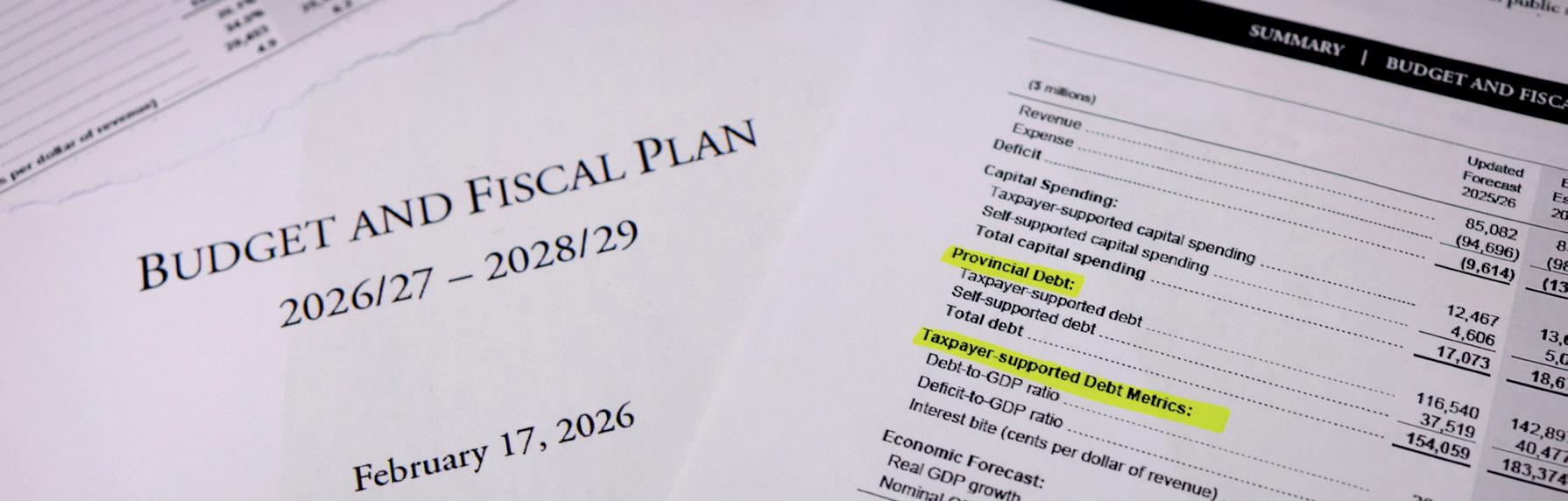
While funding has increased for post-secondary institutions, the increases do not match the rate of inflation. | SIDNEY
/ THE UBYSSEY
tutions, including UBC, have already implemented a series of measures to address the situation. This has involved hiring freezes, administrative budget reductions and program restructuring — including suspending and cancelling programs, and even closure of underutilized spaces. In the province, BCFS estimates that 177 programs have been cut, paused or suspended while more than 1,000 staff and faculty have been laid off. UBC has already confirmed reductions in operating budgets, staff reductions in certain units, hiring pauses and a new voluntary retirement program.
BCFS Chairperson Debi Herrera wrote in their statement that “the provincial government pushed institutions to rely on international student tuition to fill the gap left by declining public investment — despite clear warnings about the fragility of this model. Now that international enrolment is dropping, institutional deficits have exposed just how short-sighted this reliance on student fees really was.”
UBC will continue to receive funding for major projects
Several capital expenditure projects at UBC Vancouver remain under construction and partially supported by the province under the new budget, such as the School of Biomedical Engineering, the Gateway Building, Sauder School of Business Power House Expansion, the Advanced Therapeutics Manufacturing Facility and the St. John’s College redevelopment. The total
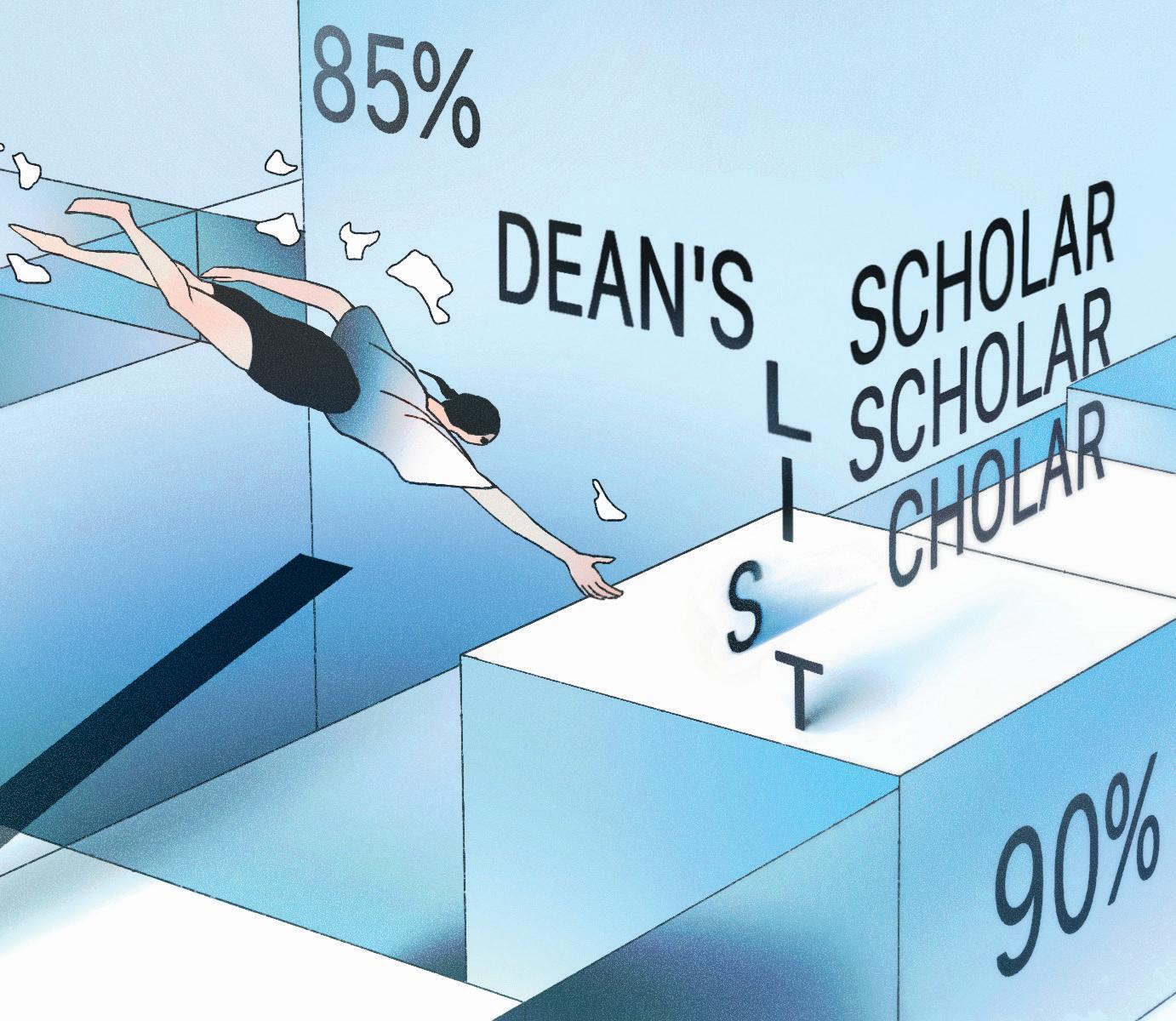
UBC’s push to standardize academic honours comes to the school of kinesiology
remaining cost of these projects is $744 million and all projects are to be completed by 2030. While the province is supporting these projects until completion, a large portion of these costs are co-funded by other sources, like foundations, federal funding and revenues generated from services.
Investing in future skills
The budget set aside $30 million in funding to train highly qualified professionals in “priority areas” such as critical minerals, marine, transportation and advanced technology by adding specialized streams to existing post-secondary programs. Although it is unclear whether UBC will be a recipient of these funds, the budget states that investing in focused streams — such as engineering, geology, computer science, biology and aerospace — “will improve alliances between industry and post-secondary partners, and accelerate growth in technology-related degrees.”
Public sector job cuts will impact universities
The provincial government will cut 15,000 public sector full-time employees — including those in public post-secondary institutions — by the end of 2028-29 to “return the size of the public sector to a more sustainable level and prevent cuts to core services.”
“In the coming months, government will be developing specific targets for the public sector, including executive positions,
Report by Simon Jian News Contributor
The school of kinesiology is introducing sessional academic honours (officially known as additional period honours) for the first time, adopting the university’s standardized dean’s list and dean’s scholar designations.
The change marks a significant shift for the school, which previously did not offer additional period honours. Instead, kinesiology recognized academic performance through degree class standings, based on students’ overall averages at graduation.
Under the new system, introduced at January’s Vancouver Senate meeting, the school will recognize student performance for each winter session in addition to overall degree performance. Dean’s list will be awarded at a sessional average of 85 per cent, while dean’s scholar will require a 90 per cent average.
Kinesiology is one of the few academic units that continue to use degree class standings, where students are awarded Class 1, Class 2, or Class P upon graduation.
The faculty of arts eliminated the designations several years ago, when then-arts Associate Dean Academic Stefania Burk said the degree class standing system did not reflect the faculty’s view that all of its graduates had merit.
Kinesiology’s adoption of standardized honours titles reflects a broader shift across UBC over the past two years. The university’s transition to Workday Student has meant that faculties can now only use the titles dean’s list and dean’s scholar, eliminating the previous patchwork of faculty-specific names.
Before the shift, faculties awarded honours under a range of titles, including dean’s list, dean’s honour list and dean’s honour roll. Science was unique in offering two levels of recog-
with a focus on protecting frontline services,” the Ministry of Finance wrote in an email to The Ubyssey.
This represents 3.4 per cent of the public sector workforce and includes both the B.C. Public Service and the broader public sector, which includes roles within research and teaching universities and post-secondary colleges and institutions.
“To the greatest degree possible, the aim will be to achieve any workforce adjustments through attrition and voluntary departures,” the ministry wrote. The ministry did not say what percentage of cuts will occur in post-secondary institutions.
A significant portion of post-secondary funding will be assisted by the federal government over the next few years. The federal contribution — $702 million for the 2025-26 year — will increase annually up to an expected $751 million in the 202829 year, while the federal government’s contributions to other sectors across the province are expected to decrease by an average of about 10 per cent annually.
The budget did not outline any growth to student service programs, which includes student aid, scholarships, bursaries and loan forgiveness programs, or make any mention of the UBC SkyTrain extension despite multiple calls for action since the province committed to the project 18 years ago.
“For over 400,000 post-secondary students in BC, this budget was a disappointing document that failed to invest in our futures,” wrote Yi-Kieran. U
nition, using dean’s honour list alongside the “Science Scholar” designation for top students. Other faculties offered only a single tier of honours.
Most faculties have now adopted a two-tier system. Kinesiology joins arts, science, applied science, land and food systems, forestry and the school of architecture and landscape architecture in offering both dean’s list and dean’s scholar. Science’s “Science Scholar” has been replaced by the university-wide dean’s scholar, while the Sauder school of business maintains only dean’s list recognition.
While honours titles are now standardized, faculties retain autonomy over the grade thresholds required for each honour.
In a written statement to The Ubyssey, Dr. Kin Lo, chair of the Senate Academic Policy Committee, explained that the varying thresholds are a reflection of the “different empirical distributions of sessional averages” across programs, owing to “considerable variation in the nature of the subject matter, pedagogy and general assessment.”
Kinesiology’s dean’s list threshold of 85 per cent is five per cent higher than arts, science, applied science, and land and food systems, which all award dean’s list at 80 per cent. The school of architecture and landscape architecture matches kinesiology’s 85 per cent threshold, while forestry & environmental stewardship has set its cutoff at 82 per cent.
Thresholds for dean’s scholar also vary. While most faculties require a 90 per cent sessional average, the faculty of arts awards the designation at 85 per cent. Sauder does not offer a dean’s scholar designation.
“Having consistency in [the] naming of dean’s scholar and dean’s list is advantageous to external parties who read [and] use students’ transcripts,” wrote Lo. U
The university’s transition to Workday Student has meant that faculties can now only use the titles dean’s list and dean’s scholar, eliminating the previous patchwork of faculty-specific names. | SKYE SHEN / THE UBYSSEY
SHAW
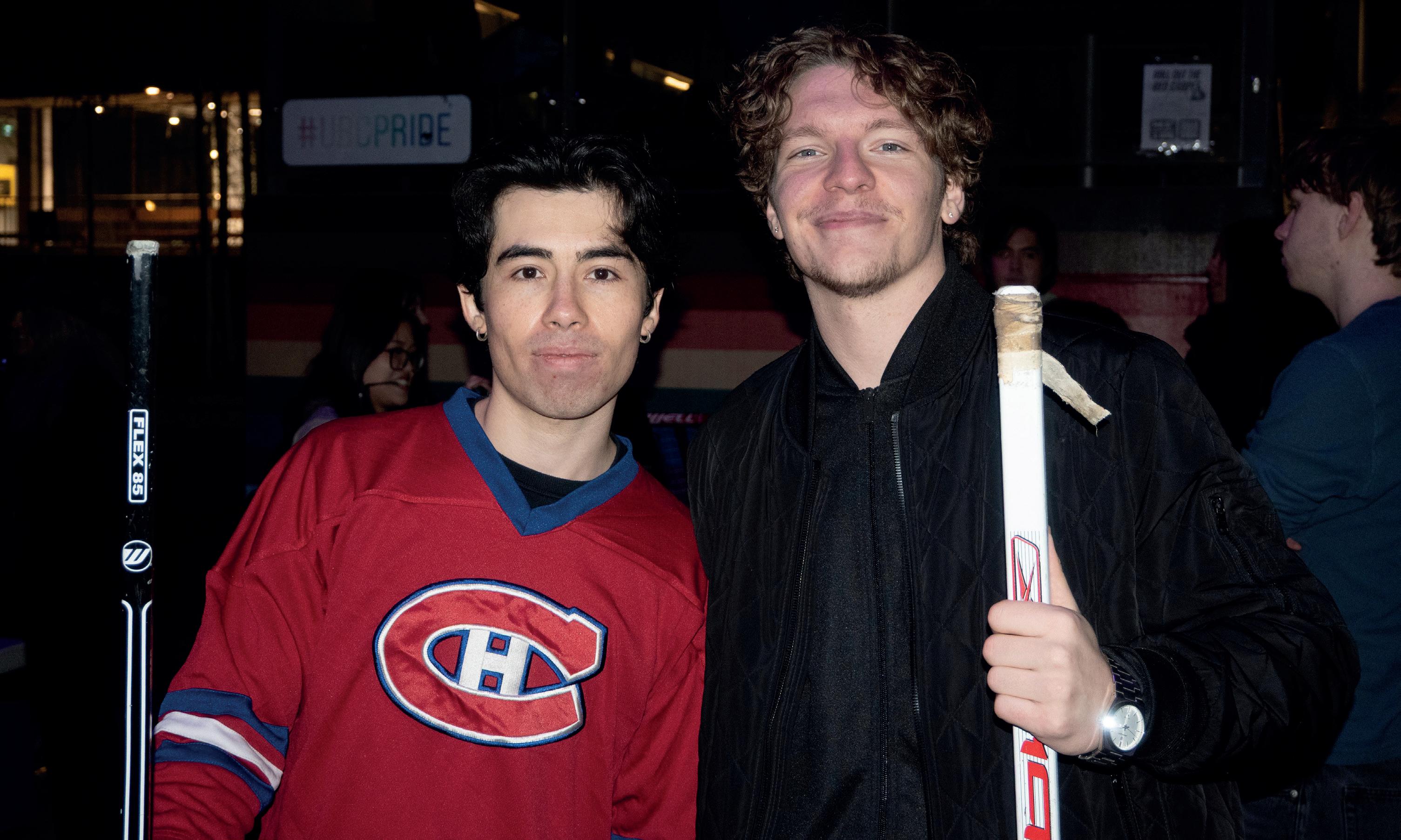
Heated Rivalry look-alike contest heats up campus
Event report by Nivita Dutta Contributor
Continued from page 1.
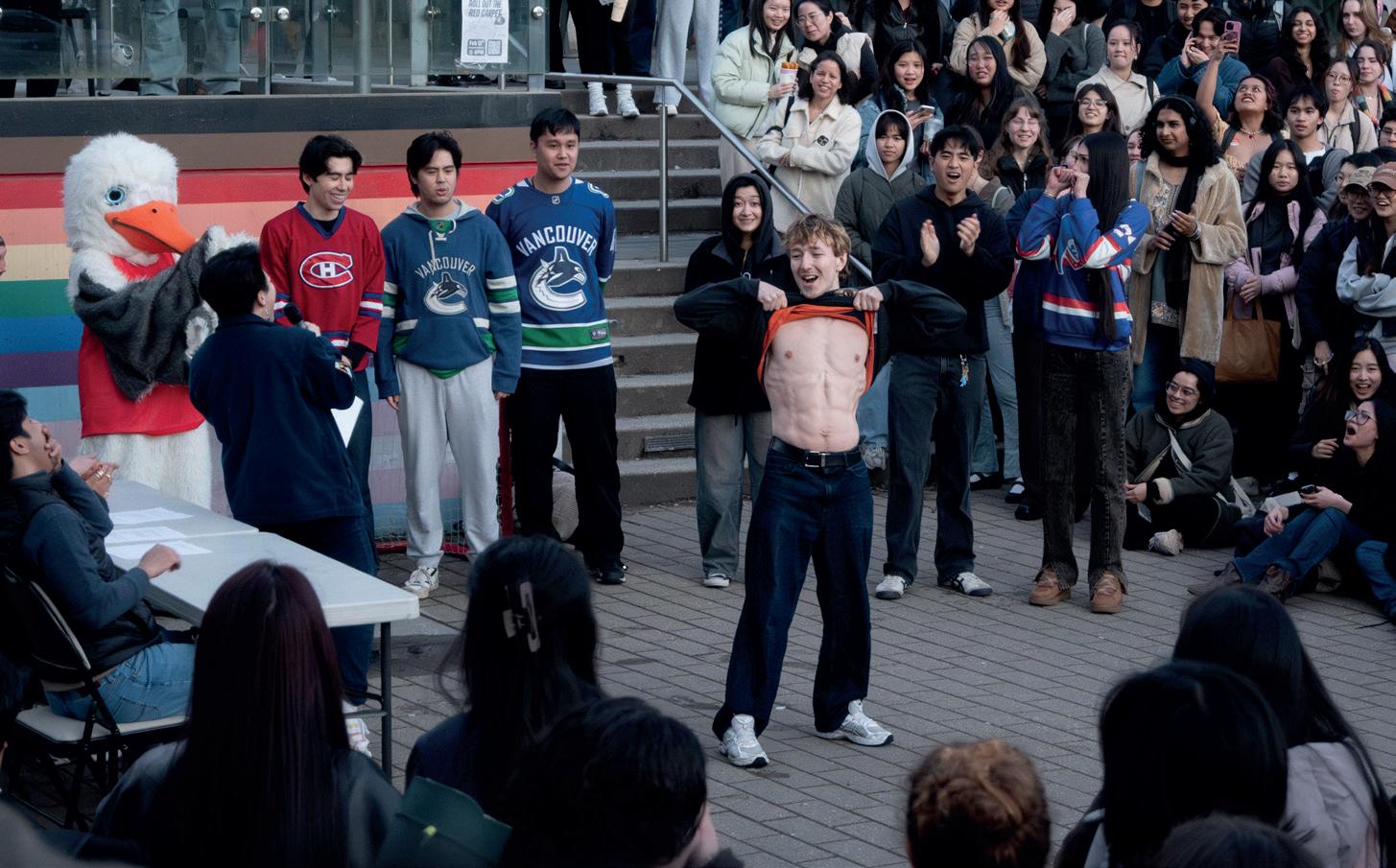
“All the Things She Said” by t.A.T.u. played on speakers as Majumder encouraged more Shane and Ilya look-alikes to join the competition. The prize was a $25 AMS gift card, free hockey sticks, the coveted right to boast that you bear some resemblance to men who have been thrust into mega-fame as sex icons and $5 cash.
In case you’ve been living under a thousand rocks, Heated Rivalry is more than just a TV show adaptation of a gay hockey romance novel with lots of (graphic) sex. It is that — but it’s also a cultural phenomenon. We are in a Heated Rivalry deluge. There are Heated Rivalry full-season watchathons, Heated Rivalry-themed trivia nights and dance parties and even Heated Rivalry transit rallies. The leads
— Hudson Williams and Connor Storrie — were torch bearers for the Winter Olympics, and the Prime Minister of Canada was recently on a red carpet pulling Hudson Williams’ leg up to his waist. Heated Rivalry is perhaps the biggest thing to come out of Canada since Justin Bieber. So it’s no surprise that look-alike competitions of the two leads began popping up, and where better to do one than in Williams’s college town?
It was clear that the contestants were there to win. There was a Shane from Montreal, a Shane who’d seen the show four times and a Shane who claimed their reason for qualification should be that they also “like dicks.” As for the Ilyas, two were real-life Russians, one was the infamous AMS Mascot ‘Birb’ and one was a bandana-wearing man who didn’t go to UBC, had never seen the show before and didn’t know which one of the two he looked more like.
With such strong contestants in
the running, the competition began with the fashion show catwalk to weed out the heavy-hitters and see who really looked the part.
Majumder and their fellow organizers held up large portraits of the actors on the balcony above the pride wall as the Shanes in Canucks jerseys and black hoodies began strutting back and forth. The audience formed a semicircle and cheered for the contestants with especially loud screams for a Shane drinking a can of Canada Dry. The Ilyas received similar fanfare, with some competitors sending flying kisses and flashing their abdomens to rile the crowd up. One waved around their Russian passport.
Due to the already small contestant pool, the only person eliminated in round one was the aforementioned bandana man, who seemed happy just to have been there. The second round, however, made the competition more serious: sounding the part. Judges passed around pages with quotes from the show,
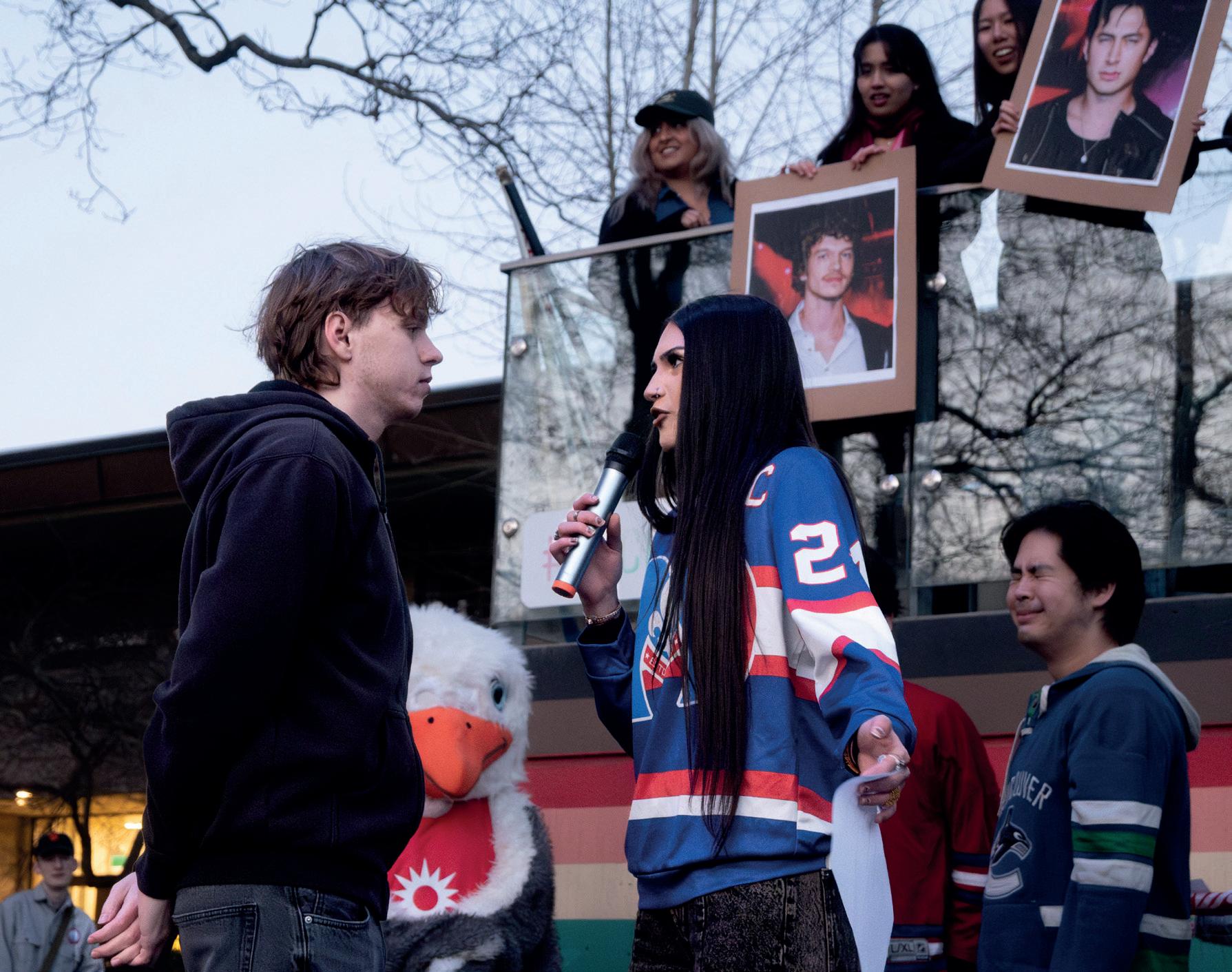
and a nervous hush fell over the crowd.
The first contestant, Birb — our non-verbal anthropomorphic mascot — was exempt from the speaking part and instead made some indelicate gestures with their wings that elicited oh’s from the surrounding audience. The Ilyas, especially the Russian ones, began soaring ahead of the competition with their ability to recite the actual Russian dialogue.
The dialogue most Shanes chose to say was one from episode four, where Shane says “I prefer being the hole than the peg,” insinuating his preferred sexual dynamic in bed and provoking scandalized gasps from the audience. Things were, as one of the judges put it, getting “hot and spicy.”
It’s obvious from the uptick of look-alike contests, the public embracement of the show, and how our professors cringe when they accidentally say the numbers six and seven in succession, that what were once niche corners of the internet are bleeding into the real world.
A few years ago, saying the word “yaoi” in a public setting might have ostracized you as a weird kid. Now, it’s proof of nothing more than being au courant. Chioma Ezeonyejiaku, a psychology student at UBC, and one of the judges, said that “events like this bring people out of their shells. People get to meet new people and realize that they’re not the only person who’s interested in this — [they’re] not a weird kid.”
The next round of the competition had the Shanes and Ilyas pair up to play hockey against each other. With long sticks and balls in hand, a series of unsubtle, crass jokes emerged from the competitors.
“Who doesn’t love balls?” said a Shane to a groan from the audience, with another Shane holding the stick between their thighs. There were exaggerated stretching manoeuvres and more sips taken of Canada Drys. Judging was based on how well the contestants did at playing kid hockey and how well they worked together. After they faced off, the competition was reduced to its final three pairs.
As the cold evening settled in, the promenade outside the Nest was flooded with beautiful purple blue bisexual lighting from the courtyard lampposts, perfect for bringing the atmosphere to its concluding steamy segment: the chemistry round. Contestants were paired and given scripts of the infamous ‘Cot-
tage’ scene from episode six. Unfortunately, Birb had to be eliminated here because they couldn’t compete in the chemistry round for HR reasons. Things got more physical quickly. The first pair decided to lay on the ground and exchange romantic dialogue before Ilya picked Shane up into his arms and carried him away, to the mad delight of onlookers. Then followed the other two pairs who gave each other piggy back rides and laid heads in laps to the mild disappointment of an audience chanting “kiss, kiss, kiss.” At this, the judges had to make a statement on the importance of consent.
At the end of the competition, winners were declared: Adrien Chaput won as Shane Hollander, and Nikita Strygun won as Ilya Rozanov.
“In another lifetime, I’m a hockey player from Russia who comes to the USA and likes men as well, that’s on the table,” Strygun said in an interview. He added, though, that it’s unlikely that it would be on the table for this lifetime.
Campus can sometimes feel isolating, and Majumder and friends think it’s important to let students have non-academic events that are whimsical and engaging. The lookalike contest did more than just get people hot and bothered, it celebrated queer joy on campus collectively.
“When you engage in advocacy, especially with students who are young and always online, you want to engage with them in a way that is authentic and real. We’re trying to get our fellow students to engage in community and activism in a way that’s fun and joyous and celebratory,” Kevin Nicklin, another judge, said.
People yearn for community, and for spaces outside their phones to get together and get silly, and the ones successfully bringing such whimsy to campus are Majumder and friends. Their next event is a trivia night with GRSJUA at Greta YVR called “So you think you’re the Woker?”
The Heated Rivalry look-alike contest did more than give us a good time, it let us all participate in guiltless public freakery. When else are students allowed to gather, even if just for an hour, to make crass dick jokes, ethically ogle our peers and scream-cheer at two guys picking each other up bridal style? Perhaps what we all needed during this midterm season is to get a
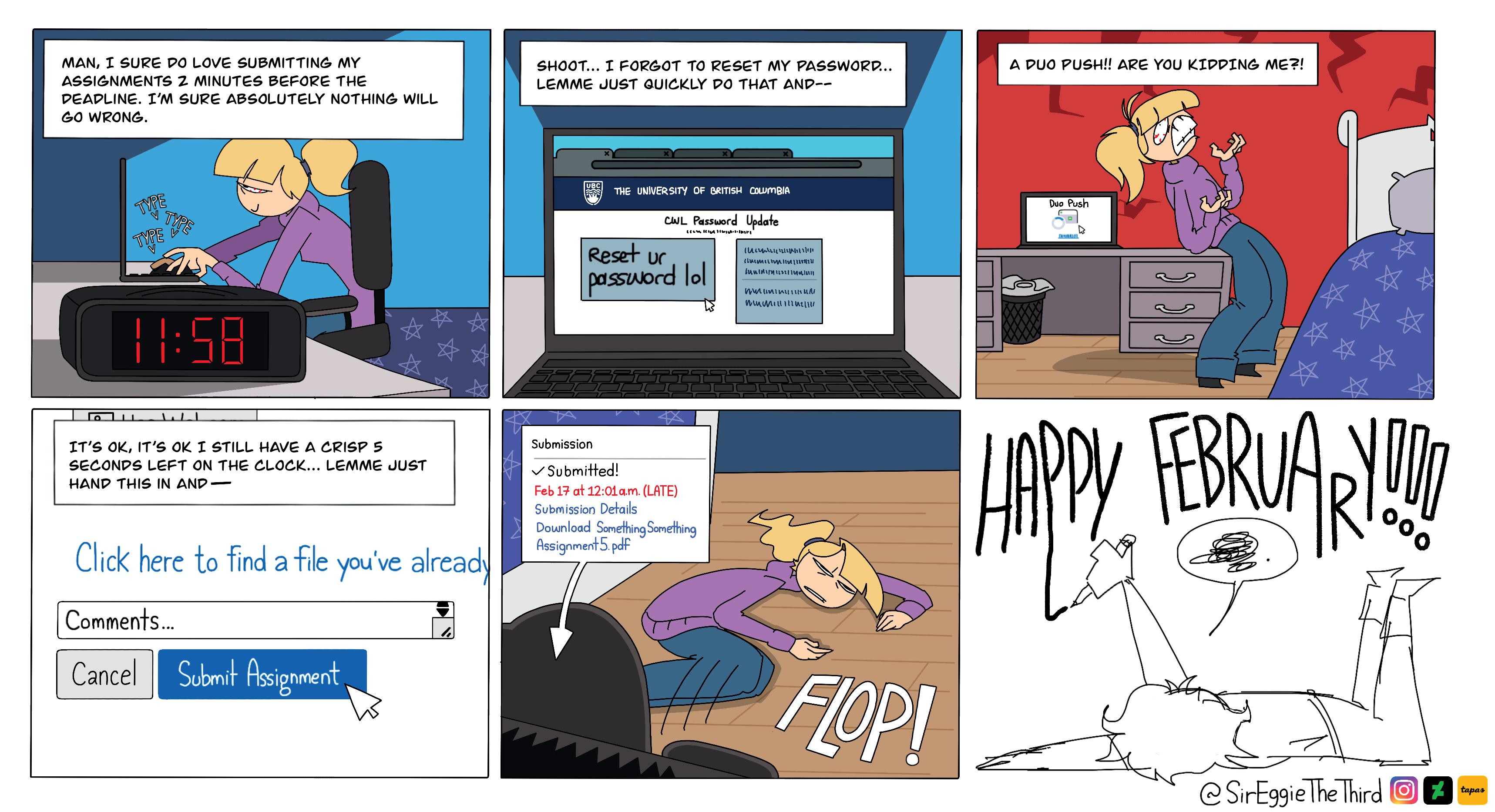
In case you’ve been living under a thousand rocks, Heated Rivalry is more than just a TV show. | ALEAH KIPPAN / THE UBYSSEY
The Name Shen Yun Means “The Beauty of Divine Beings Dancing.”
AHVA Gallery puts undergrads in the spotlight
Review by Natalie Vakulin Senior Arts Reporter
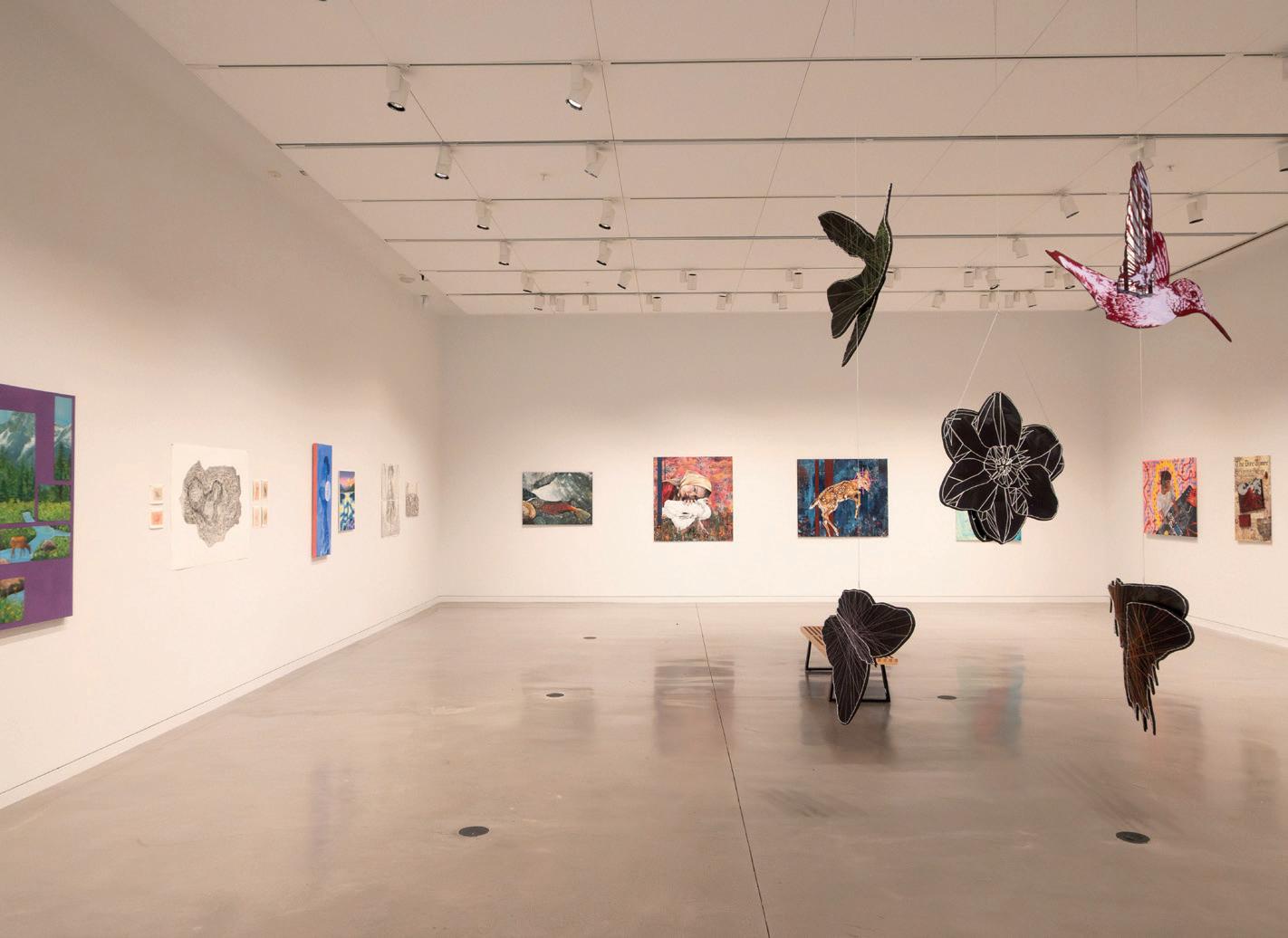
Every one of the artworks featured in the AHVA Gallery at the Audain Centre feels a little different. From realist paintings in warm tones to others in impressionist blues, the mediums vary, as do the subjects and emotions they convey. But, walking around the room from one piece to the next, There is a sense of cohesion.
The department of art history, visual art and theory held their Undergraduate Exhibition at the AHVA Gallery in the Audain Art Centre Jan. 22 through Feb. 13. The exhibition is an annual event showcasing second and third-year student work from across the department. This year, instead of being run by professors, the Undergraduate Exhibition was curated by students of VISA 475: Exhibition Theory and Practice, a change that has been meaningful for curators and artists both.
As student curators Yesha Gunara and Fiorella Hayashida walked me through the gallery, they explained the many choices that go into creating an intentional gallery space. Right away, before I had even fully entered the gallery, the huge, striking painting of musical artist Humbe by Juliana Pombo, streaked with gold foil, grabbed my attention. The curators were deliberate in this placement, and the massive face’s gaze beckons you further into the gallery. Everything was considered — which works were grouped together, their height, how they were spaced out along the walls, the lighting. The benches, alongside the one and only free-hanging artwork, split the gallery space in half. “It was a lot of trial and error,” Gunara said. The small group of students learned what felt right as they experimented with the lessons they were learning in class.
“Everyone handled [curating the exhibition] super competently, because they wanted [the exhibition] to do well, and I think it ended up fantastic,” said Griffin Schwam, another student curator. “Getting that hands-on experience is really such a unique and amazing experience.” The value of curating is not just for students like Schwam who want to pursue curatorial work after graduation, but for artists who can appreciate the behind-the-scenes elements of gallery spaces.
Hayashida explained how the class broadened how she thinks about audience, and how the “architecture of the space” became important to her own artistic process. Making these curatorial choices, added Gunara, “nurture our own practice [as artists] as well.”
Offering a physical, dedicated gallery space for student artists is another part of what makes the Undergraduate Exhibit so valuable for students in the AHVA department. The AHVA gallery both “bring[s] artists together” and is a space where they can get exposure, said Schwam. “I am really appreciative that we have [that space] at UBC.”
One of the challenges that the curators had to navigate was audience engagement when bringing together multiple works that weren’t originally intended for the gallery setting. Schwam said they enjoyed this challenge. “It pushes both curators and artists to think creatively about how work can be displayed, even outside of the initial intentions [of the artist].” One example of this is Ava Brown’s Horsemeat, which was physically rearranged to fit within the exhibition.
Though most of the artworks in the exhibit were chosen by the curators from a pool of applications, Horsemeat was specifically requested by the curators — they had seen her work in class and thought it would be a great fit. “We had an area of space that was still quite vacant,” Schwam said. Instead of spacing other artwork out, curators approached Brown and offered to include her work in a special way.
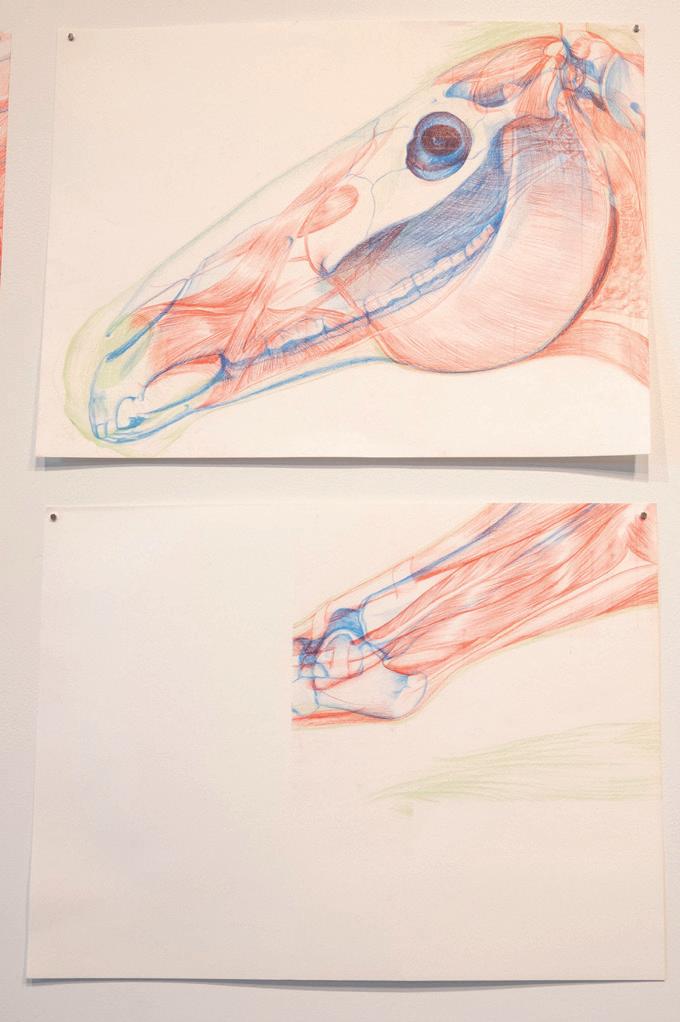
Brown’s piece is one of the first you see in the exhibit, a life-size drawing of an English thoroughbred horse. Coat, muscle system and skeleton are layered atop one another in green, red and blue colours, and under a black light the paper reveals the anatomical names of these components. Originally, it was displayed in a dark room and the audience could interact with the art through the use of a flashlight.
At the AHVA Gallery, as part of The Undergraduate Exhibition, the horse couldn’t be displayed in this way. Instead of a drawing that interacted with the audience and the light, the pieces of paper that the horse was drawn on were rearranged, creating a unique experience of a different kind.
Schwam described this process of rearranging the pieces of the horse in a “different kind of context” as “deconstruct[ing] and scrambl[ing]” the art to form the final product. “Part of the [reason for the] rearranging was the knowledge that it couldn’t be displayed in the way it originally was.”
Griffin and Fiorella said Brown’s fragmented horse is “emblematic of [their] exhibit.” In less than three weeks, the students of VISA 475 made an assortment of work for different classes out of different media into a cohesive exhibition. In a way, the deconstruction of the English thoroughbred and the subsequent collaborative act of putting it back together again is how the exhibition itself was put together.
Hayashida sees Horsemeat as one of the most ambitious pieces in terms of installation, and a “big accomplishment.”
Schwam added that, “there’s a sort of unconventionality with that piece.” These are the sort of works the curators are excited to see moving forward to the Graduating Exhibition, the end-of-year exhibition that showcases the work of students graduating that year. Held in April, the Graduating Exhibit is always curated by students. As the curators look forward to this major project, they want to “encourag[e] students to submit their more creative and unconventional and maybe almost strange works that can really flourish in a gallery setting.” U
“I was uplifted; I was filled with hope… The world is a better place because of Shen Yun.”
EXPERIENCE 5,000 YEARS OF CIVILIZATION
—Richard Swett, former U.S. Congressman
EXPERIENCE 5,000 YEARS OF CIVILIZATION Order Tickets:
For 20 years, Shen Yun has grown from its humble beginnings in New York to performing across five continents and more than 200 cities annually.
“I was uplifted; I was filled with hope… The world is a better place because of Shen Yun.”
“Magnificent… very enlightening!”
—Richard Swett, former U.S. Congressman
—Tony Robbins, motivational speaker
“Magnificent… very enlightening!”
—Tony Robbins, motivational speaker
“There is a that can It brings
EXPERIENCE 5,000 YEARS OF CIVILIZATION
—Daniel Herman, former
Over 10 million people worldwide have witnessed this revival of genuine traditional Chinese culture—a mission that has touched hearts, uplifted spirits, and inspired audiences everywhere.
“I encourage and all of
“There is a massive that can embrace It brings great
Join us in celebrating 20 years of beauty, courage, and inspiration at Shen Yun’s spectacular 2026 performances! April 8-12
—Daniel Herman, former Minister of Culture
—Donna
I have reviewed about 4,000 shows, none can compare to what I saw tonight.”
“I encourage everyone and all of us to learn
—Richard Connema, theatre critic
Let Shen Yun Take You on an Unforgettable Journey
—Donna Karan, founder
Let Shen Yun Take You on an Unforgettable Journey


The Name Shen Yun Means “The Beauty of Divine Beings Dancing.”
Everything was considered — which works were grouped together, their height, how they were spaced out along the walls, the lighting. | ALEAH KIPPAN / THE UBYSSEY

Column by Maya Tommasi Politics Columnist
Every morning before getting to school I walk down Davie Street to reach the bus. A few weeks ago, I noticed two restaurants seemed to have gone out of business.
Last Tuesday, B.C. Finance Minister Brenda Bailey started her budget speech honouring the Tumbler Ridge victims and reminding us of Trump’s trade war. It should be clear to anyone that these are not normal times. It seems that there is something deeply wrong with the state of the world.
Bailey’s speech acknowledged this. In the buildup to the budget,although the B.C. NDP said it wouldn’t make cuts to healthcare and education, some sort of austerity seemed to be coming. For a government that has consistently adopted right-wing framings on mental health, immigration and drug law, perhaps it was time for the austerity pivot. In all honesty, when Bailey foreshadowed being “the least popular person in the province,” I was reminded of former UK Prime Minister Margaret Thatcher and her fiscal hawkishness. The thing about Thatcher, though, is that she still had strong supporters. This pseudo-austerity budget does not even have that going for it — it’s as if it were strategically assembled to annoy literally every British Columbian. Want a lower deficit? No job cuts to the public sector? New capital investments? Tax cuts? Tax increases on the rich? It’s a ‘no’ on all those fronts.
The situation is no better if you dig into issues that affect post-secondary students. International student permit cuts mean universities lose substantial funding. Tuition will continue to rise, and services will be fewer and farther between. The provincial government could have given us a lifeline. This is their jurisdiction, and education, after all, was one of their focuses. We didn’t get anything. Instead, we need to brace ourselves for a more expen-
Powers that Be: With the province’s latest budget, where is the BC NDP’s political vision
versity administrators.
Housing will also see no real change. Yes, the budget includes an increase in the vacant homes tax — but this isn’t likely to be a silver bullet for the housing cri-
“
I hope the NDP knows their 2024 victory was less an NDP success and more a rejection of the alternative.
sis. More likely, it just slightly reduces the deficit growth like their other tweaks to taxation, while providing little in the way of material improvement. There was also no announcement targeted at youth employment opportunities.
Healthcare (the other priority) also saw little change. The government paused the construction of the Burnaby hospital and retirement homes. Despite mental health contributing to two of the most tragic days in our province’s history in the last year, the budget gave us only a slight increase in appropriations for involuntary care — the most fascist of all healthcare.
In a moment of crisis, most of us expect bold leadership. Especially when leaders like B.C. Premier David Eby and Bailey are pointing to extraordinary circumstances like the economic one created by Trump’s tariffs. And though this government’s economic mismanagement seems to have preceded any tariff-induced crisis, a crisis narrative is
rise of far- right extremism, the crumbling of the global order, rampant imperialism, genocide and economic crisis — we are not doing that much better provincially. The British Columbian right-wing — a once dominant, centrist group — has given way to a much more radical bunch. The B.C. Conservatives, whose future is somewhat uncertain, brought together conspiracists and bigots who were not often seen before in B.C. — the hateful clowns from OneBC descended upon our very campus a few weeks back.
I hope the NDP knows their 2024 victory was less an NDP success and more a rejection of the alternative. Eby did not exactly inspire voters in the last election; he is not the most popular Canadian premier. John Rustad probably would have won had the B.C. Conservatives been less marred in controversy.
My fear is that by failing to inspire British Columbians, the NDP opens the door to extremist forces who could form a government that would be genuinely catastrophic for many. Not least those like myself, who need access to politicized but lifesaving healthcare. The NDP isn’t going to advocate for transformative politics anytime soon. Even with John Horgan’s more fiscally responsible government, the NDP was still siding with oil interests over Indigenous peoples, opposed climate activists, and — my personal pet peeve — did not extend free healthcare to international students, despite claiming it was a human right.
Bold politics are not exclusive to the left. Prime Minister Mark Carney’s Davos speech was not only bold, but it also reverberated across the globe. Domestically, since the speech, the Liberals have risen in the polls. Canadians have an appetite for this type of politics. Ironically, Carney’s vision for the country is pretty close to what Eby’s might be. The difference between them, though, is that Carney actually has a political vision, while Eby seems to
many politicians manage to do — escaping the allure of inoffensiveness. Minimizing your chance of alienating part of the electorate is an everyday political calculation. One way to do this is to avoid unnecessary controversy — plastering over points of division to the point where any coherent message is impossible. The consequence is the blandest, most uninspiring form of politics. It leads to a lack of political vision, which allowed us to sleepwalk into our current political predicament.
Perhaps it came from not being a longtime politician, or perhaps it is something special about the man, but Carney seems to escape both blandness and needless polarization. To the appreciation of the masses (although not
“
To the appreciation of the masses (although not uncharismatic), Carney’s vision makes him appealing to so many Canadians. Eby could learn from that
uncharismatic), Carney’s vision makes him appealing to so many Canadians. Eby could learn from that.
Carney is far from the only politician who is gaining a following outside the fasciosphere. Last year saw the rise of New York City’s Zohran Mamdani and the England and Wales Greens’ Zach Polanski. Crucially, both eschewed the traditional political
ness and, with a wave citement, have shown formidable success, at the expense less cians. Strong political leadership doesn’t have to come from the outside, as Carney showed. One thing is certain: even in B.C.’s political climate, it is still possible to inspire and have success. It just requires political leadership. We need actual governance when it comes to the future of our province, not least in education and healthcare.
The prospect of long-term outsider change is exciting. It seems like it is more likely to deliver transformative political change. But its impact is not certain, and might take a while. If we are to keep right-wing extremists at bay, we need bold leadership. Federally, Carney showed this was possible. When he came to power, the Liberals had already governed for almost 10 years, having lost a clear political vision. The cost was a rising Conservative party flirting with dangerous extremism. By demonstrating a vision (even if one I don’t always agree with), Carney changed that. The B.C. NDP had a chance to do that with this budget. Instead, we got something deeply uninspiring.
Our next provincial election might still be years away. Until then, we are stuck with what we have. The Canadian left talks about insufficient Democratic party leadership in the south; perhaps it’s time we make our dissatisfaction known when the same brand of politics is done here. I would like to imagine politics can be better and not just stuffed with politicians seemingly just going through the motions, doing the bare minimum to stay in power.
Hopefully, in a few years, when I walk down the streets of Davie, I won’t see a revolving door of generic businesses opening and closing every month or so. Instead, I might be greeting establishments on the road to becoming as iconic as the Junction, Numbers, or the Fountainhead. For that to happen, we need a functioning politics and economy. U
The United States’ intervention in Venezuela and its implications for Canada
Q&A by Harper Jasinski Contributo r
As continued from page 1
Here’s what he had to say — edited for length and clarity.
What is the significance of the United States’ intervention in Venezuela’s affairs? How does it affect how we understand sovereignty in 2026?
The intervention in Venezuela really only makes sense in the context of the recent national security strategy document released by the Trump administration, calling itself the “Trump Corollary” of the Monroe Doctrine. Going back to the beginning of the 19th century, the Monroe Doctrine has been a source of irritation for many Latin American countries precisely because it doesn’t respect the principle of equal sovereignty.
It sets the United States up as the country that can police and intervene in the affairs of other countries in the Western Hemisphere to protect its own interests. So the intervention in Venezuela is a return to the past in an unfortunate way — it’s a return to a world of spheres of influence in which the United States positions itself as the dominant player in the hemisphere. You can’t have a dominant player and equal sovereignty at the same time.
What do you think the implications are of Nicolás Maduro’s former vice president, Delcy Rodríguez, assuming the role of interim president rather than opposition leader María Corina Machado?
Well, for me, there were several surprises in this military operation that led to Maduro being kidnapped. Perhaps the biggest surprise was the decision to leave Rodríguez in office as a substitute for Maduro, as opposed to insisting on regime change. You might have imagined that Trump would have attempted to install Machado, who is by far the most popular democratic politician in Venezuela. Yet Trump essentially threw her under the bus in the press conference on the day of the intervention and embraced Rodríguez.
I think the reason for doing this was based on the fear that if you tried to topple the Maduro regime, there would be real instability in Venezuela. This decision reinforces that what Trump cares about above all else is stability, American primacy and access to resources.
The United States has intervened in Latin American politics before (Panama in 1989, Chile in 1973). How does the current situation compare to these?
In 1973, the United States deposed a democratically-elected president in Chile and then installed a military dictatorship that lasted for 17 years. In some respects, what has happened in Venezuela resembles a coup more than an invasion. They didn’t go in and establish a military presence. They went in and removed the leader, and that’s what happens in a coup. So it was a bit as if it were a coup, but it was executed by the United States military. It’s a very anomalous kind of situation.
I think that the closer precedent is Panama. While I do believe that the United States was guided by the belief that it could do something in Venezuela like what it did in Panama, I think it’s

important to also recognize the fundamental differences between the two countries. Venezuela is a much bigger, more complicated country with an entrenched regime that is clearly hostile to the United States. In the case of Panama, they had a dictator who the United States alleged was involved in drug trafficking. They had a military presence on the ground around the Canal Zone and were able to extract him with minimal loss of life to civilians and others. In the case of Venezuela, a much more forceful but briefer intervention was required. And now the question is: Panama, subsequent to the overthrow of Noriega, became more democratic. What will happen in Venezuela? That we just don’t know.
Venezuela has the world’s largest crude oil reserves, according to 2023 data from the U.S. Energy Information Administration. Donald Trump has spoken about taking control of the country’s oil and recruiting American companies to invest in its industry.
How do you think the United States’ interests in these reserves will impact Canada’s economy?
I don’t think that there will be any immediate impact due to the significant time it will take to rebuild Venezuela’s petroleum sector. This is a badly eroded industry — the level of production
is very, very low. It’s going to take massive infusions of new capital to get the country back up to the level of production that it was at a couple of decades ago.
It’s true that Venezuelan crude is heavy, like Canadian oil sands crude, which also requires a lot of refining. Ultimately, it could compete with Canada, but we’re talking about five, 10, 15 years down the road.
Some of the messaging we’re hearing from Canada about how this points to the urgency of pipelines is a little bit tendentious. People are jumping on the prospect of Venezuela’s oil coming back online as being a threat to Canadian competitiveness, leaving quite apart the whole question of whether we should be leaving the oil in the ground. I don’t see this as being an immediate threat.
In an article for Maclean’s, you noted that a new Trump administration policy builds off of the Monroe Doctrine, an 1823 assertion of American dominance in the Western Hemisphere. How does Trump’s action in Venezuela and this new policy come as a potential threat to Canadian sovereignty?
It’s a really interesting historical puzzle. The Monroe Doctrine was intended to defend the rise of Republican governments in the new world against the colonization and meddling by European monarchical powers. So its original conception, although it was pa -
ternalistic and opened the door to United States intervention, nonetheless, was anti-colonial — but it wasn’t directed to Canada. The attitude of the Americans was “We’ll leave you alone if you leave the rest of the hemisphere to us.”
Canada never felt like the Monroe Doctrine was applied to it. Over the course of the 19th century, the doctrine was used to justify American expansion across the West, and then later more interference in South America, Cuba, Haiti, Nicaragua and elsewhere until the Cold War, in which the United States took more of a global role. It’s only with Reagan and the Central American conflict that we begin to hear talk of the Monroe Doctrine again.
Now that Trump is talking about the Monroe Doctrine, he clearly sees the whole of the Western Hemisphere as the sphere of influence of the United States, and I think that’s part of what motivates him to want to take Greenland. It’s why he’s talking about Canada as the 51st state. He wants to apply the Monroe Doctrine to us.
I think that we have to remind the Americans that their creed is based on republicanism, democracy and a system based on citizenship. They have fought a civil war over these issues and are now retreating back to a stance that is in some ways inimical even to the original Monroe Doctrine. I think it puts us in a very awkward position.
Do you think the Prime Minister’s vision laid out in his Davos speech adequately responds to the challenges Canada is facing?
Yeah, I do. I think Carney has given us the guidance that we need to respond to what the United States is saying about its role in the Western Hemisphere. Without explicitly naming the United States, he has acknowledged that the United States is a disruptive force — that we’re in a moment of rupture, not a transition. That means that countries like Canada need to hold fast to our principles of multilateralism with respect to human rights and democracy, but at the same time, we have to be realistic about what this means for us. We need to think about how we strengthen ourselves domestically so that we can survive this, while also building alliances with other like-minded countries.
The thing that I find interesting as a Latin Americanist is that the Carney speech could well have been given by Brazil or South Africa. It is very much the kind of speech that you hear from Non-Aligned countries in the Global South. That’s the position that we are being put in by the United States — by treating us as part of the Monroe Doctrine, we’ve been placed into the same bucket as the Global South.
I think this means there is an opportunity for us to make common cause with countries like Brazil, Mexico and others who have a long history of resistance against these infringements on sovereign equality. U
“Countries like Canada need to hold fast to our principles of multilateralism with respect to human rights and democracy, but at the same time, we have to be realistic about what this means for us.” | AYLA CILLIERS / THE UBYSSEY
The magnitude of the will to abstain
Creative Non-fiction by Daniella Barretto Guest Contributor
As continued from page 1.
We are not born with this hesitation. When a child is born, it worries not about what tomorrow shall bring or how fast it will grow, but rather the song to be sung and what food it shall swallow. A child exists in the pure present, unburdened by the gravity of expectation. Yet, as one ages, the might to capture the day is gradually devoured by the fear of tomorrow’s dismay. We learn to anticipate failure, to measure risk, to restrain possibility. The openness of being gives way to the vigilance of survival.
In the Black experience, this dismay is not merely an anxiety, but an inheritance. We navigate an internalized culture shaped by a history where struggle was the baseline and failure was a luxury

we could not afford. For us, the room to become has often been crowded by the necessity of survival. This history creates a phantom of fear, a belief that aspiration is a risk and that our worth is tied strictly to our labour. We fight the will to imagine because imagination requires a safety that our history has not always guaranteed. Black excellence is not only found in what we endure or produce, but in how we choose to exist despite what we have inherited. It is found in the active decision to imagine freely, to rest without apology, to create beyond necessity, and to define ourselves outside of the expectations placed upon us. To live on our own terms is to reject the demand that our value be proven solely through struggle. It is to show up fully, to claim space where space was never offered, and to recognize that our existence itself carries brilliance. In this way, abstaining from fear, imposed limits, and in-
herited narratives becomes an act of self-definition and joy. Perhaps abstaining is the very thing that defines our strength. If we can find the courage to abstain from the fear of struggle, we might finally reclaim the child’s song. To give in is not to surrender but to allow ourselves to exist outside of the grind, to trust that our being does not require constant justification. If we can master the magnitude of the will to abstain from the shadows of the past, we may finally answer that first, vital question. We may discover that excellence is not something we chase, but something we practice in the ways we allow ourselves to live. To abstain from fear is to make room for joy. To abstain from imposed limits is to reclaim imagination. To abstain from survival as our only inheritance is to choose becoming. And in that choice, we begin to see who we are meant to be: undivided, unburdened and entirely our own. U
Purple in a Sea of Blue
Creative Non-Fiction by
Delina Mehari Guest Contributor
I’m sitting for dinner, glancing at the sea of unfamiliar faces, all baby blue. It’s only in contrast that I notice my own lavender hands, but I pay them no mind. I was invited, I think. It wouldn’t be the first time either, I remember.
I’m sitting through introductions, hellos and my name is’s. We’re seated away from the main table, big group as we are. “A lonesome table of four,” I joke. “Bringing back segregation huh?” a guy responds. I bristle, busy my hands with the carafe of water.
There is a beat that no one pays attention to, in which he is looking directly at me. Blue to lavender, lavender to blue. I stare back, defiantly, would he have made that comment if I was...? I’m navel-gazing, I breathe in, I was invited, I breathe out.
I’m sitting in conversation with my tablemates, discussing this and that about the new year, abysmal weather and plans of graduation; they are fellow university students, they are potential classmates all pursuing the same major. I am not any different from their blue, I reassure myself.
I’m sitting after our meals have been served and we share silly stories. That guy has been looking at me all night, not yet uncomfortably but… assessing. I laugh along and decide to share a story of my own, of the time I had food poisoning (ironic to share at a restaurant but funny enough to breed common ground).
I’m sitting, enthusiastic now and ea-
ger to successfully reach the punchline, my lavender hands gesturing this way and that.
Blue hands wouldn’t make such a ruckus, I think.
Blue voices aren’t quite as loud, I lament.
Blue hair is docile, pliant on their backs-
I choke that voice into submission, straighten my posture and resume my narration. I am not any different, I reassure myself, I was invited.
I’m sitting, laughing now at the hilarity of my own story, and he interrupts to say:
“Wow, I can’t believe that happened, sis.”
The word echoes and reforms: lavender, lavender, lavender, outsider-lavender. Ah, there it is, my epithet. An amalgamation of my identity and definer, outsider. I am not his sister, his friend or even a classmate. I am not a lavender he knows, and yet being lavender I exist as a monolith. I represent all and am all, all at once. My idiosyncrasies are void, my characterization irrelevant, I am lavender, beginning middle and proverbial end.
I’m sitting, offering up silence as a retort and tucking into my food. I feel the anger like a livewire but do not utilize it as it swells, only wonder at the hopeless nature of this situation. What am I angry at?
I’m sitting for dinner, glancing at the sea of unfamiliar faces, all pale white. It’s only in conversation that I note my own black hands, and it is a hard thing to ignore:
Black in a Sea of white. U
My Skin
Poem by
Akuol Riak Guest Contributor
My skin is a map of everywhere I have been and all the places I have yet to go. Up north, a waterfall of dark, luscious curls cascade gently down my face. Down south are the vehicles of this journey marked with the blisters and bruises from taking the wanderer’s path. To the east and west point the hands that have tried to hold the weight of the world which ended up slipping through my fingers like a leaky pipe.
My skin is a museum the scars long faded evidence of battles fought to make my way in the world. And proudly on display are my taut muscles pulled tight like strings on a cello that have played in many games, run several races, and carried me through this journey we call life.
My skin is a blend of my mama’s richness, my daddy’s strength, and the rest I’m still figuring out but what I know for certain is that my skin is not up for sale. It is not open from Monday to Friday and only closed on statutory holidays. It is not open for business.
My skin is not a passport for you to send me “back to where I came from.”
My hair is not a toy it is the crown of a queen who sits on her throne and will not be poked and prodded like the winning project of a science fair competition. It will not be the player to be chased down by suspicious retail employees, the men and women in blue, the neighbourhood patrol or anyone who has the audacity to claim that my skin has no place in this city. I want to be alive, awake and love each inch of my skin explored and yet to be discovered not to fall at the hands of oppressors because I am Black. U

Poem by Eliora Kwakye Guest Contributor
I am the pain of my ancestors
And the hopes and aspirations for my future
For Martin Luther King Jr. the dream truly answered
Our history, demonstrating strength beyond measure
I am my parent’s tomorrow
And my children’s yesterday
My people’s sorrow
My people’s remedy for their suffering, I am a melody
I am the crashing of the waves
The songbird’s song for days
The future hope for the beaten, the abused, the slaves
Cultivated, cultured, personally kissed by the sun’s rays
Sing, black boy
Your voice is an echo of joy
Dance, black girl
You shine bright in a dimly lit world U
Just a Man
Poem
by
Esther Raji Guest Contributor
I am a man.
My skin is the color of the deep, dark soil, the color of the sky right before the stars come out.
But they treat me like a puppet on a string, a thin, white string that pulls my arms until the thread snaps and I finally drop.
Just a man with nothing in my pockets but dreams.
With nothing in my chest but a fire.
What can I grab with these hands?
What part of this place is actually mine?
I look in the mirror at my own face and I tell myself:
I am nothing but a man.
In this big, lost world
I’m still looking for a seat at the table.
I’m looking for something more.
And when my heart starts to beat faster, I realize this — I am not just a man.
In a place that doesn’t feel like home
I’m still trying to find what I’m worth.
The world turns its head when I walk by because they don’t want to see me.
I’m forced to stay in the shadows because they are afraid of the dark skin and the bright light I carry. They are afraid of something new.
Then I realize I am not just a man.
I see it now
I am different.
I am a gift.
I have a rhythm that nobody else has. I have the power to change the whole world. U
Something to be proud of
Poem by Ife Onwemelu Guest Contributor
Today I tried
To wake up early
Catch the beam of light
Carve my future piece by piece
Yesterday I meditated
Envisioning the worry within
Tense
Fraught silence
Shrouded in yesterday’s stressors
Each exhale paired with hope for tomorrow
A careful release from internal collapse
Tomorrow I’ll reflect
Wondering where I am
How I got here
Searching for answers and guidance
With no destination in sight
Supposedly we can have it all
Be anything
Do everything
No opportunity is beyond reach
Yet there’s a fine print
Scrawled carelessly
On the document of our lives
To create for ourselves
Is building within confines
However moving forward
Advancement on our terms
Requires choosing
Ignoring predetermined paths
Detaching from expectations
Intentionally creating the lives we want
Where do we begin? U

Reverence
Personal Essay by Deborah Ojo Guest Contributor
There is a softness that fills my dad’s voice when he speaks of his father. An awe as bright as the green leaves of the palm trees that scattered his childhood farm, a love as boundless as the uncharted bush which bordered it. It is an emotion I can only describe as reverence. One deeply rooted within him, like the roots of an ancient tree. One that someone isn’t just born with. This is a reverence that must be earned.
Everything in Otan Ile was earned. Tucked away in the outskirts of Osun state, Otan Ile is a village situated in the south-west of Nigeria, built on rolling hills and vast lowlands. The village bursts with the bright leaves of cassava trees and the rippling green shells of cola nuts. Deep within this wild verdure lay the small farm of my dad’s childhood.
The square-footage which my family possessed was not grand by any means. The plot was of an average size, charted by sparse palm trees which scattered themselves across the rolling earthy terrain. And yet somehow this mundane space fed both my dad’s young curiosity and the bellies of his large family. It filled his youth with vibrant flora and fauna, the soft chirping of weavers, the songs of the red-eyed dove, the browns and yellows of cocoa trees, the rich purple of grapefruit. Mornings would be spent racing across the land, plucking fresh oranges and bananas from their branches, leeching colour and sweetness and life with eager teeth. On good days when the sun was out and the crops were strong, they’d chew cola nuts, the bitter taste rolling against their parched tongues, the delicacy contrasting with the sweetness of the ever-present papaya or the tang of the palm wine, which they had in excess on the farm.
He spent his childhood exploring this vast terrain, darting between the sprawling branches and hopping along the streams that cut through the thicket. Much of this was with little supervision, other than the stern gaze of his mighty father.
My grandfather was not a man of many words. He did rather than spoke. He spent the better part of his many years toiling the land of those western African plains with an ageless wisdom and a strong hand. He was a tall man, with slim eyes, a stiff brow and an immovable resolve. He was firm with his children and firmer in his ways. Each morning, he’d rise early like a soldier to manage the grounds, no matter how hot it got or how heavy the rain poured. His eyes were like the hawks, all-seeing, knowing every crevice of his plot. When his shining bald head caught the light of the rising sun, my grandfather was said to look like a mighty pillar. My grandfather was seen as such — a pillar. He was a man determined to see his land prosper and his family fed. All of this made him revered by not just the farm-
ers of Otan Ile, but by his children.
My dad recalls how he and his many siblings would eagerly gather around the dinner table, feasting on the fruits of their land, the smooth fluff of the pounded yams dipped generously in the rich bitters of the vegetable soup which my grandmother specially made. And yet, despite these bountiful meals, the children seemed hungrier for the hallowed voice of their father. They would make pounded yams out of cassava, and grill meat from what was bought in town as they feasted on the tales of my grandfather.
But in a village like Otan Ile, money was scarce. Even dinners had to be earned. And some nights, the table would have the fruit of the farm, but no meat to provide sustenance. To my grandfather, meat was necessary for his growing children. Like a farmer who tended to his plants from their very first day as seeds, watching the yams sprout roots before blooming again, he tended to his children. And like a farmer, his success would be seen in their flourishing, his accomplishments in their health and, one day, the fruition they would bring to the family. It was like this in Otan Ile. Family is what earns one reverence. But beyond the innate craving my grandfather, like anyone, had to succeed, he loved his children deeply. Silently, in a looming, hovering sort of manner, as the sun dawns upon the earth with a loving caress. It is a love that is sometimes harsh, sometimes invisible and yet forever there, omnipresent. And so, he was willing to do anything to ensure that his children were fed.
Those nights when no meat filled the table, my dad’s belly would rumble and, with wide eyes, he and his siblings would gaze innocently upon the man whom they revered. They did not know what it was they were asking of him with their gazes. All they knew was they were looking upon the answer to that twisting feeling in their stomach and that loud rumbling which shook the home. And with one swift nod, their father would grunt and slip into his bedroom, returning with a frown and a rifle in his hand. Wordlessly, he would be gone into the brooding night, into the darkness, into the bush. He would go out and earn his reverence once again.
The bush was opposite the farm. Wild and untamed, it was a chaotic, unruly combination of greenery. The thick tree branches warped upon each other as if to swallow one another whole. The only way to navigate it was by a slim and winding path carved by hunters. At night, it was worse. The wild animals roamed. Bushbuck and wild boar, squirrels and civets scampered, eliciting hisses and howls from all corners of the untamed forest. The bush was not to be taken lightly, for many did not leave it at all.
My dad said he’d only been in there a handful of times as a child, but never at night. My grandfather was the only one in the family to do
so. He braved it alone. Often. And yet he was never alone when he came out.
My grandfather would walk as long and as deep into that bush as necessary till he secured game, a stiff frown on his chiselled, dark face and a furrow in his brow. Upon observation, one might even describe him as unbothered by the wild madness of the night, which he traversed so often. Sometimes he’d be gone for only ten minutes, other times it would be hours before he returned. But he was determined to return with something. He refused to leave that wood, even when hours passed, and my grandmother would go scampering from their compound, wailing “Oko mi oh! Oko mi!”, terrorized by the prospect of the forest having taken another victim in her husband.
And yet he always returned.
Sweat beading his head, or maybe a scar gashed through the side of his cheek. A limp in his leg or a frown upon his face. But he brought more than his suffering. He brought back sustenance. Every time. My grandfather quickly became known as the great hunter, for his bush meat was always the largest, his aim the sharpest and, eventually, his children the most successful. He fed his children, not only with the roaring meat of the night, but with the heavy, determined love of his silent presence. The love which led him to the mouth of death nightly. The love which fed them every night. That was my grandfather to my dad. A determined man. A man of will. A man of consistency. A man who earned the reverence of his children.
My dad says his father’s motto was to never give up. No matter how dark, or lonely, or frightening that bush must have been, my dad says his father braved it. He kept going into that lonely, gaping darkness till he found something for his family. It is this determination and focus that is etched in the foundation of who my dad is today.
The days of my grandfather braving the bush are now a distant memory for my dad. Now it is he who ventures into the wild unknown. Though paved with concrete rather than palm tree branches, this western wilderness still bears a brooding darkness which my father braves every single day. And no matter how hard or gruelling this foreign terrain may be, my father returns, bringing our family everything we need. Love, light and strength. In him, I see the legacy of his father, both earners of reverence. I see that very same furrowed brow and stiff resolve and firm hand. Those very same long limbs and shining bald head which make him look like a pillar in the sun. I see a man filled with an omnipresent love for me, which has beamed upon me all my life, filling me endlessly with sustenance.
And when I speak of my father now, I feel a softness and awe fill me. Because I, too, know what it is like to watch a man walk into the night and return with light. I, too, know reverence. U
Game Analysis by Sofia Campanholo Sports Reporter
For the final time in the regular season, the UBC Thunderbirds women’s volleyball team stepped onto the court at War Memorial Gym on Feb. 14. While they could take comfort in knowing that the work of the past four months had already positioned them well, how the ‘Birds finished the season still mattered.
Saturday afternoon’s matchup against sister school UBC Okanagan Heat (UBCO) carried added significance for the T-Birds. It was senior night, a playoff tune-up, and the final chapter of the regular season. For UBCO, this game was essentially meaningless. They had come into the weekend with an outside chance of sneaking into the playoffs, holding a 5–13 record and being only one point out of the tenth and final playoff spot, but on Friday, that hope had been snuffed out. After a 3–0 T-Birds win over the Heat on Friday and a 3–0 Winnipeg win over Brandon, the Heat were eliminated from playoff contention. They finished two games behind both MacEwan and Winnipeg with only one game left to play.
All the Heat could hope for at this point was a moral victory — to end their campaign on a high note with an upset of the T-Birds.
Unfortunately, for UBCO, they couldn’t get that either. By the end of the evening, the Thunderbirds had delivered a composed 3–0 victory again, extending their winning streak to eight games and closing the regular season with authority. The sweep secured the No. 2 seed in the conference for the ‘Birds and sent them into the Canada West playoffs with momentum. However, the match itself offered more nuance than the scoreline alone suggests — and the opening set reflected that immediately.
Rather than being overwhelmed by the environment or the opponent, with nothing to lose, UBCO matched the Thunderbirds pointfor-point early. The Heat served aggressively, challenging UBC at the net and extending rallies — refusing to let the match get away from them. For the first stretch, neither team managed to create separation, with side-outs traded cleanly and both backcourts working hard to keep points alive.
Then, for UBC, the breakthrough came through pressure rather than power. Midway through the set, Elizabeth Lee stepped to the service line and forced UBCO out of system with her serve repeatedly, allowing UBC’s block to set up and their transition game to flourish. Thanks to Lee, the ‘Birds delivered a sustained run that shifted the balance, widening what had been a narrow margin into 11–5 lead, pushing the Thunderbirds out in front after a 6–0 scoring run.
After falling behind, UBCO briefly regrouped, trimming the lead to 13–11 with disciplined at tacking and steady ball control. But UBC responded immediately and emphatically. Capitalizing on the Heat’s attack errors and winning consecutive long rallies, the Thunderbirds went on another run, rattling off eight straight points to seize a commanding 21–11 advantage. It was the first real separation of the match — and it came from composure rather than chaos.
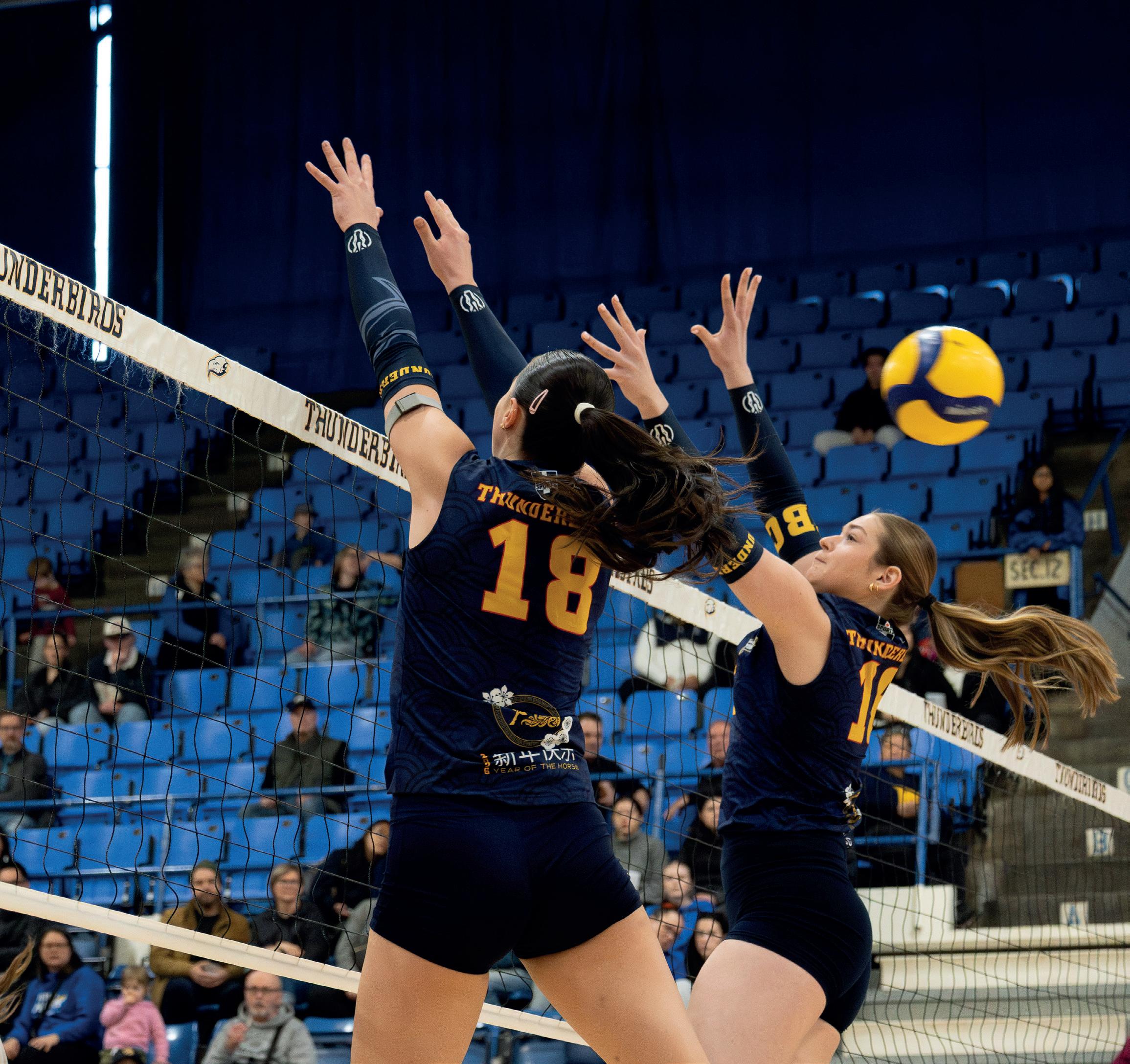
Composure key for ‘Birds in final regular season game against UBCO
Heat tapped back into their ability to hang in a back-and-forth set, sustaining their momentum instead of losing hope early, like in the first set. This time, the Heat blocked effectively, slowed the pace, and forced UBC into longer possessions.
For a stretch, UBCO held a nar-
that their sustained pressure would eventually be telling. Slowly, the tide turned.
UBC began winning the first contact battle, and their block-defence system started producing free balls and transition opportunities. From that moment, the set flipped decisively.
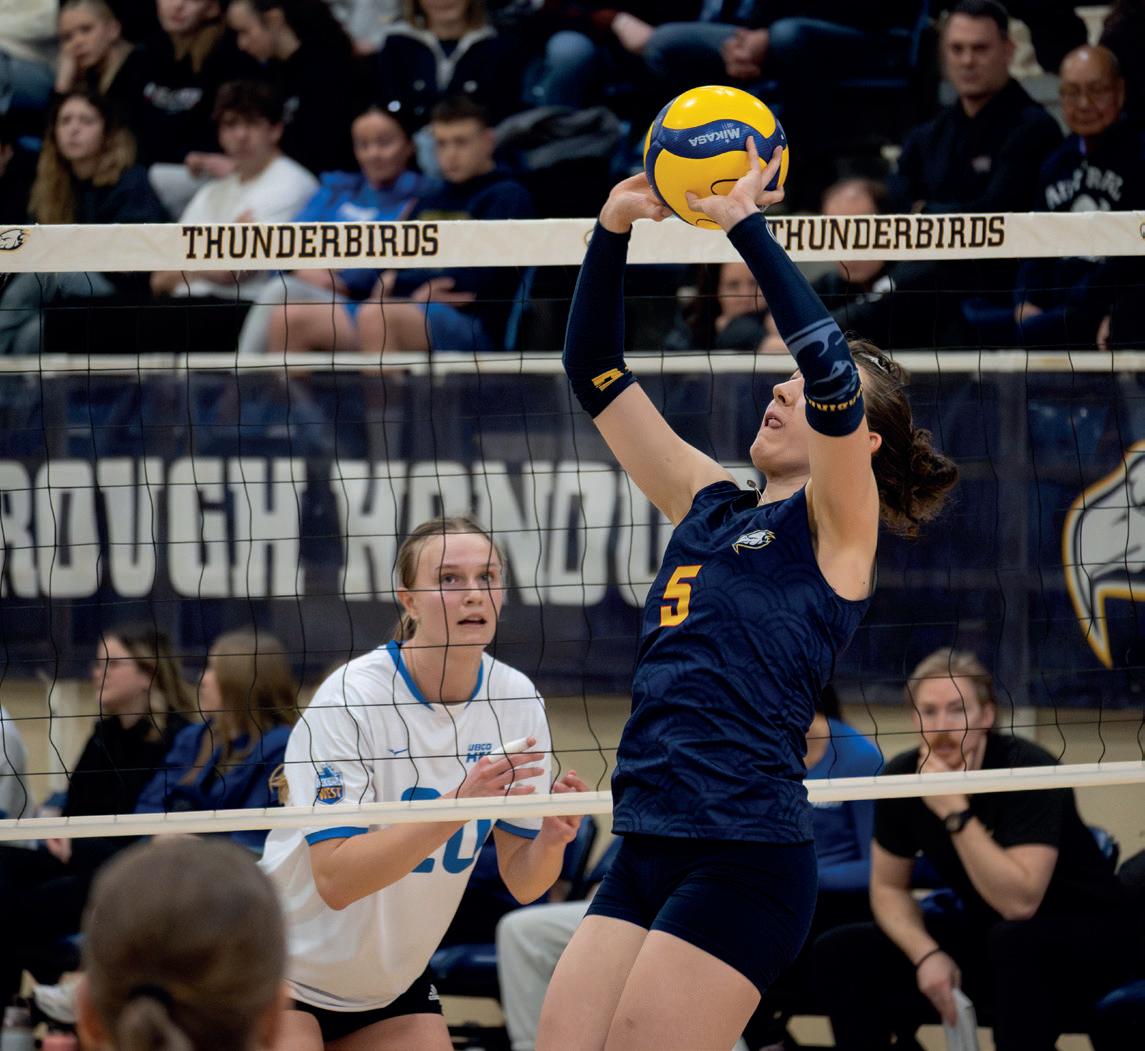
Appropriately, it was Lucy Borowski who closed the door. Playing the final regular-season match of her collegiate career, the senior outside hitter delivered a powerful back-row kill to claim set point, one of her team-high nine kills on the night. UBC took the opener 25–15. Their performance was not flashy, but the ‘Birds were firmly in control. The second set introduced a different challenge for the T-Birds. Offensively, the Thunderbirds struggled to find consistency early — a troubling tendency this season. Their swings lacked the same timing and precision as in the first set, and UBCO took advantage. The
row 13–12 lead, and the gym felt noticeably quieter as the Thunderbirds searched for answers. Coming into this game, the T-Birds had won three of their last four matchups against the Heat 3–0 — even dropping a set would have been surprising. It wasn’t a strong set for UBC’s attack — they would finish the set hitting .114 — while their game average was .227. But the way they responded revealed something important.
Rather than forcing swings or chasing points, the Thunderbirds tightened their serve-receive, recommitted to defense, and trusted
What had been a one-point deficit quickly turned into a sizable lead. UBC seized control late and never allowed the Heat back into the set, with middle Tianna Kehler punctuating the turnaround with a service ace to close it 25–17. In this set, several Thunderbirds rotated through the lineup, with some less-experienced players — like Kehler, who had only played in 15 sets this season before Saturday’s game — gaining valuable court time ahead of the postseason. So, although the score suggested comfort, the process to get there had been anything but. By the third set, the match had taken its final shape. For UBCO, unless they fought back quickly, this would be the last set of the year. For UBC, the focus was on fine tuning their game without sacrificing control, and the Heat responded with urgency.
Although they never led in the frame, UBCO stayed within reach throughout, answering points and forcing the Thunderbirds to earn every score. The rallies lengthened, the serve pressure increased, and the Heat refused to let the match end quietly. It was, without question, their strongest set of the night.
Issy Robertshaw seized momentum early for UBC. The fourth-year setter opened the set with three straight service aces — immediately putting UBC in front and energizing the bench. Still, the Heat persisted, chipping away and keeping the deficit manageable. This resistance
demanded UBC’s best offensive stretch of the weekend — and they delivered.
The Thunderbirds played well as a collective team in the third set, spreading the ball efficiently and finding seams rather than forcing swings into the block. Aimee Skinner continued her steady return from injury, tallying eight kills. Borowski remained the go-to option in key moments, terminating rallies when the Heat threatened to build momentum.
And down the stretch, experience mattered. UBC consistently won the longest rallies, absorbed late service pressure, and made cleaner decisions in transition.
While UBCO continued to battle — extending points and forcing defensive plays — the Thunderbirds never looked rushed. A late push from
17–3, second in the conference with 50 points, and riding an eight-game winning streak into the playoffs. Alberta ultimately secured first place with an 18–2 record, while UBCO, despite their effort, ended the campaign in 11th — one spot short of postseason qualification.
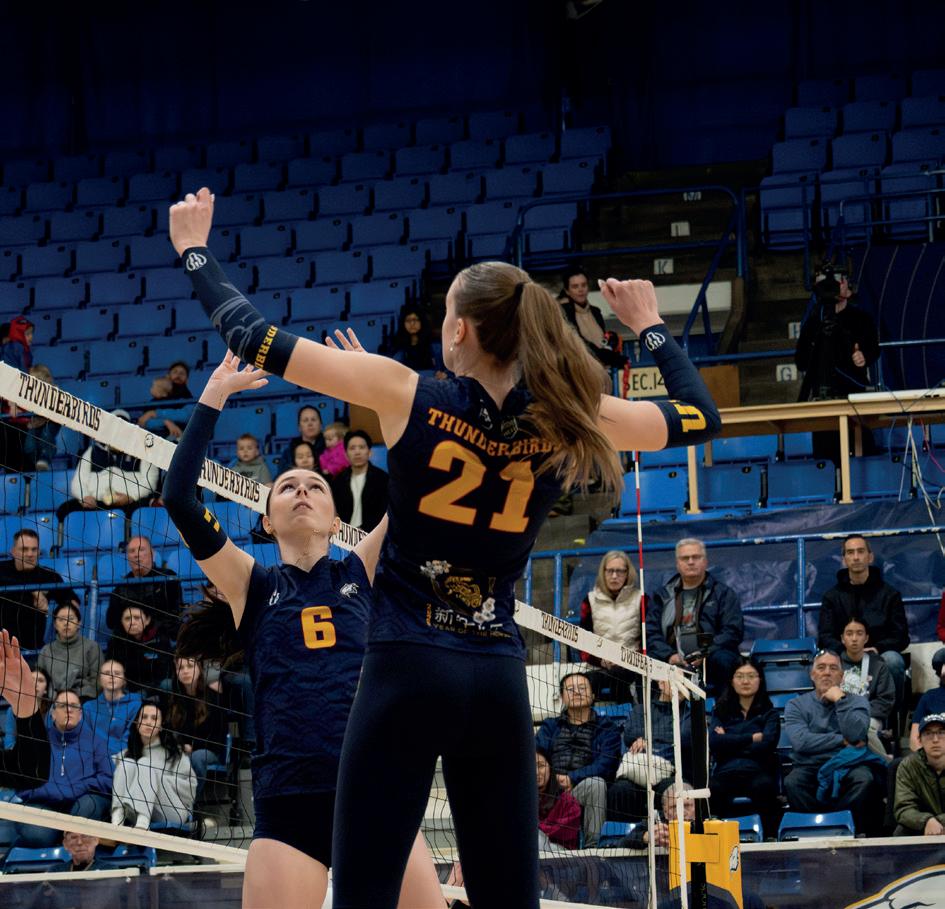
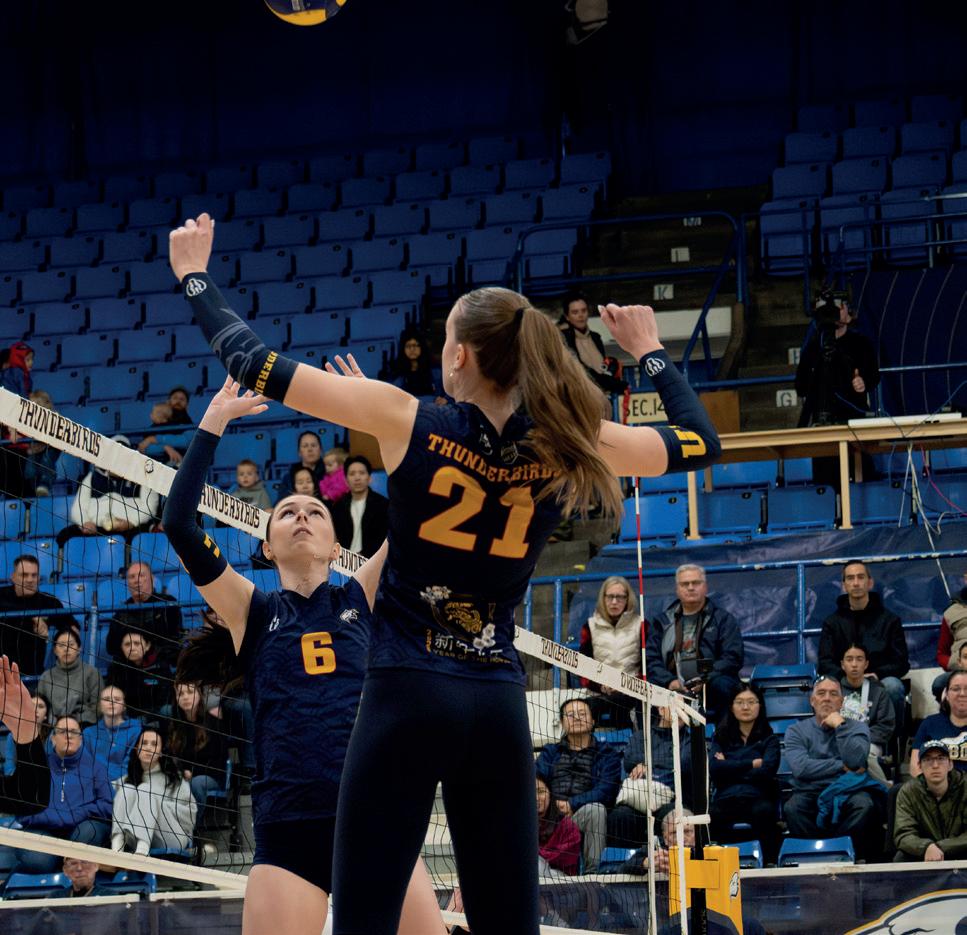
When the final ball hit the floor, the implications settled quickly. UBC finished the regular season
For the Thunderbirds, this was not their most dominant performance, nor did it need to be. There were stretches of offensive inconsistency and moments where rhythm wavered, particularly in the second set. Yet, time and again, they responded by winning extended rallies, applying serve pressure, and trusting their systems — and those traits may prove more valuable than any single stat line. However, the next time the T-Birds play, the margin for error tightens. UBC will host a best-ofthree Canada West quarterfinal series beginning Feb. 26, welcoming the winner of the play-in matchup between the No. 10 MacEwan Griffins and No. 7 Fraser Valley Cascades. They’ll have a week off to regroup, but when they come back, with the stakes of the postseason, it’ll be a different kind of volleyball.The pace will quicken and the pressure will sharpen. But Saturday offered a quiet reassurance: even without playing perfect volleyball, the Thunderbirds remained composed, adaptable, and exceptionally difficult to beat. As the regular season closed with their playoff spot secure — that may have been the most important result of all. U
25–19, ending the match on another Borowski kill, a fitting finale for her final regular season match at home.
Lucy Borowski (#18) and Abby Wasutyk (#16) go for the block.
| ALEAH KIPPAN / THE UBYSSEY
ALEAH KIPPAN / THE UBYSSEY
ALEAH KIPPAN / THE UBYSSEY
Canada’s top goal-scorer,
Grace Elliott, is driven to win
Grace Elliott has done it all. She’s led the country in goals for two straight years. She’s the reigning U Sports player of the year. She’s UBC’s all-time point leader. Her university career is coming to an end this year, but she’s made the most of every second.
Profile by Luiza Teixeira Sports Reporter
If you’ve been to a UBC women’s hockey game in the last few years, you’d probably be quick to notice Grace Elliott. It would be hard not to. Standing at a whopping 6-foot2, she towers over everyone else on the ice, teammates and opponents alike.
But while her height is what stands out at first glance, it’s usually not long until her skills are evident as well.
With the regular season ending last week, Elliott finished as the top scorer in her conference and in the country, with 24 goals in 28 games and 37 points on the season. She hasn’t just been excellent this year, either. The White Rock native is also the reigning Canada West and U Sports Player of the Year, and recently broke the program’s alltime Canada West points record in December. Across her UBC career, she’s notched 150 total points in 162 games. These accomplishments are no coincidence. They are the result of her constant drive to be the best player she can be, a trait that sets her apart.
“She wants to be the best, to get better. She just has that internal drive,” said her head coach, Graham Thomas. “She wants to win. She accepts challenges, hard coaching and criticism.”.
That drive to win started early for Elliott. The power forward’s hockey journey began in part because of her brother, who also
played, and her dad who runs an ice rink in Surrey. That rink was where Elliott learned to skate for the first time — and hockey came soon after.
She quickly developed her skills and progressed through the levels of minor hockey in the local area, suiting up for the Surrey Falcons, the Greater Vancouver Comets and Delta Hockey Academy. It was in Delta where she first caught Thomas’ eye.
In 2020, with the T-Birds’ season shut down for COVID-19, the only action the women’s hockey team saw was a couple of exhibition matches against local teams. The first of these games was against Elliott and the Delta Hockey Academy. Seeing Elliott play from the opposing bench, she immediately stood out to Thomas — even as a younger player.
“She was just loaded with potential,” he said. “She just jumped out to me right away and this is before we even were recruiting her or talking to her.”
As a teenager, Elliott was already developing the skills she needed to be a great hockey player. Beyond her height and reach, she had a great ability to read the game — while also not being afraid to use her physicality.
After committing to UBC and joining the team for the 2021-22 season, Elliott continued to flourish and develop. She saw less playing time in her first year, playing in 25 games and registering 11 points, before becoming just under a pointper-game player in her second and third years. Then, in her fourth
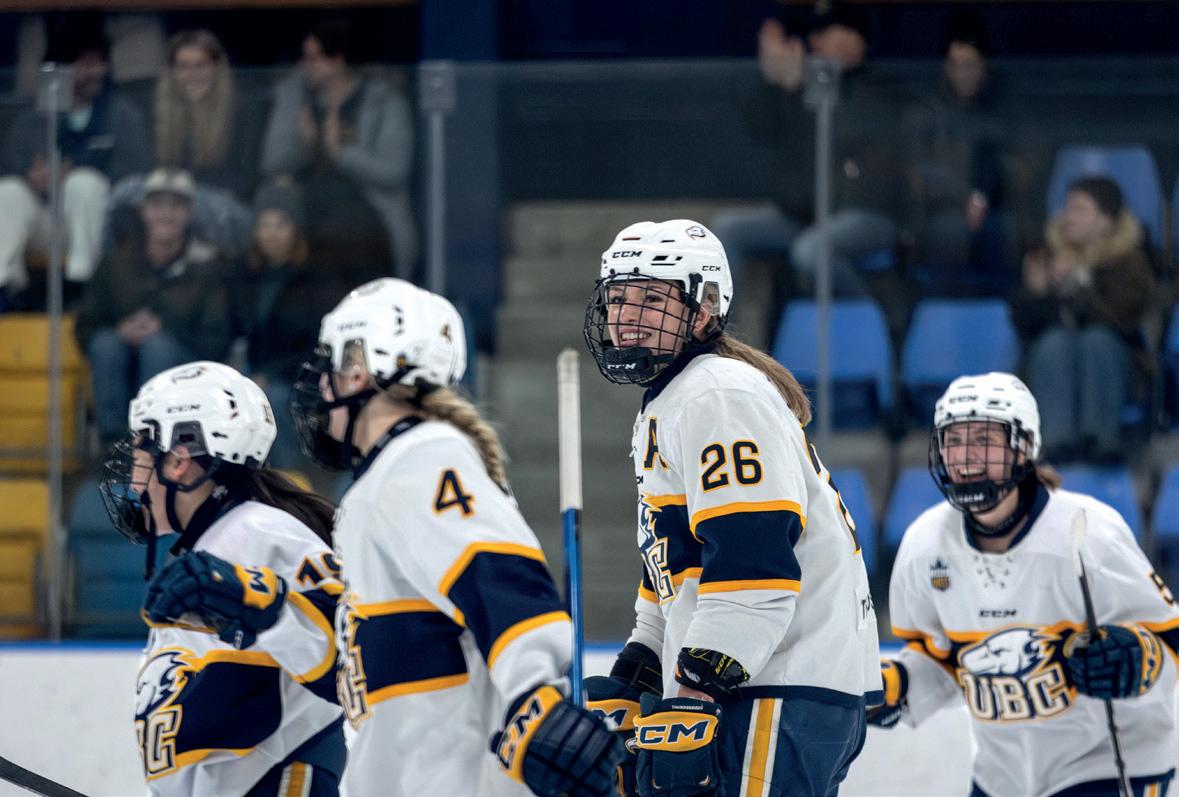
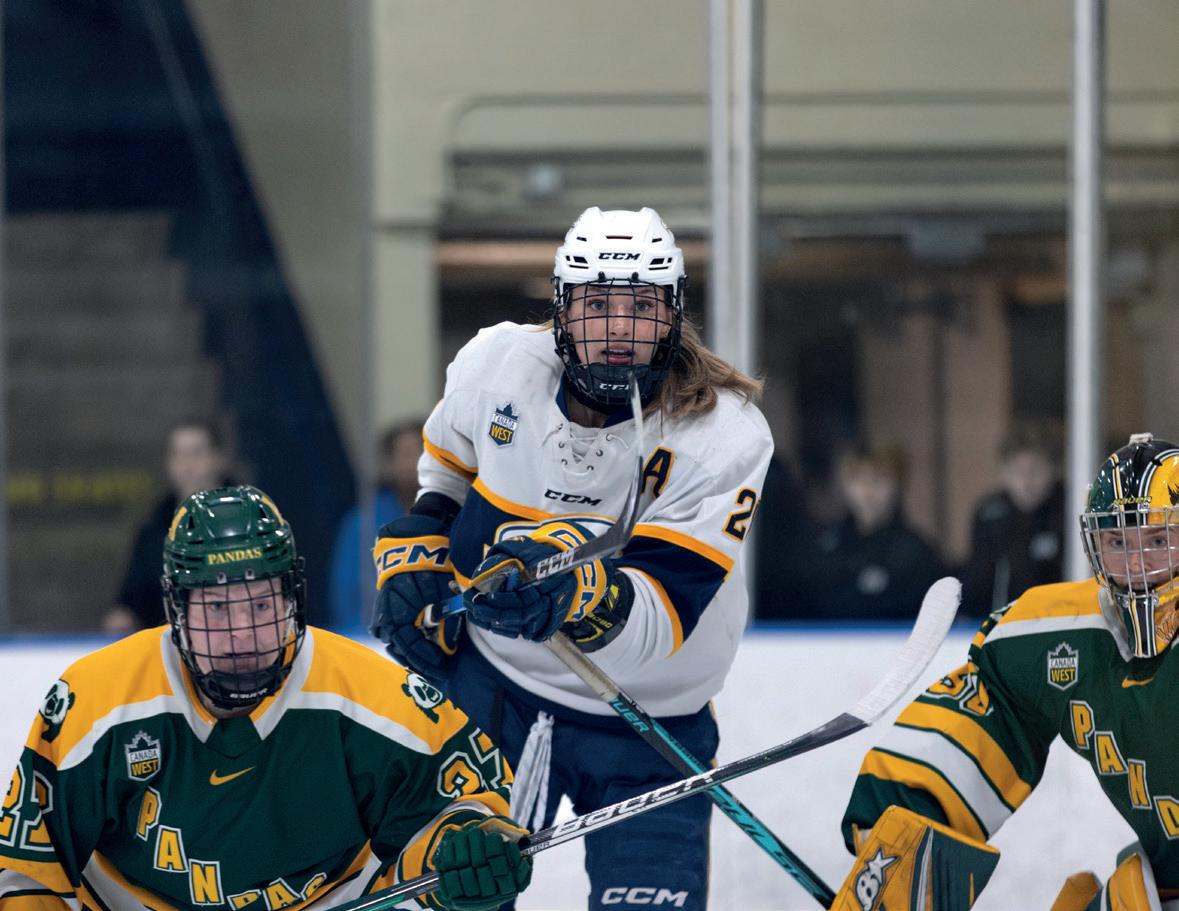
year, she exploded. After a 28-point season in 2023-24, she nearly doubled her total the following year, racking up 49 points in the 202425 season.
It was an incredible jump. But for Elliott, her breakout season wasn’t because she improved her skills on the ice. Instead, the forward credits that growth to her mental development and increased maturity. Almost paradoxically, as she stopped worrying about individual statistics — instead trying to ensure her team’s success, finding how she can best help her teammates — her point totals increased. It’s a team-oriented mindset.
“When you get to that point … it’s easier to score, it’s easier to get assists, it’s easier to play as hard as you possibly can because you want to be good for your team.”
She has been. After being elected as alternate captain by her teammates in her final season with the Thunderbirds, the fifth-year has helped lead UBC to the top spot in the Canada West standings, with 26 victories this season, the most in the country — and an all-time record for Canada West.
But despite the success and accolades, being a star player comes with its challenges. Because Elliott is the T-Birds’ top scorer, she is a target for players from opposing teams, who adopt a more physical strategy when guarding her.
Case in point, one of the toughest moments of her career came during the national consolation final in 2024, where she was faced with a very physical game against the University of Saskatchewan Huskies. In the final game of their season against a bitter rival — with Saskatchewan hosting the tournament — everything seemed to be going against her.
“I kind of got beat up and the [referees] weren’t on my side. The crowd was booing at me … It was just super tough mentally to push through that”, said the forward.
Despite the difficulty faced in that moment, Elliott found strength in her teammates and family on the bench and in the crowd.
“Ultimately, I’ve gotten so much stronger from that moment.”
Many girls, however, don’t have that same support system to push through the difficulties inherent in sport. More than one in five girls stops playing sports in her teen years, despite 70 per cent of them saying that sport positively impacts their mental health.
That is why National Girls and Women in Sports Day was created. This date honours the accomplishments of female athletes, coaches and leaders — and is an initiative Elliott fully and enthusiastically supports.
”It’s so important to have days like these, dedicated to all the hard work that people put into women’s sports. Honestly, sometimes we don’t get recognized as much as the men’s side does,” said Elliott. “So I think it’s super important to push that … and make us [be] seen.”
It’s a movement that’s gaining momentum not just in university sport, but in professional sport as well. With the Professional Women’s Hockey League (PWHL) being founded in 2023, the sport has experienced the most visibility it’s seen in decades, growing substantially with each season and setting attendance records for women’s hockey.
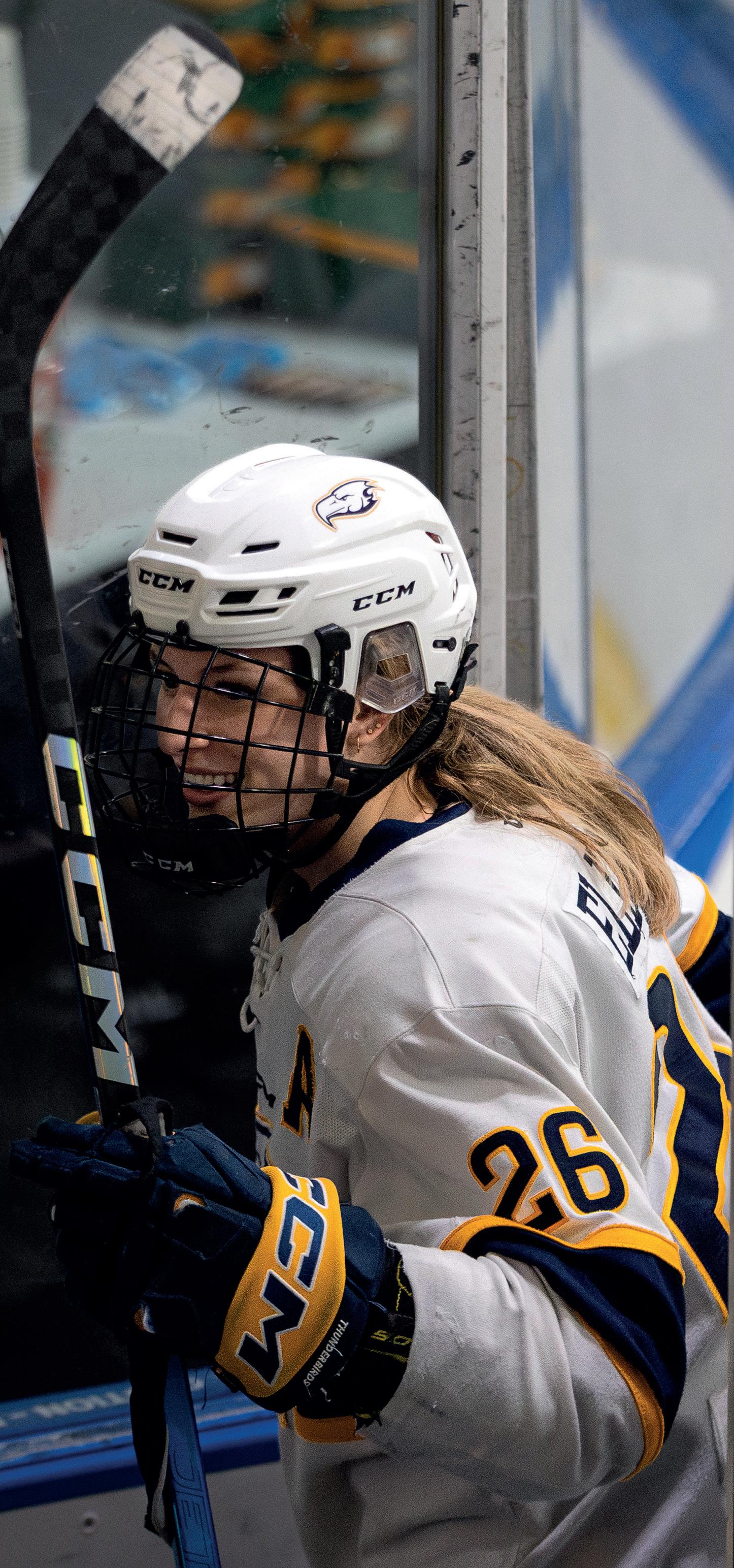
In the PWHL’s first three seasons, the league has also welcomed a few Thunderbirds to the professional ranks.
While she didn’t make the final roster — now playing professionally in Sweden — Elliott’s former teammate Chanreet Bassi became the first ever T-Bird to be drafted into the league, by the hometown Vancouver Goldeneyes. Another former teammate, defender Rylind MacKinnon, also left her mark in the pros. After initially going undrafted, MacKinnon made the roster of the Toronto Sceptres, playing in 22 games for them before heading east to join the Boston Fleet.
It’s the highest level of play the sport has to offer. And based on her trajectory coming off her final year of university hockey, Elliott could be next to join them.
“ I’m hoping to continue playing hockey, whether that’s PWHL or somewhere in Europe … I’ve talked a little bit to [some former teammates], I know Rylind [MacKinnon] loves it a lot … I’m hoping that I’ll [love it too],” said Elliott.
MacKinnon in particular was someone who Elliott cited as a role model. In a group characterized by their determination and competitiveness, having people who bring a positive influence is imperative to keep morale up. Even though she’s been away from the team for a couple years now, her presence and leadership is still felt and has been invaluable to the development of this T-Birds’ team, including Elliott.
“She’s such a genuine person. She pushes herself so hard and she was a great captain who led us to where we are now,” said Elliott.
For Thomas, Elliott has now taken on a similar role herself.
“She’s very selfless. She will give a lot of credit to her linemates, to her teammates … I know that’s the kind of mindset she has,” he said.
As a driven and competitive
player, she’s managed to find balance between managing the expectations put on her to perform at her best, while also helping elevate others.
“She [works] so hard in practice, in the gym and everywhere. It [raises] the level of everybody,” said Thomas.
In the coming weeks, a high level will be required from UBC — more than ever. Playoffs are right around the corner, and every team in Canada West will be looking for an opportunity to knock down the No. 1 seed T-Birds, who are looking for their seventh conference title. They have a target on their back. But they couldn’t be happier.
“[We have to] just go out there and [not] change anything. Play in the way that we’ve been playing … [the] pressure is a privilege”, said Thomas. We want to win the league, we want to win nationals. So [it’s about] just recognizing and accepting [the pressure], and then knowing that we’ve earned it to get to this point, but we [also] gotta continue to earn it.”
For Elliott, this year’s playoffs will bring mixed feelings. While there is sadness in leaving a program that has been a big part of her life and her career as a hockey player, she’s also looking forward to the next chapter in her life, whether that be in the PWHL, in Europe, or beyond.
But for now, she’s putting all that to the side. With every game from now on potentially being her last as a Thunderbird, her focus is on the games ahead of her, and enjoying her final moments with some of her teammates.
“ We have 12 graduating seniors that are just so, so special to this program. … we’ve been together for these past five years and [have] just grown so much as a whole. It’s super exciting that we are in this situation, in this moment, and I think it’s gonna be awesome.” U
With the playoffs fast approaching, any one of the T-Birds’ remaining games could be the final match that Elliott plays in the blue and gold. | SIDNEY SHAW / THE UBYSSEY
Teams often play Elliott more physically than usual. | SIDNEY SHAW / THE UBYSSEY
Grace Elliott has led the country in goals two years in a row. | SIDNEY SHAW / THE UBYSSEY
Hot gas from the early universe challenges what we know about galaxy clusters
Report by Vicky Nguyen Senior Staff Reporter
Researchers expected the universe’s earliest galaxy clusters to be relatively cold. However, UBC scientists have discovered hot gas in a 12-billion-year-old cluster, shedding light on galaxy clusters in the early universe — and contradicting current models of their evolution.
The largest galaxies in the universe exist in clusters. Matter between galaxies is heated by gravitational forces from supermassive black holes and radiation from newly formed stars. Simulations of galaxy cluster evolution predicted that intracluster gas would be cooler earlier in cosmic history, since the gas would still be accumulating and heating.
Recently, a team of researchers found a reservoir of extremely hot gas in SPT2349–56, a distant young galaxy cluster about 12 billion lightyears from Earth. A light-year represents the distance light travels in one year, meaning researchers were observing the cluster as it appeared 12 billion years ago — when the universe was at only 10 per cent of its current age.
Calculations showed the thermal energy of the gas reservoir in SPT2349–56 was about 10 times greater than what gravitational pull could produce.
“It is very surprising, because this kind of hot gas was thought only [to] exist billions of years lat-
er,” said Dazhi Zhou, a PhD student in UBC’s department of physics and astronomy and the first author of the publication. They detected the gas through leftover radiation from the Big Bang, in the form of the cosmic microwave background (CMB). As they travel, photons from the CMB interact with the highly energetic gas in the intracluster medium (ICM), leading to the thermal Sunyaev–Zeldovich (tSZ) effect. This scattering creates detectable distortions in the CMB.
Instead of relying on light emitted by gases, the tSZ effect allows researchers to observe gases through the “shadows” they create in the CMB. “This way, your signal won’t fade when you go to study a more distant object,” said Zhou.
Traditional X-ray observations are restricted by cosmological surface-brightness dimming, which describes the light from the gas becoming fainter with further distance.
To observe the clusters, Zhou used data from the Atacama Large Millimetre/submillimetre Array (ALMA) telescope, a powerful radio telescope located in Chile. The study spanned years. Zhou spent around one of those years filtering out emissions from other galaxies to observe the CMB shadow; the team initially estimated the light from the galaxies to be at least 20 times brighter than the shadow. As a result, filtering out the light was

difficult and other team members thought it was impossible. “They even suggested my supervisor ask me to give up the project, because it felt so challenging,” said Zhou. “My supervisor was so worried because I didn’t publish even a single paper after one year of effort.”
“I just kept going.”
The hard work paid off when Zhou spotted the shadow around the galaxy light — a cluster of high-temperature gas, just like what detections through the tSZ effect would predict.
“The first time I saw the shadow, because it was too strong, both my supervisor [and I] were thinking, ‘Oh, it couldn’t be real,’” said Zhou. The team spent months validating the observation, which confirmed they were observing extremely hot gas from early in the universe’s life.
So what could explain this surprising discovery? Within SPT2349–56, there are three supermassive black holes with powerful jets, pumping out a huge amount of energy into the surrounding gas, along with several starburst galaxies with high star-formation rates, making the cluster a good candidate for further examination. These sources could have heavily increased the thermal energy of the gas in the cluster during its early life, leading to much higher temperatures than previously modelled.
According to Zhou, not only does this discovery show that galaxy clusters can evolve faster than previously thought, but it also highlights major observation gaps; this is the only hot gas that scientists have discovered from the first 3
billion years of cosmic history, so there have yet to be any other direct observations of a gas in such an early stage.
This means more work needs to be done to understand the formation of massive clusters and their atmospheres. “We do not know whether this hot gas in this system is an outlier, or is pointing us to a very important and unrecognized phase of cluster evolution,” said Zhou.
For the next steps, Zhou hopes to follow up with more independent observations of the hot gas to fill in knowledge gaps.
“Just like every first discovery, we have to be cautious and test it further, whether [the hot gas] is a very common stage of the cluster evolutions or it is a very strange system,” said Zhou. U
How UBC researchers are using MRI techniques to improve neonatal
Report by Harleen Randhawa Contributor
Preterm infants rely on respiratory support to survive, but the same life-saving ventilation can also put their developing brains at risk. Researchers at UBC and the BC Children’s Hospital Research Institute are examining how preterm infants use oxygen in their brains to transform early neonatal care.
Chronic respiratory problems are among the most common health challenges for very premature infants (born before 32 weeks). These early lung vulnerabilities can persist and shape respiratory health beyond infancy.
“When you’re born early, a lot of things are disrupted,” said Dr.
Alexander Weber, an assistant professor in the department of pediatrics at UBC. Underdeveloped lungs can result from these disruptions.
Respiratory support is essential for survival, and yet it can also injure fragile preterm lungs and affect the brain. Clinicians must ensure babies receive enough oxygen despite the risks of ventilation-related inflammation and unstable blood flow.
Weber was introduced to quantitative susceptibility mapping (QSM), a technique that allows MRI scanners to measure magnetic susceptibility in biological tissues.
Iron and deoxygenated blood have distinct magnetic properties. By detecting these differences, QSM allows researchers to esti-
mate oxygen levels and identify patterns of oxygen use in the brain.
To understand how infants use oxygen, Weber and the team combined QSM with another advanced MRI technique: Arterial spin labelling (ASL), which involved tagging blood at the neck and tracking its movement into the brain. This allows the researchers to measure blood flow.
QSM measures how much oxygen remains in the blood leaving the brain, while ASL shows how much oxygen-rich blood enters it. These two measurements allowed researchers to calculate how much oxygen the brain consumes.
The team initially predicted that infants who needed the most invasive respiratory support would show reduced oxygen metabolism
compared to other infants. However, the scans were conducted after infants were discharged from the Neonatal Intensive Care Unit, so the results tell a more complex story. Instead, they saw that infants who spent longer on non-invasive ventilation appeared to have higher oxygen metabolism and infants who spent more time breathing room air without support were associated with lower oxygen metabolism.
Weber emphasized that the study was observational and did not establish a cause-and-effect relationship, nor does it provide a conclusive answer about the best ventilatory support for preterm infants. “It kind of just brings up new questions.” Even so, these preliminary findings could help shape
care
how ventilatory support needs are assessed in the future.
He also highlights a gap in neonatal care: the inability to predict long-term outcomes. Weber mentioned cases in which babies with injuries shown on MRI scans performed well in behavioural and cognitive testing later while babies who showed no signs of injury later had low scores.
“Parents [say] ‘Well, what can I do to help my baby so they have the best outcomes?’” For now, there isn’t a concrete answer.
Weber’s focus for future research involves identifying MRI techniques that can better detect predictive biomarkers. This could help clinicians determine which infants may benefit from developmental support earlier in life. U
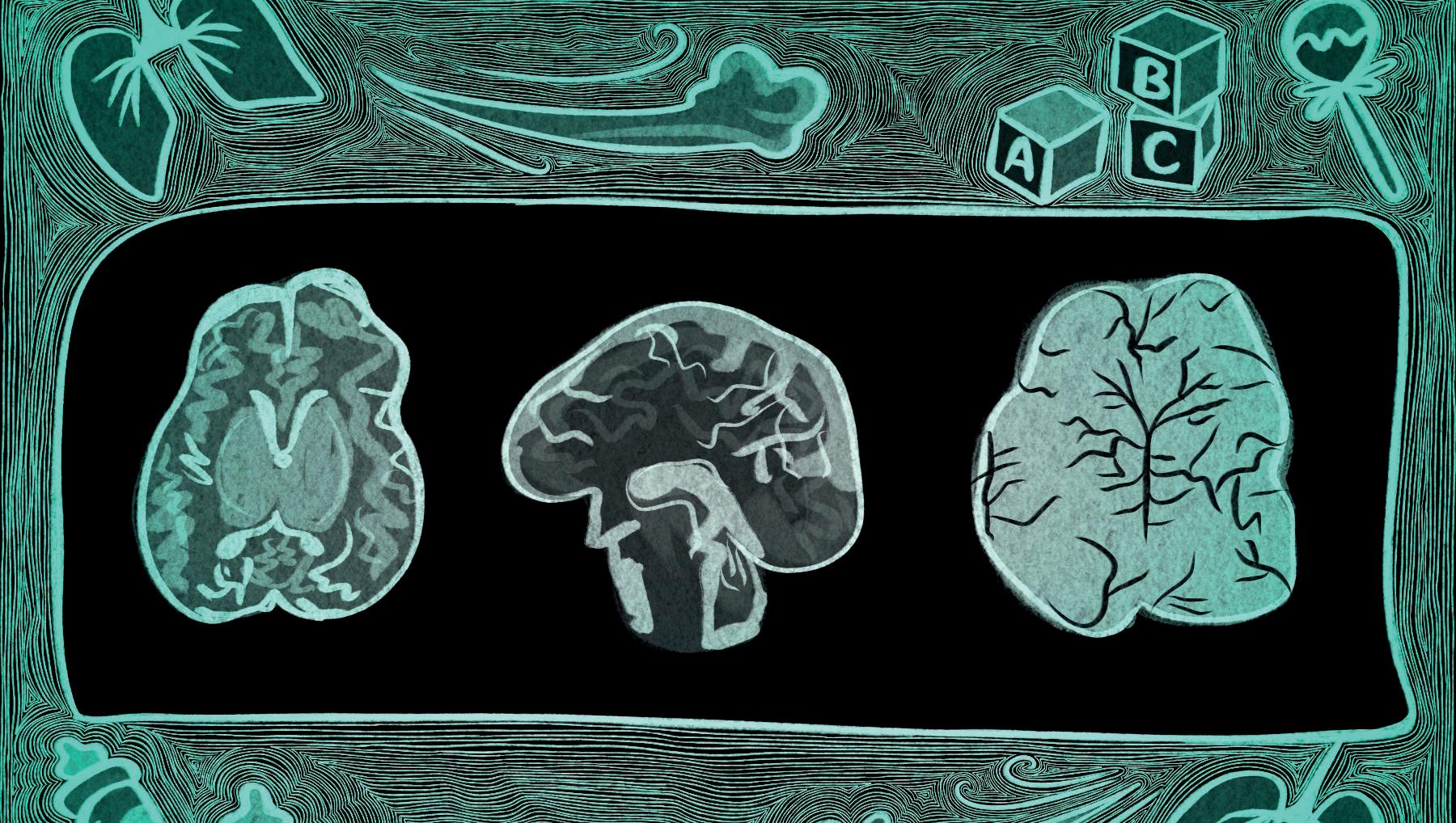
Quantitative susceptibility mapping allows researchers to estimate oxygen levels and identify patterns of oxygen use in the brain. | ABBIE LEE / THE UBYSSEY
They detected the gas through leftover radiation from the Big Bang, in the form of the cosmic microwave background (CMB). | SKYE
SHEN / THE UBYSSEY

Semi-biohazardous spaces earn big on Airbnb

Report by Mason Carter Humour Writer
The Student Housing and Community Services office was recently informed that there was a sudden rise in Airbnb properties listed on campus over reading break. At first glance, Student Housing and Community Services expressed little concern about the sharp uptick, assuming it could be attributed to those wealthy students with private apartments in Westbrook Village looking to make a quick buck. This, however, is not another capitalizing-on-daddy’s-assets-for-a-little-extra-drinking-money-scheme. Instead, these listings are calculated, strategic financial moves by students trying to afford textbooks.
Airbnb currently has no specific regulations stating that listed properties cannot be located on a university campus, nor do they have rules for properties that are. UBC students have been taking full advantage of this policy oversight and have been listing their dorms on the short-term accommodation platform, regardless of their dormitories’ “special quirks.”
An average double room in the Totem Park residence is listed at $100 per night as of Feb. 21 and in some cases, only one student in the shared space decides to rent out their room. Most listings with this particular issue assure those seeking accommodations not to worry — one Airbnb listing promises “their roommates are very chill” in the listing description. In a recent review of this property, one patron provided an insightful description of their stay at the Totem Park double occupancy room.
“Not only was this not a private accommodation, but the roommate was most definitely not ‘very chill.’ He left the residence for what couldn’t have been longer than an hour and returned reeking of Fireball. That wasn’t even the worst part; he threw up all over me and the bed I had to sleep in. Not only did I have to go to my big meeting downtown that I flew all the way to Vancouver for smelling like I’d just pounded a fifth of vodka and two handfuls of cinnamon hearts, but right before I walked into the meeting room, I was hit with a notification from Airbnb. Dude had the nerve to charge me a cleaning fee for his roommate’s vomit. If I could give less than 0 stars, I would. This was not the ‘college experience’ I signed up for.”
When the owner of the accommodation was questioned, he explained that the Airbnb tenant’s review was all a big misunderstanding.
“My roommate is ‘very chill,’ and I didn’t appreciate this old lady staying in my place and then criticizing our humble abode. She ruined the vibe. I talked to my roommate, and it turns out she was anxiously practicing her ‘keynote speech’ all evening. Talk about annoying. The only thing he could do to drown out her noise was to skull a bottle of Fireball. Surprisingly, even through the blackout, he could hear her constant ‘umms’ while practicing, which is why he needed to vomit on her and the bed. He obviously didn’t want
to, but she left my guy no other choice.”
When asked for further comments, the dorm lister simply said, “Old people are sickening.”
This isn’t the first incident arising from these UBC Airbnb properties. Another review from a single room in the Vanier residence detailed an equally disturbing experience.
“My stay was going fine … The room was small and smelled like mold … But the bed had a decent mattress topper, and I could tell this kid made an effort to make this a comfortable accommodation. I was almost beginning to forgive her for charging me $150 a night, until around midnight, when I was struck by a sudden gurgle in my stomach. With the accommodations came access to the residence’s all-access dining, and I never shy away from a buffet; they shy away from me. Though tonight, after scarfing down multiple plates of butter chicken, it felt like my stomach was trying to hide within itself. At that very moment, I realized there is no bathroom in my room. I burst out into the hall — it felt like one of those hydraulic press videos – except my body was trying to press everything out of me. I managed to find the bathroom with six shared stalls – all covered in hair, all without toilet paper, and best of all, they were all clogged. At this point, I had no choice but to add to the clog and use these shared showers as a makeshift bidet. How is this even a legal listing on Airbnb? How do people live like this?”
The Ubyssey investigated the review’s claims, following a number of alleged safety violations over the past few years related to UBC’s residence dining halls. After contacting a number of offices, we were soon put in touch with Feast at Totem Park head chef, an 18-year-old first-year named Kyle. He declined to provide a last name, because “it’s just Kyle, like how Beyoncé is just Beyoncé.”
“The kitchen is all about experimenting. When you’re making waves in any scene, there will always be naysayers and downers. If you don’t like my medium-rare chicken, don’t eat it. Your unsophisticated paletes won’t dull my whimsy,” he said.
With Vancouver set as a host city for the upcoming 2026 FIFA World Cup, Totem double rooms are estimated to climb to an average of $400 a night. With these highly anticipated events in mind, the Student Housing and Community Services Office is partnering with Airbnb to find a way to better serve Airbnb tenants during their stay. To take advantage of this promising financial opportunity UBC Student Housing and Community Services will be evicting all student residents this summer and hiring cleaners and competent maintenance workers for the duration of the Airbnb agreement.
“Students deserve the right to make money on their semi-biohazardous spaces, but Airbnb guests have more rights because they pay us more. Students may not deserve access to consistently working heat or piss-free floors, but our Airbnb guests sure do!” U
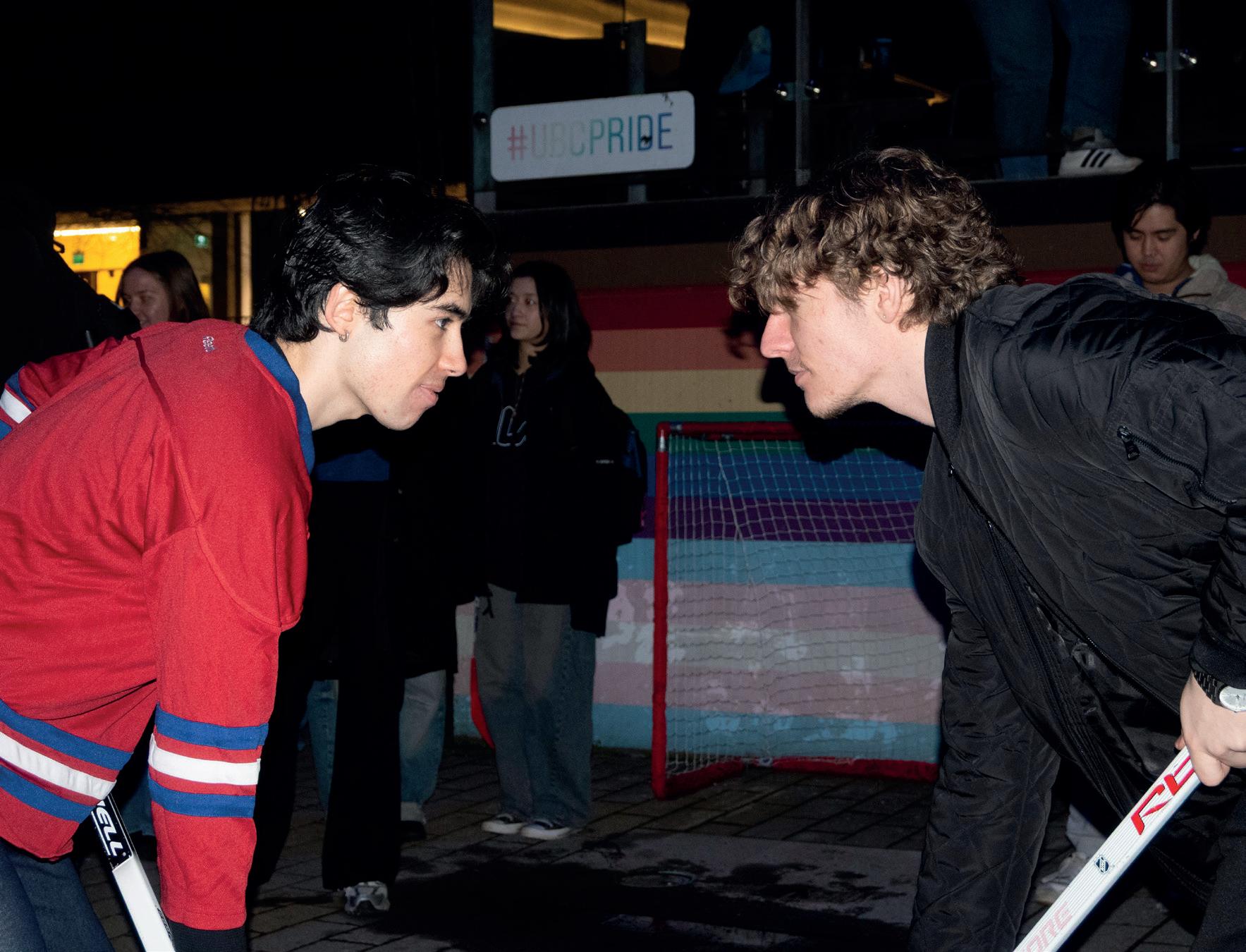
“You don’t even know what the cottage is!”.
What actually happened at the Heated Rivalry contest
Everything you have heard about the Feb. 10 Heated Rivalry Lookalike Contest is a lie. As someone who’s watched the show enough times that I can recite Ilya Rozanov’s Russian monologue (take that Duolingo) on command, there is no one more qualified to tell you what happened at this event than I. Here’s the truth: this was a performativity contest on steroids. It brought performative men out of hiding, prompting them to swap their oat matchas for a crisp Canada Dry.
These infamous ‘performative men’ had the audacity to join the contest, claiming they looked like either Shane Hollander or Ilya Rozanov and announcing that they’re basically Hudson Williams because they were born in Canada. Other contestants proudly expressed in their introductions that they’ve watched the show “four times.” Scoff. To that I say: rookie numbers — the only thing better than Heated Rivalry is “ReHeated Rivalry.”
Contestants met outside the Nest near the Pride wall, where UBC somehow produced more Russian-speaking blondes than Ginger Ale-loving wasians. This competition was fierce, given what was at stake: the massive, earth-shattering opportunity to win a $25 AMS Nest gift card and UBC drop-in skate rentals, plus everyone in the crowds’ number.
As I watched the contestants strut their stuff and attempt their best bedroom eyes, I could not help but succumb to my inner critic. One contestant pulled out their Russian passport and one of the Shane’s spoke French, but no French kissing? Where is the commitment to the bit? I thought we were aiming for accuracy. The iconic AMS mascot, Birb was the most impressive candidate, saving the day by competing as Ilya Rozanov, even though Birb more so resembles a loon (if you got concussed and had a fractured collar bone like my dear friend Shane Hollander).
Though I write in the wake of the Heated Rivalry contest, the ‘performative man’ mentality is a greater epidemic. Statisticians at TinderHQ (I have friends in high places; can’t blame a girl for trying to bag herself a Hudson Williams or Connor Storrie) reached out to me with a report on the Feb. 10 contest’s resonant impacts on the Vancouver dating scene. 105 per cent of contestants joined dating apps with the toxic trait of thinking that because they are wasian or blonde with curly hair, that they are as desirable as Shane Hollander or Ilya Rozanov. Tinder is reportedly being flooded with “really sinister images” of men holding up Ginger Ale cans like those guys who hold
fish in their profile photos. Contestants went through additional long rounds of elimination of reciting character lines (the AMS Birb unfortunately failed this portion) and shooting a toy ball into a children’s hockey net. As the afternoon turned to evening, the moon began to rise, which got me daydreaming about Connor Storrie’s moons — I mean, have you seen that shower scene? It single-handedly made Rec North 69 per cent more busy. At the contest, I was not alone in my wishful thinking of a certain wasian prince showing up. Whispers filled the crowd as rumours about Hudson Williams being back in Vancouver passed from lip-to-lip. According to one random girl “he had nothing better to do.”
“As Williams stormed off, belittling the posers of the contest as he went, the performative men began plotting.
I tried to contain my rage at her irreverent tone — Williams goes where Williams wants. He’s a worldwide phenomenon, show some respect! However, it is significant to note that these Williams-related rumours have widespread effects. Vancouver hotels have reported a 700 per cent increase in customers keeping their doors unlocked on NHL game nights in the city on the off chance any hockey players want to try out some method acting. Screw security, I also wouldn’t allow a lock to prevent me from finding my own Williams.
A few rounds into the competition the fan favourite and mosttalked-about prospect, Birb, got eliminated, mainly due to a lack of muscles. I shook my head in protest at this unjust decision, knowing in my gut the Birb was perhaps the only true Heated Rivalry fan in the contestant pool.
All of a sudden, Birb stepped forward, and a hush fell over the crowd as he broke all of the mascot rules ever and tore off his own head — the carnage — I almost fainted at the gruesome sight when suddenly, I gazed upon a glorious face. It was Canada’s mascot and most skillful bearer of an Olympic torch, Hudson Williams!! He wasted no time, breaking his Birb-induced silence by popping off on the judges and the performative men, by saying “you don’t even know what the cottage is!”
That’s what I’ve been saying.
Williams then pointed to the journalists, saying that they should report what is actually happening: performative men adopting whatever interest is trendy, making community events like these about them. Williams, half-Birb halfman, berated the performative men on their mispronounced lines, high-fived the Russian passport person, and then expressed that he needed both $25 AMS Nest gift cards and skate rentals in preparation for season two of Heated Rivalry, since The Old Spaghetti Factory won’t hire him back citing concerns about the effect of his “yearning bottom eyes” on customers.
As Williams stormed off, belittling the posers of the contest as he went, the performative men began plotting. They paid off everyone with promises of private skating lessons, and this, accompanied by swoony-worthy hair-tossling, seemed to work. Nobody was talking about Williams’ appearance at UBC. The performative network before me sought to cover up the most exciting thing to happen on campus since they filmed Fifty Shades of Grey at the Chan Centre, all because Williams expressed disapproval for their lack of commitment to the bit.
The Ubyssey even received a cease-and-desist order from Prime Minister Mark Carney, when unnamed informants told him of Williams’ expressed disapproval of such uninformed engagements with his art.
“All reporting on Hudson Williams telling these young men at UBC to actually ‘watch the fucking show’ before competing in a contest about [Heated Rivalry] must not be allowed to see the light of day,” Carney’s letter read.
This only demonstrates how widespread Heated Rivalry-centric performativity has spread: Carney reportedly kisses the picture he took with Williams’ leg wrapped around him every night before bed, and has recently moved into a home numbered 1221. He doesn’t deserve the official fleece …
These performative men cowards feared the charisma radiating from Williams. They couldn’t dream of out-heartthrobbing a man who doesn’t need a quarter zip and matcha to gain everyone on campus’ attention, so they embraced other nefarious means of maintaining their status: silencing the press.
I will not be silenced, especially when it comes to this show. Whenever I introduce myself to someone new, I don’t even say my name because there is only one important question: have you watched Heated Rivalry? As a society we must not forget what truly happened on this day, so we can all enjoy the cottage in peace without performative men hopping on our heartfelt interests like they’re another trend. U
“If I could give less than 0 stars, I would.” | KYLA FLYNN / THE UBYSSEY
Event Report by Selena Sallay Humour Writer
| ALEAH KIPPAN / THE UBYSSEY

Sassy Sage: TLDR dating sucks
Sassy Sage is Ubyssey humour’s satirical advice column, written by Selena Sallay. You can seek her misinformation disguised as heartfelt counsel by writing to her at advice@ubyssey. ca. Letters will be edited for brevity, clarity and to make them funnier tbh.
Column by Selena Sallay Humour Writer
Dear Sassy Sage, I got set up with this guy, and now he keeps messaging me extremely suggestive emojis like he’s in middle school flirting with a girl for the first time … He will not leave me alone!!! When I told him I was going to block him and that I did not want to hook up with him, he had the audacity to ask me to set him up with my best friend.
HELP.
Desperately,
Ivanna Somepeace
Dear Ivanna, We live in a world full of people wanting their hot girlfriends to pay the bill on Valentine’s Day. Shocking as it may seem to you given the composed, untouchable aura I radiate, but this has even happened to the incomparable ME! In short, we have now reached the utter downfall of humanity. This email reminded me that I am not hating on men enough. My fellow ladies, we need to stand up. Be warned: if you are not careful, you’ll wake up one day with a bum of a boyfriend on your couch, wondering where your life went wrong as you watch romance movies continuously longing for what the protagonists have while telling yourself passionate sex is unrealistic to make yourself feel better. Am I speaking from experience once more? This isn’t about me.
If no one has told you, Ivanna, I’m sorry. For some cruel reason you were chosen as the sacrifice to deal with an unwanted onslaught of eggplant emojis insinuating a desire to show you his purple pickle IRL. I wouldn’t even set this sorry excuse for a human up with my greatest enemy. Okay, maybe I would. I would advise the following: block him, change your number and then blow up your phone because it has been exposed to the incurable virus of his sickening texts gracing your screen. If seeking revenge is more your vibe, I suggest torching his U-Pass and then calling Transit Security so he gets fined. An alternative option is to bring back shame: stalk his mom on Facebook and send her screenshots of his messages. Lastly, if “simple and effective” is your vibe, set him up with the worst person you know (or write back for the full government name, address and contact info of the worst person I know, if you need a target). Misery loves company, so let them have one another. There’s no point in making two other people miserable!
Stay safe and stay single, Sassy Sage U
GAMES


Word of the Bird
Out-of-Context Campus Content
“Clearly Birb is wasian”
– Student on Birb competing as Ilya, Heated Rivalry Lookalike Contest
“What if they call me dumb and ugly?” “They could never call you ugly.”
– Editor-to-editor, National Student Journalism Conference
Just say

Down: