A lone star’s search for brisket in the true north strong and free
I set out to find Texas in Vancouver: a brisket in the great white north that I could go to when I missed people with accents like dripping molasses.
Review by Jack Paransky
Arts Contributer
Texan brisket is not a utility food; it’s an art form.
The pitmaster will spend up to 18 hours — after waking at comically early hours — to slow cook a piece of meat in an industrial-sized smoker. People who make brisket are the intersection between cooks and blacksmiths, choosing the temperature needed to hold the brisket at, the wood it will be smoked upon and the length of time to smoke the meat with a level of care and attention to detail that I
have only seen in chemistry labs. It’s a game of patience, sleepless nights, careful planning and a devotion to a craft.
When my dad was going through one of his many obsessions, he made brisket. I remember living in Arizona and how he complained about waking up at 5 or 6 a.m. to cook a brisket for 13 hours, just for it to be ready for when guests came in the evening. His brisket was kosher, of course.
I came from a religiously observant Jewish family. The intense type, too: waiting an hour-and-a-half to eat dairy af-
Point of Inquiry:
ter meat, separate cupboards for meat dishes and dairy dishes, and all meat had to be certified kosher by a Rabbinic organization. So everything we ate was kosher.
The only difference between a kosher brisket and an unkosher one is that no barbecue place on earth has kosher brisket. So I ate brisket at home, in awe of the time, care and passion that went into it.
When we moved to Texas, the smoked meat beckoned me like wanderlust singing to a secluded monk. We would drive by places known worldwide as holy sites
Keep the AMS momentum rolling.
Opinion by Quyen Schroeder AMS Columnist
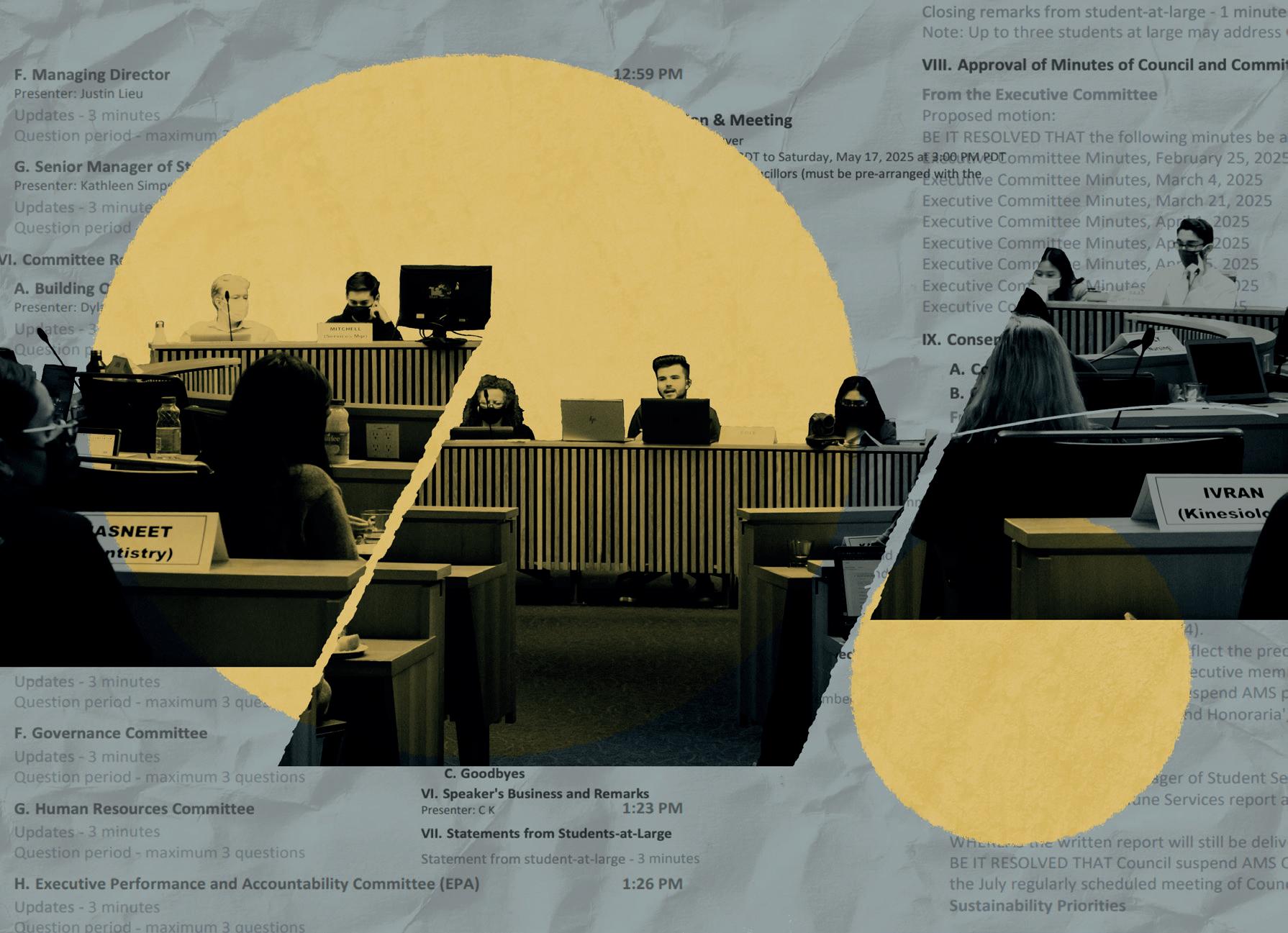
In 2025, the Huntley administration replaced toxicity with focus. In 2026, as students confront the affordability crisis and the AMS faces its deficit, service costs and businesses’ performance, this is the new bar in student politics.
I hoped I’d be done with AMS Council in 2025.
My first AMS Council meeting was at the beginning of 2023 during Eshana Bhangu’s presidency. In 2025, after two years of near-perfect attendance, I was ready to retire from following student politics. I associated the AMS with negativity and hostility — within the AMS, and towards student organizers.
I wrote all my discontents into the Barry ‘Bee’ Buzzword joke candidacy. After that? I
awaited my life of blissful ignorance, free from student politics.
Yet since my editor convinced me to write this column, I’m more involved than ever before — and gladly, too. This is the healthiest and most productive term of AMS council I’ve experienced, and my nearly three years attending council exceeds most councillors’ time sitting on it. With that, I’d like to take you through the previous year: where it started, how it progressed, and where I hope it’s going into this year.
A toxic culture
At the start of this year, the AMS was a noxious environment. It was known for one thing: the drama.
In November of 2024, then-VP Academic and University Affairs Drédyn Fontana was removed from his
position. An internal investigation concluded he made a “misrepresentation to AMS Council” and demonstrated “poor performance and conduct.” It was the first removal of an executive in AMS history. Fontana contests the reasons for his removal and is suing the AMS for wrongful termination of his employment.
Two days after Fontana’s removal, then-VP Finance Gavin Fung-Quon took an indefinite leave of absence. (This was effectively a resignation. The only difference is that the AMS wasn’t required to hold an election for his replacement. This loophole has allowed the AMS to appoint unelected replacements for Fung-Quon, 2023-24 President Esmé Decker, 2023-24 VP External Tina Tong and 2022-23 VP AUA Dana Turdy).
Continued on pages 10-11.
where barbecue savants made their sauce-stained pilgrimages. But I was stuck in the car, going to eat kosher meat at home.
When I turned 18, I took my first step toward gastronomic independence. I had my first unkosher meal at the Rainforest Cafe, and that set me down a path of trying what I had been steered away from in my youth.
I got more daring. I went to barbecue places with friends and finally tried the food my father had emulated for the religious palate. Standing in those lines for food felt like a corrupt act.
Continued on pages 4-5
Chopping Spree is democratizing jazz
Profile by Lucas Rucchin Contributer
In December, during the finale of Shindig 2025, I watched Kyler Young, Chopping Spree’s saxophonist, climb a tower of storage boxes mid-performance. Hands flailed up from the crowd. Posing, face contorted with passion, he wailed the chorus of “Koi Fish,” the second of two contagiously energetic singles put out by the band since October. Jazz morphed into funk, then into blues. Hayden Cohen, the keyboardist, ditched his post and, leaping down from the stage, began rapping. Heavy metal ensued. The crowd lurched. A mosh pit formed, and I had to remind myself that the music I was hearing — which had galvanized the most energetic crowd of the night — had its roots in jazz.
“Chopping Spree is everything they say they are,” I texted my friend after the show, electrified, bussing home a new fan
Continued on pages 8-9.
Saying the feature did “not accurately reflect the percentage of completion” for some students’ academic progress.
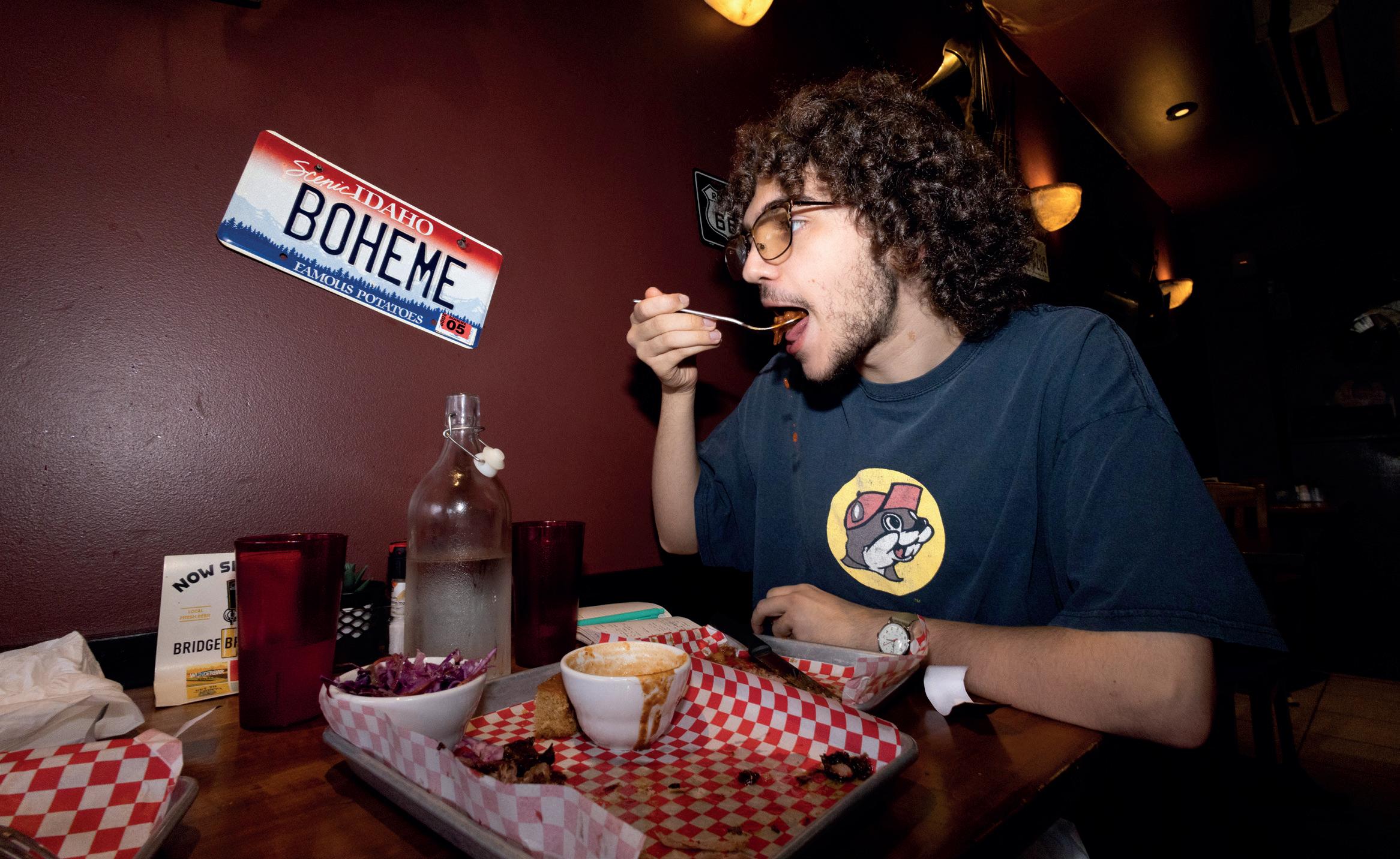
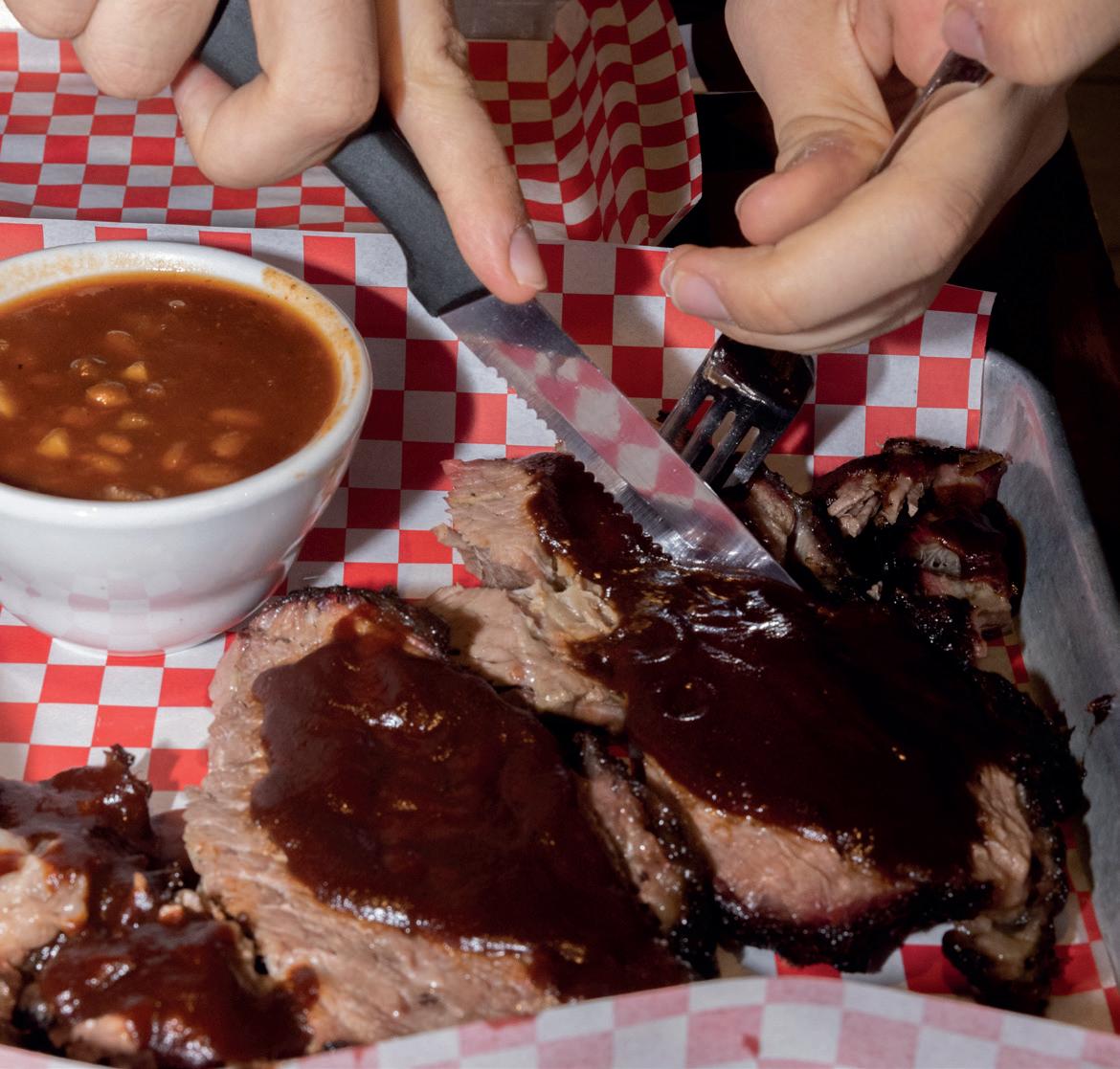
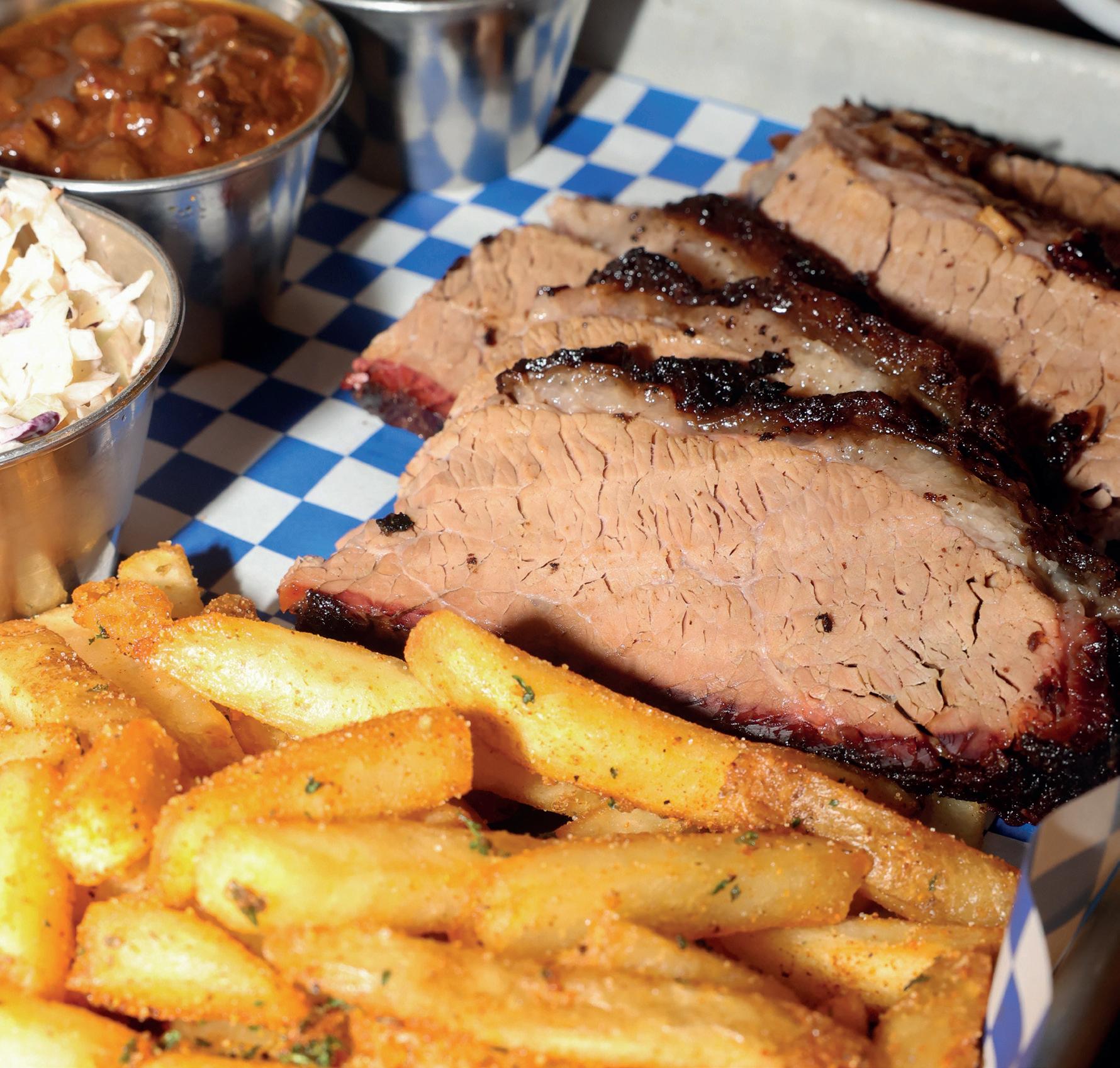
Texan brisket is not a utility food; it’s an art form. | ZOE WAGNER / THE UBYSSEY
The Ubyssey
LAND ACKNOWLEDGEMENT
The Ubyssey acknowledges we operate on the traditional, ancestral and stolen territories of the Coast Salish peoples including the x məθk əy əm (Musqueam), Sḵwx̱wú7mesh Úxwumixw (Squamish) and səlilwətaɬ (Tsleil-Waututh) nations.
Humour
Editor-in-Chief Aisha Chaudhry eic@ubyssey.ca
Managing Editor Saumya Kamra managing@ubyssey.ca
News Editor Stephen Kosar news@ubyssey.ca
Arts & Culture Editor Julian Coyle Forst culture@ubyssey.ca
Features Editor Elena Massing features@ubyssey.ca
Deputy Managing & Opinion Editor Spencer Izen deputymanaging@ubyssey.ca opinion@ubyssey.ca
Business Manager Scott Atkinson business@ubyssey.ca
Digital
ARTICLE GUIDE
The fashion world through Cassidy Chen’s lens
Photographer and UBC alum Cassidy Chen has already shot shows at Paris Fashion Week and made Forbes’ 30 Under 30 list, but she isn’t planning on slowing down anytime soon.
Profile by Elena Massing Features Editor
As I scrolled through photographer Cassidy Chen’s portfolio, I immediately found myself drawn to how she captures femininity. Even though she plays into a sense of softness — light colours, playful backdrops, flowing silhouettes — there is something intense and intentional about how her models carry themselves. “It’s their connection to my camera, my lens,” Chen said, describing her style as “emotive”; she takes the energy her model brings and runs with it.
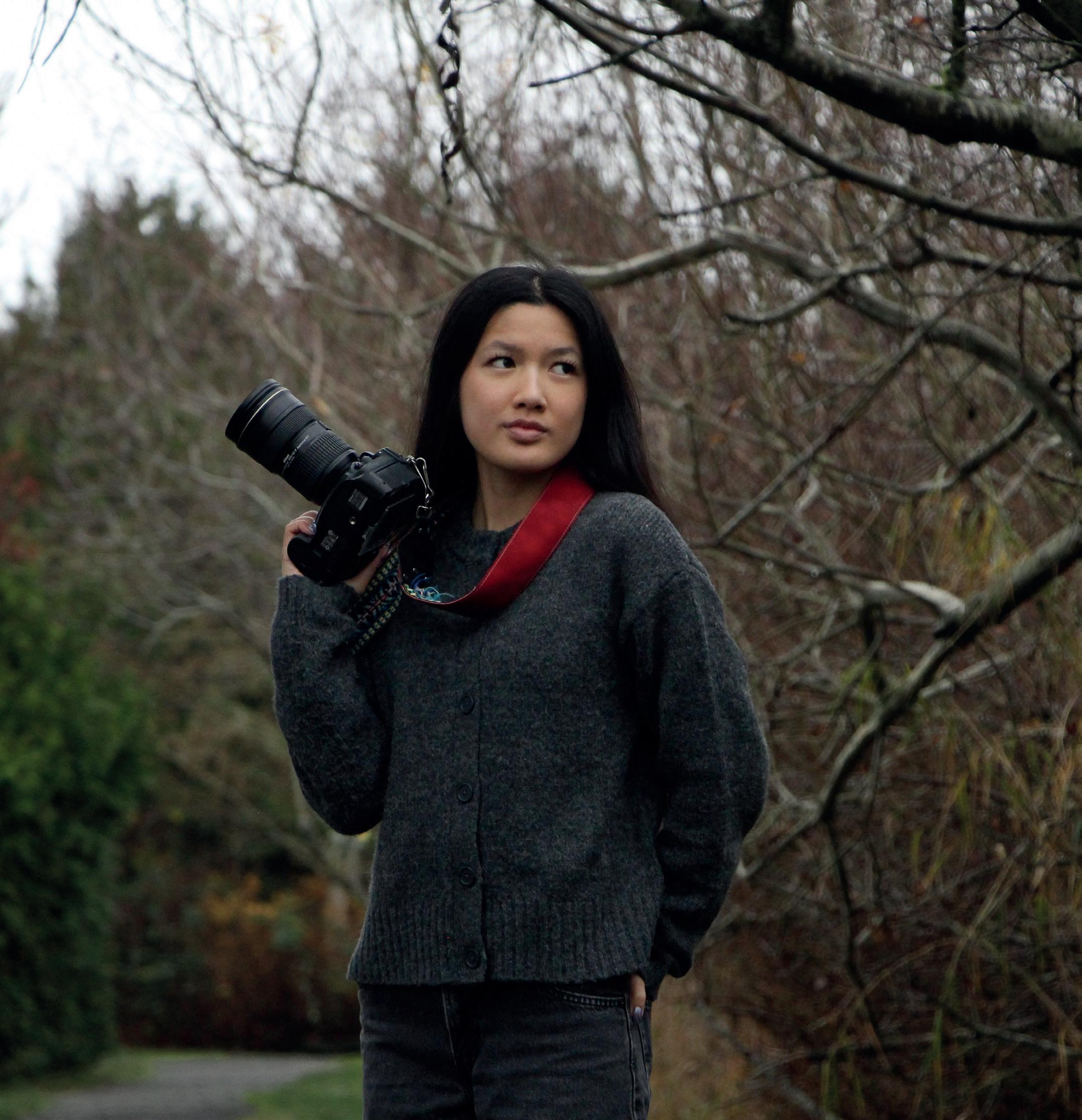
Chen gaduated from UBC in the spring of 2025 with a degree in film studies and creative writing. Photography wasn’t necessarily a key facet of her program, but she gives some credit to her time here for having taught her about tangentially-relevant areas like film history and audience perceptions of media.
Mid-degree, she set off for France, where she landed one of her biggest photography opportunities to date: Paris Fashion Week. There, she collaborated with London-based designer Feng Chen Wang, whose clothing is known for tailored silhouettes and elements of Chinese culture. Chen shot a little bit of everything, from behindthe-scenes footage to product images. She also worked as a photographer at the London and Milan Fashion Weeks around the same time, shooting shows for names like Paul Costelloe and Pam Hogg. Since coming back to Canada, Chen has been working with
Lululemon and other Vancouver brands.
In 2024, Chen was named on the Canadian Arts and Fashion Awards’ NewGen list, which recognizes young people in creative industries who are worth keeping an eye on. Her most recent achievement, however, is a spot on the Forbes 30 under 30 list.
“I remember growing up and looking at the Forbes [30] Under 30 list, and being like, ‘Wow, these people are so inspirational, and they’re all such go-getters,’” she told me, recounting how a 3 a.m. washroom trip was interrupted by a sudden urge to check the list, only to find her name on it. “[It’s] crazy to wrap my head around.”
There were 20 different categories this time around, ranging from science, to games, to education. Chen appeared in the art and style category — she’s dabbled in plenty of areas within her medium, but fashion photography is her home turf. Like a lot of girls, Chen grew up wearing princess dresses and playing with Barbies and American Girl dolls. It cultivated an early interest in fashion, specifically how clothes could be used to tell stories.
Her aunt and uncle are photographers, so when Chen was a kid, they would go on family vacations and snap shots along the way. Her passion only blossomed from there. In grade nine, Chen took a photography class, where she found one of her biggest supporters in her teacher, Mr. Sharma. “He saw that I was super passionate
about it and really supported me through that process.” When the pandemic forced people online during her last year of high school, she took it as an opportunity to get outside and take photos with her friends — they’d head to a park in her hometown of Richmond and shoot from over six feet apart using a zoom lens. This was around the time she began posing her work more frequently on social media, and people were starting to take notice.
Even as a kid, Chen feels she was somewhat of an entrepreneur. It’s what has allowed her to make a name for herself in a creative industry — one that’s extremely hard to break into, and even harder to succeed in. She used to sell her creations, like bracelets and other little crafts, to her family; this, albeit unintentionally, gave her the foundations of a business-oriented mindset. Photography had only really been a hobby until a couple of girls reached out to Chen after having seen photos she posted on Instagram, wondering if they could commission her to do a photoshoot with them. That’s when her dream started to feel more attainable: taking photos could become much more than just a side gig.
“My brain is more catered towards art direction, photography and the creative side of things,” Chen said. However, she emphasized that trying to understand some of the logistical aspects of a career in the arts is essential; a major factor in her success is that she started working when she was quite young, so she’s had time
to make mistakes, then learn from them. She’s not afraid to reach out to other people for guidance. “Chatting with people who maybe aren’t necessarily photographers, but are in the business world — [I] see value in that as well.” The creative world demands a lot of a person; being an artist is often precarious, and Chen realizes this, noting she’s grateful her family has supported her in choosing a rather unconventional life path. Her philosophy is to “be vulnerable and be uncomfortable, because that’s how you’re going [to] get further with your career.”
It’s worked so far. At 23, Chen is only just getting started. “It’s cool to be acknowledged for your work, especially as an artist … It’s the way that I view the world and the way that I see things, and to feel appreciated in that aspect [is] just incredible,” she said.
“It’s never about the title, it’s about the art itself,” Chen told me when I asked if there’s an award or honour that will make her feel like she’s truly ‘made it.’ She pitches a few dreams for her future: working with Sandy Liang and Danielle Guizio, maybe shooting for Vogue someday. For her, the end goal of photography will always be to create beautiful things. “I don’t know if there will ever be a time where I’ll be like, ‘Wow, I made it’ … But I think those moments of being on set and just bouncing creative ideas with other artists back and forth — that is the most fulfilling part about my job.” U
Cassidy Chen graduated from UBC in the spring of 2025 with a degree in film studies and creative writing. | SIDNEY SHAW / THE UBYSSEY
UBC’s highest-paid employee made $1.11 million in 2024
Report by Sophia Samilski News Reporter
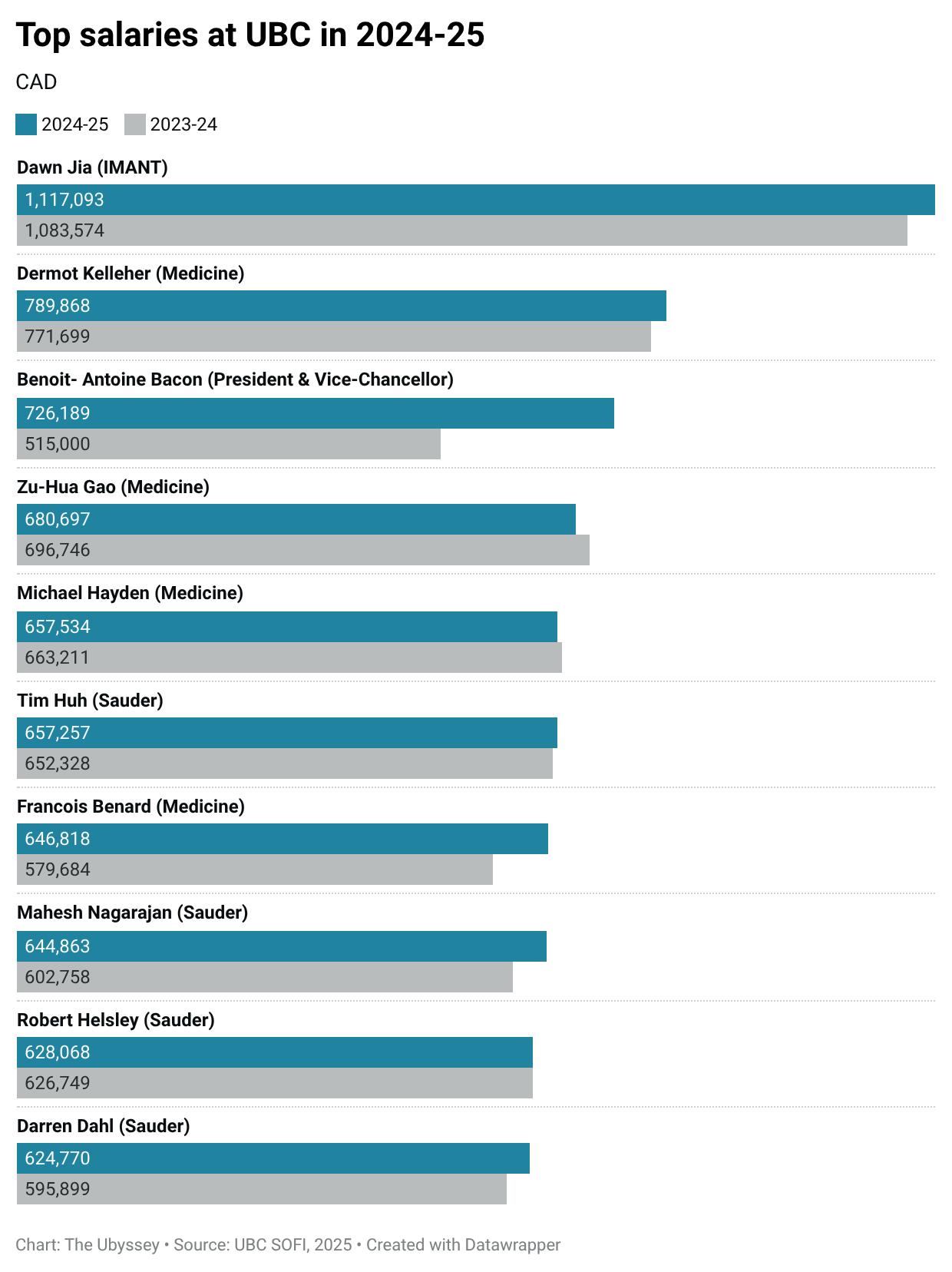
UBC’s most recent financial report, the 2025 Statement of Financial Information, reveals that the university’s top ten earners received a median salary well over $650,000.
The latest financial statement outlines UBC’s financial position from Apr. 1, 2024 to Mar. 31, 2025, with a notable $2-billion allocated to employee compensation. This marks around a 2 per cent increase from the $1.96-billion reported in the previous fiscal year’s statement of financial information.
In accordance with the Financial Information Act, UBC is legally required to release annual financial statements, including all specific salaries above $75,000.
For the fifth time, The Ubyssey broke down the salaries of the school’s top earners, including deans by faculty, the president and vice-presidents.
Top salaries
Dawn Jia, the CEO of UBC Investment Management (IMANT), was the highest paid UBC employee with a salary of $1,117,093 — a three per cent increase compared to her salary boost the previous year, which increased by 9 per cent.
Since the 2021 fiscal year-end, she has been the highest paid employee at UBC. Appointed in 2019, Jia is responsible for the overall investment activities and monitoring of the portfolios under IMANT. The organization manages UBC’s staff pension plan and endowment.
Dr. Dermot Kelleher, dean of the faculty of medicine and vice-president of health was the second highest earner, with a $789,868 salary. In 2024-25, his salary increased by approximately 2.4 per cent, compared to 17 per cent the previous year. He has since been replaced by Dr. Sharmila Anandasabapathy in November 2025, who will take both of his roles.
UBC President and Vice-Chancellor Benoit-Antoine Bacon took the third spot, earning $726,189. This marked a 41 per cent increase from the $515,000 annualized salary agreed upon in his contract for his first year — where he earned $295,815 as he was not appointed until November 2023. Previous UBC President, Santo Ono earned $629,893 during the 2021-22 fiscal year.
The remaining seven of top ten earners were all within the medicine and business faculties, a consistent trend The Ubyssey has reported on the last two fiscal-years.
Deans’ salaries
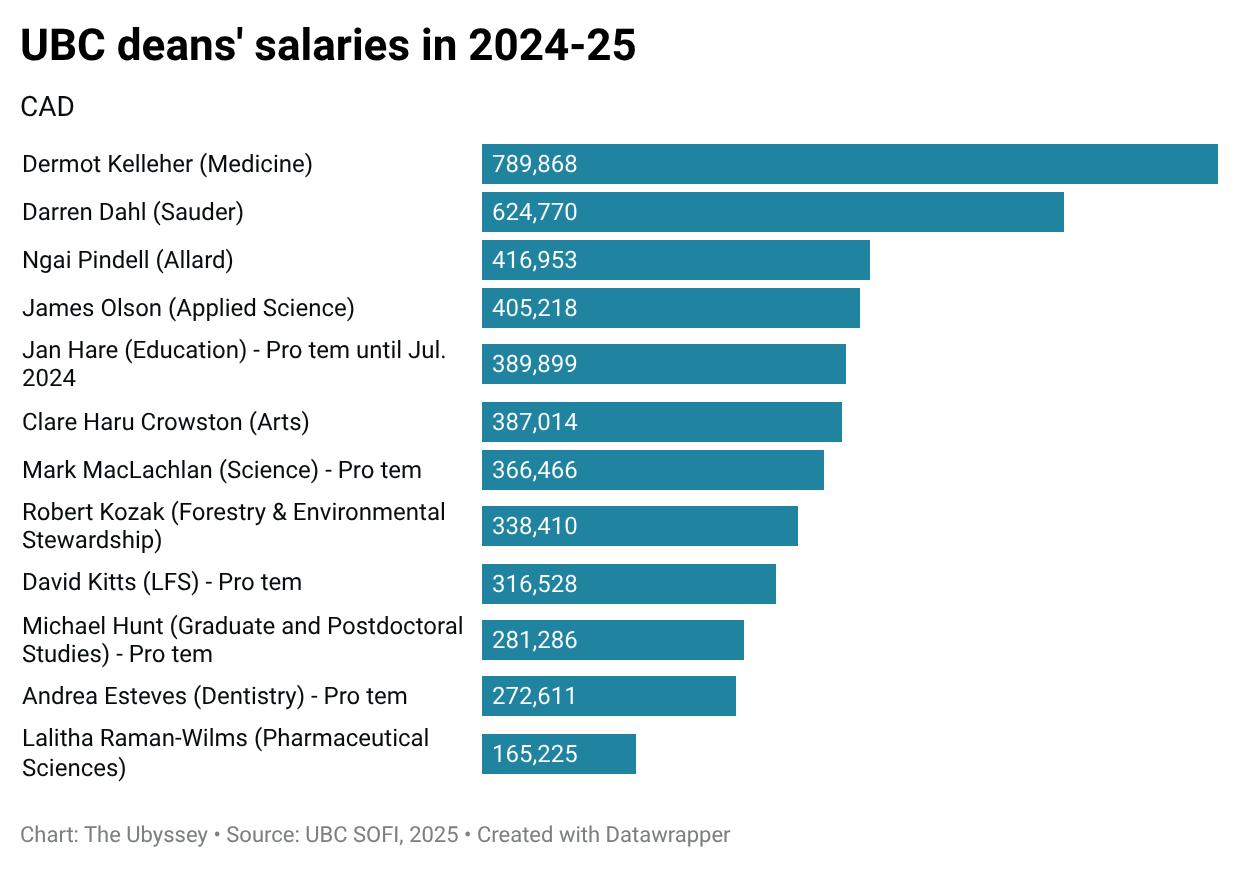
UBC has 12 deans, who are paid a median salary of $376,740, about $19,000 more than last year’s median.
The highest paid dean was Dr. Dermot Kelleher of the faculty of medicine.
The second highest paid dean was Darren Dahl of the Sauder School of Business, earning $624,770, while the third was Ngai Pindell of the Peter A. Allard School of Law.
Mark MacLachlan (Science), Michael Hunt (graduate and postdoctoral studies) and Dr. Andrea Esteves (dentistry), served as deans pro tem — otherwise known as temporary deans — throughout the complete fiscal year (Apr. 2024 - Mar. 2025), while David Kitts (land and food systems) was appointed as dean pro tem in October 2024. Hunt has since been replaced as pro tem dean by Shannon Hagerman, in June 2025.
Other deans serving pro tem have continued to serve in those roles, with the notable exception of MacLachlan, who was appointed as dean of the faculty of science in April 2025, after serving as
Some programs remove academic progress wheel amid frustration over degree tracking
Report by Jeff Lee News Reporter
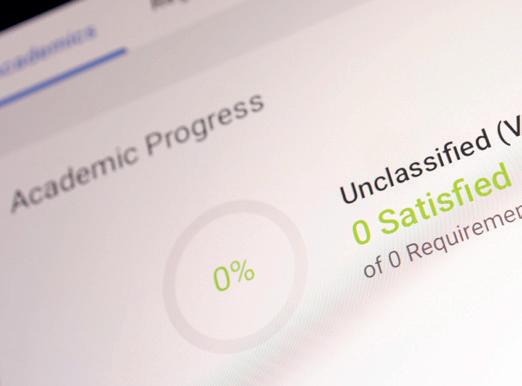
UBC has removed the academic progress wheel from the Workday Student platform for some programs that use academic progress reports (APR), such as the faculty of arts, saying the feature did “not accurately reflect the percentage of completion” for some students’ academic progress.
The wheel was a visual summary layered on top of the academic progress report, which provides a detailed breakdown of degree requirements and remains available to students.
With the recent changes, students have to rely fully on their academic progress reports to understand which requirements they still need to complete.
In an email to The Ubyssey, Rella Ng, associate vice-president for enrolment services and registrar, wrote that there was no blanket removal of the progress wheel across UBC.
“As new functionality became available — features that were not in place when Workday was first launched — academic units were given the option to assess whether the APR wheel was the most appropriate tool for their programs,” Ng wrote.
One such unit was the faculty of arts, which sent an email to arts students on Jan. 2, informing them that the inaccuracy of the progress wheel led to its removal for them in Workday. “This update is being made to help ensure that you have the most accurate information possible as you course plan toward completion of your degree,” the email read.
sponsibilities for correcting errors in Workday often fall on students, requiring them to individually contact enrolment services to update their academic records.
She said this process creates additional work for staff while placing an unfair burden on students. They have to monitor the system for inaccuracies and advocate for corrections on a caseby-case basis, a situation she said should not have occurred during the rollout of a university-wide system.
The current challenges with the academic progress wheel is the latest in a series of Workday-related issues flagged by students since its rollout in May 2024.
At an AMS Council meeting last July, Nawar highlighted widespread dissatisfaction with the Workday Student system during a presentation on the student union’s Workday Student Survey Report.
According to the report, which was undertaken in collaboration with undergraduate societies in 2024, 85 per cent of surveyed students reported finding Workday difficult to use, underscoring usability concerns with the registration platform.
The survey also showed a significant drop in students’ confidence in degree tracking tools. While 78 per cent had previously found tools like UBC’s old student portal, the Student Service Centre’s Degree Navigator, or Workday’s Academic Progress page useful, only 24 per cent felt the new Workday version met their needs.
dean pro tem since January 2024. His salary reflects his pro tem salary, as he was appointed after the 2024 fiscal year-end.
Jan Hare (Education) was appointed as dean during the fiscal year, in July 2024, after serving as dean pro tem since 2021, and Lalitha Raman-Wilms (pharmaceutical sciences) was appointed as dean in October 2024.
UBC President and Vice-President Salaries
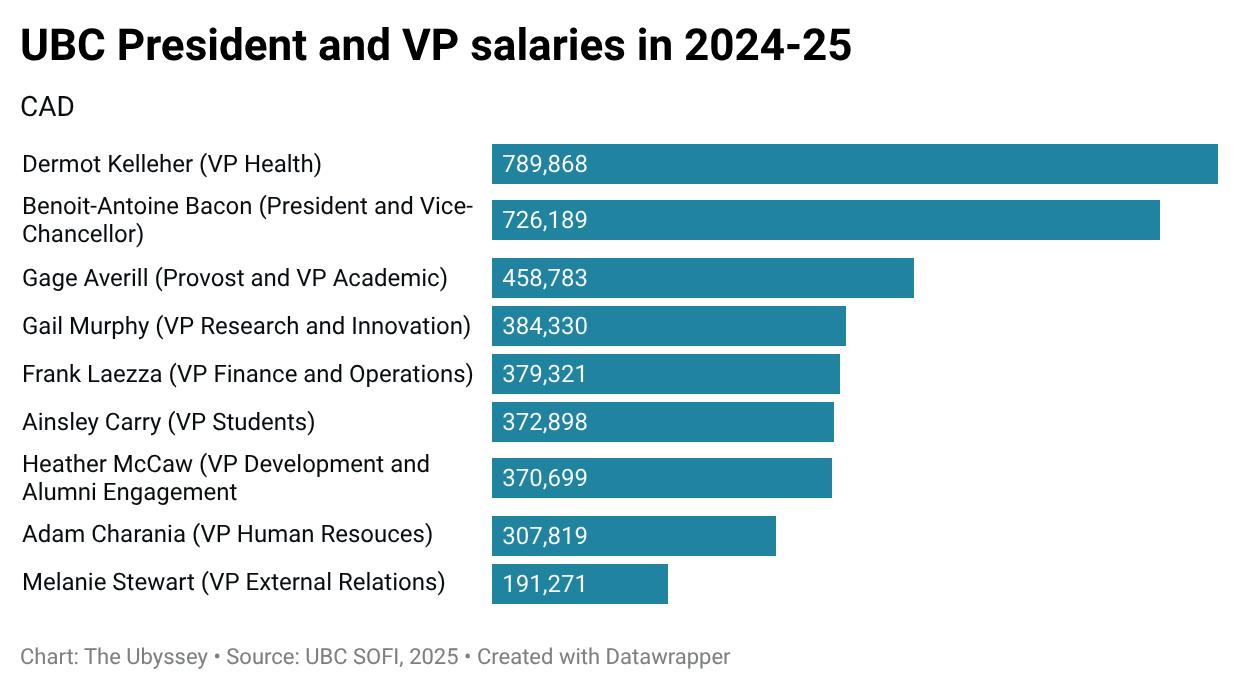
The median salary of UBC’s president and nine vice-presidents that compose the core of the president’s executive team is over $375,000. The highest paid individuals within UBC’s presidential office were Dr. Dermot Kelleher, Benoit-Antoine Bacon and Gage Averill (Provost and VP Academic), who took home a salary of $458,783.
Melanie Stewart (VP external relations) replaced Robin Ciceri in September 2024, while Adam Charania (VP human resources) was appointed to the position in December 2024, after serving as interim VP since April 2024. U
“Decisions were made at the academic unit level based on program structure, advising practices, and how students track academic progress … programs that continue to use it will see the wheel functioning as intended,” Ng added.
Ng also mentioned that academic units that chose to discontinue the progress wheel were asked to consider the potential impact on students and to clearly communicate any changes, adding that students with questions about how their academic progress is displayed are encouraged to contact their academic unit.
AMS Vice-President Academic and University Affairs Zarifa Nawar said that inaccuracies in the underlying academic progress reports — which the wheel drew from — were a major source of anxiety for students.
“When I first looked at it, it said I was done zero per cent of my degree — and I’ve been here since 2020. That was a scary moment, and I can imagine a lot of students had those scary moments,” said Nawar.
Nawar said the re-
The report also found that only “17 per cent of respondents knew who to contact about issues with Workday,” suggesting confusion around support and troubleshooting pathways.
Meanwhile, 94 per cent of students said they preferred the previous student information system, signaling a strong lean back toward the legacy interface over the new platform.
Nawar noted during her presentation that students felt they were not adequately informed about the transition and changes to Workday, adding to frustration with the rollout process.
The report’s findings included calls for improvements to navigation features, with students identifying dropdown menus, pop-up timetables, and a termby-term calendar view as critical functionality lacking in the current system.
As challenges with Workday persist, Nawar recognized the importance of student consultation and ongoing dialogue with the university.
“There are students here who can offer their perspective … you can leverage that understanding [and work] in earnest to improve Workday,” Nawar said. U
UBC spent over $2 billion on employee compensation during the 2024-25 fiscal year, around 2 per cent higher than the year before.”. | ABBIE LEE / THE UBYSSEY
ARTS & CULTURE
Nosh Hunt:
Searching for brisket in Vancouver pushed me to the brink. One restaurant brought me back.
Review by Jack Paransky Arts Contributer
As continued from page 1
But the brisket was good. Better than good. Now it outlines my memories of watching movies with friends. The smoky flavour was under my tongue as I experienced the first bits of independence from familial expectations. Brisket was a form of rebellion.
I’ve felt homesickness for the food that moulded me since I’ve moved to Vancouver — a yearning that sounded like cicadas and felt like the humidity of the South. I didn’t know if it was a longing for the feeling of home or the food. But I set out to find Texas in Vancouver: a brisket in the great white north that I could go to when I missed people with accents like dripping molasses.
To me, all barbecue places are trying to be the primordial brisket joint. The best brisket on earth is probably 15 hours away from civilization in a converted air hangar.
There’s a line out the door, and they start selling brisket at 11 a.m. to patrons who have been waiting since dawn. It’s set up like a middle school lunch line: sliding metal trays and food you order by the pound. You sit down at wooden tables and taste the food the pitmaster has been making for 30 years. You’re there not for the purposeful aesthetic or cultivated liquor collection, but to eat meat that has been cooked for longer than a cubicle workday.
The closer any barbecue place is to this primeval ideal, the better I thought it would be. When I set out on this journey, I wanted to find something at least trying to be the ideal. No gimmicks, no homage to the States: just good food. People in my life told me not to be optimistic, and I was inclined to believe them. With my expectations for restaurants in the dirt, Zoe (the photographer for this piece) and I set out on what I told my friends was Brisket Week 2025.
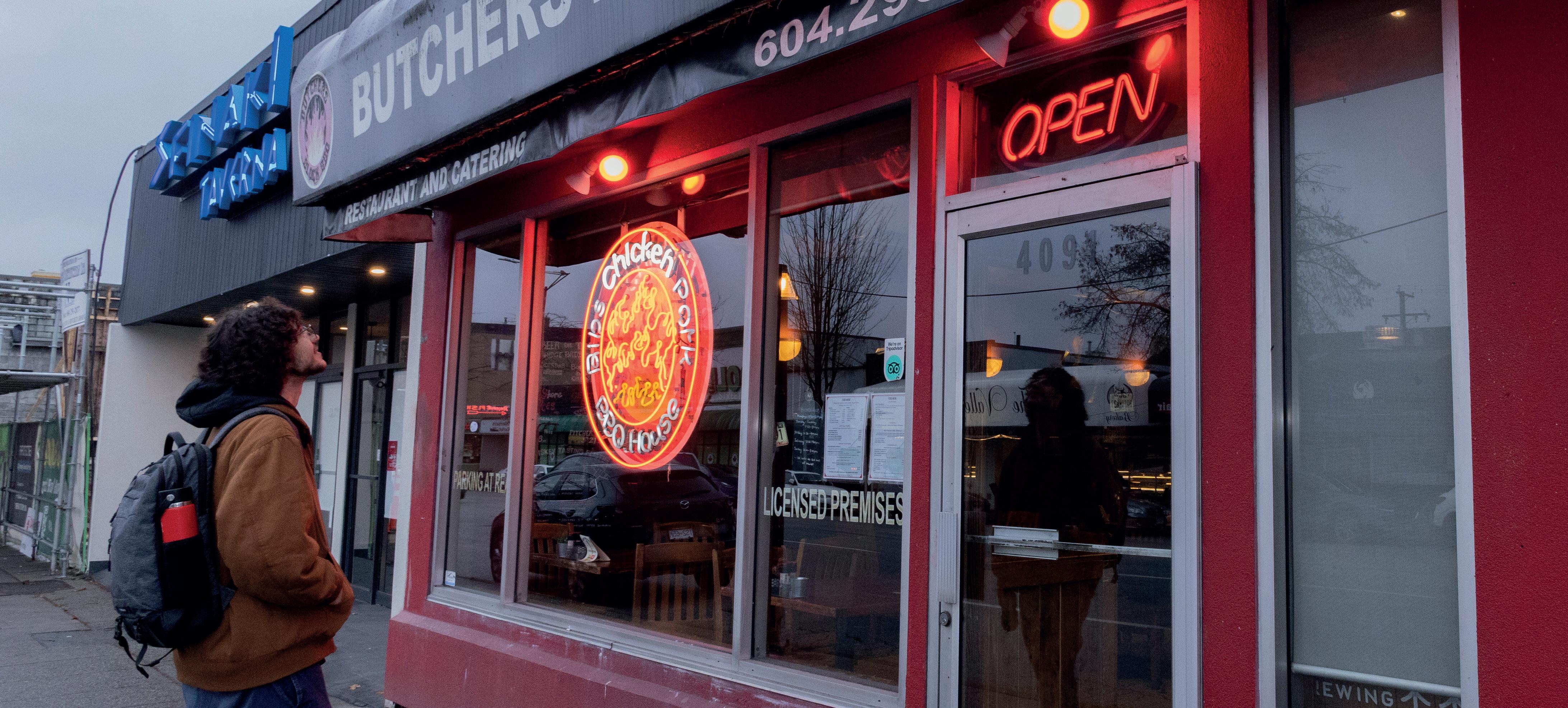
Butchers Block BBQ Plain wooden tables, one grill station in the back, music-themed statues and licence plates lining the walls.
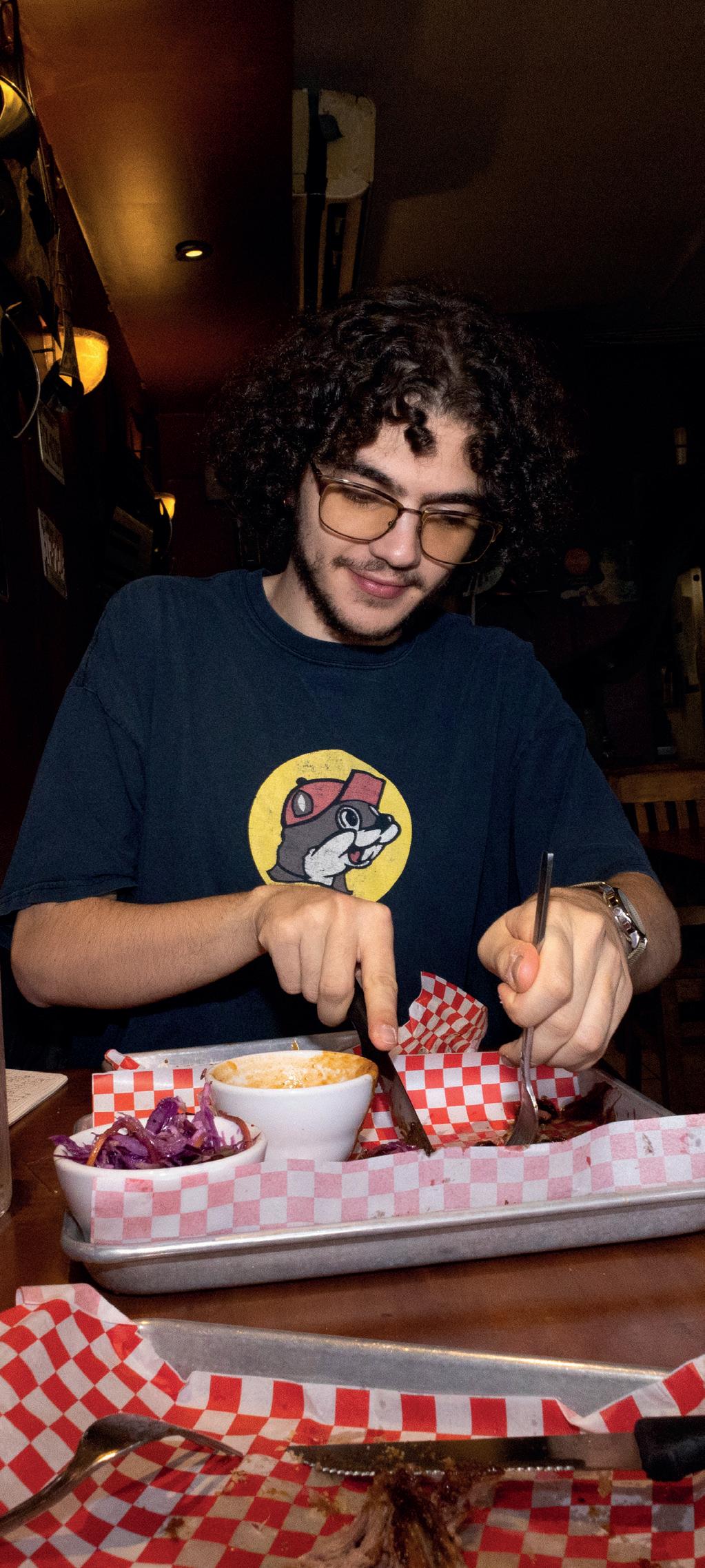
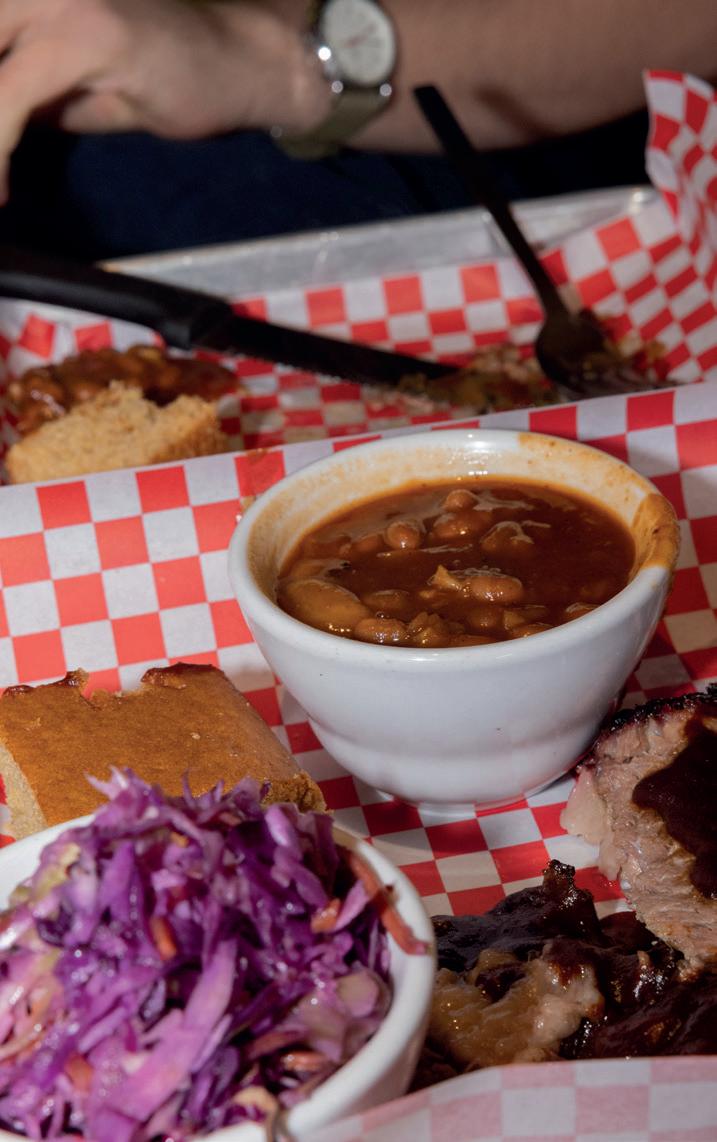
We first went to Burnaby Heights, taking the 14 to its terminal stop, to go to Butchers Block BBQ. The restaurant had plain wooden tables, one grill station in the back, with music-themed statues and licence plates lining the walls. They were cute to see, honestly — plates from a couple of southern states, one from the Midwest and Alberta sticking out like a maple syrup-covered sore thumb. First, the sides. The cornbread was really dense and somehow chewy-crumbly at the same time. Zoe, who is a baker, seemed to be
holding back insults in front of the people who just made our food. The coleslaw was nothing: vegetables with sauce on it. The beans were slightly cold when we got them, but I ended up picking at them for our time there.
The brisket was good in some parts, lacking in others. The bark, the tougher and darker “skin” of the brisket that forms due to the Maillard reaction, was fantastic. There were parts of the brisket where the sauce and the fat coalesced into a harmony, where I found exactly what I was looking for. The barbecue sauce was interestingly acidic, like it was made with berries. Hope for home filled my heart as beef did my stomach.
But the longer I chewed, the tougher it got. It became dry, immo-
bile. A brisket should not stand on its juiciest parts, and a great brisket doesn’t even need sauce. This brisket needed it like a fish needs water. It was gasping for sauce, suffocating without it. Though I may hyperbolize, Butcher’s Block was fine. Nothing special in my mind — a fine reference to American cooking. But it wasn’t the real thing. In Texas, it would flounder as much as their brisket did without sauce. I tried not to nitpick each and every part of the food: I am not an expert in brisket and thus I am able to enjoy things. But when I was eating it, I didn’t feel good. I didn’t hear the rhythmic rattle of the highway or the susurration of bugs on a hot evening. I started to worry that I would never find home while living in the Lower Mainland.
A brisket should not stand on its juiciest parts, and a great brisket doesn’t even need sauce. This brisket needed it like a fish needs water. | ZOE WAGNER / THE UBYSSEY
ARTS & CULTURE
Memphis Blues BBQ
One corridor of tables surrounded by photos of some of the most classic blues and rock musicians from the south.
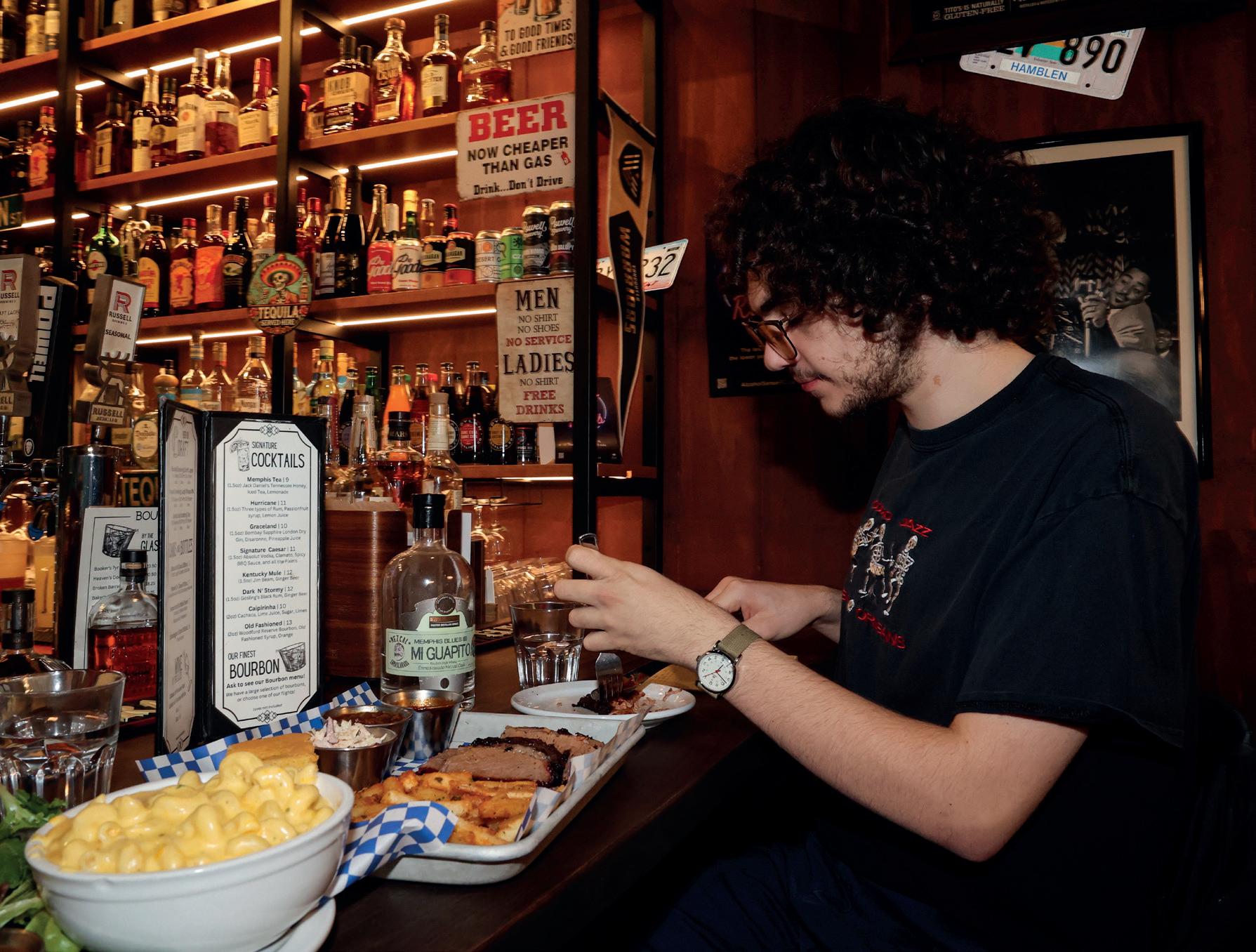
These fears grew downtown at Memphis Blues BBQ three days later. The quality of the food should be put into context with its location: sandwiched between a Body Energy Club and a Dairy Queen. Anything stuck in that sort of brand purgatory in Vancouver is going to have its soul extracted like how a vampire bat takes blood from a goat.
The restaurant was small — one corridor of tables surrounded by photos of some of the most classic blues and rock musicians from the south. Black and white images of John Lee Hooker, Lead Belly, James Brown, Big Ella and B.B. King looked down like saints looking upon a Catholic mass. Someone did their research.
That’s the problem, though — someone did their research: either googling or word of mouth. It’s corporate appreciation.
Medium shelf liquor was stacked up to the ceiling, like a great stained glass centrepiece. A lot of the decoration actually had to do with booze: signs about needing whisky, one telling women without tops that they’ll drink for free — we were even served water in an old
whisky bottle. The TVs blasted an infinite tar pool of sterile ads, with some hockey breaks in the middle.
Southern licence plates were haphazardly thrown onto the walls under paintings and leaned against the wall instead of hung up. I realized then that they were borrowed authority, using a mundane part of American life to portray knowledge or respect for the food they were serving. My despondency grew.
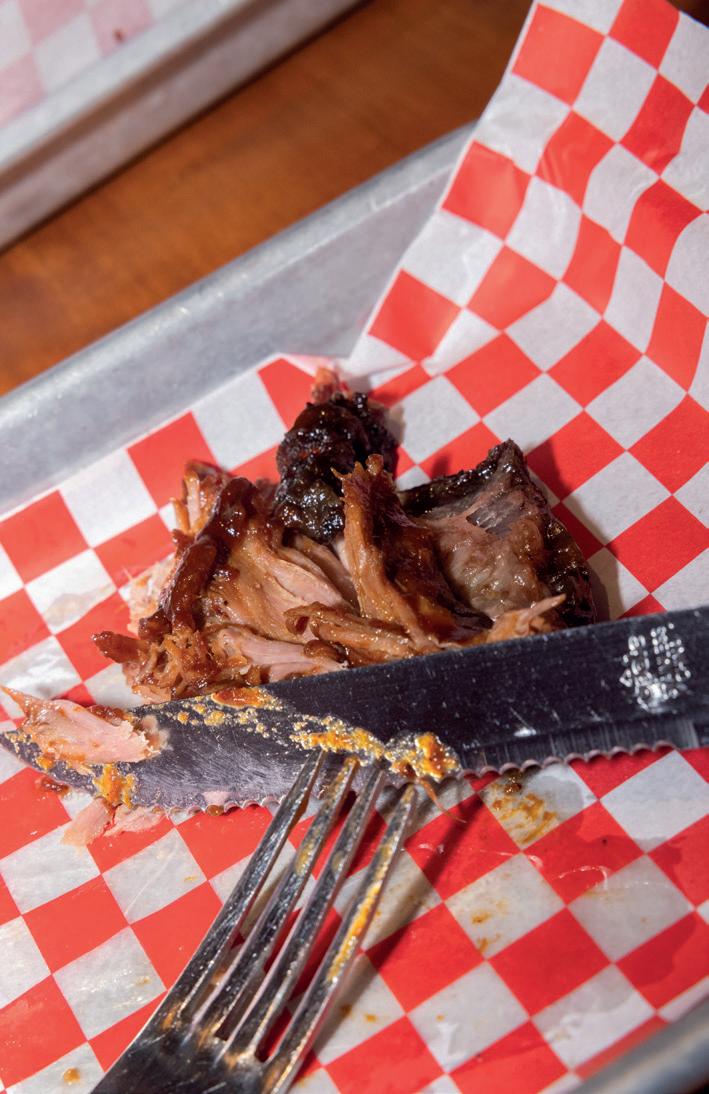
The food itself was as corporate as the bar I was in. We ordered the brisket meal. There was no mention of the amount of brisket on the menu — we were given a couple of pieces of dry meat. The only consolation was the barbecue sauce, which tasted so standard I swear I have a bottle of it back home.
The longer I chewed, the sadder I got. I tried to distract myself with the sides, but they were all bland. The mac and cheese, though incredibly creamy, tasted like nothing while chewing it. The coleslaw this time was actually just vegetables. The cornbread was thin, a fine taste but it was like someone had put a weight on it while it cooked — Zoe grimaced. She called it “texturally challenging” and let me have the rest. The beans tasted like a beef stew with too much brandy and tomato paste. Let me tell you, that’s a feat on its own.
The most seasoned thing on the
Slim’s BBQ Halfway between dive bar and car shop, stained glass lamps hung with Christmas lights around them, giving the whole place an almost incandescent glow.
Slims BBQ, sitting on a corner in Mount Pleasant, is what I was looking for. It was exactly what I was looking for. I’ve used a lot of flowery language in this article, but I have to say this plainly: this place fucks.
plate was the fries. I actually still dream about these fries. They were the right amount of salty with addictive spices. If I had gone there to just eat fries, I would have left a happy customer. But I didn’t. And I was not. I became disconsolate the more I thought about it. The food that I loved, the testament to the skill of the chef and the devotion they feel toward the form, was being commodified — served up on a tray to reflect a place that no one working here might have even seen. It was a game of telephone, where the word at the beginning of the line was brisket.
The taste of dry brisket and stock sauce left a bitter taste in my mouth for the week between Memphis Blues and our final stop. A chain had stereotyped an art form, which I know they are known to do. It was sad. I was sad.
That week, I thought about this piece. I thought about this piece a lot. The whole point of this was to be trying to find home in an unfamiliar place. The thesis I kept coming back to was “if you are somewhere, don’t try to recreate the feeling of home. You are where you are — try to enjoy that.” It was the authorial white flag held up at the bombardment of the French barricades.
Then I got to hear the cicadas again.
I’ve been to this place before. Houston has dozens of places like this — halfway between dive bar and car shop. Stained glass lamps hung with Christmas lights around them, giving the whole place an almost incandescent glow. One wall was dedicated to “the shooting priest of Texas,” with photos of a senile priest toting a pistol and pinching a cigar between his teeth. A birthday balloon hung in the air, half deflated from a party that I am sure was long past celebrated. On one end of the restaurant, for some reason, there was a hyperrealistic painting of an owl. This place was lived in and had as much character as one of your dad’s old friends before he sold his pickup truck. No goddamn license plates were in sight.
They only sell brisket on Saturdays, from 5 p.m. until close, so I was beaming when their once-aweek delight was handed to us with cornbread and mac and cheese.
I should mention the sides first. The cornbread was perfect — Zoe laughed as she told me it was up to her standards before gobbling up the rest of her piece. The mac and cheese had a little kick and was seasoned. The riblets we also ordered were as smoky as the outside of a Green Auto show.
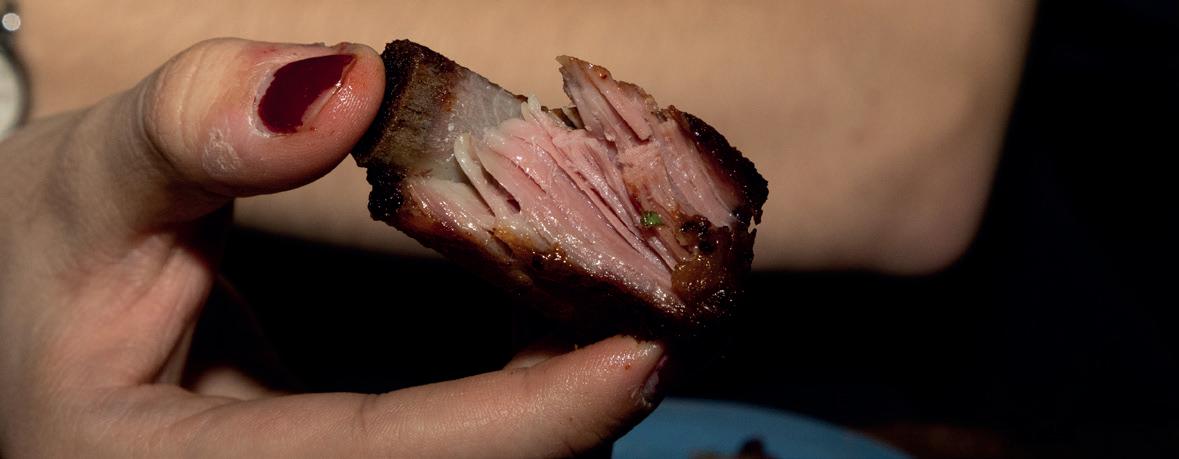
Even though the brisket had no sauce, it was so juicy it left a buttery sheen on the paper it was served on. It reminded me that I don’t eat barbecue to live longer. It was smoky, tender; it melted in my mouth like
gold in a kiln. It had seasoning, no thick bark, but I didn’t even care. Zoe, who for most of her life didn’t eat meat, stared at the ceiling like she was having a divine revelation before saying, “Meat should all be like this.” We finished the food in front of us like buzzards after a famine. We left nothing.
This place didn’t do their homework, didn’t pay homage to places I loved and called home. They were home. Bits of accidental Texas surrounded me as I feasted. Metal stars lined the exterior of the kitchen, just like they did countless lawns and door frames back down south. There were bats on the walls, apparently an old Halloween decoration, that took me back to the Congress Avenue bridge in Austin, Texas, seeing hundreds of bats ascend and blot out the setting sun.
I asked our waiter if anyone was from Texas and he laughed. He told me he was from Penticton, BC. The owner lived in San Francisco for a bit, but is from Vancouver. The kitchen was half, if not all, from Latin America. He said that they were “a bunch of Vancouver kids hanging out.”
My journey last month was not trying to find the place that made me feel like home. I know I’m not going to get Texas here. What I was looking for wasn’t someplace that tried to be the South or the Wild West, but somewhere that cared. I wanted to find someplace where they loved the art of everything as much as I did. I wanted to find a place that saw a piece of animal and 16 hours the same way a sculptor sees a slab of rock and a chisel. Find the people that give heart to the same things you do. I see that more as a home than any name on a map. Because this is still a Nosh Hunt, I would recommend Slims BBQ in Mount Pleasant for
If
the best brisket I’ve had in Canada.
you’re in the area on a Saturday night, stop by — you might hear the cicadas by the end of the meal. U
There was no mention of the amount of brisket on the menu — we were given a couple pieces of dry meat. | ZOE WAGNER / THE UBYSSEY
Even though the brisket had no sauce, it was so juicy it left a buttery sheen on the paper it was served on. | ZOE WAGNER / THE UBYSSEY
Review by Zoé Stojanovic Arts & Culture Reporter
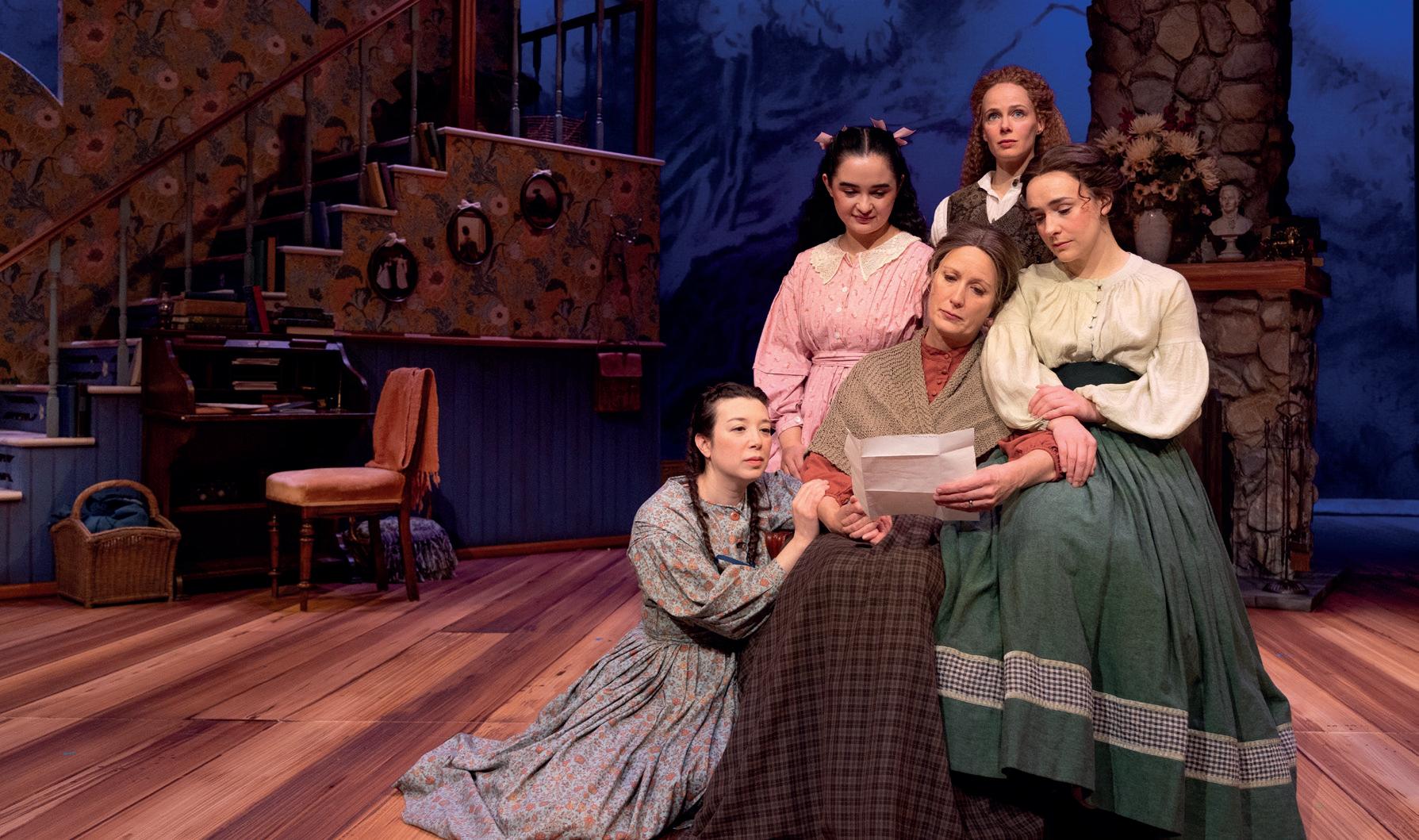
A stage adaptation of the classic American novel, the aptly named Louisa May Alcott’s Little Women, made its Vancouver — and Canadian debut — with a production by the Arts Club Theatre Company, and it might just be the best adaptation of the source material yet.
As an avid fan of the original book, Little Women accompanied many of my primary school recesses. I went into the play with high expectations and an attachment to the source material — I read both of its sequels, adored the 1994 and 2019 movies and thoroughly wore out my headphones listening to the soundtrack of the 2005 Broadway musical.
The first three words of the title — which distinguish the play’s title from the novel’s — were put into context when actor Kate Besworth identifies herself as both the author, Alcott, and the novel’s protagonist, Jo March. As they transitioned from Alcott’s to Jo’s world, each character managed to remain dynamic, creating a playful relationship with the audience as they broke the fourth wall and introduced their roles.
UBC MFA directing alum Barbara Tomasic’s direction took full advantage of an otherwise exposition-heavy first scene to showcase the cast’s vibrant chemistry while introducing relevant book details.
The entrance scene was the first of many striking portraits and particularly well-crafted moments that stuck with me throughout the play. The scene ended heartwarmingly, with the March women huddled over a chair, perfectly recreating the book cover of my own childhood copy of the novel.
The set design by Jennifer Stewart conveyed the comfort and coziness of the March home while naturally leaving additional space for the play’s many secondary settings. The central use of a large staircase in particular allowed for more fluid movement across locations in the
ARTS & CULTURE
Louisa May Alcott’s Little Women blurs the line between author, stage and character
second act while adeptly translating certain difficult scenes onto the stage. For instance, the scene where Jo and Laurie rescue Amy from a lake inventively had the characters rush down from the top of the stairs and use them to reach out and save her, capturing the physical urgency of the scene in the restricted setting of a theatre.
The lighting direction by Jillian White also contributed to the creation of these spaces and the emphasis of more emotional moments in the scripts. Noteworthy examples included Laurie’s silent first
introduction as he overlooks the family from the stairs and the spotlighting on Beth during her scenes at the piano.
Alongside establishing the cast and its interwoven personal dynamics, the play also had to tackle the task of believably building four intimate romantic relationships over the course of its two acts. In particular, Nick Fontaine’s dual role as John Brooke and Dr. Bhaer in the first and second acts, respectively, limited the time that could be dedicated to each character’s romantic arc.
Despite these limitations, each relationship was developed well and served its purpose satisfyingly in terms of each sister’s arc. Meg’s plotline in the second act, for example, still felt substantial despite the absence of Brooke. Similarly the absence of an actor for Mr. Lawrence — a key player in Beth’s arc — was handled well and did not impede the overarching story, a testament to both the pacing of the production and the cast’s chemistry.
The production’s portrayal of Laurie and Jo’s relationship, a subject of frequent contestation and re-
interpretation in adaptations, was nuanced, profound and ultimately beautiful, ending in a very satisfying way. The confession scene between Laurie and Jo was a highlight, coming with well-placed momentum in the second act. While Besworth’s Jo was everything you could wish for from an overflowing and conflicted young woman, Conor Wylie’s performance as Laurie, sometimes wordless, was what made the scene beautifully devastating.
Kaitlyn Yott’s playful — at times laugh out loud funny — portrayal of Amy managed to be believable and consistent despite the challenge of the character’s aging throughout the show. Elizabeth Barrett’s Meg was colourful and nuanced, a believable counterpart to both Amy and Jo’s personalities. Ming Hudsons’s Beth, though characteristically subtle compared to the other sisters, perfectly captured the evolving degradation of the character’s health.
While each actor delivered a strong individual performance rooted in what translated to the audience as a deep understanding of their characters, the most striking moments were their group interactions. The believable hubbub perfectly captured the chaos of the March family, and the cast’s communal moments of simultaneous talking were particularly well-timed and executed.
The gravitas of Ming Hudson’s Beth shone through particularly during the character’s death scene. However, while Hudson’s performance might have drawn the first tears, Barrett’s silent, heartbreaking reaction as Meg is what opened the floodgates in my case — another brilliant instance of the cast’s powerful acting without lines.
More than anything, the production captured the source material’s heart and care. The play’s ability to tug at the heart strings meant that, by its conclusion, even the audience felt saddened to leave these characters and to learn of their ‘real-life’ fates through Alcott’s family history. U
Where there’s smoke, there’s fire. The Belkin’s new exhibition has both
Review by Julian Coyle Forst Arts & Culture Editor
Though the smoky skies now synonymous with BC summers may seem distant at the start of a new year, the intensifying threat of wildfires across the province is never truly out of mind. In its first exhibition of 2026, the Morris and Helen Belkin Art Gallery puts these threats to canvas, code and film with The Structure of Smoke. Open Jan. 9 through April 12, the exhibition features work exploring the physical and conceptual dimensions of smoke and fire through a variety of forms and media.
These works range from starkly impressionistic to highly interpretive. On one end, Evan Lee’s Forest Fires series is deceptive with the extent of its direct representation of BC’s wildfires. Though expressive brushstrokes may lead viewers to mistake the two pieces for paintings, they might be more accurately described as physically altered photographs.
In a talk at the exhibition’s opening reception on Jan. 8, Lee explained that he made the pieces by printing aerial photos from the BC Forest Service archive on the back of Kodak photography paper. He then used a brush to manipulate the still-wet ink that pooled on the absorbent paper. The result is something in between, Lee said, “a painting or photograph, or both, or neither” — hyper-realistic in composition, but abstract in detail and slightly surreal. Heavy-edged blots of orange ink make up the centre of roaring blazes and, in the un-inked white of the smoke plumes, the Kodak watermark is visible.
Lee said the process was experimental and sometimes accidental, a product of the uncharted early days of digital photography. Remembering it makes him nostalgic now, “about a time when [he] wasn’t made anxious about fires every summer … a time when photography frustrated [him], but in a good way.”
Other interpretations featured in The Structure of Smoke are more conceptual. Samuel Roy-Bois’s Balloons, a set of three wooden framework sculptures, each balanced on a bucket or a jar, might evoke the temporary and precarious volume of fire, but the thematic link is tenuous beyond that.
Two pieces from Musqueam artist Susan Point, Wildfire and Rising Waters, point out the interconnectedness of fire and water. Both works are silkscreen prints produced from identical stencils. They depict patterns of large, birdlike heads rising like waves or flames. The colouring — reds and yellows in Wildfire and blues in Rising Waters — recontextualizes the pattern in each piece and highlights the details of the patterns.
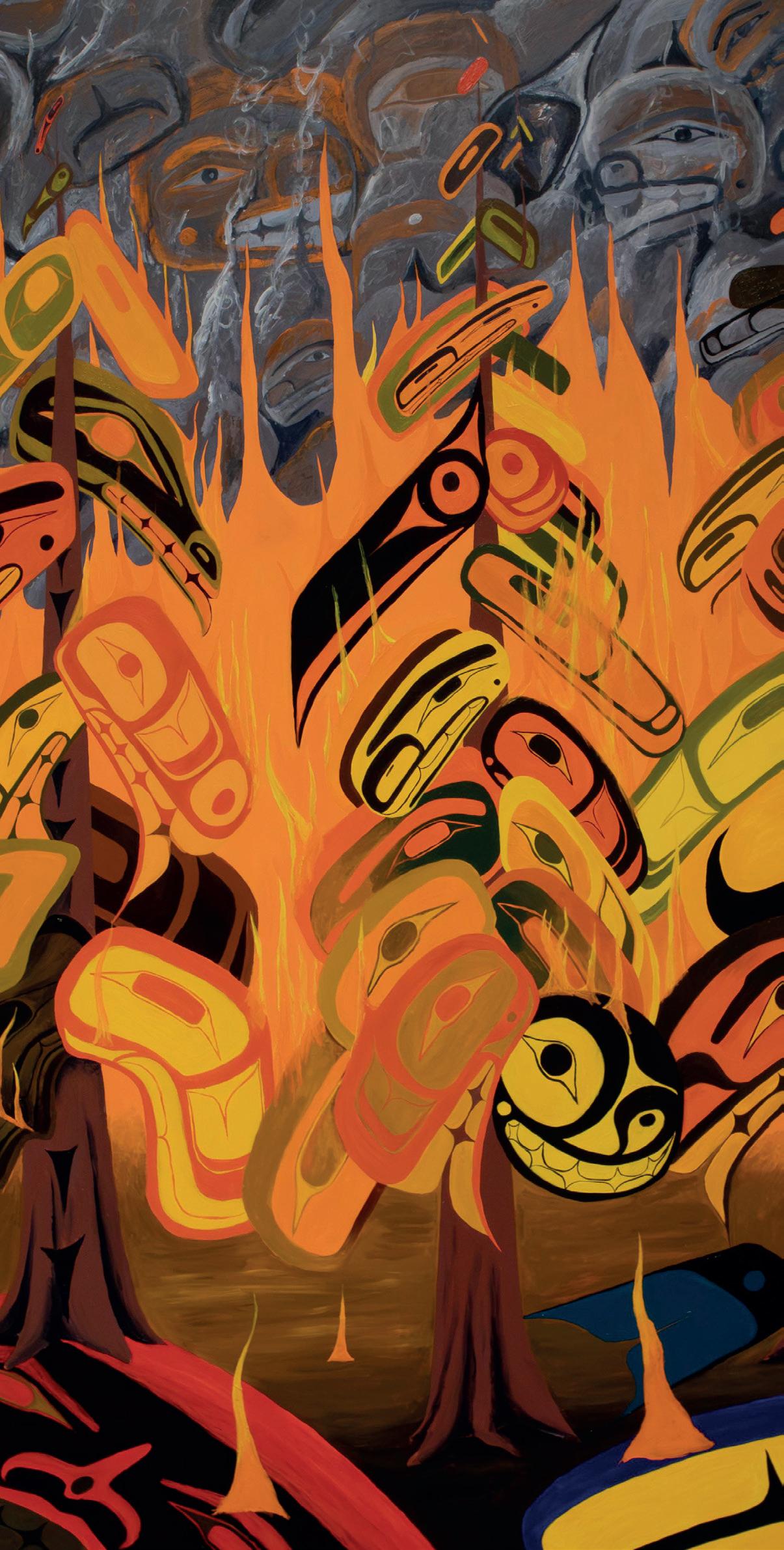
Lawrence Paul Yuxweluptun’s New Fire Landscape is an iteration on several of the artist’s previous works — Fire Landscape, Native Land Fire Landscape — and, like Point’s Wildfire, sees spirits in the natural forces of the blaze. This time, patterns of birds, bears and blackfish overlap in the smoke above a burning forest, whose trees are also made up of animal designs.
In a post discussing New Fire Landscape on the Faculty of Forestry website, Yuxweluptun critiques the “utopian capitalist wilderness” of early Canadian naturalist painters, specifically the Group of Seven. It’s easy to see the critical inspiration in New Fire Landscape, particularly in the broad planes, distinct figures and flat textures of Lawren Harris. But where the Group of Seven turned blind eyes to the repercussions of colonial exploitation, depicting the land as empty and pristine, Yuxweluptun fills the frame with faces and fire.
Other works included Brian Jungen’s Triangle Repeater and Heraa Khan’s Havoc, Loss of Land and Okanagan. Jungen’s piece is a blue plastic 20-litre water canister carved with a repeating Métis triangular pattern which perforates the material. Khan contributes three
richly-detailed miniature paintings depicting burning hills, branches and villages. The miniatures, surrounded by fields of coloured vasli paper, transpose the distinctive style of Persian miniature onto the Canadian context, complete with pine trees and flaming A-frame roofs.
Passing by the Belkin in the next few months, you might notice small puffs of smoke rising from the roof. No, the gallery hasn’t installed a coal-burning boiler. This is the outward-facing side of Germaine Koh’s Prayers, probably the most technically elaborate piece in The Structure of Smoke. It explores smoke as a medium for communication rather than a natural force. A smoke machine mounted on the roof connects to a computer inside the gallery. Viewers can type into an interface, and the characters are translated into Morse code, sent to the smoke machine and emitted, slow and steady, as dots and dashes — short and long puffs of smoke.
At the exhibition opening, Koh said she was intrigued by the external, “indexical” — meaning, basically, contextual — signs of work being done inside buildings: lights seen through windows, chimneys and exhaust ports breathing smoke or steam. These signs are traditionally byproducts, not end goals, but Prayers makes the relationship intentional — the gallery’s front desk computer is also hooked up to the machine, so the link between the work going on inside Belkin and the smoke signals is a direct one. Prayers also points to the link between modern digital communications technology and the physical mediums of the past. Digital computing and smoke signals, after all, are both based on binary code. Recipients of the newsletters being drafted on the Belkin’s terminals can now just as well receive their updates by sitting on the benches across Main Mall with a morse code guide and a notebook — though they may want to set aside a couple hours. U
The scene ended heartwarmingly, with the March women huddled over a chair,
Lawrence Paul Yuxweluptun’s New Fire Landscape is an iteration on several of the artist’s previous works.
| RAUL DELROSARIO / THE UBYSSEY
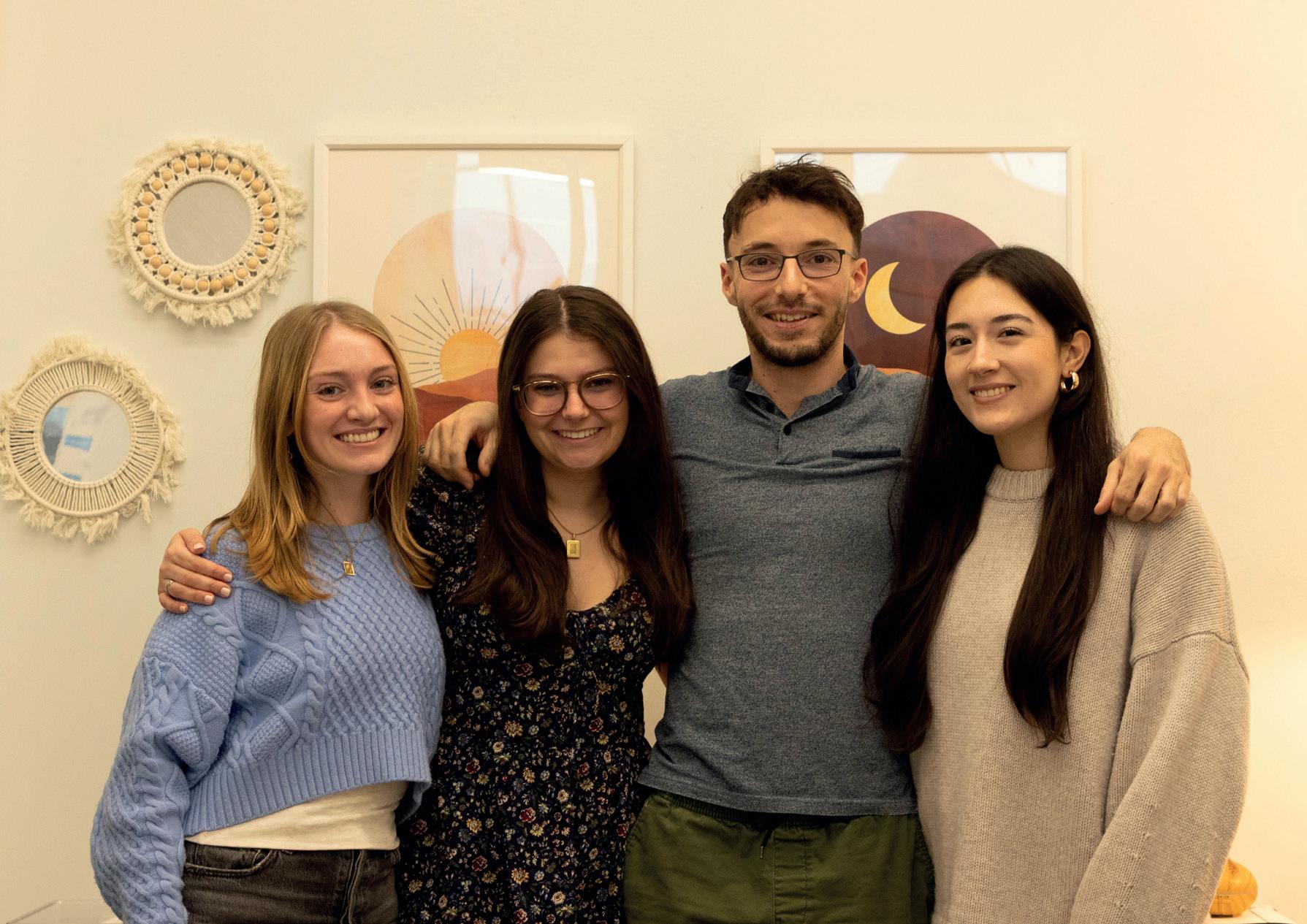
Meet the volunteers behind AMS Peer Support
During the 2024-25 academic year, 38 student volunteers collectively poured 3,600 hours into running AMS Peer Support, a service dedicated to helping UBC students dealing with academic stress, substance use and other issues impacting mental well-being.
Profile by Alexis Jacobson Contributer
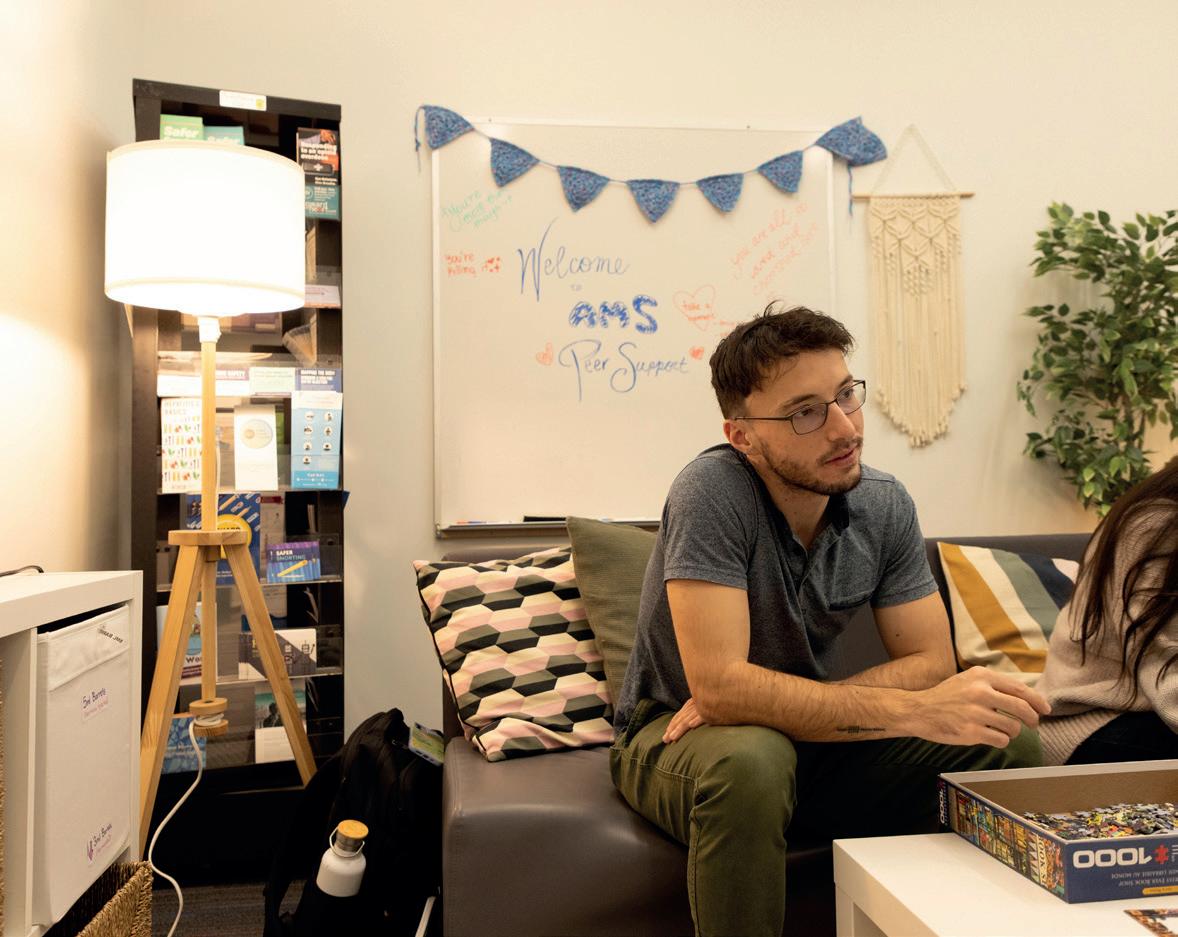
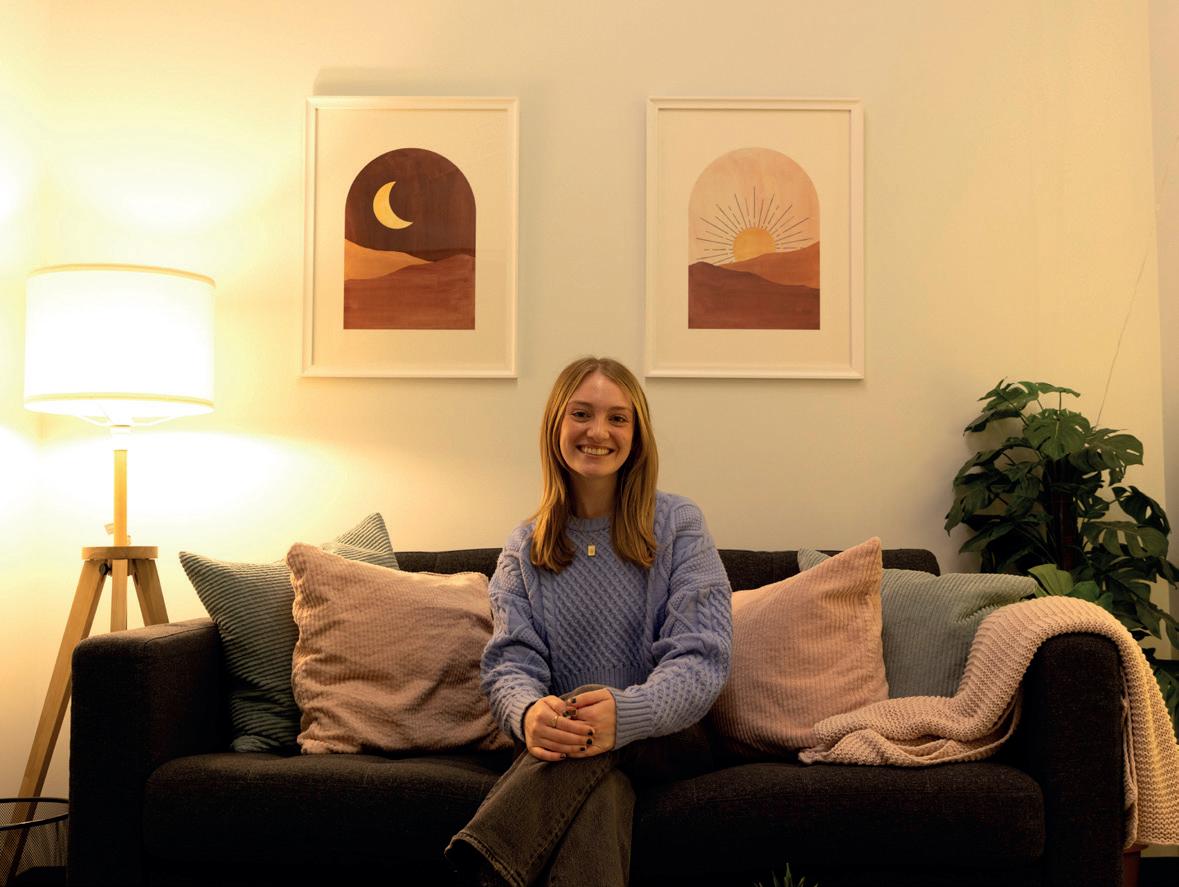
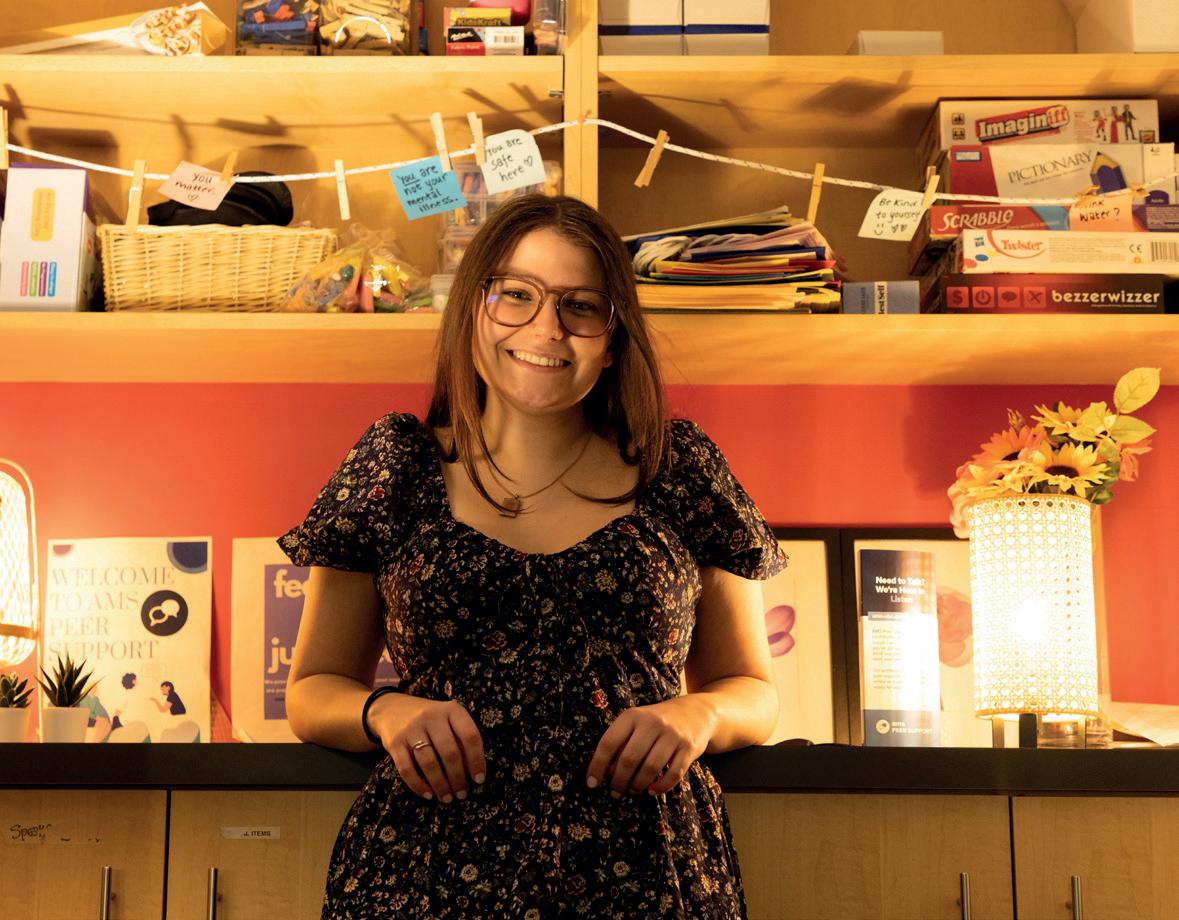
Soft, yellow light blankets the walls of the AMS Peer Support Hub in the Nest. Every nook and cranny of the room is adorned with macrame mirrors, potted plants, meditative posters and motivational notes. As a kettle breathes out clouds of steam into the air, four students sit across from each other at a table strewn with puzzle pieces and board game chips. These are just a few of Peer
understanding of the student experience and are more than willing to lend a listening ear if someone needs to get things off their chest.
“We’re not here to pull you out of an issue, we’re here to sit with you in that emotion, and collaboratively explore the situation and empower you to feel capable of navigating the stressors in your life,” wrote Marissa Miller, a team lead. She handles the educational aspects of Peer Support, which mainly consists of managing a
Support’s volunteers, who work to help UBC students dealing with academic stress, substance use and other issues impacting mental well-being.
AMS Peer Support began serving students in the fall of 2020 as a merger between Speakeasy — an initiative started in 1970 focused on supporting UBC students — and Vice, which provided confidential services centred on
team of volunteers, running workshops and distributing supplies for safer substance use.
Miller is currently working towards a degree in psychology, which began when her love for theatre collided with mental health awareness efforts. At 14, Miller landed a role in the short film “Lifelines,” directed by Catharine Parke, who, through cinema, sought to raise awareness
addiction and substance use. The collaboration intends to fill gaps left by other counselling services, blending support and education outreach for a multifaceted program that addresses an array of student concerns.
During the 2024-25 academic year, 38 student volunteers collectively poured 3,600 hours into running the service. Unlike typical counselling sessions, people who attend Peer Support get the chance to chat with a fellow student. Though volunteers may not be able to provide professional guidance, they have an intimate
the path toward working in fields related to mental health doesn’t always start with an explicit interest in doing so. This also happens to be the case for Peer Support Coordinator Alex Girardi, who oversees all volunteers.
Girardi worked in marketing in Ireland before changing tracks post-pandemic in pursuit of something that answered the question that had been nagging at him, career-wise: “Is it worthwhile?” A keen listener with a curiosity for “how people work,” his friends recommended he look into practicing counselling. He packed up his things and moved to Vancouver from Nelson, B.C., where he had been living for a few years, to pursue a psychology degree at UBC.
He eventually found his way to Peer Support as a volunteer in 2023, then worked as the assistant coordinator for a year before getting promoted to his current role in 2025. He credits his work at Peer Support as the source of fulfillment that solidified his decision to switch careers, and he feels a sense of pride in giving “volunteers a platform to do what they clearly want to do.”
Although Peer Support doesn’t set strict application requirements, all volunteers and staff must undergo three days of intensive training, 10 hours of practice sessions and a two-day Applied Suicide Intervention Skills training at the BC Crisis Centre. The main criterion the centre evaluates, according to Girardi, is an applicant’s sense of empathy and a willingness to give back to the community.
Like Girardi, team lead Julia Martin wasn’t always set on studying psychology — she bounced from Western University to Capilano University to UBC, redirecting her focus from biology to psychology. Through all of it, she was guided by a desire to “learn more about why we do the things we do.” She’s drawn to the endless possibilities of the social sciences, where ‘what if’ questions dominate the conversation and will rarely have one right answer, because people are “changing and evolving all the time.”
about anxiety and non-suicidal self-injury among young girls. As the protagonist, Miller’s role required extensive preparation and research to properly portray the character’s struggles — the experience helped her discover a lot about who she was when the cameras stopped rolling, too. Right up until the time came to apply for university, Miller maintained her interest in mental health, “learning how to live with my own struggles [and] how to support the people around me who were struggling, too.”
As Miller’s story demonstrates,
As a team lead, Martin runs bi-weekly practice sessions in a role-playing exercise that imitates Peer Support meetings. Although these meetings are fictitious, some of the scenarios discussed are gathered from places like Reddit, where students air out some of their day-to-day struggles, many of them revolving around feelings of loneliness. “I think that we often spend a lot of time in dysfunctional patterns, thinking that they are the only way forward and that we’re alone in hard times,” Martin wrote. “I think having someone to listen can make a really positive impact on people’s lives.”
As the assistant coordinator of education and outreach, psychology student Amy Daiminger is less involved in these one-on-one sessions. She manages harm re-
duction workshops, like sessions on safer drinking and group naloxone training on how and when to use the opioid overdose reversal drug, which served 235 attendees in the 2024-25 academic year.
In any undergraduate degree, assignments can demand long hours spent in busy coffee shops
a sentiment her parents had instilled in her: “nerves mean that you care.”
After all, the appeal of these services isn’t necessarily perfection — it’s relatability. “We’re peers, so we’ve been there,” Miller said. Sometimes people can feel less inclined to speak to mental
or cramped libraries, only for students to feel unfulfilled after completing them. For Daiminger, working at Peer Support has a more tangible positive impact than her schoolwork: “I’m doing this for a reason, instead of just doing [something] to hand it in.”
When Daiminger started as a volunteer, she would often fixate on making support sessions flawless, fluffing and rearranging pillows in an effort to perfect what she felt she could control.
health professionals who come from a very different background or stage in life, so the peer support model aims to alleviate stigmas by showing people that their peers might be going through the same experiences.
At the very first session Miller ran, the two of them sat in silence for a while as the person cried. While they started closed-off, by the end of the session, “their entire demeanour had changed:
She soon learned, however, “that a good support session doesn’t require perfection and solutions, just genuine care for the person and being with them in whatever they are going through.” Miller initially found herself in the same boat, eventually finding comfort in reframing her anxieties using
they were smiling and even making jokes.” The volunteers of AMS Peer Support aren’t expecting everyone to approach conversations about mental health the same way; regardless of whether someone wants to chat, cry or simply embrace silence — they are there to listen. U
Unlike typical counselling sessions, people who attend Peer Support get the chance to chat with a fellow student. | SIDNEY SHAW / THE UBYSSEY
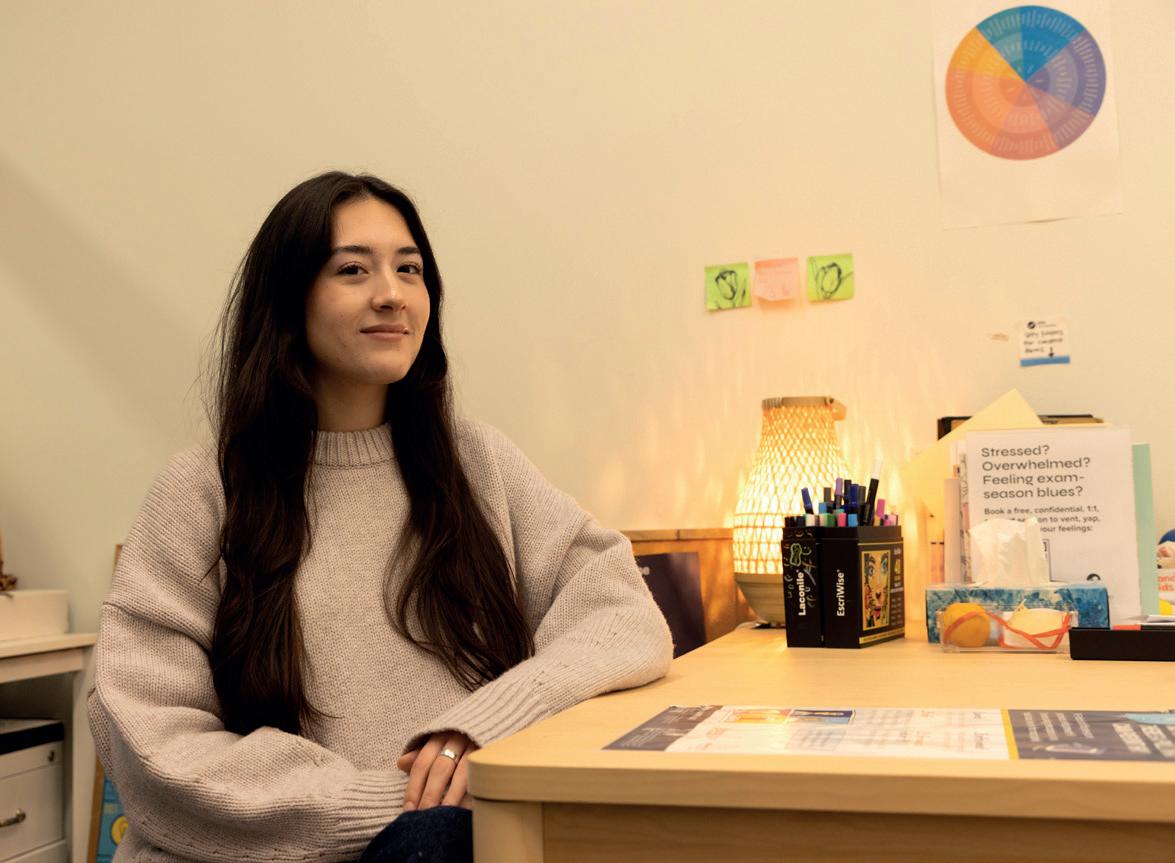
Alex Girardi the Peer Support coordinator, overseeing all volunteers. | SIDNEY SHAW / THE UBYSSEY
Marissa Miller is a Peer Support team lead. | SIDNEY SHAW / THE UBYSSEY
Julia Martin is a Peer Support team lead. | SIDNEY SHAW / THE UBYSSEY
Amy Daiminger is the Peer Support assistant coordinator of education and outreach.| SIDNEY SHAW / THE UBYSSEY
Chopping Spree
Now they’re a staple of Vancouver’s
Profile by Lucas Rucchin Contributer
his hair is as I recognize it, long and dark and the best in the band. Olivier Leclerc, the bassist, is also a parkour hobbyist, a graduate of Capilano University’s jazz program and the only one in the band who’s out of school working a job (“One of us is actually making money,” Naranjo jokes). Naranjo, adjusting the drumset, I admire not only for his fluency around the kit, but also for his commitment to a political science and history degree alongside playing for two bands.
the tale of how the band formed. In early 2024, Chen, Naranjo, Cohen and Young met in the UBC Jazz Ensemble. Seeing a lack of jazz in the Vancouver music scene, Chen and Naranjo, who already knew each other through the metal band Reverend Ape, sought a new cre ative outlet. “The music scene is so vibrant out here,” Chen tells me. “There’s a lot of indie, there’s a lot of punk, a lot of metal. The jazz scene is tight, though, in compar ison. And the scene overall is very small compared to the electronic music nightlife, club music, rave life, all that shit. So I just want ed to bring something differ ent.”
“I meet Chopping Spree at their studio, a room on the second floor of a nondescript building in the industrial district of Vancouver. It is small, yet lived-in and cozy. A lamp sits on a mixer with knobs and switches; a dartboard hangs above a whiteboard with the night’s agenda; a couch, minifridge and bar stools outfit the end of the room, by the shuttered window. A sheet is draped over the ceiling light, dimming the studio, lending it an intimate quality. “This is our first time having a place,” Eddie Naranjo, the drummer, tells me. “Before, we were doing whatever we could.” They inform me that “Crayola” — their bright, CASIOPEA-esque single with over 30,000 Spotify streams — was not created here, but written, rehearsed and recorded around the UBC School of Music, Young’s house and a barn in Langley. “So it’s actually nice to have the space.”
“It’s like we feed off the energy of the audience. That’s such an important part of us having fun on stage. You don’t want to play a show where everybody’s just sitting down, just watching us. We always want to have people dancing.”
- Naranjo
Cohen moves around the studio, rearranging seats and stands, configuring his two keyboards. The room is filled with amps, microphones and pedals, as well as a drumpad for use by Colm McIntosh, who substituted for Naranjo while he was on exchange in Spain and has since stuck with the band as their secondary percussionist. Young, beaming as he greets me, is wearing a Geese t-shirt, and I can’t help but think about the similarities between that Brooklyn sensation and the band assembling before me now: in their kinetic stage presence, in their cohesiveness as a musical unit, in their thrillingly distinctive artistic vision. But Chopping Spree may have the edge in that last category, considering the eclectic nature of their jazz-fusion ethos, and the quickness with which it matured.
Before we sit down, there is an air of playfulness in the room.
All five members, gear in tow, set up their instruments. Junny Chen, the guitarist, is much calmer than he was at Shindig — his onstage presence is defined by manic yelling and burning solos — but
Beers and Timbits are passed around; YouTube videos on mixing are discussed; darts is practiced. “I’m just gonna get insane at darts by the time the album comes out,” says Young, scoring a bullseye. As Cohen and Naranjo exchange musi cal ideas — Cohen rolling up and down scales, Naranjo matching him with frenet ic barks of his hi-hat — I realize how the band has reached such heights in the local scene: their chops are just as strong as their friendship, and their dedication (“The love of the game,” Chen says) is balanced with a heady open ness to fun.
“The origin story,” says Naranjo, prefacing
And Chopping Spree is. Compared to the oth er bands that performed at Shindig — many of whom offered an ex pansion on a single genre, like shoegaze, indie pop or emo — Chopping Spree boasts a kaleidoscopic set of influences, and is willing to innovate on any of them. When I ask them about the music they listen to, the band members list everything from King Gizzard and the Lizard Wizard, an Australian experimental band, to Balkan music, which inspired the outro to their heavy metal original, “Portrait of Zahora.” For the band members, that freedom is stimulating. “I think that inspired me with Chopping Spree where it’s like, we could do whatever we want because we’re all ADHD,” Young says. “Let’s just grab onto what ever’s interesting to us at the moment. We could do a rap song at a show. We could do a fucking jazz fusion song. We could do a metal song. We could do whatever the fuck we want.” The band members joking ly suggest K-pop as another genre to add to their resumé, but I get the sense that none of them dismiss the possibility.
Over the summer of 2024, Chopping Spree played their debut gigs around Vancouver — among them Koerner’s Pub and a frat house (“He’s got a fucking laun dry rack as his stand,” Young says, recounting the conditions) — but were having trouble finding their
sus] is when we really started finding the Chopping Spree style,” Young says. “The direction for the band.” They worked tirelessly at their audition tapes, finalizing early versions of their original compositions. One of them was “Zahora,” which tapped into their underground influences, fusing their jazz roots with the essence of the Vancouver music scene.
“We really wanted to have something that was a shock to the audience,” Naranjo explains.
“So [‘Zahora’] turned into this really crazy proggy song. It was still jazz fusion-y, but it definitely had a lot more metal influence.” Chop-
Spree won the event. “The energy was super different. That was the moment that we were all kind of like, this is something special for sure.” The band also played “Caravan,” a jazz standard. In its traditional form, it is not the kind of song you would associate with the realm of nightlife inhabited by the Vancouver underground. But Chopping Spree made it their own. “I distinctly remember the first show I played with you guys,” Leclerc says. Leclerc, who received an education in jazz, had performed “Caravan” before — but in solemn, academic settings, where he paid
Back, left to right: Hayden Cohen, Junny Chen, Eddie Naranjo. Front, left to right: Olivier Leclerc, Kyler Young. | COURTESY JACKSON ISELI
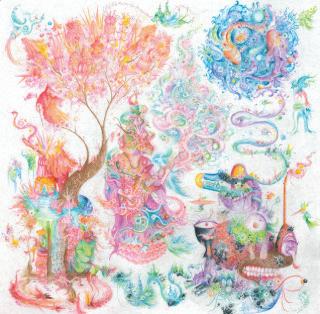
Chopping Spree’s single cover: Crayola Cover art by Kasper Linh
Chopping Spree’s single cover: Koi Fish Cover art by Kasper Linh
formed at UBC. Vancouver’s music scene
attention to the accuracy of his bass playing than anything else. With Chopping Spree, “Caravan” has a different effect. “Playing that tune and then watching people fucking ramming into each other … I was kind of smiling. Everybody was smiling. I was like, what the fuck is going on?”
Categorizing Chopping Spree is difficult. Jazz fusion, the genre most often ascribed to their musical diversity, captures their inventiveness but misses their wildness, the danceable energies of their underground influences. “We do a fusion of the jazz framework,” Leclerc
every Chopping Spree performance. But their crowd invigoration, their exhilarating showmanship, comes from elsewhere. “It’s all the ideas of [jazz combined with] the high-energy shit that us three — Junny, Eddie and I — come from with punk bands,” Leclerc says, “and the endless stream of influences that we have.” The word “democratic” comes up a couple times while we are talking, a word that perfectly encapsulates the Chopping Spree method: it is underground music democratized, jazz music transcribed onto the underground scene. “People want that jazz frame-
work,” Young
songs that we play at our shows, but each show we’re always doing different.”
It wasn’t always this way. “Definitely in early Chopping Spree shows, looking back, our performances [weren’t] super crazy or energetic,” Cohen says. “But the more you look at it, the more intense it gets, because it’s a reaction to the crowd.”
audience member who rarely attended live shows, but was drawn to Chopping Spree because they liked video game music — a genre the band tapped into with “Crayola,” which has traces of Mario Kart’s “Coconut Mall.”
Since forming, Chopping Spree has performed at Red Gate, the Rickshaw Theatre, the Biltmore, Tyrant Studios, the Pearl, Green Auto and Hero’s Welcome — venues where Vancouver’s music scene convenes. Playing in front of these crowds helped develop Chopping Spree’s stage presence. “That’s where the moshing and the partying and stuff came out,” Cohen says. “That was something that we realized was essential to our shows.”
When I ask what makes our music scene so special, the band members tell stories of appreciation.
“It’s so flavourful, man,” Chen tells me. “It’s so vibrant. Super wholesome, and the community is dope. I’ve met some of the dopest people in my life through the music scene. There’s something special about it being … not secretive, but definitely a very underground community. A lot of the venues we know and love are on the verge of being shut down.” People keep the scene alive, and Chopping Spree, with upwards of 8,000 monthly listeners on Spotify and an album release show booked at the Fox Cabaret on Jan. 10, keeps the peo-
Perhaps the most enduring aspect of the band is the way their genre-bending is expanding the scope of what underground bands can play — and where they can perform. Young recounts their performance at Tyrant Studios, a mellow, low-key venue with a reputation for traditional jazz shows. Past performers include Frank Sinatra and Duke Ellington, and attendees spectate the stage from candlelit tables. When Chopping Spree arrived, they had all the tables removed, intending to make space for a dance floor. Needless to say, people danced. “I’ve never seen anybody stand up at Tyrant,” Young says.
Breaking boundaries means more people entering the scene. “Introducing jazz to the metal scene is expanding the [number] of people and the amount of reach,” Cohen says, telling me about an
“You get to make personal connections with the people,” Naranjo says. “It’s like we feed off the energy of the audience. That’s such an important part of us having fun on stage. You don’t want to play a show where everybody’s just sitting down, just watching us. We always want to have people dancing.”
Outside of Chopping Spree, the band members have responsibilities: Cohen, Chen and Young are pursuing degrees in music, and Naranjo a political science and history degree. Cohen, Chen and Leclerc offer music lessons. When I ask how they juggle their lives alongside the band, they don’t hold back in their eagerness to commit fully to Chopping Spree. “It’s easy to put a lot of effort into this band because we all love it,” says Naranjo. “It is hard to balance everything.”
“It’s like an endless time sink in the best way,” Young adds. “We could put all our time and all our energy into Chopping Spree. There’s nothing stopping us but our actual studies and personal time. I think Chopping Spree will take on an even stronger, more beautiful form after we’re all out of school, because we’ll be able to more readily focus our time on it.”
For Cohen, Chopping Spree is an outlet for his prolific songwriting. (Chen jokes that Cohen has a MuseScore application in his brain.) “I have notepads full of fully completed songs and ideas,” he says. “I love songwriting, and that’s why I’m in school for it. I’ve been writing songs since I was a kid.” However, Cohen never labels himself as the principal songwriter; creating with Chopping Spree, he explains, is a communal exercise. “I’ll bring a small idea, or I’ll bring a more fully-formed song, and I’ll just be like, ‘this kind of vibe.’ And then we’ll launch into a song that way. But in other cases, we’ll just start jamming something, and then we’re like, ‘Let’s turn this into a song.’”
This kind of spontaneous, authentic creative process — writing in between shows, bringing a new song to every crowd, iterating further in rehearsals — culminated in their debut album, Anemoia, set to release on Jan. 9. According to Young, the album’s title means “manufactured nostalgia.” The idea has personal significance: not only does nostalgia capture the way Chopping Spree revives
““We do not function like a jazz band. We do not play jazz music. But we play the framework.”
- Leclerc
and refashions old music, it charts the band’s evolution as well. “In a sense, it is nostalgia for our old playing,” Cohen says, reflecting on the way the band began as an ode to Japanese jazz fusion and transformed, over a year of endless experimenting, into the celebration of genres they now represent. I ask them to describe the album in one word. “Colourful.” “Explorative.” “Lush.” “Goated.” One sticks out: “Honest.” I end the interview, and the band members get to practicing. With the same amazement I felt at Shindig, I listen as they shift from a stank-worthy funk piece, complete with vocals from Cohen and a disgust - ingly flavourful bassline from Leclerc (“What’d I just do?” he exclaims), to a bone-chilling, apocalyptic heavy metal piece whose ambient screeches, guttural guitar and spoken word poetry transport me to the hellscapes of Doom. Chopping Spree’s process is on full display, and I’m reminded of the emphasis on “democracy” and “communal” in our interview as the band members pause to talk, discussing time signatures, riffs, the colour of chords; Cohen is usually the one to introduce new directions, the rest of the band responding with their ideas.
The songs I am hearing, they tell me, will be revealed in future projects, so I do my best not to pry. But I do ask them what the future holds.
“Big things coming!” they say, telling me that 2026 will be a year of singles and festivals.
Practice ends on the later side, around 10 p.m. As we head outside to our cars, I remember a moment from Shindig. I was trying to get the best view of Chopping Spree through the crowd, dense and swaying. Sifting through the darkened heads, I spotted a woman holding a toddler. For the volume, the toddler wore earmuffs. For the music, the woman bobbed up and down. Both of them, as far as I could tell, were happy with what they were hearing.
“If Chopping Spree ended tomorrow,” Young told me earlier, “I could be proud of the fact that we were able to get old heads, who go to the Infidels Jazz shows, and young folks, who go to these YVR underground shows, in the same room. Some of them are moshing. Some of them are standing like this. But everybody is enjoying the show.” U
Chopping Spree’s debut album: Anemoia Cover art by Kasper Linh
Point of Inquiry:
I thought I’d be done with the AMS in 2025. I’m glad I’m not.
Point of Inquiry is a reported column written about our student union’s governance and policies. It seeks to analyze the AMS with a critical — but constructive — eye. It occasionally contains novel reporting, but Point of Inquiry is written independently of The Ubyssey’s news team — which has no editorial involvement in the column and covers the AMS impartially.
Quyen Schroeder (they/she) is a fourth-year student studying English language and computer science, and they’ve been a committed observer of almost all AMS Council meetings since February 2023. She also ran as “Barry ‘Bee’ Buzzword” in the 2025 AMS Presidential election. They can be reached at q.schroeder@ubyssey.ca.
Opinion by Quyen Schroeder AMS Columnist
Continued from page 1
Then, in February of this year, both then-VP External Ayesha Irfan and Fung-Quon resigned within 10 minutes of each other. Just over a week later, The Ubyssey’s news team published its investigation into Fontana’s removal. The report includes quotes from Fontana, FungQuon, Irfan, Decker and Turdy, all urging the AMS to improve its “toxic corporate culture,” to use Turdy’s words. “I was scared all the time,” Decker said. Fontana said “It’s a pattern of behaviour. I’m not the first victim.”
(Point of Inquiry is published in the opinion section, which is editorially independent from the news section. Neither the piece’s authors nor the news team have editorial control over what I write here.)
I believe the reports of a toxic culture. When the story came out, key AMS figures displayed their immaturity for everyone to see. Then-President Christian Kyle, former-VP AUA Kamil Kanji (who was Fontana’s predecessor and the partner of his successor) and EPA member and former-President Eshana Bhangu posted their responses to The Ubyssey’s media request on the r/ubc subreddit. Bhangu and Kanji’s profane posts described The Ubyssey’s questions as “dumbass” and “[reddit censor lol]” while comparing the paper itself to TMZ and a “knock-off gossip girl.” Bhangu described The Ubyssey’s questions about potential conflicts and procedural biases in Fontana’s removal as “time to just troll a little bit.” This juvenile, schoolyard mockery shouldn’t be publicly posted by our elected representatives. (Admittedly, many adult politicians disagree with me.)
The Election
In 2025, the Huntley administration replaced toxicity with focus. In 2026, as students confront the affordability crisis and the AMS faces its deficit, service costs and businesses’ performance, this is the new bar in student politics.
candidates Eve Sankar (/u/sasamats) and Tony Kulenovic (Nobody).
During the first debate, I realized that we’d be in for more of the same. Huntley’s platform was plentiful but unfocused. Many goals would fit better in a vice
“Huntley has been the best president I’ve experienced in the AMS. Throughout the year, his demeanour has been markedly different from Kyle’s.”
president’s portfolio. Others were overdone and uninspired — such as the oft-promised exam database. (The AMS led the creation of an exam database a decade ago. Though it cost $80,000, few professors uploaded exams to it.)
His campaign priorities echoed those of Kyle and Bhangu, whose presidencies perpetuated toxicity in the AMS.
The second debate only confirmed what I knew. I ate 200 grams of honey that night — a spoonful whenever Huntley used his debate time to attack Fontana. Throughout the debate, Huntley barely mentioned his own platform. He focused instead on Fontana’s inadequacies. The same toxic environment was playing out again.
Huntley wasn’t the first choice on my ballot. Nor my second. Or third.
As those who have read any of my columns will know: I ran as joke candidate Barry ‘Bee’ Buzzword in the 2025-26 AMS Presidential election against AMS President Riley Huntley and Fontana. I described the criticisms that motivated my campaign in an opinion essay co-written by fellow joke
I was excited for the vice presidents, though they mostly ran unopposed. And I was especially excited for VP External Solomon Yi-Kieran’s vision for advocacy and was impressed by VP Finance Gagan Parmar’s computerless debate performance. However, once presidential results were in, I
started making predictions about who would be the first executive to resign.
I was wrong.
The toxic culture of years prior has been excised from our union. I haven’t seen evidence of destructive internal strife in the AMS. No longer are reporters being publicly berated for “dumbass” questions. Instead, our union is focused on working for students, from organizing advocacy campaigns to repairing relationships. Huntley has been the best president I’ve experienced in the AMS. Throughout the year, his demeanour has been markedly different from Kyle’s. From the start of his term, Huntley has proven willing to engage and adapt to feedback. (One of his executive goals was inspired by a conversation we had via direct message.)
In my first essay for this column, I called on the AMS to be a leader and resource for student movements on campus. Since then, the AMS has mended relationships that were strained by previous executive teams — such as those with resource groups. Our union also started advocacy campaigns of its own, inviting students to participate in a Rally for SkyTrain. Though I was critical of the event, I’m glad it happened. That essay also challenged students to be willing to work with the AMS, rather than attack our representatives at every misstep. Though there have been some instances of hostile student engagement with council, interactions have mostly been respectful and professional. Our union has also succeeded in drawing students into its governance activities, such as during this year’s quorate annual general meeting — a rarity in the past half-century.
updated on its advocacy. On the AMS’s Instagram, we’ve seen our executives speak at Vancouver City Council, photos after lobbying the premier and video from a televised press conference delivered from Victoria.
Advocacy continued on the Point Grey campus, too. Vice-President Academic and University Affairs Zarifa Nawar continued to run the annual Textbook Broke Campaign, which advocates for UBC to use more free or low-cost educational materials.
Our union has made impressive strides in clawing its way out of a years-long deficit and has shifted from a defensive posture to a long-term outlook. The AMS changed its investment strategy, accepting more year-to-year risk in exchange for greater long-term gains.
Though in the short term, we
“We need more AMSorganized rallies in general. Students shouldn’t feel like someone else is responsible for fighting tuition increases or securing renter protection on campus.”
positive momentum continues through the AMS elections in March. This isn’t just blind optimism. This year’s executive team has built a strong foundation for our union’s future success. The future of the AMS isn’t toxic culture and constant resignations. The coming year will focus on improving our union and student experience. Executive infighting will be left behind in 2024 and early 2025.
The AMS will continue the important work of reducing our operating deficit. I expect we’ll see another fee-increase referendum during the election. Should students vote against it, we’ll continue to face tactical cuts to AMS services like the club limit imposed this summer. Our deficit is currently just under a million dollars (down from over $5 million in 2022). It’s possible we’ll eliminate the deficit in 2026, though if we don’t, it won’t be much longer.
Despite the efforts of the AUA office, our tuition will likely continue to increase. If we’re lucky, it will only be by 2 per cent for domestic students — but the AMS has raised concerns that it may be higher if the provincial government ends the Tuition Limit Policy that has capped annual increases at 2 per cent since 2005. If the province does so, I hope for an AMS-organized rally built on the foundations of the Rally for SkyTrain.
I’m excited to see whether the creation of the VP Student Life role pays off in the coming year: I expect Block Party to be a major indicator of that. I’m curious what ideas other candidates for the VP Student Life will bring to the nascent portfolio. I’d like to see candidates eager to collaborate with the VP External on advocacy events like the Rally for SkyTrain, which will both entertain students and involve them in AMS advocacy.
The AMS has kept students
still feel the AMS’s budgetary strain. AMS businesses have been struggling. (Council has cited low alcohol sales and the Friendlier’s reusable containers as potential reasons.) With the failure of this spring’s fee-increase referendum, council was forced to limit the number of AMS-sponsored clubs.
The year ahead
2026 will be a good year — if the
As students, we’ve contributed to our union’s governance and advocacy in a way we haven’t in recent years. This year has brought fewer negative student–AMS interactions. This is good, but we can do better. I want to see students productively engaging with the AMS in the coming year. You can come to the council meetings to observe or speak to council as a studentat-large. (There is free food.) I especially want to see you at council meetings if you’re planning on running for an executive position next year: you owe it to your fellow students to be familiar with the union. I’d like to imagine this column does its part in modelling a more productive engagement. One whose criticisms and celebrations are based on facts, not overheard halftruths or unread policies. This column’s success is not predicated on every reader agreeing with my positions. That would be a sign of failure. You can and should disagree with me. If you do, join the conversation! Reach out to the Opinion Editor at opinion@ubyssey.ca or fill out the new opinion essay form. (He’s really good; you’ll be lucky to get to work with him.)
I’m excited for the AMS’s year ahead. I hope you are too. U
PHOTO ELEMENT BY CHARLOTTE ALDEN / THE UBYSSEY; ILLUSTRATION BY AYLA CILLIERS / THE UBYSSEY
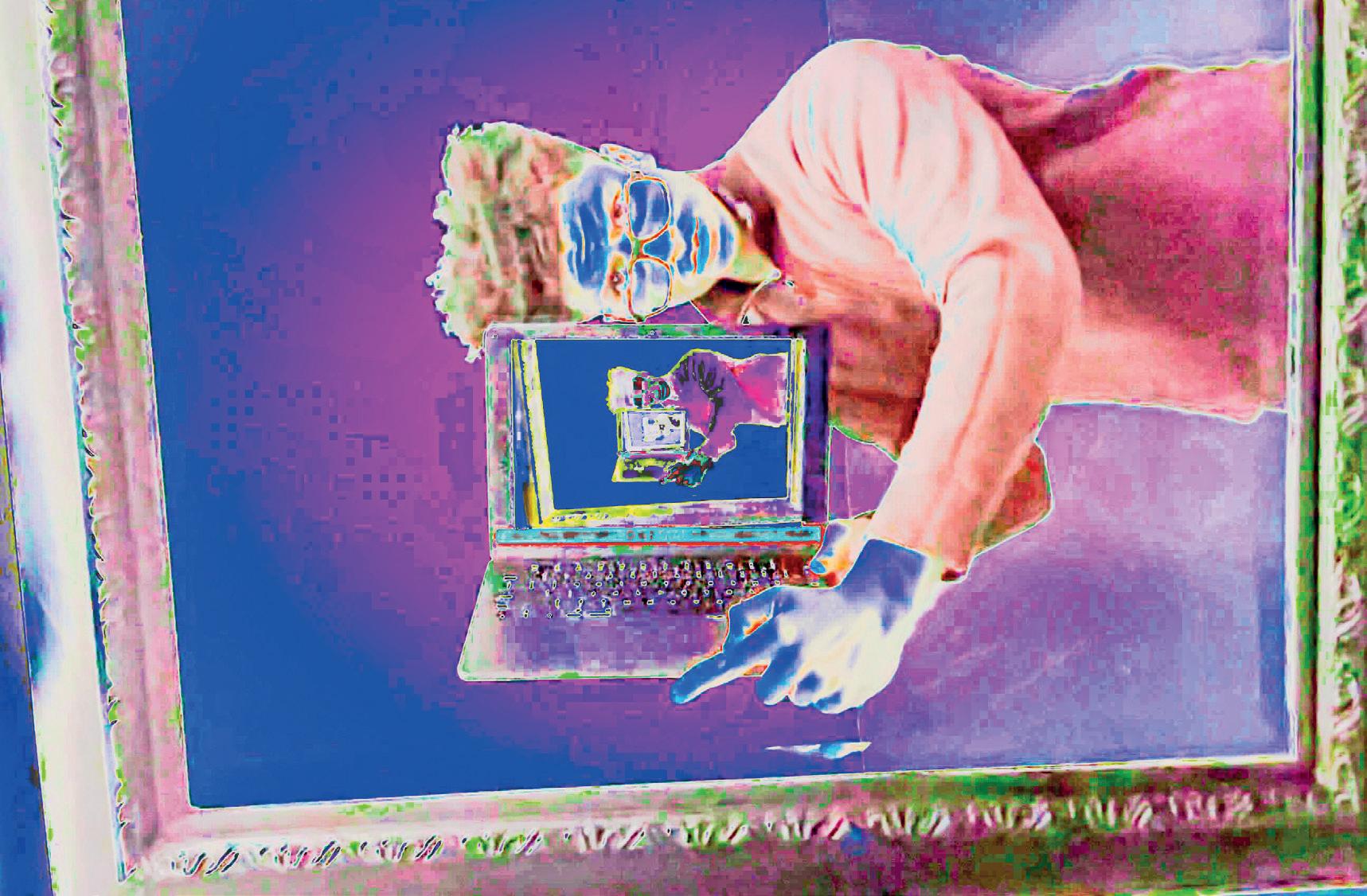
What do we have in common with Shakespeare?
Report by Saba Majd Contributor
Media theorist and English professor Richard Cavell recently published Mediatic Shakespeare, a book discussing how Shakespeare was writing in “a highly volatile media ecology.” This was a moment when oral culture, scribal practices and the new force of print collided.
The origins of Mediatic Shakespeare were formed through Cavell’s mentor, Marshall McLuhan, who he met as a doctoral student at the University of Toronto. “It was [McLuhan] who once [told] me, ‘all of my media theory comes out of Shakespeare,’” Cavell said in an interview with The Ubyssey
After McLuhan planted this seed in his head, Cavell sat down with the complete works of Shakespeare and started taking notes. Often, right in the first scene, Shakespeare mentions a medium. “It was inescapable,” he said.
Cavell’s book rebuts two key misunderstandings: first, that Shakespeare was just a playwright with “no concept of media” or media shifts; second, that media are neutral transporters of content.
“Media are not neutral,” Cavell said. “They don’t simply transport information — they transform information.”
The appearance of print transformed two existential concepts: ontology (our sense of being and who we are as humans) and epistemology (our knowledge and ways of knowing). Cavell approaches Shakespeare through the lens of this shift.
Shakespeare was born in 1564 in a largely oral culture. Script was around as well, but usually intended to be read aloud. Few people had the ability to write.
Around this time, print was starting to become present in society, especially in the theatre. While Shakespeare was writing plays meant to be performed orally, “this new technology … [was] slowly undermining the power and predominance of orality.”
Cavell posits that Shakespeare’s fre
quent reference to various media lustrates his anxieties about print and the disappearance of communal society.
speare] creates a world where you’ll have various media interact ing — letters, books and, of course, speech,” among others. For exam ple, the map in read as a visual technology, and the tragedy is a result of Lear’s trust in the map’s visual representation over spoken negotiation between characters. In Othello, the titular character’s demand for “ocular proof” of Desdemona’s infidelity and his insistence on seeing rather than listening exemplifies what Cavell calls print’s “commodification of truth imposed by vision” in a previous article. In other words, the truth is biased toward evidence that can be displayed and verified.
Cavell structured Mediatic Shakespeare around four key themes that emerged while he was analyzing the works. The first chapter situates Shakespeare within the Elizabethan “media
ecology,” wherein oral, scribal and printed forms coexisted and competed. The second explores the tension between the aural and the visual. Chapter 3 homes in on this shift in sensory cognition from ears to eyes, which Cavell calls “the breakdown of the sensus communis” (the senses working together).
Chapter 4, titled “the Printing Involution,” a phrase coined by Cavell, argues that print did not erase orality, but absorbed and reconfigured it. This creates a culture that is both nostalgic for speech and dependent on the permanence of text. “The so-called Renaissance — which came out of the printing press — immediately looked back-
Drug repurposing is a method that uses existing drugs for new treatments. | SKYE SHEN / THE UBYSSEY
Report by Harleen Randhawa Contributor
UBC researchers have discovered a 70-year-old Parkinson’s drug to be a strong candidate for treating tuberculosis (TB) by using an innovative approach that bypasses traditional antibiotics.
Caused by the bacteria Mycobacterium tuberculosis (Mtb), TB has persisted for centuries and still remains one of the deadliest infectious diseases worldwide. Its resilience stems from its unique biological features, including a waxy, impermeable cell wall, a slow growth rate, and the ability to enter a dormant state that allows it to evade drugs and the immune system.
The current standard treatment is challenging: up to four antibiotics taken daily over several months. Barriers such as poverty can make accessing treatment more difficult.
“There is an adherence issue due to the complexity of treatment and the side effects. [Patients] discontinue it, and this leads to resistance,” said Dr. Henok A. Sahile, lead author and postdoctoral researcher in the Faculty of Medicine. ”It’s a vicious cycle.”
This investigation emerged during the COVID-19 pandemic, as the research team screened over FDA-approved drugs, compiled by Medicines for Malaria Venture (MMV). The MMV library contained drugs that were thought to be useful against COVID-19, and
because SARS-CoV-2 has some similarities to TB pathogens, the research team thought the drugs could be used to fight TB as well.
The compounds were tested on human macrophage (immune cell) models infected with Mtb. Benztropine, a drug used for regulating muscle control and stiffness in Parkinson’s disease, , emerged as a promising candidate.
“[Benztropine] activates human cells … so they are capable of killing the [bacteria] by themselves,” said Sahile.
Unlike standard TB antibiotics, which directly target the bacteria, this drug uses a host-directed approach. It activates host macrophages to fight the infection instead of directly killing the bacteria.
wards to manuscript culture, which it then started printing.”
“Most often people refer to the ‘printing revolution.’ But it wasn’t all that revolutionary,” he said. Orality didn’t go away, but neither did script. Cavell said it wasn’t an evolution either, because “for McLuhan, media history didn’t evolve.” “It was recursive … a turning [backwards and] inwards.”
Cavell also notes that media history is cyclical, and right now, similarly to Shakespeare, we’re living through a media shift. “We’re going back to the future in a certain strange sense,” and AI is the “ultimate extension” of this shift to electronic media and digitality, he said. “We’re being told … that
this super intelligence will actually be more intelligent than us.”
“Artificial intelligence, [however], has very little to do with intelligence and a lot to do with humanness — and what concerns humans is their displacement [from] centre stage.”
Cavell emphasized that just as the invention of print replaced the participatory world of orality with a solitary mode of being, social media, digital verbal communication and AI technologies now push us back toward a new kind of virtual, isolating orality. It’s one in which we’re navigating society through the “little chat box that opens up on the lower right hand corner of [our] screens.” U
UBC researchers repurpose old Parkinson’s drug as new tuberculosis treatment
Using an innovative approach that bypasses traditional antibiotics,UBC researchers have discovered a 70-year-old Parkinson’s drug is a strong candidate for treating tuberculosis (TB).
“It could shorten the treatment duration [and] reduce the emergence of drug resistance.” Using fluorescently tagged Mtb in macrophages, the team compared the drug’s effectiveness to standard antibiotics. While it inhibited roughly 70 per cent of bacterial growth, the drug’s mechanism still gives it a unique advantage over conventional treatments. Drug repurposing is a method that uses existing drugs for new treatment purposes. This method leverages medications with known safety profiles and reduces the cost and time needed compared to creating new drugs from scratch. This technique to repurpose drugs is not new; relatively recently, many antivirals were
repurposed from existing drugs during the COVID-19 pandemic. Sahile and his team are now exploring combinations of repurposed drugs with existing TB antibiotics to shorten treatment duration and combat bacterial resistance. They are also screening alternative compounds with similar host-activating properties but fewer side effects than Benztropine, with future plans for animal studies and, eventually, clinical trials.
He explained that because the drug targets human cells rather than Mtb, it can be applied to other bacteria as well.
“We’re trying to refine this work with different pathogens [and under] different conditions,” said Sahile. U
‘Birds blank second-ranked Dinos 4–0 in statement win
Game analysis by
Caleb Peterson Sports & Recreation Editor
This season, UBC Men’s Hockey has had an unorthodox problem. It’s not their record. They’ve been spectacular, only dropping five games up to this point in the season. It’s not their goaltending. The ‘Birds have been able to roll with the excellent pairing of Brett Mirwald and Cole Schwebius all year, who both rank in the top 10 nationally for goals-against-average. It’s not their offence. Each player in their top line of Sasha Mutala, Scott Atkinson and Chris Douglas is a top-25 point-scorer in Canada.
In fact, the problem isn’t anything they can control. The Thunderbirds have a competition problem. In Canada West play, the teams are split into two divisions, and the majority of the games a team will play — 18 of the 28 regular season games that UBC will suit up for this season — are against the other teams in their division, which, for UBC, is Alberta, MacEwan and Trinity Western. It hasn’t been a fair fight.
UBC currently holds a 14-point lead over the second-best team in the division. The next largest division or conference lead in Canada is five points. UBC has 16 wins. The other three teams — combined — have 20. Every team other than UBC in the CW West division has a losing record. Initially, this would seem to be a positive — and in some sense, it is. The ‘Birds are the first team in Canada West to clinch a playoff spot, largely because of their non-competitive division, and they’ve still got nearly 10 games to play. It’s an enviable position to be in.
Yet, by so easily securing a playoff spot, by beating up on subpar teams, what UBC gains in wins — it loses in credibility. At the end of the year, the only thing that matters is how you perform in the playoffs, and there are no cupcakes in the postseason. Without quality wins against tough competition going into the Canada West playoffs, the ‘Birds risk getting surprised by a more battle-tested team. This T-Birds team has looked very good all year, but it’s hard to know how good they actually are until they face real competition.
In the first few games of 2026, however, we have found out. Coming off of the winter break, the ‘Birds would face their largest test of the season, going against the two Calgary-based teams in Canada West, first, the Mount Royal Cougars at home, before heading to Alberta to play the University of Calgary Dinos on the road. Standing now at second and first place, respectively, in the CW East Division, these teams were
the test that the T-Birds were looking for. In the first national rankings of the year, both teams were ranked inside the top 10 in the country. If UBC could beat Mount Royal and Calgary convincingly, they’d leave no doubt about their status as the team to beat nationwide.
They couldn’t. In their back-toback against Mount Royal at home, the T-Birds fell flat, losing 4–2 in the first game before losing again in overtime, 3–2, dropping two games in a row for the first time all year. These weren’t pretty losses, either. In the first game, UBC gave up three goals in the span of a minute to give the game away in the first period, while in the second, the ‘Birds blew a two-goal lead. It seemed to be a confirmation that, despite all the winning, their second-ever Canada West title was still a ways away.
To make matters worse, of their two opening matchups, Mount Royal should have probably been the easier opponent. In comparison to the upcoming Dinos, Mount Royal was the lower seed — both in the national rankings and in the standings — and the T-Birds got them at home. They wouldn’t have that same luxury against Calgary. After the back-to-back with the Cougars, UBC fell from the No. 1 spot in the national rankings — for the first time since Nov. 24 2025— to fourth, behind three other CW East teams. With a road trip to Southern Alberta on the horizon, the ‘Birds needed a win, if not for the standings, then for their reputation.
They got it. Convincingly. In one of their most complete performances of the season, on Friday night, the Thunderbirds dominated the second-ranked Dinos in a game that, from the opening puck drop, never felt that close. The 4–0 final score, if anything, was kind to Calgary. The ‘Birds killed the Dinos on the powerplay. They suffocated them on the penalty kill. They kept possession of the puck nearly the entire game. They got great goaltending from Mirwald. For UBC head coach Sven Butenschon, this game has got to be teaching tape for the remainder of the season. They took one of the best teams in the country and made them look incredibly subpar. It’s the kind of statement win that this team has been looking for all year.
[T-Birds goalie Brett Mirwald celebrates with his teammates after one of the team’s best wins of the season. Mirwald held down the fort in goal with a great performance and a deserved shutout.]
The ‘Birds got the party started early. After a choppy opening couple minutes, with numerous whistles and pucks out of play, the game’s first power play would go to
the T-Birds, who would need only 20 seconds of the man advantage to take an early lead on an impressive play off the draw. While forward Jake Wright initially mishandled the pass from his defenceman, Jake Lee, at the point, the third-year did a commendable job to keep his composure, quickly corralling the pass back in, recognizing the opportunity for a shot had been lost, and dishing it back to Lee. Wright’s pass was perfect, and Lee hammered it home with a one-time from the blue line — a laser to the back of the net.
That early lead was important, and the way the ‘Birds were playing was impressive. While they had taken the lead on the power play, they were playing just as well at even strength, controlling the puck, not allowing Calgary any time or space in the offensive zone. Yet, they couldn’t get comfortable. After all, they had a strong first period against Mount Royal, but ended up collapsing. The Dinos were bound to get some chances of their own, and it was up to the ‘Birds to keep their momentum.
The first real challenge to UBC’s strong first period came about midway through, when ‘Birds defenceman Wolfgang Govedaris pre-empted a pass up-ice and cross-checked a Dinos forward before they had the puck. Govedaris would go to the box, and in doing so, leave his team shorthanded against one of the best powerplay units in Canada.
If the Dinos have a strength as a team, it’s their powerplay. Going into this matchup, they had notched 26 power play goals in 20 games, scoring on nearly 30 per cent of their opportunities. Both of those marks would place Calgary in the top five nationally — so needless to say, it was a unit that UBC would want to avoid, especially since the T-Birds’ penalty kill has been relatively weak this season.
Those stats certainly didn’t play out on the ice, however. UBC’s penalty kill made the Dinos look pedestrian, not allowing them to get set up in the attacking zone until half of the power play had already drained away. Even when the Dinos did set up, the passing lanes closed fast, with their only solid chance of the advantage coming on a give-andgo near the slot, which defenceman Jonny Lambos got a stick on to deflect it out of harm’s way. The ‘Birds sustained their one-goal lead.
For how well the ‘Birds played in the first, the one area they seemed to struggle in, strangely, was shots on net. Eleven minutes into the frame, they had only mustered one shot on goal — which was Lee’s goal at the start of the period. That wasn’t indicative of the Thunderbirds’ of-
fensive success. Case in point, with eight minutes to go, hemming the Dinos in their own end, UBC forward Nathan Sullivan found space behind the net, whipping back out front with space to get a clear shot away. It rang off the post.
Chances like Sullivan’s — hitting the post, just missing a one-timer pass, not having space to shoot into an open net — these were the near-misses that defined much of the game for the T-Birds. They were getting high-danger chances, they just weren’t scoring. Or, even registering shots on net.
This continued with a late power play to end the first. Wright’s attempt to jam home a rebound was just blocked by a sprawling defenceman. A beautiful tic-tac-toe set-up by Douglas left Mutala with nothing but twine in front of him — but the angle was too tight to get off a shot. By the end of the power play, with two minutes left in the period, UBC only had four shots — but they had plenty more opportunities.
Those chances finally paid off for UBC right as their man advantage came to a close. With another great cross-ice pass to Mutala — this time from Josh Williams — UBC’s leading scorer left no doubt this time. Dinos goalie Carl Tetachuk could only watch as the ‘Birds extended their lead to 2, taking that lead to the locker room.
In the second, things mostly settled in. The ‘Birds continued to hog the puck, both by pressuring the Dinos whenever they attempted to set up play in the UBC end, and through an aggressive forecheck that routinely forced offensive zone turnovers. Yet, while the T-Birds’ puck possession continued from the first, their overall quality of chances didn’t. Sure, they still had their moments, such as a Ty Thorpe shot off the post early on, but without that third goal to solidify their lead, the door was open for the Dinos.
As an uneventful period started to wind down, Calgary started to wake up. On a UBC powerplay, the Dinos got their best chance of the game shorthanded, as their leading scorer, Adam Kydd, forced a turnover at the blueline and sprinted up ice for a partial breakaway. Fortunately for the ‘Birds, Mirwald was there to save the day, blocking Kydd’s shot with ease, looking impeccably calm in the face of the first real danger he faced all night – even a quick rebound attempt from another trailing Dino couldn’t throw him. Kydd’s rush seemed to spark something in the Dinos, as for the next few minutes, they found some of their best chances of the night. A couple minutes after, they forced
another UBC turnover and turned an odd man rush the other way, with first-year Caden Stienke getting a shot off in the high slot — but it was blocked. Then, it was Kydd again, who, while fading away from the net, slid a perfect pass to a streaking Wyatt Wilson, whose one-timer came less than a foot from the goal line. Mirwald came up huge for the ‘Birds here again, sliding across to stone Wilson from point-blank range. While it was a quiet night for him overall, in the second, Mirwald almost single-handedly kept UBC in it.
Strangely enough, what broke the Dinos’ newfound momentum was a penalty — but not on them, on UBC. When Calgary went on the man advantage with three minutes left in the period, all the air came out of their offence. The ‘Birds aggressive, puck control penalty kill left the normally lethal man advantage unit without gas, and in draining out the Calgary power play, they kept their multi-goal lead into the third.
That’s when they put their foot down. Less than a minute into the third, on a power play that had carried over from the end of the prior period, the Dinos penalty kill made a brutal mistake. With the puck in the corner, all four penalty killers converged in the same area, looking to battle and take possession. Instead, the puck popped loose to Douglas, who dished it to Williams in front of the net. With Calgary out of position, Williams had an eternity in the slot, and he made no mistake. 3–0 ‘Birds.
While the Dinos still had nearly a full 20 to turn things around, the Williams goal was the killing blow, if they weren’t out of it already. With how Calgary had played, any kind of comeback didn’t seem within reach. The offence just wasn’t there. UBC had shut everything down, to the extent on the next Calgary power play, the T-Birds had the best scoring chance, with a 2-on-1.
UBC would add another garbage time tally to cap off the 4–0 victory, but they didn’t need it to cement their dominance. The margin is impressive, sure. But the performance spoke for itself. Because, in truth, with a playoff spot locked up, and the division all but a formality, wins and losses aren’t as important to the Thunderbirds right now. Instead, it’s about how they play. Can they continue to build upon their game and fortify themselves for a gruelling Canada West playoff grind, in which they’ll have to play mostly teams from the superior CW East Division? Can they prove they belong with the big dogs in the conference? On Friday, they did — emphatically. U
T-Birds forward Cyle McNabb makes a pass from his own blue line to avoid the oncoming Dino. UBC had one of their best performances of the season, proving themselves against tough competition. | COURTESY DAVID MOLL / CALGARY DINOS
T-Birds goalie Brett Mirwald celebrates with his teammates after one of the team’s best wins of the season. | COURTESY DAVID MOLL / CALGARY DINOS
Men’s Basketball overcomes early scare against UNBC to win first road game of 2026
At the end of the first quarter, UBC Men’s Basketball found themselves in an unexpected situation. The Birds, who were 10–2 on the year, were down by five points to the 2–10 UNBC Timberwolves.
Game analysis by
Ian Cooper Sports & Recreation Reporter
At the end of the first quarter, UBC Men’s Basketball found themselves in an unexpected situation. The Birds, who were 10–2 on the year, were down by five points to the 2–10 UNBC Timberwolves.
This season, the Timberwolves have been outscored by their opponents by an average of 11.6 points per game and have not won since Nov.7, when they beat the Trinity Western University Spartans. Conversely, UBC hadn’t lost since Nov. 1, having won their last nine games. This meeting — the first of the year between the two — was shaping up to be a blowout, just as their three games the prior season were, with UBC winning all three matchups by over 25 points. Yet, in the face of that precedent, on Thursday night, the Thunderbirds trailed in their first road game of the new year.
Despite their struggles, UNBC entered this matchup hoping to turn a new leaf, with reasons to be optimistic, looking to build some momentum through individual bright spots. Second year guard Milan Pasquale has established himself as a reliable presence off the bench, sitting in the top five in Canada West three-point percentage at 43.8, while fourth year guard Justin Sunga ranks fourth in the conference in assists per game, averaging five per contest.
While UNBC has established solid guard play this season, they’d need to take it up a level against the T-Birds. UBC’s front court has been dominant, with both Nikola Guzina and Nylan Roberts consistently scoring in the double digits — averaging 16 and 11 points per game respectively — while playing under 25 minutes a game.
Guzina — who possesses tremendous skill for his size and position — scored the first points of the evening while showing off his face-up game. However, after the opening bucket, UBC looked sluggish. They turned the ball over four times in the quarter and were held to just 36.8 per cent from the field. Meanwhile, the Wolves were able to establish a bit of a rhythm on offence — despite having their own issues with turnovers — connecting on more than half of their field goal attempts and having assists on six of eight made baskets. That offensive efficiency was the difference for UNBC — allowing them to start dreaming of an upset, being up five after the first.
But UBC wouldn’t go down that easily. First year guard Edouard Gauthier came out blazing in the second quarter — scoring four quick points in the first minute and a half of the quarter. Gauthier has provided a consistent spark off the bench all season, averaging 10 points per game. Possessing a tremendous ability to facilitate for his teammates along with an elusive, shifty first step, he is a dangerous driver and a uniquely difficult matchup for opposing teams. Despite this quick burst of scoring, both teams continued to turn the ball over in the opening minutes
of the second quarter, with UNBC retaining their lead.
With around six minutes left in the second quarter, Sunga got a switch onto UBC’s Karan Aujla — who is nearly a foot taller than Sunga — and put on a flurry of deadly dribbles, breaking Aujla’s ankles. Driving to the basket, Sunga was fouled by Aujla and nearly converted on the layup. Instead, Sunga settled for free throws, knocking down one of two at the line to put the Wolves up six. UNBC was imposing their will — the ‘Birds needed to show some fight.
And they did. This moment was seemingly the wakeup call for the Birds. UBC found its rhythm, converting on back-toback three-point tries to bring them within one point. This offensive success was paired with a relatively clean end of the quarter while tightening up on the defensive end — holding the Wolves to eight points in the second half of the quarter — and found themselves with a one point lead heading into halftime.
The T-Birds came out for the third quarter looking like a new team. UBC opened up the quarter on an 8–0 scoring runwith starting point guard Holt Tomie assisting fifth year forward Gus Goerzen on back-to-back baskets. At this point, however, the well seemed to run dry for both teams.
With seven minutes left in the third, neither club managed to score for a full two minutes, as both teams played at a frenetic pace and repeatedly turned the ball over. At one point — an apt symbol of the chaos — a shot got wedged between the rim and the backboard. This drought was finally broken when Gauthier converted two free throws to help right the UBC ship.
Nearing the end of the third, the Birds found themselves up 10 and were looking to close the quarter up strong. However, a well-schemed in-bounds play by the Timberwolves and an untimely foul by Guzina gave four quick points to UNBC, leaving UBC up by six heading into the fourth. With 10 minutes left, UBC still couldn’t relax.
Once again, Tomie and Goerzen connected to open a quarter, this time for a three-pointer, and once again UBC appeared seemingly revitalized at the onset of the period, gaining momentum. This time, they sustained it. UBC scored 14 points in the first half of the final quarter — UNBC only scored eight while missing all of their attempted three-pointers.
The Birds – now firmly in the driver’s seat –never looked back and ended the game on a 9–0 run, winning 88–74 and securing their fourth consecutive win against the Timberwolves.
For the T-Birds, while they didn’t necessarily live up to their standard winning ways, they demonstrated their ability to respond to adversity. Playing against a team with nothing to lose, the Birds absorbed an early punch and leaned on their depth and experience to close out the contest. The game served as a testament to UBC’s ability to win in different ways and reinforced the team’s identity as one of the conference’s top-two teams. U
The ‘Birds regroup in front of the UNBC home crowd. While the game was a mismatch on paper, the feisty Timberwolves kept things close throughout.
| COURTESY HARSH BANGA / UNBC TIMBERWOLVES
UBC’s Nylan Roberts defends as the Timberwolves attempt to break to the net. Roberts has been part of a dominant front court this season, averaging double-digits in points per game. | COURTESY HARSH BANGA / UNBC TIMBERWOLVES
UNBC guard Justin Sunga tries to make space against the T-Birds’ Karan Aujla. Despite the size mismatch, Sunga got free to extend an unexpected Timberwolves lead. | COURTESY HARSH BANGA / UNBC TIMBERWOLVES
T-Birds guard Holt Tomie looks to set up the UBC offence. Tomie and Gus Goerzen sparked the T-Birds back to life in the third. | COURTESY HARSH BANGA / UNBC TIMBERWOLVES
The Ubyssey’s 2026 ins and outs
PSA by Ubyssey Humour writers
Ins:
• Jujuing on that beat
• Canadian government-funded shows
• Disco rap
• The benefit of the doubt
• 2016
• Office hours
• “Never Be Like You” by Flume
• Facebook Marketplace
• Ke$ha-level messiness
• Fun umbrellas
• Basic literacy
• Getting ghosted by IKEA
• Harry Styles
• Vodka slimes
Duct tape crafts (revive duct tape wallets)
• Oxford comma Donating your body to science
• Morbid workplace conversations
• Print media
• Enforcing the Air Passenger Protection Regulations
• Pentametre
• Divorce
• Engineering
• Coming out videos
• The tangible
• Buchanan Tower
• Contributing thoughtfully to discussion boards on Canvas
• Mannequin challenge
• YOLO Watching Vine compilations on YouTube
Outs:
• PANTONE 11-4201 Cloud Dancer
• Yearning
• Snapchat Gmail notifications
• Carrying an umbrella instead of feeling the rain on your skin
• Being the smartest person in the room
• AI slop
• Squishmallows
• Cardboard
• Fake grass and/or turf lawns
• Spotify Wrapped
• Book-to-film adaptations (doesn’t anyone have any original ideas anymore?)
• SkyTrain to UBC Spoilers
• Doing the most (stop writing a 700-word essay for your weekly discussion post)
• Giving zero energy
• The Ubyssey’s Humour Editor
• Media literacy
• Declarations and proclamations
• Critical thinking
• Forums
• Piano
• Strava
• Telling the truth
• Reboots
• Prom, conceptually
• Blueberries A certain 10-year-long series that had a finale so bad that it ruined the whole holiday season OpenAI (fuck you for trying to acquire Pinterest)
• Skateboards U
Word of the Bird
Out-of-Context Campus Content
“you couldn’t point out wasia on a map”
“do you know Hudson Williams, like, personally? you just seem like you’d know him”
– Student opening phone to Google Maps app, Koerner’s Pub
He didn’t always want the spotlight, but everywhere he walked, he couldn’t help but step into it.
A fourth-year vibe optimization major at UBC, Gottakeep Flexxon, was always meant to be a star.
It all started back in the second grade, when Flexxon entered his elementary school’s annual talent show.
“I chose to perform, not because I had a talent to show off, but because I knew that once I got on that stage, my life would begin,” Flexxon told The Ubyssey.
“I didn’t show off a talent that day; I presented the audience with a glimpse into a superior way of being … a lifestyle,” he added.
Flexxon’s lifestyle, from this moment, would grow rapidly into internet stardom. Fame, since his early childhood successes, has followed Flexxon like a moth to a flame in the form of a successful career on various social media platforms, namely in the “aura-maxxing” and “aura-farming” content niches. Because of this, many students were confused and disappointed when Flexxon did not make an appearance at the recent aura-farming contest which took place in the Nest on Jan. 6.
I sat down with Flexxon to discuss his aura-farming career and why he failed to make a much-anticipated appearance at this significant cultural event.
Flexxon began our conversation by asserting, “to understand my choices, you first have to understand where it all started.”
Though I tried to direct our conversation to more immediate matters, Flexxon’s self-assured suaveness had me invested in what he referred to as his “aura-farming origin story.”
“It was my second grade talent show,” Flexxon began, describing how he had awkwardly stepped up on-stage and stumbled through a clumsy delivery of his favourite joke.
Voice cracking, he asked the crowd, “Why did the banana go to the hospital?”
Confused looks filled his onlooker’s faces, but without missing a beat, Flexxon finished with his punchline: “Because he wasn’t peeling well.”
Silent. Not a single laugh was uttered. Flexxon swears he could hear the heartbeats of everyone in the crowd as the weight of the awkward, tense, no-laugh atmosphere settled on his shoulders.
In this situation, most regular folks would want to curl up in the fetal position and have a nice little cry, but that would be negative aura. Flexxon, instead, did what only those destined to aura-maxx would do — he dropped the mic.
A screeching feedback sound ringing from the auditorium speakers, Flexxon once again held the attention of the crowd.
Without breaking eye contact, he moonwalked off that stage. The crowd stood from their seats and erupted in applause. For what? Even they didn’t know. They could not begin to put what had transpired into words. They may not have known the words for what had just occurred, but Flexxon did — the crowd just witnessed his first-ever aura-farm. From that day forward, Flexxon was never the same.
“I’ve been through the aura ringer — I’ve done my time, completed my sentence. If I were to compete in an aura-farming competition, I’d be disregarding how far I’ve come since I was a measly second grader. Such trivial displays of my aura prowess are beneath me, man,” Flexxon said.
In recent years, aura-farming has become a common practice, expedited by the rapidly growing mass of aura-related content flooding soul-sucking platforms such as Instagram and TikTok.
“These normies think they understand what it’s like to be a true aura farmer, but they wouldn’t last a day in my shoes. When you’re at the top, all eyes are on you. Every moment of my life is watched; if I were to endure even one too many negative aura moments, my whole aura homeostasis would be thrown off,” said Flexxon.
“People think aura-farming is all about innate talent and aura-rich instinct, but it’s hard work. I had to hire an accountant just to keep track of my books — every positive aura moment is accounted for and this aura bank then allows for a certain amount of Ls I can take in a given year.”
Flexxon then whipped out an impressive-looking Excel spreadsheet, but when I asked for a copy he said that printing it would “ruin his mystique” and promptly continued his rant.
“Contrary to popular belief, I am mortal. Since coming to UBC, I’ve had to put extensive effort into maintaining my aura-ness. Last year, during finals season, I got the time mixed up for my SWAG 340 exam. I had to get from the Forestry building to Brock South in 10 minutes,” he said.
Flexxon, at that moment, paused for effect, staring into my eyes and quirking an immaculately-groomed brow.
“Could I have probably run with my backpack and made it there in time?”
I began to answer, but Flexxon put one finger to my lips and shushed me.
He proceeded, “Yes… I could have. But would that have been such a loss of Aura? 100 per cent — and that would be unacceptable. Instead, I walked across campus, biding my time, feeling the attention build with each step I took. I obviously can’t read minds, but I can feel the thoughts of passing students when their inferior auras interact with mine, which were along the lines of, ‘Wow, that guy is cool, he has so much aura with
so little care.’”
Flexxon unfortunately did not pass SWAG 340.
“So it turns out if you’re 20 minutes late for an exam, they don’t always let you take it. I may have taken an F in my class, but at least I didn’t take an L in my social status,” Flexxon said.
After several more lengthy anecdotes, Flexxon finally spoke to his absence at the Jan. 6 aura-farming contest.
“Aura farming is my life. It is a hard life, though. Waking up every morning and having to be so nonchalant — when we live in such a chalant world — can be daunting, but I do it because it’s who I am. Not everyone needs to be an aura farmer … Not everyone should be an aura farmer,” he said.
“I felt that by going to [the aura-farming contest], I’d be inspiring the next generation of aura farmers, but I don’t think that’s what the world needs.”
He continued, “We need people with enough urgency to run to their final exam when they’re late, people who don’t experience paralyzing fear when their headphones die causing their phone to blast their music out loud, people who will bike to class while holding an umbrella proudly overhead. If we were all aura farmers, there would be nothing to farm, and the world would fall apart. This is the cardinal law of swagriculture. So, no. I didn’t go and flex to my fellow university students that I am an aura god. I stayed home, knowing I don’t need a contest to prove my status, and maybe that’s the most aura move of them all.”
In fact, Flexxon would like to see fewer events like the Jan. 6 contest in the future and is actively working to destroy the careers of up-and-coming aura farmers. In recent months, Flexxon has become hyper-fixated on ensuring that there is no next generation of aura-farming. He wants the practice to “die with him.”
To accomplish this, Flexxon has assembled a team of 50 seventh graders to troll any content they see relating to aura-farming.
“It feels good to be praised for being cool, but it blows when someone calls you out for trying too hard. If I had received even a percentage of the hate that my team puts out, I would have ended my career when I still had the chance to leave the aura-farmer sphere. Once you’ve had this many eyes on you, though, you can’t just quit. You have a legacy and it’s your job to maintain that. I’ve never had to try to be cool, and that’s why I didn’t compete in the aura-farming competition. Unlike these normies I don’t need a ribbon to prove my aura. All I need is a small army of mean 13-year-olds with parents who don’t monitor their internet use to bully anyone who comes close to my level of stardom. I don’t need a contest to prove myself — that’s child’s play, and to be honest, a major loss in aura.” U