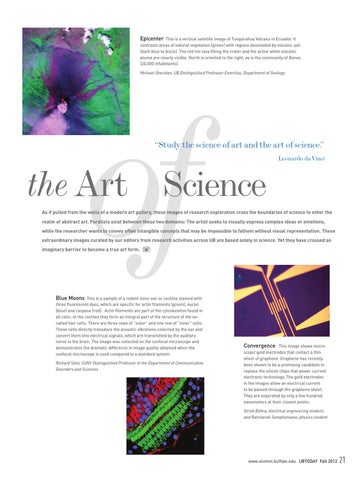
Epicenter
This is a vertical satellite image of Tungurahua Volcano in Ecuador. It contrasts areas of natural vegetation (green) with regions devastated by volcanic ash (dark blue to black). The red hot lava filling the crater and the active white volcanic plume are clearly visible. North is oriented to the right, as is the community of Banos (20,000 inhabitants). Michael Sheridan, UB Distinguished Professor Emeritus, Department of Geology
“Study the science of art and the art of science.”
the Art Science
Leonardo da Vinci
As if pulled from the walls of a modern art gallery, these images of research exploration cross the boundaries of science to enter the realm of abstract art. Parallels exist between these two domains: The artist seeks to visually express complex ideas or emotions, while the researcher wants to convey often intangible concepts that may be impossible to fathom without visual representation. These extraordinary images curated by our editors from research activities across UB are based solely in science. Yet they have crossed an imaginary barrier to become a true art form.
Blue Moons
This is a sample of a rodent inner ear or cochlea stained with three fluorescent dyes, which are specific for actin filaments (green), nuclei (blue) and caspase (red). Actin filaments are part of the cytoskeleton found in all cells. In the cochlea they form an integral part of the structure of the socalled hair cells. There are three rows of “outer” and one row of “inner” cells. These cells directly transduce the acoustic vibrations collected by the ear and convert them into electrical signals, which are transmitted by the auditory nerve to the brain. The image was collected on the confocal microscope and demonstrates the dramatic difference in image quality obtained when the confocal microscope is used compared to a standard system. Richard Salvi, SUNY Distinguished Professor in the Department of Communicative Disorders and Sciences
Convergence
This image shows microscopic gold electrodes that contact a thin sheet of graphene. Graphene has recently been shown to be a promising candidate to replace the silicon chips that power current electronic technology. The gold electrodes in the images allow an electrical current to be passed through the graphene sheet. They are separated by only a few hundred nanometers at their closest points. Girish Bohra, electrical engineering student; and Ratchanok Somphonsane, physics student
www.alumni.buffalo.edu UBTODAY Fall 2012
21