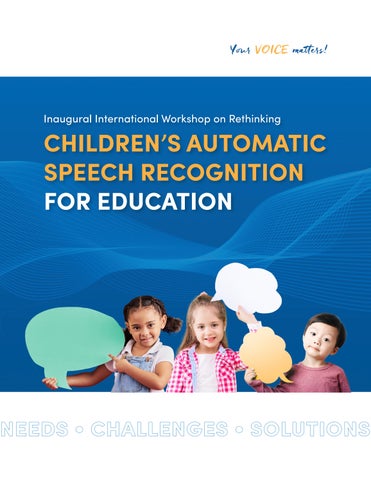
Rethinking Children's Automatic Speech Recognition (ASR) for Education Agenda

Page 1


Inaugural International Workshop on Rethinking

CHILDREN’S AUTOMATIC SPEECH RECOGNITION FOR EDUCATION

RETHINKING TOGETHER

Welcome to the Inaugural International Workshop on Rethinking Children’s Automatic Speech Recognition (ASR) for Education. This forum brings together thought leaders to address the unique challenges of developing ASR for children—ranging from scarce data and ethical considerations to the need for robust evaluation and benchmarking. By sharing insights and charting new directions, we aim to build a collective foundation for timely, responsible and transformative ASR technologies that advance learning for all children.

Thank You for Joining the Discussion, Inaugural Workshop Chairs

JINJUN XIONG, PHD

Director, Institute for Artificial Intelligence and Data Science (IAD)

SUNY Empire Innovation Professor University at Buffalo

JING LIU, PHD

Director, Center for Educational Data Science and Innovation (EDSI) Associate Professor University of Maryland

IN COLLABORATION WITH

WORKSHOP SCHEDULE

Rethinking Children’s Automatic Speech Recognition for Education

• • •

7:00 - 8:00 Breakfast and Sign-in

8:00 - 8:15 Welcome and Opening

8:15 - 9:00 Scope of the Workshop

9:00 - 10:00 Challenges in Children’s ASR, Why Now?

UB Provost: Scott Weber

UB SEAS Dean: Kemper Lewis

Workshop Organizers: Jinjun Xiong (UB) and Jing Liu (UMD)

Jinjun Xiong (UB)

Moderator: Jing Liu (UMD)

ABSTRACT: Many assume that the challenges of ASR for children have already been solved. But is it really the case? Even with today’s advances in AI, significant hurdles remain. What are the persistent technical and practical obstacles? What innovative approaches might address them? And how does an educational focus on ASR technology influence these considerations? In this panel, experts with decades of experience in ASR will share insights into these complex issues, shed light on the roadblocks that still stand in the way, and offer pathways that can lead to breakthroughs moving forward.

10:00 - 10:15 Coffee Break

Panelists: Abeer Alwan (UCLA)

Carol Espy-Wilson (UMD)

Matthew Perez (TeachFX)

WORKSHOP SCHEDULE cont.

10:15 - 11:15

Data Drives True AI, but Where do We Stand Today?

Moderator: Rohini Srihari (UB)

Panelists:

ABSTRACT: The limited availability of open-source, large-scale speech datasets from children remains a major barrier to advancing AI-driven speech models for education. Privacy concerns make the collection and sharing of such data even more complex. This panel will showcase teams that are actively tackling these challenges by developing novel datasets of children’s speech. Leading scholars will present their approaches, share lessons learned and engage with the community to chart a path toward building a more robust data infrastructure, one that can accelerate progress in children’s ASR for educational applications.

11:15 - 12:15 Needs and Solutions: Users’ Perspectives

Ahmed Attia (UMD)

Mark Hasegawa-Johnson (UIUC)

Brian MacWhinney (CMU)

Jacob Whitehill (WPI)

Moderator: Brian Graham (Grand Island Central Schools)

Panelists:

ABSTRACT: Many EdTech products rely on students’ voices as a primary input to power their core functionalities, whether it’s assessing mathematical reasoning, evaluating literacy development, or creating a seamless user experience. However, the requirements for children’s ASR vary widely depending on the subject domain, student subgroups, and the specific goals of each product. This panel brings together entrepreneurs from leading EdTech companies to share how they incorporate ASR into their tools, the unique needs and solutions they’ve developed, and their aspirations for the future of the field. The conversation is designed to spark greater alignment between academic research, industry needs, and funders’ investments, and ensure that progress in children’s ASR translates into meaningful impact in education.

12:15 - 1:15 LUNCH BREAK

1:15 - 2:15

Children’s ASR in Action at National AI Institutes and Centers

Orna Azulay (Remote Speech)

Amy Armstrong (Summit)

Arun Ramanathan (PowerMyLearning)

Drew Shoaf (Magpie)

Moderator: Marisha Speights (Northwestern University)

Panelists:

ABSTRACT: Two flagship federal initiatives are leading the way in applying AI to education: the National AI Institutes program and the National Research and Development Centers on Using Generative Artificial Intelligence to Augment Teaching and Learning in Classrooms (U-GAIN). In this session, panelists representing these programs will share real-world educational use cases from their institutes and centers. They will discuss how children’s ASR is being integrated into their work, highlight successes and lessons learned, and reveal their “wish list” for future advancements in children’s ASR technology.

Suma Bhat (Princeton)

Sidney DiMello (University of Colorado-Boulder)

Lei Liu (ETS)

Wookhee Min (NCSU)

2:15 - 3:15

Interests

from

Funding

Agencies and their Perspectives on Children’s ASR for Education

Moderator: Dana Suskind (University of Chicago)

Panelists:

ABSTRACT: Funding plays a pivotal role in guiding the research priorities and efforts of the community. As the federal funding landscape evolves, support from privatesector foundations will become increasingly influential. In this discussion, program officers from both a federal funding agency (NSF) and private foundations will share their perspectives on the importance of children’s ASR in education. They will address its relevance within a broader, integrated solutions context, highlighting complementary technologies, and outline their “wish list” for future technology and solution development.

3:15 - 3:30 Coffee Break

3:30 - 4:30 ASR and the Future of Assessment

Elizabeth Mokyr Horner (Gates Foundation)

Robert Ochsendorf (NSF)

Katie Wetstone (DrivenData)

Moderator: Alison Hendricks (UB)

Panelists:

Nonye Alozie (SRI)

Lydia Liu (ETS)

ABSTRACT: Assessment is one of the most dynamic and promising frontiers for applying ASR in education. By enabling more individualized evaluation, ASR has the potential to transform traditional assessment systems by moving beyond rigid, end-of-year standardized tests toward approaches that are timely, adaptive and deeply informative. This panel brings together experts from leading assessment companies and research institutions to explore both the technical and practical dimensions of ASR-powered assessment. Together, they will share their insights on current innovations and offer their visions for the future of assessment in the age of AI.

Susan Lottridge (Cambium)

Kirk Vanacore (Cornell)

4:30 - 5:30 Small Group Deep Dive

ABSTRACT: After a full day of inspiring talks and lively conversations, attendees will have a chance to channel their energy and ideas into focused discussions. In small, topic-centered groups, participants will explore emerging key themes during the day, identifying areas worth pursuing beyond the event. Possible discussion topics include: (1) Standardizing evaluation and benchmarking for tracking progress in children’s ASR for education; (2) Sharing best practices and lessons learned across the community; (3) Coordinating collective data collection efforts to benefit all stakeholders, and (4) Building a lasting coalition to sustain momentum and drive continued impact.

WORKSHOP SCHEDULE cont.

5:30 - 6:15 Group Discussion for Next Steps

ABSTRACT: We will bring everyone back together to share the key takeaways from each small-group discussion and collaboratively outline a roadmap for moving forward. To keep the momentum alive, we’ll conclude by inviting enthusiastic volunteer writers to lead the development of a white paper that captures our findings and recommendations for the broader community.

6:15 - 6:30 Travel to Dinner

6:30 - 8:30 DINNER

WORKSHOP MODERATORS

JINJUN XIONG

University at Buffalo

Passionate about scaling earthly AI through innovation

BRIAN GRAHAM

Grand Island Central Schools (WNY)

Superintendent, Effective Leader and Influencer in Adopting AI for Education

ALISON HENDRICKS

University at Buffalo

Language Learning Researcher on Language Acquisition in School-age Children with and without DLD

MARISHA SPEIGHTS

Northwestern University

Inspirational Leader in Developing

Inclusive, AI-informed Tools for Early Identification of Speech and Language Development Challenges

JING LIU

University of Maryland

K-12 Education Policy Researcher and Education Economist

ROHINI SRIHARI

University at Buffalo Scientist and Entrepreneur, Award-Winning ChatBot Researcher

DANA SUSKIND

University of Chicago

Professor of Surgery & Pediatrics

Co-director of the TMW Center at the University of Chicago

WORKSHOP PANELISTS

NONYE ALOZIE

SRI • M.S., Ph.D. (SRI), Co-Director of STEM&CS in Education with more than 10 years of experience in science education, learning sciences, designing for AI technology, standards-based curriculum design and assessment.

ABEER ALWAN

UCLA • Veteran researcher working on children’s ASR for more than 3 decades

AMY ARMSTRONG

Summit Center • Special Education Teacher and licensed behavior analyst who directs curriculum and instruction for individuals with autism

AHMED ATTIA

University of Maryland • Rising Scholar who contributed to UMD’s effort to build an AI database for math instruction and learning

ORNA AZULAY

Remote Speech • Founder for scaling SLPs to provide remote services for people with disabilities

SUMA BHAT

Princeton • NLP expert for the National AI Institute for Inclusive Intelligent Technologies for Education (INVITE)

SIDNEY DIMELLO

University of Colorado Boulder • Leader of the two-rounds of National AI Institute for AI-Student Teaming (iSAT)

CAROL ESPY-WILSON

University of Maryland • Long experience in working in ASR, more recently on ASR for children with translating research for real-world impact by founding OmniSpeech

MARK HASEGAWA-JOHNSON

University of Illinois Urbana-Champaign • Leader of the Speech Accessibility Project funded by five tech giants to make ASR more useful for people with a range of diverse speech patterns and disabilities

LEI LIU

ETS • Co-PI for National Center of Generative AI for Uplifting STEM+C Education (GENIUS)

LYDIA LIU

ETS • Associate Vice President as a globally recognized expert in assessment

SUSAN LOTTRIDGE

Cambium Assessment • Chief Scientist of NLP Applications at Cambium Assessment and Managing Director of Psychometrics

BRIAN MACWHINNEY

Carnegie Mellon University • Pioneer in speech data sharing and founder of TalkBank

WOOKHEE MIN

North Carolina State University • Managing Director of NSF AI Institute for Engaged Learning (EngageAI)

ELIZABETH MOKYR HORNER

Gates Foundation • Senior Program Officer driven by a passion for leveraging technology to bridge opportunity gaps

ROBERT OCHSENDORF

National Science Foundation (NSF) • Veteran NSF PO with deep interests in education and learning

MATTHEW PEREZ

TeachFX • Research Scientist working on speaker diarization in noisy classroom environments

ARUN RAMANATHAN

PowerMyLearning • CEO with deep passion to bring evidence-based programs for K-5 math education

DREW SHOAF

Magpie • Technologist that develops research-based PK-8+ digital literacy tools

KIRK VANACORE

Cornell University • Research Director at the National Tutoring Observatory which partners with tutoring providers to open-source instructional data for research that advances the science of teaching

KATIE WETSTONE

DrivenData • Senior Data Scientist passionate about incentivizing innovation through competition and benchmarking

JACOB WHITEHILL

Worcester Polytechnic Institute • Developing multimodal machine learning systems for classroom observation and teacher feedback

Institute for Artificial Intelligence and Data Science (IAD)

215 Lockwood Hall, University at Buffalo (North Campus)

Center for Educational Data Science and Innovation (EDSI)

0102 Benjamin Building, University of Maryland, College Park, MD

National AI Institute for Exceptional Education (AI4ExceptionalEd)

205 Lockwood Hall, University at Buffalo (North Campus)

NSF AI Institutes Virtual Organization (NSF AIVO) AiInstitutes.org

qrco.de/ASRWorkshop

Turn static files into dynamic content formats.

Create a flipbook
Issuu converts static files into: digital portfolios, online yearbooks, online catalogs, digital photo albums and more. Sign up and create your flipbook.