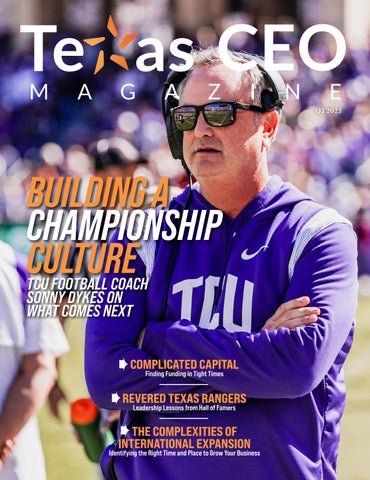
BUILDING
A CHAMPIONSHIP CULTURE
TCU FOOTBALL COACH
SONNY DYKES ON WHAT COMES NEXT
COMPLICATED CAPITAL
Finding Funding in Tight Times
REVERED TEXAS RANGERS
Leadership Lessons from Hall of Famers
THE COMPLEXITIES OF INTERNATIONAL EXPANSION
Identifying the Right Time and Place to Grow Your Business
KEYNOTE SPEAKER
Every entrepreneurial journey starts with a dream. To create something new, better or more meaningful. To be your own boss and leader. To enjoy a more flexible lifestyle. To leave a legacy for the next generation. To give back to a community. To change the world in positive ways. Whatever your dream as a woman business owner, NAWBO is here to power it by delivering a uniquely fun and impactful experience infused with networking, inspiration, learning, shopping, resources and more.
Every month from now through the conference, we’re randomly drawing the name of one registrant to win a 1-night hotel stay at this year’s conference host venue, Renaissance Austin Hotel. That means, the earlier you register, the better your odds of winning!
Join
Dr.
Martha Beck
Power your dream with the most diverse group of women entrepreneurs from across the country.
CEO / C-SUITE SUMMIT 2023
NOVEMBER 6, 2023
NOON - 6 PM Hilton Austin | 500 East 4th Street | Austin, TX 78701
The Austin Technology Council CEO / C-Suite Summit will bring together 150 visionary leaders from Austin’s tech ecosystem to network, learn, and have roundtable conversations about the issues facing the future of Austin.
TO REGISTER, VISIT https://atc.ticketbud.com/ceo-c-suite-summit
For more information, call (512) 394-8260 or email thom@austintechnologycouncil.org.
austintechnologycouncil.org
Event Sponsors
IN THIS ISSUE
40
Building a Championship Culture
48
The Extra Mile is Never Crowded
It’s been 25 years since the Texas Ranger Hall of Fame and Museum inducted any new members, but this year is different. Meet the only living Texas Rangers, inducted this year, in the hall of fame and find out what’s behind their success.
34
Navigating the Funding Landscape of Texas
Is it the best of times or the worst of times to fund a company? The answer is complicated.
56 Streamlining Business with the US Army
Coach Sonny Dykes took the TCU football program to a historic championship last year. This year, he’s determined to not let prior success become a stumbling block.
The Army Applications Laboratory is reshaping the way the military and industry work together.
“There are always lessons to be learned from success, just as much as there are from adversity. You’ve got to be careful not to pat yourself on the back too much. You’ve got to keep expanding, learning, growing, pushing, because other people who haven’t had the success are working harder.”
TCU Head Football Coach Sonny Dykes
TEXAS TALK
16 Making a Difference for Texas Veterans
Endeavors President and COO Chip Fulghum seeks to serve Texas veterans and other vulnerable populations.
22 Finding Opportunity in Chaos
CEO Mark Steffe and First Command lead military families to financial success.
28 From Struggling to Success
Veteran Women’s Enterprise Center founder and CEO VR Small has a big vision for women veterans in business.
VOICES
62 Buyer Beware
Artificial intelligence heightens the need for cybersecurity vigilance.
ON THE COVER
TCU Coach Sonny Dykes led the TCU Horned Frogs to a national championship in his first season. Can he do it again? Story on page 40. Photo courtesy of TCU.
OWNER
Joel Trammell
PUBLISHER
Rebecca French Smith
EDITORIAL & DESIGN
CONTRIBUTING EDITORS
Kathy Casteel
Aaron Hierholzer
GRAPHIC DESIGN
Horizon Line Design, LLC
CONTRIBUTORS
Jeff Bounds, Jonathan Conrad, Gordon Daugherty, Charles Denyer, Deborah Hamilton-Lynne, Jonny Hawkins, Phaedra Rogers
SALES & MARKETING
MARKETING & OPERATIONS MANAGER
Grace Daleki
To subscribe to the print or digital edition of Texas CEO Magazine, please visit our website TexasCEOMagazine.com and click subscribe.
POSTMASTER
Please send address changes to:
The American CEO, LLC
dba Texas CEO Magazine
8012 Bee Caves Road Austin, TX 78746
© 2023 The American CEO, LLC, dba Texas CEO Magazine. All rights reserved. The Content in this issue may not be reproduced, distributed, or otherwise used without the prior written consent of The American CEO, LLC. The various contributors own their respective Content that is published in this magazine.
The beliefs, content, comments, opinions, statements, and viewpoints (collectively, the “Content”) published in this issue are those of the respective contributors and we do not necessarily agree, endorse, support or verify such Content. The Content presented in this issue is for informational purposes only and is not advice of any kind.
Your use of the Content is at your own risk. The Content is provided on an “AS IS” basis, without any warranties of any kind, either express or implied. Neither The American CEO, LLC, nor any person associated with us makes any warranty or representation with respect to the completeness, reliability, quality, or accuracy of the Content. Without limiting the foregoing, The American CEO, LLC, does not represent or warrant that the Content will be accurate, reliable, error-free, that errors will be corrected, or that the Content will otherwise meet your needs or expectations. The American CEO, LLC, disclaims all warranties of any kind, whether express or implied, statutory or otherwise, including but not limited to any warranties of merchantability, non-infringement and fitness for particular purpose. The foregoing does not affect any warranties that cannot be excluded or limited under applicable law.
THE VALUE VETERANS ADD V
eterans are special for myriad reasons, but they can be a particular asset for a business, whether serving on the team or leading the organization. In this issue we sought to focus on those who are making a difference both serving as leaders and making a difference for veterans in the Lone Star State.
First, we sit down with Air Force veteran and president and chief operating officer at Endeavors, Chip Fulghum (“Making a Difference for Texas Veterans,” page 16). For more than 50 years, the organization has worked to provide safety and resources for vulnerable populations, and for the last decade, veterans have been a part of its mission. In the last two years, it has upped its game with a new Veteran Wellness Center in San Antonio with a second center expected to open in 2025 in El Paso.
Veterans can bring a unique perspective, attitude, and work ethic to a task. In our Texas Talk “From Struggling to Success” on page 28, we introduce you to VR Small, a veteran with a can-do attitude who is putting her skills to work helping women veterans excel in their businesses. She brings to light the challenges women veterans face, and through her organization, the Veteran Women’s Enterprise Center, helps set up this demographic for success.
Learn more about Rebecca and the rest of the team online at TexasCEOMagazine.com/about.
You’ll also meet the only two living Texas Rangers in the Texas Ranger Hall of Fame and Museum (“The Extra Mile is Never Crowded,” page 48). These two gentlemen exude humility. We give you a peek into their perspectives on the meaning of teamwork and leadership and how those concepts played into any success they had in the field.
Of course, I’d be remiss if I didn’t mention the cover story (page 40) and why we included it in this issue. TCU Coach Sonny Dykes is a veteran of the gridiron. His leadership and commitment to the sport led the Horned Frogs to the national championship last season. In our Q&A session with him, we look at the team’s phenomenal first season and what he hopes this next season holds.
The last piece I’d like to draw your attention to is historical. History has always fascinated me, and you know what is said about learning from it. In “When One Word is Enough” on page 48, ISF President Jonathan Conrad walks us through a critical part of the Battle of Gettysburg where the leadership and communication of the commanding officer shaped the regiment’s culture—and how that same approach can be applied to modern-day business.
You’ll likely notice another theme that runs through this issue, one that veterans through experience know very well: teamwork. It’s a pivotal piece of any endeavor, and the veterans we spoke to recognize it is a crucial aspect to success.
Enjoy the issue!
Rebecca French Smith Publisher Texas CEO
Veterans can bring a unique perspective, attitude, and work ethic to almost any task.
THE PERFECT SPOT FOR YOUR NEXT LEADERSHIP TEAM RETREAT OR PERSONAL GETAWAY IS RIGHT HERE IN
Nestled on 150 acres just 30 minutes east of the Austin airport, this one-of-a kind ranch facilitates the ultimate executive retreat. With 15 bedroom suites your group will enjoy immersion in nature without sacrificing any modern comforts. Miles of wooded trails span around majestic, oversized pines, lush fields, coastal and native grasses, and wildflowers along with two fishing ponds stocked with sunfish and largemouth bass. Spectacular amenities include a 9-hole putting green, golf simulator, pickleball court, 1,000-square-foot conference room and more. A true Texas getaway awaits.
AMENITIES:
• High-definition TVs and work desks in each room
• Dedicated home theater
• Commercial hi-speed Internet with WiFi
• Courtyard with pool, hot tub, and outdoor kitchen
• Pickleball court
• Chargepoint electric vehicle station
• Eight electric bikes included
• Running stream with meditation area
• Golf facilities, including 9-hole artificial putting green, driving range, and golf simulator
• Three-hole frisbee golf course
• Catch-and-release fishing—fishing gear provided
• 15 bedrooms suites that can sleep up to 23
KEEPING YOUR EMPLOYEES WELL GROUNDED
We’ve all slipped on a slick floor, tripped over a child’s toy or fallen off a ladder. When it happens at home, we usually end up with minor, though sometimes embarrassing, bumps, bruises or scrapes. When it happens at work, it can be far more serious.
Slips, trips, and falls are one of the top three leading causes of workplace fatalities. These types of workplace incidents also carry direct and indirect costs. Direct costs, which include medical and income benefits for the injured worker, are covered by the insurance carrier. Indirect costs, such as making up for lost production, come out of your pocket. Indirect costs can be up to 10 times higher than direct costs.
The average non-fatal slip, trip or fall injury results in about $23,929 in direct costs. If we use a conservative one-to-two ratio, that seemingly minor injury will cost you $47,858 in indirect costs.
So, that’s the bad news. The good news is that you can prevent most slips, trips, and falls. Share these four tips with your employees to keep everyone’s feet on solid ground.
1. Practice good housekeeping. Wipe up spills, and keep walkways, steps, and exits clear. Do not run extension cords across walkways. If you have to, secure them to the floor. Keep desk and file cabinet drawers closed when you’re not using them. Otherwise, unsuspecting co-workers might trip over them.
2. Move safely and avoid horseplay. Walk, don’t run, making sure to slow down at blind corners. If you are carrying a load, make sure you can see over it. And never engage in horseplay or take shortcuts, such as jumping off loading docks or machinery.
3. Dress for success.
Slip-resistant footwear can help protect you from injury, but consider it your last line of defense against accidents. Make sure the shoe
FROM SLIPS, TRIPS, AND FALLS
or boot is rated for the hazards you encounter. Replace shoes when the soles are worn. Here’s a rule of thumb: If you have a worn spot bigger than two pennies, it’s time for new shoes. If you work in a restaurant or other environment where wet floors are common, ask your employer about slip-resistant floor mats.
4. Work safely from heights.
Learn how to set up, inspect, and use ladders safely. On stairs, use the handrails, avoid distractions, and take one step at a time. And always use fall protection equipment when required. Texas Mutual online services can help you steer clear of slips, trips, and falls. Policyholders can visit the safety resource catalog to get training materials to help prevent injuries. Sign in to use the loss run and claim detail tool to identify accident trends.
75,000+ businesses insured by Texas Mutual
9,000 agents across the state, ready to serve you
Thousands of free safety resources including online videos, sample safety programs and more for policyholders
CARING FOR TEXAS FOR MORE THAN 25 YEARS
Texas Mutual is the state’s leading provider of workers’ compensation insurance and is committed to building a stronger, safer Texas. Helping employers prevent workplace accidents is an important part of Texas Mutual’s mission. Talk to your agent about how you can strengthen your business with Texas Mutual and learn more at TexasMutual.com.
MAKING MOVES
Grant Adams
DALLAS
Goodnight Midstream, a provider of waterhandling services, promoted Grant Adams to CEO. Adams joined Goodnight Midstream nearly seven years ago as a general counsel; he previously worked as in-house counsel at EnLink Midstream and Alon Energy. Adams succeeds Patrick Walker, who will continue to be an active member of the Goodnight Mainstream Board of Directors after the transition.
Stacie Wheelock Adams
DALLAS
The Business Council for the Arts named Stacie Wheelock Adams as its CEO. Most recently, Adams served as the senior vice president of external affairs at Axxess, a technology innovator for at-home care. Previously, she served as deputy director of the Crow Museum of Asian Art and director of public relations and communications at the Dallas Symphony Orchestra. Adams succeeds Katherine Wagner, who is retiring after 14 years of service.
Robert Aslett
AUSTIN
Silicon Integration Initiative, Si2, appointed Robert Aslett as president and CEO. Most recently, Aslett worked at the Social Venture Partners of Portland and was a guest lecturer at Portland State University’s Graduate School. He brings more than 30 years of experience to this role, having held multiple leadership roles at Intel and several nonprofit enterprises.
Kelley Cornish
DALLAS
T.D. Jakes Foundation (TDJF) appointed a new CEO, Kelley Cornish, to oversee the foundation as it works to close the racial wealth gap. Previously, Cornish held multiple executive diversity roles for companies such as TD Bank Group and Children’s Hospital Philadelphia. Most recently, she was the executive vice president, chief administrative officer for diverse segments, representation, and inclusion at Wells Fargo and Company.
Flynn Dekker
HOUSTON
Shipley Do-Nuts named Flynn Dekker as the next CEO of the brand. Dekker most recently served as CEO at the global Korean fried chicken franchisor, Bonchon. Prior to Bonchon, Dekker served as chief marketing officer of Wingstop Restaurants and has more than 30 years of executive leadership experience in the restaurant and retail industry. Dekker succeeds Clifton Rutledge, who will sit on the company’s board of directors.
AUSTIN
Roadwire, an automotive leather interior and specialty products company, appointed Ammie Forrister as CEO. Forrister has more than a decade of experience in the industry and was most recently the vice president of manufacturing. She is a third-generation legacy to take over Roadwire, succeeding her father, former CEO pro tem Dwight Forrister, who has resumed his position as chairman of the Roadwire board.
Here are a few recent CEO moves in Texas.
Jarred Howard
FORT WORTH
The National Juneteenth Museum member’s board named Jarred Howard as CEO. Howard was the senior vice president of small businesses and entrepreneur support at the Fort Worth Chamber of Commerce. He was also one of the visionaries behind the museum, which is planning to open on June 19, 2025. Howard brings more than 20 years of economic development, marketing, and banking experience to this role.
BIG SPRING
SCS Technologies appointed Cody W. Johnson to serve as president and CEO. He has more than 20 years in executive leadership positions in the oil and gas and industrial end-markets. Johnson succeeds co-founders Cliff Castilaw and Jess Slaughter, who will focus on long-term strategic vision as active board members.
AUSTIN
Auctane, a global delivery company, selected Albert Ko as its next CEO. Most recently, Ko was the CEO at Early Warning Services (EWS). Prior to his time at EWS, Ko spent more than 13 years at Intuit, where he served in various executive leadership roles, including chief transformation officer, general manager of Mint, and head of product for QuickBooks. He succeeds Nathan Jones, who plans to join the company’s board of directors.
Cintra, a subsidiary of Ferrovial, promoted Alberto González Lalueza to the role of CEO of its US region. González has been with Ferrovial since May 2004 and has held several leadership positions at Cintra. Previously, he was the CEO of Dallas Highways in Dallas. González succeeds Andrés Sacristán, who is being promoted to global CEO.
Chef Holdings, the parent company of CTI Foods and Liguaria Foods, appointed Terence O’Brien as CEO. O’Brien brings nearly 40 years of food and leadership experience to this position at Chef Holdings, including senior leadership roles at Dean Foods and Frito-Lay, and as CEO at Brach’s Confections. Most recently, he was the CEO of CP Foods North America.
O’Brien succeeds Mike Buccheri, who has held the role since 2019.
Pinecroft Reality, a real estate company that specializes in health care properties, appointed Jim Pisula as its next president and CEO. Pisula has been with Pinecroft for more than 15 years, most recently serving as the chief investment officer and as a partner at the firm. The company has grown to have a presence in Texas, Colorado, and Arizona. Pisula succeeds his brother, Tom Pisula, the founder, who will transition to chairman of the national company.
Cody W. Johnson
Albert Ko
Alberto González Lalueza
Dr. Mark Shen
AUSTIN
The Hospital at Westlake Medical Center and Arise Austin Medical Center appointed Dr. Mark Shen as the new CEO. Previously, Shen held senior positions with Ascension Texas and was the CEO of Senton Health Alliance. Shen also is an associate professor with Dell Medical School at The University of Texas at Austin.
Bryan Shin
DALLAS
South Korean fried chicken restaurant franchise Bonchon has promoted former global chief financial officer Bryan Shin to lead Bonchon US as CEO. He joined Bonchon in 2019 and has been in the global food and beverage space for more than 10 years. Previously Shin held top global leadership and senior positions at Yum! Brands and Goose Island Beer Company.
Dana Sisk
CORPUS CHRISTI
Rally Credit Union appointed Dana Sisk as the new president and CEO. Sisk joined Rally Credit Union in 2006 as chief financial officer and, most recently, served as executive vice president. Previously, she was the chief financial officer for Horizon Credit Union. Sisk succeeds Gerry Morrow, who retired at the end of April after 18 years of service.
Tad Stahel
AUSTIN
Thrive Pet Healthcare, a national veterinary hospital network, appointed Tad Stahel as CEO. Most recently, Stahel served as group vice president for DaVita. He brings more than 20 years of business experience in health care and technology to this position. Stahel succeeds Odis Pirtle, who is stepping down after 20 years.
Pete Stoy
AUSTIN
Hanger named Pete Stoy as its next CEO. He will also serve on Hanger’s Board of Directors. Stoy joined Hanger in November 2020 as the chief operating officer. He came to Hanger with more than 20 years of health care experience as he held leadership roles in Sodexo and Cardinal Health. Stoy also holds a designation as a Fellow of the American College of Healthcare Executives. He succeeds Vinit Asar, who has held the position for more than a decade.
Starlee Sykes
HOUSTON
BP promoted Starlee Sykes to CEO of Archaea Energy, a bioenergy company that BP acquired late last year. Most recently, Sykes served as the senior vice president of BP’s Gulf of Mexico and Canada businesses. She brings more than 25 years of experience to this position in the energy industry.
GROWTH – Three Principles for Minimizing Pain While Realizing Gain
AUTHOR: Elbert Johnson, Consulting CFO, vcfo
the organization received not only the support and expertise needed to remedy known issues but also insight into unknown issues and opportunities ahead. For example:
Healthy growth requires managing through, minimizing, and avoiding the pains and pitfalls that growth typically brings. Here, we explore how growing pains manifest themselves in businesses and outline three principles for navigating growth effectively.
Principle 1 - Know Your Trajectory and What It Entails
Most owners and executives are pushing for some degree of growth. As the trajectory of business growth steepens and more milestones are met, the number of decisions, new challenges, and new business supports needed multiply. When the growth trajectory outpaces readiness and preparation for it, pain arises. For example: an outdoor goods company carved out a stable market niche that generated ~$5M annually. Revenue hovered around that mark for 20 years until a new growth-minded executive arrived. After learning of a high-potential product line not yet sold in their market, he added it to the company’s offerings via their existing distribution network. Over the next five years, revenue skyrocketed more than eight times. Actions to manage the monumental growth were well-intended and directionally sound but nonetheless
resulted in new problems.
• Basic operational software was replaced by a deeper platform to improve recordkeeping and reporting, but poor implementation and setup by IT vendors made matters worse.
• A transition from cash accounting to accrual accounting happened without a complete understanding of what that entails, which created a jumbled mess of entries.
• Efforts to secure funding for expansion and capacity building were stalled by financial reporting deficiencies, resulting in inefficient and costly makeshift funding plans to meet demand. Whether growth expectations are 5 percent or 500 percent over a given period, the right plan, people, and processes must be in place to support it. This point and the issues outlined above set the stage for our next principle.
Principle 2Seek Counsel from Those Who Have Traveled the Road
To address the issues borne of its problematic software implementation, conversion to accrual accounting, and funding efforts, the company brought in an outside expert. Because the outside expert had previously been the CFO of a comparable company in their industry,
• An introduction enabled a switch from a general insurance broker to significantly better coverage from a provider that solely serves the company’s industry.
• Other relationship doors were opened, leading to conversations with mid-regional banks that, unlike smaller local counterparts, were accustomed to funding expansions of the size needed by the business. Seeking counsel from those who traveled the road before doesn’t extend to just finance. Open dialogue into other areas such as HR expertise, sales, marketing, and other operational areas to gain insights from leaders in adjacent businesses.
Principle 3Be Willing to Let Go of Status Quo
Owners and executives must face the fact that some of the people and processes that got them where they are may not get them where they need to be. Hesitancy to change often stems from feelings of loyalty and comfort with how things have historically been done and who has done them. Adding needed expertise needn’t involve kicking tenured employees to the curb. Consider whether you can put those employees in positions where they can continue to develop, apply institutional knowledge, and add value. Fractional leadership can help here too by serving as bridges to support the company until
capacity and other conditions compel adding those roles inhouse. When that time comes, fractional resources can help to articulate the qualities and skills that will be needed in these roles.
Manage Growth Wisely
Business growth doesn’t have to hurt. A well-planned and principled approach to managing growth optimizes gains and minimizes pain. Understand your company’s growth trajectory and what that brings into play. Get input and advice from experts who have successfully guided others through comparable growth climates and conditions. Lastly, be open to parting with the status quo to instill the right expertise and infrastructure.
vcfo makes companies stronger through fractional Finance and HR expertise enabling business leaders to focus on driving objectives and growth plans. vcfo provides expert guidance and assistance with a suite of services across the operational spectrum.
What growth looks and feels like can differ dramatically from one company to the next. For some, growth is a rocky road where leaders are surprised by or unprepared for what comes next and find themselves in precarious positions. For others, growth unfolds predictably and relatively painlessly.ELBERT JOHNSON Consulting CFO
MAKING A DIFFERENCE
written by Rebecca French Smith
Chip Fulghum learned the finer points of service when he was in the Air Force. He learned what it meant to serve from bosses who taught him the value of service. Over time, the military became a way of life for him, a way to give back and a way to serve others. But that’s not how it started.
Fulghum grew up in a small town in North Carolina near the Seymour Johnson Air Force Base. Despite the base’s proximity, he says he didn’t know much about the military other than his father served overseas for two years. When it came time to choose a college, he didn’t think he would be successful at a traditional institution, so he chose to attend The Citadel, a South Carolina military school with the stipulation that ROTC was a requirement to graduate—not to enroll but to graduate.
“About half went in, half didn’t,” Fulghum says. “I’d like to tell you I joined because of education and this service, this passion to serve. I didn’t really have that at the time, but they were offering a hundred dollars a month. I had zero.”
Graduating with a bachelor’s degree in history, Fulghum signed up for a four-year stint in the military and ended up spending 28. He served in the Air Force’s financial management system throughout his military career, overseeing the needs of airmen around the world and ensuring they had what they needed to do their jobs. He did three tours at the Pentagon in Washington, DC, and spent time at the major air commands, including the Air Education and Training Command, and tours at base level.
In Texas, Fulghum is one of more than 1.5 million veterans who live here, according to the US Department of Veterans Affairs. Texas has the second-largest population of veterans in the United States, coming in behind California, which claims more than 1.6 million veterans. The US Census Bureau lists some 2,700 veterans experiencing homelessness in the Lone Star State, an issue Fulghum battles in his current role as president and chief operating officer at Endeavors, a San Antonio-based nonprofit that provides social services to vulnerable populations. Established in 1969 by five churches in the San Antonio area, Endeavors began its mission with a focus on helping the unhoused population in that area. More than 50 years later, the agency’s scope has grown to include shelters for single women and their children, mental health services, disaster case management services including hurricane relief, and migrant services. Some of Endeavors’
latest work has centered on veteran services through The Steven A. Cohen Military Family Clinics at Endeavors and the Veteran Wellness Center (VWC).
Last year, Endeavors provided more than $3.4 million to veterans in need across 109 Texas counties through homelessness assistance, utility assistance, and essential items, according to its 2022 annual report. In 2021, Endeavors opened its first VWC in San Antonio. The center provides mental and physical health services through offerings such as yoga, group fitness classes, and a state-of-the-art fitness center. Last year, 3,634 people used the VWC’s services, and the organization broke ground on a second VWC on 10 acres in El Paso and hopes to have it up and running in early 2025.
Veterans use the new Veteran Wellness Center in San Antonio. The fitness center added 294 new fitness center memberships in the last year.
What I’ve learned through the years is people are people, and the one thing the military taught me is if you just treat people the way you want to be treated, you’ll probably do okay.
— CHIP FULGHUM ENDEAVORS PRESIDENT AND COO
What spurred your move from Homeland Security to your role at Endeavors?
I learned what service was all about in the Air Force. So, to me, public service was just another way to serve. You’re just serving the nation in a different capacity. When someone asked me about going over to Homeland Security
and becoming, at the time, the budget director, I said first I had to figure out what Homeland Security was. I didn’t know a lot about that agency because it was relatively new. But then to see the mission [of Endeavors], the importance of that mission, and how service and serving in that capacity would be another
way to give back, I applied for the job, and I was fortunate enough to be selected. How does your military background influence how you lead? What I’ve learned through the years is people are people, and the one thing the military taught me is if you just
treat people the way you want to be treated, you’ll probably do okay. I’ve tried to carry that over and look at the organization and flip it upside down. The only reason I’m here is to support the people right above me now, which actually are the people below, if you think about flipping it upside down. If you carry that out throughout the whole organization, then you get the idea: We’re only here to support those who work for us. But, we’ve got to support them, get them the resources they need, and provide the right type of leadership.
Ultimately, it’s about making a difference. We look at it as if we serve one client at a time, and if we’ve made a difference for that one client, then we’ve made a difference that day. That’s what you learn in the military—how to go about making that difference in those you work with, those
who work for you, and even those you work for.
Who have been your mentors?
Several, and I would say, you learn from the bad as well as the good. But one is Major General Alfred K. Flowers. I worked for General Flowers when I was at Air Education and Training Command. He was the chief financial officer of the command. Then I worked with him again when he was the director of budget for the Air Force.
General Flowers is the longestserving airman in Department of Defense history, 40-plus years of service—started as an airman in Vietnam, rose to the ranks of two-star. What a humble guy and the true definition of what servant leadership is all about. He’s certainly one of the foremost folks who taught me a lot about leadership and taught me about what it means to serve others and
After his Air Force career, Chip Fulghum spent seven years with the Department of Homeland Security before he transitioned to the private sector to become president and chief operating officer at Endeavors, but he sees both jobs as ways of serving his country.
to give back. His book, Reflections of a Servant Leader, is an excellent book.
Tell us about the origins of Endeavors. We’re a faith-based organization that was founded by five Presbyterian churches in 1969 with a simple mission, and that was a mission to serve. At the time, there was a significant homeless population—a pretty bad problem—here [in San Antonio], and Louis Zbinden, the pastor of the First Presbyterian Church, came to the church one January.
Out of that, a lot of organizations responded, including Endeavors, and we never lost that mission to serve others. Today, we have communitybased services. We have emergency services. We do a lot with behavioral health, particularly as it relates to veterans and their families, and then the migrant services line. In regard to migrant services specifically, we’ve been supporting those operations for more than a decade. We’ve done more than 35 deployments in support of
When you say operations, can you give an example?
One example is an influx care facility. Whenever there is a surge of migrants coming across the border seeking asylum, the Health and Human Services Office of Refugee and Resettlement has a permanent shelter network set up. They have so many beds available for unaccompanied children coming across the border. When there’s a surge and they don’t have enough bed capacity, they stand up influx care facilities, which are more temporary in nature, to deal with that additional overflow that they have because they don’t have enough permanent bed capacity.
because Border Patrol was not set up to care for this type of population or hold this type of population. It’s primarily set up for single adults, not families or unaccompanied kids. The government looks for organizations such as Endeavors to help provide that capacity in times of crisis.
to serve vulnerable people in crisis, and if unaccompanied children coming to the border seeking asylum don’t meet that mission, I don’t know what does.
When did veterans enter Endeavors’ purview?
It was really cold the night before, and a homeless individual had perished. Zbinden was committed from that point on to not let that happen again because the church was put here to serve.
those operations, primarily as a subvendor to others; 2021 was the first time we were the prime vendor for those operations, but we’ve been doing it for well over a decade.
In 2021, when there was again a crisis at the border and a record number of unaccompanied children coming across, sites went up across the United States to meet that demand. Because what you’re trying to do is get these kids out of Border Patrol care as fast as possible
What did last year look like? Reports cited some 2.76 million migrants came across last year. That number includes single adults, families, and unaccompanied children. I believe it was a record year for unaccompanied children at the end of 2022, and migrations are typically seasonal in that they go up and down. This one has been steadier over the last couple of years, and the government needed organizations like us to step up and help. At the end of the day, we’re a humanitarian organization. Serving this population meets our mission. Our mission is simply
We began serving veterans who have become homeless or about to become homeless in 2012. We’ve been a provider of those services on behalf of the Department of Veterans Affairs (VA) since 2012. If you’ve served in the military and you find yourself at risk of becoming homeless or are experiencing homelessness, one of your earned benefits is to come to organizations like ours that the VA has contracted with. Our job is to help 1) housing first, get you back into housing, and then 2) not only help you with that temporary financial assistance but really do the case management work to figure out what drove you to homelessness and then help you back on the road to recovery so that it doesn’t happen again.
We look at it as if we serve one client at a time, and if we’ve made a difference for that one client, then we’ve made a difference that day.
We got into the mental health and behavioral health business as it relates to veterans in 2016. The Cohen Veterans Network (Steve Cohen, who now owns the New York Mets, and whose son served in the Marines in Afghanistan) developed after Steve’s son came back and said, “Dad, my friends can’t get access to mental health care as fast as they need to from the VA.” He’s put his money where his mouth is and stood up 25 clinics across the United States with the purpose of providing mental health support to veterans and their families.
The veteran can determine who that family member is. It may be a caregiver, maybe a partner, could be a child, could be a spouse. About 50 percent of the folks we see in our Cohen clinics are family members. About 25 percent of those are kids.
We were the first one outside the clinical research facility. They stood up in New York, then here in San Antonio. We have
two more, one in El Paso, one in Killeen. There’s also one in Dallas. We’re very privileged to operate those on behalf of the Cohen Veterans Network and serving the mental health needs of veterans, active duty, and their families. Then we began to see an even bigger need for veterans and their families, and it’s around the idea of wellness as it relates to suicide prevention. If you can get folks pointed toward a more holistic approach to wellness, the less likely they are to die by suicide.
We were fortunate to be able to build a first-of-its-kind here in Texas, in San Antonio, a 27,000-square-foot veterans wellness center. Every square inch of the facility is designed with some aspect of wellness in mind. What’s really cool about it is the veterans get to choose where they start. It’s not prescriptive in nature. They get to choose what aspect they want to start with, whether it’s just a walk on the treadmill or there’s a large connectedness
space where they can just hang out, talk to someone, and connect to Wi-Fi, or maybe it’s an alternative to traditional health care with acupuncture, massage therapy, or tai chi, or maybe they just need help with financial issues. There’s a financial adviser, or maybe there are legal issues they’re having in terms of getting their claims adjudicated, so there’s a legal provider.
What advice would you have for a fellow veteran who is looking for a way to make an impact?
There are a lot of different ways to serve. I was very fortunate to spend seven years in Homeland Security, from starting as the budget director to becoming CFO and deputy undersecretary for management, even acted as the deputy secretary. It’s proof positive that veterans have some incredible skills that, if given the right opportunity, they can make the most of it in terms
of giving back. I’m proof positive that anything’s possible given the time I spent both in the military as well at Homeland Security and then in the private sector. Nonprofits are always looking for leadership, and if there’s one thing veterans know, it’s leadership.
I didn’t know anything about the homeless other than what I read when I got here, but I can learn those things. I can learn the best practices in serving the homeless or what are the best practices in serving those who are suffering from some form of mental illness. You can acquire knowledge, but the leadership you gain and the experience you gain in the military is just invaluable.
Organizations like ours are desperately seeking folks with leadership ability because every issue rises and falls on leadership. For veterans, just because the job description may not exactly fit what they did in the military doesn’t mean they can’t do the job.
LIGHTNING ROUND
What’s your favorite Texas product?
Anything HEB has.
What’s the best advice you ever received?
“It’s not about you.”
What quote summarizes your personal approach to leadership?
I think Lyndon B. Johnson said one time: “You aren’t learning anything when you’re talking.”
What is your can’tlive-without-it technology?
Cell phone.
FINDING OPPORTUNITY IN CHAOS
written by Jeff Bounds
CEO Mark Steffe and First Command lead military families to financial success.
First Command Financial Services President and CEO Mark Steffe.
Mark Steffe was ready to take the leap. After serving in leadership roles at TIAA (previously TIAA-CREF) and UBS Financial Services (formerly PaineWebber), he finally got to run his own show when he was promoted to president and CEO of First Command Financial Services Inc.
That was the good news.
The bad news was he took the reins on January 1, 2020. On March 13 of that year, he sent the Fort Worth-based company’s staff to work remotely because of fast-spreading COVID-19.
“That one day called our entire business model into question,” Steffe says.
Founded in 1958 as the United Services Planning Association, First Command supplies financial planning and coaching to 293,000 military families through 173 offices worldwide, most situated near military installations.
As COVID-19 took hold, one of the company’s biggest issues was that its advisers, who provide the planning and coaching, worked primarily face-toface with clients they were helping with investments, insurance, and banking. (The company offers those products and services through subsidiaries such as First Command Bank.)
One of the primary ways Steffe and company addressed this problem was through technology, something that today has helped position the business to grow in a postpandemic world.
With uncertainty now hanging over US and global economies, Steffe’s team is finding new revenue sources in areas where First Command already does business.
During the pandemic and beyond, Steffe displayed the hallmark of military leadership: guiding people through their darkest hour. Yet he is the first CEO in the company’s history who did not serve in the armed forces. Like many of his generation, he learned about leading group efforts through avenues such as playing sports.
Steffe grew up in Colona, Illinois, a community of 5,000 near the larger Quad Cities metro area that straddles the Illinois-Iowa border. The son of a mechanic and a secretary, he played football and basketball in high school and was recruited by several smaller Division III colleges.
Since a career as a professional athlete seemed unlikely, Steffe opted
for the University of Illinois at UrbanaChampaign where he earned a bachelor’s degree in finance, with honors, in 1991. He holds Series 7, 8, 23, 63, and 65 securities registrations and completed the Harvard University Advanced Management Program in 2015.
Prior to joining First Command in 2010, Steffe spent much of his financial services career in wealth management. His clients included high-net-worth individuals, who Forbes defines as “people or households who own liquid assets valued between $1 million and $5 million,” and ultra-high-net-worth people, who the magazine classifies as owning more than $30 million in liquid assets.
“I used to joke when I was first coming in (that) in my prior career, for instance at UBS, it was a lot of fun and rewarding helping wealthy people become wealthier,” Steffe says. “But we weren’t changing lives. They were already wealthy when we began working with them.”
Going to a company that serves military families “was a dramatic switch,” he says.
Military Families’ Money Issues
First Command was founded by Lt. Col. Carroll Payne, a B-29 aircraft commander who saw 24 crew members die in World War II. Payne, who had to inform their next of kin, learned that the men’s families often suffered financially from the losses of their loved ones.
After the war, when Payne was stationed at Eglin Air Force Base in the Florida Panhandle, he watched as military retirees, their pensions damaged by high inflation, ate and drank on credit at the officer’s club.
Payne launched United Services Planning Association in 1958 to help military families adopt habits that breed financial security, such as saving money consistently, buying life insurance, and investing prudently. The company renamed itself First Command in 2001.
First Command Financial Services, President and CEO Mark Steffe and Gail Donahoo, the company’s meetings and events coordinator, celebrate the closing ceremonies of its annual Spirit of Giving campaign in October 2022. The campaign raised $136,000 for the First Command Educational Foundation and the United Way of Tarrant County.
While the company’s efforts have produced many success stories, money problems still plague service personnel and their families today, just as in Carroll Payne’s time. A number of service members, particularly junior enlisted personnel, have less-than-ideal credit scores, Steffe says. They can wind up with escalating credit card debt, which gets worse when one makes only the minimum monthly payments on it.
“I once had a former military person say to me that outside every Army post is an Army town,” Steffe says. “He meant that there are used car dealerships, check-cashing places, tattoo parlors, you name it. It’s just one money trap after another.”
Mission Drives Decisions
Helping military families improve their finances is more than words on a piece of paper for First Command, Steffe says. It informs almost everything about the business.
“When your clients are your central focus and top priority, it makes a lot of other decisions a whole lot easier,” he says.
First Command’s
approach
starts with its workforce.
“Whether you’re in the field as an adviser or in the home office as an employee, our people are completely bought in to that mission,” Steffe says. “We’ve seen this through employee engagement surveys and in discussions we have with employees and advisers.”
What did you learn from playing basketball and football in high school?
What matters is how the team works together and if you win the game. It doesn’t matter who had the most points or who gets the most credit.
In different times when I was younger
or older on the team, sometimes you’re the leader, sometimes you’re not. Being able to not only be an effective leader, but also being able to be effectively led, are two critical components. Can you be someone others would want on your team and know that you’re going to play your part?
You have coached various youth sports. What did it teach you about managing adults? I have three children from my first marriage and two stepsons from my second marriage. Coincidentally, I was able to coach all the kids throughout their Little League careers even before my
current wife and I got married. I coached softball, baseball, Little League football, and both boys’ and girls’ basketball at different times.
I still carry this forward in business, even from something as simple as youth sports: It’s not enough to tell people what to do. I could tell them, “Drive the basketball this way,” or “Run the play this way.” We were clear to the kids why we were doing something a certain way. They understood the reasoning behind it, and it helped them think, not just memorize and react.
When the oldest of the five kids, my son Jack, was playing youth baseball, he was a pretty decent pitcher. But inevitably in any game, there might be a period where he’s having a tough time finding the strike zone. Inevitably there is a parent or group of parents who, in order to be helpful, would start screaming, “Hey
Jack, throw strikes.”
If he’s not throwing strikes, it’s not because he doesn’t have a desire to do it. It’s because his mechanics are off. What he needs is the coach in the dugout to call timeout, walk out, and help him adjust his mechanics. That’s a critical lesson for leaders in any organization. If you have people who aren’t performing to their fullest, don’t just tell them to do better; roll up your sleeves and work with them to help them understand how to do better.
Over roughly the first 18 years of your career, you worked at large companies like UBS. Why did you leave that world for First Command?
I’d worked mostly on the wealth management side with high-net-worth and ultra-high-networth clients, where financial planning and insurance weren’t a huge focus. The investment piece was the majority
Texas CEO Magazine caught up with Steffe to discuss topics such as the impact his sports career made on him, why he believes organizations should not make money-related goals their top priorities, and how First Command turned COVID-19’s lemons into lemonade.
focus. At First Command, there was more of a focus on what we would call the three elements of a financial plan: the investment piece, the insurance piece, and the banking piece, in addition to estate planning work that tends to come along as well.
With service members and their families, and I don’t mean this to be taken lightly, we can
Why has First Command lasted nearly 65 years?
Two things.
The first is the legacy of our founder, Carroll Payne. Chip Payne, Carroll’s son, is still on our board of directors today and has been for about 40 years. I’ve said to Chip several times that I would like to think if Carroll were alive today and he looked at the way we serve the military, he
financial planning, investments, and insurance knowledge. Most of us get that at some point in our lives, but many military families don’t.
We understand the unique challenges that military families face with deployments and permanent changes of station (PCS), meaning they move every two to three years. It’s understanding those challenges, and all the benefits, which are complex, and being able to factor those things into a financial plan that helps us set these military families up for success.
that the input, like, “How do you drive revenue?” To us, that’s more of an outcome.
Our belief is the better job we do taking care of military families, and the more military families we can take care of, that will drive revenue higher and make us more profitable. We are careful never to reverse those two things.
What are lessons for other companies from when you helped steer First Command through the pandemic?
employees along with us. We wanted to be predictable. If people said, “I knew that was the decision you were going to make,” we took that as a compliment.
The other thing we had to balance was to never take our eyes off the ball of our strategic plan or our three- or five-year plan. That’s been a constant balance for us to continue to advance the ball forward so we’re not putting ourselves behind our one-, three-, five-year business plan. We’re making progress on that as well.
change not just their financial lives, but also change their lives—period. If we can help them exhibit the right financial behaviors over 10, 20, 30 years, we can get them into a position that they probably never thought they’d be in, in terms of having the right amount of insurance, a healthy savings account, and an investment portfolio.
would feel proud that his legacy is alive and well.
The second thing is our focus on this niche market.
Eighty percent of our advisers are former military or military spouses, and a large percentage of our home office employees are too.
We understand the needs that military families have around basic
When that inevitable move or PCS comes along, we transfer that plan to a local adviser at the new duty station so that in-person coaching and accountability can stay as high as possible.
Why do you believe growing revenue and profit should not be a company’s primary goals?
We can’t survive if we don’t drive revenue higher and if we’re not profitable. A lot of companies make
We worked hard as a leadership team to balance two critical elements.
One is dealing with the here and now of the crisis you’re in. If you think back since March 2020, every several months, or at least once a year, we’ve come across another crisis. We had to keep people engaged. We had to help people understand where we were, what our next steps were, why we were taking those next steps, and bring our field force (of advisers) and home office
You need a team of people who are talented in their roles and willing to speak up, voice their opinions, and get comfortable with what we call constructive conflict—to put an issue on the table and do our best to effectively debate it, never let that debate become personal, and do our best to lead to the best decisions and outcomes we possibly could.
The mission of First Command has helped draw talented people to the
If you have people who aren’t performing to their fullest, don’t just tell them to do better; roll up your sleeves and work with them to help them understand how to do better.
company, especially to our leadership team. It was through that partnership that we’ve done a good job of both leading through the crises and moving our fiveyear plan forward. I can’t say there are no decisions we would do over again if we had the chance, but there are very few of those.
What lasting changes did the pandemic bring to First Command?
The lasting changes were around the acceleration of technology.
We accelerated our straight-through processing efforts (which means doing transactions in an automated way without manual work). We accelerated our DocuSign e-Signature capabilities. We embraced the technology.
What we’ve been able to do throughout the organization, whether it’s training programs, client interactions, or team leadership meetings, is find a good balance between those things that should be done in person and those that should be done remotely.
How are you getting the company through the storm afflicting financial services?
What we’ve done is what initially most companies do when times get tough: We take expenses and remove as much as we can without harming the business or its future. We’ve implemented what our chief financial officer calls a “hiring gauntlet,” which is not a hiring freeze. Every new position and every backfill of a position has to come through the executive team so we can keep a close eye on what headcount we have, where we’re growing headcount, and where we need to grow headcount— but do it in a precise way to ensure we’re containing those costs as much as we can.
Beyond costcutting and looking at headcount, we said, “Where are additional revenue opportunities?” In good times, we run as hard and as fast as we can. We’re trying to serve more families, grow the revenue, and drive more profitability. In tough times, you almost get the luxury
of saying, “Where are opportunities within the businesses that we have that we’re not fully capitalizing?”
Through the team’s help, we’ve identified 10 or 12 different opportunities to do that. As part of this, we have found additional revenue opportunities in businesses we’re already in.
The bank is ripe with opportunities.
During COVID, we became a Paycheck Protection Program lender and did several million dollars’ worth of loans to smallbusiness owners to
help them. We had to be approved by the US Small Business Administration to become a lender, and we’re identifying other opportunities in the SBA world where we can better serve, or more thoroughly serve, our clients.
Do you have any plans to sell First Command or take it public?
No, we don’t. We are happy to be an employee-owned company (through an employee stock ownership plan). That provides us with flexibility that you don’t necessarily get as a publicly traded
company. It allows us to be patient. It’s been particularly valuable through these last three years, especially when things have gotten volatile. It gave us the luxury of managing through the hereand-now crisis, but also staying focused on the longer-term strategic plan, the three-year plan, the five-year plan. We did not have to drive ourselves to this quarter’s earnings.
I do not know that we would have had the exact same opportunity if we were a publicly traded company.
First Command Financial Services’s executive leadership team attends the company’s annual offsite meeting for executive leadership in Glen Rose, Texas, last March.
FROM STRUGGLING TO SUCCESS
VWEC Founder and CEO VR Small has a big vision for women veterans in business.
written by Phaedra Rogers
M
ilitary men and women know how to think strategically and stare down the opposition. US Navy veteran VR Small has spent her life doing exactly that, both in and out of the military. A strong business acumen and her nurturing nature made her the ideal person to launch the Veteran Women’s Enterprise Center (VWEC), an organization aimed at thrusting entrepreneurial military women from struggle to success.
Small founded the VWEC after research showed that military women were struggling to run their businesses. Dallas-based VWEC is a one-of-a-kind center for entrepreneurial women affiliated with the military such as veterans, military spouses, reservists, and active-duty military personnel. Small’s vision for the VWEC was to be the place where military women make connections while learning how to scale their businesses together.
Small is a self-proclaimed army brat. Multiple military relocations meant that her childhood zigged and zagged throughout the country. Just as she was about to finish high school in Dallas, her stepfather received orders to Fort Hood (now Fort Cavazos) in Killeen, Texas, and her life changed once again. Small joined the US Navy at 17, almost immediately after graduation—much to the frustration of her parents. Although Small had grown up in the military, her parents had a different vision for her after graduation.
Nevertheless, she wanted to go to the Naval Academy.
Once she’d enlisted in the navy, Small’s aspirations were at the mercy of higher-ranking officers.
“I wanted to either be a JAG (judge advocate general) officer or study journalism, but my recruiting officer told me I needed to go to a school to get to a school,” Small says. The recruiter meant she needed to start at Point A to get to Point B, but it turns out that wasn’t entirely correct.
After a presentation to the Dallas City Council regarding Women Veterans Day, VR Small (in white jacket, center) poses with a group of women who attended the meeting in support of this event.
She was assigned to be a hospital corpsman, and although the job wasn’t her first (or second or third) preference, she was determined to succeed. “I remember getting to boot camp and telling my commanders that I was going to train as a corpsman and then move up to officer school, and they looked at me like that was the funniest thing they had ever heard,” she recalls. “They said, ‘It doesn’t work that way, Small.’ You don’t go from being enlisted to becoming an officer unless you undergo a complex process.”
When most people may have gnashed their teeth and thrown their hands in the air, Small doubledowned on her resolve to do whatever jobs were assigned to her.
“I thought to myself, where do I have strengths, and where can I grow? I knew I needed to make the most of my experience, so I never stopped trying,” she says.
Flash forward to 2015. Small was no longer in the navy and had just moved back to Dallas after spending several years in New York running a successful business and launching a powerful women’s networking group. Once back in Dallas, she planned to teach, pursue her doctorate, and eventually write a book. Despite several years of academic teaching experience, securing an academic assignment didn’t progress as planned, so she became involved with local veterans’ business organizations.
That’s when things took a turn.
“I saw a post about an event called Roll Call in Lubbock,” she says. “It’s a 2½-day personal and professional growth event designed for women veterans to make connections while attending workshops. Roll Calls rotated to different cities, so I asked them to come to Dallas. They said they had no one to organize it and asked if I’d do it.”
How did spearheading a Roll Call event evolve into starting the VWEC? I had just moved back to Dallas from New York, so I wasn’t prepared to organize an event like this. The Texas Veterans Commission (TVC) tried to find people to coordinate a Roll Call in Dallas but said no one was interested. And I said, “Well, I think
you reached out to the wrong people. You need to try again.” Considering our community had several veterans’ organizations, it didn’t make sense that they couldn’t find anyone to lead.
The TVC hosted another conference call and assembled a great group of people committed to leading the Dallas Roll Call. Since I launched and ran a successful
business in New York, I volunteered to lead an entrepreneurial workshop for the attendees. During my workshop, I planned to share resources that support military entrepreneurs. Many programs claimed they support veterans, so it should’ve been a piece of cake. But when I reached out to them, 98 percent of them said no. Either they didn’t have
Navy veteran VR Small discovered that women veterans disproportionately struggled to run their businesses. She created the Veteran Women’s Enterprise Center to help her sistersin-arms scale for success.
somebody or weren’t really doing it, but either way, none of them supported us.
I had to come up with a plan quickly. I’m a SCORE mentor, and I got some of my SCORE colleagues and asked if they’d help me put the entrepreneur seminar together. We put the workshop on, and about 25 to 30 women attended. It was a big success. But after the workshop, people kept reaching out about what was next, and I thought that was so strange. This is a once-ayear event; nothing is next. I started thinking about how many people didn’t support us. So, I did more research to determine if there’s a need for entrepreneur support for veteran women. Sure enough, the numbers said yes.
What did the numbers tell you?
I came across the 2007–2012 census report that everybody was using at the time. The report illuminated how military women entrepreneurs were growing. They went from 4 percent to more than 15
percent—nearly 400,000 new businesses in just five years.
I noticed nobody was talking about the growth military women were propelling. The reports said we needed womenspecific programming and more data, but I didn’t see anyone doing the research. And there was limited programming, primarily online, to help these women veteran entrepreneurs. But the really telling numbers were that 97 percent of those women reported income below $25,000 annually; the other 3 percent reported collective revenues of more than $10 billion. Upon further research, I found a report that said if this small group produced revenues proportionate to their size, they should’ve reported almost $29 billion.
What unique hurdles do military women face, especially as leaders?
There are definitely some unique challenges. Number one, women in
the military are trained and taught differently to be leaders, but that training doesn’t always merge well in a civilian environment. In the military, we’re taught to solve problems quickly. We don’t get to say, “You know what, captain? I’d like to discuss this with so-and-so.” Our answer is, “Yes, sir!” or “Yes, ma’am!” and then we get to work.
In a civilian scenario, you might have a veteran who knows how to solve a problem, and she’ll jump right in. Even if she’s not the most senior person in the room, she might take charge of the situation without consulting a committee. That’s often seen as being overconfident or not a team player.
Another key difference is that women stand alongside men in the military; we’re not allowed to be less than them. But we know in the civilian world, women are not always lined up equal to men. So, when a female veteran enters this environment, she might not immediately see
the differences. She might think, “I’m as competent as that person over there.” And again, that can be pegged as aggressive or overconfident.
Walk us through how the VWEC works.
First and foremost, VWEC is all about connection. Our slogan is, “Connecting You is What We Do.” We connect women to people and resources to scale their businesses, and I do that by providing a CEO Suite of Services at our center.
The C stands for our collaborative community offering coworking, conference facilities, and a cafe lounge.
It’s the heartbeat and hub of our concept.
The E is for our engagement activities. Not only do we have events, but we have programs, and those programs are how we track success.
For example, our Financial First Weekend Series equips our clients with financial fundamentals to run their businesses. We provide them with technical assistance,
and then they tell us how they will use it.
After a mentoring session or workshop, we want to ensure they act on what we discussed or what they learned.
Did they finish that business plan? Did they file that LLC? Did they apply for that
loan or grant? Unless the client acts on the information provided and does something, we haven’t created an impact.
The O stands for other resources.
The military has a centralized place where you can go, and those people know everything. There’s no second guessing—there’s an answer for everything. When you get out of the military, there’s no centralized anything. You can go to 13,000 places and still not get what you need.
Women call us about all kinds of things that have nothing to do with the VWEC. For example, we have people who call us
about housing. We don’t do housing, but we know people who can assist. We don’t want to see any veteran fall through the cracks because she can’t find what she needs. So, it’s our job to know what the other resources are so we can get them connected.
You expanded nationwide during COVID. How did you defy the odds?
When I started the VWEC before the pandemic, my first space was, oddly enough, in an old armory with 14-inch walls and no internet. Obviously, that wasn’t going to work, but through some serendipitous connections, we
were able to install the internet. So, in 2020, we hadn’t really even launched our full CEO Suite of Services. We were doing events and networking but not solid programming because the facility didn’t work appropriately until we installed the internet.
When COVID happened, we went online and BOOM. Like everyone else, we were forced to go virtual. We engaged more than 500 women in one quarter, which was usually our annual target. Because everyone was sitting at home scrolling the internet, the VWEC attracted veterans nationwide. We’re in more than 30 states now … and counting. We recently moved into our new home at the Comerica BusinessHQ in south Dallas. Our new facility is helping our entrepreneurial ecosystem flourish!
Tell us about your T-R-U-T-H talk.
I always tell people we are not dealing with things; we’re dealing with human beings. Yes, my lane is business, but if my veteran has no roof
over her head, she’s probably not doing good business. If she can’t find childcare, she’s probably not doing good business. If she’s struggling with her health, she’s probably not doing good business. If I just focus on business as if the rest of her doesn’t matter, I’m definitely not doing good business.
I have a talk called “Knowing the TRUTH About You.” T-R-U-T-H is an acronym. And, whenever I feel like someone is stuck, they’re putting themselves down, telling me all the things they can’t do, I give them the TRUTH talk.
The T is to take care of you. Make yourself the top priority by staying on top of your physical, spiritual, and mental health.
The R is romanticizing your vision. How do you want to be? How do you want to look, act, and feel? You’re going to write the story of you, and you’re going to bring it to life like an amazing romantic novel. Then, enjoy the journey.
The U is utilizing expanded posture. So often, women walk into a room, and
they squeeze into a corner, or they go to the back, or they sit on the side. When you walk into the room, don’t just quietly shuffle in; grab a seat at the table. Grab a seat at the front of the room like you belong there— because you do.
The T is telling your story. You have a story to tell, and it’s up to you to share it. Don’t be afraid of telling your story because no matter what it is, no matter how much you’ve gone through, it’s your story, and it’s still worth telling.
The H is to be your own hype person. If no one is talking about your greatness, you’d better be the one talking about it. I’m not talking about being conceited; I’m talking about confidence.
Sometimes you simply have to encourage yourself and let others know all the extraordinary things you are doing.
What anchors you during tough times?
Last year, I was honored with the prestigious title of a “Sister with Superpowers,” an award that left me
momentarily at a loss for words when asked to unveil my extraordinary abilities. However, upon reflection, a profound realization dawned upon me. “VR” not only represents my name but also symbolizes the remarkable powers within me: vision and resilience. Vision, for me, is
things work together for the good of those who believe in Him. In those moments when everything appeared to crumble around me and despair loomed, I had to wrap myself tightly in my faith. During those lonely hours, I reminded myself there is a greater source of power accessible to me at all times. By
LIGHTNING ROUND
Who do you admire as a female CEO or leader?
Gayle King, CBS Morning News. I really appreciate her leadership in sharing her honest opinions when honest opinions were not encouraged to be shared by any news anchor.
Complete the sentence: My favorite thing about Texas is
…
Its scenic landscapes. Almost around every corner, there’s something beautiful to see.
What’s something that would surprise people about you?
deeply rooted in my faith, as I draw inspiration from the Scriptures that urge us to write down our vision, make it clear and tangible for others to comprehend, and join in the pursuit.
Amid the tumultuous challenges posed by the pandemic, the unyielding focus on the vision for the VWEC anchored me. Resilience, on the other hand, emanates from my trust in God’s Word, which assures us that all
seeking God above all else, I have witnessed how He orchestrates circumstances and the provision He bestows upon me— not always what I want, but what I need. I suggest we all explore, identify, and embrace the superpowers within us and use them to inspire, uplift, and empower ourselves and others. Together, we can overcome any obstacle and achieve greatness, leaving an indelible mark on the world around us.
I received a call back after auditioning for the original Broadway production of Dreamgirls!
What’s your can’t-livewithout-it technology?
Honestly, my phone. I have everything in it. I don’t live on it, but I wouldn’t want to lose it.
How do you stay balanced?
I try hard to carve out “me” time to meditate on the Word, take a scenic drive, watch a good action movie, or simply rest whenever possible.
You have a story to tell, and it’s up to you to share it. Don’t be afraid of telling your story because no matter what it is, no matter how much you’ve gone through, it’s your story, and it’s still worth telling.
Navigating the Funding Landscape of Texas
Is it the best of times or the worst of times to secure financing for a company? The answer is complicated.
written by Bart Davis and Aaron HierholzerOne of the fundamental roles of any founder or CEO is fueling the business with the resources it needs to function. These resources come in two primary forms: talented employees to do the work and capital to sustain and grow the company.
At the current precarious economic moment, the second part of this equation has become tougher, particularly for new ventures looking to get off the ground. Unlike many of their larger, more capital-rich counterparts, smaller operations are feeling the financial crunch, whether they’re seeking loans from a banking partner or investments from a venture capital or private equity firm.
Part of the issue is a set of mixed economic signals. Is the United States about to see its next big financial crash? Or is this just the beginning of the next bull cycle? The answer depends on which analyst or economist you talk to. While some economic indicators look healthy, others are flashing red: The country is currently seeing its highest level of corporate bankruptcies—ever. The rate of inflation is falling, though prices are still up significantly. And a potential meltdown in commercial real estate looms on the horizon.
Given this reality, what is a business owner who seeks capital to do?
The first question to ask concerns the mix of debt and equity financing you seek.
For entrepreneurs who want to preserve equity and their capitalization table, and who can afford interest payments to a lender, it may make sense to load up on debt. But for other ventures—those for which debt repayment would be a monthly struggle— taking on that much debt would be highly unwise. Selling equity to a venture capital (VC) or private equity (PE) firm is likely the better option for business owners in that situation, allowing them to improve cash flow without the need to immediately start paying back a loan.
While VC generally focuses on earlystage companies and PE on larger, more established businesses, this has shifted somewhat. PE has increasingly encroached into traditional VC territory, in terms of both company size and check size, with some PE firms making smaller investments in smaller companies. Historically, for a company that was a few years old and doing a couple million in revenue, PE funding wouldn’t have made sense, though today it might.
If you’re looking to secure new funding for your business, it’s wise to understand the current state of the landscape in Texas. To that end, let’s take a look at both equity and debt funding, starting with the former.
Equity Funding
The good news for business owners is that both PE and VC firms are steadily making investments in Texas-based businesses, economic uncertainty notwithstanding. Private equity as a whole has money to throw around right now, and the investing patterns of venture capitalists haven’t changed dramatically either, especially when it comes to earlystage companies.
At LiveOak Venture Partners, an Austin-based venture capital firm, founding partner Venu Shamapant says that the investment thesis hasn’t changed. LiveOak is an entrepreneur-first investor, largely sector agnostic, that focuses on earlystage companies in Texas. That basic strategy isn’t necessarily impacted by issues in the broader economy, Shamapant says. “As long as it’s a great entrepreneur going after a big problem and they’re based here [in Texas] where we can work with them collaboratively, that’s still interesting to us.”
How much funding do you need to meet your business goals?
Will you be able to afford to repay a lender each month?
How much control are you willing to give up to an investor?
Shamapant notes, though, that later-stage investors may be more affected by macroeconomic conditions than LiveOak is currently. In deals with more mature companies, depressed valuations can be a hurdle, and securing financing can be more difficult.
Eric Engineer, a partner at Austin-based S 3 Ventures, another prominent venture capital firm focused on Texas, echoes Shamapant, saying that S 3’s investment thesis has not altered with macroeconomic changes. “We like to say that ‘Texas is our thesis,’ and that has not changed,” Engineer says. “We are patient, long-term investors and still believe Texas has the potential to be the second-largest tech innovation ecosystem in the country by 2030.”
Engineer points to Texas’ capacity to attract record numbers of entrepreneurial and technical talent as part of why he has so much faith in the state. “That is a decades-long trend, and we don’t see it slowing down anytime soon,” he says.
That said, startup valuations have shrunk over the past couple of years as interest rates grew and the investing climate worsened. Artificial
intelligence (AI) companies appear to be immune, with ongoing interest fueled by the success of OpenAI, maker of DALL-E and ChatGPT. Mark Sherman, managing director at Telstra Ventures, recently told Crunchbase that AI startups are getting valuations that are two to six times more than non-AI tech companies.
For Engineer, the lowering of valuations isn’t a negative development per se. “On average, valuations are roughly half of what they were at the peak in 2021, but that is a healthy phenomenon and a return to more normal, sustainable levels,” he says. “We’ve simply returned to 2018–19 levels. That being said, we are still seeing rich valuations for the fastest-growing companies, as well as those with riding the latest wave of excitement around AI.”
Shamapant adds that valuation fluctuations in Texas have not been as extreme as in other parts of the country. “Before these macroeconomic changes, Texas-based company valuations had expanded, but not to the levels of Bay Area- or New Yorkbased companies. Relatively speaking, Texas-based valuations were more reasonable to begin with and therefore did not have as much compression to go under. While there’s now more focus on making sure valuations are appropriate, we never got too carried away in the first place.”
Shamapant hasn’t seen much of a slowdown in deal volume, but he does expect round size to compress somewhat. “We have a couple of companies right now that have financing term sheets in place for $20–$25 million rounds,” he says. “In the good old days, these companies could probably have gone out and raised 50 million bucks. But increasingly, growth-stage rounds are shrinking a bit as valuations normalize. At the end of the day, entrepreneurs think about how much dilution they are taking in each round; right now, many are taking a little less money and trying to make it last longer and go further.”
For his part, Engineer has seen a slowdown in startups going to the capital markets over the past six to 12 months. “Most VC-backed startups made cuts and looked to inside investors to extend their runways with the hope of growing into their valuations over the next year,” Engineer says. “This phenomenon was broad-based, but it was most acute at the later stages, where valuations dropped the most in dollar terms. We expect Series A/B deal activity to pick up significantly by Q4 of this year, as those extension funds will start to run out. However, we’re already starting to see activity pick up at the seed stage.”
Debt Funding
Business owners seeking funding can’t be blamed for looking to the banking sector with some trepidation in 2023.
For one, the Federal Reserve has recently increased interest rates faster than ever in history, impacting loans across the county. Earlier this year, we all watched as several high-profile banks failed, including Silicon Valley Bank. In the early months of 2023, more banks took emergency lending from the Federal Reserve than in the 2008–09 financial crisis. Along with the resultant depositor skittishness, banks both large and small have grown more cautious about lending as they aim to keep their balance sheets secure. All this adds up to a lending landscape that’s tighter and less predictable than it’s been in a while. Loan applicants who would’ve been shoo-ins previously may now struggle to secure a business loan.
Small-business owners are keeping a close eye on the situation; the number who anticipate better credit conditions in the next three months hit a low point in January, according to the National Federation of Independent Business.
At the same time, banks in Texas as a whole don’t seem to be making too much of a lending pullback, particularly in high-growth areas of the state such as North Texas.
Susser Bank, founded in 1959 and based in Dallas, is one of the fastest-growing banks in the region and declares it remains fully committed to lending in the technology space. More specifically, the bank’s focus is on SaaS technology companies with more than $3 million in ARR, established product/market fit, and excellent management teams.
Annalese Smolik, director of technology banking at Susser Bank, says the institution is seeing its clients prepare for uncertainty. “We continue to see portfolio companies have laser focus on transitioning away from cash burn for growth’s sake at all costs to strict expense management, line of sight to cash flow neutrality or positivity, and an elevated client retention effort.”
The bank is also helping leaders bolster themselves for potential market vicissitudes. “We are encouraging clients to prepare downside budgets, thoughtfully identifying first- and second-round expense cuts that can be executed swiftly and efficiently, if necessary,” Smolik adds, “given that the higher rate market and cash coffer replenishment from the VC/PE market is not as guaranteed or timely as it was, for example in 2021.”
Mandy Austin, Dallas market president at Bank of Texas, says there is still demand for loans in her region, although the bank is looking out for some potential slackening later this year or next. Austin recently told the Dallas Business Journal that demand is “up significantly” year over year, attributing this to companies depleting excess liquidity following stimulus payments during the COVID-19 pandemic. Although the bank, like so many others, is exercising caution, Austin says the Bank of Texas is “strategically well-positioned,” particularly in North Texas, and adds it is growing significantly.
Businesses and private lenders in Texas also continue to take full advantage of the Small Business Administration’s backing; Texas ranks second in the nation for SBA funds, with Lone Star State businesses taking in nearly $1.8 billion so far in 2023. In 2022, 10.9 percent of the SBA’s total funds went to Texas, a total of more than $2.8 billion on SBA 7(a) loans.
The Best of Times
Ultimately, if you’re an entrepreneur or business owner in Texas, you are likely better off in your search for funding than many others. Securing a loan may be harder, but it’s still possible. And investors here are certainly still looking for deals.
In fact, Shamapant emphasizes that in the venture business, times of macroeconomic hardship are some of the best times to start a company. “2001–2002, right after the tech bubble burst, was a great time to invest,” he says; “2008–2010 was another great time to invest.”
Shamapant points to a couple of different advantages entrepreneurs have in times of macroeconomic trouble. “Number one, frivolous companies don’t get financed [in these times], so your competition tends to be less. Number two, if you’ve got a really good solution when times are hard, your customers are more likely to try something new and innovative. If they’ve got to cut costs or find more market share and you can help them do that, they’re more likely to give it a shot.
“And finally,” Shamapant says, “by the time you bring your solution to market, hopefully things have turned around in the economy and you can go in with some wind behind you.”
Whatever the case, external conditions need not be a barrier to entrepreneurship, he adds. “If you’ve got an idea, take it seriously. Don’t let the macro markets dissuade you.”
Bart Davis is the CEO and cofounder of 512Financial. After beginning his career in the PwC Houston Assurance practice, Davis has spent the past decade working in and around finance teams of early-to mid-staged businesses, with a specific focus in enterprise software. He founded 512Financial in 2022 after guiding three clients to acquisition between 2018 and 2021.BUILDING A CHAMP
Coach Sonny Dykes took the TCU football program to a historic championship last year. This year, he’s determined to not let prior success become a stumbling block.
CHAMPIONSHIP CULTURE W
hen Sonny Dykes took on the head football coaching job at Louisiana Tech in 2010, he urged patience from Bulldogs fans. His system would take a while to get going, he explained, but it would work.
Sure enough, the Bulldogs improved steadily each of the three years of his tenure. By 2012, Dykes had led the team to a 9-3 record, its best showing since 1997. This slow-but-sure progress was a pattern Dykes would repeat in his next two head coaching jobs, at California and Southern Methodist University.
Sonny Dykes hoists a commemorative football celebrating the team’s win over No. 2 Michigan at the Vrbo Fiesta Bowl last December, a win that would send the Horned Frogs to the national championship game.
“At Cal, we were really bad my first year,” Dykes recalls. “One win the first year, then five the second. At SMU, it was five wins the first year, then 10 the second.”
So in 2021, when Dykes moved across the Metroplex from Dallas’s SMU to Fort Worth’s Texas Christian University, most onlookers figured it would take a year or two for the real magic to happen.
But this time, there was no wait. Success came much quicker.
written by Joel TrammellUnder Dykes, the TCU Horned Frogs saw a historic 2022 season. The team had no losses in the regular season, earning a perfect 12–0 record. Despite a loss to Kansas State in the Big 12 championship game, TCU went on to make the College Football Playoff National Championship game—the first Big 12 team to do so in the CFP era—before falling to national champion Georgia and ending the season ranked No. 2. Dykes won 10 National Coach of the Year awards that year.
“I’m not quite sure why it happened so fast,” Dykes says. “It usually takes a little longer. I think it was a combination of our teaching methods and the personalities on the team.”
Born in Big Spring, Texas, Dykes is the youngest son of college football coaching legend Spike Dykes, who served as head coach of the Texas Tech Red Raiders from 1986 to 1999 and took the team to seven bowl games. Sonny was inspired by his father early on but initially opted for baseball over football. He graduated in 1993 from Texas Tech, where he lettered as a first baseman.
Texas Christian University head football coachThis is one aspect of Dykes’ football coaching career that makes him a little unusual. Another is his pedigree, working under the eccentric, innovative Mike Leach at Kentucky and Texas Tech. Leach, who passed away in December 2022, was known for his transformational “Air Raid” offense (you can read more about Leach in “Catching the Perfect Pass” in the Q1
2020 issue of Texas CEO Magazine). Dykes credits Leach not only for much of his own success but also with changing how the game of football is played.
“Mike was totally authentic and an outside-the-box thinker,” Dykes says. Leach, who once taught a college course called “Leadership Lessons in Insurgent Warfare and Football Strategies,” took an unconventional and somewhat cerebral approach to the game that
clearly influenced Dykes. In that way, Dykes is something of a new model of football coach: a professional, a systems thinker, someone as interested in working smart as in working hard.
If that sounds a little like an ideal CEO to you, you’re not far off. In our discussion with Dykes, he often makes parallels to the world of business. Read on for some of his insights from his career so far—many of which translate from the gridiron to the office.
Your first year at TCU was phenomenal right out of the gate. How did it happen so quickly this time around?
Typically, it does take a little time to get your system put in and to get the buy-in of the players. For whatever reason, this team seemed to grasp the concepts we teach faster than any team that I’ve ever been around.
The approach that we took from day one was “Here’s our plan and here’s how it’s going to benefit you individually and all of us collectively.” I’m a big believer in explaining why something is important, whether it’s your athletic team, your employees, whomever. I even have this conversation with my daughters all the time: Why is this important? Why does it matter if you do well in eighth-grade science class?
At TCU, we kept emphasizing why certain actions were important, and to their credit, the players listened. They started to see why it was important for them to get good sleep, to really take care of their nutrition and supplementation—all those things. The buy-in was really good.
We were fortunate to have some success early on in the season. We passed a big test when we won against Oklahoma. Then we got down 17 to Oklahoma State, but our players never panicked. Our guys rallied, and we kept working the plan we’d talked about being so important. And we came back and won. We kept our heads down, believed in ourselves, believed in our teammates, and didn’t try to do too much.
One thing we talked about all the time that year was “do your job.” Everybody on this team has a very specific job. Some are viewed as really important and others as not as important, but they’re all critical to success. That was the secret for us. Fortunately, we never got distracted. The players showed up every day and did their job.
You talk about a few things that might surprise some people— things like mental health, nutrition, sleep. These are fairly new ideas in the college coaching world, right?
Yes, and I think that excited our players—the idea that we’re going to take advantage of every trend and all the cutting-edge technology. We are going to grab every inch we can, whether it’s in nutrition or recovery or supplementation or mental health or the scheme. You keep grabbing these inches and then all of a sudden you look up and you’ve got a couple of feet. That approach became who we are as an organization.
Our challenge now is how to move forward. Because last year’s success doesn’t have anything to do with our future. We have to make sure we wake up every morning with the same desire to improve on last year.
Last season, you lost your starting quarterback in the first game. What went through your head when that happened? I’d been coaching for 24 consecutive seasons and our starting quarterback had never missed a start. Then our quarterback [Chandler Morris] injures his knee in the third quarter of the first game. We were fortunate to have a replacement in Max Duggan. Max had lost a quarterback competition after three years as a starter, but we all had a lot of confidence that he would step up.
Max Duggan, right, was the TCU quarterback in Sonny Dykes’ inaugural season as head coach and helped lead the team to the championship. He currently plays for the Los Angeles Chargers.
Max never blinked. He just kept showing up, kept working hard. Fortunately for us and for him, he was ready. When Chandler got hurt, Max stepped in and picked up where Chandler left off and elevated our program. Max ended up finishing second in the Heisman trophy balloting. A year and half ago, he probably thought he was going to be in the corporate world, and now he’s been drafted by the Chargers.
The change in the environment in college football is interesting. Now an athlete can decide they don’t want to play for you anymore and just transfer. I assume that free-agent approach has dramatically changed the way you have to treat players. It is different. It used to be that once you recruited a player, they were at your mercy. But I never really saw it that way. I saw, still see it, as everyone being in this together. My role as a coach is to push you and to get you to do things that are sometimes uncomfortable. Your role is to let us know what we can do better to put you in a situation to succeed. If we don’t play well on Saturday, it’s not the player’s fault; it’s our fault, because we’re all in it together. When you have that way of thinking, everybody is more motivated and will do everything they can to support each other.
If the players believe you care about them, that’s when you have consistency within your organization. You don’t
have players leaving all the time. You don’t have the tremendous roster turnover that some people see in college football. That allows you to build on a foundation and get better and better as the program goes along.
Going into last year, you had to be thinking, “I need to give this team confidence coming off a losing season.” But then at some point in the middle of the season, you had to pivot because the team was seeing a lot of success. How did you handle that?
We had this great first half against Oklahoma, a big lead at halftime. As I’m walking off the field, the first thing I think is, “I’ve got to settle these players down. Oklahoma’s going to come out in the second half and be motivated, and we have to stay focused.”
I walked into the locker room ready to present that message. But when I got there, the leaders of the team were already saying it: “The first half doesn’t matter. We need to do the same thing in the second half. If you want to be great, you have to play great for four quarters.” It was all the stuff we’d told them up to that point. Once I heard that, I turned around and walked out. It’s one thing for a coach to tell a player something, but it’s another thing if one of their teammates says it to them. I believe it’s much more valuable coming from a fellow player than it is coming from me. I went to our coaches and said, “You know what? We’re
getting ready to have a good football team.”
Leadership is so important within an organization, as well as buy-in and belief. And those guys had it. We had willing leaders and guys who were really invested.
What recommendations would you make to a coach who’s coming up right now? Who did you learn the most from in preparation for the head coaching role?
Obviously I learned a lot from my dad. He understood the relationship part of coaching probably better than anybody. There was a tremendous trust and a tremendous line of communication between him and his assistant coaches and his players. The players knew he was invested in them as people, not only as players. I got to see what that bond meant to the players and the impact it had on their lives.
Then I learned a lot of organizational thinking from Mike Leach when I worked for him at Texas Tech. Mike was always teaching. He had unusual ways of figuring out problems, but he too had a strong belief in keeping things simple and making sure everybody had a clear understanding of what was important. He wanted people to look past the mundane things that can drag the organization down and focus instead on the stuff that does matter. That was a great lesson for me. In business, just like coaching, you have a million frustrations and opportunities every day. You have to figure out what actually moves the needle.
If you had come in last year and had a solid 8–4 season, you’d have gotten a lot of praise. But when you get to the national championship game, there aren’t a lot of ways up from here. How do you deal with expectations and knowing that it’s going to be hard to re-create a past season with a new team and new environment? With such a good season last time, I think that’s going to be a challenge for us, quite frankly. In our profession, you’ve got to put success behind you quickly. You have to learn from it and make sure you don’t sugarcoat everything. We understand that our program is nowhere near perfect, and a lot of those guys who led us to previous success aren’t here anymore. Our challenge now is to re-create it the best we can with a different cast of characters.
So, we have to make sure we stay hungry and continue to get better. Nobody cares about what happened last year—not our opponents, not the fans. That team is part of history now, and this team has the opportunity to write the book however they want.
That goes for me as a coach, too. If you’re a salesperson having some success, you always have to look in the mirror and ask, “Is it because of me or is it because of the product?” It’s the same with football. The better players we have, the better product we have, the easier it is to sell it.
Even when you’re doing well, you have to selfevaluate. There are always lessons to be learned from success, just as much as there are from adversity. You’ve got to be careful not to pat yourself on the back too much. You’ve got to keep expanding, learning, growing, pushing, because other people who haven’t had the success are working harder.
You’ll start next season with an exciting ballgame against Coach Deion Sanders, returning to the DFW area as coach of the Colorado Buffaloes. That’s got to give the team something to shoot for. I think so. It certainly will be a lot of attention. Coach Sanders has attracted some really good players. It’ll be a challenging game for us for sure, but something I think our players will be excited about.
Nobody cares about what happened last year—not our opponents, not the fans. That team is part of history now, and this team has the opportunity to write the book however they want.
— TCU FOOTBALL COACH SONNY DYKES
THE EXTRA MILE IS NEVER CROWDED
Hall of Fame Texas Rangers share lessons on leadership and teamwork.
written by Rebecca French Smith
Texas Rangers have long been regarded as quintessential lawmen and -women. They command a healthy respect from anyone who knows even a little about what they do. Their bravery, courage, experience, leadership, and expertise precede them, and these qualities are evident, too, in those who have been inducted into the Texas Ranger Hall of Fame and Museum—35 rangers in total.
In 2023, the Texas Rangers celebrate 200 years of serving Texans, and the hall of fame inducted four rangers in June. While it was the first time in 25 years that rangers had been added to the inductee ranks, something was different about the 2023 class. The organization added rangers Colonel Homer Garrison Jr., Captain James Frank “Pete” Rogers, Sergeant John Martin, and Sergeant Johnnie Aycock. The difference is, this is the first year any living rangers have been inducted into the hall of fame, specifically Aycock and Martin.
Aycock and Martin both earned hall-offame status on their own terms and for different reasons, but neither is willing to admit they are deserving. Retired Texas Ranger Chief Chance Collins, who championed their nominations, predicted they would feel that way.
“They’re going to say, ‘I don’t feel like I deserve to be in there, because rangers do great work, and all I’ve ever done is just be a ranger,’ ” Collins says. “They’re going to want to talk to you about what this person did or what this captain did or what this ranger taught them. They’re going to tell you they don’t belong in the hall of fame.”
Indeed, both Aycock and Martin are quick to give credit to their fellow rangers and local, state, and federal agencies and cite others’ contributions to their successful cases. Teamwork and leadership are critical, they agree, to any achievements they have made.
“Teamwork is the right word,” Aycock says. “If it hadn’t been for people I worked with, and most of the ones I worked for, giving me leeway to do what needed to be done, it wouldn’t have been such a career, really.”
born in Abilene, Texas. While serving in Vietnam, Aycock travels via boat near Cho Lach team headquarters in Vinh Long Province. Alcohol, Tobacco, Firearms and Explosives (ATF) agents Charles Meyer, left, and Byron San Marco, right, pose with Aycock at the presentation of his first Medal of Valor in 1987. Above, from left, Texas Ranger Retired Chief Bruce Casteel, Aycock, and Randolph Mitchell with the Texas Department of Agriculture stand for a photo at Aycock’s second Medal of Valor presentation in 1996. Aycock speaks at his hall of fame induction ceremony in June 2023.
Texas Ranger. The guy is the epitome of bravery, and he would tell you, ‘Hey, I’ve never done anything any other ranger wouldn’t do.’
“Johnnie Aycock has stormed into the mouth of the demons many, many, many times without hesitation. It’s just amazing what he has done and walked away from it,” Collins says.
“Knowing that they have fear but do it anyway is something very special. Courage isn’t the absence of fear, but it’s doing it with the fear and doing it over and over and over and over and over again. It’s something you rarely see in people, and you definitely see it in John Aycock.”
When the hall of fame started considering rangers for this year’s inductees, Aycock’s name came up first, Collins says.
Aycock joined the Department of Public Safety (DPS) as a highway patrolman in 1968 after returning home from deployment to Vietnam. He served as a ranger from 1983 to 2001. During his time as a ranger, he handled cases of violent crime, evaluated blood stain spatter, and resolved kidnappings, among other duties.
Throughout his career, Aycock worked on some tough cases, but his toughest was initially elusive to
pinpoint. “Which one?” he asks but eventually names the ones that bubble up. “The Luby’s Massacre [1991] in Killeen was one. The Branch Davidian conflict [Waco, 1993] was another one.”
One of the two Texas Department of Public Safety’s Medals of Valor he earned was for his work on a kidnapping case, another tough assignment, but his biggest accomplishment, he says, is staying alive. On that kidnapping case, Aycock lost his partner and longtime friend, Ranger Stanley Keith Guffey, at Horseshoe Bay in a shootout while trying to retrieve an abducted child. Aycock is the only ranger in the organization’s history to hold two Medals of Valor. There are only four, including him, who hold one.
Aycock has been the recipient of several honors he doesn’t feel he deserves. To hear him tell it, he was just doing his job, making sure criminals were caught and victims were given justice. “It was an honor, obviously an honor,” he says. “I know this is not going to sound right, but I tried not to let those things interfere with my activities. I just went on like it never happened. I thought the best way to handle it would be just get back to work. So that’s what I did.”
From top left, John Martin, as well as other rangers, used horses for carrying out certain tasks, such as searching for suspects or individuals fleeing in remote or rural Texas areas. Martin and Al Cuellar, a fellow ranger in San Antonio, became close colleagues and friends when Martin inherited Cuellar’s cases after Cuellar’s retirement. At the National Forensic Academy at the University of Tennessee, Martin, standing, processes a mock crime scene with another student. Each crime scene emphasized a different process. Martin served in the DPS Highway Patrol until the mid-1990s.
Opposite page, Martin speaks at his hall of fame induction in Waco last June.
SERGEANT JOHN MARTIN
John Martin completely changed the crime scene program of the Texas Rangers during his tenure assigned to Company D out of San Antonio, from 1996 to 2007.
“He modernized it, he standardized it, and it is world class,” Collins says. “We went from being a division that relied upon local deputies or local agencies that had a crime scene tech who could come out and hopefully collect—and they did a good job—to rangers who are now training forensic scientists on crime scenes and on DNA and on collection of biological material. John, as a ranger, created a new cold case program.”
Early in his career at DPS, Martin began to recognize how important it was to ensure a thorough investigation of the crime scene. “You only get one shot at that, and if you don’t do a good job, you don’t get a redo,” he says.
Once a ranger, Martin says he realized just how critical it is to perform thorough and competent crime scene investigations of violent crimes. He was assigned to a newly created group called the Unsolved Crimes Investigation Team, whose primary task was to address cold case murders.
Many law officers learn a lot on the job, he says, but the advanced training in behavioral analysis, forensics, and advanced crime scene investigation techniques he volunteered for in the new unit took the rangers to the next level. He brought back that knowledge and lobbied ranger leadership to develop a training program for the Texas Rangers.
“I offered to take the lead on putting that together to make a return on the investment that had been made in me,” Martin says. He went on to create what they called a crime scene investigation working group.
Martin handpicked six other rangers, one from each ranger company, to work with him to develop a training program—a curriculum— and the equipment requirements to support not only training but ranger crime scene processing activities in the field. The group brought in 20 rangers at a time to take the intensive threeweek training program, building on the extensive knowledge base many of them already had.
“I knew that we had done the right thing, but it really was confirmed when I began to receive feedback from rangers who had left our course,” Martin says. “I would get calls from them that went something like this: ‘I just worked a case, and I was successfully able to identify the suspect and get the suspect arrested, and the case is very strong.’ Those kinds of comments—expect a successful prosecution. They would attribute the training that we provided and the equipment that we acquired as the pivotal aspect of the success of that investigation.”
The creation of the training program and the advancement of rangers’ ability to process crime scenes are among the reasons Martin was selected for hall of fame induction.
“Teamwork is vital in leadership. ... It doesn’t have to be when bullets are flying, but in any business, when things get difficult—a chaotic moment, a chaotic time, a chaotic program that stresses you out—you’ve got to have a solid team.”
—Retired Texas Ranger Chief Chance Collins
ON TEAMWORK AND LEADERSHIP
“Teamwork is vital in leadership,” Collins says. “For rangers, and these two gentlemen, the teamwork aspect of leadership is something they showed every day. It doesn’t have to be when bullets are flying, but in any business, when things get difficult—a chaotic moment, a chaotic time, a chaotic program that stresses you out—you’ve got to have a solid team. You’ve got to have people around you who you know care more about you, care more about the program, care more about getting this done than themselves. We may not get paid more to go that extra mile, but it’s what needs to be done and it’s going to take the team to get it done.
“One of my chiefs, Randy Prince, used to say, ‘The extra mile is never crowded,’ ” Collins adds. “How many people are willing to really go that extra mile—not occasionally working a few minutes late but putting your heart and soul into something because it’s right and it’s helpful and it’s part of the team?”
Both Aycock and Martin agree that teamwork is essential. They spent the majority of their time as rangers working alongside others to effect a positive outcome. Martin calls it “leading from behind.”
Because rangers so often work with federal, state, and local authorities and other agencies on cases, it’s important not to steal the glory, Martin says. “Being able to develop that type of leadership style is absolutely imperative to the work of a Texas Ranger.” Martin uses that approach in his current role as vice president of security for Trinity Industries. “A lot of those leadership skills that were developed through my work as a ranger translated into my role as a leader [at Trinity].”
Being able to quickly assess the skills and capabilities of those he is working with and then determine where he can best fill any gaps has been an asset for Martin. “Our whole approach was that
of teamwork,” he says. “We integrated ourselves with the agencies within our areas of responsibility so that we were viewed more as extensions of their agencies.”
Coming alongside Martin’s take, Aycock looks at leadership as a matter of understanding, patience, and building trust.
“You have to be pretty understanding of others’ thoughts and their thinking processes,” Aycock says. In dealing with the families of victims and criminals, “you have to be patient with them, and you’ve got to listen to the other officers, because they’re out there every day and you’re not.
“You learn who you can trust,” he adds. “That took time, but I learned something from every single solitary person I ever worked with. So in the next case down the road, you tried to put that in perspective and handle the next one a little better than you handled the one before.”
Collins goes beyond the concepts of teamwork and leadership and calls out commitment. “We can send you to school on crime scenes. We can teach you how to do interviews and how to write reports. We can’t teach a commitment and a desire to go be a part of something greater than yourself,” he says.
“That gets into the whole personnel selection and culture of your organization,” Collins adds. “If you don’t have the right culture in an organization and you’re not selecting the right people, you can put the words up on the wall in the break room, but it’s not going to matter. You’ve got to have people who are willing to be a part of something greater than themselves, and for generations, John Martin and Johnnie Aycock are people who have earned that. They are the epitome of teamwork, of the concept of being a part of something greater than themselves. Sacrifice, dedication, commitment. When people go to the Texas Ranger Hall of Fame and Museum and see their pictures on the wall, that’s what they represent.”
STREAMLINING BUSINESS WITH THE ARMY
The Army Applications Lab goes beyond the US Army’s conventional approach to reshape the way the military and industry work together.
written by Deborah Hamilton-Lynne
FFor a company, working with the military can involve navigating murky waters and dealing with the large amounts of red tape associated with submitting a proposal to a government agency. Some startups and small companies are hesitant to work with the US Department of Defense (DOD) due to the Federal Acquisition Regulation and other issues that slow payments. The lengthy process to submit a proposal is daunting, and leaders of some smaller companies may assume that contracts usually go to the “big guys”—the companies that already have relationships with the military.
That was the conundrum the US Army faced up until five years ago. Army officials knew they had problems that needed solutions in a timelier fashion than traditional government protocol allowed. They knew they needed to find a way to reclaim the lead when it came to quickly evolving technology. The Army wanted to work with innovative companies and find a way to modernize and remain on the cutting edge of the ever-changing landscape of today’s military needs. They knew problems could be solved much faster by commercial entities that were already working in several arenas, including technology.
The win-win solution came in 2018 with the creation of the Army Applications Laboratory (AAL), an organization under the Army Futures Command (AFC) with the mission to address those needs. “We solve Army problems,” AAL declared at South By Southwest 2023. “Army Applications Laboratory is Army Futures Command’s innovation unit and a partner for industry, the Army, and government organizations. We discover practices and processes to speed capability development and turn cutting-edge ideas into real, relevant solutions for Soldiers.”
The reality of that mission is an organization that provides new ways for the military and public industry to work together effectively and efficiently, allowing companies with innovative technology and products to scale and solve problems for the military in key focus areas. The AAL helps these companies navigate doing business with the US Army and finds ways to creatively apply their products, research, and services to meet the critical needs of the military.
In short, the AAL has developed a blended business model that allows the Army to remove unnecessary constraints and work with commercial industry companies that might not understand how the needs of the military could relate to their products and technologies.
AAustin’s reputation as an innovation hub led to its selection as the base for the organization. Part of the Army Futures Command based in Austin, AAL is headquartered at the Capital Factory, a venture capital firm and accelerator.
Several Texas companies have reached out and are working with AAL. Currently AAL projects come from companies in 38 states, and outreach for submissions is nationwide. Last June, AAL received the Small Business Innovation Research Award at DOD Small Business Week.
Texas CEO Magazine recently spoke with Dr. Casey Perley, executive director of AAL. Perley has also served as a deputy director and as the first director of insights for AAL. Her resume includes a PhD in molecular genetics and microbiology and a postdoctoral fellowship at the US Army Medical Research Institute of Infectious Diseases.
The concept of AAL is very forward thinking and seems to be very successful. You have recently taken the role of executive director. What do you see as the mission for the organization?
Our mission is to get the best technology into the hands of a war fighter. In order to do that, you have to get to the best idea. Sometimes it comes from companies that are already working with us, and sometimes it doesn’t. So we have to find ways to reduce the barriers of entry for nontraditional small businesses and make working with the DOD a viable process for them. Only then can the DOD have the ability to access their technology and expertise to solve our critical problems.
Can you give us an example of how that partnership might work?
Our H2FMS (Holistic Health and Fitness Management System) program is a good example of problemsolving. The Army needed to monitor soldiers in a holistic manner—to monitor not just the things like how fast they could run, how strong they were, but things like how they were sleeping, what they were eating, and how they were cognitively as well as their emotional and mental health. They wanted to get a whole picture of the individual, but they also realized that they needed to be able to gather data and information in a way that wasn’t burdensome to the soldier. The data had to be accessible to different groups of people without being intrusive.
Thinking of this in a new way, we found that what
we needed sounded a lot like the information needed for training and managing top, high-performance athletes and that there was already software in use by professional teams and colleges for similar purposes. We were just going to have to tweak it to meet our needs.
We went out to industry and found three companies that have professional athlete management software, and then we gave them access to three Army units—a paratrooper unit, a basic training unit, and an MI (military intelligence) battalion—in order to figure out how to have the best technology and system to meet the Army’s needs. Now we have a great pilot program in place.
So, the challenge was how to transition a commercial application to meet the needs of the soldier. If we had tried to develop that software we would never have had it in time to meet the needs of the US Army. It would not have been as good, and it would have cost a lot more. By leveraging great talent and expertise of the commercial industry, we can open up a whole new stream of income for businesses that may never have considered working with the DOD. The Army, in return, gets the technology we need much quicker and in a much more mature stage of development that meets our needs so it’s a really great mutually beneficial relationship.
As you begin your tenure as executive director, what is your vision for AAL?
I was interested in becoming
Our mission is to get the best technology into the hands of a war fighter. In order to do that, you have to get to the best idea.
— DR. CASEY PERLEY EXECUTIVE DIRECTOR OF AAL
AAL TEXAS SUCCESS STORIES
ARM Automation
ARM is a 30-year-old machine design and robotic systems integrator located just west of Austin. The 28-person company builds custom robotic systems for industries such as the automotive and transportation sector, medical services, and entertainment industry.
AAL Project: TECHNOLOGY
ARM Automation is developing an end-to-end autoloader solution for the Army’s Extended Range Cannon Artillery (ERCA) that involves moving already-prepared munitions from a storage area to the gun barrel.
COMMERCIALIZATION
ARM has extensive commercial business in which it can apply technology developed using SBIR. Customers include Tesla, Epson, Rockwell (Allen-Bradley), Siemens, Bosch, Kollmorgen, and Yaskawa.
Apptronik
A 42-person robotics company located in Austin, Apptronik intends to empower the next generation of robotics to improve the health, comfort, safety, and productivity of humans. The company’s robots are developed from mechatronics and control software contributions that can live and work with humans to make their lives safer, more productive, and easier, enabling advanced researchers to use the same components as in leading robotic programs.
AAL Project: TECHNOLOGY
The company is currently developing a robotic arm that is attached to military vehicles to help load and unload ammunition. The arm will ultimately be capable of fully autonomous movement and can easily be used manually by soldiers under degraded conditions.
AAL’S NETWORK AND INVESTMENTS SPAN THE CONTINENTAL UNITED STATES
130
Total companies funded on 167 total contracts
64% No or limited DOD experience
30 States, plus Washington DC Represented 87 Congressional Districts
COMMERCIALIZATION
Apptronik has numerous commercial customers including Lockheed Martin, NASA, SuitX, and the Office of Naval Research. A major American investor has expressed enthusiasm about the ability of this technology, if successful, to have a substantial impact on commercial logistics.
Hypergiant
Headquartered in Austin, Hypergiant is a developer of an enterprise AI software company designed to focus on accelerating the intelligence transformation. The company’s software services include developing AI technologies and implementing a variety of services including computer vision, human-robot interaction, machine learning, autonomous navigation systems, natural language processing, and predictive modeling, enabling corporations to tackle their changing business priorities and drive toward growth.
AAL Project: PROBLEM
A hardware-to-human ratio problem makes the employment of robotic combat vehicles (RCV) infeasible without an increased ability to accurately and rapidly sustain the RCV fleet. The US Army must develop best-in-breed technology that can translate sensor data to actionable facts, in real time, for logisticians, maneuver leaders, maintainers, and mechanics.
PROJECT STATUS
This is currently about a quarter of the way through the 24-month period of performance (POP) on the Phase 2 SBIR. Hypergiant is part of a larger cohort working on the Robotic Combat Vehicle Sustainment project developed during Phase 1. The project has completed month five of the POP and continues to analyze the data to support solution build. By developing a user interface toward integration with other cohort members, AAL continues to coordinate with contractors to build potential transitions to the commercial markets for companies.
AAL BY THE NUMBERS
5000+ companies in AAL solver network
42 DAYS average time to contract—SBIR Phase I
60% of AAL portfolio companies have little to no DOD experience 75% of the AAL portfolio is comprised of small- to mediumsized companies
$100M + in total funding awarded
the executive director because we don’t want to win the next war, we would like to prevent it through technological overmatch.
I would like to emphasize problems that fill critical capability gaps for the Army, problems that have the ability to transform how we are going to fight in 2030 and 2040. I would like to continue to find more ways to target the business community to solve our more immediate problems and speed up contract time. I am very interested in speeding up the time that companies get access and the solutions they develop to actually get to the soldiers in the field.
What are the areas AAL is currently focusing on?
AAL works on solutions for problems involving power and energy, robotics, tactical artificial intelligence (AI), contested logistics, human performance, security, operations, and intelligence. Right now, our main focus areas are robotics, logistics, and power. With that said, if there is an unforeseen need in another area, say cybersecurity, we’re not going to say no to helping find ways to solve that problem. If it is a critical need, we will always look at it.
One of the things General James Rainey, commander of AFC, is interested in is how to integrate humans and machines and the ways we can use robots while allowing humans to be in charge of the critical decisions that need to be made. One of the things they love about our RCV (robotic combat vehicle) project is that instead of
bringing in one company we brought in 10 companies and exposed them to all of the stakeholders and end users and asked them to identify the things they are best at that can help solve this problem. At the end of the day, six companies were selected, and all of those technologies are complimentary. So rather than having one winner we have six best-in-their-area companies. In addition to being a really interesting technology in relation to using more machines on the battlefield, it also became a great way to incentivize small businesses to work together.
Would you explain the process for companies or individuals looking to work with AAL?
First, I need to explain how we identify a project. No one can better explain or identify a problem than those closest to it, so we listen to everyone from senior leaders across all areas of the Army to privates in the motor pool. We listen to the professionals who have a short-term capability gap that they believe nontraditional industry can help them solve. Before we take on any project, we conduct in-depth market research. We look at the state of technology in the commercial industry and across the government. We check to see if commercial technology is robust in that area. Another consideration is companies that might have the solution large or small. And are they located in the United States?
After we decide to take on the problem, we look at funding. Are we going to
use the SPARTN (Special Program Awards for Required Technology) program or the funds we have for targeted viable products? We have a lot of freedom to look at the possibilities for projects, and there is a lot of internal decision-making behind the scenes that goes into the decision-making process. We are fortunate that we don’t have to tell exactly what we are going to do with the funds until the year of execution. That allows us to tackle problems that come up at the last minute and need immediate solutions—the problems no one has anticipated. That is really powerful and gives us incredible flexibility.
Once the decision has been made to go forward, that’s when industry learns about the opportunity. We advertise it on SAM.gov and call for submissions on the website. In addition, we advertise on LinkedIn, Twitter, our networks established through Capital Factory, and our targeted email list. We also work with venture capitalists, chambers of commerce, incubators, aggregators, and accelerators, and we ask them to push out the call for submissions to their networks.
Companies then have the opportunity to call and ask questions and to clarify some of the more technical aspects of what we are asking for and what problem we are specifically addressing. We utilize webinars, explainer videos, and other papers depending on the complexity of the project. From there, companies
submit a proposal. Our goal is to inform them within two to three weeks after their selection and have them on contract within 30 to 60 days after the event.
That seems very fast for a government project and contract. There are three areas we address that speed up the process: speed to capital, access, and transparency. While the government will never move capital at the speed of commercial industry, we can get it done in 60 to 90 days. That is because we have an incredible, dedicated team
that works with us from inception of the project and understands the pain points small businesses face. They guide and help them with all of the necessary documents so we can have a quick turnaround on submissions. We are also committed to providing transparency to these companies and we try our best to keep them informed on a timely basis so they can make choices about what is strategically best for their companies. And lastly, we are committed to improving access. We give them access and consistent feedback within
WHAT MAKES SPARTN DIFFERENT?
the units that are using their technologies.
The SPARTN process we use for submissions was developed specifically for AAL’s business model and is structured to speed up the process and overcome hurdles that might impede the progress of finding solutions to immediate problems and the critical needs of the US Army. It works very well.
How many projects have you completed so far, and what is the success rate to date? We have completed 15 projects, and we have a
transition rate, which means that we have gone on to work with other parts of the DOD, on 47 percent of those projects. Of those, we have also transitioned 11 technologies, which shows that our projects can be used collaboratively to solve other problems as well as the original application. We are on track for a number of successful transitions this year as well.
According to the Army Applications Laboratory (AAL) website, Special Program Awards for Required Technology (SPARTN) unites US Army Small Business Innovation Research (SBIR) funding and AAL’s business model to create a program that moves—and pays—at the speed of business. SPARTN helps US-based small businesses advance their technology while supporting US Army modernization priorities.
● Problems released through SPARTN are tied to the US Army’s critical needs and to other focused modernization efforts.
● SPARTN strives for a faster contracting speed, with the goal of having companies on contract as soon as possible versus up to 180 days.
● It has the ability to connect with US Army stakeholders and end users (soldiers) for deeper insight into the problem.
● There is potential for millions of dollars in total value contract to build a concept or prototype related to a specific problem.
● Acquisition teams are included early with the goal of easing transition and building new technology into recurring budgets.
WE POST ARMY PROBLEMS
We will publish problem areas and opportunities where your innovation can help us modernize.
YOU CAN ASK US QUESTIONS
You’ll be able to join a webinar or talk with a technical point of contact to learn more about these problems.
YOU REGISTER WITH THE GOVERNMENT
You’ll need to get a DUNS code and register with SAM.gov & Small Business Administration to apply. Tutorials may help make that process easier.
YOU SHARE YOUR SOLUTION
To be considered, submit your proposal to solve one of these Army problems via the DOD’s online DSIP Innovation Portal.
WE REVIEW YOUR PROPOSAL Army stakeholders and technical experts will evaluate the submissions and make final selections.
TOGETHER, WE GET STARTED
If selected, we’ll work with you to get a contract in place so you can get started solving Army problems without delay.
YOU TALK WITH STAKEHOLDERS
Through the SPARTN process, you’ll be connected with Army stakeholders and end users for deeper insight.
IMPLICATIONS AND PRIVACY RISKS
BUYER BEWARE
Artificial Intelligence heightens the need for cybersecurity vigilance.
written by Charles J. DenyerData Privacy and Protection
TThrough the first half of 2023, it has become obvious that artificial intelligence (AI) technologies offer numerous benefits and opportunities across various industries. However, AI adoption also introduces cybersecurity implications and privacy risks that must be carefully addressed by CEOs and others in senior management. These considerations can help mitigate issues when looking to incorporate this new technology.
AI systems rely on vast amounts of data for training and decision-making. Organizations should ensure they have proper data governance practices in place to protect sensitive information and comply with privacy regulations. This includes obtaining user consent, anonymizing or de-identifying data when necessary, implementing robust access controls, and securely storing and transmitting data. Legal considerations require familiarity with the General Data Protection Regulation (GDPR), California’s Privacy Rights Act (CPRA), Canada’s Personal Information Protection and Electronic Documents Act (PIPEDA), along with countless other international and state-specific laws regarding data privacy.
Adversarial Attacks
AI models can be vulnerable to adversarial attacks, where malicious actors manipulate input data to deceive the system or hijack its output. Organizations should implement strong defenses—such as input validation, anomaly detection, and model robustness techniques—to detect and mitigate such attacks. More specifically, best practices to implement regarding AI model and adversarial attacks include the following:
ROBUST TRAINING DATA
Use diverse and representative training datasets to reduce the risk of biased or manipulated data impacting the model’s performance.
ADVERSARIAL TRAINING
Augment the training process with adversarial examples that are intentionally designed to deceive the model.
ADVERSARIAL DETECTION AND RESPONSE
Implement mechanisms to detect adversarial attacks during runtime.
ONGOING RESEARCH AND COLLABORATION
Stay informed about the latest research and advancements in adversarial attack techniques and defense mechanisms.
SECURITY TESTING
Conduct rigorous security testing of AI systems to identify vulnerabilities and weaknesses.
EMPLOYEE AWARENESS AND TRAINING
Educate developers, data scientists, and other personnel involved in the AI system’s development and deployment about adversarial attacks.
BIAS AND FAIRNESS
AI systems trained on biased or unrepresentative datasets can perpetuate and amplify societal biases, leading to discriminatory outcomes. Organizations must carefully consider the biases and fairness implications in data selection, algorithm design, and decision-making processes. Conduct regular audits and evaluations to identify and address potential biases.
Model Transparency and Explainability
Some AI models, such as deep learning neural networks, are often considered black boxes, making it a challenge to understand the reasoning behind their decisions. This lack of transparency raises concerns about accountability, fairness, and potential vulnerabilities. Organizations should explore techniques for model interpretability and explainability to enhance transparency and ensure compliance.
Data Integrity and Manipulation
AI systems rely heavily on accurate and reliable data. Malicious actors can attempt to manipulate or poison training data to introduce biases or compromise the system’s performance. Organizations should implement data validation and integrity checks to detect and mitigate data manipulation attempts throughout the AI lifecycle. Common best practices for data validation—and ultimately data integrity—include the following:
DEFINE DATA VALIDATION RULES. Clearly define validation rules and criteria based on the data requirements, business rules, and domain knowledge.
VALIDATE DATA AT INPUT. Perform data validation as close to the point of entry as possible.
IMPLEMENT AUTOMATED VALIDATION. Use automated validation techniques and tools to streamline the process and ensure consistency.
CHECK DATA FORMAT AND TYPE.
Validate that the data adheres to the expected format and data type.
VERIFY DATA COMPLETENESS. Ensure that mandatory fields are filled, and essential data is present.
IMPLEMENT DATA SANITIZATION. Apply data sanitization techniques to remove invalid characters, leading or trailing spaces, or other unwanted artifacts.
MONITOR DATA QUALITY. Implement data quality monitoring processes to identify anomalies, inconsistencies, or trends in data quality.
System Vulnerabilities and Attacks
AI systems, like any other software, can be susceptible to traditional cybersecurity vulnerabilities and attacks. Organizations should follow secure coding practices, regularly patch and update AI software, conduct vulnerability assessments, and implement robust cybersecurity measures to protect AI systems from unauthorized access, data breaches, and other cyber threats. The two most essential cybersecurity best practices for AI include:
SECURE INTEGRATION
Consider security implications when integrating AI systems with other IT systems and networks. Ensure secure communication channels and API integrations, implement network segmentation, and apply proper access controls to protect against unauthorized access or data leakage.
ADVERSARIAL ATTACK MITIGATION
Employ techniques to detect and mitigate adversarial attacks on AI systems. Implement anomaly detection mechanisms, input validation techniques, and adversarial robustness strategies to detect and defend against attacks that aim to manipulate or deceive the AI system.
Malicious Use of AI
AI technologies can be exploited by adversaries for malicious purposes, such as automating cyberattacks, generating sophisticated phishing campaigns, or impersonating individuals. Organizations should remain vigilant, implement intrusion detection systems and develop countermeasures to defend against AI-driven attacks.
Compliance and Regulatory Considerations
Finally, organizations should ensure their use of AI aligns with relevant laws, regulations, and industry standards. Compliance with data protection regulations, such as the aforementioned GDPR or CCPA, is particularly important when dealing with personal data. It is crucial to consider legal and ethical frameworks surrounding AI usage to avoid regulatory and reputational risks.
Get Holistic, and Get Real
AI is here to stay. AI technologies have become increasingly prevalent and are transforming various industries and aspects of our daily lives. The advancements in AI have the potential to revolutionize critical industry sectors such as health care, finance, transportation, manufacturing, customer service, and many others.
AI offers numerous benefits, including improved efficiency, enhanced decision-making capabilities, automation of repetitive tasks, personalized experiences, and the ability to process and analyze vast amounts of data. These advantages have led to widespread adoption of AI across sectors, with organizations recognizing its potential to drive innovation, improve operations, and gain a competitive edge. This presents an even greater rationale to address the growing cybersecurity implications and privacy risks surrounding AI.
Organizations should adopt a holistic approach that combines technical measures, robust governance, ongoing risk assessments, and stakeholder involvement. It is important to prioritize privacy and security from the design phase of AI systems and continue monitoring and updating security practices as AI technologies evolve. Collaboration with cybersecurity experts, privacy professionals, and legal advisers can help ensure comprehensive risk management and compliance.
CHARLES DENYER
Charles Denyer is an Austin-based cybersecurity and national security expert who has worked with hundreds of US and international organizations. He consults with top political and business leaders throughout the world, including former US vice presidents, White House chiefs of staff, secretaries of state, ambassadors, high-ranking intelligence officials, and CEOs. He is also an established author, with forthcoming biographies of three of America’s former vice presidents: Dick Cheney, Al Gore, and Dan Quayle. His latest book, Texas Titans , focuses on the special relationship between President George H. W. Bush and Secretary of State James A. Baker III.
AI is here to stay. AI technologies have become increasingly prevalent and are transforming various industries and aspects of our daily lives.
OPENING NEW MARKETS THE RIGHT WAY
Know when to crawl, walk, and run when expanding a business into a foreign country.
written by Gordon DaughertyThere is a point in the evolution of most tech companies that international expansion seems appropriate and beneficial to support continued growth. Most startups either pursue that expansion too early or accidentally
Tfind themselves operating internationally without intention. The concepts covered here are most relevant to companies that do not deliver solutions to the market via online, selfservice purchase, usage, and support. For example, mobile apps and very simple softwareas-a-service (SaaS) solutions are somewhat global from the onset. Additionally, these concepts are most applicable for startups based in a developed country. For startups in small or underdeveloped countries, there is no choice but to expand internationally, and these concepts can still be used as a roadmap of sorts.
THE COMPLEXITIES OF INTERNATIONAL EXPANSIONWHEN IS THE RIGHT TIME?
The decision to expand into international markets should be a calculated and well planned move. With few exceptions, there is no such thing as dipping your toe in the water or taking it for a test drive—you either expand into an international market or you don’t.
Before starting such an expansion, consider these fundamental questions:
• Are you running out of sales opportunities in your home country?
• Is the serviceable market in your home country too small to get investors interested in your current round of funding?
• Are the opportunities in international markets significantly better than at home? If so, along which dimensions?
• Are your key competitors already expanding internationally, and are you afraid of losing competitiveness if you wait?
• Do you have multinational customers pushing you for international expansion?
Answering one or more of these questions in the affirmative might be a legitimate reason to start planning for international expansion. But during the first few years of operating in large markets such as the United States, it is rare that these issues will arise.
In the early days, focus is a startup’s best friend. Expanding internationally is a significant endeavor. Most startups should not consider such an expansion until they have optimized the customer acquisition and support models in their home country, established an effective management system and healthy company culture, and either secured sufficient funding to have at least 18 months of runway or reached a point of generating consistent profit. For most startups, accomplishing those things takes years.
WHAT IS THE BIG DEAL?
If a prospect in Mexico, France, or Australia wants to buy your product, why not just let them do it? After all, you’re doing everything possible to maintain high revenue growth. Let’s step through the biggest issues you might encounter.
Employment Laws & Practices
There is a good chance you’re going to need in-country personnel to advance your business interests there. Sure, some employees from the home country can travel to complete the first customer sales or first distribution partner relationships, but what happens after that? If you’re going to sell directly to your customers, you will need an in-country sales team. If, instead, you’re going to implement an indirect method of acquiring customers (i.e., distributors, resellers, retailers), you still need someone in-country to recruit, onboard, train, and support those partners.
Every country has a different set of laws that govern employment. Even if you hire a consultant to help you figure that out, there are generally accepted employment practices that you will need to understand. Maybe they relate to terminating an
employee, discrimination, work-hour flexibility, getting a company car, or something related to holidays and vacations.
You might be thinking you can just hire a contractor to do the in-country work, rather than put a foreigner on your payroll as a regular employee. Think about the local laws and practices related to that and how you are going to pay them.
This overall issue is one reason why US companies evaluate synergies and opportunities in a foreign region rather than a singular country. Expanding into Germany might be followed by expansion into France and Italy. Your local team can cover all three countries, over time. The same happens in South America and parts of Asia. Imagine the synergies with this approach versus expanding first into France, then Brazil, then Singapore, which would be a more cumbersome process.
Business Laws & Practices
If you will have full-fledged employees in the foreign country, it might mean you will need to set up a local business entity that hires them.
• What options are there for business entity types in that country, and which is best for you?
• What is the process for getting a new business established?
• How much will it cost? What sort of accounting, tax, and legal filings are required, and at what frequency?
• How might local data privacy or marketing solicitation laws affect you?
As with employment laws and practices, there are also different business laws and practices in every country. Certain economic regions such as the European Union provide a benefit in this regard because of a set of laws that are in common across the participating countries. Even if you get everything figured out, there is always a risk of violating some law—not intentionally, of course. Or maybe a competitor or business partner decides to launch a lawsuit against you. Anyone can launch a lawsuit for just about anything and leave it to the judicial system to sort it out. How would you deal with a court case in (insert target country)?
Payments
Payment methods for foreign customers are likely to be a different currency than the one you use (dollars in the United States). Customers will have different currency in their bank accounts and might not be willing to pay for goods or services via PayPal or other digital wallets.
If you establish a local business entity, you will likely establish a local bank account as well for receiving payments in the local currency. With success, you’ll generate sales in the country. The next issue is using those funds for US-based expenses. You must understand the laws and required tax accounting treatment in both countries that something like a wire transfer might involve.
Language
If consumers in the country in which you want to expand don’t speak English as a native language, you’ll have more complexities with which to deal. It’s not simply a matter of more difficult business conversations. Additionally, your product may have language barriers.
If you’re running a software company, you will need to translate your user interface and online help. If you’re a hardware company, any text labels on the product must be translated. That, in turn, means another stock-keeping unit (SKU) and bill of material components that you will need to forecast. It also means translated packaging, user manuals, warranty registration cards, and the like.
It also means addressing any website needs, marketing materials, proposal templates, invoices, and any other online or physical content that is consumed by, or exchanged with, customers, business partners, and service providers.
Companies can engage a translation agency to convert anything needed into the local language. But can they be trusted to get the messaging just right where it matters?
In-country sales reps could provide the translations, but they need to spend their time selling. Further, each update to English versions of a product, content, and other deliverables will require translated versions as well.
Exporting Physical Products
If you sell a physical product, you will need to ship it to the foreign country for purchase by local customers. You might assume you can put it into a FedEx box and enter a foreign address on the shipping label, but it’s not that simple. You’re not shipping a gift to your cousin in Argentina. You’re fulfilling a business transaction that is subject to the commerce laws in both home country and the foreign country.
You must understand and implement special documentation, possible export and import duties, and export licensing requirements. It is possible that your in-country distribution partner understands this well, and that can be of great value. Your customs broker will become one of your most valuable service providers.
Warranty returns are also important. The process of shipping something from a foreign country back to the home country doesn’t just involve working the shipping process in reverse. For example, you don’t want to pay duties and tariffs again on the return of a failed product, but the customs authorities want to make sure you aren’t cheating the system.
Regulatory Requirements
If you’re selling a physical product (i.e., hardware, consumer packaged goods, etc.), you’ve likely learned about the complexities of regulatory requirements in the United States. It’s an alphabet soup of acronyms and required certifications you must achieve before you can sell your product on the market. Most of those certifications don’t convey to foreign countries; some do, but many don’t. Other countries have their own versions. Extra time, effort, cost, and risk are the result.
Intellectual property protection also falls into this category. If you have any patents, they probably only apply to the US market. Gaining patents in foreign countries also requires extra time, effort, cost, and risk. Ask yourself: Am I infringing on someone else’s patent when I start selling in (insert target country)?
Corruption
Some countries have a business culture that includes corruption. As a US business, you do not want to be in violation of the Foreign Corrupt Practices Act. Having in-country employees who are on your payroll introduces additional risk in this regard. They might be following the business culture they grew up with, not knowing they’re putting your US company in legal jeopardy.
Even if your employees or business partners are clean as a whistle in this regard, the mere existence of corruption in the local business culture in a foreign country will introduce uncertainties into your business projections.
Time Zones & Travel
Expanding into Canada or Mexico comes with the benefit of time zone synergy and reasonable travel costs, but expanding to Europe or Asia introduces both time zone and travel cost complexities. Trying to have business conversations during overlapping business hours is more difficult. The cost of international travel to establish, develop, and support your business in the foreign country will add up. This also means you won’t be as responsive to matters that require your physical presence. If you suddenly need to be in Dallas tomorrow afternoon, you’ll need to rearrange some things on your calendar, but you can do it. If, instead, you suddenly need to be in Munich or Singapore tomorrow afternoon, it might be a stretch.
Tech Support Model
If you offer any form of phone support, differences of time zone and language introduce complexities. You’ll either need to staff the hotline at times that aren’t normal US business hours or implement a tech support operation in the country or region where your customers are. You’ll also need to staff the hotline with support reps who speak the required languages.
Product Pricing
Your products may be priced competitively for the US market, but prices in the selected foreign country may differ. You might assume that you can simply pull up an online currency converter to derive the equivalent price in the foreign country, but foreign exchange rates change constantly, sometimes dramatically.
As a US-based company, if you price in the local foreign currency, it means you are taking on the risk of currency conversion rates over time. For this reason, US companies often uplift their converted prices to offset some of this risk. In the past, I have uplifted US prices by 10 to 25 percent, depending on the currency exchange volatility for a given country or region in which I was doing business. This practice likely requires international price list reviews and updates at least once a year. A challenge with this is that uplifting prices means the solutions become less competitive in the foreign market.
The cost of international travel to establish, develop, and support your business in the foreign country will add up.
WALK BEFORE YOU RUN
The issues, unknowns, and risks involved with international expansion are the reason some companies initially rely on partners to enter a new country.
The most common forms of partnership for this purpose are resellers and distribution channels. They already know how to conduct sales, marketing, and support in their local country. They know how to transact in the local currency, and some of them have already partnered with American companies and companies located in other countries from their own. A subset also knows how to legally import a foreign physical product.
Finding the right partners is challenging, as is finding the right combination of legal expertise to help negotiate a good partnership agreement, but the right partners can be quite valuable when it comes to international expansion.
These are but a few of the complexities and challenges a business can encounter in expanding to another country. The full list of issues is considerably longer. Since every additional country entered comes with a unique list of complexities, embarking on a multicountry expansion effort as an early-stage company introduces significant risk to viability.
Education and planning are crucial when embarking on a path to expand internationally. There are ways to crawl-walk-run into a new country. Advisers with international expansion experience and service providers who specialize in critical issues will serve a company well.
GORDON DAUGHERTY
Gordon Daugherty is a seasoned business executive, entrepreneur, startup adviser, investor, and the best-selling author of Startup Success: Funding the Early Stages of Your Venture. A proud native Texan, Daugherty graduated from Baylor University. He has vast experience with early-stage fundraising from both sides of the table, making more than 350 investments and raising more than $100 million in growth and venture capital as a company executive, fund manager, board director, and active adviser.
IMPACTING THE GREATER PURPOSE
WHEN ONE WORD IS ENOUGH
Leadership and communication come down to 3 key elements of company culture.
written by Jonathan Conrad
ONJuly 2, 1863, Lt. Col. Joshua Lawrence Chamberlain shouldered the burden of an impossible task: Hold the line at the Union far-left flank on Little Round Top during the Battle of Gettysburg. With one beleaguered regiment in his command, low on ammunition and men, Chamberlain’s orders were to rush to the front and hold out against the entire Alabama Brigade of Maj. Gen. John Bell Hood’s division.
Chamberlain’s men of the 20th Regiment Maine Volunteer Infantry were thrown into this battle at the last possible minute (just 10 minutes before the Confederate attack). His already-depleted regiment was stretched to the point where all the men could do was form a single-file line with a hard-right angle on the end to try to thwart Confederate flanking maneuvers. His men were tired, hungry, and poorly equipped. After rebuffing waves of assaults, they knew it was not going to end in victory. They had no reinforcements, and they had run out of ammunition. Chamberlain had three options: run away, stay in place, or go forward.
Inset, Lt. Col. Joshua Lawrence Chamberlain led the 20th Regiment Maine Volunteer Infantry on Little Round Top during the Battle of Gettysburg. Today, the site is part of the Gettysburg National Military Park.
LIBRARY OF CONGRESS
He looked to his men, meeting their eyes as he peered down the remaining line. Finally, he gave a one-word command. One word. It wasn’t “Charge!” or “Forward!” or even “Death!” He simply said, “Bayonets.”
That one word led to one of the most successful charges and highly lauded military maneuvers in US combat history. As the Confederates advanced for a final push, the men of the 20th Maine stormed down
the hill, screaming as they charged their adversary, catching the rebels by surprise. The men making up the right angle moved quickly across like a swinging door collapsing in on the Confederate troops climbing the hill toward them. The men of the Alabama Brigade were stunned and, thinking Union reinforcements had arrived, laid their weapons on the ground in surrender. Chamberlain would describe it in his journal:
Not a moment was about to be lost! Five minutes more of such a defensive and the last roll call would sound for us! Desperate as the chances were, there was nothing for it but to take the offensive. I stepped to the colors. The men turned towards me. One word was enough—‘ BAYONETS!’ It caught like fire and swept along the ranks. The men took it up with a shout, one could not say whether from the pit or the song of the morning sat, it was vain to order ‘Forward!’ No mortal could have heard it in the mighty hosanna that was winging the sky. The whole line quivered from the start; the edge of the left-wing rippled, swung, tossed among the rocks, straightened, changed curve from scimitar to sickle-shape; and the bristling archers swooped down upon the serried host…”
Chamberlain said it perfectly: “the word was enough.”
That kind of leadership and communication can be simplified to three key elements of company culture: relationship, character, and purpose.
The men of the 20th Maine understood their purpose: not just their individual roles as soldiers, not just their place in their regiment, not just their place in the army. They understood the major purpose, the cause for the war—the reasons for two sides of the same country to wage battle against one another— and the importance of that war. They understood that the war would, quite literally, come down to their army, their regiment, and their role on that very hill. If that hill were flanked and lost to the Confederates, the battle at Gettysburg would have gone differently. The Confederate army would have had firing positions to take the entire Union army from behind. Then they would have marched unopposed into Washington, DC, where Abraham Lincoln would have sued for peace. That was their purpose: to hold the line and avoid that outcome.
This 1863 image looks out over the Union position in the main Gettysburg theater from Little Round Top.
LIBRARY OF CONGRESS
Purpose is critical to the success of any team or organization: Why are we here? Why is what we do important? Why is what I do important to that greater cause?
Yet, it’s hard to imagine purpose alone would explain such quick and precise communication. A strong relationship with his men would also have been a crucial factor. These men knew their commander. They knew his story, his views, and his tendencies. They had spent years together. They endured suffering, loss, success, victories, and failures.
They saw his reactions to those situations. They watched him lead and saw his approach and tactics. They knew his loves and his background as a professor of rhetoric and oratory at Bowdoin College. They knew of his family and what memories brought him joy in the toughest of times. They spent countless hours and days together. They knew the man, and they knew the look in his eye.
That strong relationship gave them insight into a much more powerful and telling attribute. They knew the man’s character—what he stood for, what made him angry, what made him cry, what made him laugh. They knew how deeply he felt about this war and his purpose. They knew what he had sacrificed and what they had been through together. They’d seen him injured yet continue the fight. They’d seen him when he ordered advance or retreat and how that impacted him. They knew that this man, in this moment, would not run
away and would not stay in place. There was only one other option, and when the word “bayonets” came from their leader, they knew what it meant. Forward!
How a leader or an organization applies this comes down to three questions.
1How strong are the relationships in your organization?
Is there a sense of trust, transparency, and accountability? Do you spend time together? Would your team members say they really know you—or each other, for that matter? What do you care about, what makes you angry, what inspires you, and what saddens you? When you fail or falter, have you been open about it? Can you say your team knows your heart, and do they know one another’s? Is it safe to share? Honest and real relationships breed organizational growth and help keep the organization healthy.
Every person in an organization has a critical role to play. Each must understand how they impact the greater purpose of the organization.
Does your character drive your growth? Clients trust organizations to make a difference; they know those organizations care about having a positive impact and that they are excellent at what they do. Character starts with leadership. It’s important for leaders to live out personal values and communicate openly throughout the organization. Those day-to-day, personal values can manifest in many ways, but one way is through the lens of H3: humility, honesty, and humor.
Humility is key to strong relationships and the ability and willingness to listen and learn. Lack of humility leads to close-mindedness, arrogance, and a negative view of everything in the organization. If you see yourself above everything, then everything in the company is beneath you and you have nothing to look up to or forward to. It also means you take on the burden of making anything good happen for the company—in your mind, at least. To stay humble:
• Remember (and remind yourself) that in given areas, others have more talent than you. Acknowledge it and stop trying to own everything.
• Accept that you are not good at everything, and that’s okay. It’s better for yourself and your team to admit it. It’s freeing to acknowledge shortcomings and put the right people in place to create a balanced, successful team.
• Take time to regularly name—out loud—those whom you wouldn’t be successful without. Everyone has those people who help make them successful. Gratitude has a huge impact and changes your view. Name those people and say it out loud in gratitude.
Honesty and openness will lead to better communication, clearer expectations, and more confidence in your team. There are several key attributes to an honest approach:
• Foster trust, transparency, and accountability. Your team members
need to know you trust them. They need open and transparent communication without the sense of need-to-know secrets. They also need accountability: We trust you, we’ll include you, and we hold each other accountable for our expectations.
• Confidence and clarity are key. Uncertainty, “wishy-washiness,” or worse, silence on big issues, will erode any faith in the direction you’re heading. Be confident. Be clear.
• No games! Office politics have no place in an organization—no intrigue or games with clients and none within the team. Don’t share what you wouldn’t tell a person to their face and always build a culture that allows others to call you out if that’s happening. Make it clear that there is no turf, no power moves, no territory, no shielded executives, and no barriers to talking with anyone in the company about anything.
Humor is one of the most powerful attributes of great company character. Laugh, relax, enjoy what you do, and have fun. Work isn’t separate from life; it’s part of it, and it should be enjoyable.
• Joy is a key component to a strong culture. Why can’t work have a little joy? Take joy in what you accomplish and joy in celebrating the gifts and talents of the team. Joy can be found in many ways, big and small.
• Laugh—a lot. A team that is comfortable laughing together is a healthy team.
• Don’t take yourself too seriously. Your tone sets the bar for the team and the organization. Be available. Be vulnerable. Be kind and be engaged.
Do you know why you do what you do? Do your team members understand their role and purpose? Is it clear, not only what their job is, but the impact they have on the bigger and more important purpose of the organization?
There is a proverb that illustrates the impact of this question: for want of a nail.
Benjamin Franklin put it this way in 1758:
For want of a nail, the shoe was lost.
For want of a shoe, the horse was lost.
For want of a horse, the rider was lost.
For want of a rider, the battle was lost.
For want of a battle, the kingdom was lost, And all for the want of a horseshoe nail.
The point here is every single person in an organization has a critical role to play. Every detail of what they do, from an email to a conversation to a major deliverable, is vital to success, which will not happen without each one of them and the actions they take daily. Each must understand how they impact the greater purpose of the organization.
One final note about the 20th Maine’s actions on that day in 1863: Chamberlain’s one-word order wasn’t the key to how the events unfolded. It truly came down to this phrase noted in his journal: “It caught like fire and swept along the ranks.” The team passed the word, and “the whole line quivered from the start …” That one word caught like wildfire because of what already existed: close relationships, strong character, and a clear and vital purpose. In a culture like that, “the word is enough … Bayonets!”
JONATHAN CONRAD
The Chief Executive Operating System
A New Framework Is Transforming How CEOs Approach Their Job
The Chief Executive Operating System (a.k.a. CEO-S) is a framework that guides CEOs to deliver predictable performance. If your organization isn’t generating expected results, a better operating system could get you there—and make your life a lot easier in the process.
BY JOEL TRAMMELL AND SHERIF SAKRIt is a truism that the CEO job is incredibly lonely. Although chief executives may not get a lot of sympathy—they make all that money and get all that prestige, after all—isolation and loneliness are very real factors in the daily life of the CEO. But what exactly makes the job so alienating?
In our experience, it’s not just the fact that CEOs don’t have a direct boss or lateral peers like everyone else on the org chart. The sense of anxious solitude also comes from a profound lack of direction and dedicated resources available to assist the CEO.
Think about it: In every other leadership role, you have a robust set of tools, systems, and even software at your fingertips.
If you are the sales executive, you have Salesforce, myriad sales playbooks to follow, and numerous training programs like Sandler to attend. You became CFO? You undoubtedly know all the best practices of your field,
from GAAP to SEC reporting guidelines. You can turn to any number of well-known accounting and consulting firms for updates and insights. It is similar for all the other functions in a business. These jobs are certainly high-pressure, but the objectives are fairly clear, and should a crisis arise, you have a boss to turn to—the CEO.
But step up and become the CEO and suddenly everything changes. You’re walking a tightrope without a net. Not even MBA programs teach a comprehensive approach on how to lead and manage a company from the CEO role. If you want wise counsel, you must go out and find it, and it’s unlikely many in your network have been where you are. It might not surprise you that the Journal of Occupational and Organizational Psychology found that CEOs experience higher levels of stress, loneliness, and
pressure compared to all other employees, and the average CEO tenure hovers at only five years, suggesting high rates of failure and turnover.
Many CEOs will tell you that they learned what a CEO actually does the hard way, through trial and error. Many are still learning how to do the role a decade or more into their tenure. Countless others have struggled and struck out when they should have blasted a home run—something that’s painful for us to observe.
A lack of preparation leads to all kinds of failure modes for the CEO: The Cheerleader, who never admits anything is wrong and doesn’t face objective reality; The Firefighter, who plays WhacA-Mole with the urgency of the day; The CIA Operative, who is not open and transparent and thus sows fear and confusion; Mr. Mayhem, who doesn’t focus and chases one shiny penny to the next; and so on.
GET THE BOOK
Curious about what goes into the Chief Executive Operating System? We’ve laid it all out, with nothing held back, in our new book. You can get hardcover and ebook copies at CEOSys.com/books; and the audiobook will debut this fall. Do you know a CEO group who might want to read the book together? Drop us a line at Info@CEOSys.com. We’re happy to offer a bulk discount and even set up a live Q&A session.
We care about CEO success because when a CEO fails, it doesn’t just affect them. Livelihoods are impacted. Companies fail. The economy at large may be affected.
What, then, is to be done?
As cofounders of CEO-S and authors of the new book The Chief Executive Operating System, our prime mission is to help CEOs fill the curious lack of professional resources and support dedicated to the CEO role. The issue is not that the role lacks an inherent nature or clear responsibilities; Peter Drucker told us almost 20 years ago now that American CEOs are unique because of their “distinct and specific work” on behalf of the organization. The issue is, rather, that no one has done much in the way of distilling that distinct, specific work into a playbook that CEOs can use to truly master the job. We saw this gap as an opportunity. As a veteran of the CEO role, and someone who has founded two companies to achieve ninefigure exits, Joel Trammell has been in the trenches of the CEO role for decades and has spent much of that time organizing lessons learned and studying the successes and failures of other CEOs. You could say that few people in history have spent as much time thinking about the CEO role. And Sherif Sakr, in addition to running businesses of his own, has been a longtime confidant to successful CEOs, with a focus on mindfulness and
holistic fulfillment. These two complementary backgrounds led to the creation of a comprehensive and pragmatic CEO playbook that we call the Chief Executive Operating System (CEO-S).
The launch of the system to the broad public is new, but the principles are not. Trammell has been teaching them for more than a decade. In recent years we have trained dozens of CEOs in the system at our CEO intensives. The feedback on CEO-S has been incredible. Clients say things like this:
“The first complete system I have seen for the CEO.”
“Tools I can apply instantaneously.”
“A gift.”
“A game-changer.”
“Ten out of ten.”
To say it’s been heartening how much CEOs appreciate a management system for their companies is a big understatement.
The idea of an operating system for the CEO is still new, so you may be wondering what exactly it looks like in practice and what the tangible benefits are. To that end, here are some of the reasons to consider implementing such a system in your organization.
1. GIVE YOURSELF A MENTAL MODEL. Mental models are the oftenunconscious structures for how we think about certain topics. The mental model most of us have for the CEO role is hardly useful: We tend to think of the CEO as a “super executive,” one step up from whatever executive role you
had before. If I work as hard as I did to get here, we think, surely, I’ll be a good CEO!
This is not so. The CEO is the ultimate generalist role, requiring a set of skills very different from the domainspecific tools and mindset of a great executive. CEO-S helps you move away from that broken “super executive” mental model. It shows you how to think about the organization holistically and how the CEO must balance the interests of the core stakeholder groups. It shows you the five responsibilities that are your bread and butter as CEO—the things that define whether you’re effective or not—and it helps you think differently about your leadership style, specifically how you can lead all the wildly diverse types of people who make up your company.
2. END THE CHAOS. CEOs work hard—an average of 62.5 hours per week, according to Harvard Business Review, and we bet many of you exceed that. But no matter how many hours they put in, CEOs are often plagued by a sense that the organization is both chaotic and sluggish. There’s a lot of craziness and running around, but not much of the right stuff is getting done. A common feeling is that the CEO is pressing the gas pedal, but nothing’s happening.
The Chief Executive Operating System addresses this by pinpointing the specific activities required for the organization to make
consistent, meaningful progress toward business priorities. It’s the ultimate time-management system about where a CEO should best spend valuable time. The system outlines the process of making crystal clear plans for how the organization is going to win. It then allows you to set up an operating rhythm that ensures those priorities are not just a focus but the focus. To that end, CEO-S incorporates all the fundamentals of a clear execution process—annual and quarterly planning, companywide goal alignment, regular check-ins, etc.—in a system that is practical, streamlined, and road-tested over years of application in the real world.
3. BUILD FOR THE FUTURE OF YOUR BUSINESS. While the operating system for the CEO is novel, the concept of an operating system for a business is not. You may be familiar with the Entrepreneurial Operating System, or EOS, outlined in the book Traction. That is a good system for what it was designed to do: work with startups and small businesses. Once an organization reaches scale (50-plus employees), EOS begins to break down because the mental model is for a small business where one person makes most of the important decisions.
When the founder or CEO steps up to leading a team of 50, 100, 500, or 1,000 or more, the calculus changes. As the organization scales past that critical mark,
complexity explodes—and the CEO’s job has to change. At that point, you become what we call a “professional” CEO. You can no longer fit everybody into a single room and know exactly what they did that day. You have to graduate to a new system, built for CEOs in the lower and mid-market. That system is CEO-S.
4. PROTECT YOUR TIME AND ENERGY. At this point, you may be wondering how much time and energy it’s going to take to set up a system like CEO-S. As we honed this system over the years, we took that issue very seriously. We’ll be honest: It can be a lot of work to learn and run a new operating system. We expect it to take three to four quarters to fully implement. That’s why the CEO-S Implementer is an integral part of the process.
The Implementer is a professional trained in CEO-S and prepared to help you apply and run the system. This person is similar to a chief of staff, a role that has gained prominence in the corporate world in recent years. The chief of staff role originated in the military where the person was responsible for managing the flow of information from a senior official to the top commanders. The CEO-S Implementer does something similar for the CEO, working directly with the executive team and employees at large to get the operating system set up and then ensure it’s running smoothly.
WHAT DOES A CEO-S IMPLEMENTER DO, EXACTLY?
A system is only as good as its implementation. That’s why we’ve designed CEO-S to include a dedicated Implementer— a right-hand person who helps the CEO make the most of the system. If you currently have a chief of staff or similar role, we can certify them in CEO-S; if not, we can connect you with a dedicated CEO-S Implementer. The responsibilities handled by the Implementer include:
• Educating the executive leadership team (ELT) and other managers on CEO-S principles and tools,
• Facilitating creation of your organization’s 1-Page Strategic Plan,
• Capturing, aligning, and communicating business goals across the organization,
• Optimizing and upholding your operating rhythm, including strategic planning, board check-ins, ELT meetings, 1-on-1s, and more,
• Gathering cross-departmental data around key initiatives and tracking key metrics,
• Running CEO Software—a platform that mines predictive goal insight and more for the chief executive,
• And much more, as needed.
As CEO, this means that not only will you have a clearer understanding of your core responsibilities as the chief executive, you’ll also have a right-hand person for doing the legwork of keeping the system running. This protects your time and energy for the work that you cannot delegate to anyone else: the high-level strategic work you are paid to do.
Using our Chief Executive Operating System will help you become a world-class CEO, leading a world-
class organization. We encourage you to learn more by checking out our new book, The Chief Executive Operating System, which describes CEO-S in full, or by visiting CEOSys.co and taking our brief performance assessment. Being CEO may be tough job, but you don’t have to fly blind or alone. Take the lessons of those who have gone before and who have built a system, then work your system to deliver consistent, predictable results.
TAKE THE CEO-S PERFORMANCE ASSESSMENT
Ready to take the first step and start using the Chief Executive Operating System? Visit CEOSys.co and take our brief CEO-S assessment. We’ll ask you to answer a few questions about your organization, show you your results, and give you the opportunity to schedule a free consulting session with Joel Trammell to discuss them.
ABOUT THE AUTHORS
Joel Trammell is the owner of Texas CEO Magazine and the cofounder of CEO-S. He has spent more than 30 years serving as CEO of companies ranging from technology startups to a public company. He has twice founded and led startups to nine-figure exits. A leading CEO educator, Trammell regularly speaks at conferences and events nationwide. He has contributed to Entrepreneur , Forbes, and Inc.com and has served on the boards of public, private, and nonprofit organizations. He is the author of The CEO Tightrope and The Manager’s Playbook , and coauthor of The Chief Executive Operating System
Sherif Sakr is the cofounder of CEO-S and coauthor of The Chief Executive Operating System . He comes from a diverse international background and a career that spans success in five industries, including business ownership. He has spent the last decade teaching and coaching individuals and CEOs to drive results while maintaining a mindful perspective to reduce stress and optimize fulfillment. Sakr is now on a mission to train and equip CEOs with tools, strategies, and systems so their companies and employees can thrive.
THE LIMITS OF SERVANT LEADERSHIP
Leveraging all of a CEO’s strengths ensures comprehensive leadership.
written by Joel Trammell
I’ve always had a rub with the concept of servant leadership.
Coined by Robert K. Greenleaf in his 1970 essay “The Servant as Leader,” servant leadership is popular with executive types. They typically use the term to soften the top-down, authoritarian idea of the CEO that lives in lots of people’s heads.
Sure, it does sound nice that a CEO would primarily serve others. My caution to CEOs is that being a “servant first,” as Greenleaf phrases it, puts the cart ahead of the horse.
In my estimation, leadership begins with, well, leading. You have to first define a vision, a destination, a goal. Unless you meet this requirement, efforts to serve your employees will be fruitless. You can enable people, but to do what? You can help the team along, but in order to get where?
This does happen in the real world, a lot.
A certain type of CEO places inordinate emphasis on supporting and empowering their people while neglecting their duty to own the vision of the organization. Good leadership has a sequence to it, and if you begin with serving, you’re probably not going to be very effective. It’s like a field officer who goes around supplying his troops with the best rifles and ammunition— without telling them where they’re supposed to shoot.
At the end of the day, servant leadership is one mode that well-rounded CEOs operate in, but it’s not the first or the primary. Unlike so many other professionals, the CEO cannot lean fully into one or two strengths and become great. Because the CEO leads such a broad group and balances so many stakeholders, he or she has to balance many different strengths and leadership styles.
In DiSC personality assessment terms, you cannot succeed as a 99 percent (D)ominance leader (this type would lack any inclination to servanthood) or a 99 percent (S)teadiness leader (this type would be the pure servant-only type). Instead, you have to know what your natural tendencies are and make sure you’re using a little bit of the (D)ominance, (i)nfluence, (S)teadiness, and (C)onscientiousness approach. You can’t place the emphasis in just one place without risking teetering off the tightrope. So, yes, serve your people. But make sure you’ve first provided them with the vision, direction, and structure they need. That’s the only way the whole team will get anywhere worthwhile.
JOEL TRAMMELL Joel Trammell is the owner of Texas CEO Magazine . Learn more about his CEO tools and educational opportunities at TrammellGroup.co.Leadership begins with leading — defining a vision, a destination, a goal.
Help your team work with you BETTER!
Ever felt misunderstood at work?
Build clarity, understanding, and self-awareness by creating your personal User Manual.
The manual includes
Leadership-focused DISC type
Behavioral scales analysis
Workplace preferences and management style
Custom content on your quirks, personality, and values
In less than 15 minutes, we’ll capture your quirks, preferences, and expectations.