Marvel Book A:Marvel Book
8/19/09
6:24 PM
Page 8
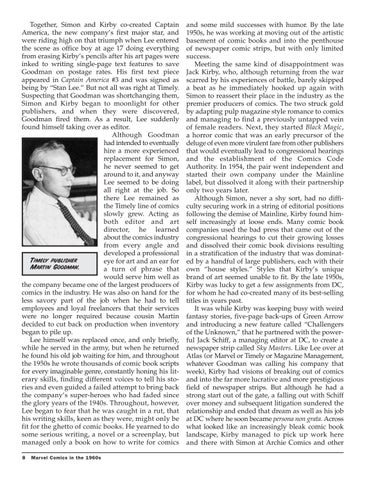
Together, Simon and Kirby co-created Captain America, the new company’s first major star, and were riding high on that triumph when Lee entered the scene as office boy at age 17 doing everything from erasing Kirby’s pencils after his art pages were inked to writing single-page text features to save Goodman on postage rates. His first text piece appeared in Captain America #3 and was signed as being by “Stan Lee.” But not all was right at Timely. Suspecting that Goodman was shortchanging them, Simon and Kirby began to moonlight for other publishers, and when they were discovered, Goodman fired them. As a result, Lee suddenly found himself taking over as editor. Although Goodman had intended to eventually hire a more experienced replacement for Simon, he never seemed to get around to it, and anyway Lee seemed to be doing all right at the job. So there Lee remained as the Timely line of comics slowly grew. Acting as both editor and art director, he learned about the comics industry from every angle and developed a professional Timely publisher eye for art and an ear for Martin Goodman. a turn of phrase that would serve him well as the company became one of the largest producers of comics in the industry. He was also on hand for the less savory part of the job when he had to tell employees and loyal freelancers that their services were no longer required because cousin Martin decided to cut back on production when inventory began to pile up. Lee himself was replaced once, and only briefly, while he served in the army, but when he returned he found his old job waiting for him, and throughout the 1950s he wrote thousands of comic book scripts for every imaginable genre, constantly honing his literary skills, finding different voices to tell his stories and even guided a failed attempt to bring back the company’s super-heroes who had faded since the glory years of the 1940s. Throughout, however, Lee began to fear that he was caught in a rut, that his writing skills, keen as they were, might only be fit for the ghetto of comic books. He yearned to do some serious writing, a novel or a screenplay, but managed only a book on how to write for comics 8
Mar vel Comics in the 1960s
and some mild successes with humor. By the late 1950s, he was working at moving out of the artistic basement of comic books and into the penthouse of newspaper comic strips, but with only limited success. Meeting the same kind of disappointment was Jack Kirby, who, although returning from the war scarred by his experiences of battle, barely skipped a beat as he immediately hooked up again with Simon to reassert their place in the industry as the premier producers of comics. The two struck gold by adapting pulp magazine style romance to comics and managing to find a previously untapped vein of female readers. Next, they started Black Magic, a horror comic that was an early precursor of the deluge of even more virulent fare from other publishers that would eventually lead to congressional hearings and the establishment of the Comics Code Authority. In 1954, the pair went independent and started their own company under the Mainline label, but dissolved it along with their partnership only two years later. Although Simon, never a shy sort, had no difficulty securing work in a string of editorial positions following the demise of Mainline, Kirby found himself increasingly at loose ends. Many comic book companies used the bad press that came out of the congressional hearings to cut their growing losses and dissolved their comic book divisions resulting in a stratification of the industry that was dominated by a handful of large publishers, each with their own “house styles.” Styles that Kirby’s unique brand of art seemed unable to fit. By the late 1950s, Kirby was lucky to get a few assignments from DC, for whom he had co-created many of its best-selling titles in years past. It was while Kirby was keeping busy with weird fantasy stories, five-page back-ups of Green Arrow and introducing a new feature called “Challengers of the Unknown,” that he partnered with the powerful Jack Schiff, a managing editor at DC, to create a newspaper strip called Sky Masters. Like Lee over at Atlas (or Marvel or Timely or Magazine Management, whatever Goodman was calling his company that week), Kirby had visions of breaking out of comics and into the far more lucrative and more prestigious field of newspaper strips. But although he had a strong start out of the gate, a falling out with Schiff over money and subsequent litigation sundered the relationship and ended that dream as well as his job at DC where he soon became persona non grata. Across what looked like an increasingly bleak comic book landscape, Kirby managed to pick up work here and there with Simon at Archie Comics and other