82658 00098 1
JACK KIRBY COLLECTOR
All characters TM & © Simon & Kirby Estates.
1
The #69
FALL 2016
$10.95
THE
Contents PARTNERS! OPENING SHOT . . . . . . . . . . . . . . . .2 (watch the company you keep) FOUNDATIONS . . . . . . . . . . . . . . . .3 (Mr. Scarlet, frankly) START-UPS . . . . . . . . . . . . . . . . . .10 (who was Jack’s first partner?)
C o l l e c t o r
ISSUE #69, FALL 2016
2016 EISNER AWARDS NOMINEE: BEST COMICS-RELATED PERIODICAL
PROSPEAK . . . . . . . . . . . . . . . . . .12 (Steve Sherman, Mike Royer, Joe Sinnott, & Lisa Kirby discuss Jack) KIRBY KINETICS . . . . . . . . . . . . . .18 (Kirby + Wood = Evolution) FANSPEAK . . . . . . . . . . . . . . . . . .22 (a select group of Kirby fans parse the Marvel settlement) JACK KIRBY MUSEUM PAGE . . . .29 (visit & join www.kirbymuseum.org) KIRBY OBSCURA . . . . . . . . . . . . .30 (Kirby sees all!) CLASSICS . . . . . . . . . . . . . . . . . . .32 (a Timely pair of editors are interviewed) RE-PAIRINGS . . . . . . . . . . . . . . . .36 (Marvel-ous cover recreations) GALLERY . . . . . . . . . . . . . . . . . . . .39 (some Kirby odd couplings) INPRINT . . . . . . . . . . . . . . . . . . . .49 (packaging Jack) INNERVIEW . . . . . . . . . . . . . . . . . .52 (Jack & Roz—partners for life) INCIDENTAL ICONOGRAPHY . . . . .60 (Sandman & Sandy revamped) OPTIKS . . . . . . . . . . . . . . . . . . . . .62 (Jack in 3-D Land) SCULPTED . . . . . . . . . . . . . . . . . .72 (the Glenn Kolleda incident) JACK F.A.Q.s . . . . . . . . . . . . . . . . .74 (Mark Evanier moderates the 2016 Comic-Con Tribute Panel, with Kevin Eastman, Ray Wyman Jr., Scott Dunbier, and Paul Levine) COLLECTOR COMMENTS . . . . . . .92 (as a former jazz bass player, the editor of this mag was blown away by the Sonny Rollins letter...) PARTING SHOT . . . . . . . . . . . . . . .94 (never trust a dwarf with a cannon) Cover inks: JOE SINNOTT from Kirby Unleashed Cover color: TOM ZIUKO If you’re viewing a Digital Edition of this publication,
PLEASE READ THIS: This is copyrighted material, NOT intended for downloading anywhere except our website or Apps. If you downloaded it from another website or torrent, go ahead and read it, and if you decide to keep it, DO THE RIGHT THING and buy a legal download, or a printed copy. Otherwise, DELETE IT FROM YOUR DEVICE and DO NOT SHARE IT WITH FRIENDS OR POST IT ANYWHERE. If you enjoy our publications enough to download them, please pay for them so we can keep producing ones like this. Our digital editions should ONLY be downloaded within our Apps and at
www.twomorrows.com
Direct from Roz Kirby’s sketchbook, here’s a team of partners that holds a warm place in our hearts—the Boy Explorers. The Jack Kirby Collector, Vol. 23, No. 69, Fall 2016. Published more or less quarterly by and © TwoMorrows Publishing, 10407 Bedfordtown Drive, Raleigh, NC 27614, USA. 919-449-0344. John Morrow, Editor/Publisher. Single issues: $14 postpaid US ($18 elsewhere). Four-issue subscriptions: $45 Economy US, $58 Expedited US, $67 International. Editorial package © TwoMorrows Publishing, a division of TwoMorrows Inc. All characters are trademarks of their respective companies. All artwork is © Jack Kirby Estate unless otherwise noted. All editorial matter is © the respective authors. Views expressed here are those of the respective authors, and not necessarily those of TwoMorrows Publishing or the Jack Kirby Estate. First printing. PRINTED IN CHINA. ISSN 1932-6912
1
COPYRIGHTS: Blue Bolt, Boy Explorers, Boys' Ranch, Captain 3-D, Fighting American & Speedboy, Race For The Moon, Strange World of Your Dreams, Stuntman TM & © Joe Simon & Jack Kirby Estates • Incredible Science-Fiction TM & © EC Comics • Space Ghost TM & © Hanna-Barbera • Johnny Reb & Billy Yank TM & © New York Herald Tribune, Inc. • Abdul Jones, Battle For A Three Dimensional World, Beast Rider, Galactic Bounty Hunters, Jacob & The Angel, Lone Rider, Micro-Car, Secret City Saga, Silver Star, Sky Masters, Socko the Seadog • Batman & Robin, Blue Beetle, Boy Commandos, Challengers of the Unknown, Darkseid, Demon, Dingbats of Danger Street, Dubbilex, Flash, Forever People, Goody Rickles, Green Arrow, Guardian, Jimmy Olsen, Kamandi, OMAC, Mister Miracle, Mr. Scarlet & Pinky, Newsboy Legion, Oberon, Orion, Sandman, Sandman & Sandy, Shazam, Super Friends, Super Powers, Superman, Tales of the Unexpected, The Losers TM & © DC Comics • Avengers, Black Musketeers, Black Panther, Captain America & Bucky, Daredevil, Devil Dinosaur, Dr. Doom, Dr. Strange, Falcon, Fantastic Four, Galactus, Giant-Man, Hulk, Hulk, Iron Man, Machine Man, Mad Thinker, Mole Man, Moonboy, Odin, Rawhide Kid, Red Skull, Sandman (villain), SHIELD, Silver Surfer, Sub-Mariner, Taboo, The Nightmare, Thing, Thor, Warriors Three, X-Men TM & © Marvel Characters, Inc.
Kirby’s First Partner?
Start-Ups
Bob Farrell’s role in Kirby’s development examined, by Jean Depelley (below) Some of the “teaser” strips Jack did for Lone Rider. (next page, top) Comicscope ad from Daring Mystery Comics #7 (April 1941). Farrell and Victor Fox would’ve gotten this image of Cap and Bucky at least a month before Captain America Comics #1 hit the stands. (next page, bottom) Blue Beetle 1/15/40 strip by Kirby, under the house name “Charles Nicholas.”
e know that between late 1937 and July 1938, while Jack was working for Eisner & Iger’s Universal Phoenix sweat shop, he was also searching for publishers and syndicates—to finally succeed with Associated Features Syndicate in 1939, where he drew The Lone Rider strip. Knowing Jack’s lack of ability to communicate with publishers, how did he end up at Fox in early 1940? It appears someone helped him. After leaving the Max Fleischer Studio in early 1937, Jacob Kurtzberg was still working for the Lincoln Syndicate. In late 1937, he showed his portfolio and got a job at Eisner & Iger’s Universal Phoenix Syndicate, at the corner of Madison Avenue and 40th Street. At Universal Phoenix, while producing Diary of Dr. Hayward, The Count of Monte Cristo and the western Wilton of the West, Jack was to meet a freelance writer who must have had a great impact on him. His name was Bob Farrell. The man was educated, confident, and
determined to be rapidly successful. Our 21-year-old artist was hooked. Born Izzy Katz in 1908, Farrell was a former attorney, as Joe Simon writes in his Comic Book Makers book. Actually, Farrell had to stop his studies in Law, as his father lost his job. He started a new career as a freelance writer, scripting for Eisner & Iger. But he was ambitious enough to consider launching his own syndicate, which he was to do in 1938 with Associated Feature Syndicate (according to Ron Goulart’s The Funnies). And he likely dragged Kirby along with him—probably thanks to his work on Wilton of the West, Jack followed Bob Farrell and left the Eisner & Iger Studio in July 1938. He signed with Associated Features Syndicate and, under the pen name Lance Kirby, started the Lone Rider western series, which was to grace newspapers’ comics sections starting January 3, 1939. The strip was sold to a limited number of newspapers. After six “teaser” strips, it started in earnest on January 8, scripted by Robert W. Farrell (who also wrote the Yankee Girl comic strips for his syndicate). A few weeks later, on February 18, 1939, Jack lost his assignment on Lone Rider, as Farrell preferred young Frank Robbins’ art to his. Robbins would eventually leave the art one month later (the equivalent of 24 strips) to the mediocre Geo Brousek. Jack’s involvement on the Lone Rider could have ended there, but the strips were collected and published six months later (retitled Lightning and the Lone Rider, certainly to avoid problems with The Lone Ranger’s copyright holders) in Easter Color’s Famous Funnies, successfully sold to the comic book publisher by Bob Farrell. The series was published in colors, two pages with four strips per issue, starting with issue #61 (August 1939). Kirby’s daily strips were reprinted up through #66, followed by Robbins’ (but Brousek’s strips seems to have been ignored). It’s worth noting that Famous Funnies publisher Max Gaines had Kirby’s zip-atone removed along with the coloring, damaging the art in the process. Quite surprisingly, Jack was given the opportunity to continue his adventure strip in early 1940, from issue #72-76 of Famous Funnies, with nine full-pages of beautiful new art, having Lightning and the Lone Rider redirected toward science-fiction, with weird Doctor Chuida from an ancient race, one of the first (if not the first) big-headed Kirby characters. Then, with no explanation, the series was discontinued, Jack’s workload at Timely Comics at that time being the most likely cause.
W
But let’s go back to early ’39 and to a disappointed Jacob Kurtzberg, dismissed from Lone Rider and still looking for a job… In a 1976 interview in Italy, reprinted in TJKC #48, Jack stated: “I did assist Frank Robbins for a while, doing Scorchy Smith, in which I wrote and drew several sequences.” The Jack Kirby Checklist Gold Edition (p. 86) 10
Kirby’s Fab Four
PROSPEAK
Close Kirby associates interviewed by Jon B. Cooke
(below) We used the below Superman pencil drawing as the cover of TJKC #31 (our first tabloid-size issue), with inks by Neal Adams. In 2009, Joe Sinnott took a shot at it for a fan. oe says, “I felt Jack made the arms a little short as he ran out of drawing room,” so he slightly altered it. (next page) A stat of the pencils from Jimmy Olsen #139, page 22.
ince this issue focuses on Jack’s partners, collaborators, and close associates, we sought out some reflections from his inkers, an assistant, and even Jack’s own daughter:
S
• Joe Sinnott (most acclaimed inker from Jack’s 1960s Marvel era) • Mike Royer (prolific inker who tackled most of Jack’s 1970s DC work) • Steve Sherman (Jack’s assistant at DC Comics in the 1970s) • Lisa Kirby (Jack’s youngest daughter, and executor of the Kirby Estate) Jack was famously known to have the stories virtually “flow” from his pencils. In your experience, was it to the work’s benefit for the King to work in collaboration with someone, or go it solo?
MIKE ROYER: It is my concerted opinion that Jack’s best work happened when he was left to his own creative instincts. Solo! STEVE SHERMAN: I don’t think Jack needed anyone’s help. Given enough time, he could have inked and colored his own work. But with the amount of pages he needed to turn out to make a decent living, other hands were necessary. I know that on Sky Masters, Jack was more than willing to accept the Wood brothers’ input. In fact, he would hunt them down to get the scripts. After a while it became such a chore that writing the strip himself was so much easier, even though the Wood brothers still received credit as writers. I guess it depends on how you look at. If you want pure Kirby, then his ’70s DC work is the best example. If you prefer Jack with a collaborator, then ’60s Marvel is the finest example. JOE SINNOTT: Jack certainly had to work with a good inker, one who was also a good artist, because as great a penciler that Jack was, he really was not a good inker. His work suffered if he were to ink his own pencils. Can you share any specific incidences where your suggestions, direction, or input (creatively or editorially) made it into the stories? ROYER: Hate to disappoint you on this one. I never ever suggested anything to Jack; however, without him being aware of it there were a couple times when I added a word or two so that the meaning was perfectly clear. Example: Jack, Roz and I had lunch at the Copper Penny restaurant that used to be across the street from the Warner Brothers bungalows in Burbank, after I went on staff at Disney. He wanted me to ink Silver Star. At lunch he proceeded to tell me the story of Silver Star. I thought at the time, gawd, this is a hell of a lot of story for
12
public worked a great deal of magic. But, I guess that wasn’t enough for him. This is just one man’s opinion... I think Jack should have been left alone. SINNOTT: Here again, he needed collaboration only on his inks—his great pencils wouldn’t have materialized into the outstanding finished art without a great inker. In your personal dealings with Jack, did you learn anything from the man’s storytelling from your association with him? ROYER: Nuts and bolts I don’t remember. Personal stuff I do. When I worked with/for Jack Kirby I was treated like part of the family. I have fond memories of sitting at their kitchen table, eating Roz’s homemade chocolate cake, drinking a glass of milk, and talking with them about old movies. I would deliver the finished books to Jack two ways: (the old) Postal Special Delivery or in person. Many times my son or son and daughters would accompany me to Jack’s. While Jack and I went over the finished pages, we would occasionally look out the window to the left of Jack’s drawing board and watch my kids (all AAU competitive swimmers) 14
An ongoing examination of Kirby’s art and compositional skills
Kirby + Wood = Evolution ometime around 1954, work in the field of comic books began to grow scarce, even for the formerly lucrative team of Joe Simon and Jack Kirby. When Simon became an editor for Harvey Publications, the two creators went their separate ways. Kirby struggled to find work, approaching the newspaper syndicates with proposals for strips. In 1956, he returned to work for National Periodicals, developing such ideas as Green Arrow and Challengers of the Unknown. At some point following the break-up of the team, Jack Kirby’s style began to undergo a series of gradual changes that would alter the look of his figures and the design of his pages. Kirby’s heroes had always possessed a lithe sinewy and somewhat elongated musculature. Beginning somewhere in the mid to late fifties, Kirby’s artwork began to bulk up and to take on a more architecturally geometric quality. Coincidentally around this time, Kirby’s pencils were coupled with the embellishment of an inker of extraordinary skill who was a legendary draftsman in his own right. This was the remarkable Wallace Wood, who had honed his skills working with EC Comic’s groundbreaking storytelling company. The unique partnership debuted on the aforementioned series Challengers of the Unknown, a concept often considered to be a forerunner of Lee and Kirby’s Fantastic Four. Kirby also soon realized his dream to pen a newspaper strip, one Sky Masters, which was also inked by Wood. Wally Wood is usually described as an intense workaholic who labored obsessively over his pages. In an article in The Comics Journal #197, author Bill Mason1 says this of Wood’s development as an artist: “The young Wood taught himself how to draw in a dashing, boldly exaggerated style which he gradually refined by adjusting the spatial relationships in his drawing, through an extremely laborious process of point to point navigation from one solid object to another.” You can see in the intricacy of this cover from EC Comics’ Incredible Science Fiction #11 (left2) just what Mason is talking about. There is literally no space in this composition that is not being used to maximum advantage to showcase the complexity of the craft’s interior. Wood served in the Air Force as a Paratrooper, and was fascinated with the equipment he worked with, later incorporating its design into his sci-fi illustrations. Every shape in this drawing is meticulously and strategically placed around the figure and all are precisely rendered with dark and light almost perfectly balanced. The ability to do this sort of spatial structuring is something that Wood had in common with Jack Kirby, who is generally regarded as someone who drew seemingly with no effort or preparation. This may be the case for the latter portion of his career, when he had more or less mastered his craft, but having seen some examples from his early swipe file, I believe that Kirby worked extensively on his depiction of reality. One notable example is Robert Riggs illustration that Kirby used for a cover for Police Trap #2 [see Jack Kirby Collector #38]. The figures that Kirby more or less copied, that are standing in a station house, show a serious concern with the young comic artist’s desire to master the
S
18
FANSPEAK
(below) Leading up to the 2014 settlement, fan support was at a fevered pitch, including this petition at Change.org. You’ll see the “Confirmed Victory” notation that it holds now. (bottom) This year, Marvel celebrated “Jack Kirby Week” at www.marvel.com with a slew of tributes to Jack and his creations.
Kirby Confab “Marvel and the family of Jack Kirby have amicably resolved their legal disputes, and are looking forward to advancing their shared goal of honoring Mr. Kirby’s significant role in Marvel’s history.”
Several prominent Kirby fans corralled by John Morrow
Disney’s bottom line. For the record: the terms of the settlement were private, and I have no firsthand knowledge of the details, other than hearing that the Kirby family was very happy with its outcome. (But since soon thereafter, Jack’s began receiving a creator credit on both comics and films, it’s a safe bet that was part of any agreement.) That doesn’t mean I, like most of fandom, didn’t find it fascinating. Just as interesting to me was how some “civilians,” who knew little to nothing about comics, approached me for feedback. A couple of the dads in my father/daughter YMCA group independently asked me about it. They didn’t specifically realize I was associated with this “Jack Kirby” guy they’d heard about in the news, but both said basically, “I know you’re involved in comic books. What do you think about this court case?” So to get some perspective on its repercussions, I asked a select group of Kirby friends, fans, and TJKC contributors to answer a few questions, to help us all better understand what it meant, and continues to mean, to Jack’s legacy and fans. Contributors were:
eptember 26, 2016 marked the two-year anniversary of that joint statement, and the settlement between Marvel/Disney and the Kirby family over rights to Marvel characters Jack was involved in the creation of. Unsurprisingly, immediately after the news hit back in 2014, the online comics community was abuzz, with rumors of what it would mean to the industry, and wild speculation of how many millions/billions/trillions had been shelled out to keep the Supreme Court from having the chance to issue a ruling that might irreparably hurt
S
• Jon B. Cooke (editor of Comic Book Creator magazine, and former associate editor of TJKC) • Adam McGovern (Kirby scholar and the voice behind our “Kirby As A Genre” column) • Steve Robertson (Kirby family friend, and assistant at Genesis West publications) • Norris Burroughs (our “Kirby Kinetics” columnist) • David Schwartz (Kirby family friend ) • Jerry Boyd (regular TJKC contributor)
22
• Marty Lasick (Kirby family friend, and occasional inker of Jack’s commissioned work) • Tom Kraft (trustee of the Jack Kirby Museum) I simply asked them to answer a few questions, in as brief or lengthy a manner as they saw fit. In checking the pulse of Kirby fandom, I encountered a few surprises. What was the first Kirby work you ever saw, and did you immediately like it, or did it turn you off? JON B. COOKE: I have a vague memory of seeing “Ant-Man” in Tales to Astonish. I thought his work was somewhat grotesque and not as accessible as the slick work in the DC, Harvey, and Dennis the Menace comics of which I was more accustomed. I believe I was five years old. STEVE ROBERTSON: Honestly, I can’t remember specifically what the first Kirby artwork I ever saw was (I was only seven years old at the time, in 1960), but it immediately made all other comic books obsolete! I can tell you that it was Jack’s pre-hero monster artwork for Marvel, that I saw displayed on the comic book racks at the local grocery store where my Mom shopped. I absolutely loved it! To put this in perspective, I was an early reader, and I had always enjoyed comic books, but my parents forbid me to buy any “Horror” related material—but the furtive glances that I was able to make at Famous Monsters of Filmland at the local store, and Jack’s monster artwork, were so powerful to me, that it changed my life forever! After this, I never had any interest in comic books that weren’t drawn by Kirby (or Ditko)!
remember being totally absorbed by the story and art and sorry I hadn’t been able to read the previous issue, since it was a continued story. Believe it or not, the very next week I checked the same newsstand and they actually had issue #57 in the back of the stack of comics from the month before. I was very excited to get that issue as well!
ADAM McGOVERN: I saw Kirby work so early in life that everything in the rest of the world looked wrong—not seeing puffy clouds with metallic squiggle-lines or people with mouths shaped like trapezoids took some adjusting to. I received subliminal education in the Kirby style by the comics my older brother left around. The first was probably some Thor story or one of the shorts about Cap in WWII (the 1960s ones by Lee & Kirby)—I was always an inside-my-head kinda kid, so the ideal and fearsome abstraction of Kirby’s look appealed to me right away.
JERRY BOYD: I wish I could remember the first time I saw the King’s work! It really kicks me around at times, because I can remember the first time I saw the work of Steranko, Romita Sr., Colan, Sprang, Ditko, and both Buscema brothers, among others. But Kirby became my king at first glance, and the memory’s gone! But I’ll say X-Men #9 and I did love it!
NORRIS BURROUGHS: I’m pretty sure the first Kirby story I saw was a monster comic, Strange Tales #75 with Taboo, the Thing From the Murky Swamp, and it was pretty scary. I was about nine and I thought the art was really intense. The first thing that made me sit up and notice Kirby as an artist, which also inspired me as an artist, was the amazing sequential fight scenes in Rawhide Kid #30. I think the most wonderfully hilarious image was that of the Kid standing on his head shooting the boot heels off an opponent [above right].
MARTY LASICK: I remember first seeing (what I later found out to be) Kirby artwork on The Fly, “Green Arrow”, Challengers of the Unknown, and some sci-fi short stories. I was addicted from the start and looked forward to Kirby on any book I could find. It is something I have never grown out of. Now I look forward to any Kirby reprints to preserve my original comic book collection and Kirby-IDW original artwork books. Jack in any format never gets old to me. TOM KRAFT: The first Kirby work I saw was The Fantastic Four. My best friend handed to me in a stack of FF comic books when I was sixteen. They were random issues from issues in the #60s, 70s and #80s. They immediately blew my mind! The visual language and power simply thrilled me. I never thought a comic book could be like that, and I was hooked from then on.
DAVID SCHWARTZ: I believe the first time I saw a Jack Kirby comic was when my grandmother bought me a copy of Fantastic Four #58. I was eight years old and it was on the stands at a newsstand near my school. My grandmother used to take my brother Howard and me to lunch each week and sometimes she bought us each a comic book. I was immediately grabbed by the cover as it looked really exciting and very grown-up to me at the time. I
How do you feel Kirby’s legacy has changed now, in light of the Marvel/Disney settlement? COOKE: I firmly believe that Jack Kirby will be remembered and appreciated a century from now, if not by the masses, at least by those who appreciate the best cartooning. ROBERTSON: Frankly, it hasn’t changed at all among anyone who was already a comic book fan, and has any knowledge concerning comic book history. My fervent hope is that Jack’s genius will become more widely recognized! It’s up to you, Kirby Museum! 23
A Timely Pair
Classics
An interview with Bonnie and Arnold Hano, by David Laurence Wilson
(right) A recent photo of Bonnie and Arnold Hano. (below) Splash panel detail from Captain America Comics #10 (Jan. 1942), produced by Simon & Kirby just prior to leaving Timely Comics for DC. Though the Hanos worked at Timely in-between Jack’s 1940s and 1950s stints at the company, this interview should give readers a sense of what it was like at the offices there. (next page, bottom) Stan Lee in the 1950s, when Bonnie was his assistant.
[Editor’s Note: The following interview was conducted on December 19, 2013, and submitted to TJKC. While it doesn’t focus specifically on Kirby, I felt it gives a fascinating inside look at the workings of Timely Comics, with commentary about both Stan Lee and Martin Goodman. I have edited it to keep it more germain to topics that would likely interest TJKC readers.]
becoming an editor at Timely/Atlas. (He later wrote numerous acclaimed books on baseball and westerns.) Bonnie (who married Arnold in 1951), worked alongside Stan Lee in the early 1950s to keep the stories coming from Timely Comics. Those years, 1951-1954, were an industry-wide trough between waves of superheroes, with a wider range of titles, publishers, and readers in the industry than there has been since. Visiting the Hanos at their charming home, on a quiet street two or three blocks from the main thoroughfares of Laguna Beach, California, would clarify what Bonnie Hano had done or didn’t do so many years ago. The couple had not kept up with the comics business. They couldn’t describe “Ultron” if you spotted them two Silver Surfers and a Black Widow. Bonnie said: “Who ever knew that Stan Lee was going to become the big famous deal that he is today?” Both of them were surprised when I showed them hardbound copes of Atlas Comics produced during their tenure, issues that might even contain some of the stories they had written. Neither of them had ever attended a comic book convention. It was not going to be like a conversation with Jack Kirby, who seemed to be familiar with not only the past but the future. First of all, Mrs. Hano had a bone to pick with the scholars of the comics industry:
n the 1950s, Arnold and Bonnie Hano were the power-couple at Martin Goodman’s Magazine Management company at New York’s Empire State Building. It was a dull, gray-suited name for an empire of publications that emanated from Goodman’s equally unassuming office. Goodman was a fellow who played hunches and took gambles but not risks, and if a magazine was unsuccessful, it would be quickly canceled. The company was better known by what you might call its pseudonyms: Timely (now Marvel) Comics; men’s magazines, especially Stag magazine; and Red Circle Books, a sensationalistic line of paperbacks that would soon be revised and renamed as Lion Books, a short-lived but important paperback company. Arnold Hano was born in Manhattan but he grew up in the Bronx. He received a degree from Long Island University and then higher education, as a copy boy at the New York Daily News. After action in World War Two, he worked as Managing Editor at Bantam Books and then Editor-in-Chief at Lion Books in 1949, before
I
BONNIE: Do you know what’s so crazy? I looked up something one day, and I found on the Internet that I was Hank Chapman’s first wife. I don’t know where they ever got that. When I met Hank, he was married to Gloria, whom he called Toni, and we knew her as Toni. They became very good friends of ours. So how did I get married to Hank on the Internet? How do things like that happen? Chapman was one of the top writers at Timely, one of the few writers to be credited on many of his stories, receiving credit even before the artists. His best known story may have been “The Nightmare” from Astonishing #4 (June 1951), a story illustrated by Wayne Boring in which a writer for Marvel Tales and Astonishing named Hank Chapman is terrorized by vengeful characters from his stories. 32
the writer and artists in his office, though I think they were always working from full scripts. But there was also always an aspect of shyness with him. If he seemed a little shy, it sounds incongruous, but I don’t think it was. I just really liked him a lot. When Hank Chapman left his job as Production Manager, Lee asked Bonnie if she would like the higher paying position. She worked as Production Manager through 1952 until the end of 1953. It was a period when the number of titles at Timely almost doubled. BONNIE: I don’t ever recall feeling pressured. We always seemed to be busy but I don’t think that any of us felt like we were overworked. DAVID: Did you ever feel that there was a hurry-up atmosphere? ARNOLD: Goodman was really good at that. He would get more out of everybody, and it didn’t seem to diminish the quality. DAVID: Now when you took over as Production Manager, Bonnie, what were your duties? To get the comics out, I guess. Were you managerial or hands-on? BONNIE: It was really a managerial job, because there wasn’t much physical stuff for me to do. My job was to get everything together. To get the stuff done. Then I’d take it into Stan, he’d put the stories in the order he wanted them to go to the printer, and we’d be on to the next one. We had somewhere between eight and ten employees, including letterers and proofreaders. Chris Rule, a big, heavy guy, was on staff, mostly in production and inking. He didn’t do a lot of original artwork. Sol Brodsky was an artist, and a very nice guy. Artie Simek was a letterer. Stan Starkman, and Herbie Cooper, a talented singer who sang and acted in amateur productions—they were our letterers. The thing I remember—I took it when I left—was my x-acto knife. Because one of the things we had to be very careful of, was that “flick” remained “flick.” That’s where the x-acto knife came in, just to erase a little bit of the lettering, when necessary. DAVID: Would you say that any of the people working in production were frustrated artists? BONNIE: If so, they weren’t talking about it. I know we had some inhouse artists. Sol Brodsky was an artist, a really nice guy. What Stan would do, there were in-house writers and he would assign the comics to freelance artists. Sol and Chris Rule might have done some of the artwork. I can’t remember whether they just did corrections and additions or whether they actually did some of the stories.
BONNIE: By 1949, when Arnold went over to Magazine Management, we were an item and I, too, began working for Lion Books. I was reading books to be selected for reprints. About a year later Stan asked me to come over to the Timely Comics division and work with him as his assistant. It was really a better job and it paid more. DAVID LAURENCE WILSON: You already knew Stan? BONNIE: We all knew each other. It was a very compatible office. DAVID: When you were Stan’s assistant, did you work in his office? BONNIE: I can’t remember that. Isn’t that funny? I don’t think so.
DAVID: Mostly they were inkers, I think, and they would do inhouse corrections. BONNIE: Yes, that’s mostly what I remember. But I don’t think we did any coloring in-house. I have no memory of that at all. The art came in on the heavy paper that artists use, the big pieces of heavy paper. The lettering was done later in our office. You know what was funny about that place, I used to be very good at getting stores to accept returns, and to do other things, situations that had to be straightened
DAVID: As an editor, Stan seemed to have a fairly lax style, in that he was a collaborator and an encourager, rather than someone who was eager to go line by line over a piece of work. BONNIE: Oh, I think that was absolutely true. He was also very creative, too. That’s the thing I most remember. DAVID: So you would be called in when he needed you for something? BONNIE: I don’t really remember what I did for Stan. There was no correspondence for him. I have no idea what I did in that job. I have no idea! ARNOLD: Part of that was that lax style of Stan’s. BONNIE: Well, and besides, not only was it a long time ago, but there was nothing that happened that was memorable. It wasn’t like other jobs. DAVID: By the 1960s, when Stan would work on a story, and give the writer his input, Stan would talk out the story in his office, and people would describe him as being really boisterous; he’d jump up on his desk and act out a fencing scene. BONNIE: Well, he was. He was very lively, very active. I don’t remember him jumping up on a table, but he’d talk over the stories with 33
Gallery Kirby’s partners & pairs, as chosen by John Morrow
(left) Only Kirby would take kids from the slums of New York, give them a sooped-up flying car, and send them to Scotland to track down the Loch Ness Monster. Pencils from Jimmy Olsen #144, page 13 (Dec. 1971). (pages 42-43) The “Black Musketeers” take their bow in Black Panther #9 (May 1978). Seeing as how the Panther was originally visually similar to a certain Caped Crusader, we thought it only fitting to show Jack’s one turn at Batman (and his partner Robin) from Super Powers II, #5 (Oct, 1985). (page 44) Space Stars was a Hanna-Barbera cartoon that ran on NBC-TV from 198182. Here are Jack’s animation concepts for the episode “Dimension of Doom” where Space Ghost rescues his mutated partners Jan and Jace. (page 45) Page 4 of the unpublished Dingbats of Danger Street #2 (circa 1974), with inks by Mike Royer. (page 46-47) Two pages of Cap/Falcon teamwork from Jack’s 1970s return to Marvel in Captain America #193 (Jan. 1976). (page 48) August 18, 1957 Sunday page of Johnny Reb & Billy Yank, which Jack ghosted for inker Frank Giacoia.
39
If you think you recognize this piece from the 1979 Jack Kirby Masterworks portfolio, you’re only half right! For whatever reason, Jack decided to copy his own work—not exactly line for line, and not a tracing.
A Kirby friend commissioned the piece at left directly from Jack Kirby in 1979 for $200— whereas the bottom image is the one that appeared in Masterworks, with a 1978 copyright line (meaning Jack drew the bottom one first). Matching up the two images in Photoshop (above) shows a) Jack didn’t lightbox it, and b) he didn’t trace it—he apparently just drew it again. Both versions appear to be directly from Jack doing all the art, with no assistants. He simply did two of them. We’re not sure if he looked at the previous piece while doing the second one, or if he just had a photograph in his mind and he drew it.
41
Packaging Jack
InPrint
by Gary by John Picariello Morrow (below) Original art from Who’s Who #6 (Aug. 1985) of Darkseid, showing an unused pencil panel of the ruler sending troops after the Hunger Dogs. We darkened the top panel to better show the erased pencils.
here’s a great scene in the Jack Kirby graphic novel The Hunger Dogs where Darkseid ponders the techno-wizardry that has replaced the raw power of crowd-control used in simpler times. Comments one of Darkseid’s minions, “It’s packaging, sire! Technology that is easy to produce and easy to create!” They could very well have been talking about comic book reprints instead of nuclear destruction, but the principle is the same: with so many years worth of archived Kirby material, a steady stream of Jack Kirby art has surfaced in the last few years: Repackaged, reformatted, and reintroduced to an eager and interested public, much to the delight of fans and publishing house accountants. Over 20 years since Jack Kirby passed from this world into the great beyond, the sands of time have not dimmed the spotlight that continues to shine on this artist whose career spanned nearly five decades. Kirby’s work is still revered—his output and creativity still the benchmarks of what can be accomplished with a pencil and a simple sheet of Bristol board. But perhaps the true testament to the man is the amount of product that continues to be published so many years after Kirby’s death. Trade paperbacks and hardcovers from Marvel and DC Comics reprinting the chronicles of the New Gods, Jimmy Olsen, Black Panther and Captain American generate healthy sales for both publishers. Add to the mix recent best sellers like the “coffee table” volume Marvel Visionaries or fanzines like the Jack Kirby Collector and it’s evident that there is still a market for the four-color visions of the creator or co-creator of this generations most popular comic creations.
T
But what is the criteria for publishers who decide to repackage what is basically old artwork and stories in a way that appeals to the new reader, and not just the hardcore Kirby fan? When it comes to reprinting classic Marvel Comics stories and art, the focus—comments Marvel editor Tom Brevoort—is on the character and not the artist. “The fact that the work is by Jack is secondary”, says Tom. “So when there’s a Fantastic Four movie in the works, you can expect Marvel to produce a lot of FF collections, and certainly most of them will have some percentage of Kirby material in them. Outside of special cases— the Kirby Visionaries, or the Cap Madbomb book—we’re not really marketing to the hardcore Kirby fans.” Tom also feels that when the classic stories are reprinted, the work stands on its own merits: “You work out what you think is the best, most economically sound package for the material you’re printing, and then you go with that. This means that certain stories may end up in black-and-white in an Essentials collection, in color on slick paper in a Masterworks volume, and reprinted in softcover in color as well—FF #51 is one of these. But I don’t feel the need to, say, try to color Jack’s work in the modern 49
Innerview
Partners for Life by Blair Kramer
(below) Forever People #8, page 7 pencils. (next page, bottom) Walter Simonson’s pencils from Secret City #0.
[This interview was conducted in late December 1992 via telephone with Jack and Roz Kirby, just as Jack’s Topps Comics series were about to launch. Much of this interview was originally published as “Interview with Jack Kirby” in Comic Book Collector #5, May 1993, by Century Publishing. This full version was transcribed and edited by John Morrow. It gives a nice look at how, even at the end of his career, Jack relied on his life partner Roz to help him.]
BLAIR KRAMER: First of all, I very much want to tell you that, and I guess you must’ve heard this many times, but it is true with me when I say that, you have been one of my idols for a very long time. JACK KIRBY: I thank you for that. I can assure you that I’ve always done my best to just get the reader into my work as much as possible. Initially it’s my duty to sell magazines, and that’s what I’ve always done. I’ve done it by telling the best story I can. BLAIR: I remember as I was growing up in the 1960s, picking up the Fantastic Four, Captain America, and so many other comic books that you illustrated, I remember that all my friends, myself included, all wanted to draw just like you. You probably heard that many time, but in all honesty, as far as we were concerned, there was only one artist, and you were that artist. You were the only one. JACK: Believe me, that’s deeply appreciated. I can only say, as far as drawing style in comics, I’ve always felt that my style was apropos of the kind of comics I was doing. BLAIR: There was hardly anything more dynamic, more fascinating, more exciting than the Fantastic Four, and any of the other comics you were drawing. There was probably nothing as exciting as those comics you drew. JACK: Well I can only tell you that’s probably an offshoot of the times, when I was young, y’know? Probably much of my own development is a product of those times. Of course, those are transcribed in all the drawings and the stories I’ve ever made. BLAIR: You bring up an interesting point, being that all the new comic book illustrators have people like yourself as influences, but you started in on the ground floor. JACK: Yes. In fact, comics were first beginning to proliferate. I remember that the field didn’t have many magazines. The industry was growing. BLAIR: You created many of the features that are mainstay comic books on the stands today. JACK: I did. It was a lot of fun doing that. BLAIR: It shows too. It showed in the work. As I said, I’m gushing now, and I don’t mean to gush. JACK: Oh no, in a way, I’m gushing too. (laughter) I’ve always been enthusiastic 52
And they’re very specific. One is called Secret City, and the other is called Satan’s Six. In the press release, they name who’s working on what, and what the stories are about, so that’ll give you a great idea. They’ll have details, and ideas of what it’s going to be about.
A Kryptonian design, from the Super Friends cartoon.
JACK: You can get the information from that. It’s got all the new books they’re gonna produce, and they went from my ideas. BLAIR: Can you elaborate on the storyline for our readers? ROZ: Tell him about the Secret Six. [Roz meant Satan’s Six here—Ed.] BLAIR: Wasn’t there a comic book called Secret Six some time back? JACK: Satan’s Six, Roz. ROZ: Oh, Satan’s Six. Sorry. I confused myself. Eliminate that from the tape. (laughter)
about comics. To me it’s always been a great form of American journalism.
JACK: Satan’s Six is about people who are caught in limbo. They can’t get into Hell cause they haven’t been that bad. The idea is that, in order to make it into Hell, they have to go out and do something bad, but it always turns out to be good. (laughter) And they’re forever caught in limbo. The Devil, of course, I call The Inspector, but he’s really the Devil, though.
BLAIR: I’ve never thought comic books were as well appreciated as they should’ve been. Not from the very beginning. They still aren’t.
BLAIR: Is this a continued series, or a mini-series?
JACK: No they weren’t. It was a very new media, and anything new, respect is something it gains over the years. It was the same way with comics.
ROZ: It’ll be continued. JACK: Yes, it’ll be continued.
BLAIR: Can you tell me a little bit about what you will be doing with Topps?
BLAIR: Now who’s supposed to be drawing this? ROZ: I forgot what the thing said on the paper, but there’s a whole list of who’s doing what.
JACK: Topps are doing some books created from my ideas. ROZ KIRBY: And sketches. I’m here on the phone. (Roz laughs)
JACK: It’s one of the books that will be drawn by these top notch artists.
JACK: And sketches. They’ll produce the books, they’ll get their own artists.
BLAIR: And the other one is called…
BLAIR: So you won’t be drawing them.
ROZ: Secret City. Let me get the paper and I’ll give you the names.
JACK: No, I won’t be drawing them. But they’re taken from contributions that I made through my own ideas.
JACK: I’ve got so many concepts, that I’ve forgotten the details of all of them. (laughter) But Satan’s Six has that format. The Secret City also.
BLAIR: Will there be some reprint art?
BLAIR: So this isn’t all superheroes? You’re not sticking to the superheroes.
ROZ: No, it’s all gonna be new stuff. They’ll have people like Don Heck and Roy Thomas; did you get the press release?
JACK: No, I’m not sticking to the superheroes. Well, the superheroes are in it. Listen, if you talk to my wife, she’s got all the details for you. She’s really kept track of them.
BLAIR: Mr. Salicrup told me he would be sending me a press release. ROZ: It’ll have all the people working on the books; all the great guys who worked with Jack before. Ditko, Don Heck, so many of the others.
BLAIR: Okay, I would rather you didn’t hang up, though. JACK: Oh no, no.
BLAIR: By Don Heck and Ditko, new artwork?
BLAIR: I’m looking forward to it. Could you tell me a little about these ideas? Or is it too early to discuss them?
BLAIR: Because I wanted to hear about you, personally. I don’t want to pry per se. My idea was, when I was given this assignment, first of all I’m a feature writer. I’m not terribly experienced at doing interviews, but I’ve read enough interviews to know I did not want to ask you pat questions, which would force you to give me pat answers. And I wanted to have kind of a casual conversation interview, so to speak.
ROZ: Actually, you’ll have it in the press release. It’ll give you an idea what the first couple of books are going to be about.
JACK: That’s the kind of conversation we’ll have, I assure you. Like I say, I never give pat answers, unless it demands one.
ROZ: It’ll be all new artwork, from Jack’s characters. JACK: They’re all great artists in their own right. ROZ: It should be very interesting concepts.
53
Optiks
Jack In 3-D Land by Stan Taylor, with thanks to David Folkman for material assistance
his story starts way back in 1954. A young boy about six years old is out with his mother, comes upon a revolving comics rack, and stares in fascination. On the rack are several of those new three-dimensional (3-D) comics. He stares and rifles through the books. He shows his mother and asks if she will buy him one. He already has some comics so it’s not an unusual request. His mother looks and when she sees the EC 3-D horror comic, she blanches. Rather than the crime and gore, she picks out a 3-D comic featuring Mighty Mouse by St. Johns. The kid is spellbound; he had never seen anything like this. The amazing rodent is flying and almost jumping out of the book. This was an excellent choice. Originally created in 1942 as a movie short, Mighty Mouse was a parody of Superman. We have a hit. He went through several mutations—beginning as Super Mouse—before becoming the mouse we all love. Mighty Mouse became the most popular of the many characters in Paul Terry’s studio. Not many could ever forget the stentorian operatic vocals of Mighty Mouse singing, “Hereeee I come to save the dayyyyyy.” Opera and farce played a large part of Mighty’s oeuvre, even the constant villain; Oil Can Harry occasionally breaks into aria. He was a natural for comics with Timely producing a short run in 1946. St. John’s took over the license and started making comics in 1947 with Mighty Mouse soon their top selling book. It was no surprise that this character was chosen for their first 3-D comic. Joe Kubert recalled: “We produced two sample proofs with the 3-D effect, a panel of Tor and one of the Three Stooges. When we showed them to Archer St. John, he flipped over the idea! We went to work on a Mighty Mouse book because St. John felt it would be the best vehicle for 3-D and get the best chance on the newsstands.” The first book sold out. Mighty Mouse later became one of the earliest TV characters in 1955 when the studio was sold to CBS. The 3-D effect left young Ray Zone breathless. Ray’s imagination and wonderment were on fire as he searched out and collected any and every thing he could find relating to 3-D. Hollywood was just beginning to flood the market with 3-D movies. Such great titles like Bwana Devil, It Came From Outer Space, and House of Wax captivated the young man who became obsessed with the concept of 3-D. One of his favorite comics was Captain 3-D by Joe Simon and Jack Kirby—a wondrous example of the 3-D concept. Ray came to this fascination as a consumer, but James Butterfield (below) was deep into the nuts and bolts of the industry. Even as early as the 1950s, he was producing a 3-D TV show in Mexico. He invented several 3-D set-ups
T
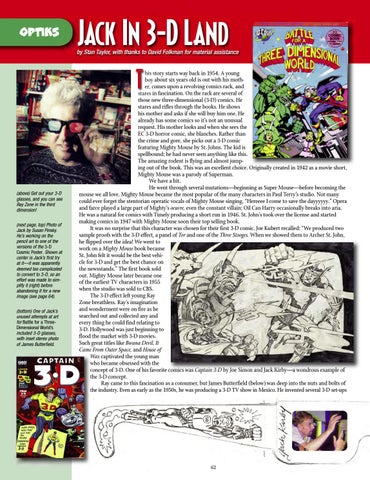
(above) Get out your 3-D glasses, and you can see Ray Zone in the third dimension! (next page, top) Photo of Jack by Susan Pinsky. He’s working on the pencil art to one of the versions of the 3-D Cosmic Poster. Shown at center is Jack’s first try at it—it was apparently deemed too complicated to convert to 3-D, so an effort was made to simplify it (right) before abandoning it for a new image (see page 64). (bottom) One of Jack’s unused attempts at art for Battle for a ThreeDimensional World’s included 3-D glasses, with inset stereo photo of James Butterfield.
62
to improve the quality of 3-D pictures and films. In 1979, he started a new business called 3-D Video Corporation in North Hollywood, ostensibly to transfer ’50s Movies into 3-D films for TV showings, but he also had plans for other 3-D concepts. In 1981, he created 3-D Cosmic Publications, a printing division of the parent 3-D Corp. One of the first things he did was hire David Starkman for his sales team. A week or so later, he hired David’s wife, Susan Pinsky. It was a serendipitous 1976 visit to a garage sale that got their 3-D spark going when they ventured upon an old View-Master. The View-Master was originally invented in the early 1900s and first presented at the New York World’s Fair. It was a self-contained stereo viewing unit containing 7 pairs of stereoscopic pictures in a round reel that produced great 3-D shots of scenic spots and entertainment shows. The 3-D effect amazed them and they were instantly obsessed with the hobby. They joined the Stereo Club of Southern California, they wrote a newsletter, and opened their own retail mail order business selling 3-D paraphernalia to photographers, both amateurs and professionals. At 3-D Video, David was put to work in the sales department selling 3-D glasses and various trinkets to convenience stores and other outlets. But Susan was given another task. Mr. Butterfield asked her to gather and produce a 3-D comic book that could be used as a primer and sales point for the 3-D craze. He wanted this to be the best 3-D comic ever. He envisioned this book to be sold at convenience stores with the accompanying glasses. This daunting task was the first attempt at a 3-D comic in 25-some-odd years and Susan decided she first needed a writer who understood 3-D and possessed a writing style that could captivate the young readers. The young man from 1954 had now grown up into perhaps one of the most knowledgeable people on the concept of 3-D. Ray Zone was working at a large steel company in their art department. On the side he was writing articles about 3-D in various magazines. From a 1989 interview, Ray recalls: “I was writing articles freelance and had a couple of articles on 3-D published. One was in the 11th edition of the Overstreet Price Guide (1981) and another, called “Stereovisions,” was in Fanfare Magazine. And that article was an attempt to create a single historic overview of all forms of 3-D imaging, including photography, comics, holography, 3-D movies, the whole thing. After that article appeared, a lady named Susan Pinsky contacted me. She was employed by 3-D Video Corporation in North Hollywood, the company that was producing anaglyphic conversions of old 3-D movies for television in 1982. She asked me to write a 3-D comic book that would be a graphic history of 3-D and hired me to create an original superhero that would be a vehicle to tell that history. After I hung up the phone talking 63
Sculpted
The Kolleda Incident Glenn Kolleda remembered, by Ray Wyman, Jr. (http://www.linkedin.com/in/raywyman) [Editor’s Note: During my first visit to the San Diego Comic-Con in 1991, before I had any idea I’d one day be publishing this—or any other—comics publication, I briefly met Glenn Kolleda. I was lurking around the booth where Jack was supposed to appear, waiting for what became my one and only encounter with the King, and Kolleda was there promoting his pewter sculpture/print combo of Jacob & The Angel. I remember not being particularly impressed, as the price seemed astronomical to me, for what was not actual “Kirby” work, but someone else’s sculpture based on Jack’s drawing. But I took his flyer anyway, which I still have (left). Cut to a few years ago. I received a phone call at the TwoMorrows offices in North Carolina, and the person on the other end said he was Glenn Kolleda! We spoke for a few minutes— he said he’d relocated to NC (less than an hour from me), and wanted to go on-the-record about his dealings with Jack and Roz. When I tried to set up a specific time to do an interview, he hedged, saying he’d call me back soon when he was ready. Sadly, I later learned Glenn died shortly after our phone conversation. While we’re left without his firsthand recollections, Ray Wyman Jr. was kind enough to provide the following details, including one harrowing incident, which he offered up to Jean Depelley for his recent Kirby biography in France.] lenn Kolleda was a very imaginative man; affable and charming (he had two really cute little kids and a very charming wife). He was also a jeweler who could do some fantastic work with small figures. He had a contract with Roz to promote Jack’s art through pewter sculptures and other projects, but was incredibly disorganized and couldn’t keep his mind on one task. During the time he knew Jack and Roz, he managed to generate a few high quality pewter sculptures—one very clever design of Spider-Man leaping off a wall and another based on Jack’s pen-and-ink illustration titled Jacob and the Angel. The ‘incident’ happened while Jack was very much alive—Spring of 1990 (Jack passed away in 1994). By the time of this event, we had all grown weary of Glenn’s distractions—even Jack was making fun. But this incident was to be Glenn’s last distraction and his downfall. He had befriended a con-man who claimed (among other things) to be “Roberto Salazar.” Actually, it’s hard to tell who befriended whom and I’m not sure if I have the correct last name for “Robert”—but it doesn’t matter. “Robert” admitted to me that he used an alias because he was really a government agent (seriously, that’s what he told me). The point is that “Robert” had Glenn thoroughly convinced that he could promote Jack’s art like no one else: Robert had contacts in government. Robert knew highly influential people throughout the world. Robert was an aficionado of fine art, and no art—in Robert’s opinion—was finer than the work he saw hanging on the walls at Jack and Roz’s home. While we all agreed that Jack’s art was splendid work, we rolled our collective eyes at Robert’s endless proclamations and platitudes—which, at the time seemed completely harmless. At some point, however, Glenn started pushing a plan to take Jack’s art on a tour, but a date was never set, so none of us really
G
(top right) Glenn Kolleda with Jack. (below) Original handpainted Kolleda sculptures of Beast Rider and Odin.
72
Mark Evanier
Jack F.A.Q.s A column of Frequently Asked Questions about Kirby
(below) Jack reunites with an old friend at a late 1970s Comic-Con. (opposite) Page 11 of the Silver Surfer Graphic Novel (still in pencil)—the final Lee/Kirby collaboration. (bottom) This year’s panelists, left to right: Kevin Eastman, Mark Evanier, Ray Wyman Jr., Scott Dunbier, and Paul S. Levine. Panel photos by John Morrow.
Another event that’s going to happen... there’s a convention called the San Diego Comic Fest, which attempts to replicate the El Cortez hotel years of this convention, the years when you could actually sit by the swimming pool with Jack Kirby and talk about comics. Actually, you could talk with Jack about anything. If you wanted to talk about World War II, he’d have you there for an hour. (laughter) It’s a more intimate convention, more about comics. And they have this thing, it’s February 17-20, and one of the themes of the convention is a Centennial Tribute to Jack Kirby, special programming, and Kirby Cafe. That means there’s a restaurant on the premises, and they redecorate it into a theme each year for whatever is the main topic of the convention. I believe they’re flying Mike Royer down to be a guest there, and Mike will probably be here next year. I will just mention that the convention has not invited me yet. (laughter) Also, next year, I really, really hope I’m going to have my big biography of Jack out.
2016 Kirby Tribute Panel Held Sunday, July 24, 2016 at 10:00am at Comic-Con International: San Diego, California. Featuring Kevin Eastman; Ray Wyman, Jr; Scott Dunbier; attorney Paul S. Levine; and moderated by Mark Evanier. Transcribed by Steven Tice, and edited by John Morrow. MARK EVANIER: Good afternoon. Welcome to the 8000th annual Jack Kirby Panel. I’ve done a lot of these. I’m Mark Evanier, you must know that by now. You know, every year this convention has themes. Next year they essentially only have two themes: The 100th anniversary of the birth of Will Eisner, and the 100th anniversary of the birth of Jack Kirby. (applause) There will be quite a few important events on the schedule. There will be more than one Jack Kirby panel, and there will be a lot of special guests. If you’ve got a great idea for a panel or event that should take place, drop me an email before next April or so, when we start planning this stuff, because it seems like it would be a very good year to celebrate Jack. Every year is a good year to celebrate Jack, but people seem to like round numbers. (laughter) I’m very good friends with the great cartoon voice actress June Foray, and she’s going to be 99 this year. And the people at Warner Brothers came to me and said, “We want to set up a special big birthday party for her, when she turns 100.” And I said, “How about doing it when she’s 99?” (laughter) And they go, “Well, that’s kind of a messy number.” (laughter) Like, anybody can live to be 99. (laughter) So I think we’re going to do a party for 99, and maybe she’ll get another party next year out of the deal.
PAUL S. LEVINE: You will, you will. EVANIER: This man is my attorney, Paul S. Levine. (applause) He’s also the attorney for what people casually call the Jack Kirby Estate. It’s really the Rosalind Kirby...? LEVINE: Family Trust. EVANIER: They call it the Kirby Estate, but to be specific it’s the Rosalind Kirby Family Trust. LEVINE: And I’m also a literary agent, so I’ll sell Mark’s book to a book publisher, the moment it’s done. (laughter) EVANIER: Yes, the moment it’s done. It gets bigger, and bigger, and bigger. [Australian voice from audience]: No pressure. LEVINE: No pressure. EVANIER: No pressure, no. Why wasn’t Jack born in 1918 instead [of 1917]? It’d be much easier for me. (laughter) So I’m hoping to have that out. It is going to be a very, very long book. It is going to be a very, very controversial book, I think. You are never going to read so much, dissecting the Stan Lee/Jack Kirby relationship, and who did what. I think I am the only person alive who ever worked for both men, and I had a lot of conversations with both of them, and also with a lot of their close people and intimates. Let me introduce to you the rest of the dais, and I’m going to poll the room for people who’ve got Kirbyrelated announcements. I wish I had taken the time to look up the exact quote, but somebody asked Jack around the late 1970s or something like that, “What’s the next trend in comics?” and he said, “I can’t tell you 74
at doing the titles and the lettering. Tremendous. (below) Even in these fairly simple pencils from the “Tales of Asgard” story in Journey Into Mystery #112 (Jan. 1965), Vince Colletta removed the large sword in panel 2, the shadowed figure in panel 4, and simplified background elements throughout.
EVANIER: Let me say this now when Mike isn’t here, so you won’t think I’m saying this because he’s on the panel with us. It is amazing the synchronicity that Mike Royer was available. When Jack started looking for someone to ink his work, there was really no other person in Southern California who could have done it. It’s not like Mike was the best choice; he was the only choice. And he also had the ability to letter. It wouldn’t have worked to send all the pages back to New York for lettering. We never would have gotten them back. And
also he was—and I learned this from Mike, who’s a very close friend of mine—he was a super-reliable guy. He absolutely, never missed a deadline. He worked as many hours as was necessary. A few times he would employ assistants when he got a little behind because— it is very tough to keep up with Jack. Both Joe Sinnott and Frank Giacoia told me they were really impressed with Mike’s inking, the quality level, but they were also amazed that he could do all of it. Neither one of them could have inked as much as Mike did.
DUNBIER: It’s a remarkable achievement. IF YOU ENJOYED THIS PREVIEW, CLICK THE LINK TO ORDER THIS EASTMAN: Actually, when I ISSUE IN PRINT OR DIGITAL FORMAT! was reading his Kamandi impressions, is it true that he was lettering on three pages and finishing inks on three pages a day? EVANIER: Yeah. Well, Jack was drawing, averaging 15 pages a week then. (scattered whistles of amazement) EASTMAN: He hadn’t yet slowed down a little bit. EVANIER: There are guys in this business, some of your KIRBY COLLECTOR #69 favorite inkers couldn’t ink 15 KIRBY’S PARTNERS! Cap/Falcon/Bucky, Sandman & Sandy, Orion & Lightray, Johnny & Ben, Dingbats, Newsboys,pages plus fea-a week. Forget the lettures on JOE SIMON, MIKE ROYER, CHIC STONE, DICK tering! AYERS, JOE SINNOTT, MIKE THIBODEAUX — even ROZ KIRBY! Also, BATTLE FOR A 3-D WORLD, the 2016 ComicCon Kirby Tribute Panel, MARK EVANIER, and galleries of Kirby DUNBIER: pencil art! Cover inked by JOE SINNOTT!
Fifteen pages a week? Fifteen pages a month! (laughter) I’ve worked with http://twomorrows.com/index.php?main_page=product_info&cPath=98_57&products_id=1257 some guys that wouldn’t do that, okay? I edit comics! (laughter) (100-page FULL-COLOR mag) $10.95 (Digital Edition) $4.95
EVANIER: Yeah. And so that was amazing. And this analogy only goes so far, but it’s like the dancing bear. Never mind how he dances. The fact that he can do it at all is amazing! (laughter) It just happened the work was very good. And, going back to something Scott said, I think Mr. Colletta gets a bad rap sometimes by people who forget that he didn’t, like, barge into the office, and grab the pages, and ink them over someone’s objections. They assigned them to him. The people at DC were very happy with his inking. Every time he handed in a job, they would say, “Great job, Vinnie. Here’s the next issue.” I think he was miscast. First and foremost, my objection to Colletta is, not every penciler goes with every inker. I think he was a miscast person. I don’t care for his 84