great, this is wonderful.” I said, “You were going to pay me with a Howard the Duck #1.” “Oh, yeah, right, right,” so he turns around and one of the ten that was going to be a door prize, he pulls off and gives it to me! So there were only nine door prizes And he had advertised ten, which I think shows something about his character. Anyway, this guy—you’ve probably read about him—disappeared from Detroit by the late ’80s, and reappeared in San Diego, changing his name to Todd Loren. Todd started Revolutionary Comics. Apparently, he was still exploiting teenagers, by the looks of the quality of his line. [laughter] Eventually, he was murdered and it’s still unsolved. They were actually thinking this Andrew Cunanan guy (who murdered designer Gianni Versace) was involved. But that’s my little brush with notoriety! [laughter] Stu was my first comic book publisher, as it were. CBA: Ah, comics! [laughs] Did you specifically want to do super-hero comics from an early age? Don: Oh, yeah. The thing about Marvel was that it went from the Silver Surfer to Howard the Duck, with a big chunk of imaginative territory in-between, where you had Spider-Man and other more-or-less conventional super-heroes. But you had this really Shakespearean melodrama of the Surfer—who was almost like Mr. Spock—an icon of the late ’60s, the first New Age super-hero. Then you had Howard the Duck, almost a National Lampoon/Saturday Night Live irreverent satire at the other end of the spectrum. Between the two, it really offered quite an imaginary playground, and that was my idea of fun. To be a comic book artist meant drawing everything within those two frames of reference. [laughter] My heroes were guys like John Romita, Sr., Gil Kane, John Buscema, and Jack Kirby… all those guys had drawn a little bit of everything. Of course, Kirby had created everything. To me, the idea of being a comic book artist meant drawing everything, doing a few issues on every series. That’s why I have this enormous stable of characters I’ve created, which doesn’t make a lot of sense for a so-called “independent” cartoonist, because if you’re working for a company, you can draw Fantastic Four for five issues, and then you can move on, and it’s not going to have to be canceled. Whereas if you’re trying to sustain a solo career, you’ll run into a lot of trouble. What I found was people wanted Megaton Man over and over again, and I wanted to draw a lot of different kinds of characters and ideas. So, that screwed me up, but that’s typical of my career. CBA: One of the compelling things about Megaton Man is the Marvel “look” to the title. Did you study Artie Simek’s lettering and his logo work, for instance? While you started reading Marvel in the ’70s, it has a real ’60s look to it. Don: Oh, yeah. Well, the thing about my neighborhood was, in about 1972, there were still a lot of late ’60s comics floating around. There was a kid named Jim Barbee around the block who had Thors dating back to around ’66, and he had all the Steranko Captain Americas, and he had some of the Barry Smith Nick Fury stuff. The trades would be pretty unfair, but I could trade five 1972 comics for an issue from ’68 or something. There were no price guides then, so I May 2000
COMIC BOOK ARTIST 8
was pretty much at his mercy. But I did get my hands on the Steranko Caps, I recall, and I still have a Thor issue with the Wrecker. Kirby had the Wrecker with his crowbar and Thor using Loki’s helmet… I mean, just these incredible things. And then I read Kirby’s Fantastic Fours. Actually, I skipped over one thing, and that was that I do remember, before I started buying comics myself, we were on a newspaper drive—this would’ve been in the late ’60s—and I did get a couple of Fantastic Fours from that. I remember the other kids found them and they were passing them around, and I ended up with them. But that didn’t really prompt me to go out and buy comics on my own. Anyway, there was still enough of that stuff, and like I said, the first… even the Jimmy Olsens introduced me to Jack Kirby, and then of course, Origins of Marvel Comics came out, and things like that in the ’70s, and they were always reprinting the origins. In fact, the first Fantastic Four issue I bought featured a retelling of the origin, it had an homage to the first issue’s cover. What was that, #126 or something? There’s a dinosaur coming up from the earth. CBA: Right, by John Buscema. Don: So, it was still steeped in tradition, and you could still find so much of that stuff around. If I can digress for a moment: The thing about Comic Book Artist, and the particular issue that you sent me, #6, was that it just coincided with my time reading comics, and what’s interesting about that time is that the Marvel formula had become a
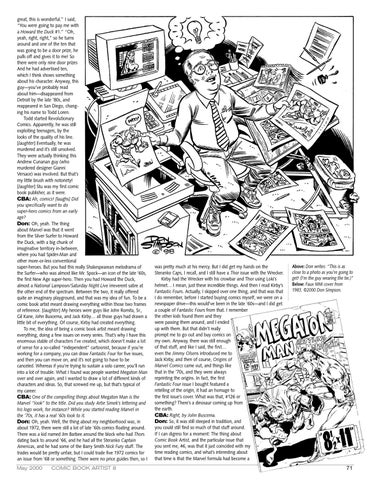
Above: Don writes: “This is as close to a photo as you’re going to get! (I’m the guy wearing the tie.)” Below: Faux MM cover from 1983. ©2000 Don Simpson.
71