Marvel’s Second Wave
Making Mine Marvel, 1970-77 Becoming a Friend of Old Marvel Bullpenners If you were around for the first issue of Comic Book Artist, you know that I’m a huge fan of the DC books between 196774. Not all of ’em, mind you, but starting with Jack Kirby’s Fourth World books and on down, I was hooked. And what I liked best was the overlapping continuity that Jack brought to the titles, some of it seeping over into Julie Schwartz’s great Superman books. What I didn’t realize was that Jack was attempting a “Marvelization” over at the Distinguished Competitor and that he had left a legacy over at that garish, slightly tawdry line called Marvel. Well, a trip to a flea market and a chance encounter with both Avengers Special #4 and Captain America Special #1 changed all that. But (sigh) I’ll dispense with the boring reminiscence and get to what CBA does best; go to the source, after a brief word. What distinguished Marvel’s Second Wave from the previous Kirbydominated Marvel Age was not only Jack’s absence but the lingering power and dominance of his and Stan Lee’s concepts. It was what was accomplished by taking Lee & Kirby’s ideas as a starting point which made for some slammin’ comics. Cases in point: The collaborations of Roy Thomas and Gil Kane—specifically Warlock, Captain Marvel and “Iron Fist.” Roy shared with me his take on the teaming of Thomas & Kane: “One of my all-time favorite collaborators has to be Gil Kane, who’s also become a good friend over the years,” Roy told me recently. “We had known each other slightly since the 1965 New York Comicon, and we would exchange a few words here and there, but we never really talked. Then in 1969 we wound up doing Captain Marvel together, and we really hit it off. He loved the story I had plotted only a couple of days before he walked in and said he’d like to see what he could do with MarVell; and I, for my part, loved the dynamic, spare way he drew the story. We even redesigned the costume together. I still have the splash panel, inked by Dan Adkins, hanging in my foyer. After that first story, we co-plotted the other four CM issues we did together, some of which were originally Gil’s idea. The last issue, in which a man in an apartment-house maze turns out to have been an inmate of a Nazi concentration camp, had real power, and it was basically Gil’s idea. “After Captain Marvel we worked together whenever we had a chance. Gil’s always saying he was ‘never anybody’s first choice’ for an art assignment, but he’s wrong there. He was very definitely my first choice when I thought of the basic idea of Warlock, which we then developed together. He was the first Summer 1998
COMIC BOOK ARTIST
artist I thought of working with when I wanted to do “Iron Fist”; in that case all I had was a name and a general martial arts theme, so when Gill suggested we plunder the Amazing-Man origin for Iron Fist’s background, I really got into it. We did a Ka-Zar origin that was a thing of beauty, and his two early issues of Conan were not only beautifully drawn but were very good sellers. “In some ways the height of our collaborations was The Ring of the Nibelung at DC. Once again, Gil was my (and original editor Mike Gold’s) first choice. That series of four books was so good that it went right over DC’s head, and I think they were shocked when we started getting all these great notices from opera reviewers. I wasn’t. The Ring was a work of real integrity, and no one could have done it any better than Gil. “From time to time Gil bemoans the fact that he’s overly identified with Green Lantern. I can understand his feelings, I guess. But Gil should be proud of the fact that, after four decades of artists who have drawn the Hal Jordan Green Lantern, there is absolutely no one whom people think of in connection with that hero before they think of Gil Kane. Only the Neal Adams Green Lantern/Green Arrow period even rivals it, and that’s primarily because of the super-relevant subject matter, not even Neal’s artwork. “Bill Everett and the SubMariner. Jack Kirby and the Fantastic Four. Steve Ditko and Spider-Man. Gil Kane and Green Lantern. That’s not bad company to be in, you know?” There’s good company also to be found in the following pages. Roy and I have obviously hit it off famously in the last six months or so, and I would not have such a concise issue devoted to his era as Editor-in-Chief at Marvel (and beyond) without his very-much appreciated help. This one’s for you, Roy. This one’s also for those Bullpenners and freelancers who did not make it into the issue but shared their time and efforts: John Romita Sr., Marie Severin, Don McGregor, and Dave Cockrum. The issue proved so big, that we’ve decided to follow-up with “Marvel Phase 2” for our next issue, where their interviews will finally appear (with a few more surprises). MARIE SEVERIN Let’s start our tour with a stop in Stan “The Man” Lee’s office…
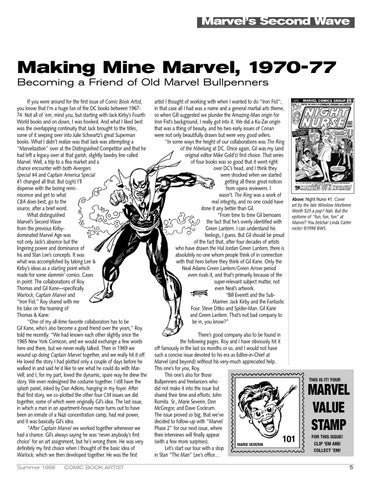
Above: Night Nurse #1. Cover art by the late Winslow Mortimer. Worth $25 a pop? Nah. But the epitome of “fun, fun, fun” at Marvel? You betcha! Linda Carter rocks! ©1998 BWS.
THIS IS IT! YOUR
101
MARVEL VALUE STAMP FOR THIS ISSUE! CLIP ’EM AND COLLECT ’EM!
5