© Liberty Media for Women, LLC.
It is generally believed that Gloria Steinem, leading Schwartz may not have known Wonder Woman, but he feminist, political activist, and publisher, had something to knew guest-star appearances by heroes on a comic-book do with the character’s costumed return. Wonder Woman cover boosted sales. He guessed that the predominantly had appeared on the cover of the premier issue of male readership, who may be reluctant to purchase an Steinem’s magazine Ms. in January 1972. Steinem had a issue of Wonder Woman, might buy it if it featured business relationship with Steve Ross, CEO of Warner Superman, or Flash, or Batman, so was born the idea of Communications (then-corporate owner of DC Wonder Woman undergoing Twelve Trials, with each story Comics). Carmine Infantino, publisher of DC Comics at narrated by a member of the Justice League and featured the time, denied any involvement from Steinem. “I met prominently on the cover. “I’m not sure,” Pasko says, since her when she came down to the offices,” Infantino said the idea was accomplished before he came on board, in an interview for the inaugural issue of TwoMorrows’ “but knowing Nelson Bridwell’s love of classical literature Comic Book Artist. “She told me that she grew up with and Greco-Roman mythology in particular, it wouldn’t and loved the character; but that was it and I never surprise me if he was the one who came up with it and saw her again. I heard nothing further.” Infantino Julie bit because it meant it bought him a whole year to further explained that the decision to revert figure out the series’ format once the guest-starring stuff Wonder Woman was because of poor sales. was done.” E. Nelson Bridwell was Schwartz’s senior Julius “Julie” Schwartz was assigned assistant editor, and one of the first comics Wonder Woman at the end of fans to become a professional. summer 1973, following At one time or another, Kanigher’s brief return. Schwartz edited nearly every Though not quite a Herculean superhero title in the DC Comics task, it was arduous nonetheless. lineup. He could draw on an extensive “My first job for Julie went like this,” talent pool of eager young writers and Martin Pasko, Schwartz’s editorial veteran professional artists. Bob Oksner assistant at the time, recalled in an was assigned the covers, working interview on the Word Balloon podcast, from Infantino-designed layouts. “He calls me in and he says, ‘What do Superman artist Curt Swan was called Len Wein you know about Wonder Woman?,’ on to pencil the first story, as he and I said, ‘Not much.’ And he said, would be called on throughout ‘Well I’ve just been handed the book and I Schwartz’s tenure on the series. don’t think I know what I want to do with it yet. I don’t Always mindful of the importance the readership know anything about Wonder Woman so your put on consistent internal continuity, which was in assignment is to read everything we have in the library on disarray, Schwartz chose Len Wein to write Wonder Wonder Woman and get a sense of the character for me,’ Woman and return her to the Justice League. “It was and I said okay, and I spent the next month being just time,” Wein explains, “and the JLA wasn’t the immersed in the inside of William Moulton Marston’s same without Wonder Woman” (as the regular writer rather strange brain as interpreted by Harry Peter.” of the Justice League of America, he would know).
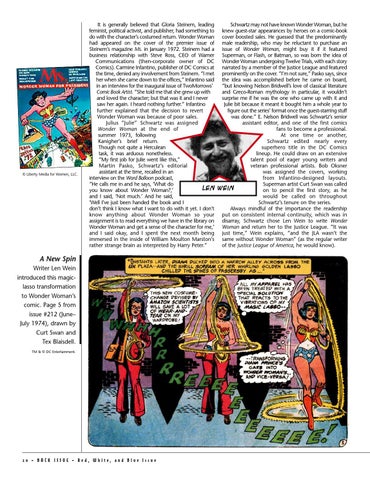
A New Spin Writer Len Wein introduced this magiclasso transformation to Wonder Woman’s comic. Page 5 from issue #212 (June– July 1974), drawn by Curt Swan and Tex Blaisdell. TM & © DC Entertainment.
20 • BACK ISSUE • Red, White, and Blue Issue