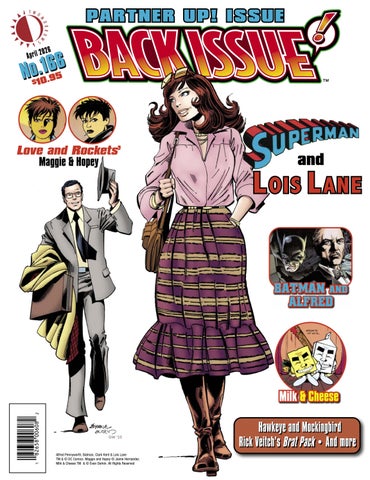
Back Issue #166 Preview

Page 1


Hawkeye and Mockingbird
Rick Veitch’s Brat Pack • And more
Love and Rockets’
Maggie & Hopey

EDITOR-IN-CHIEF

PUBLISHER

John Byrne and Terry Austin (Originally appeared in The Art of John Byrne Volume 1 (SQP 1980). Original art scan courtesy of Heritage Auctions.)

COVER

COVER

PROOFREADER Kevin

BACK ISSUE™ issue 166, April 2026 (ISSN 1932-6904) is published monthly (except Jan., March, May, and Nov.) by TwoMorrows Publishing, 10407 Bedfordtown Drive, Raleigh, NC 27614, USA. Phone: (919) 449-0344. Periodicals postage paid at Raleigh, NC. POSTMASTER: Send address changes to Back Issue, c/o TwoMorrows, 10407 Bedfordtown Drive, Raleigh, NC 27614. Michael Eury, Editor Emeritus. Roger Ash, Editor-In-Chief. John Morrow, Publisher. Editorial Office: BACK ISSUE, c/o Roger Ash, Editor, 2715 Birchwood Pass, Apt. 7, Cross Plains, WI 53528. Email: rogerash@ hotmail.com. Eight-issue subscriptions: $108 Economy US, $161 International, $39 Digital. Please send subscription orders and funds to TwoMorrows, NOT to the editorial office. Cover artwork by John Byrne and Terry Austin. TM & © DC Comics. All Rights Reserved. All editorial matter © TwoMorrows and Roger Ash, except Prince Street News © Karl Heitmueller Jr. Printed in China. FIRST PRINTING Comics’ Bronze Age and Beyond!

She was feeling generous that day, so the girl reporter gave the office milksop a break and went out on a date with him. It did not go well, less because of the outing than due to the fact that she was kidnapped by a lecherous hoodlum immediately thereafter. Within minutes, however, the young brunette was standing next to a crumpled car and watching a man in blue and red tights hang her would-be assailant on a telephone pole. “You needn’t be afraid of me,” Superman told the shivering woman as she leaned back in disbelief. “I won’t harm you.” Flying his charge back into the city, he advised the Daily Star reporter “not to print this little episode.” And what did she say in response? Absolutely nothing! Lois Lane would never make that mistake again.

This was what constituted “meet cute” in Action Comics #1 (Apr. 1938), Jerry Siegel and Joe Shuster’s landmark comic book that introduced Superman and Lois Lane to an unsuspecting world. Unaware that her hero was secretly the coworker she dismissed as a spineless weakling, Lois reunited with Superman proper in Action #2, peppering him with all the questions she’d been too speechless to ask last time. Brushing her off as she had Clark Kent, the Man of Steel was finally cornered in Action #5. Awestruck after being rescued from a flood, Lois locked lips with her dream man between panels and his stoic façade crumbled. “Wow!” he exclaimed. “What a kiss!” It was, she declared, “a super-kiss for a Super-Man!”

From there, it was a short trip to Superman’s elevation to multi-media phenomenon, with a syndicated newspaper strip (1939), a radio show (1940), and animated movie shorts (1941) cementing the folk hero’s place in pop culture. Lois Lane was at the heart of it, an assertive, competitive reporter for the renamed Daily Planet who rejected coworker/ rival Clark Kent most of the time but still liked him well enough to accept the occasional date.

The romantic triangle provided a large dose of wish fulfillment for males—including creators Siegel and Shuster—who longed for the women who spurned them to see the hero within. It became such a signature element of the feature that, in 1941, Siegel’s plan to have Lois discover Superman’s alter ego was soundly rejected by his bosses. Other mystery-men, including the Flash, Hawkman, Doctor Fate, and the Sandman, allowed their girlfriends in on the secret but they weren’t household names.

Instead, Siegel went in a different direction, penning a script for 1942’s Superman #17 wherein Lois began to actively suspect that Clark was Superman. In the quarter-century that followed, a veritable sub-category of stories arose in which the Man of Steel had to refute the dogged

Superman is late for his date with Lois on the José Luis García-López Silver Age variant cover to Superman Unchained #1.

TM & © DC Comics.

(top) Superman and Lois Lane meet in Action Comics #1 (art by Joe Shuster), and again (middle) in a stunning Alex Ross recreation. (bottom) Lois chooses Captain Marvel over Superman in this Kurt Schaffenberger illustration.

reporter’s latest irrefutable proof that he and Kent were one and the same. Those tales mingled with scores of others that found Lois fruitlessly attempting to win Superman’s hand in marriage. Failing that, she allowed herself to be courted by a multitude of suitors, including Clark Kent himself. The two reporters were actually wed in a December 1949 newspaper sequence, until February 1952’s revelation that it had all been a dream. By that time, the live action Adventures of Superman TV series (starring George Reeves) was in production, and it was perhaps deemed prudent to have the strip on the same page as the comic books and television show. Phyllis Coates and Noel Neill, alumni from recent movie serials, played Lois on the small screen, the former only in its first season. Jack Larson’s Jimmy Olsen became so popular that DC went so far as to launch a Superman’s Pal, Jimmy Olsen comic book in 1954.

The logical follow-up premiered during mid-1957 in issues #9 and #10 of the tryout title Showcase. Entitled “Superman’s Girl Friend, Lois Lane,” the issues codified the reporter’s status in the Man of Steel’s life, regardless of how much he downplayed his romantic interest. To the surprise of no one, an ongoing Lois comic book went on sale in January 1958. Issue #1 brought veteran Fawcett Comics artist Kurt Schaffenberger aboard as the series’ primary artist and virtually defined Lois Lane for the next decade.

With a polished style that married realism with a light cartoony quality, Schaffenberger was the perfect person to draw strips that ranged from slapstick comedy to crime drama between the covers of a single issue. Viewed objectively, the tales often didn’t make their star look very good. For every story that played up Lois’ investigative skills and empathy, there was another that depicted her as variously petty, vindictive, jealous, gullible, and foolish. Superman, required to be prominent in both Lois and Jimmy’s books, sometimes came away with mud on his face himself, particularly when he’d play pranks on his so-called girlfriend to “teach her a lesson.” The characterization was positively schizophrenic but, approached on their own terms, the stories were often as hilarious as a classic sitcom.

Lana Lang, created in 1950s Superboy #10 as a teenage precursor to Lois, wound up (following a few trial balloons) as a regular in Lois Lane as of issue #7 in late 1958. Now a TV reporter in Metropolis, she became the Betty to Lois’ Veronica. Sometimes they were best friends, other times bitter rivals when it came to a certain superhero. Unlike Archie Andrews’ dueling girlfriends, though, there was really no contest on who had the edge in a battle for the heart. Lois had the seniority, name recognition, and comic book with “Girl Friend” in the title.

In Lois Lane #80 (Nov. 1967), Lois literally tore those very words off the cover, setting up a Leo Dorfmanscripted two-parter where she finally concluded that Superman was never going to treat her as more than a good friend. Heading off for a new life with an astronaut boyfriend, Lois temporarily acquired telepathic powers in issue #81’s conclusion. Reading Superman’s mind, she discovered that he did truly love her and that his longtime assertions that—as his wife—she would be murdered by his enemies was a sincere deeplyrooted fear. It was, as readers pointed out over the years, a shaky rationalization since Lois was a prime target for retaliation whether she wore a wedding ring or not. Regardless, it was enough for Lois to return to Metropolis, content that Superman genuinely cared for her.

The two-parter was Kurt Schaffenberger’s grand finale on the feature, reluctantly replaced by penciler Irv Novick and reassigned to the Supergirl strip as part of an artistic shake-up on the Superman titles. Another shift followed two years later as the franchise’s powerhouse editor Mort Weisinger retired and his books were divvied up among multiple men. Weisinger’s assistant E. Nelson Bridwell was assigned Lois Lane itself, beginning with issue #105 (Aug. 1970).

Citing the Dorfman/Schaffenberger two-parter in issue #107’s letter column, Bridwell emphasized that the excesses of the Silver Age had no place in the 1970s. “Superman’s love for Lois, once stated, cannot be retracted. Nor would we want to do so. We want a hero with believable emotions, not one who goes around challenging two girls—and the reader—to guess which one he’s really in love with.”

Bridwell also conceded that Lana’s role in the feature—already dimmed in the post-Schaffenberger period—was a problem since there was no longer a point in her playing spoiler. It fell to writer Cary Bates (with artists Art Saaf and Vince Colletta) to tackle the subject in LL #109. A former professor of Lana’s took it upon herself to hypnotically strip Lois of her ability to love, requiring a compassionate Superman to help revive her feelings. Having already come to terms with the fact that she no longer had a chance with the Man of Steel, Lana took the crisis as a sign to get a fresh start. In the last panel, she left Metropolis for a new job as European correspondent with Galaxy Broadcasting. Lana was “gone for the time being,” Bridwell wrote in LL #108, “until we decide definitely what to do with her. We are open to suggestions.”

Lois’ primary writer Robert Kanigher tended to push more into romance comic territory, as in issue #105’s contrivance where a death-row prisoner convinced the reporter to marry him before his execution.

The following issue’s “I Am (Curious) Black” famously had Lois use Kryptonian technology to become an African-American woman to gain perspective on discrimination against Black citizens. An awkward scene found Lois asking Superman if he’d marry her as a Black woman. It was, the hero noted, a cheap shot since she knew he wouldn’t marry anyone lest they be a target. Bridwell revealed in a January 1971 syndicated newspaper article that one reader took issue with the sequence because she “didn’t believe in interracial marriages.”

Although later generations of readers delight in mocking the story (inspired by John Howard Griffin’s 1961 memoir Black Like Me), it was greeted warmly by many correspondents in 1970. There were exceptions, of course, as Bridwell noted in the aforementioned article. A blistering missive postmarked Jamaica, New York “was plain racist. He didn’t want [expletive]—spelled with one ‘g’—in magazines. The letter was written either by a young kid or by an adult who couldn’t write.”

Bridwell’s editorial run culminated with a shocker in January 1972’s Lois Lane #120 that revealed that Lois’ sister Lucy was secretly a spy for the 100

(top) Lois no longer wants to be Superman’s Girlfriend. Cover by Curt Swan and Neal Adams. (bottom left) Lana Lang departs. Art by Werner Roth and Vince Colletta. (bottom right) Lois uses Kryptonian technology to become African American. Art by Roth and Colletta

declaration: “Yes. I want to share my life with you.” Ordway drew the lovely final pages himself, declaring them a favorite among his memories on the series.

“It seemed a logical step for the two of them,” Dan Jurgens told BI. “Plus, if people reacted negatively, we could simply have them break up for a bit. We also thought it might be a long engagement that could last several years. One of the main things behind all of it is that we were always trying to build off of Clark’s humanity. The idea of Superman marrying an earth woman really emphasizes that and helps to define his character, so we saw that as a plus.”

Carlin’s discussion with Action Comics writer Roger Stern added another wrinkle. Ordway adds that they “discussed the idea that Clark couldn’t enter into the engagement with a lie—meaning his secret identity as Superman. So, Clark’s next step was revealing his secret to Lois. Now, I had little to do with Carlin’s and Roger’s conversation, but I recalled a favorite moment in the generally mediocre Superman IV: The Quest for Peace film [1987]. Clark and Lois talk heart to heart, and she either said or implied that she had known Clark was Superman for a while. I loved that: she was an award-winning reporter, after all. So that was where my head was when drawing the proposal sequence.”

Stern got the ball rolling at the end of the Bob McLeod-illustrated Action #662 (Jan. 1991). “Being married to me might not be the safest thing in the world,” Clark said as part of a preamble to coming clean on the historic last page.

Ordway picked up moments later in Superman #53, where a reeling Lois conceded that, on some level, it wasn’t a complete surprise. “In my heart, I think I’ve known for a long time,” she observed, “but my brain would always dismiss the notion. Suspecting something and acting on it are two different things.”

She eventually processed and accepted the revelation, with writer-penciler Dan Jurgens later adding a nice episode entitled “Superman’s Fiancée, Lois Lane” in July 1991’s Superman #59. As had been the case in his pre-Crisis existence, Superman was eternally being pulled between his obligations to the world and those closest to him. In this story, the Man of Steel emphatically put Lois first, flying her to Mount Fuji for hours of uninterrupted conversation on the forces that shaped him and the implications of marriage. Miraculously, no crisis interrupted the couple as they built “a bedrock that [mirrored] the core of their relationship.” In fact, the “miracle” was the result of a member of the Linear Men who secretly manipulated the passage of time as a gift to Superman.

“The cover and story for Superman #59 stands out” as one of Jurgens’ favorite Superman/Lois memories. “It helps for Superman to have a partner,” Jurgens observed to BI, “and also helps to bring his concerns down to Earth. I see it as a huge plus. Again, that goes back to Superman’s humanity and even the morals he was raised with, and what he witnessed with the Kents. I have always said that it was both Lois and Superman who debuted in Action Comics #1, so it’s been in effect from the very beginning.”

Carlin and his well-coordinated creative team had shored up the shaky foundation of the Byrne

relaunch to great effect, the stories flourishing with both fine adventures and strong character development. Ordway took pride in what that meant for the young lovers.

“I am proud of the small moments in their relationship,” he told BI. “Clark changes a battery in a smoke alarm while Lois is getting a stepladder! She is bemused. [Adventures #484] That was fun. Another bit was a small tip about hanging wrinkled clothes in the bathroom after a shower, with the moisture in the room helping to smooth out wrinkles. A working person could benefit from the advice! I think those small things are what people still remember fondly from our comics, not who the villain of the issue was. Fans still love the Jimmy Olsen, Bibbo, and Jose Delgado character stuff, when I chat to them at comic shows. That was the ‘special sauce’ of that era of Superman.

“As a newly married man,” Ordway continued, “I had married my own Lois Lane, a strong, capable, and smart woman. I really just channeled emotions and some circumstances into my stories. The idea that Clark risked his life as Superman, while his parents watched the news and worried, was one thing. Lois had to report on it all, while

(top left) The secret is out. Cover by Kerry Gammill and Brett Breeding. (top right) Lois and Clark are finally together. Cover by Stuart Immonen and Jose Marzan, Jr. (bottom) Clark reveals his secret.

Art by Bob McLeod. TM & © DC Comics.

“Truly great friends are hard to find, difficult to leave, and impossible to forget.”

One of the longest running American creator-owned comic book series is Love and Rockets. The series is written and drawn by two brothers, Jaime and Gilbert Hernandez, with a third brother, Mario, making occasional contributions.

Love and Rockets made its debut in 1981 with a single self-published issue released by the Hernandez Brothers. The series was then picked up by Fantagraphics Publishing, with the first issue of the ongoing Love and Rockets being released with a September 1982 cover date.

Jaime and Gilbert Hernandez both have had regular features that have run through Love and Rockets over the years. For Gilbert, he has chronicled the stories of a small Central American town named Palomar. For Jaime, his “Locas” stories have looked at the lives and loves of the residents of the Mexican American farming town of Huerta, California, nicknamed “Hoppers,” a fictionalized version of the Hernandez brothers’ hometown of Oxnard. The two main characters in Jaime’s stories, and the first we meet, are teenage girls Margarita Luisa Chascarrillo and Esperanza Leticia Glass, or, as they are better known, Maggie and Hopey.

Where did the characters of Maggie and Hopey come from? Jaime Hernandez explains to BACK ISSUE the inspirations for the duo. “Maggie was created when I was in high school and took on different forms over the years until we did Love and Rockets so you could say she’s based on many different personalities and looks. Hopey came along a little later and was based on the looks and attitude of certain punk girls in late seventies Los Angeles.”

Through flashbacks, we discover that Maggie and Hopey were introduced to each other by a mutual friend Isabel “Izzy” Ortiz Reubens. After Maggie’s parents separated, Maggie was sent to live with her aunt, wrestling superstar Vicki Glori, in Hoppers. Izzy ended up helping to raise Maggie.

When Maggie was 13 years old, her best friend Letty was killed in a car accident. Soon after this tragedy, Izzy introduced Maggie to Hopey, who was already a hell-raising juvenile delinquent. Izzy knew that the two teenagers had something in common: they both liked punk rock music. It seems likely that Izzy hoped the two teenage girls would benefit from getting to know each other;

Even Maggie and Hopey frolic sometimes.

TM & © Jaime Hernandez.

Jaime Hernandez
Ferran Cornellà / Wikimedia Commons.
by Ben Herman

In the story “100 Rooms,” following Maggie’s return to Hoppers, she, Hopey, and Izzy are invited by their friend, the gorgeous Penny Century, to stay in the West Coast mansion of eccentric billionaire H.R. Costigan, with whom Penny is having an affair. There, Maggie discovers a man named Casey hiding out, who is seeking to meet Costigan. Maggie and Casey have a brief affair. Finding out about this, Hopey becomes jealous. Afterwards, during a lavish party that Maggie and Hopey attend, the two teenagers get into a fight. Casey is forcibly ejected from the mansion by Costigan’s bodyguard. The next day, sneaking back in, Casey explains to Maggie that he’s leaving the country, and he asks her to join him. Maggie responds by telling him:

“Maybe I could run away with you five years from now, but not right now… Right now, there’s no one I’d rather spend my life with than my friend Hopey. I wish she was here this very minute. But, I’m afraid I may have blown that sky high. Now, I don’t know if she’ll ever come back. I don’t… know…”

Casey kisses Maggie goodbye and leaves. And then Hopey appears, revealing that she heard everything that Maggie said, and the two friends make up.

Soon afterwards, in the story “Las Mujeres Perdidas” (“The Lost Women” in English), Maggie accompanies Rand Race overseas on another assignment, this time to the politically unstable island of Chepan, where she once again encounters Rena Titañon. Revolutionaries are blowing up buildings to protest the dictatorial rule of the eccentric and cruel Dr. Beaky. Maggie and Rena are caught in one of the explosions and presumed dead. The news of their apparent demises reaches the inhabitants of Hoppers, and Hopey is understandably devastated.

It turns out, though, that Maggie and Rena escaped through a tunnel underneath the warehouse. After several days of wandering through the sewer systems and deserts of Chepan, the two women finally reach civilization. Following a short stay in the hospital, Maggie returns to Hoppers.

Later on, Maggie and Hopey have another argument. Going to Izzy to discuss this, Maggie explains that she’s

(top left) The early fantasy elements in Jaime’s stories are on full display on this cover featuring Maggie and Penny Century. (top right) The major “Locas” characters on the cover of Love and Rockets #13. (bottom) Stunning art from “100 Rooms.” Original art scan courtesy of Heritage Auctions (www.ha.com). TM & © Jaime Hernandez.

The romantic life of Peter Parker, the Amazing Spider-Man, has always been an integral part of his mythos. Peter’s woes with women are woven into his stories and largely defined by two characters, Gwen Stacy and Mary Jane Watson. Both of those ladies have a deep connection to Peter and have become household names, whether as a costumed hero in their own right or Peter’s wife. Moving beyond the big two loves of his life, there certainly has been a long list of ladies that have caught Peter’s eye and attention; Betty Brant and Felicia Hardy (The Black Cat) are often mentioned next. There are more, of course, too many to do justice to in this article, but there is no character in Spider-Man history as poorly treated and casually dismissed by Peter (and arguably Marvel editorial) than Debra Whitman.

A love interest who was a consistent supporting character in all the Spider-Man titles for the better part of two years, most of Debra’s appearances came during the well-regarded Bill Mantlo run in Peter Parker The Spectacular Spider-Man. Debra was also present for the kick off of the critically acclaimed and character defining Roger Stern run in Amazing Spider-Man.

Stay tuned for the sad tale of Debra Whitman, the girl who discovered Peter’s secret identity and got a lot more than she bargained for before being shuffled off abruptly into SpiderMan’s history.

A much larger part of modern comics than maybe most of the readers are familiar with is the place romance comics play in their origin. The major creators of the medium we love, including Joe Simon, Stan Lee, and Jack Kirby most notably, were the driving force behind titles like DC’s Heart Throbs and Young Love , Charlton’s Romantic Stories and Teen Confessions , and Marvel’s Patsy Walker and Millie the Model. These titles were displayed on the newsstands side by side with the superheroes we all know.

Certainly, romance comics sales had diminished into the Bronze Age before completely disappearing from shelves—the last issue of Millie was cover-dated Dec. 1973, well into this magazine’s zone of interest—but romance and that specific style

The Debra Whitman story comes to a head in Peter Parker: The Spectacular Spider-Man #74. Art by Bob Hall and Al Milgrom. (inset) Romance by Stan Lee and Jack Kirby. TM & © Marvel Characters, Inc.

of storytelling is noticeably present in the DNA of the superhero stories we grew up loving. You can’t read the first years of the Fantastic Four and not see the soap operatics of Namor and Sue. Look at The Avengers and watch Hawkeye and Black Widow’s tango. Former Marvel Editor in Chief Tom DeFalco reveals to BACK ISSUE, “Stan Lee’s greatest contribution to the medium was the introduction of soap opera into the superhero comics.” Perhaps a bit of an understatement, but his point is unquestionable.

The Amazing Spider-Man title was a fine example of the times. These stories always had their fill of soap opera elements, most noticeably Peter’s driving self-flagellation over Uncle Ben’s death always played as inspirational, but there is no denying the melodramatic overtones that seeped into every panel because of it. Peter’s approach to women always played more General Hospital than high school love. Peter’s ups and downs never stopped all through the Silver Age. Gwen Stacy, Harry Osborne, Mary Jane Watson, and their drama would have played as well in Young Romance as it did in Stan Lee’s and Steve Ditko’s seminal run of the first 38 issues of Amazing Spider-Man and beyond. Future writers took their cues from those issues and did not stop there as Spider-Man comics rolled into the Bronze Age with drug use and Aunt May’s marriage to Doctor Octopus. But no character’s portrayal personified the soap opera tendencies of comics, and specifically Spider-Man titles, than Debra Whitman. Debra first appearance was in Amazing SpiderMan #196 (Sept. 1979) written towards the end of Marv Wolfman’s impressive time on the title. While Wolman’s more famous comics work was soon to follow at DC with New Teen Titans , his signature Spider-Man creation (along with artists Keith Pollard and Dave Cockrum) the Black Cat, was to become a major love interest. In fact, Debra was only a minor character at her introduction as the secretary to Doctor Morris Sloan, the Dean of the Bio-Physics department. Sloan was Peter’s boss during his time as a Graduate Assistant at Empire State University. When asked about Debra Whitman, Wolfman was honest and told BI that she was not a memorable character.

An inauspicious debut for Debra Whitman in Amazing Spider-Man #196. Art by Al Milgrom, Frank Giacoia, and Jim Mooney. (bottom) Peter and Debra’s romance does not begin well in Pater Parker: The Spectacular Spider-Man #42. Art by Mike Zeck and Jim Mooney.

TM & © Marvel Characters, Inc.

Obviously, Wolfman had higher hopes for Black Cat’s future as a possible love interest than Debra’s, but that was to come later. At first, Debra was just a face at a desk, occasionally playing a damsel in distress, but mostly someone for Peter to talk to while doing his ESU work. Debra was just another supporting character as Peter’s role at ESU created new friendly faces and avenues of adventure for Spider-Man. It was not until Marvel’s Bronze Age master writer Bill Mantlo took over Peter Parker: The Spectacular Spider-Man that Debra began moving into a bigger role. DeFalco tells BI “She was introduced as someone who had a crush on Peter Parker, but a fear of Spider-Man.” Certainly a situation ripe for melodrama.

Debra and Peter’s relationship played out in early appearances as many real-life friendships do— idle banter turns into interest which turns into

Tom DeFalco
© Luigi Novi / Wikimedia Commons.

Rick Veitch’s Brat Pack five-issue miniseries (Aug.1990-May 1991) is a paradigm-shifting reinterpretation of the superhero-sidekick dynamic set against the seedy urban backdrop of Slumburg with its many troubled denizens. Comparatively, while The New Teen Titans showed readers how sidekicks can successfully grow up into young adults and “Batman: A Death in the Family” explored the darker end of this spectrum with the tragic—and phone-voted-in—murder of Jason Todd, Brat Pack boldly exemplifies what happens when the mentor-superhero uses and destroys the adolescent sidekick in a repetitive cycle involving sex, drugs, and abuse. Specifically, Veitch’s takedown of the corporate-branded superhero-sidekick dynamic via the twisted pairings of Midnight Mink-Chippy, Moon MistressLuna, Judge Jury-Kid Vicious, and King Rad-Wild Boy explores the darker edge of how ostensibly responsible adults affect the lives of vulnerable teenagers. In other words, Brat Pack works on a twofold level: as both a meta dissection of the problematic superhero-sidekick pairing in relation to reality and an indictment of how these younger characters are exploited on a corporate level in order to achieve a bump in sales after they have attracted the media to cover their sensationalistic plot developments. With this appropriately cynical viewpoint in mind, I spoke with Veitch via email about his edgy postmodern miniseries as well as his expansion of the Brat Pack universe through his entire King Hell Heroica Cycle.

TOM POWERS: Rick, could you please share the origins of Brat Pack as a creative project?

RICK VEITCH: It grew out of the creative ferment that I was part of at DC in the mid-1980s. Swamp Thing had rearranged a lot of editorial thinking up there, and I was part of that team, assisting Steve Bissette occasionally and doing fill-in issues, then taking over as penciler. Alan Moore was still writing the book and was also beginning work on what would become Watchmen. He and I were on the phone a lot, and there was much discussion and cross pollination concerning how we might evolve superheroes beyond what served as normal fare for mainstream comics. I was also talking a lot with Bissette, John Totleben, and Neil Gaiman; and we all freely shared ideas about what we were working on.

The sales success of Dark Knight and Watchmen opened the door for us to pitch more edgy stuff and me, being from the Underground Comix scene in San Francisco, thought I’d really like to take it to whatever DC’s limit was. I originally pitched it to them in 1988, I think. They wanted to do it as part of a new cutting-edge imprint, Piranha Press. They sent me a contract, but my Swamp Thing run blew up over the Jesus story, and I was out of there.

Chippy prepares for a night out. Original art for Brat Pack #1 cover, art by Rick Veitch. Scanned from the Brat Pack trade paperback. TM & © Rick Veitch.

POWERS: What aggravated you about DC’s treatment of kid sidekicks in 1988 via the phone-in vote for Robin (Jason Todd) to live or die campaign?

VEITCH: The naked greed and cynicism.

POWERS: Did resigning from Swamp Thing as writer due to DC not running your Swamp-Thingmeets-Jesus issue affect your storytelling choices for Brat Pack ? I mean, they can encourage fans to vote for killing a teenager but can’t accept your vision of Jesus?

VEITCH: I was really angry after it all went down, and that anger fed Brat Pack . I was ripsh*t at what I’d experienced inside the industry, and those feelings encompassed a lot more than the dial-a-death thing.

POWERS: In terms of your publishing choices for Brat Pack, why did you go with black and white for this story?

VEITCH: It was way more difficult and expensive to do color in those days. I originally planned it as simple black and white line art on cheap pulp paper, but when I joined forces with Tundra, I was able to add the grey tones and nice stock. Tundra also made it possible to run an ad campaign to retailers, providing them with point of purchase stuff to build awareness.

POWERS: You were quite brave for self-publishing Brat Pack under your King Hell label. As a professional, how did you feel going into that uncharted territory?

VEITCH: I had been drawn into the group of self-publishers who were trying to empower creators and reform the business practices which were pretty abhorrent in the late ‘80s. So, Kevin Eastman, Peter Laird, Steve Bissette, Dave Sim, and Gerhard were showing me a new business model with which, if I was lucky, I could free myself from situations like I’d just experienced at DC.

POWERS: What drawing tools did you utilize for Brat Pack and how did you approach illustrating a panel or a scene for this comic?

VEITCH: The boards were smaller than the usual 10” x 15” we were using back in the day. Probably 8” x 12.” And I was working very fast. So that gave the art a rougher and tougher feel, I think. I would first work out a page or a spread in my sketchbook, then start laying it out with tracing paper, starting in light pencil, and then hitting the drawing again in darker pencil. Once I was happy, I’d lightbox it as tight as I could onto the boards. Then tighten the pencils. Then brush, pen, and India ink for the line work. Then lay in the basic gray tones with dyes and model those with color pencils. Go back and touch up the blacks. I’d also use airbrush sometimes and collage. The lettering, by Gary Fields, was done on overlays.

The Brat Pack and their mentors.
TM & © Rick Veitch.
rick veitch Facebook

POWERS: Could you please discuss your design choices for some of the so-called superheroes and their sidekicks’ costumes? (For instance, Midnight Mink wears this perverse mink cape; Moon Mistress looks as if she’s stepped out of a 1970s exploitation film; King Rad resembles a punk wearing paramilitary garb; and Judge Jury could be mistaken for a KKK member, while his sidekick, Kid Vicious, comes off as a jock-cowboy—not to mention Wild Boy’s burnout skater gear, and Chippy’s and Luna’s fetishistic outfits.)

VEITCH: They are all broad parodies, with some mixing and matching, of various superhero tropes. The thing to remember about Brat Pack is that it isn’t just a meditation on mainstream heroes. It’s very much informed by Underground Comix like Wonder Wart-Hog.

POWERS: When you were writing Brat Pack , did you initially see it as beginning in medias res, a la The Odyssey or Star Wars: A New Hope , especially in considering that, like the original Star Wars film being retitled Episode IV, you subtitled it Volume Four of your King Hell Heroica Cycle?

VEITCH: No, I originally conceived it as a single miniseries that would be collected as a stand-alone graphic novel. After it seemed to strike a nerve in

the marketplace, Tundra wanted more Brat Pack, but I’d gotten a lot of the poison out of my system. So, I conceived of a more sweeping narrative exploring the Maximortal, who was a character in Brat Pack. I wanted to explore making different types of comics. Still do!

POWERS: Taking your amazingly dark creative process in mind, can you please discuss how the so-called superhero “mentors” in Brat Pack relate to what I believe to be their DC/Marvel analogues: Midnight Mink/Batman, King Rad/Green Arrow, Moon Mistress/Wonder Woman, and Judge Jury/ Captain America (or the Punisher).

VEITCH: All of them are meant to hit broader targets than just the DC/Marvel analogues. I wanted to satirize the sheer kinkiness of superheroes that somehow passed under the radar of the Comics Code all those years. After horror comics were banned, the publishers had figured out how to make stories for kids that reeked of subliminal sex, violence, and vigilantism. I wanted to shine a light on that.

POWERS: I notice that you often employ what I am calling a four-square format for telling the concurrent tales regarding Midnight Mink, King Rad, Moon Mistress, and Judge Jury’s recruiting

(left) Voting to see if kid sidekicks die. That seems familiar. (right) The votes are in, and the original Brat Pack dies.

“A partner brings something to the relationship that you lack; they inspire you to up your own game.”

-Bill Gates Source Code

We sometimes think of Batman as a loner, meting out justice as only the Dark Knight can, but is that truly the case? During his long run in The Brave and the Bold, for example, he appeared to be the ultimate team-up partner, seemingly allying himself with everyone in the DC Universe. He’s obviously also been a charter member of the Justice League of America, founded the Outsiders, and back in March of 1940, specifically in the pages of Detective Comics #38, he gained a sidekick in the form of Robin, the Boy Wonder, a mere 11 issues after his own beginnings in the magazine.

A few years later, another vitally important partner joined the Batman mythos under the title, “Here Comes Alfred.” It was in Batman #16 (May 1943) when the new butler to Wayne Manor appeared, and he came to stay. This essay will explore the character and some of the more notable highlights in his history with a particular focus on our beloved Bronze Age and a bit beyond.

At the time of that initial appearance, he was known simply as Alfred (later with the surname Beagle), and unlike the svelte and mustachioed version most of us are familiar with in later continuity, the first Alfred was larger, clean-shaven, and more in the mold of comedy relief than what the character eventually became.

Bob Greenberger’s very useful The Essential Batman Encyclopedia (2008/2012) informs us that “Alfred Beagle was a portly gentleman’s gentleman who forsook an acting career to serve Earth-2’s Bruce Wayne and Dick Grayson. He did this to honor a promise he’d made to his father, Jarvis, who lay on his deathbed in England after having served the Wayne Family years earlier. Early on, the two tried to keep their secret identities of Batman and Robin from their butler, but he accidentally discovered their secret and happily joined their efforts.”

Creator credits for that initial introduction of Alfred from the Grand Comics Database list Don C. Cameron as scripter, Bob Kane as penciler, and Jerry Robinson inking with George Roussos on background inks and lettering. In a conversation with Jerry Robinson, back in December of 2007, Jerry suggested Alfred, along with additional classic characters, were more often a group effort: “I was able to play a creative role in the development of other major Batman characters including Penguin, Alfred, Catwoman, Two Face, and others.”

The splash page to that debut story contained the classic element of an oversized figure, namely Alfred, bedecked in a Sherlock Holmes inspired deerstalker hat, Calabash pipe, and magnifying glass as he gazes over a copy of “How to Be a

A touching tribute by Lee Weeks from the cover of Pennyworth RIP #1. TM &

Comics.

Detective,” while in the background, miniature figures of Batman and Robin along with a scattering of criminals flesh out the scene.

Soon, we see Alfred leaving a ship and bidding farewell to a traveling companion named Leduc and shortly after, he notes that he’s already two years late, so perhaps he’ll follow Leduc, but before that can happen, he is accosted by crooks demanding that he surrender his valise. Not one to be intimidated, Alfred uses the suitcase as a weapon to fend them off and soon none other than Batman and Robin have arrived to send the would-be thieves scurrying away. A grateful Alfred informs the Dynamic Duo that he is an amateur criminologist and would be glad to assist them in their endeavors. Batman suggests he call on them to further discuss possibilities and they depart.

Later, at Wayne Manor, Batman and Robin are back in their civilian attire when they hear the doorbell and are shocked to see Alfred, who tips his bowler and promptly describes his harrowing journey, followed by his announcement that he is their new butler. He goes on to describe that his father, Jarvis, had served Thomas Wayne in that capacity and had been disappointed when his son chose not to go into the family business, but embarked on a career as an actor. On his deathbed, Jarvis secured the promise of Alfred to go and serve the Wayne family as he had.

Uncertain how to proceed, despite Robin’s fears that Alfred’s amateur sleuthing could uncover their secret identities, Bruce says he hasn’t the heart to turn him away and will decide how to proceed in the morning.

Predictably, the criminal element who showed such interest in Alfred have not given up their quest and have followed him to Wayne Manor, accosting the gentleman just after he’d discovered a cache of old newspapers showing that Gaston Leduc is the Duke of Dorian, who has fled a Nazi invasion. The criminals again demand the valise and, in the nick of time, thanks to a clever burglar alarm alerting the Dynamic Duo, Batman and Robin burst into Alfred’s quarters and subdue one of the party and send the rest of the gang running.

While Batman and Robin go in pursuit, Alfred is left to make sure Bruce and Dick are all right, but after finding an empty bed in Dick’s quarters, the thug revives and takes another attempt at harming Alfred, who takes a valiant swing that misses, but dislodges an ornamental shield from the wall, knocking the thief out, but also revealing a hidden passageway that the curious Alfred follows to discover the Batcave.

Elsewhere, the Caped Crusaders have followed the gang to an abandoned theater, but before they can

(top) Alfred’s first appearance in Batman #16. (bottom) Alfred just gets to town and discovers the Batcave. He is good! Art by Bob Kane, Jerry Robinson, and George Roussos. (inset) The ominously deceptive cover to Batman #16.

TM & © DC Comics.

(June 1964) when the loyal manservant sacrificed his own life to save Batman and Robin from being crushed by a boulder. Following this insurmountable loss, the Dynamic Duo honored their friend with the Alfred Foundation, muddling along with Aunt Harriet in Alfred’s stead, a cross-pollination from the television series; and only later did it come to light in Detective Comics #356 (Oct. 1966) through an extended flashback sequence that Alfred had been brought back to life by scientist Brandon Crawford, but much like Dr. Frankenstein and his infamous experiment, things didn’t go quite according to plan and a very altered creature emerged, both physically and mentally, from the cell regeneration equipment in Crawford’s laboratory. The bone-white figure, covered in circular markings sans any hair, looked nearly statue-like and was endowed with weird abilities including telekinesis and was bent on the destruction of Batman and Robin. He dubbed himself The Outsider, as in being outside the human race.

Another strange consequence of the bungled experiment was that Brandon Crawford himself was transformed, into a duplicate Alfred, so the Outsider placed him into the coffin for cover. From that point forward, the Outsider vexed our heroes, often through surrogates. The World’s Greatest Detective is suspicious that the Outsider’s knowledge of their operation spells out Alfred and in a final showdown in Crawford’s lab, the theory is proven out when they defeat the Outsider and restore Alfred (and the scientist) to their natural state. The faithful butler further has no recollection of his time as the Outsider, so things return to normal at Wayne Manor.

(left) After bedeviling our heroes for many issues, The Outsider finally appears in the flesh in Detective Comics #356, and his secret is revealed.

Art by Carmine Infantino and Joe Giella. (right) The dramatic cover to Batman #216.

Art by Irv Novick and Dick Giordano. TM & © DC Comics.

series bloomed large, and they determined to make Alfred an essential character in that series, the orders came down to DC to bring Alfred back to life in the comic books. What we later learned was that Alfred had not exactly died but had become a villain of cloak and mystery and known only as ‘The Outsider.’ All these stories, therefore, lent depth to the character of Alfred as we had never seen quite before.”

Bob Rozakis, the famed “Answer Man” and writer and editor at DC Comics confirmed the notion to do away with the character by Julie Schwartz. “He (Alfred) was expendable when Julie Schwartz took over as editor, replaced by Aunt Harriet.

The Outsider storyline was Julie’s way of killing him off.”

Another significant milestone in the ‘60s included one of the more memorable portrayals of Alfred from the small screen in the aforementioned Batman television series by Alan Napier, whom Bob Rozakis listed as his favorite live action actor for our favorite butler. Longtime Batman editor Jordan Gorfinkel further elaborated on his preference for the actor: “Alan Napier, hands down. Unflappable, loyal, smart, kept Aunt Harriet distracted. Although it always confused me that Alfred had a mustache and Commissioner Gordon did not. As a kid, I thought Gordon looked like Alfred and the reverse.”

Michael Uslan had these insights on this timeframe as well: “The next depth change to Alfred came with the advent of the ‘new look’ Batman in Detective Comics #327-329, which culminated in the death of Alfred. This was intended by editor Julius Schwartz to be a permanent change as part of the revolutionary new approach to Batman. But as soon as the TV

In Batman #216 (Nov. 1969), Alfred loomed large, beginning with that dramatic cover by Irv Novick and Dick Giordano where he appears to have been felled by a mysterious cloaked female figure. Inside, we see that the same art team handles the Frank Robbins scripted “Angel—or Devil?” The piece is lettered by Ben Oda with editing by Julius Schwartz.

It seems a Shakespeare festival from London has descended upon Gotham City, and drama is already in the air when a young blonde girl at the stage door of the Gotham Theater is being menaced by a pair of men with British speech patterns, insisting she perform some sort of unspoken task that

bob rozakis © Luigi Novi / Wikimedia Commons.

“I don’t mind giving people what they want, as long as I’m happy doing it. I’ve got a lot of irons in the fire. I’m usually working on six things at once. I know where they fit into my scheme of things, and I enjoy Milk & Cheese . If I didn’t enjoy it, you would stop seeing it.”

-Evan Dorkin in Hero Illustrated (Mar. 1995)

Laurel and Hardy, Wheeler and Woolsey, Abbott and Costello, Burns and Allen, Sacco and Vanzetti… In the tradition of all of those great double acts of history, the late 20th century brought us…Milk & Cheese. While they are, yes, a self-described comedy duo, Milk & Cheese actually could be said to have more in common with Sacco and Vanzetti, two violent anarchists controversially tried, convicted, and subsequently executed in the 1920s. Like that notorious Jazz Age pair, Milk & Cheese are also anarchists long past their expiration dates.

Then and now, the warped genius behind these two destructive dairy products is Evan Dorkin, a man with an impressive resumé besides the little imps we’re here to discuss. He’s written for TV’s Superman: The Animated Series, Batman Beyond, Ben 10, and Space Ghost Coast to Coast. He also wrote the unsold animated pilot, Welcome to Eltingville, based on his own cult favorite strip about comics and gaming nerds.

Dorkin tells BACK ISSUE , “I worked in comics retail for roughly six years. Over that time, I started weaning off Marvel and DC titles and getting into indie genre stuff like Nexus , Judge Dredd, and American Flagg. And I became a huge fan of alt/ indie titles like Love and Rockets, Eightball, Hate, Weirdo, Sin, Dirty Plotte, Jim Woodring’s work, and many others. I was also following the comics in The Village Voice and New York press free weeklies, which ran Mark Newgarden, Mark Beyer’s Amy and Jordan, Matt Groening’s Life in Hell, Charles Burns, Steven by Doug Allen, Carol Lay, Kaz. My boss, Jim Hanley, got me into The Spirit and old comic strips and I saved up enough pay to eventually buy my first Russ Cochran EC library. It was a great time to fall into all sorts of work. Heady times.”

One late entry neo-underground indie series that stood out among all the rest in the overcrowded market was Evan Dorkin’s own Milk & Cheese from 1991, a comic about cheerfully pure cartoon anarchy in the form of two dairy products gone bad. Milk & Cheese were, literally, a small carton of milk and a tiny wedge of cheese — “a carton of hate; a wedge of spite.” No real background or context.

Dairy products gone bad, Milk and Cheese. Art by Evan Dorkin from Fun With Milk & Cheese TM & © Evan Dorkin.

Thompson
evan dorkin

Just pure idiotic insanity on a page, as our protagonists insult and/or assault celebrities, events, politicians, hippies, stand-up comics, people, places, and things…even their own readers and fans feel the brunt at times!

Dorkin draws them as awfully cute, though, with big expressive faces and thick black brows. Their endearing looks draw you in and before you know it, their relentless attacks on what they perceive as stupidity are underway... and they perceive pretty much everything as stupidity. “They’re brothers from different udders,” says Dorkin, “a bonded pair. I love both of my hate children equally.”

On a 2019 episode of The Awesome Podcast , the host tells Dorkin he writes the best angry people ever, to which the artist replies, “Thank you? I guess.”

Milk & Cheese certainly weren’t the first comics characters ever to spend their entire time “on camera” attacking or railing against something they perceive as wrong in some way or another. That distinction would possibly belong to Everett True, star of The Outbursts of Everett True, a single or double-panel strip dating all the way back to 1905, the very infancy of comics, but one that shows up rather a lot on the Internet even today. A collection of Everett True strips appeared in 1983, and another as recently as 2015.

Even closer to their time period were other precedents such as David Boswell’s Reid Fleming, World’s Toughest Milkman, who began his sounding off and blustering in 1978, and the irascible real-life comic book character, Harvey Pekar, star of his own American Splendor comic which began in 1976.

If the “adventures,” and I use the term loosely, of Milk & Cheese, reminded me of anything already in comics, though, it was Alan Moore’s 2000 AD strip, D. R. & Quinch, drawn by Alan Davis, the difference being that in that case, those two violent non-humans were alien juvenile delinquents.

Dorkin says, “I had the Titan edition of D. R. and Quinch back in the ‘80s, but they weren’t an influence or inspiration. The initial inspiration for my characters was alcohol. I drew them on a napkin while waiting for food after a show at CBGB’s with friends. I was three sheets to the wind at the time. Milk & Cheese were just characters I’d doodle on envelopes and backing boards at cons, but one year, at the San Diego Con, I was asked to draw a comic with them for Greed magazine. That lead to more appearances and, eventually, the comics from Slave Labor Graphics.”

Reid Fleming , American Splendor , and, as Dorkin notes, even D.R. & Quinch, have all been published in collected editions. There’s a wonderful

(top left) Blaming society seems appropriate. (top right) Who wouldn’t want to have Fun With Milk & Cheese ? (bottom) The boys celebrate their favorite beverage. (opposite page) A fairly typical outing for our fun-loving duo. Original art scan courtesy of Heritage Auctions (www.ha.com).

TM & © Evan Dorkin.

“I suppose I should swear off chicks, after Wanda and the Widow dumped me…but that’d be like swearin’ off air.”

Thus proclaimed Hawkeye in The Defenders #9 (July 1973) immediately after planting a smacker on the lips of a very unappreciative Valkyrie. Clint Barton is as much interested in following the ladies as battling crime, and he was different to most male superhero characters, in that he favored costumed heroines to civilians. Clint’s love life was, up to this point, a bit of a disaster. His first romantic interest, the Black Widow, favored a relationship with Daredevil, while the Scarlet Witch fused with the synthezoid Vision.

In the early Eighties, married Marvel superhero couples were limited to Reed and Sue Richards, Hank and Janet Pym, and Vision and the Scarlet Witch. While the latter couple’s union was complex, the former two partnerships had their origins in the Sixties and followed the patriarchal template of overbearing husband and somewhat subservient wife. The marriage of Hawkeye and Mockingbird created a different kind of dynamic during the more enlightened Eighties.

Hawkeye was created by Stan Lee and Don Heck in Tales of Suspense #57 (Sept. 1964). Dr. Barbara ‘Bobbi’ Morse was created by Len Wein and Neal Adams in Astonishing Tales #6 (June 1971) as a nameless supporting character in the Ka-Zar series. Gerry Conway, Roy Thomas, and Gary Friedrich all had a hand in developing her.

Bobbi became Mockingbird in Marvel Team-Up #95 (July 1980). For detailed histories of Hawkeye and Mockingbird, see BACK ISSUE #56 (May 2012)

Mark Gruenwald, fascinated by the world of DC, always intended Mockingbird to be teamed with Hawkeye, as Marvel’s analogue to the Direct Competition’s Green Arrow and Black Canary, as Steven Grant explained to Jarrod Buttery in the aforementioned BI #56: “Mark’s early love was always DC superheroes, and he had a long-term dream of creating a Marvel version of the Justice League. One of the characters was a Marvel-earth version of Black Canary, who he intended to pair up with Hawkeye.” Gruenwald, a lifelong fan of Clint Barton, got his chance to write his favorite character in the first Hawkeye limited series. In an article in Marvel Age #6 (Sept. 1983), the writer explained the purpose of the book: “A good limited series, in my opinion, is a quartet of stories which feature a major crises and resolution in the life of a hero-the outcome of which will in some way alter the hero’s life thereafter.” Gruenwald was also keen to right a few romantic wrongs. “The hapless Hawkeye seems to have a penchant for getting involved with women who can’t or won’t return his love. He’s still searching to find out what it is about him that makes him a loser in the game of love. This series will present a dramatic turning point on that score. His romantic interest will be an ex-S.H.I.E.L.D. agent named Mockingbird. What happens when two of love’s losers get together is another major storyline of the book.”

Hawkeye and Mockingbird leap into action; from the cover of Solo Avengers #1. Art by M. D. Bright and Joe Rubinstein. Original art scan courtesy of Heritage Auctions (www.ha.com).

TM & © Marvel Characters Inc.

(top left) Hawkeye debuts in Tales of Suspense #57. Cover by Don Heck. (top right) Bobbi Morse debuts as Mockingbird in Marvel Team-Up #95. Cover by Frank Miller and Bob McLeod. (bottom)

Clint and Bobbi first cross paths in Hawkeye #1. Cover by Mark Gruenwald and Brett Breeding.

TM & © Marvel Characters Inc.

Clint Barton meets his future wife in Hawkeye #1 (Sept. 1983) written and illustrated by Gruenwald (with finishes by Brett Breeding). His romantic luck is running true to form as his current girlfriend turns out to be using Cross Technological Enterprises to manufacture a mind control device. Enter Mockingbird, who Hawkeye catches breaking into CTE. In what will become a common trait in their relationship, Mockingbird gives a demoralized Hawkeye some tough love: “So this is what they taught you in the Avengers? What a bunch of jerks! They should see you now. I’ll bet you let them down in a pinch too.”

The remainder of the limited series sees Hawkeye and Mockingbird face Crossfire, the brains behind the plot, alongside navigating their complex new relationship. Hawkeye #4 (Dec. 1984) features “Stan Lee presents Hawkeye and Mockingbird” on the splash page. This cements their superhero partnership, and the final page reveals they have also gotten married.

In the introduction of the Hawkeye trade paperback, Gruenwald gave more insight into the pairing: “Mock fit the bill as an ideal counterpart to the maladjusted marksman-athletic, brainy, and as sharp-tongued as Hawk himself. Hawk had always been unlucky in love, falling for one unobtainable woman after another. I felt it was high time he had somebody hot for him. Mockingbird was a former spy, like the other great love of Hawkeye’s life, and the idea of a Ph.D. in biology falling for a carnival archer who barely finished high school has a bizarre appeal to me.”

Roger Stern would be the writer to bring Hawkeye back into the Avengers fold. It would be the first time Clint Barton leads his own team of Earth’s Mightiest Heroes, with his new bride by his side. Avengers #239 (Jan. 1984) sees Hawkeye carrying Mockingbird over the threshold of Avengers mansion to meet the holographic Vision and he relays the events of his limited series to the ghostly synthezoid. In the same issue Hawkeye introduces Mockingbird to former girlfriend, Black Widow who greets Bobbi with: “It’s always a pleasure to meet a woman as brave as you must be!”

Mockingbird meets the whole team in Avengers #242 (Apr. 1984) with art by future West Coast artist Al Milgrom. Captain America tells Hawkeye: “Getting married is the most responsible thing you’ve ever

done.” Thor offers his good wishes in his usual florid style: “Marriage is a bold adventure, Hawkeye…may you face its challenges with wisdom, and reap its harvest of joy.” In the same issue Hawkeye tells Mockingbird he fears a membership reshuffle will see him ousted from the team again.

The overcrowded membership issue is resolved by Avengers chairman Vision in Avengers #243 (May 1984) when he creates a West Coast division of the team, with Hawkeye appointed their leader.

West Coast Avengers #1 (Dec. 1984) featured the newlyweds, along with Iron Man (James Rhodes), Wonder Man, and Tigra. Roger Stern explained to the Marvel Masterworks Resource Page the genesis of the team: “I came up with WCA at a weekend convention that I attended with Mark Gruenwald. Gruenie wanted me to come up with a miniseries, and I wanted to nail down some of the non-active Avengers.”

Artist and co-creator of the West Coast Avengers, Bob Hall, explained to the West Coast Davengers YouTube channel in 2023: “Boy, did I hate doing team books. But I’m pretty sure I got assigned team books because I was trained by John Buscema, who was the ultimate team book guy. West Coast was my favorite team book because it was a controllable number of people and I liked the characters. It had a comic spirit to it even when it was being serious.”

West Coast Avengers #4 (Dec. 1984) saw the team triumph over Graviton, winning the official

ENJOYED

seal of approval from Vision. Avengers #250 (Dec. 1984) saw the East Coast and West Coast teams join for the first time. Hawkeye fears his team looks like second stringers and Mockingbird uncharacteristically diminishes her abilities to “an acrobatic ex-spy.” In future, she will become considerably more confident.

Stern’s plans to mix and match members from the East and West teams was scuppered by the success of the WCA limited series, which quickly earned itself ongoing status, but not with Stern as the writer: “Steve Englehart had been lured back to Marvel,” Stern explains. “There was obviously some interest in having him write a series that would recapture what he’d done with in the ‘70s.”

BACK ISSUE #166

Steve Englehart began writing the team’s adventures in West Coast Avengers #1 (Oct. 1985), crossing over with a title featuring another married couple: “Well, I started my WCA run connected to Vision and the Scarlet Witch who I got married back in Avengers,” he explains, “so that sort of relationship wasn’t rare for me. I saw Clint and Bobbi as having their natural married bond as a subset of WCA bonds. They were both pros, so their relationship never impacted the group until she dropped the Phantom Rider off a cliff, and we saw the fundamental schism between an Avenger and a S.H.I.E.L.D. agent.”

PARTNER UP with teammates, friends, sidekicks, and significant others! Superman and Lois Lane, Love and Rockets’ Maggie and Hopey, Batman and Alfred, Milk and Cheese, plus behindthe-scenes with RICK VEITCH’s Brat Pack. Featuring ORDWAY, JURGENS, WOLFMAN, HERNANDEZ, VEITCH, MOENCH, DORKIN, ENGLEHART, MILGROM, and others. Cover by JOHN BYRNE and TERRY AUSTIN (84-page FULL-COLOR magazine) $10.95 (Digital Edition) $4.99 https://twomorrows.com/index.php?main_page=product_info&cPath=98_54&products_id=1887

Englehart realized the fundamental differences between the couples: “When I took over Avengers

(left) Well, that was fast. Clint and Bobbi are married at the end of Hawkeye #4. Art by Mark Gruenwald and Danny Bulanadi. (right) Hawkeye and Mockingbird arrive at Avengers Mansion. Art by Al Milgrom and Joe Sinnott.

Turn static files into dynamic content formats.

Create a flipbook