THE LATE, GREAT
WILL EISNER A MAN OF QUALITY!
5.95
$
In the USA
PLUS: PLUS :
No. 48
EISNER TA L K S ABOUT HIS D AY S AT QUALITY COMICS
May 2005
1940s QUALITY A RT I S T S
VERN HENKEL & CHUCK MAZOUJIAN T O P PROS PAY TRIBUTE TO T H E L E G E N D A RY A RT I S T OF THE SPIRIT! Spirit & related characters TM & ©2005 Estate of Will Eisner: Uncle Sam, Plastic Man, Blackhawk, Red Bee, & Doll Man TM & ©2005 DC Comics
Vol. 3, No. 48 / May 2005
™
Editor
Roy Thomas
Associate Editors Bill Schelly Jim Amash
Design & Layout
Christopher Day
Consulting Editor John Morrow
FCA Editor
P.C. Hamerlinck
Contents
Comic Crypt Editor Michael T. Gilbert
Editors Emeritus
Jerry Bails (founder) Ronn Foss, Biljo White, Mike Friedrich
Production Assistant
Eric Nolen-Weathington
Cover Artist & Colorist Will Eisner
Marilyn Mercer’s essay on Will Eisner, from The New York Herald Tribune, Jan. 1966.
“I Always Felt Storytelling Was As Important As The Artwork” . . . . . . . . . . 7 Will Eisner to Jim Amash on Quality Comics, Eisner & Iger, & The Spirit.
“Will Eisner... Still Cares!” . . . . . . . . . . . . . . . . . . . . . . . . . . . . . . . . . . . . . . . 27 Jim Amash takes a personal look at a comic art legend.
And Special Thanks to: Heidi Amash Pedro Angosto Ger Apeldoorn Faustino R. Arbesú Bob Bailey Mike W. Barr Alberto Becattini Allen Bellman John Benson Jon Berk Jerry K. Boyd Lee Boyett Chris Brown Nick Caputo Gene Colan Pat Curley Teresa R. Davidson Lee Dawson Al Dellinges Roger Dicken & Wendy Hunt Shel Dorf Arnold Drake Sofia Carlota Rodriguez Equeren John Evans Shane Foley Stephan Friedt Carl Gafford Janet Gilbert Donald F. Glut David Hajdu Jennifer Hamerlinck Bruce Heller
Writer/Editorial: The 30-Year Dinner . . . . . . . . . . . . . . . . . . . . . . . . . . . . . . . 2 The Only Real Middle-Class Crimefighter . . . . . . . . . . . . . . . . . . . . . . . . . . . 4
Vern Henkel Hal Higdon Glen Johnson Jeffrey Kipper Henry R. Kujawa Stan Lee Alan Light Juan C. López Sam Maronie Chuck Mazoujian Lou Mazzella John McDonagh Will Murray Mikel Norwitz Troy Pierce Bud Plant Ken Quattro Charlie Roberts Ethan Roberts Steven Rowe Diana Schultz Marc Swayze Tony Tallarico Greg Theakston Dann Thomas Mort Todd Anthony Tollin Stan Tychinski Jim Vadeboncoeur, Jr. Dr. Michael J. Vassallo Chris Wallace Hames Ware Tom Wimbish
This issue is dedicated to the memories of
Will Eisner & Bill Yoshida
The Spirit of Will Eisner . . . . . . . . . . . . . . . . . . . . . . . . . . . . . . . . . . . . . . . . . 31 Remembrances by Gene Colan, Stan Lee, Allen Bellman, Will Murray, Anthony Tollin, and others.
“The Last Spirit Story”? . . . . . . . . . . . . . . . . . . . . . . . . . . . . . . . . . . . . . . . . . 36 Artist Alex Saviuk on working with Will Eisner.
“I Was Doomed To Be An Artist” . . . . . . . . . . . . . . . . . . . . . . . . . . . . . . . 40 Chuck Mazoujian on drawing Lady Luck and others.
“I Always Liked Working” . . . . . . . . . . . . . . . . . . . . . . . . . . . . . . . . . . . . . . 47 Vern Henkel on his days at Quality, Timely/Marvel, and elsewhere.
Comic Crypt: The Wonder Of It All! . . . . . . . . . . . . . . . . . . . . . . . . . . . . . 57 Michael T. Gilbert presents Will Eisner’s 1939 “Wonder Man” story—reprinted in full.
Finding The “Inner Bud” – Part 2 . . . . . . . . . . . . . . . . . . . . . . . . . . . . . . . . . . 68 Bill Schelly concludes his talk with the founder of Bud Plant Comic Art.
Bill Yoshida (1921-2005) . . . . . . . . . . . . . . . . . . . . . . . . . . . . . . . . . . . . . . . . 74 Tribute to a veteran comic book letterer.
re: [comments, correspondence, & corrections] . . . . . . . . . . . . . . . . . . . . . . . . 75 FCA (Fawcett Collectors of America) #107 . . . . . . . . . . . . . . . . . . . . . . . . 81 John Pierce & P.C. Hamerlinck on A.J. Hanley & Mark Swayze on comic strip syndication.
About Our Cover: The main image is from a “Spirit” poster by Will Eisner sent to comics shops by Kitchen Sink in the 1990s, probably in conjunction with its then-ongoing Spirit comics title. TwoMorrows head honcho John Morrow says: “My local retailer gave me my copy. It does have a plug for the thenupcoming Spirit TV movie.” John, working with Ye Editor, assembled this cover from his copy of that poster—a panel of Commissioner Dolan, his daughter Ellen, and Ebony—and a quintet of Quality Comics covers. [Eisner art ©2005 Estate of Will Eisner; Uncle Sam, Blackhawk, Doll Man, & Red Bee TM & ©2005 DC Comics.] Above: This Will Eisner drawing has previously appeared in various places, including on the cover of The Spirit: The First 93 Dailies, published by Ken Pierce in 1980. Maybe The Spirit is on his way to kick down that door on our cover? [©2005 Estate of Will Eisner.] Alter EgoTM is published monthly by TwoMorrows, 10407 Bedfordtown Drive, Raleigh, NC 27614, USA. Phone: (919) 449-0344. Roy Thomas, Editor. John Morrow, Publisher. Alter Ego Editorial Offices: 32 Bluebird Trail, St. Matthews, SC 29135, USA. Fax: (803) 826-6501; e-mail: roydann@ntinet.com. Send subscription funds to TwoMorrows, NOT to the editorial offices. Single issues: $8 ($10 Canada, $11.00 elsewhere). Twelve-issue subscriptions: $60 US, $120 Canada, $132 elsewhere. All characters are © their respective companies. All material © their creators unless otherwise noted. All editorial matter © Roy Thomas. Alter Ego is a TM of Roy & Dann Thomas. FCA is a TM of P.C. Hamerlinck. Printed in Canada. FIRST PRINTING.
4
The Only Real Middle-Class Crimefighter A Vintage Document Of The Mid-1960s “Rediscovery” Of WILL EISNER
T
by Marilyn Mercer
he January 9, 1966, issue of New York, the Sunday magazine supplement of the revered (though sadly fast-fading) New York Herald Tribune newspaper, was a very special one for comics fans. It spotlighted what it called on its cover “The Great Comics Revival” with (a) an article on the recent Superman Broadway musical and the imminent Batman TV series; (b) an interview with Stan Lee and Jack Kirby about the rising popularity of Marvel Comics (a piece which, by the law of unintended consequences, inadvertently wound up greatly exacerbating the tensions in that fruitful collaboration); (c) an article by cartoonist/satirist Jules Feiffer about the intrinsic value of comic books; (d) a brand new 5-page black-&-white comic book manner. In the first installment, “Spirit” story by Will Eisner (his first Denny Colt, a young criminologist, is pursuing in more than a decade, and which was Dr. Cobra, a mad scientist. When Dr. Cobra’s reprinted in the still-in-print Alter secret formula explodes all over the laboratory, Ego V3#2)—and (e) an article by Denny is immobilized, taken for dead, and buried journalist and one-time Eisner in Wildwood Cemetery. assistant Marilyn Mercer about Will The photo of Will Eisner which appeared in the Jan. 9, 1966, New York magazine supplement of The New York himself. Over the past few years we at A few panels later, Denny arrives in Police Herald Tribune—and the cover of the issue itself. With A/E have attempted to locate Ms. Commissioner Dolan’s headquarters, explains thanks to Michael T. Gilbert. Also in that issue was Mercer—though Eisner himself had that he is alive but wishes to take advantage of his Eisner’s first new Spirit strip in years, opposite a page long since lost touch with her a second supposed death so that he can “go after criminals heading that read: “Now that [NYC] Mayor Lindsay has time, and said he thought she had the law cannot touch.” And so he puts on a blue been safely inaugurated, Will Eisner reveals how The passed away. We re-present this article mask and becomes The Spirit, operating out of Spirit returned from Limbo to combat backstage (with one correction of dates) for its Wildwood Cemetery with the assistance of skulduggery during the recent campaign.” [Cover ©2005 historical importance on the heels of New York Herald Tribune or its successors in interest.] Dolan, Dolan’s beautiful daughter Ellen, and a the 1965 Feiffer book mentioned small Negro boy named Ebony. below (which had been excerpted earlier in Playboy), as Ms. Mercer’s Eisner, however, could not play it straight for long. As the strip sincere attempt to focus attention on one of the greatest creators in the progressed, The Spirit as serious crimefighter gave way to The Spirit as history of comics—by which we mean here both comic books and not so serious focal point for whatever zany fantasy Eisner felt inspired comic strips. Special thanks to Michael T. Gilbert. —Roy. to build around him that week. Crime became incidental; sometimes Eisner forgot to put it in. The stories ranged from adventures in the It started with Jules Feiffer saying in his book, The Great Comic mysterious East to politics in Central City to living soap opera. They Book Heroes, that in the golden age of comic books a seminal force in were always funny. the industry, the comic artist most likely to be imitated by other comic artists, was Will Eisner, who, between 1940 and 1952 with a few years A lot of people in those days wanted to work for Eisner. Marginal off for World War II, wrote and drew The Spirit, a comic-book-size types because of the fine, lunatic quality of his imagination; career comic seven-page supplement syndicated in Sunday newspapers. Not artists because of his technical excellence—for one thing, he drew better everybody remembers The Spirit, but those who do tend to remember it than anyone else. I worked for him between 1946 and 1948, along with distinctly and with passion. Jules Feiffer, in a five-man shop at 37 Wall St. where we turned out a weekly Spirit, assorted comic book features, and an occasional adverThe Spirit was a burlesque of, among other things, the standard tising brochure. As I remember it, I was a writer and Jules was the office adventure comic. However, it started off (on June 2, 1940) in the classic
7
“I Always Felt Storytelling Was As Important As The Artwork” WILL EISNER Talks About Quality Comics, Eisner & Iger, The Spirit—And Other Stuff Interview Conducted & Transcribed by Jim Amash
W
ill Eisner wasn’t WILL EISNER: Originally, Eisner & considered a national Iger was doing business with Quality treasure by comic book Comics. We were packaging stories; fans for nothing. His that was the basis of the Eisner & Iger influence on the industry cannot be business. We were not publishers; we overestimated, and he remained a simply packaged for publishers, like vital, inspirational storyteller up to the Fiction House, Victor Fox, and all the Will Eisner in 1941 (left) and circa 1980, flanking one of his most day of his passing. Publisher Everett rest of the new companies. Our staff oft-reproduced images of The Spirit—used in this instance on the “Busy” Arnold’s Quality Comics was produced the insides of the books and cover of Ed Aprill Jr.’s Great Classic Newspaper Comic Strips (1968), an aptly named company, and Eisner we delivered them ready for publiwhich reprinted the 1942 daily Spirit strips. The 1941 photo appeared was their creative driving force in its cation. This is how we got to work for in The Art of Will Eisner (Kitchen Sink, 1982). Circa-1980 photo by early days. As important as The Spirit Quality. Jerry Iger was actually the Sam Maronie. [Art ©2005 Estate of Will Eisner.] was to comics, our main focus in this salesman for the company; I produced interview was on his other work for the merchandise. Quality. Many of the characters he originated still survive in print to JA: The Eisner & Iger shop was in business before Quality, and this day, and now we’ll learn how they came to be, as we discuss, Feature Funnies was the company’s first book. among other things, Eisner’s relationship with Quality Comics, though we’ll stray off point a little and talk about Eisner & Iger, the EISNER: Eisner & Iger started in late 1936, and we were packaging comics shop begun by Eisner and partner S.M. “Jerry” Iger. Hey, features for Feature Funnies before Busy Arnold owned the title. It was anytime I can get a little more comics history on tape (and in print), only natural that we continued to supply work for Arnold. you know I will! —Jim. For example, Arnold would say, “We want to publish another magazine.” I’d come up with a rough idea for a magazine, like Hit Comics, and create the individual features. Then I’d submit the idea to him, and Iger was the one who took it over to Arnold. Sometimes I made rough sketches of the characters and Arnold would say, “Yeah, I’ll do that,” and we’d deliver the book to him. JIM AMASH: How did you discover that Quality Comics was publishing? Did they come to you first, or did you approach them? JA: So Arnold approved each individual feature.
“Packaging Stories…Was The Basis Of The Eisner & Iger Business”
8
Will Eisner Talks About Quality Comics–-– And Other Stuff
Publisher, Writer/Artist, And Editor (Above:) This photo, taken Oct. 13, 1941, shows Eisner at work on The Spirit as the comics feature editor of The Philadelphia Record (whose name is recalled as “Gup,” only because Will is dedicating the drawing to him) pretends to browbeat the artist. Grinning at left is Eisner’s partner and sometime publisher, Everett “Busy” Arnold. This photo appeared in the 1982 Kitchen Sink volume The Art of Will Eisner. (Right:) Alas, we don’t have a photo of early Quality editor George Brenner, but here’s a page of “The Clock,” a series he drew both for Quality and, earlier, for Centaur. Repro’d from an English comics annual of the 1940s or ’50s; thanks to Roger Dicken & Wendy Hunt. [©2005 the respective copyright holders.]
EISNER: Yes. Broadly, he would do it, but not as hands-on as your statement implies. In other words, he wasn’t editorially involved. Arnold was more of a businessman. His main forte was recruiting football players for his alma mater, Brown University. Actually, that’s how he found most of the talent that he dealt with. JA: Did you deal much with the editors under him?
EISNER: It certainly is. Some things just stick out in your mind.
EISNER: In our case, we weren’t as heavily policed by his editors as were the other people he bought work from. That’s because we delivered the complete job. We didn’t submit story ideas for his editors to approve. We simply delivered a complete package.
JA: That’s what I like about doing these interviews. Those kinds of memories put a human face on these people, and that’s what I try to do, as you noticed in my Gill Fox interview [see A/E #12 for my interview with this artist. —Jim].
JA: Was Johnny Devlin there when you started?
EISNER: It was a very warm interview. I loved Gill’s conversation. He had an incredibly good memory, and I was in awe of it. I found myself saying, “Yeah, yeah.” He certainly was a good fellow.
EISNER: I think he was. The first editor there when I started was George Brenner. JA: Not Ed Cronin? EISNER: No. I originally met Ed Cronin at Ham Fisher’s office when I was applying for a job with Ham Fisher. [NOTE: Ham Fisher was the creator of the popular Joe Palooka newspaper comic strip. —Jim.] Ed Cronin was Fisher’s assistant, and he was the Quality editor before Gill Fox. Ed was a very sweet, wonderful guy: real solid, good, God-fearing gentleman. It broke my heart when he died of cancer. A fine man, very upright. Physically, I remember that he wore an apron when he was editing to keep his trousers from getting dirty on the job. [mutual laughter] Not the kind that a woman wears, just a half-apron. JA: It’s funny what you remember about people, isn’t it?
JA: He sure was. By the way, I asked about Johnny Devlin because he’s relatively unknown today, even though he was an editor at Quality. I’ve seen some of his artwork and he was pretty good.
Quality artist and editor, the late Gill Fox, shown circa 19992000 holding up his original art for the cover of Hit Comics #22 (June 1942), which featured the hero Stormy Foster. Thanks to Jon Berk.
EISNER: He was. I think Devlin had done newspaper features before working at Quality. My contact with him was minimal. In fact, my contact with most of the editors up there was minimal. Most of my contact was with Busy Arnold, and actually Jerry Iger was the one who originally opened up the contact. But Jerry and Arnold didn’t get along too well, so I came in and took over. It was a “good cop, bad cop” sort of thing. [laughs]
“I Always Felt Storytelling Was As Important As The Artwork”
“Will Eisner’s A Great Idea Man But His Stories Ain’t Good” JA: [laughs] Right. What did you think of [Quality publisher] Busy Arnold? EISNER: That’s a hard question to answer, because the relationship I had with Arnold was different than, say, the relationship he had with Gill Fox. I socialized to some degree with Arnold, but was never really that close. Busy Arnold and I had a very interesting relationship. I regarded him as a partner and he thought of me as an employee. [laughs] We had a different view of each other.
9
with Arnold, not them. JA: Yeah, but no one put a gun to their heads and made them work for you. They had to know you were going to make some money off their work. EISNER: Of course. You have to think about it as the nature of the business at the time. They were working for me full-time, on salary. I tried to avoid dealing with freelancers on a per page basis. One of the successes of the Eisner & Iger shop was the fact that I paid salaries, because it enabled me to remake a page without having to worry about their [the artists’] anger over losing money. I wanted to control the quality of the art. At that time, I was very idealistic; the quality of the art meant everything to me. Jerry Iger didn’t agree with this system, but it worked for me. Iger said, “We’re making frankfurters here. Let’s just keep this going.” We had to get a certain number of pages out each week in order to make a profit... which we did. We made a lot of money. The artists’ attitude was, “Okay, I’m going to get my salary at the end of the week anyway. What do I care?” It was a totally different atmosphere at the time. It was more like a ball club, and I was like the playermanager.
Busy Arnold was an astute buyer of comic book features. When all the other publishers believed in buying on the cheap, Three For The “Iger Counter” Arnold’s theory was to pay (Left:) The panel from Eisner’s 1986 quasi-autobiographical graphic novel well. He knew he could get The Dreamer in which young artist-hopeful Billy Eyron (= Eisner) meets Jimmy better talent by paying well. And Samson (= Iger), just as the latter’s comic book Socko – the Fun Magazine he had some strong opinions (a stand-in for Wow, What a Magazine!) is going down the tubes. The panels about talent. I would in which Eyron and Samson decide to team up were seen in A/E #34’s focus occasionally get a nasty letter on Quality Comics. [©2005 Estate of Will Eisner.] from him. I remember he told (Right:) Jerry Iger (on far right) at a 1970s comics convention with Alan Light, somebody that, “Will Eisner’s a founder of The Comics Buyer’s Guide. Thanks to Alan. great idea man, but his stories (Below:) A sketch by Iger, done on the back of a page of original DC Comics art ain’t good.” [mutual laughter] I in the 1970s. Thanks to Ger Apeldoorn. [©2005 Estate of Jerry Iger.] never knew what that meant. Professionally, I think he regarded me very highly. But he was a tricky partner and JA: [laughs] I can relate because I was a could be difficult to deal with as one. player-manager in semi-pro baseball. As time went on, I began to learn a lot more about business and became a little bit more demanding. For example, in the course of your conversation with Gill Fox, he mentions that [artist] Lou Fine was angry at me at one time, and so, actually, was [artist] Bob Powell. It was because of Busy Arnold. Busy and I were partners, and if your partner came in and offered your employee a higher salary so he’d leave and go to your partner, you’d be a little angry, wouldn’t you? JA: I sure would. EISNER: And so would the artist himself, because he’d regard me as inhibiting his career. Bob Powell got good and mad at me at one point and said, “You’re ruining my career. I could get twice as much as you’re paying me by working for your partner.” It became a very difficult thing. Same with Lou Fine. Both Lou and Bob felt I was inhibiting their careers. My quarrel was
EISNER: [laughs] Then you know what I mean. The player-manager always has a tough time. Of course, Arnold did not contribute to the relationship between me and my employees. My shop was always being raided, because I had a lot of good talent in the ship and I was always training guys. Most of the publishers in town, if they needed talent, would say, “Let’s go get someone out of Eisner’s shop.” It was a complimentary thing, but it was also a tough situation.
“The Sunday Papers Are Looking To Compete With The Comic Books” JA: Now, the partnership you had with Busy Arnold: was it a legal partnership? EISNER: Yes. Let me explain that, because it’s very important for you to know. It bothers me when people say to me, “You
16
Will Eisner Talks About Quality Comics–-– And Other Stuff
Busy over a thing like this. He has the right to create characters for his magazines, if he wants to.” In those days, everyone was doing knockoffs on other people’s characters; Arnold wasn’t the only one doing things like that. We joked around about it for a while, and I don’t know if it was Jack or me who got the brilliant idea to make him a funny character. That way, Jack could satisfy Busy Arnold and it’d be a totally different character. And from there, he went on to create “Plastic Man.” That is as I remember it. Maybe Gill Fox has another take on it? Incidentally, I’m very fond of Gill. He’s a very fine man, morally and intellectually, but we never had much contact. He worked in my shop for a very brief moment, but he was always Busy Arnold’s man. He never really edited my work. [NOTE: This interview was conducted not long before Gill Fox passed away. —Jim.]
“I Was My Own Editor” JA: And that surprised me when I talked to Gill. He told me that Busy Arnold selected all the writers and artists.
EISNER: No. After I sold him the magazines, our relationship got a little cooler because I felt I’d been euchred in that deal. It was a normal business practice on his part; I understood it to be that, but still, I was a little annoyed that it happened. We weren’t mad at each other. In fact, when the time came for me to drop The Spirit, Arnold gave me no legal problems. He was very cooperative. JA: The Spirit ran a long time in Police Comics, though it was just reprints of the newspaper Sundays. Did you get a percentage for that? EISNER: I probably did, but I can’t remember. JA: Gill told me that Jack Cole got big bonuses. EISNER: Oh, yeah. Well, I told you that Busy was smart. He paid very, very well, and his shop became known as a place where you could get good pay. Good talent would gravitate in his direction. JA: Alex Kotzky told me that, even when he was in the service,
EISNER: He may have. He picked all the artists, there’s no question about it. But when you talk editing, you’re thinking about someone going over your artwork, saying “Change this, or this doesn’t work, or this story isn’t right.” Arnold never read the stories until after they were published, if he ever read them. He picked the artists, however. Again, if you go back to the metaphor I used before, he was buying baseball players. JA: And since you were handing him complete stories with camera-ready art, it seems to me that you were editing, too. EISNER: Exactly. I had very little to do with anyone editing my stuff. The only time I ever got an editorial comment was when there was a spelling error or something like that. Ed Cronin was very good on spelling errors or commas. He would occasionally come down on me for bad spelling or punctuation. But as far as story, no. As a matter of fact, I had an incredible amount of freedom when I think back on it, even when I did Spirit stories that the syndicate got complaints on. I did one story where this ape falls in love with this girl. I got nasty, threatening letters from an editor at the San Antonio newspaper, saying that I was promoting miscegenation. Those were times when that was considered a bad, bad thing. No one said to me, “You can’t do this because it won’t fly.” I was my own editor. Even when I was doing the magazines, no one was doing the kind of editing you see today. JA: I’ve always wanted to ask you this question. Nearly everybody I’ve interviewed who knew you at this time called you “Bill.” When did “Bill” become “Will”? EISNER: [laughs] I think it was when I went into the Army. It was just an attempt to be arty. It’s like using a circle for a dot in the “i.” “Will” just sounded better to me. My brother Pete always called me Bill. JA: When you got out of the service, you were still partners with Arnold because of The Spirit. Did you have much contact with him after that?
Quality publisher Busy Arnold may have liked the idea of owning heroes who wore blue masks, business suits, and hats—but Jack Cole clearly liked swamis, ‘cause here’s another one, this time from a “Midnight” story in Smash Comics. The splash of this tale appeared with A/E #25’s wall-towall coverage of Cole’s life and art. Sorry we’ve forgotten who sent us this scan. [©2005 DC Comics.]
“I Always Felt Storytelling Was As Important As The Artwork”
17
The Spirit Is Willing…. Because Eisner retained control and copyright, he was able to market reprints of the Spirit material again and again, often simply drawing new covers, like these for Kitchen Sink’s The Spirit, Vol. 1, #1 & #2 (Jan. 1973 & Sept. ’73). [©2005 Estate of Will Eisner.]
Arnold sent him money.
bution to the writing of the story.
EISNER: One thing I have to say about Busy is that he was not tightfisted in his relationships with his artists. It wasn’t a question of generosity; it’s just that he was smart. That’s what I would have done, what I tried to do, anyway.
JA: And a lot of times, he went home and did a different story than the one they discussed.
JA: Today, characters like The Black Condor and The Ray don’t look anything like what you had originally envisioned. How does it feel to know that these characters are occasionally coming back? EISNER: It’s hard to answer that question. Sometimes I get no feeling at all. It’s like putting a child up for adoption when the child was three months old and the child grows up to be the Vice President of the United States. JA: That’s a good analogy. I know Jack Kirby didn’t look at his characters once he quit doing them. EISNER: Jack Kirby’s a different situation. Jack felt that he was cheated. I know he told me this and others, too, that he was angry at Stan Lee because Stan was getting the credit for being the writer and creator of all these properties when Jack felt he was the writer and creator, too. Jack had a partial case to make because the system that Jack was working with was that Stan Lee and Jack would come up with a story and Jack would come back with a completely penciled story, then Stan would put the balloons in. Now the question is: Whose story is that? Who’s the writer? Jack had good reason to believe that he made a major contri-
EISNER: That’s what he’d occasionally do. He had a good case. The problem with the industry is that there’s no classification suitable for him. Stan deserved credit for what he did and Jack deserved credit for what he did. It was like the original art. When you have a penciler, an inker, a colorist, and a letterer, to whom does the original art belong?
“We All Had A Slave Mentality In Those Days” JA: Off-tape, you told me a story about Busy Arnold and original art. Would you mind repeating it for this interview? EISNER: It’s perfectly all right. I was in the service at the time and came home on leave. I had a colonel in the Army who read The Baltimore Sun, where The Spirit was appearing. “Do you do that?” he said. I admitted I did, and he asked, “Could I get an original page? I like to collect original art.” I said, “Sure,” because it wasn’t worth very much. I came back to New York and had lunch with Busy and said, “By the way, Busy. Can I have a page of original art from The Spirit?” He said, “What do you want it for?” I said, “This colonel would like to have an original, and I think it’d be very nice. After all, I’m in his outfit and it won’t hurt to butter him up a little bit.” Arnold said, “What do you need it for? You got proofs. Give him a proof.”
“Will Eisner Still Cares!”
27
A Personal Look At A Comic Art Legend
E
by Jim Amash
ditor. Art Director. Writer. Artist. Letterer. Colorist. Painter. Publisher. Businessman. Taskmaster. Teacher. Lecturer. Biographer. Storyteller. Warrant Officer. Pioneer. Creator. Mentor. Promoter of the Arts. Icon. Theoretician. Genius. Husband. Father. Will Eisner. He was born March 6, 1917, in Brooklyn, New York. A keen observer of humanity even in his youth, this son of Jewish immigrants possessed a burning ambition to transcend the poverty of his environment, and the artistic temperament to succeed. Eisner’s first published artwork appeared in the DeWitt Clinton High School newspaper. He became hooked on the arts; now he had to make a living at it. In 1936, Eisner found brief employment at Henle Publications, an early comic book publisher, creating the “Harry Karry” and “The Flame” features for Wow, What a Magazine. Along with the ambitious Jerry Iger, a cartoonist better suited for salesmanship, Eisner became the co-owner of the Eisner & Iger Studio, perhaps the first shop to package features for comic books and newspapers. The legendary group of fledgling and down-on-their-luck cartoonists that populated the Eisner-Iger shop included Bob Kane, Jack Kirby, Lou Fine, Bill Bossert, Alex Blum and his daughter Audrey/Toni (possibly the first woman to write comic books), George Tuska, Bob Powell, and Chuck Cuidera. Eisner created or co-created most of the shop’s features: “Muss ‘Em Up Donovan,” “Hawks of the Sea,” “Doll Man,” “The Ray,” “Black Condor,” “Uncle Sam,” “Blackhawk” (though Chuck Cuidera disputed this particular claim), “Sheena – Queen of the Jungle,” “Espionage,” and numerous others. He also wrote and drew some of the features and covers, and acted as boss, editor (supplying camera-ready art to Quality Comics and other companies), art director, and inspirational force. Unlike most comic book creators of the time, Eisner and Iger also retained some ownership of their characters. Eisner and Iger were making a lot of money, but Eisner grew increasingly unhappy. He wanted to do more than just children’s fantasy stories, and his relationship with Jerry Iger wasn’t harmonious. Enter Everett “Busy” Arnold, publisher of Quality Comics, one of Eisner & Iger’s main accounts. The Des Moines Register and Tribune Syndicate’s sales manager, Henry Martin, approached Arnold with an idea for syndicating comic books as newspaper inserts. Arnold liked the idea and contacted Eisner as the man capable producing the material. Eisner found an escape hatch from his situation and took the job.
The result of this venture was The Spirit Section, starring the strips/features Mr. Mystic, Lady Luck, and of course, The Spirit himself. Eisner took what could have been just another detective feature (the lead character’s mask, gloves, death, rebirth, and lack of socks notwithstanding), and created a legend. The pre-war stories were a cut above the ordinary, as Eisner stretched the graphic boundaries of standard comic book fare. That’s more than can be said for the war-time stories, even though luminaries such as Lou Fine, Jack Cole, and Manley Wade Wellman were responsible for some of them. Eisner was on his way to becoming the O. Henry of comics: the pre-war Spirit was full of adventure, humor, and pathos. However, it was the post-war Spirit
This art for the cover of The Will Eisner Companion (DC Comics, 2004) is all credited to Will himself, with design by Amie Brockway-Metcalf. [Cover ©DC Comics; Art ©2005 Estate of Will Eisner.]
stories that really shone: Eisner refined and expanded the ordinary conventions of sequential storytelling into uncharted territories. Seldom equaled and never surpassed, this body of work catapulted Will Eisner into the pantheon of comic book greats. When The Spirit Section ceased publication in 1952, all rights reverted to Eisner, making him one of the few comic artists to totally own his feature. During World War II, Eisner served in the Army as a warrant officer, creating instructional manuals and posters that sometimes featured his “Joe Dope” character. In 1948, he launched an ill-fated comic book company that crashed as soon as it took flight, taking Baseball Comics, Kewpies, and the unpublished John Law with it. (John Law’s adventures were later turned into Spirit episodes, before finally seeing the light of day as originally intended in the 1980s.) Eisner founded the American Visuals Corporation, a commercial art company that provided illustrations and comics for commercial and education purposes. He began producing P.S. magazine for the Army, a venture that lasted almost twenty years. He also took over the Bell-McClure Syndicate, briefly
THE SPIRIT OF WILL EISNER
31
Tributes To The Creator Of Denny Colt From A Handful Of Comics Pros And Fans
In A Spirit Of Friendship (Above:) Three veterans of the Golden and Silver Ages share a moment at the 1996 San Diego Comic-Con. L. to r.: Jim Mooney, Will Eisner, & Joe Giella. [Photo ©2005 Charlie Roberts.] (Right:) A vintage Spirit page, repro’d from a photocopy of the original art, courtesy of Ethan Roberts. Ethan says this page is "pure Eisner, both pencils and inks, with caricatures of Eisner, Andre LeBlanc, and Ben Oda." [©2005 Estate of Will Eisner.]
S
ince the contents of this issue of Alter Ego were basically already in place before Will Eisner’s regrettable passing, we did not solicit tributes or comments on his life and career. Even so, however, we found ourselves in receipt of several examples of same, so it is our bittersweet pleasure to feature them here.
Gene Colan Comics Artist Will Eisner will be greatly missed by everyone in or out of the comic strip industry. Although I never knew him personally, I was deeply influenced by his cinematic approach, even before my own career began. The Philadelphia Record featured his famous strip The Spirit, and I would study his art like a wide-eyed kid with his nose against a toy window. The atmospheric effects he used so well to give a burst of sudden light to a scene, like a lightning flash, were captured so effectively. I believe I heard somewhere that his father was a stage set designer. What a fabulous background for Will Eisner as a youngster! We certainly have been diminished by this loss.
Will Murray Writer
Spirit-ual Inspiration I first encountered Will Eisner through the Harvey Spirit giants of 1966-67. Although I was a dedicated Marvelite, I was enthralled by this dramatic yet whimsical character with the cool domino mask and cooler name. I didn’t know that The Spirit was a kind of take-off on Leslie Charteris’ Saint—and I doubt I would have cared. I saw him more in the
tradition of The Green Hornet or The Lone Ranger. He was classic. Only two Harvey Spirits were released, but I read them over and over, and never forgot them. Or the mystery-man behind The Spirit, Will Eisner. Flash forward to 1973. The Spirit was back, thanks to Kitchen Sink. It was one of the few comics I still read after I dropped my Marvel habit. I had no sooner begun my writing career than I encountered a problem. I had signed my first two published articles with the name by which I was then known. Simultaneously, a new rising comic star was appearing in the media. I didn’t want to be known as the “other” Bill Murray, but what to do? That was my name. The exact moment of inspiration has faded from memory, but I know from whence it came. Little did I imagine that in changing from Bill to Will, I was following in the former Bill Eisner’s footsteps exactly. He had done the identical thing early in his career, too. I paid Eisner homage during my 40-novel run on the Destroyer paperback series, when I had the convicted and “executed” ex-cop Remo Williams one day visit the grave where he was supposedly interred. In
32
Tributes To The Creator Of Denny Colt One might wonder what a Gibson and Eisner Shadow comics section might have been like. However, I’m pretty sure the universe created the right series of events. Walter’s later Shadow newspaper strips from 1942 (still not reprinted) show that he eventually mastered the strip medium, as the Shadow strip develops strong character-driven storylines that pit Margot against The Shadow’s crimefighting costumed partner Valda in the same kind of good-girl/bad-girl format favored by Lee Falk in The Phantom and Alex Raymond and his ghost writer in Flash Gordon. I doubt a Gibson-scripted Shadow supplement would have been any better than the Bill Woolfolk-ghosted Spirit sections of the war years. It’s extremely unlikely that a Gibson/Eisner collaboration would have ever reached the artistic and creative levels of Eisner’s solo post-war efforts. So everything happened for the best. The amazing thing about Will was that he was still at it, still breaking new ground and searching for new directions. Certainly, none of us would have faulted him if he had done what so many other artists did, and simply churned out re-creations of his earlier Spirit cover and splash pages for big bucks… or created new Spirit stories from his earlier templates. But, no, Will continually reinvented himself and the comic book medium, taking the road less traveled… which we know makes all the difference.
Besides having the Eisner Awards named for him, Will was naturally on the receiving end of many honors over his lifetime, including the Haxtur Award presented by the Salón Internacional del Comic del Principado de Asturias, a major comics convocation held each year in Gijón, Spain. (The Haxtur is named for the famed hero/strip created by Victor de la Fuente.) In 2001, for the Salón’s 25th anniversary, past honoree Eisner sent his congratulations to all his fellow recipients. With thanks to Sofia Carlota Rodriguez Equren and her father Faustino R. Arbesú, who host the event, and to Juan C. López for sending us a photocopy of the above. [©2005 Estate of Will Eisner.]
the scene, he goes to Wildwood Cemetery in New Jersey to pay his respects to his old self. Next to his empty grave is another. The name carved on the headstone: D. COLT. I never met my adopted namesake, but I interviewed him by phone twice. Imagine my delight when he remarked, “I believe I’ve heard of you.” Well, I’d gotten around by then. But I suspect Eisner was vibing on the spiritual reflection of one Will who was mirroring another….
Anthony Tollin Comics Colorist In case you weren’t aware, Busy Arnold in 1939 approached Shadow pulp writer Walter Gibson about writing a Shadow Sunday comic book supplement for newspapers. Walter brought Busy up to Street & Smith, which rejected the idea, having no interest in comics at the time. (Former newspaperman Gibson had been after them to feature The Shadow in comics since before Action #1.) When Walter related the story to me, circa 1979, he didn’t know about Busy’s affiliation with The Spirit. The rest of the story seems pretty obvious: Busy recruited Eisner later to create a new hero who, like The Shadow, wore a slouch hat and dark garments and frequented the same warehouse and waterfront districts as The Shadow did.
Longtime comics writer Mike W. Barr writes: “The accompanying illo was done in 1990 as Will’s grateful response to the publication of The Maze Agency Annual #1, which included a “Spirit” pastiche by Rick Magyar, Darick Robertson, Wm. MessnerLoebs, Vickie Williams, Michele Basil, and myself, with cover by former Eisner apprentice Mike Ploog, to celebrate the 50th anniversary of the strip. I’m occasionally asked if it’s for sale. Sure—the opening bid is the contents of Fort Knox.” [Art ©2005 Estate of Will Eisner; Maze TM & ©2005 Mike W. Barr.]
36
A
“The Last Spirit Story”? Artist ALEX SAVIUK On Working With WILL EISNER
lex, comic book veteran who currently pencils the SpiderMan Sunday newspaper strip and inks Larry Lieber’s pencils on the daily, sent this hasty March 8th e-mail from Jacksonville, Florida, where he was “on my final week of storyboards on the new John Travolta-James Gandolfini movie Lonely Hearts,” getting home only on weekends. It has been, he writes, “a long but satisfying journey”—and I know he’d apply at least the latter adjective to his recent work for and with Will Eisner on what may well have been the final Spirit story from the master’s mind, pencil, and brush. For, you see, Alex only recently finished assisting Eisner on a tale for Dark Horse Comics’ quarterly Michael Chabon Presents The Amazing Adventures of The Escapist, in which the two most Jewish heroes of comic book culture finally encountered each other. Alex, though moved profoundly by Will’s passing, preferred to dwell in writing on their collaboration. The story appeared in Escapist #6, which went on sale in April. Our thanks to Dark Horse editor Diana Schultz and publicist Lee Dawson for their permission and cooperation with regard to Alex’s tribute. —Roy. Will called me up and asked me if I would be interested in working from his roughs to help him out. Plus, he felt that, if I agreed, it would be a great way for Dark Horse to see what I can do. Of course, I agreed, and he explained that he wanted me to take his roughs and do the pencils on the art boards he provided. Then he would make pencil adjustments to fit his style and rhythms, then ink and add some washtones. He specifically stated that it wouldn’t be the classic penciler-inker situation because of those reasons, but he assured me that he would insist that I get an art assist credit. As you can see from the artwork, he did follow some of my work, I feel, especially on the splash re The Spirit’s pose, the courier, and the secondary figures in the windows—but there were enough additions elsewhere to make a true believer out of me. Very evident were the
A note from Will Eisner to Alex Saviuk, courtesy of Alex.
changes on page 2 in the big center panel, where he changed the composition of the attacking group and The Spirit’s poses, as well, and the addition of putting P’Gell on the fire escape, which was obviously a better introductory story element. I don’t have access to my files at the moment to talk about other specific areas, but I think this sums it up pretty well. Also, Will asked me to keep it light, because, although a serious story, it still is The Spirit, which meant that there would be a humorous twist involved.
Will Eisner's rough for the panel in Dark Horse's Escapist #6 in which The Escapist meets The Spirit, repro'd from a scan of the original art. [Art ©2005 Dark Horse Comics; The Escapist TM & ©2005 Michael Chabon; The Spirit TM & ©2005 Estate of Will Eisner.]
I know that, out of respect for his creativity, people may not want to know that Will wasn’t completely responsible for this Spirit story—but didn’t he also have assistants working for him back in the ’40s? He was such a genius at crafting a tale and in full control of all the elements of his work that to even suggest that he needed help might be sacrilegious to some. But all I ask for is acknowledgment that I helped in the creation—no, the production of something magical. The creation was and still is Will Eisner’s—but it takes skill and experience to be able to take those roughs and put some good drawings on a page. Of that I am proud—and no one can take that away from me. And that’s about as much as I have ever “tooted” my own horn.
40
“I Was Doomed To Be An Artist” CHUCK MAZOUJIAN On Drawing Lady Luck And Others
A
Conducted by Jim Amash
long with other greats like Lou Fine and Bob Powell, Chuck Mazoujian was part of the stellar Eisner production studio that produced The Spirit and hundreds of memorable stories for Quality Comics and other publishers. Although he only worked in the Eisner & Iger shop for a year and a half, Mazoujian made his mark on comics history when he created the Lady Luck series for Eisner’s syndicated Spirit Section. Still creating visual imagery, Chuck reflects back with fondness on simpler times, when a little Lady Luck smiled on his life and ours as well. Thanks to Dave Hajdu, author of the Bob Dylan/Joan Baez study Positively Fourth Street for putting me in contact with Chuck. —Jim.
Transcribed by Tom Wimbish JA: What got you interested in art? MAZOUJIAN: I started drawing when I was five years old, right from the beginning. I drew a horse, and it looked pretty good, so I continued making pictures. From there on, I used to copy sports and religious subjects from the newspapers and magazines. Sports was the main thing I loved to draw, though. I played football in high school, and I’ve loved sports my whole life. I loved drawing religious subject matter, too. I’m a Christian, and I used to go to church and talk to the priest; I was fascinated by religion.
“I Drew All The Time”
I went to school, and the teachers noticed me drawing. When I was eight or nine, I copied a picture of George Washington’s head in pencil. The teacher saw it, grabbed the drawing, framed it, and put it on the outside of her door. From that point on, I was doomed to be an artist.
JIM AMASH: When and where were you born? CHUCK MAZOUJIAN: I was born in Union City, New Jersey, on August 24, 1917. JA: I’m curious about your name... MAZOUJIAN: It’s an Armenian name; they all end in “ian” or “yan.”
My father was an actor who played Julius Caesar at Swiss Turnhall, which had a theatre; the actors spoke Armenian. There was a big Armenian population in New Jersey then. My father was an artist, too. He was in the printing business, but he used to
Chuck Mazoujian today, beneath one of his paintings— bookended by a pair of pirate illos: a page from the Lady Luck story for Aug. 25, 1940, and his later book illustration for The Barbary Pirates by C.S. Forrester. See the first page of the former on p. 18. Photo courtesy of C.M.; book art provided by Lee Boyett. [Lady Luck art ©2005 Estate of Will Eisner; other art ©2005 the respective copyright holders.]
Chuck Mazoujian On Drawing Lady Luck And Others
41
do fashion drawings for the old Butterick Magazine. He didn’t want me to go into the art world; he thought it was a tough business. I proved to him that I could make a living, though, because I worked for 20 years for Ogleby & Mather Advertising in New York, and they really paid me a lot of money. I drew all the time, and I did good illustrations as I became a teenager. In high school, they’d find some colored chalk and tell me to get up and draw something on the board for each holiday. Anything that they wanted me to do, I did it for them. As I was getting out of high school, my brother was going to Pratt Institute in the evenings. I went with him one time, and I was in heaven. I graduated Pratt after three years but I didn’t get a degree. By the way, a lot of comic book people went to Pratt: Bob Powell, Ken Bald, Chuck Cuidera, among many others. Some of the greatest times of my life were at Pratt. I went there from 1936 to 1939. I served in the military for over four years during World War II, and somebody spotted my work while I was stationed at Fort Hancock, and published a page of my drawings in Life magazine. That was in about 1942. Later, one of my commanding officers also saw my drawings, and I was assigned to G-2 at the Pentagon in Washington, doing G-2 training manuals. I worked on four manuals, showing what the Germans and Japanese were doing. The bulletins that I worked on were disseminated to the servicemen.
“Lady Luck ... Was Patterned After My Girlfriend” JA: How did you you get into comics? MAZOUJIAN: Bill Eisner and Jerry Iger had a comic book studio on 42nd Street and Lexington Avenue. I had done a cover for some company with a King Kong type of character. Eisner saw my work, telephoned me, and said, “Come on over; I want to look at your stuff.” I went over there, and he said, “How would you like to work for me?” And I said, “What can you pay me?” [laughs] He offered me a pretty good sum of money, and I worked for him for a year and a half, until I got drafted into the service in 1941. Eisner was a marvelous writer; he had excellent ideas, and he never had more than a high school education. Bill was one of the finest writers of comics I ever saw, and a very nice guy. He once wrote an article for the first page of The New York Times magazine section, and he did a terrific job. His artwork was good, but he actually copied Lou Fine’s work. He had Lou Fine do a lot of his drawing; Bill did some layouts and Lou would do the artwork. Lou loved Bill, and he was a naturalborn artist. The reason I stayed with Bill was because of Lou Fine: I liked the guy, and I liked the way he drew. Bill paid me $25 or $30 a week, and I was being paid more than anybody else. The rest of the guys were getting $15 to $18 a week. Later, when my work went into syndication, Eisner gave me bonuses. I was doing a lot of work for him, and he was getting extra money for the syndication, so I think he gave me a couple of $500 bonuses before I left there. That was nice of him. I know there were some people who weren’t happy with their pay, but those things happen. I was working on Lady Luck at the time. She was patterned after my girlfriend, who later became my wife. Her maiden name was Edna Munson; she was a Swede. She was a beautiful girl: blonde, blue-eyed, gorgeous. She was going to Pratt, and as soon as I laid eyes on her, I said, “I’ve got to get to know this girl. Two years later, I married her. We had two marvelous kids: a daughter, Gwen, and a son, Craig. For a time, I used the pen name of “Ford Davis” when I worked for Eisner. Davis was an old illustrator’s last name. Bill asked me to do it; I
The first page of Mazoujian’s second Lady Luck tale—from The Spirit Section #2, June 9, 1940. Thanks to Lee Boyett. [©2005 Estate of Will Eisner.]
don’t know why. I did a lot in that year and a half. In addition to Lady Luck, I did some extra freelance work that Bill asked me to do. I’d work on that stuff at night, at home. I didn’t like the idea. I did it for a while, and then I thought, “What am I doing? I work all day, and then I come home and work some more.” My wife would say, “What the heck are you doing? Get to bed.” So I quit doing freelance.
“Eisner And Iger Didn’t Like Each Other” JA: What did you think of Jerry Iger? MAZOUJIAN: He wasn’t around very often. To tell you the truth, I never liked Iger. I didn’t like him because he was so damned businesslike, and he thought that he knew it all. Eisner used to say, “Don’t pay any attention to him; he’s here because he’s a good businessman,” which I guess he was. I didn’t deal with Iger much; I dealt with Bill. Everybody called him “Will,” because that’s the way he signed his comics, but I called him Bill. Eisner and Iger didn’t like each other, but Eisner made a lot of money doing comic books. He published them himself, and he made a lot of money. He’s still making money. He’s still working. I was visiting somebody in West Palm Beach, Florida, and I found out where Bill was, so I drove down to see him. [NOTE: This interview was conducted before Eisner’s death. —Jim] Eisner was fine to work for. He knew from my work when I was
42
“I Was Doomed To Be An Artist”
Three features which Mazoujian drew indirectly for Fiction House, via Eisner & Iger, were “Nelson Cole,” which appeared in Fiction House’s Planet Comics #1 (Jan. 1940)—“Kayo Kiby” in Fight Comics #5 (May 1940)—and “Stuart Taylor” for Jumbo Comics #15 (May 1940). Thanks to Lee Boyett for the scans. [©2005 the respective copyright holders.]
doing Lady Luck that I was in a completely different category, and he paid me more than the other guys because of that. It was good luck that I wound up there, because he was looking for someone to do covers for his magazines, and I did a couple of very nice covers for him.
And Norman Rockwell! I met him at Grand Central Station. He had come down from New Rochelle to lecture at Pratt. He had a little bow tie on, and his curly, kinky hair, and I was able to pick him out immediately. I escorted him to Pratt for the lecture. The only thing he told me was, “Please don’t have them ask me how much money I get for The Saturday Evening Post covers.” One of the people in the audience asked him anyway, but he got around it somehow.
“Mainly, [Eisner] Left Me Alone” JA: Do you remember whether Eisner created the characters for his features? MAZOUJIAN: I think so. He was a very bright guy, and he came up with some damn good stuff.
JA: Before you did Lady Luck, you did a series of filler features for Quality Comics. Here’s Jerry Bails’ list of them: “Sally O’Neil,” “Quicksilver,” “Jack and Jill,” “Samar,” “Z-11,” and “Zero.” MAZOUJIAN: Yeah, I think I did “Sally O’Neil”; I’d forgotten about that. I don’t remember the others, except for “Samar,” which was a jungle character that I drew. I stopped doing those when I started doing Lady Luck.” JA: In an early Spirit story, Eisner had a character named “Chuck Magoo.” Was that you? MAZOUJIAN: Yes, that was me. I remember that! Some of the guys at Pratt had problems pronouncing my last name, so they started calling me “Magoo.” I mentioned that to Bill Eisner, who got a good laugh out of that, and one day he decided to use that name in a story. JA: What do you remember about Bob Powell? MAZOUJIAN: He wasn’t that good an artist. Powell was a big blowhard, as far as I was concerned. Bill apparently used him because he could sell whatever he was drawing. JA: How about George Tuska? MAZOUJIAN: Yes. He was a big, blond guy. He had kind-of a funnysounding voice, because he was hard of hearing. Of course, Chuck Cuidera worked for Eisner, too. He was always a nice, friendly guy. JA: At Quality, Lou Fine was drawing “The Ray” and “Black Condor”…. MAZOUJIAN: Lou was excellent. He was a very good draftsman; he did a beautiful job. He was a very nice, easy-going guy, very bright and talkative. He had a tough time walking, because he’d had polio as a child. When we talked, it was mainly about drawing. I’d talk about the illustrations that were being published in the big magazines, The Saturday Evening Post, or Collier’s. We were fans of J.C. Leyendecker and Norman Rockwell. I loved Leyendecker as a kid, that very posterish style he had. He was out of this world, one of the best illustrators I know.
The Mazoujian-drawn “Zero, Ghost Detective” and the Tarzan wannabe feature “Samar” both debuted in Quality’s Feature Comics #32 (May 1940). The above “Zero” page, supplied by Lee Boyett, is from the first “Zero” story. [©2005 the respective copyright holders.]
47
“I’ve Always Liked Working” Artist VERN HENKEL On His Days At Quality, Timely/Marvel, And Elsewhere Interview Conducted & Transcribed by Jim Amash Vern Henkel in 1950 (at top left) and at the turn of the 21st century. The older photo is from the front page of a Lancaster, Pennsylvania, Sunday newspaper, dated Dec. 10, 1950. It and a photo of his friend and fellow artist Allen Ulmer appeared above the headline “Lancaster-Born Comic-Book Artists Find Product Losing Villain Role.” The gist of the article was that comics appeared to be weathering the storm of controversy that had recently erupted concerning crime comics and the like—but of course Seduction of the Innocent and the Kefauver Subcommittee were still a few years in the future. The worst was yet to come! Courtesy of Vern Henkel.
York, which was publisher Busy Arnold’s first office. I had been working for Quality for a year when I received a letter from Frank Markey of the same address informing me that he thought my feature had newspaper syndicate possibilities and he wanted me to come to New York and meet him. I had never been up there before.
V
ern Henkel was an early contributor to Quality Comics. He had a clean, consistent drawing style, adaptable to any subject matter, and he wrote fun adventure stories, too. Publisher Busy Arnold’s unique treatment of Henkel, recounted below, speaks volumes of the esteem in which he was held. Henkel also spent a fair amount of time at Timely Comics, where he fought crime and war at his drawing board. Later on, he hooked up with a famous comedian for a series of coloring books. “Fun” is a good description of what awaited anyone who ever read a Vern Henkel story. —Jim.
“[Busy Arnold] Wanted A Bunch Of Work From Me” JIM AMASH: I’ll start off with the basic questions, like when and where were you born? And how did you get your start in comic books? VERN HENKEL: I was born in Lancaster, Pennsylvania, where I still live, November 27, 1917. I remember seeing comic books as a kid in high school. I used to go down to the corner store and buy them. Famous Funnies was one of the comics I bought. I liked all the comic books that were coming out. I used to copy the Sunday comics while drawing on the floor and started drawing around five. In high school, my first published work was “Heroes of History” for Golden Fleece magazine, which was published in Chicago. It ran for about seven issues, and it got me going. This gave me the idea that I could do comics, and I started creating my own series. “Gallant Knight” was the first one I created, and Quality Comics was the publisher. That’s where I started my comic book career, in 1937. Quality Comics was at 369 Lexington Avenue in New
I didn’t know that I was stepping into the middle of a reorganization. Busy Arnold had something going with McNaught Syndicate and I thought I’d meet McNaught, but I was steered away from him. Arnold wined and dined me at the Hotel Commodore and told me about this new comic book he was starting, so I began working directly for him. I even signed a year contract. As I dined, I noticed that the emblem on the bottle of the good Pilsner beer I was drinking was a pasteover. It read: “Made in Pilsen, Germany.” I peeled it off to see the original label, which read: “Made in Pilsen, Czechoslovakia.” Later, when I was on the train back to Lancaster, it dawned on me that I never did meet the guy who invited me up there. Just as the label on that bottle of beer had been switched, so had my meeting, and I would be working for the next eight years for the Quality Comics Group. [laughs] Talk about being wet behind the ears! Vern says this is his “first published page”—a pen-&-ink drawing done during his senior year at Lancaster (PA) Boys’ High School in 1937—and, amazingly, published in the pulp magazine Golden Fleece, where he shared space with the likes of Robert E. Howard, creator of Conan! “Vernon Henkel” started out already pretty good, by our lights. Sorry for the curvature and darkness of the art at left, but it’s well-nigh impossible to photocopy a full copy of a page from a pulp without damaging its spine. [©2005 the respective copyright holders.]
JA: How did you get the “Gallant Knight” job? HENKEL: I just starting drawing it and mailing the work to New York. It was like a syndicated feature, because it was published in several English-speaking countries. I
48
Artist Vern Hankel On His Days At Quality, Timely/Marvel, And Elsewhere
did the feature from 1937 to 1939. Then I created other features, like “Chic Carter,” who was a reporter. JA: Did you have much contact with Arnold before you met him? HENKEL: Not too much, because I dealt with Ed Cronin, who was his editor. I liked Cronin, who was always smoking cigars. He was a very nervous guy. [laughs] So was George Brenner, who was doing some editing there. When he was drawing, he’d almost have to pin his thumb down so his hand wouldn’t move. I thought, “This guy could draw like that?” He was doing “The Clock” at the time. I really didn’t get to know the people there because I always worked through the mail. Once, I went up there to learn how to ink with a brush because I’d been inking with a pen like all the newspaper artists of the time. Everybody did pen work in the early years; all the syndicated artists did. But then Lou Fine and guys like that came in, and they were very prolific with the brush, doing great thick and thin lines. It was a much faster way to work.
character say, “Oh, a union guy!” and another character started piling away at him. I had to change that, and I never thought about things like that. Sometimes I tried to write stories around things I read in the newspapers. That’s where I got my ideas. Sometimes I just wrote and drew them and mailed them in. That only lasted about two years, and then Arnold started sending me scripts. I’d have about seven or eight of them piled up at one time. JA: Why did you stop writing? HENKEL: It was hard to do both; I was pressed for time. JA: Maybe Arnold thought you were more valuable as an artist than as a writer? HENKEL: Apparently. JA: Do you remember how much you were paid for writing scripts? HENKEL: About $30 for an 8page story. I always got paid by the page.
JA: You always inked your own One summer, Arnold put me up The artist’s very first comics sale, featuring his hero “Gallant Knight,” appeared work? in Feature Funnies #7 (April 1938). Above is a “Gallant Knight” page sent by in a suite of rooms at Hotel 10 on Vern from one of his dog-eared vintage issues; issue number uncertain. Park Avenue. It was really HENKEL: Yes. At first, I even In a separate note, Vern writes that he had mailed that first “Gallant Knight” something. The doorman wore did my own lettering. They had a story “to the editor of Feature Funnies. A return check from Everett M. Arnold white gloves and would salute me letterer on staff, Martin DeMuth, caused me to turn handsprings. I was on my way as a freelance artist in the when I came in. [laughs] I set a who took over my lettering. He phenomenal first years of the comic book industry.” [Art ©2005 the respective higher level for myself and was used to go down to Mexico every copyright holders.] looking at magazines like The year and paint on his vacations. Saturday Evening Post and When I was at the offices, he used to play records of Mexican music, and Collier’s, and that spurred me on to do good work. language lessons. I liked him very much. He was an older man... everyone seemed older to me back then. JA: What can you tell me about Busy Arnold? HENKEL: There’s not much to tell. There was a guy up there, Henry Martin, who actually got the company going by reprinting newspaper strips. He came from Des Moines. Arnold was wonderful to work for. He was very generous. He’d start you at $5 a page, then 10, 12, and up to $20 a page during the time I worked for him. He’d give big bonuses, like $500, every Christmas. One year, I got a thousand-dollar bonus. That was money! This was the Depression!
“We Had A Lot Of Fun” JA: Gill Fox, who took over for Ed Cronin, told me that you wrote your own features. He told me that Arnold hired the artists and writers, not him. Since you didn’t live in New York, how did you deal with getting stories and art approved? HENKEL: Arnold did all the hiring. At first, I’d mail finished scripts up there. Sometimes he made small alterations and told me what I could and couldn’t do. Like, I couldn’t attack unions. I did a story and had a
When I got to New York, Arnold discovered I was just a kid. He thought I was a history professor because I drew those stories about knights and got the armor right. [mutual laughter] I fit the role now. I’m an old codger now. We had a lot of fun.
“I’d Come Up With An Idea And Just Mail It In” JA: While you were learning how to ink with a brush in New York, did you get to meet Jack Cole? HENKEL: Yes. He did “Plastic Man.” I didn’t get to know him, but we were friendly. I didn’t socialize much. Arnold didn’t have much of a staff in those days. When Quality moved out to Stamford, Connecticut, I used to deliver work there by train. Sometimes I mailed my work in. I visited the offices every three months or so. If there were any changes, they’d have me come up. There was a time when Alex Kotzky inked my work. He was just a kid then. When I had too much to do, he inked some of my work. JA: You did a lot of features for Arnold: “Abdul the Arab,” “Captain
“I’ve Always Liked Working”
49
“You Need Three Names To Be Famous And I Don’t Have A Middle Name” JA: Did you serve in World War II?
(Left:) Henkel’s “Chic Carter, Ace Reporter” started out in Quality’s Smash Comics #1 (Aug. 1939). In 1943 he would become “Chic Carter, Police Reporter” in the pages of National Comics. Originally Vern wrote the strip as well as drew it. (Right:) In between, with super-heroes all the rage when Police Comics #1 debuted for Aug. 1941, Chic did time as a costumed swordsman. According to Jerry Bails’ Who’s Who, Henkel handled the art chores clear through the character’s demise in National Comics in 1945. [Both pages ©2005 the respective copyright holders.]
Fortune,” “Comet Kelly,” “Wings Wendall,” among others. Did you create these features? HENKEL: Yes. I’d come up with an idea and just mail it in. They’d say, “Let’s try that.” Sometimes I’d just draw a feature up and send it in and they’d print it. JA: That’s so unusual. Arnold normally kept a tighter rein than that on his creative help. He must have had a lot of confidence in you in order to take a new series on cold like that. HENKEL: He must have. JA: Did you talk to him on the phone very often? HENKEL: Not often. We wrote letters. I had all that correspondence, but some guy from Reading, Pennsylvania, visited me once and bought it all. I don’t remember his name, though, but I wished I’d saved that stuff. [NOTE: Hey! That sounds like Jim Steranko, when he was writing his History of Comics. —Jim.] JA: I wish you did, too. It’d been great to read the letters. You didn’t do much super-hero stuff for Quality.
the Quality days?
HENKEL: No. I was 4-F. There was a time when I was in line to take over The Spirit, but it never came about. I remember one time being in an elevator with Will Eisner, and he had his pages with him. I said, “You did all that in a week? That’s a lot of work.” JA: Yes, but he did have assistants. Are there any writers you remember from
HENKEL: Manly Wade Wellman is one that I remember. He was good. I talked to him briefly when I worked in the office. One time, we went down in an elevator together...I met a lot of people in elevators.... and he had a circle of smoke around his face and said, “I think I’ll disappear for a while.” [mutual laughter] My God, he was living this stuff! JA: I met Wellman a few times. Every time I did, he was smoking, and the cigarette was never in his mouth. It teetered at the edge of his mouth, stuck to his lower lip, and I could never figure out how it stayed there without falling. HENKEL: I remember that! He talked like Humphrey Bogart, with the cigarette hanging from his lip. He must have had glued it on there. [laughs] It never touched the top lip at all. Is he still alive? JA: No, he passed away around the mid-1980s. He drank a lot in his day, and I think it caused him problems later on. He was a diabetic, and they ended up having to take off both his legs. But from what I heard, he was feisty right up until the end.
HENKEL: They didn’t interest me. I was more into adventure stories, like those in the movies. I liked realism. JA: You also liked to draw airplanes. You did a lot of aviation stories. HENKEL: I liked to draw airplanes...anything exciting. JA: Was the fact that you knew war was coming have anything to do with it? You must have known that war was coming. HENKEL: Oh yes, even in high school, I saw that a world war was coming.
“Abdul the Arab” and “Dusty Dane” were two exotic features Henkel drew for Quality, running in Smash and Feature, respectively. V.H. supplied these pages. [©2005 the respective copyright holders.]
58
Mr. Monster’s Comic Crypt
NOTE: Text to this month’s “Comic Crypt” follows this story, on page 63.
The Wonder Of It All!
The Wonder Of It All! (A brief history of Will Eisner’s Wonder Man!) by Michael T. Gilbert Will Eisner was rightfully praised for innovative work on his syndicated hero, The Spirit, as well as for ground-breaking instructional comics for the military. Late in life, he repeated his success with a series of award-winning graphic novels. But, equally importantly, Eisner was also a pioneer in the earliest days of comic books. In 1937, he and Jerry Iger formed the Eisner & Iger Studio, one of the first shops to package comic books for various publishers. Eisner, the creative half of the team, led a team of writers and artists as they produced entire comic books on a tight deadline. In the process, Eisner’s produced with helping create Blackhawk, Sheena, Doll Man, and other four-color icons. He’s also credited (or discredited!) with creating the very first Superman knock-off—Wonder Man! Publisher Victor S. Fox, one of the sleazier publishers of the freewheeling Golden Age, hired Eisner to create the character in 1939. Fox decided to publish comics when he learned about Action Comics’ redhot sales figures. As related in Ron Goulart’s Great History of Comic Books, Fox approached 22-year-old Eisner with a proposition:
65
“‘Cover dated’ May 1939 means that Wonder Comics #1 actually appeared in March 1939. DC obtained a preliminary injunction (a legal procedure to order the stopping of an act in order to prevent ‘irreparable harm’) on March 16, followed by a permanent injunction hearing on April 6, which quashed there ever being a second appearance of Wonder Man. As produced, Wonder Comics #2 contained no Wonder Man, Eisner related his encounter with Victor Fox—excuse but Yarko the us, Vincent Reynard—in his 1986 graphic novel The Great.” Dreamer. [©2005 Estate of Will Eisner.]
“Fox, according to Eisner, had in mind a comic book that would star a character to be called Wonder Man. The new hero was to have a red costume, and the rest of the ‘specifications were almost identical to Superman,’ Eisner says. ‘We knew it was very much like Superman, that it was imitative, but we had no idea of its legal implications.’” Cover-dated May 1939, Wonder Comics #1 came out almost simultaneously with Batman’s debut in Detective Comics #27—a mere eleven months after Superman’s introduction in Action Comics #1 (June 1938). Eisner wrote and drew Wonder Man’s first 14-page adventure, using the pen-name “Willis.” Endowed with super-strength, rocksolid skin, and the power to leap great distances, Wonder Man bore an uncanny resemblance to Superman. At least that’s what DC claimed. They sued Fox, accusing his company of stealing their idea. Comic historian Jon Berk describes what happened next: “Detective Comics, Inc. was not amused. Problem was that this was 1939, and no one else but Superman had this particular shtick. ‘Imitation,’ it is said, ‘is the highest form of flattery.’ However, in the cutthroat competition of funny books, imitation, flattering or not, was viewed as a monetary threat. Accordingly, Detective Comics, Inc. moved quickly.
In this 4-panel sequence from The Dreamer, we see thinly-disguised versions of Eisner, Iger, and Fox. [©2005 Estate of Will Eisner.]
68
Headline I T
Comic Fandom Archive
Finding The “Inner Bud” ––Part 2––
Getting To Know The Owner Of Bud Plant Comic Art!
he mission was clear: get bookseller Bud Plant out of his “business mode,” and find out about the “inner fan”— how he got involved in this hobby, what kind of comics he collected as a youth, and what kind of involvement he had in comics fandom. Last time, we found out that he was a cardcarrying member of the MMMS (Merry Marvel Marching Society) in the mid-1960s, when he was in junior high school. Not long after, he heard about fandom and began collecting EC comics, and building up a collection of Quality comics. Now let’s find out how his involvement in fandom led him to open his first comics store, and how he discovered what would become his life’s work…
BILL: Okay, I think we have a pretty good idea of the kind of comics that interested you and pulled you into the hobby. What about fanzines? Did they interest you at all? BUD: Absolutely yes! Speaking of Marty Arbunich and Bill DuBay, I liked Yancy Street Journal. It was great. It was such a quality fanzine to me because it was printed really well. Another one that was a must-have was On the Drawing Board [later The Comic Reader]. It was the only thing that told you about what comics were coming out. Eventually, DC started putting pages in their comics—around 1968 or ’69— with comics news, but they were more or less “hype pages.” The Rocket’s BlastComicollector was a must-
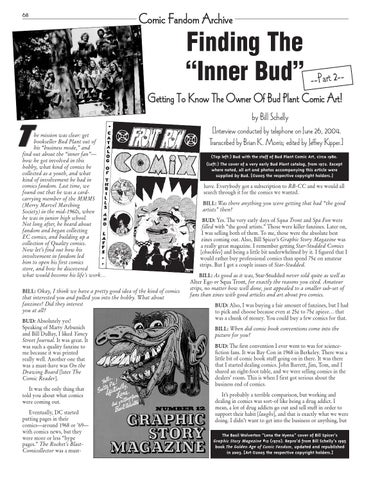
by Bill Schelly [Interview conducted by telephone on June 26, 2004. Transcribed by Brian K. Morris; edited by Jeffrey Kipper.] (Top left:) Bud with the staff of Bud Plant Comic Art, circa 1980. (Left:) The cover of a very early Bud Plant catalog, from 1972. Except where noted, all art and photos accompanying this article were supplied by Bud. [©2005 the respective copyright holders.]
have. Everybody got a subscription to RB-CC and we would all search through it for the comics we wanted. BILL: Was there anything you were getting that had “the good artists” then? BUD: Yes. The very early days of Squa Tront and Spa Fon were filled with “the good artists.” Those were killer fanzines. Later on, I was selling both of them. To me, those were the absolute best zines coming out. Also, Bill Spicer’s Graphic Story Magazine was a really great magazine. I remember getting Star-Studded Comics [chuckles] and being a little bit underwhelmed by it. I figured that I would rather buy professional comics than spend 75¢ on amateur strips. But I got a couple issues of Star-Studded. BILL: As good as it was, Star-Studded never sold quite as well as Alter Ego or Squa Tront, for exactly the reasons you cited. Amateur strips, no matter how well done, just appealed to a smaller sub-set of fans than zines with good articles and art about pro comics. BUD: Also, I was buying a fair amount of fanzines, but I had to pick and choose because even at 25¢ to 75¢ apiece… that was a chunk of money. You could buy a few comics for that. BILL: When did comic book conventions come into the picture for you? BUD: The first convention I ever went to was for sciencefiction fans. It was Bay Con in 1968 in Berkeley. There was a little bit of comic book stuff going on in there. It was there that I started dealing comics. John Barrett, Jim, Tom, and I shared an eight-foot table, and we were selling comics in the dealers’ room. This is when I first got serious about the business end of comics. It’s probably a terrible comparison, but working and dealing in comics was sort-of like being a drug addict. I mean, a lot of drug addicts go out and sell stuff in order to support their habit [laughs], and that is exactly what we were doing. I didn’t want to get into the business or anything, but The Basil Wolverton “Lena the Hyena” cover of Bill Spicer’s Graphic Story Magazine #12 (1970). Repro’d from Bill Schelly’s 1995 book The Golden Age of Comic Fandom, updated and republished in 2003. [Art ©2005 the respective copyright holders.]
Finding The “Inner Bud”–––Part 2
69
in order to make more money to buy comics, I bought ones that I didn’t want, then sold those.
20¢ and sell them in our store for a quarter. We made a big nickel apiece on them. We wouldn’t buy a lot of them, just a small amount for a few for people who wanted to get theirs a little early. We didn’t even have the imagination to get our new comics directly from a distributor. That was just beyond our ken, so we were mainly dealing in used comics and used science-fiction paperbacks.
Also, the spring of 1968 is when we opened our first comic book shop, too—The Seventh Sons Comic Shop.
Paperbacks were easy to come by. We sold some used records, too. We were in a really good location because we were close to the San Jose Flea Market. The Flea Market became a major source for our merchandise. I could go there and spend $5–$10 at a time and come back with a ton of comics. I would buy at a nickel a piece, then mark them up in price for resale. All of a sudden, I was actually generating some money, which, of course, went right back into comic books.
BILL: No one was thinking about having comic shops at that time, except for the bookstores in Hollywood that had old comics. The Comics & Comix crew. Photo by Clay Geerdes; ©2005 Carol Kossack. From The Underground Comics Family Album by Malcolm Whyte Word Play >. Publications <www.word-play.com> (That’s Bud in the striped shirt.)
BUD: Yeah, there was Collector’s Bookstore in Hollywood, Robert Blum’s Cherokee Books, and Gary Arlington’s San Francisco Comic Book Company. There has always been the question of who opened first—Gary Arlington or us. I think we may have beat Gary Arlington by a month or something. Gary became an institution because he was dealing full-time and selling underground comix.
BILL: How did your parents look at your business endeavors? BUD: They were really cool about it for the most part. I think they had some concerns when some of my older friends—older only by a year or two—drove me around before I was able to drive myself. They might have thought it was sort of funny that I was going out and these guys would give me a ride to the other side of town. Tom Tallmon was one of these guys. He has since dropped out of comics, but we were really good buddies. He used to give me rides all over the place. We shared a lot of experiences. By this time I was taking college prep classes in high school and planned to go straight into college after I graduated. I had no idea what I was going to do after college. BILL: Were you a good student in school?
There were actually six people involved in Seventh Sons, but we had an “honorary” member because “Seven Sons” sounded better than “Six Sons” did. [laughs] The “Sons” were: myself, Michelle Nolan, Tom Tallmon, John Barrett, Jim Buser…. The sixth was this guy that wasn’t really a member, but he used to steal office supplies from the place he worked at for us. [laughs] That’s the story we’d get, anyway. The sixth was the notorious Frank Scadina. Frank is a whole story unto himself. He was actually about five or six years older than the rest of us. He’d had polio when he was a young child and his mom took care of him. She was still being really protective of him when I met him. His mom thought our group would be a great thing for him and so, somehow, she got him involved. BILL: Where was the store located? BUD: It was on East San Fernando Street in San Jose, pretty close to San Jose State. It opened in April of 1968. Rent was 75 bucks a month. We had to pay two months’ rent in advance and split it up among six of us. We found this to be a very affordable threshold for opening a comic book shop. By that time all our individual collections had plenty of duplicates. We wanted a way to make money and also get more comics for our personal collections. We decided to open our comic book shop to do this. BILL: Were you able to get any access to new comics, or did you deal only with old and used comics? BUD: We weren’t sophisticated enough to approach a distributor and deal with new comics. There was a distributor for the Gilroy area (which is just south of San Jose). We could get new comics from them a few days early. We would go and buy comics in Gilroy for the cover price of
Cover to fanzine published by Bud Plant, Jim Vadeboncoeur, Jr., and Al Davoren: Promethean Enterprises #1 (1969). [©2005 the respective copyright holders.]
[Art Š2005 P.C. Hamerlinck]
83 the World’s Mightiest Mortal! You see, seated around that table were people … wonderful folks … who saw comic books as no more than brightly colored items that took up space somewhere on the news rack … never to be touched … or opened … or read. I was certain that to them my working on a comic book character … this Captain Something-or-Other … amounted to having taken a step or two backward in the career. By
mds& (c) [Art
logo ©2005 Marc Swayze; Captain Marvel © & TM 2005 DC Comics]
[FCA EDITORS NOTE: From 1941-53, Marcus D. Swayze was a top artist for Fawcett Publications. The very first Mary Marvel character sketches came from Marc’s drawing table, and he illustrated her earliest adventures, including the classic origin story, “Captain Marvel Introduces Mary Marvel (Captain Marvel Adventures #18, Dec. ’42); but he was primarily hired by Fawcett Publications to illustrate Captain Marvel stories and covers for Whiz Comics and Captain Marvel Adventures. He also wrote many Captain Marvel scripts, and continued to do so while in the military. After leaving the service in 1944, he made an arrangement with Fawcett to produce art and stories for them on a freelance basis out of his Louisiana home. There he created both art and story for The Phantom Eagle in Wow Comics, in addition to drawing the Flyin’ Jenny newspaper strip for Bell Syndicate (created by his friend and mentor Russell Keaton). After the cancellation of Wow, Swayze produced artwork for Fawcett’s top-selling line of romance comics, including Sweethearts and Life Story. After the company ceased publishing comics, Marc moved over to Charlton Publications, where he ended his comics career in the mid-’50s. Marc’s ongoing professional memoirs have been FCA’s most popular feature since his first column appeared in FCA #54, 1996. Last issue, Marc continued his recollections of The Great Pierre, the comic strip that had finally led to his long soughtafter syndicate contract. In this issue, Marc enters the corporate world of 1956 with a packaging design assignment and, while there, contemplates his comics career… and what kind of future in comics lay in store for him. —P.C. Hamerlinck.]
Ashamed? I am more so now … for having been then! I thought about that … and how much the comic books had meant to me … as I sat at my desk in 1956 … in the Packaging Division of OMCC … the Olin Mathieson Chemical Corporation. The curious vacillating tactics of Joseph Agnelli at Bell had continued on into the year. My purpose for being with the packaging people was to assist them in assembling a creative art department. The game plan of the new owners was to convert the existing industrial facilities to include retail packaging. Involving the consumer trade meant more sophisticated graphics. I found it all very interesting … although I understood my participation as temporary. The Great Pierre, the feature for which I held a contract with Bell Syndicate, was, in comic strip terms, a realistic, continuous adventureromance … the kind I had hoped to spend my life writing and drawing. It was the very kind of newspaper feature that had begun to slip from an uppermost position in the reader popularity polls … and was predicted to keep slipping. And … as was later learned … did! I knew it … or should have … after fifteen or so years of intense interest and dedicated study and effort. Maybe I saw it and refused to acknowledge it. Human nature behaves that way sometimes, you know. At the OMCC packaging offices my first move in the quest for appropriate artists was like I imagined Al Allard’s might have been … I looked around me. You’d have thought I was preparing for war. A World War II vet situated in the structural design lab of one of the plants was a qualified artist … and he knew the tricky language of packaging
Things were so different then! Before you made a single stroke with your pen, it had to be dipped into a very, very familiar little black bottle that occupied a special permanent place on your board, and contained opaque, slow-drying ink … the only kind you would have considered worthy of the small masterpiece taking shape before you. Daily newspaper comic strips were delivered to the local publishers in the form of lightweight molds … made of a material capable of withstanding the heat of the molten metal used in making printing plates. And all of that was taken into consideration at the drawing board … because a line drawn too lightly might not print at all … whereas one too heavy might merge with an adjacent line, with an unsightly … well … blob! Have you ever been troubled by little incidents that occurred long ago … and have never really been a bother … except when you remember them? On a brief visit back South during my early months at Fawcett, I was having dinner with friends at the Keatons’ in their hometown in Mississippi. Russell, the writer/artist/creator of the newspaper strip Flyin’ Jenny and always the perfect host, suggested that I tell of the work I was doing in the “Big City.” It’s hard to explain … but I was embarrassed! Think of it! Ashamed … to talk about my old pal, Captain Marvel,
“Ashamed?!! To talk about drawing the World’s Mightiest Mortal?” Panel from “The Haunted Halloween Hotel” in Whiz Comics #36 (Oct. 1942), art by Marc Swayze. [©2005 DC Comics.]
85
Alan Jim Hanley: The Story Of A Good Guy I
by John Pierce
Edited by P.C. Hamerlinck
NTRODUCTION: FCA is proud to present John Pierce’s reverent review of the often-overlooked work of late fan artist Alan Jim Hanley, whose cheerful comic strips graced various fanzines—including his own Comic Book—throughout the 1960s and ’70s. Hanley’s original, Golden Age-inspired stories contained a genuine, warm, and humanistic feel—combined with a dry, gentle sense of humor.
I had corresponded with Hanley a couple of times before finally meeting him in person at a 1979 Minneapolis comic convention. As we exchanged bright ideas at his table (okay, it was mostly just me listening to his corny jokes!), he sat there with his ever-present pipe in mouth and sketched out a version of me—an awkward teenager at the time—as Captain Marvel Jr. As he belted out this masterpiece while we talked, I felt as if I were talking to that clean-living superhero himself, “Goodguy,” Hanley’s humble Captain Marvel-like creation. Even if you never had the opportunity to meet the amiable Mr. Hanley, but had read an issue of his Comic Book or any “Goodguy” adventure, then in a way you did indeed know the man, because his humor, opinions, and love for comics always shone through his work. Commercial publishers had no need for him, even though Hanley aspired to see his work appear one day in “major league” comics. But he was in a league of his own, and most likely wouldn’t have been very content illustrating another writer’s script or having to depict things he truly felt were bad for comic books. The exception would have been a shot at drawing his admired hero from childhood, the Big Red Cheese, Captain Marvel. C.C. Beck himself suggested Hanley as the artist to succeed him on DC’s Shazam! comic after Beck quit the book. But drawing Captain Marvel for DC never materialized for Hanley, who held great disdain for the company’s handling of the character. He told John Pierce in June, 1980: “Let’s face it: the vision, the personality, and the luck that created the original Captain Marvel just ain’t there! A certain verve, independence of spirit, spunk, and a certain educated romantic mind—and maybe a few other highly individualistic qualities—are required to pull a guy like Captain Marvel together and put him over the top. Do I have enough of the above to do it? Looking over my past stuff in an increasing distant retrospect, I think it is obvious that I do. … It would have been nice to have had the opportunity to work with a good, knowledgeable editor on Captain Marvel.” Even though Hanley didn’t “officially” contribute to the mythos of The World’s Mightiest Mortal, it certainly doesn’t diminish the enduring quality of the numerous creative contributions he gave to the world of comic fandom …work that was definitely in the same spirit as the original Captain Marvel. In addition, there would be no FCA in existence today had Hanley and Bernie McCarty not convened that one Sunday afternoon over 35 years ago at Hanley’s suburban Chicago apartment to discuss a way to revive the old Captain Marvel Club of their youth … a planted seed which McCarty would eventually develop into the Fawcett Collectors of America newsletter. —P.C. Hamerlinck.
The first page of A.J. Hanley’s Comic Book #4. The artist drew himself wearing a badge saying “America’s No. 1 Starving Artist.” [All art reproduced with this article is ©2005 Estate of Alan Jim Hanley; all characters are TM & ©2005 the respective trademark & copyright holders.]
Captain Marvel has had many devoted fans over the years. Some, such as E. Nelson Bridwell, Don Newton, Jerry Ordway, and Alex Ross, have even had the opportunity to work on one version or other of the character. But no one else took his enthusiasm for Captain Marvel in particular, and comics in general, in the direction followed by one singular, creative fan: Alan Jim Hanley. When Jim (as he was generally called) died an untimely death at the age of 41, on December 24th of 1980, he left behind an impressive body of work. But with the exception of some text illustrations for Charlton Publications, and a few for Crazy magazine, none of it appeared in professional comics. Instead, his work was seen in numerous fanzines of
86
Alan Jim Hanley Finally, as one character observed, “Billy will need a convenient device for switching back ’n’ forth from his souped-up form to his runty little self.” Captain Marvel (not herein named, but obviously him) responds, “I know a nifty magic word!” “Nooo,” says another. “Magic words are definitely out! Midniteman has come up with this... a medallion—a panic button as it were—sensitive only to Billy’s touch.” Thus, when problems arise, Billy Boyko has only to press the panic button in order to change into Goodguy, “the major marvel of this time.” Perhaps not surprisingly, Goodguy is dressed in a costume which borrows liberally from Captain Marvel’s tailoring, and on the surface the character is seemingly a blatant rip-off of the Big Red Cheese. In actuality, Goodguy was a homage to a character who had passed from the scene over 20 years before. The DC Captain Marvel revival was still a few years in the future, something hardly anyone at the time could have foreseen. Hanley was paying tribute to his favorite character of yore by creating a new version, crafted in the image of the original. And yet, Goodguy came to have his own voice and style, and moved beyond being a simple Captain Marvel imitation. Not too surprisingly, Goodguy was later joined by a Goodguy Junior (also called Minor Marvel) and by a female version variously named Miss Marvel, Ms. Marvel (before Marvel Comics came out with a character by that name, herself being a distaff version of Marvel’s own name-stealing Captain Mar-Vell), and Bonniebelle. Hanley never seemed to run out of inspiration for names! While professional comics characters have numerous nicknames (Man of Steel, World’s Mightiest Mortal, Emerald Crusader, Scarlet Speedster, ol’ Web-Head, etc.), and of course their secret identity handles, very few have ever gone by more than one nom de guerre. Where else does one find such, except in the Bible and in the works of J.R.R. Tolkien? A page from Goodguy’s origin in Comic Book #4, with a cameo by Captain Marvel.
Together, these three formed the Goodguy Gang (later some others, including a Moms Marvel, would be added), and not unlike The Marvel Family, they had adventures together and separately.
the late ’60s and ’70s, such as The Comic Reader, The Buyer’s Guide, FVP, Dynamic Magazine, Sense of Wonder, Fantasticomix, Comics Commentary, Comic Crusader, and many others, including his own Hanley’s Fandom and Comic Book. In particular, he was known for his pastiches of Golden Age stars: All-American Jack (Captain America), The Spook (The Spirit), and various others. But above them all stood his tribute to the original Captain Marvel, his own Goodguy, a.k.a. Major Marvel. Goodguy was really Billy Boyko, a youngster and comics fan visited by the spirits of various comic book characters from Limbo. These characters were a mixture of pastiches (Supersam, Quickstreak, etc.) as well as actual figures, including Captain Marvel and Green Lama. Together they confer upon Billy “the special gifts of the Comic Book Limbo League,” including such powers as “flying ability, power over time ’n’ space, imperviousness, the ability to make small talk, super-speed, extraordinary sense of humor, courage, humility, aura-sensitivity, et cetera.” From that list, it can easily be observed that seriousness was hardly to be the order of the day with Goodguy, as more typical super-powers are mixed with abilities which are hardly super at all. (Though, in all honesty, I know some people who could use an “extraordinary sense of humor.”)
The Spook, Hanley’s homage to Will Eisner’s Spirit. Read this story today in Bill Schelly’s new book The Best of Star-Studded Comics, featuring highlights from that classic 1960s fanzine, which also sports the work of Landon Chesney, Gardner Fox, Grass Green, Roy Thomas, Alan Weiss, Biljo White, Dave & Steve Herring, and many more. Highly recommended by FCA! See Hamster Press’ ad on p. 30.