20
Dick Ayers
RT: Because they had their own special deal, with their studio supplying art and story.
AYERS: Well, he would make it sound like it was inventory. If things picked up, like the humor market, then he would go back in again. But he killed Fibber McGee by Phil Usgis. After that, he gave me a one-page feature in Tim Holt.
AYERS: It was under the Magazine Enterprises label, so Vin had me try out for Jimmy Durante. And I sent you a copy of the drawing that I made. And then I traced that onto illustration board and then I inked it and colored it.
Oh, I forgot—before I got to do Jimmy Durante, while I was waiting for Ray to write the script, he gave me a western. I don’t know how many pages. “Doctor of Fate - the Story of Doc Holliday.” That’s the first job I did... the first job that I penciled, inked, and lettered, that got printed!
RT: So did you ever meet Durante or was it all done through the mail? AYERS: No, I didn’t. I didn’t even get to know who Mrs. Calabash was. [laughs] Vin either didn’t know or wouldn’t tell me. I noticed the other night, they had on television an hour show on Durante. Oh boy, I really had tears in my eyes. It was terrific.
RT: Between Sullivan and editor Raymond Krank, ME was basically almost a two-man operation, wasn’t it? AYERS: That’s what it was. Vin would come in and sit down and describe what he wanted in The Ghost Rider. He told me to go see Disney’s Sleepy Hollow— Ichabod Crane, the Headless Horseman—and then he told me to play the Vaughn Monroe record, “Ghost Riders in the Sky.” And then he started talking about what he wanted the guy wearing.
RT: Of course, you were aware that Joe Shuster and Jerry Siegel, who were doing Funnyman, had created Superman and were going through this lawsuit. AYERS: Yes. We thought, “Oh, boy! We’ll get to do Superman. We’ll have it made!” We were very upbeat. But then I left, before the end came. They did a few more books. They went six books and I think mine was, maybe, #3, or something like that. RT: I’ll check my complete bound set of Funnyman. Were you aware that Sullivan was one of the people who discovered “Superman”?
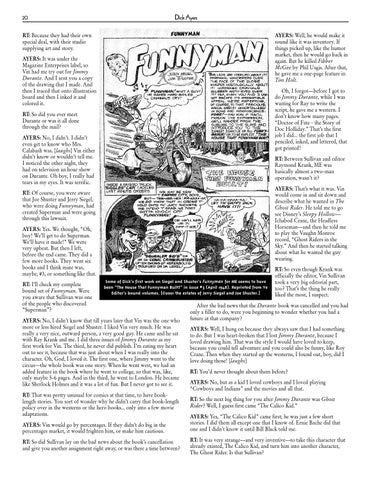
Some of Dick’s first work on Siegel and Shuster’s Funnyman for ME seems to have been “The House That Funnyman Built!” in issue #3 (April 1948). Reprinted from Ye Editor’s bound volumes. [©2001 the estates of Jerry Siegel and Joe Shuster.]
AYERS: No, I didn’t know that till years later that Vin was the one who more or less hired Siegel and Shuster. I liked Vin very much. He was really a very nice, outward person, a very good guy. He came and he sat with Ray Krank and me. I did three issues of Jimmy Durante as my first work for Vin. The third, he never did publish. I’m eating my heart out to see it, because that was just about when I was really into the character. Oh, God, I loved it. The first one, where Jimmy went to the circus—the whole book was one story. When he went west, we had an added feature in the book where he went to college, so that was, like, only maybe 5-6 pages. And in the third, he went to London. He became like Sherlock Holmes and it was a lot of fun. But I never got to see it. RT: That was pretty unusual for comics at that time, to have booklength stories. You sort of wonder why he didn’t carry that book-length policy over in the westerns or the hero books... only into a few movie adaptations. AYERS: Vin would go by percentages. If they didn’t do big in the percentages market, it would frighten him, or make him cautious. RT: So did Sullivan lay on the bad news about the book’s cancellation and give you another assignment right away, or was there a time between?
RT: So even though Krank was officially the editor, Vin Sullivan took a very big editorial part, too? That’s the thing he really liked the most, I suspect.
After the bad news that the Durante book was cancelled and you had only a filler to do, were you beginning to wonder whether you had a future at that company? AYERS: Well, I hung on because they always saw that I had something to do. But I was heart-broken that I lost Jimmy Durante, because I loved drawing him. That was the style I would have loved to keep, because you could tell adventure and you could also be funny, like Roy Crane. Then when they started up the westerns, I found out, boy, did I love doing those! [laughs] RT: You’d never thought about them before? AYERS: No, but as a kid I loved cowboys and I loved playing “Cowboys and Indians” and the movies and all that. RT: So the next big thing for you after Jimmy Durante was Ghost Rider? Well, I guess first came “The Calico Kid.” AYERS: Yes, “The Calico Kid” came first; he was just a few short stories. I did them all except one that I know of. Ernie Bache did that one and I didn’t know it until Bill Black told me. RT: It was very strange—and very inventive—to take this character that already existed, The Calico Kid, and turn him into another character, The Ghost Rider. Is that Sullivan?