1981 TIMELINE
April 21: John Byrne begins his five-year stint as the writer/artist on Fantastic Four with issue #232.
A compilation of the year’s notable comic book industry events alongside some of the year’s most significant popular cultural and historical events. January 8: Fourteen years after relinquishing art duties on The Flash in order to become DC Comics’ editorial director, artist Carmine Infantino returns to the title with issue #296.
March: After a dispute with Marvel’s editor-in-chief Jim Shooter, artist Gene Colan leaves Marvel for DC Comics.
January 20: Ronald Reagan is sworn in as President of the United States; the same day 52 American diplomats who had been held hostage in Iran for 444 consecutive days are freed.
JANUARY
April 23: DC Comics’ Madame Xanadu one-shot – a Steve Englehart/Marshall Rogers collaboration originally intended for the cancelled Doorway into Nightmare – arrives exclusively to the Direct Market where it sells over 100,000 copies.
March 30: Outside the Washington D.C. Hilton hotel, John W. Hinkley Jr. shoots and wounds President Ronald Reagan and three others. Claiming he was attempting to impress actress Jodie Foster, Hinckley was found not guilty by reason of insanity at his 1982 trial. Consequently, many states rewrite their laws regarding the insanity defense.
F E B R U A R Y M A R C H
April 12: After many delays, the first space shuttle, Columbia, makes its maiden voyage when it launches from Cape Canaveral, Florida.
April 24: IBM introduces its Personal Computer with an operating system designed by Microsoft and microprocessor circuitry manufactured by Intel.
June 5: The Centers for Disease Control publishes the first report of a mysterious outbreak of a sometimes fatal pneumonia among gay men. Originally called “gay related immune deficiency” (GRID), the syndrome is re-named Acquired Immunodeficiency Syndrome (AIDS) in 1982.
JUNE
May 25: Wearing a Spider-Man costume, Daniel Goodwin scales Chicago’s Sears Tower – then the tallest building in the world – in seven and a half hours.
March 18: The Greatest American Hero – starring William Katt as a school teacher who is given a super-powered suit by an alien race to help him save the world – premieres on ABC-TV.
April 14: Marvel Treasury Edition #28 is a joint Marvel/DC publication teaming Superman and Spider-Man against Doctor Doom and The Parasite in a 68-page oversized book written by Jim Shooter and Marv Wolfman with art by John Buscema.
You express a very valid concern about the future of comics if the comics publishers “restrict” themselves to specialty shop sales. However, I feel you needn’t worry too much… We are trying at Marvel to reach the widest number of people with our comics. Our enthusiasm for the Direct Sales program comes precisely because we believe these wholesalers are creating new business for us, first by servicing the specialty shops, and second, by reaching out and bringing their expertise to other outlets and thereby help them sell comics to more people.
Dazzler TM and © Marvel Characters, Inc.
June 4: DC Comics launches The Krypton Chronicles and Arak, Son of Thunder, the latter created and written by Roy Thomas. Another Thomas creation, All-Star Squadron, debuts June 18.
A P R I L M AY
Batman and Superman TM and © DC Comics. Fantastic Four, Hulk, Marvel Fanfare, Spider-Man TM and © Marvel Characters, Inc. Captain Victory and the Galactic Rangers TM and © Jack Kirby estate. MTV TM and © Viacom Media Networks.
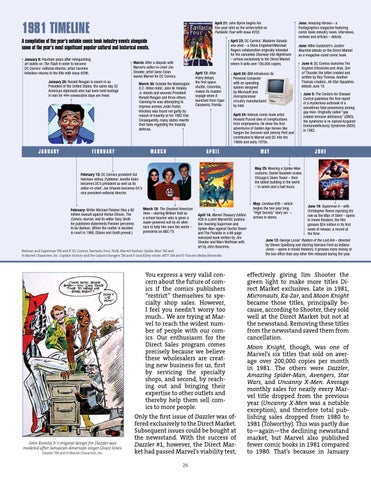
John Romita Jr.’s original design for Dazzler was modeled after Jamaican-American singer Grace Jones.
June: Mike Gustovich’s Justice Machine debuts on the Direct Market as a magazine-sized comic book.
April 24: Veteran comic book artist Howard Purcell dies of complications from emphysema. He drew the first adventures of Golden Age heroes like Sargon the Sorcerer and Johnny Peril and contributed to Marvel and DC into the 1960s and early 1970s.
February 13: DC Comics president Sol Harrison retires. Publisher Jenette Kahn becomes DC’s president as well as its editor-in-chief. Joe Orlando becomes DC’s vice president-editorial director.
February: Writer Michael Fleisher files a $2 million lawsuit against Harlan Ellison, The Comics Journal, and its editor Gary Groth for published statements Fleisher perceives to be libelous. (When the matter is decided in court in 1986, Ellison and Groth prevail.)
June: Amazing Heroes – a Fantagraphics magazine featuring comic book industry news, interviews, reviews and articles – debuts.
Only the first issue of Dazzler was offered exclusively to the Direct Market. Subsequent issues could be bought at the newsstand. With the success of Dazzler #1, however, the Direct Market had passed Marvel’s viability test, 26
May: Cerebus #26 – which begins the two year long “High Society” story arc – arrives in stores.
June 19: Superman II – with Christopher Reeve reprising his role as the Man of Steel – opens in movie theaters; the film grosses $24 million in its first week of release, a record at the time.
June 12: George Lucas’ Raiders of the Lost Ark – directed by Steven Spielberg and starring Harrison Ford as Indiana Jones – opens in movie theaters; it grosses more money at the box office than any other film released during the year.
effectively giving Jim Shooter the green light to make more titles Direct Market exclusives. Late in 1981, Micronauts, Ka-Zar, and Moon Knight became those titles, principally because, according to Shooter, they sold well at the Direct Market but not at the newsstand. Removing these titles from the newsstand saved them from cancellation. Moon Knight, though, was one of Marvel’s six titles that sold on average over 200,000 copies per month in 1981. The others were Dazzler, Amazing Spider-Man, Avengers, Star Wars, and Uncanny X-Men. Average monthly sales for nearly every Marvel title dropped from the previous year (Uncanny X-Men was a notable exception), and therefore total publishing sales dropped from 1980 to 1981 (Tolworthy). This was partly due to—again—the declining newsstand market, but Marvel also published fewer comic books in 1981 compared to 1980. That’s because in January