(drawn by Bill Montes and Ernie Bache), a trio of squabbling, telepathically-linked college students named John “Specs” Anders, Warren “Creep” Blaine, and David “Swift” Scott.
Captain Doom debuted in Outlaws of the West #64. TM and © respective copyright holder.
Vince Alascia team. After writing the third and fourth Captain Doom episodes, Steve Skeates was reassigned to the revived Kid Montana feature in Outlaws #68, thrilled that he was now working with star Western artist Pete Morisi. “I relished the chance to give this true artist some scripts he could really sink his teeth into!” the writer enthused (Schwirian 9).
“The Charlton Westerns seemed more adult than those produced by the other comic book companies,” Skeates reflected. “Darker, brooding, good old ‘grim and gritty,’ and with heroes who were often disillusioned and rather world weary—all of which made those babies far, far more fun to write than [Marvel’s] Kid Colt and Two-Gun Kid had been” (Schwirian 9). Skeates declared his days at Charlton as “the most fun I ever had writing comics” (Schwirian 7) and pointed to projects like Charlton Premiere to illustrate his point. A tryout book on the order of DC’s Showcase, the writer noted that the new title generally ran “works that were far more experimental than anything Showcase handled, and, as unfortunately is often the case with really fun ideas, Premiere sold abysmally” (Schwirian 14).
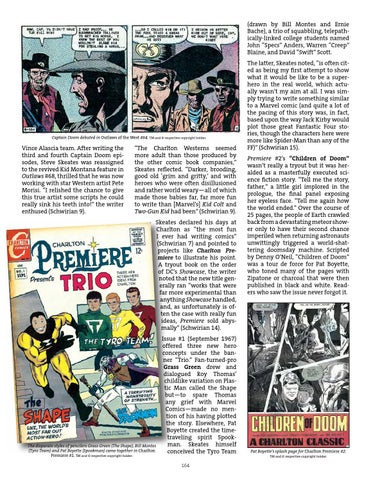
The disparate styles of pencilers Grass Green (The Shape), Bill Montes . (Tyro Team) and Pat Boyette (Spookman) came together in Charlton Premiere #1. TM and © respective copyright holder.
Issue #1 (September 1967) offered three new hero concepts under the banner “Trio.” Fan-turned-pro Grass Green drew and dialogued Roy Thomas’ childlike variation on Plastic Man called the Shape but—to spare Thomas any grief with Marvel Comics—made no mention of his having plotted the story. Elsewhere, Pat Boyette created the timetraveling spirit Spookman. Skeates himself conceived the Tyro Team 164
The latter, Skeates noted, “is often cited as being my first attempt to show what it would be like to be a superhero in the real world, which actually wasn’t my aim at all. I was simply trying to write something similar to a Marvel comic (and quite a lot of the pacing of this story was, in fact, based upon the way Jack Kirby would plot those great Fantastic Four stories, though the characters here were more like Spider-Man than any of the FF)” (Schwirian 15). Premiere #2’s “Children of Doom” wasn’t really a tryout but it was heralded as a masterfully executed science fiction story. “Tell me the story, father,” a little girl implored in the prologue, the final panel exposing her eyeless face. “Tell me again how the world ended.” Over the course of 25 pages, the people of Earth crawled back from a devastating meteor shower only to have their second chance imperiled when returning astronauts unwittingly triggered a world-shattering doomsday machine. Scripted by Denny O’Neil, “Children of Doom” was a tour de force for Pat Boyette, who toned many of the pages with Zipatone or charcoal that were then published in black and white. Readers who saw the issue never forgot it.
Pat Boyette’s splash page for Charlton Premiere #2. . TM and © respective copyright holder.