GUILLERMO BERT
LONGING & BELONGING

WILLIAM TURNER GALLERY


![]()

WILLIAM TURNER GALLERY


Santa Monica, CA - William Turner Gallery is pleased to present Longing & Belonging, the gallery’s first solo exhibition by Los Angeles–based artist Guillermo Bert, opening November 15, 2025. This landmark exhibition brings together three major series spanning two decades of Bert’s practice— Warriors, Encoded Textiles, and Jacquard Punch Cards—each exploring the intersections of tradition, technology, and migration in the 21st century.
Born in Santiago, Chile, and based in Los Angeles, Bert transforms materials and digital media into cross-cultural artifacts that preserve stories often silenced by systems of displacement. His works fuse ancient craft traditions with augmented reality, QR codes, and 3D modeling, creating a poetic dialogue between the handmade and the high-tech.
In Warriors, Bert reimagines the ancient terracotta army of the Qin Dynasty as honor guard for today’s society, comprised of our essential workers and often unsung heroes—laborers, nurses, teachers, and farm workers. Each life-sized, laser-cut birch figure is modeled from 3D scans of real individuals, standing as a contemporary monument to endurance, dignity, and service. The precisely etched surfaces capture both fragility and strength, while an accompanying soundscape allows visitors to hear the workers’ own voices, grounding their stories in lived experience. Together, these figures form a resonant chorus of resilience—guardians not of emperors, but of the collective humanity that sustains us.
In Encoded Textiles, Bert collaborates with Indigenous artisans across the Americas to weave
QR-coded patterns into traditional fabrics. When scanned, the codes reveal short films that share oral histories, poetry, and personal narratives—turning each textile into a living archive.
Finally, the Jacquard Punch Card series revisits one of the earliest coding technologies—the 17th-century punch card, developed for weaving patterns on the loom, which prefigured the computer by utilizing a binary code as a form of language. By burning portraits of immigrants into layered punch cards, Bert creates haunting hybrids of tapestry and code, weaving together the analog and the algorithmic, the historical and the contemporary.
Through these works, Bert explores how human identity and migration continue to be woven— literally and metaphorically—into the fabric of global modernity.
Guillermo Bert has exhibited widely in the United States and abroad, including at the Los Angeles County Museum of Art, (where his work is currently on exhibition in Grounded ), the Smithsonian Renwick Gallery (Washington D.C.), the Nevada Museum of Art (site Bert’s first major museum exhibition in 2023, entitled The Journey, ), and Museum of Latin American Art in Los Angeles (which will hold a solo exhibition for Bert in 2026), and at the Rhode Island Museum of Art, where it’s currently in an exhibition of the museum’s recent acquisitions. His works are included in major collections at LACMA, The Smithsonian Institution, the Rhode Island Museum of Art, and Museum of Latin American Art, amongst other important collections.
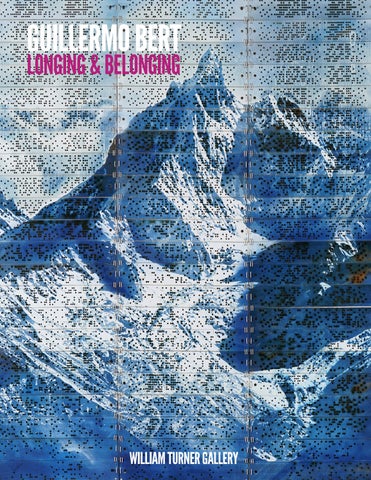
Standing before the Andes, Guillermo Bert found that the landscape was not just a backdrop but a monumental piece of his own memory reflected back at him. It is a familiar presence that rekindles a sense of home and belonging. In that moment, he realized that the terrain of our past inhabits us as much as we inhabit it. Each ridge and valley is a repository of lived experience, and returning to these places reawakens the emotional landscapes within us.
In a world where memories now float in digital clouds, physical landscapes ground us in a tangible sense of identity. They remind us that we are, in essence, an accumulation of the places we’ve loved and the homes we’ve known. This reflection invites viewers to consider how the landscapes of their own lives shape their sense of self and continuity.


Andes / Memory, 2025, Mixed media on wood and layers of pigment, laser cut, 72” x 120”


La Sagrada Familia, created on Jacquard punch cards, portrays an immigrant family whose figures are marked by punctures that resemble both scars and binary code. These perforations symbolize the digital and geopolitical forces that rewrite the family’s identity, as if their stories are being encrypted and frozen in time.
In this work, what seems like scars are actually meaningful voids. The emptiness in these figures is as defining as what remains, inviting viewers to see how absence and presence, scars and codes, together shape a family’s evolving story.
SILENT FROZEN MEMORY, 2025, Mixed media on wood and layers of pigment, laser cut, 33” x 48”

The Warriors is a sculptural series that pays tribute to frontline workers—nurses, teachers, agricultural laborers, and more—through intricately layered wooden sculptures. Each life-sized figure is built from numerous laser-cut layers, creating a pixelated effect that brings these essential workers into the spotlight. Inspired by the Terracotta Warriors of China, the series highlights the often unseen contributions of these modern-day heroes.

This project has been showcased in a number of museums, and aims to create a traveling exhibition to bring The Warriors to communities that have less access to traditional museum spaces. By doing so the artist hopes these artworks can be experienced in local environments, allowing a broader audience to celebrate the vital stories of these everyday heroes.


The Teacher and the Student, 2024, 3D Scan, laser cut on birch wood and metal, Teacher: 70” x 27” x 25”, (Edition of 3)
Student: 44” x 16” x 19”, (Edition of 3)


Margarita, 2022, 3D Scan, laser cut on birch wood and metal, 64 x 32” x 20”, (Edition of 3)


Tali the Gymnast, 2025, 3D Scan, laser cut on birch wood and metal, 38” x 24” x 20”, (Edition of 3)


Nalleli Cobo Environmentalist, 2023, 3D Scan, laser cut on birch wood and metal, 64” x 32” x 20, (Edition of 3)


Field Worker Nayeli, 2023, 3D Scan, Laser cut on birch wood and metal, 64” x 32” x 20”, (Edition of 3)


Field Worker Veronica, 2024, 3D Scan, laser cut on birch wood and metal, 62” x 28” x 35” (Edition of 3)
Field Worker Ricardo, 2023, 3D Scan, laser cut on birch wood and metal, 64” x 32” x 20”, (Edition of 3)


Firefighter David 2023
3D Scan, laser cut on birch wood and metal, 68” x 27” x 25” (Edition of 3)


Nurse Sabrina, 2023, 3D Scan, Laser cut on birch wood and metal, 64” x 32” x 20”, (Edition of 3)


Beekeeper Eduardo, 2023,
3D Scan, Laser cut on birch wood and metal, 64” x 32” x 20”, (Edition of 3)

Encoded Textiles is a series dedicated to preserving the traditions of indigenous communities from regions such as southern Chile, the Mayan territories, Oaxaca, and the American Southwest. Guillermo Bert and his team traveled through these lands, recording the voices of elders, poets, medicine men, and community storytellers. By embedding their narratives into textiles woven with QR codes, Bert honors and sustains their cultural heritage.
In these works, the woven patterns are living archives that merge traditional craftsmanship with digital storytelling, ensuring that the stories of these communities remain alive and accessible across generations and geographies.

Acoma Portal #3, 2015, Wool with natural dyes, 87” x 53” (framed)


Ancestral Spirit, 2012, Wool with natural dyes, 80” x 60”


Acoma Portal #7, 2014, Wool with natural dyes, 87” x 53” (framed)
La Bestia, 2019, Wool and natural dyes, 41” x 22.5” (Limited Edition of 10, hand-woven)


Guillermo Bert is a Los Angelesbased artist whose multi-media works range from painting, sculpture, weaving, documentary film and photography. Born in Santiago, Chile, in 1959, Bert’s bicultural background provides a rich, lived perspective that deeply informs his artistic practice. For decades, Guillermo Bert has explored themes of urbanism, consumerism, and cultural displacement—beginning in the 1990s with street-level bricolage projects inspired by the visual archaeology of posters and signage from LA’s Skid Row.

Over time, his work evolved to include technological elements, such as integrating barcodes into laser-cut pieces and paintings. A pivotal moment came in 2010 during his first trip back to Chile, where he began collaborating with Mapuche weavers. This experience profoundly shifted his practice. Together with these artisans, Bert embedded functional QR codes into traditional textile designs. When scanned, these “hightech” patterns link to short films that capture the oral histories, myths, and reflections of Mapuche elders, activists, and poets.
Building on this concept, Bert expanded his collaborations to include Indigenous communities across the Americas, such as the Navajo, Maya, Mixtec, and Zapotec peoples. The result is an ongoing series of 40 short films—each approximately 10 minutes—that act as cultural time capsules, “decoding” Indigenous worldviews and fostering connection between viewers and the communities represented.
While these films are intrinsic to the textile works, they also stand alone as documentary media—intimate, observational glimpses into Indigenous lives, told in their own voices and often in their native languages. Together, they form a kind of visual short films spanning more than seven countries. Bert continues to expand the project globally, with future plans that include India, and works across a spectrum of media: from woven textiles and laser-cut sculptures to photographs and immersive films.
Guillermo Bert’s work is currently featured in Grounded , at the LA County Museum of Art, (Sept 2025 - July, 2026), a multi-media exhibition that illuminates the lasting effects of colonialism and imperialism. In 2023, Bert’s work was featured in a major mid-career retrospective entitled The Journey, at the Nevada Museum of Art, accompanied by a book. His work was acquired by The Smithsonian’s Renwick Gallery and was included in their 50th-anniversary exhibition Crafting a New World in May 2022. Bert is in the permanent collections of LACMA and the Rhode Island Museum of Art as well.
Bert has exhibited his work nationally and internationally at museums and galleries including Queens Museum in NY, Palm Springs Museum, Lille3000 in France, Anchorage Museum in Alaska, Nevada Museum of Art, Museum of Latin American Art, Pasadena Museum of California Art, Museum of Art and Design in New York, the Getty’s Pacific Standard Time / LA/LA , the Craft Contemporary Museum, and UCR Arts in Riverside.
His work has been reviewed nationally and internationally by Smithsonian Magazine, ArtNews Magazine, LA Times, and LA Weekly. He was awarded a COLA individual artist grant from the City of Los Angeles Cultural Affairs Department and received the California Community Foundation Fellowship in 2015, the Center for Cultural Innovation Quick Grant for Education in 2015, and the 2010 Master Artist Grant from the National Association of Latino Arts.
Guillermo Bert’s career as an artist and educator has taken many forms, including Art Director for the Los Angeles Times (1995-2000) and Professor of Mixed Media at the Art Center School of Design, in Pasadena. During the pandemic, Bert participated in several online talks with museums including The Museum of Art and Design in New York, The George Washington University Museum in DC, and The Long Beach Museum of Latin American Art.


WILLIAM TURNER GALLERY