
YesterYears 2026

Page 1


YESTER YEARS

Wednesday, April 8, 2026

YESTER YEARS CONTENTS

Turlock’s life on the rails

When state legislators took into consideration the potential for the further growth and production that a railroad through the Central Valley would provide, a comprehensive railroad bill became a priority. Legislators backed a plan that permitted county aid to the construction of a railroad in 1869, leading to the commencement of the construction of the Central Pacific Railroad’s San Joaquin Valley line on Dec. 31, 1869 in Lathrop.

after Turlock’s first station was built in a location known as Henderson’s Crossing, however. The station featured no buildings and the most notable feature was, indeed, a mud hole that soiled much of the baggage offloaded from the freight and emigrant trains that journeyed into the valley.

Less than a year later the station was moved a mile north to a less soggy piece of ground and the first Turlock depot was constructed.

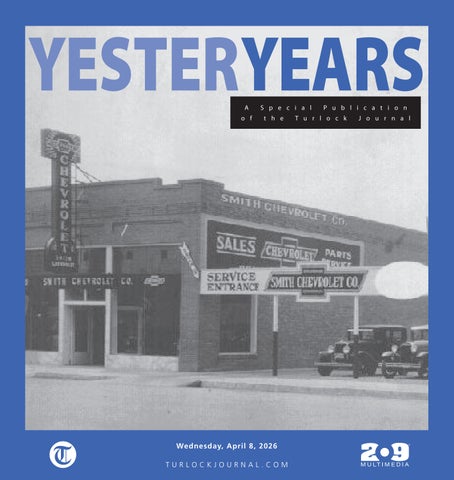
COVER: The 1926 Smith Chevrolet dealership located in downtown Turlock at 206 South Broadway.

PUBLISHER

Hank Vander Veen

EDITOR

Kristina H. Hacker

ART DIRECTOR

Harold L. George

DESIGN

Sharon R. Hoffman

ADVERTISING

Beth Flanagan

WRITERS AND PHOTOGRAPHERS

Joe Cortez

Christopher Correa

The four businessmen from Sacramento responsible for the formation of the Central Pacific Railroad — Leland Stanford, Collis Huntington, Charles Crocker, and Mark Hopkins — had just completed the nation’s first transcontinental railroad, connecting California to Nebraska and all the railways of the eastern United States. Stanford and Hopkins saw the possibilities for growth in the then-desolate valley, marked by few, scattered homes, as they rode on horseback through the area plotting the course for their railroad.

By early 1870 the San Joaquin line reached the Stanislaus River. Construction was put on hold until August due to consolidation in the railroad industry, but by 1872 the rails stretched all the way down to Goshen.

John Mitchell, who would go on to found Turlock, owned all of the land that the railroad would cover from Keyes to Merced and freely granted usage to the Central Pacific Railroad. The rails that covered his land were built rapidly during 1871, using 12 carloads of timber on the bridge across the Merced River alone.

All of the difficult work of laying miles of track was done entirely by the hands of Chinese laborers working for $26 a month. Neither horses nor machines of any kind were used for this construction.

Representatives from the Central Pacific Railroad wanted to name Turlock’s first station after John Mitchell, but he declined. Instead, he asked that the new station, around which the city of Turlock would grow, be named after Turlough, a city in Ireland.

The city did not immediately prosper

After the San Joaquin line came to Turlock it seemed as though railroad fever caught the region. A Southern Pacific line was extended from Oakdale to Turlock in 1891 and an Atchison, Topeka, and Santa Fe Company line funded by sugar baron Claus Spreckels came to town less than five years later.

It was the agricultural prominence of Turlock that led to the rapid growth. As early as 1878 several train cars carrying as much as 24 tons of grain each were leaving Turlock every single day.

In the early 1920s a fourth line, the Tidewater Southern Railroad, built track to Turlock from Hilmar in hopes of profiting from shipping the large and successful melon crop, made possible by the new addition of irrigation.

In less than 40 years the railroad transformed Turlock from little more than a muddy station with no buildings into a growing city serviced by four different railroads.

The rise of automobiles and paved roads spelled the end of the railroad’s importance. A combination of bus lines, removing passengers from the rails, and trucks, handling agricultural transport, cut drastically into the railroads’ profits. Passenger service to Turlock was finally eliminated in 1971 after 100 years of railroad service.

Despite the lack of passenger service, the railroad still plays a vital role in Turlock’s economy. The main lines, now owned by Union Pacific, provide for private shipping and support many local businesses.

— Article originally published in the Centennial edition of the Turlock Journal, Feb. 13, 2008.

Paul’s Glass Co. celebrates 85 years

For over four decades Patrick Jensen has been keeping the Paul’s Glass Co. legacy alive, a Turlock paragon for the past 85 years.

Jensen credits the business’ longevity to making sure the customer is always taken care of as well as its commitment to the community at large.

“I think another part is a lot of history, a lot of longevity, and then I think also being involved in the community, the way that we have as a business and in our personal lives as well,” he said.

“We are extremely proud of what we’ve been able to do here in the community and the fact that I truly believe we are one of the oldest companies still around,” Jensen continued.

Paul’s Glass Co. in Turlock began when Paul Bonander opened up Paul’s Paint Store at 243 W. Main St. in 1941. Bonander, who was working in the paint department at Youngdale’s at the time, decided he wanted to open a paint business of his own.

Nearly three decades later, his son Mike Bonander joined the family business and worked there for seven years before he and his wife Roylene Bonander ultimately bought out Paul in 1975. Together, Mike and Roylene led the business for another successful 30 years.

Jensen was just a “teenager looking for a job” when he began working part-time for Paul’s Paint and Glass at 16 years old. However, his time spent at the glass company turned out to be more than just a job as he buzzed successfully from department to department over the next decade.

“I worked here for 10 years until I was 26,” said Jensen. “My first everything happened while I worked here—my first girlfriend, my first car, my first—well, only— marriage. There’s a story that when my son was born I was the only one at the store and Mike’s wife was the one who jumped in the car and picked up my wife and brought her down to the store. Mike here was the first one when I turned 21 to take me down to the local pub and buy me my first beer.”

After taking a hiatus from the company to pursue a different vision, Jensen returned to purchase Paul’s Paint and Glass in 2006

with his wife Andrea Jensen and partners Craig and Lorii Anderson. Two years later, the partners decided to split off the paint store and opened Paul’s Paint Company.

Jensens were joined by their son, Nic Jensen, and a team of professionals who have kept up the quality and customer service that Paul’s Glass is known for.

“The primary reason why they stick with us is, I believe, the level of customer service that they get and the fair pricing,” said Devin Black, the chief operating officer for Paul’s Glass. “I think all of our pricing is fair. It’s always relatively competitive, and we have built such a great relationship and rapport with majority of our general contractors and designers and that’s what keeps them coming back. If there were to ever be an issue on the job site, whether it’s a general contractor, designer or even a homeowner, we always make sure that the customer gets taken care of at the end of the day. Even if there is some stumbling blocks along the way, we make sure that they’re happy with the final product. And I think that’s why they continuously come back to us because their homeowners are happy.”

Jensen also credits Paul’s Glass continuing to have an actual showroom in Turlock where designers and homeowners alike can come and see in person the features and details of different products as a reason that they stay so busy.

“Nothing has changed as far as the way you fix a broken window, or the way you replace a window. I would say that shower doors have transitioned from being a utilitarian item to now people want fancy bathrooms with a ‘wow’ factor. I don’t know if you want to call it human nature, but I think people themselves have caused a change in the glass business, just because they want nicer looking things even in windows. Back even 15 years ago, 20 years ago, or when I was here in the in the ‘80s and in the early ‘90s, when even windows seemed to be more of an utilitarian item, people just figured they had to have them in their house. Now, fancier, nicer-looking windows, higher-end window packages are being sold, instead of just the everyday white vinyl window kind of thing,” he said.

Today, Paul’s Glass Co. offers services

ranging from window coverings, shower doors, replacement windows, tinting, patio door replacements, custom glass and custom framed mirrors. Additionally, after Jensen purchased the company in 2006, he decided to branch out from strictly residen-

tial jobs into commercial services, including storefronts and power operated doors seen at many businesses.

Paul’s Glass Co. is located at 240 S. First Street in Turlock. For more information, call 209-634-2993.

KRISTINA HACKER/The Journal
TOP: Paul’s Glass employees Terya Trombley, Vanessa Rubio, Devin Black and Nicolas Jensen will continue the business’ commitment to customer service into the future.
BOTTOM: Paul’s Glass Co. owner Patrick Jensen (center) stands with the “old guard” of the longtime Turlock business, Bill Murry, who has been working at Paul’s Glass for 23 years, and Tom Fisk.

Smith Chevrolet celebrates 100-year family business legacy

The year was 1926 and gas cost 23 cents a gallon, Route 66 was newly established and Charles Lincoln Smith, Jr. purchased the Chevrolet dealership in Turlock. One hundred years later, gas is $5.89 a gallon, Route 66 is now an iconic tourist route and the Smith family is still selling Chevys.

The Smith family and the Turlock community celebrated the dealership’s centennial anniversary on Wednesday — exactly 100 years after the original grand opening of Smith Chevrolet.

Smith grew up on a yam farm in Oregon, but decided he didn’t want to be farmer, according to family recollections. He loaded up a barge full of yams and he and his wife made their way to the Port of San Francisco. Smith sold the yams and started a new life in the Golden State. He went from working at the Sir Francis Drake hotel in San Francisco to selling bicycle and auto parts from Oakland to Fresno and up to Sacramento.

During his travels selling bicycle and auto parts, he came across the Chevrolet dealership in Turlock when the original owners were looking to sell.

“He had gumption and drive and vision and desire,”

said Charles Smith’s grandson and current Smith Chevrolet dealer Larry Smith. “He was determined to make a better life for him, his wife and his young family starting off.” According to family folklore, at the time there were three banks in town. So he went to the first bank and said, well, I have two thirds of the money for the dealership, but I only need the final third. Can you loan me the final third? And they said, sure. So he then went to the second bank and said he had two thirds of the money and only needed the final third. Can you loan it to me? And they said, yeah, okay. And then he went to the third bank and got the final third of the money needed.

“Whether that’s true or not, who knows, but it’s a great story,” said Larry.

Larry said the key to the business’ longevity is customer service.

“My grandfather, his philosophy was take care of the customers; customer service comes first. He really took care of his customers. When my grandfather bought the dealership in 1926, the Great Depression came relatively soon after that, and no one had any money, and no one had anything and yet he managed to keep the business afloat when dealerships, businesses of all sort, were going bankrupt,” said Larry. 

Photo contributed
Lee and Larry Smith pose with a display of memorabilia from their dad and grandfather, who started Smith Chevrolet 100 years ago.

That dedication to customer service was passed down to his son, Don Smith.

Don didn’t go directly to work at the dealership, he made a detour to study at Stanford University before World War II broke out and then, like millions of other young men, made his way to the recruiter’s office.

Don served in the Army Air Corps. He was assigned to the Air Transport Command where he was stationed at Prestwick, Scotland. After the war, he returned to Stanford to finish his education and found his wife, Elizabeth. After both graduated from Stanford, they moved to Turlock where Don entered the family Chevrolet dealership and started his own family. While Don was well-known for the longevity of his family business, he also become synonymous with philanthropy. Over the years, Smith was recognized by Turlock Journal readers as the Best Community Role Model and was selected as the Citizen of the Year through the Chamber of Commerce’s Best of Turlock awards ceremony.

Throughout several decades he served on a variety of boards including the California State University, Stanislaus President’s

Advisory Board, the CSUS Foundation Board, the Turlock Cemetery Association and Turlock Funeral Home Board of Directors. Don also served on the Emanuel Board of Directors from 1968-1973, as well as the Turlock Chamber of Commerce Board and was an active member of the Turlock Exchange Club for many years. Perhaps the most impactful of Smith’s contributions was his time spent working with the Salvation Army, both on the board and as a citizen. With his involvement dating back to the 1960s, Don helped spearhead the organization’s infamous bell ringing – still a Smith family tradition – and contributed to several programs including visiting rest homes in the community to support seniors without family and friends nearby.

“The work I have done with the Salvation Army is something that really stands out to me. I think it’s the most helpful thing I’ve done,” said Don in 2015. “I’m proud of that as much as anything.”

Don’s two sons, Lee and Larry Smith were the next generation to take over the family business. They also continued their father’s philanthropy efforts by starting an

Over 30 years

KRISTINA HACKER/The Journal
Smith Chevrolet held a 100-year celebration on April 1 to commemorate the business’ original opening date of April 1, 1926.

annual Veterans Golf Tournament that supports multiple local veterans organizations.

The Veterans Golf Tournament is not only close to their hearts due to Don Smith’s service in World War II, but also in honor of Lee Smith’s service during the Vietnam War. When Lee returned from the Army, he got married and started his own family while working at the dealership.

Younger brother Larry took a different detour before returning to the family business. He went to college at the University of the Pacific for his undergraduate work then got his master’s in business administration at the UCLA Anderson School of Management.

After graduating from UCLA, Larry took a job in finance — at the Ford corporate offices in Michigan.

Yes, the son of the Smith Chevrolet legacy went to work for Ford. But he said every day he went to work he drove his 1969 Chevrolet Camaro and parked it in the Ford corporate office parking lot.

Larry said he had a lot of fun working at Ford, but after a few years he took a con-

sulting job in Los Angeles, bringing him back to the Golden State. It wasn’t until the mid-1980s that he finally made it back to Turlock and went to work at the family dealership.

“I got involved in the business and started to learn the business from a retail perspective. And again, the goal was to grow the dealership. And how are we going to do that? So, what were our strengths? Well, our strength was our service department. So let’s take pretty good and make it even better,” he said.

“We strive every year to be the first dealership in our Central Valley area to complete 100% of our service training requirements. So we go way beyond 100%. I’m a huge believer in training. I mean, what we sell now is increasingly complex products. We have small gas engines, big gas engines. We have a limited hybrid. We have all electric. We have small diesels, big diesels. I have six speed automatic transmission, eight speed automatic transmission, nine speed automatic transmission, 10 speed automatic transmissions. I have everything from small all electric cars, small internal combustion cars, to three quarter ton, one ton diesel Dooleys,” said Larry. 

KRISTINA HACKER/The Journal
Larry Smith poses with the 1969 Chevrolet Camaro he drove to college, and then at his job working for at the Ford corporate offices in Michigan.

Lee and Larry Smith a certificate in recognition of the business’ 100th anniversary; RIGHT:

automobile he purchased in honor of Smith Chevrolet’s centennial anniversary date of April 1, 1926.

Over the years, the Smith Chevrolet dealership went from its original location on S. Broadway to its current home at the Turlock Auto Mall off Fulkerth Road near Highway 99.

In 2011, Smith Chevrolet was the first dealer to lease an electric car in Turlock. Rob and Kristen Santos were the first Tur-

lockers to purchase the Chevrolet Volt electric hybrid car. Smith Chevrolet signed up to get four of the 10,000 Volts Chevrolet released in December 2010 — and they were inundated with calls about the new car for months.

“We’ve had huge interest,” Lee Smith said in 2011. “They’ve been calling us for

Photo contributed

The 1926 Smith Chevrolet dealership located in downtown Turlock at 206 South Broadway.

a year now.”

In 2017, the dealership made another investment in being environmentally conscious by installing a rooftop solar system to their site.

Lee is retired now, leaving Larry the remaining Smith to carry on the family legacy. While Larry may be the last Smith

a vin-

to sell a Chevy in Turlock, he plans for the dealership to continue offering the community the same commitment to service his grandfather started 100 years ago with the help of dedicated employees like General Manager Jason Curl.

CANDY PADILLA/The Journal
LEFT: Mayor Amy Bublak presents
Larry Smith poses with a 1926 Chevrolet,
tage
(KRISTINA HACKER/The Journal)

Sacred Heart School: Educating children for seven decades

Sacred Heart School has been a community within a community for more than 70 years.

“The school has seen good times and hard times, and it’s also stood the test of time,” said Principal Sara Michelena. “And that’s impressive.”

The Rev. James P. McElligott was assigned to Sacred Heart Parish in February 1953, and he immediately set about formulating a plan for a parochial school at Cooper and Oak streets, adjacent to the old church building located on the corner of Lyon Avenue and Rose Street, where the church still stands today.

Dwight D. Eisenhower was president.

Gasoline cost about 30 cents a gallon.

The San Francisco Giants still played in New York. And nobody had ever heard of Elvis Presley.

By August of that year, a parishwide appeal for construction funds was underway within the community.

And it didn’t take long for parishioners to respond.

Within a year, Sacred Hearth School was built, and it officially opened its doors to 169 students in grades 1-4 on Sept. 13, 1954. Nuns from the order of the Sacred Hearts of Jesus and Mary — founded in France in 1866 — were the school’s first teachers.

And Sacred Heart School has been a vibrant part of Turlock’s Catholic community ever since. Kindergarten was added in 1981; five years later, preschool was offered.

Four current teachers at SHS — Sarah Silveira (third grade), Kevin Crivelli (fourth grade), Julia Jennings (fifth grade), and Angela Roe (eighth grade, science) — are alumni of the school, which today has more than 250 students.

Crivelli’s mother, the late Sharolyn (Pimentel) Crivelli, was a student when the school first opened in ’54 and was a member of its first graduating class in 1959. Her three younger siblings also graduated from the school.

“I think when all four of them attended at the same time, their tuition was something like $24,” said

Mark Crivelli, Kevin’s older brother.

“I can’t confirm that, but I think that’s right.”

Myron Nelson, a former lieutenant with the Stanislaus County Sheriff’s Department, can confirm it.

“Tuition when I attended was just $6 a month, per student,” said Larson.

The family connections at Sacred Heart don’t stop there.

All the Crivelli brothers — Brian, Greg, Mark, Kevin — were Mustangs, and all of their children attended the school.

Mark’s wife, Anissa Crivelli, has been the school’s kindergarten teacher since 2013. And cousins Kyndall and Abby Crivelli — the daughters of Kevin and Mark, respectively — occasionally serve as substitute teachers at the school.

Roe’s mother, Debbie Cannella, was the school’s preschool director for more than three decades, while her father, John Cannella, was the school’s director of maintenance.

Roe’s late sister, Theresa Cannella, taught at the preschool.

Meanwhile, kindergarten student

Theron Vessel has become the fourth generation of his family to attend SHS, joining mother Nicole Serpa, grandfather Dennis Serpa Jr., and great-grandfather Dennis Serpa Sr.

“Everybody becomes part of this greater family here,” said Michelena, whose husband, Joe, is the school’s eighth-grade home-room teacher, and whose four children attend SHS. “And that’s why we call it the Sacred Heart School family. It’s very organic.”

TOP: From left, Sacred Heart School teachers Julia Jennings, Kevin Crivelli, and Angela Roe, are also graduates of SHS; BOTTOM LEFT: Sharolyn (Pimentel) Crivelli was a student when the school first opened in 1954 and was a member of its first graduating class in 1959. Her three younger siblings also graduated from the school. All the Crivelli brothers — Brian, Greg, Mark, Kevin — were Mustangs, and all of their children attended the school.

BOTTOM RIGHT: Sacred Hearth School officially opened its doors to 169 students in grades 1-4 on Sept. 13, 1954. Today, the school has more than 250 students, many second or third generation Mustangs. (Photo contributed)

JOE CORTEZ/The Journal

From the Turlock Melon Carnival to the Stanislaus County Fair

STAFF REPORTS

In 1911, residents of Turlock got together for the first ever Melon Carnival sponsored by the Turlock Chamber of Commerce. The Turlock Melon Carnival was an effort to promote and market the local melon industry and shipping business.

The Melon Carnival lasted only a few years, and in 1924 the American Legion Rex Ish Post 88 organized a 4th of July celebration for largely the same purpose. In 1925, the American Legion resurrected the name “Turlock Melon Carnival” for the mid-summer festival.

The 4-H and FFA livestock shows were instituted in 1933, and in 1935 the State of California issued a char-

ter that established the 38th District Agriculture Association, which remains today. The “fair” was run jointly by the American Legion post and the agricultural district until 1944 when the American Legion sold the site and buildings to the DAA, which has had the sole responsibility for its operation ever since.

No fairs were held during World War II, although the carnivals and horse pulling events continued in the downtown area. The fair was used as a Relocation Center for Japanese Americans in 1942, and a Rehabilitation Center for the U.S. Army Ninth Service Command from 1943 to 1946. The fair resumed operation after the war, and in 1956 the name “Stanislaus County Fair” was used for the first time on the marquee. In 1960, the fairgrounds

became the original home of California State University, Stanislaus. From a summer weekend in 1911 to a 10-day run, the Stanislaus County Fair has been a source of fun, entertainment and education for persons of all ages. A record 261,089 persons attended the 1989 Fair.

On March 15, 1999, the Stanislaus County Fair Board of Directors of the 38th District Agricultural Association, with support of the Turlock American Legion, resolved that the Stanislaus County Fair Arch Gate be recognized as a California State Point of Historical Interest. A marker was unveiled during an opening night ceremony during the 1999 Fair and is on public view just inside the historic Arch Gate.

This year the fair will celebrate its 115th anniversary.

Turn static files into dynamic content formats.
Create a flipbook