




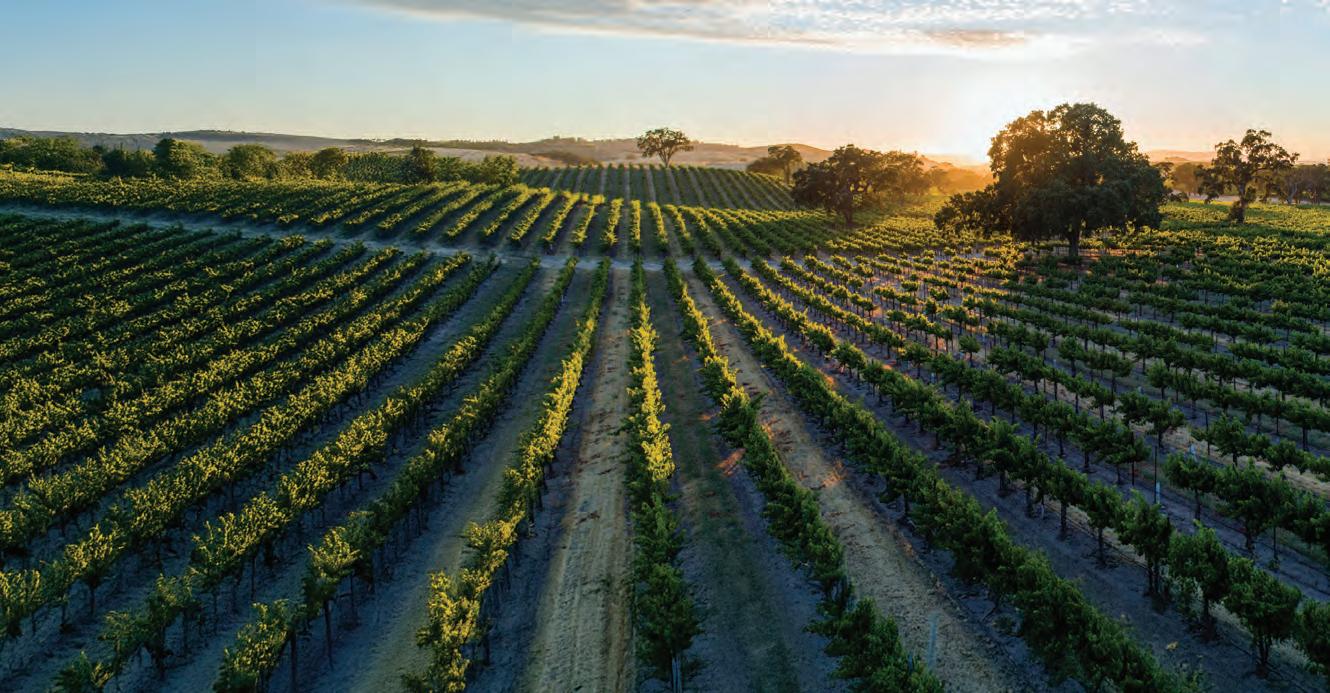






February doesn’t just herald another Valentine’s Day, but also the start of spring in the 209 and with it a sense of romance. In this issue we at 209 Magazine are featuring just two of the many places in the 209 where couples can foster their relationships.

40 Lodi, wine and romance
44.............. A romantic day in downtown Jackson





PUBLISHER/OWNER
Hank Vander Veen
EDITOR
Kristina Hacker
MANAGING EDITOR
Sabra Staford
CREATIVE DIRECTOR
Harold L. George
WRITERS & PHOTOGRAPHERS
Christopher Correa
Joe Cortez
Renee Edwards
Marg Jackson
Matt Johanson
Claudia Newcorn
Shawn Pintor-Day
Zachery Ramos
Dennis Wyatt
ADVERTISING & PARTNERSHIPS
Chris Castro
Beth Flanagan
Melody Wann
Charles Webber
MARKETING
Rich Matheson
SCAN this to advertise in 209 Magazine or call Manteca • (209) 249-3500 • Newman • (209) 243-8170 Oakdale • (209) 847-3021 • Turlock • (209) 634-9141 209 Magazine is published 6 times a year


209 Magazine is a product of
1215 W. Center Street, Ste 203 • Manteca, CA 95337
Comments & Questions: sstaford@209magazine.com
©Copyright 2026. 209 Magazine All rights reserved. Reproduction in whole or in part of any text, photograph or illustration without written permission from the publisher of 209 Magazine is strictly prohibited. The opinions expressed in 209 Magazine are those of the authors and do not necessarily refect the view of 209 Magazine management or owner. 209 Magazine assumes no responsibility and makes no recommendation for claims made by advertisers and shall not be liable for any damages incurred.

As winter softens and the frst hints of spring begin to color the Valley, this issue of 209 Magazine leans into the season of connection—connection to place, to community, and to the people who make the 209 such a remarkable region to call home.
Our feature story takes you along on a pair of roman‑ tic excursions perfect for February and beyond. We spent an afernoon wine‑tasting among the vines of Lodi, where small‑lot winemakers and family‑run tasting rooms create an atmosphere that feels both intimate and efortlessly welcoming. From there, we slipped away to historic Jackson for a charming weekend steeped in Gold Coun‑ try character—walkable streets, cozy inns, and the kind of slow, scenic moments that remind you how restorative a simple getaway can be.
March brings Women’s History Month, and we’re proud to spotlight several women leaders whose work is shaping the future of the 209. Teir stories refect the grit, creativity, and generosity that defne this region, and we’re honored to share their accomplishments with you.
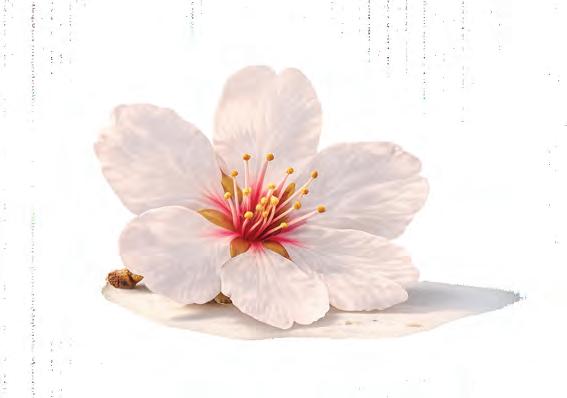
Tis time of year also marks one of the Valley’s most breathtaking natural events: almond blossom season. Whether you’ve lived here your whole life or are discovering the 209 anew, those sof white and pink blooms never fail to inspire a sense of wonder. We celebrate the beauty, the agricultural heritage, and the communities that come alive beneath those blossoms.
In this issue, you’ll also meet two standout locals whose passions and talents add even more color to our region. Los Banos resident Stuart Mc‑ Cullough invites us into the world of competitive duck calling—a craf he’s mastered with dedication and a deep love for the outdoors. And in Gustine, Baylor Bloom shows what determination looks like as he bal‑ ances high school with running his own farming business, proving that entrepreneurship has no age limit in the 209.
As always, thank you for reading, for sharing our stories, and for sup‑ porting the work we do. 209 Magazine thrives because of you—our com‑ munity of engaged, curious, and loyal readers. We also encourage you to support the advertisers who make each issue possible. Teir investment keeps local storytelling alive and helps us continue celebrating the people and places that make this region extraordinary.
Wishing you a season flled with warmth, discovery, and a renewed appreciation for the beauty of the 209.
Hank Vander Veen Publisher/Owner hvanderveen@209magazine.com
FOLLOW US ON

for supporting the American Heart Association during our year-end efforts. Your impact is seen, heard, and making a difference in the fight against heart disease and stroke.
Buchalter Builders Exchange of San Joaquin Cumming GroupHealthForce Partners California
iRhythm TechnologiesMedtronic Structural Heart
Oak Valley Community BankParadigm Construction, Inc.
REED FAMILY COMPANIESSan Joaquin General Hospital





FEB14 2026
The Miners Lounge is turning back the clock for a Roaring ’20s–themed Valentine’s Day Jazz Soirée on Feb. 14, offering an evening of live music, vintage cocktails and speakeasy‑style ambiance. The Capybara Coalition returns after their standout Repeal Party performance, this time joined by special guest musicians to set a romantic, high‑energy mood. Guests are encouraged to dress in period attire while enjoying food specials and classic prohibition‑era glamour throughout the night. The event starts at 7 p.m. and is free to attend and open to ages 21 and older with valid ID. The lounge is located at 1276 S. Main Street in Angels Camp.
MAR14 2026
FEB14 2026
Wine lovers can celebrate Valentine’s Day in style as the Lodi Wine & Chocolate Weekend marks its 29th year on Feb. 14–15. The two‑day event invites guests to explore the Lodi Appellation, home to more than 85 wineries and over 135 grape varietals. Saturday features a self‑guided winery tour from 11 a.m. to 4 p.m., offering tastings, live music and chocolate pairings at more than 30 participating wineries. On Sunday, the Winemakers Toast at Wine & Roses Resort and Spa offers an intimate tasting experience with brunch‑style bites and wines from over 20 Lodi producers. The weekend blends romance, craftsmanship and regional flavor for a memorable Valentine celebration in Lodi wine country.
The city will welcome the Year of the Horse with a vibrant Chinese New Year Celebration on March 14, featuring a parade, tai chi demonstrations, folk dance performances, Peking opera, magicians, jugglers and an award‑winning lion dance troupe. The event showcases traditional arts, culture and entertainment for all ages. More information is available at stocktonccss.com.
FEB19 2026
The city’s biggest tradition of the year, the Almond Blossom Festival, returns Feb. 19–22 for its 64th anniversary celebration. First held in 1962, the festival has grown into a beloved community tradition marking the arrival of spring and bringing residents together for a full weekend of events. Hosted by the Ripon Chamber of Commerce, the festivities include the Miss Almond Blossom/Miss Ripon competition, a carnival and vendor fair at Mistlin Sports Park, the annual Fun Run, the Almond Blossom Parade and the always‑popular Diaper Derby. More information is available at riponchamber.org/almondblossom-festival.

The Cesar Chávez Community Celebration Committee will host its Third Annual Black History Month Empowerment Luncheon on Feb. 25 from 11:30 a.m. to 1:30 p.m. at the Red Event Center, 921 8th Street. This year’s theme, “Blacks in Ministry,” highlights the contributions and leadership of Black faith communities. Tickets are $30, with a discounted rate of $25 for seniors, students and veterans. For more information, contact Maggie at 209-303-2664 or Carla at 209-704-6083.
MAR18-29 2026 FEB 25 2026 FEB 27 2026 MAR 6 2026
Sierra Repertory Theatre launches its 2026 season with a fresh, intimate staging of Fiddler on the Roof, running Feb. 27 through March 29 at the East Sonora Theatre. The beloved musical returns with all its iconic music, heart and timeless themes of love, family and tradition. Performances take place Wednesdays through Sundays, with showtimes varying. The production is ticketed and will be held at 13891 Mono Way in Sonora. Tickets and details are available at sierrarep.org.
The Calaveras Celtic Faire returns to the Calaveras County Fairgrounds with a full weekend of Celtic culture, live music, jousting, armored combat, living‑history demonstrations, clan gatherings and artisan vendors. Festivities begin March 6 at 9 a.m. at 2465 Gun Club Road in Angels Camp. The event continues through March 8 and is organized by the Calaveras Celtic Fair. For details, call 209-601-7031.
One of Tuolumne County Arts’ most enduring and popular events, the InFocus Photography Competition, Exhibition & Sale, returns March 18–29 at 22738 Main St. in Columbia. First held in 1987, the show features work from
both amateur and professional photographers and has grown steadily in size and quality over nearly four decades. The exhibition is open March 18–22 and March 25–28 from noon to 5 p.m., with a final viewing on March 29 from noon to 2
p.m. Sale days are March 28–29, when all works are offered at 20 percent off. A reception and awards presentation will be held March 15 from 5 to 7 p.m. Admission is free. More information is available at infocus-tcaa.org.







































































MOVIE-MAKING
MAGIC TRANSFORMS
RIVERBANK INTO ‘WINTER WONDERLAND’
By MARG JACKSON










































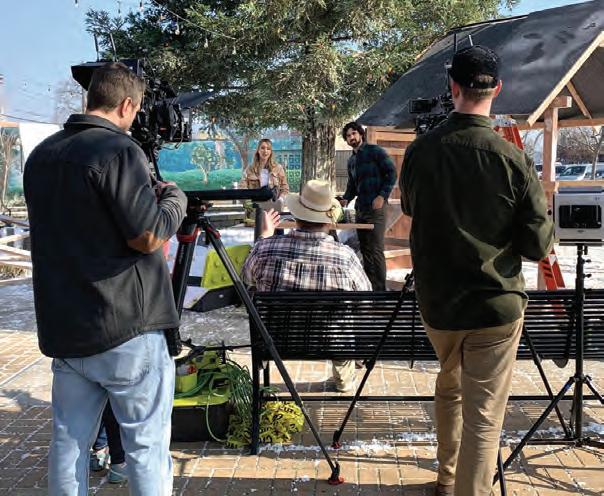




















or a few days this January, there was snow in the Plaza del Rio Park in downtown Riverbank, a broken-down manger scene … and a little bit of movie magic.
A production company came to town, with cast and crew members, shooting scenes for “Te Ornament” Christmas movie that is expected to have a holiday season 2026 release.
Among those on set was local resident Robin Bjerke, serving as production manager.




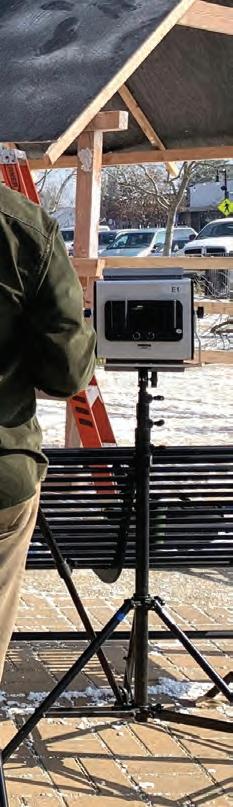


“We’re just making Riverbank a winter wonderland,” Bjerke explained, noting that the holiday love story begins with the efort to rebuild the city’s Christmas nativity scene in the town square afer it was damaged by a storm.
Leads in the flm are Tom Maden and Hannah Brantley and the writer/ director for Te Ornament is Arvin N. Berner.
Eric Raingruber of Sprocketless Entertainment out of Modesto was also on set.
“Tis is our third Christmas flm that we’re doing with Nicely Entertainment and they sell to all the networks, but primarily GAC and Hallmark,” he said, adding that the movie is being classifed as a “Christmas romance.”
Afer a brief production break, Raingruber said they will be back to flm additional scenes throughout the area.
“We found the location, we were





really excited … it was perfect for what we were doing,” Raingruber said of the large existing Christmas tree in the plaza, which played right into the lighting scene. “Also the City (of Riverbank) is so welcoming and they’ve just greeted us with open arms, been very supportive of us.”



I love the community, I love the feeling of just being here and it’s great to be back.
For lead actress Brantley, who few in from Memphis to do the Riverbank scenes, it almost felt like coming home.
“I love it; I love the community, I love the feeling of just being here and it’s great to be back,” she said.
Brantley and Maden worked together previously, in a movie that flmed several scenes in Escalon last year.
She also said the lighthearted romance movies are rewarding to work in.
“It’s incredible, that’s what draws me to this genre so much is that




anyone can watch them, they’re ‘feel good’ – especially Christmas movies,” Brantley explained.


“You’re with your family and your loved ones, you’re gathering around with a cup of hot chocolate and watching something that makes you smile … it’s beautiful, I love it.”
Maden added that there is a lot to enjoy about working on a holiday flm.
“I really love just a good set, the amount of people that are here, it really is a spontaneous community so it is really enjoyable just to see everybody again and for all of us to work on something that makes us happy,” he said.
Te culmination of the flming was done on Friday evening, Jan. 16, with residents from throughout the area answering a ‘casting call’ to show up and serve as extras for the tree lighting scene, showing up in their holiday sweaters, cold weather coats, hats and scarves. ●



























We created The Haven at Bethany assisted living so that older adults can beneft from truly personalized attention and enjoy life with greater autonomy and purpose. From the welcoming atmosphere and life-enriching amenities to engaging daily activities and attentive support available day and night, The Haven is assisted living that’s all about living one’s best life.










By CHRISTOPHER CORREA
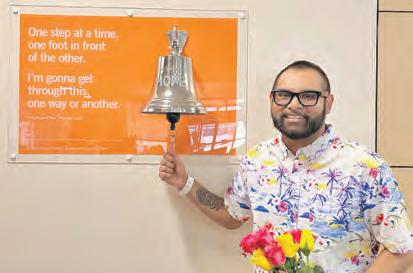
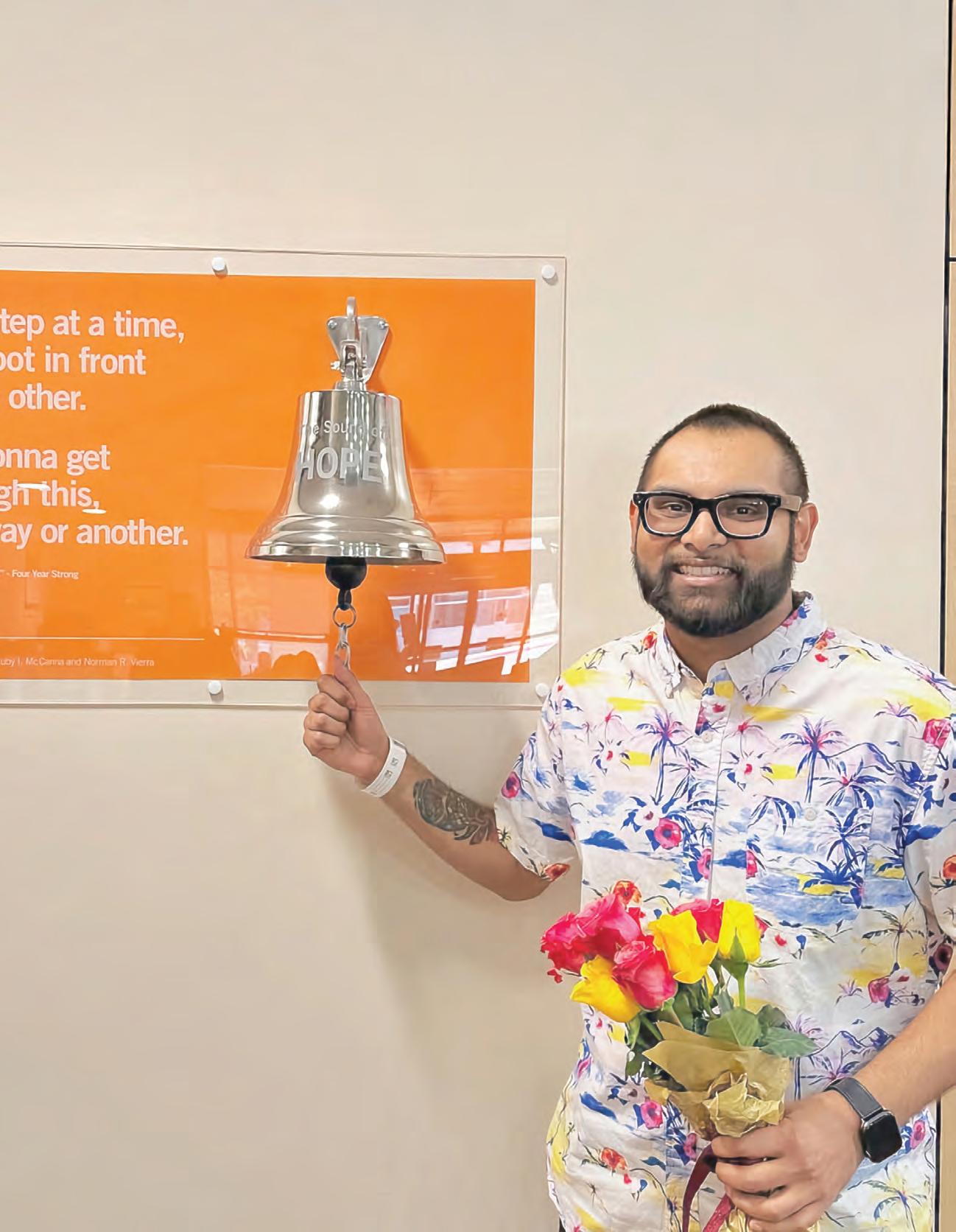
Nevin Shoker seemed to be in the clear, spending his summer in celebration as scans in June indicated that he was in full remission afer batting Stage 4 Hodgkin’s Lymphoma for a year.
Te 29-year-old, who grew up in Ceres and took the frst steps towards a career in media production and music at Stanislaus State, was providing optimistic updates on his social media platforms. As he shared with 209 Magazine earlier this year, his music career had established a solid online following, which only grew as he shared daily updates of his cancer journey as he made it a mission to urge others to watch out for specifc symptoms and to advocate for themselves following doctors controversial dismissing his cancer concerns and instead blaming asthma.
Unfortunately for Shoker and his family, nearly the same story began to unfold in July, when his mother, Laxmi, was diagnosed with gastric adenocarcinoma, a stomach cancer. It was a revelation that came afer doctors similarly dismissed her constant stomach pains.
“It was devastating,” Shoker said. “Right when I’m turning the corner, we get this news, and it just felt like the cycle was never ending. It was another round of fear, another round of frustration that our concerns were brushed to the side. Traumatized, really, from doctors not taking me seriously, and then seeing her going through the same thing right afer, with the same exact treatments, seeing the way doctors would treat you and look at you like you’re crazy if you’re asking for all these tests and blood work, it’s a lonely feeling. Helpless feeling, sometimes.”
With her son’s insistence and newly gained expertise on

cancer, Laxmi asked for bloodwork to be done. Afer initial resistance from doctor’s, results revealed that not only was her iron low, which is common in many middle-aged women, but that she had a critically low amount of blood in her body.
Te solution from doctors was to give her iron pills and a blood transfusion.
“But they weren’t looking into why she was losing blood, Shoker said. “Tey gave her the transfusion and just let her go, kind of dismissing that there had to be some sort of reason why she had lost all the blood in the frst place without her having any wounds or bleeding out. Eventually, they started looking a bit deeper afer she was low and blood. We all started asking, ‘Where did all the blood go?’
One endoscopy was all it took to fnd a large tumor in the stomach.
“Again, just like my situation, if we didn’t keep asking questions and insisting on things, who knows what would’ve happened,” Shoker said.
Te story of Laxmi going through the same process as her son has similarly captivated the online world, where Shoker
has nearly 72,000 followers and 6 million views between Instagram and Tik Tok.
Shoker explained he was more fearful for his mother, 59, as he knew the toll that chemotherapy and other treatments took on a young man like himself.
“It’s like I’m on the fip side of things, reliving everything,” Shoker said. “Her oncologists and my oncologist are the same guy, her appointments and my appointments because I’m still technically a patient, are overlapped on the same day sometimes because it’s an hour long drive to Merced, and the people there are nice enough to schedule us together so we don’t have to make two
trips. It’s just a crazy process.”
It’s a rare situation.
According to the American Childhood Cancer Organization, 5 to 15% of cancers are linked to genetic conditions, and according to the National Institute of Health, about 6.9% of children with cancer have a frst-degree relative (parent/sibling) with a cancer history, but the increased risk ofen disappears once hereditary
syndromes are accounted for.
But the Shoker’s have much diferent forms of cancer, and them being diagnosed almost a year apart is almost unheard of, so much so that Dr. Tomas Fiero of Merced broke down in tears when he heard their story, in a video that has amassed millions of views on social media.
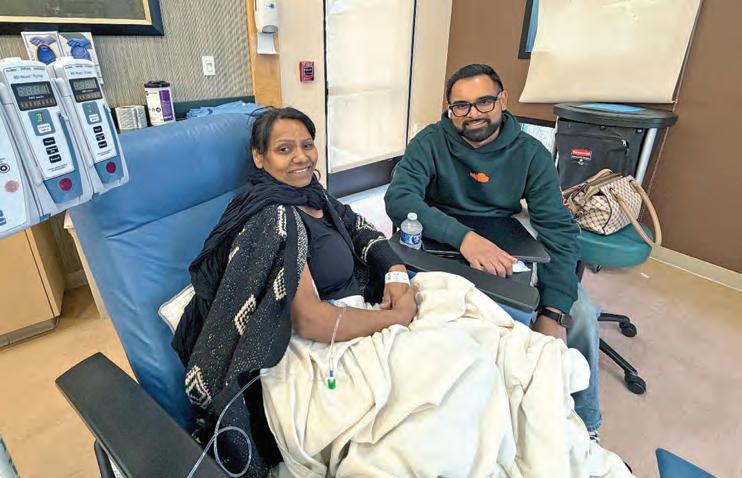

“As I mentioned a few months ago, I’ve met so many people through the power of the internet, and each person has such unique struggles, and this was just another crazy story,” Shoker said. “And it’s a place you go for support, when you have those lonely and hopeless moments.”
It was Shoker’s goal to inspire and build a community during his bout with cancer, and his aspirations have only grown now that his mother is battling.
“I had built a good following with my music career, and now I’m pretty much known online for my cancer and the cancer in my family,” Shoker said. “With my mom getting cancer, I just feel like I’m even more obligated to make this my purpose, to help support others emotionally and spread awareness of how to deal with the treatments and advocate for yourself in the doctor’s ofce.”
It’s why next month, Shoker will launch a cancer support group named “Surviving the Shock,” which is a play on words on his social media handles,
@ibeshocker
“It will be talking about the shock that you get when you’re diagnosed with cancer, because it is a huge shock because nobody expects it to happen to them. It’s always something that you hear about, and you never really know too much about it until you or somebody you know gets afected by it. You don’t know what treatments you’ll go through, certain terms, how your body will be afected, the fnancial burden, it’s a big unknown that you walk into with a lot of uncertainty, and a lot of times, fear.”
world that he connected with on the internet over their cancer journeys.
“I pretty much have had it set up on Discord where people can submit their stories through like a Google form and I would be doing interviews with those people on live streams, as well as having the Discord lounges and chat rooms for people to connect with each to talk about their experiences, as well as ask questions or seek out advice.”
A year and a half after learning he was in remission from Hodgkin’s Lymphoma, Nevin Shoker sits with his mom, Laxmi, as she undergoes treatment for stomach cancer.
As Laxmi continues her own bout, Shoker has had the same optimism as when he was recording himself going to appointments and on the hospital bed.
Te support group will live on the platform Discord, where folks can discuss specifc topics relating to cancer. Content will then be shared on sites like Instagram, Facebook and TikTok, with moderation taken care of by Shoker’s friends from around the
“My mom’s really strong. She’s a fghter, for sure, and she has been through the ringer,” Shoker said. “It really sucks to see her go through everything I went through, because I know how hard it is, but I know she’ll get through this.” ●

By SHAWN PINTOR-DAY
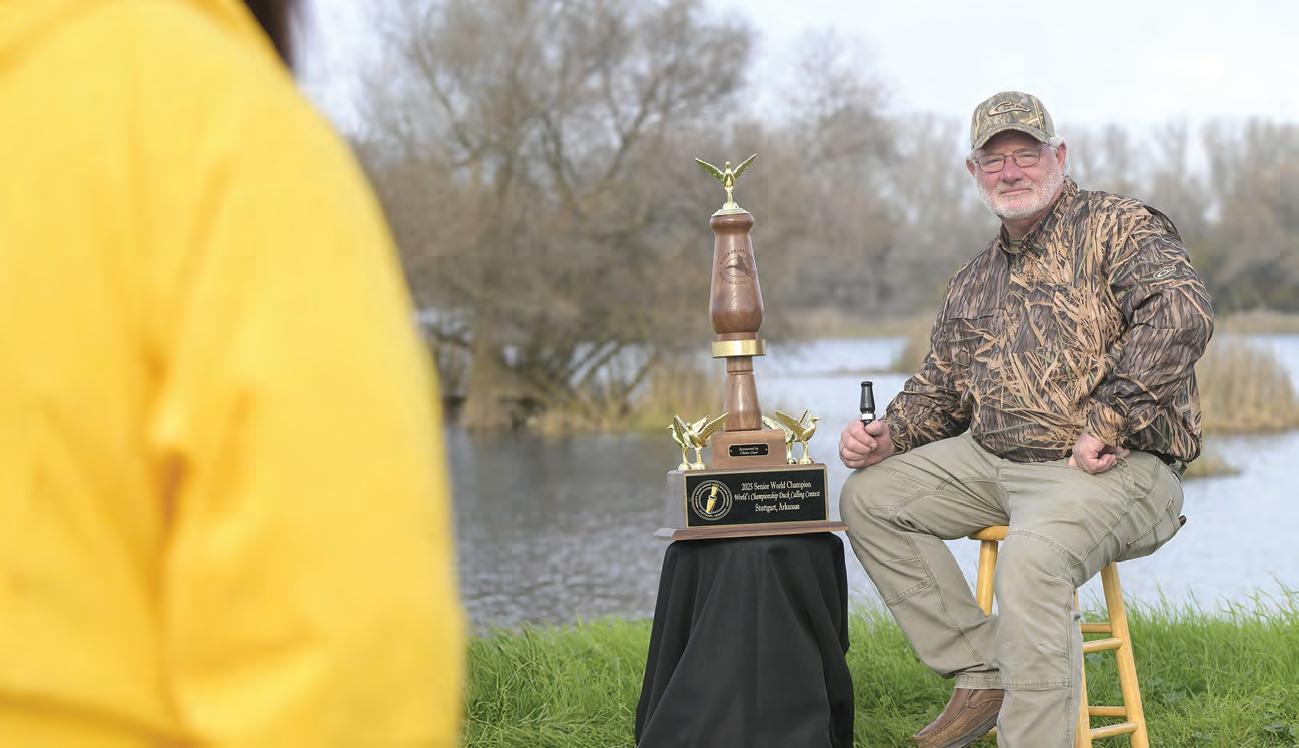
The 90th annual duck calling championship competition, held in Stuttgart, Arkansas this past fall, saw Stuart McCullough, a lifelong Los Banos resident, take home the senior division trophy during the Wings Over the Prairie Festival.
Tough he was a ways from home, McCullough’s skills and experience earned him frst place and secured his title as Senior World Champion.
McCullough was frst prompted to show his calling skills while at a Waterfowl dinner with the 1987 World Champ Daid Jayne. Despite his knowledge of calling coming from hunting rather than showmanship, McCullough’s wife, Kimberly, urged him to enter a contest afer hearing Jayne display his world-class calling skills.
Despite his initial hesitation to jump into the competitive scene, McCullough managed to get a videotape of the 1988 world championships and “watched it over and over, just trying to make the sounds that everyone else made.”
Tough he didn’t give competing much serious thought at the time, fate would push him further into his calling when he met some friends in grad school who made and manufactured
duck calls.
With a steady supply of instruments to hone his skills and a supportive group of friends, McCullough spent the next decade quietly honing his duck calls and in 1997 entered his frst contest on a dare.
Tis dare led to his frst victory, which quickly led to his second and third, and snowballed from there into a nearly 30-year career of professional duck calling.
We’d still be doing this whether we’re competing or not.”
Having qualifed for the world championship fve times over the course of the early aughts and early 2010s, McCullough is the furthest thing from a stranger to high-level calling competition and even got to reunite with some familiar faces.
“Stepping into the bullpen was like a reunion,” He explains, “We’ve competed against each other for 25 years. You don’t see [your competitors]
all the time, but you have all these memories and experiences together.”
Tis spirit of camaraderie is what keeps the duck calling championships alive, and McCullough always takes his son, Zach, to competitions to show him what duck season makes possible.
While the competitions are a fun way to gather communities together and recognize the skill of callers at all levels, duck calling is a real art practiced by outdoorsmen the world over.
Te beauty of the calling competitions lies in the celebration of the outdoor lifestyle and realizing what we can give back to nature and the environment around us.
“Even if we didn’t have this sport, every one of us would hunt and fsh,” said McCullough, “We’d still be doing this whether we’re competing or not.”
McCullough now holds one of just six world trophies, and despite having been in the duck calling game for 30 years, winning the 90th annual duck calling championships “felt really good - the regiment, the mindset, it’s all still fun.”
While competing further is not totally out of the question, McCullough was content to share duck season with his son and admire his world championship trophy, happy to have followed the duck call of victory. ●
is in full swing
By DENNIS WYATT
Get ready for nirvana.
When the calendar reaches midFebruary, it means the sweetest days of the year will arrive.
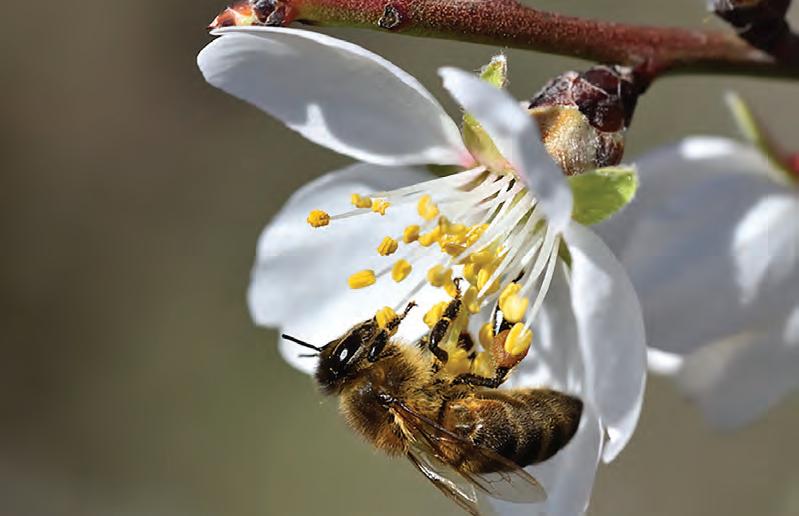
Tey will come with the bees — millions of bees, tens of millions of bees.
It is part of one of nature’s most blessed unions.
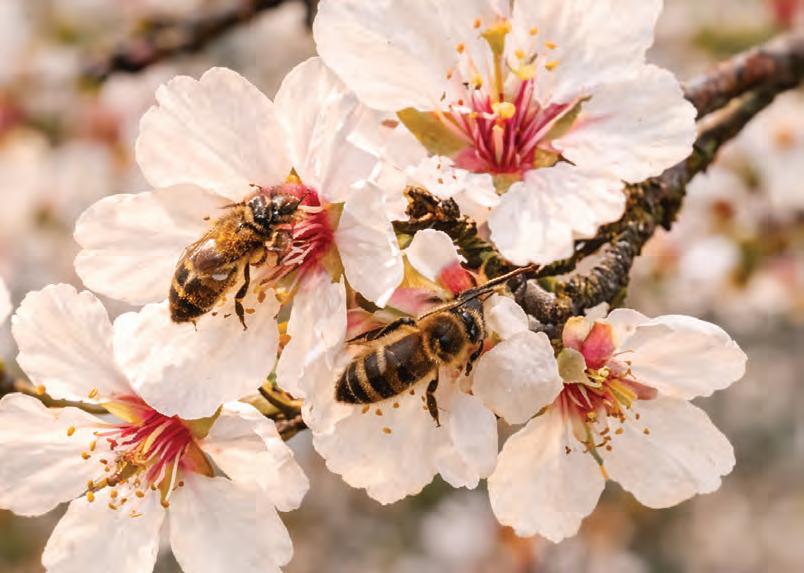
Bees zip through nearly naked almond branches to visit small buds just starting to split through the sof wood.
In a matter of a short time, those buds will open. Sometimes it seems to happen overnight.
Skeleton orchards start to shiver afer losing the last rays of semi-warmth as the sun slips behind the Diablo Range as winter uses the chill of night to try and prolong nature’s slumber.
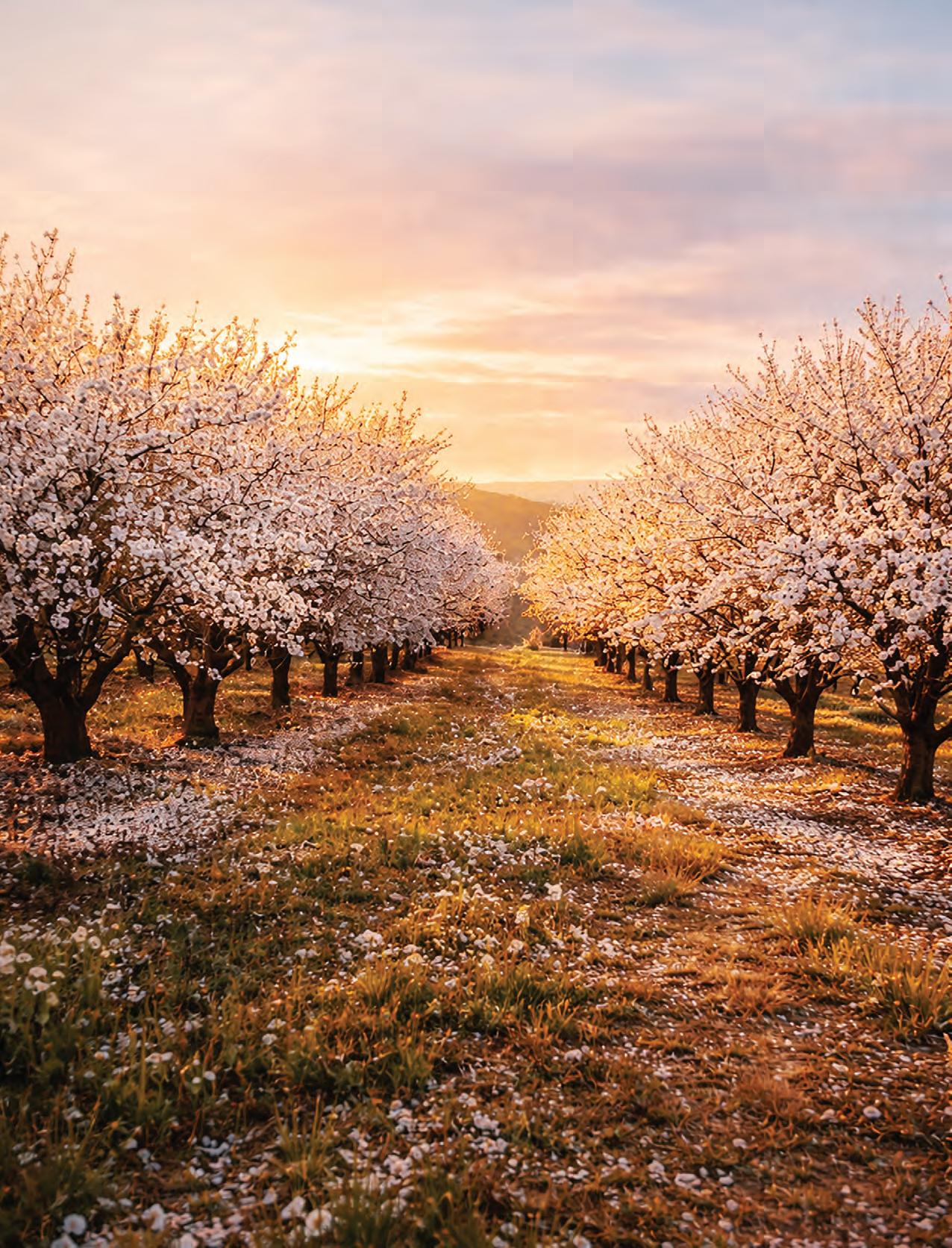
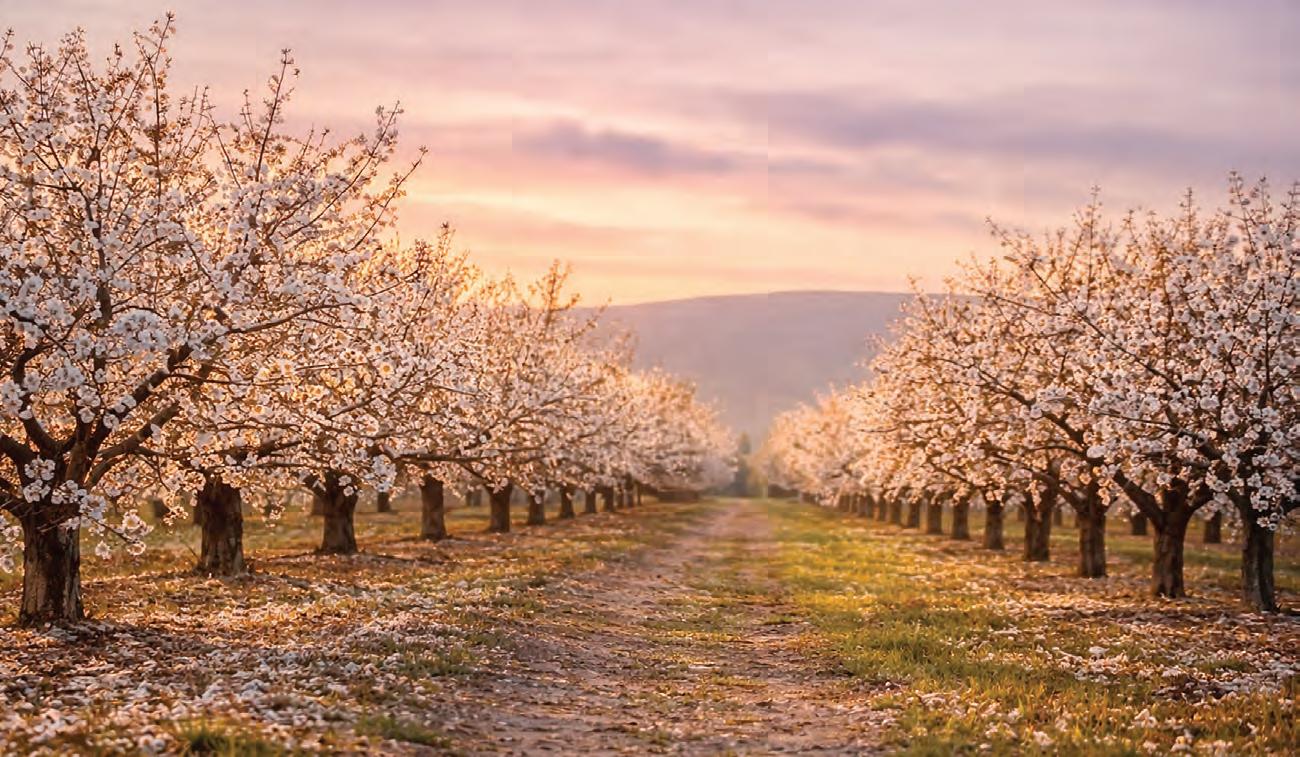
But then as the sun rises over the snow draped Sierra in the east, the light of a new day backlights the most glorious sight ever created by Mother Nature — billions upon billions of delicate white and pink almond blooms bursting everywhere you look.
Spring doesn’t simply arrive in the countryside around the Northern San Joaquin Valley.
It bursts open seemingly all at once but not in an in-your-face way.
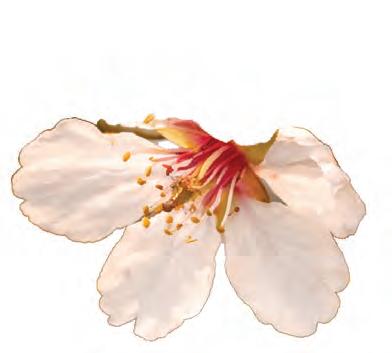
Rather it caresses the senses.
Feast your eyes on delicate creations that make cherry blossoms seem rough by comparison. Touch the delicate beauties and you are suddenly as nervous as a guy holding a newborn baby for the frst time.
Te scent o almond blosoms is the swe t perfume o the year.
Tey are so sof and new that you fear you may hurt them.
But then the biggest treat comes along. Te bees have been busy.
As the mercury inches up ever so slightly toward the magical 70-degree mark, the sun’s warmth gently bakes the blossoms, creating a delightful scent that is more intoxicating than Chanel No. 5 announcing the arrival of a sweetheart.
Te air you breathe is flled with delightful reminders that the cold and sometimes gray days of winter were worth every second.
But it isn’t until night falls when
the warmth of the mid-February day fades away and a slight coolness slips over the land that the real treat begins.
On the perfect night, there is an ever-so gentle breeze.
Te steady stream of air washing ashore from over the Pacifc Ocean makes its way across the Altamont Pass and through the meandering Delta to nudge the scent along as a gentle caressing breeze makes its way through orchard afer orchard.
It is best this time of year to leave your bedroom window ajar before you retire for a late winter slumber even if you still need to bundle against the cold.

Tat’s because there is not a more glorious way to drif of to sleep than taking in breath afer breath of the sweetest perfume ever concocted — almond blossoms in bloom. As your body goes into sleep mode and your mind drifs away, they help create the sweetest dreams of the year.
And if you happen to awaken in the middle of the night, your senses led only by your nose, make you feel as if you are in Mother Nature’s arms bundled up with covers as you smell the sweet scent of rebirth.
If you are lucky, the fragrant elixir will wake you in the morn. Who needs to smell the cofee when you can inhale the sof fragrance of almond blossoms?
It is little wonder millions of bees have no issue with being busy as a bee.
How can it be work when you get to zip from one almond blossom to another getting intoxicated with the sweetest smell on earth?
Once you’ve taken in the frst act of spring in the Northern San Joaquin Valley it is easy to understand how insects that can hurt so much when they sting can produce such a sweet golden treat that we call honey.
Te days of February are the days that try the souls of almond growers.
While we revel in the return of
almond blossoms, growers fret about rain and high wind striking at the most inopportune time.
Te early almond varieties sometimes popping blooms here and there earlier in the month. Almond growers will tell you that is ahead of the right time.
For a few short days, disapearswinterand the valle inhale spring.
Mother Nature, if she could talk, would likely laugh at such a statement knowing full well that almond blossom time always starts on the terms of the brave buds that give the frst signal that the glorious symphony of smells and sights she is cueing up is about to fll the countryside with a blazing celebration of life.
It’s a spectacle that makes the great works of arts such as Vincent Van Gogh’s “Te Starry Night” look drab and mechanical.
Nothing fows as free or inspires as much as what the almond blossoms and what follows brings to the valley.
Forget about waking up and smell-
ing the roses. Tat’s for people landlocked by asphalt and concrete. Get out and savor the almond blossoms.
Drive into the countryside from Turlock, Modesto, Merced, Ripon, and Manteca in the coming weeks and roll down your windows. You won’t be disappointed.
Better yet park the car, get out, and walk along an orchard’s edge that is in full bloom. Unless you are unfortunate enough to be cursed with an allergy to almond blossoms, there is nothing that man has yet to bottle that can bring as much bliss to your nose.
In felds where growers still let grass grow in almond orchards, the dew moistened form green stripes between rows of white and pink blossoms creating a delightful scent of its own as the month slips closer to March.
It’s a decadent treat.
Almond blossom time also heralds the start of an endless parade of blooms and scents that the Northern San Joaquin Valley’s Mediterranean climate coaxes out of some of the most fertile soil in the world.
By the time March arrives and almond blossoms have reached their crescendo, Mother Nature unleashes the fnal performance of the production that will lead to the shaking of

several billion pounds of nuts up and down the Central Valley when summer draws to a close.
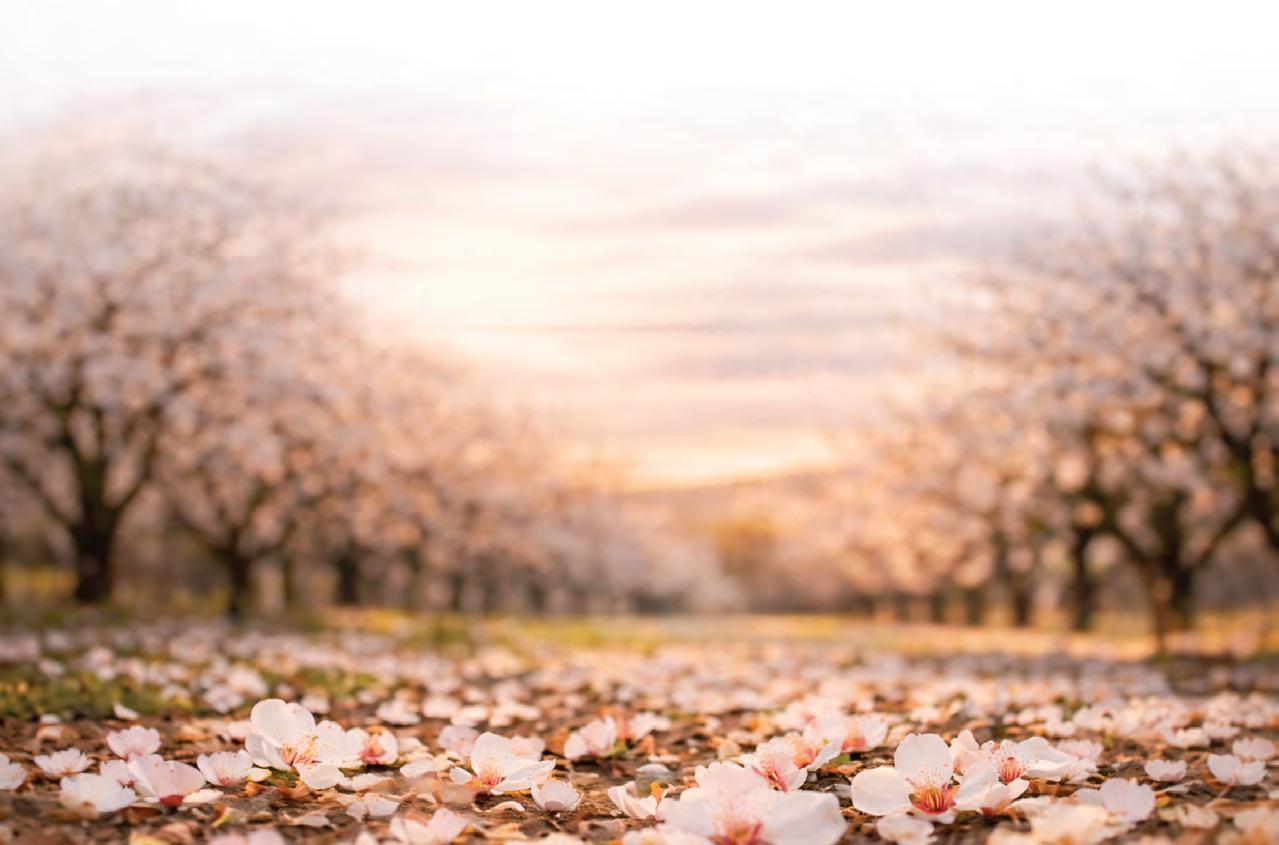
Te sweet scent is waning as delicate white and pink blossoms start sofly falling to the ground. It is the fnal act that brings down the curtain on the almond blossom season coating the earth with a gentle blanket of blossoms.
Enjoy what is about to unfold in our backyard.
It’s heaven on earth. ●
Te blosoms fall quiely, and spring move on without asking permision.
Almond Blossom Festival in Ripon; Modesto offers downloadable map for drives.
One third of the 1.5 million acres in the Central Valley that will be ablaze with delicate white and pink almond blossoms can be found in the Northern San Joaquin Valley counties of Stanislaus, San Joaquin, and Merced.
It has been a reason for Ripon for the past 64 years to mark the almond blossom season with a festival.
This year’s festival runs from Feb. 19 through Feb. 22.
It features a festival with vendors, food, and entertainment along with carnival rides Feb. 20-22 at Mistlin Sports Park on the northern edge of Ripon at Jack Tone and River roads surrounded on three sides by almond blossoms.
The Ripon Chamber of Commerce event is the first community festival of the year in the Northern San Joaquin Valley. Admission is free although there is a parking charge.
There are community events throughout the weekend with the highlights being a downtown parade on Feb. 21, at 1 p.m. and a fun run that morning.
Details can be found at riponchamber.org
You can also celebrate the almond blossom season by taking a drive.
If you need help deciding on a route, the Modesto Visitors & Convention Bureau (visitmodesto.com) offers a downloadable map.
It offers three suggested routes ranging from an hour to three hours.

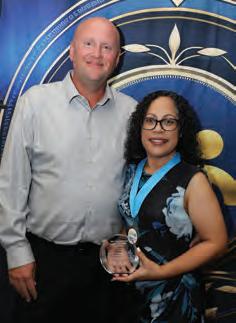

Love showed up in the sweetest ways. Thank you to everyone who shared their cutest couple moments—each photo brought smiles and heart. We’re endlessly grateful for our incredible 209 community of readers and to our sponsor, Jared Holt, for helping us celebrate love, connection, and all the joy this Valentine’s Day.


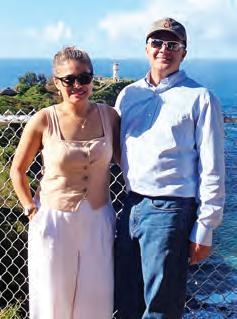



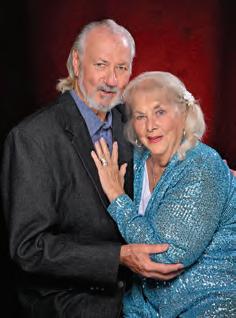
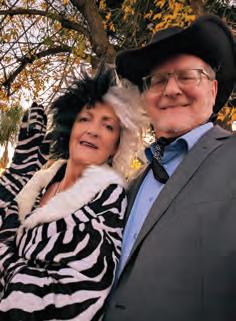



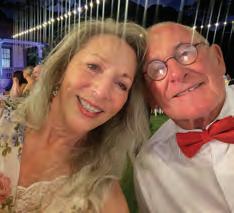

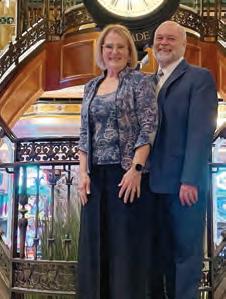





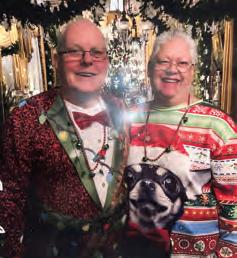



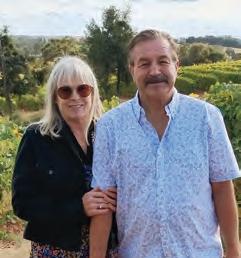




Every year, March is designated Women’s History Month by presidential proclamation. Te month is set aside to honor women’s contributions in American history.
Women’s History Month began as a local celebration in Santa Rosa, California. Te Education Task Force of the Sonoma County Commission on the Status of Women planned and executed a “Women’s History Week” celebration in 1978. Te organizers selected the week of March 8 to correspond with International Women’s Day. Te movement spread across the country as other communities initiated their own Women’s History Week celebrations the following year.
In 1980, a consortium of women’s groups and historians—led by the National Women’s History Project (now the National Women’s History Alliance)—successfully lobbied for national recognition. In February 1980, President Jimmy Carter issued the frst Presidential Proclamation declaring the Week of March 2-8, 1980 as

National Women’s History Week.
“From the frst settlers who came to our shores, from the frst American Indian families who befriended them, men and women have worked together to build this nation. Too ofen the women were unsung and sometimes their contributions went unnoticed. But the achievements, leadership, courage, strength and love of the women who built America was as vital as that of the men whose names we know so well,” said President Carter during his message designating March 2-8, 1980 as National Women’s History Week.
Between 1988 and 1994, Congress passed additional resolutions requesting and authorizing the President to proclaim March of each year as Women’s History Month. Since 1995, each president has issued an annual proclamations designating the month of March as “Women’s History Month.”
Te National Women’s History Alliance selects and publishes the yearly theme.
Women’s leadership has shaped America, often unnoticed, now rightfully celebrated.
Te theme for Women’s History Month 2026 is “Leading the Change: Women Shaping a Sustainable Future.”
Subsequent Presidents continued to proclaim a National Women’s History Week in March until 1987 when Congress passed Public Law 100-9, designating March as “Women’s History Month.”
Tis theme, according to the alliance, honors the women who have and are reimagining and rebuilding systems to ensure long-term sustainability- environmental, economic, educational, and societal. It recognizes the powerful leadership of women in creating a future that is rooted in equity, justice, and opportunity for all. From environmental advocacy to fnancial reform, from community organizing to policy innovation, women are at the forefront of driving holistic change. Teir leadership is not only addressing today’s most urgent challenges - it is laying the foundation for a more resilient and inclusive tomorrow.
Tere are far too many women leaders in the 209 to celebrate them all, but 209 Magazine has selected just a few to highlight this year. ●
By JOE CORTEZ
State Sen. Marie Alvarado-Gil (R-Jackson) represents the largest senate district (areawise) in all of California. It hugs the Nevada border from north of Lake Tahoe (near Reno) to south of Death Valley (near Las Vegas), then bows out to the Santa Clara County line (near Silicon Valley). District 4 includes all or pieces of 13 counties, eight diferent area codes, 16 tribal nations, and more than 1 million total constituents — nearly twice the average assembly district, and 33 percent more than the average congressional district.
It’s a lot of turf to cover, but Sen. Alvarado-Gil manages just fne, thank you very much.
that women now outnumber men in the state senate, she knows that politics, as a whole, is a world dominated by men.

We know what’s right; we just have to do it.
“My district is larger than 10 states in the U.S.,” boasted AlvaradoGil, who was elected in 2022 and will be seeking her second term in Sacramento this fall. “I pride myself on being accessible, and when I go into a grocery store or the post ofce and people come up to me and tell me stories of the results we’re getting … those stories carry me for days.”
While she’s also proud of the fact
“I don’t think that’s necessarily a disadvantage,” said Alvarado-Gil, who has a blended family of six children and two grandchildren (a third is due in March) with husband Cesar Alvarado-Gil, the chief counsel at UC Merced. “I look at it as a gif. But it also makes me a target, so I do have to work harder to navigate what has traditionally been a male profession. But I’m not the frst one who’s had to do that. And that male domination has been whittled away. We just celebrated the senate’s frst Latina president pro tempore (Sen. Monique Limon), and that was a big milestone for us.”
Alvarado-Gil was born in Mountain View to parents who immigrated from Mexico. She pursued a degree in animal science from UC Davis, but halted her studies to raise her children. Eventually, she obtained a bachelor’s and a master’s from the University of San Francisco. She has been open about her early struggles, which included being placed in foster care, and surviving a sexual assault.
It’s those hardships that have fueled her drive as a legislator.
“I remember when I was running for ofce, I was told I could never have an impact on Prop. 57,” said Alvarado-Gil, referring to a measure that created a loophole where those who raped an unconscious or intoxicated person could not be prosecuted for a violent felony. AlvaradoGil’s Senate Bill 268, signed into law by Gov. Gavin Newsom in 2024, closed that loophole. “Tat tells me there is an avenue to do what’s right and responsible in Sacramento,” she said. “And my colleagues have to understand this. We know what’s right; we just have to do it.”
With such a vast area to cover in District 4, its difcult for Alvarado-Gil to be as present throughout her district as other legislators. But she’s dedicated to meeting as many as she can, as ofen as she can.
“It’s all about the constituents,” said Alvarado-Gill. “I’m proud that constituents can give me their unfltered feedback. I really take that to heart. Tey know we’re in this together.” ●
By MARG JACKSON
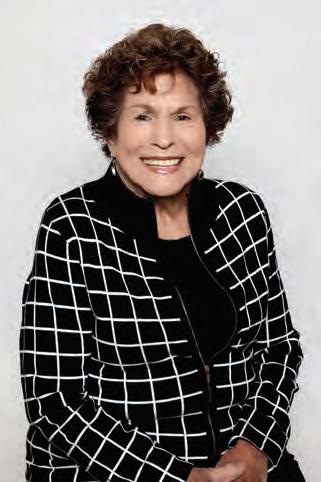
To say Mickey Peabody was a force for her Oakdale community –and the east side of Stanislaus County in the 209 – would be an understatement.
From her earliest involvement in schools her children attended to later work with the county Board of Supervisors, the Oakdale City Council and the state’s Senior Legislature, she has been helping to make a diference for decades.
her work on multiple county issues, from senior transportation to mental health advocacy, also continues to have an impact.
Born and raised in Fresno, she moved with her husband and three small children to Oakdale in December of 1965.
I realized I could do more on the other side of the podium.
Now, at 89, Peabody has slowed down some physically – heart surgery and cancer among her battles – but remains involved as much as she can, there to ofer advice and guidance as a new generation takes over.
For Peabody, she found community service to be the most gratifying, and a place where she could get things done at the local level. But
“I’ve been political since my father ran for city council when I was like 16, I helped him with his campaign,” Peabody said. “From that moment on, I’ve been political.”
Included in her vast resumé of work is six years serving on the Oakdale City Council, helping bring the Gladys L. Lemmons Senior Community Center project in Oakdale to fruition. It is a stand-alone facility, adjacent to a senior housing complex, that is open to the community’s senior citizens and ofers multiple programs and services.
She also spent four years as the feld representative for longtime District 1 Stanislaus County Supervisor Pat Paul at the county level, and
served more than 20 years on the Stanislaus County Mental Health Board, representing the east side of Stanislaus County. She then moved on to a position on the Area Agency on Aging Commission, with another 20 years dedicated to that panel. She was a founding member of the Stanislaus Senior Foundation and, with former longtime Modesto City Council member, the late Jenny Kenoyer, Peabody was one of the founding directors of MOVE, a transportation program that provides “door-through-door” service for the county’s senior citizens, veterans and disabled residents to get to appointments, shopping and more.
Peabody and Kenoyer were instrumental in the passage of Measure L, a half-cent tax that provided funding for critical transportation issues, including the MOVE program.
Her work with Pat Paul at the county level, Peabody added, was “the best job I ever had … and the worst.”
Tat, she said, “because every time you picked up the phone, somebody was mad. Tey didn’t call because
they were glad. Tey had an issue … and the good part about it was you could solve those.”
Time spent as the senior Senator for Stanislaus County on the California Senior Legislature gave Peabody the opportunity to take issues to Sacramento on behalf of the region, helping to get a variety of senior needs and concerns heard at the state level.
It’s about how you use volunteers and make them feel worthwhile. A volunteer has to be appreciated.
And while her earliest involvement in the community was being a part of the parent club when her children were in school, Peabody used that as a springboard into a much larger arena.
Among her accolades through the years, Peabody has received the Outstanding Women’s Award for Stanislaus County and the Lifetime Achievement Award from the
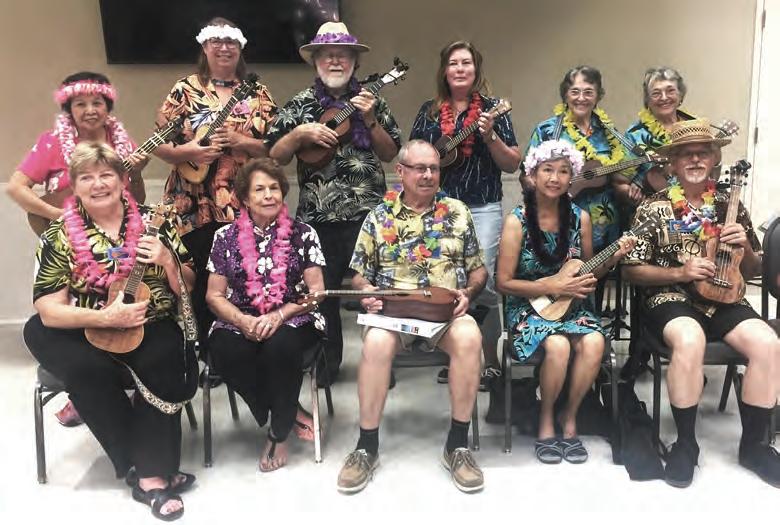
Oakdale Chamber of Commerce. She was also instrumental in forming the ‘Silver Strummers’ group of senior ukulele players, a popular musical group in the area for senior citizens that has expanded to include a harp, guitars and drums, with the seniors playing at a variety of functions in the region.
“To see something blossom,” Peabody said of what means the most to her in her various activities.
She also said she found it easier to “get things done” as a community activist as opposed to being an elected ofcial, with more freedom to act independently as an activist, not having to go through the proper channels and red tape that government inherently brings.
“Afer six years (on the Oakdale city council) I realized I could do more on the other side of the podium,” she noted.
With more than 50 years of community service and government work to her credit, Peabody said she has had to “take a step back” as she has dealt with a serious bout of COVID-19, a broken neck, heart surgery and leukemia, all within the past fve years.
Tough passing the torch on to a new generation and excited about the possibilities for the future, she said there’s one thing that will always remain the same.
“It’s about how you use volunteers and make them feel worthwhile,” Peabody explained. “A volunteer has to be appreciated.”
She also pointed to Oakdale’s senior center as the project she is most proud of.
“It’s a commitment to taking care of our seniors,” she said. ●
By CHRISTOPHER CORREA
Britt Rios-Ellis, Ph.D., a bilingual and bicultural educational and community health expert, was invested as the 13th president of Stanislaus State in early October, marking a historic moment for the University in Turlock. With her investiture, Rios-Ellis added to a long legacy of infuential female leaders at the institution. Presidents that preceded her include Sue Borrego (2023-2024), Ellen Junn (2016-2023) and Marvalene Hughes (1994-2005).
In her address at the Ed and Bertha Fitzpatrick Arena, titled 'Te Pulse of Possibility and Leading with Cariño,' Rios-Ellis refected on the University's role as more than an academic institution.
"We are a beacon where dreams fourish and opportunities abound,” she said. “Together, we are creating an environment wherein knowledge, diversity, respect and collaboration thrive, ultimately shaping a brighter future for the Valle Central."
“My vision for Stan State is one where everyone, of all backgrounds, has equitable access to the resources and opportunities they need to thrive. Cariño-laden inclusivity is the force that transforms education into equity, and equity into progress. At Stan State, cariño is demonstrated in the way we show up for one another, the way we center students in every decision and the way we embody strength and kindness as Warriors."
She described the “pulse of pos-
sibility” she felt the moment she arrived on campus — a rhythm of resilience, dreams and aspirations carried by students, faculty, staf, alumni and partners throughout the Valley.

University trains in Stockton.
“It is the rhythm of hard work through challenges overcome and destinations realized,” she said. “Tis pulse is alive in every lecture hall, every lab, every relationship and every graduate who walks across our stage. It is truly the sound of bright futures unfolding.”
Over the past year under the direction of Rios-Ellis, Stan State earned national recognition with its second consecutive fve-star ranking from Money.com and being named a top university in the Central Valley for return on investment by the College Futures Foundation.
In August, the University received a $435,255 grant from BEAM Circular to transform existing facilities on the third foor of the Naraghi Hall of Science into a state-of-the-art laboratory with bioreactors, sequencing and imaging tools and plant growth chambers, establishing the Centre for Sustainable Biotechnology.
Outside of Turlock, there is rapid expansion at the Stockton Campus with a new two-story, 48,000 sq. f. academic building equipped with classrooms, labs, ofces and study spaces nearing completion. Additionally, Health Plan of San Joaquin and Mountain Valley Health Plan invested $2.5 million to double the number of healthcare providers the
When she was appointed in 2024, Rios-Ellis served as provost and executive vice president of Academic Afairs at Oakland University in Michigan. At the time, she already had strong ties to the CSU system. Afer she earned a bachelor’s degree in political science and Spanish, a master’s degree in health and ftness management, and a Ph.D. in community health at the University of Oregon, Rios-Ellis served as a faculty member in the Department of Health Science at California State Long Beach from 1994 to 2014.
From 2005 to 2015, Rios-Ellis served as founding director of CSULB’s Center for Latino Community Health, Evaluation, and Leadership Training in alliance with UnidosUS. She was recognized with a CSULB Outstanding Professor Award in 2013 for her signifcant impact on Latino health research and education, and was named Woman of the Year by the National Hispanic Business Women’s Association in 2010 and the Regional Hispanic Chamber of Commerce in 2009. In 2008, she received the Sol Award from the Los Angeles County Ofce of HIV/AIDS Planning Prevention.
From 2014 to 2020, Rios-Ellis served as founding dean of the College of Health Sciences and Human Services at Monterey Bay State, where she led fundraising and strategic planning eforts and co-founded the Master of Science Physician Assistant Program — the frst of its kind in the CSU. ●
By DENNIS WYATT
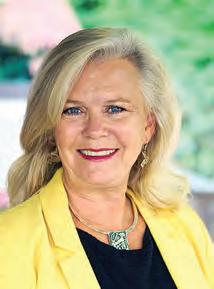
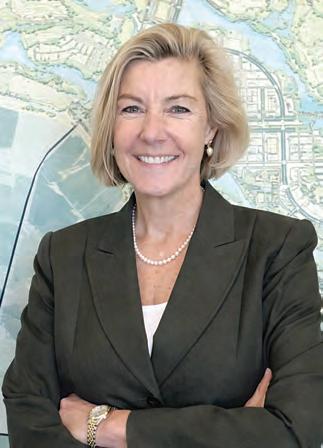
Susan Dell’Osso not only lives in the community where she works but she is literally building it.
Dell’Osso is the President of River Island at Lathrop Development.
She has been overseeing the transformation of the 4,995-acre Stewart Tract near Interstate 5, the 120 Bypass, and Interstate 205 from a San Joaquin Delta island that for a century was used for row crop farming into a 15,001home community.
degrees in economics from UC Santa Barbara thought she’d be doing when she accepted a job with a Big Eight accounting frm — Arthur Anderson — afer graduation.
Tree years later, wary of spending 30 percent of her time traveling, she accepted a job with Cambay Group. Tat was 38 years ago.
She started learning the entitlement end of the development business and was assigned to the Lathrop project.
I love everything about it. I work in the city where I live. Not many developers can say that.
“It’s so personal, I love everything about it,” Dell’Osso said of her job. “I work in the city where I live. Not many developers can say that.”
Nor can they say they are developing the largest planned community ever built in the Northern San Joaquin Valley.
It is not what the daughter of Dutch immigrants who was raised in Fullerton and earned bachelors and master’s
It took more than a dozen years to get River Islands to the point that dirt was being turned in 2011 and another fve years before the frst home was built.
To get to the point homes could be built on Stewart Tract, Dell’Osso has led a team of out-of-the-box thinkers that have done what few, if any, developers in the valley have done.
Put in place 200-year food protection without the need for federal and state permits or fnancial assistance by essentially creating a parallel levee and then flling in the gap to make it 300 feet wide.
Secured permits and built the frst road bridge crossing of the San
Joaquin River in 50 years.
Negotiated an ecological restoration plan that includes creating a food bypass that both the Sierra Club and state signed of on.
Established the Lathrop Irrigation District that supplies River Islands with electricity at rates below what PG&E charges.
Founded the River Islands Academies charter school system that in the past 10 years has opened a high school and three elementary schools. She also serves on the school board.
Designed and is developing the longest levee greenbelt with a paved bike path that will feature a paved 18-mile bike path that will not cross a single road.
And while doing that, 28 years ago she partnered with her husband Ron to start the Dell’Osso Farm corn maze and numerous other attractions that now brings nearly 200,000 people each October to Lathrop.
She has served on the San Joaquin Partnership board, an organization that actively seeks employers to locate in the county, for more than 20 years.
Dell Osso is a founding member of the Lathrop Rotary that was launched in 2002 and is president of the Reclamation District 17 Board. ●
By SABRA STAFFORD
AFebruary chill may settle over downtown Modesto, but inside the Gallo Center for the Arts, the Modesto Symphony Orchestra is preparing to ignite two nights of musical fre. On February 13 and 14, the MSO presents Scheherazade & Márquez’s Fandango—a program built on passion, storytelling, and the kind of virtuosity that turns a concert into an experience. At the center of it all is one of the most celebrated violinists of our time: Anne Akiko Meyers.
For Music Director Nicholas Hersh, now in his second full season leading the orchestra, this concert is more than a highlight—it’s a milestone. “It is difcult to put into words how excited I am for our upcoming performances of Arturo Márquez’s Fandango with violin superstar Anne Akiko Meyers,” he says. Hersh, known for his imaginative programming and dynamic rapport with audiences, doesn’t toss around superlatives lightly. But this piece, and this artist, inspire them. “Anne brings such vibrant and thrilling artistry to the stage,” he adds. “She is the originator and dedicatee of this astounding concerto… If you choose just one Modesto Symphony concert to attend

this season, this would be the one I’d pick.”
Te evening opens with selections from Margaret Bonds’ Montgomery Variations, a work rooted in the Civil Rights Movement and shaped by Bonds’ deep admiration for Dr. Martin Luther King Jr. Te music is refective, powerful, and steeped in American history—an evocative prelude to the emotional range that follows.
Ten comes the centerpiece: Arturo Márquez’s Fandango, a violin concerto bursting with the composer’s signature blend of classical form and the dance rhythms of his native Mexico. Meyers premiered the work in 2021 with Gustavo Dudamel and the LA Philharmonic at the Hollywood Bowl, and the piece has since become a sensation. Teir recording went on to win two Latin GRAMMY® Awards, cementing Fandango as one of the most electrifying new works in the contemporary violin repertoire.
For Meyers, the concerto is more than a showpiece—it’s a collaboration born from trust, artistic curiosity, and a shared love of musical storytelling. She has now performed Fandango more than 40 times with orchestras around the world, but her return to Modesto marks only her fourth appearance with the MSO. Local audiences will hear the work from the musician who knows it best, performed on the 1741 Ex-Vieuxtemps
Guarneri del Gesù—an instrument ofen described as one of the fnest violins ever made.
Te program concludes with Rimsky-Korsakov’s Scheherazade, a symphonic suite that has dazzled listeners since 1888. Inspired by the tales of One Tousand and One Nights, the piece is a kaleidoscope of orchestral color—lush, dramatic, and irresistibly cinematic. Its sweeping melodies and vivid character scenes ofer a perfect counterbalance to Márquez’s rhythmic freworks, creating a full-arc evening of musical storytelling.
Hersh, appointed Music Director in 2023, has quickly become a defning force in the MSO’s artistic identity. His national profle continues to rise—this season includes his debut with the New York Philharmonic and return engagements with major orchestras across the country. Yet his connection to Modesto remains grounded and genuine. He brings both technical command and a warm, approachable presence to the podium, a combination that has resonated with musicians and audiences alike.
Meyers, meanwhile, arrives in Modesto with a résumé that reads like a tour through modern classical music history. A GRAMMY® winner, she has premiered works by many of the most infuential composers of the past half-century, from Arvo Pärt to Philip Glass to Wynton Marsalis. Her career began early—she appeared on Te Tonight Show at age 11—and has since spanned more than 40 albums,

countless world premieres, and performances for royalty, heads of state, and audiences of hundreds of thousands.
Her artistry is matched by her versatility.

Anne brings such vibrant and thrilling artistry to the stage. She is the originator and dedicatee of this astounding concerto.
She has collaborated with jazz icons, avant-garde composers, electronic music pioneers, and even pop artists.
She has been featured in national advertising campaigns, inspired fctional characters, and appeared in
children’s literature.
Yet despite her global reach, Meyers maintains a deep connection to the communities and orchestras she performs with— something Modesto audiences will feel the moment she steps onstage.
With two performances scheduled—Friday, February 13 and Saturday, February 14—this concert ofers a rare opportunity to experience world-class artistry
in an intimate, hometown setting.
Whether you’re a longtime symphony supporter or a newcomer looking for a memorable Valentine’s outing, the MSO has crafed a program that promises emotional depth, exhilarating virtuosity, and a sense of shared celebration.
Tickets range from $23 to $103, with $15 student tickets available in person at the Gallo Center Ticket Ofce. For many, this will be the kind of performance that lingers long afer the fnal notes fade— a reminder of the power of live music and the joy of experiencing it together. ●

By CLAUDIA NEWCORN

FFor 50 years, cartoonist Charles M. Schulz created the immortal Peanuts comic strip, sharing witticisms and insights on life and humanity through the distinct personalities of his characters Charlie Brown, Linus, Snoopy, Lucy and more. When he passed away in 2000, wife Jeannie Schulz and his many friends and colleagues were determined to keep the joy and his legacy of laughter alive, and in 2002, opened a fascinating and fun Museum in Santa Rosa, CA.
A Cartoonist from the Heart
Born in 1922 in Minneapolis, MN, Schulz knew from the start he wanted to be a cartoonist. “It was the only thing he wanted to do,” Jeannie Schulz explained. “He used to say he had no other skills, so what else would he do?” An uncle nicknamed him “Sparky” afer the horse Sparkplug in the Barney Google comic strip, a name that would stick for the rest of his life.
In February, 1937, at age 14, he had his frst comic sketch published in Ripley’s Believe It or Not. It was of his dog Spike, the inspiration for Snoopy. In his senior year in high school, he enrolled in a correspondence cartoon course with the Art Instruction Schools, learning essential techniques. Afer serving in World War II, he returned to St. Paul, MN. His frst comic, Li’l Folks, appeared in 1947 in the St. Paul Pioneer Press. In 1950, he sold the comic to the United Feature Syndicate. Tey renamed it Peanuts, a title he never liked.
Tere is a saying that when people fnd their pas-
sion, success follows. Over the next 50 years, Peanuts would become a cultural phenomenon. By 1958, the same year Schulz moved with his family to Sebastopol, CA, the comic strip appeared in 400 newspapers. When he announced his retirement in 1999, the multi-award winning strip had grown to over 2,600 newspapers worldwide, with over 100 million readers.


“He was such a genius at those four little panels,” Jeannie noted. “He could fgure out how to take an experience he’d seen or overheard and distill it down. He used to say, ‘I have a repertory company (in Peanuts), and no matter what idea I get, I have a character who can play it out.’ Sparky was ofen asked, ‘Where do you get your ideas?’. He never bought or accepted ideas; he just created them out of his observations of people. I did contribute in that he took some of the stupid things he heard me say. I called him my Sweet Babboo, and he used it in the comic strip. Once he did that, I found that I didn’t use it anymore.”
In 1964, Schulz became the frst cartoonist to earn two Reubens, the most prestigious honor awarded by the National Cartoonists Society. Peanuts was on the cover of Time Magazine in 1965, the same year the beloved animated TV feature A Charlie Brown Christmas appeared – it would later win a Peabody and an Emmy. Snoopy and Charlie Brown joined the astronauts on Apollo X in 1969. More Emmy-winning animated TV specials followed, and an entry in the Guinness Book of World Records in 1984. Schulz was posthumously awarded the highest US civilian honor possible, the Congressional Gold Medal, in 2000. A Peanuts movie came out in 2015. 2025 marked the 75th anniversary of the comic strip’s publication, an event the museum continues to celebrate with its ’75 Years of Humor’ retrospective through March 18, 2026, which will be followed by new
and changing exhibitions. And today, Snoopy-themed merchandise is enjoying a surge in popularity around the world.
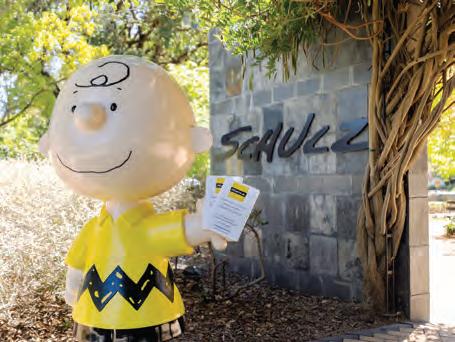
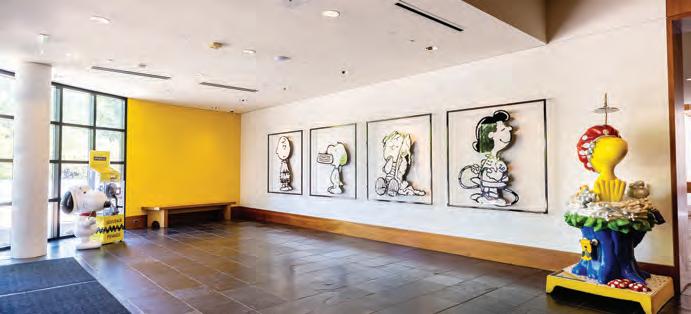
For lovers of Peanuts, there is no greater delight than a visit to the Charles M. Schulz Museum. “We wanted to create a welcoming place which not only preserves and displays Sparky’s cartoons and showcases his career,” Museum Director Gina said, “but also helps create an appreciation for and understanding of cartoon art and the illustrative process. We have an education center where people can try their hand a cartoons, changing exhibitions and programs, and more. Our Museum celebrates Sparky and his Peanuts family.”
“He was such a genius at those four little panels. He could figure out how to take an experience he’d seen or overheard and distill it down. He used to say, ‘I have a repertory company (in Peanuts), and no matter what idea I get, I have a character who can play it out.’”
Jeannie Schulz
At 27,000 square feet, the two-story Museum is designed for the young at heart of any age. Cushy sofas ofer places to fip through fascinating scrapbooks. Displays are designed for you to get up close, to learn about diferent artists and cartooning techniques. One of my personal favorites was seeing his actual work studio, relocated from its original location to its own room; be sure to watch the video where you can see him talk and draw his characters simultane-
ously, as if he were there at work.
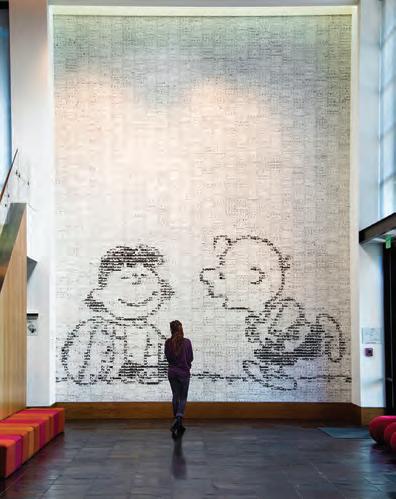
Tere are discoveries both overt and subtle. Gina pointed out the large tile mural where Lucy holds the football, awaiting Charlie Brown’s kick. Get up close, and you see it’s a collage composed of 3,588 Peanuts comic strips. Te zigzag parquet foor emulates Charlie Brown’s shirt pattern. In the Great Hall, the square-cut ceiling is designed to look like the four panels of a comic strip. A magnifcent wooden mural, “Morphing Snoopy”, reveals the genesis of Snoopy from real dog to dancing beagle. Outside, visitors can walk through the Snoopy Labyrinth and spot a real kite-eating tree clutching its victim in the upper branches!
Tere’s the nursery wall painted by Schulz for his daughter in 1951 in their Colorado home, subsequently buried by coats of paint, then rediscovered by a new owner who contacted the Museum. “She felt sure we would want this piece of history,” Gina said. “When she ofered it, we grabbed it and worked it into a permanent exhibit.”
Despite hobnobbing with royalty and celebrities, Schulz never forgot his roots. When the Santa Rosa ice skating arena was forced to close in 1967, he and his frst wife Joyce stepped in. Afer a zoning fght, the Schulzes were able to break ground on their ice arena in 1968. It took almost a year to build, opening in 1969.

“Tey loved skating there as a family and felt that it was an important part of the community,” explained Gina. “Once Snoopy’s Home Ice arena was built, Schulz would walk from his studio to the ice arena nearly every day for breakfast and lunch at Te Warm


Puppy Café inside the arena, and enjoy an English mufn or a tuna fsh sandwich. People would come up to chat.”
His table is still there, with a vase of fowers, and pictures from those meetings. Just beyond the ice arena is Snoopy’s Gallery and Gif Shop, with an array of Peanuts merchandise, and a small display of vintage memorabilia upstairs.
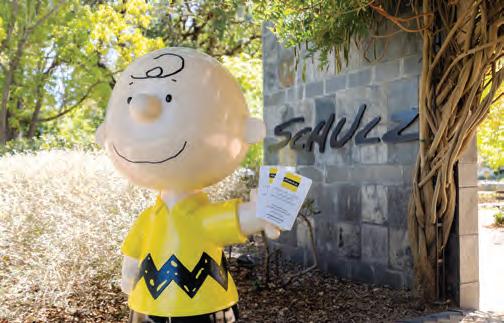
Scattered about the Museum’s campus are larger-than-life sized statues of Charlie Brown, Woodstock, Snoopy and more, perfect for photo ops. And all this is just for starters. A visit to the Museum can be an all-day afair, with ongoing events and exhibitions, special programs and more.
When the world shut down in March 2020, Gina and her team had to pivot fast when the Museum closed. Tey successfully transitioned the Museum to virtual programming and a curriculum by planning two weeks at a time, so as to be fexible and adapt activities as needed. Today, recordings of in-person talks by renowned artists, authors, and other special guests, and intimate virtual tours of current exhibitions are ofered exclusively to Museum members, enabling access to the Museum’s programs and exhibitions, regardless of location.

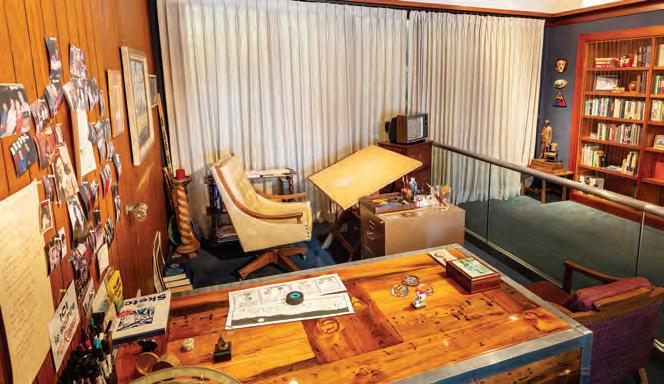
here’s your chance to discover everything you ever wanted to know and more about the characters and their “creator,” Charles M. Schulz.


So, here’s your chance to discover
everything you ever wanted to know –and more – about the characters and their “creator,” Charles M. Schulz. I guarantee you will enjoy this legacy of laughter, lovingly preserved by Jeannie, overseen by Gina and the dedicated Museum staf and volunteers. For more information on all there is to do and see at the Charles M. Schulz Museum, visit schulzmuseum.org.
schulzmuseum.org.




By KRISTINA HACKER
o need to travel to Napa or Sonoma for a romantic day of wine tasting. Te Lodi AVA right here in the 209 is California’s largest grape-growing community, making up roughly about 20% of California’s wine grapes, and is most famously known as the Zinfandel Capital. With 85 wineries and over 130 varietals grown in the region, local winemakers are showcasing some pretty unique wines that are sure to surprise everyone – from a casual taster to a dedicated decanter.
Te best place to start is to go to:visitlodi.com. Te tourism site ofers a complete list of wineries, upcoming events, places to stay, dining options and even recommended itineraries.
Here is just a few of Visit Lodi’s suggestions:
— When it’s time for a tasting, downtown’s seven wine rooms are calling. Jeremy Wine Co. is a great place to start—let their team pour you through a fight, then take your favorite bottle out to the patio.
white wine make for the perfect afernoon escape.
The Lodi AVA proves you don’t need Napa to enjoy worldclass wine.
— Food and wine are the perfect duo, and in Lodi, you can enjoy the best of both with the freshest local ingredients around. Whether you’re in the mood for a food and wine pairing or just want a tasty dinner afer a day of wine tasting, Lodi’s farmto-table vibe is everywhere. Check out spots like Americana House, Guantonio’s, and Pietro’s Trattoria for seasonally driven menus that go perfectly with a glass of Lodi wine.

— If you’re craving vineyard charm, head to Durst Winery just outside of town. Teir manicured gardens, friendly hosts, and crisp Amada Mia
— Climb aboard the Lodi Wine Trolley for a one-of-a-kind tour through wine country. You’ll visit three wineries, enjoy lunch, and soak up plenty of local

favor—literally. It’s a fun, laid-back way to experience the best of Lodi’s vineyards.
— Calivines Winery and Olive Mill has a newly designed tasting room, which opened in 2021, that is the perfect place to spend an afernoon sipping on fantastic wine, tasting incredible Lodi-grown olive oil, and enjoying a curated small-plate snack menu if you get hungry during your tasting.

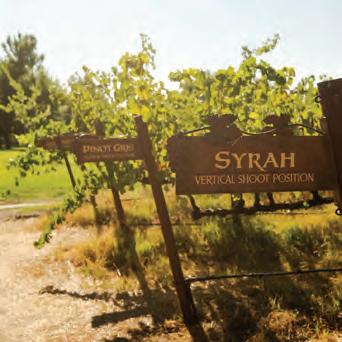

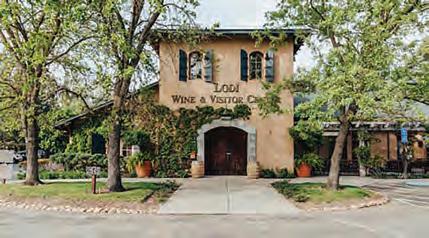
From tasting rooms to vineyards, Lodi ofers wine experiences that surprise every palate.
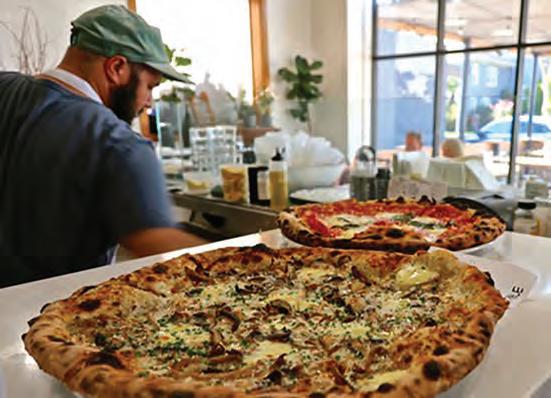
— Guantonio’s Wood Fired is a local favorite where the pizzas are hot, the wine list is stellar, and the desserts are impossible to skip.
— Interesting varietals to explore in Lodi include:
Albariño, a Spanish white wine available at Bokisch Vineyards.
Teroldego, a medium-bodied red Italian varietal, available at Peltier Winery.
Clairette Blanche, a white Rhône-style varietal available at Acquiesce Vineyards.
Assyrtiko, a Greek white wine varietal from Perlegos Family Wine Co., available at the Lodi Wine Visitor Center. ●
Celebrate 29 years of wine and chocolate indulgence during Lodi Wine & Chocolate Weekend, happening Feb. 14–15. This signature two-day celebration invites wine lovers to explore the Lodi Appellation, home to more than 85 wineries and over 135 grape varietals.
SATURDAY, FEBRUARY 14, 2026
Winery Tours
11 AM – 4 PM
Kick off the weekend with a self-guided “passport-style” tour through more than 30 participating wineries across the Lodi region. Your Saturday Ticket ($75) includes:
• A 15-ounce stemless wine glass
• A gourmet chocolate treat
• Admission and tastings at all participating wineries (must be age 21+)
Enjoy a full day of wine tasting, live music, and artisan chocolate pairings while meeting the winemakers and discovering your new favorite Lodi wines.
SUNDAY, FEBRUARY 15, 2026
Winemakers Toast
11 AM – 1:30 PM
Close out the weekend in style at the Winemakers Toast, held at the beautiful Appellation Lodi, Wine & Roses Resort and Spa. Your Sunday Ticket ($95) includes:
• A 19.5-ounce long-stem wine glass
• Tastings of red, white, rosé, and sparkling wines from more than 20 Lodi wineries
• Brunch-style small bites curated by the Appellation Lodi - Wine & Roses culinary team
• Artisan chocolate samples from CocoTutti Chocolates
This elegant, intimate experience is the perfect finale to your wine-filled weekend in Lodi.
• Explore the diversity of the Lodi wine region, featuring over 135 varietals and award-winning producers.
• Meet passionate winemakers, enjoy limited-release wines, and savor hand-crafted chocolate pairings.
• Support local viticulture— event proceeds benefit regional wine research, education, and marketing initiatives.
• Perfect for couples, friends, or anyone seeking a romantic and flavorful weekend getaway.
• IMPORTANT INFORMATION
• Both events are 21+ only. No children or pets permitted.
• Each day requires a separate ticket. Saturday admission does not include Sunday’s event.
• Plan ahead—parking is limited and tickets sell out early.
• The event is rain or shine.
Location: Saturday: Various participating wineries across the Lodi Appellation and Sunday: Appellation Lodi, Wine & Roses Resort and Spa.
For tickets, visit: bit.ly/3LivTEV


By SABRA STAFFORD
Jackson has a way of wrapping you in its charm before you even realize it’s happening. Te Gold Rush architecture, the slow rhythm of Main Street, the smell of fresh bread drifing from a tiny bakery—it all comes together to create a place that feels tailor‑made for a romantic day away.
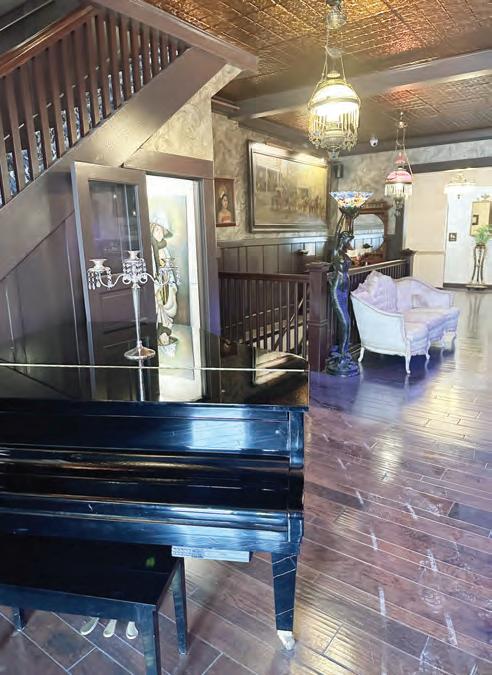
A perfect Jackson escape begins at Te National Hotel, the grand Victorian beauty that has anchored downtown since 1852. Restored with meticulous care, the hotel blends antique elegance with modern comfort, ofering couples a setting that feels both historic and indul‑ gent. Te Honeymoon Suite, with its in‑room Jacuzzi and freplace, is especially suited for a cozy morn‑ ing spent lingering over cofee and watching the light spill across Main Street. Te hotel’s long list of famous guests—Ulysses S. Grant, Mark Twain, and John Wayne among them—adds a layer of intrigue, especially when you learn Wayne once lost $47,000 in a poker game here.
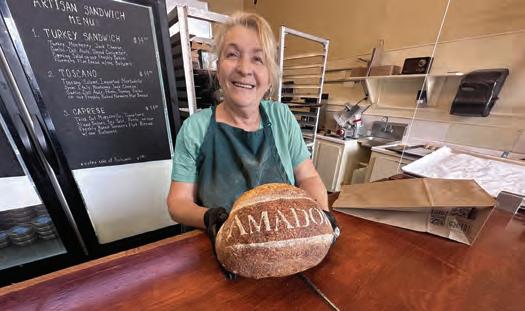
A short walk brings you to one of Jackson’s most beloved secrets: Blue Door Bakery. Known locally as the Serbian Bakery, it operates entirely by word of mouth. Tere’s no website, no phone number, and no fashy signage—just the irresistible aroma of bread made the old‑world way.
Owner Lana Zivanoviec learned to bake from her grandfather, uncle, and mother, and she still follows the same traditions today. Each loaf takes about 36 hours from start to fnish, shaped by hand and infuenced by everything from the weather to the mood of the starter. “It’s almost like taking care of a child,” she says. Te result is bread

Wrapped in charm, Jackson turns an ordinary day away into something timeless.
that stops people in their tracks, flling Main Street with a warm, rustic scent that feels like an embrace. Arrive early, bring cash, and don’t be surprised if you leave with more pastries than you planned.
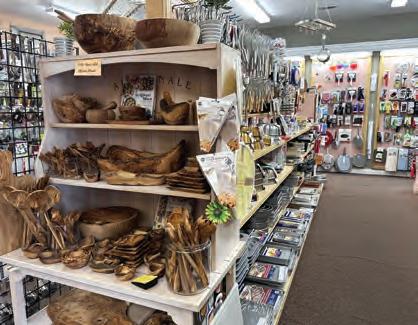
Te rest of the afernoon is best spent wandering. Jackson’s Main Street is lined with antique shops, artisan boutiques, and specialty stores that invite slow browsing. Te Celtic Knot and Volcano Glass Company ofer handcrafed treasures, while Te
Biggest Little Kitchen Store is a won‑ derland for anyone who loves to cook. Train Town Candies, owned by Terry and Barbara Wierschem, is a nostalgic delight with house‑made fudge, hand‑dipped chocolates, more than 90 favors of tafy, and shelves of puzzles and cookie cutters. It’s the kind of place where couples inevitably pick out something sweet to share later.
As evening settles in, Luka’s Restaurant becomes the ideal spot for a romantic dinner. Warm light‑ ing, thoughtful dishes, and a relaxed atmosphere make it easy to unwind. Te brie burger is a local favor‑ ite—juicy beef topped with buttery brie—and the chicken pesto pasta is rich, fragrant, and comforting. It’s the sort of meal that encourages lingering, talking, and savoring every bite.
When the night winds down, a stroll through downtown Jackson feels like stepping into a postcard. Te his‑ toric buildings glow sofly under the streetlights, and the quiet of the foot‑ hills settles over the town. It’s peaceful, intimate, and timeless—everything a romantic getaway should be.
Whether you come for the food, the history, or simply the chance to slow down together, Jackson ofers a day that feels both nostalgic and new, wrapped in the kind of charm that stays with you long afer you’ve headed home. ●









By RENEE EDWARDS


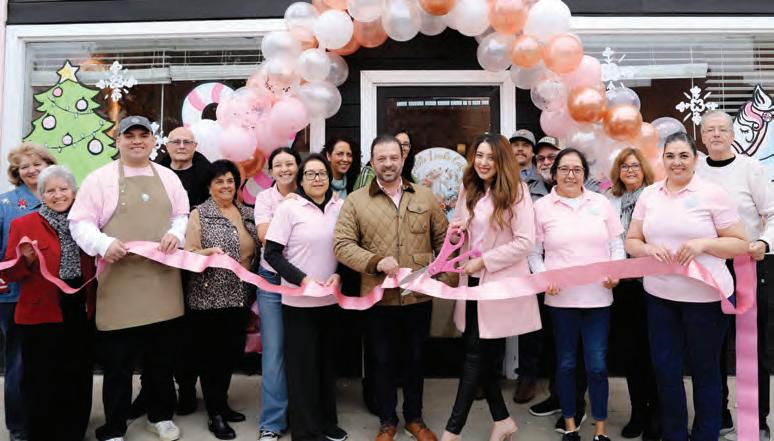

Cielito Lindo Cafe is more than a new business in town. For owners Alejandra and Rui De Silva, the shop represents a sevenyear dream rooted in afection and intention. “We believe in love,” Alejandra said, describing the inspiration behind the project. When the couple opened their doors on Saturday the 13th, they ofered Gustine not just a cofee shop, but a piece of themselves.
Te grand opening drew hundreds of residents, creating what the owners described as an emotional and overwhelming show of support. Local dignitaries, including the mayor, Chamber of Commerce and city manager, stopped by to congratulate the couple, underscoring the community’s enthusiasm. Inside, the cafe was designed to feel “absolutely heartwarming and friendly,” Alejandra said. The couple envisioned a peaceful refuge that feels like “walking into your family’s home,” and they achieved it with an elegant, comfortable interior meant to encourage guests to linger. For Alejandra, a Gustine High School graduate, and Rui, the goal was simple: create a cozy, beautiful space where people could gather from 8 a.m. to 8 p.m. and feel at home. The name Cielito Lindo, meaning “my sweet darling” or “my little love” in Mexico, reflects the couple’s philosophy. “This place has a lot of both of us,” Alejandra said. Even the White Horse logo is personal, honor-
A dream of love brought to life for their town.
ing the first horse the couple shared. Without traditional industry backgrounds, the owners leaned on their home kitchens and family traditions. Alejandra crafts each coffee drink herself, while the food menu draws from their Mexican and Portuguese roots. Signature drinks include the Churro Latte, the Cielito Lindo Latte and the White Horse Latte. Popular dishes include the Chicken Avocado Crepe and the Tostada Tamazula, made with ingredients from the small Mexican city of Tamazula. The couple said the most challenging part of the journey was navigating the permit process, which they joked was harder than their careers as a psychologist and a horse trainer. But the community’s reaction has made the effort worthwhile. Hearing customers say, “This is not a place that would be in Gustine, it’s so beautiful,” has been especially meaningful.
With free WiFi and outdoor seating, Cielito Lindo Cafe is positioned to become a community gathering place. The owners say they welcome suggestions for future events and hope to build a truly social, engaging space.
Alejandra and Rui are already seeing visitors travel from Monterey and San Jose to experience the cafe. Their hope is that Cielito Lindo becomes a destination—“a place so special that people from all over will say, ‘Let’s go to Gustine just to visit that beautiful cafe.’” For the couple, the shop is more than coffee; it is a dream of love brought to life for their town.●



SERVINGS
4-6
INGREDIENTS
1 beef tenderloin (4 pounds), wrapped with butcher’s twine
9 tablespoons olive oil, divided
4 teaspoons pepper, divided
1 head caulifower
5 shallots, quartered
2 teaspoons salt, divided
3 tablespoons lemon juice
2 teaspoons Dijon mustard
1 package (51 ounces) baby spinach dried cranberries, for garnish
DIRECTIONS
1. Heat oven to 475 F. Place beef on baking sheet. Rub 4 tablespoons olive oil and 2 teaspoons pepper into beef. Bake 12 minutes.
2. In large bowl, toss caulifower, shallots, 1 teaspoon salt and 1 teaspoon pepper to combine. Scatter vegetables around beef and bake 18-25 minutes, or until desired doneness is reached. Allow meat to rest 15 minutes covered in aluminum foil.
3. In medium bowl, whisk 3 tablespoons olive oil, lemon juice, mustard and remaining salt and pepper until combined. Add spinach; stir until combined.
4. Serve by layering spinach topped with caulifower and shallots then sliced tenderloin. Garnish with dried cranberries.

5
11 baking chocolate chips
1 baking peanut butter chips
3 tablespoons coconut oil, divided
1 pound fresh strawberries shredded coconut crushed almonds SERVINGS
1. In saucepan, add bak ing chocolate chips and two tablespoons of coconut oil. Melt on low to medium heat and whisk until smooth.
2. In a small bowl, add baking peanut butter chips and 1 tablespoon of coconut oil. Microwave in 30 second intervals until melted. Whisk together until smooth.
3. Line a baking sheet with parchment paper.
4. Dip all strawberries into melted chocolate. Then, dip 1/3 in coconut, 1/3 in almonds and 1/3 just chocolate and lay on tray.
5. Drizzle the melted peanut butter over the plain chocolate strawberries.
6. Put in the fridge for at least 30 minutes or until strawberry treats are chilled.

By ONE MUGGLE
By MATT JOHANSON

Two oil tankers collided beneath the Golden Gate Bridge in 1971, spilling 840,000 gallons of crude oil into San Francisco Bay and killing countless fsh and seabirds. Tousands of volunteers tried in vain to save the wildlife. John Francis, a 20-year-old Black environmentalist disgusted by the loss and sufering, chose another response: “stop driving cars” and “use my life for change.”
For the next 22 years, Francis walked everywhere he went to set an example that people can travel without fossil fuels and help the great outdoors.
Francis walked 1,000 miles from Marin County to Oregon and back to study the environment and earn a bachelor’s degree, exploring the Siskiyou Mountains and summiting high peaks as he traveled. He later completed a seven-year march across the U.S. while he earned a master’s degree and a doctorate in land resources.
rial Park; the six eucalyptus trees she planted still grow beside it on Octavia Street.
In the days before Yosemite became a national park, stage coach driver George Monroe helped three American presidents and countless others discover the incomparable valley. Born in Georgia, Monroe endured a childhood of slavery before his family was able to buy his freedom and bring him to Mariposa in 1856. Monroe developed an afnity for horses and worked for 20 years as a tour guide and stage coach driver.
He chose to walk, using his life as environmental change.
Francis does not ft the profle of a modern outdoor enthusiast who runs marathons or breaks records, but his exploits focused on improving the world rather than chasing personal glory, fame or sponsorships.
In honor of Black History Month, here’s a look at other African Americans who blazed trails in the outdoors.
Afer moving to San Francisco in 1852, Mary Pleasant planted eucalyptus trees and purchased and preserved a 1,000-acre ranch in Sonoma County that became the scenic Calabazas Creek Open Space Preserve. Tere’s no record of her climbing mountains or performing other athletic feats but Pleasant made up for limited outdoor credentials by overachieving as an abolitionist and civil rights crusader.
Pleasant led escaped enslaved Americans to freedom on the Underground Railroad and arrived in California one step ahead of the law which hunted her for that brave pursuit. A century before Rosa Parks refused to vacate her seat on a bus, Pleasant fled lawsuits which overturned segregation on San Francisco’s streetcars.
“My cause was the cause of freedom and equality for myself and for my people and I’d rather be a corpse than a coward,” wrote the socalled “Mother of Civil Rights.”
Pleasant’s admirers today can still hike through Calabazas Creek Open Space Preserve and San Francisco’s Mary Ellen Pleasant Memo-
“I have never known another such an all-round reinsman as George Monroe. He was a wonder in every way,” claimed his employer Henry Washburn.
James Beckwourth survived slavery in his native Virginia and made his way across the continent as a trapper, trader and scout. Te Gold Rush drew him to California, where he found a pass over the Sierra Nevada Mountains near Reno, and established a trail between there and Marysville. Te pass, trail and a nearby mountain all now bear his name.
Bufalo Soldiers, an all-Black U.S. Army
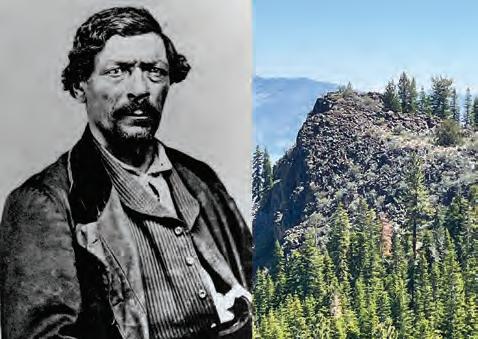


unit, supervised Yosemite in 1899 and then watched over Sequoia National Park in 1903. While there, they climbed 14,505-foot tall Mount Whitney and built the frst trail to its summit. “Te Mount Whitney country will convince even the least thoughtful man of the needfulness of preserving these mountains,” wrote Capt. Charles Young. A century afer Young became the frst Black national park superintendent, Sequoia named one of its magnifcent trees for him.
Te West has seen a rush of Black
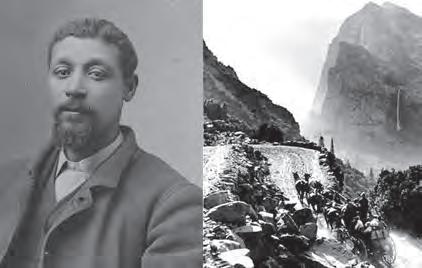
outdoor frsts, records and achievements in the 21st Century. Chelsea Grife accomplished a breakthrough climb on Yosemite’s El Capitan. Manoah Ainuu broke barriers in Yosemite and elsewhere while climbing on both rock and ice. Both Akuna Robinson and Elsye Walker completed not just the Pacifc Crest Trail, but also Continental Divide and Appalachian trails, which form long-distance hiking’s triple crown.
Yosemite Ranger Shelton Johnson revived the story of the Bufalo Soldiers who protected Sierra Nevada treasures. Oakland’s Rue Mapp created Outdoor Afro which has grown into a nationwide organization that encourages
Mary Pleasant planted trees in San Francisco, preserved open space in Sonoma County and fought tirelessly against slavery and racism.
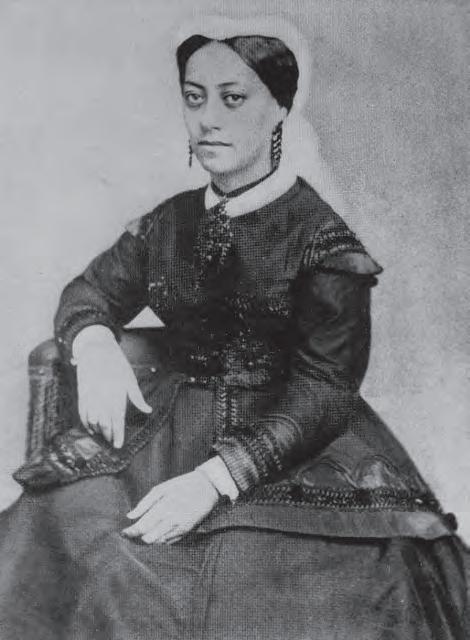
Black pioneers reshaped outdoors, preserving land, access, dignity, and possibility.
outdoor activity and fellowship. Distance runners Futsum Zienasellassie and Grace Kahura each won the prestigious California International Marathon in recent years.
Tese outdoors standouts and all Americans owe a debt of gratitude to California’s Black pioneers who led the way.
One of those pioneers still blazes trails. Afer his frst cross-country trek, Francis recreated his odyssey in 2005. He’s walked across Venezuela, Brazil, Bolivia, Argentina, and Chile, and taught and spoken to groups around the world. Now in his late 70s, Francis is walking 6,000 miles across the length of Africa, from Capetown to Cairo.
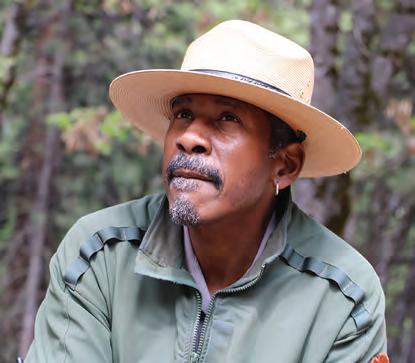
“Every moment of the present contains the seeds of opportunity for change. Your life is an adventure. Live it fully,” Francis wrote in his book, “Planetwalker.” ●


‘race’ you run on the road to better health
By DENNIS WYATT

The year was 1989.
I was the sixth bicyclist to complete a 12.5-mile route to reach the transfer point for the fnal leg of the Eppie’s Great Race team competition that was a 6.35-mile paddling event in the American River back to the start point of the initial leg, a 5.82-mile run.
When I was frst approached to be part of a team by a Youth for Christ pastor who at age 25 was seven years younger, I wasn’t interested at all.
Tere was a good reason. He was a former collegiate crosscountry runner and had the fourth best Amateur Athletic Union time his last season running as a teen in Northern California.
As for me, I was 32 and had been bicycling almost on a daily basis two years afer dropping 140 pounds. I had never competed in any race on a bicycle or otherwise.
I also was not athletic and I was average at best when it came to bicycling fast.
He fnally convinced me it would be fun.
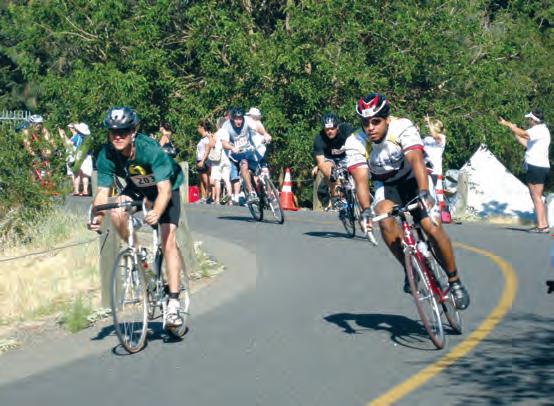
oranges into the ground loudly complaining we failed to fnish in the top fve in the team division.
His wife apologized saying her husband was an intense competitor.
As for me, I was ecstatic when I frst learned we fnished 14th out of 150 plus teams but was anything but joyous afer hearing from the guy we were nothing but losers thanks to the kayaker “ringer” not making an efort.
There is a diference between sports and simply trying to get ft.
Did I mention he also told me not to worry as he had a “ringer” for the paddle leg, a gentleman from Ukiah that a friend put him in contact with. Te “ringer” happened to have been on the United States kayak team at the 1956 Melbourne Olympics.
Te team runners took of frst on the land course that was along the American River Bike Trail in Sacramento.
My team’s runner — the youth pastor — was the second to reach the transfer point where the cyclists were waiting.
I felt really good that I completed the 12.5 mile cycling leg — more like a time trial than a road race — with only three solo competitors passing me up.
I pedaled back to the starting point to meet up with the other team members including the wife of the runner.
It wasn’t a joyous occasion.
Te runner has just fnished berating the 50-year-old plus kayaker who struggled on the water.
Te kayaker, a virtual stranger to the man who was verbally assailing him for his efort, said he didn’t need to listen to the rant and walked away.
Meanwhile, his tormentor and the guy that convinced me doing Eppie’s Great Race would be fun, slammed a couple of
I learned two valuable lessons that day.
One was that there is a diference between sports and simply trying to get or stay ft. It is a difference that obliterate exercising being fun or personally satisfying.
Te other was that one doesn’t have to be an athlete to be healthy.
In fact, if you think you have to compete in an organized sport, team or individual, to pursue a healthier and more active lifestyle — you are wrong.
You might channel Walter Mitty — the 1930s era adult male character created by John Turber who day dreamed of being a great athlete.
But you should never equate ftness skills to needing to be a successful athlete.
Te reason is simple.
If you tie your ftness and health success to doing well in a sport, it can be really easy to give up.
I did complete in one more competitive race afer that.

It was in 1991 at a criterium on a course near Turlock High that some friends talked me into doing.
I fnished dead last in the category four division of 17 riders. And I mean dead last by a wide margin.
I fnished 17th. It would have been 19th, but two riders a lot younger than myself were disqualifed afer they sat out three laps on the back side of the course and then jumped back in.
Exercising is a key part to pursuing lifestyle changes when it comes to health and ftness.
Over the last 30 years, my times whether it was running or bicycling or my skill levels at team endeavors such as basketball would qualify as less than stellar. Ok, let’s be honest. Tey were, and are, borderline pathetic.
But I have checked almost all the boxes when it has come to the right numbers whether it is blood work or heart rate thanks to exercise and diet.
I did that while being a
self-confessed klutz with suboptimal coordination.
I get that some people need to exercise with others whether it is bicycling or hitting the health club for an organized class.
I’ve done more than my share of organized aerobic and light weight lifing classes.
Tat said, I fnd the entire experience of doing anything that remotely calls for comparisons such as how fast you cover a mile running/jogging or bicycling on a road bicycle stressful and unpleasant.
You don’t need to measure up to someone else to improve health.
You don’t need to measure up to someone else to improve your health and ftness.
You just need to be consistent and dedicated to reasonable goals you set for yourself.
One does not need to run a fve-minute mile to be healthy or ft.
Nor do you have to be a weekend warrior.
What you need is to not set yourself up for failure.
And that means keeping it realistic.
Te game you need to step up is yours, not LeBron James’.
Tat means you need to walk frst.
If you’re walking, walk more, or walk faster.
And if and when you’re ready, perhaps try jogging.
Te “race” you run in life is not against someone else.
It is about you. ●


Stockton area luxury designer Kathleen Jennison, founder and principal of KTJ Design Co., had an exciting end to 2025 with two prestigious design awards.
The National Kitchen and Bath Association’s California Capital Chapter awarded Jennison 2nd Place, Small Bathrooms, for a project called “Enchanted Escape,” as a frsttime design awards entry.
“When our client frst described their dream guest bathroom, they didn’t ask for marble countertops or trendy tile, –they asked for magic. Their vision? A whimsical forest-themed retreat with a ‘wow’ factor, one that felt elevated and artistic rather than adolescent or over-the-top. Alongside this creative brief came practical goals: a more functional layout, better fow, and a dedicated space for a makeup vanity,” said KTJ Design about the project.
KTJ Design Co’s Enchanted Escape had an existing foor plan that was cramped and simply uninspired, with awkward plumbing locations, a useless linen closet, and zero room for a vanity. By reimagining the space and by removing the linen closet, their team was able to make room to relocate the sink to the opposite wall, which all opened the room dramatically. This change was aesthetic but also functional to allow for a makeup vanity that would accommodate more room for bathroom essentials, without expanding the footprint. We cleverly annexed space from a neighboring coat closet, turning lost square footage into daily delight.



Jennison described that designing with restraint and sophistication helped to ground the playful theme of the Enchanted Escape by installing classic materials with rich textures. From a marble mosaic tile foor that became the anchor for the earthy color palette of deep green, terracotta, black, and gold that her team used throughout the design. A tiled mural
over the tub delivers an unforgettable focal point, while terracotta wallpaper adds subtle pattern and warmth for this chic bathroom. Adding brass fnishes elevate the space to and play up the sophisticated elements when paired with carefully selected light fxtures for a boldboutique-hotel luxury feel. Further proving that whimsy and refnement


can coexist—when imagination meets intention.
“It’s a rewarding feeling, these awards delivery, and is especially meaningful because they recognize both creativity and how a space functions in real life. I’m proud of the work, and I’m grateful to the clients and partners who helped bring each detail to life,” said Jennison.
KTJ Design Co’s second recognition was by The National Association of the Remodeling Industry’s Sacramento Chapter, which awarded the frm the Judges’ Choice Award for “Mix, Mingle & Martini Project”- a lounge and dining room designed as a beautiful, entertaining-forward space.
“I am so grateful to have received so many awards over the past 15 years, and I have been a long-time member and past board member of NARI, so being awarded The Judges’ Choice Award is an extra special honor to me,” said Jennison.

Jennison was also recently honored to have one of her interior design projects featured in Designers Today’s October 2025 issue, “Designing for the Solo Set.” This project and article highlight a growing niche and segment in residential design, and was a featured discussion during Las Vegas Market in January on Armen Living’s showroom.
“As many young professionals are focused on their careers, before diving into family life and giving insights into a special kind of career-driven and single client that Kathleen has had success working with over the past several years.” Jennison shares, “The Solo Set, as I call them, they’re decisive, confdent but curious, and almost always overwhelmed at the start. They’re single — some recently divorced, some widowed, others never married — but all of them are starting fresh. And they’ve become my favorite kind of project.” ●




By CINDY WEINER
UC Cooperative Extension
Imagine a garden designed to focus on creating natural wildlife habitat. Why not eliminate turf grass from your own garden and replace it with trees, shrubs, perennials, and annuals that beneft wildlife?
Welcome to Naturescaping, a method of landscaping that allows people and nature to coexist. By growing appropriate plants, especially natives, and adopting a few new practices, you can attract insects, birds, and other wildlife to your garden. Naturescaping can help to replace habitat destroyed by urban development, while at the same time helping your garden ft better into the local environment. If neighbors cooperate to transform their gardens, together they can create wildlife corridors between disconnected natural areas. If you’d like to try this, here are some suggestions for naturescaping your own garden.
Reduce or eliminate your lawn. Lawns can provide an attractive surface where people and pets can play or just relax. But lawns consume a lot of resources, including large quantities of water for irrigation, as well as the energy needed to manufacture fertilizer and herbicides and to power lawnmowers. At the same time, lawns contribute little of value to wildlife.
Reduce or eliminate pesticide use. Because pesticides ofen kill benefcial insects along with the unwanted ones, they should be used very sparingly as a last resort.
Add native plants to the garden. Insects coevolved with native plants,
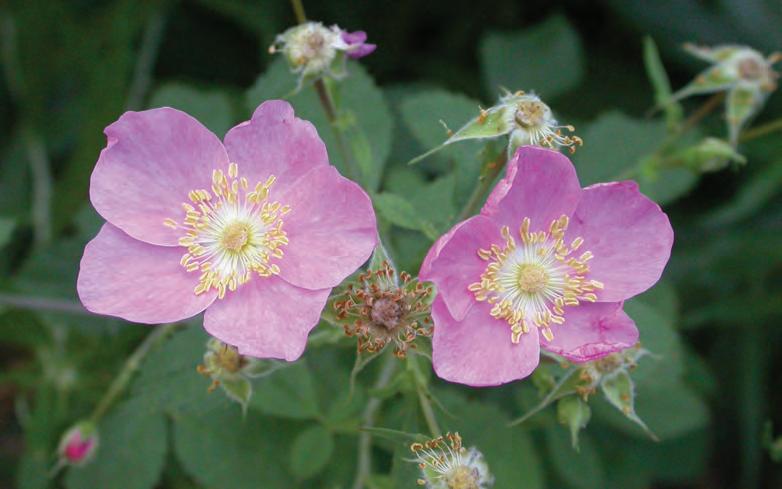
and those plants provide good quality food for them. Non-native plants don’t always contribute the same value to local wildlife. Native plants are also adapted to our local soils and climate. An example of native plants used to create attractive landscape element while providing habitat for wildlife.
Cindy Weiner
Be a little lazy and a little messy. Don’t be too quick to deadhead spent fowers, cut plants back, rake leaves, weed, or prune dead branches. If you allow at least some fowers to go to seed, those seeds will provide food for birds.
Create vertical habitat layers. Incorporate a variety of plant heights in your garden. Diferent critters will use diferent areas of a layered garden. California Pipevine ( Dutchman’s Pipe) is the host plant for the pipevine swallowtail butterfy. J. Alosi
Provide the critters in your garden with food, water, shelter, and a place to raise their young. While many pollinating insects are generalists in that they collect pollen and sip nectar from a variety of plants,
Naturescaping allows people and wildlife to coexist by replacing lawns with native plants that restore lost habitat.
some are specialists and forage at only one or a few plant species. Some butterfies and moths lay their eggs on specifc host plants.
Other resources:
Te Xerces Society has a list of California pollinator plants at: xerces. org/publications/plant-lists/ recommended-plants-californiacentral-valley-region
Te California Native Plant Society maintains Calscape, a database of native plants in cultivation along with their cultural requirements and pollinator associations. ●
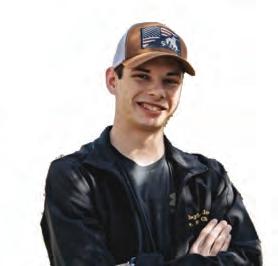
In an era where fewer young people are entering agriculture, Gustine-area student Baylor Bloom is proving that passion, determination, and a willingness to learn can still pave the way for a thriving future in farming.
Bloom, the young entrepreneur behind Full Bloom Harvesting, began operating a nut-harvesting shaker at just 14 years old. Afer spending his childhood working on his family farm, he stepped into a leadership role earlier than most — a decision that built both his confdence and the foundation for a growing business.
“I started Full Bloom Harvesting afer running this shaker for three years,” Bloom shared. “I knew I wanted to take on more responsibility as a high schooler. It was defnitely a learning experience the frst year.
From managing the machine to managing the business, there was a lot to learn with very little time and very little room for error.”
Bloom credits much of his early expansion to mentorship and the guidance of partners who helped him navigate the agricultural business world.
“My biggest factors behind this expansion were the support and wisdom of partners, and the knowledge I’ve gained of the industry,” he said. “Being armed with that knowledge allowed me to expand more quickly into new
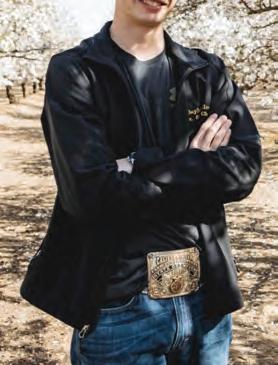
machines and cover more acres.”
Tat expansion has included purchasing additional harvesting equipment — a major responsibility for anyone, let alone a teenager still in high school.
“With the purchasing of a new machine comes a lot of responsibility,” Bloom said. “I’d be lying if I said it isn’t downright scary, but it opens doors for my business and my life. Owning a shaker shows people I’m established and reliable, and allows my business to grow at a pace I can manage.”
Bloom says the toughest part of running a business at his age is balancing school with feldwork.
“My biggest challenge was not being able to be out in the feld most days,” he said. “I had to learn to work around school and manage the machines well enough to step away for hours at a time.”
Despite those challenges, Bloom has grown Full Bloom Harvesting steadily each season, relying on discipline, careful planning, and a strong work ethic instilled by years on the family farm.
California’s almond and walnut industries — among the largest in the world — rely on highly specialized equipment that demands skill and precision.
“Almonds and walnuts take many steps to harvest,” Bloom explained. “Efciency is very important. Te
By ZACHERY RAMOS
biggest thing I do to ensure precision is proper operator training. Tese skills don’t come from videos and they don’t come easy. It takes years to master.”
Bloom also stresses the importance of maintenance.
“I keep the machines properly serviced. Less downtime means more operation time, and during harvest, every minute counts.”
As Bloom approaches graduation, his focus is on ensuring Full Bloom Harvesting remains stable as he begins college.
“Looking ahead, I hope to fully stabilize the business,” he said. “As I fnish high school and move on to college, it’s critical that my company is well managed when I’m not able to be there in person.”
Beyond college, Bloom hopes to continue expanding into additional harvesting operations and servicing more acres.
“It’s a balance between expansion and stability, and I’m learning every single day,” he said.
Bloom represents a promising future for California agriculture — one rooted in hard work, innovation, and a genuine passion for the land. As he continues to scale his business while fnishing high school, his story is a reminder that the next generation of farmers is not just preparing to lead — they’re already doing it. ●