










What it Takes to Get Your Foot in the Door
Amon Gray
Within Reach
Elizabeth Chin
America Far, Far Away: The Making of a Rogue Superpower
Lily Rogers

Winning Students Back from Gen AI
Madison Clowes



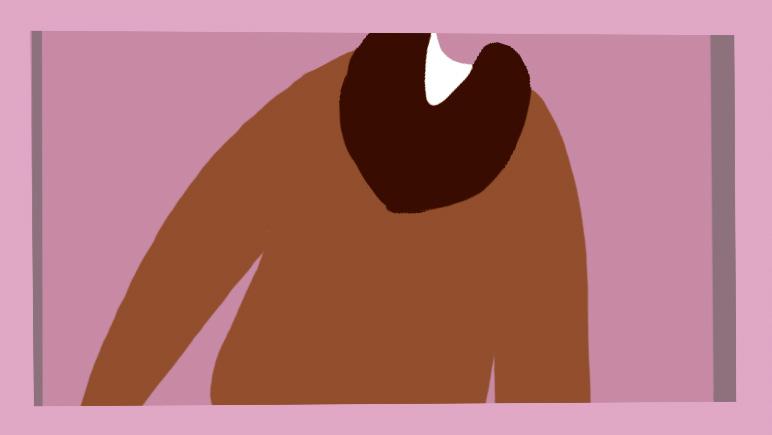
How To Dress Like a Tufts Student
Gigi Applebaum
Creative Inset
Jaylin Cho
My Weight in Gold
Rohaan Iyer, Nora Bitar, Sundari von Wentzel
Life in Limbo
Ben Maughan


Love Story
Veronica Habashy, Talia Tepper

You Are What You Eat
Taarini Gupta
On pith, my blown-out crotch, and the present delight Sadie Schmitz
The Observer in Stitches
Lucie Babcock, Wellesley Papagni

Emma Dawson-Webb 2 5 6 8 10 12 14 20 22 24 26 28 29 16 18
My Skin Will Wrinkle and Sag
Emma Castro
Trump’s “American”
Rebrand
Leah Glaspey
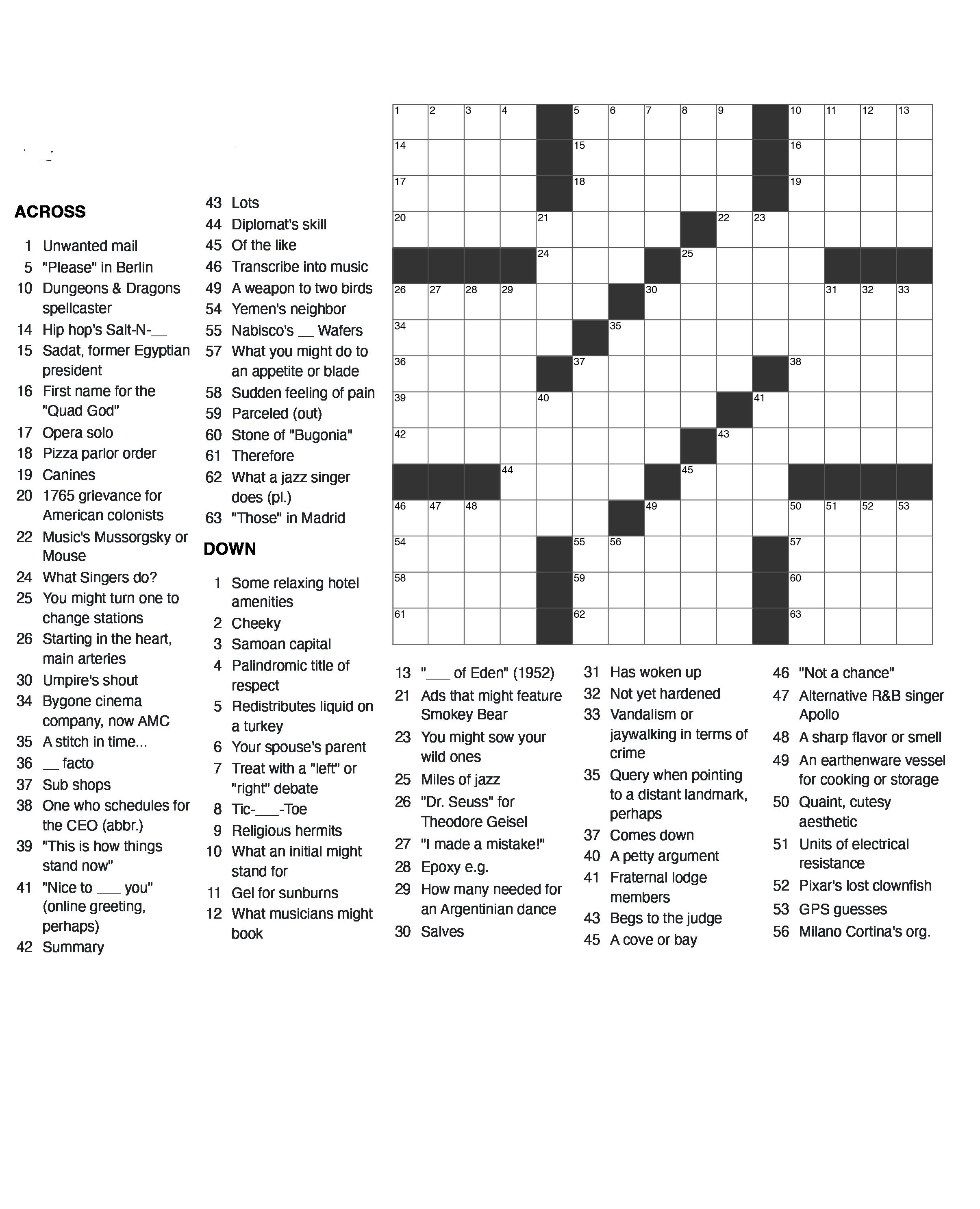
Crossword
Editors-In-Chief Caroline












Whitney

Ella


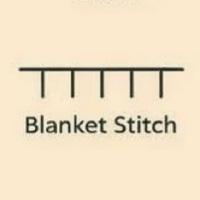
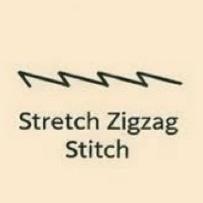
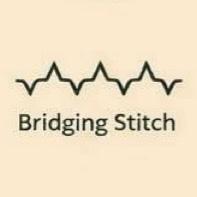
Row 1: slip 1 with yarn in front, drop an ish(ue), knit to end of row
Row 2: from left needle to right needle, peruse from 1895 to Mend(es).
Row 3: needle in the thread, gotta get you out of my head, repeat to last stitch, k1.



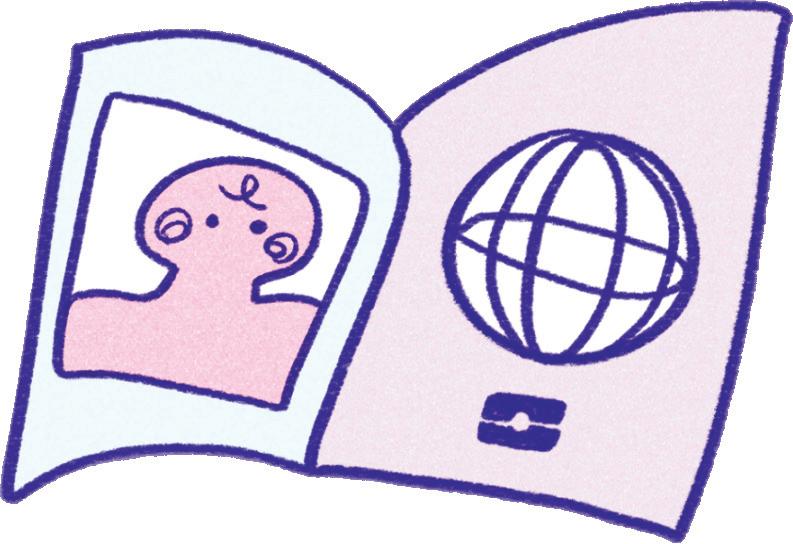
As the semester approaches its second half, plans for summer fun are overshadowed by frantic talk of internships and careers. Tufts students are now all too familiar with the same exhausting cycle: check Handshake, write another cover letter, refresh email, repeat.
The college internship is considered an essential part of students’ career paths. For students, internships are a way to gain necessary experience and connections in their chosen field, while employers see them as an important resume item for hiring after graduation. However, in recent years, the internship landscape has become more stratified, more automated, and more competitive. While some students have found success using the resources at their disposal, many have been disheartened and frustrated by the process.
The major obstacle students face when applying for internships is waning

By Amon Gray
supply and spiking demand. Internship postings on Handshake declined more than 15 percent from 2023 to 2025, while applications per internship surged to an average of 109 applications for 2024-25, as com - pared to 62 in 2023-24 and 43 in 2022-23. The fierce competition has some students feeling desperate and unable to stand out in the hiring pool, leading to a frenzy of mass applications, hoping something lands. This new hiring landscape is one in which a polished application and strong credentials are the norm, limiting students’ ability to explore other interests. Exploring a different career track takes essential time for building a strong application and background in a single field.
“It’s kind of a disheartening experience,” said Max Turnacıoğlu, a junior studying international relations. He expressed that the college internship appears to determine one’s future, but it has become so competitive that there are no opportunities to fumble around and figure out what you like and what you’re good at.
While Turnacıoğlu was accepted into a six-week fellowship in political theory, the program would mostly focus on rigorous educational experiences such as attending classes and seminars. Preferring to gain professional experience, he has continued to submit applications in the search for an office-style internship at a political think tank. According to Turnacıoğlu, IR follows the same hiring trends as other humanities disciplines: success often depends on the framing of experiences and leveraging personal connections.
Recruitment can also feel very openended due to more ambiguous hiring methods. IR lacks the obvious technical or lab-based skill markers, which are key indicators for hiring in STEM fields. While IR generally has a diverse range of career opportunities, including government, consulting, think tanks, and research, it is now a shrinking pool. Cuts in government spending have limited state internships as well as government-funded research opportunities. USAID terminations affected 12 Tufts-involved projects, while the NSF paused grant review panels and, in early 2025, halted new funding.

“I have no indication of whether this is gonna pan out, “I constantly remind myself, ‘knock on every door, all you need to have is one to open’. That’s cool, but I’m like, when’s one gonna open?”
the lack of feedback in his internship search, Turnacıoğlu has found himself casting a wider net to areas less aligned with his interests. This is not a unique experience, and the uncertainty of not having a definite plan for the summer weighs heavily across disciplines.
After an extensive application process, Boston-Blue Giovannini, a junior studying computer science and engineering, landed an internship at InterSystems, a software company specializing in data management. Yet, he has seen many of his peers in tech struggle to land desirable internships through standard applications.
“It’s definitely a big stressor,” Giovannini said. “I have a couple friends who I’ve been talking to throughout the process, and one of them had a few possibilities, nothing guaranteed. The first thing he got, he said, ‘I didn’t even really look at the specifics of pay or anything like that, because I just need something.’”
The tech sector has become the most competitive area of the internship market, with an average of 273 applications per posting, followed by financial services at 192 and professional services at 187. However, the work-life balance for some of the best-paying jobs in the tech industry is so strenuous that even the bestcase scenario can seem grim. Giovannini described entry-level jobs at Google and Amazon as having “golden handcuffs,” where employees earn good pay but must work grueling hours and are unable to quit due to rent prices in the area where they work. According to Giovannini, a lot of companies also expect specialized experience in AI or data management, which is particularly difficult for undergraduates to obtain while they are still working through broad, general coursework in their fields. This is especially true if they have taken time to explore other avenues and find a ‘perfect’ fit.
The lack of flexible time to explore their options becomes more exacerbated for students who alter their area of study. For example, junior Mikayla Joseph added the premedical track to her biochemistry major halfway through her junior year. Despite gaining biological research experience in the summer of 2025, Joseph worries that her medical school application will not be at the same level as peers who declared the premed track as freshmen.
“I think there’s an overwhelming amount of opportunities but also an overwhelming amount of people who are premed and people who have known they’ve been premed for a lot longer than me,” Joseph said. She expressed feeling immense pressure to gain the necessary experience for medical school, given that this will be her last summer before graduation.
In addition to the stress of gaining proper experience, automation of both the application and hiring processes have also left students feeling uncertain. The minimal human interaction between applicants and employers has raised concerns about the use of AI, both in the submission and review of applications. According to LinkedIn’s Global Talent Intelligence Report, 67 percent of organizations reported using some sort of AI in their recruiting process. Among these organizations, 41 percent use AI to screen resumes. With the increased automation of the application review process, many students are frustrated with the lack of feedback on their applications. Put-
ting time and work into an application and receiving no response at all is a common experience among students.
“I have no indication of whether this is gonna pan out,” said Nathaniel Kennedy, a senior searching for a congressional post-graduate internship. “I constantly remind myself, ‘knock on every door, all you need to have is one to open’. That’s cool, but I’m like, when’s one gonna open?”
Kennedy, who majored in political science, sees an internship in Congress as essential to his chosen career path. He has observed that the majority of those who land jobs as congressional aids have either done so through an internship or by working on a candidate’s campaign before they were elected. Given the small number of positions and high volume of applicants, Kennedy said his only avenue to stand out in applications has been through coffee chats with Tufts alumni.
While these connections are useful to all Tufts students, others are able to land internships through pre-established personal connections. Many advance their
career through roles gained through referrals by family or friends.
“Not everyone who gets a job that way doesn’t deserve it,” Giovannini expressed. “But it does open the door to people who haven’t worked for it to take the place of someone who has. It’s not always a bad thing, but it’s definitely a tough watch when you see it over and over again, and other people who maybe have worked pretty hard can’t stand out from the crowd.”
Additionally, financial concerns may affect the number of positions students can apply to. As budget cuts and uncertainty in government agencies such as NIH have reduced paid research opportunities, external funding has become increasingly important for students to support themselves through the summer. The Tufts Career Center offers internship grants; however, some students have found it difficult to secure those opportunities due to time constraints. For example, Joseph said she applied for a grant for her sophomore-year research internship, but the deadlines limited her ability to provide enough information about her position to submit a convincing application. Similarly, Turnacıoğlu said he would likely be unable to meet the grant application deadline even if he secures an internship.
Financial concerns, worries about automation, and increased competition have not diminished the importance of the internship in the post-grad job hunt. 70 percent of employers now opt for a skillsbased hiring process, which emphasizes internship and co-op experience. In the face of all these worries, students can turn both to their peers and to the Tufts Career Center for advice. As students at Tufts, applicants have access to unique resources
that can help them stand out in applications.
“Students don’t need hundreds of applications; they need a strong, targeted strategy,” wrote Chris Di Fronzo, Director of Career Services, in a statement to the Tufts Observer. “Employers are looking for the students who show genuine fit, preparation, and interest. A thoughtful well-aligned application has more impact than 20 rushed ones.
Additionally, Di Fronzo recommends focusing on 10 to15 roles that closely match students’ interests in each recruitment cycle, preparing thoughtful resumes and cover letters that do not rely on AI-generated language, identifying organizations to follow and engage with, and connecting with one or more Tufts employees at each organization.
According to Giovannini, the Tufts alumni network, The Herd, was a big help in securing his internship. After several chats with Tufts alumni, one referred his resume to InterSystems, which helped him land an interview. “I think my biggest piece of advice if you don’t know somebody is pestering alumni from your school that share your major or your interests. Of course, [be] very respectful about it, and [go] in with low expectations, and [know], ‘maybe I won’t get a referral, but at least I’ll get some solid advice from someone in the industry,’” he said.
Turnacıoğlu also secured his fellowship position by discussing it with a professor who happened to be affiliated with the organization and was able to nominate him. A political theory fellowship is one of many alternatives to office-style internships that students can pursue to gain the skills they need to demonstrate competence in their job search.
In a written statement to the Tufts Observer, Sheryl Rosenberg, Associate Director at the Tufts Career Center, said that students should think of internships not simply as titles or resume items, but as one of many opportunities to demonstrate traits such as “leadership, teamwork, coachability, communication, and technical fluency.” To demonstrate these traits, Joseph is considering a mix of different summer programs to gain more clinical experience, such as volunteering at a
hospital, gaining certification as an EMT or CNA, or taking additional classes. Students can explore such options at the Career Center’s “No Internship? No Problem!” on April 3.
The Career Center also addressed students’ financial concerns in their internship search. “Financial barriers don’t shut students out of competitive opportunities. With support and a creative approach—leveraging local roles, on-campus jobs, part-time paying work combined with an unpaid internship, research, community work, experiential learning programs, or project-based experiences—students can continue building strong, career-ready skills and meaningful pathways forward.”
While the internship and career market can appear bleak, students have resources at their disposal. In a market of uncertainty, the students who break through are those able to combine persistence with the right support. Despite the setbacks and new challenges, many are finding ways to adapt, build experience, and keep moving forward.

By Elizabeth Chin
Hardly lucid, I stumble from my bed. Distant screams and smoke bend around the cracked door, but none of it reaches me in my dream. The Earth’s core gurgles beneath my feet as I run down the hallway for the front entrance. I grasp the frame to propel me, looking out to see my mom and my siblings standing like piles of stones in their pajamas, staring back at the house. Black clouds litter the sky and glowing embers peek through the concrete. Everything slows. I glance back for my dad, tripping up the path as the ground fissures, spitting up molten material. It’s too late. My mom falls to her knees, watching our home split in two, my dad’s head peaking out from the door frame. I stay crumpled on the pathway. I’m afraid to look up. When I wake, it’s morning, and I can recall this lingering dream in which someone is always stranded on the other side of Earth’s will and testament, their figure swallowed in the black smoke. I sit for a moment before turning on my light and then sewing shut this portal to the unspeakable.
I had my first panic attack at age 10. I ran into my parents’ bed and wept in my mom’s arms. Salty tears soaked through the pillow and clung hair to my face. My mom embraced me, stroking the top of my head. She whispered, “Shhhh. You’re okay.” I rocked and kept thinking over and over, there can’t just be darkness in death. Still, I could only imagine the soul being separated from the body and crossing over into a space where no light could touch. I pictured being untethered in outer space, only there were no stars to guide you and no hands to

look down on. I couldn’t imagine a lonelier place. That was death to me: a condemned lonely existence. I kept mumbling to myself, “I don’t want to die.” Something inside me had awoken and begun scratching at my consciousness. I stopped shaking only when my body had fully exhausted itself. I fell asleep right there with empty tear ducts and crispy hair. The next morning I removed my aching body from her arms, rinsed my face, and never spoke about it again. That day I placed another stitch.
From then on, I convinced myself of reincarnation. I needed to believe in something. People don’t often talk about death or what it means when they’re still alive. In life, we think of death as subtraction, everything we risk to lose. I am grateful never to have lost anyone close to me. Without memories of my grandparents, I never understood through my childhood what it meant to reconstruct the image of someone who was gone, both the pain and the joy of that recollection. I think maybe that made my fear even larger. The sheer unknown of it all.
There was a period in my life years later when that fear of death turned into ideation. I thought being alone didn’t sound so bad, and I let the idea of death continue to tear its way through healthy brain tissue. After some months, I confessed to my sister in few words. She furrowed her brows and said, “No, you’re not really gonna do that.” I met her with silence and before promptly dismissing the topic, she told me to think of our family, our parents. Sheepishly, I darted my eyes and nodded. We

resumed our lunch conversation as normal and to this day, have never revived the topic. That day, her words registered something in me, a strange mix of regret and guilt for a fiction I had created in my mind in which my family was left behind. With that, I realized I couldn’t tell which of those existences—mine in space or my families on Earth—would be life and which would be death. I began sewing up all those rips and pulled real tight, knowing my family would embrace me in their arms and wrap those wounds securely.
The animation danced on the screen as bright music played out into the theater. Scenes of a woman and her baby bao made me smile. I turned to my mom to see she was already looking back at me. My eyes grew wide, but then the music slowed and turned to minor. The bao grew older and the mother lonelier. I burrowed my chin into my collar and lowered my eyes. With one foot out the door, the bao struggled to release his mother’s grip. I watched in one swoop as the mother grabbed the bao and swallowed it whole. Droplets dotted my sweatshirt. I was glad to be consumed by the darkness of the theater when the short had finished. I wedged myself down in the seat and kept my eyes forward for the entirety of the following movie.
Sometimes, all that emotion comes bubbling to the surface, putting tension on the sutures I have so carefully placed. They’re remnants of past ideas threatening to break through, yet it’s not the ideas themselves, but the recollection of what they meant that stretches me thin.



By Lily Rogers
From January 19 to 23, 2026, the global elite descended on a small Swiss town for the World Economic Forum—referred to by the town’s name, “Davos,”—to do something that has become surprisingly radical: talk to one another. Heads of state, CEOs, and political leaders alike gathered to hash out climate commitments, trade rules, and security frameworks, premised on the idea that solving the world’s problems requires coordination.
it feels it can abandon the very rules it once wrote .
“[The US is] still extremely powerful, but it’s now wielding that power in service to something different,” said Beckley. “Instead of upholding some kind of liberal order, it’s much more transactional and much more willing to act unilaterally—really just take the gloves off, even with allies.”
its power. The Trump administration’s response has been to signal that that era is over.
The same logic applies to allies. Under Trump, decades of complaints—beginning with Eisenhower and continuing through successive administrations—have boiled over. “[The Trump administration is asking:] ‘Why are we being taken for suckers?’” Beckley summarized. “‘Why are we the only ones really doing the heavy lifting to sustain a global order? Let’s get much more transactional with these countries.’”
This message plays as standing up for American taxpayers, which resonates with a domestic audience that has grown skeptical of foreign entanglements and globalist promises.
On January 21st, in the middle of that week, President Donald Trump took the stage at Davos. His speech touched on the usual ‘Trumpian themes’—opposition to renewable energy and skepticism of European allies—but also floated two proposals that captured something essential about this administration’s foreign policy posture: a renewed push to acquire Greenland and a proposal to establish a “Board of Peace” for the Middle East, which could eventually rival the United Nations.
The underlying belief is that America’s power is best preserved through unilateral leverage, rather than mutual dependence. Call it coercive unilateralism: cooperation isn’t built through institutions or long-term commitments, but extracted through demonstrations of power and pressure—tariffs, threats, or withdrawals from multinational organizations.
“It seems to me that the Trump administration’s foreign policy is: ‘Politics will follow my military means,’” said Consuelo Cruz, professor of political science. “‘I have military might, and therefore I will use it, and I will think about the politics next’.”
Michael Beckley, professor of political science who studies US foreign policy at Tufts, puts it more bluntly: the United States has become a “rogue superpower.”
“Rogue” is a term usually reserved for isolated pariah states, not the architect of the post-World War II order, underscoring the paradox of a nation so dominant
The administration’s approach rests on a distinction that often goes unstated: the one between power and authority. The US remains powerful; its economy is the largest, and its military reaches every corner of the world. But authority is different. Authority is earned when power is exercised with restraint, through institutions, or in consultation with others. It’s what makes otheWr nations seek out the US for guidance and support.
What this approach fails to account for, however, is the extent to which US allies are willing to resist American pressure when that pressure is decoupled from consultation, reciprocity, or shared legitimacy.


Though Trump has publicly vocalized his interest in the US acquiring Greenland since 2019, he has doubled down on his intentions during his second term as president. At Davos, he revived his interest in acquiring the Danish territory, calling it a “piece of ice.” While Trump insisted he wouldn’t use force, he demanded “immediate negotiations” nonetheless.
As Cruz put it, “Those who were powerful could always violate the rules. But there was a degree of restraint. There was a notion that the rules-based order is also in our interest, because it makes international relations manageable, and creates stability that is good for everyone, including the United States.”
Power, in the administration’s view, is simply possessed. Authority requires the restraint Cruz mentions, but the Trump administration is increasingly asserting power sans restraint—sans consensus.
What shocked US allies wasn’t the ambition, but the disregard for sovereignty norms. While hosting the Prime Minister of Greenland and Denmark, French President Emmanuel Macron stated, “Greenland is not for sale, nor is it up for grabs.”
However, on January 3, 2026, the US launched an operation in Venezuela that showed said disregard was concrete. American military forces captured Venezuelan President Nicolas Maduro and his wife, Cilia Flores. The two were transferred to a New York prison to face federal narcoterrorism charges.

The gap between power and authority is important because the US is trying to navigate a world wherein globalization itself has not meaningfully reversed. Supply chains remain deeply connected across borders. Alliances, however strained, persist. Energy markets, technological development, and security frameworks all remain structurally global.
For Beckley, what’s retreating is not the structure, but the US’ willingness to sustain it. Adversaries, he said, have long viewed America as unwilling to actually use
Though Trump framed the operation as a blow against dictatorship, the aftermath tells a different story. Cruz pointed to an underlying tension in the US approach, saying, “While you stabilize the country, the other thing that you’re doing is [stabilizing] the incumbent regime. [It’s clear] that the predatory nature of the incumbent regime was really not a problem for the United States.”
Even if stability were the goal, she added, democratization can-



not be imposed unilaterally. “A democratic transition is a very protracted process that involves everybody.”
The US acting without consensus is not new. The Bush administration invaded Iraq without UN approval in 2003, and the Clinton administration’s 1999 intervention in Kosovo went through NATO rather than the UN.
The Trump administration, Beckley says, is asking, “‘Why does the United States need UN approval?’… What matters is power.”
Reactions from other countries range from outrage over potential violations of international law to celebration—but regardless, the message was clear: the US will act when and where it decides, the process be damned.


Such unilateral postures have extended well into institutions that have long structured US alliances, and the results are increasingly contradictory. For example, Trump has repeatedly threatened to withdraw from NATO. At Davos, he suggested the US was paying “virtually 100 [percent]” for NATO. Hours later, Trump announced on social media that he had “formed the framework of a future deal” with NATO Secretary-General Mark Rutte, leading to the cancellation of threatened tariffs on European allies.
The whiplash is the point. By keeping allies off-kilter—not knowing whether the US will pay, stay, or punish them— the administration creates uncertainty that can be exploited for concessions. Predictability, in this framework, is a weakness. Unpredictability is leverage. The goal is not stable relationships, but continuous recalibration on US terms.
However, the strength of an alliance is
not based only on credibility, but predictability—the very characteristic the US has been considering conditional. Thus, allies respond in kind: they hedge; they make other plans; and the institutions binding the US to them begin to weaken.
Nowhere is the inconsistency clearer than in Ukraine. The US government has framed support for Kyiv as resistance to Russian aggression. But more recently, Trump has described aid as too costly, and questioned why Europe, collectively, has given Ukraine “much less [aid].”
Complicating matters further is Trump’s warm rhetoric toward Russian President Vladimir Putin during their August 2025 meeting at an Alaskan military base. The signal to European allies: don’t assume the US will be there.
The contradictions play out differently in the Middle East. Though Trump has publicly criticized Israeli Prime Minister Benjamin Netanyahu over the starvation of the Palestinian people during the war on Gaza, the US has historically supported Israel both financially and as a proponent for its statehood. As of February 28, 2026, the two countries have conducted joint strikes in Iran resulting in the death of Supreme Leader Ayatollah Khamenei.
The strike, and its subsequent elimination of a key adversary, was celebrated in
Washington. But as Cruz noted, the triumph was undercut by the circumstances surrounding it: the strike came while Iran was sincerely negotiating with the US through Omani mediators. “If you want to preserve your own reputation, you do not attack while someone is negotiating in good faith—because that is seen as a perfidious trap,” she said, “and yet it seems that’s what [the US] did.”
The question, after an escalation of this scale, is what kind of actor is the US becoming?
Not a weaker one. The US remains militarily, economically, and structurally powerful; it can still project force, kill adversaries, reshape markets. But power alone no longer guarantees followership. Authority, once assumed, now has to be claimed.
For Cruz, this claiming of authority through assertion rather than consensus carries costs that are already making dents in American diplomacy. “Friends and allies of the United States now know quite clearly that being a friend doesn’t protect you from maltreatment, insults, or extortion—because they can see what’s happening to the Europeans.”
The world is still trying to coordinate, at Davos and summits elsewhere. But during this coordination, the US is performing a rebrand, replacing the stars and stripes—once a symbol of leadership, freedom, and the future—with a new flag flying alone on its own ridge, watching the summit, and its allies gathered there, from afar.





By Madison Clowes
As generative AI has advanced into the cultural mainstream since the monumental release of ChatGPT in 2022, concern has emerged for how the technology will largely affect students’ ability to learn. A USC report found that, unless otherwise instructed by professors, surveyed college students primarily used AI to achieve quick solutions with minimal effort, making it a tool of convenience rather than intellectual growth. The USC report revealed a relative lack of preparation within classrooms to cope with the level of cognitive offloading that AI chatbots offer to students. Thus, universities like Tufts are beckoned to adapt academic policies and operational methods to confront the threat AI may pose to students’ ability to learn effectively.
On Tufts’ campus, students integrate AI into their academic practice with some variation. Lili Newberry, a senior studying English and philosophy, expressed that she uses AI minimally, to occasionally refresh her understanding of a reading or for spellcheck. Jesse Cool, a senior studying math and cognitive brain science, recently began paying for a premium subscription to Claude AI. He primarily uses generative AI for assistance with preliminary source-finding for research and generating code-based models for his math thesis. Cool said, “When it comes to humanities, it’s super different. I just do not touch [AI] at all.”
Neither Cool nor Newberry felt that, for the most part, rampant AI use had been noticeably or negatively prevalent in their classes. Though neither felt they had an unhealthy relationship with AI, both demonstrated a willingness to engage with the university’s academic resources. For example, Cool meets frequently with his thesis advisor to work through challenging ideas, and Newberry expressed a certain love for attending professors’ office hours. Newberry reflected, “It just feels nice to be
taken seriously—I look up to my professors a lot, so it’s nice to get that individual attention … [and] my professor is just gonna explain something way better than Chat[GPT].”
The kinds of interactions Cool and Newberry value with academic mentors are often among the first replaced with a chatbot. Newberry also works on campus as a Writing Fellow through the Student Accessibility and Academic Resources (StAAR) Center. She explained, “I think sometimes [students] ‘Chat’ things because of a lack of resources at their place of education, and because they want to get their [assignment] in. I think Writing Fellows, TAs, [and] all of these kinds of supplementary resources help make doing the work yourself even more possible.”
While the purpose and philosophy of the Writing Fellow program is not targeted at curbing AI use, their work may have the effect of doing so through its emphasis on writing as a process. Newberry elaborated on the Fellows’ methodology, saying, “I think all of this attention to the writer as a person and to their writing process shifts the pressure off of the output of the essay a little bit more.” Further, Newberry explained that shifting pressure from output to process often also serves to de-incentivize students from using AI.
Course instructors can opt their course into the employment of Writing Fellows. Amahl Bishara, Associate Professor of Anthropology, is one instructor who expressed appreciation for the space Writing Fellows create for conversations about teaching. “Writing Fellows is something that I’ve been [involved] in most semesters at this point,” Bishara explained. “I never write anything without revising it … so asking students to … write, talk to somebody, and revise, just seems like the right way to do writing.”
Professor Bishara has recently made revisions to the way she organizes her
classroom, in part motivated by a desire to discourage the use of AI. She began utilizing forms of in-person assessments in her classroom in the fall semester. She explained that, based on conversations within her department, many faculty “are moving towards more in-person [assessments], and it is mainly because of AI.”
Some faculty are returning to inperson assessments, while some are using exams for the first time, as is the case for Professor Bishara. She employs intermittent 30-minute written assessments throughout the semester, as well as smaller written reflections at the end of class. She explained that she “thought of it as a kind of a spectrum of ways of checking in.” While in-person assessments meet one need, Professor Bishara stated that “it maybe doesn’t fulfill all of the needs of what I expect students to learn in anthropology classes,” as her courses also make use of larger, summative writing assignments beyond the realm of class time.
Cool echoed similar sentiments, explaining, “I hate exams just as much as the next person, but I think that’s the incentive structure that will force people to use AI in a way that is most beneficial for their own learning.” Cool spent his junior year studying math and philosophy at the University of Oxford. He noted that he much preferred Oxford’s incentive structure and believes that universities in the US should move toward a system where in-person exams constitute the majority of students’ grades. He felt that cumulative in-person exams gave students the liberty to develop their own ways of internalizing knowledge while preventing AI use, which may inhibit one’s learning.
It may feel a bit unsatisfying to think that the best response to the progress ushered in by generative AI may be best met by a return to pedagogical tradition, especially one which mirrors the archaic institutional traditions that top

universities in the US have tried hard to break. Though, as Alex Herz, a senior studying English, argued, “It doesn’t have to be a return to tradition; there could be an evolution in the objectives of higher learning.”
Herz expressed that the framing and focus of higher education has potentially divorced from its original intentions as it has become increasingly career-oriented.
“You can’t extricate getting a degree from getting a high-paying job after [graduation], right? It gamifies education,” he said. In other words, university culture’s emphasis on post-graduation plans may put distance between students’ motivations and the actual process of learning, making assignments feel like a means to an end to be achieved as easily as possible. But, he believes that there must be ways to bring together those who want to acquire knowledge for knowledge’s sake, to better the world, and themselves. He theorized, “You can change the incentive structures within the classroom towards higher engagement-based learning for grades, or really, it’s about the deprioritization of grades.”
For many courses in the social sciences and humanities, students’ grades are determined predominantly by a few pieces of writing, which are supposed to exemplify their learning. Especially when an assignment carries so much weight, it can be easy to lose sight of why the piece is being written: to get a good grade and an eventual job, or to simply get better at critically thinking and writing, a ‘result’ which may manifest in less immediately obvious ways.
Herz noted that STEM as a field can be very results-oriented, which translates into the monstrous midterms and finals typical of a STEM education. But, for the humanities, things tend to work differently. “It’s like no one cares if you wrote the most incredible paper for your Faulkner class. No one’s going to read it—for the vast majority of people, it’s not publishable level work in the humanities,” Herz said. For many degrees, papers serve as practices of process and not products in their own right.
Sometimes educational structures favor hard results, negligent of their processes—a quality AI has well latched onto. While rampant use of AI by students has taken the spotlight in much discourse, what’s also pressing is the shortcomings it exposes in our educational structures and processes.
In some ways, the fix seems simple: resources and structures which better engage students. Tufts’ Writing Fellows and TAs constitute part of a network of academic resources that can prove influential to students’ conceptions of their education. Newberry touched on the rarity of resources for “listening to the students, letting them, and pushing them to think critically about their own writing,” noting that she believes it “encourages people to find value in learning and writing outside of their grade.”
In a post-pandemic social landscape, it may sometimes seem challenging to convince young people to lean on those around them, especially as AI chatbots offer a familiar, isolatory solution. However, in a culture increasingly driven by the interwoven ideals of optimization, isolation, and reliance on technology, it is important to reaffirm esteem in the power of real engagement with people and process. The college campus, responsible for bringing people of all ages together to cultivate
the next generation of thinkers and workers, feels like a pretty good place to start. Tufts has the opportunity to learn from the holes AI has poked in its educational structure, and from the bits which have remained strong. But as Herz asserted, “Everything is a resource issue.” Time and access are factors which limit people much more than a chatbot. But allocation matters, too. A university which reexamines the efficacy of its pedagogy and invests in students’ academic support and engagement is surely better off than one that doesn’t. And hey, maybe students will feel less likely to use ChatGPT, too.

By Emma Castro
Aunt Margaret got Botox in her forehead and looks ten years younger. Not that she needed it—she’s always been the pinnacle of beauty in our family. Now, instead of crawling up a third of the way on her forehead, the vertical mobility of her eyebrows is restricted to about a centimeter. The injections were tasteful. No fillers, just freezing agent. Only one syringe—natural, minimal, but effective, fabulous. She didn’t touch the delicate skin around her eyes, which still crinkled a bit when she smiled. She was beautiful at 60 and is beautiful at 50, too. Mom and Aunt Catherine keep making fun of her, but I know they’re now considering it for themselves. As will I, I’m sure, when the years settle crevices into my forehead.

I sat alone in the exam room for my annual checkup. Before the doctor arrived to check my vitals (and ask me how much alcohol and marijuana I consume in a week), my phone buzzed with a text from my best friend. One of our former classmates had died; her body had rejected the liver transplant she’d gotten a year prior. I knew she’d been born with a rare condition, the nature of which I’d never been close enough to her to ask about. But had she kept her own liver, her odds of making it into adulthood would have been unfavorable. During our school years, she’d taken occasional stays at the hospital, though they were brief and she always returned to school appearing unscathed. When she’d finally gotten her transplant at the end of high school, it was rumored to have gone remarkably well. I looked it up: for her condition, patients who receive liver transplants have a survival rate of over 95 percent. I suppose she was simply unlucky; her body had rejected its second chance at life. She was 18, give or take a few months.
When the doctor finally saw me, she told me my blood pressure and heart rate were higher than usual.

Big Fat Eyelids. Blepharitis. Blepharon is the Greek word for “eyelids” and itis refers to swelling, which is to say that the name for this condition is entirely descriptive and not at all explanatory.
Blepharitis does not have a single root cause, but in my case, it appeared to be vanity. After months of jotting down everything I put around my eyes, I deduced that flare-ups occurred only when I wore mascara for several days in a row. I had no choice but to stop, and only then did I understand the fragility of not only my eye-
lids, but also of my own beauty. It is when the body surprises us, through what seem like no more than chance events, that we are reminded that our physical forms are destructible, and our beliefs about those
The dermatologist gave me a thick ointment of hydrocortisone, a mild steroid, to apply during flare-ups. She advised me to never apply it too frequently or liberally,
Until the day my next-door neighbor had to shovel snow out of his driveway, he was the most athletic, adventurous, and spry 40-something I knew. Before then, his weekends consisted of rising before the sun to paddleboard on our local reservoir, climb some boulder, or crosscountry ski in the woods of our hometown. Just months before the injury, he’d hiked Mount Washington during a thunderstorm, forcing his begrudged teenage daughter along. (She tells me she still hasn’t forgiven him.) Post-incident, he had no choice but to take weeks off work, and since this was before the advent of Zoom meetings and remote work, he was condemned to spending those weeks ailing, resting, recovering, and reflecting on how the hell this could have happened to a man like him. The body is a dynamic, nebulous, and fragile thing. He’s recovered now, mostly. I never did ask him about the diagnostics of the injury, but I know he hasn’t touched a paddleboard since.

Mom swears by her new anti-inflammatory diet, which seems to consist of two primary rules: 1) avoid eating anything that would generally spark joy, and 2) replace those things with fashionable supplements advertised on TikTok

and Instagram. Each morning she mixes a scoop of collagen into her coffee, which she’s already enriched with a splash of her homemade almond milk. Chlorophyll water, turmeric and ginger tea, red jujubes and dates (I still don’t know if those are two different things). She’s convinced this new regimen has improved the burgeoning arthritis in her knees. We believe we can exert control over the body, that we can explain its every mechanism with science. She tells me this is the best she’s felt in a long time, that she can take long, hilly hikes with Willow without being sidelined by her pain. I wonder if it’s the regimen or the beliefs she’s instilled in herself as a result of it. She knows she’ll eventually need a double knee replacement, as evidenced by her father and Catherine, but she’s hoping to delay it as long as possible.

Ashley has a recurring dream in which she wakes up with her entire body covered in tattoos. She calls it a nightmare. They wrap around her limbs and neck, overbearing anchors and hideous neon flowers, impossible to conceal. But what frightens her most is their permanence. Unless removed by expensive lasers, tattoos follow us throughout our lives, carrying immutable stories of our past. I have three of my own, the largest of which sits on the inside of my arm, just above my elbow. Without sleeves over my arms, I cannot look at my hands without seeing it.
Four years post-ink-job, I notice its edges have bled. I swear it’s gradually crawling higher up my arm, despite the fact that I haven’t grown in six years. With time (and without Botox), my skin will inevitably lose its elasticity, wrinkle and sag. My arm will no longer feature a chunky crescent moon but an indecipherable ink stain that will have faded from black to blue. Even the things we accept as permanent adjustments to our body are not so.

My good friend once told me she hates the fact that she will perpetually live in the same body. She feels confined by this fact. I disagree with the premise of her complaint; I do not believe we inhabit the same body forever. But what’s worse: permanence, or the illusion of it?

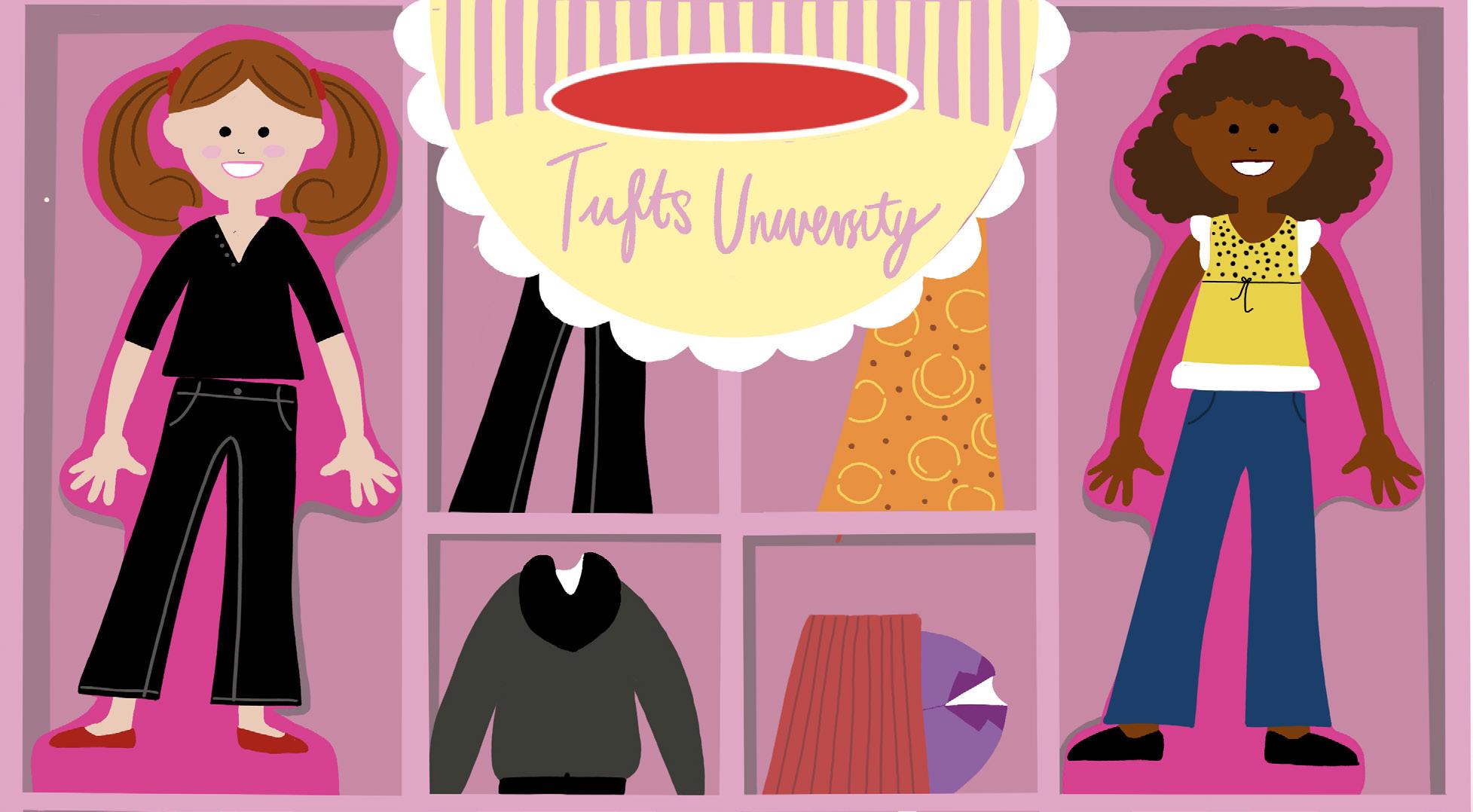
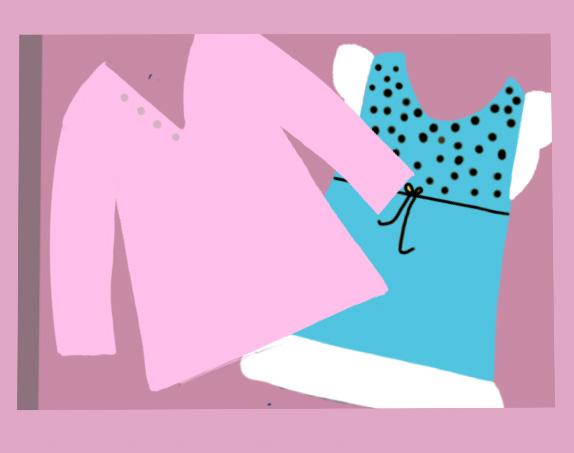
Tufts is, in many ways, the quintessential liberal arts college—small enough to have cultivated a distinct campus culture, but big enough to harbor a variety of students with diverse interests and personal styles. Bridging the gap between ‘crunchy’ New England college (think Wellesley) and Boston-area university (just take a trip along the Red Line), Tufts strikes a delicate balance. It wouldn’t be a very controversial statement to claim that there’s an identifiable Tufts ‘vibe’; looking around campus, it’s easy to spot a range of outfits and styles. Tufts has it all—casual Blundstone wearers, Brandy Melville loyalists, Carhartt-clad ‘indie’ identifiers, and everything in between. The school prides itself on having a student body of diverse individuals with uniquely interdisciplinary interests, and the eclectic mix of fashion on campus evidently reflects that.
That said, there’s a decided visual ‘Tuftsness’ to students, despite their specific fashion proclivities. Though not immune to the influence of popular trends, Tufts feels simultaneously distinct from our fellow liberal arts schools and glaringly
By Gigi Appelbaum
different from larger universities. This essence could be abstract, or it could boil down to the inevitable influence of communal living on college students. Maybe students don’t necessarily come to Tufts with a style reflective of the campus, but after months or years spent living within the community, they’re likely to adopt at least a little bit of Jumbo style.
Freshman engineering student Peter Wiehler agrees that Tufts students feel distinguishable when compared to people from other schools and environments. “[The Tufts vibe] stems from a certain level of alternative-wear. It’s a lot of thrifted clothes, a lot of older, more vintage pieces, a lot of leather boots, satchels, scarves of different varieties,” he explained. “You can look at someone and be like, that’s a Tufts fit.”
Wiehler attributes some of this distinctiveness to the influence of that communal living: “Coming to Tufts, if you look at the grades, you see a lot of seniors wearing those kinds of clothes, so there probably is some level of people kind of conforming to the Tufts identity.” Evidently,
time spent at Tufts has a way of seeping into students’ approaches to fashion and self-perception.
Lulu Knaebel, a freshman, also perceives a certain Tufts vibe, which she has termed ‘rat’—thrifty, artistic, and intentionally rough around the edges. For Knaebel, ‘rat’ is positive, and reflects the campus’ casually creative culture. “There’s an element of ‘ratness’ in people’s fashion here where they don’t care as much about looking completely put together,” she explained. “People are free to express themselves creatively.”
According to Knaebel, this atmosphere differs from other East Coast schools in a recognizable way. Having recently visited Yale, she described the vibe there as more put-together: “[Lots of] people have their hair curled, and people have cool fashion, but it feels more vintage than thrifted,” she said. That is, the Ivy League environment comes across as more stereotypically ‘preppy’ in a way that feels different from Tufts, despite the schools’ similar cultures of prestige.
Knaebel’s observations reflect many
Tufts students’ commitment to creativity in their modes of self-expression. With a large community of School of the Museum of Fine Arts students on campus, artistic influences on fashion are a given. That said, Knaebel admits that her perspective is limited by her own interests and by the generally artistically-inclined people she surrounds herself with. “If you asked someone else this, you’d probably get a completely different answer … These are the people who stand out to me,” she said. “Maybe I’ll find ‘rat’ people anywhere.”
Of course, the Tufts ‘vibe’ does not exist in a vacuum, whether influence comes from neighboring schools, general trends, or simply the weather. As the months get colder, students’ fashion grows more homogenized, as is the case with all winterburdened schools. A change in weather has a way of simplifying the outfits of even the most creative dressers—when it’s 10ºF out, it’s hard to avoid overshadowing your outfit with a big puffy coat. During colder months, the influence of broader winter fashion trends might become more readily recognizable on campus. As the frost settles in, so does the ubiquity of Super Puff, North Face, and Canada Goose coats— notably expensive brands, which often hold social capital amongst the upperclass students of expensive universities. A stroll through Boston might have observers more readily distinguishing people in terms of their fashion age groups, rather than their school affiliations. A Tufts student might become indistinguishable from someone from Boston College, Emerson
College, UMass Boston, or MassArt. But how distinguishable were they in the first place?
Commonalities between the fashion choices of similarly-aged people are unavoidable—trends are generationally dependent. That said, social media as a broadly influential force in the lives of most Gen-Z students has undoubtedly had an impact on this homogenization. There’s a reason that fashion trends seem relatively similar, regardless of what part of the country you’re from, and why Knaebel said the only really significant difference

in style she’s noticed since moving to Tufts from California has been the impact that the cold weather has on her outfit creativity. Aside from the obvious weather influences on fashion, major trends evidently follow generations more than they do geography. Per usual, social media is a likely culprit.
Apps like TikTok and Pinterest are always ripe with fashion inspiration, fed to consumers through stylish influencers, season-dependent trend PSAs, and endless advertisements for popular stores. In a way, these influences make campus fashion a relatively reliable reflection of what’s ‘in’ with college-aged students. But ultimately, there’s no one singular set of trends that applies to everyone, and even social media recommendations are tailored to the interests and personalities of their audience. Recent years have seen the increased power of algorithmic advertising—where once your feed was only populated by people you followed, simply engaging with a post now has the power to sway what you see when you scroll. Sizebay columnist Ester Bazzanella writes,“By promoting what’s already popular and what consumers already like, algorithms can create fashion echo chambers.” However, depending on people’s general personalities and environments, the echo chambers they enter could be different. While Tufts might not be immune to the digital influence of fashion trends, it’s certainly home to many facets of popular fashion.
These fashion niches tend to follow the social outlines of interest-driven social groups, though it’s hard to say whether similarly-dressed people simply gravitate towards each other and towards similar interests, or if they’re actively asserting influence on one another. People’s proclivities are often reflected in their attire—if you have hiking boots, you might want to join the mountain club; if you’re already in the mountain club, you’re going to have to buy hiking boots.
Wiehler has noticed these visible social distinctions. “If you go to the Crafts Center, you see people dressing alternatively. If you go to frat parties, you’re
gonna see frat dudes in leather slippers,” he explained. “It’s kind of a chicken and egg question. Do people dress the same in certain clubs because they assimilate to the culture, or are they already dressing the same and they just came together because of similar interests?”
That said, Tufts students often transcend the stereotypes associated with their social affiliations. Wiehler, for example, is an engineering student, but integrates artistic elements into his distinct personal style. Maybe that’s what sets Tufts apart: not a rejection of or variation from generational trends, but a more diverse mixture of them, reflective of the diversity of our student population. Many universities are more conventional in their fashion: my sister attends University of WisconsinMadison and described campus style as overwhelmingly mainstream, characterized by sweatpants or jeans paired with hoodies, and claw-clip updos. Though this style is definitely present at Tufts, it’s not the only trend students follow—Jumbos are comfortable expressing their unique styles, even if those styles might fall into certain categories popularized by social media subcultures.
Ultimately, fashion at Tufts both unites students and sets them apart from one another. The way people dress demonstrates who they are as individuals, and how they wish to present their personalities. The outward-facing nature of fashion is uniquely capable of bringing like-minded people together, and might go so far as to encourage people to associate with certain groups that may align with their personalities and interests. Jumbos’ styles are as diverse as the students themselves, and there’s an aesthetic niche for almost anyone on Tufts’ campus. On the undergraduate admissions website, Tufts identifies itself as “intellectually playful,” perhaps a euphemism for ‘quirky.’ It’s not hard to see why—a pervasive sense of self and the consequent impulse for self-expression is as visual as it is internal. If anything connects our fashion choices, it’s authenticity, of which Tufts has no shortage.
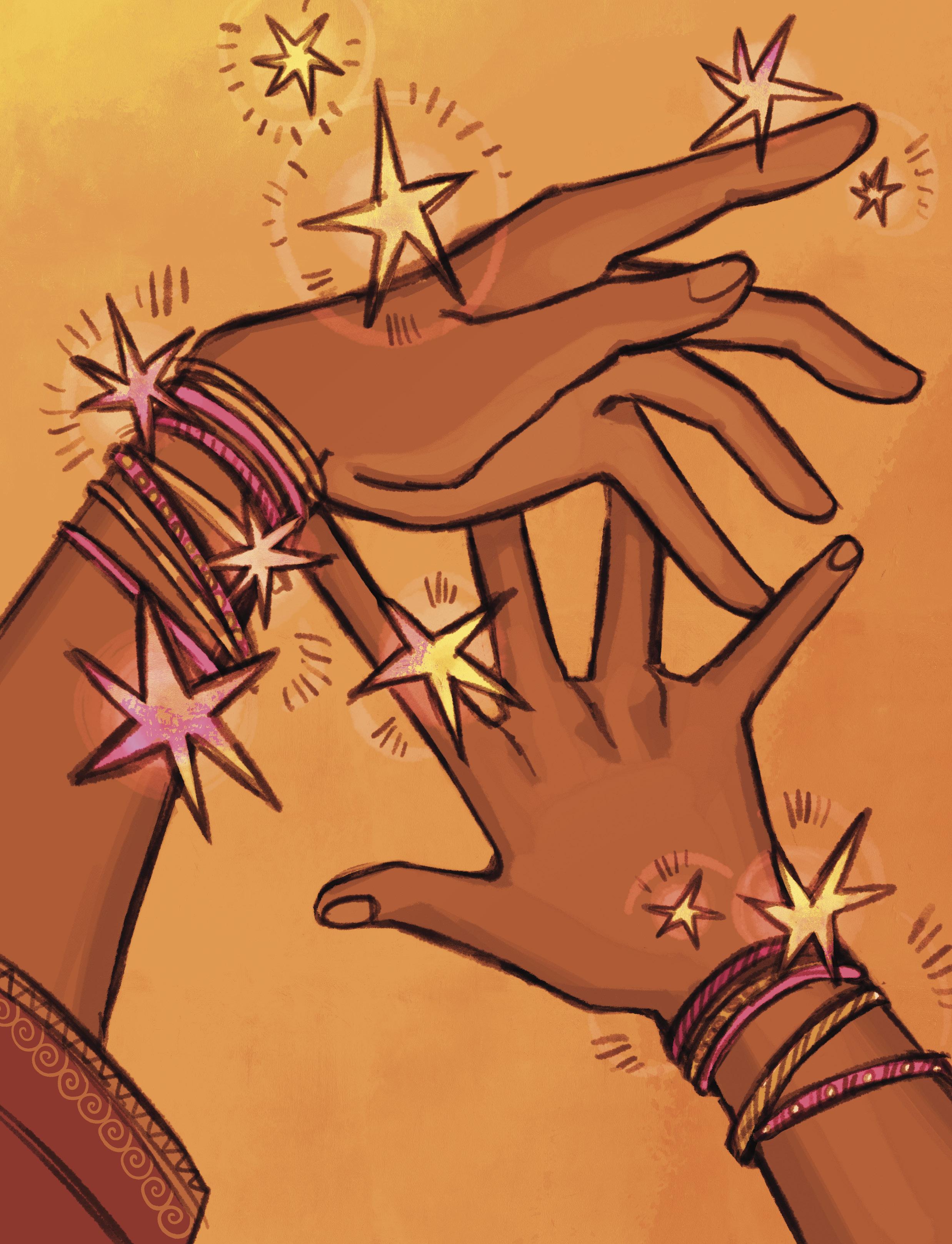


By: Rohaan Iyer, Nora Bitar, and Sundari von Wentzel
“This one?”
“Mast,” says Thatha, his crinkled eyes and head raised; he smiles in a deep way, a way I know I’ll only understand when I’m his age.
I grin with my teeth as I fix the two gold hoops to my ears, their weight tugging my lobes to the earth. How long have I waited for this?
The spiritually clean streets of Chennai track down from urban to sprawl, Thatha’s flip-flops slapping against my heels emit dust with each step, the soles simultaneously too wide and too short for my feet. Patti and her sister (my other patti) lead the way to the temple. Their ankles and toes are adorned with yellow glimmers that catch and create light. A stud in each of my pattis’ right nostrils
“Will you marry me, Elaine Killebrew?’
Thomas implores her with these six words, his brown eyes wide open. The sting of the war is still a raw pain gnawing at everyone’s bones, but she says yes to a church wedding one day after Christmas, two weeks after her graduation. All she owns are some pennies stuffed in her skirt pocket saved up from a stingy shoe-shop job. But she feels like the world is at her fingertips in a way it never has been for anyone else. She has a pent-up energy inside of her, like time is running out, like if she doesn’t leave now, when The War is over—when she is free—she will be stuck there, in Alabama forever.
Elaine flees with Thomas on an overcrowded train to New York City: her
completes the ensemble of their brightly colored saris and dangling gold pendants. We approach the altar of Hanuman and kick off our chappals, making our way barefoot to The Vendor who sells garlands, holy grass, and jaggery (vellam). Her off-white teeth are offset by the gold adorning her ears. After a brief exchange of money and smiles, we enter. Aunties broaden their chests, their life savings hanging around their necks and spiraling up their arms, the mass so much they should sink right into the temple floors, but they won’t. They drag along their resistant children who have yet to don these ornate pieces of art. The priest approaches me with plated fire and I sweep my hands over it and onto my head, my spirit becoming the luminescent orange-yellow of Agni, my sacred flame. In the glow, I can see my inner-bhagwan, my inner-god (my mom says bhagwan is everywhere and
one way ticket to freedom. She marvels in the whispers of a generation with a reckless hope spilling out of all of them like a volcano overflowing with magma, burning and giddy. All Elaine carries with her is her heart, a tiny diamond ring, and an electrifying uncertainty of what her life will become. The stubbornness of her youth protects her, fueling her unflappable yearning for adventure and her need to leave her banal hometown behind. She shudders when she thinks about it: brothers and uncles lost to a calamitous war, years of patching up cardigans and cutting up vegetables in Anniston, Alabama.
“Just live,” Elaine always said. “Just go places, do things.” She never understood her parents or her siblings, planted in Alabama. She knew that she was meant for something more profound. With a baby in her stomach and two at her hips,
lives inside us) absorbed and augmented, light refracting into life-giving heat. The same brightness that Thatha says I have. “You’re so smart, Kunjulu. Make sure to study hard.”
Surrounded by the jewels and brilliance, all I can think is, How do I become
a cent to her name. She was 21 years old when she left and never came back. Why would she?
I see my great-grandmother’s ring now, fixed on my hand. It’s encrusted by my birthstone: a tiny garnet, red like a pomegranate stain. I don’t know what happened to the diamond. I hope it’s lost somewhere far away, between sea glass at some overcrowded beach in Santorini, or tucked behind the crook of a painting at the Louvre. I see Elaine in my head telling me with her kind eyes, her short curly hair and her white knit sweater, “Go. Go somewhere, do something, be someone.” I carry her spirit on the little gold band on my right ring finger, her spunk, her dogged insistence that she was meant for something more than the world decided. Just live.

“The golden pheasants have left the nest.”
The call crawls over censored, contraband radio. Translation: The Nazis are evacuating. Cascades of Russian bodies are nigh.
What do you scramble for? Photos? Jewels? Papers? What is worth its weight? What can’t you bear to lose? Do you methodically pluck predetermined items? Or do you frantically pillage your vanities, hope chests, floorboards, grasping all you can carry?
Run hurriedly into the darkening January skies. Clutch your son’s quivering palm. Cradle heirlooms to your chest, gasping as frigid metal shocks already shivering hands; this is the harshest winter in 100 years. Wind whistles through speckled poplars, bark peeling off like Nazis fleeing this cold corner of Europe.
One day, this place will be called Poland, but now, it is 1945 in East Prussia and you are afraid.
Actually, you are lucky. You were not executed in the town square when your uncalloused hands revealed your education to then-new Nazi officers. Your contraband radio went undiscovered. You have a horse-drawn wagon; you will not be one of thousands fleeing on foot. You surge across the River Oder just minutes before a man throws himself and a hand grenade atop the sole bridge, dooming the wailing refugees on the other bank. You are not shot point-blank by the Russians who discover you curled around your slumbering son—they only fling your fair-haired boy over hay bales like a sack of grain. You kiss his bruises, cornflower blue, quieting your hidden child like Queen Louise. You thread his curls between your fingers. You treasure the sunshine.
Actually, I am lucky. From the warm embrace of the American sun, I trace the jagged scars in the worthless imitation gold you carried under your breast. What made these earrings worth ferreting to Neusgattersleben? Possibly duty. Perhaps the shade of red.
I consider it evidence. A testimony to your forgotten, frantic flight. You were caught between two engorged armies, enemy to both sides—neither Nazi nor Russian occupation meant liberation. You watched men descend on dead horses with curved knives and smelled the sharp sting of iron rain as men in Allied uniform shepherded emaciated men in thin, striped uniforms westward. This centuries-old mockery of gold is your legacy, the sole vestige of five hundred blue Prussian winters hanging crooked on my ears. The weight is a reminder: you choose what you carry. You remember. You move forward.
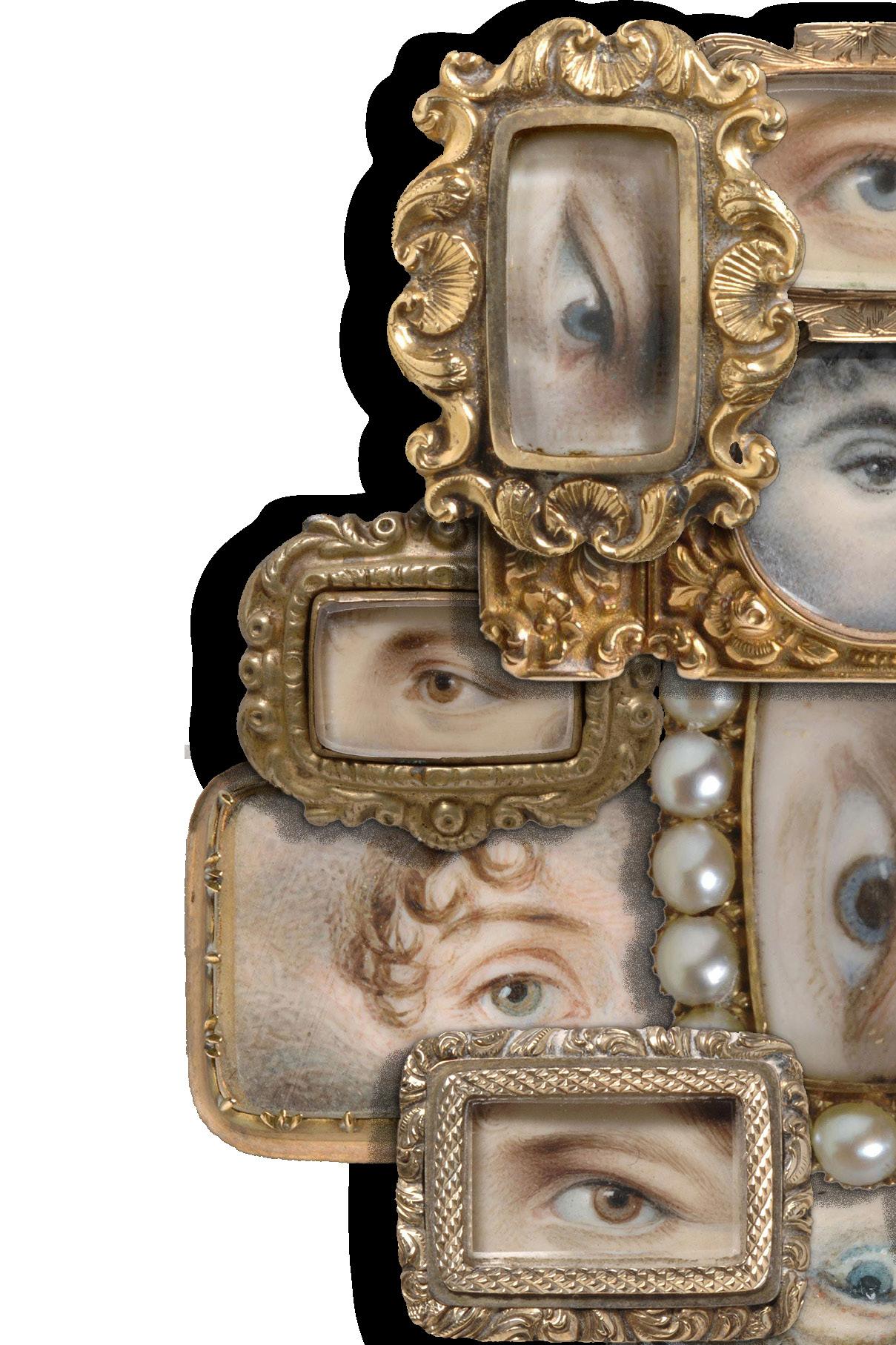
By Ben Maughan
Life as a Tufts student can be a balancing act. We are, for better or worse, a school of overachievers. We fill our days with as many classes, library lock-ins, club meetings, and extra shifts as possible. Students balance these commitments with social lives that are often equally as rigorous, squeezing in time for friends, family, and themselves. Losing a loved one or struggling with the grief of a heavy loss can violently upset students’ carefully constructed balance, adding a new dimension to an already formidable environment.
Nobody emerges from a loss completely unscathed, and getting help, traditionally or otherwise, is crucial in easing the burdens on a bereaved student. Tufts students experiencing grief lean on both official and unofficial resources to see them through their darkest hours: from counseling services to the Dean of Students Office to student organizations. There is no shortage of avenues for support, on paper at least, but the unsympathetic pace of most students’ lives can make using these resources challenging in practice.
Bereaved students seeking to ease their academic burden will interact most with the various arms of the Dean of Students Office, according to an interview with Carmen Lowe, the dean of academic advising and undergraduate studies for the School of Arts and Sciences. She highlighted the Advising Deans as students’ goto resource for assistance and encouraged students to meet with them as soon as possible when experiencing a loss. Lowe said, “The Advising Dean will try to determine how close was this person to the student, and how impacted is the student” before they “contact all the student’s professors
and the student’s advisor on [their] behalf” to reschedule exams and excuse absences.
For Lowe, flexibility and allowing students to process their grief is key to her office’s response. “Depending on the loss and the student’s own reaction to it, we’ll try to be sensitive to how much support the student need[s], how much flexibility, [for] how long,” Lowe said. This amenable attitude toward grief’s irregular effects on students aligns with sophomore David Kane’s experience. Kane, who recently lost a close family member, said, “[It] will just randomly make me emotional out of nowhere … I find myself sometimes, even when I’m not thinking about it, [it] makes me more emotional or heightens other emotions.”

For Kane, time with family has been key to his recovery process, saying the loss of his relative “made [him] think about [his] family a lot,” and that he has been “feeling closer with them.” The Dean of Students Office encourages students experiencing loss like Kane to spend time with family, even if it takes students off campus. “Academics coming second … makes total sense,” Lowe stated. Especially if “the loss of that person and wanting to be with family is so pressing.”
In practice, however, this flexibility has limits.

Lowe emphasized that while every situation is different, “one of the things with the academic flexibility is usually it is short-term … up to a week.” Long enough, in most cases, Lowe said, for students to get back on their feet and begin attending classes again. If a bereaved student, two weeks on, is still struggling, especially after a particularly crushing loss, Lowe said her office “might talk about a




leave of absence.” This kind of leave, however, has major implications for both a student’s academics and finances. Lowe specified, “if the student initiates this [leave] on the last day of classes, or before the last day of classes in the semester, we will basically withdraw them from all their classes so there’s no academic impact.” This leave would effectively erase a student’s work for the entire semester. What’s more, if leave is initiated in that time frame, students and families will be on the hook for the semester’s tuition, unless they opted into tuition insurance. Lowe acknowledged that students who would be financially responsible for tuition during a possible leave would likely be under pressure to finish the semester out, even under the weight of grief. On tuition insurance, Lowe said, “One of the things we don’t want to see is someone who’s really, really grieving, really unable to focus, and they feel like ‘I paid all this tuition. I have to finish this semester.’”
A time limit on flexibility leaves grieving students in a predicament where a failure to move forward with grief swiftly may erode the academic support they receive. Feeling a need to move on with grief is something Doctor Stefan Jadaszewski, a staff clinician with Tufts’ Counseling and Mental Health Service, said does more harm than good. “We commonly receive the message that our job as grievers is to ‘accept’ and ‘move on’ from a loss,” Jadaszewski said, “but in reality, grief often does not have a tidy endpoint.”
Dr. Jadaszewski noted that loss will affect everyone differently, saying that “there is no ‘one size fits all’ approach to grief,” highlighting that grieving college students experience a unique set of difficulties. “Being a student often means being far away from family or community support networks, often at exactly the times when that support may feel most needed,” he said.
Dr. Jadaszewski further lauded how CMHS tries to support bereaved students by “making support readily available when needed” with “individual therapy,
group therapy, and referral assistance.” Non-emergency individual therapy appointments, however, can be hard to come by, often having long wait times and sporadic availability, according to an article published in The Tufts Daily. Dr. Jadaszewski, who co-facilitates Tufts’ “Coping with Loss” support group, sees group therapy as an accessible, weekly alternative to individual therapy, sharing that “grieving students find that processing their feelings in a collective setting can be especially helpful.” However, Dr. Jadaszewski acknowledges that this too has scheduling constraints. “It can also be hard for many students to find spaces where discussing the impact of a loss feels welcome and acceptable, all while managing the demands of college life,” he said.
An anonymous first-year student, who lost a parent late in high school and has attended Dr. Jadaszewski’s support group, enjoyed their experience. This student had little initial trouble accessing group therapy, saying, “I just searched, like ‘grief tufts’ and the coping with loss group came up. I emailed [Dr. Jadaszewski], and it was really easy.” The student commented that their experience was a positive one, saying, “I felt from just the group like my needs were met. It was taken very seriously.” Corroborating Jadaszewski’s account of scheduling woes, the student shared that the reality of college life eventually resulted in them dropping the support group from their schedule. Even though the student finds group counseling to be vital for “[keeping] track of [their grief] and not [letting it] get pushed aside with the rest of [their] life,” they felt that they had to put this part of their recovery on pause, saying, “It didn’t work with my schedule.”
In place of formal counseling this semester, the anonymous first-year student has found support from student groups that provide a less structured alternative to CMHS’ offerings. Specifically, the student described how their experience with the Tufts chapter of Kessem, an organization that provides programming for children who have a parent battling cancer, helped them connect with other students coping with grief outside of a clinical setting. “[I] regularly interact with people who have
also had some experience with cancer,” they said. “I think [it’s] nice to talk about it more, and kind of have a group of people for that aspect of my grief.” While they appreciate the community of Kessem, the student expressed an openness to pursuing clinical support again when their schedule allows, saying they “may return [to the grief group] sophomore year” but would need an amenable schedule to do so.
College is a place where many students are on their own more than they have ever been before. Dr. Jadaszewski mentioned that one of the most common challenges he sees students experience is “the sense of aloneness that sometimes comes with grieving as a college student.” The resources students look to for support in an often lonely time will vary, but Dr. Jadaszewski said, “We want to empower students to feel able to make their own informed choices about the supports that are right for them.”
With or without easy access to official resources, Tufts students still work to stitch themselves together after a loss. This does not mean, however, that grieving students are completely on their own just yet; Kane shared that following the news of his loss, he went to puppy yoga with a friend, saying, “it was really nice. Just being there and hanging with puppies … I cried a little bit, and luckily my friend was there … helping me out.”




By Leah Glaspey

Throughout his political career, President Donald Trump has established his platform through distinctive branding. Before running for president, Trump was notably inexperienced in politics, which complicated trust surrounding his campaign. His first campaign made use of his status as a businessman and his appearances in the entertainment world to create a parallel sense of security among the American public—a tactic he carried into the White House. Trump relies heavily on notions of status to legitimize his position in power, and the longer he occupies office the more overt his marketing strategies become. His red baseball cap and golf polo brand have turned into grand architectural projects, titles of major federal infrastructure, and plastic surgery fads.
In the first year of his second administration, Trump oversaw a complete aesthetic redesign of the federal government. Centering the resurgence of an American golden age, he vaguely references the US’s economic prosperity and global prowess in the 1950s. A central strategy of the second Trump administration is the development of his branding while openly discussing the intended impacts of changes to come. Trump’s “America First” disposition facilitates the further development of military technology while simultaneously committing to a more intimidating foreign policy agenda. Executive Order 14347, signed in September 2025, changed the name of the
Department of Defense back to the George Washington-era Department of War. This serves as a landmark example of how Trump is cultivating a more aggressive facade for the state. In the order, he described that “The name ‘Department of War,’ more than the current ‘Department of Defense,’ ensures peace through strength, as it demonstrates our ability and willingness to fight and win wars on behalf of our Nation at a moment’s notice, not just to defend.” Trump clearly expressed the purpose behind the name change: to assert a willingness to take a more aggressive stance in the global sphere.
White House briefings that introduce his Peace Through Strength initiative describe that the tactic “ended conflicts, dismantled threats, and rebuilt U.S. military dominance, making the world safer for Americans and restoring respect for the United States on the global stage.” This open acknowledgement of dominance is a different approach than most US presidents have taken since the end of World War II. While American leaders have initiated military conflicts since, the actions are typically guised under the language of inevitability. The renaming of the Department of War takes unapologetic ownership of the proactive approach.
This agenda is further perpetuated by the media strategies used by different federal agencies under the Trump administration to share events aligned with Trump’s Peace Through Strength initiative. In the days following the beginning of US military action in Iran, the official Department of War and White House Instagram accounts made a joint post featuring a headshot of Secretary of War Pete Hegseth looking straight to the camera with the line, “If you kill Americans, if you threaten Americans anywhere on Earth,

we will hunt you down without apology and without hesitation and we will kill you,” in white text with key phrases bolded in red. Nothing on the post refers to a specific conflict, but generally instills fear during an era of political tumult. The administration’s actual actions are undoubtedly important to watch, but thus far, its news-breaking policy decisions have been precipitated by changes to their language. War is undoubtedly an attentiongrabbing display of authority, but many of the choices the Trump administration makes impact small details that rarely garner notice. These details, when combined, change the tone completely. The specific graphic design decisions made by the administration do just that.
Emma Thurgood, a creative professional with over a decade of brand and marketing experience, noted that when deciding the appropriate visuals for a graphic branding, “intent is really important, and important to any branding and marketing anywhere is the way that you want the person receiving that to feel after they’ve seen it.” When creating graphics that summarize texts or convey dense information more legibly, Thurgood shared that she “will try to find whatever the strongest statement is within that document with all the text,” and she specifically loves to “lead with bold, short, polarizing statements” that create a strong response from the viewer. Put simply, the key strat egy for producing marketing is to catch the viewers’ at tention and sow sentiments aligned with support for the product being marketed. In the political context, candidates and public officials are often treated
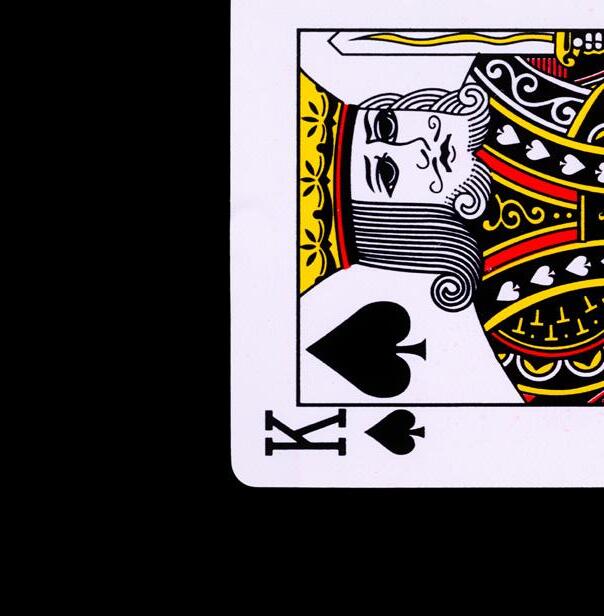



like products being marketed within the tions and legislative to sensitive decisions, legislation, can become keting. Thurgood shared that, doing branding and marketing work is to sell something. As long as you’re not lying outright, you’re in a more acceptable gray area of the truth in advertising.” She further iterated that she “would love to always be designing only using truth and facts, but that doesn’t sell—feelings are what sell, and that’s something that this administration has leaned into very well. They sell feelings.”
In terms of graphic design, changes to fonts have been among the most minute yet impactful. The State Department’s change from Calibri to Times New Roman as the department’s standard font in December 2025 drew backlash from disability rights activists. who criticized the move to a font style with more complex shapes that are less legible on a mobile device. While the reversal was openly a step towards revoking Biden-era diversity, equity, and inclusion policies, Secretary of State Marco Rubio also reasoned that the font made more formal, sophisticated-looking documents, reinstating professionalism in the State Department. This movement is not exclusive to the State Department, nor is the reasoning unfounded.
The exclusive use of Times New Roman in the State Department and the broad adoption of Instrument Serif as the primary font for the Trump administration’s media content subtly change the way texts are received. Font psychology is an aspect of graphic design that interprets how text font impacts the viewer’s feelings. Using traditional serif fonts in logos signals to viewers that the organization is established, traditional, and trustworthy, rather than the sans serif used under the Biden administration, which is associated with modernity, innovation, and sophis-
tication. In official graphics released on social media and the White House’s website, text often appears in all caps, evoking feelings of confrontation or aggression in viewers. Although the change is so subtle that the average viewer likely would not be able to identify a difference, it creates a sharper edge that shifts the tone, especially with the changes to the message’s actual content. The language of the Trump administration supports a disposition toward domination, but the sentiment is reinforced through the aesthetics of delivery. These tactics set clear boundaries on who the administration works to serve and regarding which issues. Combined with perpetual attacks against non-MAGA congressional coalitions, the dominance aesthetic the administration uses across its brand has the potential to isolate citizens, even outside of specific policy measures that serve specific social groups over others.
Eleanor Martello, a junior at Tufts, shared about her experience with bipartisan communication as the District Outreach Team Intern Lead for a congressional representative of a mixed district. She shared that to cultivate a feeling of support, even among residents who did not vote for the representative, “we were always told that you’re not working in a political office, you’re working in a district office, and we’re here to support everybody. So when the team was doing constituent services, there’s nothing that relates to being a Democrat or a Republican.” Martello noted the communication strategy as antiinflammatory and unifying, describing that, “nothing was related to political party, and because of that, I think everything felt much more accessible.”
which leaders represent themselves shapes who is allowed true representation. The Trump administration largely derives legitimacy from branding decisions, with varying degrees of subtlety. Trump’s lack of political experience means speech is the most powerful tool in his arsenal, and recognizing the unspoken ways he changes the tone of political conversations is vital to understanding the full impact of his rule. The way he names and displays information has the power to change the perspectives of the population, and as such, our collective future.


Under the current administration, average citizens are increasingly frightened by the prospect of bringing issues affecting their communities to light. Even within an administration that emphasized open communication, Martello found that constituents who identify differently from the representative she worked with “don’t reach out as much, and because of that, there might be issues going on that the representative doesn’t even know about just because none of the people who could tell them are telling them.” The manner in



Arts and Culture editors Talia Tepper and Veronica Habashy meet to discuss FX’s limited docu-series, or rather, the semi- ctionalized docu-drama, Love Story: John F. Kennedy Jr. and Carolyn Bessette, and the newest wave of Kennedy Mania.
Talia Tepper: You know, it’s nice out. A little damp.
Veronica Habashy: It’s kind of actually colder than I thought it would be. It’s feeling British today.
TT: And that’s relevant. !ere is de nitely a parallel between the public’s fascination with the Kennedys and the public’s fascination with the British royals— or rather, their obsession —and there has to be a disparity between one’s life and these celebrities’/aristocrats’ lives in order to idolize them.
VH: It’s sort of the prototype of the parasocial relationship. [Carolyn Bessette] is o en compared to Lady Diana, and it’s the masses who are obsessed with her. I think the xation partially comes from the fact that she (both Carolyn and Diana) is a regular person. Lady Di was not an aristocrat, and Carolyn is just a girl who was selling clothes at Calvin Klein and worked her way up.
TT: Maybe it’s also like a Y/N* situation. We picture ourselves as the “regular girl” who gets graciously chosen by the “most eligible bachelor.” And we want to be her so badly.
VH: It sits on the cusp of technically being possible because it happened, but it’s also just this fantasy that has all of the aspects of a daydream—right down to the fact that it remains as such. And then there’s an uglier underbelly that we can relish in because it’s not happening to us. [Producer] Ryan Murphy is kind of known for exploiting people’s televised tragedies via stylish dramatization (for example, Monster). We can’t look away, but it’s also not inconsequential.
TT: It does have an e ect on the people depicted—I almost said those characters, but they’re not characters, they’re people—and on their families. !ere was a CBS interview with Jack Schlossberg, JFK Jr.’s nephew, where he said the show was a “grotesque display” of their family and they weren’t consulted at all. Daryl Hannah [JFK Jr.’s ex-girlfriend] wrote an opinion piece lamenting on how upset she is about the way that she was portrayed, and that this show is exploiting these relationships that were already poisoned by media exploitation in the rst place.
VH: It’s also kind of a parable. [!eir lives] look awesome, but you really don’t want it. We love it because it’s not us, and we get to live in that comfort.
TT: !ere’s a TV-screen-shaped veil between us and the real characters. And the audience surrogate is, in fact, a surrogate, and not us.
VH: It’s just sheer enough that we understand that they are real people and these things might have actually happened. It’s clear people are loving the show, but do we think it’s good?
TT: I mean, it’s cheugy. First of all, it’s called Love Story Which is horrible.
VH: Horrible title. Is it a love story? Who is the love story between? TT: Us and them?
VH: It’s corny as hell, and sort of the American, cheap plastic version of e Crown, which is critically acclaimed, elegant, and nuanced. But [Love Story] does feel very earnest to me, especially if you look into the research that they did for the clothes. !e rst round of paparazzi photos from the set came out and people pointed out the asynchronicity of [Sarah Pidgeon’s] out ts, so they changed costumers.
TT: What do you think about the styling? I keep seeing articles like, “How to Dress like Carolyn Bessette,” “How to Dress like JFK Jr.”
VH: !ey’re both visually emblematic of something that our generation has been grasping at for at least the last year—chic minimalism, clothes that look like they were made for you.
TT: !e thing is, she looks good in all her clothes because she can a ord to have them tailored to t her, because she works in fashion. Everything looks good on him, because he has the money to have a perfectly tailored and extensive closet. And we want that, but ultimately it’s unattainable unless we are JFK Jr. and Carolyn Bessette —which I suppose we want to be. I wonder if Calvin Klein sales have gone up.
VH: What was also kind of fun about watching this was that a lot of the things that happened, people actually saw in real time on the television and in the tabloids. It’s tapping into nostalgia for a myriad of reasons, but more than anything, these are images [the public has] already seen before, and it’s déjà vu, or this nostalgic reliving of a moment. Ryan Murphy is basically doing a very expensive version of what everybody did at home, which is imagining what was going on and recreating the conversation.
TT: And there is also such nostalgia for a Kennedy era.
Why do we love the Kennedy family so much? Or do we? And does this show?
VH: When you’re done watching Love Story, Hulu will immediately start playing 11.22.63, which is about a guy going back in time to stop the JFK assassination. We really think about it as the day that something died in America. He represented a lot of hope for us and our relationship with the government. And now we’re here, and we’re really feeling our lost hope, and we’re yearning for that relationship that we used to have with public gures.
TT: And that’s why we’re nostalgic, and why this show is nostalgic. So much of what is written about [Love Story] is the ‘90s style we want to bring back, but what we really want to bring back is that image we once had of Americanism. And that image was constructed by the media.
VH: We have to talk about the paparazzi.
TT: Yes!—because we hate the paparaz zi, but right now, we are the paparazzi. Jackie Kennedy, played by Naomi Watts, says in the show that the public always has a stone in one hand and a ower in the other. It’s meta—we have a stone in one hand and a ower in the other for this show and its creators, and they also have a stone in one hand and a flower in the other for the people they write about.
VH: I’m also thinking about that very literally, in that the paparazzi is directly tied to the crumbling of these gures, but then they die, and suddenly we’re all ooding to the vigil with our owers, because we threw the stone already. imagery of them as the respective beauty standards, I think, makes them really perfect for this.
TT: We just love images of hot people in love, because ultimately, that’s all we want to be.
VH: Hot, rich people, madly in love…
TT: ...wearing Yohji Yamamoto and J. Crew.
VH: at’s an American love story.
TT: What are your thoughts on the soundtrack?
VH: !ere were so many good songs. It’s needle drop a er needle drop, but it’s also Je Buckley playing for 30 seconds, and then it just fades out. What’s the point of invoking this incredible song and then cutting it short? I know all those hits were so expensive, yet it feels cheap, creating the vibe of the ‘90s that we love, but in the end really just aunting an enormous music budget.
TT: Totally, it’s cheap while flaunting money.
VH: America.
TT: Literally, America. I think a lot of movies and television, and maybe this one, have an overreliance on the soundtrack. If the show is corny, but the soundtrack is good, then maybe the soundtrack will save it.
VH: And they were like, wait, they’re gonna love this.
TT: I kind of did.
VH: Yeah, and I kind of did.
TT: I texted you the second Björk started playing.
VH: And I was sincerely, really excited when !e Breeders came on.
VH: Why do so many people care so much about this show right now? Isn’t it just the tabloid reincarnate?
TT: Honestly, it’s evoking conversation, even if the conversation is tabloid-esque. And o en it’s about grander implications. So maybe it does matter.
VH: I really appreciate when we can all enjoy a corny piece of media and also talk about it critically.
TT: Right –what’s better than the show is talking about the show.
VH: So, thank you, Ryan Murphy, I guess? I think we’re gonna see a lot of vests and Kangol hats. But I’ve been wearing vests for years.
TT: I already liked wearing Calvins and dresses and heels. And I do not like men in backwards hats. I hate it. Hate it.
*shorthand for “your name,” used in readerinsert fan ction.

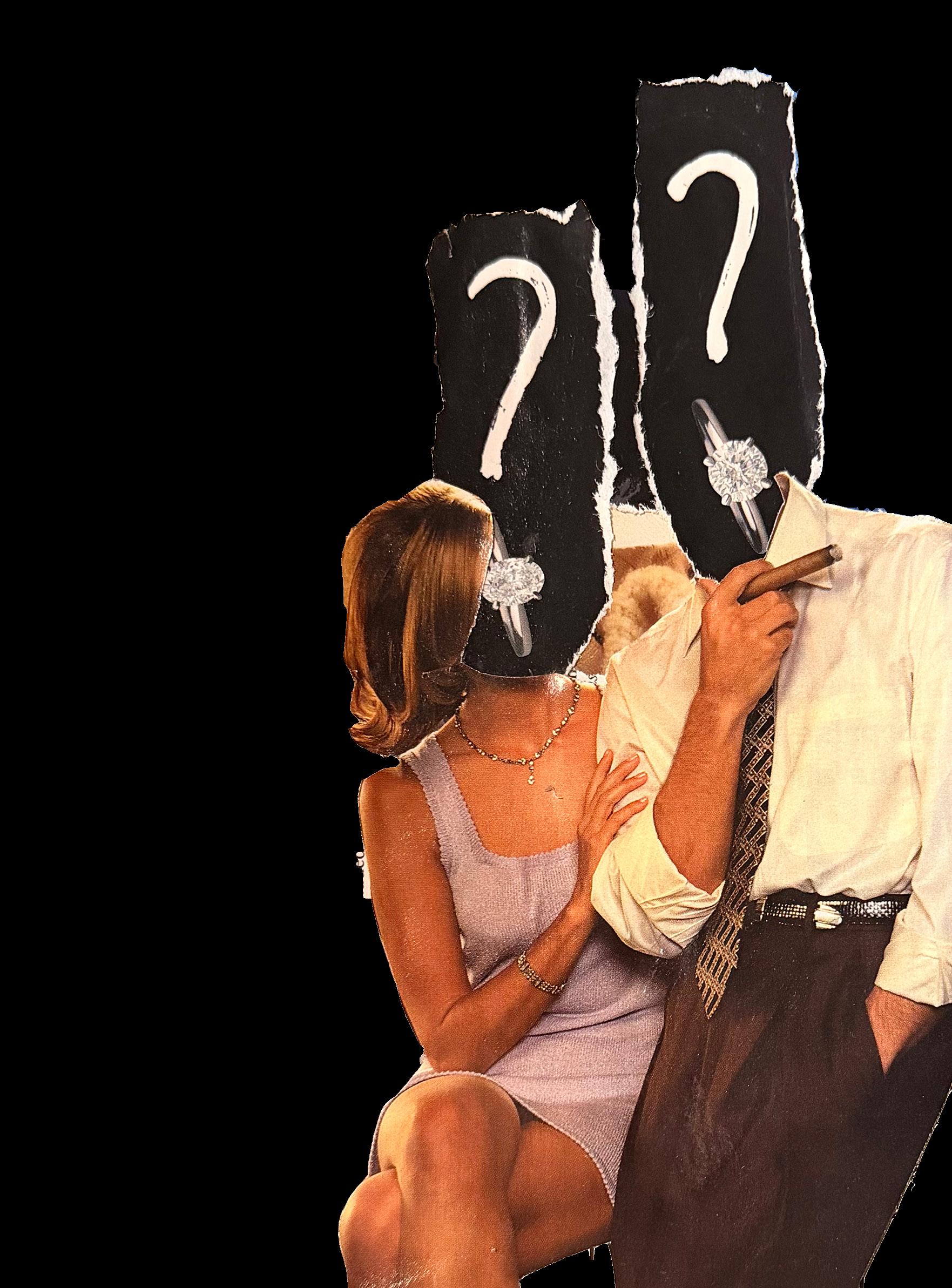
By Taarini Gupta
It’s the Saturday night after a midterm week from hell. You’ve given it everything and now can’t seem to even move an inch away from the rug you plopped yourself on as soon as you walked in your door, snow boots still on, coat tossed away somewhere to the side. Netflix. That’s all your brain can think of wanting, even before a hot, healing shower or refilling your Brita. You just need some stupid, longform content to submerge your fried brain in that feels healthier than doomscrolling—a much-needed release.
Of course, your roommate walks in at this moment. You feel obliged to preface your behaviour: you’re only watching Love is Blind ironically—it’s so bad it suddenly became good.
As college students, we are, naturally, in a very identity-conscious time of our alives, constantly making sure that how others perceive us aligns with our internal identity. At Tufts, labels like ‘ferda-boys’ and ‘indie’ are casually thrown around in conversation when characterizing individuals. Extending beyond fashion choices—from laid-back athletic-wear to purposefully mismatched scarves layered upon chunky indie sweaters—or even beverage choices—like an ice-cold fresh-off-the-vending machine Celsius or a pristinely green Sink matcha latte—these identity labels exist on a spectrum. They reflect our consumption habits, stitching them into our personality. Our sense of identity is hyperlinked to what we watch, wear, and worship. When it comes to media, however, I’ve noticed people tend to be less confident in aligning their choice of entertainment to their perceived identity. There, instead, exists a wider spectrum of consumption habits where many of us stay up late spamming our friends with cinematic ‘Bonrad’ edits set to “Red” by Taylor Swift at 1 AM on one night, while also happily devouring 1200+ pages of Tolstoy’s War and Peace the next.
Media consumption tends to come with an added privacy factor, unlike the clothes we visibly wear or the drinks we carry around campus. This anonymity allows us to freely consume content without feeling the pressure of being boxed into

a fandom. According to sophomore biopsychology and film double major Nicola Klarfeld, what makes the consumption of trashy reality TV or lowbrow romance shows different is that “no one knows what you watch unless you tell them.”
As college students, we are conscious about maintaining our external image through consumption patterns, especially on social media. For instance, with the massively successful release of the queer hockey show Heated Rivalry, Klarfeld— while wholeheartedly enjoying the show— felt restricted to only liking Instagram edits of Shane Hollander and Ilya Rozanov from her spam account to “avoid being judged by others who didn’t get the show.” Meanwhile, she still happily danced the night away at a public club night dubbed the ‘HeatedRivalRave.’
Being in a public place with others who share a niche interest validates that interest and allows us to be ourselves more openly by authentically showing enjoyment. In contrast, the unspoken rules of social media often paralyze our ability to consume content freely. The purpose behind each interaction—whether to actively declare support through a bold story repost, or passively like videos to actually curate our feed—seems to be constrained by challenging rules imposed by these platforms.
Like everything fast—from fashion to food—this media is marketed as a cheap
thrill in a world where inflation forces us to hesitate before making any financial decisions beyond ‘essential needs.’ This demand for endless content results in an oversaturated circulation of trashy shows across streaming platforms like Netflix— from Love is Blind to Dubai Bling—and lowbrow hallmark romcoms like The Princess Switch.
Personally, I like to use such shows as soothing background noise as I force myself to finally do my laundry after weeks of procrastinating. When our brains are overloaded or sleep-deprived, for instance, we tend to do more “lightweight activities” because we don’t have the energy to focus on understanding something difficult. The act of watching a show at all has also become a less formal experience compared to just a few decades ago, when families consciously tried to gather around the living room TV at a specific time to catch the next episode of the latest hit on cable. Regardless of how ‘seriously’ we watch TV, the decreasing quality of these shows and our rapidly declining attention spans tend to encourage multi-tasking or scrolling on TikTok, even while we watch what we’d consider our favorite shows.
Because of this abundance of lowquality content ready at our fingertips, it becomes increasingly important to clarify, even if just to ourselves, whether we are intentionally watching a show or hate-watching—ironically enjoying content under a critical label that separates us from its reputation and quality. While some consider this label pretentious and insecure, I believe it empowers us to take back control of our consumption choices in a world growing increasingly quick to define who we are before we get the chance to ourselves.
How quickly we adopt the label ‘hatewatching’ depends on various factors, such as whether we are watching a show with others. Personally, watching low-quality shows with my friends, like Netflix originals with poorly-developed plots or onedimensional characters, can serve as an entertaining bonding experience. “There are certain shows you only watch with others,” Klarfeld said. It is often “easier to hate-watch a show when you’re watching it with other people” because you can judge
characters or situations—such as the absurdity of Bridgerton character Benedict being unable to recognize Sophie in season four after they kissed at a masquerade ball just episodes before. Watching shows ‘out-loud’ allows you to constantly assert your real-time opinion—a liberating process that contrasts everyday society where we are taught to keep ‘unwarranted thoughts’ to ourselves.
Similarly, hate-watching can also be a cathartic and comforting experience, even at an individual level. For instance, seeing characters who share our flaws overcome adversity can help overwrite our own insecurities.
necessarily
hold true in scenarios where flawed characters highlight our own weaknesses.

As someone who struggles with the fear of being seen as ‘too much,’ I found comfort in seeing high-energy and chaotic Poppy, the leading female character from Netflix’s recent adaptation of People We Meet on Vacation. While some fans found the film version’s portrayal of Poppy as annoyingly cringey—losing the nuanced persona portrayed in the books—many appreciated how, even in this exaggerated version, she was able to find someone who loved her for who she is.
There exists a fine line, however, for when shows with nonsensical plots or incoherent dialogues become no longer simply teasable. Many such shows, like Netflix’s Ginny & Georgia, tend to misrepresent identities through inaccurate, discombobulated ‘Gen Z’ dialogue full of awkward slang, irrelevant pop-culture references, and force-fitted mentions of real-world apps like Snapchat.
Other trashy shows tend to exaggerate religious or ethnic traits through character behavior, such as overly-thick accents or stereotypical family dynamics, like the classic overbearing immigrant parent. Crossing the line from low-quality due to poor storytelling to low-quality due to being out of touch can turn such shows from being a source of low-effort enjoyment to an uncomfortable viewing experience.
Additionally, while our personal insecurities being turned into character strengths encourage us to continue watching low-quality content, this doesn’t
As a French minor planning to study abroad in Paris, Klarfeld remarked how after watching a few episodes of Emily in Paris, she could no longer stand Emily’s lack of effort to learn the language, perpetuating the stereotype of an ‘ignorant American.’ Instead of serving as a source of comfort or representation, it reminded Klarfeld of her own fear of not learning the language well enough before she went abroad.
Whether you do continue watching a show depends on ensuring you are gaining more—in catharsis, broadened perspectives, or low-effort pleasure—than you are giving up—in internal confidence or ethical standards.
Given the private nature of media consumption and the increasing abundance of low-quality content, it’s natural to have a love-hate relationship with television. Especially as college students stepping into our adult selves, we are pressured to decide who we are and what we stand for as we navigate our beliefs, values, and intersectional identities in an ever-changing and polarized world. Anti-labels, like ‘hate-watching’ allow us to openly declare what we are watching without the fear of being boxed into an identity group, eliminating the element of secrecy. If claiming labels allows us to publicly regain control of how what we consume defines who we are, then why should we feel the need to deprive ourselves of proudly taking such ownership?
by SadieSchmitz
and waterlogged brains working overtime simply to practice putting torn things back together again. A meditation on repair. A lifetime, really, dedicated to fixing what’s broken.
I’ve been thinking about thread a lot this winter. Suture thread is uniquely medical-grade and sterile, specially made to stitch together all the meat of our bodies. Some of them (the stitches, that is) dissolve over time, breaking down into our tissuey parts that needed sewing up. I’ve never gotten stitches, dissolvable or otherwise, and I’ve only recently started taking a serious interest in winter citrus. I’ve always liked oranges, sure, but digging through the pith, sifting through the sticky white filaments for the fleeting joy that is the fruit didn’t seem worth it until recently.
Maybe as I’m getting older, I’m getting more patient. More willing to have the tacky threads stuck in the gaps between my teeth and momentary inconvenience for an ephemeral sweetness. Impermanent,
herent, vaguely sour strings that hold it all together.
Mostly, though, I’ve been thinking about thread in the wake of having recent ly walked through the groin of my favor ite pair of pants—something I learned is broadly referred to as a ‘blown-out crotch.’ Well, my crotch has blown out. I’ve tried to patch it up but the threads are already starting to slide free again. Desperately, I’ve sewn a new patch onto the inside and then used my mother’s sewing machine to reinforce the edges, and then darned over it. I’m not sure if it’s drawing more or less attention than the former sinewy hole that
revealed which bygone pair of underpants I am wearing each day, but at least I no longer have to feel the winter wind creep -
My patching and re-patching of the intersection of my favorite pants is, I think, my way of wrangling autonomy in the face of the fated. It’s possible that the future for my pants is to have a perpetual chasm in the most aesthetically displeasing spot possible. Mending my pants gives me a passing power in the face of the unavoidable hole. As I’ve walked through the pants and now the patch too, I just keep thinking about how the pants will continue to rip apart and I’ll continue to put them back together. I’m not planning on stopping anything soon. It’s a relentless refusal
That is all to say: thread has been on my mind. I’ve been stockpiling rolls of it in faded khaki-color because I know I’m going to have to use it soon enough again. Although perhaps it wasn’t this latest hole

med student practice, pithy fruit, and crotch seams on the mind, I’ve started thinking about her story again, too. I now know that the story itself is East Asian folklore—a tale about fate and lovers and what’s destined to be, regardless of circumstance.
Yue Lao, or the Old Man Under the Moon, with his lengthy white beard and cascading clothes and sheath of red thread draping over his hunched shoulders, took his red thread and tied it to the pinky fingers of couples at birth who would eventually meet. The two of them, crucially, were destined to be each other’s ulti -

Here, the fable diverges from the story my mom told me. The East Asian tradition centralized Yue Lao and his red thread as an inherently romantic connection—soulmates. My mom’s iteration, conversely, was that the red thread connects all people destined to meet. And yes, one of those people you are tied to may be your fated true love, her story goes. But simultaneously, your nextdoor neighbor, freshman roommate, childhood best friend, and philosophy TA are all tangled up with you in a thicket of red thread. Accordingly, I, her, and everyone in our rapidly disconnecting world are all in some way connected by the fine crimson threads wrapped around our pinkies.
In a way, the red thread folktale carries a sincere, profound optimism, the unbridled belief that what is meant for you is inevitable, regardless of the choices you make. In other ways, it’s rampant pessimism, that no matter what choices you make, your acquaintances, friends, family, lovers will remain the same. You are, ultimately, powerless in the face of the celestially divine.
In two months, I will be graduating. And maybe it’s not that I’ve been thinking about red thread at all, but rather, that I’ve been thinking about the possibility that

whatever is going to happen next is already in the cards for me. That I am entirely pow erless in the face of who I will meet, where I will move, what I will do, who I will become. Perhaps, regardless of what comes next, it’s already been determined if I will ever patch the hole in my pants or try a sumo orange.
The earth is beginning to warm again and the bleached blue of winter is thinning out and the days are swelling with the anticipation of the spring equinox. As the seasons change, I am swaying on the precipice of one too. And so it is March and I am thinking of thread. Of citrus sutures and of gummed pith and blown out seams and scarlet willows that tether us to one another. The threads that run through all of us and hold us together. The celery strings of our bodies and twine that ties me to you. Wondering if anything coming is inevitable, and what I’m supposed to do in the meantime. For now, I’m thinking that all I can do is delight in the essence of the orange, keep walking through my pants, and idle in the fleetingness of it all.
Compiled by Lucie Babcock & Wellesley Papagni
You may know the Observer for its groundbreaking journalism and exciting student voices. What you may not know is that we find ourselves really funny too!
Here’s just a taste of what gets the O giggling… (hint: save this page for the next time you need to impress a crowd with your killer humor.)
Q: Why did the shark cross the road?
A: Because it was an underwater road.
–Slips of the tongue: saying “tragedy relief” instead of “damage control.”
Q: What’s the difference between a dirty bus stop and a lobster with big boobs?
A: One is a crusty bus station and the other is a busty crustacean.
–“My housemates and I attribute any issue we have in the house to ‘the fucking cunts from Riverdale’ (spoken as John Cena).”
Q: How much does a roof cost?
A: Nothing! It’s on the house!
–Another slip: “the needle that made the camel fall” instead of “the straw that broke the camel’s back.”
–People reacting to their growling stomachs in a silent room.
–“My favorite bit as of now is referring to Michael Jordan as Michael B. Jordan to my basketball-obsessed sister.”
Q: How does a penguin build its house?
A: I-gloos it together!
“What if anything?! What if a bomb drops on your head right now?!” –Donald Trump


by Emma Dawson-Webb