
Issue 1 Spring 2026

Page 1


Letters from the Editors

Caroline Lloyd-Jones, Sofia Valdebenito, Ela Nalbantoglu

3 4 7 8

Letter from the Creative Directors

Meg Duncan & Katie Ogden

Reasons for Resistance

Kate Castleberry

A Quick One, For Mary Sofia Reynolds

Building Understanding and Finding Support Through Community

Sofia Valdebenito

The Silent Elephants in the Room

Caroline Lloyd-Jones

I Am Going to Die (With a Boulder Lodged in My Stomach)

Nora Bitar

What Do Women Want? Gay Hockey

Sex Apparently

Miles Kendrick

The Billion-Dollar Safety Net

Anonymous Student

Rapt Attention

Leah Glaspey

Flowers in Concrete Cracks

Rhea Shah

Did I Choose to Go to This Rave?

Alec Rosenthal

Breaking News and Breaking Trust

Samira Amin

A Decade of Ebb and Flow on Tufts Campus

Lecia Sun two bodies (suspended)

Sundari von Wentzel

Crossword

Max Greenstein

Editor-In-Chiefs

Caroline Lloyd-Jones

Sofia Valdebenito

Editor Emeritus

Miles Kendrick

Managing Editor

Ela Nalbantoglu

Creative Directors

Meg Duncan Katie Ogden

Feature Editors

Amon Gray

Claire Stromseth

News Editors

Henry Estes

Nina Nehra

Arts & Culture Editors

Veronica Habashy

Talia Tepper

Opinion Editors

Lucie Babcock

Wellesley Papagni

Campus Editors

Abilene Adelman

Emilia Ferreira

Poetry and Prose Editors

Anna Farrell

Peaches Wright

Voices Editors

James Urquhart

Laxmi McCulloch

Crossword Editors

Max Greenstein

Emma Dawson-Webb

Art

Maria

Copy Editors

Glaspey

Sundari von Wentzel

Designers

Madison Clowes

Emma Dawson-Webb

Ahmed Fouad

Ella Hubbard

Emma Selesnick

Madoka Sho

Meera Trujillo

Radhika Yeddanapudi

Sky Frisch

Anastasia Pak

Urja Parekh

Mila VonderHaar

Ruihan (Carys) Yang

Lead Copy Editors

Isabella Tepper Mer Boyle

Cabochan

Staff Artists

Jaylin Cho

Ella Hubbard

Isabel Mahoney

Khrystyna Saiko

Paola Silva Lizarraga

Yayla Tur

Elika Wilson

Felix Yu

Dena Zakim

Amalia Hicks

Hana Kopp

Greta Magary

Catherine Ting

Ruihan (Carys) Yang

Rapture:

Dearest Observers,

I have been hiding from you.

I initially joined the O as a staf writer in my freshman spring, back when I still had every intention of majoring in English and becoming a frequently published essayist in the New Yorker magazine. But, by the end of that semester, I had become entirely resentful of my own writing and the process it entailed. I couldn’t stand the anxious back-and-forth, the frantic typing and sequential deleting only to retype the exact same sentence two minutes later. I decided that, from then on, I was done being the writer; I wanted to see things from the editor’s side. So here I’ve been for the past four semesters, hiding my voice under the guise of honing others’.

I don’t want to hide anymore. For this issue, I wrote an article I’ve wanted to pitch for a while now, and through this, I remembered the reason I fell in love with writing in the frst place: not because of the process, but because of how incredibly rewarding it feels to reach the end, knowing how hard it was to get there. It is through this experience I am reminded that, sometimes, rapture can only be felt to its fullest potential when in juxtaposition with struggle.

So, reader, please don’t fret. Rapture is right around the corner.

yOurs fOrever,

Dear Reader,

As I keep getting reminded that I am less than 100 days to graduation, I have not been immune to the senior spring, postgrad anxieties: where will I be, who will I be, and when will I get a JOB!?! It is difcult to practice gratitude in times where it seems like nothing is fgured out. Yet, I refect, and remember, that I am the person who I had hoped to become at freshly 18. I am her!! And I have learned so much. I’ve spent my time here doing what I love most: writing and reading and surrounding myself with those who inspire me. What a privilege it is to say that I have set out and done what I had hoped to do then. I have the Observer to thank for most of this growth.

Reader, I hope you are feeling ever so inspired and ready to open Rapture. I am so proud of the people who made this issue come to life.

Sincerely,

Hi wonderful people,

I am so incredibly excited for my Leditor debut! As I write this, I can’t help but think of my frst ever night of layout, spring of freshman year. I was terrifed walking into the MABLAB, alone and not knowing anyone, yet warmed by seeing everyone laughing and conversing about whatever section they were working on. I had no clue that I would meet my best friends here (or that I would look forward to spending hours at layout). Oh how grateful I am.

In the wise words of Sharpay Evans, “out with the old, in with the new, goodbye clouds of gray, hello skies of blue”—here is Rapture. An issue on long-awaited goodbyes and new beginnings. In this issue, I hope you fnd something that resonates with you, or sparks catharsis within you. Or maybe you want to Fiona Apple it with Shadowboxer, “Oh, it’s evil, babe / Te way you let your grace enrapture me.”

Do whatever you desire with this issue. It is journalism from us for you.

Let it enrapture you. With intense joy and a sense of rebirth, we pull the curtains:

Te rapture is here.

All my love, Ela

Dear Reader,

For our frst issue as creative directors we are so excited to bring you Rapture. 2026 so far has been a year of both nostalgia and trepidation for the future, something we felt this issue’s theme represents well. As we look towards the past and the future, we are reminded to focus on our joy when we are overwhelmed or uncertain. As we celebrate Hannah Montana’s 20th anniversary, among many other milestones, we hold true that it is, in fact, all about the climb. We hope you are as enraptured by this issue and our wonderful team’s designs as we are.

Within and without,

Meg and Katie

Reasons for Resistance Tufts Students

Speak on ICE Protests

“After the first killing, everyone was shell-shocked. It was just really quiet. Bigger than something you could comprehend immediately,” senior Orrin Slager recalled. Slager was at home in Minnesota when the news of Renée Good’s death hit, marking the beginning of largescale protests around the country against Immigration and Customs Enforcement (ICE) and the Trump administration’s immigration crackdown.

Campus has been quieter in light of recent ICE issues compared to last spring. Students are losing stamina, feeling helpless and unable. While some are finding it in themselves to protest anyway, others are looking for different steps forward.

During the 2024 election, President Trump’s policy on unauthorized immigration was a key part of his platform. Hitting its peak in 2023 with 14 million unauthorized immigrants in the US, citizens were voting for policies aimed at higher border regulation and action taken towards the unauthorized immigrants already in the US. The Trump administration has propagated rhetoric that unauthorized immigrants are a key destabilizing factor for American society. Trump supporters are taking up arms against unauthorized immigrants in fear that they are abusing tax payer dollars, fraudulently voting in elections, and are oftentimes criminals. Additionally, because unauthorized immigrants make up approximately 5% of the US workforce, some Americans are worried unauthorized immigration will adversely affect the labor market for native-born US citizens.

While the rate of unauthorized immigration has recently been higher than ever before, the true impact of this type of immigration is highly contested. There have been only 125 cases of non-resident or alien voting in US elections since 1982. Unauthorized immigrants have around 50% lower overall offending rates compared to US citizens, and they are not eligible for SNAP benefits, any federally funded healthcare benefits, or social security benefits. Many Americans are finding it hard to grapple with the idea that, despite these facts, unauthorized immigration would be such a root problem in the US.

As America stands divided on the issue, the Trump administration is in the midst of its full force immigration crackdown. ICE is tasked with enforcement and

removal operations, as well as homeland security investigations. With the passing of President Trump’s “Big Beautiful Bill” in July, the budget for immigration enforcement has increased by $170.7 billion. In addition to this budget increase, there has been a movement away from targeted operations to indiscriminate raids. This has led to a 2,450% increase in those held in ICE detention with no criminal record.

Many Americans are highly opposed to the margin of error associated with the arrests and would like to see significant reform done to the system. To demonstrate their opposition, Americans across the country are participating in protests, the most prominent of which being the “ICE Out” protests held on January 30, 2026, in conjunction with a nationwide shutdown. The ICE Out protests broke out in solidarity with Minnesota after the killing of US citizens Renée Good and Alex Pretti at Minnesota protests.

With 60% of Americans disapproving of ICE’s actions and thousands gathering for the ICE Out protests, there is an audible call for change across the country. Protests are known to call out issues of public importance, give solutions, and unite people under shared beliefs. Another common goal of protest can be to win over the “silent majority.” Those who are not normally politically active may become more aware of an issue if they see a large group of people caring so intensely about it.

Tufts’ campus is no stranger to political activism and protest, but many wonder why students aren’t as vocal about this issue now as in months past. Protests on campus specifically surrounding the ICE raids hit their peak in the spring of 2025. After the unlawful detention of Tufts graduate student Rümeysa Öztürk, students rallied together in opposition to ICE and the immigration crackdown. 10 months later, sentiments haven’t changed, but students are running out of steam. According to Ezra Liebowitz, a sophomore at Tufts, “a lot of students are horrified, but desensitized and fatigued.” He fears his classmates have slowed their activism because they feel incapable of enacting real change.

Studying political science at Tufts, Liebowitz claims he is well-versed in patterns of political repression and is quite fearful of the direction the country is heading. After months of protest and classroom conversations, Liebowitz doubts whether there is any room for action under such a repressive administration. “I don’t know the limits to which the Trump administration will go to continue shutting down opposition,” commented Liebowitz. He sees the deaths of Alex Pretti and Renée Good as clear indicators of government overreach. These emerging patterns of repression have driven his hopelessness over the past year.

But while campus may be quiet, some students are finding the resistance, instead of letting it come to them. Senior Alba Jordan attended the ICE Out protest on January 30 in the Boston Common. “It was very peaceful, very uplifting, very hopeful,” Jordan noted. She said it broke her heart to see the turn the US has taken on the topic of immigration. “I try to attend because I have the privilege to not be worried about my status. I should be speaking out and standing up for other people and making my voice heard,” she said.

In September 2025, the US Supreme Court denied a Los Angeles court order blocking ICE agents from making arrests and detentions on the basis of workplace, language, accent, and skin color. It is likely that the Supreme Court will uphold this precedent in other parts of the country, making it dangerous for certain individuals to protest without fear of being profiled. Yet, Jordan has faith in the protests and their ability to challenge these structures. Seeing the Trump administration begin to withdraw its occupation in Minnesota has given her hope that the work she did enacted change.

Some are not convinced that these protests will cause real change. Sophomore Reed Ramirez supports immigration enforcement and strong border control. He expressed, “I think if you’re in this country illegally, you’re still breaking the law, whether you’re a criminal or not.” While Ramirez would like to see major changes made to the ICE organization and the way ICE carries out arrests, he doesn’t believe protest is the way to do it. He argues that attending protests is performative. “I think they just want to make themselves feel like

they’re being a part of it,” he commented. He continued to say that, especially knowing this administration, protests won’t do much. He noted, “Trump has a strong personality. I don’t think a protest is going to make him sympathize with these people.”

Ramirez also worries that those who attend protests are not well-educated on the cause they are supporting. He remembered going to a protest and trying to engage with the protestors. “I’ll do research on their topic and try to ask them questions … They kind of look incoherent and don’t really respond to me. They’ll usually just yell at me. I find it quite comical.” Ramirez finds it hard to see the effectiveness of protest when he doesn’t see the protestors having adequate knowledge of their cause and

deman has cautious optimism that there will be real change. However, he is worried that this administration has awoken some unappetizing, bigoted belief systems that will be hard to shut down.

“The reaction people are having is this terrible belief that no one is going to save them”

Many students are unsatisfied with how Tufts has functioned as a political space recently. “It’s a bubble. It’s hard to

argues that cultural diversity is the foundation of Minnesota, and “when ICE started to have a bigger presence in Minneapolis, people were ready to push back.” He is excited to see the support coming from within his state, but he is not surprised. The protests all around the country have given him hope. “America is really unique in the way that it always bounces back, and it will be able to recover from something like this,” Slager asserted.

Students differ in how they believe we should move forward. Sophomore Celina Savage attended the ICE Out protest in Boston, but she believes the work doesn’t stop there. Savage was happy to see emotions high at the protest, but she doesn’t know if they will stay that way. She worries that there is so much happening in the political world that students move on too quickly from issues that need enduring attention. She asserted, “we just need to consistently be talking about it, and that’s my concern. Are people going to still talk about this in a month if another death doesn’t happen?” Liebowitz shared a similar sentiment, especially about the deaths of Alex Pretti and Renée Good. He argues that “they can’t just become martyrs stuck in time; we have to remember them actively.” protests pop up nationwide, some Tufts students are getting back on their feet to fight after the quiet fall semester. The overwhelming support across the country is inspiring students and convincing them that their voices do matter. Protest means something different to everyone, whether that means finding community in shared outrage, holding institutions accountable, or stepping up where others feel they cannot. Looking to the future, students realize the importance of staying vigilant in times of despair. Despite outcomes not fully satisfying the protestors’ demands, these protests have managed to revitalize hope that reform is possible.

A Quick One, For Mary

I used to sit in pews at church and feel heat emerge between my legs tainted thoughts polluted my brain as I stared at the crucifix until food from the morning began to rise

While I slept Mother Mary would join me in my bed She held me until morning

When I arose I banished her to the small box I kept hidden underneath the bed frame

I lie next to you now Mary I watch your chest rise and fall

I trace your profile with my fingers like I once caressed the beads on my Mother Mary

Building Understanding and Finding Support Through Community Spirituality at Tufts

Every evening, a melody plays from Goddard Chapel’s carillion. Whether you’re in class on the hill, resting in your dorm, or walking to the Campus Center with friends, a series of ringing bells can be heard every day at 5p.m. without fail. Each note is carefully selected by the chapel’s music director. It is a song that can be heard across campus, serving not just as a rhythmic anchor of the 17th hour of the day for the Tufts community, but as a reminder of the presence of the university’s religious and spiritual life. In 2023 the Tufts Chaplaincy released the Tufts’ spirituality demographic, identifying 13 different religious, spiritual, and philosophical affiliations of incoming undergraduate and graduate/professional students at Tufts. Of the varying identities, approximately 43 percent of respondents labeled themselves as either agnostic, atheist, and/or none/nonreligious. On a campus where almost half the student body does not follow a specific religious

faith, how can all members of the Tufts community seek rapport through spiritual contexts? One major institution that many students turn to is the Tufts Chaplaincy, the heart of religious, spiritual, ethical, and cultural life on campus. It works to provide spiritual care (counseling from the chaplains), Chaplain-specific resources, and a space for students across all religions, cultures, and spiritualities. The Chaplaincy, led by University Chaplain The Reverend Elyse Nelson Winger, is composed of several different religious and philosophical communities. While there are designated chaplains for each community, the Chaplaincy as a whole also provides additional specific support for underrepresented communities. These individual chaplaincies hold weekly gatherings and events for their respective communities, spanning from prayer services to book clubs to Bible studies.

It is under the Tufts Chaplaincy that students can find the Humanist Chaplaincy. On the Chaplaincy’s website, Humanism is described as a “continued praxis,” where individuals are constantly exploring the human condition to envision liberatory conditions for all. Humanism acknowledges that human beings belong to nature. While it is free of supernaturalism, Humanism holds the belief that the values that shape human life, whether they are religious, ethical, or political, have their origin in human experience and culture. Humanists encompass a plethora of nonreligious identities, such as agnostic, atheist, non-theist, and freethinkers. In a written statement to the Tufts Observer, Humanist Chaplain Anthony Cruz Pantojas emphasized the Humanist Chaplaincy as a liminal space for both nonreligious and religious students “to engage or

clarify their own perspectives, ambivalent or not.” Pantojas elaborated that the Humanist Chaplaincy stresses exploration of one’s place in the world and assessing that position through dialect pluralism. “By offering Humanist students and nonHumanist students a place to explore being human, [we] explore our place in the wider web of life. Deconstructing the metanarrative is how spirituality and community is shared for non-religious students.”

The Humanist Chaplaincy extends its teachings and presence beyond the Chaplaincy to both classes and partnerships with other organizations. This past October, Pantojas was a guest facilitator for the English Department’s Topics in Creative Writing: Writing the Climate Crisis class. The class serves as an introductory practice and instruction in creative writing through engagement with environmental issues. Taking place in the Interfaith Center, students “engaged in exploring through a reflexive space the interrelatedness of climate anxiety/grief, personal/professional ethics, and the power of storytelling as reparative modes and accountability beyond ourselves,” according to Pantojas. Humanist teachings can provide a platform for students from both nonreligious and religious backgrounds to grasp difficult situations and events through the lens of community-based conversation.

Making space for spiritual but nonreligious students can be significant for those who do not have another place to connect with others on campus. Interfaith engagement connects students of different religious, spiritual, and/or philosophical identities, and is a well-stressed aspect of Chaplaincy life. There are various opportunities for students to represent their religious and philosophical communities in conversation with other communities; Interfaith Student Council (ISC) is one of those platforms. Co-facilitated by Muslim Chaplain Khan Shairani and Associate Director and Catholic Chaplain Lynn Cooper, ISC connects students of varying backgrounds to engage in “spiritual storytelling, rest/renewal/joy, and sharing a warm meal,” according to the Chaplaincy website.

In a written statement to the Observer, Lynn Cooper shared, “We [at ISC] spend

a lot of time building the muscles to be storytellers and story receivers. We move at the speed of trust, but often I find that students are excited to go deep and talk about the things that matter.” Cooper emphasized that participating in ISC also prioritizes the meaning of hospitality. “Interfaith work is grounded in this spiritual gift, which I think of as a multidirectional street. While the offer of someone else’s hospitality is deeply valuable, I have to be able to be in a place to receive it.”

Made up of various student representatives from different communities, ISC meets weekly and facilitates events for the greater Tufts community toward the end of each term. Cooper mentioned a few events ISC has hosted, including Decompression Nights at Goddard Chapel during reading period, Flower-Give-Aways, and movie nights. Samantha Rodriguez Sanchez, a senior who served on ISC last school year as the Catholic Representative, reflected on an event which Tufts President Sunil Kumar attended. “Each table at the event had a question. [For example,] one table had a question, ‘Where did you see yourself in 5 years?’ Kumar heard every single question from every table. At the end, he enjoyed coming and appreciated how we invited him,” Rodriguez Sanchez said.

While ISC meetings are limited to student representatives, students amongst the broader Tufts campus can engage with other religious, spiritual, and philosophical communities at Community of Faith Exploration (COFFEE) meetings. COFFEE is a student-run collective that serves as an interfaith discussion group. It prioritizes constructive considerations regarding faith and identity among students of varying ideological identities. Analiese Christenson, a sophomore and current communications director of COFFEE, explained that COFFEE discussions have different meeting themes each week. “Our [discussion] topics range from ‘Religion and Music,’ to ‘Religion and Television,’ and ‘Religion and Color.’” While the club primarily focuses on these discussion-based meetings, there are also opportunities for students to engage in stargazing, dinners, and game nights. Christenson mentioned that COFFEE has also organized events surrounding careers in the faith sector.

Both Rodriguez Sanchez and Christenson emphasized that their respective interfaith collectives highlight and stress the importance of community and conversation. Rodriguez Sanchez reflected on how being a part of an interfaith community creates a “sense of connectedness and sameness. Religion is just a term; we all have similar ways to calm ourselves down and make one another feel better.”

Chistenson mentioned similar ideals, remarking that respect is the basis of interfaith discussion, “I think one of the biggest parts is building bridges across differences. I think it is important to get new perspectives on things … For me, it has expanded my own faith and my own ‘why.’”

For students looking for more specialized religious and/or spiritual support, the Chaplaincy also provides oneon-one spiritual care. Spiritual care providers can serve as a “calming presence for students and share spiritual resources and practices such as meditation, storytelling, or prayer”, according to the University Chaplaincy website. Pantojas emphasized that the Chaplains are deeply attuned to the “subtleties, complexities, and inner movements imbued in a student’s life story, and also hold space to help them make meaning.” The Chaplaincy stresses that spiritual care is for anyone at Tufts; students are able to make an appointment with a Chaplain of a faith they are familiar with, or of any faith or tradition.

Whether they are Chaplaincy-driven or student-organized, there are spiritual and religious initiatives and communities for Tufts students to ground themselves in. Spirituality and faith at Tufts exist in various shapes and forms, even beyond the carillon bells.

Editor’s Note: To access Chaplainspecific, Interfaith Student Council, and/ or spiritual care resources from the Tufts Chaplaincy, you can visit chaplaincy. tufts.edu. To learn more about COFFEE, follow @tuftscoffee on Instagram; Meetings take place at Goddard Chapel on Monday nights.

The Silent Elephants in the Room

The silence starts small.

A professor poses a question— it’s not obscure, not some niche philosophical riddle you’d only understand from reading one of Nagel’s earliest works. In fact, the answer is literally right there on the projector, written in 64 pt. font and all caps. A few students shift in their seats; someone coughs; keyboards clack away, no intention of losing their tempo. Ten seconds pass. Fifteen. The room holds its breath.

And yet, no one speaks.

When I first arrived at Tufts, these moments were incredibly jarring. In my high school classrooms, student participation varied, of course, but it was rarely paralyzed. There wasn’t this shared, almost rehearsed hesitation, this sense that everyone was waiting for someone else to go first. At Tufts, I’ve encountered it in 150-person lectures and in eight-person recitations, in intro courses across several disciplines and in mid-level seminars— and I hate it.

Don’t get me wrong. I do it too sometimes—I outlined this article in the back of a JCC lecture hall, completely ignoring my professor in the process. But as someone who generally tries to participate in class (and, to be completely honest, just feels bad for her professors), this phenomenon has stood out to me for quite some time. I wanted to understand whether this has always been the nature of large lectures, or if it is a relatively new trend. And if it

is a new trend, what are the reasons behind it, and what are its consequences?

Professor Kim Ruane in the Department of Mathematics, who has been an undergraduate lecturer at Tufts since 2000, said she has observed a gradual decline in students’ willingness to speak in class in recent years. “I sometimes will hear students whisper an answer, or I’ll see them do some hand gesture that lets me know they know,” she said. “But yes, I think overall, students are less likely to speak up in class or to ask questions.”

Another long-term lecturer in the Department of Psychology, Dr. Holly Taylor, said that, since she began teaching in 1994, she has seen a similar decrease in undergraduate participation. “There was a huge bump down since COVID,” she noted. Ruane agreed, saying, “I think it was already starting a little bit before COVID. It just became so much more pronounced after.”

It’s not hard to understand why, after spending months learning through muted microphones and ‘broken’ cameras during the pandemic, students might have returned to the classroom with new habits of invisibility. This is compounded by the fact that students in college classrooms have largely shifted to digital forms of note-taking rather than traditional paperand-pencil methods. As a result of this transition, many students will use lecture time to work on other tasks or to passively entertain themselves when they are not actively taking notes, shielded by the fact

that the professor cannot see their screens. Even for those who are not misusing their electronics, just seeing other students’ offtask screen use can be a huge distraction.

In addition to its mere presence in the classroom, Taylor hypothesized a more fundamental effect of technology on student participation. “It seems that with social media, Tiktok, etc., students spend more time just being consumers and not engaging in the construction of ideas,” she said. From this perspective, students may have lower levels of participation because social media use has conditioned us to receive information passively.

There are also all the classic anxieties involved in peer relationships: fears of being wrong, of being judged, of being perceived. Ruane, however, believes a more significant contributing cause is a major shift in how students view college. “There [are] societal pressures on students now that I don’t think were there 10 years ago,” she said.

Instead of viewing college as a space to learn for the sake of learning, students now solely look at college as a propeller to the next step, whatever that may be. Ruane described a noticeable increase in stress about the future, about whether the time and money they are investing

into their degree will ‘pay off.’ And when you’re operating with that high-stakes mindset, raising your hand (or even paying attention) in courses that don’t directly serve those future goals, such as a random course to satisfy the art credit, may seem useless.

Admittedly, I’ve felt that shift to an extent within myself. I am very much aware that every second I spend writing this article is time that would perhaps be better spent applying to summer internships or cold-emailing clinics to set up shadowing hours. In the country’s current state, with the unemployment rate among recent college graduates (ages 22-27) at 5.6 percent, that’s a very reasonable and pragmatic perspective to hold. But in taking that approach, in limiting our level of

Beyond just the cognitive effects, I think I speak for most of us, both students and professors, when I say that these frequent moments of silence can really affect the level of comfort in a room. Ruane agreed with this sentiment, saying, “It’s not mentally good for either side.” From a professor’s perspective, she detailed, “It can be very disheartening. It’s like when we were in COVID, and you’re on a Zoom class, and everybody has their camera off. It’s the same feeling, even though you could be staring at 200 faces.”

She emphasized, though, that the responsibility to improve this issue doesn’t solely fall on the students. It also falls, to some extent, on professors to adjust their teaching methods to account for the evolving ways students learn. “We

her cognitive psychology lecture this past fall. She noted, “It was interesting because some students from cognitive said [on the course evaluation], ‘At first, I was annoyed that you did that. But now I appreciate it.’” I, myself, was one of those students.

The only practical way this issue can be improved is through continued pedagogical adjustment and institutional-wide conversation. “I do think students need to be more present, more engaged. They need to understand why they’re in class, but I do think faculty need to understand a little bit more of what’s working and what’s not working. I really think it’s a problem that we should all be invested in improving,” Ruane said.

Regardless of our individual backgrounds, we, as students, are incredibly privileged to attend a university at all, and especially one as well-resourced and academically rigorous as Tufts. I believe that, to some extent, we have a moral responsibility as burgeoning intellectuals to take advantage of the opportunities that privilege affords us. And the primary opportunity that a college education affords college education. I don’t think it’s a stretch to say that, at least at some point in our college careers, we have all, in some way or another, taken an educational opportunity for granted. I really expected that, coming to a liberal arts institution with a reputation for having an academically and civically engaged student body, students would at the very least be willing to ask or answer basic questions in class. I wanted to come to Tufts for the very reason that the students seemed passionate about and actively engaged in their studies—but is it now cool to be apathetic towards those things? don’t acquire knowledge simply by being physically present in the space where it’s taught. You to make an active effort to engage with that material in order for it to have its fullest potential impact. The opportunity to learn is right there at the front of our lecture halls—the only question is whether we will rise with it in rapture, or remain seated as it ascends without us.

I Am Going to Die

(With a Boulder Lodged In My Stomach)

I remember an image in my mind—one I can’t shake—of picking a rose off a bush. The broken stem, the insides of the plant spilling out, me ending its life in a split second. Any feeling, any faith that existed within its velvety petals and barby spine is gone, disappeared. Living to dead with no god to save it. One day I will get snapped in half, too.

***

I remember the first time I thought about dying.

I was ten years old, sitting on my bed with my copy of Percy Jackson, the cover half ripped and the pages all warped from when I dropped it in the pool. Luke held the knife up to his heart as he prepared to stab himself. I cowered under my flowery bedsheet, my face drowned

in a reeking sweat as existential dread dragged at my heart. Luke is going to die, I realized in a panic. I knew, contained within these faded pages, that the afterlife and the underworld and the gods were real. Here, he wasn’t really gone. But in my mind, there was no afterlife. There was no underworld. There were no gods. Death was a void, an all-consuming nothingness. Seeing out of the back of my elbow, graphing the square root of negative one, knowing whatever it is the universe is expanding into.

I couldn’t shake the horror stabbing at my body. What’s it all for? Am I condemned to wilt away into the dirt? A terrible, deep-seated feeling of wrongness festered in my heart, like someone put a boulder in my chest; it started to wedge itself into my stomach, working its way into a crevice between my organs until it got stuck and anchored itself in my body. I felt like I was going to die.

I am going to die.

***

I remember the first time I realized people believed in God.

I was twelve years old, shifting around uncomfortably in the pews of my middle school chapel. My feet rested on the cushion beneath the pew until someone gave me a slight nudge, as if to make public my defiance. Dirty shoes do not belong in places where bent knees pray. I stared at the Virgin Mary’s contorted figure within the shards of jewels on the windows, her image pieced into an alien story.

“Let us pray.”

How do you even pray? I turned towards the

front of the room to see the chaplain bent over a book, her long black robe waterfalling down her body. I felt called to the exceptional nature of her voice: the strength and the confidence of her cadence, the precision in her simple declaration—the intuitive recognition that her words were not hollow or idle, but bursting with an intangible passion, a devotion that transcended the sound wandering from her lungs to her lips.

As she spoke, dozens of heads snapped down like broken branches. I could tell which ones were just craning their necks perfunctorily, their bored faces drooping. A boy sat in the pew across from me. His head was contorted downwards, his forehead grazing the dusty cover of the prayer book on the stand in front of him, as if to hear its confession. His fingers were strained and knotted up as they rested on his legs, as if he was holding something illicitly between them. From where I sat, it almost looked like he was in pain: wrinkles forming on his skin, crinkles in his eyes.

At that moment, I understood with a sense of clairvoyance and jealousy that he was seeing God—a real God—in a way that I never had and never would. I knew the boy was somewhere far away from this dimly lit chapel, somewhere more divine than my unbelieving mind could ever dream of comprehending. The boulder pushed itself around my insides, that too-familiar feeling of all-consuming anxiety returning.

As I looked on, deep crevices formed indents on the boy’s face. Wrinkles and blotches stained his skin with the permanent blemish of age. Now, he was eighty, and sat in a warm, dusty bedroom as the light came

through an open window, at peace as God whispered in his ear and assured him they would meet again soon. I looked at my own hands, now frail and decrepit from years of living. But I was no longer in a church. I was sprawled in a hospital bed screaming in terror, latching on like a parasite to the last strands of my life until my inevitable oblivion.

I am going to die.

***

I remember being 14 years old, sitting in the passenger seat of the car next to my sister. It was five o’clock in late December and the sky was an ashy orange, the golden glare reflecting off of Christmas lights and car reflectors. We were shuffling Melodrama on the way home from school.

I closed my eyes and let the music melt into me, my head pressed against the window. Suddenly, I thought about dying again. Not with fear, but with a resigned melancholy. Parties, dinners, tears, laughter, slammed doors, books grabbed off of shelves and placed back on, hugs, fights, apologies, restless nights, marked-off calendars. All turned into dust.

I am going to die.

The boulder in me was heavy again, ripping my stomach. When I looked at the sunset through the window, I wished to see something within it—a sign, a God. Instead, I suddenly fall off a cliff. I desperately look for something to cling to, but nothing appears.

I reappeared in the backseat. The sunset looked raw. Shades of amber and red spread like a halo over the highway, encasing the car in a pure and radiant light. The sacredness in the mundanity of the sky stuck to me like syrup. ***

I remember the first time I understood the boy from my middle school chapel. I was sitting on the floor of a movie theater bathroom sobbing on my best friend’s shoulder in a deep, guttural sort of way that I couldn’t really explain to anyone but that floored me, as if someone had just punched my guts and left me to reel. My heart was twisting itself in my stomach like a knotted jumble of barbed

wire gashing at my insides.

I am going to die.

But my best friend sat with me for 30 minutes, we bought way too many snacks, and she drove me to her house. I slept over in the same room I stayed in at six years old when I still got homesick and had to call my mom. I felt a sense of faith through her. I healed through the repetition of our mundane ritual. That night, my stomach felt lighter than it had since I was 10 years old. I understood my life fiercely, profoundly— like when people see God in the palms of their hands or in the sun dappling on trees. That transcendental tenderness, that comprehension that one day you’ll die, but right now you get to breathe and love and live. There is something just as sacred as God in that feeling.

***

When death creeps into my psyche now, when I reckon with my own mortality, I think of the cherished moments that have made up my life. Every tear I’ve ever cried, every fingernail I’ve ripped off, every diary I’ve started and never finished. Sitting in a common room with my friends until four in the morning because no one wants to get up to leave. Fighting with my sister until one of us laughs and we go for a drive by the ocean (no fights are forever with your sister). Sitting in my living room watching TV with my mom or soccer games with my brother and dad. Playing in the snow at midnight on my birthday with numb fingers and my hair sprinkled white. I can feel the quiet intimacy of mortal life and the temporal sacredness of a human soul.

I am going to die.

What Do Women Want?

Gay Hockey Sex Apparently

The beginning of a romance is almost as important as its end. For Shane Hollander and Ilya Rozanov, the two leading lovers of the 2025 Canadian television series Heated Rivalry, their romance begins with Ilya lighting a cigarette in a Saskatchewanian back alley.

As for my own gay romance, I’m sipping a piña colada from the head of a ceramic sumo wrestler, talking to my shorter-than-anticipated Hinge date at a tiki bar in Harvard Square. In a desperate attempt to save a few moments of awkward silence, I ask him if he’s seen the show. He confesses that he has and that it wasn’t for him, feeling uncomfortable with its overt sexuality and enthusiastic consumption by hordes of straight women. “It feels almost like a fetish for women,” he tells me. “It’s like straight guys watching lesbian porn. It just doesn’t feel right.”’

His answer was the first in a series of bad judgment calls culminating in his decision to ghost me (some endings are less interesting than others). The sentiment, though, stuck with me for days after: Something in this gay show about sports and butt stuff resonates deeply with women, and in turn some gay men resent them for it.

To understand the origins of Heated Rivalry and its relationship to female viewership, we must first look to the hallowed halls of Star Trek’s USS Enterprise, where homosocial dynamics between two of its central male characters sparked early interest among a group of female fans.

“[Gay fan fiction] got its start in the ‘70s with stories about Kirk and Spock,” said Allegra Rosenberg, a fandom expert and writer, in an interview with the Tufts Observer. Within an existing mass of fan literature emerged a subset of female writers whose stories of Kirk and Spock, called K/S and pronounced “K-slash-S,” gave rise to “slash,” a genre of fan fiction

centered around the imagined emotional and sexual relationship between two men. As Rosenberg put it, slash is “erotica by women, for women, depicting two men.”

Around the same time, in Japan, shojo manga stories featuring gay male relationships kicked off what would eventually be known as boys’ love, or BL, a steadily growing Japanese industry that raked in approximately 35.5 billion yen in 2021. Whether called slash, BL, fujo, or yaoi, gay fan fiction is perhaps the most prevalent fixture of the larger tradition of fandom, representing at least 51% of primary fan fiction pairings according to a 2023 study by the University of Central Florida.

“Fandom is a collective interpretation of text that is grounded in feels,” said Mel Stanfill, the associate professor and media studies scholar who ran that study. “It’s affective. It’s emotional, [and] it has a text at the center.” For early slashers, that text was Star Trek. Since then, those in the world of M/M (“male-slash-male”) fanfiction writing have turned to things like TV shows (e.g. Criminal Minds), boy bands (like One Direction), and inanimate objects (see Draco Malfoy/green apple ship “Drapple”), as centers of erotic fantasy. “If it exists, there’s fan fiction of it,” noted Stanfill.

Emerging from this world of fandom and slash is Rachel Reid herself, the author of the Game Changers books, the third of which is the premise for Heated Rivalry. Her first book in the series originally appeared on the fan fiction publishing platform Archive of Our Own, and she remains open about its origins in female-dominated slashdom. And it’s not just straight women who read slash. While 95% of fan fiction readers were something other than cisgender men, just 54% identify as cisgender women and only 14% as heterosexual. Interestingly, the largest group of fan fiction readers

are on the asexual spectrum (28%), followed by bisexual (25%) and queer (15%).

The question, then, is why? Why do people assigned female at birth, many of whom do not identify as men or even find them sexually attractive, so deeply resonate with two hockey studs eating tuna melts and grinding on the couch?

In her seminal essay “Pornography by Women, For Women, With Love,” feminist scholar Joanna Russ seeks to answer such questions. By analyzing K/S fan fiction, she argues, albeit through a relatively cisnormative lens, that when women read stories about Kirk and Spock making sweet gay love, “their subject is not a homosexual love affair between two men, but love and sex as women want them.”

Russ argues that female-written gay erotica is a response to the implicit power imbalance in heterosexual relationships

as created by the patriarchy. In quoting Camila Decarnin’s essay “Interviews with Five Faghagging Women,” she explains that women recognize in M/M relationships “a socio-erotic position she herself would like to hold, as the recognized peer and the lover of a male.” According to Russ and Decarnin, gay erotica allows women to imagine themselves in reciprocal relationships with men without the gendered subordination imposed by patriarchy.

The evidence for such an interpretation, according to Russ, is ample, and many of her central points can be seen in the plot lines of Heated Rivalry. For example, she explains that women, who are “(quite realistically) wary of heterosexual sex,” have learned to sexualize the act of waiting itself. “The endless analyses of motives and scruples,” perhaps reminiscent of foreplay before female orgasm, is “itself erotically arousing.” In Heated Rivalry, Shane and Ilya’s painstakingly slow romance, consisting of yearly meetups spanning a full decade, reflects this feminine proclivity to “wait and see.”

In theory, the idea of feminine desire funneled through the lens of gay erotica is compelling. In practice, however, questions of representation and agency in writing and television complicate the conversation.

David Valdes, a lecturer in the Tufts English department and author of gay YA romance novels like Spin Me Right Round, explained that he started writing novels because, “I wanted to see more male/male romance written by actual gay people, because a lot of it is written by straight women.” While he clarified that “women can certainly write beautifully about universal experiences that couples

have,” they often fail to “write very knowingly about the inside of that experience, what it feels like to be a gay man within gay male culture, outside of gay male culture, within a family, within society.”

The point of inflection, it seems, is when slash becomes mainstream media. While slash is traditionally confined to a group of readers who understand its intentions, appreciate its logic, and respect its limitations, its transformation into a broader market can confuse things. Suddenly, not only is the story trying to appeal to a wider audience, it’s being introduced into a world that doesn’t quite understand its intent.

“One of the sources of conflict … is that corners of the internet fandom are now being very visible to mainstream fandom, and they have totally different practices and totally different understandings of the right way to be a fan,” explained Stanfill.

The result is resentment and confusion layered throughout all of the obsession. Without an understanding that shows like Heated Rivalry were created by and for female and nonbinary individuals, the feminine attachment to gay media is an easy point of criticism. “I think that people … discount the quality of the source material and efforts of … the community in which that material was made,” said Rosenberg. “And that’s typical, right? Dismiss the efforts of the women who read it and who write it.”

One solution is to pursue more Heated Rivalry-like fusions, in which a female writer with roots in slash collaborates with queer creatives (like Heated Rivalry director Jacob Tierney) to create a distinct and authentic depiction of gay love and vulnerability. The collaboration takes “a genre with a real understanding of intimacy, character, relationship, and fundamental romance,” as Rosenberg put it, and combines it with lived experience.

“I think that you can be somebody outside of a community and write a beautiful story,” said Valdes. “But I do think you need to ask why … And then you need to make sure before you publish a word … that people from that community have looked at the material and you’ve heard whatever they have to say.”

The beginning of a gay romance is almost as important as its end. With the

Heated Rivalry hype simmering down, it seems all but certain that a new age of queer media is upon us, and fans will again confront the amalgamation of disagreements, accusations, and manic frenzies that typify the space. Among all that disconnect, Heated Rivalry represents a point of discourse and, perhaps, a source of unity. Queerness, after all, is a kind of amalgamation; a place where horny teenage slashers and closeted gay hockey players can find solace over a collective unlikeness. When women long for sex beyond the patriarchy, gays strive for representation, and your date doesn’t text you back, isn’t it queer that the one thing we can all get behind is Shane Hollander in a bath towel pressed against the hotel door?

The Billion-Dollar Safety Net Why ICE’s System Survives Its Violence

When 37-year-old ICU nurse Alex Pretti was shot and killed on January 24, 2026, it marked the second fatal shooting of a civilian by US immigration agents in Minneapolis this year, following the shooting of 37-year-old Renée Good on January 7, 2026. Along with the 2025 death of 38-year-old Silverio Villegas González during a federal immigration enforcement operation in Illinois, these incidents have forced a renewed examination of Immigration and Customs Enforcement’s (ICE) model of administration. ICE’s methods have been solidified by federal policy, funded by billions in contracts, and defended by a network of influence that helps ensure its survival.

These deaths have raised a question about how enforcement is carried out: what does it mean when the government agency tasked with protecting the nation’s borders becomes a source of lethal violence against its communities?

For the Trump administration, the answer is clear. Department of Homeland Security (DHS) Secretary Kristi Noem defended the actions of ICE agents as essential community protection. “[ICE agents’] families live there and that’s their neighbors they are protecting by getting dangerous criminals off the streets,” Noem told Fox News Digital. “They are going after those murderers and rapists, people that are trafficking drugs, and protecting America.”

Her framing, however, only tells part of the story. According to a 2025 investigative tracker, ICE has been involved in 13 incidents that resulted in casualties, both fatal and non-fatal, since April 2025. This, however, does not include the other 65 recorded cases where ICE agents brandished firearms, fired shots, or used less lethal

means of control, such as rubber bullets. This sustained use of force coincides with a major policy shift of the Trump administration—one that reinvigorated a multi-billion-dollar private detention industry with a direct stake in aggressive enforcement.

On his first day back in the Oval Office, President Trump signed Executive Order 14148, revoking former President Joe Biden’s Executive Order 14006, which attempted to phase out federal reliance on for-profit prisons. The practical effect was immediate: it reopened the door for the federal government and subsidiary agencies, such as ICE, to begin contracting with private prison corporations to operate immigration detention facilities.

The detention population has swelled quickly as a result. According to DHS figures obtained by CBS News, the number of immigrants in ICE custody reached a record high of 73,000 by early 2026, with nearly 90% of all detainees being held in private, for-profit prisons. The surge was no accident. In a May 2025 interview with Fox News’s Sean Hannity, White House Deputy Chief of Staff Stephen Miller made the President’s intent explicit. “Under President Trump’s leadership, we are looking to set a goal of a minimum of 3,000 arrests for ICE every day,” Miller remarked, implying the number would increase over time.

More detainees mean more demand for beds. For private prison corporations, that demand translates directly into opportunities for lucrative federal contracts. Two corporations dominate the private-prison market: GEO Group and CoreCivic. In their 2024 annual reports, the companies disclosed that ICE contracts accounted for 41% and 29% of their total revenues, respectively. The financial markets have

directly linked the companies’ value to immigration policy. The day after the 2024 presidential election, GEO’s stock price rose by 41% and CoreCivic’s by 29%, according to market data—an exact match that underscores how deeply the companies’ financial fortunes are tied to immigration enforcement.

In a contract renewed with the State of Montana in 2023, CoreCivic was paid $77 per diem per inmate, before switching to a monthly payment of roughly $2.1 million dollars for 753 available beds in a state prison. This illustrates the per-bed arithmetic that drives for-profit prisons’ revenue—a number which scales directly with the number of detainees under ICE’s expanding purview. Moreover, DHS has only published estimated average adult bed costs up to the 2023 fiscal year, when it was $187.48. Despite the 2026 DHS budget overview for ICE having been made public, it is notably lacking the “Strategic Context” section that would include these per-bed bills that taxpayers foot.

Federal data shows ICE has awarded GEO $746.52 million, total, as of February 27, 2026, for detention services. In 2026, new ICE contracts are expected to add hundreds of millions in revenue, which analysts project could push GEO’s total annual revenue over the $3 billion mark—a milestone tied directly to the expansion of detention. However, it should also be noted that the exact terms and costs of recent contracts between ICE and both GEO and CoreCivic have not been made public.

This financial incentive structure concerns even those who support ICE’s mission. “I am opposed to private detention facilities because they are incentivized to keep as many people in prison

as possible—sometimes over capacity,” Charles Ota, president of Tufts Republicans, said. “I don’t think the government should be outsourcing detention to private companies.”

With so much revenue at stake, both GEO and CoreCivic actively work to shape the policy and environment that governs their business. In 2024, both companies lobbied Congress for DHS appropriations funding ICE. That same election cycle, political action committees (PACs) created by GEO collectively donated $3,718,518 to conservative and Republican candidates. Similarly, CoreCivic’s PACs donated $784,974 to a majority Republican cause. The connection between regulator and regulated is also personal. GEO’s leadership includes several former ICE officials, a pattern known as the ‘revolving door.’ Former ICE head Julie Wood joined its board in 2014 and Matthew Albence, a former ICE executive, became a GEO executive in 2022. In a notable move just days before the 2024 election, ICE’s Executive Associate Director Daniel Bible left the agency to become an executive vice president at GEO. Even the current Attorney General, Pam Bondi, lobbied for the company while working at D.C.-based firm Ballard Partners—and did not disclose her work as a potential conflict of interest during her Senate confirmation.

For David Seaton, president of Tufts Democrats, Bondi’s ties exemplify a deeper problem. “The problem is even greater than the fact that these agents are committing crimes. There’s nobody there to hold them accountable because who’s actually supposed to police all this? Pam Bondi is the Attorney General, but she’s implicated in all this. So there’s just no accountability,” Seaton said.

ICE contends that all of its detention facilities comply with detention standards. However, the National Immigration Law Center reported that both GEO Group and CoreCivic prisons have been sites of death and physical, sexual, and mental abuse for decades. On February 6, 2026, California Representative Juan Vargas attempted to visit CoreCivic’s Otay Mesa Detention Center following reports of inhumane conditions. Vargas was denied entry, highlighting a central tension: the system’s resistance

to oversight, even as its outcomes include repeated instances of serious violence.

At Tufts, the national debate over ICE has played out in miniature. For many students, the 2025 arrest of graduate student Rümeysa Öztürk was a wake-up call. “The crisis of ICE policing our freedom of speech is horrifying,” said Seaton. “It shows how illegitimate [ICE] is.”Ota rejects that framing. “I support their mission,” he said, referring to ICE. “But not necessarily how they’ve been used.”

Both, in different ways, are calling for accountability in a system that seems designed to resist it.

Ota believes the agents involved in recent shootings should be prosecuted. “They should have their day in court. If there was enough evidence that they were acting in self-defense, they should be let out. If not, they should be convicted.”

Seaton frames the stakes with urgency. “We need to take this moment as a reminder of what can happen when we forget the shared humanity that we all have in our country.”

This confluence of policy, profit, and political defense begs a fundamental question underscored by the recent fatal shootings: why does a system with such fatal outcomes persist with such force?

The imperative is volumetric: fill beds, and let human costs become externalities. DHS Secretary Kristi Noem defended the killing of Renée Good as a response to an act of “domestic terrorism.” Watchdogs like the American Immigration Council decry the agency’s actions as “more abusive, and more opaque than ever.” The resulting standoff is one of impenetrable insulation.

In this framework, the deaths of Alex Pretti, Renée Good, and Silverio Villegas González are not anomalies. They are the logical outcomes of a system in which contracts, connections, and cash serve as a safety net to ‘catch’ operators, and politicians’ rhetoric frames any death as collateral damage in a much larger fight. As long as detention centers need to be filled, donations need to be repaid, and agencies need to be defended, the ICE machine will continue running. The only question is who dies next.

Rapt Attention : Connecting Attentively

I’m always hearing about how today’s young people are inattentive and antisocial. Experts across fields are concerned with the development of the generations who spent pivotal years in pandemic isolation and have grown up using technologies with impacts that are only now beginning to be understood. From what I see, they are right to be concerned. While I rarely find myself in situations where a large group of people are all silently scrolling while sitting next to each other, the ability to take out a phone during slow moments is undoubtedly a sort of armor. I certainly prefer reading to scrolling on reels, and yet, I find myself having to build thick walls around my Instagram in order to actually pick up a book. I feel the struggle between the virtual and reality intimately, and it’s clear I’m not the only one. This issue is deeply rooted in where, how, and with whom we share our attention.

Perhaps we have failed to consider the ways in which inattention lays the foundation for antisocial behavior. I struggle to believe that feeling known, loved, and

connected does not impact one’s ability to overcome obstacles, and further, that a strong attention span is not necessary for building those meaningful relationships. Using technology is far easier than

forging a real relationship, but it doesn’t build the same resilience. Perhaps our collective inability to share our rapt attention, especially during moments of social difficulty, is perpetuating our loneliness as a generation. If one cannot overcome the inevitable hurdle of an awkward pause in conversation without pulling out a phone, there is no foundation for a nurturing, empathetic relationship in the future. Maintaining investment in an interaction despite the friction bridges this gap.

The foundation of empathy is remembering, but the degree to which we remember events is dependent on active engagement during them. One of the most frequent claims made about our generation is that we cannot concentrate on a single task at a time, and this scattered attention impacts our ability to be fully present in any given moment. Brains allocate attention through two simultaneous processes: first, responding to a stimulus, then maintaining concentration on that stimulus. Especially when working with technology, the value of maintenance is often ignored in favor of responding to something new.

Media multitasking is the simultaneous use of several digital media functions, for example, writing an essay while concurrently reading and responding to text messages. Constantly swapping between tasks reduces the ability to cope with the boredom of completing a task that is no longer novel. Continuous participation in this behavior also increases the rate of attention lapses, a brain function commonly associated with moments of forgetfulness, regardless of whether or not the person is actively multitasking. This is to say, even when concentrated on a single, analog task, the multitasker is less likely to recall the details of that occurrence later. Translated to a social situation,

even if the multitasker is engaging in a conversation where devices are off and away, they are less likely to remember the minutiae of the exchange when they interact the next time. This drastically reduces the capacity to form empathetic relationships.

True deep connection comes from repeatedly granting one’s undivided attention to the same individual. Friendship is a process of understanding another person’s way of life, which is informed by the little moments that make up their holistic experience. There is an intimacy in remembering whether a friend takes cream in their coffee or the titles of their recently read books. Listening to the delights or woes of a regular Tuesday gives insight into the little things that spark joy or how an individual copes with small annoyances. All these small, mundane aspects of daily life flesh out our complete contexts and inform how we want to be treated. However, a thorough understanding of how another person exists in the world requires investment and memory. Increasingly, it seems like our brains are being rewired away from the foundation of compassion.

Recalling these mundane experiences gives reference points that are important to building empathy. I know that “they forgot the pickles” is one of the most devastating statements my best friend could possibly utter, but that specific sentiment is far from universal. When I finally remember a friend just took an important exam, their absence from their usual spaces makes more sense and I’m reminded of ways I have failed to show up. Remembering what feels big for a friend gives a framework for predicting how they will feel in similar circumstances and acts as a marker of really seeing and understanding them. However, this does not happen if the details shared immediately float off

into the void of the forgotten. This degree of friendship requires intensive, enduring care and attention.

It also literally has the ability to reshape our identities.

Relationship identification is how individuals perceive the impact of a specific relationship on their self-conceptualization. Essentially, the role one takes in a particular relationship creates an identity marker with distinctive traits and responsibilities. For example, a college student in the context of being a housemate might be quiet, tidy, and follow certain cleaning routines. However, as a member of a dance ensemble, the same student might

is with their housemates, the more likely they are to prioritize the traits and behaviors rewarded within that environment. This identity-defining camaraderie is largely cultivated by a sense of mutual understanding. Even subconsciously, we want to please the people who put effort into truly understanding us, but at the same time, we motivate others to put in that effort by embodying the traits they appreciate. Understanding how to behave to maximize the depth of the relationship requires recalling past experiences, which are rooted in the attention we give others while actually interacting.

Ultimately, attention and connection

be energetic, encouraging, and dedicated to stretching every day. What it takes to be a consistent contributor varies between relationships, but it is impossible to be everything at once.

The significance of a relationship identification within one’s personal identity directly affects the sense of responsibility to perform well within that relationship. That is to say, the closer the student

are stages in a cyclical process. Building a quality connection requires the ability to overcome boredom in order to complete a meaningful task. A healthy attention span is the defense against friction, and becoming an empathetic individual is an endeavor motivated by the identification of any relationship.

Historically, having to build relationships with real-life human beings has

been unavoidable, but the close relationship many young people have formed with AI chatbots demonstrates the increasing prevalence of technology in reducing human connection. The computer will always generate an easy response and does not encourage the adoption of more productive behaviors. Plainly, an AI friendship removes the inevitability of friction, does not have a personality of its own with details to remember, and motivates users to become entrenched in their ways. Technology is reducing our ability to be a good friend while offering a seemingly viable alternative, but without the same support.

Perhaps cultivating our attention is the greatest act of care we can do for the people we love. Treating every task we complete with intentionality bleeds into our social connections. Going analog, turning off notifications, and completing difficult tasks using nothing but a real human brain may prime us to sit attentively in slow conversations and work through moments of awkwardness. I find that when I enforce dedicated periods of time for specific tasks, I am more able to actually check things off the list and thus feel less scattered when I am with my friends.

In order to conquer the pervasive loneliness, we need relationships informed by rapt attention and intentional presence in the spaces we occupy. The only way to really learn another person is to be with them for the long run, intentionally and consistently.

Flowers in Concrete Cracks

Do you ever feel like you’re stuck in an endless loop?

A cycle of same-old, sameold: with the same alarm startling you awake every morning, the same classes adding piles and piles onto the same workload, the same friend circle prattling on about the same two topics of conversation. You lie there on your bed, wilting and rotting, body and mind graying far too young. The gray spills from your soul and

bleeds into the world around you. In your polluted eyes, the sun’s soft yellow glow mutates into a glaring white, your favorite song morphs into a wistful, barely-played record, and the sweetest spring appears obsolete and uninspired. The world picks up its pace, transforming every day into a haze of checklists and commitments.

You scroll, and scroll, and scroll, and scroll, silently begging the short, evocative videos to bejewel your neurons with positivity. It takes hours, weeks, months, years. And then, the hidden treasure you’ve been searching for finally appears on your screen, and you involuntarily crack a smile. Your veins fill with pinpricks of passion, your brain hand-washed with warm water and lavender-scented soap, kindness threads into the tendrils of your heart. You

are reborn, reminded of the slow softness of human existence, the effortless beauty in the most mundane.

Hopecore.

Video after video, images of warmth and sun-drenched possibility radiate at you. The ocean glitters in the daylight, an elderly lady smiles with youthful passion and exuberance, you walk through hidden coffee shops with sprawling sofas and stained-glass windows. A stranger buys a warm, flavorful meal for someone who cannot afford it, loving parents orchestrate a surprise party for their cherished child. Every moment of kindness, intentionality, and romanticism is captured and presented to you on a silver platter. The world pauses, slows down—just for you—and with it, a rosy tint replaces the drawling gray. You accept respite in your mirage of safety—pull over your comfort-

ing blankets and sip on warm chamomile tea.

The world is good. The world smiles at you, so you involuntarily smile back. The world thinks you are more than enough, just as you are. Such reminders manufacture a worldview of glorious, ineffable color.

Color bursts from your screen into the real world. You soften towards your surroundings. You now have a spring in your step, you beam at strangers and gleam with kindness. Your cheeks flush with happiness as you gaze at flowers blooming through the cracks of concrete, for they have defied all odds just to exist. You twirl during a snowstorm and catch iridescent snowflakes on your tongue. Your heart thrums with passion as you watch poetry weave its way into your experiences. Why haven’t you surged and bloomed and taken up space like this before? You’re not too much, soak up the human experience. Your brain has rewired itself, and all the terrible things that you’re constantly exposed to fade away, and your key focus is being good. Being compassionate. Spreading love. This love doesn’t just extend to the rest of the world, it bends inwards, like a prism refracting a rainbow. Love wraps around you, hesi- tantly and gently, and begins to paint your essence golden with growth.

A flurry of self-compassion replaces your cognitive distortions: I’m enough, I’m trying my very best, everything is temporary and fleeting. You approach strangers even when your nerves crinkle with anxiety, you soften with empathy when you make a mistake, you learn how to spend time with yourself. And you pause.

Breathe in, breathe out.

You are transported to simpler times. A slow life, where every moment is punctuated with intention. Buying fresh flowers from the supermarket and letting the aroma seep through your living room, wearing wired headphones and walking through the streets, watching people and wondering what their story is, all while reflecting on yours.

Speculating about what truly makes them tick, what type of life they get to go back home to. Observing the tiny details that echo from their very existence: awestruck eyes tracing their surroundings,

a nurturing

hand petting stray dogs, a pensive finger glued to a chin in deep thought. Do they ever gaze at human beings and wonder too? Is there some invisible string that ties us together, some ancient magnetism that reverberates throughout the human race?

My invisible string glints and glows when the sun bounces off the walls of my childhood bedroom.

Driving, late at night, on my favorite coastal highway back home while blasting Bollywood music. Calling my long-distance best friend for two hours at a time. Reading piles of weathered books that transport me to another time. Absorbing the glimmering sound of my brother’s laugh as he narrates his weekly shenani-

gans. Romanticizing academia by soaking in all the knowledge I possibly can. Soothing self talk to my inner child when my heart dims. Trying to make others feel seen just the way I want to be. Inhaling the comforting smell of the ocean as sea spray kisses my skin, fluid and free. Sunflowers gazing at each other while it rains. Wearing stacks of colourful bangles. My mother gently braiding my hair after a long day.

These instances are broadcast in my brain, on a 75-inch television with 8k Quantum Picture Technology, playing image after image after image. 33 million pixels burst with the highest brightness and clarity, firing the electric impulses that heighten my serotonin levels.

Sometimes the screen glitches, with flashing lines and color distortions. Sometimes negative emotion stubbornly switches it off, for hours at a time, and I am forced to look back outside. Towards reality.

War. Discrimination. Hate. A nine-to-five job that sucks the very life out of life. That all-encompassing, omnipresent, dreary gray. An idle mind means that soot and dust threaten to mar the pristine curation I have carefully compiled, just for myself.

A beat passes. Maybe two. And I grab the television remote and switch it right back on.

Did I Choose to Go to This Rave?

The Vitality of Our Digital Monoculture

Each February, national conversation returns to the Super Bowl, a uniquely American convergence of the most important strains of the mainstream—sports, musical performance, and advertising. As anticipated as a media spectacle as it is a football broadcast, this champion of our entertainment sphere maintains a unique foothold as a one-part football game, two-part vehicle for mass media. This year, Super Bowl LX amassed 124.9 million viewers, a metric which establishes it as the most-watched television broadcast of all time. While this statistic would depict this event as a popular cultural phenomenon, Ben Fritz’s article “The Rise and Fall of the American Monoculture,” published in The Wall Street Journal, recasts these broadcasts as vestiges of our prior entertainment landscape.

More recently metamorphosed into a sociological term, “monoculture” derives from the Greek prefix “mono-” and the Latin word “cultura,” literally meaning “singular cultivation.” Its use stems from the eponymous agricultural practice of tending to one crop across a select terrain, borrowed by popular cultural studies to portray a society unified through collective cultural experience. Sociologists commonly identify television, radio, and film as integral forms of cultural dispersion: 83 percent of Americans owned radios in 1940, and 98 percent owned televisions by 1980. America’s access to and production of culture evolved into a dominance that Maude Barlow remarked upon in her 2001 article “The Global Monoculture.” She illustrates the consequences of these decades of cultural authority by observing the increasingly homogenous global network produced by the mass consumption of branded clothing, blockbuster media, and music. Barlow implicates the North American entertainment-indus -

trial complex as the leading perpetrator and trailblazer for a cultural flattening, coloring American popular culture as a bulldozer of local global diversity.

Despite the reappropriation of monoculture to describe collective media experiences, its original agricultural use connotes a singular product being pushed to the masses. The focus lies within an object’s commercial potential, with its adaptation occurring alongside drastic technological advancements. The entertainment-industrial complex coalesced as an entity in the 20th century to then establish official commercial spheres for the arts. As a response to consumers digesting content via personal devices, it then morphed into newer digital formats.

While presenting a more individualized experience, the collective reliance on and use of these products elevated this system of cultural engagement to the monocultural level. 73.2 percent of the global population is online, with 96 percent connecting via mobile phones. However, the system remained the same: an elite few dictating the taste of the general public. Fritz wrote of these predominantly white male executives, “Their cultural blinders were imposed on an entire nation, which is why it was so difficult for Latin music, auteur cinema, and rap to force their way into the mainstream.”

Fritz asserts that the internet introduced a democratization of content consumption that placed choice within the hands of consumers; however, he fails to account for the widespread algorithmic influence that dominates search engines, social media platforms, and other popular websites. Individual agency instead operates under a collective codification, embedded by algorithmic guidance that both openly and subliminally drives our online engagement.

Online behavioral patterns are subject to tracking and subsequent regurgitation, with consumers equally feeding and being fed by observant algorithms that exploit netizens’ time, money, and attention. Thus, the guided consumption of commodified content such as film or music subtly thwarts Fritz’s concept of a “democratized” internet in which we have the illusion of choice regarding what media we watch, read, or listen to. Modern media consumption reinforces an underlying passivity that subverts the consumers’ belief that they possess an active role in their digital activity. While our online engagement supposedly reinforces our subjecthood, it shatters under the reality that the internet is a guided landscape.

Film and Media Studies professor Mat Rappaport defined these virtual constraints, calling the Western internet a

privately owned capitalist space. While platforms such as Instagram and X feign free use, they regulate behavior, language, and content as businesses exercising ownership over private domains. Existing in cyberspace creates a mediated experience that builds on user data to elicit response.

“[Social media platforms] rely on user-generated content and optimizing through algorithmic engagement because their model is to basically buy and sell our data, and more importantly, be able to predict and shape behavior,” Rappaport said. “There are a few players who are really collecting and turning data into a utility that then gets sold back to advertisers and deployed across platforms. All these platforms are really trying to keep us hooked, keep us engaged, and keep us watching.” Their monocultural success is palpable: simply turn to the near-even split between Spotify and Apple Music users. While a range of alternative listening methods and streaming platforms exist, the ubiquity of allegiance to one of two giants demonstrates a victory of capitalistic pressures, which sets in motion a domino effect of related consequences.

Senior Sanaa Nicholson remarked upon the contrast between this supposed diversity of choice and the reality of imposing decision-making regarding subcultural engagement and the modern music industry. Nicholson critiqued the ability to more easily identify with subcultures without necessarily adopting the values and customs of such, finding modern consumers to instead focus on aesthetic presentation and consumption habits. According to them, the internet enables this phenomenon to act as an engine for capitalist consumption and trend cycles that media moguls such as music executives take advantage of. Consumer engagement in the age of short-form content becomes a surface-level vomitorium of culture, with subcultural influences strained into insincere content that is then force-fed to hungry scrollers.

it, and they wriggle it around. [They] reinvent it to make it digestible and legible for people who don’t understand, who are people who exist in the mainstream. People who should be listening to Sabrina Carpenter are now at the rave, being miserable and taking selfies. Leave.”

Nicholson’s frustration with insincere artistic engagement is emblematic of how algorithms shape rather than adapt to people’s tastes, instead funneling listeners inauthentically all into a singular cultural space or inauthentically into too many of the wrong ones. They noted their own efforts to combat their dissatisfaction with manicured streaming algorithms, currently in the process of switching to the music streaming platform Qobuz. Also growing their own diverse collection of physical music media via records, they asserted these tactics felt like a more fruitful and conscious digestion and exploration of music beyond its role as a mere commodity.

“Music should be an active experience,” Nicholson said. “By passively listening to music, it creates this culture of not really caring about artists, or not really caring about art, and then that leads to big record companies being able to make all of their music sound the same.”

“The people who own these companies are not artists, but they would like to commodify art,” Nicholson said. “They hire all these talented people to find out what the next subculture is, what the next trend is. They figure that out, they push

Despite our access to various subcultural spaces through the virtual world, portable devices serve as individualized points of access, contrasting the more communal nature of broadcast media. While Fritz characterizes this as divisive, consuming media through personal devices possesses a monocultural hold just as tightly as methods such as television, bonding the populace collectively despite holding more individualized attributes.

prints on platforms such as TikTok that create natural support for emerging artists. As a popular creator on the platform, Cece also noted how companies attempt to both explicitly and implicitly promote artists, recounting how he’s previously been recruited to engage in this digital payola. “Labels will try to intentionally push certain songs and make them more popular,” Cece said. “Since the time I’ve been DJing and making mixes, people from labels will reach out to me and be like, ‘Can you put this song in a mix?’”

Tufts senior Daniel Cece remarked on how personalized algorithms feel, noting that feeds often regurgitate his own interests so strongly that they cloud his perception of popular culture. “Certain artists just pop up in my feed all the time, like Jane Remover,” Cece said. “I listen to them a lot, and so the amount of times that Jane pops up in my feed—I would think that they’re a massive global superstar, but they only have less than a million listeners.” Cece found the algorithm as useful in congealing communities of fans and establishing subcultural foot-

Cece’s experience reveals the hidden vehicles that push culture forward, with media industries shaping our passions in the hopes of measuring greater engagement. Our technological advancements have seemingly placed our agency in our hands, yet it seems our self-direction is under as much scrutiny as ever. Each swipe, scroll, and tap is pregnant with data that quantifies and tracks consumers who depersonalize the relationships we have with our devices. The entire media industry encourages us to desire for the sake of desiring, consume for the sake of consuming, and live for the sake of scrolling. These devices have not murdered our monoculture. They have invasively augmented its influence.

Breaking News and Breaking Trust: Reporting the Fall of Journalism

staying informed no longer means unfold ing a newspaper first thing in the morning. Instead, almost all of us come across newsrelated content while scrolling through social media. Headlines appear between memes and sponsored posts; TikTok videos summarize geopolitical conflicts in under sixty seconds; AI-generated clips claim to show something that never happened. Once the backbone of American journalism, print media has declined dramatically, allowing social media to become the primary source for political information.

According to the Pew Research Center, 93 percent of people aged 18–29 get news from digital devices, while only 18 percent use print. In contrast to age-old sources of news, social media platforms lack editorial gatekeeping; anyone can produce content, share a political opinion, or spread a piece of information without fact-checking. While this encourages political participation and global awareness, it generates concerns about authenticity, misinformation, and accountability.

Stories are published within minutes, updated constantly, and judged not by accuracy, but by clicks. Platforms prioritize content that captures attention, often showing users sensational or emotionally charged material rather than accurate or important information. A 2022 article in Frontiers in Political Science found that online discourse on Reddit grew signifi-

lowing major political events in 2020 and 2021, particularly after the Black Lives Matter protests and the January 6 Capitol attack. As language grew more polarized and combative, social media feeds increasingly reflected outrage rather than reporting. This turned into a back-and-forth battle between social media users struggling to choose whom to believe on unregulated, unmonitored platforms. Researchers at MIT have found that fake news can spread up to 10 times faster than true reporting on social media. Ultimately, in the race between true and boring versus false and entertaining, the latter wins every time.

New technologies, such as AI-generated videos and automated writing tools, have further blurred the line between reporting and fabrication. AI can now create realistic political messages, speeches, and visuals at scale, making it easy for campaigns or anonymous trolls to flood feeds with misleading material faster than journalists or fact-checkers can respond. In early 2024, for example, New Hampshire voters were targeted with an AIgenerated robocall that closely imitated President Joe Biden’s voice and urged them not to vote in the primary, demonstrating how synthetic audio can be used to interfere with turnout in real time rather than just distort perceptions after the fact. AI can produce realistic but false political content faster than it can be debunked.

The problem is not just the creation of false information—it’s also the system that spreads it. As users engage with content that aligns with their own pre-existing beliefs, algorithms show

more of the same posts, reinforcing bias and deepening identity-based divides. Opposing viewpoints become less visible, presenting users with only one side of the story. This produces echo chambers—algorithmically curated information bubbles that reinforce existing views while minimizing exposure to dissenting perspectives. Meanwhile, journalism has become more partisan, with most outlets catering to a specific ideology, reinforcing political identities rather than challenging them. Americans characterize each other in inaccurate and extreme terms: Republicans believe that 38 percent of Democrats are LGBTQIA+, when in reality the reported number is 6 percent. Meanwhile, Democrats believe over 44 percent of Republicans earn over $250,000 per year, when in reality only 2 percent do. When citizens hold such exaggerated perceptions of each other, they reveal a media environment that rewards affirmation over accuracy. News is often framed as a product designed to confirm what readers already believe, rather than as a public service. This reshapes journalism as a “yes man”—someone who agrees with everything that’s said instead of questioning opinions to learn more about global politics and discover alternate points of view.

By defining adverse coverage as “fake news,” the Trump administration has substantially fueled public mistrust of the media. Instead of being portrayed as a component of democracy, journalism has been framed as a political enemy. This narrative is accompanied by structural changes: disputes between reporters and officials have turned into spectacles in and of themselves, while some outlets are openly favored and others are barred from briefings. When the press secretary uses condescending language and labels reporters’ inquiries as “stupid,” they undermine journalists’ credibility and authority on public issues. Last month, White house Press Secretary Karoline Leavitt berated a reporter and called him a “left wing hack”, further feeding into distrust and a distaste for journalism. Skepticism toward journalists has permeated everyday life, and mistrust of news outlets has become widespread and entrenched.

As national news networks become increasingly more untrustworthy, many Americans disengage from journalism altogether, including at the local level. Most Americans rarely follow local news. Political scientist Daniel Hopkins argues in his article on FiveThirtyEight that this shifts citizens’ concerns away from local issues and toward abstract national battles. As a result, voters become less knowledgeable about the decisions that directly affect their daily lives. This has immense consequences; communities with weaker local journalism experience higher levels of corruption, less competitive elections, and elected officials who don’t listen to constituents.

The simultaneous decline of local journalism and the rise of social media as a source of information create a dual information crisis; citizens lose access to nonpartisan local reporting while becoming increasingly exposed to unfiltered online opinions. Since 2004, almost 40 percent of all local U.S. newspapers have vanished, leaving citizens without access to the news that affect their daily lives. In her New York Times article Lydia Polgreen argued that “local newspapers serve as a central source of shared information, setting a common agenda.” Local journalism does not simply inform—it anchors democracy in place. When it disappears, civic life weakens. These same tensions play out on college campuses. Student journalism operates under immense pressure from social media; campus newspapers once had the luxury of time, allowing stories to be developed over days, edited carefully, and published on a fixed schedule. Today, information spreads instantly through social media, and student audiences demand instant updates, putting campus publications in a constant sprint against the clock. The pressure to publish quickly can undermine accuracy, especially for student journalists still learning the craft, causing them to overlook fact-checking in an effort to be first. Premature headlines or misreported quotes can cause confusion, damage reputations, and trigger unintended consequences.

Maya Godard, video editor and writer for The Tufts Daily said the time sensitivity varies depending on what section you’re writing for. She explained that “Arts & Sciences isn’t usually breaking news … It’s more about publishing consistently and making sure we always have content out there.”

She also noted that the News section feels a stronger obligation to publish quickly, as it covers events affecting both the Tufts community and the broader Medford–Somerville area. When asked about limits to what the Daily can publish, she explained that pieces involving university leadership or controversial figures require careful consideration of tone and presentation. She used a recent explainer video on the Tufts–Epstein connection as an example. “We went into it knowing it was going to be sensitive,” and they adjusted their tone accordingly. Although the Daily is financially independent of Tufts, backlash is still possible. Political and critical subjects can invoke strong reactions from readers, affecting how students approach their work.

Tufts sophomore Tara Patnaik described her news consumption as largely incidental, explaining that she doesn’t follow the news regularly but instead “sometimes scrolls through the New York Times website” or encounters news headlines through social media. Her engagement with student journalism is similarly selective. She noted that she usually reads campus publications only when friends have written something, and occasionally reads a Tufts Daily article on Instagram if a headline catches her eye.

Censorship of student media is no longer a hypothetical situation. Universities have begun shutting down student publications directly. Rather than defending student media as a protected space for expression and critique, colleges are increasingly willing to eliminate campus publications altogether. A July 2025 memo from the Department of Justice reiterated that federal anti-discrimination laws apply to all recipients of federal funding, including programs framed as DEI initiatives.

The consequences of this became evident in December 2025, when the University of Alabama permanently shut down two student-run magazines: Alice Magazine and Nineteen Fifty-Six. Alice, founded in 2015, focused on

women’s lifestyle and wellness, while Nineteen Fifty-Six, established in 2020, highlighted Black student life and culture. According to University officials, they were simply adhering to federal and state regulations. For students involved with the magazines, however, the decision represented an unmistakable act of censorship, erasing a platform dedicated to underrepresented groups on campus.

Cases like Alabama’s illustrate how student journalism can become collateral damage in broader political and legal battles. Student journalists are losing spaces to report and critique campus life. Even the possibility of repercussions pressures self-censorship, narrowing the range of stories students feel safe pursuing.

Student journalism is an essential part of campus life. Campus newspapers continue to cover student advocacy, important administrative decisions, and actions of protest. Maintaining independent student reporting is crucial at a time when false information spreads more quickly than corrections. Without it, conversations on campus risk being influenced by rumors, algorithms, and unreliable information. Maintaining a space for truthful, moral reporting is crucial for democracy as a whole, as well as for the advancement of journalism.

A Decade of Ebb and Flow on Tufts Campus

“2026 is the new 2016”—a phrase recently popularized on social media. It has officially been a decade since 2016. Social media users feel nostalgic for what society looked like back then, in the good ol’ days. Photos appear to reflect a happier time with the highly saturated filters and effects popularized on Instagram and Snapchat. The revitalized interest in 2016 stems from a trend on TikTok in which users reminisce about when the internet appeared ‘more innocent’ than it is today and less cluttered with monetized content, AI deepfakes, and brainrot.

Tufts University chose to partake in this trend on its Instagram page, posting photos of campus life in 2016 with the caption, “All this 2016 talk has us scrolling back in our IG feed.” Everything about the images in the post feels familiar: walking through the snow on the Res Quad, sharing a meal with friends in Commons with open laptops, attempting to complete an assignment on Prez Lawn but getting distracted by the warm weather, and watching the sun set behind Dewick. Some things never change.

But as much as there are similarities between being a Tufts student in 2026 and 2016, there are some apparent differences. Tufts campus has grown significantly in the past decade, both in student population and campus size. In 2016, there were 4,172 Arts & Sciences undergraduates and 838 Engineering undergraduates. In 2025, Tufts enrollment for Arts & Sciences and Engineering was 4,895 and 1,321, respectively.

Due in part to the growing student population, Tufts’ landscape looks noticeably different from 2016. The Science & Engineering Complex (recently renamed the Tsungming Tu Complex in 2025) expanded from 2015 to 2017, the Joyce Cummings Center construction was completed in 2021, and the Medford/Tufts Green Line stop opened in 2022. Tufts also made renovations to prominent buildings and spaces, such as Ellis Oval in 2016, Houston and Miller Halls in 2018 and 2019, BarnumDana Complex in 2019, and Eaton Hall in 2025. Even during these revamps, Tufts students and faculty still functioned on campus, attending classes in new locations and relocating offices to new buildings.

Professor David Proctor, a ‘triple jumbo’ and Senior Lecturer in the Department of History and Department of Classics, sees these architectural changes as indicative of a larger struggle he’s seen the university face over the years. “[Tufts] has gone through… a bit of ups and downs … [over] the last 10 years … in terms of our identity,” he explained. “An ebb and flow,” he called it.

Tufts and the School of the Museum of Fine Arts have maintained a close partnership since 1944, according to The Tufts Daily. Another pivotal change at Tufts was the SMFA officially becoming part of Tufts University in 2016, marking the start of the dual degree program. The SMFA student population contributed 614 students to the total undergraduate enrollment in 2025.

The expansion of the Tufts student population in the past decade toes a fine line, balancing the identity of Tufts as a small liberal arts college and a R1 research institution. “We’re a small, tier-one research university, while still being teaching-wise like an Amherst or Williams,” Proctor said.

The dedication to supporting liberal arts studies at Tufts has struggled in the past few years. In 2016, there was a rising sentiment among humanities students regarding the importance of these subjects beyond the classroom, both in teaching style and content. An opinion piece published in the Daily commented on the decline in humanities and art majors as indicative of a larger trend of students looking for preprofessional tracks in the STEM fields. “This outlook is far from unsolicited—it is a product of the times,” the Daily wrote. “In a world where science and technology are taking over, shifting our focus in these directions is undoubtedly important, but we must simultaneously make a calculated effort to preserve arts and humanities.”

In 2017, the Daily covered a Tufts purchase of two Prysm Visual Workplaces to “offer increased class technological integration.” The first professor to use the board in the classroom, Professor Chris Rogers from the Department of Mechanical Engineering, explained in the article that the board allows students to “take part more actively in class instruction by writing on their computers and tablets and having that work show up on the board.”

Liberal arts professors such as Proctor still push back against a complete reliance on technology in the classroom, sticking to more traditional teaching strategies. “10 years ago, you were considered a dinosaur,” Proctor said, regarding the reliance on blue books and going tech-free in classrooms. “I think that’s just indicative that there are certain things that just work. And then, if you wait long enough, whatever you thought was out of vogue in education always comes back in vogue.”

Indeed, in 2026, the movement away from greater reliance on computers in class reflects a growing effort among many professors to restructure and redefine education and grading in the wake of generative AI. Proctor recognized this motion, emphasizing his commitment to using blue book exams in class. “I’d say in 2016, the fact that I was still using blue book exams was pretty well ridiculed,” he said. “What I found fascinating is that suddenly, in the last two years, all over, not just at Tufts, people suddenly are using them again.” The switch back to blue book exams could be an attempt by professors to revitalize a commitment to lifelong learning in the humanities, impacting formal education and attitudes within the classroom.

portance of non-threatening, collaborative efforts in making Tufts a respectful and “caring community.” A more recent 2023 statement from current President Sunil Kumar addressing the rising tensions on campus echoed Monaco’s sentiment. Student activism continues to grow into 2026, indicating Tufts students’ commitment to advocating for change and community for the betterment of the community.

Proctor noted that what doesn’t change through the years is Tufts students’ “sense of connectivity and community flow.” In recent years, there has been a stronger push on an institutional level towards commitment to civic engagement initiatives, both within the Medford/ Somerville community and beyond. In 2016, the University College of Citizenship and Public Service was renamed the Jonathan M. Tisch College of Civic Life to better convey the department’s mission. Since then, Tisch College has expanded its local and international partnerships with its Civic Semester abroad, Civic Studies CoMajor and Minors, and more.

Students in 2026 are largely quieter in the classroom than in the past decade, but Proctor noted that, despite these transformations, student body identity has changed in recent years. “Students feel more publicly comfortable talking about their personal beliefs,” he stated. “They want to express who they are in all the different ways of possibilities that define identity, which is a myriad of elements in our life. And I think we became a little bit more open to some of that than we maybe were in years past.”

This idea can be seen through the development of activism on Tufts campus. In a statement immediately following the 2016 presidential election, former Tufts President Tony Monaco stated that there had been “an alarming number of reports of hateful intimidation and harassment at campuses across the country” and that “Tufts has not been immune to this trend.” He cited an incident on the SMFA campus where graffiti that “called for violence against one candidate’s supporters” was discovered. Monaco underscored the im-

Frank Roche A’19, Civic Life Administrator for Athletics, noted the significant changes to the civic programs during his time at Tufts. “Across the university, there is a [greater] commitment to [civic engagement] as a core value,” Roche stated. “When I was a student, it was still evident, but there it was more informal in the ways people got involved.” The structuring of these civic programs makes it easier for students to have formal guidance in the ways they could get involved on campus.

In the midst of change, a sense of collectiveness and collaboration can be attributed to the students at Tufts. It’s no longer 2016, and Tufts has embraced the changing times on its campus and among the student population since then. Every year will

two bodies (suspended)

morning. (naked and soft) in your arms, i tilt my cheek to rest against your stubble, framing the smile slinking sly across your rough face like daybreak bleeding through lace, tiger’s-eyes staring back to the cape cod beach where, fuzzy-eyed and still chasing the race of our pulses, the high noons in the fridge, pushing 95 on the highway, we shut our eyes to the golden morning dripping into (burnt pancakes, tossing red solo cups, mopping whatever malcolm spilled by the porch) the bed like warm wax, slowly coursing from cloudy dreams to sunstreams through the curtains, salt air tickling our wandering (wondering) forms and i revel in the warmth, the curve of your bruised neck, let the light reveal how (i love you) though i hate this newborn hour, contentment is your freckled skin, kisses still tinted with spearmint from our four o’clock rebellion, a whisper under your sheets and an arm lazily encircling my waist, caressing the skin between my shoulder blades and studying my face like i’m the residue of the thrown sunshine creeping through the eastern window.

Rapture

the end is nigh

Turn static files into dynamic content formats.
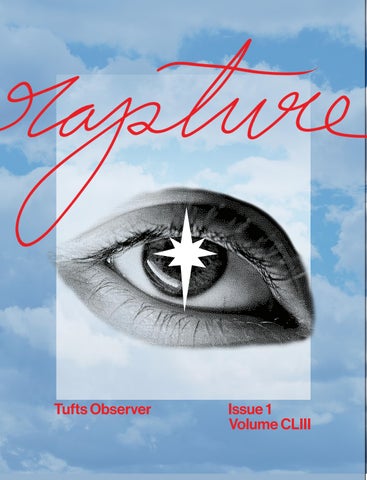
Create a flipbook