The Tufts Daily - Thursday, March 26, 2026

Page 1


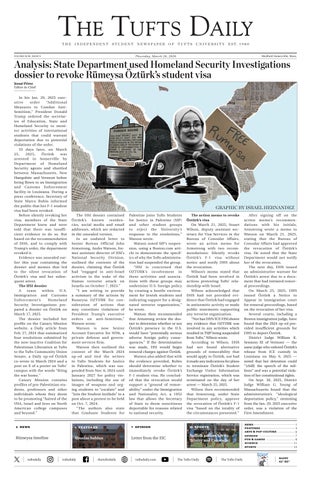
Analysis: State Department used Homeland Security Investigations dossier to revoke Rümeysa Öztürk’s student visa

In his Jan. 29, 2025 executive order “Additional Measures to Combat AntiSemitism,” President Donald Trump ordered the secretaries of Education, State and Homeland Security to monitor activities of international students that could warrant deportation due to potential violations of the order.

55 days later, on March 25, 2025, Öztürk was arrested in Somerville by Department of Homeland Security agents and shuttled between Massachusetts, New Hampshire and Vermont before being flown to an Immigration and Customs Enforcement facility in Louisiana. During a press conference, Secretary of State Marco Rubio informed the public that her F-1 student visa had been revoked.

Before silently revoking her visa, members of the State Department knew and were told that there was insufficient evidence to do so. But based on the recommendation of DHS, and to comply with Trump’s order, the department revoked it.

Evidence was unsealed earlier this year containing the dossier and memos that led to the silent revocation of Öztürk’s visa and her subsequent arrest.

The HSI dossier A team within U.S. Immigration and Customs Enforcement’s Homeland Security Investigations prepared a dossier on Öztürk on March 17, 2025.

The dossier included her profile on the Canary Mission website, a Daily article from Feb. 27, 2024 that summarized four resolutions submitted by the now-inactive Coalition for Palestinian Liberation at Tufts to the Tufts Community Union Senate, a Daily op-ed Öztürk co-wrote in March 2024 and a post on X of a poster on Tufts’ campus with the words “Bring the war home.”

Canary Mission contains profiles of pro-Palestinian students, professors and other individuals whom they deem to be promoting “hatred of the USA, Israel and Jews on North American college campuses and beyond.”

The HSI dossier contained Öztürk’s known residencies, social media and email addresses, which are redacted in the unsealed version.

In an undated letter to Senior Bureau Official John Armstrong, Andre Watson, former assistant director of HSI’s National Security Division, outlined the contents of the dossier, claiming that Öztürk had “engaged in anti-Israel activism in the wake of the Hamas terrorist attack on Israelis on October 7, 2023.”

“I am writing to provide a summary of the actions by Rumeysa OZTURK for consideration of actions that may constitute violations of President Trump’s executive orders on anti-Semitism,” Watson wrote.

Watson is now Senior Account Executive for SOSi, a private defense and government services firm.

Watson then outlined the content of the March 2024 op-ed and tied the writers to Tufts Students for Justice in Palestine, which was suspended from Nov. 6, 2024 until January 2027 for policy violations, including the use of images of weapons and urging students to “escalate” and “Join the Student Intifada” in a post about a protest to be held on Oct. 7, 2024.

“The authors also state that Graduate Students for

Palestine joins Tufts Students for Justice in Palestine (SJP) and other student groups to reject the University’s response to the resolutions,” Watson wrote.

Watson noted SJP’s suspension, using a Boston.com article to demonstrate the specifics of why the Tufts administration had suspended the group.

“HSI is concerned that OZTURK’s involvement in these activities and associations with these groups may undermine U.S. foreign policy by creating a hostile environment for Jewish students and indicating support for a designated terrorist organization,” he wrote.

Watson then recommended that Armstrong review the dossier to determine whether or not Öztürk’s presence in the U.S. would have “potentially serious adverse foreign policy consequences.” If the determination was made, HSI would begin removal charges against Öztürk.

Watson also added that with the evidence provided, Rubio should determine whether to immediately revoke Öztürk’s F-1 student visa. He concluded that the revocation would support a “ground of removability” under the Immigration and Nationality Act, a 1952 law that allows the Secretary of State to deem noncitizens deportable for reasons related to national security.

The action memo to revoke Öztürk’s visa

On March 21, 2025, Stuart Wilson, deputy assistant secretary for Visa Services in the Bureau of Consular Affairs, wrote an action memo for Armstrong with two recommendations: Silently revoke Öztürk’s F-1 visa without notice and notify DHS about the revocation.

Wilson’s memo stated that Öztürk had been involved in actions protesting Tufts’ relationship with Israel.

Wilson acknowledged that DHS had not provided evidence that Öztürk had engaged in antisemitic activity or made public statements supporting any terrorist organization.

“Nor has DHS/ICE/HSI shown any evidence that OZTURK was involved in any activities which resulted in TSJP being suspended from Tufts,” Wilson wrote.

According to Wilson, DHS had not found alternative grounds of removability that would apply to Öztürk, nor had it made any indications for plans to terminate Öztürk’s Student Exchange Visitor Information Service registration, which was terminated on the day of her arrest — March 25, 2025.

Wilson then recommended that Armstrong, under State Department policy, approve the revocation of Öztürk’s F-1 visa “based on the totality of the circumstances presented.”

After signing off on the action memo’s recommendations with his initials, Armstrong wrote a memo to Watson on March 21, 2025, stating that the Bureau of Consular Affairs had approved the revocation of Öztürk’s visa. He noted that the State Department would not notify her of the revocation.

The next day, DHS issued an administrative warrant for Öztürk’s arrest due to a document that had initiated removal proceedings.

On March 25, 2025, DHS issued Öztürk a Notice to Appear in immigration court for removal proceedings, based on the revocation of her visa.

Several courts, including a Boston immigration judge, have found that the 2024 op-ed provided insufficient grounds for DHS to deport Öztürk.

District Judge William K. Sessions III of Vermont — the same judge who ordered Öztürk’s release from ICE custody in Louisiana on May 9, 2025 — noted that her detention could “[chill] the speech of the millions” and was a potential violation of her constitutional rights.

On Sept. 30, 2025, District Judge William G. Young of Massachusetts found that the administration’s “ideological deportation policy,” stemming from the Jan. 29, 2025 executive order, was a violation of the First Amendment.

Founded in

The Tufts Daily is the entirely student-run newspaper of record at Tufts University in Medford, Mass. An editorially and financially independent organization, the Daily’s staff of more than 100 covers news, features, arts and sports on Tufts’ four campuses and in its host communities. The Tufts Daily office is located on the colonized land of the Massachusett people and within the territories of the Nipmuc and Wôpanâak (Wampanoag) tribes. Let

Story tips? Questions? Concerns?

Medford Comprehensive High School Building Committee presents new educational plan to city

this small group. … It’s not a respectful professional space for kids to work.”

Originally published March 24.

At their March 23 meeting, the Medford Comprehensive High School Building Committee voted on six final designs for the high school.

Whittling the potential designs down from 29, committee members discussed design priorities ranging from site safety and security to ensuring strong counseling and community health support. Members also debated how a new pool might be included in the construction and fielded public questions and comments.

The construction plan for Medford’s new high school is in full swing following the presentation of its educational plan in January. Written by the Medford Comprehensive High School Building Committee, the plan envisions improved learning spaces and programming for students, faculty and community members.

Guided by Medford Public Schools Superintendent Suzanne Galusi and Kimberly Talbot, assistant superintendent of academics and instruction, the 58-page plan includes architectural proposals for potential classroom and learning space dimensions as well as educational goals that center on creating “human-centered spaces that support collaboration, movement and multiple modes of teaching and learning,” which are currently lacking in Medford’s high school, according to Talbot.

“The classrooms are small,” Talbot said. “There’s not space for you to get up and move into

The educational plan presents goals to expand collaborative, hands-on learning opportunities with increases in flexible classroom spaces and career and technical education opportunities. Vocational programming will be more integrated into the new high school, allowing all students to be part of the same community, and will increase from 15 to 19 programs, providing more career-focused learning opportunities for students.

The educational plan also proposes a new early childhood center at the high school, combining the existing Medford Family Network and other daycare programs. Graham hopes that holding programming at a singular central location will allow for more comprehensive services for families.

The educational plan is a major feature of the feasibility study, the third module of the Massachusetts School Building Authority’s project. The process, which officially began in October 2025 after a prior failed attempt, lays out specific steps that the city must take for the MSBA to partially fund construction.

To write the plan, Galusi and Talbot collaborated with teachers, community groups and a group of ‘content directors’ who represent each of the eight academic departments. The team also visited other new construction sites to gain insight into what might be required for the new school. Project management firm LeftField was hired in June 2025 to represent the city’s goals as the owner’s project manager, and Cambridge architecture firm

SMMA was hired in November 2025 as the designer.

Talbot also spent a day shadowing high school students to hear what they would prioritize in a new high school.

“We learned a lot about what students want and how they want to engage with the world,” Talbot said. “They have a lot to say about how they interact with the world around them, from how long it takes to get from one class to another … to how the room is organized.”

The Medford School Committee also played a central role in reviewing and approving the educational plan earlier this winter. The committee discussed the document during its Jan. 26 meeting and approved it on Feb. 2 before submitting it to the MSBA as part of the feasibility process.

Jenny Graham, vice chair of the Medford School Committee and chair of the Medford Comprehensive High School Building Committee, said the plan will guide future decisions about the building as the project continues.

“That building is really a hub for activity in the city, and the educational plan sort of lays out all of the ways we intend to use the building in the future,” Graham said.

City officials are also seeking input from Medford residents as the planning process continues. The district has hosted community forums and offers a mailing list where residents can review building proposals and share feedback on possible designs. The Building Committee has also held regular meetings throughout February and March to present updates and major decisions to the public.

Talbot emphasized the importance of keeping residents updated and invested in the project.

“The School Committee is really so responsive to the needs of the district and also in connecting with the community,” Talbot said. “Additionally, [the] Building Committee has worked very hard to inform the School Committee of all of these steps along the way, and the Mayor is part of both of those.”

Graham highlighted the School Committee’s goal to engage residents in the project.

“We’ll be out and busy in the community trying to bring the project to people instead of asking people to come to the project,” Graham said.

The committee is also beginning its schematic design process, in which 29 proposed designs will be voted on and narrowed down to three to five design alternatives at the March 23 Building Committee Meeting. The final preferred design is expected to be chosen in June.

City officials also hope to implement some of the education programming as early as next year. Plumbing and IT/cybersecurity vocational programs are expected to be offered to rotational ninthgrade students in the current school space, although other programs, such as dental assisting, require the new space to be offered.

“[Medford High School] is more than a high school, it’s more than the daycare, it’s more than a pre-K, it is a community space,” Graham said. “I just look forward to the day that people go there and they say, ‘This really is the gem of our community.’”

Owen Chin-Rust and Evan Vezmar Contributing Writer and Deputy News Editor
KUNAL BOTLA / THE TUFTS DAILY Medford High School is pictured on Oct. 20, 2024.

Timeline of Rümeysa Öztürk’s detainment and legal proceedings

From

arrest to case dismissal, Öztürk’s case highlights tensions between immigration enforcement, free expression and federal authority.

Tufts graduate student Rümeysa Öztürk co-wrote an op-ed with three other graduate students calling on the university to adopt resolutions related to the war in Gaza, including recognizing genocide, issuing an apology for past statements by University President Sunil Kumar and disclosing investments and ties with Israel.

U.S. District Judge Denise Casper ruled that Öztürk could not be removed from the country pending a jurisdiction ruling. The American Civil Liberties Union joined her legal team and filed an amended petition arguing that her transfer to Louisiana — carried out without notifying her counsel, the court or the Department of Justice — reflected a broader ICE pattern of moving detainees to remote locations to obstruct habeas filings.

Judge Casper denied the government’s motion to dismiss and transfer Öztürk’s case to Louisiana, instead moving it to Vermont, where Öztürk had been held overnight when her petition was filed. Casper also kept in place the existing order barring her removal from the country.

An immigration judge denied bond to Öztürk, calling her a flight risk and a danger to the community. Meanwhile, her lawyers argued in federal court that her detention was unconstitutional, retaliatory and harmful to her health, and sought to move her case to Vermont. A federal judge in Vermont ruled that the court had jurisdiction over her habeas petition and ordered that she be transferred from Louisiana to Vermont for further hearings, finding that her return would allow proper review of constitutional claims, medical concerns and potential bail without interfering with immigration proceedings.

A federal judge in Vermont ordered Öztürk’s release from ICE detention in Louisiana, allowing her to return to Somerville and travel within Massachusetts and Vermont after finding that the government had presented no evidence of violent activity beyond the op-ed she co-authored. The judge said her lawyers had raised serious First Amendment and due process concerns. The decision followed an appeals court deadline for the government to transfer her to Vermont, as she continued to challenge her detention in a separate habeas case while her immigration proceedings were ongoing.

She returned to Massachusetts on May 10 and held a press conference with elected officials at Boston Logan Airport. Speakers criticized her arrest as unsupported by evidence, emphasized that her deportation case was ongoing and said the ruling raised serious First Amendment and due process concerns while highlighting the broader treatment of other detainees.

Judge Casper ordered the government to restore Öztürk’s SEVIS student record, finding that its termination after her arrest likely violated federal law and caused irreparable harm by blocking her from paid research work, doctoral training and lawful student status. The court said the government failed to give a consistent legal justification for the termination. The ruling allows her to regain her academic standing while her broader immigration and constitutional cases continue. The government appealed the decision, and the case remains ongoing.

Öztürk announced that she received her Ph.D. from Tufts’s Eliot-Pearson Department of Child Study and Human Development, completing her degree after a year marked by her ICE detention, visa revocation and multiple court battles tied to an op-ed she co-authored as a doctoral student. Although her immigration case was dismissed and her student record restored, appeals in federal courts are still pending. In a public post, she said that despite the ordeal, she remains committed to research on child development, media and compassion while calling attention to global human rights abuses.

MARCH 26, 2024

MARCH 25, 2025

MARCH 29, 2025

APRIL 4, 2024

MARCH-APRIL 2025

After having her visa revoked by the U.S. Department of State, Öztürk was arrested by masked Immigration and Customs Enforcement agents in Somerville and taken to ICE facilities in New Hampshire and Vermont before being flown to Louisiana. While on her way to break a Ramadan fast, Öztürk was captured on video screaming as agents removed her backpack and placed her in handcuffs. In the following days, students and local residents took to the streets in protest and petitioned the university to take action to secure her release.

Sen. Elizabeth Warren and 30 senators wrote a letter to Secretary of State Marco Rubio and other Trump administration officials demanding answers about the legal basis for Öztürk’s detention and calling for her release. Tufts students organized a walkout on April 1 in support of Öztürk, while Jewish faculty called on the university not to equate criticism of Israel with antisemitism.

APRIL 18-24, 2025

APRIL 11, 2025

In a court filing, Öztürk described unsafe detention conditions, a lack of proper medical care for her asthma and other circumstances her counsel called extraordinary. Her lawyers asked a federal judge in Vermont to order her immediate release or return to Vermont, arguing that her detention in Louisiana violated her constitutional rights, harmed her health and interfered with her education. The government contended that the case was filed in the wrong court and should be handled in Louisiana, arguing that the court lacked authority to grant relief.

APRIL 22, 2025

The groups argued that punishing her for a March 2024 op-ed would contradict the university’s commitment to free expression and called on federal agencies to provide evidence justifying her detention. Leaders from both groups said the bipartisan statement was meant to reduce campus fear, demand transparency from the government and show that students across the political spectrum could unite in support of free speech and due process.

MAY 9, 2025

JULY 17, 2025

In an op-ed copublished in the Daily and Vanity Fair, Öztürk described her arrest and 45 days in ICE detention, where she said she faced overcrowded, unsanitary conditions, inadequate medical care, sleep deprivation and worsening asthma, while witnessing other detainees struggle with illness, family separation and a lack of basic necessities. She wrote that the experience changed her view of the U.S. immigration system, arguing that detention conditions reflect broader injustice and dehumanization of immigrants.

DECEMBER 8, 2025

FEBRUARY 20, 2026

FEBRUARY 10, 2026

A Boston immigration judge ended removal proceedings against Öztürk, finding that the Department of Homeland Security failed to show valid grounds for deportation. Her lawyers said the case is not fully resolved because the government can still appeal, and her habeas case in federal court continues.

For more information, visit our page with previous coverage of Rümeysa Öztürk.

Tufts to host members of Abuelas de Plaza de Mayo in speaker series event

Editor’s note: Some of the written quotes featured in this article were edited for clarity.

This Monday and Wednesday, Tufts will be hosting a speaker event with Hector Rombola and Marcela Solsona Sintora, who are with the Abuelas de Plaza de Mayo organization. The speaker event will be at the Olin Center from 3–4:30 p.m. on Monday and 5–5:45 p.m. on Tuesday.

APM is a human rights organization that works to identify and reunite those affected by Argentina’s military dictatorship with their biological families. The dictatorship occurred between 1976 and 1983 and resulted in the disappearance of an estimated 22,000 to 30,000 people, many of whose status is still unknown.

Even if one is unfamiliar with 20th century Argentine history, there are still plenty of takeaways from this speaker series.

“This talk is going to give … [a lesson about] the repression that took place in the 1970s,” Barbara Corbett, a lecturer in the history department, said.

The event was organized by

last year. His work largely involved expanding the biographical archives that the organization is building to reunite families.

“[APM] takes photos sent in by family members of the disappeared and saves them in their database,” he said. “The idea with these biographical familial archives is so that when the grandchild has their identity restored, even if none of their biological family members are still alive, they can still look at these photos and reconnect with their identity.”

Tratt said he “felt an obligation as an American to learn more and to be involved with the work that a witness does.”

APM was created during the dictatorship by mothers with disappeared daughters, concerned for their children and future grandchildren.

“Some of these mothers realized that several of their daughters had disappeared while pregnant. Were those babies born? Where were they? Some of these mothers soon realized that they may need to find their grandchildren and they would likely be alive,” Rombola wrote.

taken, wrote to the Daily that she “[feels] even more committed to recounting what happened and telling my story, one among many others.”

To understand why the Abuelas, or grandmothers, were so effective, Corbett explained the unique strategy of resistance known as ‘political motherhood.’

“This is a military dictatorship. You couldn’t speak out,” Corbett explained. “Yet [these women] were the most threatening things because they pointed out the absolute hypocrisy of the military regime by not allowing these women to fulfill their conservative roles as mothers.”

Since the military regime claimed to value the ‘traditional family’ and ‘Catholic motherhood,’ the women of the Plaza de Mayo used those exact roles as a shield.

While Sintora considered her childhood to be “very normal,” she did not understand that she was adopted until she became an adult.

“After the DNA test, [my mother] also confessed that when I was about 5 years old, between 1982 and 1983, and news reports about missing babies started,

story and educating broader communities.

“She’s a living testament, a witness … so for her to come and speak to my students, it puts them in immediate contact with this. This is a living history,” Corbett said. “To see it and hear about it from someone who has lived through it and was a victim of these events, [and] not just a victim, but then a triumphant resister and survivor of these events, I think it’s an inspirational tale.”

Tratt agreed with this, saying, “I really do think it’s important to have a grandchild come and speak and not have it be something on Zoom. … It’s a testament to the fact that the work that Abuelas does is very current and has a real impact on the lives of people who are breathing and around right now.”

However, Sintora shared her hesitations about speaking out, as it seemed a daunting task.

“In the beginning, I didn’t want to do it. My first response was a negative one … but the time went on, and it became to be a need for myself, and the moment I decided that I had to do it was when I was [a] mother,” she wrote.

Today, Sintora reflects on how

of my origins. And [nowadays] I can’t imagine my life without this: my brothers, my father, the history of my mother, my nephews, all this make me today a stronger and completed person,” Sintora wrote.

Tratt emphasized that APM’s work is far from over.

“[APM estimates] that there’s [currently] 500 grandchildren who [have] disappeared in this fashion, and they found roughly 130,” he said.

“The last grandchild was found in July 2025,” Rombola wrote.

Rombola strongly believes that “perseverance does pay off when love is the fuel. APM has been looking for their grandchildren and advancing the concept of the Right to Identity against many enemies for almost 50 years.”

“What happened in Argentina is not atypical, in fact it could happen in any country … and it is,” Rombola wrote.

For Sintora, this urgency is deeply personal. She highlights that “the only way to avoid [and] repeat horrors of the past, is knowing the history, especially knowing its consequences.”

“I hope that many people that are right [now] in the same situation I was 7 years ago … under-

Mass

Freedom to Read supports literary free expression on day of advocacy

The Mass Freedom to Read Coalition assembled on March 10 in the Boston State House for a day of advocacy, involving a book fair and a press conference with speakers including authors, state legislators, students, librarians and advocates.

The Mass Freedom to Read Coalition consists of Massachusetts families, students, authors, publishers, librarians, booksellers and educators who believe in the freedom to read, as it relates to the First Amendment. The coalition is dedicated to advocating for the passage of Bill H. 3594, an act regarding free expression. It declares that books and

materials cannot be removed from public libraries and schools based on personal ideology and protects librarians and educators from retaliation.

Malinda Lo is a member of Massachusetts Freedom to Read and the author of the LGBTQ coming-of-age novel “Last Night at the Telegraph Club,” which was one of the most-banned books of 2024.

Lo explained that the passage of H.3594 in Massachusetts is especially crucial at this moment, as restrictive legislation is proposed nationwide.

“With the recent introduction of HR 7661 the United States House of Representatives mendaciously titled ‘Stop the Sexualization of Children Act,’ the federal government is well on its way to telling us what we can

and can’t read,” Lo said during the conference. “But we can fight back here in Massachusetts using our state laws to protect Massachusetts residents and to send a message to Washington.”

Lo explained the importance of these books to young readers.

“Books are the keys that unlock minds. They show people what is possible,” she said. “When people feel unsafe,

Emily Sullivan Staff Writer
NICOLE DACEY / THE TUFTS DAILY ·
The Olin Center for Language and Cultural Studies is pictured on March 25.

unheard or unimportant, books offer a way for people to see themselves in stories.”

Many of these stories facing bans and restrictions contain marginalized perspectives and identities. Andrea Fiorillo, co-chair of the Massachusetts Library Association Intellectual Freedom and Social Responsibility Committee, elaborated on which narratives most often face censorship.

“When we talk about banning books, we’re really talking about people whose stories are told, whose stories are censored. Recently, it is especially the voices of LGBTQ, Black, Indigenous and Latinx voices who are silenced.

Currently in Massachusetts, it’s Palestinian and trans stories who are most often excluded,” Fiorillo said during the conference.

Book banning in Massachusetts is not limited to community members filing complaints against curricula and libraries.

“In Great Barrington, police were called to middle school to investigate a book. In Rockport and beyond, books were hidden or destroyed. … A candidate for secretary of state campaigned on the issue of libraries exposing children to pornography,” Fiorillo said. “Extremists in ski masks have disrupted story times in Taunton, Fall River and Boston, and bomb threats of terrorized library workers and their communities in Reading and Somerville.”

Lessons of gratitude

After returning from Los Angeles, I feel renewed by a powerful dose of vitamin D, a few extra pounds and enough matchas to make my wallet shed a few tears. I’m happy to say we’re back! Spring is officially here! Days are getting longer and the weather is (supposedly) getting warmer! With only a handful of weeks left in the semester, one might say life is looking lusher than before.

Yet amid all this bliss, there is a dissonance. A part of me is trying to grapple with this feeling, given the political turmoil and destruction that our country is eliciting. It was recently announced that the Pentagon has deployed around 2,000 troops to the Middle East amid the escalating war. There have been devastating reports of collateral damage, including the horrific bombing of an Iranian girls’ school by the U.S. that resulted in at least 175 deaths. Countries across Asia have plummeted into a global energy crisis. Meanwhile, our country’s leaders continue to spew despicable rhetoric that glorifies this violence and death.

How to reconcile this? What can I make of this nagging sense of guilt for feeling the “bright side?”

I’ll admit it, I fall into this trap at times. I feel this pang of guilt sometimes for feeling joy, or even stressing

Outside of public libraries in schools and communities, Fiorillo connected the fight against book banning to others regarding censorship and academic freedom.

“The threat to free expression has spread, evident in the suppression of curricula, peaceful assembly, the press, in defunding research … in detaining academics,” she said. “Even when the sensors don’t win at the moment, the impact is that individuals, libraries, museums, schools, municipalities, universities self-censor for fear of the consequences.”

These anxieties around self-censorship are present in writers as well, especially those beginning in their writing careers, as Fin Leary, a program manager at We Need Diverse Books and writing instructor at Emerson College, noted.

As book banning increases, there are more hesitations from educators to teach certain books, publishers to publish certain books and literary agents to promote and advocate for certain books. This all can affect authors, leading them to self-censor.

Leary further detailed their observations around how young adult writers engage and experience censorship outside of self-censorship.

“I think one of the biggest trends is that students are deeply concerned about these issues.

Young people are very aware of the impact that book banning and censorship has. They’re passionate. … They don’t want to be censored,” Leary said.

over my own mundane struggles, while others are experiencing literal catastrophe. I’m not sure if anyone else relates to this. If so, this is how I’ve been considering my feelings.

Guilt is not a productive feeling. Rather, it implies a sort of paralysis or stagnation. There is this sense of helplessness that benefits no one. Instead, it inhibits one from truly being present in their life, while also doing nothing to alleviate the struggles of others. In a way, it is a subtle, perverse form of self-victimization, occupying a space that is neither here nor there, lacking the courage to be happy or the utility to be helpful.

Fiorillo added that the bill is actionable, given it has a specific focus.

“We’re addressing a very specific piece of this censorship issue here. There’s something very actionable. It just makes some small tweaks in existing law, but it also reaffirms our commitment to the First Amendment and to the 14th Amendment,” Fiorillo said.

What I have been working to do instead is to feel a sense of informed gratitude. This isn’t ‘blissful ignorance.’ Rather, it looks like educating myself about what is occurring in the world, without letting it taint or remove me from my own experiences.

I have found that being here at Tufts and educating myself is the best way to make an impact. Learning about the world around us leads to taking steps in tackling its problems, rather than just feeling helpless.

For me, this looks like leaning into the final months of this school year. Embracing the late-night

laughs and the intellectual rigor of my classes, while keeping an understanding of what is happening around the world. Lately, my family has also been using a gratitude sharing app where we post three things we are grateful for and one kind reflection on one another. It’s such a simple, little ritual, but it is effective. We post pictures of our dogs and our coffee in the morning, and reflect on how lucky we are to have each other in our lives, rather than living in a state of war and displacement. It centers me in this state of abundance rather than shame, providing necessary emotional fuel to actually move

Lo underlined the importance of this bill during the conference.

“As one of our nation’s founding states, Massachusetts has a responsibility to be a leader and to continue our proud tradition of fighting for freedom during troubled times,” she said.

forward. It allows us to use our privilege to educate ourselves and advocate for change. We cannot pour from an empty cup, or help others when we feel this perverse shame for our own joys.

Even in writing this, I worry I’m making it all about me — perhaps that, too, is a form of self-centeredness. But I am still pulling myself back to the present, back to gratitude. For now, this is the bright side.

Sera Kwon is a deputy features editor for the Daily. Sera is a sophomore who has not yet declared a major and can be reached at sera. kwon@tufts.edu.

EMILY SULLIVAN / THE TUFTS DAILY
Malinda Lo speaks at the Mass Freedom to Read Advocacy Day at the State House in Boston on March 10.
The Bright Side

ARTS & POP CULTURE

Brian Becker

filling in the gaps. But as listening to music no longer necessitated the purchase of physical media, listeners lost a tangible connection to the music that could not be replicated. We are no longer required to listen to the ebbs and flows of an album and, as a result, the listener no longer encounters the entire production process.

To many of us, CDs and records are relics of the past. While they were once collected by our parents and grandparents to access music, the widespread use of the inter net has given birth to digital media. The size of one’s collection slowly gave way to the strength of one’s inter net connec tion as the primary mea sure of music accessi bility. With the purchase of a month ly subscrip tion and the touch of a finger, listeners can now access any song they could ever desire. We assemble playlists of any order and length, cherry-picking the best songs from each album with listening algorithms

However, many have become fatigued of the constant skipping and swiping that comes with music streaming services, opting to download MP3 files

people combing through the countless amounts of vinyl records and CDs. Sure, physi cal media will never again be the ultimate medium for con sumption. But I will explore why so many have turned to physical media as a source of entertainment in an increas ingly digitized world.

If you want the satisfaction of playing physical media without having to fork over several upfront costs, a CD player is your best bet. Many appreciate CDs for their ability to play music fully offline, as well as their ability to play quality music through a car’s sound system in older vehicles lacking Bluetooth or USB connectivity.

time

While certainly not as customizable as modern playlists, CDs still offer users the ability to ‘burn’ a series of songs to disk. Recently, I repur posed a DVD player from an old PC and wrote a series of MP3 songs to disk. What the MP3 format delivers in convenience is what the CD brings in permanence. The content inside a disk can’t be modified until you use a writing laser to rewrite it.

CDs might offer the conveniences of pausing, playing, writing and rewriting, but vinyl records have music almost literally etched in stone. Listeners must go through the act of cleaning the record, placing it onto the turntable and physically dropping the needle onto the album.

to the music. While no metrics can objectively deem that vinyl has better listening quality than a digital setup, users have cited a ‘warmer feel’ to the track as a whole. The act of listening to vinyl has become a community event, too. It has brought back the ‘listening party’ where people gather around the record player to listen to an album. Listening bars have also popped up in major U.S. cities for minds looking for respite from noise and a more deliberate choice for music. In an increasingly connected world, we choose friction over

supporting the artists who created it, bringing back physical media may be worth considering. In a world defined by convenience and endless choices, intentionally selecting a record, sliding it from its sleeve, placing it on the turntable and, finally, dropping the needle, offer something streaming cannot: presence. Vinyl does not simply play music — it asks you to listen. And for those seeking a deeper, more intentional relationship with music, that experience may be reason enough to begin a collection.

Each
I make the journey to Ball Square to ride the Green Line, Stereo Jack’s in Somerville has a handful of
Graphics by Israel Hernandez
Staff Writer

OPINION

Letter from the Editor in Chief: A special coverage page on Rümeysa Öztürk, two years later

Dear readers,

It has been one year since Dr. Rümeysa Öztürk’s arrest by masked agents from the Department of Homeland Security near her home in Somerville. We are publishing a “special coverage” page to mark this date.

This special page lists all our news articles related to Öztürk’s legal cases, in addition to responses from Tufts affiliates and local officials. At the bottom of the page, we have listed all the op-eds submitted to the Daily by local residents, Tufts affiliates and Öztürk herself.

The newest article is an analysis of evidence that was unsealed in

January 2025 surrounding the State Department’s revocation of her visa and the Department of Homeland Security’s decision to detain her.

I want to take this opportunity to address the timing of this page’s release and its title.

The Daily published an op-ed that she co-authored on March 26, 2024. DHS detained Öztürk on March 25, 2025. The op-ed was one day away from turning one year old when she was detained. Much of what Öztürk and her coauthors argued for in the piece has gone unheeded by the Tufts administration in the two years since the Tufts Community Union Senate’s resolutions.

The unsealed evidence shows that the government used the 2024 op-ed and a series of loose

associations to justify her detainment, informed by her profile on the Canary Mission website. By their own admission, the government — specifically Homeland Security Investigations — did not find further evidence to revoke her visa on national security concerns or antisemitism. This lack of hard, substantive evidence is ultimately why the Boston immigration judge terminated her removal proceedings.

Nevertheless, Secretary of State Marco Rubio’s State Department signed off on the silent revocation of her visa on the same day an action memo was delivered to a Senior Bureau Official.

Any discussion or reflection about Öztürk’s case is inextricably linked to the 2024 op-ed.

Today marks two years since the op-ed was published. That is why the page is titled “Two Years Later.”

The March 2024 op-ed was an exercise of free speech, which the First Amendment protects. Infringing on that basic right has led to several lawsuits; the Daily has worked to uphold and practice that basic right for 46 years. We will not stop doing so.

The Daily remains committed to protecting the voices of community members and Tufts affiliates in our reporting and in the submission of op-eds. I highly encourage you to email our Opinion section at opinion@tuftsdaily.com to contribute to a culture of constructive debate and reflection about any topics that you

Editorial: Spring has (almost) sprung

feel the community should be informed about.

The following writers were instrumental in covering Öztürk’s proceedings, and I am deeply appreciative of their work and efforts:

• Samantha Eng, executive news editor, spring 2025

• Julian Glickman, executive news editor, spring 2026

• Matthew Sage, executive news editor, spring 2024

• Anika Parr, deputy news editor

• Shayna Levy, news editor

• Michael Onysko, former deputy news editor I want to especially thank Mike Joseph and the SNWorks team for helping us create the special page.

Pax et Lux,

Josué Pérez

Editor-in-Chief

As the snow finally melts from Prez Lawn and the sun peeks out above the Hill, we at the Editorial Board think it’s time for all of us at Tufts to start spending some more time outside in our nearby neighborhoods. From Davis Square to downtown Boston, the area is full of unique neighborhoods with exciting upcoming spring events and activities that we recommend taking advantage of — not to mention the spring activities Tufts itself has to offer.

Few times in your life will you have convenient access to a plethora of nearby town squares via the university shuttle or to lush green quads on which to study, nap or pretend to make some progress on your assigned reading. While it’s still slightly gloomy out, that doesn’t mean you can’t start planning your April and May activities to get through the next few rainy weeks.

1. Mark your calendars for PorchFest on May 9 — just in time for the end of the reading period. PorchFest, an annual Somerville music festival, invites neighborhood musicians and bands to play on porches across Davis Square, Central Square and even the Tufts campus. PorchFest is the perfect way to spend time outside, support local musicians and celebrate the end of finals!

2. Studying on Prez Lawn is already a favorite activity of Tufts students, but a reminder to cherish the sunlight while it’s here never hurts. We’ve already had a few sunny days, and there has been no

shortage of students soaking up the sun and lounging on Adirondack chairs and leftover bales of hay. While studying outdoors might not always be conducive to productivity, make sure to have at least one outdoor study session to welcome the new season.

3. Whether you’re on a reduced

Franklin Park Zoo. There, as the leaves turn green and we get out of the winter slumber, you can find all sorts of animals up and about. It’s a great place to wander aimlessly for a few hours and enjoy the comfort that a few furry friends might be able to bring you. If you’re looking for a scenic walk or bike

delays. Train enthusiasts can also take advantage of Green Line, commuter rail and Amtrak trains passing along at varying speeds.

6. Tufts students and faculty have also had access to the Harvard museums since March 2025! Some were already free, but Tufts community members can now visit in, take the opportunity to explore beaches around Boston. Revere Beach is easily accessible from Tufts via the Green Line and a transfer to the Blue Line, while Carson Beach can be reached via the Green Line and Red Line. Farther east, Castle Island offers an ideal destination for a full, sun-filled day by the water. Spring is the perfect time to explore the neighborhoods surrounding Tufts and try new Boston activities before the semester wraps up. The Editorial Board hopes this list offers some ideas for how to spend the

The Editorial Board AARON GRUEN / THE TUFTS DAILY Bendetson Hall is pictured on April 12, 2023.

The Tufts Daily is a nonprofit, independent newspaper, published Monday through Friday during the academic year and distributed free of charge to the Tufts community. The content of letters, advertisements, signed columns, cartoons and graphics does not necessarily reflect the opinion of The Tufts Daily editorial board.

EDITORIALS: Editorials represent the position of The Tufts Daily Editorial Board. Individual editorialists are not necessarily responsible for, or in agreement with, the policies and editorials of The Editorial Board. Editorials are submitted for review to The Tufts Daily Executive Board before publication.

VIEWPOINTS AND COLUMNS: Viewpoints and columns represent the opinions of individual Opinion editors, staff writers, contributing writers and columnists for the Daily’s Opinion section. Positions published in Viewpoints and columns are the opinions of the writers who penned them alone, and do not necessarily represent the opinions of the Daily itself. All material is subject to editorial discretion.

OP-EDS: Op-Eds provide an open forum for campus editorial commentary and are published Monday through Friday. The Daily welcomes submissions from all members of the Tufts community; the opinions expressed in the Op-Ed section do not necessarily represent the opinions of the Daily itself. Opinion articles on campus, national and international issues should be 600 to 1,200 words in length and submitted to opinion@tuftsdaily.com. The editors reserve the right to edit letters for clarity, space and length. All material is subject to editorial discretion and is not guaranteed to appear in the Daily. Authors must submit their telephone numbers and day-of availability for editing questions.

ADVERTISEMENTS: All advertising copy is subject to the approval of the Editor-in-Chief, executive board and business director. Reach out to business@tuftsdaily.com with advertising inquiries.

Late Night At The Daily

Emily: “Where did you get this transparent image?” Grace: “God loves me.”

CROSSWORD

ACROSS 1 Mr. Clean and Pitbull, e.g.

5 Official currency of Thailand (plural)

10 FDR's furry friend

14 In addition

15 "Joke's ___!"

16 Portuguese man ___ (sea creature)

17 *Spoils plans I have

20 Boston and NYC time zone

21 One may take this for a bad sign

22 "Say cheese!"

23 ___ Mis

24 Gave away

26 "Say a little ___ for you"

30 Make merry

Prometheus tried to give this to humans

32 Extra great

Tie-breaking soccer shots: Abbr.

*Event will happen regardless of weather 40 Ave. crossers

Playground retort, with 38 Down 42 Ready for business 43 "A Doll's House" playwright 44 Told event host you were coming

"No I'm ___ Rebel!" from a 2012 Disney film

RR stops

"Woe is me!"

Calisthenics pose that builds core strength

Put on

Someone born between 1946 and 1964

Queen ___ lace

Song of praise, often in a church

"How's it goin?"

Like a black-tie wedding

Soup spoon

Thin as ___ (2 words)

46 There's a pot of gold at the end of this, supposedly 49 Bashful 50 "___ A Woman?" book by Sojourner Truth 51 Dermatologists' concern 52 Bonnie & Clyde, Mickey & Minnie, e.g. 55 *Cancels scheduled plans 59 ___ Brockovich of California

‘Rainy Days’ by Shayna Levy
‘More Precipitation’ by Shayna Levy

THURSDAY, MARCH 26, 2026

Addressing the costs of excessive alcohol consumption

For the majority of Americans, the consumption of alcoholic beverages plays some role in their lives, whether it takes the shape of a drink out with friends, a glass of wine at a restaurant or a beer after work. According to the Centers for Disease Control and Prevention, around two-thirds of American adults consumed alcohol in 2018. While alcohol consumption has been decreasing over time, a study from Gallup found that 54% of Americans reported drinking alcohol in 2025. A significant proportion of these Americans engage only in light drinking; the CDC found that just 5.1% engaged in heavy drinking in 2018. However, though that proportion is small, the economic costs of excessive alcohol consumption are significant and often underestimated.

the Supplemental Nutrition Assistance Program that year. Meanwhile, Harvard Medical School estimates that the annual cost of treating alcohol-associated liver disease will more than double from $31 billion in 2022 to $66 billion by 2040. Further, one study on heavy drinking in high-income countries found that in most of them, the societal costs of alcohol were approximately one percent of a country’s GDP.

The costs of alcohol extend beyond economic ones. According to the National Highway Traffic Safety Administration, 12,429 people died in preventable alcohol-impaired traffic accidents in 2023. About 30% of all traffic crash fatalities in the U.S. involve drunk drivers and from 2014–23, about 11,000 people died annually due to drunk driving.

Furthermore, alcohol is correlated with crime. According to the U.S. Department of Justice,

alcohol market was disastrous. From 1920 to 1933, the U.S. government enacted a policy of Prohibition — a complete ban on the manufacturing, transportation and sale of liquor. This move increased illegal sales, shifted consumption toward the purchase of illegal and unregulated liquors and likely contributed to increased gang violence and organized crime. Therefore, there is reasonable hesitation toward renewed government intervention in the American alcohol market.

Nonetheless, there are policy interventions that can effectively straddle the line between ineffective bans and inaction. One such policy is minimum unit pricing, or MUP, which sets a price floor per unit of alcohol across product.

MUP has a record of success in Scotland, where it was implemented in 2018. Public Health Scotland found that it reduced deaths directly caused by alco-

strongest alcohol products, thereby targeting the consumption patterns of heavy drinkers. As a result, MUP was able to target excessive alcohol consumption without leading to significant drops in consumption that would drive sellers out of businesses.

The World Health Organization has identified such policies as “among the most cost-effective measures that countries can use to reduce alcohol consumption and harms” alongside pricing policies such as increasing the alcohol excise tax.

A second policy that should be considered is standardized and mandated harm labeling on alcohol containers. Similar to warning labels on unhealthy foods, we can apply this practice to alcohol. A systematic review published in The Lancet found that these labels “probably influence some alcohol consumption behavior” and may help address “alcohol-related harms.”

Finally, more should be done to increase awareness of the health risks of excessive alcohol use. More than half of Americans are unaware that alcohol increases cancer risk, and Pew Research Center found 57% of Americans who drink do not believe their alcohol consumption increases the risk of serious physical health problems “at all.”

None of this is to say alcohol or educated drinking is inherently bad. Pew also found that many Americans report that alcohol enhances their enjoyment of food and meals. In some ways, though the magnitude of health impacts may differ, alcohol is not so different from other indulgences, like a scoop of ice cream or a bag of chips. However, alcohol differs in its uniquely high social costs which are borne by all Americans. Through these moderate policy measures, it is possible to address these societal costs without dis-

The corporatization of nostalgia in American mass media

A major trend in Hollywood filmmaking that emerged in the 2000s and continues today is the legacy sequel. In 2015, the true renaissance of the legacy sequel era began, with “Mad Max: Fury Road” (2015), “Star Wars: The Force Awakens” (2015), “Jurassic World” (2015) and “Creed” (2015) all released in the same year. Quality disparities aside, the huge successes of these films proved that the legacy sequel was poised to become the future of filmmaking. Now, over 10 years later in the post-“Avengers: Endgame” (2019) era, the legacy sequel has become so naturalized that it seems inevitable.

The trend quickly expanded beyond Hollywood. Soon, commercials, TV show reunions and other forms of American mass culture joined the nostalgia wave. Though film has always been an

inherently commercial art form, the box office successes of early legacy sequels indicated that fans responded enthusiastically and effusively, that the movies had captive audiences. Fans were eager to see more from the franchises, and filmmakers were motivated to return to the worlds of their creations. Since then, however, as the political and cultural milieu of the country has atrophied, nostalgia continues to be corporatized and shoved down our throats. In Hollywood, the success of the legacy sequel sparked a barrage of more for franchises more obscure than the mainlines of “Jurassic Park,” “Star Wars,” “Mad Max” and “Rocky.”

At least in the realm of film, this trend can still appeal to fan desire, with fans desperate to see what their favorite characters are up to five, 10 or even 20 years later. More concerningly, however, the trend has spread to commercials

and advertising. Zach Braff and Donald Faison, for example, star in a T-Mobile commercial that premiered during the 2024 Super Bowl. Though not legally playing their beloved characters from “Scrubs” (2001–2010), the banter between the stars knowingly recalls their dynamic on the show. Similarly, at the start of the college football season in early October of last year, Terry Crews — sitting in the brand new Ram Truck he was promoting — gets so inspired he attempts to write his own fight song. When Vanessa Carlton’s “A Thousand Miles” plays instead, Crews notes that it’s a favorite of his, recalling the famous scene from “White Chicks” (2004).

This trend cynically says: Remember this thing you like? Buy our product, and you’ll feel just as great as you did then! A regressive nostalgic wave that started out of fandom has quickly become consumed by corporate

interests. Nostalgia for movies and TV shows we loved in the past is being repackaged as an escape from the breaking point the United States is rapidly approaching. Remember “Scrubs?” Switch to T-Mobile internet and it will make you forget about the militarized federal law enforcement parading around our cities right now. It will take you right back to how it felt watching “Scrubs” when things were better. Want to forget about the illegal war being waged in Iran right now? Buy a Ram Truck and you’ll feel like you did when you were cackling at “White Chicks.”

Not only are corporate interests cynically co-opting nostalgia to sell us products as a distraction from the frankly terrible state of our nation, but such emphasis on regressive nostalgia may also reflect a concerning sign for the political future of the country. When a demagogue with a powerful cult of personality begins

deploying paramilitary units into his own country and disguises it by appealing to a time when things were better, one cannot help but recall Italy’s Il Duce, Benito Mussolini. Fascist rhetoric in Italy appealed to the greatness of the Roman Empire to justify and distract from the gross violations of personal and civil rights. ‘The paramilitary squadristi in Italy were only murdering socialists because we remember how great the Roman Empire was.’ As bitter as this sounds, by becoming aware of it, we can begin to resist it. That’s not to say we shouldn’t watch our favorite movies from the past because we’re worried about our country falling to fascism. Being aware of how nostalgia is co-opted for corporate interests as a form of cynical manipulation of the atrophied American mass cultural zeitgeist can prevent us from being blinded by it. Let’s ‘Make America Great Again,’ right?

VIA PICKPIX
A group of people holding drinks is pictured.

Originally published March 24 Baseball is America’s sport. At least, it used to be.

It’s no secret that Major League Baseball is fueled by international talent and fans. Some of the best players were born internationally: Albert Pujols, Sammy Sosa, David Ortiz and Ichiro Suzuki. International fans are also heavily invested in the sport.

For example, after Japan-born superstar Shohei Ohtani signed his historic $700 million contract with the Los Angeles Dodgers in 2023, the team exceeded four million fans in attendance for the first time in its history. LA Tourism estimated that in 2024, 80%–90% of Japanese tourists to the city went to Dodger Stadium at least once.

It’s no accident that international players bring in huge audiences, with people across the world tuning in. It’s also no accident that the rise of international baseball coincided with American interventionism.

For example, the Dominican Republic, the country most represented on 2025 MLB Opening Day outside of the United States, began playing baseball in earnest

A masterclass in American hubris

after President Woodrow Wilson ordered delegate James Mark Sullivan to “teach Dominicans democracy.” U.S. military teams played against Dominican teams partially in an effort to reinforce American values rather than revolutionary ideology. Now, baseball is a billion-dollar industry for the Dominican Republic. International fanbases were first addressed directly by MLB in the 1990s, when the league began organizing games at international stadiums. MLB has also negotiated TV deals with international companies so fans can follow their players in the league, sometimes literally — Japanese broadcasts of Dodger games have cameras that track every move Ohtani makes. The most recognizable example of MLB’s globalization efforts is the World Baseball Classic. Started in 2006, the WBC invites qualifying countries across the globe to compete for the title, and every year, millions tune in to watch.

While professional baseball leagues from multiple countries sponsor the tournament, it is still largely an American endeavor. MLB organizes the event, and as a baseball fan, I can confirm that America is often the presumed center of baseball. International players

dream of signing in the United States because that is where the money is. As such, there is a prevailing belief in American dominance in the WBC. That belief is unfounded. Team USA has only won the tournament once. This year, we saw on the world stage how this hubris — the belief that America would presumably ‘win it all’ — led to events I would only describe as embarrassing.

In the first round of the 2026 tournament, Team USA beat Mexico for the first time since 2006. The team spent the night celebrating in the locker room, reportedly talking and drinking until past midnight.

The next morning, team manager Mike DeRosa incorrectly stated that Team USA would advance to the next round and joked that the team was ‘dragging’ because of the previous night’s partying. During that night’s game against Italy, DeRosa chose to bench many of the team’s best hitters, resulting in a loss. Suddenly, the U.S. was at the mercy of the result of Italy vs. Mexico, a game previously deemed so unimportant that it was supposed to air on Tubi. On the day of the game, it was announced that Fox Sports 1 would take over the broadcast.

Other controversies included Tarik Skubal, arguably the best pitcher in MLB, being called unpatriotic for leaving the team after only one appearance, and the entire team being perceived as ambivalent toward the tournament. My personal favorite of these controversies was when Robert J. O’Neill — one of the members of SEAL Team Six that killed Osama bin Laden — gave a speech to the team before its game against the Dominican Republic. Yes, you read that right. And, of course, Team USA lost in the final round to Venezuela.

On a broader level, MLB and the WBC attempted to limit political commentary and focus on baseball. But politics cannot be separated from any aspect of life. If the spread of baseball is tied to political intervention, then the entire game is informed by politics. This was especially evident in Team Venezuela.

Team Venezuela played many of its games in the United States, a country that had just invaded its country and captured its president in an illegal international act. While some Venezuelans have reported positive reactions to the intervention, the U.S. has made no moves to promote democracy in the region, one of its stated justifications. Players and

coaches on the Venezuelan team have refused to discuss geopolitical developments. But politics found them anyway. The day before the final game, President Donald Trump posted that Venezuela should become America’s 51st state. He reiterated the statement after Venezuela won, calling for “STATEHOOD!!!”

As someone who cares deeply about baseball and politics, this World Baseball Classic was difficult to watch. At many points, I was ashamed of Team USA, both its performance on the field and its off-field statements. Much of the patriotism (if you can call it that) the team exhibited was tied to American militarism, which sets a horrible precedent for what being American means on an international stage.

International sporting events like the WBC can foster cross-cultural connection, international cooperation and patriotism, but only if we allow them to. In a hostile political climate shaped by the United States’ escalating military threats across the globe, the WBC risks becoming a tournament that highlights hubris instead of player excellence. We must recognize that sports and politics are interconnected and we must thoughtfully deal with the complications that come with that relationship.

VIA WIKIMEDIA COMMONS
Team USA fans are pictured at the 2009 Baseball World Classic.

Rising to the occasion: Sea level research at Tufts

The Kemp Lab, located in the newly renovated Bacon Hall, focuses on coastal stratigraphy and the reconstruction of sea levels over the last 2,000 years. A core facet of the lab’s work is its interdisciplinary approach, which combines oceanography, seismology, statistics, geochemistry and climate science. The lab — led by Andrew Kemp, an associate professor of earth and climate sciences — is one of the leading university research labs studying sea level rise, with some of the most highly cited work in this field. Professor Kemp’s lab relies heavily on geological data to create these reconstructions. Specifically, sediment cores from coastal wetlands and salt marshes provide a significant portion of the data the lab uses. The lab also focuses on the Gulf Stream and on documenting the prehistory of large earthquakes, which can cause the land to shift vertically. Additionally,

researchers study isostasy models, which describe the geological equilibrium between Earth’s crust and mantle.

The work this lab does is particularly relevant now, as we see unprecedented sea level rise worldwide, affecting millions of people living near coastlines and potentially leading to mass migration.

The lab’s research also has several policy implications, helping inform best practices for coastal management. One example is the Intergovernmental Panel on Climate Change’s examination of how current rates of sea level rise compare with past levels. While the lab has several papers that focus specifically on the North American Atlantic Coast, these findings can also be used to analyze global trends. The IPCC has consulted the lab’s relative sea level reconstructions to place projected sea level changes in historical and geological contexts. On a global scale, Kemp has also published papers such as “Implications of anomalous

relative sea-level rise for the peopling of Remote Oceania,” which examines migration to remote oceanic islands such as Pohnpei and Kosrae. This research provides much-needed empirical data for Pacific island nations facing high risks of climate migration, economic loss and cultural erosion due to rising sea levels.

One fascinating strategy that the Kemp Lab has used — specifically when analyzing relative sea-level change — is bulk organic geochemical measures. This involves measuring levels of carbon-13 in the atmosphere, an isotope of carbon, to identify sources of organic matter. In a 2024 Quaternary Science Reviews publication, Kemp and collaborators Wilson, Lloyd and Khan used this method to distinguish between organic matter sources in coastal environments and identify changes in their contributions. Bulk organic geochemical measures can be used to analyze environments such as tidal marshes, isolation basins and mangroves.

Cristian Staii: The physics of the brain

From outer space to the human brain, Tufts University’s research labs explore various fields of science to uncover new insights and develop principles to test them. Diving deep into the human brain, one such Tufts lab analyzes how neurons grow and form neural networks. Cristian Staii, an associate professor of physics and astronomy, runs a biophysics lab that operates on ex vivo brain cells, mimicking actual biological environments and utilizing atomic microscopy to analyze these cells under different conditions. By examining how neurons in neural networks function and how their mechanical properties change under different environmental conditions, the team aims to mathematically explain the brain’s complex structure. Staii devises mathematical formulas for the mechanical properties of these cells, emphasizing the importance of applying physical and mathematical knowledge to different areas. His previous work across various fields led him to his current research in neurophysics.

With a background in chemical engineering and quantum computing, Staii learned to collaborate with scientists from diverse backgrounds to grow neurons on silicon germanium substrates in different environments, observing how external forces affect cell growth and neuronal network formation. At his research lab, he collaborates with researchers from different fields. For example, he worked with Professors David Kaplan and Ying Chen in the biomedical engineering department on a project that involves encapsulating cells and protecting them from external perturbations like toxic environments.

Mangroves, which are frequently discussed in climate science, are another focus of the lab’s research. The Kemp Lab has also published work on taraxerol abundance as a proxy for in situ mangrove sediment. Taraxerol abundance can serve as an indicator of mangrove-derived sediments formed directly in their natural environment. Mangrove sediments can also provide insight into relative sea level change, allowing researchers to make predictions about future sea levels by analyzing past sea levels. Mangroves are particularly relevant in discussions of nature-based solutions to sea level rise because they act as buffers between the ocean and the coast, lessening the effects of erosion, storm surges and tsunamis. On top of that, they function as high-value carbon sinks and are both cost-effective and stable with strong root systems.

In summary, the Kemp Lab primarily focuses on paleocean dynamics and their role in sea level change. Paleocean dynamics refers

To measure cell properties, the team used atomic force microscopy. An atomic force microscope has a metallic cantilever with a sharp tip that is used to locally push the cell and measure its physical properties. Because the microscope measures the force applied to the cell, it can be used to determine properties such as the cell’s stiffness and elasticity. Using high-resolution imaging, the volume and height of the cells can be measured.

Currently, the microscope is used for two-dimensional analysis. However, the team is also looking forward to conducting three-dimensional experiments. Staii emphasizes that the challenges in this shift come from operating in “sideways and diagonal” space rather than in planar space, as in two-dimensional analysis.

“It’s much more challenging to infer what the forces are, but we’re trying to implement that to understand this growth in three-dimension,” Staii said. “It then is a matter of adapting our models which are two-dimensional, like the stochastic differential equation, to make this three-dimensional mathematical framework.”

One of the interesting highlights Staii found surprising was that temperature played an important role in neuronal growth. He reported in his experiment that changing the environment’s temperature by a few degrees can significantly affect neuronal growth and mechanical properties. While in a different matter, like water, Staii explained that 25 versus 37 degrees would not make a significant difference. However, for the cells, they observed that in addition to longer axons, the cells’ mechanical properties also showed

to how oceans evolve over time, which can be analyzed using chemical and biological markers preserved in marine sediments. The lab has also explored sea level rise in Boston Harbor, an area frequently visited by students from Tufts’ Department of Earth and Climate Sciences for research and education. This work was also part of Elaine Whestine’s (LA’24) thesis, which ultimately became a peer-reviewed publication in Quaternary Science Reviews and is currently available through the National Science Foundation’s website. The study found that sea level rise in Boston during the 20th century was significantly higher than in the preceding 40 centuries.

For students interested in pursuing a career in climate science, a new major at Tufts and a rare one among colleges across the country, Kemp recommends visiting the website to review the ECS course offerings. More information about the lab’s research and publications is available on its website.

and graduate students work alongside Staii and his Ph.D. students on modeling and stochastic differential equations, developing both experimental and theoretical skills. In addition to publishing research papers, the lab provides hands-on training and independent project work.

One of Staii’s Ph.D. students, Nathan Brodeur, joined the lab after learning about Staii’s work on mathematical modeling of neuronal growth, which would allow him to combine his interests in physics and brain sciences. In his first eight months, Brodeur described gaining hands-on experience with various experimental techniques and collaborating with a large group of researchers to combine theory with practice.

significant changes. These findings led the team to question whether the cells “read the mechanical cues from the environment.”

As Staii explained, using an atomic force microscope is similar to “driving:” basic operations on the microscope are easy to learn, like driving lessons, but becoming skilled takes practice (according to Staii, about six months). Using the microscope requires fine motor control, real-time feedback management, anticipating and compensating for drift and temperature effects and adapting to different samples. By becoming proficient in conducting atomic-level experiments, the team can turn their observations into calibrated mechanical parameters and predictive models by generating mathematical formulas.

In the lab, students play an important role. Undergraduate

“I’ve had to learn how to do basic wet lab stuff like pipetting and how to centrifuge a sample, how to manufacture the silk that we use to encapsulate the cells, all that sort of stuff … [that] I didn’t know anything about before,” Brodeur said. “I’ve also learned a lot of math and physics to do with the atomic force microscope, the very granular details of how the signal gets generated, how the signal gets processed and also, on the soft skills side, how to communicate with a larger team of people.”

Overall, the lab taught him that physics is often messier and more experimental than people might imagine and that it’s important to collect experimental data to build accurate models.

As well as demonstrating the importance of experimentation and interdisciplinary collaboration, Staii’s lab generates promising results that help scientists better understand how the human brain grows and forms neural networks, supporting future studies aimed at understanding and restoring the brain’s biological functions and intelligence.

Hande Naz Kavas Staff Writer
HANDE NAS KAVAS / THE TUFTS DAILY
Professor Cristian Staii and Ph.D. student Nathan Brodeur are pictured in front of an atomic force microscope on Feb. 25, 2026.

Jumbos win both games of doubleheader against Suffolk University

Coming off a 10–2 record, Tufts’ pitching led the team to a sweep over Suffolk University in Saturday’s doubleheader, winning 5–3 and 10–0 respectively.

The Rams traveled to Sol Gittleman Park for two cold-yetsunny afternoon games at 12 p.m. and 3 p.m. In their final week before NESCAC play, the Jumbos were assertive in the batter box and on the bases, giving starting pitchers sophomore Emmet Christian and senior right-handed pitcher Cole Donato ample run support.

Senior catcher/outfielder Malcolm Whitfield had a standout performance, logging three hits, four RBIs and two walks between the two games.

Christian got right to work on the mound, with a three-up, three-down first inning, recording the first two of his seven strikeouts. Likewise, Whitfield wasted no time connecting on a 0–2 pitch down the first base line and reaching second on a throwing error in the bottom of the first.

The Jumbos backed Christian in the second inning: Junior infielder Max Pavlik led off with a single to

right field and advanced to second on an infield bunt by senior outfielder Owen McKiernan. Suffolk pitcher Nick Arnett struggled to find the zone with far outside pitches, giving up a walk to sophomore catcher Gavin Lind. From there, Arnett felt the pressure of runners on base — back-to-back hits to left field from senior infielder Jesse McCullough and Whitfield drove in three runs.

Sophomore outfielder Jack Kamin again capitalized on Arnett’s lack of control with an RBI single to shallow left. He then narrowly evaded a tag to steal a base. Sophomore infielder James Henshon ended the rally, leaving Whitfield as the first of nine runners stranded on base. The score stood at 4–0 in favor of the Jumbos.

Christian wavered slightly in the third, allowing two walks, but avoided any serious jams. A neat double play ended the inning and he kept rolling. Though the Jumbos recorded no hits in the third, they drew two walks. Arnett lucked out with a strikeout to McCollough to evade loaded bases.

A two-run home run in the fourth by Suffolk shortstop Sam Arbuster put the Rams on the board for just the second hit given up by

Christian. Tufts responded in the latter half of the inning, as Whitfield knocked a triple to deep center left for his second time on base of the day. Kamin punched a 2–2 pitch right back to the same spot on an RBI double to give Christian extra run support. This ended the day for Arnett. The Jumbos remained in the lead at 5–2.

Yet, Suffolk reliever Ian Maude also struggled to control the zone — he walked Henshon, and first-year outfielder Tate Bannish reached base on a fielder’s choice. Bannish also stole second, the Jumbos’ third of the day. Maude gave up a third walk of the inning to load the bases, but an infield play to third stranded three more runners.

In the fifth, Christian allowed a single to center, but made quick work with a popout and double play, facing only three batters over nine pitches. The Jumbos recorded another single and stolen base. Whitfield also got caught stealing, exemplifying the assertive play of the offense.

Suffolk put up another run in the sixth with a solo homer to left field. Christian ended the day with two earned runs and seven strikeouts over six innings. Sophomore Derek Desmarais pitched the

seventh, allowing a single and getting the save. The final score was 5–3.

“We’ve been really aggressive on the bases, and that’s something we’ve been working on a lot,” junior infielder/outfielder AJ Lysko wrote in a message to the Daily. “Our pitchers also did a great job this weekend throwing strikes. They stayed in control, limited walks, and made hitters earn everything.”

Just under a half hour later, Donato took the mound for the Jumbos in their second game of the day. The game got eventful in the bottom of the second — Suffolk pitchers again struggled to find the zone and Harry Meehan immediately gave up two walks.

Junior infielder Tyler Wong scored the first run for the Jumbos on a sacrifice ground out by McCollough. Whitfield followed with an RBI single and a stolen base, then crossed home on an error that also allowed Kamin to reach base.

Meehan continued to struggle, letting Henshon reach on another wild pitch. Bannish slapped a single to the middle of left field, knocking in Kamin. The Jumbos batted around and left three runners on base, putting up four runs.

Donato gave up two walks in the third but avoided any

significant jams. The Jumbos’ adrenaline kept pumping with another run in the third.

Donato kept it clean, facing 25 batters in five innings but only allowing three hits. He finished the day with seven strikeouts and no earned runs over six innings.

In the bottom of the seventh, Henshon walked and advanced to third on a Bannish single to center. Bannish stole second, the third of the game but the sixth of the day. Pavlik walked to load the bases, then Lind walked to bring Henshon home. The Jumbos were up 8–0.

Junior outfielder Caden Abraham singled to left center for two RBIs, opening a base just for McCollough to walk and load the bases yet again. Two consecutive walks scored two more runs, bringing the Jumbos to a final score of 10–0.

“The guys are doing good jobs taking chances, getting good jumps, and putting pressure on the defense,” Lysko wrote. “It’s helped us create more opportunities and keep things moving offensively.”

The Jumbos beat UMass Boston, 7–3, in an afternoon game Tuesday and will travel to Brunswick, Maine, this weekend to face the Bowdoin Polar Bears.

Women’s lacrosse brings their record to 7-1 with wins over

Trinity and Colorado College

This past weekend, the Tufts women’s lacrosse team had a busy weekend on Bello Field with a 15–5 victory over NESCAC opponent Trinity College on Saturday and a 20–1 non-conference win over Colorado College on Sunday.

Saturday was Tufts’ third NESCAC game, going in with a 1–1 conference record. The Jumbos were determined to get another tally in the win column, coming out strong against the Bantams by winning the first draw control and getting early looks at the cage, despite none of them finding the net. The first few minutes of the game foreshadowed what was ahead, as Tufts dominated possession by winning 15 of 20 draw controls.

After almost five minutes of play, junior midfielder Schuyler Lloyd got the ball through traffic to senior attacker Allie Zorn who was able to put it in the back of the net for the first goal of the game. About a minute later, Trinity was able to tie the score 2–2 at the end of the first period.

The Jumbos started the second quarter with possession and they used the 15 minutes to pull away. Zorn scored another goal 20 seconds in; however, it was matched soon after by Trinity. Tufts responded quickly with a goal by junior midfielder Grace Hammond, assisted by first-year attacker Eleanor Helm. Helm played the quarterback role once again, getting the ball to junior attacker Sophia Claps who scored to extend the Jumbos’ lead.

A few minutes later the Bantams scored their last goal of the half, bringing the score to 5–4 in favor of the Jumbos. Tufts proceeded to execute an 8–0 run that lasted the remainder of the second quarter and the whole of the third.

During this run, Zorn earned two more goals, Claps earned three, Lloyd earned two and first-year midfielder Marlo Stuart put in one. The Tufts defense also remained impenetrable as the team limited Trinity’s shots and possession time, and sophomore goalkeeper Devon Chipman made three saves during the second and third quarters.

In the final frame, Trinity was able to score one more goal early on, their last goal of the game. Trinity’s defense seemed rejuvenated and was able to hold Tufts off from scoring until the final two minutes when sophomore midfielder Ava Olender and sophomore attacker Anna Mollahan were able to put two more in to make the final score of 15–5.

Less than 24 hours later, the Jumbos returned to Bello Field to take on the Colorado College Tigers for their annual Pride Game. Tufts was still hungry and looking to play to the best of their ability once again. With a similar draw control statistic, the Jumbos won 15 of 21 face offs and dominated shots on goal 23–7. Tufts’ ride on Colorado as they tried to bring the ball up the field was phenomenal, creating more possession for the Jumbos.

About five minutes into the game, sophomore midfielder Neta Leschly opened up the scoring for the day as Hammond got the ball to

her in front of the goal. This was the start of a 9–0 run which extended into the first half of the second quarter with goals from senior midfielder Kate Deehan, Lloyd, Zorn, Helm, Mollahan and senior midfielder Elsa Schutt. The goal from Colorado that broke Tufts’ run was the team’s lone goal of the game.

Tufts reignited their scoring immediately after, making the score 12–1 at halftime. The team used the second half of the game to show the depth of their bench, putting junior goalkeeper Sophie Powless in goal and showcasing some newer faces. Tufts had eleven goalscorers in the game. Lloyd, sophomore attacker Esme Coes and first-year attacker Sonja Keneally each earned a hat-trick, with Coes’ third goal coming from a successfully-executed behind-the-back shot. Leschley

and Zorn scored two goals each, while Deehan, Stuart, Mollahan, Helm, Schutt, first-year attacker Amelia Sousa and first-year midfielder Aynalie Charron each scored one goal.

The score not only demonstrates Tufts’ incredible attacking ability but also the team’s composed and ferocious defense. The Jumbos caused six turnovers, three of which were thanks to sophomore defender Annie Bergeron and two by senior defender Nicola Donlan. The defense limited the Tigers to 12 shots, seven of which were on goal and all but one were denied by the Jumbos’ goalkeepers.

The Jumbos finished the weekend with 35 total goals, 12 different goal scorers and 16 total goalkeeper saves: Chipman with 10 saves against the Bantams and two against

the Tigers and Powless with four in her appearance against the Tigers.

“Our focus was to bring the same exact energy to both games, and to keep working together and playing our game no matter who the other opponent was,” Claps wrote in an email to the Daily. “These two wins taught us a lot about playing consistently with back to back games and preparing us for this situation later in the season.”

Tufts will look to continue its five-game win streak when taking on its No. 1 NESCAC rival, the undefeated Middlebury College on Saturday. This will be a rematch of last year’s NCAA national championship game in which the Jumbos narrowly lost 10–9. Saturday’s game is Scooter’s Game, played in honor of their former teammate Madie Nicpon.

Jumbos jump for joy during Sunday's win against Colorado College.

Turn static files into dynamic content formats.

Create a flipbook