The price of : students determine whether unpaid internships warrant the costs see FEATURES / PAGE 5
JUMBOS
Who’s who in the NESCAC: meet our competitors
“High School Musical” matriculates: student theater organizations preview orientation musical and show see ARTS AND LIVING / PAGE 13
SEE SPORTS / PAGE 23
THE
INDEPENDENT
STUDENT
N E W S PA P E R
OF
TUFTS
UNIVERSITY
E S T. 1 9 8 0
T HE T UFTS DAILY
VOLUME LXXII, NUMBER 1
tuftsdaily.com
Wednesday, August 31, 2016
MEDFORD/SOMERVILLE, MASS.
News roundup: top headlines of last year
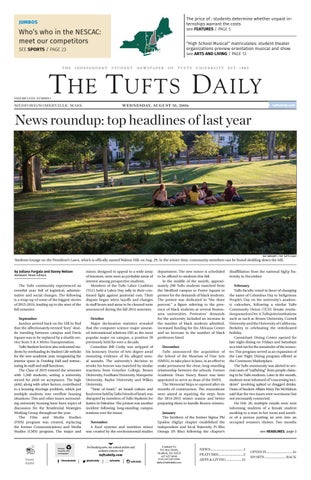
RAY BERNOFF / THE TUFTS DAILY
Students lounge on the President’s Lawn, which is offically named Walnut Hill, on Aug. 29. In the winter time, communtiy members can be found sledding down the hill. by Juliana Furgala and Danny Nelson Assistant News Editors
The Tufts community experienced an eventful year, full of logistical, administrative and social changes. The following is a wrap-up of some of the biggest stories of 2015-2016, leading up to the start of the fall semester. September Jumbos arrived back on the Hill to find that the affectionately-termed ‘Joey’ shuttle traveling between campus and Davis Square was to be replaced by a shuttle service from A & A Metro Transportation. Tufts Student Services also welcomed students by overhauling its Student Life website for the new academic year, reorganizing the interior space in Dowling Hall and restructuring its staff and staff functions. The Class of 2019 entered the semester with 1,360 students, setting a university record for yield on acceptance. The high yield, along with other factors, contributed to a housing shortage problem, which put multiple students into overflow housing situations. This and other issues surrounding university housing have been topics of discussion for the Residential Strategies Working Group throughout the year. The Film and Media Studies (FMS) program was created, replacing the former Communications and Media Studies (CMS) program. The major and
Please recycle this newspaper
Sunny 89/68
/thetuftsdaily
minor, designed to appeal to a wide array of interests, were seen as probable areas of interest among prospective students. Members of the Tufts Labor Coalition (TLC) held a Labor Day rally in their continued fight against janitorial cuts. Their dispute began when layoffs and changes in staff hours and areas to be cleaned were announced during the fall 2014 semester. October Major declaration statistics revealed that the computer science major unseated international relations (IR) as the most popular major on campus, a position IR previously held for over a decade. Comedian Bill Cosby was stripped of his honorary Doctor of Arts degree amid mounting evidence of his alleged sexual assaults. The university’s decision to revoke his honors was matched by similar reactions from Goucher College, Brown University, Fordham University, Marquette University, Baylor University and Wilkes University. “Taste of Israel,” an Israeli culture and food event held by Tufts Friends of Israel, was disrupted by members of Tufts Students for Justice in Palestine. The protest was another incident following long-standing campus tensions over the issues. November A food systems and nutrition minor was created by the environmental studies
For breaking news, our content archive and exclusive content, visit tuftsdaily.com @tuftsdaily
tuftsdaily
tuftsdaily
department. The new minor is scheduled to be offered to students this fall. In the middle of the month, approximately 200 Tufts students marched from the Medford campus to Porter Square to protest for the demands of black students. The protest was dedicated to “the three percent,” a figure referring to the presence of black students at several Bostonarea universities. Protesters’ demands for the university included an increase in the number of black students admitted, increased funding for the Africana Center and an increase in the number of black professors hired. December Tufts announced the acquisition of the School of the Museum of Fine Arts (SMFA), to take place in June, in an effort to make permanent the close, long-standing relationship between the schools. Former Academic Dean Nancy Bauer was later appointed to serve as dean of the SMFA. The Memorial Steps re-opened after six months of construction. The renovations were aimed at repairing the steps from the 2014-2015 winter season and better preparing them to handle Boston winters. January The brothers of the former Sigma Phi Epsilon (SigEp) chapter established the independent and local fraternity Pi Rho Omega (Pi Rho) following the chapter’s
Contact Us P.O. Box 53018, Medford, MA 02155 617 627 3090 FAX 617 627 3910 daily@tuftsdaily.com
disaffiliation from the national SigEp fraternity in December. February Tufts faculty voted in favor of changing the name of Columbus Day to Indigenous People’s Day on the university’s academic calendars, following a similar Tufts Community Union (TCU) Senate resolution passed on Dec. 6. Tufts joins institutions such as such as Brown University, Cornell University and the University of California, Berkeley in celebrating the rededicated holiday. Carmichael Dining Center opened for late night dining on Fridays and Saturdays as a trial run for the remainder of the semester. This program served as an expansion of the Late Night Dining program offered at the Commons Marketplace. The Tufts community was alerted to several cases of “catfishing” from people claiming to be Tufts students. Later in the month, students were informed of “concerning incidents” involving spiked or drugged drinks. Dean of Student Affairs Mary Pat McMahon said that the two issues were worrisome but not necessarily connected. On Feb. 26, multiple emails were sent informing students of a female student awaking to a man in her room and another of a person putting an arm into an occupied women’s shower. Two months
NEWS............................................1 FEATURES.................................5 ARTS & LIVING.....................13
see HEADLINES, page 3
OPINION...................................16 SPORTS............................ BACK
2
THE TUFTS DAILY | News | Wednesday, August 31, 2016
tuftsdaily.com
Editor-in-Chief
Facilities workers union files charges against university, claims workers’ rights violated
EDITORIAL
News Editor
T HE T UFTS D AILY Arin Kerstein Jake Taber Sophie Lehrenbaum Managing Editors Evan Sayles Associate Editor Kathleen Schmidt Executive News Editor Melissa Kain News Editors Robert Katz Liam Knox Gil Jacobson Catherine Perloff Jei-Jei Tan Hannah Uebele Joe Walsh Kyle Blacklock Assistant News Editors Juliana Furgala Jesse Najarro Danny Nelson Miranda Willson Executive Features Editor Constantinos Angelakis Features Editors Nina Joung Becca Leibowitz Justine Chung Assistant Features Editors Siddharth Divakaruni Maddie Orzeske Justin Krakoff Executive Arts Editor John Gallagher Arts Editors Merilla Michael Eran Sabaner Isaac Brown Assistant Arts Editors Jocelyn Contreras Alison Epstein Elliot Storey Emma Henderson Executive Op-Ed Editor Shannon Geary Cartoonists Stephen Dennison Allie Merola Miranda Chavez Editorialists Aneurin Canham-Clyne Frances DeFreitas Eriko Koide Anita Ramaswamy Noah Weinflash Phillip Goldberg Executive Sports Editor Yuan Jun Chee Sports Editors Alison Kuah Maddie Payne Eddie Samuels Maclyn Senear Chris Warren Soven Berry Assistant Sports Editors Noah Smith Max Lalanne Mia Lambert Caroline Ambros Ray Bernoff Maria Eduarda Ferraz Henry Hintermeister Leila Li Julia Press Evan Sayles Angelie Xiong
by Catherine Perloff
Service Employees International Union (SEIU) 32BJ New England District has filed an unfair labor practice charge against Tufts University with the National Board of Labor Relations following the university’s introduction of schedule changes set to be implemented on Sept. 5. The union is arguing that the university has failed to bargain appropriately about changes to facility workers’ schedules, according to SEIU Vice President Roxana Rivera. The coming changes will shift the schedules of five current Tufts facilities workers from a Monday through Friday workweek to one from Tuesday through Saturday, Senior Facilities Director Stephen Nasson told the Daily in an email. SEIU argues that these changes would negatively impact workers’ lives and that the workers’ rights to bargain over them have been violated. “Workers are ready to sit down with Tufts to discuss alternatives that will meet their operational needs and allow this to be absorbed by the workers,” Rivera said.
“Unfortunately, Tufts has not agreed to meet with workers and discuss these issues.” Some facilities workers, who spoke on the condition of anonymity due to potential risk to their jobs, felt the schedule changes were made without an opportunity for them to voice their concerns. “It was brought [to our attention] that there were going to be shift changes, major changes,” one worker said. “[Administrators] really didn’t announce it to us. We got it second hand.” Nasson countered that the university did sufficiently complete the bargaining process. “We are confident that we have met all our obligations to bargain in good faith with the union,” he wrote. The workers expressed several concerns about the proposed changes. In the past, opportunities for overtime pay were typically offered during the weekend. With some employees working on Saturday as part of their regular hours, workers are concerned that overtime shifts will no longer exist. “[The administrators] want to make the [university a] 24/7 [operation], where in the past it’s been covered with overtime. The guys rely on overtime,” one worker said.
Nasson confirmed that the goal of the changes is to allow the university to run daily. “Tufts utilizes the campus seven days a week, and this trend is growing. We are seeing increased requests for weekend use of the Medford/Somerville campus for things like sporting events, student activities and guest lectures,” Nasson wrote, noting that a weekend shift is common at many universities. However, Nasson explained that he did not think the changes would affect overtime hours. “Overtime pay will remain the same, with any employee working more than 40 hours a week receiving overtime pay,” he added. “We expect some Saturday overtime hours will decrease, while there may be more overtime on Mondays than in the past.” Workers countered that if the changes ultimately decrease overtime hours, they may lose a sizeable chunk of their income, noting that overtime pay accounts for about $8,000 to $10,000 of workers’ income on average. “[Overtime pay] is an income [employees] are expecting … so to suddenly be see FACILITIES, page 4
Green Line Extension revisions pave way forward, create local anxiety
Executive Photo Editor Photo Administrator Picture Tufts Editor Staff Photographers
PRODUCTION David Westby
Production Director Allie Merola Executive Layout Editor Sebastian Torrente Layout Editors Jewel Castle Abbie Gantner Leila Li Brianna Mignano Mandip Pokharel Emily Sharp Astrid Weng Petrina Chan Creative Director Allie Merola Executive Graphics Editor Perina Chan Graphics Editors Annie Chen Juliana Furgata Dana Pek Ashton Stephens Rena Tang Belinda Xian Zach Hertz Executive Copy Editors Jei-Jei Tan Meagan Adler Copy Editors Alison Beach Arthur Beckel Caroline Bollinger Ben Bornstein Claire Boals Alison Epstein Audrey Falk Maria Eduarda Ferraz Gil Jacobson Melissa Kain Sharon Kelmar Liam Knox Kathleen Martensen Jack Ronan Netai Schwartz Nihaal Shah Arielle Sigel Liora Silkes Dan Strauss Maxwell Bernstein Executive Tech Manager Nitesh Gupta Online Editor Mia Lambert Social Media Editor
BUSINESS Josh Morris Executive Business Director Qinyue Yu Receivables Manager Evan Sayles Online Advertising Jay Hayes Ad Managers Eva Sachar
COURTESY MASSACHUSETTS DEPARTMENT OF TRANSPORTATION
An artist’s rendering of the proposed construction above the planned College Avenue stop on the long-delayed Green Line Extension. by Robert Katz News Editor
Massachusetts Bay Transportation Authority (MBTA) officials unveiled a revised and scaled-back version of the Green Line Extension (GLX) earlier this summer, which includes a stop at College Avenue beside Tufts’ Medford/Somerville campus. Updates to the plan for the long-discussed addition of seven new stations to the Green Line in Cambridge, Somerville and Medford are intended to bring costs down from a previous cost estimate of about $3 billion to within the MBTA’s original goal of $2.3 billion. A significant portion of the estimated savings comes from cutbacks in station design. According to a May 9 article in the Boston Globe, while expenditures for the MBTA’s original station design plan were estimated at about $410 million, the redesigned stations would cost only $121 million. Among the proposed changes are the elimination of full indoor stations in favor of open-air stops with weather shelters and a significant reduction in staff amenities. The new plan also eliminates some accessibility amenities. While none of the new stations will feature escalators and three of them won’t feature elevators, the College Avenue
stop is planned to feature two elevators as well as stairs, but will no longer feature ramps or fare arrays. According to a report to the MBTA fiscal control board detailing the changes, Tufts will be allowed to continue development plans above the station. Robert Chihade, Tufts’ director of real estate, said the university looks forward to continuing discussions with the MBTA on the project’s design and budget. “We continue to work with the MBTA to understand proposed changes to the project and how they might affect the feasibility of an academic building above the proposed Green Line station and related improvements,” Chihade told the Daily in an email. Medford Mayor Stephanie Muccini Burke, elected earlier this year, expressed disappointment with the MBTA’s cutbacks. “There’s not much of a station, really, when you think about it, at any of the locations,” Burke said. “They really scaled back. What was a station and an actual facility [at each stop] is now pretty much a platform like [the stops on] the current Green Line.” Somerville Alderman Mark Niedergang explained that he had described the original designs as “magnificent” and “unbelievable,” but had viewed them with suspicion.
“There were so many things about the previous design and the way they were running the project that I said, ‘Boy, how do they have the money to do all this? Where’s this money coming from?’” Niedergang said. “Sure enough, basically, the adults were somewhere else, and the children were running the project.” Burke noted that she was still grateful that the MBTA was able to work to bring costs down. “Ultimately, [the Green Line] is a transportation facility,” Burke said. “The purpose is to get people to and from areas, so that’s the bottom line. That’s what it is all about. Everything above that is nice to have but isn’t necessary when transporting people.” However, Burke expressed disappointment over the reallocation of funding away from a planned GLX route linking the College Avenue stop to Route 16 in Medford, which was “the larger picture” of the project in her eyes. “There was a lot of wanting to get [the Green Line] to [the Route 16] terminus,” she said. “We haven’t given up the fight. We will continue to fight and to push for funds.” She said that Massachusetts Secretary of Transportation Stephanie Pollack will engage see GREEN LINE, page 4
Wednesday, August 31, 2016 | News | THE TUFTS DAILY
News
3
What happened on the Hill: top stories of 2015-2016 academic year and summer HEADLINES
continued from page 1 later, a female student called the Tufts University Police Department (TUPD) after waking up to an unknown man in her room, stroking her arm. All of these instances have been under TUPD investigation, according to the university’s emails. March A mumps outbreak passing through Boston-area schools spread to Tufts, infecting at least five students. April Members of the TCU Senate began a new push for the creation an on-campus pub. The TCU senators working on the project have determined that Brown and Brew may serve as an economically-viable location for a pub in the future. Anderson Cooper’s visit to campus to speak at the Edward R. Murrow Forum on Issues in Journalism was in high demand, with tickets to the event fully claimed within an hour.
The administration released the expected tuition fee for the 20162017 academic year, which saw a 3.6 percent increase from the year before and the lowest increase in four years. The news of the increase caused many students to demand an explanation for the tuition hikes in the form of a protest. The Jonathan M. Tisch College of Citizenship and Public Service was renamed the Jonathan M. Tisch College of Civic Life to better reflect the functions of the college, following a $15 million donation from Jonathan M. Tisch. TLC continued its efforts to support janitorial staff and construction workers hired by Tufts by staging a protest during Jumbo Days. In response, the administration cancelled the speech of University President Anthony Monaco, fearing it would encourage further protest and distract from the event. Senior Gauri Seth was the first woman to be elected to the position of TCU President since 2002. Seth defeated her opponent, senior Ryan Johnson,
with 75 percent of the vote over Johnson’s 23 percent. May Indie-pop duo Matt and Kim headlined the annual Spring Fling concert, which was held despite driving rain. Other performers included indie-pop artist BØRNS and rapper Shaggy. Finals week was thrown into early disarray on May 9, after authorities responding to a car fire discovered a handwritten bomb threat outside of Health Service. While no bombs were reported to be found, the incident temporarily shut down all campus activity and forced many final exams to be rescheduled or canceled. Simpsons voice actor and Tufts graduate Hank Azaria (LA ’87) delivered the 2016 Commencement address. June, July & August Workers took the place of students on the Academic Quad this summer, as construction continued on the Central Energy Plant (CEP) located next to Dowling
Hall. Much of the space between Braker and Eaton Halls was torn up to tie in steam lines for the CEP and replace old water service lines. A brick pedestrian walkway was also installed connecting Braker Hall, Eaton Hall, Lincoln-Filene Center, Paige Hall and Miner Hall. Construction continued on the Science and Engineering Complex, which is located behind Anderson and Robinson Halls and is scheduled to open in 2017. The renovation of Metcalf Hall was undertaken and completed in time for the new school year. The project reappointed brick and mortar on the building and all new windows. Tufts Technology Services (TTS) prepared for the return of students by updating wifi in residence halls on the Medford/ Somerville campus. TTS is also orchestrating a $10 printing credit for each student, enabling printing from laptops and adding more printing locations throughout campus. Additionally, diagnostic and repair fees will be subsidized for students using Dell, Lenovo and Apple devices under warranty.
As Sherman Teichman rounded out three decades as director of the Institute of Global Leadership, Ulrich Schlie was chosen to replace him as interim director. Schlie is a historian who is currently holding the chair of diplomacy at Andrássy University in Budapest. Professor Vickie Sullivan of the political science department will be the IR program’s interim director for the 2016-2017 school year, as Professor Kelly Greenhill prepares for a threeyear term as IR director beginning September 2017. Rocco DiRico has been appointed co-director of community relations, joining current director Barbara Rubel. DiRico, a Medford native, will oversee relationships with Medford, the Fenway and Mission Hill. Negotiations over janitors’ contracts with Tufts began Thursday, Aug. 18. It is the latest chapter of a saga that began early in the fall semester of 2014 with reports from TLC of impending layoffs and hour changes.
Seniors form Tufts Union Debate, spinoff of Oxford’s debate forum by Joe Walsh News Editor
Tufts Union Debate, a newly-founded group modeled after the Oxford Union, will host seven public debates on issues related to Tufts, the nation and the world this semester. The first debate will take place on Sept. 12 in Braker Hall Room 001. By providing a forum for regular debates between students, faculty and outside experts, the Tufts Union intends to challenge students’ opinions and encourage them to consider alternative points of view, according to co-founder Manal Cheema, who serves as co-president of the group along with seniors Nimarta Na ra n g , C h r i s t o p h e r Dowd and Elizabeth Ahrens. Cheema, a senior, explained that each debate will tackle a particular motion. The motions for the first three debates are “This Campus Believes that the U.S. Should Support a Two-State Solution,” “This Campus Commends Tufts’ Use of Our Tuition” and “This Campus Believes that the American Dream is Dead.” She said that the topics for each debate are deliberately varied in scope. During the debates, two pre-selected speakers will argue in favor of the motion and two will argue against, with eight minutes allotted for each speaker to deliver a prepared remark. While the main feature of each debate will be the four prepared speeches, each debate night will also feature audience participation in the form of brief floor speeches, Cheema explained. Narang also noted that the Union plans to host ’emergency debates’ later in the semester, during which audience members will be able to present one-minute speeches sharing
their views on current issues on campus. One of the largest gauges of the Tufts Union’s impact on its audience will be through voting on the motion both before and after the debate, Cheema noted. While involved with the Oxford Union during her time abroad, she said she observed how a night of debate would frequently cause many attendees to change their minds about the motion. Cheema added that the intention of the debates is not necessarily to make people change their minds, but rather to cause them to think analytically and academically about an issue. Some attendees might leave the debate holding the same opinion as before but armed with stronger arguments to defend it, she said. Cheema and Narang noted that although the organization’s founders have received a large number of nominations for speakers, they are still in the process of selecting speakers for each debate. They said they intend to include a mixture of students and professionals, with the goal of inviting a wide range of people. “We’re hoping to invite speakers with different viewpoints,” Narang said. “It’s more about bringing different people in [and] making sure that all different points are addressed.” Cheema said that the group is looking into recognition by Tufts Community Union (TCU) Senate in the future. While all of the organizers recognize the Oxford Union as a successful template, Narang said that the Tufts-focused topics are integral to Tufts Union Debate. “We hope that we will be able to form the Union into something that’s unique,” Narang said.
MAX LALANNE / THE TUFTS DAILY
Tufts Union Debate co-founders Nimarta Narang, Elizabeth Ahrens, and Manal Cheema, all seniors, pose for a portrait in front of the Campus Center on Aug. 29. Cheema and Narang said that the Tufts Union is recruiting committee members to invite speakers and to help facilitate the debates. According to Dowd, the Tufts Union itself will be neutral and apolitical, with an agenda purely focused on facilitating spirited discussion. “First and foremost, the Tufts Union is a platform,” Dowd said. “The only thing we advocate for is informed debate between dedicated members of our community in an effort to help raise discourse.” An April 2016 survey of Tufts students conducted by the Tufts Daily and Enigma found that 72 percent of Tufts students aligned with the Democratic Party, whereas only seven percent supported the Republican Party, demonstrating that Tufts is somewhat politically
homogeneous. Cheema argued that this homogeneity would not inhibit a balanced debate, citing that the Oxford Union hosted spirited debates even though their student body was also disproportionately progressive. To that end, Cheema said, the Tufts Union intends to invite speakers who will introduce the attendees to alternative viewpoints without being polarizing. Cheema said that they are aware that certain political disagreements can have an inherent power imbalance, but nonetheless, their focus is on encouraging serious debate, even if everybody does not agree. “The last thing I want is for speakers not to be able to put forth arguments that are academically based for the fear that
they’re not aligned with popular opinion at Tufts,” Cheema said. Cheema argued that the practice of discussing important issues in a civil and analytical matter is currently lacking at Tufts. “So often, the debate and issues get lost in personal attacks,” she said. “[The organization’s goal is to] foster a kind of community that causes people to reconsider their opinions in light of new information, or give them the arguments to defend the position they’ve already adopted.” Dowd agreed, noting that college campuses are a forum where ideas and opinions should be challenged. “If we do not allow ourselves to be open to that sometimes uncomfortable process, we are doing ourselves and our community a disservice,” Dowd said.
4
THE TUFTS DAILY | News | Wednesday, August 31, 2016
tuftsdaily.com
Cognitive and brain sciences minor reinstated, will continue to be housed in philosophy department by Liam Knox News Editor
The cognitive and brain sciences (CBS) minor, which had been on pause since the end of the fall 2015 semester, has been reinstated for the new academic year. According to Dean of Academic Affairs for Arts and Sciences Bárbara Brizuela, the CBS minor will now be administered by philosophy professor Brian Epstein, and will continue to be housed in the philosophy department, as it was before it was paused. Epstein explained that he will serve as the minor’s “faculty backup” and that the administrative work would be handled by staff assistant John Badiali. Plans to continue with the minor were initially halted following the Center for Cognitive Studies Co-Director Ray Jackendoff’s decision to retire after the 20162017 academic year, according to Jackendoff himself. “Although the CBS major is housed in the psych department, the minor [was] not, because the psych department has its hands full with running five different majors,” Jackendoff, who created the CBS minor around eight years ago, told the Daily in an email. “Up till now, it’s been more or less my responsibility.” According to Tufts Community Union (TCU) Senate Education Committee Chair Nesi Altaras, the effort to preserve the CBS minor began when his predecessor, junior Rati Srinivasan, checked the CBS webpage to view the requirements for the minor, which she planned on pursuing, only to find that it had been put on hold. “I saw on the website that it was just gone, and we were pretty angry about it. We didn’t realize because there was no notice sent out,” Srinivasan said. “Everyone in Education Committee was very enthusiastic about the
project from the beginning because everyone said that it really shouldn’t be paused without giving the students notice.” Altaras, a sophomore, said that the two of them then spoke to Brizuela, who is responsible for overseeing the philosophy department. “[Brizuela] was surprised to hear that students were even interested to know these minors were canceled since so few people had done them before,” Altaras told the Daily in an electronic message. “We rushed to get a school-wide email sent out before fall registration ended. Only after that did we even start to work on how to get these restarted. Our first goal was to let everyone know they had been paused.” According to Brizuela, the initial decision to pause the CBS minor was made so that administrators could evaluate whether there would be sufficient resources to continue offering it after Jackendoff’s impending departure. “We did not pause with the intention to discontinue the program, but to carry out an assessment,” she wrote in an email to the Daily. Srinivasan said that the role of the TCU Senate in reinstating the minor was mainly to notify Brizuela that there was student interest in pursuing it, which they gauged using a survey. According to Brizuela, the final decision to continue the minor would not have been made had the assessment found inadequate resources. “If we had found that the resources needed to continue to offer the minor would have an impact on other priorities (e.g., other programs, financial aid) then our decision would have been to discontinue the minor permanently,” she wrote. After helping to draft the email notifying students of the minor’s pausing, Altaras said
he and Srinivasan met with the psychology department to ask them to administer the minor, as opposed to the philosophy department. Altaras said they initially considered the psychology department because it already houses the CBS major and administers most of the courses that would be required for the minor as well. However, Altaras said the department was unwilling to administer the minor. “That would mean they would have to assign minor advisers … which the psych department didn’t want to do because they have a ‘no minor history.’ So we convinced the philosophy department to keep [the minor],” Altaras wrote. “The philosophy department chair wanted to help as many students as possible.” Epstein said that the philosophy department was happy to be of assistance. “We got a lot of interest from students and people were a little unhappy that [the CBS minor] was being suspended,” he said. “The philosophy department also has a commitment to the cognitive sciences program, and I thought that it would be a shame not to preserve the continuity.” Epstein was pleased that the CBS minor was reinstated because of its interdisciplinary value. “I think that the idea of a minor allows students who are specializing in another discipline to still get a very solid grounding, and I think that minors can be extremely important for broadening students’ capabilities and their understanding of different fields,” he said. “So I think minors in general are a great idea, and this one I think is broad and useful and applicable to students in a lot of contexts.” While Epstein is confident that the newly un-paused CBS minor can be administered effectively, he said that Jackendoff’s departure “leaves a serious gap.”
“He’s a world-class linguist and replacing him is going to be difficult,” he said. “On the other hand, generations of young scholars are incredible, and it’s not as if they’re less capable.” Epstein also said that Jackendoff’s retirement is just the beginning of a series of changes that Tufts’ cognitive and brain sciences program is likely to undergo in the coming years. “You kind of have to test waters in some ways, especially as fields change and people leave,” he said. “So there’s going to have to be student, faculty and administrative attention paid to renewing what this program is going to look like and hiring people of that caliber.” In addition, Altaras explained that he and Srinivasan are working to convince the administration to un-pause the linguistics minor, which Jackendoff also created, and which was also halted following his retirement announcement. However, Srinivasan said that it would not be as easy to push for linguistics’ reinstatement. “Though they were paused side-by-side, for CBS we still have all the necessary professors [and] classes, [so] the outline of the entire minor doesn’t actually have to change. The only problem we came across was finding a new home for it,” she said. “[Linguistics] couldn’t be un-paused as it was before, it would need to be changed. They have very different barriers we had to go through.” Srinivasan also invited students who are frustrated with administrative decisions that affect their education to take the same steps that TCU Senate took to push for change. “It could’ve been anyone who notified the administration of something like this and achieved the same result,” she said. “So it’s extremely important that any students who see something like this come up, that they step up and do something to help further the education of all students in this manner.”
Facilities workers claim unjust treatment College Ave. green line stop downsized from administrators, union files complaint after budget cuts FACILITIES
continued from page 2 switched and to have to work those same hours over the weekend and not receive compensation for it creates a pretty big change in people’s lives,” junior Nicole Joseph, a student organizer with the Tufts Labor Coalition, said. One worker believes that if the schedule changes ultimately took away overtime, an average work day would involve an unreasonable number of tasks. Workers pointed out that two vacancies on the staff — one of which they say has gone unfilled for over two years — already had them at workload capacity. “With no overtime, there’s going be more work over the course of an eight-hour day that [administrators] are trying to cram in,” he said. “And that means they want us to do more work in an eight hour day and we can’t do more than we’re doing now.” According to Nasson, workload will not change and overtime shifts may be added if workers feel overburdened. “If on any given Saturday, management feels the workload is beyond the capacity of the seven [workers], then overtime will be assigned as needed,” he wrote. He also noted that the administration is planning on hiring two workers to fill the two current vacancies on the grounds and labor staff. These workers would be hired to work the new Tuesday through Saturday schedule, Nasson wrote. However, workers said that the administration had made a similar assertion in the past and that nothing had come of it.
“With this administration, there’s been no promotions and no new hires,” a worker said. “They’re not going to replace anybody that we’ve lost. There’s one guy who’s been out for more than two years. They have not replaced him. They promised us they’d replace him. That’s not happened.” Finally, these scheduling changes may add other costs; workers said the weekend shift could result in additional childcare costs and inability to meet family obligations, such as taking care of elderly parents or babysitting grandchildren. They also noted that the new schedule could jeopardize the second jobs of some workers. “People’s lives are involved here,” a worker said. Some workers feel that the changes indicate a lack of respect from their superiors. “It means nothing to the administration about the impact to these guys,” a worker said. “Lack of any compassion. Nothing.” Rivera said the union has notified the university that it has filed unfair labor practice charges. The National Labor Relations Board takes between 7 and 12 weeks to determine whether an unfair labor practices charge is valid, according to their website. As scheduling changes will soon go into effect, Rivera said she hopes that the university will respond to the union’s request to bargain. “If [administrators] want to ram this through with no process, I think it’s unbecoming of the university to do that,” she said. “There should be [a] basic level of respect. Workers understand changes. It’s a lot easier to absorb once you talk through the implications of those changes.”
GREEN LINE
continued from page 2 in an environmental study by the end of the year to investigate whether bringing the line to Route 16 will be possible in the future. Although the Federal Transit Administration and Commonwealth of Massachusetts have jointly provided $1.992 billion for the project, gathering the approximately $300 million needed to reach the $2.3 billion price estimate has required more local contribution than expected. According to the MBTA, both Cambridge and Somerville have announced that they will commit a total of $75 million to addressing the funding gap, pitching in $25 million and $50 million, respectively. Laurie Goldman, a lecturer in urban and social policy at Tufts, noted that Somerville’s intended commitment, which Niedergang and other city council members approved, has fomented anxiety among residents. “The community is concerned,” Goldman said. “What is that commitment to $50 million displacing in terms of expenditure? Somerville is a city that doesn’t have a huge tax base, so residents are really concerned about how those tax revenues are being allocated. We also have a lot of needs because Somerville is a city that has a lot of people who need municipal resources.” Goldman had misgivings about potential tax increases to help cover the cost, particularly in addition to the city’s already-rising property taxes. She also worries that while Somerville developers such as Union Square Station Associates (US2), the master developer of the Union Square station,
have committed to contribute to the $50 million sum, those firms may count said allowances as their community benefit contributions, which would take the place of other community benefits that residents are eager to see. Niedergang acknowledged community uncertainty about how the city would amass their GLX funding, and is interested in looking at options alternative to tax hikes. “A lot of people are concerned about that, understandably,” Niedergang said. “Personally, I want to see what the financing plan is. The mayor has said there’s been a number of ways to do it. He’s been in consultation with Governor [Charlie] Baker and state financial authorities. There might be a number of ways we can do it so we don’t just have to add to the tax rolls, which I wouldn’t be happy about doing.” Niedergang stressed the necessity of having the GLX funded while still expressing his displeasure at Somerville’s financial obligation to the project. Somerville’s contribution was not in the original GLX budget plan, and Niedergang called the MBTA’s requests “highway robbery and extortion.” “[The Green Line] is desperately needed in Somerville. It’s a really important community development project here,” Niedergang said. “We shouldn’t have to pay a penny and this is unprecedented and totally unfair. But it will be worth a lot more to us than $50 million to get the Green Line Extension. I’m not happy about it. I’m screaming and yelling about it, but as long as the financing plan is a reasonable plan I’m voting for it.”
Wednesday, August 31, 2016
Features
5 tuftsdaily.com
As election season approaches, students rally for candidates, causes, campus engagement by Madeline Orzeske
Assistant Features Editor
With the 2016 presidential election on the horizon, Tufts political student organizations have been pursuing different goals and agendas this summer that they will continue this fall. These organizations have their sights set on a variety of political objectives. Here is a look at what the largest political organizations on campus have been up to since the presidential nominees were determined in May and June. Tufts Democrats For Ben Kaplan, president of Tufts Democrats, summer vacation meant campaign season. As an intern for presidential nominee Hillary Clinton’s campaign in Roanoke, Va., Kaplan spent days talking to voters, calling voters and organizing a voter registration drive. The Tufts senior and political science major said he would like to see fellow Tufts students engage with the election this semester in the same way he did this summer. “What we’re doing down here in rural southern Virginia and what interns and organizers are doing all across the country is exactly what the Tufts Dems are going to be doing on campus,” he said. “Our plan as the Tufts Dems is to be the Tufts University field office for the Clinton campaign.”
MENGQI SUN / THE TUFTS DAILY
Members of the Tufts Democrats sign up for former Maryland Governor Martin O’Malley’s campaign email list at the 2015 New Hampshire Democratic State Convention on Sept. 19, 2015. O’Malley suspended his campaign on Feb.1, after the Iowa Caucuses. As Tufts’ “field office,” Tufts Democrats plan on running three major initiatives leading up to election night on Nov. 8, according to Kaplan:
registering voters, running phone banks for Clinton and planning weekend trips to campaign for Clinton in New Hampshire.
The group has joined forces with former members of Tufts for Hillary to see ELECTION SEASON, page 6
Unpaid summer internships present challenges, create opportunities for Tufts students by Miranda Willson
Executive Features Editor
Ever since Kenny Weitzman was a high school student in rural New Hampshire, he knew he wanted to work on Capitol Hill. The Tufts junior saved money for the past four years, working during his summers and school years to be able to accept an unpaid internship at Sen. Jeanne Shaheen’s (D-N.H.) office. Weitzman, who double-majors in international relations and economics, completed the Washington, D.C.-based internship this summer. “It’s been incredible,” he said. “Working on the Hill, it’s one of those things where you kind of see history unfolding before you.” But Weitzman said he considers himself lucky that he was able to make the unpaid internship possible by saving money and by having parents who support many of his financial needs during the school year, such as tuition. “My family is comfortable, but we’re not wealthy by any stretch,” he said. “It’s been good, but I feel personally like I’m on the edge of being able to do this [unpaid internship]. If I hadn’t been forward thinking, known I’d wanted to do this for a while and been able to put those savings away, there’s no way I would be here right now.” According to Gregory Victory, the executive director of the Career Center, most Tufts students take on internships during their time as undergraduates. A survey conducted by the Career Center, he said, found that 88 percent of the Class of 2015 interned once while at Tufts, and 66 percent completed two or more internships. “Often, an internship is an important experience that helps students get into
the job or graduate school they want,” Victory said. Though the Career Center does not have data about the percentage of Tufts undergraduate students that complete unpaid internships, he said approximately 46 percent of the positions listed on Jumbo Jobs during the 2015-2016 school year were unpaid. Nationally, 39.2 percent of bachelor’s degree graduates from the Class of 2015 participated in an unpaid internship during their college career, according to a study conducted by the National Association of Colleges and Employers. The Career Center offers roughly 50 grants that fund unpaid internships each summer, which are paid for by private donors, Victory said. Some are offered to students looking to work in a particular field. Others primarily consider the socio-economic backgrounds of applicants. “It’s our goal to grow the number of grants we get,” Victory said. “If students don’t have access to [internship] opportunities because of financial reasons, then they’re falling behind in securing a position post-Tufts. So I want to do everything I can to close that opportunity gap.” Tufts senior Bailey Werner received a $3,500 grant through the Career Center to intern this summer at Groundwork Somerville, an environmental non-profit. Without the grant, she would not have been able to accept the unpaid internship or live in her off-campus house. She could not definitively accept the internship, however, until she was offered the grant on May 1. She worried that her employer would want to hire someone else instead. “If your ability to work at the internship is contingent upon your receipt of the
grant, then you have to tell your potential employer that you cannot actually accept the internship until May 1,” Werner told the Daily in an electronic message. “So you have to let your internship pend for almost a month, which is unfortunate for both the intern and the employer, since you are presumably holding the spot of someone who might be able to definitely work.” Had Werner not received the grant, she also would have had to find a subletter for her off-campus house during the summer months, since she would not have been able to afford living there. “I was really stressed that if I ended up not getting the grant, I would have to start the search for a subletter on May 1, which is pretty late in the game,” she said. “Additionally, I would be left without any plans for the summer. Luckily, in my case, it worked out.” Werner said the $3,500 grant is meant to support students interning for at least 350 hours, meaning that students make at most $10 per hour from the grant. When factoring in the rent students pay to live near Tufts — $750 per month in Werner’s case — Werner said the grant makes an unpaid internship “doable, but definitely not easy.” “Maybe [the grant] should be needbased, first and foremost,” she said. “The … Career Center said they consider the financial standing of the student when they look at applications, but I know multiple students who received the grant and who would have been able to accept their unpaid internship [regardless].” Weitzman was denied a Tufts internship grant this summer, but the Career Center suggested he look for other grants given by non-profit and governmental
organizations. As a result, he applied for and received a $2,000 grant from the New Hampshire State Society (NHSS). This covered some of his summer housing, food and transportation costs in D.C., which he otherwise would have paid entirely out of his own pocket. “While I didn’t receive the Tufts funding, [the Career Center] was helpful in advising me to find another grant,” Weitzman said. “I was planning on basically burning through my entire life savings this summer, but this [NHSS] grant has allowed me a little more flexibility with my options.” Though the Career Center is looking to expand grant opportunities for unpaid internships, Victory said they also want to ensure that Tufts students’ internships meet the six criteria that make unpaid internships legal as defined by the Fair Labor Standards Act. Under this act, an unpaid internship must be done for the benefit of the intern, similar to a training session or an educational experience. Additionally, the intern cannot do the same work a paid employee would do, the company or organization cannot immediately benefit from the intern’s work, the intern is not necessarily entitled to a job after the internship and both the employer and the intern must know the intern will not be paid for their work. However, Victory said that as long as universities and students throughout the country continue to legitimize unpaid internships that might not be legal, it is difficult for Tufts to fix this problem. “There is a part of me that wants to wave a magic wand and say Tufts won’t post an internship [on Jumbo Jobs] unless it meets this criteria, but unless we get see UNPAID INTERSHIPS, page 7
6
THE TUFTS DAILY | Features | Wednesday, August 31, 2016
tuftsdaily.com
Tuftslife relaunches after hiatus, revamps for new semester by Constantinos Angelakis Features Editor
When looking for events and activities, Tufts students cast a wide net over a range of online sources, including the school’s official events page, students’ and organizations’ Twitter posts and club or class pages on Facebook. Upperclassmen may recall an older online source: Tuftslife. com, a student-run website that compiled campus news, events and listings, serving as an online information hub for all
members of the Tufts community. This summer, a small but growing group of students, led by Yotam Bentov, a computer science major and the president of the Tuftslife team, has been working to revamp the website. The site relaunched last week in time for the start of the fall semester. Tuftslife is ancient, in internet terms. According to Bentov, a senior, the original version of the website launched in 2000, four years before Facebook started in February 2004, to immediate popularity.
“I understand the response to it was pretty warm,” Bentov said. “People were using it, which is the bottom line.” The website reported up-to-the-minute news on campus, sometimes quicker than other outlets, Bentov said. He cited a 2013 school closure due to a snowstorm, which Tuftslife reported before the university officially announced it. However, Bentov said the website has gone through several changes of leadership and bouts of inactivity since its founding. Its most recent iteration, created in
2015 by Alex Lenail (LA’16), has seen little traffic, according to a text overview of the site’s history provided by Bentov. Bentov said that previous leaders of Tuftslife contacted him last fall, asking him to relaunch a new version of the site. The relaunched version will use the same online platform as the last one, with some adjustments. It will host information about events posted by Tufts Community Union (TCU)see TUFTSLIFE, page 7
Various campus groups continue efforts leading up to election season ELECTION SEASON
continued from page 5 create a campus-wide election strategy, according to Kaplan. He added that they are also in contact with former members of Tufts for Bernie. “[Tufts Democrats’] goal is twofold: it’s to be the voice of the Democratic Party on campus and to help elect Democrats up and down the [ballot],” Kaplan said. “But it is also to be…a voice within the Democratic Party, demanding progressive change and demanding a more inclusive party.” In addition to working with former Tufts for Hillary and Tufts for Bernie members, Kaplan said the group will partner with the College Democrats of Massachusetts, a statewide organization that includes 16 colleges in the Commonwealth, according to its website. In partnership with this organization, members of the Tufts Democrats and other politically engaged students will have the opportunity to canvas for the Democratic nominee in New Hampshire, an important swing state in New England. “We’re looking at potentially 500 students from across Massachusetts going up to New Hampshire on three different weekends,” Kaplan said. As increased membership, participation and engagement is crucial to carry out the Tufts Democrats’ current goals, Kaplan said the group has made structural changes over the past year to allow more people to get involved in campaigning, canvassing and other political efforts. “Tufts Democrats is now organized as a horizontal club…which basically means that the main governing body of [the group], the planning board, is open to all members…[so they can] have a real voice in our organization,” he said. Tufts Democrats is currently the largest political organization on campus, with an email chain that reaches almost a quarter of the current stu-
dent body, according to Kaplan. The active membership from week to week is about 45, although Kaplan said he expects the number of active members to expand to over 100 as election season heats up this fall. Tufts for Hillary After months of phone banking, canvassing and registering voters last semester, Tufts for Hillary members have joined forces with the Tufts Democrats now that Hillary Clinton has emerged as the Democratic nominee. Together, they will work to elect Democrats at the local, congressional and federal levels, according to Kate Mieher, former president of Tufts for Hillary. “Tufts for Hillary is officially part of the Tufts Democrats,” Mieher, a senior, told the Daily in an email. “This semester is going to be pretty campaign-focused, because the goal of the semester is to elect Hillary and other Democrats.” In addition to campaigning, Tufts Democrats plans to invite local candidates and elected officials from the Medford/ Somerville area to speak and engage in discussions at its weekly meetings, Mieher, a political science major, said. As the main coordinator on campus for the Clinton campaign, she will work through similar means as last semester to support the Democratic agenda this fall. “I’m basically doing the same role [as before], but…I’m fulfilling that role within a larger organization, which is the Tufts Dems,” she said. In addition, Mieher said she hopes former members of Tufts for Hillary will get involved this fall with the Tufts Progressive Alliance (TPA), a new group on campus rebranded from its former identity as Tufts for Bernie. Tufts Progressive Alliance, formerly Tufts for Bernie When Nate Krinsky was elected president of Tufts for Bernie last April, he knew
Sen. Bernie Sanders’ chances of becoming the Democratic nominee were slim. A former president of Tufts for Bernie, Deena Alexander (LA ‘16), suggested that Krinsky change the group’s goals as the election progressed. Rather than continue to focus primarily on electing Sanders, a single progressive candidate, she told Krinsky to consider making Tufts for Bernie a space for students who more broadly stand for progressive values and policies. Krinsky, a sophomore, took that advice and created Tufts Progressive Alliance. “I was very worried about the whole movement fizzling out without [Bernie],” he said. “I wanted to make sure that at least on the Tufts campus … we could continue the momentum … that we found with the Bernie Sanders campaign.” Tufts Progressive Alliance will focus on several issues leading up to the general election, according to Priya Vaishampayan, who will be managing TPA’s social media this semester. She cited several examples, including environmental protection, a woman’s right to choose and immigration and healthcare reform. Krinsky said the group hopes to harness the energy of the existing student organizations on campus that promote different progressive causes through activism. “What we want to do is work with other, more activism-heavy groups on campus … focus [their] energy and point it towards more concrete, political goals,” he said. With similar policy goals as the Tufts Democrats and substantial membership overlap, Krinsky said he hopes to work with that organization as well. Nonetheless, both Krinsky and Vaishampayan said TPA will be branded as nonpartisan as the election approaches. “We want to focus on the issues, not on the candidate, and engage in a full discussion [about policy goals],” Vaishampayan, a junior who studies political science, said. One example of an issue the group
HAILEY GAVIN / THE TUFTS DAILY
Tufts for Hillary students canvass in Merrimack, N.H. on Feb. 7, two days before the New Hampshire presidential primary.
will bring to the attention of Tufts students is the Massachusetts Legalization Initiative, also known as Question 4, which will appear on the Massachusetts ballot this November. If this initiative is passed, the use, cultivation, possession and distribution of marijuana for recreational purposes by individuals at least 21 years old would be legal in Massachusetts, according to the text of the initiative available at Mass.gov. Krinsky said the initiative has many influential opponents, which could stop it from passing. At the same time, he said the issue has the potential to impassion progressive Tufts students like himself that want to see the initiative pass. “It’s going to be an uphill battle because there are a lot of political establishments in Massachusetts that have come out against it,” he said. “But it’s a great progressive issue…and it’s such a great opportunity for a growing group to work together toward a common goal.” Tufts Republicans The goals of the Tufts Republicans during the upcoming election are not as clear-cut as the backing of a single candidate, or even of a series of policy issues. Tufts Republicans President Hannah Crowley said the promotion of political awareness and engagement will be the primary goal of the student organization for the fall semester. “We would like to encourage political activism in the sense of increasing the voter turnout in our community, as well as keeping the student body up-to-date on political affairs by focusing on the facts behind current events, court decisions, policies, etc.,” Crowley, a junior, told the Daily in an email. When it comes to the upcoming presidential election, Tufts Republicans range in their opinions of who should next hold office, according to Crowley. “As [Donald] Trump does not fit the mold of a typical Republican nominee, the Tufts Republicans are split in their support of a presidential candidate,” she said. “While some like Trump, others will instead be voting for [libertarian candidate Gary] Johnson in the fall.” Due to these differing opinions, the organization has decided not to endorse or campaign for a single candidate. “Toward the end of the spring, when it became clearer that Trump and Clinton would become the nominees, we devoted a lot of time to predicting how things would go down in November, as well as the influence that third parties may have in this election,” Crowley said. With a strong divide among Republicans on campus and across the nation, Crowley said that upholding the GOP’s principles in the group’s activities and in the face of future elections will be of special importance this semester. “Regardless of what happens in November, it is crucial that all Republicans focus on what unites them: the Constitution and the conservative ideals upon which this country was founded,” she said.
Wednesday, August 31, 2016 | Features | THE TUFTS DAILY
F e at u r e s
7
Tuftslife undergoes redesign, hopes to gain traction among student body TUFTSLIFE
continued from page 6 recognized student organizations, a listing section for wanted and for-sale advertisements and a homepage that will gather all the site’s sections into a more convenient portal, according to Bentov. “The website right now, technologically, has actually been made,” Bentov said. “We’re adding improvements, and we’re tweaking a bit of the layout, but development is going well.” The Tuftslife team also hopes to partner with TCU and members of the Tufts admin-
Ethan Geismar, a sophomore, is the marketing director for the Tuftslife team. He said the group is working to promote the site to the Tufts community, especially to underclassmen who may have never seen its earlier versions. “I feel really good about where we’re heading with marketing and what our initiatives are,” Geismar said. “I think our main goal at this point is just to position ourselves as best we can for launch and to get as many people using it as quickly as we can after we launch.”
working on spreading news of the launch to incoming first-years. “[The Tuftslife team] is planning on integrating [the site] into orientation,” Bond said. “We’re planning on emailing orientation leaders, letting them know this is back, making sure they know what the product is before they sell it.” One of Tuftslife’s priorities for the coming relaunch is to regain TCU recognition as a student organization, which they had initially obtained in 2000 but have since lost, according to Bentov. Geismar said that TCU recognition is
The Tuftslife.com Timeline March 2013
March 2000
While doing freelance web design work, Tuftslife.com founder Mike Masterman comes up with the idea to create an Internet portal site for the Tufts community.
Taylor Lentz and Juan Carlos Montemayor Elosua redesign Tuftslife.com to comply with new standards for mobile devices. However, the redesign appears to turn users away from the site. This is the last notable timepoint at which TuftsLife was ubiquitously used.
February 2003
Unique visitors to the site exceed 4,300 in a single day.
2000
2005
October 2000
The first official release of the Tuftslife.com site is available to the public.
2010
2009-2012
Version 2 of Tuftslife.com (named Amaretto) launched in January 2009 and was extremely popular under Mike Vastola during this time.
March 2001
One week after celebrating its first birthday, Tuftslife.com launches its first mobile edition.
2013-2015
During these years, a number of other Tufts computer science students, headed by Anthony Cannistra, try to bring the site back.
2015 September 2012
Amadou Crookes launches iJumbo, an iPhone app intended to mirror Tuftslife’s functionality. It was last updated in December 2014.
February 2011
October 2015
Alex Lenail relaunches a new version of Tuftslife. This new version, despite being technologically sound and modern, receives comparatively little traffic.
Operating under Michael Vastola, Tuftslife launches a chatroom service.
Sources: Former TuftsLife.com programmer Yotam Bentov and Tufts Daily articles published January 28, 2009, February 8, 2011, and February 12, 2013. ALLISON MEROLA / THE TUFTS DAILY
istration to enhance the quality of information available on the site. “We hope we can, in the future, work with the Tufts administration to get more information to benefit the student body and the community as a whole,” Bentov said. The primary reason for the site’s problems, according to Bentov, has been a lack of student use, especially after periods during which the site has shut down. “As far as actually getting people to post on the site, most of the functionality of the site happens by giving students information about events that happen on campus,” Bentov said.
He added that Tuftslife is in contact with administrative and student organizations to encourage use of the website. “We’re coordinating with the RAs and with the orientation program to get the name out there … relaying the information to another specific group or medium that’s spreading it out further … and making sure they all know about and are engaged with the platform,” Geismar said. Cole Bond, a sophomore, is also part of Tuftslife’s marketing team, helping coordinate student outreach about Tuftslife and working on future website development. As an orientation leader, he is now
crucial to its success, and he envisions room for collaboration between TCU and Tuftslife. He added that he anticipates the group will have little trouble regaining TCU recognition. “I think [TCU] is excited to have the site back at their disposal,” Geismar said. “We’re excited to have them back on the site because it’s a very mutually beneficial relationship.” Although communication between Tufts students has changed dramatically since Tuftslife’s founding due to the rise of social media, the Tuftslife team believes their website can occupy a unique and nec-
essary place among other media outlets, since it is readily available to the student body and broader Tufts community. “I think our mission with Tuftslife is really to make it a central part of the experience of attending the university,” Geismar said. “And so, in that sense, we don’t think that a student can feel properly informed and aware of everything that is happening and all the opportunities that they have at their disposal at Tufts without a central hub to gain access to that information.” Compared to current resources such as pages and Facebook groups, Bond said that Tuftslife is more dedicated to the needs of Tufts students. He referred to a Tuftslife textbook exchange service as a potential alternative to the multiple existing Facebook pages meant for selling and buying textbooks to and from fellow students. “I think Tuftslife is going to provide a more unique, better online representation of what the Tufts community is,” Bond said. “We think this is going to be a more intuitive interface for it. We have all these services that are better than Facebook, on an interface that is [specifically] built for them.” Both Bentov and Geismar said that, as opposed to current media outlets, Tuftslife will offer a more convenient and efficient means of obtaining information about the Tufts community by amalgamating the information available from other platforms. “We very much also see Tuftslife not as competition to any other media outlet, but really as a way to bring them together and make them available to the student body, so people can use them for their maximum potential,” Geismar said. Bentov said he thinks the website will reduce the current need for students to routinely check different social media and listing sources in order to stay informed about happenings around campus. “It shouldn’t be that complicated,” Bentov said. “It’s not hard to make a page that just has [everything] … We think that there’s very much a need for a product like that, that considers the needs of the average Tufts students and is built around them, as opposed to a conglomeration of other services that kind of work, but aren’t complete.”
Students struggle to balance gaining experience with managing finances UNPAID INTERSHIPS
continued from page 5 our sister institutions to do the same, we might not be able to do that,” he said. One way that employers can be sure that an unpaid internship is legal is by offering students course credit in exchange for their work, as a way to prove that the internship is for the benefit of the student’s education. But Victory said that students do not always need the extra credits, and during the summer, students must pay tuition to receive credit, which he feels is not always fair. “It’s like, what are you paying for?” he said. “If there’s a faculty member associated with the [course credit], and they’re coming in and supporting it, then maybe there’s a small administrative fee to cover someone’s time, but I don’t feel like you should be paying whatever the standard tuition is.” Reflecting on his internship this summer, Weitzman said he knows of many qualified people who were not able to have a fulfilling internship experience like his due to a variety of constraints. “It definitely helps to have money in order to be able to do this,” he said. “And I can see that clearly from the people I work with. They’re all wonderful people, but they’re able to do this because they can afford to.”
By the Numbers: Career Center Internship Grants 88% of the Class of 2015 interned once while at Tufts. 66% completed two or more internships.
This summer, 123
applications for grants were submitted.
51 grants were awarded.
The career center usually funds 40-50
undergraduate students each summer doing unpaid internships for 350
hours or more. Students can receive up to $3,500.
Nationally, 39.2% of bachelor’s degree
graduates from the Class of 2015 participated in an unpaid internship during their college career. Because of the total hour minimum, students make at
most $10/hr from the grant.
46% of the 2270 positions listed on Jumbo Jobs during the 2015-2016 school year were unpaid.
Sources: Tufts Career Center Executive Director Gregory Victory and the Tufts Career Center website ALLISON MEROLA / THE TUFTS DAILY
8
THE TUFTS DAILY | Advertisement ADVERTISEMENT | Wednesday, August 31, 2016
1/4
tuftsdaily.com
1/8
1/2
Wednesday, August 31, 2016 | Advertisement ADVERTISEMENT | THE TUFTS DAILY
tuftsdaily.com
Orientation Week Shuttle Schedule Wednesday, August 31st
Welcome Back, Please Review the following mandatory meetings and upcoming events!
9am to 4pm On-Campus Shuttle ONLY for Orientation
REGISTER YOUR ORG. NOW! All orgs. need to register for the year at ocl.tufts.edu.
Sunday, September 4th Paint the Town Blue and Brown (Orientation Event) 12-5pm Upper Campus Center Patio to Davis Square Shuttles leave every ½ hour
SMFA/NEC Orientation Shuttle
NO SHUTTLE: Thursday, September 1st through Saturday, September 3rd and Monday, September
ATTENTION STUDENT ORGANIZATIONS
5th
– Labor Day
Tuesday, September 6
th
Shuttle resumes normal schedule
(Pickup/Drop off in front of Aidekman/Sophia Gordon)
Sept. 3rd – 12pm to 12am Sept. 4th – 12pm to 12am Sept. 5th – 12pm to 12am
Student Organizations Fair! Wednesday September 14! Once you register your org. for the year you are confirmed to attend the Fair. (5 pm – 7 pm Res Quad) Executive Summit! September 14 or 15, 7:30 pm. At least one member of each group MUST attend one of the two Executive Summits. (Barnum 008) TCU Treasury Meetings! September 14 or 15, 8:30 pm. Both group signatories MUST attend one of the two TCU Treasury Meetings. (Barnum 008)
Financial Stewardship Training!
Wednesday September 28th, 12 noon – 1 pm, Campus Center 012 or Monday October 3rd, 12 noon – 1 pm, Campus Center 112
At least one member of each group, preferably a treasurer or financial representative MUST attend one of these two meetings. Further information on each of these events can be found at ocl.tufts.edu. HAVE A GREAT YEAR!
CONNECTED Student Value Checking Receive a $ 25* bonus
when you open and use a Student Value Checking account.
NO MONTHLY FEE** • NO MINIMUM BALANCE • NO FEE FOR INCOMING WIRES
Start here to make it happen:
SANTANDERBANK.COM/STUDENT
Student Value Checking is available to students 16 through 25 years of age (legal guardian co-owner required for those between 16-18 years). Once you reach 26, we may convert your Student Value Checking to another checking product. Proof of enrollment may be required. *Get $25 when you open a new Student Value Checking account with a $10 minimum opening deposit between June 15, 2016 and September 30, 2016 and complete 8 debit card transactions that post to your account within 60 days of account opening. Your new account needs to remain open for 90 days in an eligible product type and payment of the bonus will occur within 30 days thereafter. One bonus per customer. Students who currently have a personal checking account or who have had a personal checking account with Santander Bank in the last year are not eligible for this offer. Cannot combine with other personal checking account cash offers. Offer only available to U.S. residents. Santander team members are not eligible. Bonus is considered interest and will be reported to the IRS on Form 1099-INT. **Other fees may apply, including a Paper Statement fee if you elect to receive paper statements. Refer to your fee schedule for details. Santander Bank N.A. is a Member FDIC and a wholly owned subsidiary of Banco Santander, S.A. © 2016 Santander Bank, N.A. All rights reserved. Santander, Santander Bank and the Flame Logo are trademarks of Banco Santander, S.A. or its subsidiaries in the United States or other countries. MasterCard is a registered trademark of MasterCard International Incorporated. All other trademarks are the property of their respective owners.
9
10
THE TUFTS DAILY | Advertisement ADVERTISEMENT | Wednesday, August 31, 2016
1/4
tuftsdaily.com
1/8
1/2
Wednesday, August 31, 2016 | Features | THE TUFTS DAILY
F e at u r e s
11
A comprehensive guide to Tufts, from A-Z Welcome to Tufts! You’re now part of a community with enough terms, traditions and inside jokes to warrant a small dictionary. Below is the SparkNotes version, a primer for new Jumbos. — by Miranda Willson
AcornHead: Created by artist Leslie Fry, the “Colossal AcornHead” came to Tufts in 2012 and was the first public sculpture installed on the Medford/Somerville campus. It represents a special connection between humans and the natural world. Though it briefly left Tufts for the 2013-2014 school year, the beloved AcornHead has since returned to its home on the Hill.
Bubs: Short for the Beelzebubs, this is an all-male a cappella group famous for providing the vocals for the Warblers on “Glee” (20092015) and taking second place in the first season of NBC’s “The Sing-Off” (2009-present). The Bubs performed for President Barack Obama in 2010 and are celebrating their 54th anniversary this year.
Crafts Center: This is a Tufts Community Union-funded, student-run arts and crafts makerspace located in the basement of Lewis Hall. Possible artsy activities include candle and soap making, jewelry and button making, 3D printing and ceramics. The center even runs free workshops throughout the year, and you can drop by every day except Saturdays.
The Daily: Formally known as The Tufts Daily, the independent student-run newspaper was ranked the No. 10 college newspaper in the nation last year by the Princeton Review. Tufts is the smallest research university to have a daily newspaper.
Early Decision: Unlike many schools, Tufts matriculates students from not one, but two rounds of Early Decision (ED) applicant pools. The Class of 2020 saw the highest number of ED applicants in Tufts history – 2,070, a 12 percent increase from last year.
Fall Gala: This is one of the first big events open to all students on campus in the fall. Held annually on the Academic Quad, it features a DJ, a live band, a photo booth, food and more.
Gifford House: This brick house on Packard Avenue is where University President Anthony Monaco allegedly lives. Each spring, the seniors are invited over to have dinner with him and alumni. On Halloween, the house is decorated while Monaco, sometimes accompanied by his wife, wears a costume and welcomes Tufts students and local children with treats.
Hodgdon On-the-Run: Located in the basement of Hodgdon Hall, this take-out spot has plenty of food options: wraps, burritos, pasta, snacks, beverages and more. The space was renovated during the summer of 2014 and remains open until 10 p.m. Monday through Thursday. It is a great place to grab a meal or a late-night snack.
IGL: The Institute for Global Leadership aims to help the Tufts community to understand and engage with difficult global issues through their courses and mentorship programs. IGL offerings range from intensive courses on world regions each year (EPIIC) to social entrepreneurship (BUILD) to research (Synaptic Scholars).
Jumbo: Tufts’ mascot, Jumbo the elephant, is the only mascot to appear in Webster’s Dictionary. Jumbo was a male African elephant that belonged to P.T. Barnum, who donated the elephant’s hide to be displayed at the university. Following a fire in 1975, Jumbo’s ashes were put in a peanut butter jar, which athletes have traditionally rubbed for good luck. A new bronze sculpture of Jumbo was unveiled in April 2015.
Kosher Deli: Opened in 2014, Pax et Lox Glatt Kosher Deli is located adjacent to the Campus Center and offers a variety of kosher sandwiches and sides for those seeking alternatives to dining hall options.
Loj: Located approximately two hours north of Tufts in Woodstock, New Hampshire, the Loj is a university-owned retreat destination. It is operated by Tufts Mountain Club (TMC). Over 75 years old, the Loj is primarily used for TMC activities, events and retreats and as lodging for students in the White Mountains.
Moe’s: Opened in 2007, Moe’s BBQ Trolly is a popular spot for a quick late-night bite on weekends, where it is parked conveniently at the corner of Professors Row and Packard Avenue.
Naked Quad Run: Though it was banned in 2011 due to safety concerns, this tradition remains a central piece of Tufts’ history. Every winter, students would gather to run a naked lap around the quads. The popularity of the event grew consistently until it was terminated. Various eyewitness sources confirmed an attempt to revive the tradition last spring.
O-Shows: O-Shows stands for orientation shows, which are put on by Tufts’ student groups during orientation. They showcase what the Tufts performance scene has to offer and welcome many first-years and transfer students to the community.
Pumpkin-ing: Every year, the night before Halloween, an anonymous group places dozens of pumpkins throughout campus, often on the rooftops of university buildings. “Pumpkin-ing” is over 75 years old, according to the Tufts University Alumni Association, and although members of the Tufts Mountain Club are rumored to be behind the tradition, no student organization has ever taken credit for it.
Quads: Great places for big events like Fall Gala or casual activities like frisbee and slacklining, the Res and Academic quads are important hubs for student activity.
Rainbow Steps: These are steps at the intersection of Winthrop and Capen Streets — though the bright colors for which they were named have since faded somewhat since their installation.
SMFA: Starting in 1944, a five-year dual-degree program allowed students to receive degrees from both Tufts and the School of the Museum of Fine Arts, which was established in affiliation with the Museum of Fine Arts, Boston. As of July 1, the SMFA became part of Tufts University. The SMFA at Tufts, as the program is now known, is one of two art schools in the United States that is affiliated with a major museum.
Talloires: The Tufts University European Center is located in Talloires-Montmin, France, a commune of 2,000 residents in the French Alps. The center holds conferences and hosts several study abroad programs each summer. In 1990, Jean Mayer, then president of Tufts, invited 22 universities to the Talloires campus to create the Talloires Declaration, which calls on higher education institutions to commit to environmental sustainability.
Uphill: There are two kinds of people at Tufts: uphill people and downhill people. If you find yourself living in Hill or Houston Halls, preferring Carm to Dewick and valuing access to the quads over access to Davis, chances are you’re an uphill person.
Veterinary school: The School of Veterinary Medicine, located at Tufts’ campus in Grafton, Mass., was established in 1978. It was renamed the Cummings School of Veterinary Medicine at Tufts in 2005 when the Cummings Foundation pledged a $50 million donation, and it remains the only veterinary school in New England.
WMFO: 91.5 WMFO is a freeform radio station owned by Tufts and run by both students and volunteers from the Medford and Somerville area. It broadcasts music of many genres, humor shows and political and social commentary. Its website says the station started in 1970 and broadcasts 24/7, every day of the year.
(e)X-College: The Experimental College offers a host of interdisciplinary classes not offered in the traditional departments. The courses are often taught by Tufts students, faculty and other experts from the Boston area. This year, course offerings cover topics such as guerilla performance art and the history and literary representation of witches.
Yoga: Yoga, Zumba and Pilates are just a few of the fitness classes offered by Tufts Student Resources (TSR) on a weekly basis. Classes are student-taught and are held in the Hill Hall Aerobics Room.
ZIP code: Our campus is split between two ZIP codes. Depending on where you are, you could be in 02155 – Medford – or 02144 – Somerville. While this distinction is important when it comes to registering to vote, it matters a lot less for mail: all students who live in dorms ship their packages to Tufts Mail Services, which uses the 02155 ZIP code.
12
THE TUFTS DAILY | ADVERTISEMENT | Wednesday, August 31, 2016
WELCOME
SMFA STUDENTS
tuftsdaily.com
Wednesday, August 31, 2016
ARTS&LIVING
13 tuftsdaily.com
Sneak peek: orientation productions by Justin Krakoff
Executive Arts Editor
As Orientation Week continues, be sure to catch one of the orientation shows presented by Torn Ticket II and 3Ps (Pen, Paint and Pretzels), two of Tufts’ student-run theater groups. Here is a sneak preview of what they have in store for you: Ordinary Days Torn Ticket II is going back to the basics with “Ordinary Days.” The group has returned to its practice of performing a musical comprised of concrete storylines and characters, rather than performing a primarily theme-based show, as it has
done in recent years. This one-act musical tells the story of a graduate student, artist and couple as they all navigate the perils and joys of living in New York City. Directed by senior Megan McCormick, the show promises to engage audience members by illustrating many of the challenges of transitioning into college life. Torn Ticket president Lucy Kania noted the value of the show’s theme. “At its heart, ‘Ordinary Days’ is about finding moments of beauty, meaning and connection in everyday life, which is something I think we should all strive for,” Kania, a senior, said. “It reminds us that friendships are the most important relationships that we form in college and are just as fulfilling as romantic ones.”
Gruesome Playground Injuries 3Ps is also returning to the fundamentals, with “Gruesome Playground Injuries” being the group’s first two-person show in recent memory. Written by contemporary American playwright Rajiv Joseph, the play tells the story of two childhood friends, Doug and Kayleen, whose lives periodically intersect with one another, leading them to reflect on the past and what keeps bringing them together. Director Kevin Lombard said he feels that the show has particular value for those acclimating to life at Tufts. “One of the reasons that I love this show is that it is a hard show to watch,”
Lombard, a junior, said. “It gets into the gross, gritty details that we often try to overlook in our daily lives. Being a first-semester freshman is a really hard job, and what I think is important about this show is that it reminds everyone that sadness and pain are normal parts of life. These challenges are what allows us to grow and learn.” “Ordinary Days” will be shown on Sept. 4 at 9 p.m. and Sept. 5 at 2 p.m. “Gruesome Playground Injuries” will be shown on Sept. 4 at 7 p.m. and Sept. 5 at 4 p.m. All shows will be performed in the Balch Arena Theater in the Aidekman Arts Center and are free and open to the public.
ALBUM REVIEW
Frank Ocean shows vision, mastery on long-awaited album SHANE HIRSCHMAN VIA FLICKR
Frank Ocean performing at Lollapalooza in Chicago in 2012. by Justin Krakoff
Executive Arts Editor
In the weeks preceding the release of his now iconic debut album “channel ORANGE” (2012), R&B singer Frank Ocean published a letter on his Tumblr page in the middle of the night detailing a previous love affair with a man. While the letter refrains from ever explicitly announcing Ocean’s sexuality, the letter and subsequent album represented a watershed moment in pop culture, as the then 24-year-old addressed many of the stereotypes placed upon black and queer artists. At the end of the letter, Ocean boldly writes, “I feel like a free man.” The surprise release of Ocean’s highly anticipated sophomore album “blond” on Aug. 20 coincided with another Tumblr confession. This letter seemingly finds Ocean in a more introspective, contem-
plative place than three years ago, possibly capturing his feelings about living in a world facing the injustices of Orlando and Ferguson. However, Ocean offers hope at the end of his letter as he writes, “It’s still all good.” After fulfilling his contractual obligations with Def Jam Recordings by releasing his less-than-stellar visual album “Endless” the night prior to the release of “blond,” Ocean was able to release his sophomore record on his own independent label Boys Don’t Cry. Appropriately, “blond” marks a clean break with the pop music machine, and even society itself, as the album’s title is deliberately spelled both with and without an “e,” perhaps symbolizing androgyny or an enigma. Whatever the reason, these factors contribute to the feeling that Ocean’s follow-up plays like a hazy, dreamy end to a summer of both great emotional and physical turmoil.
Yet for all its misgivings about the current musical landscape, Ocean’s “blond” fits into the larger narrative by engaging with some of music’s most impressive names, including Beyoncé, David Bowie, James Blake, Kanye West, Pharrell Williams, Kendrick Lamar and Andre 3000, who nearly steals the show with perhaps the most energized verse of the year on “Solo (Reprise).” Lead single “Nikes” opens the album and is indicative of Ocean’s current state, as the downtempo track jumbles together his romantic falsetto with digitally distorted vocals, a far cry from the days of the lush “Thinkin Bout You” (2011). The track’s moodiness feels heavier than elsewhere on the album, evident in the emotional and political implications of Ocean robotically singing, “RIP Trayvon, that n---- look just like me.” The song’s gorgeous video serves to reinforce the intense themes explored as the visual depiction of queerness and
black bodies breathes life into what Ocean is grappling with. After the heaviness of “Nikes,” Ocean spends the majority of “blond” dissecting love in its numerous forms, continuing to push the limits of what can be considered true R&B. On “Ivy,” Ocean juxtaposes fairly venomous lyrics with guitars that sound practically sun-kissed, creating an almost apathetic tone when he sings, “I broke your heart last week / You’ll probably feel better by the weekend.” “Solo” sees Ocean navigating the perils of self-love and substance abuse with a clever chorus, with the song’s title doubling as both “solo” and “so low”. Other album highlights include the genderless “Self Control,” which sees Ocean layering his own voice to create a breathtaking harmony, and the purposefully scattered “Nights,” which combines multiple genres see LEAD SINGLE, page 14
14
THE TUFTS DAILY | Arts & Living | Wednesday, August 31, 2016
tuftsdaily.com
Superhero movies are not sustainable, but are they doomed? by Jocelyn Contreras Assistant Arts Editor
Critics vs. Fans: The ultimate showdown. Forget about that super guy and bat dude who fought for all of five minutes in what was supposedly a film about their head-scratching rivalry, only to bond over something as quasi-monumental as the shared name of their mothers. No, no. The conflict worth following over the next few years lies in two schools of thought. There is the “fanboys will be the death of cinema” critics’ camp, and then there’s the “screw ‘em, critics are just pretentious and actually like being unhappy” fan hub. With this kind of unrest, it’s no surprise that every added expansion from the Marvel or DC universe to hit the theaters is simply the next battle in this war. The most recent one has decidedly become the bloodiest. “Suicide Squad” (2016) had a lot of pressure coming from both sides upon its release. Rotten Tomatoes gave the film a 26 percent Rotten rating, while the audience score revealed that 68 percent liked it. The numbers may vary, but they’re hardly staggering. Yet the animosity continues. It should not, however, since in the case of “Suicide Squad,” critics and fans alike are on the same “it wasn’t anything special” spectrum. Some vary in the extremity of their opinion, but generally they both found some of the performances worthwhile but the overall product tepid and tone-confused. On principle, critics and fans will continue to take issue with one another. Critics operate under a preference for cinematic integrity, while fans gravitate toward canon integrity. When will they realize that since the advent of this superhero invasion, there hasn’t been
much of either? What’s to blame for this? Money. Actually, the studios, in the interest of money, are the guilty third-party that somehow escape the majority of the “us vs. them” rhetoric that materializes in the reception of every major blockbuster they release. It’s an odd phenomenon, considering they’re not immune to the resulting backlash. For instance, “Suicide Squad” did decently in its first weekend, grossing about $133 million. To date, however, it hasn’t even topped $600 million, which, by Warner Brothers standards, is hardly anything to write home about, especially when the projected earnings were estimated to be around the $1 billion mark. Box-office success will never be an exact science. However, one would think that repeated failures would catalyze a “hey guys, let’s take a look at this. Why does everyone hate what we’re doing?” moment that could then, in turn, encourage strategized shifts in the way these films are made. There are countless artists who are more than willing and certainly ready to leave their mark on a given franchise, should the studios ease up and let them. It’s happened before. “The Dark Knight” trilogy is so highly revered by both critics and fans because Christopher Nolan made the movies that he wanted to make. The problem is that studios want to replicate this formula exactly, leading to films that fall flat in the box-office without exhibiting at least a trace of authenticity. After the fiasco that resulted from “Batman v Superman: Dawn of Justice” (2016), Warner Brothers took issue with the reviews that deemed it “joyless.” The resulting “Suicide Squad” reshoots saw David Ayer, the director, lose creative control over the film because the studio wasn’t willing to make a risky move. The
JULIE SCOTT VIA FLICKR
“Batman v Superman: Dawn of Justice” scored 44/100 on review aggregator Metacritic. original edit got scrambled to make room for the addons, in an effort to make the film lighter. Never mind that the protagonists in question are actual psychopaths. Perhaps, sooner rather than later, studios will come to the conclusion that repeatedly curbing a director’s certain touch is the riskier move after all. Meanwhile, people like Zach Snyder, the director of “Batman v Superman,” are still being kept on the Warner Brothers slate for more films, including “Justice League: Part One” (2017), “Wonder Woman” (2017), “Aquaman” (2018) and “Justice League: Part Two” (2019). Instead of lamenting the lack of a secret superhero movie manual, every studio should do their best in encouraging artistry from the inception of a script to its ultimate release, without pressured reshoots. Marvel/Disney is not without its faults
either. They pride themselves on delivering content that fans want, yet the first female-led superhero film won’t be out until 2019, when “Captain Marvel” hits theaters. Additionally, the hyper-focus on making everything fit into the extended universe is coming across as forced and mechanical, rather than allowing the individual characters’ stories to grow organically. At the moment, the decisions headed by these major studios are made under the pursuit of the finicky cash cow that is the superhero movie. Anyone can see it isn’t sustainable. However, the remaining films that are part of this block of our culture still have the potential to be worthwhile, if they would only go back to the roots of story-telling before the anxiety of having an impressive box office performance shifts the movie experience beyond repair.
End of summer TV round-up: nostalgic hits and misses by Julie Doten Staff Writer
“Stranger Things” On July 15, Netflix premiered the Duffer Brothers’ “Stranger Things,” an eight-episode series redolent of 1980s science fiction, adventure and horror films. The show perfectly harnesses the atmosphere of ‘80s pop culture and movies by drawing obvious parallels to “Alien” (1979), “The Shining” (1980), “Poltergeist” (1982) and many other classics. Winona Ryder unsurprisingly stuns as Joyce Byers, whose son Will (Noah Schnapp) mysteriously goes missing in their small town of Hawkins, Indiana. Ryder flawlessly captures the desperation of this frantic single mother as she relentlessly searches for her son. And yet, the true standouts are the 12-year-old kids who bring warmth and sentimentality to the series. Despite her character’s minuscule vocabulary, Millie Bobby Brown shines as Eleven, the strange, formidable girl with telekinetic abilities discovered alone in the woods by Will’s friends Mike (Finn Wolfhard), Dustin (Gaten Matarazzo) and Lucas (Caleb McLaughlin). The connection between Eleven and Mike is infectious and genuine, undeniably similar to the partnership of E.T. and Elliot in “E.T. the Extra Terrestrial” (1982). And while Ryder’s character is in constant emotional distress, Wolfhard, Matarazzo and
McLaughlin add lightheartedness and comedy to the series, as if they were the same group of boys from “The Goonies” (1985); both of the ringleaders even share the name Michael. Despite the various allusions to ‘80s pop culture, “Stranger Things” avoids being vapid and imitative, creating an exciting, original story that is captivating from the start. Not a single episode is lackluster, and the series feels more like a seven-hour movie than a show. “Stranger Things” succeeds in everything it sets out to do, and is a delight to fans of the genre and newcomers alike. Rating: 4.5/5 “Wrecked” TBS’s “Wrecked,” although at times entertaining, ultimately disappoints. The comedy follows the survivors of a plane crash on a deserted island, a clear parody of the popular drama series “LOST” (2004). The show relies heavily on the assumption that its viewers will be familiar with its references, but fails to create nuanced parallels, simply putting a twist on familiar “LOST” plot lines; for example, instead of finding a gun in a locked briefcase, they find a myriad of sex toys. The actors hold their own, playing up the physical, slap-stick comedy and committing to the ridiculousness of their characters. However, the show often feels disjointed, made up of individual personalities
without any clear connection to each other. Some roles are more noteworthy than others, such as Todd Hinkle (Will Greenberg), the counterpart to a charmless Sawyer (Josh Holloway) from “LOST.” Initially insufferable, he proves to be one of the show’s more enjoyable characters, especially when he develops a friendship with a baby boar, determined to save him from becoming the camp’s dinner. Their partnership is perhaps the only instance of natural chemistry between two characters in the whole series. The series is highly derivative and lacks any decent material to redeem itself. Neither a clever satire nor a nostalgic tribute to “LOST,” “Wrecked” instead depends on gimmicks, outlandish events and juvenile humor, making the show more similar to a fan-made spoof found on YouTube than a well-developed cable television show. Rating: 1.5/5 “Animal Kingdom” The gritty new TNT drama “Animal Kingdom,” inspired by the 2010 Australian film of the same name, brings its audience into the wild world of the Codys. When his mother dies of a heroin overdose, Joshua “J” Cody (Finn Cole) moves in with his estranged family members, an intimate group of criminals. They hesitantly welcome him into their dark lifestyle of drugs, sex and crime. J quick-
ly realizes that the longer he stays with his grandmother and uncles, the more involved he will become in their secrets and the more dangerous it will be to try to leave. Ellen Barkin wonderfully portrays Janine “Smurf” Cody, the forceful leader of the family and the mastermind behind their robberies. Barkin succeeds in blending the contrasting aspects of her character – a loving mother and a merciless criminal – so that they appear to be her natural persona. The Cody sons, consisting of Barry “Baz” Brown (Scott Speedman), Andrew “Pope” Cody (Shawn Hatosy), Craig Cody (Ben Robson) and Deran Cody (Jake Weary), are the muscle behind Smurf’s plans and the glue that keeps the family together. Certainly most notable is Andrew “Pope” Cody; the instant Hatosy appears on screen, it is clear that his character is dangerous and unstable. The only brother arrested from a previous job gone wrong, Pope is intensely loyal to his family but will do anything to avoid going back to jail. The southern California setting and edgy cinematography of “Animal Kingdom” compliment the story well but don’t distract from the plot’s pacing. The tempo is often painfully slow, making even the most exciting moments feel repetitive. Luckily, the dynamics between the Codys, and the few they let enter their inner circle, save the show from its monotony. Rating: 3/5
Ocean succeeds in creating immersive, forward-thinking music LEAD SINGLE
continued from page 13 to tell a doomed love story following the impact of Hurricane Katrina on his hometown of New Orleans in 2005. The emotional heart of “blond” can arguably be found in the devastating combo of “Seigfried” and “Godspeed.” The former
sees Ocean struggling with whether or not he wants to settle down with “two kids and a swimming pool” and him yelping, “I’m not brave (brave).” The song’s apex comes, coincidentally, as its ethereal synths begin to wind down, and the listener is left to contemplate the echoes of “(in the dark, in the dark) / I’d do anything for you.” If “Seigfried”
is Ocean’s struggle to see a path forward, then the gospel-tinged “Godspeed” is his determination to make peace with the past, as he sings, “I will always love you how I do / Let go of a prayer for ya.” While “blond” is sometimes too introspective for its own good and never explicitly steps outside the subdued space it seeks to inhabit,
Ocean is clearly content to be creating his art as he sees fit. After all, it took over four years and numerous delays for “blond” to come to fruition. In the end, closing track “Futura Free” best sums up Ocean’s “when it’s done” approach, as he succinctly reminds the listener, “I ain’t on your schedule / I ain’t on no schedule / I ain’t had me a job since 2009.”
15
THE TUFTS DAILY | ADVERTISEMENT | Wednesday, August 31, 2016
tuftsdaily.com
All Students Invited! 2016 Student Organizations Fair Over 300 Organizations Waiting for You!
Wednesday September 14, 2016 5pm – 7pm Residential Quad (Rain Date, Sept. 15)
Check out the Office for Campus Life Website for More Information…ocl.tufts.edu
Be a Jumbo Voter! Help us improve student participation in the 2016 elections!
go.tufts.edu/jumbovote And register to vote in minutes at
tufts.turbovote.org jumbovote@gmail.com
JumboVote
@JumboVote
16 tuftsdaily.com
Opinion
Wednesday, August 31, 2016
EDITORIAL
Leave your door open After spending four years of high school trying to define yourself, it’s easy to fall prey to the idea that you’ve already figured out what you’re good at and what isn’t quite your cup of tea. What you may not realize, though, is that you’ve probably never had as many opportunities readily available to you as you will here at Tufts. Academically, socially and personally, you would be shortchanging yourself by not taking advantage of the abundance of resources around you in this new environment. But when there’s so much going on at once, how can you really find what “clicks” for you?
Leave your door open. When you move into your new residence hall, don’t be afraid to leave your door propped ajar while you settle into your room, encouraging your new hallmates and suitemates to introduce themselves. These people could very well become the closest friends you make here. But more importantly, leave your door open in a mental sense. It is natural to feel inclined to stick to what is comfortable, and close yourself off to new people or novel activities. By closing your door, you’d be precluding yourself from a myriad of potential new connections. So welcome each opportu-
nity with an open mind and a sense of enthusiasm. If something doesn’t work out, you’ll become more self-aware by at least having given it a shot. After all, Thomas Edison tested over 1,000 different filaments for the light bulb before he found the one that worked. Keep an open mind and opportunities will fall into your lap at the least expected times. Whether these opportunities come in the form of a flyer outside of Dewick, a new friend asking you to try out for a team with them or an email from one of the billion e-lists you signed up for, you will eventually end up finding a community
that is perfect for you. So even if you think you’re a bad dancer, go to that tryout. If you haven’t really written before, it’s not too late to start. College is the perfect time to pick up a new hobby, explore a new field of study or learn a skill that has always intrigued you. The professors and peers surrounding you want you to succeed. Your voice is valuable and will enrich the Tufts community; that’s why you’re here. So be confident in yourself, shed your high school labels and leave your door open. You never know what incredible new pursuits you’ll stumble upon here at Tufts.
BY SHANNON GEARY
LETTER FROM THE EDITOR On behalf of the masthead of the Tufts Daily, I would like to welcome you to the Hill for the next, and perhaps biggest, adventure of your life. While some of you just landed in Boston today, some of you are still probably trying to rid yourselves of a Wilderness stench six showers later. Whether you participated in a pre-orientation program or you are just arriving on campus, the Matriculation Ceremony marks the new beginning of your journey together as the Class of 2020. Throughout the next week, you’ll see the O-Shows, storm the nearby Target and discuss the Common Reading book (which I predict only 20 percent of you actually read), all of which are a few of the many things upperclassmen have done on our journeys to becoming Jumbos. As the semester progresses, maybe you’ll paint the cannon or watch the sunrise on Tisch Roof. Maybe you’ll look forward to
sledding down the President’s Lawn on cardboard boxes or trick-or-treating at President Monaco’s house on Halloween. However, these are not the only traditions that define the Jumbo. The Jumbo’s legacy is defined by the combined actions and stories of the student body. While we at the Daily happily welcome you into the Jumbo family as you join in on all of our traditions, we also look forward to seeing you go beyond these practices to create new definitions for what it means to be a Jumbo. College provides an exciting opportunity to engage with the community and environment around you like never before. So, we encourage you to look deeply and listen attentively to one another, because you might end up pursuing a Jumbo legacy that you would have never thought of this morning, sitting on those sweaty fold-out chairs
on the Academic Quad. Your beliefs will definitely be challenged, and if they’re not, you’re probably not speaking with enough people. Engage deeply with this community while you have the chance so that you make being a Jumbo something you are personally proud of. Tufts is the smallest university in America that produces a daily newspaper. Regardless of our university’s size, the Daily staff feels that daily production and constant coverage are essential to the cohesion of our Tufts community. We aim to have our newspaper reflect the issues that define the students at Tufts on any given day. Whether it be keeping updated on the progress of a new student initiative, checking on sports scores or reading opposing opinions in the pages of the Daily, we hope you utilize this paper as a way to understand the various stories and perspectives of members of the com-
munity as they strive to create their own definitions of Jumbo. We promise to do our part in this by seeking out the truth so we can write about the things that make you proud to be a Jumbo, and just as importantly, the things you might not appreciate about the university. We’ll do our best to share as many perspectives as we can to make the Daily a place where every Jumbo can see a bit of themselves and of each other. Tonight, you will all illuminate the Hill with the flames of your candles. Continue to keep those flames burning by teaching each other and creating new history for all of us Jumbos. So, what is your story going to be? I can’t wait to find out. Best, Arin Kerstein Editor-in-Chief
The Tufts Daily is a nonprofit, independent newspaper, published Monday through Friday during the academic year, and distributed free to the Tufts community. The content of letters, advertisements, signed columns, cartoons and graphics does not necessarily reflect the opinion of The Tufts Daily editorial board. EDITORIALS Editorials represent the position of The Tufts Daily. Individual editors are not necessarily responsible for, or in agreement with, the policies and editorials of The Tufts Daily. OP-EDS The Op-Ed section of The Tufts Daily, an open forum for campus editorial commentary, is printed Monday through Thursday. The Daily welcomes submissions from all members of the Tufts community; the opinions expressed in the Op-Ed section do not necessarily represent the opinions of the Daily itself. Opinion articles on campus, national and international issues should be 600 to 1,200 words in length and submitted to oped@tuftsdaily. com. The editors reserve the right to edit letters for clarity, space and length. All material is subject to editorial discretion and is not guaranteed to appear in the Daily. Authors must submit their telephone numbers and day-of availability for editing questions. ADVERTISING All advertising copy is subject to the approval of the Editor-in-Chief, Executive Board and Executive Business Director.
Wednesday, August 31, 2016 | Opinion | THE TUFTS DAILY
Opinion
17
OP-ED
Welcome to Tufts, Class of 2020 by Gauri Seth Welcome to Tufts, Class of 2020! My name is Gauri Seth and I have the privilege of serving as your Tufts Community Union ( TCU) President this academic year. I want to officially welcome you to the Tufts community on behalf of everyone here on the Hill. Amidst all the craziness of moving in, attempting to learn everyone’s names and bouncing from one orientation event to the next, I urge you to pause, step back and enjoy the moment. You’ve made it. You’ve gotten through the endless SAT classes, the hockey practices and the play rehearsals. You’ve told admissions, “Why Tufts?”; and you’ve let your life speak. Congratulations; we’re so excited to finally have you here! I know that I am not the only senior who is jealous of the position you are in today. Your entire Tufts career lies untouched in front of you. At first, this may seem daunting, but it is incredibly powerful. Whether you’ve lived in the same house your whole life or moved all around the world, change is never easy. From meeting your new roommate to learning to do your laundry, you are going to have countless new experiences. These experiences will help you to grow exponentially. You will learn so much about yourselves, about human nature and about the world during your time here, and this is truly invaluable. Every Jumbo is so very different and that is what makes this campus so
special. We come from all corners of the world and congregate in Medford, Mass. with our unique perspectives. We each bring our distinct lived experiences of race, ethnicity, culture, sexual orientation, gender, religion, age, ability and nationality with us. This intersection of lived experiences will teach you more than you can imagine. Just remember to listen! I would be a hypocrite if I told you that adjusting to life here is always easy. College is hard, finals suck, getting homesick is very real and repeating your name, hometown and a fun fact about yourself to 30 different people in a day isn’t all it’s cut out to be. Find comfort in the fact that it does get better. You’ll get through the mountain of reading that seems impossible to finish, finals will be over eventually and you’ll find friends who not only know your name, hometown and a fun fact, but also what makes you tick and how to cheer you up when you’re missing home. So, as many of you leave your family for the first time today, know that it will all turn out to be okay. I thought I would give you a few pointers from someone who’s made their fair share of mistakes while trying to navigate love, life and the pursuit of happiness. Be open to learning in every situation. It doesn’t matter if it’s sitting in your Principles of Economics lecture in Cohen, or sitting on the floor of your dorm room debating politics — knowledge quite literally is every-
SOFIE HECHT / THE TUFTS DAILY
where. Listen to the perspectives of the people around you, learn from the experiences they share with you and question your preconceptions and biases. Take care of yourself. It’s so easy to keep saying you’re okay, but it’s incredibly important to stop and think about if you really are. College can be overwhelming. Remember to breathe. Call home once in a while and let your loved ones know how you are doing. They’ll worry, but even a two-minute phone call can make a big difference to you and to them.
This campus truly is a very special place; it is where I found my home away from home. So, as you officially begin your journey here as Tufts students, I hope and am confident that you can find that too. Every Tufts student makes this campus their own in a different way and leaves a unique mark. I cannot wait to see the mark that you will leave on the Hill, Class of 2020. Gauri Seth is a senior majoring in economics. She is the Tufts Community Union (TCU) President and can be reached at gauri.seth@tufts.edu.
OP-ED
Finding your niche by Manal Cheema When I arrived on campus my freshman year, I was excited, nervous and ambitious. Like many of you, I had taken advantage of the clubs at my high school and was coming from a place where I was in the highest echelons of my community — a glorified high school senior. I was in charge of several clubs and had a solid community, but when I started as a college freshman, I suddenly lost all of that. Even so, I fantasized about the perfect Tufts experience during which I would join student government, be in the most prestigious-sounding organizations and have the coolest friends. I was confident that all would go according to plan. In my first weeks at Tufts, I had whittled down my choices for clubs and activities: Model United Nations, Mock Trial, Tufts Community Union ( TCU) Senate and something fun like a campus publication. As you can tell, I didn’t aim low. My rationale for choosing these activities was that they aligned with my pre-law and political science interests, would look incredibly good on a resume and would serve as a continuation of what I had excelled in throughout high school. I thought I was all set. But the thing is, college and life do not work that way. One of the things I hadn’t understood about Tufts — and college in general — is that when you are trying out for teams, dance groups, acapella groups or even running for an elected seat, you are competing against the best, and not everyone can get in, regardless of quali-
fications or academic and social caliber. I didn’t get elected to the TCU Senate or accepted onto the Mock Trial team. I was absolutely devastated. I hadn’t been mentally prepared. I thought that getting into Tufts and continuing to do my best would be enough. I’m not saying that you won’t get into the clubs you want and that you’ll be miserable—far from it. What I am saying is that everything does happen for a reason. If you looked at my rationale for being a part of those organizations, the justifications seem pretty superficial. It’s not that I had terrible reasoning, but extracurriculars mean so much more than prestige and resumes. The most important understanding that I lacked about college is that organizations form the environment in which you live: they form your friendship groups and your communities; they foster your interests and push you to develop expertise and skills that classes can’t teach and they affect your happiness and provide you with a niche that makes you who you are. You need to find the niche that is right for you, and you may not know exactly what it is right when you begin college. After my “failures,” I decided to try again. I attended General Interest Meetings for multiple clubs and made myself attend more than one meeting. It wasn’t a chore; it was enjoyable to meet all sorts of different people and see the wide interests and skills represented at Tufts. I met people who were incredibly professional, goofy and as ambitious as they were considerate. While I dropped some clubs
along the way, by the end of my first semester, I had joined ALLIES, a civilian-military relations organization, and JumboRaas, a South Asian dance team. The two clubs were polar opposites, but undoubtedly my first families at Tufts. And whenever I felt that there was something lacking in my extracurricular or social life, I went out and found something to fill the void, such as becoming a Writing Fellow at the end of my freshman year. As long as you keep your eyes open, Tufts makes finding new activities incredibly easy, with a constant stream of club positions and cool opportunities opening up throughout the year. It is also important to note that I didn’t completely develop my niche by the end of freshman year. You have to realize that building your Tufts community is an ever-evolving process that mirrors the growth you experience as an individual through the years. During sophomore year, I searched for and discovered new opportunities like The Monologues, which introduced me to a whole new group of inspirational people that I didn’t necessarily have freshman year. As a rising senior, I’ve realized that my club experience is still lacking, so I am currently co-creating a new organization called the Union, which organizes debates with student and faculty speakers on Tufts-centric, national and international topics. Within all these organizations, I found friends I would have never met otherwise, and I discovered interests and talents that I never knew I had. None of it came as quickly as I expected
or in the way I imagined. Nevertheless, the point is that without the failures and successes I went through in finding my niche at Tufts, I would not have been able to become the campus leader or confident person I am today. I want you to know that college is full of ups and downs. Tufts will take you on roads you could have never imagined. You may change majors. You may pick up a minor you never thought you would or join a club that you weren’t initially interested in. You will get rejected and find that things — whether they be organizations, positions or internships — don’t always go the way you wanted. It didn’t go the way I thought it would for me. But if there is anything I have come away with, it is that I am grateful it didn’t. I am grateful I got rejected because it made me a better person and pushed me to build my own environment. I never dreamt of being this happy as I return to Tufts for my final year, ready to reunite with the best of friends and lead the best of organizations. As you begin your time here, I want you to keep this in mind: Keep an open heart, an optimistic outlook and that sense of adventure I know you all have. You will continue to build your niche throughout college and the process of finding one will be exciting and enjoyable. So, have fun and get right back up in the face of what you think is failure. Take it from my experience: everything works out in the end. Manal Cheema is a senior majoring in political science. She can be reached at manal.cheema@tufts.edu.
18
THE TUFTS DAILY | ADVERTISEMENT | Wednesday, August 31, 2016
tuftsdaily.com
BAG E L BR U N C H 2 0 1 6 !
!
Sunday!August!6 Sunday, Septemberth,!11!am!at!Tufts!Hillel! 4, 11 am at Tufts Hillel
1/4
Come!join!us!to!see!all!of! Bagels? Check. Schmear? Check. Tufts’!a!capella!groups! Lox? Check. perform,!eat!delicious!free! Live music? Check. bagels,!and!meet!new! friends.!!Join!the!hundreds! Enjoy a delicious brunch and live of!freshmen!who!will!be! performances from all 9 of Tufts’ a attending!!!All!are! cappella groups with hundreds of other freshmen! welcome!!
1/8
What better way to start Sleeping!in!on!Sunday?! More!bagels!for!everyone!else!! your Sunday? !
1/2
Questions?! Email! Harrison.Rubin@tufts.edu Or Jacob.Gilbert@tufts.edu
Wednesday, August 31, 2016 | ADVERTISEMENT | THE TUFTS DAILY
tuftsdaily.com
19
Freshman Shabbat
1/4 AD
Come alone or bring a friend to the first Shabbat of the year! Both Reform and Conservative services are offered, and you can make new friends at a tasty dinner to follow. Join us for services, dinner, or both!
September 2nd Services at 6 pm,
Q: Where should you go to get a delicious dinner on Friday? Carm or Dewick?
1/2 AD
A: Hillel’s Freshman Shabbat Questions? Email Jacob.Gilbert@tifts.edu or Harrison.Rubin@tufts.edu
1/8 AD
Dinner at 7:15 pm at Tufts Hillel
20
THE TUFTS DAILY | ADVERTISEMENT | Wednesday, August 31, 2016
1/4
tuftsdaily.com
1/8
1/2
Wednesday, August 31, 2016 | Sports | THE TUFTS DAILY
Sports
21
BASEBALL
Fresh off NESCAC championship, baseball to fight for consistency by Eddie Samuels Sports Editor
Coming off a NESCAC title and a deep run in the NCAA Div. III tournament, the Jumbos are looking for continuity this season. Tufts is historically a reliable force in NESCAC baseball, with strong showings expected every year. “I think for me what defines Tufts baseball is perseverance,” coach John Casey said. “It’s written on our scoreboard, and it’s something that’s very important to me. It’s a grind sometimes, especially at the end of the season. You win a game and no one pats you on the back. It’s right back to the library.” Last year, according to Casey, the players made it their goal to claim the pennant and refused to let anything stand in their way. “I think they played really hard all year,” Casey said. “It’s really a tribute to our players. It was one of those years. Coaches always say this, but it was honestly a team effort. A bunch of guys stepped up across the board.” The team received strong contributions from players of all ages, with firstyears such as pitcher R.J. Hall (7-0, 3.53 ERA) stepping up and carving out permanent spaces for themselves in the lineup. One key loss for Tufts since last season is shortstop Matt Moser (LA ’16). A shortstop is essential to a successful defense, and the Jumbos will need someone to assume the integral role Moser played on the team. This season, Tufts will once again need
contributions from the whole team to make a deep run. As with every year, the team will elect captains and will rely on the leadership and guidance of seniors, especially pitchers Speros Varinos and Tim Superko and outfielder Harry Brown. “They’ve been leaders already for us, long before they had the title,” Casey said. “The responsibility is really on those three, but the one thing we tell all our guys is to motivate themselves and inspire others.” Tufts’ pitchers were among the team’s greatest strengths last year, with a combined team ERA of just 3.25, a value 1.05 less than any other team in the NESCAC. The Jumbos allowed the fewest runs in the league, despite playing 13 more games than the second place team in the statistic, the Hamilton Continentals. Although occasionally inconsistent, Tufts offense was a force to be reckoned with throughout the year. Tufts scored a total of 328 runs, which was over 40 more than the next best NESCAC team. With power coming from a number of strong hitters, notably Brown and senior Oscar Kutch, the Jumbos often jumped out to early leads. Tufts saw its season end in their fifth game of the NCAA Div. III Regionals, a 7-5 loss to Keystone College. The Jumbos accomplished their goal a few weeks earlier though, when they won the NESCAC title after defeating Trinity 18-6. “It didn’t really sink in right away,” Brown said. “We felt good when we knew we were up against Trinity. What was really awesome was being able to do that for the seniors in their last NESCAC tournament.”
ANGELIE XIONG / THE TUFTS DAILY
The Tufts men’s baseball players cheer on their teamates from the dugout at a home game against Brandeis on April 9. The goals this year are to continue building on last year’s success and to ensure the team takes steps forward rather than backward. “We never go into a season saying we’re [definitely] going to win a NESCAC championship,” Brown said. “We just want to keep the team chemistry we had last year; that’s what made playing so much fun.” Though it is still early in the offseason, the team uses its time primarily for lifting and getting into premier shape while awaiting the beginning of the season in March. “Our focus is becoming better, stronger, more physical athletes,” Casey said.
“That’s what helps us down the stretch. We’ve gotten a reputation for closing well, but I think the truth is we don’t close at all — we stay the same while other teams fade at the end of the season.” With the baseball season still far off, the Jumbos are focused on maintaining their winning history. “We’ve been doing pretty well for a long time,” Casey said. “There’s nowhere to hide. There’s a strong tradition and a lot of support from the university and I think our guys really enjoy living up to the level we expect them to play at. We’re not hoping to win a couple games — our goal is to win the NESCAC championship.”
Women's basketball, men's lax just shy of NCAA titles in 2016, lead Tufts athletics LEARFIELD CUP
continued from back spot in the standings again for the 19th time in the 21 years since the Learfield Cup was expanded to include NCAA Div. III schools in 1995-96. In a testament to the strength of the competition that Tufts teams regularly face, NESCAC schools dominated the top 15. Williams and Tufts joined Middlebury, which came in fifth with 860.50 points, Amherst, which placed seventh with 796.50 points and Bowdoin, which finished 15th with 616.50 points. Though Tufts made the top 10 in eight out of the last 10 years, prior to this past year, it had only placed as high as sixth, during the 2005-2006 and 2009-2010 seasons. The men’s lacrosse team’s national championship win in May 2010 — the school’s first ever NCAA title — roughly marked the start of a surge that has seen the Jumbos rise to become national contenders in an increasing number of sports. Since then, Tufts teams have earned another seven NCAA championship titles, including two more in men’s lacrosse (2014, 2015), three straight in softball (2013-2015), one in field hockey (2012) and one in men’s soccer (2014). Despite the three national championships earned by men’s soccer, men’s lacrosse and softball in 2014-15, Tufts finished in ninth place in the Learfield standings with 766.25 points. Ironically, no Tufts teams earned NCAA titles last year, but more widespread success across a greater number of sports lifted the point total higher: 15 teams’ NCAA scores factored into the Tufts total as opposed to just 11 in 2014-15. Though no teams won national titles, class of 2016 graduate Mitchell Black of the men’s track and field team did win individual national championships in the
indoor 800-meter race in the winter and in the outdoor 800-meter in the spring, becoming one of the most decorated Jumbo athletes. They were his third and fourth overall NCAA titles after he won both events in 2015. The women’s cross country team shined in the fall, placing seventh at the NCAA Championships in one of the program’s strongest seasons ever, to pick up 72 of Tufts’ 193 fall points. Men’s cross country also improved from 2014 to 17th place at NCAAs, while men’s soccer, despite being unable to match their 2014 underdog run to a title, rounded out the fall scoring by making it to the third round of the NCAA tournament. Though its performance did not factor into Tufts’ Learfield Cup score, the football team was nevertheless the most visible success story of the fall, continuing to turn its program around after a dismal 201013 stretch, finishing in third place in the NESCAC with a 6-2 season. The excitement more tangibly heated up toward the end of the winter season, though, as the men’s and women’s basketball teams simultaneously made their deepest runs through the NCAA tournament in program history. While the men thrilled Tufts fans at Cousens Gym all the way through their run, which ultimately ended with a tough loss to NESCAC rival Amherst in the Elite Eight, the women battled on the road to the NCAA championship game. They lost to defending champion Thomas More College. Tufts’ runner-up finish is tied for the second best performance among all Tufts teams of the year. The winter was the highest-scoring season for Tufts, yielding 357 points in total, as men’s and women’s swimming and diving, men’s and women’s indoor track and field and basketball all had some
of their strongest NCAA showings in recent years. Standing out in particular was men’s swimming and diving, which placed 12th for the first time since 2006. The Jumbos saw that streak continue into the spring season, which has traditionally seen significant success for the school due to the sheer dominance of men’s lacrosse and softball — both have spent the majority of the past two years ranked No. 1 in the nation in Div. III. In a season in which softball faltered at regionals and men’s lacrosse lost in the NCAA Championships game for the first time (their runner-up finish still tied women’s basketball for the best individual team performance), there were still strong NCAA performances from women’s tennis, baseball and men’s and women’s outdoor track and field that bolstered the total spring score and allowed Tufts to edge out Middlebury for the fourth spot. Men’s track and field turned in a best-ever 15th-place finish at the NCAA meet, while both baseball and women’s tennis qualified for their respective regional finals. Despite how well Tufts finished in this year’s Learfield Cup standings, metrics like this serve more as something for athletic directors like Morris to tout than they do as focus points for athletes. According to senior field hockey co-captain Nicole Arata, the Directors’ Cup standings aren’t really a talking point in the locker room or in coaches’ pep talks. Still, Jumbo athletes did not need to know exactly what place Tufts held to know that the athletics programs as a whole were having one of their best years in school history. “There was definitely an excited energy in Tufts athletics last year,” Arata said. “I maybe would have thought that we did better the year before, with men’s lax and softball and men’s soccer all winning national championships. But I could also
see that more teams made a mark this [past] year.” Though the Learfield Cup may mean more to those in the athletic administration office than to the average Jumbo athlete, as Arata notes, it is important for Tufts to have widespread success across a variety of sports — that kind of self-propagating culture of success can inspire stronger performances within the athletics community. “There is definitely [an athletic] program-wide pride,” Arata said. “I would say that Tufts athletes definitely enjoy the successes of other Tufts athletes. There is a level of intensity in the weight room, a community in the training room and in athlete social spheres that takes pride in athletic achievements — like breaking records in the weight room, winning games and cheering each other on. And I would say that spirit has definitely grown in the four years I’ve been at Tufts.” Tufts athletics appears to be in strong shape, which is a welcome sign for Morris as he enters his second year as athletic director. But while Morris wants to see more teams win NESCAC championships during his tenure, and see Tufts continue to stay in the top 10 in the Learfield Cup and improve upon its fourth-place ranking, the competitive success that many teams now enjoy allows for more holistic goals for Tufts’ athletic programs. “All of our victories on the field are rendered hollow if we aren’t also winning in the classroom, ensuring our student-athletes get involved in campus life and community service, and using athletics as a vehicle to build leaders, bring the campus community together and enhance school pride,” Morris said. “My goal is to continue building a championship culture around those values, and if we do that, our performance in the Directors’ Cup will take care of itself.”
22
THE TUFTS DAILY | Sports | Wednesday, August 31, 2016
tuftsdaily.com
Tufts ready for redemption shot at fourth national title LACROSSE
continued from back ly reformed the lacrosse program at the Taft School, helping to raise its national rank from 802 to the top 20 in just seven years. “You get a little bit better every day, take care of the little things and the big things will take care of themselves,” D’Annolfo said. “Be on time, be respectful, be coachable. There are four or five pillars of what we do, and we’re just going to work at those things. The guys will operate with those rules and within those parameters.” D’Annolfo will attempt to retain Daly’s fast-paced style of play during practice in order to keep Tufts playing the high-tempo lacrosse that it is now famous for. The program graduated 15 players last season, eight of whom were consistent starters in the team’s 10-man line up. It will be a challenging transition for
the rising seniors, who will now assume leadership roles for the 50-strong roster of players. Some stars of the senior class are Austin Carbone, who netted eight goals against Ithaca College in May, and Zach Richman, a starter who was the team’s third highest scorer last season, after John Uppgren (LA ’16) and Jake Gillespie (LA ’16). “Austin Carbone and Zach Richman made big contributions last year, and I’ve assumed that they’re going to continue on that path,” D’Annolfo said. “[Seniors] Tyler [Olney] and Tucker [Mathers] are the stalwarts of the defensive end, but I still think there are a lot of positions that are going to be open. I’m really excited for the guys because they’re going to have the opportunity to potentially step in and play. That’s going to be really healthy for the team because there will hopefully be a
lot of continuity for next season.” The Jumbos said goodbye to the program’s most decorated player, Uppgren, who graduated after leading the team in scoring for two straight seasons, becoming the program’s all-time leading scorer and thrice earning All-NESCAC first team honors. Conor Helfrich (LA ’16) was the NESCAC’s and Div. III’s leading face-off expert, and it was his skill that often earned the Jumbos the possessions needed to score goals. Both he and Uppgren will be playing in Major League Lacrosse (MLL). Uppgren scored two goals during his MLL debut in July in the Boston Cannons’ 14-13 overtime victory over the New York Lizards. “They’re such a great group of guys, such hard workers,” Richman said of the Class of 2016. “They represent the program and what Tufts lacrosse is real-
ly about in the best way possible. There will be a challenge to fill some of the spots that we have now with them leaving, but we have a lot of great young guys who are looking forward to the new challenge.” Uppgren and classmate Jon Sax were recently hired to join the Tufts lacrosse coaching staff and they hope that their experience will help bring the team to victory. The new senior class will look to them for guidance as they transition into leadership roles. D’Annolfo expects the senior class to set the tone of Tufts’ characteristic high level of discipline and lead by example in that respect. The Jumbos aim to extend their NESCAC dominance for an eighth year. The main goal, however, is to take back the NCAA crown and win Tufts its fourth national title.
Up-and-coming athletes reach new heights for Tufts FALL ATHLETES PREVIEW
continued from back their best season since 2001. Most of that success stemmed from Tufts’ revamped high-powered offense, driven in large part by senior running back Chance Brady. Brady rushed for 975 yards in eight games to lead the NESCAC, and his 11 touchdowns ranked second in the conference. Building on his success as offensive MVP and Player of the Year at Haverhill High School in 2012, Brady steadily grew into his role as Tufts’ primary tailback and a centerpiece of the offense. He earned USA Div. III All-American honors and was one of three running backs selected to the 2015 New England Football Writers (NEFW) AllNew England Team — the first Jumbo to be named to the NEFW team since 2008.
Brady and senior quarterback Alex Snyder will lead what could be the highest-scoring offense in the NESCAC this season Men’s Cross Country – Tim Nichols Senior Tim Nichols led a surging men’s cross country team last fall, earning the program’s first All-American finish since 2011 and wrapping up an excellent junior year by finishing 19th individually at the 2015 Div. III Men’s Cross Country Championship. Nichols clocked a 24:46.20 time in the 8,000-meter race, breaking into the top 20 in Winnecone, Wis. last November and earning the fourth-fastest time among all New England runners. Tufts finished 17th out of 32 teams overall, the fourth-best finish among NESCAC teams.
Volleyball – Elizabeth Ahrens Senior Elizabeth Ahrens, who has anchored Tufts’ volleyball’s middle block since her rookie season at Tufts, was again one of the team’s top contributors last year, when the team finished 17-8 overall and 7-3 in NESCAC play. She has played in every match in her three years at Tufts, only missing eight of 307 possible sets during that span. She ended last season with 154 kills, which was the second most on the team. Ahren’s .307 hitting percentage was the third best mark in the conference. She also contributed defensively with 85 total blocks, close to one per set, to lead the team in that category. She was one of four Jumbo volleyball players to make the All-NESCAC teams last year, receiving second team honors.
Field Hockey — Dominique Zarrella Senior co-captain Dominique Zarrella is poised to lead the field hockey team’s offense again this fall after pacing the Jumbos in scoring both her sophomore and junior seasons, with 9 and 10 goals respectively. Zarrella got hot with four multi-score games and racked up nearly a quarter of her team’s total scores. Tufts finished 11-6 last year and 7-3 in NESCAC play, good for third behind Bowdoin and Middlebury, two of the top programs in the nation in recent years. The last members of the 2012 Tufts national championship team graduated in May, and once again, Tufts will have to compete in the toughest conference in Div. III field hockey. This year’s squad is hungry to stay near the top of the NESCAC, with Zarrella returning at its helm for her second year as a captain. Women’s Cross Country — Brittany Bowman The women’s cross country team put together one of its best seasons in program history last year, finishing second in the NESCAC and seventh at the NCAA Div. III National Championships, marking its most successful season since 2006. Junior Brittany Bowman consistently scored in the top five for the Jumbos all season and delivered at nationals, where she recorded the team’s second fastest time. At the NESCAC championships, she ran the 6,000-meter race in 22:43.30 to finish 18th at her first-ever conference race and then improved by half a minute at the NCAA Div. III Championship race, finishing 82nd overall with a time of 22:13.80. One of her best times was at the Regional Championships, where she finished third among Tufts runners to place 25th overall, with a 22:11 mark. With last year’s top runner Audrey Gould (LA ’16) having graduated, the Jumbos will look to Bowman to pace the team this season
EVAN SAYLES / THE TUFTS DAILY
Tufts midfielder Nathan Majumder, a senior, chases the ball in the game against the Bowdoin Polar Bears on Oct. 31, 2015.
Golf — Owen Elliot Senior Owen Elliot was one of the golf team’s most consistent leaders last fall, shooting in the 70s in every event. He earned a spot on the All-NESCAC second team for the second time, partly based on his ninth-place individual finish at the NESCAC qualifier in October. At the New England Championship, he was the second-highest scorer for Tufts over the twoday tournament, shooting 155 in total, 11-over par, to finish 15th individually out of 110 golfers. One of his best events last year was the Newbury Invitational, where he shot an even-par 70 to place first alongside Tufts junior Aaron Corn, and led the team to first place overall.
Wednesday, August 31, 2016 | Sports | THE TUFTS DAILY
Sports
23
Who’s who in the NESCAC The Jumbos are preparing for their upcoming season, and so are our competitors in the New England Small College Athletic Conference (NESCAC). Founded in 1971, the NESCAC is composed of 11 prestigious liberal arts colleges, offers 14 sports for women and 13 sports for men and boasts six national championship teams from the 2015 through 2016 seasons. Middlebury won field hockey and women’s lacrosse, Williams celebrated wins in women’s cross country and women’s soccer, while Amherst and Bowdoin took home titles in men’s soccer and men’s tennis respectively. The NESCAC led all conferences, with four schools that placed within the top ten of the Div. III Learfield Directors Cup, a measure of overall athletic achievement nationally. The Daily is excited for another year of competition, and what better way to start than introducing you to the NESCAC teams the Jumbos will be squaring off against this year? by Phillip Goldberg
Middlebury Panthers Location: Middlebury, Vermont On the Field: Middlebury brought home NCAA championships in women’s lacrosse and field hockey last year to break a national championship drought that extended back to the 2010-11 season. Of Middlebury’s 35 national championships since 1993, 23 are in hockey and lacrosse. Mascot Madness: The Middlebury Panthers’ backstory is not particularly interesting — the name won a contest in 1922 that a local merchant sponsored. We suspect a connection to the pink panther, though we’re no inspector Clouseau and as of yet have no confirmation of this.
Bates Bobcats Location: Lewiston, Maine On the Field: The Bobcats were unable to repeat either of their NESCAC crew championships from two years ago, snapping the women’s two year streak. However, last season, Ahmed Abdel Khalek won the NCAA individual squash championship for the second year in a row, his last title before graduating. Mascot Madness: The Bates Bobcat mascot was chosen in 1924 for its ability to fight despite its small stature. In 2013, the Bobcat received a makeover intended to convey confidence, fearlessness and valor. Bates will need all three to stay competitive in the tough NESCAC.
Bowdoin Polar Bears Location: Brunswick, Maine On the Field: The men’s tennis NCAA championship season last year is especially impressive considering they were just the second Bowdoin team to win a national championship. Field hockey won three NCAA tournaments in four years, from 2007-10, and a fourth in 2013, making it the winningest team in Bowdoin’s school history. Mascot Madness: Although Bowdoin is plenty cold in the winter, that’s not why their mascot is a polar bear. The Polar Bears trace their mascot’s history back to 1909, when Admiral Robert E. Peary of the Bowdoin class of 1877.
Hamilton Continentals Location: Clinton, New York On the Field: The Continentals only fully joined the NESCAC in 2011, which perhaps explains why their best NESCAC performance is a runner-up finish in men’s golf in 2008. You know you’re not doing well when two Summer Olympic Games have been held since you’ve played in a championship game. Mascot Madness: In 2014, Hamilton introduced a new mascot, “Alex,” which pays homage to Alexander Hamilton in Continental uniform. In order to distract from the Continental’s dismal athletic record, Hamilton tastefully introduced their new mascot to the sound of bagpipes and drums. A variety of Alex figure drawings are also available online in 12 different color schemes. Williams Ephs Location: Williamstown, Massachusetts On the Field: The Ephs are a force to be reckoned with in the NESCAC. They swept both men’s and women’s cross country, track and field, swimming and diving and rowing last year. The men’s swimming and diving championship is the Ephs’ 14th in a row, and while the women’s team’s streak sits at three straight championships, they have earned 15 of 16 NESCAC titles since the championship’s inception in 2001. Women’s golf, women’s soccer, softball and women’s tennis should not be left out either, as those teams also won NESCAC championships last year. It is no surprise, then, that Williams won the Director’s Cup for the second year in a row in 2015-16. Mascot Madness: “Eph” is actually a shortening of founder Ephraim Williams’ name. The true Williams mascot is a purple cow. We would have made fun of them, but then we reread the above section. Trinity Bantams Location: Hartford, Connecticut On the Field: The Bantams men’s squash team were undefeated from 1998 to 2012, winning 252 consecutive matches and snagging the longest winning streak of any sport in the history of collegiate athletics in the process. As if that were not impressive enough, the Bantams, in their 19th consecutive appearance in the finals, once again won the national men’s squash title in 201415. Women’s ice hockey, women’s squash and women’s lacrosse picked up NESCAC titles that same year. Neither Trinity squash program has ever failed to win a NESCAC title. Mascot Madness: The Bantam is a particularly small breed of chicken named after a city in Indonesia. Trinity traces its Bantam heritage back to the Honorable Joseph Buffington, Class of 1875, who allegedly described Trinity as a “proud unfazed rooster” to the big shots of the “collegiate barnyard.” Despite their mascot’s small stature, the Bantams have certainly not allowed their larger opponents to squash them (even if they’re Jumbo-sized, sorry).
Colby White Mules Location: Waterville, Maine On the Field: Alhough the Mules have not won an NCAA championship since 2002, their women’s lacrosse team has recently seen some success. In 2009, the Mules won a NESCAC championship and were runners-up the following two years. Mascot Madness: Colby adopted its mascot in 1923, after an editor from The Colby Echo wrote an editorial stating that the football team’s success had made their “dark horse” status obsolete. Naturally, White Mule seemed a better fit.
You
Wesleyan Cardinals Location: Middletown, Connecticut On the Field: Women’s tennis junior Eudice Chong successfully defended her NCAA singles title last season, offering some reprieve for an athletics program that has neither won a NCAA title in a team sport nor had an individual champion in a men’s sport. Wesleyan’s notable alumni, however, include esteemed New England Patriots coach Bill Belichick and Executive Vice President and General Manager of the Chicago Cubs Jed Hoyer, who more than make up for any lack of collegiate championships. Mascot Madness: In 1932, the Wesleyan football team was referred to as “the mysterious ministers from Middletown” in newspapers in Rochester, NY. The team, taking issue with their new nickname, played an active role in reaffirming the Cardinal as the school’s mascot.
Amherst [No Current Official Mascot] Location: Amherst, Massachusetts On the Field: Amherst is the reigning NCAA champion in men’s soccer, and in the pool, Emily Hyde, who graduated in 2016, swam to the top in the 200 meter breaststroke and intermediate medley. Men’s and women’s basketball were both able to make the NCAA Are Here semifinals, although only the women’s team won a NESCAC championship last season. All of these accomplishments, in addition to an undefeated football season, make the former Lord Jeffs a team to beat in 2016-17. Mascot Madness: Undergoing a shift in mascot, Amherst College and its athletic teams, formerly known as Lord Jeffs, have ditched their old name due to the connection with Lord Jeffery Amherst, who in 1763 advocated for gifting small pox-infected blankets to Native Americans. While Amherst Athletics says there will likely be no official mascot released this year, that hasn’t prevented people from voicing their opinions; there has been a call for the new mascot to be a moose, and there is also at least one student advocating for a purple-antlered dragon with a squirrel tail to represent the school. The mythical beast has our vote.
Connecticut College Camels Location: New London, Connecticut On the Field: The most recent addition to the NESCAC, Connecticut College, which joined the conference in 1982, has had mixed athletic success recently. No Camels team has claimed an NCAA championship since the school joined the NESCAC, but in the 2013-14 season, individual athletes took home NCAA championships in men’s cross country, the 3,000-meter steeple chase for the second straight year and the 100-yard backstroke. Incoming first-year Ragna Agerup sailed the Olympic Class boat 49erFX for Norway in the Rio Olympics. Mascot Madness: The Camels adopted their mascot in 1969 when the school went co-ed, but the new and improved version introduced in 2010 is easily worth a YouTube search for “Introducing the new camel.” Jury is out on whether or not the school will adopt “My Humps” as its fight song.
Sports
EVAN SAYLES / THE TUFTS DAILY
The Tufts men’s lacrosse team poses after winning the NESCAC championship against the Middlebury College Panthers on May 8. by Maddie Payne Sports Editor
For the seventh consecutive season, men’s lacrosse decisively won the NESCAC crown. Tufts beat Middlebury 20-14 in the NESCAC Championship game before playing its way to the final of the NCAA Div. III Championship. There, the team suffered a heartbreaking 14-13 loss to Salisbury University, which prevented the Jumbos from winning a historic three NCAA Championships in a row. Still, for the 15-strong players in the graduating class, reaching the final was an achievement in and of itself.
The coming year will be a challenge for the new senior class and the team as a whole, as long-time coach Mike Daly, who assumed the role in 1999, departed from Tufts this summer to begin a coaching position at Brown University. Daly is the all-time leader in coaching victories for the Tufts lacrosse program, with a record of 244-83, and was twice named the Div. III National Coach of the Year. In Daly’s 18 years of coaching at Tufts, he introduced an innovative fast-breaking style of play that collegiate lacrosse had not yet been exposed to. Recognizing that over 60 percent of goals are scored in unsettled situations, Daly focused
Tufts’ program on taking advantage of fast-break and transition opportunities as opposed to traditional six versus six attacking plays. The method proved to be a clear success, as the Jumbos’ offense scored the most conference and overall goals of any team in the NESCAC every year for the last eight years. “The style of play that we play is a lot of fun,” senior Zach Richman said. “It allows us to score a lot of goals but puts a lot of pressure on our defense. Our defense and our goalie always play really well, and that gives us the opportunity to win each game.” Daly’s unorthodox strategy earned
by Yuan Jun Chee Sports Editor
While Tufts’ athletic success is the result of a cumulative team effort, there are some Jumbos whose performances on the field transcend expectations and particularly help to elevate their respective teams. These athletes are some of the highest scorers, the staunchest defensive anchors and the team leaders on and off the field. All of them deserve our recognition and attention as they enter new seasons. Men’s Soccer – Nathan Majumder After tallying seven goals across his first two seasons at Tufts — including two crucial goals in the team’s 2014 NCAA finals win over Wheaton — it was no surprise that senior Nathan Majumder rose to lead the men’s soccer team with 11 goals last year in his junior campaign. The 2015 Jumbos could not match their Cinderella-story NCAA championship season from the year before, finishing 11-53 after falling to the Kenyon Lords in the third round of the NCAA tournament, but Majumder scored twice in that 3-2 defeat. His 11 goals rank him as the second lead-
ing scorer in the NESCAC and he earned a spot on the all-NESCAC first team and on the National Soccer Coaches Association of America All-Northeast Region second team. Women’s Soccer — Emily Bowers Though the women’s soccer team struggled last year with a 6-8-2 record, sophomore goalkeeper Emily Bowers had a standout first season. She was a large part of why the Jumbos were viewed as a difficult team to break down defensively and helped to lower the team’s average goals-allowed from 1.40 per game in 2014 to 1.08 last year. She let in 18 goals and made 84 saves to cap an impressive rookie season. Bowers was the only first-year starting regularly in the Jumbo defense last year — she started all 16 games — so the Jumbos can expect to build on their defensive improvements last year with her as a reliable rock at the back of a veteran defense. Football – Chance Brady The Jumbos finished 6-2 last year and placed third in the NESCAC, marking see FALL ATHLETES PREVIEW, page 22
see LACROSSE, page 22
LEARFIELD CUP
FALL ATHLETES PREVIEW
Jumbos in the spotlight
notice among other programs, most notably that of Brown. Brown started off with an unremarkable lacrosse program two years ago, but was transformed into an NCAA Div. I semi-finalist in part due to the influence of former Assistant Coach Sean Kirwan, who previously played and coached at Tufts Tufts alumnus Casey D’Annolfo (LA ’06) was tapped to fill the Jumbos’ coaching vacancy. D’Annolfo played under Daly for four years at Tufts when Daly was the coach for both the lacrosse and football teams. As a coach, D’Annolfo successful-
Tufts earns best-ever fourth place in 2015-2016 Learfield Sports Director’s Cup by Maclyn Senear Sports Editor
Though the 2015-16 athletic year may have lacked the excitement of a national championship, Tufts quietly had one of the best years in the history of its athletics programs. The Jumbos finally broke into the top five in the Learfield Sports Directors’ Cup Div. III standings, which were announced on June 9, finishing fourth in the best showing in school history. The Learfield Sports Directors’ Cup, a joint project by the National Association of Collegiate Directors of Athletics (NACDA) and USA Today, has been the best metric to compare the overall strength of colleges’ athletic programs since it was first developed in the mid 1990s. Each institution is awarded points based on the finishes of its athletic teams in NCAA competition, with national championship-winning teams earning 100 points for their school, runner-ups earning 90, and so on. Up to 18 different
teams — nine women’s and nine men’s — can score for their school in a given year. In all, more than 400 institutions compete in NCAA Div. III athletics, and 324 scored points in the Learfield rankings. “What makes the result meaningful is not the place finish itself, but rather what it represents,” Tufts Director of Athletics John Morris told the Daily in an email. “To finish fourth out of more than 400 Div. III institutions, that means a large number of [Tufts] teams are winning or competing for NESCAC championships and making deep runs into NCAA tournaments – it’s that breadth of competitive success, and the amazing championship experiences it affords our student-athletes, that I find most gratifying.” Over the course of the 2015-2016 year, 15 Jumbo teams earned NCAA berths and racked up 882.25 total points, just behind Williams (1098.25), Washington University in St. Louis (1013) and Emory (969). Unsurprisingly, Williams earned the top see LEARFIELD CUP, page 22