WOMEN’S CROSS COUNTRY
BEATS still banging despite lack of practice space see FEATURES / PAGE 3
XC steals fourth place, leaves competition staggering
Snapchat takes its bespectacled vision to the market see ARTS&LIVING / PAGE 5
SEE SPORTS / BACK PAGE
THE
INDEPENDENT
STUDENT
N E W S PA P E R
OF
TUFTS
UNIVERSITY
E S T. 1 9 8 0
T HE T UFTS DAILY
VOLUME LXXII, NUMBER 13
tuftsdaily.com
Tuesday, September 27, 2016
MEDFORD/SOMERVILLE, MASS.
Women’s Center welcomes new interim director this fall by Jesse Najarro
Assistant News Editor
Bryn Gravitt began her tenure as interim director of the Women’s Center on Aug. 22 of this year, following the departure of former director Steph Gauchel in February for a position at the Harvard Divinity School. Gravitt will serve in her capacity until Feb. 2017, or until a long-term candidate is selected, she said. As a former graduate student assistant for the Women’s Center, Gravitt comes to the position with a keen understanding of the center’s inner workings, she said. After Gauchel left the position, Gravitt served as interim program coordinator before officially being named interim director. “When Steph left, [administrators in Student Affairs] needed somebody to step in who had familiar knowledge of the center,” she said. She explained that a nationwide search for a full-term director will commence shortly. “[ The Office of Student Affairs is] going to…do a nationwide
search which will be comprised of student committees, faculty [and] staff committees, so that will begin shortly, and then my position is up. Right now, we’re looking for someone to come in in February — so for the beginning of next semester — to occupy a more permanent position,” Gravitt said. The role of the director of the Women’s Center is to ensure that daily programming runs smoothly and that the center acts as a mouthpiece for students on issues related to gender and identity, according to Gravitt. “Locally, I make sure our day-to-day functioning is going well so we have discussion groups that our interns run, mostly through SAGE, Students Acting for Gender Equality, and we have monthly events that we do at the center,” she said. “On the larger university level, I serve as the liaison from what we do here in this space to the larger community so talking to staff [and] faculty about issues related to gender and intersectional feminism.” see WOMEN'S CENTER, page 2
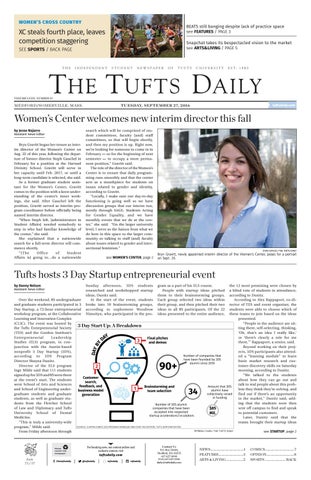
EVAN SAYLES / THE TUFTS DAILY
Bryn Gravitt, newly appointed interim director of the Women’s Center, poses for a portrait on Sept. 26.
Tufts hosts 3 Day Startup entrepreneurial event by Danny Nelson
Assistant News Editor
Over the weekend, 85 undergraduate and graduate students participated in 3 Day Startup, a 72-hour entrepreneurial workshop program, at the Collaborative Learning and Innovation Complex (CLIC). The event was hosted by the Tufts Entrepreneurial Society (TES) and the Gordon Institute’s Entrepreneurial Leadership Studies (ELS) program, in conjunction with the Austin-based nonprofit 3 Day Startup (3DS), according to 3DS Program Director Shayna Dunitz. Director of the ELS program Inge Milde said that 111 students signed up for 3DS and 85 were there at the event’s start. The students were School of Arts and Sciences and School of Engineering undergraduate students and graduate students, as well as graduate students from the Fletcher School of Law and Diplomacy and Tufts University School of Dental Medicine. “This is truly a university-wide program,” Milde said. From Friday afternoon through
Please recycle this newspaper
Rain 73 / 57
/thetuftsdaily
Sunday afternoon, 3DS students researched and workshopped startup ideas, Dunitz said. At the start of the event, students broke into 10 brainstorming groups, according to sophomore Woodrow Nimoityn, who participated in the pro-
gram as a part of his ELS course. People with startup ideas pitched them to their brainstorming groups. Each group selected two ideas within their group, and then pitched their two ideas to all 85 participants. Of the 22 ideas presented to the entire audience,
the 12 most promising were chosen by a blind vote of students in attendance, according to Dunitz. According to Alex Rappaport, co-director of TES and event organizer, the students were able to choose which of these teams to join based on the ideas presented. “People in the audience are sitting there, self-selecting, thinking, ‘Oh, that’s an idea I really like,’ or ‘there’s clearly a role for me there,’” Rappaport, a senior, said. Beyond working on their projects, 3DS participants also attended a “learning module” to learn basic market research and customer discovery skills on Saturday morning, according to Dunitz. “We talked to the students about how they can go out and talk to real people about this problem they think they’re solving, and find out if there’s an opportunity in the market,” Dunitz said, adding that the students were then sent off campus to find and speak to potential customers. Later, Dunitz said that the teams brought their startup ideas see STARTUP, page 2
For breaking news, our content archive and exclusive content, visit tuftsdaily.com @tuftsdaily
tuftsdaily
tuftsdaily
Contact Us P.O. Box 53018, Medford, MA 02155 617 627 3090 FAX 617 627 3910 daily@tuftsdaily.com
NEWS............................................1 FEATURES.................................3 ARTS & LIVING.......................5
COMICS....................................... 7 OPINION.....................................8 SPORTS............................ BACK
2
THE TUFTS DAILY | News | Tuesday, September 27, 2016
T HE T UFTS D AILY Arin Kerstein Editor-in-Chief
EDITORIAL Sophie Lehrenbaum Jake Taber Managing Editors Evan Sayles Associate Editor Kathleen Schmidt Executive News Editor Melissa Kain News Editors Robert Katz Liam Knox Gil Jacobson Catherine Perloff Jei-Jei Tan Hannah Uebele Joe Walsh Juliana Furgala Assistant News Editors Jesse Najarro Danny Nelson Miranda Willson Executive Features Editor Constantinos Angelakis Features Editors Nina Joung Becca Leibowitz Siddharth Divakaruni Assistant Features Editors
Justin Krakoff Executive Arts Editor John Gallagher Arts Editors Eran Sabaner Isaac Brown Assistant Arts Editors Jocelyn Contreras Alison Epstein Elliot Storey Emma Henderson Executive Op-Ed Editor Shannon Geary Cartoonists Stephen Dennison Allie Merola Miranda Chavez Editorialists Aneurin Canham-Clyne Frances DeFreitas Eriko Koide Anita Ramaswamy Noah Weinflash Phillip Goldberg Executive Sports Editor Yuan Jun Chee Sports Editors Maddie Payne Eddie Samuels Assistant Sports Editors Maclyn Senear
Max Lalanne Mia Lambert Caroline Ambros Ray Bernoff Maria Eduarda Ferraz Henry Hintermeister Leila Li Julia Press Evan Sayles Angelie Xiong
Executive Photo Editor Photo Administrator Picture Tufts Editor Staff Photographers
PRODUCTION David Westby Production Director
Allie Merola Executive Layout Editors Sebastian Torrente Jewel Castle Layout Editors Abbie Gantner Leila Li Brianna Mignano Mandip Pokharel Emily Sharp Astrid Weng Petrina Chan Creative Director Allie Merola Executive Graphics Editor Petrina Chan Graphics Editors Juliana Furgala Dana Pek Ashton Stephens Rena Tang Belinda Xian Sebastian Torrente Zach Hertz Executive Copy Editors Jei-Jei Tan Norrie Beach Copy Editors Arthur Beckel Caroline Bollinger Alison Epstein Maria Eduarda Ferraz Gil Jacobson Melissa Kain Sharon Kelmar Reena Kerasin Bibi Lichauco Kathleen Martensen Netai Schwartz Nihaal Shah Arielle Sigel Liora Silkes Dan Strauss Maxwell Bernstein Executive Tech Manager Nitesh Gupta Online Editor Mia Lambert Social Media Editor
BUSINESS Josh Morris Executive Business Director
tuftsdaily.com
Gravitt hopes to provide continuity, progress at Women's Center WOMEN'S CENTER
continued from page 1 On an administrative level, Gravitt said that she has ensured continuous dialogue about gender and identity related issues. Recently, she said that she has been involved in conversations about safe spaces in light of a letter released by the University of Chicago in August that was critical of safe spaces. “Most recently we’ve had a lot of conversations about what safe space means… in talking about instead of a safe space for people, leaning towards the language of intentional space and what that might look like,” Gravitt said. She continued by acknowledging that spaces may not always be safe for everyone, but that it is important to try to create spaces where students can come to feel supported and affirmed. Walae Hayek, the Women’s Center’s Tufts Community Union (TCU) Senate representative, said she has been work-
ing closely with Gravitt as an advocate for student issues and is seeking to build community relations, especially with the Group of Six. “I met with Bryn last week and I’m working to talk to her a little bit more about things we can improve on our relationship with the Group of Six and with the larger community so we can reach out, and we can be fixed [and] supportive of different things going on on campus … It’s all intersectional and we have to work on making sure that intersectionality thrives,” Hayek, a junior, said. According to Gravitt, the Women’s Center is currently making efforts to improve said relations through upcoming co-sponsored events and peer education workshops on gender and intentional spaces at Tufts. Gravitt added that she hopes to reach out to the larger Tufts community, especially faculty in the Women’s, Gender and Sexuality Studies Program and grad-
uate students who she says are often untapped resources. “I think we can do more targeted outreach to the larger campus,” she said. “We have a really great group of core students and then we have a good amount of people coming in and out of the center on a daily basis, but I would love to see different kinds of students coming to our events.” Natasha Karunaratne, a student intern at the Women’s Center, was enthusiastic about Gravitt’s appointment and optimistic about positive changes she could bring. “I’m really happy with the way the Women’s Center runs currently and I’m really proud of the programs we have … but I know a lot of people are intimidated by the center and I would love if Bryn could help us change that,” Karunaratne, a sophomore, told the Daily in an email. “I bet there are other ways to show Tufts students that the Women’s Center is a welcoming, homey environment and I hope we accomplish that while Bryn is still with us.”
Workshop teaches students entrepreneurial skills STARTUP
continued from page 1 before a series of mentors with entrepreneurial experience. This exposure further aided the teams in the refinement of their pitches, she said. Teams spent the remainder of Saturday and much of Sunday preparing for 3DS’s final event: a three minute pitch before a panel of individuals with first-hand experience launching startups. “The teams go over their problem, the market size, their solution and their business model,” Dunitz said. While many students knew how to present a class project, Dunitz said that teaching them how to pitch to investors was an essential aspect of the program. On Sunday afternoon, each team made its final pitch before fellow program attendees and a judging panel. Among the ideas pitched was a virtual reality program that teaches public speaking skills, a playground that harvests kinetic energy and a tooth-mounted calorie tracker. There were no declared winners of the event. “I came to [3DS] because I wanted the entrepreneur experience,” sophomore Hermes Suen, a member of the team that pitched the playground, said, noting that while he believes in his team’s vision, he does not expect to pursue it. One of the major goals for this year’s entrepreneurial event was to expand
MAX LALANNE / THE TUFTS DAILY
Students participating in 3 Day Startup, a 72-hour entrepreneurial bootcamp at 574 Boston Ave, give their final pitches on Sept. 26. the educational diversity of participating students to ensure a great variety of students gain entrepreneurial experience, according to Milde. “It’s been a big mission of mine to create opportunities and to share opportunities that our program is providing … so that all people, whether they’re students, graduate students, researchers, post-docs, faculty, staff
… know about all the entrepreneurial opportunities,” Milde said. An educationally-varied participant base was integral for the program’s success, according to Rappaport. “You get a a diverse level of experiences, so you get this fun mix of freshmen who are excited and don’t know what to do, [as well as] jaded grad students who know what to do,” he said.
Police Briefs – Sept. 26 If You Can’t Take the Heat… A Carmichael Dining Center employee cut his right hand on Sept. 19 at 3 p.m. while preparing food for dinner. Tufts Emergency Medical Services (TEMS) and the Tufts University Police Department (TUPD) responded to the incident. The wound was bandaged and the employee was brought to the hospital for followup. Hitting Out TEMS and TUPD stopped at the Health Service on Sept. 20 after receiving a report at 7:00 p.m. about a male with a dislocated shoulder. The male had been playing tennis with
friends when he was injured. His shoulder was immobilized by wrapping a sling around his shoulder. This person was brought to the hospital. Scuffed Up A student fell off his bicycle on Whitfield Road on Sept. 20 at 9:30 p.m. TEMS and TUPD responded to the call and found the student with scratches on his knee and wrist. He was transported to the hospital for treatment. Popped Alarm TUPD and the Medford Fire Department responded to a fire alarm activation at 26 Winthrop St., the site
of the occupational therapy building. The cause of the alarm was due to burnt popcorn in the microwave. The Medford Fire Department checked the area and approved a reset of the alarm. Cured by Magic TUPD responded to a report of a student at Fletcher Field who suffered a head injury while playing Quidditch. The student reported feeling better upon TUPD’s arrival than when the injury had first occurred, but was brought to the hospital for further examination.
— by Juliana Furgala
Tuesday, September 27, 2016
Features
Limited on-campus space leaves academic departments, student organizations scrambling by Becca Leibowitz Features Editor
Hiring a new faculty member in spring 2016 proved to be more complicated than initially expected for the drama and dance department. Housed in Aidekman Arts Center, the department needed to find additional office space for the new faculty member, which appeared to be nonexistent in Aidekman. “[Aidekman] is literally at capacity,” Heather Nathans, the chair of the drama and dance department, said. “We … went through the building multiple times to try to see what might be reallocated internally, assuming nobody was going to build us a new wing to the building.” Nathans joked about the building’s options, or lack thereof. “We were opening rooms where we’d say, ‘Well, there’s a lot of steam pipes in here and a water heater, but I don’t know, maybe?’” she said. Eventually, a storage closet, Aidekman 008, was identified as the best option for the necessary office space. This closet was where the student percussion group Bangin’ Everything at Tufts (B.E.A.T.s) kept its drumming equipment and supplies, including buckets, a ladder and old street signs. A new search for space Though B.E.A.T.s was asked to move its belongings elsewhere in order to accommodate office space for the new drama and dance department faculty member Kareem Khubchandani, the room switch was not direct, Joe Golia, director of the Office for Campus Life, said. Rather, according to Nathans, the Department of Drama and Dance and the Department of Art and Art History negotiated a switch with the help of Tufts’ space management team, in which Khubchandani moved into Aidekman 003 — the room that Art and Art History teaching assistants (TAs) had been using — while the TAs moved into the former B.E.A.T.s closet, Aidekman 008. This switch allowed Khubchandani to have an office that was in a row with other drama and dance department faculty offices, Nathans said. For B.E.A.T.s, losing access to the closet meant not only the loss of a convenient storage space, but also the loss of a group tradition, B.E.A.T.s president Jessie Hoffman explained. “[The closet] was … kind of like a spot where we would convene before practices, before any show that we had,” Hoffman, a sophomore, said. “So it was kind of our meeting place, and it was definitely a tradition in the B.E.A.T.s history and culture.” While B.E.A.T.s has used the closet for several years, it was initially an open space that the group claimed unofficially, according to Golia. “[The closet] was empty [many years ago], [and B.E.A.T.s] took it,” Golia said. “Nobody is blaming them, nobody is saying they did anything wrong, because we knew they had it … but it was never given to B.E.A.T.s.” The fact that B.E.A.T.s even had its own closet for this many years, Golia added, was a luxury, given how many student groups desire storage space.
“I have one group a week at least walk into my office and ask me for storage space,” he said. “That’s how many student organizations are desperate for storage space, and we’ve got nothing to give them. So an organization that has space, I don’t care where it is, they’re pretty lucky.” Golia said that he contacted the members of B.E.A.T.s in June to inform them that they could no longer use the closet. According to Golia, he and B.E.A.T.s worked together to figure out a date for the group members to move their equipment before the renovations began that would transform the storage closet into an office space. During this time, however, only a few B.E.A.T.s members were still on campus, according to Hoffman. “We were kind of scrambling to figure out who was gonna move the stuff,” she said. Golia said that after losing access to Aidekman 008, B.E.A.T.s was given temporary access to a storage space behind the Green Room in Cohen Auditorium. However, this storage space was difficult to access, Hoffman said, as the B.E.A.T.s members had to call Tufts University Police Department (TUPD) to unlock the room whenever they needed their equipment.
For this reason, since the start of this semester, B.E.A.T.s had been leaving its equipment in Aidekman 012, the room in which it practices, according to B.E.A.T.s member Josh Berl. For the long term, Campus Planner and Project Manager Colin Simmons found a space in the basement of Harleston Hall where B.E.A.T.s can now keep its equipment. According to Simmons, this space is larger than Aidekman 008 and will provide B.E.A.T.s with more storage room than it had before. But Hoffman countered that, as of now, the basement of Harleston is not an ideal spot for B.E.A.T.s’ belongings. “It’s not near where we practice at all, it’s not centrally located on campus and also we don’t really have swipe access for later when we actually practice to get into [Harleston],” she said. “So we haven’t moved any of our stuff down there yet.” However, according to Golia, there is a possibility that the members of B.E.A.T.s will be able to change where they practice from Aidekman 012 to the basement of Harleston, thus minimizing the issue of convenience. This change is contingent on whether the noise from practice sessions will carry upstairs to the residence hall itself, Golia said. see B.E.A.T.S, page 4
RAY BERNOFF / THE TUFTS DAILY
B.E.A.T.s members replaced their improvised musical equipment after it disappeared from Aidekman 012 on Sept. 16.
3 tuftsdaily.com
Natasha Khwaja and Faryal Jafri Karachi vs. Kansas
Who’s who?
N
atasha (N): So I know you guys have been dying to know who’s Karachi and who’s Kansas, or what it really means. Well, take it away Faryal. Faryal (F): I used to joke that when I was younger, I didn’t know I was any different from my peers in the white suburb of Kansas City. As I grew up, I began to slowly realize my “browness.” What started as me avoiding pork or missing school for Eid developed into having “brown friends” and “school friends,” and later grew into realizing my worldview was fundamentally different from that of my peers. N: See, I lived in Pakistan from ages 3 to 10. The only fundamental difference between my Pakistani peers and me during these years was that I was one of the only kids with a single mom, which is relatively rare in Pakistan. When we were moving back to the United States, I remember emailing my dad with a message titled, “America at Last.” I was waiting for this place where I thought I would fit in perfectly. Little did I know that the move would create an entirely new set of dilemmas and differences. F: It wasn’t until I was around 18 when I started confidently calling myself PakistaniAmerican. I considered myself a “hyphenated American,” as Woodrow Wilson once called us. Though I have never lived in Pakistan and have only visited the country sporadically, it is a part of my identity that I refuse to compromise. Even my parents are confused about why I hold their origins so closely to my identity. Yet, its culture, politics and struggles are what have inspired my career aspirations. N: When I moved back to the United States in northern Minnesota, I was basically the only child of an immigrant in my whole school. Since both my name and features are generally considered “ethnically ambiguous” — other than having to explain once a year to my dumb-struck friends that my family didn’t celebrate Christmas — I basically was American during the year and Pakistani when I visited my cousins and grandparents during the summers. For me, my political and more critical interests in Pakistan were what led me to see my identity as hyphenated; it was now more than just the warm and fuzzy memories I had at my grandmother’s dining table. F: This summer, I was able to visit Pakistan with my dad through a new lens: instead of making the day-long journey to attend a family wedding, we explored the country for the sake of learning. This experience was very different from the version of Pakistan I’m constantly fed in my classes and in the media. I came away from this trip wanting to use my identity as a Pakistani-American to add to the Western conversations about Pakistan. N: For both of us, the hyphen represents something different because of our different upbringings and the ways we’ve interacted with Pakistan. For me, it’s more connecting two separate things, while for you, they were always connected: it was a matter of separating them so they’d stop fighting each other. I find it difficult to balance my personal and academic connections to Pakistan, while not getting caught up in the romanticized version of Pakistan to which most diaspora cling. F: So, basically, we both have a “Karachi” and a “Kansas” wrestling each other inside of us. Stay tuned to see who gets knocked out first! Natasha Khwaja is a junior majoring in international relations and anthropology. She can be reached at natasha.khwaja@ tufts.edu. Faryal Jafri is a junior majoring in international relations. She can be reached at faryal.jafri@tufts.edu.
4
THE TUFTS DAILY | Features | Tuesday, September 27, 2016
tuftsdaily.com
B.E.A.T.s left without equipment, place for storage B.E.A.T.S
continued from page 3 “[B.E.A.T.s] need[s] to go practice and I need to be upstairs in [Harleston] and see if it causes any problems,” Golia said. “If they can practice in there and their sound does not carry through the residence hall, then they’re going to be in great shape because they can literally practice across the hall from their closet.” Losing more than just a closet The lack of a convenient space for B.E.A.T.s to store their equipment proved to be a bigger problem than initially anticipated for the group, which arrived at around 6 p.m. on Sept. 16 in Aidekman 012 to find that its equipment and supplies were no longer there, according to Berl. After contacting TUPD, Golia and Facilities Services in an attempt to figure out where their equipment had gone, Berl said a few members of B.E.A.T.s went to the Facilities office to see what had happened. The drummers were informed that someone had filed a work order with Facilities regarding “junk” in Aidekman 012 that they believed should be removed. According to Steve Nasson, senior facilities director, this work order had been filed on Sept. 8 by someone associated with the Tufts University Art Gallery. In the work order, this person asked Facilities to both dispose of “junk” and replace the lightbulb in Aidekman 012 in preparation for a class that would be meeting in that room. Facilities removed the “junk” — B.E.A.T.s’ equipment — on the following Friday, Sept. 16, Nasson said. Berl said that B.E.A.T.s has since purchased about $150 of equipment to replace some of what had been lost. Nasson had not been informed of the incident prior to the Daily’s contacting him. He quickly offered compensation for any mistake made on the part of Facilities. “If it was something we did, I’m happy to reimburse [B.E.A.T.s],” Nasson said. According to Nasson, a small amount of B.E.A.T.s’ equipment — specifically some of their buckets — may still be in Facilities’ possession, in which case B.E.A.T.s could get it back. “We will return [the buckets] to their rightful owners,” he said. Still, most of B.E.A.T.s’ equipment has
MAX LALANNE / THE TUFTS DAILY
B.E.A.T.s practiced and also stored their equipment in Aidekman 012 until it was unknowingly removed by facilities, pictured here on Sept. 26. already been thrown away, according to Nasson. Despite losing their closet and then their equipment, Berl said that B.E.A.T.s has taken it all in stride. “Right now, we don’t really blame facilities or [the Office for Campus Life] or the [study group] that used the room … There are some things that are gone forever and we will probably never be able to replace exactly what we had, but the rest is [comprised of ] trash and we will be fine,” Berl told the Daily in an electronic message. “[Hoffman], as well as the other members of B.E.A.T.s who were working hard to find our stuff, did a fantastic job handling this mess.” True to its acronym, B.E.A.T.s hopes that it will be back to “bangin’ everything at Tufts” in no time. “B.E.A.T.s is resilient, and we are going to keep playing everything we can with what we have and what we can get our hands on,” Berl said. Office space shortage According to Lois Stanley, Director of
Campus Planning, lack of office space at Tufts is a concern that extends beyond the drama and dance department and student organizations such as B.E.A.T.s. The university is working to address the problem by fully utilizing the campus’ new buildings, such as the Collaborative Learning and Innovation Complex (CLIC) at 574 Boston Ave. and the Science and Engineering Complex (SEC) currently being built, she said. By following more specific parameters for office space and increasing shared space in these new buildings, Stanley explained, concerns regarding lack of office space can be alleviated. “Knowing that we have office crunches everywhere, we went into [CLIC] with some space-use guidelines … For the occupant groups in CLIC … the going-in rule was that [only] full-time faculty get private offices,” she said. “When you shift the definition of who requires an office, then you’re less likely to get to the office crunch as quickly as we have elsewhere.” Rather than establish additional private offices, the CLIC features shared
RAY BERNOFF / THE TUFTS DAILY
B.E.A.T.s unofficially housed their equippment in an Aidekman closest for years, though the space it had all occupied is being repurposed.
spaces for collaboration, as well as “huddle rooms” for one or two people that can be reserved online, Stanley said, when people need a private space for a meeting or even just for themselves. The balance between storage space and office space is a difficult one to strike, according to Stanley. While storage space has few requirements, office space has more specific needs. “Storage can be almost anywhere, but you do want it to be something you can access … so that it’s easy to deliver storage to and from,” she said. “[For] offices, we like folks to have direct or indirect light, so [for] storage, we have more possibilities.” Yet the former B.E.A.T.s closet and new TA office, as well as Khubchandani’s new office, lack this natural light, according to Nathans. Stanley acknowledged that the basement in Aidekman, though renovated over the summer, is less than ideal for office space. “[The drama and dance department is] very, very squeezed … [It’s] not the sort of community one would like, so they already are compromised in terms of office space,” she said. “It sounds a little bit odd to create an office for faculty out of a closet … [but] we really needed to accommodate an incoming faculty [member].” Though storage is important, Stanley said that it is difficult to prioritize storage over office space. “I think people do come first, particularly full-time faculty, full-time students [and] full-time administrators,” she said. While new buildings on campus are being designed with the goal of maximizing office space, older buildings such as Aidekman may be difficult to expand upon. According to Nathans, throughout the past few decades, several offices in Aidekman have been divided into multiple offices in order to increase office space. However, Nathans believes that the need for more offices reflects the vitality of a flourishing department. “We’re lucky to be growing … and if the worst or the most painful part of that growth is, ‘Oh, we’re a little squeezed for the time being until we can build enough buildings to catch up with our growth,’ then we’ll deal with that,” she said. “But I think it’s really exciting that we’re growing, we’re adding faculty [and] we’re able to offer more to students.”
ARTS&LIVING
5 tuftsdaily.com
Tuesday, September 27, 2016
TV THROWBACK
The Gold in Netflix’s back catalog: three timeless shows for your binge-watching habits An editor’s Netflix suggestions for those tired of fall TV premiers by John J. Gallagher Arts Editor
Netflix is all about its original series at the moment — hardly a week goes by where some permutation of the phrase “Netflix’s rich stable of original series” isn’t weaved into an article — but Netflix has a sprawling catalog of entertainment on tap, including some real gems from yesteryear. When one needs their next fix after watching Matt Murdock punch ninjas on the rooftops of Hell’s Kitchen or Frank Underwood weave a machination, look no further than these three classic, yet oft-overlooked, series. “Firefly” (2002-2003) The grand-daddy of cult classics, “Firefly” is an offbeat sci-fi western that is known as much for its glittering cast and dialogue as it is for its tragically short single-season run. Joss Whedon’s characteristic cerebral writing elevates the premise above the episodic, poor-man’s “Star Wars” it could have been, with a rag-tag crew of misfits adventuring aboard a charismatic clunker of a starship. Expect meditations on war, existing on the fringes of society and horrific government abuse. The show’s ensemble cast has been roundly praised time and time again since the show’s cancellation, but those praises bear repeating. Leading man Nathan Fillion is brooding and charm-
PHOTO BY DOUG KLINE VIA POPCULTUREGEEK.COM
The cast of “Freaks and Geeks” reunited for a discussion at PaleyFest on March 12, 2011. ing by turns, which brings tremendous depth to his much-beloved character: traumatized war veteran turned smuggler Malcolm “Mal” Reynolds. The rest of the cast’s performance is similarly multifaceted, with Summer Glau as super-powerful torture victim River Tam being a standout among standouts. The time taken to get through the single season of “Firefly” is time well spent, if only so one can feel superior
the next time “The Big Bang Theory” (2007-present) or another televised dumpster fire invokes “Firefly” to enhance its nerd cred. “Freaks and Geeks” (1999-2000) Before he started churning out so-so romantic comedies (including the series “Love” (2016), which the Daily see NETFLIX, page 6
TECH PREVIEW
Snapchat moves into wearable technology with new video camera sunglasses by Isaac Brown
Assistant Arts Editor
Snapchat has joined the battle to sell the latest wearable technology with the announcement of its new Spectacles glasses, a pair of sunglasses with a builtin video camera. With this announcement, Snapchat also changed its corporate name to Snap Inc. as an indication of how the company aims to expand beyond the messaging app that made them well-known. The Wall Street Journal (WSJ) reported on Friday that this announcement marks a significant milestone in the company’s transition from software into hardware products. Leaked stills from a promotional video for the glasses showed up in Business Insider on Sept. 23, depicting a pair of dark mirrored lenses surrounded by a black frame. In the upper, outer corner of both lenses is a dime-sized camera that lights up. According to the WSJ report, Spectacles will be available for purchase in limited quantities this fall and will come in one size and three
colors: black, coral and teal. Tapping a button near the hinge of the glasses will record 10 seconds of video, while simultaneously lighting up on the rims to let people know that the user is recording. The technical details of the cameras, such as what resolution the video footage is shot at, have not been released yet, but the device uses an 115-degree camera lens with a fisheye rendering effect. Users can charge Spectacles by placing them inside their special case. A full charge will give one enough uptime to record for a day, and a case holds an additional four charges. For iOS users, the glasses will transfer videos using Bluetooth and high-resolution recordings over Wi-Fi, but Android users will only be able to use Wi-Fi, according to a Sept. 4 article COURTESY SNAPCHAT in The Verge. By designing Spectacles to be sunglasses, Snap, Inc, seems to suggest that users should use them primarily outdoors; the leaked promo videos show what appear to be parents playing with children on a playground, or teenagers riding skate-
boards. The glasses’ rather eccentric appearance, resulting from the need to store extra tech inside the rims make it seem geared towards teenagers willing to be more experimental with their choice of eyewear aesthetic. Others suggest that Snap has designed their eyewear in a way that will appeal to young people. “If you look at the kinds of glasses millennials wear, the design is very ‘in,’” Carolina Milanesi, a consumer technology analyst at Creative Strategies, said. Snap’s 26-year-old founder and CEO Evan Spiegel told the WSJ that Spectacles would be headed in a different direction from Google Glass, a more complex device released by Google in 2014 with a liquid-crystal on silicon display and a camera that could take photos and record 1080p HD video. Snap Inc.’s product is certainly less costly than Google’s; a pair of Spectacles will only set you back $129.99 while the Google Glass Explorer Edition was priced at $1,500. Even though Spectacles are certainly not as pretentious as Glass, critics will likely have similar complaints about a pair of glasses with the ability to record video. Google Glass users in San Francisco and New York City encountered backlash from others who objected to their wearing see SNAP, page 6
Tommy Gillespie The Reel World
I
New York
hold firm the belief that any college student can look at the poster of “Frances Ha” (2012) and think, “Yeah, same.” The image of star Greta Gerwig jumping and dancing on a New York street corner with hair flinging every which way, feet ominously positioned to fall down and eyes supremely focused on her task, but also seeming very confused, speaks to a similar figure within all of us; one who is just barely keeping ahead of all her tasks, harried, and also maybe falling down occasionally. Or, if you’re like me, maybe it could also serve as an embarrassingly accurate description of what you often look like on the way to class. As I was doing more than my fair share of scrambling around campus this week, going to lift, class, office hours, practice, GIMs and the like, I felt stuck in the rat race. Thinking of Greta Gerwig’s leap of faith in “Frances Ha,” with the Boston skyscrapers in the distance, took me straight into the cinema world of New York. Life as it is portrayed in New York cinema and life at any college, especially Tufts, can be strikingly similar: fastpaced and in your face. For instance, I recently saw a girl running down Professor’s Row trip, fall, then immediately get up and continue running. She could just as easily be scurrying after a cab in a Scorsese film. Alternatively, she could be the busy business lady in every rom-com barking, “I have no time for this!” into her phone, walking down Wall Street only to have coffee spilled all over her shirt by her soon-to-be boyfriend Ryan Reynolds. The busy business lady trope and New York appear more effectively in a film I saw over the summer, “Equity” (2016). In the film, Anna Gunn’s Naomi, an intensely motivated, high-flying investment banker, navigates a particularly challenging initial public offering for a tech start-up as flirtations with illegal dealings, backstabbing, scheming and sexism undermine her. Surely, any college student can empathize with Naomi as she seemingly plans for every possible outcome and ties up every loose end, only for a completely unforeseen problem to derail her. Similarly, when Michael Keaton’s Riggan Thompson in “Birdman” (2014) finds himself locked out of the theater during the opening night of the show that he is starring in, in hopes of rebooting his career, he is forced to take a half-naked walk through Times Square around to the front entrance of the theater. When I was trudging down College Avenue with two bags slung over my shoulders recently, I thought I could have been mistaken for Keaton in Times Square: stressed, sweaty, crazed look in the eye, bumping into random strangers. Luckily, however, I was fully clothed and, also luckily for Michael Keaton, the show is a smashing success. On Broadway and in college, that’s the mantra: my clothes are gone, it’s 2 a.m. and I’ve got three papers to do, but the show must go on. Tommy Gillespie is a first-year who has not yet declared a major. Tommy can be reached at tommy.gillespie@tufts.edu.
6
THE TUFTS DAILY | Arts & Living | Tuesday, September 27, 2016
tuftsdaily.com
Cult classics abound in Netflix's back catalog NETFLIX
continued from page 5 reviewed back in March), Judd Apatow served as executive producer on the sole season of “Freaks and Geeks,” a heart-breakingly poignant look at the timeless pain of growing up, as seen through the eyes of a collection of early ’80s suburban teens. There aren’t many shows that can inspire so heartfelt a think piece as Nick Hilbourn’s musing on Bill Haverchuck for HeadStuff.org or be so acclaimed as having the “Greatest Scene in Television History” or to have launched so many careers: Martin Starr plays shaggy-haired Satanist Bertram Gilfoyle on HBO’s “Silicon Valley”(2014-present), and Seth Rogan, Jason Segel and James Franco are all household names. Come for the gangly, younger versions of celebrities, stay for the ache of adolescence. “House of Cards” (1990) Before Kevin Spacey came to embody Machiavellian efficacy as Frank Underwood in Netflix’s smash-hit original series “House of Cards” (2013 – present), the BBC adapted Conservative politician Michael Dobbs’ novel into the
1990, four episode mini-series “House of Cards.” Set in the aftermath of Margret Thatcher’s resignation, “House of Cards” follows Chief Conservative Whip Francis Urquhart (Ian Richardson) as he attempts to scheme his way into 10 Downing Street. Overflowing with a kind of smarmy, emotionally repressed and public schoolboy Englishness, “House of Cards” is an unflattering look at the unsavory characters that populate the upper echelons of British politics. The show’s production values are a touch dated, but the Shakespearean overtones and excellent acting keep the original rendition of “House of Cards” tense and worth watching. Ian Richardson does a better job of breaking the fourth wall than Kevin Spacey is ever likely to. Each of these three shows will last through a weekend of dedicated binging or could be stretched across a handful of evenings by more restrained watchers. However one chooses to view them, all three are a welcome change of pace from the shows that dominate Netflix’s offerings.
MATT BARON/REX SHUTTERSTOCK/ZUMA PRESS/TN
Joss Whedon, the creator of “Firefly,” poses at The Hollywood Reporter's annual Nominees Night on Feb. 8 in Los Angeles.
Snap Inc. enters wearable tech market SNAP
continued from page 5 of the devices in public spaces, labeling the Glass wearers as “Glassholes.” There was a widespread misconception that Glass was always recording, despite that
not being true, and people around Glass wearers said it made them feel uncomfortable. While Glass showed great potential to enhance our ability to multitask, public perception was so negative that the project was scrapped by Google in 2015.
Spiegel understands the risks of following in Google’s footsteps, choosing to treat the device not as a hardware launch but as a fun toy available to a limited number of people. Spiegel seemed to hint at the challenges Spectacles faces as it
tries to appeal to a demographic that has yet to fully embrace wearable technology. “We’re going to take a slow approach to rolling them out,” Spiegel said. “It’s about us figuring out if it fits into people’s lives and seeing how they like it.”
7
Tuesday, September 27, 2016 | Comics | THE TUFTS DAILY
tuftsdaily.com
Comics
LATE NIGHT AT THE DAILY Jake: “My tofu’s pretty firm.”
Comics
SUDOKU
DOONESBURY BY GARRY TRUDEAU
Difficulty Level: Finding a pizza place on Boston Avenue.
Monday’s Solution
NON SEQUITUR BY WILEY MILLER
FOR RELEASE SEPTEMBER 27, 2016
Los Angeles Times Daily Crossword Puzzle CROSSWORD Edited by Rich Norris and Joyce Lewis
WHY DID THE CHICKEN CROSS THE ROAD? —
Because the GPS told her to. Find your way over to our new restaurant in Medford Square ...use a GPS as needed. cnrguys.com 617-903-8538
64 Salem St, Medford
ACROSS 1 Civil __ 4 Tropical fish with large peepers 10 Add to the staff 14 Jungle swinger 15 Rapper whose professional name sounds like a candy 16 Sport, for ports: Abbr. 17 Kindled 18 Churchgoer’s “If it’s meant to be” 20 Explorer Ericson 22 Kitchy-__ 23 Blame taker 24 Curtain material 26 Another name for the gladiolus 30 Cable box display 32 Dispensable candy 33 High bond rating 34 Geological epoch in which mammals arose 37 Leave __: reward the waiter 38 Post-Cold War hierarchy ... and what is literally contained in the circled squares 42 Mortar carriers 43 __ Fables 44 Nonprofit URL ending 45 Adherent’s suffix 47 Muscat residents 51 Out-of-the-office assignment 55 Point of view 56 Peau de __: satin-weave cloth 57 Wide shoe width 59 In any way 60 They’re often passed on the road 64 Holiday threshold 65 Starting course 66 Austrian capital 67 “__ Misérables” 68 Chris of “The Good Wife” 69 First female Shuttle pilot __ Collins 70 H.S. 12th-graders DOWN 1 NYSE locale
9/27/16
By Lonnie Burton and Nadine Anderton
2 Per unit 3 Head to bed 4 Brussels’ land: Abbr. 5 “Don’t worry about me” 6 Copter predecessors 7 Provide with funding 8 Evergreen that’s a homophone of a vowel 9 Political refugee 10 Judaism : kosher :: Islam : __ 11 Start 12 Took part in a marathon 13 Cake mix need 19 City southwest of Warsaw 21 Reporter’s quintet of questions 25 Ask for Whiskas, perhaps 27 Opinion columns 28 Lion’s den 29 Jabber 31 Prefix with friendly 35 Muse of poetry 36 Marlins’ MLB div. 37 Source of media revenue 38 “Me neither”
Monday’s Solution Monday’s Puzzle Solved
©2016 Tribune Content Agency, LLC
39 Barely beats 40 Valentine card hugs 41 LP measures 42 Baseball inst. in Cooperstown 45 “__ it my way” 46 Turn sharply 48 Orange choices 49 “Well, __!”: “What an outrage!” 50 Blood pressure elevator
9/27/16
52 Acid test outcome, possibly 53 Party hearty 54 Nancy Drew creator Carolyn 58 White-tailed coastal bird 60 Nine-digit ID 61 Lav, in Bath 62 Three on a sundial 63 __ Antonio
8 tuftsdaily.com
Opinion
Tuesday, September 27, 2016
EDITORIAL
Curve grading needs to go Everyone’s heard the horror stories of collegiate sabotage: students ripping pages out of their peers’ textbooks, pulling fire alarms in the library during finals week or intentionally giving their classmates incorrect notes. While these tales are extremes of questionable veracity, undoubtably there exists a certain level of competitiveness between students when it comes to classes graded on a curve. Curve grading, where students’ raw grades are adjusted so that the class scores fit within a standard bell curve distribution, is common on college campuses, particularly in the fields of math and science. However, there are a growing number of concerns surrounding the effectiveness of grading on a curve, and heightened criticisms of the cutthroat academic environments curve grading can create, calling into question the place it holds in higher education. Why grade on a curve? A common
argument in favor of curves is that they foster competition that encourages students to aim higher. However, studies have proven that students are less inclined to study when they know an assessment will be curved. The knowledge that failing scores could likely be converted to passing scores — and that particularly high scores may not be rewarded — discourages studying. Low- and high-achieving students alike are led to assume that the process of curving will alter their performance in one direction or another, and the goal of mastering the material can quickly become muddled by the drive to merely perform better than peers. Furthermore, curved classes tend to be large STEM lectures preparing students for fields that are inherently collaborative. Teaching undergraduate students that another’s failure is their gain in preparation for collaborative, team-based careers is highly counterintuitive. If the university seeks
to foster a constructive environment that promotes growth, students should not be pitted against one another. We should be promoting the idea that students should strive to do their personal best, whatever that may be, rather than arbitrarily working to ‘outshine’ classmates. Innovation and learning are not insular activities by nature — there is so much potential to learn from each other and share new perspectives, but much of that intrepid spirit to work together can become lost when students feel an internal drive or obligation to outperform their peers. As the old adage goes, two heads are better than one. And when the average grades in particular historically challenging courses are fairly low, we could instead employ a standard conversion system to translate raw scores across the board and solve the issue of precariously low scores. An alternative grading system like this would mitigate direct competition between stu-
dents whose focus should be achieving independently-earned success alongside synergistic collaboration. Considering the statistically-proven disadvantages to curve-based grading, as well as its discouragement of collaboration, it’s time to call into question the system’s validity in our university as well as those across the country. Classes and individual students alike would greatly benefit if classmates saw each other as collaborators rather than competitors. Furthermore, with growing rates of anxiety and depression at American universities, there is no doubt that reducing competitive peer rivalry, while boosting collaborative encouragement and support, could make a positive impact on the mental health of college students. Changing the curve grading system would spur numerous positive results for universities and students alike, and it is a change that could not happen soon enough.
CARTOON
BY STEPHEN DENNISON The Tufts Daily is a nonprofit, independent newspaper, published Monday through Friday during the academic year, and distributed free to the Tufts community. The content of letters, advertisements, signed columns, cartoons and graphics does not necessarily reflect the opinion of The Tufts Daily editorial board. EDITORIALS Editorials represent the position of The Tufts Daily. Individual editors are not necessarily responsible for, or in agreement with, the policies and editorials of The Tufts Daily. OP-EDS The Op-Ed section of The Tufts Daily, an open forum for campus editorial commentary, is printed Monday through Thursday. The Daily welcomes submissions from all members of the Tufts community; the opinions expressed in the Op-Ed section do not necessarily represent the opinions of the Daily itself. Opinion articles on campus, national and international issues should be 600 to 1,200 words in length and submitted to oped@tuftsdaily. com. The editors reserve the right to edit letters for clarity, space and length. All material is subject to editorial discretion and is not guaranteed to appear in the Daily. Authors must submit their telephone numbers and day-of availability for editing questions. ADVERTISING All advertising copy is subject to the approval of the Editor-in-Chief, Executive Board and Executive Business Director.
Tuesday, September 27, 2016 | Opinion | THE TUFTS DAILY
O OP-ED
Older and (maybe) wiser by Caroline Enloe When President Obama ran for office in 2008, he was doing so as a man who had two years of experience in the United States Senate. He was 47 years old. People believed that America needed a “fresh face” and new ideas. Now, eight years later, our country is deciding who will take over for him. The two candidates we have chosen are a decade older than the current office holder and, many hope, a decade wiser. Children are taught from a very early age to respect their elders; they are taught that because older individuals tell stories that begin with, “When I was your age,” these individuals know much more about the world. While sometimes this proves to be false, many of us are frequently more than willing to listen to the wisdom of the generation before us. Employers will often listen to the opinions of those who have been with a company for a longer period of time, rather than those who have just started — even though the greener employees may very well have a clearer perspective. Many individuals have a predisposition to believe that when you are older, you are wiser. This idea has carried over into our politics, although it could very well have been unconsciously. The candidates that did well in this year’s primary were those who were older and had been in the public eye much longer than President Obama when he became president. For example, Hillary Clinton was the first lady of the United States turned senator turned Secretary of State, while Ted Cruz served in various appointed fed-
eral offices before beginning his congressional career in the state of Texas. Bernie Sanders has been serving as a senator for decades, and while he was not well-known to the general public, he was well-respected in the political community. Donald Trump is an extremely well-known businessman and has also been toying with the idea of running for president since 1988. Of course, there were other candidates in the primaries, but they were largely ignored in favor of their opponents with which the general public were more familiar. Trust and familiarity in this election have allowed for two candidates to rise above all others. Our world is in a precarious state and so it would seem that the people want a sage leader who has been with them since the beginning. The idea of having a president who is experienced and well-known goes back to the writing of the U.S. Constitution. There is a reason that the president must be 35 years old, while a member of the House can be 25 years old. It is again this stigma that responsibility and decision-making comes with age. George Washington was elected at the age of 57, a relatively older age in the 18th century, after having led the country through a revolution. The people were familiar with him and trusted his judgement and wisdom after years of fighting. His experience — combined with his age — made him a prime pick to become president. So many different things go into becoming president and so many things need to be taken under consideration for the job. A 70-year-old candidate is not necessarily going to be a good president
because they are older and have had more experience in the government. A 40-year-old candidate is not necessarily going to be a bad president because they have only been in elected office for four years. In this year’s election cycle, Marco Rubio spent the entire primary process deflecting attacks on his inexperience and his age, while Hillary Clinton recently spent a great deal of time being pestered about her pneumonia. These candidates are representative of the two ends of the scale: a young candidate that the American public worries lacks credentials and an older candidate that the American public worries is not physically healthy enough for the job. There are issues with both sides, and yet the candidates with age and credentials prevailed. This year, Americans might have gone with the “wiser” candidates, but we certainly should not decide who our next president will be based solely off age or expertise. In the coming weeks, as debates begin, we should not just be looking at a candidate’s resume or medical record, we should also be looking at policies and temperament. When November comes, voters should push all prejudices aside and think about who they want to represent our country. Older is not always wiser and our opinions may not always be based off of facts. This election cycle has more than proved that we cannot agree on which road this country should be headed down, and we can only hope that our peers will pick our side. Caroline Enloe is a first-year student intending to major in international relations. Caroline can be reached at caroline. enloe@tufts.edu.
9
Jake Lawicki Jumbo Steps
I
Christ’s horseshoe
t’s interesting to see what kind of questions we Jumbos ask each other at the start of every academic year. I’ve noticed that the majority of returning sophomores ask more personal questions compared to the start of freshman year, which makes sense since the first-year song and dance of asking vague questions is over. There seems to be less of, “What’s your name? Where are you from? What’s your major? Did you do a ‘preo’?” and more of, “How was your trip to X place? Did you enjoy your internship? How about we continue being gym buddies? Remember all those grueling study nights for X class?” But when I brunched over homemade banana bread with an old friend last week, this usual line of questioning shifted in a direction I’ve never seen it go before. “How are you holding up mentally?” she asked casually. “Pretty well, actually,” I proudly reported. Although Tufts doesn’t really assign “summer homework” (hallelujah), I had a pretty hefty workload before returning to campus. My self-assignment was to identify what I should change to make my well-being better this time around, and by extension, to identify who or what is preventing me from making those changes. After pondering this question for 15 weeks, I found my answer: I was stifling my religious growth. As such, one change I’ve made this year is to join one of Tufts’ Nondenominational Christian Fellowship (NCF) clubs. To me, religion is fundamentally a personal relationship — not only with a deity, but also among other believers. So you can imagine how awkward it was for me diving right into my first NCF get-together; I knew only one other person there, and was worshipping a God who I’d put on the back burner for quite some time. We sat around in a horseshoe-shaped row of chairs. I picked the innermost seat, plopping down next to (unbeknownst to me) that night’s speaker on my left and a couple I’ve never seen in my life on my right. But eventually, the couple departed early for the night, right before the speaker left his seat to deliver his sermon. So here I was, in the middle of the horseshoe, alone. I regard myself as sociable and extroverted, but in novel social situations, I sometimes turn inward. I tried to avert my attention from the empty seats toward the lyrics of the worship songs. I tried to stop thinking about how I could have easily moved just a few seats to join the rest of the group, or how I could have felt less isolated if I had just begun singing with everyone. But I didn’t try for that long. Because I didn’t have to. The one person I knew forewent sitting with the regulars to take up the empty chair to my right. This is the community I’ve been searching for. The one I’ve been craving. The one I’m excited to grow with. Jake Lawicki is a sophomore who has not yet declared a major. Jake can be reached at jake.lawicki@tufts.edu.
10
THE TUFTS DAILY | ADVERTISEMENT | Tuesday, September 27, 2016
tuftsdaily.com
SOPHOMORE
PRE-HEALTH MEETING Early assurance and combined degree programs, major and study abroad questions, looking for internships…COME and hear from the pre-health advisors and seniors who have done it!
WHEN: Wed., September 28th from 12-1 pm WHERE: Dowling 745 Sponsored by Pre-health Advising
What is The Tufts Daily Semester Scholarship? This scholarship schola aims to provide funds to first-year students with demonstrated financial need so they may be able to pursue their interest in journalism and media through the Daily.
Who qualifies? F irst-year students at Tufts who qualify for federal work study or have demonstrated financial need. Students with serious interest in journalism or media. No prior journalism experience is necessary, but it is preferred.
What is expected of me? Complete a set number of projects every month. Meet weekly with your section executive editor to assess your work and discuss opportunities for growth.
H ow am I paid? The scholarship is worth $500. You will receive two installments of $250, one midway through the semester and the second upon completion of the scholarship at the end of the term.
Apply at : tinyurl.com/dailyscholarship
Applications due at noon on September 30th!
Tuesday, September 27, 2016 | ADVERTISEMENT | THE TUFTS DAILY
tuftsdaily.com
1/4 AD
1/8 AD 1/2 AD
11
12 tuftsdaily.com
Sports
Tuesday, September 27, 2016
WOMEN'S CROSS COUNTRY
No. 6 Tufts outpaces competition en route to fourth-place finish at Williams by Arman Smigielski Contributing Writer
Women’s cross country continued its strong start to the season with a fourthplace finish at the Williams Purple Valley Classic. No. 6 Tufts was the only team at the meet that placed nine runners in the top 50 of the six-kilometer race. The Jumbos finished with 125 points, 25 behind third-place finisher No. 1 Williams. No. 2 SUNY Geneseo and No. 5 MIT rounded out the top two, with 65 and 71 points respectively. Along with Williams, those teams were the top three finishers at the national tournament last year. Tufts’ top five runners placed 12, 15, 29, 34 and 35 out of 277 runners. Tufts outran No. 8 Middlebury, No. 11 Rensselaer Polytechnic Institute and No. 14 Ithaca, all teams that are ranked in the top 15 Women’s cross country programs nationally. Senior tri-captain Alice Wasserman ran the 6k in 23:16.8 and finished as the fourth runner for Tufts for the second-straight week. Wasserman was excited about the team’s prospects going forward and by its chances to challenge the big name programs for a top-three place this year. “We finished in fourth place to the three top finishing teams from nationals last year, and if we stay in this position, the podium is very reachable for us,” Wasserman said. “We are going to keep on putting in hard workouts and strategizing to continue to excel in races and close the gap between a lot of our runners moving into the postseason.” Wasserman credited the team’s success to strong communication and innovative strategy during the race. The team started out at a moderate pace and then sped up throughout the race, using the racers in front as motivation to continue increasing speed. While the strategy has not been perfected yet, the team has continued to improve on it and hopes it will yield increasing returns as the season progresses. “This week, we communicated really well. We were all vocal and supportive [of each other] for the entire race,” said Wasserman. “Each race group had a strategy and for the most part, we were able to stick to the plan and execute strong races.” Junior Brittany Bowman was the Jumbos’ first finisher on the day, with a time of
COURTESY ALYSSA RIVAS
The women's cross country team placed 16th at Nationals in 2014. Then-sophomore Kelly Fahey sprints toward the finish, earning an All-American title. 22:39.0. Senior Kelly Fahey crossed the finish line at 22:44.6 followed by sophomore Natalie Bettez and Wasserman. Just one second after Wasserman was senior Lindsay Atkeson who rounded out scoring for Tufts. Five Jumbo seniors placed within the top 50 at the meet, including tri-captain Samantha Cox (23:21.8) and Olivia Dehm (23:23.6).
COURTESY ALYSSA RIVAS
Then-sophomore Alice Wasserman races past a pack of runners at the 2014 Nationals.
Head coach Kristen Morwick felt that while the team improved from its previous start, the team could further improve its approach and eventually challenge the top three teams this season. “We were much better than at Bates,” Morwick said. “[We] raced a conservative but smart race … I think later in the season when we’re ready to be more aggressive in our approach, we will challenge those top three teams.” Tufts is close to cracking the top three and the future looks good for the rest of the Jumbos as well, as they have a deep and talented squad behind their top runners. The middle of the team performed exceptionally. If Tufts’ eighth through 12th best runners were a team, it would have outperformed NESCAC rival Colby. Among the underclassmen, first-year Gia Kim ran the third fastest time for a firstyear on the course in Tufts history and finished 47th. The Jumbos are optimistic heading into the rest of the season, but constant improvement remains the focus. “[It was a] solid effort for our second race of the year, and we know we can improve,” Morwick said. The Jumbos compete next on Saturday at Lehigh University’s Paul Short Invitational.
Nicky Shapiro Under the Lights
Chords of Comfort
O
nly a select few are labeled “the voice of a generation.” It’s downright silly to be dubbed the voice of three. And yet, that is the title that Vin Scully, the Los Angeles Dodgers’ play-by-play man on television and radio for the last 67 — yes, 67 — years, has earned over his unimaginably decorated career that comes to a conclusion this week. Scully has had such an impact over such a vast number of people over nearly seven decades that I would be remiss to not dedicate at least this much space, in this medium, to him. I don’t know where to start. Scully witnessed and narrated Jackie Robinson rounding third at the legendary Ebbets Field in Brooklyn, a Sandy Koufax slider off the mound at the Coliseum and a limping Kirk Gibson’s 1988 World Series walk-off home run. The 88-year-old’s unprecedented run stretched the majority of this century. It has transcended the administrations of twelve separate United States Presidents, the passing of the Civil Rights Act, Title IX and the invention of the modern computer. The latter is perhaps the most impressive; Scully’s timeless voice found a way to stay relevant in an age where his slow, methodical style runs paradoxical to modern sports culture, which in recent years has relied more and more on instantaneous highlights and quick, snappy roundups. Scully was the antithesis to this revolution. He’d tell stories that would span not just across at-bats but through entire innings, sprinkling in facts and tidbits about the game and players he was watching along the way. The announcer’s greatness refused to be constricted by time, which is perhaps why if you ask anyone in Los Angeles who the face of their city is, the conversation almost always turns to Scully at one point or another. It’s hard to articulate how big of a presence Scully has had on the nation’s second-biggest market. Put it this way, though: if you grew up in Los Angeles and are below the age of sixty, chances are there were only three people in your life who you heard talk more than Scully throughout your childhood: your parents and your teacher in elementary or middle school. Scully’s voice is that of millions of childhoods and countless young summers spent falling asleep in front of the television or radio to the tune of his sweet, melodic vocal chords. Unlike most of youth, though, that voice wasn’t fleeting; it remained, for decade after decade after decade, a constant reminder of the stability and consistency that Americans, and particularly Los Angeles residents, so desperately sought throughout Scully’s tenure in the broadcast booth. His voice defined large chunks of the lives of those born in the last century. Scully says goodbye this week to a game and a world that hardly resemble what they looked and sounded like when he sat behind the microphone for his first game back in 1950. The game, the fans, and the players have changed definitively. Somehow, beyond all reason and comprehension and logic, Vin Scully has not. Nicky Shapiro is a first-year who has not yet declared a major. He can be reached at nicholas.shapiro@tufts.edu.