An elephantine endeavor: JumboVotes works to register student body see FEATURES / PAGE 3
TUFTS SAILING
Sailing, Rodopman leave competitors in their wake
Tasty eats at revamped Chinatown gem see ARTS&LIVING / PAGE 5
SEE SPORTS / BACK PAGE
THE
INDEPENDENT
STUDENT
N E W S PA P E R
OF
TUFTS
UNIVERSITY
E S T. 1 9 8 0
T HE T UFTS DAILY
VOLUME LXXII, NUMBER 14
tuftsdaily.com
Wednesday, September 28, 2016
MEDFORD/SOMERVILLE, MASS.
Debate Watch Party draws full house, highlights student contingent supporting Clinton by Liam Knox News Editor
The Department of Political Science hosted a Presidential Debate Watch Party on Sept. 26 from 7:45 p.m. to 10:30 p.m. in Cohen Auditorium. The screening of the first presidential debate of the 2016 election — between the Democratic presidential nominee, former Secretary of State Hillary Clinton, and the Republican presidential nominee, Donald J. Trump — was preceded by a panel discussion. Moderated by Chair of the Political Science Department Deborah Schildkraut, the panel consisted of Dean of the School of Arts and Sciences James Glaser, Associate Professor of Sociology Sarah Sobieraj, Professor of Political Science Jeff Berry and former “Meet the Press” host David Gregory. The event was co-sponsored by the Office of the Provost, the Department of Sociology, the Experimental College, see DEBATE, page 2
RACHAEL MEYER / THE TUFTS DAILY
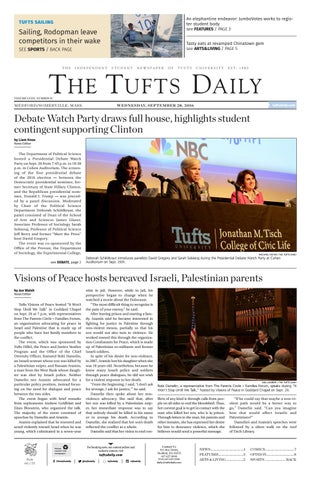
Deborah Schildkraut introduces panelists David Gregory and Sarah Sobieraj during the Presidential Debate Watch Party at Cohen Auditorium on Sept. 26th.
Visions of Peace hosts bereaved Israeli, Palestinian parents by Joe Walsh News Editor
Tufts Visions of Peace hosted “It Won’t Stop Until We Talk” in Goddard Chapel on Sept. 26 at 7 p.m. with representatives from The Parents Circle – Families Forum, an organization advocating for peace in Israel and Palestine that is made up of people who have lost family members to the conflict. The event, which was sponsored by Tufts Hillel, the Peace and Justice Studies Program and the Office of the Chief Diversity Officer, featured Robi Damelin, an Israeli woman whose son was killed by a Palestinian sniper, and Bassam Aramin, a man from the West Bank whose daughter was shot by Israeli police. Neither Damelin nor Aramin advocated for a particular policy position, instead focusing on the need for dialogue and peace between the two sides. The event began with brief remarks from sophomores Andrew Goldblatt and Eitan Bloostein, who organized the talk. The majority of the event consisted of speeches by Damelin and Aramin. Aramin explained that he resented and acted violently toward Israel when he was young, which culminated in a seven-year
Please recycle this newspaper
Rain 60 / 53
/thetuftsdaily
stint in jail. However, while in jail, his perspective began to change when he watched a movie about the Holocaust. “The most difficult thing to recognize is the pain of your enemy,” he said. After leaving prison and starting a family, Aramin said he became interested in fighting for justice in Palestine through non-violent means, partially so that his son would not also turn to violence. He worked toward this through the organization Combatants for Peace, which is made up of Palestinian ex-militants and former Israeli soldiers. In spite of his desire for non-violence, in 2007, Aramin lost his daughter when she was 10 years old. Nonetheless, because he knew many Israeli police and soldiers through peace dialogues, he did not wish for a violent response to her death. “From the beginning, I said, ‘I don’t ask for revenge, I ask for justice,'” he said. Damelin then spoke about her nonviolence advocacy. She said that, after her son was killed by a Palestinian sniper, her immediate response was to say that nobody should be killed in his name or to avenge his death. According to Damelin, she realized that her son’s death reflected the conflict as a whole. Damelin said that her vision to end con-
For breaking news, our content archive and exclusive content, visit tuftsdaily.com @tuftsdaily
tuftsdaily
tuftsdaily
MIA LAMBERT / THE TUFTS DAILY
Robi Damelin, a representative from The Parents Circle – Families Forum, speaks during “It Won’t Stop Until We Talk,” hosted by Visions of Peace in Goddard Chapel on Sept. 26. flicts of any kind is through calls from people on all sides to end the bloodshed. Thus, her current goal is to get in contact with the man who killed her son, who is in prison. Through letters to the man, his parents and other inmates, she has expressed her desire for him to denounce violence, which she believes would send a powerful message.
Contact Us P.O. Box 53018, Medford, MA 02155 617 627 3090 FAX 617 627 3910 daily@tuftsdaily.com
“If he could say that maybe a non-violent path would be a better way to go,” Damelin said. “Can you imagine how that would affect Israelis and Palestinians?” Damelin’s and Aramin’s speeches were followed by a silent walk on the roof of Tisch Library.
NEWS............................................1 FEATURES.................................3 ARTS & LIVING.......................5
COMICS....................................... 7 OPINION.....................................8 SPORTS............................ BACK
2
THE TUFTS DAILY | News | Wednesday, September 28, 2016
tuftsdaily.com
T HE T UFTS D AILY Arin Kerstein Editor-in-Chief
EDITORIAL Sophie Lehrenbaum Jake Taber Managing Editors Evan Sayles Associate Editor Kathleen Schmidt Executive News Editor Melissa Kain News Editors Robert Katz Liam Knox Gil Jacobson Catherine Perloff Jei-Jei Tan Hannah Uebele Joe Walsh Juliana Furgala Assistant News Editors Jesse Najarro Danny Nelson Miranda Willson Executive Features Editor Constantinos Angelakis Features Editors Nina Joung Becca Leibowitz Justine Chung Assistant Features Editors Siddharth Divakaruni Justin Krakoff Executive Arts Editor John Gallagher Arts Editors Eran Sabaner Isaac Brown Assistant Arts Editors Jocelyn Contreras Alison Epstein Elliot Storey Emma Henderson Executive Op-Ed Editor Shannon Geary Cartoonists Stephen Dennison Allie Merola Miranda Chavez Editorialists Aneurin Canham-Clyne Frances DeFreitas Eriko Koide Anita Ramaswamy Noah Weinflash Phillip Goldberg Executive Sports Editor Yuan Jun Chee Sports Editors Maddie Payne Eddie Samuels Maclyn Senear Noah Smith Assistant Sports Editor Max Lalanne Mia Lambert Caroline Ambros Ray Bernoff Maria Eduarda Ferraz Henry Hintermeister Leila Li Julia Press Evan Sayles Angelie Xiong
Executive Photo Editor Photo Administrator Picture Tufts Editor Staff Photographers
PRODUCTION David Westby Production Director Allie Merola Executive Layout Editors Sebastian Torrente Jewel Castle Layout Editors Abbie Gantner Leila Li Brianna Mignano Julie Murray Emily Sharp Astrid Weng Ezgi Yazici Jiaqi Yuan Petrina Chan Creative Director Allie Merola Executive Graphics Editor Petrina Chan Graphics Editors Juliana Furgata Dana Pek Ashton Stephens Rena Tang Belinda Xian Sebastian Torrente Zach Hertz Executive Copy Editors Jei-Jei Tan Norrie Beach Copy Editors Arthur Beckel Caroline Bollinger Alison Epstein Maria Eduarda Ferraz Gil Jacobson Melissa Kain Sharon Kelmar Reena Kerasin Bibi Lichauco Kathleen Martensen Netai Schwartz Nihaal Shah Arielle Sigel Liora Silkes Dan Strauss Maxwell Bernstein Executive Tech Manager Nitesh Gupta Online Editor Mia Lambert Social Media Editor
BUSINESS Josh Morris Executive Business Director
RAY BERNOFF / THE TUFTS DAILY
Students watch the first 2016 presidential debate at the Department of Political Science’s Presidential Debate Watch Party at Cohen Auditorium on Sept. 26.
Pre-debate panel discusses possible strategies, pitfalls DEBATE
continued from page 1 Jonathan M. Tisch College of Civic Life, Tufts Democrats and JumboVote. Chief Diversity Officer Mark Brimhall-Vargas said that he hoped the viewing party would help bridge divides between students with differing viewpoints. Students gathered outside Granoff Music Center over half an hour before the debate began, eating pizza provided by the event’s co-sponsors and discussing the election. JumboVote also set up tables at which students could register to vote, an opportunity that many students took advantage of before doors opened at 7:45 p.m. At 8:15 p.m., after students had filled most of the available seats in the auditorium, the event began with the panel discussion. Gregory, who currently teaches a class through Tisch College called “Race for the White House in a Modern Media Environment,” spoke briefly with the Daily before the event about the media’s role in the debates, dis-
cussing the part of moderators in particular. “My view is that fact-checking should be done in moderation,” he said. “The moderator should serve as a referee, but primarily, it’s the candidates’ job to fact check each other … the media’s fact-checking will mostly be done in the days that follow.” Gregory lauded the journalistic skills of debate moderator Lester Holt, a former colleague of Gregory’s, and expressed confidence in Holt’s ability as a moderator. Upon opening the panel, Schildkraut urged students to “keep your reactions, which may be strong, short and polite” during the debate. The panelists discussed a wide variety of topics, including what was at stake for each of the candidates, how they should present themselves, possible gaffes or negative impressions and the media’s role in the public perception of the debate’s outcome. The debate itself saw students in the audience predominantly responding
positively to Clinton’s responses and negatively to Trump’s, often laughing or booing after his statements. Conversations between students as they filed out of Cohen Auditorium made it clear that the overwhelming consensus among attendees placed Clinton as the winner of the night’s debate. Brett Isaacs, a sophomore who attended the event, said she was glad for the opportunity to watch the debate in a communal setting with her peers. “I think it’s great for students to come together and watch the debate … because it provides a feeling of community, that there are other people who are also interested in the issues being talked about,” she said. “I really enjoyed that we all got to feel that community last night.” In an effort to encourage discourse between students with differing political affiliations and candidate preferences, a facilitated post-debate dialogue titled “Reaching Out Across the Divide: Talking Politics in 2016” was held in the Alumnae Lounge on Sept. 27 at 6 p.m.
The Ground on Which We Stand A public conversation
between
Ruben
Santiago-
Hudson and
Dr Monica
White
Ndounou Please join us for a conversation between Professor Ndounou from the Tufts Department of Drama & Dance and Tony award winning actor, director, and playwright Ruben Santiago-Hudson; known for his play and teleplay Lackawanna Blues, his film and television roles in Selma and Castle and his work on the plays of August Wilson including Gem of the Ocean
Friday, September 30, 2016 | 5:00 pm Barnum 008 | Tufts University Free and Open to the Public
Sponsored by the American Studies Program with support from the Nat R. and Martha Knaster Charitable Trust; the Department of Drama and Dance; the Africana Studies Program; the Latino Studies Program; the Consortium of Studies in Race, Colonialism, and the Diaspora; the Center for the Humanities at Tufts; and the Film and Media Studies Program
Wednesday, September 28, 2016
Features
JumboVote looks to boost students’ voter turnout
3 tuftsdaily.com
Kevin Lawson The Tufts Daily Show
Trump commits massive debate gaffe by showing up
H
ey all! It’s Wednesday, Sept. 28, which means two nights ago, we got to watch the long-awaited clash between Hillary Clinton and the Saints and Donald Trump and the Falcons. Wait, never mind, I got confused with Monday Night Football again. What I meant to say was, the first presidential debate was two nights ago! Unfortunately, my columns are due for submission on Mondays at noon, so at the time I’m writing this, I haven’t actually seen it yet. I have, however, already placed my bets. Here’s the action I’m looking at:
MAX LALANNE / THE TUFTS DAILY
Sophomore Eva Sachar smiles at the camera while helping register voters for JumboVote at VoteFest on Sept. 23. by Nina Joung Features Editor
JumboVote 2016, described on its website as “a multifaceted, university-wide initiative to boost political learning, engagement and voting in this year’s presidential election,” has been working to tackle the barriers and questions some Tufts students face when registering or voting in order to increase students’ voter registration and turnout. While the JumboVote initiative extends to all of Tufts’ departments, schools and campuses, the operation runs out of the Jonathan M. Tisch College of Civic Life — specifically, from the office of Diane Alexander (LA ’16). Alexander, a former English and political science double major, transitioned quickly from student to staff, taking on the position of JumboVote coordinator in April 2016. Since then, Alexander has been working with different departments, campuses and politically-oriented student organizations to spread the word about JumboVote 2016, increase registration and provide students with resources about the political process to foster effective political dialogue on campus. “We’re working with, basically, pretty much all departments … with the [Experimental College], [the Office of Residential Life and Learning] … because we know that it’s important to get the word out in every possible way,” Alexander said. “So if you haven’t heard of JumboVote or heard how you can register to vote [in Massachusetts] by October 19, then you basically have not left your dorm room.” Ben Kaplan, a senior majoring in political science, is the president of Tufts Democrats, one of the many campus organizations with which JumboVote is collaborating this fall. Along with JumboVote, Tufts Progressive Alliance, Tisch College, Tufts Cooperation and Innovation in Citizenship and WMFO 91.5FM, Tufts Democrats helped organize VoteFest 2016, an event on Sept. 23 that featured live music, free food and voter registration, according to Alexander.
Alexander said that 152 people registered to vote at VoteFest, which she described as “a huge success.” Kaplan’s fraternity, Pi Rho Omega, also hosted a party that same night with a voter registration table in partnership with JumboVote. These events are a few examples of what Kaplan appreciates about JumboVote’s presence on campus. “It’s a great way to get registered to vote and have fun doing it,” Kaplan said. These programs and partnerships aim to improve upon Tufts’ previous voting rates during the 2012 presidential election and the 2014 midterm elections. A separate initiative, the National Study for Learning, Voting and Engagement (NSLVE) run by the Institute for Democracy and Higher Education (IDHE) at Tisch College, tracked the voting rates of Tufts students and students at other higher education institutions in 2012 and 2014. IDHE Director Nancy Thomas said that she and her team have collected voting data from 920 campuses, covering 8.5 million college students since the NSLVE began in 2013, as a way to study political engagement and learning in higher education. According to a report released in November 2015 by the NSLVE, 51.2 percent of Tufts students voted during the 2012 presidential election, compared to an average of 46.9 percent of students from the more than 750 colleges and universities included in the study. But Thomas believes Tufts’ voting rate could be much higher. “If education is an indicator of voting, which it is, [shouldn’t] we expect college students to be voting at higher rates?” Thomas asked. Alexander believes that part of the reason why it can be difficult to get students to the polls has to do with the bureaucratic voter registration and voting process. Not only does Tufts sit between two different cities — Medford and Somerville — but it is also divided into four different voting precincts. Additionally, the wide range of students’ off-campus addresses poten-
tially adds a fifth precinct, according to Alexander. She said it can be especially difficult for students who must re-register every time they change on- or off-campus addresses, which is typically every year for Tufts students. “A lot of people would come to the [Mayer] Campus Center, and it was difficult to tell them where to vote,” she said. “And that’s not something we can change because that’s not decided by us.” Then there are students who vote in other states by absentee ballot. Because deadlines and registration processes vary significantly across states and districts, communicating the necessary information about voting to students has been difficult for Alexander. Alexander said that every state has a different deadline — sometimes down to the hour of the day — for receiving absentee ballots. She says she has spent hours researching the voter registration deadlines for all 50 states, absentee ballot deadlines for all 50 states, which states have online registration options and any caveats to each state’s voter registration process. She has compiled these results into a digestible Google sheet, which students can find on the JumboVote website. “There were states where I had to go into the weeds to find [the absentee ballot deadline],” Alexander said. “It didn’t say on the website. You had to go into the [actual] absentee ballot request form.” To help organize the registration process for students voting in either Massachusetts or their home state, JumboVote has partnered with TurboVote, an online voter registration tool that helps Tufts students register to vote and request absentee ballots and reminds students of deadlines and important dates. According to Alexander, as of Sept. 22, 764 students had registered to vote through TurboVote. However, she noted that about 100 people have started but not completed their registration through TurboVote. In 2012, voter registration at Tufts did see VOTE, page 4
• $5 that a bouncer looking at a clipboard will tell a sad Gary Johnson that he’s not on the list • $10 that a third podium will be kept ready in case Joe Biden decides to make a last-minute entrance • $5 that Trump exceeds expectations by successfully making even one comment that sounds like a normal thing a president might say • $11 on a comparison between Trump and Hitler (and another $11 on Trump taking it as a compliment) • $17 that the Washington Post’s fact-checking team scores Trump’s performance as “not even trying” • $0 on any of this mattering come Election Day (face it, no amount of punches thrown are changing the fact that Uncle Bill is voting for Trump) Who do you guys think won the debate? For the online readers, we can do an informal poll. If you thought Clinton won, drop a comment down below our post, and if you thought Trump won, ask whichever literate friend is reading this aloud to you to please do so on your behalf. In other news, I’m now going to start a new segment called “In Other News!” Note: The exclamation point in there is not part of the title – I’m just really excited about this new segment and grammatically, I think it has to go inside the quotation marks. In Other News You know what, I kind of liked the exclamation point. In Other News! Paulitics as usual: two former top aides to Ron Paul were put on probation for secretly paying a state senator for his endorsement. Wait a minute. You can get paid to endorse someone? @Donald Trump, please contact my people ASAP. Sticker shock: The price of EpiPens has been jacked up 500 percent, which is bad news for anyone with a severe bullshit allergy. Cardinal sin: An Arizona pastor made remarks so homophobic, he was deported from Botswana, where homosexuality is a crime. And in a parallel universe, a Botswanan was deported from Arizona for eating too many hamburgers before a Cardinals game. Assault and battery: The NRA has spent $5 million to run an ad depicting a home invasion that ends with the words, “Don’t let Hillary leave you protected by nothing but a phone.” Unless it’s a Samsung Galaxy Note 7, which is technically a firearm. Time lapse: Facebook confessed that it falsely inflated its measure of the average time users spend viewing video footage by 60 to 80 percent. Good, I thought I was spending 5 hours per day watching puppy videos, but turns out it’s only about 3.5. The Tufts Daily Show will be right back after a week-long word from our sponsors! Kevin Lawson is a junior majoring in political science. He can be reached at kevin.lawson@ tufts.edu.
4
THE TUFTS DAILY | Features | Wednesday, September 28, 2016
tuftsdaily.com
F e a t u rshoots e s for increased student voter turnout JumboVote F e at u r e s
VOTE
continued from page 3 not necessarily correlate with actual voting, according to Thomas and the NSLVE report. She pointed out that of the estimated Tufts population that was eligible to vote, only 80.8 percent were registered in 2012. Of those registered voters, only 63.4 percent actually voted. The voting rate for the 2014 midterm elections was significantly lower, with 27.2 percent of registered students voting, representing 18.5 percent of the total number of eligible students. Thomas said that this discrepancy between registered voters and active voters can be explained by the emphasis on getting people registered over ensuring that they get to the polls on Election Day. “Students are being mobilized to register more than to vote,” Thomas said. “They don’t have a civic identity as a voter.” According to Alexander, there may be a different reason why Tufts students might not make it to the polls: Because Massachusetts is a solid blue state (or sometimes because students’ home states are solid blue states), some Tufts students may feel that their votes do not matter. She encouraged those students to remember that other candidates and issues, such as local or state ballot initiatives, appear on the ballot in addition to the presidential candidates. Ballot initiatives come out of petitions for certain statutes or constitutional amendments that have received demonstrated support from a minimum number of registered voters. Alexander cited the Massachusetts Authorization of Additional Charter Schools and Charter School Expansion Initiative, also known as Question 2, as one important ballot initia-
MAX LALANNE / THE TUFTS DAILY
Students volunteering for JumboVote man one of the voter registration tables at VoteFest on Sept. 23. tive that many Tufts students care about and that JumboVote is addressing as another way to get students to the polls. According to the Massachusetts Attorney General Office’s website, the approval of this ballot initiative would allow for the creation of 12 new charter schools each year or the expansion of enrollment in existing charter schools by the state Board of Elementary and Secondary Education. Alexander added in an email to the
Daily that some Tisch Scholars are working with JumboVote to put together a panel of speakers to discuss the charter school initiative. With only a few weeks until Massachusetts’ voter registration deadline on Oct. 19, and a few more before election day on Nov. 8, Alexander said that she recognizes that getting all eligible student voters to the polls will take more than JumboVote’s efforts to lower voter registration barriers and create discus-
sion and interest around the election. “Ultimately, we can only directly impact students by providing as many resources as we can and making the whole process more accessible,” Alexander said. “Caring enough about the issues at stake is what will get people out of their doors, and alleviating some of the logistical troubles we face from the way our precincts are laid out is what will get people into the right booths.”
WFULL AD
What is The Tufts Daily Semester Scholarship?
This scholarship schola aims to provide funds to first-year students with demonstrated financial need so they may be able to pursue their interest in journalism and media through the Daily.
Who qualifies? F irst-year students at Tufts who qualify for federal work study or have demonstrated financial need. Students with serious interest in journalism or media. No prior journalism experience is necessary, but it is preferred.
What is expected of me?
Complete a set number of projects every month. Meet weekly with your section executive editor to assess your work and discuss opportunities for growth.
H ow am I paid? The scholarship is worth $500. You will receive two installments of $250, one midway through the semester and the second upon completion of the scholarship at the end of the term.
Apply at : tinyurl.com/dailyscholarship
Applications due at noon on September 30th!
ARTS&LIVING
Wednesday, September 28, 2016
RESTAURANT REVIEW
Newly-revamped BLR by Shojo offers Asian fusion food in authentic setting by Eran Sabaner Arts Editor
Asian gastropub Shojo’s presence in Chinatown has always been somewhat controversial. In an area with abundant cheap Asian options, Shojo is able to differentiate its brand by serving pricier but arguably higher-quality food. Furthermore, Chinatown is one of the most centrally located neighborhoods in Boston, so it is reasonable to open a “hip” restaurant around the area. That being said, Shojo also validates Chinatown residents’ concerns regarding gentrification. Shojo serves Asian street food, yet it is a far cry from the family-owned, modest and simple Asian restaurants that essentially make the Chinatown we know of today. Little-known fact among food critics and connoisseurs: the father of Shojo co-owner Brian Moy managed another Chinatown location in close proximity to Shojo. Enter Best Little Restaurant (BLR), a tiny restaurant that utterly captured the essence of Chinatown. Although BLR was beloved by the neighborhood, it also needed a major renovation. That’s when the Shojo team decided to step in and revamp the place. Shojo’s decision to take over BLR might be one of the most exciting developments in Boston’s culi-
nary scene this year, as the reopening has a sentimental value to Shojo owners, Chinatown residents and food enthusiasts everywhere. The best thing about BLR by Shojo is its decor, which might be best described as anything but subtle. Red lanterns hang from the ceilings and maneki-neko figurines are placed everywhere. Shojo appears to be keen on making the ambiance feel nostalgic and cosy. The sense of cosiness is reenforced in BLR by Shojo’s reservation policy. Technically, you can reserve a table at BLR by Shojo through the Reserve app, but the place also encourages walk-ins. This is starkly different from Shojo’s reservation policy, in which guests have to reserve a spot almost a week prior in order to dine. The food of BLR by Shojo is what sets the restaurant apart from the original BLR, though. The menu is small and simple, but it features mouth-watering dishes that are reminiscent of Shojo’s Asian fusion street food. The appetizers are categorized into three groups: cold, hot and starch. The delightfully soft-roasted bone marrow, served with scallion pancakes and seafood, stands out the most. Chilled tofu noodles with mushrooms are a great option for vegetarians seeking a little spice in their food. The mains offer a larger vari-
ety of options. The honey-walnut shrimp from the seafood section is perfect for those with a sweet tooth. A true standout is Chen’s famous veggie mapo tofu under the veggie section, which has the potential to make the most ardent of carnivores fond of tofu. The place also serves HeySong Sarsaparilla sodas, which taste like a combination of cola and root beer. In terms of prices, BLR by Shojo is not as steep as Shojo, yet it is definitely costlier than a standard Chinatown venue. However, the portions are quite large, and one main course is enough to leave one feeling full. Although there are certainly cheaper options, none come to mind that are able to serve the fusion extravaganza this venue offers. BLR by Shojo is the perfect way for Shojo’s owners, cousins Brian and Brendan Moy, to pay homage to their family and the Chinatown they grew up in. By saving a suffering restaurant and valuing its original aesthetic, the Shojo team is able to keep neighborhood gems from being lost to gentrification. Also, the idea of turning a modest, run-down restaurant into an Asian fusion hub must be exciting for Shojo’s hip target audience. Through BLR by Shojo, Chinatown is able to keep its iconic restaurant and food enthusiasts are introduced to another culinary journey.
5 tuftsdaily.com
Ana Antolin and Emily Friedlander Runaway Roundup
Barbie goes to art school
T
here are three key lessons that we learned from this week’s episode of “Project Runway” (2004-present). Number one: At a time when the average woman is a size 14, designers still refuse to learn how to make clothing for any one under 5’10” and larger than a size two. Number two: “Project Runway” pretty accurately parallels the rough-and-tumble lives of SMFA students. Number three: Maybe most importantly, one should always invite their guest judges to the viewing party an hour early so that they will arrive on time. Our wonderful, and tardy, guest judges this week were SMFA students seniors Mary Herrera and Kevin Valderrama. Mary is an active member of the Tufts student theater community and is best known for her beautiful set designs. Kevin still gets lost around campus despite being a senior. Mary describes her aesthetic as “Barbie goes to art school.” Kevin did not know that agreeing to watch the show with us entailed getting interviewed, but he begrudgingly told us that his signature colors are black, olive green and maroon. He is often seen around his apartment in scrubs (we have no idea why). Mary and Kevin were rife with information that gave us great snapshots into life at the SMFA. For example, they labeled designer Erin Robertson, last week’s winner, as the stereotypical art school student with her funky glasses, short bleached hair and giant fruitthemed earrings. Designer Alex Snyder acts like the average graduate student: snarky and always bemoaning their “OCD tendencies” and unsuccessful search for perfection. “That’s me every day!” was Kevin’s repeated reaction to designers talking about not being ready for a critique or procrastinating by gossiping with the other people in the workroom. Every season, one episode has a token “real women” challenge, in which designers are dared to do the impossible: design something for the general population. This episode’s challenge starts in a park, where the designers are surrounded by 100 “regular” women who proceed to say and do nothing and then leave. The regular models are then brought in for the runway, and it is as if nothing has happened. Our most pressing question to all the designers is, “Since when do women wear jumpsuits every day?” At least half of the designers make some kind of jumpsuit, and the other half create what our guest judge Mary unaffectionately describes as a “tent.” Our favorite quip belongs to Mary, who blurted out, “What is this? A runway or a national park?” when yet another model walked onto the runway in a shapeless ensemble. The winner of the episode is Laurence, with a drop-crotch army green jumpsuit that is essentially a box with pants attached. Questionably, it also has large darts in the derriere area. Designer Laura is eliminated because she made a knit dress that failed to flatter even the model. Fifteen looks walked down the runway, but we could only identify two that we would have worn ourselves. We love “Project Runway,” but episodes like these make us yell at the TV and hope that one day it will respond. Ana Antolin is a junior majoring in international relations. She can be reached at ana.antolin@tufts.edu. Emily Friedlander is a senior majoring in international relations. She can be reached at emily.friedlander@tufts.edu
6
THE TUFTS DAILY | Arts & Living | Wednesday, September 28, 2016
tuftsdaily.com
LIVE EVENT
Somerville Theater’s 70mm Film Festival revives magic of film by Elliot Storey
Assistant Arts Editor
Running from Sept. 16 to Sept. 25, the Somerville Theatre’s 70mm and Widescreen Festival brought to the screen a bevy of films, presented in some of the most revered film formats. Featuring pictures from 1956 (“The Ten Commandments”) to 2014 (“Interstellar”), the series offered a potent reminder of the heights that movies can reach. The films on display were not necessarily those that will go down in film history as the best, though two of them, “Lawrence of Arabia” (1962) and “Ben-Hur” (1959), are certainly in that discussion. They are, however, without a doubt some of the biggest and most ambitious movies ever made. For those who missed it, fear not, because the festival will be back next year. This reviewer was able to see Lawrence Kasdan’s Western, “Silverado” (1985) and Stanley Kramer’s comedy epic, “It’s a Mad, Mad, Mad, Mad World” (1963). While “Silverado” is technically not a true 70mm film, having been shot on Super 35mm and then blown up to 70mm for presentation, the picture and sound are nevertheless breathtaking. Both the sound and Bruce Broughton’s score were nominated for Academy Awards, and 30 years on, it’s easy to see why. The soaring horns over the crystal-clear rumble of hoofbeats on the prairie, the rustle of saddles and the booms of Henry rifles and six-shooters effortlessly transport the audience to the Old West. “Silverado” may not be an all-time great Western, but in the opening scene, the camera follows hero Emmett (Scott Glenn) as he steps
out of a mountaintop cabin, coupled with a gobsmacking widescreen vista that is laid out across the screen, rendering any complaints about plot or dialogue moot. “Mad World” offered an even better experience. Filmed in the rare Ultra Panavision format, the film has a 2.76:1 aspect ratio, resulting in the widest of widescreen pictures currently available. Following a motley group of motorists who learn the location of a stash of money from a dying man, this film truly is one of the all-time greats. As they race to be the first to the money, the sweeping aerial and vehicular cinematography can make a beat-up red Volkswagen overtaking a furniture truck more captivating than anything from “The Fast and the Furious” (2001). Even though it clocks in at around three-and-a-half hours (with an intermission!), “Mad World” doesn’t drag for a minute. There’s humor in every scene, in every moment and in practically every line. Even when the immersion is broken due to a loud cough from an audience member, an inadvertent kick to the back of one’s chair or some other distraction, there’s no impulse to check the time or wish for the end credits to roll. For all the crowing that audiences’ attention spans have disappeared, naysayers should be directed to that theater, where nary a cell phone screen could be spotted for the entire duration of a decades-old movie, still able to enthrall viewers and make them laugh so hard it hurts. Luckily, old movies aren’t the only ones to take advantage of the 70mm format. Filmmakers like Christopher Nolan (“Interstellar”), Quentin Tarantino (“The Hateful Eight” (2015)) and Paul
(MAX LALANNE / THE TUFTS DAILY)
The Somerville Theater in Davis Square on Sept. 27. Thomas Anderson (“The Master” (2012)) have all taken advantage of the format. The release of “Interstellar” and “The Hateful Eight” spurred many theaters to add 70mm capabilities, allowing directors to shoot in the format and know that audiences would be able to see their films the way they were meant to be seen. Upcoming releases in large format include “Rogue One: A Star Wars Story” (2016), which was digitally filmed in 65mm with Ultra Panavision lenses, and Nolan’s “Dunkirk” (2017), which was shot entirely in 65mm with a significant portion shot in IMAX 65mm. Films are shot in 65mm and projected in 70mm, the extra 5mm carry the sound. Some argue that digital formats offer a better quality picture because film inherently has a grain that cannot compare with a pristine digital image, but
both digital devotees and film fanatics overlook that each format has its place. The classic and unmistakable look of film provides a sense of realism, an ever-so-slight barrier between the real and the cinematic that wards off the effect of the uncanny valley. Filming a human drama in digital would lose that quality and shooting a movie like “Gravity” (2013) on film would have compromised its stark and stunning look. Many complain about high prices, crowds and distractions at movie theaters, preferring to watch movies at home. And perhaps one’s couch is the best place for some movies – a lazy afternoon watching a comedy with friends is certainly appealing. But for those who don’t often go to theaters, take the time to find a theater showing a movie you want to see in 70mm. It certainly isn’t something to regret.
7
Wednesday, September 28, 2016 | Comics | THE TUFTS DAILY
tuftsdaily.com
Comics
LATE NIGHT AT THE DAILY Jake: “If you put all of the administration into a ball of flesh, what would be the density?”
Comics
SUDOKU
DOONESBURY BY GARRY TRUDEAU
NON SEQUITUR
Difficulty Level: Getting food past midnight in Medford/Somerville
BY WILEY MILLER
Monday’s Solution
FOR RELEASE SEPTEMBER 28, 2016
Los Angeles Times Daily Crossword Puzzle Edited byCROSSWORD Rich Norris and Joyce Lewis
Sophomores:
Study with Tufts Programs Abroad in 2017-18! Learn More @ Our Upcoming Pizza Parties:
Tufts in Japan:
Wednesday, September 28th at 6:00pm Dowling Hall, Room 745A
Tufts in Hong Kong:
Wednesday, October 5th at 6:00pm Dowling Hall, Room 745B
Tufts in Madrid:
Thursday, October 13th at 6:00pm Dowling Hall, Milmore Room Tufts in London: Wed., 10/19 @ 6pm in Dowling Milmore Room Tufts in Oxford: Thurs., 10/20 @ 6pm in Dowling Milmore Room Tufts in Paris: Thurs., 10/27 @ 6pm in Dowling Milmore Room Tufts in Tübingen: Tues., 11/1 @ 6pm in Dowling Milmore Room Tufts in Chile: Wed., 11/2 @ 6pm in Dowling Milmore Room Tufts in China: Tues., 11/8 @ 6pm in Olin Laminan Lounge Tufts in Ghana: TBD
Applications due Feb. 1 (Oxford: Dec. 1) http://go.tufts.edu/studyabroad
ACROSS 1 Gain experience (from) 6 Leg muscle 10 World Golf Hall of Famer Karrie 14 First host of “The Tonight Show” 15 Like some history 16 Original thought 17 Old-time bandits 20 “The Time Machine” race 21 Goes out 22 First extra inning 23 Dallas Mavericks org. 25 Old Mideast alliance: Abbr. 26 Narc’s quarry 32 Nova Scotia hrs. 35 City SW of St. Augustine 36 Young boys 37 Place for a pedicure 38 Special forces mission 42 Bi- halved 43 Cambodian cash 44 Polar explorer 45 Butter-on-hotgriddle sound 46 Anonymous holiday gift giver 48 Bowl-shaped cookware 49 __ in: surround 50 Delta rival, as it was once known 53 Tosca’s “Vissi d’arte,” e.g. 56 Magic charm 60 Air marshal’s possession 63 “The Mod Squad” role 64 Automation prefix 65 Superman’s makeup? 66 __ code 67 Mess offering 68 Brits’ boob tube DOWN 1 Pathetic, as an excuse 2 Airline to Jerusalem 3 In addition 4 Put the spark back into, as a relationship
9/28/16
By Timothy L. Meaker
5 Salem-toPortland dir. 6 It may help with a mop 7 Many a Syrian 8 Metallica drummer Ulrich 9 St. with a panhandle 10 Three-lane, vis-à-vis two-lane 11 “I Dream of Jeannie” star 12 Buddy of Kermit 13 Big party 18 Leader with a .edu address 19 Beehive State 24 Animal symbolizing the 25-Down 25 World power inits. until ’91 26 Magical start 27 Tappable cellphone images 28 “Miles Smiles” trumpeter 29 Poker-faced 30 Come to a point 31 Fred’s dancing sister 32 Chinese or Japanese 33 Hurling or curling
Tuesday’s Puzzle Solved Monday’s Solution
©2016 Tribune Content Agency, LLC
34 Tucker of country 39 Taxing trip 40 Semicircular church section 41 One who might go to bat for you? 46 Achy 47 January warm spell 48 Modern witch’s religion 50 Home of the NCAA’s Bruins
9/28/16
51 Evening in Quebec 52 Klein of fashion 53 Lotion additive 54 Singer McEntire 55 Star adored by many 57 Autobahn auto 58 “Piano Man” man 59 __ child 61 Branch 62 Approx. repair cost
8 tuftsdaily.com
Opinion
Wednesday, September 28, 2016
EDITORIAL
Got meals? Sharing meal swipes to tackle food insecurity Meal swiping is mindless for many of us. We swipe in and out of the dining halls day after day without giving it a second thought. This is especially true for first-years, who aren’t given a choice about the amount of meals they pay for over the course of the year. Under Tufts’ premium meal plan, which is required for first-years, students are provided with an unlimited number of visits to Carmichael and Dewick during any given meal period. And while swiping in with reckless abandon whenever you want a cookie or a snack seems like one of Tufts’ greatest perks, for the vast majority of students, unlimited dining is undeniably excessive. Even when upperclassmen get to select their preferred meal plan, swipes still go unused. At the end of each semester, swipes are wiped from accounts and thousands of cumulative dollars go to waste. The thing is, while some students have the opportunity to access as much food as they want as often as they’d like, there are still students going hungry, even at private, elite institutions like Tufts. A survey of 4,419 students at Cornell University found that over one in five students had skipped meals due to financial constraints in the past year. The University of California found that 25 percent of its 150,000 students have skipped meals for financial reasons. And the City University of New York estimates that 40 percent of its 274,000 students have experienced food insecurity in one way or another. So while we may joke about cashstrapped college students settling for cheap
ramen, the reality is that many — even at Tufts — find themselves struggling to pay for meals. Universities across the country are coming up with solutions to the problem of disappearing swipes alongside hungry students. Jon Chin, a graduate student at New York University (NYU), responded to this dilemma by creating the website Share Meals in 2013. Share Meals matches NYU students who have extra meal swipes with those who are in need of food. At Columbia University, the Columbia First-Generation, Low-Income Partnership (FLIP) created a Facebook group called CU Meal Share. Through the program, students with extra meal swipes can post their information in the group, and students in need of a meal can contact them to meet up for a swipe. In addition to sharing meal swipes, students also use the forum to share information about cooking meals and publicize free food events. Sharing meal swipes is a simple and costless solution for financially-strained students in need of extra meals, but it’s a niche that has yet to be truly filled at Tufts. That’s not to say that Tufts Dining hasn’t taken initiative to fight food insecurity. The Tufts Food Rescue Collaborative works with Tufts Dining to coordinate opportunities for students to sign up to package surplus food from Dewick and Carmichael Dining Halls. The food is then donated to Food for Free, a local NGO that redistributes the meals to people in the surround-
ing area. In recent years, Tufts Dining and Tufts Community Union (TCU) have also hosted biannual Cause Dinners, which give students the opportunity to donate money or meal swipes to selected organizations, such as the Justice for Janitors Community Fund and Tufts Timmy Global Health. As great as these efforts are, they could be expanded upon if swipes were also redistributed to students in need; there is undoubtedly a multitude of students whose unused swipes could not only go to benefiting local communities but to more financially constrained students as well. Both Tufts’ administration and student body can change the culture by implementing a system in which students can share surplus meal swipes with those in need of meals. It doesn’t need to be expensive or complicated; it could even start with a Facebook group. Not only would such a system help students for whom meals are harder to come by financially, but it would also improve community ties within our university as a whole. Sharing meals would engender a collective for students helping students, encouraging compassion for our peers while also reducing food insecurity due to financial constraints. At Tufts, we have coders, social justice activists and communicators. We have a community filled with generous, compassionate, change-driven individuals. We have far too many untapped resources and meal swipes galore. Let’s put all of this to good use.
BY SHANNON GEARY The Tufts Daily is a nonprofit, independent newspaper, published Monday through Friday during the academic year, and distributed free to the Tufts community. The content of letters, advertisements, signed columns, cartoons and graphics does not necessarily reflect the opinion of The Tufts Daily editorial board. EDITORIALS Editorials represent the position of The Tufts Daily. Individual editors are not necessarily responsible for, or in agreement with, the policies and editorials of The Tufts Daily. OP-EDS The Op-Ed section of The Tufts Daily, an open forum for campus editorial commentary, is printed Monday through Thursday. The Daily welcomes submissions from all members of the Tufts community; the opinions expressed in the Op-Ed section do not necessarily represent the opinions of the Daily itself. Opinion articles on campus, national and international issues should be 600 to 1,200 words in length and submitted to oped@tuftsdaily.com. The editors reserve the right to edit letters for clarity, space and length. All material is subject to editorial discretion and is not guaranteed to appear in the Daily. Authors must submit their telephone numbers and day-of availability for editing questions. ADVERTISING All advertising copy is subject to the approval of the Editor-in-Chief, Executive Board and Executive Business Director.
Daniel Lewis The Echo Chamber
Universal free college, a good thing?
T
wo hundred years ago, the Industrial Revolution forced massive changes upon the global economy. Education followed suit, with new jobs and technologies requiring a more educated workforce. Now, in the midst of the Internet Revolution, many believe a similar shift is occurring, one where high school isn’t enough and a college education is necessary. But even if that shift is upon us, is universal free college the best answer? Let’s break out of The Echo Chamber to find out. When discussing free college, many people look to the European system for inspiration, with Germany and the Scandinavian countries as the strongest examples. But when you break it down, these nations are poor comparisons to the United States. Germany, for example, offers tuition-free higher education. But, along with a myriad of other issues, Germany has a population that is a quarter that of the U.S. and the third-highest tax burden in the world (compared to the U.S. at No. 24). In the U.S., public universities cost around $9,410 annually for in-state residents, while private universities cost an average of $32,405. To put that in perspective, the 2015 median annual income in the U.S. was $56,516, or just over six years of public college tuition. These education costs have led to over $1.2 trillion of student debt with 70 percent of graduates from four-year colleges leaving school with unpaid loans. But what would taking that $9,410 down to zero actually do? While universal free college would provide a much easier path for all Americans to receive higher education, it comes at a cost. In the plan put forth by Bernie Sanders earlier this year, free undergraduate tuition would cost around $75 billion a year, with two-thirds being funded by a federal tax on Wall Street trading and one-third of the burden falling on cash-strapped states. But, say college was made free. Enrollment in free public institutions would skyrocket, as would the costs to cover these new students. This paradigm shift could easily lead to the trap found in the Brazilian higher education system where the better-educated attend free public universities, and those who are poorly educated have to pay their way through mediocre private universities. Another solution was proposed by President Obama in 2015: a free two years of community college. This proposal, called America’s College Promise, was loosely based on Tennessee’s Promise program, where all tuition fees not covered by federal grants are paid for by the state lottery. The program has already led to a six percent increase in enrollment and a surprisingly successful retention rate due to Tennessee’s innovative mentorship program. But critics argue that community college graduation rates are too low for the costs to be worthwhile and that Tennessee’s plan actually harms low income students by covering all students rather than only those that need it. With rising tuition fees, unfathomable student debt and a continually widening income gap, higher education in the U.S. needs reform. But is universal free college the best way to improve our system? That’s for you to decide. I just hope that you enjoyed some time outside The Echo Chamber. Daniel Lewis is a first-year student who has not yet declared a major. He can be reached at daniel.lewis@tufts.edu.
Wednesday, September 28, 2016 | Opinion | THE TUFTS DAILY
Opinion
9
OP-ED
The importance of peer teaching at Tufts by Grace Segers On Aug. 28, 2013, I walked into Eaton 206 as a wide-eyed first-year full of hopeful expectations and barely concealed terror. My mom had moved me into Tilton earlier that afternoon, and I was now meeting with my advising group for the first time. Everyone in my group was also in a Perspectives class, a peer-taught course for first-years sponsored by the Experimental College. The Perspectives class, called “Superheroes in the Media,” was my introduction to life at Tufts. The co-leaders of the course were enthusiastic juniors, always willing to help their first-years in academic and personal matters. Throughout the semester, this course and my amazing teachers taught me how to write in an academic setting. I learned how to formulate my thoughts in class discussion, how to speak in front of a room full of my peers and even how to make friends. Taking a peer-taught course defined my firstyear experience by providing a safe space where I could grow both academically and socially. On Aug. 31 this year, my co-leader and I welcomed our advising group to Tufts. We were both students in “Superheroes
in the Media” our first year, and now we’re teaching our own Perspectives course together for the Class of 2020. Working with first-years is one of the most rewarding experiences I’ve had at Tufts; I get to watch them grow and adjust on a weekly basis. I get to teach a course on a topic I’m passionate about — feminism in science fiction media — with a longtime friend. Tufts is unique because it values the importance of the individual’s learning process, ostensibly allowing each student to explore education at their own pace and in their own way. I’m now in my final year at this university, and I feel a little dismayed by what I see as a betrayal of these fundamental ideals. Tufts’ increased focus on STEM (science, technology, engineering and math) is not necessarily a bad thing. However, it does follow a worrying trend begun by other private universities, in which teaching marketable skills may come at the expense of creativity. I believe that one of the most overlooked departments at Tufts is one of its most unique: the Experimental College. The ExCollege has occasionally been disregarded by the administration and by students, but it continues to sponsor some of the most intriguing classes,
lectures and events on campus. Many of the ideas that originated with the ExCollege eventually became their own entities, such as the Institute for Global Leadership and the Film and Media Studies program. It offers opportunities for students to learn in unique ways — and to teach. Students can become peer teachers through the Perspectives or Explorations programs, which are geared toward first-years, or through peer teaching for students of any grade throughout the year. Peer teaching allows for creativity in designing syllabi and lesson plans, in exploring fields and pushing against limitations — not to mention its power as a resume builder. Peer-taught courses offered in the spring semester can be on any topic. When I walked into Eaton 206 as a first-year in 2013, I wasn’t aware of all the ways that I could explore and build my own education at Tufts. It feels as if every year, incoming students have fewer opportunities to think and perform creatively. As the school becomes more heavily focused on conforming to a certain model of education, something is lost. So students who want to take or teach a course that will count toward an
elective credit should know about the opportunities available. They should know about the capacity to make an impact on fellow students by learning and growing with them, by teaching a non-traditional course which will give their peers new insights into education. Peer-taught courses prove that Tufts can still be a place for first-years — and students of all grades — to truly explore. I know that my university experience has been transformed by peer teaching; I just hope that other students get to take advantage of the same wonderful opportunities that I was offered. Students interested in peer teaching should apply to do so by Oct. 28. More information can be found at excollege. tufts.edu. Editor’s note: If you would like to send your response or make an op-ed contribution to the Opinion section, please email us at tuftsdailyoped@ gmail.com. The Opinion section looks forward to hearing from you.
Grace Segers is a senior majoring in political science. She can be reached at grace. segers@tufts.edu.
10
THE TUFTS DAILY | ADVERTISEMENT | Wednesday, September 28, 2016
1/4
1/8 FULL AD 1/2
tuftsdaily.com
Wednesday, September 28, 2016 | Sports | THE TUFTS DAILY
S p o rts MEN'S CROSS COUNTRY
Younger runners gain experience at Purple Valley Classic by Ben Feinberg
Contributing Writer
Tufts placed 14th out of 23 teams on Saturday at the Purple Valley Classic in Williamstown, Mass. The Jumbos finished with 429 points, eight points behind the 13th place Norwich Cadets. SUNY Geneseo won the eight-kilometer race with a total of just 48 points. Sophomore Brian Reaney placed highest for the Jumbos in the 8,000-meter race, finishing in 27:23.9, good for 98th place out of 284 participants. The rest of the team was not far behind. Sophomore Brian Djerf finished in 119th place (27:37.2), while his classmate Colin Raposo earned the 129th overall finish, crossing at 27:45.3. First-year Michael Carnavos rounded out Tufts’ scorers with a time of 28:04.1. Carnavos finished in 148th place. Sophomore Dylan Jones was impressed with how a lot of the team ran. “Reaney, Djerf and Raposo all had great races which is really great to see.” Jones said. “We have a deep team, which was important this week.” Though the finish in this meet was not as high as Tufts had hoped for, there was strategy behind the team’s performance. “We rested our top 10 this week to … prepare for next week’s meet at Lehigh.” sopho-
more Christian Swenson said. “It is important to rest some meets and prepare for the end of the season as well. The team is looking good, and everyone is getting better week to week.” During the season, each race has to be carefully planned out in terms of who competes so as not to burn out top runners. “Some of the guys’ race plans just dictated that this would be an off weekend,” coach Joel Williams said. “The nature of our sport dictates that you can’t race every weekend. As great of a meet as Purple Valley is, our top guys just weren’t scheduled to race this weekend.” The Purple Valley Classic course is considered very difficult. During the 8,000-meter race, contestants must run over a very large hill twice, which often results in slower course times for runners. A tough course means tough results and tough training, but it is also an opportunity for the runners to try their skills on different terrain. The course is near Williamstown, which gives rival Williams College runners something of a “home-field advantage,” which was apparent in the results. “Overall, we are pretty satisfied with the team performance,” Williams said. “These rolling hills in Berkshire County make for a very challenging course. There were a few guys making their 2016 debut and that course more than gets them prepared for the rest of the season. The hills provide great training opportuni-
ties, and it is important for the younger guys to get reps on the course, as it is a possible future regional championship location.” Sophomore Hiroto Watanabe really stood out during the 5,000-meter race, which also occurs at the Purple Valley Classic. Watanabe ran the course in a blistering 16:35.9, resulting in a ninth place finish, Tufts’ highest of the day. Watanabe was only topped by a group of first-years from Williams, a perennial NCAA contender. The next closest Jumbo, junior Tom DePalma, finished in 22nd place (17:29). “[Watanabe] ran very well, especially considering his main event is the 800 [in track].” Swenson said. “This is a long distance for him, but he was able to do it really well, which is awesome.” Positive results at early meets instill confidence in the team, and the entire squad is excited about the upcoming meets. The team emphasizes improvement every day, encouraging and pacing each other and striving for personal bests both in practice and in meets. “The hope is that we continue to improve our fitness and race readiness.” Williams said. “We do a great job of running together and sharing the work. That’s something that will pay off once we start preparing for racing season.” The Jumbos’ next meet is on Saturday at the Paul Short Invitational at Lehigh University in Bethlehem, Pa.
Jumbos ranked 20th in latest Inter-Collegiate Sailing Association rankings SAILING
continued from back the Jumbos finished second out of 20 at Kings Point in New York on Sept. 17. The Jumbos are off to a hot start and are currently ranked
20th in the nation after starting the season unranked. Legler attributes their low preseason expectations to the new Inter-Collegiate Sailing Association’s system of ranking. “The way it used to be was a three-coach
panel. They did a lot of research on every team, including at the beginning of the year in the preseason,” Legler said. “You got to do a lot of research with who’s back, who graduated, new recruits and skipper-crew combinations to figure out who’s going to be the best team. Now it’s a coach’s poll for anyone who wants to send in their rankings, doesn’t matter what school you’re from.” Nonetheless, after finishing second to Yale in New York and winning their home regatta handily in the past two weeks, the Jumbos foresee a climb in the rankings. Representing Division A at the regatta for the Jumbos were senior Griffin Rolander and junior crew Emily Shanley-Roberts. Representing Division B were senior Scott Barbano and sophomore crew Ian Morgan. Due to Tufts’ recent successes, Legler anticipates that his team will move up to No. 5. in the nation, especially with Rodopman now heading to the national championships. At the Singlehanded National Championships, Rodopman will be facing 2016 Olympians Enrique Jose Arathoon Pacas of El Salvador and Stefano Peschiera of Peru, both seniors at the College of Charleston. In preparation for November, Rodopman is traveling to Charleston, S.C., to train with his rivals. The bayou that Rodopman will be competing at in Galveston bears little resemblance to the waters that he has sailed in so far. On top of that, Rodopman’s biggest competition comes from Yale and the College of Charleston, two teams accustomed to open-water sailing. “One of the problems with nationals is that it will be in a really, really, really small body of water — there will be zero waves,” Legler said. “[But the small body of water]’s a little bit of an equalizer. So if he can get good at this short racing in flat water, he has as good of a chance as anybody.” With his sights set on bringing a national title back to Tufts, Rodopman hopes his success can carry over to the rest of the team. “I think it’s great to see how we improved as a team over the last year,” Rodopman said. “Hopefully, we will up our good performances throughout the season and end up with top finishes in races.”
11
Bradley Schussel The Coin Toss
NFL Week 4
W
elcome to The Coin Toss, where I make some bold, unlikely predictions every week about some of your favorite professional sports. First, let’s recap my predictions from last week’s NFL games. I predicted that the Redskins would hold the Giants to 10 points or fewer. The Redskins won the game, but the Giants scored 27, busting my prediction. I also said that Todd Gurley would have his first big game of the season, rushing for 100 yards and at least a touchdown. Gurley showed up as I predicted, having his biggest performance of the young season. He rushed for two touchdowns but only 85 yards, which makes this second prediction also incorrect. I correctly predicted a big upset last week, as the Vikings handled the Panthers 22-10. So we have one out of three correct with the other two being pretty close. Not a bad first week! Now on to this week’s predictions… The Jaguars beat the Colts for their first win. The Jags were a popular dark horse coming into the season but have disappointed so far. The team sits without a win at 0-3 on the season. Their division rival Colts have only notched one win but have consistently found production from star QB Andrew Luck. Luck has thrown for 913 yards, six touchdowns and two interceptions on the season. He makes his team the favorite against Jacksonville, but I’m picking against Luck here. The Jaguars have the eighth-ranked defense in the league, ahead of all but one (the Broncos) of Luck’s first three opponents. The young Jags defense will neutralize Luck enough to get their team the upset for their first win. Jameis Winston Throws for 350+ against the Broncos. Most will agree that the Broncos have one of the best, if not the best, defenses in the league. That unit has propelled them to a 3-0 record and they match up this week against the Buccaneers led by quarterback Jameis Winston. This will be Winston’s toughest challenge yet by far. Last week, he threw for 405 yards against the Rams. Against a much better defense, one would expect him to regress, but I believe that Winston has another big performance in him. Besides, he’s riding a hot hand after his big game last week. The prediction: Winston throws for at least 350 yards against the stout Denver D. The Steelers Lose Again, Fall to the Chiefs. The Steelers have the league’s best offense on paper. There’s no denying that Ben Roethlisberger and Antonio Brown can lead a scoring juggernaut even with Le’Veon Bell suspended. Last week, they only managed three points against the Eagles. One might chalk that up to Carson Wentz tearing their defense apart and taking away their momentum. The Chiefs are fresh off of pounding on the Jets. In that game, the Chiefs D forced an astounding eight turnovers and picked off Ryan Fitzpatrick six times. This week, despite Bell’s return, they’ll beat an even better offense, taking down the Steelers. Bradley Schussel is a sophomore majoring in biomedical engineering. He can be reached at bradley.schussel@ tufts.edu.
12 tuftsdaily.com
Sports
Wednesday, September 28, 2016
VOLLEYBALL
Volleyball rebounds against Bowdoin after first loss by Sam Wewidner Contributing Writer
After suffering its first loss of the season to UMass Boston last Tuesday, Tufts bounced back in a win over the Bowdoin Polar Bears at Cousens Gym on Saturday to improve to 9-1 overall and 3-0 in conference play. The victory against Bowdoin was Tufts’ first in regular season play since 2011 and defended the Jumbos’ undefeated record at home this season. The Jumbos were lackluster early against the Polar Bears, dropping the first set 25-19 after trailing by as many as eight. Bowdoin took advantage of Tufts’ inability to slow down its middle hitters, as well as a number of Tufts’ hitting errors, to jump out to the early lead. “We did struggle out of the gates with Bowdoin,” coach Cora Thompson told the Daily in an email. “But it was more of a struggle with ourselves rather than what Bowdoin was doing cross net. Going into the 2nd set … we really just focused on cleaning up our side and playing better volleyball … I am proud of the grit this team showed.” The Jumbos responded quickly to build and maintain a lead of their own in the second set. Strong serving prevented Bowdoin from gaining an offensive rhythm, and Tufts took the second set 25-20 to tie the match. The Jumbos carried that momentum into the last two sets, winning both by 25-23 margins to finish the game. The win was a critical response to Tufts’ first setback of the season, as they regained the momentum that they started the season with and remained tied for first place in the NESCAC. First-year libero Kelly Klimo led the team with 25 digs, anchoring a scrappy,
reliable Tufts defense that kept numerous nearly-lost rallies alive. Sophomore setter Angela Yu and junior co-captain defensive specialist Alex Garrett tied for second-most on the team with 13 digs each. The comeback win demonstrated the front row’s ability to put up a large and disruptive block. Bowdoin’s hitters struggled to find their angles and put hard-hit balls into play because of the space the Tufts block took up. First-year opposite hitter Christina Nwankpa and senior co-captain middle hitter Elizabeth Ahrens both racked up three blocks over the match. Sophomore outside hitter/opposite Mackenzie Bright led the team in kills with 12, followed by first-year outside hitter Brigid Bell with 11. Volleyball was off to its best start since 2011 after winning its first eight matches before losing 3-1 while away against UMass Boston on Sept. 20. The host Beacons outplayed the Jumbos on the defensive end, offensive end and across the board in statistics — including in kills, assists, digs and aces. Tufts lost a tightly-contested first set 28-26 but then came back to win the second set 25-20. The Jumbos struggled in the third and fourth sets, though, and ultimately fell after a 25-13 fourth-set loss. Ahrens led the team with 11 kills in the loss. “I don’t think that we played up to our potential against UMass Boston on Tuesday,” Ahrens said. “They were definitely a really good team and competed really well, and I think that we learned a lot from that loss, and we definitely transferred over the mental toughness into our game versus Bowdoin.” The Jumbos have played with poise for a team nearly half-composed of first-year players. The first-years are making significant contributions, though, getting playing
(EVAN SAYLES / THE TUFTS DAILY)
First-year opposite hitter Christina Nwankpa leaps above the outstretched arms of two RWU players to spike the ball in the game against the Roger Williams University Hawks on Wednesday, Sept. 14. time at the setter, libero, middle hitter and right side positions. “[The first-years] want the same things that we do,” Ahrens said. “That’s kind of rare to have in a [first-year], to be so on board so quickly, but all of them have stepped up to the plate incredibly well.” With a new look to the team and after getting off to a hot start, the Jumbos have high goals for this year. They were able to find success last year with a 7-3 record in conference, but they fell in the quarterfinals of the NESCAC tournament. With a lot of depth at key positions like setter and libero and all the new potential from their first-year players, they believe that they can make an even deeper postseason run this
year, putting them in a great position to build a winning culture for the team going forward. “We are really focused on winning the NESCAC,” Ahrens said. “Then beyond that, we believe that we have the talent and the mental attitude to take it to NCAAs and win a national championship, but we’re taking it one step at a time.” Tufts’ next game is a key conference matchup at Wesleyan on Friday, which may prove to be one of their most competitive yet. Wesleyan is currently 8-1 overall and 3-0 in the NESCAC, tied with Tufts for first in the conference. The Jumbos and their young lineup will be looking to prove themselves as the undisputed top team in the conference.
CO-ED SAILING
Rodopman finishes first in Singlehanded New England InterCollegiate Sailing Association Championship by Marc Weisglass Contributing Writer
It was a busy weekend for the Tufts sailing team as coach Ken Legler sent his sailors to eight different events. Two highlights of the weekend were the Singlehanded New England Inter-Collegiate Sailing Association Championships, where senior Alp Rodopman finished first out of 23 sailors, and the 34th interconference Professor Stedman Hood Trophy regatta, hosted by Tufts. Rodopman secured one of four spots at the 2016 Intercollegiate Sailing Association Singlehanded Championship in Galveston, Texas on Nov. 4, while Tufts’ first-string of larks won its home regatta. Behind Rodopman were his familiar rivals from Yale, sophomore Nicholas Baird, who finished with a score of 90, and junior Malcolm Lamphere, who finished with 92. Tufts senior James Beatty came in ninth with a score of 109. This was Rodopman’s second New England Championships, after he competed as a first-year and placed eighth. His first performance was hindered by lack of wind, but that was not the case this time. “I’ve been waiting for him to have a breakthrough,” Legler said. “He’s gotten a lot better. We were expecting that he would qualify. We knew the two Yale guys would be tough, but we thought he could beat every-
body else. But he just ran away with it.” Rodopman spent the past two seasons training to represent Turkey in the 2016 Summer Olympics in Rio. He came up short by two countries in Olympic qualifiers but he attributes his success this season to his Olympic training routine. “My preparation was not much different than it was in my freshman year,” Rodopman told the Daily in an email. “However, a year away from Tufts just sailing definitely helped me a lot. All the work I have put in during my Olympic campaign is paying off.” Rodopman and (COURTESY KEN LEGLER)
see SAILING, page 11 Senior Alp Rodopman competes in the Nevins Trophy at King’s Point on Sept. 17.