TUFTS WOMEN’S CREW
iOS 10 scores a 10/10 see ARTS AND LIVING / PAGE 5
Row ‘Bos: Women’s crew ready to hit the water
Taking A Leave of Absence: Part II in a series see FEATURES/ PAGE 7
SEE SPORTS / BACK PAGE
THE
INDEPENDENT
STUDENT
N E W S PA P E R
OF
TUFTS
UNIVERSITY
E S T. 1 9 8 0
T HE T UFTS DAILY
VOLUME LXXII, NUMBER 5
tuftsdaily.com
Wednesday, September 14, 2016
MEDFORD/SOMERVILLE, MASS.
Karen Richardson appointed new dean of admissions Laura DaRos named assistant dean at SMFA by Kathleen Schmidt Executive News Editor
ALEXIS SERINO / THE TUFTS DAILY
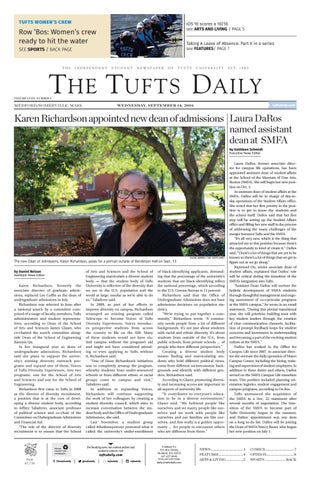
The new Dean of Admissions, Karen Richardson, poses for a portrait outside of Bendetson Hall on Sept. 13 by Daniel Nelson
Assistant News Editor
Karen Richardson, formerly the associate director of graduate admissions, replaced Lee Coffin as the dean of undergraduate admissions in July. Richardson was selected in June after a national search by a committee comprised of a range of faculty members, Tufts administrators and student representatives, according to Dean of the School of Arts and Sciences James Glaser, who co-chaired the search committee alongside Dean of the School of Engineering Jianmin Qu. In her inaugural year as dean of undergraduate admissions, Richardson said she plans to support the university’s existing diversity outreach programs and expand one of them, Voices of Tufts Diversity Experiences, into two programs: one for the School of Arts and Sciences and one for the School of Engineering. Richardson first came to Tufts in 2008 as the director of diversity recruitment, a position that is at the core of developing a diverse student body, according to Jeffrey Taliaferro, associate professor of political science and co-chair of the Committee on Undergraduate Admissions and Financial Aid. “The role of the director of diversity recruitment is to ensure that the School
Please recycle this newspaper
Rain 87 / 56
/thetuftsdaily
of Arts and Sciences and the School of Engineering matriculate a diverse student body — that the student body of Tufts University is reflective of the diversity that we see in the U.S. population and the world at large, insofar as we’re able to do so,” Taliaferro said. In 2009, as part of her efforts to improve diversity on campus, Richardson revamped an existing program called Telescope to become Voices of Tufts Diversity Experiences. Voices introduces prospective students from across the country to life on the Hill. Many of these students would not have visited campus without the program’s aid and might not have considered attending or even applying to Tufts without it, Richardson said. “One of Dean Richardson’s initiatives was to completely revamp the program, whereby students from under-resourced schools or from different ethnic or racial groups come to campus and visit,” Taliaferro said. In addition to expanding Voices, Richardson will continue supporting the work of her colleagues by creating a student diversity council, which aims to increase conversation between the student body and the Office of Undergraduate Admissions, she said. Last November, a student group called #thethreepercent protested what it called the university’s under-enrollment
For breaking news, our content archive and exclusive content, visit tuftsdaily.com @tuftsdaily
tuftsdaily
tuftsdaily
of black-identifying applicants, demanding that the percentage of the university’s students that are black-identifying reflect the national percentage, which according to the U.S. Census Bureau is 13 percent. Richardson said that the Office of Undergraduate Admissions does not base admissions decisions on population statistics. “We’re trying to put together a community,” Richardson wrote. “A community needs people from a lot of different backgrounds. It’s not just about students with racial and ethnic diversity. It’s about students from outside of the U.S., from public schools, from private schools … of people who have different perspectives.” Creating a diverse student body means finding and matriculating students who hold different political views, come from different socioeconomic backgrounds and identify with different genders, Richardson said. According to Glaser, promoting diversity and increasing access are important to all aspects of university life. “It contributes to everyone’s education to be in a diverse environment,” Glaser said. “We befriend people like ourselves and we marry people like ourselves and we work with people like ourselves and our families are like ourselves, and this really is a golden opportunity … for people to encounter others who are different from them.”
Contact Us P.O. Box 53018, Medford, MA 02155 617 627 3090 FAX 617 627 3910 daily@tuftsdaily.com
Laura DaRos, former associate director for campus life operations, has been appointed assistant dean of student affairs at the School of the Museum of Fine Arts, Boston (SMFA). She will begin her new position on Oct. 3. As assistant dean of student affairs at the SMFA, DaRos will be in charge of day-today operations of the Student Affairs office. She noted that her first priority in the position is to get to know the students and the school itself. DaRos said that her first step will be setting up the Student Affairs office and filling her new staff in the process of addressing the many challenges of the merger between Tufts and the SMFA. “It’s all very new, which is the thing that attracted me to this position because there’s the opportunity to kind of create it,” DaRos said. “There’s a lot of things that are yet to be known so there’s a lot of things that we get to figure out as we go along.” Raymond Ou, senior associate dean of student affairs, explained that DaRos’ role will be critical during the transition of the SMFA’s integration into Tufts. “Assistant Dean DaRos will nurture the holistic development of SMFA students through thoughtful management and ongoing assessment of co-curricular programs at the SMFA campus,” he wrote in an email statement. “During this pivotal transitional year, she will prioritize building trust with key student leaders through the creation of clear communication channels, facilitation of prompt feedback loops for student concerns and investment in understanding and becoming a part of the evolving student culture at the SMFA.” DaRos has worked in the Office for Campus Life since 2007. As associate director she oversaw the daily operation of Mayer Campus Center, including the hiring, training and supervision of student employees. In addition to these duties and others, DaRos served on the SMFA Campus Life transition team. This position included planning orientation logistics, student engagement and campus programs, according to Da Ros. Tufts announced the acquisition of the SMFA in a Dec. 22 statement after several months of negotiation. The transition of the SMFA to become part of Tufts University began in the summer, and DaRos’ appointment was one item on a long to-do list. DaRos will be joining the Dean of SMFA Nancy Bauer, who began her new position on July 1.
NEWS............................................1 FEATURES.................................4 ARTS & LIVING.......................5
COMICS....................................... 7 OPINION.....................................8 SPORTS............................ BACK
2
THE TUFTS DAILY | News | Wednesday, September 14, 2016
tuftsdaily.com
Editor-in-Chief
Tusk Marketplace provides new platform for students buying, selling
EDITORIAL
by Jei-Jei Tan
T HE T UFTS D AILY Arin Kerstein
Sophie Lehrenbaum Jake Taber Managing Editors Evan Sayles Associate Editor Kathleen Schmidt Executive News Editor Gil Jacobson News Editors Melissa Kain Robert Katz Liam Knox Catherine Perloff Jei-Jei Tan Hannah Uebele Joe Walsh Kyle Blacklock Assistant News Editors Juliana Furgala Jesse Najarro Danny Nelson Miranda Willson Executive Features Editor Constantinos Angelakis Features Editors Nina Joung Becca Leibowitz Siddharth Divakaruni Assistant Features Editors Justin Krakoff Executive Arts Editor John Gallagher Arts Editors Merilla Michael Eran Sabaner Isaac Brown Assistant Arts Editors Jocelyn Contreras Alison Epstein Elliot Storey Emma Henderson Executive Op-Ed Editor Shannon Geary Cartoonists Stephen Dennison Allie Merola Miranda Chavez Editorialists Aneurin Canham-Clyne Frances DeFreitas Anita Ramaswamy Noah Weinflash Phillip Goldberg Executive Sports Editor Yuan Jun Chee Sports Editors Alison Kuah Maddie Payne Eddie Samuels Maclyn Senear Max Lalanne Mia Lambert Caroline Ambros Ray Bernoff Maria Eduarda Ferraz Henry Hintermeister Kevin Ho Thaw Htet Leila Li Julia Press Evan Sayles Alexis Serino Angelie Xiong
Executive Photo Editor Photo Administrator Picture Tufts Editor Staff Photographers
PRODUCTION David Westby
Production Director Allie Merola Executive Layout Editors Sebastian Torrente Jewel Castle Layout Editors Leila Li Brianna Mignano Mandip Pokharel Emily Sharp Astrid Weng Petrina Chan Creative Director Allie Merola Executive Graphics Editor Petrina Chan Graphics Editors Annie Chen Juliana Furgata Dana Pek Ashton Stephens Rena Tang Belinda Xian Zach Hertz Executive Copy Editors Jei-Jei Tan Norrie Beach Copy Editors Arthur Beckel Caroline Bollinger Alison Epstein Gil Jacobson Melissa Kain Sharon Kelmar Bibi Lichauco Kathleen Martensen Netai Schwartz Nihaal Shah Arielle Sigel Liora Silkes Dan Strauss Maxwell Bernstein Executive Tech Manager Nitesh Gupta Online Editor Mia Lambert Social Media Editor
BUSINESS Josh Morris Executive Business Director Qinyue Yu Receivables Manager Evan Sayles Online Advertising Jay Hayes Ad Managers Eva Sachar
News Editor
A group of Tufts students have developed Tusk Marketplace, which describes itself as an online, peer-topeer marketplace designed specifically for the Tufts community. Tusk was officially launched on Sept. 6, the first day of classes. Jack Fritzinger (LA ’16), CEO and co-founder of Tusk, said that he was inspired to make the site at the end of his junior year. The Tusk Marketplace “I was sticking around for senior week and I saw all my friends leaving their items out on the side of the road or scrambling last-minute to sell them to other friends,” he said. “There were other options out there but they weren’t great. Facebook groups and Craigslist had their various problems, so I kind of saw the need for something different that would fill that gap.” Fritzinger said he spent the summer after junior year looking for people to help build the website because he did not have coding experience. At the start of his senior year, he met co-founder Dan Callahan, who had been thinking about a similar project. “I was getting annoyed with Facebook,” Callahan, a senior, said. “There’s a million different Facebook groups. I get notifications whenever people post something, but it’s not necessarily what I’m looking for.” Together with co-founders Brian Cefali (LA ’16) and seniors Jackson Clawson and Michael Seltzer, the group registered for the innovation brainstorming event Tufts Scramble in September 2015, where they started work on Tusk, according to Callahan. Seltzer and Callahan described Tufts Scramble, hosted by the Tufts Entrepreneurship Center, as being similar to a hackathon but with more of a business focus. According to Callahan, Seltzer and Cefali were computer science majors and heavily involved in software development, while he and Clawson were engineering psychology majors more focused on user design. Fritzinger worked on setting up the company and handled most of the business
MAX LALANNE / THE TUFTS DAILY
website landing page received significant traffic as of Sept. 13, a week after it launched. and marketing side of the operation. “We really balance each other well,” Callahan said. Callahan also highlighted the support they have received from the Tufts Entrepreneurial Leadership Studies program. “They’re always available for us to bounce ideas off of [or] to troubleshoot with, and it’s connected us with a couple other businesses on site,” Callahan said. Fritzinger noted that some members wanted to release a minimum viable product with only the basic functionality in place, while others wanted to add features and designs in order to release a better product. The group struggled to decide when to release Tusk until they agreed to launch it at the start of this academic year, he said. As of Monday, Sept. 12., Tusk already has over 250 registered users and 50 published listings, according to Seltzer. He added that people have been actively contacting sellers and buyers through the website, as well as providing specific feedback to the developers that they can use to quickly improve the site. “Our main focus is just really being a responsive company,” Seltzer said. Seltzer said that Tusk can make it easier for buyers and sellers to connect. “It’s really difficult for someone to find someone who’s really interested in buying something [or] subletting,” Seltzer said. “I don’t think that’s because they don’t exist. I think it’s just because people aren’t connected in any good way, so we’re trying to improve that.” Fritzinger hopes that people will start using the site in the place of other platforms.
“I’d like to see all the traffic that is currently going to Facebook and Craigslist – I’d like to see those people switch and use Tusk,” Fritzinger said. Callahan acknowledged that some of the site’s initial popularity may be due to postlaunch buzz. “Now we’re enjoying the launch boom, but next week people might not care as much,” he said. “So we’re constantly updating and improving, so hopefully as people check back next week, they see some slight changes … we hope that it keeps people coming back to the site.” Fritzinger said that, as a for-profit company, Tusk plans to implement features that will eventually be worth paying for. While buying and selling items would remain free, he explained that job listings, advanced sort and filter options for sublets and advice on negotiating with landlords and figuring out maintenance expenses would create a service that he believes students would pay a small fee for. Callahan added that Tusk is in the early stages of discussing collaborations with various on-campus organizations, including the Office of Residential Life and Learning. “We think that we can solve a lot of their problems and they won’t need to deal with it, so if we can help them and the students, it’s a win-win-win situation,” he said. Seltzer noted that people have already contacted the group to express interest in becoming involved with Tusk. Callahan said that he wants to grow the team and have some younger students on board so Tusk can have a continued presence on campus.
Police Briefs – Sept. 14 Turned In An Area Resident Director called the Tufts University Police Department (TUPD) to turn in confiscated alcohol on Sept. 2 at 5:00 p.m. The alcohol was taken from a group of students attempting to sneak it into a dorm.
Nighttime Run A student was spotted near Stratton Hall with a dislocated shoulder on Sept. 4 at 1:30 a.m. The student had been running down the path behind Sophia Gordon Hall when he fell. He was taken to a nearby hospital to receive treatment.
Toasted TUPD was alerted about a fire alarm that went off in Hodgdon Hall at 11:30 p.m. on Sept. 3. The Somerville Fire Department was also called to the scene, where a student accidentally set off the fire alarm while cooking french toast. TUPD allowed for the alarm system to be reset.
Don’t Stop the Music TUPD arrived at the scene of an off-campus house on Adams Street around 3:30 p.m. on Sept. 4, after receiving a loud party complaint. The music was heard from several streets away. Upon arrival, TUPD officers discovered approximately 50 people gathered in the backyard of the house. The music was turned off and non-residents were sent away.
Sharp Parenting Tufts Emergency Medical Services (TEMS) and TUPD were called to Lewis Hall after a student’s father cut his thumb with a pair of scissors at 3:00 p.m. on Sept. 4. The student’s father was cutting boxes at the time. TEMS responders cleaned the cut and wrapped his thumb with a bandage. No Charge A student reported a missing wallet to TUPD on Sept. 9 at 10:05 p.m. The student later noticed a fraudulent credit card transaction, and realized the wallet had been stolen. The student was told to cancel the card and dispute the transaction. — by Juliana Furgala
News
Wednesday, September 14, 2016 | News | THE TUFTS DAILY
3
ResLife looks to fill vacant Area Residence Director position by Joe Walsh
Barakat, whose office is in Area 1, said that he has offered help and advice for Area 1 Resident Assistants (RAs). The Office of Residential Life and King added that ResLife has hired two Learning (ResLife) is currently search- Graduate Residence Directors to overing for a new Area Residence Director see unstaffed halls and otherwise sup(ARD) for Area 1 (Hill Hall, West Hall, port RAs and ARDs. Houston Hall and Miller Hall), a position King explained that since late that has been vacant since the begin- August, the ARDs and other ORLL staff ning of this academic year, according to have focused on training, move-in and ResLife Director Yolanda King. other beginning-of-year tasks. She Candidates for the ARD job are said that she hopes to appoint an Area being interviewed this week, and King 1 ARD as the ResLife system begins to said she intends to hire a new ARD transition to normal operations for the within the next few weeks. The ARD year. job posting was removed from the Tufts Emily Touchet, an RA in Miller Hall, Careers website on Monday afternoon. said that the vacancy has created orgaFor the third year in a row, ResLife is nizational issues. She noted that RA hiring four full-time ARDs to oversee training and programming have been multiple residence halls, replacing the confusing in the absence of a permaformer system of hiring 10 part-time nent ARD, especially for her as a firstResidence Directors (RD), according to time RA. an Oct. 1, 2015 article in the Daily. “It feels a bit strange acting as if “This is in line with the best prac- Jerome is the ARD while knowing that tices in other residential life programs he will not remain in this position, at other institutions,” King told the and there will be a transition at some Daily in the 2015 article. “By moving to unknown point,” Touchet, a sophothis model, the positions allow all the more, told the Daily in an email. ARDs to spend more time focusing on Dean of Student Affairs Mary Pat the needs and support for the students McMahon said that, in the future, she who live on campus.” would like to synchronize the hiring In the absence of a full-time ARD, schedule for ARDs with the academic year. ResLife Associate Director Jerome “My goal would be for future Holland Jr. has overseen Area 1 for the Residential Life office hires, as much past several weeks, according to King. as possible, to be posted … in the In addition, Area 2 ARD Mohamed spring, and people would be in place News Editor
in the summer to be ready for the fall,” McMahon said. ResLife briefly faced similar vacancies at the beginning of last year, when two of the four ARD positions were unfilled, according to the 2015 Daily article. Tanya Mascary, who was previously the Area 1 ARD, left Tufts in July 2016 to work with City Year in Boston, according to her LinkedIn profile. Before she left, she was the only remaining ARD who was hired when the full-time ARD system was created in 2014, McMahon noted. According to the ARD job posting, the ARD position is limited to a three-year appointment. McMahon explained that, corresponding with the limited appointment, the ARD job is designed to be an entry-level position, and Tufts expects ARDs to leave after a few years for other opportunities. “I’m comfortable with the turnover in the role,” McMahon said. “I think we’ve had great people, [and] I’m confident that we’re going to get more great people.” King agreed, saying that she recognizes that ARDs will frequently leave for another job if an opportunity arises outside of Tufts. The other three ARD positions are currently filled by staff who were hired in 2015. Barakat oversees Area 2 (Carmichael Hall, Wilson House, Wren Hall, Carpenter House, Metcalf Hall
and Richardson House), Julie Kennedy oversees Area 3 (Bush Hall, Hodgdon Hall, Haskell Hall and Tilton Hall) and Donisha Thaxton oversees Area 4 (Lewis Hall and Harleston Hall). According to all three current ARDs, their roles involve overseeing their areas’ RAs, helping to organize and approve programming, coordinating with campus partners such as EcoReps and the Scholars-in-Residence, serving on their area’s on-call rotation and completing a variety of other tasks that vary on a daily basis. King said that she is looking to hire an ARD who is energetic, interested in building communities and experienced in working with diverse populations. Similarly, McMahon added that an ARD should be a generalist who is able to support residents with a wide variety of interests and personalities. McMahon and King both agreed that an ARD does not have to have a specific type of prior experience, as long as they are competent at building communities. According to McMahon, that experience could come from involvement in residential life, student activities or student leadership. “I am looking for people who are really sharp and [who] understand that people coming into a residential community are coming from all over the country and all over the world,” McMahon said.
4 tuftsdaily.com
Features
Wednesday, September 14, 2016
The disappearing act: taking a medical leave of absence from Tufts by Nina Joung Features Editor
This is the second part of a two-part article about Tufts students who take a leave of absence from school. This part focuses on taking a medical leave of absence from Tufts. One night in October 2014, Nikhil Nandagopal bolted upright out of bed with the realization that something about his life needed to change. At the time, Nandagopal was entering the first semester of his sophomore year, balancing classes and extracurriculars while also battling multiple mental illnesses: obsessive-compulsive disorder (OCD), bipolar disorder and body dysmorphic disorder (BDD). He noted that he was having trouble finishing assignments and getting to class on time due to the mental health problems he experienced. Following his midnight revelation, Nandagopal said he officially began the process of taking a medical leave of absence from Tufts. “I knew I had to take it,” Nandagopal, who came back to campus this semester after a two-year medical leave, said. “I really needed to take time off for myself in order to heal.” According to Associate Dean of Student Affairs Marisel Perez, a medical leave of absence such as that pursued by Nandagopal is usually unplanned. While mental health is one reason why students pursue a medical leave of absence, Perez said that other medical problems may trigger the leave, particularly sudden, recently diagnosed illnesses. The leave option is recommended to students who “find it difficult to productively or safely manage the demands of their academics and campus life due to a health concern,” according to the Student Affairs website. M.J. Griego, another student who returned to campus this semester after taking a year-long medical leave, also left Tufts in order to address mental health issues. According to a written response submitted to the Daily, Griego first sought help in fall 2014 as a sophomore. Griego wrote that cold-like symptoms, which they now recognize as symptoms of depression, initially drove them to visit the Health Service. “I was constantly fatigued, easily thrown off and had erratic eating habits,” they said. “Since college had started, I’d noticed a change in my response to stress. As soon as I underperformed once, I would attribute it to me being bad in general.” Griego said they found Health Service’s and Counseling and Mental Health Service’s (CMHS) advice insufficient in helping their situation, and expressed frustration towards the “quick-fixes” suggested by Tufts counselors. “I realized nothing helpful would come of seeing someone who tried to tell me breathing exercises on my way to class would in any way help my increasingly severe depression,” they said. By spring 2015, Griego said they were experiencing suicidal thoughts, at which point their CMHS counselor suggested they seek an off-campus counselor. “She gave me a page of phone numbers to find my own counselor, which wouldn’t have been a big deal if I were
actually functioning,” they said. “But in the midst of depression I couldn’t even mentally grasp the steps it would take to call a bunch of counselors, tell them my story, get to their offices, decide who was best for me and then go to a session every week while trying not to fail all my classes.” About midway through the semester, Griego said they learned of the option of taking a medical leave of absence, and decided that leaving would be preferable to staying on campus in their current state. According to Perez, a medical leave of absence has specific benefits not offered by a personal leave of absence, such as the ability to have all classes removed from the student’s transcript for the semester(s) during which they take a medical leave. On the other hand, Perez said that taking a medical leave of absence requires a formal approval process that includes documentation from a health professional to support the student’s request for the leave, in contrast to the “revolving door” policy offered for a
“They kind of figured out that I needed more time not just to stabilize, but to stay stable.” — Nikhil Nandagopal
personal leave. Additionally, the process of reentry — especially for a medical leave of absence caused by mental illness — is longer and more complex. Perez meets with all upperclassmen and graduate students who request to take a medical leave of absence to learn why they feel they would benefit from doing so. She then continues to communicate with these students during and after their leaves. Associate Dean of Student Affairs Christopher Rossi handles first-years considering or pursuing a medical leave of absence, which he described as “a daunting process.” “Medical leave isn’t for everyone, but we can help a student navigate through that together,” Rossi said. Perez said that before a student leaves campus — unless the medical leave is due to an emergency situation — they must have an exit interview with one of the university’s clinicians or doctors. This is an opportunity for the health professional to get a better sense of the student’s condition, connect students with resources near home and give students free clinical referrals. Throughout the student’s medical leave, Perez and Rossi said they communicate with students to help them prepare their application for reentry that the Health Accommodations and Medical Leave Committee (HAMLC) evaluates at the end of the leave. This application, as well as an interview, determines whether the student is prepared to return to campus, according to Perez. Multiple departments sit on the HAMLC, according to Perez, includ-
ELYSSA HARRIS / THE TUFTS DAILY
Newly appointed Assistant Dean of Student Services Chris Rossi poses for a portrait in his office on Oct. 8, 2015. Rossi is one of several administrators who serve as a resource for students seeking medical leaves of absence. ing Health Service, CMHS, the Office of Equal Opportunity, Residential Life and Student Accessibility Services. Perez, who convenes the HAMLC, added that the committee meets several times during the semester to review and decide on each student’s “reapplication” to Tufts. She said approximately 15 students take a medical leave of absence at a given time, but the committee always reviews every application received. Director of CMHS Julie Ross discussed the role of clinicians from Health and Wellness in the reapplication process for medical leaves of absence. According to Ross, outside providers whom the student has seen while on leave must submit records to the appropriate Tufts clinician during all cases of medical leave. When that appropriate clinician is a health clinician, the health clinician will then submit this documentation to the Medical Director of the Health Service. When it is a mental health clinician, they will submit documentation to CMHS, according to the student affairs website. Ross said this process keeps the records confidential and separate from students’ educational records. “These confidential records typically summarize the care the student has received while on leave and the provider’s judgment regarding their readiness to return,” she said. “We review these records, meet individually with the student and then present a brief summary to the committee, with the student’s written consent, of course.” In addition to submitting medical documentation, Perez said that students are often required to submit a personal statement describing their time on leave. For medical leaves of absence that address mental illness, Perez reviews these documents looking for changes in the way the student handles the issues that led to the leave. “I like to know [not] as much what they have done, but what has changed, what perspectives they have,” Perez said. Rossi added that he and Perez do not always require the application and the interview depending on the circumstances surrounding the student’s leave, but that these reentry steps are almost almost always necessary for students leaving Tufts due to mental illness.
Upon returning from a medical leave of absence after a physical injury, junior Kevin Lovaincy said his reentry process to Tufts was fairly simple. Lovaincy took a medical leave of absence in fall 2015 after he tore his ACL, LCL and hamstring during football practice. He said most of his semester on leave was spent focusing on intense physical therapy that continued through the end of the semester. He explained that it was clear to him and to the associate dean dealing with his case at the start of the leave that he would return to campus next semester. “It wasn’t like I had to reapply,” Lovaincy said. “It was just a pause.” Griego went through the full reapplication process, and was approved to return to Tufts this semester. Nandagopal, on the other hand, said he was denied reentry to Tufts when he first applied to come back after one year of medical leave. “In the beginning, I was a little surprised,” Nandagopal said. “I asked my dean if there was something [different] I could have done.” He said that Perez reassured him that the committee simply believed he needed more time. As this semester’s students return from medical leave, Perez and Rossi plan to meet with each returning student regularly. According to Rossi, this is crucial for maintaining and advancing the progress students have made during their leave. “It’s for us to map out a follow-up plan for them if they need additional supports here at Tufts — things that are helpful to them, things that need to be put in place,” Rossi said. Rossi and Perez both said that they hope more students recognize medical leave of absence as an option to support their own health and well-being. Nandagopal, who spent both years of his medical leave in Bangalore, India, said the second summer of his medical leave gave him the opportunity to resolve his issues with BDD, to explore his passion for classical Indian music and dance and to gain the motivation to start a new organization about body positivity on campus, called Jumbodies. “In hindsight, I could never imagine a better decision,” he said. “For some reason, they kind of figured out that I needed more time not just to stabilize, but to stay stable.”
ARTS&LIVING
Wednesday, September 14, 2016
5 tuftsdaily.com
ICA exhibits a fine selection of contemporary art with ‘First Light’ by Eran Sabaner
Assistant Arts Editor
As evidenced by the Rose Kennedy Greenway Conservancy’s installment of Ai Weiwei’s public art masterpiece, “Circle of Animals/Zodiac Heads,” or the Museum of Fine Arts (MFA) upcoming launch of the mfaNOW program, art institutions in the Boston area have been focusing on contemporary art this year. This leaves the Institute of Contemporary Art (ICA), the leading contemporary art establishment in Boston, in a delicate state. On the one hand, it’s beneficial for other institutions to concentrate on contemporary art because these institutions are more likely to bring in new audiences. On the other hand, the size and the support for the ICA are tiny when compared to the MFA, so with the recent competition, the ICA is at risk of losing its “leading” status in contemporary art. Over the years, the ICA has displayed groundbreaking exhibitions by artists including Arlene Shechet, Adriana Varejão and Os Gemeos. Yet none of the exhibitions were
as noteworthy as MFA’s recent blockbuster exhibition, “Megacities Asia,” which included a massive ready-made installation by Ai. Luckily, the ICA’s new exhibition, entitled “First Light: A Decade of Collecting at the ICA,” will no doubt provide some competition. The ICA functions not only as a museum but also as a venue for art and design events, which is undeniably needed in Boston. In fact, the actual galleries of the building are rather small, which prevents curators from setting up big shows. “First Light: A Decade of Collecting at the ICA” is able to veil the problem of limited space by featuring small works of big-name artists. From contemporary icons Andy Warhol, Eva Hesse and Cindy Sherman to younger yet equally renowned artists Nick Cave, Kara Walker and Mona Hatoum, the exhibition features an exceptional selection of works by established artists. The showcase may not be their most famous, yet it is enough to get a taste of each artist’s flair. There is a certain emphasis on women artists in the exhibition. “The Barbara Lee Collection of Art by Women” features
PHOTO BY IWAN BAAN
“First Light: A Decade of Collecting at the ICA,” is on exhibition at the Institute of Contemporary Art, Boston until Jan. 16, 2017. works by Yayoi Kusama, Kiki Smith and many others. Named after the Bostonbased philanthropist who, in 2014, gave the museum its largest gift ever (43 works by 25 female artists), the exhibition featuring female artists is an important step
for the ICA, especially since the work of women tends to be underrepresented in museums. The abundance of works by women artists demands introspection by see EXHIBITION, page 6
TECH PREVIEW
iOS 10 brings long-awaited improvements to Apple’s mobile devices by Isaac Brown Arts Editor
iPhone and iPad owners have a great deal to look forward to in iOS 10, the most recent update to Apple’s mobile operating system, which was released yesterday. iOS 10 overhauls a number of features such as the Siri digital assistant, the Messages application and lock screen notifications, while also making the software more customizable. Third-party developers will now be able to integrate their own apps into Siri and Messages. In addition to improving functionality, Apple refreshed many of its default apps like the Control Center, Maps and Apple Music with redesigns and reorganized features to make them more user-friendly. Some of these changes have been long overdue. iOS has historically lagged behind Android in terms of features and customization due to Apple’s steadfast desire to control its meticulously-crafted brand. iPhones have seen few major new features in recent years,
while Apple has tried to drum up excitement about newer projects like the Apple Watch and, more recently, AirPods. The recent decline in Apple’s share of the smartphone and tablet market over the summer from 28.42 percent in April to 23.10 percent in May likely resulted from Apple’s lack of eye-catching innovation and high price point. iOS 10 needs to impress if the company hopes to keep up. From the moment one picks up a device –iPhone 6S or newer– it is noticeable that the iconic “slide to unlock” message is gone. Many of us use our smartphones in short bursts, so Apple has made the lock screen less of a hindrance with “Raise to Wake.” This is a quality-of-life feature that Apple has borrowed from Android devices, which makes it easier for users to take quick glances at their phones to check notifications. Users simply need to pick up their phones to get the information straight from the lock screen and without extra button pressing. With the new update, lock screen notifi-
PHOTO BY IPHONEDIGITAL VIA FLICKR
The iOS 10 operating system was released on Sept. 13 for iPhones and iPads. cations are now not only easier to check, but have been made much more useful with 3D Touch notifications. 3D Touch — which allows users to preview content by exerting different degrees of pressure on the screen — was present in earlier versions of the software, but with iOS 10, the feature gives users deeper access
to various apps through lock screen widgets. Using 3D Touch on a message notification, for example, gives one the chance to view the entire conversation pane and type responses without unlocking the phone. see IOS 10, page 6
TV REVIEW
‘Loosely Exactly Nicole’ debuts refreshing, crude comedy by Merilla Michael Assistant Arts Editor
“Loosely Exactly Nicole,” which premiered its first-ever episode on Sept. 5, is loosely based on the life of actress and comedian Nicole Byer, best known for her appearances on MTV’s “Girl Code” (2013 – present). Byer shines throughout her segments on “Girl Code,” which is a comedic reality show in which a group of women gives advice on topics ranging from sex and dating to friendships and families, and she is praised for the boldness she brings to the table. The type of crude humor that is sprinkled throughout the season premiere of “Loosely Exactly Nicole” isn’t exactly what one would call “politically correct.” For fans of “Girl Code,” this shouldn’t come as a surprise, as Byer rarely shows res-
ervations or much of a filter. This is part of what makes her character, Nicole, so entertaining and realistic, albeit a bit wild. She’s an actress living in Los Angeles with roommate Devin (Jacob Wysocki), and has been struggling to find any leads. As a side job, Nicole babysits Troy (Ian Chen), a young Taiwanese boy whose mother (Laura Kai Chen) is the Type A sort. Though Nicole appears to not be the most attentive of babysitters, she does stick up for Troy when he gets bullied on the playground and channels the cool, young babysitter trope quite well. Nicole’s interactions with Troy are really where the unorthodox humor begins to emerge. Nicole hears of an audition opportunity for an acting agency that is looking for a mother and child to shoot a commercial for depression medication. Being child-
less, Nicole, seemingly out of the goodness of her heart, offers to babysit Troy for the day in order to take him to the audition and pretend he is her child. When a woman in the waiting room of the audition location tells Nicole that the agency already auditioned the “non-traditional families” (read: adopted, as Troy appeared to be) yesterday, Nicole swipes dark foundation all over Troy’s face in the bathroom and calls it a day. The scene made this reviewer simultaneously cringe and laugh nervously, surveying her surroundings to make sure no one had seen her watch this segment before continuing to play the episode. While in the audition, Nicole proceeds to fabricate an elaborate story about how she met a Taiwanese man at a bar, fell in love with him and conceived Troy. She ended up not getting the part, but is given
the number of an acting agency looking for female comedians. This plot point on the show reflects the challenges that many actresses face — specifically those of color — when trying to make it in the comedy industry, which is typically dominated by white males. It’s refreshing to see a woman of color leading in a comedy instead of being relegated to the same, stereotypical roles that writers tend to haphazardly throw around. One of Nicole’s good friends, Veronica, played by Jen D’Angelo, is a fairly bland character and is completely overshadowed by Devin, who has some hilarious one-liners in this debut. When Nicole asks him to help her fix their air conditioning unit, which she’s named “The View” (1997-present) after the television show, see NICOLE, page 6
6
THE TUFTS DAILY | Arts & Living | Wednesday, September 14, 2016
tuftsdaily.com
Institute of Contemporary Art highlights women in new exhibition EXHIBITION
continued from page 5 traditional museums such as the MFA, and will hopefully cause them to question how well they promote diversity. The exhibition features works by Mona Hatoum, who recently had a massive retrospective at Tate Modern Museum in London. “Pin Rug” is a carpet-like figure made out of thousands of black pins. Resembling the “seccade” Muslims pray on, the surface of the rug appears smooth and silk-like. Yet the
actual material used is uncomfortable and even hazardous. “Pin Rug” is not Hatoum’s best work, but it highlights the general aesthetic of many of her pieces, which usually survey the relationship between pleasure and pain, tragedy and joy. Another work of Hatoum’s, entitled “Natura Morta,” is a Victorian-like vitrine. Yet, instead of displaying vases and delicate ornaments, the vitrine displays crystal grenades of festive colors. There isn’t an overarching idea that neatly encompasses the entirety of the
exhibition. Instead, each gallery has its own theme. The exhibition is made up of eight parts, and each part draws inspiration from a certain idea, medium, material or artist. “Question Your Teaspoons” consists of works about domesticity, while “Soft Power” only features work with soft materials. The common concepts and elements help the audience to interpret the works more easily. 2016 is the time during which Boston art establishments are finally able to catch up
with establishments from cultural capitals in terms of contemporary art. In its tenth year of existence, the ICA is able to prove that while its collection is most definitely not on the same level as New York City’s Museum of Modern Art or the San Francisco Museum of Modern Art, it is still reputable and respected. The lack of local galleries and auction houses will always be one of Boston’s disadvantages when it comes to diverse representation of local artists, yet the enthusiasm for contemporary art will not wane.
Apple finally shows innovation on latest update IOS 10
continued from page 5 Avid texters should try out the new Messages app, which has integrated many popular features from Facebook’s Messenger and WhatsApp to create a worthy competitor. It is now possible to add background animations and bubble effects to users’ messages or write messages in “invisible ink.” Messages now suggests words that can be replaced with emojis and also has its own App Store, where one can download add-ons from other developers, such as tools to search for and import GIFs.
Evidently, Apple now sees the value in getting third-party apps involved as they’ve done the same thing with Siri, allowing third-party apps to become integrated into the digital assistant. Siri can be asked to carry out tasks such as “Call a Lyft to Logan International Airport” or “Send Chet Morton five dollars on Venmo.” Don’t expect Siri to order food off of GrubHub or book Zipcars anytime soon, however. Apple has limited Siri to only work with a few different types of apps for the time being. As a sign of the changing times, Apple is finally letting users delete the pre-in-
stalled apps such as iCloud Drive and FaceTime. Apple doesn’t recommend this practice, as doing so only frees up minimal storage space and renders a number of features obsolete, but at least it now leaves the final decision to the consumer. Even so, deleting the apps will only “hide” them; they will not be entirely erased from the system and will be merely invisible until they are re-downloaded from the App Store. These kinds of half-measures are indicative of a need to find a balance between the Steve Jobs-era of rigid
brand control and the realization that Android is slowly but surely crowding iOS out of the mobile device market. Many hopes are riding on iOS 10 and the major iPhone revamp rumored for release in 2017 to resuscitate Apple’s sagging financial results. Some users attempting to download iOS 10 on Tuesday encountered a software bug that rendered their devices unusable. Apple has since deployed a fix, stating that the issue is resolved and that affected users should connect their devices to iTunes or contact customer support.
Comedian Nicole Byer shines in new MTV comedy NICOLE
continued from page 5 he responds by saying that his hands are “not [those] of a common laborer.” When describing a sexual encounter with a recent fling, Devin describes the male orgasm “…like Pringles. Once you pop, you cannot stop.” It is unclear what that comparison even means, but the delivery was spot on, and made for one of the best lines of the episode.
An issue that comedies like “Loosely Exactly Nicole” face is where to draw the line — when does the unorthodox kind of humor become the offensive? While Nicole and Troy are in the car, she asks him to practice a dialogue with her so she can rehearse her lines. As Troy reads the lines of a character that is a pimp, he stops before reading a line that contains the N-word. Troy: I can’t say that word.
Nicole: Listen, we’re saying it for a very important reason today. Troy: My mom says I should never say the N-word for any reason. Nicole: OK, listen, Troy. Black people can say that word, and Taiwanese people are the black people of Asia. Troy: We are? Nicole: Yeah, sure. Plus, we’re in a car. Nobody can hear us. Whether or not this scene is funny
depends on the audience. Some people might think it’s funnier and less offensive because it’s an oblivious kid. Some might think the exact opposite. It’s kind of a tossup. All in all, “Loosely Exactly Nicole” was enjoyable and provided many laughs. It reminds this reviewer a bit of “Broad City” (2014 – present) but is not quite as hilarious. As the show progresses, there’s no doubt it’ll sharpen its humor and showcase Byer’s talents.
CONNECTED Student Value Checking Receive a $ 25* bonus
when you open and use a Student Value Checking account.
NO MONTHLY FEE** • NO MINIMUM BALANCE • NO FEE FOR INCOMING WIRES
Start here to make it happen:
SANTANDERBANK.COM/STUDENT
Student Value Checking is available to students 16 through 25 years of age (legal guardian co-owner required for those between 16-18 years). Once you reach 26, we may convert your Student Value Checking to another checking product. Proof of enrollment may be required. *Get $25 when you open a new Student Value Checking account with a $10 minimum opening deposit between June 15, 2016 and September 30, 2016 and complete 8 debit card transactions that post to your account within 60 days of account opening. Your new account needs to remain open for 90 days in an eligible product type and payment of the bonus will occur within 30 days thereafter. One bonus per customer. Students who currently have a personal checking account or who have had a personal checking account with Santander Bank in the last year are not eligible for this offer. Cannot combine with other personal checking account cash offers. Offer only available to U.S. residents. Santander team members are not eligible. Bonus is considered interest and will be reported to the IRS on Form 1099-INT. **Other fees may apply, including a Paper Statement fee if you elect to receive paper statements. Refer to your fee schedule for details. Santander Bank N.A. is a Member FDIC and a wholly owned subsidiary of Banco Santander, S.A. © 2016 Santander Bank, N.A. All rights reserved. Santander, Santander Bank and the Flame Logo are trademarks of Banco Santander, S.A. or its subsidiaries in the United States or other countries. MasterCard is a registered trademark of MasterCard International Incorporated. All other trademarks are the property of their respective owners.
7
Wednesday, September 14, 2016 | Comics | THE TUFTS DAILY
tuftsdaily.com
Comics
LATE NIGHT AT THE DAILY Moses: “If you’re still here after 1 am I’m TEMSing you all.”
Comics
SUDOKU
DOONESBURY BY GARRY TRUDEAU
NON SEQUITUR BY WILEY MILLER
Difficulty Level: Planning your day around Sundae Sundays.
Monday’s Solution
FOR RELEASE SEPTEMBER 14, 2016
Los Angeles Times Daily Crossword Puzzle Edited byCROSSWORD Rich Norris and Joyce Lewis
Study Abroad Fair
Mark your calendars now! Wednesday, Sept. 14th
11:30 am-2:00 pm Dowling Hall Room 745 Representatives from over twenty-five programs will be in attendance. All majors and class years welcome!
Sponsored by the Office of Programs Abroad Find out more at: http://go.tufts.edu/studyabroad
ACROSS 1 Hershey’s toffee bar 5 Res __ loquitur: the thing speaks for itself 9 Online shopping mecca 14 Chip in a chip 15 Seasonal song 16 Hunky-dory 17 Start of a knitting project 18 Prefix with space 19 Dry Italian wine 20 Tailpipe emission 23 Hot state 24 Beatty/Hoffman box office flop 28 Tug-of-war injuries 32 Former fillies 34 Ready for a refill 35 Freelancer’s email attachment: Abbr. 36 Glider on runners 37 Flowing garments 38 Sonar signal 39 Word in a bride’s bio 40 Went a-courting 41 Two-time US Open winner 42 Hair-smoothing hairs 45 Library machine 46 “__ the Walrus” 47 Shellfish cookouts 54 Medicare prescription drug section 57 Pre-coll. 58 Brandy bottle letters 59 Prospero’s servant 60 Highest sudoku digit 61 Hip bones 62 Free, in France 63 Armoire feature 64 Counting-out word DOWN 1 Cyber Monday event
9/14/16
By Gail Grabowski and Bruce Venzke
2 Fort with lots of bars 3 “Then again,” in tweets 4 Fixed 5 “Be right with you” 6 Pound, but not ounce 7 Medieval laborer 8 Six-time All-Star Moises 9 Slips past 10 __ pork: Chinese dish served with pancakes 11 Letters often after a perp’s name 12 Loo 13 Corrosive substance 21 “Exodus” author 22 Money makers 25 Warbles 26 Musical set in an orphanage 27 Replies to an invite, for short 28 Make available 29 “__ coffee?” 30 Louvre Pyramid architect
Tuesday’s Puzzle Solved Monday’s Solution
©2016 Tribune Content Agency, LLC
31 Pages with views 32 Rachel Maddow’s network 33 Final Olds made 37 Charming snake? 38 2007 animated film in which Sting voices himself 40 Coax 41 Big chunk
9/14/16
43 Many a bridesmaid 44 Less cluttered 48 Shift (for oneself) 49 Hodgepodge 50 “How awful!” 51 Cruise stop 52 Pork choice 53 Do a vet’s job 54 Chum 55 NPR journalist Shapiro 56 Bone in a cage
8 tuftsdaily.com
Opinion
Wednesday, September 14, 2016
EDITORIAL
Petition 15-31: Why you should support charter school expansion in November A very visible number of Tufts students are already revving up to vote in the general election this November. And while Clinton, Trump and Johnson are discussed furiously, the local issues that affect our community are often brushed aside. Case in point: Petition 15-31, or “An Act to Allow Fair Access to Public Charter Schools.” This referendum would allow for the creation of 12 additional charter schools per year beyond the current cap of 120 charter schools within the state of Massachusetts. It’s expected to be especially important in cities like Boston or Somerville, where the number of charter schools is near or at the limit. If enacted, the referendum would provide thousands of underprivileged students with access to greater education and more opportunity. The creation and expansion of charter schools is often a controversial subject, especially within liberal circles. While proponents boast of the overwhelming success of many charter schools, outspoken critics, such as New York Mayor Bill de Blasio, claim that their success is artificially produced. These critics allege that charter schools’ apparent success is merely a result of teachers who direct lesson
plans toward the standardized tests used to evaluate the school’s’ performance. Teachers’ unions have also been constant critics of the schools, partly due to skepticism surrounding a charter schools’ incentive to “teach to the test,” but largely because charter school teachers are often not unionized, and thus greatly decrease the unions’ bargaining power. However, a 2014 study conducted by Sarah Cohodes of Harvard University found that Boston charter schools do not suffer the fate that critics like de Blasio claim they do. From her study, Cohodes concluded that although there are incentives to focus on frequently tested material, there was no evidence of this teach-for-the-test style pervading the classroom. Boston charter schools show remarkable effectiveness both in comparison to their public school counterparts and charter schools in other states. One study from the Center for Research on Educational Outcomes (CREDO) found that Massachusetts charter school students have significantly larger gains in math and reading than students enrolled in public schools. The study also found that the growth in learning rates were the larg-
est that CREDO had seen in any state they had surveyed thus far, suggesting that Massachusetts charter schools should serve as a model for other states looking to expand their programs. The largest criticism of charter schools centers around their impact on local public schools. Firstly, many are concerned that money spent on charter schools is money not spent on public schools, and that public schools will become worse learning environments if they are competing for resources with local charter schools. Secondly, critics argue that as the better-performing students move out of local public schools, the average academic ability of students in those schools (and in turn, the test scores by which those schools are evaluated) will greatly decrease. Yet, these same critics don’t denounce honors or AP students for leaving grade-level classes with less academic rigor, nor for using resources that may be more equitably spent on worse-performing students. Why would they? Few would claim that an AP teacher should be paid more because her students score higher on tests, and fortunately, that isn’t how funding for public and charter schools
is evaluated either. A 2014 University of Arkansas nationwide study found that charter schools receive less funding per pupil than public schools. In other words, sending students to charter schools actually saves the school district money and allows public schools to use that extra money on higher salaries for teachers, new textbooks and better academic resources. Charter schools aren’t a catch-all solution to Massachusetts’ education problems. There will always be concerns about students who are unable to gain acceptance to charter schools being at a disadvantage, or about losing the brighter students in the public school system. But Massachusetts charter schools, with their high accountability, high expectations and high-achieving students, are often considered the gold standard for charter schools across the United States. Upholding this standard will provide students of the state — and students from Tufts’ local community — with greater opportunity for their own academic goals and for increased academic innovation. So, we encourage you to make it an absolute priority to vote on Nov. 8. And when you do, vote yes on Petition 15-31.
BY ALLISON MEROLA The Tufts Daily is a nonprofit, independent newspaper, published Monday through Friday during the academic year, and distributed free to the Tufts community. The content of letters, advertisements, signed columns, cartoons and graphics does not necessarily reflect the opinion of The Tufts Daily editorial board. EDITORIALS Editorials represent the position of The Tufts Daily. Individual editors are not necessarily responsible for, or in agreement with, the policies and editorials of The Tufts Daily. OP-EDS The Op-Ed section of The Tufts Daily, an open forum for campus editorial commentary, is printed Monday through Thursday. The Daily welcomes submissions from all members of the Tufts community; the opinions expressed in the Op-Ed section do not necessarily represent the opinions of the Daily itself. Opinion articles on campus, national and international issues should be 600 to 1,200 words in length and submitted to oped@tuftsdaily. com. The editors reserve the right to edit letters for clarity, space and length. All material is subject to editorial discretion and is not guaranteed to appear in the Daily. Authors must submit their telephone numbers and day-of availability for editing questions. ADVERTISING All advertising copy is subject to the approval of the Editor-in-Chief, Executive Board and Executive Business Director.
Wednesday, September 14, 2016 | Opinion | THE TUFTS DAILY
Opinion
9
OP-ED
On the forefront of democracy in Massachusetts by Jamie Neikrie Democracy isn’t confined to white marble halls, or to bucolic lawns, or to the carpeted floors of the U.S. Congress. It does not emerge solely from the mouths and minds of besuited white men with perfectly coiffed hair. Democracy, as it happens, can emerge in the most unlikely of places, from the work of any citizen. This was the message on display at the Atrium School in Watertown, Mass., which – over the course of four days in late August – hosted the state’s first Citizens’ Initiative Review (CIR). The CIR system is a product of the laboratory of democratic engagement and direct citizen involvement in politics. It envisions a citizen panel, representative of the overall voting population, convened to examine ballot initiatives and make recommendations to their fellow citizens. First piloted in Oregon in 2010, the CIR has proven to be an effective way of disseminating information to voters, as well as demonstrating the power of direct democratic processes. Ballot initiatives have always been vital to the politics of the United States. They create a platform through which a petition, signed by a certain number of registered voters, can engender a public vote on a proposed statute or constitutional amendment. They are the closest thing that the American political system has to direct democracy. And yet, ballot initiatives are often corrupted. They are pushed by citizen groups, distorted by politicians, slandered by special
interests and swung by a small fraction of often uninformed voters. At a time when gridlock and partisanship has crippled national politics, citizens must take advantage of the ballot to push legislation, to push politicians. This is where the CIR system comes in. This year marks the pilot of the CIR in Massachusetts, a program that was made possible by the support of Representative Jonathan Hecht, Healthy Democracy – the organization that pioneered the CIR in Oregon – and Tufts’ very own Tisch College of Civic Life. As the ballot questions emerged, a citizen panel of 20 voters was created from a poll of 10,000 randomly selected voters, with diversity of race, ethnicity and socioeconomic status taken into account to reflect the voting population. This year’s CIR delved into Ballot Question 4, which will present voters with the option to legalize marijuana for recreational use in the state of Massachusetts. Over the course of four days, the citizen panel was presented with evidence from experts of numerous fields, including medical professionals, law enforcement officials and economists. They heard testimony from advocates on both sides of the issue, selected by the pro and con teams attached to the ballot question itself. Using this information, the citizen panel was tasked with creating a pamphlet that will be disseminated to all Massachusetts residents. While summaries and pro/con statements have always been included on the Election Day ballot,
What is The Tufts Daily Semester Scholarship? This scholarship schola aims to provide funds to first-year students with demonstrated financial need so they may be able to pursue their interest in journalism and media through the Daily.
Who qualifies? F irst-year students at Tufts who qualify for federal work study or have demonstrated financial need. Students with serious interest in journalism or media. No prior journalism experience is necessary, but it is preferred.
this pamphlet will offer voters something unique: the facts, figures and statements that their fellow citizens – trained and educated specifically for this task – feel they should know before they cast a vote on Question 4. The entire process was open for public viewing at the Atrium School, and it did not disappoint. Though heavily regimented every step of the way, the CIR allowed the citizen panel to shine. Faced with the claim by a state senator that Question 4 would allow residents to grow massive amounts of marijuana in their own homes without being taxed, one panelist asked, “Traditionally, haven’t taxes been for revenue? Therefore, if a citizen doesn’t generate revenue from the sale of marijuana, why should they be taxed? Further, does the state place an excise tax on the marijuana seeds in addition to taxing the soil and pot?” This type of reasoned, thorough questioning was common at the CIR. Later in the day, a panelist asked for the grammar in the claims to be adjusted. When the panelist – a 90-year-old former English teacher – was told that the claim could no longer be edited, she replied, “I’m not mad about it. I am enjoying the heck out of this! But as an English teacher, I cannot support that statement the way it is currently constructed.” The debate on both sides of Question 4 was impressive. Proponents of the measure claimed legalization would allow for greater regulation of a currently underground industry, would create $100 million in revenue for the state
and help combat the state’s opioid crisis. Opponents claimed that the proposed 12 percent was far below the taxes on marijuana implemented in states like Colorado (roughly 30 percent effective tax rate) and Washington (roughly 40 percent), that it placed no restriction on edible marijuana products or THC levels, and that we know too little about the health risks associated with smoking, especially at an early age. But ultimately, the ramifications of what happened in that school gym extended far beyond the marijuana debate. The citizen panelists, no matter their background, demonstrated that American citizens are ready to handle more responsibility, more lawmaking ability, more direct influence over the laws that govern their society. This experiment has ramifications in all other realms of politics, including budgeting, a process that Oregon has also begun to turn over to its citizens. The CIR serves as a much-needed reminder to all of us – politicians and citizens alike – that, when tasked with understanding and producing complex policy proposals, Americans will rise to the challenge. Editor’s note: If you would like to send your response or make an op-ed contribution to the Opinion section, please email us at tuftsdailyoped@gmail.com. The Opinion section looks forward to hearing from you. Jamie is a junior majoring in political science. Jamie can be reached at benjamin. neikrie@tufts.edu.
What is expected of me? Complete a set number of projects every month. Meet weekly with your section executive editor to assess your work and discuss opportunities for growth.
H ow am I paid? The scholarship is worth $500. You will receive two installments of $250, one midway through the semester and the second upon completion of the scholarship at the end of the term.
Apply at : tinyurl.com/dailyscholarship
Applications due at noon on September 21st!
10
THE TUFTS DAILY | ADVERTISEMENT | Wednesday, September 14, 2016
tuftsdaily.com
AA Alcoholics Anonymous
MEETINGS on Campus
Grafton Campus OPEN
HOUSE
Sunday, Sept. 18, 2016 11 a.m. – 3 p.m. Free Admission vet.tufts.edu/open-house Rain or Shine
Tuesday & Thursday Campus Center 218 12 pm to 1 pm Thursday Interfaith Center (58 Winthrop St) 7 pm to 8 pm For more information contact Ian Wong, Health Promotion Ian.wong@tufts.edu 617 627 5495
FRIDAY SEPT. 30 2016 COLLEGE NIGHT @ MUSEUM OF SCIENCE
200 Westboro Road, North Grafton, MA
Free Transportation From Medford Campus get your tickets at www.tuftstickets.com 11:00 am Departs Medford from the Mayer Campus Center (Talbot Ave side) 3:00 pm Departs Grafton from the Agnes Varis Campus Center (Wildlife Drive side)
Now Hiring immediately for
Students
EVENT STAFF • $12 per hour Starting Pay
• Flexible Scheduling
• Work Study NOT required
FREE FOR STUDENTS W/ COLLEGE ID! $6 REDUCED RATE FOR SPECIAL EXHIBITS
Send your resume and cover letter to jamiere.abney@tufts.edu by Monday, Sept 19
APPLY TODAY More info at ocl.tufts.edu
Wednesday, September 14, 2016 | Sports | THE TUFTS DAILY
Sports
11
Editors’ Challenge | Week 2 Welcome back, sports fans, to the second week of Editor’s Challenge. Last week, we mentioned Chris “Speedy” Warren’s ballsy decision to pick the Buccaneers over the Falcons, which turned out to be the pick of the week. Warren sprinted to the top of the standings, where he sits tied with last semester’s Executive Sports Editor Maclyn “Pretty Boy” Senear. Yours truly and the Daily’s Executive Copy Editor Zach “Pain” Hertz clawed our way to second place with 11 correct picks. Bringing up the rear is the sport section’s
very own Eddie “I miss the Rams” Samuels. This week, every competitor has selected the Giants over the Saints, confirming that everyone at Tufts is indeed from New York. The Patriots were almost an unanimous pick but our esteemed Editor-in-Chief Arin “A-A-Ron” Kerstein selected the Dolphins because, “they can swim.” That’s a real quote. On that note, may our oblong balls bounce favorably, may we pick the winningest teams and may Eddie once again lose.
Phil
YJ
Ali
Eddie
Maclyn
Zach
Sophie
David
Evan
NYJ at BUF NO at NYG TEN at DET DAL at WASH KC at HOU MIA at NE BAL at CLE SF at CAR CIN at PIT TB at ARI SEA at LA ATL at OAK JAC at SD IND at DEN GB at MIN PHI at CHI
NYJ NYG DET DAL KC NE BAL CAR PIT ARI SEA OAK JAC DEN GB PHI
NYJ NYG TEN DAL KC NE BAL CAR PIT ARI SEA OAK JAC DEN GB PHI
NYJ NYG TEN DAL KC NE BAL CAR PIT ARI SEA ATL SD DEN GB PHI
NYJ NYG DET DAL KC NE BAL CAR PIT ARI SEA ATL JAC DEN GB PHI
NYJ NYG DET WASH HOU NE BAL CAR PIT ARI SEA OAK JAC DEN GB PHI
BUF NYG DET WASH HOU NE BAL CAR PIT ARI LA ATL SD DEN GB PHI
NYJ NYG DET DAL KC NE BAL CAR PIT ARI SEA ATL SD DEN GB PHI
BUF NYG DET WASH HOU NE BAL CAR PIT ARI SEA OAK SD DEN GB CHI
NYJ NYG TEN DAL KC NE BAL CAR PIT ARI SEA ATL SD DEN GB PHI
GUEST Arin NYJ NYG DET DAL KC MIA BAL CAR CIN TB SEA LA JAC IND MIN CHI
SCORE:
11
9
10
7
12
11
9
8
10
12
Jumbos start season on the wrong foot MEN'S SOCCER
continued from back After the Gulls netted a goal in the 57th minute, the Jumbos went into overdrive, trying to produce a response. Tufts shot 11 times in the second half compared with Endicott’s three shots, and Endicott’s keeper, senior Nick Weinstein, made eight total saves. The desperation on the Tufts side emerged late in the second half, when players started to lose discipline and foul
their opponents. By the end of the contest, Tufts had committed 20 fouls, compared to Endicott’s eight. “Against Endicott, we went one down in a game we thought we should be winning and should be possessing against them,”Majumder said. “We started to freak out a little bit, bombing the ball over into our striker’s head. It’s harder to possess when you do that. That’s something that you have to do at some point to get the
defense facing their own goal and get them turned around, but we got away from the style of soccer that we like to play.” The Endicott game was a learning experience for the team, which is still trying to adapt to its relatively young roster and overall lack of experience. The biggest differences in the team compared with last year’s squad come in the defense and midfield, where four starters graduated and left key spots to be filled.
This is especially critical, as the midfield is where the tempo of the game is set and where the ball is transitioned from defense to offense. Tufts faces Gordon away today in a non-conference game, but plays twice at home this weekend. The first home matchup is against Bates in a conference game at 2:30 p.m. on Saturday, and the second against Plymouth St. on Sunday at 2:30 p.m.
Women's crew optimistic despite roster turnover WOMEN'S CREW
continued from back strong performance at the prior year’s race. For the Jumbos, who compete with the best clubs but are rarely on the podium, re-qualification is a top priority. The Jumbos finished eighth at the Head of the Charles last year with a time of 18:11:05, 46 seconds behind Division III winner Williams. Of the eight Jumbo rowers and coxswain, five were seniors. Despite these losses, the team hopes its young talent, coupled with its returning members’ experience, is enough to prove its strength. The first regatta of the year for the Jumbos is not until October, which gives the team plenty of time to work out boat arrangements, get back in shape and build the chemistry critical for success in the sport. This proves difficult every year for a sport like rowing because there is often so much turnover in the boats. Conroy captains the Jumbos this year alongside senior Hayley Cohen and senior Natalia Kastenberg. “Last season was a success but there was much room for improvement going forward,” Conroy said. “We are focused on improving team cohesion, drive and depth.” Coach Brian Dawe, Conroy and Lowenstein all praised the newly graduated rowers from last year that the team had to say goodbye to. In particular, Dawe praised the ability of last year’s boat to work cohesively, especially in a tough race like the Charles. The team will certainly miss the experience and leadership that last year’s senior class brought, but it is looking forward to the impact fresh faces can have going into their season. The team is just getting their first look at
SOFIE HECHT / THE TUFTS DAILY ARCHIVE
The Tufts crew team rows against Middlebury College on the Malden River on April 16, 2016. the new incoming first-year class this week, but maintain high hopes for the newcomers. “[I’m excited to work with] this new,
very tall freshman class,” Lowenstein said. The Jumbos start their season in Putney, Vermont on Oct. 1 at the Green Mountain Head Regatta. They then race
in the Head of the Snake for their final tune-up before the Head of the Charles. They close their season the following week in the Head of the Fish.
Sports
12 tuftsdaily.com
Wednesday, September 14, 2016
WOMEN'S CREW
Women’s Crew builds teamwork in anticipation for Head of the Charles by Onat Tarimcilar Staff Writer
The Tufts women’s crew team returned to early morning practices this week after a much-needed offseason. Though rowing mostly competes in large regattas in the spring, including the regional and national regattas, the fall season remains highly competitive, especially in the Northeast. The headlining regatta of the fall is the Head of the Charles. It features the best schools in Divisions I and III, as well as some of the best club rowing teams in the country. It is the most-publicized regatta of the year, and the Jumbos are setting their sights on a strong performance for the weekend of Oct. 23. Junior tri-captain Emma Conroy left no doubts about the team’s intentions. “[Our goals are to] finish a boat in the top 10 in the [Head of the] Charles and re-qualify both of [our] boats for a spot next year,” Conroy said. Sophomore Natalie Lowenstein echoed her captain’s sentiments. “We want to finish well enough to re-qualify both boats,” Lowenstein said. Teams can secure a spot in the Head of the Charles a year in advance with a see WOMEN'S CREW, page 11
SOFIE HECHT / THE TUFTS DAILY
The Tufts crew team rows against Middlebury College on the Malden River on April 16, 2016.
MEN'S SOCCER
Men’s soccer suffers worst start to season since 2009 by Maddie Payne
Assistant Sports Editor
Tufts men’s soccer suffered its worst start to the season since 2009, when the program fell to 0-4-1 before winning a game. Although the 2016 Jumbos aren’t at that point yet, their 0-1-1 record is a far cry from last season’s 5-0-0 start. Tufts traveled to Waterville, Maine on Saturday to face off against the Colby Mules in both teams’ first conference matchup of the season. Although Tufts dominated the flow of the game, firing off 25 shots to Colby’s 13, the game ended after two periods of overtime in a 1-1 tie that moved both teams to 0-0-1 in the season. Despite the tie, Tufts played a more controlled game than they did last Wednesday against Endicott. The Jumbos pressured early and senior forward Gaston Becherano found the net on an unassisted strike low from outside the 18-yard box just after the nine minute mark. The Mules responded quickly when sophomore Jacob Towers received a pass inside the Jumbos’ box to the side of senior goalkeeper Scott Greenwood in the 14th minute. From there, Towers was able to easily slide the ball into the net for the equalizer. Although Tufts kept up its offensive pressure, Colby first-
year goalkeeper Avery Gibson thwarted multiple attempts and many others were off-target. First-year midfielder/forward Gavin Tasker saw an unlucky shot go off the crossbar in the opening minutes. Several minutes after his goal, Becherano unleashed a shot that went wide, and senior midfielder Kevin Lawson’s attempt at goal was broken up by Gibson late in the first half. With three minutes remaining
in the first half, senior co-captain Zach Halliday, a midfielder, was unable to capitalize on a penalty opportunity because Gibson correctly predicted the direction of the shot and blocked it. Although the Mules led in shooting attempts during the first half, 9-7, the Jumbos kicked it up a notch in the second half, dominating with 11 shots to the Mules’ one. Once again, the woodwork thwarted
Tufts’ best scoring opportunity when Lawson’s shot in the 57th minute hit the right post. The game remained tied through the whistle and entered into sudden-death overtime. “It’s hard to work on putting the ball in the net, because you have one chance and you just have to do whatever it takes to put the ball in the net,” senior co-captain Nathan Majumder said. “It’s definitely something
EVAN SAYLES / THE TUFTS DAILY
Tufts midfielder Kevin Lawson attempts to run the ball past a Middlebury defender in the homecoming game on Oct. 10, 2015.
we can work on to be more organized around the goal, and maybe a little more ambitious. Sometimes we play with the ball too much instead of just getting a shot off. I think we did better against Colby in terms of getting the ball in the box, and we had a lot of early crosses.” During the first overtime period Tufts shot seven times to Colby’s one shot, but Gibson frustrated all of Tufts’ attempts. First-year forward Joseph Braun was a formidable force at the front, constantly pressuring the Mules’ defense in an attempt to produce a scoring opportunity, but the Mules successfully kept the score tied. The second overtime period also saw no scoring, and the game ended 1-1. “I think yesterday we actually played pretty well,” junior defender Matt Zinner said. “You could see a marked improvement from our performance against Endicott compared to yesterday. It was a case of us being unlucky to not finish some of our chances.” Tufts kicked off its season with an unprecedented 1-0 defeat to the Endicott Gulls last Wednesday. This was Tufts’ first loss against Endicott in seven meetings dating back to 2003. Tufts struggled to adhere to the style of soccer it typically tries to play in the season opener. see MEN'S SOCCER, page 11