MFA’s ‘Megacities Asia’ exhibit brings together contemporary art’s biggest names see ARTS AND LIVING / PAGE 9
MEN’S CREW
Jumbos beat three NESCAC rivals in solid weekend of rowing
Research on canine brains linked to OCD in humans
SEE SPORTS / BACK PAGE
THE
see FEATURE / PAGE 4 INDEPENDENT
STUDENT
N E W S PA P E R
OF
TUFTS
UNIVERSITY
E S T. 1 9 8 0
T HE T UFTS DAILY
VOLUME LXXI, NUMBER 51
tuftsdaily.com
Tuesday, April 12, 2016
MEDFORD/SOMERVILLE, MASS.
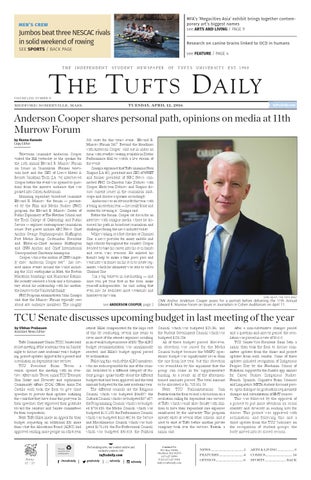
Anderson Cooper shares personal path, opinions on media at 11th Murrow Forum by Reena Karasin Copy Editor
Television journalist Anderson Cooper visited the Hill yesterday as the speaker for the 11th annual Edward R. Murrow Forum on Issues in Journalism. Former television host and the CEO of Loews Hotels & Resorts Jonathan Tisch (LA ’76) interviewed Cooper before the event was opened to questions from the massive audience that was packed into Cohen Auditorium. Honoring legendary broadcast journalist Edward R. Murrow, the forum — presented by the Film and Media Studies (FMS) program, the Edward R. Murrow Center of Public Diplomacy at The Fletcher School and the Tisch College of Citizenship and Public Service — explores contemporary journalism issues. Past guests include ABC News’ Chief Anchor George Stephanopoulos, Huffington Post Media Group Co-founder, President and Editor-in-Chief Arianna Huffington and CNN Anchor and Chief International Correspondent Christiane Amanpour. Cooper, who is the anchor of CNN’s nightly show “Anderson Cooper 360˚,” has covered major events around the world including the 2010 earthquake in Haiti, the Boston Marathon bombings and Hurricane Katrina. He recently released a book and a documentary about his relationship with his mother, the heiress to the Vanderbilt family. FMS Program Administrator John Ciampa said that the Murrow Forum typically sees about 400 audience members. The roughly
560 seats for this year’s event, “Edward R. Murrow Forum 360˚: Beyond the Headlines with Anderson Cooper” sold out in under an hour, with overflow seating available in Distler Performance Hall to watch a live stream of the event. Ciampa explained that Tufts alumnus Neal Shapiro (LA ’80), president and CEO of WNET and former president of NBC News, connected FMS Co-Director Julie Dobrow with Cooper. Each year Dobrow and Shapiro discuss current issues in the journalism landscape and choose a speaker accordingly. “Anderson was an obvious fit this year, with it being an election year — he’s really front and center for covering it,” Ciampa said. Before the forum, Cooper sat down for an interview with campus media, where he discussed his path in broadcast journalism and challenges facing the news industry today. While working as a fact checker at Channel One, a news provider for many middle and high schools throughout the country, Cooper decided to take his career into his own hands and cover wars overseas. He enlisted his friend’s help to make a fake press pass and went into war zones on his own to create segments, which he ultimately was able to sell to Channel One. “I’m a big believer in out-hustling — and once you get your foot in the door, make yourself indispensable,” he said, noting that even now he dedicates most weekends and holidays to his work. see ANDERSON COOPER, page 2
SOFIE HECHT / THE TUFTS DAILY
CNN Anchor Anderson Cooper poses for a portrait before delivering the 11th Annual Edward R. Murrow Forum on Issues in Journalism in Cohen Auditorium on April 11.
TCU Senate discusses upcoming budget in last meeting of the year by Vibhav Prakasam Assistant News Editor
Tufts Community Union (TCU) Senate held its last meeting of the academic year on Sunday night to discuss next academic year’s budgeting, project updates, approval for a project and a resolution on dependent care services. TCU President Brian Tesser, a senior, opened the meeting with an overview. Afterwards, Tesser, junior TCU Treasurer Shai Slotky and Diversity and sophomore Community Affairs (DCA) Officer Anna Del Castillo each took the floor to give short speeches to provide final updates outlining the work that they have done this past year. In their speeches, they expressed their gratitude toward the senators and Senate committees for their cooperation. Next, Tufts Hillel made an appeal for their budget, requesting an additional $30 more than what the Allocations Board (ALBO) had approved sending more people on a first-year
Please recycle this newspaper
Rainy 57 / 37
/thetuftsdaily
retreat. Hillel compensated for the large cost of this by readjusting several line items to cover most of the retreat’s expenses, resulting in an overall budget increase of $30. The ALBO budget recommendation was unanimously rejected, and Hillel’s budget appeal passed by acclamation. Following this, each of the ALBO members, who are each responsible for one of the councils, dedicated to a different category of student groups, spoke briefly about the different budgets that had been approved and the total amount budgeted for the next academic year. The different councils are the Religious Council, which was budgeted $94,837; the Cultural Council, which was budgeted $97,457; the Programming Council, which was budgeted $769,936; the Media Council, which was budgeted $122,153; the Performance Council, which was budgeted $110,982.56; the Service and Miscellaneous Council, which was budgeted $176,196; the Pre-Professional Council, which was budgeted $50,525; the Political
For breaking news, our content archive and exclusive content, visit tuftsdaily.com @tuftsdaily
tuftsdaily
tuftsdaily
Council, which was budgeted $25,281; and the Student Government Council, which was budgeted $256,234. All of these budgets passed. However, an objection was raised for the Media Council budget because the WMFO operations budget was significantly lower than the one from last year, but this objection was overridden by the argument that the group can come in for supplementary funding. As a result, all of the aforementioned amounts passed. The total amount to be allocated is $1,703,601.56. Next, TCU Parliamentarian Sam Berzok took the floor to lead a discussion on a resolution calling for dependent care services at Tufts, which would allow faculty with children to have their dependent care expenses reimbursed by the university. This program already exists at several other schools, and it used to exist at Tufts before another private company took over the services, Berzok, a junior, said.
Contact Us P.O. Box 53018, Medford, MA 02155 617 627 3090 FAX 617 627 3910 daily@tuftsdaily.com
After a non-substantive changes period and a question-and-answer period, the resolution was passed in a vote of 30-0-0. TCU Senate Vice President Gauri Seth, a junior, then took the floor to discuss committee updates from the chairs and project updates from each senator. Some of these updates included recognition of Indigenous Peoples Day by the Friedman School of Nutrition, support for the iJumbo app, minors for Career Studies, Indigenous Studies, French, Spanish, Cognitive Brain Sciences and Linguistics, MBTA student discount passes, open dialogue on graduation requirement changes and subsidization of EMT courses. This was followed by the approval of a project to put more attention on social identity and diversity in reading lists for classes. This project was approved with acclimation, and following this and a short update from the TCU Judiciary on the recognition of student groups, the body moved into its closed session.
NEWS............................................1 FEATURES.................................4 OPINION.....................................6
ARTS & LIVING.......................9 COMICS..................................... 14 SPORTS............................ BACK
2
THE TUFTS DAILY | News | Tuesday, April 12, 2016
T HE T UFTS D AILY Sarah Zheng Editor-in-Chief
EDITORIAL Nicholas Golden Mengqi Sun Managing Editors Nicholas Pfosi Associate Editor Arin Kerstein Executive News Editor Isha Fahad News Editors Abby Feldman Melissa Kain Sophie Lehrenbaum Emma Steiner Ariel Barbieri-Aghib Assistant News Editors Kyle Blacklock Gil Jacobson Robert Katz Liam Knox Catherine Perloff Vibhav Prakasam Hannah Uebele Joe Walsh Kendall Todd Executive Features Editor Nicole Brooks Features Editors Nina Joung Jake Taber Diane Alexander Assistant Features Editors Constantinos Angelakis Emily Cheng Emma R. Rosenthal John Gallagher Executive Arts Editor Lancy Downs Arts Editors Justin Krakoff Josh Podolsky Jonah Allon Assistant Arts Editors Cassidy Olsen Eran Sabaner Hannah Hoang Dorie Campbell Emily Karl Erin Sifre Stephen Dennison Abigail Feldman Shannon Geary Allison Merola Cassie Bardos Miranda Chavez Frances DeFreitas Jake Goldberg Emma Henderson Michael Lefkowtiz Anita Ramaswamy Noah Weinflash
Executive Op-Ed Editor Op-Ed Editor Cartoonists
tuftsdaily.com
Television journalist visits Tufts, discusses current election ANDERSON COOPER
continued from page 1 Even now that he has worked his way to the top, Cooper explained that he does not see himself as a celebrity. “I don’t watch myself if there’s a billboard in New York that has my picture on it that CNN is advertising, I don’t walk down that street, I don’t take a selfie of it … It always surprised me when politicians talk about themselves in the third person,” Cooper said. “I’m like, ‘how do you get to the point where you actually talk about yourself in the third person’?” In terms of the broader journalism landscape, Cooper spoke about the importance of knowing where information comes from in order to be aware of potential biases and inaccuracies. He also warned about the dangers of catering to ratings in an age where such information is constantly available. “I do think it’s a big mistake if you try to follow the numbers, and ultimately it’s like crack — I mean not that I’ve tried crack, but from what I hear — it may feel good initially, but long term you’re going to lose your teeth and you’re going to be all messed up,” Cooper said. He later signed copies of his new book in the Remis Sculpture Court. Next, University
President Anthony Monaco gave the opening remarks at the forum, followed by Dobrow, who introduced Cooper and Tisch. Cooper responded humbly to the audience’s applause, joking, “You’re just happy not to be in class.” Cooper wove together his signature humor and more serious side, segueing from charming stories about his days on an overnight news show — which he claims only night-shift workers, nursing mothers, drunk people and insomniacs watched — to explaining how the deaths of his father and brother made him want to cover wars and all the tragedies that he has witnessed throughout his career. “I really wanted to go overseas and be around people who spoke the language of loss, where life and death was very much a real issue,” he said. “I found it in an odd way — I preferred to be far away where life and death were the subject of the everyday than to be back here, where people just didn’t talk about that.” Cooper explained the importance of reporters to let themselves be affected by the tragedies they cover and noted how difficult this can be to balance with the logistics of reporting. “You have [to] go and be willing to be open to what you see, to be changed by it, and I
TCU candidates discuss platforms at forum event
Editorialists
Maclyn Senear Executive Sports Editor Ray-Paul Biron Sports Editors Ross Dember Phillip Goldberg Alex Schroeder Chris Warren Yuan Jun Chee Assistant Sports Editors Maddie Payne Eddie Samuels Noah Smith Sofie Hecht Executive Photo Editor Alex Knapp Caroline Ambros Picture Tufts Editor Ray Bernoff Staff Photographers Laura DeArmas Maria Ferraz Henry Hintermeister Katlyn Kreie Mia Lambert Jiaxun Li Nora Nord Nicholas Pfosi Julia Press Evan Sayles Angelie Xiong
PRODUCTION Julie Doten
Production Director Astrid Weng Executive Layout Editor Jewel Castle Layout Editors Abbie Gantner Leila Li Allie Merola Brianna Mignano Mandip Pokharel Ellie Powers Annabelle Roberts Emily Sharp Andrew Stephens Sebastian Torrente Shirley Wang Petrina Chan Allison Merola Dana Pek Belinda Xian Jack Ronan Dan Strauss Meagan Adler Alison Beach Arthur Beckel Lancy Downs Alison Epstein Andrew Kager Melissa Kain Sarah Kalinowski Reena Karasin Sophie Lehrenbaum Rachel Salzberg Arielle Sigel Caroline Watson Maxwell Bernstein Nitesh Gupta Evan Sayles
Creative Director Executive Graphics Editor Graphics Editors
think it should horrify you and it should make you cry at night,” he said. In response to a question from Tisch about the current presidential election cycle, Cooper said that no one knows what to expect in the coming months but noted that he thinks strong competition tends to produce stronger candidates. Regarding disproportionate media coverage, he shared his firsthand experience that Republican presidential candidate Ted Cruz has routinely declined news media’s interview requests unlike Republican presidential candidate Donald Trump. At the conclusion of the forum, Cooper answered a questions from the audience members. In response to a student’s question, he explained his frustration with what cameras can capture and said he wishes he could take his audiences on location with him. After visiting Tufts, Cooper returned to his campaign coverage. He interviewed Ohio Governor John Kasich and his family in a town hall event last night, will be speaking with Donald Trump and his family tonight and will interview Senator Ted Cruz and his wife tomorrow ahead of Thursday’s Democratic debate that is hosted by CNN.
MAX LALANNE / THE TUFTS DAILY
Rising sophomore Emily Sim, seeking senate re-election, speaks during a candidate forum in Hotung on April 11. Daniel Nelson
Contributing Writer
Tufts Election Commission (ECOM) held the TCU Candidate’s Forum last night in Hotung Café to provide a speaking platform for candidates running for positions on the TCU Judiciary and class of 2019 Senate positions. The forum came ahead of today’s TCU elections, where students can vote for Judiciary and Senate positions all day using their Student Information System (SIS) accounts. ECOM also posted a message on the Senate election Facebook page noting technical difficulties in the first 15 minutes of voting in today’s election, which has since been changed.
“If you voted prior to 12:15 please vote again as your vote was not counted prior to 12:15.” the statement read. “Tell all your friends and supporters to vote once more.” Fewer than ten students were at the forum, which began with appearances from the eight candidates for the Judiciary. Seasoned TCU veterans and hopeful second-semester first-years took turns answering questions posed by ECOM. The questions focused on issues of corruption and communication. For the most part, the candidates answered similarly, noting a lack of new student interest in joining the Judiciary. “We havent had a contested election for the Judiciary for over four years now,” current Judiciary Historian Anna
Weissman, a junior, said. After TCU Judiciary candidates’ closing statements, 12 candidates for class of 2019 senatorial positions and two candidates for International Community Representative, Celeste Teng and Rayane Haddar, introduced themselves. Resentment toward the administration was a common theme in candidates’ speeches. All 14 candidates expressed sentiments that the administration needs to be held more accountable for their actions. “The administration usually isn’t open to changing the status quo,” Senate candidate Malachy Donovan, a first-year, said. Some candidates went further, implying that the administration was not acting with students’ best interests in mind. [The administration’s] priority is its profit,” first-year Amira Al-Subaey, who is running for a seat on the Senate for the first time, said. Another major theme expressed at the forum was the need to empower minority student voices within Senate. First-year Emily Sim, a current TCU Senator running for reelection, spoke about how this issue is personal for her. “Being a woman of color on the Senate is difficult ... Being a woman on the senate is difficult,” she said. Sim added that women comprise only one third of the TCU Senate, despite making up approximately half of the student body. The candidates also spoke openly about the struggles to bring in non-Senate affiliated students to engage with student government.
Executive Copy Editors Copy Editors
Executive Tech Manager Online Editor Social Media Editor
BUSINESS Yiran Xu Executive Business Director Qinyue Yu Receivables Manager Evan Sayles Online Advertising Eva Sachar Ad Managers Jay Hayes
Police Briefs
Stolen Belongings Tufts University Police Department (TUPD) received a report of stolen belongings from the Steve Tisch Sports and Fitness Center at 3 p.m. on April 4. A person left her jacket in a cubby in the fitness center while exercising and discovered that her keys were missing from her jacket pocket when she returned. A police report was filed and the person was advised to have her key recoded if possible. Marijuana Smell TUPD was dispatched for a reported smell of marijuana coming from a residential hall at 2
p.m. on April 7. Officers met with the suspected resident, who admitted to smoking marijuana and then turned over the pipe used to TUPD. A police report was filed and sent to the Office of the Dean of Student Affairs. Fire Alarm TUPD responded to a fire alarm evacuation at Hillside Apartments at 8:30 p.m. on April 7. The alarm went off as a result of someone cooking toast. The Medford Fire Department checked the area and called for a system reset.
Noise Complaint TUPD responded to a loud noise complaint at Davies House at 1:15 a.m. on April 8. The officers could hear loud music coming from the residence and saw several residents drinking alcohol on the porch. TUPD established contact with a resident, shut down the party, confiscated the alcohol and filed a report. The report was then sent to the Office of the Dean of Student Affairs.
Tuesday, April 12, 2016 | ADVERTISEMENT | THE TUFTS DAILY
tuftsdaily.com
1/4 AD
1/8 AD 1/2 AD
3
4 tuftsdaily.com
Features
Research on canine brains linked to OCD in humans by Siddharth Divakaruni Contributing Writer
As 1.6 percent of the U.S. population is afflicted with a lifetime prevalence of obsessive-compulsive disorder (OCD), which is “characterized by intrusive thoughts that produce anxiety (obsessions), repetitive behaviors that are engaged in to reduce anxiety (compulsions), or a combination of both,” according to the National Institute of Mental Health (NIMH). Researchers at the Cummings School of Veterinary Medicine have linked their studies of the canine compulsive disorder (CCD) genes in dogs to compulsive behavior disorders in humans, furthering understanding of human OCD and helping find a more effective cure for human patients. Nicholas Dodman, a professor in clinical sciences at the Cummings School, and his team have been studying the genes of CCD — the counterpart to human OCD, and have recently found chromosome locations that correspond to the disorder’s severity, according to a Feb. 26 Tufts Now article. Their findings are published in the paper “Genomic Risk for Severe Canine Compulsive Disorder, a Dog Model of Human OCD.” Moreover, Dodman and his researchers have also tested certain medicines on dogs that have been proven effective. According to Dodman, this is not his first time working with CCD. In fact, he has been interested in animal disorders before the 1990s. Dodman explained that he came upon this area of animal behavioral care by chance. In the 1980s, soon after he arrived at Tufts, he became involved in trying to eliminate repetitive, undesirable behaviors in horses, which are called stable vices. After giving the horses morphine, which turned out to be ineffective, the team gavethe horses opioid blocker medication, which led to a reduction in the unwanted behaviors. Since that study, Dodman noted that he became interested in the genetic and neurochemical bases of animal behavioral disorders, specifically compulsive behavioral disorders. At the same time, he said he wondered how CCD could be related to human OCD. In the 1990s and early 2000s, along with Edward Ginns of University of Massachusetts Medical School, Dodman collected genetic samples from several species of canines, felines, horses, etc. After several years of collection, Dodman, Ginns and others found the CDH2 gene in dogs of particular interest. When comparing this gene to the human version, it partially clarified the link between canine and human brains in regards to compulsive behavioral disorders, Dodman noted.
In addition to gene study, Dodman also compared the brains of both humans and dogs. In 2013, Dodman worked with Marc Kaufman from the McLean Hospital to image Doberman Pinscher and human brains and compare them with each other. Kaufman detailed what their goals were in an email to the Daily. “Our general aim in animal studies is to try to identify brain structural and functional abnormalities similar to those reported in humans with compulsive behavior disorders, and then determine with imaging and other methods the underlying mechanisms for those abnormalities,” he wrote. Kaufman also wrote about how dog models can be useful due to inbreeding and thus a lack of genetic variation makes genes easier to study and compare. “All of these [canine brain] abnormalities paralleled those previously reported in human studies of patients with compulsive behavior disorders, and are consistent with brain circuit abnormalities thought to underlie compulsive behavior disorders,” Kaufman wrote. Dodman and his team have also delved further into the neurochemical aspect of compulsive behavioral disorders. Specifically, Dodman said he became interested in selective serotonin reuptake inhibitors (SSRI), or drugs that increase the brain’s serotonin levels. According to him, these drugs (an example of which is Prozac), are frequently used to treat depression and anxiety. Dodman also noted that although these drugs did not help too much, identifying MMDA receptors finally aided in curbing dogs’ obsessive compulsive behaviors. These, along with the similarities between canine and human brains and genes, may open up the possibilities for future treatment options. According to his most recently published paper, Dodman and his team have found several loci on the genes of canine chromosomes contribute to levels of CCD severity, which speaks more to the similarity between CCD and OCD and helps elucidate both conditions. However, he believes that there is more to be done. For example, according to him, there are abnormal serotonin receptor genes on CCD-afflicted dogs’ chromosomes, as opposed to normal genes on dogs without CCD. To further progress this research, he also said there must be more exploration into the genetic pathways of human genes. He believes the same serotonin receptor genes should be analyzed more in humans with and without OCD. “If you show that the same genes are involved [in both humans and canines], then you can make projections about
Spring Fling reactions “I’m still going to go. I’ve done crazier things on weekdays, so a Sunday isn’t a big deal.” Thomas Coons, ’19 “I think people should be grateful that Tufts even puts on a concert. Our tuition is for paying for education, not for concerts, so people should stop complaining.” Tyler Klein, ’19 “I wasn’t super excited, especially since I was already pretty confident I knew who the performers were but I wasn’t particularly upset either, espe-
cially since Spring Fling is on a Sunday this year, and this will make it easier for me to leave all the festivities earlier.” Hannah Feldman, ’18 “I was mostly disappointed, but Børns is pretty sick. We are about thirteen years late on Shaggy, though, and I heard Matt and Kim are pretty bad live.” Sami Ascha, ’19 “Spring fling being on a Sunday is just generally really inconvenient because I, along with…probably the
genetic pathways [of each species],” Dodman said. “When you discover the pathway, then you will know more about the physiology of the problem and new methods of treatment.” Both canine and human compulsive behavior disorders are severe conditions that are necessary to treat. For dogs, Dodman noted that CCD can greatly disrupt the pet-owner relationship. He explained that canines can experience a variety of compulsive behaviors, such as object suckling and compulsive circling. In humans, although the genetics and neurochemistry are similar, the behaviors are different but just as debilitating. Professor of Psychology Alexander Queen discussed the implications of the disorder in humans. According to Queen, although OCD was considered simply an anxiety disorder by the fourth edition of the Diagnostic and Statistical Manual of Mental Disorders (DSM), the latest version, DSM-5, currently has OCD in its own category along with disorders like hair-pulling and body dysmorphic disorders. “Most of the time, people realize that [obsessive-compulsive] thoughts are unrealistic or not necessary, but they feel like they have to do them to reduce their anxiety,” he said. Queen also talked about the various compulsive habits that reduce a person’s quality of life, including excessive hand washing and showering. He mentioned that not only does it take time out of people’s days, it prevents them from going certain places and hinders work and personal relationships. Queen noted that both psychiatric and psychological treatment options exist. Medicines used to treat human OCD include SSRIs such as Zoloft and Prozac. Behaviorally, there is a type of cognitive behavioral therapy, named “exposure with response prevention,” which gradually introduces and then maintains a fearful stimulus in order to habituate the patient. Still, despite the current treatments at hand, Dodman believes that there is still much more science left undiscovered — science that can pave the way to even better, more effective treatments for both canines and humans. Kaufman agrees. “Unfortunately, many patients are undertreated, or even worse, undiagnosed for many years after symptoms begin,” Kaufman wrote. “Our research aims to better understand brain developmental mechanisms, including identifying genes that increase vulnerability for developing a compulsive behavior disorder, which may enable earlier diagnosis and better treatment, of these debilitating conditions.”
C A M P U ST CO M M E N
majority of the student body, do most of my work on Sundays that I should’ve been doing the whole weekend, so it’s kind of hard when we now have that day for Spring Fling… You could say [that] Saturday is better to do [homework], but nobody’s going to do it then. Realistically it just doesn’t make sense that [Spring Fling is] on Sunday. ” Ashlee Guzman, ’18 “Who is Matt and Kim?” Anjalique Knight, ’19
Tuesday, April 12, 2016
Melissa Feito The Story of Stories
Live and alive
O
n a Wednesday night of my sophomore year, I walked into The Burren in Davis Square (for the first time, to boot) alone. I settled myself in the back room, where I was definitely not just the only person under the drinking age but maybe the only person under 30. I know what you’re thinking, fair readers, but I wasn’t there to throw down with the older crowd. I was there for a Story Slam, sponsored by local nonprofit Massmouth. While I came that night to just be a wallflower, I ended up being goaded onto that stage in front of a crowd of strangers, telling a poorly improvised but devastatingly hilarious story of my own personal struggle to connect with my sister while hunting for a showing of Frozen that was not sold out, rescheduled or as in one theater, literally on fire. I won second place. I went on the semi-finals a few weeks later, and I’ve loved live storytelling ever since. Story slams are like poetry slams, but thankfully for people like me who have no talent for cadence nor rhyme, the whole event is focused on another kind of artistry, and experience, in total. For anyone who listens every week to The Moth podcast, or anyone who has listened to a particularly captivating tale over the dinner table, it’s about being present, being connected and being true. This can mean a lot of different things; it can mean painting a detailed picture of the moment of your story, bringing the listener there with you. It can mean using comedy, or drama, to engage the crowd. It can mean that your story has an incredibly important, global message to the audience, or it may be something entirely personal. The one thing that is always the same is that it has to be live. The slam is a space of co-creation and co-interpretation. As an audience member, being so close to the raw memory of another person is intimate, and it can be scary, but it is always moving and enlightening. Last week, I was asked to help design and lead a workshop for a Hillel and MSA (Muslim Students Association) co-sponsored programming called Dignity in Difference, a day for spiritual reflection and evaluating peace between Israel and Palestine. A professor of mine, Norah Dooley, who teaches the Ex-College class Storytelling and Social Justice invited me on board the planning committee. It was an all-day event, beginning with early afternoon Jum’ah and ending with evening Shabbat. Somewhere in between the events of the day, there was a 45 minute stretch where we gave participants to take claim of their own narratives and experiences when encountering someone different, or facing something that tested their faith. Participants paired up to share their experiences to prompts like “barriers” or “flipped.” Finally, MSA representative and friend of mine Nazifa Sarawat told the first story, of the first time she interacted with Jewish girls of her age group and realizing that barriers aren’t permanent. Several students followed in suit, and although our time was brief, it’s the kind of genuine sharing that makes stories such a powerful barrier breaker. Melissa Feito is a senior majoring in English. She can be reached at Melissa. Feito@tufts.edu.
Tuesday, April 12, 2016 | ADVERTISEMENT | THE TUFTS DAILY
tuftsdaily.com
The Tufts Department of Drama and Dance presents
2016 SPRING DANCE CONCERT Featuring work by graduating Dance Minors
1/4 AD
Friday & Saturday, April 15 & 16 @ 7PM Sunday, April 17 @ 5PM Friday, April 29 @ 7PM & 9PM
1/8 AD
For more information visit: http://dramadance.tufts.edu/
5
6 tuftsdaily.com
Opinion EDITORIAL
What we talk about when we talk about private college Thinkpieces and magazine articles alike talk about private college as a pressure-cooker, full of controversy and in need of massive reform by policymakers. Whether improving access, helping with student debt, evaluating Greek life or hook-up culture, media and policy narratives underline private fouryear colleges like Tufts, our fellow NESCAC schools and big state schools nation-wide. That leaves out all the other college students, not always between 18 and 22 years of age, many of whom have distinctly different circumstances and paths that need to be included. When we take a broader scope of the American college-aged population, the stereotypical college experience commonly portrayed in the media isn’t mainstream. An estimated 45 percent of college students are at community college. Meanwhile, the National Association of Independent Colleges and Universities states that 3.4 million students are enrolled in private universities nationwide with a whopping 7.8 percent of those attending college. The rest attend public colleges and universities, where the majority of students work at least part-time.
But often these issues aren’t part of the discussion in media articles about college, partially because most of the people working for places like The Atlantic, The New York Times or The Tufts Daily attended wealthy private schools and are reporting on the issues in their bubble. As education journalist Jeff Selingo points out, this causes us “to view higher education through the eyes of private higher education.” Even Monsters University creators visited Harvard and UC Berkeley to decide on the model of the campus and the social life they would portray in their movie. The first part of the onus is on us as media contributors to begin widening the focus of these conversations to include real problems faced by a wider spectrum of college-aged population. Issues in public institutions, two-year community colleges or vocational schools are often looked over. When we advocate for changes to the day-to-day life of students, it’s important to recall the need, for example, for flexible class schedules that allow students to work full time. When it comes to conversations about higher education, we need to be aware of biases, stereotypes and subjectivities propagated by the
privileged few in the media to better accommodate those outside of our bubble. That’s not to say that problems experienced at private colleges should be ignored or that they aren’t as important, but rather that they only tell part of the story. One way to start introducing more objectivity to the scope of issues faced by college students is to be more intentional, selective and critical about the types of media we consume, the debates in which we choose to engage and the stances we take when we think about class. This way, media sources can be influenced as they pick up on the preferences of their viewers or readers. Finally, look for ways to take action in your local community that actively improve your regional universities or community colleges. It’s fun to talk about how Tufts’ acceptance rate is lower than Cornell’s this year or the new dining hall that Notre Dame just opened, but remember to think about the vast majority of students who are what we call “non-traditional” college students; maybe it’s time to acknowledge that really it’s we who are non-traditional.
EDITORIAL CARTOON BY ABIGAIL FELDMAN
The Tufts Daily is a nonprofit, independent newspaper, published Monday through Friday during the academic year, and distributed free to the Tufts community. The content of letters, advertisements, signed columns, cartoons and graphics does not necessarily reflect the opinion of The Tufts Daily editorial board. EDITORIALS Editorials represent the position of The Tufts Daily. Individual editors are not necessarily responsible for, or in agreement with, the policies and editorials of The Tufts Daily. OP-EDS The Op-Ed section of The Tufts Daily, an open forum for campus editorial commentary, is printed Monday through Thursday. The Daily welcomes submissions from all members of the Tufts community; the opinions expressed in the Op-Ed section do not necessarily represent the opinions of the Daily itself. Opinion articles on campus, national and international issues should be 600 to 1,200 words in length and submitted to oped@tuftsdaily.com. The editors reserve the right to edit letters for clarity, space and length. All material is subject to editorial discretion and is not guaranteed to appear in the Daily. Authors must submit their telephone numbers and day-of availability for editing questions. ADVERTISING All advertising copy is subject to the approval of the Editor-in-Chief, Executive Board and Executive Business Director.
Tuesday, April 12, 2016
Luke Sherman Earth On Fire
A unique opportunity
I
n the words of President Barack Obama, it was a “shellacking.” November 2, 2010, the day the Republican Party netted a historic 63 seats in the House of Representatives, proved to be a catastrophe for domestic initiatives that would mitigate climate change. The number of seats captured by the GOP, which pledged to oppose all federal measures designed to stave off of the worst effects of global warming, represented the largest swing in over 60 years. A shellacking it was. Many political observers credit the GOP’s groundbreaking victory in part to the lower chamber’s passage of cap-and-trade legislation the previous year. The bill, had it been enacted, would have established a limit on greenhouse gas (GHG) emissions from some of the nation’s largest emitters. From the beginning, supporters of the legislation failed to properly inform the public of the initiative’s benefits. We cannot isolate this failure, however, from its context and previous attempts to reduce GHG pollution. Climate change represents such a politically vexing issue because society will bear its worst impacts decades from now while elected officials must make the needed changes now. In a system of governance that features regular elections, politicians have little incentive to protect the well-being of future voters. Moreover, the free rider problem further disincentives taking action on this issue, as one country or state can do nothing to diminish its own GHG pollution while still benefiting from another’s emissions reductions. All rational voters, then, would oppose proposed laws that would compromise their own interests. To counter and ultimately nullify this opposition, it is imperative that environmentalists and their political and civic allies communicate to voters the benefits of legislation that would likely raise energy costs, discourage consumption and radically alter the way we live our lives. Until we do so, our political leaders will never lead on this issue. Author Annie Leonard references this necessity in The Story of Stuff, arguing that the public must properly understand the problems associated with our current economic and social systems to comprehend the sort of society we could collectively create. “We know what the world of today looks like: climate chaos, toxic chemicals in every body on the planet including newborn babies, growing social inequity, disappearing forests and fresh water, increasing social isolation and decreasing happiness,” she writes. The changes we need to make to prevent catastrophic climate change are radical. But the benefits of these changes are huge. Investing trillions of dollars in public transportation and other infrastructure projects would create millions of high-paying jobs and curtail air pollution. Banning the extraction of fossil fuels on federal lands would ensure that all Americans have the right to enjoy the beauty of nature. Taxing the consumption of goods would lead to a realignment of our values and increase our overall happiness. Climate changes presents us with a unique opportunity – one we must embrace. The environmental movement has not sufficiently communicated these benefits to voters. Until it does so, we will continue to inch ever closer to the brink of climate chaos. Luke Sherman is a senior majoring in environmental studies. He can be reached at luke.sherman@tufts.edu.
Tuesday, April 12, 2016 | Opinion | THE TUFTS DAILY
Opinion
7
OP-ED
The debate system created Trump — how can we avoid a repeat? by Jamie Neikrie Turn on the news at any time of the day, and you will see political pundits discussing the previous night’s debate, translating debate performance into primary prognostications or anticipating a coming debate. The debate system has become entrenched in our political system — the most ubiquitous, consistent method for choosing the party representatives and our next president. Lost in the conversation about Donald Trump’s terrifying rise to Republican presidential frontrunner is how the televised debate system elevated Trump. In many ways, Trump — a performer and a showman — was the logical result of a debate stage that values bluster above substance, promotes one-liners above complex policy prescriptions and rewards hardliner positions over measured compromise. Televised debates emerged in the election of 1960 with the famed debates between Vice President Richard Nixon and Senator John F. Kennedy. And initial reviews were not positive. Prior to the first of four debates, the Wall Street Journal warned that a televised debate would be “rigged more for entertainment than for enlightenment.” The New York Times concurred, arguing that the debate would appeal to voters “who are influenced not so much by logic and reason as by emotional, illogical factors … The fear is that they will not discuss the issues as much as put on a show.” These reactions, while prescient, could be attributed to the print media digging its heels in against
the growing dominance of television media. Upon the first debate’s conclusion, moderator Quincy Howe of ABC News said, “Vice President Nixon and Senator Kennedy have used a new means of communication to pioneer a new type of political debate … Surely they have set a new precedent. Perhaps they have established a new tradition.” Howe was right, and today the debate has become our central tool for evaluating a presidential candidate. In 2012, there were a staggering 23 Republican debates. The Republican National Committee (RNC) made the conscious decision to drop to 13 debates in this year’s election cycle after RNC Chairman Reince Priebus called the 2012 primary debate schedule “ridiculous,” and “blamed the forum battles for the presidential election loss.” However, this year’s elections have only perpetuated the RNC’s problems, giving rise to Donald Trump and Ted Cruz — a racist, xenophobic businessman and a severely conservative senator hated throughout Washington. Both candidates will be unelectable in the general election. A new study from the University of Miami, which employed game theory in its analysis, concludes that an increased number of campaigns emphasizes a candidate’s character above policy stances. According to Christopher Cotton, a professor at Queens University and co-author of the study, televised debates encourage voters to base their political decisions on vague impressions of candidates rather than on facts or policy. “The more often the voters are going to see these people on TV, the
more likely one is to stand out as a much better speaker, while another looks like a bumbling buffoon,” he said. Amazingly, the American political system has never tested a political alternative to the debates. The first presidential debate occurred in 1858 between Abraham Lincoln and Senator Stephen A. Douglas. As a nation, we never stopped to consider whether debates emphasized the qualities sought in a president. According to Fred Greenstein, a renowned professor of political science at Princeton, the six attributes most correlated to success in office are effectiveness as a public communicator, organizational capacity, political skill, vision, cognitive style and emotional intelligence. Very few of these traits are tested or revealed on a debate stage. Instead, we are treated to rehearsed lines, manufactured spats and baseless rhetoric. So what is the alternative? Maybe it’s because I was an avid participant in Model U.N. in high school, but I would like to see candidates participate in a mock crisis game, a simulation in which candidates are placed in a room together, presented with a looming crisis and given two hours to reach a consensus plan of action. Debates have largely phased out hypothetical questions, as candidates will always dismiss them with a retort like, “I don’t deal in hypotheticals.” But I believe that such an exercise could reveal a lot about a candidate. A mock Situation Room exercise would test a candidate’s ability to think quickly and act decisively, reveal their understanding of current events and test
their composure under pressure. Most importantly, given the hyper partisan climate in Washington, it would reward candidates who are willing to compromise and politicians who can engineer a proposal acceptable to both sides. Of course, candidates like Ted Cruz have gained popularity based on their refusal to compromise, demonstrating the strengths of their convictions. But in a televised crisis game model, these candidates would appear obstinate and ineffective. Such an exercise would reveal the ugly reality of a candidate fundamentally opposed to compromise. I would like to once again quote the Times’ analysis of the televised 1960 elections: “The fear is that they will not discuss the issues as much as put on a show.” The Times understood the ramifications of a televised debate serving as the primary tool in our election process 56 years ago. And now, we have seen the inevitable product of that system: Donald Trump. I am not calling for the abolition of all televised debates. At times, they can be illuminating glimpses into the thought process and leadership styles of a candidate. But it is time we explored alternatives to this system — models of discourse that emphasize skills critical to leadership like the abilities to think critically, listen to good advice and engineer acceptable compromises. It’s time we got smart about choosing our next president. Jamie Neikrie is a sophomore who has not yet declared a major. He can be reached at benjamin.neikrie@tufts.edu.
Hiring for Students for Senior Week!! Tufts Dining is recruiting students to help out for Senior Week/Commencement
Students will assist with the preparation of food in addition to providing customer service on events. • You’ll be right in the center of many marquee Tufts events that occur at that time! • We can put you on a meal plan while you work • You get a sneak preview of what you have to look forward to as a senior!
If you would like to apply or learn more about the hiring process, please send your resume and/or inquiry to Michael.DeSimone@tufts.edu, Michael is the Manager of Staffing and Training
8
THE TUFTS DAILY | Opinion | Tuesday, April 12, 2016
tuftsdaily.com
Only a few days left... Tell the University what you think about housing at Tufts! Include your voice in the housing master planning study.
UNDERGRADUATE HOUSING SURVEY
Check out this fun web-based survey at http://mycampus.sasaki.com/tufts-housing/ and drop icons on where you live and what you like (or not) about your residential housing experience at Tufts - on or off campus where you like to study, where you spend your down time, etc. Where would you prefer to live and why? What do you think about the lottery system? Tell us about it. If you'd like, enter a drawing at the end of the survey to win a new Tablet!
76130
Survey closes Saturday, April 16, 2016
WE HELP THOSE WHO DO GOOD DO WELL.
Rediscover what makes us a different kind of financial partner at the new TIAA.org
INVESTING
ADVICE
BANKING
RETIREMENT
BUILT TO PERFORM. CREATED TO SERVE.
C28789
Tuesday, April 12, 2016
ARTS&LIVING
9 tuftsdaily.com
Natalie Girshman The ABC's of Literature
GALLERY REVIEW
Small yet cutting-edge, ‘Megacities Asia’ vitalizes the contemporary art scene in Boston Melina Marchetta
I
COURTESY CHUCK CHOI
The piece “Forever” (2003) by artist Ai Weiwei is made of 64 steel bicycles and displayed at the Museum of Fine Arts in their “Megacities Asia” exhibition. by Eran Sabaner
Assistant Arts Editor
Though the Museum of Fine Arts is one of the oldest art museums in the United States — founded in the same year as the Metropolitan Museum of Art — it is very much still interested in promoting and exhibiting contemporary art. The MFA’s still-evolving collection is already notable: it includes big names like Andy Warhol and Kara Walker, as well as up-and-comers like Cheryl Ann Thomas, who just had an exhibition at Back Bay’s Gallery NAGA last month. “Megacities Asia” is an extension of the MFA’s dedication to contemporary art.
“Megacities Asia” centers on five of Asia’s most densely populated cities: Shanghai, Beijing, Mumbai, Delhi and Seoul. Each of these cities has a population higher than 10 million and are hence labeled “megacities.” The works displayed touch upon topics such as over-population, urbanization and gentrification in megacities, and they respond to the social, political and environmental climate of modern day Asia. Although small in terms of space and the number of works displayed, the exhibition still impresses. It notably features an all-star group of contemporary Asian artists, with Chinese artist Ai Weiwei front and center. Named one of the “Top 10
Living Artists of 2015” by Artsy Magazine, Weiwei is the superstar of contemporary art right now, in part due to his 2011 arrest in China, which led a public feud between the artist and the Chinese government. Weiwei’s recent show at Royal Academy of Arts in London earned both critical praise and commercial success. Understandably, “Megacities Asia” has been marketed as “the show that features Ai Weiwei,” and while other works in the exhibition are impressive, Weiwei’s installation “Forever” (2003) stands out the most. Inspired by Marcel Duchamp and readymade art, Weiwei attaches together a number of see MEGACITIES, page 10
RESTAURANT REVIEW
Bom Café’s açaí bowls provide a refreshing escape by Deepa Patil
Contributing Writer
A few blocks away from Inman Square, at the corner of Cambridge and Elm, Bom Café stands out amid a crowded food scene. Bright yellow paint and colorful artwork cover the interior walls, alluding to the restaurant’s upbeat vibe. Loud, celebratory
music turns every breakfast and lunch into a party. The display on the counter is filled with cans of Guaraná, the popular Brazilian soft drink. Behind the display, a hip, older gentleman in a fedora and fashionable eyeglasses takes orders. The restaurant’s name promises a pleasant food experience — after all, “bom” translates to “good” from Portuguese.
DEEPA PATIL FOR THE TUFTS DAILY
An acai bowl at Bom Café.
The restaurant offers an enticing range of breakfast and lunch options. Omelets and subs — like “the linguiça” with sausage, caramelized onions and peppers served on a buttery, toasted roll — constitute the heartier dishes. Lighter options include a variety of pastries and beverages. After ordering at the counter, only a few minutes pass before a waitress who also works in the kitchen brings out an açaí bowl, signals for me to extend my arm and places the bowl in my hand instead of on the table. Her smile is kind and adds to the warm, welcoming atmosphere of Bom Café. The açaí bowl arrives adorned with three pieces of strawberry lined along the middle, while four slices of banana are placed in opposite quadrants of the bowl. The fruit rest atop a bed of granola. It is a crispy mixture of small oats and several types of seeds, but it lacks an expected crunch without larger clusters. The textural flaw, however, may be overcome by the granola’s delicately sweetened flavor, allowing the true essence of its constituent parts to present themselves without being overpowered by excessive amounts of sugar. This subtlety of the granola is essential because the star of the açaí bowl — namely, the frozen and see AÇAÍ, page 10
t’s the rare author who manages to switch between genres, going from witches and wizards to the everyday dilemmas of a modern family. Most find the genre in which they’re most comfortable and stick to it, carefully staking out a path and wearing it down until it’s a well-beaten track. But some authors manage to master multiple forms, one of my favorite examples being Australian young adult author Melina Marchetta. Marchetta started out writing heart-breakingly real YA contemporary novels set in modern-day Australia. Of these, I recommend starting with “Saving Francesca” (2003), one of those quiet books that slowly builds up until it stuns you with its emotional power. According to the book’s blurb on Amazon, Francesca Spinelli tries to navigate her transfer to St. Sebastian’s, a formerly boys-only prep school that likes to “think the building of a girls’ bathroom makes them coed,” where the only other girls are a rabble-rousing feminist, an irrepressible flirt and an accordion player. She can’t seem to stop running into the infuriating Will Trumbull, she’s not entirely sure what kind of person she wants to be, and then her mother sinks into a deep depression. Marchetta effortlessly weaves together family issues, growing friendships, and romance and does it all with a cast of characters that are incredibly true to life. These are real teenagers, flaws and all, and they spring to vivid, imperfect, marvelous life on the page as we see them through Francesca’s eyes. At first glance, “Saving Francesca” might seem to tell a story that we’ve heard a hundred times before, but in the hands of a skilled writer like Marchetta, it seems like one that’s entirely new. If you fall in love with the cast of characters in “Saving Francesca,” there’s “The Piper’s Son” (2010), a companion novel about Thomas Mackee, the clown of the group of friends, five years later after his family has fallen apart from the inside out. It’s a subtle, heart-wrenching novel that captures everything from the uncertainty of your twenties to the heartbreak that can come later in life and that doesn’t always let you like its characters but always lets you want them to be happy. Best of all, “The Piper’s Son” also features a male voice and a male lead character that actually ring true. Of course, Marchetta isn’t just capable of writing fabulous contemporary novels. She has also written the Lumatere Chronicles, an epic fantasy series. They begin with “Finnikin of the Rock” (2008) which follows the titular Finnikin, once the son of the captain of the guard and now a wanderer who hasn’t seen his homeland for ten years since a terrible curse fell upon it. When a mysterious novice appears claiming that the heir to the throne is still alive, he suddenly has something to hope for again — and something to fear. The Lumatere Chronicles combines a richly detailed fantasy world with characters that are just as richly detailed, each book told from a different point of view and adding new and equally memorable characters to its cast. If you’re a fantasy fan, or even just a fan of good writing, they’re a must read, as is everything from this immensely talented, unique writer. Natalie Girshman is a senior majoring in history and drama. She can be reached at natalie.girshman@tufts.edu
10
THE TUFTS DAILY | Arts & Living | Tuesday, April 12, 2016
tuftsdaily.com
MOVIE REVIEW
‘Everybody Wants Some!!’ offers nostalgic view of college, falls short by Elliot Storey
Contributing Writer
Billed as a follow-up to “Dazed and Confused” (1993) and “Boyhood” (2014), “Everybody Wants Some!!,” released March 30, is writer-director Richard Linklater’s latest entry into his genre of films that are more experiences than stories. Whether that experience is worth the price of admission depends on the viewer. Here, the experience is pure ’80s college nostalgia, and for those whose knowledge of the ’80s comes from music, movies and history class, it isn’t enough. Where “Dazed” and “Boyhood” closed on the transition out of high school, here Linklater opens on college pitching recruit Jake (Blake Jenner) cruising onto campus in his Oldsmobile 442, The Knack’s “My Sharona” (1979) blasting on the cassette player. The mood is set — Jake and his teammates will spend their long weekend before the start of classes doing everything one would expect: pounding cans of Schlitz beer, bisecting thrown baseballs with an axe, playing Space Invaders and, of course, picking up girls. And it will all be accompanied by the best and worst of ’80s tunes, from the title song, Van Halen’s “Everybody Wants Some!!” (1980), to a baseball practice set to Devo’s “Whip It” (1980). The impeccable aesthetic of the film, courtesy of production designer Bruce Curtis, and the subtle ubiquity of nods
and throwbacks to the era, transform the campus of the fictional Southeast Texas University into something of a fantasyland. It’s a land of ease where the fiercest conflict is a hotly contested ping-pong match between Jake and teammate McReynolds (an impressively mustached Tyler Hoechlin), where the team’s hazing rituals come off as benevolent and inclusive rather than cruel. A time when they can sig along to The Sugarhill Gang’s “Rapper’s Delight” (1979) with their lone black teammate, without a thought to what that means. Linklater avoids this topic, and any other idea that threatens to become too serious, by undercutting it with humor or channeling it through the haze of stoned dorm room philosophy. Some films never bother to put forth an argument or make us think, and “Everybody Wants Some!!” is one of them. Linklater is content with “just getting in that groove”, as pothead pitcher Willoughby (Wyatt Russell) puts it. There is some philosophizing. Jake shares his insecurity with having his small pond of high school ball replaced with the ocean of college talent. And the players ponder pro careers and wonder, as they hop from disco club to country bar to punk rock show, whether they’re being true to their identities. But Linklater doesn’t explore or linger — we’re always off to the next beer, the next party, the next girl. And that’s for the best. Any attempt at a message here would harsh our mellow. That’s not to say these are a bunch
Renowned contemporary artists featured in MFA’s ‘Megacities Asia’ MEGACITIES
continued from page 9 steel bikes to create a cylindrical shape. Monumental in size, the work is both deeply personal and socially relevant. As a child Weiwei dreamed of having a bike, a symbol of freedom and mobility. However, returning to Beijing after more than a decade of living abroad, Weiwei realized that the dream of owning a bike now diminished as fast cars and large highways had taken over the city. In a way, the work emphasizes the ways in which urbanization changes our dreams and values. Other works in the exhibition are just as ambitious as “Forever.” Han Seok Hyun’s “Super-Natural” (2011) comprises a huge pile of green products found in supermarkets in Seoul and Boston. The green color is supposed to stress how “healthy” these products are, yet when piled together, the soda cans and cleaning product looks like a colossal
pile of waste. With rapid urbanization and the rise of consumption culture, Hyun asks his viewers what is and what isn’t healthy and eco-friendly in modern city life. Another highlight is Hema Upadhyay’s “8’ x 12’” (2009). Using scrap materials, Upadhyay creates a map of Mumbai on the inside of a cubelike structure visitors can walk into. Upadhyay’s city looks congested, overwhelming and lively, echoing the character of the ultra-dense Indian city. One of the biggest advantages of “Megacities Asia” is that each work displayed complements the others. The exhibition functions as if it is a puzzle, with each speaking to a different aspect of modern day Asian cities. With “Megacities Asia,” artists can simultaneously promote their art and their cities, while the exhibit allows the MFA to demonstrate its commitment to exhibiting impressive and significant works of contemporary art.
Bom Cafe serves up unique take on Brazilian favorites AÇAÍ
continued from page 9 mashed açaí mixture — hides just beneath. The açaí mixture is a deep maroon with purple undertones. The consistency is reminiscent of a sorbet but with the softness of a yogurt. A perfect spoon includes all components of the bowl — the açaí, the granola and a piece of fruit. Unfortunately, there is far too much açaí mixture and not enough granola and fruit to get enough perfect bites. Still, it is a peculiar and pleasant experience to eat something that is simultaneously refreshing and so rich. The flavor of the açaí berry or pulp, however, is disappointingly restrained by an overpowering taste of frozen banana in the
açaí mixture. Despite this, the açaí bowl is sweet and delicious by any standard. To warm up before heading back outside, Bom Café offers a great coffee menu. The latte is delightful, and their popular pao de queijo, a delicious ball of cheesy bread, provides a much needed savory bite after a sweet açaí bowl. It is unreasonable to expect Bom Café to perfectly replicate the açaí bowl experience of Brazil or its Southern Californian interpretations. After all, Boston usually lacks the pleasant pace of life and the sun required to enjoy this cold treat. But with a bit of imagination, Bom Café’s açaí bowls provide a great temporary escape from Boston’s capricious climate.
VAN REDIN / PARAMOUNT PICTURES VIA MCT
Zoey Deutch and Blake Jenner in “Everybody Wants Some!!” of dumb jocks. Linklater, himself a baseball player at Sam Houston State University, has assembled an endearing cast of characters, from fast-talking Finnegan (Glen Powell, stealing scenes left and right) to the short-fused Niles ( Juston Street). Whether we’re laughing with or at them, their palpable camaraderie and sincerity is infectious. “This is the best day of my life…until tomorrow,” McReynolds says, realizing the second half of that sentence even as he utters it. The only trouble is that while all these elements combine to make an
enjoyable film, the experience is pleasant, no more, no less. The film elicits smiles rather than laughs, and the romance between Jake and theater major Beverly (Zoey Deutch) is sweet and genuine, but bland. While the constant references to the era (an AMC Gremlin, Neil Young’s “Decade” (1977), Carl Sagan), may resonate with those who lived those years, there is a disconnect for younger viewers. That said, it would be unfair to fault Linklater or anyone involved. After all, you write what you know, and this is what Linklater knows better than anyone.
Tuesday, April 12, 2016 | ADVERTISEMENT | THE TUFTS DAILY
tuftsdaily.com
VOTE TODAY!
1/4 AD
Candidates for tCU senate Class of 2019 aMira al-suBaey
There are some fundamental changes that I want to see at Tufts. I want us to address gender and race divisions on campus. I want us to empower each other. I want everyone’s identity to be celebrated and equally valued. I want to hold administration accountable to the Tufts brand. I want the “Tufts personality” to mean something that WE define. I want us to use student power to shape our University for ourselves. Vote for Amira!
1/8 AD
nesi altaras
My name’s Nesi Altaras and I’m running for Senate. Like everyone else running, I was in student government in high school. I’m from Istanbul, Turkey but I now live in Tilton. I’m planning on being an IR and Econ double major and I’m running because Tufts is my home and I want to work so that others feel the same way.
BuBaKar Bah
Hey, my name is Bubakar Bah. I am first year-student from New York. If I am fortunate enough to earn your vote, I promise to reflect your voices and make decisions that will contribute to the overall improvement of our school community.
JacoB cantor
Hi, I’m Jacob Cantor. I’m a first year and super-stoked to be running for TCU Senate. In the past, I held the presidency in my high school and led the coalition to fight for American Indian rights by changing our school mascot. I am confident in my ability to work productively with administrators, legislators and students and I hope to represent you in the fall! Yes We CANtor!
aMrutha chintalapuDi
Hi there! My name is Amrutha Chintalapudi and this year I’m running for TCU senate because I’d like to be a representative of the student body. Id like to bring about a change to this campus because I believe every student does not have an equal voice and I feel that as a part of the Tufts community every student deserves that opportunity. Thank you for voting and I hope you vote Amrutha for TCU Senate!
Malachy Donovan
1/2 AD
My name is Malachy and I am asking for your vote next Tuesday! I will work to bring about more effective and transparent student-administration conversation and a stronger student voice. I am a firm believer in the power of open communication and discussion to get things done, particularly to facilitate effective change on campus. As a TCU Senator, I hope to represent the voices of students by tirelessly pushing to relay your concerns and ideas at senate and administrative meetings. Two of the most important issues for this upcoming semester are diversity and financial allocation. I will take a hard look at funding and advocate to put money where it really matters, as well as push for policies that increase diversity at Tufts for years to come.
Brian KipchuMBa
Hello fellow Jumbos! My name is Brian Kipchumba and I am running for senate. Being part of the Student Government at my previous institutions has given me the experience to lead my fellow classmates. I want to be YOUR voice and I welcome you to share YOUR issues with me, because I’m confident that together, there’s nothing we can’t solve!
chris leaverton
Hi, I’m Chris and I’m running for re-election to the TCU Senate! Senate is the most important activity at Tufts for me, and for the past year I have fought for students’ right to attain the education they want to receive. I have served as Assistant Treasurer and worked to keep senate as transparent as possible, please vote for me!
11
12
THE TUFTS DAILY | ADVERTISEMENT | Tuesday, April 12, 2016
tuftsdaily.com
aDaM rapfogel
I currently have the honor of serving as a freshman TCU Senator, and I take my commitment to Senate seriously. I have yet to miss a meeting, and I’ve spent the past year on the Services committee, working on projects from the Joey and Late-Night Dining to the Turkey/Spring Break Shuttle, Housing, and the Cause Dinner. If I am so fortunate as to earn your vote, I promise that I will continue to listen to all of your voices and consider even the most outlandish or seemingly silly ideas.
eMily siM
1/4
Why vote Emily? I care about making Tufts truly a home for everyone, regardless of what walk of life you come from. This year, I focused on allowing legal aliens to apply to Tufts as domestic applicants rather than international and sustainable dining. Let’s grab coffee simtime and I can tell you about my plans for next year!
aMir soleiManpour
My name is Amir Soleimanpour and I’m running for a senate seat in the rising sophomore class. I have an array of qualities to contribute to TCU. I want to increase the student body’s engagement with TCU and its various initiatives by expanding policy discussions to non-TCU students. The more discussion there is about campus life and TCU policies, the more we enjoy Tufts. Vote for discussion, vote for engagement, vote Amir.
1/8
charlie Zhen
Hey! I’m Charlie, a first year from NYC. I’m running for Senate to advocate for low income, first gen students like myself, and to make Tufts a more inclusive, supportive space for all. This year I’ve gotten to know many of you through serving as Freshmen Class President, giving tours for admissions, volunteering with LCS, and so much more!
Candidates for JUdiCiary
alexanDria hayMan
A rising sophomore, Alexandria Hayman is running for re-election to the TCU Judiciary following her Spring 2016 term as Historian. She hopes to make the Judiciary a more active member in the lives of the Tufts student body, and pick up where previous Judiciaries have left off in updating the TCUJ Constitution. Alexandria looks forward to having the opportunity to continue working for a community she has come to love.
isaBella Kahhale
Hi, Tufts! After 2 years as a TCU Senator and a semester as the Judiciary Vice-Chair, I’m running again to serve you on the Judiciary. I’ve spearheaded many projects including late-night dining in the Commons and the Judiciary Sanctions Infographic. I’d love your vote so I can continue turning words into actions and improve the way the Judiciary serves you.
Michael KalMans
Hi Tufts! For the past three semesters, I have had the sincere honor and pleasure to have represented your voice, interests, and issues on the TCU Judiciary. Though I am currently spending the academic semester in Berlin, I am beyond excited about the prospect of continuing the two years of hard work and progress we have already achieved as a body come this fall! If re-elected, I vow to build stronger relationships between the Judiciary and university administrators and always work hard to further cultivate and maintain the vibrancy, integrity, and passion of a campus that we all know and love! Thank you for your kind consideration and please reach out if you have any suggestions or want to discuss my candidacy in further depth!
Meg Kenneally
1/2
Let’s get straight to the point. I’m Meg Kenneally and I’m running for a spot on the TCU Judiciary. I’ve been in this branch of Student Government for two years and I’d love to continue in a third term. I’m experienced, I enjoy the work, and I love the Oreo-cream cheese desserts in the dining halls. That’s all, folks.
ecom.tufts.edu/VOTE
Tuesday, April 12, 2016 | ADVERTISEMENT | THE TUFTS DAILY
tuftsdaily.com
VOTE TODAY Candidates for JUdiCiary
1/4 AD
ashton stephens
Ashton Stephens is a Electrical Engineering and Computer Science double major running for his second term in the Judiciary. He enjoys good food, lettuce, long walks on the beach, and people with fancy hair dos. If he were re-elected back into the judiciary, he would spend the most effort into making the club recognition and rerecognition documents easier to understand.
eMily tannenBauM
1/8 AD
Hello Tufts Community Union! I’m Emily Tannenbaum, a current sophomore, and I’m running for the TCUJ. For the past two years I have been a member of the TCU Senate. After being part of an organization that funds clubs, I am eager to be involved in another aspect of the process and will bring my knowledge and experience with me. It’s extremely important for clubs to be properly recognized and to have student participation. I want to help the student body grow. So, vote for me, Emily Tannenbaum, on April 12th! And, of course, Go Jumbos!
anna WeissMan
Hello Tufts, my name is Anna Weissman. I am a rising senior and the longest serving member of the current TCU Judiciary. From Treasurer, to Recognition Chair, to Historian, to Vice Chair, I have taken my role seriously on the TCUJ. I am ready to serve our student body even better than before for one last year!
parth yatin patel
Hi! I’m Parth Yatin Patel (not to be confused with the other Parth Patel on campus)! I’m from Goshen, Indiana, and I’m studying political science. I am a captain of JumboRaas, a huge fan of The West Wing, a DC Comics nerd, and, hopefully, a future member of the TCU Judiciary! Ask me about dandiya, and don’t forget to vote on April 12th!
Candidates for international CommUnity representative rayane haDDar
1/2 AD
After serving a year in Senate as a first-year student and on the Allocations Board, I intend to use my experiences and perspectives to represent the international community and the larger student body in Senate.
celeste teng
Celeste is a rising sophomore hoping to major in ILVS. She calls Singapore home, but she acknowledges that many of us have a difficult relationship with the word. Some things that demand her time and heart: the Tufts Singapore Students Association, the campus chapter of Love146, as well as weekly conversation groups with new immigrants in Medford learning English as a second language.
ECOM
@tufts.edu
twitter.com/
TuftsECOM
ecom.tufts.edu/
calendar
13
14
THE TUFTS DAILY | Comics | Tuesday, April 12, 2016
Comics
tuftsdaily.com LATE NIGHT AT THE DAILY Jack: “Guys should I get a sugar daddy?.”
Comics
SUDOKU
JUMBLE
Difficulty Level: Missing the production deadline.
Monday’s Solution
NON SEQUITUR BY WILEY MILLER
CROSSWORD
Monday’s Solution
Tuesday, April 12, 2016 | Sports | THE TUFTS DAILY
Sports
Tufts to host second home match of spring season Wednesday against Brandeis MEN'S TENNIS
continued from page back ing through and gaining the advantage they needed for a win. “Losses are always tough, but our match against Middlebury was a lot closer than the score indicated. We were up 2-1 after doubles, and we secured the first set on three of the six singles courts,” Glickman said. “If each of those courts had closed out the second set, we would’ve beaten Middlebury 5-4. There is a reason why they are the No. 3 ranked team in the country, though. They were the more resilient team on Sunday, and ended up coming back and winning each of those matches in three sets.” Despite the tough loss to the Panthers, Tufts proved their strength as a team with a lot of encouraging moments of play. “There were more bright spots from the Midd match I think,” Cary said. “Our goal was to make them earn the victory, and we have
to give credit to them for doing just that. Our doubles was definitely a positive sign from Sunday, and we were in there in most of the singles matches at the start.” Most importantly, with an effort like what the team put together against Middlebury, it will now have the experience for future contests that are as closely contested. “Most of the time that [type of play] will lead to a much closer final score than what happened on Sunday, so going forward — if we find ourselves in a similar position — we know it falls on us to finish the match and not let whoever we play back in it,” Cary said. The day before, Tufts visited Middletown, Conn. to challenge another nationally recognized team and NESCAC rival, Wesleyan. The Cardinals won most matches by comfortable margins, with no matchup in singles competition reaching three sets. The Cardinals improved to 5-4 overall and 1-2 in the NESCAC.
Glickman took on the national No. 14 singles player, sophomore Steven Chen, in the No. 2 spot and fell 6-1, 6-2. The lone victory for Tufts on Saturday came from Coran in No. 6 singles, who bested senior Michael King of Wesleyan 6-2, 6-2. Other matchups included Brockman and Telkedzhiev, who fell to Chen and Wesleyan junior Michael Liu 8-2 in No. 2 doubles, and Jacobson going down 6-1, 6-1 in No. 4 singles against Cardinals’ first-year Joachim Samson. Though this past weekend did not produce favorable results for the Jumbos, both Glickman and Cary stressed that the team’s confidence has not wavered and it looks forward to continued preparation to take on some of the conference’s and nation’s top teams. The next match for Tufts is against local opponent No. 32 Brandeis University. The Jumbos and the Brandeis Judges will square off at the Voute Courts tomorrow at 4:00 p.m.
Jumbo novice crew gets revenge against Bates MEN'S CREW
TUFTS SUMMER SESSION 2016 prepare. eXpaND. Develop. school of arts and sciences | school of engineering
Three sessioNs: May 25–July 1 | July 5–augusT 12 | May 25–augusT 12 go.tufts.edu/summer Follow us on facebook:
College & Pre-College Programs Day & Evening Classes Affordable Tuition
Outstanding Tufts Faculty Online Courses
continued from back the beginning half [of our race], and [Saturday] that’s exactly what we did,” Collins said. “Our start was really fast. We pulled away right in the beginning, and it’s a pretty demoralizing thing for the other team when that happens.” The crew’s victory came just a week after they suffered a disappointing defeat to Bates College in a regatta held on the Charles River on April 2, where the Bobcats finished in front of the Jumbos by a margin of 15 seconds — an outcome that the crew attributed to their lower stroke rating and slow start. “[Last week] we wanted to be at a [stroke] rating of 36 during our race but we ended up at a 31,” Grant said. “So today, we were able to keep [our rating] at a 36 during the piece but jumped up to a 40 for our power moves.” The novice eight’s improvement over the past week was described by Collins and Grant as the result of coach George Munger’s direction and guidance, a sentiment echoed by Takata. Munger was hired this past fall to coach the novice men’s crews after leaving his post at Boston University. “[Our success is] really all due to our coach,” Takata said. “Coach George [Munger] is the best coach I’ve ever had … He simplified the stroke and made it all work together. Everything [the team] does, we’re doing it for our coach.” The novice eight entry earned some redemption after last week’s disappointment on the Charles, finishing half a boat-length ahead of their competition with a time of 6:18.1 to Bates’ 6:20.9. In the other Saturday races, Tufts’ second varsity eight lost to Wesleyan in the first heat, but won against UNH in the petite final with a time of 6:28.4, far ahead of the UNH boat. The third varsity eight lost to Wesleyan by a margin of five seconds with a time of 6:52.7. The varsity and novice men’s rowing teams look to replicate their victories this Saturday in their final home regatta against NESCAC rival Middlebury at the Shoemaker Boathouse before heading out to Lake Quinsigamond in Worcester to take on Worcester Polytechnic Institute ( WPI), Rochester Institute of Technology (RIT ) and Washington College on Sunday.
15
Nicole Brooks Jersey Over Apron
T
Virtual fan experience
he sporting fan experience today is something that’s incredibly varied. Whether it be enjoying a youth soccer game from a lawn chair, a collegiate football game from crowded bleachers, or catching a glimpse of your favorite player with binoculars from coveted nosebleed seats, being at a sporting event has greatly changed from its original traditions. The hyper-reality of sport is becoming the expectation for fans. What this means is that the actual experience of sporting events are largely embellished through live media coverage, causing the actual experience to largely fail to meet expectations for live fan attendance. Those many fans who experience sporting events through live television coverage are privileged with great unobstructed views of the players, complete with zoom, graphics and commentary analysis. The fan experience is changing due to the integration of technology into sports entertainment and within the game itself. What’s interesting about the use of technology is not only that it’s spreading knowledge of different sports, but it’s also influencing how sports are played and coached. This is seen through instant replays, goal line technology and challenges which have been adopted after sports media programs were first able to replay referees mistakes live, while participants within the game found themselves unable to correct missed calls without the technology integrated into the game. Though the game is dynamically changing along with technology, sports have also harnessed different technology to attract the fan even when a sporting event isn’t occurring. Technology’s development within the modern neoliberal moment is something that has paralleled the popularity of mass sport since its beginnings following the advent of modernism and globalization after World War II. Technology’s integration into sport can be witnessed in the popularization of fantasy sports, which invite fans to manage and use statistics from real-world games to generate the value of their own virtual teams. The practice of getting fans closer to the action in today’s age of sports entertainment is nothing new, and fantasy sports further extend this aspect into a technological tool used as a form of competition and betting by fans around the world. According to sociologists Otto and Mettz, traditional sports media has “attempted to create a sense of vicarious participation, and illusion of reality (or perhaps hyperreality),” further removing the wall between fans and the athlete, allowing them to somewhat control their success based on skill in an unpredictable game. This modern medium of sporting technology within fantasy sports continues the trend of technological development influencing and changing due to society’s desire and value in being further a part of sporting culture. What’s interesting about how technology continues to develop within sport is how it continues to try to remove the wall between the fan and athlete both through television and fantasy. It makes me wonder whether this hyperreality is changing sports. Why would people go to sporting events anymore if they can get an improved fan experience from the comforts of their couch? Nicole Brooks is a features editor at the Tufts Daily. She is a senior majoring in History and minoring in Communications and Media Studies and can be reached at nicole.brooks@tufts.edu.
16 tuftsdaily.com
Sports
Tuesday, April 12, 2016
MEN'S TENNIS
Men’s tennis pick up first NESCAC losses of season by Alex Schroeder Sports Editor
Tufts took to the road on Saturday for a matchup against No. 11 Wesleyan and returned home Sunday for a competition against No. 3 Middlebury on the Voute Courts. After two NESCAC victories in the previous week, this weekend saw the Jumbos take their first two conference losses of the spring season. The Middlebury Panthers won their match 7-2 while the Wesleyan Cardinals earned an 8-1 victory. The Jumbos, who started the spring season in March with a 5-2 record during play in California, are now 3-2 in the month of April. They fall to 3-2 in the NESCAC and 8-4 overall. Amid the weekend’s mixed weather, Tufts welcomed Middlebury to Medford on Sunday. While the Jumbos played the Middlebury Panthers — one of the top ranked teams in Div. III — close throughout doubles and singles competition, Middlebury edged out Tufts over the course of the day and ended up taking home a definitive victory. Just as they did in the Wesleyan match the day before, Tufts played its opponent tightly but could not quite break through to swing their singles matches in the team’s favor. “We just ran into some good teams at the wrong time,” senior tri-captain Nick Cary told the Daily in an email. “We still competed well, and some of the matches were closer than what the final score indicated, but it verifies going forward how tough the NESCAC is and how more critical the next few weeks will be for us.”
Tufts actually started the day in the lead after taking two out of the three doubles matches. At the No. 1 pairs position, Cary and sophomore Rohan Gupte played Middlebury senior quad-captain Ari Smolyar and sophomore Noah Farrell down to the wire before eventually pulling out a 9-8 (10) win. The thrilling match was paired with another victory (9-7) at No. 2 doubles for senior Nik Telkedzhiev and sophomore Griffin Brockman. Though senior Jay Glickman and sophomore Zain CAROLINE GEILING / THE TUFTS DAILY ARCHIVE Ali fell in the third douMen’s Tennis player Nick Cary goes for the ball in the game against Connecticut College on April 10, 2014. bles matchup, Tufts was still on top over the first section of play. Middlebury, however, regained control deciding match at No. 4 against Ali. Ali “The tiebreaks that we won at No.1 in singles play. The Panthers won all six won the first set 4-6, but dropped the next doubles and No.2 singles demonstrat- matches, despite Tufts nearly pulling out two, giving Middlebury an overall advantage ed our team’s ability to execute under victories on multiple occasions. Gupte fell that Tufts could not overcome. Sophomore pressure,” Glickman told the Daily in in No. 1 singles against Farrell, the country’s Danny Coran of Tufts also took his oppoan email. “Tennis is a very mental sport, top ranked singles player, in straight sets. nent to three sets in the No. 6 spot, narrowly and when sets come down to a few Though Glickman waged and won a hard- losing 2-6, 6-4, 7-5. Senior tri-captain Rob points, the player that is stronger men- fought battle in the first set of the No. 2 Jacobson and Telkedzhiev lost in the No. 5 tally usually wins. Our team has a lot of singles match, taking it with a tiebreak score and No. 3 positions, respectively. players who play well under pressure, of 7-6 (14), his opponent Smolyar secured The final 7-2 match score does not indiand as we continue to encounter pres- the final two sets 6-1, 6-0 to take the match. cate how close the Jumbos were to breaksure situations during the season, this In the other singles spots, sophomore skill will pay dividends for us.” William de Quant of Middlebury won the see MEN'S TENNIS, page 15
MEN'S CREW
Men’s crew beats three NESCAC rivals in solid weekend of rowing by Andre Chuong
twenty-six seconds against Amherst (7:02.04), while the second varsity eight (6:42.3) won by nearly a minute The men’s rowing team was back (7:35.85). in action Saturday on its home waters Under sunny skies on Saturday of the Malden River, taking on crews morning, the Tufts rowers competfrom Bates College, the University of ed in a four-team event conducted New Hampshire (UNH) and Wesleyan in a style similar to the Henley Royal University. The Jumbos also faced the Regatta that is held annually on the Amherst Purple and White in head-toRiver Thames. Crews raced each other in a series of headto-head knock-out heats to determine positioning in the grand and petite finals, with the winning crew of each heat going to the grand final and the losing crew going to the petite final. Tufts’ first varsity eight finished second out of four teams, finishing only behind Bates’ first varsity eight crew, the defending grand final champions of last year’s New England Rowing Championships varsity eight event. Coming off of its impressive vicRAY BERNOFF / THE TUFTS DAILY Tufts men’s rowers launch off the dock at Tufts’ crew meet with Hamilton, Coast Guard, Trinity, and Mount tories the previous Saturday, the Holyoke at William Shoemaker Boathouse on Sat Apr 3. Contributing Writer
head races Sunday. On Sunday, the men’s first and second varsity eights swept Amherst College in two head-to-head races, winning both by definitive margins. Under windy and chilly conditions, the Jumbos surged out ahead of the Purple and White rowers and led the whole way in both races. The first varsity eight (6:36.19) won by an impressive
Tufts first varsity eight this Saturday was comprised of sophomore stroke Andrew MacMillen, senior Andrew Warren, junior Doug Burt, senior tri-captain Jon Williams, first-year Richard Gilland, sophomore Tyler Hagedorn, junior tri-captain Zach Merchant, first-year bow Ryan Bell and first-year coxswain Hannah Frankel. The first varsity eight won their first heat against Wesleyan University (6:05.4) with a time of 6:01.9. The Jumbos moved on to the grand final, but they lost to the Bates Bobcats by a margin of nearly 16 seconds and had to settle for second. In perhaps the team’s most impressive performance on the day, Tufts’ novice eight entry, comprised of first-year stroke Ryan Magnuson, first-year Tamas Takata, first-year Reed Collins, sophomore Hani Chkess, firstyear Nick Hartman, first-year James Miller, junior Jeremy Slavitz, first-year bow Max Klaver and first-year coxswain James Grant, took home another dominant win over the Bates novice men’s crew. Pulling away from the opposing crew with their first ten strokes on the water, the novice men kept an early lead on Bates, which they maintained throughout the 2000-meter race. “This past week we worked on getting our [stroke] rate up, especially in see MEN'S CREW, page 15