December 2025
www.specificationonline.co.uk ll www.letstalkspecification.co.uk
Specification Magazine's 25th Anniversary Edition
This month’s features: Sector Reports: • Metal in Architecture
Features: • 25 Year Anniversary • Lifts, Stairs, Balconies & Balustrades • Roofing, Cladding & Insulation
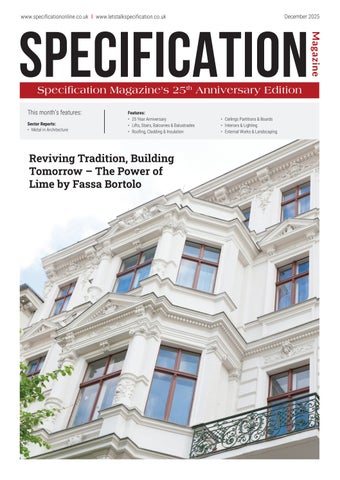
Reviving Tradition, Building Tomorrow – The Power of Lime by Fassa Bortolo
• Ceilings Partitions & Boards • Interiors & Lighting • External Works & Landscaping
Magazine
SPECIFICATION
WE'VE HIT THE 'VERY SEVERE' MARK! Fassacouche launches the first-ever KIWA-accredited 'Very Severe' wind-driven rain category in BRE Report rt 262. Our long-awaited KIWA-certified, class OC W2 through-coloured render delivers superior protection at 15mm thickness. Proving that superior protection doesn't have to come at the expense of compromise. Tried. Tested. Certified. Fassa strong.
KIWA BDA Certified for 'Very Severe' wind-driven rain conditions 15 mm render thickness minimal, efficient protection 23 stunning shades Multiple finishes: scratched, floated, sponge-floated & smooth
Discover more at www.fassabortolo.co.uk or call 01684 218 305 Enquiry 1
Welcome
PROVEN PUMPING SYSTEMS RIGHT FIRST TIME!
Welcome UK architecture shows renewed strength
T
he Royal Institute of British Architects (RIBA) has published its annual Business Benchmarking 2025 report.
Floor Mounted Lifting Stations
Using data submitted by UK-based RIBA Chartered Practices, the report tracks business trends in the twelve months to 1 May 2025, including revenue, expenditure, profitability, salaries, work types, and international activity. The full report is available exclusively to RIBA Chartered Practices.
Under Sink Wastewater Pumping Systems
This year’s findings show a profession delivering its strongest financial performance since before the pandemic, marked by strong revenue growth, rising profitability, and renewed confidence across much of the sector. While growth has been broad-based, much of the international expansion is driven by larger practices – with 83% of overseas revenue generated by those with 100 or more staff – while the smallest practices continue to face tougher trading conditions. RIBA President Chris Williamson said: “This year’s critical research paints an encouraging picture of a profession regaining strength, confidence and international reach. The record £5 billion in revenue – and the first meaningful rise in profits for some years– reflect architects’ adaptability and resilience in the face of persistent economic uncertainty and regulatory pressures. “It’s particularly encouraging to see renewed global momentum, with international work up by an unprecedented 67%, much of it from the EU. UK architecture continues to be a world-leading export and a vital part of our creative economy. But despite signalling the sector is on the right trajectory, there are also significant areas of concern. I know from speaking to many colleagues that some aspects of this survey will come as overly optimistic given current circumstances. Small practices especially, continue to work in a challenging market. Stagnant revenue and falling profit reflect the challenge of winning residential work with adequate fees. “There’s more work to do to close the gender and ethnicity pay gaps and I will work to ensure all RIBA members adhere to our pay policies. Thank you to every Chartered Practice that contributed their data. Together, we’re building an essential evidence base to help us champion and support the profession through both its continued growth and ongoing challenges.”
Self-contained Shower Sump Pump
Below Ground Pumping Stations
0118 9821 555
Experienced Support Team - Fast Response Specification - Right First Time Product Support - Nationwide POWERED BY
www.pumptechnology.co.uk www.jung-pumps.co.uk Aldermaston, Berks, RG7 4PW
Paul Groves || Group Editor Enquiry 2
3
sulator av e
In te a Pl
n sI
la su
Retro fit E
Retro fit W al l
Don’t just meet today’s standards — exceed tomorrow’s
Our retrofit eaves insulation solutions prevent damp formation, protect against rafter rot and deliver the compliance assurance your projects demand. Meet Awaab’s law standards through proactive hazard prevention Supports compliance with the Decent Homes Standard Suitable for PAS 2035 projects Structural integrity protection
Call now for more information 0113 252 9428
www.arcbuildingsolutions.co.uk Enquiry 3
tor
20
Magazine
SPECIFICATION
Contents
December 2025
www.specificationonline.co.uk ll www.letstalkspecification.co.uk
Specification Magazine's 25th Anniversary Edition
This month’s features: Sector Reports: • Metal in Architecture
Features: • 25 Year Anniversary • Lifts, Stairs, Balconies & Balustrades • Roofing, Cladding & Insulation
• Ceilings Partitions & Boards • Interiors & Lighting • External Works & Landscaping
Reviving Tradition, Building Tomorrow – The Power of Lime by Fassa Bortolo
8 News Reviving Tradition, Building Tomorrow – The Power of Lime by Fassa Bortolo
6 Latest News
Fassa Bortolo’s FassaLime range embodies the perfect harmony between tradition and sustainability. Featuring the Ex Novo line, these lime-based solutions are designed for restoration, conservation, and ecoconscious construction. Rooted in Bio Architecture, FassaLime promotes natural breathability, durability, and respect for the environment – creating buildings that stand the test of time, beautifully and responsibly.
16 Front Cover Spotlight
12 Project
27
Specification Magazine's 25th Anniversary Read on Page 21
Sector Reports 18 Metal in Architecture
68
See pages 16-17 for the details. Enquiry - 10
Features in Focus TSP Media Ltd, Grosvenor House, Central Park, Telford, TF2 9TW
52 Lifts, Stairs, Balconies & Balustrades
T: 01952 234000 E: info@tspmedia.co.uk www.tspmedia.co.uk
56 Roofing, Cladding & Insulation
Follow us @MySpecNews
66 Ceilings Partitions & Boards
Products in Focus
68 Interiors & Lighting
74 News & Developments
72 External Works & Landscaping
75 Building Services
5
News
Government urged to act now to make homes climate-resilient The Housing Commission of the Radix Big Tent think-tank have issued a warning to the government that without changes to the existing housing stock, the UK is risking a ‘health emergency’ as the climate becomes more unpredictable.
already been built and it is with these in mind that Radix Big Tent’s Housing Commission sets out a number of policy shifts required by the government in order to allow the housing sector to address issues with ‘retrofitting’ existing buildings.
Climate-related health factors are becoming more prevalent in the UK as, according to climate-management firm Tado, the country has the worst-insulated housing in Europe and leak heat three times faster than some European neighbours.
Radix Big Tent’s Housing Commission Chair, Alex Notay Hon MRTPI, said: “The government’s direction of travel - publishing the Healthy Homes Standard and enacting Awaab’s Law - has been broadly positive in ensuring residents do not suffer because of the places they live in.
But cold and the resulting damp is not the only factor raised as a threat - during the scorching heatwave of 2022, Britain saw nearly 3,500 excess deaths linked to high temperatures. The main risk factors here were age and house quality, with The Centre for Ageing Better predicting death counts will only rise. The Housing Commission noted in its 2024 report, Beyond the Permacrisis’, that poor housing costs society £18.5bn per year, with the NHS spending £1.4bn a year to treat the health-related effects of housing that is damp, too cold or too hot. The think-tank’s new Homes without Harm report points out that nearly 9 out of the 10 homes we’ll be living in by 2050 have
“However, the continued delays around the Future Homes Standard, Minimum Energy Efficiency Standards and revised EPCs are making the already complex challenge of ensuring homes are sustainable and affordable even more difficult when balancing the challenge of retrofitting and decarbonising existing homes with futureproofing new housing. “Our latest report suggests some key nudges to ensure progress towards net zero is maintained but not at the cost of quality homes for our citizens. “We strongly encourage the government to listen to the cross-sectoral voices we are providing here and take the steps needed to address homes that are causing harm.”
Green light for Science Park’s masterplan Hartwell Plc, the automotive and property development company, has received planning approval for its masterplan to deliver new carbon efficient laboratory and workspace buildings for small and medium sized science and technology companies and amenities at Wootton Science Park to the south-west of Oxford. Hartwell has owned the park since 1975 and built the first office building in 2005. The £44 million Scott Brownrigg-designed masterplan was submitted to Vale of White Horse District Council in May 2024. The approved masterplan will deliver circa 106,233 sq ft (9,869 sq m) across five new commercial buildings and connected amenities and facilities for future employees and the surrounding community, which will include high quality landscaped areas, secure bike storage, a bistro and gym.
First specialist centre for MND The new Rob Burrow Centre for Motor Neurone Disease at Seacroft Hospital in Leeds will become the first of its kind to offer specialist services for MND patients under one roof. Constructed by Yorkshire-based firm, I&G, part of the wider Sewell Group, the centre which is run by Leeds Teaching Hospitals NHS Trust provides a calm and peaceful environment for patients and was designed in partnership with the hospital’s clinical staff, patients, their families and the wider MND community. Named after rugby league legend, Rob Burrow CBE, who campaigned for MND after being diagnosed with the condition in 2019, the new centre is a fitting tribute to his memory.
6
To make an enquiry – Go online: www.enquire2.com or post our: Free Reader Enquiry Card
Enquiry 4
News
Study establishes a datadriven path to net zero for homebuilders
First Passivhaus apartment completed
The Future Homes Hub has released its Whole Life Carbon (WLC) Benchmarking Study for 2025, a landmark report addressing a critical knowledge gap in the UK homebuilding industry.
"This benchmark is a pivotal moment for the homebuilding sector. For the first time, we have a clear, data-driven picture of our collective starting point on whole life carbon.
For the first time, this study provides a vital, empirically grounded evidence base on the embodied carbon performance of new lowrise housing, guiding the sector’s collective transition to net zero.
“This isn't just about numbers; it's about providing the tools and transparency our industry needs to set ambitious targets, make smarter design choices, and track meaningful progress. We are immensely grateful to our members who contributed data, and we urge the entire sector to join us in building this evidence base for our shared net-zero future.
The homes form the first part of Adelphi Village, a main residential zone of the £2.5bn, 240-acre Crescent Salford masterplan being delivered by Salford City Council, the University of Salford and ECF – a joint partnership between Homes England, L&G and Muse. The new community will deliver a diverse range of housing to create a sustainable, inclusive neighbourhood, with plans recently submitted for 263 homes at Old Adelphi and 42 townhouses and 185 apartments at Farmer Norton.
The study’s core purpose is to create a robust snapshot of current carbon performance by analysing 48 detailed Whole Life Carbon assessments submitted by 17 industry partners. To ensure consistency, credibility, and comparability across the dataset, all assessments adhere to the rigorous standards outlined in the WLC Conventions for New Homes and RICS Professional Standard 2nd edition. This study is a testament to the power of industry collaboration. Its findings were made possible by the homebuilders and consultants who contributed their detailed project data and expert insights, demonstrating a shared commitment to transparency and progress. Adam Graveley, Head of Technical and Innovation, Future Homes Hub, said:
“This collaborative effort provides the essential foundation for the targeted actions needed to accelerate the sector's decarbonisation journey.”
Major milestones have been reached at Willohaus, 100 affordable, Passivhaus homes on Peru Street in Salford, with the completion of the brick exterior and the first apartment.
Salix Homes is the housing association partner for Willohaus, which has been designed by Buttress Architects and built by Eric Wright Construction. The one and two-bedroom apartments will be available for affordable rent, reflecting Salix Homes’ ongoing commitment to delivering muchneeded, high-quality, affordable housing.
This inaugural benchmark is not an endpoint but a critical foundation for future work. The Future Homes Hub will continue to gather data to refine these benchmarks and has identified several key opportunities for the sector to pursue collectively. To spearhead this agenda, the forthcoming Embodied Carbon Implementation Board will convene stakeholders from across industry and government, providing the leadership needed to dismantle strategic barriers and capitalize on these opportunities.
Plans for Glasgow mixed-use development Downing has submitted a planning permission application to redevelop 40 Anderston Quay, situated along the River Clyde in Glasgow. The project is designed to meet the growing need for high-quality student accommodation and co-living residential units in the local area. Formerly the headquarters for the Daily Record and Sunday Mail newspaper, the brownfield regeneration site is planned to include three blocks with a total of 1,135 bedrooms, alongside a 3,700 sq. ft commercial unit. Two of the blocks will accommodate Purpose-Built Student Accommodation (PBSA) units, whilst the third will be allocated for co-living use. All three blocks will have their own management suites, ancillary and amenity features, landscaping and extensive public realm.
8
To make an enquiry – Go online: www.enquire2.com or post our: Free Reader Enquiry Card
Enquiry 5
News
Small firms ‘overwhelmed’ by building safety regime Better communications and more consistent enforcement are needed to improve compliance with the Building Safety Act, according to speakers at the recent London Build Expo.
Olympia exhibition centre in London that 88% of the industry’s professionals were aware of the Act but most SMEs found the legislation “overwhelming and daunting” and felt “left behind”.
A lively panel session informed by new research from the Building Engineering Services Association (BESA) debated the need for more targeted information about the Building Regulations, stronger enforcement, and sector specific training to overcome the barriers to compliance reported by the SMEs and micro-businesses that make up 99% of the construction sector and its related professions.
“This is critical because those companies are the lifeblood of the industry,” said Davidson. “There are also a lot of people who still think the legislation only applies to HRBs (higher risk buildings).”
BESA’s director of specialist knowledge Rachel Davidson told the busy event at the
BESA’s second annual survey of the sector’s response to the legislation also showed that many clients were carrying on with “business as usual” meaning they continue to prioritise cost and speed over safety. “A lot of this comes back to leadership and culture,” said Davidson.
“78% of companies tell us that this is important to them but fewer than half report having taken enough action.” She said that building engineering contractors were increasingly calling for clear and consistent enforcement of the legislation because “unless there are consequences, clients will continue to think compliance is optional”. Davidson added that BESA was delivering more guidance to help firms see “what good looks like” in their sector. “It is also important to reassure people that they don’t need to know or understand everything about the Act – they should focus on the parts they can control and their specific roles and responsibilities.”
Landmark new residential development The Hill Group is starting construction work on Little Chalfont Park, a landmark new residential development that will deliver up to 380 high-quality new homes and a wealth of green open space in the sought-after village of Little Chalfont, Buckinghamshire. This key milestone follows the recent approval of the first Reserved Matters Application, covering the Western Parcel of the site accessed from Burtons Lane. This first phase includes 74 new homes, extensive green spaces, infrastructure works and the start of construction of the pedestrian and cycle bridge providing direct access to Chalfont and Latimer station. The homes in the first phase, with a development value of £78.5 million, include a collection of three, four, and fivebedroom houses for private sale and shared ownership, all designed in a traditional style that blends seamlessly with the local setting.
First Nest Houses land in Scotland The first life-changing homes land at Harriet Gardens, the newest purposebuilt supported accommodation village by Social Bite, in partnership with South Lanarkshire Council and Salvation Army. The arrival of the modular Nest Houses marks the next stage of construction as the project progresses towards an opening date in early 2026. Upon completion, the £3m village
10
will have 15 modular Nest Houses and a community hub with shared cooking facilities, spaces for group activities, therapeutic support, and areas for social connection. Day-to-day running of the village will be supported by financial contributions from South Lanarkshire Council and Social Bite and managed by the Salvation Army, who will deliver specialist, round-the-clock support.
To make an enquiry – Go online: www.enquire2.com or post our: Free Reader Enquiry Card
News
Titon’s Compact, Efficient and Powerful MVHR Range ● 600 mm wide – big performance in a small footprint
● Airflow up to 158 l/s (568 m³/h) at 100 Pa – built for serious ventilation ● Up to 91% heat recovery efficiency – save energy without compromise ● Ultra-low Specific Fan Power – down to 0.38 W/l/s for outstanding performance ● Unhanded – flexible to your installation needs
HRV4/4.25
HRV1.6
HRV1.35
Smart design | Powerful performance | Minimal space www.titon.com Enquiry 6 Titon Specification Dec 25 A5 H.indd 1
08/12/2025 16:33:26
Make interior films part of your design toolkit. Get your hands on samples, brochures and case studies - introduce the world of interior films into your designs. Order your FREE Architextural Specification Box today at www.architextural.co.uk
Order now!
Tel: +44 (0) 1833 690305
Email: info@architextural.co.uk Enquiry 7
11
Project
Project: The Northcliffe Architects: John Robertson Architects Suppliers: ASWS; Optima; OAG; Granada; Tyrell; Sortfords; Kone
Preserving heritage and delivering excellence at The Northcliffe The Northcliffe is the Grade II listed former Daily Mail headquarters in London’s Whitefriars Conservation Area which has been reimagined by John Robertson Architects.
T
he Northcliffe is a historically sensitive reimagining of the former headquarters and print works of the Daily Mail newspaper in Tudor Street, close to Fleet Street, in the City of London.
JRA’s redesign incorporates the Grade II Listed façade of the original 1920s building, and extends the building across two floors to offer 17,344 m2 of office space centred around a spectacular reimagined atrium. The Northcliffe is WELL Ready and offers extensive amenities, including three new landscaped roof terraces, lounge spaces, a library area, a quiet room, end-of-trip facilities, a café and a retail unit, all unified by references to the building’s post-industrial heritage. pattern, and high quality, crafted finishes. The atrium is the central feature of the building, around which the office floors and key circulation routes are organised. It provides natural daylighting for the office spaces and visual interest at the heart of the workplace. It is an integral part of the user and visitor experience, with a feature stair located at ground floor level connecting the lower ground floor to the main entrance hall.
JRA’s design achieved BREEAM ‘Outstanding,’ which less than 1% of refurbished buildings have achieved to date, and is certified EPC B. The project saved 53% of global warming potential versus demolition by retaining the superstructure and building fabric, and exceeds RIBA’s 2030 embodied energy emissions targets. The practice’s sustainable approach has been informed by a Life Cycle Assessment (LCA) commissioned by the Client. The extensions at the upper two levels step back from the Daily Mail façade, allowing for three new south facing ‘green’ roof terraces to be formed at levels 5, 6 and 7. These new ‘green’ terraces link with the existing terrace on Bouverie Street and Whitefriars Street and
12
are wide enough to provide usable external landscaped terraces for occupiers. The main entrance of the building has been relocated, placed centrally on Tudor Street and within the original Daily Mail façade. It marks a new era for the building and draws users and visitors alike into the heart of the revitalised, hospitality style reception. The interior design is inspired by the rich history of the 1920s, focusing on strong geometries, bold use of colour and
The Grade II listed façade was designed by Ellis and Clarke in 1925, with the addition of the recessed façade and turret at level four in 1929. The building was constructed using a cast steel frame with the external elements encased in concrete to support the walls and ties for the precast cladding of ‘Atlas White’ Portland cement stone and the fashionable neo-Egyptian style decorative features such as the fluted coved cornice above the third floor. It made liberal use of Crittall’s minimalist W20 section galvanised steel windows with copper-lite glazing, giving the first and second floors an almost fully glazed appearance. >>
FIRE-RATED, LAMINATED, ACOUSTIC, TOUGHENED & MIRRORED GLASS
THE FUTURE OF FIRE & SAFETY GLASS
WE PROTECT WHAT MATTERS We’re huge stockists of fire and safety glass, offering fast delivery from local branches. Our team provides technical help and specification support, with options for supply-only or supply-and-fit to suit your project and budget needs.
#TRUSTTHEEXPERTS FAST DELIVERY FROM OUR WELL-STOCKED LOCAL BRANCHES
MIDLANDS 0121 667 9089
CONNECT WITH US:
NORTH 0161 532 8371
Enquiry 8
SOUTH 01206 805 922
WEST 01174 528 800
SCOTLAND 0131 526 4141
INSTALLATION 0121 667 9089
0121 667 9089
WWW.FIREGLASSUK.COM
Project
>> Levels five, six and seven feature landscaped terraces that utilised 8,163 plants made up of over 55 species to create a country garden experience, enclosed by glass balustrading and perimeter planting. The terraces have been designed to provide a variety of spaces in which to work, relax and ‘to do more’. The terraces at level five and six have been demised to the adjacent office tenant and the level seven terrace is an amenity for the whole building. Responding to the climate crisis was a priority at The Northcliffe. A Life Cycle Assessment was conducted to ensure the client’s sustainability goals were met. The LCA confirmed the benefit of retaining the superstructure and building fabric, saving 53% of global warming potential versus demolition. The building possesses 40m2 of solar panels, 910m2 of landscaped terraces with biodiverse planting, 345 cycle spaces and extensive premium end of trip facilities. In use, all waste is diverted from landfill, the building is powered by 100% renewable electric energy and has greater than 55% more efficient water consumption. In addition to BREEAM ‘Outstanding,’ the building is certified EPC B and the design exceeds RIBA 2030 targets for sustainability.
ASWS conducted a full condition survey across the building’s complex elevations, internal doors, and screens – covering steel, aluminium, and curtain walling. This detailed report formed a key part of the tender process and set the foundation for the restoration strategy. ASWS Operations Director, Kris Bennell, described the scope: “For the steel windows, we carried out full servicing and detailed cleaning of the original copper light glazing, along with redecoration and overhaul of all ironmongery. On-site, we completed extensive mastic work and redecoration across the remaining windows which included timber sashes.” JRA Associate Andy Thomas highlighted the architectural significance of the copperlight windows, which were retained as a key interior feature. He praised ASWS’ role in restoring these elements and managing the sequencing of works with precision. ASWS’ contribution was instrumental in helping the project team meet its sustainability goals. By restoring and reusing original components wherever possible, The Northcliffe is now on track to achieve a BREEAM Outstanding rating – placing it among the top 1% of commercial refurbishments in the UK.
14
To make an enquiry – Go online: www.enquire2.com or post our: Free Reader Enquiry Card
ALIDECK - RAISING THE STANDARD IN BALCONY DESIGN When it comes to balcony safety, there’s no room for compromise. The Building Safety Regulator (BSR) is setting a new benchmark for accountability, compliance, and long-term performance and AliDeck is leading the way. We’re proud to be the only UK balcony manufacturer with QUALICOAT accreditation, the global quality mark for aluminium powder coating. This certification confirms that our in-house finishes meet the highest international standards for durability, corrosion resistance, and weather protection. It’s proof of our commitment to quality — not just in words, but in verified performance. ✔ Only balcony manufacturer with QUALICOAT accreditation ✔ BSR-compliant non-combustible systems ✔ Made in Britain certified ✔ 30-year product warranty
AliDeck - where compliance meets quality.
Call: 01622 534077 info@alideck.co.uk www.alideck.co.uk/spec Enquiry 9
LEARN MORE about our Qualicoat process - SCAN HERE!
Front Cover Spotlight
Building with Nature: FassaLime and the Ex Novo Commitment to Bio Architecture In a world increasingly focused on sustainable development, Fassa Bortolo continues to lead the conversation with its FassaLime range. A collection of lime-based systems designed to respect the environment, preserve architectural heritage, and deliver exceptional building performance. Rooted in centuries-old craftsmanship yet guided by modern science, FassaLime embodies the company’s philosophy of creating harmony between tradition, innovation, and the natural world.
A
t the heart of the FassaLime line are its carefully developed cycles, each tailored to meet the needs of restoration, conservation, and ecoconscious construction. These lime-based solutions are not simply products, but complete systems that work in synergy - from mortars and renders to finishing coats, to ensure durability, breathability, and authenticity. Each cycle within the FassaLime portfolio is designed to enhance the natural performance of historic structures while providing sustainable alternatives for modern builds.
Among these, the Ex Novo range stands out as a perfect example of Fassa Bortolo’s dedication to both preservation and progress. Ex Novo is a specialist line developed to restore, conserve, and protect historic buildings, allowing their beauty and integrity to endure for generations to come. Using natural hydraulic lime (NHL) and selected raw materials, the products in the Ex Novo range mirror the original materials used in traditional architecture while offering the consistency, reliability, and technical performance expected of modern formulations.
16
The genius of Ex Novo lies in its ability to balance authenticity with innovation. Its products allow buildings to ‘breathe’, facilitating the natural movement of moisture through the walls; a critical factor in maintaining structural health and avoiding the trapped dampness that can result from cement-based materials. In doing so, Ex Novo supports the intrinsic sustainability of traditional construction, reducing the need for frequent repair and minimising environmental impact over the building’s lifetime. This focus on Bio Architecture, an approach that places the health of people and the planet at the core of design and material choice, defines the ethos of Fassa Bortolo. Every FassaLime product is created with full respect for natural cycles, utilising lime sourced and processed through low-impact methods that reduce carbon emissions and energy consumption. The brand’s research and innovation teams continue to refine these formulations to align with global environmental standards and sustainable building certifications.
Beyond material performance, Fassa Bortolo’s vision extends to the cultural and ecological value of construction. The company recognises that architecture is more than the sum of its materials; it reflects the communities and landscapes that surround it. By combining ancient knowledge with modern expertise, FassaLime allows architects, designers, and conservation specialists to work in harmony with nature - preserving the past while building responsibly for the future. With FassaLime and Ex Novo, Fassa Bortolo reaffirms its position as a pioneer in sustainable building technology. Proving that when innovation is guided by respect for history and the environment, truly timeless architecture can be achieved. To find out more on our FassaLime cycles and Ex Novo products, please call 01684 218305 or email info.fassauk@fassabortolo.com Fassa Bortolo – Enquiry 10
To make an enquiry – Go online: www.enquire2.com or post our: Free Reader Enquiry Card
FassaLIME
SUSTAINABILITY: OUR COMMITMENT Recycling and recovery of materials
WATER RESOURCES MANAGEMENT
Bio-Architecture SUSTAINABLE BUILDING product environmental Footprint assessment
waste management
Sustainable architecture and environmental issues have become rooted in popular culture and the work of building professionals. Sustainable building means promoting ecological awareness through the image of the building, with its features being related to its relationship with the environment.
ENERGY AND EMISSIONS
Sustainable building means reducing environmental impact and setting energy efficiency as design goals, improving the health, comfort and quality of life of inhabitants, objectives that can be achieved by incorporating appropriate structures and technologies into the building.
Efficiency and circularity are key issues when it comes to sustainability. At Fassa Bortolo we are committed to optimising the use of resources, reducing waste and promoting a circular economy in the building industry. Only through responsible business practices can we create a better future.
TO FIND OUT MORE about Fassa Bortolo and its range of render systems and building products. Visit www.fassabortolo.co.uk or call 01684 218 305 Enquiry 11
Sustainable building means managing a building that satisfies the needs and demands of its owner, taking into account natural rhythms and resources right from the initial stages of the project, without causing damage or inconvenience to others and the environment, striving to fit harmoniously into the context and thus also thinking about the ability to totally reuse spaces and materials.
Metal in Architecture
State-of-the-art university campus created at iconic Art Deco store City Campus is a vibrant new hub in the heart of Gloucester. The former Debenhams site has been transformed into a state-of-the art centre for teaching, learning and community services.
H
owells Patent Glazing was tasked with supplying five bespoke rooflights and two areas of mono pitch glazing for this iconic building. University of Gloucestershire purchased the site in 2021 and has subsequently been working with main contractor, Morgan Sindall and project architect, ADP Architecture to create a home for the University’s Education, Psychology and Social Work programmes and shared public access facilities. The site includes a Victorian wing and sections dating back to the 1930s and 1950s, meaning the transformation has been complex – combining heritage preservation and progressive development. For Howells, City Campus is the largest and one of the most challenging projects in the company’s 50+ years history, as business development manager, Tracey Jackson Howells Patent Glazing
18
Howells Patent Glazing
explains: “This was an incredibly complex yet rewarding project. The biggest challenge was the size and weight of the glass combined with the building’s city centre location which created access, material handling and storage issues.”
“The existing building had a floor plate that was too deep for an educational environment, making it difficult to bring daylight into the centre,” comments Natalia Lopez, Associate Director, ADP Architecture Ltd. “With only a few existing rooflights located above the third floor, natural light was unable to reach the lower levels effectively. To address this, new rooflights and openings were introduced across all floor plates, enabling daylight to penetrate the central social learning spaces and classrooms, and even extend down into the basement.” Howells advised ADP Architecture and Morgan Sindall on the most appropriate rooflighting solution. Following a site survey, Howells confirmed design and installation of two hip-ended rooflights, two self-supporting octagon rooflights, two areas of mono pitch glazing and one tapered ridge rooflight. Due to their size, Howells appointed a structural engineer to complete structural calculations for each rooflight to ensure the aluminium bars could withstand the weight of the glass plus any imposed loadings, such as wind and snow. The fabrication team strengthened the glazing bars based on these calculations adding steel inserts. This also increased their span capabilities. One of the hipended rooflights measures 3.2 metres
Metal in Architecture
Howells Patent Glazing
long by 6.3 metres wide and is the largest rooflight manufactured by the Black Country-based specialist. To guarantee a precise installation, this rooflight and a slightly smaller version were built-up in the factory before being dismantled and sent to site. The tapered ridge rooflight proved very interesting. The ridge went from 5.1 metres to 4.3 metres wide along its 12.5+ metre length and dropped by around 24.5 centimetres. This presented all sorts of challenges many of which had to be addressed at both the design and fabrication stages. Shaped glass is used throughout. The two self-supporting octagonal rooflights replaced one smaller rooflight which had sat above the former Debenhams central atrium and two new areas of mono pitch glazing were added. Each bespoke aluminium rooflight is powder coated in Black Grey RAL 7021 in a matt finish, both inside and out. “Daylight is fundamental to the success of the building, shaping not only its environmental performance but also the quality of its internal spaces,” concludes Natalia Lopez, Associate Director, ADP Architecture. “Ultimately, it is the presence of daylight that enables the building to feel open, connected, and alive.”
19
Metal in Architecture
Anodised blade wall ensures lively façade In the spring of 2022, the new Dutch Galapagos headquarters opened its doors at the Leiden Bio Science Park (NL). The impressive 17,000 m² building, combining office and laboratory spaces, owes much of its architectural character to the plinth and rooftop structure clad in Linius, Renson’s horizontal façade cladding system.
T
he brushed and anodized finish of the aluminum blades brings vibrancy to the façade. Special laser-cut combs integrated into the carrier profiles add an extra layer of functionality: fall protection for visitors in the parking garage. This clever solution eliminated the need for traditional, visually intrusive fencing and guardrails. Both the client and the architect deliberately opted for anodized blades. “Purely for aesthetic reasons,” explains Koos Zwitser, Project Manager at OZ Architects. “We wanted to create liveliness in the façade. Powder-coated cladding tends to look too uniform and sterile.
the fact that the anodizing process is less harmful to the environment than powder coating was a welcome bonus.” Façade contractor Storax brushed and anodized the Linius blades and installed the entire system, including the integration of around fifteen door constructions.
“The final result with brushed, anodized blades has received unanimous positive feedback. Mission accomplished. And
Find out more at www.renson.net Renson – Enquiry 12
Maximum design freedom for the façade – Kalzip Flexform The design of the façade plays a central role in architecture, as it not only shapes the external appearance of a building but also fulfils functional, cultural, and communicative roles.
W
ith the Kalzip FlexForm® façade, Kalzip is launching a new generation of meander façades that offer architects and planners maximum creative freedom. This innovative system is a logical further development of the proven TF800R façade. The folded aluminium profiles enable relief-like structures, clean lines, and rhythmic façade compositions— from serial grid solutions to individually modelled surfaces. With the new Kalzip FlexForm® façade, the Koblenz-based company provides a selection of technically tested profile shapes for efficient planning and reliable execution. For bespoke design requirements, the Kalzip FlexForm® Ultra façade offers a solution in which architects can define their own profile shapes with variable angles, depths, and pitches. Kalzip supports this process with technical consulting, feasibility studies, sampling, and project-specific manufacturing.
20
The new system is also available in a wide range of high-quality surfaces and colours. These include the AluPlusPatina surface finish, which provides an elegant, matte metallic appearance in bronze, copper, and gold tones. A high-performance coating (HPC) option is also available, allowing colours and gloss levels to be freely selected. The HPC coating provides excellent UV and weather resistance.
This ensures that every façade can express material culture, value, and identity. As with every Kalzip product, the new façade solution stands for responsible construction: the profiles are made from up to 95 per cent recycled aluminium of European origin and can be completely recycled back into the material cycle. Kalzip – Enquiry 13
www.specificationonline.co.uk ll www.letstalkspecification.co.uk
April 2023
Magazine
SPECIFICATION This month’s features: 5GEVQT 4GRQTVU • Hotel, Sport & Leisure • Offsite Construction
(GCVWTGU • Lifts, Stairs & Balustrades • Ceilings, Partitions & Blinds • Timber for Specifiers
Specification Magazine's 25th Anniversary
5RGEKƒECVKQP /CIC\KPG
A fresh angle on decorative casings from Encasement
• Paints, Stains, Coatings & Linings • Bricks, Blocks & Lintels • External Works & Landscaping
25 ANNIVERSARY EDITION TH
Perfect partners for Low Temperature Heating
For the widest range of Low Temperature Heating Solutions, it has to be MYSON
Tailored Solutions for Low Temperature Heating Heating systems are increasingly being designed with lower flow temperatures to help decarbonise buildings. To maximize impact, it‘s crucial to choose the right heat emitters and user-friendly controls for precise temperature management. As a total solutions provider, Myson has carefully created a complete range that caters to all needs. Ranging from hydronic and electric radiators to underfloor heating, heating valves and electronic controls, all products are designed to offer the highest levels of comfort and efficiency. www.myson.co.uk Enquiry 14
Explore our solutions
A quarter of a century of innovation and collaboration
T
25 Year Anniversary Edition
Welcome
racing the history of Specification Magazine has been an illuminating experience and unsurprisingly it runs parallel with the development of the industry as a whole.
As a flagship, product-based publication of TSP Media’s portfolio of titles, Specification has accurately traced the significant changes that have shaped the industry in the last 25 years and also previewed many of the innovations that have taken it in new and exciting directions. The team at TSP Media is delighted to welcome you to our special anniversary supplement, which highlights many of the companies who have spearheaded change and innovation over the last two decades and more, as well as many of the industries bodies and trade organisations which have played an active role in improving the built environment in the UK and beyond. We will highlight how product development has played a crucial role in making the industry leaner, more efficient, sustainable, futureproofed and above all better equipped to provide the developments and schemes the country needs. Specification has played its part in that progress. As a dynamic, multi-media and multi-channel publisher we have developed a set of information resources that still has the printed magazine at its heart but also offers a wide variety of professional and industryleading options to do what we have always done best – get the right information to the right audience. A week remains a long time in politics, but arguably with the advent of new technology literally changing the way we access information on a daily basis then 24-hours can often be a lifetime in publishing. But TSP Media and Specification continue to evolve and adapt, which is why celebrating 25 years at the leading edge of the industry is such a landmark worth celebrating. The industry has undergone seismic change in recent years and we continue to reflect that every month in the magazine and every day through our website. We will continue to act as a vital information resource for the industry and are already making plans for the next 25 years.
Paul Groves || Group Editor
23
Roofing
25 Year Anniversary
Roofing at the heart of change in construction Build UK Chief Executive Suzannah Nichol MBE has stressed that construction remains central to the government’s economic plans.
W
hile ambitions such as building 1.5 million homes may seem unrealistic to many, she explained that the ambitious goal puts construction “at the heart of government.” The NFRC continues to underline roofing’s critical role in the wider construction landscape. Whether it is providing skilled contractors for housing delivery, expertise for retrofitting the UK’s draughty housing stock, or trusted products and installation in the push for energy efficiency, NFRC Trade and Supplier Members are uniquely placed to deliver. As the UK navigates political change, economic uncertainty, and urgent environmental goals, NFRC will continue to champion Members, push for fair and consistent standards, and ensure the roofing sector has a strong and united voice at the table. This years has seen CIOB, in collaboration with NFRC, launch a brand-new Roofing Chartered Membership Programme (CMP) – a dedicated route for experienced roofing professionals to achieve Chartered status (MCIOB). The Roofing CMP marks an exciting milestone for the roofing sector, providing a tailored pathway to professional recognition through the CIOB. The programme is designed for individuals with at least five years' experience in roofing who manage people, processes, or projects, offering the opportunity to gain professional accreditation that their skills knowledge and leadership within the industry.
24
"It’s a significant step forward in recognising roofing as a professional discipline in its own right." James Talman, CEO, NFRC
Programmes such as the new Roofing CMP are becoming increasingly important as proof of competency requirements under the Building Safety Act 2022 (BSA) come into force. James Talman, CEO of NFRC, added: “This collaboration with CIOB gives our members a unique opportunity to gain Chartered status through a programme designed specifically for their expertise. It’s a significant step forward in recognising roofing as a professional discipline in its own right.”
A.Proctor Group
There has never been a more important time to deliver innovation in construction products Looking back at the last 25 years, we can trace many changes to energy efficiency regulations. We can highlight the evolution of important standards like BS 5250. Above all, we can see how our climate has changed in that time.
W
e also understand how the climate is likely to continue changing. That means we can, and should, be creating products capable of dealing with the increased frequency and intensity of extreme weather. In other words, innovation is vital to futureproofing buildings.
As a 4th generation family business, Proctor Group has a history of technical innovation, promoting good practice, and developing products that roofing contractors want to use. We applied this wealth of experience to creating our air permeable and vapour permeable (APLR) underlay, Proctor Air®. Hidden from view, pitched roof underlays usually warrant little attention from building users. Yet they play a vital role in protecting those users from the elements, and from unhealthy indoor climates. By choosing and installing Proctor Air, specifiers, contractors and building owners can enjoy the confidence that comes from a high-performance product doing its job without intervention. Proctor Air’s water resistance has been tested and, having a water hold out performance of more than a 1m head of water, meets the guidance of the NFRC’s Technical Bulletin TB06. While stopping external moisture getting in, a low resistance underlay must also allow water vapour out. Since Proctor Air permits the passage of both air and moisture vapour through the roof construction, no VCL is
required in the ceiling and no ventilation measures are required in the cold roof space. Avoiding the need for ventilation – particularly at the eaves – helps when it comes to installing the substantial thicknesses of insulation required in lofts. With the impending introduction of new energy efficiency regulations,
those thicknesses may well increase. Rooftop solar is also expected to be made compulsory as part of the Future Homes Standard in England. We have recently published industry-leading research demonstrating the compatibility of Proctor Air with integrated PV panels. Confusing technical guidance made specifiers and housebuilders unwilling to use the two together. Our recommendation gives the roofing sector the confidence it needs to fully embrace new solutions. There has never been a more important time to deliver innovation, and Proctor Air is an underlay that makes pitched roof constructions simpler while delivering performance ready for the future. Find out more: https://proctorgroup.com/ products/proctor-air A.Proctor Group – Enquiry 15
25
Lifts
25 Year Anniversary
Trade event attracts record numbers as industry embraces significant changes A clear indication of the strength of an industry and product market is often seen in the success of related trade events.
L
IFTEX, the triennial trade show run by the Lift & Escalator Industry Association (LEIA), attracted record attendance when it took place at London’s ExCeL this year, bringing together 4,400 industry professionals from more than 40 different countries. Now in its 37th year, LIFTEX is the UK’s dedicated exhibition for the lift, escalator and access industry and welcomed visitors from as far afield as Hong Kong, the UAE, India, South Korea, Japan, China and the USA. The show also featured exhibitors from 12 different countries. Attendees ranged from lift consultants and specifiers to property owners, facilities managers, and building designers and many from the industry – all with a common goal of making vertical transportation safer, smarter and more efficient. LIFTEX Show Director Oliver Greening commented: “The atmosphere at this year’s show was incredible. We saw engagement across the board from both visitors and exhibitors. What sets LIFTEX apart is its ability to unite the entire industry, not just to conduct business, but to share knowledge and actively shape the sector’s future. This year’s record-breaking
turnout confirms how vital the show is to the market. While the show’s international participation grows, LIFTEX still retains a strong UK focus.” This year LEIA embarked on “Recalibration 2025”, a year-long initiative to shape the support and services provided by their association. Recalibration 2025 was launched at the LEIA Council meeting in London in February where significant time was set aside for focus group discussion. Representatives from the LEIA management board, member companies and association staff engaged in deep conversation on topics including, business needs, association services and members’ relationships with the association. Nick Mellor, LEIA’s managing director said “It’s important to ensure the association is delivering the leadership, support and guidance members need to prosper in uncertain times. We can only achieve this by actively engaging with all our members to better understand their current concerns, needs and ideas – it’s time to recalibrate.”
"What sets LIFTEX apart is its ability to unite the entire industry, not just to conduct business, but to share knowledge and actively shape the sector’s future." Oliver Greening, LIFTEX Show Director
26
To make an enquiry – Go online: www.enquire2.com or post our: Free Reader Enquiry Card
Stannah Lifts
Lifts that make a difference From revitalising step free access in heritage spaces to improving safety and accessibility in some of the UK’s most iconic locations, Stannah Lifts has played a key role in a range of prestigious projects.
Welcome Break Ben Harrison Photography
The Creamery
W
hether balancing old and new at the Creamery, delivering a seamless multi-lift solution at Welcome Break’s latest service station, or improving engineer access inside Big Ben, Stannah Lifts continues to showcase its vast expertise. The Creamery Once a dairy processing local farmers’ milk into cheese for transport to London in 1912, the Creamery has been reconstructed by Ken Biggs Contractors as a vibrant hub with a restaurant and shop celebrating its past. A standout feature is the bespoke all-glass lift installed by Stannah Lifts with Stonewood Design, using bespoke German glass from Gemtec. Handrails were discreetly integrated into the glass panels without corner trims, and the keyhole for operating the lift doors was repositioned to align with the minimalist aesthetic, all contributing to a seamless and elegant design. Signal issues inside the lift shaft were resolved with a GSM package and antenna, ensuring reliable operation. This project stands out for its careful balance between heritage preservation and modern functionality, allowing all visitors to experience a piece of local history.
Welcome Break Welcome Break’s 60th Yorkshire village inspired service station features a multi-lift solution from Stannah Lifts ensuring smooth movement of visitors and goods. Stannah Lifts installed a 13-person MRL traction passenger lift to improve accessibility for wheelchair users, families with prams and those with reduced mobility. It provides energy-efficient travel with VVVF drives, LED lighting and remote monitoring. The A2C escalator supports visitor flow with a wide step, durable glass balustrade and energy-saving slow-down mode. Back of house, Stannah Lifts proposed a 1,000kg Goodsmaster goods lift to ensure safe transport of goods between floors, improving workflow and reducing manual handling risks.
Working with Sir Robert McAlpine Special Projects and SVM Associates, Stannah Lifts designed two bespoke lifts to install inside the tower’s unused 11.7m² ventilation shaft, overcoming tight space and the 0.23-degree lean with a compact 500kg hydraulic lift for the final ascent. Winners of the RIBA London Award and Elevator World’s Project of the Year Award, Big Ben was also shortlisted for RIBA’s 2025 Stirling Prize. For more information on lift solutions, visit: www.stannahlifts.co.uk Stannah Lifts – Enquiry 16 Big Ben
This coordinated approach delivered all three lift solutions seamlessly ahead of schedule, ensuring reliable and efficient movement throughout Welcome Break’s first new service station in two decades. Big Ben Built in 1859, Big Ben has faced more than 160 years of wear. During its first full restoration, Stannah Lifts was tasked with creating safe lift access for engineers without disturbing the tower’s historic fabric. Previously, the only route up was a narrow 334-step spiral staircase, posing safety risks and making transporting equipment difficult.
27
Doors
25 Year Anniversary
Raising awareness of the importance of standards and certification The Door & Hardware Federation (DHF) is a not-for-profit trade association for over 500 members and is the ‘go to’ place for technical advice and training which lends itself to raising the standards of the industry.
I
t is regarded as the ‘Centre of Excellence’, with a network of professional staff members as well as external consultants that can provide support in all sectors, making us a single source for technical expertise, information, knowledge, advice, and practical help. As a federation, it supports various industry sectors by representing them on BSI standards committees, liaising with compliance authorities such as the Health & Safety Executive
"We will continue to raise awareness of the crucial role that fire doors play in saving lives and protecting property" Patricia Sowsbery-Stevens, Director of Commercial Operations, DHF
28
(HSE) and Trading Standards as well as fire safety organisations across the UK and Europe. DHF once again endorsed its commitment to fire safety by supporting Fire Door Safety Week, the national awareness campaign first launched in 2013 in response to widespread neglect of fire doors. For a fire door to perform effectively, every stage must be right. From correct product manufacture and quality standards to proper installation and ongoing maintenance, the detail matters. How fire doors are specified, managed and used can quite literally mean the difference between life and death for building occupants. Something as simple as propping a fire door open can prevent it from doing its job in the event of a fire. Responsibility does not lie with one group alone, however. Manufacturers, installers, building owners and users all share the duty of ensuring fire doors remain fit for purpose. This principle of shared responsibility is the driving force behind Fire Door Safety Week. DHF has also partnered with BRE to deliver a series of one-day training courses on fire door safety, inspection and ongoing maintenance. DHF’s Director of Commercial Operations, Patricia Sowsbery-Stevens, said: “Through our guidance work, industry partnerships and training initiatives, we will continue to raise awareness of the crucial role that fire doors play in saving lives and protecting property.”
To make an enquiry – Go online: www.enquire2.com or post our: Free Reader Enquiry Card
GEZE UK
GEZE UK: 25 Years of Innovation and Intelligent Building Solutions Having partnered with Specification Magazine for many years, GEZE UK is proud to celebrate with them on their 25th anniversary.
D
uring the last 25 years, we’ve witnessed first-hand the rapid transformation of the door, window and access control sectors, to which GEZE UK has constantly evolved. From humble beginnings supplying door closers to becoming a leading provider of integrated door, window and safety systems, our journey has been defined by innovation, quality and partnership. From Mechanical to Intelligent Systems When GEZE UK was first established back in 1988, the focus was on durable mechanical products. Today, our solutions connect doors and windows into intelligent building systems, balancing accessibility, safety and energy efficiency. Automatic sliding, swing and revolving doors, access control integration and window automation are now part of complete smart-building solutions that help architects, contractors and facility managers deliver safer, more efficient environments. Growing with Our Customers Since our inception, GEZE UK has grown from a small team to a national operation with regional offices, a dedicated service division and expert specification support. This expansion reflects our commitment to being more than a supplier - we’re a consultative partner throughout the entire building lifecycle, from design to aftercare. Andy Howland, Sales & Marketing Director, said: “GEZE UK’s success has always been about people — our team, our customers, and the long-term relationships we’ve built. From those early days to the intelligent
systems we deliver today, we’ve grown together with the industry and stayed true to our values of quality, service and partnership.” GEZE UK is proud to have supplied products for many prestigious global projects, across multiple sectors, including; healthcare, education, hospitality, retail and commercial; helping our clients navigate evolving regulations on fire safety, accessibility and sustainability. Commitment to Quality and Sustainability Excellence and responsibility have always been at our core. GEZE UK was among the first in the industry to achieve ISO 45001:2018 for Health & Safety, alongside ISO 9001 and ISO 14001. Sustainability is embedded in everything we do – from product design to operations. Our parent company’s EcoVadis “Committed” sustainability rating underlines our dedication to responsible innovation and continuous improvement.
We also recently won ‘Fire Door Product of the Year’ at the National Fenestration Awards for our ‘Slimdrive EMD-F Powered Swing Door Drive System’, highlighting our commitment to quality, performance, and innovation that underpin all GEZE products. Smarter Service and Support Even the smartest technology needs the right support behind it. GEZE UK’s service division ensures that every system, new or old, continues to perform safely and reliably long after installation. Our engineers work across the UK to keep doors, windows and access systems operating smoothly, helping clients meet compliance requirements and maintain safe, accessible environments. For us, great service isn’t just about fixing problems, it’s about giving customers confidence that their buildings work exactly as they should, every day. Looking Ahead With GEZE recently celebrating more than 160 years globally, GEZE UK remains focused on shaping the future of building automation. From cloud-connected control platforms like myGEZE Connectivity to energy-efficient systems that support smart building management, our vision is to create safer, healthier and more liveable spaces. Andy Howland, Sales & Marketing Director, added: “We’re proud of what we’ve achieved in the past 25 years – but we’re even more excited about what’s next. Together with our partners, we’ll continue to open doors to innovation, sustainability and smarter buildings for generations to come”. To learn more about GEZE UK: Website: www.geze.co.uk Email: info.uk@geze.com GEZE UK – Enquiry 17
29
Glass & Glazing
25 Year Anniversary
The importance of meeting regulations As part of its mission to ensure consumer safety and product compliance across various industries, the Office for Product Safety and Standards (OPSS) plays a critical role in regulating products within the UK market.
30
perating under the Department for Business and Trade (DBT), the OPSS oversees a wide range of sectors, from construction products to consumer goods and environmental regulations.
O
meet regulatory standards and continuously improve their product offerings. The GGF fully supports the OPSS inspections, as they present an essential opportunity to strengthen compliance and promote higher standards in the sector.
Recently, the OPSS has ramped up its inspections in the glass and glazing sector, with a specific focus on heat soaked thermally toughened glass. This increased level of scrutiny represents a significant development for the industry.
We are aware that several of our members have already been inspected and we’ve also received inquiries from non-members about these inspections. This shows that the message is reaching a broad audience and that the industry is taking compliance seriously.
In this context, the Glass and Glazing Federation (GGF) has been instrumental in supporting the OPSS’s efforts. The GGF has worked closely with the regulatory body to communicate critical industry issues and ensure that its members stay informed about the importance of compliance. Through this collaboration, the GGF raises awareness within the industry, encouraging members to
As the GGF continues to work with the OPSS to raise the bar on product safety, the GGF is committed to supporting its members in navigating the regulatory landscape and ensuring their continued success in the market. By maintaining the highest standards of compliance, we can all contribute to a safer and more reliable glass and glazing industry.
To make an enquiry – Go online: www.enquire2.com or post our: Free Reader Enquiry Card
Senior Architectural Systems has marked 2025 with a series of transformative milestones, reinforcing its reputation as one of the UK’s most forwardthinking manufacturers of aluminium windows, doors and curtain walling solutions.
Senior Architectural Systems
Senior celebrates innovation, sustainability, and sweet success in 2025
F
rom product innovation to championing best practice in communicating technical information, and even a touch of beekeeping, Senior has had quite a year! SF52 curtain wall system gains EPD certification Senior’s commitment to transparency and sustainability has been further demonstrated with the launch of a new Environmental Product Declaration (EPD) for its SF52 mullion-drained aluminium curtain wall system. Independently verified and developed in accordance with EN 15804+A2 and ISO 14025:2011, the SF52 EPD provides detailed insights into the system’s environmental impact across its full lifecycle. Unlike many EPDs that include insulated glass units, which are typically not supplied by system houses, Senior has chosen to omit glazing from its calculations on the environmental credentials of its SF52 aluminium system. This is because the heavy weight of glass, combined with its relatively low carbon per kg, can make the overall figures for the aluminium system look lower than they really are after conversion. By omitting the glazing from its EPD, Senior ensures that the carbon figure per square metre reflects only the aluminium system itself, giving a more accurate and honest assessment. This bold approach sets a new benchmark for product transparency in the fenestration
systems. This initiative ensures that endof-life PURe® products can be fully recycled and reintroduced into the manufacturing cycle, reducing waste and supporting a circular economy. industry and provides a solid foundation for the publication of further EPDs for Senior’s doors and windows. Celebrating a decade of PURe® innovation This year also marks ten years of Senior’s pioneering PURe® aluminium window and door system. Launched in 2015, PURe® was the first UK aluminium system to incorporate a thermal barrier made from expanded polyurethane foam, delivering exceptional thermal performance. To celebrate this milestone, Senior also unveiled a new closed-loop recycling process for its PURe®
Introducing the SPD 150 commercial door Senior’s product portfolio also continued its evolution with the development of the new SPD 150 aluminium commercial door. Designed to meet the demands of high-traffic environments, the SPD 150 offers enhanced durability, security, and ease of operation. With its robust construction and sleek design, the SPD 150 is set to become a go-to solution for commercial projects requiring reliable and stylish entrance systems. Buzzing with biodiversity Away from the factory floor, Senior has embraced a sweeter kind of sustainability with the installation of its very own beehive. Located at the company’s dedicated Thermal Improvement Facility in Rotherham, the hive supports local biodiversity and reflects Senior’s holistic approach to environmental responsibility. This year saw the harvesting of the first batch of honey, another milestone that was celebrated by staff and shared with customers. For more information on Senior’s products and initiatives, please visit www.seniorarchitectural.co.uk or search for Senior Architectural Systems on LinkedIn, Instagram and Facebook. Senior Architectural Systems – Enquiry 18
31
Wetrooms
25 Year Anniversary
Creating a clearer picture of products with improved information One of the key improvements the industry has seen in the last two decades and more is the implementation of tighter guidelines on product information and marketing.
There are two separate Codes provided by CCPI, one for manufacturers and one for merchants and distributors: • For manufacturers – including responsibility for product information, clarity of performance claims made, general information and competency • For merchants and distributors – including requirements to have audit trails for all product information, documented sign-off process, and have a company policy in place to promote the Manufacturers’ CCPI to its suppliers CCPI aims to aid participating companies from organising their systems to marketing their products – supporting compliance with anticipated new regulatory requirements and helping to give specifiers, clients, and others confidence regarding the information provided on the construction products they select. It is also working proactively on another significant issue impacting the industry – sustainability. To help reduce carbon emissions and prepare your business for future Government rules and regulations, The Tile Association’s Sustainability Working Group is available to answer your sustainability questions. Through regular meetings, it continues to steer the industry’s efforts to improve its environmental impact, helping TTA members and the wider industry play their part in achieving Net Zero by 2050.
A
long with stricter rules on testing and certification, the advent of the Code for Construction Product Information has been universally welcomed across the industry as a significant step forward. The Tile Association has become a Trade Associate of the Code (CCPI). This means that it has pledged support for CCPI’s goal to raise standards in construction product information and marketing and will encourage TTA members to register.
32
Large organisations with turnovers of £10 million+ are already preparing or working to these rules, however we believe small businesses will need to be prepared too. Getting to grips with sustainability helps you safeguard not only people and the planet, but your business. The following advice is designed to help you start or advance your sustainability journey to protect your interests. In collaboration with some of its members, TTA has produced a series of case studies now available on its Ways to Be More Sustainable website page to help inspire sustainable action.
To make an enquiry – Go online: www.enquire2.com or post our: Free Reader Enquiry Card
Marmox
Marmox 25 Years celebrated with updated New Wetroom range
This year, Marmox celebrated a major milestone: 25 years of delivering high-performance building solutions. Earlier in the year, to mark the occasion, the Marmox team gathered at the Big Cat Sanctuary in Headcorn, Kent, for a Silver Jubilee event full of reflection, recognition – and a few surprises.
A
Celebration to Remember Around 50 team members and their families enjoyed guided tours of the sanctuary, coming face to face with lions, tigers, cheetahs, jaguars, and leopards. A special cake, decorated with the Marmox logo, was cut by founder Harry Parsons, who shared the story of how the company began and how it has grown over the past quarter-century. Certificates were presented to long-serving employees by Managing Director Sarah Viney, Business Development Director Johnathan Parsons, and Finance Director Richard Kent-Smith, recognising their dedication. And adding a playful touch, lottery tickets under dining glasses gave three lucky guests the extraordinary opportunity to feed the tigers.
Redesigned with installer feedback, the new range includes centre and offset drains, linear drain options, and additional tray sizes. A brand-new drain is easier to clean, with choices in stainless steel, white, black as well as gold finishes. Each Showerlay now features a 100mm surplus waterproof fleece for seamless integration with Marmox Multiboards and S/A Waterproof Tape. Built from high-density extruded polystyrene, the trays combine strength, insulation, and lightweight handling, with pre-formed falls directing water efficiently to the new drain. Fibreglass mesh and cement-polymer mortar coatings ensure long-term durability in both domestic and commercial settings.
Looking Back – and Forward “Over the past 25 years, we’ve introduced a range of solutions that respond to changing building needs,” says Sarah Viney. “From Marmox Thermoblock for cold bridging, to Fireboard for non-combustible compliance, and of course our original Multiboard – which remains a tiling favourite – we’ve always focused on practical, reliable solutions. And our wetroom range continues to grow with installer-friendly innovations.”
Modern Bathrooms Basins The updated wetroom range also introduces stylish new accessories: wall-mounted tileable vanity basins with point or linear traps, a floating shelf for traditional basins or as an extension to the new tileable basins, and two new niche sizes – 600mm x 300mm and 1200mm x 400mm – offering more design freedom.
Exciting Wetroom Innovations – Launching December 2025 Marmox is set to launch an updated wetroom range this December, expanding the popular Multiboard Showerlay collection.
Grant Terry, Marmox Marketing Manager, comments: “Customer feedback has directly shaped these improvements,
resulting in a more versatile and userfriendly wetroom offering. We’re excited to see how these products will enhance bathroom spaces across the UK.” A Quarter-Century of Success Marmox’s 25-year journey reflects a commitment to quality, reliability, and customer-focused innovation. With a dedicated team, expanding product ranges, and a clear vision for the future, Marmox is ready for the next 25 years – continuing to deliver solutions that installers and specifiers can trust. Marmox – Enquiry 19
33
Bathrooms
25 Year Anniversary
Rising Stars awards highlight a bright future for the industry Encouraging and promoting the next generation of professionals is always a key priority and the kitchen and bathroom sector is working hard to developing training and mentoring programmes.
F
or a product sector where innovation has consistently been a key characteristic, this has taken on an added impetus with a new award scheme.
The Bathroom Association, the leading voice for the UK bathroom industry, unveiled the winners of its prestigious Thirty-underThirty Awards at the Association’s Gala Dinner. Now in its second year, the Thirty-under-Thirty Awards recognise and honour the next generation of bathroom industry talent. The initiative showcases individuals who are already making waves across the sector—whether through commercial leadership, innovative design, operations, marketing, sales, or technical excellence. Association Chief Executive Daphne Doody-Green praised the awardees for their “unmatched enthusiasm and commitment to shaping the bathroom industry of tomorrow.” She added, “These winners exemplify what it means to lead with purpose, innovate with intention, and elevate our industry through fresh thinking. It’s not just about age—it’s about impact, and every one of these individuals is delivering it in spades. “The result is a list of thirty outstanding individuals whose work is already driving positive change—and whose future contributions promise even more. The winners represent a wide range of companies, specialisms, and career paths—from design studios and engineering teams to marketing departments and finance roles—each of them united by their passion for excellence and dedication to the bathroom manufacturing sector.” The awards are part of the Association’s broader strategy to foster skills development, support career progression, and ensure a robust talent pipeline for the UK bathroom industry. “These young professionals aren’t just the future—they are the now,” said Lisa Carnwell, Policy Manager at the Bathroom Association. “Recognising them publicly not only celebrates their hard work, but sends a clear message: this is an industry where talent is seen, valued, and supported.
34
"These young professionals aren’t just the future—they are the now" Lisa Carnwell, Policy Manager, Bathroom Association
To make an enquiry – Go online: www.enquire2.com or post our: Free Reader Enquiry Card
Saniflo
Kinedo: 25 Years of Showering Innovation and Style Over the past quarter of a century, Kinedo – the sister brand to SFA Saniflo – has evolved from pioneering prefabricated cubicles to manufacturing a design-led range of modern, inclusive cubicles, enclosures, trays, and wall panels that combine elegance, simplicity, and performance.
Walls that Go Further Kinewall panels aren’t just for showers – they are designed to offer a robust wall covering that can be used above sinks, in cloakrooms and utility rooms to offer a scuff free, easy clean and attractive wall covering. With designs that replicate the beauty of stone, tile, wood, marble and nature, the fully waterproof panels can be cut to size on site and fit directly over existing surfaces for a seamless finish in hours, not days.
A
Heritage of Innovation Since launching in the UK in 2000, Kinedo has led the way in transforming shower spaces. From the groundbreaking all-in-one cubicles — still the first choice for rapid, mess-free refurbishment — to the sophisticated new Solo Design + walkins and cuttable shower trays, the brand’s products have redefined what modern showering can look and feel like. Kinedo cubicle arrive as a complete package — including tray, internal and external panels, door, thermostatic valves and shower head, plus a handheld shower and all fixtures and fittings. With no need for tiles, grout, or silicone, installation is fast, clean, and reliable, whilst specification is simple. The result? A watertight shower that is ready for use after installation, no follow-on trades and a space that is high quality, low maintenance and long lasting.
Built to Last Designed and manufactured in Europe by the SFA Group, every Kinedo product is engineered for performance and backed by robust warranties. Combining aesthetic appeal with practicality and ease of maintenance, Kinedo continues to deliver style, speed and simplicity to homes, hotels, gyms and commercial projects across the UK. In 2017 enclosures and cuttable trays were added to the Kinedo portfolio in the UK and these have evolved over time to today’s collection of design-led products. This was complemented by a stunning range of slim, but strong lightweight shower wall panels in over 70 designs in 2023.
Saniflo – Enquiry 20
Design for Everyone Inclusive design is central to the Kinedo philosophy. The Kinemagic Serenity cubicle features a levelaccess tray, fold-down seat and grab rails as standard offering the same level of modern design, safety and independence for all users. Kinedo trays feature anti-slip surfaces, and the latest Kinediva model, uniquely offers a lateral water-flow design to facilitate the swift egress of water.
35
Ceilings
25 Year Anniversary
Creating a competent and professional future The industry is investing heavily in developing the workforce of the future and the FIS has been instrumental in spearheading initiatives and programmes for this sector.
F
Meanwhile, the Industry Task and Finish Group on the management of competence in organisations (ITFG) launched its short consultation on its draft guidance Managing Competence in the Built Environment: A Guide.
These development of these new courses reflect FIS’s commitment to fostering professional growth and supporting the continuous development of its members and the wider community.
The ITFG was pulled together in June 2025, to collaborate on guidance that will support organisations across the sector to manage competence of individuals, engaging with the Industry Competence Committee (ICC).
IS has continued the expansion of its e-learning offering with the introduction of three new training courses. Tailored to meet the evolving needs of those working in the sector industry, these courses are a valuable resource for those working in the sector to enhance their skills and knowledge.
FIS President Ian Strangward said: “FIS is focussed on building skills and competence and key to this is the development of e-learning to support our members and the wider community. Since we launched our e-learning platform in 2024 we have developed seven new courses. “The bank of knowledge which FIS has built is impressive, and the transition of this content into e-learning puts guidance into people’s heads. Hundreds of people have accessed our courses so far and we will continue to develop more courses targeting vital interventions, job titles and knowledge gaps.”
36
The resulting output is a consensus document that follows the principles in the recently published ICC Consultation document. While the ICC principles document is pitched at a high level of ‘what’ is expected of organisations in this area, the ITFG document follows these principles and seeks to help organisations understand in detail ‘how’ to put in place approaches and processes to meet the ICC principles. The broad representation in the ITFG aims to ensure that the wide-ranging needs of all types and size of organisations are met.
To make an enquiry – Go online: www.enquire2.com or post our: Free Reader Enquiry Card
Innovation has always been at the forefront of Hunter Douglas Architectural's ethos – and the past 25 years of investment in research and development has enabled the global company to create an impressive ceilings portfolio that has sustainability at its heart.
I
t now offers more than 70 different types of ceilings in a wide range of materials and finishes that are suitable for exterior and interior applications.
Hunter Douglas Architectual
25 Years of Innovation: Hunter Douglas Architectural’s Sustainable Ceiling Evolution
In a world where design and quality are uncompromising, Hunter Douglas has undertaken more design partner roles. The development of Heartfelt®, which won the Red Dot Award in 2017, is just one example of how engineers and designers can collaborate to create a striking, sustainable ceiling system. Improving integrated high-performance acoustic backers and micro-perforation technologies has also enabled Hunter Douglas ceilings to play a key role in comfort and environmental quality. David Harris, general manager of Hunter Douglas Architectural UK, says: “Over the past 25 years, there have been significant changes in the specification of ceiling and wall systems from architects and designers. programmes, being C2C level bronze certified. Some of the wood systems are C2C level silver certified. This assists in the design of buildings when working towards BREEAM or LEED certification. David adds there has been a significant growth in over the past two and a half decades in the Derako solid and veneered wood range and HeartFelt® felt product range, as well as a marked rise in the number of custom projects it delivers. A desire for the highest level of technical performance and design solutions, as more designers demand a wall solution to match the ceiling system, has led the technical team to adapt several of its products for use in vertical wall applications.
“There has also been a been a considerable change in product requirements, specifically related to the acoustic and fire performance, together with recyclability and the importance of ethical and environmental sourcing of raw materials. “We have expanded our popular Luxalon metal ceiling systems, specifically the linear aluminium ceilings that are suitable for
external, swimming pool and applications where high levels of acoustic absorption are required.” Sustainability has also become a defining force, with ongoing efforts to address environmental concerns. Hunter Douglas’s aluminium systems contain up to 86% recycled material, with the linear and wide panel metal ceilings, as well as felt
“More recently we have begun to work more closely with several lighting manufacturers, to offer fully integrated lighting solutions for most of our linear ceiling systems,” explains David. “We have witnessed the transitioning from standardised ceiling products to delivering architectural systems that carefully balance design, sustainable practice and rigorous performance standards – and this will only grow.” Hunter Douglas Architectural – Enquiry 21
37
Flooring
25 Year Anniversary
Industry continues to look forward for improvements The wider construction and architectural products industry has never stepped away from the challenges posed by future growth and progression and the flooring sector has been instrumental in shaping best practice.
W
hether it is the growing importance of the sustainability agenda or the significant challenges faced in developing the next generation of industry professionals, the Contract Flooring Association has been at the forefront of pushing for positive change. The CFA’s latest Sustainability Guide, an annual publication that highlights key information, products, services and case studies, is fast becoming more and more important as a reference document for our sector. It aims to help anyone with a current flooring project (with sustainability at its heart) to deliver best practice. At the same time, it provides some thought leadership pieces around the future of sustainability in the commercial flooring sector. Returning to its roots as a guide, there is a very practical article on ways that contractors can improve their green credentials outside of installing sustainable products. A whole list of accessible actions and improvements that make both environmental and business sense. Doing the right thing, whilst at the same time making a flooring contractor more attractive as a supply chain partner to work with. The CFA has also formally added its support to an industry initiative opposing the recently proposed apprenticeship reforms by Skills England and the UK Government. These reforms include a significant reduction in the minimum apprenticeship duration period in England and removal of key elements of the End Point Assessments (EPA), including external verification. Whilst CFA supports ongoing efforts to modernise apprenticeship pathways, it believes the proposed changes pose real risks to the quality, competence and safety of the construction sector and the commercial flooring sector in the future. CFA will continue to work with member companies, training providers, awarding organisations and industry bodies to ensure that the commercial flooring sector remains underpinned by robust, employer-led training and assessment pathways.
38
Proposed changes pose real risks to the quality, competence and safety of the construction sector and the commercial flooring sector in the future
To make an enquiry – Go online: www.enquire2.com or post our: Free Reader Enquiry Card
Gerflor
Gerflor: A Heritage of Innovation Shaping the Flooring Industry For more than 80 years, Gerflor has been synonymous with resilient flooring innovation. Its world-class, design-led, and sustainable solutions have earned the brand a global reputation across healthcare, education, sport, offices, retail, industry and housing. Gerflor’s success is rooted in a rich history defined by continuous progress and a commitment to shaping the future of flooring. Pioneering Homogeneous Flooring erflor’s journey began in 1937, when the company launched its first homogeneous flooring product in Troisdorf, Germany. This early innovation laid the foundation for what would become one of its most iconic ranges. Mipolam has evolved into a benchmark solution for healthcare, education, and industrial markets. Recognised for its benefits in delivering durability, stain resistance, easy cleaning and maintenance and suitability for high traffic environments.
G
GTI
Linoleum Flooring Gerflor continued to strengthen its portfolio through the 2018 acquisition of DLW Flooring, expanding into sustainable linoleum. DLW is one of the world’s oldest flooring manufacturers, producing linoleum since 1882. This addition brought more than 140 years of craftsmanship into the Gerflor family and strengthened its commitment to natural, sustainable materials. DLW Linoleum, made from 98% natural and renewable ingredients, remains one of the most eco-responsible flooring solutions available, offering timeless design, colour depth, and long-lasting performance for high-traffic public buildings.
Mipolam Sustainable Looselay Innovations In 1985, responding to a growing need for quicker, more flexible installation methods, Gerflor launched its self-adhesive tiles, a precursor to today’s fast-track systems. This spirit of problem-solving paved the way for one of its most significant technical achievements: the GTI interlocking tile. Designed for industrial, retail, warehousing, and even cleanroom settings, GTI offered a durable, fast, easy-to-install solution that addressed the practical challenges of busy, high-impact environments. Olympic Pedigree Sports Flooring In 1947, Gerflor introduced another breakthrough: the first foam-backed vinyl sports flooring. Taraflex was designed as a technically advanced synthetic floor that enhanced performance, safety, and durability for sports facilities, offering a point-elastic solution to minimise injuries. Today, Taraflex continues to be a popular choice in the Education, Leisure, and Fitness sectors, and has been used in the Olympics since 1976.
Gradus
DLW
Future-proofing Build Environments Across every milestone, Gerflor has continued to expand its reach, now operating in more than 100 countries. Its innovations have improved ergonomics, enhanced interior comfort, and supported more durable, safer, sustainable building environments. Gerflor’s heritage continues to guide its vision for the next generation of resilient flooring. Gerflor – Enquiry 22 Taralay
Taraflex Interior Finishing and Accessories A major chapter in Gerflor’s history unfolded in 2015, when the group expanded its interior finishing capabilities by acquiring Gradus. A UK-based manufacturer specialising in contract interior solutions, stair-edgings, floor trims, barrier matting, wall protection, entrance matting, lighting and more. This brought a complementary suite of products that allowed Gerflor to broaden its offering beyond flooring alone.
39
External Walls
25 Year Anniversary
Improving performance and setting new standards INCA, the recognised trade association for the external wall insulation (EWI) industry in the UK, has produced a best practice guides on the installation of external wall insulation designed to ensure that EWI systems are fit for purpose and installed to the very highest standards.
F
ollowing on from the best practice guide for EWI systems incorporating a render finish which was published in April of this year this second guidance document focusses on external wall insulation systems finished with brick slips and defines the installation process, standardises common details, and provides useful information on the materials and components that make up a finished system. It covers all aspects of EWI incorporating brick slips including: system types, materials, and components; statutory bodies, accreditations, and approvals; overview of different construction methods; installation methods and processes; standard detail drawings; condensation and damp; project completion; post installation maintenance. INCA’s most recent trade survey showed 4.4 million square metres of EWI was installed onto buildings
40
across the UK in 2024, 66% of this went into the refurbishment of homes and buildings and 22% into new build construction. John Sparrow, Executive Director at INCA said: “Building on the foundations laid following the publication of the first industry report for many years some 12 months ago this report was able to confirm the size of the industry in financial terms, correct a discrepancy in the over-all size in square metre size and drill down slightly more by sector. “Coming at a time when we have such a clear focus on competence, training and the development of a new industry apprenticeship scheme we regard the results to be of particular importance to better evidence the need to attract new blood into the EWI industry and support our efforts to facilitate this.”
To make an enquiry – Go online: www.enquire2.com or post our: Free Reader Enquiry Card
Wetherby Wall Systems is reflecting on a landmark year of transformation, innovation and enhanced technical capability. Twelve months after joining the ROCKWOOL Group, the company has strengthened its position as a leading provider of certified, compliant and high-performing façade and insulation systems for projects across the UK.
Wetherby Wall Systems
A Year of Growth, Innovation and Certified, Compliant Solutions for Wetherby
S
trengthened Capabilities Through Integration with ROCKWOOL Now part of the ROCKWOOL Group, Wetherby brings together more than four decades of façade system expertise with ROCKWOOL’s global innovation in noncombustible stone wool insulation. This partnership has significantly expanded Wetherby’s technical depth, testing capability and product resilience at a time when regulatory compliance and safety are central to construction industry decision-making. By incorporating ROCKWOOL stone wool into its external wall insulation (EWI) and façade systems, Wetherby is able to offer fully non-combustible solutions that meet stringent fire safety requirements while delivering exceptional thermal and acoustic performance. The integration has also enabled enhanced testing programmes and new certifications across several Wetherby systems, ensuring greater transparency and reassurance for specifiers, contractors and building owners.
Driving Innovation: New Systems Innovation has remained at the heart of Wetherby’s development this year. The introduction of InteriA, an A-rated internal wall insulation system developed specifically for retrofit projects where external upgrades are not feasible, marks a significant expansion of the company’s offering. InteriA provides a streamlined, thermally efficient interior solution, enabling energy-performance improvements within occupied buildings while maintaining a clean, modern aesthetic.
Certified, Compliant and Technically Supported Wetherby Wall Systems and ROCKWOOL are committed to delivering solutions built around reliability, quality and compliance. Every system is supported by robust certification, ensuring alignment with the latest regulations and industry standards. From initial specification through to installation, customers benefit from dedicated technical support, helping ensure systems are designed and installed exactly as intended. This comprehensive approach to compliance continues to strengthen Wetherby’s reputation as a trusted partner for both new-build and retrofit projects.
Wetherby has also expanded its portfolio with SOQEL A2, the UK’s first fully fire-tested external wall insulation system designed specifically for below-damp-proof-course applications. Addressing an often-overlooked area of façade design, SOQEL A2 provides A2s1,d0 performance at ground level and other high-risk zones, while allowing a seamless visual match to the upper façade, delivering both compliance and aesthetic continuity. These product developments sit alongside a series of new system certifications, further reinforcing Wetherby’s commitment to quality assurance and technical integrity. With enhanced testing and independently verified performance, the company continues to provide systems that specifiers can trust.
A Shared Commitment to Sustainability Sustainability remains a core focus for both Wetherby and ROCKWOOL. Stone wool’s natural durability, recyclability and inherent fire resilience support low-carbon design principles and long-term building performance. Wetherby’s alignment with ROCKWOOL’s circular-material approach ensures that sustainability is embedded in product development, system design and lifecycle assessment. Looking Forward As Wetherby Wall Systems enters its next phase of expansion, the company remains committed to advancing façade performance, strengthening compliance and supporting customers with comprehensive technical expertise. With the backing of the ROCKWOOL Group, a year of significant innovation and a strengthened portfolio of certified, non-combustible solutions, Wetherby is well positioned to meet the evolving challenges of modern construction and retrofit. For technical support or project enquiries, contact Wetherby Wall Systems on 01942 717 100 or info@wall-systems.co.uk, or visit www.wall-systems.co.uk. Wetherby Wall Systems – Enquiry 23
41
Bricks
25 Year Anniversary
Shaping modern, high-performance architecture As one of the traditional building and architectural materials, brick remains a cornerstone to the progress of the industry.
The adaptability of clay brick extends into the digital realm, making it a powerful tool for modern design and collaboration.
T
he Brick Development Association’s annual awards remain an essential and significant showcase of the continued importance of brick, in all its formats, to modern architecture. The BDA highlights how clay brick is often seen as a traditional building material, but its inherent qualities make it incredibly adaptable for modern, high-performance architecture. Far from being a relic, it’s a versatile solution for today's specifiers and architects. Here's how clay brick is evolving to meet the demands of modern construction. The adaptability of clay brick begins with its form. While the standard rectangular unit is a timeless classic, UK manufacturers are producing an incredible variety of shapes, sizes, and textures. Clay brick is no longer just laid one by one on-site. It's now a key element in modern, pre-fabricated systems, which improve efficiency and quality. Brick slips are thin cuts of clay brick, allowing a building to achieve the classic brick look without the weight or on-site labour of traditional brickwork. This is particularly valuable for retrofitting buildings or for offsite construction where lightweight façade systems are required. Entire wall sections are now being pre-built in a controlled factory environment.
42
These panels, complete with insulation and window openings, can be delivered to the site and craned into place, drastically reducing construction time and improving build quality. The adaptability of clay brick extends into the digital realm, making it a powerful tool for modern design and collaboration. In an industry where innovation is key, clay brick remains an adaptive and forward-thinking material. Its ability to be moulded, integrated into off-site systems, and represented in digital models ensures it will continue to be a cornerstone of good design for generations to come.
To make an enquiry – Go online: www.enquire2.com or post our: Free Reader Enquiry Card
Vandersanden
Sustainable by Design: Vandersanden’s CO2-Negative Brick Marks 100 Years of Innovation Vandersanden, one of Europe’s largest and most sustainable brick manufacturers, celebrates its 100th anniversary this year, joining Specification Magazine in the spirit of milestone celebrations that make 2025 a year of notable achievements and shared progress in the construction industry.
F
ounded in 1925 by Jaak Vandersanden with a single kiln in Kleine-Spouwen, Belgium, the company has grown from modest beginnings into a pioneering force in sustainable brickmaking. Now in its fourth generation of family leadership, Vandersanden remains committed to its founding values of quality and forwardthinking innovation, whilst seeking new ways to reduce the environmental impact of the built environment.
Central to this century-long journey is Pirrouet®, introduced in 2023 as the world’s first CO2-negative facing brick. This groundbreaking product exemplifies Vandersanden’s dedication to environmental stewardship. Unlike traditional bricks, Pirrouet® utilises carbonation technology, meaning the bricks are cured, rather than fired. Instead, one tonne of Pirrouet® absorbs 60 kg of CO2 during curing, significantly reducing the carbon footprint of construction projects. During carbonation, the CO2 reacts with calcium-containing materials, creating carbonates and forming a hard, limestone-like brick that meets the European standard for ceramic facing bricks. Only 20% of the facing brick consists of
primary raw material, with the rest sourced from residual flows from the steel industry. The new brick is not only a fine example of sustainability, but it also delivers on aesthetics with its unique surface texture and its striking colours. This innovation addresses the urgent need for more sustainable building solutions and represents a tangible step towards climate neutrality – a goal Vandersanden has firmly embedded in its “Together to Zero” programme, aiming for a completely neutral footprint by 2050. The development of Pirrouet® forms part of a broader strategy to transform brick manufacturing through product transition, energy efficiency, energy transition and Carbon Capture & Storage (CCS). Vandersanden’s other recent innovations, such as RoboBrick®, a system that automates the bonding of brick slips and reduces raw
material and energy use by up to 60%, further cement the company’s reputation as a genuine sustainability pioneer. Johan Deburchgrave, CEO of Vandersanden, comments, “Our success lies in our vision for the future. Where others saw bricks, we saw the future. Vandersanden is not just a manufacturer; we are a family business with a mission to build a future full of craftsmanship, innovation and sustainability.” As milestones are celebrated across the industry this year, Vandersanden’s 100-year journey shines as a testament to what is possible when passion and purpose drive progress. Here’s to the anniversaries that inspire us all to build better, together! Find out more at Vandersanden.com Vandersanden – Enquiry 24
43
Cladding
25 Year Anniversary
Scrutinising quality and safety in the built environment The publication of the Grenfell Tower Inquiry Phase 2 report in September 2024 was long-awaited and vital for the industry.
T
he importance of independent and rigorous product testing and certification regimes was reinforced in the report and changes have been happening at a rapid pace.
“Whilst a difficult read – an important milestone for us to reflect on our progress to date and a look to the future on what else needs to be done,” said Hardy Giesler. “Our colleagues have dedicated their careers to contributing to the construction sector in a positive way. Whilst there has been no malicious intent or gain, the findings, of course, cut to the bone – as they have to. “The BBA welcomes all and any changes being made to improve product testing and certification. Many of our people are involved in industry forums, committees and working group to influence, contribute and support these changes. It very much meets one of our original objectives, to be more stakeholder, market and industry focused. We have much to contribute and are pleased to be able to do so. “The work we do can be complex and will always require a high level of competence to support the users of the information provided. We are trying to simplify this as much as possible to help decision-making across the industry, but equally competence
44
on behalf of the user will always be a necessity. We believe in independent oversight, so naturally BBA has is accredited by UKAS, the government-appointed accreditation body for the UK for over 20 years.” The Government has acknowledged the important role of UK Conformity Assessment Bodies, such as the BBA, and has confirmed it will work with them as part of the building safety reforms it is considering. The Government also confirmed that, any changes to the recognition of CE marking would be subject to a minimum 2-year transitional period. A third-party Agrément Certificate, such as the BBA’s assesses a product’s fitness for purpose for a specific application, is subject to stipulated reviews and is specific to the UK climate and Building Regulations. The Inquiry report did not identify one single fault that led to the fire, but rather highlighted countless flaws and shortcomings that led to inherent failures in the system to build and maintain safe housing, particularly in high-rise buildings.
To make an enquiry – Go online: www.enquire2.com or post our: Free Reader Enquiry Card
Metalline
Metalline: 35 Years of innovation in Aluminium Facades. For over 35 years, Metalline has been at the forefront of aluminium facades, delivering high-performance, durable, and visually striking solutions to clients across the UK and internationally. By continually investing in advanced fabrication technologies, bespoke design solutions, and rigorous product testing, Metalline has built a reputation for quality, reliability, and innovation.
T
heir expertise covers the production and provision of aluminium facades, spandrel panels and rainscreen cladding systems, helping architects and builders bring even the most complex design concepts to life, whilst always prioritising quality and compliance at every stage. Metalline’s commitment to cutting-edge techniques, from precision laser cutting
to bespoke machinery, ensures every project is tailored to client needs while maintaining the highest standards of safety, durability, and aesthetic appeal. Sustainable practices, including energyefficient processes and use of recycled materials, further underpin the company’s approach, allowing it to thrive in a rapidly evolving construction landscape.
High-Performance Rainscreen Cladding System for Central Park, Brighton One of Metalline’s most recent prestigious projects is the Central Park development in Brighton, where UNITY DF panels with a brushed anodised finish were supplied and installed by FILL UK. The panels were selected for their strength, fire resistance, and tested performance, providing a façade that meets the demanding requirements of modern buildings. The UNITY DF system is a discrete fix rainscreen cassette available in both landscape and portrait orientations, with colour-matched fixings recessed in the shadow joint for a clean, consistent finish. Fully non-combustible, the system includes anodised and pre-coated aluminium panels with A1 fire classification and powder-coated panels with A2-s1, d0 classification. Panels have been independently tested for impact resistance, wind resistance, and water tightness, giving specifiers confidence in long-term performance. Installation is efficient, supported by either the CLAD-LINE CL1 or Floor 2 Floor Framing System, making UNITY DF suitable for newbuild and refurbishment projects alike. The main challenges on Central Park included matching the existing façade and ensuring panel stability. Metalline worked closely with FILL UK and United Anodisers to develop the brushed anodised finish, providing multiple working samples for client approval. Careful planning and integration of studwelded stiffeners, combined with 3D CAD modelling, ensured precise installation and long-term structural reliability. The result is a high-performing, durable façade that demonstrates Metalline’s expertise in delivering innovative, high-quality architectural metalwork. Contact Metalline and discover how they can elevate your next façade project. Where Quality Meets Compliance. Metalline – Enquiry 25
45
Safety & Security
25 Year Anniversary
Designing out crime taken to a new level The role of safety and security products has always been important within the industry but the last 20 years in particular has seen a significant increase in the role such products now play.
F
ounded in 1989, Secured By Design emerged in response to the rapid housing expansion of the 1960s80s, when many estates were built quickly and cheaply but often lacking even basic security. The consequences were clear: burglary rates soared, peaking at 1.8 million offences per year by 1996. Recognising the urgent need for better design and security standards, the Police Service established Secured by Design to embed crime prevention principles into the built environment. Today, SBD works closely with architects, developers, local authorities and housing associations, ensuring crime prevention is considered from the design phase through to completion. Embedded across the UK Police Service, Designing Out Crime Officers (DOCOs) provide free expert guidance to help incorporate police crime prevention standards into developments of all sizes. The most effective time to reduce crime is before a development is built, when plans are still on the drawing board. Simple design changes, such as reorienting a building or restricting access to vulnerable areas, can make a huge difference. Good design doesn’t have to cost more. In fact, evidence shows that poorly designed environments can lead to longterm costs associated with crime and anti-social behaviour - costs that could be avoided through smarter design choices early on.
46
To date, over one million homes and commercial properties have been built to SBD standards, achieving crime reductions of up to 87%. Many local authorities now require SBD standards within their planning policies. Research consistently shows that improving security in new and refurbished properties reduces crime and fear of crime, contributing to better physical and mental well-being. The built environment shapes how people interact, so SBD seeks to create spaces where law-abiding individuals feel safe and criminals feel exposed.
Simple design changes, such as reorienting a building or restricting access to vulnerable areas, can make a huge difference.
To make an enquiry – Go online: www.enquire2.com or post our: Free Reader Enquiry Card
Abloy UK
Unlock new specification potential with Abloy UK’s exclusive Partner Program
Abloy UK has launched an ambitious new Partner Program designed to empower architects and specifiers with enhanced access to the expertise, solutions and support needed to meet today’s evolving security demands.
B
uilt around the principles of collaboration, technical excellence and shared success, the program provides a comprehensive framework that strengthens specification outcomes at every stage of a project. Abloy has long been a trusted name in highsecurity locking and access control, securing some of the most complex, high-risk and mission-critical environments worldwide. With projects becoming increasingly regulated and technologically advanced, the new Partner Program provides architects and specifiers with a direct route into Abloy’s knowledge base and product innovation, helping ensure security requirements are met with clarity, confidence and full compliance. At its core, the program offers structured access to Abloy’s market-leading portfolio,
supported by technical guidance, accredited training and commercial tools that streamline specification and reduce project risk. Partners benefit from co-branded materials that support clearer communication with clients, priority access to product launches that help future-proof designs, and lead generation campaigns that strengthen relationships with end-user stakeholders. The program is anchored by four pillars that align strongly with specification priorities. Premium Experience ensures access to robust, high-performance products backed by expert support throughout the design and delivery process.
highlights Abloy’s commitment to sustainability and transparency, which are increasingly crucial considerations for the modern specification community. Partners receive tailored support from dedicated regional sales and program managers, while the Abloy Academy delivers specialist training that enhances competence in standards, application and solution selection. Joint technical support for end users further strengthens the specification journey, ensuring the right system is designed, delivered and maintained to the highest standard.
Trusted Advisors reflects Abloy’s longstanding role in shaping industry standards, offering specifiers dependable guidance grounded in decades of engineering and security heritage.
A tier-based rewards system also recognises engagement, with points awarded for training, project registration and collaboration initiatives, unlocking exclusive benefits and formal recognition.
The third pillar, Stronger Together, captures the collaborative ethos behind the initiative. Abloy’s global network works collectively to elevate quality, share knowledge and deliver consistent technical excellence across every project, large or small.
For architects and specifiers seeking a more streamlined, technically resilient approach to security design, the Abloy Partner Program offers a powerful opportunity to enhance capability and deliver outstanding projects.
The final pillar, Responsible by Nature,
To apply, email partner-program@abloy.co.uk For further information on products and services available from Abloy UK visit www.abloy.co.uk, email info@abloy.co.uk or call 01902 364 500. Abloy UK – Enquiry 26
47
Decking
25 Year Anniversary
Survey finds landscapers keen to engage with BNG The landscaping industry has progressively become more important as the sustainability agenda in particular has become a major influence on new developments.
B
uildings alone are no longer the central selling point of new schemes, the landscape and environment around it are also vitally important.
The vast majority of members of the British Association of Landscaping Industries (BALI) are interested in getting involved with the government’s biodiversity net gain (BNG) policy, according to our new survey on the topic.
Further, where landscaping businesses have worked on BNG, they have identified areas where the scheme in its current form requires reform.
And the government is currently consulting on how the policy could be better applied to small, medium, and brownfield sites.
Members largely reported that while they align with the goal of BNG, the delivery often seems to be viewed as red tape to developers as opposed to a meaningful way to enhance habitats and biodiversity. Members also are concerned with the long-term management of these BNG sites as they often have insufficient funds for the maintenance and management of sites as well as little auditing.
To inform its response, BALI we surveyed members about their experience with BNG to date and appetite to become more involved over time. BALI found that almost half of respondents have already engaged with BNG in a business capacity and over 80% have either some or extensive knowledge of the policy.
BNG is a promising scheme for delivering biodiversity and habitat protection and restoration which aligns with the values of BALI members; however, the scheme could be improved to be more straightforward, accessible for landscapers, and deliver better results for nature and communities.
Biodiversity net gain is essentially an obligation on developers to deliver more biodiversity than is lost through any building project, resulting in a 10% ‘net gain’.
48
It also found that over 90% of respondents are interested in getting involved with BNG going forward, with a lack of skills and training acting as the biggest barrier to doing so.
To make an enquiry – Go online: www.enquire2.com or post our: Free Reader Enquiry Card
The Outdoor Deck Company
From Products to Systems: 25 Years of Change in Deck Design Rising safety standards and increasingly complex build-ups have pushed the decking industry toward complete, tested systems that offer clarity, confidence and reliable performance.
O
ver the past two decades, outdoor spaces have become increasingly important in both residential and commercial schemes, with balconies and terraces now treated as valuable amenity areas rather than leftover spaces. Meanwhile, the decking industry has seen major material innovation. Timber, once the default choice, now exists alongside composites, bamboo, porcelain and cement fibre – many of these driven by stricter fire safety standards, as well as design ambition. During the same period, the construction industry has also taken a more joined-up approach to safety and performance. We now understand that materials behave differently when they’re part of a full build-up, not just viewed as isolated products. This shift is especially clear in areas shaped by fire safety. Recent changes to the wider building safety regime have brought external walls, balconies and roofing under closer scrutiny, reinforcing the need for clear evidence of how materials perform together. Decking has followed the same path. How Deck Design Has Evolved A generation ago, decking specification was mainly about choosing a suitable timber board. As roof terraces and balconies became standard features of residential and commercial projects, the expectations placed on decking design grew. Today, decking often interfaces with waterproofing membranes, insulation, thresholds, load paths and fire safety strategies. With more elements in play, the need for compatibility has grown.
“Coordinated systems take the guesswork out of installation. That’s better for designers, better for contractors, and better for the building.” Mike Wilderink, Managing Director, The Outdoor Deck Company more reliable to install. For architects and contractors, the benefits include: • predictable performance • fewer compatibility risks • clearer compliance pathways • reduced coordination issues on site Roof Terraces: Tested, Proven Systems When it comes to roof terraces, systems thinking works on two levels. The decking system – pedestals, joists and the deck surface – needs to function as one. But it’s also important to remember that the decking system sits within a much bigger system: the roof build-up.
This is where systems thinking has become essential. A deck now needs to be designed as a coordinated layer within the wider building fabric, not an add-on.
To achieve BROOF(t4), fire performance must be demonstrated for the entire build-up. That includes elements such as the membrane and insulation, as well as the decking system. A high-performing product alone isn’t enough; it’s the combined performance that matters. This shift has changed how roof terraces are designed. Manufacturers increasingly test complete build-ups, and specifiers rely on these test-backed combinations to reduce risk and simplify decision-making.
Why Systems Thinking Matters A systems approach recognises that every component influences the next. Pedestals, joists, rails, boards and fixings all play a part in drainage, stability and long-term performance. When these elements are designed to work together, the result is simpler to specify and
Balconies: Non-Combustible Materials, System-Led Benefits Balconies follow different rules. For many residential buildings above 11 metres, current regulations require balcony components to be
constructed from materials that achieve A1 or A2-s1,d0 fire classifications, with only limited exemptions. This means balconies can technically be designed product-byproduct. But in practice, a systems approach still makes the process clearer. When components are designed to work together, drainage paths are protected, thresholds are easier to detail, and installation becomes more predictable. Looking Ahead As outdoor spaces become more integral to modern developments, the need for coordinated, test-backed solutions will only increase. The past 25 years have moved the decking industry from isolated choices to connected systems. Today, good deck design isn’t just about selecting materials – it’s about ensuring all the layers work as one. The Outdoor Deck Company – Enquiry 27
49
Rooflights
25 Year Anniversary
As industry develops so does its trade bodies
The construction industry has undergone a period of rapid change in the last two decades that has seen it develop new ways of working and new systems for specification on all manner of different projects.
J
ust as manufacturers have been at the forefront of this change, innovating new products and systems, so the industry’s trade bodies have made progress in representing particular markets and sectors. A white paper from The Rooflight Association reports how natural light and the significant daylighting potential of rooflights can make a substantial contribution to sustainability, health and compliance goals in a rapidly evolving built environment. Prepared by Emeritus Professor John Mardaljevic of Loughborough University, ‘The Benefits of Rooflights for the Daylighting of Buildings’ study was commissioned to better understand the impact of daylighting on human health, occupant wellbeing, and the everyday operation of non-residential buildings, and the role well-designed rooflights play in this. The study explores the beneficial effects of daylighting which include: a connection to the outside and natural dynamic changes of daylight inside the building which is essential to promote a healthy 24-hour circadian rhythm. Daylight has been shown to enhance alertness and the concentration of occupants. Well daylit spaces are associated with improved staff retention and reduced absenteeism. Exposure to sufficient levels of daylight is believed to support the long-term health and wellbeing of occupants.
50
There are commercial and environmental advantages too, with the potential to reduce electric lighting consumption and increase asset value and space utilisation. Energy savings are demonstrated in a case study which uses a 3D model based on a typical large-span industrial roof lit building provided by Rooflight Association member, Brett Martin. To take advantage of daylighting, the report summarises ‘designers should consider daylight to be an essential element in building design’ and should maximise ‘the useful levels of daylight within their designs, where possible...’ and that a ‘sufficient provision of rooflights is essential to achieve the wide-ranging benefits of daylight’. “This white paper comes at a critical time,” comments Paul Smith, chair of The Rooflight Association’s Technical Committee. “The UK construction industry is under increasing pressure to deliver sustainable, healthier buildings which means daylighting is no longer an option – it’s a necessity. “This document offers evidence-based guidance that supports better, more energy-efficient building design, including the significant daylight potential afforded by rooflights. We believe this study will help the sector evolve and encourage stakeholders to realise the true value of this natural resource.”
To make an enquiry – Go online: www.enquire2.com or post our: Free Reader Enquiry Card
Here, Brett Martin’s Head of Product and Application Development, Paul Smith, looks back at some of the key changes that have occurred in the rooflight industry in the past 25 years. He also highlights how the organisation has evolved too – in order to provide the best possible solutions.
Brett Martin
Brett Martin shines a light on the changes in the rooflight industry
to the demand for more natural light in buildings. At the turn of the millennium, our focus was primarily on GRP rooflights and polycarbonate domes for the industrial and commercial sectors, but our range has now expanded significantly to include large continuous polycarbonate rooflights, polycarbonate panel glazing systems, and glass rooflights, for all sectors including residential. Our Marlon Clickfix panels demonstrate this diversification, providing an alternative to vertical glass that is lightweight, affordable and easy to install, but still enables designers to maximise interior light levels.
A
key priority for manufacturers in the last couple of decades has been about addressing safety concerns. As the importance of safety in construction increased, Brett Martin, alongside its competitors within the National Association of Rooflight Manufacturers, collaborated with the HSE to develop standards and guidance for rooflight non-fragility. Now rebranded as the Rooflight Association, this key group of manufacturers continue to play an important role in promoting safety and driving positive change in the industry. The way the industry is structured has also changed significantly, with rooflight installation being carried out by a broader selection of contractors. Where previously a specialist glazier may have installed the product, today general contractors and roofers are often responsible. As such, we have invested in making rooflights easier and faster to install, but crucially without compromising on safety or functionality. Our Glass Link is an ideal example, as almost infinite lengths can be configured and installed thanks to its modular design and use of standard fixings and equipment. In addition, everyone’s understanding of the importance of natural daylight in building projects has also changed dramatically since the early 2000s. Although it was widely understood that increasing the provision for
natural light by using rooflights could help reduce dependency on artificial lighting, there was little research that supported the positive impact daylight has on a building’s occupants. However, in recent years, national standards like EN-17037 have helped to reinforce the key role that daylight should play in the design of interior spaces. Supported by research from BREEAM, WELL and the Rooflight Association, more buildings than ever are utilising rooflights to maximise daylight and support health and wellbeing.
Looking forward to the next 25 years, we expect efficiency and sustainability to continue to grow as important issues. With the whole life environmental impact of building materials increasingly in the spotlight, Brett Martin is leading the way with products such as BioPlus polycarbonate. This innovative solution replaces 89% of the fossil fuels within the material with bio-derived alternatives and utilises 100% renewable energy for production. It’s likely that, as with safety, manufacturers will continue to lead the way and drive positive change. To find out more about Brett Martin’s daylight systems and to get in touch with a member of the team, go to www.brettmartin.com/daylight-systems. Brett Martin – Enquiry 28
Other recent changes include the way that U-values of rooflights are calculated. Originally using the same vertical calculation for windows and rooflights was mandated within UK Building Regulations. In 2022, the regulator changed this to assess rooflights in the horizontal plane, as they are used. As part of the Rooflight Association, Brett Martin contributed to the development of guidance explaining this, promoting greater transparency and enabling specifiers to select products correctly. Finally, Brett Martin has significantly diversified its own product portfolio in response
51
Lifts, Stairs, Balconies & Balustrades
Campaign launched in response to high number of stair-related incidents Almost half of UK adults (43%) have experienced a slip, trip or fall on the stairs in the last 12 months, according to new research released by the British Woodworking Federation.
British Woodworking Federation
T
he BWF’s research findings highlight an often-overlooked risk in the home: 60% of those who had experienced a trip, slip or fall said it happened in their own property, highlighting the need for better awareness around stair safety. Helen Hewitt, Chief Executive of the BWF, said: “With people feeling most comfortable in their own homes, they tend to take risks – using their phone on the stairs, carrying heavy items or simply rushing up or down. While a clear reflection of today’s busy lifestyles, these behaviours increase the risk of a slip, trip or fall, which could result in serious or potentially fatal injuries.” In response to the research findings, the BWF has launched a safety awareness campaign, Speak up for Stair Safety, to champion the urgent need for safer stair habits and staircase design.
those aged 65+ in 2023 were caused by ‘fall on and from stairs and steps’ according to ONS data.
British Woodworking Federation Younger adults displayed a higher risk for trips, slips and falls on the stairs, with over 60% of those aged 18-34 reporting accidents in the last 12 months, in stark contrast to just 33% of over 65s. However, while younger people are having accidents more often, the older population faces a greater risk of fatal injury from a fall on the stairs. With more than 850 deaths of
52
Lifestyle factors such as rushing (25%), carrying items (10%) and digital distractions such as phone use (5%) may be contributing to this increased risk for younger people – even if the resulting impact of a slip, trip or fall is not as serious as those faced by the older generation. Despite 84% of people acknowledging that device use increases the risk of falls, nearly a third admit to scrolling social media (31%) or using a messaging app (29%) while on the stairs. Added to this nearly a third (31%) admit to leaving items like laundry or parcels on the stairs, despite 40% highlighting it as a perceived hazard and 6% citing this as a cause of a fall. It’s clear that knowledge of risks and hazards
is not translating to behaviour change, highlighting a need for broad awareness and greater education to drive home the real danger that trips, slips and falls on stairs present. In fact, a 2024 RoSPA report stated that accidents are becoming the top cause of preventable death for people under 40, and almost half (46%) of accidental deaths in 2022 resulted from falls. “Staircases are one of the most-used features in our homes, and in busy households, handrails, guarding and other safety features are vital to help prevent slips and trips,” adds Helen. “For all new installations and renovations, staircases need to not only meet key regulations and compliance standards, but they also need to be designed as a beautiful feature for the home while incorporating essential safety features.
To make an enquiry – Go online: www.enquire2.com or post our: Free Reader Enquiry Card
Marshalls has recently developed a range of external concrete steps to incorporate a durable, permanently contrasting visibility strip that meets the requirements of both Part M and BS8300 standards. Light Reflective Value (LRV) is also an important consideration when designing external steps and choosing the correct materials for their construction. For those with visual impairments, the contrast between the step and the nosing must be at least a 30-point difference to create that visual differentiation. This means that no matter the sun’s intensity on the steps, there will still be a distinct colour variation between the steps and their nosing.
Lifts, Stairs, Balconies & Balustrades
Marshalls
Mark King, a paving engineer at Marshalls has shared the following about the future of public spaces: “As we age, our eyesight naturally deteriorates - impacting how we interact with and experience the world around us. The population is undoubtedly living longer, therefore we can assume that a large number of people are living with visual impairments of varying severity. “Steps are a very common landscaping method, creating transitionary spaces between indoor and outdoor environments and creating access between different heights in a space’s natural infrastructure. Therefore, it is important to acknowledge how this might impact an ageing population and ensure we are doing what we can to future-proof public spaces across the country. “These play a key role in protecting people due to how we’re now using our staircases – distracted, in a rush and often with hands full. “Safe staircase design and responsible use are the two core components of accident prevention. At the BWF Stair Scheme we believe that stair safety begins with staircase design and manufacturing. With the foundation of a safe design and installation, users can be reassured that core safety features such as handrails and guarding will provide crucial touch points should they be needed to help prevent a trip, slip or fall.” One step at a time Marshalls has revealed what significant differences stair nosing makes to public spaces. Stair nosing is a safety feature installed on the edges of stairs. It is typically made of durable materials, such as metal or rubber, and is a contrasting colour to the stairs to enhance visibility. This contrast helps individuals, especially those with visual impairments, to identify a step and reduce the risk of falls. Many falls on stairs result from someone misjudging the step tread and riser when
climbing up and down the steps. So by creating a contrast between the step nosing and the colour of the step, people, particularly those with visual impairments, can differentiate between the tread and riser. The sizes of external steps are tightly controlled, helping individuals form a habit when climbing steps as they know how high they need to step.
“As there are over 2 million people in the UK currently living with sight loss, this isn’t limited to only those of an older age. Therefore, creating accessible and inclusive spaces for everyone is crucial.” Marshalls
By maintaining consistency amongst external steps, people will be able to correctly judge the height of steps, creating an inclusive and accessible environment. With this in mind, stair-nosing enhances the visibility of steps to help people build a consistent habit and approach to climbing the stairs. Regulations and guidance around stair-nosing derive from the BS8300 standards and Building Regulations Part M. However, these requirements differ slightly when it comes to the width and positioning of the nosing strips. So, how can consistency and compliance be achieved?
53
Lifts, Stairs, Balconies & Balustrades
Bridging design and accessibility with Stannah’s stairlift at luxury Islay hotel Ardbeg House, a boutique luxury hotel on the picturesque island of Islay, Scotland, has opened its doors as a truly immersive whisky and hospitality experience, with a newly installed Stannah Stairiser CR2 inclined platform lift providing guests with full accessibility to upper floors.
The results The Stairiser CR2 now provides safe and reliable access to the two upper floors of Ardbeg House, allowing all guests to enjoy the hotel’s immersive and unique experience. Equipped with remote call stations, wheelchair users can summon the lift independently from the top or bottom of the stairs, ensuring convenient operation.
F
eaturing twelve individually themed bedrooms, the hotel combines luxury, creativity and storytelling inspired by the island’s famous Ardbeg distillery and heritage. The hotel interiors include striking copper wall art, a custom-designed boat chandelier and interactive features including buttons labelled Press for Smoke, which release a smoky whisky scent. Guests can also enjoy tours of the local distillery and a quality food and drink menu with an Ardbeggian twist. The work Designed in collaboration with Russell Sage Studio, Ardbeg House honours the heritage of Ardbeg while creating immersive spaces that reflect the island’s culture and the distillery’s iconic history. Over 20 local and Scottish architects contributed to weaving Ardbeg’s story into the hotel’s design, which also involved seamlessly integrating the Stannah Stairiser CR2 with customised solutions. Stannah Lifts collaborated closely with Russell Sage Studio and main contractor Thomas Johnstone to supply a custom lift solution that met both the functional and aesthetic requirements.
The Challenge The hotel required a custom solution to provide disabled access to its upper floors, which presented three main challenges. The first challenge was accessing the island, as transporting equipment involved careful planning and coordination with ferry services to ensure timely delivery and installation without disrupting the renovation schedule. The second challenge was addressing the space constraints. The hotel had no space to accommodate a passenger lift, so an inclined platform lift was the best option. However, the staircase area was small, requiring a compact design. Following a detailed assessment of the space, a Stannah CR2 inclined platform lift was chosen as the ideal solution. The lift’s slimline design further minimised wall projection, and the platform folds neatly when not in use, preserving staircase space. The platform dimensions of 800mm by 1000mm comfortably accommodate a wheelchair and user, while raised ramps and safety barrier arms ensure secure and safe operation. The goal was to provide safe and reliable access for wheelchair users without disrupting the visual appeal of the hotel interiors. To achieve this, a bespoke colour was selected for the platform lift, ensuring it blended seamlessly with the surrounding walls and décor.
54
Designed for use on a curved rail, the Stairiser CR2 follows the natural flow of the staircase while keeping outward projection to a minimum. This innovative feature makes the Stairiser CR2 equally well suited for installations featuring a single turn, multiple landings or spiral configurations. To ensure the stairlift complemented the hotel’s rich Ardbeggian interiors, the rail and carriage were finished in a custom green paint specifically chosen to match the hotel's décor. This carefully considered design decision allowed the lift to feel like a natural part of the space, making the lift an integral element of the storytelling and design. With the installation of the Stairiser CR2 completed in just two days, Ardbeg House continues to offer a world-class whisky and hospitality experience that is now fully accessible to every guest. Dimitri De Juliis, Technical Sales Consultant at Stannah Lifts Scotland, said: "Working on Ardbeg House was an exciting challenge because it required a solution that improved access while seamlessly blending with the interiors. By customising the stairlift with a bespoke green finish, we were able to provide full accessibility without compromising the hotel’s luxurious design. Careful logistical planning was also essential, as all equipment had to be transported to the island via ferry. It’s incredibly rewarding to see how naturally the lift integrates into such a unique and immersive space." For more information, visit: www.stannahlifts.co.uk Images by Ben Shakespeare Photogrpahy Stannah Lifts – Enquiry 29
To make an enquiry – Go online: www.enquire2.com or post our: Free Reader Enquiry Card
You deliver fabulous hospitality. Our lifts will support your success. That’s teamwork.
While the best venues and outstanding in-house teams deliver brilliant front of house service, our lifts simply keep back of house moving smoothly. Make us your extra team player, the one that never lets you down! • Food and drink-moving lifts • Goods-moving lifts • People-moving lifts All with 24/7 local support to keep everything moving, all of the time.
Meet the family
Call us on: 01264 343692 or visit: www.stannahlifts.co.uk Enquiry 30
Roofing, Cladding & Insulation
Magply virgins AHR and Q9 sign up for a repeat AHR architects and specialist sub-contractors Q9 Cladding Solutions give Magply boards a definitive thumbs up.
directly onto the structural deck, but our concern was that without a flat substrate, we might have had issues achieving the airtightness requirements for the project.
T
he use of fire-resistant roofing boards from leading UK manufacturer Magply on an exemplar Passivhaus school was a first-time experience for the architects and installers. And both would be more than happy to use them again. Magply’s 12mm-thick boards, which meet Euroclass EN13501 (A1 Non-Combustible) standards, were specified for a warm roof build-up by AHR architects for Caledonia High School in Rosyth, Fife, Scotland. The magnesium oxysulfate boards were installed over metal roof deck sheets by specialist sub-contractor Q9 Cladding Solutions for main contractor BAM to help provide a lightweight, flat surface for the waterproofing. AHR senior architect Keith Peterson said: “We were initially looking at using a weatherproof cement board but the contractor was keen to look at alternatives as this was quite an expensive solution over the whole roof area. “We also considered not using any board product at all and installing the roof VCL
56
“The Magply board was a cost-effective solution that would ensure the airtight VCL layer was well supported to help achieve the Passivhaus standard. And the Magply boards have performed well. We don’t have any formal air test results, but initial smoke testing confirmed that the envelope is performing as intended for a Passivhaus project.” He added: “From my understanding, the site team have been quite happy laying the boards and have been able to achieve a good level of workmanship overall. I had not used Magply before but would be happy to specify them again based on the experience we have had so far on our projects.” Installers Q9 Cladding Solutions had a team of six men on site. Contracts manager Graeme Ritchie said: “We have used a similar product in the past but this was the first time we had used the Magply product. It was the specified product on this project. It was great. There were no issues with its installation. The boards were easy to cut and quick to lay. Time was mainly spent fixing the boards down due to the number of fixings required but we didn’t find any particular challenges.” He added: “We don’t specify products ourselves but we have recently been working on a project using a similar product and I believe Magply is a superior product. The similar product absorbed water more easily and was more difficult to dry out.”
Caledonia High School is being built on the Fleet Grounds in Rosyth as a state-of-the-art replacement for the outdated Inverkeithing High School. It will accommodate 1,735 pupils over three floors, with an open “see and be seen” approach throughout. The latest in Fife Council’s £88million programme to renew all of its secondary schools, its Passivhaus build ensures Caledonia High School will use around 75% less energy than a standard UK new-build, helping to meet the education authority’s net zero carbon ambitions. The details for Caledonia High School were also used by AHR at Templehall Community Hub, also a Passivhaus project, in Kirkcaldy, Fife. Both projects are due to open around July 2026. Keith said of the two: “The Magply board was selected as it is A1 rated and dimensionally stable so was a good product for substrate to the roofing system.” The Magply boards were supplied to Caledonia High School by CCF in East Kilbride. Magply – Enquiry 31
It’s more than a roof It’s a Marley Solar Roof System.
You may just see a roof. But by specifying a complete Marley Solar Roof System, you can be sure of a secure and robust solution, that also delivers more desirable, energy efficient homes. It’s more than a roof, it’s building to make a difference.
Enquiry 32
marley.co.uk
LEARN MORE
Roofing, Cladding & Insulation
Swish adds shadow gap to its natureclad range with two new profiles Swish Building Products is excited to announce an extension to its NatureClad range with the addition of two new profiles, Shadow Gap and Shadow Gap Plus.
S
hadow Gap features a narrow channel between each board creating a distinctive shadow effect, whilst the innovative Shadow Gap Plus has the same channel but with an exposed black coextruded line, which further emphasises the ‘shadow’ effect. The beautifully modern Shadow Gap Plus profile creates a dramatic and architecturally interesting finish, which results in an appearance that is not often seen in the UK’s RMI market. Shadow Gap is available in all six NatureClad colours; Chiminea Charcoal, Cumulus Grey, Morning Dew Silver, Moonlight Anthracite, Coastal Sand, and Rich Espresso, whilst Shadow Gap Plus comes in Cumulus Grey and Coastal Sand, allowing both profiles to beautifully complement a variety of exterior designs.
Offering the natural texture of wood but without the weight, both Shadow Gap and Shadow Gap Plus deliver a sleek, seamless appearance, especially when installed with matching trims and joints, which are available in complementary wood tones. Both profiles also support horizontal, diagonal, and vertical installation to meet evolving customer trends and market demands.
58
“Since its release last year, NatureClad has led the way in terms of its innovative design and composition. Its PVDF-layered foil finish delivers an exceptionally durable, super-matt wood effect finish with high-definition detail. The addition of Shadow Gap and Shadow Gap Plus pushes this range even further,” explains Lewis Litchfield, Product Marketing Manager at Swish Building Products. “Our two new profiles enhance the NatureClad range with greater design versatility, reinforcing our commitment to new product development and innovation with our customer’s needs in mind. We’re confident the contemporary design, high-
quality, and adaptability of Shadow Gap and Shadow Gap Plus will prove just as popular as our existing NatureClad range with both installers and homeowners alike,” concludes Lewis. Both variations of NatureClad Shadow Gap and Shadow Gap Plus profiles are available in 165mm single planks in 5m lengths. For further information about Shadow Gap and Shadow Gap Plus, as well as the extended NatureClad range, visit Swish Building Products: NatureClad or call 01827 317 200. Swish Building Products – Enquiry 33
To make an enquiry – Go online: www.enquire2.com or post our: Free Reader Enquiry Card
Achieve the effect of timber cladding with all the added benefits. Hardie® Plank by James Hardie: • 21 colours & two finishes available • Low maintenance & easy to install • A2 fire rated & BBA certified
Available nationwide though Brickability Brick & Building Materials. Speak to our teams for take-off services, technical advice, and local supply. hardieplank@brickability.co.uk
Enquiry 34
Roofing, Cladding & Insulation
Fassacouche Achieves Kiwa “Very Severe” Certification — A New Benchmark in Performance Fassa Bortolo has long been synonymous with tradition, technical expertise and uncompromising quality, and its latest achievement marks a significant milestone for both the company and the wider construction industry. The certification also offers significant benefits to contractors. With Kiwa’s “Very Severe” rating, Fassacouche provides confidence in long-term performance, reducing maintenance needs and mitigating risk over the lifespan of the building. Installers can rely on a system that behaves predictably, applies efficiently, and resists the stresses of both climate and time. For end clients and homeowners, the accreditation assures peace of mind. Whether used on a coastal property, a high-exposure hillside home, or a large-scale housing development, Fassacouche delivers enduring protection without compromising aesthetics. Its resilient formulation supports a façade that stays true to colour, resists cracking and maintains its visual appeal year after year.
F
assacouche, the brand’s flagship monocouche render, has officially been awarded the prestigious Kiwa BDA Agrément “Very Severe” certification—a distinction that recognises only the highestperforming external renders capable of withstanding the toughest environmental demands. This new accreditation not only reinforces Fassacouche’s position as a market-leading render system, but also offers architects, contractors, and specifiers an even greater level of assurance in challenging build scenarios. The “Very Severe” certification is reserved for products that demonstrate exceptional durability, adhesion, water resistance, and weather protection, particularly in regions exposed to persistent winddriven rain, harsh coastal conditions, or fluctuating temperatures. Fassacouche has undergone an extensive and rigorous testing programme, including assessments of strength, thermal performance, moisture behaviour, and long-term resilience. The achievement of this classification affirms that the product exceeds the stringent criteria necessary to ensure structural
60
protection and aesthetic longevity, even in the most demanding settings. For professionals specifying external finishes, this certification represents more than a technical endorsement—it is a guarantee of reliability. Fassacouche’s robust composition, combined with Fassa Bortolo’s advanced manufacturing processes, delivers excellent workability on site, consistent curing, and a clean, crisp finish across both traditional and contemporary façade designs. It is a system that balances design freedom with outstanding technical integrity, enabling buildings to perform as beautifully as they appear. In addition, this accreditation underscores Fassa Bortolo’s commitment to continuous improvement and innovation. The company has invested heavily in research and development, ensuring its materials not only meet but surpass modern performance standards. Fassacouche’s enhanced classification is a testament to this ongoing dedication, reflecting a product range that evolves with the industry while remaining rooted in the craftsmanship that has defined Fassa Bortolo for more than three centuries.
Ultimately, the Kiwa “Very Severe” certification represents a new chapter for Fassacouche - one built on trust, performance, and the pursuit of excellence. Fassa Bortolo continues to set industry standards, offering products that not only withstand the elements but elevate the expectations of what modern renders can achieve. With this latest recognition, Fassacouche firmly establishes itself as a leader in high-exposure external finishes, ready to meet the challenges of the built environment with exceptional strength and style. Discover more by contacting info.fassauk@fassabortolo.com or calling our team on 01684 218305. Fassa Bortolo – Enquiry 35
To make an enquiry – Go online: www.enquire2.com or post our: Free Reader Enquiry Card
Independently BBA Certified for Safe and Reliable Structural Roof Deck Construction
BBA CERTIFIED FOR STRUCTURAL ROOF DECKS
OTHER ROOFING APPLICATIONS
Multi-Purpose Sheathing | Bitumen Felt | Capping Recovery & Protection Board | Liquid Waterproofing Lead & Hard Metals | Single Layer Membranes | Sarking
FOR MORE INFORMATION VISIT
magply.co.uk
+44 (0) 1621 776 252
Enquiry 36
sales@magply.co.uk
Roofing, Cladding & Insulation
Ecological building systems releases A1 fire rated retrofit wall insulation solution
Ecological Building Systems, a leading provider of natural building solutions, has developed a new internal insulation system, Retro EcoWall™ A1, which is ideal for upgrading the thermal performance of existing buildings with traditional solid stone or masonry walls.
R
etro EcoWall™ A1 is a complete internal insulation system developed by Ecological Building Systems. It combines layers of Diasen Diathonite Thermactive.037 lime and cork insulating plaster, with breathable mineral adhesives and Redstone Clima Redboard Pro, calcium silicate thermal insulation, allowing the system to achieve different U-values depending on the required performance level. Lower U-values reduce heat loss, support energy efficiency and improve overall comfort within the building. The system is particularly well suited to taller buildings, where fire performance is critical. Every component carries an A1 noncombustible classification, which means the full internal build-up also achieves an A1 fire rating. This provides a reliable solution for increasing thermal performance in buildings where strict fire safety requirements apply. A central element of the system is the Redstone Clima Redboard Pro, manufactured from natural calcium silicate using lime and sand. The board can absorb up to 4.7 times its own weight in water and remains lightweight and easy to handle during installation. Its capillary-active and hygroscopic behaviour allows it to regulate moisture effectively, helping manage humidity peaks and contributing to healthier wall conditions while maintaining vapour openness and stable thermal performance. The moisture management capacity of Redstone Clima Redboard Pro is especially valuable in buildings that experience persistent damp or fluctuating humidity levels. The board absorbs moisture through capillary action, distributes it within its structure and releases it gradually as conditions become drier. This natural buffering effect
62
helps stabilise indoor humidity, reduces the possibility of surface condensation and supports the long-term condition of traditional stone and masonry walls. In retrofit projects where damp has been a recurring concern, the material offers a reliable way to moderate moisture and maintain a healthier internal environment. By adjusting the thicknesses of the materials, Retro EcoWall™ A1 can be configured to reach specific U-values. One arrangement combining 25mm of Diasen Diathonite Thermactive.037, Redboard Clima Pro mineral adhesive and two layers of 50 mm Redstone Clima Pro calcium silicate boards, reaches 0.35 W/m²K. Increasing the Thermactive.037 to 42mm layer, enables the system to reach 0.30 W/m²K without altering its A1 fire classification. Neil Turner, Technical Manager at Ecological Building Systems in the UK, explains: "With our latest internal solid wall insulation solution comprising A1 fire rated components, our customers can have greater reassurance and peace of mind knowing the Retro EcoWall™A1 system meets the highest fire safety standards. By adjusting the number of layers and thicknesses of the materials used, we can achieve very low U-values for our customers, in order to further enhance the energy efficiency of their projects.” Ecological Building Systems continues to lead the industry in developing innovative solutions that bridge the gap between environmental responsibility and regulatory compliance, supporting construction professionals in delivering projects that meet both sustainability goals and safety standards. With this latest A1 fire-rated system, Ecological Building Systems has reinforced
its commitment to providing safe, sustainable and high-performance insulation solutions for both contemporary and traditional buildings. Ecological Building Systems has grown significantly through supplying innovative, sustainable, high quality ecological building materials, backed up by expert advice and product training. The company was set up in County Meath, Ireland, in 2000, with the UK division established in 2006 and based near Carlisle in Cumbria. Ecological's parent company is MacCann & Byrne, a familyowned company steeped in history, having been established on the same premises in Athboy since 1906. For more information, visit: https://www. ecologicalbuildingsystems.com/solutions/ damp-and-mould-prevention/redstoneclima-redboard-pro-moisture-management Ecological Building Systems – Enquiry 37
To make an enquiry – Go online: www.enquire2.com or post our: Free Reader Enquiry Card
“Quality and integrity go hand in hand: our customers must be able to trust us completely. Knowing that every product we deliver meets the highest standards makes me proud.” Christian, Quality Team
Kingspan Insulation Today At Kingspan Insulation, accountability is at the core of everything we do. Achieving the ISO 37301:2021 global Compliance Management Standard at our manufacturing sites in the UK reflects our commitment to compliance and integrity. We’re rebuilding trust through inviting globally respected third parties to review our compliance and governance practices, and with rigorous internal and external testing and accreditation to meet our aim of delivering best-in-class products.
Kingspaninsulation.co.uk/kingspantoday
Enquiry 38
Roofing, Cladding & Insulation
RENOLIT ALKORPLAN expands training facilities with new UK centre RENOLIT ALKORPLAN roofing products, a leader in advanced synthetic waterproofing membranes, is proud to announce the opening of its new state-of-the-art training centre at the RENOLIT UK factory in Cramlington. RENOLIT ALKORPLAN roofing products: investing in expertise across Europe. To uphold the highest standards of waterproofing, RENOLIT ALKORPLAN roofing products is significantly expanding its investment in professional training.
T
his new facility represents a significant expansion of the company's robust European training infrastructure, reinforcing its unwavering commitment to supporting installers and guaranteeing an impeccable result for the end-client. The official inauguration, attended by the company's top management, was held on the 4th of November.
Navigating design standards for flat roofs Comprehensive, free-of-charge flat roof specification support from Bauder helps architects mitigate the challenges of technical calculations, regulation compliance, and detail design. And, with 24 Bauder systems covered by 16 CCPI (Code for Construction Product Information) marks, architects can trust that the information used to specify a Bauder solution is “clear, accurate, up to date, accessible, and unambiguous.” Bauder provides weight load calculations to ensure that proposed roof systems do not exceed the structural capacity of the building. These calculations align with BS EN 19911-1, supporting compliance with Approved Document A of the Building Regulations. Bauder – Enquiry 40
The new UK training centre will serve as a pivotal hub within its already extensive European training facilities, which delivers professional courses in Spain, Italy, France, the Benelux countries, Scandinavian and Baltic regions, and Germany. These comprehensive programmes are designed not only to support installer clients but also to guarantee exceptional results for the endclient, acknowledging that the product alone is insufficient without expert application. On average on yearly basis, RENOLIT ALKORPLAN roofing products trained
approximately 300 individuals, equipping them with practical skills and in-depth technical knowledge. The training covers everything from understanding membrane specifications to mastering advanced welding techniques, ensuring that installations consistently meet and exceed industry standards. This commitment to continuous professional development ensures that partners are fully prepared to tackle complex projects efficiently and to the highest quality. This strategic investment in training reflects RENOLIT ALKORPLAN roofing products’ core belief that while their membranes are engineered to the highest standards, the ultimate success of any waterproofing project hinges on the expertise of its application. RENOLIT ALKORPLAN – Enquiry 39
Brett Martin spans Center Parcs’ subtropical swimming paradise Brett Martin’s Marvault rooflights have been installed as part of a multi-award-winning refurbishment at Center Parcs’ Whinfell Forest holiday village in Penrith, Cumbria. The customer required a solution that would increase the thermal efficiency of the large, subtropical space in order to reduce heating costs and the sites carbon emissions. Brett Martin’s vaulted multiwall polycarbonate rooflight system, which covers an area of approximately 2,785m2, provided the ultimate solution, enabling the existing roof to be kept whilst reducing heating usage by 11.14%. Brett Martin put forward its Marvault rooflight system which utilises aluminium and polycarbonate to create a barrel-vaulted shape. This shape increases light penetration and enables spans of up to seven metres to be bridged with no restriction on length. This suited the requirements of Center Parcs as the existing roof utilised long unbroken rooflights that spanned four metres and ran from 30m to 61m in length. Unlike the old, single layered polycarbonate rooflights installed at Center Parks, Marvault is glazed with two layers of Brett Martin’s 16mm Marlon ST Longlife polycarbonate. This lightweight, multiwall insulated panel provides increased efficiency by reducing heat loss through its seven layers, as well as providing UV protection. Brett Martin – Enquiry 41
64
To make an enquiry – Go online: www.enquire2.com or post our: Free Reader Enquiry Card
Roofing, Cladding & Insulation
Marmox Thermoblocks insulate Tudor reconstruction The reconstruction of a rambling old farmyard close to Ely in East Cambridgeshire is making use of well proven Marmox Thermoblocks, specified in three widths as the ideal solution for tackling thermal-bridging around the building perimeter as part of a well-insulated design.
M
itchell’s Barn is replacing a sprawling complex of dilapidated tin cowsheds and a rather more attractive oak barn which was founded on a plinth of Tudor era bricks. The original planning permission allowed for the reconstruction of the latter structure, but when the owner, Ben Hughes came to dismantle the outer envelope, much of the timber was found to be rotten while the bricks showed significant frost-damage. The work which got under way earlier in the autumn, is therefore seeing both 215mm
and 140mm wide Thermoblocks being used to support a 800mm high brick base which will then carry the conserved oak beams, creating a traditional looking inner ambience.
polystyrene). They are attached at either end to the top and bottom layers of glass-fibre reinforced polymer concrete to achieve a strong bond with the rest of the structure.
With a proven track record going back more than a decade, Thermoblocks are available in widths of 100, 140 and 215mm and feature a unique design where two rows of high strength epoxy concrete mini-columns are encapsulated in sections of XPS (Extruded
Thermoblocks regularly feature at first floor level and beneath parapet walls. They are further employed for swimming pool construction. Marmox – Enquiry 42
Keylite launches Viridian Solar collaboration Keylite Roof Windows (Keylite), part of the Keystone Group, has launched a collaboration with Viridian Solar (Viridian) to enhance compatibility between roof-integrated solar panels and roof windows.
with a streamlined, integrated solution for combining solar panels and roof windows. KT Tan, Chief Technical Officer at Viridian Solar, commented: “With the growing size of PV arrays, close collaboration with roof window manufacturers is essential. Our collaboration with Keylite Roof Windows is key to delivering high-quality, seamlessly compatible solutions.” Colin Wells, Head of Technical at Keylite Roof Windows, added: “Partnering with Viridian Solar allows us to deliver a fully integrated solution that combines our roof windows with their Clearline Fusion solar panels. This collaboration reflects our ongoing commitment to innovation and provides our customers with a streamlined, compatible system for creating smarter, more sustainable rooftops.”
V
iridian Solar, a UK-based manufacturer established in 2004, is renowned for advancing the building integration of solar technology and for producing highquality roof-integrated solar systems. The partnership enables seamless compatibility between Viridian’s Clearline Fusion roof-
integrated solar panels and Keylite roof windows in sizes 06 and 07F, using the VS RF flashing. For central installations, the Clearline Fusion F16-VC flashing kit aligns perfectly with Keylite’s V2 RF flashing, providing installers
Renowned for its award-winning innovation, Keylite provides a comprehensive range of roof windows, blinds, timber loft ladders, flashings, electric operations kits and accessories. For more information, visit www.keyliteroofwindows.com, call 01283 200 158 or email info@keylite.co.uk. Keylite Roof Windows – Enquiry 43
65
Ceilings Partitions & Boards
Design that stands on its own Proven stability for creative bathroom concepts beyond the heavy and the ordinary: lightweight waterproof solutions and the smart construction behind floating lines and long spans.
I
n contemporary bathroom architecture, the ability to build freely - without bulky substructures, visible reinforcements, or reliance on ceiling fixings - has become a mark of both technical expertise and design maturity. Architects and interior designers are seeking solutions that allow space to feel lighter, clearer, and more intentional. And this is precisely where wedi’s newest system developments redefine what is possible. Lightweight design. Stable performance. With a high-density, closed-cell XPS core, wedi building boards and modules combine remarkably low weight with proven, enduring waterproof performance. This duality - light enough to handle effortlessly, yet strong enough to support long spans - creates new opportunities for creative bathroom planning. Walls and modules can be positioned where they make the most architectural sense, rather than where the building’s structure dictates. Freestanding bathroom structures. Longer, leaner. Traditionally, extending freestanding partitions in wet areas meant compromise such as excessive reinforcement, metal framing, or ceiling connection. wedi breaks this pattern by setting a new benchmark for unsupported length: just two building boards with a thickness of only 80mm are enough to construct a freestanding wall up to 1800mm long and 2600mm high, with remarkable structural stability. wedi XL and XXL building boards provide the
perfect solution. “Our lightweight partitions strike the perfect balance between design freedom and technical reliability,” says Andrew Watkins, Technical Manager at wedi UK. “We guarantee stability up to a length of 1.8 metre – without any additional reinforcement or ceiling support.” The result is a cleaner architectural language: long, uninterrupted planes that appear to rise effortlessly from the floor.
Walls that stand alone. Unsupported, uncompromised. Shower partitions typically require more than a simple dividing wall. While wedi building boards from 80 mm thickness can be milled or prefabricated on site to accommodate niches or service runs, the final performance still depends heavily on workmanship. To ensure reliable outcomes in wet-room design, wedi also provides ready-to-install wall elements with factory-integrated technology such as Hansgrohe iBox, preinstalled hot and cold pipes, or built-in storage niches - offering architects a secure, specification-led solution. All wall modules can be seamlessly integrated into partitions using standard wedi building boards of matching thickness, creating a light yet structurally robust, interlocking construction without ceiling support or supplemental reinforcement up to 1.8m in length. The result is a refined, functionally resolved design delivered through a fully coordinated wedi system solution. Compact footprint. Full-scale performance. Small spaces often demand the highest degree of planning intelligence. “Our newest wall element the Sanwell XS shower module delivers exactly that - a slimline, ready-to-tile solution that includes the required hot and cold-water pipes as well as the reinforcement for on site installation of a shower rod,” highlights Watkins.
66
Ceilings Partitions & Boards
“At only 300mm wide and 50mm thick, it is practical and easy to integrate into even the smallest spaces”. The new module offers an extremely compact system solution for shower back wall design with surfacemounted fittings as well as straightforward installation and enduring waterproof performance. Flowing forms. Technical precision. Bathrooms without limits. Creating the perfect curve to meet the goal at just the right angle — what makes football fans' hearts beat faster is also shaping modern bathroom design; here, too, it’s all about movement, as softly contoured shower walls create elegant, fluid transitions that invite you further into the space. Bringing organic forms to life in wet areas however requires more than vision, efficient and reliable construction is essential. Built on decades of knowledge and trust, wedi solutions ensure that every curve is as breathtaking as it is watertight. Cut, shape, bend: flexible and easy to work with, wedi Construct building boards enable designers to shape bathroom structures with precision and confidence, knowing that every feature is backed by predictable stability and a fully certificated system. For architects who value both aesthetic clarity and technical certainty, this brings a whole new level of design freedom. Design. Trust. Build. Backed by proven performance, wedi’s 100% waterproof building systems bring visionary designs to life without structural compromise. “What distinguishes our solutions is their cohesion. Every element is engineered to interlock seamlessly, reducing risk during installation and ensuring long-term security in humid, high-load environments,” - concludes
Andrew Watkins, Technical Manager at wedi UK. “For specifiers and planners, this system reliability translates directly into trust: trust in the build quality, trust in long-term performance, and trust that creative concepts can be executed exactly as intended.” Backed by 43 years of expertise, wedi empowers the creation of unsupported forms with its fully
coordinated system solutions turning compact construction spaces into surprisingly expansive and expressive design opportunities. For more information, contact us at technical@wedi.co.uk wedi – Enquiry 44
67
Interiors & Lighting
A responsible addition: HIMACS shapes are now SCS-Certified for recycled content HIMACS has long been the solid surface material of choice for architects and designers looking for a refined balance of aesthetics, performance, and versatility.
N
ow, the full range of HIMACS standard sinks and basins has been officially SCS-certified for containing a minimum of 8% pre-consumer recycled content. This certification adds to the material’s technical and visual appeal by offering an option with enhanced sustainability, without compromising on quality or functionality. From bathroom vanities with integrated basins to kitchen islands with flush-mounted sinks, HIMACS Shapes offer the perfect combination of style and function. Each component can be seamlessly integrated to the surrounding HIMACS surface, creating a continuous, grout-free finish that is both elegant and easy to maintain. Non-porous, hygienic, and free from silica and VOC emissions, HIMACS is well suited for a wide range of applications including kitchens, bathrooms, hospitality and healthcare environments. Its warm, silky feel offers a tactile appeal and adds to user comfort, while its seamless finish prevents the build-up of dirt, mould and bacteria. In addition to the collection of pre-cast basins and sinks, HIMACS offers further design benefits with sheets that are thermoformable, allowing designers to explore organic curves and fluid geometries, ideal for creating distinctive, bespoke interiors. The extensive colour palette includes a wide range of options with recycled content, offering even more flexibility for those seeking to combine creative freedom with material responsibility. Furthermore, the durability, repairability and re-usability of the material can optimise the longevity of an installation. With SCS certification now covering all HIMACS sinks and basins, specifiers can make informed choices backed by third-party verification, supporting a more conscious design without sacrificing performance or aesthetics. Check out the full collection of shapes with 8% SCS certified recycled content at www.lxhausys.com/uk HIMACS – Enquiry 45
68
Enquiry 46
Interiors & Lighting
New Geotone QuickLay PUR collection from Polyflor Polyflor has launched Geotone QuickLay PUR: a new and exciting collection of UK-manufactured, loose-lay resilient sheet flooring.
B
uilding on the success of the established Polysafe QuickLay, and utilising the same loose-lay technology, Geotone QuickLay PUR is a highly desirable range of smooth, resilient flooring for adhesive-free installation, making it perfect for busy commercial environments that require a quick turnaround and minimal disruption. When installing Geotone QuickLay PUR, subfloor preparation is considerably reduced as it can be laid directly over a variety of existing floor coverings, including new concrete substrates up to 97% RH.
perimeter of the room, underneath seams and doorways, to secure the flooring in place. This established, adhesive-free installation system saves considerable time and money, reducing the need to uplift existing floor coverings and minimising downtime and disruption.
In line with Polyflor’s ongoing commitment to the healthcare sector, Geotone QuickLay PUR is a Dementia Design Accredited Product, thanks to the University of Stirling, promoting positive and inclusive environments for those living with dementia.
Visually, the design concept for Geotone QuickLay PUR is inspired by elements found in the natural world, including pebbles and stones, which are often linked to forms of wellbeing and comfort.
It is designed for contemporary interior design schemes in healthcare, education, retail, and leisure environments.
The QuickLay system works by applying a double-sided QuickLay tape around the
The premium collection of 18 tonal shades has been designed with a subtle texture and a matt finish to offer a consistent overall
Get ready to be impressed
Unlock the ultimate in heavy duty performance
Unilin Flooring’s Quick-Step has revamped its Impressive waterproof laminate collection, introducing eight new colours to join existing best-selling patterns.
With Isafe 70, Iperform 70, Pionieer 70 and a recently updated Optimise 70, IVC Commercial has a complete range of heavy-duty floors for all types of location. So, whether tackling corridors with a requirement for safety underfoot, classrooms with a need for improved acoustics or general areas that demand the best in strength; you can rely on IVC Commercial to deliver. Every floor bearing the 70 label is made to bring the best in heavy-duty performance so you can confidently recommend them as the ultimate flooring solution. Isafe 70 brings stylish slipresistance thanks to its easy to look after Hypergrip finish.
The original Quick-Step Impressive collection was introduced in 2014 as the world’s first waterproof laminate floor. Since its introduction, it has become a cornerstone range for the international flooring brand, renowned for its refined, authentic designs and confidence-inspiring quality and durability. For 2025, Quick-Step is introducing eight new designs to the collection across two brand-new structures. These join the 10 best-selling Impressive looks to bring an optimised collection of 18 natural wood designs that welcome nature indoors. Unilin Flooring – Enquiry 48
Polyflor – Enquiry 47
IVC Commercial – Enquiry 49
Forbo’s diverse designs used in student hub SOAS University of London was looking to refurbish its Student Union space, with updated designs reflective of the organisation’s diverse student body. Story Design was consulted to draw up the interior plans, using Forbo Flooring Systems’ Marmoleum and Tessera collections. Kenton Simons, Creative Director at Story Design, said: “I’ve used Forbo for years now and have no hesitation in recommending them for other projects; the products are tried and tested and have stood up well when I last visited the building. Forbo do a great job of keeping its colour offering up to date, something which proved very useful for this project.” Forbo Flooring – Enquiry 50
70
appearance, making it ideal for open-plan spaces where a unified and cohesive look is required.
Residential lighting specialist, Collingwood Lighting, has launched H2 Lite Select, a performance optimised downlight that offers greater energy efficiency compared to traditional luminaires. Each H2 Lite Select downlight has a range of enhanced features such as suitability for rooms where moisture gathers, including kitchens and bathrooms, is dimmable, with a Control Colour Temperature function, switchable between 2700K, 3000K and 4000K. The lights also come with a five-year warranty as standard. The H2 Lite Select leads a family of six products that are part of the complete downlights offer from Collingwood Lighting. The range of downlights all
include first fix LENNEL connectors, with additional reliability built in throughout the manufacturing process. In response to current aesthetic trends the fittings come with a fixed slimline metal bezel finish, available in Brushed Steel, Matt White and Black colour. These products are all readily available from local Electrical Wholesalers.
Improving the standard of flooring in social homes With Beauflor sheet vinyl, social housing providers can ensure their tenants benefit from a welcoming floor that gives a better standard of living. Beauflor’s cushion vinyl flooring ranges provide landlords with an affordable and durable floor covering that’s still quiet and comfortable underfoot. Chris Roberts, sales director, says, “Our cushion vinyl floors are easy to install whatever the design. They are a great way for landlords to engage tenants positively and involve them in a decision making process without having to worry about the cost, installation or ongoing maintenance of one floor over another.”
Interiors & Lighting
Collingwood Lighting introduces the H2 Lite Select
Beauflor – Enquiry 52
Andrew Fairhurst, Sales Director, Collingwood Lighting said: “This downlight has all the features you would expect from a high quality Collingwood Lighting product, but with some extra features we hope will make this a huge hit with contractors and installers for a wide range of projects. This product leads our core downlights offer for 2026.” Collingwood Lighting – Enquiry 51
CRL Stone introduces intriguing Taj Mahal
Taj Mahal
Featuring warm, rich, earthy tones, Taj Mahal is an intriguing Quartz surface that radiates natural beauty. Aptly named after one of the Seven Wonders of the World, it embraces the trend for natureinspired interiors to bring balance to darker colour schemes and intrigue to paler palettes. Packed with charm and character, Taj Mahal is perfect for kitchens and bathrooms and will make an impressive style statement in every interior. From islands, work surfaces and splashbacks to furniture, floors and walls, Taj Mahal brings functional beauty to any residential or commercial setting. Taj Mahal is an infinitely versatile, non-porous surface. CRL Stone – Enquiry 53
Choose a fully assembled kitchen with Life Trade With the ongoing expectations from trade customers requiring speed, reliability, accuracy and quality as standard practice, kitchen brands are under pressure more than ever. Paul Berryman, Head of Life Trade, shares why complete, fully assembled kitchens tick all the boxes: “Efficiency in fitting is measured in both cost and time. As cabinets arrive fully assembled, with all internals, fittings, and frontals already in place, it means there’s little to no on-site assembly required. By delivering units that are prepared to plan, it saves valuable installation time, reduces disruption and keeps projects running smoothly.” “Approaching a kitchen as a complete system changes the nature of the fitting. With the cabinet, door and storage features already pre-designed and assembled, it means installation can progress in a logical rhythm without potential interruption. Installers can then move through the fitting with confidence.” “All our cabinets are manufactured on-site at our headquarters, which also houses our worksurface production, Paint-to-Order facility, design teams and customer service. By having everything under one roof and keeping production local, we always guarantee a consistent, quality product every time.” Life Trade – Enquiry 54
71
External Works & Landscaping
GRASSCRETE always the smart choice when compared to Block Paving With increased demand for permeable paving to address issues of SUDS, many driveways, access roads and car parks are now adopting grass paving alternatives.
W
ith more than 50 years of grass paving installations, the Grass Concrete policy is to guide clients to the most appropriate system: in-situ-concrete, pre-cast concrete or plastic systems. This strict fit for purpose policy is the key to achieving sustainability in any construction project, with careful consideration of grass paving types, particularly when likely to be subjected to frequent traffic and weights of vehicles. Incorporating SUDS (Sustainable Urban Drainage system) using GRASS PERMEABLE PAVING helps mitigate the implications of surface water run-off and its implications for the local storm water network. Sustainable grass cover is best achieved by a system that promotes permeability. The depth and shape of the soil pockets can have a critical part to play. Both Grasscrete and Grassblock offer substantial capacity for soils and root systems to promote maximum grass coverage. A grass reinforced systems can permeate at up to 90% the rate of natural grass a safe lag time can be achieved. Storing water within the system with low risk of ponding, until the ground can naturally re-charge is a significant benefit. Lag time is beneficial in the prevention of flooding and can be extended by introducing an underlying drainage blanket across the full extent of the paved area. It’s not simply about getting water from A to B, it is about what you do with it along the way. Smart Permeability, using source control to manage the rate of permeability both mitigates downstream impact and provides essential root nourishment for grass coverage.
72
GRASSCRETE – the smart choice for Fully Reinforced Structure • CO2 Sequestration • Re-Oxygenation • Reducing Urban Heat Island Effect • Controllable Hydrology • Naturally Purifying Bio-filter • 50+ Years of Success
The drainage blanket can be used to either attenuate permeation to the water table or be a vehicle for rainwater harvesting. To find out more Talk to the experts in grass permeable https://grasscrete.com/sustainable-paving/ Grass Concrete – Enquiry 55
To make an enquiry – Go online: www.enquire2.com or post our: Free Reader Enquiry Card
External Works & Landscaping
Green-tech aids increase in biodiversity and water management As Scotland’s eighth newest city (2022), Dunfermline was the birthplace of King Charles 1 and once served as the ancient capital of Scotland.
A
s part of the Dunfermline Eastern Expansion, Taylor Wimpey have built around a hundred homes, a mix of 3, 4, and 5-bedroom houses, as well as affordable housing units, situated around Macpherson and MacCallum Avenues.
saving installation time and money. With it being vital to the health of any tree or planting scheme, Green-tech delivered a total of 260 tonnes of Green-tree British Standard subsoil and Geocell topsoil to site over a staggered period as required.
Although Biodiversity Net Gain (BNG) is not mandatory in Scotland just yet, the National Planning Framework 4 (NPF4), focuses on ‘significant biodiversity enhancements’ for major developments. And any urban greening, particularly street trees, plays a vital role.
Green-tech – Enquiry 56
Advance Construction (Scotland) approached Greentech to price up twenty-one tree pits throughout the new TaylorWimpey development, using the TreeParker® tree pit support system. Having been used in mainland Europe for the past twelve years or more, on high-profile projects such as the pavements around the Eiffel Tower, and Rotterdam’s main boulevard, Coolsingle, TreeParker® works by supporting the paving above a tree pit, whether used for pedestrian or vehicular traffic.
Grass reinforcement providing environmental paving solutions
car parking
16,000m2 of Grasscrete
In doing this, it protects the soil within the tree pit from becoming compacted. This enables the landscaper to use a soft, friable, organic topsoil for the tree to grow in, rather than having to make do with a less organic, structural tree sand. Unlike similar systems, it has several distinct advantages. The heavy-duty, reinforced legs are available in six height options from the factory: 400, 600, 800, 1000, 1200, and 1500mm. This gives a previously unheard-of adaptability with depth options. From a contractor’s point of view, it means there is never any need to stack two units to achieve a depth over 600mm,
Scan the QR code below to read the full Saracens Car Parking case study.
Innovative environmental solutions www.grasscrete.com Enquiry 57
Grass Concrete Limited info@grasscrete.com
Tel: +44(0)1924 379443 @grasscreteworld
73
News & Developments
FIREFLY Phoenix continues to protect store chain As value for money makes the Home Bargains brand an increasingly popular choice with price conscious shoppers, the national retailer is continuing to increase its coverage by building new stores in locations such as Camborne in Cornwall, with products from the FIREFLY® range repeatedly being included in the specification to help ensure the safety of staff and customers. barrier was carried out by sub-contractor S R Shopfitting over a period of just a couple of days in early July, with the new Home Bargains outlet scheduled for its official opening on August 22nd. Working from hydraulic platforms, the lightweight Phoenix fire barrier was fixed to sections of steel angle bolted onto the roof members, with all overlaps sealed using FIREFLY® High Temperature Adhesive, while butt joints were fixed using stainless steel staples. While the Collaroll was used to wrap the highlevel steel beams, the manufacturer’s ablative batts – introduced into the range last year to assist with tasks like creating protected zones – fill voids beneath the soffit level.
A
s with many of its outlets, the existing 9,150sq ft warehouse and sales floor on the Camborne Retail Park is being refurbished by Oakhurst (Southport) Ltd. with WPL Consulting filling the role of project architect.
The Phoenix Vertical, Collaroll and ancillary FIREFLY® products have been used to create a semi-permanent fire barrier that is suspended from the underside of the pitched, metal decked roof. Installation of the 60- minute rated fire curtain and smoke
The FIREFLY® range is designed to optimise resistance to flame and smoke as well as offer heat protection in a wide range of scenarios.
West Fraser helps housebuilders meet net zero targets
Paul Blake joins Brett Martin as specialist sales manager
TBA FIREFLY® – Enquiry 58
Rooflight and daylight systems manufacturer Brett Martin has announced that Paul Blake has joined its daylight systems sales team as Specialist Sales Manager for the UK & Ireland.
West Fraser has always been committed to being at the environmental forefront within its industry. For the housebuilder looking to meet Net Zero targets, the specification of West Fraser’s comprehensive range of highperformance board products is quite literally a natural choice. For instance, the company manufactures SterlingOSB Zero which, because it’s responsibly made and sold here within the UK, embodies lower transportation carbon than plywood, or other competing imports. This helps the brand achieve an A+ rating in the BRE Green Guide, the highest rating possible.
Bringing seventeen years of experience, Paul will support customers with the specification and installation of Brett Martin’s multiwall systems, Marlon Clickfix and Toploc. Paul has gained a thorough understanding of the construction sector and polycarbonate daylight systems in his previous roles. Having worked within the industry since 2008, he brings excellent insight into customers’ needs along with a practical understanding of common pain points.
West Fraser – Enquiry 59
At Brett Martin, Paul’s remit currently covers two market leading polycarbonate multiwall solutions. The first is Marlon Clickfix, an architectural façade and glazing system that has been utilised across multiple sectors: from the new studios of the Royal College of Art to large scale warehouse and distribution facilities. “Joining the team at Brett Martin is a really exciting next step for me,” commented Paul. “The Marlon Clickfix and Toploc systems are the best on the market and we have a fantastic opportunity to expand our reach and get involved with many more projects.” Paul is already working with Brett Martin’s Technical Design Manager to develop new products. Brett Martin – Enquiry 60
74
To make an enquiry – Go online: www.enquire2.com or post our: Free Reader Enquiry Card
Building Services
Gilberts delivers the low-down Independent air movement specialist Gilberts is delivering the low-down on how building services can meet the challenge of the changing office landscape.
T
he drivers of reduced energy costs, creating a healthier working environment and flexible office spaces are combining to see increasing demand for underfloor air distribution (UfAD): up 8% according to market data. Gilberts’ uniquely-designed GFS floor swirl diffuser brings new dimensions for designers and users of the internal space. Its performance characteristics mean GFS can help towards WELL, LEED and BREEAM accreditation. Gilberts’ GFS circulates air from the floor void with no need for direct ducting. As a result it can be positioned anywhere across the floor plan. And GFS maximises agile offices: all that is needed is repositioning of the diffuseroften just swopping a floor tile- with no need to reconfigure the air circulation paths nor ducting. The patented design enables the
choice of horizontal or diagonal (45°) swirling omni-directional or diffused airflow at floor level. Heating and cooling is quickly and effectively delivered where the occupants are.
as required for occupant comfort and doubles as a dirt trap. The diffuser plate removes easily to facilitate cleaning, adjustment or maintenance.
Excess heat generated by the occupantspeople and machines- and airborne pollutants are displaced upwards and out, optimising indoor air quality and comfort. Gilberts has incorporated a volume control damper into the diffuser which regulates the quantity of airflow
Whilst predominantly used for air supply, GFS can, like all Gilberts’ swirl diffusers, also function as the ventilation extract, further simplifying the design & specification process. Gilberts – Enquiry 61
ESBE provides fail-safe frost protection for heat pumps As winter sets in, hydronics specialist ESBE is offering installers and users of monobloc heat pumps ultra reliable anti-freeze protection in the form of a new valve which, will automatically drain down very cold water in the outdoor circuit before it can freeze and cause costly damage.
W
hile there are already frost protection valves on the market, ESBE’s introduction to the VTN100 series features an innovative axial sealing element containing a piston which provides a consistent level of compression, along with other refinements. These include an antivacuum mechanism to permit air admittance. It is designed to open when the temperature in the fluid falls below 30°C, releasing water and allowing warmer water to enter the system. The valve will then close again once the temperature rises above 40°C; while the valve’s operation is unaffected by other ambient conditions such as humidity - and the actual volume of water drained down in frosty conditions is relatively low. Importantly, no manual reset is needed after the valve has been automatically activated. The VTN102 valve has
been developed to fit DN25 and DN32 (28mm and 35mm) pipe diameters to automatically monitor the temperature of the water flow. ESBE’s Technical Manager, Nigel Raper, comments: “Where competitor products use a flat faced sealing mechanism which has fluid pressure or spring load constantly compressing the seal – which can thereby result in the valve sticking - our new AntiFreeze Valve features an axial sealing element with a piston running through a specially formulated wax blend sealed in a metal cup. This provides a consistent level of pressure, reducing the risk of the valve leaking or sticking. The VTN102 is straightforward to install, requires no maintenance and will be ultra reliable.” ESBE – Enquiry 62
75
Amalfi
Capri
Malabar
Riviera
Zerodeck Porcelain Fire-rated Decking.
Compliance for balconies & roof terraces has never looked so good • • • •
Class A Fire-rated BROOF(t4) options available Resistant to fading, scratches & stains Clip-fixed for a natural solution to wind uplift
Engineered to combine stunning finishes with superior performance, our decking & cladding systems are selected to meet the requirements for technically advanced commercial & residential projects.
outdoordeck.co.uk | 020 8977 0820 | info@outdoordeck.co.uk Enquiry 63
A RATED
T4 ROOF