Opinions
Life & Style
The Pitzer community welcomes a mural honoring indigenous communities in California.
Jolo Labio PO ‘20 draws attention to issues faced by international students at the 5Cs.
Page 4
Page 7
THE
STUDENT
LIFE
The Student Newspaper of the Claremont Colleges Since 1889
CLAREMONT, CA
FRIDAY, APRIL 21, 2017
VOL. CXXIX NO. 11
National Powerhouses Clash in Sixth Street Showdown 5C RAs Lobby for Better Support, Compensation Natalie MacDonald & Julie Tran
Adela Pfaff • The Student Life
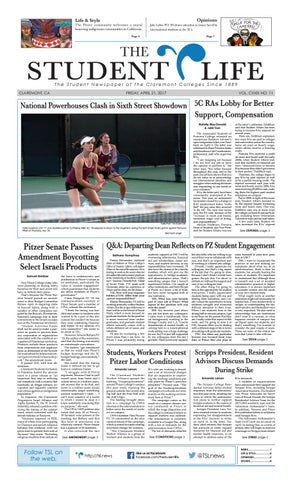
Katie Kuosman CM ’17 and doubles partner Catherine Allen SC ’20 prepare to return to the Sagehens during the Sixth Street rivalry game against PomonaPitzer on Thursday, Apr. 20. See back page
The Associated Students of Pomona College released an anonymous Resident Advisor’s open resignation letter over Facebook on April 9. The letter was addressed to three Pomona deans and Residence Life Coordinators, professional staff who supervise RAs. “I am resigning not because I do not love my job or have the capacity to perform it,” the letter read, “but rather because throughout this year, and in the past, you all have shown that you do not value us or acknowledge our intersectional identities and struggles when making decisions and responding to our needs or your mistakes.” RAs, the letter said, have been consistently underpaid at Pomona. This year, an unforeseen tax burden caused by a change in RAs’ employment status “nullified” the pay raise they received in the fall. The raise was necessary, the RA said, because of the “increase in room and board, minimum wage, cost of living, and responsibilities.” Miriam Feldblum, Pomona Dean of Students and Vice President for Student Affairs, was one
of the letter’s addresses. Feldblum said that Student Affairs has been trying to increase RAs’ stipend for several years. There are, Feldblum explained, two ways RAs are paid in colleges and universities across the country. Some are paid an hourly wage, while others receive a housing credit. Pomona RAs received a credit on room and board until the early 2000s, when Student Affairs realized that students on financial aid were “disincentivized to become RAs because they didn’t get money in their pocket,” Feldblum said. Therefore, the college began to pay RAs by cash stipend as well as by a partial housing credit. The stipend increased each year with room and board, and by 2009, RAs were receiving $5,000 in cash, making them the highest paid student employees on campus. But in 2009, in light of the recession, Student Affairs decided to fix the stipend despite increasing room and board costs. This was, Feldblum said, one of many ways the college cut back its annual budget, including fewer Orientation Adventure trips and no staff raises. A few years later, Student Affairs increased the RAs’ stipend
See STIPENDS page 3
Pitzer Senate Passes Q&A: Departing Dean Reflects on PZ Student Engagement Amendment Boycotting Select Israeli Products Bethany Humphrey
Samuel Breslow Any Pitzer College clubs who were planning on buying Sabra hummus for their next event will have to rethink their plans. That’s because the Pitzer Student Senate passed an amendment to their Budget Committee Bylaws April 16 requiring clubs to boycott Sabra, along with a number of other companies targeted by the Boycott, Divestment, Sanctions campaign due to their connections to the Israeli occupation of the Palestinian territories. “Student Activities Funds shall not be used to make a payment on goods or services from any corporation or organization associated with the unethical occupation of Palestinian territories. Products include those products from corporations and organizations as delineated in the boycott list maintained by bdsmovement. net/get-involved/what-to-boycott,” the amendment reads. It passed 22-0, with four abstentions. Claremont Students for Justice in Palestine hailed the amendment in a press release as “an important first step in reducing our complicity with a country that maintains an illegal military occupation and regularly commits war crimes against an indigenous population.” In response, the Claremont Progressive Israel Alliance and Alpha Epsilon Pi, the 5C Jewish fraternity, released a petition criticizing the timing of the amendment, which coincided with the Jewish holiday of Passover. “Students opposed to BDS, many of whom were participating in Christian and Jewish religious holidays this weekend, were not given time to present their side of the issue,” they wrote. “Excluding religious students from debate on
the issue is undemocratic and antithetical to Pitzer’s values as an institution, particularly the value of ‘student engagement’ which guarantees that students are active members of Pitzer’s governance.” Claire Wengrod PZ ’19, the communications secretary of Pitzer Senate and a member of CPIA, echoed this sentiment. “I think the timing was horrible and unfair to students who wanted to be a part of this discussion but couldn’t be because they were celebrating Passover and Easter. In my opinion, it’s very insensitive,” she wrote in an email to TSL. However, Simone Bishara PZ ’18, the author of the resolution, said that the timing was merely an unfortunate coincidence. The bylaws “got introduced so that we could time Pitzer’s budget hearings and the 5C budget hearings coincidentally,” she said. She noted that the timing made it difficult for her to go home to celebrate Easter. “I struggle with [CPIA’s] argument, because I had to pull myself away from home and I would never, in a million years, ask anyone else to do that, and never in a million years would intentionally target something around somebody’s faith. ... I can’t even conceive of a world in which I would be okay if I knew somebody was doing that on purpose,” she said. The CPIA/AEPi petition also noted that only 25 of Pitzer ’s 39 Senators were present at the meeting, but Bishara said that this level of attendance was relatively normal. Pitzer Senate has a quorum of 20 members. It also criticized the fact
See AMENDMENT page 3
Follow TSL on the web.
Danny Hernandez, assistant dean of students at Pitzer College’s Office of Student Affairs, will depart Pitzer at the end of the semester. He is leaving to work as the senior director of student life and assistant professor at the University of Southern California’s Suzanne Dworak-Peck School of Social Work. TSL spoke with Hernandez about his experiences at Pitzer and his plans for the future. TSL: How will your responsibilities at USC differ from your current responsibilities? Danny Hernandez: I’ll still be working primarily within Student Affairs, but the major difference is that I will be in the School of Social Work, which is more focused on graduate students. So the position is more removed from undergraduates, and graduate student affairs naturally comes with a whole different set of issues and concerns. I’ll also be overseeing a few more areas than I am here. At Pitzer I was primarily doing
academic support; at USC I will be overseeing admissions, financial aid and scholarships, career services, and student services, so my responsibilities have increased. I’ll also have the chance to be a faculty member, which will give me the opportunity to bridge academic and administrative areas. That’s something unique that I haven’t experienced before. I’ve taught at other institutions, and held this job at Pitzer, so I know a bit of both, but have never navigated both at one institution. TSL: What was your favorite part of your job at Pitzer? What aspect of the position will you miss the most? DH: My favorite part about my job has been my colleagues. I came from a traditionally clinical background, working in the Orange County and L.A. County departments of mental health, so coming here to a non-traditional work setting was a huge challenge for me, but I’ve just felt supported by my colleagues from the day I got here. There is not only support,
Students, Workers Protest Pitzer Labor Conditions Amanda Larson The Claremont StudentWorker Alliance spread the hashtag “#wakeup4workers” around Pitzer College’s campus this past week, marking the ground outside McConnell dining hall and the Free Wall with the club’s logo. The hashtag brought attention to a campaign by CWSA directed at the administration to better serve the needs of workers on campus. CWSA member Thea Piccone PZ ’19 commented on the educational nature of the campaign, which is aimed towards creating structural change for workers. “The Claremont Student Worker Alliance is a group of workers and students from the
http://tsl.news
5Cs who are working to broadcast a set of structural changes that are imperative to improving the working conditions put into place by Pitzer’s previous president,” Piccone said. “The goal of the #wakeup4workers campaign is to educate our community on the working environment here at Pitzer.” The campaign comes as the result of a campus climate survey conducted at Pitzer, in which the wage disparities and the college’s continued failure to support workers was outlined. The information is currently available in a Google Doc, along with a list of demands for the administration from CWSA. The list of demands detailed
See CONDITIONS page 3
Like us on facebook: facebook.com/thestudentlife
but also folks who are willing to go out of their way to collaborate with you, and that’s an important part of working at a liberal arts college. Overall, I really appreciate my colleagues, and that’s a big aspect of the job that I’m going to miss, because I don’t think I would have gotten the job that I’m about to embark on without the support and care of my colleagues here. The other thing I’m going to miss is the opportunity for student interaction. I really appreciated students being open with me and sharing their narratives, and I really valued the opportunity to help students navigate and overcome difficult obstacles in their lives. When I see students here in the dining hall or around campus, I get to see them for the person that they are. I really value that aspect of this work, and I’m going to miss it at USC, because there you’re dealing with a different stage of life in terms of working with graduate students. TSL: Are there any particular lessons you learned from your time at Pitzer that you plan to
carry forward to your new position at USC? DH: I want to incorporate the practice of not just making assumptions about what we, as an administration, think is best for students, but actually hearing the voices of students. It’s important to understand that although there is research and a set of accepted administrative practices in higher education, it is always important to consider context and the needs of your own student body. What might work at another institution might not necessarily be helpful here. Every student body is unique, so understanding the student narrative and the student voice is very important. We also need to acknowledge that our institutions don’t exist in a vacuum, so what happens outside of campus has an impact upon our students, and that’s something I’ve learned to consider the past couple of years. Those are some of the critical lessons that I plan to take with me.
See DEAN page 2
Scripps President, Resident Advisors Discuss Demands During Strike Amanda Larson The Scripps College Residential Advisors Strike elicited responses from the administration this past week, detailing the ways in which the administration plans to further support Scripps students in the realms of financial aid and mental health. Scripps President Lara Tiedens emailed a letter to students expressing her disappointment at the RAs’ decision to strike on April 14. In the letter, Tiedens cited reforms that Scripps has pursued in order expand resources for financial aid and mental health resources, in an attempt to address some of the
@TSLnews
RAs demands. A number of organizations have announced their support for Scripps’ RAs, including Scripps Associated Students, The Student Life, Pitzer Advocates for Survivors of Sexual Assault, the Scripps Residential Advisor Team for the 2017-2018 academic year, and the Admission Ambassador’s Team. In addition, Pomona and Pitzer RAs published letters in solidarity with Scripps RAs. The Admission Ambassador’s Team (AAT) sent out an email on April 16 stating that, as a form of protest, they will begin to read out a message on Scripps tours detail-
See STRIKE page 2
NEWS................................1 LIFE & STYLE.....................4 OPINIONS........................6 SPORTS.............................8
NEWS PAGE 2
APRIL 21, 2017
THE STUDENT LIFE
STRIKE: RAs Want Demands Publicized at Admitted Students Weekend Continued from Page 1 ing the current Scripps climate, as well as listing the demands of the Residential Advisors. Before listing the demands of the Residential Advisors, the statement reads: “... we will no longer give students our refined tours where we share mostly positive sentiments of Scripps. As a team that is mostly made up of students of color, we understand the need to provide a realistic, critical, and honest image of what Scripps provides and does not provide students so that prospective students can make an informed decision.” As a result of this statement, Admissions Ambassador’s were instructed to not give tours to students. The AAT also stated that they would boycott Admitted Students Weekend this coming weekend if the RAs neglected to receive a response from administration by April 20th. Victoria Romero, Vice President for Enrollment at Scripps, wrote in an email to The Student Life that she understood the AAT’s decision to strike. “We understand that different student groups on campus want to stand in solidarity with the RAs who are on strike. We hope that while our guests are here on Friday, staff who are assisting with the events of Admitted Students Day will make our guests feel welcome as we provide information and activities to help them learn more about Scripps College.” The RAs demanded increased transparency in financial aid packages that demonstrate increases in tuition, room and board, as well as the creation of a publicized emergency fund to accommodate the fluctuating financial circumstances of students. Additionally, they demanded an increase in mental health subsidies. “[Scripps] College expanded the financial aid budget by $400,000, increased the emergency fund by more than $25,000, and Scripps has supplemented existing 5C mental health resources
with additional staff support and funding for off-campus therapists,” Tiedens wrote in the email. Tiedens also spoke to her intention of further engaging students in dialogue about the issues expressed in the demands. In response to this letter, the Scripps RAs sent an email to students with a Google form that encouraged Scripps students to anonymously share their experiences with Charlotte Johnson and financial aid. Tiedens sent a second email on April 19th that detailed a sit-down meeting that occurred with the RAs. The letter directly responds to the RAs demands, suggesting initiatives to further support students, and listing resources that are already available. For example, in response to the RAs demand that an emergency fund for students be created, Tiedens responded: “This year, more than ever, we observed the importance of having a student emergency fund to cover students’ incidental or unusual costs that arise out of unexpected crises. The Scripps College student emergency fund was established in 2015, and the amount available has depended entirely on designated gifts from donors. Effective in the 2017-2018 academic year, the College will allocate $20,000 to this fund at the beginning of each academic year and continue to solicit donor funds to further augment it.” In response to the demand that the RA position be restructured, Tiedens announced that Charlotte Johnson will be leading a committee to work with RAs to restructure the role. In a message sent out by the RAs on April 20th, the RAs suggested that Primary Contact Dean Chris Dennis lead the restructuring, instead. Sam Martin SC ‘19 expressed her anger at the decision to appoint Johnson in an email to TSL. “To appoint Dean Johnson as the head of the committee in charge of restructuring the RA role is, frankly, a bit rude...There’s already a lack of trust between
Austin Huang • The Student Life
Scripps’ Balch Hall, housing the Dean of Students Office and the Office of Student Affairs, is empty after Dean of Students Charlotte Johnson’s office hours. Students called for a boycott of her office hours following the RA strike.
the students and Dean Johnson, and this really isn’t helping mend that divide. I agree with the recent update from the RAs that Chris Dennis should head the project instead.” Though the RAs remain on strike, they encouraged students
to volunteer for admitted students day and to engage prospective students about the campus climate. “We are humbled by the outpouring of support we have received from our community, current students, faculty, staff,
parents, alum and admitted students. We are committed to continuing this work with you. We will be continuing our strike, but encourage students to take part in Admitted Students Day by engaging students critically around issues of mental health, financial
aid, emergency preparedness, and the lack of institutional support for students by the Dean of Students office. This transparency and work should not stop at the end of this semester but continue for years to come.”
DEAN: Hernandez Prepares for Increased Role at USC
Courtesy of Pitzer College
Pitzer College’s Assistant Dean of Students, Danny Hernandez.
Continued from Page 1 TSL: What was the greatest challenge you faced in your time as the assistant dean of students at Pitzer? Your greatest success? DH: When I first came to Pitzer, my position was new, so I walked into a position that wasn’t previously established. There were a lot of needs in the areas of social justice, mental health, student retention, and first-generation college student support, and when I first came here, it was overwhelming to think about what my position would look like in light of all that. That was very challenging, but being able to tackle those issues the help of colleagues and students was an experience that I found particularly rewarding. The work we did as a community to address those needs and determine what my role would look like is something that I am very proud of. I have valued my time here and what I was able to
offer from my skill set, and I valued learning about the opportunities and strategies available for improving campus life for students, faculty, and staff. I feel that I have left behind some of my own characteristics and skills to the role, and I hope that informs the search for the best person to support and meet the needs of the community as a whole. TSL: Anything else you’d like to add or say to the Pitzer and Claremont Colleges community? DH: Pitzer and the Claremont Colleges will always play a significant role in my life. They have been influential not only in shaping me as a professional, but also in shaping who I am as a person. I will take a lot of the experiences that I had during my time here with me [and] use them moving forward. I know that I am a much better person for those experiences than I would have been without them, and I really appreciate that. This interview has been edited for clarity and length.
NEWS APRIL 21, 2017
THE STUDENT LIFE
PAGE 3
AMENDMENT: Critics Call STIPENDS: Tax Change Impacts Low-Income RAs Surprise Vote an Attempt to ‘Silence Opposing Voices’ Continued from Page 1
Continued from Page 1 that the amendment was not announced before the meeting, describing this omission as “a deliberate attempt to silence opposing voices in this debate.” Bishara did not include the amendment in the first draft of the budgetary bylaws presented on April 9. She said that she left it out so it would not be overlooked. “It was very intentionally a decision to make sure that if that provision went into the bylaws, it would be heard on the floor, and that there would be a very intentional discussion about it,” she said. Because it was an amendment, Bishara was not required to announce the measure on the agenda. “It’s just not procedurally how Senate does things,” she said. However, she did reach out to a number of Senators and SJP, which sent members to the meeting to speak. Bishara said she did not alert CPIA that she was presenting the amendment “because my intention was to have it pass. I have had enough intellectual conversation about why people disagree with me.” She said her views of the Israeli-Palestinian conflict are influenced by her Egyptian family. “My opinions are less rooted in academic knowledge or political belief and more in this identitybased concern,” she said. “It’s emotionally gutting for me to sit here and have to explain why I think these things are the right things to do. ... It’s just emotional labor that no one ever should have to do.”
There were no provisions for enforcement included in the budgetary bylaws. Bishara said that if a club was discovered violating the boycott, “I’m not 100 percent sure what would happen, but it definitely is going to be addressed.” Wengrod told TSL that she disapproves of the budget bylaws as a forum for endorsing BDS. “Introducing a change like this in the budget bylaws doesn’t include faculty and staff in the conversation at all. Additionally, this amendment is more symbolic than anything and will only prevent students from buying Sabra with student activities fees,” she wrote. CPIA and AEPi criticized the BDS movement itself. “Not only does BDS directly harm the economic development of the Palestinian people, but also it has failed to gain the support of Palestinian leadership, who see BDS as an obstacle to sovereignty. In reality, BDS is a well organized, thinly veiled smear campaign against the existence of the state of Israel,” they wrote in their petition. However, Bishara defended BDS’s goals. “This is one of the most gross violations of human rights across the globe, and it is some of the most gleaned over and normalized violence in the world,” she said. “We’re shifting into an era where we’re definitely choosing sides of history, and it’s about what side we want to be on in that regard.” Editors’ Note: Bishara is an Opinions columnist for TSL.
to $5,500, while continuing to work for a more significant raise. “But just because that’s a priority doesn’t mean that we’re successful,” Feldblum said, citing the many demands made on Pomona’s budget. “But you continue to make the argument each year.” By the beginning of the 201617 academic year, Student Affairs was able to increase the cash stipend to $7,800, or half the annual cost of room and board. In addition, RAs receive $4,527 in room credit (half the annual cost of room), for a total of about $12,300 in compensation each year. However, the pay raise coincided with a change in RAs’ employment status. Up until fall 2016, RAs were considered hourly wage workers, and received W2 tax forms instead of the 1099. But because RAs receive a housing credit and stipend tied to that credit, instead of an hourly wage, they are not considered “employees” by the Department of Labor’s Fair Labor Standards Act (FLSA). The Field Operations Handbook (10b24) reads: “Students serving as residence hall assistants or dormitory counselors, who are participants in a bona fide educational program, and who receive remuneration in the form of reduced room or board charges... are not employees.” The tax implications of the RAs’ change in employment status, however, were unexpectedly significant. “Some students,” the letter writer said, “ended up owing enough in taxes that the raise was essentially nullified and therefore being underpaid for their labor.” Autumn Martin PO ’19, who is an RA this year, agreed with the letter writer that the unforeseen tax implications have had particularly negative consequences for low-income students. “Low-income students have budgeted their money in a way that makes sense to them according to family needs and self needs,” said Martin, who identi-
fies as low-income. “To have to pay the government taxes that we weren’t expecting to take out of our savings or what we give to our family each month.... If we’d known, we could have planned for it.” Feldblum said that although Student Affairs and the business office recognized that the change in RAs’ employment status would have tax implications and that they alerted students to this at the beginning of the year, they did not anticipate the extent of the tax burden. Feldblum acknowledged that “there could have been much better communication about the tax implications. We didn’t try to model it out, and that’s something that we should have done,” she said. Both Martin and the anonymous letter writer were frustrated by the amount of time it took the college to respond to the RAs’ tax concerns. RAs initially contacted Student Affairs in February, but didn’t receive a response until early April. “If we raise a concern at a time when it is most critical, it does not mean get back to us when there’s a week left to do your taxes,” Martin said. She agreed with the letter writer that it is “institutional violence” when a “majority of employees that you’re ignoring are low income, undocumented, and other marginalized identities.” Martin said that marginalized and low income students are likely to become RAs because “passion for community and political problems comes from being affected by those things.” She added that being an RA is “a labor intensive job. If you didn’t need the money, I’m not sure that you’d be interested.” RAs at Pitzer have also run into unforeseen tax burdens. In addition, Pitzer RA Arman Ahmed PZ ’19 says that RAs are underpaid. They receive $172 biweekly plus a housing credit, which Ahmed says adversely affects students on financial aid because the credit counts as income. He added that Pitzer is considering providing RAs with course credit instead of a pay raise, which is also problematic for students on financial aid, who can only take 32 units before graduating.
Kirsten Carrier, Pitzer’s Director of Residence Life, affirmed Pitzer’s commitment to engaging with RAs. “Often times feedback from our students and RAs have led to changes in the Residence Life program, positions, and operations that improved services to our students,” she said. CMC RA Parker Mallchok CM ‘17 said she “didn’t choose this job for the compensation.” CMC RAs are compensated with full room and board credit. Instead, she said, “the personal growth was invaluable.” Mallchok added that “whenever I asked for help, it was always very freely given to me. When a situation was emotionally taxing, I felt like I was supported by the Dean of Students staff as well as by my fellow RAs.” Ace Bansal HM ’17 has had a similar experience at Harvey Mudd. HMC does not employ RAs; instead, they have proctors, who serve a play a similar role on campus. Bansal said that “being a proctor has been the best decision I’ve made.” However, Bansal acknowledged that challenges have come with the role, specifically high emotional demands. “The proctors are a very comfortable way for students to get help,” Bansal said, “and I think that’s one of the things that makes the system awesome. What’s unfortunate is when that’s the only system they feel comfortable going to.” Nonetheless, Bansal said that the administration has been supportive. “I’ve had a very difficult semester. Willie Zuniga was my co-proctor,” Bansal said. Zuniga passed away in February. “And I’ve felt supported throughout that entire process…. I’m very appreciative of that.” On April 10, the Pomona Business Office sent a specialized letter to RAs explaining the specifics of their compensation. Pomona has contracted with a local accountant who RAs can meet with at no cost, and has invited RAs to request an emergency grant/loan from Pomona’s fund if they need financial
assistance meeting unforeseen tax burdens. The letter writer said that this solution was inconsistent with Pomona’s “commitment for students to graduate without debt.” Feldblum said that grants are available as well as loans. “For someone who’s not on financial aid, who doesn’t have the money now but actually has the means, it may be appropriate to give them a loan,” she said. “Usually, emergency grants are reserved for students on financial aid.” The anonymous RA’s letter was also addressed to Pomona Dean of Campus Life Christopher Waugh, and Steven Jubert, Associate Dean of Campus Life and Director of Residential Life. Both said they are committed to supporting Pomona RAs. “I’m hoping that it will open up continued dialogue,” Waugh said of the letter. Jubert said that RAs’ summer training is “centered around how to support and recognize where marginalized students might come from, and how being here at Pomona can impact them in many different ways. So it’s important to us that that’s a high consideration.” Meanwhile, Scripps RAs have been on strike since April 13. In a letter to Scripps President Lara Tiedens, the RAs outlined the purposes of the strike: “1) To put pressure on Scripps to fulfill its obligation to students 2) to demonstrate the extent of the labor we perform on campus and 3) to break with our normal routine in recognition of the impact of Tatissa’s passing and illustrate our frustration with Scripps’ continued inaction.” Scripps RA Tatissa Zunguze passed away last month. Pitzer RAs have issued a statement of solidarity with Scripps RAs as well as the anonymous Pomona RA who resigned. “These actions are not isolated from one another,” the statement reads, “rather it connects back to unfair labor conditions endured by student-workers and the dismissal of barriers faced by marginalized students… We are not going to be bystanders as student
CONDITIONS: Staff, Workers Express Frustration in Campus Survey
Courtesy of The Claremont Student-Worker Alliance
#wakeup4workers marks Pitzer College’s Free Wall, part of The Claremont Student-Worker Alliance’s call for all of Pitzer’s staff to receive a living wage.
Continued from Page 1 in the document reflects the grievances of the workers. It includes instilling a 15:1 President to worker wage ratio, instead of the current 36:1 that exists at Pitzer under President Melvin Oliver. Additionally, the document demands increased transparency in Human Resources and the establishment of a process for workers to submit formal complaints. According to the campus climate survey, the lowest paid worker at Pitzer gets paid $22,000 a year, below the California poverty line. Additionally, not all workers at Pitzer College are
official Pitzer College staff and subsequently not all receive a living wage and benefits. The survey highlights a number of other ways in which the Pitzer College administration has failed to properly address the needs of workers on campus. An anonymous Pitzer staff member told TSL how the campaign is the result of mounting frustrations at the slow-moving structural change. “As a staff member, hearing about the #wakeup4workers campaign is fantastic and I believe is a way to address the elephant in the room when it comes to justice for all lower level staff on
campus,” the worker said. “We need to be honest and vocal about how slowly structural changes for workers have been moving and stand up for all levels of staff in a public manner at Pitzer,” they wrote in an email to TSL. They also spoke to how the educational campaign can work to rally support amongst students for workers, who have more leeway with the administration than workers. “If we don’t do this, then nothing can change, things won’t get better. There are already pockets of apathetic staff that have just given up over time,” the CSWA staff member said. “Things can
change and this campaign is meant to open the eyes of students and newer members of our community. There is an obvious lack of communication and a culture of fear and retaliation with the staff and workers at Pitzer and this needs to change.” When asked to comment, the Pitzer College administration sent the following statement to TSL. “Pitzer College values every member of our community. We applaud students’ enthusiasm for sharing our commitment to staff’s well-being. Here are some facts about Pitzer’s commitments to its employees. In 2010, Pitzer imple-
mented a policy that compensates staff in regular, full and part-time positions no less than 5 percent above the Los Angeles County Living Wage and increased it to no less than 10 percent above the LA County Living Wage in 2014. In addition, Pitzer offers a robust benefits package that includes a 12 percent unmatched retirement saving plan to all faculty and staff employees (based on plan eligibility). Further, the College complies with all state and federal labor code regulations and does not knowingly hire undocumented workers. As addressed through multiple in-person and other com-
munications with CSWA members, who are not authorized representatives for staff members, it is a disappointment that the unsourced generic template document presented by CSWA includes outdated data and inaccurate information and that do not reflect the current state of employment at the College. Pitzer and each branch of our shared governance including Staff Council Representatives, the only official staff branch of the governing body, continue to work diligently together to seek improvements and enhance labor relations for all employees of Pitzer College.”
LIFE & STYLE THE STUDENT LIFE
APRIL 21, 2017
Pitzer Community Mural “Decolonizes Academic Space” Julie Tran After a Global Local Mentorship Program trip to Canada in the spring of 2016 with Associate Professor of Sociology Erich Steinman, several students were inspired to establish a mural to pursue the process of decolonizing the Pitzer College community and bringing to light the importance of California natives. “This mural is reflective of the traditions and the stories of the indigenous people here, and it’s a way to tell their story,” Community Engagement Center Staff Member and Assistant Director of Native American Initiatives Scott Scoggins said. The mural’s design was a collaborative effort between Joe Galarza, a well-known indigenous artist who has painted two other murals on Pitzer’s campus, and Pitzer’s Tongva Elder Julia Bogany. “Sacred Grandmother” depicts twins holding up the earth, which according to some indigenous beliefs, was on the back of a turtle. Above the turtle is a tree with a beating heart and grandmother overlooking all. It was painted in Scott Courtyard on the side of Scott Hall, the primary academic building at Pitzer College, with the stated purpose of “honoring our ancestors past, present, and future.” Dana Nothnagel PZ ‘19 attended the Global Local Mentorship Program and contributed to the organization of the mural. She wrote in an email to TSL that the mural’s organizers received funding from Student Senate last spring, and then got the idea approved by the Aesthetics Committee and College Council. Nothnagel wrote that the biggest obstacle in the planning
process was getting approved by the College Council and the President’s cabinet. “At first they were very unreceptive, but by the end of last semester, we had pushed through. Painting started in January and finished just a couple of weeks ago,” Nothnagel wrote. Throughout the painting of the mural, students and members of the community were invited to help paint, and many were responsive. “We wanted students to be involved in decolonizing our academic space,” Nothnagel wrote. “We talk about healing through art a lot at Pitzer, and I think this was a way students used art to heal, learn, and participate in social change.” Diversity Staff Intern Phil Brayley PZ ‘19 said, “The mural brings more of the people of this area to this campus. A lot of the stories from different cultures are represented.” With the numerous symbols and indigenous stories within “Sacred Grandmother,” Nothnagel shared the mural’s impact on her. “The mural stands as a reminder that we need to push aside Western academia and make space for traditional learning and knowledge,” Nothnagel said. “I hope that this mural and talking circle might help start a larger conversation on campus about how we can create a more welcoming and inclusive environment for students that identify as indigenous. I hope that it reminds settler students that we are on stolen land and encourages them to dig deeper into their own identity.” “Sacred Grandmother” was officially dedicated on Thursday.
Scripps Live Arts Hosts Local Artist Music Festival Andrea Hernandez
Courtesy of Dana Nothnagel The Yagna Mural seen on the west side of Scott Hall at Pitzer College on April 20.
Last Saturday, Scripps Live Arts hosted the music festival, “Sounds from Venus,” at Bowling Green, featuring local and uprising artists from Southern California. The event welcomed the talents of local student band I Feel Strange, Lealani, a high school student from Bonita High in La Verne, L.A based artists Arima Ederram and Linafornia, and the DJ GEWZER from Fresno. Scripps Live Arts, which hosted the Athena Festival in the past, is co-run by Scripps students Iman Salty SC ‘17 and Nina Posner SC ‘17. In an email to TSL, Posner expressed their drive to put on the festival this year and the funding barrier they encountered: “We wanted to bring the music and vibe we care so much about right to our classmates’ doorstep. It’s hard, though, because we don’t receive that much funding and we want to compensate the artists fairly, so we had to save most of our yearly budget to plan a big event like this.” Both Posner and Salty work for KSPC, the radio station of the Claremont Colleges, which is how they have become familiar with a lot of local artists. “Lealani and Linafornia both played an Art After Hours event put on by KSPC in the fall, and Lealani is also a KSPC DJ. I knew Olivia from I Feel Strange because she also volunteers at KSPC,” Posner said. Lealani, who performed an electronic set at “Sounds from Venus” commented on her en-
thusiasm to participate in the event. “Both Iman and Nina invited me and I really enjoyed myself. It’s great that the Claremont colleges can throw events like this.” Arima Ederra, an L.A.-based singer-songwriter who performed selected songs from her acoustic soul album, was very pleased with how the event turned out.
“
We want to spotlight
underrepresented artists
“
PAGE 4
and put people on to our favorites, and provide safer
and alternative spaces. -Nina Posner SC ‘17
“What I like about this space is that is all girls and very wide open. The audience were really attentive and eager to participate and that’s always so rewarding.” Both Posner and Salty, however, were slightly disappointed with the poor turnout to the event. “We had the event in a very central space on Scripps’ campus, publicized the event thoroughly in advance, and booked incredible acts, so I’m not really sure why a lot of people didn’t come. Maybe it’s because we’re a dry campus, or because most people had never heard of these artists...we want to spotlight underrepresented artists and put people on to our favorites, and provide safer and alternative spaces to students who feel marginalized or excluded by the wider campus culture,” they said.
MOVIE COLUMN
Ye Olde Student Life It’s an eerie feeling to look at the TSL issue immediately before 9/11, or before the assassination of JFK, or before Pearl Harbor. These issues are utterly, utterly normal, a fact which makes complete sense, but which also serves to highlight just how blindsided we were by those events. However, history—no matter how surprising—never happens in complete isolation. This week’s article is an editorial from October 12, 1940, a little over a year before Pearl Harbor, when America was only just starting to recover from the Great Depression. Its attitude toward a plea for $1350 ($23,000 in today’s dollars) from the British may surprise many readers. --Compiled by Samuel Breslow PO ‘18 and Marc Rod PO ‘20 WHEN IN GLASS HOUSE, DON’T THROW GOLD BRICK...Confucius On the editorial desk before us sits a mimeographed publicity release. We get a dozen of these a day, and most of them are quickly filed in the wastebasket. This one, however, deserves special attention. It is a plea from the British-American Ambulance corps. This seems to be a well-meaning and humanitarian organization devoted to the cause of transporting wounded Tommies in American ambulances. The corps has figured out a clever little scheme. There are many colleges in the United States, all full to the brim with British sympathy and US cash. “Each institution will carry on an individual campaign to raise from its own student body the $1350 needed to purchase an ambulance, which will bear the school name.” Isn’t that swell, chums? For only $1350, we can get a nice, shiny new death-wagon with “Pomona College” painted on its doors. Andy they only want 1,000 ambulances. It is extremely dangerous to take any positive stand, but at the risk of being labelled an isolationist, we are seething at the impudence of this appeal. When America is a country that is faced with such shameful problems as the Dust Bowl, 9,600,000 unemployed (according to the Republican figures), and a national debt too big to comprehend, it seems rather stupid for us to throw $1,350,000 right across the Atlantic Ocean, no matter how humanitarian the motives. And another thought: Aren’t we technically neutral? If Britain is entitled to ambulances, why doesn’t somebody do something for Germany? A wounded man is a wounded man, no matter what language he speaks. And how is the American Red Cross treating Germany?
“The Promise” Misrepresents Armenian Genocide Victoria Anders The Armenian Genocide--one of the many complex chapters of World War I, when the Ottoman Empire killed an estimated 1.5 million Armenians–has seemingly been forgotten, or at least untouched, by Hollywood. “The Promise” sought to change this pattern through a war-torn love triangle storyline, but missed the mark on capturing the gravity and delirium of the atrocity. The fictional love story ties Paris-educated tutor Ana (Charlotte Le Bon) with Armenian medical student Mikael (Oscar Isaac) and Associated Press war reporter Chris (Christian Bale), and witnesses them from the glamour of pre-war Constantinople (now Istanbul) to Ottoman work camps and round-ups of Armenian villages. Mikael, unwilling to settle for his innocent small-town fiancée
(Angela Sarafyan), leaves her for the big city and medical school, promising to return soon (this isn’t the namesake promise, however). Falling for the first city girl he sees, also Armenian, he faces his first hardship in discovering she is in a long-term relationship with Chris. But, as this is 1914, the world is seeing worse than Mikael’s pining heart. The flirting, lusting, and city life continues on until Constantinople’s Armenian intellectuals start disappearing. The film, as the war, then devolves into an expository battle of prisoners, executions, and desperation. However, the film’s laser focus on the love triangle only becomes more and more unsympathetic and meaningless. The film is a sincere attempt at humanizing and personalizing events that are too complex and devastating to portray as a whole by focusing on the individual
lives affected rather than the 1.5 million persons affected, but gets lost in its attempts to do both. Solid acting, beautiful scenery, and compelling action almost gives the film a shot at being successful, but not quite. The problem does not seem to be wholly the director: Terry George also directed “Hotel Rwanda,” with much more depth and conviction. Nor is it money, as the film reportedly cost almost $100 million to produce, including support from Armenian-American billionaire Kirk Kerkorian. As Peter Travers of the Rolling Stone put it, “it’s distressing to see a great subject go wrong in the right hands.” “The Promise” may inspire a viewer to read up a bit more on one of the world’s first modern genocides, but the film itself will not leave you with an accurate enough understanding of this chapter of history.
Josie Ren SC ‘19 reflects on Edward Ruscha’s Hollywood at the Pomona College Museum of Art on Oct. 20.
And, as a bonus, here’s an ad that appeared in TSL during that era (specifically, September 3, 1940). Stay tuned for more Ye Olde ads next week.
Alyssa Alfonso • The Student Life
LIFE & STYLE APRIL 21, 2017 FOOD COLUMN
THE STUDENT LIFE
PAGE 5
The High Environmental Cost of Eating Fish
Molly Edison Americans ate a total of 4.8 billion pounds of seafood, approximately 15.8 pounds per person in 2009, according to NOAA. Globally, each person eats an average of 17 kg of fish per year, with seafood making up at least 15 percent of the average animal protein intake for 3 million people. Not only is fish important to the diet of the world, but the economy as well. With a majority of people on the planet living in coastal or near-coastal areas, 12 percent of the world’s population relies on fishing and aquaculture to make a living, and the total export value of the world trade of fish was U.S. $148 billion in 2014. Fishing practices vary across regions, markets, and types of fish. One of the most widely used devices in large scale wild fish catching is a Fish Aggregating Device. According to Greenpeace, “A FAD is essentially a large object–anything from a fallen tree to a man-made structure–that floats in the sea and acts as a beacon for fish.” Often FADs attract fish to an area to create almost a mini-ecosystem where massive amounts of fish congregate. Eventually, the fisherman or industrial fleet returns with nets and takes everything around the FAD, which are used to target and catch mostly big pelagic fish, almost always tuna. FADs range from simple nets and objects for small, artisanal, or traditional fishing to huge man-made productions for large-scale industrial fishing. More modern FADs even
include radio locator devices to sense how many fish have accumulated in the area and alert the fleet when to come back. Fish are attracted to FADs as they lull fish into a false sense of security and make them feel protected from predators. FADs ultimately help large-scale fishing fleets lower prices of commercial wild-caught fish. When a large area of the ocean is collected together in a huge net, the target fish will not be the only thing that ends up being caught. Larger animals like sea turtles, dolphins, sharks, young fish, and other marine animals end up in the nets along with the target fish. After being dragged out of the water onto a ship, they are thrown back into the ocean dead. Currently, entanglement in FADs is the largest threat to sea turtles, a species that is already threatened. It is nearly impossible to determine the number of non-target animals that are killed in FAD fishing. Commercial fishing companies do not want to record, research, or publish the number of dolphins or turtles they kill per year. They are not held responsible with regulations or by the market, which meants that they carry on without considering catching fish in a better, more ethical way. Marine fisheries are being depleted across the planet. As global populations climb, demand for seafood does as well. FAD fishing is not the worst overall. When compared to bottom trawling and other destructive forms of fishing, FAD fishing does not disrupt marine habitats to
INTERNATIONAL COLUMN
No, I don’t Bathe with Elephants! International Stereotypes and Their Implications Tarini Sipahimalani
Being an international student, I have received numerous questions or comments regarding my hometown, some perceptibly playful and others genuinely inquisitive. Since I hail from Singapore, friends have always joked about the gum law and how I was deprived of bubble gum until I came to the States, while strangers have inquired why I don’t seem to have a Singaporean or foreign accent. My sister even claimed that an acquaintance at a summer camp a few years ago asked if she bathed with elephants. Jokes aside, there are often assumptions that some make about being from abroad. Here are the top three: One: a common notion that people dwell on is the mystery of how some international students can speak English proficiently, void of any remnants of exaggerated stereotypical foreign accents. Franco Liu PO ’20, from China, spoke to this assumption coming from his own family members. “One time I was talking to my sibling ..after we got our final grades back, and she was like, ‘Oh I can only imagine how hard it must be for you to write essays in English,’” he said. Liu has also encountered the flipside, where professors have sometimes overestimated skills without taking into account international differences. In one of Liu’s courses, “the professor would just assume that I had previous experiences writing extensively in English, but that’s not true for me,” he said. Liu attended Chinese public schools, where he was taught solely in Chinese, making it difficult for him to gain exposure in English. “The teacher barely knew any English. We didn’t write anything in English. So yeah, [I think] the professors [sometimes] have false expectations of international students,” Liu said. Jolo Labio PO ’20, from the Philippines, also commented on people’s reactions to his language skills. “People are always surprised that I speak English well,” Labio said, adding that once they realize he’s proficient, they automatically assume he’s Filipino-American. TWO: a lot of assumptions that are made align with perceptions of the particular culture and the stereotyped illustrations associated with it that have infiltrated our minds. Amanda Tung PO ’20, from Hong Kong, explained how she often encounters people inquiring
about her choice of cuisine back home, even though Hong Kong is an international, cosmopolitan city with more than one cuisine. Tung recalled, “Sometimes people ask what I have for dinner back home. They ask if we only eat Asian cuisines such as rice,” assuming she seldom eats pasta or pizza. “I think there are definitely assumptions made [about international students] because of my culture,” Akari Ishida PO ’20, from Japan, said, “But I think it’s just their way of being friendly and finding connections.” Ishida doesn’t take offense to some of the assumptions that are made because she understands that when she mentions she’s from Japan, they “immediately say something that they can resonate with, and that just tends to be anime and sushi.” THREE: accents are usually a chief topic of inquisition. There is the notion that being from abroad, we must have acquired an accent that is distinctly dissimilar to the American accent. A lot of the time, this may be true; growing up locally in many countries, or even being exposed to molded versions of English, many of us do have foreign accents, which are noticeably different from what is common here. However, being international often also implies that we’ve moved around a lot; we’ve grown up among international communities, lived as expats, which in itself often encompasses a degree of western influence. It is also possible we attended an American school abroad or that our international school received western influence be it in terms of the curriculum or even the student and cultural atmosphere. Ishida explained how she’s experienced people asking her where her accent comes from. “They don’t expect me to have this kind of accent,” she said alluding to her British-Japanese-international amalgamation of an accent, “so when I say I’m from Japan, they will be like ‘why do you have that accent?’ and then I have to explain my whole life story,” she said. Making assumptions isn’t necessarily a bad thing and doesn’t always imply a sense of ignorance; in many cases, it is simply one’s desire to know more about a culture or country that they haven’t been able to experience themselves. Assumptions, essentially, can be the starting point from which one’s understanding of the rest of the world can be further delved into.
the same degree. The ultimate problem with FAD fishing is that it allows industrial fishing fleets to catch astronomical amounts of fish with less effort. In an already depleted marine fishery, FAD fishing not only allows, but encourages rapid large-scale fishing and further depletion of fish stocks. With meat, we know that buying farm-raised, grass fed, local, organic, grade-A meat is the most ‘ethical’. When it comes to fish, when we buy it in a store, most people think that wild-caught means it is safer and more ethically raised and caught than farm-raised fish. But at least when eating farm-raised fish, many other, larger, endangered species did not die in it’s catching. Now, mind you, I eat fish. I sometimes say I’m a vegetarian, but I do eat fish on occasion. For so long, I’ve thought that eating fish is better for the environment or more humane to the animals. Producing fish is definitely different than producing meat in our industrialized food system. But I love turtles. Countless numbers of turtles are killed in every FAD, and nearly all commercially bought tuna is caught in a FAD. If other aspects of the fishing industry don’t turn me off enough from eating tuna, the fact that my favorite animal died in its production should. I’m not here to tell you to stop eating fish because FADs are unethical and have unintended consequences. I am here to constantly reassess my own convictions, including eating fish. Every meal is a choice and each of us has the power to consider the greater effect it has.
Sophie Reingold • The Student Life
OPINIONS PAGE 6
Hidden Classism in Claremont
THE STUDENT LIFE SEAN OGAMI, News Editor KELLEN BROWNING, News Assignment Editor ELINOR ASPEGREN, News Associate LIAM BROOKS SAFA ARSHADULLAH, Life & Style Editor Production Editor SOPHIE PETERS, Life & Style Editor ANIKKA VILLEGAS, Life & Style Associate CHRISTOPHER ESKILSON KATE DOLGENOS, Opinions Editor Content Editor JO NORDHOFF-BEARD, Sports Editor CLAIRE WENDLE, Sports Editor LAUREN ISON Editor-in-Chief
GRACE OZONOFF-RICHEY, Senior Design Editor ELIZABETH LEADER, Senior Design Editor DAPHNE YANG, News Designer MEGAN ROBALEWSKI, Life & Style Designer NOOR DHINGRA, Opinions Designer CHRISTINA BECK, Sports Designer The Student Life, the oldest college newspaper in Southern California, is produced and managed by students of the Claremont Colleges and published weekly. The Editorial Board consists of the Editor-in-Chief and two Managing Editors. Aside from the editorial, the views expressed in the opinions section do not necessarily reflect the views of The Student Life. Email letters, questions and concerns to editor@tsl.pomona. edu. Email tips to liaison@tsl.pomona.edu; email advertising inquiries to business@tsl.pomona.edu.
MATTHEW LEE, Senior Copy Editor DONNIE DENOME, Copy Editor ANDREW MEDINA, Copy Editor DOMINIC FREMPONG, Graphics Editor ALYSSA ALFONSO, Photo Editor MEGHAN JOYCE, Photo Manager DONOVAN NEW, Video Director MONICA ACOSTA, Distribution Manager WESLEY LIANG, Business Manager ALEXA STRABUK, Senior Advisor
TSL welcomes Letters to the Editor, which can be submitted by mail, by email, or in person at the Fishbowl in Walker Hall. Letters must be under 400 words (although when an issue is particularly salient, we reserve the right to allow letters to run at a longer length) and submitted by 4 p.m. Wednesday of the week of publication. We reserve the right to decline publication of submitted letters and will not accept anonymous letters, letters containing profanity, factually inaccurate letters or letters making personal attacks. TSL also reserves the right to edit for spelling, punctuation and grammar. Letters may be signed by a maximum of three persons. All letters become the property of TSL and may not be reprinted without prior permission from the Editorial Board.
EDITORIAL BOARD
Deciding to Print, Here and Now If you’re reading this in [typeface] in a gray box on postconsumer recycled newsprint, you’re not stuck in the past. If these words are appearing as backlit pixels, you’re not living in the future. We could spend pages explaining how the internet and social media have allowed us to reach and engage readers like never before. But what’s often lost in those arguments is the equal, if not greater, importance of our print edition, which is currently under threat by the drama-ridden politicking of student governments across the 5Cs. Our argument for printing is not rooted in symbolism or idealism. It comes from a recognition of our role on campus as adverse to administration-peddled narratives, especially in the current political climate around student organizing.
Our newspaper is the only 5C-wide printed matter that is not vetted or wholly produced by communications departments. From stamps on flyers to glossy copies of Hidden Pomona, we’re encouraged to see our 1-squaremile lives as relaxed, diverse, and utopic. TSL allows us students to say otherwise, and to rightfully raise our voices in the same physical landscape that hosts corporate campus propaganda. Our print edition binds together the Claremont Colleges like no other publication. As one supporter of our recent petition eloquently stated: “Newspapers are a symbol and physical manifestation of communal unity, a place where conversations can be held, achievements celebrated, and news shared.” When you hold a printed copy in your hand, you can know that you’re holding the same copy as
Metrolink Supporting print journalism
TSL SAYS
APRIL 21, 2017
THE STUDENT LIFE
Metrolink at 4:00am Toot toot!
any reader across the 5Cs. Very few things knit our campuses together as well as stacks of the community-focused, studentproduced newspaper outside our dorm rooms and in our dining halls and libraries. We understand that our budget is much higher than most 5C student organizations. Like them, we exist to serve students. The vital service we provide to our community relies on our ability to go to print each week, though. That is, the ability of the student voice to enter the 5C discourse depends on a funded print newspaper. The decision to grant us our full allocation is simple, moral, and decidedly pro-student-voices. Let us print, and we will show you what democracy looks like. Hint—ten pages, two in color, on the desk of every college president.
Joaquín Bañuelos Guest Columnist
The Claremont Colleges are always abuzz with issues of inclusivity and social justice, yet we rarely discuss class and classism. A recent study conducted by The Equality of Opportunity Project found that Pitzer College and Claremont McKenna College both have more students from the top 1 percent than the bottom 60 percent of the income distribution. The statistics speak for themselves and reveal the extent to which these colleges exclude the poor and working class. Class delineations are especially vivid for those us who grew up poor, working class, or in rural communities. Inclusivity should not be limited to racial and gender identities. So, why don’t we talk about classism more often? There are many social justiceoriented students who act like authorities on issues of class, but many of them are ignorant of the forms of classism that actually impact students on our campuses. The unfamiliarity with class is apparent in their approach to social justice and even in their social lives on campus. There is a tendency to conceive of the working class and poor as hypotheticals, treated as something removed from reality, and abstract. It is not surprising that the discourse surrounding class is circumscribed around a few concepts that really miss the essence of the classism experienced at an elite college—often reduced to discussions of grammar and access to education. Sure, grammar and spelling are superficial ways of imposing a value on an intellectual perspective that alienate students who are
catching up to their more privileged peers, but such a myopic focus indicates to me that the discourse is not led by folks affected by the classism in Claremont. Most of the struggles related to class are invisible because social mores, values, experiences, and aesthetics are not always obviously linked to class, often supposed to be subsumed by ethnic and racial identity. Something as simple as an art event—a typical who’s who of the future gentrifiers of America—can bring to bear class differences. It can evoke that nagging sense of not belonging that comes with being thrown into an environment where people speak and carry themselves in ways that make one feel lesser. Art galleries are spaces that primarily serve the college educated and wealthy. The crowd that frequents these spaces has a taste for fashion aesthetics that are less attainable for the poor. Classism takes shape when a person’s value is calculated based on a bundle of experiences which require overcoming economic barriers. Social capital is commonly doled out for experiences like travel or expensive hobbies, experiences that can exclude the poor. Interesting people are expected to be cosmopolitan, for example. But many students never had the money to leave their city. Money makes you interesting and cosmopolitan because it affords you the ability to travel. Theory, too, has class barriers. Knowledge of theory has social capital on college campuses, but folks are often reluctant to distribute that knowledge to anyone perceived to be problematic. This notion that you have no responsibility to educate or that educating is a labor and there-
fore a kind of oppression is classist in many instances. Are we really going to morally judge a blue-collar worker, too exhausted from being on their feet all day, for not interacting with the world according to your interpretation of Judith Butler’s “Gender Trouble”? You will find you have gentrified your inner-circle, living in an elite bubble of the self-anointed morally enlightened class. Students of color too can be ignorant of classism, and class differences between people of color are in many ways just as relevant as the color divide itself. A student of color who went to Phillips Andover Academy and was raised in a home with parents who graduated from college has a drastically different experience of the world than do I. Students from these backgrounds were socialized to articulate themselves and carry themselves according to the norms that are expected when navigating academic and professional spaces. Growing up, the adults in my life were truckers, welders, plumbers, and warehouse workers; I learned different ways of starting conversation, telling jokes, and even different dietary habits—all of which can carry negative stigmas in an elite college. Wealth will never fully erase issues of race, but a hierarchy based on racial oppression always seems to dictate who gets to speak on a wide range of issues related to marginalization that are distinct from race. An inclusive discussion of class means acknowledging that classism affects individuals of all ethnic identities, though race and gender influences the form it takes. Joaquín Bañuelos is a student at Pomona College. He enjoys human activities and describing himself in the third person.
Print news People who don’t like print news
Ultra-strong juicing hands Busting fruit without breaking the bank
Exploring your own identity Find comfort in the fur
Overinvesting in automation Not this time, robots!
Jeb Bush as a furry Too Bushy, yet not bushy enough Kyla Smith • The Student Life
Why Won’t 5C Student Governments Support Student Journalism?
Simone Bishara Columnist It’s that time of year again. If you’re the leader of a club or organization on campus, you’ve likely spent the last few weeks asking for money from student governments for the coming year. TSL is no exception. However, what distinguishes TSL from other organizations is the incredibly vital role at the Claremont Colleges. Having a consistent, critical, and ethical
paper contributes to the colleges’ legitimacy, keeping us on par with every other competitive college in the nation and simultaneously keeping alive a journalism program, all while holding the administrations accountable to their informed study bodies. For TSL, printing physical copies of the paper amplifies the goals of teaching ethical journalism and promoting truthful reporting. It’s easier to have questionable journalistic standards when your words can be edited on a website at any time--you’re held accountable in print. More so, printing creates jobs. For students interested in journalism, TSL is one of the few opportunities to get paid experience that is relevant to the workforce. For TSL’s layout designers, their jobs are entirely dependent on printing. Ceasing to print would cause students to lose their jobs and access to crucial work experience—simple as that. Investing in printing is investing in student work. Yet the arguments against
printing pervade. In an article called “Why We Print,” TSL’s Editorial Board wrote that TSL has been underfunded for the past few years, causing the staff to frantically look for money instead of focusing on reporting. However, a lack of knowledge about print journalism and a misguided set of priorities seem to limit student government generosity across the 5Cs. A major concern of student governments is whether or not printing aligns with their strong stances about environmental sustainability. But when people arbitrarily attempt to apply this value to printing the newspaper, they severely miss the mark. Sustainability aims to reduce waste and the unnecessary use of replaceable materials that harm the environment. Switching cacti for roses, or glass for plastic makes sense, but there is no replacement for the value of print journalism. The newspaper is printed on post-consumer materials. This means that when you recycle your 700 pages of politics reading at the end of the semester, they go
through a process and end up becoming next semester’s TSL. This is arguably a more environmentally responsible process than the loads of waste we create after every major party or event that student governments happily fund. Deeming the print issue unnecessary or replaceable does not address the aforementioned impact it has on campus. Numerous people stumble over the paper in ways they could never stumble over online articles—staff, students, faculty, and visitors alike. Cutting funding to TSL just because the print issue is on paper simply doesn’t make sense. Now, let’s pretend that the environmental sustainability argument holds water and that the student governments really are concerned about the environment. Where is the funding to help TSL develop other options, then? If the concern is real, the investment needs to be made in journalism. An increased web presence requires an increased monetary contribution to things like cam-
eras, trainings and software updates. Moving away from printing doesn’t mean that schools get to ignore their obligation, but instead that they should be stepping up their game to aid in the transition. I’m perplexed and appalled by the lack of support the schools have given the paper in the recent years, especially with the rise in predatory reporting from the Claremont Independent. The duty to fight against inflammatory, racist, and sensational ‘journalism’ needs to be shared by all the colleges. People of color across these campuses are consistently at risk of being targeted by the Claremont Independent, and one of the most tangible actions schools can do about it is to fund TSL in order promote truthful, ethical journalism. I understand the merit of funding 5C organizations proportionately to a college’s participation. Why should some student governments have to contribute to something if almost none of their students (like Harvey Mudd, for
instance) participate? However, this logic cannot be applied to something as universal and far reaching as TSL. Mudd, for instance, has seen a cultural shift begin to happen in large part assisted by TSL’s publication of the leaked Wabash Report. TSL coverage is not perfect, and it is hard to understand what happens at other colleges if students from those colleges aren’t in the room, but still, TSL’s staff has always put in a concerted effort to hold all the colleges accountable. Rally your student senates and governments to demand that they support the institutions that affect you. Tell them that you care about and are invested in TSL. Let them know if you pick up physical copies. Scripps students can fill out a poll here, asking about viewership. Pomona students can do the same here. TSL is there to represent and support you, and now they need your support. Simone Bishara is a third-year at Pitzer College studying Sociology. She hopes to one day pursue a career in juvenile justice.
OPINIONS APRIL 21, 2017
PAGE 7
THE STUDENT LIFE
The ‘Cute’ Minority: Increasing Support for International Students
Jolo Labio Columnist “International students are treated this way because we’re the ‘cute’ minority.” For a Pomona College student hailing from Colombia and Peru, this statement encapsulates Pomona’s institutional treatment of international students. Every year, Pomona’s admissions department prides itself on its plethora of international admits. In its demographic report of the admitted Class of 2021, Pomona boasts that “admitted students hail from 46 countries”–followed by a very lengthy list of nations spanning five continents. In its international student brochure, Pomona is branded as a “globally-oriented campus” and a “recognized leader in international education.” While many international students are incredibly grateful for Pomona’s comprehensive learning opportunities, institutional support remains surface level. Pomona recruits international students in order to project an image of global diversity and inclusivity–a ‘cute’ minority. Yet once they are admitted, they are often left to fend for themselves.
On April 17, a slew of dissatisfied international students gathered in Frank Blue Room for an external review forum hosted by the International Student Mentorship Program (ISMP). Students of varied nationalities and backgrounds echoed a singular, compelling statement about the lack of institutional awareness and efficiency in addressing international student needs. Many international students voiced concerns regarding the allocation of financial aid. Despite ranking first in the nation for “Great Financial Aid,” both lowincome domestic and international students of color consistently fear reductions in their financial aid packages. International students, however, face very specific challenges. For one, financial aid packages are currently not adjusted for exchange rate fluctuations due to international economic volatility. One student remarked how his country’s currency is severely depreciated against the dollar, thus compromising his family’s ability to pay–yet his financial aid package did not reflect this. A second financial aid impediment unique to international students is that international financial aid packages do not adequately cover travel costs. For those travelling across oceans and continents, four years worth of plane tickets amount to thousands of dollars. Consequently, many international students are forced to stay on campus during extended breaks. Most importantly, admission for international students remains need-aware--the admissions department takes financial need into account when accepting international applicants. While interna-
tional students do receive aid, this practice advantages those with the ability to pay–often at the expense of low-income applicants. This implicitly perpetuates socioeconomic inequality. While I acknowledge that Pomona’s financial aid system is more supportive than other institutions, it is no secret that Pomona possesses a two billion dollar endowment. Yet instead of investing in domestic and international financial aid, the administration instead funds ziplines and surf simulators on Marston Quad. At the external review forum, international students also brought attention to the absence of a reliable, central, and knowledgable international student resource. Earlier this semester, the international student designated school official (DSO)– Sara Mitchell–was terminated without prior warning, creating worry among international students needing immediate assistance. She was swiftly replaced by Joel Hart and Marilyn White. Hart primarily works as a dean in the Office of Admissions, and White only works part-time. Consequently, international students point out a lack of time-accessibility from their DSOs. This is especially detrimental when international students have to meet deadlines for work and internship applications that involve heavy paperwork. In fact, international students feel that DSOs–and the administration in general–lack knowledge regarding international student problems. For example, the International Place of the Claremont Colleges fails to assist students with complicated tax issues, leaving them at risk for fines. Consequently, the majority of international students are forced to seek assistance else-
Elodie Arbogast• The Student Life
where–either from other students or internet resources provided by other higher education institutions. Most alarmingly, international students may face additional obstacles in academic settings. Certain majors are constructed with varying degrees of America- and eurocentrism. Notably, the PPE major’s philosophy requirements primarily feature European philosophers, while its politics requirements center around American politics and constitutionalism. Similarly, the Public Policy Analysis major requires enrollment in Intro to American Politics and Policy Implementation and Evalu-
Free Speech Debates Miss the Point
Kate Dolgenos Columnist After student protesters blocked access to a talk by anti-Black Lives Matter speaker Heather Mac Donald at Claremont McKenna College on April 6, the Claremont Colleges erupted in yet another round of debates about free speech. Students who participated in the protest argued that allowing Mac Donald to express anti-black views in a public forum marginalized students of color, while free speech advocates claimed that preventing her from speaking violated both the First Amendment and the principles of open dialogue that colleges and universities are built on. I have been extremely frustrated with both sides on this issue. I support Mac Donald’s right to speak, but not because I agree with her views or worship free speech as an abstract
academic principle. If the trade-off was truly between allowing her to deliver a talk and supporting marginalized students, I would choose the latter. The problem is that suppressing dissenting viewpoints, even reprehensible viewpoints, does not actually crush the dissent. Instead, it strengthens them by victimizing their adherents, who in turn are able to avoid any real challenges to their opinions. If you don’t believe me, consider what happened in the immediate aftermath of the protest. Respected conservative editorial pages across the country, including in the The Wall Street Journal and The National Review, published a flurry of op-eds defending Mac Donald and denouncing radical leftists in Claremont for suppressing free speech. These op-eds almost universally avoided delving into Mac Donald’s views or the subject of her talk, preferring instead to mercilessly mock student protesters. That is a shame, because Mac Donald’s views on race and police brutality are factually incorrect and deserve to be challenged. This newspaper published an op-ed that carefully refuted each of her arguments and explained why her talk was misleading. However, the firestorm emitting from the protests, coupled with a widely publicized open letter from students calling on Pomona’s president to apologize for supporting free speech in the protest’s aftermath, allowed conservative media and Mac Donald’s supporters
to ignore factual challenges to her viewpoints. The argument that either CMC or the specific research institute that hosted Mac Donald were promoting her views by giving her a platform to speak does not hold up to scrutiny. Mac Donald is a nationally renowned speaker and author. Had CMC not invited her to speak, someone else would have. Her anti-Black Lives Matter views are already given platforms. Moreover, they are endorsed by plenty of conservative policing experts. The only result that preventing a Q&A session accomplished was drawing negative attention to our schools while allowing Mac Donald to go unchallenged as she disseminated manipulated statistics and misleading information on police brutality. I am not sure if most Claremont students fully understand that the protests and Mac Donald’s subsequently canceled speech were a huge public relations coup for the conservative movement. Because of the actions of the protesters, Mac Donald has received a ton of publicity and the Claremont Colleges are being treated as a joke in national media. Oxtoby and CMC President Hiram Chodosh released statements only after having enormous pressure put on them to crack down on protesters, who are being portrayed as illiberal social justice warrior fascists. The protesters did not help themselves by physically preventing faculty attendees from entering the speaker’s venue and calling anyone who planned to attend Mac Don-
ald’s talk (including some Jewish students) “Nazis.” That being said, the anti-Mac Donald protesters are not the only students who fail to understand the impact of their actions. Free speech activists in Claremont have consistently displayed a callous indifference to the concerns of protesters, even though some protesters felt that Mac Donald’s allegedly anti-black views invalidated their identities and devalued their lives. This dismissive attitude is unfair to students of color and does free speech no favors. Instead of mocking Black Lives Matter activists, those of us who support open dialogue should use our precious freedom of speech to address their objections and figure out ways to make our campus more inclusive. Snarkiness alienates potential supporters and makes us seem willfully blind to the issues raised by the protesters. Free speech is not a sacrosanct value just because it is enshrined in the First Amendment. It is important because it is the only way for ideas—even repulsive ideas—to be considered on their merits. If you suppress the expression of these ideas, the suppressed person gets to complain that you infringed on their freedom of speech instead of being forced to defend themselves. It is a tragedy that Heather Mac Donald was given this privilege. Kate Dolgenos PO ‘17 is TSL’s Opinions editor and a politics major from Philadelphia, Pennsylvania. She wears better shoes than you.
Weekly Comic
ation (a US-based public policy class). Consequently, international students are at a disadvantage in comparison to their domestic peers, and they may feel disconnected from the material they are learning. I acknowledge the difficulty in accommodating all international student needs, due to the sheer diversity in international experiences. However, more comprehensive efforts are needed to ensure a smoother transition for international students. International students already face immense social pressures, such as homesickness, acclimatizing to American culture, and navigating Pomona’s socio-
Weekly Crossword
Simone Bishara PZ ’18
Across
1. ___ Millan, dog whisperer 6. California or Alaska, for example 11. What foreign aid is called post natural disaster 13. Fear 14. Threatening ultimatum words 15. Wireless internet source 16. Syrian Kurdish political party, abbr. 17. Flaws 19. 1995 Fincher thriller 20. Say 24. Jack O’ Lantern pre-carving 27. Dove sound 28. Popular Vegas resort and casino 29. Consenting to coitus over text, abbr. 31. Greek God of love 32. What albums used to be released on 33. Halloween outfit 35. Dress like part of fairy outfit 37. Rock in the sky associated with night, plural 38. What a crowd is made up of 40. Lithuania country code 43. Insect that is the subject of American’s most common fear 46. More of 2 down 48. Blood clot in the brain 49. Most arid 50. Game including a king and queen 51. Downward compass direction
Down
Audrey Jang • The Student Life
political climate; they should not be further burdened by logistical incompetence. If Pomona is truly a “globallyoriented campus,” they must provide the necessary institutional support that justifies the label. We are more than just ‘cute minorities.’ We are not collectible trophies, gold-plated with words like ‘diversity’ and ‘inclusivity’–only to be left gathering dust. We are students of this institution, and we deserve to be heard. Jolo Labio PO ‘20 is from Manila, Philippines. Catch him every MondayThursday at 7:59 AM, furiously sprinting to his 8 a.m. at Mason.
1. Edit by removing parts 2. Spooky, var. 3. Fun snow activity vehicle 4. Affliction 5. Search for again 6. Psychic 7. 2010 Schwimmer thriller 8. Usually found in a museum
9. Foot digit 10. Mistake 12. Very enthusiastic 13. 1982 sci-fi film redone in 2010 by Disney 18. ___-A-___, 1987 comedy crime film starring Burt Reynolds 19. Popular location for facials and massages 21. Shade of beige 22. Tool used for weaving fabric 23. To misplace 24. Super ___ 25. Pakistani language 26. Light sprinkle 30. Duped 31. Many of Elliot’s new friend in 1982 sci-fi film 34. Mocking looks 36. Buns or pony-tails 37. A bigger amount 39. Shrieks 40. In ___ of 41. Exam 42. ___ Café, popular LA hang out 43. Pomona College’s Coop locale, abbr. 44. Specific glad secretion 45. Anger 47. ___ de Janeiro, 2016 Summer Olympic locale
Answers
SPORTS PAGE 8
APRIL 21, 2017
THE STUDENT LIFE
Sports Calendar
April 21 - April 27
Editor’s Picks
SPORTS FEATURE
How Elite Sports Allow for Sexual Abuse
FRIDAY, APRIL 21 Women’s Softball It’s a Sixth Street Rivalry match-up between the Athenas and the Sagehens softball teams this Friday. CMS will host P-P for both the 2 p.m. and the 4 p.m games, and it will be an intense battle between the two teams as they fight to up their rankings before the upcoming SCIAC tournament. P-P Baseball The Sagehens will host Occidental in the first game of their three-game series this Friday at 3 pm. This will be the first time this season they take on the Tigers, and the rest of their games of the series will be away. Occidental has a 21-12 record, and it is sure to be a great series. P-P Women’s Water Polo The P-P women’s water polo team will play their first game of SCIAC Tournament on Friday, April 21 in La Verne against Redlands at 10:45 a.m. This game will dictate the course of the tournament for the Sagehens as they will continue to play throughout the weekend, hopefully towards the championship game.
SATURDAY, APRIL 22 CMS Women’s Lacrosse The Athenas will play the Occidental Tigers for their Senior Day match on Saturday, April 22 at 1 p.m. at home. This game follows two huge 19 point wins by the Athenas, and they hope to maintain their dominance in the SCIAC conference as they begin to close out their season. CMS Women’s Tennis CMS will play their matches against Division I UC Irvine on Saturday, April 22 at home. This follows their win over rivals Pomona-Pitzer this past Thursday. The Athenas have consistently delivered throughout this entire season, earning them their No. 2 national ranking. CMS Baseball The Stags will continue their series against the Whittier Poets at home on Saturday, April 22 at 11 a.m. and 2 p.m. It is sure to be a close series, with Whittier just one spot behind CMS in the SCIAC rankings.
TUESDAY, APRIL 25
Dominic Frempong • The Student Life
Torrey Hart Since the early 1990s, the United States women’s gymnastics team has dominated international competition. Under the reign of dynamic coaching duo Béla and Márta Károlyi, the National Team has secured seven all-around medals at the Olympics, three of them gold, and eleven World Championship medals. Recently, both the Fierce and Final Five captured viewers’ hearts and social media streams alike. They successfully brought gymnastics in the national spotlight, but at what cost? In the fall of 2016, it was revealed that USA Gymnastics ignored allegations of sexual abuse directed at many of its affiliated coaches. 2000 Olympic team member Jamie Dantzscher filed a lawsuit against USA Gymnastics and the team doctor at the time, Larry Nassar. She alleged that Nassar sexually abused his patients throughout his tenure with the team. Forthcoming lawsuits also accuse the Károlyis as being complicit in the abuse because the vast
majority of the reported incidents took place on their property, referred to as ‘The Ranch’, where the National and Olympic teams train and will continue to train following the couple’s retirement. Former elite gymnasts who spent much of their youth training at the Károlyi Ranch have gone on the record saying that Nassar was allowed to treat them in their cabin beds, without other adults or athletes present. As children, they assumed this was the norm, but later realized something was not right. The Károlyis deny that they knew about this practice. An extensive report published by The Indianapolis Star last summer alleges that there have been 115 or so adults implicated in the accusations throughout all levels of the sport. While reports do often lead to quick firings of the perpetrators at their current workplaces, USA Gymnastics lacks a system to track these coaches, who are usually hired easily at other gyms. Additionally, the sport has a policy in place that dismisses allegations of sexual misconduct unless the report comes directly from the victim. According to the Star’s
investigative reporter on the case, Marisa Kwiatkowski, the organization dismissed secondhand reports as mere “hearsay.” It is likely that many cases of sexual abuse go unreported due to athletes’ fear of ruining their own careers. Herein lies the most dangerous aspect of coach-athlete relationships in the sport: to be an elite gymnast requires total mental and physical devotion to the sport, as well as complete faith in their coaches. Athletes routinely give up their bodily autonomy to their coaches, so the presence of abuse is not wholly surprising. The sport is known for its “do whatever it takes” mentality, which admittedly gets results. Young gymnasts don’t have the power to question the main authority figures in their lives, so when so-called experts like Nassar violate their bodies in the name of helping success, they may assume nothing is wrong. Many of the women who came forward against Nassar said that they didn’t realize at the moment that anything was wrong; the power dynamics were such that they trusted him totally
because he was supposed to help them win. Nassar is now being held without bail in Michigan, where until recently he was working as the team doctor at Michigan State University. In late February, the 1996 Olympic gold medalist Dominique Moceanu called for USA Gymnastics President and CEO Steve Penny to resign, and said that gymnastics’ culture “set the stage for such atrocities to take place.” Penny stepped down on March 16. Upon his resignation, Penny said, “[It] has been heartbreaking to learn of instances of abuse and it sickens me that young athletes would be exploited in such a manner.” According to the Star’s report, Penny’s job description included personally handling allegations of sexual abuse. Going forward, Paul Parilla, chairman of USA Gymnastics’ board, will serve as the interim head, and he has called for a crackdown on safety in the sport. Whether or not he can shift the script on gymnastics’ powerful culture of submission and instill a more effective policy on sexual abuse remains to be seen.
P-P TRACK & FIELD
P-P Track Races Ahead in Multi-Dual Meet
P-P Women’s Lacrosse The Sagehens will take on the Redlands Bulldogs at home at 7 p.m. this Tuesday, April 25. Last time P-P faced up against Redlands they suffered a loss, so this will be their redeeming match.
WEDNESDAY, APRIL 26 CMS Men’s Tennis The Stags will play two matches on Wednesday, April 26. One will be away at Azusa Pacific at 1:30 p.m., and the second will be at home hosting Hope International at 7 p.m. CMS hopes to keep their winning streak alive following their 7-2 victory over rival P-P.
Scores Pomona-Pitzer
Claremont-Mudd-Scripps
Softball La Verne 5 P-P 1 La Verne 9 P-P 3 P-P 4 Whittier 0 Whittier 2 P-P 0
Softball CMS 7 Occidental 0 CMS 9 Occidental 5 La Verne 12 CMS 2 La Verne 1 CMS 0
Baseball P-P 11 La Verne 2 La Verne 5 P-P 2 La Verne 10 P-P 5
Baseball CMS 6 Chapman 5 Chapman 6 CMS 4 Chapman 12 CMS 7
Women’s Tennis P-P 9 Whittier 0 P-P 9 Cal Lutheran 0 CMS 6 P-P 3
Men’s Tennis CMS 8 Cal Lutheran 1 CMS 9 Occidental 0 CMS 8 Chapman 1
Men’s Tennis P-P 8 Whittier 1 CMS 7 P-P 2
Women’s Tennis CMS 9 Azusa Pacific 0 CMS 9 Occidental 0 CMS 6 P-P 3
Men’s Track & Field P-P 121 Caltech 32 P-P 122 Chapman 18 P-P 107 Whittier 50 La Verne 81 P-P 80 Women’s Track & Field P-P 127 Caltech 8 P-P 138 Chapman 9 P-P 98 La Verne 80 P-P 105 Whittier 53 Women’s Water Polo P-P 10 Chapman 6 Women’s Lacrosse Occidental 11 P-P 9 P-P 16 Whittier 8
Women’s Track & Field CMS 123 Cal Lutheran 39 CMS 104 Occidental 59 CMS 86 Redlands 75 Men’s Track & Field CMS 111 Cal Lutheran 48 CMS 88 Occidental 75 CMS 83 Redlands 80 Women’s Water Polo CMS 11 Caltech 7 Women’s Lacrosse CMS 20 Whittier 1 CMS 20 Chapman 1
Meghan Joyce • The Student Life
Paul Messana PZ ‘17 runs the 400 meter dash in the SCIAC 5-way Track & Field Meet at Pomona College’s Strehle Track on April 15, winning with a time of 48.30 seconds. Messana went on to win the 4x400 relay as well with teammates Cal Neikirk PO ‘19, Nick Vucovich PO ‘18, and Lucas White Moon PO ‘20.
Jack Carroll The Pomona-Pitzer men’s and women’s track teams wrapped up their regular seasons this past weekend at home in spectacular fashion. The women swept their four meets against University of La Verne, Chapman University, Whittier College, and California Institute of Technology, winning by more than 100 points against Caltech and Chapman, and still defeating Whittier and La Verne by an impressive margin. The men won three out of four multi-dual meets against the same teams. In their fourth matchup versus La Verne, they
lost by a single point. There were a lot of stand-out performances, but Abby Gardner PO ’17 and the men’s 4x400 relay team were particularly impressive. Gardner broke her P-P record in the steeplechase with a time of 11:21:69. Ryan Abele PO ’18, Cal Neikirk PO ’19, Paul Messana PZ ’17, and Nick Vucovich PO ’18 posted the 7th fastest time on the Sagehen’s All-Time list in the 4x400 relay at 3:17:21. On the field, Katherine Pelz PO ’20 won the discus and hammer with respective throws of 112-01 and 133-02. Prisca Diala PO ’18 won the long jump with a leap of 18-00.25 and came in second in the
triple jump with 33-10.00. Jessica Finn PO ’18 also won the javelin with a throw of 134-01. Calvin Aylward PO ’18 won the javelin for the men as well with a throw of 206-09, and Lucas White Moon PO ’20 finished third in both the triple and long jump. Other winners included Neikirk in the 100 and 400 hurdles, Charlie Watson PO ’17 in the 5000-meter, and Danny Rosen PO ’20 in the 800-meter. The women’s 4x400 team, consisting of Amy Watt PO ’20, Katrina Dank PO ’20, Lia Frances PO ’20, and Cat Bonobi PO ’17, also won with a time of 4:08.62, and Bonobi had her own individual victory in
the 400-meter with a time of 58.97. It was a particularly sweet victory for both teams, as it was Senior Day. Before the meet, all twelve seniors were honored. Up next for the Sagehens is the SCIAC Championship meet. They are hosting this year on April 28 and April 29. When asked about how this past weekend’s performance helps the team moving forward, women’s head coach Kirk Reynolds said, “This gives us great momentum heading into the SCIAC Championships in two weeks.” No doubt they will be looking to unseat their neighbors and rivals as men and women’s conference champions.
SPORTS APRIL 21, 2017
PAGE 9
THE STUDENT LIFE
CMS SOFTBALL
Athenas Falter in SCIAC Standings with Losses to Leopards
Alyssa Alfonso • The Student Life
The CMS Athenas infield regroups during their doubleheader against La Verne. Despite their composure, they dropped two games to the Leopards on Saturday, April 15.
Blaise Malley Coming into their doubleheader showdown on Saturday, the Claremont-Mudd-Scripps softball team (16-13, 14-6 SCIAC) had a chance to claim sole possession of first place in the SCIAC. The Athenas and their opponents, the University of La Verne Leopards (23-7, 16-4 SCIAC) were tied at 14-4 in conference play entering the games. However, the Leopards came
away with a pair of victories, 1-0 and 12-2, to take over the top of the standings. Following the doubleheader, the Athenas found themselves squarely in second place. The first game was a pitching duel between two of the SCIAC’s best, the Athenas’ Anna Gurr CM ‘18 and La Verne’s Elisa Ponce. The two pitchers kept the game scoreless until the ninth inning, when the Leopards’ Sienna Kendricks drove in the winning run, hitting a single that drove in Carly Condon.
P-P Athlete of the Week
Kendricks had earlier broken up Gurr’s bid for a no-hitter in the fifth inning. Solid defense behind her allowed Gurr to keep the Leopards’ offense at bay for most of the game. Both Gurr and Ponce pitched the whole nine innings, striking out eight and five batters, respectively. Meanwhile, the Athenas’ offense put runners on base but was consistently unable to capitalize on their opportunities. In the first
game, they outhit their opponents seven hits to five and left ten runners on base. After a difficult and hardfought loss in the opener of the doubleheader, the second game quickly turned sour for the Athenas. Starting pitcher Chloe Amarilla CM ‘19 struggled to find her composure and only pitched one third of the first inning, giving up six runs off of five hits and putting the Athenas in an early hole. Continuing with a theme from
the first game, CMS responded by loading the bases in the home half of the inning because of some pitching errors by La Verne, but were once again unable to convert their baserunners into runs. When the Leopards tacked on five more runs in the fifth inning, the game was effectively over. In the bottom fifth, the Athenas finally got on the board for the first time in the two games, with Amarilla hitting an infield single and coming around to score on
an RBI groundout by Alison Jue SC ’20, and Carly Roleder CM ’18 scored on a passed ball. The two runs were only consolation in the eventual 12-2 loss. The Athenas will look to bounce back and consolidate their hold on second place during the team’s next series, a double-header with their cross-campus rival, PomonaPitzer (10-24, 6-16 SCIAC). The games will take place at Athena Softball Field on Friday at 2 p.m. and 4 p.m..
P-P WOMEN’S WATER POLO
Sagehen Water Polo Sees Success on Senior Day
Men’s Track & Field Paul Messana
PZ ‘17 South Pasadena, California The Sagehens Men’s Track and Field team dominated this past weekend in their multi-dual meet against Caltech, Chapman University, and Whittier College, and they barely lost out by just a single point to University of La Verne. The performances of Paul Messana PZ ‘17 stood out amongst many great athletes, especially his final leg in the 4x400. He came from behind to give the Sagehens a comfortable lead and passed La Verne in the first 150 meters, helping the team to a time of 3:17.21, which is the seventh-best in the nation. Messana also won the 400-meter race with a time of 48.30, which is the eighth best time for NCAA Division III this season.
CMS Athlete of the Week Women’s Lacrosse
Meghan Joyce • The Student Life
Members of the Pomona-Pitzer women’s water polo team work to block a shot from a Chapman University opponent in their Senior Day game on April 15. The Sagehens won 10-6.
Katie Baughman
Zoe Pinczower CM ‘17 Kirkland, Washington
The CMS Athenas blew out opponents Chapman University and Whitter College this week, but senior Zoe Pinczower CM ‘17 had a standout game against the Chapman University Panthers on Wednesday. She scored a season-high of five goals during the game for the Athenas, and she flew solo on her first two attempts early on in the game to help the team to an early lead. She showcased her speed and agility during the game, making her hard to defend and the Panthers defense suffered. Pinczower has a few more games to close out her outstanding senior season, and will be honored at Senior Day on April 22 at 1 p.m. when CMS hosts Occidental College.
On Saturday, the PomonaPitzer women’s water polo team (14-18, 7-1 SCIAC) celebrated Senior Day and the end of their final regular-season with a huge 10-6 win over the Chapman University Panthers (6-20, 3-5 SCIAC). Fresh off their victory against CMS (9-19, 3-5 SCIAC) two days prior, the Sagehens solidified a number two seed heading into the SCIAC Tournament this weekend. The Sagehens wasted no time executing offensively as Jocelyn Castro PZ ’18 scored off an assist from Morgan McCracken PO ’18 in the first 20 seconds. Though Chapman answered two minutes later with a goal from Emiko Mizusawa to tie at 1-1, P-P couldn’t be fazed. The Sagehens responded with five consecutive goals, and goalie Ahsha Earwood PZ ’17 held the Panthers score-
less for the rest of the quarter to put P-P ahead 6-1. “We had a lot of communication wins,” Earwood said. “Especially in the first half, we were doing really well at seeing each other, and building off of each other.” P-P continued its impressive run in the second quarter with two additional goals from Nohea Kahaulelio PZ ’19 and Kyla Pickell PZ ’19. The Sagehens held a comfortable lead at 8-2 to finish the half, and kept the Panthers’ scoring low thanks to four saves from Earwood and excellent defense from Chessa Burke PZ ’17. Burke and Janelle Lewis PO ’19 added two more goals for the Sagehens, and goalie Morgan Stockham PZ ’18 took to the net in the second half. Though Chapman scored four goals, P-P pulled out a 10-6 final, sending seniors home happy in their final regular season game. One of P-P’s greatest strengths is their ability to distrib-
ute the ball offensively. “We always try to win games as a team,” Rodriguez said. “I think it was a great team effort.” Eight players scored throughout Saturday’s match, with two apiece for both Castro and Anna Yu PO ’19. Additionally, the Sagehens controlled the ball more effectively than Chapman and took twice as many shots as the Panthers at 32 to 16, respectively. Castro also said that P-P’s team dynamic was a crucial part of their success. “As the season went on, we started to find our cohesiveness and really play for each other...I think we really came together to do it for each other and learn that we all needed to contribute equally in order to win,” Castro said. Seniors Earwood, Burke, Hope Grant PZ ’17, and Christina Williamson PO ’17 have brought unity to the young team both inside and outside the pool.
To prepare for the playoffs, P-P plans to continue bringing its team-oriented style of play to every game. “In one person shining, there’s another girl that was behind her, that made her the awesome pass that enabled her to make a great shot,” said Earwood. “Everyone is a player on the team, and everyone needs to be contributing in that way.” The Sagehens will face off against the University of Redlands Bulldogs (8-21, 3-5 SCIAC) in the SCIAC Tournament on Friday. A victory over Redlands, who earned the number seven seed, would put P-P in the semi-finals on Saturday, and a win on Saturday would place the Sagehens in the finals on Sunday. Rodriguez is both proud of and confident in his team as they head into the tournament. “I would not trade this team for any team going into a tournament,” he said.
SPORTS PAGE 10
APRIL 21, 2017
THE STUDENT LIFE
WOMEN’S TENNIS
In Sixth Street Rivalry, Close Match Falls to Athenas Tennis Jo Nordhoff-Beard
Sixth Street Rivalries are always close games, especially when two top teams not only in the Southern California Intercollegiate Athletic Conference (SCIAC), but in the nation are playing. On Thursday, the no. 2 nationally ranked Claremont-Mudd-Scripps Athenas (7-0 SCIAC) and no. 5 nationally ranked Pomona-Pitzer Sagehens (6-1 SCIAC) women’s tennis teams faced off under the lights of Pritzlaff Field. Last year, the Sagehens beat the Athenas 5-4, but today the match went the other way in favor of the Athenas, who won 6-3. The three doubles matches were contested and back and forth from the get go. CMS won the no. 1 and no. 2 doubles matches and
pushed through the long slog to jump out ahead 2-1 before singles. Since the Sagehens and Athenas met in the fall ITA Regional Tournament, they had a good understanding of how to read each other’s playing styles and did not walk into this match blindly. In the no. 2 match, Catherine Allen SC ’20 and Katie Kuosman CM ’17 won 8-4 over Arianna Chen PO ’19 and Caroline Casper PO ’19. Kuosman asserted herself through the match, making clutch net plays and overhead shots as Casper and Chen played with dexterity. They executed long lobs, short volleys, slices, and topspin shots with ease, but it was not enough to overtake the Athenas. Neither team served particularly well in the long, dragged
out games, which were peppered with different types of rallies and good net play. Kyla Scott HM ’18 and Maddy Shea CM ’20 lost the no. 3 doubles match versus Joy Kim PO ’19 and Grace Hruska PZ ’18. The match was pretty even until the Sagehens broke, or won a game that the Athenas were serving, to tie the match at 4-4 and then pulled away to win 8-4. Scott and Shea were out of sync, going for the same shots at the net and failing to communicate. Hruska’s good net play and Kim’s quick footwork across the baseline helped secure their win. The no. 1 doubles match was the most exciting of all. Lindsay Brown CM ’18 and Nicole Tan CM ’20 were down 5-3 and then won five games in a row to win the
match 8-6 over Emily Chen PO ’18 and Maryann Zhao PO ’18. Chen and Zhao worked masterfully together by seemingly knowing where the other was going to be at all times. All points in this match were long rallies, mostly of long groundstrokes, and required a lot of communication. Brown played exclusively in the front court, hitting overheads and volleying well. Tan played with unlabored, quiet confidence and hit monster forehands to keep CMS in the match. In the final two games, the Athenas won most of their points off of unforced errors by Chen and Zhao, who lost the momentum they had at the beginning of the match. In singles, the Athenas had some mixed results, but ultimately
won four out of six matches to win the overall team match. Brown’s 6-3 6-2 win at no. 5 over Kim was the most straightforward of the four. Tan won the no. 2 match first set 6-4, which was pretty even and had multiple service breaks, but then bageled her opponent Zhao 6-0 to put it away. Jessie Cruz CM ’19 won against Mae Coyiuto PO ’17 6-4 0-6 and then won the match tiebreak 10-6. At no. 3, Allen faced up against Arianna Chen and found herself in an early hole. Down 3-1, Allen held serve, meaning she won a point when she was serving, and then proceeded to win the first set 6-4. In the second set, Allen cruised easily to a 6-3 win with less effort than the first set. Chen hit huge forehands with really
pretty long strokes and found the most success when she served and volleyed. Casper and Scott’s no. 1 match was very evenly matched. All of Casper’s serving problems from her doubles match went away as she served well to take the first set 6-4. Scott came back with more intensity during the second set. Both of them held serve in the second set until 3-3, then Scott broke Casper’s serve to go up 4-3 and did not look back to win the set 6-3. The momentum once again flipped in Casper’s favor as she obliterated Scott in the match tiebreak 10-5. The Athenas next face UC Irvine on Sat, and both the Athenas and Sagehens head to the Ojai Tournament the weekend of the 29.
Clockwise from top left: Kyla Scott HM ’18 sets up her stroke during the AthenaSagehen 6th Street rivalry match April 20. Sagehen Joy Kim PO ’19 prepares to return to the Athenas during the 6th Street rivalry tennis match last Thursday. Joy Kim PO ‘19 cheers on her doubles partner Grace Hruska PZ ‘18 after scoring during last Thursday’s 6th Street Rivalry game against the Athenas. Catherine Allen SC ‘20 begins a set against the Sagehens during the 6th Street rivalry tennis match last Thursday. Catherine Allen SC ’20 prepares her return in her doubles match against Pomona-Pitzer Sagehens. (Adela Pfaff • The Student Life)