Opinions
Life & Style
Columnist Molly Edison explores the connection between advertisements and activism when corporations exploit ethics.
Kate Dolgenos PO ‘17 urges the importance of dialogue amongst students with different backgrounds and beliefs.
Page 3
Page 6
THE
STUDENT
LIFE
The Student Newspaper of the Claremont Colleges Since 1889
CLAREMONT, CA
FRIDAY, APRIL 7, 2017
VOL. CXXIX NO. 9
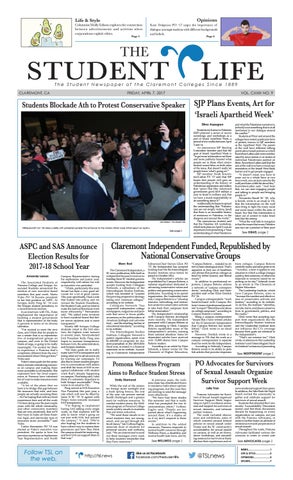
Students Blockade Ath to Protest Conservative Speaker
SJP Plans Events, Art for ‘Israeli Apartheid Week’ Elinor Aspegren
Liam Brooks • The Student Life
Will Buckstaff CM ’20 takes a selfie with protesters outside the entrance to the Marian Miner Cook Athenaeum on April 6. See page 2
ASPC and SAS Announce Election Results for 2017-18 School Year Amanda Larson The Associated Students of Pomona College and Scripps Associated Students announced the election of new executive board members this past week. Maria Vides PO ’18 became president in her first position on ASPC. At Scripps, Kelly Peng SC ‘18 won the Scripps student presidency in a record-turnout election. In an interview with TSL, Vides emphasized the importance of building a student government that is representative of the body it governs in terms of its diverse identities. “I’m excited to meet the new class, and I think that for people to see a senate that is so representative of marginalized groups on campus, and even in the United States at large, is going to be really meaningful. I’m excited for them to experience a Pomona that’s completely different from the one I encountered when I first got here,” Vides said. Vides’s main goals for her presidency include centralizing resources on campus and making them more accessible to all students. She explained how her lived experiences at Pomona have informed her of ways to make resources more available. “A lot of the plans that we have is to bridge that gap between the resources that exist, and how people are actually accessing them ... So I’m hoping that with my lived experiences here and all the work I’ve been doing over the past couple years with the whole community, and other community members that are very prominent, that we’ll find ways to make all those financial, legal, and day-to-day type of resources more accessible,” said Vides. Carlos Hernández PO ’18 was elected as Vides’s executive vice president. He spoke to how his previous experience as Sophomore Year Representative and North
Campus Representative during his sophomore and junior year, respectively, will inform his role as executive vice president. “I think, particularly this year, Senate has been a very good advocate for a lot of good causes. This year specifically, I had a role that looked into policy, and we revised the Student Handbook, the Student Code, and we tried to make the Judicial Board just work more efficiently,” Hernández said. “We added some revisions to have a judicial board that better serves students and is more transparent.” Nearly 600 Scripps College students voted in the SAS election, the highest voter turnout in several years. Newly-elected SAS President Kelly Peng also hopes to increase transparency between SAS, the administration, and Scripps students. “My main goals are to really make sure SAS is transparent and doing what we’ve all set out to do by running our campaigns. I’d also like to center student perspective in conversations with admin and shift the focus of SAS to recognize/collaborate with student work that’s already happening on campus. That being said, I also think it’s extremely important to hold Scripps accountable.” Peng wrote in an email to TSL. Peng served as SAS Executive Vice President this past year, a role which will now be filled by Irene Yi SC ’19. Yi agreed with Peng’s views towards increased SAS transparency. “I’m hoping to implement having SAS tabling every single week, so that students will be able to know what’s going on not just with SAS, but around the campus,” Yi said. “[We’re also hoping] for the students to have a direct way to express their grievances and how they think the campus should be improving, and how SAS can support them in that way.”
Follow TSL on the web.
Students for Justice in Palestine (SJP) planned a series of movie screenings and workshops as a part of Israeli Apartheid Week, a period of two weeks between April 3 and 14. An anonymous SJP Steering Committee member said that the goal of Israeli Apartheid Week is “to get more information out there and more publicity beyond what people see in these short misinformed sound bites on both sides of the issue, that doesn’t really let people know what’s going on.” SJP member Noah Knowlton-Latkin PZ ‘17 said that SJP hopes that people will gain an understanding of the history of Palestinian oppression and realize that “given that [the American] government gives $3.8 million a year to Israel in military aid, that we have a moral responsibility to do something about it.” Additionally, he hopes to spread the understanding that “Palestinians are not simply victims, [and] that there is an incredible history of resistance in Palestine, in the diaspora and around the world.” The anonymous student said that the Palestine 101 workshop, which took place on April 3, was an important event presenting a “base understanding of what Palestine is
and what the Palestinian narrative is, [which] is not something that is at all mentioned in our dialogue around the conflict.” Students at Pitzer and around the colleges have noted a particular form of protest, known to SJP members as the Apartheid Wall. The panels of the wall have different talking points about Israeli policies — which Knowlton-Latkin said were corroborated by news stories — or stories of individual Palestinians painted on them. Knowlton-Latkin said that the aim of the wall is to have a visual representation of the Israeli West Bank barrier and to get people engaged. “It doesn’t mean you have to come out to a whole hour or two hour event, you can just come [to the wall] and learn a little bit about this,” Knowlton-Latkin said. “And from that, we can start engaging people and talking to people and bringing people in.” Alexandra Bacall SC ‘20, who is Jewish, wrote in an email to TSL that the information on the wall does bring to light the many racial and social issues within the state of Israel, but that this information is taken out of context to make Israel look like the enemy. “What the wall fails to recognize is that the issues that many Palestinians face are a product of their poor
See ISRAEL page 2
Claremont Independent Funded, Republished by National Conservative Groups Marc Rod
The Claremont Independent, a 5C news publication, bills itself as independent because it receives no funding from 5C student governments. However, the Independent accepts funding from Collegiate Network, a subsidiary of the Intercollegiate Studies Institute, which was founded to “counter the growing progressive ideology taking over American colleges,” according to its website. Collegiate Network “has supported independent college newspapers, magazines and journals that serve to focus public awareness on the politicization of American [colleges and universities] ... and the resulting decline of educational standards,” according to its website. The Intercollegiate Studies Institute, Collegiate Network’s parent organization, spent over $1,400,000 on programs for student journalism in the 2015-2016 fiscal year, as stated in a financial statement on its website. According to Claremont Independent
Editor-in-Chief Steven Glick PO ’17, the Independent has accepted funding from the the Intercollegiate Studies Institute since before he joined in October 2014. The Independent’s articles are re-published by Campus Reform, a national organization dedicated to advancing conservative values and politics and grooming conservative politicians. According to its parent organization, the Leadership Institute, Campus Reform is a “one-stop resource, networking, and instruction center for conservative activists to take back their campuses from leftist domination.” The Independent’s relationship with Campus Reform developed more recently. The Independent partnered with Campus Reform in 2016, according to Glick. Campus Reform republishes many of the Independent’s articles, earning them national attention. Some Independent articles have received over 15,000 shares from Campus Reform readers. According to an article by Peter Schmidt, a senior writer for The Chronicle of Higher Education,
Pomona Wellness Program Aims to Reduce Student Stress Emily Diamond While the end of the semester brings more sunlight and a fresh spring breeze, the end of the year can present mental health challenges and a greater need for wellness resources. To combat student stress, the Wellness program at Pomona College sends weekly emails to students that aid stress reduction. “We send these emails to remind students they are strong, smart, and can get through difficult times,” Jan Collins-Eaglin, associate dean of students for personal success and wellness, said. “We are determined to send out these messages every week to help students remember that they have resources.”
http://tsl.news
In previous years, the wellness team has distributed flyers in residence halls about upcoming programs, but this year they are striving to send the message more effectively. “We have had three deaths this semester and that is really what has prompted the rise in conscientious effort,” CollinsEaglin said. “People are impacted about what’s happening around them. It’s a shame on us if we don’t respond to these events.” In addition to the added resources, Pomona responds to mental health concerns through Wellness Peers, a disability and mental health task force, and by
See WELLNESS page 2
Like us on facebook: facebook.com/thestudentlife
“Campus Reform… make[s] no effort to hide ideological slant. That’s apparent in [its] use of headlines and photos that portray colleges as beset by leftist tyranny and liberal excess.” In addition to professional reporters, Campus Reform utilizes a network of ‘campus correspondents,’ including Glick and Independent staff writer Elliot Dordick PZ ’18. Campus correspondents “work hand-in-hand with Campus Reform’s team of professional journalists” to report “liberal bias and abuse on college campuses,” according to Campus Reform’s website. Being a campus correspondent “means that I have written articles for the [Claremont] Independent that Campus Reform has republished,” Glick wrote in an email to TSL. However, Dordick wrote in a message to TSL that his work as a campus correspondent is separate from his work for the Independent. According to Schmidt, Campus Reform revels in its ability to publish articles that provoke responses
from colleges. Campus Reform carefully tracks and takes pride in its “‘victories,’ a term it applies to any situation in which a college changes a policy, fires someone, or otherwise responds to concerns raised by reporting on its site,” Schmidt wrote in an article in The Chronicle of Higher Education The Leadership Institute, which runs Campus Reform, aims to “increase the number and effectiveness of conservative activists and leaders,” according to its website. To do this, the Institute “identifies, recruits, trains, and places conservatives in government, politics, and the media.” Glick wrote that accepting support from organizations like the Intercollegiate Studies Institute and the Leadership Institute does not influence the CI’s coverage because their goals are identical to the Independent’s. “That’s our mission too,” Glick wrote, in reference to the Leadership Institute’s and Intercollegiate Studies Institute’s missions of promoting
See INDEPENDENT page 2
PO Advocates for Survivors of Sexual Assault Organize Survivor Support Week Julie Tran Pomona Advocates for Survivors of Sexual Assault organized Survivor Support Week, beginning on April 2, to enhance awareness and support for survivors of sexual, domestic, and intimate partner violence. The week included discussions and exhibitions, some of which centered around federal policies on sexual assault under Trump and the 5C community’s accountability for sexual assault on campus, as well as art shows, dance workshops, and storytelling sessions for survivors to freely disclose their experiences and re-
@TSLnews
ceive emotional support from peers. In addition, the Take Back the Night March invited the community to gather and celebrate support for survivors of sexual assault. Students that attended the Community Accountability Discussion session said that these discussions should be happening in every organization on campus, not just with the Pomona Advocates, in order to further foster an attitude of intolerance towards perpetrators of sexual assault. Throughout the week, Pomona Advocates facilitated various discussions in order to create safe
See ADVOCATES page 2 NEWS................................1 LIFE & STYLE.....................3 OPINIONS........................5 SPORTS.............................7
NEWS PAGE 2
ISRAEL: Students React to SJP Events and Message and tyrannical system of government,” she wrote. Conversely, Dana Nothnagel PZ ‘19 said that she found the wall incredibly powerful. “I particularly admire SJP because of their bravery; they’re speaking up about an issue that is often very difficult and very unaccepted at the 5Cs. The wall is an incredibly bold and needed addition to campus,” she wrote in an email to TSL. Pitzer President Melvin Oliver published a statement on April 4 acknowledging the wall and the high emotions surrounding both the wall and the situation in the Middle East. “My hope is that we use the core values of Pitzer, which include civility, respect and dialogue as a basis of conversation and further discussion of this difficult issue. Pitzer remains open to considering multiple points of view, to caring for each other and focusing on our shared positive values,” the statement reads. The anonymous student and the rest of SJP believe that the statement fairly contextualizes the wall’s role as meaning to spark dialogue, not to hurt anyone’s feelings. “It’s about bringing awareness to the issue of state oppression and to spark dialogue around that,” she said. At the same time, according to Knowlton-Latkin, the statement validates students who feel offended because of political speech against a colonialist state. “Especially in comparison to the actual trauma that Palestinians face, for Jewish students to conflate their offense to criticism of the state of Israel with that, I think, is absolutely
ridiculous,” he said, referring to the “horrific forms of violence and harassment experienced by Palestinians in their own homeland.” According to Executive Board Member for the Claremont Progressive Israel Alliance (CPIA) Zachary Freiman PO ’20, Apartheid Week, which CPIA refers to as Hate Week, acts as a way to intimidate, threaten and silence pro-Israel voices on campus. “As an organization, we feel strongly that SJP does not speak for a majority of students on campus, that they are using tactics that intimidate students for remaining silent for their pro-Israel views,” he said. According to CPIA Executive Board Member Mica Laber CM ’18, CPIA has placed numerous posters around campus emphasizing talking points about Israel in order to promote positivity. “There’s a lot of information about Israel that people don’t know because Israel gets washed up in this narrative and conflict and foreign affairs that gets very very messy and complicated.” Laber said. “The posters are meant to help students recognize that Israel is a vibrant country that does a lot of good for the region.” Freiman said that CPIA has also been reaching out to Jewish students to make them feel safe and like they have someone to talk to on campus. According to Laber, many Jewish students have felt unsafe on campus. “There are students who want to transfer, there are students who do not feel comfortable in their classrooms, there are students who are being targeted in the classroom. They’ve had students turn around and say extremely anti-semitic things
to their faces,” she said. CPIA has been planning alternate programming “to promote positive dialogue,” said Laber. At one such event, NYU Adjunct Professor Abe Haak spoke about his childhood growing up a part of the Palestinian Liberation Organization and his later transition into a pro-Israeli activist. “From the minute you’re born until you die, for most people, there is no dissenting voice to challenge the narrative that Israel is a racist, imperialist, expansionist, colonialist state, and the Jews are the vilest of mankind,” he said during the talk. Students have had different reactions to the SJP’s and the Israel Alliance’s activity. Hannah Zuckerberg PZ ‘20 said that although SJP came from a good place and had good events, there were still ideas lacking from the week. “An event that they were lacking was a dialogue discourse type of event where people could ask questions and engage in dialogue who might not necessarily agree with SJP and also might not agree with the Israeli Alliance group,” she said. “That sort of space was not available during this week.” Chen Pekker HM ‘19 said that she has felt attacked and isolated as a result of SJP’s “hateful activity.” “I feel as though I have to defend my right to exist, both as a Jew and especially as an Israeli. There is so much misinformation and hatred out there which makes it extremely difficult to engage in any sort of positive, thoughtful conversation,” she said.
Lia Francis-Bongue • The Student Life
The Apartheid Wall displayed at Pitzer College on April 6.
ADVOCATES: Events Aim to Increase Student Involvement in Support Programs Continued from Page 1 spaces for survivors to disclose their experiences and trauma. The advocates stressed the need to normalize sexual assault awareness and support dialogue. Advocate Micayla Calloway PO ’18 helped organize the second annual Survivor Support Week. “Last year, I came into the Pomona Advocates noticing that they didn’t know how to reconcile organizing events and direct survivor support,” Calloway said. “Which one should we prioritize since the institution is doing neither?” Calloway said that the Advocates don’t have the capability to organize events and provide direct survivor support all of the time, which led to the establishment of Survivor Support Week. Fellow Pomona Advocate Emily Coffin PO ‘19 said survivor support should emphasize addressing rape culture on campus with an activist mindset. “It’s not enough to handle situations as they occur rather than promoting a culture that condemns them to begin with,” Coffin said. Despite the relatively recent emergence of Survivor Support Week, Calloway noted a large increase in participation and involvement from the student body during this year’s support week. Calloway attributes this to her belief that the Claremont Colleges community would benefit and connect most with vocal, persistent events. Moreover, Coffin believed that many individuals on campus viewed this week as their opportunity to jump in and be active members of the community. “This year’s programming has been more intentional to call out and call in certain members and organizations of the community that have taken a stance that have not necessarily been active with these issues and giving them space to finally engage,” Coffin said. Coffin explained that publicly identifying as a survivor often feels invisible, giving the impression that people don’t feel a responsibility or
an obligation to care. “Increasing the visibility of survivors on campus, presence of these issues on campus, presence of these issues within [students’] own organizations allow us to really draw people in and hold this entire community accountable for its actions,” Coffin said. Coffin then further explained the importance of Survivor Support Week to the Pomona Advocates: “The vision and the mission of our organization in particular is to protect survivors, and to have that at the core is very crucial to event planning and to be considerate of the needs and wants of survivors and developing an event program where the space, discourse, and material that are being distributed are in the best interests for survivors.” When asked about her motivation to be in Pomona Advocates, Calloway said that she became a survivor during her first week at Pomona. After the incident, she assumed that no one cared because there was no vocal or visible support from the school or the community. “It’s such an isolating community to be in and I wanted to make sure that it was no longer isolating, and that there is a community that will welcome you and that will help you,” Calloway said. Calloway and Coffin both agreed that survivor support week was what they wanted to leave behind after graduating. Both believe that effectively fostering and normalizing conversation about survivors will require not only a shift in the mindset of the students but also the administration. “Our mission for Survivor Support Week is to construct a visible network of support and resources for survivors on campus and to continue the ongoing conversation about rape culture and systemic issues surrounding sexual violence,” advocate Sophia Bax PO ‘20 wrote in an email to TSL.
Ath Speech Livestreamed as Protestors Block Entry Samuel Breslow A crowd of approximately 300 protesters surrounded the Marian Miner Cook Athenaeum at Claremont McKenna College in an attempt to block conservative political commentator Heather Mac Donald from entering the building and delivering a talk on the evening of Thursday, April 7. Mac Donald, a fellow at the Manhattan Institute and contributing editor at City Journal, is a vocal critic of the Black Lives Matter movement and its allegations of racial bias in policing. Her scheduled talk, entitled “The War on Police,” promised to “explore the data on policing, crime, and race and argue that policing today is driven by crime, not race,” according to the Ath’s website. The protesters released an anonymous statement on Facebook the afternoon of the talk accusing Mac Donald of holding anti-black, Islamophobic, and xenophobic views. “As a community, we CANNOT and WILL NOT allow fascism to have a platform,” they wrote. “To protect the current police and prison system means that you are maintaining the racist system which constantly murders and dehumanizes people of color.” The protesters, most of whom wore all black, congregated outside Honnold/Mudd Library at 4 p.m. to stage the action. “We are here to shut down the fucking fascist,” announced an organizer to a crowd of around 100 students. The organizer also warned that “there is a potential for police to show up and there is a potential for arrest.” The protesters subsequently marched to the Ath around 4:30 while chanting. An organizer shouted “How do you spell racist?” into a megaphone; the marchers responded “C-M-C.” When they arrived, the protesters were greeted by around two dozen Campus Safety officers and Claremont police officers, stationed at various locations around the building. Protestors ignored the officers (who did not obstruct them) and the makeshift white fences sectioning off areas of Flamson Plaza, enveloping each of the Ath’s entrances with multiple rows of students linking arms.
White students were encouraged to stand in front to form a barrier between students of color and the police. The protesters continued their chants, including “hey hey, ho ho, Heather Mac has got to go,” “shut it down,” and — most frequent and sustained — “black lives matter.” Some of the officers appeared visibly uncomfortable during chants of “from Oakland to Greece, fuck the police.” However, David DeMetz, a Sergeant for the Claremont Police Department, said, “We’re there to ensure everyone’s safety, even the people that may not be happy with the police’s presence. … We have to … remain neutral and objective.” As the scheduled start of the dinner approached, prospective attendees with reservations were unable to enter. Most stood outside, waiting around in small groups, dressed in formal attire. However, others chose to argue with protesters in heated exchanges. Keck Science professor Anthony Fucaloro pushed against and grappled with the crowd of protesters in an unsuccessful attempt to reach the door. He could not be reached for comment before press time. Mac Donald succeeded in getting in, but she was greeted by a nearly empty room apart from some Ath employees, professors, law enforcement officials, and a camera livestreaming the talk to an audience of roughly 250 people. “It’s very awkward to be speaking to an empty room, but nevertheless, the show will go on,” said Ath fellow Sarah Sanbar CM ‘17 while introducing her. Sanbar defended Mac Donald’s right to speak, attributing that attitude to her own upbringing in Saudi Arabia, “a country that does not protect free speech.” Mac Donald’s talk lasted only half an hour. After defending her views, she answered a few questions submitted remotely. Meanwhile, the protest continued outside. Garrett Ryan CM ‘17 brought a large speaker to the Hub’s patio, blasting Sousa’s patriotic march “The Stars and Stripes Forever” to provoke the protesters. A woman who ran up to him managed to steal his audio cable after a brief scuffle, cutting off the music and garnering cheers from the protesters when she returned to the crowd. “It was not well-received,” Ryan
told TSL. Steven Glick PO ‘17, the coEditor-in-Chief of the conservative Claremont Independent publication, attempted to livestream the protest, but he was swarmed by protesters who blocked his phone. Several administrators attended the protest and stood to the side. They told TSL that they saw their role as ensuring student safety, but they also sympathized with the protesters’ views. “Black Lives Matter is really at my heart,” said Pomona Associate Dean Jan Collins-Eaglin. CMC Dean of the Faculty Peter Uvin urged students to engage with Mac Donald’s views as a way to “deepen or challenge our pre-existing perspectives” in an allcampus email sent out the afternoon of the talk. Afterwards, he expressed his disappointment with the turn of events. “Precisely because these issues are so important, we must be able to debate them, to acknowledge that there exist different analyses and life experiences about these matters, and to listen carefully to each other,” he wrote in another all-campus email. Andrew Busch, the director of the Rose Institute for State and Local Government, who invited Mac Donald, also defended the invitation in an email to Rose students. “If someone calls us racists because they do not respect the importance of free debate, he or she should be reminded that the purpose of a college education is not indoctrination into a particular ideological dogma,” he wrote, adding that racism “should not be trivialized and turned into a bludgeon with which to shut up critics or keep friends in line.” “We do not endorse our speakers’ views, only their qualifications to make informed commentary and their right to be heard,” Busch wrote. However, he also offered his own view that “one can believe strongly that black lives matter without agreeing with the tactics of Black Lives Matter. Critiquing the organization is not synonymous with racism. … The dispute is over means and methods, not aims.” The incident comes on the heels of similar speaker controversies nationwide, including one at Middlebury College in which a professor was injured and one at UCLA in which Mac Donald was shouted down the previous day.
INDEPENDENT: Editors-In-Chief Say Paper’s Mission Aligns With Conservative Orgs Providing Support Continued from Page 1 conservative politics and values. Claremont Independent CoEditor-in-Chief Matthew Reade PO ’18 agreed. Their mission “is our mission. We are, and always have been, a conservative paper,” he wrote in an email to TSL. According to Reade, the Independent partnered with the Leadership Institute and Intercollegiate Studies Institute to advance mutual goals. “We sought out these organizations because we want funding only from organizations and individuals that share our values,” Reade wrote. Notably, the Independent’s mission statement on its website does not mention promoting conservatism:
“The Claremont Independent is dedicated to using journalism and reasoned discourse to advance its ongoing mission of upholding truth and excellence at the Claremont Colleges,” the statement reads. According to Claremont Independent Associate Editor Quincy Clarke PO ‘18, members are also invited to Leadership Institute and Intercollegiate Studies Institute events. Based on the Leadership Institute’s website, its events are plainly intended to train future conservative politicians and activists. While the Intercollegiate Studies Institute provides fewer publically available details about its events, Jane Coaston, a writer for MTV News and a former Editor-in-Chief of Michigan Review, a Collegiate Network-funded publication at the University of Michigan, wrote an article about her experience at a Col-
legiate Network editors’ conference she attended while in college. “My senior year, while attending an editors’ conference in Scottsdale, Arizona, where we were given as much free alcohol as we could stand, I realized that we weren’t battling the forces of ignorance and apathy. We were battling liberals,” she wrote. Reade wrote that Collegiate Network, Campus Reform, and their respective parent organizations do not have editorial power over the Independent’s reporting, nor have they tried to censor or influence the Independent. “Our broad network of grassroots support — from alumni, parents, students and organizations that share our values — enables us to exercise complete editorial independence,” Reade wrote. However, Glick wrote that the
Independent is unlikely to adopt any “mainstream political ‘point of view or opinion’” with which Intercollegiate Studies Institute disagrees. “I am not concerned that this will ever be an issue for us because … our mission closely aligns with all the organizations we work with,” Glick wrote. According to Reade, funding from Intercollegiate Studies Institute represents a “minority” of the Independent’s budget. “Most of our funding comes from grassroots donations from alumni, parents, and students from the various Claremont campuses, as well as from unaffiliated individuals who support our independent journalism,” Reade wrote. Campus Reform and Collegiate Network did not respond to TSL’s requests for comment.
WELLNESS: Task Force Organized to Support Students Continued from Page 1 referring students to Monsour counseling. The Wellness program promotes wellness in its broadest sense, which includes physical, emotional, financial, environmental, spiritual, career/ academic, and sociocultural wellness. The program has collaborated with the McAllister Center to provide programs around spirituality, supported a program that teaches students about what it means to be physically well, and has held exercise programs such as “Zumba after Dark.” Upcoming events include a hike with the OEC, trip to the Pomona Art Museum, mental health awareness day with Monsour counselors, and a spathemed event at the Hive. In addition to the set programs, Collins-Eaglin emphasized the importance of informal help-seekers in improving wellness. “One of the things that I feel
is most dangerous during this time is going into your room, being isolated and not connecting with others,” she said. “Even if you’re feeling really stressed, connecting with somebody who cares about you is really important.” Aliki Stogiannou PO ’19, a wellness peer, emphasized that though stress levels often increase during the end of the year, resources should be available at all times. “You can’t just identify one period when there is a need for resources,” Stogiannou said. Several staff members agree that Pomona can improve current resources. “Monsour has added staff and we have responded to the recent deaths in numerous ways, but we could do better,” Collins-Eaglin said. “The need is still outpacing our resources,” Vice President for Student Affairs and Dean of Students Miriam Feldblum wrote in an article to TSL. Jasa Cocke, Drug and Alcohol Counselor, thinks that it would be
beneficial to hire people who work with substance abuse and eating disorders to the Monsour services, though she stated that limited resources hinder this possibility.
“
We send these emails to remind students that they are strong, smart, and can get through difficult times Jan Collins-Eaglin
“
Continued from Page 1
APRIL 7, 2017
THE STUDENT LIFE
“I want folks to remember that using drugs and/or drinking can be a part of somebody’s mental health. It breaks my heart when students under the influence go to therapy, get medications, and never talk about their underlying
issues,” Cocke said. Collins-Eaglin emphasized the importance of addressing mental health concerns. “Mental health is a major issue in the United States, so this is not a unique experience,” she said. “The stress of our world, all the factors that lead to depression, we’re all in this together.” Though mental health issues are extremely prevalent, they are often unnoticed, according to Stogiannou. “Just because someone looks like they are doing okay doesn’t mean that they are doing okay,” Stogiannou said. “We should realize that impressions and prejudices can be very harmful when it comes to wellness.” Collins-Eaglin advises students to talk to others, whether that is a Dean, someone in a residence hall, a faculty member, or a friend. “Help is out there, so there is no reason that students should fall through the cracks,” CollinsEaglin said. “That to me would be the biggest and saddest reality.”
LIFE & STYLE PAGE 3
THE STUDENT LIFE
APRIL 7, 2017
FOOD COLUMN
The Importance of Advertising Your Activism: How Corporations Exploit Ethics our dollars to people living these traditional lifestyles and wearing beautiful ‘ethnic’ outfits while making things for us. Receiving Fair Trade certification costs a lot of money and takes a lot of time. Companies go through rigorous auditing to maintain their certification. Yet it is important to ask: do customers even know exactly what they are getting by paying more for a certified product? There isn’t an exact set of standards that Fair Trade Certified™ products are held to. Minimum fair prices are applied to a lot of products, but more or less, they are simply supposed to follow responsible sourcing practices. More often than not, a Fair Trade product is just made by a company that can pay enough money for the certification and pay intermediaries more for responsible sourcing. Coffee is a key product for fair trade marketing. The Fair Trade USA website states that if you are drinking Fair Trade coffee, you are helping a farmer escape poverty. Coffee is grown in some of the counties with the lowest incomes, including Brazil, Vietnam, Colombia, Indonesia, and Ethiopia. Fair trade marketing of coffee very directly appeals to our desire to buy activism. Klatch Coffee, sold at the Motley Coffeehouse, has a wide range of Fair Trade certified and organic products. Stumptown Coffee, sold at the Grove House, does not sell any Fair Trade certified products, but holds themselves to responsible and ethical sources practices. Groundworks Coffee, sold at the
Molly Edison Sex is no longer the biggest seller — activism is what loosens our wallets these days. Look at any product marketed to a younger age group and you will see tag lines and buzzwords left and right. Starbucks hires refugees, Apple has been removing conflict minerals, Target gives billions of dollars to public education. Our generation is full of neoliberalists, and our purchasing choices matter. We want the things we use and the places we spend our money to be doing good things with that money. When it comes to our food, those taglines and buzzwords dominate every end of the market. Fair Trade, organic, local, vegan, gluten-free, natural, ethicallyraised, grass-fed, free-range, nonGMO, and so many other phrases are plastered across our food. Often, these don’t even mean anything. But where many claims about our food apply mainly to the animals or crops being raised, Fair Trade directly affects people. According to Fair Trade USA, “Fair Trade Certified™ products were made with respect to people and planet.” Fair Trade claims to promote safe and healthy working environments, uphold social, environmental, and economic standards, and empower communities. The Fair Trade USA website is littered with colorful photos of mostly people of color in less western surroundings doing physical labor. Fair Trade wants us to believe that by buying products they have certified, we are directly giving
Pit Stop Café and available at McConnell Center, only offers certified organic coffees and advertises being fairly traded but is not Fair Trade certified. Regardless of their certification or not, we as consumers don’t exactly know if the food is produced ethically or not; we can only make our choice based on the claims the product is making. Starbucks does not offer any certified organic or Fair Trade certified coffee. Stumptown may have more ethical sources practices than Klatch Fair Trade certified coffee, but there simply isn’t transparency about where our food comes from. Growing coffee is hard. There are many steps from the ground to the cup. Planting, harvesting the cherries, processing the cherries, drying the beans, milling the beans, exporting the beans, roasting the beans, grinding, and brewing are all involved. The tiny farm conjured up by the term “fair trade” likely does not have the capacity to make enough beans following certain standards and turn a profit. Local coffee is another marketing trap. We don’t grow coffee beans in southern California; it’s simply not possible. Small coffee shops like Augie’s and even Verve love to tout “Drink Local Coffee,” but at best, the coffee is locally roasted. When a business can’t advertise their coffee as organic or fair trade, the last activist selling point they end up with is “local.” Yes, supporting small business is fantastic for the local economy, but we are kidding ourselves if we think that local roasting makes coffee any more ethical.
Sophie Reingold • The Student Life
Making ethical food choices is important, don’t get me wrong, but when it comes to coffee, I spend up to $5 a cup for exactly what I want. That $5 pays not only for the end taste, but all the
means that went into making it. Fair Trade certification does not mean all that much. Next time you spend an extra dollar or two on something that is Fair Trade or otherwise responsibly produced,
take one extra second to think if the difference in production will make an impact in the end or if you are making activist purchases to assuage other guilt.
Heroism Without The Emotional Poet, Author Illuminates James Grit in “The Zookeeper’s Wife” Baldwin’s Lyricism Victoria Anders Based on Diane Ackerman’s 2007 nonfiction book, “The Zookeeper’s Wife” tells the true story of a Polish couple, Jan and Antonina Żabiński, who rescued around 300 Jews living in the Warsaw Ghetto from the Holocaust by sheltering and hiding them in their zoo. Some have called it “‘Schindler’s List’ with Pets.” Jessica Chastain (“The Help,” “Zero Dark Thirty”) is wonderful as the sentimental Antonina, who cares for her animals as though they were her children: “You can trust animals, but not people” are her words to live by. The film seemed to miss the mark, however, in choosing where to place Antonina’s attention and passion, and thus the film’s main subject: the Jews the Żabińskis seek to provide shelter for, or the animals that were the charge of the zoo. Screenwriter Angela Workman went with the latter, making the most emotional scene in the movie one where Antonina risks her life to save a baby elephant by administering CPR to it, rather than risking her life and
security for any Jewish person or against any Nazi. The family’s relationship with the animals under their care almost takes on a Dr. Doolittle side: Antonina allows her son to nap with lion cubs, and her seeming inability to psychologically separate the caretaking of animals from that of desperate human beings comes to a peak when Jan and Antonina take in a teenage girl who had been assaulted by soldiers and whom Antonina treats like a wounded animal. This is perhaps a commentary on the bizarre, unreal nature of the Holocaust and Nazi invasion to Poles in the moment, but perhaps also a tone-deaf emotional juxtaposition. Where the film’s dialogue and screenplay is lacking in depth and passion, director Niki Caro (“Whale Rider”) steps in to keep up consistent and striking action and visuals. This begins with a grandiose opening scene portraying the Nazi invasion of Poland and Warsaw, bombers, armored tanks, and destruction galore. Even more powerful is seeing how this invasion impacted the naïve
and unaware animals and their reactions to the air raids and leftover smoldering animal cages. As with many other films portraying a story in a nonEnglish speaking setting in English, the various characters’ accents are dizzyingly inconsistent. Chastain struggles to maintain a glimmer of a Polish accent, Daniel Brühl (“Woman in Gold”), who portrays zoologist turned Nazi eugenicist, carries an impeccable English accent, and Flemish actor Johan Heldenbergh portrays Jan with an accent somewhere in between. In the end, the Nazi sounds clear, educated, and well-spoken, while the heroic resistance fighters come across as unsure of themselves and their words, let alone their lifesaving actions. Overall, “The Zookeeper’s Wife” is a soft-spoken Holocaust-era film, depicting an incredible true story in a lessthan-incredible fashion; beautiful visuals and a pleasing soundtrack do not make up for its lack of tension and emotional cognizance.
Alexa Strabuk • The Student Life
Want to Write for TSL? We’re hiring for our Life & Style and Sports sections Email editor@tsl.pomona.edu
Andrea Hernandez Ed Pavlić, poet and author of seven poetry collections and two books, spoke about his latest research in a talk titled “James Baldwin, Black Music and the Lyrical Stakes of Political Speech” at Scripps College on April 3. Pavlić is currently a distinguished research professor of English and creative writing at the University of Georgia. His lecture, which welcomed many Baldwin admirers, focused on alternative ways to look at Baldwin’s work and encouraged people to see Baldwin as a lyrical writer. “How does one think about lyrical language if not in the standard ways of judging poetic porosity, for example by looking at the page and guessing that if it’s written in one way it’s either poetry or prose?” Pavlić said. “The question becomes interesting as it relates to James Baldwin, as he’s a celebrated writer of prose, essays, and novels, but who in his career and life referred to himself as a poet again and again, while at the same time writing very few works that resemble poems.” Pavlić argued that instead of looking at Baldwin’s writing and judging from what we see, we should instead notice the powerful lines that lend themselves to repeated reading or
recitation. “If you meet people familiar with Baldwin’s work, they will all have a favorite passage. This is true for all writers, but this is uncommonly so with Baldwin. People who go back to his work again and again find themselves reading the same passage several times, among other reasons, for the experience of just encountering the language again,” Pavlić said. Pavlić then made the connection between lyrical language and music, as both are “loaded up with emotional and textural meaning and resonance.” He pointed out that literary works like Baldwin’s can have musical substance. “The first thing you learn in this country if you’re black is a form of silence. Nobody saw Malcolm coming, nobody saw Martin coming. These people who live in their mirror, don’t see what’s coming”, Pavlić said. Pavlić then played Rihanna’s “Consideration” from her album “ANTI.” According to Pavlić, the song “traces a lyrical suspicion of social tendency, it exposes that some lyricists don’t go with the flow. The lyric poet has a distinct voice, which makes syntax works in ways that is not possible for prose.” Pavlić then played “Backwater Blues” by Bessie Smith, a song
which was written in response to the historic floods of Mississippi and Louisiana and the people that were caught there. This is a song that struck Baldwin deeply. Pavlić argued that writing about this specific experience opens its range of possibility without diminishing its specificity at all, as through the language, readers or listeners can sympathize with the experience in a different way than if it was generalized. “This is lyrical action. In lyrical action, one can find a mirror in something that technically didn’t happen to you at all.” Pavlic finished by reading a letter that Baldwin wrote to a friend of his, Mary Painter, from the first week that he was ever in the American South, where Baldwin recalls several bad experiences he had there, most related to racism. “This,” said Pavlić, is “Backwater blues. Baldwin’s experience in the South and his political involvement altered the voice in which he would write in essays and in novels, in ways which some people have not been able to get over. They think his craft suffered due to his political involvement, but they fail to see the fact that it displaced Baldwin’s Western aesthetic experience of his own mirror. He needed history to give him a break from the face he saw in his own mirror.”
LIFE & STYLE APRIL 7, 2017
Former Wheaton College Prof. Speaks on Academic Freedom
Adela Pfaff • The Student Life
Theology professor Larycia Hawkins discusses her faith and pedagogy in Rose Hills Theatre on Wednesday, April 5.
Tarini Sipahimalani Professor Larycia Hawkins gave a talk titled “Academic Freedom isn’t Free: Christian Professor in Hijab meets Evangelical Litmus Test” at Pomona College’s Rose Hills Theatre on April 5. Hawkins, who was suspended from Wheaton College, a Christian liberal arts college, for wearing a hijab in solidarity with Muslim women, described herself during her talk as “the repugnant cultural other: black, Christian, female.” Hawkins earned her Bachelor’s degree in Sociology and History at Rice University and received a Masters of Public Administration at the University of Oklahoma. Calling Illinois a state she adopted as a home away from home, she conveyed her disappointment in Illinois’ and Wheaton’s response to her wearing a hijab to work during Advent in an effort to stand in solidarity with Muslims, who haven’t been fully accepted in the United States. “It was professional, and it was damn personal,” Hawkins said, “because these are all connected. I stand in religious solidarity with Muslims because they like me are
people of the book.” Our reality sees “the definition of citizenship as synonymous with Christianity,” she said. We see “Jesus as a white supremacist God” because Christians believe Jesus is God personified. “I began thinking about the plight of Muslim women in the United States,” she recalled, explaining why she felt it was important to wear a hijab to work in the first place. “The reality is that academia is the place where ideas go to die. Academia is its only economy; we breed conformity and fact while pretending we promote pluralism,” Hawkins said. “So I am here to use my own story to inspire and mobilize you,” Hawkins said. “Academic freedom is not free. We have tunnel vision and in that we even have blurry vision and it’s limited to a foot in front of our face.” The first step toward justice is that we don’t only need equity, but diversity as well. We have to be aware of who is being excluded from the conversation and fight against all injustices, according to Hawkins. “What I’m pushing us towards
is to be for one another. The cost may be the loss of our status and position but that’s okay. It has to be okay for justice. Academics need to be willing to die for what they do,” Hawkins said. Joslyn Gardner PO ’20 decided to attend the talk because she believed it was a very relevant topic. “I was interested to see how [Hawkins] would approach academic freedom, how it’s not free from a student perspective, and also from a faculty perspective,” she said. Gardner said that she found the talk to be relatable, powerful, and inspiring. “She pushed us students to consider what we are learning in our classes. What is the professor’s agenda?” Gardner said. Gardner liked how Hawkins urged students in the room to ask tough questions of their professors. “It’s amazing how what happened to her at Wheaton College has transformed her life. She may never teach in academia again, but she has evolved into an activist,” Gardner said.
Nancy Williams Talks Activism, History on Transgender Day of Visibility Donnie TC Denome
A smattering of students gathered in Harvey Mudd College’s Drinkward Recital Hall on Friday, March 31, to hear a presentation in honor of Transgender Day of Visibility. Nancy Williams HM ‘95, Keck Science Department Associate Professor of Chemistry, who is a transgender woman herself, spoke about her experiences with transitioning, activism, and the idea of visibility. “I knew, when I was a student at Harvey Mudd, one out gay student,” Williams said, “So the visibility of LGBTQIA+ students at Harvey Mudd and the Colleges was really quite different.” For the last few years, Williams has been involved with the Leadership Lab, a project of the Los Angeles LGBT Center. The aim of the Leadership Lab is to send canvassers out into the city to talk to voters about LGBTQ+ issues in the hopes of swaying people to vote favorably on those issues. Throughout the talk, Williams showed footage the Leadership Lab had filmed of actual canvassers talking to actual voters. Over and over again, the audience was surprised at how effective the canvassers seemed to be at convincing voters to side with them. Williams herself helped canvass on the issues of same-sex marriage in California and transgender non-discrimination legislation for schools in California. She also assisted when the Leadership Lab sent people to Miami-Dade county in Florida to canvass surrounding a transgender nondiscrimination ordinance there. Woven in with Williams’ talk about her activism work were stories about her own social transition and her time as a professor at the Claremont Colleges. She explained the tenure process, where after six years of working at an institution, one is either offered a job as a professor for life, or is fired. Williams was going through the tenure process around the same time Proposition 8 passed in California, banning same-sex marriage. “I was going through a lot. I wasn’t sure whether I was going to get tenure. But [Proposition 8] grabbed me,” Williams said. She received tenure and was sent on sabbatical to New Jersey. “[Within] weeks of getting
PAGE 4
THE STUDENT LIFE
tenure,” she said, “I can date my first fully adult visualizations of myself as a woman.” Even though Williams was speaking on serious, personal matters, her talk was incredibly entertaining. In her overview of her time on sabbatical, she openly talked about her excessive drinking to try and drown the “gender issues” she was dealing with. To a crowd of scienceminded mostly Mudd students, she said, “And it didn’t work so if any of you are contemplating trying to use alcohol to suppress a gender identity issue, I’ve done the experiment. It’s not successful.” Both Williams and the crowd laughed. It took Williams two years after returning from sabbatical to come to terms with her gender identity and to start coming out to people on campus and in her life. “I started coming out one by one to all the faculty members and staff members of Keck Science Department,” she said. “There were 60 at the time in a spreadsheet [and I] kept turning lines from red to green as I came out to them one by one. [I had] about a hundred coming out conversations on the Claremont campuses one by one, important people who I thought needed to know.” In 2013, as Williams was coming out to her colleagues and students, California passed AB 1266, also known as the School Success and Opportunity Act. AB 1266 requires that students in kindergarten through 12th grade be allowed to participate in “sexsegregated school programs, activities, and use facilities consistent with their gender identity, without respect to the gender listed in a pupil’s records.” There was immediate backlash. “There were two signature gathering campaigns, one in 2013 and one in 2014” to repeal the law, according to Williams. To combat this backlash, the Leadership Lab sent canvassers, including Williams, out into Los Angeles to talk to people about the law and hopefully gain their support. During the talk, Williams showed a video of a canvasser talking to a person about transgender non-discrimination ordi-
nances and then led a discussion about the video. “Thoughts?” she asked. An audience member raised their hand. “Even though [the canvasser ] was cisgender he had someone to talk about that was trans to keep the visibility and the personal connection,” they said. Williams agreed. She explained that in her time working with the Leadership Lab, she had met many cisgender students from UCLA and other schools who were eager to canvass but didn’t know any trans people. “So we’ve got to make sure that in the two-hour training we’re going to sit [them] down in a circle [and tell them], ‘we’re going to pair you up with a trans person and tell some stories,’” she said. The audience, again, laughed. “And now [they] can talk about [their] friend Nancy, and [I] make sure that they’ve got a picture of me on their phone.” Near the end of the talk, Williams offered up three guiding principles she learned while canvassing: keep the conversation open, don’t talk over the other person, and use the power of a story. “As soon as things start to get ugly or people start to feel threatened, they’re going to raise their defenses in a big hurry,” she said. “And that’s when the conversation goes south.” However, when it comes to visibility, Williams offered up a piece of advice: “It always has to be on your terms.” The talk was organized in part by they/them, a nHMC club for trans and nonbinary students. Quentin Barth HM ‘18, one of the founders of they/them and one of the talk’s organizers spoke to how extraordinary he thought Williams was, calling her an “example for activism.” Similarly, one of Barth’s coorganizers, who asked not to be named for fear of being outed, explained that they felt the talk was extremely positive and much-needed in the wake of all the unhappiness on campus. “Nancy William is almost single-handedly responsible for the change in attitude [at the Claremont Colleges] towards trans people,” Barth said. “It’s impressive how effective her activism is.”
Nonfiction Authors Explore Influence of Personal Experiences in Writing Process Riley Mang The Spring Scripps Presents speaker series closed out an impressive season on Tuesday with authors Maggie Nelson and Sarah Manguso discussing their works, methods, and inspirations on the Garrison Theatre stage. Maggie Nelson is known for transcending the boundaries between cultural theory, autobiography, and poetry in her writing. She is the critically acclaimed author of five books including “Bluets,” “The Red Parts,” and her most recent, “The Argonauts.” A 2016 MacArthur Genius Grant recipient, Nelson’s work is a deeply personal interrogation of identities and narratives that challenge degrees of cultural normativity and linearity. Sarah Manguso is also known for intervening in taxonomies with her poetically-enriched prose. A 2012 Guggenheim fellow, Manguso has authored seven books, her most recent of which, “300 Arguments,” she discussed at Scripps earlier this semester. Manguso is also the current Mary Routt Chair of Creative Writing at Scripps, where she teaches writing. At once memoirs and meditations, “The Argonauts” and “300 Arguments” subvert classical literary forms and guide readers through personal memory, cul-
tural criticism, and potent musings on the human condition. Organized into several small compositional units, both works demonstrate the power of each carefully selected word. “I think Sarah and I share a real delight in the small form but also compositional structures that are more symphonic and discursive, and I think that’s probably a trick that we learned from poetry, where we both started,” Nelson shared. “With shorter forms, you’re really blaring out loud what the compositional elements are, they’re just more obvious.” Although these authors resist placing their works into categories, both use nonfiction to relate their literary talents to current cultural and political identities. Nelson, in particular, cites gender and queer theory in navigating her readers through her pregnancy and her partner’s gender transition through compelling, nonlinear storytelling. “What I like about nonfiction,” Nelson said, “is that whatever happens, your job as an artist is to grapple with what happened and make it into art, which is different from making whatever you want happen in fiction. Wherever the chips fall, make art from it. You don’t control it in that way.” Nelson and Manguso both read from their selected works, inviting
the audience into their intimate anecdotes and trains of thought and further reflecting on the process of representation and formulation. Flora Field SC ‘17 is an English major and a student in Manguso’s creative writing class. She said that she admires both authors’ works and that they have influenced her own writing. “The style of the conversation really intrigued me, particularly because I knew the two had a relationship prior to the event,” Field wrote in an email to TSL. “I think the audience gains a lot from witnessing a conversation as opposed to a presented talk. In some ways, I think this more organic form seems to replicate a part of what I understand both Maggie and Sarah’s projects to be, which is to write the self in a more comprehensive or integrative way, as opposed to following the linear narrative.” Nelson and Manguso topped off what has been a stellar cast of speakers on the Scripps Presents 2017 roster. Other literary highlights included the National Book Foundation’s Lisa Lucas and bestselling authors Rachel Kushner, Robin Coste Lewis, Elif Batuman, and Jami Attenberg. Each has enriched the semester with words on the literary form, the power of fiction, and the capacity to ignite empathy through storytelling.
Courtesy of Jacqueline Legazcue
Authors and friends Maggie Nelson (left) and Sarah Manguso closed out the Scripps Presents speaker series on April 4.
OPINIONS APRIL 7, 2017
THE STUDENT LIFE SEAN OGAMI, News Editor KELLEN BROWNING, News Assignment Editor ELINOR ASPEGREN, News Associate LIAM BROOKS SAFA ARSHADULLAH, Life & Style Editor Production Editor SOPHIE PETERS, Life & Style Editor ANIKKA VILLEGAS, Life & Style Associate CHRISTOPHER ESKILSON KATE DOLGENOS, Opinions Editor Content Editor JO NORDHOFF-BEARD, Sports Editor CLAIRE WENDEL, Sports Editor LAUREN ISON Editor-in-Chief
GRACE OZONOFF-RICHEY, Senior Design Editor ELIZABETH LEADER, Senior Design Editor DAPHNE YANG, News Designer MEGAN ROBALEWSKI, Life & Style Designer NOOR DHINGRA, Opinions Designer CHRISTINA BECK, Sports Designer The Student Life, the oldest college newspaper in Southern California, is produced and managed by students of the Claremont Colleges and published weekly. The Editorial Board consists of the Editor-in-Chief and two Managing Editors. Aside from the editorial, the views expressed in the opinions section do not necessarily reflect the views of The Student Life. Email letters, questions and concerns to editor@tsl.pomona. edu. Email tips to liaison@tsl.pomona.edu; email advertising inquiries to business@tsl.pomona.edu.
MATTHEW LEE, Senior Copy Editor DONNIE DENOME, Copy Editor ANDREW MEDINA, Copy Editor
MONICA ACOSTA, Distribution Manager WESLEY LIANG, Business Manager ALEXA STRABUK, Senior Advisor
TSL welcomes Letters to the Editor, which can be submitted by mail, by email, or in person at the Fishbowl in Walker Hall. Letters must be under 400 words (although when an issue is particularly salient, we reserve the right to allow letters to run at a longer length) and submitted by 4 p.m. Wednesday of the week of publication. We reserve the right to decline publication of submitted letters and will not accept anonymous letters, letters containing profanity, factually inaccurate letters or letters making personal attacks. TSL also reserves the right to edit for spelling, punctuation and grammar. Letters may be signed by a maximum of three persons. All letters become the property of TSL and may not be reprinted without prior permission from the Editorial Board.
Ath Talks Aren’t Neutral During the protest at the Marian Miner Cook Athenaeum at Claremont McKenna College yesterday, which Samuel Breslow reported on in this week’s issue of TSL, a common argument by counter-protesters was one that seems reasonable on paper: “I agree that Black lives matter, but I also want to see the speech.” Heather Mac Donald was scheduled for the evening program at the Ath to argue against the Black Lives Matter movement, whose position against police brutality she calls “tragic” and whose platform she deems a “myth”. “If we are going to have a ‘Lives Matter’ crusade, it would more appropriately be labeled ‘White and Hispanic Lives Matter,’” Mac Donald wrote last year in National Review, citing what she saw as the reality of “black crime”. It makes sense, then, that the focus of Thursday’s protest was
Thou Shall Not Kill: The Hypocrisy in Catholicism
DOMINIC FREMPONG, Graphics Editor ALYSSA ALFONSO, Photo Editor MEGHAN JOYCE, Photo Manager DONOVAN NEW, Video Director
EDITORIAL BOARD
TSL SAYS
PAGE 5
THE STUDENT LIFE
the worth of Black lives and the need to end police brutality, seeing as Mac Donald’s work argues directly otherwise. But, despite what critics of the protest argued, simply agreeing that Black lives matter is not enough to counter the influence of Mac Donald’s ideas. If we allow her to speak at the Ath or attend her talk, we are amplifying her voice and enhancing her credibility. Last month, we proposed that writing and publishing an article, even if it’s “free of opinion,” is not passive. This is a throughline for many of our editorials this year: many actions that seem neutral in theory are actually entrenched in unconscious bias. The ability to hold ideas in one’s head that directly oppose one’s own beliefs is necessary for learning, and can indeed be a neutral act motivated by a need to better understand a complicated
Calling out corporations on their bullshit Pepsi will solve police brutality
or tumultuous issue. If you want to expose yourself to Mac Donald’s ideas, it’s not hard to read through Mac Donald’s author page on the National Review or buy her books on Amazon. But showing up at an Athenaeum event, dressed to the nines for a dinner and long-winded introduction, is not a neutral act. The select few speakers who are invited to our colleges with respect and fanfare should espouse the most important ideas of our time, not a rehashed support for systemic racism. There’s no way to truly support the Black Lives Matter movement while fetishizing the First Amendment into an excuse for supporting racists. We encourage people who flippantly say “Black lives matter” while supporting speakers like Mac Donald to slow down and consider the real meaning behind that proclamation.
Jolo Labio Columnist In first grade, my Catholic primary school required us to memorize the Ten Commandments. Thou shall not kill. Thou shall not steal. Thou shall not bear false testimony. We were told to live by these truths; I obeyed and took them to heart. I took mandatory catechism classes for six years. My grandmother read me Bible verses everyday. My parents place a Santo Niño — an image of the Child Jesus — in every room in our house. For over seventy-six million Filipinos, Catholicism is deeply ingrained into our identities. I was a performative Catholic for eighteen years; I didn’t want to upset or disappoint my family. I was told being a Catholic would grant me eternal salvation — that I would “go to hell” if I dared turn away from the Church. Thou shall not kill. Thou shall not steal. Thou shall not bear false testimony. For Claremont students who grew up in deeply Catholic households, this narrative is all too familiar. As soon as I moved to the United States for university, I felt liberated from the shackles
of performative Catholicism. Free from parental pressure and armed with newfound knowledge, I began questioning the glorification of Catholicism. My eyes took notice of the dark blood stains on the Church’s white, pristine walls. Catholicism served as justification for Spanish imperialist pursuits in the Philippines, Mexico, and the rest of Latin America. Spanish friars converted natives to Catholicism in order to ‘liberate them from their savage and ignorant indigenous practices.’ To them, killing men, stealing land, and erasing culture were all justified in the name of God. Thou shall not kill. Thou shall not steal. Thou shall not bear false testimony. Once local tribes were evangelized, Spanish friars usurped political and economic power from native leaders. Catholic missionaries were complicit in the tribute and encomienda systems, institutions that enslaved and extorted money from natives. Fertile land, sparkling waters, and rolling hills lay in the palm of a Spanish iron fist; we were prisoners on our own land. Ultimately, Catholicism became the face of oppression — an empire of churches and crosses built on the bones and blood of natives. Thou shall not kill. Thou shall not steal. Thou shall not bear false testimony. And to this day, the Catholic Church continues to exert undue sociopolitical influence over public policy. In the Philippines, the Church persistently condemns access to reproductive health and planned parenthood services, guilt-tripping contraception users as “sinners” and “murderers”. In doing so, the Church deprives a woman of agency over her own
body. Moreover, the Catholic Church in the Philippines vehemently opposes any form of same-sex unions, further ostracising the Filipinx LGBTQIA+ community. Most alarmingly, the Filipino Catholic Church claims to advocate for the poor, yet invests billions of pesos into the Philippines’ big banks and oil industries. It is hypocritical for the Church to preach morality whilst fuelling a capitalist machine that oppresses the most marginalised members of society. Thou shall not kill. Thou shall not steal. Thou shall not bear false testimony. Unfortunately, a lot of devout Catholics believe that the Church is infallible. They conveniently ignore Catholic atrocities and continuously pressure non-performing Catholics to participate in religious practices. Most notably, Catholic parents often shame their college-aged children into regularly attending church services. While we all possess the freedom to practice religion, we should be more critical of the history and foundation of certain institutions. The Church is not morally absolute. We need to hold them accountable for their atrocities — they kill, they steal, and they lie. We can be morally upstanding people — ones who even possess Christian values — without being complicit in the Catholic Church’s hypocrisy and oppression. Thou shall not kill. Thou shall not steal. Thou shall not bear false testimony. Practice what you preach. Jolo Labio PO ‘20 is from Manila, Philippines. Catch him every Monday-Thursday at 7:59 AM, furiously sprinting to his 8 a.m. at Mason.
Weekly Comic
Berry Manilow on the menu
Kendall Jenner, once again How low can the Kendall burn?
Barry Manilow off the market
Cute Spring Fling Promposals I’ll have her home by 11 pm
Spring flowers Profile pic courtesy of Superbloom
Oversaturated programming Glad my student fees are getting put to noble use
Those terrifying “mosquito hawk things” What are they even called Audrey Jang • The Student Life
Students for Justice in Palestine Several weeks ago, the United Nations released a statement telling us what Palestinians have known for decades since the Nakba: that Israel has established an apartheid regime. Meaning “the Catastrophe,” the Nakba refers to the time when over 700,000 Palestinians — Muslim, Christian, and Jewish alike — were violently uprooted and expelled from their homes by Zionist forces in 1948. While this moment is understood as a time of expulsion of indigenous Palestinians, one can understand the Nakba as ongoing through the apartheid policies of the settler colonial state of Israel today. According to the UN’s Apartheid Convention, apartheid is a discriminatory political system historically practiced by the white ruling class of South Africa. As it pertains to international law, apartheid includes “similar policies and practices of racial segregation and discrimination as practiced in southern Africa.” With this, there is a historical link between the South African struggle against white
Apartheid Exists in Israel
apartheid and tthe Palestinian struggle against Israeli occupation. South African leader Nelson Mandela consistently reaffirmed Palestinians’ right to statehood and liberation, and this cross-cultural solidarity lives on today. A statue of Mandela gifted by the city of Johannesburg was erected in Ramallah in 2016. Hasina Kathrada of the South African Broadcasting Corporation writes: “Solidarity knows no boundaries or even geography. SA’s destiny is tied to the people of Palestine. South Africa’s liberation and humanity is tied to Palestine’s. Madiba’s statue here in the centre of Ramallah will be a daily reminder to the people of Palestine that indeed, their intifada is SA’s too.” Importantly, the definition of apartheid according to international law is: “inhuman acts committed for the purpose of establishing and maintaining domination by one racial group of persons over any other racial group of persons and systematically oppressing them.” With this definition in mind, it’s clear why Israel is an apartheid state. Palestinians, in the West Bank, Gaza Strip, Israel, and in
diaspora, are deprived of rights afforded to Jewish Israelis. The hundreds of thousands of Palestinians expelled from their homes in 1948 have grown to over 5 million refugees. While many of the dispelled Palestinians hold the deeds and keys to their houses back in Palestine, none of them, nor their descendents, are allowed to move back to their homes. In fact, depending on their citizenship or political identities, they are often not allowed to even visit Israel if they have the means to. In contrast, Jewish individuals around the world are automatically able to receive Israeli citizenship and, through the Birthright program, are eligible for an allexpenses paid trip to Israel. Palestinians, even those born in what is now Israel, have no such birthright. They have no right of return. Palestinian citizens in Israel are also subject to racialized laws and regulations that inhibit them from living as equals under the law. First and foremost, Palestinian citizens of Israel are stripped of their national identity and classified as Arab-Israelis.
This institutionalized overwriting of Palestinian identity is consistent in Israeli rhetoric. Palestinians are grouped into the Arab monolith, rather than being considered in the context of their situated ties to the land. Contrary to popular belief in the United States, Israel is not a bastion of liberal democracy in the Middle East. According to the MerriamWebster Dictionary definition, democracy is a political system in which “the supreme power is vested in the people” and where there is an “absence of hereditary or arbitrary class distinctions or privileges.” Neither are true in Israel/the Occupied Palestinian Territories. Full citizenship is harder to receive and maintain as a person of color or non-Jew in Israel, and without it, these residents cannot participate in political life. There are over 50 laws that discriminate against Palestinians in Israel. For starters, Palestinian citizens do not serve in the Israeli military, which often asserts force on other Palestinians and Arab populations. However, military service is tied to many social/eco-
nomic benefits in the country, and as such, Palestinian citizens are denied these benefits. Public services beyond those afforded to IDF members/veterans are also segregated by race. Throughout Israel, particularly in East Jerusalem, it is more difficult for Palestinians to attain property permits, and their schools are entirely separated from the schools of Jewish students. This tiered public system is a clear indicator of an apartheid state, especially considering that Arab schools receive under half the funding per capita of Jewish schools. Another indicator of the race/ religion based discrimination infused with Israeli law is Israel’s marriage laws, by which same-sex and interracial marriages are disallowed. Though Israel poses itself as a haven of LGBTQ+ friendliness, this rhetoric masks the deeper concern that Israel uses this as a pivot point from their rejection of queer Palestinian liberation. Most chilling of Palestinian unequal experiences are those of Palestinians in the West Bank and Gaza, who are subject to regular
home demolitions, settler violence, and toiling checkpoints throughout daily life. Palestinians in the West Bank are held under Israeli military law which arbitrarily charges children as adults. Under occupation, the IDF convicts Palestinians on “secret evidence” to prisons known for their impugned use of torture. Residents of Gaza, one of the most densely populated places in the world, face the worst of Israeli crimes against humanity. Israel’s blockade on Gaza prevents the travel of goods and people, and every few years the IDF besieges Gaza as collective punishment. The most recent siege occurred in the summer of 2014 (known as Operation Protective Edge), when 2,205 Palestinians were killed. Given the lived experiences of Palestinians today, it would be an injustice to purport that Israel has not established an apartheid regime. We call attention to these crimes this year in Israeli Apartheid week, and invite you to attend our events, for we know that there will not be peace and justice in the region until the liberation of Palestine.
OPINIONS PAGE 6
APRIL 7, 2017
THE STUDENT LIFE
Political Polarization at the 5Cs is Harmful to our Education
Kate Dolgenos Columnist My elementary, middle, and high schools were progressive institutions with pervasive liberal groupthink atmospheres. The schools were so liberal that we were forbidden from wearing camo print, playing with water guns, or including toy swords in our Halloween costumes because, apparently, these actions promoted violence. Policies like these were theoretically supposed to make us more progressive, but all they did was annoy me. Although my progressive political views never conflicted with my school’s liberal consensus, I came to a liberal arts college because I wanted an environment with genuine dialogue, political and otherwise. I wanted to learn from my classmates’ experiences and opinions. At Pomona, I have done this for the most part — but not politically. The political realm is a bizarre
exception to the genuine openmindedness of the Claremont colleges. Students here tend to equate political beliefs with both a person’s moral goodness and their intellectual worthwhileness. The ultra-liberal majority regards conservatives as evil, heartless, and cartoonish. The conservative/libertarian minority believes that college liberals are stupid, delusional, and unlikely ever to find gainful employment. Paradoxically, the college I chose for its open-mindedness and intellectual discovery sometimes seems more narrow-minded than my high school class, which had exactly one Republican in it. The intolerant approach to political discourse at this school is bizarre and troubling, because the most accurate predictors of someone’s political beliefs are the political beliefs of their parents and the political atmosphere of the background in which they grew up. A 2005 Gallup poll found that 71 percent of teenagers plan to vote with the same political party as their parents, even if their views skew slightly more liberal or conservative. Whether we admit it or not, most of us would be Republicans if we were born in a Republican household and raised around Republicans, and vice versa for Democrats. Judging someone purely based on their political affiliation is hardly different from judging someone based on their background. Often, the assumption in Claremont is that the education here will cure students of their unacceptable, politically incorrect
political beliefs. This is nonsensical, because different people with different personalities and beliefs respond differently to the same information. A gender studies class will not make a conservative into a progressive, nor will an economics class somehow turn a hardcore leftist into a dedicated capitalist, even if both these classes present information that I personally regard as enlightening or educational. Their original beliefs might even harden. This would not make them bad people, just people who happen to disagree with me. Obviously, there are rare examples of people at the 5Cs who think themselves out of the conservative belief systems that they grew up with (or liberal belief systems, though I suspect that newly anointed conservatives are quieter about their political metamorphoses). However, these are exceptions to the rule, since most people are destined to have political beliefs that mirror their parents’. The closed-mindedness of judging people’s morality and intellectual heft based on their political beliefs is detrimental to a comprehensive education. The student body in Claremont does its best to not judge people based on superficial factors like class or nationality, but everyone is expected to be equally ‘woke,’ meaning ultra-liberal. It is impossible to maintain this expectation of all of one’s friends and classmates without sacrificing one’s open-mindedness. Because of this extreme politi-
Dominic Frempong • The Student Life
cal polarization, the political climate on campus sometimes seems like a collection of extremist echo chambers with little exchange between them. There are student organizations, secret Facebook pages, and even entire friend groups premised on isolating oneself solely with people who agree politically. These groups, depending on their political affiliation, tend to believe that campus culture is either insanely left-wing and politically correct or neoliberal and
Finding a Place for Arab Identity in Apartheid Week
Simone Bishara Columnist A relative once told me that, after 9/11, they wanted to rip out every Arab part of themselves. The same relative tells me all kinds of stories about home — stories about the breeze in the apple orchards or the smell of home-cooked food. Their memories are vivid and fond. Only something like 9/11 could shake them like it did. This relative wasn’t the only one. Arab-Americans saw a rapid racialization post-9/11 that quickly made them the targets of hate and grief-fueled anger. A common response was to hide what they could; it was easier that way. Safer. So 15 and a half years after the tragic event, it is no surprise that, for the most part, Arabs are invisible. In Hollywood, we’re either terrorists or nomadic salesmen. On the census, we’re white. The lack of common knowledge about where Arabs fit in explains the strange consciousness that I found when
coming to college. I’ve written before about how isolating it felt to not only be so starkly different from my peers, but to have no community to fall back on. The creation of the Middle Eastern Student Association, a dependable group that I can surround myself with, has made Pitzer’s lack of institutional support so much more obvious. I can no longer forgive what I chose not to see. My aforementioned piece called for more institutional support to identity groups for their work supporting marginalized folks. But what about the groups that exist for the sole purpose of organizing around an issue? Are those groups not accountable to the communities they claim to organize for? This week and the next, Claremont Students for Justice in Palestine (SJP) is hosting Israeli Apartheid Week, celebrating 100 years of the Palestinian resistance. First off, I want to make clear that not every Arab or Middle Eastern/ North African (MENA) person is pro-Palestine. And, as is apparent in SJP, not every Jewish person is pro-Israel. In fact there are many Arab Jews, and they have a range of opinions on the issue. The reality is, there are so many sides, and you can’t tell someone’s opinion based on any one aspect of their identity. I am, however, pro-Palestine. I am against occupation, against colonialism, against oppression. I am an advocate for the framework that explains that, while Judaism doesn’t not mean Zionism, Zionism
does mean racism and should be treated as such. Yet, even for me, this week doesn’t seem like a celebration, but rather another series of emotionally taxing workshops and events. Education is exhausting. Being reminded of the oppression of my Palestinian brothers and sisters (as if I ever forget) is exhausting. I can’t even walk to the dining hall this week without having to have a gut-wrenching conversation about occupation. The events fall anywhere between a workshop on pinkwashing (a strategy employed by Israel that attempts to cover up the ethnic cleansing of Palestinians by focusing on Israel’s seemingly open gay life) to a Shakedown Sounds about Borders and Walls. Not all of the events are purely educational, but my fear is that while their intention is to create healing around some of these issues, the absence of Arab folks in the space will make that goal far-fetched. The Claremont Colleges are overwhelmingly white with a healthy Jewish population. SJP is no different. That makes the group especially good at targeting their efforts at the demographics that make up the 5Cs. But that also means that they are susceptible to leaving holes in supporting the students with first-hand knowledge of what occupation really looks like — the students who have personal connections with the conflict. What I have seen happen time and time again is that spaces dedicated to fighting for Palestinian lib-
eration are overwhelmingly white, making it hard for Arab students to participate, especially because they make themselves especially vulnerable while doing this work. This is a pattern true of many organizing spaces on the campuses and one that direly needs to be addressed. Again, this isn’t to say that SJP isn’t doing good work, but rather that the culture on these campuses needs to shift to productive action that helps the students here while also helping folks abroad. This is not to say that I am ungrateful. The movement that exists on the campuses is unique and resilient. The people organizing in these spaces are smart and strong and passionate. I am thankful for them because without them, my life would be exponentially harder, and that is a tough reality to imagine. It is beautiful to see students mobilize for a cause they grew up understanding so differently. But until we can say that our Arab, MENA, and especially Palestinian students are accounted for and supported, we are not doing enough for Palestinian liberation. There is a long road to go, a difficult one. It is hard to fight for justice half-way across the world when it seems your own home is starting to crumble. But we will do it. The events happening for the next week are valuable, and regardless of where you stand on the issue, I encourage you to attend. Simone Bishara is a third-year at Pitzer College studying Sociology. She hopes to one day pursue a career in juvenile justice.
Elodie Arbogast • The Student Life
graduation, you will probably interact mostly with people like yourself. Why would we not want to take advantage of this strange opportunity to interact with people who are different from us, even if the conversations we have are sometimes uncomfortable? The students here have so much to offer. It is time that we let ourselves and our peers embrace our differences and engage in real political dialogue.
‘problematic’. In my experience, there is barely any interaction between these groups. I understand the desire to be with people who share your core beliefs. It can be hard to forge deep friendships with people you regard as fundamentally different from yourself. We have to try anyway. Avoiding people who think differently from you means that you are, inevitably, avoiding people who have different backgrounds from you. And after
Weekly Crossword 1
2
3
4
5
12
15 18
6
7
24
25
26
27
16
17
19
23
32
33
28
29
30
31
35
38
41
42
43
45
46
54
55
56
58
61
53
22
52
14
21
51
20
11
13
10
8
9
34
36
37
39
40
44
47
48
49
50
57
59
60
62
63
Across 1. DJ/Producer out of CMC 5. Not new Across 8. Popular hiking route, Claremont _____ 1.SDJ/Producer 12. elf-‐referencing out of CMC 5.GNot new 13. olf goal 14. s well as hiking route, Clare8.APopular 15. Hany Abu-‐Assad film, The _____ mont _____ 16. Yet Self-referencing to be declared, abbr. 12. 17. You ____ what you sow 13. Golf goal 18. Hints, pieces of advices
14. As well as 15. Hany Abu-Assad film, The _____ 16. Yet to be declared, abbr. 17. You ____ what you sow 18. Hints, pieces of advices 19. One of many reflexes 21. They just declared Pepe a sign of hate and bigotry, abbr. 24. Branches of the church 28. Evil Egyptian God 31. Illusion of dessert paradise 34. Single at the top of the charts 35. The original desktops 36. ____ Coffee, gas infused cold brew 37. Doc.’s group 38. Revelation sound 39. Cow tit 40. Pirate leg alternative 41. Plural of Torah 43. Willing to engage in illicit activity 45. ____ Feed 47. Object 51. Take away, snatch 54. Nautical Affirmative 57. Down bathroom garb 58. ___ Millions Lottery 59. File name for your media studies homework 60. Ancient Greek walkway 61. Spotted, visually identified 62. Take legal action against 63. Shelter on Josephine Down 1. Leave out of 2. ____-Cal, health insurance by Jerry Brown 3. Surmounting 4. Spicy sauce 5. Choose 6. Where all your STEM friends are 7. ___ Show 8. Not small
Simone Bishara PZ ’18
9. Spanish yell 10. Mother bear, Sp. 11. Soda in the Midwest 20. Categorize, distribute 22. Desserts for breakfast 23. Put down, placed horizontally 25. British man 26. What you look at a watch for 27. Alone or male deer 28. Ejected saliva 29. Cave answer 30. Ivan the Terrible was one 32. Potential consequence of unprotected sex 33. Angered 42. Heart or Liver for example 44. Primary, not second or third 46. Smith and Waterston 48. Beach bag 49. Black or dark brown 50. What vegetarians don’t eat 51. Text message when you don’t have an Iphone 52. Born as 53. Number of years on Earth 55. Second person 56. The day before, Christmas ____
Answers
SPORTS APRIL 7, 2017
PAGE 7
THE STUDENT LIFE
Sports Calendar
April 7 - April 13
Editor’s Picks FRIDAY, APRIL 7 P-P Softball v. Redlands at Wig Beach P-P Softball will have two chances to take Redlands down at home on Friday, April 7 at 2 p.m. and 4 p.m. CMS Men’s Tennis v. Redlands at CMS The Stags tennis team will face the Redlands Bulldogs after returning from their sojourn to Texas on Friday, April 7 at 3 p.m.
SATURDAY, APRIL 8 CMS Baseball v. P-P at Arce Field The Sagehens will take on the Stags on the baseball diamond at Arce Field at Claremont McKenna at 11 a.m. and 2 p.m. SCIAC Men’s Golf Tournament at Oak Quarry Men’s Golf continues their SCIAC play with the SCIAC 2 tournament on Saturday, April 8 at Oak Quarry golf course at 11 a.m.
CMS WOMEN’S LACROSSE
CMS Lacrosse Controls Game Against Colorado College Claire Wendle
On Saturday, the Athenas lacrosse team (9-1, 5-0 SCIAC) faced the Colorado College Tigers (11-2, 0-0) on their home turf to pull out a 15-11 victory. A well-coordinated defense and an aggressive offense were both keys to CMS success during the game. The team’s offense was led by Lauren Clubb CM ’18, who racked up four goals and three assists throughout the game. Emily Cohen CM ’20 also put four goals up on the board, and Allie Hill CM ’20 was responsible for three of the Athenas’ 15 points as well as two assists. CMS opened with a goal by Clubb, but Colorado College quickly retaliated with two of their own and went up 2-1. The Athenas quickly responded with four goals in six minutes to take control of the offensive game. Coach Lauren Uhr commented on their aggressive play, writing in an email to TSL that “our teamwork through transition really stood out to me and I was proud of our fast break offense as
CMS SOFTBALL
well as our tenacity on the ride.” “We prepared and watched video on the game plan that Colorado College has been working on; however we really focused last week on our game and on the details,” Uhr wrote. It was a close game in the first half as the Tigers ramped up their defense and scored two more goals on the offense, slicing the Athenas lead to just one. This is where the Athenas showed their strength in transitions, moving seamlessly between offense and defense to score two more goals before the end of the first half, going into the latter half of the game with a lead of 7-4. CMS pulled their defense together to create turnovers and make stops, and relied on a few clutch saves from their goalie Sara Reid CM ’20. The two teams were well matched, and the second half of the game was just as exciting as the first. The Athenas continued to battle to maintain their lead, and they secured their victory with six minutes to go when Corie Hack CM ’19 scored to create a fivepoint lead. This win adds another notch to the Athenas’ already extremely
CMS Lacrosse v. Redlands at Redlands CMS Lacrosse will continue their tear through their SCIAC opponents when they face the Redlands Bulldogs at Redlands on Saturday, April 8 at 1 p.m.
Meghan Joyce • The Student Life
Chloe Amarilla CM ‘19 prepares to swing for the fences at home against Chapman University on April 1.
WEDNESDAY, APRIL 12
Torrey Hart
CMS Lacrosse v. P-P at Zinda Field P-P Women’s Lacrosse takes on their Sixth Street Rivals CMS on Wednesday, April 12 at 7 pm on Zinda Field.
In their second consecutive Saturday sweep, the Athenas out-hit the Panthers 15-7, and were bolstered by nine phenomenal innings from pitcher Anna Gurr CM ’18, who struck-out 11 batters over the course of her
Pomona-Pitzer
Claremont-Mudd-Scripps
Men’s Tennis P-P 8 Westmont 1 P-P 8 Chapman 1
Women’s Tennis CMS 8 Middlebury 1 CMS 9 Occidental 0
Women’s Tennis Williams 6 P-P 3
Men’s Tennis CMS 6 Trinity 3 Middlebury 6 CMS 3 Emory 7 CMS 2
Baseball Caltech 4 P-P 3 P-P 6 Caltech 5 Caltech 6 P-P 16 Men’s Track P-P 88 Cal Lutheran 69 Occidental 91 P-P 72 Women’s Track P-P 89 Cal Lutheran 74 Occidental 91 P-P 72 Women’s Water Polo P-P 15 Redlands 3 Hartwick 11 P-P 3 P-P 6 Cal Lutheran 5 Softbal Cal Lutheran 2 P-P 1 Cal Lutheran 6 P-P 1 Women’s Lacrosse Colorado College 25 P-P 9
Baseball Redlands 12 CMS 0 Redlands 4 CMS 1 CMS 18 Redlands 15 Women’s Water Polo CMS 16 Occidental 9 Hartwick 11 CMS 8 CMS 10 Chapman 7 Softball CMS 4 Chapman 2 CMS 4 Chapman 2 Women’s Lacrosse CMS 15 CC 11
seven innings as the starter in the first game, and two innings of relief in game two. “Anna’s an elite college pitcher,” head coach Betsy Hipple said. “She tends to pitch a complete game, and the other game of a double-header you try to cobble together other pitchers. When she
Even with their outstanding record, the Athenas are always focusing on bettering their game. Their “goal for the rest of the season is to take one game at a time and improve every time we hit the field,” Uhr wrote. The Athenas will face up next against the Redlands Bulldogs on April 8 at 1 p.m.
No. 5 P-P Women’s Tennis Falls to No. 3 Williams The Pomona-Pitzer women’s tennis match against Williams College this past Friday came down to intense play and hardfought matches to decide the outcome. The No. 5 ranked Sagehens gave it their all, but fell to the No. 3 Ephs with a final score of 6-3, which dropped their record to 10-5 overall. They opened with doubles play where Williams outperformed P-P and took two out of three matches. The No. 1 doubles pair Emily Chen PO ’18 and Maryann Zhao PO ’18 lost a nail-biter two-hour pro set with a final score of 9-8 (3). The No. 3 duo Grace Hruska PZ ’18 and Joy Kim PO ’19 also fell to Williams’ No. 3 team 8-3. The only doubles win came from the No. 2 match, with Caroline Casper PO ’18 and Arianna Chen PO ’19 soundly defeating their opponents 8-1. Against each of their competitors, the Sagehens employ a similar approach. “Our main team strategy involving matches is to compete and work hard in every match,” wrote Head Coach Ann Lebedeff in an email to TSL. “We can’t control our opponent’s efforts or match play, but we can control our attitude and effort during the matches.” Both Casper and Lebedeff saw room for improvement in the team’s doubles play. “I think our team did well keeping all the matches close against Williams, and competing hard,” Casper wrote in an email to TSL. “We are hoping to improve in doubles so that we can go into singles with a lead, and be able to close matches out.” Casper herself was a key player, and head coach Ann Lebedeff
comes in as a relief pitcher, she’s almost more dominant than when she pitches the complete game. To some degree, there’s no pacing.” Hipple also noted that the coaches are not worried about overusing Gurr in terms of injury potential, but more concerned with how much other teams get to see her in action. The coaches want other teams to still be surprised by her pitches in the postseason. Also of note was a stellar defensive performance from the CMS outfielders. Sophomore centerfielder Ande Troutman CM ’19 made successful plays on five balls hit to her throughout the day, and leftfielder Alexa Haydenberk CM ’17 made a stellar diving catch on-the-run. “Every game we are given opportunities to execute, and someone new pulls through when we need her most,” Troutman said. In both games, the Athenas jumped on Chapman pitchers early, scoring two runs in the bottom of the first inning. Additionally, they twice capitalized on Panther errors with some headsup base running to bring players home from third. “In the second game, the ability to answer their two-run advantage in the first inning was
huge and speaks to the resilience and fight that this team has been developing this season,” Gurr said. This resilience and consistency was the story of the weekend for the CMS squad, who won both games 4-2. Although softball has individual aspects like batting, Hipple said that the sport is also profoundly team-oriented. “You can just feel it when everyone is feeling good,” she said. “When people are playing ‘mefirst,’ we’re not going to have the kind of success that I think this team is capable of having.” The season’s motto, “Team before me,” is palpable both on and off the field. Every player contributes to the wins, and during the occasional slump, players rely on each other to turn things around. Hipple also said that there is a lot to look forward to in the remainder of the season: “It’s taken us a while to become who we’re becoming. I don’t think we’re there yet — we’re still in the process — but I think we’re getting closer.” The Athenas will continue the process with twelve games in three weekends, beginning with the University of Redlands Bulldogs at home on Friday, April 7.
P-P BASEBALL
P-P WOMEN’S TENNIS
Claire Wendle
Scores
successful season. They have dominated SCIAC play this year, owing their success to their dedication both on and off the field. Uhr wrote that she has been “proud of our team for continuing to push each other and the accomplishments we make at practice. Practice is where the strength and depth of our team pushes us forward.”
Athenas Softball Out-Pitches Panthers
CMS Women’s Tennis V. Whittier and Pt. Loma Athenas tennis has two matches on Saturday, April 8: first against the Whittier Poets at 10 a.m., and then against the Point Loma Sea Lions at 3 p.m.
P-P Women’s Water Polo v. CMS at Haldeman Pool Athenas water polo travels downhill on Sixth Street to Haldeman Pool to take on their conference rivals the Pomona-Pitzer Sagehens on Wednesday, April 12 at 7 p.m.
Austin Huang • The Student Life
Kira Weiss CM ‘20 zigzags between the opposition against Colorado College on April 1.
noted her performance in the No. 1 singles match as especially memorable. Casper came back to win the No. 1 singles from 5-0 down in the third set to win 106, after winning the first 6-4 and dropping the second 6-7 (5). The other singles win was secured in straight sets from Zhao in the No. 2 matchup. It was redemption for Zhao after losing to Myong from Williams last year in the NCAA semifinals. The remaining four singles matches went to Williams. The Sagehens had been getting ready for this matchup all season. “The majority of our preparation for our match against Williams was all the practice we have been putting in since our season started in January,” Casper wrote. “Going into the match, our strategy was to fight our hardest and to be really unified as a team. Even though we play our ... individual matches in tennis, a supportive and unified team makes us as individuals play better.” Even though their match ended with a loss, Casper still maintains a positive attitude. “Our match against Williams and the other ranked teams that we have played recently showed us that we are truly a top tier team that has the potential to win a national championship, as well as the weaknesses we need to improve to reach this goal,” she wrote. Looking forward, the main goal for the team is to “put themselves in contention with for the NCAA team title. For this to happen, the team needs to work harder these last eight weeks and perform better,” wrote Lebedeff. The Sagehens will next hit the court to play California Institute of Technology on April 8 at 10 a.m.
Sagehens Baseball Barrel Over Beavers Jack Carroll
The Pomona-Pitzer baseball team swept California Institute of Technology this past Saturday, moving their season record to 12-15. The Sagehens eked out a one-run win in extra innings in the first game before dismantling the Beavers 16-6 in the seven-inning finale of the doubleheader. Casey Hershfield PO ’17 got the win in relief in the first game, and starter Nicholas Radich PZ ’18 got the win in the second. The Sagehens got off to a rocky start in the first game, surrendering three runs in the third inning, but slowly came back and eventually took the lead in the seventh. They were an inning away from winning but allowed a run by the Beavers to tie it up in the top of the ninth. Things looked like they might take a turn for the worse when Cal Tech scored in their first time up in extras, but the Sagehens responded in walk-off fashion when they tallied tying and then winning runs in the bottom of the tenth. Duncan Skerrett PO ’18 was the hero with a single that drove in Tanner Nishioka PO ’17 and Cade Hulse PO ’18.
It was an impressive performance from Skerrett. With a gutsy performance to build off of, the Sagehens made short work of the Beavers in game two. They opened their scoring in the first inning with an eye-popping five runs. They added three more in the second, and it looked like they might run away with things. Caltech tried to put themselves back in the game with four runs in the fourth inning, but the Sagehens closed the door fully when they answered with three more runs. The score was 11-5 after four innings, and it was becoming clear that P-P had clinched the win. They did not miss out on an opportunity to pad their stats, however, and added five more runs in the last two innings. The final run count of 16 was the team’s third highest on the season and the most against a SCIAC opponent. Up next for the Sagehens is a rivalry series versus the CMS Stags. Both teams are trying to climb the SCIAC standings in time for the playoffs and will desperately be trying to win this series. They will face off in the first game of the series on Friday, April 7 at Alumni Field at 3 p.m.
Liam Brooks • The Student Life
Nolan McCafferty PO ‘20 and Cade Hulse PO ‘18, far left, are congratulated by teammates as they arrive in the Sagehens dugout after scoring against Whittier College on Saturday, April 1.
SPORTS PAGE 8
APRIL 7, 2017
THE STUDENT LIFE
SPORTS COLUMN
The Consequences of Concussions at the Claremont Colleges
Savannah Mellberg entered Scripps College in fall 2014 as a student-athlete on the ClaremontMudd-Scripps women’s lacrosse team. Mellberg was cautious to protect her head during games and practices; she’d received three concussions in high school and knew the detrimental effects of suffering repeated hits. In late November 2014, Mellberg had her fourth concussion when an opposing player ran into her during a game and caused her to hit her head on the ground. “That [fourth] one took me a really long time to recover,” Mellberg said. She experienced severe headaches, nausea, sensitivity to light and noise, and difficulty concentrating and remembering for over three months following the hit. Mellberg was forced to give up lacrosse, and now helps athletes recuperate from injuries as a CMS student athletic trainer. Recently, concussions have been identified as one of the most common severe sports injuries for athletes. The CMS Athletics Concussion Management Plan defines a concussion as a change in brain function following a force to the head, which may be accompanied by temporary loss of consciousness. In awake individuals, concussions are associated with neurologic and cognitive dysfunction. Athletes with concussions may experience multiple symptoms and it is crucial they receive proper evaluation and a recovery plan. A mission of the CMS Sports
Medicine team is to assist athletes with concussions in the healing process. Head Athletic Trainer Steve Graves and Assistant Athletic Trainers Raechel Holmes and Craig Harnetiaux work with athletes and run tests to ensure players fully recover before returning to play. CMS Sports Medicine follows NCAA concussion protocol to ensure that head injuries get careful medical attention. Before engaging in sports, CMS athletes receive thorough education about the injury. Athletes also complete baseline written and motor-skill tests at the beginning of the year to reference if they suffer a head injury. Thus, athletic trainers play a critical role in evaluating and treating unique concussions. Under NCAA rules, an athlete experiencing symptoms more than fifteen minutes after a blow to the head has endured a concussion. Each concussion is unique. “That’s the thing about concussions: Nothing is ever the same,” says CMS athletic trainer Raechel Holmes. “You can see people get crazy [hits], and then they stand up and have no problems. And then you can see someone walk into a door and have extreme signs.” Anyone with a concussion can experience a variety of symptoms that affect physical and emotional states, energy levels, and cognitive abilities. Some physical symptoms include headaches, dizziness, nausea, and light and sound sensitivities. A person may also experience irritability, anxiety, irregular sleeping patterns, fatigue, and difficulty focusing and remembering. If an athlete receives a hit to the head and experiences concussive symptoms, they must refrain from physical activity the rest of the day. After a CMS athletic trainer assesses the player, the CMS team physician is consulted to create a specialized plan that will help the athlete recover. In order to re-enter sports activity, student-athletes must receive clearance from the athletic trainers by completing the Return-to-Learn and Return-to-Play protocols. Once a student has been symptomfree for 48 hours, they can slowly
begin to engage in physical exercise. For example, the first day includes light aerobics, such as walking, swimming or biking. The intensity of these workouts gradually builds, and the student can join regular practice after six days of asymptomatic training. If the athlete experiences concussive symptoms during the workout, they return to the previous day of training, and cannot move to the next step until they are symptomfree.
“
I learned a new way to battle through adversity.
“
Katie Baughman
AUSTIN SCHOFF CM ‘17
With around 475 student-athletes, the CMS Sports Medicine staff treats approximately 20-25 concussion cases annually. According to Holmes, “it really changes year to year, because of the demands of the sport.” Although concussions most commonly occur in football and soccer, they are not limited to these sports. Athletes can experience head injuries from any sport. Because concussions are such individualized injuries, there is no “one shoe fits all” time-frame or formula for an athlete to recover. Most commonly, “if it’s a mild concussion, [it’s] probably a week
to 10 days,” says student-athletic trainer Grace Thieme SC ’18, who has suffered three concussions herself. However, she notes that this approximation is not universal: Those who experience harder hits may require more rest, while others may fully heal after a couple days. Athletes who have experienced multiple head injuries may experience prolonged symptoms and need a longer recovery. Such was the case for CMS baseball player Austin Schoff CM ’17, who suffered five concussions over a seven-year span. After being hit by a baseball in fall training, Schoff completed extensive eye therapy and worked with several doctors before returning to baseball and the classroom. “Until I completed eye therapy and could sit through an entire class without feeling exhausted or feeling dizzy, I could not play,” he remembered. It took a year and a half before Schoff felt fully recovered academically. The methods of recovery depend on the individual’s symptoms. While one may find limiting exposure to loud noises helpful, another might benefit more from reducing screen time. Individuals recovering from concussions must refrain from activities that aggravate their symptoms. “You’re trying to rest your brain, so you want to remove all stimulus,” says Holmes. Some common ways to reduce stimulus include limiting use of electronics, avoiding bright lights and loud noises, engaging in less strenuous
physical activity, and refraining from reading or putting excessive stress on the brain. Holmes’ advice is: “If you’re doing something that makes your symptoms worse, you need to stop doing it.” The student-athlete’s recovery process may be affected by the college atmosphere. After hitting her head while traveling last fall, CMS student athletic trainer Leta Ames SC ’18 said that it was difficult to recover from a concussion while being a full-time student. “It was hard to figure out how to balance being at school, doing work, and needing to recover,” she said. Student-athletes at rigorous colleges like the Claremont Colleges may find it difficult to let the brain heal without falling behind. But the CMS sports medicine staff encourages students experiencing severe symptoms to communicate with their professors and receive
necessary accommodations. In their recoveries, Mellberg, Schoff and Ames experienced positive relationships with their professors, who understood their injury’s effects and offered support. By asking for extensions and extra time on tests, students can receive the rest they need to fully heal. As a student who endured three concussions, I understand the challenges that come with these injuries. But despite their debilitating effects, those who have experienced concussions can find new strength in recovery. “The concussions made me much tougher,” Schoff said. “I learned a new way to battle through adversity.” And with a team of diligent, caring athletic trainers, it’s safe to say that CMS athletes and students who experience concussions will be in good hands.
Mary Jane Coppock • The Student Life
P-P Athlete of the Week Men’s Track & Field NOITTA
OK OK
UNI QLO
QLO UNI
Reggie Reed
PZ ’17 Thousand Oaks, California Reggie Reed PZ ‘17 had an outstanding performance at the SCIAC Multi-Dual meet at Occidental College this past Saturday. The senior dominated his throwing events, winning the shot put with a throw of 44-06.25 and the discus with 127-11. He also placed fifth in the hammer throw with a mark of 83-04. His performances were crucial to the Sagehens’ success at the meet, where they split with a victory over California Lutheran University and a loss to Occidental. Reed has been a throwing powerhouse for the P-P track team over the past four years, and his final season is proving to be no different.
CMS Athlete of the Week
More info at iplace.claremont.edu/festival
Softball INU OLQ
NOITTA
food, performances, & cultural activities from around the world
KO
Anna Gurr
UNI QLO
CM ‘18 Soquel, California
OK
12-4 PM, SATURDAY APRIL 8th, 2017 @ CMC North Mall (909) 607-4571 iplace.claremont.edu ipoffice@cmc.edu International Place of The Claremont Colleges 390 E. 9th Street, Claremont CA, 91711
This weekend, Anna Gurr CM ‘18 struck out 20 batters in the Athenas softball team’s double header against Chapman University. The Athenas won both games this weekend and maintain their spot of 2nd in SCIAC overall. This year, Gurr has the most wins in SCIAC with nine, most strikeouts at 77, and the lowest ERA at .89. Last year, Gurr was selected to the NFCA AllAmerica Third Team, NFCA All West Region Team, and was awarded SCIAC Pitcher of the Year. This year, she has been utilized as both a relief pitcher and starter, contributing crucial innings in both areas.