Sports
Opinions
Shayok Chakraborty PO ‘19 urges leftists at the Claremont Colleges to get out of the bubble.
Catch up with the Athenas in their trip la-cross the country.
Page 8
Page 10
THE
STUDENT
LIFE
The Student Newspaper of the Claremont Colleges Since 1889
CLAREMONT, CA
FRIDAY, MARCH 24, 2017
VOL. CXXIX NO. 7
Feminist Musician Vibes with the Motley’s Message
Mudd Addresses Workload: Leaked Report Advocates Reform Kellen Browning
Lia Francis-Bongue• The Student Life
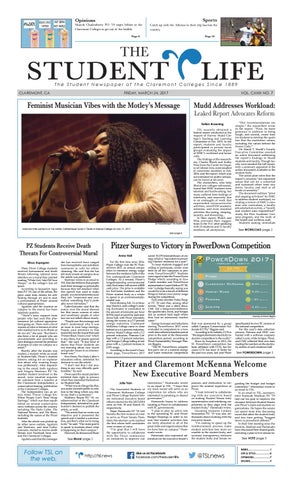
Malynda Hale performs at the Motley Coffeehouse Tunes n’ Deals at Scripps College on Mar. 21, 2017. See page 5
PZ Students Receive Death Threats For Controversial Mural Elinor Aspegren Three Pitzer College students received harrassment and death threats following national news attention on a mural they painted reading “White Girl, Take Off Your Hoops,” on the college’s free art space. According to Jacquelyn Aguilera PZ ’19, one of the artists, the piece came from desires for selfhealing through art and to start a conversation at Pitzer around cultural appropriation. Aguilera said the reaction on campus to the mural has been relatively positive. “There’s been support from people who had seen this phenomenon [of cultural appropriation] going on. There were a lot of women of color or femmes of color who reached out to us to thank us for our art,” she said. “But there’s also been a lot of people who are uncomfortable and unwilling to have dialogue around the presence of people of color on campus as a result.” Shortly after the murals was created, a student wrote an email to Student-Talk, Pitzer’s student listserv, asking for an explanation about why wearing hoops was problematic. After responding to the email, both Aguilera and Alegría Martinez PZ ’18, another student involved in the mural, were emailed requests for comment from a reporter at the Claremont Independent, a conservative-leaning publication at the Claremont Colleges. The Independent ran an article titled “Pitzer College RA: White People Can’t Wear Hoop Earrings,” which was then republished on several conservative news websites across the country, including The Daily Caller, The National Review, and The Blaze, including the names of the Pitzer students. After the article was picked up by other news outlets, Aguilera and Martinez, and later GalloGonzalez, started to receive death threats over Facebook from outside the Claremont Colleges. Aguilera said that the messages
she has received have ranged from homophobic and anti-black comments to calls for ethnic cleansing. She said that she has felt more unsafe on campus since the article was published. Martinez wrote in an email to TSL that she believes that people took their message so personally because they felt attacked when free speech was used to make people uncomfortable—because they felt “restricted and controlled, something they’d probably never felt before.” Gallo-Gonzalez said that the outcry over the mural showed her that issues women of color and non-binary people of color face are not talked about clearly. “People saw this message and didn’t understand why it was an issue to wear hoop earrings. People paid attention to that mural but not the mural that said ‘Protect Black Trans Lives’ which is also there, but people ignored that,” she said. “It just kind of shows that Pitzer students are not learning about race issues and gender issues in an intersectional way.” Eric Owen, The Daily Caller’s education editor, defended his decision to run the article. “I don’t feel that I did anything in any way ethically questionable,” he said. Owen said the mural painters forfeited their right to privacy when they identified themselves on Student-Talk. “When you do things like this, you make yourself public in relation to the thing which you did. To me, that’s a no-brainer.” Matthew Reade PO ‘18, coeditor-in-chief of the Claremont Independent, defended his publication’s decision to publish the article, as well. “The article that we wrote was objective and it presented the speech and it started a conversation, and that’s what we’re trying to do,” he said. “Our main goal is to speak to students about what is happening on their campus.” However, he denounced those
Follow TSL on the web.
See Mural page 2
TSL recently obtained a leaked report conducted at the request of Harvey Mudd College’s Teaching and Learning Committee in Oct. 2015. In the report, students and faculty participated in private focus groups evaluating the impact of HMC’s workload and honor code. The findings of the researchers, Charlie Blaich and Kathy Wise from the Center for Inquiry of Liberal Arts, were emailed to committee members in Feb. 2016, and the report, which was not intended for public release, can be found at tsl.news. The researchers, who help liberal arts colleges self-assess, found that HMC students were talented and hardworking, but many suffered from feelings of inferiority and insecurity due to an onslaught of work that superseded extracurricular activities, non-STEM academic interests, and even essential activities like eating, sleeping, laundry, and showering. In their report, Blaich and Wise provided their suggestions to the TLC after speaking with 24 students and 31 faculty members, all anonymous.
“Our recommendations are simple,” the researchers wrote in the report. “First, be more generous in addition to being tough, and second, create time for students to develop the qualities that the institution values, including the values behind the Honor Code.” On March 7, Mudd’s Faculty Executive Committee emailed an action document addressing the report’s findings to Mudd students and faculty. Though faculty were emailed the full report, only a summary appeared in the action document available to the student body. The action plan notes that the report’s concerns “are important issues that call for a concerted and sustained effort from students, faculty, and staff at all levels of seniority.” The document outlines “prior and ongoing activities” by HMC to address student workload, including a review of HMC’s common core curriculum, a faculty job satisfaction survey, a “faculty and student time expenditure” study, the Peer Academic Liaisons program, and the work of the health and wellness staff. Students seeking immediate
See WORKLOAD page 2
Pitzer Surges to Victory in PowerDown Competition Anna Hall For the first time since 2014, Pitzer College won the 5C PowerDown 2017, an annual competition to minimize energy usage between the residence halls of the five undergraduate Claremont Colleges. As a reward, Pitzer’s longest-standing environmental club, EcoCenter, will receive a $500 cash prize. The prize is available for EcoCenter members and the Pitzer student body as a whole to spend in an environmentallyrelated way. From Monday, Feb. 13, to Monday, March 6, each college’s ranking fluctuated in correlation to the amount of kilowatts per hour (kWh) used or saved by each residence hall, with Pitzer ultimately taking the victory at a 7.7 percent energy reduction. Claremont McKenna College came in close behind at a 6.4 percent reduction, Harvey Mudd College with a 5.2 percent reduction, Pomona College with a 1.5 percent reduction, and Scripps College falling in last place with a .2 percent increase in kWh usage. According to the event’s Facebook page, PowerDown 2017
saved 33,170 kilowatt-hours of energy, which is “equivalent to powering 3 homes’ electricity for a year.” To keep students engaged and willing to participate, events were held on all five campuses to promote PowerDown2017. Students were urged to take the Power Down Pledge which, according to EcoCenter member and PowerDown representative Laurel Melton PZ ‘20, was “a pledge basically saying you would try to do a bunch of different things to reduce your power usage during the competition. EcoCenter member Haley Burger PZ ‘20 said that, among other events, “there was a silent disco, CMC did a hang-your-clothes-inthe quad-to-dry event, and Scripps did an outdoor field night where they had an astronomy teacher come.” Energy increases and reductions during PowerDown 2017 were evaluated in comparison to a twoweek data collection baseline period prior to the start of the three-week competition period, according to Pitzer Sustainability Manager Warren Biggins. “The 5C PowerDown competition grew out of a national energy and water reduction competition
Courtesy of Warren Biggins
that was sponsored by a group called Campus Conservation Nationals (CCN),” Biggins said. According to its website, CCN is “the largest short-term electricity reduction competition in the world.” Since its inception in 2013, the 5C PowerDown competition has been affiliated with CCN, but because CCN has been in limbo for the past two years, last year Pitzer
spearheaded its own 5C version of the national competition. For this year’s data collection process, Pomona and HMC contracted with a software company called Lucid, while Scripps, Pitzer, and CMC collected their own data reading the numbers on the electricity meters of each residence hall.
See POWERDOWN page 2
Pitzer and Claremont McKenna Welcome New Executive Board Members Julie Tran The Associated Students of Claremont McKenna College and Pitzer College Student Senate welcomed executive board officers elected for the 2017-2018 term on Feb. 28 and March 10, respectively. Hajar Hammado PZ ’18 will become the first woman of color to serve as Pitzer Senate President; this election cycle marked the first where both candidates were women of color. “I’m glad that I will have the opportunity to collaborate with the Pitzer community on initiatives to improve our
http://tsl.news
institution,” Hammado wrote in an email to TSL. “I hope that my track record will serve as an inspiration for others who are interested in partaking in shared governance.” Hammado hopes to address funding at Pitzer in collaboration with 5C governments. “I plan to play an active role in the upcoming 5C and Pitzer Budget Hearings in order to ensure that student activities fees are fairly allocated to all of the great clubs and organizations that we have here on campus,” Hammado wrote. Hammado also expressed admiration for the executive board’s
Like us on facebook: facebook.com/thestudentlife
passion and dedication to improve the student experience at Pitzer. “I look forward to collaborating with my executive board on making Student Senate truly representative and redefining our priorities so they align with the student body,” Hammado wrote. Incoming treasurer Lindsay Mooradian PZ ’19 was also enthusiastic about working with the executive board. “I’m looking to speed up the reimbursement process, make student activities fees more accessible to the student body, and increase transparency between the student body and Senate re-
@TSLnews
garding the budget and budget committee,” Mooradian wrote in an email to TSL. In an email to TSL, secretaryelect Kamyab Mashian PZ ’19 laid out his goal to improve the dynamic between Student Senate and Pitzer’s clubs and student organizations. He hopes the senate can spend more time discussing issues that affect the student body and less time getting “bogged down in procedural debates.” In their first meeting since the election, Mashian and Hammado have discussed their shared goals, including a plan to live stream fu-
See VOTE page 3
NEWS................................1 LIFE & STYLE.....................4 OPINIONS........................7 SPORTS.............................9
NEWS PAGE 2
MARCH 24, 2017
THE STUDENT LIFE
MURAL: National Media Spotlights Cultural Appropriation Continued from Page 1
Continued from Page 1
“ Courtesy of Jacquelyn Aguilera
From left to right, Jacquelyn Aguilera PZ ’19, Alegría Martinez PZ ‘18, and Estefanía Gallo-Gonzalez PZ ‘18 show their mural on the Pitzer Free Wall.
right-wing networks who bully us, then we would be able to limit the work we have to do because we’d have more allies, more educated people, more sensible people, perhaps fewer readers to them [or less money], since that seems to be the only thing that really matters.” In response to the death threats,
Pitzer College President Melvin Oliver released a statement on March 9 condemning the harassment of students as threatening “the safety and well-being of every member of our community.” “As a place of higher education, we strongly cherish and defend intellectual curiosity, productive dis-
course and opposing views that may broaden our perspectives as global citizens. However, when speech resorts to hate, violence and threats, we will not tolerate these acts nor the perpetrators of these actions,” he wrote. --Samuel Breslow contributed reporting
Not all campuses had the resources to collect data daily and instead collected information approximately every four days, after which a graphic would be released informing the student body which school was in the lead.
“
issuing death threats. “I think those people should be prosecuted,” he said. “The authorities ... should put those people in jail.” Elliot Dordick PZ ‘18, the author of the article, declined to comment. In response to the Claremont Independent’s coverage, Aguilera and Martinez, along with the third muralist, Estefanía GalloGonzalez PZ ’18, sent a statement to latinorebels.com describing their thoughts on the article. “[The CI article] takes the situation out of context, sensationalizes the mural and puts young women of color in danger,” the statement read. “Also, the publishing of students’ names and affiliations has endangered the students outside of the institution. They now are facing harassment from ultra-rightwing groups and individuals, including a death threat through Facebook messenger.” The “White girl, take off your hoops” mural was the third in the series of murals painted by the students. The first was “Latinx for Black lives” and the second was “Protect Black Trans women.” Gallo-Gonzalez, Martinez and Aguilera said that they have started a campaign to take down the Claremont Independent. “Our next plan is simply to let people know what [the Claremont Independent is] doing with plans to expose them, and get more people on our side,” Martinez wrote. “If we had a network as big as the
POWERDOWN: 5Cs Focus on Energy Conservation
“It’s a very low-tech monitoring system,” said Biggins of Pitzer’s method. “I go around at the same time every day during the competition and read the me-
ter, then I enter it into a spreadsheet that computes the usage of how much electricity was consumed over the course of a night or a weekend.” Not all campuses had the resources to collect data daily and instead collected information approximately every four days, after which a graphic would be released informing the student body which school was in the lead. According to the Pitzer College website, “the ultimate goal of the competition is to use a short-term challenge to change long-standing habits to help reduce carbon dioxide emissions.” Some examples of ongoing energy saving habits offered by Melton are to “always, when you leave your room, turn off your light and open the window.” She also stressed the importance of “trying to charge your phone and computer during the day versus at night, so that when it’s done you can just unplug the charger.” Haley suggested a few methods for saving energy: “drying your clothes because we live in southern California, not washing clothes more than is necessary, taking shorter showers, taking colder showers, and washing your clothes with cold water.”
Q&A: Thomas Poon Departs Claremont for Loyola Marymount Amanda Larson
Courtesy of Pitzer College
Thomas Poon, Keck Science Center chemistry professor, is accepting a position at Loyola Marymount University as Executive Vice President and Provost.
Thomas Poon, former interim and acting president and senior associate dean of faculty at Pitzer College and current professor of chemistry at the Keck Science Department, recently announced his departure from the Claremont colleges. He will next serve as Loyola Marymount University’s Executive Vice President and Provost of the college. TSL spoke with him about his experiences at the 5Cs and his hopes for the future. TSL: How will your responsibilities at LMU differ from those that you have at the Claremont colleges? Thomas Poon: Some of my responsibilities are remarkably similar. For example, I will supervise administrators responsible for student affairs, enrollment management
(admissions), academic affairs, the library, strategic planning, and educational effectiveness. The major difference is that LMU is a university with a much broader scope of academic offerings than Pitzer or any single 5C has. For example, LMU has six different schools or colleges, each with their own deans for undergraduate, graduate, and credential programs. LMU also has a law school, but that is outside of my responsibilities. TSL: The press release announcing your departure described in brief a variety of academic and social initiatives that you’ve spearheaded on campus. What has been your most meaningful experience? TP: Well, these types of short biographies typically give credit to just one person, but I’d like to clarify here that all of these initiatives were team efforts involving administra-
tors, faculty, staff, and students. My involvement and leadership in these initiatives ranged from approving a budget in some cases, to fundraising in others, to extensive collaboration and brainstorming with community members. My most meaningful experience with regard to the latter was helping Pitzer navigate campus climate concerns around diversity and inclusivity during the 2015-16 academic year. I learned so much from the various affinity groups and stakeholders that I met with last year. TSL: You’ve worked at a variety of colleges and universities. How has your experience at Claremont differed from other schools? TP: The Consortium is a gem among higher education institutions. In no other setting do students, staff, and faculty from seven colleges
and universities with very different missions and cultures get to collaborate and cooperate in the way that we do here at the Claremonts. These collaborations develop both organically and deliberately thanks to our proximity to each other and it is unlike at any other institution at which I have worked. TSL: What has been the greatest challenge you’ve faced over the course of your work at the Claremont colleges? Your greatest success? TP: [My greatest challenge] definitely was addressing the campus climate concerns around diversity and inclusivity that I mentioned earlier, because so many members of the community were affected in very different ways and had many different needs. I’m most proud of helping Pitzer address each of these needs and be-
ing transparent about our progress through the Living Document that continues to this day. A close second in terms of greatest challenge and greatest success was reopening the Pitzer in Nepal Program just eight months after the devastating Gorkha earthquake of April 2015. TSL: You’ve served as a professor of chemistry and also in administrative positions. Which of these do you prefer? TP: This question is like the Kobayashi Maru (geeky Star Trek reference)! So like Captain Kirk, I will cheat and say I liked them both equally. They both allowed me to provide new and (hopefully) rewarding learning experiences for students, just in vastly different ways. This interview has been edited for clarity and length.
WORKLOAD: Action Document Aims to Improve ‘Unmanageable’ Curriculum
“
Students Say
“Every time I choose to sleep eight hours or go for a run in the morning, I’m very aware that that’s coming from my work on a problem set. There’s just not enough time in the day.”
“ “ “
“ “
“At some point over your career at Mudd, everyone becomes a shell of themselves.”
“I appreciate faculty who tell me when they’re struggling too. It tells me that I’m not a failure if I’m struggling.”
dents deal with the challenges, and thought that Harvey Mudd needs to change to give students a little breathing room,” they wrote in the report. “These faculty checked in on students and ask[ed] how they were doing, were more flexible about deadlines, shared how they struggled with their workload, and encouraged students to ask questions.” Others, however, “thought that Harvey Mudd students had, over time, become less capable of, and less interested in, meeting the challenge of Mudd’s difficult curriculum. While it is not unusual for us to hear faculty lament ‘the decline in the quality of students,’ what was unusual, in our experience, was that many students had heard and felt this sentiment from some of their faculty.” Laura Palucki Blake, Mudd’s director of institutional research and effectiveness and a member of the TLC, urged TSL not to release the full report. “Our strong preference would be to not have students’ and faculty members’ responses quoted,” she wrote in an email to TSL. “In projects like this, participants are encouraged to speak candidly with the understanding their comments are confidential.” This year ’s chair of the TLC, Jae Hur, joined the committee in the 2015-16 school year, and wrote in an email to TSL that releasing comments made in confidence “will do real damage to our ability to gather information in the future to improve our campus.” TSL decided to release the report in the interest of transparency and to allow students to examine the information gathered by the researchers and provided by fellow students and faculty members for themselves. Hur recalled that prior to the report’s release, “there was already a proactive, self-motivated effort by faculty here to look at … how to help our students really understand their sense of accomplishment and abilities.” He said the report is “an important part of what we were
doing, but it’s not certainly meant to be the entire thing.” When Hur assigns homework to his classes, he wants his students to “take a step back and say like, ‘Wow, I did that. That’s amazing. That’s a lot of work and a lot of learning that I accomplished.’” But faculty members quoted in Blaich’s and Wise’s report said that some HMC professors assign homework for a different reason. “To get students’ time, you need to give them a problem set, something tangible to work on so they spend time on it,” one anonymous faculty member said in the report. “It’s an arms race.” Blaich and Wise seemed to conclude that this approach was not productive. “At some point, when students are stretched far enough, all this results in is departments stealing students’ time from one another in a zero-sum game,” they wrote. “Many of the students with whom we spoke appeared to be at this point.” Faculty believed the resulting workload incentivized students to cheat and otherwise violate HMC’s honor code. “The pressures students feel from the workload are putting pressures on the Honor Code,” one faculty member said in the report. “HMC has an oppressive curriculum.” The researchers noted that some faculty members thought students needed to learn the “whys” of the code — the report suggests students and faculty members have different perceptions of what the code entails. Aside from privacy and confidentiality concerns, Hur says there’s another reason not to release what he calls the “raw version” of the report. “I’ve come to the conclusion that it’s not helpful,” he said. “The issues it brings up are clearly very helpful, but … it needs a better delivery if it’s not going to just make people reactive and actually approach an issue that’s important for everyone involved.” Professor Lelia Hawkins, who
“ “ “
Faculty Say
“There’s a stigma about asking for help here. I try to encourage students to come to office hours, but it’s not seen as a good thing.”
“There are no role models for students here. HMC seniors are burnt-out. They’re not inspiring students to develop good habits.”
“Students don’t have valves to release pressure from hard classes here. They lack time to reflect, to step back. If they had time to step back and reflect, they might not be as prone to succumbing to pressures that might lead to cheating.”
was the TLC chair when Blaich and Wise visited Mudd, agrees that the “negative tone could be off-putting.” “I think that if you are external to Mudd, it’s easy to be surprised by the workload here, whereas if you’re a faculty or student here, you understand it’s more normal,” she said. Hawkins emphasized that the report was a starting point, and wants to “look beyond [the tone] and sort of pick the pieces out that are useful to us—and that’s why the report was written for a committee to digest.” She said no one at Mudd wants college to be easier, but agrees the curriculum can be “unmanageable” at times. Hawkins does not know what the solution is, and wants a quantitative review to provide more information.
“
change will have to be patient; the FEC emphasized that substantial adjustments take time. “Efforts to review and revise aspects of the Core curriculum may not seem to be producing change fast enough for many of our current students to feel their effects,” the committee wrote. “However, we firmly believe that the curriculum ought not to change quickly nor without systematic, careful study and input from our college’s many stakeholders: students, faculty, alumni, staff, and trustees.” Associated Students of Harvey Mudd College President Shailee Samar HM ‘18 agreed that HMC’s core curriculum needs improvement. “We need to adapt our perspective to ensure that our students thrive, and not only survive,” Samar wrote in an email to TSL. “The action items listed should just be the first few steps, and I hope that we move quickly,
take impactful action, and reevaluate the big picture. After seeing a copy of the full report, ASHMC’s First-Year Class President Julia Wang HM ‘20 thought it “did a pretty good job of capturing the student life and academics.” “Students don’t have the opportunity, really, to make time to actually enjoy all the subjects they’re taking,” Wang said. “Work-life balance is such a struggle that it becomes a joke. I don’t think it should be treated like that.” Wang expressed disappointment the college did not release the full report to students. “It seems kinda hurtful that they know this is going on and that they, in a sense, didn’t want us to know,” she said. Blaich and Wise found that faculty were split on whether to be accommodating to students who felt burdened by the workload. “ S o m e f a c u l t y w e re s y m pathetic, worked to help stu-
“ “
Continued from Page 1
“If we’re going to say that workload is a problem, we need to know exactly what parts and why,” Hawkins said. To that end, HMC hired “educational effectiveness consultants” who spoke to more than 75 members of the college community on March 6 as part of a core curriculum review, according to the FEC. Hawkins said the review was planned before the workload report’s release, but it is also “in some ways a response to the issues that were raised.” “Do we drop units? Do we drop courses? Do we change courses? These are all on the table until people take them off the table,” she said. “We have a couple-of-years process ahead of us.” --Samuel Breslow contributed reporting
NEWS MARCH 24, 2017
THE STUDENT LIFE
PAGE 3
Scripps Students Take Moral Stand Against Dining Hall Provider Julia Thomas & Jonathan Chai-Chang Azterbaum Students from across the Claremont Colleges have organized Drop Sodexo, a campaign aimed at ending Scripps College’s contract with Sodexo, a French multinational food services and management corporation with a welldocumented connection to private prisons and worker exploitation. Comprised of mostly Scripps students, the Drop Sodexo organizing committee seeks to inform the 5C community about Sodexo’s treatment of workers and the ways in which the corporation allegedly contradicts Scripps’s values. Sodexo, founded in 1966, has had significant investments in and ownership of private prisons, and has repeatedly been involved in civil rights abuse, food safety, and racial discrimination cases. “By continuing business with a company that has such an extensive corporate crime record, we are providing a monetary endorsement for their increasing exploitation of land, people, and communities throughout the world,” the Drop Sodexo statement on the committee’s website reads. Scripps’s current contract with Sodexo is for dining, facilities, and maintenance management and was most recently signed in the fall of 2014, according to a written statement from the Scripps administration. Dining hall and facilities workers at Scripps are employed
by the College, and not by Sodexo. Student organizer Elizabeth “Zizzy” Murphy SC ‘19 emphasized that an important part of the campaign is providing clarity around the group’s movement against Sodexo as a corporation, and not workers themselves. “Our movement is explicitly not targeting the workers themselves, and we want them to continue with their livelihoods here at Scripps and that really should be one of Scripps’s foremost things in understanding that its students care that its workers are being taken care of and feel welcome here.” Harvey Mudd College also has a contract with Sodexo for its dining services management of Hoch-Shanahan dining hall. Student organizer Rebecca Millberg SC ’17 heard criticisms of Sodexo throughout her time at Scripps, but began formally organizing with fellow students after conducting thorough research into its practices after learning that Scripps had purchased furniture made by prison labor. “We began doing our research about Sodexo, and we were absolutely horrified by the fact they actually owned and operated over a hundred private prisons abroad, especially in the U.K. and Chile as well,” Millberg said. “They also have a history of horrible labor practices and food safety violations and worker exploitation, and
so it just felt like with all of that information it shouldn’t be that hard for Scripps administration to see that it goes completely against our values.” Ending Scripps’s contract with Sodexo has been a point of interest for Scripps students for the past several years, and was articulated in the student organizing efforts and demands presented to the administration during the 20152016 academic year. Other colleges across the nation have campaigned and successfully ended their contracts with Sodexo; Fordham University announced that it had dropped its contract with the corporation in April 2016, and students at approximately 50 college and university campuses across the nation organized rallies, sit-ins, and boycotts of Sodexo, formerly named Sodexho Marriott Services, in 2001, according to The New York Times. Drop Sodexo had its first meeting Jan. 20 with over 60 students in attendance, and has since held two actions outside of Malott in the days surrounding Family Weekend in February. Millberg said that Drop Sodexo has received significant support from students, and that faculty have expressed “being glad that students are finally organizing around an issue that they’ve been concerned with for longer than we’ve been students here.”
The Scripps administration has stated that they do not plan to terminate their contract with Sodexo prior to its expiration in 2020. “Scripps’ senior team reviewed the impact of terminating the contract early, and President Tiedens reported back to students that legal fees and a variety of other expenses related to such an action would exceed $1 million and create undue negative impact on the College’s budget … as it would reduce available funding for other important priorities, such as financial aid and faculty and staff compensation,” the Scripps administration wrote in an email to TSL. Scripps’s senior team also wrote that they would develop a procurement policy to “to govern future selection of vendors and products in accordance with Scripps’ educational, co-curricular, and social values as well as its fiduciary responsibility to manage financial resources prudently.” In a meeting with Tiedens Nov. 18, the Drop Sodexo campaign shared a thorough fact sheet detailing Sodexo’s abuses. “For us it felt like, we’re not waiting four years for Scripps to funnel more money to this institution when we know it’s wrong now,” Millberg said. “And that was when we really decided to bring this to the student body and start building a much larger, visible campaign.”
Student organizer Roxy RozoMarsh SC ‘19 said that the Scripps administration has sent emails to Drop Sodexo discouraging future actions. “We need to keep the college accountable. I think there’s a lot of things that Scripps is affiliated with that its students don’t stand for, and the fact that we have beds made by prison labor for 55 cents an hour — that’s something that we’re sleeping on, something we’re actively using and engaging with,” Rozo-Marsh said. Students have posted flyers around campus with information about Sodexo and the campaign to end Scripps’ contract, and will continue to do so in the future. “The administration does not have all the power. We as students have a lot of power, even in the fact that when we as 5C students choose to eat at other dining halls not run by Sodexo (so that’s CMC, Pitzer, and Pomona’s dining halls), Scripps actually pays the other colleges for those meals,” student organizer Alicia Goode-Allen SC ‘19 said. “That’s something little that if we all start doing together can send the message to the administration that we do have power in this situation, that we do have agency.” Organizers of the Drop Sodexo campaign hope to find an alternative management solutions that prioritizes worker rights through continued conversations and
research. “We don’t intend for the campaign [to end] just with some kind of awareness when we know that there are concrete things that can be done,” student organizer Elizabeth Murphy SC ‘19 said. “The thing we most want to ensure is that the thing that comes after [Sodexo] is not a step back.” Drop Sodexo will next host a community lunch on the lawn outside of Malott Commons on March 30, intended to demonstrate a student, faculty, and staff boycott of the dining hall. Student-staffed food organizations, including The Motley Coffeehouse and the Grove House, are supporting the event by providing food. Drop Sodexo encourages students to eat at or take lunch in a to-go box that day from dining halls not contracted by Sodexo, which include Collins, Frank, Frary, and McConnell dining halls. “Our hope is that the entire student body will know what’s going on with Sodexo,” Millberg said, “and as many students as possible will show up when we have actions so that we have a solid group of students from across the 5Cs who are organizing together with us.” Drop Sodexo holds weekly meetings on Wednesday nights at 6 p.m. in the Scripps Student Union and welcomes any interested individuals.
Sean Ogami, Grace Ozonoff-Richey, Dominic Frempong • The Student Life
VOTE: Incoming Executives Promise Revamped Govs Continued from Page 1 ture senate sessions and maintain an archive of the footage. “Based on my work with the other newly-elected members, I think we will have no problem working together to tackle issues like transparency, diversity, and fair spending. I have high hopes that the next academic year will be a productive one,” Mashian wrote. The term for the new executive board officially starts on May 14. With regard to CMC’s elections, vice president-elect of student activities Chandler Koon CM ’19 wrote in an email to TSL that he was disappointed that he only received 76 percent of 735 votes, with the other 24 percent of voters either writing in candidates or abstaining from voting. “I hope to hear from and work with the people who didn’t vote for me, because I assume they have valid reasons for doing so, and would love to incorporate their ideas for ASCMC events and programming moving forward,” Koon wrote. Koon believes ASCMC events only attract certain groups within the student body, and hopes to make this term’s events programming more inclusive and appealing. He also wants to “bring the community back into a larger role in planning events at CMC.” Koon elaborated that this concern stems from his belief that students are “generally not huge fans of [ASCMC].” “Though ASCMC is far from a perfectly-run corporation, its sole purpose for existing is to make student life better, and I hope that
this board will be able to make that clear in a way that past boards have not,” Koon wrote. Koon wrote that he is excited about working with the elected and appointed executive board members on ASCMC, but is “fairly uncomfortable with the number of unopposed elections, and the lack of female representation in elected positions.” Incoming dormitory affairs chair Josh Guggenheim CM ’19 explained his plan to focus his efforts on the housing selection for students in the 3:2 Program, which typically involves CMC students receiving an undergraduate degree in three years and a master’s degree in two. “Despite attending many meetings regarding this issue, I was recently told that there was ‘not enough time’ to engage with this issue,” he said. “As [dormitory affairs chair], I want to make sure that all issues have substantial time dedicated to them. I promise to engage with all dormitory concerns equally and fairly.” Sophomore class Presidentelect Bryan Carlen CM ’20 hopes to “appeal to a larger audience for events, specifically keeping in mind those who may not be interested in ‘party culture.’” All but two appointed positions for ASCMC are finalized. The applications for the remaining appointed positions are due on March 27. Pitzer Senate’s legislative applications are available from March 27 to April 7. The legislative elections will be held on April 10 to April 11.
HMC Alumni Excel in Post-Grad Salary Rankings Marc Rod In recent rankings by various publications, Harvey Mudd College alumni were ranked above graduates from nearly every other prestigious school in comparisons of post-graduation salaries. HMC took the top spot in early career salary rankings in Payscale’s 2016-2017 College Salary Report with an average early career salary of $78,500. The “Impact Report” on HMC’s career services website listed higher salaries, with an annual mean base salary of $93,107.79 for 2016 graduates. In a 2016 Forbes ranking of mid-career salaries, HMC alumni ranked second with an average mid-career salary of $106,200, surpassed only by Massachusetts Institute of Technology. In Payscale’s report, HMC tied for third with Princeton, with a mid-career salary of $131,000, outranked by State University of New York Maritime College and MIT in first and second place, respectively. A recent Business Insider article about these statistics credited HMC students’ success in the workforce to the school’s Common Core curriculum. The Common Core requires students to take STEM and humanities courses. Business Insider particularly praised HMC’s emphasis on computer science in the core program. The core “provides an academic challenge by blending the STEM disciplines ... as well as including classes in writing and critical inquiry” to “give students a broad scientific foundation and the skills to think and solve problems across disciplines,” according to HMC’s website. Common Core was designed to give students a comprehensive liberal arts education, rather than a narrowly specialized one, according to Vice President of Academic
Austin Huang • The Student Life
Students walk to and from their classes in front of the R. Michael Shanahan Center for Teaching and Learning at Harvey Mudd College.
Affairs and Dean of the Faculty Jeffrey Groves. “[HMC’s] mission came out of the belief of our founding president, trustees, and faculty members in the late 1950s that engineers and scientists should be broadly educated, as opposed to the increasingly narrow specialization that had become the norm in American education,” Groves wrote in an email to TSL. Vice President for Student Affairs and Dean of Students Jon Jacobsen thinks that the Common Core contributes to HMC alumni success. “Our broad-based core focused on developing critical thinking and interdisciplinary skills across the scientific disciplines along with effective oral and written communication within these areas and beyond
certainly contributes to the competitive strength of our graduates in the job market,” Jacobsen wrote in an email to TSL. Groves agrees. “While the core and the humanities, social sciences, and the arts requirements are in place to serve the mission, it’s also true that they make our graduates very desirable as graduate students or employees,” Groves wrote. Groves also believes that HMC’s broad-based education helps alumni succeed and advance quickly in their chosen fields. “When they get into a laboratory or into industry after graduation, [their] breadth of experience helps them to see projects in a well-rounded, productive way,” Groves wrote.
“They can quickly become leaders in whatever setting they find themselves in … and employers have come to recognize that.” HMC students agreed that the college’s education is preparing them well for life after graduation. According to HMC’s Impact Report, 91.9 percent of students surveyed indicated that they were somewhat or very prepared for their careers. “Looking ahead, I do think we’re being prepared well,” Priyanka Agarwal HM ‘20 wrote in an email to TSL. “Even just for internships, I can already see how our assignments (in CS classes since I’m intending to major in CS and intern in a CS field) are relevant to much more complicated topics than interviewers commonly ask.”
LIFE & STYLE PAGE 4
THE STUDENT LIFE
MARCH 24, 2017
FOOD COLUMN
Disney Food And Wine Festival Is a Treat for Park-Goers Molly Edison
Bringing together two of my favorite things, Disney and food, this year’s Disney California A d v e n t u r e F o o d a n d Wi n e Festival takes place from March 10 to April 16 at at the Anaheim theme park. Disneyworld hosts a similar but larger event at Epcot featuring international cuisine taking place every fall. F o r a D i s n e yl a n d a n n u a l passholder, the festival brings an exciting new twist to the beloved California Adventure experience. For a special-visit vacationer, it makes a potentially once-in-a-life-time experience more memorable, all while Disney takes more money out of our ohtoo-willing hands. This year’s festival has 15 unique booths featuring different foods with a combination of California and Disney themes. Some choice stops at the festival include “Nuts About Cheese”, which features combinations of nuts and cheese in small toast and bread servings with different flavor pairings. “Uncork California” is its complement, featuring flights and glasses of California wines. “I (heart) Artichokes” includes multiple preparations of the not-soapproachable vegetable. Other highlights include “Garlic Kissed”, which cranks up the stinky breath with delectably hearty tastings as well as unique garlicy ice cream. “Olive Us” showcases my favorite salty snack in preparations from warm focaccia bread to dirty vodka martinis, while “The Onion Lair” brings back the stinky breath in sweet, savory, and drink preparations. “Off the Cob” features quintessential summer corn in new dishes, and “Sweet and Sourdough” pays homage to the San Francisco classic, tying to Boudin (which is also available in the park). Aside from the food at the kiosks, the festival also offers tastings and samplings of different products including olive oils, hot sauces, handmade bath products, and more. In addition to food, the Food and Wine Festival also offers
Sophie Reingold • The Student Life
activities such as “In the Kitchen With…,” which offers visitors a chance to see celebrity chefs cook, taste their dishes, and even meet them and get autographs. This year’s celebrity chef line-up includes G. Gavin of Road Trip with G. Gavin, Robert Irvine of Restaurant: Impossible, Graham Elliot of Masterchef, Guy Fieri of Diners, Drive-Ins, and Dives, Cat Cora of Iron Chef: America, and
Jet Tila of Chopped and Cutthroat Kitchen. The “Sweet Sundays” demonstrations are similar to “In the Kitchen With…” but are exclusively baking and dessert demonstrations with pastry chefs. The lineup includes Duff Goldman of Ace of Cakes, Emily Ellyn of Food Network Star and Cutthroat Kitchen, and Keegan Gerard of Food Network Challenge.
“Winemaker Dinners” includes a four course dinner with selected wines from featured winemakers. T h i s ye a r’ s w i n e m a k e r s a r e Flora Springs Winery, Buckhorn Vineyards, and Disney Family of Wines. The Flora Springs and Buckhorn dinners cost $150 per guest plus tax and tip while the Disney Family of Wines dinner costs a whopping $200 per guest plus tax and tip.
Ath Talk Highlights History of Blaxicans in Los Angeles
Jack Carroll
Wa l t e r L u i s T h o m p s o n Hernandez spoke at the Marian M i n e r C o o k At h e n a e u m a t Claremont McKenna College this past Wednesday, March 23. His speech, “Blaxicans of LA: Then and Now,” focused on both the history and contemporary state of (the lives of) mixed race blackMexicans, or “blaxicans,” in Los Angeles. Thompson-Hernandez, a multimedia journalist, social documentary maker, and current doctoral student at UCLA, made multiple appearances at the Claremont Colleges this week to discuss his work. He primarily focuses on transnationalism and afro-Latino culture, and he is in the midst of a book project entitled A f r o - L a t i n o s i n M o ve m e n t : Critical Approaches to Blackness and Transnationalism in the
Americas. His presentation showcased his diverse skill set, as he mixed his lecture with a diverse array of multimedia content, including archived videos and a series of portraits. The portraits, which featured blaxican people he has photographed and interviewed, were the main feature of his presentation. For almost all of the portraits, Thompson-Hernandez told a story about who was in the photograph and how their mixed-race identity played a role in their life. One particular story that stood out was about the parents of a mixed-race woman who told Thompson-Hernandez about how their identity is often fragmented. They, and others like them, often feel that being perceived as half-mexican and half-black diminishes their understanding of themselves. In order to help
their daughter truly express herself they said they “will teach her to be proud of the fact she is Mexican and proud of the fact she is black.” Another theme in ThompsonHernandez’s work was portraits of hands, specifically palms. He said people often ask him why he does this. “I think about hands and what we carry.” This is poignant in thinking about people who identify as mixed-race because they may face so many questions and connotations about the different parts of who they are, he said. Towards the end of his presentation, ThompsonHernandez took time to broaden his focus from this specific topic to larger issues at play such as racial histories, narratives and ideologies; the power of art; and love and relationships. He also
commented on how current political events in the United States continue to make it hard for minorities and stigmatize migration and the exchange of cultures. One point he was sure to make in the Q&A session at the end was that his goal is to raise awareness about the conditions of “blaxicans” but not in a way that is complicit in the “tokenization” or “fetishization” of them as art subjects. He told the crowd he is a storyteller, not an anthropologist. He also addressed the difficulties of being an artist as a member of a minority group. He told students in the room that he can understand why people may choose to pursue more economically stable careers, but reiterated his utmost respect for those that try to make it as artists even when it is very difficult.
Other festival demonstrations include “Winemaker Dinners”, “Wine Education and Tasting seminars”, “Beer and Spirit Education and Tasting seminars”, and “Culinary Demonstrations,” which require reservations. Disneyland and California Adventure are expensive, there is no doubt about it. But for me, this festival is an even bigger draw to the allure and joy that is
TV COLUMN
End of an Era, Start of An Ora: America’s Next Top Social Media Mogul Lauren Churchwell There are two words that have ruled this season of America’s Next Top Model: Boss and Brand. They’ve been repeating it so many times that you may forget you’re watching America’s Next Top Model in the first place — the reign of Tyra is over and we’re entering this uncharted territory, and I’m not sure if I’m a fan of this new land.
“
Unfortunately, the show has completely forgotten the intensity of runway shows and avantgarde photo shoots in favor of social media challenges and music videos.
“
Meghan Joyce • The Student Life
Documentarian, journalist, and doctoral student Walter Luis Thompson-Hernandez gives a talk called “Blaxicans of LA: Then and Now” at Claremont McKenna College’s Miller Miner Cook Athenaeum on March 22.
Disneyland. Items at the kiosks are up to five dollars for tiny bites and fourteen dollars for a sip of a martini, yet people don’t stop going. Disney has always found bigger and better ways to take our money. Featuring local and sustainable foods and showcasing artists and both small-scale and big-time celebrity chefs, however, is fun, entertaining, enticing, tasty, and maybe even worth it.
What made America’s Next Top Model so interesting in the past was that it gave viewers an insight into a world that we would never see or experience, a world of high fashion, a world where the eccentric and beautiful would come together with over-the-top interpersonal drama. Unfortunately, the show has completely forgotten the intensity of runway shows and avant-garde photo shoots in favor of social media challenges and music videos. Like a lot of music videos. Like way too many music videos. You really have to ask yourself: What is this show about? The new host, Rita Ora, keeps telling us that they’re not just looking for a model anymore. They’re looking for a boss, they’re looking for a brand. I understand that there is an art to social media and that being a backup dancer is not easy, but neither of these
things are comparable to being a model, even if they do speak to what fame and fortune is in today’s society. It’s rather telling that our new host is not a top model like Tyra Banks, but Rita Ora, whom you may have heard of for her music career or possibly from her cameo in 50 Shades of Grey — the point is you probably haven’t really ever heard of her. As much as she claims to be a multi-media mogul, you really wouldn’t know because almost no one knows who she is. Even today, I told someone that she’s the new host of ANTM and their response was “Rita Ora?” with the voice of someone scrambling in their mind for an idea or an image or any clue of who she is. Ora wouldn’t honestly be that big of an issue if she was not surrounded by panel members who exude charisma and selfconfidence. Law Roach, a “famous” Hollywood image architect (yeah I can talk up my résumé too hunny), and plus-size, actually famous supermodel Ashley Graham cannot stop killing it at every turn. Graham especially outshines Ora, and while she is not a perfect analogy to Tyra, she is a hell of a lot better than Ora. In the first episode, we see Tyra for the first and last time. She tells the crowd of beautiful, smart, and interesting women in their 20s that this year they are looking for a non-traditional model. The camera pans back to the crowd of beautiful, able-bodied, fresh-faced, size zero models. The problem with this reboot of America’s Next Top Model is that it pretends to be a radical redesign but ends up following a lot of the same disappointing trends that the modeling and media industry always follow: portraying Latina women as inherently hypersexualized, West African women as violent and angry, and of course letting mediocrity slide by in the face of true talent. I for one am not impressed, and I’m not sure how much longer my love for the show’s history will hold me over.
LIFE & STYLE MARCH 24, 2017
PAGE 5
THE STUDENT LIFE
Musical Activist, SingerSongwriter Croons at Motley
Ye Olde Student Life Over the break, I suspect many 5C students indulged in quite a bit of Netflix. Back in 1965, though, Pitzer College’s administration did not seem too concerned that installing television sets in its dorm rooms would turn its student body into couch potatoes. Rather, they saw it as an opportunity for pedagogical experimentation. This sort of experimentation was extremely common in Pitzer’s early years, as the college sought to embrace the era’s cultural focus on innovation and formulate its identity. (It was also a women’s college at the time.) This article, from TSL’s Sept. 23, 1965 issue, appeared in “The Pitzer Pioneer,” a section of the paper that reported about Pitzer every issue. --Compiled by Samuel Breslow PO ‘18 Dorm TV Units Aid Instruction
Lia Francis-Bongue • The Student Life
Malynda Hale and accompanists Griffin Wright (left) and David Brunelle at the Motley Coffeehouse Tunes n’ Deals at Scripps College on March 21.
Andrea Hernandez O n Tu e s d a y , M a r c h 2 1 , students and visitors to the Motley Coffeehouse enjoyed a performance by Malynda Hale, an American singer, songwriter, and activist who embeds messages of social justice in her music and is sponsored by vegan make-up company Valana Minerals. Hale performed covers of “I’d rather be” by Clean Bandit, “Latch” by Sam Smith, and “Pure Imagination” by Gene Wilder; as well as some of her original songs, including her latest single “Stand,” which she wrote to encourage people to stand up for what they believe in. As students worked on their
laptops or enjoyed a beverage, Hale and company — Dave Brunelle on the guitar and Griffin Wrigth on the Cajon — performed a variety of songs from Hale’s various albums about the importance of activism. Hale has been to the Motley several times before. Megan O’Brien, music manager at the Motley, re-invited Hale because “her music really aligns with the Motley’s message and overall space.” Hale said that she loves the Motely because of “the message that it’s brought here. I love that it’s a women-run association. I think everyone is pretty attentive, even when they’re studying, they love listening to my music.” As her performance drew to an
end, Hale introduced her song, “Falling,” which was written in dedication to Leela Alcorn, a transgender student who took her own life a few years ago. She finished with her song, “We Run,” an original song, which she wrote in response to the Black Lives Matter movement. “People can relate to music in a meaningful way,” Hale said. “Rather than having arguments on social media, if you get someone to listen to a song that has your perspective and your feelings, they’re more likely to resonate with what you’re saying, I think music is a universal language and that’s why I like to use it to get my message and my views across.”
In less than two months, students in Sanborn’s A-Wing will have televisions installed in their rooms, part of a $30,000 pilot study to determine the effectiveness of audio-visual instruction in dormitories. The forthcoming pilot study will not basically change the pattern of instruction already established but will supplement it by encouraging faculty members to program part of their course material to the student in her room, according to President John W. Atherton. Atherton said that plans call for five classrooms to be electronically connected to an audio-visual control center which will in turn be connected to Sanborn. Students will be able to choose from commercial VHF and UHF channels, the five closed-circuit channels and audio channels which will broadcast music and language tapes. Funds for the Pitzer project have been provided by the Educational Facilities Laboratories, Inc., a nonprofit organization established in 1958 by the Ford Foundation to help American schools and colleges with their physical problems by the encouragement of research and experimentation in building design and planning. Costs of the undertaking involve the full-time services of a technical director, consultant time, materials and rentals, and released faculty time. The pilot study will be carried out and evaluated during the second semester, Ahterton [sic] said.
MOVIE COLUMN
‘A United Kingdom’: When Love Became a Colonial Crisis Victoria Anders I’ll be honest — I was quite worried going into the movie theater to see A United Kingdom over spring break after seeing the trailer and learning the background. A Hollywood film based on the true story not only of an interracial marriage in the 1940s, but a marriage between a Botswanan (then-Bechuanaland) King-in-waiting and a white British woman, during the 80-year British protectorate of the southern African country? That could easily and quickly turn out to be a problematic soap opera. But I left the theater two hours later feeling satisfied and honestly informed about a chapter of neo-imperialist history. The film, based on Susan Williams’ book Colour Bar, stars David Oyelowo (Selma) and Rosamund Pike (Gone Girl — I still can’t look at her without feeling some fear and distrust) as posh King-to-be of the Bamangwate tribe Seretse Khama and Englishclerk-turned-Botswanan-Queen Ruth Williams. Director Amma Asante (Belle), the story’s ultimate advocate, takes us quickly through the couple’s meeting and courtship in 1947 London, where Seretse is studying to become a barrister while preparing to ascend to his throne, and eventual elopement at the protests of their families. The story focuses on the colonial crisis brought about by the marriage, as well as Ruth and Seretse’s struggle to be recognized as legitimate spouses and rulers by both the Bamangwate people and British government. Asante is not, however, deeply interested in portraying the romanticism of falling and staying in love against all odds, though it is this enduring and inspirational modern love story that allows for a film about the political machinations of imperialist Britain and African nations in moments leading to independence. The love story is interwoven with the political implications of and players within the union, from Seretse’s own regent uncle’s (Vusi Kenene) rejection to having a daughter of the colonizer as Queen, to the British diplomats (Jack Davenport and Tom Felton) fighting to maintain protectorate control and manage the implications of Bechuanaland royalty in the broader Southern Africa region, particularly South Africa. With Apartheid implemented in 1948, any marriage between a black and a white person was illegal. But it’s not interracial marriage that scares the British government the most — it’s the possibility of losing
power, money, and minerals such as diamonds, gold, uranium. Seretse and Ruth move to Bechuanaland following their marriage to become King and Queen, but face criticism and isolation from colonialists and tribespeople alike. Seretse’s uncle advises him to abdicate, but he is able to win the love and support of the people through a poignant open-air speech and a democratic vote. The British are not so easily convinced, however — led by Davenport’s Sir Alistair Canning, they exile Seretse from his own country in 1951, leaving the pregnant Ruth behind as a stronghold of power. Ruth forms a real love for the women of Seretse’s family and gives birth to a baby girl on her own in Bechuanaland. The couple had gained overwhelming support in Britain, where calls for the resignation of Lord Salisbury, the minister responsible for the exile order, were widespread and sustained. The British diplomats, and even Sir Winston Churchill, are portrayed as hell-bent imperialists seeking power. Likely, the movie somewhat over-simplifies the British official’s characterization as nothing less than evil, almost caricatured. However, the white betrayal the film eloquently characterizes is clearly still a part of international politics — just pick up a copy of the New York Times to see that. Following much political savvy, many broken promises, and numerous cut-off inter-continental phone calls, *spoiler alert* Seretse and Ruth are eventually able to return to Bechuanaland in 1956, but as private citizens rather than royals. Seretse continued pursuing politics, however, and eventually became the first democratically elected president of independent Botswana in 1966. He and Ruth worked tirelessly to bring their country from third-poorest in the world to having a developed and prosperous diamond-mining economy. Oyelowo, himself descendent from a royal family line in Nigeria, shines as the morally responsible Seretse and seems “both timely and timeless” (Rolling Stone). He perfectly complements the subtle yet cunning Pike, who portrays Ruth’s truthful and energetic desire to be accepted by her new people and work hard for them. Asante and the lead actors blend history, humanity, and romance to depict the couple’s formative development as individuals and a union, who would, in turn, foster the continent’s longest continuous multi-party democracy to date. It is a tender, defiant, and poignant story that deserves and needs to be told and seen today.
LIFE & STYLE PAGE 6
MARCH 24, 2017
THE STUDENT LIFE
Sociologist Explores Intersectional Identities Throughout History in PO Talk Tarini Sipahimalani Marla Kohlman, professor of sociology at Kenyon College, discussed the history of intersectionality and its impact on today’s society at Pomona College on Wednesday, March 22. “I want to talk about the history of intersectionality that doesn’t get acknowledged most of the time,” Kohlman said at the beginning of her talk. ‘Intersectionality’ is a term that was introduced by American civil rights advocate Kimberlé Crenshaw, according to Kohlman. The term refers to the intersection of social identities such as gender, race, and class that can exist in the midst of oppression. Kohlman went on to explain how a person’s position of power is dependent on social context. “As students, you have a lot of power, but you have to be careful how you use if because we [profesors] have a lot of power too.” She said. “In some areas, you might be the oppressor; in others, you may be oppressed. It depends on the context.” Kohlman explained how nobody is exactly the same; one’s experience may refute another’s. She used psychologist Carol Gilligan’s work to introduce the significance of separating a single grouped identity into distinct individualist ones that are specific to the individual experiencing the world through their body. We sometimes assume that all women are experiencing the same issues to the same degree, Kolhman said. However, this isn’t necessarily true, as Kolhman asserted; intersectionality acknowledges the overlap of race and gender, for example, emphasizing how a white woman may face issues different than those of a black woman. “There is no experience of womanhood or manhood,” Kohlman said. Kohlman also spoke about common narratives around civil rights figures Rosa Parks and Martin Luther King, Jr. She said that many people don’t know that Parks’ objection to give up her bus seat in 1955 was not her first act of
Meghan Joyce • The Student Life
Marla Kohlman, Professor of Sociology and Director of African Diaspora Studies at Kenyon College, gives a lecture entitled “Intersectionality: Politics and Praxis” in Pomona College’s Hahn Hall on Mar. 22.
activism. In 1944, Parks organized the Committee for Equal Justice after black woman Recy Taylor was brutally raped and kidnapped by a group of white men. “This is a part of what she did. Most of us just don’t know that,” Kohlman said. “Before Rosa Parks, we had Maria Stewart. And before that, Fannie Lou Hamer. By the time
Novelists Caution Against Making Assumptions about Semi-Autographical Works Riley Mang Though fake news and false truths have made headlines in recent months, the boundary between fact and fiction has a l wa y s b e e n r a t h e r b l u r r y . Authors Elif Batuman and Jami Attenberg walk the fine line between novel and autobiography in their latest works, yet neither seem to care much for taxonomical distinctions. In Scripps College’s Hampton Room on Tuesday, March 22, students and professors listened to both authors read from their highly anticipated, recently released novels, which both reflect the lives of their creators. Attenberg started off with a raunchy selection from All Grown Up, a first-person narrative about a woman in her late 30s who is unmarried, childless, and navigating her career and relationships in New York City. Batuman followed up with a reading from The Idiot, a story about a young Turkish-American girl in her first year at Harvard. Batuman began writing the book as a young Ivy-leaguer herself, disenchanted by collegiate life. Years later, she returned to the manuscript with the distance and insight that would inform the novel’s published fate. After their books were released, critics and readers wa n t e d t o k n o w a b o u t t h e autobiographical quality of their works. This is not a new question in the school of literary interpretation; the striking resemblances between Marcel Proust and the protagonist in his modernist epic In Search of Lost Time, for example, have spurred endless dissertations about the distinction between fiction and autobiography. In his popular essay “The Death of the Author,” cultural critic Roland Barthes discouraged the attempt to explain a work by drawing upon the biographical context of its so-called creator. He considered personal information about the author t o be d i st ra c t i n g i n l i t e r a r y interpretation. Readers today, however, have increased access to the day-to-day personalities of contemporary authors via social media which writers use to connect to their fanbase.
Attenberg is a prolific user of twitter, using the medium to express her politics, publicise her work, and share her humor in 140 characters or less. In an interview with the Los Angeles Review of Books, she expressed frustration with being asked about how much of her work is autobiographical, saying that this question is more often directed at female writers than male writers. “I would say, in general, it’s a lazy question to ask,” she responded, “Writers work so hard to create a specific and unique piece of art that rises above our particular reality.” In an essay in n+1 Magazine, Batuman addresses the ways in which fiction mimics reality, asserting that literature is inspired by everyday life. “The novel consists of all the irrelevant garbage, the effort to redeem that garbage, to integrate it into Life Itself, to redraw the boundaries of Life Itself,” she wrote. O n Tu e s d a y , B a t u m a n continued to distinguish the novel as a literary genre w h i c h e s p o u s e s t r u t h s ye t does not necessarily have to accommodate to fact. “I think there’s an assumption that nonfiction is true and fiction has this stamp on it that says ‘none of this has happened’,” she said. “My feeling is that the stamp that’s actually on the novel is that it doesn’t matter if this happened or not, I’m telling you a story, so just suspend your disbelief.” Whether their books were based on memoir or fiction, Attenberg’s and Batuman’s words brought laughter and contemplation to Tuesday’s crowd of admirers. Bridgette Ramirez SC ‘17 had read some of Batuman’s work in writing classes before and was especially excited t o h e a r h e r re ad fro m The Idiot, the author’s first work of fiction in an impressive career of nonfiction reporting. “I think she and Jami had a fascinating contrast and parallelism in their respective works,” Ramirez said, “a sort of coming of age or self discovery narrative that happens to two different women in a different time of their life.”
Rosa Parks came along, she’s got a lot of folks before her … you don’t talk about that in intersectionality.” When Kohlman put an image of Ella Baker up on the screen, few audience members recognized her. “There would be no Martin Luther King, Jr. without Ella Baker,” Kohlman said. “Martin Luther King Jr. was
fabulous. I don’t mean to take anything away from him. But [Ella Baker’s] important and nobody knows her,” she said. “There were a lot of people behind Martin Luther King, Jr. not paid attention to.” For instance, Bayard Rustin helped put together the March on Washington but was not a wellknown public figure due to his
blatant disregard for what others thought about his homosexuality, according to Kohlman. “I’ve looked at that picture [of Martin Luther King, Jr.] since I was six and I never knew who Rustin was,” Kohlman said. Kohlman, referencing Audre Lorde, believes that we should use “our differences to combat social
inequality.” Daphnide McDermet PO ’20 found Kohlman’s discussion of intersectionality to be very thoughtful. “It provided a more nuanced perspective on how oppression manifests itself,” she said. “I think she brought up valid points and opened the door for more discussion.”
SEX COLUMN
All The Bed’s A Stage: The Act of Hooking Up
The Setting When I was in ninth grade, my senior peer leader told me a story about having sex on a waterslide. Literally, going down a waterslide. In that moment, I was given the impression that this kind of sexual activity was relatively normal — maybe not for everyone, definitely not for the majority, but perhaps as commonplace as trying mushrooms or going to class high on April 20. Maybe a fifth of the population had had sex in some outlandish location. When I started having sex myself, I realized how ridiculous this idea was. Little did I know: sex is difficult! I would have to magically gain an athleticism I know I don’t have in order to coordinate intercourse in most of the locations these stories detail. Even when the novel location doesn’t involve tricky maneuvers, it’s often downright uncomfortable. When I was in high school, a new boyfriend once asked me if I was interested in hooking up in the sandpit at the school track. He had recently been named captain of the track team, so he proposed it to me with some narrative of “christening his dominion,” which allegorically doesn’t even make sense. Nevertheless, I complied.
On a Friday night, I laid my ass down on the sand and let his skinny body on top of mine. By the time two minutes had passed, I had sand up my ass crack. Right then and there, I realized adventure wasn’t for me. Even stories of escapades on Browning tower and other locations on campus don’t spark me with jealousy anymore. Some people just underestimate the value of a nice, warm bed. The Costume I’ve never understood other straight girls’ interest in matching underwear sets. I honestly believe, if no one ever sees it, what’s the point? Well, sure, the guy you’re hooking up with might see it. But there’s a 70 percent chance he won’t care at all. He also probably won’t even see! How often do you take off both your shirt and your shorts at the same time, pause, untangle yourself from whatever position you’re in, and take a moment to allow your partner to admire the outfit? The answer is probably never. That said, I have caught myself being almost too apathetic about my under-attire during a hookup night. One night, my sophomore year, I finally caught the attention of a very attractive upperclassman. When I was getting ready to go out that
night, I knew it was now or never for the hookup. Yet somehow, in all the effort I put into getting ready, I gave no thought to the underwear I was wearing. This older boy was known for being sensitive, a “sad boy”, if you will. It showed in bed. He was sensual, and moved slowly. He asked, in a slow, earnest voice, to remove each article of clothing, instead of tugging at it and seeing if I would remove it myself, like most of my less-suave partners do. He finally got me to the point where I was stripped to my underwear. “Is this okay?” he asked me, playing with the lace around the edges. I nodded, a little too turned on to give a coherent answer. He pulled them off, then gave me a look while he dangled them in front of my face. I had worn a leopard print thong. It was one of those ones you buy at Victoria’s Secret when you need underwear and they’re out of mediums in all the normal patterns. I won’t be caught making that mistake again, but we still had great sex that night. The Hair Body hair. Can’t live with it, can’t live without it, am I right? No one I know seems to know what to do with their body hair.
Shaving? Ew, stubble. Waxing? Pricey, painful, inconvenient, and you have to wait for it to grow back. But apparently it’s really nice for a little while. Letting it rage? Totally an option, but not for everyone. Trimming? I just don’t trust my ability to give my pubes a neat haircut. It’s best to embrace that there are no good options, so don’t be embarrassed by the state of your genitals, just own it. A side note: Many people I know default on shaving, but this is not always the wisest choice. To all the big spoons who are reading this: your pubic hair might be prickling your partner’s butt. It does not feel good. Please ask them if it bothers them. And little spoons: if you’ve ever fallen victim to prickly butt syndrome, please speak up! I don’t have a lot of great stories about hair, but I do have a quick one about hair removal. I once got such bad razor burn that for a day I had to go commando, in a dress, because anything touching my skin down there incited uncontrollable itching. I also had to go to Target that day. So I went to Target, in a dress, with no underwear. It was a rush. I highly recommend it. The experience was 10/10. - Jill Unexpected
Sean Ogami • The Student Life
OPINIONS MARCH 24, 2017
THE STUDENT LIFE SEAN OGAMI, News Editor KELLEN BROWNING, News Assignment Editor ELINOR ASPEGREN, News Associate LIAM BROOKS SAFA ARSHADULLAH, Life & Style Editor Production Editor SOPHIE PETERS, Life & Style Editor ANIKKA VILLEGAS, Life & Style Associate CHRISTOPHER ESKILSON KATE DOLGENOS, Opinions Editor Content Editor JO NORDHOFF-BEARD, Sports Editor LAUREN ISON Editor-in-Chief
GRACE OZONOFF-RICHEY, Senior Design Editor ELIZABETH LEADER, Senior Design Editor DAPHNE YANG, News Designer MEGAN ROBALEWSKI, Life & Style Designer NOOR DHINGRA, Opinions Designer CHRISTINA BECK, Sports Designer
The Student Life, the oldest college newspaper in Southern California, is produced and managed by students of the Claremont Colleges and published weekly. The Editorial Board consists of the Editor-in-Chief and two Managing Editors. Aside from the editorial, the views expressed in the opinions section do not necessarily reflect the views of The Student Life. Email letters, questions and concerns to editor@tsl.pomona. edu. Email tips to liaison@tsl.pomona.edu; email advertising inquiries to business@tsl.pomona.edu.
MATTHEW LEE, Senior Copy Editor DONNIE DENOME, Copy Editor ANDREW MEDINA, Copy Editor DOMINIC FREMPONG, Graphics Editor ALYSSA ALFONSO, Photo Editor MEGHAN JOYCE, Photo Manager DONOVAN NEW, Video Director MONICA ACOSTA, Distribution Manager WESLEY LIANG, Business Manager ALEXA STRABUK, Senior Advisor
TSL welcomes Letters to the Editor, which can be submitted by mail, by email, or in person at the Fishbowl in Walker Hall. Letters must be under 400 words (although when an issue is particularly salient, we reserve the right to allow letters to run at a longer length) and submitted by 4 p.m. Wednesday of the week of publication. We reserve the right to decline publication of submitted letters and will not accept anonymous letters, letters containing profanity, factually inaccurate letters or letters making personal attacks. TSL also reserves the right to edit for spelling, punctuation and grammar. Letters may be signed by a maximum of three persons. All letters become the property of TSL and may not be reprinted without prior permission from the Editorial Board.
EDITORIAL BOARD
Our Updated Comment Policy Since our first issue 128 years ago, we at TSL have committed ourselves to providing a platform for student expression. This platform has always extended past the feet of our own staffers — guest columns and letters from our readers find important places on our pages. For most of our history, these guest submissions have come as handwritten or printed letters in our mailbox. More recently, our email inbox has welcomed submissions and letters to the editor. As we’ve increased our focus on web content, we’ve learned to appreciate how online comments provide one of the quickest, most seamless ways for our readers to add to the conversation. With this in mind, we’ve updated our admittedly vague online comment policy to better match the expectations we have for other channels of expression. We’re introducing the following community standards for our online comment section: 1) Comments should be relevant and civil. They may attack
TSL SAYS
PAGE 7
THE STUDENT LIFE
ideas but not people. They should add to the discourse and not intentionally mislead other readers. 2) Comments that encourage discrimination based on race, class, religion, gender, sexuality, ability, and/or other identities will not be tolerated. Neither will comments that contain private or personal information, commercial promotion, profanity, obscenity, libel, or defamation. As journalists, we take freedom of speech very seriously. Without it, TSL wouldn’t exist. But we also understand that we have a responsibility for what we do and do not host on our website. Because this is such a tense issue, especially in the current political climate, we turned to large, established publications for guidance. These basic tenets are drawn from the comment policies of The New York Times and the Guardian, with some modification. We don’t require real names or locations in order to let readers who are under contracts or policy to comment without risking their livelihood. We also sided with the
Holding lawmakers to their word Maybe we can keep Obamacare?
Times’s screening model over the Guardian’s removal model, because our policy is centered around protecting our community, and moderation can’t always operate retroactively. As those national publications mention, the motive behind any good comment policy is creating productive discourse, not shutting down speech that moderators disagree with. The rules we have in place are designed to protect members of our community from doxxing and hate speech — no more, no less. One thing to note: since moderation is done by people, not algorithms, and is kept entirely in-house, comments may not appear immediately after submission, especially if they’re made outside of normal business hours. We understand that community standards may change as the community values they reflect change as well. This document isn’t set in stone, and will be updated when the editorial board sees fit. You can always find the full, up-to-date policy at tsl.news/page/about/.
Ultimatums This isn’t r/relationships
Learn from History: A Case Study in Authoritarianism Joaquín Bañuelos Guest Columnist Earlier this month, the Claremont Independent (CI) published an article about a group of Pitzer College students who painted “White Girls, take OFF your hoops” on a wall for expressing free speech. It was a brief and technically factual article, but, like most of the CI’s content, it was stripped of valuable context and analysis. Predictably, the story was immediately picked up by right wing blogs, conservative opinion journals, and other outfits that have carved a lucrative racket out of selling stories about the “snowflakes.” The artists were trying to highlight the discrimination and stereotyping marginalized groups — particularly women and non-binary people of color — are subjected to for not conforming to upper class white norms, and the indignation of seeing white women break those norms without consequence. Instead, CI readers imagined that left wing fascists were infringing on their rights, policing their bodies and behaviors, demanding that they remove their hoop earrings. The article made the Claremont Colleges the object of unwarranted ridicule and singled out our campus as a target for reactionary violence and rage. Students received death threats and were called racial slurs by who folks who, I suppose, imagined they were waging war against the identity politicking, PC leftists that Trump will deliver them from. But this was not an isolated incident; it was a microcosm of a reactionary paranoia taking hold over millions of Americans, fueled by right-wing journalism and propaganda that exaggerates the cultural and political reach of “identity politics.” Though right wing populism is a political and economic problem, the power it holds over people is psychological — people were pushed to the right by the threat of a fictive leftist bogeyman, not the left’s actual discourse. The idea that Americans are
Visibility for autism Go you, Sesame Street
Neil Gorsuch Either pure evil or milk toast
NEA on the chopping block Who needs art?
Weekly Comic
Audrey Jang • The Student Life
critique of liberalism, ostensibly in defense of tradition but radically departing from it. Ronald Reagan’s 1985 visit to the Bitburg cemetery, where Reagan solemnly observed the resting place of Waffen SS soldiers who died fighting the Soviets, was the catalyst for the Historikerstreit, a public debate between rightleaning and left-leaning public intellectuals in West Germany over Nazism’s legacy. The incident illustrated a preference for the far-right over the far-left which was highly problematic for Germany because it implied that East Germany was more reprehensible than the Nazi regime. Der Stürmer, the Nazi newspaper infamous for its anti-Semitic propaganda, also emphasized the Bolshevik threat, a racialized “Asiatic” terror. Initially, the magazine catered to an alienated German working class and lower middle class, both eager to reassert German greatness, as well as their own dignity, as members of a body-politic. Of course, the purpose of this discourse was to convince Germans of the monstrosity of the far left and that they needed to respond preemptively — fascism was presented as self-defense against left wing extremist violence. Both liberals and conservatives regard Trump’s rise as a reflex to progressive identity politics. The argument is this: an intolerant, extremist left created rightwing extremism and alienated otherwise moderate voters, radicalizing the white working class and polarizing conservative viewers, making them more likely to support Trump. Fear of a leftist takeover is ingrained into the psyches of millions of Americans, changing the way they see the world. The ugliness of this transformation can be seen in the CI’s comment section. CI commenters hate the “snowflakes.” They want to destroy them; they love the strong and hate the weak; they are proud of their hostility, their pettiness, and their suspicion and hatred of difference. Joaquín Bañuelos is a student at Pomona College. He enjoys human activities and describing himself in the 3rd person.
Court Costs and Complexities Still Remain in Legally Transitioning Donnie TC Denome Guest Columnist
SCOTUS confirmation hearings Regardless of party
becoming more susceptible to authoritarianism was postulated by European emigrés who arrived after WWII, many of them intellectuals associated with the Institute for Social Research. Having witnessed the rise and fall of fascism on the European continent, they noticed psychological tendencies, a political paranoia, that was easily susceptible to manipulation by mass media and popular culture. In 1950, Theodor Adorno, along with a few other collaborators, catalogued the psychological and sociological profiles of individuals with potentially fascist tendencies in a highly influential volume titled “The Authoritarian Personality.” They were shocked by the amount of racist, antidemocratic, paranoid, and irrational sentiments they encountered in the interviews. The study’s political relevance waned with McCarthyism’s end, but Adorno’s moment of vindication may have arrived. Trump’s presidency — the ascendancy of a charismatic leader with authoritarian tendencies — and the emergence of a politics of antagonism and confrontation rooted in extreme polarization has convinced many that America may be at its Weimar moment. That is not to say that Trump is Hitler nor that the socio-political circumstances are identical. But the similarities are conspicuous and far more relevant that the differences; there is reason to be unnerved. Like the Weimar Republic, we are in a period of crisis created by the rupture of linear development, and the opening up of a liminal period in which the liberal democratic order can be delegitimized and dissolved. Germany’s descent into authoritarianism offers a strong framework for understanding how liberal democracies can rapidly deteriorate that can inform our analysis of what is unfolding today. Most of the comparisons with authoritarianism focus on Trump’s assault on the Lügenpresse (lying press) and his xenophobic rhetoric, but not enough comparisons have been made about the fascist tendency to view their projects as defensive maneuvers against leftists, providing their own counter
MasterCard should make one of their “Priceless” commercials about me. Six-month supply of injectable testosterone and injection supplies: $100. Fees to change name and gender marker on official documents: $688 (so far). Relief that my long legal nightmare is (almost) over: priceless. I first filed to change my name and gender marker legally in January. After enduring the “are you sure you don’t need a lawyer?” question from my parents for the millionth time, I strode into the Probate Clerk’s office and slid my documents through the opening in the bottom of the bulletproof window. At the end of the long legal process, now, in mid-March, I stand confused and annoyed at the process but also relieved it wasn’t worse. There are six forms you need to fill out in California to change your name and gender legally, plus a background check form required by my county and a doctor’s letter stating that I am a Certified Official Trans person. The forms are surprisingly mundane, given the emotional transition process they represent. Name, address, county, courthouse address, declarations that you are not currently in jail … every single feeling a transgender person could have about legally transitioning boiled down to a fillable box on a PDF labeled “Reason for name change (explain).” After filing, all I could do was wait and fume that the process cost $435 just for the court order, plus $25.50 for each certified copy. My saving grace is that the court didn’t require me to advertise my name change in the newspaper. California, thankfully, has realized that forcing trans people to advertise their legal name changes might put a fair number of people at risk, as opposed to most states where advertising one’s name change in the newspaper is required. The rest of the process was
anything but streamlined. The Social Security Administration needs to see both a court order and their own form if you want to change your name and/or gender with them. The DMV needs a court order to update your name, but only their own form with a doctor’s signature to update your gender marker. The Department of Public Health needs to see a certified copy of the court order, plus a doctor’s letter, to change your name and gender marker on your birth certificate. I returned to the courthouse on March 14. I didn’t have to appear in front of a judge — which both relieved and disappointed me — so instead I stood again in the Probate Clerk’s office as the clerk of the court made and certified copies for me. The SSA was easy. I spent more time waiting than actually updating my documents with the agent. So was the DMV — the worst part was having my photograph taken. (“Let’s try that again,” the agent said as she frowned at my presumably horrific photograph on the computer.) The one problem I’ve run into is Wells Fargo bank, who told me they wouldn’t update my name and gender marker on my account until I showed them an updated permanent photo ID. (My temporary license isn’t good enough for them, apparently.) They cited the PATRIOT ACT. I read the PATRIOT ACT. Nowhere does it say that banks have to require photo ID of their customers, just “reasonable procedures for … verifying the identity” of their customers. But frankly, the process was easier than I expected. Nobody questioned what I was doing, or why, or gave me the all-toofamiliar runaround of transphobia. Aside from the Wells Fargo people, I didn’t run into trouble. That isn’t to say the process is easy, or that it isn’t taxing in other ways. I’m lucky enough to be able to afford the $688 it’s cost me so far. The Superior Court does allow people to request a fee waiver if they cannot pay court costs, but not everyone will qualify under the waiver.
In particular, one of the questions asks for the person filling it out to list the incomes of anyone they rely on for support. College student with transphobic parents who won’t help you pay your court costs? Out of luck, most likely. Beyond that, not every agency even offers a fee waiver. It reminds me of the debate over requiring photo ID to vote. Not everyone can afford a driver’s license or state ID card, or the fees to amend one. It’s the same with the fees to update my birth certificate. There is a bill underway in California that would make it easier for transgender people to update their state-issued legal documents, but this alone is not enough. We need comprehensive reform like this across the nation, both at the state and federal level. I fear we’re not going to get it anytime soon. With Republicans in charge in both the federal government and many state governments, these issues are unlikely to pass. Plus, there’s always the argument of “why are we making such a big deal out of something that affects so few people?” Because it’s such a huge issue for the people it affects. Think about how often you use your driver’s license or state ID card. Think about all the forms that require you to list your Social Security number or all the times you’ve needed to show your birth certificate as identification. Once I receive my updated driver’s license, I can get on an airplane without being misgendered and misnamed at the ticket counter and in security. I can apply for a job without having to explain my situation. Having proper ID means I have more control over who knows I’m trans. The issue doesn’t affect that many people but for those of us who it affects, it means the world. This is an issue I will fight for. And good allyship means you should be fighting for this, too. Donnie TC Denome PZ ‘20 is a transmasc queerdo and future public health major from the San Francisco Bay Area. They’re probably asleep or knitting as you read this.
OPINIONS PAGE 8
MARCH 24, 2017
THE STUDENT LIFE
Where Claremont Leftism Falls Short: Why We Need Action Shayok Chakraborty Guest Columnist
I am a committed member of the left. After Trump’s election, I founded the Damage Control Action Network (DCAN), an anti-Trump student group focusing on local government. DCAN has been able to do some good things in the surrounding community — pressuring the city of Claremont to pass a sanctuary resolution, and helping to plan and execute a Know Your Rights Resource Fair for undocumented families in the city of Pomona (alongside IDEAS, Pomona ESL, and community organizations). These are small things, but I want to make clear that the following criticisms of college leftism are from a fellow left-wing activist. Still, they are undoubtedly criticisms. To me, certain strands of college leftism can be unproductive, selfindulgent, and rooted in private liberal arts college (LAC) elitism. If college students are to effectively combat systemic oppression, elitism in college leftism must be scaled back or stamped out. I think the best indication of what is wrong with Claremont Colleges leftism is our image in the surrounding communities: to a surprising extent, we have none. As I began doing work in Claremont and Pomona, I was shocked at how many people committed the, “Oh, Cal Poly Pomona?” mistake. That seems indicative of a lack of community engagement on the part of much of the left-wing activism here. I do not mean to say that this kind of effective community engagement
is nonexistent — that would be ignoring organizations like the 5C Refugee Advocacy Project, IDEAS, the Pomona College Academy for Youth Success, Homelessness Action Team, Upward Bound, the Weekly Writing Workshop, etc. But many of the progressive and radical groups on campus rarely leave the bubble at all, preferring to discuss ideology and theory over action. I respectfully ask those leftists who do not leave campus: who does it help to hold leftist ideology but not apply it? Does the homeless Pomona resident benefit in any way when we spend the meeting discussing Marxist theories? Does the undocumented family get closer to healthcare when we take a photo for Facebook captioned “Single Payer Now!”? I don’t think leftism is effective or particularly beneficial if you cannot point to a way that an individual or community has been empowered by your action. On a separate point, the Claremont Colleges left can sometimes become so concerned with “wokeness” that its leftism can itself become exclusionary and elitist. Such college leftists center their own ideological needs over potential marginalized beneficiaries of their time, energy, and power. This manifests in a variety of ways. There are the “purity politics” of those who will not work with imperfect partners because they are insufficiently radical, despite the positive impact their engagement might have — critiques are valid, but never more important than the push for concrete change, especially when there are no better alternatives.
There is also the tendency to speak in academic, theoretical language, where the college leftist effectively locks the marginalized group they are supposed to be “advocating for” out of the conversation. A related tendency is going into conversations with members of a marginalized community with the sole aim to “educate” them, as opposed to listening. This orientation is highly paternalistic, as it assumes that the community member the college leftist is talking to somehow does not understand their own oppression, though the college leftist has that ‘understanding’ because they have taken a class at Pomona College. These are just a few ways in which “wokeness” can be a tool for exclusion. I don’t know exactly why college leftism is the way it is, but I have a few theories. One is quite simple — many students don’t have the time or energy to engage in off-campus activism. We are students at an elite college, and many students must face the added weight of being at an institution that seems inhospitable to people like them. I understand those concerns, and they complicate the issue. I am a second-generation Indian-American, but I am also an upper-middle class, straight cis man, and these privileges allow me to devote time and mental energy to activism that not everyone enjoys. This goes for other privileged students, too — especially since so many who are not privileged on this campus manage to do this work anyway. But there is something else. Our college culture can be so insular that
Alexa Strabuk • The Student Life
it prevents adequate acknowledgement that as students at an elite private LAC, we are part of a tiny aristocracy. We are privy to opportunity, mobility, resources, and social and intellectual capital that the vast majority of people never have access to. While the campus is alive with dialogue about power relations within the colleges, we need to begin one about the power relationship between the colleges and the com-
In Defense of the Arts and Humanities
Jolo Labio Columnist Every day, my mom, dad, and grandparents wore a white coat, blue mask, and black stethoscope to work. Growing up, hospital wards were my playground; prescription pads were my coloring books. Everyone expected I would become Dr. Joaquin Labio, M.D. Disease fighter. Organ fixer. Life saver. Yet in ninth grade, I fell in love with my history class. In eleventh grade, my most meaningful work came out of my English class. This semester, my favorite class involves graphic design. Since then, my parents have accepted my status as the family’s academic black sheep — the sole arts and humanities lover amidst a sea of STEM devotees. Yet from time to time, they still express some skepticism about my intellectual pursuits. “What jobs can you get with that?” “As long as you’re financially stable.” “You should take Economics too!
It seems practical.” For students planning to major in the arts and humanities, this is an all-too-common occurrence. Our daily workload is deemed minimal because we don’t spend our afternoons staring at test tubes or sifting through swarms of code. Our aspirations are branded as too naive and idealistic — “Good luck on unemployment,” teases the latest round of STEM student jokes on 5C memes’ pages. However, the stigma against the arts and humanities does not stem from their perceived inferiority. Rather, it is because these programs lack significant institutional support — especially in comparison to STEM fields. The disparity begins as early as primary school. During my formative years at a Filipino school, students who were adept at science and math were rewarded with slots in advanced classes and participation in out-of-school competitions. This further honed their skills and encouraged participation in these areas. In contrast, there were no additional resources for students with an affinity for languages or the humanities. Similarly, art was taught for only forty minutes a week. Consequently, young students are conditioned to believe that STEM is synonymous with success, relegating the arts and humanities to mere hobbies and leisurely pursuits. This is further compounded by rigorous standardized testing culture. In order for students to score well, high school curricula is designed to emphasize quantitative and formulaic skills, often at the
expense of “creative” subjects — the arts, literature and humanities. In effect, undergraduate STEM programs are designed for students who possess high proficiency in these fields, whereas arts and humanities programs field those who have not received as much training. Ultimately, this contributes to the perception that the arts and humanities are less rigorous than STEM. If this notion is indeed true, then it is only because our education system has been structured in that manner. Consequently, there has been a decline in humanities enrollment since the 1970s – from 17% of all degrees in 1967, to 7% in 2011. To further compound this, President Trump has threatened to defund the National Endowment for the Arts and the National Endowment for Humanities. The death of the arts and humanities is imminent. Let me get one thing straight: I don’t blame STEM students for this phenomenon. I deeply respect STEM students’ intelligence and drive — especially that of my own mother, who is a woman of color in a STEM field. I also acknowledge that due to the growth of the technological sector, enrollment in STEM will naturally increase. Perhaps, the true problem lies in society’s capitalist perception of education. We are told to study in order to find a job — to become a financially-secure individual and a productive member of society — we must pursue an economically valuable career in the field of science and technology. Yet in doing so, we sacrifice self-autonomy and
personal happiness in the name of money and productivity. The political establishment conditions us into becoming doctors, engineers, or even lawyers — for these high-income professions keep America’s economic machine up and running. Conversely, the government and its business interests feel they cannot profit off the arts and humanities. In fact, they are probably viewed as threatening; many arts and humanities courses espouse social justice principles, which creates an atmosphere of dissent and defiance. Truly, the arts and humanities allow us to empathize. To understand. To empower. In essence, this is why the arts and humanities are severely underfunded. Knowledge is power, and they don’t want us to be too powerful. Ultimately, we must reclaim our agency over our education — the classes we take, the books we read, and the discourse we engage in should all be determined by us. We need to put our own desires first, and break free from a system that has been designed to profit off our intelligence and hard work. So if you’re passionate about how the human body works, then by all means, go attend medical school. If you want to be a French major, then take a semester abroad in Paris. The choice is yours, and only yours. Jolo Labio PO ‘20 is from Manila, Philippines. Catch him every MondayThursday at 7:59 AM, furiously sprinting to his 8 a.m. at Mason.
Looking Back on My High-Pressure High School
Simone Bishara Columnist To my hometown, Arcadia High School, and to all the expectations I had for myself: I’m trying to find a good message from my time in high school, but every time I try I run myself in circles. I’m a long way out, but when I stumbled upon Terence Zhao’s “A letter to my community” in The Stanford Daily, I was so unbelievably intrigued. Zhao’s honest articulation of the expectations set up around the college admission process struck home for me. The piece very explicitly illustrates the pervasive prioritization of prestigious college admission and the ways that it shaped students’ experiences and mentalities. I don’t remember Terence. Realistically, he was probably one of the 7,000 students who cycled through Arcadia High that I never met, a common occurrence then but one starkly different than what I have become accustomed to at the Claremont Colleges. Reading his words
were comforting. For the first time, I was seeing a critical analysis of the Arcadia High experience that mirrored my internal balance of appreciation and disdain. For some context, Arcadia High School, the only public high school in the city, sits in the center of Arcadia, California. The town and the high school alike are home to a primarily affluent East Asian population and host various amenities that support this population. While I don’t identify with the Asian aspects of my hometown, I am familiar with the affluence. Because I never had to worry about what I could and couldn’t afford, from SAT classes to extracurriculars, it made participating in the college readiness process that much easier. Arcadia High is also home to the most competitive college admission culture I have ever experienced or heard of. As soon as elementary school had ended, students were conditioned to compete for acceptance into institutions of higher education. I have distinct 5th grade memories of deciding which spelling words I would use in my college applications, words so advanced I avoid them in casual conversation even today. In my first high school English class, we were asked to write an essay about where we wanted to be in the future. The exercise was supposed to help shape the rest of our high school experience. I wrote about happiness, having a home and a family and a career, but primarily
about being satisfied. It seemed apt as I was entering the part of my life that was supposed to be the turning point for everything else to come. It was the beginning of the real hard work that would eventually launch me into the workforce. The profession I would choose would have to fund my lavish lifestyle and eventually my children’s similar pursuit of education. So when I thought about the future, I thought about happiness, because it wasn’t something I had then and I wouldn’t have it until I had reached these arbitrary milestones of graduations and marriages. I had that same English teacher again in my senior year. He gave us a similar assignment. This time it was supposed to put in context the decisions we would make in college and how they may or may not be what we had always imagined. Writing the assignment I realized that I hadn’t used a single spelling word from the 5th grade in my college applications. I hadn’t enjoyed a minute of the AP test studying or the mindless, useless volunteering. I hadn’t actually known what selfmade happiness looked like. And waiting until I was satisfied and achieved and “done” meant that I might actually never know what selfmade happiness looked like. I wasn’t going to find happiness in the career or the profession or the graduations or the marriages. I wasn’t going to find much of anything until I decided to start creating it. It’s hard for me to think about
high school and not compare it to college. Pitzer is so different from Arcadia High, yet so similar. I am still very different from my peers, in identity and experience. I still find myself waiting and planning for the next moment causing myself to completely miss the current one, and I catch myself doing a lot of things I don’t enjoy for goals that I never chose myself. But I’ve changed and my interests have changed and I’m someone at Pitzer I could not have been at Arcadia High. Putting high school in perspective causes me to consider how college will fit in. At 21 years old, the decisions I make are probably more relevant in the long run than the decisions I made at 15 years old, but do they carry the weight that I put on them? Do the things that I break my back over week after week really make the difference at the end of the day? My guess is that I won’t remember the one Senate bill that I blocked or the three that I couldn’t. But I will remember what it felt like to develop an argument and discuss my position and I guess that’s what all of this is about. I would never go back to high school, but I’m forever grateful for what I learned. I suspect my feelings about college may be similar. Simone Bishara is a third-year at Pitzer College studying Sociology. She hopes to one day pursue a career in juvenile justice.
munity. That will be a fundamentally uncomfortable conversation, but so is every conversation about power and privilege. We need to reckon with the elite aspects of our positionality headon, and try (as best as we are able) to use that power to amplify the voices of marginalized communities around us. In Pomona (and in Claremont), there are dozens of organizations that would love student engagement and manpower, and tens of thousands of people who could benefit from the
institutional power of the Claremont Colleges (so long as we amplify community voices, not displace them). It is imperative we do the work to create those bridges. If you don’t know where to start, I could help refer you to one of the many organizations that do this work already. Let’s use our power to do our part. Shayok Chakraborty PO ‘19 is a Public Policy Analysis-Politics Major from Los Angeles, California. He has a pretty good beard.
Weekly Crossword
Simone Bishara PZ ’18
Across
1. Diplomatic foreign relation offices, abbr. 5. Basic Latin verb 9. Short for animatronic 12. Purple root vegetable 13. Foot covering 14. Handheld propeller 15. These Men let the dogs out 16. Shapely fruit 17.” Murder ___ Wrote” 18. Sia’s “The Greatest” lyric, “I’ve got _____” 20. Edition of the newspaper 22. Internet hack used to get around blocked websites 23. Cost 24. Cow noise 26. Fabric attached to a string, often found at the beach 29. Corrosive liquid 33. __-Pen, holy grail during allergic reactions 34. Digit on 23-Down 35. Solid water 36. Ground covering on a farm 38. Life-saving people in ambulances 40. Convent graduate 41. Withdrawal site 43. Charged particle 45. Black and white bear 48. Australian region or Pitzer’s backyard 52. Yoko’s surname 53. Sometimes done with a wooden spoon 55. Prayer ending 56. Insect studying prefix 57. Prince’s dad 58. Meaning singular, or a nasty kissing disease 59. Golf necessity 60. Japanese liquor 61. Redone
Down
1. The tide does this before and after it flows 2. Animal by-product 3. Patterned actions 4. Letter requirement 5. Sports on the TV are on this station 6. ___ Stadium, Beatles venue 7. “_____ a man walks into a bar…” 8. Scary or creepy 9. Jefe 10. Hawaiian island 11. What a broccoli resembles 19. Pen liquid 21. Ocean 23. See 34-Across 24. Doctor related, abbr. 25. Nail polish brand 27. Singular thing 28. “Uncle ___’s Cabin” 30. Pumpkin Spice ingredient 31. Hospital wing 32. Living room 37. Just a little bit 39. Take a seat 42. Chores 44. Recently former president 45. One who doesn’t write in prose 46. Frank or of Green Gables 47. Memo 48. Pig noise 49. Strongly recommend 50. Prefix meaning relatively new in geology 51. Understand 54. Spanish aunt
Answers
SPORTS MARCH 24, 2017
PAGE 9
THE STUDENT LIFE
Sports Calendar
March 24 - March 31
Pomona-Pitzer Friday, March 24th
Softball At Occidental 12:00 p.m., 2:00 p.m.
Softball V. Williams 1:00 p.m., 3:00 p.m.
Sunday, March 26th
Men’s Tennis V. Tufts 1:00 p.m.
Women’s Water Polo V. Brown PICK 11:00 a.m. EDIT OR’S
Tuesday, March 28th
Baseball V. Cal Lutheran 3:00 p.m.
Women’s Tennis V. MIT 4:00 p.m.
Women’s Tennis V. Tufts 4:00 p.m.
Men’s Tennis V. UC Santa Cruz 5:30 p.m.
Saturday, March 25th Men’s Track & Field Westmont Collegiate Classic at Santa Barbara 10:00 a.m.
Wednesday, March 29th Softball V. Willamette 2:30 p.m., 4:00 p.m.
Women’s Track & Field Pt. Loma Invitational in San Diego 10:00 a.m.
Women’s Water Polo V. La Verne 4:00 p.m.
Women’s Water Polo At Whittier 11:00 a.m.
Women’s Lacrosse V. George Fox 7:00 p.m.
Baseball At Cal Lutheran 11:00 a.m., 2:30 p.m.
Thursday, March 30th Women’s Tennis V. Middlebury 4:00 p.m.
Claremont-Mudd-Scripps Friday, March 24th
Sunday, March 26th
Softball At Redlands 2:00 p.m., 4:00 p.m.
Baseball V. Williams 11:00 a.m.
Baseball At Occidental 3:00 p.m.
Women’s Water Polo V. Brown 4:00 p.m.
Saturday, March 25th
Monday, March 27th
Women’s Tennis V. Williams 10:00 a.m.
Men’s Golf At West Cup All Day
Men’s Tennis V. UC Santa Cruz 10:00 a.m. V. Arizona Christian 3:00 p.m. EDIT O
P-P SWIM & DIVE
Sagehen Swim Breaks Records at NCAA Championships
Claire Wendle While most students were enjoying their spring breaks, the Pomona-Pitzer swim team was putting on a strong performance at the NCAA Swimming and Diving Championships in Shenandoah, Texas. They entered the meet with the main goal of equaling their performances at the SCIAC meet three weeks prior to the championships, and enjoying the overall experience of competing at the highest level against some of the best swimmers in the country. The Sagehens sent ten swimmers to the championships, which spanned from March 15 to March 18. All ten also earned All-American times during the meet. Maddie Kauahi PZ ’19 represented the team in the 100-meter freestyle, setting a P-P record for the event with a time of 50.77 in the preliminaries, and finishing eighth overall in the event. Head Coach John-Paul Gowdy listed her performance as one of the highlights of the meet. Sarah Jin PO ’18 set her own program record in the 100-meter backstroke, winning the consolation heat with a time of
55.51, and she also competed in the 200-meter backstroke as well. The men’s 400 freestyle relay, comprised of Adrian Hui PO ’19, Mark Hallman PO ’18, Ryan Drover PZ ’19, and Samuel To PO ’18, also set a program record with a time of 3:01.18, which earned them a 13th place finish. The men’s 200 freestyle relay also put forth a legendary performance, finishing fifth overall and setting a program record of 1:21.70 in the prelims with swimmers Hui, Hallman, Drover, and To. It was the “highest finish by a P-P swimming relay at the NCAA Championships since the 1990’s,” Gowdy wrote in an email to TSL. The men’s 800 freestyle relay finished 13th with a time of 6:44.00, swam by Will Abele PO ’20, Zach Senator PO ’20, To, and Hallman. The men’s team finished 18th overall, which is the best finish for the men’s team since the 1980’s. Going into their races, the strategies for each swimmer differed based on the distance and type of event, but one thing remained the same for all athletes. “In general, our athletes were prepared to execute their race plan in the first half of the race (and try not to let the big moment
MJ Coppock • The Student Life
affect them too much), then focus on racing the other competitors in the 2nd half of their race” Gowdy wrote. He also commented on one of the key reasons for the team success, writing that “many things worked well, but one in particular and in relation to NCAAs, we were lucky enough to have three returning men and three returning women at the NCAA meet. I think their experience helped them perform well and helped
provide know-how for our firsttime swimmers at NCAAs.” The Sagehens have reason to look forward to a similarly successful season next year as well, with all their swimmers returning. “None of our NCAA swimmers are [graduating], so the future bodes well for us,” Gowdy wrote. “However, next year is a long way off and for now we’ll just enjoy the great performances we had this past week.”
CMS TENNIS
Stags Singles Performances Clinch Stag-Hen Invite
Women’s Golf At Bulldog Classic 11:00 a.m. Lacrosse V. Linfield 7:00 p.m.
PICKR’S
Baseball V. Occidental 11:00 a.m., 2:00 p.m.
Tuesday, March 28th
Women’s Water Polo V. Cal Lutheran 11:00 a.m.
Men’s Golf At West Cup All Day
Softball At Cal Lutheran 12:00 p.m., 2:00 p.m.
Women’s Golf At Bulldog Classic 8:00 a.m.
Lacrosse At Occidental 1:00 p.m.
Men’s Tennis V. Williams 4:00 p.m. Wednesday, March 29th Women’s Tennis V. MIT 6:00 p.m.
Scores Pomona-Pitzer
Claremont-Mudd-Scripps
Women’s Water Polo P-P 6 George Washington 5 Loyola Marymount 10 P-P 7 P-P 6 Long Beach State 6 Michigan 14 P-P 4 Princeton 11 P-P 6 P-P 18 Occidental 7
Swim & Dive 2017 NCAA Championship Men: 14th Women: 21st
Women’s Golf 5th place, Westbrook Invitational
Women’s Golf 3rd place, 946
Softball Redlands 4 P-P 3 Redlands 5 P-P 4 Baseball P-P 4 Wesleyan 3 P-P 8 Wesleyan 3 P-P 10 Williams 8 Men’s Tennis Williams 6 P-P 3 Lacrosse P-P 16 North Central 3
Men’s Golf 9th place, 892
Lacrosse CMS 5 Amherst 4 Softball Ithaca 5 CMS 0 Ithaca 6 CMS 3 CMS 3 Whittier 0 Whittier 5 CMS 1 Baseball Willamette 5 CMS 0 CMS 7 Berry 5 CMS 19 Wesleyan 4 CMS 19 Bard 10 Women’s Tennis CMS 6 Boudin 3 CMS 8 Sewanee 1 CMS 8 Wis. Whitewater 1 Men’s Tennis CMS 6 Oxford 1 CMS 7 U Chicago 2
Courtesy of Ellen Friedlander
CMS Stags show off their trophy after winning the 2017 Stag-Hen tournament.
Kellen Browning The Claremont-MuddScripps men’s tennis team (11-0 SCIAC) won its seventh StagHen Invitational title in dramatic fashion last Wednesday, eking out a 5-4 victory over Bowdoin College after facing a 4-0 deficit. Pomona-Pitzer finished fourth at the prestigious tournament, which was co-hosted by the two Claremont schools. The Sagehens fell 5-4 to Washington University in St. Louis, dropping to 11-6 on the season. The Stags lost all three doubles matches to begin their title bout against Bowdoin, and the situation looked bleak.
Though he’d seen his team make clutch comebacks before — they did it just the previous day, beating Washington after falling behind 3-0 — CMS head coach Paul Settles harbored some doubts. “You think, ‘This is a really tall mountain to climb,’” he said. The mountain only got higher when Daniel Morkovine CM ‘17 lost his singles match 6-4, 6-1. But the remaining five Stags — Nikolai Parodi CM ‘20, Glenn Hull CM ‘17, Patrick Wildman CM ‘18, Daniel Park CM ‘20, and Max Macey CM ‘17 — rattled off a series of victories to clinch the win for CMS. “I was blown away at their grit
and their toughness and their selfbelief,” said Settles, who thought his athletes were able to “put on their blinders” and focus on individual match-ups rather than the team’s chances as a whole. Settles attributed his players’ tenacity to the storied history of the program; the Stags won the 2015 NCAA championship and are on the hunt for their 12th consecutive SCIAC title. Settles said that a “culture of excellence” and pressure to continue the team’s legacy drives current tennis players. “They’re part of creating a history, creating a narrative of excellence,” he said. “I think they come here with great expectations, knowing what their predecessors
have done, and I think they feel sort of an extra burden of, ‘Alright, I don’t want to be the guy to break the legacy.’” The Sagehens, also a formidable national competitor, got wins from doubles team Graham Maassen PZ ‘17 and Jake Yasgoor PZ ‘17, as well as singles players Antony Bello PO ‘17, Marko Mandic PO ‘18, and Yasgoor, but it wasn’t enough to topple Washington. After three straight runner-up finishes in the SCIAC championship game, as well as multiple NCAA defeats at the hands of their Sixth Street rivals, the Sagehens are aiming for a SCIAC title this year.
P-P Athlete of the Week CMS Athlete of the Week Men’s Tennis
Baseball Nolan McCafferty
Nikolai Parodi
PO ‘20 Woodinville, WA
Shortstop Nolan McCafferty PO ‘20 led the Pomona-Pitzer baseball team in their 10-8 win over Williams College on March 22. The first-year has had a strong first season as a Sagehen, with three hits in this game. His double in the bottom of the third inning got Tanner Nishioka PO ‘17 home, tying up the score at 2-2. His single in the fifth inning was also an essential part of the win, driving Bryce Rogan PO ‘18 home to give the Sagehens the lead. The future looks bright for McCafferty, and he has three more years to continue to make his mark on Sagehen baseball.
CM ‘20 Washington, D.C.
Although a first year, Nikolai Parodi CM ‘20 has made a significant impact on the perennially impressive Stags tennis squad. In the fall season, Parodi made it to the finals of the ITA West Regional tournament but lost to his teammate Daniel Morkovine CM ‘17. Morkovine was unable to compete in the ITA Oracle Cup, the next-advanced tournament, so Parodi was the representative for the Stags. He finished 7th in singles in the Oracle Cup this fall and is an up-andcoming singles player for the Stags this spring season. He has won three no. 1 singles matches in a row and hopes to continue this streak.
SPORTS PAGE 10
MARCH 24, 2017
THE STUDENT LIFE
CMS SOFTBALL
CMS Softball Tackles Five Double-Headers in Packed Week
Courtesy of CMS Athletics
Erin Alexander CM ‘20 pitches her 6th inning of the day against P-P on March 11 at Pomona College’s Wig Beach Field.
Katie Baughman Though the campuses may have been empty over spring break, the No. 2 SCIAC-ranked ClaremontMudd-Scripps women’s softball team (7-11, 5-3 SCIAC) wasted no time getting some important game experience. In total, the Athenas played double-headers against not one, not two, but five different teams. CMS kicked off the week with a fierce Claremont Colleges battle against the Pomona-Pitzer Sagehens at Wig Beach Field on Saturday, March 11. With the sun blazing by the mid-morning, CMS took game one against its P-P rivals 4-2. The Athenas’ three-run rally in the fourth inning also boosted their game, with a walk from Carly Roleder CM ’18 and RBI singles from Chloe Amarilla CM ’19 and Briana Halle CM ’18. CMS starting
pitcher Anna Gurr CM ’18 threw seven solid innings in game one to hand the Athenas a 4-2 win. But the Sagehens came roaring back that afternoon. P-P immediately got the ball rolling in the first, scoring four runs to start the game. Following the shaky start, Alexander delivered five impressive shutout innings for the Athenas. Although a single from Marissa Valdovinos SC ’20 brought the Athenas two runs in the seventh, PP’s early rally got the best of CMS. Rodarte held down the fort for P-P, pitching seven innings and giving up no earned runs to the Athenas. The score of the first game flipped, handing P-P a 4-2 win over CMS. With little time to recover from the intense series, the Athenas embarked on a marathon of eight games between Mar. 14 and 18. On Tuesday, they squared off against the No. 1 NCAA Division III col-
lege in the country, the Berry College Vikings (21-1, 6-0 SAA). Coming into the series, the Vikings, who traveled all the way from northwest Georgia, boasted a squeaky-clean 18-0 record. But the Athenas were ready to rally. The series started with five strong innings from Gurr and two from Erin Alexander CM ’20 for CMS. Despite their solid performances, three costly defensive errors from the Athenas’ in the top of the first handed Berry two runs right off the bat. The Vikings scored a third and final run to seal the deal in the top of the third. Although Berry took game one 3-0 off two unearned runs, CMS put up the ultimate defensive fight to end the Vikings’ perfect streak. Berry struck first in game two and put its only run of the game in the top of the fourth. With the scorching sun beating down in Cla-
remont, the Athenas were hungry for redemption, and went to work at the plate. Reeve Grobecker CM ’19 delivered big for CMS in the bottom of the fifth with a killer bunt that sent Chloe Rodman CM ’18 to second. Though a walk from Valdovinos loaded the bases, Berry took a fielder’s choice and threw Rodman out at home. With bases loaded and two outs, a wild pitch from Berry’s ace Marie Collop brought Grobecker home to even the score 1-1. After seven masterful innings from Gurr, CMS entered the seventh and final inning of the game 1-1. But the Athenas refused to end the game in a tie, and were determined to get another rally going. After Grobecker walked, Valdovinos and Amarilla reached the bases off back-to-back fielding errors. With just one out and
bases loaded, Ande Troutman CM ’19 came in to pinch hit for Alison Jue SC ’20. She delivered big and hit a monster single to right field which drove Grobecker home and brought the Athenas arguably their biggest win of the season. The Athenas also hosted the Denison University Big Red (7-5, 0-0 Conf.) from Granville, Ohio, on March 15, and the Ithaca College Bombers (6-4, 0-0 Conf.) from New York two days later. CMS took two tough losses to both Denison (8-1, 5-2, respectively), and Ithaca (5-0, 6-3). But the Athenas took these series in stride, and bounced back with a split series against the Whittier College Poets (10-12, 6-4 SCIAC) on Saturday, March 18. Five consecutive singles from Valdovino, Grobecker, Amarilla, Troutman, and Alexa Heydenberk CM ‘17 in the bottom of the third gave the Athenas the offensive edge
over the Poets. A superb outing from Gurr handed the Athenas a 3-0 victory, bringing Gurr her sixth win of the season. Despite a 5-1 loss in game two against the Poets, CMS’ week reflected undeniable progress for the rest of the season. A huge win against their Claremont arch rivals and a victory over the top-ranked team in the country serve as representations of the Athenas’ talent and unity. After a whirlwind of a week, the Athenas are ready for four more games this weekend. They will face some tough SCIAC competition against the University of Redlands Bulldogs (7-13, 4-6 SCIAC) on Friday, March 24, and California Lutheran University Kingsmen on Saturday, March 25. Big wins this weekend would help CMS overtake University of La Verne in the SCIAC rankings.
CMS LACROSSE
No. 20 Athenas Lacrosse Show Strength in Cross-Country Trip Torrey Hart
It’s not often that a Division III team gets a chance to put itself on the national radar, but with their three games on the East Coast over spring break, the ClaremontMudd-Scripps women’s lacrosse team (6-1, 4-0 SCIAC) did exactly that. The Athenas kicked off the trip with a rough 16-8 loss to Tufts University (2-2, 0-2 NESCAC), but showed signs of promise amidst the harsh Boston weather. Corie Hack CM ’19 had a strong showing with three goals, and Evan Murphy CM ’18 scored two of her own. “The goal for the team is definitely to make the NCAA tournament and get as far as we can. We really wanted to prove on this trip that West Coast lacrosse shouldn’t be overlooked and we absolutely did that,” Hack said. East Coast lacrosse is widely regarded as being superior to the West Coast. Currently, no West Coast team has ever won an NCAA championship in any division, so the Athenas aimed to make a statement with their first East Coast trip in program history. Luckily, the second and third games of the trip secured the program’s place in the national arena. On day two, the Athenas bounced back with a dominating 14-6 win over the Connecticut College Camels (0-3, 0-2 NESCAC). Emily Cohen CM ’20 scored four of the six, with Murphy again contributing two. CMS newcomers have been making crucial contributions all season long and are thriving under the team’s leadership. “More than a third of our team are freshmen (and myself, a
transfer). The upperclassmen and returning players all have showed leadership in helping the new players get acclimated, which has been huge in allowing us to win games with so many new players,” Murphy said. In their third game in as many days — a schedule largely unheard of in collegiate lacrosse — the Athenas put up their most impressive performance. In the 5-4 win over Amherst College (2-2. 1-1 NESCAC), goalie Teresa Despres HM ’18 saved a career-high ten goals, and Cara Cancelmo CM ’17 was instrumental in 17 successful clear attempts. “It was a cold and demanding trip, with three games in three days, but the Athenas really battled through and I’m proud of the intensity they brought ‘til the end,” Head Coach Lauren Uhr said. “Traveling to the East Coast over spring break really allowed the team to bond and become even closer than before. We were looking forward to a challenging schedule, and we’re excited that we returned home feeling successful.” Following the trip, the Athenas were ranked #20 in the nation in Divison III lacrosse, a huge feat for a West Coast team. The program is in a good place to further its standing in the NCAA tournament and continue to bring CMS lacrosse into the national spotlight. “I am hoping that we are able to play Tufts again in the NCAA Tournament, because I think we learned a lot over the trip and the next time we play them I am confident it will be a much closer game,” Murphy said. The team will head to Pasadena on Saturday, March 25 to take on the Occidental Tigers at 1 p.m.
Courtesy of Connecticut College
Connecticut College Camel cuts in front of Luisa Valles CM ‘20 before falling 6-14 against the Athenas on March 16.