Life & Style
Sports
This year’s Gaypril was marked by a Lavender Graduation, Gaymer Night, and fashion show. Check out TSL’s center spread.
CMS track star Tyra Abraham, once an unheralded walk-on, is aiming for her second NCAA title this spring.
Page 6-7
Page 9
THE STUDENT
LIFE
The Student Newspaper of the Claremont Colleges Since 1889
CLAREMONT, CA
FRIDAY, APRIL 27, 2018
VOL. CXXX NO. 11
Pomona #MeToo Debate Featuring Roxane Gay Rife With Tension Olivia Truesdale
Renowned feminist scholar Roxane Gay spoke alongside two others to an overflowing crowd of nearly 300 students at Rose Hills Theater Tuesday, and engaged in a contentious debate about the #MeToo movement. During and after the event, Gay and many audience members expressed frustration that one of the speakers, Northwestern University media studies professor Laura Kipnis, questioned the idea that survivors should automatically be believed, which they saw as a fundamental truth. The debate, hosted by the Pomona Student Union, featured Gay, a well-known writer and sexual assault awareness advocate; Brett Sokolow, an attorney who helps colleges reform their sexual assault policies; and Kipnis, who argues that believing people who report sexual assaults by default denies due process to those accused. It was moderated by Pomona College philosophy department chair Julie Tannenbaum. During the tense and heated debate, each panelist responded to questions about topics such as the #MeToo movement, media coverage of sexual violence, Title IX processes, and Time’s Up, a sexual harassment awareness movement founded by Hollywood celebrities. Gay appeared visibly uncomfortable and frustrated at various points during the discussion, and repeatedly sighed and rolled her eyes while the other panelists spoke. “This event was a mess,” she told TSL following the debate. Gay and many audience members expressed particular frustration and indignation with Kipnis’
Luke Meares • The Student Life
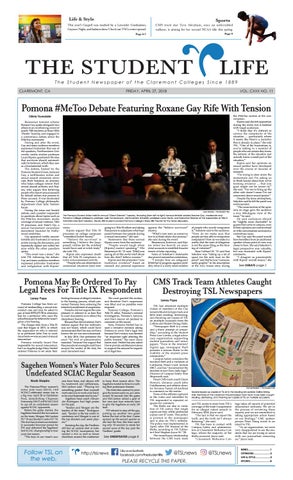
The Pomona Student Union held its annual “Great Debate” Tuesday, featuring (from left to right) famous feminist scholar Roxane Gay, moderator and Pomona College philosophy professor Julie Tannenbaum, Northwestern University professor Laura Kipnis, and Executive Director of the Association of Title IX Administrators Brett Sokolow. Nearly 300 students packed Pomona College’s Rose Hills Theater for the tense discussion.
views. Kipnis argued that Title IX processes on college campuses “resembled [witch hunts].” “‘Believe the survivors’ is something I believe the [supposed] victims [of the witches] would have said at witch trials,” she told TSL. Kipnis also expressed doubt that all Title IX complaints involve non-consensual activity. “People who are oftentimes in consensual situations [are] later
going to a Title IX officer and asking that person to adjudicate what happened between two people during a sexual encounter,” she said. Statements like these earned Kipnis scorn from the audience. “People would laugh when [Kipnis] started speaking,” Elle Biesemeyer SC ’21 said. “[She] was saying all of this awful stuff about how she didn’t believe women.” Kipnis said she presented “contradictory evidence” based on research and personal experience
Pomona May Be Ordered To Pay Legal Fees For Title IX Respondent Laney Pope
Pomona College has been accused of mishandling a sexual misconduct case and may be asked to pay at least $255,672.50 in attorneys fees for a petitioner who sued the school because he believes he wasn’t given a fair hearing. The charges stem from a Title IX case that began in 2015, in which the respondent — who is referred to as petitioner John Doe in court documents — was accused of sexual misconduct. Pomona initially found Doe responsible for sexual misconduct, but Los Angeles Judge Mary Strobel ordered Pomona to set aside their
findings because of alleged mistakes in the hearing process, which prevented Pomona from enforcing the intended punishment of suspension. Pomona did not require the complainant — referred to as Jane Roe in court documents — to attend the disciplinary hearing. Because Roe did not attend, Doe’s defense argued that key testimony was not heard, which could have demonstrated that Doe may not have known the act was non-consensual. In July 2016, Doe petitioned the court “for writ of administrative mandate,” because Doe argued that this procedural oversight could have swayed the verdict of the trial, the court document read.
The court granted this motion, and therefore Doe’s suspension was lifted and no penalties were imposed. Pomona College, Pomona’s Title IX office, Pomona’s external investigators, Pomona’s lawyers, and Doe’s lawyer all declined to comment on the record. Now, Pomona Strobel has issued a tentative decision asking Pomona to cover Doe’s legal fees because Doe’s victory was deemed “an important right affecting the public interest,” the court documents read. Strobel has also asked Doe to provide additional evidence to support the amount he requested in legal fees.
Sagehen Women’s Water Polo Secures Undefeated SCIAC Regular Season Noah Shapiro
The Pomona-Pitzer women’s water polo team (20-10, 14-0 SCIAC) celebrated senior day in a big way April 20 at Haldeman Pool, demolishing Chapman University (10-17, 6-8 SCIAC) 16-2 to cap off an undefeated season against SCIAC opponents. Before the game started, the Sagehens honored the two seniors on the team, Morgan McCracken PO ’18 and Jocelyn Castro PZ ’18. The duo has overseen an extremely successful four-year period for P-P, and delivered the Sagehens’ first SCIAC championship in four years last season. “The keys to our team’s suc-
cess have been, and always will be, teamwork and selflessness, McCracken said. “Playing for something greater than yourself motivates you to work even harder for your teammate next to you.” Sagehens head coach Alexander Rodriguez had high praise for the pair. “Jocelyn and Morgan are the leaders of the team,” Rodriguez said. “Jocelyn is the top center in conference and Morgan is one of the top shooters and assist players.” Entering the day, the Panthers still had an outside shot at making the SCIAC tournament, but needed a win as well as losses elsewhere around the conference
Follow TSL on the web.
to keep their season alive. The Sagehens wasted no time in crushing their postseason dreams. The festivities seemed to energize the seniors early on, as Castro scored 24 seconds into the game and McCracken added a goal of her own just four minutes later to give the Sagehens an early 2-0 lead. P-P refused to step off the gas, putting up another two goals before the end of the first. Castro opened up the second quarter as she had the first, this time needing only 18 seconds to sneak her second score of the day past the Panthers’ goalie.
See UNDEFEATED page 8
http://tsl.news
against the “believe survivors” mantra. “What’s now seen as conservative is to think about due process,” she said during the event. Biesemeyer, however, said Kipnis relied too heavily on anecdotal accounts to establish broader trends of false reporting. Some of Sokolow’s statements also proved somewhat contentious. “I wonder how we safeguard [#MeToo’s] progress against probably what is a fairly small number
of people who would weaponize it,” Sokolow said to the audience. “How do we make sure that people are less able to weaponize complaints? How do we make it a reality that the taint of allegation is not the same thing as the finding of violation?” Rose Gelfand SC ’21 said that Sokolow was “taking up a lot of space for the only man on the panel” and that he was “unnecessarily graphic” in his description of the Aziz Ansari story during
the #MeToo section of the conversation. Kipnis said she felt opposition during the event, but is familiar with tough audiences. “I think that it’s difficult to convey the complexity of the situation … particularly where it seems like there’s a narrative that is already in place,” she told TSL. “One of the frustrations is, you’re talking to a roomful of people who are certain they know the entirety of the situation and actually know a small part of the situation.” Kipnis said her opinions on sexual politics have developed over the course of decades of research. “I’m trying to slow down the momentum and I’m asking us to think harder about how we’re forming evidence … that you guys might not be aware of,” she said. “For me to bring up the other side doesn’t mean I’m not concerned about sexual justice.” Despite the tense atmosphere, Sokolow said he felt the panel was well-rounded. “The cross-section of the opinions on stage gave the audience a nice 360-degree view of the issue,” he said. He said audiences should be “slightly more charitable” to guests that come to campus, even if their opinions are controversial or if the conversation surrounds a contentious issue. But Gay said the panel would have benefited from an additional speaker whose point of view was closer to hers. She said Sokolow’s legal perspective was valuable, but was frustrated with Kipnis’ comments. “I disagree so passionately with Kipnis’ overall stance,” she
See DEBATE page 2
CMS Track Team Athletes Caught Destroying TSL Newspapers Laney Pope TSL has obtained multiple videos of members of the Claremont-Mudd-Scripps track and field team stealing, destroying, and throwing out copies of TSL on multiple occasions from the Collins and Malott Dining Halls. “Newspaper theft is a crime and a blunt attempt of censorship,” according to the Student Press Law Center, a legal advocacy organization supporting student journalists and newspapers. “Even in the internet/ digital age, newspaper theft presents a serious threat to the viability of the student press community.” Campus Safety considers the incident theft and a violation of California Penal Code section 490.7, and has “documented the incident in our Clery daily logs,” Director of Campus Safety Stan Skipworth said. Head CMS track coach Glenn Stewart, distance coach John Goldhammer, and athletic director Terrance Tumey all declined to comment on the matter. None of the athletes captured in the video and identified by TSL responded to repeated requests for comment. The thefts are also in violation of TSL policy that single copies are free, while additional copies cost 47 cents. This policy is printed in the newspaper and is also on TSL’s website. The policy was implemented in April, after TSL learned of the thefts, according to TSL Editorin-Chief Meghan Joyce SC ’20. The tumultuous relationship between the CMS track team
Like us on facebook: facebook.com/thestudentlife
Samuel Breslow • The Student Life
Several ripped up copies of TSL sit in the recyling bin outside Collins Dining Hall. Members of the Claremont-Mudd-Scripps track team have been caught stealing, destroying, and throwing out copies of TSL on multiple occasions.
and TSL seems to stem from TSL’s coverage of the team’s suspension for an alleged naked assault in February 2018, Joyce said. “The fact is that we report the truth, and the truth isn’t always flattering,” she said. TSL has been in contact with Campus Safety and administrators at Claremont McKenna College, where the majority of the thefts occurred, Joyce said. “Claremont McKenna Col-
@TSLnews
PLEASE RECYCLE THIS PAPER.
@TSLnews
lege takes all reports of potential misconduct seriously. We are in the process of reviewing these reports, and we are committed to taking appropriate action based on our findings,” CMC spokesperson Peter Hong wrote in an email to TSL. “As an organization, we were very disappointed to see the students that we are trying to serve with our journalism censoring us,” Joyce said. NEWS................................1 OPINIONS........................3 LIFE & STYLE......................5 SPORTS.............................8
NEWS PAGE 2
APRIL 27, 2018
THE STUDENT LIFE
DEBATE: Students Wanted Gay By Herself Continued from Page 1 said. Kipnis’ “honest opinions come from an intellectually dishonest place” and she “acts as if her audience comes from a place of ignorance … and wishful thinking,” Gay added. Some students at the debate were also frustrated by its format. “A lot of us [in the audience] were here for Roxane and her perspective,” Allie Pitchon PO ’20 said. “We were frustrated that she had to debate things we found to be fundamental.”
Caitlin Conrad SC ’20 concurred. “Bringing a speaker like Roxane should have been its own event,” she said. PSU’s culminating annual event is usually a panel, PSU member Sherwin Shabdar PO ’18 said. Shabdar said the group identified Gay as an influential voice to include after deciding to host a panel on the #MeToo movement. Due to miscommunications with her speaking agent, Gay said she was not aware the event would be a debate, rather than a talk or a
reading, or who she would be debating, until 10 days beforehand. Had she known further in advance, she would not have participated in the event, but it was “too late to back out” when she found out, she said, adding that it’s critical to have a survivor’s perspective in sexual assault debates. “Events like this are complicated,” Gay said. “It was a mess, but good conversations always are.” Samuel Breslow and Marc Rod contributed reporting.
Pomona Paints Over Walker Wall Message Calling CMC Professor A ‘Nazi’
Pomona Experiences Rash Of Thefts
Pomona College experienced a recent spike in burglaries from residence hall rooms, as well as other types of on campus robberies, according to a Monday email from associate dean Frank Bedoya. Stolen items have included laptops, other personal electronics, and other valuables. Jack Conner PO ’19 said he believes someone went into his room while he was asleep and stole his laptop. He did not lock his door before he went to bed. “I was in my room until around 2 a.m. and my backpack was with me, so I was very confused when I woke up and I couldn’t find it,” he said. Campus Safety has also received a number of recent calls about suspicious activity from various locations at Pomona. Bedoya encouraged students to keep their doors and windows closed and locked, notify Campus Safety about suspicious activity, report lost or stolen keys to Housing and Residence Life, and report issues with locks, doors, and windows. — Marc Rod
Pitzer Senate Holds Additional Elections
Pitzer College Student Senate elections committee chair Claire Wengrod PZ ’19 announced the results for Pitzer Senate’s legislative elections April 20. Nimiye Ogoun PZ ’19 was elected as senior class representative, Becca Zimmerman PZ ’21 was elected sophomore class representative, Zhuocen Shi PZ ’21 was elected international representative, Kamya Sud PZ ’19 was elected environmental rep, Dana Nothnagel PZ ’19 and Sylvie Wilson PZ ’21 were elected to the campus aesthetics committee, Brendan Schultz PZ ’20 and Matthew Brunstad PZ ’20 were elected to the academic planning committee, Victor Bene PZ ’19 was elected to the diversity committee, Arianna Dang PZ ’21 was elected to the study abroad and international programs committee, Nicole Aquino PZ ’21 was elected to the curriculum committee, and Conner Wells PZ ’21 was elected to the campus life committee. No candidates applied to run for junior class representative, and Pitzer will hold elections for the position in the fall. Campus-wide voter turnout was, as with executive board elections, low at 35.8 percent, or 358 students. — Marc Rod
Samuel Breslow • The Student Life
“Charles Kesler is a Nazi” was spray-painted on Pomona’ College’s Walker Wall late last week, sparking dialogue on campus about free expression.
Samuel Breslow & Ariel So Two Pomona College students spray-painted “Charles Kesler is a Nazi” in large black capital letters on Walker Wall, which has served as the college’s free speech wall since the 1970s, late last Thursday night. Kesler is a Claremont McKenna College government professor and editor of the Claremont Review of Books, an influential conservative publication. He wrote in an email to TSL that the issue was “too fatuous to comment on.” The painters, who requested anonymity to avoid disciplin-
ary consequences, told TSL they don’t know Kesler personally but wanted to raise awareness of his presence on campus. “When people criticize Trump, why do they not criticize the person next door to them who is writing the academic underpinning for his role?” one of them said. He added that he does not literally consider Kesler a Nazi. Pomona painted over the message Friday because a committee of students, faculty, and staff judged it violated “community norms” delineated in Pomona’s student handbook, acting Dean of Students Janet Dickerson wrote in an email to students Friday
afternoon. Dean of Campus Life Chris Waugh, a member of the committee, told TSL it was “fairly clear” that the posting violated the handbook’s prohibition against “specific threats or attacks on an individual.” Another message on Walker Wall declaring “the yt [white] mind is weak” was judged to be “offensive” but not to violate community norms, Dickerson wrote in an email to students Tuesday. Waugh said there is a separate bias-related incident investigation into that message. Visit tsl.news for expanded coverage on this topic.
Pomona, HMC Continue Dean of Students Searches
Pomona is bringing candidates for its vice president of student affairs and dean of students position to campus to replace former dean Miriam Feldblum, who resigned in February in while on sabbatical. The first candidate visited Monday, and additional candidates will be visiting April 30 from 4:30 p.m. to 6 p.m. in Rose Hills Theater and May 1. Janet Dickerson is currently the acting VPSA and dean of students. Harvey Mudd College recently brought its three vice president for division of student affairs/dean of students candidates to campus and conducted a student survey about the candidates. The search committee is now reviewing the survey data and deliberating, according to an email from President Maria Klawe to HMC students. — Marc Rod
Pomona Signs DACA Amicus Brief
Pomona College signed onto an amicus brief supporting plaintiffs suing the Trump administration to preserve the Deferred Action for Childhood Arrivals program. The Presidents’ Alliance on Higher Education and Immigration, led by former Dean of Students Miriam Feldblum and former President David Oxtoby, filed the brief in the Second Circuit Court of Appeals, and its approximately 70 member schools signed on. — Marc Rod
Wednesday, May 2, 6–8 p.m. Harvey Mudd College | Shanahan Center for Teaching and Learning, Auditorium Our nation is wrestling with big challenges that have important scientific dimensions: climate change, the opioid crisis, the future of work and many more. How do we communicate to the public the curiosity, inquiry and innovation that drive science and ensure that people from all communities are reached and engaged? Join Talithia Williams, NOVA Wonders host and Harvey Mudd associate dean and associate professor of mathematics; Julia Cort, NOVA Wonders executive producer; Flip Tanedo, assistant professor in theoretical physics at University of California, Riverside; and Harvey Mudd President Maria Klawe for an advance screening of NOVA Wonders, a six-part series that tackles some of the biggest questions about life and the cosmos. The screening will be followed by a panel discussion on how we can make science communication more inclusive and ensure that science is open to everyone. A reception with refreshments follows the Q&A. For more information, contact communications@hmc.edu.
NOVA Wonders premieres on consecutive Wednesday nights from April 25 through May 30 at 9 p.m. on PBS (check local listings).
RSVP at hmc.edu/nova
OPINIONS PAGE 3
THE STUDENT LIFE MEGHAN JOYCE Editor-in-Chief KELLEN BROWNING Managing Editor ARIEL SO Managing Editor
SAMUEL BRESLOW, News Editor MARC ROD, News Editor LANEY POPE, News Associate MEGHAN BOBROWSKY, Life & Style Editor SAMANTHA RESNICK, Life & Style Editor WHITNEY WACHTEL, Life & Style Associate DONNIE DENOME, Opinions Editor ANIKKA VILLEGAS, Opinions Editor HANK SNOWDON, Sports Editor DAPHNE YANG, Senior Design Editor CASSIE WANG, Senior Design Editor MIN HYUNG LEE, News Designer KELLY HO, Life & Style Designer CHRISTINE LIN, Opinions Designer JILLIAN BATIUK, Sports Designer
The Student Life, the oldest college newspaper in Southern California, is produced and managed by students of the Claremont Colleges and published weekly. The editorial board consists of the editor-in-chief and two managing editors. Aside from the editorial, the views expressed in the opinions section do not necessarily reflect the views of The Student Life. Email letters, questions, and concerns to editor@tsl.news, tips to securetsl@gmail.com, and ad inquiries to ads@tsl.news. Single copies of TSL are free and may be obtained at news stands around campus. Multiple copies may be purchased for $0.47 per copy with prior approval by contacting editor@tsl. news. Newspaper theft is a crime; perpetrators may be subject
OLIVIA TRUESDALE, Copy Chief AKSHAYA AMARNATH, Copy Editor EMILY JIANG, Copy Editor LORELEI BIVINS, Copy Editor JAMIE REID, Copy Editor SARAH WONG, Graphics Editor LUKE MEARES, Photo Manager LAURYN CRAVENS, Photo Editor CHRISTOPHER HU, Distribution Manager PETER YAN, Business Manager JACINTA CHEN, Social Media Manager
to disciplinary action as well as civil and/or criminal prosecution. TSL welcomes letters to the editor, which can be submitted by mail, by email, or in person at the Fishbowl in Walker Hall. Letters must be under 400 words (although when an issue is particularly salient, we reserve the right to allow letters to run at a longer length) and submitted by 4 p.m. Wednesday of the week of publication. We reserve the right to decline publication of submitted letters and will not accept anonymous letters, letters containing profanity, factually inaccurate letters or letters making personal attacks. TSL also reserves the right to edit for spelling, punctuation and grammar. Letters may be signed by a maximum of three persons. All letters become the property of TSL and may not be reprinted without prior permission from the editorial board.
EDITORIAL BOARD
If You Want Good Journalism, Fund It Today, college newspapers across the nation participated in #SaveStudentNewsrooms, an effort to bring attention to drastically underfunded college media. We’re here to add our voices to the call for financial support. Student news organizations are essential because they provide in-depth coverage of local issues that affect college students on campuses. No other publications feature student voices, publicize events, and investigate wrongdoings on campus as methodically as college journalists. In the past year alone, TSL articles have impacted students lives and prompted administrations to agree to new policies. 1. Last spring, TSL published a leaked report that the Harvey Mudd College administration had been keeping secret from students, detailing how the school’s excessive workload left students mentally and physically exhausted. Furious students protested, rallied, and staged sit-ins, prompting the administration to issue a public apology, cancel two days of class, and pledge more funds to mental health and student organizations. 2. In March, our investigation into the ways Pitzer College Student Senate has spent its money and its failure to adequately track expenses – making abuse of power possible – raised awareness across Pitzer, and caused the incoming executive board to promise more accountability
and transparency. 3. Last fall, we wrote several stories and produced a video about the experiences of Scripps College first-years forced to live off-campus in apartments at Claremont Graduate University because Scripps enrolled too many people. Though some were able to make it a home, many said that they felt isolated and cut off from the community. This semester, Scripps pledged no student would be forced to live at CGU in the fall. 4. Also last year, a TSL editor penned a column explaining why she was transferring from Scripps; she felt the school didn’t have enough spaces for students to come together and build community. Specifically, she questioned why Scripps doesn’t open up its classrooms after-hours like other 5Cs. This semester, Scripps opened four classrooms to students to do work in. Despite the impact our writers have made and the hours they put into their work, they’re unpaid. So are our photographers, graphic artists, and business associates. Our section editors make the equivalent of $1.60 per hour. Not $11.60. A dollar sixty. And they often put in more than 20 hours per week, including eight or nine hours during weekly production nights alone. Our labor budget comes from the administration, which would not be ideal even if we were paid like millionaires. And our production budget, which mostly goes toward printing, comes from the same student senates that we routinely cri-
North K - South K Everything is going to be OK
TSL SAYS
APRIL 27, 2018
THE STUDENT LIFE
Dammit Kanye I really don’t know what to say
tique and investigate. Journalists need to be financially independent and unaffiliated with the communities they cover, but we can’t afford to. No amount of funding threats would stop us from publishing the news people need to know, but what if we lose our ability to pay to print? The past two years, we’ve only been able to continue printing the oldest student newspaper in Southern California thanks to an anonymous donation. How can we ask or expect anyone to work essentially for free? It certainly hinders our ability to build a socioeconomically diverse newsroom, and it’s heartbreaking to hear from reporters that they love journalism, but have to quit our staff because they need to find a job that pays. There’s no solution in sight. Some college newspapers have been able to get a student media fee passed, so all students pay for local journalism on their campus. But here at The Claremont Colleges, we have five different schools to contend with, and five Boards of Trustees that would have to approve such a change. As we continue to search for ways to survive and print, while still producing highquality, impactful content, we need your help. If you believe that journalism matters, especially on college campuses, please donate to The Student Life. Your money will go directly toward ensuring we’re able to continue serving our community.
Alumni Weekend Shout out to setting the Tinder age range to 25-65+
Pitzer Senate’s “Complete Failure In Leadership” Was Structurally Inevitable Liam Brooks Guest Columnist Like most aspects of Pitzer College, governance is best done by the students. Thankfully, we have a concrete institution that allows us to hold up our side of the college’s structure. It has allowed students to come together, debate, and present their ideas to the community as a whole — as it has withstood the elements for decades. I’m talking, of course, about Pitzer’s Free Wall. I’m not talking, of course, about Pitzer Student Senate. Don’t get me wrong: The Senate has accomplished respectable and exemplary achievements both during and before the time I’ve attended Pitzer. To name just two, Pitzer has divested from fossil fuels and opened gender-neutral bathrooms across campus. I acknowledge that students on Senate, especially those on executive board, are overworked and rarely given the credit they are due for their efforts. Still, worse is the way that the structure and goals of Senate, as an institution, have failed the student body, and done nothing to rescue a vocal but apathetic constituency from straying ever further from collective, effective governance. Since leaving Senate after three semesters of service and observing it as a constituent and reporter, I can say that something is profoundly wrong. That something is the core of Senate’s problems, from presidents that spend five times the maximum conference budget to Senate members who can’t head off internal crises the size of a yacht: a legitimately chilling belief that their constituents couldn’t or shouldn’t be aware of the work they are doing. I do agree with the incoming executive board that the solution starts with transparency. Their plan to use a live spreadsheet for credit card charges is a good one. However, that should be a first step on a much, much longer path toward an effective and ethical form of Senate: a journey that will be rough, and hopefully end with a more accurate sense of self. Glass walls hurt because you walk into them. The biggest thing Pitzer Senate has done to improve transparency in the four years I’ve been here is to start using microphones during meetings. For that, I applaud them. You might not expect this, given the promises made by nearly every executive board candidate, not to mention most Senate candidates in general, in the past four elections and beyond. These promises are nothing new but often go unchecked. If
every candidate promised to improve hydration, we’d ask about water fountains. If they promised to shrink Senate, we’d ask for the positions that they would cut. We need to do the same thing for transparency. Here’s the thing: improving transparency is really, really difficult. Especially if you think it’s easy. In no particular order, here’s what transparency isn’t: Facebook Live; smiling; using the words “listen,” “engage,” or “voice”; surveys on student-talk; suggestion boxes; using “table” as a verb. Most importantly, transparency is neither the instance nor the result of a lack of action — despite how it’s framed. Rather, transparency is an active endeavour, and one that hurts. That’s because, despite what the word suggests, transparency in governance is extremely visible — gratingly and uncomfortably so. To use just a small example, at every meeting of Senate I’ve been to (which is most of them) since microphones became standard policy, a number of things will happen. Someone will insist they can speak loudly enough without it, only to be shouted down, though occasionally with some disagreement. A guest (on the rare occasion that anyone besides a Senate member shows up) will begin speaking without a microphone, and it’ll take a minute to get them a microphone, after which they’ll have to waste time and repeat what they already said. A member of Senate (or two, or three) will sigh, lean back, and think if I’m ever on exec board, I’m going to get rid of these stupid microphones. But the microphone system makes it possible for more people to hear what is being said, whether guests, a senator at the far end of the room, or someone without the best hearing capability. If a member of Senate really cared about their meetings moving more quickly, they should read and discuss legislation beforehand so recesses don’t have to be called, or should not try to suspend the constitution — a lengthy voting process — on a regular basis. Transparency takes work The default state of government is invisible, and correspondingly opaque. Invisibility and opacity get things done faster. Because remaining transparent takes energy, it detracts what is thought of as “actually governing”: writing legislation, introducing it to the body, and voting it through. Furthermore, those in power know that political success isn’t always pretty. You have to cut deals and make compromises, else the government itself will be shut down. It used to be common practice in the United States for senators to deliver one version of a speech on
the Senate floor, then write an entirely different one to be published in the newspaper back home. Real work got done, and they didn’t get voted out next election. Yet, students do show up when they care, and they force Senate to operate in public — when it affects them directly. Identity groups show up en masse, for example, when they need funding or are hoping to secure a space. After TSL broke the story about the Senate’s lackluster accounting, several students showed up to ask questions. Other than that, not many people show up at all. At first, this doesn’t seem like a problem: Members of Senate are elected as representatives of students, so it makes sense that they would be there in their stead. However, while the Senate’s mission is to govern — to do the legwork, pull institutional strings, and cash the checks that shared governance writes in our name — the legislature also plays a more symbolic role: representing the student voice. Sometimes it does. But when it doesn’t, it’s not pretty. Take the Student Initiative Fund, a $10,000 chunk set aside to fund proposals solicited from the community, like new hammocks or a half-pipe. When some students asked via the student-talk listserv why the funds couldn’t be used for scholarships instead, or questioned how the available options had been decided on, Senator Dana Nothnagel PZ ’19 replied that “Probably communicating your concerns on the last day of the election through student talk isn’t the most effective means of making a change,” and added that she was “Looking forward to all of your input and participation next year! :) :) :) :) :)” There will always be people who wait until the last moment — for example, U.S. Senators. But at the end of the day, a democratic governing body should be doing everything it can to solicit its constituents’ feedback — and should check itself when it fails, not belittle voters. When it comes down to it, Pitzer has handed Senate the keys to a $270,000 F1 race car, but Senate members aren’t complaining about having to drive it on a closed course. What the student body needs is a bus — a vehicle that’s accessible to more people, makes better use of fuel, and can be driven on actual roads, even if it’s a bit slower. How do we get there? It’s not enough to buy the bus and brag about unlocking the doors. Instead, it starts with planning and advertising routes, building clearly marked stops, enforcing ramp accessibility, and not caring whether every seat cover is embossed with a Pitzer tree. Liam Brooks is a senior at Pitzer College. He served on Pitzer Student Senate as a member of the public art committee and was editor-in-chief of TSL for fall 2017.
Improve Your Freestyle Rap and Poetry Skills!
Can You Find All the One Syllable English Words that Rhyme With Each Word Listed Below?
Rhymes with Sound:
Pirate Party Shout out to early onset alcoholism
Rhymes with Tough:
Bill Cosby Supposedly Feeling Disoriented After Jury Slips Conviction Into His Verdict (credit: The Onion, we aren’t funny anymore tbh)
Hogwarts Mystery The game we didn’t know we needed
Rhymes with Pig:
Donald Trump on Fox and Friends Supposedly an A+ president; I bet he curves all his classes.
Rita Skeeter BREAKING: Records, Rules, Standards of Ethical Journalism
Anam Mehta • The Student Life
OPINIONS APRIL 27, 2018
PAGE 4
THE STUDENT LIFE
Why I’m Proud To Have Written The CMS Track Story Hank Snowdon Guest Columnist Less than 12 hours after TSL published the story about the Claremont-Mudd-Scripps track team’s suspension that I co-wrote, I heard my name whiz across the Collins breakfast tables from people smearing my reporting ability. The article had already garnered thousands of views, and was proving to be controversial. “TSL doesn’t have a right to post that.” “They’re all just fake news.” Statements like these came to embody the general attitude of many across the 5Cs in the coming weeks. Their responses were not warranted. I was confused because, while reporting, we followed the ethical standards of journalism set out by the Society of Professional Journalists, including the mandate to seek truth and report it as accurately and responsibly as possible. As the CMS track team has made concerted efforts to deny our legitimacy as a newspaper, they have instead solely provided evidence of their own ignorance. Their attempt to subvert information further demonstrates the need for a free press to convey truth on these campuses. Accusations and intimidation The snippets of conversation I overheard at Collins were but the tip of the iceberg. When I checked Facebook, I immediately saw comments on the story accusing us of unethical, incorrect, and biased reporting. Discouraged, I went to class and tried to focus on something else. However, as soon as I sat down, I heard someone call out my name. Looking over, I saw a member of the CMS team, whose identity I will keep private to protect his dignity. With everyone in the class listening, he called out: “How does it feel to make 114 people feel like shit?” After class, he expressed his disgust toward the article. I explained how I wasn’t going to apologize for doing my job, and how all we had done was put public information into words.
Staring down at me, he put his hand firmly on my shoulder, telling me I should take the advice of coach John Goldhammer, who was quoted in the story: “You’re free to make choices, BUT you’re not free from the consequences.” Whether or not my classmate had the intention to threaten me, I felt intimidated. Nonetheless, I remained confident in the importance of my reporting. What we knew The original version of the story was relatively simple. We knew that the team had been suspended. We knew that the incident was “part of an initiation event,” we had a comment from CMC confirming the suspension, and a copy of the email that Goldhammer had sent the team before the suspension was announced. Most importantly, we had Claremont Police Department logs from that night, which gave us plenty of information that was completely public. This is what we based our reporting on: public information. With the original article we wrote, and every subsequent follow-up story, we did our best to report what we knew to be true, that there was an alleged assault by members of the team on a student employee at the Rains Center that night — the attack described in that same police report. Our goal was never to attack, but solely to report truth. Backlash Despite the fact that we reported the attack described in the police report as alleged, members of the team claimed we had reported these alleged events as fact. We had no intention of claiming that any details had been proven, as we repeatedly used “alleged” for this very reason. And though we accidentally dropped the word “alleged” in one minor instance where information was unconfirmed, we were sure to make a correction and update the story accordingly. Our main focus in reporting this story was to only report what we
knew to be true from the information given, and that is why we made a concerted effort to include “alleged” while reporting on unconfirmed information. Yet, more complaints about the story appeared on Facebook. One commenter claimed the alleged details in story were outright false, and that it was biased by the number of Pomona students who work for TSL. Meanwhile, another citing a conflict of interest claimed the authors of the story run for the rival Pomona-Pitzer track team. I attend CMC, definitely do not run for the P-P track team, and neither does Marc Rod PO ’20, my co-author. While Kellen Browning PO ’20, one of TSL’s managing editors and a P-P runner, did read the article, he in no way interfered with the story’s factual content. And, again, we never confirmed anything as fact: we simply provided the public information given on the incident.
the public’s main checks on government power. Members of the track team calling TSL “fake news” simply because the breaking story publicizes them negatively is exactly what the president is doing: further dividing people and attacking members of the press, who simply aim to hold people accountable. Calling TSL “fake news,” despite us reporting on what was already public information, is absolutely baffling to me. The extent of the attack on TSL is extremely concerning. It may be difficult for some to understand why we would report on the incident, given its potential backlash and added publicity to those involved. But as journalists, it was absolutely our job and responsibility to do so, because members of the public deserve to understand what is happening around them.
It is a natural human reaction to respond negatively when one is featured in such a way. However, instead of accepting the outcome, or voicing their concerns in a respectful and intellectual way, members of the team created a full-fledged attack — lashing out on the newspaper that merely informed others of the truth. And while this response was discouraging, it also demonstrates TSL’s vital role on these campuses. That team members believed they could discredit information reported about them by intimidating the writer, smearing the name of our publication, and stealing newspaper copies is terrifying. The attitude that groups like the CMS track team can simply cover up public information that uncovers their faults — is one that cannot exist here. As the newspaper of record at the 5Cs, TSL is a crucial protector
of the right to report what happens here. Every community needs a free press that can hold institutions and people accountable for their actions. At the 5Cs, TSL fulfills that role. We were entirely within our rights and responsibility to report on the CMS track story, and I’ll always be glad that we did. As we finish up this semester and move into the next school year, we will refuse to back down from intimidation. We will refuse to let other groups discredit our name. We will continue to work every day to report the truth, despite the concerning attitude around the idea of journalism at our schools. Hank Snowdon CM ’21 is an applied math major from Columbus, Ohio, and is the current sports editor at TSL. He enjoys In-N-Out, Del Water Gap, and Clayton Kershaw’s curveball.
Claims of “fake news” As all of these ridiculous claims surfaced, I realized that, somehow, team members were blaming us for their suspension, and that they had made TSL into a scapegoat. As the days and weeks went on, they smeared our name to the 5C community, telling everyone that the story was “fake news,” while calling the publication “TSLies” and “To Spread Libel.” They made “TSL Track Club” track jerseys mocking us, that say we were “BREAKING: Records, Rules, Standards of Ethical Journalism.” Recently, they’ve been caught damaging and throwing away copies of TSL from Collins and Malott Dining Halls. Every one of these alarming incidences illustrated to me how backwards the entire situation was. Troubling implications We live in an age where the current U.S. president uses the term “fake news” to discredit reporting that puts him in a negative light. It’s an attack on the First Amendment, and one that directly threatens one of
Tuition, Student Loans Perpetuate College Culture Of Elitism
Nina Potischman • The Student Life
Letter to the Editor Peter Hong
“they’d rather that you shut up or leave than ever even slap a perpetraYour April 20, 2018 story “Sur- tor on the wrist…I don’t know a single vivors Speak Out About 5C Title person who went through the Title IX IX Sexual Violence Policies” con- process who was at all happy about tained a lengthy anonymous the outcome or felt the outcome was quote regarding Claremont McK- just,” she added. “I don’t even know enna College that said, in part, someone who knows someone who
felt satisfied with the outcome of their Title IX process.” Publishing this quote was a breach of a widely accepted principle of journalistic ethics. It was irresponsible of you to run such an outlandish quote without any supporting evidence.
No, Really, How Are You? Katie Baughman Guest Columnist
Dominic Frempong • The Student Life
Jo Nordhoff-Beard Columnist The average cost of attending one of The Claremont Colleges is now around 70,000 dollars for the 201718 academic year. In the three years since I started attending Scripps, the cost per year has gone up by 5,000 dollars, which is a 7.1 percent increase. The cost is blasphemously high, which puts excessive strain on families and could force students to take out loans if their financial need is not met by a package from the school or from other scholarships. Student loan debt is one of the most important undercovered issues in politics, and as college students, we should actively push our representatives to make this issue a priority. There are two bills on the Senate floor right now that are not currently out of committee. If the election in November pans out in a more progressive direction, like many have predicted it will, there will be a greater chance of providing free or reduced-cost college tuition to students. When the Affordable Care Act was passed in 2010, it placed the allocation of student loans directly on the government via Pell grants and ended private bank subsidies. Until Sen. Bernie Sanders’ 2016 presidential campaign, where one of his landmark policy ideas was the College For All Act, this was an issue that had not been in the public discourse for the past eight years. Part of the reason Sanders got so much support from millennials
was because he spoke to issues that would directly impact them, like student loan debt, free and reduced cost college education, and universal health care. The College For All Act was introduced into the Senate last year and would eliminate tuition and fees at public universities for students whose families made under 125,000 dollars, which is 80 percent of the American population. It would subsidize tuition by taxing Wall Street and redistributing the money from the tax to students in need. However, college is more expensive than just tuition, and Sanders’ bill does not address other costs like room and board, books, and other living expenses associated with being a student. Senator Brian Schatz PO ’94 introduced a bill called the Debt Free College Act of 2018, where the federal government would match the state provided Pell Grant to an individual attending a public university, which then negates the need for anyone to take out student loans. In an interview with Vox, Schatz said that “both parties have been running on this [college affordability], and we haven’t done the hard legislative work.” Sanders received criticism in his campaign for the high costs associated with paying for the College For All Act, and Republican politicians have criticized rising student loan interest rates. Education is not a wedge issue. People in the United States carry 1.3 trillion dollars of student debt, which is second highest to mortgage debt. Free college tuition provided
from Sanders’ bill only covers 45 percent of college expenses, and college tuition rises every year when financial aid does not rise proportionally. While these bills do not directly impact private institutions like The Claremont Colleges, they would have a positive impact on our future colleagues, neighbors, and could sway people into choosing different schools based on financial aid and the possibility of a more equitable, lower cost solution to the high cost of being in college. It is a shame and reflects terribly on the United State’s broken education system that it now may not be economically advantageous for someone to enroll in college because of the amount of debt they could accumulate in order to afford rising costs. Attending college is theoretically supposed to lead to a higher paying job with more opportunities to become economically successful. However, student loan debt places a huge strain on individual’s finances, and should not preclude people from wanting to attend a dream school. It is on us, as students, to keep lobbying for this issue and bring awareness to something that many of us face but very few elected officials recognize as legitimate concern. College, just like health care, should be affordable and accessible to all, and not behind an ivory tower of exclusivity and elitism. Jo Nordhoff-Beard SC ’19 is an English major from Seattle. She only likes carbonated beverages.
“Hey.” “How are you?” “I’m good, how are you?” “Good.” If you’re anything like me, you get this question several times a day. In my four years at The Claremont Colleges, I’ve noticed how frequently this quick dialogue plays out. It functions as one of the effortless ways to greet friends passing by, or easily launch into small talk with peers. I’ve memorized its easy formula, and engaged in both sides of the conversation every single day. Recently, though, when I’ve asked and answered this question, I’ve noticed its routineness feels more robotic than genuine. Oftentimes when I’m asked this question, I don’t give a full-fleshed response. And, in most circumstances, neither will my peers. My concern about this phrase sparked earlier in the semester, when I saw a friend on my way to my 11 a.m. class. Naturally, I was in a rush, already two minutes late to the seminar, and didn’t have time to jump into an elaborate conversation. I asked “How’s it going?” out of habit and reflex. Admittedly, when she answered that she wasn’t feeling too great, it kind of threw me off guard. After hearing her non-cookiecutter response and analyzing how interchangeably I use this phrase, I started to think of how routine, mundane, and ultimately meaningless the phrase became in my everyday vocabulary. The more I thought about it, the more I realized that this superficial question is the fast food of socializing: a quick and cheap attempt to create a substantive interaction. I ask myself, Why do I use this phrase so often? Most of the time, it comes out when I’m on the go or don’t have time to stop, park, and have a real sit-down conversation. Hence, I’ll spit it out quickly, banking on the assumption that our exchange will be minimally brief.
However, in other situations when I have enough time to fully engage, I’ll ask what they’ve been up to, or come up with more inventive, ample questions. After realizing how often I depend on this phrase as a social clutch, I searched for factors explaining both my dependence on this question and my logic for offering such an ambiguous, one-dimension response. Usually, I reckoned, it’s because giving a short answer can be a timesaver, both for me and for my peer. It’s a quick, friendly way to sum everything up without warranting a follow-up question or concern. It works well for Claremont students operating on a busy, fastpaced schedule, with a variety of interests and extracurricular activities everyday. Constantly hustling between classes and scrambling to make meetings, there sometimes isn’t time to stop and have a quality conversation, even with a friend. Consequently, the question-andresponse scheme becomes second nature. Besides its logistical convenience, responding with “I’m good” may be less emotionally taxing. When someone says “I’m good,” I don’t get any insight into their lives. As a result, I have no option but to assume all is well. I’m not proposing that saying “I’m good” is a problem: if I don’t know someone, or don’t feel comfortable sharing, I don’t have to. That is the beauty of conversation: individuals have the authority and right to be as transparent or open as they please. In that circumstance,“I’m good” has come in handy for me frequently. However, I’ve also noticed that even when I’m having not-so-great days, I still tell people I’m good. I don’t usually share those moments with my peers, or even my friends. Sometimes, I abstain from revealing my bad days to conserve time for both parties. But most often, I don’t answer honestly because I either don’t want to burden others with my problems, or because of the social pressure to always be good. Should I confess to feeling
something aside from this norm, I worry my peers will judge me, and I will be the only person who isn’t thriving every second of the day. I fear that people might actually be concerned, or put off, if I reveal the more intimate and often messy details of my imperfect life. I’ve subconsciously realized the phrase serves as a defense mechanism, a cop-out from disclosing my true feelings. I’ve grown so accustomed to “I’m good” that I’m not only taken aback if someone ever responds differently; I’m also unwilling to offer an alternative myself. Perhaps I ask and answer this question automatically because that’s what is socially “acceptable.” Now that I notice how effortlessly the phrase rolls off my tongue, I’m more convinced I’ve been replicating this dialogue more out of politeness than true interest in their circumstances or concern for their well-being. Even more frightening is the notion that by replicating this social formula, I’m not only anticipating a humdrum reply; I may not even be interested in forming an emotional connection in the first place. It’s easy to see why the question “How are you?” has become such a prevalent phrase in our conversations. It’s a sign of courtesy, and a quick way to reaffirm that we are interested in our peers’ healths, activities, and well-beings. But, it’s also important to ask why we have constructed a formula, a generic script when we raise this question. I’m not implying that this phrase is entirely devoid of good intention, and cannot be used to demonstrate that individuals care for one another. I merely note that because this phrase gets tossed around so frequently and robotically in my own life, I rarely give a more specific, detailed answer. What is, or should be, a legitimate question has lost its luster, and become a generic and rehearsed filter in my social script. Katie Baughman SC ’18 is an Economics major with an English minor, a loud singer, and a terrible dancer. She has greatly enjoyed her time at TSL over the last three years and will miss the office once she graduates.
LIFE & STYLE APRIL 27, 2018
PAGE 5
THE STUDENT LIFE
TECH COLUMN
Ofo Is The Wrong Answer To The Right Question Liam Brooks
“Every time I see an adult on a bicycle, I no longer despair for the future of the human race” is something that H.G. Wells probably didn’t say, though it has a nice message. Here is something I will definitely say: “Every time I see a student on an Ofo bicycle, I despair for the future of Claremont.” Yes, the bikes are pretty and the rides are free — for now. Yes, Ofo said its Claremont pilot is going great. But Ofo represents the increasing trust Claremont is putting in for-profit companies to solve problems we could fix ourselves. And for that, we should hesitate. Ofo — and no, I’m not styling it as “ofo” unless “bell hooks” has been trademarked as a bike safety accessory — was launched in 2015 by five students at Peking University in Beijing with financial help from an alumnus. Now, Ofo is the largest bikeshare company in China and was valued during a Series D investment round in 2017 at $1 billion. Since expanding to the United States and other countries after earning its unicorn horn, Ofo has swept onto college campuses, from Vanderbilt to Texas A&M to San Diego State — and this semester, to Pomona College and perhaps to the rest of the 5Cs soon. If you haven’t noticed, Ofo’s core feature is being “dockless,” meaning bikes can be left anywhere, not just on a rack. A self-locking mechanism and GPS tracker keep them safe. Take a quick walk around campus these days, and you’ll see the bright-yellow bikes leaning on kickstands outside academic buildings, near the entrances to dining halls, and dotting the Claremont Village.
It’s great that more people are riding bikes and that people find them convenient. By standardizing what otherwise might be a mess of systems, Ofo appears clean, safe, and reliable. But to understand the bigger picture, and why I think we should be worried about it, we have to look at another service adopted by the 5Cs to fix a problem we couldn’t handle ourselves: Sakai. Increasingly similar to Ofo with each passing day, Sakai is deployed across hundreds of colleges and universities in the United States. However, at the end of the day, Claremont doesn’t need Sakai. Each class could just have an email listserv, Facebook group, or website — and plenty do. Some professors make Wordpress blogs instead of using Sakai’s system, and many students create Facebook groups to ask questions or coordinate study sessions. Likewise, Ofo is not trying to replace other forms of transportation, or even personal bikes, at the 5Cs. It’s simply another option, and one that is executed well. The way Sakai fixes the course materials problem is exactly opposite to how Ofo fixes the lastmile transit problem. Sakai is open-source, free, and owned by the non-profit Apereo Foundation. Ofo’s bikes require speciality repair tools, cost almost $400 a pop on Ofo’s end, and are owned by a decidedly for-profit board (despite being barely profitable yet, if at all). Finally, as Ofo tells it, it’s not just bringing bikes to campus; it’s supposedly making campus a better place. Ofo advertises its university program online as not “just sustainable campus transportation” but also something that “helps build a sense of com-
Elodie Arbogast • The Student Life
munity in students.” On the one hand, that sounds like a holistic view of what transportation can do — a view that I tend to agree with. I’m an advocate of the bicycle, public transit, and car-free cities. But on the other hand, it’s a red flag. If we’re trying to solve
FILM COLUMN
A Film Columnist’s Sign-Off: Farewell, Claremont
a problem, we shouldn’t need to literally be sold on the solution. The future of Claremont, as a place, is bright. Over the past several years, the colleges have begun acquiescing to demands for more space for identity groups and students who need study space — admittedly, only after
protests and well-crafted op-eds. But, the way we move between those spaces matters, too. Not only have Pomona and Pitzer College tried their own bikeshare systems with minimal institutional support, and not only have demands for greater accessibility to buildings not been taken
seriously, but a lack of careful consideration has grown bigger when it comes to the physical manifestations of Claremont’s culture. Ofo is tempting. So, too, was Sakai. But take a step back, don’t get it twisted, and consider what it might mean to take the bait.
ADULTING COLUMN
#Adulting Part V: Why Being Alone Is An Adulting Necessity
Victoria Anders The past three years, I have written film reviews, commentaries on the changing film landscape, and annual Oscar predictions. There have been some fundamental changes within the film industry and elements of slow but concrete progress. For my final TSL column before leaving Claremont, I thought I would reflect on experiences both as a film columnist and member of TSL. I write this piece with emphasis on the more mainstream, bigbudget world of Hollywood that is heavily influenced by the awards shows, and run by major film executives and studios. In 2016, there was public outcry over the near-total lack of representation of people of color among Academy Awards nominees (#OscarsSoWhite). Though perhaps prompted only by the need to respond to Oscars getting called out, noticeable change has happened in casting for films and recognition of achievement among both nominees and winners of the major awards shows in the past two years (think Jordan Peele, Viola Davis, Mahershala Ali, Guillermo del Toro, and Antonio González Iñárritu). “Get Out” satirized the classic Hollywood horror/thriller model with a critical racial lens. And there was the phenomenon of “Black Panther,” that opened in mid-February and has made five times as much money as any other movie released in the United States in 2018. On top of that, it had a nearly all-black (and badass) cast. There is still a significant lack of Chicanx/Latinx, Asian American Pacific Islander, and Indigenous folks in mainstream film, on and off camera. TV is perhaps different with the likes of “Jane the Virgin,” “Fresh off the Boat,” “Atlanta,” and “This Is Us.” The first-ever film with an all-Asian cast produced by Warner Brothers, “Crazy Rich Asians,” is set for release in August. The greater amount of representation in TV series likely plays a part in why students across the 5Cs seem to prefer to watch TV shows on Netflix, rather than going to the movies, to relax. In addition to this, the cost of going to a movie theater may also play a role. Film critics strongly distance themselves from the idea that TV is better than movies. Despite the movement toward increasing diversity in Hollywood, the most visible, and arguably most impactful ripple through Hollywood has been and continues to be the #MeToo movement. However, I hope that the forces
Molly Antell • The Student Life
behind the movement, revelations, and changes in those with power inside the film industry do not lose momentum. The abrupt end to the careers of box-office heavyweights like Kevin Spacey and Jeffrey Tambor certainly seems to suggest that the studios, producers, and public relations machines of Hollywood have taken the movement seriously. In fact, I hope other movements outside Hollywood that have taken root in my four years at Pomona College continue unimpeded, including the pursuit of liberation from sexual harassment and even more pervasive sexual assault on college campuses and in the food service, hospitality, and domestic services (housekeeping) industries. As a film columnist, I have evolved as well. I began inspired by and modeling my writing after Ann Hornaday, the movie critic at my hometown’s newspaper, The Washington Post. My articles focused on one film at a time and examined technical aspects within the film — storyline, acting, cinematography, and score — with only minimal consideration for the broader implications beyond the film’s main subject. I have since grown comfortable commenting on broader trends in filmmaking and the film industry. I have also become more well-versed in assessing the industry’s role in maintaining existing systems of domination and representation, while the film industry is occasionally pushing for radical change. Changes in representation of filmmakers and the stories they bring to life have come largely through the labor of people of color, queer people, women, and intersections among these (for instance, Ava Duvernay, Raoul Peck, Dee Rees, Greta Gerwig). I’ve also seen TSL struggle and change throughout these three
years. There has been a growing inclusion of a variety of life and style perspectives, everything from sex and sexuality to TV and book reviews, and a greater emphasis on investigative reporting that brings in voices of 5C students experiences on these campuses. And yet, some things have been slow to change. There is still a fundamental lack of institutional support for student journalism here, significantly the result of a lack of funding from each of the seven institutions TSL represents. This has surprised me, I must admit. The paper has also only recently begun to include a more diverse group of voices and perspectives within its reporting. TSL should strive for a more intentional creation of space for international students’ perspectives on the impact of events happening around the world have on students within our communities. I leave behind me a trail of critical analysis, dozens of joyous hours in the Laemmle movie theater, and to a great extent, a skepticism about the continuing role of the traditional film industry in popular culture, along with social and community movements. More generally, I have begun to increasingly question more about whether mainstream film will ever be able to accurately represent the historical period we are living in. (That is not to say I won’t be watching the movies that will inevitably come about in the Trump era.) It’s been an honor and a pleasure to provide commentary, analysis, and thoughts about a part of popular culture I love. I hope I have been successful at least in this: providing a critical eye toward a beautiful, imperfect medium. Thank you for reading.
Sarah Wong • The Student Life
Mabel Lui Being alone is scary. Being seen alone is even more terrifying because of the negative associations and social stigma society has attached to solitude. Learning how to be alone, however, is also essential to becoming an adult. After all, adulting is a time when most people learn to be independent, take care of themselves, and grow as a person. How can we learn about who we are if we are so dependent on others for social validation? I find that I go through the most interesting and insightful thought processes when I am alone in the shower or lounging around in the sun with absolutely no one else to distract my thoughts.
My desire to be alone is not often openly echoed by my friends and peers. But, as a self-proclaimed ambivert, I can recognize the merits of social relationships while simultaneously cherishing the value of alone time. I don’t call my parents often because I personally don’t feel the need to (but that’s okay if you like to!). I generally prefer studying alone. I disappear from time to time just to take a breather for myself. Sometimes, I even go to the Claremont village and eat alone when I’m craving Thai food or bubble tea. And yet, I’m still often faced with stares and questioning comments when I recount my experiences. “You went by yourself? That’s kind of sad,” my friends will say. But for me, it’s not sad. I believe that learning to be
alone — sometimes, but not all the time — is so important; it’s a form of self-service, one where I only need to have my own desires and choices in mind. Perhaps my friends’ comments stem from associating the act of being alone with loneliness, but I certainly don’t think those two things should be synonymous with each other. Loneliness in itself is an integral part of adulting. Through being lonely, we can reflect on our experiences, feelings, and relationships with retrospection. I know there will come a time when I’ll find myself not knowing what to do, where to go, or who to talk to. And when that time comes, I’ll be grateful I can appreciate being alone, because being alone is inescapable in the realm of adulting.
LIFE & STYLE PAGE 6
THE STUDENT LIFE
APRIL 27, 2018
GAYPRIL CREATES LGBTQIA+ O For the rest of the world, it’s the end of April. For The Claremont Colleges, where things are looking a little more rainbow than usual, it’s the end of Gaypril. Gaypril, according to Pharalyn Crozier, assistant director of the Queer Resource Center, is the celebration of pride for the LGBTQ+ community. This month of festivities has been an annual celebration at the 5Cs since at least 2011. This year’s Gaypril included a fashion show, a drag show, a hike, a barbeque, Gaymer Night, along with art and tea parties. Crozier was impressed that many of these events were student-run. “Students pick things they’re interested in or passionate about,” she said, “and that shines through in their programming.” Carol Ambriz PO ’21, a student associate at the QRC, helped run the fashion show that took place April 21. According to Ambriz, about 40 students attended the show, which included about 20 models. Speaking of the fashion show in particular, and Gaypril in general, Ambriz said that the events “get people together.” Gaypril “goes beyond just resources,” she said. “People have fun, learn, and celebrate aspects of themselves.” While the QRC is open in June, which is generally considered Pride Month within the United States, most students aren’t on campus. Most of what goes on in June, and through the rest of the summer, according to Crozier, is projects to improve the QRC and planning programming for next year.
FASHION SHOW FEATURES QUEER SELF-EXPRESSION, SUSTAINABILITY The first annual Queer Fashion Show of The Claremont Colleges, sponsored by the Queer Resource Center and Pomona College’s Sustainability Office, celebrated and showcased the fashion styles of LGBTQ+ students at Doms Lounge April 21. Carol Ambriz PO ’21 and Diego Zaragoza PO ’21 orchestrated the event. “For queer folks and trans folks, our clothes are how we present ourselves to the world,” said Ambriz, who was wearing makeup and a colorful flower crown. Zaragoza had the idea to host the event because of his love for fashion. “I’m obsessed with ‘RuPaul’s Drag Race,’ so during the runways [on the show] every week, I’m like, ‘I want to do this, I want to do that,’” Zaragoza said. “We were like, ‘Other people would love to do this too.’” Colorful lights and music set the mood, with chairs on both sides of a mini runway. An enthusiastic crowd of 5C students sat in the audience and mingled, enjoying the show and the refreshments. Erin Mathieu PZ ’21 attended the event to support her friends and become more involved in the 5C queer community. “My favorite part was hearing the cheering of the crowd as people walked down the runway,” Mathieu wrote in an email to TSL. “Everyone was so supportive and enthusiastic about the hard work of their friends and peers!” Alfonso Casares PO ’20 played the role of emcee, introducing each model as they strolled down individually, struck a pose, and walked back into the dressing area to the sound of roaring applause and cheers from students. “Everyone had a blurb they made about their outfit: how it represents their queerness, sustainability, what it means to them,” Zaragoza said. Zaragoza exhibited three outfits, which he described as “post-apocalyptic,” “‘fuck you’ to machismo,” and “emo Jackie Kennedy,” respectively.
Some outfits incorporated pieces by student designers, including jean jackets decorated with art painted by Devon Horn PO ’18. Other students provided clothing for models to wear. Some of the models created their own unique looks by incorporating the sustainability theme. They found clothes in unique ways: recycling from their mothers’ closets, thrifting, borrowing from the QRC’s donation closet, or even sewing scarves together, to name a few. Ambriz hoped the show would demonstrate how LGBTQ+ students represent themselves through their clothes. “Sometimes we [LGBTQ+ folks] wear a certain outfit to signal something,” Ambriz said. “We’re exploring with this idea of, ‘how [do] our clothes tell us who we are, how do we get rid of binaries, how do we let men wear things that are typically associated with women?’” Mathieu said she learned a lot from the experience with other peers. “I definitely think I got a stronger sense of community out of the queer fashion show, as well as a lot of respect for the students who worked so hard to put it on,” she said. Zaragoza said it took a lot of work to plan and prepare the show, but that the process was worth it. He hoped people learned about the queer community through the medium of fashion, adding that clothing “has a lot of power.” “I feel like clothing and style is very much something that’s packed with so much to say when it comes to gender politics, sexuality, and self-expression, for a community that’s been marginalized forever,” Zaragoza said. Ambriz also wished the fashion show had inspired attendees to feel more comfortable expressing themselves. “I hope people were like, ‘I’m going to play around with what I wear now and do whatever I want,’” Ambriz said. “I hope people just understand that folks like us, LGBT folks, do a lot to make space for ourselves, and part of that is through our fashion.”
LIFE & STYLE APRIL 27, 2018
THE STUDENT LIFE
PAGE 7
COMMUNITY FOR ON CAMPUS Crozier, along with Manny Diaz, the director of the QRC, and the rest of QRC staff, have already discussed what to keep or improve for next Gaypril. “We want to show up on more campuses,” Crozier said, “and have more intersectional programming.” One reason that Crozier wants to make the QRC and Gaypril programming more mobile is that many students, faculty, and staff that don’t usually access such programming to attend Gaypril events. She gave the example of a new faculty member who had never gone to the QRC before but showed up for the Faculty and Staff Luncheon April 19. “It’s an introduction to the QRC,” she said. Crozier also noted that QRC staff are planning more education programming for next Gaypril. “We tried to have a trans sex ed workshop,” she said, “but the educator we wanted to bring was all booked up for April.” During and extending beyond Gaypril, both Crozier and Ambriz see the QRC as a “safe haven” on campus for queer members. “It’s hard being yourself on campus,” Ambriz said. “Gaypril is a time to be ‘in everyone’s face’ and be acknowledged.” Crozier concurred, saying Gaypril is a time to “build community.” She was looking forward to Lavender Graduation, a celebration for queer graduating students from all 7Cs, which took place April 26. “It’s been about 10 years since Manny [Diaz] was in his Lav Grad at Cal Poly Pomona,” she said, “and I never got to have one.”
GAYMER NIGHTS: OLD TRADITIONS, NEW AGENDAS Gaymer Nights have become a staple event at the Queer Resource Center of the Claremont Colleges, taking place 3-4 times per semester for at least five years. QRC student associate Milagros Montalvo PO ’18 said that although she does not remember when Gaymer Nights were first introduced, the QRC records show that they have been hosted since around 2013. While there is a focus on games — including console games, ranging from Xbox and Nintendo Wii to board games — the space is also open for general hanging out. The event welcomes students to come in and out whenever they please. “Recently, we collaborated with Residence Hall Staff to host a Gaymer Night in order to bring more awareness [to] the event [and] the QRC,” Montalvo said. “Gaymer Nights are meant to be a safe space for LGBTQ+ students from the 7Cs to engage with [each other and] play games.” In addition to this collaboration with RHS, Montalvo said her aspirations for Gaymer Nights extend beyond the social arena. She said it would be great for the QRC to host discussions about
LGBTQ+ representation in the gaming industry. “Traditionally, the gaming industry itself is very male-dominated, and you don’t see many LGBTQ+ characters depicted in video games,” Montalvo said. “It would be amazing if we could host critical discussions around that and how the gaming industry, or gaming as an activity, can be more inclusive.” Inclusivity is a crucial part of Montalvo’s hopes for Gaymer Nights. She said she has been thinking a lot about how the space could be more inclusive for students who identify as a QTPoC (Queer Trans Person of Color), international, and/ or 7C LGBTQ+ student in general. In a broader sense, the event is a way for students, especially those that identify as part of the LGBTQ+ community, to engage in games and activities that are not always accessible to college students. “Video games and gaming consoles cost so much money, and the cost of board games is not always feasible for everyone, so I am glad the QRC has the resources [and] space to hold events like Gaymer Nights,” Montalvo said.
The Gaypril Creates Community for LGBTQIA+ On Campus article was written by
Donnie TC Denome. The fashion show article was written by Leah Kelly. The Gaymer Nights article was written by Karen Song. Photo captions (clockwise starting from top left): Students from The Claremont Colleges attended and were part of Lavender Graduation, a ceremony celebrating the queer graduates of 2018 from across the 5Cs. (Ian Poveda • The Student Life) Karaoke attendees sing to “Dogs Days Are Over” by Florence + The Machine. (Alec Lei • The Student Life) Jessica Ramirez celebrates her Ph.D. in Education and Gender and Women’s Studies from Claremont Graduate University at Lavender Graduation. (Ian Poveda • The Student Life) Students work the runway at the Queer Fashion Show in Doms Lounge (Lauryn Cravens • The Student Life) Walker Wall is painted in honor of Gaypril. (Photo courtesy of Pomona College)
SPORTS PAGE 8
Sports Calendar
April 27 - May 4
Pomona-Pitzer Friday, April 27 Track And Field SCIAC Championships At Redlands 2 p.m. Softball At CMS 2 & 4 p.m.
Women’s Tennis Redlands at P-P 10 a.m. Baseball At Redlands 11 a.m. & 2:30 p.m. Softball Chapman at P-P 12 p.m. & 2 p.m.
Baseball Redlands At P-P 3 p.m. Women’s Water Polo SCIAC Semi-final Whittier At P-P 4 p.m. Men’s Tennis At Ojai Invitational TBA Saturday, April 28 Track and Field SCIAC Championships At Redlands 2:00 PM
Women’s Lacrosse SCIAC Semi-final At Occidental 1 p.m. Men’s Tennis At Ojai Invitational TBA Sunday, April 29 Women’s Water Polo SCIAC Championship At P-P ED ITOR ’S TBA PIC K
Claremont-Mudd-Scripps Friday, April 27
Baseball Cal Lutheran At CMS 11 a.m. & 2 p.m.
Track And Field SCIAC Championships At Redlands 2 p.m. EDIT
PICOKR’S
Softball At Cal Lutheran 12 p.m. & 2 p.m.
Softball P-P At CMS 2 & 4 p.m.
Women’s Lacrosse SCIAC Semi-final Chapman At CMS 11 a.m.
Baseball At Cal Lutheran 3 p.m. Women’s Water Polo SCIAC Semi-final Cal Lutheran At CMS 4 p.m. Men’s Tennis At Ojai Invitational TBA Saturday, April 28 Track and Field SCIAC Championships At Redlands 2:00 PM
Men’s Tennis At Ojai Invitational TBA Sunday, April 29 Women’s Water Polo SCIAC Championship At P-P TBA Men’s Tennis At Ojai Invitational TBA
Scores Pomona-Pitzer Softball Whittier 6-10 P-P 4-9 Baseball P-P 5 Occidental 2 Women’s Tennis P-P 9 Whittier 0 Men’s Tennis P-P 8 Whittier 1 Women’s Water Polo P-P 16 Chapman 2 Baseball Occidental 12-10 P-P 2-9 Women’s Lacrosse P-P 17 Redlands 14
Claremont-Mudd-Scripps Women’s Tennis CMS 9 Washington & Lee 0 Baseball Whittier 11-9-4 CMS 4-2-6 Men’s Tennis CMS 8 Caltech 1 CMS 6 UCSD 3 Women’s Water Polo CMS 11 Cal Lutheran 10 Softball CMS 4-8 La Verne 0-6 Women’s Lacrosse CMS 21 Chapman 2 Men’s Golf 1st Place in SCIAC Women’s Golf 1st Place in SCIAC
APRIL 27, 2018
THE STUDENT LIFE P-P WOMEN’S WATER POLO
UNDEFEATED: Team Clinches Tournament’s No. 1 Seed On Senior Day
Continued from Page 1 After assisting on Castro’s goal, Kahea Kahaulelio PO ’19 got in on the action, scoring on a dish from McCracken for what would be her first of five goals on the day. “Senior day has always been an exciting and motivating day for the team,” Kahaulelio said. “We played for our two seniors ... knowing these girls have worked very hard the past four years.” At halftime, P-P held a commanding 9-0 lead, and while the offense was putting up points in a hurry, the Sagehens’ smothering defense deserved much of the credit. Morgan Stockham PZ ’19 spent the first quarter in goal and shut out the Panthers before Haley Crabtree PZ ’21 came in for the remainder of the game. Stockham had two steals in the first, and Crabtree made eight saves in her three quarters of work while only giving up two goals. Despite only scoring twice, Chapman still took 19 shots, not far off of P-P’s 28. The drastic difference in shooting percentage (11 percent vs 57 percent) was demonstrative of the Sagehens’ defensive prowess and accuracy when shooting. All season the Sagehens have been sensational on both ends of the pool, setting the pace in the SCIAC for both points allowed and scored. Their 52 goals allowed
sits well below California Lutheran University’s (20-8, 12-2 SCIAC) mark of 66, and the Sagehens’ whopping 223 goals scored leaves the rest of the conference in the dust, with CalLu’s 143 a distant second. In the second half, the Sagehens continued to pour it on, scoring seven more goals while holding the Panthers to two. Kahaulelio had four of P-P’s goals in the half, including three straight to open up the third. “My team allowed every open opportunity on offense for me to score,” Kahaulelio said. “I played smart with a positive mindset of finishing my shots on cage.” With the win, the Sagehens clinched the No. 1 seed entering the conference tournament, something they haven’t done since 2014. P-P finished second in the conference behind Whittier (9-16, 7-7 SCIAC) for three consecutive seasons, but after beating Whittier College in the SCIAC championship last season, it seems the Sagehens have gotten over the hump. “This year we have beaten every SCIAC team by five or more goals,” Rodriguez said. “The consistency of our team has allowed us to be more dominant in the conference.” Kahaulelio believes the team’s SCIAC domination has been also result of its work ethic. “[P-P] women’s water polo is a team of hard-working women who
Jojo Sanders • The Student Life
Morgan Stockham PZ ’19 aims for the goal in the Pomona-Pitzer women’s water polo game against Chapman University April 20.
are dedicated to waking up for morning practice at 6 a.m., wearing heavy-ass weight belts in the water, and working harder each day,” Kahaulelio said. P-P will take on Whittier at home April 27 in the SCIAC semi-finals. Despite the heightened stakes, Rodriguez said the team’s preparation hasn’t changed. “The way we watch video, prepare a game plan and practice is the same for any game throughout our season,” Rodriguez said. “Whether it be the lowest seed or the highest
[Division I] opponent, we prepare the same.” With a win, the Sagehens would move on to play the winner of CalLu vs. Claremont-Mudd-Scripps (18-9, 11-3 SCIAC) in the SCIAC championship. Regardless of this year’s ending, the Sagehen seniors will look back on their time in the pool fondly. “Being a member of the P-P water polo team has been a huge part of my Pomona College experience that I will cherish forever,” McCracken said.
COMMENTARY
Wenger Out: End Of An Era At Arsenal FC Danny Klain
It’s official: Arsene Wenger is leaving Arsenal Football Club, and all that feels appropriate is to let out a sigh and say “finally.” This is no coronation, no swan song, no ride off into a sunset. However, this isn’t exactly a desecration either. Aaron Eckhart’s Harvey Dent said it best, “You either die a hero or live long enough to see yourself become the villain.” That’s overdramatic for the situation — at the end of the day it’s only soccer — but I can’t find anything more applicable to describe Wenger’s reign as manager of Arsenal. Arriving in 1996, Wenger was the opposite of the typical English Premier League coach. Wenger was a meddling semi-pro player who, while playing, went to school part-time to pursue a degree in economics; he was calculated and scientific, far from the brute force of direct play that characterized English soccer. Wenger famously brought in a nutritionist to change player’s eating habits and demanded more stretching and warm-ups for players before matches, something that, although now ordinary, was radical even 20 years ago. The coach also revolutionized scouting, looking across Europe, and was able to poach and develop some of the best talent over the next decade. Legends like Patrick Vieira, Thierry Henry, Nicolas Anelka, Cesc Fabregas, and Robin Van Persie all probably owe the rise of their careers to Wenger. It didn’t take long for Wenger to succeed either; in his second season as manager he led Arsenal to be Premier League and FA Cup champions. Then, in the 2001-2002 season, Arsenal, thanks to players like Henry and Vieira that Wenger recruited, again won both the Premier League and the FA Cup, and the season after Arsenal repeated as FA Cup champions. Wenger continued to improve. In the 2003-2004 season the coach’s squad did not lose a single domestic league match, a feat that has not been accomplished since. As they coasted to the EPL title again, they became known as the “Invincibles.” Arsenal would end up winning 49 consecutive Premier League games (another record), and Wenger won his third FA Cup trophy in 2005. However, in 2006, tides began to change. While Arsenal make it all the way to the Champions League Final, they fell 2-1 to FC Barcelona, despite holding the lead for the first 75 minutes. Only Wenger, a man known as “the Professor,” would reach the biggest match of his career and have nothing go according to plan.
This was the match that began Wenger’s slow downhill spiral. With Henry riddled with injuries, and the generation of players starting to age out of their athletic peak, he revamped the club roster and focused on youth development once again. He sold Vieira in 2005, star striker Dennis Bergkamp retired, star midfielder Robert Pirès was sold in 2006, and Henry left in 2007. On came the new generation of young European talent: Cesc Fabregas, Mathieu Flamini, Gael Clichy, and Robin Van Persie stepped into their shoes, yet for the next decade, Arsenal never flourished like in previous seasons. While they didn’t completely collapse, from 2007 to 2014, Arsenal did not finish above third in the EPL. They never finished below fourth place either, but it became clear that Wenger’s magic was fading fast. All the while, longtime competitors Manchester United rose to take over the league, winning five Premier League titles and a Champions League victory over the same period. Meanwhile, thanks to rich billionaires buying their clubs, teams like Chelsea and Manchester City also emerged to be fierce competitors, winning titles. Worst of all, these clubs poached some of Arsenal’s second generation of talent. Ashley Cole went to Chelsea, Clichy and Samir Nasri went to Manchester City, and Van Persie left for Man Utd. What made Wenger once so successful was exactly what led to his
demise. Wenger’s focus on youth development became an impossible method of building a roster, as the league shifted to where teams were flush with enough cash that they could buy expensive, developed transfer players to fill out a squad. Wenger’s balanced 4-4-2 formation, once modern and revolutionary, became antiquated in a league when managers would catch the attention of the league with new tactics. Whether it be Jose Mourinho’s park-the-bus and counter strategy, the emergence of the 4-2-3-1 in the 2010s, or even Antonio Conte’s 3-5-2, Wenger would always only stubbornly stick to his ways or react to change, rather than prepare for it. And so here we are in 2018, and Wenger has announced that he will be leaving the club at season’s end. For at least three years, chants of “Wenger Out” become European soccer’s “Is Joe Flacco Elite” meme: while showing up in the most random places, it became a topic that needed to be addressed. While Wenger won two more FA Cups in 2015 and 2017, and even got the club to a second-place EPL finish in the 2015-2016 season, at that point the stench of mediocrity clouding the club couldn’t be ignored. Trophies can’t cover up what was clear: Wenger had lost the attention of his players, and the squad was clearly okay with putting in mediocre efforts. At the end of last season, all signs were pointing to Wenger’s exit. His contract was just about to run out; this was the time to let him go gently. However, instead of giving him
a heroic viking send-off, ignoring the decade of malaise and remembering him only for his greatness, Wenger signed a two-year contract extension. This season only further complicated his legacy. Arsenal signed two transfer record strikers, yet still lacked any sort of conviction in big moments. Against the other “Top Six” clubs (Man Utd, Chelsea, Man City, Liverpool, and Tottenham) they’ve only earned six points in nine league matches. Arsenal’s players had given into their criticisms and withered away when it was time to step up. The darkness and sadness that once was just talk has built on itself; even Arsenal’s crowning achievement this season, reaching the Europa League’s semi-final, is an indictment of how much Arsenal’s standards for greatness have fallen. So how do we remember Wenger? As “the Professor,” the forward thinking genius who pushed the English Premier League to a higher level of quality? Or the man whose stubbornness in such beliefs tortured him into a comatose state of mediocrity? I personally did not get to see Wenger at his apex. All I hear is folktales from older millennials who tell legends of Henry, Lampard, and Gerrard as English Premier League landed on the shores of the United States in the mid-2000s thanks to new television deals. While I can recognize the beauty of “The Invincibles” and the hero that Wenger was, I will unfortunately only remember his tragic, self-inflicted turn toward the villain.
Courtesy of Ronnie Macdonald via Flickr
Arsene Wenger, longtime manager of Arsenal Football Club, is retiring at the end of this season after a turbulent career.
SPORTS APRIL 27, 2018
PAGE 9
THE STUDENT LIFE
P-P WOMEN’S LACROSSE
Sagehen Women Down Redlands, Prepare For Semifinal Game Against Tigers Jacinta Chen
The Pomona-Pitzer women’s lacrosse team (10-7, 5-5 SCIAC) celebrated its lone senior, Sal Marx PO ’18, with a 17-14 win over the University of Redlands Bulldogs (7-10, 3-7 SCIAC) April 22 in its final regular season game. With intense, aggressive play, the Saghens racked up 12 goals within the first period, including seven scores in a row, to secure a 12-5 lead over the Bulldogs in the first half. The Bulldogs regrouped and managed to reply to each of the Saghens’ goals at the start of the second half with one or two of their own, cutting the lead to five. But P-P responded with 11:39 remaining, as Lily Hermann PZ ’21 assisted Kate Immergluck PO ’21, who scored the Sagehens’ 16th goal of the night. This was soon followed by a quick pass from Marx that let Sophie Hubbell PZ ’20 regain the seven-goal lead. While the Bulldogs wrestled for the victory with more aggressive play, scoring four consecutive goals in the final minutes, the Sagehens persisted with strong defense and ultimately prevailed. Sarah Woo PZ ’21 was especially proud of the team’s ability to stick to its plays, despite the Bulldogs’ shifting strategies. “In the past few games before that, we had been having a hard time piecing together a full game and were experiencing a sort of mental block that got in the way of us playing to our full potential,” she said. With the win, the Sagehens secured third place in the SCIAC
Men’s Track & Field Andy Reischling PO ‘19 Seattle, Washington
Andy Reischling PO ’19 made Pomona-Pitzer history last Thursday at the Mt. SAC Relays, setting the program record in the 10,000-meter run. Reischling, who just began to run the 10,000 this year, finished in 29:51.75, besting the previous P-P record by more than five seconds. Reischling’s time is also good for second-best among Division III runners nationwide this season.
Chloe Ortiz • The Student Life
Lily Thomey PO ‘19 and Isabel Schmidt PO ‘20 try to get in position to score in the Pomona-Pitzer women’s lacrosse match against the University of Redlands April 22.
standings, and ensured that they wouldn’t have to face powerhouse Claremont-Mudd-Scripps (16-1, 10-0 SCIAC) in the first round of the conference tournament. However, the Sagehens’ main focus was on winning the match in honor of Marx. “We went in expecting and wanting to win and it was great to see that happen,” Lauren English PO ’19 said. “It was sad to have my last home game with Sal, but also great to win at home and celebrate with her.” Woo noted how senior day helped the team come together and play to their strengths on the field. “It was fun to honor Sal, since she is our only senior and has given so much of herself to the team this year, and [to the] program for her four years,” she said. “I just wanted her last bit to be the best it could
possibly be.” Marx’s younger teammates feel bittersweet about losing a key player on the field. “I will miss … Sal’s love for the game and for the team and her incredible work ethic,” English said. In addition to her inspirational play on the field, Woo expressed how much the team has appreciated Marx’s off-field support. “I am going to miss her checkins,” English said. “She always asks me how I really am, and genuinely wants to actually know versus just saying it to say it. … She is patient and lets things work out with time, and I will miss her steadfast demeanor.” Marx said her final season for the Sagehens was a memorable one. “I am most proud of the heart on this team, and [being able] to lead a group of individuals who
COMMENTARY
From Walk-On To NCAA Champion Tyra Abraham On Her Running Career That Almost Wasn’t Torrey Hart
Armed with a Coca Cola and an infectious smile, Tyra Abraham SC ’18 exuded a controlled energy last Saturday afternoon at Claremont McKenna College’s Hub Grill. Abraham is approaching graduation and the end of her storied Claremont-Mudd-Scripps track career, which saw a meteoric rise from walk-on runner to NCAA national champion in just two years. “I didn’t officially start running for a track team until seventh grade when I transferred to a private school and they actually had a team I could join,” Abraham said. “But I guess before that I always knew I was a pretty fast kid, and in elementary school, I was always the fastest kid on the playground.” She went on to run in high school, but did not find her signature event until joining the collegiate program. Abraham wasn’t even sure she would run in college until after accepting Scripps College’s admissions offer. “In high school, I was a more average runner,” she said. “I didn’t really consider trying to be recruited by anyone. I just really didn’t think I would want to run after high school. But in April of my senior year, when I realized I was running out of time, I kind of felt sad and I had this longing to run more, and I especially felt like I had a lot of untapped potential at the time.” Her intuition was right. Abraham emailed then-CMS head coach Kendra Reimer, shared her best times, and asked about joining the team upon her arrival in August 2014. Reimer, who left the program before Abraham joined, answered with a resounding “oh yeah, sure.” But Abraham’s unheralded arrival quickly brought CMS into the national spotlight. Mainly a 400-meter runner before college, she transitioned to shorter sprints out of the team’s necessity. “I never ran the 100 before coming to college,” she said. “In middle school I was more of a mid-distance runner and then in high school I focused on the 400-meter in particular.” Even in the months immediately preceding her 100-meter national title in 2016, Abraham was still “getting the hang of” the 100. “I guess it didn’t really hit me until April when I realized I was still one of the top-ranked 100-meter sprinters in the country by that
P-P Athlete of the Week
genuinely care for, support, and push each other to be our best on and off the field,” she said. Marx’s career is not over yet — P-P hopes to play plenty more lacrosse with her in the postseason. That starts Saturday, when the Sagehens take on the Occidental Tigers (12-5, 8-2 SCIAC) in the conference semifinals. In their two previous matches against Oxy, the Sagehens suffered narrow losses of 14-13 and 16-11, but think a win this weekend is within reach. “If everyone on the team steps up and plays their best, if not a notch higher than what they think they can do, we will be able to do great things,” Woo said. “It is a team goal to win SCIACs, and I know that if we work hard and do what we need to do, we can do that.”
Audrey Simmons • The Student Life
time,” she said. That was “when I realized I actually had a chance at winning this.” Spring coach Bob Ramsey recalled the stress before the 100-meter final at the NCAA meet. “It was pretty nerve-wracking,” Ramsey said “When she won, I was really happy for her, [and I also] felt a deep sense of relief.” Since then, Abraham has continued to improve. Coming off a fourth-place finish at the 2017 NCAA Championship, she has already run a lifetime best of 11.65 in 2018 — a full tenth of a second faster than her 2017 national time, and only two hundredths off what the winner ran. In 2016, it only took a 12.10 to win it all. “It was really nice to know that all the training and hard work I’ve been putting in has been paying off,” Abraham said. “It was also really cool because I was running against girls from Oregon and Arizona and Washington, so it was really cool to run against them and just keep up with them.” Abraham is more than an athlete — in her life off the track, the New York native majors in anthropology and media studies. She has a passion for photography and visual storytelling, and prefers the “more candid, even documentary, photojournalism kind of style.” Abraham also serves as a photographer for Scripps’ marketing and communications office. She’s had a number of nonprofit internships; last summer, Abraham worked on branding and communications at DonorsChoose. org, and before that, she worked at StoryCorps, which records and publicizes the stories of Americans
from a variety of backgrounds. In comparison to distance runners or jumpers, sprinters tend to be known for loud, boisterous personalities, but Ramsey said Abraham doesn’t fit the mold. “Tyra doesn’t have the ‘big’ personality typical of most sprinters,” he said. ‘“Tyra’s energy is focused on developing the skill and craft of her sport, and her focus brings her teammates along with her.” Abraham doesn’t attribute her sprinting success to any sort of pre-race ritual. For her, it’s all about the harnessing the right type of energy. “I feel like if I start doing a routine, I’ll have to do it, and if I don’t, it’ll mess up my entire race,” she said. “Although, the past two meets I’ve been drinking coffee before, and I feel like that’s really helped me a lot in terms of energy. So I might just keep doing that.” That energy will be key heading into the SCIAC championship meet this weekend. Beyond SCIACs, Abraham is eyeing more national titles, both individually and as part of the Athenas’ 4x100meter relay, which recently broke both the CMS and conference records. “I’m hoping to win the 100-meter sprint and hopefully do well in the 200 — finish all-American,” she said. “Hopefully our relay can do really well and win at nationals too. We definitely feed off each other’s energy.” As Abraham enters the final month of her collegiate career — a career that almost wasn’t — she advises other unsure high school runners: “Give it a shot. Stick with it, and trust the process.”
Women’s Golf Margaret Loncki
CM ‘18 Paradise Valley, Arizona
In her final SCIAC championship Margaret Loncki CM ’18 did not disappoint, as the senior golfer finished first in the conference while carrying her team to an easy SCIAC team title. Loncki shot 220 (+4) for the three-day tournament, and the Athenas finished +36 on the weekend, good enough for a whopping 53-stroke victory. The individual championship was Loncki’s second, as she also won the title back in 2015 as a first-year. The Athenas’ team win was their second consecutive SCIAC title, and their fifth in program history.
CMS SOFTBALL
Back To Winning Ways: Athenas Smack La Verne, Are Seven-For-Eight In April Delaney Hartmann
Tyra Abraham SC ‘18, the national champion in the 100-meter dash, poses for the camera. The CMS sprinter is aiming for a repeat title this May.
CMS Athlete of the Week
The Claremont-Mudd-Scripps women’s softball team earned two wins against the University of La Verne April 21, and appears to be hitting its stride after a rough patch during the middle of the season. In the first game, the Athenas took care of business against the 2017 SCIAC champions after a four-home-run fifth inning and a shutout from pitcher Anna Gurr CM ’18. Chloe Amarilla CM ’19 went 4-4, notching four singles, while Reeve Grobecker CM ’19 and Maddie Valdez CM ’21 added two base hits each. In the second game of the doubleheader, Amarilla took over on the mound, and with solid run support, led the team to an 8-6 win. Molly Spaniac CM ’19 and Carly Roleder CM ’18 provided the offense with two hits each, while five different Athenas scored a run. Head coach Gina Oaks Garcia was excited by the victories, which she credited to her team’s work ethic in practice. “The sweep against La Verne was exactly what we set out to
do and we accomplished it,” Oaks Garcia said. “The team has been practicing hard and it was so exciting to see them come together and achieve another solid weekend.” The pair of victories was especially sweet for CMS, given that the Athenas were able to defeat the team that took them down in the SCIAC final last season. “La Verne has been our main competition ever since I have been here,” first basemen Briana Halle CM ’18 said. “Any win against them is something we are proud of, and having those wins going into the SCIAC tournament this year will hopefully give us a little more confidence.” While the goal throughout the season has always been to win the SCIAC championship, the Athenas’ confidence faltered during a rough patch in the middle of the season; they were swept by both PomonaPitzer and Cal Lutheran. However, the Athenas have since been able to refocus and right the ship. “We came to practice after getting swept by Cal Lutheran and everyone was determine to fix something,” Kawai Scanlan SC ’21 said. First-years like Scanlan have
been instrumental this year, as the freshman class makes up four of the Athenas’ regular starting nine players. “I’m really excited to continue playing with this group,” Scanlan said. “We have a really special bond, and we always have a blast in the dugout.” Halle said team unity helped the Athenas to come back from some disappointing losses; they’ve won seven out of eight games thus far in April. “We focused on playing as a team and emphasized team chemistry and working together,” Halle said. Oaks Garcia was pleased by the Athenas’ performances, and believes that if they can continue to play at that level, they’ll fare well in the postseason. “We had some great execution and solid defense,”Garcia said. “That combination will win a lot of ball games. We just need to focus on the simplicity of our game, make adjustments faster than the other teams, and I’m confident we will continue to thrive.” The Athenas next face Sixth Street rival Pomona-Pitzer April 27 on CMS’ senior night.
Ethan Hardacre • The Student Life
Anna Gurr CM ‘18 pitches a fastball in the Claremont-Mudd-Scripps women’s softball game against La Verne April 21.
ADVERTISEMENTS SPORTS PAGE 10
THE STUDENT LIFE
APRIL 27, 2018
! w o N r e t is g Re
2018
Accelerated Two-week Session: May 14 – May 25 Six-week Session: May 14 – June 22
Save 25% on Tuition
Make your summer count! Catch up or jump start your year. For a full list of classes and descriptions, visit www.pitzer.edu/summer or email summersession@pitzer.edu
Registration: February 12-April 20
! S R IO N E S G IN T A U D A R G S N IO T A L U T A CONGR
SPECIAL SHOUTOUT TO OUR INTERNS PAST AND PRESENT! David Ahia PO ’18 Chloe Bazlen SC ’18 Ernesto Dillon PO ’18 Elizabeth Freedman PZ ’18 Emilia Hagen SC ’18 Madeline Helland SC ’18 Victoria Hernandez PZ ’17
Katiannah Moise PO ’18 Chinasa Okolo PO ’18 Romario Ramirez PO ’18 Stephanie Reyes PO ’18 Sydney Sibelius SC ’17 Adam Starr PO ’18 Esther Stilwell PZ ’18