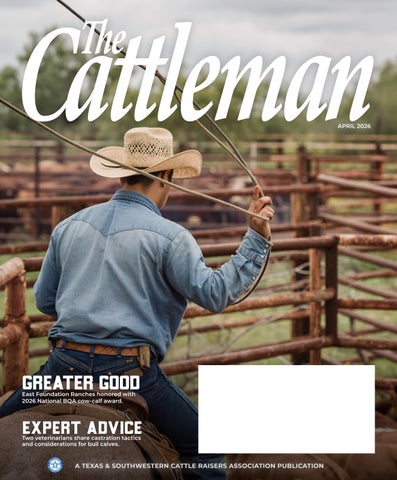
Greater Good
East Foundation Ranches honored with 2026 National BQA cow-calf award.

Two veterinarians share castration tactics and considerations for bull calves.

![]()
East Foundation Ranches honored with 2026 National BQA cow-calf award.

Two veterinarians share castration tactics and considerations for bull calves.


Jason Griffin Atok a, OK (580) 271-1333
Ty Grimsley Nazareth, TX (806) 685-5406 Cole Johnson Dallas, TX (214) 384-2653
McCauley Seymour, TX (940) 256-8353 Wes Miller Independence, KS (928) 245-6560


•
•
•

For the Greater Good
East Foundation Ranches receives National BQA cow-calf award.
By Shelby Kirton
Improving outcomes and avoiding setbacks.
By Krissa Welshans


Prioritizing the safety of people and livestock is crucial in ranching. Beef Quality Assurance is a nationally recognized framework focused on cattle well-being, responsible pharmaceutical use and sound management practices. Each year, BQA recognizes ranching operations that uphold the program’s safety and quality principles.
In this month’s issue, we feature East Foundation Ranches, which was nominated by Texas & Southwestern Cattle Raisers Association for a National BQA award in the cow-calf division. They were recognized as the national winner in February during CattleCon 2026 in Nashville, Tennessee, alongside other ranches that reflect the quality stewardship happening across the U.S. every day.
Our second feature focuses on castration, exploring BQA recommendations alongside veterinary insight to help develop or refine a herd plan. From improving technique and reducing recovery time to preventing complications, the article outlines practical steps that protect cattle health and long-term performance.
If you would like to renew or become BQA certified, Texas & Southwestern Cattle Raisers Association offers BQA trainings alongside state partners to ensure ranchers have access to these tools and resources. Trainings are offered both in person and online. To learn more or find a course near you, visit texasbeefquality.com.
Praying for rain, good grass and a strong spring for all our cattle raisers this April! T C

Jaclyn Roberts Parrish
Executive Director of Communications, Marketing & Partnerships/Editor-in-Chief, The Cattleman jaclyn@tscra.org • 817-916-1794


April 2026 / / Vol. CXII, No. 11
Published by Texas & Southwestern Cattle Raisers Association
P.O. Box 101988, Fort Worth, Texas 76185
Phone: 817.332.7064 • Fax: 817.394.1864 tscra.org
EDITORIAL
Editor-in-Chief Jaclyn Roberts Parrish
Managing Editor Jena McRell
Associate Editor
Shelby Kirton
Copy Editors Kayla Jennings, Elyssa Foshee Sanders
Graphic Designer Ryan Barten
EXECUTIVE DIRECTORS
Executive Vice President/CEO Jason Skaggs
Communications, Marketing & Partnerships Jaclyn Roberts Parrish
Events, Education & Leadership Development Emily Lochner
Finance & Human Resources Megan Wills
Interim Government Relations Peyton Schumann
Law Enforcement, Brand & Inspection Services Clay McKinney
Membership & Operations Lisa Walker
OFFICE LOCATIONS
Fort Worth 2813 S. Hulen St., Suite 150 Fort Worth, Texas 76109 Austin 919 Congress Ave., Suite 750 Austin, Texas 78701
Subscription Inquiries: tscra@tscra.org or 800-242-7820
Advertising Sales: sales@tscra.org or 817-332-7064

Working cattle at East Foundation Ranches. The operation was recently recognized as the 2026 National BQA winner in the cowcalf division. Read their story on page 10.
Photo by Emily Stribling
When you pick Sendero, the gold standard in mesquite control, you now get game-changing LandVisor — a breakthrough tool that gives you a clear, data-driven view of your land like never before.
Sendero Powered by LandVisor provides:
• Higher Return Potential
• Consistent, Effective Results
• Enhanced Service and Support


East Foundation Ranches receives National BQA cow-calf award.
Story by Shelby Kirton
Photos courtesy of East Foundation
In deep South Texas, East Foundation Ranches stands as an ultimate testament to the enduring legacy and history of ranching, while simultaneously adapting to modernday practices. Their story is one of reinvention, progress and an unwavering commitment to continuous improvement.
To honor these efforts, Texas & Southwestern Cattle Raisers Association nominated East Foundation Ranches for a National Beef Quality Assurance award in the cowcalf division, which they were presented with Feb. 3 during CattleCon 2026 in Nashville, Tennessee.
Spanning more than 217,000 acres across the Wild Horse Desert, also known as the South Texas Sand Sheet or the Coastal Sand Plains, the region is known for sandy soils, extreme heat and humidity, and high drought risk. East Foundation Ranches operates in six locations throughout portions of Jim Hogg, Kenedy, Starr and Willacy counties.
“East Foundation sees this land for what it truly is beyond the challenging desert and isolated region — a thriving ecosystem that sustains incredible wildlife and plant diversity, provides for livestock production and creates livelihoods,” said Jason Sawyer, Ph.D., East Foundation’s chief science officer.
“We’re honored to raise a healthy, nutritious beef product that sustains our South Texas rural community and beyond. BQA is just the bare minimum of what East Foundation Ranches expects.”
The foundation stays true to its mission of advancing land stewardship through three primary arms: ranching, science and education. At its core, the ranch is a working laboratory where scientists and ranch managers collaborate to address key issues in wildlife management, rangeland health and ranch productivity.
Primarily a cow-calf enterprise, East Foundation Ranches raises about 3,000 calves annually. Today, their feeder steers and heifers are highly sought after and bring a premium — but that was not always the case.
About a decade ago, East Foundation Ranches recognized the need to overhaul ranching practices and cattle care standards to fully align with BQA principles.
“The BQA program provided us with the roadmap,” said Eddie Reyna, East Foundation ranch operations manager.
“Because it is designed to allow producers to start from where they are and grow, it was a great way for us to move rapidly toward a comprehensive inventory management, identification and recordkeeping program.”
Today, all East Foundation cattle are branded and assigned EID tags. The ranch incorporates a two-breed rotational crossbreeding system of Red Angus and Santa Gertrudis.
The cow herd continues to become more uniform in type, with mild variability in Bos indicus percentage. With the native heat and humidity, the ranch continues to experiment with the percentage of Bos indicus needed to be environmentally sustainable, while also producing a highly marketable calf crop.
The ranch manages both spring and fall calving herds under a 90-day breeding and subsequent calving window. Spring calving herds see bull turnout from April 15 to July 15, while fall calving herds run from Nov. 1 to Feb. 1. Spring calves, around 2,000 in total, wean in October, while fall calves, around 1,000 head, wean in June.
When it comes to handling cattle, the herd is gathered twice yearly for penned workings.

East Foundation stewards ranchlands once acquired by the East family over a period of about 100 years.
Tom T. East Sr. first registered the Diamond Bar brand in 1912. He and his wife, Alice Gertrudis Kleberg East, raised their family on the San Antonio Viejo and built a ranching legacy throughout South Texas. Their children included Tom T. East Jr., Robert Claude East and Alice Lica Hattie East.
Upon Robert East’s passing in 2007, he bequeathed his estate, including his ranch ownership, for the establishment of a foundation as his beneficiary. This became the East Foundation.
These ranchlands represent some of the best examples of native rangelands across three natural regions of South Texas: the South Texas Sand Sheet, South Texas Brush Country, and Gulf Coast Prairies and Marshes.
Due to harsh conditions from recurring droughts and extreme heat, it is a challenging landscape for ranching, but these lands remain known for rangeland productivity and the quality of habitat for native wildlife.
“Over time, we have trained the cattle to come to a pickup siren,” Reyna said. “This allows them to migrate to the pens naturally rather than having to push against their natural pattern. Because the cattle are used to daily interaction, their flight zone is not triggered when we begin to gather.”
The ranch team continuously evaluates pen design and layout and adjusts as needed.
Once cattle are gathered into pens, no employee is on foot; instead, they remain on horseback to ease cattle calmly through pens, which are designed with a series of cut gates that can be easily turned into a bud box. Prods, hotshots and similar tools are used sparingly and only when necessary for the animal’s overall wellbeing, strictly following BQA program recommendations.
“The pens throughout the ranch were built in the 1970s and ’80s; at that time, cattle were handled and gathered differently,” Reyna said. “For us, it’s our highest priority to view the cattle’s natural behavior and adjust to their needs.”
While working cattle, employees keep noise to a minimum. Cattle bellows and hydraulic chutes should be the primary noises of the day — and little else.
Since 2019, East Foundation Ranches has hosted regular on-ranch BQA trainings, including a session each summer for all employees. The annual trainings are designed to fit the current needs of the operation and include chute-side vaccine administration, livestock handling, facility design and worker safety. Trainings are conducted in both English and Spanish to ensure all personnel understand the material.
“Giving our foremen responsibility as stewards of the cattle under their care is really important,” Reyna said. “We know that doing the right thing with the cattle every day helps the cattle do the right thing when we need them to — at branding, pasture rotations or weaning.”

by


The southern border of the East Foundation’s El Sauz Ranch sits at one of the greatest lynchpins for biosecurity protection in South Texas — and the U.S.
El Sauz Ranch is adjacent to a cattle fever tick quarantine zone and participates in extensive surveillance to monitor any sign of the cattle fever tick. While the ticks themselves pose no risk, they can carry a microscopic parasite called Babesia bovis, commonly known as cattle fever. Cattle fever attacks and destroys an animal’s red blood cells causing anemia, fever and an enlarged spleen and liver, ultimately resulting in death for an estimated 40% to 90% of susceptible cattle.
The tick attaches not only to cattle and horses, but also to white-tailed deer and nilgai antelope. Recent research shows that deer and antelope are dead-end hosts, which carry the ticks but are not susceptible to disease effects. To safeguard against the tick spreading farther north, the El Sauz Ranch and others voluntarily built a doublefenced wildlife barrier spanning miles along Highway 186, the current fever tick quarantine end zone.
“Highway 186 is the last paved road for a considerable distance on the north side of the fever tick quarantine zone,” Sawyer said. “If fever ticks gain a foothold north of the line, it would be next to impossible for the Texas Animal Health Commission to establish a barrier, and the tick could spread quickly throughout Texas and beyond.
“Our El Sauz Ranch location participates in extensive surveillance of wildlife to follow their movements and ensure they don’t break the double-fenced barrier and head north.”
The ranch regularly scratches and dips or sprays cattle, and culled cows do not return to any other ranch but are instead sent directly to processing. The only cattle that leave the El Sauz Ranch are weaned calves, which follow all protocols and are scratched for tick presence and treatment effectiveness before being unloaded for backgrounding at the headquarters ranch.
“Our involvement with the cattle fever tick eradication program has caused us to pay close attention to both cull cow management and biosecurity principles, which are part of our BQA program,” Sawyer said.
The potential northern spread of the New World screwworm is a constant concern, as well.
“With the renewed threat from northward movement of the New World screwworm fly, we have relied on the lessons we have learned and used BQA principles to inform our response plans,” Reyna said. “Although we don’t have screwworms in Texas today, we are already increasing our observations of cattle and re-evaluating our existing parasite control protocols to help us manage the risk of exposure. Fortunately, our approach to cattle handling will help us as we manage this new challenge.”
In recent years, herd health protocols implemented by East Foundation Ranches have created a cow base with nearly impeccable health, requiring minimal use of antibiotics or emergency medicine intervention. They develop all herd health plans by consulting with their local veterinarian, noting that a strong veterinary-client relationship is instrumental for success.
Once a year, cows receive respiratory, reproductive and clostridial disease vaccinations in addition to an injectable dewormer and palpation for pregnancy diagnosis. Spring-calving open females are given one chance to roll to the fall calving season for rebreeding. If they come up open after a second palpation, they are culled from the fall herd.
To reduce stress, calves receive their primary dose of clostridial and killed virus respiratory disease vaccines prior to weaning. In addition to an injectable dewormer, all calves are given a Lazy Diamond brand and bull calves are castrated by knife.
At weaning, calves receive an EID tag and a second round of vaccinations and injectable dewormer. Heifer calves receive an additional visual ear tag and vaccines for reproductive diseases and Brucellosis. After two weeks, all calves are brought back for a modified-live virus respiratory disease vaccine before being weighed
and sorted into contemporary groups prior to the backgrounding phase.
“The multi-stage vaccination program works on our calf crop,” said Garrett Stribling, East Foundation ranch business manager. “Last year, we weaned more than 2,800 calves, and we only treated a total of six head for sickness following our standard protocol.”
Another important factor for herd health includes administration tactics. In the South Texas heat, it’s important to properly store vaccines chute-side. The ranch uses vaccination coolers with ice packs to store bottles and syringes between each calf or cow.

“We are diligent about changing our needles,” Reyna said. “We use a three-quarter-inch needle on every animal. Needles are replaced every 20 head. If an animal looks sick, or if a needle is dull or dropped in the dirt, it’s changed immediately.”
The crew also follows all BQA injection guidelines, including injecting no more than 10 milliliters in one site, always following intramuscular or subcutaneous injection locations, and placing all vaccines in the neck, ahead of the shoulder.
“We also instruct our crew to space out vaccinations,” Reyna said. “If they’ve given two shots on one side of the neck, they switch to the other side, so placement isn’t too combined.”
Brangus were created more than 75 years ago to blend two desirable breeds to create a new one. Unlike breeding value or EPD, Heterosis is not passed from generation to generation in a crossbreeding program without a loss in its level unless a stable breeding program is established (as has been done in Brangus and at OCF).
Heterosis has the greatest effect on traits most affected by environment... adaptability, longevity, fertility, maternal ability, resistance to parasites and diseases. OCF is widely known for their True Brangus and increased Heterosis allowing their genetics to perform better in most environments. Long-time customers and repeat buyers tell the real story at Oak Creek Farms
BRANGUS AT ITS BEST DATA RESULTS IN! Hurla Feedyards 63 Oak Creek Farms Steers • 92% Choice • 20% CAB • 3.37 Avg Daily Gain $1.10 Cost of Gain • 63% Carcass Yield • 2.8 Avg Yield Grade • 6.2 Feed Conversion Canadian Feed Yard Harvest Data
Oak Creek Farms Steers 87% Choice with 1.5% Prime Heifers were 90% Choice with 5% grading Prime

SALE CONTACTS
Owner: John Kopycinski 979-251-2530
Consultants: Gary Bruns 830-391-0766 • Kent Smith 979-540-8338 Mike Arnold 979-732-7679 * Charlie Tiner 713-252-4662
Auctioneer: Troy Robinett 817-995-7509


Because East Foundation Ranches spans 120 miles across South Texas, the team faces a wide variety of animal health requirements. There’s no blanket plan for every animal under the ranch’s care; instead, health strategies are tailored to location.
“Our coastal herds will receive a dewormer that protects against liver flukes, whereas more inland dry climate herds don’t have the same base needs,” Stribling said. “If ever an anthrax outbreak is nearby, we’ll vaccinate only as needed.”
When it comes to bull health, after moving to a set breeding season nearly 10 years ago, the ranch noticed an increase in calves lost during gestation. This realization expedited regular bull test protocols, including annual bull breeding soundness exams and twice yearly Trichomoniasis tests. As a result, the ranch has been trichomoniasis-free for seven years.
To ensure that all practices are carried out consistently by operation personnel, the ranch conducts pre-cattle working meetings to further explain the reasoning behind each process.
“We make it a standard practice right before starting our working days to have a sit-down training, giving an overview of what’s going to happen,” Reyna said. “We
explain what we are going to administer to the cattle, how much of each vaccine should be given and why we’re giving it. This way everyone is on the same page, and everyone holds each other accountable.”
East Foundation Ranches tells a story that goes far beyond raising beef. It is a narrative of caring for cattle in a responsible way, including a larger commitment to people, the land and the environment that ultimately promotes consumer trust.
By integrating BQA practices with their broader stewardship mission, East Foundation Ranches provides assurance that every ounce of beef meets the highest standards of quality and integrity.
This holistic approach bridges the gap from ranch to dinner table, reinforcing trust in the product they produce, and embodying the philosophy that the right way is the only way.
“Inspiring consumer confidence is the primary goal of Beef Quality Assurance,” Sawyer said. “Our stewardship of the cattle we care for is part of our adoption of BQA principles, and it is an important part of conservation and the broader land stewardship story.” T C
“Inspiring
the primary
— Jason Sawyer, Ph.D., East Foundation chief science officer


Texas Beef Quality Assurance promotes modern best management practices that are proven to help strengthen consumer confidence in beef as a wholesome food product.
Build trust, enhance your reputation and showcase your commitment to excellence by attending a FREE training near you and earning your BQA certification.
Be proud of the beef you produce by learning best practices in beef safety, product quality, environmental stewardship and animal well-being.
The majority of 2025 Texas BQA training participants:
Planned to adopt at least one additional management practice
Rated the program as excellent
Expected financial benefit from


Photo by Jerod Foster
By Krissa Welshans
Castrating bull calves is a standard industry practice strongly recommended by the Beef Quality Assurance program. Even so, it’s estimated that nationwide, up to 80% of calves sold as steers are intact bulls. That is according to the BQA Manual, which explains how there are economic incentives for castrating bull calves prior to marketing.
While intact bulls may gain weight faster in the short-term, waiting to castrate may not be worth the risk of decreased performance and profitability in the long-term.
When sale day comes around, market demand for cutter bulls is low, often leading to significant discounts. Managing intact bulls also presents challenges due to their more aggressive temperament. Additionally, leaving bulls intact negatively affects meat quality — resulting in coarser texture, less marbling and inconsistent tenderness.
Whether a producer is developing a plan for castrating bull calves on the ranch or evaluating current methods, two veterinarians — Dr. Ross Thompson, of Simmons & Harlan Veterinary Clinic in Wichita Falls, and Dr. Ken Gottwald, of Guadalupe Valley Veterinary Clinic in Gonzales — offer advice for improving the process, reducing recovery time and avoiding complications.
To start, Thompson, who is a Texas & Southwestern Cattle Raisers Association director, encourages ranchers to consult with their local veterinarian about goals and the most appropriate method.
“It all depends on what kind of facilities you have and the size of the animal,” he says.
Both Thompson and Gottwald agree the best time to castrate is when bull calves are 2 to 4 months old and around 200 to 400 pounds. At this age, calves typically heal better and bounce back quickly, while they also have time to develop male characteristics.
This timeframe is often when calves are vaccinated, dehorned, wormed and tagged or branded, allowing producers to complete the tasks at once.
Gottwald notes grouping tasks together makes it a one-time stressful event for the calf and helps minimize costs for producers. Still, he recognizes that what is ideal isn’t always realistic. While defined calving seasons allow for easier planning, producers with more diverse calving dates should still target a weight range for castration of 200 to 400 pounds.
Thompson cautions that waiting too long can lead to complications, including excessive bleeding, infection and a lengthy healing process. He points out that heavier calves with fat around the scrotum tend to bleed more, and Gottwald says fat can slow the healing process.

A second consideration for determining when to castrate is the calves’ overall health and body condition. If the animals are in poor condition or have parasites, Gottwald says, “They’re not going to have the immunity to respond to vaccines, blood loss or the overall stress of the event, so castration is going to be a little more stressful on them.”
Both veterinarians agree it is best to wait to process a sickly calf, although Thompson says delaying is not always an option. In this case, the calf can still be castrated but needs to be doctored with antibiotics after the procedure.
Thompson stresses the importance of having a solid parasite control regimen established in the cow herd to ensure calves aren’t anemic and don’t have a parasite load before castration.
“Overall, the calf will feel better and heal more quickly since the immune system’s working harder,” he says.
On processing day, weather, facilities and setup, as well as handling practices, can affect outcomes. Thompson explains there are several ways to process calves, including running them through a chute, using a calf table, or roping and dragging. All these methods have benefits and drawbacks. The goal is to choose the least stressful, safest option for the animals and handlers. This includes aiming for drier conditions and temperatures that won’t add to the calf’s stress.
Gottwald also emphasizes the importance of quiet, calm handling, pointing out that excessive noise and prodding only intensify an already stressful event.


No matter where or how processing occurs, Thompson says the environment should be clean. Allowing calves to lie in mud or sloppy pens following the procedure could cause mud to cake on the site — an easy way to get an infection, he says.
Thompson says the calf’s size dictates the castration method he recommends to a producer. He prefers banding for calves more than 500 pounds, while smaller animals can be castrated using an emasculator or knife. He also notes that ranchers should confirm both testicles are descended before castration, particularly when banding.
Although not widely used, some operations employ the Henderson Castrating Tool attached to a drill.
“It wraps the spermatic cord around itself so many times that it eventually falls off,” Thompson explains, adding that because the blood vessels are severed, there is minimal bleeding. While this takes more time than other methods, it is effective for a 500- to 600-pound animal.
While both veterinarians admit banding is not their first choice when it comes to castration methods, Thompson says he prefers California or Callicrate Banders. Zip-tie banding is problematic, he says, because it does not tighten like regular banding.
“A band needs to continually get tighter as tissue starts to break down,” he explains. “Zip-tie banders will be tight, but once that tissue breaks down, they get loose, resulting in blood flow. That’s when we see a lot of infected scirrhous cords.”

When banding, Gottwald recommends making an incision on the bottom of the scrotum so it can drain and dry out faster. Both he and Thompson stress the importance of giving a tetanus shot to banded calves. Thompson says they occasionally encounter calf loss because a producer who used bands assumed a vaccine included tetanus protection when it didn’t.
Thompson recommends cleaning blades with chlorhexidine between animals and disinfecting the surgical site with Betadine, especially in muddy conditions. Blades should also be changed every fifth calf, or when they start to dull.
After the procedure, Thompson recommends applying a permethrin-based wound dressing and fly control spray on the site for fly prevention. Given heightened concern surrounding New World screwworm, whole-animal fly control through pour-on insecticides or ear tags is critical.
For calves with open wounds, Thompson says some producers give Vitamin K shots if they’re worried about


blood clotting. He also says veterinarians are fielding more questions about pain management, adding that research indicates oral meloxicam helps calves get back on feed and recover more quickly, especially when they are both branded and castrated.
He says the use of oral meloxicam is gaining traction quickly, particularly as states like California move toward requiring pain mitigation for castration. A second option for pain management is administering an NSAID like flunixin meglumine.
Following castration, Thompson advises producers leave cows and calves in a trap for at least a couple of hours so they can calm down and pair back up. “They’re sore, and if they aren’t established with their mom, we see some wander off,” he explains.
Also with NWS in mind, both Thompson and Gottwald say it is more important than ever to keep calves in a clean, dry area during the healing process so they can be monitored.
For more than half a century, TCU’s renowned Ranch Management Program has given students an edge in agricultural resource success. This unique nine-month intensive program equips graduates with real-world strategies as producers and land stewards in changing times.
Space is limited. Financial aid and scholarships may be available f rom the Ranch Management Program and through the TCU Office of Scholarships & Student Financial Aid ranch.tcu.edu Be an Agricul tural Resource Manager for an Evolving Agricul tural Industr y.


If problems do occur, they will typically appear within the first 10 days, Thompson notes. If it’s a bleeding issue, he says it will be noticeable in the first day or so following the procedure. Some drainage is normal for the first few days but should be minimal, Gottwald adds.
Symptoms of infection can appear anywhere from five to 10 days following castration. Signs may include a foul smell, pus, swelling, hanging scirrhous cords, fever or lethargy. In a normal scenario, smaller calves should heal or scar over within a week, although Thompson usually tells clients the healing process can take two to three weeks in banded calves.
“If the testicles haven’t fallen off in three weeks, that is typically a sign the band is not tight enough or something is wrong,” Thompson says.
Both veterinarians agree that while every operation is different, smart processing decisions can help prevent setbacks and ensure calves recover quickly. T C

Heightened concern over the spread of New World screwworm in Mexico has cattle raisers in Texas and across the Southwest on high alert.
Experts agree that whole-herd fly control treatment and wound management are critical, particularly following castration. The fresh wounds are highly attractive to NWS flies, which lay eggs that hatch into larvae and can lead to deadly infections and further spread of NWS.
Because of this threat, veterinarians Ross Thompson and Ken Gottwald urge producers to consider castrating calves during cooler weather — not only to reduce the number of flies, but also because NWS flies are largely inactive when temperatures fall below 60 degrees.
They also recommend the following precautionary measures:
• Keep the site clean before and following the procedure;
• Use a pour-on or injectable insecticide and/or insert fly tags at the time of castration;
• Apply a pyrethrin or aerosol spray near the site wound;
• Use a wound protectant spray such as Catron;
• House animals in a clean, dry environment; and
• Keep animals close for daily observation.
Gottwald specifically recommends waiting to release calves to new locations until they are fully healed. “If screwworms have infested the incision, you don’t want the calves dispersed to several areas and to cause a more extensive containment issue for NWS control,” he explains.
Thompson explains that symptoms of a screwworm infestation could include swelling, drainage or other signs of infection combined with the presence of fly larvae in the wound site.
If a producer suspects a screwworm infestation, Thompson and Gottwald say immediate contact with Texas Animal Health Commission is critical to mitigate spread.
Both veterinarians stress the importance of not moving an animal with a suspected case of screwworms, even if it’s to a local veterinary clinic. “Producers coming from several miles out can potentially disperse the eggs and larvae along the way,” Gottwald explains.
The veterinarian or producer should collect samples of eggs and larvae to submit for testing and clean out the wound site, including scraping out all larvae and eggs. The wound should be treated and antibiotics administered if infection is present.


By Seth Denbow
Since the Trump administration took office, there has been a flurry of activity on the international trade front. Early in 2025, President Donald Trump announced reciprocal tariffs on several countries that brought world leaders to the negotiating table. These actions sparked an increase in trade headlines, bringing both opportunities and challenges for the beef market.
Of note is a trade agreement-in-principle with the United Kingdom, which would give U.S. beef more access to the country’s lucrative market. Trump also signed reciprocal trade deals with Malaysia and Cambodia, as well as a framework trade deal with Thailand, that will require all three countries to address tariff and non-tariff barriers on U.S. imports. Trump also announced a similar deal with Vietnam, which has been levied with a tariff rate of 20% on exports to the U.S.
These are important moves for U.S. beef. High tariff rates on our product imposed by these four countries have made competition difficult with beef exporters including Australia and New Zealand. Now, with lower tariffs, American ranchers are provided greater opportunity to capture market share and demand for high-quality beef cuts.
Beyond these four countries, new trade deals have also emerged with North Macedonia and Taiwan. Taiwan plans to eliminate or reduce its average 17% tariff on virtually all traded goods, including beef, and streamline processes for exporting U.S. beef products. Likewise, Northern Macedonia agreed to eliminate customs duties for all U.S. industrial and agricultural goods, which historically has had a tariff rate close to 13%.
Texas & Southwestern Cattle Raisers Association supported Trump’s renegotiation of the North American Free Trade Agreement into the vastly improved U.S.Mexico-Canada Agreement during his first term. USMCA modified NAFTA to reflect modern economic needs, protecting unrestricted duty-free beef access established under NAFTA. In return, this agreement
allowed our industry to build Canada and Mexico into perennial top-five beef export markets. USMCA will be up for a joint review starting in July, when the U.S., Canada and Mexico will decide whether to extend the agreement for another 16 years.
Along with the whirlwind of trade headlines came the announcement that the U.S. will increase beef imports from Argentina to 80,000 metric tons, expanding the supply of lean trim used in grind in the U.S. market.
While Texas & Southwestern Cattle Raisers Association supports trade and understands that marketing highquality U.S. beef to increase value requires imported lean trim, safety and protection must remain top of mind. Importing beef from a country where foot-andmouth disease is present could pose a serious threat to the U.S. herd — and potentially undermine efforts to rebuild our nation’s cattle inventory. Our association voiced our concerns and encouraged the administration to consider long-term solutions that preserve herd health, incentivize domestic beef production expansion and protect the livelihoods of American ranchers.
In late February, the U.S. Supreme Court ruled that the use of the International Emergency Economic Powers Act to impose broad tariffs was unconstitutional, which invalidated IEEPA-based tariffs affecting multiple beef trading partners. This ruling does not, however, impact the previously negotiated trade agreements in place from last year.
While considerable attention given to international partnerships brings both positive and negative sentiments, cattle producers benefit from trade overall. Successful negotiation of these trade deals and expanded market access are essential for a prosperous future for years to come. T C
Seth Denbow is a Texas & Southwestern Cattle Raisers Association director from Weatherford who serves on the marketing and transportation committee.
Daniel Mellsop serves as the deputy chief of mission at the New Zealand Embassy in Washington, D.C. In this role, he supports diplomatic engagement and facilitates communication between U.S. and New Zealand representatives and government agencies.
Through his work, New Zealand has increased exports of their grass-fed beef, which is primarily used by the U.S. to blend with domestic grain-fed trimmings for ground beef.
New Zealand maintains 10 diplomatic representative offices throughout the U.S., with the Embassy in Washington, D.C., serving as its principal mission. In recent years, the two countries have focused on strengthening international trade and cooperation in the Pacific Islands. Roughly 12% of New Zealand’s total global beef exports are sent to the U.S.
importance of the partnership. It is apparent that Mellsop aims to strengthen ties between Texas and New Zealand, enhancing diplomacy and cooperation.
Mellsop was born and raised in New Zealand, and attended the University of Waikato, earning his master of business in economics. However, his interest in international affairs began during high school. While completing an exchange program in Russia, Mellsop met with New Zealand diplomats from a trade delegation. This experience shaped his goal of pursuing a career in diplomacy and international relations.

Daniel Mellsop
Last year, Mellsop met with Texas & Southwestern Cattle Raisers Association leadership and staff to discuss the
THANK YOU TO OUR CONTRIBUTORS
Alan Curry Family
Ben Eshleman
Birdwell & Clark Ranch
Brian T. McLaughlin
Brooks Hodges
Busher Ranch Co.
C. Clark Welder
C.A. Detering Cattle Co
C.R. "Dick" Sherron, MD
Carl Ray Polk Jr.
Carol & Marty Harris
CDR Markham B. Dossett, USNR (Ret.)
Chris Scharbauer
Christopher P. Womack
Claude & Jessica Koontz
Clay Jones
Cliff Teinert
Crawford Edwards
Crow Ranches
Dan Gattis
Danny & Laruth Stewart
David & Deborah Neal
Diebel Cattle Co.
Don Neal Family, L.P.
Mellsop has held more than a dozen positions with the Ministry of Foreign Affairs since he first joined the organization 25 years ago. His previous assignment was as high commissioner to Canada and Jamaica, where he represented New Zealand’s interests in both countries. T C
Dottie & Bobby Hill
Eleanor & Scott Petty
Elizabeth & Clayton Henry
Harral Livestock Co.
Henry Beken
Hunter Crow
J.B. Daniel
James Dudley IV
James H. Dudley
James L. Donnell Jr.
Jason Harlow
JG & Wilson Sisters Ranch
Jody and Betsy Bellah
John & Bonnie Welch
John Dudley
John Greer
John L. Cantrell
John S. Runnells III
Johnson Cattle Marketing
JR Ramirez
Kimberlin Ranches
Larry & Linda Horwood
Lynn Cowden
McKnight Ranch Company
Means Ranch Company
Milton Greeson
Parker Ranch
Parke Greeson
RAMRO, LLC/RJ Cattle Co.
Randy Stephens
Richard & Karen Thorpe
Robert Graff
Ron Helm
Ronda & Reed Stewart
Samantha & Jason Skaggs
Seth & Misty Denbow
Spade Ranches
Steve C. Lewis
Steven J. Mafrige
Stuart Sasser
Tony Spears
White Ranch
William Arrington
William McCall
Willis (Bill) Lowry
*Donor acknowledgements in this publication include contributions processed by March 1, 2026.

Sterile fly dispersal facility operational at Moore Air Base.
Story by Paige Holbrooks
Photos courtesy of USDA
Stephen Diebel, Texas & Southwestern Cattle Raisers Association first vice president, alongside U.S.
Secretary of Agriculture Brooke Rollins, Gov. Greg Abbott and several other industry leaders attended the Feb. 9 grand opening of the USDA Animal and Plant Health Inspection Service sterile fly dispersal facility at Moore Air Base.
Texas & Southwestern Cattle Raisers Association was well represented at the announcement, communicating the association’s support and emphasizing the importance of protecting the U.S. beef herd.
“The value of equipping the U.S. to combat the threat of New World screwworm cannot be overstated,” Diebel said. “As Texans and cattle producers, we celebrate the opening of the sterile fly dispersal facility at Moore Air Base, strengthening our nation’s ability to protect our cattle herd health, food security and economy, which would suffer from any NWS incursion.”
The dispersal facility, a critical piece of USDA’s sweeping five-pronged plan, was provided funding by the Trump
administration in June 2025. Since then, NWS has continued its northward migration from Central America and established populations 187 miles south of the TexasMexico border. The facility will be capable of dispersing up to 100 million sterile flies per week.
“Advocating for the resources, infrastructure and coordination needed to increase sterile fly production has long been a priority for Texas & Southwestern Cattle Raisers Association,” Diebel said. “We remain committed to supporting both state and federal efforts to manage this threat and deeply appreciate the Trump administration, Secretary Rollins, USDA staff and Gov. Abbott in prioritizing the needs of Texas and U.S. production agriculture.”
Planning is underway with the U.S. Army Corps of Engineers for construction of the domestic sterile fly production facility, with a projected capacity of 300 million sterile flies per week. This will be the only U.S.based sterile fly production facility. In August 2025, USDA committed $750 million toward its construction.


As part of preventive efforts to stop the northward spread of the NWS fly, USDA has established an updated sterile fly dispersal polygon extending approximately 50 miles into Texas along the U.S. border with Tamaulipas, Mexico.
“We welcome progress on the Moore Air Base dispersal facility and the planned additional fly production in Mexico, and we are encouraged by ongoing collaboration with USDA to expand capacity,” said Texas & Southwestern Cattle Raisers Association President Carl Ray Polk Jr. “Until those measures are fully established and risk can be minimized, keeping the border closed is the responsible course of action to protect the health of U.S. livestock and wildlife.”
At press time, Rollins and USDA continue to keep the U.S.-Mexico border closed to livestock imports. While existing protocols and surveillance systems are demonstrating effectiveness and collaboration with Mexican counterparts, the threat posed by NWS remains significant. A single incursion into Texas or the U.S. could have devastating economic consequences for livestock producers, wildlife populations and landowners.
“We trust Secretary Rollins and USDA to make reopening decisions based on science and preparedness, not pressure, and stand ready to support efforts to safeguard animal health,” Polk said. “These measures are necessary until progress is made on pushing the fly further south.” T C
Paige Holbrooks is the director of policy and political communications for Texas & Southwestern Cattle Raisers Association.

USDA-APHIS uses neon green dye to ensure swift identification of sterile male flies that have been dropped.

Texas & Southwestern Cattle Raisers Association attended CattleCon 2026, hosted by National Cattlemen’s Beef Association Feb. 3-5 in Nashville, Tennessee. As members of the bi-national committee, Texas & Southwestern Cattle Raisers Association staff joined officials from Canada and Mexico to discuss high-priority cattle health issues such as tuberculosis, brucelosis, New World screwworm and cattle fever ticks.
Additionally, Texas & Southwestern Cattle Raisers Association First Vice President Stephen Diebel delivered an update at the Region IV meeting. Diebel shared the state’s approach to combating NWS, as well as updates leading into the association’s annual convention.
While in Nashville, 16 association policy committee members helped develop, debate and adopt policy alongside other cattle producers. In coordination with Nebraska Cattlemen, Texas & Southwestern Cattle Raisers Association brought policy to the live cattle marketing committee to support expansion of

the Livestock Risk Protection insurance program by including coverage options for breeding and cull cattle. This policy was adopted by the committee and will be presented during the Cattle Industry Summer Business Meeting July 12-14 in Denver, Colorado. Texas & Southwestern Cattle Raisers Association also supported policies in the cattle health and well-being, and ag and food policy committees.
A former Gilly Riojas Memorial intern, Sarah Mullens joined Texas & Southwestern Cattle Raisers Association Feb. 9 as the local outreach coordinator. She is based in Fort Worth.

Originally from Flower Mound, Mullens has a passion for agriculture, with a particular interest in connecting urban and rural communities and promoting transparency within the industry. She enjoys writing, storytelling and creating marketing materials that highlight the people and purpose behind agriculture. She says her time interning at Texas & Southwestern Cattle Raisers Association further strengthened her commitment to advocating for beef producers and the agricultural industry.
An Oklahoma State University graduate, Mullens holds dual bachelor’s degrees in agribusiness and agricultural communications.
Texas & Southwestern Cattle Raisers Association announced it will host its fifth-annual TSCRA Cattle Raisers Roundup July 19-24.
The event is open to high school students who have completed their junior or senior years and are interested in learning about the beef supply chain, natural resources and other important agriculture issues.
Cattle Raisers Roundup will include tours at cattle operations or ranches and beef packing plants, as well as the opportunity to speak with industry leaders. The program focuses on practical skills for those who buy, sell, produce and rely on beef protein.
Applications are due May 3 and are available at tscra.org/what-we-do/students.
Cattle Raisers PAC, the political action committee of Texas & Southwestern Cattle Raisers Association, recently announced the launch of the 1877 Club, a recognition program for members who contribute $1,877 or more annually to the committee.
The club honors the association’s founding year, 1877, and strengthens the voice for land and livestock stewards who represent the oldest and largest livestock association in the Southwest.
1877 Club members receive year-round benefits designed to honor their generosity and enhance their association experience. Benefits include:
• A custom 1877 Club lapel pin, providing admission for one member and one guest to applicable 1877 Club in-person events during the active recognition year.
• Recognition through the association’s digital platforms and print publications, including The Cattleman, with opportunities for donor spotlights.
• Priority invitations to Cattle Raisers PAC events and select association gatherings with leadership and elected officials.
• Exclusive commemorative items and communications designated for 1877 Club members.
Texas & Southwestern Cattle Raisers Association members may join the 1877 Club by contributing $1,877 or more to Cattle Raisers PAC. Contributions should be made payable to Cattle Raisers PAC with “1877 Club” noted in the memo line.
For additional information or questions, email wbaugh@tscra.org or call 800-242-7820.
Texas & Southwestern Cattle Raisers Association leadership met with Chairman Cody Harris and staff Feb. 10 in Austin. Harris has served House District 8 since 2019 and currently serves as chair of the House Natural Resources Committee.
During his time in the Texas Legislature, Harris led legislative efforts on important issues such as protecting private property rights, particularly water rights. The association is proud to have Harris as a friend and advocate for its membership. T C

Join or renew your membership today. Membership supports TSCRA Special Rangers, government relations advocacy, educational programs, member-only discounts, networking and social events, The Cattleman magazine and insurance services.
To learn more about membership, scan the code below or visit TSCRA.org.


T SCRA’s new business membership categories are designed for businesses that support ranchers and landowners. Whether operating in one county or across multiple states, TSCRA business memberships help businesses increase visibility, strengthen customer relationships and engage directly with the people shaping the future of the cattle industry.

Annual print or digital advertising credit
Annual event or sponsorship credit
Business Directory listing
Use of TSCRA Business Member logo
Business member display sign
Eligibility for the TSCRA Partner Program
Eligibility for the TSCRA Gilly Rojas Memorial Internship Placement Program
Eligibility to serve on TSCRA committees
Enhanced visibility and engagement opportunities with TSCRA leadership
Access to aggregated member trends and industry intelligence
Ask about out Partner Program, with enrollment Nov. 1 - Jan. 31 annually.


Since 1850, Gene Copenhaver’s family has been rooted in the land, raising crops and livestock. The Virginia cattleman now takes the helm as the president of National Cattlemen’s Beef Association. Copenhaver’s new leadership role began at the end of CattleCon 2026, held Feb. 3-5 in Nashville, Tennessee.
The 2026 officer team was approved by National Cattlemen’s Beef Association’s board of directors and includes Kim Brackett of Idaho, president-elect, and Skye Krebs of Oregon, vice president.
Kenny Rogers of Colorado was elected chair of the policy division, and Scott Anderson of Oklahoma was elected policy vice chair. Travis Maddock of North Dakota and Dan Hanrahan of Iowa were elected as chair and vice chair of the federation division, respectively.
Brad Hastings of Texas will serve in the role of treasurer.
Copenhaver, who was an agriculture loan officer for 38 years, currently manages his family’s stocker operation in southwest Virginia with his son, Will. His father taught him early to “be at the table,” especially when policy decisions were being made.
About 25 years ago, he helped launch a county cattlemen’s group, then worked his way through leadership roles at the state level, eventually serving as president of the Virginia Cattlemen’s Association. Nationally, he became involved with National Cattlemen’s Beef Association, serving on the tax and credit and international trade committees, multiple task forces and the officer team.
The new president’s priorities are straightforward: continue what works, stay grounded in grassroots input, remain open-minded and focus on profitability. Copenhaver wants every sector and every scale of operation to be viable. That means pushing back against regulatory barriers, supporting policies that allow reinvestment and building on recent momentum around tax provisions.
“We can’t build the future if every good year gets taxed away before we can shore up our infrastructure,” he said.
Copenhaver remains optimistic about the future for two reasons. First, the demand the beef industry has built steadily in the last four decades. Second, he says the next generation of young producers is smart, relationship-
driven, family-oriented and wants to build operations that last.
For Copenhaver, success is not complicated. “Build a good operation. Involve your family. Treat people right,” he said. For the industry, it means continuing to grow demand and profitability across all sectors without losing sight of its roots.
On Feb. 2, National Cattlemen’s Beef Association announced its 2026 policy priorities following approval by the organization’s executive committee at CattleCon 2026. The association’s focus centers on policies that directly impact producer profitability, including reducing regulatory costs, defending free markets, expanding trade opportunities and maintaining strong beef demand.
“NCBA focused on practical, workable solutions that produced meaningful policy wins in 2025,” Copenhaver said. “NCBA’s efforts resulted in key tax and regulatory improvements, including expanded estate tax exemptions, a new Waters of the U.S. rule, and the rescission of the Bureau of Land Management Public Lands Rule, providing greater certainty and opportunity for cattlemen and cattlewomen.”
National Cattlemen’s Beef Association leaders noted those achievements provide a strong foundation for the organization’s 2026 policy agenda, which focuses on strengthening producer profitability and addressing emerging challenges across the cattle business.
The organization will advance regulatory reform, animal health protections, expanded market access, and workforce solutions that ensure the cattle and beef supply chain can continue meeting strong consumer demand.
“Now is the time to continue reforming federal regulations that have hindered conservation efforts for decades, strengthen protections against the northward spread of New World Screwworm, expand foreign market access for U.S. beef and advance science-based policies that keep beef at the center of the plate,”
Copenhaver said.
The organization’s 2026 policy priorities are:
• Continuing to press the administration to roll back harmful regulations to keep working lands working.
• Enhancing and strengthening U.S. mitigation measures against the incursion of NWS.
• Protecting the U.S. cattle herd from foreign animal diseases and pests through heightened awareness and preparedness actions.
• Expanding market access for U.S. beef exports and holding trade partners accountable to ensure equivalent animal health and food safety standards for imported beef.


Last Stand® is the ultimate Day 1 protocol for beef calves

Help calves maintain normal digestive health and a hardy, functioning immune system. ©2024 DBC Ag Products

Spring “Best of the Best” Replacement Female Sale
Saturday,April11,2026
@10:00a.m.–SanSaba
Offeringqualitypair,bredcows,bredheifers,andopen orexposedheifers.Don’tmissyouropportunitytobuysome ofthebestfemalesinthecountry! Thesellerandbuyerofthetop-sellingfemales ineachoftheclasseswillreceiveatrophy. Allcattlewillbefiveyearsofageoryounger!
May Replacement Female Sale
Saturday,May2,2026
@10:00a.m.–SanSaba ConsignmentsWelcome!
Special Bull Offering
Inconjunctionwithourregularsale.Bullswillsellat10a.m. Bullswillbefertilitytested,meettrichrequirements,and readytogotowork.
Thursday,April16,2026
@10:00a.m.–SanSaba
FeaturingHickorySandBrangus,STSRangerRegisteredAngus& ShadyOakFarmCharolais&SimAngusBulls BooksareClosed!
Thursday,April30,2026
@10:00a.m.–SanSaba
FeaturingGrothauseHereford&MPBrangusBulls BooksareClosed!
WEEKLY SALES HELD AT 11:00 a.m.
Monday – Mason Thursday – San Saba
Formoreinfoonabove salesoronlineviewing andbidding,pleasecall orvisitourwebsite.
• Promoting science-based nutrition policies and sound, fact-based information for consumers.
• Pushing further hours-of-service flexibility, increased truck weights, and continue delaying ELD requirements for livestock haulers.
• Safeguarding the U.S cattle and beef supply chain by working with the administration to ensure there is a strong workforce to limit processing disruptions for producers.
Winners of the 2026 Beef Quality Assurance Awards were announced Feb. 3 during CattleCon 2026 in Nashville. The BQA Awards recognize outstanding beef and dairy producers, marketers and educators who demonstrate outstanding animal care and handling principles as part of day-to-day activities.
“BQA continues to be the cattle industry’s leading education program for animal care and handling,” said Buck Wehrbein, National Cattlemen’s Beef Association past president. “We are excited to recognize these award winners who exemplify the BQA program and share their commitment with others.”

East Foundation Ranches LLC, Hebbronville
East Foundation Ranches, located in South Texas, traces its origins back to the 1900s when Tom T. East began his cattle operation. Today, the ranch spans 217,000 acres across six ranches in separate locations encompassing diverse native rangeland. The ranch is dedicated to advancing land stewardship through ranching, science and education, and their mission is to do what’s right for the land and the life that depends on it. Texas & Southwestern Cattle Raisers Association nominated East Foundation Ranches for this honor.
Ordway Cattle Feeders, Ordway, Colorado Ordway Cattle Feeders is invested in the care and comfort of its cattle, having expanded and updated the feedlot to better accommodate different sizes, ages and feeding stages of cattle. The feedyard brings in university
BQA experts to provide all employees with foundational training on best management practices, and works closely with expert nutritionists, veterinarians and industry professionals to assess their daily production practices — providing perspective to foster continuous improvement.
Sysco Corporation, Houston
Founded in 1969, Sysco Corporation is the world’s largest foodservice distributor and a major provider of animal protein products for consumers around the globe. The company is dedicated to driving improved animal welfare practices while upholding stringent standards for all Sysco Brand animal products. Part of this commitment involves promoting BQA as the standard, ensuring the sales team discusses cattle care and sustainability with chefs and restaurant customers.
For a complete list of 2026 BQA award winners, visit bqa.org/beef-quality-assurance-awards.
National Cattlemen’s Beef Association announced Feb. 3 that Wine Glass Ranch in Imperial, Nebraska, is the 2025 Environmental Stewardship Award program national winner. The award, which annually recognizes the outstanding stewardship practices and conservation achievements of cattle producers, was presented to the Pribbeno family during CattleCon 2026.

• Region I: Whispering Hills Farm, Lawrenceburg, Kentucky
• Region II: M&D Overstreet Ranch, Kathleen, Florida
• Region III: Smith Family Farms, Bankston, Iowa
• Region IV: McFaddin Ranch, Victoria
• Region V: G&G Livestock & Cathey Cattle Co., Polson, Montana
• Region VII: Wine Glass Ranch, Imperial, Nebraska
To learn more, visit environmentalstewardship.org. T C


Join Texas & Southwestern Cattle Raisers
Association for the next Ranching 101 at 1 p.m., Tuesday, April 21. During the hour-long Zoom webinar, participants will learn essential strategies for effective parasite control to support cattle herd health and performance. Interested members can register by scanning the QR code below.
An expert speaker will offer practical insights into effective parasite control strategies, seasonal management considerations and tools that can reduce parasite pressure and support overall animal health. Discover practical approaches to managing internal and external parasites, including breaking life cycles, minimizing resistance and addressing common seasonal challenges.
Participants will also learn actionable tips to protect animal performance, improve treatment effectiveness and support overall productivity.
Ranching 101 webinars provide participants with practical, sound guidance on the tools and equipment needed to get started in ranching or land ownership. The webinars are available online on the third Tuesday of every month.
Registration is complimentary for any association member. Visit tscra.org to learn more. T C

Ranching 101 is presented by:

Flexible fencing. Endless advantages.
With Vence, I don’t have to worry about building a fence. I don’t have that capital expenditure, I don’t have the maintenance on it, and I can move that fence and put it exactly where I want it.
Jim Strickland
Rancher, Strickland Ranch

Reduce costs.

Protect natural resources.
Have full control of your land and livestock from a computer or laptop without the expense of physical fencing.
Future proof your livelihood while conserving valuable habitats by managing access to sensitive areas.
Optimize grazing across vast and challenging terrain.
Increase land productivity by efficiently moving cattle to the best grazing areas in real time, even across vast open ranges.

Manage livestock with precision and efficiency.
Pinpoint each animal’s location, monitor grazing patterns and schedule automated cattle movements with GPS mapping.
As terrain varies, seasons change and weather shifts, SenseHub Vence can help you adapt grazing to scale your operation. Visit VenceFence.com or scan to learn more.


5% Sterile Solution Extended-Release Injectable For Subcutaneous Use
Parasiticide for Cattle on Pasture
For the Treatment and Control of Internal and External Parasites of Cattle on Pasture with Persistent Effectiveness
Not for use in female dairy cattle 20 months of age or older, including dry dairy cows. Not for use in calves to be processed for veal.
Not for use in breeding bulls, or in calves less than 3 months of age.
Not for use in cattle managed in feedlots or under intensive rotational grazing.
Caution: Federal law restricts this drug to use by or on the order of a licensed veterinarian. INDICATIONS FOR USE
LONGRANGE, when administered at the recommended dose volume of 1 mL per 110 lb (50 kg) body weight, is effective in the treatment and control of the following internal and external parasites of cattle:
Texas & Southwestern Cattle Raisers Association Special Rangers led an investigation resulting in felony indictments against Jessie Coleman, of Lovelady, Andrea Houston, of Houston, and Cole Hoot Jr., of Dodge, for theft of livestock valued at less than $150,000.
On April 12, 2025, Texas & Southwestern Cattle Raisers Association Special Ranger Darrel Bobbitt received a report of missing cattle from a property located south of Crockett in Houston County. The following day, Bobbitt received information indicating the cattle may have been stolen, prompting the formal investigation.
Three potential suspects were identified through the investigation. Bobbitt later obtained a confession from one of the suspects, which led to the location and recovery of all the stolen cattle.


The case was submitted to the Houston County District Attorney’s Office and presented to a grand jury. After reviewing evidence, the grand jury returned a true bill of indictment against Coleman, Houston and Hoot on charges of theft of livestock valued at less than $150,000. All three suspects surrendered to law enforcement, were booked into jail and have since been released on bond while awaiting trial.
Bobbitt was assisted by fellow Texas & Southwestern Cattle Raisers Association Special Ranger Chace Fryar, of Huntsville, and the Houston County Sheriff’s Office.
Haemonchus placei – Adults
and L4 Grubs
Oesophagostomum radiatum – Adults
Ostertagia lyrata – Adults Mites
Ostertagia ostertagi – Adults, L4 and inhibited L4
Trichostrongylus axei – Adults and L4
Trichostrongylus colubriformis – Adults
DOSAGE AND ADMINISTRATION
LONGRANGE® (eprinomectin) should be given only by subcutaneous injection in front of the shoulder at the recommended dosage level of 1 mg eprinomectin per kg body weight (1 mL per 110 lb body weight). Each mL of LONGRANGE contains 50 mg of eprinomectin, sufficient to treat 110 lb (50 kg) body weight.
Divide doses greater than 10 mL between two injection sites to reduce occasional discomfort or site reaction.
var. bovis
Do not underdose. Ensure each animal receives a complete dose based on a current body weight. Underdosing may result in ineffective treatment, and encourage the development of parasite resistance.
WARNINGS AND PRECAUTIONS
Withdrawal Periods and Residue Warnings
Extended-Release Injectable Parasiticide
5% Sterile Solution For the Treatment and Control of Internal and External Parasites of Cattle on Pasture with Persistent Effectiveness
Not for use in female dairy cattle 20 months of age or older, including dry dairy cows. Not for use in calves to be processed for veal. Not for use in breeding bulls, or in calves less than 3 months of age. Not for use in cattle managed in feedlots or under intensive rotational grazing. CAUTION: Federal law restricts this drug to use by or on the order of a licensed veterinarian.
LONGRANGE is to be given subcutaneously only. Animals should be appropriately restrained to achieve the proper route of administration. Inject under the loose skin in front of the shoulder (see illustration) using a 16 or 18 gauge, ½ to ¾ inch needle. Sanitize the injection site by applying a suitable disinfectant. Clean, properly
Animals intended for human consumption must not be slaughtered within 48 days of the last treatment. This drug product is not approved for use in female dairy cattle 20 months of age or older, including dry dairy cows. Use in these cattle may cause drug residues in milk and/or in calves born to these cows. A withdrawal period has not been established for pre-ruminating calves. Do not use in calves to be processed for veal.
User Safety Warnings
DESCRIPTION LONGRANGE® (eprinomectin) is a ready-to-use, sterile injectable preparation containing eprinomectin, a member of the macrocyclic lactone class of antiparasitics. Each mL of LONGRANGE contains 50 mg of eprinomectin in a co-solvent system of N-methyl-2-pyrrolidone (30% v/v) and triacetin (qs), along with 50 mg of poly-lactide-co-glycolic-acid 75:25 (PLGA), a polymer that allows a slow release of eprinomectin from the formulation, thereby maintaining a prolonged duration of product effectiveness. Butylated hydroxytoluene (0.2 mg/ mL) acts as an antioxidant in the formulation. The chemical name of eprinomectin is 4”-deoxy-4”-epiacetylamino-avermectin
B1 It is a semi-synthetic member of the avermectin family of compounds consisting of a mixture of two homologous components, B1a and B1b which differ by a single methylene group at C26
INDICATIONS FOR USE
Not for Use in Humans. Keep this and all drugs out of the reach of children. Reproductive and developmental toxicities have been reported in laboratory animals following high, repeated exposures to N-methyl-2-pyrrolidone (NMP). Pregnant women should wear gloves and exercise caution or avoid handling this product. The Safety Data Sheet (SDS) contains more detailed occupational safety information.
To report adverse effects, to obtain an SDS, or for assistance, contact Boehringer Ingelheim Animal Health USA Inc. at 1-888-637-4251. For additional information about adverse drug experience reporting for animal drugs, contact FDA at 1-888-FDA-VETS or www.fda.gov/reportanimalae.
Animal Safety Warnings and Precautions
The product is likely to cause tissue damage at the site of injection, including possible granulomas and necrosis. These reactions have disappeared without treatment. Local tissue reaction may result in trim loss of edible tissue at slaughter.
Observe cattle for injection site reactions. If injection site reactions are suspected, consult your veterinarian. This product is not for intravenous or intramuscular use. Protect product from light. LONGRANGE® (eprinomectin) has been developed specifically for use in cattle only. This product should not be used in other animal species.
LONGRANGE, when administered at the recommended dose volume of 1 mL per 110 lb (50 kg) body weight, is effective in the treatment and control of the following internal and external parasites of cattle:
The special rangers would like to thank the Houston County Sheriff’s Office and Houston County District Attorney’s Office for their assistance throughout the investigation. T C
When to Treat Cattle with Grubs
Gastrointestinal Roundworms Lungworms
Bunostomum phlebotomum – Adults and L4 Dictyocaulus viviparus – Adults
Cooperia oncophora – Adults and L Cooperia punctata – Adults and L Cooperia surnabada – Adults and L4
LONGRANGE effectively controls all stages of cattle grubs. However, proper timing of treatment is important. Consult your veterinarian concerning the proper time for treatment.
Environmental Hazards
Not for use in cattle managed in feedlots or under intensive rotational grazing because the environmental impact has not been evaluated for these scenarios.
Haemonchus placei – Adults Grubs
Oesophagostomum radiatum – Adults Hypoderma bovis
Other Warnings: Parasite resistance may develop to any dewormer, and has been reported for most classes of dewormers.
Ostertagia lyrata – Adults
Ostertagia ostertagi – Adults, L4 and inhibited L4
Trichostrongylus axei – Adults and L Mites
Trichostrongylus colubriformis – Adults Sarcoptes scabiei var. bovis
Fecal examinations or other diagnostic tests and parasite management history should be used to determine if the product is appropriate for the herd/flock, prior to the use of any dewormer. Following the use of any dewormer, effectiveness of treatment should be monitored (for example, with the use of a fecal egg count reduction test or another appropriate method).
Persistent Activity
LONGRANGE has been proven to effectively protect cattle from reinfection with the following parasites for the indicated amounts of time following treatment: Parasites Durations of Persistent Effectiveness
A decrease in a drug’s effectiveness over time as calculated by fecal egg count reduction tests may indicate the development of resistance to the dewormer administered. Your parasite management plan should be adjusted accordingly based on regular monitoring.
Gastrointestinal Roundworms
Bunostomum phlebotomum 150 days
Macrocyclic lactones provide prolonged drug exposure that may increase selection pressure for resistant parasites. This effect may be more pronounced in extended-release formulations.
TARGET ANIMAL SAFETY
Cooperia oncophora 100 days
Cooperia punctata 100 days
Haemonchus placei 120 days
Oesophagostomum radiatum 120 days
Not for use in bulls, as reproductive safety testing has not been conducted in males intended for breeding or actively breeding. Not for use in calves less than 3 months of age because safety testing has not been conducted in calves less than 3 months of age.
Ostertagia lyrata 120 days
STORAGE
Ostertagia ostertagi 120 days
Trichostrongylus axei 100 days
Lungworms
Dictyocaulus viviparus 150 days
DOSAGE AND ADMINISTRATION
LONGRANGE® (eprinomectin)
Store at 77° F (25° C) with excursions between 59° and 86° F (15° and 30° C). Protect from light. This information is not comprehensive. Consult your veterinarian for more information. Visit https://bianimalhealth.com/cattle/products/longrange for the FDA approved product label.
Approved by FDA under NADA # 141-327
Marketed by: Boehringer Ingelheim Animal Health USA Inc., Duluth, GA 30096 The Cattle Head Logo® and LONGRANGE® are registered trademarks of Boehringer Ingelheim Animal Health USA Inc. © 2022 Boehringer Ingelheim Animal Health USA Inc. All rights reserved. 1050-2889-09,
should be given only by subcutaneous injection in front of the shoulder at the recommended dosage level of 1 mg eprinomectin per kg body weight (1 mL per 110 lb body weight). Each mL of LONGRANGE contains 50 mg of eprinomectin, sufficient to treat 110 lb (50 kg) body weight. Divide doses greater than 10 mL between two injection sites to reduce occasional discomfort or site reaction.


break free from regular deworming longrangedewormer.com

LONGRANGE IMPORTANT SAFETY INFORMATION: Do not treat within 48 days of slaughter. Not for use in female dairy cattle 20 months of age or older, including dry dairy cows, or in veal calves. Post-injection site damage (e.g., granulomas, necrosis) can occur. These reactions have disappeared without treatment. Not for use in breeding bulls, or in calves less than 3 months of age. Not for use in cattle managed in feedlots or under intensive rotational grazing. Pregnant women should wear gloves and exercise caution or avoid handling this product.
1 Dependent upon parasite species, as referenced in FOI summary and LONGRANGE product label.
2 Rademacher, RD, Behlke EJ, Parr SL, et al. An evaluation of eprinomectin extended-release injectable (LONGRANGE®) on the performance of yearling cattle on pasture in western Canada. Bov Pract 2018;52(1):46–52.
3Andresen CE, Loy DD, Brick TA, Gunn PJ. Case study: Effects of extended-release eprinomectin on cow-calf performance and reproductive success in a fall-calving beef herd. Prof Anim Sci 2018;34(2):223–229.
LONGRANGE® and the Cattle Head logo® are
Brown Brahman-cross cow missing in Donley County.
Texas & Southwestern Cattle Raisers Association Special Ranger Lynn Mays reports a brown Brahmancross cow missing from a property near the southwest corner of FM 3142 and County Road 30 in Donley County. The cow is approximately 3 years old with a white belly, a blue tag in her left ear and yellow sale stickers on both sides. The cow was last seen Nov. 28, 2025. Anyone with information regarding this case is urged to contact Mays at 806-683-8320.
Top Hat utility trailer stolen in Hale County.
Texas & Southwestern Cattle Raisers Association Special Ranger Michael Looney reports a black Top Hat 14-foot utility trailer stolen from a property off Texas Avenue in Abernathy. The trailer has a gorilla lift on the side panels and ramp on the front. The Texas license plate No. is FMDT09 and the VIN No. is 4R7BU12189T092210. The trailer was last seen Jan. 30. Anyone with information on this case is urged to contact Looney at 806-778-2585.
Longhorn calves missing in Jack County.
Texas & Southwestern Cattle Raisers Association Special Ranger Cliff Swofford reports two brown Longhorn calves and one brown-and-white Longhorn calf missing from a property off Two Bush Road in Gibtown. The calves are 3 to 4 months old and were last seen Dec. 15, 2025. Anyone with information regarding this case is urged to contact Swofford at 817-343-8804.
Wagyu cows missing in Callahan County.
Texas & Southwestern Cattle Raisers Association Special Ranger Zach Havens reports 13 head of Wagyu cows missing near the intersection of County Road 269 and FM 604 in Callahan County. The 8-year-old cows are horned, have a “rocking molar” branded on their left hip and a yellow or white fly tag in their right ear. The cattle were last seen in December 2025. Anyone with information on this case is urged to contact Havens at 254-396-1747.
Cattle stolen in Brazos County.
Texas & Southwestern Cattle Raisers Association Special Ranger Brent Mast reports four black cows, one red-and-white cow, six black calves and one redand-white calf stolen from a property off Kuder Road in Bryan. They were last seen Jan. 17.
Cattle stolen in Brazos County.
Mast also reports seven black heifers, a brownishblack heifer with horns and a black bull calf stolen from a property off Kuder Road in Bryan. The heifers are approximately 3 years old, and the calf is 7 to 8 months old. They were last seen Jan. 14. Anyone with information on these cases is urged to contact Mast at 936-714-6619. T C
TSCRA offers a cash reward for information leading to the arrest and/or grand jury indictment of individuals for theft of livestock or related property. Anonymity is guaranteed. To provide information, call the Operation Cow Thief tip line at 817-916-1775.

WeedMaster® XHL Herbicide is an innovative premix powered by Dual Salt Technology™ and DGA dicamba to put pasture problems and preplant weed challenges behind you. Control 90+ types of weeds and brush with reduced volatility, low odor, enhanced tank-mix compatibility—and more treated acres with every jug. AND

The evolution of 2,4-D nufarm.com/uscrop/xhl

Combination treatment provides different modes of action to enhance parasite control.
Parasites are a hidden drain on cattle performance, quietly stealing productivity and profit from herds across the country.
For producers, the cost is not only in lost weight gain, but also in overall herd health and efficiency. That is why veterinarians and ranchers alike are turning to improved parasite control strategies, like combination treatment.
“Combination treatment is the use of two or more dewormers from different classes, each with a different mode of action, to get more effective control,” said Dr. Matt Washburn, a Boehringer Ingelheim veterinarian.
The advantage? Each dewormer targets parasites in a different way. When used in combination, they can help reduce the number of parasites left behind. In fact, fecal egg counts in cattle herds have been shown to drop by nearly 99% when using dewormers from different classes.
To get the most out of combination treatment, it helps to understand how each class of dewormer works.
Dewormers can be divided into three different classes based on their chemical structure and mechanism of action: macrocyclic lactones (endectocides), benzimidazoles (white dewormers) and imidazothiazoles.
Each class controls a distinct spectrum of parasites, and for a different amount of time. “Some classes of dewormer do a better job controlling certain parasites
than others,” Washburn said. “Endectocides provide strong coverage against both internal and external parasites, while white dewormers work well against only internal parasites.”
There are also differences in how long the dewormers will persist in the animal.
“Most of our macrocyclic lactones have a persistence of about 28 to 30 days, with the exception of the extended-release dewormer, with which we can get out to 150 days,” Washburn said. “On the other side of that, you’ve got the benzimidazoles, which are also known as purge dewormers, because they’re going to clean the animal out, and in two days, they’re gone.”
Near Okemah, Oklahoma, rancher Buck Rich has been using combination treatment for several years. Under the guidance of his veterinarian, Dr. Tyler Thomas, he incorporated combination treatment into his deworming protocol at Leaning Oak Ranch to protect his nearly 2,000 cow-calf pairs.
“We’ll normally use an injectable, and then we’ll do an oral drench,” Rich said. “It seems to work really well for us and cleans those cattle up a little quicker. That’s our go-to protocol now.”
Depending on the season, Rich said he may apply a pour-on dewormer to the calves instead of an injectable as part of his combination treatment protocol for additional coverage.
DRUG CLASS INCLUDES CLASS KNOW FOR
Ivermectin
Eprinomectin
Doramectin
Moxidectin
Endectocides offer convenient injectable and pour-on formulations with internal and external parasite control. Read each product label for persistent efficacy claims.
DRUG CLASS INCLUDES CLASS KNOW FOR
Oxfendazole
Fenbendazole
Albendazole
White dewormers deliver a rapid “purge effect” and only control internal parasites. Efficacy lasts no longer than two days. See efficacy claims listed on each label.
DRUG CLASS INCLUDES CLASS KNOW FOR
Levamisole
Known for being quickly absorbed and distributed throughout the body, but only controls internal parasites. Can be delivered orally, topically and by injection. See efficacy claims listed on each label.
Source: Boehringer Ingelheim
Strategic timing can also make combination treatment even more effective, especially when cattle are carrying their highest parasite loads.
“Using combination treatment, you get a better cleanout up front, and you’ll see it on the cattle, particularly coming out of winter, when our highest parasite load occurs,” Thomas said. “They’ll shed that winter coat off, they get fat and look good.”
Recommending combination treatment to producers for the first time can be challenging due to the added cost of another dewormer.
“Going from a single class to combination therapy, producers are almost always on a macrocyclic lactone, and they’re adding a white dewormer to it,” Thomas said. “I would tell them it’s well worth it, it’s very economical, and it doesn’t take much more effort. They can see the results in the cattle.”
Rich has seen measurable benefits from implementing a combination treatment protocol.
“We’ve seen a drastic change,” Rich said. “The cattle look better. Their hair coat is better. I really think combination treatment is worth it for our operation.”

Healthy cattle that gain weight and stay in condition are reason enough for Rich to continue implementing combination treatment and other deworming practices advised by Thomas.
“We’re getting paid for pounds of beef at the end of the day,” Rich said. “Using a quality deworming program helps put on more pounds, which is always a benefit in our business.”
For long-term success that helps drive performance and profitability, combination treatment should be part of a broader parasite control plan that includes:
• Diagnostic testing: Performing routine diagnostic tests, such as fecal egg count reduction tests and coprocultures, can help assess the effectiveness of a deworming program and identify parasites that may be surviving treatment.
• Refugia: Intentionally not deworming a small percentage of the herd is recognized as an important factor in delaying the onset of parasite resistance.
• Management: Producers can increase overall herd immunity through routine vaccinations and enhanced nutrition. Limit overgrazing, maintain appropriate forage height and rotate pastures when possible.
When evaluating deworming practices, it’s best to involve a veterinarian — just as Rich and Thomas collaborated to create a parasite control plan for Leaning Oak Ranch. T C
Story and photos courtesy of Boehringer Ingelheim.
The first step toward better grazing.
Story by Laura Nelson
Photos courtesy of Noble Research Institute
Most of us can feel the difference between rest and true recovery. We sit down at the end of a long day, scroll on the phone for 20 minutes and stand back up feeling more worn out than before.
True rest, however, rejuvenates our bodies and spirits — a quiet cup of coffee, good conversation, a reflective walk among our livestock or a small power nap. Same amount of time, very different result.
Hugh Aljoe, director of ranches, outreach and partnerships at Noble Research Institute, says this distinction translates to the land, too.
“Rest is just the time period that a pasture doesn’t have livestock in it,” Aljoe says. “It’s the absence of grazing. Recovery only occurs when the forages and plants are actively growing.”
We can look at our grazing plan and say we gave a pasture plenty of rest on paper, without ever seeing true recovery. True recovery restores plant health and vigor.
One of the best ways to measure recovery is by observing individual plant performance.
“We have a habit of looking out across the pasture and saying there’s a lot of grass or there’s not enough grass,” Aljoe says. “But what we need to do is look down and look closely at what the grass species we want to manage for are actually doing.”
He suggests starting by identifying a few key indicator plants of ecosystem health — likely the native grasses that will provide essential nutrition for livestock and soil cover — and get a picture of the ideal plant at each growth stage.
Pay close attention to the leaves, Aljoe says. In general, broader, wider, more robust and abundant leaf structure signals healthy photosynthetic opportunity. As leaves mature, the tips — the oldest part of the plant — will begin to brown and senesce. This is the signal that plants have fully recovered and are ready to graze. “If we top them off at that stage during good growing conditions,

grazing just the top 20-30%, less than half of the leaf structure, we’re leaving the plant at full operation for recovery,” Aljoe says. “There remains enough leaf material to keep the entire root system functioning. When we remove more than half the leaf area, the roots stop growing and it slows recovery.”
The Noble team aims to prepare at least 30 days ahead in terms of growth and recovery during the growing season. When the dormant season approaches, they begin plans to manage grazing so the grass will last 30 days into spring.
“We can’t graze everything off completely,” Aljoe says. “We’ve got to leave enough residual matter to protect the crown of the plant through the dormant season. That’s what gets them started the next growing season, and it’s what protects the land.”
If pastures didn’t make a full recovery before frost, give them time to finish the process before spring grazing.


Overgrazing occurs when an animal takes a second bite before the plant has fully recovered. This is a function of time, rather than space or intensity.
Accurately gauging stocking rate and carrying capacity remains the most reliable way to support proper recovery — but these numbers are always changing. “We all want to stock for the average year, but the average year never happens,” Aljoe says.
A fixed “rest rotation” grazing system often falls short because it doesn’t adjust stocking rates with changing rainfall. Adaptive management, which aligns stocking rates with carrying capacity, has the advantage. If rainfall — and thus carrying capacity — drops while stocking rates remain the same, plants are unlikely to achieve proper recovery.
“For every year that you’re overstocked, you can expect to need two years of understocking or abundant rainfall to rebound,” Aljoe says.
Even in an ideal year, overgrazing occurs due to distribution issues, when livestock are allowed to loiter in high-use areas and re-graze the grasses or forbs they like best.
This is where the number of pastures available comes into play. Most think of this as their grazing plan, but the true aim of increasing the number of pastures is a recovery plan.
Consider the simple math in this sliding scale: One pasture with 365 days of livestock access has zero chance of any rest or recovery. Split that pasture in half, and you automatically grant each pasture 182-183 days of rest. Break that same amount of land into 32 paddocks, and each one gets 354 potential days of rest, which means you’re now able to grant rest during the growing season and allow for active recovery.
Aljoe has seen the power of true recovery at work.
When Noble first took possession of Coffey Ranch, the team implemented rangeland restoration through adaptive, multi-paddock grazing. Over the course of ten years, the ranch transitioned from eight pastures to 42, allowing true recovery throughout the growing season and adjusting stocking rate with carrying capacity. Along the way, he witnessed a 350% increase in animal unit days, which is defined as 26 pounds of dry matter, through increased forage capacity.
“Recovery accelerates everything,” Aljoe says.
Just like people who need more from their downtime than a mindless scroll, land becomes increasingly resilient when rest means more than the absence of livestock. Real recovery makes room for growth, and it’s a quietly powerful process.
“When we do the right things right — stocking within carry capacity, allowing full recovery when possible, and maintaining residual — we’re well on our way,” he says. T C
Laura Nelson is a freelance writer for Noble Research Institute.
Broadleaf
Gunslinger®


By Adam Russel l

The latest USDA cattle inventory report released in January delivered another clear signal that the U.S. beef herd has yet to turn the corner, and Texas remains central to the story, according to Texas A&M AgriLife Extension Service experts.
Nationally, the number of beef cows dropped just more than 1%, a sharper decline than many market analysts expected, said David Anderson, Ph.D., AgriLife
Extension economist in the Texas A&M University department of agricultural economics.
In Texas, the nation’s largest beef-producing state, cow numbers dipped by about 30,000 head, but producers held back 50,000 more heifers — an 8% increase in
replacements that Anderson said could signal the early stages of a slow rebuild.
He said strong calf prices and historically tight cattle supplies continue to shape producer decisions about growing their herds.
“That suggests we’re bottoming out — holding a few more replacements for future growth,” Anderson explained. “But there’s nothing here that suggests rapid growth.”
A slower rebuild and tighter cattle supplies will continue to ripple from cow-calf operations to feedyards and packers, all the way to grocery stores, Anderson said.

The rebuild process appears far more measured than past post- drought recoveries. That is according to Jason Cleere, Ph.D., AgriLife Extension beef cattle specialist in the Texas A&M University animal science department. Heifer retention ratios are trending upward across many regions of the state, yet high prices are causing some ranchers to weigh short-term returns against long-term herd growth.
Bred-heifer values reaching $4,000 to $5,000 have created an incentive for producers to sell rather than hold on to calves, he said.
“There’s pressure to just sell them and take advantage of the market and then worry about rebuilding next year,” Cleere said. “Many producers also remember the last rebuild — how fast it went and how fast prices plummeted afterward. They’re just a touch more cautious this time around.”
The state’s long-term cattle capacity has also been thinned by rapid urban expansion, land fragmentation, and the conversion of quality pasture into solar and other non-agricultural uses. Those losses, he said, translate directly into fewer cows in the statewide and national herd.
Cleere added emerging drought around the state could also influence cattle producer decisions related to their herds.
Anderson said the January inventory report is typically a strong indicator for how the year will shape up. Cattle physiology is already influencing the coming years. Most heifers are ready to breed by 15 months, and calves gestate for more than nine months. Calves reach finishing weight in 18 to 20 months.
Anderson and Cleere expect calf prices could go even higher in 2026 and 2027 due to tightened supplies. Last week, 500- to 600-pound steers sold for $450 per hundredweight on average in Texas, compared to $326 per hundredweight at the same time last year.
Margins should remain strong for cow-calf producers, potentially even better than last year, Anderson said, supported by lower feed costs and sustained demand. But the year’s outlook for Texas will hinge heavily on how the drought evolves.
“You don’t see a lot of market reaction to the January report,” he explained, “but it’s one that tends to place an anchor for where things are, and that has a longer-term effect on prices.” T C
“Many producers also remember the last rebuild — how fast it went and how fast prices plummeted afterward. They’re just a touch more cautious this time around.”
— Jason Cleere, Ph.D., Texas A&M AgriLife Extension

Field Ragweed (Ambrosia confertiflora)
By Kent Ferguson
Photo by Gene Sturla , Lady Bird Johnson Wildflower Center
Anative, perennial forb, Field Ragweed, also called Bur-sage or Weakleaf Bur Ragweed, is a member of the sunflower family. The plant is found growing in clay-type soils in millions of acres of old cropland throughout Texas.
Field Ragweed:
• Is an erect, gray-green plant that is 12 to 18 inches tall with alternate leaves, pinnately divided up to four times, which gives the leaves a lacy appearance. The leaves are 4 to 8 inches long and 4 inches wide, with one or more lobes at the base.
• Has both male flowers at the top of its branches and female flowers in the leaf axils.
• Forms large colonies by its strong rhizomatous root
system or by seed, which have re-curved spines on the top two-thirds of the body of the seed.
While Field Ragweed is not palatable to domestic livestock, it will be grazed if severe conditions exist in pastures with limited forage. The plant is also of little use for white-tailed deer, quail or songbirds.
Field Ragweed can be a tough competitor in pastures and rangelands, but it can be controlled with timely applications of approved herbicides. T C
Kent Ferguson, a retired rangeland management specialist from the USDA Natural Resources Conservation Service, provides plant identification photo stories to help ranchers.
A p p l i c a t i o n D e a d l i n e : M a y 3 J u l y 1 9 – 2 4 , We s t Te x a s


When administering vaccines, it is important to label syringes to ensure products are not accidentally mixed when refilling them. Mixing different products in the same syringe can reduce efficacy.
Several techniques can help with labeling. Use a marker or colored tape to differentiate between syringes, and consider marking a line on the plunger of plastic syringes for easy identification. When using tape or markers, apply the same color to the corresponding vaccine bottle to avoid confusion. T C


Stratford Feedyard
Trevor Christian, Manager Stratford, TX of ce: (806) 396-5501 cell: (806) 390-9035


Cactus Feedyard
Trice Connally, Manager
Cactus, TX
o ce: (806) 966-5151
cell: (361) 571-7177
Ulysses Feedyard
Adam Gerrond, Manager Ulysses, KS
o ce: (620) 356-1750 cell: (806) 390-9034
Frontier Feedyard
Jon Vanwey, Manager
Spearman, TX
o ce: (806) 882-4251
cell: (719) 251-2381


Hale Center Feedyard
Rusty Jackson, Manager
Hale Center, TX
o ce: (806)590-4141 cell: (806) 773-9457
Burlington Feedyard
Logan Hardin, Manager Burlington, CO
o ce: (719)346-8532 cell: (620) 575-6702
Southwest Feedyard
Troy Keller, Manager Hereford, TX
o ce: (806) 364-0693 cell: (806) 679-6330


Adam Gerrond, Manager Ulysses, KS
o ce: (620) 356-2010 cell: (806) 390-9034
Wolf Creek Feedyard
Keith Brinson, Manager Perryton, TX
o ce: (806) 435-5697 cell: (806) 282-7588

Wrangler Feedyard
Randy Shields, Manager Tulia, TX
o ce: (806) 583-2131
cell: (806) 290-0559
Syracuse Feedyard
Phil Moreman, Manager
Syracuse, KS
o ce: (620) 384-7431
cell: (806) 340-4790

USMEF shares year-end data on U.S. beef exports.
December 2025 beef exports were the largest in eight months, but full-year shipments fell substantially year-over-year, largely due to the ongoing trade impasse with China. That is according to year-end data released by USDA and compiled by U.S. Meat Export Federation.
To end 2025, December beef exports totaled 98,595 metric tons, down 10.5% from the year prior but the largest since April. Market access to China was largely lost in March 2025. Export value was $809.2 million, down 10% but also the highest since April.
December shipments increased year-over-year to Taiwan, the Middle East, ASEAN, the Caribbean, South America and Hong Kong; were steady to Japan; and fell only modestly to Korea, Mexico and Canada. But exports to China were minimal, offsetting gains elsewhere. When excluding China, December beef exports increased 4% year-over-year in volume and were 6% higher in value.
Throughout the 2025 calendar year, beef exports were down 12% from 2024 in volume, at 1.14 million metric tons, and were 11% lower in value, at $9.33 billion. But excluding China, 2025 exports were down 3% in volume and just 0.4% in value.
“Global demand for U.S. beef — where it’s available to the millions of consumers who love it — has remained strong despite tight supplies and numerous headwinds,” said U.S. Meat Export Federation President and CEO Dan Halstrom. “USMEF is encouraged by recent market access gains in some markets, but implementation remains key and the industry looks forward to capitalizing on these wins. But for U.S. beef exports to hit on all cylinders and help maximize the value of every animal, it is imperative that access to China is fully restored.”
With a steady December performance, Japan maintained its position as the leading volume market for U.S. beef exports. December shipments totaled 18,646 metric tons valued at $135.5 million, both steady with a year ago. This included more than 5,000 metric tons of beef variety meat — mostly tongues and skirts — up 47% from a year ago, while the value of these shipments climbed 49% to $45.3 million. Combined beef and beef variety meat exports to Japan reached 237,975 metric tons in 2025, down 2% year-over-year, while value fell 6% to $1.76 billion.
Exports to Korea, the leading value market for U.S. beef, were modestly lower in December, but finished 2025 steady with a year ago at 232,175 metric tons. Export value was slightly higher at $2.23 billion — the third highest on record and the fifth consecutive year that shipments to Korea have exceeded $2 billion in value. In 2026, U.S. beef reached zero-duty status under the Korea-U.S. Free Trade Agreement. Before this agreement entered into force in 2012, U.S. beef entering Korea was tariffed at 40%.
December beef exports to Taiwan totaled 6,569 metric tons, up 7% from a year ago. Although down 2% yearover-year, export value was the highest of 2025 at $75.3 million. Exports to Taiwan rallied late in the year but still finished 2025 down 6% year-over-year in both volume, at 58,714 metric tons, and value, at $667.6 million. The reciprocal trade agreement with Taiwan will eliminate tariffs on U.S. beef, as well as outdated non-tariff barriers related to BSE.
Other 2025 export results for U.S. beef include:
• Despite a slight decline in volume, beef export value to Central America shattered the previous record in 2025. Although shipments to the region were down 5% from 2024’s record volume at 20,724 metric tons, export value soared 26% to $201.3 million, led by exports to Guatemala topping $105 million, an increase of nearly $27 million from the previous year’s record. Exports also achieved annual value records in Panama, Honduras and Nicaragua.
• December beef exports to Mexico were down 4% from a year ago in volume, at 19,818 metric tons, but still climbed 4% in value to $118.2 million. Fullyear exports to Mexico were down 10% from 2024 at 209,094 metric tons, but value fell just 3% to $1.3 million. These results included more than 115,000 metric tons of beef variety meat, valued at $323.4 million. December variety meat shipments were valued at $35.8 million, up 29%.
• The largest variety meat shipments to Egypt in 11 months and a continued rebound for muscle cuts to the United Arab Emirates pushed December beef exports to the Middle East to 4,816 metric tons, up 48% from a year ago, while value increased 52% to $21.8 million. Full-year exports to the region were down 2% in volume, at 51,338 metric tons, but still increased 4% in value, at $239.7 million.
• Variety meat exports were a major bright spot for U.S. beef in December, increasing 20% from a year ago to 28,394 metric tons, the highest since May 2022. These shipments were valued at a record $122.1 million — up 47%. In addition to growth in Japan, Mexico and Egypt, shipments increased to Taiwan, Chile, Peru and Jamaica. For 2025, beef variety meat exports were down 6% in volume, at 270,606 metric tons, but were just 1% lower in value, at $1.08 billion.
• As previously noted, U.S. beef has been effectively locked out of China for several months due to China’s failure to renew plant and cold storage facility registrations and its unjustified suspension of many plants for technical reasons. Exports to China finished 2025 dramatically lower year-over-year in both volume — 59,403 metric tons, down 48% — and value — $497.6 million, down 69%. Shipments have been minimal since April, following the expiration of most facilities on March 16.
• December beef export value equated to $393.13 per head of fed slaughter, down 11% from a year ago. The 2025 average was $391.94, down 6%. Exports accounted for 12.5% of total December beef production and 9.5% of beef muscle cuts, down from 14.6% and 12.3%, respectively, in December 2024. The full-year ratios were 12.7% of total production and 10.4% for muscle cuts, each down just more than one full percentage point from 2024. The lower per-head average and the smaller ratios exported largely reflect the loss of the China market. T C

several PriceMart stores throughout Colombia.
New launches for branded U.S. beef products are expanding the industry’s retail presence in Colombia, an important step toward regaining market share in the increasingly competitive market.
Supermarket chains Exito and Carulla recently introduced several new branded U.S. beef products at stores in major Colombian cities. U.S. Meat Export Federation partnered with importers on training, merchandising and promotional programs to launch the new products.
“Rebuilding market share is a priority for U.S. beef in Colombia,” says U.S. Meat Export Federation Colombia Representative Maria Ruiz. “The Canadian beef industry developed new business here when U.S. beef was restricted for several months in 2024 due to avian influenza in dairy cows.”
While Colombia is a relatively small destination for U.S. beef, it is a growing market. Exports increased from just $3.4 million in 2012, the year the U.S.-Colombia Trade Promotion Agreement was implemented, to a record $48 million in 2022.
But the U.S. beef industry lost ground in 2024 when H5N1-related restrictions were imposed on U.S. beef by the Colombian government. From the time restrictions began in April 2024 until the late September 2024 repeal, U.S. Meat Export Federation estimates the cumulative loss of U.S. beef exports to be roughly $18 million.
The Canadian beef industry was the main beneficiary during the restrictions, courting major importers and conducting training seminars in several major cities in Colombia. U.S. Meat Export Federation also saw more product entering Colombia from Chile and Uruguay.
Despite the increased competition, the Colombian market for U.S. beef presents promising avenues for expansion as demand for premium food choices grows among an expanding middle class. For January to November 2025, U.S. beef exports to Colombia increased 24% in volume to 3,863 metric tons and climbed 76% in value to $36.9 million compared to the reduced export levels of 2024.
In November, two Colombian importers introduced four new branded U.S. beef products at major supermarkets throughout the country: two premium beef burgers, outside skirt steak and New York striploin. In December, two more importers followed with four additional Choice-grade cuts: picanha, outside skirt, New York strip and ribeye.
Funding support for the beef product launches was provided by USDA’s Market Access Program.
TSCRA Director Leslie Kinsel is committed to serving others and the beef industry.
By Addie Brown
Christian, wife, mother, rancher and lawyer — all roles that Leslie Kinsel says she is called to daily. Those around her say she carries out these roles intentionally, joyfully, masterfully and eloquently, with each trait blending seamlessly into the next.
Kinsel has been involved in cattle ranching her entire life, beginning as a young child helping her father with their cow herd on leased land. Together they attended cattlemen meetings at their local auction market, where she grew comfortable within the ranching lifestyle.
“I grew up thinking that cow working was a great adventure,” she says.
Kinsel knew she wanted a formal education in agriculture, which led her to pursue a degree in agricultural economics from Texas State University.
Kinsel began by serving on the legislative and tax committee, eventually rising to chair. She then served on the natural resources and wildlife committee and its water subcommittee for several years, as well as assisting special task forces on important topics such as border security and the legal advisory committee.
She made association history when she was asked to join the executive committee — the first woman to serve as part of the leadership group.

Leslie Kinsel was the first woman to serve on TSCRA’s executive committee, a reflection of her service and leadership. Courtesy photo.
After attending law school, she found her place within the agriculture industry. Kinsel served farm and ranch clients early in her legal career and, after marrying her husband, Dan, in 1990, ranching became part of her daily life. His family has ranched near Cotulla for more than a century.
Her involvement in Texas & Southwestern Cattle Raisers Association began in an unexpected way. One of her first dates with Dan was at association meeting, which she says is the definition of cowboy romance. After the couple married and started their family, they were adamant about bringing the children along to conventions and meetings. It became a family affair. She accepted opportunities to serve on committees early on.
“Always be ready to serve where you are asked,” Kinsel says. “If you attend convention, there will be opportunities to get more involved. So first, just show up.”
Kinsel’s willingness to aid her fellow cattle raisers, her poised leadership, and the respect and admiration she earned from her peers led her to represent Texas & Southwestern Cattle Raisers Association on the Texas Beef Council for a six-year term, and serve on the Texas Farm and Ranch Land Conservation Council.
“The part that I find most critical in our future is land use,” she says. “It is a finite resource and there is an ever-growing demand for it.”
Kinsel’s passion for ranching is rooted in her belief in God and her desire to steward His resources to the best of her ability. She says these resources are meant to feed our world, and she has found fulfillment in helping producers do that job better.
For her, that means tending cattle and land each day while keeping a broader perspective and advocating alongside her peers before state and federal policymakers.
“It’s not the glory of the cow, it’s the beef,” she says. “I don’t think it’s about preserving our way of life selfishly. I think it is recognizing the significance of what we do globally to provide this food product.” T C

From our School for Successful Ranching educational sessions, exciting main stage sessions and our Dinner & Dance, the 2026 Cattle Raisers Convention & Expo was a success.
THANK YOU TO ALL WHO JOINED US IN FORT WORTH!


SHARE YOUR FEEDBACK APRIL 9 – 11, 2027 FORTWOR T ,H XT SAVE THE DATE
2027 CATTLE RAISERS CONVENTION & EXPO • REGISTRATION OPENS JAN. 1, 2027

CARL RAY POLK JR.
President P.O. Box 155108 Lufkin, Texas 75915

STEPHEN DIEBEL
First Vice President 3907 Salem Rd. Victoria, Texas 77904

DAN GATTIS
Second Vice President and Secretary/Treasurer 213B W. 8th St. Georgetown, Texas 78626
James L. Powell San Angelo, 1988-1990
Tom Beard Alpine, 1994-1995
C. Coney Burgess Amarillo, 1997-1999
J. Mark McLaughlin San Angelo, 1999-2001
John E. Dudley Comanche, 2001-2003
Joe M. “Jody” Bellah, Throckmorton
Blake Birdwell, Canyon
E. S. F. “Swasey” Brainard II, Pampa
J. K. “Rooter” Brite Jr., Bowie
Donnell Brown, Throckmorton
Campbell Burgess, Amarillo
Deborah Clark, Henrietta
Lynn Cowden, Skellytown
Jake Cowen, Benjamin
J. B. Daniel, Crowell
James Henderson, Memphis
Bob McCan Victoria, 2003-2005
C.R. “Dick” Sherron, MD Beaumont, 2005-2007
Jon Means Van Horn, 2007-2009
G. Dave Scott Richmond, 2009-2011
Joe J. Parker Jr. Byers, 2011-2013
Clayton Henry, Wichita Falls
Brooks Hodges, Guthrie
Joe Leathers, Guthrie
Frank McLelland, Tahoka
Jeff Mitchell, Amarillo
Gage Moorhouse, Benjamin
Diaz W. Murray, Wichita Falls
J. Malcolm Shelton IV, Amarillo
Dale A. Smith, Amarillo
Jim Thompson, Breckenridge
Ross Thompson, Iowa Park
Wesley Welch, Lubbock
Pete Bonds Saginaw, 2013-2016
Richard Thorpe III, MD Winters, 2016-2018
Robert E. McKnight Jr. Fort Davis, 2018-2020
G. Hughes Abell Austin, 2020-2022
Arthur G. Uhl III San Antonio, 2022-2024
Kevin Busher, Winters
Charles M. “Charley” Christensen Jr., San Angelo
C.A. “Chili” Cole IV, San Angelo
Alan F. Curry, San Angelo
James H. Dudley IV, Horseshoe Bay
Amanda Dyer, Fort Davis
Johnny Ferguson, Big Lake
DA Harral, Fort Stockton
Ron Helm, Van Horn
Heath Hemphill, Coleman
Shelby W. Horn, Fredericksburg
Larry R. Horwood, Sterling City
Grant Jones, Rochelle
Mark W. Jones, Brady
W. Clay Jones, Brady
Ty Keeling, Boerne
Lorenzo Lasater, San Angelo
Brian T. McLaughlin, Midland
David L. Neal, San Angelo
Gerald Nobles Jr., Brady
James Oliver, Ozona
Wade Perks, San Angelo
Jessica Tate, Marfa
James Uhl, Fort McKavett
Cody Webb, Barnhart
C. Clark Welder, Fredricksburg
Ray W. Willoughby III, Eldorado
Ford Drummond, Pawhuska, Oklahoma
Edward Bordovsky Jr., Riviera
Austin Brown III, Beeville
W. Christopher Bush, Refugio
James Clement lll, Kingsville
David S. Crow, Corpus Christi
Dustin Dean, Floresville
David DeLaney, Kingsville
Robert “Bobby” Dobson, Birmingham, Alabama
James L. “Jamie” Donnell Jr., Fowlerton
J. David Eppright, Cost
Benjamin Eshleman III, Corpus Christi
Joseph B.C. Fitzsimons, Carrizo Springs
Robert “Robbie” Graff, D’Hanis
Parke Greeson, Goliad
Bret Griffith, Del Rio
Heath Grigg, Kingsville
Marty R. Harris, Tilden
Anson Howard, San Antonio
William Whitby Jones III, Hebbronville
Leslie Kinsel, Cotulla
Claude Koontz, San Antonio
Steven J. Mafrige, Tilden
Richard Marbach, Victoria
Federico “Freddy” Nieto, Raymondville
T. Michael O’Connor, Victoria
Jason Peeler, Floresville
J.R. Ramirez, La Pryor
Michael Sasser, Corpus Christi
Lew Thompson, Pearsall
John E. Zacek, Victoria
Bill Cawley, Crockett
Wayne Cockrell, College Station
Herff Cornelius Jr., Wadsworth
Carlos Detering III, Houston
Gardner H. Dudley, Houston
Lloyd French IV, Houston
Cody Fry, College Station
Kelley Sullivan Georgiades, College Station
George Harrison, Bay City
Robert Hodgen, Houston
Colt Hoffmann, Marlin
Clay Kenley, Crockett
John Malazzo, Caldwell
Clive Runnells III, Austin
John Sumner Runnells III, Bay City
Tony Spears, Rosanky
John “Rocky” Sullivan, Galveston
Claudia Scott Wright, Richmond
April Bonds, Saginaw
Missy Bonds, Saginaw
John L. Cantrell, Cresson
Ian Chapman, Madill, Oklahoma
Hunter Crow, Dallas
James A. Dangelmayr, Muenster
Seth Denbow, Weatherford
Crawford Edwards, Fort Worth
John Greer, Henrietta
Jason Harlow, Dallas
Pete Hudgins, Sherman
Tom Johnson, Wortham
Ken Leiber, Fort Worth
Stefan Marchman, Fort Worth
William H. McCall, Fort Worth
Dan Nance, Haslet
Susan Roach, Fort Worth
Stephen S. “Steve” Sikes, Fort Worth
Bragg Smith III, Dallas


Texas & Southwestern Cattle Raisers Association directors represent six geographical regions across Texas and Oklahoma. Reference the special rangers page for a link to an interactive online map.


William M. “Buck” Arrington, Pampa
Van Baize, Nocona
Bradford S. “Brad” Barnes, Fort Worth
Steve G. Beever, Pearsall
George Beggs IV, Fort Worth
Richard H. Bennett, San Antonio
Emry Birdwell, Henrietta
Mary Lou Bradley-Henderson, Childress
Chip Briscoe, Carrizo Springs
J.D. Cage, Muleshoe
Presnall Cage, Falfurrias
John W. Carpenter III, Dallas
Barrett D. Clark, Breckenridge
Martin W. Clement II, Kingsville
Thurman S. Clements Jr., Victoria
C.A. “Chip” Cole III, San Angelo
James T. Dangelmayr, Muenster
Nixon Dillard, Pleasanton
William C. “Billito” Donnell Jr., Alpine
Markham B. Dossett, Waco
Bob Drake, Davis, Oklahoma
James H. “Jim” Dudley, Comanche
Jay C. Evans, Dripping Springs
Trainor Evans, Mercedes
Leroy Ezer, Anahuac
Jim L. Gates, Pearsall
Richard Gates, Marfa
Mike Gibson, Paducah
Ronald J. “Ron” Gill, Chico
Frank Green, Liberty
W. H. “Billy” Green III, Albany
Milton S. Greeson Jr., Victoria
Thomas J. “Tommy” Haegelin, Concan
Dr. Philip C. Hardee, Beatrice, Alabama
Rafe Hargrove, Rotan
Tom J. Haynie, Navasota
Dr. Joe Pat Hemphill, Coleman
Ken Jordan, San Saba
Don Keeling, Fredericksburg
David W. Killam, Laredo
John Z. Kimberlin Jr., Dallas
Dan W. Kinsel III, Cotulla
Chris Lacy, Fort Davis
Steve C. Lewis, San Antonio
James E. “Jim” Link, Crowley
Coleman H. Locke, Hungerford
Ben Love, Marathon
Katharine Armstrong Love, Austin
Richard M. Lucas Jr., Houston
Robert B. Mansfield, Amarillo
Jon David Mayfield, Dublin
Jim McAdams, Seguin
James A. McAllen, Linn
William “Alan” McNeill, Beaumont
Len P. Mertz, San Angelo
Evalyn Moore, Richmond
Raymond E. Moore IV, Richmond
Bob Moorhouse, Weatherford
Tom Moorhouse, Benjamin
Beth Knolle Naiser, Sandia
Russell Noble, Ardmore, Oklahoma
Les Nunn, Pauls Valley, Oklahoma
Boots O’Neal, Guthrie
James Palmer, Roaring Springs
Rick Peebles, Baytown
Tim Pennell, Westhoff
Tom Perini, Buffalo Gap
Jim Peters, Quemado
Scott Petty Jr., San Antonio
Bill Phinizy, Gail
Frank Price, Sterling City
Gary Price, Blooming Grove
Mary Joe Reynolds-Montgomery, Fort Worth
Tom L. Roach III, Bozeman, Montana
Charles R. “Butch” Robinson, Navasota
Nolan Ryan, Round Rock
M. Stuart Sasser, Corpus Christi
Gordon E. Sauer, Fredericksburg
Wilson Scaling, Henrietta
Chris Scharbauer, Amarillo
Frates Seeligson Jr., San Antonio
Ed Small, Austin
Danny B. Stewart, Sterling City
Gerald Sullivan, Galveston
Stephen T. “Steve” Swenson, Dallas
Rick Tate, Marfa
Cliff Teinert, Albany
Richard Traylor, Batesville
Robert J. Underbrink, Houston
Tom Watson, Muleshoe
Dennis W. Webb, Barnhart
John Welch, Wolfforth
Richard Wortham, Austin
Ken Welch, Baird
Roger F. Welder, Victoria
A.B. Wharton, Vernon
W.C. “Billy” Williams, Mertzon
David W. Winters, Del Rio
Dr. M. R. “Mike” Wirtz, Brenham
Tom Woodward, Decatur
Bart Wulff, Dallas
Curtis A. Younts Jr., Belton


TSCRA Market Inspector David Munden speaks to more than 40 years on the job.
By Jena McRell
The year was 1983 when David Munden, who ran cattle east of Brady, heard about the grand opening of a new livestock market. Jordan Cattle Auction hosted its first sale in January that year, and Munden applied for a job. He joined the team a few months later, helping process cattle, organize pens and support the weekly sale in San Saba.
Not long after he started at Jordan Cattle Auction, Munden was hired as a Texas & Southwestern Cattle Raisers Association market inspector for an auction in nearby Brownwood. He held that role for a couple years until the position came up to cover Jordan Cattle Auction’s San Saba sale. It was the perfect pairing, and one Munden says he still enjoys today.
“I’ve pretty much been there ever since,” he says.
“They say, after this long you ought to know something,” Munden says with a laugh. “But I know the TSCRA Special Rangers say the information they get from us is extremely important.”
Munden is part of District 26 and works with Texas & Southwestern Cattle Raisers Association Special Ranger Todd Jennings, who says their partnership is key to protecting area cattle raisers and recovering livestock or property theft.

Munden grew up on his family’s ranch near Duncanville, decades before it was considered part of the booming Dallas-Fort Worth metroplex. His early years inspired a love for the land and caring for cattle. He worked on a ranch near Jacksboro for a time before moving south and planting roots near Brady.
Now, 40-plus years later, he has earned a reputation as one of the most familiar faces at the San Saba sale. He says he has seen Jordan Cattle Auction grow into one of the largest in the state, now marketing more than 145,000 head annually.
“I watched the two Osborne boys [Jeffrey and Jody] who run the sale barn from the time they were in high school and just working summers,” he says. “The relationships with them, Ken Jordan and the family, it’s been really enjoyable.”
Building relationships with fellow ranchers throughout the area has been important to him, too. Because he’s been a Texas & Southwestern Cattle Raisers Association market inspector for decades, he knows most of the sellers, their brands and operations.
That knowledge is extremely valuable as he monitors pens and keeps track of consignments.
“David is my go -to resource for ranch owners and brands throughout the Hill Country,” Jennings says. “His deep knowledge of the area consistently helps the special rangers combat livestock and property theft. I can call him any time, and he almost always knows exactly who I need to reach and where to find them.”
As a rancher himself, Munden says he also appreciates having a front-row seat to the cattle market trends every week. Producers who sell animals once or twice per year may not have the same opportunity. He says the last couple of years have been especially rewarding for producers.
“There was a time I sold steers for 33 cents per pound — and was pretty glad to get it,” Munden says. “Now those same steers would bring probably more than $4 a pound. Of course, the cost of everything has increased, too. But the market has gone places where not too many people would have seen it going.”
When he’s not at the auction market or checking his own cattle, Munden can likely be found with his family — children in Aledo and Christoval, and a crew of grandkids he and his wife of 51 years, Lynn, travel to visit often. They are also active members of Redeemer Church Brady.
“Everything revolves around the cattle,” he says. “Either the ones we have or the ones at the sale barn. There’s sure not too much that goes on that is not tied to this lifestyle.” T C


4 Lo Ranch LLC Midland
6 R Land & Cattle LLC Grandview
7F Fisher Ranch Johnson City
Acock Family Hill Country Village
Aaron Adams Lantana
Denise Addison Hico
Admire Family Farm Nocona
Caitlyn Alderson Loveland, Colorado
Cecilia Allen Grapevine
Christian Anderson Nederland
Anderson Cattle Clinton, Oklahoma
Ryder Antilley Wingate
Nestin Argueta Kingston, New York
Ben Baccus Midland
McKenna Bailey Stephenville
Marshall Baker Nacogdoches
Stanley Balzekas Brookfield, Illinois
Bar 3 Ranches Madisonville
Ryan Bean Bevil Oaks
Blockhouse Ranch Marble Falls
Brooks Livestock Crockett
Adyson Bullion Huntsville
Camille Burns Wharton
Burwell Farms Sweeny
Stephanie Busby Fort Worth
Eddie & Tricia Byrom Kerrville
C-Knot Land & Cattle Fort Worth
C&H Cattle Co. Sanger
John Calame Wortham
Charles & Jolie Campbell Houston
Chumchal Land & Cattle Bryan
Circle B Ranch Pearland
Hannah Corder Stephen F. Austin University
Rylan Cox Driftwood
Laci Cumpian Poteet
Tamara Davant Sweeny
Tommy Davis Cleburne
Nolan Decker Aubrey
Diamond S Greenville
E7 Ranch Meno, Oklahoma
Shane Evans New Deal
F&N Livestock Decatur
FA Collins Farm Waelder
Brooklyn Farris Austin Tess Flores Ganado
Flying Horse Ranch Kemp
Gavin Ford Waxahachie
Four T Ranch Kaufman
Taylor Gibson Anderson
Goolsby Farm Grapeland
Grassroots Carbon New Braunfels
Piper Grisham Dublin
Quinn Grisham Dublin
Hajek Ranch Hennessey, Oklahoma
Sydney Harris Clifton
Erica Heidle Lubbock
Ellie Hert San Saba
Brian Hevrin
Haskell
Hi-Pro Feeds Friona
Emit Hill Lindale
Tucker Hill Lindale
Kolten Hooten
Robert Lee
Chase Hrncir Weimar
Hunt Cattle Co.
Edna
Huse Cattle Penelope
Todd Hustead Malakoff
JBR Moro Ranch Presidio
JET-BAC Ranch Celeste
Hunter Jones Godley
Teri Jones Leonard
Kelly Cattle Co. Buna
Sawyer Kestner Highland Village
Tom Laird Houston
Ricky Lewis Iredell
Michael Long Wapanucka, Oklahoma
Olivia Lopez Mission
Mary Lowry Austin
M&M Cattle Co. Springtown
Mabry Farms La Grange
Andrew Mambretti Friendswood
Max Manning Ennis
Truitt Marks Waxahachie
Savahannah Martin Graford
Kaylee Martinez Burleson
Haedan Mazoch
Frost
Mazoch Properties at Pecan Point LLC
Frost
Peyton McAshlan
Santa Fe
McConathy Farms Weatherford
J’Von McGee Celina
Darby McGurk Edinburg
Emma McShan College Station
Justin & Carolina Mondrik Fredonia
Praxedis Morgan Corpus Christi
Dawson Murchison Weatherford
Avery Nelius
Round Top
Keith Newton Big Spring
NK Ranch
Lantana
Bailie Nobile
Saint Jo
Brent Nobile
Saint Jo
Alan Nusser
Alva, Oklahoma
Jeffrey Ottmers Fredericksburg
Patschke Land & Cattle Lubbock
Raymond Patterson Fort Worth
Gage Payne Telephone
Kedren Penney
Tyler
Ridge Pittman
Collinsville
Plains Land Bank Amarillo
Powell Land Co. Longview
Powers AG Products & Solutions Guymon, Oklahoma
Roberto Quintanilla McAllen
R&E Tipton Cattle Lipan
Ashley Radcliffe West Point, Kentucky
Rafter 4 Cattle Co. Angleton
Christopher Ramirez Mercedes
Laura Ray Gainesville
RHM Ranch
Liberty Hill
Allan Riddle Lufkin
Rise & Shine Cattle Co. Beckville
River Thomas - Bar T Yantis
Rockin’ S Cattle Co. El Campo
Alexa Rohe Fort Worth
Charlie Roscoe Gordonville
Tucker Sachs
Dallas
Sager Cattle Beaver, Oklahoma
Sandy Hill Land & Cattle Co.
Vernon
Christian Sardelich El Campo
Lyndon Schneider Spring
Sendero Land & Cattle Co. Fort Worth
Clint Shuman Hutto
Garry Sinquefield Bryan
David Sisk Cleburne
Sourdough Springs LLC Brownsboro
Starr Roberts Grapevine
Jodie & June Streck Hennessey, Oklahoma
Chase & Amberly Sunvison Shiner
Tesoro Ranch Bison Talco
Tobosa Ranch Fort Stockton
Bruce Trammell Caddo, Oklahoma
Katrina Turner College Station
Makayla Turner Cedar Creek
O’Brien Underwood Lubbock
Jud Voight Aledo

Harness the power in your soil for better forage, better livestock and
May 12-13 Ardmore, OK
Annette Waggoner Lubbock
Watson Ranch Morris, Oklahoma
White Bison Ranching Tennyson
Addison Wilkerson College Station
Calvin Wunderlich Brenham
Y Bar Ranch Clarendon
JW Yeater Horseshoe Bay
Zizmont Tree Farms LP Beaumont
Discover
Noble’s educational courses for land stewardship and ranch management provide proven techniques for more profitable grazing operations and healthier, more productive land. No matter the size, location or scope of your operation, Noble’s education and consultation services focus on honing your strengths and bolstering areas where you need support.

Scan QR code or visit www.noble.org/find-a-course to learn more.
Use your available forages to get the best out of your
May 21-22 Ardmore, OK
Oct. 6-8 Ardmore, OK
Discover how to make your grazing strategies work for your bottom line.
Nov. 10-12 Ardmore, OK


Elkhart Horse Auction
Where: Elkhart
Phone: 903-764-1495
Sale Day: Saturday
Contact: Tiffany Patterson, 903-388-7288
Atascosa Livestock Exchange
Where: Pleasanton
Phone: 830-281-2516
Sale Day: Tuesday
Contact: Brandon Armstrong, 210-259-1780
Four County Auction
Where: Industry Phone: 979-357-2545
Sale Day: Tuesday
Contact: Lisa Sebastian, 979-270-3041
BAILEY
Muleshoe Livestock Auction
Where: Muleshoe
Phone: 806-272-4201
Sale Day: Friday
Contact: Leo Aviles, 956-437-3899
BEE
Beeville Livestock Comm.
Where: Beeville
Phone: 361-358-1727
Sale Day: Friday
Contact: Daniel Keese, 361-449-7942
Clifton Livestock Comm. LLC
Where: Clifton
Phone: 254-675-7717
Sale Day: Wednesday
Contact: Ray Davis, 254-718-5512
Meridian L/S Comm. Co.
Where: Meridian Phone: 254-435-2988
Sale Day: Monday
Contact: Larry Brown, 254-265-1920
BOWIE
J & J Livestock Auction
Where: Texarkana
Phone: 903-832-3576
Sale Day: Saturday
Contact: Cheri Beal, 903-280-4554
BRAZOS
Brazos Valley Livestock Comm.
Where: Bryan
Phone: 979-778-0904
Sale Day: Tuesday
Contact: Nina Nygard, 512-281-6753
Caldwell Livestock Comm.
Where: Caldwell Phone: 979-567-4119
Sale Day: Wednesday
Contact: Mark Nygard, 512-281-6330
Lockhart Auction
Where: Lockhart
Phone: 512-398-3476
Sale Day: Thursday
Contact: Nina Nygard, 512-281-6753
Bruce Overstreet Livestock
Where: Pittsburg
Phone: 903-856-3440
Sale Day: Monday
Contact: Larry Hand, 903-571-3488
Tri County Livestock Market
Where: New Summerfield
Phone: 903-322-4940
Sale Day: Saturday
Contact: Jerry Boulware, 936-465-1597
Coleman Livestock Auction
Where: Coleman
Phone: 325-625-4191
Sale Day: Wednesday Contact: Dave Williams, 325-669-2030
Cattleman’s Columbus Livestock Auction
Where: Columbus Phone: 979-732-2622
Sale Day: Thursday
Contact: Wes Martin, 281-782-4412
Comanche Livestock Exchange
Where: Comanche
Phone: 325-356-5231
Sale Day: Saturday
Contact: Michael Davis, 254-879-3121
The New Gainesville Livestock Auction
Where: Gainesville
Phone: 940-665-4367
Sale Day: Friday
Contact: Robin Gibbs, 903-227-0791
Coryell County Comm.
Where: Gatesville Phone: 254-865-9121
Sale Day: Wednesday
Contact: Larry Brown, 254-265-1920
Cattleman’s Livestock Comm.
Where: Dalhart
Phone: 806-249-5505
Sale Day: Thursday
Contact: Clifton Miller, 806-570-7439
Hereford Livestock Auction
Where: Hereford
Phone: 806-240-3082
Sale Day: Tuesday
Contact: Joe Bob Via, 806-452-9280
Cuero Livestock Comm.
Where: Cuero
Phone: 361-275-2329
Sale Day: Friday
Contact: Kaylee Malatek, 979-942-0323
Texas Cattle Exchange
Where: Eastland Phone: 254-629-2288
Sale Day: Tuesday
Contact: Shondra Davis, 325-642-5542
Dublin Livestock Auction
Where: Dublin Phone: 254-445-1734
Sale Day: Friday
Contact: Mike Heck, 806-886-6554
Erath County Dairy Sale
Where: Dublin Phone: 254-968-7253
Sale Day: Friday Contact: Shondra Davis, 325-642-5542
Stephenville Cattle Co.
Where: Stephenville Phone: 254-968-4844
Sale Day: Wednesday Contact: Mike Heck, 806-886-6554
Flatonia Livestock Comm.
Where: Flatonia Phone: 361-865-3538
Sale Day: Monday
Contact: Vance Weltner, 210-473-9099
Schulenburg Livestock Auction
Where: Schulenburg Phone: 979-743-6566
Sale Day: Saturday Contact: Vance Weltner, 210-473-9099
Floydada Livestock Sales
Where: Floydada Phone: 806-983-2153
Sale Day: Wednesday Contact: JE Stone, 806-777-4396
Pearsall Livestock Auction
Where: Pearsall
Phone: 830-334-3653
Sale Day: Wednesday
Contact: Clarence Stevens, 210-415-0441
Gillespie Livestock Co.
Where: Fredericksburg Phone: 830-997-4394
Sale Day: Wednesday Contact: Larry Bowden, 210-846-0380
Gonzales Livestock Market
Where: Gonzales
Phone: 830-672-2845
Sale Day: Saturday
Contact: Doug Brunet, 830-708-6537
Nixon Livestock Comm.
Where: Nixon
Phone: 830-582-1561
Sale Day: Monday
Contact: Landyn Maguglin, 361-492-9484
Longview Livestock
Where: Longview
Phone: 903-235-6385
Sale Day: Thursday
Contact: Paul Pruitt, 903-725-6200
Mid-Tex Livestock Auction
Where: Anderson
Phone: 936-825-3970
Sale Day: Thursday
Contact: Rick Faught, 936-442-1039
Navasota Livestock Auction
Where: Navasota
Phone: 936-825-6545
Sale Day: Saturday
Contact: Rick Faught, 936-442-1039
Seguin Cattle Co.
Where: Seguin
Phone: 830-379-9955
Sale Day: Wednesday
Contact: Elizabeth Cortez, 830-857-1945
Hamilton Livestock Comm.
Where: Hamilton
Phone: 254-386-3185
Sale Day: Tuesday
Contact: Larry Brown, 254-265-1920
Gore Family Auction Center
Where: Silsbee
Phone: 409-782-0612
Sale Day: Saturday
Contact: Christy McCoy, 409-782-0612
Athens Comm. Co.
Where: Athens
Phone: 903-675-3333
Sale Day: Friday
Contact: Brandy Baughman, 903-440-4382
Edinburg Livestock Auction
Where: Edinburg
Phone: 956-383-5671
Sale Day: Saturday
Contact: Coney Alvarez Jr., 956-437-3899
Hubbard Livestock Market
Where: Hubbard
Phone: 254-576-2584
Sale Day: Monday
Contact: Patrick Romine, 254-723-0950
Sulphur Springs Livestock Comm.
Where: Sulphur Springs
Phone: 903-885-2455
Sale Day: Monday
Contact: Paul Pruitt, 903-725-6200
East Texas Livestock Auction
Where: Crockett
Phone: 936-544-2246
Sale Day: Tuesday
Contact: Cheyenne London, 936-222-3689
Big Spring Livestock Auction
Where: Big Spring
Phone: 432-267-5881
Sale Day: Wednesday
Contact: Bruce Brandenberger, 254-977-5763
Edna Livestock Auction
Where: Edna
Phone: 361-782-7666
Sale Day: Monday
Contact: Galynn Mazoch, 979-578-1823
Kirbyville Auction Barn
Where: Kirbyville
Phone: 409-423-2612
Sale Day: Saturday
Contact: Erica Morgan, 409-509-1946
Gulf Coast Livestock Market
Where: Alice
Phone: 361-664-4395
Sale Day: Tuesday
Contact: Ramiro Garcia, 361-460-0008
Johnson County Cattle Auction
Where: Cleburne
Phone: 817-556-9090
Sale Day: Saturday
Contact: Reed Durham, 817-723-8220
Karnes City Auction
Where: Karnes City
Phone: 830-780-3382
Sale Day: Wednesday
Contact: Douglas Brunet, 830-708-6537
Karnes County Livestock Exchange
Where: Kenedy
Phone: 830-583-2574
Sale Day: Thursday
Contact: Elizabeth Cortez, 830-857-1945
Cattlemen’s Livestock Comm.
Where: Paris
Phone: 903-784-2238
Sale Day: Saturday Contact: Lana Caldwell, 903-908-0530
Paris Livestock Auction
Where: Paris
Phone: 903-739-2575
Sale Day: Wednesday
Contact: Robin Gibbs, 903-227-0791
Hallettsville Livestock Comm.
Where: Hallettsville Phone: 361-798-4336
Sale Day: Tuesday
Contact: Kaylee Malatek, 979-942-0323
Giddings Livestock Comm.
Where: Giddings Phone: 979-542-2274
Sale Day: Monday
Contact: Nina Nygard, 512-281-6753
Lexington Livestock Comm.
Where: Lexington Phone: 979-773-2922
Sale Day: Saturday
Contact: Nina Nygard, 512-281-6753
Buffalo Livestock Comm.
Where: Buffalo Phone: 903-322-4940
Sale Day: Saturday Contact: Cheyenne London, 936-222-3689
Raywood Livestock Market
Where: Raywood Phone: 936-587-4941
Sale Day: Monday
Contact: Harvey Williamson, 963-334-5325
Groesbeck Auction & Livestock
Where: Groesbeck Phone: 254-729-3277
Sale Day: Thursday
Contact: Mallory Steen, 903-390-0594
Live Oak Livestock Auction
Where: Three Rivers
Phone: 361-786-2553
Sale Day: Monday
Contact: Brandon Armstrong, 210-259-1780
Jordan Cattle Auction
Where: Mason
Phone: 325-347-6361
Sale Day: Monday
Contact: Warren Ottmers, 830-669-2262
West Auction
Where: West
Phone: 254-826-3725
Sale Day: Thursday
Contact: Ray Davis, 254-718-5512
Union Comm.
Where: Hondo
Phone: 830-741-8061
Sale Day: Monday
Contact: Clarence Stevens, 210-415-0441
Milam County Livestock Auction
Where: Cameron Phone: 254-697-6697
Sale Day: Friday
Contact: Rick Faught, 936-442-1039
Nacogdoches Livestock Exchange
Where: Nacogdoches
Phone: 936-564-8661
Sale Day: Thursday
Contact: Michael Witcher, 936-556-0992
Corsicana Livestock Market
Where: Corsicana
Phone: 903-872-1631
Sale Day: Tuesday
Contact: Katy Webb, 903-388-4390
Carthage Livestock Auction LLC
Where: Carthage
Phone: 903-693-6361
Sale Day: Tuesday
Contact: Lori Blankenship, 936-234-3441
Livingston Livestock Exchange
Where: Livingston Phone: 936-327-4917
Sale Day: Saturday
Contact: Harvey Williamson, 963-334-5325
Lonestar Stockyards
Where: Amarillo
Phone: 806-677-0777
Sale Day: Tuesday
Contact: Gary McClellan, 806-334-0517
Emory Livestock Auction
Where: Emory
Phone: 903-473-2512
Sale Days: Tuesday & Saturday
Contact: Brandy Baughman, 903-440-4382
Calvert Livestock Co.
Where: Calvert
Phone: 979-364-2829
Sale Day: Friday
Contact: Ray Davis, 254-718-5512
Hunt Livestock Exchange
Where: Henderson
Phone: 903-657-2690
Sale Day: Monday
Contact: Fernando Santiago, 254-285-1724
Jordan Cattle Auction
Where: San Saba
Phone: 325-372-5159
Sale Day: Thursday
Contact: David Munden, 325-456-7253
Center Auction Co.
Where: Center
Phone: 936-598-4395
Sale Day: Wednesday
Contact: Michael Witcher, 936-556-0992
Triple G Livestock Auction LLC
Where: Rio Grande City
Phone: 956-437-1988
Sale Day: Friday
Contact: Coney Alvarez Jr., 956-437-3899
Tulia Livestock Auction
Where: Tulia Phone: 806-995-4184
Sale Day: Thursday
Contact: Tommy Thompson, 806-690-4080
Abilene Auction
Where: Abilene
Phone: 325-673-7865
Sale Day: Tuesday
Contact: Dave Williams, 325-669-2030
Stone Livestock Comm.
Where: Mt. Pleasant
Phone: 903-575-9099
Sale Day: Tuesday
Contact: Paul Pruitt, 903-725-6200
Producers Livestock Auction
Where: San Angelo
Phone: 325-653-3371
Sale Day: Thursday
Contact: Bruce Halfmann, 325-315-5972
Southwest Livestock Exchange
Where: Uvalde
Phone: 830-278-5621
Sale Day: Thursday
Contact: Richard Collins, 210-265-9061
Mort Livestock Exchange
Where: Canton Phone: 903-287-6386
Sale Day: Special Sales Only
Contact: Paul Pruitt, 903-725-6200
Brenham Livestock Auction
Where: Brenham
Phone: 979-836-3621
Sale Day: Friday
Contact: Lisa Sebastian, 979-270-3041
El Campo Livestock Exchange LLC
Where: El Campo
Phone: 979-543-2703
Sale Day: Tuesday
Contact: Galynn Mazoch, 979-578-1823
Wharton Livestock Auction
Where: Wharton Phone: 979-532-3660
Sale Day: Wednesday
Contact: Megan Stavena, 979-320-4228
Wichita Livestock Sales
Where: Wichita Falls Phone: 940-541-2222
Sale Day: Wednesday Contact: R.C. Langford, 832-330-7279
Decatur Livestock Market
Where: Decatur Phone: 940-627-5599
Sale Day: Monday
Contact: Rebecca Benson, 940-389-6382
Winnsboro Livestock Auction
Where: Winnsboro
Phone: 903-365-2201
Sale Day: Friday
Contact: Alan Pruitt, 903-725-6200
Graham Livestock Comm. LLC
Where: Graham Phone: 940-549-0078
Sale Day: Monday
Contact: Ronnie Ober, 817-371-7071


Janet, Steve and Carlton Partin 3159 FM 837 • Montalba, Texas 75853 903-549-3000 • partin.partin@aol.com Janet Partin: 903-922-3689
Partin: 407-709-0297 www.heartbarranch.com


Watt M . C asey/ Watt J r. 325-66 8-1373 Alb any, Texas 764 30 www.CaseyBeef masters.co m Bill Carr
Hilltop Ranch Beefmasters
Quality Beefmaster Cattle Ranches in Webb, Wilson and Kendall counties Mailing Address: P.O. Box 2947 Laredo, Texas 78044 Phone: 361/586-5067


Registered Black Herefords bacicafarms.com


Mike & Carla Bacica 11707 FM 2868 Flint, TX 75762
Mike: 903-520-0390 mbpga@aol.com
Carla: 903-530-8551 wtnca@aol.com


“Quality Registered Herefords” Est.1921 – Bulls for sale at all times out of good milking


Borchers Southern Y Ranches, L.P.
Charla Borchers-Leon • Mary Kay Borchers 2401 N. Wheeler St. • Victoria, Texas 77901 • 361-575-1297 Santa Gertrudis • Braford F-1 Purebred • Star 5 • Crossbred Cattle Steven Boothe 361-575-1297 O • 361-571-9728 M


Riverbend Farms
RANCHES P.O. Box 1417 Victoria, Texas 77902 361/573-7141
Traylor Division San Roque DivisionSan Carlos Division Bloomington, TX Catarina, TXRio Grande City, TX Joe Jones-Manager • 361/897-1337


Bros.

Lockney, Texas
& SimAngus BULL SALE
8, 2012
Saba, Texas
Treaty Sales
cattle are perfomance
Mallett 10602 North Hwy 281 • Lampasas, TX 76550
512-556-8548 • Cell: 512-556-1021 www.mallettsimmentals.com
WEDNESDAY, APRIL 1
TSCRA Fall Internship Applications Open
FRIDAY, APRIL 3 -
SATURDAY, APRIL 18
San Angelo Rodeo Where: San Angelo
SATURDAY, APRIL 4
Gardiner Angus Ranch: 47th Annual
Spring Production Sale Where: Ashland, Kansas
SUNDAY, APRIL 5
TSCRA Leadership Launch Applications Due
THURSDAY, APRIL 9
HeartBrand Cattle: Female Production Auction Where: Online
SATURDAY, APRIL 11
G Five Cattle Co: Production Sale Where: Sulphur Springs
Jordan Cattle Auction: Spring “Best of the Best” Replacement Female Sale Where: San Saba When: 10 a.m.
THURSDAY, APRIL 16
Jordan Cattle Auction: Special Bull Offering Featuring Hickory Sand Brangus; STS Ranger Registered Angus; & Shady Oak Farm Where: San Saba When: 10 a.m.
MONDAY, APRIL 20
Jorgensen Land & Cattle: Top Cut Angus Bull Sale Where: Ideal, South Dakota
TUESDAY, APRIL 21
Ranching 101: Parasite Control Where: Online When: 1 p.m.
SATURDAY, APRIL 25
Oak Creek Farms: Forage Tested Registered Spring Bull Sale Where: Chappell Hill When: 12:30 p.m.
TUESDAY, APRIL 28WEDNESDAY, APRIL 29
Texas A&M AgriLife Hemphill County Beef Conference Where: Canadian
THURSDAY, APRIL 30
Jordan Cattle Auction: Special Bull Offering Featuring Grothause Hereford & MP Brangus Where: San Saba When: 10 a.m.
FRIDAY, MAY 1
TSCRA Fall Internship Applications Close
SATURDAY, MAY 2
Ground Zero Farms: Production Sale Where: Watts, Oklahoma
Jordan Cattle Auction: May Replacement Female Sale Where: San Saba When: 10 a.m.
SUNDAY, MAY 3
TSCRA Cattle Raisers Roundup Applications Close
MONDAY, MAY 4
Gardiner Angus Ranch: 11th Annual Meating Demand Sale Where: Ashland, Kansas
TUESDAY, MAY 5WEDNESDAY, MAY 6
Oklahoma FFA Convention Where: Tulsa, Oklahoma
THURSDAY, MAY 7
Jordan Cattle Auction: Special Stocker & Feeder Sale Where: San Saba
THURSDAY, MAY 7SUNDAY, MAY 10
Western Heritage Classic Where: Abilene
WEDNESDAY, MAY 13 -
THURSDAY, MAY 14
TSCRA Policy Committee Meetings Where: Fort Worth
THURSDAY, MAY 14
Wichita Falls Luncheon Where: McBride’s Steakhouse, Wichita Falls When: 11:30 a.m.
SATURDAY, MAY 16
Lone Star Angus: Registered Female Sale Where: Gainesville
TUESDAY, MAY 19
Ranching 101: Beef Beyond the Fence Where: Online When: 1 p.m.
WEDNESDAY, MAY 27THURSDAY, MAY 28
TSCRA Leadership Launch Where: Austin
MONDAY, JUNE 1THURSDAY, JUNE 4
Texas 4-H Roundup Where: College Station
FRIDAY, JUNE 5SATURDAY, JUNE 6
TSCRA Summer Meeting Where: Houston
TUESDAY, JUNE 16
Ranching 101: Technology Transforming Beef Production Where: Online When: 1 p.m.


“Come and git it, or I’ll throw it out,” sang out Mit Smith, who was pictured on the cover a century ago. While he swung irons around dutch ovens and the two-gallon coffee pot, George Pattullo, a Western author, reclined in the shade.
This scene set the stage for the magazine issue, which explored a period of profound transition for the cattle industry. W.M. Jardine wrote of how the days of the uncrowded open range were gone, replaced with higher-priced land, labor, input costs — and stronger competition.
“This changing order of things may or may not be welcome. But it has had to be faced,” he said. “Never, in the judgment of shrewd observers, will the cattleman of this generation have so good a time to get his house in order as within the next 5 to 8 years.” T C


SAFE-GUARD® feed formulations offer a convenient and effective way to take your strategic deworming program to the pasture. Powered by fenbendazole, SAFE-GUARD goes to the gut and kills parasites, even when ingested in small amounts. From blocks to pellets to cubes, feed formulations offer an easy, hands-free option for summer and fall deworming. Break parasite life cycles and prevent shedding back onto the pasture with SAFE-GUARD.
SPRING TURNOUT
Choose from a variety of SAFE-GUARD product options to deworm at turnout or grass green-up.
SUMMER FOLLOW-UP
Deworm with SAFE-GUARD feed formulations on the pasture.


FALL FINISH
Finish the year by deworming at the end of grazing season with your choice of SAFE-GUARD product.
Protect your herd against profit-eating parasites. Add the SAFE-GUARD Program to your parasite management protocol. See the full menu at Safe-Guard.com


