LITER 3 9 LITER 12 20

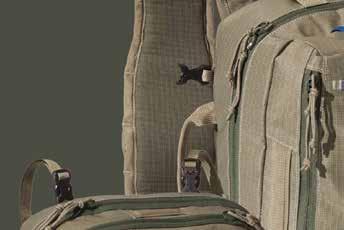
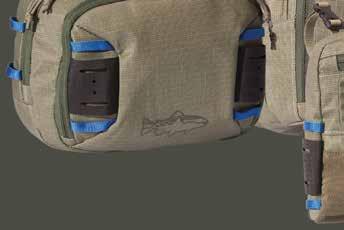
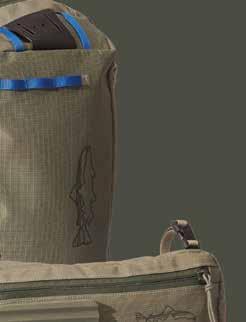
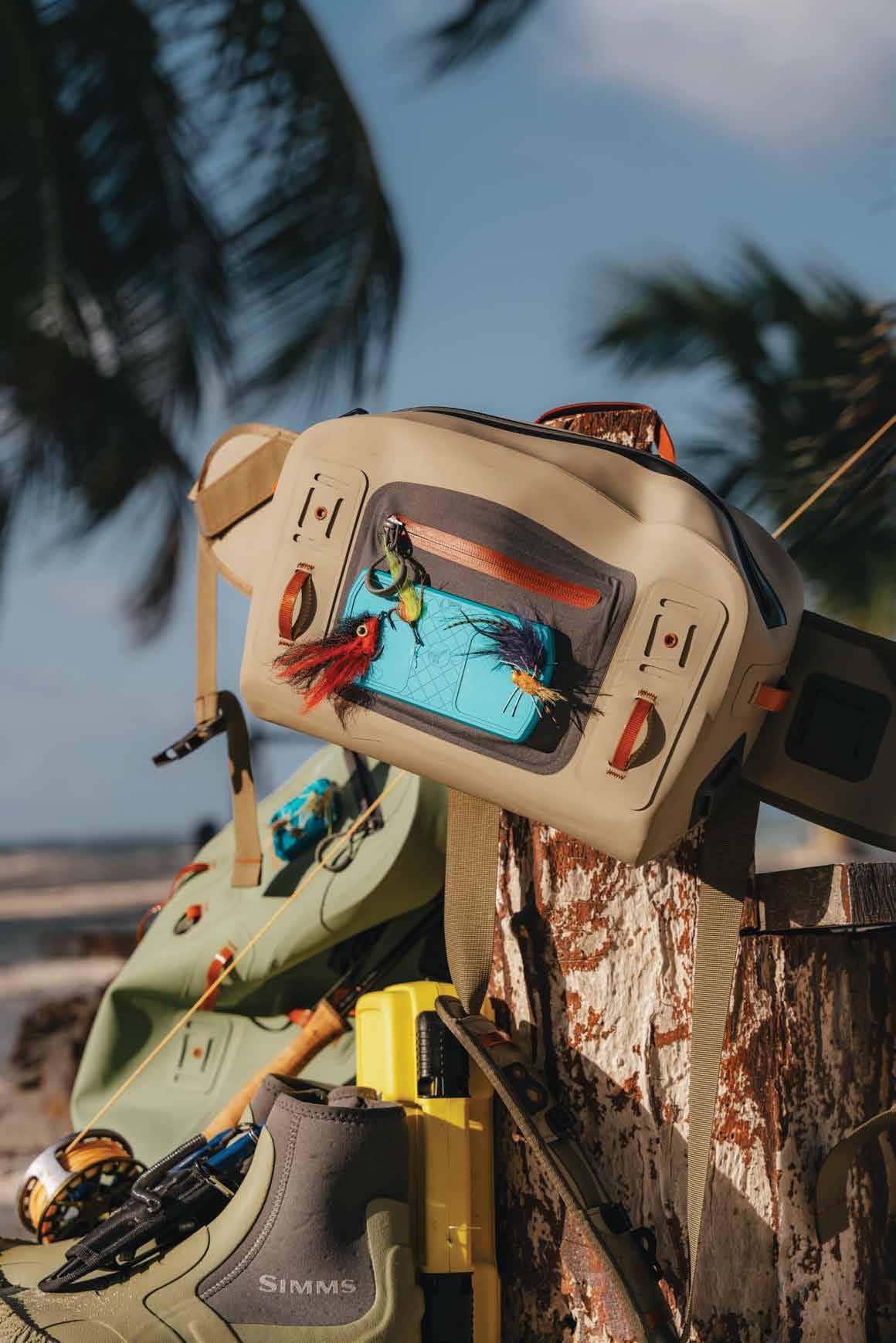
In fly fishing, everything changes all the time. That’s why we engineer our Stealth Switch Packs to optimize your options. The 3- and 5-liter packs can be worn as a chest, hip or sling pack, clipped to another pack, or attached to your belt. The 9-liter pack is built for left- or right-shoulder wear and easily converts to a hip pack. Features include corrosion-resistant zips, multiple pockets, intuitive organization and Patagonia quality that’s built for years, not seasons.














Board of Trustees
Chair of the Board
Terry Hyman, Washington, D.C.
President/Chief Executive Officer
Chris Wood, Washington, D.C.
Secretary
Jeff Witten, Columbia, mo / Elkins, WV
Treasurer
Stewart Alsop, santa FE, nm
Chair of the National Leadership Council
Rich Thomas, starlight, Pa
Secretary of the National Leadership Council
Paul McKay, WhEEling, WV
Trustees
Linn Beck, oshkosh, WisC
Tony Brookfield, Park City, utah
John Burns, nEEDham, mass
Josh Crumpton, WimbErlEy, tExas
Mac Cunningham, basalt, Colo
R. Joseph De Briyn, los angElEs, Cali
Paul Doscher, WEarE, n h,
Larry Finch, Wilson, Wyo
Susan Geer, gilbErt, az.
Peter Grua, boston, mass
Chris Hill, Washington, D.C. / hainEs, alaska
Steve Loranger, FlagstaFF, az / santa barbara, Cali
Mick McCorcle, FrEDEriCksburg, tExas
Steve Miller, sammamish, Wash
Phoebe Muzzy, houston, tExas
H. Stewart Parker, ChaPEl hill, n.C.
Al Perkinson, nEW smyrna bEaCh, Fla
Greg Placone, grEEnVillE, s.C.
Candice Price, kansas City, mo
Donald (Dwight) sCott, DariEn, Conn.
Judi Sittler, State CollEgE, Pa
Gene Slusher, lExington, ky
Joseph Swedish, silVErthornE, Colo
Blain Tomlinson, long bEaCh, Cali
John Ulrich, san antonio, tExas
Leslie Weldon, bEnD, orE
Geofrey Wyatt, santa barbara, Cali
National Leadership Council Representatives
Chair
Rich Thomas
Secretary
Paul McKay
arkansas, Ron Blackwelder
CaliFornia, Trevor Fagerskog
ColoraDo, Barbara Luneau
gEorgia, Steve Westmoreland
iDaho, M.E. Sorci
illinois, Hans Hintzen
ioWa, Tom Rhoads
mainE, Tammy Packie
miChigan, Greg Walz
miD-atlantiC, Noel Gollehon
montana, Mark Peterson
nEW hamPshirE, John Bunker
nEW JErsEy, Peter Tovar
nEW mExiCo, Jeff Arterburn
nEW york, Jeff Plackis
north Carolina, Mike Mihalas
ohio, Matt Misicka
oklahoma, Levi Poe
orEgon, Peter Gray
ozark (ks/mo) Jeff Holzem
PEnnsylVania, Eric Lewis
south Carolina, Mike Waddell
tEnnEssEE, Danny Sells
tExas, Joe Filer
utah, Lynn Sheldon
VErmont, Travis Dezotell
Virginia, Tom Benzing
Washington, Andrew Kenefick
WEst Virginia, Paul McKay
WisConsin, Scott Allen
Wyoming, Jim Hissong
State Council Chairs
arizona, Alan Davis
arkansas, Michael Wingo
CaliFornia, Shana Bagley
ColoraDo, Barbara Luneau
ConnECtiCut, Richard Mette
gEorgia, Rodney Tumlin
iDaho, Tyler Hallquist
illinois, Dan Postelnick
ioWa, Dave Klemme
mainE, Matt Streeter
Coldwater Conservation Fund Board of Directors 2026
President
Jeffrey Morgan, nEW york, n y
Executive Committee
Joseph Anscher, long bEaCh, n y
Philip Belling, nEWPort bEaCh, CaliF
Stephan Kiratsous, nEW york, n y
Stephen Moss, larChmont, n y
Directors
Peter and Lisa Baichtal, saCramEnto, CaliF
Bill Bell, atlanta, ga
Douglas Bland, ChEsaPEakE City, mD
Stephen Bridgman, WEstFiElD, n.J.
Mark Carlquist, los gatos, CaliF
Gregory Case, PhilaDElPhia, Pa
Benjamin Clauss, grEEnVillE, s.C.
James Connelly, nEWPort bEaCh, CaliF
Jeremy Croucher, oVErlanD Park, kan
Matthew Dumas, DariEn, Conn
Rick Elefant and Diana Jacobs, bErkElEy, CaliF
Glenn Erikson, gloriEta, nm
Renee Faltings, kEtChum, iDaho
John Fraser, norWalk, Conn
Matthew Fremont-Smith, nEW york, n y
Bruce Gottlieb, brooklyn, n y
John Griffin, brooklyn, n y
Robert Halmi, Jr., nEW york, n y
William Heth, Eau ClairE, Wis
Kent and Theresa Heyborne, DEnVEr, Colo
Kent Hoffman, oklahoma City, okla
Frank Holleman, grEEnVillE, s.C.
Timothy Hong, sEattlE, Wash
James Jackson, houston, tExas
Tony James, nEW york, n y
Jeffrey Johnsrud, nEWPort bEaCh, Cali
Matthew Kane, boulDEr, Colo
Peter Kellogg, nEW york, n y
Andrew Kenefick sEattlE, Wash.
Steven King, Wayzata, minn
Lori Langston, sEattlE Wash
Lee Lewis, PhilaDElPhia, Pa
Cargill MacMillan, III, boulDEr, Colo
Ivan & Donna Marcotte, ashEVillE, n.C.
Michael Maroni, bainbriDgE islanD, Wash
Jeffrey Marshall, sCottsDalE, ariz
Tim Martin, hEnDErson, nEV
Paul McCreadie, ann arbor, miCh.
Gregory McCrickard, toWson, mD
J. Thomas McMurray, JaCkson, Wyo
Daniel Miller, nEW york, n y
Robert & Teresa Oden, Jr., hanoVEr, n h
Kenneth Olivier, sCottsDalE, ariz.
massaChusEtts, C. Josh Rownd
miChigan, Gabe Schneider
miD-atlantiC, Randy Dwyer
minnEsota, Brent Notbohm
montana, Lyle Courtnage
nEW hamPshirE, Michael Croteau
nEW JErsEy, Marsha Benovengo
nEW mExiCo, Marc Space
nEW york, Cal Curtice
north Carolina, Brian Esque
ohio, Scott Saluga
oklahoma, Bridget Kirk
orEgon, Mark Rogers
ozark (ks/mo) Bill Lamberson
PEnnsylVania, Lenny Lichvar
south Carolina, Tom Theus
tEnEssEE, Ryan Turgeon
tExas, Chris Johnson
utah, Scott Antonetti
VErmont, Jared Carpenter
Virginia, Tom Sadler
Washington, Penny Mabie
WEst Virginia, Eugene Thorn
WisConsin, Myk Hranicka
H. Stewart Parker, ChaPEl hill, n.C.
Michael Polemis, olD Chatham, n y
Adam Raleigh, nEW york, n y
Margaret Reckling, houston, tx
John Redpath, austin, tExas
William Reed, kEntFiElD, Cali
Brian Regan, nEW Canaan, Conn
Michael Rench, CinCinnati, ohio
Steven Ryan, Wilson, Wyo
Leigh Seippel, nEW york, n y
Daniel Seymour, stamForD, Conn Paul Skydell, bath, mainE
Gary Smith, st louis, mo
Robert Strawbridge, III, Wilson, Wyo
Paul & Sandy Strong, lakEmont, ga
Daniel Seymour, stamForD, Conn
Margeret Taylor, shEriDan, WWyo
Robert Teufel, Emmaus, Pa.
Andrew Tucker, larChmont, n y
Andrew Tucker, VEro bEaCh, Fla
Deacon Turner, DEnVEr, Colo
Jeff Walters, sCottsDalE, ariz
Maud and Jeff Welles, nEW york, n.y.
Tyler Wick, boston, mass
Geofrey & Laura Wyatt, santa barbara, CaliF

[ CHRIS WOO D ]
I do not think I am an innovator. It took me two years to learn to catch a corner pattern over the “wrong shoulder” in football. My Dad urged me to work on my off hand in hoops forever before I finally spent a summer learning to do so.
The reality is that I am a plodder. Every time a college kid or recent graduate calls and asks, “how do I break into the field of conservation?” I say the same thing… Just work harder than everyone else; everything will work out.
I had an intern many years ago who wanted to work for TU. He worked hard, and for peanuts for two years. By the time you read this, more than 20 years later, Keith Curley will have assumed the inaugural role of Chief Conservation Officer at TU. Why? He worked hard and innovated.
Innovators change the world. Plodders help make that change normative. Aldo Leopold, a pioneer of ecological restoration in America, was the innovator of what we today call “process-based restoration.” Leopold wrote, “Health is the capacity of the land for selfrenewal, and conservation is our effort to understand and preserve this capacity.”
Process based restoration helps to re-establish ecological processes that lead to the self-renewal of our lands and waters. Beavers were ecological engineers whose dams helped to hold water in rivers through summer drought. Unfortunately, they were removed from many of their historic habitats in America. In places such as Idaho, Montana, Oregon, Wyoming and other western states, TU staff are working to create so-called beaver dam analogues to replicate the work that beavers historically did to help retain water in streams and reconnect streams and rivers to flood plains.
In places such as the Potomac headwaters and the Greenbrier watershed in West Virginia, TU and our partners such as the Forest Service and the National Fish and Wildlife Foundation have pioneered the use of placing large wood into streams to help replace the wood that would have fallen into the creek and create the cover trout and salmon need had it not been cut more than 100 years ago.
TU scientists are working with volunteers and chapters in California to use SONAR to help determine the health of steelhead runs. eDNA tests developed by TU and partners in academia help community scientists and volunteers to determine the presence or absence of native trout and salmon in Alaska and help guide recovery work in priority waters. TU volunteers used GIS to monitor tagged and track 24 million data points of tagged wild fish to help make the case for ending stocking on the Deerfield River in Massachusetts.
TU’s entire approach to conservation is an homage to innovation. Conservation was historically, and in some cases, happily, imposed from the top down by American leaders such as President Theodore Roosevelt, who for example, helped create our network of public lands.
Over the past few decades, TU has helped to innovate a different approach to conservation—one that we call “collaborative stewardship.” Collaborative stewardship understands that the conservation that is most local is often most durable. Our volunteers, chapters, partners and professional staff help us to develop deep roots in local communities across America. Those roots lead to relationships, and those relationships lead to commitments to recover priority waters and protect sensitive habitats for wild and native trout and salmon. Perhaps you are like me and think, “heck, I am not an innovator. I am a plodder.” Maybe we should rethink that. Hard work is the secret-sauce of innovation. Every TU volunteer, employee and donor know and demonstrate that every day.

EDITOR
Kirk Deeter
DEPUTY EDITOR
Samantha Baldensperger
EDITOR-AT-LARGE
Erin Block
Trout Unlimited 1700 N Moore Street Suite 2005
Arlington, VA 22209-2793
Ph: (800) 834-2419
trout@tu.org www.tu.org
DESIGN grayHouse design jim@grayhousedesign.com
DISPLAY ADVERTISING
Nick Halle nick.halle@tu.org (703) 284-9425
Trout Unlimited’s Mission: To conserve, protect and restore North America’s coldwater fisheries and their watersheds.
TROUT (ISSN 0041-3364) is published four times a year in March, July, September and December by Trout Unlimited as a service to its members. Annual individual membership for U.S. residents is $35 Join or renew online at www.tu.org.
TU does occasionally make street addresses available to like-minded organizations. Please contact us at 1-800-834-2419, trout@tu.org or PO Box 98166, Washington, DC 20090 if you would like your name withheld, would like to change your address, renew your membership or make a donation.
Postmaster send address changes to:
TROUT Magazine
Trout Unlimited 1700 N Moore Street Suite 2005 Arlington, VA 22209-2793




[ KIRK DEETER ]
Most of the stories in this issue revolve around a theme of “innovation.” It’s always struck me as somewhat odd how a sport like trout fishing that, by design, is a celebration of things simple, still thirsts for innovation. Some technologies have, no doubt, changed fishing for the better. Thank goodness for breathable waders, for example. And modern fly lines… could you imagine drying and treating a silk line after every time you went fishing? I love a good cane rod, but graphite does wonders for my cast. And how can you sight fish if you cannot see fish with good eyewear? While the legitimate game-changing innovations in fishing gear seem to roll out at a steady, if glacial, pace, innovations in conservation are now multiplying at a record pace. Artificial Intelligence, satellites, understanding DNA, advanced engineering, etc., are all changing how rivers and fisheries are made healthier. Which is wonderful, because if you asked me what the number one innovation that improved the sport of trout fishing is, you’d be surprised by my answer. It wouldn’t be slick-coated fly lines, or fast-action graphite rods. It wouldn’t be fancy waders or nearly invisible leaders and tippets or even the multitude of truly creative fly patterns we now have. Nope. All close, and all wonderful. But the most meaningful innovation happened when a bunch of anglers in Michigan realized that the key to sustainable trout fishing was to have big fish making little fish naturally in the wild, in cold, clean water. Minus that, none of the other stuff matters. The truth is, when it comes to changing the trout fishing world, the greatest innovation of all was the formation of TU. So be proud and keep rolling.


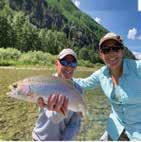
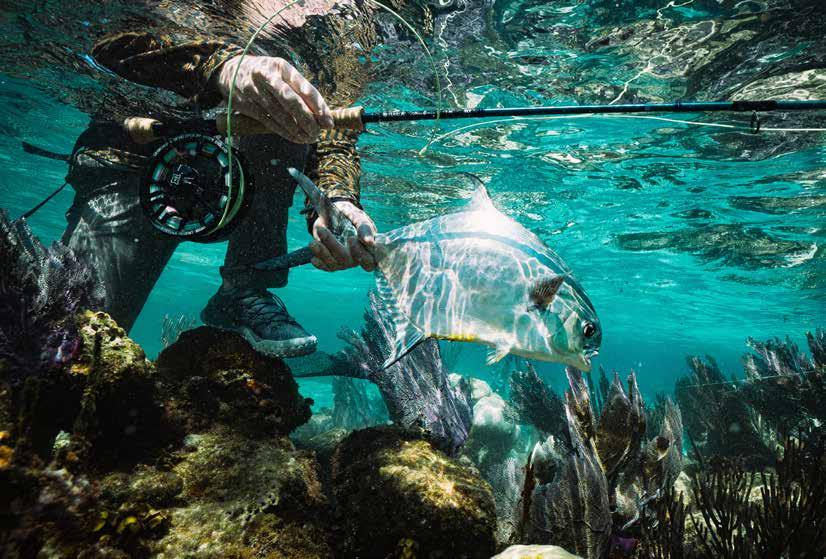

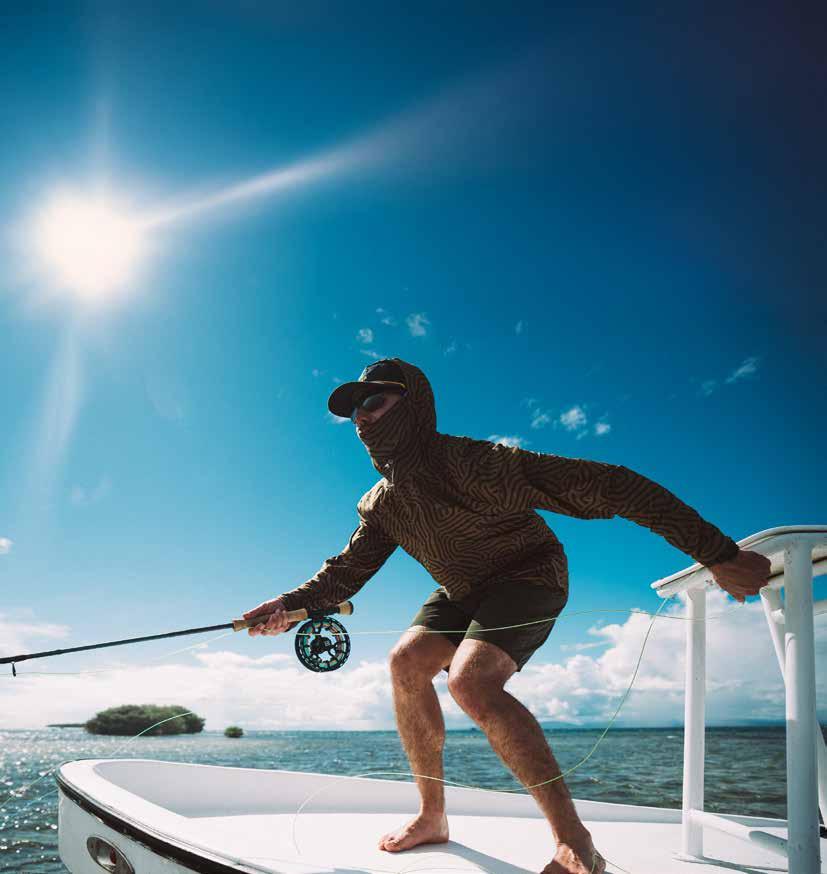
There are few environments that can offer the challenge of the salt. Smooth early morning runs through thick air across nervous liquid silver flats can quickly yield to cast killing winds and seemingly impossible shots from an unstable casting platform. However when the wind drops, the stars align and you slide that fly into the bulls eye there is no match for the feeling of expectation turning instantly into adrenaline as a hundred pounds of chrome goes airborne or six pounds of silver leaves the flat like its been fired from a gun. The Hardy Marksman Z with its unrivalled blend of feel, power, recovery and down right durability has been designed in conjunction with some of the finest guides, anglers and legends in the saltwater world. From Gold Cups to grand slams and a thousand different challenges in between, the Hardy Marksman Z is the right rod for that right moment in the Salt.
BY MARK TAYLOR
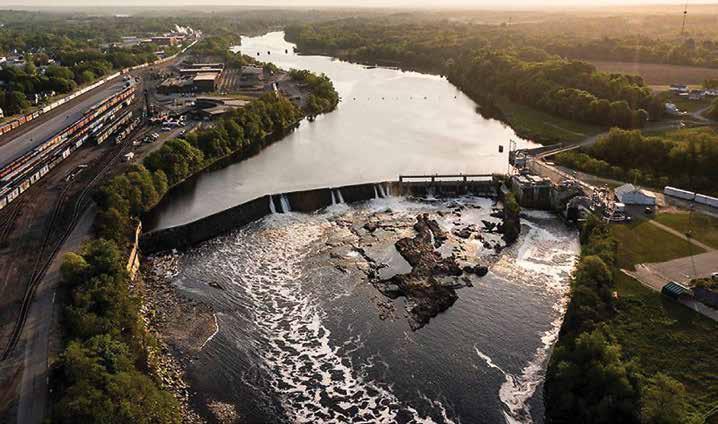
In the early 1800s, as many as 200,000 Atlantic salmon would return to Maine’s Kennebec River for their annual spawning run. In 2025, just 47 adult Atlantic salmon—designated as a federally endangered species—swam up the river to Lockwood Dam, where they were trapped, then trucked to spawning habitat upstream in the Sandy River, above four impassable dams.
Such efforts keep the river’s salmon hanging on by a thread. But in the nottoo-distant future, salmon should once again be able to swim upstream in the Kennebec.
On Sept. 23, The Nature Conservancy (TNC) and dam owner, Brookfield Renewable Partners, announced a deal that sets the stage for the decommissioning and eventual removal of the lowermost four dams on the Kennebec. That will open an
astounding 800-plus stream miles— including the mainstem Kennebec and tributaries like the critically important salmon spawning habitat in the Sandy River—to sea-run fish.
The agreement will establish a new nonprofit entity, the Kennebec River Restoration Trust, to take control of the dams. The trust, which will include Trout Unlimited representation in a role still being determined, will continue to operate the hydropower facilities at the dams
while the process of decommissioning and removing the dams unfolds. The transfer is expected to close in mid2026 with the complete process of removing the four dams expected to take about a decade. Brookfield will continue to own and operate a suite of hydropower dams in Maine, including in the upper reaches of the Kennebec watershed.
BY: COREY FISHER
It was only months ago Congress passed landmark “Good Samaritan” legislation to facilitate the cleanup of abandoned hardrock mines, tens of thousands of which are polluting the environment. Led by Senators Martin Heinrich (D-NM) and James Risch (R-ID), this legislation was passed with overwhelming bipartisan support. Now, the Environmental Protection Agency (EPA) is moving forward with implementing the pilot program established by the new law.
The new program will allow wellqualified, non-liable third parties—socalled ‘Good Samaritans—to clean up abandoned hardrock mines without the threat of liability for pollution they didn’t cause. In doing so, state agencies, Tribal nations, non-profits such as Trout Unlimited (TU) and private partners have an historic opportunity to improve the health of watersheds and communities by cleaning up abandoned mines that otherwise would continue to leak a toxic cocktail of heavy metals such as zinc, arsenic and cadmium.
Charged with standing up the new pilot program and showing success within the seven-year authorization, the EPA has been quick to coordinate with stakeholders across the spectrum, including environmental groups, state agencies, federal agencies and industry. The agency is on track to permit the first handful of projects to begin breaking ground in the 2026 field season.
“Our whole EPA team is very supportive of the new Good Samaritan Mine Cleanup Program and it’s only possible due to a broad array of partners who supported the legislation that’s now become law,” said EPA Office of Land and Emergency Management Principal Deputy Assistant Administrator, Steven Cook. “I want to specifically thank Trout Unlimited for their support of the law and our growing TU/EPA partnership to successfully launch the Good Samaritan cleanup pilots. Trout Unlimited brings decades of experience that will help inform and lead our Good
Samaritans to beneficial projects for our communities and ecosystems.”
TU has been steadily growing its abandoned mine land program,
with professional staff leading over 60 AML cleanup projects in nine western states. To date, we’ve made significant progress, successfully restoring almost 200 miles of streams degraded by abandoned mines. With Good Samaritan protections in place, TU plans to leverage the new pilot program to show success and come back to Congress to make the program permanent.
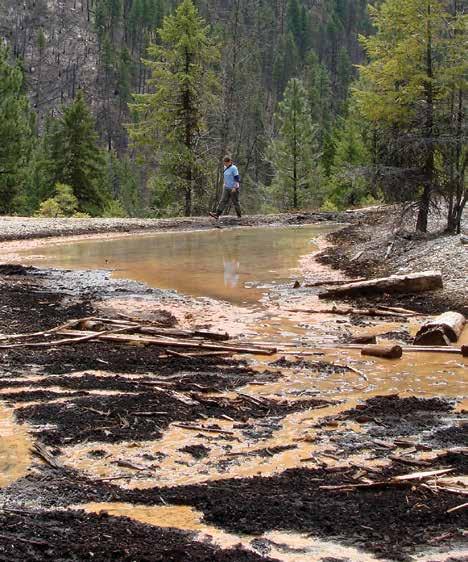
TU has been steadily growing its abandoned mine land program, with professional staff leading over 60 AML cleanup projects in nine western states.
Picture this, you’re on your favorite river, you spot a nice trout sipping off the surface. After careful observation, you tie on a fly you think matches. Then you watch this fish for a few more minutes, cast, land your fly just ahead of the sipper, and much to your delight, it raises its head, opens its mouth and inhales your fly.
After a brief tussle, the beauty comes to the net, and you admire the spots and colors.
Maybe, you think to yourself, just maybe you’ve caught this fish before. Maybe last year or the year before, but you’re unsure, so you snap a photo to compare to previous catch photos from this river in your photo library and continue fishing upstream.
That photo now has the chance to become a valuable tool for science thanks to the TroutSpotter program.
TroutSpotter is a fisheries management tool developed by Trout Unlimited, Conservation X Labs and onWater Fish. By harnessing the power of angler catch data, it uses artificial intelligence and machine learning to identify individual fish from angler-submitted images.
and opens the door to deeper involvement in TU’s work.
TroutSpotter is a free, first-of-itskind angler science tool, and every angler who participates, helps improve its accuracy, supports expansion to additional watersheds and contributes valuable data that furthers TU’s mission to restore
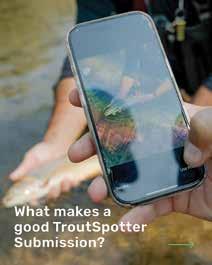
By keeping a journal of fish caught with the onWater app and opting in to the TroutSpotter program, users contribute valuable data that supports conservation while connecting more deeply with their home waters. Every submission helps train TroutSpotter, improving future efforts to understand fish migrations, recapture frequency and population numbers to inform fisheries management and conservation strategy.
Participation by everyday anglers supports real-world restoration work
coldwater fish habitats.
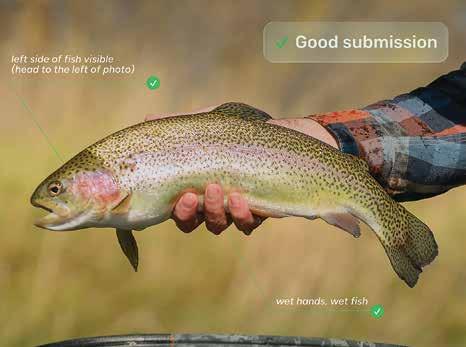
To help, download the onWater Fish app, create a free account, navigate to the journal feature and opt in to the TroutSpotter program. Take photos once you’ve caught a fish, even if offline, and then create a journal entry. The AI system learns the spot pattern and other identifying characteristics and assigns the fish a number.
Catch data remains private and is shared only with conservation and restoration agencies and organizations.

TroutSpotter is a fisheries management tool developed by Trout Unlimited, Conservation X Labs and onWater Fish. By harnessing the power of angler catch data, it uses artificial intelligence and machine learning to identify individual fish from angler-submitted images.

Coleman Savage on Guiding,
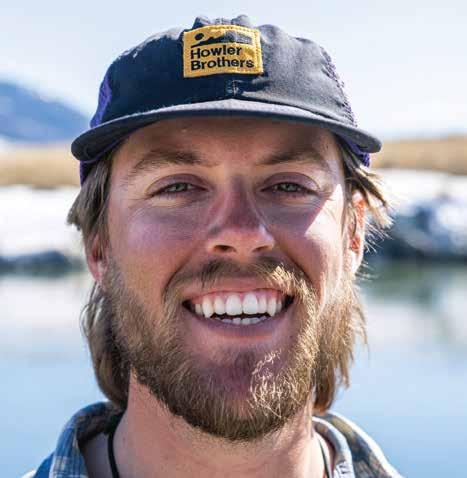
In the dynamic world of Montana’s fly fishing, Coleman Savage has rapidly emerged as a prominent figure. As a Guiding for the Future Ambassador, Savage embodies passion, continuous learning and a deep commitment to the rivers he calls home. We sat down with Coleman to delve into his journey and the impact of the Guiding for the Future program.
Q: Coleman, where do you consider your home waters, given your background?
A: I grew up in rural Virginia, but spent a few formative years living in the community of Cherokee Sound on Abaco Island in the Bahamas. Between these places I had quite the playground: smallmouth bass on the James River, Brook Trout in Shenandoah National Park and Bahamian bones—or whatever would bite a piece of
conch on a handline. Today, the freestone rivers of southwest Montana are where I feel most at home.
Q: You recently became an Outfitter. How many years were you guiding before that?
A: After a few different fly-shop jobs I started guiding in 2021, so I spent four years guiding before becoming an outfitter this year.
Q: You participated in the 2022 Missouri River, Sterling Ranch G4F program. How did you first hear about it?
A: I discovered it through the F.O.A.M. newsletter. As a new guide eager to grow and improve, I saw it as an opportunity to seek mentorship, learn from experienced professionals and build connections— even though the program was designed for guides with more experience. It felt like an opportunity I couldn’t pass up.
Q: How has the G4F program impacted your guiding career?
A: It was a quantum leap. The program gave me a deeper understanding of the bigger picture that we are a part of on the water; I learned more about water rights, conservation law, hydrology and the history behind our public waterways. That knowledge has helped me educate friends, clients and fellow guides and better represent our community and resources, beyond just catching fish.
Q: Beyond the factual knowledge, what about stewardship and ethics?
A: The program strengthened my commitment to ethical, conservation-minded angling—from pinching barbs and minimizing fish handling to considering the nuances of every interaction on the river and engaging with others in the most respectful way possible. It’s about fostering a culture of respect for the resource and each other while keeping sustainability and stewardship at the center of how we fish and run our businesses.
Q: Did the G4F program influence your decision to become an Outfitter so quickly?
A: Absolutely. G4F deepened my respect for the profession and gave me the confidence and motivation to move forward sooner than I might have otherwise. My completion of the program signaled to my mentoring outfitters that I was serious
about my professional development, and with that they encouraged me to go for it. G4F was a major steppingstone in my professional progression.
Q: What would you tell a guide friend considering the G4F course?
A: Do it, because you will get so much out of the program. It expands your knowledge, makes you a better steward of the fisheries we make our livings on and ultimately, it’s a great feather in your hat. You’ll gain valuable connections and stand out to outfitters and clients alike in a competitive field. If you’re serious about guiding as more than just a shortterm job, it’s a no-brainer. Guiding for the Future helps paint a fuller picture of and makes a day on the water more complete beyond just catching fish—and that perspective is invaluable.
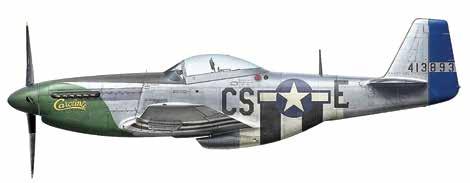
The P-51 Mustang proved to be a difference maker in helping the Allies defeat the German Luftwaffe in World War II, with significantly increased range and maneuverability, it could escort bomber missions, dogfight and engage ground targets with dramatic effect. The key to the Mustang’s design was the “laminar flow wing” which, shaped like a teardrop, creates a dynamic where the air flowing over the top of the wing is slowed more than the air passing underneath. Thus, drag is reduced, and lift is greatly improved. It turns out that over a century before WWII, Sir George Cayley, considered the grandfather of English aviation, had theorized on lift and drag as keys to soaring. Not only did he observe birds in flight, at one point he sliced a trout in cross sections to note the streamlined body. It turns out, in the 1940s, when the engineers compared the measurements of the prototype Mustang’s laminar flow wing with Cayley’s trout measurements, they matched perfectly. In effect, nature had already produced the perfect laminar flow airfoil. *Derived from Wings of War—The WWII Fighter plane that saved the Allies, By David Fairbank White and Margaret Stanback White.










BY MAGGIE HEUMANN
If you’ve ever flipped over a rock in a stream and watched a mayfly nymph scurry across the bottom, you’ve done the same thing generations of anglers and biologists have done to understand trout food. For decades, aquatic entomology relied on sharp eyes, field guides and microscopes. But in the last 10 years, a quiet revolution has been unfolding in the world of stream bugs. Thanks to DNA technology and digital tools, we’re learning that the underwater and terrestrial world is far richer and more complex than we ever imagined.
Traditionally, identifying aquatic insects requires collecting samples and sorting them under a microscope (down to dissection of genitalia) for identification. This is painstaking work that could take hours just to confirm a single species. Now, researchers can gather a jar of stream debris, grind it up and analyze the genetic material inside. Using a process called DNA barcoding, scientists read small snippets of DNA unique to each species. The result? A full list of fish, insects, crustaceans and other tiny critters living in that waterway, often in a fraction of the time. Another result is the constant reclassification of insects based on new genome knowledge. To the angler, this means that the common name of an insect is likely easier to keep up with than the Latin name.
These DNA “barcodes” have become the new field guide for aquatic life. They help scientists spot species that look identical under a microscope but are genetically distinct. In some rivers, researchers have doubled or tripled the number of known insect species by using technology like DNA barcoding.
eDNA:
One of the most exciting tools in aquatic science is environmental DNA, or eDNA. Every living thing leaves traces of its genetic material behind—bits of skin, exoskeletons, mucus or waste that float downstream. By collecting a small bottle of water and sequencing the DNA
inside, researchers can detect presence or absence of species in the area, even if they were never caught in a net. (Full disclosure, this technology will not help confirm the presence of Bigfoot.) This tech is used often by the TU science team and in chapter community science work.
That means conservationists can now find rare native species or early signs of invasive ones without disturbing the habitat or being worried they will sample at the wrong time of year and miss something that just hatched or is in egg form. In the same way a trout can read the current for food, scientists can “read” the water for signs of life. Some are even experimenting with portable sequencers-small devices that plug into a laptop and can decode DNA in the field. Imagine standing knee-deep in a stream, testing the water and learning on the spot whether that
Much like TU’s new Troutspotter AI technology that has been developed with our partners over at OnWater, apps like iNaturalist can now populate insect family and genus classification information from an uploaded photo in an instant.
riffle still supports the same assemblage of species that were there 20 years ago.
Artificial Intelligence: All the Buzz DNA isn’t the only breakthrough. AI has also entered the bug world. Highresolution cameras paired with artificial intelligence can now sort and identify insect samples automatically, learning from thousands of labeled photos.


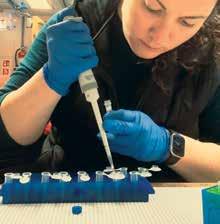
By collecting a small bottle of water and sequencing the DNA inside, researchers can detect presence or absence of species in the area, even if they were never caught in a net.
Much like TU’s new Troutspotter AI technology that has been developed with our partners over at OnWater, apps like iNaturalist can now populate insect family and genus classification information from an uploaded photo in an instant. It’s not always perfect, but it’s a heck of a lot easier than spending hours under a microscope with a dichotomous key—unless you’re into that sort of thing.
These tools help agencies, researchers and conservation groups monitor streams more efficiently, freeing up time and resources for restoration and protection work.
All of this technology adds up to one big thing: better data about the health of our rivers. When mayflies, caddisflies and stoneflies disappear, it’s a sign something’s wrong—pollution, sedimentation or warming water temperatures. By using DNA and digital tools, scientists can track changes faster and at finer scales, giving resource managers and anglers a clearer picture of what’s really happening in the water.
For anglers, this research deepens our connection to the rivers we champion. The next time you match a hatch or tie a fly, consider that the insect you’re imitating might have an unseen subspecies, recently discovered by a genetic test or is completely unique to your waterway. These invisible discoveries remind us that trout aren’t just chasing bugs- they’re part of a web of life far more intricate than we can see or understand.
The essence of aquatic entomology hasn’t changed. We’re still asking the same question: What lives here, and what does it tell us about the water here? But now, we have the tools to answer that question with more precision and wonder than ever before. Whether through a microscope or a DNA sequencer, the goal is the same—to
protect the rivers and the incredible diversity of life that trout depend on as part of their food web.
So, keep turning over those rocks. Just know that somewhere, in a lab, or even beside another stream, a scientist is doing the same thing—only with a pipette and a portable sequencer instead of a seine net and wading boots. It doesn’t matter if you are old-school or new-school, both approaches are helping ensure that our trout waters, and the bugs that feed them, stay clean and healthy for generations to come.
Want to help care for the bugs, too? Join me and The Salmonfly Project by sharing your observations or participating in their community surveys. Your time on the water can help fuel better conservation and restoration decisions across the country.
Learn more about The Salmonfly Project at salmonflyproject.org.
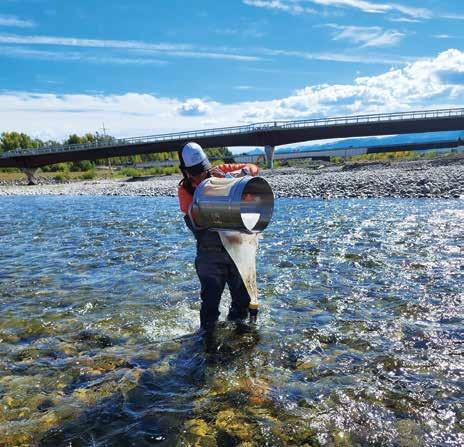
So, keep turning over those rocks. Just know that somewhere, in a lab, or even beside another stream, a scientist is doing the same thing—only with a pipette and a portable sequencer instead of a seine net and wading boots.
BY AMFF TRUSTEE ROB ODEN, FORMER PRESIDENT OF KENYON AND CARLETON COLLEGES
Now more than 50 years in existence, the American Museum of Fly Fishing (AMFF) was established in 1968, in a corner of the Orvis flagship facility in Manchester, Vermont. The AMFF happily remains in Manchester, but for several decades its collection has been housed in a lovely, purpose-built museum structure. The AMFF’s mission statement accents that the Museum was created to serve as an institution to research, preserve and interpret the treasures of angling history. However, the AMFF also focuses on preserving cold, clear, fishable waters, and the museum is less than a mile from the Battenkill River, which many consider America’s most challenging river. That the Battenkill continues to attract anglers from around the world is due significantly to the work of Trout Unlimited, in alliance with Orvis, the Battenkill Watershed Alliance and other organizations, in enhancing the river’s ability to provide food and habitat for its wild brook and brown trout.
Tracing the history of fly fishing through its artifacts is important because the story of fly fishing demonstrates how much we owe our predecessors. And the further we understand our history, the richer and more meaningful our experiences on the water become. Angling history also shows clearly how many flyfishing innovations, thought by many of us to
be recent advances, in fact were shaped by our predecessors decades, often centuries, ago.
In future columns, we aim to offer descriptions of some of the museum’s treasures, which provide a comprehensive review of advances in fly fishing since the 16th century.
In future columns, we aim to offer descriptions of some of the museum’s treasures, which provide a comprehensive review of advances in fly fishing since the 16th century. The earliest reels, Greenheart rods, early bamboo rods, horsehair and gut leaders—these
and more are included in the AMFF’s collection, which is the most comprehensive such collection, anywhere. In addition, and importantly, the museum’s library includes a vast collection of flyfishing literature, including the Thacher Collection, which is the finest assembly of antiquarian fly-fishing volumes in the United States. Just now the collection also includes an exhibition of first-rate sporting art, including works by Frank Benson and others.
Please look for regular accounts of the museum’s collection and hence, the many reasons for anglers to visit the museum in future numbers of TROUT In the months ahead, TU readers will be treated to a journey through fly-fishing’s past, exploring innovations, traditions and timeless lessons that continue to shape the way we experience this great sport. And please join us in exploring all the ways to connect with the AMFF— whether by visiting the museum galleries, engaging with our online programming or attending events that bring fly-fishing history and community to life.
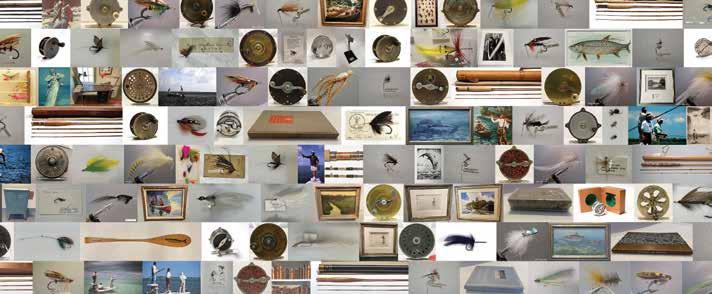

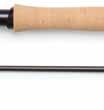
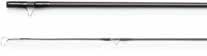
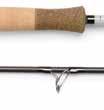
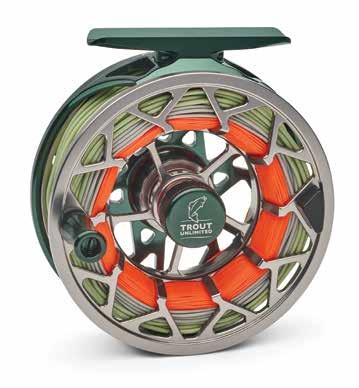
TUworks hard to offer products attached to fundraising campaigns that are unique (only found through TU)… special (they look great and stand out)… and proven (we’ve extensively tested it on the water). We’re proud to highlight a couple of the latest “heirloom” offerings we’ve made with valued partners.
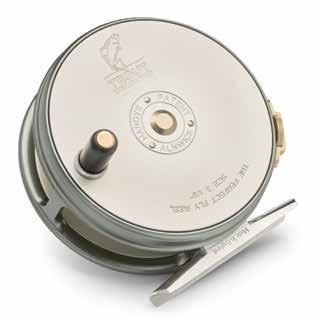
Building on a series, Hardy has produced a limited edition, special TU version of the classic 1912 “Perfect” reel. With a custom agate insert it not only lives up to the name, there will be fewer than 100 produced in the whole world.
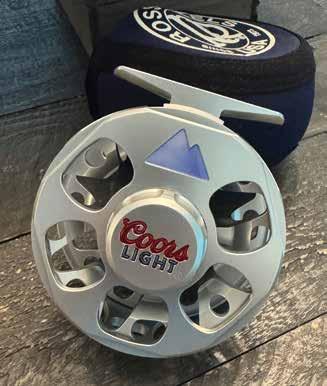
One other product that we feel worth a shout is the “Coors Light” version of the Ross Cimarron LT reel. Building off the popularity of the original Coors Banquet beer reel, the “Silver Bullet” will actually feature a thermochromic (like when the beer can mountains turn blue when cold) label. In this case, the reel will tell you when the water temperature is safe for responsibly fishing for trout. MSRP is $495 and a portion of proceeds will once again be earmarked for TU.
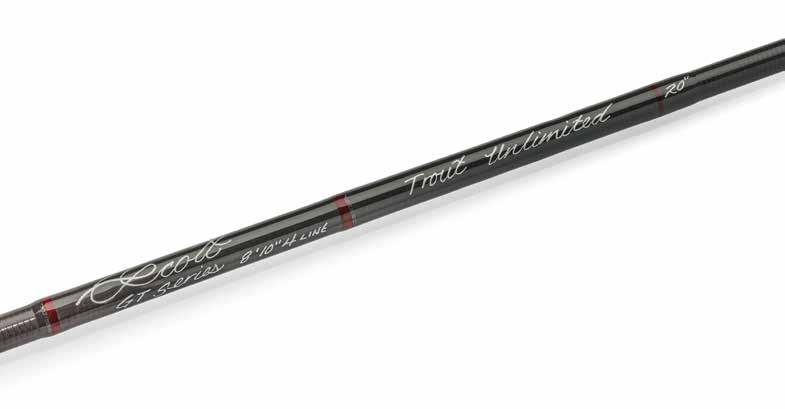
The Scott “Session” fly rod might be the best dollar value fly rod in the world. Those of you who liked “Radian” will love Session. We’re pairing it with a special Cheeky reel in the upcoming life membership campaign. As an alternative, we’re offering the brand new Scott GT rod. This might be the best dry-fly rod ever made, with thinner blank walls than the current G series, which translates to remarkable feel and accuracy. Please see specific TU fundraising campaigns for details.

BY KRIS MILLGATE
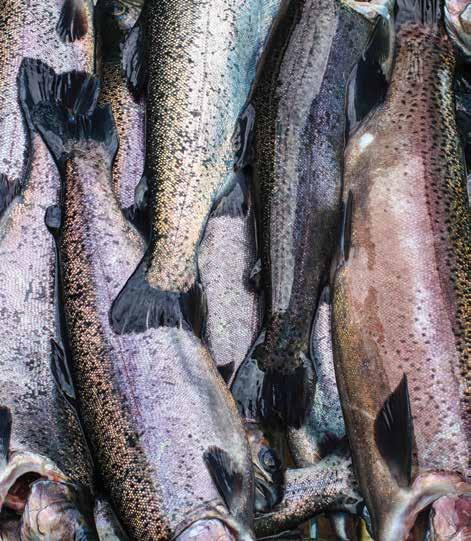
What happens on the river doesn’t stay on the river in Eastern Idaho. It ends up in the cubby-sized back room of a cluttered warehouse at Idaho Department of Fish and Game regional headquarters in Idaho Falls. That’s where thousands of dead rainbow trout are scanned, sorted and shipped. Some are worth money. Some are not. Some are worth eating. Some are not. But all must be accounted for when you need more than 8,000 harvested in one year.
“It makes me incredibly happy to see a user group, particularly guides, become conservation partners in a program we have going,” says Sage Unsworth, Idaho Department of Fish and Game Upper Snake regional fisheries biologist. “We are on track to meet the goal before the end of the year.”
Technicians sort through coolers loaded with catch and keep rainbows. The fish come from freezers staged at boat ramps along the South Fork of the Snake
The goal is 30 percent of nonnative rainbow trout removed annually from the South Fork of the Snake River. It’s an effort to keep native Yellowstone cutthroat trout in the watershed.
River. There’s more than trout in the collection. There are random flies, usually nymphs, hooked in lips and snagged on bags. Those bags are what harvested fish are shoved into during river trips.
Before those bags held fin, they housed ice, chips, entire lunches. There are also heads wedged into condiment cups then sandwiched between fully finned carcasses. The motivation for submitting fish heads is money. Some trout have bounty tags in their snout. An angler’s eye won’t see it, but a technician’s beeping scanner will detect it. The unbag and beep routine happens weekly in that crowded corner lab
containing more coolers and garbage cans than sinks and chairs.
The goal is 30 percent of non-native rainbow trout removed annually from the South Fork of the Snake River. It’s
an effort to keep native Yellowstone cutthroat trout in the watershed. In 2024, that meant 3,996 rainbows. In 2025, the target more than doubled to 8,229 because a big water year two years prior resulted in a flood of catchable abundance.
The ask seemed insurmountable. Take it as far as insulting for many people because most catch and release anglers haven’t kept a trout in decades. Returns, even with possible payouts of $1,000 for tagged fish, haven’t lured catch and keep ethic as expected.
In small streams, you will usually find trout in the deeper pockets because it’s the only safe place.
South Other General Quota Fork Lodge Guides Public Total
2025: 8,229 5,227 50 1,037 6,314*
2024: 3,996 2,967 224 816 4,007
(* = as of September 29, 2025)
When fish didn’t come in, the agency sent its shocking boats out. It stunned the river annually starting in 2021. It netted belly-up fish and sent the rainbows to other waterways every spring through 2023. Guides hated that. Some of them hated it enough to resort to catch and keep in 2024.
“This is a challenging issue,” said Oliver White, fly-fishing guide and South Fork Lodge partner, when TROUT first reported on the program in its June 2025 publication. “I am not a believer in the eradication of rainbows. At the same time, I’m pragmatic. Those fish were coming out no matter what. I thought there was a better way to do it.”
White was the first outfitter who officially committed to keeping fish in 2024, provided the department kept its shocking boats off the river. The deal stuck. There wasn’t a spring shock. South Fork Lodge removed 2,967 of the 4,007 rainbows harvested. The feat seemed nothing short of a miracle.
When the 2025 quota spawned beyond double, repeating the feat seemed impossible. Despite that, South Fork Lodge carried the bulk of the commitment alone again. Its guides, and their clients, turned in 5,227 rainbow trout by the end of September when this magazine went to layout. All other guides turned in 50 rainbow trout, combined. The general public turned in 1,037 rainbows for a total of 6,314.
The department uses shocking boats in the fall to monitor South Fork fish populations. It’s one of the most historic surveys conducted in the state. That’s how researchers knew rainbows were
trending toward take over. The state launched various suppression tactics on introduced fish, including the aggressive removal program in recent years.
That fall shock continues. It’s the spring shock that stopped once guides started keeping rainbows. The fish they turned in turned into 670 pounds of meat for local food banks in 2025. Thirty-nine of those fish had tags in their snouts valued at $2,900 in bounty payouts, including one worth $1,000.
The nearly 2,000 remaining rainbows that are needed to meet the 2025 removal quota by year’s end are within reach for two reasons. First, shoulder season is stellar on the South Fork, guided or unguided. Second, biologists plan to move 450 tagless rainbow trout from the South Fork of the Snake River to the Henry’s Fork of the Snake River during the fall population survey. Tagging research indicates those fish should be too far north, into the Box Canyon stretch specifically, to find the South Fork again. They’ll be added to the 2025 removal tally.
Provided Fish and Game gets what it wants, 30 percent of rainbows removed annually, anglers will get what they want—a system that isn’t shocked in the spring.
BY JIM DAWSON
—Headline from The San Francisco Call newspaper, August 9, 1902
…The Golden Gate Club: it has bred a school of casters who are without doubt the finest there have ever been.”
—Tom
McGuane from “Twilight on the Buffalo Paddock”

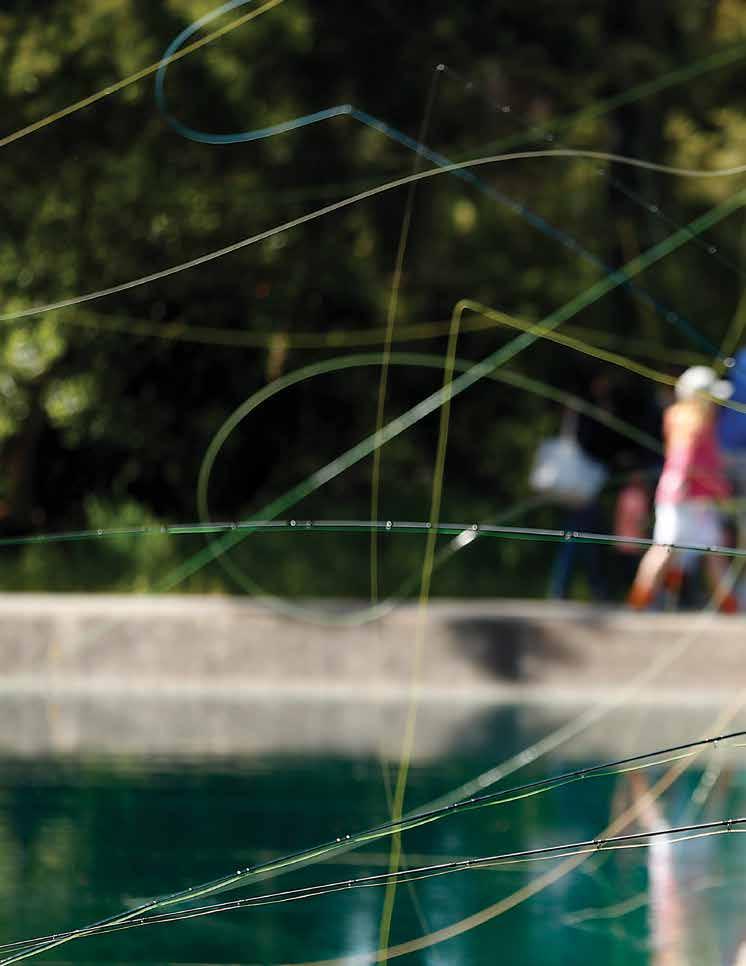
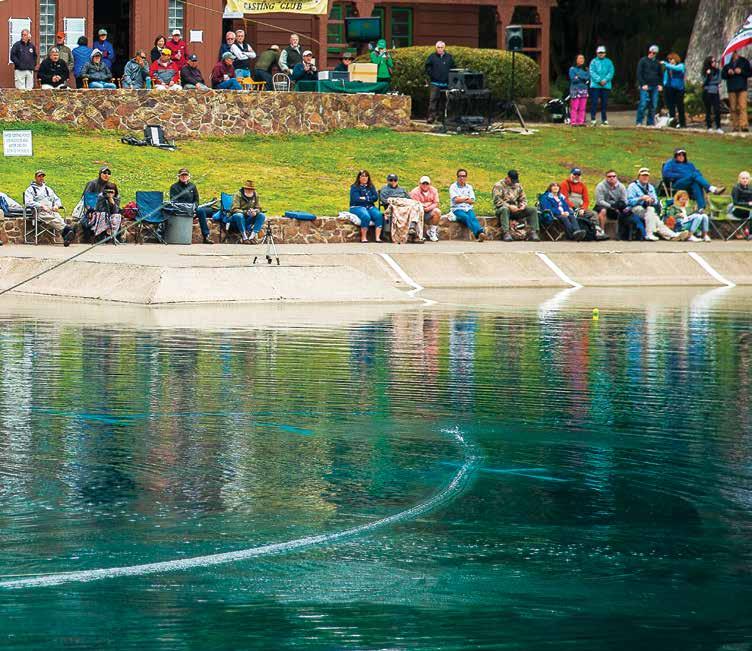
Nestled in the heart of San Francisco’s most iconic park is a near-century-old fly-fishing club that has a lot more to do with your next fishing trip than you’d ever guess. It is the Golden Gate Angling and Casting Club, or GGACC, an old school institution whose influences reach straight out of history into your closet of fly rods, and how you use them today.
The GGACC is an intriguing throwback to a time when if you couldn’t cast, you couldn’t fly fish. It was in an era before bobbers or euro nymphers, at a time when good casting was not only highly prized as a way to catch more fish, but also as a sporting event in its own right. Among the angling and casting clubs of its day, of which the club in SF was the first on the West Coast, there were formally organized casting competitions for both distance and accuracy that were covered in the sports pages of newspapers. Winners were known and celebrated, and it was a 12-time GGACC world casting champion by the name of Jon Tarantino who was the only fly-casting champion ever to be featured on a cover of Sports Illustrated magazine.
Competitive fly casting in San Francisco began in 1894 during the first California Midwinter International Exposition. Fly casters from the Bay Area became known as the finest in the world. That organization, a decidedly blue-blooded club typical of the Victorian age, went on to dominate the sport for many years and was the origin of what would become the Golden Gate Angling and Casting Club.
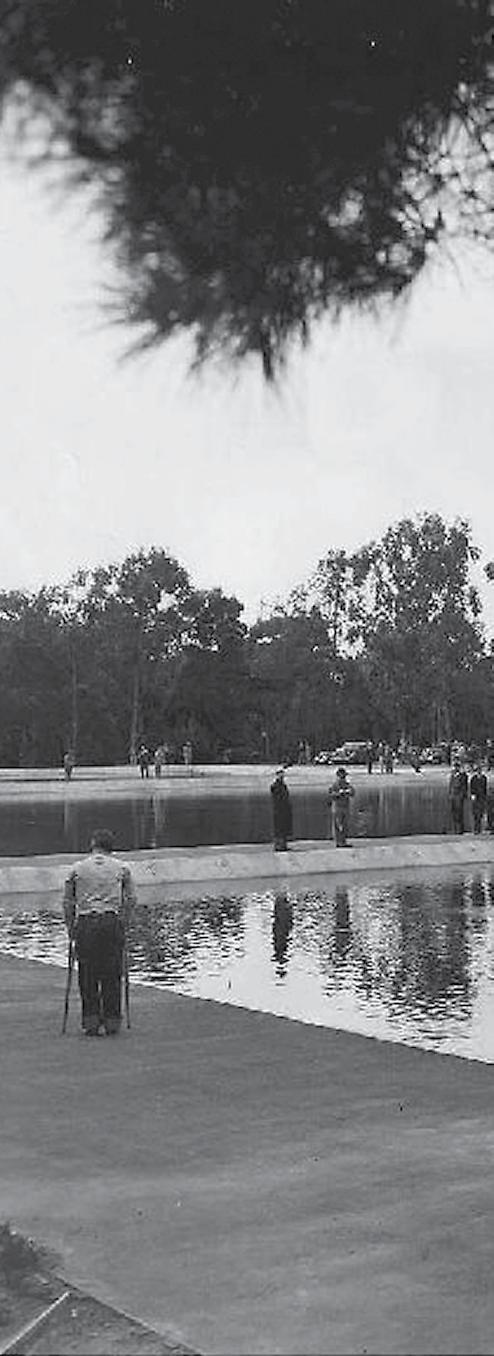
In 1938, in the midst of the great depression, club members decided that a new casting facility was necessary. The GGACC’s President, a fishing friend of the Golden Gate Park’s commissioner, used his connections and went to work. By getting the city to donate land for a facility and combining that with federal money set aside for building projects by FDR’s Works Progress Administration, the world’s most advanced and modern casting facility was launched. Eighteen months
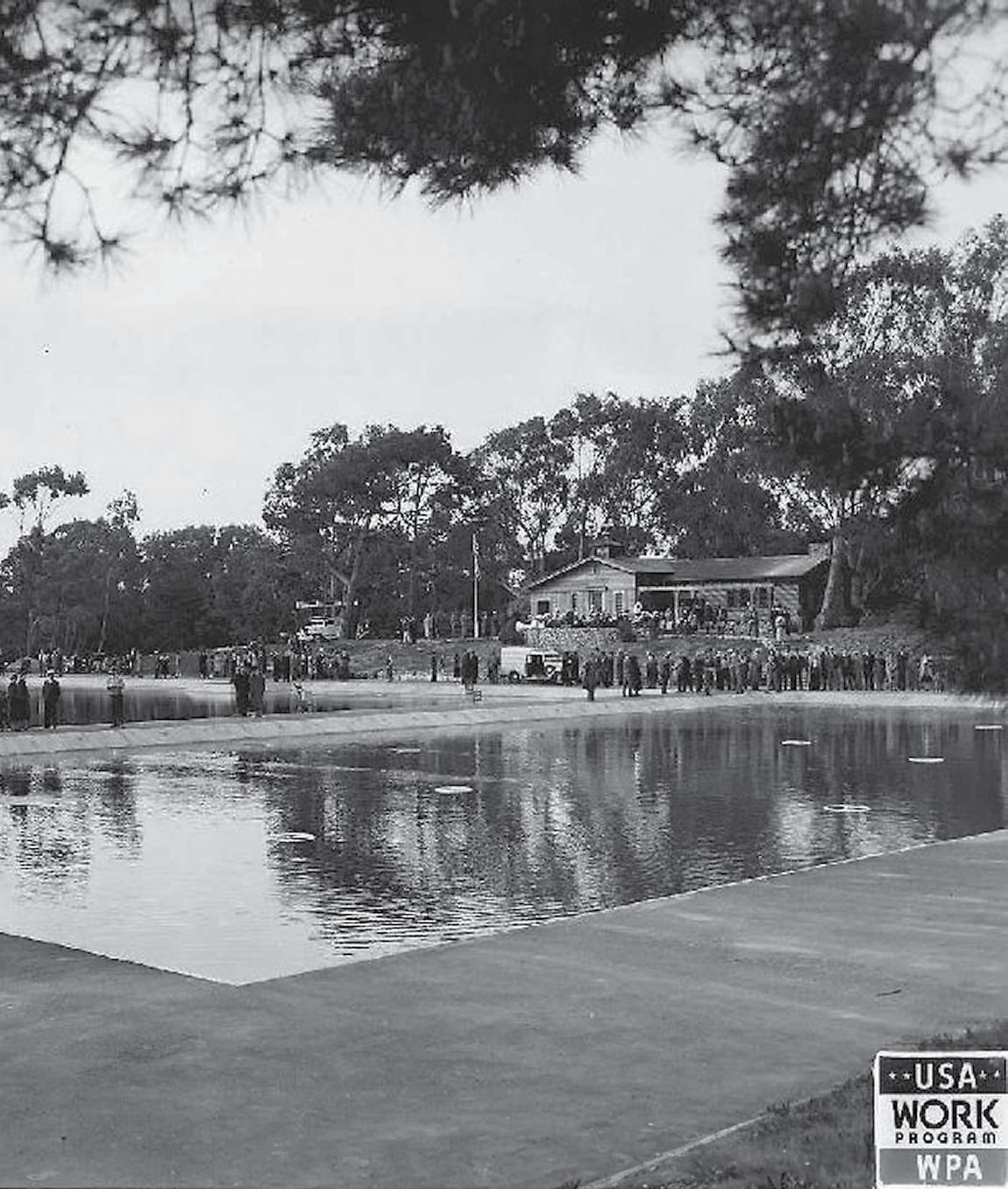
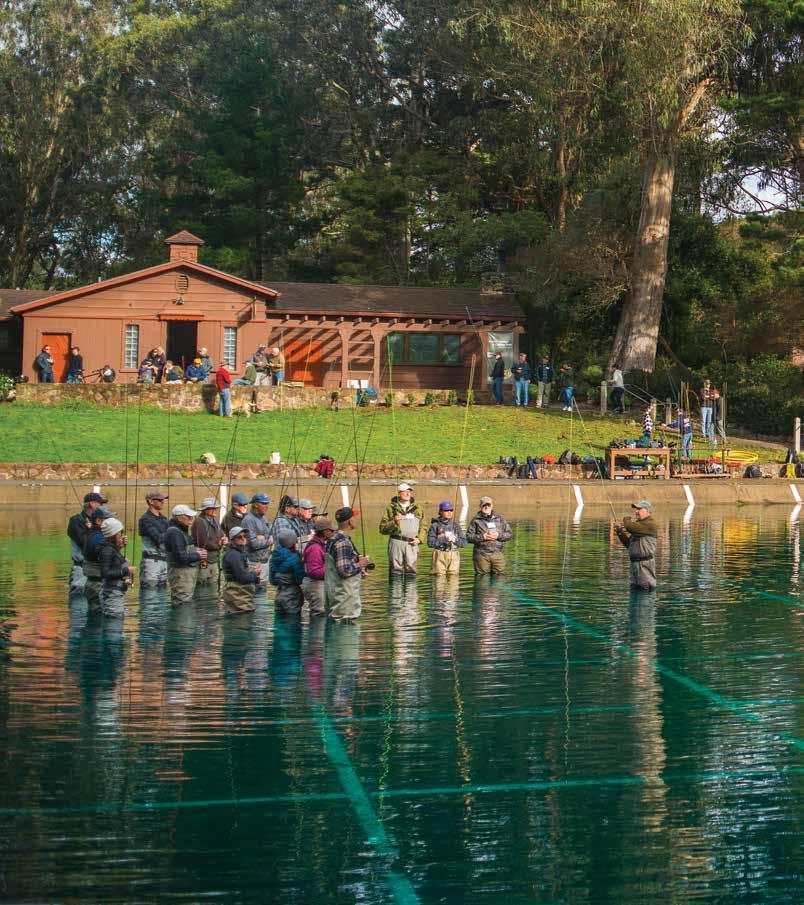
“THE CASTING PONDS OF THE CLUB WOULD BECOME THE LABORATORY WHERE SO MANY OF THE INNOVATIONS IN THE SPORT WERE BORN.
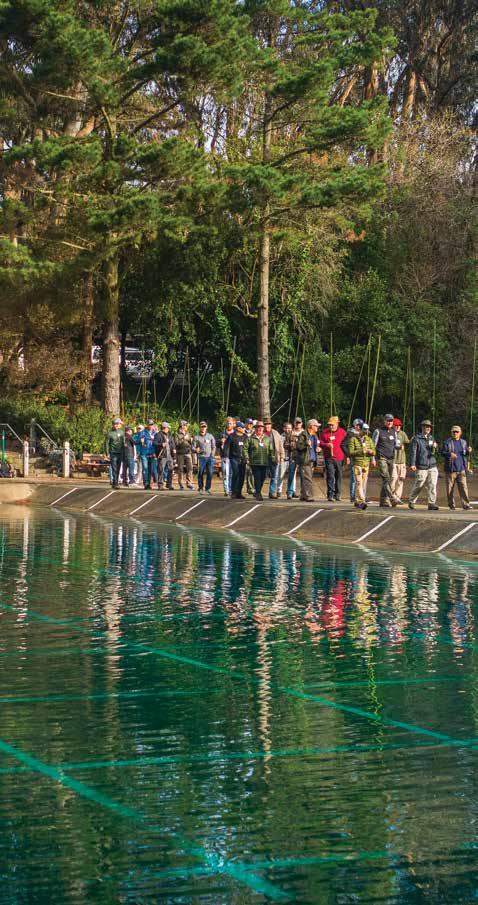
later, the casting ponds and angler‘s lodge of the GGACC were completed. It was (and still is) the finest facility of its type in the world.
The casting ponds of the club would become the laboratory where so many of the innovations in the sport were born. Results from casting competitions would feed new ideas for rod or line designs, those ideas were then built, tested and refined, which resulted in a closed loop “virtuous” development cycle unique to the club.
As a result, the GGACC went on to foster more innovation, more champions and championships, and more world records than any other single casting club in the world. Some of the innovations from the club include the GGACC casting style, the double haul, shooting heads with monofilament running lines, lead core sinking lines, “weight-forward” fly lines, progressive drag systems for a fly reel, the numbering system to match fly rods with fly lines and even the whip finisher.
As a mecca for the art of fly casting, the GGACC has also played a key role in the development of the single most critical tool that all fly casting and fishing requires—the fly rod. Today there are some 11 fly rod companies whose roots run through the ponds at the GGACC, including Winston, Powell, Loomis, Echo and Fenwick, among others.
The club’s home water, near Silicon Valley, is widely known as the world’s hub of technical innovation, however long before AI, the Internet or even before silicon chips were a thing, another innovation, one more fundamental to fly fishing, came from the Bay Area which changed the sport and became the foundation upon which every modern fly rod ever since has been built.
From its inception, fly casting depended on long, flexible rods to throw fly lines. Early rods were made of wood or metal and eventually bamboo in a process that took splices of the material, tapered and bound them together to create a lever to store energy on a back cast that was then released forward to send the fly. For
a hundred years, solid bamboo was the material best suited to do that. Then, on October 31st in 1933, a U.S. patent was granted for an innovation that would change how fly rods would be built from then on… a hollow tube.
In the 1930s, two Bay Area rod companies, E.C. Powell and Winston, in attempting to give their competitive casters an edge simultaneously landed on an idea to hollow out the bamboo strips before gluing them together. Exactly how that is done remains the secret sauce of bamboo rod makers to this day. The result was twofold: the rods became lighter and the rod’s action could be tuned, resulting in a significant improvement in performance.
Lightning had struck a hundredyear-old rod building process, going forward, it would never be the same. The very hollowing techniques and performance tuning used on bamboo would lend themselves to the next generation of rods which were naturally hollow as they made of rolled fiberglass, graphite and then boron. In fact, it was a GGACC casting champion from the 1930s who went on to become perhaps the greatest fly rod designer of all time, Jimmy Green. Jimmy, who started building hollow bamboo rods at Winston, eventually took the idea of a hollow tube to Fenwick where for 30 years he oversaw and guided more of the
modern innovations in fly rod design than anyone before or since.
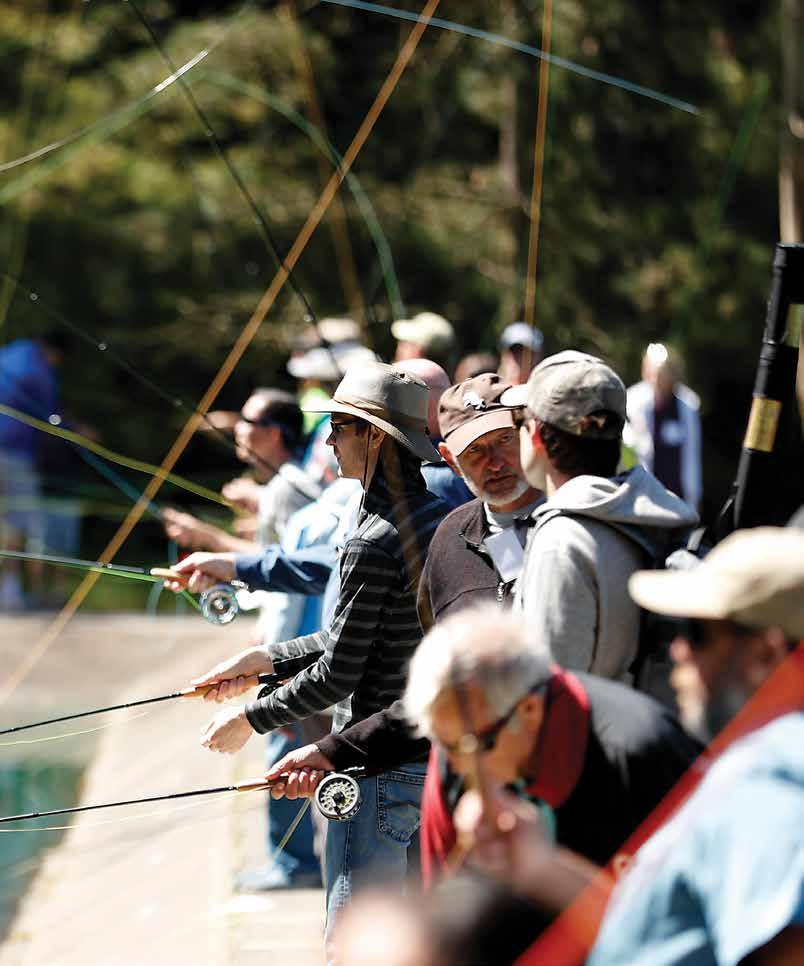
Today’s club is a vibrant combination of over a thousand anglers spanning from old bamboo to modern day Spey, all with the same common denominator… an interest in casting. On the second Saturday of any given month, you’ll find upwards of 150 newbies learning how to roll cast into the club’s historic ponds as the GGACC offers free fly-casting lessons for anyone who’d like to give it a try. Club members have taught lessons since the 1930s, and now among the teachers are 13 Fly Fishers International Certified Instructors, seven of whom have attained the prestigious level of Master Certified Instructor.
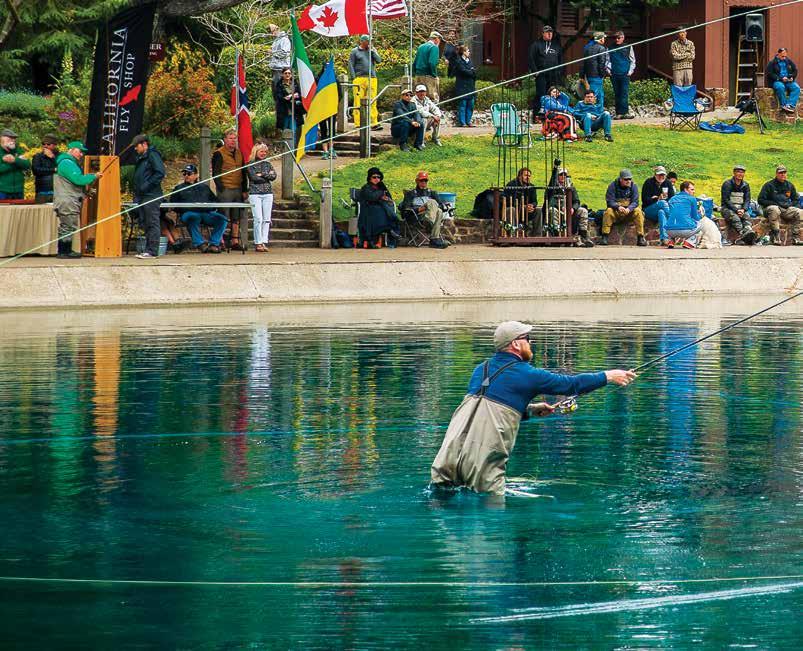
“EVERY YEAR, FOR THE PAST 25 YEARS, THE CLUB HAS HOSTED THE JIMMY GREEN SPEY-O-RAMA, THE WORLD CHAMPIONSHIP IN DISTANCE SPEY CASTING.
True to its roots, the club maintains an internationally decorated casting team that travels around the world to compete. Among its member champions are the youngest women’s world title winner at 12 years of age, Maxine McCormick,as well as the greatest tournament caster of all time, Steve Rajeff, with over 57 titles and 14 world championships. Both champions learned how to cast and were mentored at the GGACC’s famous ponds.
Every year, for the past 25 years, the club has hosted the Jimmy Green Spey-O-Rama, the world championship in distance Spey casting, as well as other tournaments including the first U.S. Open Invitational Casting Championship held at the casting ponds in 2024.
In addition to competitive casting, the GGACC supports programs for veterans, women and a three-year Learn to Fly Fish school where graduation depends on mastery of angling tactics,
conservation theory and casting proficiency judged via exams that are as intense, as some graduates say, as were their CPA or BAR exams. The club also offers an active calendar of fly-fishing trips, classes to impart skills ranging from fly tying to rod building, and in its historic lodge, the club hosts a speaker series called River Arts & Lectures where angling luminaries the world over come to speak in the most historic room in fly fishing.
BY KRIS MILLGATE
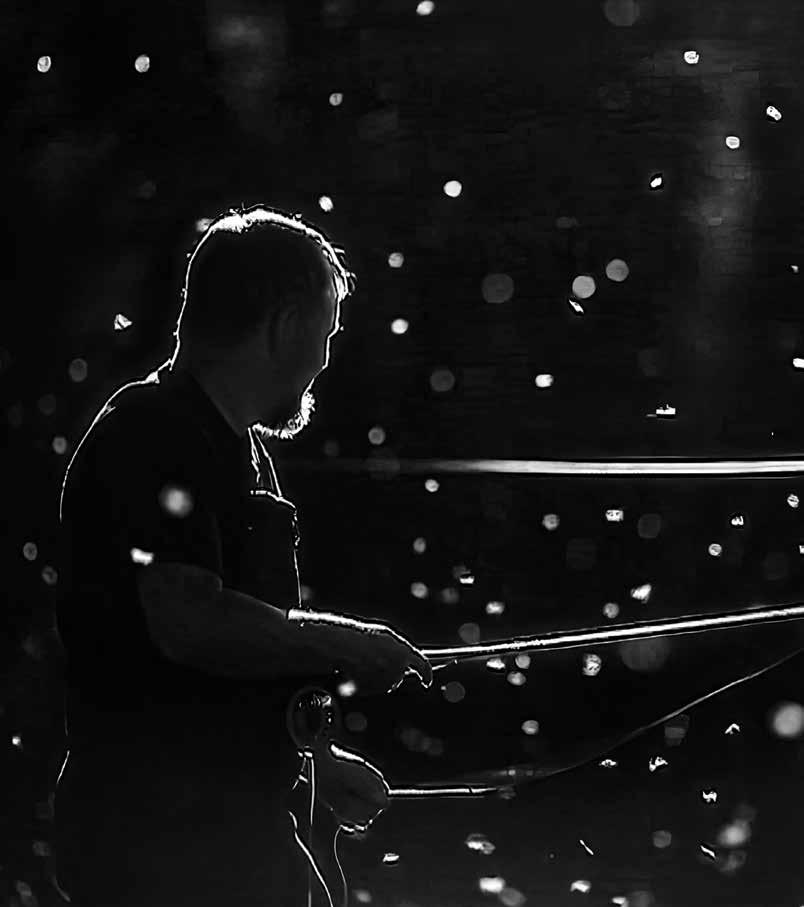
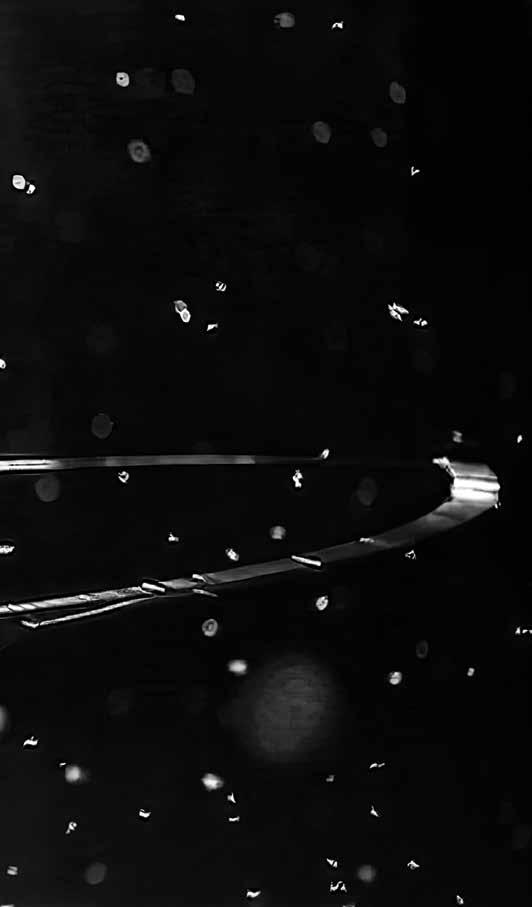
I’ve never fished with exceptional photographer Steve Smede. Looking at his self-portrait makes me wish I had. He titled it ‘Last Cast’ and everything about the stunning black and white image screams emotion, both beautiful and painful. The beauty of the freeze frame is obvious. It’s in the beard, the bugs, the backlight, the cast. The pain is buried. It didn’t surface until 15 minutes after the shutter snapped. Smede exited the river at last light after composing the remarkable selfie. That’s when he fell.
“I noticed that I wasn’t getting around on the trail very well,” says Smede, fly fisher, photographer and retired magazine editor. “I’ve always been a bit of a klutz, but something was off. There was something more going on medically. It took doctors a long time to figure it out.”
He was diagnosed with a variant of ALS, a neurologically degenerative disease also known as Lou Gehrig’s disease. The rare type Smede has doesn’t interrupt involuntary bodily functions like breathing, but it does mess with his speech, his grip, his gait.
“I need to do as much as I can to get out and enjoy nature like I always used to and make the most of it,” Smede says as he leans on his car while showing me his custom-made walking stick that has a hand-carved steelhead as its grip. “I need to make
every second count so that’s where I’ve been. I’ve been out.”
Smede’s outings look different these days. His field work requires special equipment, and specific access, that he never thought about when he took mobility for granted. There’s the trike with off-road tires. The camo backpack that quickly turns into a chair, the harness for his camera, the crutches as his extra pair of legs. Those come with a variety of bases like spikes for ice and smooth for carpet.
“I have to be somewhat selective. Not because of my interest, but because of my limitations,” Smede says as he starts hobbling (his description of his gait) along a narrow, relatively flat, trail bordered by wild grasses. “I always have my eyes on the ground. Every step and every put down of the crutch is a very deliberate, safe, slow-paced experience and that’s the way it needs to be. I cannot
go out there and just look at the birds. I have to position myself, get a nice little perch, take my time and just wait.”
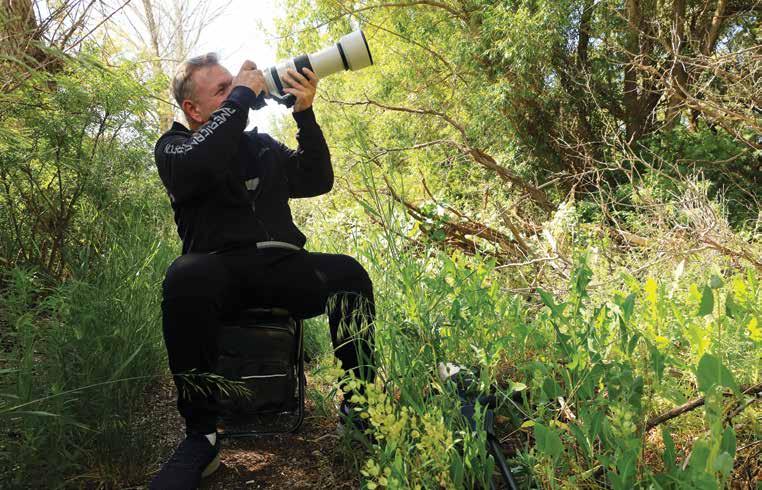
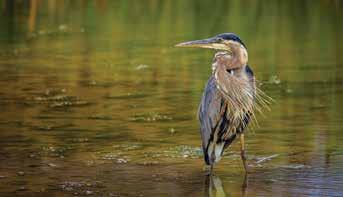
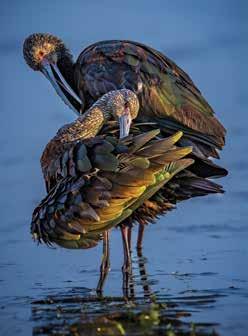
Birds are what he photographs most often, holding still and letting them come to him instead of playing chase. In the shade of cottonwood trees acting as a shelter belt for feathered wildlife, he pops open his pack. Next, he pulls out his camera, seats himself on the chair provided by the pack’s frame, lays his crutches in the grass nearby then he settles in.
“When you get hit with an illness or disability, your sense of time changes,” he says as he zooms in on the leafed canopy with a long lens that gives him further reach without having to physically get closer to what he’s focusing on. “When I’m out looking at the world as a retired disabled person with no schedule, time changes. You just go out and you’re okay to sit there for a long time. It’s just part of the fun.”
How Smede maneuvers is driven by two things. His desire to be out and his occupational therapy. Innovative devices keep Smede, and a lot of other people with limited mobility, outside.
“When we work with individuals with chronic diseases that are never going to get better, we work on integrity and independence even though they might be degrading,” says Travis Bennett, Premiere Therapy occupational therapist. “The whole focus of occupational therapy is we want people to be able to participate in what’s meaningful to them for as long as they can.”
For Smede, that’s photography and fishing. Bennett puts a wader-wearing Smede in a current-infused swimming pool with a submerged treadmill and tells him to walk. It’s balance and strength training for when Smede wades a real river, preferably a slow-flowing one. Other therapy sessions involve fly
“Every
step and every put down of the crutch is a very deliberate, safe, slowpaced experience and that’s the way it needs to be. I cannot go out there and just look at the birds. I have to position myself, get a nice little perch, take my time and just wait.”
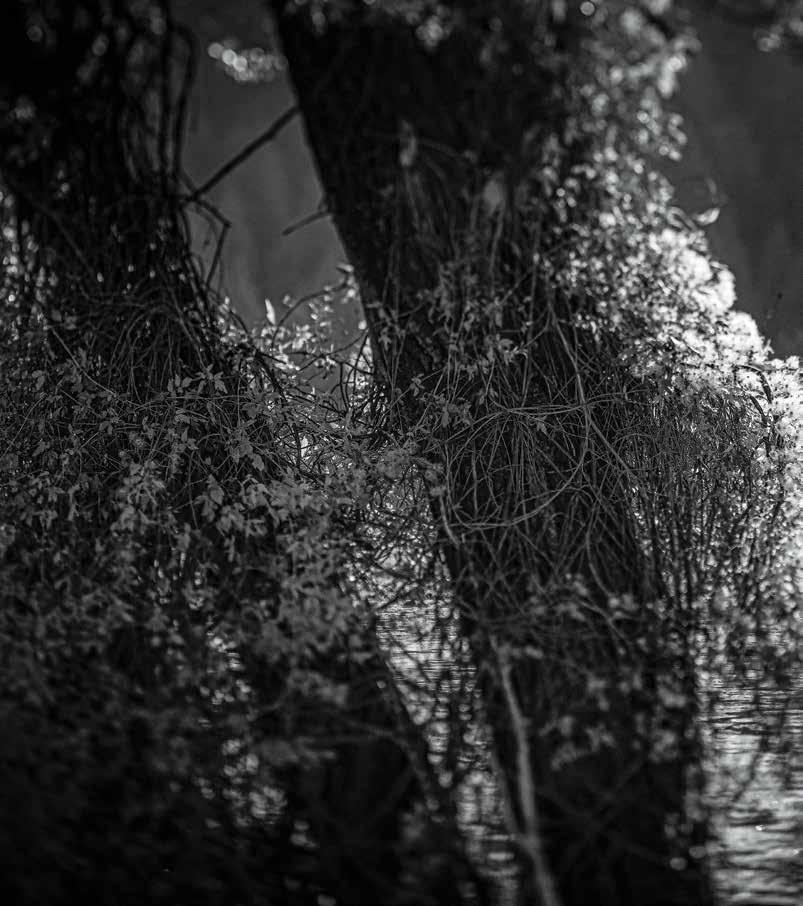
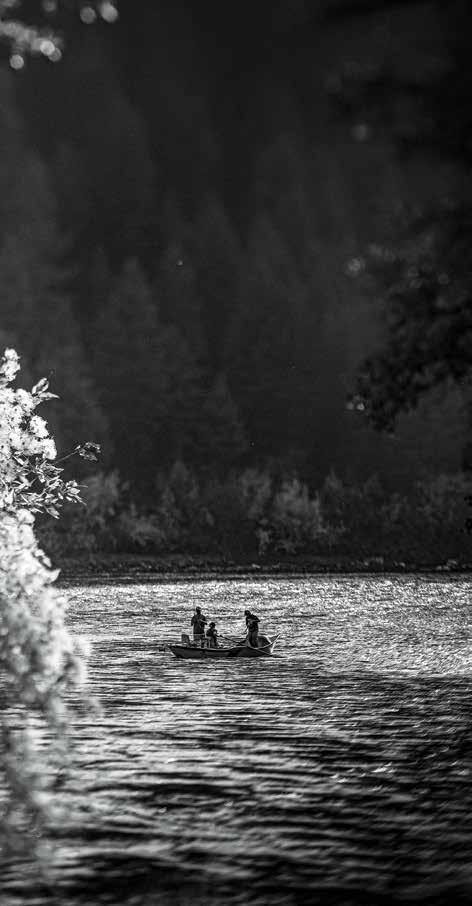
“I have severe limitations with walking but with my crutches and a couple of tricks in how I pack my gear, I can make it out into wooded areas and shoot whatever comes my way.”
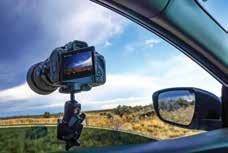
tying for manual dexterity. Smede’s also learned to cast a fly rod while sitting on his trike and shoot wildlife photos while sitting in his car. The images are just as stunning as when he could stand on his own.
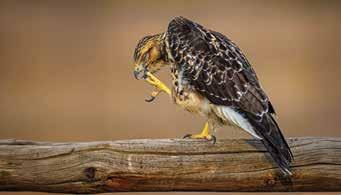
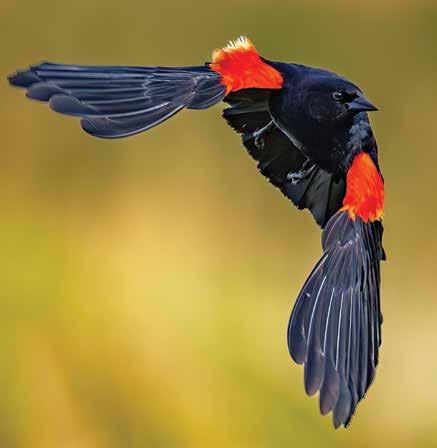
“A lot of what I do is find places that have good access where I can shoot directly from my car or where I can get out to make a short hike,” Smede says. “I have severe limitations with walking but with my crutches and a couple of tricks in how I pack my gear, I can make it out into wooded areas and shoot whatever comes my way.”
As we sit in the shade we catch up on media, magazines and our kids. We’ve known each other so long, we’ve watched our offspring grow up with our careers. We continue to sit. We shoot photos of the vegetation, of the birds, never looking at our watches. We are ‘out’ on Smede’s schedule with only the mosquitoes to motivate our eventual retreat.
“You get around pretty good, Millgate,” he says with a smirk as I quietly, and patiently, follow in his crutched wake back to the parking lot a few dozen yards away. “As do you, Smede,” I reply, smiling.
And he honestly does get around pretty good. The movement modifications and inventive equipment actually work. He’s still out, with help and without hurry.
Look at his ‘Last Cast’ selfie again, the man casting in the river with beard, bugs and backlight. You won’t see loss. You’ll see life.
Emmy-winning outdoor journalist Kris Millgate is based in Idaho where she runs trail, chases trout and stalks birds. She’s currently following sage grouse for the new wildlife film, Sage Wisdom West . It premieres in spring 2026. Read and watch more of her work at www.tightlinemedia.com.
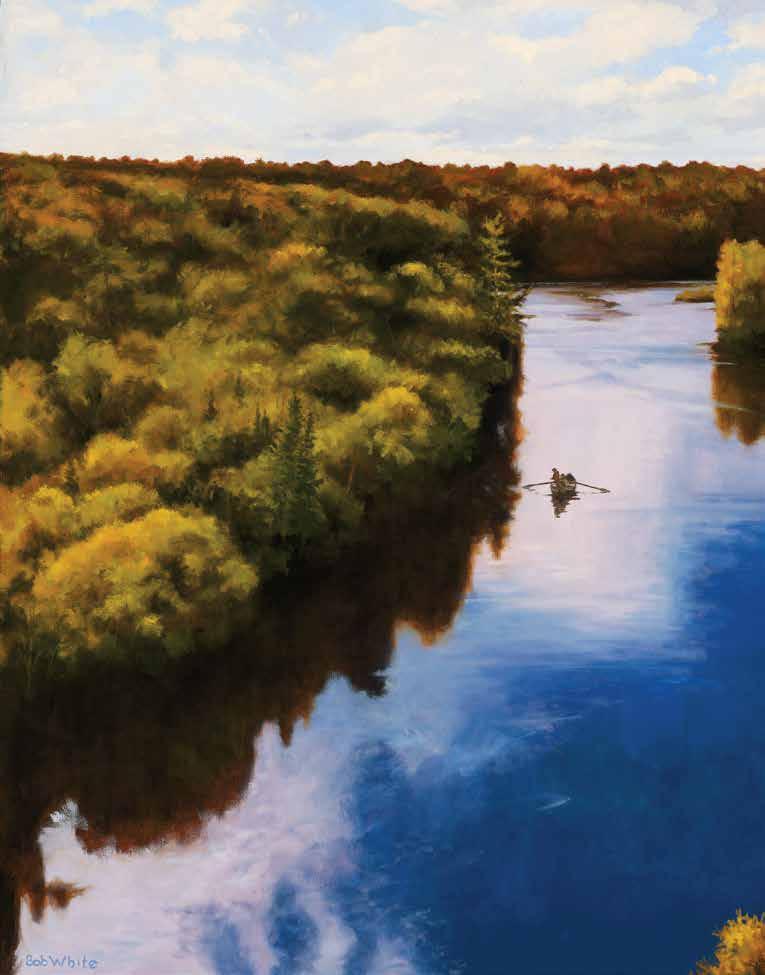

BY BOB WHITE
When our friend John Gierach passed, he left us nearly a year’s worth of columns to ease us into a world without his voice.
While it’s wonderful that we’ve had his thoughts and insights in these past few issues of TROUT, it also means that, sadly, there’s a finite and shrinking number of paintings for me to render for him. Because John’s last column is about getting ready for spring, I’ve been asked to write and illustrate the winter issue, saving the last of his columns for the appropriate season.
In 1987, the editors of Fly Rod & Reel contacted me about illustrating a short story written by a fellow named John Gierach, whose work I had occasionally seen in Fly Tyer. A few years later, after Lee Wulff’s tragic death, the editors at the magazine asked him to write the closing column, and he suggested that I illustrate it. Our first regular column together, “The Sporting Life,” was published in March of 1992. Twenty-nine years and more than 160 collaborations later, Fly Rod & Reel sadly closed its doors. Fortunately, Kirk Deeter, the editor of TROUT, offered us a home, and our column, “Convergence,” debuted in October of 2017. In all, we’ve collaborated on nearly 200 columns in, perhaps, half a dozen magazines.
I always wanted a brother, but it wasn’t in the cards. When John and I partnered on the closing
column for Fly Rod & Reel, he became the big brother I’d always wanted.
A decade older and centuries wiser, John was always there to help. He guided and mentored me, answered my silly questions without laughing (though his eyes sometimes gave him away), and, like the wonderful big brother he was, knew that the highest compliment he
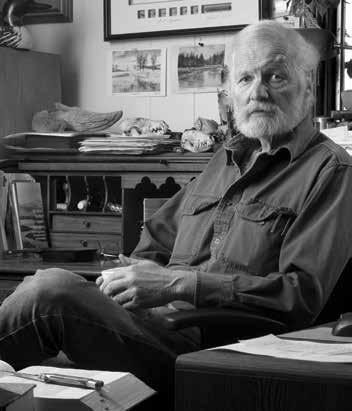
John was utterly and completely genuine in both his writing and his life. There was no difference between the two; no “professional polish” or pretense in either. He had a painfully sharp insight into our foibles and the ironic wit to describe them in a way that made us laugh at ourselves.
could give me was to occasionally ask for my advice — and then listen with genuine interest.
There’s a reason this column isn’t titled “Painting John Gierach.” Though many of the earlier paintings showed a distant figure in a brimmed hat that could easily have been John, there was never an expectation that I’d render a portrait.
John’s work and his life have touched a lot of people in very personal and often profound ways. Anglers around the world—most of whom had never met the man—were deeply moved by the honest and powerful truth in his words.
John was utterly and completely genuine in both his writing and his life. There was no difference between the two; no “professional polish” or pretense in either. He had a painfully sharp insight into our foibles and the ironic wit to describe them in a way that made us laugh at ourselves.
When I’m asked, “What was he like?” my stock reply is, “If you’ve read his work, then you know the man.” I’ve often heard it said that reading John’s work is like sitting around the campfire with a good friend. He would have liked that.
Upon seeing the first painting I did for John after his passing, “Crossing Over—Blackfoot River,” my friend Alan wrote, “When I zoomed in on the painting and saw the unmistakable profile of John’s face in the bow, I instantly choked up. Something about this image finally cemented the reality of his passing.
The first Gierach book I bought was The View from Rat Lake. I was mostly reading Schwiebert, Sparse Grey Hackle, Dana Lamb, etc.
At that time, I was also deeply into the Beat Generation and sometimes had a hard time relating to the old-money, private-water-on-the-Beaverkill, cocktails-at-theAnglers-Club, Payne-on-the-hood-of-the-Bentley school of fishing literature. About three pages into Rat Lake I remember thinking, here it is… this is Kerouac in waders.
There have been very few constants in my life, but his singular voice has been one of them. At some point in the last 20 years fly shops stopped smelling like mothballs and cigarette smoke, and the pursuit of fly fishing became unrecognizable to me.
But there was still a constant flow of Gierach. His words remain, as do the little brook trout streams in the hills, where fishing a dry upstream on a light bamboo rod is the right thing to do. John’s spirit and his message live on in his words. Nothing at all has changed.
I’ve rendered more than 200 images for John over the past four decades. These are some of my favorites.
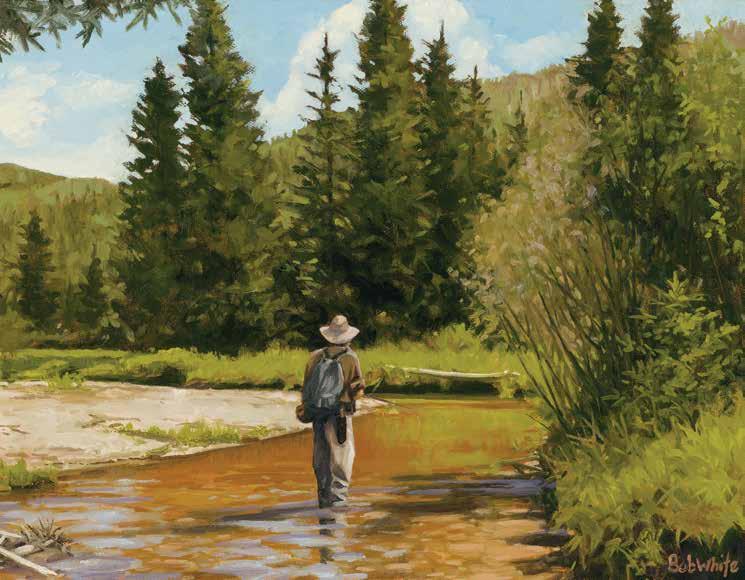
T“ALL THE TIME IN THE WORLD”
his painting shows John on the upper Colorado River and is a simple composition of a simple man quietly contemplating the headwaters of a mighty river—one that grows in volume and stature as it moves toward its terminus. The title of the column, “All the Time in the World,” caused me to pause, and I wondered if it was, perhaps, a cryptic acknowledgement of his mortality.
We believe we have all the time in the world, but our worlds are limited to the time we have left in them. Our heroes seem immortal, until they’re not.
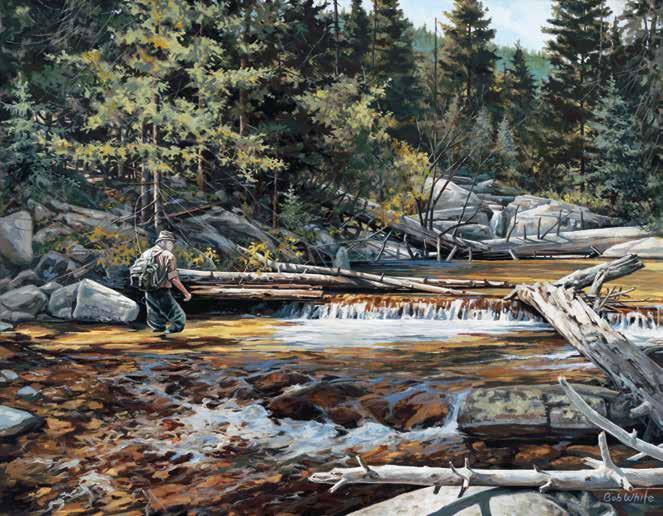
“CLOSE TO HOME”
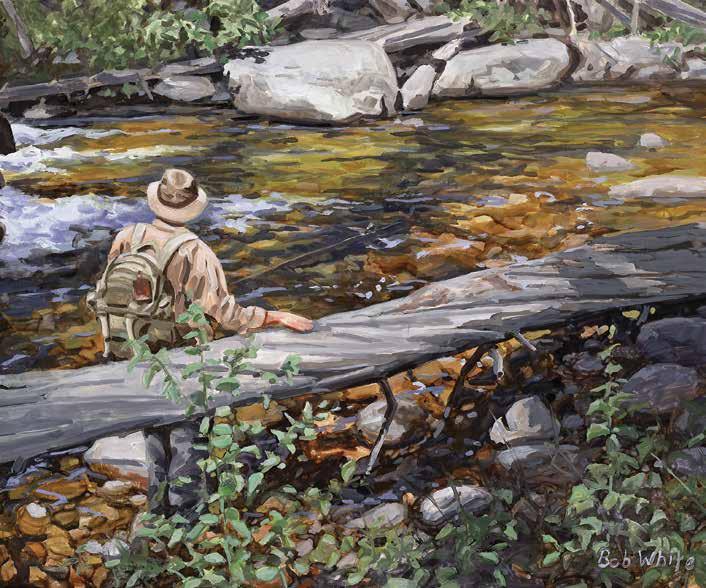
In anticipation of our 100th collaboration in Fly Rod & Reel, John suggested we spend a few days f ishing together on his home water, and that I produce a painting of his favorite stream. We fished together for three days, and I took hundreds of photographs of him and the river. On our last afternoon, as he played the final fish of the trip, I captured this image. After landing and releasing it, he waded to shore and waited for me to join him. As I crossed, I noticed a beer can caught in a recirculating wave beneath the deadfall, and while wading over to it, I stepped on a large smooth rock and went down, completely submersing my camera. The battery died and the circuitry shorted, but the final shot had been saved to the memory card. The image was safe, and the painting was rendered.
John thought I intended to do a painting of the river, with perhaps a distant, nondescript fisherman surveying the water ahead of him—as I had done many times in the past.
This was the first painting I did for him that might be considered a portrait, and, as a humble individual, he was a bit sheepish—perhaps even embarrassed—to be the focal point of my work. Years later, he told me that he’d began to feel better about it after one of his friends, upon seeing a print of it in his living room, commented, “Dude… that’s you!”
One of the most valuable lessons I’ve learned as a guide is that the time spent watching the water is infinitely more important than the time spent fishing. How often have I walked right up to a stream and cast my fly to where I thought a fish ought to be? Plenty. How often have I spooked a good fish that would have made itself visible had I patiently waited a few moments before rushing in to cast? More than I’d care to discuss.
It’s been my experience that the best fly fishers are those who patiently wait and thoughtfully watch the water. John was one of those. He was never in a hurry to make his first cast and always seemed to catch the most fish with the fewest casts.
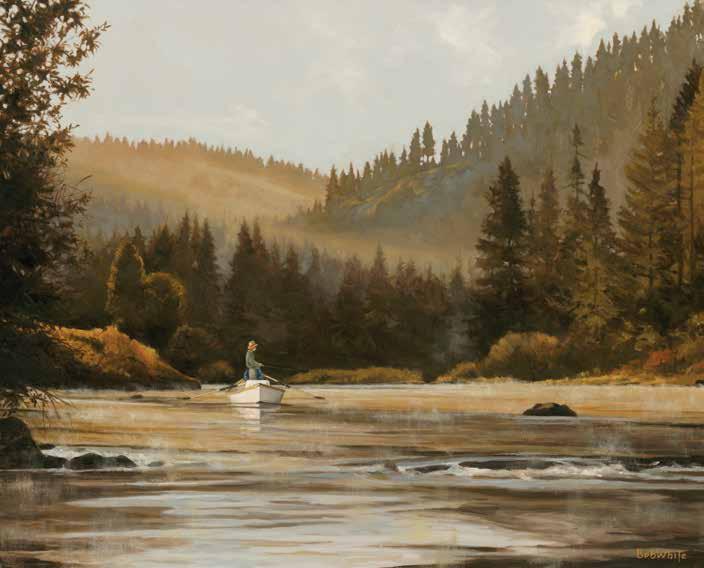
“EVENING RISES”
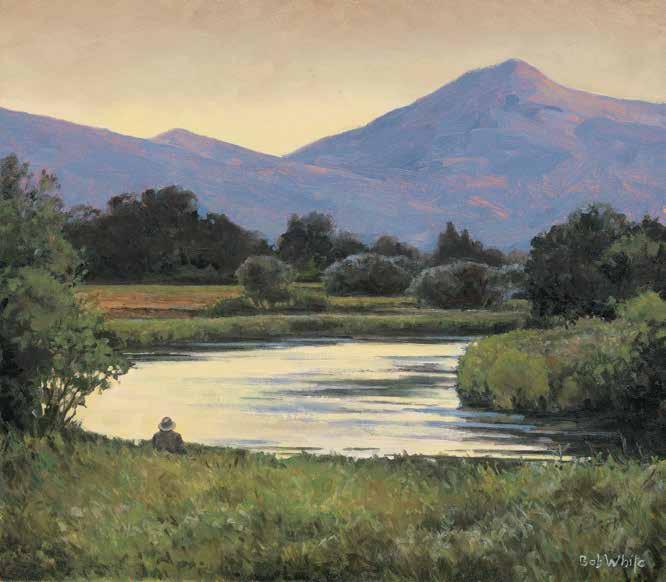
Rivers are transformative; they bring us to places, and they take us away from others.
When we’re in a river, the water envelops and moves past us, as certain and relentless as time. When we’re floating on one, it’s often reflective of life: it can be a slow, gentle glide, or a tumultuous, white-knuckled ride through dangerous currents.
I won’t claim these thoughts to be original. The River Styx, or any of other legends and myths, given to us by the ancients about death, come to mind.
All these thoughts, and some more personal ones, were on my mind when I contemplated how to illustrate the first column for my friend after his crossing.
I hope it was a slow and gentle glide.
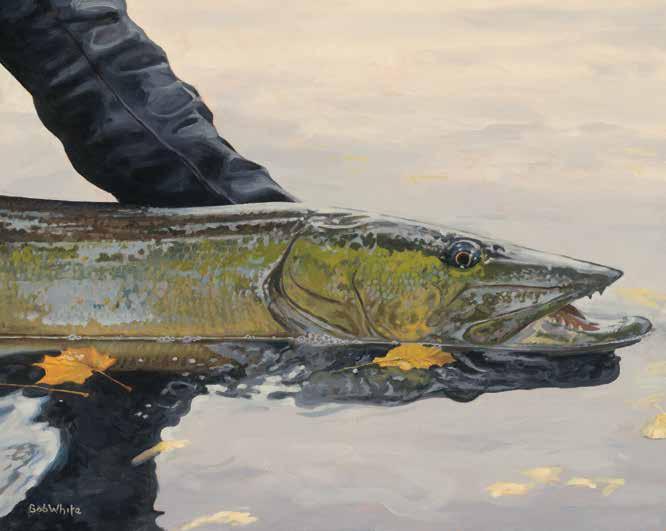
“ONE LAST LOOK—MUSKY”
This painting was created as a tribute to John’s first big musky: a fish that took him a lot of time and effort to catch. He had joined our annual Northwoods event, Musky Madness, for three years before catching his bellringer—a beautiful fish of nearly 50 inches. I knew the instant it was in the net that I’d paint it.
John was to spend the day fishing with our son, Jake, and I’d float behind them with my friends, Mike and Josh. We’d be far enough upstream to rest the water, but not so far that we couldn’t catch up if a good fish was tagged.
John was typically upbeat about the day as we launched, but Jake was nervous. This was his first time fly fishing for musky… and in a boat with John Gierach. His predicament wasn’t lost on either of us, and John and I smiled at one another in acknowledgment.
Jake asked, “What should I remember?”
“Do everything perfect, all of the time,” I said, “and never lose focus, because if you do, you’ll have an eat and you’ll miss it… and you’ll relive that moment forever.”
John took the ever-present notebook out of his shirt pocket and jotted down my advice, which I took as a compliment.
Later that morning, I watched John’s boat slide past a rocky point and hover off the eddy it created. Jake was in the front of the boat and hit the spot perfectly, remembering to figure-eight at the end of his retrieve. After a polite hesitation, John’s fly slapped down just a few inches from where Jake’s had landed. John walked the fly back to the boat, and the first sweep of his figure-eight yielded nothing, but the second met resistance and he strip-set like a man who’d never caught a trout in his life.
I’ve rarely seen John beam so broadly, but I noticed that there was both joy and humility in his smile. He recognized that Jake had made the same cast just minutes before, but for some reason the fish had chosen to strike his fly.
“Mucking fuskies.” Jake said under his breath.
John smiled and reached for his notebook while the guide posed for a photograph with the fish.
“LOW
We were on the St. Vrain when John turned to me and said, “The more I fish, the less important the fish become. That’s not to say,” he continued with a grin, “that occasionally, I don’t enjoy catching a big fish, or even a lot of fish. What I mean is that over time, what’s become important to me is sharing a day on the water with a good friend, fish or no fish.”
“The water I fish has also become a big part of the experience,” he continued. “If you’re lucky enough to have a stream or river nearby that you fish often and know intimately, revisiting it is like calling on an old friend.”
John’s words struck me as profound. I also noticed that while he offered the profundity, his eyes never left the water; he didn’t want to miss seeing a flash or a rise.
“I hike up here on snowshoes late in the winter,” he continued. “On clear and sunny days, when the snow is deep and the river is drifted over, I build a fire in the woods for coffee. Then I walk out over the stream and listen to it through 10 feet of snow.”
Someday, I’ll paint that scene: John kneeling in the snow over his home water, head cocked, listening for spring.
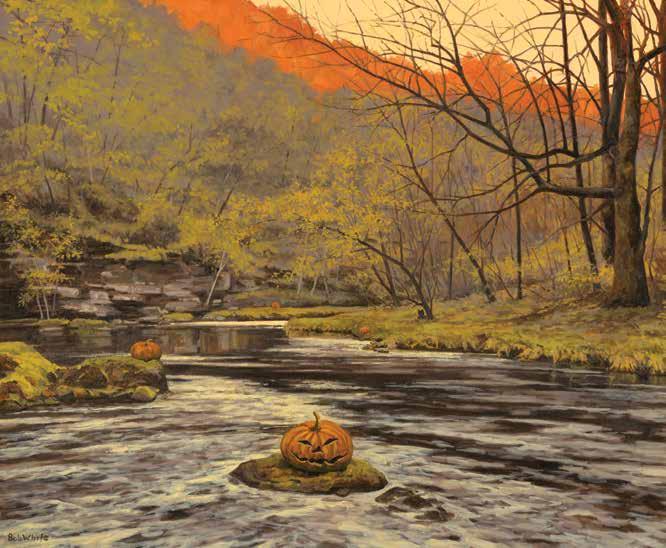
“PUMPKIN SPOTTING – DUSK ON HALLOWEEN”
Occasionally, John would throw a curve ball at me with an essay that defied a clear image to describe it. I think he enjoyed this for several reasons. First, he didn’t like to be thought of as just another fishing writer— one who only writes about exciting trips and big fish. And secondly, I think he took delight in challenging me.
“What the hell?” I asked aloud after reading his story about Halloween pranksters who placed jack-o-lanterns along a famous trout stream in Colorado. “How am I supposed to illustrate this?”
I thought a lot about pumpkins that afternoon and recalled my admiration for a series of paintings that Jamie Wyeth rendered using them as a motif, particularly the one titled Pumpkin Head. It seems that one of the requirements
of being elected to the National Academy of Design is to give the Academy a self-portrait. Jamie didn’t want to paint a self-portrait and rejected the idea—just as John rejected being pigeonholed.
Well, I thought, if a bit of rebellion was good for Jamie Wyeth and John Gierach, it’d be good enough for me, and the image began to take form in my mind’s eye. I decided to paint a local Midwest trout stream decorated with pumpkins for Halloween. I wanted to copy Wyeth’s sneer on the Jack-o-lanterns, but since John hadn’t mentioned it in the story. I added them later, after publication.
The National Academy of Design was furious with Wyeth’s painting and rejected it. I hoped that the readership of TROUT had a better sense of humor.
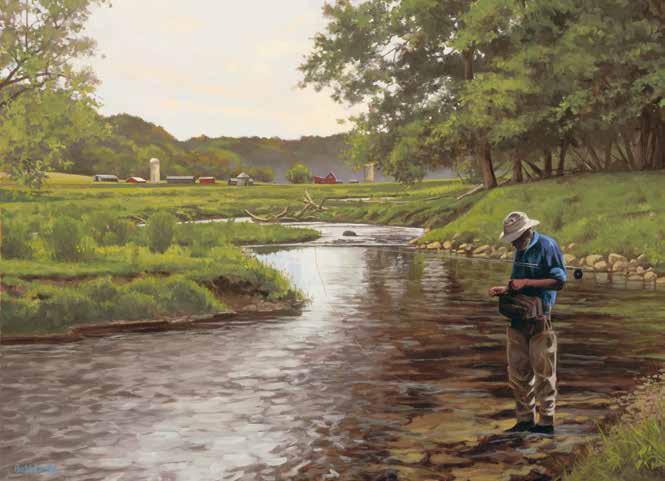
“HAZY DAY IN THE DRIFTLESS”
Even though John grew up in Minnesota, I think it’s safe to say he was introduced to the treasures of the Minnesota Driftless by our mutual friend, Mike Dvorak.
The timing for our first trip with Mike was perfect: the hatches would be at their peak and the rivers low and clear. And, it would have been perfect… if it hadn’t started to rain. As we drove south from the Twin Cities, multiple thunderstorms pummeled the area with up to nine inches rain. Tornadoes touched down to the south of us, and Decorah, Iowa, was flooded for the second time in as many weeks.
Every river we crossed was swollen beyond its banks, and ran the color of a latte. Still, Mike, who’d organized the trip, remained positive—even upbeat—about the fishing. We were told that the tributaries to the larger rivers are, for the most part, spring-fed and remain fishable even after the severest deluge. Mike’s dog, Moose, seemed to buy it, but John and I remained guardedly skeptical.
The first day we fished a meadow stream born from two spring creeks. While a bit off-color, it fished well. The larger of the two tributaries was clear, and it fished like a dream. We leapfrogged up the stream, trading water as
good friends do, and we all caught fish—some surprisingly large, given the size of the creek.
And so, the week unwound. The weather cleared and the rivers dropped. Minnesota poet Larry Gavin joined us, and we all enjoyed a wonderful day of fishing together on Pine Creek. The day was humid and hazy when I snapped some photographs of John thoughtfully selecting a fly. In the moment, I had no idea that those shots would eventually be used as reference material for this painting, or that it would grace the cover of his next book.
John fell in love with the Driftless, making the trip an annual pilgrimage for many years. The lay of the land, the rivers, the fishing and the people all seemed to resonate with him. The total experience was exactly what he loved, understood and appreciated.
John’s path in life and mine seem to have paralleled one another’s in many ways. We were both born in Illinois, moved to Minnesota, and then the Zeitgeist of our generation drew us to wild places with trout—him to Colorado, and me to Alaska. At the time, neither of us realized what lovely fishing we’d left behind in order to find ourselves in distant lands. With Mike’s guidance, we’d found our way home.
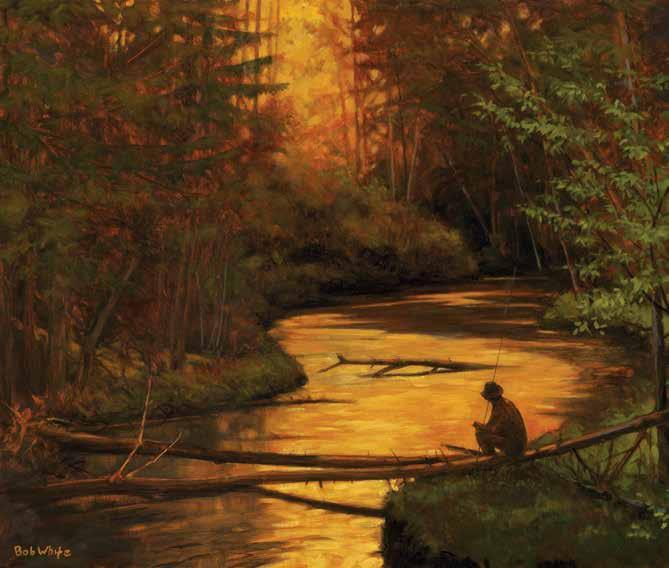
John, Mike, and I all contribute our respective crafts to TROUT, frequently in the same column. Several years ago, the editor of the publication, Kirk Deeter, invited us to join him at his family’s historic cabin in Michigan, on the Baldwin River. I looked forward to spending time with friends, and revisiting the Michigan woods and the streams where I’d learned to fly fish for trout. Unfortunately, a family matter came up, and I had to cancel at the last moment.
My friends had a wonderful time, and as it turns out, John wrote a nice essay about the experience, which was later published in TROUT. While I hadn’t been on the trip, I didn’t have any problem illustrating the scene. As a young man, I’d spent a lot of time in the area, and had deeply etched memories of waiting for evening hatches along Michigan trout streams. I imagined John sitting in the gloaming, listening to tree frogs and spring peepers, and watching dusk turn the leaves into curtains of animated stained glass.
“SPRING PEEPERS”
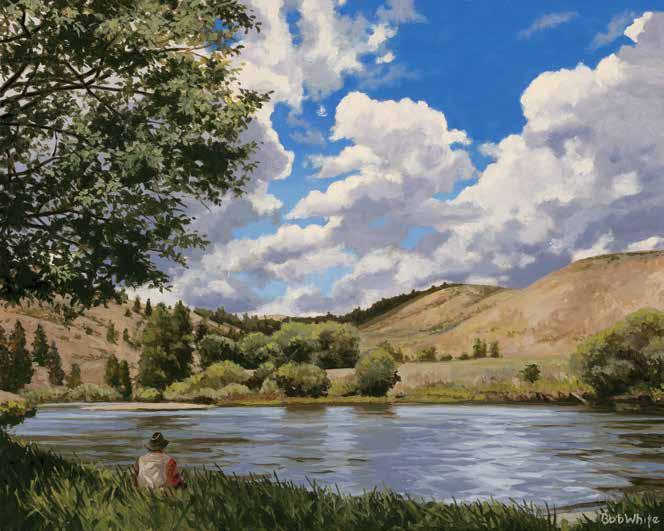
“CLOUD
Ilove to paint skies, and since a description of the weather was always included in John’s writing, he provided me with plenty of inspiration to do just that. My illustration for his recent essay, “A Small River in Wyoming,” was the last painting I did for him while he was still alive.
In the story, John writes about a fishing trip with his old friends Ed, Vince and Doug. After a day or so, he’s feeling under the weather and picks the next day’s stretch of water because it’s the ideal spot for an ailing fisherman.
It was, he writes, “a short stroll across the meadow from the cabins, easy wading as long as you don’t get too eager, with a grassy bank to lounge or nap on—in the sun or the shade of cottonwoods, depending upon whether you’re having chills or hot flashes.”
As he sometimes did, John snapped a few photographs and sent them to me with the column as reference material. The sky was dynamic and fun to paint, and it was easy enough for me to imagine him resting on the shaded grassy bank, watching the river roll past.
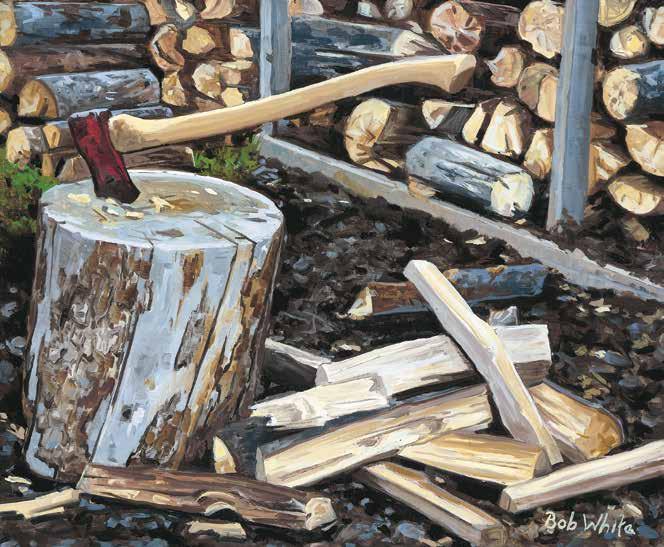
This may seem like an odd image to include in this article, as it has nothing whatsoever to do with fly fishing, the pursuit of fish or the environs in which they live.
This is a rendering of the wood pile at the Alaskan fishing lodge where I guided for nearly two decades. It was a familiar sight, as I stopped there on my way to the floatplane every morning to gather a sack of firewood for my shore lunch. I painted it for myself, as a memento of those times, never intending to sell it.
John admired the painting as a simple, yet essential, element in a guide’s day, and I suggested that someday he write an essay about firewood so that we could use it.
It took a few years, but one day I received a column, titled, “A Simple Life,” and upon reading it, realized that he’d finally given me the opportunity to see a favorite painting published.
John liked to say that there was only one instance in his career as a writer when he wrote an essay specifically for an illustration, and I know he’d appreciate seeing it included in this column.
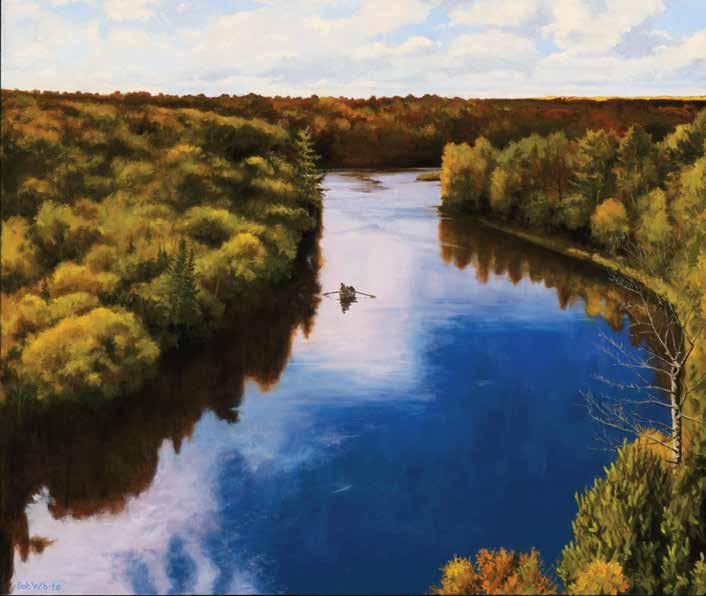
The image that leads this column was particularly challenging for me to paint because it brought back so many memories of fishing with John. While the memories are welcomed and treasured, the process of painting them seemed like a final admission of the reality of his passing.
While I’ve painted John countless times, it’s always been at ground level, as if we were sharing time on the water. This painting is from a very different point of view. I chose this elevated view because my intention was to render the scene from John’s perspective, as he watches from above, measuring my progress down the river.
The sun is low, and the shadows are long. There are many miles to go before my float is finished, and the front of my boat is empty.
BY GEORGIANA DE LA TORRE
Early one summer morning, while fly casting along a shoreline where the Golden Gate Bridge loomed in the near distance, a woman walked toward me. She was searching intently in the tideline when she saw me and startled. I paused my back cast to let her pass.
“I’ve been walking this beach for years,” she said, “and I’ve never seen a woman fishing.”
“Well, now you have,” I answered.
“I’m looking for sea glass,” she replied. “I used to collect stones, when I lived on a river in Oregon.”
“I hope to fish there one day,” I said.
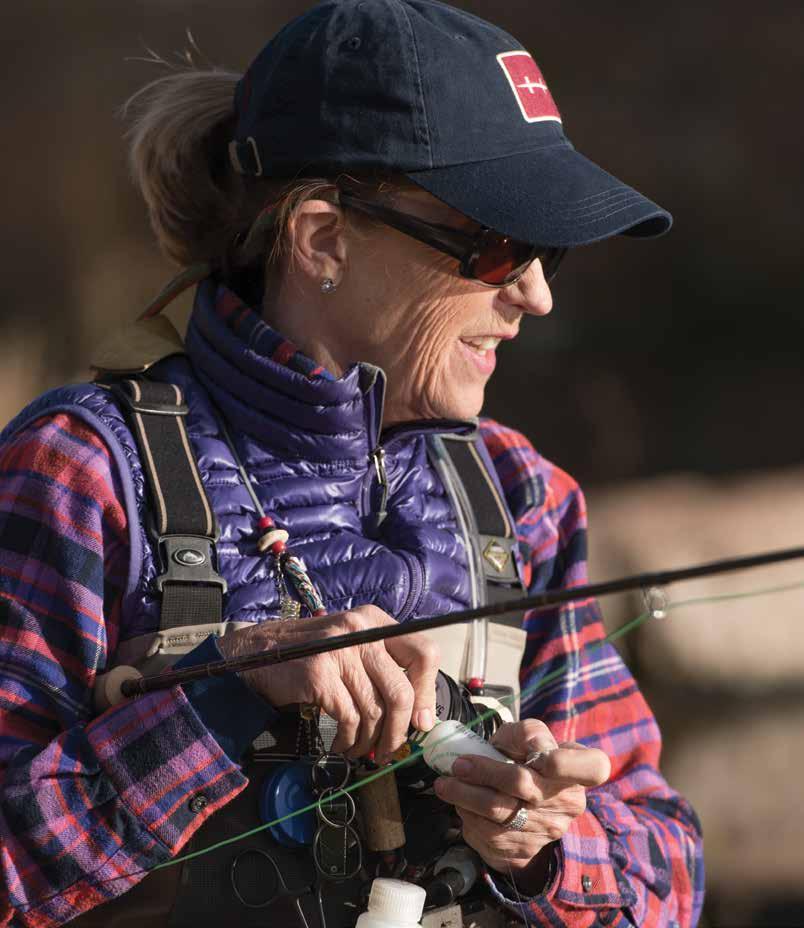
The exchange got me thinking: if seeing a woman fishing is a rare experience, how seldom seen are older women fishing?
Not surprisingly, older women are never featured in fishing media and advertising, which lean to shapely young blondes in bikinis, fishing rod in one hand and fat bass dangling from the other… or others wearing waders, waste deep in a river, rod tips bent toward a fish.
Annual fly-fishing film festivals are dominated by quick takes to high-fiving dudes and thrashing tarpon set to a background of wailing heavy metal guitar riffs. Eco porn of disappearing waters and forests, and fragile trout are standard. One year did include a short profile of a 70-year-old fly-fisher woman. She still dyed her hair blonde and seemed like she’d be a good time on a float trip.
Why does this matter to me, and why should it matter to anyone else? Because women of a certain age are invisible, whatever their role in life. Who they are, and who they were, should not only be seen, but celebrated.
To fly fishers, mention older women fishing and the legendary Joan Wulff immediately comes to mind. At age 25, and then known as Joan Salvato, she cast 136 feet to win the national fly-casting distance championship—the only woman ever to enter, let alone win, the competition. At 41, she was a divorced mother of two boys, and repping for the Garcia fishing gear company when she became the fourth wife of renowned fly fisher, filmmaker and conservationist, Lee Wulff. Together they founded The Wulff School of Fly Fishing in Livingston Manor, New York. In a 2017 interview
published in Angler’s Journal, she is quoted as saying, “I truly love fishing, being connected to a wild creature, to a life force. It’s a little like sex.” She was 89 at the time. Lee Wulff died in 1991 when he crashed his light plane during a recertification flight run. Joan Wulff, now aged 99, has been running the school ever since.
When I think of older women fishing, I think of Lillian Hellman playing herself in the film Julia. She is the shadowy figure in the opening scene cloaked in a raincoat and floppy hat sitting in a skiff holding a fishing rod. The water is calm, and the sun has not yet risen. She is smoking. I was only 23 when I first saw the film, but I will never forget the image of Hellman, a complicated woman near the end of her life rewarded by blessed solitude, and the time to fish in the quiet of pre-dawn.
Turns out that Hellman was not only “this country’s first major female playwright,” but in her 1984 Washington Post obituary, Hellman was also lauded as “a great fisherman.” She claimed to have caught nine flounders in one hour. “I am always child-happy when I am alone in a boat,” she wrote, “no other boat to be seen until the light breaks through.”
This perfectly describes how fishing can transcend physical age. But there are also old women who do not have the time or resources to fish for fun but must fish for their livelihoods. Since the 18th century, the Haenyeo (sea women) of Jeju Island, South Korea, have been diving for abalone, seaweed, urchin and squid to feed their families and sustain their communities. These women hold their breath at great depths for long periods of time, impervious to the cold, rough waters. They have weathered storms of occupation and abuse by the Japanese, the Koreans and the Americans, and continue to dive. The majority of Haenyeo are over 50, with the oldest now in their 80s.
Of course, women, young and old, fish and have done so for recreation and sustenance forever. No matter the attention or recognition we receive for it, we will continue to spend time on the water. And as an older woman who fly fishes for the sheer joy of it, and often does so alone, being unseen may not be such a bad thing. Afterall, what is stealthier than being invisible?
Maybe it’s even a superpower.

BY TOM ROSENBAUER
There is some speculation about the very first Orvis graphite fly rods. I always understood that the first year or two they were offered, the blanks were made by Shakespeare and finished in our rod shop. Eric Jeska, the nephew of Henry Shakespeare of the Shakespeare Rod Company, remembers a conversation shortly before his uncle passed away. Eric said that his uncle relayed that Shakespeare made rods for “that group in Vermont” and when Eric asked if it was Orvis, his uncle replied “yeah, them.”
Regardless of when Orvis started making its first blanks, it was not more than a year or so after their introduction. Orvis had already built a new rod shop next to the retail store on Route 7A, and had purchased the machinery to build fiberglass rods, which utilize the same construction techniques as the early graphite rods.
When the first graphite rods premiered in 1973 by Fenwick and Shakespeare, Leigh Perkins, the president, tasked Howard Steere, a machinist from Maine, with building our own graphite rods. Raw materials of the right form of graphite were tough to obtain, but at a board of director’s meeting, one of Leigh’s directors, Bob Mitchell, who was at the time vice-president of Celanese, asked if anyone had contacted one of his firm’s subdivisions, Narmco, which was producing a low-modulus graphite. “Let me see if I can get you some,” Mitchell said. Thus, Orvis began building its own blanks.
The first Orvis graphite rods were introduced in the 1974 Christmas catalog with a small listing, followed by a two-page spread in the Spring 1975 catalog, which was really considered the first official offering of the rods. The first rods were basic models, mimicking the length and line size of favorite fiberglass and bamboo rods: 7-foot 5-weight, 7 ½-foot 6-weight. But at the

same time, realizing that longer, lighter, more powerful rods could be made from the material, Orvis introduced the “Limestone Special” (8 ½-foot 6-weight). This would have been a relatively heavy and clunky rod in bamboo or fiberglass, but graphite was the perfect material.
There was even a 9-foot, 9-weight and an 8-foot 9-inch 10-weight offered in that first year. These 9- and 10-weights were fine for fish like Atlantic salmon, but it would take many years before Florida tarpon guides would trust graphite rods; they preferred to use big heavy fiberglass rods like the Scientific Anglers’ “Great Equalizer” well into the 1980s and beyond.
Meanwhile, in the 1980s, a revolution was occurring on the other side of the country, heavily influenced by tournament
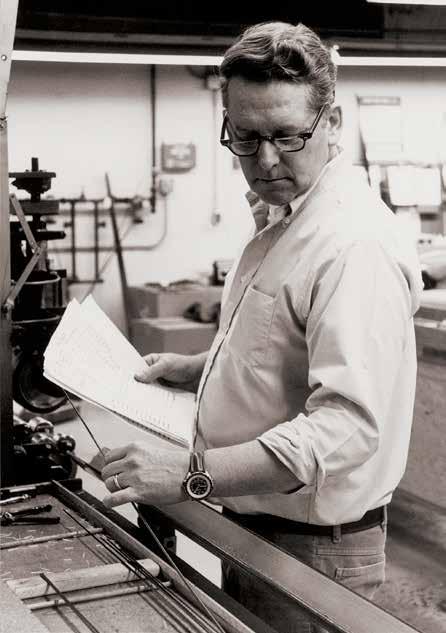
casters, who preferred a much stiffer rod with a steep taper and a lighter tip, which made longer casts possible.
Howard Steere resisted this trend for a number of reasons. One was that an abiding tenet of Orvis rods manufacturing was that we didn’t want to build rods that were fragile. This philosophy dated back to the Wes Jordan bamboo days. Wes did everything he could to avoid needless repairs. Joe Brooks, Leigh Wulff and others used Orvis bamboo rods to catch bonefish, permit and even smaller tarpon. Howard followed the same philosophy and even though he knew he could construct graphite rods with lighter tips, he avoided those tapers and the newer, higher modulus materials because those materials were more brittle.
In 1984, the Orvis rod shop team set a milestone—the world’s first 2-weight fly rod, the 7-foot 9-inch “Ultrafine.” At the time, a 2-weight fly line was not even made and sold by any fly line company, and Orvis had to reach out to 3M/ Scientific Anglers (which made many of the Orvis lines for years and would eventually be acquired by Orvis) to make a 2-weight line to our specifications. It was a great rod and a lot of fun to fish, and I still own two of them—although the new Superfine 7-foot 9-inch 2-weight, with its more modern taper, lighter tip and much better levered weight, is far superior. In 1988, Orvis followed this up with the One-Weight, another industry first and although it was a specialized rod, it made a big difference in late summer, low-water conditions.
Building on that, in 1991, Leigh Perkins asked Howard Steere to make a rod that would only weigh one ounce. It would be the world’s lightest production fly rod. This 6 ½-foot 2-weight was more of a novelty and although it would catch fish in small streams, it was not the best-casting rod. It required a lot of effort on the part of the caster to throw a decent loop. But Howard got the weight down to a single ounce.
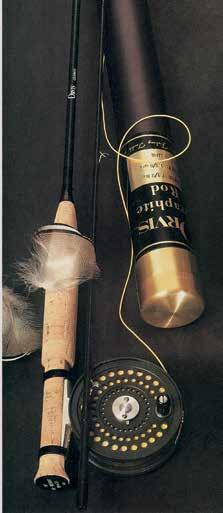
At the same time, Orvis was frustrated by the success of other rod companies, mainly from the West Coast and Rocky Mountains. The public desired faster, stiffer rods and most rods were evaluated by the “wiggle test” inside a store and then going outside and attempting to cast an entire line. Orvis rods were great fishing tools, but they didn’t have the shelf appeal or the distance advantage of the stiffer rods.
The first attempt was in 1984 with the introduction of the “Western Series.” These rods did have a stiffer butt section and as a result slightly higher line speed. One all-time favorite was the 8 ½-foot 5-weight “Henry’s Fork” but it still retained a heavier tip characteristic, so it did not pass the wiggle test as well as rods from Sage or Winston could.
Meanwhile, in the 1980s, a revolution was occurring on the other side of the country, heavily influenced by tournament casters, who preferred a much stiffer rod with a steep taper and a lighter tip, which made longer casts possible.
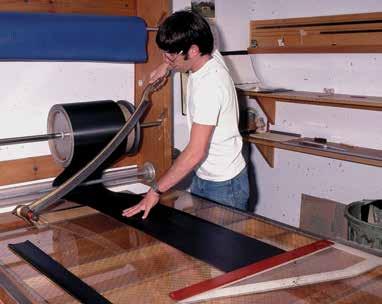

But Orvis kept trying, with later series like the HLS (high line speed) in 1990, HLS2 in 1996, and PM-10 in 1993. Each series got a bit better, but Orvis just could not catch up to the competition, based mainly on the refusal to make tips that were lighter and the tapers that would support a lighter tip. I remember many days sitting in Howard Steere’s office bumming cigarettes from him and trying to talk him into making a rod with a faster taper. He did make each series a bit faster but just not fast enough. And Orvis was still losing the levered weight comparison.
Perk Perkins: The 25-Year Guarantee and the Flex Index
But Orvis was still leading the industry in other aspects of fly-rod marketing.
who admitted he killed a rattlesnake on a railroad track using his rod and broke the tip. Once it was free customers were much more inclined to tell the real story. Soon, bowing to pressure, other rod manufacturers followed with similar guarantees although much later, in the 2010s, most, including Orvis, began to charge a service fee for the repair.
Perk had another good idea to help consumers distinguish between rod tapers and actions. Rods had always been classified as “fast,” “slow” or “medium” action but no one agreed on exactly what those terms meant. Some anglers called any stiff rod “fast.” Other considered a rod that bent much more toward the tip than butt of the rod “fast.” But there was no standard and little agreement. Rather than relying
Most of the other companies were sanding and painting their blanks, but until 1996 Orvis relied on its “honorable scar,” or ridges left after a rod was cured in an oven and wrapped with heat shrink tape.
In 1988, Perk Perkins, who was soon to take over the reins of the company from his father Leigh, realized that nearly every rod repair we did was at no charge. “The customer would just tell you it broke in casting even though you could see the tire marks on it,” he told me. “So why not repair all the rods for free and tell people we would repair or replace them for free for 25 years? We weren’t getting any marketing credit prior to this. And after we implemented it, rod repairs only went up 20 percent. “Why not make it lifetime?” That suggestion came from legal advisors for “liability reasons.”
Perk continued, “It was eye opening to then see how honest our customers became. Prior to that, the rod shop would see vertical breaks and knew damn well that a rod was slammed by a door. But after we implemented the guarantee, we’d get stories like the guy
on subjective descriptions, Perk wanted to come with a numerical system that would describe in objective terms how a rod flexed. He had seen the principle applied to tennis racquets and felt the same principle could apply to fly rods. This was easier said than done because a system had to be developed and every Orvis rod had to be measured.
When it was finally done, for 1998 and until 2010, each Orvis rod had a designator like “Mid 7.5” to describe its action. In many cases, one rod model would be offered in two different flex indexes so the customer had a choice. But this system caused more confusion amongst customers than expected, and contrary to what Perk had hoped, the industry did not embrace the system at all. In 2011 the system was simplified so that each rod had a “full”, “mid” or “tip” flex rating. But again, the problem with this was that it did not tell a customer what a rod could do, only the way it flexed. Today, the F (shorter casts, more versatile, finesse fishing) and D (distance, casting and lifting power) designations do a bit more
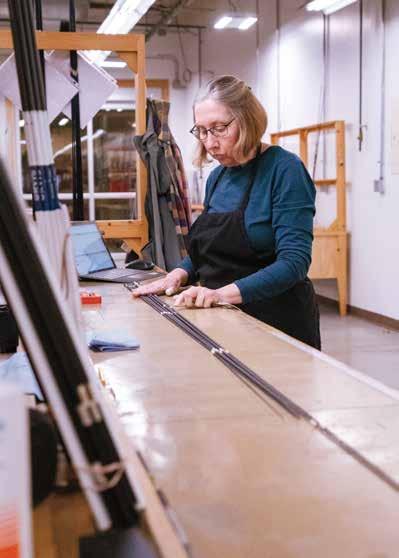
to help a customer make a choice because they describe how a rod is used instead of how it flexes.
One place Orvis remained behind was in the sanding of blanks to create a smooth, polished finish. Most of the other companies were sanding and painting their blanks, but until 1996 Orvis relied on its “honorable scar,” or ridges left after a rod was cured in an oven and wrapped with heat shrink tape. Orvis was losing market share to rods that were more appealing on a rod rack but Leigh Perkins refused to let the rod shop sand the blanks. And Howard Steere also resisted it because it added cost and labor. But finally Perk and Jim Lepage convinced Leigh that we were missing out, and the first sanded blank, the HLS2, premiered in 1996.
In 1995, Howard Steere retired, and Jim Logan was hired to run the rod shop. Jim had seen thermoplastic resins used in tennis racquets and realized these were superior resins to hold the graphite fibers together. Jim spent several years testing the material and building prototypes, and the first rod to use this material was the T-3, introduced in 2002. It was a stronger, stiffer rod and a huge hit with customers.
Jim wanted to bring superior rods to the Orvis lineup and realized that the rod shop had not bought any updated machinery or new mandrels (the stainless steel, reusable tapered rods that the graphite is rolled around) for 20 years. No new mandrels, no new rod tapers. Jim proceeded to spend $1.1 million
on updates to the shop, prompting Tom Vaccaro, the CFO, to blast into his office yelling “You’re spending money like a drunken sailor.” But the rods under Jim’s tenure got better, equal to what the competition was putting both in action and in shelf appeal.
Jim and Frank Hoard, rod design engineer and now plant manager in the rod shop, had some essential help in both sourcing and utilizing the new graphite/ thermoplastic resin composite. John Hattayer worked for a defense contractor and helped them obtain the materials, by tacking on some extra to an order for a particular defense contractor and then selling it to Orvis. (At the time, some of these materials were not available outside of the defense industry.) “John loved working with Orvis as opposed to
working with defense contractors,” Frank Hoard told me, “Because we got quick results as opposed to working with the Pentagon bureaucracy.” When I asked him if he thought some of the materials we were using, which were going into F16s and Apache helicopters, were classified, Frank said, “John told me as long as it flies, I can work on whatever I want.”
Helios and the dampening, lightweight, strength revolution
Orvis introduced the Helios rod in 2009 and we still consider the recent iterations to be the best fly rods in the world. Jim incorporated two new techniques into the Helios—thermoplastic, thermoset resins, which were stronger and even more reliable. Just as important was the use of graphite scrim instead of fiberglass scrim. Scrim is a layer of material added to the graphite blank to add toughness and increase hoop strength. Prior to the Helios, fiberglass scrim was used because it is a very strong and flexible material. Its only problem was weight, as fiberglass has a much higher aerial weight per fiber than graphite. The resulting rods were just as strong as older models but considerably lighter. In fact, the goal with the Helios series was to build the world’s lightest rod.
Helios 2 continued the progress made with the first Helios rods but modified tapers and also increased the strength of the rods—always a consideration with lightweight rods with fine tips.
With Helios 3, the rod shop worked to develop the world’s most accurate rod by improving the damping characteristics of this long, flexible tube.
Back in 1994 I got a call from a guy with a soft voice who claimed to work on nuclear submarines and had an idea for dampening fly rods. At first, I thought it was a friend pulling my leg with a crank call, but the more I talked to him I realized he was dead serious. Not being an engineer or rod designer, I passed him onto Jim Lepage and Howard Steere, who saw the potential and invited him to Vermont. The technique he devised was
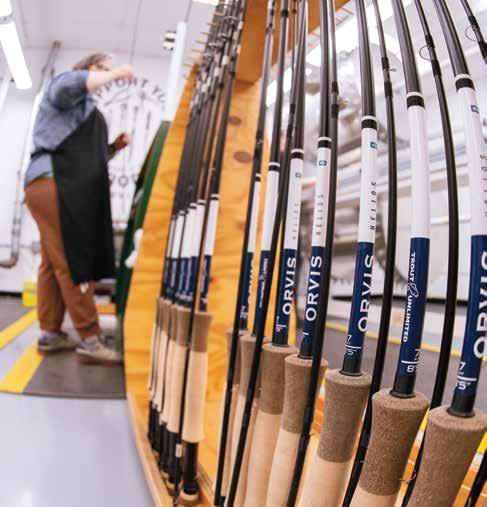
the addition of a “noodle” of dampening material into the tip of the rod and the Trident series (named after the sub series, obviously) was introduced in 1996.
The only problem was that adding that material to the tip of the rod made them extremely tip-heavy and the public hated them. So, in 1997 they tried adding the damping material to the grip instead of the tip section and called this rod the Trident PM10+. The grip dampening didn’t do much, so we stopped adding the material to the grips a year later.
Back to the modern Helios story, the rod designers devised a machine using high speed photography and a unique computer program to graphically monitor the way a fly rod dampened, not only the amplitude it deflected after the cast was completed but also the time it took for the rod tip to come to rest. This informed the design process, and after much experimentation with tapers, graphite fiber and scrim with different properties,
and lots of testing in the field, the Helios 3 was born and touted as “The world’s most accurate rod.” And we had the data to prove it, which no one had ever quantified before, beyond saying that “a rod “tracked well.”
The fourth generation of Helios rods, now just called Helios instead of Helios 4, further improved the tapers for better dampening (tracking) and improved the strength of the rods, both from an impact resistance and tensile strength when pushed almost beyond their limits with a large fish running under a boat.
Don Swanson— precision tolerances and interchangeable parts
Jim Logan retired in 2015 to spend more time on his beloved Battenkill and Missouri River, and to chase striped bass off Cape Cod. Orvis hired Don Swanson, who had previously been the president and minority owner of the Abel Reel
facility in California. Don quickly began a project that has set Orvis apart. With the Helios series, Orvis went to a true tip-over-butt construction, where the taper of the female section of a rod would mate seamlessly with the male section. This, of course, added complexity to the design taper of each rod but many problems were solved with a precision CNC pattern cutter that would cut the graphite flags exactly to the designed taper, instead of relying on a straight edge and a razor blade guided by human hands. Then, to ensure that each rod section was made to precision tolerances and rod sections of the same model would be interchangeable, Don invested in other new production machinery, including precision tooling that he engineered

to ensure that the outside and inside diameters of the sections fell within a .001-inch tolerance. Prior to this, tolerances in the ferrules were between 15 and 20 thousandths of an inch. If a customer broke a section of their rod, it had to be sent back to the rod shop because the sections would have to be hand-fitted. The result was a huge boon to rod repair because a customer can now just fill out a form on the Orvis web site and have a new rod section that will fit perfectly, without the need to mail a rod back and forth.
It’s difficult to predict the future of graphite rods, and perhaps a new material will bubble to the top of research into new composites. The Orvis rod shop has always
looked four or five years into the future as it takes at least two years to develop rod models and a number of years prior to that if new materials are on the horizon. They’re most likely looking at a new rod material right now but they won’t share it until they’re satisfied. The Orvis rod shop has always been in one town, Manchester Vermont, since 1856. The Orvis graphite fly rod has been developed under the guidance of a single family, the Perkins family, now in its third generation with Simon Perkins at the helm. And throughout these generations, the Perkins (all not just serious fly fishers but geeky, passionate anglers who chase fish in their back yards and around the world as intensely as any “influencer” but quietly and without fanfare). You won’t see them bragging on social media.
The Orvis rod shop has always looked four or five years into the future as it takes at least two years to develop rod models and a number of years prior to that if new materials are on the horizon.
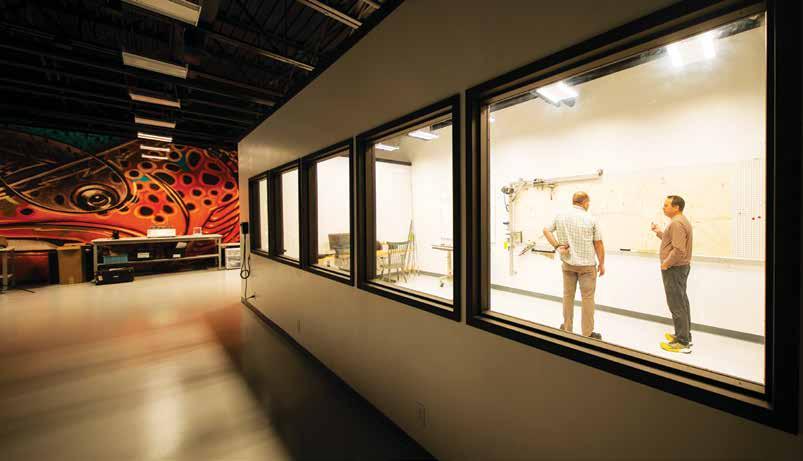
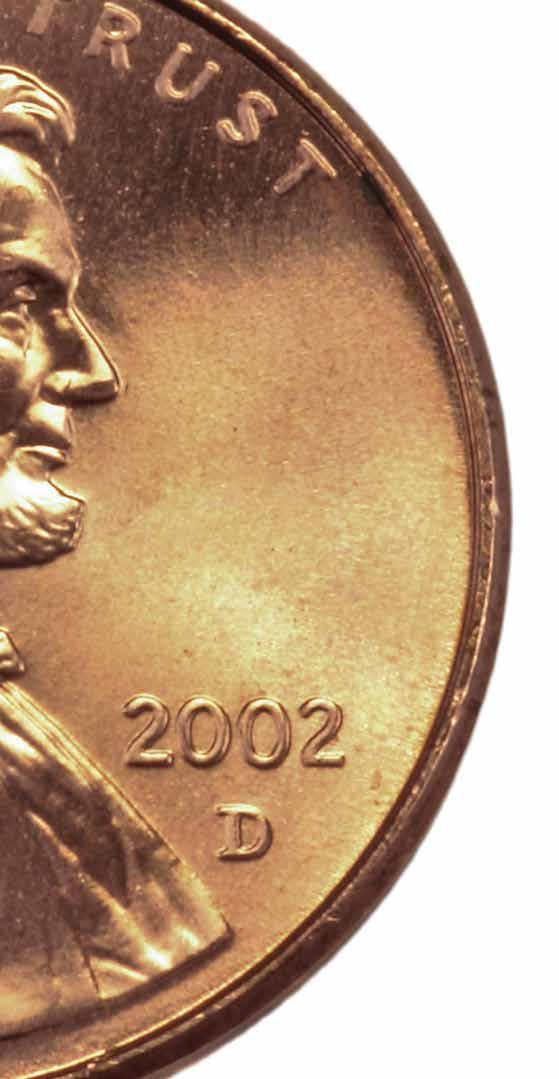
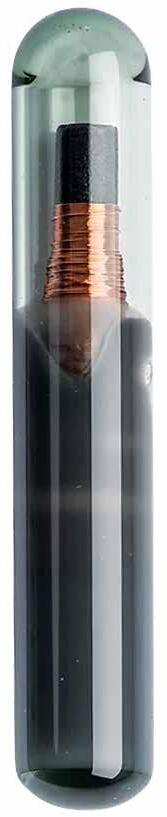
SCIENTISTS
BY CHRISTINE PETERSON
Fish conservation has always required boots on the ground. Humans remove culverts to help trout swim up and down streams; build beaver dam analogues to restore wetlands and yearlong water flows; and electrofish rivers to survey for populations.
No amount of technological advances can replace on-the-ground habitat work. But recent innovations have given the hands that do that hard work a boost. In the last few decades, the ways managers have surveyed for fish populations, fought invasive species and in general understood our fisheries and the waters they occupy have dramatically improved.
And an improved understanding helps them manage better.
But many of these technologies, innovations and yes, even artificial intelligence, may fall under the radar of the average angler pursuing the species that get them out of bed in the morning. So here is a look at some of the promising and possibly lesser-known trout conservation advances in the last couple of decades.
As futuristic as this might sound, imagine pumping water out of a clear, clean stream across a filter, and then later reading the results from a lab telling you exactly what species of fish, snail or insect occupy that stretch of river. Not only is that possible, but the practice has become almost routine by fisheries managers across the country.
eDNA, which stands for environmental DNA, parses out the genetic signatures left behind in water from plants, animals
Invasive species have long been a problem for trout conservation as fish like brook and rainbow trout invade western streams and outcompete or hybridize with native fish. The impact of invasive species can be so severe that managers have often turned to draconian solutions such as the poison rotenone that kills all fish in a stream, allowing managers to reintroduce native species.
Now researchers think they may have another tool in the battle with invasive

and microbes, allowing managers to survey fish populations without ever setting eyes on the fish themselves. The technology has been particularly useful for species that are hard to find like bull trout, or for detecting invasive species like zebra and quagga mussels and nonnative trout species.
The practice is also advancing quickly. A 2024 paper published in The Canadian Journal of Fisheries and Aquatic Sciences used data collected from citizen scientists, including a local Washington Trout Unlimited chapter, to create a more efficient and reliable species detection method especially for rare and endangered species. The new method allowed researchers to study an entire basin and document, in a cost-effective way, hardto-find species like coastal cutthroat trout, a variety of salmon, bull trout and Pacific lamprey. It also eliminates the need for a sampling permit.
species. All males carry X and Y chromosomes, allowing them to produce both male and female offspring. But researchers have developed a way to produce fish with only YY chromosomes, which means when they breed with a female, the offspring is only male. The idea is that, over time, enough YY males are introduced into a population that the resulting offspring are exclusively male and will, overtime, shrink the nonnative populations.
“It’s not been fully successful yet but conceptually should work and some good studies are going on right now,” said Helen Neville, Trout Unlimited’s senior scientist. “Eventually it would cut down on the need for manual removal.”
This can also only be done in areas where species cannot interbreed. But that means releasing YY males could be a possible solution for streams in, say, the western U.S. where brook trout are outcompeting native cutthroat trout.
While most of us wring our hands at every news alert about artificial intelligence, managers are finding a way to use deep learning to their advantage. Like most AI, these ideas are still in their infancy but progressing quickly and giving researchers like Neville some hope for current and future projects.
Trout Unlimited, the U.S. Geological Survey and On Water recently unveiled an app called TroutSpotter, run by Conservation X, where users upload pictures of trout they catch, and the program identifies and logs each trout by its unique spot pattern. When the fish is inevitably caught by that angler or someone else later, and another picture is uploaded, the program will notify biologists (at least that’s the ultimate goal). It’s another version of what researchers call mark and recapture, which has been a staple for wildlife and fisheries management for decades and gives managers insight into fish movement and survival rates to help with population estimates. And now with TroutSpotter, anglers themselves are lending a hand by doing what they love most: catching fish, taking pictures and sending those fish back into the water.
Managers are also using deep learning models focused on pattern recognition to try to identify culverts and other impediments to fish passage.
Tucked inside fish swimming freely through lakes and streams are trackers as thin as pieces of mechanical pencil lead. When the fish swim past receivers—likely planted in a stream bank or on the bottom of a lake—the chips activate and send signals to biologists who can track their movements. The tiny trackers are a feat of modern fish tracking technology, and just one of many to evolve in the last couple of decades, said Emma Lundberg, Trout Unlimited’s aquatic resiliency scientist.

Lake trout and suckers in the Great Lakes have been fitted with acoustic monitors that send regular signals to a grid of telemetry receivers across multiple lakes. Unlike the tiniest trackers, which operate like a chip in your pet dog or cat, the acoustic monitors include their own batteries allowing constant collection and transmission of data. And only with advanced battery technology have the trackers become possible for a range of fish species and body types including small juveniles.
Yet another new tracker uses power from a tiny battery to record water temperatures. The trackers can last up to a year, giving researchers a picture of where fish spend their time and how they find pockets of cool water as the climate continues to change.
Sometimes controlling invasive species requires little more than some romantic trickery. Sea lamprey made their way through shipping canals from the Atlantic Ocean into the Great Lakes in the 1830s. There, the snake-like creatures with mouths straight out of the movie Dune, attached themselves to native fish like lake trout, whitefish and ciscoes. The parasitic species literally sucked the life out of so many lake trout that harvest in the upper Great Lakes went from 15 million pounds a year in the 1940s to 300,000 pounds by the 1960s, according to the Great Lakes Fishery Commission.
Researchers developed ways to trap sea lamprey and began to control their numbers, slowly restoring fish populations. But the efforts have been “labor

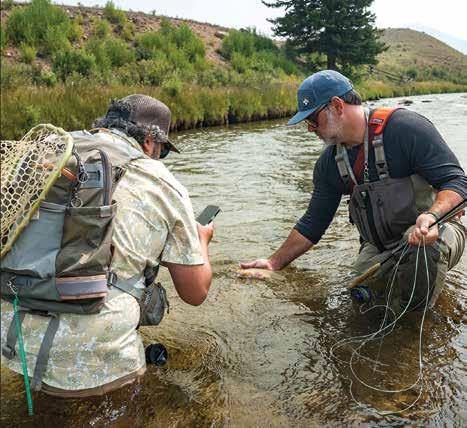
TROUT UNLIMITED, THE U.S. GEOLOGICAL SURVEY AND ON WATER RECENTLY UNVEILED AN APP CALLED TROUTSPOTTER, RUN BY CONSERVATION X, WHERE USERS UPLOAD PICTURES OF TROUT THEY CATCH, AND THE PROGRAM IDENTIFIES AND LOGS EACH TROUT BY ITS UNIQUE SPOT PATTERN.
and resource-intensive,” reports the U.S. Geological Survey.
So, scientists are turning to love—or at least sea lamprey sex lives. Sea lamprey males attract females by releasing a certain concoction of pheromones. Researchers can now synthetically
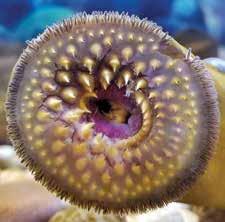
reproduce the pheromone, enabling them to bring female lamprey into traps and away from spawning beds.
Conversely, U.S. Geological Survey scientists at the Great Lakes Science Center also figured out how to reverse engineer sea lamprey hormones, turning them into a repellent, thus keeping the males and females from ever finding each other. The study showed a drop in spawning by 97 percent.
“If you’re able to do something that has a low impact on native species and still has the desirable impact of reducing an invasive species, that seems like an incredible opportunity,” Lundberg said. Similar techniques are also being used on invasive carp in Australia and the Great Lakes, and Lundberg said it could provide promise for many other destructive invaders.
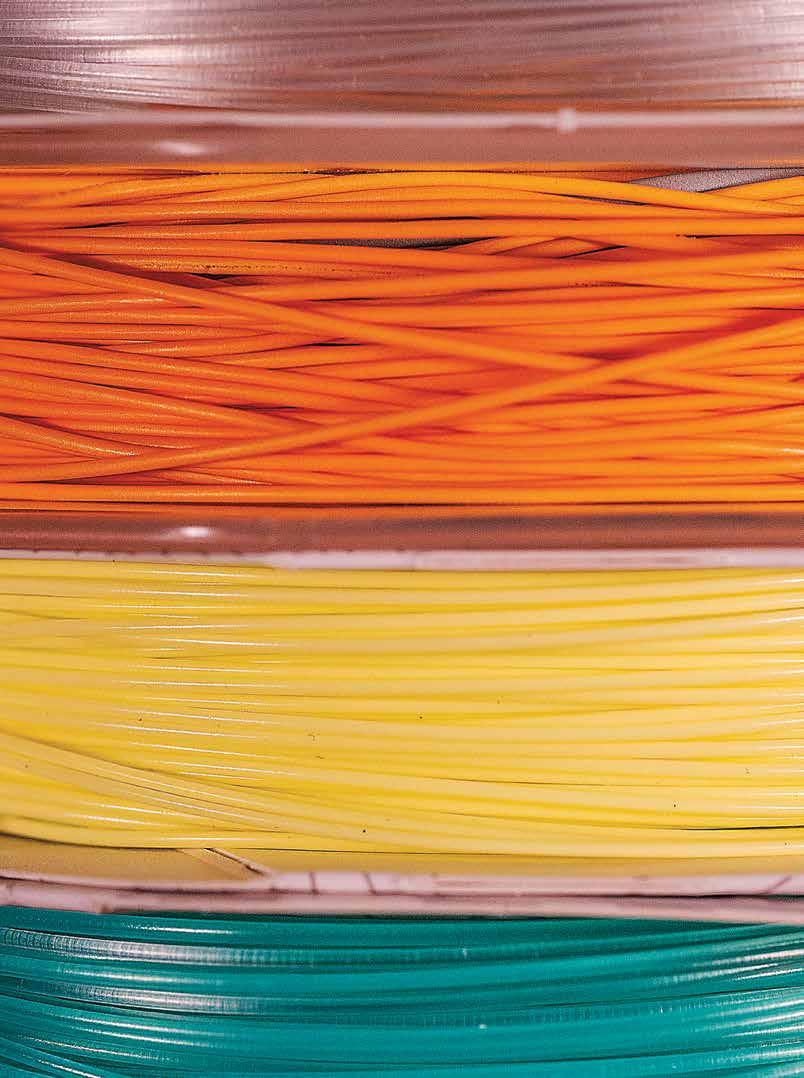
BY JON OSBORN
That’s a strong statement, considering today’s Ferrari-fast graphite rods, precision disc-drag reels, and waders that breathe more efficiently than an Olympic athlete. But without fly line, there could be no fly fishing. A fly line is the literal connection that makes the entire angling experience possible.
Before the 1950s, silk was the only option for fly anglers, and it required tedious applications of dressing to ensure buoyancy and lengthy drying out periods to prevent rot. But that all took a turn when Leon Martuch, Clare Harris and Paul
Rottiers founded Scientific Anglers in 1945. Before long, the Michiganbased company was a global leader in fly-line production, and for the last 80 years, they’ve been at the forefront of innovation.
The story follows a winding route, and it’s a history sharpened by experience. By 1952, SA had developed a prototype PVCcoated fly line, and a few years later, they introduced Air Cel, which is recognized across the industry as the first modern floating fly line. But Scientific Anglers were just building up steam. A sinking line known as Wet Cel followed shortly thereafter.
*( Editor’s note: in 1959, an organization dedicated to improving and protecting trout habitat was formed in Michigan… and Scientific Anglers became one of Trout Unlimited’s first and strongest supporters…
There have been other notable touchstones along the way. For starters, silicone was integrated as a line lubricant, and AST (advanced shooting technology) was added to some models, greatly enhanc ing slickness and durability. Intense research and develop ment led to AST+, an additive that’s impregnated into instead of simply adhered to the coating, which further improves performance.
Today, Scientific Anglers remains committed to inno vation, employing a team of 36 employees at its Midland facility. Women comprise half of SA’s workforce. A friendly, knowledgeable customer-service team is available for in-person or online discussions about fly lines for every angling adventure.
Joe Wolthuis is the company’s mar keting manager. “Scientific Anglers is big business within the world of fly fishing, but in a global manufacturing sense, we’re relatively modest,” he explained. “Being a smaller company also allows us to focus some of our efforts on education
and conservation through programs like the Trout Unlimited youth camps and Fish for Change. Our goal is to help sustain fisheries wherever and however we can.”
Erick Johnson is the customer experience supervisor. Affectionately known to friends and coworkers as “Moose,” he noted that the industry has changed a lot over the years. “Prior to polymer lines, options were limited,” Moose said, “but now there are so many taper profiles to choose from, mostly because modern streamers are larger and heavier than they were in years past. Think about a Circus Peanut compared to a Wooly Bugger.”
Currently, SA offers 70 different line models.
“All those options can seem overwhelming at first,” Joe added. “We get
Take striped bass for instance. Water temperature, casting range, fly type and wind resistance were taken into consideration during the line-development process, and the outcome was Amplitude Smooth Striper, a line created specifically for fishing the Upper Atlantic environment. It’s two times heavier than standard line, with a powerful head for turning over large flies, and AST+ for longer casts.
“Our cold-water coatings and cores are suppler for species like striped bass and steelhead, whereas our tropical coatings and cores are stiffer and better suited for warmer fisheries like the bonefish flats,” Moose further explained. “Then there are hybrid Bass-Bug tapers with a cold-water core and a warm-water coating designed to perform across a wide range of temperatures.
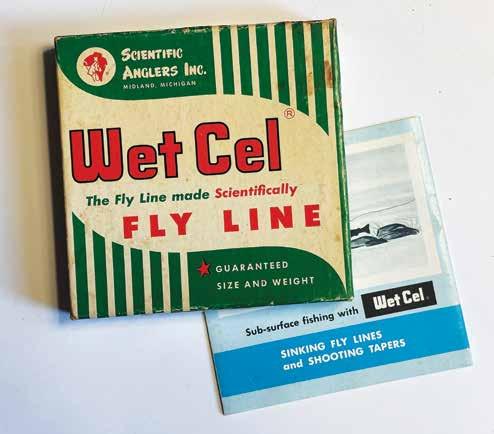
ries a wide range of species-specific options, such as “Striper,” “Bass Bug” and “Anadro.” That’s not just creative marketing. The intention is to simplify the selection process by grouping variables such as seasons, fishery-types and expected temperature ranges.
Quality fly line is an investment, plain and simple. You get what you pay for, but if you’ve ever wondered why a certain brand or model costs more than another, you’re not alone.
“The short answer is that there’s less tech incorporated into economy lines,” Moose explained.
“For instance, our Air Cell series has a basic five-foot front taper, 30 feet of belly and a five-foot rear taper. The coating doesn’t have any slickness or durability additives.” They’re still good lines, but they have less bells and whistles, which is why they retail for $39.95 per spool.
Next, there’s the Mastery Series. At double the cost, there’s noticeably more options incorporated into the materials, like AST for enhanced slickness and shootability. In addition, the line ID is conveniently printed on the front taper, and the head and running sections are contrasting colors, allowing for easier
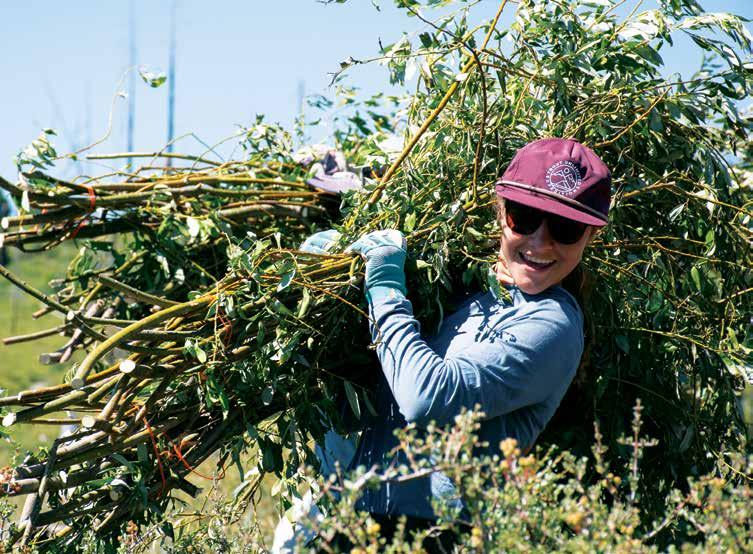
“Being a smaller company also allows us to focus some of our efforts on education and conservation through programs like the Trout Unlimited youth camps and Fish for Change. Our goal is to help sustain fisheries wherever and however we can.” —Joe Wolthuis
pickup and mending. Then there’s the textured Amplitude series with AST+, an additive that floats, shoots and mends better than the other models, plus it’s highly durable.
Clearly, features and benefits improve with cost, but what’s the expected lifespan of a fly line? That’s a loaded question, according to Moose. Stats say the average angler takes five to seven day-long fishing trips per year, but frequency of use isn’t the only factor at
play. Variables like water quality and maintenance affect durability as well. “A musky angler won’t get as much life out of a line as the average trout fisherman because they’re basically casting a wet sock full of pennies,” Moose said.
“Think of it like truck tires,” Joe added. “Longevity depends upon whether you’re driving on gravel or pavement, and if you’re getting regular rotations. There are just so many dynamics involved.”
In short, a little care goes a long way.
With that in mind, Moose offered some tips for extending fly-line life:
1. Clean line performs best but avoid products like Armor All. It sounds counterintuitive, but these additives fill in the textured dimples (imagine a golf ball), essentially increasing friction, which defeats the purpose. Realize, too, that different lines require different care. With the Amplitude series, remove a micro layer from the
coating using a mild abrasive pad to expose the AST+, which lubricates the line. You can overdo a good thing if you’re not careful, however. Sandpaper and Brillo pads aren’t suitable, so stick with products intended for fly line.
2. Chemicals like DEET-based insect repellent, sunscreen and gasoline break down plastic lines. They’re commonplace in boats and fishing vests, so keep the away from fly line whenever possible.
3. Speaking of boats, mind the prop. Even electric motors can shred fly line.
4. Casting on a lawn or in a parking lot inevitably picks up abrasion and grit, damaging line. Casting without a leader isn’t recommended, either. The end of the line attains incredible veloc ity (like a bullwhip), and the welded loop absorbs all the abuse, leading to cracking and fraying.
5. Avoid storing lines in direct sunlight. Some UV exposure is bound to occur (like, in a drift boat), but leaving a strung-up rod against a cabin wall or in a hot vehicle day after day will definitely reduce longevity.
Environmental concerns are a hot topic these days, and rightfully so. Midland is home to Dow Chemical, a company that once produced mustard gas, Agent Orange and napalm. Not surprisingly, surrounding rivers like the Saginaw and Tittabawassee are superfund sites. Scientific Anglers is committed to minimizing their environmental impact, although they acknowledge that waste is an unfortunate byproduct of industry. The key then, is reduction, a process that starts with longevity. In other words, the longer a line lasts, the less often it needs to be replaced, and that means less plastic headed to the landfill. Another push comes with packaging. In 2022, SA switched from plastic to cardboard line spools after discovering
Since moving to cardboard, they’ve saved over 27 tons of single-use plastic. Read that again. Not pounds, tons.
that 80 to 90 percent of them wound up in the trash. What’s more, traditional fly-line spools contain as much plastic as two, 90-foot, five-weight lines. Since moving to cardboard, they’ve saved over 27 tons of single-use plastic. Read that again. Not pounds, tons.
Also, their Absolute leaders are packaged in paper with a soy-based window. “At first, that didn’t seem like a big deal,” Wolthuis said, “but over several years, it made a huge difference. We’re always looking to improve our internal impact in shipping and production chains and always trying to reduce and re-use. An advantage we didn’t necessarily anticipate is that our competitors evolved along with us, which means the industry is improving, overall.”
The team at Scientific Anglers are the movers and the shakers of the fly-line industry, but they keep trade secrets and future endeavors under their hat. “We’re always improving durability, slickness, and performance,” Wolthuis said, almost with an implied wink and a nod. “Let’s put it this way, the future is in material science,” Moose insinuated. Either way, odds are strong that the innovative minds at SA have some great ideas brewing. Fly fishing is all about connection—to the outdoors, with family and friends, and sometimes, on the luckiest days, even with a memorable fish. Scientific Anglers has been at the forefront of fly-line innovation since the beginning, and today they continue pushing creative boundaries to ensure their lines are the strongest and most durable in the business.
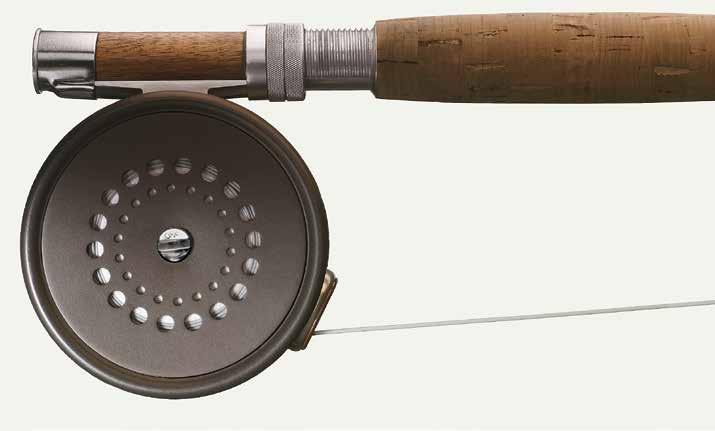
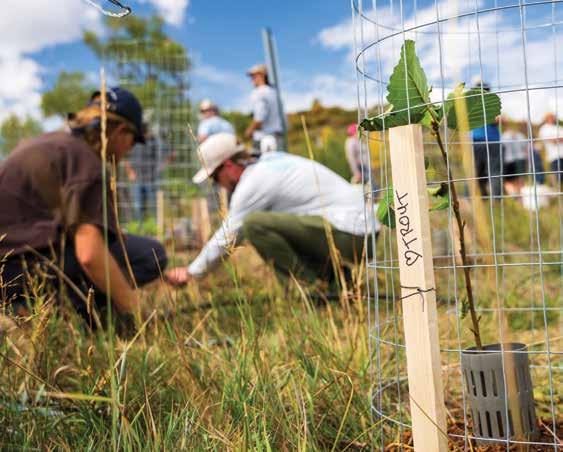
Saturdays
90 students from across the western U.S. come together in Steamboat Springs, Colorado for the 5 Rivers program.
pg 74
Colorado Trout Unlimited’s River Conservation and Fly Fishing Camp celebrates 20 years.
pg 76
Lead Like a Champion, Regional Rendezvous Events, TU Trainings and more.
pg 78
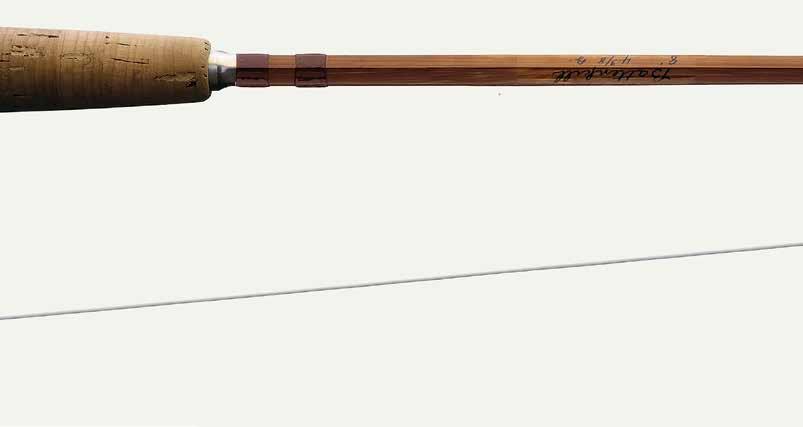
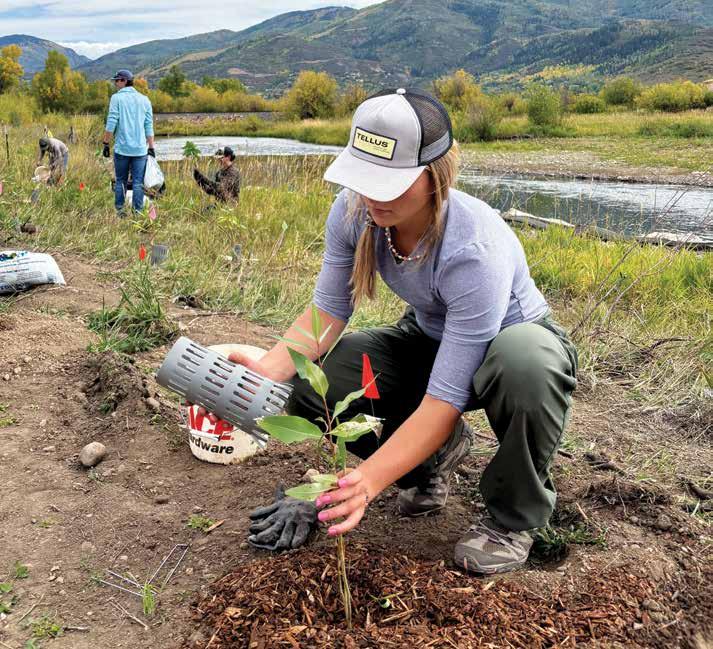
What were you doing on Saturday mornings as a college student? If planting trees was your answer, you might be a 5 Rivers alumnus. If catching wild and native trout with a heap of other college anglers was your answer, you might be a 5 Rivers alumnus. And, if preparing for your college’s D1 football game while nursing a hangover was your answer, you might also be a 5 Rivers alumnus.
This fall, in Steamboat Springs, Colorado, the 5 Rivers program was on display in all its glory as 90 students from across the western U.S. came together to plant trees, fish for trout and form new friendships—despite college football rivalries.
Hailing from the University of Utah, Colorado State University, CU Boulder, Colorado School of Mines and the University of Wyoming, this crew planted an impres-
sive 240 native trees along the banks of the Yampa River. By improving streamside habitat and lowering water temperatures during the hot summer months, these trees will play a vital role. For years to come, they’ll support countless anglers’ success on this river—and these college anglers are to thank.
“It’s a privilege to be here, and that comes with a responsibility to give back and protect the waters we fish,” says Tyler Schrott,
President, CU Boulder Fly Fishing Club. “My hope is that the next freshman who comes to CU Boulder has the same opportunity I was given to fall in love with fly fishing.”
The sentiment that Tyler brings to the table runs strong through the 5 Rivers program as conservation-minded anglers across the country bring the TU mission to life on their college campuses.
After the planting was complete, students eagerly rigged up their rods and took to the river in pursuit of the fish they love to protect. A few were caught, but the need for conservation work felt imminent as water levels were low after a historically hot and dry summer for the Yampa Valley.
“Fishing is a getaway, and a getaway with good company makes it so much sweeter,”
says Faith Beard, Social Media Manager, CSU Fly Fishing Club. “You can really feel the joy that fishing provides, and being able to share that experience with others makes catching fish a huge plus!”
This desire to build community and conservation ethics through fly fishing can be found on every one of the over 80 campuses that have 5 Rivers clubs. From Florida to Washington, and Arizona to Maine, college anglers are doing their part to care for wild and native trout and salmon.
No matter how you spend your Saturday mornings, we’d love to have you join us! If you’d like to get involved, reach out to TU Youth Fly Fishing Programs Manager, Cliff Watson, at clifford.watson@tu.org.
This fall, in Steamboat Springs, Colorado, the 5 Rivers program was on display in all its glory as 90 students from across the western U.S. came together to plant trees, fish for trout and form new friendships.
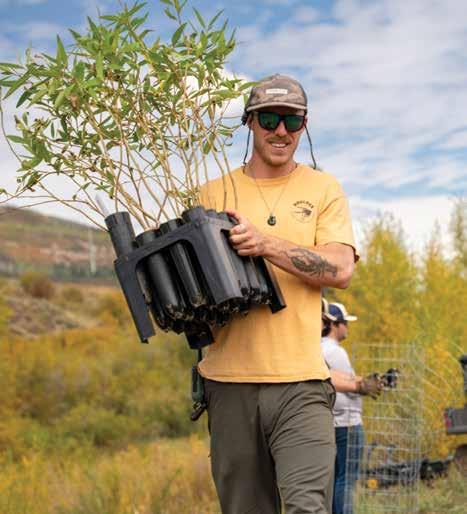
Send us a 300-500 word write up on your projects and events along with a photo or two and you could see your chapter in the pages of TROUT. Send your submission to Samantha. Baldensperger@tu.org.

Colorado Trout Unlimited’s River Conservation and Fly Fishing Camp
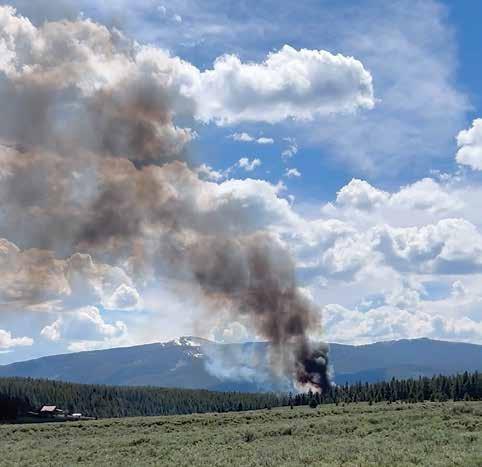
BY SAMANTHA BALDENSPERGER
This year marked the 20th anniversary of Colorado Trout Unlimited’s River Conservation and Fly Fishing Camp, an incredible milestone in a program that has impacted hundreds of youth and helped build the next generation of conservation minded anglers.
Between celebrating this legacy, navigating a wildfire evacuation and embracing the joy of fishing, friendship and environmental learning, the 2025 camp will go down as one of our most memorable yet.
On Sunday, June 8, 23 campers from across Colorado and New Mexico
arrived at AEI Base Camp in Almont, Colorado, ready for a week of fly fishing, leadership development, river conservation and fun. Many of these campers were meeting each other for the first time. For some, it was their first time sleeping in a tent, being this high in altitude (over 10,000 feet) or spending an extended time away from family. It takes courage to show up, and they did.
Welcoming them were over 20 camp counselors and volunteers, a powerhouse team of anglers, environmental educators, conservation professionals and camp alumni. Several counselors have returned year after year, some for
more than 18 years, a testament to the lasting impact of this program and the community it creates.
What none of us expected was the wildfire.
On Monday afternoon, during a fishing outing at AEI’s ponds and along Illinois Creek, campers and counselors noticed smoke in the distance. Within minutes, what started as haze turned into a visible fire. Thanks to the quick thinking of our lead counselors, camp director and AEI staff, and the solid evacuation plan we had practiced earlier that day, we safely evacuated all campers, counselors and volunteers within 30 minutes.
Everyone remained calm, communicative and compassionate, an incredible reflection of the trust and training built over two decades. That night, the Red Cross graciously provided shelter, food and supplies at the Gunnison Fairgrounds. Thankfully, the winds shifted in our favor, and the fire was contained. We returned to camp the following afternoon and were able to resume programming that evening. What followed was a remarkable week of connection, growth and joy. Campers built Beaver Deceivers to help with stream restoration, visited Roaring Judy Fish Hatchery, spent time honing their fly-fishing skills on local waters, and built friendships that will last far beyond summer.
This year reinforced what many of us already knew: the strength of this camp lies in the people behind it.
For 20 years, CTU camp directors, counselors, volunteers and partner organizations have poured their hearts into building not just a memorable experience, but a safe one. From developing evacuation protocols to refining staff training and building strong support systems for campers, their efforts were deeply felt this year.
To our 2025 camp counselors and volunteers, thank you. Your leadership, kindness, flexibility, humor and grace under pressure turned what could have been a traumatic experience into one defined by community, resilience and care. You showed up not just for the campers, but for each other.
We are deeply proud of you and forever grateful.
And to those who came before, who designed the systems, built the traditions and gave generously of their time and talents, your legacy is alive and well. You made this year’s camp possible.
Here’s to the next 20 years.
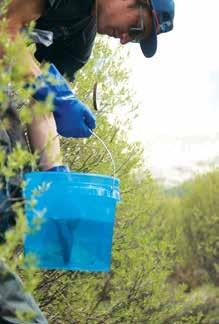
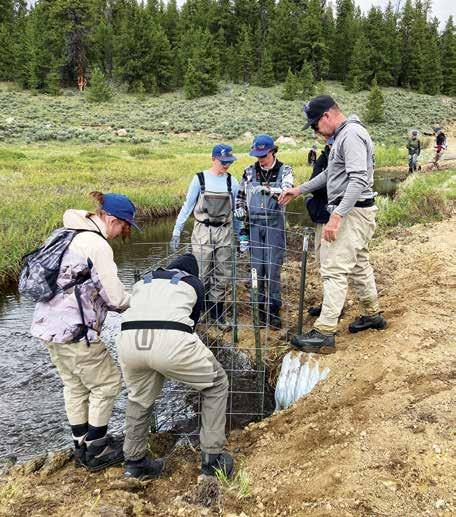
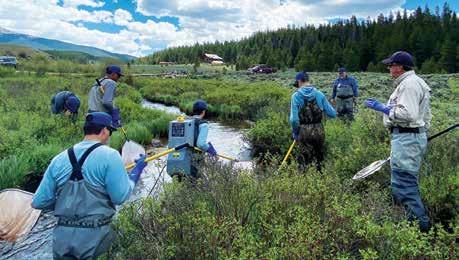
[ BY JEFF YATES ] Director of Volunteer Operations
Every river needs a champion, and every local TU chapter needs volunteer leaders to guide and direct the impact of that volunteer effort.
Each year, TU benefits from the energy and passion of thousands of conservationists and anglers who contribute
24/7
more than 650,000 volunteer hours on stream cleanups, tree plantings, youth events, programs for veterans and more. Behind each of those opportunities are the chapter and council leaders and volunteers who step up to coordinate, plan and manage activities.
As we work to grow the number of river champions, we’ll need even more people to rise to the occasion and fill the critical committee and board leadership roles that make our organization tick.
“It’s relatively easy to get people to turn out and volunteer three hours for a trash cleanup along a local river that they love,” said Q Collins, Director of Volunteer Operations. “What’s harder to find are volunteers who are willing to put in hours of time to plan that cleanup, coordinate the gloves and garbage bags, hang the posters, send event emails, post on social media and be at the event early to set up and welcome volunteers."
If you’re interested in joining a fun, friendly group of volunteer leaders who share your passion for conservation and making a difference, don’t hesitate to step forward this winter. Fill out our volunteer form at www.tu.org/volunteer and find and reach out to your local chapter at www.tu.org/ chapters.
TUstaff, partners and volunteers deliver monthly online training sessions on topics ranging from using phone apps to conduct community science on local rivers to chapter leadership strategies, youth education programs, tree planting, trash cleanup planning and more.
These trainings are a great way for current TU volunteers to deepen their chapter’s impact and can be a great entry for new volunteers looking for a way to make a difference locally.
Join us for a live session or catch up with a recording on a topic that interests you at www.tu.org/training



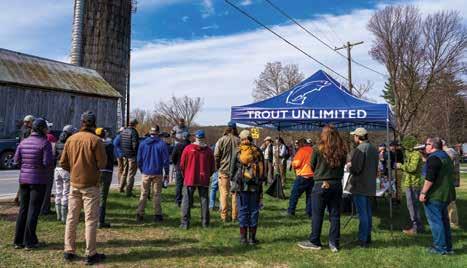
Join TU Supporters Like You for a Weekend of Learning, Networking and Fun!
TURegional Rendezvous are exciting weekends packed with conversations to grow your local conservation impact, camaraderie and networking with TU supporters and volunteers, a chance to meet and learn from TU staff and partners and meaningful opportunities to participate in hands-on projects.
At each Rendezvous, you’ll find:
• Inspiration & Learning: Gain valuable insights from experts and peers on coldwater conservation.
• Networking & Relationships: Meet fellow TU supporters and conservationists from across the region.
• Real Skills & Tools: Take home tactical and practical resources to grow and strengthen your impact locally.
• Fun Events & Fishing: Sign up for great fishing outings hosted by local TU volunteers.
Whether you’re a longtime volunteer or new to TU, this is an incredible oppor-
Whether you’re looking to find a fishing trip close to home, hoping to volunteer for a river restoration project, or simply interested in connecting socially, our online calendar at www.tu.org/events is a great place to start your search!
Even better, if you’re planning a trip and want to connect with the local TU community, the calendar offers an easy way to search for events across the country.
Check out the online options today, and if your local chapter doesn’t have any listings, you can get in touch with them directly to learn more. Find your local chapter at tu.org/chapters.
tunity to engage with our community and support TU’s mission.
Join us at one of these inspiring weekends:
Southeast Regional Rendezvous
March 13-15, 2026
Black Mountain, N.C.
Northeast Regional Rendezvous
April 10-12, 2026
Roscoe, N.Y.
Western Regional Rendezvous
April 17-19, 2026
Missoula, Mont.
Midwest Regional Rendezvous
May 1-3, 2026
Roscommon, Mich.
Full details and registration online at www.tu.org/regionals
All Regional Rendezvous events and talks are free to attend with the “meeting only” option on registration. Subsidies to support full registration and travel to the Rendezvous may be available for first-time attendees. Contact Lilly Knight for details.
You also won’t want to miss CX3 Twin Cities, TU’s biggest annual gathering, for fishing opportunities, a special conservation tour, great events, discussions and additional activities! This multi-day event has something for everyone and is the best way to celebrate our coldwater conservation mission together! Details at cx3.tu.org
BY CHRISTINE PETERSON
ou bent your knees and braced your back as another 50-mph gust roared over the granite peaks surrounding us and careened onto the lake before slamming into you.
The wind had been hitting us like this all day, creating cyclones at just under 11,000 feet that whipped up water and sprayed it across our faces.
You paused for a second, waited for the gust to pass, then picked your line up to cast again. The green and tan hopper your dad tied before we left plopped back down on the water. You watched, then twitched it a little, then looked up the lake to see when the next wind gust was coming and then twitched it again. Then slam, a Yellowstone cutthroat trout leapt out of the water and the hopper disappeared. Your line went tight, and you held the cork handle of your dad’s 4-weight as hard as you could with one hand while the other reeled in your line.
“Dad, I got another one!” you yelled. Your dad hopped from one boulder to another, granite rocks dropped thousands of years ago from glaciers as they slowly retreated back up the Wind River Range.
You gave him your rod, knelt down, pushed up your sleeves, dunked your hands in the water and grabbed the beautiful cutthroat. Seconds later, you’d popped the fly out of its mouth and slipped it back in the water.
You and I spend a lot of time talking about what makes fishing fun other than catching fish. We ogle bald eagles as they soar above our heads. We stuff our mouths with whortleberries and blueberries, take pictures of wildflowers and you cuddle the dog. We watercolor the
mountains in front of us, and we share fruit snacks and granola bars.
Those lessons are important. They keep us going on the slow days, and let’s be honest, we’ve had plenty of slow days. But there’s a reason your dad learned to love to fish by catching perch and sunfish in the middle of hot Minnesota summers. And why the first time you asked to go fishing was after back-to-back days catching smallmouth bass on northern pike in the Boundary Waters Canoe Area Wilderness.
Because ultimately, catching fish is fun.
We’re all here for a buffet of reasons, but baseline, we want to see what swims in the lakes and rivers in front of us. We want to see the bright orange slash on a cutthroat trout and the pink and purple stripe of a rainbow trout.
But trout can be finicky, especially on some of the rivers we fish. Who can blame you for losing patience? Don’t we all?
So after two years fishing in the Boundary Waters, you declared a passion for catching smallmouth bass and pike with your spinning rod. But not trout. And certainly not with a fly rod prone to tangles.
Then in early August, after backpacking a dozen miles over a couple mountain passes, we found ourselves on the side of those windy lakes with no names. You bombed a shiny lure you nicknamed the purple zinger with your spinning rod.
But then you asked to use my fly rod or your dad’s instead. You wanted to watch the take, to see Yellowstone cutthroat come up out of the water and slurp or slam the fly off the surface. Who were we to refuse? So your dad and I traded,
and you cast with one of our rods, a little farther each time, trial by fire in that wind.
I should have counted how many fish you caught, though the number wasn’t

really the point. The point was that you were catching them.
You took pride in your own fly and securing it to the end of your tippet. You told us where you were going and cast in the spot of your choosing. You giggled when you could see them come up to the surface but decide not to strike. And you jerked your fly just a little to entice it to come back.
Then the morning on the last day, you made an announcement: For Christmas this year, you wanted your own fly rod.
I’ve written endless stories about how to introduce kids to fishing, and I stand by all the tips, the ones about bringing snacks and watercolors, pointing out birds and looking at wildflowers.
But bottom line, kids want to fish for the same reason adults do. They want to
see something grab their flies, and they want to feel their lines go tight. They want to have that communication with nature, that knowledge even for the briefest moment that they spoke a language the fish understood.
And because let’s admit it, fishing is fun.
Love, Mom
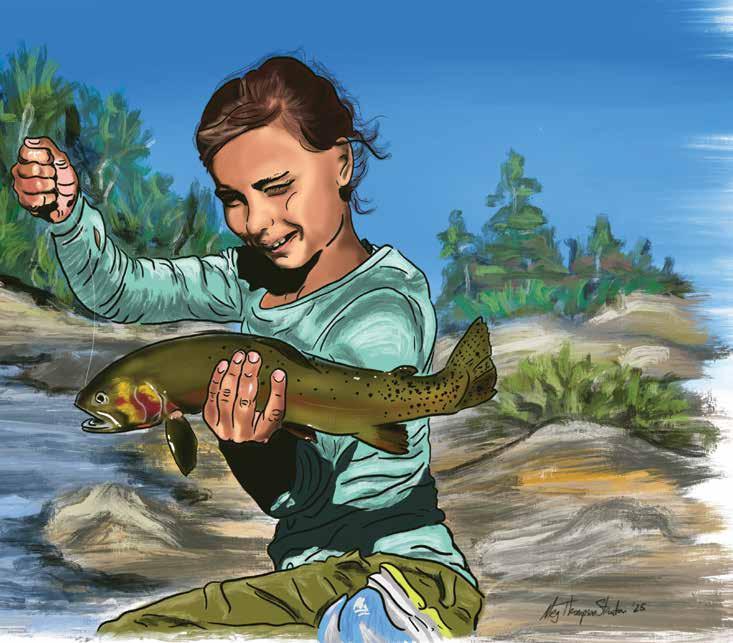
But bottom line, kids want to fish for the same reason adults do. They want to see something grab their flies, and they want to feel their lines go tight.
Guided day trips near Denali National Park for Arctic Grayling in the heart of the Alaska Range. www.denaliangler.com.
Turn Key Fly-Fishing Vacations In Missoula Montana. Trip includes all food and drink, ground transportation, accommodations and 3 days guided Float Trips on Blackfoot, Clark Fork, Bitterroot and Rock Creek. 2026 dates are June 15-19 & June 22-26. $3000 per angler. Discounts available for multiple anglers. www.mmtroutadventures.com Call for details 602-448-4834
Exclusive Fly-Fishing Club for you and your guest. Enjoy a mile of wild, trophy trout stream in western N.C. www.armstrongflycasters.com
Pennsylvania Guide Service, Sky Blue Outfitters, ½ day, full day and overnight trips available. Penns, Spring, Letort, Little Juniata, Pine and many more. Call 610-987-0073 or visit www.skyblueoutfitters.com for details.
WEST VIRGINIA: GO TROUT FISHING by TU Life Members. WV is home to some of the most wild and wonderful trout streams in the US! Find your next trout fishing destination at GoTroutFishing.com
FLIES & GEAR
Reel display cases and rod tube storage racks. Handcrafted fine wood accessories for anglers and tyers. Saltcreekstudio.etsy.com
Custom Built Trout Nets—Steam bent hardwood landing nets. goldcreeknets.com
Handcrafted wooden fly-fishing furniture and fly boxes – Handcrafted fly fishing furniture and wooden fly boxes. Built from the finest hardwoods. Visit woodbyroy.net or contact Roy at 804-930-2113.
4-piece bamboo flyrods handmade with bamboo ferrules. cgbamboorods.com chuck-g@comcast.net
Fly or Spin Rods—Veteran Owned www.stanleycanyon.com james.a.boyless@stanleycanyon.com
Custom made wooden fly boxes, no two are alike. Contact Jim at jimwhip@q.com for details
EZ-P Waterproof Wader Zipper—$80 Installed in any brand. Guaranteed for the life of your waders. Pressure tested for dry suit SCUBA. Contact: bjuniata@verizon.net or 814 569 8843
BAMBOO RODS Buy Sell Consign www.coldwatercollectibles.com (616) 884-5626
No Touch Hook Release™. This tool saves fish, flies and cold hands. Easy to use, it releases fish quickly, even for #22 hooks and bead heads. Learn more and buy: NoTouchTrout.com ($20 ppd)
FLY ROD RULER Measure your catch with a Rodrule. The micro-thin Rodrule adheres to your rods without hampering the action or finish. Guide approved! Order at: www.rodrule.com
Reach more than 150,000 anglers for just $2.25/word ($2.05/word for members). Send text of ad and payment to:
TROUT Classifieds
1700 N Moore Street Suite 2005 Arlington, Virginia 22209-2793
Ads may be faxed to (703)284-9400 or e-mailed to Samantha.Baldensperger@tu.org
Classifieds must be prepaid. Count phone number, fax number, ZIP code, street number, abbreviations and email or website address as one word each.
March Deadline: January 10, 2026. To request a media kit for display advertising, call (703)284-9422
From classic TU logo gear to representing our advocacy and conservation project work, the TU store has all of the hats, shirts, stickers, and patches you need to represent us out in the wild!

+ SNAG THIS SHIRT!



Trout Unlimited Business members are TU ambassadors in protecting, restoring, reconnecting and sustaining North America’s coldwater fisheries. To become a TU
Business Member, contact Maggie Heumann at (256) 996-2241 or maggie.heumann@tu.org.
Outfitters Guides Lodges
Alaskan Angling Adventures LLC.
Mike Adams Cooper Landing, AK 99572 (907) 595-3336 alaskananglingadventures@gmail.com www.AlaskanAnglingAdventures.com
Alaska Drift Away Fishing
Jeremy Anderson Sterling, AK 99672 (907) 529-8776 info@guidekenairiver.com www.guidekenairiver.com
Alaska Fly Fishing Goods
Bradley Elfers Juneau, AK 99801 (907) 586-1550
brad@alaskaflyfishinggoods.com www.alaskaflyfishinggoods.com
Alaska Kingfishers
Rob Fuentes Dillingham, TX 99576 fish@alaskakingfishers.com www.alaskakingfishers.com
Alaska Sportsman’s Lodge
Brian Kraft Kvichak River – Lake Iliamna, AK (907) 227-8719
brian@fishasl.com www.fishasl.com
Alaska Trout Guides
Josh Hayes Sterling, AK 99672 (907) 598-1899
josh@alaskatroutguides.com www.alaskatroutguides.com
Alaska Troutfitters
Billy Coulliette Cooper Landing, AK 99572 (907) 595-1212 info@aktroutfitters.com www.aktroutfitters.com
GOLD LEVEL
Alaska Wild Caught Seafood
Matthew Luck Ketchum, ID 83340 (208) 720-4226
matt@alaskawildcaughtseafood.net www.alaskawildcaughtseafood.net
Aleutian Rivers Angling
Dan, Jeff & Pat Vermillion Livingston, MT 59047 (888) 347-4286 pat@sweetwatertravel.com www.sweetwatertravel.com
Bear Trail Lodge
Nanci Morris Lyon
King Salmon, AK 99613 Lodge: (907) 246-2327
Cell: (907) 469-0622 gofish@bristolbay.com www.fishasl.com/naknek/
Bristol Bay Lodge
Steve Laurent Bristol Bay, AK Office: (509) 964-2094 Cell: (509) 899-0734 slaurent@bristolbaylodge.com www.fishasl.com
Chasing Tales Alaska
Shawn Coe Sterling, AK 99672 (907) 741-7944 chasingtales.alaska@gmail.com www.chasingtalesalaska.com
Classic Casting Adventures
Tad Kisaka Sitka, AK 99835 (907) 738-2737 tadkisaka@hotmail.com www.flyfishsitka.com
Cooper Landing Fishing Guide, LLC
David Lisi
Cooper Landing, AK 99572 cooperlandingguide@gmail.com www.cooperlandingfishingguide.com
Copper River Lodge
Pat Vermillion Iliamna, AK 99606 (406) 222-0624 info@copperriverlodge.com www.copperriverlodge.com
Crystal Creek Lodge
Dan Michels King Salmon, AK 99613 (907) 357-3153 www.crystalcreeklodge.com info@crystalcreeklodge.com
Deneki Outdoors
James Kim Anchorage, AK 99503 (800) 344-3628 info@deneki.com www.deneki.com
EPIC Angling & Adventure
Don Mutert
Alaska Peninsula, AK (512) 656-2736 don@epicaaa.com www.epicaaa.com
Equinox
Cameo Padilla & Brooks Areson Sitka, AK 99835 (907) 738-4736 info@equinoxalaska.com www.equinoxalaska.com @equinoxalaska
Lakeview Outfitters
Phil Hilbruner
Cooper Landing, AK 99572 (907) 440-4338
info@lakeviewoutfitters.com www.lakeviewoutfitters.com
Lost Boys Fishing LLC
Drew Petrie Anchorage, AK 99502 (907) 202-6422 fishguide@kenaineverland.com www.kenaineverland.com
Mister Kenai Sportfishing
Jack Mister Sterling, AK 99672 (301) 752-3551 misterkenaisportfishing@gmail.com
No See Um Lodge
Expedition Broker
Greg Schlachter Haines, AK 99827 (907) 766-3977 (877) 406.1320 travel@expeditionbroker.com www.expeditionbroker.com
Explore Kenai Dallas Voss Soldotna, AK 99669 (907) 690-6477
Contact@explorekenai.net www.explorekenai.net
Fish Em, LLC
Travis Price Alaska (907) 317-4706 Travis@fishem.net www.fishem.net
Fishe Wear
Linda Leary Anchorage, AK 99503 (907) 854-4775 linda@fishewear.com www.fishewear.com
Frontier River Guides of Alaska
Marty Decker Anchorage, AK 99523 info@frontierriverguides.com www.frontierriverguides.com
Grizzly Skins of Alaska
Rochelle Harrison and Phil Shoemaker
King Salmon, AK 99613 (907) 376-2234 info@grizzlyskinsofalaska.com www.grizzlyskinsofalaska.com
Kenai River Drifters Lodge
Jonathan Hulcher
Cooper Landing, AK 99572 (336) 354-9582 info@drifters.com www.drifterslodge.com
Kenai River Trout Anglers
Josiah Brown Cooper Landing, AK 99572 (907) 599-0086
Kenairivertroutanglers@gmail.com www.kenairivertroutanglers.com
Kenai Riverside Fishing Cooper Landing, AK (800) 478-4100
info@kenairiversidefishing.com www.kenairiversidefishing.com
Kenaiflyfish
Ian McDonald Sterling, AK 99672 (907) 301-6957
Kenaiflyfish@gmail.com www.Kenaiflyfish.com
AZ Fly Shop
Chris Rich Phoenix, AZ 85032 (602) 354-8881 info@azflyshop.com www.azflyshop.com
Destinations Fly Fish
Steve Berry Phoenix, AZ 85020 (480) 223-3117 steve@destinationsflyfish.com www.destinationsflyfish.com
Financial Planning First, LLC. Matthew Sullivan Tucson, AZ 85718 info@fpftucson.com www.financialplanningfirst.com
Imus Investment Partners
John Holman King Salmon, AK 99613 (907) 232-0729 fish@noseeumlodge.com www.noseeumlodge.com
Outer Coast Charters
Captain Christopher Paul Jones Sitka, AK 99835 (907) 623-8290 contact@outercoastcharters.com www.outercoastcharters.com
Outgoing Angling
Jordan Carter Anchorage, AK 99507 (907) 830-9545 jcarterflyfishing@gmail.com www.outgoingangling.com
GOLD LEVEL
Pride of Bristol Bay
Steve and Jenn Kurian Bloomsburg, PA 17815 (570) 387-0550 contact@prideofbristolbay.com www.prideofbristolbay.com
Rainbow King Lodge Iliamna, AK 99606 800-458-6539 info@rainbowking.com www.rainbowking.com
Royal Coachman Lodge
Pat Vermillion Dillingham, AK 99576 (406) 222-0624 info@royalcoachmanlodge.com www.royalcoachmanlodge.com
Tikchik Narrows Lodge Bud Hodson Anchorage, AK 99522 (907) 243-8450 info@tikchik.com www.tikchiklodge.com
Undisclosed Excursions, LLC
Ethan Welch Juneau, AK 99801 (907) 982-9674 undisclosedexcursions@gmail.com www.flyfishjuneau.com
Wilderness Place Lodge
Jason Rockvam/Cory Wendt Anchorage, AK 99519 (907) 733-2051 wildernessplacelodge@gmail.com www.wildernessplacelodge.com
Arizona Flycasters Gene Hechler Phoenix, AZ 85016 (520) 203-4140 president@azflycasters.org www.azflycasters.org
The White River Inn Steven Sonnamaker Cotter, AR 72626 (870) 430-2233 info@thewhiteriverinn.com www.thewhiteriverinn.com
Two Rivers Fly Shop
Dru Zametto Norfork, AR 72658 tworiversflyshop@gmail.com
White River Trout Lodge
Jo Anna Smith Cotter, AR 72626 (870) 430-5229 info@whiteriverlodge.com www.whiteriverlodge.com
Gary Imus Tucson, AZ 85718
Direct: (877) 813-4985 or (520) 314-1301 Fax (520) 529-4031 Cell (520) 991-5317 gary@imusinvestmentpartners.com www.imusinvestmentpartners.com
Lees Ferry Anglers Marble Canyon, AZ 86036 (800) 962-9755 anglers@leesferry.com www.leesferry.com
Oxbow Ecological Engineering, LLC
George Cathey Flagstaff, AZ 86005 (928) 266-6192 george@oxbow-eco-eng.com www. oxbow-eco-eng.com
Spiral Creative Services Graphic Design
Susan Geer Gilbert, AZ 85234 (602) 284-2515 Susan@spiral-creative.com www.spiral-creative.com
GOLD LEVEL
Wilkinson Wealth Management
Eb Wilkinson Tucson, AZ 85715 (520) 777-1911 (877) 813-4985 eb@wilkinsonwealthmgmt.com www.wilkinsonwealthmgmt.com
Dally’s Ozark Fly Fisher
Steve Dally Cotter, AR 72626 (870) 435-6166 info@theozarkflyfisher.com www.theozarkflyfisher.com
Freedom Fire Pro Michael Cormier Rogers, AR 72756 (479) 631-6363 mcormier@freefirepro.com www.freefirepro.com
Natural State Fly Shop Jane Hatchet Cotter, AR 72626 (870) 471-9111 (870) 321-2792 (Cell) flyfishcotter@gmail.com www.naturalstateflyshop.com
Peglar Real Estate Group Matt Hershberger Mountain Home, AR 72653 (870) 405-4144 matt@peglarrealestate.com www.peglarrealestate.com
Bix Restaurant and Supper Club Douglas Biederbeck San Francisco, CA 94133 info@bixrestaurant.com www.bixrestaurant.com
Catch America Abdul Masri San Rafael, CA 94901 abdul@catchamerica.com www.catchamerica.com
Confluence Outfitters
Andrew Harris Red Bluff, CA 96080 (530) 632-3465 andrew@confluenceoutfitters.com www.confluenceoutfitters.com
FishMammoth
Jim Elias Mammoth Lakes, CA 93546 (760) 582-2195 jim@fishmammoth.com www.fishmammoth.com
Fly Fishers Club of Orange County
Brian Mayer Santa Ana, CA 92711-3005 (562) 619-9169 bdmayer@hotmail.com www.ffcoc.org
GOLD LEVEL
The Fly Shop
Terry Jepsen Redding, CA 96002 (530) 222-3555 terry@theflyshop.com www.theflyshop.com
Merriam Vineyards Peter Merriam Healdsburg, CA 95448 peter@merriamvineyards.com www.merriamvineyards.com
Mountain Hardware and Sports Bran Nylund Truckee, CA 96160 (530) 587-4844
Brian.nylund@yahoo.com www.mountainhardwareandsports.com
Trout Creek Outfitters
Miles Zimmerman & Scotty Koper Truckee, CA 96161 (530)563-5119 info@troutcreekoutfitters.com www.troutcreekoutfitters.com
5280 Angler Jay Baichi Arvada, CO 80004 (720) 450-7291 info@5280angler.com www.5280angler.com
Born in Jackson, WY and instructed by professional guides worldwide, Fish Camp delivers expert-led masterclasses for all levels of fly fishing, along with exclusive member-only benefits to elevate your angling.
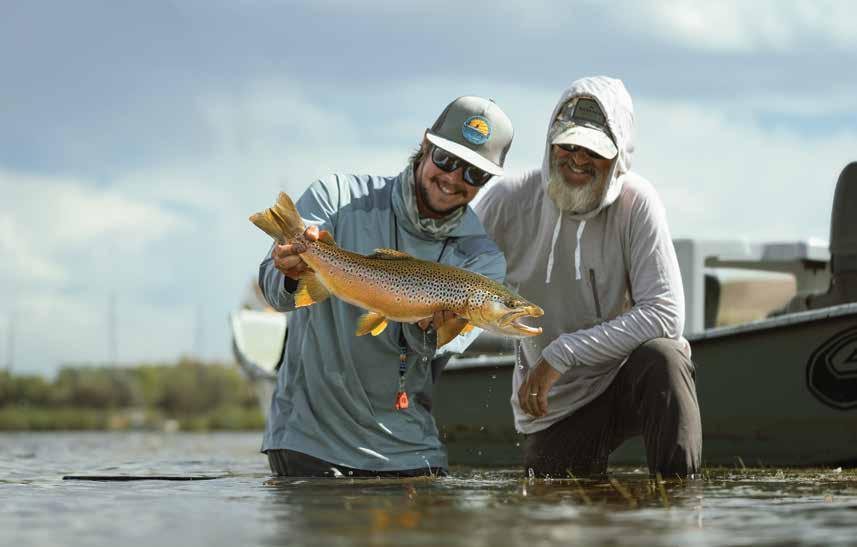
Beginner, intermediate, and expert level courses
• Over 160 instructional videos from how to improve your cast to what flies and gear to use
• Prepare for your next trip with destination and species specific courses

• Learn more https://fishcamp.life
• Exclusive member only gear discounts and giveaways
As an official Trout Unlimited Business Member, our courses are rooted in conservation, etiquette, and preserving the waters that sustain our passion. Use code TROUTMAG25 for 25% off an annual subscription at fishcamp.life
8200 Mountain Sports
Joel Condren
South Fork, CO 81154 (719) 873-1977 (800) 873-1977
info@8200sports.com www.8200mountainsports.com
Abel Reels
Jeff Patterson Montrose, CO 81401 (970) 249-0606 info@abelreels.com www.abelreels.com
AGORA Search Group
Rob Lauer
Colorado Springs, CO 80919 (719) 219-0360 info@agorasearchgroup.com www.agorasearchgroup.com
Alpacka Raft Mancos, CO 81328 (970) 533-7119 workshop@alpackaraft.com www.alpackaraft.com
Alpine Bank Battlement Mesa
Anne Kellerby Parachute, CO 81635 annekellerby@alpinebank.com
An Angler’s Bookcase
Craig and Catherine Douglass South Fork, CO 81154 (719) 221-9027 books@ananglersbookcase.com www.aabks.com
Anglers All Littleton, CO 80120 (303) 794-1104 (800) 327-5014 info@anglersall.com www.anglersall.com
GOLD LEVEL
Angler’s Covey
David Leinweber
Colorado Springs, CO 80904 (719) 471-2984 info@anglerscovey.com www.anglerscovey.com
Angling Trade Magazine
Tim Romano Boulder, CO 80304 (303) 495-3967 tim@anglingtrade.com www.anglingtrade.com
Aspen Outfitting Company
Jarrod Hollinger Aspen, CO 81611 (970) 925-3406 contact@aspenoutfitting.com www.aspenoutfitting.com
AvidMax Cory Anderson Centennial, CO 80112 (866) 454-5523 customerservice@avidmax.com www.avidmax.com
Big Trout Brewing Company
Tom and Emily Caldwell Winter Park, CO 80482 (970) 363-7362 bigtroutbrewing@gmail.com www.bigtroutbrewing.com
Black Canyon Anglers
Matt Bruns Austin, CO 81410 (970) 835-5050 info@blackcanyonanglers.com www.blackcanyonanglers.com
The Broadmoor Fly Fishing Camp
Scott Tarrant
Colorado Springs, CO 80906 (719) 476-6800 rbabas@broadmoor.com www.broadmoor.com
Black Canyon Anglers
Matthew Bruns Austin, CO 81410 (970) 835-5050 info@blackcanyonanglers.com www.blackcanyonanglers.com
Budge’s Wilderness Lodge Ryan McSparran Gypsum, CO 81637 Lodge: 970-422-1311 (July - October) howdy@budgeslodge.com www.budgeslodge.com
C. Gualdoni Bamboo Rods LLC
Chuck Goldone Littleton, CO 80126 chuck-g@comcast.net www.cgbamboorods.com
GOLD LEVEL
Cutthroat Anglers
Ben McCormick Silverthorne, CO 80498 (970) 262-2878 anglers@fishcolorado.com www.fishcolorado.com
GOLD LEVEL
DiscountFlies
Chris Nielsen Castle Rock, CO 80108 (303) 741-4221 support@discountflies.com www.discountflies.com
Drifthook Fly Fishing
Matthew Bernhardt Westminster, CO 80021 (773) 359-3474 info@drifthook.com www.drifthook.com
Durango Fly Fishing Thomas Schaefer Durango, CO 81301 (970) 501-5355 info@dgoflyfishing.com
Ed's Fly Shop
Ed LeViness Montrose, CO 81401 (970) 301-1272 ed@edsflyshop.com www.edsflyshop.com Fishpond, Inc. Ben Kurtz Denver, CO 80223-1346 (303) 534-3474 benkurtz@fishpondusa www.fishpondusa.com
GOLD LEVEL
Freestone Aquatics, Inc.
Clint Packo Littleton, CO 80127 (303) 807-7805 clint@freestoneaquatics.com www.freestoneaquatics.com
The Guide Network
Ethan Whitson Golden, CO 80401 ethan@theguidenetwork.com www.theguidenetwork.com
Home Team Builders, LLC.
Matthew Templin Telluride, CO 81435
matt@hometeambuilderstelluride.com www.hometeambuilderstelluride.com
JHL Constructors
Charles Bisbee
Englewood, CO 80112 cbisbee@jhlconstructors.com www.jhlconstructors.com
JP Fly Fishing Specialties
James Pushchak (719) 275-7637
Canon City, CO, 81212 jamespushchak@gmail.com www.jpflyfish.com
Kebler Corner - RV Resort Somerset, CO 81434 (970) 929-5029 info@keblercorner.com www.keblercorner.com
L4 Construction
Matt Lamar
Greeley and Lyons, CO 80540 (970) 628-0047 mlamar@l4construction.com www.l4construction.com
Monic Fly Lines
Martha Britton Boulder, CO 80301 info@monic.com www.monic.com
North Fork Ranch
Hayley Horner Shawnee, CO 80475 (303) 838-9873 info@northforkranch.com www.northforkranch.com
North Fork Ranch Guide Service
Jeff Poole Shawnee, CO 80475 (303) 478-1349 info@nfrgs.com www.northforkranchguideservice.com
onWater Fly Fishing
Patrick Straub Louisville, CO 80027 team@onwaterapp.com www.onwaterapp.com
QuietKat, Inc.
Logan Holtz Eagle, CO 81631 logan@quietkat.com www.quietkat.com
GOLD LEVEL
RepYourWater
Garrison and Corinne Doctor Erie, CO 80516 (303) 717-0267 customerservice@repyourwater.com www.repyourwater.com
RIGS Fly Shop & Guide Service Ridgway, CO 81432 (970) 626-4460 info@fishrigs.com www.fishrigs.com
RockyTalkie
Erin Moeller 4990 Nome St Unit A Denver, CO 80239 Rockytalkie.com Erin@rockytalkie.com
Ross Reels
Jeff Patterson Montrose, CO 81401 (970) 249-0606 customersupport@rossreels.com www.rossreels.com
Scheels All Sports Johnstown, CO 80534 (970) 663-7800 communitycolorado@scheels.com www.scheels.com/johnstown
She’s Fly Ft. Collins, CO 80524 (970) 682-4704 info@shesfly.com www.shesfly.com
St. Peter’s Fly Shop –South Ft. Collins, CO 80524 (970) 498-8968 shop@stpetes.com www.stpetes.com
Scott Fly Rods Montrose, CO 81401-6302 (970) 249-3180 info@scottflyrod.com www.scottflyrod.com
Seek Outside
Dennis Poirier
Grand Junction, CO 81504 (970) 208-8108 info@seekoutside.com www.seekoutside.com
Telluride Angler
John Duncan Telluride, CO 81435 (970) 728-3895 fun@tellurideoutside.com www.tellurideoutside.com
TRUE NORTH Surveying and Mapping, LLC.
William Buntrock Littleton, CO 80125 billb@truenorthsurvey.com www.truenorthsurvey.com
Umpqua Russ Miller Louisville, CO 80027 (303) 567-6696 Umpqua@umpqua.com www.umpqua.com
Uncompahgre River RV Park
Mark Hillier Olathe, CO 81425 (970) 323-8706 info@urrvp.com www.urrvp.com
UpRiver Fly Fishing
Andrew Maddox Buena Vista, CO 81211 (719) 395-9227 shop@upriverflyfishing.com www.upriverflyfishing.com
GOLD LEVEL
Upslope Brewing
Henry Wood Boulder, CO 80301 (303) 396-1898 henry@upslopebrewing.com www.upslopebrewing.com
Volpe Law LLC
Ben Volpe Parker, CO 80138 (720) 257-9982 info@volpelawllc.com www.volpelawllc.com
Western Anglers Ned Mayers Grand Junction, CO 81501 (970) 244-8658 info@westernanglers.com www.westernanglers.com
Willowfly Anglers
Three Rivers Resort Almont, CO 81210 (970) 641-1303 fish@3riversresort.com www.3riversresort.com
Zen Tenkara/Zen Fly Fishing Gear
Karin Miller Loveland, CO 80538 (970) 412-8392 (844) TENKARA zenflyfishingear@gmail.com www.zenflyfishinggear.com www.zentenkara.com
Interior Federal Credit Union Washington, DC 20240 Reston, VA 20192 (800) 914-8619 info@interiorfcu.org www.interiorfcu.org
Acme Monaco Corporation Lucas Karabin New Britain, CT 06052 (860) 224-1349 acmecorp@acmemonaco.com www.acmemonaco.com
F. F. Hitchcock Company, Inc. John Bowman Cheshire, CT 06410 john@ffhitchcock.com www.ffhitchcock.com
J. Stockard Fly Fishing Kent, CT 06757 (877) 359-8946 service@jsflyfishing.com www.jsflyfishing.com
Fish Nation Myakka City, FL 34251 (307) 637-5495 info@fish-nation.com www.fish-nation.com
Outpost On The Nush
Dave Pishko Bonita Springs, FL 34134 info@outpostonthenush.com www.outpostonthenush.com
GEORGIA
GOLD LEVEL
Alpharetta Outfitters
Jeff Wright Alpharetta, GA 30009 (678) 762-0027 shop@alpharettaoutfitters.com www.alpharettaoutfitters.com
GOLD LEVEL
Atlanta Fly Fishing School
Mack Martin Cumming, GA 30040 (770) 889-5638 mack@mackmartin.com www.atlantaflyfishingschool.com
Blue Ridge Fly Fishing School
David and Rebecca Hulsey Blue Ridge, GA 30513 (770) 639-4001 (706) 838-4252 info@hulseyflyfishing.com www.hulseyflyfishing.com
Escape to Blue Ridge LLC, Blue Ridge, GA
Pamela Miracle Alpharetta, GA 30023 (866) 618-2521 (706) 413-5321 pamela@escapetoblueridge.com www.EscapetoBlueRidge.com
NGI Trenchless Pipe & Sewer Repair Canton, GA 30114 www.northgeorgiapipelining.com
Noontootla Creek Farms
Emily Owenby
Blue Ridge, GA 30513 (706) 838-0585 (voice) (706) 809-6055 (text) emily@ncfga.com www.ncfga.net
Oyster Bamboo Fly Rods
William Oyster Blue Ridge, GA 30513 (706) 897-1298 shannen@oysterbamboo.com www.oysterbamboo.com
GOLD LEVEL
Redd's Flies
Jordan Redd Atlanta, GA 30305 jordanredd590@gmail.com www.reddsflies.com
River Through Atlanta Guide Service
Chris Scalley Roswell, GA 30075 (770) 650-8630 chrisscalley@bellsouth.net www.riverthroughatlanta.com
GOLD LEVEL
Unicoi Outfitters
Jake Darling Helen, GA 30545 (706) 878-3083 flyfish@unicoioutfitters.com www.unicoioutfitters.com
Unicoi Outfitters General Store
Jake Darling Clarkesville, GA 30523 (706) 754-0203 flyfish@unicoioutfitters.com www.unicoioutfitters.com
HAWAII
Alagnak Lodge Anthony Behm Honolulu, HI 96825 (808) 227-9301 tonybehm@alagnaklodge.com www.AlagnakLodge.com
IDAHO
GOLD LEVEL
Alaska Wild Caught Seafood
Matthew Luck Ketchum, ID 83340 (208) 720-4226 matt@alaskawildcaughtseafood.net www.alaskawildcaughtseafood.net
The Bent Rod Outdoors
Greg and Cheri Webster Challis, ID 83226 (208) 879-2500 thebentrod@custertel.net www.thebentrod.com
Elevate Fly Fishing
Trevor Sheehan Boise, ID 83703 (208) 514-7788 trevor@elevateflyfishing.com www.elevateflyfishing.com
Henry’s Fork Lodge
Jamie Short Island Park, ID 83429 (208) 558-7953 info@henrysforklodge.com www.henrysforklodge.com

The Lodge at Palisades Creek
Justin Hays Irwin, ID 83428 (866) 393-1613
palisades@tlapc.com www.tlapc.com
The McCall Angler
Reba Brinkman McCall, ID 83638 (208) 315-6445
info@themccallangler.com www.themccallangler.com
Northwest River Supplies, Inc. (NRS)
Mark Deming Moscow, ID 83843 (877) 677-4327
service@nrs.com
www.nrs.com
QRS Consulting, LLC Boise, ID 83705 (208) 342-0091 cchristensen@qrs-llc.com www.qrs-llc.com
RIO Products Idaho Falls, ID 83402 (800) 553-0838 rio@rioproducts.com www.rioproducts.com
River Retreat Lodge
Elizabeth Douville Irwin, ID 83428 liz.douville@riverretreatlodge.com www.riverretreatlodge.com
RIVHAB Engineering Design
Jeanne McFall Eagle, ID 83616 (208) 401-6129 jeanne@rivhab.net www.rivhab.net
Silver Creek Outfitters
Terry Ring Ketchum, ID 83340 (208) 726-5282 office@silver-creek.com www.silver-creek.com
South Fork Lodge & Outfitters
Zach Peyton / Guide Manager Swan Valley, ID 83449 (208) 483-2112 fish@southforklodge.com www.southforklodge.com
GOLD LEVEL
WorldCast Anglers
Mike Dawkins Victor, ID 83455 (800) 654-0676 gofish@worldcastanglers.com www.worldcastanglers.com
ILLINOIS
GetOut Networking
Spencer Kaehler Winnetka, IL 60093 spencer@getout.network www.getout.network
IOWA
Pescador on the Fly
Jeff Ditsworth West Des Moines, IA 50266 (515) 240-6774
info@pescadoronthefly.com www.pescadoronthefly.com
Wilderness Lite LLC
Phillip Hayes Maurice, IA 51036 wildernesslite@gmail.com www.wildernesslitefloattubes.com
Great Blue Heron Outdoors
Robert Marsh Lawrence, KS 66044 (785) 856-5656
info@gbh-outdoors.com www.greatblueheronoutdoors.com
Appalachian Mountain Club
Maine Woods Initiative
Carolyn Ziegra Greenville, ME 04441 (207) 695-3085 cziegra@outdoors.org www.outdoors.org
Chandler Lake Camps and Lodge
Jason and Sherry Bouchard North Maine Woods, ME 04732 (207) 731-8938 info@chandlerlakecamps.com www.chandlerlakecamps.com
HMH Vises
Jon Larrabee Biddeford, ME 04005 T: (207) 729-5200 F: (207) 729-5292 jon@hmhvises.com www.hmhvises.com
Sam Lambert Keller Williams Realty Brunswick, ME 04011 (207) 522-7728 samlambertrealestate@gmail.com
L.L.Bean Inc. Mac McKeever Freeport, ME 04033-0002 (207) 865-4761 www.llbean.com
Rangeley Region Sports Shop
Brett Damm Rangeley, ME 04970 (207) 864-5615 rangeleyflyshop@gmail.com www.rangeleyflyshop.com
Western Maine Yurts, Inc Bethel, ME 04217 stay@westernmaineyurts.com
MARYLAND
Boatyard Bar & Grill
Dick Franyo Annapolis, MD 21403 (410) 267-0145 dick@boatyardbarandgrill.com www.boatyardbarandgrill.com
Rich Dennison Fly Fishing
Rich Dennison Parkville, MD 21234 (443) 668-3535 richdennisonflyfishing@gmail.com www.richdennisonflyfishing.com
Resource Restoration Group, LLC Tracys Landing, MD 20779 info@rrgroup.us www.rrgroup.us
MASSACHUSETTS
Cheeky Fishiing
Ted Upton (339) 707-3017 North Adams, MA 01247 getcheeky@cheekyfishing.com www.cheekyfishing.com
High Hook Oregon Wines
T. Mark Seymour Leverett, MA 01054 (413) 218-0638
mark@fishhookvineyards.com www.fishhookvineyards.com
Krag Silversmith
Wendy O’Neil
Stockbridge, MA 01262 wendy@kragsilversmith.com www.kragsilversmith.com
Postfly
Brian Runnals
Newbury, MA 01951 brian@postflybox.com www.postflybox.com
Recur Outdoors, Inc.
Brian Runnals
Newbury, MA 01951 brunnals@recuroutdoors.com www.recuroutdoors.com
Swift River Fly Fishing
Rick Taupier
New Salem, MA 01355 (413) 230-1262 swiftriverflyfishing@earthlink.com www.swiftriverflyfishing.com
Wild Soul River, LLC
Justin Adkins Williamstown, MA 01267 (413) 597-1172 info@wildsoulriver.com www. wildsoulriver.com
Wingo Outdoors
Ted Upton (339) 707-3017 North Adams, MA 01247 info@wingooutdoors.com www.wingooutdoors.com
The Wooden Fly Bart Estes Easthampton, MA 01027 (413) 588-1125 bartestes42@yahoo.com www.etsy.com/shop/TheWoodenFly
Au Sable River Guide Service
Captain Tom Quail Lake Orion, MI 48360 (248) 495-2615 ausableriverguideservice@gmail. com www.ausableriverguideservice.com
CastBack
Justin Sivils Saline, MI 48176 angler-j@castback.com www.castback.com
Diem Investments, Inc. Grand Rapids, MI 49503 The Gremel Group
Andrew Gremel Belmont, MI 49306 (616) 874-2200 andy@gremelgroup.com www.gremelgroup.com
HFF Custom Rods Steven Haywood Taylor, MI 48180 stevenh@hffcustomrods.com www.hffcustomrods.com
HomeWaters Real Estate
Chad Brown Traverse City, MI 49686 (231) 258-5309 chad@homewaters.net www.homewaters.net
Indigo Guide Service
Kevin Morlock Branch, MI 49402 (231) 613-5099 indigoguidekevin@gmail.com www.indigoguideservice.com
Iron Fish Distillery
Troy Anderson Thompsonville, MI 49683 troy@ironfishdistillery.com www.ironfishdistillery.com
J. A. Henry Rod and Reel Company
Andrew Mitchell Rockford, MI 49341 j.a.henryusa@gmail.com www.jahenryusa.com
MothBear Outfitters
Tylor Witulski Alpena, MI 49707 (989) 884-3288 www.mothbear.com support@mothbear.com
North Rivers Lodge
Joe Neumann Luther, MI 49656 (231) 266-6014 northriverslodge@gmail.com www.northriverslodge.com
Northern Lights Guide Service
John and Trish Kluesing Baldwin, MI 49304 (231) 745-3792 jtkluesing@gmail.com
Oshki
Jackson Riegler Muskegon, MI 49441 (231) 955-1392 jackson@oshki.us www.oshki.us
Red Moose Lodge
Cast Away Guide Service
Clint and Debi Anderson Baldwin, MI 49304 (231) 745-6667 info@redmooselodge.com www.redmooselodge.com www.castawayguideservice.com
Salmo Java Roasters Fred Taber Kalamazoo, MI 49048 (269) 806-6829 salmojava@gmail.com https://salmojavaroasters.com/ Upper Peninsula Concrete Pipe Co. Craig Vanderstelt Escanaba, MI 49829 (906) 786-0934 cvanderstelt@upconcretepipe.net www.upconcretepipe.net
MINNESOTA
Rose Creek Anglers
Rich Femling Roseville, MN 55113 (763) 807-5878 rich@rose-creek.com www.rose-creek.com
Solid Rock Masonry Eric Moshier Duluth, MN 55803 (218) 343-2978 info@solidrockmasonry.com www.solidrockmasonry.com
Trout Buddy Driftless Guides
Mike Warren La Crosse, WI 54601 (608) 792-2521 mjw54601@icloud.com www.TroutBuddy.com TroutRoutes Zachary Pope Columbia Heights, MN 55421 (612) 965-8039 zpope@troutinsights.com www.troutinsights.com
Bob White Studio
Bob White Marine on Saint Croix, MN 55047 (651) 433-4168 bob@bobwhitestudio.com www.bobwhitestudio.com
MISSOURI
Jim Rogers Fly Fishing School
Jim Rogers Lebanon, MO 65536 (417) 532-4307 ext. 2 www.jimrogersflyfishing.com
MONTANA
Alpine Foot and Ankle Clinic
Dr. Gregg Neibauer Missoula, MT 59801 (406) 721-4007 www.alpinefoot.com
Angler's West Fly Fishing Outfitters
Matson Rogers Emigrant, MT 59027 (406) 333-4401 info@montanaflyfishers.com www.montanaflyfishers.com
Dan Bailey’s Outdoor Company
Dale Sexton Livingston, MT 59047 (406) 222-1673 info@danbaileys.com www.danbaileys.com
Bauer Fly Reels
Jeff Evans Twin Bridges, MT 59754 (406) 684-5674 jevans@winstonrods.com www.bauerflyreel.com
Beartooth Flyfishing
Dan and Nancy Delekta Cameron, MT 59720 (406) 682-7525 info@beartoothflyfishing.com www.beartoothflyfishing.com
Big Hole Lodge
Craig Fellin Wise River, MT 59762 (406) 832-3252 info@bigholelodge.com www.bigholelodge.com
Bighorn Fly and Tackle Shop
Duane Schreiner Fort Smith, MT 59035 (888) 665-1321 bighornfly@gmail.com www.bighornfly.com
Big Sky Anglers
Justin Spence West Yellowstone, MT 59758 (406) 646-7801 info@bigskyanglers.com www.bigskyanglers.com
GOLD LEVEL
Blackfoot River
Outfitters, Inc.
John Herzer and Terri Raugland Missoula, MT 59808 (406) 542-7411 trout@blackfootriver.com www.blackfootriver.com
Casting for Recovery, Inc.
Faye Nelson Bozeman, MT 59715 (406) 624-6583 www.castingforrecovery.org info@castingforrecovery.org
CrossCurrents Fly Shop
Chris Strainer Helena, MT 59601 (406) 449-2292 crosscurrentsflyshop@gmail.com www.crosscurrents.com
Donaldson Bros. Ready Mix Charles Donaldson Hamilton, MT 59840 charles@donaldsonbros.com www.donaldsonbros.com
ERA Landmark Real Estate
Kelly Bresnahan Bozeman, MT 59715 (406) 586-1321 kelly@eralandmark.com www.eralandmark.com
Fay Ranches
Greg Fay Bozeman, MT 59715 406-586-4001 info@fayranches.com www.fayranches.com
Gallatin River Guides
Mike Donaldson Big Sky, MT 59716 (406) 995-2290 gallatinriverguides@gmail.com www.montanaflyfishing.com
Glacier Anglers
Mike Cooney West Glacier, MT 59936 (406) 888-5454 info@glacierraftco.com www.glacieranglers.net
Glacier Excavating Inc
Bob Cuffe Eureka, MT 59917 (406) 297-3155 Bob@glacierexcavating.com www.glacierexcavating.com
GOLD LEVEL
Glacier Excavating
Bob Cuffe Eureka, MT 59917 (406) 297-3155 glacierexcavating@hotmail.com www.glacierexcavating.com
GOLD LEVEL
Healing Waters Lodge
Steve Mackey Twin Bridges, MT 59754 (406) 684-5960 steve.mackey@hwlodge.com www.hwlodge.com
Hubbard’s Yellowstone Lodge Nancy Hubbard Emigrant, MT 59027 (406) 848-7755 nancy@hubya.com www.hubbardslodge.com
Lakestream Fly Shop Whitefish, MT 59937 info@lakestream.com www.lakestreamflyshop.com
GOLD LEVEL
Linehan Outfitting Company
Tim Linehan Troy, MT 59935 (800) 596-0034 info@fishmontana.com www.fishmontana.com
Long Outfitting
Matthew A. Long Livingston, MT 59047 (406) 220-6775 info@longoutfitting.com www.longoutfitting.com
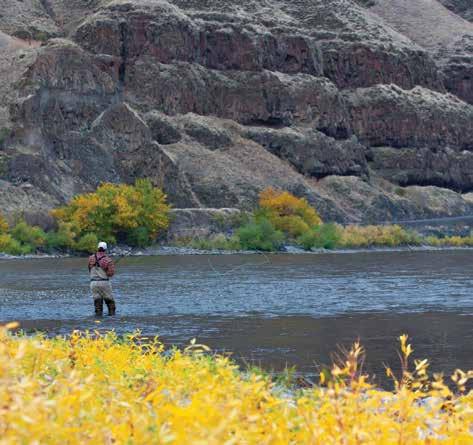
LV Wood
James and Tara Caroll Bozeman, MT 59715 (406) 624-7273
west@lvwood.com www.lvwood.com
Denny Menholt Honda
Matt Smith Bozeman, MT 59718 (406) 587-0761 matts@dennymenholthonda.com www.dennymenholthonda.com
Madison Valley Ranch, LLC
Manu Redmond Ennis, MT 59729 (800) 891-6158 mvr@3rivers.net www.madisonvalleyranch.com
Missoula Fly Fishing Outfitters
Russell Parks Missoula, MT 59801 (406) 546-6305
Russell@missoulaflyfishingoutfitters.com www.missoulaflyfishingoutfitters.com
Montana Angler Fly Fishing
Brian McGeehan Bozeman, MT 59718 (406) 522-9854 business (406) 570-0453 cell brian@montanaangler.com www.montanaangler.com
Montana Angling Company
Max Yzaguirre Bozeman, MT 59715 (406) 579-9553 info@montanaanglingco.com www.montanaanglingco.com
Montana Fishing Outfitters
Garrett Munson Helena, MT 59601 (406) 431-5089
heymfo@montanafishingoutfitters.com www.montanafishingoutfitters.com
Montana Fly Company
Jake Chutz Columbia Falls, MT 59912 (406) 892-9112 jake@montanafly.com www.montanafly.com
Montana Trout Stalkers
Joe Dilschneider Ennis, MT 59729 (406) 581-5150 joe@montanatrout.com www.montanatrout.com
Mountain Prairie Outfitters
Taylor Todd Helena, MT 59624 taylor@mountainprairieoutfitters.com www.mountainprairieoutfitters.com Parks’ Fly Shop
Kody Marr Gardiner, MT 59030 kody@parksflyshop.com www.parksflyshop.com
P3 Properties
Patrick Pozzi Missoula, MT 59808 pozzi.patrick@gmail.com
PRO Outfitters
Brandon Boedecker Helena, MT 59624 (406) 442-5489 pro@prooutfitters.com www.prooutfitters.com
Realty ONE Group Peak
Bryan Atwell Bozeman, MT 59715 (406) 579-7616 bryan@bryanatwell.com www.bozemanrealtyone.com
Royal Bighorn Club
Dan Vermillion Livingston, MT 59047 (888) 347-4286 dan@sweetwatertravel.com www.sweetwatertravel.com
Ruby Springs Lodge Paul Moseley Sheridan, MT 59749 (406) 842-5250 info@rubyspringslodge.com www.rubyspringslodge.com
GOLD LEVEL
Dan Rust State Farm
Insurance
Dan Rust Bozeman, MT 59715 (406) 587-8287 dan.rust.b60w@statefarm.com
School of Trout
Todd Tanner Bigfork, MT 59911 (406) 792-5545 finn@schooloftrout.com www.schooloftrout.com
Simms
Diane Bristol Bozeman, MT 59718 (406) 585-3557 info@simms.com www.simmsfishing.com
Skwala Fishing
Rich Hohne Bozeman, MT 59715 (833) 523-1500 rich@skwalafishing.com www.skwalafishing.com
Stillwater Anglers, LLC. Chris Fleck Columbus, MT 59019 (406) 321-0564 chris@stillwateranglers.com
Stockman Bank – Bozeman Paul Pahut Bozeman, MT 59718 (406) 556-4100 paul.pahut@stockmanbank.com www.stockmanbank.com
Stockman Bank – Missoula Bob Burns Missoula, MT 59801 (406) 258-1401 bburns@stockmanbank.com www.stockmanbank.com
Sweetwater Travel Company
Dan, Jeff & Pat Vermillion Livingston, MT 59047 (888) 347-4286 dan@sweetwatertravel.com www.sweetwatertravel.com
Toyota of Bozeman Jayden Schaap Bozeman, MT 59718 (406) 551-6642 marketing@resslermotors.com www.toyotaofbozemancom
Trail Head & Trail Head
River Sports
Todd Frank Missoula, MT 59807 (406)543-6966 tfrank@trailheadmontana.net www.trailheadmontana.net
Triple-M-Outfitters
Mark Faroni Dixon, MT 59831 (406) 246-3249
mark@triplemoutfitters.com www.triplemoutfitters.com
TroutRoutes
Zachary Pope Columbia Heights, MN 55421 (612) 965-8039 zpope@troutinsights.com www.troutinsights.com
Trout On The Fly
Nate Stevane Outfitter #8533 4467 Ethan Way Bozeman, MT 59718 (406) 580-7370 nate@montanatroutonthefly.com www.montanatroutonthefly.com
Trout Scapes River Restoration, LLC
Brian Cowden Bozeman, MT 59715 (201) 230-3383 bcowden@troutscapes.com www.troutscapes.com
Trout Tales Fly Fishing
Ian Secrest Bozeman, MT 59718 (406)539-4327 ian@trouttalesflyfishing.com www.trouttalesflyfishing.com
Wild Montana Anglers
Mark Fuller Martin City, MT 59926 (406) 261-4343 mark@wildmontanaanglers.com www.wildmontanaanglers.com
Wild Trout Outfitters, Inc. J.D. Bingman Big Sky, MT 59716 (406) 995-2975 fish@wildtroutoutfitters.com www.wildtroutoutfitters.com
Yellowstone Country Fly Fishing
Walter Wiese Livingston, MT 59047 ycflyfishing@gmail.com www.flyfishmontana.biz
Yellowstone Fly Fishing Co. James Pappas Livingston, MT 59047 yellowstonefishingco@gmail.com www.yellowstoneflyfishingco.com
Yellowstone River Outfitters Brogan Ballard Livingston, MT 59047 (406) 531-1838 yellowstoneriveroutfitters@gmail.com www.yellowstoneriveroutfitters.com
Outlaw Rod Company
Anthony Saling Sparks, NV 89431 (775) 636-2945 anthony_saling@yahoo.com www.outlawrodco.com
American Fly Outfitters
Dan Tilton
Winham, NH 03087 info@americanflyoutiffters.com www.americanflyoutfitters.com
Hobbs Brewing Company Ossipee, NH 03814 (603) 539-3795 info@hobbsbeer.com www.hobbsbeer.com
Schilling Beer Company
Jeff Cozzens Littleton, NH 03561 (603) 444-4800 jeff@schillingbeer.com www.schillingbeer.com
Stone River Outfitters
1 State Route 101A, Unit 1 Amherst, NH 03031 (603) 472-3191 (800) 331-8558 sales@stoneriveroutfitters.com www.stoneriveroutfitters.com
Keystone Reclamation Fuel Management LLC Morristown, NJ 07960
oakpool
Alex Ford Jersey City, NJ 07302 (908) 642-8930 alex@fordhamilton.com www.oakpool.xyz
Ramsey Outdoor
Marty Brennan Succasunna, NJ 07876 (973) 584-7798 mbrennan@ramseyoutdoor.com www.ramseyoutdoor.com
RoxStar Fishing
Mike James Howell, New Jersey 07731 (973) 704-1323 mike@roxstarfishing.com www.roxstarfishing.com
South Branch Outfitters Abraham and Lindsey Beates Califon, NJ 07830 (908) 867-8067 info@sboutfitters.com www.sboutfitters.com
Suburban Fly Fishers Tim Glynn Maplewood, NJ 07040 (973) 220-3031 timothyglynn@verizon.net www.suburbanflyfishers.com
Tightline Productions Tim and Joan Flagler Califon, NJ 07830 (908) 832-6677 tightlineproductions@comcast.net www.tightlinevideo.com
Chama Trails Motel Austin and Karlee Phippen Chama, NM 87520 (575) 756-2156 chamatrails@windstream.net www.chamatrailsmotel.com
Fly Fishing Outpost Santa Fe, NM 87506 (505) 629-5688 trout@loeflyfishing.com www.flyfishingoutpost.com Land of Enchantment Guides
Noah Parker Velarde, NM 87582 (505) 629-5688 trout@loeflyfishing.com www.loeflyfishing.com
Questa Economic Development Fund Lindsay Mapes (575) 586-2149 lindsay@questaedf.com
Rezo Systems
Marc Harell Taos, NM 87571 (505) 603-1342 info@rezosystems.com www.rezosystems.com
Rocky MTN Tenkara
Casey Canfield Rio Rancho, New Mexico 87124 (505) 252-1667 contact@rockymtntenkara.com www.rockymtntenkara.com
A. Rubey Rod Company
Andy Rubey Corrales, NM 87048 (614) 546-7828 andy@rubeyrods.com www.rubeyrods.com
GOLD LEVEL Taos Fly Shop
Nick Streit Taos, NM 87571 (575) 751-1312 info@taosflyshop.com www.taosflyshop.com
NEW YORK
Black Dog Outdoor Sports
Target Sports
Steve Borst Glenville, New York 12302 (518) 355-8923 www.blackdogsports.com
Douglas Outdoors
David Barclay Phoenix, NY 13135 (315) 695-2000 info@douglasoutdoors.com www.douglasoutdoors.com
Evans Group Global Real Estate Asset Management Trust Emmet Evans New York, NY 10021
FlyEnthusiast.com
Robert Park Rochester, NY 14610 robsflyshop@gmail.com www.flyenthusiast.com
Fly on the Water Allen Rupp New York, NY 10023 (872) 205-9211 allen@flyonthewater.com www.flyonthewater.com
Fly Shack, Inc. Michael Bokan Gloversville, NY 12078 (800) 801-2318 info@flyshack.com www.flyshack.com
High Peaks Adirondack Outfitters
Brian and Karen Delaney Lake Placid, NY 12946 (518) 532-3764 info@highpeakscyclery.com www.highpeakscyclery.com
Tailwater Lodge
Brian Benner Altmar, NY 13302 (315) 298-3435 bbenner@tailwaterlodge.com www.tailwaterlodge.com
West Kill Brewing
Michael Barcone West Kill, NY 12492 info@westkillbrewing.com www.westkillbrewing.com
Brookings Anglers
Matt Canter Cashiers, NC 28717 (828) 743-3768 info@brookingsonline.com www.brookingsonline.com
Coastal Cottages
Mark Milby
Kitty Hawk, NC 27949 obxcottageplans@gmail.com
Creel Lodge at Middle Creek Keith Foster Otto, NC 28763 keith@creellodge.com www.creellodge.com
Hunter Banks Company
Frank Smith Asheville, NC 28801 (828) 252-3005 staff@hunterbanks.com www.hunterbanks.com
Nantahala River Lodge
Mickey and Annette Youmans Topton, NC 28781 (912) 596-4360 mickey@nantahalariverlodge.net www.nantahalariverlodge.net
Pesca Muerta Winston Salem, NC 27104 (336) 355-4561 info@pescamuerta.com www.pescamuerta.com
Pisgah Outdoors
Heath Cartee Pisgah Forest, NC 28768 (828) 577-3277 heath@pisgahoutdoors.com www.pisgahoutdoors.com
Primavera Leathers
Evenlight Eagles Blowing Rock, NC 28605 evenlighteagles@gmail.com www.primaveraleathers.com
Whitetail Fly Tieing Supplies
Nancy Richardson Chapel Hill, NC 27516 (630) 294-2947 nancy.richardson55@gmail.com www.whitetailflytieing.com
Time Timer, LLC
David Rogers Cincinnati, OH 45243 (877) 771-8463 dave@timetimer.com www.timetimer.com
K R Parker Holdings, LLC
Ken Parker Tulsa, OK 74137 krprkr@gmail.com
Alpine Archery and Fly
John Appleton La Grande, OR 97850 (541) 963-4671 alpinearcheryllc@gmail.com www.alpinearcheryandfly.com
GOLD LEVEL
The Caddis Fly Angling Shop
Chris Daughters Eugene, OR 97401 (541) 505-8061 caddiseug@yahoo.com www.caddisflyshop.com
Creative Resource Strategies, LLC
Lisa DeBruyckere Salem, OR 97317 (503) 371-5939
lisad@createstrat.com
www.createstrat.com
The Fly Fishing Shop
Mark Bachmann Welches, OR 97067 (503) 781-6468 flyfish@flyfishusa.com www.flyfishusa.com
The Fly Fishing Place
Nick Nickens Summerville, OR 97876 editors@theflyfishingplace.com www.theflyfishingplace.com
Fly Water Travel
Ashland, OR 97520 (800) 552-2729 info@flywatertravel.com www.flywatertravel.com
Loon Outdoors
Brett Zundel
Alan Peterson Ashland, OR 97520 (800) 580-3811 service@loonoutdoors.com www.loonoutdoors.us
Minam Store Outfitters
Grant Richie Wallowa, OR 97885 (541) 431-1111 grant.minam@gmail.com www.minamstore.com
Paul’s Pipes
Paul Menard Bend, OR 97703 info@paulspipes.com www.paulspipes.com
The Rogue Angler
Mark Koenig Eugene, OR 97402 (800) 949-5163 customerservice@therogueangler.com www.therogueangler.com
Royal Treatment Fly Fishing
Joel La Follette West Linn, OR 97068 (503) 850-4397 joel@royaltreatmentflyfishing.com www.royaltreatmentflyfishing.com
PENNSYLVANIA
ARIPPA
Jaret Gibbons & Cristy Sweeney Camp Hill, PA 17011 (717) 763-7635 jgibbons@arippa.org csweeney@arippa.org www.arippa.org
Arnot Sportsmen’s Assoc., Inc
Ron Signor Arnot, PA 16911 (570) 638-2985 sms2333@PTD.NET
Creamton Fly Fishing Club Bethlehem, PA 18015 jms1701@gmail.com www.creamtonflyfishingclub.com
GOLD LEVEL
Cross Current Guide Service and Outfitters
Joe Demalderis Starlight, PA 18461 (914) 475-6779 crosscurrent@optonline.net www.crosscurrentguideservice.com
The Fly Fishing Show
Ben Furimsky Somerset, PA 15501 (814) 443-3638 ben@flyfishingshow.com www.flyfishingshow.com
Flyway Excavating, Inc. Brad Clubb Mount Joy, PA 17552 (717) 560-0731 bclubb@flywayexcavating.com www.flywayexcavating.com
The Forest Lake Club Colleen Van Horn Hawley, PA 18428 (570) 685-7171 gm@forestlakeclub.net www.forestlakeclub.net
Gleim Environmental Group
Stephanie Rider Carlisle, PA 17013 (717) 258-4630 srider@jwgleim.com www.jwgleim.com
Jim’s Sports Center
Terry Malloy Clearfield, PA 16830 (814) 765-3582 terry@jimssports.com www.jimssports.com
Gorski Engineering
Jerry Gorski Collegeville, PA 19426 (610) 489-9131 jgorski@gorskiengineering.com www.gorskiengineering.com
The Lodge at Glendorn Shane Appleby Bradford, PA 16701 (814) 362-6511 sappleby@glendorn.com www.glendorn.com
The Lodge at Woodloch Josh Heath Hawley, PA 18428 (800) 966-3562 jheath@thelodgeatwoodloch.com www.thelodgeatwoodloch.com
Milestone Financial Associates
David S. Coult, CFP® Macungie, PA 18062 (610) 421-8777 dcoult@milestonefa.com www.milestonefa.com PA Fly Company
Doug Yocabet Mount Pleasant, PA 15666 (724) 322-0037 doug@paflyco.net www.paflyco.net PA Troutfitters
Bill Nolan Slatedale, PA 18079 (717) 875-7426 patroutfitters@gmail.com www.patroutfitters.fish
Papillon & Moyer Excavating & Paving, LLC
Dave Moyer Stroudsburg, PA 18360 (570) 421-5020 dave.moyer@papillon-moyer.com www.papillon-moyer.com
Perfect Hatch Fly Fishing
Tony Grubb Lansdale, PA 19446 (800) 523-6644 tony@rayrumpf.com www.perfecthatch.com
GOLD LEVEL
Pride of Bristol Bay
Steve and Jenn Kurian Bloomsburg, PA 17815 (570) 317-2200
contact@prideofbristolbay.com www.prideofbristolbay.com
Robindale Energy Services, Inc.
James Panaro Ebensburg, PA 15931 (814) 322-2294 jim.panaro@resfuel.com www.robindale.energy
GOLD LEVEL
Sky Blue Outfitters
Rick Nyles Fleetwood, PA 19522 (610) 987-0073
rick@skyblueoutfitters.com www.skyblueoutfitters.com
That Fish Place-That Pet Place
Stephanie Welsh Lancaster, PA 17603 (717) 345-4671 swelsh@thatpetplace.com www.thatpetplace.com
Thomas Spinning Lures, Inc.
Peter Ridd Hawley, PA 18428 (800) 724-6768 info@thomaslures.com www.thomaslures.com
Troutman Wealth Management, LLC Steve Troutman Malvern, PA 19355 (877) 393-9660 steve@troutmanwealth.com www.troutmanwealth.com
Wild East Outfitters
Nick Raftas Coatesville, PA 19320 (610) 500-3147 wildeastoutfitters@outlook.com www.wildeastoutfitters.com
Wild for Salmon
Steve Kurian Bloomsburg, PA 17815 (570) 387-0550 info@wildforsalmon.com www.wildforsalmon.com
RHODE ISLAND
EA Engineering
Sal DeCarli Warwick, RI 02886 sdecarli@eaest.com www.eaest.com
Fenwick
Jim Murphy Columbia, SC 29203 (800) 334-9105 info@purefishing.com www.purefishing.com
Free Fly Apparel
Lillian Frances 711 Meeting St Charleston, SC 29403 (843) 817-3232 Lillian@freeflyapparel.com www.freefly.com
Hardy Fly Fishing Jim Murphy Columbia, SC 29203 (800) 334-9105 info@purefishing.com www.purefishing.com
Hellbender Nets
Bailly & JD Wagner Easley, SC 29640 hellbendernets@gmail.com www.hellbendernets.com
GOLD LEVEL
Rambler Angler & Blade Co. Caleb Snead Spartanburg, SC 29303 caleb@rambler.co www.rambler.co
The Lodge at Green Cove Green Angler Store
Jason McConkey Tellico Plains, TN 37385 (423) 252-4014 greencoveangler@gmail.com www.greencoveangler.com
Smoky Mountain Angler
Harold Thompson Gatlinburg, TN 37738 (865) 436-8746 info@smokymountainangler.com www.smokymountainangler.com
Smoky Mountain Spinnery Frederick Thompson Gatlinburg, TN 37738 nancy@smokymountainspinnery.com www.smokymountainspinnery.com
Action Angler
Chris Jackson New Braunfels, TX 78132 (830) 708-3474 info@actionangler.net www.actionangler.net
GOLD LEVEL
Gruene Outfitters
Tiffany Yeates New Braunfels, TX 78130 (830) 660-4400 tiffany@grueneoutfitters.com www.gueneoutfitters.com
HB Systems Inc. Corey Allen Plano, TX 75023 www.hbsystemsinc.com
GOLD LEVEL
Living Waters Fly Fishing Round Rock, TX 78664 (512) 828-3474 chris@livingwatersflyfishing.com www.livingwatersflyfishing.com
Yeti Coolers
Jake Drees Austin, TX 78735 (512) 394-9384 info@yeti.com www.yeti.com
UTAH
Park City Outfitters
Brandon Bertagnole Park City, UT 84098 (866) 649-3337 bbertagnole@hotmail.com www.parkcityoutfitters.com
Utah Whitewater Gear
Clinton Monson Midvale, UT 84047 clinton@utahwhitewatergear.com www.utahwhitewatergear.com
VERMONT
T Patagonia Outfitters
John Bleh Waitsfield, VT 05673 (802) 362-5340
John@patagonia-outfitters.com www.patagonia-outfitters.com
hree Rivers Equine Veterinary Service
Tyler McGill Barnet, VT 05821 tmcgillvt@gmail.com www.threeriversequinevet.com
VIRGINIA
Atlantic Bulk Carrier Corporation
Mark Short Providence Forge, VA 23140 mshort@atlanticbulk.com www.atlanticbulk.com
beag+haus | creative + modern small home design
Marc O'Grady Ashburn, VA 20147 (888) 984-1853 contact@beaghaus.com www.beaghaus.com
Beaverdam Falls, LLC Beau Bryan Covington, VA 24426 info@beaverdamfalls.com www.beaverdamfalls.com
Ecosystem Services, LLC Kip Mumaw Charlottesville, VA 22903 (540) 239-1428 kip@ecosystemservices.us www.ecosystemservices.us
Hutton Fly Expeditionary Fly Fishing Travel
Derek Hutton Lexington, VA 24450 (208) 399-1888 info@huttonfly.com www.huttonfly.com
Interior Federal Credit Union Washington, DC 20240 Reston, VA 20192 (800) 914-8619 www.interiorfcu.org
GOLD LEVEL
Mossy Creek Fly Fishing
Colby Trow Harrisonburg, VA 22801 (540) 434-2444 store@mossycreekflyfishing.com www.mossycreekflyfishing.com/
New River Fly Fishing
Mike Smith Willis, VA 24380 (540) 250-1340 msmith@swva.net www.newriverflyfish.com
Potts Creek Outfitters
Daniel Walsh Paint Bank, VA 24131 (540) 897-5555 pco@pottscreekoutfitters.com www.pottscreekoutfitters.com
Roanoke Angler Jay Waide Roanoke, VA 24015 jay@roanokeangler.com www.roanokeangler.com
South River Fly Shop Tommy Lawhorne Kevin Little Waynesboro, VA 22980 (540) 942-5566 shop@southriverflyshop.com southriverflyshop.com
Stonegate–An Elegant Guest House
Margaret Hutton Lexington, VA 24450 (208) 399-1887 hutton@stonegatevirginia.com www. stonegatevirginia.com
Virginia River Guides
Derek Hutton Lexington, VA 24450 (208) 399-1888 trips@VirginiaRiverGuides.com www.VirginiaRiverGuides.com
DRYFT
Sam Thompson and Nick Satushek Bellingham, WA 98229 (360) 818- 4047 contact@dryftfishing.com www.dryftfishing.com
Redington Bainbridge Island, WA 98110 (800) 253-2538 info@redington.com www.redington.com
Red’s Fly Shop Joe Rotter Ellensburg, WA 98926 (509) 933-2300 staff@redsflyshop.com www.redsflyshop.com
Sage Fly Fishing Bainbridge Island, WA 98110 (206) 842-6608 (800) 553-3004 sage@sageflyfish.com www.sageflyfish.com
Silver Bow Fly Fishing
Sean Visintainer Spokane Valley, WA 99216 (509) 924-9998 flyfish@silverbowflyshop.com www.silverbowflyshop.com
Angler’s Xstream Parkersburg, WV 26101 (877) 909-6911 fishing@anglersxstream.com www.anglersxstream.com Fife Street Brewing Josh Dodd Charleston, WV 25302 (304) 941-8269 josh@fifestreetbrewing.com www.fifestreetbrewing.com
Alongi Santas Insurance Agency, Inc. Mark Santas Beloit, WI 53511 www.alongiinsurance.com
The Green Earth Company Andrew Busse New Holstein, WI 53061 (800) 528-1922 info@thegreenearthco.com www.greenicemelt.com
Lund's Fly Shop
Brian Smolinski River Falls, WI 54022 (715) 425-2415 brian@lundsflyshop.com www.lundsflyshop.com
Trout Buddy Driftless Guides
Mike Warren La Crosse, WI 54601 (608) 792-2521 Mike@TroutBuddy.com www.TroutBuddy.com


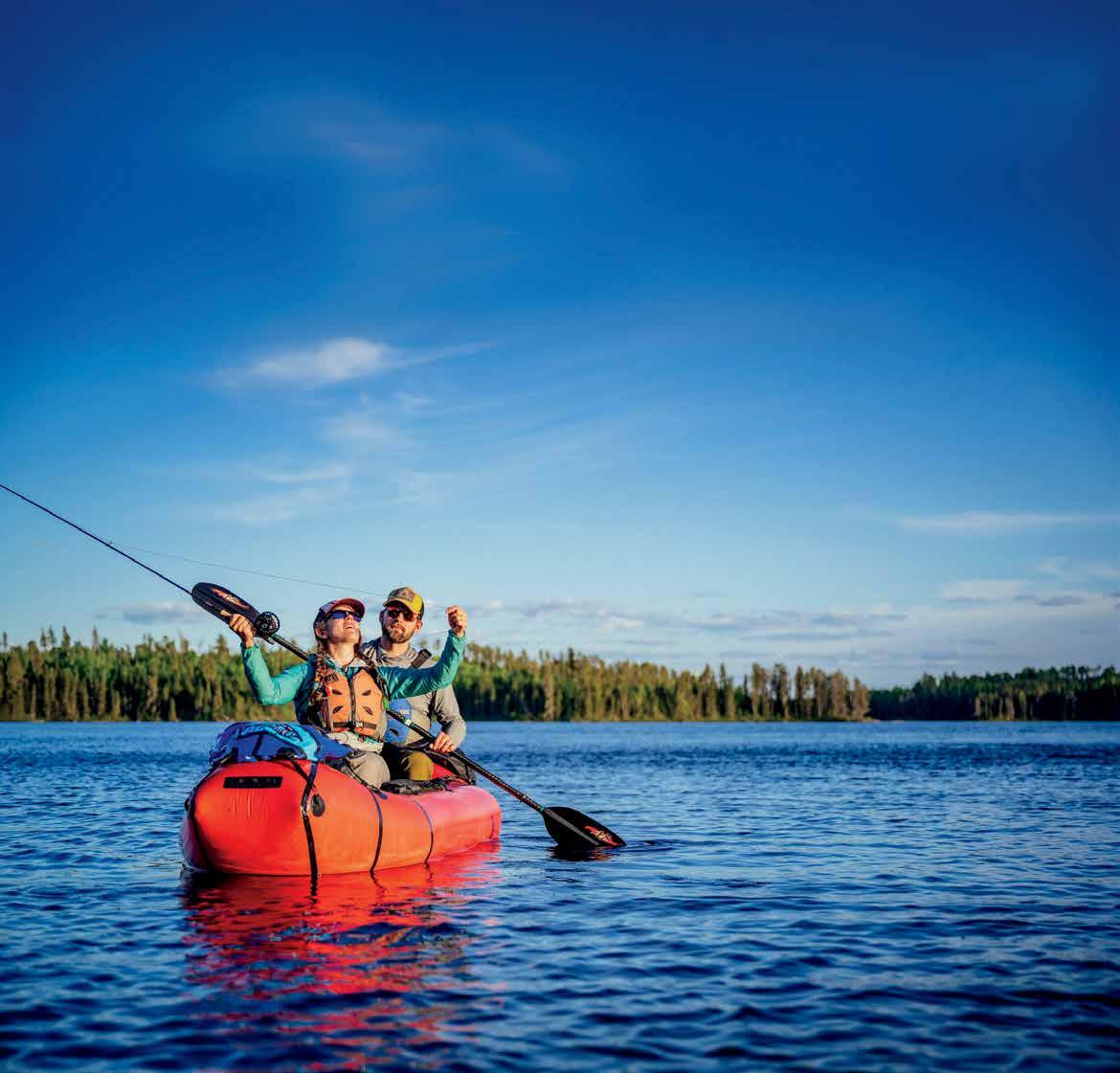









Make 2025 the year you check the Bighorn from your fishing


Arrow Land and Water, LLC
Chad Espenscheid Big Piney, WY 83113 (307) 231-2389
chadespen@gmail.com
Dunoir Fishing Adventures, LLC
Jeramie Prine
Lander, WY 82520 (307) 349-3331
jlprine@gmail.com www.dunoirfishing.com
Fish Camp
Jon Klaczkiewicz Wilson, WY 83014 (307) 413-7547
Jk@fishcamp.life www.fishcamp.life
Fish the Fly Guide Service & Travel
Jason Balogh Jackson, WY 83001 (307) 690-1139
jb@fishthefly.com www.fishthefly.com
Grand Teton Fly Fishing
Scott Smith and Mark Fuller Jackson, WY 83002
307-690-4347
ssflyfish@rocketmail.com
markwfuller@gmail.com www.grandtetonflyfishing.com
Graylight Outfitters
David Collom Elsinore, UT 84724 (435) 720-7440
graylightoutfitters@gmail.com www.graylightoutfitters.com
GOLD LEVEL
JD High Country Outfitters Jackson, WY 83001 (307) 733-7210
scott@jdhcoutfitters.com www.highcountryflies.com
Live Water Properties
Macye Maher Jackson, WY 83002 (866) 734-6100 macye@livewaterproperties.com www.livewaterproperties.com
North Fork Anglers
Blair Van Antwerp Cody, WY 82414 (307) 527-7274 hello@northforkanglers.com www.northforkanglers.com
Park County Glass Cody, WY 82414 (307) 587-9303 pcg@bresnan.net www.parkcountyglass.com
Rock Creek Anglers
Clark Smyth Sheridan, WY 82801 (307) 672-6894
rockcreekanglers@wyoming.com www.anglingdestinations.com/ rock-creek-anglers
Sweetwater Fishing Expeditions, LLC
George H. Hunker III Lander, WY 82520 (307) 332-3986 phunker@wyoming.com www.sweetwaterfishing.com
Tactical Fly Fisher, LLC
Devin Olsen Lander, WY 82520 info@tacticalflyfisher.com www.tacticalflyfisher.com
Thermopolis Fly Shop
Dan Pass Thermopolis, WY 82443 thermopolisflyshop@gmail.com www.thermopolisflyshop.com
TyOutdoors
Ty Hallock Casper, WY 82609 (307) 315-8287 ty@tyoutdoors.com www.tyoutdoors.com
Westbank Anglers
Michael Dawes Wilson, WY 83014 (307) 733-6483 info@westbankanglers.com www.westbankanglers.com
GOLD LEVEL
Wind River Outdoor Company
Ron Hansen Lander, WY 82520 (307) 332-7864 ron@windriveroutdoor company.com www.windriveroutdoorcompany.com
BAHAMAS
Mangrove Cay Club
Dan, Jeff & Pat Vermillion Livingston, MT 59047 (888) 347-4286
dan@sweetwatertravel.com www.sweetwatertravel.com
BRAZIL
Agua Boa Lodge
Dan, Jeff & Pat Vermillion Livingston, MT 59047 (888) 347-4286 dan@sweetwatertravel.com www.sweetwatertravel.com
3 Rivers Steelhead Expeditions
Dan, Jeff & Pat Vermillion Livingston, MT 59047 (888) 347-4286
jeff@sweetwatertravel.com www.sweetwatertravel.com
Lower Dean River Lodge Dan, Jeff & Pat Vermillion Livingston, MT 59047 (888) 347-4286 jeff@sweetwatertravel.com www.sweetwatertravel.com
Steelhead Valhalla Lodge Dan, Jeff & Pat Vermillion Livingston, MT 59047 (888) 347-4286 jeff@sweetwatertravel.com www.sweetwatertravel.com
MONGOLIA
Mongolia Taimen Camps Dan, Jeff & Pat Vermillion Livingston, MT 59047 (888) 347-4286 dan@sweetwatertravel.com www.sweetwatertravel.com
UK
WALES
Llyn Guides
J. Noel Hulmston Nefyn, PWLLHELI LL53 6LF T Int + (0)1758 721654 C Int + (0)7774 610600 llynguides@dnetw.co.uk www.llynguides.co.uk
BY PAUL BRUUN
Creating a fish-attracting wake with a dry or wet fly on a river isn’t new. But you should know a little bit about one historic technique.
Nearly a century ago Newfoundland’s Portland Creek area fishers devised what turned into a proven method for waking salmon fly presentations.
Early salmon fly hooks were formed without eyes. Hook eyes were firmly attached catgut leader loops, a connection susceptible to eventual failure from repeated fishing stresses. Sportsmen and military officers fishing in that island dominion of the British Empire left their worn, traditionally large feather wing salmon flies with resident fishermen. Prior to and during World War II the area provided extensive Allied navy, army and air base support. Labrador and Newfoundland became Canada’s 10th province in 1949.
To preserve, but actually fish these fly treasures, locals added a grinner knot to any eye remains before reinforcing the connection by snugging a pair of leader hitches on the hook behind eye and fly head.
This riffling, or riffle hitch or Portland hitch, was a mash-up leader that guided a fly from the side and lifted the eye. As the fly traveled, a subtle but noticeable V-wake resulted. Hitches began with the fly hook eye facing upstream so when completed the leader was toward the caster. Switching river banks normally meant reversing the leader hitches.
A still glowing memory was the surprise of a massive steelhead, maybe 15 feet away, suddenly tracking the floating Muddler that my free rod hand was casually skating as I pulled John and our raft from a gravel bar.
Fear of flunking hitch rigging shooed me from this revered technique, but not from botching casts that too often created obscene hitch-like fly wraps. Such messes didn’t stop my dragging, skating, stripping, mending and waking Dave’s Hoppers along with Double Humpies, Stimulators, Trudes and Muddlers. Caddis, craneflies, late summer golden stoneflies, hoppers, mice and frogs all swerve about the river surface where my experimenting continues attracting trout attention.
Anadromous salmon char and trout returning to spawn in natal rivers are said to not feed regularly. However, fisheries biologists’ stomach samples include everything from voles, caddis, stoneflies, fry, rocks, crustaceans, worms, bright objects and wood.
Famous American fly-fisher, Lee Wulff, popularized this unusual Newfoundland fly-waking hitch method he learned from Portland Creek guides.
Subtle and not-so-subtle V-waked presentations are often needed to hook reluctant and challenging salmon and steelhead. Trout and smallmouth bass seekers are also successful using waked and hitched flies.
The closest I ever expected to come to Atlantic salmon style fishing was reading Wulff, Schwiebert and Bates. In the 1980s when John Simms invited me to British Columbia, my goal was to see a mystifying Pacific searun rainbow chase a waking deer hair Bomber or Muddler like in Trey Combs’ steelhead stories.
When heavy September rain wrecked our Babine/Silver Hilton Lodge visit, the trip was rescued by a quick relocation to Houston, a borrowed raft and several steelhead landings on DIY Bulkley River floats.
Recently I observed Yvon Chouinard, Jackson Hole’s unrelenting anadromous-explorer, demo his preferred riffle hitch on local cutthroat.
Opportune for fishing from either river bank, his rig begins with the leader tag entering a down eye fly hook from the bottom.
A Turle knot loop is formed in the leader’s tag end. After the fly is passed through the loop, during gentle leader snugging, the diminishing Turle loop is positioned on the fly head behind the eye. Art Lee would probably approve!
Yvon attributes this mild, downward eye-pulling V-wake leader connection to Jim Lawley, a respected Atlantic Salmon Federation activist and early Canadian live-release salmon practitioner. The above leader system and smaller size 10 to 14 Pheasant Tail soft hackles have been successful enough to cause Chouinard to abandon most Intruder and traditional fly patterns. Explicit details of delicate waking hitches and downsizing anadromous flies appear in Pheasant Tail Simplicity by Yvon Chouinard, Craig Mathews and Mauro Mazzo.
During lower and warmer river conditions, experimenting with riffle hitches and more subtle fly and tube patterns may prove advantageous. Struggling anadromous species will benefit from easier hooking with less damaging smaller yet strong barbless hooks.
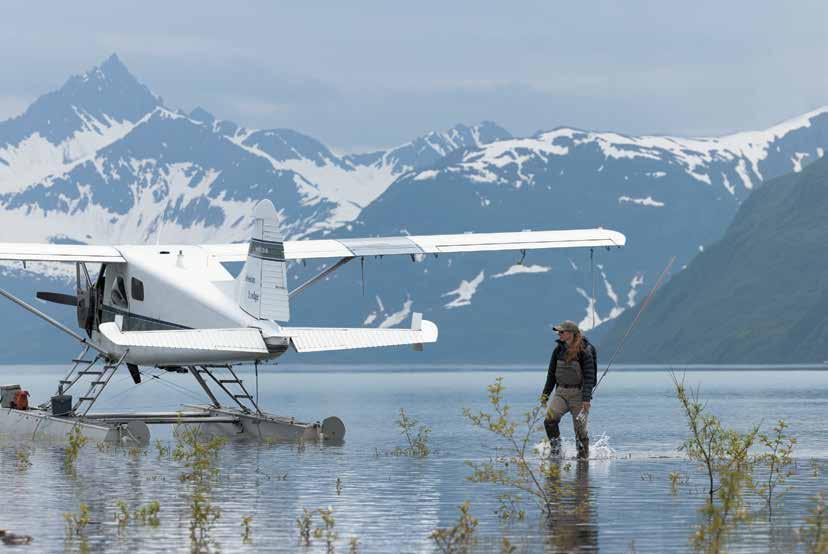
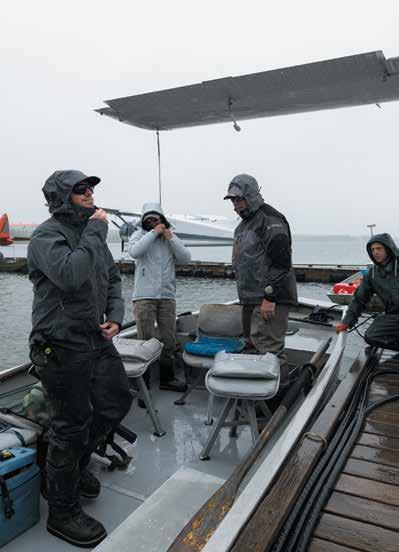
For over 80 years, we have been at the forefront of innovation. Sharpened by experience. Pushing the boundaries of material science to make our lines stronger and more durable.
Then testing in the most demanding environments with the world’s best anglers. Those who demand the best choose Scientific Anglers.