Feb 2026

Page 1


TRINITYVOICE

LIFESTYLES

FOCUS

School returns to testing in the DAC and RAC for semester exams

Season five of “Stranger Things” leaves fans questioning for more

The art of handwriting and cursive is slowly fading away

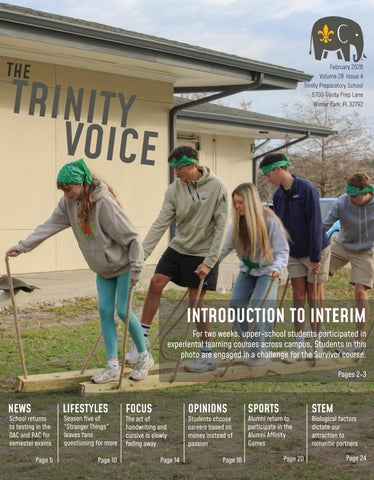
INTRODUCTION TO INTERIM

For two weeks, upper-school students participated in experiental learning courses across campus. Students in this photo are engaged in a challenge for the Survivor course.

OPINIONS

Students choose careers based on money instead of passion NEWS

Alumni return to participate in the Alumni Affinity Games

Biological factors dictate our attraction to romantic partners

6/7

Trinity’s first annual Interim Term was held from Jan. 6-16. Courses ranging from calligraphy to botany allowed students to explore their passions beyond the classroom. The two weeks culminated in a symposium, where students presented their final products from the courses.

Crypto Evolution

Blockchain innovations drive cryptocurrency growth, attracting students’ attention.

13 Stuck on Screens

Trinity teachers tackle technology usage in the classrooms.

19

Torn Between Teams

Multi-sport athletes work to find a balance between overlapping seasons.

22/23

Symbols of Love

Science explains the psychological impact of romantic gifts.

Photos by Julia Hoskins

STAFF

Editors-in-Chief: Lucy Chong, Fay Zhao

Non-Print Editors-in-Chief: Jack Aaron, Nikhil Daniel

Managing Editors: Ashwin Anand, Emily Lopez, Sammy Lou, Gustavo Membreno

Layout Editors: Aarav Gupta, Sofia Haddadin

Copy Editors: Sami Haddadin, Taylor Griffith

Broadcast & Podcast Department: Olivia Agnew (Editor), Brayden Kells, Britt Voll

Social Media and Online Department: Olivia Agnew (Editor), Gabbie Williams

News Department: Mia Prince (Editor), Krish Gupta, Sami Haddadin, Janav Ramprakash, Victoria Suarez

Opinions Department: Karl Loiseau (Editor), Gabbie Williams

Focus Department: Lila Choudry (Editor), Taylor Griffith, Skyler Campbell

Lifestyles Department: Mila Taylor (Editor), Julia Wu, Jena Mhamdi

Sports Department: Ben Kleiman (Editor), Thomas Bonos, Neve Judelson

STEM Department: Ashwin Anand (Editor), Sarah Zobel, Omi Tikalal

Graphics Department: Maxi de la Fuente (Editor), Natalie Baron, Aylin Garibay

Photo Department: Julia Hoskins (Editor), Eden Kiger, James Ellzey, Lola Brown, Ally Williams

Business Manager: Krish Gupta

Advisers: Erin Miller & Brian Kells

Editorial Policy

The Trinity Voice is a member of the Florida Scholastic Press Association and the National Scholastic Press Association. The Trinity Voice is produced by the newspaper/journalism class at Trinity Preparatory School of Florida. Editorials represent the opinion of The Trinity Voice writer and are not necessarily the views of the administration, faculty, or Board of Trustees of Trinity. The Voice welcomes letters to the editor and free-lance articles or photography. All submissions become the property of The Voice. Please send all correspondence to 5700 Trinity Prep Lane, FL 32792. The Voice may also be contacted via phone at 407-671-4140 and via e-mail at voice@ trinityprep.org. For information regarding the purchase of advertising within The Voice, contact us by one of the methods mentioned above. The Voice is a monthly publication during the school year (with the exceptions of November and January).

Broadcast & Social Media

A highlight video on the inaugural Interim Term, created by Julia H. ‘26, features the wide range of classes offered. In the photo above, students in the Business Etiquette course balance books on their heads to practice proper posture. Tune into this week’s edition of the weekly recap show to cover the highlights of the week and provide information about what’s going around campus.

Podcasts

What it means to be American is a question that grows ever more relevant day by day. In this podcast, Karl Loiseau ‘26, Fay Zhao ‘26, Julia Hoskins ‘26 and Ashwin Anand ‘27 offer their perspectives on the question, commenting on ideas of power, assimilation and immigration.

HARMONY AND RHYTHM ��

Nine students participate in FMEA’s All-State ensembles

is January, nine students from Trinity’s orchestra and chorus participated in All-State ensembles hosted by the Florida Music Education Association (FMEA). All-State is a prestigious event that brings together young musicians from around the state to perform in one of 24 All-State ensembles for the purpose of recognizing top-performing students. e event took place at FMEA’s annual professional learning conference, from Jan. 14 to 17 at the Tampa Convention Center. Students worked with talented professionals, culminating in great performances.

Before summer break, students in the orchestra program were given the audition material. Once back in school, Orchestra Director Mauricio Cespedes gave students who committed to auditioning class time to rehearse. He also provided guidance through the challenging material.

e audition results were released on Nov. 1. Even students who had previously been accepted were anxious.

“I was worried because I felt like since I’ve gotten in so many times, if I didn’t get in, it would be kind of embarrassing,” Tseng said. is year was also special because two middle school students were accepted into the orchestra: seventh grader Ian Tran and eighth grader Arianna Ja er.

ory exam and sight reading in the rst phase, and excerpts and the pre-audition material in the second phase.

“One excerpt is announced ahead of time, and two are announced on the day of the audition,” choir student and sophomore Nicholas Reeve said. “ en you have to go in and sing a part of a song on your part, and your part is muted to everyone else.”

“ e material includes scales (notes arranged in ascending or descending order), arpeggios (a chord played in sequence rather than simultaneously), some excerpts and sight reading, which is reading on the spot, so it gets to be really competitive,” Cespedes said.

e preliminary auditions took place in September at Freedom High School. Students were recorded by a committee, and then the tapes were sent for evaluation.

“We rst had to go to the school, and there was a classroom with two people sitting recording you,” orchestra student and junior Alli Tseng said. “It’s a blind audition, so they only sound record you, and they will tell you the excerpt you play, the etude, the scale and the sight reading, and you play it on the spot.”

Students then had to work the next couple of months on preparing their assigned concert music, as rehearsal time during the conference is limited. is music is separate from their audition materials and is distributed either to directors or to students directly after audition results are nalized in November.

“ ey give you the music about two months beforehand, and they expect you to practice it,” Tseng said. “And then the day of All-State, you get a seating audition for violins. If you do well, you can place higher in your seating.”

e audition process for choir was slightly di erent and included two parts: a music the-

e selected students arrived in Tampa on Jan. 14. Once there, they met with accomplished musicians and received comprehensive instruction and feedback, learning skills that they will bring to future performances.

“I would like to bring back the ability to sight-read pieces,” Reeve said. “I would also like to bring back a lot of the concepts the director discussed, including sound placement, the idea of tonus (being constantly in motion), emotion and more.”

After two long days full of instruction, they attended two student performances on Friday evening, including a few Trinity students. While the All-State experience was stressful at times, the students enjoyed themselves regardless.

“When you’re not in rehearsals, you get to be in Tampa with all the other people who are there, and I really enjoy that time I get to spend with them,” Reeve said.

On Saturday morning, there were two more performances from other ensembles, including the Tenor 1, Tenor 2, Baritone and Bass (TTBB) choir. By the afternoon, the students were headed back home, carrying with them invaluable memories.

“Overall, it was an amazing experience,” Reeve said. “I loved being able to spend time with friends and be in a room with a sound you cannot achieve anywhere else. e performances were spectacular.”

(Pictured left to right) Julian Foley ’26, Zoey Wallington ’26, Nicholas Reeve ’28, Isabella Ding ’26 and Choral Director Charles Carroll ride on a trolly in Tampa during FMEA All-State.
Orchestra Choir

CLASSROOMS TO C URTS

Semester exams relocate from classrooms to the DAC and RAC

Since COVID-19, Trinity students have been completing their semester exams in individual classrooms. This year, however, they instead found rows of tables filling the DAC and RAC with hundreds of individuals packed into one space, marking a seemingly permanent return to centralized testing. Administrators say the change was driven by wellness and grading logistics.

When exams were held in individual classrooms, teachers were often required to proctor tests outside of their subject areas across multiple days, making it difficult to complete grading on time.

“This was a strategic initiative aligned with some of the wellness objectives, that having grades be finalized by the end of (exam) week was important, so that students were not overly anxious during the holidays and had to wait until after the first of the year,” Head of Upper School Tracy Bonday said. “We also wanted teachers not to feel that they were leaving and having to continue to grade through their breaks.”

The centralized testing format, however, was intended to address both concerns.

“The thought was, if we moved back to exams in the DAC and RAC … it means that the teachers are only proctoring their content area tests, so then they have the other days to be able to spend closing out grades for the semester,” Bonday said.

The new, centralized testing locations also facilitated both teacher assistance and support for students.

“When we didn’t do this, all faculty members would have to run between rooms to answer student questions, which was a lot of physical wear and tear on teachers,” Science Department Chair Romina Jannotti said. “Now, we’re just in one place. … I think it’s

nice that I can still be with my own students and assist them with questions.”

With all students in one place, the gym setting also allowed for further supervision during exams.

“Moreover, I think it also helps with test security because now you have multiple adults in the room monitoring things,” Jannotti said. “I like being able to monitor my own exams because I think there are things that I can look for that maybe a teacher of another subject doesn’t look for.”

Centralized testing also allowed teachers more precise control over how their exams were administered.

“I no longer have to write a note for someone in terms of how to administer my test, which is difficult to do because sometimes, things that come second nature to me, I might not be able to articulate well on paper,” Jannotti said.

Some students, like eighth grader Jacob Scheinberg, also shared the benefits of the new testing environment, including how a

centralized location reduces the stress of finding the correct classroom.

While navigating the test site became easier, some found the locations themselves more distracting due to the sheer volume of people and noise in larger spaces.

“I prefer a smaller space because I feel there’s less people who could distract me,” sophomore Tyler Tongson said. “If it’s like a larger space, then there’s more chances that people might do something by accident and be just a little disruptive.”

Teachers also noted that the format comes with trade-offs, such as tailoring exam logistics to specific tests. This is especially important for teachers who want to mirror their semester exams to their classroom tests, with nuances like specific time allocations for different sections.

“If I were in my own classroom, I’d be able to tell my students that it’s been 45 minutes,” Jannotti said. “You don’t want to do that in a large setting because you don’t want to disrupt everybody.”

Despite these challenges, administrators said the overall response to the change has been positive, especially from teachers.

“From what I understand, everybody was very happy to see the change back to the testing in the gym and the ability to be able to have more time to grade during (testing) week,” Bonday said.

Looking ahead, Bonday emphasized how reduced stress during Christmas break remains a priority for the administration.

“I’m hoping that, whatever the trade-offs are, being able to move on and potentially enjoy the rest of their break is enough of an upside that whatever little nuances may be involved … will not be so problematic,” Bonday said.

Liann Kurlansik ‘26 works quietly at a desk while completing her exam in the DAC, simulating the open testing environment.

ALL ETS ON BLOCKCHAIN

When senior Connor Brady rst invested in Ethereum, the cryptocurrency was valued at about $700. Five years later, a single coin is worth nearly four times that amount. Since its creation in 2008, the cryptocurrency market has expanded rapidly, driven largely by advances in blockchain technology. ese developments have captured the attention of Trinity students across a range of grade levels, raising questions about how cryptocurrencies operate and what di erentiates them from traditional nancial systems.

Cryptocurrencies are unique in that they are decentralized, operating without government oversight or a central bank, yet they can still be traded and used in daily commerce. Blockchain works by recording transactions in veri ed “blocks” that are added to a shared public chain and validated by a decentralized network, making the information extremely di cult to alter and creating a secure, transparent record that has enabled widespread trust and adoption of cryptocurrencies like Bitcoin and Ethereum.

Class of 2021 alumnus Jake Ra a served as Head of Partnerships for Vanderbilt University’s blockchain organization and now works as a nancial technology consultant.

“One of the most exciting things about cryptocurriencies and blockchain is just how new the space is,” Ra a said. “We really don’t know the limits that we can push blockchain technology to. ere’s really a lot of room for exponential growth … and a big opportunity to make a huge impact on people.”

is excitement resonated with Brady and his friends as early as seventh grade, prompting them to explore and research the market.

Exposure to higher-level courses only intensi ed Brady’s interest as he progressed through high school.

“I really started picking (crypto) up again when I got a lot into applied math and computer science,” Brady said. “(Although cryptocurrencies) are more about public sentiment than anything, just trying to predict where something is going to go interests me

a lot, and I got into it as I took more math classes and tried new things.”

e role public sentiment plays in dictating cryptocurrency market value distinguishes it from at currencies, where value is derived from trust in the issuing government’s economic stability, like the U.S. dollar.

“ e (crypto) market is a lot more interesting than it’s ever been, with how many ways it can be manipulated and what it’s driven by,” Brady said. “ e recent volatility, with articial intelligence, along with how easily a tweet from someone of political power can throw the market o so much, has de nitely piqued a lot of interest.”

is distinction has become a magnet for investors like Brady and, coupled with blockchain innovations, has opened new avenues for investing in traditional stocks. is is through tokenized stocks, which use crypto technology and the bene ts of blockchain to invest in 1-to-1-backed real-world assets like Apple or Nvidia.

“I’ve been using crypto to invest in stocks nowadays,” Brady said. “ ere’s been a lot of hype around blockchains recently. I think both de nitely have been trending upwards. Kids don’t talk as much about crypto, but it’s de nitely been on people’s minds a lot more now because of new technology and how much easier it’s been to access it and understand it.”

Crucially, promises from President Trump, such as making the United States “the crypto capital of the world,” signal a positive outlook for the space’s direction and leave the door open to major growth. is vision has already been realized by the signing of executive orders to strengthen digital asset leadership, the creation of the Strategic

Bitcoin Reserve and the repeal of restrictive banking regulations.

“We’re going to continue to see (crypto) expand, especially as we see how U.S. legislation works out,” Ra a said. “I do think that has the potential to change the space … but assuming it follows the path it’s been following, we’ll only see adoption of crypto and blockchain technology continue to increase.”

As a result, cryptocurrency and blockchain will become increasingly integrated into dayto-day transactions, making it all the more important to grasp the basic concepts of these digital assets.

“(You) don’t need to understand it from a technical perspective,” Ra a said. “(But at least (acknowledging) that Bitcoin and Ethe-

Senior Connor Brady holds an Ethereum coin, re ecting his involvement in and curiosity about cryptocurrency.

Cryptocurrency evolves alongside new blockchain technology

reum are these legit things … (with) major nancial companies … building out their infrastructure with blockchain technology. Literacy is important, but it’s also important to recognize that this is something that’s here to stay, (so) at least strive to make an e ort to understand it.” is is especially true in a fast-moving market, where the door is always open to risks such as rug pulling. Common in trend-based memecoins like the Squid Game Token, rug pulls occur when developers hype a new project to attract investment, only to suddenly abandon it and steal the funds.

“We

It’s just all about how much time you can put into validating and nding concrete reasons why you believe (certain cryptocurrencies) aren’t a complete scam.”

While the Trinity workload is demanding, signing up for daily crypto newsletters or exploring beginner-friendly programming courses like CryptoZombies can allow students to stay ahead and alleviate pressure.

really don’t know the limits that we can push blockchain technology to. There’s really a lot of room for exponential growth ... and a big opportunity to make a huge impact on people.”
- Jake Ra a, financial consultant

In addition, utilizing Trinity’s vast array of applied science and engineering courses can also help students develop the technical skills needed to navigate and compete in an increasingly automated industry.

some of the riskier tokens, but of course, there’s the risk involved with that. ere’s no real way to know, because a project can still look really valid, and then they can rug pull.”

e illegal misuse of billions of dollars of customer funds in the Sam Bankman-Fried FTX cryptocurrency scandal serves as a stark reminder that distinguishing between good and bad actors is both necessary but tricky. Despite the risks, the cryptocurrency sector is likely to continue to grow and evolve, driven by ongoing innovation from developers and continued interest from investors.

“A lot of newer cryptocurrencies aren’t based on anything, just hype and excitement, which can be a really cool thing if you want to try to move fast and make a lot of money quickly, but it can also be the opposite,” Brady said.

While the prospect of a government-independent currency may seem attractive, the lack of regulation leaves investors’ fates in the hands of the founder, who may have ulterior motives.

“ ere’s no governmental basis that is focused on trying to improve the economy and regulate it,” Brady said. “So it is completely dependent on what the creator wants to do with this coin, if (the creator) just wants to make money or (if they) actually want to make it a sustainable cryptocurrency.”

Managing the Trinity work-life balance does not make it any easier to verify the credibility of cryptocurrencies or stay on top of the latest market movements.

“It’s about how much time you can put into it,” Brady said. “I’m a student, so I have a lot of work and don’t have a lot of time to put into constantly monitoring the market. …

“When you think about big industries trading cryptocurrency … it’s all done by pre-programmed strategies and algorithms,” Brady said. “So (in) talking about tools for the future that I think will be instrumental, it will be computer science, and then trying to make things that are automatically going to beat the market instead of by hand.”

Using social media discussion forums like Reddit, X or Discord can be a great way to make more informed investment decisions that align closer with public opinion.

“Getting a large majority of people’s sentiment … can hold a lot more weight than just asking Google or AI because of how much people’s belief in a cryptocurrency is going to a ect its price,” Brady said.

“ e people who stay and continue … to learn and be present past big spikes and during market downturns … are really building unique projects that will actually impact the space,” Ra a said. “ at quick cash grab aspect is a lot of reasons why some of the space isn’t seen as legitimate by some, but I think there are a lot of incredibly important projects being built that are genuinely making an impact.”

In the face of unprecedented innovation in blockchain technology, favorable legislative policies and an increasingly integrated crypto sector, now is a critical time to analyze the market, break it down and embrace the future of nance.

Still, the threat of rug pulls and unpredictable collapses always looms, underscoring the importance of conducting thorough research or prioritizing safety by investing in well-known currencies.

“Look at the founders and transact using big-name tokens for the most part,” said junior omas Hoskins, who has been involved in crypto for almost four years. “You can always try to transact with

“Just consume as much information as you can, watch as many videos as you can and then dive right into it,” Brady said. “ ere’s no experience that you’re going to get without actually buying and trading it. … Even just using 10 or 15 dollars and trading 10 cents at a time, you’re still going to get the experience of trading cryptocurrency. … Just jump right in, start experiencing it and learn as you go.”

MARTINEZ’S MARVELOUS MATCH

New teaching fellow Ariana Martinez serves up a love for learning

Moving from Ecuador to the United States at age 7, Ariana Martinez grew up bilingual, with English as her second language. What began as an academic challenge, though, soon became something more. Martinez developed a deep appreciation for the language and made it a de ning part of her identity. Now, Martinez is joining Trinity Prep as a teaching and coaching fellow in the middle school faculty.

“English for me has always been my favorite subject,” Martinez said. “When I was learning how to speak English, literature and grammar became such a big part of me. I’ve always been interested in it.”

As a fellow, a role focused on classroom observation and professional development, Martinez has been observing di erent English classes across the middle school. While she does not yet know for certain when she will begin teaching her own students, Martinez plans to bring her personal teaching philosophy into the classroom.

“I’ve described it as keeping an open mind, especially now in this environment,” Martinez said. “I think it’s about meeting students where they’re at and understanding that everybody learns at a di erent pace.”

In addition to her work in the classroom, Martinez will coach the middle school developmental tennis team this year, a role that connects directly to her lifelong involvement in the sport. Tennis has long been a central part of Martinez’s life. She began playing at age 4 and started competing seriously around age 7, continuing her development in Miami while at her parents’ tennis academy.

Martinez later continued playing tennis at Lake Highland Prep, where she was named Student of the Year and helped the team secure a state championship in 2014. However,

also exposed her to the challenges that come with managing both school and sports, a perspective she hopes to apply when coaching the middle school developmental tennis team this year.

“You have all this academic stress and are trying to be the best athlete that you can,” Martinez said. “I understand when every single kid is coming up to you being stressed about all this coursework and being this athlete. So that’s something that I de nitely am going to take into my coaching.”

Martinez also sees a clear connection between tennis and academics, particularly when it comes to setting goals.

“Tennis is a personal sport,” Martinez said. “It’s about setting these goals for yourself and making sure you meet them, which is the same thing with academics.”

at focus on student support carries into Martinez’s role as a co-advisor for mathematics teacher Stefani Wood’s advisory, where she works with students on a personal level.

“She just always has a smile on her face, and she always starts conversations with us,” seventh grader Chelsea Cropper said. “It’s like we all have the same thoughts, and I can always rant to her. It just makes me feel so comfortable talking to her.”

“Every single person in my family plays tennis,” Martinez said. “It’s pretty much a requirement for us to play tennis. Since we’re all Ecuadorian, it’s so important for us to keep that tradition going in our family.”

an injury at the end of her sophomore year ultimately prevented her from playing college tennis. is experience became a turning point in her life.

“Being injured like that took an incredible mental toll,” Martinez said. “I de nitely learned to take it easy, to not be too hard on yourself. It’s de nitely something that each student athlete should know.”

Martinez’s experience as a student-athlete

Whether she is exploring teaching English, supporting students in advisory or coaching on the tennis court, everything Martinez does comes back to the same lesson she learned early on as an athlete.

“Tennis is a solo sport,” Martinez said. “ ere’s nobody else to blame on that court except me. So that’s something that I’ve taken into account in my everyday life. I have to take accountability for everything I do. And any successes that I have are because of me, and any downs that I have are also because of me.”

New teaching fellow Ariana Martinez talks to seventh grader Amalia Murphy during advisory, where she serves as a co-advisor to math teacher Stefani Wood.

FIT FOR FEBRUARY

“Winter arc” trend gains traction among students

February marks the point where many quietly abandon their New Year’s goals after just making them a month earlier. Traditional goal-setting methods, such as bucket lists and vision boards, lose their meaning. However, Gen Z has invented a new approach: the “a winter arc,” a popular social media trend where people focus on self-improvement during the winter time.

Academic Arc

“A winter arc is a period where you can sit down and kind of just improve yourself in any aspects,” senior Victor Fang said.

For Fang, this means spending hours at the Rollins library on the weekends, phone notifications on silent, working on his college applications and his homework.

“I’d rather be working on homework or college applications than going out on a Friday or doing too much when I don’t have the time, and I think that’s going to pay off in the future,” Fang said. “Even if it doesn’t pay off immediately or I don’t get the results that I want, I think long term, these habits are gonna build and I’m gonna have better opportunities in the future because of the habits I built.”

Exercise Arc

Junior Thomas Hoskins approaches the gym with intention. Although winter arcs are only temporary, he aims in building long term strength.

“My main goal is to be really strong long term and just be the healthiest version of myself,” Hoskins said. “I think of it as more of a 365 day arc.”

Hoskins keeps himself accountable by tracking his progress in and out of the gym.

“At the gym, I can measure my progress by my weight increasing on the bench, squat and all the exercises,” Hoskins said. “Also, (I can

Mental Health Arc

Sophomore Cassidy Driscoll said she struggled with her mental health in the past and wasn’t able to open up to people about it. Now, in her winter arc, she recognizes that her silence was something holding her back.

“I need to start talking openly about my mental health now because it will help me in the future,” Driscoll said. “It brought me out of the dark place I was in. It helped me have more confidence within myself, be willing to learn about myself, grow and just become a better person.”

Driscoll is also focusing on what she calls her “pushup journey.” She starts by doing five pushups and increases the number each week until she reaches 100. Doing pushups has helped Driscoll boost her self-confidence.

Especially in the depressing season of winter, goals often feel unachievable. Not because they are too hard to accomplish, but because people aren’t consistent. Fang emphasizes the importance of small, consistent efforts when beginning a winter arc.

“Do 1% extra every day,” Fang said. “For example, doing five more minutes of homework or doing an extra problem on your homework set, I think it definitely pays off a lot because every time you add that 1%, eventually it’s going to become 100%, and you’re going to thank yourself for those tiny steps that don’t seem like a lot.”

measure my progress) by tracking my calories. If I get enough calories every day, that’s a success.”

For Hoskins, motivation goes deeper than just physical results.

“Find a purpose that you’re doing it for,” Hoskins said. “I think if you are very superficial about it, like if you just want to become stronger, you probably won’t stay consistent. But if you have a deeper why, then you’ll stick with it.

“If we actually want to follow through with our goals, we need to get a headstart on things,” Driscoll said. “Before, I was not be able to do a single push up, but now that I’m on that grind, I can do a lot more than (the) average person.”

Although it is already February, Driscoll believes that it is never too late to start a winter arc. It is more about the decision to begin.

“Starting is the hardest part, but it only gets easier from there,” Driscoll said. “I’m a person who used to love excuses. I would say that I will start in a week. Those excuses won’t help you in having good discipline. It is what sets you up for the future, and it’s what helps you become a better person with this discipline because it teaches you life skills that you need for years beyond.”

Sophomore Cassidy Driscoll does pushups every day for her “pushup journey,” which is a part of her winter arc improvement plan.

STRANGE FINAL SEASON

Fans are left questioning “Stranger Things” Season 5

Within the rst ve days of being released, 59.6 million fans tuned into “Stranger ings” Season 5, according to Variety. With the show developing over the span of nine years, the ending of “Stranger ings” is met with only one feeling: bittersweet.

After Season 4 ended on multiple clihangers, fans sought highly anticipated answers. People were left questioning after Max’s near-death experience, Eddie Munsen meeting his end and the Upside Down bleeding into Hawkins.

ere is now a darker tinge that lls the air of Hawkins, a shift away from innocent Dungeons and Dragons playdates, to a town under the control of the military, and an active portal into the Upside Down. Characters who were once the underdogs have grown up and changed for the better. Most notably, Will Byers.

“I think the rst half of the season was so well developed,” senior Hannah Wang said. “ e way that Will’s powers were introduced was a prominent scene.”

Yet, after part one, fan opinions of the new season got increasingly negative.

ough critics largely kept ratings high for Season 5, it has the lowest Rotten Tomatoes score of any season, with a 85% rating for writing. Science teacher and avid “Stranger ings” fan, Bryan Moretz describes the disappointment from the lack of quality writing during the nal season.

“ e overall quality and pace were very fast,” Moretz said. “It felt like there were multiple writers all doing their own thing and then throwing it all together.”

e Du er Brothers released “One Last Adventure: e Making of Stranger ings 5” for those seeking deeper insight into the development of Season 5.

were lming,” Wang said. “I think that everything was so predictable for the nale.”

Many were also confused that no main characters died after the defeat of the Mind Flayer and Vecna. is is out of the ordinary, considering that in every season leading up to Season 5, there has been at least one major character death. ough actually watching the ght scene with the mind ayer, it is no surprise that no character died, as the duration only lasted 5-10 minutes (almost the same duration as Will’s coming out scene). It was disappointing how weak the mind ayer and Vecna seemed, as the show had been building up to this nal battle for so long.

“It was very super cial, and felt more like a fun adventure movie rather than seeing the nal ending of a season that had a lot of emotional value,” Wang said.

e fact that Season 5 was supposed to have the most dangerous nal battle of all seasons, and the only emotional value seemed to be Eleven’s sacri ce, is shocking. Even then, Eleven’s death is heavily disputed, with writers hinting at her possible survival through Mike’s theory.

“I think she’s still alive,” Sixth grader Vaishnavi Ganti said. “Because you can’t see her tattoo. Her wrist is glitching, and she doesn’t have a nosebleed after pulling Mike into the void.”

to what the show had been building up for the last nine years, many “Stranger ings” fans theorized that there would be a surprise ninth episode.

Fans on various social media platforms developed the Conformity Gate eory, dissecting the nal episode and pointing out oddities and plot holes. According to the theory, Vecna had created a fake reality in which he is still alive, and the characters

“In the documentary, they did not have an ending written for Episode 8 while they

Eleven’s fate in the last episode was left up to viewer’s interpretation. Because of this, and the strangely easy resolution

are under his mind control. Fans had their hopes that Net ix would drop the surprise episode on Jan. 7, but to no avail.

“I thought at rst it would be cool to have an alternate ending,” Moretz said. “But at the same time, I could just tell it was over.”

school or the end of middle school, when guys figured out they have some kind of sta tus or persona they need to upkeep,” senior Marisela Morel said.

While this virus could affect anyone, it is commonly found in high school boys.

“(There is) a standard as a guy that if you’re not a certain way, it’s weird,” sophomore Sina Gooshvar said. “The basis of not being weird is being nonchalant.”

Nonchalance, at its core, is a performance of detachment. Caring too much shows vul nerability, effort and real excitement, all em barrassing things in high school.

“I think it protects them from rejection,” Morel said. “They (act) barely interested, so it protects them from seeming sad if they were to get rejected.”

There has been speculation as to why Gen Z is the most susceptible to the non chalance epidemic: a completely different (and 100% more fatal) epidemic that hit in 2019.

“COVID-19 has changed this generation, compared to older Gen Z,” Gooshvar said.

When COVID-19 hit, most of the current teenage population were still in late elemen tary school or early middle school, ages when they were still trying to discover who they are as people. Quarantine came swiftly and did not allow for real connection with peers, unless it was through a Zoom call with your entire sixth grade class. During this period meant for so cial development, kids were locked behind screens, cameras off and microphones muted. Over time, conversations became optional or even unnecessary.

society. Nonchalance flourished in this envi

comfort instead of confronting it head-on. It took over quickly, infiltrating the way students speak and connect, until emotional distance felt more normal than sincerity.

It is not rare for people to be afraid of being persecuted in social settings, but it is not rational to diminish or change components of yourself to fit a false persona. Social media allowed nonchalance to appear as an attractive character trait for people to have.

“With social media, everyone always sees the most perfect versions of a person, and they aspire to be like them, even though that may not be achievable,” Gooshvar said. On online platforms, perfection is rarely seen as being emotional. Being your true, unashamed self on the internet can often be received with hate and controversy, so most choose to avoid it. For example, phrases such as “aura-farming” became a synonym of nonchalance, and doing or being anything else was seen as inferior. While most trends go away with time, this one never truly left; it simply faded until the resurgence in 2025.

“I see stuff on TikTok (where people) all talk about how being nonchalant is cool,” Greenlee said. “Nowadays people kind of see stuff on TikTok and immediately treat it like fact. It’s really easy to influence people through social media.”

Many people try to conform to the internet’s image of an ideal life, failing to realize that it is simply not attainable — especially if the image is one of constant indifference.

“You should always be your true self,” junior Nabiha Shakil said. “If you don’t show your (true) personality, how are people going to want to be friends with you?”

Allowing false perceptions of perfect, emotionally detached people to influence your own behavior will lead to a life of misunderstanding who you are as a person. If nonchalance is the disease, authenticity is the cure. Recovery does not require dramatic emotional reveals or constant enthusiasm, but it does require honesty.

STUCK ON SCREENS

As the lights dim in the classroom, and the movie credits roll out, the only screen that matters is the one in students hands. Movie day used to be one of the most highly anticipated times in school, but now there is little enjoyment in the activity due to students’ lack of attention span. Constant digital engagement with technology and social media causes an excessive need for stimulation, making it difficult to focus on anything for too long. Whether it be in the classroom or at home, tasks that require patience now take longer to complete and are often interrupted by devices.

In Trinity classrooms, frequent use of technology has caused noticeable shifts in focus regarding class material. Eighth grader Chrysoula Rooth has observed firsthand the impacts on devices have on learning.

“Technology has a large impact academ-

Because of this, psychology teacher Michael Brown chooses to set aside technology almost entirely during his class, only bringing it out to help keep students engaged with the content by playing educational games.

“The only time we interact with technology in an educational setting is when we do a Blooket, Quizlet or Kahoot at the beginning of class,” Brown said. “Other than that, I just avoid it.”

Technology not only impacts students’ focus in an educational setting, but in a social one as well. When allowed to be on a device, more often than not, the ability to hold a conversation without constantly checking it becomes difficult.

“I can tell that if somebody gets a message, they’re drawn straight to their phone, even if we’re mid-conversation,” Rooth said. “And sometimes that may happen to me too, and

science teacher Emily Massey-Burmeister said. “To have something that doesn’t quite go perfectly or doesn’t go the way they think it should.”

When the ability to have an answer within seconds is taken away, students often don’t have the desire or willingness to put in the effort to find an answer themselves, which can lead to the formation of bad habits and emotional patterns.

Through direct personalization and algorithms, the Technical University study explains that AI can shape the user’s cognitive processes and alter their ability to come to proper conclusions without external help.

Although the effects of technology and social media are concerning, they aren’t permanent. The ability to focus is a habit that is easily trainable.

“With enough diligent work, you can train

LOST LINES AND LOOPS

Use of cursive declines in the classroom

A close-up of sophomore Derek Heyworth-Davis’ handwriting looks almost cinematic. The pen barely lifts, and the letters lean into one another with a smooth and somewhat medieval confidence. In most classrooms now, writing is fractured into taps, clicks and the frantic swivel of a cursor. The flowing lines of cursive that were once required in classrooms have now dwindled into a few, like Heyworth-Davis’.

Heyworth Davis was taught cursive in first grade, but when he entered middle school, cursive stopped being mandatory. Yet, Heyworth-Davis still preferred writing in cursive.

“By that point, I had simply forgotten how to effectively write in manuscript,” Heyworth-Davis said. “So it became better to write in cursive entirely.”

At the elementary and middle school Park Maitland, cursive is still taught to all students.

“There are many reasons why using cursive is so important,” Park Maitland language arts teacher Becky Austin said. “Cursive writing is good for students who have learning disabilities such as dyslexia or dysgraphia.”

According to a 2014 PBS NewsHour report, language specialist Marilyn Zecher said cursive helps students with dyslexia by integrating hand-eye coordination, fine motor skills and memory. Zecher said functional magnetic resonance imaging (fMRI) studies show that involving the hand creates stronger associations for learning and recall, allowing students to decode letters and sounds.

For students who continue writing by hand into middle and high school, speed and flow of writing matter.

“Every time you have to pick up your pencil, it’s like you have to restart,” Austin said. “If you learn how to write in cursive, you will actually be able to take notes quicker when you go into high school and into college.”

Not all students experience cursive with

the same ease. Sixth grader Vaishnavi Ghanti learned cursive in the third grade but said it never fully stuck. She prefers to type out of pure convenience.

“I kind of got the hang of reading (cursive), but never really got a chance to actually get good at writing it,” Ghanti said.

Ghanti’s preference for typing reflects a growing divide in how students approach writing — between efficiency on one hand, and the tactile experience of using the pen on the other.

“Print feels much slower for me,” Heyworth-Davis said. “It feels almost mechanical and brutish, whereas cursive is much more elegant to write because it’s all swooping and flowy gestures.”

Spanish teacher Rita Daugherty chose to teach calligraphy after years of using it for certificates, invitations and cards.

“Sometimes they need to learn to slow down because writing is kind of an art.”

Despite its decline after being taken out of Florida public school curricula in 2010, cursive still serves everyday purposes. Heyworth-Davis said being able to read it has proven unexpectedly useful, when encountering handwritten notes or older documents.

“It’s not the kind of thing that they will die regretting,” Heyworth-Davis said. “But it’s a good skill to try to obtain.”

Daugherty believes handwriting carries a personal charm that typing just can’t replicate.

“Your handwriting is unique,” Daugherty said. “It’s part of your personality.”

For now, cursive exists in pieces — licenses earned in third grade, swooping signatures, points marked off on an essay. It appears wherever effort is visible, where handwriting becomes proof that someone stayed with a

PAST AND PASSED

Students leave Witmer and Stuart behind for Nochur Sankar

In October, science and math classes transitioned into the Nochur Sankar Science Center, leaving Witmer void of any students and Stuart at a reduced capacity. Classes went from fully decorated and lived-in classrooms to the new building with a minimalist vibe and modern aesthetic.

“It’s a bit of an adjustment, because you have to figure out where to go, and then your teachers move around after class,” senior Annalyce Campbell said. “You cannot find them in the same place.”

Part of the move to the new building entails teachers no longer having their own classrooms, instead rotating between classes and sharing with other teachers. While this can be hard for students, it is an emerging approach adopted by many schools.

“We have moved into a nonhome base, not having your own classroom,” Associate Head of School Dennis Herron said. “We built the faculty lounge to have a place where teachers could store their valuables, lockers, space, desk space (and) working space. There’s a shared kind of planning space that is different than before, which means you cannot decorate a classroom like it’s your own home.”

A new building comes with new rules such as locked doors. In the older buildings, all classroom doors were unlocked; students had access anytime throughout the day. In Sankar, students have to wait for someone on the inside to open the door for them.

“The door being locked all the time is a struggle,” Herron said. “It was really hard at first, and we can’t prop it open because the doors are locked for a reason. It’s a safety feature.”

The shift toward the shared classrooms and away from individual “home bases” is to create a more focused environment without the distraction of classroom decorations, a goal backed by research. According to the website Science and Education, kids spend more time looking at decorations on the walls than at the teacher lecturing. One study found that students in classrooms with no decorations scored higher than those in classrooms with decorations.

After the opening of the Nochur Sankar Science Center, Witmer (pictured) was left empty with doors locked and lights off.

“It’s hard when the doors (are) locked all the time because the teacher could be teaching, and then someone’s at the door and they keep having to stop to let people in,” sophomore Noyan Tekin said.

While the locking doors were implemented for safety, they have become a slight issue.

In order to preserve the cleanliness of the building and the safety of the laboratory spaces, food and drinks are also banned.

“I miss the old (building) because I liked being able to eat a snack during class,” Tekin said.

After all of these changes, some students love the new building, while others reminisce about the buildings they used to be in every day.

“I like the old buildings better,” Campbell said. “(They are) a little bit cozier (and) more lived in than the new building.”

Leaving behind the old buildings can be difficult because of how long they have been around, with most of the student body having at least one class in one of them. But there is a new sense of fondness that comes from the new building.

“There is a certain level of spirit or pride that you take, if you’re a student walking into that building,” Herron said. “That’s a lot different than when you walk into Witmer.”

Plans have circulated that these buildings will turn into something greater. A board committee is focusing on the next steps for Witmer and Stuart. While there are possible ideas of a Grille expansion, new classrooms or an addition of athletic space, nothing has been confirmed yet.

“Dining space, some athletic space, potentially,” Herron said. “There is going to be space that is renovated, built new or torn down, likely in this area.”

At a school where ambition is assumed and adulthood feels like a deadline, students evaluate career paths less by passion and more so by the paycheck they promise.

at logic explains the steady pull toward nancially safe careers: STEM, law, nance and economics. ese elds are framed as rational choices rather than personal ones, valued primarily for their earning potential and perceived stability.

“Recently, there’s been a pre-professional culture in my grade towards nance andnance-adjacent elds,” senior Victor Fang said. “It’s a lucrative job, and it’s very easy to see the career trajectory. You do one thing, then you get promoted. It’s very linear, and it feels safe.”

e U.S. Bureau of Labor Statistics reinforces this mindset, reporting in 2025 that median annual wages for high-paying professional occupations, like STEM, nance and law, exceed $100,000, while other elds hover at merely half that, closer to $50,000.

When students encounter such impressive numbers — especially at Trinity, where many grow up economically insulated — salaries become less about meeting basic needs and more about achieving a skewed de nition of nancial security.

“I think kids who might originally only want to do humanities or are very interested in a very niche eld get kind of pushed out of that into STEM just because all their friends are doing it or they hear online that engineers make more money,” Fang said.

As a result, humanities are dismissed as unstable. Research from Georgetown University’s Center on Education and the Workforce shows an approximate $18,000 median annual earnings gap between STEM and humanities graduates.

“I would consider myself as one of the people who believe that

PLAY IT $AFE

Students choose careers based on money instead of passion

money is a huge factor in it,” senior Benjamin Demetriades said. “I want to be comfortable. I don’t want to be having to pinch pennies super frequently. And so I think if I’m able to make enough money to the point where I don’t have to worry about nancial strain at that point, I’ll be successful enough.”

Parental expectations intensify the pressure, steering students toward “safe” elds. ese preferences surface in advisor conversations, course planning and the metrics schools highlight: college placement, starting salaries and competitive programs.

“At least by my parents, STEM was much, much more valued just because they preferred careers that they believed had good backing for careers and nances down the line, which of course makes sense,” Class of 2023 alum Austin Yuan said.

Over time, this phenomenon produces measurable consequences. According to the Johns Hopkins News-Letter, the number of humanities degrees awarded in the United States fell by nearly 25% between 2012 and 2020. Students are not simply losing interest; they are opting out under pressure.

“I think Trinity is a really good STEM school in Central Florida,” Fang said. “But also I think because of that culture, kids who might not have originally wanted to do STEM get swept up in that culture.”

Majority: 5

Even within traditionally high-paying elds, fear now shapes decision-making. Arti cial intelligence has complicated ideas of stability to students.

“I (thought) job security meant more in terms of salary, like a job that can provide you a stable living,” Yuan said. “But I think now it’s just because it’s a vastly changing tech world and AI is coming through, and it’s replacing di erent jobs all across the board. … I think job security now also means how future-proof (it) is.”

Despite this uncertainty, students continue to treat certain paths as inherently safer than others. Law school debt, medical training pipelines and volatile tech markets are accepted risks when attached to prestige and high-earning ceilings.

“STEM, I would say, gets more praise,” Fang said. “I think if I were to say I want to become an engineer or if I want to go into college for nuclear physics versus history or gender studies, I think I would get two very di erent reactions from the person I was talking to.”

For some students, choosing their major is no longer about building a life they want. It is about avoiding a life they fear.

“If I didn’t have this environment around me, who knows what I would have done?” Yuan said.

e lead editorial represents the view of e Trinity Voice’s editorial sta . Please send comments to voice@trinityprep.org.

Dissent: 1

MUST’VE BEEN THE

STARBUCKS SCHWIND:

TWINKLE, TWINKLE, LITTLE

The fateful December afternoon on which Mr. Commentaaron notified me of his early retirement, I was shook.

There was only one place fit to ponder such a crisis: the same spot my peers often spend the early afternoon huddled together, nose tucked into a copy of “There There” or fingers glued to their keyboard, typing away at an analysis of the Ottoman Empire’s fall.

As much as I would like to ascribe the utopian education scene above to the Sankar Science Center’s state-of-the-art “learning stairs,” our little corner of comfort is actually situated a mile off campus.

Follow the scent of unfinished calculus homework, and you’ll find nine out of 10 supposed midday medical appointees at the Starbucks on Aloma Avenue, sitting shamelessly atop an ocher armchair of lies. Evidently, Orange County doctors’ offices are so overwhelmed that they now leave kids in the waiting room just long enough to write a seven-page AP Lit paper.

I’m surprised our school hasn’t demanded a cut of the coffee shop’s daily revenue, given that we provide at least a third of their weekday customer base. Just 15% would probably be enough to fund our own coffee bar in the Grille before the next time B Clubs meet.

Still, it wouldn’t be the same. There’s just something about the Starbucks ambience — the soft Mariah Carey playing overhead, the sublime umber palette of all the furniture — uniquely capable of launching a teenage procrastinator into flow state. Or so I’ve heard.

Of course, I could never endorse such an unsaintly move. Cutting class to squeeze in an extra hour of shuteye is one thing. But skipping school to do … more school?

The result is a perpetual cycle. You skip biology to finish the history reading due next period. Now you’re behind on biology. So tomorrow, you skip English. Wait! What about that essay you missed while brushing up on Punnett squares? Oh, I know: Starbucks during history.

They say caffeine is addictive, but perhaps the real peril of Starbucks lies not in the cups

of coffee but in the constancy of class-cutting.

Eight midday skips, plus a couple of inopportune red lights on your way back to campus (see: the new 15 minutes late equals absent policy), and you’re sitting for a final exam in Micro while your peers are ridin’ waves in New Smyrna.

Consider the long-term consequences of your actions. Sure, you might be slightly more prepared for the 20-minute quiz worth 3% of your final grade tomorrow. Is that worth being subject to an additional 90-minute exam worth 20% of your final grade two months down the line?

I’d love to harp more on the evils of choosing caffeine over class, but my cinnamon dolce latte’s getting cold.

Stay in school, kids — at least until 3 p.m.

Cartoon by Aylin Garibay

Senior Lorenzo Cavalieri competes at Trinity, continuing to stick with swimming at the highest level despite multiple coaching changes over the past five years.

COACH CAROUSEL

Turnover in leadership reshapes athlete development and culture

Senior Lorenzo Cavalieri has worked under nearly four prospective coaches during his five years with Trinity Prep Aquatics (TPA). Through the 2000s-2010s, TPA built a reputation for state titles, consistent podium finishes, and dominance across Central Florida. Yet in recent years, that success has proven difficult to sustain as the program has struggled to maintain a permanent coaching staff.

“When we had the coaching changes here, it was really hard for a lot of us because you’re going from one coaching style to another really fast, and that’s really detrimental to younger athletes,” Cavalieri said. “Swimming is a pretty unforgiving sport. For every day you don’t swim, it’s like five days you have to regain that speed. So when you have a month or even two months where you don’t have a coach, it’s pretty hard to get back.”

Cavalieri’s experience reflects a broader trend across NCAA athletics. At the collegiate level, coaching instability has accelerated with the rise of Name, Image and Likeness (NIL) opportunities, the transfer portal and growing financial incentives tied to immediate success. Programs are often built and dismantled, faster than ever before.

“I feel like the biggest thing was the development of a player,” Cavalieri said. “When you have a transfer portal that’s that open, as well as NIL deals and money offered to coaches and atheletes, you’re going from vastly different programs. It kind of ruins the developmental aspect of the sport.”

One of the most visible examples came this past year in college football. Former University of Mississippi head football coach Lane

Kiffin transformed the program from a struggling SEC program into a national contender over six seasons. Yet before the postseason, Kiffin accepted an offer from Louisiana State University, a program with deeper championship history and greater financial resources. His departure left Ole Miss without leadership during the most critical stretch in program history and sparked a wave of players and struggle when coaching lacked stability.

Former five-star recruit who played under football coach Brian Kells and Division I running back Lorenzo Lingard has lived through that instability firsthand. Recruited amid national attention and elite programs, Lingard said coaching turnover repeatedly reshaped his collegiate career.

“As a young 16-17 year old kid in the process of choosing a college, you’re vulnerable,” Lingard said. “You don’t know much, and what really makes the decision feel right is the coach. When the coach leaves and goes into another program, everything changes.”

Lingard first faced instability at the University of Miami, where internal coaching changes made it difficult to establish a consistent role. That uncertainty intensified when head coach Mark Richt was fired at the end of the season, forcing Lingard to adjust to a new system before fully developing in the old one.

After transferring to the University of Florida, Lingard encountered a similar situation when head coach Dan Mullen was dismissed and replaced by Billy Napier. Once again, a new staff brought different schemes, incoming recruits and increased NIL-driven competition, ultimately leading Lingard to transfer

to the University of Akron in search of a consistent and an impactful role.

“With the coaching changes, the word (among NFL scouts) was I didn’t have enough development,” Lingard said. “I had talent and natural skill, but ball knowledge and strategy were things they didn’t see because I had so many different coaches.”

With the ever evolving transfer portal and NIL landscape, it is ultimately up to the coach to really build the culture in the program for the short time they are there or their players are there for.

“The transfer portal makes the game more competitive, but it kills the brotherhood of staying in one program and growing together,” said Chaz Williams, Trinity assistant football coach and ex-DI player for Georgia Southern. “It takes a special coach to get everyone on the same page now. A lot of that development gets lost.”

Coaches are at the center of development and team culture for most athletes at both the high school and collegiate levels. Trinity coaches look to extend the values of the school to the players and the culture of excellence bred through camaraderie — the same is true at any program. Cavalieri has seen this parallel in his time under coaching changes.

“The biggest thing for a coach is the development of a player,” Cavalieri said. “If you go to an academy overseas, you’re there for up to five years, training with the same people, the same coaches. You’re building culture and developing from that. When you’re constantly moving between programs, that developmental aspect gets lost.”

Photo courtesy of Lorenzo Cavalieri

TORN BETWEEN TEAMS

Multiple sport student-athletes balance overlapping seasons

Senior Sarah Cantwell starts her day attending morning weightlifting practice, goes to school and quickly wraps up her schoolwork to make afternoon lacrosse practice. At the end of her senior season, she will become a four-sport athlete.

The Florida High School Atheletic Association (FHSAA), which manages all sports at Trinity, sets the start and end dates of sport seasons. While most of the time sports are scheduled a few weeks apart, sometimes seasons overlap as teams advance into districts, creating problems for multi-sport athletes like Cantwell.

“Last year, I missed the first two weeks of lacrosse practice … because I was still doing weightlifting, and I went to regionals for weightlifting, so my season was basically two weeks longer than it should have been,” Cantwell said.

The overlap of seasons creates stress and overuse, which risks injury. Coming straight out of football season, senior Finn Davidescu was injured in the preseason of basketball due to the stress of football season.

“I decided (to play) because it was the first day of basketball tryouts, and I just wanted to play basketball,” Davidescu said. “I was tired of foot ball, and I showed up (and rolled my ankle).”

The physical strain due to multiple sport practic es between different seasons can cause burnout. This makes the overlap period demanding both physically and mentally.

The American Academy of Pediatrics states that “Overuse injuries, for exam ple, can result from repetitive stress without sufficient recovery that leads to accumulated musculoskeletal damage. Burnout represents one of the primary reasons for attri tion in youth sports.” The

constant state of burnout and injury then reinjury threatens one’s state of wellbeing and overall health.

“You’re used to doing one certain type of practice and one certain type of sport,” Davidescu said. “(It) demands your body so much, (and then) you just convert to a different one.”

Coaches’ cooperation around this transition period is crucial in order to maintain the sports the athletic program offers. Boys lacrosse coach and Assistant Athletic Director Travis Sanders works around this problem with his multi-sport players.

“We just want to make it work for what’s best for you guys as athletes,” Sanders said. “The only thing coaches want to (do is to) make sure that you guys are prepared and healthy and taken care of and managing your workload at school.”

Overlapping seasons create complications among coaches, with some allowing their players to start late and some wanting their sport to be the players’ top priority. This time can cause student athletes to have stress and minimal time for other activities.

“It does get stressful because there’s just

sports),” Cantwell said.“ I’m always doing a sport. I’m always going to practice, and so I never have time to rest, which I think is hard, but also the preseason (of my spring sport) is important to be better.”

Along with the switch between sport seasons, athletes also have to deal with academic stress. When it comes to school and sports, students have to work to find a balance between the two with such small free time.

“(I) get (such) lack of time to do schoolwork because if you’re always doing a sport or you’re always having to choose to do one or the other, it feels like you’re putting half your energy into both things, so that’s kind of hard,” Cantwell said.

While being a multi-sport athlete is sometimes difficult, when it comes to fitness, they have an advantage above everyone else.

“I never worry that my basketball kids aren’t going to be in good shape,” Sanders said. “The nice thing is it’s already conditioned. So players that are playing this winter sport, it’s never a problem for my team because I know the minute they step on our field, they’re already in good shape (and) they’re ready to go.”

Different teams also mean more connections and different skills. Because of this, students opt to play sports all year long, sacrificing their free time for the unique experience of being a multi-sport athlete.

“We love having multisport athletes,” Sanders said. “I encourage it. … I work in the athletic department, and so we always encourage (it) if you want to” play multiple sports.”

Senior Sarah Cantwell participates in (left to right) lacrosse, soccer, weightlifting and volleyball.

BACK IN THE GAME

Alumni return to partcipate in the Alumni Affinity Games

Photos courtesy of Elizabeth McIntosh

In recent months, more and more alumni games have taken place. Soccer, lacrosse, baseball and basketball games have happened with alumni from state championships returning to play one more time with their fellow teammates. Athletes are able to come back and play on the same field that they started their athletic career on and are introduced to alumni of various graduating classes.

In the past, few alumni games have taken place, but this year, there has been an initiative to integrate alumni into school events more and more.

“We’re still trying to find out the right time frame,” Assistant Athletic Director Travis Sanders said. “Is it during a holiday break? I think we’re going to take some time, give it a run this year and then we’ll evaluate and see what teams we want to add next year and what times work best.”

Bringing alumni back to campus allows them to see the growth of the school, the athletic program and help to mentor athletes.

“We just have such pride in our school, and I think a lot of our alumni feel that way,” Sanders said. “A lot of our alumni enjoy coming back and hanging out and telling stories.

It’s been really fun to listen to stories, even alumni that graduated a long time ago come back and talk about their memories.”

Alumni meet different groups of people from differing graduating classes and reunite with teammates they crossed paths with.

“My husband went (to the baseball alumni game), and his senior big brother was there,” alumni coordinator Hannah Schuttler, who is also an alum, said. “These were guys that he knew because he was in sixth grade when they were seniors, and they were so cool when we were little, and then he got to go and hang out with them, and I think that was really fun.”

Alumni also get the opportunity to reconnect with a sport that influenced their high school lives so heavily and brings back the nostalgia of their childhood. Alumna Taylor LaPeters is now an assistant weightlifting coach after being asked to come back by alumna and current English teacher Erin Miller and being a former weightlifting athlete.

“Weightlifting was just so important to me at that time,” LaPeters said. “It helped me learn that I loved lifting throughout the past decade, being away from high school and everything. I would pretty much do anything for Erin Miller. People like that just make such an impact on your life that you’re like, yeah, of course, I’ll do anything to help out.”

Alumni games also give students an opportunity to continue their legacy with new athletes.

“It’s fun for current coaches and athletes to meet their alumni that they’ve heard stories about in our boys lacrosse program,” Sanders said. “We have guys who graduated a while ago and come back.”

On Nov. 21, members from the 2007 state runner-up team returned to play in the alumni game.

Alumni can also pass on advice that only comes with time, experience and reflection of the sport they love.

“I hope that the girls can take away, especially the seniors, that they are lifters,” LaPeters said. “As women, they are allowed to take up space in a gym. I want to instill that confidence because that’s what was instilled in me.”

These new alumni events are an initiative that reshapes community and outreach, extending beyond social media posts highlighting old classmates to truly bridging the connection with the past and present.

“I think it’s really awesome to be able to come back and see your teachers and see the places that shaped you,” Schuttler said. “And we know that athletics, being on a team, is such an integral part of growing and becoming a good professional and a good person as you grow up. And so having those relationships and continuing those relationships I think are really important, but also getting to see people that you don’t normally see.”

On Dec. 22, alumni played in the basketball alumni affinity game with former coach and alumnus Eric Schneider.

PURE WILL, NO FILL

Student athletes juggle training and fasting during Ramadan

Every year for one month, student athlete Sam Makki wakes up before the crack of dawn to consume all the food and water he needs for the day. He attends school and track-andfield practice five times a week, but he eats and drinks nothing. Makki is one of many students and people worldwide who celebrate Ramadan, a month-long fasting holiday for Muslims. This year, Ramadan starts on Feb. 18, and is is based on a lunar calendar, shifting forward 10 days every year.

Those who practice Ramadan abstain from food from sunrise to sunset, with the hours getting longer and the task tougher each day. Along with fasting for around 12 hours for 30 days straight, Makki runs in the blazing Florida sun for two hours after school on an empty stomach.

“Usually, I’ll wake up early and try to get a lot of water in,” Makki said. “Sometimes I take liquid IV or drink Gatorade … then I’ll still train normally, but I’ll remind my coach that I’m fasting, so if I don’t seem as fast as I usually do, it’s because I don’t have any food or energy in me.”

Many pro athletes, like Dallas Mavericks athlete Kyrie Irving and Saudi Arabian soccer player Karim Benzema, have to work around this as well, and each person has their own way of training while fasting.

According to Men’s Health, some people, including Makki, train before they break their fast but may have to scale down their workouts due to their lack of proper nutrition. When it’s time to eat again, they drink protein shakes or take supplements instead of a traditional dinner to help their stomachs adapt to the lack of food. In the morning, they drink water with electrolytes to counteract the mineral loss.

Others prefer to train very early in the morning, right before they start fasting, so they can consume the necessary nutrients to survive the day and not pass out halfway through. Amanda Dean, assistant boys and girls varsity track-and-

field coach, has worked with runners fasting during Ramadan to find the best strategy to maintain their performance during meets and physical needs.

“If it’s a day where we’re doing a hard workout and (the athlete is) not feeling good, they might have to decide not to go to practice that day if it’s going to be dangerous for them,” Dean said. “I have had some kids who choose not to fast during their seasons, even though I know that they normally would otherwise.”

Although it is extremely challenging to train in the heat while fasting, it’s an important part of Islam, so Makki always tries his best. He acknowledges that it’s not easy to do, but fasting during Ramadan is important to him, so he tries to adjust his training schedule rather than his fasting schedule.

“My religion really motivates me (to keep training),” Makki said. “I like to think of myself as a religious person, so I remind myself that there are professional athletes who still train during Ramadan, so if they can do it, I should try, for my religion.”

Not only is fasting during a sports season mentally challenging, but it is also hard on the body. According to Nature, an international science magazine, while fasting allows the body to adapt and conserve as many carbohydrates as possible, it may also mark a significant loss of lean body mass.

With his final track-and-field season coming up, Makki offers a piece of advice for other fasting athletes.

“Try your best,” Makki said. “If we feel like we’re able to fast while we’re doing our sports, we should try at least. But if (you) don’t think you can fast, put your health first.”

Student athlete Sam Makki runs on the track during practice, while still fasting during Ramadan.

SYMBOLS OF LOVE

On Valentine’s Day, roses appear in arms between classes, chocolate is exchanged in quiet handoffs and handwritten notes circulate more carefully than homework. Valentine’s Day persists because the symbols that dominate the holiday activate predictable emotional and physiological responses, shaping how people feel long before they think about romance. While the science behind Valentine’s Day is not the direct causation for who people love, they create the conditions for warmth, comfort and emotional openness, which is why they return every February, unchanged.

Red Roses

Roses remain the most visible symbol of Valentine’s Day on campus, largely due to Key Club’s annual Rose Sale, which delivers them directly into students’ hands. But, roses are not popular just because they look nice, their impact is rooted in biology.

dress how attentional capture by red color images and the role of the emotional valence. Color psychology shows that red increases alertness and emotional response, making it difficult to ignore. The vivid red of a rose ignites a sense of alertness, creating an instant, intimate bond.

“I feel like (roses) stay alive longer, so they mean more and they’ll be with you longer,” senior Chloe Nieves-Ramos said.

Roses also carry sensory weight. According to The Institute for Art and Olfactory, their scent is processed by the limbic system, the part of the brain responsible for emotion and memory. This makes floral smells especially effective at creating long-lasting associations.

Even thorns play a role. From an evolutionary standpoint, plants with protective features like thorns are perceived as rarer and more valuable. The effort required to handle and preserve roses contributes to their symbolic weight.

“I feel like (roses) stay alive longer, so they mean more and they’ll be with you longer.”

- Chloe Nieves-Ramos, senior

Chocolate

Chocolate is one of the most consistent Valentine’s Day exchanges, often paired with minimal explanation.

“Chocolate is (one of) the finer things in life,” Nieves-Ramos said.

Its reputation as a romantic gift, however, is chemically reinforced. Chocolate contains phenylethylamine, a compound associated with pleasure and reward pathways in the brain. According to NIH, chocolate triggers the release of dopamine and serotonin, neurotransmitters linked to happiness and re-

Science proves that romantic gifts shape our perspective of love

laxation. Chocolate, combined with its high sugar and fat content, produces a comfort quickly and reliably.

“I really enjoy the sweetness of it,” junior Holly Kimley said.

“(Chocolate) makes me feel happy.”

Chocolate melts just below body temperature, creating a smooth sensory experience that enhances its appeal. The result is not romance but a feeling of warmth and ease that aligns naturally with the tone of the holiday.

Chocolate-covered strawberries combine two of Valentine’s Day’s most effective symbols into one ritualized exchange. Their appeal is sensory and symbolic. Strawberries are bright red, visually reinforcing the holiday’s dominant color. Their natural sweetness signals rewards, while their seeds historically symbolized fertility and abundance in agricultural societies, according to the Old Barrel Tea Company. Paired with chocolate, the contrast in textures — soft fruit and smooth coating — increases sensory engagement. This pairing is not subtle. It is designed to feel indulgent, special and slightly excessive, aligning with the cultural permission Valentine’s Day gives to overdo emotion.

Stuffed Animals

Stuffed animals may seem juvenile, but their popularity persists because they serve a biological function. Soft textures activate the body’s comfort response, lowering cortisol levels associated with stress. According to the RSIS International, objects like stuffed animals are a source of comfort and anxiety and provide emotional support as they trigger hormones in the human body like oxytocin, which releases the feeling of safety and comfort.

“(Stuffed animals) make me feel safe and calm and protected,” Kimley said.

The NIH reports how tactile stimulation is particularly effective in environments as it offers physical reassurance, a counterbalance to intensity elsewhere.

“I think stuffed animals are very comforting, and (they’re) something that people like to hold onto and like to collect, so it makes them think of you when you have (the stuffed animal),” Nieves-Ramos said.

Valentine’s Day traditions are often dismissed as commercial or performative, but their longevity suggests something deeper. These symbols endure because they reliably produce emotional outcomes. They soften moods, heighten awareness and create moments that feel meaningful, even to skeptics.

Love itself cannot be measured. But the rituals surrounding it can be tested, repeat ed and optimized. Every rose, stuffed animal and piece of

chocolate contributes to an atmosphere designed to make emotion easier to access. On school campuses, Valentine’s Day brings up the topic of love, and science explains why.

“Stuffed animals are very comforting, and (they’re) something that people like to hold onto and like to collect, so it makes them think of you when you have (it),”
- Chloe Nieves-Ramos, senior

LOVE ON THE BRAIN

Crushes are the result of complex brain chemistry

It’s the season of love, or at least racing hearts, obsessive thoughts and indigestible butterflies. Through that lens, Valentine’s Day seems much more complex than Cupid would have you believe. In reality, human feelings are not the result of a lucky shot from a winged cherub, but rather a complicated mix of hormonal messages.

The brain is home to dozens of hormones that control how the human body functions. A smaller portion of these hormones is re sponsible for the infamous phenomenon of a “crush,” namely norepinephrine, dopamine, serotonin, cortisol and oxytocin.

mones increase, except serotonin. Coun terintuitively, this “happy hormone” responsible for mood regulation signifi cantly drops during this process. Ac cording to a 2023 article by Psychology Today, this decrease is similar to that found in individuals with obsessive-com pulsive disorder (OCD), leading to per sistent, preoccupying ideas.

biology teacher Emily Massey-Burmeister said. “I think anybody who’s … (had) a crush … would say that they get a little obsessive about that person.”

the frontal cortex of the brain also decreases, further impacting critical thinking and judg ment, therefore increasing the tendency to overlook flaws. This is also what makes it difficult to talk to someone you are attracted to.

brain, is activated and begins to produce these high levels of dopamine, making the person more impulsive.

“You kind of feel on edge a tiny bit because you’re with somebody that you like,” Bhonde said. “You’re more self-conscious. You want to impress them.”

The strong responses guaranteed by the hormonal reaction of the brain make it rewarding to pursue a connection with another

closeness with other individuals and kind of build a community.”

While the brain’s chemical reaction to attraction is innate, the question of who the brain may find attractive is a complicated combination of both nature and nurture.

“There (are some) hormone-induced responses, but also it’s a little bit of just learned experience that shapes who you pick as a partner,” Massey-Burmeister said. “There are

kind of true, because you have rewired your brain (due to) these increases in these hormones and these neurotransmitters.”

“I tend to stutter a lot when I’m talking to (my crush),” freshman Neel Bhonde said. “Sometimes I have a joke in my mind that I made up (in the) morning and I try to tell her, and it just comes out super wrong.”

Through the release and suppression of these hormones, the chemical composition of the human brain is changed. The ventral tegmental area, or the reward system of the

The human body’s response may seem impractical, but it has intentionally evolved to be this way in an effort to motivate humans to seek connection.

“I would say that evolutionarily speaking ... it’s easier to exist as a group than it is to exist as a standalone person,” Massey-Burmeister said. “(It’s) a safety in numbers type of situation … so there’s this need for you to have

“I think a big thing for me is how they treat you in conflict,” freshman Lena Chan said. “I think it’s really attractive if they’re gentle and nice during conflict.”

Whatever the reason for that initial attraction, the result is the same: drastic fluctuations in the brain hormones, impelling us to invest in heart-shaped chocolates and candies.

“(Having a crush) is definitely a good feeling,” Bhonde said. “It’s a universal feeling, too. Everyone has it.”

DOWN

1. A month-long fasting holiday for Muslims, starting February 18. (Page 12)

2. Alumni ______ Games. (Page 24)

3. The hormone that drops in the case of a crush. (Page 28)

ACROSS

4. New teaching fellow, observing middle school English classes. (Page 10)

5. Prestigious competition attended by 9 of Trinity’s orchestra and chorus students. (Page 4)

Students display their artwork in the middle school office for their History 8 class. Students were assigned to remake Renaissance artifacts, like the flying machine pictured in the top right, the Mona Lisa in the bottom left and the knight’s castle in the bottom right.

Turn static files into dynamic content formats.

Create a flipbook
Feb 2026 by Trinity Voice - Issuu