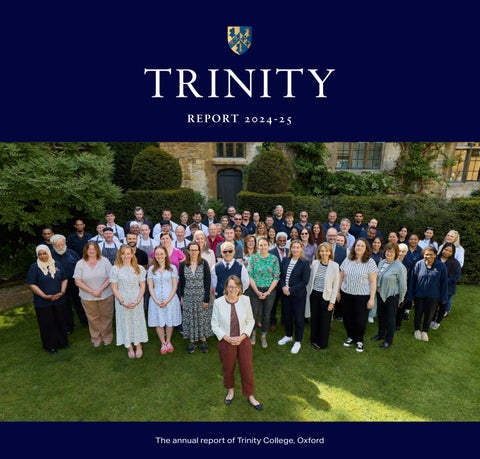
REPORT 2024-25
The annual report of Trinity College, Oxford
The annual report of Trinity College, Oxford
Iam writing this introduction to the Report in the final week of my eighth and final year as President of Trinity. Across the year, the college’s academics at all stages of their progression have delivered a range of distinctive work, attracting awards and recognition across a broad spectrum of disciplines. Amongst a successful year for Fellows, some of the highlights included the publication of a landmark book by Gail Trimble (Classics)—an edition of Catullus: Poem 64 in the Cambridge Classical Texts and Commentaries series. Marta Kwiatkowska and Dave Parker (Computer Science) were awarded a prize for their work on the PRISM software tool. And Dong (Lilly) Liu (Engineering) was appointed co-lead on a new £13m nuclear programme to develop technologies to support the deployment of next-generation nuclear energy technology.
Our undergraduates had a particularly successful year; 37 per cent achieved Firsts at the end of their degree, including many who also earned distinction outside their studies in sport, music and drama, demonstrating our students’ appetite and capacity to benefit from all that Oxford has to offer, whilst
still succeeding at the highest level academically.
On the theme of enriching the student experience, we were delighted to be able to provide (for the second time) a twoday personal development programme to all the incoming second year undergraduates. This offered a mixture of team-working, exploring aspects of leadership and public service, together with skills development. Participants experimented with communication styles, negotiating, problem solving and how to navigate disagreement—all skills that will be useful both at Trinity and in their future careers. The programme was well-received and I commend our students for throwing themselves into the spirit of the event. They emerged with new skills, as well as deepened friendships across the year group.
It was an excellent year for graduate scholarships. Thanks to
the generosity of Old Members and Friends, we were able to make new masters’ scholarship awards in English Literature, Philosophy, and Medieval History (the latter named in honour of Emeritus Fellow Bryan Ward-Perkins) and new DPhil awards in Philosophy and Materials Science. We’re now able to offer a large number of scholarships through the generosity of donors past and present. Identifying funding for graduates is and will, I’m sure, remain a key priority, and we could not be more grateful to all those who have supported students, many of whom would otherwise have been unable to take up their place.
Our first-year undergraduate cohort included a number of students who had successfully completed the Astrophoria Foundation Year the previous year; we also welcomed five new Foundation Year students in 2024. The Foundation Year is just one facet of the extensive programme of support for school students making the transition to university. Trinity’s access programme is continuously refined and this year saw a particularly high uptake for an online programme offering academic talks, advice and guidance.
The Events at Trinity series has gone from strength to strength in its third year. This year-round programme of talks, performances and tours is designed to extend Trinity’s public benefit to Oxford residents, members of the wider University and, not least, to Trinity alumni. We hosted a wide
range of expert speakers including the former Chief Medical Officer Jonathan Van Tam on the future of the NHS, sculptor Antony Gormley and Poet Laureate Simon Armitage on public art, a distinguished panel assessing the position of the UK five years after Brexit, and a moving talk by Sirin Phathanothai (parent of an Old Member) who, at the age of eight, was given by the Thai Government to China as a diplomatic goodwill offering, to be brought up as the ward of Premier Zhou Enlai. Music performances featured world-class artists in programmes designed specifically for the intimate setting and wonderful acoustic of the de Jager Auditorium. We were delighted by the audience response: most events reached (and some exceeded!) capacity, attendees (including local schools) provided enthusiastic feedback, and we welcomed dozens of alumni who reconnected with Trinity through the series.
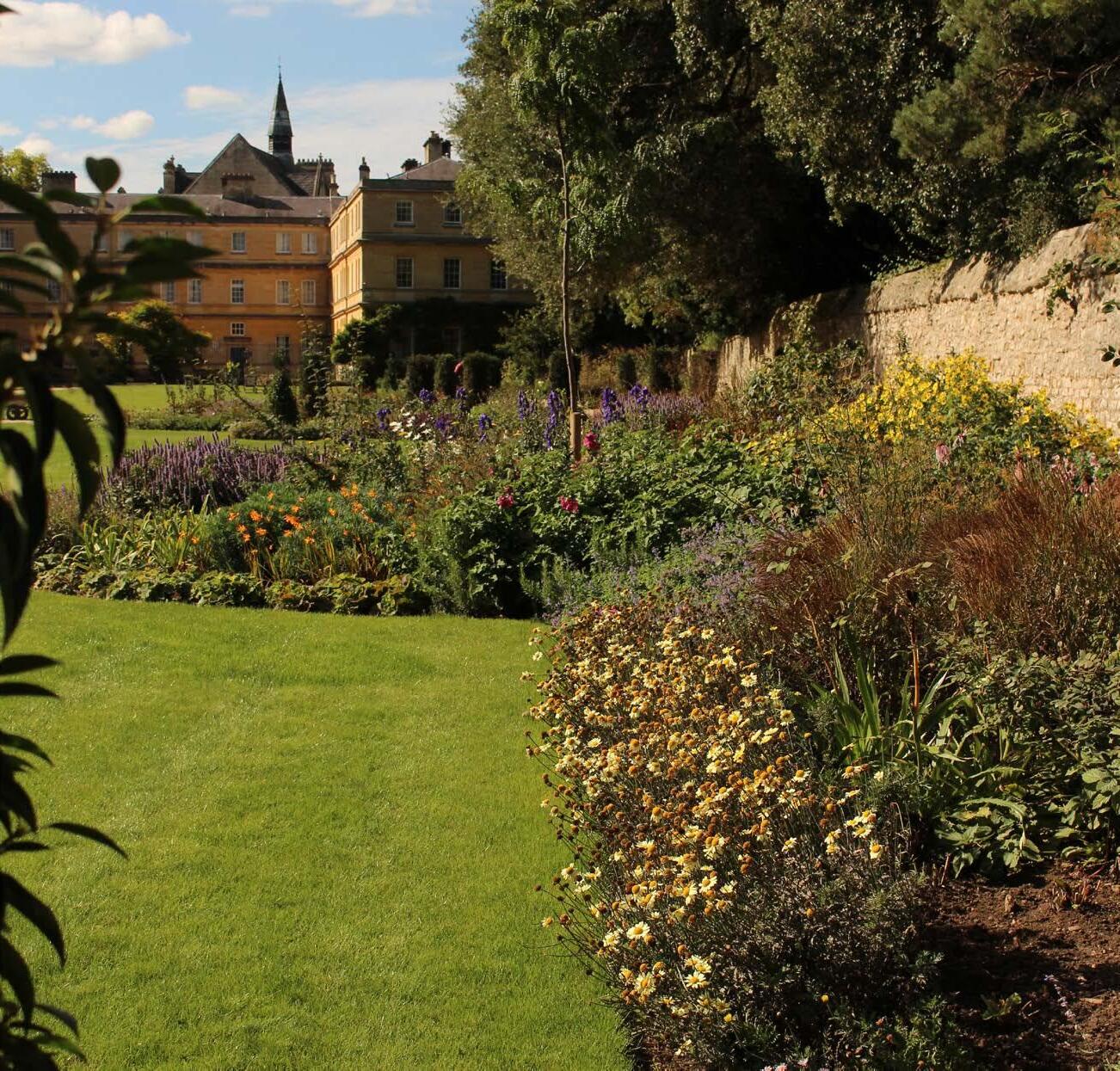
It would be out of keeping with the pattern of recent years if I were not to report on a further development of the college estate. It involved mud—lots of it! Boreholes were sunk in the north lawn throughout Michaelmas term as part of a project to install ground source heating in the Jackson Building (Staircases 5-7). Garden contractors worked their magic in the spring and the mud was shovelled back into trenches, the soil was regraded, and our gardens team set about planting the long border to a design by eminent garden designer, Chris Beardshaw. They planted some 5,600 plants. As
the summer progressed, it was a great joy to witness the garden beginning to re-emerge. We are immensely grateful to Henry Shohet (1972) for enabling the transformation of this much-loved space.
A range of practices were introduced during the year as an outcome of the recent review of the college’s governance arrangements; these included a reduction in the number of trustees overall, and the introduction of an externally-populated Risk, Audit and Governance Committee, with a view to increasing external scrutiny.
We marked the retirement of a number of distinguished and particularly long-serving academic colleagues. Professorial Fellows Dame Frances Ashcroft and Peter McCulloch, and Tutorial Fellows Keith Buckler and Jan Czernuszka have all made significant contributions to their fields of research and to the development of generations of students. Collectively they have provided over 110 years of service to the college! We also bade farewell to three early career Fellows: Junior Research Fellow in Physics, Gautam Gurung and Career Development Fellows Zoe Walker (Philosophy) and Katherine Backler (Ancient History). We offer all our departing colleagues our thanks and warmest wishes for the future.
One of the great pleasures of the role of President is regular contact with Old Members. Throughout the
year we welcomed large numbers of alumni to reunions and a range of specially tailored events in Oxford and across the UK. In addition, Director of Development Sue Broers and I made trips to meet alumni in North America and Thailand. We greatly value this contact with our global network, who are united through their shared experiences of Trinity. I offer my personal thanks to all those who have so generously offered their support, advice and friendship during my tenure.
After eight years it’s time to hand on the baton. I feel immensely privileged to have served as the college’s 28th President—a temporary custodian of this wonderful institution. I extend my thanks to all my colleagues for their commitment, professionalism and friendship, with a special thank you to the team of College Officers with whom I’ve worked most closely—they have faced every challenge with skill, collegiality and a welcome dose of humour! I wish Sir Robert Chote great happiness and fulfilment in the role of President. He’ll bring fresh ideas and perspectives and I’m excited to see ‘what happens next’. As I hang up my gown and join Michael and Ivor in that exclusive club of ‘Former Presidents of Trinity’, I look forward to supporting from a distance.
Dame Hilary Boulding, DBE
The Governing Body comprises the President and Fellows, excepting those indicated by an asterisk, as well as those Junior Research Fellows indicated by a double obelisk (‡).
President
Dame Hilary Boulding, DBE, MA Oxf, FLSW, FRWCMD
Fellows
Dr Steve Sheard, BSc PhD Lond, MA Oxf, MIET, CEng: Hunt-Grubbe Fellow and Tutor in Engineering Science, Fellow by Special Election* from February
Professor Dame Frances Ashcroft, DBE, MA PhD ScD Camb, MA Oxf, FRS, FMedSci: Royal Society SmithKline Beecham Professor of Physiology
Professor Justin Wark, MA Oxf, PhD Lond: Fellow and Tutor in Physics
Professor Jan Czernuszka, BSc Lond, MA Oxf, PhD Camb: Fellow and Tutor in Materials Science
Professor Martin Maiden, MA MPhil PhD Camb, MA Oxf, FBA: Professor of Romance Languages
Dr Keith Buckler, BSc Lond, MA Oxf, PhD Newc: Fellow and Tutor in Medicine
Professor Nick Barber, BCL MA Oxf: Wyatt Rushton Fellow and Tutor in Law
Dr Kantik Ghosh, BA Calcutta, MPhil PhD Camb, MA Oxf: Stirling-Boyd Fellow and Tutor in English
Professor Stephen Fisher, MA DPhil Oxf, MSc S’ton: Fellow and Tutor in Politics
Professor Peter McCulloch, MB ChB Aberd, MA Oxf, MD Edin, FRCS, FRCS Glas: Professor of Surgical Science and Practice (to December)
Professor Johannes Zachhuber, MA MSt DPhil Oxf, Dr theol. habil. Humboldt Berlin: Fellow and Tutor in Theology, Vice-President
Professor Stefano-Maria Evangelista, BA East Ang, MA Lond, MA MSt DPhil Oxf: Fellow and Tutor in English, Fellow Librarian
Professor Marta Kwiatkowska, BSc MSc Cracow, MA Oxf, PhD Leic, FRS: Professor of Computing Systems
Professor James McDougall, MA St And, MA MSt DPhil Oxf, FRHistS: Laithwaite Fellow and Tutor in Modern History
Professor Francis Barr, BSc Lond, PhD EMBL Heidelberg: E P Abraham Professor of Mechanistic Cell Biology
Dr Paul Fairchild*, BA Leic, DPhil
Oxf: Fixed-term Fellow and Tutor in Pathology (to March)
Professor Anil Gomes, BA BPhil DPhil Oxf: Fellow and Tutor in Philosophy
Dr Gail Trimble, MA MSt DPhil Oxf: Brown Fellow and Tutor in Classics, Dean of Degrees
Professor María del Pilar Blanco, BA William and Mary, MA PhD New York: Fellow and Tutor in Spanish
Professor Susan Perkin, BA DPhil Oxf: Fellow and Tutor in Physical Chemistry
Professor Ian Hewitt, MMath DPhil Oxf: Fellow and Tutor in Applied Mathematics
Mrs Sue Broers, BA PGCE Leeds, MA Oxf: Director of Development
Dr Melanie Rupflin, DrSc DiplMath Zurich: Fellow and Tutor in Pure Mathematics
Dr Luke Rostill, BA BCL MPhil DPhil Oxf: Fellow and Tutor in Property Law
Mr Chris Ferguson, BA Oxf, MSc Sur, ACMA: Estates Bursar
Professor Katherine Ibbett, BA Oxf, MA PhD Berkeley: Caroline de Jager Fellow and Tutor in French, Fellow Archivist, Chattels Fellow
Mrs Lynne Adam, BA Westmin, MA Oxf: Domestic Bursar, Garden Fellow
Dr Fanny Bessard, BA MA Lyon, PhD Sorbonne: Fellow and Tutor in Medieval Eurasian History
Professor Geoffrey Batchen, BA PhD Sydney: Professor of the History of Art
Dr Sam Vinko, BSc MSc URTV, MA DPhil Oxf: Fellow and Tutor in Physics, Equalities Fellow
Dr Rebecca Bullard, BA DPhil Oxf, MPhil Camb: Senior Tutor
Dr Alison Andrew, BA Camb, MPhil MRes MSc PhD UCL: Fellow and Tutor in Economics
Professor David Parker, BSc PhD Birm: Fellow and Tutor in Computer Science
The Revd Joshua Brocklesby, BA Oxf, MA Camb: Chaplain
Professor Dame Amanda Fisher, DBE, BSc PhD DSc Birm, FRS, FMedSci: Whitley Chair and Fellow in Biochemistry
Dr Natalia Gromak, BSc Edin, PhD Camb: Fellow and Tutor in Medicine
Professor Janina Dill, BA Technische Universitat Dresden, MPhil Camb, DPhil Oxf: Dame Louise Richardson Professor of Global Security
Dr Tobias Warnecke, BA Oxf, PhD Bath: Fellow and Tutor in Biochemistry
Dr Dong (Lilly) Liu, BEng UST Beijing, PhD Brist: Fellow and Tutor in Engineering Science
Dr Meera Mehta, BSc McMaster, PhD Toronto: Fellow and Tutor in Inorganic Chemistry
Dr Tammie Bishop, BA Hons PhD Camb: Fellow and Tutor in Medicine
Dr Hannah Stern, BSc Ontago, PhD Camb: Fellow and Tutor in Materials Science
Senior Research Fellows
Professor Janet Pierrehumbert, BA Harvard, PhD MIT: Professor of Language Modelling
Professor Andrea Ferrero, BA Bocconi, MSc Barcelona, MA Oxf, PhD New York: Professor of Economics, Levine Senior Research Fellow
Professor Christopher Butler, BA Rhodes, MB ChB Cape Town, DCH College of Medicine of South Africa, MRCGP, CCH Toronto, MD Wales, FRCGP, Hon FFPH, FMedSci: Professor of Primary Healthcare
Research Fellow
Dr Beatrice Groves, BA Camb, MSt DPhil Oxf: English
Fellow by special election
Dr Dean Sheppard, MChem DPhil Oxf, FHEA: Chemistry, Dean
Associate Fellow
Dr Mykola Tarasenko, Dip (Hon) BA Kyiv Slavic University, Dip PhD Dr hab A Yu Krymskyi Institute of Oriental Studies of the NAS of Ukraine: British Academy Researchers at Risk Fellow from Ukraine, Egyptology
Junior Research Fellows
Dr Christopher Fowles, BA York, BPhil DPhil Oxf, MA KCL: Leverhulme Early Career Fellow, Postdoctoral Fellow in Philosophy (to April)
Dr Gautam Gurung‡, MPhys Nepal, PGDip ICTP, PhD Nebraska: Physics
Dr Meia Walravens‡, BA MA KU Leuven, MA SOAS, PhD Antwerp: History
Dr Christopher Nicholls, MEng DPhil Oxf: Engineering
Dr Archie Bott, BA Hons MMath Camb, DPhil Oxf: UKRI Future Leaders Fellow, Physics
Dr Anna Paradis, BA MA Barcelona, MA PhD Autonomous University of Barcelona: Linguistics
Dr William Winning‡, BA PhD Camb, MSt Oxf: Classics
Dr Mathis Ebbinghaus, BA Sciences Po Paris, BA Free Universität Berlin, MSc DPhil Oxf: Sociology (from May)
Dr Jacques Bouvier, MSci Sheff, DPhil Oxf: Biology (from January)
Dr Fernando Contreras, LLB Universidad Catolica de Chile, MPhil DPhil Oxf: Law (from January)
Career Development Fellows
Dr Katherine Backler, BA DPhil Oxf: Ancient History
Dr Zoe Walker, BA MPhil PhD Camb: Philosophy
Dr Tom Ainsworth, BA BPhil DPhil Oxf: Philosophy
Dr Aurelia Annat, BA York, PGCE MA Lond, DPhil Oxf: History
Dr Richard Ashdowne, MA MPhil DPhil Oxf: Linguistics
Ms Rupavardhini Balakrishnan Raju, LLM Harvard: Law
Dr Andrea Bernini, BSc Nott, MPhil DPhil Oxf: Economics
Dr Megan Carter, MEng DPhil Oxf: Materials
Dr Anna Chrysostomides, BA Mary Washington, MA Temple, MPhil DPhil Oxf: Theology
Mr Hugh Collins Rice, BA MLitt Oxf, MA Sus: Music
Dr Luisa Maria Coelho, BA MA Porto, PhD Minho: Portuguese
Dr Harry Daniels, BA MA Manc, DPhil Oxf: English
Dr Tamás Dávid-Barrett, MA Budapest, MPhil Camb, PhD Lond: Economics
Dr Krishanu Dey, MEng Singapore, PhD Camb: Physics
Dr Julian Fells, BEng UCL, PhD Bath: Engineering
Mr Zachary Feng, BSc MSc McGill: Mathematics
Mr Richard Foster, BA York, MA Oxf: Politics
Dr Jessica Frazier, BA PhD Camb, MSt Oxf: Theology
Dr Matthew Golesworthy, MChem DPhil Oxf: Chemistry
Dr Francesco Hautmann, PhD Florence: Physics
Dr Anna Hoerder-Suabedissen, BSc Lanc, MSc DPhil Oxf: Medicine
Professor Felix Hofmann, MEng DPhil Oxf: Engineering
Dr Sinéad Hofmann, BSc NUI, PhD Dublin Institute of Advanced Studies, MSc Oxf: Mathematics
Dr Chris Horton, BA BM BCh Oxf: Medicine
Dr Sarah Jenkinson, MChem DPhil Oxf: Chemistry
Dr Alexandros Kampakoglou, BA Thessaloniki, MSt DPhil Oxf: Research Lecturer, Classics
Dr Adrian Kendal, MA BMBCh DPhil Oxf, FRCS Ortho: Medicine
Ms Momo Komatsu, BSc Amsterdam, MPhil Oxf: Economics
Dr James Larkin, MBiochem Oxf, PhD Warw: Biochemistry
Dr Dorota Leczykiewicz, MSt DPhil Oxf, MLaw Wrocław: Law
Ms Marie Léger, Lic MA Grenoble: French
Dr Charlotte Lynch, MEng DPhil Oxf: Materials
Dr Neale Marlow, MBBS BSc Lond, MSc Oxf, FHEA MRCS: Clinical Medicine
Dr Simon Martina-Perez, BSc MSc Leiden, DPhil Oxf: Mathematics
Dr Mark McAllister, MEng PhD Edin: Engineering Science
Dr Mary McMenamin, BSc PhD Belf, Dip DipLATHE Oxf: Medicine
Dr Sophie Millington, BPTC ULaw, BA BCL DPhil Oxf: Law
Professor Emeritus Peter Mirfield, BCL MA Oxf: Law
Professor Lynda Mugglestone, MA DPhil Oxf: English
Dr Theofanis Papamichalis, MEng Imperial, MPhil DPhil Oxf: Economics
Dr Claudia Pazos-Alonso, MA Lond, MA DPhil Oxf: Portuguese
Dr Naomi Petela, MBiochem DPhil Oxf: Biochemistry
Dr Matt Phillips, BA MPhil PhD Camb: Modern Languages (French)
Ms Gerda Raissar, BSocSc (Hons) Manc, MPhil Oxf: Politics
Dr Duncan Robertson, BSc Imp Lond, MA DPhil Oxf: Management
Ms Ysaline Rossi, BA Grenoble: French
Dr Gabriel Santos, BA Santa Catarina, MSc St And, MSc INRIA, DPhil Oxf: Computer Science
Dr Hannah Smith, BA MPhil PhD Camb: History
Dr Jennie-James Strawbridge, BA
MSt DPhil Oxf: Academic Support & Development Lecturer
Dr Melissa Sweeney, BA BSc (Hons) PhD Monash: Biochemistry and Medicine
Dr Pierre Vila, BA BM BCh Oxf: Medicine
Mr Azim Wazeer, BC British Columbia, MA Georgetown: Politics
Dr Lingyi Yang, MMath Nott, DPhil Oxf: Probability & Statistics
§Names are listed of the Lecturers who have taught for the whole academic year; the college gratefully acknowledges the contribution of all Lecturers during the year.
Clinical Specialist Advisors
Dr Noura Al-Juffali, BSc Tufts, PhD MBBS UCL: Psychiatry
Dr Simon Braithwaite, MBBS iBSC UCL: Radiology
Dr Fungai Dengu, MBChB BMedSci (Hons) MRCS Edin, DPhil Oxf: General Surgery
Dr Michael FitzPatrick, MA Camb, Dip Worshipful Society of Apothecaries, MBBS Barts, CILT QMUL, DPhil Oxf: Gastroenterology
Dr Imran Howell, MBBCh Card, PGCert Plym: Respiratory Medicine
Dr Henrietta Mann, iBSc Lough, PG Cert MBBS KCL: General Practice & Women’s Health
Dr Suzanne Maynard, BSc Bham: Haematology
Dr Alex Novak, iBSc MBChB Leeds, MSc Imp Lond: Emergency Medicine
Dr Marco Pisa, MD San Raffaele VitaSalute: Neurology
Dr Siôn Williams, MBBCh Card: Renal Medicine
Emeritus Fellows
Dr Michael Brown, BSc MA DM Oxf
Dr Peter Carey, MBE, MA DPhil Oxf
Mr Jack Collin, MB BS Newc, MD Oxf, FRCS
Professor Russell Egdell, MA DPhil Oxf
Dr Clive Griffin, MA DPhil Oxf
Professor Gus Hancock, MA Dub, MA Oxf, PhD Camb
Dr Dorothy Horgan, MA PhD Manc, MA Oxf
Dr Michael Jenkins, BSc Brist, MA DPhil Oxf
Professor Alexander Korsunsky, BSc MSc Moscow, MA DPhil Oxf, CPhys, MInstP
Professor Louis Mahadevan, BSc New Delhi, MSc PhD Lond, MA Oxf
Professor Jonathan Mallinson, MA PhD Camb, MA Oxf
Dr Alan Milner, OBE, LLB PhD Leeds, MA Oxf, LLM Yale
Professor Kim Nasmyth, BA York, MA Oxf, PhD Edin, FRS
The Revd Canon Dr Emma Percy, BA Durh, MA Camb, MA Oxf, PhD Nott
Mr Michael Poyntz, MA Oxf
Dr Chris Prior, MA PhD Camb, MA DPhil Oxf
Professor Peter Read, BSc Birm, MA Oxf, PhD Camb
Professor Simon Salamon, MA DPhil Oxf
Professor George Smith, MA DPhil Oxf, FRS
Mr Frank Thompson, BSc Lond, MA Oxf
Professor Bryan Ward-Perkins, MA DPhil Oxf
Professor Valerie Worth, MA DPhil PGCE Oxf
Honorary Fellows
Professor Simon Armitage, CBE, BA Port, MA Manc, Hon DLitt Hudd, Hon DLitt Leeds, Hon DLitt Port, Hon DLitt Sheff Hallam, DUniv Open, FRSL, Hon FBA
The Rt Revd John Arnold, MA Oxf, Barrister at Law, JCD
Dr Doyin Atewologun, BSc Birm, MSc Nott, PhD Cran
The Hon Michael J Beloff, KC, MA Oxf, Hon DLaws Buck, Hon DLaws De Mont, Hon DLitt Fairleigh Dickinson, Hon DUniv Open, FASS, FICPD, FRSA
Mr Richard Bernays, MA Oxf
Professor Dinah Birch, CBE, MA DPhil Oxf, FEA
Mr Julian (Toby) Blackwell, DL, MA Oxf, Hon DLitt Robt Gor, DUniv Sheff Hallam, Hon DBA Oxf Brookes
Sir Hugo Brunner, KCVO, JP, Order of St Frideswide, MA Oxf
Sir Charles Chadwyck-Healey, Bt, MA Oxf
Sir Anthony Cleaver, MA Oxf, FRCM, Hon FREng (ob. July 2025)
Professor Craig Clunas, BA Camb, MA Oxf, PhD Lond, Hon DLitt Warw, Hon DLitt Courtauld, FBA
Professor Paul Collier, CBE, MA DPhil Oxf
Mr Geoffrey de Jager, LLB Natal, BCom DLitt Rhodes
Professor Martin Goodman, MA DPhil DLitt Oxf, FBA
Professor Sir Malcolm Green, BM BCh BSc MA DM Oxf, FRCP, FMed Sci
Sir Brian Jenkins, GBE, MA Oxf, FCA, FRSA (ob. November 2024)
Professor Martin Kemp, MA Camb, MA Oxf, Hon DLitt H-W, FRSA, HRSA, FBA, FRSE, Hon RIAS, FRSSU
Mr Peter Levine, MA Oxf
Professor Sir Andrew McMichael, MA BChir MB Camb, PhD Lond, FRS
Ms Kate Mavor, CBE, MA Oxf, DUniv H-W
Judge Theodor Meron, CMG, LLM SJD Harvard, Hon DLaws Calisia, Hon DLaws Warsaw, Visiting Professor of Law
The Revd Professor John Morrill, MA DPhil Oxf, FBA, FRHistS
Mr Stephen Pearson, MA Oxf
Sir Michael Peat, KCVO, MA Oxf, MBA, FCA
Sir Ivor Roberts, KCMG, MA Oxf, FCIL
The Rt Revd Anthony John Russell, BA Durh, DPhil Oxf, FRAgS (ob. July 2025)
Mr Wafic Saïd, Ordre de Mérite du Cedre, Ordre Chérifien
Professor David Sedley, MA Oxf, PhD Lond, FBA
Professor David Soskice, MA Oxf, FBA
Professor Sir Edwin Southern, BSc Manc, MA Oxf, PhD Glas, FRS
The Rt Revd David Stancliffe, MA Oxf, Hon DLitt Port, FRSCM
Sir Peter Stothard, MA Oxf, FRSL
The Lord Tyrie, PC, MA Oxf
Professor Charlotte Williams, OBE, BSc PhD Lond, FRS
Sir Thomas Pope Fellows
Mr Peter Andreae, DL, MA Oxf
Mr Perry Crosthwaite, MA Oxf
Mr Simon Edelsten, MA Oxf, and Mrs Alison Edelsten, MA Oxf
Sir Roger Fry, CBE, BD Lond, Hon DLitt Port, AKC, FRSA
Mr Wyatt Haskell, BA JD AB Amherst, LLB Yale Law School
Mr Adrian Hohler, MA Oxf
Mr Robert Hunt-Grubbe, MA Camb (ob. August 2025), and Mrs Julia HuntGrubbe
Mr Roger Michel, BA MA Williams, MA JD Harvard, MPhil Oxf
Mr Robert Parker, CB, MA Oxf, MCMI, FRSA
Mr Richard Setchim, MA Oxf
Mr John Singer, MA Oxf, MBA INSEAD
Dato’ Robert Kim Kuan Tan and Dato’ Soo Min Yeoh
Dr Trudy Watt, BSc Open, MA DPhil Oxf, MSc Sheff Hallam
Honorary Visiting Fellows
Professor Dame Sally Davies, GCB DBE, MB ChB Manc, MSc Lond, FRS, Master of Trinity College, Cambridge
Professor Maxim Vengerov, Menuhin Professor of Music; Goodwill Ambassador, UNICEF; Artist in Residence, Oxford Philharmonic Orchestra
This year has seen the retirement of four of Trinity’s longserving Fellows in medical and scientific fields. We wish them well in retirement and look forward to their continuing connection to College as Emeritus Fellows.
Frances Ashcroft studied at Girton College, Cambridge and was a postdoctoral researcher at the University of Leicester and UCLA, before coming to Oxford in 1982 for a number of research and teaching roles, including as a lecturer at Trinity. She was elected a Fellow in 1992, and from 1996 has been Professor of Physiology in the University (as Royal Society GlaxoSmithKline Research Professor from 2001 to 2011).
Fran’s pioneering research explores how the hormone insulin is secreted from the pancreas and how this process is impaired in both neonatal diabetes and type 2 diabetes, the goal being to elucidate how a rise in the blood glucose concentration stimulates the release of insulin from the pancreatic beta-cells, what goes wrong with this process in type 2 diabetes, and how drugs used to treat this condition exert their beneficial effects.
As a Professorial Fellow Fran continued an element of undergraduate teaching, hosting undergraduate students in Medicine, Biomedical Science and Biochemistry for their
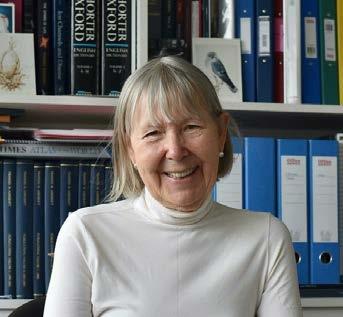
final year research projects in her lab, as well as running a multidisciplinary research group in the Department of Physiology Anatomy and Genetics, where she also supervised DPhil students and postdoctoral fellows.
Fran was elected a Fellow of the Royal Society in 1999 and made a dame in 2015, she has won numerous distinguished awards and prizes for her groundbreaking work, and has written two books for a general audience.
Fran has always been a very engaged member of the Fellowship, and will continue to bring her interest in gardens to the college’s Garden Committee.
Jan Czernuszka was elected as Fellow and Tutor in Materials Science in 1996, after studying at Imperial College and Cambridge University. A highly
creative and original researcher, Jan started his research career working on ceramics, but became increasingly interested in biological materials.
He has focussed in particular on collagen, a naturally-occurring fibrous protein which forms the ‘scaffolding material’ for the growth of bone. He has published over 190 scientific papers—most notably his authoritative review article on Tissue Engineering Scaffolds (with E Sachklos, 2003) has attracted over 1900 citations—and he holds half a dozen patents. In 1993, he received the CBI / Toshiba Year of Invention (University section) award for his work on bone substitute materials, one of a number of awards. His tutorial teaching covered the general areas of mechanical properties, as well as polymers and ceramics, and he lectured on composites, ceramics and medical materials.
Jan has served both as Dean and as Vice-President, and was especially noted within College for his support in the career development of his graduate students and younger colleagues. In particular, he encouraged them to obtain teaching experience at an early age, which facilitated the later promotion of a number of them to more senior academic positions.
Keith Buckler came to Oxford, following a first degree at King’s College London and a PhD from the
University of Newcastle, initially as a postdoctoral research assistant, an MRC Senior Research Fellow and a Junior Research Fellow. He was elected Fellow and Tutor in Medicine at Trinity in 2001, and has been an associate professor of Physiology in the Department of Physiology, Anatomy and Genetics.
His main area of research focuses on oxygen-sensing by arterial chemoreceptors and their role in the control of breathing and the cardiovascular system. He also researches the role of the HIF (hypoxia inducible factor) signalling system in ventilatory acclimatization to chronic hypoxia (for example, at high altitude), and on the effects of anaesthetics on the control of breathing.
He has lectured and given tutorials on Physiology and Pharmacology for the first-year Medicine courses; Applied Physiology and Pharmacology for the second-years; and ‘Body and Cells’ for the first-year Biomedical Sciences course, as well as lecturing and teaching in two Final Honour School options.
Peter McCulloch came to Trinity from Aberdeen, by way of Glasgow, and Liverpool, being elected a Fellow in 2004.
His research explores two questions: how to make surgery safer, and how to conduct valid studies to find out how good (or bad) it is. His specialist field is cancer surgery, particularly stomach and oesophageal cancer,
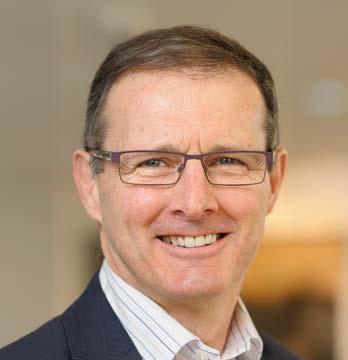
and his experience of conducting clinical research in this field convinced him of the need for new approaches to studying surgery properly, it being more difficult to test than medications.
The international IDEAL Collaboration group that he established studies new methods for evaluating surgery and other invasive and complex treatments, guiding research on operations and medical devices throughout their development. The group recently completed a comprehensive set of recommendations for evaluating surgical robots, and published the first guidelines for how to study AI systems being introduced into clinical practice.
Peter’s other research group is focused on improving the safety and reliability of surgery,
using Ergonomics and Human Factors science to design and test interventions to address the problem of errors due to poor systems of work or communication, weak teamwork, and cultural attitudes. The group has been conducting the world’s largest randomised trial (RESPOND) of a Human Factors intervention to improve surgical outcomes.
Peter taught sessions for clinical students, as well as developing and teaching the MSc course in surgical science and practice, and supervising DPhil, MD and MSc students for dissertations and theses.
The following early career Fellows also completed their time at Trinity, we wish them well in the next stages of their careers.
Towards the end of the year, Katherine Backler was appointed to a permanent position as Lecturer in Ancient History at the University of Leeds. She is excited to be joining Leeds’ thriving Classics team and is particularly looking forward to teaching the undergraduate module ‘Invisible Greeks and Romans’, which will enable her to bring her research interests in ancient social history, particularly the history of women, children, and enslaved people, more extensively into her teaching. Nevertheless, she will miss Trinity very much; she is delighted to have had the opportunity to spend three years as part of ‘a community of generous, supportive, convivial
colleagues and thoughtful, engaged students’.
Gautam Gurung’s time at Trinity has been academically and professionally fruitful, marked by collaborations with experimental research groups both within University of Oxford and at external institutions. These collaborations have significantly advanced research in areas of twodimensional magnetic materials and antiferromagnetic spintronics, leading to ten published works.
In addition to research, Gautam has been actively involved in teaching, serving as a tutor in the sub-department of Condensed Matter Physics, and at Trinity, St John’s, and Lincoln colleges—he has valued his meaningful interactions with students. Gautam has also contributed to the college community through participation as a member of the Governing Body, and involvement in academic grant committees and undergraduate admissions interviews. Looking ahead, he aims to broaden research into the dynamical properties of topological magnetic textures and their applications in energy-efficient computing.
Zoe Walker came to Trinity for a Career Development Fellowship, following a PhD at Cambridge. She has loved her three years at Oxford, and will miss all her wonderful colleagues. In addition to teaching papers in General Philosophy, Ethics, Aesthetics and Plato’s Republic,
particular highlights from her time include hosting a two-day conference on ‘Art, Imagination and Morality’ in the Garden Room, winning the American Society for Aesthetics Feminist Research Prize, for her paper on ‘Comic Objectification’, and going on conference trips to Washington DC, Chicago, San Francisco, Milan, Hamburg, Edinburgh, Cardiff and Belfast. She also found time to publish work on joking in political speech, sexist senses of humour, and objectifying comedy. Zoe found Trinity to be a very supportive place to develop as a researcher, which she felt made all of these achievements possible.
Zoe has taken up an associate lectureship at UCL, and we are delighted that she is planning to return to Oxford frequently.
Beyond her college work, Hilary
Boulding continued to serve on a number of University bodies including chairing the College Contributions Committee and the board of the University’s excellent student chamber choir, Schola Cantorum. Within Trinity her particular focus has been to ensure that, in keeping with Trinity’s charitable mission, the college continues to deliver significant public benefit to its core college community of students and academics. It was rewarding that almost the entire second-year undergraduate cohort
chose to participate in a two-day personal development programme that provided time and support to help them to develop new skills. Having completed her time as President, in September Hilary took up the role of director and chief executive of the Weidenfeld-Hoffmann Trust.
Susan Perkin provided tutorials in physical chemistry and departmental lectures in states of matter and statistical mechanics. She supervised students and postdocs in her laboratory, including two Trinity graduate students: Neave Taylor, whose experiments study electrochemical deposition of surface films at battery electrodes, and Lauriane Pierrot-Deseilligny, whose experiments interrogate the effect of nanoscale confinement on liquid-liquid phase separation. Susan was awarded the Inman Lectureship by the Royal Society of Chemistry, which recognises an outstanding contribution to the field of molten salts or ionic liquids.
Meera Mehta was the recipient of a Humboldt Experienced Researcher Fellowship and a Philip Leverhulme Prize in Chemistry. The Humboldt fellowship allowed her to spend the summer in Germany at the University of Regensburg to initiate a new collaboration, and the Leverhulme prize will allow her to expand her research team.
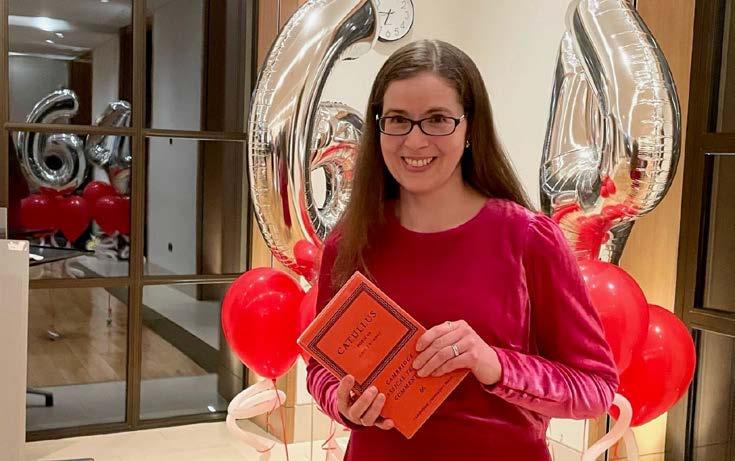
Gail Trimble celebrated the publication of her commentary on Catullus 64 (at the end of January) with a party in the Garden Room. She has accepted an invitation to write the entry on ‘Catullus’ in a new encyclopedia of epic. As her next major research project will focus on personal names in pastoral literature, she has also been enjoying participating in a seminar on Virgil’s Eclogues and gathering material on the Neronian pastoral poet Calpurnius Siculus. She served as admissions co-ordinator for the Faculty of Classics and her outreach work included judging the London Schools’ Greek and Latin Reading Competition.
This year Katherine Backler finished work on her first book, Athena’s Sisters: Reclaiming the Women of Classical Athens, for publication by CUP in early 2026. She co-wrote an article on inscriptions as evidence for the agency of ancient Greek women as part of a BA/Leverhulmefunded project. She taught papers on Alexander the Great and the Hellenistic World, as well as her archaic and classical Greek bread-andbutter.
William Winning gave academic papers in Oxford and Coimbra, Portugal, taught Latin and Greek language and Greek tragedy to students from Trinity and other colleges, and wrote an article on Apollonius’ Argonautica
(forthcoming in Classical Quarterly). He translated an academic monograph in Italian on the history of translation in ancient culture for Cambridge University Press. His PhD thesis was also awarded Cambridge University’s Hare Prize for the best doctoral thesis in Classics.
Marta Kwiatkowska was elected to the Royal Society Council. In October, she organised a Royal Society Discussion Meeting, ‘Beyond the symbols vs signals debate’, to advance our scientific understanding of how human learning, reasoning and cognition can be brought to bear on the engineering foundations of AI (recordings of the talks can be found on the Royal Society website). Marta recorded an interview filmed at Trinity, ‘Code, Logic, Legacy—Marta Kwiatkowska at Oxford’, for a TVP (Telewizja Polska) interview series, Polish Tales, released on YouTube in September.
Janet Pierrehumbert published an article about the linguistic capabilities of AI in the Proceedings of the National Academy of Sciences (PNAS). It probes the extent to which the latest large language models do—and don’t—display human-like patterns in making and processing complex derived words. PNAS followed up with a question-and-answer piece about Janet’s career and future research plans. Janet also delivered a short course on ‘Words and the nature of artificial and human intelligence’ at
the 2025 Linguistic Society of America (LSA) Summer Institute. The LSA Institutes have been held since 1928 and attract students and faculty from around the world.
Dave Parker has continued his research in formal verification, including a new project funded by the Safeguarded AI programme of the UK’s Advanced Research & Invention Agency (ARIA). The project will develop techniques and software that provide rigorous guarantees on the correctness and safety of AI-driven business processes.
Duncan Robertson was awarded Companionship of the Operational Research Society, recognising his contributions to science communication during the Covid-19 pandemic and beyond. His work focuses on complexity science and agent-based modelling, with practical applications ranging from corporate strategy to pandemic response.
Engineering
Steve Sheard continued to teach for the Department of Engineering Science and the college, but additionally he has been an examiner for the Foundation Year course. A highlight in March was the Engineering Dinner, a wonderful occasion, attended by many former Engineering Science students. It was also an opportunity to recognise the enormous contribution to Engineering at Trinity made by Professor Alexander Korsunsky.
Dong (Lilly) Liu received the Presidential Global Ambassador Award from the American Ceramic Society in January 2025, for ‘outstanding achievements, contributions to the Society and the international ceramic community, and promoting early career researchers’. With the support from IOM3 (the Institute of Materials, Minerals & Mining) and Lucideon Ltd, Lilly and Dr Roger Morrell (emeritus fellow of the National Physical Laboratory) delivered a one-day, in-person training course on Fractography of Ceramics, which is the first such course in the UK for many years. In August, she was appointed co-lead on a new £13m nuclear programme to develop technologies to support the deployment of next-generation nuclear energy technology.
Kantik Ghosh finished work on a paper entitled ‘Iuxta temporis qualitatem: Ecclesiology and Innovation in Later Medieval Europe’, to be published as part of a project on Innovationsrhetoriken: Die Faszination des Neuen im 14. bis 16. Jahrhundert, organised under the auspices of the Niedersächsische Akademie der Wissenschaften zu Göttingen. He attended a workshop in the Faculty of History in UCL to further his collaborative interdisciplinary project on the later medieval conscience and religiopolitical dissent in the long 15th century before the Reformation.
Stefano Evangelista continued with his Einstein Fellowship at the Humboldt University, Berlin, where his team has hosted a series of academic workshops and a public event in partnership with the Literaturhaus-Berlin.
Beatrice Groves continued her research on Shakespeare, psalms and early modern marginalia. She has published articles on the Psalms in Shakespeare and on how the marginalia in early modern copies of the psalms might relate to Shakespeare’s own reading of the margins. She has also been enjoying podcasting, both on Shakespeare (Twelfth Night’s connections with Epiphany in Shakespeare’s time), and in her public engagement work on the literary sources of Harry Potter. She blogs at ‘Bathilda’s Notebook’ and has published work on connections between Dracula and Harry Potter. She has also brought these strands of her research together in a publication on the Trinitarian links of phoenix imagery in both Order of the Phoenix and Shakespeare’s poetry.
James McDougall spent the year at ArtsEd, one of London’s leading conservatoires for theatre training, taking an MA in professional acting. He resigned his tutorial fellowship in January, but to continue teaching as a Fixed Term Fellow until December 2025, and he intends to remain active in historical research and writing. He published articles on the sociology of
secularisation and Islam in Annales: Histoire, sciences sociales, and on the recent ‘memorial politics’ of President Macron in the Revue d’histoire moderne et contemporaine, and completed chapters for two edited volumes, Bourdieu and History and the Cambridge Companion to the History of the French Empire.
Geoffrey Batchen was on study leave for part of the year and took the opportunity to work on his next book, a history of the daguerreotype photographic process. He had an essay appear in an anthology devoted to photographic archives and gave public talks in Barcelona and New York.
Meia Walravens prepared several articles on Islamic rule in late medieval India over the course of the year. The first one of these, on the discretionary power of the Bahmani sultan, was published in Islamic Law and Society in April. It is the first study to inquire into the legal history of the Bahmani Sultanate, using documentary collections and chronicles to reveal legal principles and procedures. Meia also enjoyed presenting her research at the MCR Showcase in Hilary term.
Law
Luke Rostill continued to serve as director of the BCL and MJur in the Faculty of Law and as a member of the Governance Working Group at Trinity. In February, he presented a draft paper entitled ‘The Nature of Adverse Possession’ to the Oxford Property
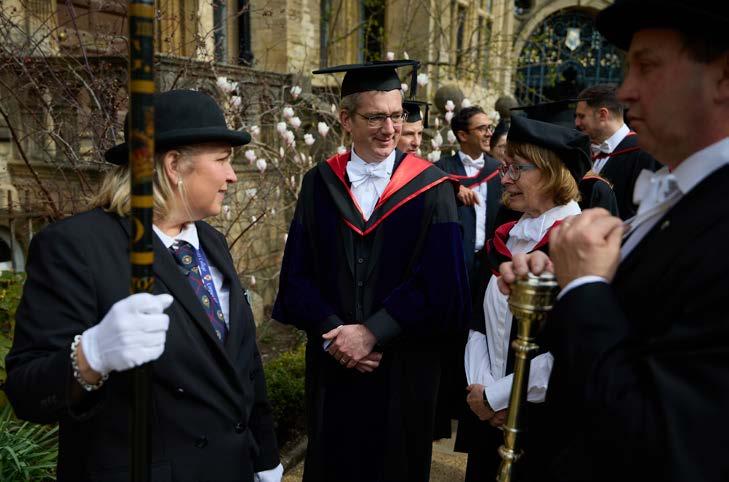
Law Discussion Group. A revised version of this paper was subsequently accepted for publication in the Law Quarterly Review.
Fernando Contreras began his Junior Research Fellowship in Hilary term. He gave the Jurisprudence tutorials for the second years, and devoted the rest of his time to research. In addition to revising his DPhil thesis for publication as a monograph, he worked on two papers. One, ‘The Concept of Unconstitutional’, was presented at a conference for junior scholars in Georgetown University, and is currently under review; the other, ‘Invalidation’, was presented
at a workshop in Oxford. Fernando also participated as respondent in a colloquium on recent developments in the philosophy of law, organised by the Law Faculty’s Programme for the Foundations of Law and Constitutional Government.
Hannah Stern, along with her research group, unveiled an important result for the development of quantum sensing technologies by demonstrating the use of atomic defects in Hexagonal Boron Nitride as powerful, room-temperature sensors capable of detecting vectorial field at the nanoscale, work that was published in Nature Communications.
Nanoscale sensors are important because they provide a way to map physical quantities of material systems, such as magnetisation, with high spatial resolution. This enables us to understand materials better and improve the design of materials for applications like computing. Hannah was invited to speak at several international conferences, including at the European Conference for Molecular Spintronics. She was the recipient of a UK Research and Innovation EPSRC (Engineering and Physical Sciences Research Council) collaborative grant focussed on quantum sensing, as well as a John Fell Fund award.
Ian Hewitt continued his work looking at the influence of meltwater on the dynamics of ice sheets, and has presented work on an improved ‘sliding law’ for use in the ice-sheet models used to project sea level change at the American Geophysical Union in Washington DC. Along with collaborators in the Earth Science department, he has recently submitted work funded by the Leverhulme Trust to understand the extreme tidal heating of Jupiter’s moon Io, the most volcanically active body in our solar system.
Melanie Rupflin had a busy but interesting year, in which she took on a new role as academic lead for first- and second-year teaching in the Mathematics Department, continued
to develop her new approach to the quantitative study of partial differential equations, was invited to present her results at numerous international conferences, and was given the opportunity to explore connections of her research to other areas of mathematics during an extended research stay at the Hausdorff Institute in Bonn.
Frances Ashcroft received the Rolf Luft Award from the Karolinska Institute and the Riggs Award for Excellence in Basic and Translational Sciences from the City of Hope research centre in California. She sat on Scientific Advisory Boards for Copenhagen University (vice-chair) and Lund University, as well as the Balzan Foundation Prize committee. She was a plenary speaker at the Innsbruck PhD day, and contributed to a podcast series on Diabetes with Dr Pedro Dias. She also recorded more podcasts for her own podcast series ‘A Good Science Read’, in which she and an invited guest discuss popular science books (search online for ‘good-scienceread’).
Chris Butler—although much changed, Covid-19 is very much still with us and many people who become infected go on to develop symptoms of long Covid. One reason for using new drugs to treat acute Covid-19 infection might be to prevent the symptoms persisting over the longer term. However, the PANORAMIC
National Trial, led by Chris Butler and published in the Lancet Infectious Diseases journal, has generated worldfirst evidence showing that treating acute Covid-19 does not meaningfully reduce the incidence of persisting covid-related symptoms over the longterm.
Chris continues to lead ECRAIDPrime, a large scale Europe-wide clinical trial of treatments for respiratory infections, and continues to contribute to World Health Organization initiatives to strengthen clinical trials in primary care.
Adrian Kendal travelled to Japan on an IBRA (International Bone Research Association) Travelling Fellowship. This was an opportunity to visit multiple hospitals and academic centres providing orthopaedic care (mainly foot and ankle), and attend the Japanese Society for Surgery of the Foot Conference, as well as enjoy a myriad of Japanese cultural experiences.
Suzanne Maynard returned from maternity leave to a fruitful year continuing her DPhil studies into Data Driven Transfusion Practice alongside undergraduate teaching. She was grateful to have been awarded a scholarship to deliver an oral presentation at the British Society of Haematology Conference, Glasgow, in April, on the work she and colleagues have completed using machine learning to classify iron deficiency anaemia (IDA) in patients with liver cirrhosis.
She attended other international conferences and is preparing a manuscript for submission exploring the burden of IDA in cirrhosis using routine primary health care data.
The academic year was another busy one for María del Pilar Blanco. She served as the chair of the Spanish Sub-Faculty, and she was also appointed academic lead for the Caribbean-Oxford Initiative (CaribOx for short), a visiting fellowship and travel-grant programme that allows scholars in the Caribbean to come to Oxford to advance their research. In the programme’s first year, the CaribOx team welcomed two visiting fellows—Brandon Bethel (an oceanographer) and Grace Turner (an archaeologist), both from the Bahamas—and Nekeisha Spencer (sociologist at University of the West Indies, Mona) received the inaugural travel grant. Beyond these activities, María found time to complete several pieces of research, including an essay on the travels (and disappearing acts) of H G Wells’s novel The Food of the Gods (1904) in Mexico during the early 20th century, and a monograph, Modernist Laboratories.
Katherine Ibbett published an edited volume, A Cultural History of Love in the Early Modern Age (Bloomsbury, 2024), and wrote a chapter on 18thcentury mosquitoes for her book on early modern rivers, trialled as keynote at the Society for Early Modern French
Studies; she also spoke on Racine and Protestantism in Istanbul, and on Champlain and the writing of New France in Krakow. She is stepping down gratefully from a three-year term as director of Graduate Studies in Modern Languages, and looking forward to a year of leave to complete the river book and start work on a new project.
Hugh Collins Rice celebrated the 150th anniversary of the birth of Arnold Schoenberg with a collaboration with pianist Pina Napolitano about the performance and analysis of Schoenberg’s piano music. This was published in a commemorative special edition of the European Journal of Musicology.
Anil Gomes continued to work on issues arising from his book The Practical Self (OUP, 2024). There were conferences on the book in Toronto and Dublin, and symposiums published in the European Journal of Philosophy and Inquiry. He presented material from the book at UCLA and Vanderbilt University. He was appointed as a Delegate of Oxford University Press. And he featured in a BBC Radio 4 documentary on The Great Gatsby, talking about its relation to philosophical ideas.
Justin Wark was on sabbatical leave for Michaelmas and Hilary terms, and took the opportunity to visit the Laboratory for Laser Energetics at the University of Rochester (where he was a postdoc in the mid-1980s), as well as Los Alamos National Laboratory, and Lawrence Livermore National Laboratory. During the year he published a paper in the Journal of Applied Physics describing research performed at the European X-ray Free Electron Laser, demonstrating how temperature can be measured via X-ray scattering in less than a tenth of a trillionth of a second in materials rapidly compressed to planetary core type conditions. In June he was awarded the American Physical Society George E Duvall Shock Compression Science Award—a biennial award widely deemed to be the most prestigious in the field of shock physics.
Sam Vinko had an active year, with several experiments at X-ray freeelectron laser facilities in the US, Germany and Japan. He was also delighted to be elected to a fellowship of the Institute of Physics. Together with three colleagues, one of them Pranav Singh (JRF 2016-19), he co-founded Numeriquai, a deeptech startup.
Gautam Gurung’s recent theoretical research work published in Nature Communications demonstrated the observation of nearly perfect
spin polarisations in noncollinear antiferromagnets (NCAFs), marking a significant advancement in antiferromagnetic spintronic. This was followed by another Nature Communications work in collaboration with experimentalists at MIT, which demonstrated the potential of NCAFs for next generation spin-based devices. In addition, a theoretical framework based on colour symmetry was developed in collaboration with Professor Paolo Radaelli (Wadham) to systematically analyse spin textures in NCAFs. This work is published in Physical Review B.
Stephen Fisher is very grateful for the year of research leave he enjoyed, during which he compiled and analysed constituency results for a book on the British general election of 2024 and made good progress on other projects. In May, he provided, as previously, statistical analysis for the BBC coverage of the local elections. At ElectionsEtc.com he published pieces on ‘Why was Trump elected again?’ and ‘Why Labour are already at high risk of losing the next election’. For Deltapoll, he wrote about ‘Net-zero scepticism rising on the right’.
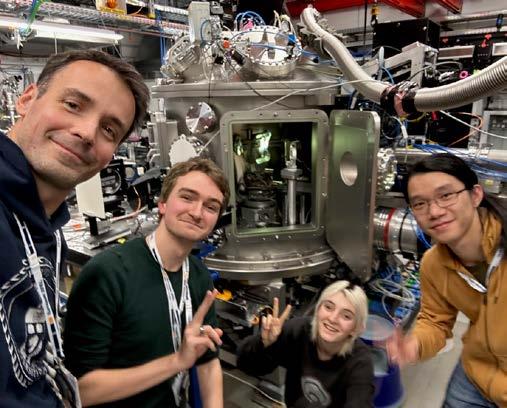
The Oxford team at the beamtime at the European XFEL in Hamburg, Germany: Sam Vinko, left, with Dr Patrick Heighway, Dr Mila Fitzgerald, and
Janina Dill published three academic articles on the role of international law in nuclear deterrence, changes in Ukrainians’ views about the costs of self-defence against Russia, and the role of local consent in the perceived permissibility of military intervention. She continued to comment on political developments, specifically regarding the conflicts in the Middle East and Ukraine. She is coleading an expert process co-organised by the International Committee of the Red Cross and the Oxford Institute for Ethics, Law and Armed Conflict
regarding the concept of military objective under IHL (international humanitarian law).
Richard Foster, while also completing his DPhil, co-authored ‘An Experimental Approach to Deliberative Democracy and Inequality’ for the Oxford Handbook of Grounded and Engaged Normative Theory. He has been working as a parliamentary researcher, completing various analyses of the rise of populism in the United Kingdom, North America, and the EU. In addition, he has also extended his teaching to postgraduates, supporting learning on political philosophy and applied policy courses on the Master of Public Policy programme at the Blavatnik School of Government.
Johannes Zachhuber was VicePresident for the year and, as such, liaised with both the outgoing and the incoming Presidents. He considered it an honour to serve the college in this role, and a unique experience. In the time that was left to him, he continued work on a project begun the previous year while he was research fellow at the Einstein Center Chronoi in Berlin. The result of the project, a short book on the ideas about time and history advanced by Denis Pétau, a 17thcentury French Jesuit, went to press in the summer.
Rebecca Bullard Senior Tutor

The academic year 2024-25 was a happy and successful one for Trinity’s academic community. Undergraduate students worked hard and enjoyed great success in University examinations, as well as developing skills and talents beyond their studies. Taught postgraduates achieved a particularly impressive set of outcomes from their degrees, and postgraduate research students undertook highlevel research across a wide range of subjects in the humanities, social sciences, and sciences.
At the start of the year, we welcomed new Tutorial Fellows in Materials Science and Medicine, and Junior Research Fellows in Biology and Law. And over the course of the year we bade farewell both to early career research fellows at the start of their academic careers, and also some of our longest-serving colleagues. Every arrival and departure contributes to the ebb and flow of academic life; the comings and goings of students and Fellows are like the tides that keep time in an ancient place of learning.
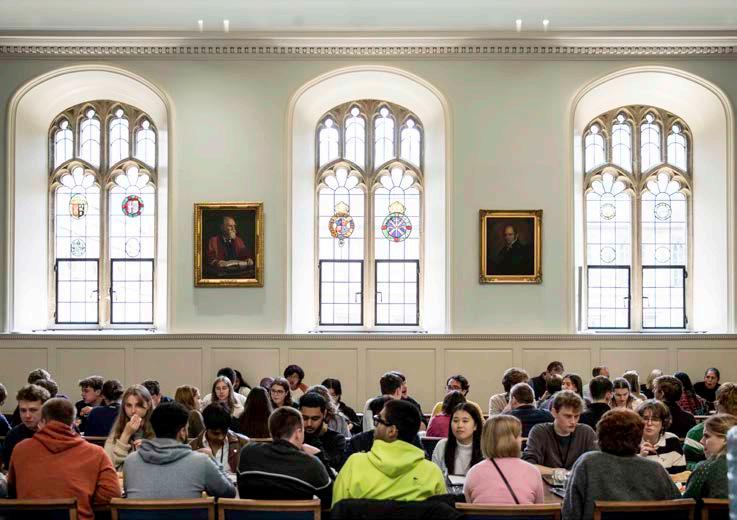
One of the greatest pleasures of having an office in the Levine Building is that my walk to work usually takes me through the café. As I stop to pick up my coffee, I hear snippets of students’ conversations around me. Sometimes they are about matches and fixtures, rehearsals and auditions; sometimes about bops, dinners, parties and other festivities. But very often, they are about essays and problem sheets, lectures and tutorials. It is a real pleasure to see students—both undergraduates and graduates— working collaboratively, helping and supporting one another, in an
‘It is a real pleasure to see students working collaboratively,
helping and supporting one another.’
environment that is less formal than the library and less isolated than a study bedroom. This relatively new space in the college has enabled new ways of working for the student body (as well as a ready supply of caffeine for the Senior Tutor!)
The hard work that students put in over the course of the year—whether in the café, the library or elsewhere
—is reflected in their excellent results. Some 37 per cent of undergraduate finalists in 2025 achieved a firstclass degree, and 53 per cent a 2.1. In Mods and Prelims, 28 per cent were awarded a Distinction or First, and all five of Trinity’s students on the Astrophoria Foundation Year completed the programme successfully. Notably, undergraduates at Trinity were awarded prizes by the University for their outstanding exam performances in a wide range of subjects, including Biochemistry, Chemistry, Engineering Science, Materials Science, Mathematics, Medicine and Theology. Students on taught postgraduate programmes also achieved excellent results; of the 32 Trinity students who completed taught masters’ degrees, 44 per cent were awarded a Distinction and 25 per cent a Merit, with the remaining students achieving a Pass.
Trinity’s postgraduate researchers had a very productive year. Twenty students completed a DPhil, on topics spanning a vast array of research fields: from Scots literature, to the use of steroids for acute asthma; from the earliest examples of British photography, to the impact of dietary fat on health; and from factors affecting wind farm performance, to the whole genome sequencing of viruses including coronavirus and hepatitis B.
The termly MCR research showcase is never short of speakers, and it is always a joy to hear students present their work to an audience drawn
from across the College community. The fact that so many of Trinity’s graduates are funded by generous donations is a wonderful example of the ways in which Old Members and Friends continue to support the research culture of both the college and the University.
We were delighted to welcome at the start of the academic year two new Tutorial Fellows to enrich our academic community: Dr Hannah Stern, Fellow and Tutor in Materials Science, and Dr Tammie Bishop, Fellow and Tutor in Medicine and Biomedical Sciences.
Hannah Stern’s research focuses on materials for optical technologies, including quantum and renewable technologies. Her first year in post involved moving her lab from Manchester to Oxford and building her research group, while also teaching topics including crystallography, thermodynamics, and the magnetic properties of materials to students at Trinity.
Tammie Bishop researches the body’s responses to low oxygen (hypoxia), especially in relation to cancer. She teaches a broad range of topics in physiology to Trinity’s students in Medicine and Biomedical Sciences, who have very much enjoyed her lively tutorials.
In January, our group of early career fellows also expanded thanks to the arrival of two new Junior Research Fellows: Fernando Contreras, JRF
in Natural Law Theory, and Jacques Bouvier, JRF in Biology.
Of course, there were departures as well as new arrivals over the course of 2024-25, including a number who have offered the college faithful service for several decades. Professor Dame Frances Ashcroft and Professor Peter McCulloch stepped down from their Professorial Fellowships; Dr Keith Buckler and Dr Jan Czernuszka retired as Tutorial Fellows in Medicine, and Biomedical Sciences and Materials Science, respectively; and Professor Cláudia Pazos-Alonso retired as the college’s lecturer in Portuguese. Between them, these colleagues have clocked up well over a hundred years’ worth of service to research, teaching and governance at this college, and we are profoundly grateful to them for all they have done for this community.
Finally, we said goodbye to some of the more recent recruits to Trinity’s Fellowship: Dr Gautam Gurung, JRF in Physics, Dr Chris Nicholls, JRF in Engineering Science, Dr Zoe Walker, Career Development Fellow in Philosophy, and Dr Katherine Backler, Career Development Fellow in Ancient History, all held their first academic posts at Trinity, and have now left to take up other positions. It is a privilege to be able to support academics through the early years of their careers. Their new research ideas and fresh perspectives on teaching are like waves, shaping the coastline of the disciplines in which they work, and the institutions to which they belong.
Michaelmas term
2024
Ancient and Modern History
Constance Quayle
Biochemistry
Jonathan Brown
Maisie Pollard
Gabriel Santos Diniz
Varun Satheshkumar
Biomedical Sciences
Jemima Barton
Lara Baugh
Chemistry
Joshua Croxford
Sahil Grover
Elowen Harley
William Munroe
Ffion Perkins
Marco Vann
Classics
Imogen Campbell-White
Evie Charles
Zoe Corvin
Thomas Kimbell
Rachel Rhodes
Classics and Modern
Languages
Georgiana Tsindos-Singellos
Computer Science
Thomas Carvell
Artemis Vellacot
Ho Yan Wong
Economics and Management
Fredrick Barker
Katie Gill
Tahseen Khan
Engineering Science
Nicolas Carcelle
Krishna
Eddanpudivenkatasivasaiganes
Joo Hyun Kim
Sudhir Krishnamoorthy
English
Jessica Neate
Fynn Hyde
Keiaron Joseph
Lauren Lendrevie
Holly Rust
English and Modern
Languages
Camilla Beraducci
Joseph Fay Sampedro
History
Ahmed Ahmed
Henry Golder
Maya Hussain
Annabel Josey
Abdur-Rahman Mahmood
Catherine McMillan
Arran Syed Raja
Lucy Wheeler
Law
Kai Beaumont
Layla Ducker
Katelin Reed
Sophia Roda
Ella Rayner
Sachi Shah
Law with Law Studies in Europe
Harry Maude
Materials Science
Huiyan Huang
Nelly Jackson
Max Sutherland
Xavier Well
Weronika Weill
Jingyun Zhou
Mathematics
Tristan Hodgson
James Hulse
George Maidstone
Isla Nangle
Benjamin Pearcey
Alice Sanderson
Medicine
Harriet Agbonmare
Juliet Brooking
Jun Hao Chen
Shrey Gala
Ryan Pang
Alexander Salama
Modern Languages
Caisey Cheung
Olivia Flynn
Pipa Rebelo
Music
Charlotte Kwok
Isabella Worcester
Philosophy, Politics and Economics
Ralph Armitage
Ella Beck
Jacob Bush
Eabha Gavaghan
Oscar Marsden
Nicole Wong
Philosophy and Theology
Giselle Ghevaert
Willow Parker
Physics
Zeynep Cabukoglu
Xinying Chen
Zachary Corbett
Charlie Knight
Thalia Rich
Kensei Sakamoto
Theology
Ifeoluwa Ayeni
Zainab Yousuf
Foundation year
Joshua Beaumont
Engineering
Arune Holloway
Theology
Jenna Mwila
PPE
Joshua Nias
Ancient & Modern History
And one student (Classics and English) who opted out of having their name published in communications
In accordance with University GDPR regulations, students are required to provide colleges with consent to publish their data—those listed on these pages have granted that permission.
Michaelmas term
2024
Eleonora Agostinelli
University of Oxford, Kellogg College
Ayantola Alayande
University of Edinburgh
Norah Aldrak
Harvard University, USA
William Allen
Australian National University
Chloe Brewster
University of Nottingham
Anica Buckel
Linnaeus University, Sweden
Prince Kelechi Chima
Trinity College
Lok Him Matthew Chiu
London School of Economics and Political Science
Saika Chowdhury
Asian University for Women, Bangladesh
Finn Conway
The University of Law
Siddhant Dhawan
Stanford University, USA
Fergus Dick
Loughborough University
Olivia Endacott
Trinity College
Anna Fitiskina
Moscow State University, Russia
Abigail Fray
University of Durham
Natali Gogishvili
Ecole Polytechnique, France
Mary Gouws
University of Oxford, Green Templeton College
Isabella Gregory
Victoria University of Wellington, New Zealand
Beixi Hao
Yale University, USA
Max Heuvels
University of Cambridge
Flora Hewitt-Harris
University of Bristol
Karan Kalsi
University of Auckland, New Zealand
Victoria Kipngetich
Yale University, USA
Teyun Kwon
Imperial College of Science, Technology and Medicine
Hei Wing Lau
University College London
Chun Sing Lee
University of Hong Kong
Man Yi Lee
University of Oxford, St Hugh’s College
Martin Lopez Howe
University of Oxford, Lincoln College
Annabel Lyon
University of Oxford, Exeter College
Arianna Margetts
University of Bristol
Samuele Marro
University of Bologna, Italy
Kate Moody
University of Edinburgh
Bunyanlkham Munkhbayar
Columbia University, USA
Diana Mwala
University of Zambia
Quan Nhu Hao Nguyen
University of Medicine and Pharmacy at Ho Chi Min City, Vietnam
Lauriane Pierrot Deseilligny
ENS de Lyon, France
Eva Plajer
Trinity College
Max Pushkin
Brown University, USA
Alexander Roskill
Imperial College of Science, Technology and Medicine
Songtum Saltrese
St George’s Hospital Medical School
Awais Seyyad
Imperial College of Science, Technology and Medicine
Emma Sibbald
University of Oxford, Worcester College
Ella Sperling
University of Chicago, USA
Wajahat Tariq
Trinity College
Sahil Thapa
University of Oxford, St Catherine’s College
Anirvinya Tirumala
University of Oxford, St Catherine’s College
Teres Vattoly
University of Delhi, India
Emily Walker
University of Durham
Christoph Weinhuber
Technical University of Munich, Germany
William Wetzel
Columbia University, USA
Finlay Williams
University of Oxford, Christ Church
Joseph Winslow
University of Oxford, Magdalen College
Wan Chun Ashley Wong
University of Manchester
Zhengbo Xu
Peking University, China
Heewon Yoon
University of Central Lancashire
Plus nine students who opted out of having their names published in communications
Trinity term 2025
One student who has opted out of having their name published in communications
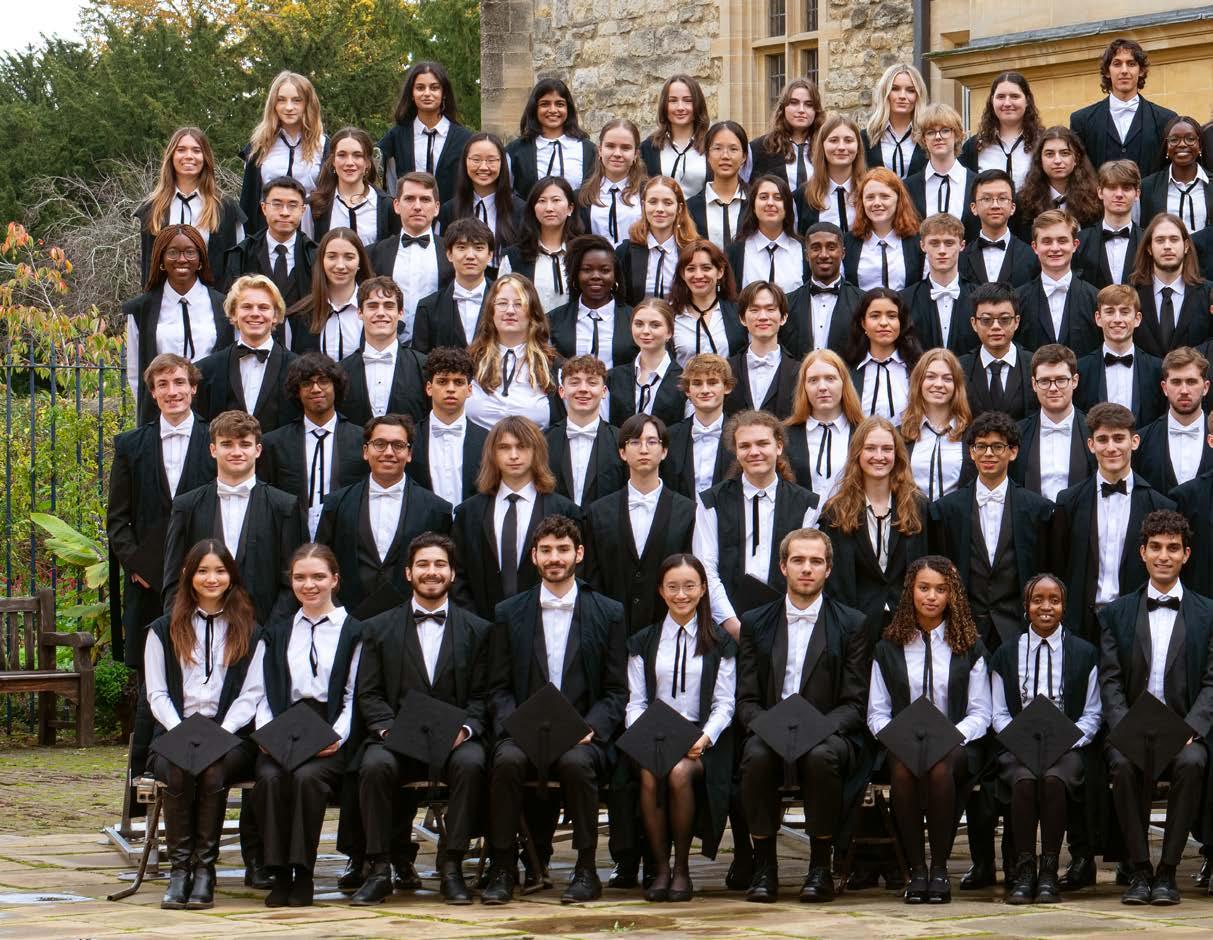
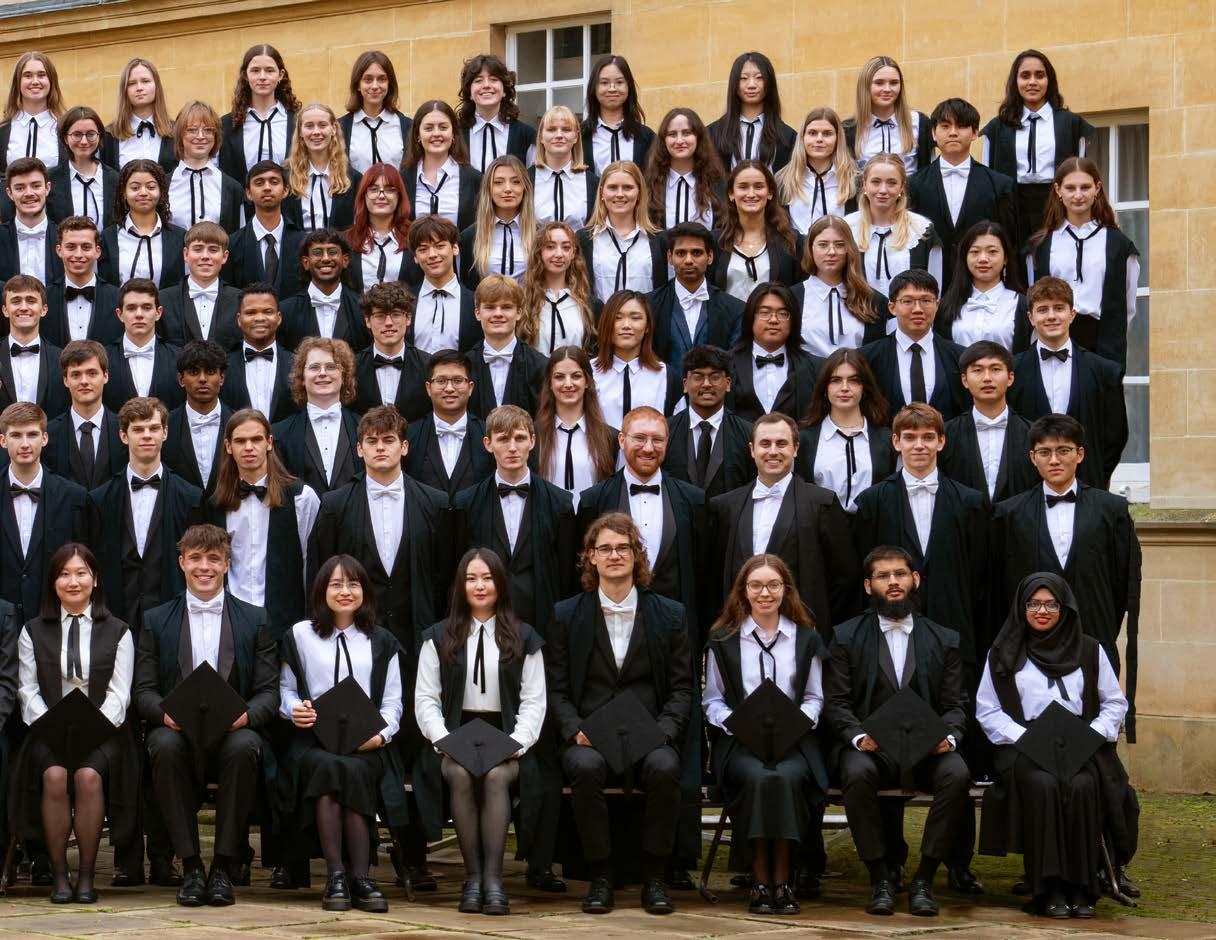
In the academic year 2024-25 there were 321 students reading for undergraduate degrees and 163 graduates reading for higher degrees.
Final Honour Schools
Thirty-four out of 93 gained first class degrees in Final Honour Schools in 2025. Their names are shown in bold.
Hannah Bailey
Aidan Baillie
Lily Bamber
Tudor Bazac
Sophie Beaumont
Anna Bekauri
Aimee Birch
Amelia Bishop
Daniel Bold
Rory Buckeridge
Leonard Buckley
Isaac Bullough
Robert Butcher
Ella Carran
Cham Tin Chan
Ibrahim Chaudry
Mary Chen
Bowen Cheng
Alexander Craig
Millicent Crewe
Stefan Danev
Hannah Davis
Vedanitya Dharwar
Akash Dubb
Sam Dudley
Ujjawal Dugar
Amber-Leigh Dunn
Justine Duvernay
Edward Dyer
Hristo Efimov
Runze Feng
Isla Finlay
Finlay Ford
Paul Furey
Daniel Garai-Ebner
Lewis Grant
Madeline Gregory
Daisy Griffiths
Agnieszka Gryguc
Joshua Holloway
Elsa Horne
Chuqi Hu
Yurie Ito
Qiushi Jin
Samuel Kramer
Anna Lapteva
Lucas Leung
Xinying Li
Zhining Li
Alphonse Loh
Morgan Lynch-Davies
Ashley MacLauchlan
Ellen Marsh
Anna Marshall
Raffaël Marth
Laura Massey
Euan McBride
Eden Mellor-Davies
Tri Mukherjee
Sakunori Nagumo
Simeon Nedkov
Julia Neill
Calvin Neoh
Colin Ng
Solademi Oduyoye
Daniel O’Keefe
Mery-Lena Orleans-Murray
Kata Pal
Roshan Patel
Adam Paterson
Clarissa Pereira
Megan Perry
Lola Picard
Christopher Ritchie
Hugo Roma Wilson
Isabella Rowe
Polina Ryzhuk
Peter Sadhani
Joshua Selfridge
Syed Shah
Angela Shi
Jun Wha Shin
Rohith Srinivas
Selen Sucu
Eben Terry
Dilia Thovez
Emma Tolhurst
Rupa Tripathy
Phoebe Troughton
Catherine Turkington
Zosia Wolny
Kitty Womack
Lucius Wong
FHS 2023-24*
Maria Kelly
Orla Phelan
Reshmaa Selvakumar
(*omitted from the printed version of the 2023-24 Report)
Bachelors of Civil Law
Anonymous
Chun Sing (Marco) Lee
Bachelor of Philosophy
Genevieve McCauley
Doctors of Philosophy
Anonymous Philosophy
Manfredi Castelli
Clinical Neurosciences
Olena Chervonik
History of Art
Calin-Mihai Dragoi
Biochemistry
Bhadrajee Hewage
History
Imran Howell
Clinical Medicine
Guosheng Ji
Engineering Science
Conor Keogh
Surgical Sciences
Andrew Kirby
Environmental Research
Sheila Lumley
Biomedical and Clinical
Sciences
Eilidh Macfarlane
Sociology
Fionn Montell-Boyd
History of Art
Ngoni Mugwisi
Engineering Science
Roger Navas I Sole
Medieval and Modern
Languages
Mary Newman
Medieval and Modern
Languages
Kam Poon
Inorganic Chemistry for Future Manufacturing
Hamish Pottinger
Linguistics, Philology and Phonetics
Dylan Sherman
Engineering Science
Charlotte Simms
Inorganic Chemistry for Future Manufacturing
Nikola Srnic
Cardiovascular Science
Masters of Business Administration
William Allen
Beixi Hao
Masters of Philosophy
Andrew Karpinski Theology
Conrad Kunadu
International Relations
Elizabeth Nwarueze
Law
Ulystean Jonathan Oates III
Politics: Comparative Government
Malayvardhan Prajapati
Economics
Kaidi Zhu
Economics
Masters of Science
Anonymous
International Health and Tropical Medicine
Jannis Büscher
Advanced Computer Science
Saika Chowdhury
Global Health Science and Epidemiology
Natali Gogishvili
Advanced Computer Science
Karan Kalsi
Comparative Social Policy
Victoria Kipngetich
Global Governance and Diplomacy
Buyanlkham Munkhbayar Comparative Social Policy
Diana Mwala
Evidence-Based Social Intervention and Policy Evaluation
Quan Nhu Hao Nguyen
International Health and Tropical Medicine
Max Pushkin
Global Governance and Diplomacy
Jordan Rothschild Sociology
Teres Vattoly Sajeev
Evidence-Based Social Intervention and Policy Evaluation
Emily Walker
Clinical Embryology
William Wetzel Sociology
Ashley Wan Chun Wong
Genomic Medicine
Zhengbo Xu
Advanced Computer Science
Masters of Studies
Anonymous
English (1700-1830)
Jean Balchin
Global and Imperial History
Chloe Brewster
Linguistics, Philology and Phonetics (Advanced Study)
Olivia Endacott
English (1830-1914)
Anna Fitiskina
Linguistics, Philology and Phonetics (Advanced Study)
Max Heuvels
English (1900-present)
Ella Sperling
English (1830-1914)
In accordance with University GDPR regulations, students are required to provide colleges with consent to publish their data—those who have not consented are listed as ‘Anonymous’.
Undergraduate scholarships
Brian Chan
Alex Craig
Stefan Danev
Veda Dharwar
Akash Dubb
Isla Finlay
Emma Goodliffe
Eliza Harris
Elsa Horne
Finn Kearns
Lucas Leung
Leo Liu
Alphonse Loh
Raffaël Marth
Euan McBride
Eden Mellor-Davies
Colin Ng
Lola Picard
Chris Ritchie
Carolyn Rong
Polina Ryzhuk
Hur Shah
Jay Shah
Jun Wha Shin
Eben Terry
Dilia Thovez
Rupa Tripathy
Andrew Walker
Undergraduate exhibitions
Johan Abel
Shreyas Adhikari
Josh Askew
Sophie Beaumont
William Boulanger
Christopher Budiwardhana
Robert Butcher
Aria Chakravorty
Benjamin Chambers
Isabel Clarke
Yash Dadwal
Sophie Duffin-Jones
Edward Dyer
Paul Furey
Yuhai Gao
Giselle Gao
Grace Hinton
Zach Hudson
Annant Khullar
Great Kitsanadecha
George Loynes
Morgan Lynch-Davies
Ashley MacLauchlan
Ella Machtynger
Anna Marshall
Harry Mawson
Holly McGlue
Caitlin McShane
Dominic Murphy-O’Connor
Simeon Nedkov
Julia Neill
Calvin Neoh
Isaac Nicholls
Houji Niu
Daniel O’Keefe
Teddy Onslow
Roshan Patel
Adam Paterson
Samuel Pomfret
Flavia Portaro
J P Pu
E Rick Pua
Florence Robinson
Grace Robson
Sofia Sherratt
Angela Shi
Xinyu Zhang
Graduate scholarships
Federico Barbero
Lars Bathe-Peters
Thomas Cross
Rose Faure
Georgina Fooks
Alexandra Gunn
Joseph Hamley
Charles Heaton
Joanna Helme
Ishbel Henderson
Bhadrajee Hewage
Zixuan Li
Priya Manwaring
Tamio-Vesa Nakajima
Roger Navas I Sole
Ellen Parkes
Ivan Tolkachev
Sparsh Tyagi
Postgraduate research scholarships
Birkett Scholarship
Awais Seyyad
Christie-Miller Scholarship
Aminath Naseem
Jeffrey Abbott Scholarship
Raza Nazar
Max Beloff Scholarship
Finn Conway
Melvin Young Scholarship
Franz Lewin Nolden
Montgomery Scholarship
Finlay Campbell
Oxford-Cecil Lubbock Scholarship
Isabella Gregory
Emma Sibbald
Oxford-Elizabeth Murphy Scholarship
Finlay Williams
Oxford-Pearson Scholarship
Martin Lopez Howe
Oxford-Sir Ivor Roberts Scholarship
Joseph Winslow
Titley Scholarship
Flora Hewitt-Harris
Postgraduate taught scholarships
Dick Fredericks Scholarship
Ella Sperling
Jeffrey Abbott Scholarship
Fergus Dick
Michael and Judith Beloff Scholarship
Sahil Thapa
Mitchell Scholarship
Clemency Day Fawcett
Eva Plajer
Oxford-Wordsworth Scholarship
Max Heuvels
Reynolds-Wright Scholarship
Eva Plajer
Saïd Scholarship
William Allen
Sir Roger Fry Scholarship
Anna Fitiskina
Ward-Perkins Scholarship
Abigail Fray
Collegeprizesandawards
Amratlal K V Shah Prize for Medicine
E Rick Pua
Britton Instrumental
Scholarship
Robert Butcher
Cham Tin Chan
Boyao Dai
Sophie Duffin-Jones
Isabella Gregory
Charlotte Kwok
Jun Wha Shin
Isabella Worster
Caistron-Calgary Access Award
Joshua Askew
Ben Chambers
Yassin Hachi
Mahima Nayak
Clarissa Pereira
Xiyan Pu
Caistron-Calgary Award
Akash Dubb
Alice Pendry-Humm
Jay Shah
Sofia Sherratt
Charles and Cynthia Phillips Prize for Neuroscience
Hur Shah
Christopher Prior Prize for Mathematics
Morgan Lynch-Davies
Douglas Sladen Essay Prize
Q Le
Runners up
Briony Arnott
Agnieszka Gryguc
Dr K Thiruvukkarasu Scholarship
Hannah Jones
Hinshelwood Chemistry Prize
Bowen Cheng
J and C Holladay Prize for Ancient History
Jamie Ashley
Jon Blake Prize
Nina Bayford
Osheen Khurana
Zain Mohammad
Lady Astbury Law Prize (Mods)
Harry Maude
Margaret Howard Essay Prize
Sahil Grover
Euan McBride
Monique and Ted Meron
Shakespeare Prize
Euan McBride
Monique Meron Memorial Law Prize
Harry Maude
Neil and Barbara Jones Award
Sarah Coffey
Ore Thomas
Odette de Mourgues Prize (French)
Isabelle Rowe
Peter Fisher Prize for Physics
Josh Selfridge
Peter Kirk Travel Scholarships
Kate Moody
A further five students from the following colleges: Balliol, Christ Church, Lincoln, St
Hugh’s, Univ
R A Knox Prize
Biochemistry
Rupa Tripathy
Computer Science
Tri Mukherjee
Economics
Brian Chan
Engineering
Ellie Marsh
English
Lucas Leung
History
Veda Dharwar
Medicine
Ashley MacLauchlan
Philosophy
Mary Chen
Politics
Polina Ryzhuk
Theology
Aidan Baillie
Richard Hillary Writing Competition
Camilla Berarducci
Leelou Lapteva
Honourable Mention
Hamish Pottinger
Sally Ball European Law Prize
Dilia Thovez
Sarah and Nadine Pole Scholarship
Akash Dubb
Nicola Kalita
Stirling Boyd Prize
Jack Warburton
Whitehead Travelling Scholarship
Sophie Beaumont
Madeline Gregory
The JCR
David Evers Prize
Isabelle Moore
There was a certainly a buzz amongst JCR members as we returned to Trinity for the 2024-25 year—the multiyear renovation of the dining hall and bar were finally complete!
The second years were treated to a personal development course at the start of Michaelmas term, with the opportunity to learn from some Trinity alumni, as well as meet the newly elected college President, Sir Robert Chote, before enjoying a dinner in the ‘brand-new’ Hall. The Freshers’ Committee, led by the wonderful Josh, Imogen, and Christina, put on a fantastic welcome for the incoming students, including socials in the JCR, college family dinners, and club nights, and the newest JCR members quickly settled into the swing of things at Trinity.
As term progressed, the Entz reps continued to put on a great range of events, particularly the Christmas Black Tie bop in the Town Hall, and the Welfare team brought warmth and light in the form of numerous welfare tea snacks as the weather grew colder and the days shorter. The annual JCR gala dinner was a merry affair, and a fantastic way to celebrate the work and achievements of the hard-toiling committee that preceded me. Cultural
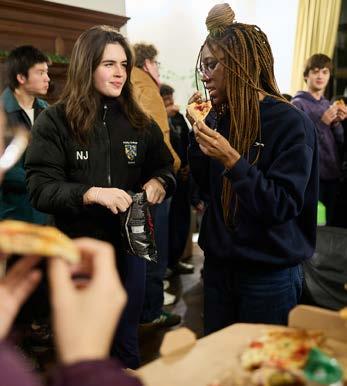
event highlights include a popular Diwali dinner and delightfully festive Oxmas season, with the choir delivering wonderful performances at the carol services.
Hilary term, whilst also bringing more cold and rainy weather, brought another successful term for the JCR. The newly opened Beer Cellar was gaining steam, through the introduction of a brand-new college drink and the hard work of the Trinity Music Society in bringing live music to college. Thanks to a generous donation from the Trinity Society for new equipment, over the course of the year the Beer Cellar became a musical hub, with karaoke nights and regular performances by Trinity’s own band, The Booksellers. Halfway Hall in February was a wonderful (and slightly raucous!) chance for the second years to celebrate their time in
Oxford, past and yet to come, and the traditional Halfway Hall ‘superlative awards’ were a big hit.
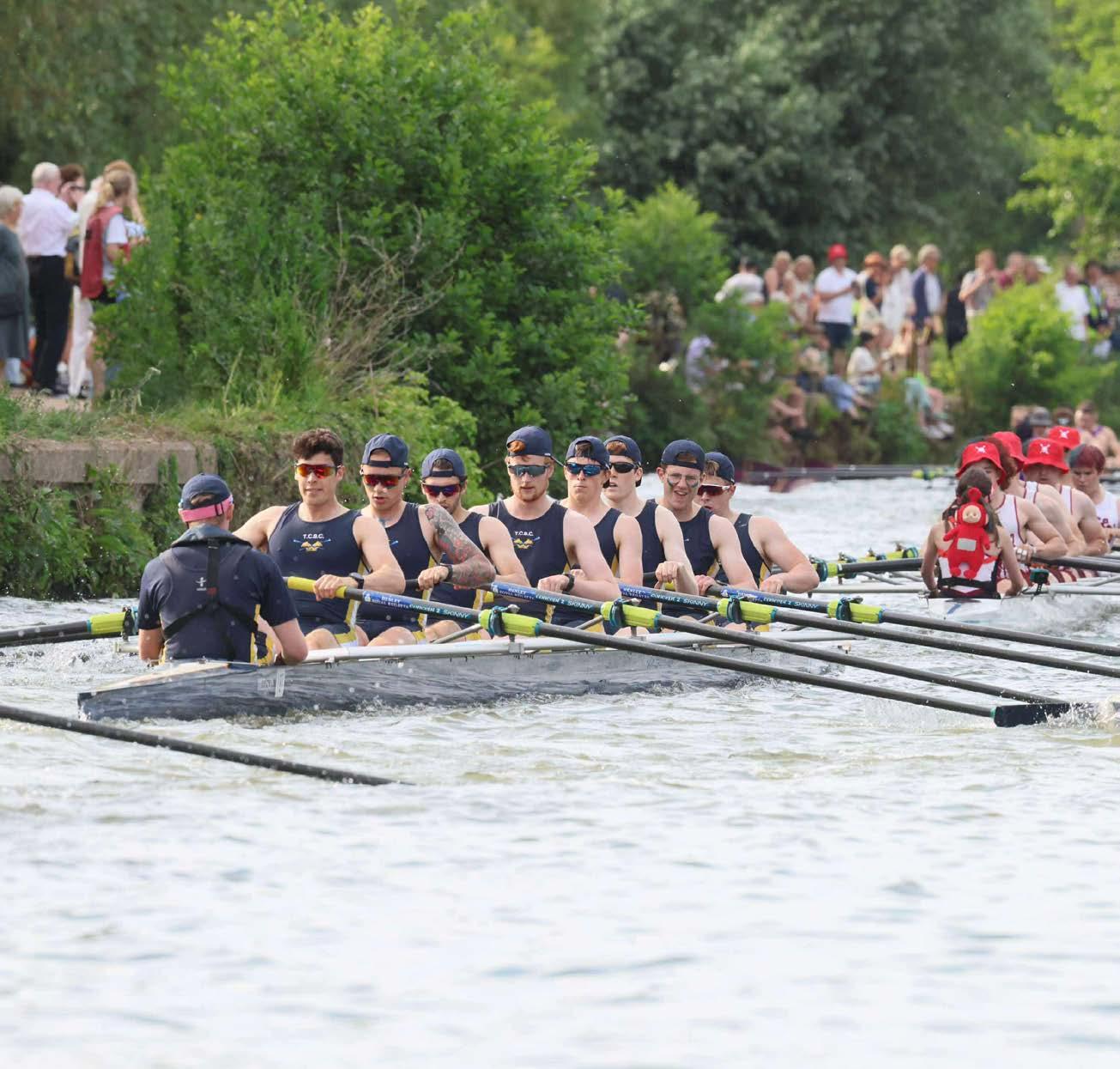
Trinity term was truly the pièce de résistance of the JCR year. We began with a trip to our sister college in Cambridge, Churchill, for a sports day head-to-head. Though the Trinity netball team reigned victorious, the less said about the football team, the better. On the topic of sporting success, Summer VIIIs was, as usual, a hit event, with the M1s performing particularly well and advancing to ninth on the river; the Pimm’s was flowing as the JCR came along to the boathouse to cheer on all the Trinity crews under the hot sun.
A stellar highlight of the term was definitely the Trinity Players’ production of The Great Gatsby in the beautiful President’s Garden— directed by the talented Izzy and George—that dazzled us all with its acting and production standards.
Trinity term concluded in typical fashion; whilst many students found themselves holed up in the library with exams looming, we still found time for croquet on the idyllic lawns and punting on the rivers. Schools
Dinners and the Trinity Monday feast rounded off the end of a packed year, and I wholeheartedly give my deepest gratitude to every member of the JCR, college staff, and wider Trinity community for making this year one to remember—it is one that I will look back on fondly forever.
Mahima Nayak JCR President
This year at Trinity was unique, but above all, it was a year defined by connection, creativity and community. The reopening of the Hall and the Beer Cellar marked a longawaited return to some of the college’s most cherished social spaces. Alongside this, we were fortunate to have access to additional spaces, including the Sutro Room, while our common room underwent development. These changes reshaped how the MCR functioned day-to-day, and gave students the ability to experience the college in new ways. We began the year, as always, with a vibrant and welcoming Freshers’ Week. This included a diverse range of events designed to help new members feel at home in College and connected to one another. Highlights included a Wild Swimming social, an LGBTQ+ picnic, a cocktail and mocktail-making competition, ‘speed friending’, a ‘crafternoon’ and a Beer Cellar bop. These events were to ensure every new member could find a space and an activity that resonated with them. As term progressed, we settled into a steady rhythm of regular and muchloved events, including academic showcases and LBGTQ+ symposia. Our weekly Tuesday Pizza Nights were a cornerstone of MCR life, providing an informal space for members to unwind
and socialise. We also organised a wide range of bar exchanges with other colleges, including St Cross, Kellogg, St Antony’s, St Hilda’s, Green Templeton, St Catherine’s, Exeter, and Christ Church. These were consistently well attended and offered members valuable opportunities to broaden their social networks across the University.
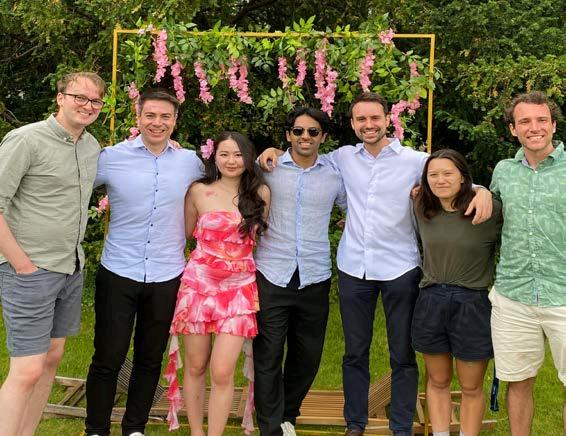
We are particularly grateful to Jon Flint and the Hall team for an outstanding dining experience throughout the year. With the reopening of the Hall and Beer Cellar, we were also able to host nine formal hall exchanges, enabling Trinity members to dine at colleges across Oxford. This exceeded the usual number of exchanges per term and was a highlight of the year, reinforcing Trinity’s place within the wider collegiate community.
In addition to our regular programme, we held our annual MCR Gala, which raised over £1,000 for the British Heart Foundation. The event was a testament to the generosity and enthusiasm of our members and remains one of the year’s proudest achievements.
Reflecting on the year, it is clear that none of this would have been possible without the dedication of the MCR committee. I am deeply grateful to Corey, Tobias, Adrian, Sabrina, Christian, Lars, and Malay for their exceptional contributions. I would also like to give special thanks to Ama, who took on the role of Social Secretary as a fresher and brought remarkable energy to the position, organising several karaoke events, when members truly sang their hearts out.
This year, more than anything, was about making Trinity feel like home again. Together, we succeeded.
Raza
I am pleased to report that the year of growth promised by last year’s TCBC president materialised in 2024-25.
After a sub-par performance at Fairbairns in Cambridge, and a difficult Torpids campaign plagued by bad weather, the M1 turned their year around, going +3 at Summer Eights whilst bumping old rivals Balliol on the last day. The senior men were also rewarded for their hard work
with a win in the Open 8+ category at Worcester Regatta. Whilst the M2 could not race at Torpids due to the aforementioned weather, they were unfortunate not to qualify for Eights and will be looking to challenge for the first boat next year.
The women’s team had a transformational campaign, after losing many senior rowers the previous year. A large group of enthusiastic novices was successfully integrated into the squad, allowing the club to field three women’s boats at Summer Eights. Whilst the Torpids and Eights results did not go their way, the crews gained valuable experience that will serve them well as they pursue ambitious goals next year. This was reinforced by a strong showing at Worcester Head, the first external race for many of the crew.
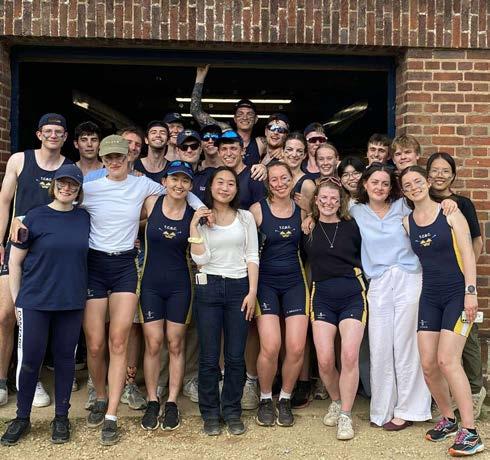
I am confident that 2025–26 will build on this progress and mark another year of strong results for the club.
Ivan Tolkachev
Trinity Badminton Club grew considerably in numbers this year, with plenty of freshers attending our sessions regularly, as well as some of the ‘old guard’. Our weekly sessions remained busy throughout the
year, and our concluding game of ‘around the world’ has become quite a tradition!
Whilst the University league wasn’t completed, for administrative reasons within the University, Trinity’s teams performed strongly, winning five times to just two losses. In cuppers, our team narrowly missed out on the chance for glory, by losing on points in the semifinals. With increasing momentum, we have no doubt Trinity will make it out on top next year!
Ashley MacLauchlan
Cricket
Building on the solid foundations of Chris Ritchie’s team in the summer of 2024, Trinity had another extremely enjoyable, and pretty
successful, cricket season, which saw us reach the quarter-finals of cuppers. Our start to the season was boosted by the addition of Fergus Dick and Thomas Kimbell to the batting lineup; both made runs in notable wins against LMH/Wadham, Brasenose and St Catz. In college cricket, a core foundation of second year classicists unburdened by exams is no bad thing, and it was pleasing to see Sam Beverley and Tom Lascelles making vital contributions with bat and ball—in addition to Ben Cole’s trusty wicket-keeping, Bertie Low’s menacing pace and my consistent averageness.
Riding high on our early successes we perhaps fell victim to a BazBallian arrogance going into the cuppers quarter final against Teddy Hall. We had bowled fantastically, and needed barely a hundred runs to win. A hundred runs we did not find: a dark day indeed in Trinity’s cricketing history, which I prefer to forget than to describe. And yet our season was not over. We picked ourselves up and headed the next week for the annual ‘Broad Street Derby’ against Balliol. Victory was decisive, and the cup is ours for the second year in a row. The game is in good hands.
Sam Monro-Davies
Both the 1s and 2s of the Trinity men’s football team enjoyed illustrious seasons of putting other colleges to the sporting sword. Strong cuppers runs, paired with high finishes in the
league tables, and an away day at our sister college, Churchill, in Cambridge were notable highlights. Thanks to a persistent pursuit of funding, we were also able to procure some marvellous club ties to make our appearances off the pitch as memorable as those on it. The baton has since been handed from captains Nat and Matthieu onto captains Thomas and George, and I’m sure the footballing aspirations of this plucky little team from Broad Street will continue to soar.
Nat Merrell
The Trinity women, joint with LMH and St Hugh’s, compete as part of Summertown FC. The year started well with a very strong intake of freshers. We reached the semi-final of cuppers and made a valiant effort against Hertble (a conglomeration of Hertford and Keble). Unfortunately, we did not make it to the final: we have maintained our streak of narrowly missing out on cuppers glory. Nonetheless, it has still been a successful year for the club and our bolstered numbers and spirits look set to continue into 2025-26.
Florence Robinson
Trinity College Netball Club had another successful season as we found our feet and continued to grow in the college community. With over 30 current members, we are now one of the largest clubs in Trinity and the largest female-led team. Although
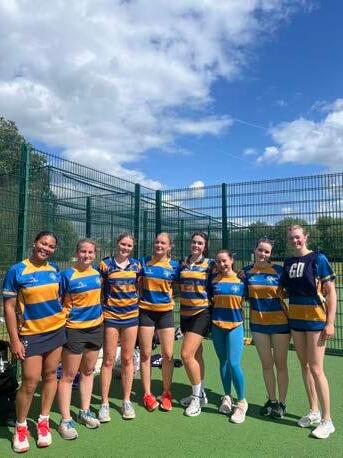
we did not have much luck in the Mixed Cuppers League, we used these weekly matches as great preparation for the inaugural Trinity Sports Day at Churchill College, Cambridge, and the cuppers tournaments at the end of the year. Our hard work paid off with a decisive victory of 21-6 in Cambridge.
We were the real underdogs going into the women’s cuppers tournament. As the only team without a kit—a big thank you to the rugby club for lending us their shirts—one netball and no umpiring whistle to be found, expectations were low. But oh, how we proved them wrong! We smashed through qualifying and put up a huge fight in the semi-finals against Brasenose, losing by only one point in
extra-time. With new netball dresses on the way, we are really looking forward to the season ahead—watch this space!
Kasia Rycroft
Fresh from last year’s successes, Trexeversity (formed with Exeter and Univ) had high hopes for the season ahead. Unfortunately, it was not to be; despite our best efforts (signing Fergus Dick, captain of the Loughborough First XV), the team was hampered by injuries and wound up knocked out of cuppers by old rivals Christ Church. The club saw some fresh talent, as well as a number of first time players— seeing these develop, in particular Ahmed Ahmed, who laid down his managerial role to join on the pitch, was a pleasure and we have high hopes for the season ahead.
Despite the lack of success on-pitch, Trinity continued to lead the charge off-pitch, continuing their strong tradition as a crewdate team.
Sam Beverley
Tennis at Trinity started earlier than usual this year, with new informal sessions in Michaelmas and Hilary terms. By holding sessions earlier in the year, it gave those of all levels of experience the opportunity to pick up a racket. Moving into Trinity term, we assembled our best to take on the coveted cuppers competition. Following a first-round exit last year, we went into our match-up against
Harris Manchester determined to break the dry spell. Unfortunately, we did not. On the bright side, we had a team with five of six players who hadn’t played for Trinity before (including one who hadn’t played tennis before) and all enjoyed it. We also held the now-traditional alumni match, with the Old Members taking a convincing win, followed by a lovely High Table dinner afterward. My thanks go to Matthew Johnston (1999) for helping to arrange it.
Adham Saeid
In recent years, climbing has exploded in popularity. To accommodate this at the college, Trinity Climbers was founded as a society for both new climbers and experienced members of the college. The society has hosted bi-weekly sessions at Oxford’s climbing gyms, where members have experienced the joys of dual-texture holds at Gallery Climbing centre and the dizzying heights of Brookes Sport’s autobelays—the latter being made accessible to new climbers by the purchase of harnesses for the society. Trinity climbers aim to create a strong sense of community and bring about peer-to-peer learning, where more knowledgeable climbers assist newer members on their climbing journey. With a large influx of new members in Michaelmas, the weekly sessions have been instrumental in welcoming these new climbers into the community. Throughout the year,
it has been wonderful to see people new to this sport grow and overcome the challenges that fighting gravity presents: many members have learnt new skills, such as top roping and lead climbing at Brookes. It’s not all about trying hard though; a Halloween social was hosted at Gallery, where members were encouraged to dress up and savour the centre’s amazing routes. We look forward to sharing the joy of climbing with the new cohort of students and hope to have another fantastic year of vertical (mis) adventures.
Robert Doherty and Kata Pal
Blues
Full Blue
Rory Buckeridge, Hockey
Fergus Dick, Rugby Union
Akash Dubb, Field Hockey
Hristo Efimov, Fencing
Isla Finlay, Lacrosse
Emma Goodliffe, Lacrosse
Tyreke Holness, Powerlifting
Annabel Josey, Lacrosse
Louis McAuliffe, Swimming
Max Pushkin, Men’s Ice Hockey
Ore Thomas, Women’s Football.
Half Blue
Ishbel Henderson, Sailing
Stephen Hoy, Taekwon-Do
Alphonse Loh, Volleyball
Charles London, American Football
Colin Ng, Rugby Fives
Maisie Pollard, Touch Rugby
Max Pushkin, Baseball
Zhengbo Xu, Dancesport
TCBGS had a very strong first year, hosting three to four events every term. We started the year in Freshers’ Week with a board games evening social, which turned out to be very popular, around 50 freshers attended! This gave us a chance to try some of our newly purchased games, such as the secret-role word-guessing game Werewords, which proved very popular. We were happy to see many of the freshers we met at that event return throughout the year for more events.
Our two most popular/requested (/imposed) games were Jungle Speed and Secret Hitler—both games which explore deeply philosophical concepts of power through different lenses. On one hand, the thesis statement of Jungle Speed is ‘might makes right’ with players competing to snatch a central totem pole before their opponents, sometimes employing the use of physical force to end a stalemate. On the other, Secret Hitler encourages players to explore their Machiavellian nature—players must uncover the fascist agitators among them but to do so, they must use more and more authoritarian policies of surveillance and even execution. Our players were left wondering ‘how far is too far in the defence of liberty’ —perhaps an increasingly relevant question.
We hope that we will be able to repeat this year’s success when we welcome the incoming freshers and who knows, maybe we might even
The Board Games Society in action
play more than two games (there are already tentative suggestions of a fivehour-plus playthrough of Hegemony).
Alec Dakin
Over the academic year, the Chapel Choir fulfilled its duties faithfully, maintaining a consistently high standard of choral singing across all three terms while tackling a demanding repertoire.
The choir also had the pleasure of performing their signature anthem, ‘Let My Love Be Heard’, in the stunning chapel of All Souls for a second consecutive year. Other notable
highlights included a Cotswolds choral outing and a joint evensong with St Hugh’s. Another memorable moment saw the choir return to the top of the chapel tower for madrigals on May Day morning. We were somewhat muffled by bells chiming the hour at the start, but undeterred, we repeated the performance in Durham Quad, delighting an eager crowd of students and staff who gave rapturous applause.
It was a richly rewarding year for the choir, culminating in a weeklong summer tour to Brescia and Verona. The choir performed in
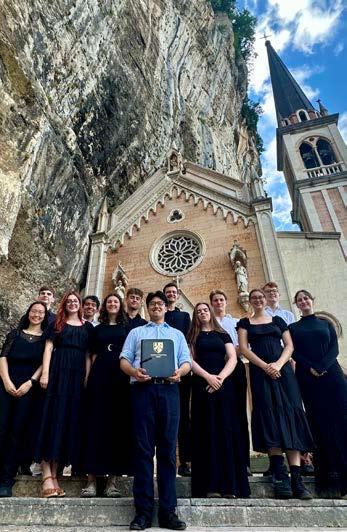
three magnificent venues: Chiesa San Francesco d’Assisi, Chiesa di San Pietro, and the breathtaking cliffside shrine, Santuario Madonna della Corona. The tour was a resounding success, met with enthusiastic audiences—including a parishioner of San Pietro, who recorded the choir’s performances and shared them via WhatsApp!
J W Shin
Christian Union
The Christian Union continued to be joined with Wadham this year. We started the year welcoming freshers with a trip to G&D’s ice-cream
parlour and, later in term, a group dinner. We continued our Gospel bible studies, as well as our fortnightly prayer meetings. A highlight of the term was the OICCU (Oxford’s Inter Collegiate Christian Union) carol service, where evangelical author Michael Ots came to speak, ahead of his return as our events week speaker in Hilary term.
In Hilary, we continued with our prayer meetings as well as running some college outreach before the OICCU’s events week, which many of our members helped with and attended. Its theme, ‘What If?’, encouraged students to think more deeply about life’s big questions, while offering them the Bible’s perspective. We held more socials and prayer meetings in Trinity, including a group dinner and a games morning. We have been grateful for the freedom we have in college to give every student at Trinity the opportunity to hear and respond to the Gospel of Jesus Christ and look forward to all God has in store for college next year.
Alice Sanderson and Ife Ayeni
Gryphon Society
The Gryphon Society has once again enjoyed a spirited year of lively debate, good company, and even better dinners. Meeting every other Wednesday, we gathered to argue, persuade, and occasionally pontificate on a wide range of motions.
Each evening featured two debates: one serious and one decidedly less so. Topics this year ranged from ‘This
House Regrets Joe Biden’s Foreign Policy’, to the rather more speculative ‘This House Would Welcome Our Alien Overlords’. Both provoked passionate speeches, heckling of varying sophistication, and the kind of rhetorical acrobatics that can only be achieved after a generous helping of claret.
The combination of serious discussion and a generous dinner made for evenings that were as intellectually stimulating as they were entertaining. It’s safe to say that while the arguments didn’t always resolve global issues, they certainly resolved the question of how best to spend a Wednesday night.
A particular highlight of the year was the Michael Beloff After Dinner Speaking Competition, in which members showcased their oratorical flair and wit before the former Trinity President himself, along with a panel of distinguished judges. The event was a real test of eloquence, but also fun and captivating, and this year’s worthy winners were Noah Schrewe and Fynn Hyde, whose speeches struck exactly the right balance of charm, humour, and self-deprecation.
All in all, it has been another memorable year for the Gryphon Society—one that proved, yet again, that serious debate and light-hearted conviviality are not mutually exclusive but, in fact, make the perfect pairing.
Sam Pomfret and Bertie Low
Over the past academic year, the Law Society hosted a vibrant programme of events offering our membership a launchpad into the legal profession.
In Michaelmas term, we were fortunate enough once again to host a dinner with trainees, associates, and partners from Freshfields. We would like to express our gratitude to Benjamin Crompton (2012) for his help in organising this event.
We also had the privilege of hosting a dinner at The Ivy Oxford with Sullivan & Cromwell LLP, offering members insight into the world of commercial law. Later in the term, we partnered with other Oxford colleges to host a three-course dinner with lawyers from Skadden LLP at the Oxford Malmaison.
In Hilary term, we hosted a threepart event with Alston & Bird, beginning with the firm’s presentation and followed by a teddy bear making workshop in the Levine Building café, partnering with the Teddy Trust, a charity that provides stuffed toys to children in worn-torn countries. We concluded the evening with dinner at Quod, on the High Street. Many of those attending later took part in the firm’s summer open days.
It has been an honour to lead the society, and we wish the very best of luck to our successors.
Osheen Khurana, Nina Bayford and Zain Mohammad
This year was the busiest in the history of TCMS, with the society receiving generous funding from the Trinity Society and purchasing a large quantity of brand-new equipment. This has been instrumental for accommodating college gig nights, the garden play and other concerts; events that Trinity did not so easily have the means to put on in the past.
In addition to the new bar gigs and social music scene that TCMS has brought to student life, it has continued its excellent reputation with the termly President’s Concert. This offers a chance for any Trinity student to get involved in a relaxed evening of recitals in the de Jager Auditorium. This year’s President’s Concerts were a joy to oversee and perform in, witnessing the college community come together in the name of conviviality, recreation and musicality.
It has been an immensely successful year for the society, which has paved the way for future generations of Trinity students to get involved with college music, away from the world of their studies.
Benjamin Reynolds
Trinity Players
The Trinity Players are an important part of the college community, bringing life, laughter, and entertainment to the college’s auditorium and gardens, so when the reins were passed down to us this year, we knew we had to give it our all.
We kicked off the year in Michaelmas term with our production of Vanbrugh’s Restoration comedy
The Provoked Wife, a triumphantly silly affair that got freshers involved in college drama. Then, in Hilary term, Izzy directed our Variety Night, a joint enterprise with the Music Society. What followed was music, musical theatre, Shakespeare, and Wilde, all tied up with a raucous performance of Izzy’s own short comedy play, Winity High Table Havoc.
The highlight of our year, though, was a hugely successful garden play, a production of the stage adaptation of The Great Gatsby, celebrating the novel’s centenary at the very college allegedly attended by its eponymous protagonist. This sold-out show, complete with dance numbers, automobiles, aeroplanes, a live 12-piece jazz band, and a cast of 17 amazing performers, was the combined effort of over 50 talented theatre-makers from Trinity and beyond.
It was an absolute honour and pleasure to work with so many incredible actors and good friends this year, particularly alongside our wonderful producer Sophia Eiden, without whom none of it could have happened.
George Loynes and Izzy Moore
Academic Office
Isabel Lough, Undergraduate & Tutorial Administrator
Ashley Maguire, Graduate & Academic Administrator
Ian McGurk, Undergraduate Admissions & Chapel Administrator
Accommodation,
Housekeeping & Site Services
Jonathan Davies, Head of Accommodation Services
Sara Reevell, Accommodation Officer
Fabiana Chiaratti, Site Services & Housekeeping Supervisor
Simona Florea, Housekeeping Supervisor (from January)
Bianca Tutuianu, Housekeeping Supervisor (to December)
Housekeeping
Joao Barbosa, Scout
Mariano Belo, Scout
Michelle Brown, Scout (Sports ground)
Rachel Clerkin, Scout
Carmen Dulgheriu, Scout (Off-site properties)
Mizania Fraga, Scout
Eka Hadinyati, Scout
Miroslawa Krezel, Scout
Barbara Mazur, Scout
Pascoela Moniz, Scout
Gercia Pires, Scout
Ivania Ribeiro, Scout
Yeti Santos, Scout
Lisa Simon, Scout (from February)
Darron Smith, Scout (Off-site properties)
Carlos Soares, Scout (from July)
Kerry Stacey, Scout
Brigida Valente, Scout (to May)
Site Services
Wilton Chiaratti, Site Services Assistant (to April)
Darren Cox, Site Services Assistant
Benjamim Neto, Site Services Assistant
Lucas Rocha, Site Services Assistant (from May)
Andrew Clinch, Administrative
Assistant (to April)
Miriam Hallatt, Development Officer
Sarah Jenkinson, Alumni & Events Officer
John Jose, Administrative Assistant (from April)
Thomas Knollys, Alumni Relations Officer
Archive, Libraries and Collections
Clare Hopkins, Archivist
Emma Sillett, Librarian (maternity leave)
Sarah Cox, Acting College Librarian
Kathryne Crossley, Modern Records and Digital Archivist
Russell Dominian, Chattels Assistant
Sophie Floate, Rare Books Cataloguer
Clara Oxley, Library Assistant
Helen Dallas, Modern Records Filing Assistant (March to July)
Lewis Cox, Modern Records Filing Assistant (from July)
Beer Cellar & Café
Ian Stacey, Bar & Café Manager
Juan Gonzalez, Deputy Bar & Café
Manager
Sinta McGuinness, Bar & Café
Assistant
Boathouse
Mark Seal, Boatman
Nasera Cummings, Accountant
Jun Li, Management Accountant
Patrick Cassell, Payroll & Purchase
Ledger Administrator
Liliana Pruna, Purchase Ledger
Administrator
Robin Rutterford, Fees & Battels
Administrator (to February)
Celia Smith, Fees & Battels
Administrator (from February)
Louise Kernahan, Head of Events (maternity leave to August)
Sarah McMillan, Head of Events (maternity cover to March)
Laura Cox, Conference & Events Officer (to January)
Lauren Cummings, Conference &
Events Officer (from June)
Joanne Morgan, Senior Conference &
Events Manager (from May)
Gardens
Kate Burtonwood, Head Gardener
Aaron Drewett, Senior Gardener
Bob Dunn, Assistant Gardener
Hannah McKay, Gardener
Chris Thompson, IT Director (shared post with Balliol, Univ, New College, Exeter)
Jack Farrow, Technical Manager (shared post with Balliol)
Elena Neidig, IT Officer
Kitchen
Julian Smith, Head Chef
Jonathan Clarke, Second Chef
Matthew Bradford, Third Chef
Kalaivanan Kalyanasundram, Third Chef
Tom Rush, Third Chef
Mark Banks, Chef de Partie
Charlotte Case, Chef de Partie
James Rudman, Chef de Partie
Simon Wallworth, Chef de Partie
Bethany Legge, Apprentice Chef
Alex Stone, Assistant Chef
Olderico Da Costa Nunes, Kitchen Porter
Juvenal dos Santos de Jesus, Kitchen Porter (to July)
John George, Kitchen Porter (to July)
Daniel Barry, Kitchen Porter (from November)
Lodge
Martin Reeve, Head Porter
Clarindo Marques de Almeida, Deputy Head Porter
Kirk Ellingham, Porter
Dominic Lantain, Night Porter
Rafael Oliveira de Almeida, Night Porter
Maria Sommaggio, Porter
Maintenance
Andrew Hooper, Clerk of Works
Elion Angjelo, Workshop Supervisor
Damian Blachnio, Maintenance Operative
David Thomas-Comiskey, Maintenance Operative
Luke Thompson, Maintenance Operative (from March)
Dene Warman, Multi-Skilled Plumber
Medical
Lizzie Shine, Head of Wellbeing
Joanna Bowd, College Nurse
Sally Harris, Wellbeing Advisor (from January)
Nicola Selway, Wellbeing Advisor
Outreach & Access
Hannah Rolley, Head of Access
Richard Petty, Teacher Engagement & Access Officer
Innocent Otunnu, Access Officer
President’s Office
Renate Ashley Sparks, Executive
Assistant to the President and Domestic Bursar
Sue Leadbeater, Clerk to the Governing Body
Julia Paolitto, Head of Communications
SCR & Dining Hall
Jonathan Flint, Head of Hospitality Services and SCR/Hall Steward
Lisa Linzey, Deputy SCR/Hall Steward
Zorica Leskovac, Dining Hall
Supervisor
Leah McLennon, Dining Hall
Supervisor
Milka Parojcic, Dining Hall Supervisor
Simon Reeves, Dining Hall Supervisor
Andrei Stefanescu, SCR Butler
Semira Ali Yemamu, Dining Hall
Assistant
Arfan Bakar, Dining Hall Assistant (to July)
Omer Buzaljko, Dining Hall Assistant
Mario Dos Santos, Dining Hall
Assistant
Sports Ground
Paul Madden, Groundsman
Jillian Mowbray, Sustainability Officer
(shared post with Keble, Linacre, Mansfield, Merton, Reuben, St John’s, University, Wadham)
Chris Ferguson
Estates Bursar
In last year’s Report I highlighted two large decarbonisation projects that were due to take place in 2024-25. The most significant and ambitious was the installation of ground source heat pumps to provide heating and hot water for Staircases 5, 6 and 7; the other a smaller air source heat pump project for the flats at 20-44 Rawlinson Road.
Ground source heat pumps
Of the two projects, the installation of ground source heat pumps was by far the most complex. First of all, the north lawn was subject to a full archaeological dig, a condition of the planning consent. Then, drilling 170m holes through an aquifer was not riskfree, since the pressurised underground water had the potential to escape quite dramatically. Our team also needed to tackle horizontal drilling in a tight space to install pipework underneath tree root protection zones. And then there was the challenge of reducing the temperature of the water in the heating system from 80 degrees to 55 degrees. Would the fabric improvements we introduced (secondary glazing, extra
insulation, new radiators) be sufficient to ensure that the rooms remained cosy?
The winter of 2024-25 was a wet one. As anyone who visited College will have noticed, the excavations looked like a battlefield, complete with trenches and endless mud. At times it was hard to believe that any good would come of it. But the project ground slowly forward. We reached practical completion on 24 February, turning a big water valve to divert the heating supply from the gas boilers to the new electric heat pumps. The weather was bitterly cold: perfect for testing a heating system.
Everything seemed to be working well. But what would the residents think? I waited until the Friday evening, then toured the building looking for cold students. To my relief, they all looked rather jolly. I asked anyone who I could find if they were warm enough. Roughly the same answer came back each time, ‘Yes. Why do you ask?’ The changeover had gone unnoticed.
Clearly we are still at an early stage with this project. We have crossed the first hurdle by delivering a working system. But the technology remains relatively new and, with a design life of 50 years, there is some way to go before we can be confident that the outcome is fully as intended—for example, the warm spring weather made it difficult for us meaningfully to assess the impact of energy savings. However, we do know that the old gas heating and hot water system generated roughly 100 tonnes of CO2 per year, whereas the new one uses around 70 per cent less power and is driven by electricity, much
of which is generated renewably. The carbon footprint will truly reduce to a minimal level if we achieve our goal of building our own solar farm and buying the electricity which it produces. There will be more, I hope, on this subject in a future Report.
We are very grateful to our excellent Clerk of Works, Andy Hooper, for his expertise in managing these projects so successfully. We were fortunate to benefit from a first-class team of professional advisors, notably architects OFA and engineers Etch, who helped us first to secure £750k in capital grants and then to design a high-quality scheme. Our builders Rendesco (for the ground source heat pumps), Lowe and Oliver (for the Staircase 5, 6 and 7 fit-out) and Alden (for Rawlinson Road) all proved excellent partners.
Gardens restored and MCR works
As visitors to Trinity over the summer will have seen, the garden has been fully and beautifully restored, marking the end of disruption that started with the Levine Building project over six years ago. In fact it looks better than ever, with a layout and planting designed by Chris Beardshaw to capitalise on the advantages that the site offers; and a stunning new door to Parks Road designed by Antony Gormley, adorned with a Simon Armitage poem. The Gardens team worked tirelessly to complete the transformation and we are all looking forward to seeing the full impact next year as the plants establish. By recent standards, the summer vacation was a quiet one for
improvements to the college’s buildings. The only significant project involved the creation of a new MCR sitting room on the ground floor of Kettell Hall. The new space significantly expands and improves the MCR’s on-site facilities, and with level access from the adjacent MCR kitchen, it is fully accessible.
The college’s accounts also enjoyed a quiet year. The college posted an operating deficit for the year of £1.1m. However, as in previous years, the deficit shown in our Statement of Financial Activities should be adjusted to take account of the college’s total return policy for its investment income (whereby ‘natural’ investment income is substituted in the accounts by a calculated income figure based on 3 per cent of the five-year average value of the endowment fund). This substitution effectively adds £1.4m to the bottom line by applying some of the investment capital gains to income, turning a £1.1m deficit into a £0.3m surplus. Overall the college’s net assets grew in value by £9.7m. This 4.1 per cent rise is slightly ahead of inflation, which means that the real value of the college’s assets increased slightly during the period.
The investment portfolio had a steady year overall, generating a total return (income plus capital gains) of just under £15m (8.0 per cent of the value of the investments held on 31 July 2024). This was slightly better than the college’s investment target of inflation plus 4 per cent, since CPI of 3.8 per cent to 31 July 2025 implied a total return target of 7.8
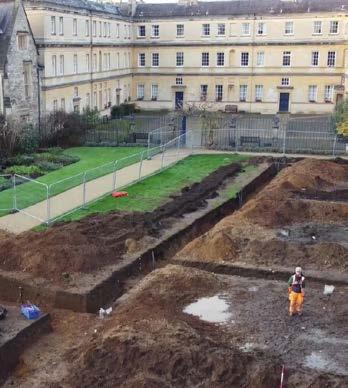
Trenches dug through the
lawn for the ground source heat pump works
per cent. The overall performance belies very mixed underlying performance, with strong gains on directly-owned property offsetting rather weak performance from some of the college’s equity holdings in unit trusts. Bearing in mind the extreme volatility seen in equity markets in 2024-25, the overall outcome was slightly better than we feared at the lowest points in the year! Whilst we would have liked to have seen stronger performance from our equity investments, the overall outcome does show the benefit of a balanced, mixed portfolio.
What does 2025-26 hold for Trinity’s finances? Anyone following the national news will know that the Higher Education sector is facing significant financial pressure. Trinity is in the very fortunate position of being protected by its endowment fund. Put simply, this
wonderful asset, the product of kind donations from the college’s members and friends since 1555, enables us to function in our current form. Without this, and similar funds across Oxford’s colleges, the undergraduate tutorial system would not exist. Furthermore, Trinity’s graduate students benefitted from more than £700k of scholarship funding in 2024-25, an increase of more than £100k compared to 2023-24, almost entirely financed by income from the endowment fund. This funding is crucial to the development of the next generation of academics and leaders across many fields, in the UK and overseas. Meanwhile, Trinity is staunchly fee-agnostic in its admissions policy: we deliberately ensure that the difference between the fee income from UK and international students is not a consideration when places are offered. Financial support is provided to students in financial need.
Clearly a sustained economic downturn would affect our investment returns, and this scenario remains a strong possibility. Meanwhile, inflation will continue to erode our spending power. We must be careful to avoid over-extending our commitment to fixed costs in an unsustainable way. However, inter-generational fairness requires us to fulfil our charitable objectives today, even whilst we carefully plan for tomorrow. So, it will be no surprise to hear that our financial plan for the next year involves a mixture of ambition and prudence! I look forward to updating you again on our progress in 12 months’ time.
Lynne Adam Domestic Bursar
Twelve months have flown by and it’s gratifying to reflect on 2024-25 as we settled into a new routine in the beautifully refurbished Hall and shiny new kitchen.
Settling
The year continued as we started, with great enthusiasm from our students, and the entire community, as we got used to the very lovely, yet practical, facilities. The return to the Hall certainly had an impact on the choices students made and we saw a significant increase in dining.
I’m pleased and proud to say that with meticulous planning and execution by our Kitchen and Hall teams, lead by Julian Smith (Head Chef) and Jon Flint (SCR Steward), our catering operation never missed a beat, with the quality of food and service going from strength to strength. Similarly, students embraced the newly opened College Bar with a range of bops, comedy nights, themed evenings and music events. I am enormously grateful to the Bar team, led by Ian Stacey, as they settled into a brand new way of working, juggling
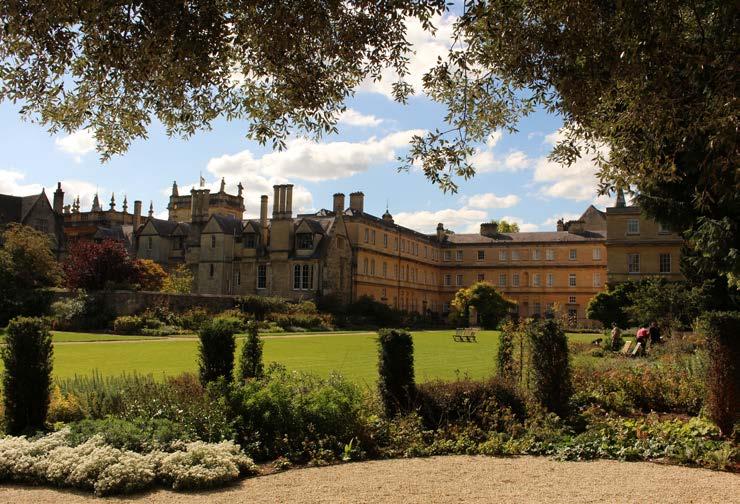
two venues: the Beer Cellar and the café in the Levine Building. It has been lovely to offer students, Fellows and commercial clients the options afforded by the bright, light contemporary spaces in the Levine Building, contrasted with the subterranean Beer Cellar that holds so much history and memories for students, both present and past.
At the end of Michaelmas term, the Gardens team braced themselves for the ground source heat pump project, which entirely took over the Lawns. You’ll read more detail in the Estates
Bursar’s report, but needless to say it was messy, disruptive work, often in pouring rain. I’m very grateful to Andy Hooper, Clerk of Works for his tireless work to ensure a successful project (one of many for Andy this year) and to Kate Burtonwood, Head Gardener, and the entire team for their patience and forbearance as this project ruined the lawns they had so carefully tended across many years.
As the ground source heat pump project drew to a close we were able to press on with the muchanticipated Chris Beardshaw design for the long border. The landscaping and reinstatement of the lawns was
overseen by Kate, with the Trinity Gardens team planting 5,600 plants in a two-week period in May and June; planting of 20,000 bulbs commenced in September, in preparation for spring.
Across such a hot and dry summer, it was glorious to see students and other members of the community enjoying the shade afforded by the large holm oak tree situated at the St John’s wall. The opportunity actually to sit back
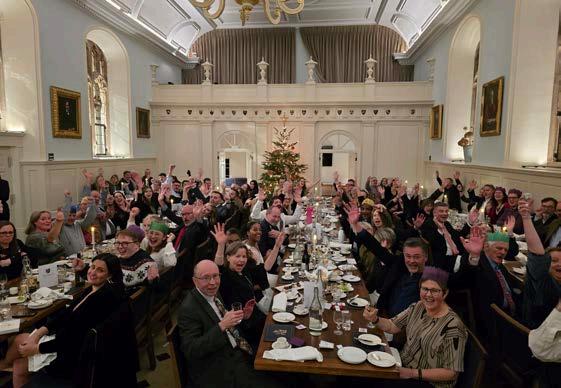
Sustainability Strategy and were successful in retaining the ‘Beyond Gold’ award in the University’s Green Impact awards. The completion of the ground source heat pump project has obviously made a substantial contribution to this work but we’ve also turned our attention to other areas, including food, recycling and travel. I’m pleased to say that we carried out a Scope 3 audit (for indirect emissions) this year and so have solid data on which to base future initiatives.
Davies and the entire Events team for their hard work in balancing our commercial targets, while ensuring that students and members of the Trinity community are able to make full use of our lovely spaces.
The Wellbeing team, led by Lizzie Shine, has had another busy year supporting our students across a range of areas. We’re delighted to have consolidated the team this year by welcoming an additional member of staff, Sally Harris, and the team continues to work closely with the college GP, nurse and counsellor.
The staff Christmas dinner: taking the opportunity to celebrate the reopening of Hall Photo:
against the wall within the border for the first time and enjoy views of Trinity across the lawns is a lovely feature of the Chris Beardshaw design and one I’m sure will be enjoyed for many decades to come.
In other news, we worked hard this year towards the goals of the
Over the summer, the entire team managed a busy summer school period, welcoming students from the universities of Georgia, Georgetown and St Bonaventure, and the University of Oklahoma College of Law, with student numbers totalling 239 across six weeks.
As usual, we concluded this period with a hectic schedule of weddings and commercial bookings before preparing for the new academic year. Our newly refurbished facilities have resulted in record volumes of enquiries and my thanks go to Louise Kernahan, Jon
I was delighted to bring students, Fellows and staff together for the annual college barbecue, which we relocated to the sports ground this year. The sun shone, fast food was enjoyed by all, and we witnessed some fiercely competitive football. We’ll continue initiatives such as this as we encourage students to get involved in sport, societies and other activities that may enhance their Oxford experience.
You’ll see on the cover of this Report that many of the team gathered to bid a fond farewell to Hilary Boulding, President over the summer. Hilary always took the time to get to know staff members and will be fondly remembered not only for her diligence and hard work, but for her warmth and laughter. As we progress into 2025-26, welcoming our new and returning students, we very much look forward to working with Robert Chote in the months and years to come.
Sue Broers Director of Development
The Alumni and Development team has been remarkably stable, but after more than 10 years, Andrew Clinch has left Trinity to take up a promotion in another college; his contribution to the work of the office has been considerable, providing essential support ranging from gift entry, gift aid claims and liaising with the Bursary, to the occasional appearance as Clunky the Clown at Family Garden Parties. The new Administrative Assistant, John Jose, joined the office in March and has taken on most of these responsibilities, but he is also keen to get to know Old Members and Friends and he will be attending many of our regular events.
The focus of Alumni and Development work this year has been on celebrating the achievements of outgoing president Dame Hilary Boulding and preparing to welcome the new president, Sir Robert Chote.
When asked about how the college might recognise her contribution, Hilary suggested a graduate
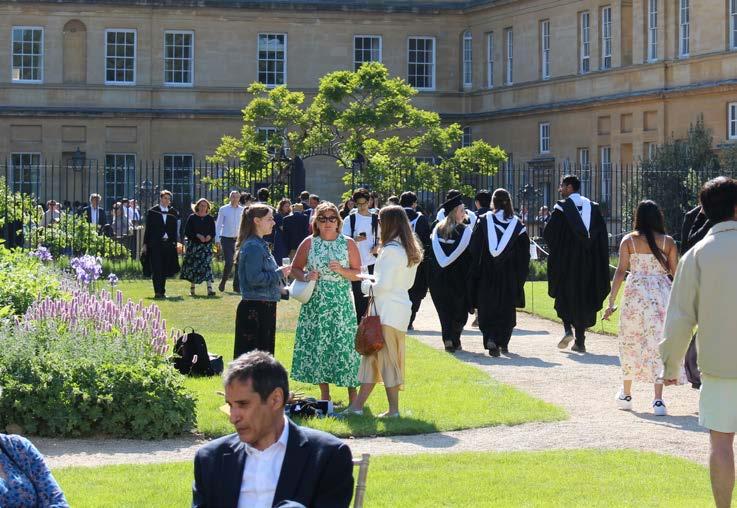
Graduands and their guests enjoying the May graduation celebrations
scholarship in the humanities, with a preference, whenever possible, for students in Music. And so the appeal for a new, endowed, graduate scholarship was launched.
During the year, the website and publications such as the Newsletter and e-Newsletters began to include updates on the progress of the appeal. Event attendees were invited to direct their donations to this cause, it being the college’s fundraising priority for the year (it will also be the priority for 2025-26). Three videos were commissioned. Filmed around the college, each focusses on a different theme, with students and Fellows talking about Hilary’s legacy,
the importance of funding for the humanities, and the role that music plays in the college. They have been released with the e-Newsletters and can also be seen online at trinity.ox.ac.uk/hb-scholarship.
As the year drew to a close, a mailing was planned for all Old Members and Friends and an application for matched funding was submitted to the University. The good news is that the application was successful, but the challenge that we now face is to raise the balance by the end of July 2026.
In the most recent Five-Year Strategy, the college stated its commitment to increasing Old
Members and Friends’ engagement with Trinity and ensuring that they remain informed of our activities, aims and ambitions. Communication and engagement are vital to the success of projects such as the scholarship.
Michaelmas and Hilary terms passed in a whirl, with the Matriculation photo and brunch, the William Pitt Society lunch, two Benefactors Lunches, two carol services, a subject dinner for Engineering and a Gaudy for those who came up between 1966 and 1973, at which there was not a spare seat to be had in Hall. In April, Hilary and I flew to the USA to host events for Old Members and Friends in San Francisco, Los
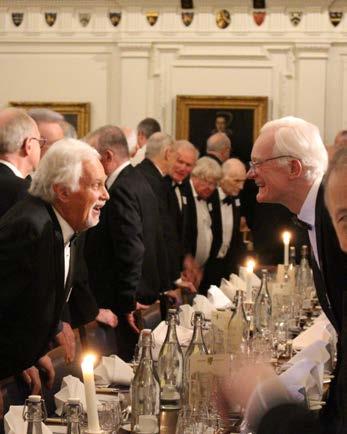
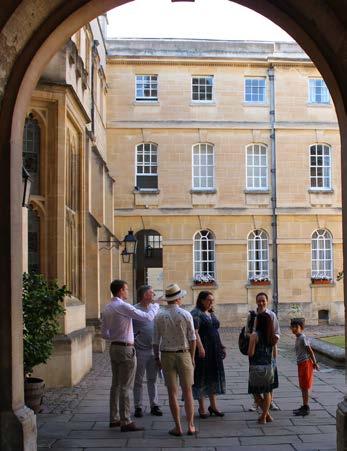
Before the 2001-2003
Angeles, Washington DC, New York and Boston. All were well attended, as people flocked to say goodbye to Hilary and to wish her well in her new role.
While the first two terms felt busy, this was nothing compared with Trinity term, which included graduation for many of last year’s Leavers (one of the busiest days of the year), a Family and Friends Day for current students, the Bathurst Dinner for major donors, a Farewell Garden Party for Hilary, and a Gaudy for those who matriculated between 2001 and 2003. Somehow in this time, the President and I also managed to fit in a short but magical visit to Thailand, where at one event, we met Oxford and Cambridge alumni
and at another, Trinity Old Members and Friends. We could not be more grateful to Sirin Phathanothai, who generously welcomed us to her home, and her son, Joe Horn-Phathanothai (1993); together they gave us a taste of Thailand that I’m sure we will never forget.
Thank you to everyone—Old Members and Friends, colleagues and current students—who supported our work this year. And to those who returned to Trinity or helped us from afar, whether you made a donation, wrote something for a publication or attended an event, we cannot thank you enough for your continuing interest and involvement in Trinity.
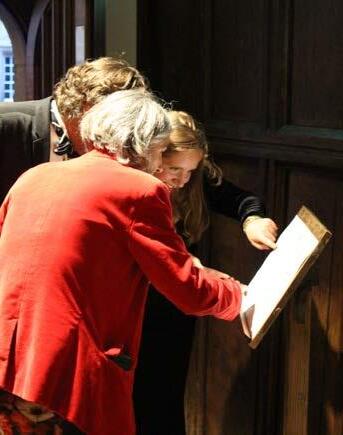
Hannah Rolley Head of Access
During 2024-25 we worked with 3,577 young people in their own schools in Oxford and Milton Keynes and 3,772 in schools in the North East. This work supported school students in Years 4 to 13 in developing their knowledge and understanding in several areas: the benefits of going to university; GCSE and A Level choice; support when applying to competitive universities; admissions guidance to apply to Oxford; personal statement and interview workshops; and Oxplore thinking skills sessions.
We also welcomed to College 2,040 pupils in Years 4 to 13, from over 100 schools in Oxfordshire, Milton Keynes and the North East. Here, they heard about student life and admissions at Oxford, and took part in academic taster sessions. This included three residential programmes of activity for 77 pupils from four different schools in the North East. One of these residentials was facilitated for 42 participants across two schools, in collaboration with the Brilliant Club.
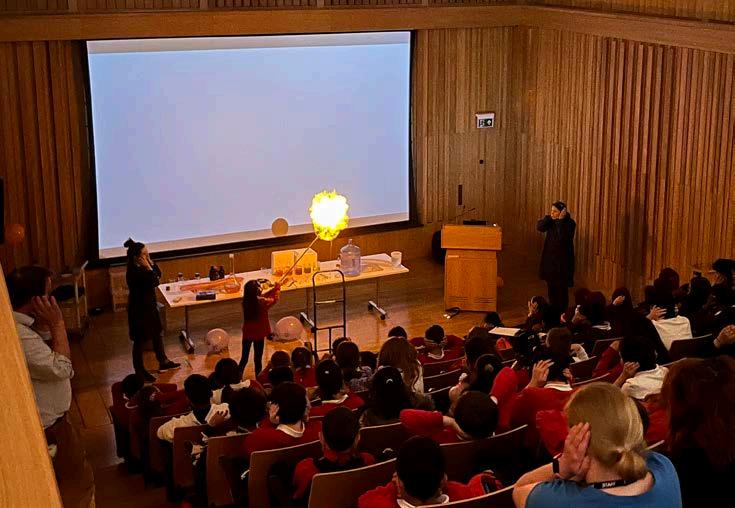
In February, together with the Oxford Centre for Islamic Studies and Jesus College, we again ran our Access Day for 70 young women in Years 10 to 12 from Bangladeshi and Pakistani backgrounds, and in collaboration with the African and Caribbean Society and Brasenose, we also ran an access day for 60 pupils in Year 12 from Black African and Caribbean backgrounds.
The Classics tutors continue to run the OxLAT Extension Programme in Classics and the Ancient World for state school pupils in Oxfordshire (and slightly beyond) who have no opportunity to study Classical subjects at school, and who have taken Latin
GCSE via the OxLAT scheme run by the Faculty of Classics. The fourth full cohort took the programme over six study days and two one-week summer schools in 2023-25. From this and the previous three cohorts (2017-19, 2019-21 and 2021-23) we know of at least 25 participants who applied to Oxford, of whom 12 were offered places, and at least 19 who went on to study Classical subjects at UK universities. These numbers include three current and past Trinity Classics undergraduates.
This year, we offered live online and in-person evening talks to parents
in our linked regions with children in state schools. The aim of these sessions is to provide information and support to those with little personal experience of going to university and the University of Oxford. Three hundred and ninety and 361 parents from the North East and OxfordshireMilton Keynes respectively registered to attend one of these sessions, meaning we engaged with a total of 751 parents.
We again offered our comprehensive online programme of continuing professional development (CPD) support for teachers in a broad range of specialist areas, including UCAS, Oxford applications and subject enrichment across the key stages. Last year, we widened access by welcoming state-school teachers from any region, meaning we saw teacher registrations for the programme increase from 146 in 2024 to 260 in 2025. Of the teachers participating in the course, a total of 36 are University of Oxford’s PGCE teachers, who are placed in 25 Oxford schools, with the remainder from 181 schools across England. Fifteen teachers joined us in person for a four-day residential research experience at Trinity. This CPD follow-on residential experience offers access to the Bodleian Libraries, and a tutorial from an Oxford tutor or researcher from the Department of Education in a research area of mutual interest.
Sixty-two per cent of teachers who responded to our feedback survey also said they were more likely to support
and encourage their pupils to make an application at every opportunity after the course compared to just 35 per cent prior to taking part. Not a single teacher said they had felt completely confident offering information and support to their pupils about applying to Oxford before the course, compared to 92 per cent afterwards.
Offering a wider variety of enrichment activities to young people from disadvantaged backgrounds can help raise attainment and progression outcomes.
Following last year’s successful re-launch of our online after-school academic enrichment programme Beyond the Classroom (BTCR), we offered another series of mini multidisciplinary lectures, academic skills sessions, and university admissions advice and guidance. This year our registrations rose from last year’s high of 400 to a phenomenal 1,600 attendees, ranging from Years 7 to 12. We also invited 80 qualified BTCR participants to join us for a residential or a Trinity visit day in April and May respectively, during which we offered application advice and guidance, Q&A with current students, lunch in Hall and tours of the college.
In the last five years, we have made good progress and plan to continue toward our aim to become a more diverse and widely representative community, in which students of
all backgrounds feel equally valued, supported and able to flourish.
Referring to the aggregated data for the three admissions years 2022 to 2024, the annual statistics and supporting Tableau reports show the collegiate University is continuing to make improvements on the key measures. At college level, where the numbers involved are much smaller, progress can appear much slower, however, we have made some good progress in many areas, showing we have diversified our student intake considerably in recent years. For example, in the reporting period 2022-24, the proportion of applicants admitted to Trinity (numbers for 2021-23 in brackets):
• From state schools rose to 59.7% (58.2%)
• Qualifying for free school meals (FSM) rose to 7.1% (5.1%)
• From regions Acorn 4/5 (geodemographic) rose to 13.1% (11.4%)
• From regions Polar1&2 (participation in HE) rose to 14.6% (11.9%)
• Identifying as Black and Minority Ethnic (BME) rose to 30.2% (28.1%)
• Having Black African or Black Caribbean heritage rose to 5.6% (4.8%)
• Identifying as Asian rose to 18.8% (15.8%)
There is still much for us to achieve in terms of widening access. We are hopeful that our continued work with teachers and the BTCR programme will go some way in helping us succeed in this mission.
Sarah Cox Acting Librarian
During Emma Sillett’s maternity leave to welcome her twin girls, the library team temporarily reshuffled to ensure continuing service—and we’re pleased to say it was a positive and engaging year with minimal disruption.
Special collections, new discoveries
Thanks to the ongoing specialist cataloguing by our Rare Books Cataloguer, Sophie Floate, we discovered some exciting items in our special collections this year.
Firstly, from the Old Library, Sophie came across a book from former president James Ingram’s bequest in 1850. It’s a collection of very rare pamphlets, at least three of which are unique to Trinity, on a wide variety of topics including gout, dysentery, wool-smuggling, and curiosities in a Chelsea coffee-house! This volume was in a sorry state with the text block completely split in two, but has now been expertly repaired by the Oxford Conservation Consortium, so we can continue to handle and display this intriguing tome for generations to come.
From the Danson collection, another glorious gem is The union of honour from 1640. This book of early British heraldry and genealogy contains portraits and illustrations of kings and queens that have been cut out from other works and inserted onto the relevant page for each monarch, with additional slips of paper with copies of the monarchs’ signatures pasted in. Nearly all the coats of arms and shields have been hand-coloured, and there are many hand-written annotations, possible by a juvenile. An early example of a kind of scrapbook, it’s the sort of object rarely found within the walls of an Oxford college.
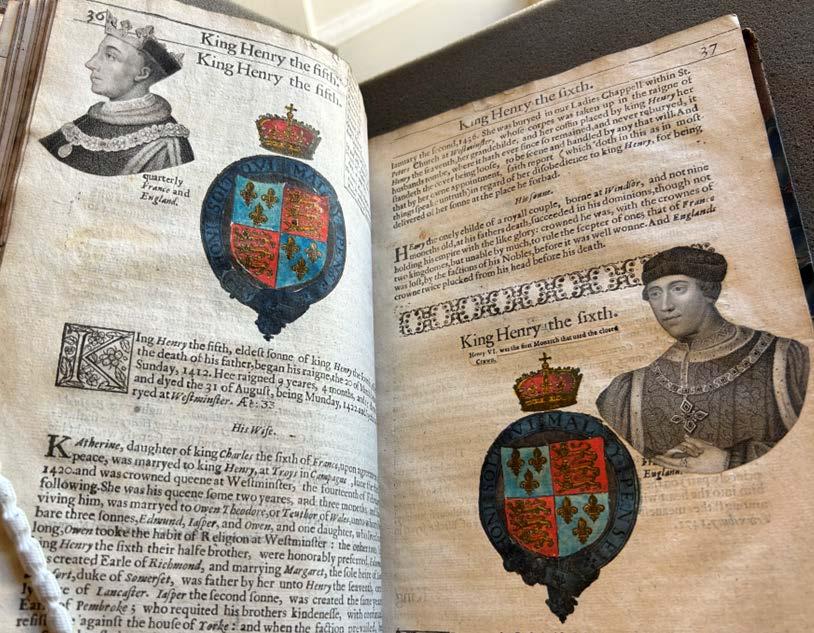
for each monarch
Perhaps the most thrilling discovery was not a book, but an object concealed within one. Hiding inside an unassuming book from 1808 we discovered what seems to be a genuine signed letter dated 1684/5 from King James II to the Earl of Danby, summoning him to James’s coronation.
The cataloguing project continues to highlight the importance of making our collection visible to researchers and other remarkable examples include folio-sized illustrated books, many of which are very rare—including three works by the famous ornithologist John Gould, with illustrations by his wife Elizabeth on hummingbirds, birds of the Himalayas and British birds.
Our special collections have featured in several events this year, including our popular Trinity Treasures event, for which we showcased The Natural History of Carolina, Florida and the Bahamas (1764) by Mark Catesby, with a fascinating talk on Trinity’s own
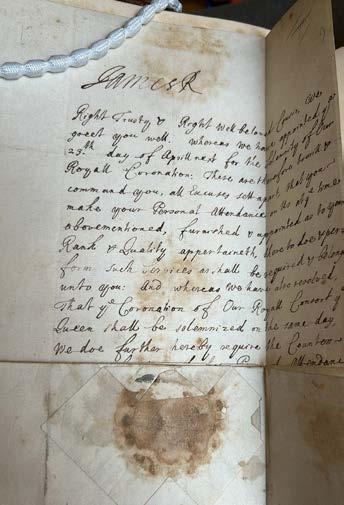
magnolia tree by Head Gardener Kate Burtonwood.
The library welcomed various visits, no two quite the same, including a retreat for the staff of Lambeth Palace on Ash Wednesday hosted by the Chaplain, where we exhibited our most notable theology books, and a visit from Year 3 children as part of a storywriting day, finding inspiration from our first edition of Winnie the Pooh.
It’s always nice to see the delight on visitors faces as they enter the Old and Danson Libraries, many for the first time, as they experience a small bit of Trinity’s history, and this was evident during the biennial Friends and Family
Day, an MCR Leavers Dinner and the 2001-2003 Gaudy in June.
The historic libraries also hosted a hands-on session with first-year English students looking at 19th-century books in the Danson Library, while other research enquiries include marginalia in the Chadwyk-Healey Bibles and in a work by John Milton, Edward Hyndmer (Scholar 1561, Fellow 1568/9) and his bequest, and the social life of erotic books in 18th-century England.
Meanwhile it was equally busy in the War Memorial Library. The year started with the usual library inductions for the freshers, followed by what seemed like a tsunami of reading lists and requests for the library team. Along with our mainstay tasks of buying, cataloguing, and processing new acquisitions, we worked hard at rejuvenating subject areas that benefited from an update this year, concentrating on our Philosophy, Management, Clinical Medicine, and Computer Science sections, with the help of subject tutors.
We are immensely grateful to the Site Services team, who continued the monumental task of cleaning our modern books. Their tenacity is incredible; they completed the first round and have begun the second, a job as endless as painting the Forth Bridge.
In Hilary term we implemented a survey to gather feedback on the overall library experience. We were
delighted by the fantastic response rate—especially impressive given that the Bodleian Reader Survey was running at the same time. In fact, Trinity students achieved the second-highest response rate for the Bodleian survey, and we’re pleased how enthusiastically they engage with opportunities to share their views. Thanks to the feedback we received, we added two monitors and another two ergonomic chairs to the library— and they’ve already proved to be popular.
As part of Wellbeing Week, we reprised our much-loved ‘Blind Date with a Book’ initiative, giving students the chance to pick up a surprise book, wrapped up with a calming herbal teabag and a chocolate treat. It was a gentle reminder that reading can be for pleasure too. We were delighted with how warmly it was received.
The library also participated in college-wide events, including Green Action Week, for which we presented an engaging and informative book display focused on sustainability. We were proud to support outreach initiatives as part of Trinity’s Access programme, including an Oxford taster week for Year 12 students and a residential professional development course for teachers.
Everything we accomplished this year was made possible thanks to the wonderful support of temporary Library Assistant, Clara Oxley, whose aptitude, dedication, and friendliness has been greatly appreciated by staff and students alike.
Clare Hopkins Archivist
This was a good year, with much achieved by Trinity’s archive and chattels team. I would like to begin this report on a personal note, reflecting on the state of the archive now as compared to the situation when I joined the college staff—40 years ago, on a one-year contract! Trinity’s long-term investment in its archive—installing the mezzanine floor in the tower, opening the reading room, joining the conservation consortium and, more recently, the University’s Digisafe vault—has created a service of which both the college and its alumni can be proud. I have never been more grateful for the support of my colleagues. Two who labour behind the scenes do not appear in the staff list, but will be known to many Old Members. Retired librarians Jan Martin and Sharon Cure both give generously of their time as volunteer cataloguers. Jan is coming to the end of a long project calendaring the diaries of Marcus Cheke (1924), whose life in the diplomatic service will be a rich source for historians of 20th-century Europe. This year, Sharon has heroically
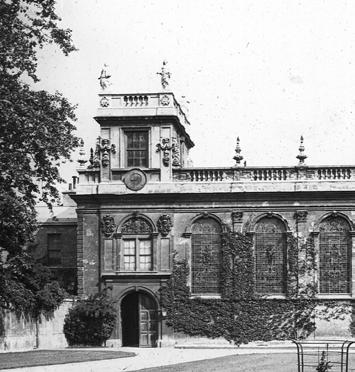
Spot the difference: Taunt, 1890—and Jones, 2025
reorganised the Archive book room, and also tackled several collections of files and ephemera.
In her first year as Digital Archivist and Records Manager, Kathryne Crossley has made great strides in both aspects of her role, ably assisted on the modern records front by two filing assistants, Helen Dallas (MCR 2020) and Lewis Cox.
Kathryne reports, ‘The first borndigital archive of President’s Papers has now been accessioned, with the transfer of Dame Hilary Boulding’s papers to Digisafe. These include a comprehensive selection of Covidera documents, which will provide future historians with a detailed look at how the college responded to the pandemic and the particular challenges faced by the President.
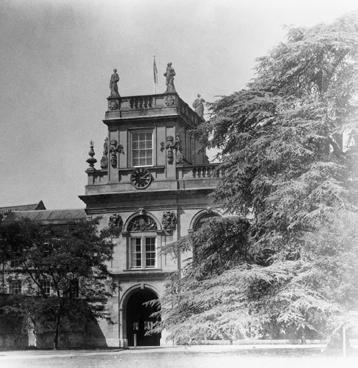
These papers complement another deposit of bursarial records related to Covid… I hope to turn to a lighter topic in the coming months as I focus on the archives of the Trinity College Boat Club, which include born-digital as well as digitised items.’
Kathryne would welcome digital donations from any past or present member of the Boat Club, or of any other Trinity club or society.
One constant in my years at Trinity has been the support of Trinity’s alumni. Your donations both enrich the records and make our days interesting. A wonderful link between the old and new has been provided by Hannah Jones (MCR 2019) who, on the one hand, delivered electronically a raft of folders of MCR minutes, papers, and photographs ready for
transfer into Digisafe, whilst, on the other, sharing the fruits of her exploration of the college’s photographic heritage. We were delighted to receive Hannah’s recreations of Henry Taunt’s iconic images of Trinity, plus her comprehensive notes of how they were taken. We illustrate the Chapel, achieved with a 3kg ‘medium-format’ camera from the 70s and ‘a “120” black and white film’ that would have been familiar to Taunt.
A service in chapel was a key part of Trinity’s quartercentenary celebrations in 1955, and we thank Tony Edwards (scholar 1954) for a copy of the commemorative Order of Service, alongside a fascinating array of ephemera preserved in his undergraduate scrapbook. Tony was an active member of the Music Society, and also a Morris enthusiast, as a press cutting of a massed Morris Ring on Tower Hill attests.
A rather different view of the chapel came from Martin Tubbs (1987). He has given scans of two documents (photocopies from the 1980s), entitled ‘guidelines to servers in Chapel’ (typed) and ‘Chapel Rituals’ (manuscript), which were passed to him when he took on the role. The first has an impressive 19 steps and ends with a cheerful albeit not wholly convincing, ‘It’s not as hard as it sounds!’ We reproduce the second, with its insightful
Chapel rituals, c. 1989, donated by Martin Tubbs
commentary. Perhaps our favourite parts of the ritual are,
3. Kneel for confession; the server kicks off on this one. (The mystical meaning of this action, guaranteed to spread paranoia amongst novice servers, is lost in the mists of time.) and
9. Turn round and face the congregation for the Peace. (Once upon a time the
server stayed facing the altar here and only Trevor turned round, but that looked really silly).
On the reverse the document concludes in capitals, ‘HAVE BREAKFAST WITH TREVOR AND REMIND HIM WHERE YOU LIVE ONCE AGAIN. GET ANNOYED ABOUT THE NEWS OR THE UNIVERSITY ENTRANCE PROCEDURES.’ To which the unmistakable hand and dry wit of Trevor Williams (Chaplain 1970-2005) has added, ‘or discuss the efficiency of the chapel secretary.’
The final member of the team is Russell Dominian, whose humble designation as Chattels Assistant belies his key role in caring for Trinity’s antique furniture, fittings and paintings. The collection was significantly augmented this year by the bequest by Ian Senior (1958) of some 112 prints, photographs, and artworks. Ian’s collection goes back at least to his 21st birthday, while an undergraduate, and includes a number of prints that are unique in the college collection. As well as being used in several college rooms, a set of Jan Frazer’s limited edition coloured prints of Trinity have been hung in the Levine Building’s mezzanine meeting room, where a plaque will be placed to record this generous bequest.
you for giving
This list records those who have given a gift or bequest in the financial year 1 August 2024 to 31 July 2025. Every effort is made to ensure the list is complete—the Alumni & Development Office apologises if any omissions have been made; please notify the office.
† Now deceased
1944
Professor G I Bonner †
1949
Dr A D Ferguson FRCP
1951
Mr R E Mavor
Mr J C Page MBE
Mr G S P Peacocke †
1952
Mr C A K Cullimore CMG †
Mr J Fraser †
1953
The Revd J M P Goodden
The Revd Prebendary D M Morris
Mr P S Trevis
Mr J F E Upton
1954
Sir Hugo Brunner KCVO JP
Dr A J Edwards
The Revd Canon A C Hall
1955
Dr D T Protheroe
Mr M J V Wilkes
1956
Professor J M B Hughes FRCP
Mr B R Rea
Mr F N P Salaman
Mr J B Walker
1957
Mr E A Bates
Mr A V Fontes
Mr J M Fry
Mr L D Jenkins
Mr R M McNaught
Mr A J Taylor †
Dr R D Thirkell-White
Mr M G L Thomas †
Dr C B Williams FRCP
1958
Mr J B Adams
Mr M F Attenborough
Mr J H Bottomley
Mr C G R Cary-Elwes
Mr R A Daniell
Mr P B Farmer
Mr A K Goldsmith
The Rt Revd R W N Hoare
Mr A F Hohler
Mr D H Killick
Mr A G P Lang
Mr C H W Parish †
Professor D J Pullen
Mr P M Reid
Mr I S T Senior †
1959
Anonymous
Mr P M H Andreae DL
Mr R J M Butler
Mr M W D Evans
His Honour Giles Forrester
Mr M J Gould
Mr A C Hutton CB
Mr C R King-Farlow
Mr P F J Macrory
Dr J I McGill FRCS FRCOphth
The Hon P H Parsons
Mr P W Tilley
Mr R A Travis
Mr H W Turcan
1960
Mr T A Bird
Professor T R Brown
Brigadier The Hon S J T Coleridge
Professor Sir Malcolm Green DM FRCP
Professor M C E Jones DLitt FSA
Mr D F G Lewis
Mr M S Rainbow
Dr J B Rossell
Mr F A Smith
1961
Mr R P F Barber OBE
Dr D Barlow
Mr T G Bewley
Mr R O Bernays
Mr N P Boileau †
Mr P S Bradford †
Mr C J S Brearley CB
Mr C J Hemsley
Mr J G Hill
Mr R W V Holland †
Mr J M W Hogan
Mr S S Jeffrey
Mr C H Johnson OBE Hon FBAAS
Mr R B Lockett
Dr J G Loken
The Revd Canon K W Noakes
Mr M E Pellew CVO
The Rt Hon the Lord Petre
Mr A D Stewart
Mr C E Sundt
Mr R H Sykes
Mr A W Warren
1962
Anonymous (3)
Mr R G A Baxter
Mr J H Duerr
Mr P R Fitzgerald
Dr D M Gillam
Mr G C Gordon
Mr P W Hanley USN
Mr M J Hatch
Mr W J M Huntley
Dr C P Jackson
Mr C J Marsay
Mr K J Merron †
Mr C P Robinson
Mr P W Rolfe
Professor Emeritus J D Sheridan
Mr C J Simpson
Mr A G Thorning CEng FRAeS
1963
Mr M B Baldwin
Mr J J Baxter
Mr J A Broom
Mr R E B Browne
Mr R C Chatfield
Mr R M Englehart KC
Dr R D Hinge
Dr S V Hunt FHEA
Mr A J S Jennings
Mr A E G Rudebeck
Dr R L Rusby
Mr S W Westbrook
1964
Anonymous
Mr J A F Alexander
Dr J B H Black
Mr J Chiswell Jones
Mr S Colley
Mr R F Foster PRP
The Revd D H Hamer †
The Revd P A Hardcastle
Mr A C Johnson
Mr J G Johnson
The Revd Professor W K Kay
Mr N E Melville
The Revd Professor J Morrill
Mr G A R Sawday
Professor L C L Skerratt
Mr J H Stroud
Dr C H Vaillant
Mr G P Williams
1965
Anonymous
The Revd Canon M G P Insley
Mr D P Jones
Mr P C Keevil
Mr M A Lavelle
Mr H L Mallalieu
Dr S A Mitton
Dr C R V More
The Revd Dr F J Selman
Mr O M Smyth
Mr K A Stevenson
Mr D C Unwin KC
Mr M J B Vann
Professor R C A White
Mr W I Wolsey
Dr S J Wood
Sir Stephen Young Bt KC
1966
Anonymous
Mr R M J Baresel
Mr G A Barton
Mr J M Botros
Mr J L A Cary OBE
Mr D M Dorward
Mr I P K Enters
Professor D Fairer
Mr I M Fyfe
Mr A A G Grant
Mr M S E Grime KC
Mr W Hood
Dr A S B Hughes
Mr D J G Hunt
Mr B R Kirkpatrick
Mr P M R Lloyd-Bostock
Mr P I Luson
Mr M Markey
Mr G R Miles
The Revd Dr R A Roberts
Mr P J Sturrock MBE
Mr M S Travis
Dr M C K Wiltshire
1967
Mr C J Cook
Mr C Corbet (Russell)
Mr P K O Crosthwaite
Professor H M M Griffiths
Mr N Hanson
Mr C F Hatton †
Mr N W Jackson
Professor N F Jones FRCS, FACS
Mr T B Manson
Mr P C Metcalf
Mr D W Parker
Mr R S Parker CB FSA FRSA
Mr S A Renton
Mr G M Strawbridge
Professor G L Thomas
Colonel D C Thornycroft OBE
Dr E F X Tivnan
1968
Mr S C D Bankes
Mr P J Bretherton
Mr C J B Bromfield
Mr J D S Collenette
Dr G B Colver
Mr R J Colver
Mr W S Dodd
Mr O N F Fairclough
Mr R Gillis
Mr A A D Grant
Mr D I S Green
Mr J A H Greenfield
Mr E J Harris
Mr C D James
Mr R N Jarman
Mr H D Kronsten
Dr S H Large
Mr A J G Moore
Mr C T Richardson
The Revd Dr R R D Spears
Dr J A Vann
Mr C P Watts
1969
The Hon Mr Justice Cloete
Mr A G Donald
Mr M F Doswell
The Rt Revd C W Fletcher OBE
Mr R S Goodall †
Mr C L L Glass
Dr C S Keeling-Roberts
Professor R S G Knight
The Revd Canon D M Lindsay
Dr P S K Lucarotti
Mr B W MacNay
Dr S J S Martin
Mr A J May MA FCA JP
Mr P J Prickett
Mr D B Sabetian
Mr C M D Setterington
Mr J B H C Singer CBE
Dr R N J Stoll
Sir Peter Stothard FRSL
Professor R G E Wymer
1970
Mr N P F Brind
Dr I S Carter
Mr A J Cary CMG
Mr J H T Chatfield
Dr N A Dunn
Professor W C Fitzgerald
Mr M L Gloak
Dr D R Grey
Mr D A Hudson
Mr H B Inman
Mr J P Kennedy-Sloane
Dr P A Lacey
Mr C R Lake
Mr J Lancaster
Mr M L L Lapper
Mr J C A Leslie
Mr J D Loake
Mr G A Mackenzie
Mr A M McQuade
Mr M A Milner
Mr A W Morgan
The Revd C Padgitt
Mr C P Montgomery †
Mr P D Powell
Mr S Quartermaine
Mr C J Sweet
Mr A Tyldesley
Mr A P Webster
1971 Anonymous
Mr W J Annan
Mr S J Browning
Mr J Clamp
Dr A E C Cowan FRHistS
Mr M J Eland
Mr J Goodrich
Professor N P Gravells
Mr J R Haigh
Mr G A Harrison-Hall
Mr J K Holroyde †
Mr N J Hunter
Mr S E Jones
Mr S Lau
Mr P J Lough
Mr P C Meredith
The Rt Revd J W S Newcome KCVO
Mr N C Ollivant
Mr A G Prendergast
Dr N E Reynolds
Mr P C Spencer
Mr M W J Thorne
Mr R J Tuttle
1972
Anonymous (2)
The Rt Revd John Arnold
Mr S D Boddy
Mr H D Burnett
Mr C M P Bush
Dr J D H Chadwick
Mr N B Charlton
Mr E A Doran
Mr T Fraser
Mr T G Grey
Mr K M Hider
Mr P J Howes
Mr S J Mitson
Mr C H Parker
Mr A D W Partridge
Dr J M Renner
Mr I R Ritchie OBE
Mr C J Salter
Mr H E Shohet
Mr D M Speed
Mr A J Stafford
Dr C D G Stuart-Buttle
1973
Anonymous
Mr R E Ainsbury (Endley)
Mr A N Buckley
Mr N C Chew
Mr A M C Cowan
Mr P N Gysin
Mr R J Henderson
Mr A J Hewitt
Lt General F G Klotz USAF (Ret)
Mr C R L Low
Dr K A Manley
Mr A A Murphy
Mr P F Neagle
Mr A S Newman
Professor R C Peveler
Mr R J B Rhodes
Mr R J R Seligman
Mr A Shivdasani
The Revd Canon A C S J Walker
Mr G Winton
Mr R A Wood
1974
Anonymous
Mr M B Alloway
Mr J M Foster
Mr P J Horsburgh
Mr R M Hunter
Mr P M Levine
Mr R H Levine
Mr P W Lodge
Mr J S W Partridge
Mr M H Ridley
Mr H Shulman
Mr M Vincent
1975
Anonymous (2)
Dr R N B Cary OBE
Mr J Clipper
Dr D B Darby
Dr S Fitzsimons
Mr P M C Forbes Irving
Mr C J Foy
Mr J S Huggett
Dr J L Speller
Dr J E Tabor
Mr D G Williams
1976
Mr M J Bowe
Mr E S Dismorr
Professor M G Everett
Mr M J Haddrell
Mr D J Haysey
Mr P J Lamphee
Mr R J Milburn
Professor J N Newton
Mr D I Reynolds
Dr M J Rhodes
Mr F C Satow
Mr P D Strawbridge
1977
Dr P R Abbott
The Rt Hon Lord Ashton of Hyde
Mr S J Charles
Mr M H S De Pulford
Dr M Fowles
Dr A J Moen
Mr A J Morgan
The Revd D M Morris
Dr C G Oakley
Mr R M Parlour
Mr S P Williams
1978
Anonymous
Dr G N F Chapman
Mr M J A Fiddes
Mr A Goddard
Mr J N D Hibler
Mr J B Hunter
Professor J C Hurtubise
Mr D W Jones
Mr S M Lord (Greaves-Lord)
Mr R C F Rea
Mr S P Vivian
Dr P D Warren
1979
Mr I N Abrey
Professor V Brendel
Dr M C Davies
Professor M F Davis
Mr T M Gioia
Miss O M E Hetreed
Mr T B LeBon
Mr D Moffat
Mr J R Pascall
Lady Sants (Caroline Mackenzie)
Mr L C Wolff
Mr R C Wright
1980
Anonymous (2)
The Revd Professor M D Chapman
Mr D J W Fleming
Mr A Fullerton
Ms L H Mason
Dr R T Miles
Mrs S M O’Brien (Tyne)
1981
Ms L L A Clay
The Revd T M Codling
Dr I Dunham
Mrs C J Jackson (Symington)
Mrs J M Lashly
Mrs L MacKinnon (Sunderland)
Mr J D B McGrigor
Mr C W Parshall
Mr C J Reilly
Mr A S C Rix
Mr J D Rose
1982
Anonymous (2)
Mrs D J Chalmers (Lewis)
Ms A Henderson-Begg (Weil)
Mr R A Lindsay
Ms S M Lloyd
Dr R C Ratnavel
Ms C J Reay
Mr H D A Stuart
Ms P Vijaykrishnan
The Revd Dr H A Warren
Mr C D A Tchen
1983
Mr W A Carter
Dr I A Castellano
Mrs C F S Clackson (Dowglass)
Mr N A Judd
Mrs S A Lewisohn (Collins)
Mr R P Paretzky
Mrs A C Sheepshanks (Robertson)
Mrs F M Tchen (Cottam)
Mrs C L M Wilkes (Taylor)
1984
Mr J M R Glasspool
Mrs A L Goodison (Scanlan Whitworth)
Ms P J Locke
Miss P M K Mayfield
1985
Mr K Y D Chan
Mr P L Cunningham
Mr P A Davies
Dr R M Harington
Mr P M Kerr
Mr B E Masojada
Ms A Nicholls
Mrs H T Reeve (Bunting)
Mr A W Short
Mrs A H L Smith (Fletcher)
Mr J Spence
Mr I D G Whittaker
1986
Anonymous
Mr A J De Groose
Mr D N Evans
Dr S A Galloway
Dr F R C Hall (Weaver)
Ms D A Meyler (McLauchlan)
Dr H R Mott
Mr M P Nelson-Jones
Mr P Springett
Professor S J Tucker
The Revd M R Wood
1987
Mrs J K Gallagher (Mistry)
Mr J M Gallagher
Dr A R Gande
Dr K I Gray (Clarke)
Miss E S K Habershon
Mr C W Hammon
Mr K E J Jordan
Ms A L Thompson
Mr M G Tubbs
1988
Anonymous
Mrs A Ardron (Brooks)
Dr E C Boswell
Mr R S Dinning
Dr G M Donnelly-Cox
Mr A H Forsyth
Dr A R Graydon
Mrs E A Heycock (Harrison)
Ms R L Sestini (Bradley)
Dr J C Steward
Jonkheer H J van Steenis
The Revd Dr S M Wood (Taylor)
1989
Anonymous
Mr C Bull SC
Sir Thomas Drew KCMG
Mr G P C Strafford
1990
Anonymous (2)
Mr E A Chadwyck-Healey
Mr N D Hallows
Ms H S Lowe
Mr I D Oliver
Dr J C Pinot de Moira
Mr I K Shawyer
Miss N V N Wilson
Dr K E Woodhouse-Beyer
1991
Anonymous (2)
Mr C W Barlow FRCS
Mr N W Gummerson
Mr B Hall
Mr T E W Hawkins
Dr P M Hayton
Miss S E Oakley
Dr B K Woodcock
1992
Mr P C Collins
Dr A R Lyon
Dr J R Mosedale
Mr M P Rendell
Mrs S M Riley (Latham)
Mr P A S Rozario-Falcone
Mr G von Graevenitz
Mr G C R Watson
1993
Mr R W Dawkins
Mr P M Gilbert
Mr T H R Hill
Mr S K Kay
Dr M Li
Dr C A Suthrell
Mr A R Walton
Ms S C Sotheran
1994
Mr W E Bennett
The Revd D S Bisby (Cage)
Dr R O Bowyer
Mr S J Chiavarini
Dr C A Clover
Mrs S J Hawkins (Reay)
Mr S J Nathan
Mr D J Nicholson
Mr A J North
Dr N A L Tamblyn
Mr M Weekes
Mrs J J Wilson (Baldestone)
Mr S D Wilson
1995
Mrs C de Jongh (Owen)
Dr J A Efstathiou
Mr S I Goldberg KC
Mrs H M North (Lane)
Mr T C Ong
Mr D A Shah
1996
Anonymous
Mr A H Anderson
Mr P A G Dillon
Mr J M Ellacott
Dr E R Hayton (Wells)
Dr C E Hinchliffe
Mr J R Maltby
Dr D P Vosper Singleton
1997
Miss H R Bacon-Shone
Dr E C J Carr (Green)
Mrs R E A Coleman (Backhouse)
Mrs H R Gauterin (Banyard Smith)
Dr T A Gladstone
Ms C Kornylak
Mrs D E Miller ACA (Cresswell)
Mr S W Miller
Mr G J Samuel-Gibbon
Mrs S A Samuel-Gibbon (Miles)
1998
Dr P D S Burnett
Mr W A Charles
Ms S E Crapper
Ms S A Ellis-Jones
Mr J G Jansen
Dr E R Waring (Towers)
Dr M Waring
Mr S J Wrigley
1999
Mrs M Bakir (Hasan)
Mr J V G Harvey
Dr M D Johnston
Dr D J Kirk
Dr D Kruchinin
Mrs C M Laing (Hayden)
Mr G W Laing
Dr O D H Large
Dr M W McCutcheon
Mr D W Pasley
Mrs J M Powlesland (Sherry)
Mr M Quieto
Mr B M Vonwiller
Mr H R Wiggins
2000
Mr T C Bell
Mr C E H Cook
Mr R B Francis
Mrs K E L Hope (Garbutt)
Dr A R Kendal
Mr T E Leonard
Mr J L Meeke
Miss L E Orr
Dr A S Powlesland
Ms C J Renton
Ms A Skotko
2001
Anonymous (3)
Mr J C Allcock
Mr B J Allott-Fletcher
Professor Dr B Bader
Mr N Barlow
Dr J R Bhavsar (Moore)
Mr C D Byrne
Mr J A Chesculescu
Mr G R Chesney
Dr R J Davidson (Levins)
Ms A C Doyle Bonsall
Mrs S C Evans (McKenna)
The Hon A R Fellowes
Mr C M Fitzsimons
Dr M J Flowerdew
Dr S E Flowerdew (Spick)
Dr A G Gallwey
Mr W S Ghani
Ms M He
Mr A R Johnson
Dr J L S Lee
Mr R P Leoni
Mr J H R Leslie
Mrs J L Lucas (Walsh)
Mrs A Mackenzie (Ellis)
Mrs C Martin (Woods)
Mr D M McCourt
Mrs E A Osman
Miss J A R Pidgeon
Mrs G L Quinn (Evans)
Dr A S Randle-Conde
Dr C R Reddaway
Miss R H Salama
Dr K E Shipman
Dr D Sinha
Mr N J Smallwood
Mr J D Smith
Ms C Staynings
Mr P C A Stopford
Dr R E Williamson
Mrs V L Wood (Jennings)
Mr C A M Mackenzie
Mr M Patel
2002
Anonymous (2)
Mrs P C Baxter (Bryant)
Mr H D Biddle
Dr S M Coulombeau
Ms J A Davies (Jones)
Mr S A Dhanani
Miss R Dickinson
Miss T Doan
Dr C J Eyles
Mrs C S Floyd (Hyde)
Professor R H George KC
Miss R E Gray
Mrs C F C House (Bosworth)
Mr I S Iliev
Mrs S Ilieva (Flint)
Mrs H S Leventis (Eastwood)
Dr M H Mathias
Mr M C Molesky
Mrs L C Ogden (Colter)
Mr T Pickthorn
Mr K Rodgers
Mr J Rowett
Mr S Surendra
Dr W H E Sweet
Miss A C Tendler
Mrs E A Udoma-Herman
Mr A N Walker
Mr M A Warlow
Dr D A Whittingham
Miss H A Wilson
Mrs C M P Wright (Lee)
Mr C S Wright
Mrs P P Yau-Illat (Yau)
2003
Anonymous (3)
Mr W T Bryant
Miss J M C Chan
Dr C L Copplestone
Mr N Davey
Mrs S M Doyle
Mr J P Fitzgibbon
Dr E Flossmann
Mr M Gater
Mr J C Griffiths
Mrs H J Gunson (Gilbey)
Dr K E Hamilton (Newell)
Mr E M Hughes
Mr D Immambocus
Mrs S L Jenkinson (Beal)
Mr J J S Kueh
Mr E S Mason
Dr V L Patterson
Ms E K K Pooley (Charles)
Mrs M Przygoda
Mr S K Pulimood
Mr P J Rennie
Mr T Riedl
Dr A Roberts
Mr D A Simon
Ms A Stachowiak (Swamynathan)
Mr M C Swan FRCS
Dr G C H Tam
Ms R L Tate
Dr C C C Tsang
Dr D A Wahl
Mr C G Walker-Buckton
Dr K B Zandbergen (Ross)
2004
Dr L Allan
Dr E C Border (Kempston)
Mr S Evans
Mr J D Fletcher-Wright
Mrs B Littlemore (Tegldal)
Mr G M S Macpherson
Mr J Mik
Mr D J Smith
Mr K L Townsend
Mrs L J Wallace (Bury)
Dr M Zandbergen
2005
Anonymous
Dr J W Few
Mr D H Hannon
Dr B Hu
2006
Anonymous
Mr A Ben-Yousef
Mrs S D J Jenks
Dr M G Choudhary (Kershaw)
Mr P Choudhary
Mrs S G Few (Dogherty)
Dr E Forestan-Barnes
Professor M B Hoppa
Mr W Lough
Mr A Mankoo
Mrs L Waygood (CampbellColquhoun)
Mrs S J Walker-Buckton (Broadbent)
2007
Anonymous
Miss R Batty
Mrs R D Dalglish-Plant
Mr D Lloyd
2008
Anonymous
Mr E P Case
Mrs R C Hugo (Hargrave)
Dr M Szabo
Dr M H Tranter
Dr J N Walker
2009
Mr T Deeks
Mr J W Fitzpatrick
Mr C E T McMillan
Miss C A Meara
Mr A M Valeanu
2010
Mr F J Crellin
Mrs B L Graham-Louloudis
Mrs O Hagyard (Grimshaw)
Mr C Louloudis MBE
Mr C Phillipps
Mr H E G Whorwood
2011
Anonymous
Mr S A Fletcher
Mrs K Gunn (Ward)
Mr J F Phillips
2012
Dr S Basu
Mr B A Crompton
Dr J J Jagger
2013
Anonymous
Miss I Bengoechea
Miss M Bowker
Mrs A E Highmore (Sumners)
Miss M N Jones
Dr E M Macfarlane
Mr N Winata
2014
Dr S Zhao
2015
Mr C M A Bannister
Mr M Perkins
2016
Miss L J Bockmuehl
Mr H P A Roseberg
2018
Ms A Arya
Mr C Oancea
Friends
Mrs P J Bonner
Captain M D W Bowker
Mrs E Bown
Mrs L Brown
Mr C Campbell
Ms C Chiriac
Mrs V Cullimore
Mr T S Dowd JD
Ambassador J R Fredericks
Mr P A M Gilligan-Hackett
Mr B Hagyard
Miss A Hall
Mrs J Hill
Mrs V A Hill
Ms R Horwood-Smart KC
Dr M W Huber
Mr D Jenks
Mr J MacRae
Mr M Oberndorf
Mrs J Oliver
Baron Timmermans
Mrs I Thompson
Mr P Tonkin
Mr W R van Dijk DDS
The Hon C C Watter
Mr G Yuan
Mr M Zhang
Fellows (including Emeritus, Honorary and Sir Thomas
Pope Fellows who are not Old Members), Former Fellows and Staff
Anonymous
Dame Hilary Boulding DBE
FRWCMD
Mrs F S Broers
Mrs C Case
Mr C R A Ferguson
Mrs M J E Hallatt
Mr J Jose
Mr T E Knollys
Mr K J S Knott CVO
Dr M McMenamin
Judge T Meron
Dr P J Moody
Professor K Nasmyth
Dr J Pellew
The Revd Canon Dr E Percy
Sir Ivor Roberts KCMG & Lady Roberts
Professor V P Seidel
Dr T A Watt
Companies and Trusts
Boston Consulting Group Ltd
Bristol Myers Squibb
Goldman Sachs & Co
Intuit
Linklaters
Marshall Wace Asset Management
Limited
Microsoft Benevity
Netflix Benevity
Oxford Thai Foundation
Peter Kirk Trust
The T W Roberts Trust, in memory of Tim Roberts
1950-59
Mr J B Adams
Mr J S Allan (ob. September 2025)
Mr P M H Andreae DL
Mr J Blackwell DL
Mr J H Bottomley
Mr T B H Brunner
Sir Hugo & Lady Brunner
Sir Charles Chadwyck-Healey Bt
Sir Anthony Cleaver FRCM HonFREng (ob. July 2025)
Mr D B Farrar
Mr A F Hohler
Sir Brian Jenkins GBE (ob. November 2024)
Mr D A Newton
Mr F N P Salaman
Mr J W R Shakespeare CMG LVO
Mr H W Turcan
Dr C J & Dr C B Williams
1960-69
Anonymous
Mr M B Baldwin
Mr R O Bernays & Ms R Horwood-Smart KC
Mr C J S Brearley CB
Mr J L A Cary OBE
Mr P K O Crosthwaite
Mr S Forster
Mr D I S Green
Professor Sir Malcolm Green DM FRCP
Mr & Mrs M S E Grime
Mr C J Hemsley
Mr W Hood
Professor & Mrs N F Jones
Mr P C Keevil
Mr R B Landolt
Mr C J Marsay
Mr & Mrs N E Melville
Mr D W Parker
Mr R S Parker CB FSA FRSA
Mr & Mrs J B H C Singer
Mr G M Strawbridge
Mr P J Sturrock MBE
Professor G L Thomas
1970-79
Mr S J Bruce
Dr J D H Chadwick
Mr S J Charles
Dr A E C Cowan FRHistS
Mr K R Craig
Mr A J de Mont
Mr F G Doelger
Mr C A S Fawcett
Mr J R Haigh
Mr & Mrs P J Horsburgh
Mr J S Huggett
Mr P M Levine
Mr S P Lomas
Mr T R Marshall (ob. November 2025)
Mr & Mrs A J Morgan
Mr A W Morgan
Mr A S Newman
Dr C G Oakley
Mr R D Old
Mr C H Parker
Mr N V Radford
Mr C D Randell CBE
Dr N E Reynolds
Mr R L Richards
Mr & Ms M H Ridley
Mr I R Ritchie OBE
Mr D M Salisbury
Lady Sants
Mr R V Y Setchim
Mr & Mrs A Shivdasani
Mr A J F Tucker
The Lord Tyrie PC
Mr S P Vivian
Dr P D Warren
Mr & Mrs S C Willes
Professor P W Willman
Mr A H & Mrs K Woodman
Mr R C Wright
1980-89
Anonymous
Mrs A & Mr J Ardron
Mr C Bull SC
Mr & Mrs L Chester
Mr S J Cordell
Mr R Drolet & Mrs M Cameron
Mr & Mrs S Edelsten
Mr D S Ewart
Mr & Mrs A H Forsyth
Mr A S Gillespie
Mr J M R Glasspool
Mr V H Grinstead
Mr K E J Jordan
Mrs S & Mr M Lewisohn
Miss B B T Liu
Mr R L Michel
Mr S B Pearson
Mr N A Sloan
Mr J Spence
Jonkheer H J van Steenis
Mr D T W Young
1990-99
Anonymous
Mr E A Chadwyck-Healey
Mr S J Chiavarini
Mr P C Collins
Mr J S Horn-Phathanothai and family
Mrs Z King
Mr D J Nicholson
Dr G Petrochilos KC
Mr A D Shah
Mr A W W Slee
Mr S J Wrigley
2000 onwards
Anonymous
Mr A Badino
Mrs H S Leventis
Fellows (including Emeritus, Honorary and Sir Thomas
Pope Fellows who are not Old Members), Former Fellows, Friends and Trusts
Anonymous Mrs J Beloff
The Hon M J Beloff KC FRSA FICPD FASS
Mr R E Bernays
Mrs F S Broers
Mr & Mrs G de Jager
Sir Roger & Lady Fry
Mr W R Haskell
Mr & Mrs B and G Howard
Mr R Hunt-Grubbe (ob. August 2025) and Mrs J Hunt-Grubbe
Ms C Joyce
Mr & Mrs K J S Knott
Mr G Koutentakis & Mrs I Konstantinidou-Koutentakis
Mr A G McClellan
Judge T Meron
Professor K Nasmyth
Mr W Pattisson
Dr J & Mr M E Pellew
The Peter Kirk Trust
Sir Ivor & Lady Roberts
Mr W R Saïd
Mr H Shaw
Ms P Shaw
Professor Sir Edwin Southern
Mrs J Steel
Dr T A Watt
Dato’ Robert Tan & Dato’ Soo Min Yeoh
1950-59
Anonymous
Mr J S Allan (ob. September 2025)
Mr M F Attenborough
Dr G E J Beckmann FRAS
Dr J D Bell
Dr M C Brown
Mr R J M Butler
Mr W P Colquhoun MBE
Mr P B Farmer
Mr D J F Fecci
Mr J M Fry
Mr C W M Grose (ob. August 2025)
Mr A F Hohler
Professor J M B Hughes FRCP
Dr D G Jones
Mr P F J Macrory
Mr R E Mavor
The Revd Prebendary
D M Morris
The Revd D R Palmer
Professor E R Pfefferkorn
Mr S D Rangeley-Wilson
Mr A Richardson
Mr A P Runge
Mr D Smith (ob. November 2024) & Ms J Jerrard
Mr M G L Thomas (ob. August 2025)
Dr G A Tindale OBE
Mr P S Trevis
Mr H W Turcan
Mr A J Williams
Mr M St J Wright
1960-69
Anonymous
Mr M B Baldwin
Mr R P F Barber OBE
Mr R M J Baresel
Mr R O Bernays
Mr T A Bird
Mr J M Botros
Mr J F M Clough FRCS (C)
Dr J H W Cramp
Mr R M Englehart KC
Mr H B L Evans
Professor D Fairer
Mr T J B Farmer
Mr A A D Grant
Professor C Hall FRSE FREng
Mr C J Hemsley
Mr J M W Hogan
Dr S V Hunt FHEA
Mr J L Hunter
Mr R N Jarman
Mr D P Jones
Professor M C E Jones DLitt FSA
The Revd Professor W K Kay
Mr G J C Lavelle
Dr N P Madigan
Dr J T Marlin
Mr C J Marsay
Mr J Metcalf
Dr S A Mitton
The Revd Professor
J S Morrill FBA
Mr C M O’Halloran
Mr R S Parker CB FSA FRSA
Mr M E Pellew CVO
Mr M S Rainbow
The Revd Dr R A Roberts
The Revd Dr R R D Spears
Mr T N A Telford
Mr A G Thorning CEng FRAeS
Dr C H Vaillant
Dr S J Wood
1970-79
Anonymous
Mr I N Abrey
Mr C D Baxter
Mr N P F Brind
Mr A P H Browne
Mrs F Cardale
Dr G N F Chapman
Mr J H T Chatfield
Mr A J de Mont
Mr M J A Fiddes
Mr J M Foster
Mr T Fraser
Mr A Goddard
Mr J R Haigh
Mr C M Henderson-Fairey
Mr J N D Hibler
Mr T K Holman
Mr J S Huggett
Mr A Y S Liu
Mr S M Lord
Mr A J Morgan
Mr A S Newman
Professor J N Newton
Mr R D Old
Mr C H Parker
Professor R C Peveler
Mr D J Platt
Mr P D Powell
Mr F C Satow
Mr R J R Seligman
Mr C J Sweet
Mr R Weaver
Mr S P Williams
Professor P W Willman
1980-89
Anonymous
Mr D R Amstad
Mrs A Ardron
Professor R K Bhala &
Dr K W Y Tan Bhala
Dr E C Boswell
Mr M A Brafield
Dr A Christou
Mr S J B Clarke
Ms L L A Clay
Mr S J Cordell
Dr G Filsner
Mr P M Kerr
Mrs S A Lewisohn
Dr M B Marcy
Mr S R Martin
Mrs S C A Maynard
Mr C W Parshall
Ms R L Sestini
Mr M M Shelton
Mr N A Sloan
Mrs J A Smithers Excell
Mr D T W Young FRSA
1990-99
Mr B Cooper
Mr D R Fontes
Dr C A Suthrell
Dr N A L Tamblyn
Mr J J Westhead
2000 onwards
Dr B Hu
Mrs O Hagyard
Mrs S L Jenkinson
Mr P G Koornhof
Miss L J J Morgan
Dr T J C O’Riordan
Miss K E Parsons
Mr W M Randall
Dr C R Reddaway
The Revd A Wellbelove
Fellows (including Emeritus, Honorary and Sir Thomas
Pope Fellows who are not Old Members), Former Fellows and Friends
Professor Dame Frances Ashcroft
FMedSci FRS
The Hon M J Beloff KC FRSA
FICPD FASS
Dr A Bramwell
Mrs V Cullimore
Mr J Griffiths
Miss A Hall
Professor J Pierrehumbert
Sir Ivor Roberts KCMG
Ms R Searle
Sir Anthony Cleaver, FRCM
Hon FREng
(1938–2025)
Minor Scholar 1958, Honorary Fellow 1989
Anthony Cleaver was born in Lambeth on 10 April 1938. Educated initially at a village school, he won an 11 plus scholarship to Berkhamsted. Specialising in Latin, he won a minor scholarship to Trinity in 1956. Before matriculating in 1958, he did his National Service. After expressing a possible interest in codes and ciphers, he was taught Arabic and cryptography at GCHQ and sent to Cyprus to decode Arabs’ ciphers.
At Trinity, after a first in Mods, he later admitted (in an interview he gave to the Journal of Informational Technology in 2016), ‘I did stop work then and enjoyed all the other things Oxford afforded’, in his case music, cricket and bridge, which he ‘spent many hours playing on staircase 12’. Of his time at Trinity he said simply but sufficiently, ‘I loved it.’
Despite these diversions he was clearly expected to get a first in Greats and was planning to do academic research in Chicago into Homeric Archaeology, in which he had to get an alpha in his finals. Maybe because of the same diversions, he obtained only a 2.1 and his plans were thwarted. He was persuaded to seek career
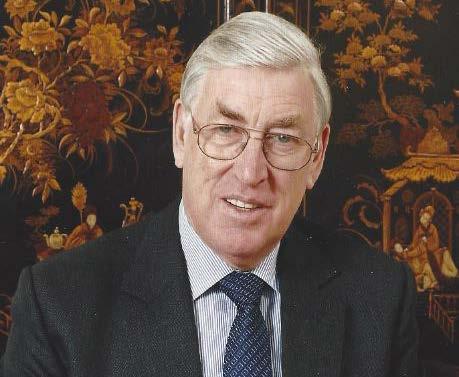
advice from the Vocational Guidance Association, by which he was told ‘no question you should go into computers’. Although he had no background in science at all, the advice proved prophetic. In 1962 he joined IBM as a trainee, spent time as a systems engineer, earning the accolade in The Times obituary as ‘the man behind the first cashpoint’, before moving into management and becoming CEO in 1986 and chairman in 1990.
He aptly described himself from 1993 onwards as ‘a serial chairman’. He held that post in UKAE, steering the nuclear industry through its privatisation, the Medical Research Council, the Nuclear Decommissioning Authority, Engineering UK, the Natural Environment Research Council, the recruitment company SThree and the financial wrap provider Novia Financial. He chaired four flotations, adding General Cable, IX Europe and SThree to the list. He also served on the boards of Smith and Nephew and General Accident, and on numerous Government committees including the Industrial Development Advisory Board, and the Committee on Standards in Public Life.
If his was a remarkably elastic portfolio career, it was one with a hinterland. He chaired the governors of Birkbeck College and the Royal College of Music, signifying his continuing interest in education and music, also evinced by his membership of the board of ENO, of which he in due course became deputy chairman. At the invitation of the then Prince of Wales, in 1999 he set up Business in the Environment, which he chaired for a decade, reflecting a new interest, and became president of the Classical Association for 1995-1996, reflecting an older one.
None of these time-consuming and demanding roles deterred him from support of Trinity. He was a generous donor, chair of the first Trinity Appeal from 1989-1998, chair of the Remuneration Committee (2011–2020), and a regular attendee of college events. Despite his many distinctions and high level contacts, he never stood on ceremony. He was always known as Tony. His intelligence, sense of humour and affability all contributed to his achievements, both outside and for the college. Many of our alumni have later had august careers, though not all have maintained links with Trinity as emphatically as Tony did. He will be mourned for what he did for the college as well as remembered for what he did so successfully in his later life.
In 1962 Tony married Mary ‘Molly’ Cotter, with whom he had two children Paul (1991) and Caroline. Following Molly’s death, in 2000 he married Jennie Lloyd Graham.
Michael Beloff, President 1996-2006
Sir Brian Jenkins GBE, FCA
(1935–2024)
Commoner 1957, Honorary Fellow 1992
Brian Jenkins held numerous roles in the City of London, and proved himself able to deal effectively and decisively with both systemic change and sudden crises.
He was born in Beckenham, where his father ran a florist business, and during the war was evacuated to Scarborough. He was a pupil at Tonbridge School and after two years of National Service with the Royal Artillery, he came up to Trinity to read Modern History. Later in life, he said that having broken his education for National Service, he felt he had not got as much out of being at Oxford as he might have done.
His initial ambition was to go into acting; having been talked out of that, the father of his then girlfriend suggested accountancy. He joined accounting firm Coopers and Lybrand, which later merged into PwC; he was made a partner in 1969 and remained there until 1995. In time, after being asked to look at how computers could be used in the audit process, a big part of his role was establishing an understanding of computing and programming. That led him to publishing a book in 1978, An Audit Approach to Computers.
Brian was president of the Institute of Chartered Accountants in England and Wales in 1985-86, and later received the institute’s Outstanding Achievement
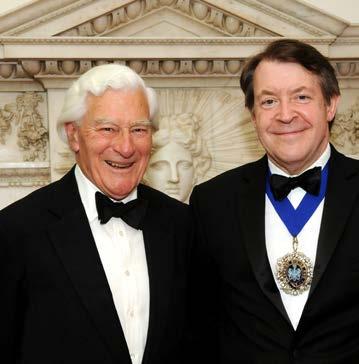
award. Following Coopers and Lybrand, he had numerous appointments and roles. Among others, he was chairman of the Woolwich Building Society from 1995, and when it merged with Barclays Bank, deputy chairman of the bank until 2004, president of the London Chamber of Commerce, and for 10 years chairman then president of the Charities Aid Foundation.
In the City he was an alderman from 1980 to 2004, serving as sheriff in 1987-88. He was master of three livery companies: the Chartered Accountants’ (1990-91—in whose hall a portrait of him hangs), Information Technologists’ (1994-95), and Merchant Taylors’ (19992000). In 1991-92, he was Lord Mayor of London. In 2005 he was appointed prior of the Priory of England and The Islands in the Order of St John and chairman of St John Ambulance.
As Lord Mayor, Brian acted swiftly in response to the bombing of the Royal Exchange. He was immediately on the scene and was determined that the City would be back up and running as usual on the Monday morning. A marquee, equipped with telephones, was soon in place outside the Guildhall for officeless workers. As planning for the Single Market, which came into being in January 1993, neared its conclusion, he energetically, if unsuccessfully, pushed to get the European central bank located in London—he had chosen ‘the City serving Europe’ as the theme for his mayoralty and put his energies into getting the best deal for the City. There were lighter sides to the job; he rode a penny farthing to promote a cycling event and flew across the City in a hot air balloon to raise funds for the Lord Mayor’s Charity appeal.
In 1964, he met Ann Prentice, a non-executive director of NHS trusts in south London, a school governor and chair of a trust providing nursing and residential care in Lewisham. They married in 1967 and during the course of a long and happy marriage, had two children.
Brian retained his close connection to Trinity and in 1992, he was made an Honorary Fellow. He was always happy to help the college, and gave advice and guidance about the workings of the City and possible venues for Trinity events in London, including the college’s dinner at the Guildhall in 1992. In recent years, his health made it increasingly difficult for him to visit College.
Sue Broers, Director of Development
(1943–2025)
Commoner with senior status 1967, Honorary Fellow 2011
Bishop Tony Russell, who died on 9 July 2025, holds the distinction of being the first Honorary Fellow to have joined the college as a graduate student. He was born in Watford, and following his school years at Uppingham (where his nickname had been ‘the bishop’), he read for a degree in Geography and Anthropology at St Chad’s College, Durham. It was that which laid the foundation for his doctoral work, which he did at Trinity following three years of ministerial training at Cuddesdon. He completed his DPhil in just three years, having his viva shortly before his ordination to serve in some rural parishes in the Norwich diocese. In commending him to his ordaining bishop the principal of Cuddesdon wrote, ‘He remains outwardly the country gent, but I have no doubt about the genuineness of his devotion to God and to his future work.’
That work, as had by then become abundantly clear, would always have a focus on rural communities and their churches. His doctoral thesis became his first book, The Clerical Profession (1980), followed subsequently by The Country Parish (1986) and The Country Parson (1993).
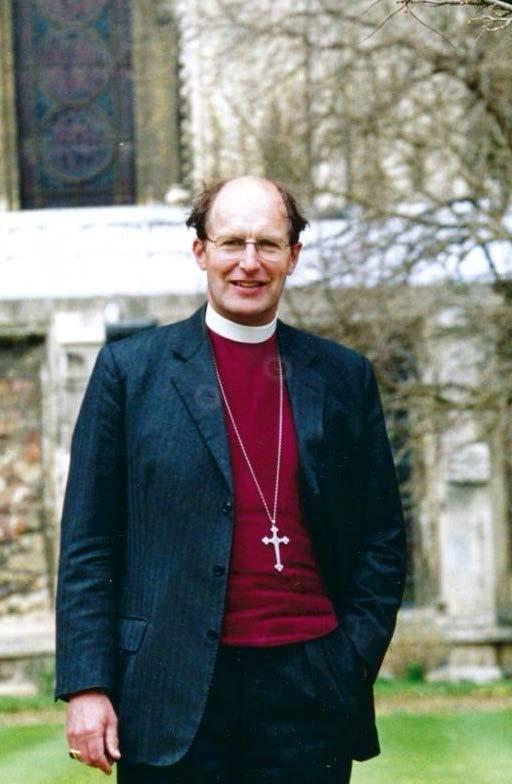
From Norwich he moved to Coventry to become first the chaplain (1973–1982), and then the director (1983–1988) of the Arthur Rank Centre (which provides training and resources for rural Christian communities) at the National Agricultural Centre at Stoneleigh Park, near Warwick. Throughout that period he also served in a variety of rural parishes, keeping his feet firmly anchored in those communities where his passion for ministry lay.
In 1988 he became the Area Bishop of Dorchester in the Oxford Diocese (Dorchester-on-Thames, not
Dorchester, Dorset) and then served with distinction as Bishop of Ely from 2000 to 2010. He retired back to Oxfordshire and, as his successor as Bishop of Dorchester, I can bear witness to the fact that he remained a perfect ‘gent’, never interfering in any way with what I was seeking to do and always being very supportive, even though I could never match in any way his knowledge and natural empathy for the many rural communities who loved him so much.
At a time of diminishing numbers of stipendiary clergy my own time as Bishop of Dorchester (2000–2020) could easily have been blighted by the need to bring parishes together in new groupings, often much against their will, but Tony had been ahead of the game and his gentle, but firm, leadership, and his willingness to listen to differing points of view (even if divisions between villages went back to the English Civil War, or on at least one occasion, the boundary between Wessex and Mercia) meant that change happened at an appropriate rate with surprisingly little acrimony.
In his latter years he fought a long and brave struggle against progressive supranuclear palsy (PSP) and he died leaving his wife, Sheila, their four children and spouses, and nine grandchildren. If Chaucer’s ‘verray, parfit gentil knight’ had been a bishop rather than a knight, then no description could have been better applied to Tony.
Colin Fletcher (1969)
The college has learned recently of the deaths of the following members, obituaries of whom we hope to include in the 2025–26 Report:
Christopher Edward Neville Arkell (1945), on 3 September 2025
Dr Han Spoel (1951), on 19 September 2025
Clive Leonard Hicks (1954), on 28 June 2025
Andrew Lionel Hichens (1955), on 5 January 2026
Nicholas Theobald Sibley (1958), on 23 September 2025
Charles Richard Baillie (1962), on 27 August 2025
Timothy Robert Marshall (1970), on 5 November 2025
David Harvey Langford (1976), on 3 December 2025
David John Mitchell (Commoner as RAF Probationer 1942), who it is believed died in March 2022, aged 98, was one of the first old members to contribute a memoir of his Oxford experience to the Archive. Six months on an RAF short course was followed by a degree in History as the first holder of the Melvin Young Bursary, endowed by the godmother of Henry
Melvin Young, rowing Blue and a hero of the Dambusters Raid.
In 1989, David described eloquently his feelings of inadequacy when invited to tea with the genteel Miss Gearing and her sister, although fortunately the ladies tactfully refrained from any probing into his service in the RAF: vertigo that stopped him flying, and the discovery that being good at games does not automatically equate to officer material. On their earnest advice, he joined the Boat Club, albeit only briefly.
David worked as a staff journalist on the Picture Post and later as a picture editor for the Central Information Service. In 1965 he became a freelance writer and published work exploring the 20thcentury women’s suffrage campaigns, as well as on the Jesuits, and the Spanish civil war.
Thomas Walmsley Mason (Scholar 1947), died peacefully on 9 February 2020, two days after his 91st birthday. He was lucid to the end of his life, despite being nearly blind and physically frail, and he enjoyed his birthday with some of his children and grandchildren.
Tom had been accelerated though his school years and said afterwards he felt too young to manage the demands of his medical course, which he completed but failed the exams (first MB). He went on to graduate in engineering from Manchester University instead, a good fit as he was
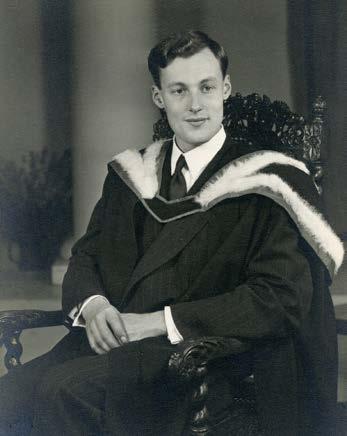
a passionate builder and tinkerer—not least the steam-powered narrow-boat that he built with a friend and toured extensively around the British canal network. After some years working on guided missiles, he moved back to Bolton to help run the family builders’ merchant business. In the 1960s he introduced an innovative computer stock control system using a PDP-11 mini computer, and then ran a consultancy installing this at many builders’ merchants across the country.
He returned to Trinity several times over the years, including on his 80th birthday, when he attended Formal Hall with his grandson Ben Mason (2008), then an undergraduate. He said quite touchingly that evening,
surveying the room, that it was nicer with the girls.
Tom remembered his Trinity years fondly and kept in touch with great friends Peter Barber and Pat Weaver (both 1946), the latter the son of the then President, J R H ‘Reggie’ Weaver. He remembered walking around Front Quad talking as young people do, and recounted one incident in which some jokers had placed a small car—an Austin 7 or similar—in the branches of a tree on the lawn by means of a ‘straight lift’.
In 1956 Tom married Jean Collins, though they later separated. He is survived by five children—Katherine, Thomas, Imogen, Edward and David—14 grandchildren, and (at the time of writing) nine greatgrandchildren.
Ben Mason-Sucher (2008), grandson
Dr David Treharne Dillon Hughes FRCP (Commoner 1949) came to Trinity from Cheltenham College to read Medicine: a not-surprising choice given that his father, Major General W D Hughes CB was distinguished in the Royal Army Medical Corps (RAMC). He stayed an extra year at Trinity taking a BSc in medical microbiology, before going to London for his clinical training (at the London Hospital); he qualified BM, BCh in 1956, had junior posts at the London and Hammersmith Hospitals, with National Service as a Medical Specialist (RAMC) in Hong Kong. He went on to an Eli Lilly Research Fellowship in the USA, and
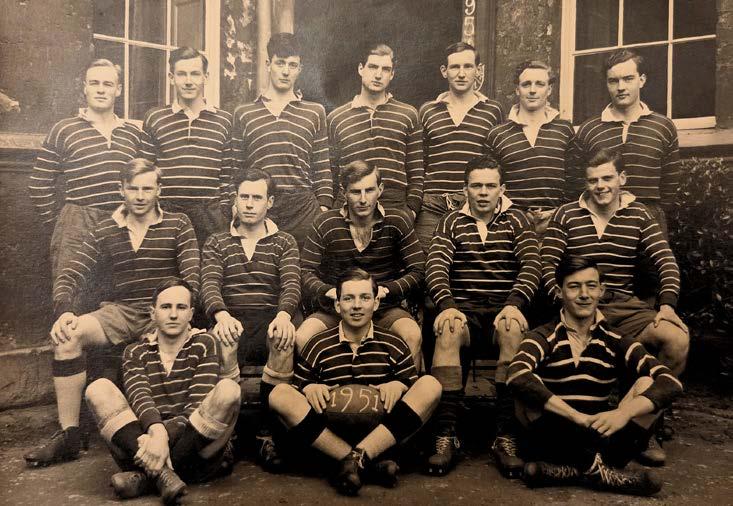
then back to The London, becoming consultant physician and director of the Respiratory Department.
Besides medicine, David had many interests. He was a keen supporter of amateur theatre, both in London as a patron of the Kings Head Theatre in Islington, and at the Edinburgh Festival and Fringe. Another interest was rowing; he coxed at Trinity, and was a member of the Leander and attended Henley every year: clubbable (the Garrick and Savage Clubs), and a lover of poetry (Rupert Brooke especially, but in his 90s could still recite the ‘Jumblies’). He played village cricket. David was proud of his Welsh origins (on his mother’s side), and
particularly appreciated steam trains and miniature railways. At Oxford, he patronised the Welsh Pony at the bottom of George Street (not a typical Trinity pub!).
His medical career was distinguished, both as a wise physician at The London, and elsewhere. He had an additional role as director of Clinical Investigation at the Wellcome Foundation; he was master of the Worshipful Company of Apothecaries (1992-3), president of the Hunterian Society, and member of the GMC (1993-96)—amongst other responsibilities. He published many scientific and clinical papers.
He married Gloria, a staff nurse at the London Hospital, who predeceased him, and they had two daughters (both doctors) and a son. Michael Hughes (1956), cousin
Hugh Douglas Cochran (Commoner 1950) was born in Aberdeen in 1932. He was the son of Marjorie (née Douglas) and David Cochran (Commoner 1919), a solicitor, and older brother of Gordon (1954). While at Loretto School, an operation left Hugh mostly deaf in one ear, which later disqualified him from National Service, and so he went straight from school to university. He came up to Trinity to read Law, followed by a further degree at Edinburgh University.
He went on to work as a solicitor in Aberdeen, also serving in other roles, including as chairman of the Castlehill Housing Association, member of the Grampian Health Board, chancellor of the Episcopal Diocese of Aberdeen and Orkney, and director at the Aberdeen Association for the Prevention of Cruelty to Animals. He shared his enthusiasm for local history in his work with the Aboyne Festival. Hugh was someone for whom life was for living. He loved sailing and cricket, and cooking. With a growing family, he enjoyed many adventurous camping holidays to all corners of the British Isles. Later in life, he visited the Great Wall of China in his 60s,
completed an archaeology degree and visited the Pyramids in his 70s, he made a round the world trip in his 80s, and a cruise around the inner Hebrides in his 90s. There was always a project, he always was positive, he was always ambitious, there was always a story.
Hugh’s first wife, Joan Fleming, died in 1961, leaving him with three children, Susan, David and Joanna. With his second wife, Isa MinioPalvello, he had two sons, Marco, who died shortly before Hugh, and Adam. In 1979 he married Beverley Jones, who died in 2019; they had a son, Andrew. He is also survived by 11 grandchildren, and 11 greatgrandchildren.
From the eulogy by Andrew Cochran, son
The Revd Gerald Fitzgerald (Commoner 1950) was born in 1926 in Dunedin, New Zealand into a large, medical family. He was educated at Christ’s College, Christchurch, before returning south to Otago Medical School. Disliking blood and needles, he swapped course, taking a BA in History, and was a founding member of the university’s ski club.
Discerning a calling to be a vicar, he set sail for Trinity, to study for a second BA in Theology, which he took in two years. Away from his studies, he was a member of the Boat Club. From Trinity, Gerald entered Westcott House theological college in Cambridge, before being ordained in the Manchester diocese by Bishop Frank Woods (who shortly afterwards
became Archbishop of Melbourne). He served his curacy at St Philip’s, Salford. After 10 years in England he returned home and worked with the Revd Harold Norris, at St Peter’s Upper Riccarton, Christchurch and then became vicar at the inland settlement of Sheffield.
In 1960 he married Belinda Williams. They had briefly met in 1939 at a school dance and won a box of chocolates. They moved to the parishes of Hokitika on the West Coast and then to Linwood in Christchurch. With three children at school age, they decided to remain in Christchurch and Gerald attained a LLB from Canterbury University in 1976.
The family then moved onto a farm outside Christchurch from where Gerald commuted, until he retired in 1986. He served on a number of boards, doing law locums and taking occasional church services (he liked, cheerfully, to remind his medical family that he buried their mistakes).
Gerald and Belinda enjoyed many years of international travel and after the Christchurch earthquakes moved to their home at Lake Wānaka in Otago. Gerald had a strong moral compass, wonderful humour, wit and knowledge of history and current affairs. He was an avid reader, until his eyesight failed him three months before his death, aged 98 in October 2024. He is survived by his wife, Belinda, sons Edward, Patrick, and Caroline, and seven grandchildren. Caroline Fitzgerald, daughter
Dr John Francis Morrison (Commoner as Postgraduate Student 1951), after gaining a BSc at the University of Sydney and MSc at the University of Queensland, came to Trinity to undertake a DPhil in Biochemistry. Following its completion, he became a Research Fellow at the John Curtin School of Medical Research in Canberra. He was promoted there to fellow in 1956, senior fellow in 1962, and professorial fellow in 1968, the title he held until his retirement in December 1990.
John’s father, a gifted cabinet maker, refused to let his son work with wood, fearing he would find it so attractive that he would miss out on opportunities for a better career. John’s work in biochemical research was certainly a great success, and made a significant contribution to the understanding of enzymic catalysis.
John spent time at the University of Wisconsin, which provided a foundation for the range of research he led into the mechanisms of action of enzymes using kinetic techniques.
John’s foundational field was studying enzymes that catalyse phosphoryl group transfer reactions. These reversible reactions are essential for the function of mammalian muscles. John’s standing was best acknowledged by an invitation to write a review of this extensive field (more than 2000 research papers between 1964 and 1971) for the Annual Review of Biochemistry in 1972.
The research of the Morrison group continued over many years, and John supervised a number of research students over his career. He was a supportive supervisor and group leader who was always interested and ready to discuss issues, and who read draft theses with patience and careful attention.
In 1989, the year before his retirement, John was appointed as the initial head of the division of Biochemistry and Molecular Biology at the John Curtin School. This was a fitting acknowledgment of his standing as he approached retirement.
John’s wife, Pam, predeceased him; he is survived by his daughter, Ann and Helen, and son John, his grandchildren and great grandchildren.
From the obituary for ANU by Beth Heyde
Gerald Sydney Philip Peacocke (Scholar 1951) was born in Milan, in 1931, to a British father and an Italian mother. His early years were marred by the advent of fascism in Italy, as well as early signs of tuberculosis, so he was duly whisked off to St Moritz, Switzerland to ‘take the Alpine air’ and avoid the impending war. It was here he would begin his lifelong love of languages, picking up German to complement his native Italian and English. As war loomed ever larger on the continent, he moved to Britain, where he was educated at Sherborne School.
He came up to Trinity to read Italian and German, a degree combination
he believed he was the first to study. Gerald was a gifted student, and would wistfully reminisce about missing Roger Bannister’s four minute mile to ‘swat in the Rad Cam’ during the run-up to his finals. Years later, he did have the chance to apologise to Bannister. ‘I hope you got a First!’ was Bannister’s reply. Gerald did indeed gain a First, but not without enjoying his time with the Trinity Players and sipping the odd sherry. He was very proud of the JCR Picture Collection, which he helped set up.
After Trinity, Gerald worked for the British Council in Ankara, where he met his first wife, Meg. As a lifelong lover of education, he then became a teacher of languages, and
later a headmaster, including stints at Eton College, The King’s School, Canterbury, King’s College School, Cambridge, and Leighton Park School, Reading. It was during his time in Cambridge that his marriage to Meg broke down, not without producing four children. Cambridge did introduce him to his second wife, Anne, with whom he would spend the rest of his days, until her death in 2023.
Gerald never forgot Trinity, with sketches of the lawns and buildings adorning his walls. He and Anne retired to live in Oxford, and Gerald was chairman of the Trinity Society from 2010 to 2012. Gerald embodied all that makes Trinity magical. He had an unquenchable thirst for knowledge, a personal warmth to all that he came across, and a love of the finer things in life that can only come from a college famed for its food. Friends of Trinity may be saddened by his loss, but can be proud to count Gerald among their number.
Finn Peacocke (2019), grandson
(Charles William) Martyn Grose (Commoner 1952) came up to Trinity from Blundells School to read Chemistry. He gained an Athletics Blue in the javelin and became a member of the Achilles Club—it was through this membership that he found himself on 6 May 1954 in the changing rooms at Iffley Road listening to Roger Bannister, Chris Chataway, and Chris Brasher discuss the tactics for their race to break
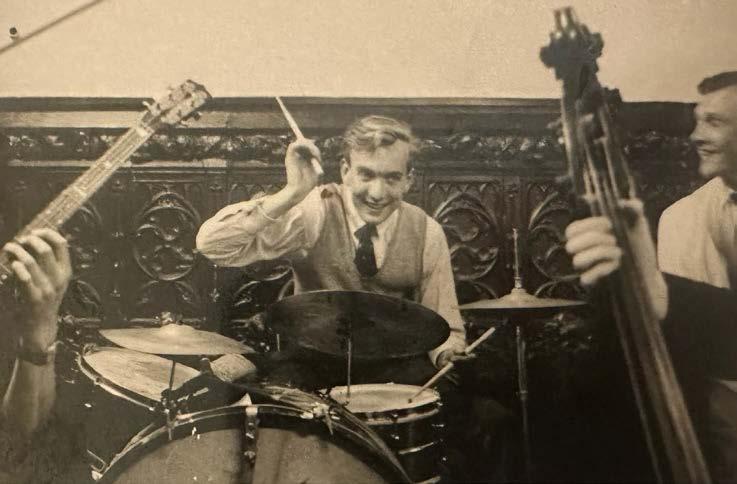
the four-minute mile. He was the drummer in the renowned University jazz band of the time, which went on to play at the Hundred Club in London with Humphrey Lyttelton and recorded their music. He rowed in the ‘Gentlemen’s VIII’.
Following his degree and a further year of research in the labs, he joined the Royal Navy on a short service commission in 1956. While in the Navy, he married his first wife, Jennifer Stansbie.
He made his career with Wiggins Teape, papermakers, and was posted to Argentina where, in 1963, he married Audrey Anderton whom he had known since childhood. After ten years there, he went to South Africa,
before returning to the UK to run the firm’s overseas operations. He retired in 1991, and moved back to Thurlestone to the family home where he was born.
He became chairman of the Grose family’s hotel business, Thurlestone Estates, in 1980. The business and governance principles he implemented radically changed the company and brought about a new era of prosperity.
The Thurlestone Hotel is now the oldest continually family-run hotel in England. He stepped down from the chairmanship in 2014 after 34 years in the role.
He was an independent councillor for South Hams district council from 1995 to 1999.
He had five children: Simon, from his first marriage to Jennifer, Lucy, Jessica, Jolyon and Charles from his marriage to Audrey, and 11 grandchildren and five greatgrandchildren. He was widowed in 2007 and thereafter found companionship with the widow of his Trinity friend, Michael Russell (1952). Jessica Mannix, daughter
Stephen Douglas Lawrence (Minor Scholar 1952) was born in Widnes in 1933 and went to Stockport Grammar School. He always modestly claimed that a long-standing school association with Trinity College got him an undeserved scholarship to read Chemistry. However, he was a successful student, and also played lacrosse for the University (and trialled for England). He met his future wife, Gillian Rushton, daughter of the distinguished visual physiologist William Rushton FRS, in the cello section of the University orchestra. But perhaps his proudest moment was as a member of the college 3rd VIII, which achieved two bumps in 1953.
After his National Service as an RAF navigator in Canada, Stephen and Gillian married in 1959. Stephen got a job with British Cellophane in Barrowin-Furness, but quite soon tired of industrial management and took a large cut in salary to become a local authority cello teacher. Eventually, the job included a day a week playing in the Cumbria Quartet. They played in schools and put on their own concert series, performing Beethoven, Bartok
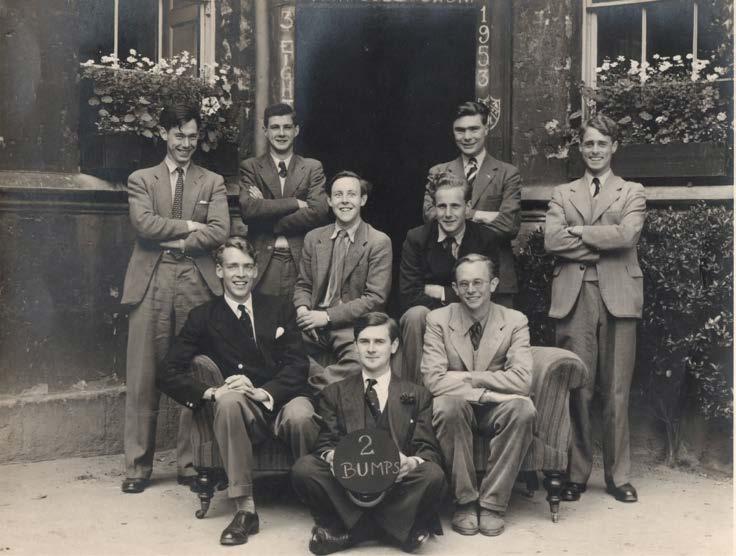
and commissioning new work. He ran the Cumbria Youth Orchestra and cofounded the Cumbria Philharmonia, a large orchestra to play the works of Mahler and Richard Strauss.
He touched the lives of many young people. When Gillian died in 2021, former members of the youth orchestra sent him flowers with the message ‘you changed our lives’, which moved him very much.
After retirement, he and Gillian moved to Hutton Roof, near Kirkby Lonsdale, and converted a barn to contain a large music room, where he played string quartets every week until
he was 90. He also enjoyed walking on Hutton Crags and was an avid Bridge player.
His love and provocative humour are much missed by his sons Martin and Peter, and his four grandchildren. Martin Lawrence, son, from his ‘Other Lives’ obituary of Stephen in the Guardian
John David Passey (Scholar 1952) was born in 1932, in Portsmouth, and during the Second World War lived for a time on a farm in north Hampshire. He attended Portsmouth Grammar School, and chose Oxford over Cambridge, winning a
scholarship exam to read Engineering at Trinity. He took up his place after his National Service, which was spent partly in Germany. He described his time at Trinity as rather riotous and he made lasting friendships.
After beginning his working life with Procter and Gamble, he married Mary, whom he had first met when they were 17. Deciding they would like to travel, John took a job with Canadian firm Alcan and a posting to Jamaica, followed by time in Canada, Switzerland and the United States. After returning to England he was involved in a number of business interests, including setting up an investment company in the City and taking on an engineering business.
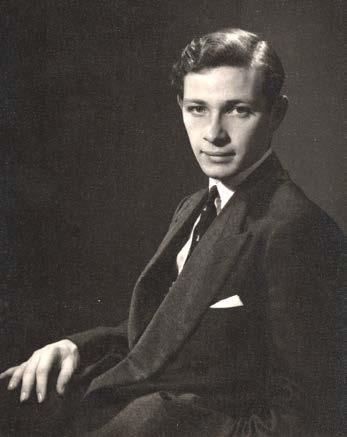
Away from work, John developed a love of sailing while living in upper New York State, a hobby that remained important to him for the rest of his life.
John was predeceased by Mary and their daughter Jo; he is survived by a son, Andrew, a daughter, Kate, six grandchildren and a great grandchild.
From a eulogy by Andrew Passey, son
Pallavicini (Commoner 1952) was born in Bridgnorth, Shropshire, on 30 June 1934, the eldest son of Prince Guglielmo Rospigliosi and the Hon Helen Lyon-Dalberg-Acton. During the Second World War, Helen took Ludovico and his siblings to South Carolina.
In 1945, the family moved to Aldenham, Shropshire, to the home of Helen’s brother, Lord Acton (where, by coincidence, Ronald Knox, chaplain of Trinity 1910-17, had been living during the war). There, Ludovico’s passion for history and genealogy began to take deeper root.
In 1948, the Actons relocated to Southern Rhodesia. After three years, the family returned to England. He continued his education at Downside School, near Bath, and completed his National Service with the RASC in Egypt. He came to Trinity to study Modern History. Here he became part of an aesthetic and Catholic aristocratic circle that included Prince Rupert Loewenstein (later financial manager of the Rolling Stones) and Michael Dormer.
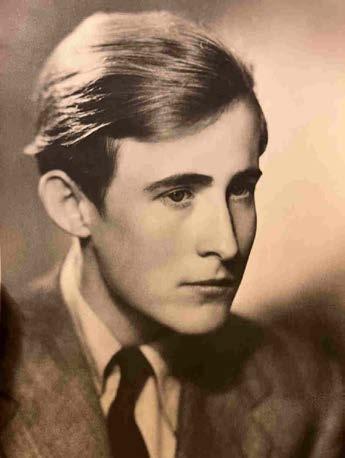
Ludovico Rospigliosi Pallavicini
In 1960, he married Ninon Sallier de La Tour. Together they had three children, Lucrezia, Camillo, and Olimpia. The family lived in Paris, where Ludovico worked for the OECD.
In 1986, they moved to Rome, where Ludovico became a valued source of historical insight and genealogical expertise for many writers. He held the rank of Knight Grand Cross of Honour and Devotion in the Order of Malta, where he served as the Order’s Historian. His scholarly duties brought him regularly to the Vatican Secret Archives and the National Central Library of Rome. He was also president of the Collegio Araldico.
Captivated by culture, Ludovico was a voracious reader and an endlessly curious thinker. His sharp, dry wit often emerged in conversation. Opera fascinated him, from Wagner to Mozart; he spotted the young Joan Sutherland years before her stardom. Rospigliosi’s princely manners and cultivated sense of humour, made him a cherished presence at Rome’s Circolo della Caccia.
In 2019, Ludovico and Ninon retired to Milan, where he died on 21 November 2024.
Camillo Rospigliosi, son
John Michael Cottis (Commoner 1954), who died in September 2024, was born in 1935, in Epping, and educated at Forest School, Walthamstow.
He came to Trinity to read History, he and his brothers being the first generation of their family to go to University. John was modest almost to excess, but his years at Trinity were very happy ones. He was an active member of the Trinity Players, having a major part in the production of Murder at the Festival, performed in the gardens in 1956, and playing a dung beetle in the The Insects Play. He had excelled at sports at school, and played football and rugby in his first term, but tore a ligament in his knee, which necessitated surgery and put an end to sport. The chapel was important to him, and he was prepared for confirmation by Austin Farrer. Shortly after graduation he married Janie Moon, who read
History at St Hugh’s, whom he had met in his second term.
John first went into the family business of agricultural engineers in Epping, but after the business was sold he tried a few other things—including teaching History for a few years at Ashlyns School in Berkhamsted— before qualifying at the Institute of Personnel Management and working for Oxfordshire County Council.
John was a keen golfer and photographer, and joined the local Society of Arts. In their fifties, he and Janie became Quakers and members of their local Peace Group. They had moved to Wantage in the 1960s, where they enjoyed a happy retirement.
From notes provided by Janie Cottis
John Stowell Allan (Minor Scholar 1955) was born in 1934, the elder son of Maurice and Sybil Allan. After school in Corbridge, Northumberland, he studied at Marlborough College.
In 1955, after two years of National Service spent largely in Klagenfurt, Austria, John came to Trinity to read History. Many years later, he had the pleasure of becoming friends with a graduate student here from Klagenfurt. John enjoyed his student days and for the rest of his life, he retained a love of history, especially maritime history, and a tremendous affection for the college.
After Oxford, John joined Stephenson Harwood, a firm of London solicitors, where he qualified in 1962. He then became a partner in
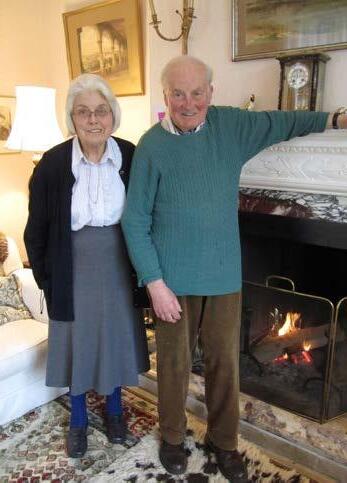
John and Judith Allan
another city law firm, and specialised in property, trusts and charities, whilst also working in maritime law. His involvement with the Company of Watermen and Lightermen of the River Thames started around this time and in 2002, he served as its master. In 2003, he hosted the college’s London Reception on a steamboat on the Thames.
In 1975, he married Judith Beresford. They travelled widely, often visiting historic sites. In his youth, John played the flute and he had a lifelong love of music, especially opera. He and Judith were concert and theatre goers and they had a shared love of art. They were justifiably proud of their beautiful
garden in Sandford St Martin in north Oxfordshire—tea in the garden was a particular pleasure—and no visit was complete without fruit or vegetables to take home.
John’s passion for history was an enduring one. In 2013, he received an MA in Maritime History from the University of Greenwich, writing his thesis on the Second World War. A voracious reader, he was always to be found surrounded by books. And it was not only history that appealed to him. His love of the absurd drew him to Anthony Trollope and he was a long-standing member of the Trollope Society.
A devoted couple, Judith died in August 2025 and John, just a few weeks later, in September.
Sue Broers, Director of Development, based on the eulogy by Richard Allan, cousin
Anthony ‘Tony’ Gande (Commoner 1955) was born in 1936 into a modest home in the industrial district of
Leeds. In 1948, he won a scholarship to Cockburn High School, coming top of class in most subjects. Here he met Maureen, his future wife—they married in 1961 and had two children, Steffi, a marketing consultant, and Richard, a consultant anaesthetist, followed by three grandchildren.
Tony came to Trinity to study French. Upon graduation in 1958 with an Upper Second, he stepped into the teaching profession. From his first post at Lincoln School, he moved to Loughborough Grammar School, then Bishop’s Stortford College as head of Modern Languages. He next progressed to head of Modern Languages at Hills Road Grammar School, Cambridge, a position he held for over twenty years until his retirement in 1996. After its transformation to a 6th form college, the school—and Tony’s department —gained national prestige. Tony embraced the opportunity to teach students who had elected to study the subject he loved: France, its language, literature and culture.
In 1988, Tony and Maureen purchased a 17th-century former goat and silk farm in a Provençal hilltop village. They spent 15 years restoring the ruined building, working, hammers in hand, with local craftsmen and welcoming a growing group of friends, both French and English. Tony is remembered for his integrity, gentle humour, and love of life. With irrepressible energy and intellectual curiosity, he sought excellence in all his endeavours: from domestic
construction projects to classical flute-playing. More than his own achievements, those of his children and grandchildren were his greatest source of pride. His legacy of learning, affection and joy will last far into the future.
Obituary by Tony’s family
Richard Ninian Barwick Clegg KC (Commoner 1956), who died in August 2024, was born in Littleborough, Lancashire, in June 1938, the son of Cuthbert Clegg (Commoner 1922).
From Charterhouse School, he came up to Trinity to read Law. His first year’s sporting endeavour as cox of the first eight was a mixed success, with the wins on the water somewhat offset by cutting the RAF eight in two and mistakenly writing off the best Trinity boat due to a steering error that drove it straight into the pontoon. However, he found his calling in the second year in the Modern Pentathlon team, in which he captained Oxford against Cambridge, albeit unsuccessfully. He always regretted that he was not awarded a Blue, which was given to the captain the following year. Whilst his academic career was undistinguished, preferring to focus on making the most of his time at Trinity, which he thoroughly enjoyed, he duly graduated in 1959 and was called to the Bar at the Inner Temple.
Following pupillage in London, he joined the Northern Circuit and developed a practice in the common law and specialised in compensation
for industrial diseases, particularly respiratory in the asbestos mining industry, and later in the cotton, coal and shipbuilding industries, the former which were at that time being prepared for trial as test cases. In the middle of preparing these cases, he took Silk in 1979 at the relatively young age of 40, having become a Recorder of the High Court the year before. When the cases were ready, his lead counsel was elevated to the High Court Bench and he was duly appointed to lead, setting the damage levels for tens of thousands of seriously ill working people.
In 1985, he was elected a Bencher of the Inner Temple and also served as a deputy High Court judge, before retiring in 1995, moving from Cheshire to Exmoor, where he had lived as a child, to enjoy his passion for hunting, the Third Order of the Franciscans, writing and entertaining.
He married his wife, Veronica, in 1963; she survives him, with their children, Aidan, Flavia and Sebastian and seven grandchildren. Veronica Clegg, and Aidan Clegg, son
Nicholas Raymond Bomford (Commoner 1957) was born in Evesham, Worcestershire, into a farming family. He came as an exhibitioner from Kelly College, Tavistock, to Trinity to read History. He served as captain of rifle shooting and earned a Half Blue several times. After taking an Oxford and Cambridge shooting team to Kenya, he began his teaching career there,
briefly, before returning home and teaching history at Bedales, Pangbourne, Dartmouth, as senior lecturer, and Wellington where he became a house master.
He was appointed headmaster of Monmouth School in 1977, then in 1982 of Uppingham School and in 1991 of Harrow. He retired to the Monmouth area in 1999, where his main interest was fishing, sometimes with friends in the Rockies, but more frequently in the tributary of the Wye, the Monnow. He also helped organise a local shoot with Michael Clarke (1948).
Nicholas married Gillian Reynolds in 1966 and they had two daughters. He died in June 2025, aged 86.
Gilly Bomford
Andrew John Corran (Commoner 1957) was a serious sportsman. At Gresham’s School, in Norfolk, he was a member of the cricket 1st XI and at Oxford, he earned three cricket and two hockey Blues. On leaving Trinity in 1961, he made his debut for Nottinghamshire County Cricket Club and in 1962, he became county captain. A medium paced bowler, he took 410 wickets in his first-class career, with 21 five-wicket and one ten-wicket hauls.
In 1965, his first-class cricket career came to an end when he emigrated to Australia, where he became a teacher. After three years, he returned to the UK and taught maths and cricket at Cranleigh School from 1968 until his retirement. In 1965 he married Gay
Sturdy, an artist, and they had five children. Andrew and Gay retired to West Lulworth, Dorset, and Andrew died there in October 2024, aged 87.
(William) John Uzielli (Commoner 1957) was one of the most admired and respected figures in British golf over the last half century, a man who epitomised the true spirit of the amateur game. He was a fine player as a student, gaining Blues in 1958, 1959 and, as captain, in 1960. Lesser known among his many golfing triumphs at Oxford was his leadership of the Trinity Golf Cuppers team to victory in 1960. Fellow team members were Tony Taylor (1957), Mike Attenborough (1958), David McCay (1958) and Gordon Thorburn (1959).
John came up to Trinity from Marlborough College, having completed his National Service in the Intelligence Corps based in Cyprus. He read Law and was a member of Vincent’s and the Claret Club. Away from the golf course, John was an inveterate cinema-goer and he recalled that, together with friends, they would be determined to have seen all the new films in Oxford by lunchtime each Wednesday! He also loved to watch cricket. Not a great player himself, he was a member of an informal, amateur team, the Haymakers, going enthusiastically on tour to villages in Kent and Sussex in the summer vac of 1959, alongside Christopher Hogg (1957), and Mike Attenborough.
From Trinity, John went into a career in insurance broking, rising to main board director and chairman of the Marine Division at Hogg Plc, where he worked for 35 years and travelled widely.
He never let up his enthusiasm for competing at golf. In 1965, he won the President’s Putter (a competition for all former and current Blues) and the associated Croome Shield, with several Trinity friends, six times; in 1972 was a member of the winning Marlborough team in the Halford Hewitt (a competition between former pupils of 64 public schools). He is one of very few people to have played over 100 matches in both the Putter and the Hewitt.
John was also prominent in the upper echelons of golf’s governance. He was captain of the Royal &
Ancient Golf Club (2000-01), served on the Rules of Golf and Championship committees and chaired the Golf Foundation from 2001 to 2009. He also served as president of the Berkshire Golf Club, the Seniors Golfing Society, and the Oxford and Cambridge Golfing Society.
John and his wife Angela—a British Champion golfer in 1977—were a formidable duo on and off the course during their 31 year marriage. They had two children and five grandchildren, and enjoyed family holidays in Cornwall filled with golf and sea swims. After Angela’s sudden death in 1999, John found joy again in a long and happy partnership with Phyll Youngman, a close family friend. Despite personal tragedy, including the loss of two brothers during his school years and later his wife, John remained resilient and gracious. Known for his modesty, kindness, humour and lack of ego, he was deeply loved by family and friends alike, admired not only for his achievements but for his generosity of spirit and unfailing warmth.
Michael Uzielli, son
Roy Herman Brown (Commoner 1958) was born in 1937. After attending Westminster School, he read Law at Trinity, following in his father’s footsteps to become a solicitor.
Life at Trinity was a dream for Roy, which he took to like a duck to water. Playing Claudius for the Trinity Players’ production of Hamlet
in the Garden Quad was a highlight. Latterly, returning for events and reunions brought him great joy.
After Oxford, Roy joined his father’s West End law firm, Hamlins, and became senior partner. Specialising in litigation, he achieved a standout victory when, amid widespread copyright theft in the entertainment industry, he secured a court order to seize the master copy of E.T. just days before its West End première—earning a congratulatory cable from Steven Spielberg.
Later in his career, Roy became a guru in financial services, policing his own profession by pursuing claims
against solicitors for negligence and fraud. He lectured underwriting departments and spoke at seminars for leading industry institutions. Though less glamorous than entertainment, it was still an exciting and groundbreaking period.
Sport was a lifelong passion, whether taking part or watching, and he was a devout member of MCC. Even in his final years, he continued playing golf and insisted on trips to Lords for matches during chemotherapy. His competitive spirit also extended to playing bridge, which he enjoyed with the same three friends, at the same time, every week for 46 years.
Roy’s laid-back, kind nature endeared him to all. Though oldschool, he combined forensic insight with common sense and was well known for his sharp humour.
Roy fought to the end, but lost his battle with cancer in 2023. Married twice, he leaves his wife, Wendy, two daughters of whom he was immensely proud, and two cherished granddaughters.
Wendy Brown
Charles Anthony Fry (Commoner 1958) had a great passion for cricket. Born in January 1940, he was the son of first-class cricketer Stephen Fry, brother of Jonathan (Commoner 1957), and grandson of C B Fry (Wadham 1892), who captained England. Charles was captain of cricket at Repton, and came to Trinity to read Engineering. He loved his time
here, however, not much else occupied him beyond cricket, he lived for the cricket season and he left with three Blues.
He carried on his cricketing career for a short time with Northants and Hampshire, with a smattering of first-class games, before taking a job in insurance. He had a keen eye for business and when he saw the opportunity and the commissions that could be earned in mortgage broking (something few did in those days), he took the idea to his insurance boss, who wasn’t interested, so with a colleague he left the firm to set-up Johnson Fry. It grew to be one of the most successful and innovative financial services companies of the 1980s and ’90s, before he floated the company and it was subsequently bought out.
He carried on his lifelong involvement in cricket. Having, in his 30s, been instrumental in getting the MCC to lower the average age of its committee members, he served on the committee and various subcommittee’s for over 30 years, and served as president and chairman.
In his downtime, Charles read profusely and loved nothing more than discussing business. He was interested in theatre and invested in several theatrical ventures. His children remember weekends spent by the side of cricket pitches and later on watching matches with him at Lord’s, as well as his uncomplicated and supportive parenting skills.
Charles died in October 2024 after a long battle with Parkinson’s disease. He is survived by his son Benjamin (1988), from his first marriage to Alice Stackpole, and by his second wife, Jane, née Vigers, and their twin children James and Annabelle. James Fry, son
Andrew James Redpath
(Commoner as Ford Student 1958) was born in March 1939, in Banstead, Surrey. Six months later he would be voyaging out by ship to India. His father, Alexander Redpath (later CBE), was in the Indian Political Service, posted to the breathtakingly beautiful mountains of the North West Frontier, where Andrew spent his idyllic early years. India would remain a key part of his life, right through to retirement when he ran a charity, Jeevika Trust, for sustainable village life, and became
Andrew Redpath
director of the Schumacher Centre, Delhi (E F Schumacher was author of Small is beautiful, proposing humancentred sustainable use of technology).
In 1946, aged just 7, Andrew came back to England to boarding school, eventually attending The King’s School, Canterbury. There he shone as an all-rounder and became head of his house and a classics scholar.
In 1958, Andrew was awarded an exhibition to Trinity. His parents and headmaster, Canon Shirley, decided he should read Jurisprudence instead of Classics, which may account for the many diversions he sought from his studies! Nonetheless, he went on to have a wonderful 32-year career with Gillette Industries. He rose to become director of Legal and Government Affairs, Eastern Hemisphere, a role he relished for its intellectual stimulation and travel opportunities to India, Pakistan, Iran, Morocco, the USA, Europe and more.
This experience with brands, including Papermate and Oral B, meant that he was perfectly placed, to become a founder member and eventually chairman (1998-2006) of the British Brands Group, a position he held ‘with distinction’ according to current chairman, John Noble. He launched the annual Brands Lecture series and the Oxford Symposium— both of which are going strong today. There, he is remembered ‘as a bright, charming, thoughtful, generous and highly collegiate colleague, a true gentleman.’ His MP, Vince Cable, who supported his charitable work, wrote that ‘his idealism, integrity and thoughtfulness shone through.’
In life, as at school, Andrew was many things, incredibly practical, a skilled carpenter, a poet and spiritual thinker, making several visits to mount Athos, studying Dante and Sufism, and following the gospel of St Thomas. He was kind, loving and encouraging to others, and in turn, much-loved. He is survived by his wife, Christine, by three children from his first marriage, and two grandchildren.
Leila Redpath, daughter
The Hon Sir (Alistair) Simon OrrEwing Bt FRICS (Commoner 1959) was the son of Charles Orr-Ewing (Commoner 1930), later a member of parliament and then a life peer. Simon came to Trinity from Harrow School to read PPE. He was a member of the Claret Club.
After Trinity he worked as a selfemployed chartered surveyor. He
was for a time chairman of Chelsea and Kensington borough planning committee, and was a member of one of Trinity’s appeal committees.
Simon lived latterly at Fifield, in west Oxfordshire. He died in August 2024, survived by his wife, Victoria, their children Archie, Jamie and Georgina, and 10 grandchildren.
Jonathan Dewey ‘Jon’ Blake (Rhodes Scholar 1960) who died in May, 2024 aged 85, from the effects of Waldenstrom macroglobulinemia, a rare blood cancer, was a communications lawyer at the forefront of helping shape legislation, licences and treaty provisions related to satellite communications, mobile phone service and broadband technologies.
Jon spent 49 years of his career at Covington and Burling LLP, including time as head of communications and media practice, chair of its management committee, and president of the Federal Communications Bar Association. He was part of a team that was awarded an Emmy Award for its accomplishments in the transition to digital television.
He considered it a ‘huge break’ that early in his career he was called upon to defend the Washington Post against politically-backed challenges to the renewal of two of its television licenses during the Nixon administration.
In his retirement, Jon gave countless hours to Making Every Vote Count, an organisation devoted to reform of the US electoral college system.
Born in the seaside town of Rumson, New Jersey, Jon attended the Rumson County Day School, where his father was headmaster and his mother an administrator. He went on to Deerfield Academy in Massachusetts and a history degree at Yale.
In 1960, Jon hitched a ride on a working ship to come to Trinity. He made the very best of his time at Oxford, availing himself of its many intellectual resources, enjoying the ministrations of his scout, gaining Blues in tennis and athletics, driving around Europe in his downtime, and ultimately marrying one of Oxford’s denizens, Prudence Rowsell, with whom he had three daughters. Finishing up his law degree at Yale in 1964, eldest daughter in tow, was probably anticlimactic. Towards the end of his life, he told his wife, ‘All
through my childhood and college years I learned how to compete. At Oxford I learned how to win.’
Jon’s participation in the Oxford Law Faculty’s Monroe E Price Media Law Moot, named after a Yale contemporary, provided the opportunity for him to return to Oxford late in his career. A student who met him as a judge in the competition has created a scholarship at Trinity in Jon’s name.
His first marriage having ended in divorce, Jon married Elizabeth Shriver, a lawyer at PBS, in 1977. Together they had a son and daughter.
Adapted by Liz Shriver from the obituary in the Washington Post. Interested readers might wish to search online for the interview with Jonathan at ‘How Rhodes Scholars Think’.
John Christopher Finch (Scholar 1960) Two years after the Thatcher Big Bang, with 20 London stock broking firms already sold to American banks, the Sunday Times taunted an ultra-respectable firm founded in 1868 by Sir Walpole Greenwell, by noting that a year after takeover by the Midland Bank, ‘the Greenwell equity team is down to a man and a dog’.
Prufrock of the Sunday Times published a mea culpa one week later, under the heading ‘Dogged reply’.
I have now had a threatening letter— from the dog. For the record, its name is Wally, and it is large, black and fierce (pictured above with his owner, John Finch). Since it also enclosed a copy of its latest 1988 review, I feel obliged to pay at least nominal attention to its
amazingly, even astoundingly, good research.
This buckshee Fleet Street advertisement epitomised the quick and ingenious lateral thinking that took John from the Crown Flats in Regents Park to a scholarship at Westminster City School and an eventual partnership at W Greenwell & Co on the eve of the Big Bang.
Student debt on a 1960 state scholarship was trivial. In any case after playing undergraduate bridge and poker in his first term, John was able to drive home for Christmas in a wagered Austin-Healey 100-6 roadster. In long vacations he had the nerves for hard work as a painter on high buildings.
At Diplomacy, a board game launched by a Harvard history professor in 1961, the rules stated that ‘knowing whom to trust, when to trust them, what to promise, and when to promise is the heart of the game.’ But in Oxford in 1962, John was first to notice that JCR Diplomacy seldom lasted long enough for one empire to achieve total European hegemony. To be one of the survivors when the pieces went back into the box, you needed only to secure one utterly trustworthy ally, an echo not just of Churchill and Roosevelt in 1940, but of the dictum meum pactum by which John lived and prospered in a second career as a stock broker and Lloyd’s underwriter, 20 years later.
At the suggestion of a friend, he abandoned a career in television market research during the ‘three
day week’ and entered the London stock market, at its lowest ebb, as a researcher.
Shares fell 73 per cent between May 1972 and December 1974. In retrospect, it was the perfect time for a man who loved lateral thinking and extolled to friends and clients, notably pension fund managers at Pilkington and Scottish Widows, that ‘trust is efficient’, to join a bourse described by Voltaire as ‘more respectable than many royal courts’.
John died after a fall at his home in Southwell, Nottinghamshire, leaving his widow Pat, a daughter, two sons, and four grandchildren.
Andrew Rosthorn (Brasenose, 1961)
Patrick George Armine Ellis-Jones (Commoner 1961) died unexpectedly on 29 November 2024, aged 82. He was educated at Rugby and Trinity, where he obtained his degree in Chemistry. Patrick spoke warmly of the time he spent at Trinity. He remembered fondly his team winning the 1965 Rugby Cuppers, and when he returned to Trinity was pleased to see the great triumph still recorded in chalk around the doorway of Staircase 14.
After passing the patent and trademark law exams he worked as an attorney in London with J A Kemp & Co. He became a partner, headed the chemical and trademark departments and set up the firm’s office in Oxford. His work involved international travel, mostly to the US and Japan.
Although he skied often in Europe and the US, as well as enjoying a game of tennis, his favourite sport was fly fishing. The place he considered the most wonderful place to do it was Alaska, accessing remote areas in a sea plane. When a brown bear stole his catch he didn’t argue with it.
A bon viveur Patrick had a keen interest in wine. He had an impressive collection stored in his wine cellar in the 100 acre Devon farm he moved to when he retired. The deer park, lakes, woodland, orchard and gardens kept him busy. His London home became a pied-à-terre as he spent most of his time in the countryside he loved. He spent his last few years in Wiltshire enjoying walks, the birds, tennis and excursions.
Patrick was married twice, firstly to Janet Evans, with whom he had
two children. He was then married, for 30 years, to Carolynne Price, an American—he and Carolynne kept a home in the Florida Keys, and spent three months of every winter there; good friends were made, fish were caught and spiny lobster was eaten.
Patrick is survived by Carolynne, his son David and daughter Caroline, stepchildren Julian and Kirsten, and five grandchildren and stepgrandchildren.
Carolynne Ellis-Jones
The Revd David Handel Hamer (Commoner 1964) died on 24 April 2025. Born and brought up in South Africa, David studied Classics at the University of Cape Town before moving to England with his family aged 20. In 1962, he began his training for the priesthood at Mirfield, whose ecumenical faith and connections to South Africa and the struggle against apartheid resonated with his values.
After Mirfield, David read Theology at Trinity. He loved the atmosphere of Oxford, enjoyed his fellow students and relished the learning. Upon completing his degree in 1966, he returned to South Africa with his new wife, Susan, to be ordained and take up a position as curate in Cape Town.
Six years later, Susan and David arrived back in the UK—David’s role as witness in a prominent court case for the dean of Johannesburg had led to him being on the watched list and, with four young children, they needed a reprieve from the
tension. In 1973, he began his role as chaplain of Blundell’s School in Tiverton. Originally offered a sevenyear contract, David stayed for nearly three decades, testament to the enduring impact he made. He was a steady and compassionate presence, guiding generations through times of celebration and sorrow alike. His sermons, always thoughtful and eloquent, blended sharp insight with quiet humour.
In retirement, David continued his intellectual endeavours. He was proud of a series of lectures on theology he delivered with a colleague over several years, and he was a key member of the U3A philosophy group in Tiverton.
Susan died in 2006. In 2008 David married Carol; she survives him, along with his six children and their 15 grandchildren. He is much loved, and his warmth, wit and wisdom are greatly missed.
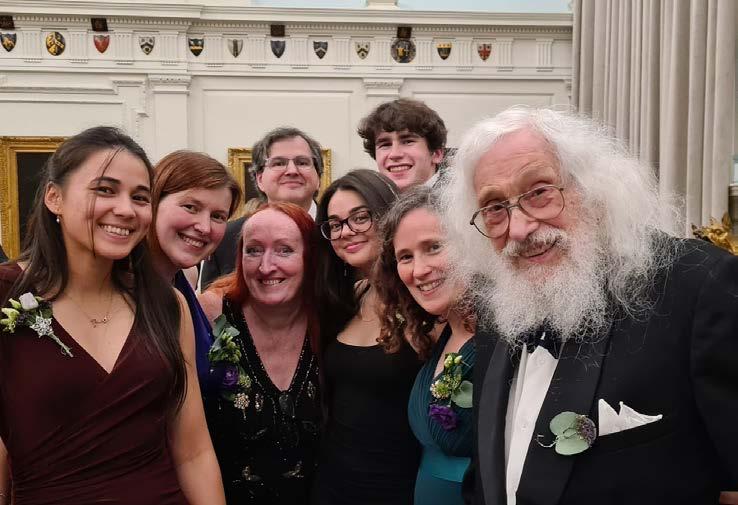
John Richard Abbott (Commoner with senior status 1965) was born in 1933, having humble beginnings in the East End of London. His father was a tailor’s under-presser and his mother loved to sing. John was evacuated when war broke out, age six. He was among the first pupils to take the eleven-plus and after the war attended Westminster City School, and sang as a chorister at St Margaret’s Westminster, allowing him, proudly, to take his mum to the wedding of Princess Elizabeth and Prince Philip. For National Service (1951-53) John served as an RAF engine mechanic,
but was not suited to military life, being, in his words, ‘a bolshy, scruffy object’.
Afterwards he worked for National Union of General and Municipal Workers, married the district secretary’s daughter, Brenda Cooper, and then ran the socialist Clarion Youth Hostel in Hertfordshire.
John began academic life in his thirties, attending Ruskin College, Oxford, before matriculating at Trinity in 1965, achieving a First in PPE in only two years. Although he looked like a hippy, his Ruskin tutor countered that ‘John came from a far
older tradition: that of the working class intellectual.’ John maintained a real affection for Trinity his whole life, and shared many stories of his time at college: singing in the choir; helping dig out the wine cellar; inadvertently getting drunk when the fruit punch was spiked; the Balliol lads stealing all the furniture from the Trinity common room (or was it the other way around?). Many stories centred on food and it was the magnificent food that brought him back to Trinity Weekends year after year, proudly accompanied by his children and grandchildren.
John lectured in Economics at Bradford University until retirement. A lifelong Vincent motorcycles enthusiast, he ran a popular vintage bike meet at Cadwell in the 1970s and ’80s, and continued riding and tinkering with his bikes well into his eighties. His greatest devotion, however, was for his five children, of whom he was immensely proud, from his marriage to Fran Healey.
John was a rare man, who lived life on his terms. He was unorthodox, anti-authoritarian, an independent thinker, but wholly grounded, openminded, and continuously willing to learn. He enjoyed life right to the end. Clover Walton, daughter
William Malcolm ‘Bill’ Gray (Commoner 1967) arrived at Trinity to read Physics, following schooling at Charterhouse and a year teaching English at Busoga College, Uganda.
At Trinity he continued his interest in sport and choral singing, captaining football and cricket teams and singing with Oxford Harmonic Choir.
After graduation, Bill taught physics for 14 years at Sevenoaks School, before moving to Brentwood School to head the physics department. He strived to make his teaching relevant and interesting and was continually searching for innovation in the department and its curriculum. His encouraging and chairmanly leadership style later led to his appointment as head of science, a post he held until his retirement.
Pupils fondly remember both his enthusiasm for physics and a challenging teaching style, which sought to get the best from each student. At Brentwood he served as football referee and coached U13 to U16 football and cricket teams and was a Duke of Edinburgh Awards assessor, often accompanied on expeditions by black Labrador, Tolly.
Bill’s other great love was music. He sang in choirs throughout his life and served as chairman of local choral societies. It was whilst singing for the Hutton & Shenfield Choral Society that he met Alison, mother to two Old Brentwoodians, who was to become his partner for the rest of his life.
On retirement they shared a love of music, choral singing, gardening, and campervan travel. They moved to Scotland to be near a cast of nephews and surrogate grandchildren, whose lives and progress he keenly followed, in particular their sporting and D of
E adventures. They remember Bill as a kind, conscientious and gentle man who perhaps cared more for others than he did for himself.
This was a man who trod lightly on the world but, in his own kind and gentle way, had an immensely positive impact on innumerable friends, family and perhaps above all, the pupils he taught with such care, grace and diligence, whether they recognised it or not.
Alison Harker, and Geoff and Peter Churn, stepsons
Professor Christopher John Hookway (Minor Scholar 1967) was born in Tonbridge in January 1949 and attended Chatham House Grammar School in Ramsgate. In coming to read PPE at Trinity, he became the first in his family to attend university.
While at Trinity he entered fully into college life, playing the saxophone and joining Paul Richardson in Garibaldi’s Band of Hope, a memorable Jug Band. Some contemporaries may be jogged into recalling the apt refrain of their most successful song:
Way up the Banbury Rd, those girls they are-so-sweet,
So pretty, so refined, you don’t meet girls like that on any-old street! He also co-founded the Guitar Society with Trinity friends, meeting his lifepartner Jo while playing guitar in a production of Archy and Mehitabel (1968). His musical enthusiasms also led him to write the score for Trinity
Players’ ‘Tis Pity She’s a Whore the next summer.
But his life was to be spectacularly defined by philosophy, on which he focused under the tutelage of Bede Rundle (Fellow 1963-2004) and Bill Newton-Smith (Balliol). Alan Thompson recalls talking through a cognac-aided night during which Chris expounded pragmatism—the seeds of ideas which grew mightily.
Following a BPhil at East Anglia, he was brought to Cambridge by Bernard Williams and was soon the William Stone Research Fellow at Peterhouse. The same gently mischievous perspective that enlightened his work kept spilling into his daily life. Paul Collier recalls walking round a Cambridge park as he remarked ‘we’re now walking through the view from my room.’
Cambridge was followed by a lectureship at the University of Birmingham. By 1992 he held its Chair and in 1995 was head-hunted by the University of Sheffield. By then he was an internationally esteemed scholar of pragmatism and American philosophy, publishing five books Peirce (1985); Quine: Language, Experience and Reality (1988); Scepticism (1990); Truth, Rationality, and Pragmatism: Themes for Peirce (2003); The Pragmatic Maxim: Essays on Peirce and Pragmatism (2012) —several edited books, and around 90 papers in journals and edited collections.
In addition to his own scholarship, he became editor of the European
Journal of Philosophy, president of the Aristotelian Society, the Mind Association, and the Charles S Peirce Society, and chair of the Analysis Trust. Alongside visiting positions with Harvard and Pittsburgh, he had a 25-year association with the University of Valencia, celebrated by a medal.
Despite this impressive workload, he entered fully into his new life in Sheffield, becoming hugely popular as a teacher, PhD supervisor, colleague and mentor. Nor did he use his acclaim to duck other responsibilities. He served as head of Department, and dean of the Faculty of Arts and Humanities. In recognition of his huge intellectual contribution, the Philosophy department of Sheffield University held an academic memorial lecture last June, sponsored by the Peirce Society.
At Trinity, he came to Gaudies and a Domus Dinner, but both visits and work were tragically curtailed when he contracted posterior cortical atrophy, through which his mind and memory gradually slipped away. For someone driven by the finest distinctions of analytic argument, the agony was all the more acute. He is survived by Jo.
Paul Collier (1967), Honorary Fellow
Anthony John Newsome (Minor Scholar 1967), who died in March 2025, was born a Shropshire lad in Bridgnorth in 1949. His parents moved to South Africa in 1955 and Anthony was educated at St John’s
College, Johannesburg, where Murray Biggs taught him English and introduced him to Eton College for four terms, from where he gained an exhibition to Trinity to read English. He made some of his most influential and enduring friendships at Trinity, for which he had great affection. He rowed for the college and enjoyed real tennis and rugby. He claimed that his years at Oxford were amongst the happiest of his life.
On graduation, he joined City stockbrokers Panmure Gordon, later joining Vickers da Costa as an equity analyst. He became head of Vickers’ Japanese research department before moving to Tokyo and, in 1978, negotiating the grant of a branch licence in Japan to Vickers—the first to go to a European stockbroking company—and was general manager of the Tokyo branch until 1980, when he moved to Hong Kong to become a director of Henderson Baring Management (later Baring International Investment Management).
In 1989, he joined Richard Carss (late of Templetons) and Jeremy Paulson-Ellis, his chairman at Vickers, to found Genesis Investment Management Ltd.
Anthony was very much a man of his time and, with success comes stress, which he largely coped with by smoking and unwinding with a drink. Frequent travel, seeking both investors and new companies for investment, was both fascinating and exhausting. By 2002 he had to take
early retirement, in Devon, enjoying boating, shooting in Scotland and skiing in Switzerland, but suffering from a general breakdown which resulted in his largely retiring from his active business life.
Anthony married Kit Higginbotham, FCO, in 1977; they have one son, Richard (2007).
Anthony was definitely a character, a one-off with temperament, audacity and ability and a huge sense of fun. He had a phenomenal memory and could recite Shakespeare, Yeats and Chaucer freely, particularly after a good dinner!
Kit Newsome, and Richard Newsome (2007)
Richard Stuart ‘Dick’ Goodall (Commoner 1969). ‘Always look on the bright side’ could have been coined for Dick Goodall. Dick, who died in April 2025, was a one-off, an entertainer who enthused himself by his performances as much as his audience. He studied Law but felt destined for the stage, starring in an epic open-air production of Dr Faustus, set in Worcester’s gardens.
Dick was for ever popping off to London’s West End to make contact with other actors and later would regale listeners with his encounter with Laurence Olivier, ‘the master’, as he put it. He travelled to America in search of fame but fell in with the dying remnants of the hippy trail in California, where by his own count he attended 134 concerts by his heroes the Grateful Dead, met Muhammed
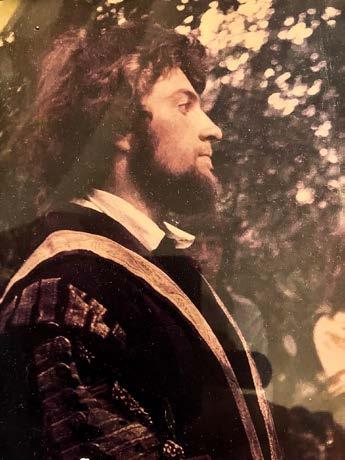
Dick Goodall in the 1971 production of Dr Faustus in Worcester College gardens
Ali at a baseball match and lived in a string of communes.
He returned to the UK, working as a lumberjack in Sherwood Forest, living an outdoor life as close to nature as he could achieve and, when not swapping kindling for coal with the local miners, fervently supporting his beloved Nottingham Forest. A few years ago at a Trinity Gaudy he extolled the virtues of human waste in horticulture and then presented each listener with a pot of his home-grown onion or tomato chutney. Some jars remain unopened to this day.
Eventually retiring after a long stint as a gas meter reader, a bequest by a lady whose garden he had tended for
many years freed him from financial worry.
Dick was a master storyteller whose account of a short excursion to buy a newspaper could keep his audience spellbound for an hour. Generations of children loved not only his stories but also that he was a dedicated fellow adventurer.
Dick was booked in for the 2025 gaudy but sadly was too frail to attend and died soon afterwards. His grave is surrounded by trees, and he was buried near Inkberrow, Worcestershire, by his friends, in the coffin he had made for himself. Charles Harvey, Luke Glass (both 1969) and Patrick Ovans (Worcester 1969)
Professor Hugh John Rhys Roberts (Open Scholar 1969), distinguished scholar of Middle East politics, who died in May 2025, was born in 1950 in Hull, though his father was Welsh, and his half-Irish mother was from Norfolk. The family settled in London and Hugh grew up in London and came to Trinity from St Paul’s School.
After graduating in PPE, Hugh taught English in rural Algeria and fell in love with a country, then at the forefront of revolutionary, anticapitalist tiers-mondisme. Back at Trinity, he wrote a DPhil (1980) in Oxford’s then-Faculty of Social Studies, on political development in Greater Kabylia, the mountainous, Berber-speaking region of Algeria on whose complex society and politics Hugh became particularly expert.
At Trinity, Hugh gravitated to the Labour right in the wake of Crosland and the Gaitskellites; in Algeria, friends thought him a ‘communist’ and worried he might be ‘found dead in a ravine one day.’ While he was a Marxist in his youth, he later described himself as a Social Democrat; but he subscribed to no orthodoxy, retaining an unplaceable independence of mind both politically and academically. After stints at SOAS and LSE, he moved to Cairo, writing incisively for the International Crisis Group on regional politics, Islamism, and popular protest, before taking up the prestigious Edward Keller chair in the study of North Africa and the Middle East at Tufts. Hugh returned to live in the UK shortly before his death.
Hugh’s forthright, forensic work focused on the inner logic of politics in military-ruled, authoritarian states. His critical, unsentimental clarity about the realities of power coexisted with a certain romanticism for antiimperialist, nationalist state-building; he was sceptical about the ‘Arab Spring’, and his opposition to EuroAmerican meddling in the Middle East made him impatient with movements to topple despots. Colleagues and students admired his ‘impressive intellect’, ‘very retentive memory’, and ‘strong views which had to be taken seriously’, especially when disagreeing with them. His articles on the Algerian crisis (which he was reluctant to call a civil war) of the 1990s, collected as The Battlefield: Algeria 1988-2002
(2003) remain indispensable, and his last monograph, Berber Government (2014) adds an impressive historical depth to an intricate political sociology. A brave, non-conformist thinker, he will be much missed.
Hugh remained closely connected to Trinity, attending events with great enthusiasm. He contributed an essay on his former tutor, the political historian Philip Williams, for the Newsletter (Autumn 2020). Hugh is survived by his partner, Elizabeth Liebson, his daughter, Leila Roberts (Wadham 2020), and former wife, Heba Saleh.
James McDougall, Fellow and Tutor in History
John Kenneth Holroyde (Scholar 1971) was born in Spalding, Lincolnshire. His father was a solicitor. He came up to Trinity from Oakham School to read Chemistry. Although only 17 at the time, he’d already worked at Boots research laboratories in Nottingham.
His tutor was James Lambert, one of the last of the college-resident bachelor dons. His fourth-year research project culminated in a published paper: ‘A Novel Metabolite from Cultures of the Fungus Marasmiellus ramealis’.
John’s social life centred on the Beer Cellar where he played darts, table football and pinball, often with a pint to hand. Out of College, he enjoyed
punting and casual football in The Parks.
After Trinity, it was perhaps inevitable that John would pursue a career in ‘big pharma’. He joined Allen & Hanbury’s research centre in Hertfordshire, where he worked on the development of the anti-ulcer medication Zantac. It’s also where he met his future wife, Denise.
In 1979, they both moved jobs to Pfizer at Sandwich, Kent, where John would spend the bulk of his career. He switched to the manufacturing side of the business and in due course was appointed production director.
After 30 years, Pfizer decided to wind down their operations at Sandwich. Denise was offered a senior post at Pfizer’s offices in Connecticut and they moved across ‘the pond’. John still worked occasionally for Pfizer as a consultant, which involved him in business trips to China and India, reviewing the company’s overseas operations.
He joined Old Lyme Country Club, to play golf and make new friends.
Upon retirement, he and Denise spent three months on a road trip travelling across as many US States as possible, from Connecticut to Oregon and back, including a cruise to Alaska. Over the course of their time in the US, they had visited 46 states.
On returning home, they settled in Leamington Spa, to be closer to family. Retirement was spent playing golf, watching cricket and football, and travel. Recent trips have covered
the Galapagos, New Zealand, Madagascar and the Arctic Circle.
Nothing was more important to John than family life. He was blessed with a long and happy marriage, three children and two grandchildren.
I was privileged to know him as a lifelong friend, my best man (as I was his), golf partner and sports enthusiast.
John Magiera (1971)
Richard Lawrence Nathan (Commoner 1971) was born near Leeds in April 1953, and educated at Pudsey Grammar School.
Edmund Lee (1971) writes, Richard seemed somehow more adult and formed than many of us, with his large head and shock of carrotcoloured hair. He read Philosophy and Theology—one felt that the academic study of theology challenged and rather eroded the Christian faith he’d grown up with.
He was an effective member of Trinity’s University Challenge team that reached the semi-final that year. He loved sport, especially cricket, with a passion, as well as music. He let me look after his very modern record collection (classical and jazz) when he went off on one of his world trips.
In Mumbai, we met up for the Jubilee Centenary Test match (1980) between India and England, which was turned round and won singlehandedly by Ian Botham. Richard also visited me in the Tuscan tourist village where I was working one summer. He later taught at a school in Zimbabwe,
making the most of the two hours of power each afternoon to listen to his favourite music. Eventually he dealt in antiques.
Richard was a questing soul, as shown by his travels throughout the world. Like many of us, he never quite seemed to find what he wanted; but he had a real capacity for friendship.
Richard Haigh (1971) writes, From around 1981 Richard was near me in the New York area. He did ‘odd jobs’ ‘helping folk’. We played much cricket together, drank more beer than we should and had a fantastic decade.
I moved to LA in 1990, but Richard got there first. He taught at the prestigious Windward School and memorably created a series of incredible evenings combining the food music and culture of a country in a unique way
Perhaps the happiest I ever saw him was when for five years we were able to take an American team to the Dubai Sevens. Richard selected the players and managed the team. Richard, rightly so, was very proud when we beat the French, among others, and reached the semi-finals.
In the early 2000s he moved to Santa Barbara to teach at Laguna Blanca, a private school with a strong reputation. Around 2012 he met Jo Rogers; eventually they became engaged with a plan to marry in Pudsey, but after Jo was diagnosed with a fast moving cancer they married with no guests in Vegas. After Jo’s death, Richard’s health problems
began. He returned to England, where he died in April 2025.
I know of no one on this earth who has anything other than praise for him; generous in every way, kind, caring and with a sharp wit. We followed each other around for 50 years and shared all the highs and lows. He cannot be replaced.
Ian de Watteville (Commoner 1972) died on 2 January 2025, aged 70. He Anthony was born in April 1954 and grew up as part of an army family, spending his early years in Germany, Cyprus, and the United Kingdom. These experiences shaped his lifelong interest in people, cultures, and travel. He was educated at Abberley Hall and then Charter House School, and studied Physics at Trinity.
Following his studies, Anthony went on to build an international career with Shell International, working in various roles around the world. His professional life reflected his curiosity, integrity, and commitment, qualities that were equally evident in his personal life.
Throughout his life, Anthony was known for his kindness, generosity, and gentlemanly nature. He had a deep love for his family and took great joy in sports and travelling, interests that remained important to him throughout his life.
Above all, Anthony will be remembered as a devoted husband and father. He leaves a lasting impact on all who knew him and will be
fondly remembered for his warmth, thoughtfulness, and the care he showed to others.
Denise de Watteville
Robert William Auld Kilpatrick (Commoner 1974) came to Trinity from Rugby School to read Classics, later changing to Law.
After Trinity he spent 12 years in human resource management, starting at Cable and Wireless, then progressing to executive HR roles with Smiths Medical Systems and the International Stock Exchange. From 1990, he was an executive search and selection professional and worked with some of the world’s most highly regarded businesses, recruiting talent across Europe and internationally in engineering, construction, manufacturing, pharmaceuticals and life sciences. He established his own company, Kilpatrick Ltd, in 1999
Robert died in July 2024, aged 67, survived by his wife, Hazel, and sons John and James.
David Courtney Boyle (Commoner 1977) and I became lifelong friends when we shared a set on Staircase 15. He worked, read novels, listened to Radio 4, committed time to a diary and offered provocative conversation. His interests became legion, and he was drawn to the unconventional. Studies concluded, he became a journalist on the Oxford Star, the beginning of a lifetime spent writing. Building Futures (1989) was the first of an oeuvre notable for diversity.
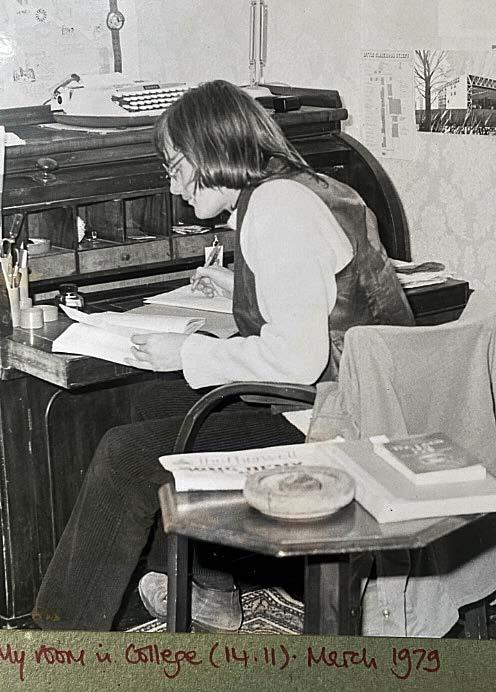
His Guardian obituary attested an energetic life eventually lived in the shadow of Parkinson’s disease. Speech became difficult and handwriting was compromised, but he worked on with support: his last letter insisted that he had no intention of stopping work. He had started a publishing business after moving out of London and remained determined to get new ideas into print.
David’s first engagement in politics, during the 1979 election, spawned an enduring advocacy of humanscale approaches to big problems. After winning a Winston Churchill Fellowship, he spent time in the USA looking at Time Banks—Funny Money was published in 1999. He became deeply involved in the New Economics
Foundation and derided the notion that good management could be reduced to metrics and targets (The Tyranny of Numbers, 2001). A tribute in Liberal Democrat Voice described him as ‘one of the foremost thinkers in the party’.
Although he’d read Philosophy and Theology at Trinity, David’s outlook on contemporary issues owed more to romanticism than it did to arid logic. He was affected by E F Schumacher’s Small is Beautiful, and in 2010 took his family to Massachusetts, to help save the Schumacher archive. There, with sons aged three and six, he and Sarah lived off-grid and used a local ‘currency’ based on vegetables— perhaps it is unsurprising, in retrospect, that he quoted Sir Gawain and the Green Knight when we shared rooms.
David’s values were rooted in a love of middle-class decency, tradition and history: they owed much to family. His paradigms were captured in narrative rather than principles and his funeral reflected this by including music from The Mikado and Salad Days.
At their wedding in 2003, Sarah spoke of one who ‘wakes up singing ditties…stands when he is thinking …talks in poems…knows people and understands dogs…and can move the way the world looks—like a kaleidoscope—so that it appears strange and new.’ To have known him was a privilege.
Stuart Williams (1977)
Dr Heather Mary Watkins (Commoner 1985) died in June 2024, after battling with an aggressive brain tumour for 18 months.
After leaving Oxford, Heather worked for the Department of Transport in London for a year before doing an MA in librarianship at the University of Sheffield. She returned to her home town of Derby and after working for the local college became the circulation manager at Loughborough University library. After that she became Art and Design librarian at the University of Derby. In 2008 she decided to return to academia and did an MA in International Relations at the University of Nottingham. This lead on to her doing a PhD entitled ‘A new Collective Politics? The potential and constraints of local participation and the concept of social capital’. She retired early due to ill health at the end of 2022 from her position as Senior Lecturer at Nottingham Trent University. She continued her research and even attended a workshop in Ljubljana, Slovenia a few weeks before her death.
Heather had a lifelong interest in the arts: dance, music, film and painting. She attended a dance class that she started while at school until she was no longer able to. She even joined a choir during her illness. She also had a great love of the outdoors and nature. Hillwalking was a favourite hobby
and despite living in Derby, she had a particular love of the coast and the sea. The last holiday we had before her illness was to the Scottish island of Stronsay, which she absolutely adored. Colin Bodley, husband
David James Yeoward (Commoner 1985) (‘Dai’ to his family) studied at Wrekin College before coming to Trinity to read Modern History. He was a gifted writer and historian, combining a particular interest in early English saints with a lifelong admiration for the novels of Anthony Trollope. He was elected JCR President, and—a natural comic actor with a fine singing voice— became a leading light in college amateur dramatics, and, indeed, more generally. His charisma and extraordinary charm won him friends and occasional official reprimands across the University.
After graduation he stayed in Oxford and qualified as a chartered accountant, working in audit, corporate finance and tax before moving into business development as Bid Director for Andersen in the UK. As a local councillor he stood as a parliamentary candidate for the Lib Dems in Milton Keynes North East in the 2001 General Election, polling respectably behind the Labour incumbent. His loss was private enterprise’s gain. In 2007 he cofounded Never Second, an extremely successful company providing business development support and bid training across the UK and Europe.
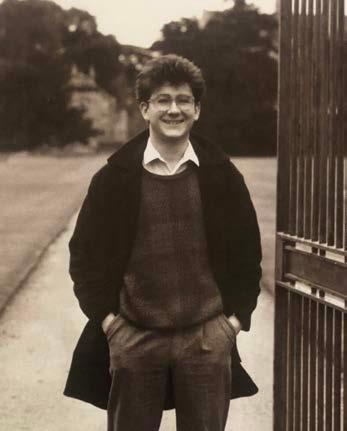
As the company flourished so too did David’s life and ever-widening circle of friends and admirers. In the run-up to Brexit he left the UK for Malta where he lived with his long-term partner Pär; they married in 2023. David died in October 2024, survived by Pär, and by his mother, Caroline, stepfather, David Dickinson (Commoner 1955), and one of his three brothers. A moving memorial service was held for him in College on 17 January 2025 and a commemorative rose (‘Malvern Hills’) has been planted in Garden Quad, close to Staircase 16. John Drew (1985)
Information for Old Members on Degree Days, dining on High Table, having Lunch in Hall, and staying in or visiting college, is available on the website, www.trinity.ox.ac.uk/old-members, or by telephone, 01865 279933.
Editor’s note
The Trinity College Report is edited by Thomas Knollys, the college’s Alumni Relations Officer.
The editor welcomes feedback, and can be contacted by post or email: report@trinity.ox.ac.uk. He is grateful to his colleagues, and especially to Clare Hopkins, Archivist, Michael Belcher, Head of Communications, and the Alumni & Development team, for their help and advice in producing this edition, and to all who contributed reports, images and obituaries.
The next edition of the Report will cover the academic year 2025-26. Offers to contribute obituaries of Old Members (up to 300 words) should be sent to report@trinity.ox.ac.uk.
Trinity College Oxford OX1 3BH
Porters Lodge
+44 (0)1865 279900
Alumni & Development Office +44 (0)1865 279933 alumni@trinity.ox.ac.uk development@trinity.ox.ac.uk
Conference & Events Office (to hold events in College)
+44 (0)1865 279888 conference@trinity.ox.ac.uk
www.trinity.ox.ac.uk