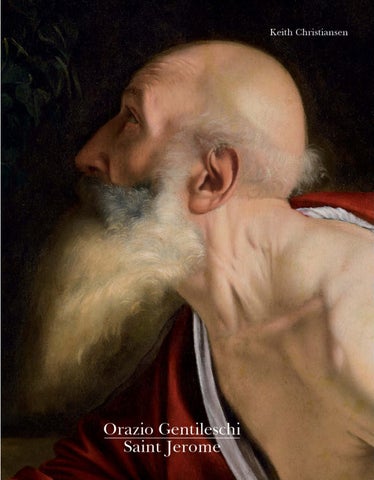
Keith Christiansen
![]()

Keith Christiansen


Ferdinando Corberi
Orazio Gentileschi. Saint Jerome p. 8
"Dipingere dal naturale": Orazio Gentileschi's Saint Jerome Keith Christiansen p. 12
Saint Jerome
oil on canvas, 127 x 112 cm
Provenance: private collection, Milan, 1943; with Carlo Orsi Milan, 2003; Koelliker collection, Milan, 2003; private collection.
Exhibited:
Sydney, Art Gallery of New South Wales, 29 November 2003 – 22 February 2004, and Melbourne, National Gallery of Victoria, 11 March – 30 May 2004, Darkness and light: Caravaggio and his world, cat. no. 27; Milan, Galleria Carlo Orsi, 18 November – 10 December 2004, Orazio Gentileschi. San Gerolamo; Genoa, Galleria Nazionale di Palazzo Spinola, 14 July – 18 September 2005, Orazio Gentileschi e Pietro Molli; Barcelona, Museu Nacional d’Art de Catalunya, 10 October 2005 – 15 January 2006, Caravaggio y la pintura realista europea, cat. no. 34; Ariccia, Palazzo Chigi, 13 October 2006 – 11 February 2007, La “schola” del Caravaggio. Dipinti della Collezione Koelliker, cat. no. 30; Naples, Capodimonte, 24 October 2007 – 20 January 2008, Omaggio a Capodimonte. Da Caravaggio a Picasso, cat. no. 29; Turin, Ersel, RED. Il rosso da Orazio Gentileschi a Andy Warhol, 4 – 31 May 2018 (with no catalogue number); Turin, Musei Reali di Torino, Sale Chiablese, 22 November 2025 – 3 May 2026, Orazio Gentileschi. Un pittore in viaggio, cat. no. IV.15.
Sources and Literature: Archivio di Stato di Roma, Archivio del Tribunale Criminale del Governatore di Roma, atti del processo 104, anno 1612, fols 395, 395v, 421, 426, 433; R. Longhi, “Ultimi studi su Caravaggio e la sua cerchia”, Proporzioni, I, 1943, p. 22, reproduced fig. 40 (as private collection, Milan). Republished in R. Longhi, Studi caravaggeschi, I, 1943-1968, Florence 1999, p. 18, reproduced pl. 37; U. Galetti, E. Camesasca, Enciclopedia della pittura italiana, Milan 1950, vol. I, p. 1062; A. Emiliani, “Orazio Gentileschi: nuove proposte per il viaggio marchigiano”, Paragone, 9.1958, 103, p. 44; A. Moir, The Italian Followers of Caravaggio, Cambridge (Massachusetts) 1967, vol. I, pp. 70-1, vol. II, pp. 17, 77; L. Mallé, Palazzo Madama in Torino, vol. II (Le collezioni d’arte), Turin 1970, p. 72; R. Ward Bissell, “Orazio Gentileschi: Baroque without rhetoric”, The Art Quarterly, vol. XXXIV,
no. 3, 1971, p. 296 note 43 (erroneously identified as the version bought by the Museo Civico in Turin in 1967);
R. Ward Bissell Orazio Gentileschi and the Poetic Tradition in Caravaggesque Painting, University Park and London 1981, cat. no. 22, pp. 23-26, 65, 72, 151-2, 163, 172, 206, 230, reproduced fig. 40 (as whereabouts unknown);
K. Christiansen, in K. Christiansen, J. Mann (eds), Orazio and Artemisia Gentileschi, exh. cat., New York 2001, pp. 94, 96 note 6 (Italian ed.: Orazio e Artemisia Gentileschi, Milan 2001, pp. 94, 96 note 6);
S. Benedetti, in Darkness and light: Caravaggio and his world, exh. cat., Sydney and Melbourne 2003, cat. no. 27, p. 132;
K. Christiansen, “Dipignere con avere gli oggetti naturali davanti” in K. Christiansen, M. Gregori, Orazio Gentileschi. San Gerolamo, exh. cat., Milan 2003, pp. 9-12 (republished in Orazio Gentileschi. San Gerolamo, collezione Koelliker, Milan 2004, pp. 11-14);
F. Corberi, in K. Christiansen, M. Gregori, Orazio Gentileschi. San Gerolamo, exh. cat., Milan 2003, pp. 14-23 (republished in Orazio Gentileschi. San Gerolamo, collezione Koelliker, Milan 2004, pp. 16-25);
M. Gregori, “Gentileschi e Caravaggio: comuni idee e differenze artistiche”, in K. Christiansen, M. Gregori, Orazio Gentileschi. San Gerolamo, exh. cat., Milan 2003, pp. 3-8 (republished in Orazio Gentileschi. San Gerolamo, collezione Koelliker, Milan 2004, pp. 5-10); K. Christiansen, “Becoming Artemisia: Afterthoughts on the Gentileschi Exhibition”, in Metropolitan Museum Journal, vol. 39, 2004, pp. 105, 122 note 12, reproduced figs 8-9; B. Ferriani, “Il restauro”, in Orazio Gentileschi. San Gerolamo, collezione Koelliker, Milan 2004, pp. 27-31;
C. Arnaldi di Balme, “San Gerolamo”, in F. Simonetti (ed.), Orazio Gentileschi e Pietro Molli, exh. cat., Genoa 2005, p. 31; D. Cafferata, S. Romagnoli, “Indagini riflettografiche e studi sul profilo di Pietro Molli nei due dipinti raffiguranti San Gerolamo e nel Sacrificio di Isacco”, in F. Simonetti (ed.), Orazio Gentileschi e Pietro Molli, exh. cat., Genoa 2005, pp. 47-49; F. Corberi, “San Gerolamo”, in F. Simonetti (ed.), Orazio Gentileschi e Pietro Molli, exh. cat., Genoa 2005, pp. 27-29; M. Gregori, in Caravaggio y la pintura realista europea, exh. cat., Barcelona 2005, cat. no. 34, pp. 162-167; M.A. Lazzari, “Molli fantasma, ovvero il modello occultato”, in F. Simonetti (ed.),
Orazio Gentileschi e Pietro Molli, exh. cat., Genoa 2005, p. 52; F. Simonetti, “Orazio Gentileschi e Pietro Molli”, in F. Simonetti (ed.), Orazio Gentileschi e Pietro Molli, exh. cat., Genoa 2005, pp. 7-14; R. Ward Bissell, in P. Carofano (ed.), Luce e ombra. Caravaggismo e naturalismo nella pittura toscana del Seicento, exh. cat., Pisa 2005, under cat. 44, pp. 122, reproduced fig. 1, 125, 127 note 17; G. Zanelli, “Sacrificio di Isacco”, in F. Simonetti (ed.), Orazio Gentileschi e Pietro Molli, exh. cat., Genoa 2005, p. 42; G. Papi, in G. Papi (ed.), La “schola” del Caravaggio. Dipinti della Collezione Koelliker exh. cat., Milan 2006, cat. no. 30, pp. 120-123; K. Christiansen, “Orazio Gentileschi”, in A. Zuccari (ed.), I Caravaggeschi. Percorsi e protagonisti, vol. II, Milan 2010, pp. 421, 433 note 3; V. Pacelli, G. Porzio, “La ‘schola’ del Caravaggio ad Ariccia”, Studi di storia dell’arte, vol. 17, 2006, p. 256; A. Orlando, in N. Spinosa (ed.), Omaggio a Capodimonte. Da Caravaggio a Picasso, exh. cat., Naples 2007, cat. no. 29, pp. 76-77; K. Christiansen, “Painting from life. Valentin and the Legacy of Caravaggio”, in K. Christiansen, A. Lemoine (eds), Valentin de Boulogne. Beyond Caravaggio, exh. cat., New York 2016, p. 47; M. Tazartes, Orazio Gentileschi. “Astratto e superbo toscano”, Florence 2016, pp. 38-40, reproduced pl. IV; M.C. Terzaghi, in F. Cappelletti, P. Curie, M.C. Terzaghi (eds), Caravage à Rome, amis et ennemis, exh. cat., Bruxelles 2018, p. 145; R. Morselli, “Opere multiple. La pratica della serialità nell’impresa dei Gentileschi”, in A.M. Ambrosini Massari, A. Delpriori, La luce e i silenzi. Orazio Gentileschi e la pittura caravaggesca nelle Marche del Seicento, exh. cat., Ancona 2019, p. 287; A. Orlando, in C. D’Orazio (ed.), Artemisia. Coraggio e passione, exh. cat., Milano 2023, under cat. no. 37, p. 184; C. Arnaldi di Balme, in A. Bava, G. Spione (eds), Orazio Gentileschi. Un pittore in viaggio, exh. cat., Milan 2025, p. 132 under cat. no. IV.14; C. Christiansen in A. Bava, G. Spione (eds), Orazio Gentileschi. Un pittore in viaggio, exh. cat., Milan 2025, p. 21; G. Zanelli, in A. Bava, G. Spione (eds), Orazio Gentileschi. Un pittore in viaggio, exh. cat., Milan 2025, pp. 132-134. (FC)


Christiansen
Orazio Gentileschi's Saint Jerome
Surely one of the most improbable as well as consequential transformations of a painter in the history of art was that of Orazio Gentileschi. He was already in his late thirties when he abandoned his established practice as a moderately successful master of a late Renaissance, academic style associated with the vast, decorative projects in the Vatican Library and the great basilicas in Rome sponsored by popes Sixtus V (r. 1585-90) and Clement VIII (r. 1592-1605), and re-fashioned himself as an ardent admirer and colleague of Caravaggio. This meant setting himself at odds with the reigning, idealist traditions that had underpinned the art of Raphael and Michelangelo and that continued to inform the work of Annibale Carracci, Guido Reni and Domenichino. Instead, he embraced the great Lombard artist’s polemical practice of painting directly from a posed model (“dal naturale”), the objective of which was to achieve a compelling effect of physical immediacy and verity. It was an approach that struck contemporaries as completely novel. Writing in 1603, Karl van Mander was only the first to register astonishment that Caravaggio “will not do a single brushstroke without close study from life which he copies and paints”.1 Yet unlike the younger generation of artists who, born in the 1590s, poured into Rome from all over Europe, enthusiastically taking up Caravaggio’s practice before returning home to create a pan-European movement, Orazio went on to create a highly original, post-caravaggesque style of exceptional refinement, perhaps best epitomized by the sublime Annunciation (Galleria Sabauda, Turin, fig. 1) that in 1623 he sent to Carlo Emanuele I, Duca di Savoia, or the courtly Finding of Moses (Museo del Prado, Madrid) that, while in London working for the queen, he gifted to Philip IV of Spain a decade later in an effort to solicit a position at the Spanish royal court. It was a trajectory that can be read not only in his art but in his sense of identity, place and

culture and it inscribed an itinerary that took him from the rough and tumble populist quarter of via del Babuino in Rome, where Orazio and his family lived from 1599 to 1611, to quarters in the palace of his major Roman patron, Paolo Savelli, to Genoa, where, accompanied by his three sons, he worked for the great families of the maritime republic, including the Doria, and on to the royal courts of Paris and London, where he found favor with Marie de’ Medici and the young Queen Henrietta Maria. Along the way he left masterpieces that elicit constant surprise for their ever evolving combination of formal inventiveness, coloristic brilliance, and, most singularly, their exploration of the varied effects of light, which play over the forms rather than merely illuminating them, thereby creating a mood of heightened sensibility. Writing about the Turin Annunciation in his groundbreaking article of 1916, Roberto Longhi identified Orazio’s exploration of light and color as his most original contribution to Italian art, pointedly describing its character and quality as seen in the Annunciation:
"The light is more delicate and authentic, richer in the transitions of scaled luminosity and transparencies. That transformation of an interior into a lucid pictorial vessel that gives form and color, substance and surface – the process that would be brought to the most ineffable refinements by Pieter de Hooch and Johannes Vermeer – finds in Orazio the Italian intermediary between the proud and surly Caravaggio and polished and bourgeois Holland."2
In another passage, Longhi further elaborated on the character of Orazio’s post-Roman paintings and their contribution to European art through the artist’s mastery of light and color, noting that:
“the stylistic framework, the artistic connection was established not by the juxtaposition of chromatic areas, as with the Venetians of the early sixteenth century, but by scaled relationships of quantities of luminosity in the colors; quantities that, precisely because they are scaled, become qualities of art: values.”3
Already in the late 1590s Orazio must have seen examples of Caravaggio’s early Roman work, for pictures such as The Cardsharps (Kimbell Art Museum, Fort Worth) and The Fortune Teller (Musei Capitolini, Rome) quickly became a lively topic of discussion in the workshops of Rome and could, moreover, be

seen for sale among the second-hand dealers – the rigattieri – of the city. Indeed, both paintings were acquired by Cardinal Francesco Maria Del Monte from just such a dealer, Costantino Spada.4 Yet there can be little doubt that the unveiling of Caravaggio’s first public commission in Rome in the summer of 1600 – the Calling and Martyrdom of Saint Matthew in the church of San Luigi dei Francesi – provided an even more powerful catalyst for change. In them, Caravaggio openly challenged prevailing critical norms by representing multifigure, complex narrative subjects from the distant past as unfolding, contemporary dramas incorporating figures painted from posed models dramatically illuminated by a focused, pre-cinematic light.5 In the view of the always perspicacious medical doctor and critic, Giulio Mancini, who knew and admired the artist, Caravaggio’s works were:
“illuminated by a single beam of light coming from above without reflections, as would occur in a room with a single window and the walls painted black, and thus, having the lit areas very bright and the shadows very dark, they give the painting a quality of relief, but in a way that is neither natural nor done nor imagined in another century or by earlier painters.”6
We must imagine Orazio among the crowd of painters, art lovers and the merely curious who flocked to the French national church to see what many in the art establishment considered to be an attack on the exalted legacy of Raphael and Michelangelo. There were those who, like Federico Zuccari, the founder and first principe of the Accademia di San Luca, attempted to deflect attention by denying the novelty of the paintings. “What’s all this noise about?” Zuccaro famously exclaimed (according to Baglione’s eye-witness account), “I see nothing beyond the conception Giorgione had in the scene of the Saint, when Christ called him to the Apostolate; and sneering and marveling at such a commotion, he turned his back and took his leave.”7 Writing later in the century, Giovan Pietro Bellori – the uncompromising promoter of an idealist aesthetic – appreciated the futility of shrugging off the innovation of Caravaggio’s work, yet lamented that:
“At that time the painters in Rome were taken by the novelty, and especially the young ones followed him


and celebrated him alone as the sole imitator of nature, and admiring his works as miracles they competed in imitating him, stripping their models and raising the lights; and without any longer paying attention to study and teachings, each one easily found in the streets and piazzas their master and exemplar for copying from life.”8
Alas, we have no recorded pronouncement from Gentileschi, though his art makes clear his position. From his testimony at a libel suit initiated by Giovanni Baglione in 1603, we learn that Orazio had befriended Caravaggio and that although he had not spoken with him in about six months, he had even shared studio props: “I lent him a Capuchin habit and a pair of wings, and it must be ten days ago that he returned the habit”.9 These are likely the same props that the artist himself employed in his painting of the Ecstasy of Saint Francis (fig. 2) in the Boston Museum of Fine Arts, a work that dates to around 1600 – perhaps even a year or two earlier. In that picture he makes one of his first, albeit somewhat tentative and awkward, exploratory experiments with the new practice, while at the same time attempting to retain a vestige of elegance in the pose and aspect of the angel. In three further iterations of the same theme we can trace the stages by which, over the next decade, Orazio shed the reformed maniera style that had earned him his reputation and, mastering the strong, contrasting modeling and assertive realism we associate with Caravaggio, went on to begin exploring what would become that novel poetics emphasizing formal structure and light that Longhi associated with what he termed “pittura di valori”. In each of these works (Museum of Fine Arts, Houston; Museo del Prado, Madrid; and the Gallerie Nazionale d’Arte Antica, Palazzo Barberini, Rome), the same props – a pair of raptor wings and a capuchin habit with frayed sleeves – were employed.10
More than any other painting, the ex-Koelliker Saint Jerome that is the subject of this essay is key to any discussion of Orazio’s immersion in Caravaggio’s art. Perhaps in only one or two other works was he as assertive and radical in his embrace of the Caravaggesque practice of “dipingere dal naturale” that involved painting directly from a model who, provided with costume and props, repeatedly assumed the same pose over an extended period of time, the results of which the artist fully understood would undercut the artistic fiction deemed necessary in depicting a revered figure from the distant past. Longhi, who first published the picture in 1943, surmised that,
Fig. 2 (opposite): Orazio Gentileschi, Ecstasy of Saint Francis, Boston, Boston Museum of Fine Arts
“only after the news of Caravaggio’s death [in July 1610], did Gentileschi dare to produce a series [of canvases] so directly inspired by the master’s most mature ‘luminism’. For example, in this ‘Penitent Saint Jerome’….” 11 Seated in a barren, grotto-like setting, his upper torso bared, his gaze directed heavenwards, the great fourth-century translator of the Hebrew Bible into Latin is depicted as a penitent in the wilderness, reflecting on mortality and the vanity of worldly things. His cardinal’s robe is wrapped around him, leaving exposed the white flesh of his left shoulder and chest (although Jerome was not a cardinal, he is traditionally depicted as one to signify his exalted position as one of the four Fathers of the Church). Two vellum-bound books lie discarded on a boulder while with his left hand he firmly grasps the cranium of a skull. It is easy to see that the skull, like the squared boulder on which Jerome rests his right arm, was provided to enable the seated model to hold his position over an extended period while being painted. No less clearly, the books have been painted over the hem of the garment as an iconographic embellishment. As Longhi noted, Orazio has conferred on the handsome visage of the aged figure distinctly portrait-like features as well as hands tanned by exposure to the sun, thereby conflating the historical past with the lived-in present and polemically asserting painting as the transcription of reality: an aesthetic of verità rather than verisimilitudine. 12 What makes this picture key to our understanding of what painting from life – “dipingere dal naturale” – entailed is the fact that we can identify the person who posed for the picture and read of his firsthand experience of doing so. He was a seventy-two-year-old pilgrim from Palermo named Giovanni Pietro Molli. Prior to August 1611, he had lived in Rome for a year and half, returning to the papal city again on March 19, 1612, following a seven-month sojourn in Naples. This information comes not from Orazio’s biographers and critics, nor from a contract or payment, but from the testimony of witnesses at the trial held at the Corte Savella in Rome in July and September/October of 1612 regarding the rape (“stupro”) of Orazio’s daughter Artemisia by a former colleague, Agostino Tassi, in March of the preceding year.
As part of the court’s attempt to establish the credibility of Orazio’s accusations against those who testified on Tassi’s behalf, neighbors and associates as well as models and patrons who had had dealings with Orazio during 1611 were questioned about his activities, the comings and goings of visitors as well as the guardianship and behavior of his brilliantly gifted daughter, whose besmirched reputation risked derailing her promising
career. From these witnesses we learn the names and occupations of several of the artist’s models, most of whom seem to have come from the neighborhood and to have had regular dealings with the artist.13 There was Costanza, the wife of Onofrio Ceuli, Orazio’s tailor. She had sometimes taken her children to his house on present-day via del Babuino (via dei Greci) so that he could draw them (“agli Greci che ce menai gli putti a retrahere.”14). That would have been before February 1611, by which time (and possibly months earlier) Orazio had moved his family to via Margutta. When, in April, he moved again to via della Croce, Costanza was his neighbor and from her window she could observe the comings and goings of his household. Again, she remarks that she had taken her children to the house so he could portray them (“ce menai gli putti a ritrahere”). From her visits to his via Margutta address, his longtime laundress Margherita was able to identify several models. There was Francesco Scarpellino (described by another witness as “a brute with long black hair” – a description suggestive of the model for Orazio’s Executioner with the head of John the Baptist in the Museo del Prado); a guardian of the Tiber port of Ripa Grande named Pasquino Fiorentino; Orazio’s barber of almost twenty years, Bernardino Franchi; and the old pilgrim Giovanni Pietro Molli. According to Margherita, Orazio kept the doors to his studio closed when painting but was eager to show how faithful he was in rendering his models’ features (“in casa sua ho visto praticare li supradetti che lui li ritraheva in camera che non si poteva vedere, ma mi mostrava bene li quadri che lui faceva e similitudine di costoro”). Of those who testified, Orazio’s barber was unquestionably the most observant. He often visited the house on via Margutta not only in his professional capacity but also to model for the artist:
“I have been in that house that I told you about […] in via Margutta many times, and according to my judgment and from what I can remember it must be about sixty times on various occasions that every week I went there two or three times and some weeks I stayed in that house two or three whole days at a time, and when I went there it was to trim the beard of said signore Orazio, to cut the hair of his sons, to draw blood from his daughter and because he sought me as a model, that is, to portray.”15
When modeling, he went four or five times a day (“ci sono stato quattro et cinque volte il giorno perché lui più volte si è servito di me per modello.”16).
Franchi proved to be an exceptionally acute observer. Of an apprentice who was learning to draw he noticed how he bent over (“quando designava lo vedevo star basso con la testa”17). He was no less attentive to the works of art in Orazio’s studio and to the presence of potential buyers (“forsi alle volte ho visto qualcun che veniva per vedere quadri che non so chi siano quali parlavano con lui e se ne andavano via”18). Among these was the merchant/ banker Settimo Olgiati, for whose chapel in Santa Maria della Pace Orazio had painted a Baptism of Christ, as well as some Theatine priests. It is from Franchi’s testimony that we also learn that Orazio painted small scale works on alabaster – a notice that has now been confirmed by the discovery of several such paintings of exquisite quality.19 We might well wonder whether, perhaps, Franchi had an occasional sideline dealing in paintings. It would not be surprising, for the Roman art market involved a far broader spectrum of the population than was known even forty years ago.20 From another source we know that Orazio invited a dealer in pigments on via del Corso, Alessandro Bertucci of Bologna, to see some pictures, and surely this must have been with a view to selling. And then, there was Giovanni Pietro Molli himself. Having returned to Rome as the trial got underway, he was enlisted as a witness on behalf of the Gentileschi. According to his own testimony he was employed modeling for a Saint Jerome during the crucial time that Orazio moved from via del Babuino to via Margutta. Franchi’s description of Molli leaves no doubt about the identity of the painting for which he posed:
“[…] for more than a month, as many times as I went to the house during the week, I saw an old man in pilgrim’s cloths, and he is a big man rather than otherwise and dressed as a pilgrim, as I said; a good-looking man with a face like a Saint Paul, bald-headed, all grey, with a beautiful [round] beard, that is full on the cheeks as in the beard itself, and the said Orazio kept this pilgrim to portray as a Saint Jerome in a painting that portrayed him full figure, and many times he had him undress and he also employed him for other things, as well as for heads, and for this purpose the aforementioned pilgrim came[…]”21
Molli’s testimony includes a unique, firsthand account of the laborious process involved in posing over an extended period.
“In response to Your Lordship’s question, I can tell you that this past year during the period of Lent, that is, this Lent
that has just passed a year ago, the painter Orazio Gentileschi employed [me]… to portray a head similar [to mine]…, [for] some paintings that he was making, and… [for] a full-length Saint Jerome; he had me undress from the waist up to make a Saint Jerome similar to me and for this purpose I stayed home throughout Lent, since three or four days a week I always had to go to his house and on some days that I went there I stayed from morning to evening and ate and drank in his house and he paid me for my days but I returned to my house to sleep.”22
There could hardly be a clearer explanation of what painting “dal naturale” entailed. What is less certain is whether the picture in question was painted during Lent of 1610, as Franchi recalled – that would mean between February 28 and April 14 – or, as Molli testified, in Lent of 1611, which ran from February 16 to April 2. According to Molli’s testimony, it was during the period in which he posed that Orazio and his family – his three sons, Artemisia, and a nephew – moved from their quarters on present day via del Babuino, near the church of San Giorgio de’ Greci, where they are documented in March 1610, to a larger dwelling on via Margutta, where they are first documented in February 1611. Unfortunately this leaves a frustrating ten month gap during which the move could have taken place.
Despite how vivid the experience of posing remained in Molli’s mind when he first testified in September, a month later, when he again took the stand, he had difficulties recalling the layout of the rooms in the via Margutta house in which he supposedly had posed, calling into question his recollection of the time frame that was crucial to the interrogation. When pressed further for particulars, the old pilgrim broke down, pleading that he be allowed to confess and take communion because he was not feeling well (“Fatemi confessare e comunicare perché io sento che vengo meno e non posso star più qua”).
What with the conflicting motives of the witnesses, the strikingly authentic character of their voices and their vivid personalities, the trial creates a compelling courtroom docudrama. We learn, for example, that Molli, newly returned to Rome, had appeared in court at the behest of Orazio, and it is difficult to resist the suspicion that perhaps the events he recounted had been rehearsed in preparation for his testimony, which was crucial to the discrediting of the damaging account given by a witness for Tassi, Nicolò Bedino, whose testimony proved to be completely false. If Molli’s account had been rehearsed, it would help explain why the old pilgrim, feeling under
attack, later broke down under pressure and had difficulties repeating the detailed description he had given a month earlier.
Just as the trial of Fabrizio Valguarnera – the diamond thief turned picture dealer – gives us a unique insight into the Roman art market in 1631, so Molli’s testimony provides an intimate window onto Caravaggesque practice in the first decade of the century by recording the experience of those who posed as models.23
What we can say with confidence is that the years 1609-1611 mark Orazio’s uncompromisingly committed adherence to the practice of painting “dal naturale”, resulting in an undiluted naturalism, the bold frankness of which can still astonish.24 Not only did the pictures Orazio painted at the end of the decade make an enormous impression on both his clients and other, younger artists, they formed the basis for the training of his daughter, whence the occasional confusion over the attribution of a small group of paintings, most signally (to my mind) the extraordinary Cleopatra (fig. 3) – a kind of seicento Courbet – for which, shockingly, Artemisia herself may have been the model.25 However, the picture that is most relevant to our critical understanding of the Saint Jerome is a virtually contemporary Madonna and Child (fig. 4) in the Muzeul Naţional de Artă in Bucharest. That the picture depicts what is traditionally known as a Madonna lactans – the Virgin Mary nursing her child – and not, as one might at first glance think, merely a genre painting of a mother and her infant, is indicted by the red color of her dress and the blue cloak she wears, since these are the colors traditionally associated with the Madonna. Her plain garments are otherwise those typical of peasants and members of the artisanal class. There is neither a halo nor golden radiance to indicate the figure’s divine status and she conspicuously lacks the beautiful features normally thought de rigueur with representations of the young Virgin. To the contrary, her plain countenance, the long, practical braids piled on her head and her broad-shouldered, robust physique indicate someone habituated to domestic hard work. She sits on the kind of plain, low chair that must have furnished many simple homes, and a leg is propped up so as to support her naked child, who, wideeyed, engages her gaze while she suckles him with a swollen breast that she carefully positions with one hand. As with the Saint Jerome, Gentileschi shows her at close quarters, cutting her below her projecting knee. We need only compare the Bucharest picture with one done only a year or two earlier –formerly in the Alana collection and now a promised gift to the Metropolitan Museum – and the magnificent Madonna and Child in the Harvard Art Museums, which must date to a few years later, to appreciate Orazio’s radical

insistence of painting the two figures – mother and nursing child – “dal naturale”, with little accommodation to conventional expectations.26 As I wrote in 2001, “Orazio transforms the grand artifice of Raphael’s Madonna della Sedia (Palazzo Pitti, Florence) into a veristic scene of homely domesticity. Even Caravaggio, in his early Fortune-Teller […] and Penitent Magdalene […] –those works that Giovanni Battista Agucchi, the early proponent of classicism, saw as a refutation of high art – did not go as far as Orazio in asserting the ordinariness of experience over the imperatives of style.”27
Despite, or because of, its singularity, the picture seems to have impressed contemporaries, for as is the case with the Saint Jerome, there was a demand for further versions. Concerning one of these, we have a revealing contemporary record. On 24 October 1609 Bartolomeo Pellini, an agent employed on behalf of the duke of Mantua, wrote to Giovanni Magni, the secretary of Vincenzo Gonzaga, regarding a picture that the duke had commissioned from Orazio and about which he was clearly anxious. Pellini’s report gives a clear idea of the powerful impact the unfinished picture made on him.
“Gentileschi is in fact progressing, for four days ago he came to invite me to go and see the painting he is doing at Your

Lordship’s request, which is almost completely finished, and in my poor judgment it will be a very rare thing and certainly worthy of any great Prince. It is a Madonna seated with the child on her lap, naked except for a swaddling cloth that covers his body a little, and […] both look at each other with great affection even though the child is no more than a month old, but natural and well-made. The Madonna is dressed in yellow with a blue cloak that, although she lets it drop to the ground, nevertheless makes a beautiful effect and embellishment. She has a very beautiful face without any ornamentation on her head other than a diadem, and her shoulders are uncovered and bare, so that one can see her natural beauty. Nor does anything displease me about this painting except that it is very small […] and thus difficult to fully take in the stature of the figure, which is large rather than of medium size. In short, one sees that naturalism is a very good thing. I have not attempted to show it to any painter so as to obtain their professional judgment because it is not completely finished, but I will do so in order to be able to write your Lordship better and with more finality. 28
Interestingly, in a further notice written in February 1610, we learn that when the picture was returned to the artist for some adjustments, there was a fear that it might be substituted with a copy.29 Such was the risk encountered on the Roman art market. Importantly for us, apart from a few details –including, notably, the mention of a diadem (perhaps an indication of a halo rather than a crown) and the comment on the Madonna’s beautiful face –Pellini’s description could as easily apply to the Bucharest picture, the reverse of which, in fact, bears the date 1609. As for the plainness of the models, we are reminded that Orazio’s neighbor, Costanza Ceuli, testified that when the artist lived on via del Babuino she had brought her children to be drawn, and that after he moved to via della Croce in 1611, she was again asked to bring her newborn (“il mio parto”30) as a model – thus echoing Pellini’s report that the baby in the Duke of Gonzaga’s picture was no more than a month old. As in the Saint Jerome, so in the Bucharest Madonna and Child, two worlds converge: that of the everyday life of the popular quarter where Orazio lived and the inherited traditions of devotional painting. Depending on the expectations and prejudices of the viewer, the one either enriched or was in conflict with the other.
Fig. 4 (opposite): Orazio Gentileschi, Madonna and Child, Bucharest, Muzeul Naţional de Artă
Gentileschi’s direct rendering of the mother and child who posed as the Madonna and Child and of Molli as Saint Jerome cannot help but remind us of Bellori’s much cited dismissive description of Caravaggio’s Penitent Magdalen in the Galleria Doria Pamphilj.
“Therefore, in finding and arranging his figures, when he happened upon someone about town who pleased him, he fixed on that invention of nature, without further exercising his imagination. He painted a young girl sitting on a chair with her hands in her bosom in the act of drying her hair; he portrayed her in a room, and adding a vase of ointments on the floor, with jewels and gems, he represented her as a Magdalene."31
Although the Bucharest Madonna and Child and the ex-Koelliker Saint Jerome share the Caravaggesque ethos described by Bellori, they are distinguished by a singularly unadorned truthfulness in rendering the model posed before him together with a richly descriptive handling of light. In both works, the assertion of verità goes beyond Caravaggio. We need only compare Orazio’s Saint Jerome, in which the act of faithfully transcribing an individual posing is uppermost, with Caravaggio’s depiction of the fourth-century Church Father writing at his desk (Galleria Borghese) to appreciate the elevating artistry that is always evident in the latter’s work (pace Bellori), though as often as not it was willfully ignored by his critics. In the ex-Koelliker Saint Jerome, as in the Bucharest Madonna and Child, Orazio explores an unadorned naturalism that set him in the vanguard of the nascent Caravaggesque movement and that seems to have attracted the attention of young painters who arrived in Rome after Caravaggio’s flight from the city.
As commented above, Orazio painted variant compositions of both the Bucharest Madonna and Child and the Saint Jerome. These would almost certainly have been done with the use of tracings that were conventionally employed both to replicate and to copy compositions and are described as far back as the fourteenth century by Cennino Cennini.32 In the case of the picture described by Pellini, the figure of the Madonna in the Gonzaga variant wore a yellow dress and had a symbolic diadem or halo. That picture is lost, but a copy of yet another, related version of the composition survives (sold, Sotheby’s, New York, October 21, 2022, lot 137). In it the Virgin wears a scarf, she has a halo, and the portrait-like features of the Bucharest Madonna


have been somewhat prettified, thereby enhancing the picture’s function as a devotional aide. These modifications strongly suggest that the Bucharest Madonna and Child is the prime version and, moreover, that it must have been conceived as a template for more conventionally keyed devotional pictures. A comparison of the ex-Koelliker Saint Jerome with the equally compelling version of the composition in the Museo Civico d’Arte Antica e Palazzo Madama in Turin (fig. 5) suggest that it, too, is the primary record of the posing session we have surveyed and served as a template for the more elaborated Turin version.
Alas, we do not know the original owners of either painting (the Turin picture first came to light on the art market in 1966). In the Turin Saint Jerome the same model, his features unaltered, is depicted full length, so that – unlike the ex-Koelliker picture – his left foot is included.33
As Orazio’s barber noted, Molli had the appearance of an apostle and his features thus required no modification. Indeed, if we compare them with similar features of the figure of Saint Joseph in the altarpiece of the Circumcision painted a few years earlier for the Jesuits in Ancona – and thus before Molli had arrived in Rome – it will be seen that Orazio must have chosen the pilgrim as a model because his appearance conformed so conspicuously to an established type. It was doubtless Molli’s apostolic look that secured his employment by other artists as well, though in his testimony the pilgrim does not say who those other artists were. Unlike the case with the Gonzaga Madonna and Child, the changes Gentileschi introduced in the Turin Saint Jerome are thus in the setting rather than the figure. They involved elaborating the grotto in greater detail, repositioning the books (once again, painted over the red drapery),

Fig. 6 (opposite): Orazio Gentileschi, David, Rome, Galleria Spada
Fig. 7: Orazio Gentileschi, David, Berlin, Gemäldegalerie, Staatliche Museen zu Berlin

and providing the saint with a focus for his meditations. Plants grow from the stony crevices, and before the aged saint a crucifix is propped against a rock on which, like Jerome himself, it casts a haunting shadow that adds further to the assertion of real presence. The idea of turning the head of the bronze figure of Christ so that the statuette shares the direction of its gaze with that of Jerome is a marvelous touch and underscores the theme of divine revelation. The enhanced sense of place enriches the picture as a site for meditation. In this respect the picture looks ahead to the sublime Penitent Magdalen that Orazio painted a few years later for the small oratory of Santa Maria Maddalena in Fabriano. In that work, the penitent saint is brought out from the darkness of Jerome’s grotto –that Caravaggesque “cantina” that both Mancini and Bellori commented on – and into a silvery, daylit setting with the plants growing from the crevices depicted against a cloud-streaked sky. The modeling of the forms is less contrasted and the shadows have acquired greater transparency, thus marking a still further stage in Orazio’s exploration of Longhi’s “pittura di valori”.34 The steps leading to this increasingly refined naturalism are evident in his depictions – one life-size; one a small, exquisite work on copper – of David Contemplating the Head of Goliath (Galleria Spada, Rome,

fig. 6, and Gemäldegalerie, Berlin, fig. 7). But the groundwork was laid in the experimental naturalism of the Saint Jerome
Yet a further reason for considering the ex-Koelliker Saint Jerome as the picture resulting from Molli’s month-long posing sessions with Orazio is the fact that X-radiographs (fig. 9) reveal that the composition was painted on a re-used canvas on which, in the upper left-hand corner, he had painted the head and shoulder of a female figure viewed in profile. Remarkably, a similar head study appears in an X-Radiograph of the Susanna and the Elders signed by Artemisia and dated 1610 (figs 10, 11).35 Orazio must have done similar studies in preparation for his work on the vault of Scipione Borghese’s Casino delle Muse, which was underway in 1611. Indeed, Orazio must have made numerous head studies, both painted and drawn, throughout his career (he continued to employ models in London, where his costs were covered by the crown for hiring both male and female models: “tanto di femine quanto di huomini”36). It’s well to remember that

Figs. 10, 11: Artemisia Gentileschi, Susanna and the Elders, Pommersfelden, Collection of Graf von Schonborn, X-radiographs (with detail of lower-left corner, inverted)
Fig. 12 (opposite): Orazio Gentileschi, Sacrifice of Isaac, Genoa, Galleria Nazionale della Liguria, Palazzo Spinola

for all their naturalism, the figures on the vault of the Casino delle Muse required full-scale cartoons, which Gentileschi evidently worked on in the evenings.37 Even after he embraced the Caravaggesque practice of painting “dal naturale”, drawing remained an essential part of his art. Head studies – whether drawn or painted – had the practical function of recording the features of favorite models so that they might be incorporated in other works, sometimes at the distance of years. Since no such studies survive,38 we are obliged to turn to the examples that have come down to us by his younger contemporaries, such as Orazio Borgianni, whose Study of the Head of an Old Woman (The Metropolitan Museum) was employed for the figure of Saint Elizabeth in his Holy Family (Galleria Nazionale d’Arte Antica, Palazzo Barberini). As has frequently been observed, Giovanni Pietro Molli’s features reappear in a splendid, if damaged, painting of the Sacrifice of Isaac (Galleria Nazionale di Palazzo Spinola, Genoa, fig. 12) as well as in Orazio’s frescoes in


the cathedral of Fabriano. In each, the features were adjusted for the figure’s new role, though a tracing may have been used for the closely similar head of Abraham.39 Similarly, the beautiful young woman who served as a model for the Virgin in his altarpiece of the Vision of Santa Francesca Romana (Galleria Nazionale delle Marche, Palazzo Ducale, Urbino), reappears as Saint Cecilia with an Angel (National Gallery, Washington), the Magdalen at the foot of the cross (Cathedral, Fabriano), and the Virgin in the Annunciation that Gentileschi sent to Carlo Emanuele I, Duca di Savoia in 1623.
Molli’s testimony that he had also modeled for other artists brings to mind the person of Slavic origin that Guido Reni reportedly spotted on the banks of the Tiber and invited to model for him. His distinctive features – a bald head, protruding ears, hooked nose and nutcracker chin – soon attracted other artists, most notably Ribera, Cecco di Caravaggio, Manfredi, and Borgianni (by whom a painted head study of the model survives), all of whom incorporated his face in their work. Whereas Molli’s handsome features reminded Gentileschi’s barber of Saint Paul, the bust Reni made of the Slavic model, casts of which circulated in Roman workshops, was christened Seneca.40
Although the act of drawing heads and preparing cartoons for frescos clearly had a practical end, there can be no doubt that even after he embraced the Caravaggesque practice of painting “dal naturale”, disegno, in both its practical application and conceptual sense, remained very much part of Orazio’s training and his manner of thinking about art. Thus, concerning the Genoa Sacrifice of Isaac, although the angel who reaches out to halt Abraham from slaying his son was clearly studied from a model lying on the edge of a tilted table with added supports for the arrangement of his leg – a technique conspicuously employed by Caravaggio for the angel extending a martyr’s palm in his Martyrdom of Saint Matthew41 – the pose was conceived with a view to bellezza and the swirling drapery has been elaborated to create formal patterns of great elegance. A more dispersed light plays over the figures and the neck and downturned face of Isaac receive soft illumination from reflected light. This approach, with an emphasis on transparency rather than density in the shadows, marks a still further refinement of what is found in the Saint Jerome and reminds us yet again that it was in the years following his extreme immersion in Caravaggesque verità that Orazio took decisive steps towards a more abstracted naturalism, with an emphasis on exquisitely formal values and delicately differentiated lighting, as is so prominently evident in that most poetic of paintings, the Lute Player (National Gallery of Art, Washington,
Fig. 12 (opposite): Orazio Gentileschi, The Lute Player Washington, National Gallery of Art
fig. 12) – a work that Longhi (who paradoxically then believed it to be by Caravaggio!) singled out for its importance in Gentileschi’s assertion of an approach to painting based on those “scaled ratios of luminous quantities in colors; quantities which, precisely because they are scaled, become qualities of art: values”.42 Yet a few years later, Orazio progressed still further beyond Caravaggesque precedent and created one of his most formally exquisite masterpieces for private devotion: the Madonna and Child in the Harvard University Art Museums. It is difficult to imagine a work more different in conception from the painting in Bucharest, from which it is separated by perhaps four to six years: “one an essay in verismo in which sacred history is envisaged in terms of the everyday; the other a grandly articulated, abstracting statement, in which gesture, expression, and costume assert a realm beyond that of ordinary experience.”43 Following its acquisition, Sydney Freedberg wrote an incisive article critically placing it within that extraordinary trajectory we have been tracing, noting that, “with the Fogg Madonna and Child and its chronological companions Orazio passed beyond dependence on the art of Caravaggio into a powerful and highly personal style, for which the prior assimilation of Caravaggism was a threshold.”44
The Saint Jerome marks that “threshold.” Its centrality and overriding importance within this extraordinary trajectory reside in the way it documents the forty-six-year-old artist boldly immersing himself in a practice utterly opposed to the one he had learned in order to reposition his place within the competitive art world of Rome. With it, he became a protagonist of the most radical movement of the seicento, creating an image that still astonishes for its appearance of authenticity. Yet, paradoxical though it may seem, only after having fully embraced painting “dal naturale” in its most extreme form could he, responding yet again to the changing aesthetic dynamics of Rome, proceed to create that exquisitely personal style that secured him a unique place in seventeenth-century Europe.
*My thanks to Ferdinando Corberi and Patrizia Cavazzini for their assistance and advice in writing this short essay.
1 K. Van Mander, Het Schilder-Boeck, Haarlem 1604, f. 119 R; translated in W. Friedlaender, Caravaggio Studies Princeton 1974, p. 260.
2 R. Longhi, “Gentileschi padre e figlia”, L’arte, 19.1916, ed. Opere complete di Roberto Longhi. Scritti giovanili. 1912-1922, vol. I, Florence 1961, p. 242: “l’azione della luce è più delicata e verace, più ricca in trapassi di scale luminose e di trasparenze. Quel fare di un interno un lucido vaso pittorico che dà forma e colore, sostanza e superficie, il fare che sarà condotto alle finezze più ineffabili da Pietro de Hooch e da Giovanni Vermeer, trova qui il tramite italiano di Orazio fra Caravaggio fiero e scontroso e l’Olanda assettata lucida e borghese.”
3 Ibid , p. 231: “il telaio di stile, la connessura d’arte fosse data non per accostamento di targhe cromatiche come nei Veneti del primo Cinquecento, ma per rapporti scalati di quantità luminose nei colori; quantità che appunto perché scalate divengono qualità d’arte: valori.”
4 F. Curti, “Costantino Spada ‘Regattiero De Quadri Vecchi’ e l’amicizia con Caravaggio”, Roma moderna e contemporanea, XIX, 2011, 2, p. 172.
5 The comparison of Caravaggio’s focused light to cinema is memorably exploited by Roger Fry in his dismissive essay, “Settecentismo,” Burlington Magazine, 41, 1922, No. 235, pp. 158-159.
6 G. Mancini, Considerazioni sulla pittura, c. 1621, ed. 1956, p. 108: “di
lumeggiar con lume unito che venghi d’alto senza reflessi, come sarebbe in una stanza da una fenestra con le pariete colorite di negro, che così, havendo i chiari e l’ombre molto chiare e molto oscure, vengono a dar rilievo alla pittura, ma però con modo non naturale, né fatto, né pensato da altro secolo o pittori più antichi.”
7 “Io non ci vedo altro, che il pensiero di Giorgione nella tavola del Santo, quando Christo il chiamò all’Apostolato; e sogghignando, e maravigliandosi di tanto rumore, voltò le spalle, ed andossene con Dio”, G. Baglione, Le vite de’pittori, scultori ed architetti, dal pontificato di Gregorio XIII, Rome 1642, p. 137.
8 G.P. Bellori, Le vite de’ pittori, scultori, e architetti moderni, Rome 1672, p. 205; ed. 1976, pp. 217-18. “li pittori allora erano in Roma presi dalla novità, e particolarmente li giovini concorrevano a lui, e celebravano lui solo come unico imitatore della natura, e come miracoli mirando l’opere sue lo seguitavano a gara, spogliando modelli, ed alzando lumi; e senza più attendere a studio, ed insegnamenti, ciascuno trovava facilmente in piazza, e per via il Maestro e gli esempi nel copiare il naturale.”
9 ASR, Tribunale del Governatore, Processi del sec. XVII, vol. 28bis, c. 390v, cited in M. Di Sivo, “Uomini valenti: il processo di Giovanni Baglione contro Caravaggio”, Caravaggio a Roma, Rome 2011, pp. 104-105 (with earlier bibliography): “una veste da cappuccino che gliela
imprestai et un par d’ale, che la veste deve essere da diece giorni che me la remandò a casa.”
10 I have discussed all four pictures in Christiansen and Mann 2001, see literature, pp. 50-54; 61-62; 110-112.
11 Longhi 1943, see literature, p. 22, ed. 1999, p. 18: “È probabile che soltanto dopo la notizia della morte del Caravaggio [nel luglio del 1610], il Gentileschi si arrischiasse a prodursi in una serie più direttamente ispirata al ‘luminismo’ più maturo del maestro. Per esempio in questo ‘San Gerolamo penitente’”.
12 See the discussion of verisimile in F. Baldinucci, Vocabolario toscano dell’arte del disegno, Florence 1681, p. 179.
13 For the various voices cited in this essay, see Cavazzini, in Christiansen and Mann 2001, see literature, pp. 432444. See also C. Marshall, Artemisia Gentileschi and the Business of Art, Princeton 2024, pp. 12-44.
14 Ibid., p. 443.
15 Ibid., p. 440, “In quella casa che ve ho detto […] dentro strada di Margutta ci sono stato più volte che a mio giuditio e per quello che posso ricordare sarà da sessanta volte in circa in diverse volte che ogni settimana ce andavo due o tre volte e qualche settimana ce stavo in quella casa due o tre dì alla volta et quando ce sono andato ce sono andato a far la barba al detto signor Horatio a tosare agli figlioli a cavare sangue alla figliola e perché si cercava di me per modello cioè per ritrarre.”
16 Ibid., p. 436.
17 Ibid.
18 Ibid.
19 See, most recently, G. Porzio, in F. Cappelletti, P. Cavazzini, Meraviglia senza tempo: pittura su pietra a Roma tra Cinquecento e Seicento, exh. cat., Rome 2022, cat. IV.7 p. 190.
20 The study of the Roman art market has transformed our understanding of the artistic production in Seicento Rome. Among the many contributions, see: P. Cavazzini, “Oltre la committenza: commerci d’arte a Roma nel primo Seicento”, Paragone. Arte, 59.2008, Ser. 3,82, pp. 72-92; R.E. Spear, P. Sohm, Painting for profit: the economic lives of seventeenthcentury Italian painters, New Haven 2010; R.E. Spear, Dipingere per profitto: le vite economiche dei pittori nella Roma del Seicento, Rome 2016. Of particular importance for Caravaggio, see, among others: Curti 2011, cit., pp. 167-197; F. Curti, “Caravaggio a Roma tra botteghe d’arte e committenze: il metodo storico e nuovi spunti documentari sui cavalletti e sul quadro ‘cum figuris’”, in Atti delle giornate di studi “Caravaggio e i suoi”, Pisa 2017, pp. 109-20.
21 Cavazzini, in Christiansen and Mann 2001, see literature, p. 440:“[…] ho visto per più di un mese di continuo tante volte quante ce andavo la settimana in casa un vecchio vestito da pellegrino che è un huomo più presto grande che altrimenti, vestito da pellegrino come ho detto, huomo di bello aspetto d’una faccia che pare
un San Paolo testa calva tutto canuto con una bella barba [tonda] grande cioè tanto nelle guancie quanto nella barba istessa e questo pellegrino detto Horatio il teneva che il … retraheva per un San Girolamo in un quadro che il ritraheva tutto et molte volte il faceva spogliare et se ne serviva anco per fare altre cose et delle teste et a questo fine ce veniva il sudetto pellegrino […]”.
22 Ibid, pp. 435-436: “In quanto Vossignoria mi domanda io gli posso dire per la verità che quest’anno passato nel tempo di quadragesima cioè questa quadragesima prossima passata ha fatto l’anno il signor Horatio Gentileschi pittore si serviva …per ritrare una testa simile …, alcuni quadri che lui faceva, et … un San Girolamo intiero; mi fece spogliare dalla cintura in su per fare un San Girolamo simile a me et per questo effetto mi tenne in casa tutta la quadragesima perché tre et quattro giorni della settimana sempre mai mi bisognava andare a casa sua et in qualche giornata che ci andavo ci stavo dalla mattina a la sera e magnavo e bevevo in casa sua e mi pagava le mie giornate ma a dormire ritornavo a casa mia […]”.
23 For Valguarnera, see J. Costello, “The twelve pictures ‘ordered by Velasquez’ and the trial of Valguarnera”, Journal of the Warburg and Courtauld Institutes, 13.1950, pp. 237-284.
24 To understand the practice in play, it is best to turn to Filippo Baldinucci’s Vocabolario toscano dell’arte del disegno, cit., pp. 105-106, where there is an illuminating description of the
difference between painting “dal naturale” – that is, painting directly from a posed model – and painting “al naturale”, which is to say, painting with a view to achieving a naturalistic effect. For Baldinucci: “Naturale: Chiamano i Pittori quell’Uomo, che ignudo o vestito, sta fermo, per esser ritratto; chiamanlo anche modello, propriamente però colui, che per tale effetto è pagato dal pubblico dell’Accademia del Disegno. E lo star fermo di colui per tale effetto d’esser ritratto, dicono stare al naturale. E fatto dal naturale; per esempio uomo, albero, mano, aria, &c. fatta al naturale, vale rappresentato in disegno, in pittura, o in scultura, con aver tenuto il modello, o naturale, per ricavarlo. E fatto al naturale vale rappresentato in disegno, pittura, o scultura, simigliante assai alla natura della cosa rappresentata”.
25 That Artemisia modeled nude for her father was put into play as common gossip during the trial by a dealer in ultramarine, Marcantonio Coppino. As for the attribution of this extraordinary picture, now in the Etro collection in Milan, see Christiansen and Mann 2001, see literature, pp. 97100. I argued the minority view that it is by Orazio. Since then, Zanelli 2005, see literature, pp. 36-38, has also ascribed it to Orazio while Orlando 2019, p. 165, has left the question open, noting “un momento di forte tangenza”. Artemisia based her miniaturized depiction of Danae (on copper; Saint Louis Museum of Art) on this composition,
but without the frank naturalism and subtle description of light that characterizes the Cleopatra.
26 For the Metropolitan and Harvard paintings, see Christiansen in Christiansen and Mann 2001, see literature, pp. 91-96, cats. 15, 16.
27 Christiansen in Christiansen and Mann 2001, see literature, p. 91.
28 A. Luzio, La Galleria dei Gonzaga venduta all’Inghilterra nel 1627-28: documenti degli archivi di Mantova e Londra, Milan 1913, p. 61: “Il Gentileschi m’incomicia a riuscire in fatti, poiché 4 dì sono mi venne ad invitare ch’io andassi a vedere il quadro che fa ad istanza di V.S., il quale si trova quasi in totale perfettione, et per mio poco giuditio sarà cosa molto rara et degna certo di ogni gran Principe. È una Madonna a sedere con il bambino in braccio, nudo da un poco di fascia in poi che le copre un pochino il corpo, che cinti et ambi duoi si guardano con affetto grand[issi]mo con tutto ch’il bambino sia d’età d’un mese et non più, ma fatto et natural[men]te. La Madonna è vestita di gialo con un manto azurro, che se bene le cade per terra fa però bella vista et ornam[en] to. È di bell[issi]ma faccia senza alcun ornamento di cappo fuor che la diademma, et ha le spalle scoperte et nude, onde si vede il bello fatto dalla natura. Né altro mi spiace in esso quadro se non l’essere assai picciolo […] per il che malam[en]te ci capisse la figura per essere di buona statura, et piutosto grossa che mediocre. Insomma si conosce che il naturale è
bonis[si]ma robba. Io non ho procurato di farlo vedere ad alcun Pittore per cavarne il loro buono et fino giuditio, perché non è finito intieram[en]te, ma lo farò per saper scrivere a V.S. altro di meglio et più sicuramente.”
29 Ibid.
30 Cavazzini, in Christiansen and Mann 2001, see literature, p. 443.
31 Bellori 1672, cit. p. 203; ed. 1976, p. 215: “Onde nel trovare, e disporre le figure, quando incontravasi a vederne per la Città alcuna, che gli fosse piaciuta, egli si fermava a quella inventione di natura, senza altrimente esercitare l’ingegno. Dipinse una fanciulla a sedere sopra una seggiola con le mani in seno, in atto di asciugarsi li capelli, la ritrasse in una camera, ed aggiungendovi in terra un vasello d’unguenti, con monili, e gemme, la finse per Madalena.”
32 I discuss this process in Christiansen and Mann 2001, see literature, pp. 21-31; Cennini describes the making of tracing paper in chapters XXIII-XXVI of Il libro dell’arte 33 Whether or not the ex-Koelliker picture originally showed the saint’s right foot cannot be said with absolute certainty. When Longhi published the picture the foot was included on a separate piece of canvas that was removed in the 1950s, “forse asportato perché guasto e rifatto” (perhaps removed because it was damaged and redone, Gregori 2005, see literature, p. 3). Importantly, the canvas support shows cusping along the lower border, suggesting that the canvas with a foot
was a later addition. However, Orazio sometimes stitched together pieces of canvas to form a larger support and it is possible – though unlikely –that such was the case here. What needs to be emphasized is that Orazio eliminated feet in other pictures, including the Bucharest Madonna, the Washington Luteplayer, and, most relevantly, the David Contemplating the Head of Goliath in the Galleria Spada (for which see G. Papi and R. Lapucci in Michelangelo Merisi da Caravaggio e I suoi primi seguaci, exh. cat., Salonika 1997, pp. 192-99; 199-201). Full scale versions of the Spada composition – for example, that in the Galleria Nazionale delle Marche in Urbino –repeat the cropping while Gentileschi’s exquisite small variant, on copper (Gemäldegalerie, Berlin) includes the right foot. My own sense is that when he painted directly from the model, Orazio emphasized nearness – something found as well in works by Valentin de Boulogne – and feet assumed less importance.
34 For the Penitent Magdalen, see Christiansen in Christiansen and Mann 2001, see literature, pp. 134-136 cat. 4.
35 See the discussion in Christiansen 2004, see literature, pp. 102-106. On balance it seems to me that the head of a female seen in an X-Radiograph of Artemisia’s Susanna and the Elders is likely to be by her father.
36 See G. Finaldi and J. Wood in Christiansen and Mann 2001, see literature, p. 449.
37 See the testimony of Nicolò
Bedino: Cavazzini in Christiansen and Mann 2001, see literature, p. 437.
38 For a discussion of the Head of a Woman sold at Sotheby’s, New York, 25 January 2017, lot 38, see Christiansen in Christiansen and Mann 2001, see literature, pp. 244-246, cat. 50.
39 See the technical analysis of Cafferata and Romagnoli 2005, see literature, pp. 47-49. I continue to believe that the Genoa Sacrifice of Isaac was most probably painted in Genoa and is not contemporary with the Saint Jerome.
40 G. C. Malvasia, Felsina Pittrice. Vite de’ pittori bolognesi, ed. 1841, II, p. 59.
41 See Christiansen, in Dentro Caravaggio, exh. cat., Milan 2017, pp. 238-240.
42 Longhi 1916, cit., ed. 1961, p. 231: “rapporti scalati di quantità luminose nei colori; quantità che appunto perché scalate divengono qualità d’arte: valori”.
43 Christiansen in Christiansen and Mann 2001, see literature, p. 146.
44 S. Freedberg “Gentileschi’s Madonna with the Sleeping Christ Child”, Burlington Magazine, 118.1976, pp. 732-735.
Printed in January 2026 by:
2026
ISBN: 978-1-9999889-9-9