Lavinia Fontana (Bologna, 1552 – Rome, 1614)
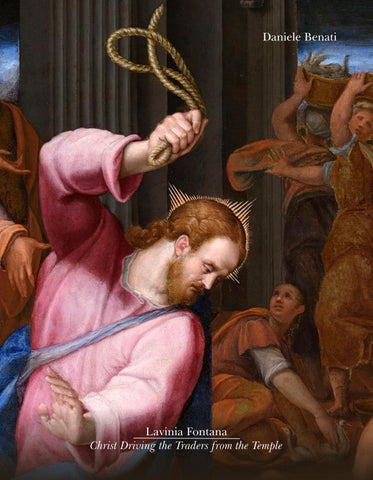
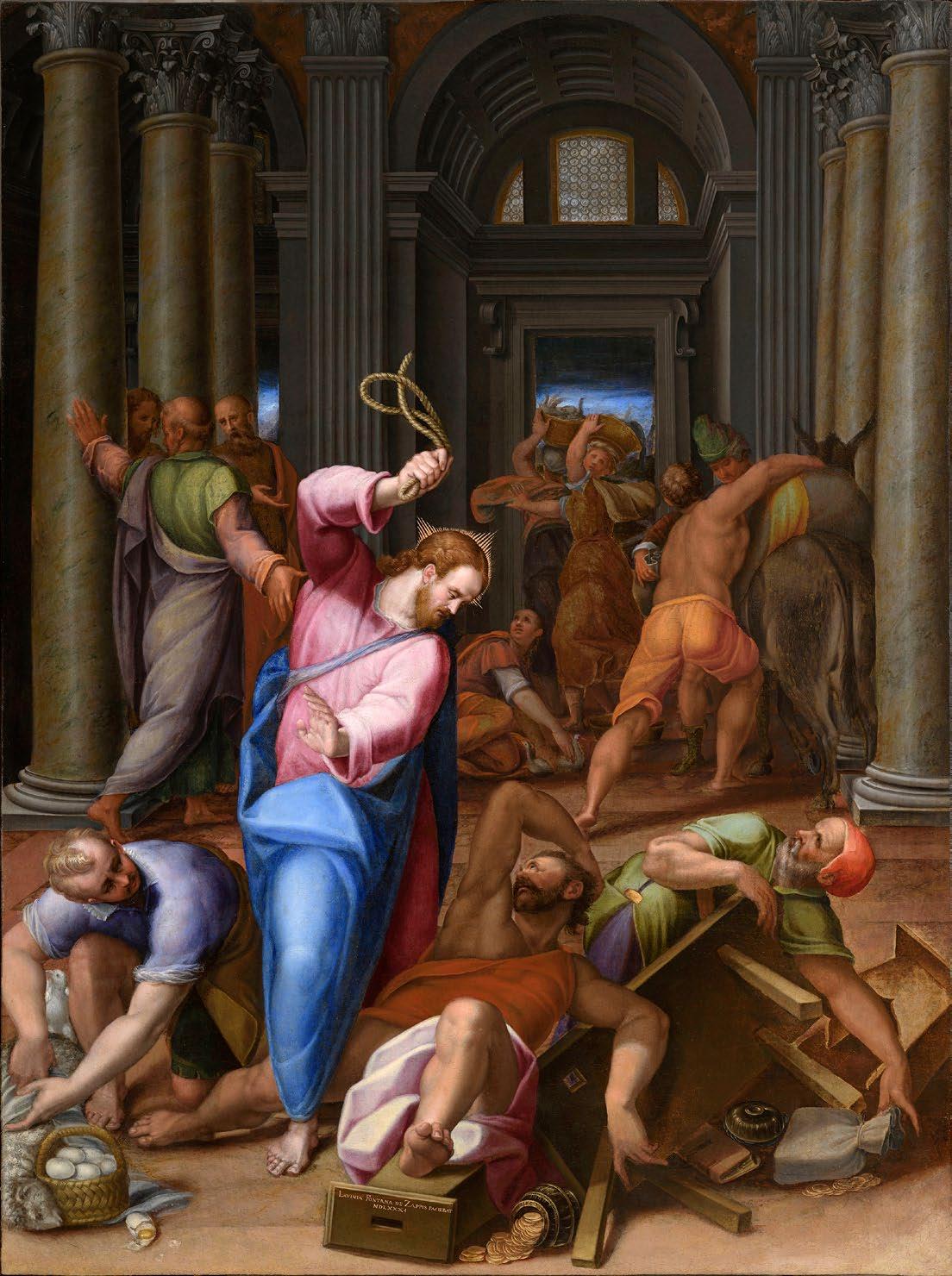
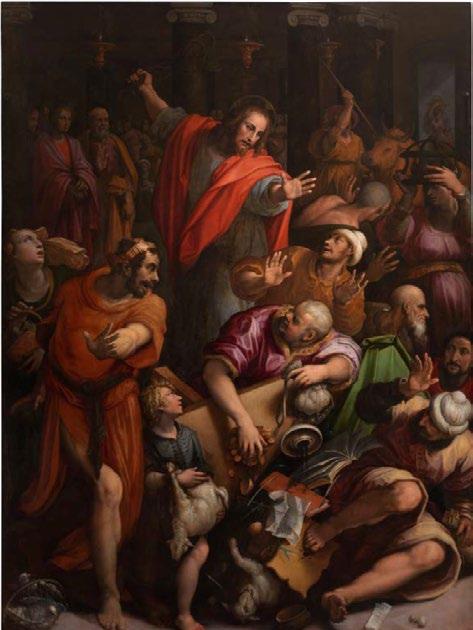
Christ Driving the Traders from the Temple Oil on canvas, 153.5 x 114 cm
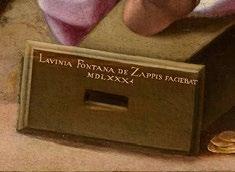
Signed and dated on the overturned stool at the bottom centre: ‘LAVINIA FONTANA DE ZAPPIS FACIEBAT / MDLXXX’
‘Trailblazer’, ‘Rule-Breaker’. This is how the recent exhibition at the National Gallery of Ireland described Lavinia Fontana in its very title, a title, of course, deliberately designed for great effect, which reflects the attention given to women artists by the men and women of the 21st century and their laborious assertion, but it does contain some truth.
Lavinia Fontana was not the first woman artist: in her own city, already at the beginning of the sixteenth century, Properzia de’ Rossi had asserted herself with great success in a still ‘masculine’ field, that of sculpture. Older than Lavinia by some twenty years, Sofonisba Anguissola arrived at the court of Philip II from her native Cremona.
Lavinia herself did take a great step forward, not a lone woman like Properzia, according to the impression given to us by Vasari’s account of the Bolognese sculptress, nor a lady of the court like Sofonisba. Lavinia was an independent artist, a self-employed entrepreneur, a woman fully integrated into the society of her time, a wife and a mother. It has often been recalled that Lavinia was the first woman artist to have her own workshop, and her marriage contract proves that she had her studio and lived from her work. This recognition in the private sphere translated into public recognition: Lavinia was the first woman artist to receive commissions for public altarpieces and to paint nudes.
This hitherto unpublished altarpiece depicting Christ Driving the Traders from the Temple adds to this known information. Here, as Professor Daniele Benati explains in the accompanying study, Lavinia was not scared to compare herself with the most famous artist of her time, Michelangelo.
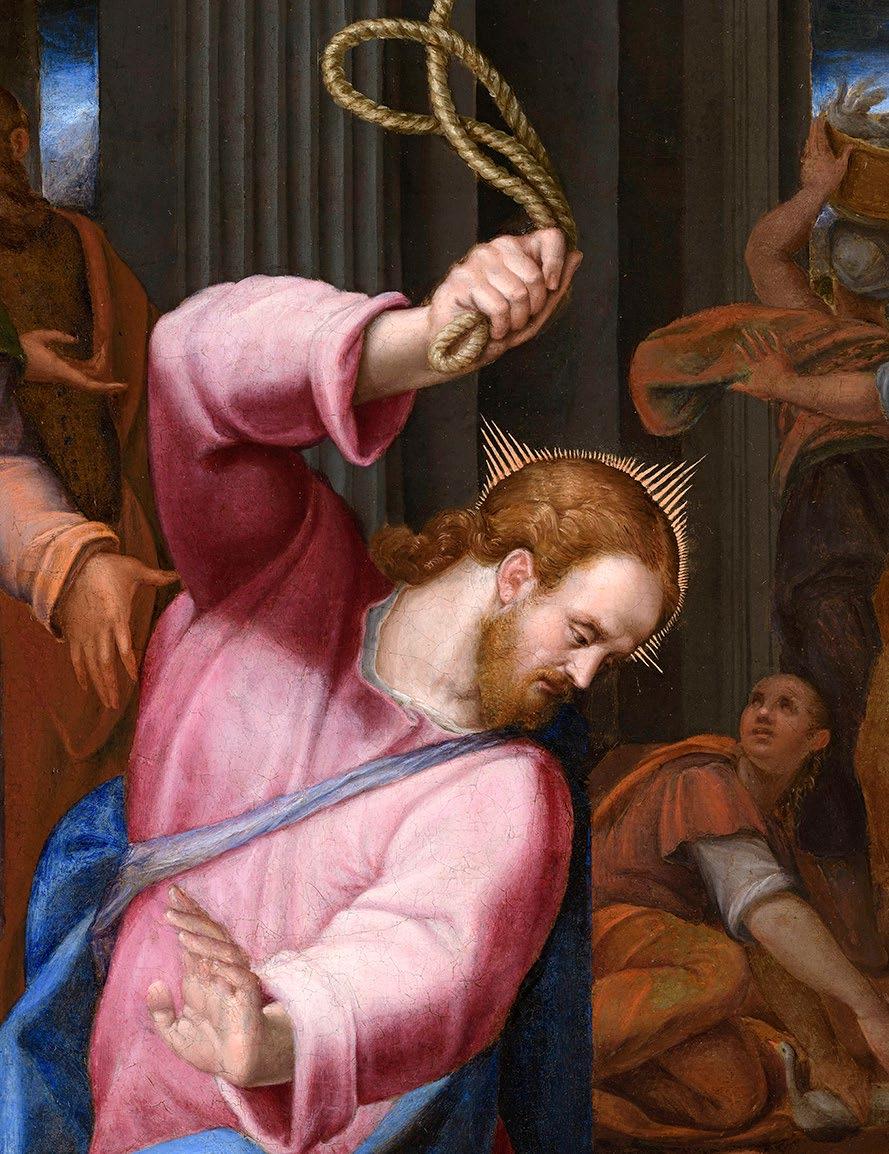
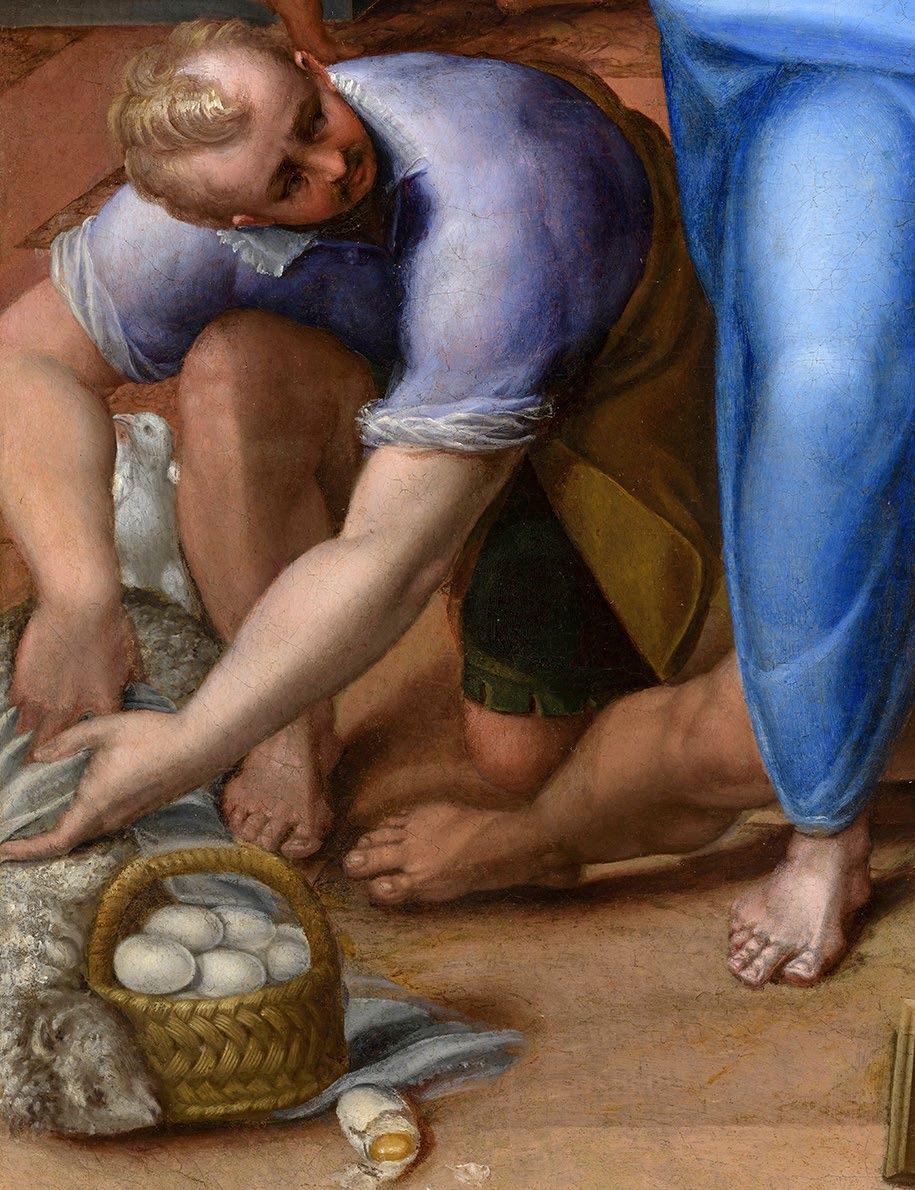
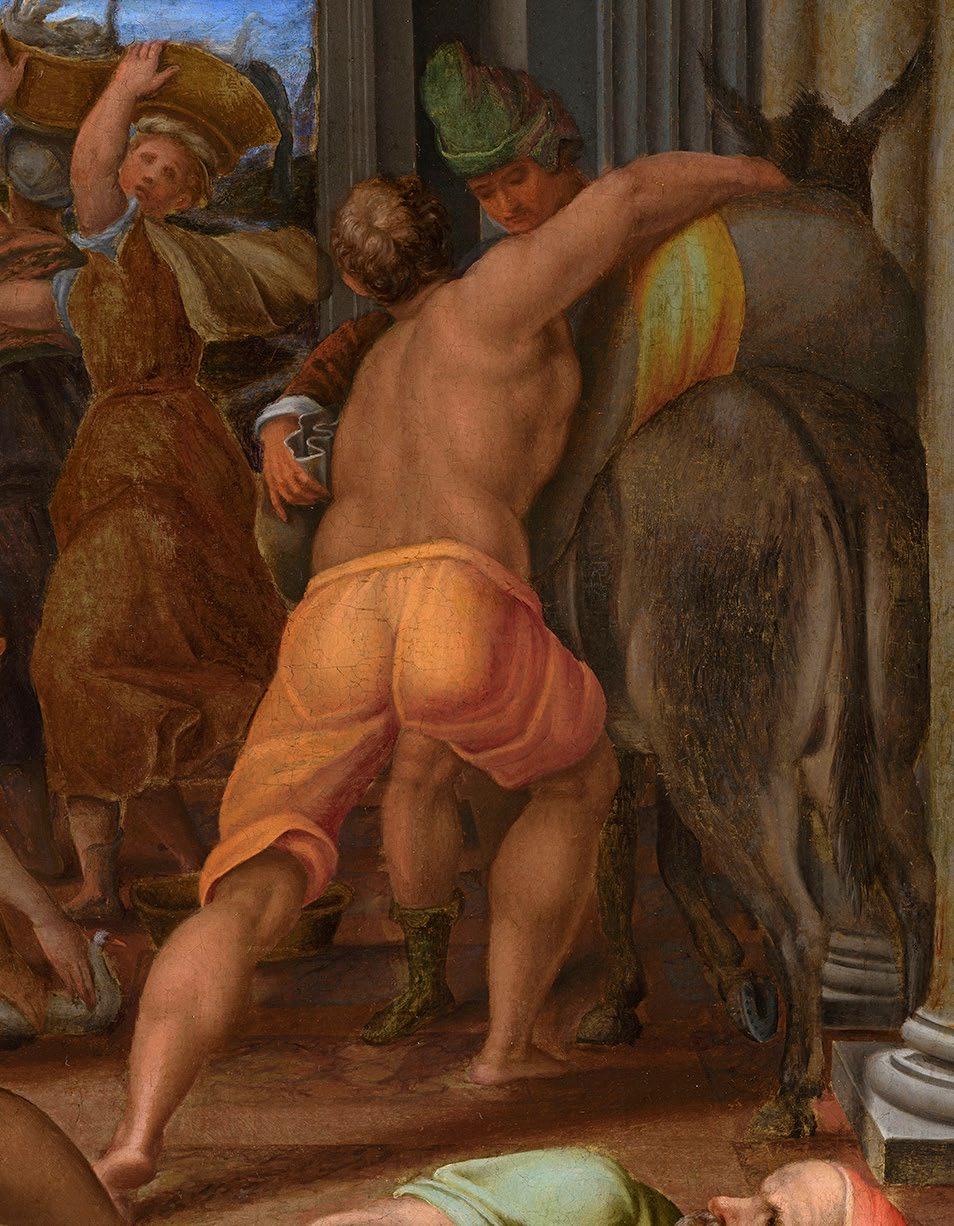
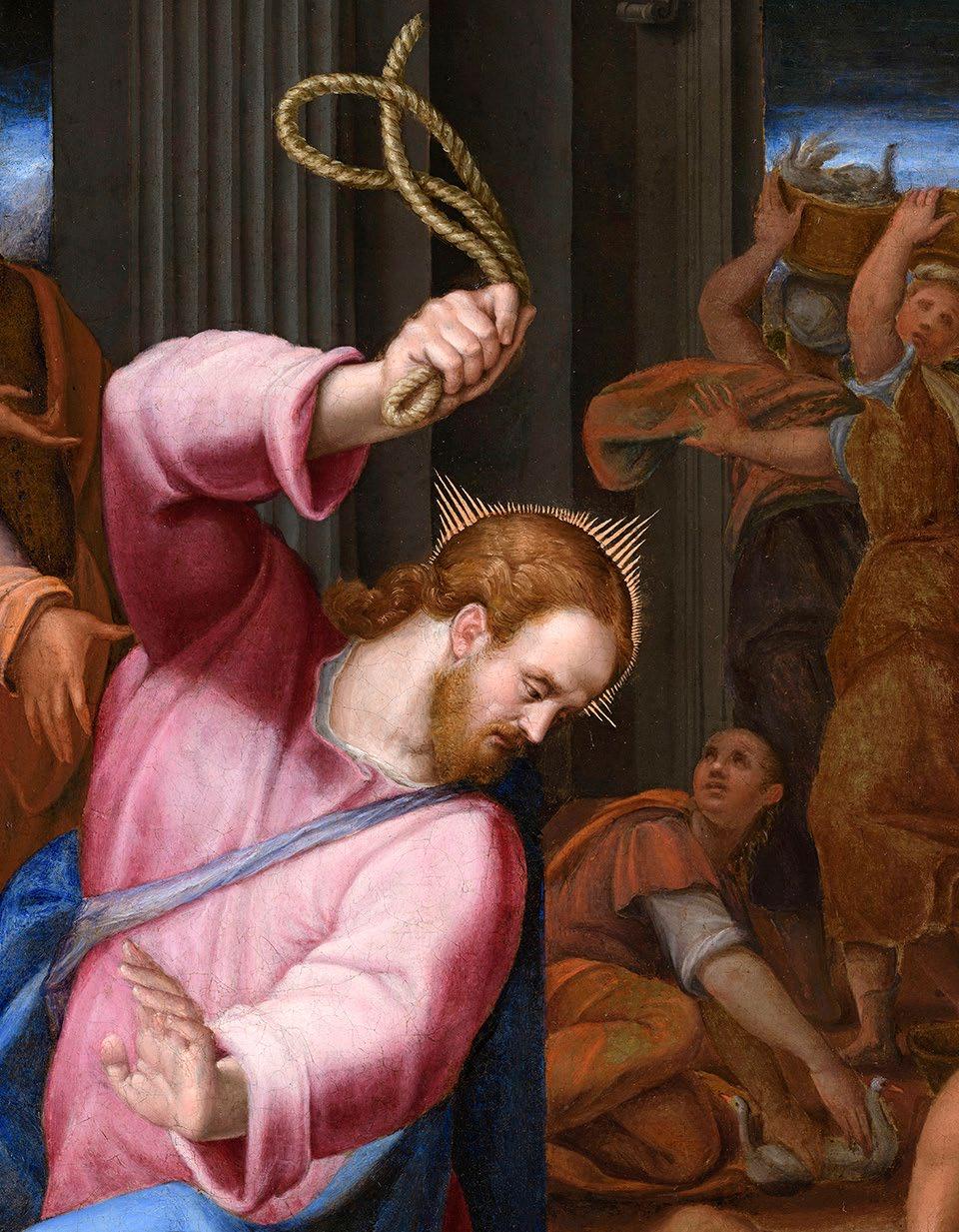
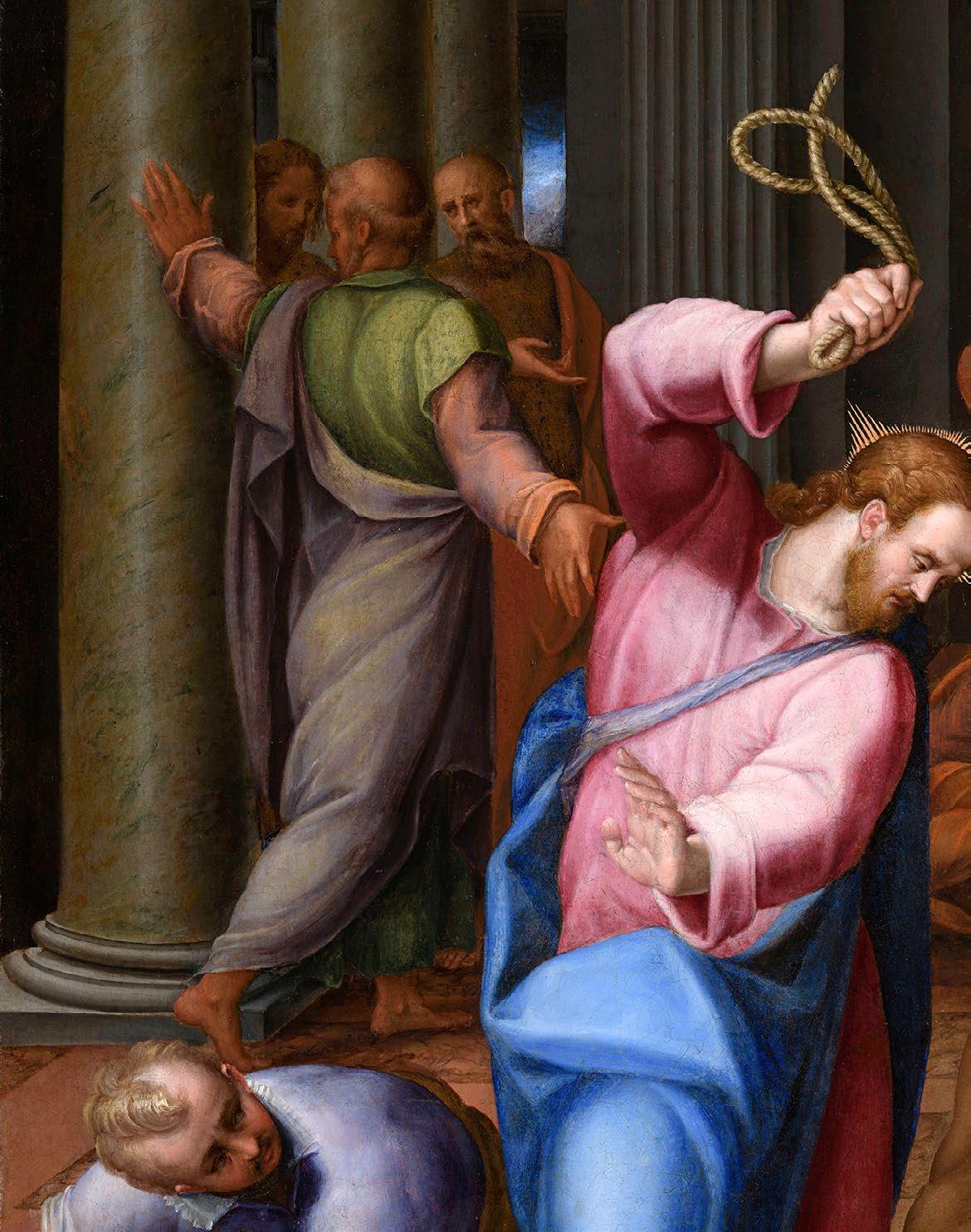
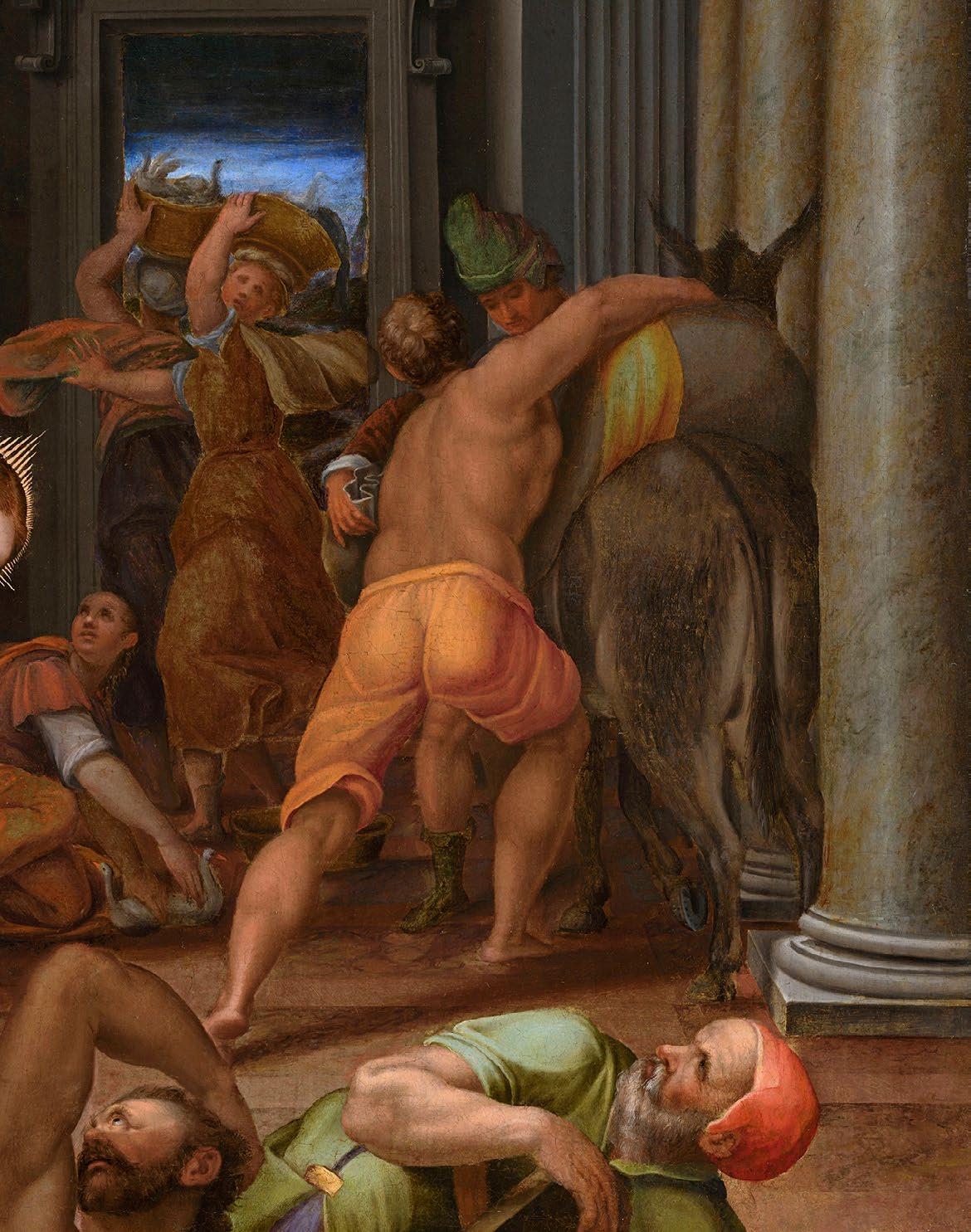
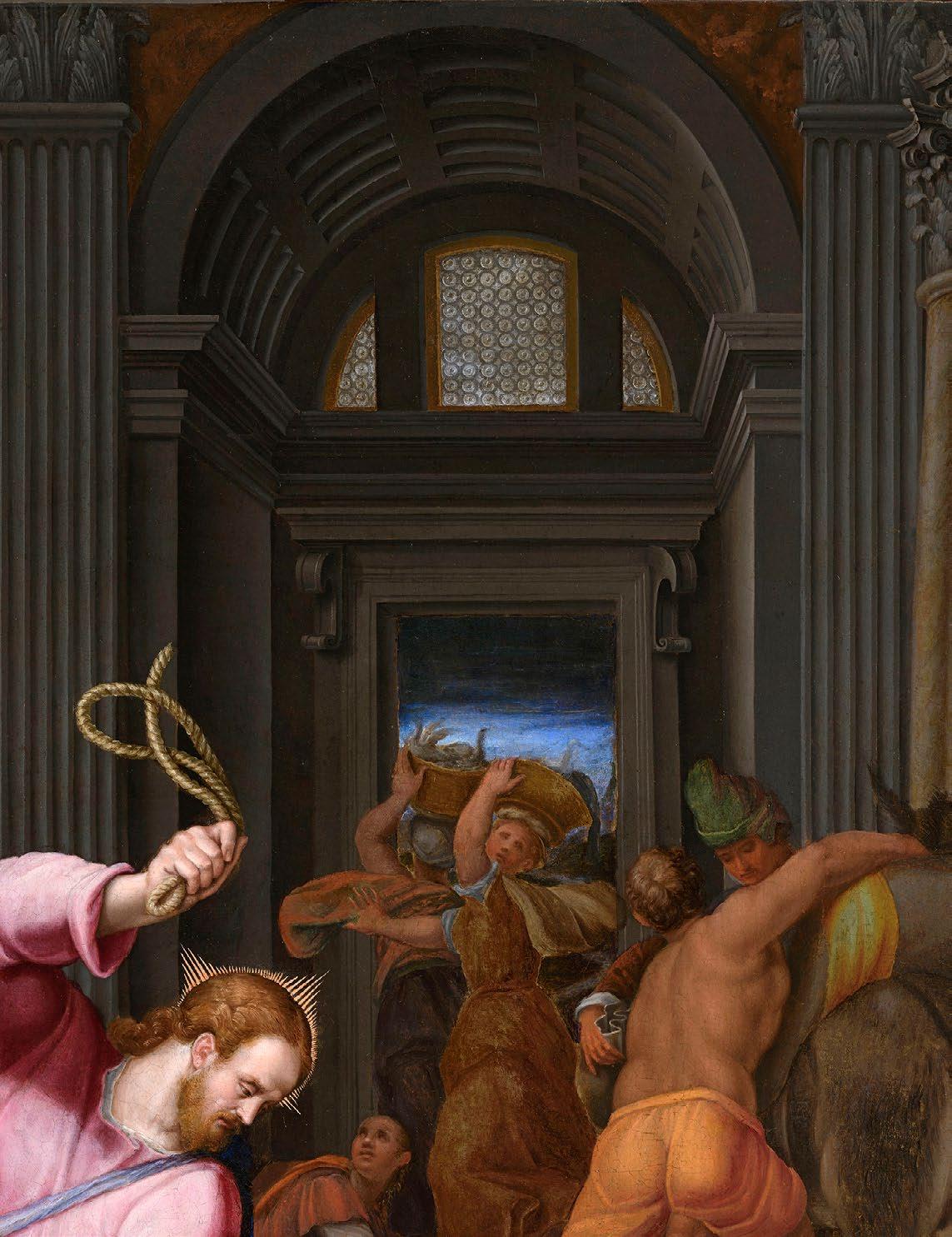
The scene is set in a temple built on a basilica footprint, the central nave of which is supported by smooth-shafted columns topped with Corinthian capitals. In the foreground, Christ uses a rope whip to strike two moneychangers, who, falling to the ground, have dropped their coins. One struggles to collect a bag of them while the other, lying on his back, cannot prevent his coins, kept in a metal jar, from escaping across the ground. On the left, a sheep- and dove-seller, intended for those wanting to make their own sacrifice at the temple, bends down to save them from the fury of Christ. In the background, fleeing merchants pour out into the atrium, trying to get to the exit with their animals and other goods, while on the left a few figures interact with each other.
The episode here represented is recounted by all four Evangelists (John 2:13-22 / Luke 19:45-48 / Mark 11:15-19 / Matthew 2:12-17), but the account richest in detail comes from John: ‘Now the Passover of the Jews was at hand, and Jesus went up to Jerusalem. And He found in the temple those who sold oxen and sheep and doves, and the money changers doing business. When He had made a whip of cords, He drove them all out of the temple, with the sheep and the oxen; and poured out the changers’ money and overturned the tables. And He said to those who sold doves, “Take these things away! Do not make My Father’s house a house of merchandise!” Then His disciples remembered that it was written, “Zeal for Your house has eaten Me up.” So the Jews answered and said to Him: ‘What sign do You show to us, since You do these things?” Jesus answered and said to them: “Destroy this temple, and in
Daniele Benati
three days I will raise it up.” Then the Jews said, ‘It has taken forty-six years to build this temple, and will You raise it up in three days?’ But He was speaking of the temple of His body. Therefore, when He had risen from the dead, His disciples remembered that He had said this to them; and they believed the Scripture and the word which Jesus had said.’
Lavinia Fontana, to whom this magnificent painting belongs not only by virtue of the signature and date 1580 inscribed on the upturned stool in the foreground, but also by that of precise stylistic references, scrupulously adheres to John’s words and gives the episode a frantic and
dramatic character, accentuated by the dynamism of the figures, portrayed in complicated and sudden foreshortenings, and by the intentional contrast with the solid architectural structure which contains them. This is an unusual tour de force for the artist, usually at ease with portraits, single figures or beautifully composed sacred conversations of which her oeuvre is full. It is easy to understand why at this time these latter subjects were considered more appropriate for a woman artist, considering that the feminine condition seemed to preclude bolder attempts in the field of history painting. In truth, Lavinia never withdrew from such a challenge, going very early on into competition with male painters, as had done the sculptress Properzia de’ Rossi before her. And, if the example of her
father Prospero pushed her in this direction, Lavinia was able to gradually free herself from his guiding hand to confront ever more ambitious and complex models.
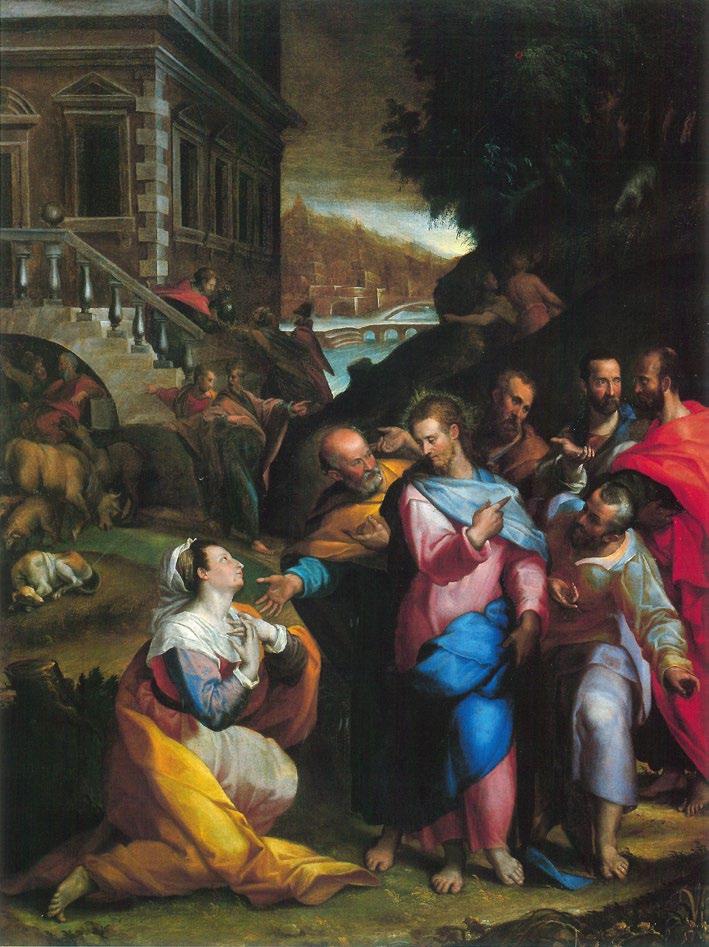
The painting in question specifically lends itself to comparison with a similar work by the artist, the Christ and the Canaanite Woman in a private collection,1 quite similar in terms of dimensions and composition, but surely of an earlier date, seeing as she signed herself ‘PROSPERI FONTANA FILIA’, without mentioning, as in our case, her second surname which she acquired in 1577 upon her marriage to the imolese Paolo Zappi. If in Christ and the Canaanite Woman there are strong
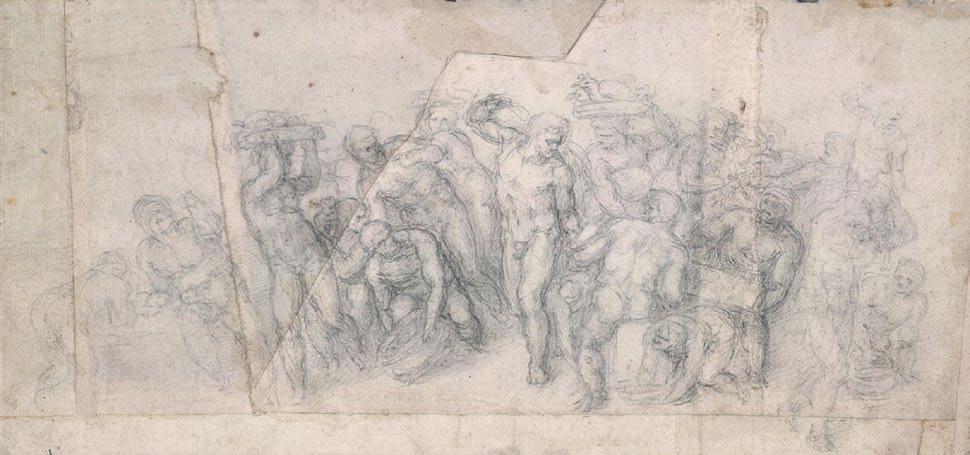
references to Prospero Fontana, not disjointed from a strong interest in the ways of the Bolognese Orazio Samacchini, the present Christ Driving the Traders from the Temple surprises with its recognition of an even more noble model, that is the creation by Michelangelo Buonarotti in around 1540 of some drawings2 and a probable ‘cartoon’,3 now lost but known
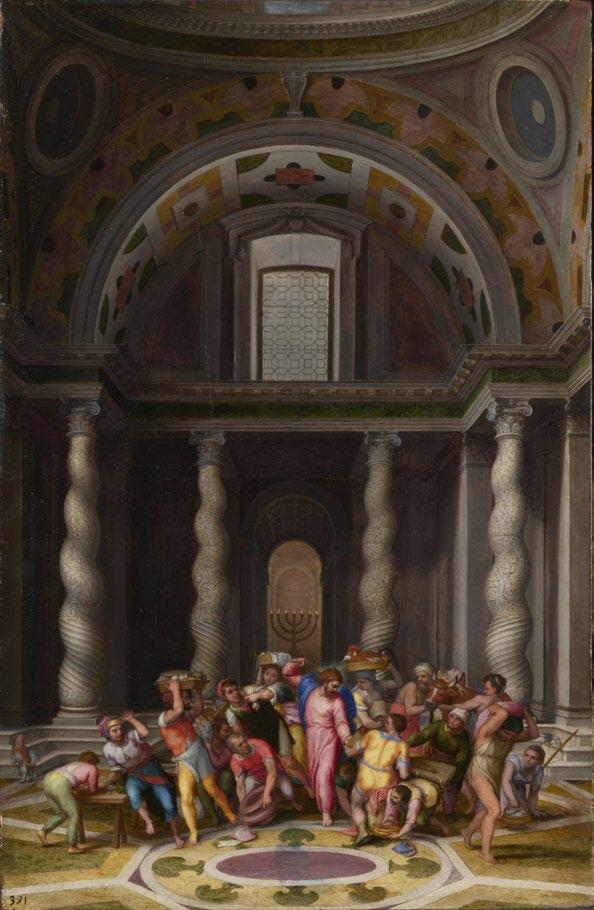
through a miniature copy made by Marcello Venusti (London, National Gallery).4 In fact, not only does the serpentine pose of Christ, in the act of turning on himself as he brandishes the rope whip with great force, refer back to a Michelangelesque composition, but so does that of the
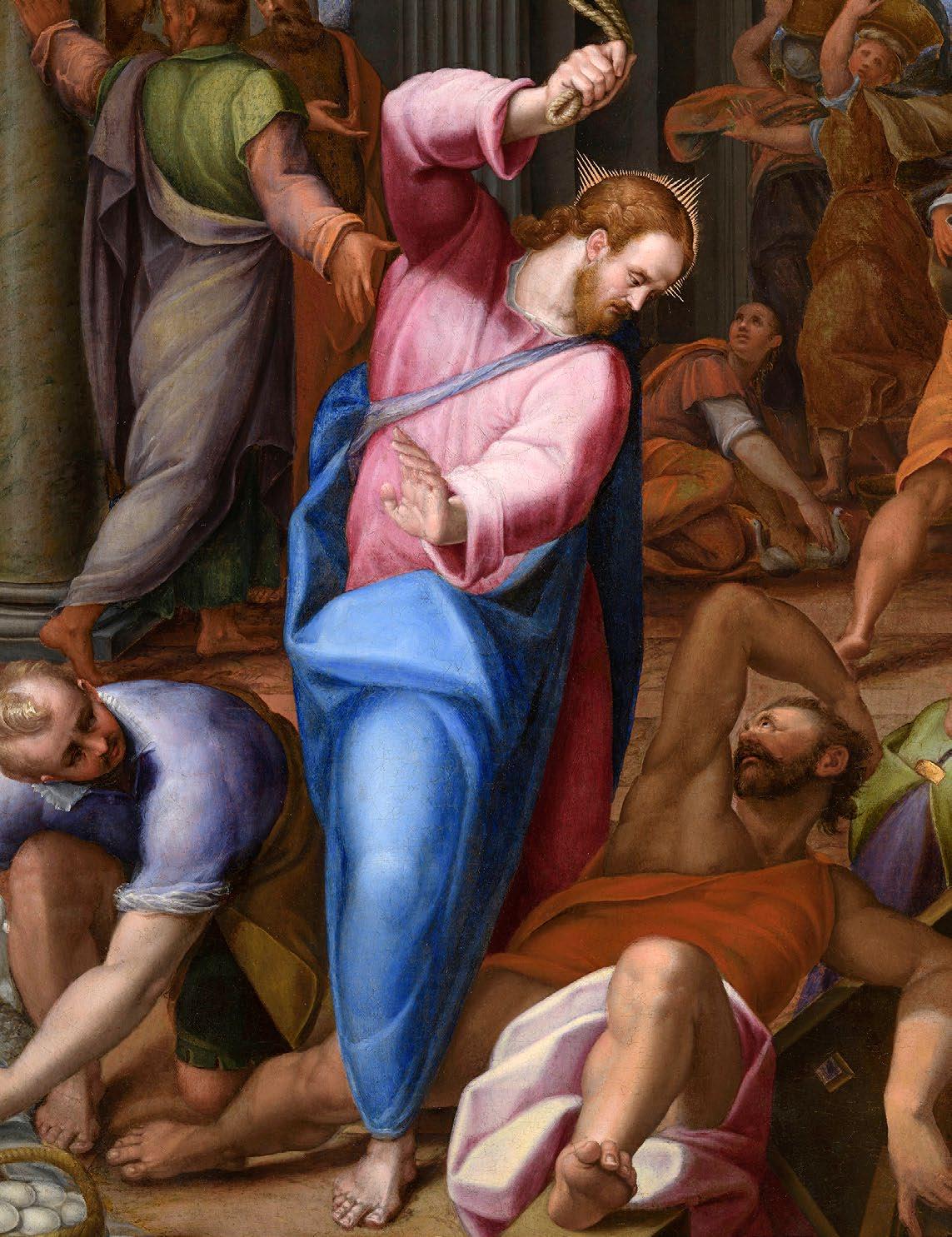
supine figure on the ground to the right, intent on recovering his own belongings.
It is rather difficult to know how exactly Lavinia came to be familiar with Michelangelo’s inventions, but the latter’s extraordinary fame would justify a vast diffusion of drawings and copies which could also have reached Bologna, perhaps through the friendship between Prospero Fontana and Giorgio Vasari, his great admirer. It should be kept in mind that studies by Michelangelo for a Driving of the Traders from the Temple, even if they were never used for a finished work and remained confined to paper, were well known. In Florence, two artists closely linked with Vasari knew of them: Giovanni Stradano, who reworked them in the
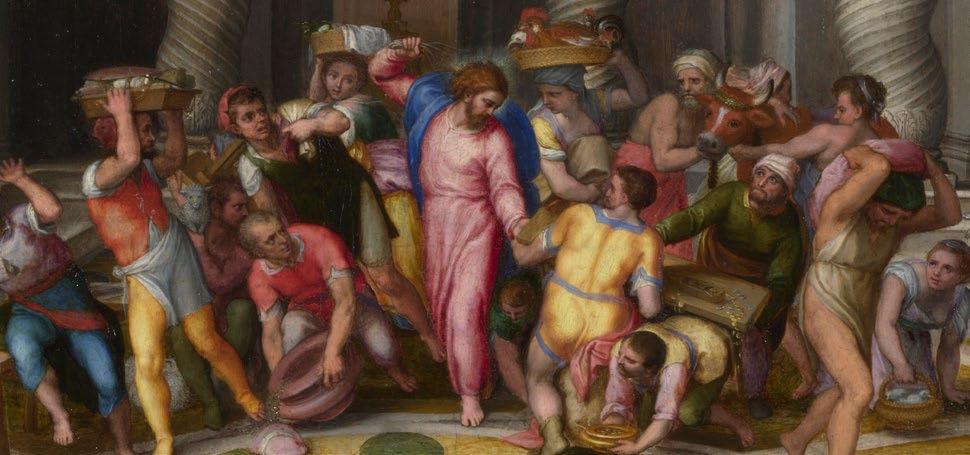
altarpiece of Santo Spirito dated 1572,5 and Giovanni Battista Naldini, who painted the same subject over the course of the eighth decade of the century for an unknown destination but now in the collection of the Conti Risolo in the Comune di Specchia in the province of Lecce.6
As far as Lavinia is concerned, she limited herself to reusing the two aforementioned characters, concentrating mainly on the clarity of the sacred narrative. The arrangement of the figures in the scaled groups in the distance contributes to this: from the foreground, in which Jesus and the unfortunate objects of his ire are positioned, to the background, with the mass of fugitives running towards the exit, passing through an
intermediate space in which Christ’s disciples are intent on explaining to the Jews the significance of what is happening. Unlike what Venusti did in his picture, the decision to place the point of escape slightly to the right confers a certain monumentality to the architecture and allows the
artist to exhibit her skills in perspective, a field studied deeply by artists at the time. This is also evident in the complicit display of foreshortening not only in the prone bodies, captured in difficult positions, but also in the overturned stools and table in the foreground.
The result is nevertheless marked by exemplary narrative effectiveness, particularly evident if this canvas is compared to the
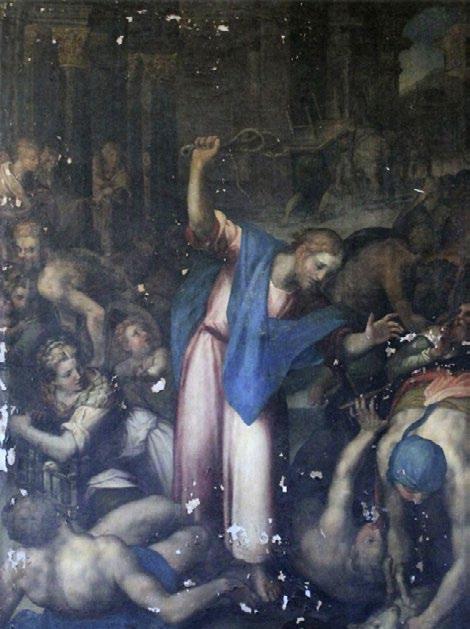
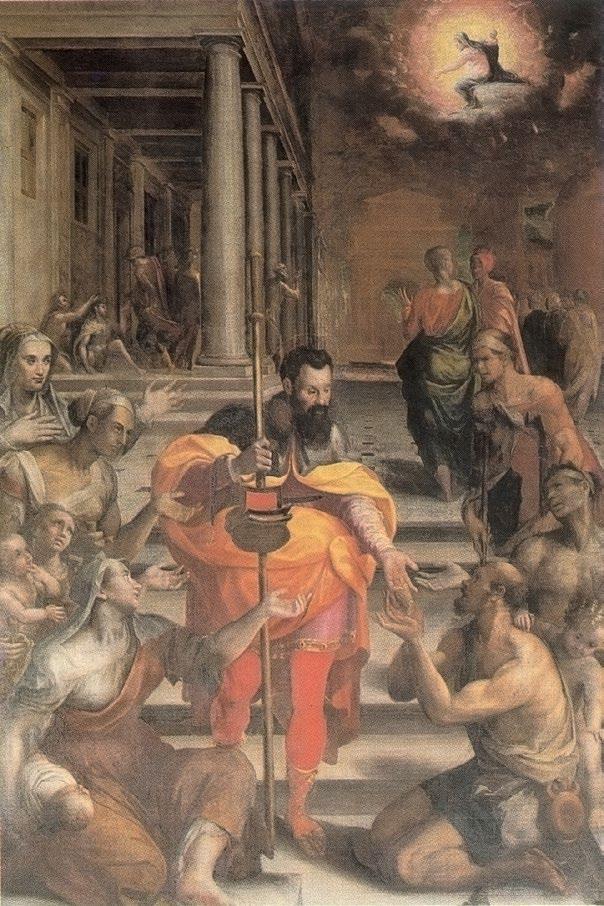
aforementioned paintings by Stradano and Naldini, rather more compromised in mannerist logic. These were also the years in which Prospero Fontana sought a new effectiveness for storytelling, as demonstrated by the almost ‘heraldic’ disposition of the figures in the Alms of Saint Alexis, painted in 1576 for the Orsi chapel in San Giacomo Maggiore in Bologna.7 Lavinia was on the same path, aiming to overcome the excesses of Mannerism, without undermining its principles, acting as it were from the inside. In this way, she seems to have felt the same need which in those years pushed the three Carracci to propose a personal solution to the problem of images, through a dialogue with the ‘natural’ which for now still seems foreign to Lavinia’s culture and to her most deeply rooted convictions.
Notes
1 Oil on canvas, 123 x 93 cm. See M. T. CANTARO, Lavinia Fontana bolognese “pittora singolare”, Milan-Rome, Jandi Sapi (ed.), 1989, pp. 68-69, n. 10, which shows the acquisition of the painting by Cardinal Ferdinando de’ Medici in Rome on 19 August 1579.
2 Oxford, Ashmolean Museum, inv. 1846.74; London, British Museum, inv. 1860,0616.2/2, 1860,0616.2/1 and 1860,0616.2. Cfr. J. WILDE, Italian Drawings in the British Museum. Michelangelo and his Studio, London, British Museum Press, 1953, nos 76-78. The destination of such works, sometimes put into relation with the decoration of the Pauline Chapel in the Vatican, (see DE TOLNAY, Michelangelo, 5 vols, Princeton, NJ, Princeton Univ. Press, 1943-1960, cit., V, pp. 77- 78) or with a drawing destined for Vittoria Colonna (H. CHAPMAN, Michelangelo Drawings. Closer to the Master, London, 2005, p. 266), remains problematic.
3 J. WILDE, ‘Cartonetti by Michelangelo’, in The Burlington Magazine, 101 (1959), p. 381.
4 Inv. 1194; oil on wood, 60 x 38 cm. See C. GOULD, National Gallery Catalogues. The Sixteenth-Century Italian Schools, London, 1975, pp. 154-155; M. MARONGIU, ‘Michelangelo: amici, allievi, collaboratori. Il caso di Marcello Venusti’, in Predella, 54 (2023), p. 19, fig. 10.
5 A. BARONI VANNUCCI, Jan Van Der Straet detto Giovanni Stradano, flandrus Pictor et inventor, Milano, Jandi Sapi (ed.), 1997, pp. 44-45, 133-134, entry 32, 198, 115-116; D. RAPINO, in Restituzioni 2016. Tesori d’arte restaurati, exh. cat. curated by C. Bertelli, G. Bonsanti (Milan, Gallerie d’Italia, 1 April – 17 July 2016), Venice, Marsilio, 2016, pp. 255-262, n. 36.
6 M. GABALLO, G. PERDICCHIA, ‘Due preziosi antichi dipinti per il patrimonio di Specchia’, in Fondazione Terra d’Otranto, 23 Decembre 2023 (https://www.fondazioneterradotranto. it/2023/12/23/due-preziosi-antichi-dipinti-per-il-patrimonio-di- specchia/); G. MORCIANO, ‘Su una nuova “Cacciata dei mercanti” di Giovanni Battista Naldini’, in Storia dell’arte in tempo reale (https://www.storiadellarterivista.it/blog/2024/07/05/una-nuova-cacciata-dei-mercantidi-giovanni-battista-naldini/).
7 G. DANIELI, Prospero Fontana “Pictor Bononiensis” (1509-1597). Catalogo ragionato dei dipinti, Rome, De Luca Editori d’Arte, 2022, p. 181, n. D82